EP2121012B1 - Peptides derived from the major allergen of ragweed (ambrosia artemisiifolia) and uses thereof - Google Patents
Peptides derived from the major allergen of ragweed (ambrosia artemisiifolia) and uses thereof Download PDFInfo
- Publication number
- EP2121012B1 EP2121012B1 EP08715749.1A EP08715749A EP2121012B1 EP 2121012 B1 EP2121012 B1 EP 2121012B1 EP 08715749 A EP08715749 A EP 08715749A EP 2121012 B1 EP2121012 B1 EP 2121012B1
- Authority
- EP
- European Patent Office
- Prior art keywords
- seq
- amb
- asp
- der
- prt
- Prior art date
- Legal status (The legal status is an assumption and is not a legal conclusion. Google has not performed a legal analysis and makes no representation as to the accuracy of the status listed.)
- Active
Links
Images






Classifications
-
- A—HUMAN NECESSITIES
- A61—MEDICAL OR VETERINARY SCIENCE; HYGIENE
- A61K—PREPARATIONS FOR MEDICAL, DENTAL OR TOILETRY PURPOSES
- A61K39/00—Medicinal preparations containing antigens or antibodies
- A61K39/35—Allergens
- A61K39/36—Allergens from pollen
-
- A—HUMAN NECESSITIES
- A61—MEDICAL OR VETERINARY SCIENCE; HYGIENE
- A61P—SPECIFIC THERAPEUTIC ACTIVITY OF CHEMICAL COMPOUNDS OR MEDICINAL PREPARATIONS
- A61P37/00—Drugs for immunological or allergic disorders
-
- A—HUMAN NECESSITIES
- A61—MEDICAL OR VETERINARY SCIENCE; HYGIENE
- A61P—SPECIFIC THERAPEUTIC ACTIVITY OF CHEMICAL COMPOUNDS OR MEDICINAL PREPARATIONS
- A61P37/00—Drugs for immunological or allergic disorders
- A61P37/02—Immunomodulators
- A61P37/04—Immunostimulants
-
- A—HUMAN NECESSITIES
- A61—MEDICAL OR VETERINARY SCIENCE; HYGIENE
- A61P—SPECIFIC THERAPEUTIC ACTIVITY OF CHEMICAL COMPOUNDS OR MEDICINAL PREPARATIONS
- A61P37/00—Drugs for immunological or allergic disorders
- A61P37/08—Antiallergic agents
-
- C—CHEMISTRY; METALLURGY
- C07—ORGANIC CHEMISTRY
- C07K—PEPTIDES
- C07K14/00—Peptides having more than 20 amino acids; Gastrins; Somatostatins; Melanotropins; Derivatives thereof
- C07K14/415—Peptides having more than 20 amino acids; Gastrins; Somatostatins; Melanotropins; Derivatives thereof from plants
-
- G—PHYSICS
- G01—MEASURING; TESTING
- G01N—INVESTIGATING OR ANALYSING MATERIALS BY DETERMINING THEIR CHEMICAL OR PHYSICAL PROPERTIES
- G01N33/00—Investigating or analysing materials by specific methods not covered by groups G01N1/00 - G01N31/00
- G01N33/48—Biological material, e.g. blood, urine; Haemocytometers
- G01N33/50—Chemical analysis of biological material, e.g. blood, urine; Testing involving biospecific ligand binding methods; Immunological testing
- G01N33/68—Chemical analysis of biological material, e.g. blood, urine; Testing involving biospecific ligand binding methods; Immunological testing involving proteins, peptides or amino acids
- G01N33/6893—Chemical analysis of biological material, e.g. blood, urine; Testing involving biospecific ligand binding methods; Immunological testing involving proteins, peptides or amino acids related to diseases not provided for elsewhere
-
- G—PHYSICS
- G01—MEASURING; TESTING
- G01N—INVESTIGATING OR ANALYSING MATERIALS BY DETERMINING THEIR CHEMICAL OR PHYSICAL PROPERTIES
- G01N2800/00—Detection or diagnosis of diseases
- G01N2800/24—Immunology or allergic disorders
Definitions
- the present invention relates to Amb a 1 derived peptides.
- Ragweed Ambrosia artemisiifolia
- mugwort Artemisia vulgaris
- Pollen of mugwort is one of the main causes of allergic reactions in late summer and autumn in Europe and affects about 10-14% of the patients suffering from pollinosis.
- Ragweed pollen represents the major source of allergenic protein in the United States, with a prevalence of about 50% in atopic27.10 individuals.
- ragweed allergy is now rapidly increasing particularly in certain areas in France, Italy, Austria, Hungary, Weg, and Bulgaria.
- Amb a 1 the major allergen of ragweed and Art v 1, the major allergen from mugwort, respectively, are unrelated proteins.
- Amb a 1 is an acidic 38 kDa non-glycosylated protein. Natural Amb a 1 undergoes proteolysis during purification and it is cleaved into two chains designated alpha and beta chain. The 26-kDa alpha-chain was reported to associate non-covalently with the 12-kDa beta chain ( King et al. Immunochem 11:83-92, 1974 ). The Amb a 1 two-chain form seems to be immunologically indistinguishable from the full-length molecule ( King et al. Arch Biochem Biophys 212:127-135, 1981 ).
- Natural Amb a 1 (nAmb a 1) from ragweed was the first described and isolated allergen ( King et al. Biochem 3:458-468, 1964 ).
- the cDNA coding for Amb a 1 was isolated from ragweed pollen in 1991 by Rafnar et al. (J. Biol. Chem. 266:1229-1236 ). But so far, a method to express and purify large amounts of active and correctly folded recombinant Amb a 1 (rAmb a 1) has not been reported.
- WO 96/13589 relates to isolated peptides which are derived from Amb a 1 and comprise at least one T-cell epitope.
- WO 99/34826 relates to methods and means for desensitizing patients by administering a peptide derived from an allergen, which peptide is capable of triggering a T-cell response in an individual.
- the present invention relates to vaccine formulations, peptides, fusion proteins, nucleic acid molecules, vectors and uses thereof as defined in the claims.
- Peptides derived from the ragweed pollen allergen Amb a 1, in particular from Amb a 1.3 may consist of an amino acid sequence selected from the group consisting of SEQ ID No. 12, SEQ ID No. 20, SEQ ID No. 27, SEQ ID No. 28, SEQ ID No. 30, SEQ ID No. 31, SEQ ID No. 33, SEQ ID No. 36, SEQ ID No. 37, SEQ ID No. 38, SEQ ID No. 39, SEQ ID No. 41, SEQ ID No. 42, SEQ ID No. 44, SEQ ID No. 46, SEQ ID No. 47, SEQ ID No. 48, SEQ ID No. 50, SEQ ID No. 51, SEQ ID No. 52, SEQ ID No. 53, SEQ ID No.
- SEQ ID No. 101 SEQ ID No. 102, SEQ ID No. 107, SEQ ID No. 108, SEQ ID No. 109, SEQ ID No. 110, SEQ ID No. 111, SEQ ID No. 112, SEQ ID No. 114, SEQ ID No. 115, SEQ ID No. 118, SEQ ID No. 119, SEQ ID No. 120, SEQ ID No. 121, SEQ ID No. 122, SEQ ID No. 123, SEQ ID No. 124, SEQ ID No. 125, SEQ ID No. 126, SEQ ID No. 127, SEQ ID No. 128, SEQ ID No. 129, SEQ ID No. 130, SEQ ID No.
- SEQ ID No. 132 SEQ ID No. 133, SEQ ID No. 134, SEQ ID No. 135, SEQ ID No. 136, SEQ ID No. 137, SEQ ID No. 138 and SEQ ID No. 139.
- SEQ ID No. 67 SEQ ID No. 68, SEQ ID No. 69, SEQ ID No. 77, SEQ ID No. 78, SEQ ID No. 79, SEQ ID No. 80, SEQ ID No. 81, SEQ ID No. 83, SEQ ID No. 86, SEQ ID No. 87, SEQ ID No. 88, SEQ ID No. 89, SEQ ID No. 90, SEQ ID No. 91, SEQ ID No. 93, SEQ ID No. 94, SEQ ID No. 96, SEQ ID No. 97, SEQ ID No. 98, SEQ ID No. 99, SEQ ID No. 100, SEQ ID No. 101, SEQ ID No. 102, SEQ ID No.
- SEQ ID No. 108 SEQ ID No. 109, SEQ ID No. 110, SEQ ID No. 111, SEQ ID No. 112, SEQ ID No. 114, SEQ ID No. 115, SEQ ID No. 118, SEQ ID No. 119, SEQ ID No. 120, SEQ ID No. 121, SEQ ID No. 122, SEQ ID No. 123, SEQ ID No. 124, SEQ ID No. 125, SEQ ID No. 126, SEQ ID No. 127, SEQ ID No. 128, SEQ ID No. 129, SEQ ID No. 130, SEQ ID No. 131, SEQ ID No. 132, SEQ ID No. 133, SEQ ID No.
- SEQ ID No. 135, SEQ ID No. 136, SEQ ID No. 137, SEQ ID No. 138 and SEQ ID No. 139 show reactivity with T cells isolated from allergic individuals and, consequently, may be employed in the production of vaccines, especially vaccines for allergies caused by ragweed pollen allergens and allergies cross-reacting to ragweed pollen allergens.
- the peptides having SEQ ID No.52, SEQ ID No. 68, SEQ ID No. 86, SEQ ID No. 91 and SEQ ID No. 126 to SEQ ID No. 139 show high T cell reactivity with samples obtained from individuals suffering from ragweed pollen allergy.
- a further advantage of the peptides of the present invention is that all of them lack IgE binding activity. Therefore, molecules comprising these peptides do not provoke allergic reactions (e.g. increased release of histamine) when administered to an individual.
- peptides derived from allergens do not bind IgE specific for Amb a 1 or bind such IgE to a substantially lesser extent (e.g. at least 100 fold less and more preferably, at least 1000 fold less binding) than the corresponding purified native Amb a 1 or the recombinantly produced beta chain of Amb a 1. If a peptide of the invention is to be used as a diagnostic reagent, it is not necessary that the peptide or protein has reduced IgE binding activity compared to the native Amb a 1 allergen. IgE binding activity of peptides can be determined by, for example, an enzyme linked immunosorbent assay (ELISA) using, for example, sera obtained from an individual (i.e.
- ELISA enzyme linked immunosorbent assay
- an allergic individual that has been previously exposed to the native Amb a 1.
- a peptide to be tested is coated onto wells of a microtiter plate.
- antibody solution consisting of the serum or plasma of an allergic individual who has been exposed to the peptide being tested or the protein from which it was derived is incubated in the wells.
- the plasma is generally depleted of IgG before incubation. However, the depletion is not necessary if highly specific anti IgE-antibodies are used.
- allergic individuals who have not undergone specific immunotherapy have in some cases almost no detectable IgG antibodies specific for the allergen in question.
- a labelled secondary antibody is added to the wells and incubated.
- the amount of IgE binding is then quantified and compared to the amount of IgE bound by a purified native Amb a 1 protein.
- the binding activity of a peptide can be determined by Western blot analysis. For example, a peptide to be tested is run on a polyacrylamide gel using SDS-PAGE. The peptide is then transferred to nitrocellulose and subsequently incubated with sera from an allergic subject. After incubation with the labelled secondary antibody, the amount of IgE bound is then determined and quantified.
- Another assay which can be used to determine IgE binding activity of a peptide is a competition ELISA assay. Briefly, an IgE antibody pool is generated by combining plasma or serum from ragweed pollen allergic individuals that have been shown by direct ELISA to have IgE reactive with native Amb a 1. This pool is used in ELISA competition assays to compare IgE binding to native Amb a 1 to the peptide tested. IgE binding for the native Amb a 1 protein and the peptide being tested is determined and quantified.
- the peptides of the present invention do preferably not result in the release of mediators (e.g. histamines) from mast cells or basophils.
- mediators e.g. histamines
- a histamine release assay can be performed using standard reagents and protocols. Briefly, a buffered solution of a peptide to be tested is combined with an equal volume of whole heparinized blood from an allergic subject. After mixing and incubation, the cells are pelleted and the supernatants are processed and analyzed using, e.g., a radioimmunoassay to determine the amount of histamine released.
- the molecule described herein may comprise in any combination more than one peptides of the present invention. These peptides may be conjugated chemically or fused by recombinant technology to each other. Such a molecule may comprise at least two, three, four, five, seven, ten, 15, 20, peptides.
- the peptides of the invention can be produced by recombinant DNA techniques in a host cell transformed with a nucleic acid having a sequence encoding such peptide.
- the isolated peptides of the invention can also be produced by chemical synthesis. Of course it is also possible to produce the peptides by chemical or enzymatic cleavage of the protein allergen.
- a peptide When a peptide is produced by recombinant techniques, host cells transformed with a nucleic acid of the invention (or the functional equivalent of the nucleic acid having a sequence encoding the peptide (or functional equivalent of the peptide) are cultured in a medium suitable for the cells.
- Peptides can be purified from cell culture medium, host cells or both using techniques known in the art for purifying peptides and proteins including ion-exchange chromatography, gel filtration chromatography, ultrafiltration, electrophoresis or immunopurification with antibodies specific for the peptide.
- Isolated peptides of the invention are substantially free of cellular material or culture medium when produced by recombinant DNA techniques or substantially free of chemical precursors or other chemicals when synthesized chemically or free of other materials and reagents when produced by chemical or enzymatic cleavage.
- the peptides described herein may also be modified by amino acid substitution, deletion or addition. Therefore, these peptides may comprise at least 7 amino acid residues of the amino acid sequences SEQ ID No. 1 to 139. Peptides may have more than 12 amino acid residues, whereby these additional residues may be derived from the native Amb a 1 molecule and being found adjacent to the peptide in the native Amb a 1 molecule, random amino acids or other peptides or proteins.
- these modified peptides exhibit similar or even identical properties as the unmodified peptides. In particular the immunogenic properties have to be substantially identical. This means that antibodies directed to these modified peptides are also able to bind to peptides having amino acid sequences SEQ ID No. 1 to 139.
- peptide refers to an amino acid sequence having fewer amino acid residues than the entire amino acid sequence of the protein from which the peptide was derived.
- peptide also refers to any functional equivalents or variants of a peptide or to any fragments or portions of a peptide.
- “Functional equivalents" of a peptide include peptides having the same or enhanced ability to bind MHC, peptides capable of stimulating the same T cell subpopulations, peptides having the same or increased ability to induce T cell responses such as stimulation (proliferation or cytokine secretion), peptides having at least the same level of reduced IgE binding, and peptides which elicit at least the same minimal level of IgE synthesis stimulating activity as the peptides directly derived from Amb a 1.
- Minimal IgE stimulating activity refers to IgE synthesis stimulating activity that is less than the amount of IgE production elicited by a purified native ragweed pollen allergen.
- the peptides described herein may consist of 6 to 50, preferably 7 to 45, more preferably 8 to 40, even more preferably 9 to 35, in particular 10 to 30, amino acid residues.
- “Functional equivalents" of peptides may further comprise at the C- and/or N-terminus of said peptides at least one further amino acid residue, which may serve as a linking group (e.g. cysteine) or which may can be found adjacent to the peptide in wild-type Amb a 1.
- variant refers to an amino acid sequence that differs by one or more amino acid residues from another, usually related polypeptide.
- the variant may have "conservative" changes, wherein a substituted amino acid has similar structural or chemical properties.
- conservative amino acid substitutions refer to the interchangeability of residues having similar side chains.
- a group of amino acids having aliphatic side chains is glycine, alanine, valine, leucine, and isoleucine; a group of amino acids having aliphatic-hydroxyl side chains is serine and threonine; a group of amino acids having amide-containing side chains is asparagine and glutamine; a group of amino acids having aromatic side chains is phenylalanine, tyrosine, and tryptophan; a group of amino acids having basic side chains is lysine, arginine, and histidine; and a group of amino acids having sulfur-containing side chains is cysteine and methionine.
- Preferred conservative amino acids substitution groups are: valine-leucine-isoleucine, phenylalanine-tyrosine, lysine-arginine, alanine-valine, and asparagine-glutamine. More rarely, a variant may have "non-conservative" changes (for example, replacement of a glycine with a tryptophan). Similar minor variations may also include amino acid deletions or insertions, or both. Variants of the peptides and molecules described herein have less than 10%, and preferably less than 5%, and still more preferably less than 2% changes (whether substitutions, deletions, and insertions).
- Another aspect of the present invention relates to a peptide derived from the ragweed pollen allergen Amb a 1 and consisting of an amino acid sequence selected from the group consisting of SEQ ID No. 52and variants thereof differing by one amino acid residue.
- Another aspect of the present invention relates to a fusion protein as defined in claims 5 and 6 comprising at least one peptide of the present invention and at least one second peptide derived from an immunogen other than Amb a 1.
- Such a fusion protein may be employed, for instance, as a vaccine inducing an immune response against a ragweed pollen allergen peptide of the present invention and said second immunogen.
- these small molecules may be linked (e.g. conjugated) to a carrier.
- This linkage makes the hapten immunogenic, this means antibodies are generated after injection into an individual.
- the binding of the hapten to a carrier protein is often covalent, but it can be ionic or be effected through a chemical component bridging the hapten and the carrier.
- the carrier is typically a protein, but it can also contain sugar and fat in mono- or polymer form.
- the immunogen according to the present invention is an allergen selected from the group consisting of Amb a 2, Amb a 3, Amb a 5, Amb a 6, Amb a 7, Amb a 8, Amb a 9, Amb a 10, Amb t 5, Art v 1, Art v 2, Art v 3, Art v 4, Art v 5, Art v 6, Hel a 1, Hel a 2, Hel a 3, Mer a 1, Che a 1, Che a 2, Che a 3, Sal k 1, Cat r 1, Pla 1 1, Hum j 1, Par j 1, Par j 2, Par j 3, Par o 1, Cyn d 1, Cyn d 7, Cyn d 12, Cyn d 15, Cyn d 22w, Cyn d 23, Cyn d 24, Dac g 1, Dac g 2, Dac g 3, Dac g 5, Fes p 4w, Hol l 1, Lol p 1, Lol p 2, Lol p 3, Lol p 5, Lol p 11, Pha a 1, Phl p 1, Ph
- a fusion protein/polypeptide/peptide is useful when used in a vaccine or in diagnosis.
- Another aspect of the present invention relates to a nucleic acid molecule encoding a peptide or a fusion protein according to the present invention.
- the nucleic acid molecule of the present invention may be employed, e.g., for the recombinant production of the peptides/polypeptides/proteins encoded by said nucleic acid molecule. Furthermore, they may also be used for therapeutic aspects (e.g. gene therapy, cell therapy).
- Another aspect of the present invention relates to a vector comprising a nucleic acid molecule according to the present invention.
- the nucleic acid molecule of the present invention may be introduced into a vector.
- the vector may be used for the recombinant production of the peptides and molecules of the present invention or for therapeutic aspects.
- Vector refers to a plasmid, cosmid and viral and phage DNA.
- a plasmid comprising a nucleic acid molecule according to the present invention may contain next to said molecule, e.g., an origin of replication, selection markers (e.g. antibiotic resistance markers, auxotrophic markers), a multiple cloning site, a promoter region operably linked to said molecule and/or sequence stretches for the homologue integration of the vector or parts thereof into the genome of a host.
- the vector of the present invention further comprises a promoter operably linked to said nucleic acid molecule, thus resulting in an expression cassette.
- the expression cassette of the present invention comprises a promoter and a nucleic acid molecule encoding for a peptide of the present invention.
- the promoter is preferably positioned at the 5'-end (upstream) of the nucleic acid molecule of the present invention.
- the promoter to be used in the expression cassette may be any one, provided that the promoter can be controlled by the respective host.
- a further aspect of the present invention relates to a vaccine formulation comprising at least one fusion protein and/or a peptide according to the present invention.
- the peptide and/or fusion protein of the present invention comprising at least one peptide derived from the ragweed pollen allergen Amb a 1 and consisting of amino acid sequence SEQ ID No. 52 can be used in a vaccine formulation. Since these peptides are able to provoke a T cell response against the ragweed pollen allergen Amb a 1 the vaccine formulation may be used for the desensitization, prevention or treatment of ragweed pollen allergies and allergies cross-reacting with ragweed pollen allergens (e.g. mugwort pollen). Due to the lack of IgE binding activity the peptides are in particular advantageous when used in a vaccine, because no or substantially no allergic reaction is provoked by said vaccine.
- the vaccine formulation of the present invention may comprise at least one, preferably at least two, more preferably at least three, peptides as disclosed herein.
- Administration of the therapeutic compositions of the present invention to an individual to be desensitized can be carried out using known procedures at dosages and for periods of time effective to reduce sensitivity (i.e. reduce the allergic response) of the individual to the allergen.
- Effective amounts of the therapeutic compositions will vary according to factors such as the degree of sensitivity of the individual to Amb a 1, the age, sex and weight of the individual and the ability of the protein or fragment thereof to elicit an antigenic response in the individual.
- the active compound i.e. protein or fragment thereof
- the active compound may be coated within a material to protect the compound from the action of enzymes, acids and other natural conditions which may inactivate the compound (see below).
- a material to protect the compound from the action of enzymes, acids and other natural conditions which may inactivate the compound (see below).
- active compound i.e. protein or fragment thereof
- Dosage regimen may be adjusted to provide the optimum therapeutic response. For example, several divided doses may be administered daily or the dose may be proportionally reduced as indicated by the exigencies of the therapeutic situation.
- the vaccine formulation of the present invention further comprises at least one pharmaceutical acceptable adjuvant, excipient and/or carrier.
- Pharmaceutically acceptable carriers are physiological saline, vegetable oils, mineral oil, aqueous sodium caroboxymethyl cellulose or aqueous polyvinylpyrrolidone.
- Suitable adjuvants include, but are not limited to: surface active substances, e.g., hexadecylamine, octadecylamine, octadecyl amino acid esters, lysolecithin, dimethyl-dioctadecylammonium bromide, methoxyhexadecylgylcerol, and pluronic polyols; polyamines, e.g., pyran, dextran-sulfate, poly IC, carbopol; peptides, e.g., muramyl dipeptide, dimethylglycine, tuftsin; oil emulsions; and mineral gels, e.g., aluminum hydroxide, aluminum phosphate, etc.
- the adjuvant may be, for example, alum or a composition containing a vegetable oil, isomannide monooleate and aluminum mono-stearate. Other preferred adjuvants include microparticles or beads of biocompatible matrix materials.
- the molecules of the present invention may be incorporated into microparticles or microcapsules to prolong the exposure of the antigenic material to the individual and hence protect said individual against infection for long periods of time.
- the immunogen may also be incorporated into liposomes or conjugated to polysaccharides and/or other polymers for use in a vaccine formulation.
- compositions that comprises the molecules, in particular the peptides, of this invention and a carrier, preferably a biologically-acceptable carrier, and more preferably a pharmaceutically-acceptable carrier.
- a carrier preferably a biologically-acceptable carrier, and more preferably a pharmaceutically-acceptable carrier.
- Typical carriers are aqueous carriers such as water, buffered aqueous solutions, aqueous alcoholic mixtures, and the like.
- Compositions comprising carriers that are for pharmaceutical use, particularly for use in humans, comprise a carrier that is pharmaceutically-acceptable. Examples of such carriers are known in the art.
- such vaccines are prepared as injectables: either as liquid solutions or suspensions, solid forms suitable for solution in, or suspension in, liquid prior to injection may also be prepared.
- the vaccine may be administered to a target animal by any convenient route, such as subcutaneously, intraperitoneally, intramuscularly, intradermally, intravenously, orally, intranasally or intramammarily, in the presence of a physiologically acceptable diluent.
- the antigens may be administered in a single dose or in a plurality of doses.
- the vaccine of the present invention may be stored under refrigeration or in frozen or lyophilized form. The vaccine is administered to an individual in an amount effective to elicit a protective immune response as compared to a control.
- the effective amount will vary, e.g., with the age and size and may be readily determined by the practitioner skilled in the art. Suitable regimes for initial administration and booster shots will also be variable, but may be typified by an initial administration followed by subsequent inoculations or other administrations.
- the vaccine formulation of the present invention contains at least one molecule comprising a peptide selected from the group consisting of SEQ ID No. 12, SEQ ID No. 20, SEQ ID No. 27, SEQ ID No. 28, SEQ ID No. 30, SEQ ID No. 31, SEQ ID No. 33, SEQ ID No. 36, SEQ ID No. 37, SEQ ID No. 38, SEQ ID No. 39, SEQ ID No. 41, SEQ ID No. 42, SEQ ID No. 44, SEQ ID No. 46, SEQ ID No. 47, SEQ ID No. 48, SEQ ID No. 50, SEQ ID No. 51, SEQ ID No. 52, SEQ ID No. 53, SEQ ID No. 59, SEQ ID No. 60, SEQ ID No.
- SEQ ID No. 107 SEQ ID No. 108, SEQ ID No. 109, SEQ ID No. 110, SEQ ID No. 111, SEQ ID No. 112, SEQ ID No. 114, SEQ ID No. 115, SEQ ID No. 118, SEQ ID No. 119, SEQ ID No. 120, SEQ ID No. 121, SEQ ID No. 122, SEQ ID No. 123, SEQ ID No. 124, SEQ ID No. 125, SEQ ID No. 126, SEQ ID No. 127, SEQ ID No. 128, SEQ ID No. 129, SEQ ID No. 130, SEQ ID No. 131, SEQ ID No. 132, SEQ ID No. 133, SEQ ID No. 134, SEQ ID No. 135, SEQ ID No. 136, SEQ ID No. 137, SEQ ID No. 138 and SEQ ID No. 139.
- the vaccine formulation of the present invention may comprise at least one peptide selected from the group consisting of SEQ ID No. 68, SEQ ID No. 86, SEQ ID No. 91, and SEQ ID No.126- SEQ ID No. 139, wherein a further preferred embodiment of the formulation comprises at least one peptide consisting of an amino acid sequence selected from the group consisting of SEQ ID No. 137 to 139.
- these molecules show a high T cell reactivity in patients suffering from ragweed allergy (the peptides are recognized by more than 90% of allergic individuals sensitized to ragweed allergies).
- these molecules/peptides may be formulated alone or in any combination in one single formulation.
- the vaccine formulation may comprise at least two, preferably at least three, of the peptides selected from the group consisting of SEQ ID No. 52, SEQ ID No. 68, SEQ ID No. 86, SEQ ID No. 91, and SEQ ID No.126-SEQ ID No. 139, preferably selected from the group consisting of SEQ ID No. 52 and SEQ ID No. 137 to 139.
- Particular preferred combinations of the peptides are: SEQ ID No. 52 and SEQ ID No. 137; SEQ ID No. 52 and SEQ ID No. 138; SEQ ID No. 52 and SEQ ID No. 139; SEQ ID No. 137 and SEQ ID No. 138; SEQ ID No. 137 and SEQ ID No. 137 and SEQ ID No.
- SEQ ID No. 52 SEQ ID No. 137 and SEQ ID No. 138; SEQ ID No. 52, SEQ ID No. 138 and SEQ ID No. 139; SEQ ID No. 52, SEQ ID No. 137 and SEQ ID No. 139; SEQ ID No. 137, SEQ ID No. 138 and SEQ ID No. 139; SEQ ID No. 52, SEQ ID No. 137, SEQ ID No. 138 and SEQ ID No. 139.
- Yet another aspect of the present invention relates to the use of a peptide and/or a fusion protein according to the present invention for the manufacture of a vaccine formulation as outlined above.
- the vaccine formulation is used for preventing or treating a ragweed pollen allergy in an individual, in particular an allergy caused by Amb a 1, or an allergy cross-reacting with a ragweed pollen allergy.
- Another aspect of the present invention relates to the use of a molecule as disclosed herein for diagnosing in vitro a ragweed allergy or the sensitivity of an individual to a ragweed pollen allergen, in particular to Amb a 1.
- the molecules of the present invention may be used also for diagnostic purposes.
- Molecules and peptides of the present invention can be used for detecting and diagnosing in vitro ragweed allergy or an allergy cross-reacting with Amb a 1. For example, this could be done by combining blood or blood products obtained from an individual to be assessed for sensitivity to ragweed allergy with an isolated antigenic peptide or peptides of Amb a 1 or isolated Amb a 1 alpha or beta chain, under conditions appropriate for binding components in the blood (e.g., antibodies, T-cells, B-cells) with the peptide(s) or protein and determining the extent to which such binding occurs.
- RAST radio-allergensorbent test
- PRIST paper radioimmunosorbent test
- ELISA enzyme linked immunosorbent assay
- RIA radioimmunoassays
- IRMA immuno-radiometric assays
- LIA luminescence immunoassays
- IgE immunoblots Other diagnostic methods for allergic diseases which the peptides of the present invention can be used include radio-allergensorbent test (RAST), paper radioimmunosorbent test (PRIST), enzyme linked immunosorbent assay (ELISA), radioimmunoassays (RIA), immuno-radiometric assays (IRMA), luminescence immunoassays (LIA), histamine release assays and IgE immunoblots.
- RAST radio-allergensorbent test
- PRIST paper radioimmunosorbent test
- ELISA enzyme linked immunosorbent assay
- RIA radioimmunoassays
- IRMA immuno-radiometric assays
- a method for diagnosing the sensitivity of an individual to a ragweed pollen allergen, in particular to Amb a 1, may comprise the steps:
- the sample used in the method according to the present invention is preferably a blood, tear, saliva or nasal secretion sample.
- Example 1 Isolation of a cDNA coding for Amb a 1
- Example 1.1 Affinity purification of rabbit Anti-Amb a 1 Antibodies
- Sera from rabbits immunized with natural Amb a 1 can be obtained by general methods known in the art.
- Amb a 1-specific antibodies were purified by affinity chromatography. 5 mg of natural Amb a 1 purified from ragweed pollen was coupled to CNBr-activated Sepharose (GE Healthcare Life Sciences). After binding of the rabbit sera, the resin was washed and highly specific Amb a 1-specific antibodies were eluted with 0.2 M glycine, pH 2.8.
- the antibodies were immediately neutralized and dialyzed against 1 x PBS pH 7.4 (8 g NaCl, 0.2 g KCl, 1.44 g Na 2 HPO 4 , 0.24 g KH 2 PO 4 , adjust with HCl to pH 7.4). Purified antibodies were then used for immunoblotting and library screening experiments.
- Example 1.2 Construction and immunoscreening of a ragweed pollen cDNA library
- a ragweed pollen cDNA library was constructed in the lambda ZAP II vector (Stratagene). Purified rabbit anti-Amb a 1-antibodies were used to screen 400.000 plaques of the ragweed pollen cDNA library.
- Four positive Amb a 1 clones were isolated and used for in vivo excision of pBluescript phagemid from the Uni- ZAP XR vector.
- the clones designated R1, R2, R3 and R4 were selected for DNA sequence analysis, which was carried out by the "primer walking" technique using 4 and 5 primers including the flanking primers T7 und T3.
- R1 and R4 were truncated at their 3' and 5' ends, respectively, and therefore were not further used in the present experiments. Both strands of R2 and R3 were sequenced twice. The sequences were used for similarity searches in the Database.
- the R2 (Amb a 1.3) cDNA was ligated into the vector pHis-parallel-2.
- two flanking cloning primers were constructed.
- the complete cDNA sequence was truncated at the 5' end by 75 nucleotides coding for the putative signal peptide.
- the following primers were used: Rag-Nco-forward: 5'-GAGAGAGACCATGGCCGAAGGGGTCGG-AGAAATCTTACCTTCAG-3' (SEQ ID No. 140) and Rag-Xho-reverse: 5'-GAGAGAGACTCGAGTTAGCAAGGTGCTCCAGGACGGCATGAG-3' (SEQ ID No. 141).
- Nco I and Xho I restriction sites were introduced at the 5' and 3' ends.
- the polymerase chain reaction (PCR) products were digested with Nco I and Xho I restriction enzymes (New England Biolabs) and ligated to the respective sites of the vector pHis-parallel-2.
- the resulting pHis-parallel-2/R2 construct was sequenced according to the Dye Terminator Cycle Sequencing protocol (Applied Biosystems).
- Example 1.4 Expression of recombinant R2 (Amb a 1.3) in Escherichia coli
- Recombinant protein expression was performed using competent Escherichia coli strain BL21 DE3 (Stratagene) hosting the construct pHis-Parallel-2/R2 (for Amb a 1.3). The transformants were selected on LB plates containing 100 mg/L ampicillin and single transformant colonies were picked. Several small-scale expression experiments were carried out and optimized before attempting a large-scale protein production.
- the culture medium (10 g/L peptone, 5 g/L yeast extract, 10 g/L glycerol, 5 g/L NaCl, 2.5 g/L (NH 4 ) 2 SO 4 , 0.5 g/L MgSO 4 .7H 2 O and 1.8 g/L Na 2 HPO 4 .2H 2 O, pH adjusted to 7.4) was inoculated with 3% of an overnight culture, grown in culture medium with 150 ⁇ g/mL penicillin G (Biochemie). Fermentation was carried out in a 10L Bioflow 3000 Fermenter (New Brunswick Scientific Co.) at 37°C with 7% oxygen saturation 200 - 400 rpm agitation and induction with 0.4 mM IPTG at an OD 600 of 1.0.
- Bacterial cells 60-80 g wet cell weight from 10L culture were harvested by centrifugation 3 hours post induction and resuspended in 100 mL 50 mM Tris base, 1 mM EDTA, 0.1% Triton X-100 (pH unadjusted, 5 mL/g cells). After addition of freshly dissolved lysozyme (100 ⁇ g/g cells) and incubation at room temperature for 1 hour, the cells were lysed by 3 freeze-thaw cycles.
- Example 1.5 Purification of recombinant R2 (Amb a 1.3) allergen
- Example 1.6 SDS-PAGE and immunoblot analysis of the purified recombinant Amb a 1.3
- the proteins were analyzed via SDS-PAGE using 15% acrylamide gels and 0.1% Coomassie staining with a molecular weight standard RPN 756 (GE Healthcare Life Sciences). Sera from allergic patients were tested for positive IgE- reactivity.
- rAmb a 1 and rArt v 6 were separated on 15% (w/w) polyacrylamide gels and electroblotted onto a PVDF membrane. After blocking the nonspecific protein binding sites with Blocking buffer (per L: 7.5 g Na 2 HPO 4 , 1 g NaH 2 PO 4 , 5 g BSA and 5 mL Tween 20), the membrane was incubated with patients' sera (diluted 1:10 in Blocking buffer) for more than 6 hours at room temperature.
- Blocking buffer per L: 7.5 g Na 2 HPO 4 , 1 g NaH 2 PO 4 , 5 g BSA and 5 mL Tween 20
- the membrane was washed for at least 30 minutes with Blocking buffer before it was incubated with radiolabeled [ 125 I]-anti human IgE (RAST, 5 ⁇ Ci, MedPro) diluted in Blocking buffer (1:40) overnight at room temperature. After a second 30-minute wash, the membrane was placed onto an imaging plate. The screen was exposed for at least 24 hours and developed using a PhosphoImager Bas-1800 II scanner for detection and the instrument's supporting software (Fujifilm).
- the R2 and R3 clones isolated from the ragweed pollen library were complete and coded for Amb a 1 isoforms.
- the deduced amino acid sequence of R3 differed from the mature Amb a 1.1 isoform in one amino acid: glycine at position 50 of mature Amb a 1.1 is exchanged for an alanine in R3.
- the deduced amino acid sequence of R2 is identical to Amb a 1.3 isoform.
- the R2 clone was used for all experiments described here and will be referred to as Amb a 1.3.
- Example 1.8 Recombinant production and IgE binding activity of Amb a 1.3
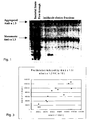
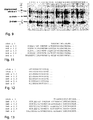
- rAmb a 1.3 was not able to bind human IgE ( Fig. 2 ). Only after reduction and heat treatment (standard procedure for SDS-PAGE/immunoblotting) rAmb a 1.3 reacted with patients IgE. These results clearly demonstrated that rAmb a 1.3 produced as described above is not a suitable reagent for allergy diagnosis and therapy. Thus, another approach for producing recombinant reagents with full IgE-binding activity was pursued, as described in section 4. Despite its low IgE-binding activity, rAmb a 1.3 was successfully used in vitro for T cell epitope mapping and proliferation assays, as correct folding is not essential for T cell recognition (see example 2).
- the T cell response to Amb a 1 was characterized in detail using the established in vitro culture system ( Jahn-Schmid et al., J. Immunol. 169: 6005-11, 2002 ; Jahn-Schmid et al., J. Allergy Clin. Immunol., 115: 399-404, 2005 ). In total, 85 clinically well-defined patients (75 from Vienna / 10 from Milano) with typical case history, positive skin prick test and CAP/RAST tests for ragweed extract were included.
- Example 2.2 PBMC, Amb a 1-specific T cell lines (TCL) and T cell clones (TCC)
- PBMC Peripheral blood mononuclear cells
- TCL allergen-specific T cell lines
- TCC T cell clones
- 1.5 x 10 6 PBMC were stimulated with optimal doses of ragweed or mugwort extract (4 ⁇ g/ml) or rAmb a 1.3 (10 ⁇ g/ml) in 24-well flat-bottomed culture plates (Costar, USA). After 5 days human rIL-2 (10 U/ml, Boehringer, Mannheim, Germany) were added and cultures were continued for additional 7 days. Then, T cell blasts were isolated by density centrifugation.
- T cell blasts were further expanded with IL-2 and irradiated PBMC.
- a small number of T cell blasts were used to establish monoclonal T cell cultures by limiting dilution: 0.3 T cells/well were seeded into 96 well round bottom plates (Nunclone) in the presence of 2 x 10 5 irradiated (60 Gy) PBMC, 0.25 % v/v PHA (Gibco, USA) and rIL-2 (4 U/well) in the medium mentioned above. After 14-21 days, growing microcultures were expanded at weekly intervals with irradiated PBMC and rIL-2.
- TCC The specificity of TCC was assessed in proliferation assays using irradiated allogeneic or HLA-matched PBMC or irradiated EBV-transformed allogeneic B-cells and 5 ⁇ g/ml Amb a 1.3. After 48 hours, cellular uptake of tritiated ( 3 H)-thymidine was performed to measure proliferation in counts per minute (cpm). When the stimulation index (SI; ratio between cpm obtained in cultures containing TCC plus autologous APC plus antigen, and cpm obtained in cultures containing TCC and APC alone) was >10, responses were considered as positive.
- SI stimulation index
- Allergen-specific TCC were expanded by alternating turns of stimulation with autologous irradiated APC and allergen or with allogeneic feeder cells and rIL-2.
- PBMC and TCL which showed different degrees of background proliferation due to autoreactivity, an SI of >3 or respectively 10.000 dpm were considered as cut-off for antigen-specificity.
- Amb a 1-specific TCL and TCC were used to identify T cell epitopes of Amb a 1.3.
- T cell cultures were stimulated with a panel of 121 synthetic 12-mer peptides and one 13-mer representing the C-terminal peptide of Amb a 1.3 (Pepset, Biotrend, Germany).
- Peptides had been synthesized according to the Amb a 1.3 amino acid sequence and overlapped for 9 amino acid residues with the neighbouring peptides (Table 1). Peptides were used at a concentration of 5 ⁇ g/ml for stimulation and proliferation of T cell cultures was determined after 48 hrs by 3 H-thymidine-uptake.
- T cells were washed and incubated with irradiated autologous APC in the presence of the stimulant (5 ⁇ g/ml) for 48 hours. Cytokine levels in the resulting supernatants were measured in ELISA using matched antibody pairs (Endogen, USA) (sensitivity limits: IL-4: 9 pg/ml, IFN- ⁇ : 9 pg/ml). Cultures containing TCC and APC alone served as negative controls. TCC with a ratio of IFN- ⁇ /IL-4>10 were classified as Th1, 0.1-10 as Th0 and ⁇ 0.1 as Th2.
- TCC The phenotype of TCC was analyzed by flow cytometry, using a FACScan and the FITC-labeled monoclonal antibodies anti-Leu4/CD3, anti-Leu 3a/CD4, anti-Leu 2a/CD8, anti-TCR ⁇ ß WT 31, anti-TCR ⁇ and CRTh2 plus goat-anti-rat-PE (all antibodies were obtained from BD Bioscience, USA).
- Example 2.6 T cell epitopes of Amb a 1.3
- T cell epitope mapping of Amb a 1.3 was performed evaluating 48 TCL from different patients (37 from Vienna and 9 from Italy), which had been initiated with ragweed extract (containing the natural allergen) or rAmb a 1.3 (Table 2).
- 26 relevant (i.e. recognized by ⁇ 10% of patients studied) T cell activating regions comprising 12-18 aa were identified. These epitope-containing regions were divided into classes of prevalence (referring to SI >5):
- the three T cell activating regions inducing proliferative responses in more than 50% of the allergic patients were defined as immunodominant epitopes ( Fig. 8 ; Table 3).
- PI positivity index
- T cell epitope mapping of Amb a 1.3 using Amb a 1-specific TCC reflected the data obtained from TCL. Results show that the presentation of Amb a 1-peptides is diverse, involving HLA-DR, -DP or -DQ as restriction elements.
- T cell epitopes from related tree pollen allergens Cha o 1 Japanese cypress
- Cry j 1 Japanese cedar
- the major epitopes of these allergens are located in regions that are homologous to minor T cell epitopes in Amb a 1.
- Table 2. T cell epitopes of Amb a 1-specific TCL from 48 different ragweed pollen-allergic patients. TCL were initiated either with rAmb a 1.3 or with ragweed pollen extract. Peptides giving Stimulation indexes (SI) higher than 3 and 5 are listed for each patient.
- SI Stimulation indexes
- Peptide No. (SI > 3) Peptide No. (SI > 5) 1 112, 114 8, 31, 33, 36, 44, 52, 59, 60, 61, 68, 78, 102, 108, 109, 110, 111, 115, 116, 117, 118, 119, 120 2 29, 30, 42, 64, 67, 79, 88, 89, 93, 98, 101, 103 27, 28, 33, 52, 60, 61, 68, 94, 107, 108, 111, 114, 115, 116, 118, 119, 120 3 120 107 4 41, 42, 60, 90, 98 52, 83, 91, 107, 108 5 39, 78, 85, 99, 101, 102, 107, 108 28, 36, 37, 44, 52, 60, 61, 86, 100, 104, 105, 106, 109, 110, 111, 119, 120 6 34 83, 91, 107, 108,
- Peptide ( SEQ ID No.) AA position AA sequence No. positive patients % No.
- nAmb a 1 undergoes spontaneously proteolysis during purification and it is cleaved into two chains, alpha and beta chain, respectively.
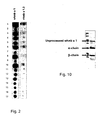
- the alpha chain weakly bound IgE antibodies of only 65% of the patients tested ( Fig. 9 ).
- Natural Amb a 1 was separated by 15% SDS-PAGE and electroblotted onto polyvinyl difluoride (PVDF) membranes (Millipore). Bands corresponding to Amb a 1 and its fragments were excised, and proteins were eluted by incubation in aqueous 40% (v/v) acetonitrile and 30% (v/v) trifluoroacetic acid for 1 hour at room temperature. Samples were vacuum dried, resuspended in water, and sequenced with the HP G1005A protein sequencing system (Agilent Technologies).
- PVDF polyvinyl difluoride
- Example 3.2 Matrix-assisted Laser Desorption / ionization Time-of-flight (MALDI-TOF) Mass Spectrometry
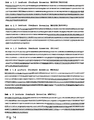
- Fig. 14 shows the deduced amino acid sequences of Amb a 1 isoforms with the putative alpha and beta chains mapped onto their sequences.
- Table 4 Mass spectrometry analysis of natural Amb a 1 Unprocessed Amb a 1 Amb a 1 alpha chain Amb a 1 beta chain Calculated Measured Calculated Measured Calculated Measured Calculated Measured nAmb a 1 37,832.14 21,808.54 15,086.31 22,323.24 Amb a 1.1 37,864.43 21,999.50 15,017.04 Amb a 1.2 38,625.71 22,425.10 15,268.56 Amb a 1.3 38,255.30 22,036.77 15,286.49 Amb a 1.4 38,008.93 21,953.62 15,130.29 Amb a 2 39,392.56 22,921.76 15,638.88
- Example 4.1 Construction of expression plasmids and purification of Amb a 1.3 alpha and beta chains designed according to naturally processed chains
- Example 4.2 Recombinant production of modified (version 1) alpha and beta chains of Amb a 1.3
- the ligation reaction was used to transform the bacterial strain TG1 (K12, D(lac-pro), supE, thi, hsdD5/F'[traD36, proA+B+, lacIq, lacZDM15]) via electroporation. After plating 100 ⁇ l of the transformation, the LBamp agar plates were incubated overnight at 37°C. PCR colony screening was used to select positive clones. (Small amount of bacterial colony is used as template for standard PCR with cloning primer). Selected clones were used for 50ml SB cultures and plasmids purification. Inserts were sequenced with ABI sequencing kit.
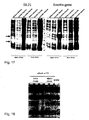
- Plasmids with correct sequence were used to transform bacterial strains BL21 and Rosetta-gami B (DE3)pLysS (Novagen). Preliminary experiments showed that higher expression levels were achieved with the Rosetta-gami B (DE3)pLysS E. coli strain ( Fig. 17 ).
- Example 4.2.2 Expression and purification of modified (version 1) Amb a 1.3 alpha and beta chains
- 10-20 clones from freshly transformed bacteria were grown in SB to OD 600 of 0.5-0.7 and then induced with 0.4mM IPTG. The expression was performed for 4-5h and then the culture was pelleted by centrifugation (5,000g). Bacterial pellet was resuspended in start buffer (25mM Na-phosphat pH 8.0; 1M NaCl). Cells were lysed by 3x freezing in liquid nitrogen and thawing at 25°C. The suspension was treated with lysozyme (5mg/ml), Dnase (0.5 ⁇ g/ml) and sonicated for 5 minutes.
- Example 4.2.3 T cell responses to modified (version 1) alpha and beta chains of Amb a 1.3
- the naturally processed alpha and beta chains of Amb a 1 have distinct immunological properties.
- the alpha chain shows low IgE reactivity whereas the beta chain contains most of the IgE epitopes of Amb a 1. Therefore, to test the IgE-binding activity of the purified alpha chain, ELISA with sera from ragweed allergic patients was performed. Results from 12 patients confirmed that the alpha chain shows low/no IgE-binding activity in vitro ( Fig. 19 ). Experiments are being carried out for the purification and characterization of the beta chain.
- the invention includes the modification of the alpha chain by adding 16 amino acid residues from the C-terminus of the beta chain to the N-terminus of the alpha chain (modified version 1; Fig. 16 , Table 5).
- the modified (version 1) construct of the Amb a 1.3 alpha chain includes the 3 most frequently recognized T cell epitopes of Amb a 1 ( Fig. 22 ).
Landscapes
- Health & Medical Sciences (AREA)
- Life Sciences & Earth Sciences (AREA)
- Chemical & Material Sciences (AREA)
- Immunology (AREA)
- Engineering & Computer Science (AREA)
- General Health & Medical Sciences (AREA)
- Medicinal Chemistry (AREA)
- Organic Chemistry (AREA)
- Molecular Biology (AREA)
- Proteomics, Peptides & Aminoacids (AREA)
- Biochemistry (AREA)
- Urology & Nephrology (AREA)
- Biomedical Technology (AREA)
- Hematology (AREA)
- Animal Behavior & Ethology (AREA)
- Veterinary Medicine (AREA)
- Public Health (AREA)
- Pharmacology & Pharmacy (AREA)
- Microbiology (AREA)
- Nuclear Medicine, Radiotherapy & Molecular Imaging (AREA)
- General Chemical & Material Sciences (AREA)
- Chemical Kinetics & Catalysis (AREA)
- Bioinformatics & Cheminformatics (AREA)
- Genetics & Genomics (AREA)
- Biophysics (AREA)
- Gastroenterology & Hepatology (AREA)
- Botany (AREA)
- Cell Biology (AREA)
- Food Science & Technology (AREA)
- General Physics & Mathematics (AREA)
- Pathology (AREA)
- Analytical Chemistry (AREA)
- Biotechnology (AREA)
- Physics & Mathematics (AREA)
- Mycology (AREA)
- Epidemiology (AREA)
- Pulmonology (AREA)
- Peptides Or Proteins (AREA)
- Medicines Containing Antibodies Or Antigens For Use As Internal Diagnostic Agents (AREA)
- Medicines That Contain Protein Lipid Enzymes And Other Medicines (AREA)
Description
- The present invention relates to Amb a 1 derived peptides.
- Ragweed (Ambrosia artemisiifolia) and mugwort(Artemisia vulgaris) are important allergenic weeds belonging to the Asteraceae or Compositae plant family. Pollen of mugwort is one of the main causes of allergic reactions in late summer and autumn in Europe and affects about 10-14% of the patients suffering from pollinosis. Ragweed pollen represents the major source of allergenic protein in the United States, with a prevalence of about 50% in atopic27.10 individuals. In Europe, ragweed allergy is now rapidly increasing particularly in certain areas in France, Italy, Austria, Hungary, Croatia, and Bulgaria. Amb a 1, the major allergen of ragweed and Art v 1, the major allergen from mugwort, respectively, are unrelated proteins. Amb a 1 is an acidic 38 kDa non-glycosylated protein. Natural Amb a 1 undergoes proteolysis during purification and it is cleaved into two chains designated alpha and beta chain. The 26-kDa alpha-chain was reported to associate non-covalently with the 12-kDa beta chain (King et al. Immunochem 11:83-92, 1974). The Amb a 1 two-chain form seems to be immunologically indistinguishable from the full-length molecule (King et al. Arch Biochem Biophys 212:127-135, 1981).
- Natural Amb a 1 (nAmb a 1) from ragweed was the first described and isolated allergen (King et al. Biochem 3:458-468, 1964). The cDNA coding for Amb a 1 was isolated from ragweed pollen in 1991 by Rafnar et al. (J. Biol. Chem. 266:1229-1236). But so far, a method to express and purify large amounts of active and correctly folded recombinant Amb a 1 (rAmb a 1) has not been reported.
-
WO 96/13589 - In the
WO 90/11293 -
WO 99/34826 - In Michael J.G. et al. (J.Br.Soc.Aller.Clin.Immunol. 20(6) (1990):669-674) the T-cell response of peptides which are obtained by a protease digestion of Amb a 1 has been examined.
- Cardinale E.J. et al. (J.Aller.Clin.Immunol. 107(2001):p 19) relates to the use of MALDI-TOF mass spectrometry for identifying and characterizing allergens.
-
US 6,335,019 relates i.a., to Amb a 1 peptides capable of provoking a T-cell response against Amb a 1 in an individual. Griffith et al. (Int.Arch.Aller.Appl.Immunol. 96(1991):296-304) relates to the sequence polymorphins of Amb a 1 and Amb a 2 family members. - It is an object of the present invention to provide peptides and molecules derived from ragweed pollen allergen Amb a 1 which can be employed in the treatment, prevention or diagnosis of allergies, in particular allergies caused by ragweed pollen allergens.
- Therefore, the present invention relates to vaccine formulations, peptides, fusion proteins, nucleic acid molecules, vectors and uses thereof as defined in the claims.
- Peptides derived from the ragweed pollen allergen Amb a 1, in particular from Amb a 1.3, may consist of an amino acid sequence selected from the group consisting of SEQ ID No. 12, SEQ ID No. 20, SEQ ID No. 27, SEQ ID No. 28, SEQ ID No. 30, SEQ ID No. 31, SEQ ID No. 33, SEQ ID No. 36, SEQ ID No. 37, SEQ ID No. 38, SEQ ID No. 39, SEQ ID No. 41, SEQ ID No. 42, SEQ ID No. 44, SEQ ID No. 46, SEQ ID No. 47, SEQ ID No. 48, SEQ ID No. 50, SEQ ID No. 51, SEQ ID No. 52, SEQ ID No. 53, SEQ ID No. 59, SEQ ID No. 60, SEQ ID No. 61, SEQ ID No. 67, SEQ ID No. 68, SEQ ID No. 69, SEQ ID No. 77, SEQ ID No. 78, SEQ ID No. 79, SEQ ID No. 80, SEQ ID No. 81, SEQ ID No. 83, SEQ ID No. 86, SEQ ID No. 87, SEQ ID No. 88, SEQ ID No. 89, SEQ ID No. 90, SEQ ID No. 91, SEQ ID No. 93, SEQ ID No. 94, SEQ ID No. 96, SEQ ID No. 97, SEQ ID No. 98, SEQ ID No. 99, SEQ ID No. 100, SEQ ID No. 101, SEQ ID No. 102, SEQ ID No. 107, SEQ ID No. 108, SEQ ID No. 109, SEQ ID No. 110, SEQ ID No. 111, SEQ ID No. 112, SEQ ID No. 114, SEQ ID No. 115, SEQ ID No. 118, SEQ ID No. 119, SEQ ID No. 120, SEQ ID No. 121, SEQ ID No. 122, SEQ ID No. 123, SEQ ID No. 124, SEQ ID No. 125, SEQ ID No. 126, SEQ ID No. 127, SEQ ID No. 128, SEQ ID No. 129, SEQ ID No. 130, SEQ ID No. 131, SEQ ID No. 132, SEQ ID No. 133, SEQ ID No. 134, SEQ ID No. 135, SEQ ID No. 136, SEQ ID No. 137, SEQ ID No. 138 and SEQ ID No. 139.
- It turned out that peptides having an amino acid sequence selected from the group consisting of SEQ ID No. 12, SEQ ID No. 20, SEQ ID No. 27, SEQ ID No. 28, SEQ ID No. 30, SEQ ID No. 31, SEQ ID No. 33, SEQ ID No. 36, SEQ ID No. 37, SEQ ID No. 38, SEQ ID No. 39, SEQ ID No. 41, SEQ ID No. 42, SEQ ID No. 44, SEQ ID No. 46, SEQ ID No. 47, SEQ ID No. 48, SEQ ID No. 50, SEQ ID No. 51, SEQ ID No. 52, SEQ ID No. 53, SEQ ID No. 59, SEQ ID No. 60, SEQ ID No. 61, SEQ ID No. 67, SEQ ID No. 68, SEQ ID No. 69, SEQ ID No. 77, SEQ ID No. 78, SEQ ID No. 79, SEQ ID No. 80, SEQ ID No. 81, SEQ ID No. 83, SEQ ID No. 86, SEQ ID No. 87, SEQ ID No. 88, SEQ ID No. 89, SEQ ID No. 90, SEQ ID No. 91, SEQ ID No. 93, SEQ ID No. 94, SEQ ID No. 96, SEQ ID No. 97, SEQ ID No. 98, SEQ ID No. 99, SEQ ID No. 100, SEQ ID No. 101, SEQ ID No. 102, SEQ ID No. 107, SEQ ID No. 108, SEQ ID No. 109, SEQ ID No. 110, SEQ ID No. 111, SEQ ID No. 112, SEQ ID No. 114, SEQ ID No. 115, SEQ ID No. 118, SEQ ID No. 119, SEQ ID No. 120, SEQ ID No. 121, SEQ ID No. 122, SEQ ID No. 123, SEQ ID No. 124, SEQ ID No. 125, SEQ ID No. 126, SEQ ID No. 127, SEQ ID No. 128, SEQ ID No. 129, SEQ ID No. 130, SEQ ID No. 131, SEQ ID No. 132, SEQ ID No. 133, SEQ ID No. 134, SEQ ID No. 135, SEQ ID No. 136, SEQ ID No. 137, SEQ ID No. 138 and SEQ ID No. 139, show reactivity with T cells isolated from allergic individuals and, consequently, may be employed in the production of vaccines, especially vaccines for allergies caused by ragweed pollen allergens and allergies cross-reacting to ragweed pollen allergens. In particular the peptides having SEQ ID No.52, SEQ ID No. 68, SEQ ID No. 86, SEQ ID No. 91 and SEQ ID No. 126 to SEQ ID No. 139 show high T cell reactivity with samples obtained from individuals suffering from ragweed pollen allergy.
- A further advantage of the peptides of the present invention is that all of them lack IgE binding activity. Therefore, molecules comprising these peptides do not provoke allergic reactions (e.g. increased release of histamine) when administered to an individual.
- For therapeutic purposes peptides derived from allergens do not bind IgE specific for Amb a 1 or bind such IgE to a substantially lesser extent (e.g. at least 100 fold less and more preferably, at least 1000 fold less binding) than the corresponding purified native Amb a 1 or the recombinantly produced beta chain of Amb a 1. If a peptide of the invention is to be used as a diagnostic reagent, it is not necessary that the peptide or protein has reduced IgE binding activity compared to the native Amb a 1 allergen. IgE binding activity of peptides can be determined by, for example, an enzyme linked immunosorbent assay (ELISA) using, for example, sera obtained from an individual (i.e. an allergic individual) that has been previously exposed to the native Amb a 1. Briefly, a peptide to be tested is coated onto wells of a microtiter plate. After washing and blocking the wells, antibody solution consisting of the serum or plasma of an allergic individual who has been exposed to the peptide being tested or the protein from which it was derived is incubated in the wells. The plasma is generally depleted of IgG before incubation. However, the depletion is not necessary if highly specific anti IgE-antibodies are used. Furthermore, allergic individuals who have not undergone specific immunotherapy have in some cases almost no detectable IgG antibodies specific for the allergen in question. A labelled secondary antibody is added to the wells and incubated. The amount of IgE binding is then quantified and compared to the amount of IgE bound by a purified native Amb a 1 protein. Alternatively, the binding activity of a peptide can be determined by Western blot analysis. For example, a peptide to be tested is run on a polyacrylamide gel using SDS-PAGE. The peptide is then transferred to nitrocellulose and subsequently incubated with sera from an allergic subject. After incubation with the labelled secondary antibody, the amount of IgE bound is then determined and quantified.
- Another assay which can be used to determine IgE binding activity of a peptide is a competition ELISA assay. Briefly, an IgE antibody pool is generated by combining plasma or serum from ragweed pollen allergic individuals that have been shown by direct ELISA to have IgE reactive with native Amb a 1. This pool is used in ELISA competition assays to compare IgE binding to native Amb a 1 to the peptide tested. IgE binding for the native Amb a 1 protein and the peptide being tested is determined and quantified.
- Furthermore, the peptides of the present invention do preferably not result in the release of mediators (e.g. histamines) from mast cells or basophils. To determine whether a peptide which binds IgE results in the release of mediators, a histamine release assay can be performed using standard reagents and protocols. Briefly, a buffered solution of a peptide to be tested is combined with an equal volume of whole heparinized blood from an allergic subject. After mixing and incubation, the cells are pelleted and the supernatants are processed and analyzed using, e.g., a radioimmunoassay to determine the amount of histamine released.
- The molecule described herein may comprise in any combination more than one peptides of the present invention. These peptides may be conjugated chemically or fused by recombinant technology to each other. Such a molecule may comprise at least two, three, four, five, seven, ten, 15, 20, peptides.
- The peptides of the invention can be produced by recombinant DNA techniques in a host cell transformed with a nucleic acid having a sequence encoding such peptide. The isolated peptides of the invention can also be produced by chemical synthesis. Of course it is also possible to produce the peptides by chemical or enzymatic cleavage of the protein allergen.
- When a peptide is produced by recombinant techniques, host cells transformed with a nucleic acid of the invention (or the functional equivalent of the nucleic acid having a sequence encoding the peptide (or functional equivalent of the peptide) are cultured in a medium suitable for the cells. Peptides can be purified from cell culture medium, host cells or both using techniques known in the art for purifying peptides and proteins including ion-exchange chromatography, gel filtration chromatography, ultrafiltration, electrophoresis or immunopurification with antibodies specific for the peptide. Isolated peptides of the invention are substantially free of cellular material or culture medium when produced by recombinant DNA techniques or substantially free of chemical precursors or other chemicals when synthesized chemically or free of other materials and reagents when produced by chemical or enzymatic cleavage.
- The peptides described herein may also be modified by amino acid substitution, deletion or addition. Therefore, these peptides may comprise at least 7 amino acid residues of the amino acid sequences SEQ ID No. 1 to 139. Peptides may have more than 12 amino acid residues, whereby these additional residues may be derived from the native Amb a 1 molecule and being found adjacent to the peptide in the native Amb a 1 molecule, random amino acids or other peptides or proteins. However, these modified peptides (variants) exhibit similar or even identical properties as the unmodified peptides. In particular the immunogenic properties have to be substantially identical. This means that antibodies directed to these modified peptides are also able to bind to peptides having amino acid sequences SEQ ID No. 1 to 139.
- As used herein, a "peptide" refers to an amino acid sequence having fewer amino acid residues than the entire amino acid sequence of the protein from which the peptide was derived. The term "peptide" also refers to any functional equivalents or variants of a peptide or to any fragments or portions of a peptide. "Functional equivalents" of a peptide include peptides having the same or enhanced ability to bind MHC, peptides capable of stimulating the same T cell subpopulations, peptides having the same or increased ability to induce T cell responses such as stimulation (proliferation or cytokine secretion), peptides having at least the same level of reduced IgE binding, and peptides which elicit at least the same minimal level of IgE synthesis stimulating activity as the peptides directly derived from Amb a 1. Minimal IgE stimulating activity refers to IgE synthesis stimulating activity that is less than the amount of IgE production elicited by a purified native ragweed pollen allergen. The peptides described herein may consist of 6 to 50, preferably 7 to 45, more preferably 8 to 40, even more preferably 9 to 35, in particular 10 to 30, amino acid residues. "Functional equivalents" of peptides may further comprise at the C- and/or N-terminus of said peptides at least one further amino acid residue, which may serve as a linking group (e.g. cysteine) or which may can be found adjacent to the peptide in wild-type Amb a 1.
- The term "variant" as used herein refers to an amino acid sequence that differs by one or more amino acid residues from another, usually related polypeptide. The variant may have "conservative" changes, wherein a substituted amino acid has similar structural or chemical properties. One type of conservative amino acid substitutions refer to the interchangeability of residues having similar side chains. For example, a group of amino acids having aliphatic side chains is glycine, alanine, valine, leucine, and isoleucine; a group of amino acids having aliphatic-hydroxyl side chains is serine and threonine; a group of amino acids having amide-containing side chains is asparagine and glutamine; a group of amino acids having aromatic side chains is phenylalanine, tyrosine, and tryptophan; a group of amino acids having basic side chains is lysine, arginine, and histidine; and a group of amino acids having sulfur-containing side chains is cysteine and methionine. Preferred conservative amino acids substitution groups are: valine-leucine-isoleucine, phenylalanine-tyrosine, lysine-arginine, alanine-valine, and asparagine-glutamine. More rarely, a variant may have "non-conservative" changes (for example, replacement of a glycine with a tryptophan). Similar minor variations may also include amino acid deletions or insertions, or both. Variants of the peptides and molecules described herein have less than 10%, and preferably less than 5%, and still more preferably less than 2% changes (whether substitutions, deletions, and insertions).
- Another aspect of the present invention relates to a peptide derived from the ragweed pollen allergen Amb a 1 and consisting of an amino acid sequence selected from the group consisting of SEQ ID No. 52and variants thereof differing by one amino acid residue.
- Another aspect of the present invention relates to a fusion protein as defined in
claims - Such a fusion protein may be employed, for instance, as a vaccine inducing an immune response against a ragweed pollen allergen peptide of the present invention and said second immunogen.
- In order to elicit antibodies against small molecules (hapten) like the peptides of the present invention these small molecules may be linked (e.g. conjugated) to a carrier. This linkage makes the hapten immunogenic, this means antibodies are generated after injection into an individual. The binding of the hapten to a carrier protein is often covalent, but it can be ionic or be effected through a chemical component bridging the hapten and the carrier. The carrier is typically a protein, but it can also contain sugar and fat in mono- or polymer form.
- The immunogen according to the present invention is an allergen selected from the group consisting of Amb a 2, Amb a 3, Amb a 5, Amb a 6, Amb a 7, Amb a 8, Amb a 9, Amb a 10, Amb t 5, Art v 1, Art v 2, Art v 3, Art v 4, Art v 5, Art v 6, Hel a 1, Hel a 2, Hel a 3, Mer a 1, Che a 1, Che a 2, Che a 3, Sal k 1, Cat r 1, Pla 1 1, Hum j 1, Par j 1, Par j 2, Par j 3, Par o 1, Cyn d 1, Cyn d 7, Cyn d 12, Cyn d 15, Cyn d 22w, Cyn d 23, Cyn d 24, Dac g 1, Dac g 2, Dac g 3, Dac g 5, Fes p 4w, Hol l 1, Lol p 1, Lol p 2, Lol p 3, Lol p 5, Lol p 11, Pha a 1, Phl p 1, Phl p 2, Phl p 4, Phl p 5, Phl p 6, Phl p 11, Phl p 12, Phl p 13, Poa p 1, Poa p 5, Sor h 1, Pho d 2, Aln g 1, Bet v 1, Bet v 2, Bet v 3, Bet v 4, Bet v 6, Bet v 7, Car b 1, Cas s 1, Cas s 5, Cas s 8, Cor a 1, Cor a 2, Cor a 8, Cor a 9, Cor a 10, Cor a 11, Que a 1, Fra e 1, Lig v 1, Ole e 1, Ole e 2, Ole e 3, Ole e 4, Ole e 5, Ole e 6, Ole e 7, Ole e 8, Ole e 9, Ole e 10, Syr v 1, Cry j 1, Cry j 2, Cup a 1, Cup s 1, Cup s 3w, Jun a 1, Jun a 2, Jun a 3, Jun o 4, Jun s 1, Jun v 1, Pla a 1, Pla a 2, Pla a 3, Aca s 13, Blo t 1, Blo t 3, Blo t 4, Blo t 5, Blo t 6, Blo t 10, Blo t 11, Blo t 12, Blo t 13, Blo t 19, Der f 1, Der f 2, Der f 3, Der f 7, Der f 10, Der f 11, Der f 14, Der f 15, Der f 16, Der f 17, Der f 18w, Der m 1, Der p 1, Der p 2, Der p 3, Der p 4, Der p 5, Der p 6, Der p 7, Der p 8, Der p 9, Der p 10, Der p 11, Der p 14, Der p 20, Der p 21, Eur m 2, Eur m 14, Gly d 2,Lep d 1, Lep d 2, Lep d 5, Lep d 7, Lep d 10, Lep d 13, Tyr p 2, Tyr p 13, Bos d 2, Bos d 3, Bos d 4, Bos d 5, Bos d 6, Bos d 7, Bos d 8, Can f 1, Can f 2, Can f 3, Can f 4, Equ c 1, Equ c 2, Equ c 3, Equ c 4, Equ c 5, Fel d 1, Fel d 2, Fel d 3, Fel d 4, Fel d 5w, Fel d 6w, Fel d 7w, Cav p 1, Cav p 2, Mus m 1, Rat n 1, Alt a 1, Alt a 3, Alt a 4, Alt a 5, Alt a 6, Alt a 7, Alt a 8, Alt a 10, Alt a 12, Alt a 13, Cla h 2, Cla h 5, Cla h 6, Cla h 7, Cla h 8, Cla h 9, Cla h 10, Cla h 12, Asp fl 13, Asp f 1, Asp f 2, Asp f 3, Asp f 4, Asp f 5, Asp f 6, Asp f 7, Asp f 8, Asp f 9, Asp f 10, Asp f 11, Asp f 12, Asp f 13, Asp f 15, Asp f 16, Asp f 17, Asp f 18, Asp f 22w, Asp f 23, Asp f 27, Asp f 28, Asp f 29, Asp n 14, Asp n 18, Asp n 25, Asp o 13, Asp o 21, Pen b 13, Pen b 26, Pen ch 13, Pen ch 18, Pen ch 20, Pen c 3, Pen c 13, Pen c 19, Pen c 22w, Pen c 24, Pen o 18, Fus c 1, Fus c 2, Tri r 2, Tri r 4, Tri t 1, Tri t 4, Cand a 1, Cand a 3, Cand b 2, Psi c 1, Psi c 2, Cop c 1, Cop c 2, Cop c 3, Cop c 5, Cop c 7, Rho m 1, Rho m 2, Mala f 2, Mala f 3, Mala f 4, Mala s 1, Mala s 5, Mala s 6, Mala s 7, Mala s 8, Mala s 9, Mala s 10, Mala s 11, Mala s 12, Mala s 13, Epi p 1, Aed a 1, Aed a 2, Api m 1, Api m 2, Api m 4, Api m 6, Api m 7, Bom p 1, Bom p 4, Bla g 1, Bla g 2, Bla g 4, Bla g 5, Bla g 6, Bla g 7, Bla g 8, Per a 1, Per a 3, Per a 6, Per a 7, Chi k 10, Chi t 1-9, Chi t 1.01, Chi t 1.02, Chi t 2.0101, Chi t 2.0102, Chi t 3, Chi t 4, Chi t 5, Chi t 6.01, Chi t 6.02, Chi t 7, Chi t 8, Chi t 9, Cte f 1, Cte f 2, Cte f 3, Tha p 1, Lep s 1, Dol m 1, Dol m 2, Dol m 5, Dol a 5, Pol a 1, Pol a 2, Pol a 5, Pol d 1, Pol d 4, Pol d 5, Pol e 1, Pol e 5, Pol f 5, Pol g 5, Pol m 5, Vesp c 1, Vesp c 5, Vesp m 1, Vesp m 5, Ves f 5, Ves g 5, Ves m 1, Ves m 2, Ves m 5, Ves p 5, Ves s 5, Ves vi 5, Ves v 1, Ves v 2, Ves v 5, Myr p 1, Myr p 2, Sol g 2, Sol g 4, Sol i 2, Sol i 3, Sol i 4, Sol s 2, Tria p 1, Gad c 1, Sal s 1, Bos d 4, Bos d 5, Bos d 6, Bos d 7, Bos d 8, Gal d 1, Gal d 2, Gal d 3, Gal d 4, Gal d 5, Met e 1, Pen a 1, Pen i 1, Pen m 1, Pen m 2, Tod p 1, Hel as 1, Hal m 1, Ran e 1, Ran e 2, Bra j 1, Bra n 1, Bra o 3, Bra r 1, Bra r 2, Hor v 15, Hor v 16, Hor v 17, Hor v 21, Sec c 20, Tri a 18, Tri a 19, Tri a 25, Tri a 26, Zea m 14, Zea m 25, Ory s 1, Api g 1, Api g 4, Api g 5, Dau c 1, Dau c 4, Cor a 1.04, Cor a 2, Cor a 8, Fra a 3, Fra a 4, Mal d 1, Mal d 2, Mal d 3, Mal d 4, Pyr c 1, Pyr c 4, Pyr c 5, Pers a 1, Pru ar 1, Pru ar 3, Pru av 1, Pru av 2, Pru av 3, Pru av 4, Pru d 3, Pru du 4, Pru p 3, Pru p 4, Aspa o 1, Cro s 1, Cro s 2, Lac s 1, Vit v 1, Mus xp 1, Ana c 1, Ana c 2, Cit 1 3, Cit s 1, Cit s 2, Cit s 3, Lit c 1, Sin a 1, Gly m 1, Gly m 2, Gly m 3, Gly m 4, Vig r 1, Ara h 1, Ara h 2, Ara h 3, Ara h 4, Ara h 5, Ara h 6, Ara h 7, Ara h 8, Len c 1, Len c 2, Pis s 1, Pis s 2, Act c 1, Act c 2, Cap a 1w, Cap a 2, Lyc e 1, Lyc e 2, Lyc e 3, Sola t 1, Sola t 2, Sola t 3, Sola t 4, Ber e 1, Ber e 2, Jug n 1, Jug n 2, Jug r 1, Jug r 2, Jug r 3, Ana o 1, Ana o 2, Ana o 3, Ric c 1, Ses i 1, Ses i 2, Ses i 3, Ses i 4, Ses i 5, Ses i 6, Cuc m 1, Cuc m 2, Cuc m 3, Ziz m 1, Ani s 1, Ani s 2, Ani s 3, Ani s 4, Arg r, Asc s 1, Car p 1, Den n 1, Hev b 1, Hev b 2, Hev b 3, Hev b 4, Hev b 5, Hev b 6.01, Hev b 6.02, Hev b 6.03, Hev b 7.01, Hev b 7.02, Hev b 8, Hev b 9, Hev b 10, Hev b 11, Hev b 12, Hev b 13, Hom s 1, Hom s 2, Hom s 3, Hom s 4, Hom s 5 and Trip s 1.
- It is particularly preferred to fuse the peptides of the present invention derived from ragweed pollen allergen Amb a 1 to peptides derived from other allergens. Such a fusion protein/polypeptide/peptide is useful when used in a vaccine or in diagnosis. Another aspect of the present invention relates to a nucleic acid molecule encoding a peptide or a fusion protein according to the present invention.
- The nucleic acid molecule of the present invention may be employed, e.g., for the recombinant production of the peptides/polypeptides/proteins encoded by said nucleic acid molecule. Furthermore, they may also be used for therapeutic aspects (e.g. gene therapy, cell therapy).
- Another aspect of the present invention relates to a vector comprising a nucleic acid molecule according to the present invention.
- The nucleic acid molecule of the present invention may be introduced into a vector. The vector may be used for the recombinant production of the peptides and molecules of the present invention or for therapeutic aspects.
- "Vector", as used herein, refers to a plasmid, cosmid and viral and phage DNA. A plasmid comprising a nucleic acid molecule according to the present invention may contain next to said molecule, e.g., an origin of replication, selection markers (e.g. antibiotic resistance markers, auxotrophic markers), a multiple cloning site, a promoter region operably linked to said molecule and/or sequence stretches for the homologue integration of the vector or parts thereof into the genome of a host.
- Preferably, the vector of the present invention further comprises a promoter operably linked to said nucleic acid molecule, thus resulting in an expression cassette.
- The expression cassette of the present invention comprises a promoter and a nucleic acid molecule encoding for a peptide of the present invention. The promoter is preferably positioned at the 5'-end (upstream) of the nucleic acid molecule of the present invention. The promoter to be used in the expression cassette may be any one, provided that the promoter can be controlled by the respective host.
- A further aspect of the present invention relates to a vaccine formulation comprising at least one fusion protein and/or a peptide according to the present invention.
- The peptide and/or fusion protein of the present invention comprising at least one peptide derived from the ragweed pollen allergen Amb a 1 and consisting of amino acid sequence SEQ ID No. 52 can be used in a vaccine formulation. Since these peptides are able to provoke a T cell response against the ragweed pollen allergen Amb a 1 the vaccine formulation may be used for the desensitization, prevention or treatment of ragweed pollen allergies and allergies cross-reacting with ragweed pollen allergens (e.g. mugwort pollen). Due to the lack of IgE binding activity the peptides are in particular advantageous when used in a vaccine, because no or substantially no allergic reaction is provoked by said vaccine. The vaccine formulation of the present invention may comprise at least one, preferably at least two, more preferably at least three, peptides as disclosed herein.
- Administration of the therapeutic compositions of the present invention to an individual to be desensitized can be carried out using known procedures at dosages and for periods of time effective to reduce sensitivity (i.e. reduce the allergic response) of the individual to the allergen. Effective amounts of the therapeutic compositions will vary according to factors such as the degree of sensitivity of the individual to Amb a 1, the age, sex and weight of the individual and the ability of the protein or fragment thereof to elicit an antigenic response in the individual. The active compound (i.e. protein or fragment thereof) may be administered in a convenient manner such as by injection (subcutaneous, intravenous, etc.), oral administration, inhalation, transdermal application, or rectal administration. Depending on the route of administration, the active compound may be coated within a material to protect the compound from the action of enzymes, acids and other natural conditions which may inactivate the compound (see below). For example, preferably about 0.05 µg-1000 µg, more preferably from about 0.1-100 µg of active compound (i.e. protein or fragment thereof) per dosage unit may be administered by injection. Dosage regimen may be adjusted to provide the optimum therapeutic response. For example, several divided doses may be administered daily or the dose may be proportionally reduced as indicated by the exigencies of the therapeutic situation.
- The vaccine formulation of the present invention further comprises at least one pharmaceutical acceptable adjuvant, excipient and/or carrier.
- Pharmaceutically acceptable carriers preferably used are physiological saline, vegetable oils, mineral oil, aqueous sodium caroboxymethyl cellulose or aqueous polyvinylpyrrolidone. Suitable adjuvants include, but are not limited to: surface active substances, e.g., hexadecylamine, octadecylamine, octadecyl amino acid esters, lysolecithin, dimethyl-dioctadecylammonium bromide, methoxyhexadecylgylcerol, and pluronic polyols; polyamines, e.g., pyran, dextran-sulfate, poly IC, carbopol; peptides, e.g., muramyl dipeptide, dimethylglycine, tuftsin; oil emulsions; and mineral gels, e.g., aluminum hydroxide, aluminum phosphate, etc. and immune stimulating complexes. The adjuvant may be, for example, alum or a composition containing a vegetable oil, isomannide monooleate and aluminum mono-stearate. Other preferred adjuvants include microparticles or beads of biocompatible matrix materials. The molecules of the present invention may be incorporated into microparticles or microcapsules to prolong the exposure of the antigenic material to the individual and hence protect said individual against infection for long periods of time. The immunogen may also be incorporated into liposomes or conjugated to polysaccharides and/or other polymers for use in a vaccine formulation.
- Also part of this invention is a composition that comprises the molecules, in particular the peptides, of this invention and a carrier, preferably a biologically-acceptable carrier, and more preferably a pharmaceutically-acceptable carrier. Typical carriers are aqueous carriers such as water, buffered aqueous solutions, aqueous alcoholic mixtures, and the like. Compositions comprising carriers that are for pharmaceutical use, particularly for use in humans, comprise a carrier that is pharmaceutically-acceptable. Examples of such carriers are known in the art.
- Typically, such vaccines are prepared as injectables: either as liquid solutions or suspensions, solid forms suitable for solution in, or suspension in, liquid prior to injection may also be prepared. The vaccine may be administered to a target animal by any convenient route, such as subcutaneously, intraperitoneally, intramuscularly, intradermally, intravenously, orally, intranasally or intramammarily, in the presence of a physiologically acceptable diluent. The antigens may be administered in a single dose or in a plurality of doses. The vaccine of the present invention may be stored under refrigeration or in frozen or lyophilized form. The vaccine is administered to an individual in an amount effective to elicit a protective immune response as compared to a control. The effective amount will vary, e.g., with the age and size and may be readily determined by the practitioner skilled in the art. Suitable regimes for initial administration and booster shots will also be variable, but may be typified by an initial administration followed by subsequent inoculations or other administrations.
- The vaccine formulation of the present invention contains at least one molecule comprising a peptide selected from the group consisting of SEQ ID No. 12, SEQ ID No. 20, SEQ ID No. 27, SEQ ID No. 28, SEQ ID No. 30, SEQ ID No. 31, SEQ ID No. 33, SEQ ID No. 36, SEQ ID No. 37, SEQ ID No. 38, SEQ ID No. 39, SEQ ID No. 41, SEQ ID No. 42, SEQ ID No. 44, SEQ ID No. 46, SEQ ID No. 47, SEQ ID No. 48, SEQ ID No. 50, SEQ ID No. 51, SEQ ID No. 52, SEQ ID No. 53, SEQ ID No. 59, SEQ ID No. 60, SEQ ID No. 61, SEQ ID No. 67, SEQ ID No. 68, SEQ ID No. 69, SEQ ID No. 77, SEQ ID No. 78, SEQ ID No. 79, SEQ ID No. 80, SEQ ID No. 81, SEQ ID No. 83, SEQ ID No. 86, SEQ ID No. 87, SEQ ID No. 88, SEQ ID No. 89, SEQ ID No. 90, SEQ ID No. 91, SEQ ID No. 93, SEQ ID No. 94, SEQ ID No. 96, SEQ ID No. 97, SEQ ID No. 98, SEQ ID No. 99, SEQ ID No. 100, SEQ ID No. 101, SEQ ID No. 102, SEQ ID No. 107, SEQ ID No. 108, SEQ ID No. 109, SEQ ID No. 110, SEQ ID No. 111, SEQ ID No. 112, SEQ ID No. 114, SEQ ID No. 115, SEQ ID No. 118, SEQ ID No. 119, SEQ ID No. 120, SEQ ID No. 121, SEQ ID No. 122, SEQ ID No. 123, SEQ ID No. 124, SEQ ID No. 125, SEQ ID No. 126, SEQ ID No. 127, SEQ ID No. 128, SEQ ID No. 129, SEQ ID No. 130, SEQ ID No. 131, SEQ ID No. 132, SEQ ID No. 133, SEQ ID No. 134, SEQ ID No. 135, SEQ ID No. 136, SEQ ID No. 137, SEQ ID No. 138 and SEQ ID No. 139.
- The vaccine formulation of the present invention may comprise at least one peptide selected from the group consisting of SEQ ID No. 68, SEQ ID No. 86, SEQ ID No. 91, and SEQ ID No.126- SEQ ID No. 139, wherein a further preferred embodiment of the formulation comprises at least one peptide consisting of an amino acid sequence selected from the group consisting of SEQ ID No. 137 to 139. In particular, these molecules show a high T cell reactivity in patients suffering from ragweed allergy (the peptides are recognized by more than 90% of allergic individuals sensitized to ragweed allergies). Furthermore, these molecules/peptides may be formulated alone or in any combination in one single formulation. Thus the vaccine formulation may comprise at least two, preferably at least three, of the peptides selected from the group consisting of SEQ ID No. 52, SEQ ID No. 68, SEQ ID No. 86, SEQ ID No. 91, and SEQ ID No.126-SEQ ID No. 139, preferably selected from the group consisting of SEQ ID No. 52 and SEQ ID No. 137 to 139. Particular preferred combinations of the peptides are: SEQ ID No. 52 and SEQ ID No. 137; SEQ ID No. 52 and SEQ ID No. 138; SEQ ID No. 52 and SEQ ID No. 139; SEQ ID No. 137 and SEQ ID No. 138; SEQ ID No. 137 and SEQ ID No. 139; SEQ ID No. 52, SEQ ID No. 137 and SEQ ID No. 138; SEQ ID No. 52, SEQ ID No. 138 and SEQ ID No. 139; SEQ ID No. 52, SEQ ID No. 137 and SEQ ID No. 139; SEQ ID No. 137, SEQ ID No. 138 and SEQ ID No. 139; SEQ ID No. 52, SEQ ID No. 137, SEQ ID No. 138 and SEQ ID No. 139.
- Yet another aspect of the present invention relates to the use of a peptide and/or a fusion protein according to the present invention for the manufacture of a vaccine formulation as outlined above.
- The vaccine formulation is used for preventing or treating a ragweed pollen allergy in an individual, in particular an allergy caused by Amb a 1, or an allergy cross-reacting with a ragweed pollen allergy.
- Another aspect of the present invention relates to the use of a molecule as disclosed herein for diagnosing in vitro a ragweed allergy or the sensitivity of an individual to a ragweed pollen allergen, in particular to Amb a 1.
- The molecules of the present invention, in particular the peptides of the present invention, may be used also for diagnostic purposes. Molecules and peptides of the present invention can be used for detecting and diagnosing in vitro ragweed allergy or an allergy cross-reacting with Amb a 1. For example, this could be done by combining blood or blood products obtained from an individual to be assessed for sensitivity to ragweed allergy with an isolated antigenic peptide or peptides of Amb a 1 or isolated Amb a 1 alpha or beta chain, under conditions appropriate for binding components in the blood (e.g., antibodies, T-cells, B-cells) with the peptide(s) or protein and determining the extent to which such binding occurs. Other diagnostic methods for allergic diseases which the peptides of the present invention can be used include radio-allergensorbent test (RAST), paper radioimmunosorbent test (PRIST), enzyme linked immunosorbent assay (ELISA), radioimmunoassays (RIA), immuno-radiometric assays (IRMA), luminescence immunoassays (LIA), histamine release assays and IgE immunoblots.
- A method for diagnosing the sensitivity of an individual to a ragweed pollen allergen, in particular to Amb a 1, may comprise the steps:
- providing a sample of an individual containing mast cells or basophils and/or antibodies, in particular antibodies of the IgE class,
- contacting said sample with a fusion protein/peptide according to the present invention
- determining the amount of histamine released from the mast cells or basophils upon contact with said molecule and/or determining the amount of ragweed pollen allergen specific antibodies in the sample, and
- diagnosing the sensitivity of an individual to a ragweed pollen allergen, in particular to Amb a 1, if the amount of histamine released and/or the amount of ragweed pollen allergen specific antibodies in the sample is increased compared to a sample obtained from an individual not suffering from a ragweed pollen allergy or an allergy exhibiting cross-reactivity with ragweed pollen allergy.
- The sample used in the method according to the present invention is preferably a blood, tear, saliva or nasal secretion sample.
- The present invention is further illustrated by the following figures and examples, however, without being restricted thereto.
-
Fig. 1 shows the purification of rAmb a 1.3 with Nickel Chelate Chromtography (NCC) in 8 M Urea. Samples were analyzed with SDS-PAGE/Coomassie staining. Purified fractions showed extensive aggregation. -
Fig. 2 shows IgE dot-blot analysis of recombinant Amb a 1.3. E. coli-produced rAmb a 1.3 was purified as described above and dotted on nitrocellulose membranes. Sera from 17 ragweed pollen allergic patients (1-17) were tested and showed very weak or no IgE reactivity with rAmb a 1.3. The same patients showed strong IgE reactivity with nAmb a 1. -
Fig. 3 shows TCL stimulated with purified natural Amb a 1 or rAmb a 1.3 at different concentrations. The values of the optimum concentrations are shown. N=13; Pearson correlation coefficient: 0.979 ** (p<0.01) or Spearman's rho: 0.912**. -
Fig. 4 shows examples of allergen titrations in TCL proliferation assays - natural versus recombinant allergens (different lots of rAmb a 1.3, lots L1-L4). STA and OPO are TCL from 2 different ragweed allergic patients, respectively. -
Fig. 5 shows similar cytokine production induced by ragweed extract and rAmb a 1.3 in TCL. -
Fig. 6 shows comparable cytokine production induced by natural and rAmb a 1.3 in TCL and TCC. -
Fig. 7 shows TCL induced with natural or rAmb a 1.3 recognize similar T cell epitopes. -
Fig. 8 shows relevant T cell activating regions of Amb a 1.3. Percentage of patients recognizing each epitope was separately analyzed for stimulation indexes higher than 3 (SI>3) and 5 (SI>5), respectively. -
Fig. 9 shows an IgE immunoblot of purified nAmb a 1. nAmb a 1 was separated by SDS-PAGE, and electroblotted onto PVDF membrane. Membrane strips were incubated with sera from ragweed pollen allergic patients (lanes 1-29) or with serum from a non-allergic donor (lane C). Bound IgE was detected with 125I-labeled goat anti-human IgE. Ragweed pollen-sensitized patients were recruited in Austria (lanes 1-13) or in Italy (lanes 14-29). -
Fig. 10 shows a Coomassie staining of purified natural Amb a 1 after SDS-PAGE and electroblotting onto a PVDF membrane. The bands corresponding to unprocessed nAmb a 1, alpha and beta chains were subjected to Edman-degradation to obtain the N-terminal sequences. -
Fig. 11 shows the N-terminal sequence of unprocessed natural Amb a 1 (nAmb a 1, seeFig. 10 ) and alignment with deduced amino acid sequences of Amb a 1 isoforms. -
Fig. 12 shows the N-Terminal sequence of natural Amb a 1 (nAmb a 1, seeFig. 10 ) alpha chain and alignment with deduced amino acid sequences of Amb a 1 isoforms. -
Fig. 13 shows the N-terminal sequence of natural Amb a 1 (nAmb a 1, seeFig. 10 ) beta chain and alignment with deduced amino acid sequences of Amb a 1 isoforms. -
Fig. 14 shows deduced amino acid sequences of Amb a 1 isoforms and their putative alpha and beta chains. Isoforms Amb a 1.1, Amb a 1.2, Amb a 1.3, Amb a 1.4 and Amb a 2 were published (Rafnar et al., J. Biol. Chem. 266: 1229-1236, 1991) and patented (United States Patent5,776,761 ). The R2 clone was isolated in the laboratory by immunoscreening of a ragweed pollen cDNA pollen with anti-Amb a 1 affinity purified rabbit antibodies and is identical to Amb a 1.3 at the protein level. Letters underlined, predicted signal peptide using the algorithm SignalP (http://www.cbs.dtu.dk/services/SignalP/). In italicised letters, putative beta chain sequence based on N-terminal sequencing and mass measurement of natural Amb a 1. Italicised and underlined, putative alpha chain sequence based on N-terminal sequencing and mass measurement of natural Amb a 1 (Figs. 10-13 ; Table 4). N-terminal sequence analysis showed that sequences in bold letters were proteolytically removed in the purified natural Amb a 1 preparation. -
Fig. 15 shows a sequence alignment of Amb a 1 isoforms. Amb a 1.1, Amb a 1.2, Amb a 1.3, and Amb a 2 were previously cloned, sequenced and published (Rafnar et al., J. Biol. Chem. 266: 1229-1236, 1991). Sequence alignment was generated using the software Clustalw (http://npsa-pbil.ibcp.fr/cgi-bin/npsa automat.pl?page=npsa clustalw.html). The complete deduced amino acid sequences (including signal peptide) given inFig. 14 were used for the alignment. -
Fig. 16 shows deduced amino acid sequence of Amb a 1.3 (R2 clone) and chains. (a) Putative alpha and beta chains based on the information from N-terminal sequencing and mass spectrometry of purified natural Amb a 1 (seeFigs. 10-13 ; Table 4). (b) the first construct made in the lab to produce recombinant alpha and beta chains of Amb a 1.3. The expression of the chains was better than full-length Amb a 1.3 but low yields were obtained. In addition, the alpha chain excluded an important T cell reactive domain (boxed, aa 178-189). (c) modified (version 1) alpha and beta chains of Amb a 1.3 designed to include in the alpha chain the T cell epitope corresponding to amino acids 178-189. (d) modified (version 2) alpha and beta chains of Amb a 1.3 designed to include in the alpha chain the T cell epitope corresponding to amino acids 178-189 and to exclude in the beta chain the first 20 amino acids at the N-terminus, which were shown to be proteolytically removed in natural Amb a 1. -
Fig. 17 shows the expression of Amb a 1.3 modified (version 1) alpha and beta chains in E. coli strains BL21 and Rosetta-gami B (DE3)pLysS. -
Fig. 18 shows SDS-PAGE and Coomassie staining of modified (version 1) Amb a 1.3 alpha and beta chains after affinity purification on nickel column. High yields of modified alpha and beta chains were obtained using E. coli strain Rosetta-gami B (DE3)pLysS (Novagen). The purified chains were soluble and did not show any tendency to aggregate, which was an acute problem with the full-length Amb a 1.3 allergen. -
Fig. 19 shows Human IgE ELISA of purified natural Amb a 1 and modified (version 1) alpha chain of Amb a 1.3 -
Fig. 20 shows proliferation of an Amb a 1-specific TCL with modified (version 1) alpha and beta chains of Amb a 1.3. Natural Amb a 1, different concentrations of full-length rAmb a 1.3, rAlpha and beta chains were used as stimulants. TCL was initiated with rAmb a 1.3 (Amb). -
Fig. 21 shows proliferative responses of 2 Amb a 1-specific TCL using full-length rAmb a 1.3, and modified (version 1) alpha and beta chains of Amb a 1.3. TCL were initiated either with rAmb a 1.3 (Amb) or with ragweed pollen extract (RW). -
Fig. 22 shows 26 identified relevant T cell activating regions in Amb a 1.3. 17/26 epitopes are located in the C-terminal region of Amb a 1. Therefore the alpha and beta chains were designed to include these relevant T cell epitopes. - Sera from rabbits immunized with natural Amb a 1 can be obtained by general methods known in the art. For screening the ragweed pollen cDNA library, Amb a 1-specific antibodies were purified by affinity chromatography. 5 mg of natural Amb a 1 purified from ragweed pollen was coupled to CNBr-activated Sepharose (GE Healthcare Life Sciences). After binding of the rabbit sera, the resin was washed and highly specific Amb a 1-specific antibodies were eluted with 0.2 M glycine, pH 2.8. The antibodies were immediately neutralized and dialyzed against 1 x PBS pH 7.4 (8 g NaCl, 0.2 g KCl, 1.44 g Na2HPO4, 0.24 g KH2PO4, adjust with HCl to pH 7.4). Purified antibodies were then used for immunoblotting and library screening experiments.
- A ragweed pollen cDNA library was constructed in the lambda ZAP II vector (Stratagene). Purified rabbit anti-Amb a 1-antibodies were used to screen 400.000 plaques of the ragweed pollen cDNA library. Four positive Amb a 1 clones were isolated and used for in vivo excision of pBluescript phagemid from the Uni- ZAP XR vector. The clones designated R1, R2, R3 and R4 were selected for DNA sequence analysis, which was carried out by the "primer walking" technique using 4 and 5 primers including the flanking primers T7 und T3. R1 and R4 were truncated at their 3' and 5' ends, respectively, and therefore were not further used in the present experiments. Both strands of R2 and R3 were sequenced twice. The sequences were used for similarity searches in the Database.
- The R2 (Amb a 1.3) cDNA was ligated into the vector pHis-parallel-2. For the cloning procedure two flanking cloning primers were constructed. The complete cDNA sequence was truncated at the 5' end by 75 nucleotides coding for the putative signal peptide. The following primers were used: Rag-Nco-forward: 5'-GAGAGAGACCATGGCCGAAGGGGTCGG-AGAAATCTTACCTTCAG-3' (SEQ ID No. 140) and Rag-Xho-reverse: 5'-GAGAGAGACTCGAGTTAGCAAGGTGCTCCAGGACGGCATGAG-3' (SEQ ID No. 141). Nco I and Xho I restriction sites were introduced at the 5' and 3' ends. The polymerase chain reaction (PCR) products were digested with Nco I and Xho I restriction enzymes (New England Biolabs) and ligated to the respective sites of the vector pHis-parallel-2. The resulting pHis-parallel-2/R2 construct was sequenced according to the Dye Terminator Cycle Sequencing protocol (Applied Biosystems).
- Recombinant protein expression was performed using competent Escherichia coli strain BL21 DE3 (Stratagene) hosting the construct pHis-Parallel-2/R2 (for Amb a 1.3). The transformants were selected on LB plates containing 100 mg/L ampicillin and single transformant colonies were picked. Several small-scale expression experiments were carried out and optimized before attempting a large-scale protein production. The culture medium (10 g/L peptone, 5 g/L yeast extract, 10 g/L glycerol, 5 g/L NaCl, 2.5 g/L (NH4)2SO4, 0.5 g/L MgSO4.7H2O and 1.8 g/L Na2HPO4.2H2O, pH adjusted to 7.4) was inoculated with 3% of an overnight culture, grown in culture medium with 150 µg/mL penicillin G (Biochemie). Fermentation was carried out in a 10L Bioflow 3000 Fermenter (New Brunswick Scientific Co.) at 37°C with 7% oxygen saturation 200 - 400 rpm agitation and induction with 0.4 mM IPTG at an OD600 of 1.0. Bacterial cells (60-80 g wet cell weight from 10L culture) were harvested by
centrifugation 3 hours post induction and resuspended in 100mL 50 mM Tris base, 1 mM EDTA, 0.1% Triton X-100 (pH unadjusted, 5 mL/g cells). After addition of freshly dissolved lysozyme (100 µg/g cells) and incubation at room temperature for 1 hour, the cells were lysed by 3 freeze-thaw cycles. Separation of the soluble fraction was done by centrifugation and the raw inclusion bodies were washed two to three times with 1% Triton X-100, 20 mM Tris-HCl pH 8.0, 1 mM EDTA, followed by 2 washes with 50% ethanol, 20 mM Tris-HCl pH 8.0. Purified inclusion bodies were dissolved in 500 mL 8 M urea, 0.5 M NaCl, 20 mM Tris-HCl pH 8.0. - The solution was loaded on a 150 mL Chelating Cellufine Column (Millipore) pre-equilibrated with the buffer described in the last step, after charging it with NiCl2 according to the manufacturers' instructions. All chromatography steps were carried out on a Biopilot FPLC system (GE Healthcare Life Sciences). Bound protein was eluted with a linear imidazole gradient ranging from 0-300 mM. The purity of the fractions was analyzed by conventional SDS-PAGE. Fractions containing nearly pure Amb a 1.3 were stabilized with 2 mM EDTA and prepared for the following gel filtration step by concentration to a volume of 50 mL in a Vivaflow 50 ultrafiltration cell (Vivascience). Gel filtration was performed in 8 M urea, 0.5 M NaCl, 20 mM Tris-HCl pH 8.0, 2 mM EDTA on a Sephacryl S-200 HR (GE Healthcare Life Sciences) column (dimensions 50 x 1000 mm). Pure Amb a 1 fractions were again concentrated to a protein concentration of approximately 3 mg/mL by ultrafiltration. Before lyophilization a refolding procedure was performed, in which disulfide bonds were reduced by addition of 10 mM mercaptoethanol and re-oxidized during subsequent dialysis against the 1,000-2,000-fold volume of 5 mM NH4HCO3 at 4°C.
- The proteins were analyzed via SDS-PAGE using 15% acrylamide gels and 0.1% Coomassie staining with a molecular weight standard RPN 756 (GE Healthcare Life Sciences). Sera from allergic patients were tested for positive IgE- reactivity. rAmb a 1 and
rArt v 6 were separated on 15% (w/w) polyacrylamide gels and electroblotted onto a PVDF membrane. After blocking the nonspecific protein binding sites with Blocking buffer (per L: 7.5 g Na2HPO4, 1 g NaH2PO4, 5 g BSA and 5 mL Tween 20), the membrane was incubated with patients' sera (diluted 1:10 in Blocking buffer) for more than 6 hours at room temperature. The membrane was washed for at least 30 minutes with Blocking buffer before it was incubated with radiolabeled [125I]-anti human IgE (RAST, 5 □Ci, MedPro) diluted in Blocking buffer (1:40) overnight at room temperature. After a second 30-minute wash, the membrane was placed onto an imaging plate. The screen was exposed for at least 24 hours and developed using a PhosphoImager Bas-1800 II scanner for detection and the instrument's supporting software (Fujifilm). - The R2 and R3 clones isolated from the ragweed pollen library were complete and coded for Amb a 1 isoforms. The deduced amino acid sequence of R3 differed from the mature Amb a 1.1 isoform in one amino acid: glycine at
position 50 of mature Amb a 1.1 is exchanged for an alanine in R3. The deduced amino acid sequence of R2 is identical to Amb a 1.3 isoform. The R2 clone was used for all experiments described here and will be referred to as Amb a 1.3. - In terms of IgE-binding activity, the first attempts to produce full-length rAmb a 1.3 in E. coli were not encouraging. First of all, proteolytic cleavage occurred during the purification of rAmb a 1.3 produced in E. coli. The yield of rAmb a 1.3 was approximately 15 mg rAmb a 1.3 from 10L fermentation culture. rAmb a 1.3 was found exclusively in inclusion bodies and therefore the use of protocols for refolding were necessary. However, the correct refolding of full-length rAmb a 1.3 turned out to be a hurdle. After using different standard procedures for refolding, the best preparations consisted mostly of insoluble aggregates (see
Fig. 1 ). - Various changes in the purification protocol and addition of different stabilizing agents did not result in a correctly folded and soluble protein. In non-denaturing assays (e.g., dot blot, ELISA) rAmb a 1.3 was not able to bind human IgE (
Fig. 2 ). Only after reduction and heat treatment (standard procedure for SDS-PAGE/immunoblotting) rAmb a 1.3 reacted with patients IgE. These results clearly demonstrated that rAmb a 1.3 produced as described above is not a suitable reagent for allergy diagnosis and therapy. Thus, another approach for producing recombinant reagents with full IgE-binding activity was pursued, as described insection 4. Despite its low IgE-binding activity, rAmb a 1.3 was successfully used in vitro for T cell epitope mapping and proliferation assays, as correct folding is not essential for T cell recognition (see example 2). - The T cell response to Amb a 1 was characterized in detail using the established in vitro culture system (Jahn-Schmid et al., J. Immunol. 169: 6005-11, 2002; Jahn-Schmid et al., J. Allergy Clin. Immunol., 115: 399-404, 2005). In total, 85 clinically well-defined patients (75 from Vienna / 10 from Milano) with typical case history, positive skin prick test and CAP/RAST tests for ragweed extract were included.
- Peripheral blood mononuclear cells (PBMC) were isolated from heparinized blood of allergic patients by Ficoll density gradient centrifugation. To generate allergen-specific T cell lines (TCL) and T cell clones (TCC), 1.5 x 10⁶ PBMC were stimulated with optimal doses of ragweed or mugwort extract (4 µg/ml) or rAmb a 1.3 (10 µg/ml) in 24-well flat-bottomed culture plates (Costar, USA). After 5 days human rIL-2 (10 U/ml, Boehringer, Mannheim, Germany) were added and cultures were continued for additional 7 days. Then, T cell blasts were isolated by density centrifugation. The majority of T cell blasts was further expanded with IL-2 and irradiated PBMC. A small number of T cell blasts were used to establish monoclonal T cell cultures by limiting dilution: 0.3 T cells/well were seeded into 96 well round bottom plates (Nunclone) in the presence of 2 x 10⁵ irradiated (60 Gy) PBMC, 0.25 % v/v PHA (Gibco, USA) and rIL-2 (4 U/well) in the medium mentioned above. After 14-21 days, growing microcultures were expanded at weekly intervals with irradiated PBMC and rIL-2. The specificity of TCC was assessed in proliferation assays using irradiated allogeneic or HLA-matched PBMC or irradiated EBV-transformed allogeneic B-cells and 5 µg/ml Amb a 1.3. After 48 hours, cellular uptake of tritiated (3H)-thymidine was performed to measure proliferation in counts per minute (cpm). When the stimulation index (SI; ratio between cpm obtained in cultures containing TCC plus autologous APC plus antigen, and cpm obtained in cultures containing TCC and APC alone) was >10, responses were considered as positive. Allergen-specific TCC were expanded by alternating turns of stimulation with autologous irradiated APC and allergen or with allogeneic feeder cells and rIL-2. For PBMC and TCL, which showed different degrees of background proliferation due to autoreactivity, an SI of >3 or respectively 10.000 dpm were considered as cut-off for antigen-specificity.
- Amb a 1-specific TCL and TCC were used to identify T cell epitopes of Amb a 1.3. T cell cultures were stimulated with a panel of 121 synthetic 12-mer peptides and one 13-mer representing the C-terminal peptide of Amb a 1.3 (Pepset, Biotrend, Germany). Peptides had been synthesized according to the Amb a 1.3 amino acid sequence and overlapped for 9 amino acid residues with the neighbouring peptides (Table 1). Peptides were used at a concentration of 5 µg/ml for stimulation and proliferation of T cell cultures was determined after 48 hrs by 3H-thymidine-uptake. Because of the frequently observed high background caused by auto-reactivity in TCL, the mean of the cpm observed with the ten least stimulating peptides (none of the peptides was toxic) was used as negative control in calculations of SI. Throughout this manuscript, a peptide comprised one T cell epitope when the stimulation index was at least 3.0. Stronger stimulating peptides with SI ≥ 5.0 are also indicated in Tables 2 and 3.
Table 1. Synthetic peptides used for T cell epitope mapping of Amb a 1.3. Deduced amino acid sequence of mature (without signal peptide) Amb a 1.3 was used as template to design 120 12- mer plus 1 13-mer peptide (corresponding to C-terminus of Amb a 1.3).Aa pos. Pept # (= SEQ ID No.) Sequence Aa pos. Pept # (= SEQ ID No.) Sequence 25-36 1 SAEGVGEILPSV 205-216 61 QIWIDHCSLSKS 28-39 2 GVGEILPSVNET 208-219 62 IDHCSLSKSFDG 31-42 3 EILPSVNETRSL 211-222 63 CSLSKSFDGLVD 34-45 4 PSVNETRSLQAC 214-225 64 SKSFDGLVDVTL 37-48 5 NETRSLQACEAY 217-228 65 FDGLVDVTLGST 40-51 6 RSLQACEAYNII 220-231 66 LVDVTLGSTHVT 43-54 7 QACEAYNIIDKC 223-234 67 VTLGSTHVTISN 46-57 8 EAYNIIDKCWRG 226-237 68 GSTHVTISNCKF 49-60 9 NIIDKCWRGKAD 229-240 69 HVTISNCKFTQQ 52-63 10 DKCWRGKADWEN 232-243 70 ISNCKFTQQSKA 55-66 11 WRGKADWENNRQ 235-246 71 CKFTQQSKAILL 58-69 12 KADWENNRQALA 238-249 72 TQQSKAILLGAD 61-72 13 WENNRQALADCA 241-252 73 SKAILLGADDTH 64-75 14 NRQALADCAQGF 244-255 74 ILLGADDTHVQD 67-78 15 ALADCAQGFAKG 247-258 75 GADDTHVQDKGM 70-81 16 DCAQGFAKGTYG 250-261 76 DTHVQDKGMLAT 73-84 17 QGFAKGTYGGKW 253-264 77 VQDKGMLATVAF 76-87 18 AKGTYGGKWGDV 256-267 78 KGMLATVAFNMF 79-90 19 TYGGKWGDVYTV 259-270 79 LATVAFNMFTDN 82-93 20 GKWGDVYTVTSN 262-273 80 VAFNMFTDNVDQ 85-96 21 GDVYTVTSNLDD 265-276 81 NMFTDNVDQRMP 88-99 22 YTVTSNLDDDVA 268-279 82 TDNVDQRMPRCR 91-102 23 TSNLDDDVANPK 271-282 83 VDQRMPRCRFGF 94-105 24 LDDDVANPKEGT 274-285 84 RMPRCRFGFFQV 97-108 25 DVANPKEGTLRF 277-288 85 RCRFGFFQVVNN 100-111 26 NPKEGTLRFAAA 280-291 86 FGFFQVVNNNYD 103-114 27 EGTLRFAAAQNR 283-294 87 FQVVNNNYDRWG 106-117 28 LRFAAAQNRPLW 286-297 88 VNNNYDRWGTYA 109-120 29 AAAQNRPLWIIF 289-300 89 NYDRWGTYAIGG 112-123 30 QNRPLWIIFKND 292-303 90 RWGTYAIGGSSA 115-126 31 PLWIIFKNDMVI 295-306 91 TYAIGGSSAPTI 118-129 32 IIFKNDMVINLN 298-309 92 IGGSSAPTILCQ 121-132 33 KNDMVINLNQEL 301-312 93 SSAPTILCQGNR 124-135 34 MVINLNQELVVN 304-315 94 PTILCQGNRFLA 127-138 35 NLNQELVVNSDK 307-318 95 LCQGNRFLAPDD 130-141 36 QELVVNSDKTID 310-321 96 GNRFLAPDDQIK 133-144 37 VVNSDKTIDGRG 313-324 97 FLAPDDQIKKNV 136-147 38 SDKTIDGRGVKV 316-327 98 PDDQIKKNVLAR 139-150 39 TIDGRGVKVEII 319-330 99 QIKKNVLARTGT 142-153 40 GRGVKVEIINGG 322-333 100 KNVLARTGTGAA 145-156 41 VKVEIINGGLTL 325-336 101 LARTGTGAAESM 148-159 42 EIINGGLTLMNV 328-339 102 TGTGAAESMAWN 151-162 43 NGGLTLMNVKNI 331-342 103 GAAESMAWNWRS 154-165 44 LTLMNVKNIIIH 334-345 104 ESMAWNWRSDKD 157-168 45 MNVKNIIIHNIN 337-348 105 AWNWRSDKDLLE 160-171 46 KNIIIHNINIHD 340-3-51 106 WRSDKDLLENGA 163-174 47 IIHNINIHDVKV 343-354 107 DKDLLENGAIFV 166-177 48 NINIHDVKVLPG 346-357 108 LLENGAIFVTSG 169-180 49 IHDVKVLPGGMI 349-360 109 NGAIFVTSGSDP 172-183 50 VKVLPGGMIKSN 352-363 110 IFVTSGSDPVLT 175-186 51 LPGGMIKSNDGP 355-366 111 TSGSDPVLTPVQ 178-189 52 GMIKSNDGPPIL 358-369 112 SDPVLTPVQSAG 181-192 53 KSNDGPPILRQA 361-372 113 VLTPVQSAGMIP 184-195 54 DGPPILRQASDG 364-375 114 PVQSAGMIPAEP 187-198 55 PILRQASDGDTI 367-378 115 SAGMIPAEPGEA 190-201 56 RQASDGDTINVA 370-381 116 MIPAEPGEAAIK 193-204 57 SDGDTINVAGSS 373-384 117 AEPGEAAIKLTS 196-207 58 DTINVAGSSQIW 376-387 118 GEAAIKLTSSAG 199-210 59 NVAGSSQIWIDH 379-390 119 AIKLTSSAGVLS 202-213 60 GSSQIWIDHCSL 382-393 120 LTSSAGVLSCRP 385-397 121 SAGVLSCRPGAPC - T cells were washed and incubated with irradiated autologous APC in the presence of the stimulant (5 µg/ml) for 48 hours. Cytokine levels in the resulting supernatants were measured in ELISA using matched antibody pairs (Endogen, USA) (sensitivity limits: IL-4: 9 pg/ml, IFN-γ: 9 pg/ml). Cultures containing TCC and APC alone served as negative controls. TCC with a ratio of IFN-γ/IL-4>10 were classified as Th1, 0.1-10 as Th0 and <0.1 as Th2.
- The phenotype of TCC was analyzed by flow cytometry, using a FACScan and the FITC-labeled monoclonal antibodies anti-Leu4/CD3, anti-Leu 3a/CD4, anti-Leu 2a/CD8, anti-TCR αß WT 31, anti-TCR γδ and CRTh2 plus goat-anti-rat-PE (all antibodies were obtained from BD Bioscience, USA).
- To confirm that recombinant Amb a 1.3 isoform stimulated T cells comparable to natural Amb a 1 (mixture of isoforms), PBMC and Amb a 1-specific TCL and TCC were stimulated with different concentrations of natural or rAmb a 1.3. Proliferation and cytokine responses were determined. The stimulatory capacity of both allergens was relatively stable over a range of concentrations and in general natural and rAmb a 1.3 induced comparable T cell proliferations (
Figs. 3 and4 ) and cytokine production (Figs. 5 and6 ). At theclonal level 1/6 tested Amb a 1-specific TCC recognizing different epitopes of rAmb a 1.3 did not respond to natural Amb a 1 (epitope: aa 265-276). TCL induced with ragweed extract or recombinant Amb a 1.3 showed similar T cell epitope patterns (Fig. 7 ). - T cell epitope mapping of Amb a 1.3 was performed evaluating 48 TCL from different patients (37 from Vienna and 9 from Italy), which had been initiated with ragweed extract (containing the natural allergen) or rAmb a 1.3 (Table 2). TCL induced with either ragweed extract or rAmb a 1.3 from the same individual recognized similar T cell epitopes (Table 2;
Fig. 7 ). Austrian and Italian patients showed a similar epitope recognition profile. Therefore, their data were combined for further analysis (Table 3). Typical for many inhalant allergens, multiple T cell activating regions were detected in Amb a 1.3. The number of peptides recognized by T cells from a single individual ranged from 2 to maximum 60 peptides with a mean of 17.8 peptides (median=16/ for SI>3; resp. 0-36/ 11.9 / 12 for SI >5) (see Table 3). In total, 26 relevant (i.e. recognized by ≧10% of patients studied) T cell activating regions comprising 12-18 aa were identified. These epitope-containing regions were divided into classes of prevalence (referring to SI >5): -
- Peptide 20 (aa 82-93), GKWGDVYTVTSN (SEQ ID No. 20), recognized by 14,6%
- 42; (aa 148-159), EIINGGLTLMNV (SEQ ID No. 42), recognized by 10,4%
- 44 (aa 154-165), LTLMNVKNIIIH (SEQ ID No. 44), recognized by 18,8 %
- 78 ; (aa 256-267), KGMLATVAFNMF (SEQ ID No. 78), recognized by 12,5%
- 80-81 (aa 262-276), VAFNMFTDNVDQRMP (SEQ ID No. 122), recognized by 12,5 %
- 83; (aa 271-282), VDQRMPRCRFGF (SEQ ID No. 83), recognized by 16,7%
- 88-89: (aa 286-300), VNNNYDRWGTYAIGG (SEQ ID No. 123), recognized by 12,5%
- 94 (aa 304-315), PTILCQGNRFLA (SEQ ID No. 94), recognized by 18,8%
- 98-99; (aa 316-330), PDDQIKKNVLARTGT (SEQ ID No. 124), recognized by 16,7%
- 100; (aa 322-333). KNVLARTGTGAA (SEQ ID No. 100), recognized by 10,4%
- 101/102 (aa 325-339), LARTGTGAAESMAWN (SEQ ID No. 125), recognized by 14,6%
-
- Peptide 27-28 (aa103-117), EGTLRFAAAQNRPLW (SEQ ID No. 126), recognized by 22,9%
- 30-31 (aa112-126), QNRPLWIIFKNDMVI (SEQ ID No. 127), recognized by 20,8%
- 33-34 (aa 121-135), KNDMVINLNQELVVN (SEQ ID No. 128), recognized by 27,1%
- 36-37 (aa 130-144), QELVVNSDKTIDGRG (SEQ ID No. 129), recognized by 25,0%
- 46-48 (aa 160-177), KNIIIHNINIHDVKVLPG (SEQ ID No. 130), recognized by 20,8%
- 86; (aa 280-291), FGFFQVVNNNYD (SEQ ID No. 86), recognized by 20,6%
- 91 (aa 295-306), TYAIGGSSAPTI (SEQ ID No. 91), recognized by 22,9%
- 109-111; (aa 349-366), NGAIFVTSGSDPVLTPVQ (SEQ ID No. 131), recognized by 22,9%
- 118-120 (aa 376-393); GEAAIKLTSSAGVLSCRP (SEQ ID No. 132), recognized by 20,8%
-
- Peptide 38-40 (aa 136-153), SDKTIDGRGVKVEIINGG (SEQ ID No. 133), recognized by 33,3%
- 68 (aa 226-237), GSTHVTISNCKF (SEQ ID No. 68), recognized by 33,3 %
- 114-115 (aa 364-378), PVQSAGMIPAEPGEA (SEQ ID No. 134), recognized by 35,4 %
-
- Peptide 52 (aa 178-189), GMIKSNDGPPIL (SEQ ID No. 52), recognized by 56,3%
- 59-61 (aa 199-216), NVAGSSQIWIDHCSLSKS (SEQ ID No. 135), recognized by 58,3%
- 107-108 (aa 343-357), DKDLLENGAIFVTSG (SEQ ID No. 136), recognized by 56,3%
- The three T cell activating regions inducing proliferative responses in more than 50% of the allergic patients were defined as immunodominant epitopes (
Fig. 8 ; Table 3). - In general, the T cell activating capacity of a certain peptide did not correlate with the frequency of recognition. Therefore, also a "positivity index" (PI; % positive patients x mean SI) was calculated to reveal other important epitopes. PI ranged from 98-2300 and identified the three immunodominant regions mentioned above and 4 additional regions as strongly immunogenic regions (PI>700; 27% highest values) in Amb a 1.3:
- 46-48: aa 160-177: KNIIIHNINIHDVKVLPG (SEQ ID No. 130)
- 109-111: aa 349-366: NGAIFVTSGSDPVLTPVQ (SEQ ID No. 131)
- 114-115: aa 364-378: PVQSAGMIPAEPGEA (SEQ ID No. 134)
- 118-120: aa 376-393: GEAAIKLTSSAGVLSCRP (SEQ ID No. 132)
- In addition to TCL, more than 100 Amb a 1-specific TCC from 10 different ragweed pollen-allergic patients was established. With the exception of one CD8+ TCC, these TCC were shown to be CD4+TCR αβ+ T cells. Investigation of the cytokine production in 108 Amb a 1-specific TCC (n=10 patients) revealed a Th2-like cytokine profile in the majority (50%) of these TCC (Th1: 11%; Th0 39%). In addition, 74% of 68 investigated TCC (patients n=8) expressed CRTh2, a surface marker for Th2 T cells also indicating that Amb a 1-specific T cells in our culture represent relevant allergenic T cells. T cell epitope mapping of Amb a 1.3 using Amb a 1-specific TCC reflected the data obtained from TCL. Results show that the presentation of Amb a 1-peptides is diverse, involving HLA-DR, -DP or -DQ as restriction elements.
- In the
US 6,335,020 (Allergenic peptides from ragweed pollen) 4 major regions of T cell reactivity have been reported: aa 57-101, 182-215, 280-322 and 342-377 (Fig. 6 ). This epitope distribution differs to some extent from the epitopes of the present invention, e.g. in contrast to region aa 57-101, it was found that epitopes within aa 109-180 are much more frequently recognized. T cell epitopes from related tree pollen allergens Cha o 1 (Japanese cypress), Cry j 1 (Japanese cedar) have been described by others (Sone et al., Clin Exp Allergy, 35: 664-71, 2005). The major epitopes of these allergens are located in regions that are homologous to minor T cell epitopes in Amb a 1.Table 2. T cell epitopes of Amb a 1-specific TCL from 48 different ragweed pollen-allergic patients. TCL were initiated either with rAmb a 1.3 or with ragweed pollen extract. Peptides giving Stimulation indexes (SI) higher than 3 and 5 are listed for each patient. Patient No. Peptide No. (SI > 3) Peptide No. (SI > 5) 1 112, 114 8, 31, 33, 36, 44, 52, 59, 60, 61, 68, 78, 102, 108, 109, 110, 111, 115, 116, 117, 118, 119, 120 2 29, 30, 42, 64, 67, 79, 88, 89, 93, 98, 101, 103 27, 28, 33, 52, 60, 61, 68, 94, 107, 108, 111, 114, 115, 116, 118, 119, 120 3 120 107 4 41, 42, 60, 90, 98 52, 83, 91, 107, 108 5 39, 78, 85, 99, 101, 102, 107, 108 28, 36, 37, 44, 52, 60, 61, 86, 100, 104, 105, 106, 109, 110, 111, 119, 120 6 34 83, 91, 107, 108, 115 7 11, 58, 68, 78, 82, 84, 86, 88, 89, 99, 108 33, 39, 47, 48, 51, 52, 59, 60, 61, 107 8 34, 44, 45, 72, 79, 80 33, 39, 40, 50, 71, 83, 107 9 50, 76, 83, 87, 101, 112, 113, 119, 121 39, 69, 91, 93, 107, 117 10 47, 96, 97, 110, 119 44, 46, 60, 61, 69, 89, 101, 107, 108, 115 11 110 33, 38, 39, 46, 52, 60, 69, 83, 90, 91, 107, 108, 115 12 59 36, 37, 52, 60, 61, 68, 86, 96, 97, 98 13 14, 37, 44, 61, 71, 77, 108, 111, 121 20, 28, 36, 47, 101, 109, 110, 118 14 30, 31, 111, 120 119 15 8, 20, 46, 47, 71, 77, 107, 108 16 87 21, 46, 47, 54, 55, 63, 86 17 14, 23, 29, 34, 53, 58, 69, 76, 80, 82, 85, 99, 102, 107, 115 20, 22, 28, 31, 33, 36, 37, 44, 52, 60, 61, 68, 77, 81, 84, 88, 98, 108, 109, 110, 111, 118, 119, 120 18 33, 104 38, 39, 52, 60, 61, 68, 81, 96, 97, 98, 107, 108, 112 19 20, 28, 36, 37, 44, 47, 48, 52, 59, 60, 67, 77, 78 20 60, 61 21 29, 34, 47, 61 30, 33, 38, 39, 42, 43, 46, 49, 52, 60, 91, 94, 107, 108, 114, 115 22 20, 39, 44, 52, 53, 64, 69, 85, 94 28, 37, 38, 40, 60, 61, 68, 86 23 23, 51, 53, 54, 55, 59, 116, 117, 120 9, 30, 31, 32, 33, 34, 38, 39, 46, 47, 48, 52, 60, 61, 68, 81, 88, 89, 98, 99, 107, 108, 111, 115, 118, 119 24 28, 114 11, 34, 37, 38, 52, 68, 83, 89, 91, 100, 101, 102, 107, 108, 109, 110, 115 25 44, 111, 119, 120 60, 61, 77, 92, 93, 94107, 108, 109, 110 26 28, 29, 30, 36, 44, 68, 83, 84, 118, 121 12, 15, 22, 23, 31, 33, 52, 60, 61, 73, 74, 78, 82, 86, 107, 108, 111, 113, 115, 119, 120 27 43, 107 10, 22, 28, 30, 33, 36, 37, 48, 52, 60, 61, 86, 87 28 33, 39, 61, 73, 93, 94, 99, 118 36, 52, 60, 77, 88, 102, 107, 108, 109, 110, 111, 119, 120 29 28, 81, 83, 86, 87, 91, 100 31, 39, 52, 59, 60, 61, 67, 68, 69, 80, 107, 108, 111, 115, 118, 119, 120 30 4, 78 20, 27, 28, 29, 30, 36, 37, 44, 52, 60, 61, 68, 80, 93, 94, 108, 117 31 11, 32, 77 29, 30, 38, 39, 40, 42, 46, 47, 48, 61, 79, 89, 94, 108, 115 32 1, 77 4, 20, 22, 28, 36, 37, 38, 39, 41, 42, 44, 50, 52, 60, 61, 62, 66, 68, 78, 83, 86, 90, 91, 96, 97, 98, 105, 107, 108, 115 33 12, 61 52, 60, 68, 108 34 28, 30, 42, 91 24, 27, 29, 94, 108, 114 35 37, 38, 69, 72 20, 28, 33, 36, 39, 42, 44, 48, 52, 58, 60, 61, 68, 94, 114 36 7, 9, 12, 15, 16, 28, 33, 37, 39, 43, 47 30, 52, 60, 61, 68, 96, 97, 98, 107 37 5, 12, 29, 55, 59 38 19, 37, 39, 41, 42, 43, 45, 46, 47, 48, 49, 51, 98, 107, 109, 113 20, 22, 28, 31, 36, 44, 52, 78, 82, 86, 89, 90, 101, 102, 110, 111, 118, 119, 120 39 4, 52 33, 42, 47, 48, 59, 60, 78, 98, 99, 107 40 24, 25, 33, 52, 73, 78, 98, 109, 111, 119 31, 66, 68, 71, 80, 81, 83, 102, 107, 108, 110, 112, 115, 120 41 2, 17, 20, 28, 30, 36, 37, 38, 44, 61, 92 27, 31, 39, 52, 83, 91, 94 42 67, 80 91, 93, 101 43 28, 62, 68, 76, 88, 89 38, 39, 51, 52, 59, 60, 61, 80, 81, 86, 92, 100, 101, 102, 109, 110 44 35, 80, 88, 90, 119 30, 31, 38, 39, 46, 47, 48, 51, 52, 59, 60, 94, 100, 107, 108, 111, 112, 115, 121 45 5, 39, 41, 42, 48, 51, 52, 53, 54, 65, 67, 68, 74, 78, 79, 84, 89, 106, 109, 112 47, 60, 61, 63, 64, 66, 72, 73, 75, 76, 80, 85, 86, 87, 88, 101, 107, 108, 115, 116 46 88 27, 91, 107 47 3, 4, 5, 6, 13, 14, 16, 23, 28, 41, 49, 61, 74, 89, 98, 102, 108, 112, 113, 114, 116, 119, 120, 121 2, 9, 15, 30, 50, 56, 62, 91, 99, 100, 103, 105, 107, 110, 111, 115, 117 48 1, 5, 8, 12, 13, 14, 15, 18, 19, 20, 21, 25, 32, 36, 42, 53, 65, 67, 69, 88, 97, 105, 106, 111 10, 11, 18, 30, 31, 33, 38, 39, 40, 46, 47, 48, 49, 50, 52, 54, 59, 60, 61, 66, 68, 70, 72, 79, 80, 81, 89, 98, 99, 107, 108, 109, 114, 115, 116, 118, 121 Table 3. T cell epitopes of Amb a 1-specific T cell lines (TCL) from 48 different ragweed pollen-allergic patients (see Table 2). 121 overlapping synthetic peptides (12-mer) were used for epitope mapping. The relevance of each epitope was separately evaluated for stimulation indexes higher than 3 (SI>3) and higher than 5 (SI>5). Peptide (=SEQ ID No.) AA position AA sequence No. positive patients % No. positive patients % SI>3 SI>5 1 25-36 SAEGVGEILPSV 2 4,2 0 0,0 2 28-39 GVGEILPSVNET 2 4,2 1 2,1 3 31-42 EILPSVNETRSL 1 2,1 0 0,0 4 34-45 PSVNETRSLQAC 4 8,3 1 2,1 5 37-48 NETRSLQACEAY 4 8,3 0 0,0 6 40-51 RSLQACEAYNII 1 2,1 0 0,0 7 43-54 QACEAYNIIDKC 1 2,1 0 0,0 8 46-57 EAYNIIDKCWRG 3 6,3 1 2,1 9 49-60 NIIDKCWRGKAD 3 6,3 2 4,2 10 52-63 DKCWRGKADWEN 2 4,2 2 4,2 11 55-66 WRGKADWENNRQ 4 8,3 2 4,2 12 58-69 KADWENNRQALA 5 10,4 1 2,1 13 61-72 WENNRQALADCA 2 4,2 0 0,0 14 64-75 NRQALADCAQGF 4 8,3 0 0,0 15 67-78 ALADCAQGFAKG 4 8,3 2 4,2 16 70-81 DCAQGFAKGTYG 2 4,2 0 0,0 17 73-84 QGFAKGTYGGKW 2 4,2 1 2,1 18 76-87 AKGTYGGKWGDV 1 2,1 0 0,0 19 79-90 TYGGKWGDVYTV 2 4,2 0 0,0 20 82-93 GKWGDVYTVTSN 9 18,8 7 14,6 21 85-96 GDVYTVTSNLDD 2 4,2 1 2,1 22 88-99 YTVTSNLDDDVA 4 8,3 4 8,3 23 91-102 TSNLDDDVANPK 2 4,2 1 2,1 24 94-105 LDDDVANPKEGT 2 4,2 1 2,1 25 97-108 DVANPKEGTLRF 2 4,2 0 0,0 26 100-111 NPKEGTLRFAAA 0 0,0 0 0,0 27 103-114 EGTLRFAAAQNR 5 10,4 5 10,4 28 106-117 LRFAAAQNRPLW 15 31,3 11 22,9 29 109-120 AAAQNRPLWIIF 4 8,3 3 6,3 30 112-123 QNRPLWIIFKND 11 22,9 9 18,8 31 115-126 PLWIIFKNDMVI 11 22,9 10 20,8 32 118-129 IIFKNDMVINLN 2 4,2 1 2,1 33 121-132 KNDMVINLNQEL 15 31,3 13 27,1 34 124-135 MVINLNQELVVN 2 4,2 2 4,2 35 127-138 NLNQELVVNSDK 1 2,1 1 2,1 36 130-141 QELVVNSDKTID 14 29,2 12 25,0 37 133-144 VVNSDKTIDGRG 14 29,2 9 18,8 38 136-147 SDKTIDGRGVKV 13 27,1 11 22,9 39 139-150 TIDGRGVKVEII 19 39,6 16 33,3 40 142-153 GRGVKVEIINGG 3 6,3 4 8,3 41 145-156 VKVEIINGGLTL 5 10,4 1 2,1 42 148-159 EIINGGLTLMNV 11 22,9 5 10,4 43 151-162 NGGLTLMNVKNI 4 8,3 1 2,1 44 154-165 LTLMNVKNIIIH 15 31,3 9 18,8 45 157-168 MNVKNIIIHNIN 2 4,2 0 0,0 46 160-171 KNIIIHNINIHD 10 20,8 8 16,7 47 163-174 IIHNINIHDVKV 14 29,2 10 20,8 48 166-177 NINIHDVKVLPG 10 20,8 9 18,8 49 169-180 IHDVKVLPGGMI 3 6,3 2 4,2 50 172-183 VKVLPGGMIKSN 5 10,4 4 8,3 51 175-186 LPGGMIKSNDGP 6 12,5 3 6,3 52 178-189 GMIKSNDGPPIL 31 64,6 27 56,3 53 181-192 KSNDGPPILRQA 5 10,4 0 0,0 54 184-195 DGPPILRQASDG 4 8,3 2 4,2 55 187-198 PILRQASDGDTI 3 6,3 1 2,1 56 190-201 RQASDGDTINVA 1 2,1 1 2,1 57 193-204 SDGDTINVAGSS 0 0,0 0 0,0 58 196-207 DTINVAGSSQIW 3 6,3 1 2,1 59 199-210 NVAGSSQIWIDH 11 22,9 8 16,7 60 202-213 GSSQIWIDHCSL 30 62,5 28 58,3 61 205-216 QIWIDHCSLSKS 29 60,4 24 50,0 62 208-219 IDHCSLSKSFDG 3 6,3 2 4,2 63 211-222 CSLSKSFDGLVD 2 4,2 2 4,2 64 214-225 SKSFDGLVDVTL 3 6,3 1 2,1 65 217-228 FDGLVDVTLGST 2 4,2 1 2,1 66 220-231 LVDVTLGSTHVT 4 8,3 4 8,3 67 223-234 VTLGSTHVTISN 6 12,5 2 4,2 68 226-237 GSTHVTISNCKF 20 41,7 16 33,3 69 229-240 HVTISNCKFTQQ 8 16,7 4 8,3 70 232-243 ISNCKFTQQSKA 1 2,1 1 2,1 71 235-246 CKFTQQSKAILL 4 8,3 2 4,2 72 238-249 TQQSKAILLGAD 4 8,3 2 4,2 73 241-252 SKAILLGADDTH 4 8,3 2 4,2 74 244-255 ILLGADDTHVQD 3 6,3 1 2,1 75 247-258 GADDTHVQDKGM 1 2,1 1 2,1 76 250-261 DTHVQDKGMLAT 4 8,3 1 2,1 77 253-264 VQDKGMLATVAF 7 14,6 4 8,3 78 256-267 KGMLATVAFNMF 11 22,9 6 12,5 79 259-270 LATVAFNMFTDN 5 10,4 2 4,2 80 262-273 VAFNMFTDNVDQ 10 20,8 6 12,5 81 265-276 NMFTDNVDQRMP 7 14,6 6 12,5 82 268-279 TDNVDQRMPRCR 3 6,3 2 4,2 83 271-282 VDQRMPRCRFGF 10 20,8 8 16,7 84 274-285 RMPRCRFGFFQV 3 6,3 1 2,1 85 277-288 RCRFGFFQVVNN 4 8,3 1 2,1 86 280-291 FGFFQVVNNNYD 12 25,0 10 20,8 87 283-294 FQVVNNNYDRWG 5 10,4 2 4,2 88 286-297 VNNNYDRWGTYA 10 20,8 4 8,3 89 289-300 NYDRWGTYAIGG 11 22,9 6 12,5 90 292-303 RWGTYAIGGSSA 5 10,4 3 6,3 91 295-306 TYAIGGSSAPTI 13 27,1 11 22,9 92 298-309 IGGSSAPTILCQ 3 6,3 2 4,2 93 301-312 SSAPTILCQGNR 6 12,5 4 8,3 94 304-315 PTILCQGNRFLA 11 22,9 9 18,8 95 307-318 LCQGNRFLAPDD 0 0,0 0 0,0 96 310-321 GNRFLAPDDQIK 5 10,4 4 8,3 97 313-324 FLAPDDQIKKNV 6 12,5 4 8,3 98 316-327 PDDQIKKNVLAR 13 27,1 8 16,7 99 319-330 QIKKNVLARTGT 8 16,7 4 8,3 100 322-333 KNVLARTGTGAA 6 12,5 5 10,4 101 325-336 LARTGTGAAESM 10 20,8 7 14,6 102 328-339 TGTGAAESMAWN 9 18,8 6 12,5 103 331-342 GAAESMAWNWRS 2 4,2 1 2,1 104 334-345 ESMAWNWRSDKD 2 4,2 1 2,1 105 337-348 AWNWRSDKDLLE 4 8,3 3 6,3 106 340-351 WRSDKDLLENGA 3 6,3 1 2,1 107 343-354 DKDLLENGAIFV 30 62,5 27 56,3 108 346-357 LLENGAIFVTSG 27 56,3 24 50,0 109 349-360 NGAIFVTSGSDP 12 25,0 9 18,8 110 352-363 IFVTSGSDPVLT 13 27,1 11 22,9 111 355-366 TSGSDPVLTPVQ 16 33,3 11 22,9 112 358-369 SDPVLTPVQSAG 7 14,6 3 6,3 113 361-372 VLTPVQSAGMIP 4 8,3 1 2,1 114 364-375 PVQSAGMIPAEP 8 16,7 5 10,4 115 367-378 SAGMIPAEPGEA 18 37,5 17 35,4 116 370-381 MIPAEPGEAAIK 6 12,5 4 8,3 117 373-384 AEPGEAAIKLTS 4 8,3 3 6,3 118 376-387 GEAAIKLTSSAG 10 20,8 8 16,7 119 379-390 AIKLTSSAGVLS 16 33,3 10 20,8 120 382-393 LTSSAGVLSCRP 14 29,2 9 18,8 121 385-397 SAGVLSCRPGAPC 6 12,5 2 4,2 - nAmb a 1 undergoes spontaneously proteolysis during purification and it is cleaved into two chains, alpha and beta chain, respectively. The data using sera collected from patients in various countries (Italy, Canada and Austria) showed that most patients (90%) strongly recognized the12-kDa beta chain. In contrast, the alpha chain weakly bound IgE antibodies of only 65% of the patients tested (
Fig. 9 ). - In experiments aiming at the identification of T cell epitopes (described in example 2) it was found that three T cell activating regions induced proliferative responses in more than 45% of the allergic patients and were thus defined as immunodominant epitopes (Table 3,
Fig. 8 ). Interestingly, these and other T cell activating regions are clustered in the C-terminal region of Amb a 1, which corresponds to the alpha chain. Thus, contrary to early published research (King et al. Arch. Biochem. Biophys. 212: 127-135, 1981), the present collective data show that the immunologic properties of the two Amb a 1 chains differs. These findings incited to investigate the possibility to separately produce the chains in E. coli and use them as candidate vaccine for allergy diagnosis and immunotherapy. The alpha chain with the lower IgE binding capacity but with high immunogenicity (T cell activation) is a perfect tool for specific immunotherapy whereas the highly IgE reactive beta chain is a candidate for ragweed pollen allergy diagnosis. - For this purpose, experiments to determine the exact cleavage site for the generation of the alpha and beta chains were performed, which was described for Amb a 1 during its extraction and purification from ragweed pollen (King et al. Immunochem. 11: 83-92, 1974). Besides the estimation of its molecular weight by SDS-PAGE, no structural data has been published concerning the Amb a 1 chains. Purified natural Amb a 1 (see King et al. Immunochem. 11: 83-92, 1974) was analyzed by Maldi-TOF mass spectrometry and the bands corresponding to intact, alpha and beta chains of Amb a 1 were subjected to Edman-degradation after SDS-PAGE/electroblotting/Coomassie staining. In this way, it was possible to determine the exact masses and N-terminal sequences of processed and unprocessed natural Amb a 1 (
Figs. 10-13 ; Table 4). - Natural Amb a 1 was separated by 15% SDS-PAGE and electroblotted onto polyvinyl difluoride (PVDF) membranes (Millipore). Bands corresponding to Amb a 1 and its fragments were excised, and proteins were eluted by incubation in aqueous 40% (v/v) acetonitrile and 30% (v/v) trifluoroacetic acid for 1 hour at room temperature. Samples were vacuum dried, resuspended in water, and sequenced with the HP G1005A protein sequencing system (Agilent Technologies).
- The molecular peaks of sinapinic acid and bovine pancreas trypsin were used for calibration. 0.5 µl (∼ 0.7 µg) of purified natural Amb a 1 protein solution in the presence of 100 mM DTT and 0.5 µl of a sinapinic acid matrix were dissolved in a saturated solution of 50% (v/v) acetonitrile and 0.1% (v/v) trifluoracetic acid (TFA), mixed, and applied to the target slide. Samples were analyzed with the Kompact MALDI-TOF IV mass spectrometer (Shimadzu) in the linear flight mode.
- Taken together, the data (
Figs. 10-13 ; Table 4) allowed the exact mapping of the alpha and beta chains into the deduced amino acid sequence of Amb a 1 and indicated that several proteolytic steps are involved in their generation: - (i) N-terminal sequencing of the unprocessed Amb a 1 showed that 17-20 amino acids are removed from the N-terminus of the protein.
- (ii) The beta chain is 138 amino acids-long and corresponds to the N-terminal part of Amb a 1 (
amino acid position 18 to 155 of the mature protein, taking Amb a 1.1 isoform as template). - (iii) The alpha chain is 207 amino acids-long and corresponds to the C-terminal part of Amb a 1 (amino acid position 165 to 371 of the mature protein, taking Amb a 1.1 isoform as template).
- (iv) Nine amino acids are removed between the C-terminus of the beta chain and the N-terminus of the alpha chain.
-
Fig. 14 shows the deduced amino acid sequences of Amb a 1 isoforms with the putative alpha and beta chains mapped onto their sequences.Table 4: Mass spectrometry analysis of natural Amb a 1 Unprocessed Amb a 1 Amb a 1 alpha chain Amb a 1 beta chain Calculated Measured Calculated Measured Calculated Measured nAmb a 1 37,832.14 21,808.54 15,086.31 22,323.24 Amb a 1.1 37,864.43 21,999.50 15,017.04 Amb a 1.2 38,625.71 22,425.10 15,268.56 Amb a 1.3 38,255.30 22,036.77 15,286.49 Amb a 1.4 38,008.93 21,953.62 15,130.29 Amb a 2 39,392.56 22,921.76 15,638.88 - Plasmid construction and purification of chains were performed as described in example 4.2. The differences in the chains are depicted in
Fig. 16 . Table 5 summarizes the different constructs for the recombinant production of alpha and beta chains. - The present experiments demonstrated that the separate production of the modified chains is much more effective than the production of the full-length Amb a 1.3 molecule. The production yield of the alpha chain was approximately 100 mg/1L fermentation culture. In addition, no significant formation of aggregates for both alpha and beta chains were observed (
Fig. 18 ). - From the original R2 clone a 100µl Standard PCR with primers designed according to the modified chains was performed. PCR products were eluted from agarose gel with Wizard Gene clean up (Promega). Both primer sets (for beta and alpha) included a NcoI site at the 5' and a stop codon plus XhoI site at the 3' end. With these enzymes the PCR fragments and the vector pHisparallel-2 were digested overnight at 37°C. After elution from the agarose gel (Wizard Gene clean up, Promega), the PCR fragments were ligated into the vector using a standard ligation protocol with T4 DNA ligase (Invitrogen). The ligation reaction was used to transform the bacterial strain TG1 (K12, D(lac-pro), supE, thi, hsdD5/F'[traD36, proA+B+, lacIq, lacZDM15]) via electroporation. After plating 100µl of the transformation, the LBamp agar plates were incubated overnight at 37°C. PCR colony screening was used to select positive clones. (Small amount of bacterial colony is used as template for standard PCR with cloning primer). Selected clones were used for 50ml SB cultures and plasmids purification. Inserts were sequenced with ABI sequencing kit. Plasmids with correct sequence were used to transform bacterial strains BL21 and Rosetta-gami B (DE3)pLysS (Novagen). Preliminary experiments showed that higher expression levels were achieved with the Rosetta-gami B (DE3)pLysS E. coli strain (
Fig. 17 ). - 10-20 clones from freshly transformed bacteria were grown in SB to OD600 of 0.5-0.7 and then induced with 0.4mM IPTG. The expression was performed for 4-5h and then the culture was pelleted by centrifugation (5,000g). Bacterial pellet was resuspended in start buffer (25mM Na-phosphat pH 8.0; 1M NaCl). Cells were lysed by 3x freezing in liquid nitrogen and thawing at 25°C. The suspension was treated with lysozyme (5mg/ml), Dnase (0.5µg/ml) and sonicated for 5 minutes. After centrifugation (15,000g) the pellets were resuspended in urea start buffer (start buffer + 6M Urea + 10mM imidazole). After centrifugation (15,000g), the supernatant was loaded onto a HisTrap Ni2+ column (Amersham). Elution was performed by gradient with Elution buffer (Urea start buffer + 400mM imidazole). Fractions were pooled and dialysed 3 times against 500mM L-Arg pH 8.5. Afterwards, proteins were dialysed against PBS. Purified Amb a 1.3 alpha and beta chains (
Fig. 18 ) were used for IgE binding and T cell proliferation assays. - When compared with the results of the T cell epitope recognition in Table 3, 45/46 patients (98%) would recognize one or more epitopes in the Amb a 1 alpha-chain. Thus, the T cell responses to modified (version 1) alpha and beta chains of Amb a 1.3 was tested in proliferation assays using available Amb a 1-reactive TCL (n=6) and TCC (n=2), described in example 2.
- The production of alpha and beta chains designed according to naturally processed Amb a 1 were not very encouraging, with very low yields. However, data obtained from T cell epitope mapping experiments indicated that one important epitope was not included in the alpha chain, which harbours most of the T cell reactive domains (
Fig. 16 ; aa 178-189). Therefore, new chains were designed to include this T cell epitope (Table 5,Fig. 16 ). - As shown in example 3, the naturally processed alpha and beta chains of Amb a 1 have distinct immunological properties. The alpha chain shows low IgE reactivity whereas the beta chain contains most of the IgE epitopes of Amb a 1. Therefore, to test the IgE-binding activity of the purified alpha chain, ELISA with sera from ragweed allergic patients was performed. Results from 12 patients confirmed that the alpha chain shows low/no IgE-binding activity in vitro (
Fig. 19 ). Experiments are being carried out for the purification and characterization of the beta chain. - Of 6 TCL tested, 2 TCL with strong reactivity to Amb a 1 are shown in
Figure 20 . The alpha chain was much more effective in stimulating proliferation than the beta-chain (82% and 84% vs. 38 and 19% of the response to Amb a 1). This finding can be explained by the epitope recognition pattern of these 2 TCL (see Table 2). Two other TCL (Fig. 21 ) also reacted with the alpha and/or the beta chain according to their epitope profile. - 2 TCC specific for epitopes within Amb a 1-alpha reacted with the alpha but not with the beta chain, albeit not as strong as with Amb a 1.3.
Table 5. Amb a 1.3 chains Amb a 1.3 chains Amino acid position Length Naturally processed alpha 191 - 397 207 amino acids beta 44 - 181 138 amino acids Design according to naturally processed aloha 191 - 397 208 amino acids beta 26 - 190 164 amino acids Modified (version 1) alpha 174 - 397 224 amino acids beta 26 - 173 148 amino acids Modified (version 2) alpha 174 - 397 224 amino acids beta 46 - 173 128 amino acids - In summary, 26 relevant T cell activating regions of Amb a 1 were identified taking a SI>5 as threshold for positivity (
Figs. 8 and22 ). - In the analysis of T cell epitopes recognized by T cell lines from 48 different patients it was found that 17/26 epitopes are located in the C-terminal region of Amb a 1.3 (alpha chain) whereas the beta chain contains only a few T cell epitopes that are mostly recognized by only 10-30% of the patients (
Fig. 8 , Table 3). - However, one relevant/immunodominant T cell epitope sequence recognized by more than 50% of the patients is cleaved off in the naturally occurring chains (would only partly be represented in the alpha chain). In order to cover this important T cell activating region, the invention includes the modification of the alpha chain by adding 16 amino acid residues from the C-terminus of the beta chain to the N-terminus of the alpha chain (modified
version 1;Fig. 16 , Table 5). Thus, the modified (version 1) construct of the Amb a 1.3 alpha chain includes the 3 most frequently recognized T cell epitopes of Amb a 1 (Fig. 22 ). - The use of the entire alpha chain of Amb a 1.3 (modified version 1) as a vaccine for ragweed pollen-allergy would cover 100% of the patients tested (n=48).
- The use of a combination of the three immunodominant T cell epitopes identified here for peptide immunotherapy of ragweed pollen-allergic patients would cover 93% of the patients:
- GMIKSNDGPPIL (Peptide 52; SEQ ID No. 52)
- GSSQIWIDHCSLSKS (Peptide 60-61; SEQ ID No. 137)
- DKDLLENGAIFVTSGSDPVLTPVQ (Peptide 107-111; SEQ ID No. 138)
- The following mixture of 4 peptides would cover 95.8% of the patients:
- GMIKSNDGPPIL (Peptide 52; SEQ ID No. 52)
- GSSQIWIDHCSLSKS (Peptide 60-61; SEQ ID No. 137)
- DKDLLENGAIFVTSGSDPVLTPVQ (Peptide 107-111; SEQ ID No. 138)
- AIKLTSSAGVLSCRP (Peptide 119-120; SEQ ID No. 139)
- The addition of the following frequently recognized peptides to this optimum peptide combination could also be considered:
- KNIIIHNINIHDVKVLPG (Peptide 46-48; SEQ ID No. 130)
- GSTHVTISNCKF (Peptide 68; SEQ ID No. 68)
- SAGMIPAEPGEA (Peptide 115; SEQ ID No. 115)
-
- <110> BIOMAY AG
- <120> Allergen fragments
- <130> R 51484
- <150>
EP07102260.2
<151> 2007 02 13 - <160> 145
- <170> PatentIn version 3.3
- <210> 1
<211> 12
<212> PRT
<213> Artificial - <220>
<223> Amb a 1 fragment - <400> 1

- <210> 2
<211> 12
<212> PRT
<213> Artificial - <220>
<223> Amb a 1 fragment - <400> 2

- <210> 3
<211> 12
<212> PRT
<213> Artificial - <220>
<223> Amb a 1 fragment - <400> 3

- <210> 4
<211> 12
<212> PRT
<213> Artificial - <220>
<223> Amb a 1 fragment - <400> 4

- <210> 5
<211> 12
<212> PRT
<213> Artificial - <220>
<223> Amb a 1 fragment - <400> 5

- <210> 6
<211> 12
<212> PRT
<213> Artificial - <220>
<223> Amb a 1 fragment - <400> 6

- <210> 7
<211> 12
<212> PRT
<213> Artificial - <220>
<223> Amb a 1 fragment - <400> 7

- <210> 8
<211> 12
<212> PRT
<213> Artificial - <220>
<223> Amb a 1 fragment - <400> 8

- <210> 9
<211> 12
<212> PRT
<213> Artificial - <220>
<223> Amb a 1 fragment - <400> 9

- <210> 10
<211> 12
<212> PRT
<213> Artificial - <220>
<223> Amb a 1 fragment - <400> 10

- <210> 11
<211> 12
<212> PRT
<213> Artificial - <220>
<223> Amb a 1 fragment - <400> 11

- <210> 12
<211> 12
<212> PRT
<213> Artificial - <220>
<223> Amb a 1 fragment - <400> 12

- <210> 13
<211> 12
<212> PRT
<213> Artificial - <220>
<223> Amb a 1 fragment - <400> 13

- <210> 14
<211> 12
<212> PRT
<213> Artificial - <220>
<223> Amb a 1 fragment - <400> 14

- <210> 15
<211> 12
<212> PRT
<213> Artificial - <220>
<223> Amb a 1 fragment - <400> 15

- <210> 16
<211> 12
<212> PRT
<213> Artificial - <220>
<223> Amb a 1 fragment - <400> 16

- <210> 17
<211> 12
<212> PRT
<213> Artificial - <220>
<223> Amb a 1 fragment - <400> 17

- <210> 18
<211> 12
<212> PRT
<213> Artificial - <220>
<223> Amb a 1 fragment - <400> 18

- <210> 19
<211> 12
<212> PRT
<213> Artificial - <220>
<223> Amb a 1 fragment - <400> 19

- <210> 20
<211> 12
<212> PRT
<213> Artificial - <220>
<223> Amb a 1 fragment - <400> 20

- <210> 21
<211> 12
<212> PRT
<213> Artificial - <220>
<223> Amb a 1 fragment - <400> 21

- <210> 22
<211> 12
<212> PRT
<213> Artificial - <220>
<223> Amb a 1 fragment - <400> 22

- <210> 23
<211> 12
<212> PRT
<213> Artificial - <220>
<223> Amb a 1 fragment - <400> 23

- <210> 24
<211> 12
<212> PRT
<213> Artificial - <220>
<223> Amb a 1 fragment - <400> 24

- <210> 25
<211> 12
<212> PRT
<213> Artificial - <220>
<223> Amb a 1 fragment - <400> 25

- <210> 26
<211> 12
<212> PRT
<213> Artificial - <220>
<223> Amb a 1 fragment - <400> 26

- <210> 27
<211> 12
<212> PRT
<213> Artificial - <220>
<223> Amb a 1 fragment - <400> 27

- <210> 28
<211> 12
<212> PRT
<213> Artificial - <220>
<223> Amb a 1 fragment - <400> 28

- <210> 29
<211> 12
<212> PRT
<213> Artificial - <220>
<223> Amb a 1 fragment - <400> 29

- <210> 30
<211> 12
<212> PRT
<213> Artificial - <220>
<223> Amb a 1 fragment - <400> 30

- <210> 31
<211> 12
<212> PRT
<213> Artificial - <220>
<223> Amb a 1 fragment - <400> 31

- <210> 32
<211> 12
<212> PRT
<213> Artificial - <220>
<223> Amb a 1 fragment - <400> 32

- <210> 33
<211> 12
<212> PRT
<213> Artificial - <220>
<223> Amb a 1 fragment - <400> 33

- <210> 34
<211> 12
<212> PRT
<213> Artificial - <220>
<223> Amb a 1 fragment - <400> 34

- <210> 35
<211> 12
<212> PRT
<213> Artificial - <220>
<223> Amb a 1 fragment - <400> 35

- <210> 36
<211> 12
<212> PRT
<213> Artificial - <220>
<223> Amb a 1 fragment - <400> 36

- <210> 37
<211> 12
<212> PRT
<213> Artificial - <220>
<223> Amb a 1 fragment - <400> 37

- <210> 38
<211> 12
<212> PRT
<213> Artificial - <220>
<223> Amb a 1 fragment - <400> 38

- <210> 39
<211> 12
<212> PRT
<213> Artificial - <220>
<223> Amb a 1 fragment - <400> 39

- <210> 40
<211> 12
<212> PRT
<213> Artificial - <220>
<223> Amb a 1 fragment - <400> 40

- <210> 41
<211> 12
<212> PRT
<213> Artificial - <220>
<223> Amb a 1 fragment - <400> 41

- <210> 42
<211> 12
<212> PRT
<213> Artificial - <220>
<223> Amb a 1 fragment - <400> 42

- <210> 43
<211> 12
<212> PRT
<213> Artificial - <220>
<223> Amb a 1 fragment - <400> 43

- <210> 44
<211> 12
<212> PRT
<213> Artificial - <220>
<223> Amb a 1 fragment - <400> 44

- <210> 45
<211> 12
<212> PRT
<213> Artificial - <220>
<223> Amb a 1 fragment - <400> 45

- <210> 46
<211> 12
<212> PRT
<213> Artificial - <220>
<223> Amb a 1 fragment - <400> 46

- <210> 47
<211> 12
<212> PRT
<213> Artificial - <220>
<223> Amb a 1 fragment - <400> 47

- <210> 48
<211> 12
<212> PRT
<213> Artificial - <220>
<223> Amb a 1 fragment - <400> 48

- <210> 49
<211> 12
<212> PRT
<213> Artificial - <220>
<223> Amb a 1 fragment - <400> 49

- <210> 50
<211> 12
<212> PRT
<213> Artificial - <220>
<223> Amb a 1 fragment - <400> 50

- <210> 51
<211> 12
<212> PRT
<213> Artificial - <220>
<223> Amb a 1 fragment - <400> 51

- <210> 52
<211> 12
<212> PRT
<213> Artificial - <220>
<223> Amb a 1 fragment - <400> 52

- <210> 53
<211> 12
<212> PRT
<213> Artificial - <220>
<223> Amb a 1 fragment - <400> 53

- <210> 54
<211> 12
<212> PRT
<213> Artificial - <220>
<223> Amb a 1 fragment - <400> 54

- <210> 55
<211> 12
<212> PRT
<213> Artificial - <220>
<223> Amb a 1 fragment - <400> 55

- <210> 56
<211> 12
<212> PRT
<213> Artificial - <220>
<223> Amb a 1 fragment - <400> 56

- <210> 57
<211> 12
<212> PRT
<213> Artificial - <220>
<223> Amb a 1 fragment - <400> 57

- <210> 58
<211> 12
<212> PRT
<213> Artificial - <220>
<223> Amb a 1 fragment - <400> 58

- <210> 59
<211> 12
<212> PRT
<213> Artificial - <220>
<223> Amb a 1 fragment - <400> 59

- <210> 60
<211> 12
<212> PRT
<213> Artificial - <220>
<223> Amb a 1 fragment - <400> 60

- <210> 61
<211> 12
<212> PRT
<213> Artificial - <220>
<223> Amb a 1 fragment - <400> 61

- <210> 62
<211> 12
<212> PRT
<213> Artificial - <220>
<223> Amb a 1 fragment - <400> 62

- <210> 63
<211> 12
<212> PRT
<213> Artificial - <220>
<223> Amb a 1 fragment - <400> 63

- <210> 64
<211> 12
<212> PRT
<213> Artificial - <220>
<223> Amb a 1 fragment - <400> 64

- <210> 65
<211> 12
<212> PRT
<213> Artificial - <220>
<223> Amb a 1 fragment - <400> 65

- <210> 66
<211> 12
<212> PRT
<213> Artificial - <220>
<223> Amb a 1 fragment - <400> 66

- <210> 67
<211> 12
<212> PRT
<213> Artificial - <220>
<223> Amb a 1 fragment - <400> 67

- <210> 68
<211> 12
<212> PRT
<213> Artificial - <220>
<223> Amb a 1 fragment - <400> 68

- <210> 69
<211> 12
<212> PRT
<213> Artificial - <220>
<223> Amb a 1 fragment - <400> 69

- <210> 70
<211> 12
<212> PRT
<213> Artificial - <220>
<223> Amb a 1 fragment - <400> 70

- <210> 71
<211> 12
<212> PRT
<213> Artificial - <220>
<223> Amb a 1 fragment - <400> 71

- <210> 72
<211> 12
<212> PRT
<213> Artificial - <220>
<223> Amb a 1 fragment - <400> 72

- <210> 73
<211> 12
<212> PRT
<213> Artificial - <220>
<223> Amb a 1 fragment - <400> 73

- <210> 74
<211> 12
<212> PRT
<213> Artificial - <220>
<223> Amb a 1 fragment - <400> 74

- <210> 75
<211> 12
<212> PRT
<213> Artificial - <220>
<223> Amb a 1 fragment - <400> 75

- <210> 76
<211> 12
<212> PRT
<213> Artificial - <220>
<223> Amb a 1 fragment - <400> 76

- <210> 77
<211> 12
<212> PRT
<213> Artificial - <220>
<223> Amb a 1 fragment - <400> 77

- <210> 78
<211> 12
<212> PRT
<213> Artificial - <220>
<223> Amb a 1 fragment - <400> 78

- <210> 79
<211> 12
<212> PRT
<213> Artificial - <220>
<223> Amb a 1 fragment - <400> 79

- <210> 80
<211> 12
<212> PRT
<213> Artificial - <220>
<223> Amb a 1 fragment - <400> 80

- <210> 81
<211> 12
<212> PRT
<213> Artificial - <220>
<223> Amb a 1 fragment - <400> 81

- <210> 82
<211> 12
<212> PRT
<213> Artificial - <220>
<223> Amb a 1 fragment - <400> 82

- <210> 83
<211> 12
<212> PRT
<213> Artificial - <220>
<223> Amb a 1 fragment - <400> 83

- <210> 84
<211> 12
<212> PRT
<213> Artificial - <220>
<223> Amb a 1 fragment - <400> 84

- <210> 85
<211> 12
<212> PRT
<213> Artificial - <220>
<223> Amb a 1 fragment - <400> 85

- <210> 86
<211> 12
<212> PRT
<213> Artificial - <220>
<223> Amb a 1 fragment - <400> 86

- <210> 87
<211> 12
<212> PRT
<213> Artificial - <220>
<223> Amb a 1 fragment - <400> 87

- <210> 88
<211> 12
<212> PRT
<213> Artificial - <220>
<223> Amb a 1 fragment - <400> 88

- <210> 89
<211> 12
<212> PRT
<213> Artificial - <220>
<223> Amb a 1 fragment - <400> 89

- <210> 90
<211> 12
<212> PRT
<213> Artificial - <220>
<223> Amb a 1 fragment - <400> 90

- <210> 91
<211> 12
<212> PRT
<213> Artificial - <220>
<223> Amb a 1 fragment - <400> 91

- <210> 92
<211> 12
<212> PRT
<213> Artificial - <220>
<223> Amb a 1 fragment - <400> 92

- <210> 93
<211> 12
<212> PRT
<213> Artificial - <220>
<223> Amb a 1 fragment - <400> 93

- <210> 94
<211> 12
<212> PRT
<213> Artificial - <220>
<223> Amb a 1 fragment - <400> 94

- <210> 95
<211> 12
<212> PRT
<213> Artificial - <220>
<223> Amb a 1 fragment - <400> 95

- <210> 96
<211> 12
<212> PRT
<213> Artificial - <220>
<223> Amb a 1 fragment - <400> 96

- <210> 97
<211> 12
<212> PRT
<213> Artificial - <220>
<223> Amb a 1 fragment - <400> 97

- <210> 98
<211> 12
<212> PRT
<213> Artificial - <220>
<223> Amb a 1 fragment - <400> 98

- <210> 99
<211> 12
<212> PRT
<213> Artificial - <220>
<223> Amb a 1 fragment - <400> 99

- <210> 100
<211> 12
<212> PRT
<213> Artificial - <220>
<223> Amb a 1 fragment - <400> 100

- <210> 101
<211> 12
<212> PRT
<213> Artificial - <220>
<223> Amb a 1 fragment - <400> 101

- <210> 102
<211> 12
<212> PRT
<213> Artificial - <220>
<223> Amb a 1 fragment - <400> 102

- <210> 103
<211> 12
<212> PRT
<213> Artificial - <220>
<223> Amb a 1 fragment - <400> 103

- <210> 104
<211> 12
<212> PRT
<213> Artificial - <220>
<223> Amb a 1 fragment - <400> 104

- <210> 105
<211> 12
<212> PRT
<213> Artificial - <220>
<223> Amb a 1 fragment - <400> 105

- <210> 106
<211> 12
<212> PRT
<213> Artificial - <220>
<223> Amb a 1 fragment - <400> 106

- <210> 107
<211> 12
<212> PRT
<213> Artificial - <220>
<223> Amb a 1 fragment - <400> 107

- <210> 108
<211> 12
<212> PRT
<213> Artificial - <220>
<223> Amb a 1 fragment - <400> 108

- <210> 109
<211> 12
<212> PRT
<213> Artificial - <220>
<223> Amb a 1 fragment - <400> 109

- <210> 110
<211> 12
<212> PRT
<213> Artificial - <220>
<223> Amb a 1 fragment - <400> 110

- <210> 111
<211> 12
<212> PRT
<213> Artificial - <220>
<223> Amb a 1 fragment - <400> 111

- <210> 112
<211> 12
<212> PRT
<213> Artificial - <220>
<223> Amb a 1 fragment - <400> 112

- <210> 113
<211> 12
<212> PRT
<213> Artificial - <220>
<223> Amb a 1 fragment - <400> 113

- <210> 114
<211> 12
<212> PRT
<213> Artificial - <220>
<223> Amb a 1 fragment - <400> 114

- <210> 115
<211> 12
<212> PRT
<213> Artificial - <220>
<223> Amb a 1 fragment - <400> 115

- <210> 116
<211> 12
<212> PRT
<213> Artificial - <220>
<223> Amb a 1 fragment - <400> 116

- <210> 117
<211> 12
<212> PRT
<213> Artificial - <220>
<223> Amb a 1 fragment - <400> 117

- <210> 118
<211> 12
<212> PRT
<213> Artificial - <220>
<223> Amb a 1 fragment - <400> 118

- <210> 119
<211> 12
<212> PRT
<213> Artificial - <220>
<223> Amb a 1 fragment - <400> 119

- <210> 120
<211> 12
<212> PRT
<213> Artificial - <220>
<223> Amb a 1 fragment - <400> 120

- <210> 121
<211> 13
<212> PRT
<213> Artificial - <220>
<223> Amb a 1 fragment - <400> 121

- <210> 122
<211> 15
<212> PRT
<213> Artificial - <220>
<223> Amb a 1 fragment - <400> 122

- <210> 123
<211> 15
<212> PRT
<213> Artificial - <220>
<223> Amb a 1 fragment - <400> 123

- <210> 124
<211> 15
<212> PRT
<213> Artificial - <220>
<223> Amb a 1 fragment - <400> 124

- <210> 125
<211> 15
<212> PRT
<213> Artificial - <220>
<223> Amb a 1 fragment - <400> 125

- <210> 126
<211> 15
<212> PRT
<213> Artificial - <220>
<223> Amb a 1 fragment - <400> 126

- <210> 127
<211> 15
<212> PRT
<213> Artificial - <220>
<223> Amb a 1 fragment - <400> 127

- <210> 128
<211> 15
<212> PRT
<213> Artificial - <220>
<223> Amb a 1 fragment - <400> 128

- <210> 129
<211> 15
<212> PRT
<213> Artificial - <220>
<223> Amb a 1 fragment - <400> 129

- <210> 130
<211> 18
<212> PRT
<213> Artificial - <220>
<223> Amb a 1 fragment - <400> 130

- <210> 131
<211> 18
<212> PRT
<213> Artificial - <220>
<223> Amb a 1 fragment - <400> 131

- <210> 132
<211> 18
<212> PRT
<213> Artificial - <220>
<223> Amb a 1 fragment - <400> 132

- <210> 133
<211> 18
<212> PRT
<213> Artificial - <220>
<223> Amb a 1 fragment - <400> 133

- <210> 134
<211> 15
<212> PRT
<213> Artificial - <220>
<223> Amb a 1 fragment - <400> 134

- <210> 135
<211> 18
<212> PRT
<213> Artificial - <220>
<223> Amb a 1 fragment - <400> 135

- <210> 136
<211> 15
<212> PRT
<213> Artificial - <220>
<223> Amb a 1 fragment - <400> 136

- <210> 137
<211> 15
<212> PRT
<213> Artificial - <220>
<223> Amb a 1 fragment - <400> 137

- <210> 138
<211> 24
<212> PRT
<213> Artificial - <220>
<223> Amb a 1 fragment - <400> 138

- <210> 139
<211> 15
<212> PRT
<213> Artificial - <220>
<223> Amb a 1 fragment - <400> 139

- <210> 140
<211> 44
<212> DNA
<213> Artificial - <220>
<223> Primer - <400> 140
gagagagacc atggccgaag gggtcggaga aatcttacct tcag 44 - <210> 141
<211> 42
<212> DNA
<213> Artificial - <220>
<223> Primer - <400> 141
gagagagact cgagttagca aggtgctcca ggacggcatg ag 42 - <210> 142
<211> 211
<212> PRT
<213> Artificial - <220>
<223> Amb a 1 alpha chain - <400> 142


- <210> 143
<211> 224
<212> PRT
<213> Artificial - <220>
<223> Amb a 1 alpha chain - <400> 143


- <210> 144
<211> 161
<212> PRT
<213> Artificial - <220>
<223> Amb a 1 beta chain - <400> 144


- <210> 145
<211> 148
<212> PRT
<213> Artificial - <220>
<223> Amb a 1 beta chain - <400> 145
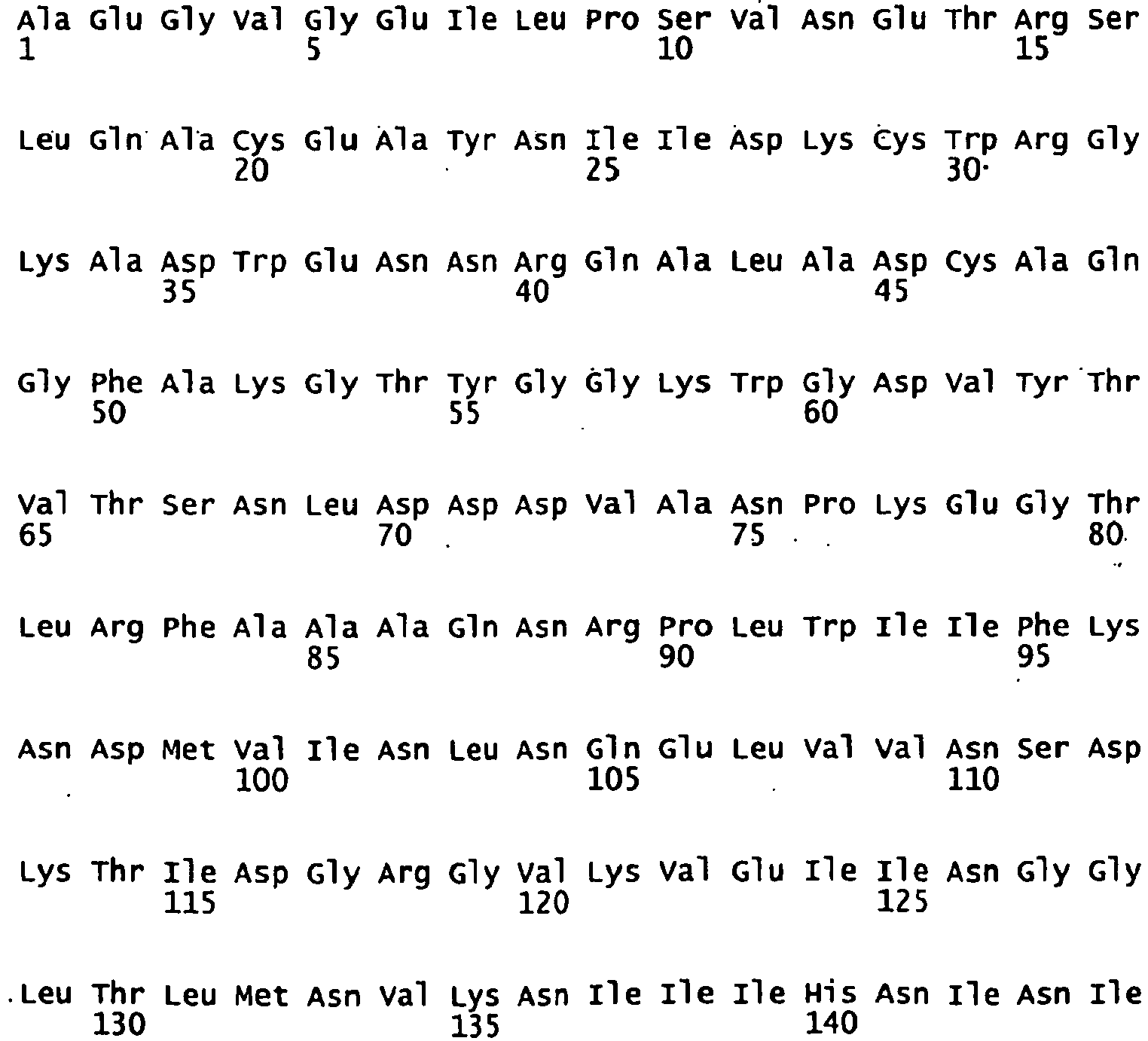

Claims (13)
- Vaccine formulation comprising a peptide consisting of SEQ ID No. 52.
- Vaccine formulation according to claim 1 comprising peptides SEQ ID No. 52 and SEQ ID No. 137; SEQ ID No. 52 and SEQ ID No. 138; SEQ ID No. 52 and SEQ ID No. 139; SEQ ID No. 52, SEQ ID No. 137 and SEQ ID No. 138; SEQ ID No. 52, SEQ ID No. 138 and SEQ ID No. 139; SEQ ID No. 52, SEQ ID No. 137 and SEQ ID No. 139; or SEQ ID No. 52, SEQ ID No. 137, SEQ ID No. 138 and SEQ ID No. 139.
- Vaccine formulation according to claim 1 or 2, characterised in that the formulation comprises further at least one pharmaceutical acceptable adjuvant, excipient and/or carrier.
- Peptide derived from the ragweed pollen allergen Amb a 1 and consisting of an amino acid sequence consisting of SEQ ID No. 52 and variants thereof differing by one amino acid residue.
- Fusion protein consisting of a peptide according to claim 4 and at least one second peptide derived from an immunogen, characterized in that the immunogen is an allergen selected from the group consisting of Amb a 2, Amb a 3, Amb a 5, Amb a 6, Amb a 7, Amb a 8, Amb a 9, Amb a 10, Amb t 5, Art v 1, Art v 2, Art v 3, Art v 4, Art v 5, Art v 6, Hel a 1, Hel a 2, Hel a 3, Mer a 1, Che a 1, Che a 2, Che a 3, Sal k 1, Cat r 1, Pla 1 1, Hum j 1, Par j 1, Par j 2, Par j 3, Par o 1, Cyn d 1, Cyn d 7, Cyn d 12, Cyn d 15, Cyn d 22w, Cyn d 23, Cyn d 24, Dac g 1, Dac g 2, Dac g 3, Dac g 5, Fes p 4w, Hol 1 1, Lol p 1, Lol p 2, Lol p 3, Lol p 5, Lol p 11, Pha a 1, Phl p 1, Phl p 2, Phl p 4, Phl p 5, Phl p 6, Phl p 11, Phl p 12, Phl p 13, Poa p 1, Poa p 5, Sor h 1, Pho d 2, Aln g 1, Bet v 1, Bet v 2, Bet v 3, Bet v 4, Bet v 6, Bet v 7, Car b 1, Cas s 1, Cas s 5, Cas s 8, Cor a 1, Cor a 2, Cor a 8, Cor a 9, Cor a 10, Cor a 11, Que a 1, Fra e 1, Lig v 1, Ole e 1, Ole e 2, Ole e 3, Ole e 4, Ole e 5, Ole e 6, Ole e 7, Ole e 8, Ole e 9, Ole e 10, Syr v 1, Cry j 1, Cry j 2, Cup a 1, Cup s 1, Cup s 3w, Jun a 1, Jun a 2, Jun a 3, Jun o 4, Jun s 1, Jun v 1, Pla a 1, Pla a 2, Pla a 3, Aca s 13, Blo t 1, Blo t 3, Blo t 4, Blo t 5, Blo t 6, Blo t 10, Blo t 11, Blo t 12, Blo t 13, Blo t 19, Der f 1, Der f 2, Der f 3, Der f 7, Der f 10, Der f 11, Der f 14, Der f 15, Der f 16, Der f 17, Der f 18w, Der m 1, Der p 1, Der p 2, Der p 3, Der p 4, Der p 5, Der p 6, Der p 7, Der p 8, Der p 9, Der p 10, Der p 11, Der p 14, Der p 20, Der p 21, Eur m 2, Eur m 14, Gly d 2,Lep d 1, Lep d 2, Lep d 5, Lep d 7, Lep d 10, Lep d 13, Tyr p 2, Tyr p 13, Bos d 2, Bos d 3, Bos d 4, Bos d 5, Bos d 6, Bos d 7, Bos d 8, Can f 1, Can f 2, Can f 3, Can f 4, Equ c 1, Equ c 2, Equ c 3, Equ c 4, Equ c 5, Fel d 1, Fel d 2, Fel d 3, Fel d 4, Fel d 5w, Fel d 6w, Fel d 7w, Cav p 1, Cav p 2, Mus m 1, Rat n 1, Alt a 1, Alt a 3, Alt a 4, Alt a 5, Alt a 6, Alt a 7, Alt a 8, Alt a 10, Alt a 12, Alt a 13, Cla h 2, Cla h 5, Cla h 6, Cla h 7, Cla h 8, Cla h 9, Cla h 10, Cla h 12, Asp fl 13, Asp f 1, Asp f 2, Asp f 3, Asp f 4, Asp f 5, Asp f 6, Asp f 7, Asp f 8, Asp f 9, Asp f 10, Asp f 11, Asp f 12, Asp f 13, Asp f 15, Asp f 16, Asp f 17, Asp f 18, Asp f 22w, Asp f 23, Asp f 27, Asp f 28, Asp f 29, Asp n 14, Asp n 18, Asp n 25, Asp o 13, Asp o 21, Pen b 13, Pen b 26, Pen ch 13, Pen ch 18, Pen ch 20, Pen c 3, Pen c 13, Pen c 19, Pen c 22w, Pen c 24, Pen o 18, Fus c 1, Fus c 2, Tri r 2, Tri r 4, Tri t 1, Tri t 4, Cand a 1, Cand a 3, Cand b 2, Psi c 1, Psi c 2, Cop c 1, Cop c 2, Cop c 3, Cop c 5, Cop c 7, Rho m 1, Rho m 2, Mala f 2, Mala f 3, Mala f 4, Mala s 1, Mala s 5, Mala s 6, Mala s 7, Mala s 8, Mala s 9, Mala s 10, Mala s 11, Mala s 12, Mala s 13, Epi p 1, Aed a 1, Aed a 2, Api m 1, Api m 2, Api m 4, Api m 6, Api m 7, Bom p 1, Bom p 4, Bla g 1, Bla g 2, Bla g 4, Bla g 5, Bla g 6, Bla g 7, Bla g 8, Per a 1, Per a 3, Per a 6, Per a 7, Chi k 10, Chi t 1-9, Chi t 1.01, Chi t 1.02, Chi t 2.0101, Chi t 2.0102, Chi t 3, Chi t 4, Chi t 5, Chi t 6.01, Chi t 6.02, Chi t 7, Chi t 8, Chi t 9, Cte f 1, Cte f 2, Cte f 3, Tha p 1, Lep s 1, Dol m 1, Dol m 2, Dol m 5, Dol a 5, Pol a 1, Pol a 2, Pol a 5, Pol d 1, Pol d 4, Pol d 5, Pol e 1, Pol e 5, Pol f 5, Pol g 5, Pol m 5, Vesp c 1, Vesp c 5, Vesp m 1, Vesp m 5, Ves f 5, Ves g 5, Ves m 1, Ves m 2, Ves m 5, Ves p 5, Ves s 5, Ves vi 5, Ves v 1, Ves v 2, Ves v 5, Myr p 1, Myr p 2, Sol g 2, Sol g 4, Sol i 2, Sol i 3, Sol i 4, Sol s 2, Tria p 1, Gad c 1, Sal s 1, Bos d 4, Bos d 5, Bos d 6, Bos d 7, Bos d 8, Gal d 1, Gal d 2, Gal d 3, Gal d 4, Gal d 5, Met e 1, Pen a 1, Pen i 1, Pen m 1, Pen m 2, Tod p 1, Hel as 1, Hal m 1, Ran e 1, Ran e 2, Bra j 1, Bra n 1, Bra o 3, Bra r 1, Bra r 2, Hor v 15, Hor v 16, Hor v 17, Hor v 21, Sec c 20, Tri a 18, Tri a 19, Tri a 25, Tri a 26, Zea m 14, Zea m 25, Ory s 1, Api g 1, Api g 4, Api g 5, Dau c 1, Dau c 4, Cor a 1.04, Cor a 2, Cor a 8, Fra a 3, Fra a 4, Mal d 1, Mal d 2, Mal d 3, Mal d 4, Pyr c 1, Pyr c 4, Pyr c 5, Pers a 1, Pru ar 1, Pru ar 3, Pru av 1, Pru av 2, Pru av 3, Pru av 4, Pru d 3, Pru du 4, Pru p 3, Pru p 4, Aspa o 1, Cro s 1, Cro s 2, Lac s 1, Vit v 1, Mus xp 1, Ana c 1, Ana c 2, Cit 1 3, Cit s 1, Cit s 2, Cit s 3, Lit c 1, Sin a 1, Gly m 1, Gly m 2, Gly m 3, Gly m 4, Vig r 1, Ara h 1, Ara h 2, Ara h 3, Ara h 4, Ara h 5, Ara h 6, Ara h 7, Ara h 8, Len c 1, Len c 2, Pis s 1, Pis s 2, Act c 1, Act c 2, Cap a 1w, Cap a 2, Lyc e 1, Lyc e 2, Lyc e 3, Sola t 1, Sola t 2, Sola t 3, Sola t 4, Ber e 1, Ber e 2, Jug n 1, Jug n 2, Jug r 1, Jug r 2, Jug r 3, Ana o 1, Ana o 2, Ana o 3, Ric c 1, Ses i 1, Ses i 2, Ses i 3, Ses i 4, Ses i 5, Ses i 6, Cuc m 1, Cuc m 2, Cuc m 3, Ziz m 1, Ani s 1, Ani s 2, Ani s 3, Ani s 4, Arg r, Asc s 1, Car p 1, Den n 1, Hev b 1, Hev b 2, Hev b 3, Hev b 4, Hev b 5, Hev b 6.01, Hev b 6.02, Hev b 6.03, Hev b 7.01, Hev b 7.02, Hev b 8, Hev b 9, Hev b 10, Hev b 11, Hev b 12, Hev b 13, Hom s 1, Hom s 2, Hom s 3, Hom s 4, Hom s 5 and Trip s 1.
- Fusion protein according to claim 5 further comprising at least one peptide derived from the ragweed pollen allergen Amb a 1 and consisting of an amino acid sequence selected from the group consisting of SEQ ID No. 12, SEQ ID No. 20, SEQ ID No. 27, SEQ ID No. 28, SEQ ID No. 30, SEQ ID No. 31, SEQ ID No. 33, SEQ ID No. 36, SEQ ID No. 37, SEQ ID No. 38, SEQ ID No. 39, SEQ ID No. 41, SEQ ID No. 42, SEQ ID No. 44, SEQ ID No. 46, SEQ ID No. 47, SEQ ID No. 48, SEQ ID No. 50, SEQ ID No. 51, SEQ ID No. 53, SEQ ID No. 59, SEQ ID No. 60, SEQ ID No. 61, SEQ ID No. 67, SEQ ID No. 68, SEQ ID No. 69, SEQ ID No. 77, SEQ ID No. 78, SEQ ID No. 79, SEQ ID No. 80, SEQ ID No. 81, SEQ ID No. 83, SEQ ID No. 86, SEQ ID No. 87, SEQ ID No. 88, SEQ ID No. 89, SEQ ID No. 90, SEQ ID No. 91, SEQ ID No. 93, SEQ ID No. 94, SEQ ID No. 96, SEQ ID No. 97, SEQ ID No. 98, SEQ ID No. 99, SEQ ID No. 100, SEQ ID No. 101, SEQ ID No. 102, SEQ ID No. 107, SEQ ID No. 108, SEQ ID No. 109, SEQ ID No. 110, SEQ ID No. 111, SEQ ID No. 112, SEQ ID No. 114, SEQ ID No. 115, SEQ ID No. 118, SEQ ID No. 119, SEQ ID No. 120, SEQ ID No. 121, SEQ ID No. 122, SEQ ID No. 123, SEQ ID No. 124, SEQ ID No. 125, SEQ ID No. 126, SEQ ID No. 127, SEQ ID No. 128, SEQ ID No. 129, SEQ ID No. 130, SEQ ID No. 131, SEQ ID No. 132, SEQ ID No. 133, SEQ ID No. 134, SEQ ID No. 135, SEQ ID No. 136, SEQ ID No. 137, SEQ ID No. 138 and SEQ ID No. 139.
- Nucleic acid molecule encoding a peptide according to claim 4 or a fusion protein according to claim 5 or 6.
- Vector comprising a nucleic acid molecule according to claim 7.
- Vector according to claim 8, characterised in that said vector further comprises promoter operably linked to said nucleic acid molecule.
- Vaccine formulation comprising at least one fusion protein according to claim 5 or 6, preferably comprising further at least one pharmaceutical acceptable adjuvant, excipient and/or carrier.
- Use of at least one peptide according to claim 4 and/or of a fusion protein according to claim 5 or 6 for the manufacture of a vaccine formulation, preferably for preventing or treating a ragweed pollen allergy in an individual, in particular an allergy caused by Amb a 1, or an allergy cross-reacting with a ragweed pollen allergy.
- Use of at least one peptide according to claim 4 and/or at least one fusion protein according to claim 5 or 6 for diagnosing in vitro a ragweed allergy or the sensitivity of an individual to a ragweed pollen allergen, in particular to Amb a 1, or an allergy cross-reacting with a ragweed pollen allergy.
- Peptide according to claim 4 or fusion protein according to claim 5 or 6 for use in preventing or treating a ragweed pollen allergy in an individual, in particular an allergy caused by Amb a 1, or an allergy cross-reacting with a ragweed pollen allergy.
Priority Applications (6)
| Application Number | Priority Date | Filing Date | Title |
|---|---|---|---|
| EP12151629.8A EP2491949B1 (en) | 2007-02-13 | 2008-02-13 | Peptides derived from the major allergen of ragweed (ambrosia artemisiifolia) and uses thereof |
| PL08715749T PL2121012T3 (en) | 2007-02-13 | 2008-02-13 | Peptides derived from the major allergen of ragweed (ambrosia artemisiifolia) and uses thereof |
| HRP20160114TT HRP20160114T1 (en) | 2007-02-13 | 2008-02-13 | Peptides derived from the major allergen of ragweed (ambrosia artemisiifolia) and uses thereof |
| SI200831575T SI2121012T1 (en) | 2007-02-13 | 2008-02-13 | Peptides derived from the major allergen of ragweed (ambrosia artemisiifolia) and uses thereof |
| EP08715749.1A EP2121012B1 (en) | 2007-02-13 | 2008-02-13 | Peptides derived from the major allergen of ragweed (ambrosia artemisiifolia) and uses thereof |
| EP12151627A EP2491948A1 (en) | 2007-02-13 | 2008-02-13 | Peptides derived from the major allergen of ragweed (ambrosia artemisiifolia) and uses thereof |
Applications Claiming Priority (3)
| Application Number | Priority Date | Filing Date | Title |
|---|---|---|---|
| EP07102260A EP1958645A1 (en) | 2007-02-13 | 2007-02-13 | Peptides derived from the major allergen of ragweed (Ambrosia artemisiifolia) and uses thereof |
| EP08715749.1A EP2121012B1 (en) | 2007-02-13 | 2008-02-13 | Peptides derived from the major allergen of ragweed (ambrosia artemisiifolia) and uses thereof |
| PCT/EP2008/001092 WO2008098749A2 (en) | 2007-02-13 | 2008-02-13 | Peptides derived from the major allergen of ragweed (ambrosia artemisiifolia) and uses thereof |
Related Child Applications (4)
| Application Number | Title | Priority Date | Filing Date |
|---|---|---|---|
| EP12151627A Division EP2491948A1 (en) | 2007-02-13 | 2008-02-13 | Peptides derived from the major allergen of ragweed (ambrosia artemisiifolia) and uses thereof |
| EP12151627A Division-Into EP2491948A1 (en) | 2007-02-13 | 2008-02-13 | Peptides derived from the major allergen of ragweed (ambrosia artemisiifolia) and uses thereof |
| EP12151629.8A Division-Into EP2491949B1 (en) | 2007-02-13 | 2008-02-13 | Peptides derived from the major allergen of ragweed (ambrosia artemisiifolia) and uses thereof |
| EP12151629.8A Division EP2491949B1 (en) | 2007-02-13 | 2008-02-13 | Peptides derived from the major allergen of ragweed (ambrosia artemisiifolia) and uses thereof |
Publications (2)
| Publication Number | Publication Date |
|---|---|
| EP2121012A2 EP2121012A2 (en) | 2009-11-25 |
| EP2121012B1 true EP2121012B1 (en) | 2015-11-04 |
Family
ID=37913945
Family Applications (4)
| Application Number | Title | Priority Date | Filing Date |
|---|---|---|---|
| EP07102260A Withdrawn EP1958645A1 (en) | 2007-02-13 | 2007-02-13 | Peptides derived from the major allergen of ragweed (Ambrosia artemisiifolia) and uses thereof |
| EP08715749.1A Active EP2121012B1 (en) | 2007-02-13 | 2008-02-13 | Peptides derived from the major allergen of ragweed (ambrosia artemisiifolia) and uses thereof |
| EP12151629.8A Not-in-force EP2491949B1 (en) | 2007-02-13 | 2008-02-13 | Peptides derived from the major allergen of ragweed (ambrosia artemisiifolia) and uses thereof |
| EP12151627A Withdrawn EP2491948A1 (en) | 2007-02-13 | 2008-02-13 | Peptides derived from the major allergen of ragweed (ambrosia artemisiifolia) and uses thereof |
Family Applications Before (1)
| Application Number | Title | Priority Date | Filing Date |
|---|---|---|---|
| EP07102260A Withdrawn EP1958645A1 (en) | 2007-02-13 | 2007-02-13 | Peptides derived from the major allergen of ragweed (Ambrosia artemisiifolia) and uses thereof |
Family Applications After (2)
| Application Number | Title | Priority Date | Filing Date |
|---|---|---|---|
| EP12151629.8A Not-in-force EP2491949B1 (en) | 2007-02-13 | 2008-02-13 | Peptides derived from the major allergen of ragweed (ambrosia artemisiifolia) and uses thereof |
| EP12151627A Withdrawn EP2491948A1 (en) | 2007-02-13 | 2008-02-13 | Peptides derived from the major allergen of ragweed (ambrosia artemisiifolia) and uses thereof |
Country Status (12)
| Country | Link |
|---|---|
| US (2) | US9360486B2 (en) |
| EP (4) | EP1958645A1 (en) |
| JP (2) | JP5719512B2 (en) |
| AU (1) | AU2008214852B2 (en) |
| CA (1) | CA2677853C (en) |
| DK (1) | DK2121012T3 (en) |
| ES (2) | ES2561588T3 (en) |
| HR (1) | HRP20160114T1 (en) |
| HU (1) | HUE026699T2 (en) |
| PL (1) | PL2121012T3 (en) |
| SI (1) | SI2121012T1 (en) |
| WO (1) | WO2008098749A2 (en) |
Families Citing this family (13)
| Publication number | Priority date | Publication date | Assignee | Title |
|---|---|---|---|---|
| EP1958645A1 (en) * | 2007-02-13 | 2008-08-20 | Biomay AG | Peptides derived from the major allergen of ragweed (Ambrosia artemisiifolia) and uses thereof |
| GB0710529D0 (en) | 2007-06-01 | 2007-07-11 | Circassia Ltd | Vaccine |
| EA023303B1 (en) | 2007-08-15 | 2016-05-31 | Сиркейшиа Лимитед | Peptide composition for tolerization to house dust mites and use thereof |
| EP2331124A1 (en) | 2008-08-15 | 2011-06-15 | Circassia Limited | T-cell antigen peptide from allergen for stimulation of il-10 production |
| ES2378870T5 (en) | 2008-08-15 | 2016-02-03 | Circassia Limited | Vaccine comprising Amb to 1 peptides for use in the treatment of ragweed allergy |
| GB0821806D0 (en) | 2008-11-28 | 2009-01-07 | Circassia Ltd | Compositions with reduced dimer formation |
| AU2015227499B2 (en) * | 2008-11-28 | 2017-06-22 | Circassia Limited | Compositions with reduced dimer formation |
| US9271899B2 (en) | 2010-04-30 | 2016-03-01 | Allovate, Llc | Methods, articles and kits for allergic desensitization, via the oral mucosa |
| WO2011137422A2 (en) | 2010-04-30 | 2011-11-03 | Apellis Pharmaceuticals, Inc. | Methods and articles for preventing or reducing risk of developing a hyperallergenic immune system |
| WO2013001362A2 (en) * | 2011-06-27 | 2013-01-03 | Anergis S.A. | Contiguous overlapping peptides for treatment of ragweed pollen allergy |
| EA035045B1 (en) | 2013-09-19 | 2020-04-21 | АЛЛОВЕЙТ, ЭлЭлСи | Toothpaste compositions for delivering allergens to oral mucosa |
| WO2017179025A1 (en) | 2016-04-15 | 2017-10-19 | Alk-Abelló A/S | Epitope polypeptides of ragweed pollen allergens |
| EP3295956A1 (en) | 2016-09-20 | 2018-03-21 | Biomay Ag | Polypeptide construct comprising fragments of allergens |
Family Cites Families (17)
| Publication number | Priority date | Publication date | Assignee | Title |
|---|---|---|---|---|
| GB8308235D0 (en) | 1983-03-25 | 1983-05-05 | Celltech Ltd | Polypeptides |
| US4816567A (en) | 1983-04-08 | 1989-03-28 | Genentech, Inc. | Recombinant immunoglobin preparations |
| US5807715A (en) | 1984-08-27 | 1998-09-15 | The Board Of Trustees Of The Leland Stanford Junior University | Methods and transformed mammalian lymphocyte cells for producing functional antigen-binding protein including chimeric immunoglobulin |
| US5225539A (en) | 1986-03-27 | 1993-07-06 | Medical Research Council | Recombinant altered antibodies and methods of making altered antibodies |
| GB8607679D0 (en) | 1986-03-27 | 1986-04-30 | Winter G P | Recombinant dna product |
| US5530101A (en) | 1988-12-28 | 1996-06-25 | Protein Design Labs, Inc. | Humanized immunoglobulins |
| US5776761A (en) | 1989-03-17 | 1998-07-07 | Immulogic Pharmaceutical Corporation | Nucleic acids encoding allergenic proteins from ragweed |
| WO1990011293A1 (en) * | 1989-03-17 | 1990-10-04 | Immulogic Pharmaceutical Corporation | Allergenic proteins from ragweed and uses therefor |
| GB8928874D0 (en) | 1989-12-21 | 1990-02-28 | Celltech Ltd | Humanised antibodies |
| DE69233482T2 (en) | 1991-05-17 | 2006-01-12 | Merck & Co., Inc. | Method for reducing the immunogenicity of antibody variable domains |
| US5565332A (en) | 1991-09-23 | 1996-10-15 | Medical Research Council | Production of chimeric antibodies - a combinatorial approach |
| EP0636180A1 (en) * | 1992-04-09 | 1995-02-01 | Immulogic Pharmaceutical Corporation | T CELL EPITOPES OF THE MAJOR ALLERGENS FROM $i(AMBROSIA ARTEMISIIFOLIA) |
| US5639641A (en) | 1992-09-09 | 1997-06-17 | Immunogen Inc. | Resurfacing of rodent antibodies |
| AU4146796A (en) * | 1994-10-27 | 1996-05-23 | Immulogic Pharmaceutical Corporation | T cell epitopes of the major allergens from ambrosia artemisiifolia |
| CA2317724A1 (en) * | 1998-01-09 | 1999-07-15 | Circassia Limited | Methods and compositions for desensitisation |
| EP1958645A1 (en) * | 2007-02-13 | 2008-08-20 | Biomay AG | Peptides derived from the major allergen of ragweed (Ambrosia artemisiifolia) and uses thereof |
| ES2378870T5 (en) * | 2008-08-15 | 2016-02-03 | Circassia Limited | Vaccine comprising Amb to 1 peptides for use in the treatment of ragweed allergy |
-
2007
- 2007-02-13 EP EP07102260A patent/EP1958645A1/en not_active Withdrawn
-
2008
- 2008-02-13 ES ES08715749.1T patent/ES2561588T3/en active Active
- 2008-02-13 HR HRP20160114TT patent/HRP20160114T1/en unknown
- 2008-02-13 WO PCT/EP2008/001092 patent/WO2008098749A2/en not_active Ceased
- 2008-02-13 DK DK08715749.1T patent/DK2121012T3/en active
- 2008-02-13 EP EP08715749.1A patent/EP2121012B1/en active Active
- 2008-02-13 PL PL08715749T patent/PL2121012T3/en unknown
- 2008-02-13 EP EP12151629.8A patent/EP2491949B1/en not_active Not-in-force
- 2008-02-13 HU HUE08715749A patent/HUE026699T2/en unknown
- 2008-02-13 JP JP2009549373A patent/JP5719512B2/en not_active Expired - Fee Related
- 2008-02-13 SI SI200831575T patent/SI2121012T1/en unknown
- 2008-02-13 US US12/526,143 patent/US9360486B2/en not_active Expired - Fee Related
- 2008-02-13 AU AU2008214852A patent/AU2008214852B2/en not_active Ceased
- 2008-02-13 EP EP12151627A patent/EP2491948A1/en not_active Withdrawn
- 2008-02-13 CA CA2677853A patent/CA2677853C/en not_active Expired - Fee Related
- 2008-02-13 ES ES12151629.8T patent/ES2604502T3/en active Active
-
2014
- 2014-12-05 JP JP2014247087A patent/JP5985592B2/en not_active Expired - Fee Related
-
2016
- 2016-05-03 US US15/145,284 patent/US20160354463A1/en not_active Abandoned
Non-Patent Citations (4)
| Title |
|---|
| ANONYMOUS: "CYND1 - Major pollen allergen Cyn d 1 - Cynodon dactylon (Bermuda grass), O04701", 20 June 2001 (2001-06-20), XP055155899, Retrieved from the Internet <URL:http://www.uniprot.org/uniprot/O04701> [retrieved on 20141201] * |
| ANONYMOUS: "Pectate lyase 1, Cry j 1 - Cryptomeria japonica (Japanese cedar), P18632", 1 November 1990 (1990-11-01), XP055155902, Retrieved from the Internet <URL:http://www.uniprot.org/uniprot/P18632> [retrieved on 20141201] * |
| SMITH ET AL: "Cloning and expression in yeast Pichia pastorisof a biologically active form of Cyn d 1, the major allergen of Bermuda grass pollen", JOURNAL OF ALLERGY AND CLINICAL IMMUNOLOGY, ELSEVIER, AMSTERDAM, NL, vol. 98, no. 2, 1 August 1996 (1996-08-01), pages 331 - 343, XP005139622, ISSN: 0091-6749, DOI: 10.1016/S0091-6749(96)70158-6 * |
| SONE T ET AL: "Cloning and Sequencing of cDNA Coding for Cry j I, a Major Allergen of Japanese Cedar Pollen", BIOCHEMICAL AND BIOPHYSICAL RESEARCH COMMUNICATIONS, ACADEMIC PRESS INC. ORLANDO, FL, US, vol. 199, no. 2, 15 March 1994 (1994-03-15), pages 619 - 625, XP024765492, ISSN: 0006-291X, [retrieved on 19940315], DOI: 10.1006/BBRC.1994.1273 * |
Also Published As
| Publication number | Publication date |
|---|---|
| ES2561588T3 (en) | 2016-02-29 |
| US20160354463A1 (en) | 2016-12-08 |
| AU2008214852A1 (en) | 2008-08-21 |
| EP2491948A1 (en) | 2012-08-29 |
| HUE026699T2 (en) | 2016-07-28 |
| CA2677853C (en) | 2017-06-13 |
| SI2121012T1 (en) | 2016-03-31 |
| EP2121012A2 (en) | 2009-11-25 |
| JP2010518813A (en) | 2010-06-03 |
| WO2008098749A2 (en) | 2008-08-21 |
| JP5719512B2 (en) | 2015-05-20 |
| ES2604502T3 (en) | 2017-03-07 |
| CA2677853A1 (en) | 2008-08-21 |
| JP5985592B2 (en) | 2016-09-06 |
| US9360486B2 (en) | 2016-06-07 |
| JP2015078218A (en) | 2015-04-23 |
| WO2008098749A3 (en) | 2008-11-27 |
| PL2121012T3 (en) | 2016-06-30 |
| EP2491949A1 (en) | 2012-08-29 |
| AU2008214852B2 (en) | 2013-08-29 |
| EP2491949B1 (en) | 2016-08-24 |
| EP1958645A1 (en) | 2008-08-20 |
| US20100104606A1 (en) | 2010-04-29 |
| DK2121012T3 (en) | 2016-02-08 |
| HRP20160114T1 (en) | 2016-04-08 |
Similar Documents
| Publication | Publication Date | Title |
|---|---|---|
| EP2491949B1 (en) | Peptides derived from the major allergen of ragweed (ambrosia artemisiifolia) and uses thereof | |
| WO2009022156A2 (en) | Peptides for desensibilization against allergens | |
| US20150192580A1 (en) | Biomarker for neurodegeneration in neurological disease | |
| DK2106262T3 (en) | HOW TO UNKNOWN PROSTATA CALLICREEN ALLERGY | |
| CN110824156B (en) | Diagnosis of neuroautoimmune disease | |
| Oreste et al. | Purification and Characterization of Par· I, Major Allergen of Parietaria officinalis Pollen | |
| JP5363441B2 (en) | Phlp5a derivative with reduced allergenicity and retained T cell reactivity | |
| US20150210742A1 (en) | Novel allergen from ragweed pollen and uses thereof | |
| US20090098167A1 (en) | PHL P 1 Allergen Derivative | |
| AU2013257437B2 (en) | Peptides derived from the major allergen of ragweed (ambrosia artemisiifolia) and uses thereof | |
| RU2409589C2 (en) | VERSION OF GROUP I Poaceae ALLERGEN CHARACTERISED BY LOWER ALLERGENICITY AND MAINTAINED T-CELL RESPONSIVENESS (VERSIONS), CODING DNA MOLECULE AND APPLICATION THEREOF | |
| PL219272B1 (en) | The DNA sequence and a method for preparing a recombinant grass pollen allergen PHL P4 | |
| Nour Ibrahim et al. | Molecular cloning and immunochemical characterization of a new Japanese cedar pollen allergen homologous to plant subtilisin-like serine protease | |
| WO2025102125A1 (en) | Modified grass pollen allergens | |
| EP2110383A1 (en) | Hypoallergenic variants |
Legal Events
| Date | Code | Title | Description |
|---|---|---|---|
| PUAI | Public reference made under article 153(3) epc to a published international application that has entered the european phase |
Free format text: ORIGINAL CODE: 0009012 |
|
| 17P | Request for examination filed |
Effective date: 20090911 |
|
| AK | Designated contracting states |
Kind code of ref document: A2 Designated state(s): AT BE BG CH CY CZ DE DK EE ES FI FR GB GR HR HU IE IS IT LI LT LU LV MC MT NL NO PL PT RO SE SI SK TR |
|
| AX | Request for extension of the european patent |
Extension state: RS |
|
| 17Q | First examination report despatched |
Effective date: 20100118 |
|
| RAX | Requested extension states of the european patent have changed |
Extension state: RS Payment date: 20090911 |
|
| RIN1 | Information on inventor provided before grant (corrected) |
Inventor name: BOHLE, BARBARA Inventor name: EBNER, CHRISTOF Inventor name: SCHMIDT, GEORG Inventor name: FERREIRA, FATIMA Inventor name: JAHN-SCHMID, BEATRICE Inventor name: WOPFNER, NICOLE |
|
| GRAP | Despatch of communication of intention to grant a patent |
Free format text: ORIGINAL CODE: EPIDOSNIGR1 |
|
| INTG | Intention to grant announced |
Effective date: 20150601 |
|
| RIN1 | Information on inventor provided before grant (corrected) |
Inventor name: EBNER, CHRISTOF Inventor name: FERREIRA, FATIMA Inventor name: JAHN-SCHMID, BEATRICE Inventor name: SCHMIDT, GEORG Inventor name: BOHLE, BARBARA Inventor name: WOPFNER, NICOLE |
|
| GRAS | Grant fee paid |
Free format text: ORIGINAL CODE: EPIDOSNIGR3 |
|
| GRAA | (expected) grant |
Free format text: ORIGINAL CODE: 0009210 |
|
| AK | Designated contracting states |
Kind code of ref document: B1 Designated state(s): AT BE BG CH CY CZ DE DK EE ES FI FR GB GR HR HU IE IS IT LI LT LU LV MC MT NL NO PL PT RO SE SI SK TR |
|
| AX | Request for extension of the european patent |
Extension state: RS |
|
| REG | Reference to a national code |
Ref country code: GB Ref legal event code: FG4D |
|
| REG | Reference to a national code |
Ref country code: CH Ref legal event code: EP |
|
| REG | Reference to a national code |
Ref country code: AT Ref legal event code: REF Ref document number: 758730 Country of ref document: AT Kind code of ref document: T Effective date: 20151115 |
|
| REG | Reference to a national code |
Ref country code: IE Ref legal event code: FG4D |
|
| REG | Reference to a national code |
Ref country code: DE Ref legal event code: R096 Ref document number: 602008040976 Country of ref document: DE |
|
| REG | Reference to a national code |
Ref country code: HR Ref legal event code: TUEP Ref document number: P20160114 Country of ref document: HR |
|
| REG | Reference to a national code |
Ref country code: RO Ref legal event code: EPE |
|
| REG | Reference to a national code |
Ref country code: DK Ref legal event code: T3 Effective date: 20160202 |
|
| REG | Reference to a national code |
Ref country code: FR Ref legal event code: PLFP Year of fee payment: 9 |
|
| REG | Reference to a national code |
Ref country code: SE Ref legal event code: TRGR |
|
| REG | Reference to a national code |
Ref country code: CH Ref legal event code: NV Representative=s name: KELLER AND PARTNER PATENTANWAELTE AG, CH Ref country code: ES Ref legal event code: FG2A Ref document number: 2561588 Country of ref document: ES Kind code of ref document: T3 Effective date: 20160229 |
|
| REG | Reference to a national code |
Ref country code: LT Ref legal event code: MG4D |
|
| REG | Reference to a national code |
Ref country code: NL Ref legal event code: FP |
|
| REG | Reference to a national code |
Ref country code: HR Ref legal event code: T1PR Ref document number: P20160114 Country of ref document: HR |
|
| PG25 | Lapsed in a contracting state [announced via postgrant information from national office to epo] |
Ref country code: LT Free format text: LAPSE BECAUSE OF FAILURE TO SUBMIT A TRANSLATION OF THE DESCRIPTION OR TO PAY THE FEE WITHIN THE PRESCRIBED TIME-LIMIT Effective date: 20151104 Ref country code: NO Free format text: LAPSE BECAUSE OF FAILURE TO SUBMIT A TRANSLATION OF THE DESCRIPTION OR TO PAY THE FEE WITHIN THE PRESCRIBED TIME-LIMIT Effective date: 20160204 Ref country code: IS Free format text: LAPSE BECAUSE OF FAILURE TO SUBMIT A TRANSLATION OF THE DESCRIPTION OR TO PAY THE FEE WITHIN THE PRESCRIBED TIME-LIMIT Effective date: 20160304 |
|
| PG25 | Lapsed in a contracting state [announced via postgrant information from national office to epo] |
Ref country code: FI Free format text: LAPSE BECAUSE OF FAILURE TO SUBMIT A TRANSLATION OF THE DESCRIPTION OR TO PAY THE FEE WITHIN THE PRESCRIBED TIME-LIMIT Effective date: 20151104 Ref country code: LV Free format text: LAPSE BECAUSE OF FAILURE TO SUBMIT A TRANSLATION OF THE DESCRIPTION OR TO PAY THE FEE WITHIN THE PRESCRIBED TIME-LIMIT Effective date: 20151104 Ref country code: PT Free format text: LAPSE BECAUSE OF FAILURE TO SUBMIT A TRANSLATION OF THE DESCRIPTION OR TO PAY THE FEE WITHIN THE PRESCRIBED TIME-LIMIT Effective date: 20160304 Ref country code: GR Free format text: LAPSE BECAUSE OF FAILURE TO SUBMIT A TRANSLATION OF THE DESCRIPTION OR TO PAY THE FEE WITHIN THE PRESCRIBED TIME-LIMIT Effective date: 20160205 |
|
| REG | Reference to a national code |
Ref country code: HU Ref legal event code: AG4A Ref document number: E026699 Country of ref document: HU |
|
| REG | Reference to a national code |
Ref country code: DE Ref legal event code: R097 Ref document number: 602008040976 Country of ref document: DE |
|
| PG25 | Lapsed in a contracting state [announced via postgrant information from national office to epo] |
Ref country code: EE Free format text: LAPSE BECAUSE OF FAILURE TO SUBMIT A TRANSLATION OF THE DESCRIPTION OR TO PAY THE FEE WITHIN THE PRESCRIBED TIME-LIMIT Effective date: 20151104 Ref country code: SK Free format text: LAPSE BECAUSE OF FAILURE TO SUBMIT A TRANSLATION OF THE DESCRIPTION OR TO PAY THE FEE WITHIN THE PRESCRIBED TIME-LIMIT Effective date: 20151104 |
|
| PLBE | No opposition filed within time limit |
Free format text: ORIGINAL CODE: 0009261 |
|
| STAA | Information on the status of an ep patent application or granted ep patent |
Free format text: STATUS: NO OPPOSITION FILED WITHIN TIME LIMIT |
|
| PG25 | Lapsed in a contracting state [announced via postgrant information from national office to epo] |
Ref country code: MC Free format text: LAPSE BECAUSE OF FAILURE TO SUBMIT A TRANSLATION OF THE DESCRIPTION OR TO PAY THE FEE WITHIN THE PRESCRIBED TIME-LIMIT Effective date: 20151104 |
|
| 26N | No opposition filed |
Effective date: 20160805 |
|
| REG | Reference to a national code |
Ref country code: HR Ref legal event code: ODRP Ref document number: P20160114 Country of ref document: HR Payment date: 20170125 Year of fee payment: 10 |
|
| REG | Reference to a national code |
Ref country code: FR Ref legal event code: PLFP Year of fee payment: 10 |
|
| PGFP | Annual fee paid to national office [announced via postgrant information from national office to epo] |
Ref country code: FR Payment date: 20170209 Year of fee payment: 10 Ref country code: RO Payment date: 20170207 Year of fee payment: 10 Ref country code: SE Payment date: 20170216 Year of fee payment: 10 Ref country code: CH Payment date: 20170217 Year of fee payment: 10 Ref country code: DE Payment date: 20170224 Year of fee payment: 10 |
|
| PGFP | Annual fee paid to national office [announced via postgrant information from national office to epo] |
Ref country code: SI Payment date: 20170124 Year of fee payment: 10 Ref country code: HU Payment date: 20170124 Year of fee payment: 10 Ref country code: GB Payment date: 20170227 Year of fee payment: 10 Ref country code: DK Payment date: 20170216 Year of fee payment: 10 Ref country code: HR Payment date: 20170125 Year of fee payment: 10 Ref country code: AT Payment date: 20170227 Year of fee payment: 10 Ref country code: PL Payment date: 20170126 Year of fee payment: 10 Ref country code: CZ Payment date: 20170130 Year of fee payment: 10 Ref country code: BE Payment date: 20170216 Year of fee payment: 10 Ref country code: NL Payment date: 20170207 Year of fee payment: 10 Ref country code: BG Payment date: 20170123 Year of fee payment: 10 Ref country code: IE Payment date: 20170131 Year of fee payment: 10 Ref country code: LU Payment date: 20170204 Year of fee payment: 10 |
|
| PGFP | Annual fee paid to national office [announced via postgrant information from national office to epo] |
Ref country code: IT Payment date: 20170207 Year of fee payment: 10 Ref country code: ES Payment date: 20170227 Year of fee payment: 10 |
|
| PG25 | Lapsed in a contracting state [announced via postgrant information from national office to epo] |
Ref country code: MT Free format text: LAPSE BECAUSE OF FAILURE TO SUBMIT A TRANSLATION OF THE DESCRIPTION OR TO PAY THE FEE WITHIN THE PRESCRIBED TIME-LIMIT Effective date: 20151104 |
|
| PG25 | Lapsed in a contracting state [announced via postgrant information from national office to epo] |
Ref country code: CY Free format text: LAPSE BECAUSE OF FAILURE TO SUBMIT A TRANSLATION OF THE DESCRIPTION OR TO PAY THE FEE WITHIN THE PRESCRIBED TIME-LIMIT Effective date: 20151104 |
|
| PG25 | Lapsed in a contracting state [announced via postgrant information from national office to epo] |
Ref country code: MT Free format text: LAPSE BECAUSE OF FAILURE TO SUBMIT A TRANSLATION OF THE DESCRIPTION OR TO PAY THE FEE WITHIN THE PRESCRIBED TIME-LIMIT Effective date: 20160229 Ref country code: TR Free format text: LAPSE BECAUSE OF FAILURE TO SUBMIT A TRANSLATION OF THE DESCRIPTION OR TO PAY THE FEE WITHIN THE PRESCRIBED TIME-LIMIT Effective date: 20151104 |
|
| REG | Reference to a national code |
Ref country code: HR Ref legal event code: PBON Ref document number: P20160114 Country of ref document: HR Effective date: 20180213 |
|
| REG | Reference to a national code |
Ref country code: DE Ref legal event code: R119 Ref document number: 602008040976 Country of ref document: DE |
|
| REG | Reference to a national code |
Ref country code: CH Ref legal event code: PL |
|
| REG | Reference to a national code |
Ref country code: DK Ref legal event code: EBP Effective date: 20180228 |
|
| REG | Reference to a national code |
Ref country code: SE Ref legal event code: EUG |
|
| REG | Reference to a national code |
Ref country code: NL Ref legal event code: MM Effective date: 20180301 |
|
| REG | Reference to a national code |
Ref country code: AT Ref legal event code: MM01 Ref document number: 758730 Country of ref document: AT Kind code of ref document: T Effective date: 20180213 |
|
| GBPC | Gb: european patent ceased through non-payment of renewal fee |
Effective date: 20180213 |
|
| PG25 | Lapsed in a contracting state [announced via postgrant information from national office to epo] |
Ref country code: HU Free format text: LAPSE BECAUSE OF NON-PAYMENT OF DUE FEES Effective date: 20180214 Ref country code: RO Free format text: LAPSE BECAUSE OF NON-PAYMENT OF DUE FEES Effective date: 20180213 Ref country code: SE Free format text: LAPSE BECAUSE OF NON-PAYMENT OF DUE FEES Effective date: 20180214 |
|
| REG | Reference to a national code |
Ref country code: IE Ref legal event code: MM4A |
|
| REG | Reference to a national code |
Ref country code: BE Ref legal event code: FP Effective date: 20160202 Ref country code: BE Ref legal event code: MM Effective date: 20180228 |
|
| PG25 | Lapsed in a contracting state [announced via postgrant information from national office to epo] |
Ref country code: AT Free format text: LAPSE BECAUSE OF NON-PAYMENT OF DUE FEES Effective date: 20180213 Ref country code: CZ Free format text: LAPSE BECAUSE OF NON-PAYMENT OF DUE FEES Effective date: 20180213 Ref country code: HR Free format text: LAPSE BECAUSE OF NON-PAYMENT OF DUE FEES Effective date: 20180213 Ref country code: LU Free format text: LAPSE BECAUSE OF NON-PAYMENT OF DUE FEES Effective date: 20180213 Ref country code: CH Free format text: LAPSE BECAUSE OF NON-PAYMENT OF DUE FEES Effective date: 20180228 Ref country code: SI Free format text: LAPSE BECAUSE OF NON-PAYMENT OF DUE FEES Effective date: 20180214 Ref country code: LI Free format text: LAPSE BECAUSE OF NON-PAYMENT OF DUE FEES Effective date: 20180228 |
|
| REG | Reference to a national code |
Ref country code: SI Ref legal event code: KO00 Effective date: 20181008 Ref country code: FR Ref legal event code: ST Effective date: 20181031 |
|
| PG25 | Lapsed in a contracting state [announced via postgrant information from national office to epo] |
Ref country code: NL Free format text: LAPSE BECAUSE OF NON-PAYMENT OF DUE FEES Effective date: 20180301 |
|
| PG25 | Lapsed in a contracting state [announced via postgrant information from national office to epo] |
Ref country code: DE Free format text: LAPSE BECAUSE OF NON-PAYMENT OF DUE FEES Effective date: 20180901 Ref country code: IE Free format text: LAPSE BECAUSE OF NON-PAYMENT OF DUE FEES Effective date: 20180213 Ref country code: BG Free format text: LAPSE BECAUSE OF NON-PAYMENT OF DUE FEES Effective date: 20180903 Ref country code: DK Free format text: LAPSE BECAUSE OF NON-PAYMENT OF DUE FEES Effective date: 20180228 |
|
| PG25 | Lapsed in a contracting state [announced via postgrant information from national office to epo] |
Ref country code: IT Free format text: LAPSE BECAUSE OF NON-PAYMENT OF DUE FEES Effective date: 20180213 Ref country code: GB Free format text: LAPSE BECAUSE OF NON-PAYMENT OF DUE FEES Effective date: 20180213 Ref country code: BE Free format text: LAPSE BECAUSE OF NON-PAYMENT OF DUE FEES Effective date: 20180228 Ref country code: FR Free format text: LAPSE BECAUSE OF NON-PAYMENT OF DUE FEES Effective date: 20180228 |
|
| REG | Reference to a national code |
Ref country code: ES Ref legal event code: FD2A Effective date: 20190801 |
|
| PG25 | Lapsed in a contracting state [announced via postgrant information from national office to epo] |
Ref country code: ES Free format text: LAPSE BECAUSE OF NON-PAYMENT OF DUE FEES Effective date: 20180214 |
|
| PG25 | Lapsed in a contracting state [announced via postgrant information from national office to epo] |
Ref country code: PL Free format text: LAPSE BECAUSE OF NON-PAYMENT OF DUE FEES Effective date: 20180213 |
|
| REG | Reference to a national code |
Ref country code: AT Ref legal event code: UEP Ref document number: 758730 Country of ref document: AT Kind code of ref document: T Effective date: 20151104 |