EP2119702A1 - Amide derivative - Google Patents
Amide derivative Download PDFInfo
- Publication number
- EP2119702A1 EP2119702A1 EP08704181A EP08704181A EP2119702A1 EP 2119702 A1 EP2119702 A1 EP 2119702A1 EP 08704181 A EP08704181 A EP 08704181A EP 08704181 A EP08704181 A EP 08704181A EP 2119702 A1 EP2119702 A1 EP 2119702A1
- Authority
- EP
- European Patent Office
- Prior art keywords
- group
- optionally substituted
- alkyl
- pharmaceutically acceptable
- acceptable salt
- Prior art date
- Legal status (The legal status is an assumption and is not a legal conclusion. Google has not performed a legal analysis and makes no representation as to the accuracy of the status listed.)
- Pending
Links
- 0 CC(C(*)C(*)N(*)C1C)C1NC Chemical compound CC(C(*)C(*)N(*)C1C)C1NC 0.000 description 58
- PKJFWXWWTQTWEG-UHFFFAOYSA-N CC(C)(C)OC(N1CC2(CC2)CCC1)=O Chemical compound CC(C)(C)OC(N1CC2(CC2)CCC1)=O PKJFWXWWTQTWEG-UHFFFAOYSA-N 0.000 description 2
- LFHDVLKMGMJGDS-UHFFFAOYSA-N CC(C)NC(c(cc1)cc(OCCCOC)c1OC)=O Chemical compound CC(C)NC(c(cc1)cc(OCCCOC)c1OC)=O LFHDVLKMGMJGDS-UHFFFAOYSA-N 0.000 description 2
- TXMPEFZQGRSFAY-BGERDNNASA-N CCOC(C[C@H](CC1)N(C)CC1N(C(C)C)C(c(cc1)cc(OCCCOC)c1OC)=O)=O Chemical compound CCOC(C[C@H](CC1)N(C)CC1N(C(C)C)C(c(cc1)cc(OCCCOC)c1OC)=O)=O TXMPEFZQGRSFAY-BGERDNNASA-N 0.000 description 2
- XYOOYQJDTQPDIC-UHFFFAOYSA-N CC(C)(C)OC(N(CCC1)CC1(C1)C1NC1CCCCC1)=O Chemical compound CC(C)(C)OC(N(CCC1)CC1(C1)C1NC1CCCCC1)=O XYOOYQJDTQPDIC-UHFFFAOYSA-N 0.000 description 1
- DKRHMQFBZYWGKK-UHFFFAOYSA-N CC(C)(C)OC(N(CCC1)CC1Nc(cc1)ccc1Cl)=O Chemical compound CC(C)(C)OC(N(CCC1)CC1Nc(cc1)ccc1Cl)=O DKRHMQFBZYWGKK-UHFFFAOYSA-N 0.000 description 1
- JSLIIDNKENYWEX-UHFFFAOYSA-N CC(C)(C)OC(NC1(C2)CNCC2(CF)C1)=O Chemical compound CC(C)(C)OC(NC1(C2)CNCC2(CF)C1)=O JSLIIDNKENYWEX-UHFFFAOYSA-N 0.000 description 1
- JJAFZDRMNTWBAJ-CJEZNJPTSA-N CC(C)N(C(C1)[C@]1(CCC1)CN1C(OC(C)(C)C)=O)C(c1cc(OCc2ccccc2)cc(OCCCOC)c1)=O Chemical compound CC(C)N(C(C1)[C@]1(CCC1)CN1C(OC(C)(C)C)=O)C(c1cc(OCc2ccccc2)cc(OCCCOC)c1)=O JJAFZDRMNTWBAJ-CJEZNJPTSA-N 0.000 description 1
- XYLKLZZSZGGVLS-YGRJSIMTSA-N CC(C)N(C(C1)[C@]1(CC[C@]12[C@H](CNC3CC3)C1)CN2C(OC(C)(C)C)=O)C(c(cc1)cc(OCCCOC)c1OC)=O Chemical compound CC(C)N(C(C1)[C@]1(CC[C@]12[C@H](CNC3CC3)C1)CN2C(OC(C)(C)C)=O)C(c(cc1)cc(OCCCOC)c1OC)=O XYLKLZZSZGGVLS-YGRJSIMTSA-N 0.000 description 1
- XLIGHLKOZRQQAP-UHFFFAOYSA-N CC(C)N(C(CC(COC(NCCc1ccccc1)=O)C1)CN1C(OC(C)(C)C)=O)C(c(cc1)cc(OCCCOC)c1OC)=O Chemical compound CC(C)N(C(CC(COC(NCCc1ccccc1)=O)C1)CN1C(OC(C)(C)C)=O)C(c(cc1)cc(OCCCOC)c1OC)=O XLIGHLKOZRQQAP-UHFFFAOYSA-N 0.000 description 1
- OLTAHIMGVUIXCK-UHFFFAOYSA-N CC(C)N(C1CNCCC1)C(c(cc1)cc(OCCCOC)c1OC)=O Chemical compound CC(C)N(C1CNCCC1)C(c(cc1)cc(OCCCOC)c1OC)=O OLTAHIMGVUIXCK-UHFFFAOYSA-N 0.000 description 1
- LWCNQZGNIOEKMA-UHFFFAOYSA-N CC(C)N(CCC1NCCCC1)C(Cc1ccccc1)=O Chemical compound CC(C)N(CCC1NCCCC1)C(Cc1ccccc1)=O LWCNQZGNIOEKMA-UHFFFAOYSA-N 0.000 description 1
- OUBZZLQCGJYFPD-MWCHUDNESA-N CC(C)N(C[C@H](CC1)CN[C@]11[C@H](CN(C2CC2)C(CCCO)=O)C1)C(c(cc1)cc(OCCCOC)c1OC)=O Chemical compound CC(C)N(C[C@H](CC1)CN[C@]11[C@H](CN(C2CC2)C(CCCO)=O)C1)C(c(cc1)cc(OCCCOC)c1OC)=O OUBZZLQCGJYFPD-MWCHUDNESA-N 0.000 description 1
- KVHGEIZECVWGHM-WXTKOERCSA-N CC(C)N([C@@H](C1)C1(CCC1)CN1C(OC(C)(C)C)=O)C(c(cc1)cc(OCCCOC)c1OCc1ccccc1)=O Chemical compound CC(C)N([C@@H](C1)C1(CCC1)CN1C(OC(C)(C)C)=O)C(c(cc1)cc(OCCCOC)c1OCc1ccccc1)=O KVHGEIZECVWGHM-WXTKOERCSA-N 0.000 description 1
- KDIUOHKQQHTLJT-COAVLMKPSA-N CC(C)N([C@@H](C1)[C@]1(CCC1)CN1C(OC(C)(C)C)=O)C(c(cc1)cc2c1OC(C)[O]2(C)CCCOC)=O Chemical compound CC(C)N([C@@H](C1)[C@]1(CCC1)CN1C(OC(C)(C)C)=O)C(c(cc1)cc2c1OC(C)[O]2(C)CCCOC)=O KDIUOHKQQHTLJT-COAVLMKPSA-N 0.000 description 1
- WBEVQSFAZNNFOX-MRXNPFEDSA-N CC(C)N([C@H](CCC1)CN1C(OC(C)(C)C)=O)C(c(cc1)cc(O)c1OC)=O Chemical compound CC(C)N([C@H](CCC1)CN1C(OC(C)(C)C)=O)C(c(cc1)cc(O)c1OC)=O WBEVQSFAZNNFOX-MRXNPFEDSA-N 0.000 description 1
- AEDFLQHKNAVKDC-ROJLCIKYSA-N CC(C)N([C@H](CC[C@@H]1CCN(C2CC2)C(Cc2cc(C(N)=O)ccc2)=O)CN1C(OC(C)(C)C)=O)C(c(cc1)cc(OCCCOC)c1OC)=O Chemical compound CC(C)N([C@H](CC[C@@H]1CCN(C2CC2)C(Cc2cc(C(N)=O)ccc2)=O)CN1C(OC(C)(C)C)=O)C(c(cc1)cc(OCCCOC)c1OC)=O AEDFLQHKNAVKDC-ROJLCIKYSA-N 0.000 description 1
- MVAVBNUEZDITFK-ZBAATNBSSA-N CC(C)N([C@H]1CNC(CCN(C2CC2)C(Cc2cc(C(N)=O)ccc2)=O)CC1)C(c(cc1)cc(OCCCOC)c1OC)=O Chemical compound CC(C)N([C@H]1CNC(CCN(C2CC2)C(Cc2cc(C(N)=O)ccc2)=O)CC1)C(c(cc1)cc(OCCCOC)c1OC)=O MVAVBNUEZDITFK-ZBAATNBSSA-N 0.000 description 1
- XQWZXYNYVOUWTP-MRXNPFEDSA-N CC(C)N([C@H]1CNCCC1)C(c(cc1)cc(OCCCOC)c1Br)=O Chemical compound CC(C)N([C@H]1CNCCC1)C(c(cc1)cc(OCCCOC)c1Br)=O XQWZXYNYVOUWTP-MRXNPFEDSA-N 0.000 description 1
- JUOMDPQMTINFGG-WHCXFUJUSA-N CC(C)N([C@H]1CNCCC1)C(c(cc1[O](C)(CCCOC)C(C)Oc1c1)c1C#N)=O Chemical compound CC(C)N([C@H]1CNCCC1)C(c(cc1[O](C)(CCCOC)C(C)Oc1c1)c1C#N)=O JUOMDPQMTINFGG-WHCXFUJUSA-N 0.000 description 1
- VOSHBLLNMDDIEJ-LMSSTIIKSA-N CC(C)N([C@H]1CNC[C@@H](COC(N(CC2CC2)Cc2ccccc2)=O)C1)C(c(cc1)cc(OCCCOC)c1OC)=O Chemical compound CC(C)N([C@H]1CNC[C@@H](COC(N(CC2CC2)Cc2ccccc2)=O)C1)C(c(cc1)cc(OCCCOC)c1OC)=O VOSHBLLNMDDIEJ-LMSSTIIKSA-N 0.000 description 1
- XXYAPUVORMODJO-UHFFFAOYSA-N CC(C)NC(c(cc1)cc(OCc2ccccc2)c1OC)=O Chemical compound CC(C)NC(c(cc1)cc(OCc2ccccc2)c1OC)=O XXYAPUVORMODJO-UHFFFAOYSA-N 0.000 description 1
- BMJZIRXORNIVBU-SFVWDYPZSA-N CC(C)N[C@@H](C1)C1(CCC1)CN1C(OC(C)(C)C)=O Chemical compound CC(C)N[C@@H](C1)C1(CCC1)CN1C(OC(C)(C)C)=O BMJZIRXORNIVBU-SFVWDYPZSA-N 0.000 description 1
- JBWDAQSMNORMOD-UHFFFAOYSA-N CC(CC(N(Cc1ccccc1)C1)=O)C1NC(OC(C)(C)C)=O Chemical compound CC(CC(N(Cc1ccccc1)C1)=O)C1NC(OC(C)(C)C)=O JBWDAQSMNORMOD-UHFFFAOYSA-N 0.000 description 1
- KBWZDJRRHGZZPX-UHFFFAOYSA-N CC(CCN(C)C1)C1N Chemical compound CC(CCN(C)C1)C1N KBWZDJRRHGZZPX-UHFFFAOYSA-N 0.000 description 1
- SBAAVGHNGCRJNY-UHFFFAOYSA-N CC(CCNC1)C1NC(OC(C)(C)C)=O Chemical compound CC(CCNC1)C1NC(OC(C)(C)C)=O SBAAVGHNGCRJNY-UHFFFAOYSA-N 0.000 description 1
- XOAPTHBFHONTTN-UHFFFAOYSA-N CC(c(cc1)cc(OCCCOC)c1OC)=O Chemical compound CC(c(cc1)cc(OCCCOC)c1OC)=O XOAPTHBFHONTTN-UHFFFAOYSA-N 0.000 description 1
- AAASDWFTNGQRPJ-UHFFFAOYSA-N CC(c1cc(OCc2ccccc2)cc(OCCCOC)c1)=O Chemical compound CC(c1cc(OCc2ccccc2)cc(OCCCOC)c1)=O AAASDWFTNGQRPJ-UHFFFAOYSA-N 0.000 description 1
- OXOBWNJWHHCFDO-ANLFSTOSSA-N CC/C(/C)=C\C(N(C[C@H](C1)C1(CCC(C1)(C2)[C@H]1N(C(C)C)C(c(cc1)cc(O/C=C/COC)c1OC)=O)N2C(OC(C)(C)C)=O)C1CC1)=O Chemical compound CC/C(/C)=C\C(N(C[C@H](C1)C1(CCC(C1)(C2)[C@H]1N(C(C)C)C(c(cc1)cc(O/C=C/COC)c1OC)=O)N2C(OC(C)(C)C)=O)C1CC1)=O OXOBWNJWHHCFDO-ANLFSTOSSA-N 0.000 description 1
- PMGVESBHNBSLCI-UHFFFAOYSA-N CC1=[O](C)c(ccc(C(OC)=O)c2)c2NC1=O Chemical compound CC1=[O](C)c(ccc(C(OC)=O)c2)c2NC1=O PMGVESBHNBSLCI-UHFFFAOYSA-N 0.000 description 1
- PQQFTHZHPGTCSM-UHFFFAOYSA-N CCOC(C(CCNC1)C1N(C(C)C)C(c(cc1)cc(OCCCOC)c1OC)=O)=O Chemical compound CCOC(C(CCNC1)C1N(C(C)C)C(c(cc1)cc(OCCCOC)c1OC)=O)=O PQQFTHZHPGTCSM-UHFFFAOYSA-N 0.000 description 1
- CGSHYDGTOPFQIU-UHFFFAOYSA-N CNC(c(cc1)cc(OCCC[O](C)C)c1OC)=O Chemical compound CNC(c(cc1)cc(OCCC[O](C)C)c1OC)=O CGSHYDGTOPFQIU-UHFFFAOYSA-N 0.000 description 1
- QXOXUEFXRSIYSW-UHFFFAOYSA-N COC(c(cc1)cc(O)c1OC)=O Chemical compound COC(c(cc1)cc(O)c1OC)=O QXOXUEFXRSIYSW-UHFFFAOYSA-N 0.000 description 1
- JCAPCXSPAUTEJF-UHFFFAOYSA-N COC(c(cc1)cc(OCc2ccccc2)c1OC)=O Chemical compound COC(c(cc1)cc(OCc2ccccc2)c1OC)=O JCAPCXSPAUTEJF-UHFFFAOYSA-N 0.000 description 1
- FPALSSIISWKYRC-UHFFFAOYSA-N COCCCOc(cc(C(O)=O)c(Cl)c1)c1OC Chemical compound COCCCOc(cc(C(O)=O)c(Cl)c1)c1OC FPALSSIISWKYRC-UHFFFAOYSA-N 0.000 description 1
- KPMUEGATGPHNDZ-UHFFFAOYSA-N COCCCOc(cc(C=O)c(Cl)c1)c1OC Chemical compound COCCCOc(cc(C=O)c(Cl)c1)c1OC KPMUEGATGPHNDZ-UHFFFAOYSA-N 0.000 description 1
- DDLFTMQUNATALP-UHFFFAOYSA-N COCCCOc(cc(cc1)C(Cl)=O)c1OC Chemical compound COCCCOc(cc(cc1)C(Cl)=O)c1OC DDLFTMQUNATALP-UHFFFAOYSA-N 0.000 description 1
- OAQKAAMBDPAALX-UHFFFAOYSA-N COCCCOc(cc(cc1)C(N)=O)c1OC Chemical compound COCCCOc(cc(cc1)C(N)=O)c1OC OAQKAAMBDPAALX-UHFFFAOYSA-N 0.000 description 1
- RJCCKAXRESZZEA-UHFFFAOYSA-N COCCCOc(cc(cc1)C(Nc(cc2)ccc2Cl)=O)c1OC Chemical compound COCCCOc(cc(cc1)C(Nc(cc2)ccc2Cl)=O)c1OC RJCCKAXRESZZEA-UHFFFAOYSA-N 0.000 description 1
- BSMIUCOCVISYDX-UHFFFAOYSA-N COCCCOc(cc(cc1)C(O)=O)c1OC Chemical compound COCCCOc(cc(cc1)C(O)=O)c1OC BSMIUCOCVISYDX-UHFFFAOYSA-N 0.000 description 1
- WYSODVYAERORPG-UHFFFAOYSA-N COCCCOc(cc(cc1)C([O](C)C)=O)c1OC Chemical compound COCCCOc(cc(cc1)C([O](C)C)=O)c1OC WYSODVYAERORPG-UHFFFAOYSA-N 0.000 description 1
- DHTDWPBCPXTTGK-UHFFFAOYSA-N COCCCOc1cc(C(Cl)=O)cc(OCCCO)c1 Chemical compound COCCCOc1cc(C(Cl)=O)cc(OCCCO)c1 DHTDWPBCPXTTGK-UHFFFAOYSA-N 0.000 description 1
- FOKGDEBXXPPCHS-UHFFFAOYSA-N COCCCOc1cc(C(O)=O)ccc1 Chemical compound COCCCOc1cc(C(O)=O)ccc1 FOKGDEBXXPPCHS-UHFFFAOYSA-N 0.000 description 1
- BJKRVFIATAUHPK-UHFFFAOYSA-N COCCCOc1cccc(C(Cl)=O)c1 Chemical compound COCCCOc1cccc(C(Cl)=O)c1 BJKRVFIATAUHPK-UHFFFAOYSA-N 0.000 description 1
- LBKFGYZQBSGRHY-UHFFFAOYSA-N COc(ccc(C(O)=O)c1)c1O Chemical compound COc(ccc(C(O)=O)c1)c1O LBKFGYZQBSGRHY-UHFFFAOYSA-N 0.000 description 1
- YPDXIGBSOBESNI-UHFFFAOYSA-N COc(ccc(C(O)=O)c1)c1OCc1ccccc1 Chemical compound COc(ccc(C(O)=O)c1)c1OCc1ccccc1 YPDXIGBSOBESNI-UHFFFAOYSA-N 0.000 description 1
- MYTUZIQBJQMGRC-UHFFFAOYSA-N Cc(c(C(O)=O)c1)cc(OC)c1OCCCOC Chemical compound Cc(c(C(O)=O)c1)cc(OC)c1OCCCOC MYTUZIQBJQMGRC-UHFFFAOYSA-N 0.000 description 1
Classifications
-
- C—CHEMISTRY; METALLURGY
- C07—ORGANIC CHEMISTRY
- C07D—HETEROCYCLIC COMPOUNDS
- C07D207/00—Heterocyclic compounds containing five-membered rings not condensed with other rings, with one nitrogen atom as the only ring hetero atom
- C07D207/02—Heterocyclic compounds containing five-membered rings not condensed with other rings, with one nitrogen atom as the only ring hetero atom with only hydrogen or carbon atoms directly attached to the ring nitrogen atom
- C07D207/04—Heterocyclic compounds containing five-membered rings not condensed with other rings, with one nitrogen atom as the only ring hetero atom with only hydrogen or carbon atoms directly attached to the ring nitrogen atom having no double bonds between ring members or between ring members and non-ring members
- C07D207/10—Heterocyclic compounds containing five-membered rings not condensed with other rings, with one nitrogen atom as the only ring hetero atom with only hydrogen or carbon atoms directly attached to the ring nitrogen atom having no double bonds between ring members or between ring members and non-ring members with hetero atoms or with carbon atoms having three bonds to hetero atoms with at the most one bond to halogen, e.g. ester or nitrile radicals, directly attached to ring carbon atoms
- C07D207/14—Nitrogen atoms not forming part of a nitro radical
-
- A—HUMAN NECESSITIES
- A61—MEDICAL OR VETERINARY SCIENCE; HYGIENE
- A61P—SPECIFIC THERAPEUTIC ACTIVITY OF CHEMICAL COMPOUNDS OR MEDICINAL PREPARATIONS
- A61P13/00—Drugs for disorders of the urinary system
- A61P13/12—Drugs for disorders of the urinary system of the kidneys
-
- A—HUMAN NECESSITIES
- A61—MEDICAL OR VETERINARY SCIENCE; HYGIENE
- A61P—SPECIFIC THERAPEUTIC ACTIVITY OF CHEMICAL COMPOUNDS OR MEDICINAL PREPARATIONS
- A61P25/00—Drugs for disorders of the nervous system
- A61P25/06—Antimigraine agents
-
- A—HUMAN NECESSITIES
- A61—MEDICAL OR VETERINARY SCIENCE; HYGIENE
- A61P—SPECIFIC THERAPEUTIC ACTIVITY OF CHEMICAL COMPOUNDS OR MEDICINAL PREPARATIONS
- A61P27/00—Drugs for disorders of the senses
- A61P27/02—Ophthalmic agents
-
- A—HUMAN NECESSITIES
- A61—MEDICAL OR VETERINARY SCIENCE; HYGIENE
- A61P—SPECIFIC THERAPEUTIC ACTIVITY OF CHEMICAL COMPOUNDS OR MEDICINAL PREPARATIONS
- A61P27/00—Drugs for disorders of the senses
- A61P27/02—Ophthalmic agents
- A61P27/06—Antiglaucoma agents or miotics
-
- A—HUMAN NECESSITIES
- A61—MEDICAL OR VETERINARY SCIENCE; HYGIENE
- A61P—SPECIFIC THERAPEUTIC ACTIVITY OF CHEMICAL COMPOUNDS OR MEDICINAL PREPARATIONS
- A61P3/00—Drugs for disorders of the metabolism
- A61P3/08—Drugs for disorders of the metabolism for glucose homeostasis
- A61P3/10—Drugs for disorders of the metabolism for glucose homeostasis for hyperglycaemia, e.g. antidiabetics
-
- A—HUMAN NECESSITIES
- A61—MEDICAL OR VETERINARY SCIENCE; HYGIENE
- A61P—SPECIFIC THERAPEUTIC ACTIVITY OF CHEMICAL COMPOUNDS OR MEDICINAL PREPARATIONS
- A61P43/00—Drugs for specific purposes, not provided for in groups A61P1/00-A61P41/00
-
- A—HUMAN NECESSITIES
- A61—MEDICAL OR VETERINARY SCIENCE; HYGIENE
- A61P—SPECIFIC THERAPEUTIC ACTIVITY OF CHEMICAL COMPOUNDS OR MEDICINAL PREPARATIONS
- A61P9/00—Drugs for disorders of the cardiovascular system
- A61P9/04—Inotropic agents, i.e. stimulants of cardiac contraction; Drugs for heart failure
-
- A—HUMAN NECESSITIES
- A61—MEDICAL OR VETERINARY SCIENCE; HYGIENE
- A61P—SPECIFIC THERAPEUTIC ACTIVITY OF CHEMICAL COMPOUNDS OR MEDICINAL PREPARATIONS
- A61P9/00—Drugs for disorders of the cardiovascular system
- A61P9/10—Drugs for disorders of the cardiovascular system for treating ischaemic or atherosclerotic diseases, e.g. antianginal drugs, coronary vasodilators, drugs for myocardial infarction, retinopathy, cerebrovascula insufficiency, renal arteriosclerosis
-
- A—HUMAN NECESSITIES
- A61—MEDICAL OR VETERINARY SCIENCE; HYGIENE
- A61P—SPECIFIC THERAPEUTIC ACTIVITY OF CHEMICAL COMPOUNDS OR MEDICINAL PREPARATIONS
- A61P9/00—Drugs for disorders of the cardiovascular system
- A61P9/12—Antihypertensives
-
- C—CHEMISTRY; METALLURGY
- C07—ORGANIC CHEMISTRY
- C07D—HETEROCYCLIC COMPOUNDS
- C07D211/00—Heterocyclic compounds containing hydrogenated pyridine rings, not condensed with other rings
- C07D211/04—Heterocyclic compounds containing hydrogenated pyridine rings, not condensed with other rings with only hydrogen or carbon atoms directly attached to the ring nitrogen atom
- C07D211/06—Heterocyclic compounds containing hydrogenated pyridine rings, not condensed with other rings with only hydrogen or carbon atoms directly attached to the ring nitrogen atom having no double bonds between ring members or between ring members and non-ring members
- C07D211/36—Heterocyclic compounds containing hydrogenated pyridine rings, not condensed with other rings with only hydrogen or carbon atoms directly attached to the ring nitrogen atom having no double bonds between ring members or between ring members and non-ring members with hetero atoms or with carbon atoms having three bonds to hetero atoms with at the most one bond to halogen, e.g. ester or nitrile radicals, directly attached to ring carbon atoms
- C07D211/56—Nitrogen atoms
-
- C—CHEMISTRY; METALLURGY
- C07—ORGANIC CHEMISTRY
- C07D—HETEROCYCLIC COMPOUNDS
- C07D221/00—Heterocyclic compounds containing six-membered rings having one nitrogen atom as the only ring hetero atom, not provided for by groups C07D211/00 - C07D219/00
- C07D221/02—Heterocyclic compounds containing six-membered rings having one nitrogen atom as the only ring hetero atom, not provided for by groups C07D211/00 - C07D219/00 condensed with carbocyclic rings or ring systems
- C07D221/22—Bridged ring systems
-
- C—CHEMISTRY; METALLURGY
- C07—ORGANIC CHEMISTRY
- C07D—HETEROCYCLIC COMPOUNDS
- C07D223/00—Heterocyclic compounds containing seven-membered rings having one nitrogen atom as the only ring hetero atom
- C07D223/02—Heterocyclic compounds containing seven-membered rings having one nitrogen atom as the only ring hetero atom not condensed with other rings
- C07D223/06—Heterocyclic compounds containing seven-membered rings having one nitrogen atom as the only ring hetero atom not condensed with other rings with hetero atoms or with carbon atoms having three bonds to hetero atoms with at the most one bond to halogen, e.g. ester or nitrile radicals, directly attached to ring carbon atoms
- C07D223/12—Nitrogen atoms not forming part of a nitro radical
Definitions
- the present invention relates to an amide derivative being useful as a medicament. More particularly, the present invention relates to an amide derivative being efficacious as a renin inhibitor. Further, the present invention relates to a therapeutic agent of hypertension, which comprises as the active ingredient an amide derivative being efficacious as a renin inhibitor.
- Renin-angiotensin (RA) system is a hormone system being important to the maintenance of blood pressure or electrolyte balance within the body, and plays an important role in the onset or development of circulatory system diseases such as hypertension, congestive heart failure, renal disease, etc.
- Renin which is an important component of RA system, is aspartic protease being mainly excreted from the kidney into the blood, and specifically decomposes angiotensinogen produced in the liver to produce angiotensin I.
- Angiotensin I is converted into angiotensin II by angiotensin-converting enzyme (ACE) being existing in the lung or vascular endothelial cells.
- ACE angiotensin-converting enzyme
- Angiotensin II constricts the blood vessel as well as stimulates the adrenal gland to promote the secretion of aldosterone.
- Aldosterone acts on the kidney to store sodium and to excrete potassium. This cascade will lead to the increase in blood pressure (Non-patent document 1).
- Non-patent document 2 a novel component, (pro)renin receptor, plays an important role in the activation of local RA system
- the tissue RA system initiates the remodeling of various organs in the longer term such as heart, kidney, blood vessel, etc. Accordingly, it is suggested that there is a possibility that the tissue RA system may cause the organ damages such as cardiac enlargement, arteriosclerosis, renal disease, etc. (Non-patent document 3).
- Non-patent document 4 Non-patent document 4
- renin is located at the most upper stream of RA system and controls the rate of this cascade, so that it is quite inviting approach on theory to inhibit renin (Non-patent document 6, Non-patent document 7).
- aliskiren which is a renin inhibitor and has been developed recently, significantly inhibits plasma renin activity and exhibits excellent hypotensive activity comparable to other RA system inhibitors in the clinical test in patients with hypertension (Non-patent document 8, Non-patent document 9, Non-patent document 10).
- Patent document 1 and Patent document 2 disclose that derivatives having a piperidine ring are useful as a renin inhibitor.
- Patent document 3 discloses that derivatives having a pyrrolidine ring are useful as a renin inhibitor.
- the compounds disclosed in these literatures are structurally characteristic in that the 3-position of piperidine ring or pyrrolidine ring is attached to an amino group via a carbonyl group or a methylene chain.
- compounds having a 3-((3-substituted phenyl)carbonylamino)piperidine as a basic skeleton are useful as a renin inhibitor.
- An object of the present invention is to provide a novel compound exhibiting an excellent renin inhibitory activity.
- the present inventors have intensively studied in order to achieve the above object, and have found that the following compounds or a pharmaceutically acceptable salt thereof (hereinafter, occasionally referred to as the present compound(s)) exhibit an excellent renin inhibitory activity, and have accomplished the present invention.
- the present invention is as follows:
- R 1a is a hydrogen atom, a halogen atom, a hydroxy group, a formyl group, a carboxyl group, a cyano group, an optionally substituted C 1-6 alkyl group, an optionally substituted C 2-6 alkenyl group, an optionally substituted C 2-6 alkynyl group, an optionally substituted C 3-6 cycloalkyl group, a C 1-6 alkylthio group, a C 1-6 alkylsulfonyl group, a C 1-6 alkoxy group optionally substituted by halogen, C 1-4 alkoxy or C 3-6 cycloalkyl, an optionally substituted C 3-6 cycloalkoxy group, an optionally substituted amino group, an aminocarbonyl group, a C 1-4 alkoxycarbonyl group, a C 1-4 alkylcarbonyl group, an optionally substituted C 6-10 aryl group, an optionally substituted C 6-10 aryloxy group, or an
- Item 2 The compound of Item 1 or a pharmaceutically acceptable salt thereof, wherein R 1a is a hydrogen atom, a halogen atom, a hydroxy group, a cyano group, a C 3-6 cycloalkyl group, a C 1-6 alkyl group, or a C 3-6 cycloalkoxy group;
- Item 3 The compound of Item 1, or a pharmaceutically acceptable salt thereof, wherein R 1a is a hydrogen atom, a halogen atom, a hydroxy group, a cyano group, a C 3-6 cycloalkyl group, a C 1-6 alkyl group, or a C 3-6 cycloalkoxy group;
- Item 4 The compound of Item 1 or a pharmaceutically acceptable salt thereof, wherein R 1a is a hydrogen atom, a halogen atom, a cyano group, a C 1-6 alkyl group having optionally a halogen substituent, a C 7-6 alkenyl group, a C 3-6 cycloalkyl group, a C 1-6 alkoxy group having optionally a halogen substituent, or a C 3-6 cycloalkoxy group.
- R 1a is a hydrogen atom, a halogen atom, a cyano group, a C 1-6 alkyl group having optionally a halogen substituent, a C 7-6 alkenyl group, a C 3-6 cycloalkyl group, a C 1-6 alkoxy group having optionally a halogen substituent, or a C 3-6 cycloalkoxy group.
- Item 5 The compound of any one of Items 1 to 4 or a pharmaceutically acceptable salt thereof, wherein R 1a , R 1b and R 1c attach to the benzene ring at the substitution positions as shown in the following formula:
- Item 6 The compound of Item 5 or a pharmaceutically acceptable salt thereof, wherein R 1a is a hydrogen atom, a halogen atom, a cyano group, a C 1-6 alkyl group, a C 3-6 cycloalkyl group, or a C 3-6 cycloalkoxy group.
- Item 7 The compound of Item 6 or a pharmaceutically acceptable salt thereof, wherein R 1a is a hydrogen atom, a halogen atom, a C 1-6 alkyl group, a C 3-6 cycloalkyl group, or a C 3-6 cycloalkoxy group.
- Item 8 The compound of Item 7 or a pharmaceutically acceptable salt thereof, wherein R 1a is a hydrogen atom, a C 1-6 alkyl group, a C 3-6 cycloalkyl group, or a C 3-6 cycloalkoxy group.
- Item 9 The compound of Item 8 or a pharmaceutically acceptable salt thereof, wherein R 1a is a hydrogen atom.
- Item 10 The compound of Item 6 or a pharmaceutically acceptable salt thereof, wherein R 1a is a halogen atom, a cyano group, or a C 1-6 alkyl group.
- Item 11 The compound of Item 10 or a pharmaceutically acceptable salt thereof, wherein R 1a is a C 1-6 alkyl group.
- Item 12 The compound of Item 10 or a pharmaceutically acceptable salt thereof, wherein R 1a is a halogen atom.
- Item 13 The compound of Item 10 or a pharmaceutically acceptable salt thereof, wherein R 1a is a cyano group.
- Item 14 The compound of any one of Items 1 to 4 or a pharmaceutically acceptable salt thereof, wherein R 1a , R 1b and R 1c attach to the benzene ring at the substitution positions as shown in the following formula:
- Item 15 The compound of Item 14 or a pharmaceutically acceptable salt thereof, wherein R 1a is a hydroxy group or a C 3-6 cycloalkoxy group.
- Item 16 The compound of any one of Items 1 to 15 or a pharmaceutically acceptable salt thereof, wherein R 1b is a substituted C 1-6 alkoxy group (in which the substituted C 1-6 alkoxy group is substituted by C 1-4 alkoxy, carboxy, mono-C 1-6 alkylcarbonylamino or mono-C 1-6 alkoxycarbonylamino).
- Item 17 The compound of Item 16 or a pharmaceutically acceptable salt thereof, wherein R 1b is a C 1-6 alkoxy group substituted by C 1-4 alkoxy.
- Item 18 The compound of Item 17 or a pharmaceutically acceptable salt thereof, wherein R 1b is a 3-methoxypropyloxy group.
- Item 19 The compound of any one of Items 1 to 18 or a pharmaceutically acceptable salt thereof, wherein R 1c is a hydrogen atom or a C 1-6 alkoxy group.
- Item 20 The compound of Item 19 or a pharmaceutically acceptable salt thereof, wherein R 1c is a C 1-6 alkoxy group.
- Item 21 The compound of Item 1 or Item 2 or a pharmaceutically acceptable salt thereof, wherein R 1a is a hydrogen atom; R 1b and R 1c combine each other to form a condensed ring with a benzene ring containing at least one heteroatom.
- Item 22 The compound of Item 21 or a pharmaceutically acceptable salt thereof, wherein the condensed ring is a condensed ring of a 5- or 6-membered saturated heterocyclic ring and a benzene ring.
- Item 23 The compound of Item 22 or a pharmaceutically acceptable salt thereof, wherein the condensed ring is a condensed ring with a ring having a partial structure of the following formula:
- Item 24 The compound of Item 23 or a pharmaceutically acceptable salt thereof, wherein R 1d is a C 1-6 alkyl group optionally substituted by C 1-6 alkoxy or mono-C 1-6 alkoxycarbonylamino.
- Item 25 The compound of Item 24 or a pharmaceutically acceptable salt thereof, wherein R 1d is a C 1-6 alkyl group optionally substituted by C 1-6 alkoxy.
- Item 26 The compound of Item 25 or a pharmaceutically acceptable salt thereof, wherein R 1d is a 4-methoxybutyl group.
- Item 27 The compound of Item 24 or a pharmaceutically acceptable salt thereof, wherein R 1d is a C 1-6 alkyl group optionally substituted by mono-C 1-6 alkoxycarbonylamino.
- Item 28 The compound of Item 27 or a pharmaceutically acceptable salt thereof, wherein R 1d is a methoxycarbonylaminoethyl group.
- Item 29 The compound of any one of Items 23 to 28 or a pharmaceutically acceptable salt thereof, wherein R 1e and R 1f are independently the same or different and each is a hydrogen atom; a halogen atom; a hydroxy group; a cyano group; a C 3-6 cycloalkyl group; a C 1-6 alkyl group optionally substituted by C 1-4 alkoxy, C 3-6 cycloalkyl, C 3-6 cycloalkyloxy, C 7-10 aralkyloxy, or aminocarbonyl having optionally a mono- or di-(C 1-6 alkyl) substituent; a C 6-10 aryl group having optionally a halogen subsitutent; a C 7-14 aralkyl group having optionally a halogen substituent; an optionally substituted aminocarbonyl group; or a 5- to 10-membered monocyclic or polycyclic heteroaryl group optionally substituted by C 1-4 alkyl.
- Item 30 The compound of Item 29 or a pharmaceutically acceptable salt thereof, wherein R 1e and R 1f are independently the same or different and each is a hydrogen atom; a C 1-6 alkyl group optionally substituted by C 1-6 alkoxy; a C 6-10 aryl group having optionally a halogen substituent; or an aminocarbonyl group optionally having a mono- or di-(C 1-6 alkyl) substituent.
- Item 31 The compound of any one of Items 1 to 30 or a pharmaceutically acceptable salt thereof, wherein R 2 is a C 1-6 alkyl group having optionally a C 3-6 cycloalkyl substituent, a C 3-6 cycloalkyl group, a C 6-10 aryl group having optionally a halogen substituent, or a C 7-14 aralkyl group having optionally a halogen substituent.
- Item 32 The compound of Item 31 or a pharmaceutically acceptable salt thereof, wherein R 2 is a C 1-6 alkyl group or a C 3-6 cycloalkyl group.
- Item 33 The compound of Item 32 or a pharmaceutically acceptable salt thereof, wherein R 2 is isopropyl group.
- Item 34 The compound of any one of Items 1 to 33 or a pharmaceutically acceptable salt thereof, wherein R 3a , R 3b , R 3c , and R 3d are independently a group of the formula: -A-B (in which A is a single bond, -(CH 2 ) s O-, -(CH 2 ) s N(R 4 )-, -(CH 2 ) s SO 2 -, -(CH 2 ) s CO-, -(CH 2 ) s COO-, -(CH 2 ) s N(R 4 )CO-, -(CH 2 ) s N(R 4 )SO 2 -, -(CH 2 ) s N(R 4 )COO-, -(CH 2 ) s OCON(R 4 )-, -(CH 2 ) s O-CO-, -(CH 2 ) s CON(R 4 )-, -(CH 2 ) s N(R 4
- Item 35 The compound of Item 34 or a pharmaceutically acceptable salt thereof, wherein B is a hydrogen atom; an optionally substituted C 1-6 alkyl group; a C 2-6 alkenyl group; a C 3-10 cycloalkyl group; a C 6-10 aryl group optionally substituted by the same or different 1 to 3 groups selected from halogen, C 6 aryl, and C 6 aryloxy; a C 7-14 aralkyl group optionally substituted by the same or different 1 to 3 groups selected from halogen, cyano, C 1-4 alkyl having optionally 1 to 3 halogen substituents, hydroxy, C 1-4 alkoxy, carboxy, C 1-4 alkoxycarbonyl, aminocarbonyl, and C 1-4 alkylsulfonylamino; a 5- or 6-membered monocyclic heteroaryl group optionally substituted by halogen or C 6 aryl; a 5- or 6-membered monocyclic heteroaryl-C 1-4 alky
- Item 36 The compound of any one of Items 1 to 35 or a pharmaceutically acceptable salt thereof, wherein R 3a , R 3b , R 3c and R 3d attach to the piperidine ring at the substitution positions as shown in the following formula:
- Item 37 The compound of Item 36 or a pharmaceutically acceptable salt thereof, wherein R 3a is a group of the formula: -A-B (in which A is a single bond, -(CH 2 ) s O-, -(CH 2 ) s N(R 4 )CO-, -(CH 2 ) s OCON(R 4 )-, or -(CH 2 ) s CON(R 4 )-, B is a hydrogen atom, an optionally substituted C 1-6 alkyl group, or an optionally substituted C 7-14 aralkyl group), R 3b is a group of the formula: -A-B (in which A is a single bond, -(CH 2 ) s O-, -(CH 2 ) s N(R 4 )-, -(CH 2 ) s COO-, -(CH 2 ) s N(R 4 )CO-, -(CH 2 ) s N(R 4 )SO 2 -
- Item 38 The compound of Item 36 or a pharmaceutically acceptable salt thereof, wherein R 3a is a group of the formula: -A-B (in which A is a single bond, or -(CH 2 ) s CON(R 4 )-, B is a hydrogen atom, an optionally substituted C 1-6 alkyl group, or an optionally substituted C 7-14 aralkyl group);
- Item 39 The compound of any one of Items 36 to 38 or a pharmaceutically acceptable salt thereof, wherein R 3a , R 3b and R 3d are a group of the formula: -A-B (in which A is a single bond, B is a hydrogen atom);
- Item 40 The compound of Item 39 or a pharmaceutically acceptable salt thereof, wherein B for R 3c is an optionally substituted C 6-10 aryl group, an optionally substituted C 7-14 aralkyl group, or an optionally substituted 5- to 10-membered monocyclic or polycyclic heteroaryl group.
- Item 41 The compound of Item 39 or a pharmaceutically acceptable salt thereof, wherein for R 3c , A is a single bond, and B is an optionally substituted C 6-10 aryl group.
- Item 42 The compound of Item 36 or Item 38 or a pharmaceutically acceptable salt thereof, wherein R 3a , R 3c and R 3d are a group of the formula: -A-B (in which A is a single bond, and B is a hydrogen atom);
- Item 43 The compound of Item 42 or a pharmaceutically acceptable salt thereof, wherein A for R 3b is -(CH 2 ) s O-, -(CH 2 ) s N(R 4 )CO-, -(CH 2 ) s N(R 4 )COO-, -(CH 2 ) s OCON(R 4 )-, or -(CH 2 ) s CON(R 4 )-.
- Item 44 The compound of Item 42 or Item 43 or a pharmaceutically acceptable salt thereof, wherein B for R 3b is an optionally substituted C 1-6 alkyl group, an optionally substituted C 6-10 aryl group, an optionally substituted C 7-14 aralkyl group, or an optionally substituted 5- or 6-membered saturated heterocyclic group.
- Item 45 The compound of Item 36 or a pharmaceutically acceptable salt thereof, wherein R 3a , R 3b and R 3c are a group of the formula: -A-B (in which A is a single bond, B is a hydrogen atom);
- Item 46 The compound of Item 45 or a pharmaceutically acceptable salt thereof, wherein A for R 3d is -(CH 2 ) s O-, -(CH 2 ) s COO-, -(CH 2 ) s N(R 4 )CO-, -(CH 2 ) s N(R 4 )COO-, -(CH 2 ) s OCON(R 4 )-, or -(CH 2 ) s CON(R 4 )-.
- Item 47 The compound of Item 45 or Item 46 or a pharmaceutically acceptable salt thereof, wherein A is -(CH 2 ) s N(R 4 )CO-.
- Item 48 The compound of any one of Items 45 to 47 or a pharmaceutically acceptable salt thereof, wherein B for R 3d is a hydrogen atom, an optionally substituted C 1-6 alkyl group, an optionally substituted C 6-10 aryl group, an optionally substituted C 7-14 aralkyl group, or an optionally substituted 5- or 6-membered saturated heterocyclic group.
- Item 49 The compound of any one of Items 45 to 47 or a pharmaceutically acceptable salt thereof, wherein B for R 3d is an optionally substituted C 1-6 alkyl group, an optionally substituted C 2-6 alkenyl group, an optionally substituted C 6-10 aryl group, an optionally substituted C 7-14 aralkyl group, an optionally substituted 5- to 10-membered monocyclic or polycyclic heteroaryl-C 1-4 alkyl group, or an optionally substituted 5- or 6-membered saturated heterocyclic group.
- B for R 3d is an optionally substituted C 1-6 alkyl group, an optionally substituted C 2-6 alkenyl group, an optionally substituted C 6-10 aryl group, an optionally substituted C 7-14 aralkyl group, an optionally substituted 5- to 10-membered monocyclic or polycyclic heteroaryl-C 1-4 alkyl group, or an optionally substituted 5- or 6-membered saturated heterocyclic group.
- Item 50 The compound of Item 45 or a pharmaceutically acceptable salt thereof, wherein for R 3d , A is -(CH 2 ) s N(R 4 )CO-, -(CH 2 ) s N(R 4 )SO 2 -, or -(CH 2 ) s N(R 4 )COO-, and B is an optionally substituted C 1-6 alkyl group, an optionally substituted C 2-6 alkenyl group, an optionally substituted C 6-10 aryl group, an optionally substituted C 7-14 aralkyl group, or an optionally substituted 5- to 10-membered monocyclic or polycyclic heteroaryl-C 1-4 alkyl group; and R 4 is a C 3-6 cycloalkyl group.
- Item 51 The compound of Item 49 or Item 50 or a pharmaceutically acceptable salt thereof, wherein B is a C 1-6 alkyl group optionally substituted by one group selected from C 3-6 cycloalkyl, hydroxy, C 1-4 alkoxy, carboxy, C 1-4 alkoxycarbonyl, di-(C 1-6 alkyl)amino, and aminocarbonyl having optionally a mono- or di-(C 1-6 alkyl) substituent; a C 2-6 alkenyl group; a C 6-10 aryl group optionally substituted by the same or different 1 to 3 groups selected from halogen, C 6 aryl and C 6 aryloxy; a C 7-14 aralkyl group optionally substituted by the same or different 1 to 3 groups selected from halogen, cyano, C 1-4 alkyl having optionally 1 to 3 halogen substituents, hydroxy, C 1-4 alkoxy, carboxy, C 1-4 alkoxycarbonyl, aminocarbonyl, and C 1-4
- Item 52 The compound of any one of Items 1 to 51 or a pharmaceutically acceptable salt thereof, wherein s is 2.
- Item 53 The compound of any one of Items 1 to 52 or a pharmaceutically acceptable salt thereof, wherein R 4 is a hydrogen atom, an optionally substituted C 1-6 alkyl group, an optionally substituted C 3-10 cycloalkyl group, an optionally substituted C 6-10 aryl group, or an optionally substituted 5- to 10-membered monocyclic or polycyclic heteroaryl group.
- Item 54 The compound of Item 53 or a pharmaceutically acceptable salt thereof, wherein R 4 is a hydrogen atom, a C 1-6 alkyl group, a C 3-6 cycloalkyl group, a C 6-10 aryl group, a C 7-14 aralkyl group, or a 5- to 10-membered monocyclic or polycyclic heteroaryl group.
- Item 55 The compound of Item 54 or a pharmaceutically acceptable salt thereof, wherein R 4 is a C 3-6 cycloalkyl group.
- Item 56 The compound of Item 36 or a pharmaceutically acceptable salt thereof, wherein R 3a , R 3b , R 3c and R 3d are independently a group of the formula: -A-B (in which A is a single bond, B is a hydrogen atom).
- Item 57 The compound of any one of Items 1 to 35 or a pharmaceutically acceptable salt thereof, wherein n is 1.
- Item 58 A compound of the formula (II) or a pharmaceutically acceptable salt thereof.
- R 12a is a hydrogen atom, a halogen atom, a cyano group, an optionally substituted C 1-6 alkyl group, a C 2-6 alkenyl group, a C 2-6 alkynyl group, a C 3-6 cycloalkyl group, a C 1-6 alkylthio group, a C 1-6 alkylsulfonyl group, a C 1-6 alkoxy group optionally substituted by halogen, C 1-4 alkoxy or C 3-6 cycloalkyl, a C 3-6 cycloalkoxy group, an optionally substituted amino group, an aminocarbonyl group, a C 1-4 alkoxycarbonyl group, a C 1-4 alkylcarbonyl group, an optionally substituted C 6-10 aryl group, an optionally substituted C 6-10 aryloxy group, or an optionally substituted C 7-14 aralkyloxy group;
- Item 59 The compound of Item 58 or a pharmaceutically acceptable salt thereof, wherein R 12a is a hydrogen atom, a halogen atom, a cyano group, an optionally substituted C 1-6 alkyl group, a C 3-6 cycloalkyl group, or a C 3-6 cycloalkoxy group.
- Item 60 The compound of Item 58 or Item 59 or a pharmaceutically acceptable salt thereon, wherein R 12a , R 12b and R 12c attach to the benzene ring at the substitution positions of the following formula:
- Item 61 The compound of Item 60 or a pharmaceutically acceptable salt thereof, wherein R 12a is a hydrogen atom, a halogen atom, a C 1-6 alkyl group, a C 3-6 cycloalkyl group, or a C 3-6 cycloalkoxy group.
- Item 62 The compound of Item 61 or a pharmaceutically acceptable salt thereof, wherein R 12a is a hydrogen atom.
- Item 63 The compound of Item 61 or a pharmaceutically acceptable salt thereof, wherein R 12a is a halogen atom or a C 1-6 alkyl group.
- Item 64 The compound of Item 63 or a pharmaceutically acceptable salt thereof, wherein R 12a is a halogen atom.
- Item 65 The compound of Item 63 or a pharmaceutically acceptable salt thereof, wherein R 12a is a C 1-6 alkyl group.
- Item 66 The compound of Item 60 or a pharmaceutically acceptable salt thereof, wherein R 12a is a cyano group.
- Item 67 The compound of Item 58 or Item 59 or a pharmaceutically acceptable salt thereof, wherein R 12a , R 12b and R 12c attach to the benzene ring at the substitution positions of the following formula:
- Item 68 The compound of Item 67 or a pharmaceutically acceptable salt thereof, wherein R 12a is a C 3-6 cycloalkoxy group.
- Item 69 The compound of any one of Items 58 to 68 or a pharmaceutically acceptable salt thereof, wherein R 12b is a C 1-6 alkoxy group substituted by one group selected from C 1-4 alkoxy, carboxy, mono- C 1-6 alkylcarbonylamino and mono- C 1-6 alkoxycarbonylamino.
- Item 70 The compound of Item 69 or a pharmaceutically acceptable salt thereof, wherein R 12b is a C 1-6 alkoxy group substituted by C 1-4 alkoxy.
- Item 71 The compound of Item 70 or a pharmaceutically acceptable salt thereof, wherein R 12b is a 3-methoxypropyloxy group.
- Item 72 The compound of any one of Items 58 to 71 or a pharmaceutically acceptable salt thereof, wherein R 12c is a C 1-6 alkoxy group.
- Item 73 The compound of any one of Items 58 to 72 or a pharmaceutically acceptable salt thereof, wherein R 22 is a C 1-6 alkyl group having optionally a C 3-6 cycloalkyl substituent, or a C 3-6 cycloalkyl group.
- Item 74 The compound of Item 73 or a pharmaceutically acceptable salt thereof, wherein R 22 is isopropyl group.
- Item 75 The compound of any one of Items 58 to 74 or a pharmaceutically acceptable salt thereof, wherein R 32a is a group of the formula: -A 2 -B 2 (in which A 2 is a single bond, and B 2 is a hydrogen atom);
- Item 76 The compound of any one of Items 58 to 74 or a pharmaceutically acceptable salt thereof, wherein R 32a , R 32c and R 32d are independently a group of the formula: -A 2 -B 2 (in which A 2 is a single bond, and B 2 is a hydrogen atom);
- Item 77 The compound of Item 76 or a pharmaceutically acceptable salt thereof, wherein B 2 for R 32b is an optionally substituted C 1-6 alkyl group, an optionally substituted C 6-10 aryl group, an optionally substituted C 7-14 aralkyl group, or an optionally substituted 5- or 6-membered saturated heterocyclic group.
- Item 78 The compound of any one of Items 58 to 74 or a pharmaceutically acceptable salt thereof, wherein R 32a , R 32b and R 32d are independently a group of the formula: -A 2 -B 2 (in which A 2 is a single bond, and B 2 is a hydrogen atom),
- Item 79 The compound of Item 78 or a pharmaceutically acceptable salt thereof, wherein when for R 32c , A 2 is a single bond, then B 2 is an optionally substituted C 6-10 aryl group, or an optionally substituted 5- to 10-membered monocyclic or polycyclic heteroaryl group.
- Item 80 The compound of Item 78 or a pharmaceutically acceptable salt thereof, wherein R 32c is a group of the formula: -A 2 -B 2 (in which when A 2 is a single bond, then B 2 is a hydrogen atom, and when A 2 is -(CH 2 ) s2 O- or -(CH 2 ) s2 COO-, then B 2 is a hydrogen atom, an optionally substituted C 1-6 alkyl group, or an optionally substituted C 7-14 aralkyl group).
- Item 81 The compound of Item 78 or a pharmaceutically acceptable salt thereof, wherein R 32c is a group of the formula: -A 2 -B 2 (in which A 2 is a single bond, and B 2 is an optionally substituted C 6-10 aryl group).
- Item 82 The compound of any one of Items 58 to 74 or a pharmaceutically acceptable salt thereof, wherein R 32a , R 32b and R 32c are independently a group of the formula: -A 2 -B 2 (in which A 2 is a single bond, and B 2 is a hydrogen atom);
- Item 83 The compound of Item 82 or a pharmaceutically acceptable salt thereof, wherein A 2 is -(CH 2 ) s2 N(R 42 )CO-.
- Item 84 The compound of Item 82 or a pharmaceutically acceptable salt thereof, wherein for R 32d , A 2 is -(CH 2 ) s2 N(R 42 )CO-, -(CH 2 ) s2 N(R 42 )SO 2 -, or -(CH 2 ) s2 N(R 42 )COO-; B 2 is an optionally substituted C 1-6 alkyl group, an optionally substituted C 2-6 alkenyl group, an optionally substituted C 6-10 aryl group, an optionally substituted C 7-14 aralkyl group, or an optionally substituted 5- to 10-membered monocyclic or polycyclic heteroaryl-C 1-4 alkyl group; and R 42 is a C 3-6 cycloalkyl group.
- Item 85 The compound of any one of Items 82 to 84 or a pharmaceutically acceptable salt thereof, wherein B 2 is a C 1-6 alkyl group optionally substituted by one of the members selected from C 3-6 cycloalkyl, hydroxy, C 1-4 alkoxy, carboxy, C 1-4 alkoxycarbonyl, di-(C 1-6 alkyl)amino, and aminocarbonyl having optionally a mono- or di-(C 1-6 alkyl) substituent; a C 2-6 alkenyl group; a C 6-10 aryl group optionally substituted by the same or different 1 to 3 groups selected from halogen, C 6 aryl and C 6 aryloxy; a C 7-14 aralkyl group optionally substituted by the same or different 1 to 3 groups selected from halogen, cyano, C 1-4 alkyl having optionally 1 to 3 halogen substituents, hydroxy, C 1-4 alkoxy, carboxy, C 1-4 alkoxycarbonyl, aminocarbonyl
- Item 86 The compound of any of Items 58 to 83 or a pharmaceutically acceptable salt thereof, wherein R 42 is a hydrogen atom, a C 1-6 alkyl group, a C 3-6 cycloalkyl group, or a C 7-14 aralkyl group.
- Item 87 The compound of Item 86 or a pharmaceutically acceptable salt thereof, wherein R 42 is a C 3-6 cycloalkyl group.
- Item 88 The compound of any one of Items 58 to 74 or a pharmaceutically acceptable salt thereof, wherein R 32a , R 32b , R 32c and R 32d are independently a group of the formula: -A 2 -B 2 (in which A 2 is a single bond, and B 2 is a hydrogen atom).
- Item 89 A compound of the following formula (III) or a pharmaceutically acceptable salt thereof.
- Item 90 The compound of Item 89 or a pharmaceutically acceptable salt thereof, wherein R 13a is a hydrogen atom.
- Item 91 The compound of Item 89 or a pharmaceutically acceptable salt thereof, wherein R 13a is a halogen atom.
- Item 92 The compound of Item 89 or a pharmaceutically acceptable salt thereof, wherein R 13a is a C 1-6 alkyl group having optionally a halogen substituent.
- Item 93 The compound of Item 89 or a pharmaceutically acceptable salt thereof, wherein R 13a is a cyano group.
- Item 94 The compound of any one of Items 89 to 93 or a pharmaceutically acceptable salt thereof, wherein R 13b is a C 1-6 alkoxy group having a C 1-4 alkoxy substituent.
- Item 95 The compound of Item 94 or a pharmaceutically acceptable salt thereof, wherein R 13b is a 3-propylpropyloxy group.
- Item 96 The compound of Item 89 or a pharmaceutically acceptable salt thereof, wherein the condensed ring is a condensed ring having a partial structure of the following formula:
- G 13 is -N(R 13d )-, G 23 is -CO-, G 33 is -C(R 13e )(R 13f )-, and G 43 is an oxygen atom or a sulfur atom;
- R 13d is a C 1-6 alkyl group optionally substituted by C 1-6 alkoxy or mono-C 1-6 alkoxycarbonylamino;
- R 13e and R 13f are independently the same or different and each is a hydrogen atom; a halogen atom; a hydroxy group; a cyano group; a C 3-6 cycloalkyl group; a C 1-6 alkyl group optionally substituted by C 1-4 alkoxy, C 3-6 cycloalkyl, or C 7-10 aralkyloxy; a C 6-10 aryl group having optionally a halogen substituent; a C 7-14 aralkyl group having optionally a halogen substituent; an aminocarbonyl group having optionally a mono- or
- Item 97 The compound of Item 96 or a pharmaceutically acceptable salt thereof, wherein G 43 is an oxygen atom.
- Item 98 The compound of Item 96 or a pharmaceutically acceptable salt thereof, wherein G 43 is a sulfur atom.
- Item 99 The compound of any one of Items 96 to 98 or a pharmaceutically acceptable salt thereof, wherein R 13d is a 4-methoxybutyl group.
- Item 100 The compound of any one of Items 96 to 98 or a pharmaceutically acceptable salt thereof, wherein R 13d is a methoxycarbonylaminoethyl group.
- Item 101 The compound of any one of Items 89 to 100 or a pharmaceutically acceptable salt thereof, wherein A 3 is -(CH 2 ) s3 N(R 43 )CO-.
- Item 102 The compound of any one of Items 89 to 101 or a pharmaceutically acceptable salt thereof, wherein S3 is 2.
- Item 103 The compound of any one of Items 89 to 102 or a pharmaceutically acceptable salt thereof, wherein B 3 is a C 1-6 alkyl group optionally substituted by one of the members selected from C 3-6 cycloalkyl, hydroxy, C 1-4 alkoxy, carboxy, C 1-4 alkoxycarbonyl, di-(C 1-6 alkyl)amino, and aminocarbonyl having optionally a mono- or di-(C 1-6 alkyl) substituent; a C 2-6 alkenyl group; a C 6-10 aryl group optionally substituted by the same or different 1 to 3 groups selected from halogen, C 6 aryl, and C 6 aryloxy; a C 7-14 aralkyl group optionally substituted by the same or different 1 to 3 groups selected from halogen, cyano, C 1-4 alkyl having optionally 1 to 3 halogen substituents, hydroxy, C 1-4 alkoxy, carboxy, C 1-4 alkoxycarbonyl, aminocarbon
- Item 104 A medicament comprising as the active ingredient the compound as set forth in any one of Items 1 to 103 or a pharmaceutically acceptable salt thereof.
- Item 105:A renin inhibitor comprising as the active ingredient the compound as set forth in any one of Items 1 to 103 or a pharmaceutically acceptable salt thereof.
- Item 106 A therapeutic agent for hypertension comprising as the active ingredient the compound as set forth in any one of Items 1 to 103 or a pharmaceutically acceptable salt thereof.
- Item 109 A method for treatment of hypertension, which comprises administering an effect amount of the compound as set forth in any one of Items 1 to 103 or a pharmaceutically acceptable salt thereof to a patient in need.
- Item 110 An intermediate compound of the following formula (VII) or a pharmaceutically acceptable salt thereof.
- Item 111 The compound of Item 110 or a pharmaceutically acceptable salt thereof, wherein R 37e is an isopropyl group.
- Item 112 The compound of Item 110 or a pharmaceutically acceptable salt thereof, wherein R 37e is a cyclopropyl group.
- Item 113 The compound of any one of Items 110 to 112 or a pharmaceutically acceptable salt thereof, wherein R 37f is a hydrogen atom.
- Item 114 The compound of any one of Items 100 to 112 or a pharmaceutically acceptable salt thereof, wherein R 37f is a C 1-4 alkoxycarbonyl group, or a phenyloxycarbonyl group.
- Item 115 The compound of any one of Items 110 to 114 or a pharmaceutically acceptable salt thereof, wherein R 37a , R 37b and R 37d are independently a group of the formula: -A 7 -B 7 (in which A 7 is a single bond, and B 7 is a hydrogen atom); R 37e is a group of the formula: -A 7 -B 7 (in which A 7 is a single bond, -(CH 2 ) s7 O-, or -(CH 2 ) s7 COO-, B 7 is a hydrogen atom, an optionally substituted C 6-10 aryl group, an optionally substituted C 7-14 aralkyl group, or an optionally substituted 5- or 6-membered monocyclic or polycyclic heteroaryl group).
- Item 116 The compound of any one of Items 110 to 114, or a pharmaceutically acceptable salt thereof, wherein R 37a , R 37c and R 37d are independently a group of the formula: -A 7 -B 7 (in which A 7 is a single bond, and B 7 is a hydrogen atom); R 37b is a group of the formula: -A 7 -B 7 (in which A 7 is a single bond, -(CH 2 ) s7 O-, -(CH 2 ) s7 N(R 47 )-, -(CH 2 ) s7 COO-, -(CH 2 ) s7 N(R 47 )CO-, -(CH 2 ) s7 N(R 47 )SO 2 -, -(CH 2 ) s7 N(R 47 )COO-, -(CH 2 ) s7 OCON(R 47 )-, or -(CH 2 ) s7 CON(R 47 )-, B 7 is
- Item 117 The compound of any one of Items 110 to 114, or a pharmaceutically acceptable salt thereof, wherein R 37a , R 37b and R 37c are independently a group of the formula: -A 7 -B 7 (in which A 7 is a single bond, and B 7 is a hydrogen atom); R 37d is a group of the formula: -A 7 -B 7 (in which A 7 is a single bond, -(CH 2 ) s7 O-, -(CH 2 ) s7 N(R 47 )-, -(CH 2 ) s7 COO-, -(CH 2 ) s7 N(R 47 )CO-, -(CH 2 ) s7 N(R 47 )SO 2 -, -(CH 2 ) s7 N(R 47 )COO-, -(CH 2 ) s7 OCON(R 47 )-, or -(CH 2 ) s7 CON(R 47 )-, B 7 is
- Item 118 The compound of Item 117 or a pharmaceutically acceptable salt thereof, wherein B 7 for R 37d is a hydrogen atom, an optionally substituted C 1-6 alkyl group, an optionally substituted C 2-6 alkenyl group, an optionally substituted C 6-10 aryl group, an optionally substituted C 7-14 aralkyl group, or an optionally substituted 5- or 6-membered saturated heterocyclic group.
- B 7 for R 37d is a hydrogen atom, an optionally substituted C 1-6 alkyl group, an optionally substituted C 2-6 alkenyl group, an optionally substituted C 6-10 aryl group, an optionally substituted C 7-14 aralkyl group, or an optionally substituted 5- or 6-membered saturated heterocyclic group.
- Item 119 The compound of any one of Items 110 to 114 or a pharmaceutically acceptable salt thereof, wherein R 37a , R 37b , R 37c and R 37d are independently a group of the formula: -A 7 -B 7 (in which A 7 is a single bond, and B 7 is a hydrogen atom).
- the compound of the formula (I) or a pharmaceutically acceptable salt thereof are occasionally referred to as "the compound of the present invention”.
- the compound of the present invention shows an excellent renin inhibitory activity and is useful as a therapeutic agent for hypertension.
- the number of the carbon atom in definitions for substituents may be expressed, for example, as “C 1-6 ".
- C 1-6 alkyl is the same as the expression of an alkyl group having 1 to 6 carbon atoms.
- any group without a term of "an optionally substituted” or “substituted” means a "unsubstituted” group.
- C 1-6 alkyl means a "unsubstituted” one.
- group in the present specification means a monovalent group unless specified otherwise.
- alkyl group means a monovalent saturated hydrocarbon group.
- group may be omitted.
- the number of the substituents as defined with “an optionally substituted” or “substituted” is not necessarily limited, and it can be either one or more as long as the substitution can be possible.
- the definition for each group is also applied to cases where said group is a part of other groups, unless indicated specifically.
- halogen atom is, for example, fluorine atom, chlorine atom, bromine atom or iodine atom.
- C 1-6 alkyl group means a straight or branched chain saturated hydrocarbon group having 1 to 6 carbon atoms, and preferable one is a C 1-4 alkyl group.
- Examples of the C 1-6 alkyl group are methyl, ethyl, propyl, isopropyl, butyl, isobutyl, sec-butyl, tert-butyl, pentyl, isopentyl, neopentyl, 1-ethylpropyl, hexyl, isohexyl, 1,1-dimethylbutyl, 2,2-dimethylbutyl, 3,3-dimethylbutyl, 2-ethylbutyl, etc.
- C 1-6 alkyl group for “B” includes a group where a C 2-4 ring is formed on the 1-carbon atom of the saturated hydrocarbon group, for example, groups of the following formulae are exemplified:
- C 2-6 alkenyl group means a straight or branched chain unsaturated hydrocarbon group having 2 to 6 carbon atoms and one double bond, and includes, for example, vinyl, propenyl, methylpropenyl, butenyl or methylbutenyl, etc.
- C 2-6 alkynyl group means a straight chain or branched chain unsaturated hydrocarbon group having 2 to 6 carbon atoms and one triple bond, and includes, for example, ethynyl, 1-propinyl, 2-propinyl, 2-butynyl, pentynyl or hexynyl, etc.
- the "C 3-10 cycloalkyl group” means a saturated cyclic hydrocarbon group having 3 to 10 carbon atoms, and a preferable one is a C 3-6 cycloalkyl group.
- Examples of the "C 3-10 cycloalkyl group” are cyclopropyl, cyclobutyl, cyclopentyl, cyclohexyl, cycloheptyl, adamantyl or norbornyl, etc.
- C 3-10 cycloalkyl group for “B” also includes a saturated bicyclic group. Examples thereof are the groups of the following formulae:
- C 3-6 cycloalkyl-C 1-4 alkyl group means a group where a C 3-6 cycloalkyl is attached to a C 1-4 alkyl. Examples thereof are cyclopropylmethyl, cyclobutylmethyl, cyclopentylmethyl, cyclohexylmethyl, etc.
- C 5-6 cycloalkenyl group means a cyclic unsaturated hydrocarbon group having a double bond, and includes, for example, 1-cyclopentenyl, 1-cyclohexenyl, etc.
- the "C 6-10 aryl group” means an aromatic hydrocarbon group having 6 to 10 carbon atoms. Preferable one is a C 6 aryl group (phenyl). Examples of the C 6-10 aryl group are phenyl, 1-naphthyl or 2-naphthyl, etc.
- C 7-14 aralkyl group means a C 6-10 aryl-C 1-4 alkyl group, which is a group where the above-mentioned alkyl group is attached to the above-mentioned aryl group.
- Preferable one is a C 7-10 aralkyl group (a C 6 aryl-C 1-4 alkyl group).
- Examples of the C 7-14 aralkyl group are benzyl, 2-phenylethyl, 1-phenylpropyl or 1-naphthylmethyl, etc.
- heteroaryl group includes, for example, a 5- to 10-membered monocyclic or polycyclic group, etc., and said group contains the same or different one or more heteroatoms (e.g., 1 to 4 heteroatoms) selected from nitrogen atom, sulfur atom and oxygen atom.
- heteroatoms e.g. 1 to 4 heteroatoms
- Preferable one is, for example, a 5- or 6-membered monocyclic group containing one heteroatom selected from nitrogen atom, sulfur atom and oxygen atom.
- heteroaryl group examples include pyrrolyl, thienyl, benzothienyl, benzofuranyl, benzoxazolyl, benzothiazolyl, furyl, oxazolyl, thiazolyl, isoxazolyl, imidazolyl, pyrazolyl, pyridyl, pyrazyl, pyrimidyl, pyridazinyl, quinolyl, isoquinolyl, triazolyl, triazinyl, tetrazolyl, indolyl, imidazo[1,2-a]pyridyl, dibenzofuranyl, benzimidazolyl, quinoxalyl, cinnolyl, quinazolyl, indazolyl, naphthyridyl, quinolinoly, or isoquinolinolyl, etc.
- heteroaryl-C 1-4 alkyl group means a group where the above-mentioned alkyl group is substituted to the above-mentioned heteroaryl group.
- the heteroaryl moiety of said group includes the same ones as exemplified as the above-mentioned heteroaryl group, for example, a 5- or 6-membered monocyclic heteroaryl-C 1-4 alkyl, such as 2-pyridylmethyl, etc.
- C 1-6 alkyl moiety of the "C 1-6 alkoxy group” is the same as the above-mentioned C 1-6 alkyl.
- Preferable one is a C 1-4 alkoxy group.
- Examples of the C 1-6 alkoxy group are methoxy, ethoxy, propoxy, isopropoxy, butoxy, isobutoxy, sec-butoxy, tert-butoxy, etc.
- C 1-6 alkyl moiety of the "C 1-6 alkylthio group” is the same as the above-mentioned C 1-6 alkyl.
- Preferable one is a C 1-4 alkylthio group.
- Examples of the C 1-6 alkylthio group are methylthio, ethylthio, propylthio, isopropylthio, butylthio, sec-butylthio, tert-butylthio, pentylthio or hexylthio, etc.
- the "C 1-6 alkyl moiety" of the "C 1-6 alkylsulfinyl group” is the same as the above-mentioned C 1-6 alkyl.
- Preferable one is a C 1-4 alkylsulfinyl group.
- Examples of the C 1-6 alkylsulfinyl group are methylsulfinyl, ethylsulfinyl, propylsulfinyl, isopropylsulfinyl, butylsulfinyl, pentylsulfinyl or hexylsulfinyl, etc.
- the "C 1-6 alkyl moiety" of the "C 1-6 alkylsulfonyl group” is the same as the above-mentioned C 1-6 alkyl.
- Preferable one is a C 1-4 alkylsulfonyl group.
- Examples of the C 1-6 alkylsulfonyl group are methylsulfonyl, ethylsulfonyl, propylsulfonyl, isopropylsulfonyl, butylsulfonyl, pentylsulfonyl or hexylsulfonyl, etc.
- C 6-10 aryl moiety of the "C 6-10 arylthio group” is the same as the above-mentioned C 6-10 aryl.
- Examples of the C 6-10 arylthio group are phenylthio, 1-naphthylthio or 2-naphthylthio, etc.
- C 6-10 aryl moiety of the “C 6-10 arylsulfinyl group” is the same as the above-mentioned C 6-10 aryl.
- Examples of the C 6-10 arylsulfinyl group are phenylsulfinyl, 1-naphthylsulfinyl or 2-naphthylsulfinyl, etc.
- C 6-10 aryl moiety of the “C 6-10 arylsulfonyl group” is the same as the above-mentioned C 6-10 aryl.
- Examples of the C 6-10 arylsulfonyl group are phenylsulfonyl, tosyl, 1-naphthylsulfonyl or 2-naphthylsulfonyl.
- the "C 3-10 cycloalkyl moiety" of the "C 3-10 cycloalkoxy group” is the same as the above-mentioned C 3-10 cycloalkyl.
- Preferable one is a C 3-6 cycloalkoxy group, etc.
- Examples of the C 3-10 cycloalkoxy group are cyclopropyloxy, cyclobutyloxy, cyclopentyloxy, cyclohexyloxy, cycloheptyloxy, adamantyloxy or norbomyloxy, etc.
- C 6-10 aryl moiety of the "C 6-10 aryloxy group” is the same as the above-mentioned C 6-10 aryl.
- Preferable one is a C 6 aryloxy (phenyloxy).
- Examples of the C 6-10 aryloxy group are phenoxyl, 1-naphthyloxy or 2-naphthyloxy, etc.
- the "C 7-14 aralkyloxy group” means a C 6-10 aryl-C 1-4 alkyloxy group.
- the "C 7-14 aralkyl moiety" is the same as the above-mentioned C 7-14 aralkyl.
- Preferable one is a C 6 aryl-C 1-4 alkyloxy group (phenyl-C 1-4 alkyloxy group).
- Examples of the C 7-14 aralkyloxy group are benzyloxy, phenethyloxy, naphthylmethyloxy, etc.
- C 1-4 alkoxycarbonyl group means a group where the above-mentioned "C 1-4 alkoxy group” is attached to a carbonyl group. Examples thereof are methoxycarbonyl, ethoxycarbonyl, propoxycarbonyl, 2-propoxycarbonyl or tert-butoxycarbonyl, etc.
- C 3-6 cycloalkoxycarbonyl group is a group where the above-mentioned "C 3-6 cycloalkoxy group” is attached to a carbonyl group.
- Examples of the C 3-6 cycloalkoxy moiety are ones as exemplified as the above-mentioned cycloalkoxy group.
- C 1-4 alkylcarbonyl group means a group where the above-mentioned "C 1-4 alkyl group” is attached to a carbonyl group. Examples thereof are acetyl, propionyl or butyryl, etc.
- C 3-10 cycloalkylcarbonyl group means a group where the above-mentioned "C 3-10 cycloalkyl group” is attached to a carbonyl group.
- Preferable one includes a C 3-6 cycloalkylcarbonyl group. Examples thereof are cyclopropylcarbonyl, cyclobutylcarbonyl, cyclopentylcarbonyl, cyclohexylcarbonyl, adamantylcarbonyl or norbomylcarbonyl, etc.
- the "C 6-10 arylcarbonyl group” means a group where the above-mentioned “C 6-10 aryl group” is attached to a carbonyl group.
- the "C 6-10 aryl moiety” is the same as the above-mentioned “C 6-10 aryl group”.
- Preferable one is a "C 6 arylcarbonyl group” (phenylcarbonyl group).
- Examples of the “C 6-10 arylcarbonyl group” are benzoyl, 1-naphthoyl or 2-naphthoyl, etc.
- heteroarylcarbonyl group means a group where the above-mentioned heteroaryl is attached to a carbonyl group.
- heteroaryl moiety is the same as ones exemplified as the above-mentioned heteroaryl group. Examples thereof are 2-pyridylcarbonyl, etc.
- C 1-4 alkyl moiety of the "C 1-4 alkylcarbonyloxy group” is the same as the above-mentioned C 1-4 alkyl group. Examples thereof are methylcarbonyloxy, ethylcarbonyloxy, isopropylcarbonyloxy, etc.
- C 3-6 cycloalkyl moiety of the "C 3-6 cycloalkylcarbonyloxy group” is the same as ones exemplified as the above-mentioned C 3-6 cycloalkyl group. Examples thereof are cyclopropylcarbonyloxy, cyclobutylcarbonyloxy, cyclopentylcarbonyloxy, etc.
- C 1-4 alkylcarbonylamino group means a group where one of the above-mentioned “C 1-4 alkylcarbonyl group” is attached to an amino group. Examples thereof are methylcarbonylamino, ethylcarbonylamino, etc.
- C 1-4 alkoxycarbonylamino group means a group where one of the above-mentioned "C 1- 4 alkoxycarbonyl group” is attached to an amino group. Examples thereof are methoxycarbonylamino, ethoxycarbonylamino, etc.
- C 1-4 alkylsulfonylamino group means a group where one of the above-mentioned "C 1-4 alkylsulfonyl group” is attached to an amino group. Examples thereof are methylsulfonylamino, ethylsulfonylamino, etc.
- the "saturated heterocyclic group” includes a 5- or 6-membered saturated heterocyclic group containing the same or different 1 to 3 heteroatoms selected from nitrogen atom, oxygen atom and sulfur atom. Said nitrogen atom, oxygen atom and sulfur atom are ring-forming atoms.
- Examples thereof are pyranyl, tetrahydrofuryl, pyrrolidinyl, imidazolidinyl, piperidinyl, morpholinyl, thiomorpholinyl, dioxothiomorpholinyl, hexamethyleneiminyl, oxazolidinyl, thiazolidinyl, imidazolidinyl, oxoimidazolidinyl, dioxoimidazolidinyl, oxooxazolidinyl, dioxooxazolidinyl, dioxothiazolidinyl, tetrahydrofuranyl, tetrahydropyridinyl, or 1,4-dihydropyrrolidine, etc.
- Said group does not bind at the ring-forming nitrogen atom. Namely, said group does not include a concept such as pyrrolidino group.
- the above-mentioned "saturated heterocyclic group” may form a condensed ring with a 6-membered aromatic hydrocarbon or a 6-membered unsaturated heterocyclic group.
- said "saturated heterocyclic group” includes a bicyclic 11- or 12-membered "saturated heterocyclic group” wherein the above mentioned 5- or 6-membere saturated heterocyclic group is condensed with a 6-membered aromatic hydrocarbon group or a 6-membered unsaturated heterocyclic group.
- the 6-membered aromatic hydrocarbon group includes benzene, etc.
- the 6-membered unsaturated heterocyclic group includes pyridine, pyrimidine, or pyridazine, etc.
- Examples thereof are dihydroindolyl, dihydroisoindolyl, dihydropurinyl, dihydrothiazolopyrimidinyl, dihydrobenzodioxanyl, isoindolinyl, indazolyl, pyrrolidinyl, tetrahydroquinolinyl, decahydroquinolinyl, tetrahydroisoquinolinyl, decahydroisoquinolinyl, tetrahydronaphthyridinyl or tetrahydropyridoazepinyl, etc.
- the "optionally substituted amino group” includes an amino group, a mono-substituted amino group, a di-substituted amino group, or a 5- or 6-membered cyclic amino group.
- the "mono-substituted amino group” includes an amino group substituted by one group selected from C 1-6 alkyl, C 3-6 cycloalkyl, C 3-6 cycloalkyl-C 1-4 alkyl and benzyl.
- the "C 1-6 alkyl”, the “C 3-6 cycloalkyl” and the “C 3-6 cycloalkyl-C 1-4 alkyl” are the same as defined above.
- amino group substituted by a mono-(C 1-6 alkyl) examples are methylamino, ethylamino, etc.
- amino group substituted by a mono-(C 3-6 cycloalkyl) examples include cyclopropylamino, cyclobutylamino, cyclopentylamino, etc.
- amino group substituted by a mono-(C 3-6 cycloalkyl-C 1-4 alkyl) are cyclopropylmethylamino, cyclobutylmethylamino, cyclopentylmethylamino, etc.
- the "di-substituted amino group” means an amino group substituted by the same or different 2 groups selected from C 1-6 alkyl, C 3-6 cycloalkyl, C 3-6 cycloalkyl-C 1-4 alkyl and benzyl.
- the C 1-6 alkyl, the C 3-6 cycloalkyl, the C 1-4 alkylcarbonyl and the C 3-6 cycloalkylcarbonyl are the same as defined above.
- amino group substituted by di-C 1-6 alkyl examples include dimethylamino, diethylamino, etc.
- Examples of the "amino group substituted by di-(C 3-6 cycloalkyl)" are dicyclopropylamino, dicyclobutylamino, cyclodipentylamino, etc.
- amino group substituted by a C 1-6 alkyl and a benzyl are N-methyl-N-benzylamino, N-ethyl-N-benzylamino, etc.
- amino group substituted by a C 3-6 cycloalkyl and a benzyl are N-cyclopropyl-N-benzylamino, N-cyclopentyl-N-benzylamino, N-cyclohexyl-N-benzylamino, etc.
- the "5- or 6-membered cyclic amino group” means a cyclic amino group consisting of 5 members or 6 members. Said group binds at the ring-forming nitrogen atom. Examples thereof are pyrrolidino, piperidino, morpholino, thiomorpholino, thiomorpholino oxide, thimorpholino dioxide, piperazino, etc. Said ring may be optionally substituted by a C 1-4 alkyl or hydroxy group.
- the substituent of the "optionally substituted C 1-6 alkyl group” includes, for example,
- the above-mentioned "optionally substituted aminocarbonyl group” means a group where the "optionally substituted amino” is attached to a carbonyl group.
- the "substituted amino” includes a mono-substituted amino group, a di-substituted amino group or a 5- or 6-membered cyclic amino.
- the substituent of the mono- or di-substituted amino includes, for example, a C 1-6 alkyl, a C 3-6 cycloalkyl, a C 3-6 cycloalkyl-C 1-4 alkyl, or benzyl.
- the "mono-substituted aminocarbonyl group” includes, for example, an aminocarbonyl group substituted by the above-mentioned mono-(C 1-6 alkyl), or an aminocarbonyl group substituted by mono-(C 3-6 cycloalkyl).
- aminocarbonyl group substituted by mono-(C 1-6 alkyl) examples include methylaminocarbonyl, ethylaminocarbonyl, etc.
- aminocarbonyl group substituted by mono-(C 3-6 cycloalkyl) examples include cyclopropylaminocarbonyl, cyclobutylaminocarbonyl, cyclopentylaminocarbonyl, etc.
- the "di-substituted aminocarbonyl group” includes, for example, an aminocarbonyl group substituted by a C 1-6 alkyl and a C 1-6 alkyl, an aminocarbonyl group substituted by a C 1-6 alkyl and a C 3-6 cycloalkyl, or an aminocarbonyl group substituted by a C 1-6 alkyl and a benzyl.
- aminocarbonyl group substituted by a C 1-6 alkyl and a C 1-6 alkyl are N-methyl-N-methylaminocarbonyl, N-methyl-N-ethylaminocarbonyl, etc.
- aminocarbonyl group substituted by a C 1-6 alkyl and a C 3-6 cycloalkyl are N-methyl-N-cyclopropylcarbonylamino, N-methyl-N-cyclobutylcarbonylamino, N-methyl-N-cyclopentylcarbonylamino, etc.
- aminocarbonyl group substituted by a C 1-6 alkyl and a benzyl examples include N-methyl-N-benzylamino, N-ethyl-N-benzylamino, etc.
- the "5- or 6-membered cyclic aminocarbonyl group” may be optionally substituted by a C 6-10 aryloxy. Examples thereof are 3-phenyloxypyrrolidinocarbonyl, etc.
- the "optionally substituted aminocarbonyl moiety" of the above-mentioned optionally substituted aminocarbonyloxy group is the same as the above-mentioned optionally substituted aminocarbonyl group. Examples thereof are aminocarbonyloxy, etc.
- the substituent of the optionally substituted C 1-6 alkyl group for R 1a is preferably a halogen atom.
- the substituent of the optionally substituted C 1-6 alkyl group for R 1c is preferably a C 1-4 alkoxycarbonyl.
- the substituent of the optionally substituted C 1-6 alkyl group for R 2 is preferably a halogen atom or a C 3-6 cycloalkyl group.
- the substituent of the optionally substituted C 1-6 alkyl group for B is preferably the following groups:
- the C 1-6 alkyl moiety of the amino moiety may optionally be substituted by a carbamoyl group, a mono- or di-(C 1-6 alkyl)aminocarbonyl, or a 5- or 6-membered cyclic aminocarbonyl (provided that A should be a single bond, and B should be an optionally substituted C 1-6 alkyl group (in which (C 1-6 alkyl)amino and the cyclic amino moiety are the same as defined above)).
- Examples of the C 1-6 alkyl of the above-mentioned amino moiety are the following compounds.
- the substituents of the "optionally substituted C 1-6 alkyl group" for B may be optionally substituted by the same or different 1 to 3 groups selected from the above-mentioned group.
- said group when A is a single bond, then said group may be optionally substituted by two groups of the above-mentioned (b2) and (j2).
- a is a group other than a single bond then said groups may be optionally substituted by two groups of the above-mentioned (b2) and (d2).
- the substituents of the "optionally substituted C 1-6 alkoxy group” are, for example, a group selected from the above-mentioned (a) to (y) (in which the substituent of the mono-substituted amino group in (u) is restricted to a C 1-6 alkyl group and a C 3-6 cycloalkyl group, and the same as for (v), (x) and (y)).
- the substituent of the "optionally substituted C 1-6 alkoxy group" for R 1a is preferably, for example, a halogen atom, a C 1-4 alkoxy or a C 3-6 cycloalkyl.
- the substituent of the "substituted C 1-6 alkoxy group" for R 1b is preferably hydroxy, a C 1-4 alkoxy, trifluoromethyl, trifluoromethoxy, difluoromethoxy, carboxy, a mono- C 1-6 alkylcarbonylamino, or mono-C 1-6 alkoxycarbonylamino.
- the substituent of the "optionally substituted C 1-6 alkoxy group" for R 1c is preferably a halogen atom, a C 3-6 cycloalkyl, a C 1-4 alkoxycarbonyl, a mono- or di-(C 1-6 alkyl)-substituted aminocarbonyl, or a 5- or 6-membered saturated heterocyclic group.
- the substituent of the "optionally substituted C 2-6 alkenyl group” and the “optionally substituted C 2-6 alkynyl group” is, for example, a group selected from the above-mentioned (a) to (s).
- the substituent of the "optionally substituted C 3-10 cycloalkyl group” and the “optionally substituted C 3-10 cycloalkyloxy group” is, for example, a group selected from the above-mentioned (x), a halogen atom, a C 1-4 alkyl and a C 6-10 aryl group (said aryl group being optionally substituted by a halogen atom, a C 1-4 alkyl, a hydroxy group, or a C 1-4 alkoxy).
- the substituent of the "optionally substituted C 5-6 cycloalkenyl group” is, for example, a group selected from the above-mentioned (a) to (s) and a nitro group.
- the substituent of the "optionally substituted C 1-4 alkylcarbonyl group” and the “optionally substituted C 3-10 cycloalkylcarbonyl group” is, for example, a group selected from the above-mentioned (a) to (h) and nitro group.
- the substituent of the "optionally substituted C 1-6 alkylthio group", the “optionally substituted C 1-6 alkylsulfinyl group”, the “optionally substituted C 1-6 alkylsulfonyl group” and the “optionally substituted C 1-4 alkoxycarbonyl group” is, for example, a group selected from a halogen atom, a hydroxy group, a nitro group, a cyano group, and the above-mentioned (d) to (h).
- substituent of the "optionally substituted C 6-10 aryl group” and the “optionally substituted 5- to 10-membered monocyclic or polycyclic heteroaryl group” is, for example, the same or different 1 to 3 groups selected from the following groups:
- the substituent of the "optionally substituted C 6-10 aryl group" for B is preferably a group selected from the above-mentioned (a3), (b3), (c3), (d3), (e3), (f3), and (g3)
- B is preferably a C 6 aryl group substituted by a C 6 aryl (having optionally the same substituents as defined for the above-mentioned (e3)).
- the substituent of the "optionally substituted C 6-10 aryloxy group” and the “optionally substituted 5- to 10-membered monocyclic or polycyclic heteroaryloxy group” includes, for example, the above-mentioned (a3) to (i3), etc.
- the substituent of the aryl moiety of the "optionally substituted C 7-14 aralkyl group” is a group selected from the following groups:
- the substituent of the above-mentioned (a4) to (m4) may substitute on the C 1-4 alkyl moiety of the C 7-14 aralkyl group (C 6-10 aryl-C 1-4 alkyl group).
- the substituent of the "optionally substituted C 7-14 aralkyl group" for R 1a and R 1c is preferably (a4).
- the substituent of the "optionally substituted C 7-14 aralkyl group" for B is preferably the same or different 1 to 3 groups selected from (a4), (b4), (c4), (d4), (e4), (f4), (g4), (k4) and (l4).
- the substituent of the "optionally substituted C 7-14 aralkyloxy group” includes the above-mentioned (a4) to (m4), etc.
- the substituent of the "optionally substituted C 7-14 aralkyloxy group" for R 1a includes (a4) and (k4), etc.
- the "optionally substituted C 7-14 aralkyloxy group" for R 1c is preferably a C 7-10 aralkyloxy group.
- the substituent of the heteroaryl moiety of the "optionally substituted 5- to 10-membered monocyclic or polycyclic heteroaryl-C 1-4 alkyl group” includes the same ones as exemplified as a substituent of the "optionally substituted 5- to 10-membered monocyclic or polycyclic heteroaryl group”.
- the "optionally substituted 5- to 10-membered monocyclic or polycyclic heteroaryl-C 1-4 alkyl group" for B is preferably a 5- or 6-membered monocyclic heteroaryl-C 1-4 alkyl group.
- the substituent of the "saturated heterocyclic group" and the “saturated heterocycle” includes, for example, the following groups:
- the "optionally substituted saturated heterocyclic group" for R 1c is preferably a 5- or 6-membered saturated heterocyclic group.
- the "optionally substituted saturated heterocyclic group" for B is preferably, for example, a 5- or 6-membered saturated heterocyclic group containing the same or different 1 to 3 heteroatoms selected from nitrogen atom, oxygen atom and sulfur atom.
- R 1a is a hydrogen atom
- R 1b and R 1c may combine each other to form a condensed ring with the benzene ring containing at least one heteroatom
- the "bicyclic condensed ring” includes a condensed ring of a 5-membered ring and a benzene ring, or a 6-membered ring and a benzene ring.
- the 5-membered ring and the 6-membered ring in the above-mentioned condensed ring are saturated ones, respectively.
- the heteroatom in said definitions is a nitrogen atom, an oxygen atom or a sulfur atom, and preferable one is a nitrogen atom or an oxygen atom, and may occasionally be the same or different two atoms.
- R 1a is a hydrogen atom
- R 1e and R 1f are, for example, one group selected from the following groups:
- the binding position of A in the "group of the formula: -A-B" is explained below.
- the "group of the formula: -A-B” means, for example, a group of the formula: -(CH 2 ) s O-H when A is -(CH 2 ) s O-, and B is a hydrogen atom.
- A is -(CH 2 ) s N(R 4 )-, -(CH 2 ) s OCON(R 4 )-, -(CH 2 ) s CON(R 4 )-, -(CH 2 ) s N(R 4 )CON(R 4 )- or -(CH 2 ) s SO 2 N(R 4 )
- the phrase that R 4 and B combine each other to form a ring means that the N(R 4 )- moiety forms a 5- or 6-membered cyclic amino group.
- A includes a group of the following formulae:
- cyclic amino groups are optionally substituted by the same substituents for the above-mentioned saturated heterocyclic group.
- substituents for the above-mentioned saturated heterocyclic group examples thereof are 4-hydroxypiperidino; 2-methoxymorpholino; 4-formylpiperidino; 4-methoxycarbonylpiperidino; 4-aminocarbonylpiperidino; 4-N-methylaminopiperidino; 3-phenylpyrrolidino; 4-dimethylaminopiperidino, etc.
- R 3a , R 3b , R 3c and R 3d are a hydrogen atom, and the remaining two groups combine each other to form a fused ring with a hetero ring
- Said fused ring includes, for example, a bicyclic ring or a tricyclic ring containing one nitrogen atom and 5 to 10 carbon atoms, and preferably a bicyclic ring. Examples thereof are groups of the following structures:
- R 1a , R 1b , and R 1c for the following partial structure are as follows.
- R 1a is a group selected from the following groups:
- R 1a is a group selected from a hydrogen atom; a halogen atom; a hydroxy group; a cyano group; a C 1-6 alkyl group; a C 1-6 alkoxy group having optionally substituted by halogen, C 1-4 alkoxy or C 3-6 cycloalkyl; a C 3-6 cycloalkoxy group; a C 6 aryl group; and a C 7-10 aralkyloxy group optionally substituted by halogen or aminocarbonyl having a mono- or di-(C 1-6 alkyl) substituent.
- R 1a is a group selected from a hydrogen atom, a halogen atom, a hydroxy group, a cyano group and a C 1-6 alkyl group.
- R 1a is a group selected from a hydrogen atom, a halogen atom, a cyano group and a C 1-6 alkyl group.
- R 1b is a group selected from the following groups:
- R 1b is preferably a C 1-6 alkoxy group being substituted by one group selected from C 1-4 alkoxy, carboxy, C 1-4 alkoxycarbonylamino, and C 1-4 alkylcarbonylamino.
- R 1b is a C 1-6 alkoxy group being substituted by C 1-4 alkoxy or C 1-4 alkoxycarbonylamino.
- R 1b is a C 1-4 alkoxy-substituted C 1-6 alkoxy group. Further, 3-methoxypropyloxy group is especially preferable.
- R 1c is a group selected from the following groups:
- R 1c is a hydrogen atom; a C 1-6 alkoxy group optionally substituted by halogen, C 3-6 cycloalkyl, mono- or di-(C 1-6 alkyl)-substituted aminocarbonyl, or 5- or 6-membered saturated heterocycle; a C 3-6 cycloalkoxy group; a C 6 aryloxy group; a C 7-10 aralkyloxy group; or a 5- or 6-membered saturated heterocyclic group.
- the above-mentioned partial structure is preferably a partial structure selected from the following groups.
- R 1c is a C 1-6 alkoxy group.
- Examples of said definitions are groups as indicated by the following chemical structures, provided that the ring expressed with dashed line(s) in said chemical structure means a benzene ring, and the ring expressed with solid line(s) means a condensed ring formed by combining R 1b and R 1c with the above-mentioned benzene ring.
- R 1d is preferably a C 1-6 alkyl group optionally substituted by C 1-6 alkoxy or mono-C 1-6 alkoxycarbonylamino.
- R 1d is preferably a C 1-6 alkyl group optionally substituted by C 1-6 alkoxy, and 4-methoxybutyl group is more preferable.
- R 1d is preferably a C 1-6 alkyl group optionally substituted by mono-C 1-6 alkoxycarbonylamino, and methoxycarbonylaminoethyl group is more preferable.
- G 1 is -N(R 1d )-; G 2 is -CO-; G 3 is -C(R 1e )(R 1f )-; G 4 is an oxygen atom or a sulfur atom; R 1d is a C 1-6 alkyl group substituted by C 1-6 alkoxy or mono-C 1-6 alkoxycarbonylamino; R 1e and R 1f are independently the same or different and each is a hydrogen atom, a C 1-6 alkyl group optionally substituted by C 1-6 alkoxy, a C 6-10 aryl group having optionally a halogen substituent, or an aminocarbonyl group being substituted by mono- or di-(C 1-6 alkyl) are preferable.
- R 2 in the formula (I) is a group selected from the following groups:
- R 2 is preferably a C 1-6 alkyl group, and isopropyl group is especially preferable.
- Preferable B of the group of the formula: -A-B is a group selected from the following groups:
- B is a group selected from a hydrogen atom; a C 1-6 alkyl group (said group being optionally substituted by C 3-6 cycloalkyl, hydroxy, C 1-4 alkoxy, carboxy, C 1-4 alkoxycarbonyl, di-(C 1-6 alkyl)-substituted amino, or aminocarbonyl optionally substituted by mono- or di-(C 1-6 alkyl)); a C 2-6 alkenyl group; a C 6-10 aryl group (said group being optionally substituted by the same or different 1 to 3 groups selected from halogen, C 6 aryl, and C 6 aryloxy); a C 7-14 aralkyl group (said group being optionally substituted by the same or different 1 to 3 groups selected from halogen, cyano, C 1-4 alkyl having optionally 1 to 3 halogen substituents, hydroxy, C 1-4 alkoxy, carboxy, C 1-4 alkoxycarbonyl, aminocarbonyl, and
- R 4 in the formula (I) is a group selected from a hydrogen atom, a C 1-6 alkyl group, a C 3-6 cycloalkyl group and a C 7 aralkyl group.
- R 4 is a group selected from a hydrogen atom and a C 3-6 cycloalkyl group, and especially preferable one is a C 3-6 cycloalkyl group.
- the present compounds of the more preferable embodiments of the present invention include the compounds of the following formula.
- R 1a , R 1b , R 1c , R 2 , R 3a , R 3b , R 3e , R 3a and n are as defined in Item 1, provided that in the formula (Ia), the compound of the following formula:
- R 1a , R 1b , R 1c and R 2 are as defined in Item 1;
- R 12a , R 12b , R 12c , R 22 , R 32a , R 32b , R 32c and R 32d are as defined in Item 58, provided that in the formula (IIa), the compound of the following formula:
- R 12a , R 12b , R 12c and R 22 are as defined in Item 58, and R 32c is the same as R 3 of the formula (Ib)].
- R 1a , R 1b , R 1c , R 2 , R 3a , R 3b , R 3c , R 3d and n are as defined in Item 1, provided that in the formula (Ic), the compound of the following formula:
- R 1a , R 1b , R 1c and R 2 are as defined in Item 1;
- R 3 is one of the above-mentioned R 3a , R 3b , R 3c , and R 3d (in which R 3a , R 3b , R 3c and R 3d are as defined in the formula (I)), provided that when R 3 is a group of the formula: -A-B, then (i) A is -(CH 2 ) s N(R 4 )CO-, or -(CH 2 ) s N(R 4 )COO-; B is as defined in Item 1; R 4 is an optionally substituted C 3-10 cycloalkyl group, an optionally substituted C 6-10 aryl group, or an optionally substituted 5- to 10-membered monocyclic or polycyclic heteroaryl group,
- R 12a , R 12b , R 12c , R 22 , R 32a , R 32b , R 32c and R 32d are as defined in Item 58, provided that in the formula (IIc), the compound of the following formula:
- R 12a , R 12b , R 12c and R 22 are as defined in Item 58;
- R 32d is as defined in the formula (II), provided that when R 32d is a group of the formula: -A 2 -B 2 , then (i) A 2 is - (CH 2 ) s2 N(R 42 )CO-, or -(CH 2 ) s2 N(R 42 )COO-;
- B 2 is as defined in Item 58;
- R 42 is an optionally substituted C 3-10 cycloalkyl group, an optionally substituted C 6-10 aryl group, or an optionally substituted 5- to 10-membered monocyclic or polycyclic heteroaryl group,
- the present invention also includes the compounds disclosed in any one of Items 59 to Item 88, wherein the compound of the formula (II) is replaced by the compound of the formula (IIc) or a pharmaceutically acceptable salt thereof.
- R 1a , R 1b , R 1c , R 2 , R 3a , R 3b , R 3c , R 3d and n are defined in Item 1, provided that in the formula (Ie), the compounds of the formulae (Ib) and (Id) are limited to ones as disclosed above]
- the present invention also includes the compounds as listed in Items 2 to Items 57, wherein the compound of the formula (I) is replaced by the compound of the formula (Ie).
- R 12a , R 12b , R 12c , R 22 , R 32a , R 32b , R 32c and R 32d are as defined in Item 58, provided that in the formula (IIe), the compounds of the formulae (IIb) and (IId) are limited to ones as disclosed above]
- the present invention also includes the compound as disclosed in any one of Items 59 to 88, where the compound of the formula (II) is replaced by the compound of the formula (IIe), or a pharmaceutically acceptable salt thereof.
- the condensed ring is preferably a condensed ring having a partial structure of the following formula: [wherein G 13 , G 23 , G 33 , and G 43 are as defined in Item 96].
- R 13a is a hydrogen atom, a halogen atom, a cyano group, a C 1-6 alkyl group, a C 3-6 cycloalkyl group, or a C 3-6 cycloalkoxy group
- R 13b is a C 1-6 alkoxy group which is substituted by one group selected from C 1-4 alkoxy and mono-C 1-6 alkoxycarbonylamino
- R 13c is a C 1-6 alkoxy group
- R 33d is a group of the formula: -A 3 -B 3 (A 3 and B 3 are as defined in Item 89)]
- the preferable compounds are ones wherein R 13a is a hydrogen atom; R 13b is a C 1-6 alkoxy group substituted by C 1-4 alkoxy; R 33d is a group of the formula: -A 3 -B 3 (in which A 3 is -(CH 2 ) s3 N(R 43 )CO-, or -(CH 2 ) s3 N(R 43 )CON(H)-, B 3 is an optionally substituted C 1-6 alkyl group, an optionally substituted C 2-6 alkenyl group, an optionally substituted C 6-10 aryl group, an optionally substituted C 7-14 aralkyl group, or an optionally substituted 5- or 6-membered monocyclic heteroaryl-C 1-4 alkyl group); R 43 is a C 3-6 cycloalkyl group; s3 is 1, or 2.
- the preferable compounds are ones wherein R 13a is a hydrogen atom; R 13b is a C 1-6 alkoxy group substituted by C 1-4 alkoxy; when A 3 for R 33d is - (CH 2 ) 2 N(R 43 )CO-, then B 3 is an optionally substituted C 1-6 alkyl group, an optionally substituted C 2-6 alkenyl group, an optionally substituted C 7-14 aralkyl group, or an optionally substituted 5- or 6-membered monocyclic heteroaryl-C 1-4 alkyl group, or when A 3 for R 33d is -(CH 2 ) 2 N(R 43 )CONH-, then B 3 is an optionally substituted C 6-10 aryl group; R 43 is a C 3-6 cycloalkyl group; s3 is 1 or 2.
- the preferable compounds are ones having a stereo structure of the following formula:
- the preferable compounds are ones having a stereo structure of the following formula:
- the preferable compounds are ones having a stereostructure of the following formula:
- the preferable compounds are ones having a stereostructure of the following formula:
- the preferable compounds are ones wherein G 13 , G 23 , G 33 , and G 43 are as defined above;
- R 33d is a group of the formula: -A 3 -B 3 (in which A 3 is - (CH 2 ) s3 N(R 43 )CO-, or -(CH 2 ) s3 N(R 43 )CON(H)-;
- B 3 is an optionally substituted C 1-6 alkyl group, an optionally substituted C 2-6 alkenyl group, an optionally substituted C 6-10 aryl group, an optionally substituted C 7-14 aralkyl group, or an optionally substituted 5- or 6-membered monocyclic heteroaryl-C 1-4 alkyl group);
- R 43 is a C 3-6 cycloalkyl group; and s3 is 1, or 2.
- the preferable compounds are ones wherein R 1d is a C 1-6 alkyl group substituted by C 1-6 alkoxy; R 1e and R 1f are independently the same or different and each is selected from a hydrogen atom and a C 1-6 alkyl group optionally substituted by C 1-6 alkoxy.
- the preferable compound of the intermediate of the above-mentioned formula (VII) are the following compounds.
- the concrete example of R 37a , R 37b , R 37c and R 37d are the same ones as the concrete examples of R 3a , R 3b , R 3c and R 3d in the formula (I).
- the preferable embodiment for each definition for "B 7 " is the same as the preferable embodiment of each definition for "B” and the preferable embodiment for each definition of "B 2 " and "B 3 ".
- R 37f of the formula (VII) may be a hydrogen atom, a protecting group being able to be removed by hydrogenation, or a protecting group being able to be removed under acidic conditions.
- the above-mentioned protecting group includes, for example, protecting groups disclosed in " PROTECTIVE GROUPS IN ORGANIC SYNTHESIS, John Willey and Sons, 4th editi on", as far as said protecting group does not affect any harmful effects on the desired compound.
- protecting groups are, for example, carbamate protecting groups (e.g., C 1-4 alkoxycarbonyl group such as t-butoxycarbonyl, etc., benzyloxycarbonyl group, allyloxycarbonyl group, etc.), amide protecting groups (e.g., trifluoroacetyl group, etc.), imide protecting groups (e.g., phthaloyl group, etc.), or sulfonamide protecting groups (e.g., p-toluenesulfonyl group, or 2-nitrobenzenesulfonyl group).
- carbamate protecting groups e.g., C 1-4 alkoxycarbonyl group such as t-butoxycarbonyl, etc., benzyloxycarbonyl group, allyloxycarbonyl group, etc.
- amide protecting groups e.g., trifluoroacetyl group, etc.
- imide protecting groups e.g., phthaloyl group, etc
- the protecting groups being able to be removed by hydrogenation or under acidic conditions are, for example, in addition to C 1-4 alkoxycarbonyl group, benzyloxycarbonyl group, allyloxycarbonyl group, p-toluenesulfonyl group, or nitrobenzenesulfonyl group, a group selected from the following compounds.
- R 5a and R 5b are independently the same or different, and each is a hydrogen atom, a nitro group, a C 1-4 alkoxy group, or a C 1-4 alkylsulfinyl group.
- the compound of the above-mentioned formula (VII) is preferably ones having the following stereostructure (wherein the symbols are as defined above).
- the bond When the bond is expressed by a wedged solid or wedged broken line in the following disclosure, such as the formulae (F2), (F4), (F6), (F7) and (F8), it indicates the absolution configuration of a substituent, when the bond is expressed by a heavy line such as the formulae (F1), (F3), and (F5), then it indicates the relative configuration of a substituent (e.g., the formula (F1) indicates ( ⁇ )-cis form).
- the pharmaceutically acceptable salt includes a salt with an inorganic acid such as hydrochloride, hydrobromide, sulfate, phosphate, nitrate, or a salt with an organic acid such as acetate, propionate, oxalate, succinate, lactate, malate, tartrate, citrate, maleate, fumarate, methanesulfonate, benzenesulfonate, p-toluenesulfonate, or ascorbate, etc.
- an inorganic acid such as hydrochloride, hydrobromide, sulfate, phosphate, nitrate, or a salt with an organic acid such as acetate, propionate, oxalate, succinate, lactate, malate, tartrate, citrate, maleate, fumarate, methanesulfonate, benzenesulfonate, p-toluenesulfonate, or ascorbate, etc.
- the present invention includes the compound of the formula (I) or a prodrug thereof, or a pharmaceutically acceptable salt thereof. Further, the present invention also includes a hydrate thereof or a solvate thereof such as ethanolate. Further, the present invention includes a crystalline form of every embodiment.
- prodrug of the compound of the formula (I) used in the present specification means a compound which is converted into the compound of the formula (I) in the living body by reaction by an enzyme or gastric acid under physiological conditions, namely, a compound which is converted into the compound of the formula (I) by oxidization, reduction, hydrolysis, etc. enzymatically, or by hydrolysis by gastric acid.
- the compound of the formula (I) may exist in the form of a tautomer. Accordingly, the present invention also includes a tautomer of the compound of the formula (I).
- the compound of the present invention may contain at least one asymmetric carbon atom. Accordingly, the present invention includes not only the racemic mixture of the present compound but also optically active compounds of the present compound. When the compound of the present invention has two or more asymmetric carbon atoms, then steric isomerism may occasionally occur. Accordingly, the present invention also includes these stereoisomers and a mixture thereof.
- the compound of the present invention may have an axial isomerism due to rotational hindrance at a phenyl group and a carbonyl group. Because of this axial isomerism, the present invention includes the stereoisomers of the following formulae.
- the present compound can be exemplified by the following compounds.
- the compounds as expressed, for example, by No.1 indicates the following compound (free base of Example 1).
- the compound of the formula (I) may be synthesized from the well-known compound by a combination of the well-known methods, for example, by the following Methods.
- the compound of the formula (I) may be synthesized by suitably combining the following Methods due to the kinds of the starting compounds.
- the compound of the formula (I) or a pharmaceutically acceptable salt thereof may be prepared, for example, by the following method.
- R 1a , R 1b , R 1c , R 3a , R 3b , R 3c , R 3d , R 2 , and n are as defined in the above-mentioned Item 1;
- R 117 is a C 1-3 alkyl group optionally substituted by fluorine, C 3-6 cycloalkyl or C 1-3 alkoxy, or a C 3-6 cycloalkyl group optionally substituted by fluorine or C 1-3 alkoxy;
- R 118 is a C 1-2 alkyl group;
- R 119 is a C 1-5 alkyl group optionally substituted by fluorine, C 3-6 cycloalkyl or C 1-3 alkoxy, or a C 3-6 cycloalkyl group optionally substituted by fluorine or C 1-3 alkoxy;
- R 120 is a fluorine atom or a C 1-3 alkoxy group;
- m 104 is an integer of 0, 1, 2, or 3;
- the compound of the formula (1-3) may be synthesized by reacting the compound of the formula (1-1) with the compound of the formula (1-2) in an inert solvent using a condensing agent, and if necessary, in the presence of a base.
- a phase-transfer catalyst may be used occasionally.
- the base may be any conventional ones which are usually used as a base in conventional reactions and is not necessarily defined, and includes, for example, organic bases such as N-methylmorpholine, triethylamine, diisopropylethylamine, tributylamine, 1,8-diazabicyclo[5.4.0]undec-7-ene, 1,5-diazabicyclo[4.3.0]nona-5-ene, 1,4-diazabicyclo[5.4.0]undec-7-ene, pyridine, dimethylaminopyridine, or picoline, etc., or inorganic bases such as sodium hydrogen carbonate, potassium hydrogen carbonate, sodium carbonate, potassium carbonate, sodium hydroxide, or sodium hydride, etc.
- organic bases such as N-methylmorpholine, triethylamine, diisopropylethylamine, tributylamine, 1,8-diazabicyclo[5.4.0]undec-7-ene, 1,5-diazabicyclo
- the phase-transfer catalyst includes, for example, quaternary ammonium salts such as tetrabutylammonium bromide or benzyltriethylammonium bromide, etc. or crown ethers such as 18-crown-6-ether, etc.
- the condensing agent may be ones as described in Jikken-Kagaku-Koza (edited by Chemical Society of Japan, Maruzen), vol. 22 .
- phosphoric esters such as diethyl cyanophosphate or diphenylphosphorylazide, etc.
- carbodiimides such as 1-ethyl-3-(3-dimethylaminopropyl)-carbodiimide ⁇ hydrochloride, or dicyclohexylcarbodiimide, a combination of a disulfide such as 2,2'-dipyridylsulfide, etc.
- a phospine such as triphenylphosphine, a phosphorus halide such as N,N'-bis(2-oxo-3-oxazolidinyl)phosphinic chloride, etc., a combination of an azodicarboxylic diester such as diethylazodicarboxylate, etc., and a phosphine such as triphenylphosphine, etc. or 2-halo-1-lower alkylpyridinium halide such as 2-chloro-1-methylpyridinium iodide, etc.
- a phospine such as triphenylphosphine, a phosphorus halide such as N,N'-bis(2-oxo-3-oxazolidinyl)phosphinic chloride, etc., a combination of an azodicarboxylic diester such as diethylazodicarboxylate, etc., and a phosphine such as triphenyl
- the inert solvent includes, for example, ethers such as tetrahydrofuran, diethyl ether, 1,4-dioxane, or 1,2-dimethoxyethane, etc., hydrocarbons such as hexane, heptane, toluene, benzene, or xylene, etc., halogenated hydrocarbons such as dichloromethane, chloroform, or 1,2-dichloroethane, etc., ketones such as acetone, etc., aprotic solvents such as acetonitrile, N,N'-dimethylformamide, dimethylsulfoxide, or hexamethylenephosphamide, etc., or a mixture of these solvents.
- the reaction temperature should be suitably selected from the range of about -70°C to about 80°C.
- the compound of the formula (1-3) may be synthesized by reacting the compound of the formula (1-2) with the compound of the formula (1-1) in an inert solvent, and if necessary, in the presence of a base.
- the base includes, for example, organic bases such as N-methylmorpholine, triethylamine, diisopropylethylamine, tributylamine, 1,8-diazabicyclo[5.4.0]undec-7-ene, 1,5-diazabicyclo[4.3.0]non-5-ene, 1,4-diazabicyclo[5.4.0]undec-7-ene, pyridine, dimethylaminopyridine, or picoline, etc.
- the base is usually used in an amount of 1 to 20 equivalents to 1 equivalent of the compound of the formula (1-1) wherein X 1 is a chlorine atom.
- the inert solvent includes, for example, halogenated hydrocarbons such as dichloromethane, chloroform, or 1,2-dichloroethane.
- the reaction temperature should be suitably selected from the range of about -10°C to about 50°C.
- the compound of the formula (1-1) wherein X 1 is a chlorine atom may be synthesized by reacting the compound of the formula (1-1) wherein X 1 is a hydroxy group with oxalyl chloride or thionyl chloride in an inert solvent in the presence or absence of an additive.
- the additive includes, for example, dimethylformamide, diethylformamide, etc.
- the inert solvent includes, for example, halogenated hydrocarbons such as dichloromethane, dichloroethane, or chloroform, etc.
- the reaction temperature should be suitably selected from the range of about -10°C to about 50°C. After the reaction is completed, the reaction solution is concentrated under reduced pressure in the presence of a hydrocarbon solvent such as benzene or toluene to give the compound of the formula (1-1) wherein X 1 is a hydroxy group.
- the compound (1-1) wherein X 1 is a hydroxy group may be prepared by using a commercially available reagent or from a well-known compound by a conventional method.
- the following compounds (1-1a) to (1-1m) may be synthesized by a similar method to the method disclosed in the literature (e.g., WO 06/100036 , etc).
- the compound as defined as "bicyclic condensed ring” may be prepared, for example, by a similar method to the method disclosed in the literatures (e.g., WO 04/028467 , Chemical & Pharmaceutical Bulletin 46, 1716 (1998 ), WO 04/007491 , J. Combinatorial Chemistry 8, 469 (2006 ), etc.).
- R 3a , R 3b , R 3c and R 3d that are substituents of the compound (1-3), may be converted into the substituents disclosed in Methods 2 to 18 by a method disclosed in Methods 2 to 18.
- the compound (I) may be synthesized from the compound (1-3) by a similar method to the method disclosed in the literature (e.g., Protective Groups in Organic Synthesis 2nd Edition (John Wiley & Sons, Inc.), etc .).
- the compound (1-2) may be synthesized from the compound (1-4) by a similar method to the method disclosed in Method 1, Step 7.
- R 2 of the compound (1-5) is an optionally substituted aryl group or an optionally substituted heteroaryl group
- the compound (1-2) may be prepared from the compound (1-4) by a similar method to the method disclosed in the literature ( J. Or g. Chem. 71, 6522 (2006 ), etc.).
- the compound (1-2) may be prepared from the compound (1-4) by a similar method to the method disclosed in the literatures (e.g., J. Org. Chem. 61, 3849 (1996 ), J. Org. Chem. 68, 4120 (2003 ), J. Org. Chem. 63, 370 (1998 ), J. Org. Chem. 70, 2195 (2005 ), etc.). The following procedures are exemplified.
- the compound (1-2) can be prepared by reacting a compound selected from the compound (1-8), the compound (1-9), and the compound (1-10) with the compound (1-4) in an inert solvent in the presence or absence of acetic acid by a reductive amination reaction using a boron hydride compound such as sodium triacetoxyborohydride, sodium cyanoborohydride, etc.
- the inert solvent includes, for example, halogenated hydrocarbons such as dichloromethane, or dichloroethane, etc.; alcohols such as methanol or ethanol, etc.; ether solvents such as tetrahydrofuran, or 1,4-dioxane, or 1,2-dimethoxyethane, etc.
- the boron hydride compound may be usually used in an amount of 1 to 3 equivalents to 1 equivalent of the compound (1-4).
- the reaction temperature should be suitably selected from the range of about - 10°C to about 40°C.
- the compound (1-2) may be prepared from the compound (1-6) by a similar method to Step 4 of Method 1.
- the compound (1-7) may be prepared from the compound (1-1).
- the compound (1-3) is prepared by reacting the compound (1-7) with the compound (1-5) in an inert solvent in the presence of a base.
- the base includes, for example, alkali metal salts such as sodium hydrogen carbonate, potassium carbonate, or sodium hydroxide, etc.; organic bases such as triethylamine or 1,8-diazabicyclo[5.4.0]undec-7-ene (DBU), etc.; alkali metal hydrides such as sodium hydride or potassium hydride, etc.; alkali metal alkoxides such as potassium t-butoxide, etc..
- X 2 is a chlorine atom or a bromine atom
- an additive such as sodium iodide or potassium iodide, etc. may be used.
- the inert solvent includes, for example, ether solvents such as tetrahydrofuran or 1,4-dioxane, etc.; aprotic solvents such as dimethylformamide or dimethylsulfoxide, etc.; halogenated hydrocarbons such as dichloromethane or dichloroethane, etc., or a mixture of these solvents.
- the reaction temperature should be suitably selected from the range of about 0°C to about 150°C.
- the compound of the formula (2-3) or a pharmaceutically acceptable salt thereof may be prepared, for example, by the following method.
- Y 1 is as defined in the above;
- Y 2 is Cbz, Boc or Alloc;
- R 100 is the same as defined for B of the above-mentioned Item 1]
- the compound (2-2) may be prepared fro the compound (2-1) by a similar method to ones disclosed in the literatures (e.g., Comprehensive Organic transformation, R. C. Laroque, VCH publisher Inc., 1989, etc.).
- the compound (2-1) may be prepared by a similar method to ones disclosed in the literatures (e.g., WO 05/028467 , etc.).
- the compound (2-3) may be prepared from the compound (2-2) in a similar method to ones disclosed in the literatures (e.g., Protective Groups in Organic Synthesis 2nd Edition (John Wiley & Sons, Inc. ), etc.).
- the compound of the formula (3-6) or a pharmaceutically acceptable salt thereof may be prepared, for example, by the following method.
- Y 1 and Y 2 are as defined in the above;
- X 3 is a chlorine atom or a bromine atom;
- R 101 is a C 1-4 alkyl group;
- R 102 is the same as defined for B of the above-mentioned Item 1;
- R 103 is as defined in R 4 of the above-mentioned Item 1; or R 102 and R 103 may combine each other to form a ring]
- the compound (3-2) may be prepared from the compound (2-1) in a similar method to ones disclosed in the literatures (e.g., Comprehensive Organic transformation, R. C. Laroque, VCH publisher Inc., 1989 , etc.).
- the compound (2-1) may be prepared by a similar method to ones disclosed in the literatures (e.g., WO 05/028467 , etc.).
- the compound (3-5) may be prepared from the compound (3-2) by a similar method to ones disclosed in the literatures (e.g., Comprehensive Organic transformation, R. C. Laroque, VCH publisher Inc., 1989 , etc.).
- the compound (3-6) may be prepared from the compound (3-5) by a similar method disclosed in the literatures (e.g., Protective Groups in Organic Synthesis 2nd Edition (John Wiley & Sons, Inc. ), etc.).
- the compound of the formula (4-3) and the compound of the formula (4-6), or a pharmaceutically acceptable salt thereof may be prepared, for example, by the following method.
- Y 1 and Y 2 are as defined in the above;
- R 104 is the same as defined for B of the above-mentioned Item 1;
- R 105 is the same as defined for R 4 of the above-mentioned Item 1; or
- R 104 and R 105 may combine each other to form a ring;
- X 4 is iodine atom, bromine atom, chlorine atom, methanesulfonyloxy group, trifluoromethanesulfonyloxy group, or p-toluenesulfonyloxy group]
- the compound (4-2) may be prepared from the compound (2-1) by a similar method to ones disclosed in the literatures (e.g., Comprehensive Organic transformation, R. C. Laroque, VCH publisher Inc., 1989 , etc.).
- the compound (2-1) may be prepared by a similar method to ones disclosed in the literatures (e.g., WO 05/028467 , etc.).
- the compound (4-3) may be prepared from the compound (4-2) by a similar method to ones disclosed in the literatures (e.g. Protective Groups in Organic Synthesis 2nd Edition (John Wiley & Sons, Inc. ), etc.).
- the compound (4-5) may be prepared from the compound (4-2) by a similar method to ones disclosed in the literatures (e.g., Comprehensive Organic transformation, R. C. Laroque, VCH publisher Inc., 1989 , etc.).
- the compound (4-6) may be prepared from the compound (4-5) by a similar method to ones disclosed in the literatures (e.g., Protective Groups in Organic Synthesis 2nd Edition (John Wiley & Sons, Inc. ), etc.).
- the compound of the formula (5-4) or a pharmaceutically acceptable salt thereof may be prepared, for example, by the following method.
- Y 1 and Y 2 are as defined in the above;
- R 106 is a C 1-4 alkyl group;
- R 107 is the same as defined for B of the above-mentioned Item 1.
- the substituent crossing the bond indicates that such a substituent bonds to one of the positions of R 3a , R 3b , R 3c , R 3d in Item 36.
- the same for the following formulae
- the compound (5-2) may be prepared from the compound (5-1) by a similar method to ones disclosed in the literatures (e.g., Comprehensive Organic transformation, R. C. Laroque, VCH publisher Inc., 1989 , etc.).
- the compound (5-1) may be prepared by a similar method to ones disclosed in the literatures (e.g., WO 97/18813 , WO 02/10172 , Tetrahedron Letters 46, 7495 (2005 ), WO 02/02525 , etc.).
- the compound (5-3) may be prepared from the compound (5-2) by a similar method to ones disclosed in the literatures (e.g. Comprehensive Organic transformation, R. C. Laroque, VCH publisher Inc., 1989, etc.).
- the compound (5-4) may be prepared from the compound (5-3) by a similar method to ones disclosed in the literatures (e.g., Protective groups in Organic Synthesis 2nd Edition (John Wiley & Sons, Inc. ), etc.).
- the compound of the formula (6-5) or a pharmaceutically acceptable salt thereof may be prepared, for example, by the following method.
- Y 1 , Y 2 and R 106 are as defined in the above;
- R 108 is a C 1-4 alkyl group;
- R 109 is the same as defined for B of the above-mentioned Item 1]
- the compound (6-1) may be prepared from the compound (5-1) by a similar method to ones disclosed in the literatures (e.g., Comprehensive Organic transformation, R. C. Laroque, VCH publisher Inc., 1989 , etc.).
- the compound (5-1) may be prepared by a similar method to ones disclosed in the literatures (e.g., WO 97/18813 , WO 02/10172 , Tetrahedron Letters 46, 7495 (2005 ), WO02/02525 , J. Or g. Chem. 70, 6956 (2005 ), etc.).
- the compound (6-2) may be prepared from the compound (6-1) by a similar method to ones disclosed in the literatures (e.g., Comprehensive Organic transformation, R. C. Laroque, VCH publisher Inc., 1989 , J. Or g. Chem. 57, 7194 (1992 ), etc.).
- the compound (6-4) may be prepared from the compound (6-2) by a similar method to ones disclosed in the literatures (e.g., Comprehensive Organic transformation, R. C. Laroque, VCH publisher Inc., 1989 , etc.).
- the compound (6-5) may be prepared from the compound (6-4) by a similar method to ones disclosed in the literatures (e.g., Protective Groups in Organic Synthesis 2nd Edition (John Wiley & Sons, Inc. ), etc.).
- the compound of the formula (7-4), the compound of the formula (7-6), and the compound of the formula (7-8) or a pharmaceutically acceptable salt thereof may be prepared, for example, by the following method.
- R 105 , X 4 , Y 1 and Y 2 are as defined in the above;
- X 5 is a hydroxy group or a chlorine atom;
- R 110 and R 111 are independently the same as B of the above-mentioned Item 1]
- the compound (7-3) may be prepared from the compound (7-1) by a similar method to ones disclosed in the literatures (e.g., Comprehensive Organic transformation, R. C. Laroque, VCH publisher Inc., 1989 ; Chem. Pharm. Bull. 40, 102 (1992 ); J. Med. Chem. 26, 507 (1983 ), etc.).
- the compound (7-1) may be prepared by a similar method to ones disclosed in the literatures (e.g., WO 05/028467 , etc.).
- the compound (7-4) may be prepared from the compound (7-3) by a similar method to ones disclosed in the literatures (e.g., Protective Groups in Organic Synthesis 2nd Edition (John Wiley & Sons, Inc. ), etc.).
- the compound (7-5) may be prepared from the compound (7-3) by a similar method to ones disclosed in the literatures (e.g., Comprehensive Organic transformation, R. C. Laroque, VCH publisher Inc., 1989 , etc.).
- the compound (7-6) may be prepared from the compound (7-5) by a similar method to ones disclosed in the literatures (e.g., Protective Groups in Organic Synthesis 2nd Edition (John Wiley & Sons, Inc. ), etc.).
- the compound (7-7) may be prepared from the compound (7-1) by a similar method to ones disclosed in the literatures (e.g., Comprehensive Organic transformation, R. C. Laroque, VCH publisher Inc., 1989 ; J. Org. Chem. 61, 3849 (1996 ); J. Org. Chem. 68, 4120 (2003 ); J. Org. Chem. 63, 370 (1998 ); J. Org. Chem. 70, 2195 (2005 ), etc.).
- the compound (7-8) may be prepared from the compound (7-7) by a similar method to ones disclosed in the literatures (e.g., Protective Groups in Organic Synthesis 2nd Edition (John Wiley & Sons, Inc. ), etc.).
- the compound of the formula (8-4) or a pharmaceutically acceptable salt thereof may be prepared, for example, by the following method. [wherein R 101 , R 102 , R 103 , X 3 , Y 1 and Y 2 are as defined in the above]
- the compound (8-1) may be prepared from the compound (7-1) by a similar method to ones disclosed in the literatures (e.g., Comprehensive Organic transformation, R. C. Laroque, VCH publisher Inc., 1989; Synthetic Communications 34, 219 (2004); etc.).
- the compound (7-1) may be prepared by a similar method to ones disclosed in the literatures (e.g., WO 05/028467 , etc.).
- the compound (8-3) may be prepared from the compound (8-1) by a similar method to ones disclosed in the literatures (e.g., Comprehensive Organic transformation, R. C. Laroque, VCH publisher Inc., 1989 , etc.).
- the compound (8-4) may be prepared from the compound (8-3) by a similar method to ones disclosed in the literatures (e.g., Protective Groups in Organic Synthesis 2nd Edition (John Wiley & Sons, Inc. ), etc.).
- the compound of the formula (9-4) or a pharmaceutically acceptable salt thereof may be prepared, for example by the following method. [wherein R 101 , R 102 , R 103 , R 105 , X 4 , Y 1 and Y 2 are as defined in the above]
- the compound (9-3) may be prepared from the compound (8-1) by a similar method to ones disclosed in the literatures (e.g., Comprehensive Organic transformation, R. C. Laroque, VCH publisher Inc., 1989, etc.).
- the compound (9-4) may be prepared from the compound (9-3) by a similar method to ones disclosed in the literatures (e.g., Protective Groups in Organic Synthesis 2nd Edition (John Wiley & Sons, Inc. ), etc.).
- the compound of the formula (10-4) and the compound of the formula (10-6) or a pharmaceutically acceptable salt thereof may be prepared, for example, by the following method. [wherein R 102 , R 103 , R 105 , X 4 , Y 1 and Y 2 are as defined in the above]
- the compound (10-2) may be prepared from the compound (7-1) by a similar method to ones disclosed in the literatures (e.g., Tetrahedron: Asymmetry 16, 2599 (2005 ), etc.).
- the compound (7-1) may be prepared by a similar method to ones disclosed in the literatures (e.g., WO 05/028467 , etc.).
- the compound (10-3) may be prepared from the compound (10-2) by a similar method to ones disclosed in the literatures (e.g., Tetrahedron: Asymmetry 16, 2599 (2005 ), etc.).
- the compound (10-4) may be prepared from the compound (10-3) by a similar method to ones disclosed in the literatures (e.g., Protective Groups in Organic Synthesis 2nd Edition (John Wiley & Sons, Inc. ), etc.).
- the compound (10-5) may be prepared from the compound (10-3) by a similar method to ones disclosed in the literatures (e.g., Comprehensive Organic transformation, R. C. Laroque, VCH publisher Inc., 1989 , etc.).
- the compound (10-6) may be prepared from the compound (10-5) by a similar method to ones disclosed in the literatures (e.g., Protective Groups in Organic Synthesis 2nd Edition (John Wiley & Sons, Inc. ), etc.).
- the compound of the formula (11-3) and the compound of the formula (11-5) or a pharmaceutically acceptable salt thereof may be prepared, for example, by the following method. [wherein R 104 , R 105 , X 4 , Y 1 and Y 2 are as defined in the above]
- the compound (11-2) may be prepared from the compound (7-1) by a similar method to ones disclosed in the literatures (e.g., Comprehensive Organic transformation, R. C. Laroque, VCH publisher Inc., 1989 ; WO 05/095357 ; WO 05/085275 ; etc.).
- the compound (7-1) may be prepared by a similar method to ones disclosed in the literatures (e.g., WO 05/028467 , etc.).
- the compound (11-3) may be prepared from the compound (11-2) by a similar method to ones disclosed in the literatures (e.g., Protective Groups in Organic Synthesis 2nd Edition (John Wiley & Sons, Inc. ), etc.).
- the compound (11-4) may be prepared from the compound (11-2) by a similar method to ones disclosed in the literatures (e.g., Comprehensive Organic transformation, R. C. Laroque, VCH publisher Inc., 1989, etc.).
- the compound (11-5) may be prepared from the compound (11-4) by a similar method to ones disclosed in the literatures (e.g., Protective Groups in Organic Synthesis 2nd Edition (John Wiley & Sons, Inc. ), etc.).
- the compound of the formula (12-3) or a pharmaceutically acceptable salt thereof may be prepared, for example, by the following method.
- R 104 , Y 1 and Y 2 are as defined in the above;
- R 112 is the same as defined for R 4 of the above-mentioned Item 1,
- R 104 and R 112 may combine each other to form a ring and
- m 100a is 1 or 2.
- the compound (12-2) may be prepared from the compound (12-1) by a similar method to ones disclosed in the literatures (e.g., Comprehensive Organic transformation, R. C. Laroque, VCH publisher Inc., 1989 , etc.)..
- the compound (12-3) may be prepared from the compound (12-2) by a similar method to ones disclosed in the literatures (e.g., Protective Groups in Organic Synthesis 2nd Edition (John Wiley & Sons, Inc. ), etc.).
- the compound of the formula (13-4) and the compound of the formula (13-6) or a pharmaceutically acceptable salt thereof may be prepared, for example, by the following method.
- R 105 , X 4 , Y 1 and Y 2 are as defined in the above;
- a 100 is -SO 2 -, or -CO-;
- B 100 is the same as defined in B of the above-mentioned Item 1;
- m 101 is an integer of 0 or 1]
- the compound (13-3) may be prepared from the compound (13-1) by a similar method to ones disclosed in the literatures (e.g., Comprehensive Organic transformation, R. C. Laroque, VCH publisher Inc., 1989, etc.).
- the compound (13-4) may be prepared from the compound (13-3) by a similar method to ones disclosed in the literatures (e.g., Protective Groups in Organic Synthesis 2nd Edition (John Wiley & Sons, Inc. ), etc.).
- the compound (13-5) may be prepared from the compound (13-3) by a similar method to ones disclosed in the literatures (e.g., Comprehensive Organic transformation, R. C. Laroque, VCH publisher Inc., 1989 , etc.).
- the compound (13-6) may be prepared from the compound (13-5) by a similar method to ones disclosed in the literatures (e.g., Protective Groups in Organic Synthesis 2nd Edition (John Wiley & Sons, Inc. ), etc.).
- the compound of the formula (14-2) or a pharmaceutically acceptable salt thereof may be prepared, for example, by the following method. [wherein R 104 , R 112 , Y 1 and Y 2 are as defined in the above]
- the compound (14-1) may be prepared from the compound (6-1) by a similar method to ones disclosed in the literatures (e.g., Comprehensive Organic transformation, R. C. Laroque, VCH publisher Inc., 1989 , etc.).
- the compound (14-2) may be prepared from the compound (14-1) by a similar method to ones disclosed in the literatures (e.g., Protective Groups in Organic Synthesis 2nd Edition (John Wiley & Sons, Inc. ), etc.).
- the compound of the formula (15-3) or a pharmaceutically acceptable salt thereof may be prepared, for example, by the following method. [wherein R 104 , R 112 , R 108 , Y 1 and Y 2 are as defined in the above]
- the compound (15-2) may be prepared from the compound (6-2) by a similar method to ones disclosed in the literatures (e.g., Comprehensive Organic transformation, R. C. Laroque, VCH publisher Inc., 1989 , etc.).
- the compound (15-3) may be prepared from the compound (15-2) by a similar method to ones disclosed in the literatures (e.g., Protective Groups in Organic Synthesis 2nd Edition (John Wiley & Sons, Inc. ), etc.).
- the compound of the formula (16-4) and the compound of the formula (16-6) or a pharmaceutically acceptable salt thereof may be prepared, for example, by the following method.
- Y 1 and Y 2 are as defined in the above;
- m 100b is an integer of 0 to 4;
- R 113 is one of the above-mentioned (a) to (y), provided that in the compound (16-4), R 113 is one of the above-mentioned (a) to (s)]
- the compound (16-2) may be prepared from the compound (16-1) by a similar method to ones disclosed in the literatures (e.g., Tetrahedron: Asymmetry 17, 993 (2006 ), Comprehensive Organic transformation, R. C. Laroque, VCH publisher Inc., 1989 , etc.).
- the compound (16-3) may be prepared from the compound (16-2) by a similar method to ones disclosed in the literatures (e.g., Tetrahedron: Asymmetry 8, 3685 (1997 ); J. Or g. Chem. 61, 6033 (1996 ); JP-A-8-12605 ; Comprehensive Organic transformation, R. C. Laroque, VCH publisher Inc., 1989 , etc.).
- the compound (16-4) may be prepared from the compound (16-3) by a similar method to ones disclosed in the literatures (e.g., Protective Groups in Organic Synthesis 2nd Edition (John Wiley & Sons, Inc. ), etc.).
- the compound (16-5) may be prepared from the compound (16-3) by a similar method to ones disclosed in the literatures (e.g., Comprehensive Organic transformation, R. C. Laroque, VCH publisher Inc., 1989 , etc.).
- the compound (16-6) may be prepared from the compound (16-5) by a similar method to ones disclosed in the literatures (e.g., Protective Groups in Organic Synthesis 2nd Edition (John Wiley & Sons, Inc. ), etc.).
- the compound of the formula (17-3) and the compound of the formula (17-5) or a pharmaceutically acceptable salt thereof may be prepared, for example, by the following method. [wherein R 104 , R 105 , X 4 , Y 1 and Y 2 are as defined in the above; m 102 is an integer of 0 or 1]
- the compound (17-2) may be prepared from the compound (17-1) by a similar method to ones disclosed in the literatures (e.g., Comprehensive Organic transformation, R. C. Laroque, VCH publisher Inc., 1989 ; WO05/085275 , etc.).
- the compound (17-3) may be prepared from the compound (17-2) by a similar method to ones disclosed in the literatures (e.g., Protective Groups in Organic Synthesis 2nd Edition (John Wiley & Sons, Inc. ), etc.).
- the compound (17-4) may be prepared from the compound (17-2) by a similar method to ones disclosed in the literatures (e.g., Comprehensive Organic transformation, R. C. Laroque, VCH publisher Inc., 1989 , etc.).
- the compound (17-5) may be prepared from the compound (17-4) by a similar method to ones disclosed in the literatures (e.g., Protective Groups in Organic Synthesis 2nd Edition (John Wiley & Sons, Inc. ), etc.).
- the compound of the formula (18-5) and the compound of the formula (18-7) or a pharmaceutically acceptable salt thereof may be prepared, for example, by the following method.
- R 105 , X 4 , Y 1 and Y 2 are as defined in the above;
- m 103 is an integer of 0 or 1;
- R 114 is the same as defined for B of the above-mentioned Item 1]
- the compound (18-2) may be prepared from the compound (18-1) by a similar method to ones disclosed in the literatures (e.g., Tetrahedron Letters 43, 4275 (2002 ), etc.).
- the compound (18-4) may be prepared from the compound (18-2) by a similar method to ones disclosed in the literatures (e.g., Comprehensive Organic transformation, R. C. Laroque, VCH publisher Inc., 1989 , etc.).
- the compound (18-5) may be prepared from the compound (18-4) by a similar method to ones disclosed in the literatures (e.g., Protective Groups in Organic Synthesis 2nd Edition (John Wiley & Sons, Inc. ), etc.).
- the compound (18-6) may be prepared from the compound (18-4) by a similar method to ones disclosed in the literatures (e.g., Comprehensive Organic transformation, R. C. Laroque, VCH publisher Inc., 1989 , etc.).
- the compound (18-7) may be prepared from the compound (18-6) by a similar method to ones disclosed in the literatures (e.g., Protective Groups in Organic Synthesis 2nd Edition (John Wiley & Sons, Inc. ), etc.).
- the compound of the formula (19-13) or a pharmaceutically acceptable salt thereof may be prepared, for example, by the following method. [wherein R 115 is the same as defined for B of the above-mentioned Item 1]
- the compound (19-11) may be prepared from the compound (19-1) by a similar method to ones disclosed in the literatures (e.g., WO 06/039325 , etc.).
- the compound (19-13) may be prepared from the compound (19-11) by a similar method to ones disclosed in the literatures (e.g., Protective Groups in Organic Synthesis 2nd Edition (John Wiley & Sons, Inc. ), etc.).
- the compound of the formula (20-8) a pharmaceutically acceptable salt thereof may be prepared, for example, by the following method.
- R 2 is as defined in the above Item 1;
- R 116 is an optionally substituted C 6-10 aryl group, or an optionally substituted 5- to 10-membered monocyclic or polycyclic heteroaryl group.
- the compound (20-7) may be prepared from the compound (20-1) by a similar method to ones disclosed in the literatures (e.g., Bioorganic & Medicinal Chemistry 13, 59 (2005 ), etc.).
- the compound (20-8) may be prepared from the compound (20-7) by a similar method to ones disclosed in the literatures (e.g., Protective Groups in Organic Synthesis 2nd Edition (John Wiley & Sons, Inc. ), etc.).
- the compound of the formula (21-5) or a pharmaceutically acceptable salt thereof may be prepared, for example, by the following method.
- R 121 and R 122 are independently an optionally substituted C 1-6 alkyl group, an optionally substituted C 3-10 cycloalkyl group, an optionally substituted C 1-6 alkoxy group, an optionally substituted C 3-10 cycloalkyloxy group, or a halogen atom;
- R 123 is a C 1-4 alkyl group;
- R 124 is a hydroxy group, a C 1-4 alkoxy group, a C 3-6 cycloalkoxy group, a trifluoromethyl group, a trifluoromethoxy group, a carboxyl group, a mono-C 1-6 alkylcarbonylamino group, or a mono-C 1 - 6 alkoxycarbonylamino group;
- m 105 is an integer of 0 to 4;
- X 6 is a iodine atom, a bromine atom, a chlorine atom, a methanesulfonyloxy group, a trifluo
- the compound (21-2) may be prepared from the compound (21-1) by a similar method to ones disclosed in the literatures (e.g., Protective Groups in Organic Synthesis 2nd Edition (John Wiley & Sons, Inc. ), etc.).
- the compound (21-1) may be a commercially available reagent or may be prepared by a conventional method from well-known compounds, and the following compounds and the following methods can be exemplified.
- the compound (21-4) may be prepared from the compound (21-2) by a similar method to Step 7 of Method 1.
- the compound (21-5) may be prepared from the compound (21-4) by a similar method to ones disclosed in the literatures (e.g., Protective Groups in Organic Synthesis 2nd Edition (John Wiley & Sons, Inc. ), etc.).
- the compound of formula (22-3) or a pharmaceutically acceptable salt thereof may be prepared, for example, by the following method. [wherein m 100a , R 112 , A 100 , B 100 , Y 1 and Y 2 are as defined in the above]
- the compound (22-2) may be prepared from the compound (22-1) by a similar method to Step 2 of Method 13.
- the compound (22-1) may be prepared by a similar method to ones disclosed in Method 12.
- the compound (22-3) may be prepared from the compound (22-2) by a similar method to ones disclosed in the literatures (e.g., Protective Groups in Organic Synthesis 2nd Edition (John Wiley & Sons, Inc. ), etc.).
- the compound of the formula (23-7) or a pharmaceutically acceptable salt thereof may be prepared, for example, by the following method.
- R 401 is a C 1-6 alkyl group
- R 402 is a C 1-2 alkyl group
- the compound (23-3) may be prepared by reacting the compound (23-1) with the compound (23-2) in the presence of a phosphine and a condensing agent in an inert solvent.
- a phosphine includes, for example, triphenylphosphine, etc.
- the inert solvent includes, for example, ethers such as tetrahydrofuran, diethyl ether, 1,4-dioxane, 1,2-dimethoxyethane, etc.
- the condensing agent includes, for example, azodicarboxylic acid diisopropyl ester, etc.
- the reaction temperature should be selected from the range of about 0°C to about 80°C.
- Step 2 may by carried out, for example, by the following method (i. or ii.).
- the compound (23-6) may be prepared from the compound (23-4) by a similar method to Step 3 of Method 24.
- the compound (23-7) may be prepared from the compound (23-6) by a similar method to Step 2 of Method 3.
- the compound of the formula (24-6) or a pharmaceutically acceptable salt thereof may be prepared, for example, by the following method.
- the compound (24-2) may be prepared by reacting the compound (24-1) with the compound (23-2) in the presence or absence of a crown ether and in the presence of sodium hydride in an inert solvent.
- the crown ether includes, for example, 15-crown, etc.
- the inert solvent includes, for example, ethers such as tetrahydrofuran, diethyl ether, 1,4-dioxane, 1,2-dimethoxyethane, etc.
- the reaction temperature should be selected from the range from about 0°C to about 50°C.
- the compound (24-3) may be prepared from the compound (24-2) by a similar method to Step 2 of Method 23.
- the compound (24-4) may be prepared by reacting the compound (24-3) with the compound (24-5) in the presence of an inorganic base in an inert solvent.
- the inorganic base includes, for example, potassium carbonate, sodium hydride, etc.
- the inert solvent includes, for example, ethers such as tetrahydrofuran, diethyl ether, 1,4-dioxane, 1,2-dimethoxyethane, etc., nitrile solvents such as acetonitrile, propionitrile, etc.
- the reaction temperature should be selected from the range from about 30°C to about 100°C.
- the compound (24-5) may be prepared by reacting the compound (24-4) under carbon oxide atmosphere in the presence of methanol or ethanol, an organic base, an auxiliary ligand and palladium acetate in an inert solvent.
- the auxiliary ligand includes diphenylphosphinopropane, etc.
- the organic base includes N,N-diisopropylethylamine, etc.
- the inert solvent includes, for example, acetamide solvents such as dimethylacetamide, etc.
- the reaction temperature should be selected from the range from about 70°C to about 150°C.
- the compound (24-6) may be prepared from the compound (24-5) by a similar method to Step 2 of Method 3.
- the compound of the formula (25-8) or a pharmaceutically acceptable salt thereof may be prepared, for example, by the following method.
- the compound (25-2) may be prepared, for example, by reacting the compound (25-1) with acetic anhydride in a pyridine solvent.
- the reaction temperature should be selected from the range from about 10°C to about 40°C.
- the compound (25-3) may be prepared from the compound (25-2) in a similar manner to Step 1 of Method 1.
- the compound (25-4) may be prepared from the compound (25-3) in a similar manner to Step 1 of Method 1.
- the compound (25-5) may be prepared by reacting the compound (25-4) with a base in the presence or absence of Amberlite (registered trade name) in an inert solvent.
- the base includes inorganic bases such as sodium hydrogen carbonate, potassium hydrogen carbonate, sodium carbonate, potassium carbonate, sodium hydroxide, sodium hydride, etc.
- the inert solvent includes, for example, alcohols such as methanol, ethanol, 2-propanol, etc.
- the reaction temperature should be selected from the range from about 10°C to about 40°C.
- the compound (25-6) may be prepared from the compound (25-5) in a similar manner to Step 1 of Method 1.
- the compound (25-7) may be prepared from the compound (25-6) in a similar manner to Step 6 of Method 1.
- the compound (25-8) may be prepared from the compound (25-7) in a similar manner to Step 3 of Method 24.
- the compound of the formula (24-6) or a pharmaceutically acceptable salt thereof may be prepared, for example, by the following method.
- X 3 , R 1d , R 1e , R 1f , R 401 and R 300 are as defined above;
- X 7 is a bromine atom or a chlorine atom
- the compound (26-3) may be prepared from the compound (26-1) by a similar method to ones disclosed in the literatures (e.g., Chem. Pharm. Bull. 46, 1716 (1998 ), etc.).
- the compound (26-4) may be prepared from the compound (26-3) in a similar manner to Step 3 of Method 24.
- the compound (26-6) may be prepared from the compound (26-4) in a similar manner to Step 2 of Method 3.
- the compound of the formula (27-6) or a pharmaceutically acceptable salt thereof may be prepared, for example, by the following method.
- the compound (27-2) may be prepared from the compound (27-1) by a similar method to ones disclosed in the literatures (e.g., Synth. Commun. 27, 2943 (1997 ), J. Chem. Soc. Perkin Trans 2, 691 (1988 ), etc.).
- the compound (27-4) may be prepared from the compound (27-2) by a similar method to ones disclosed in the literatures (e.g., WO 2005/082872 , etc.).
- the compound (27-5) may be prepared from the compound (27-4) by a similar method to Step 3 of Method 24.
- the compound (27-6) may be prepared from the compound (27-5) by a similar method to Step 2 of Method 3.
- the formula (28-6) or a pharmaceutically acceptable salt thereof may be prepared, for example, by the following method.
- X 3 , R 1d , R 1e , R 1f and R 300 are as defined in the above;
- R 403 is a C 1-6 alkyl group;
- X 9 is a iodine atom, a bromine atom, a chlorine atom, a methanesulfonyloxy group, a trifluoromethanesulfonyloxy group or a p-toluenesulfonyloxy group]
- the compound (28-2) may be prepared from the compound (28-1) by a similar method to ones disclosed in the literatures (e.g., J. Am. Chem. Soc. 123, 6989 (2001 ), J. Or g. Chem. 70, 4360 (2005 ), Synth. Commun. 29, 591 (1999 ), etc.).
- the compound (28-3) may be prepared from the compound (28-2) by a similar method to Step 8 of Method 1.
- the compound (28-5) may be prepared from the compound (28-3) by a similar method to ones disclosed in the literatures (e.g., WO 2004/096773 , etc.).
- the compound (28-6) may be prepared from the compound (28-5) by a similar method to Step 2 of Method 3.
- the compound of the formula (29-3) or a salt thereof may be prepared, for example, by the following method.
- R 112 , m 100a and Y 2 are as defined in the above; R 506 is the same as B of the above-mentioned Item 1; R 507 is the same as R 4 of the above-mentioned Item 1]
- the compound (29-2) may be prepared from the compound (22-1) by a similar method to ones disclosed in the literatures (e.g., Bioorganic & Medicinal Chemistry Letters 1621, 16 (2006 ), WO 99/054321 , etc.).
- the compound (29-3) may be prepared from the compound (29-2) by a similar method to ones disclosed in the literatures (e.g., Protective Groups in Organic Synthesis 2nd Edition (John Wiley & Sons, Inc. ), etc.).
- the compound of the formula (30-17) or a salt thereof may be prepared, for example, by the following method.
- R 1d , R 1e , R 1f and R 2 are as defined in the above;
- R 600 is the same as B of the above-mentioned Item 1;
- G 4 is CH 2 , an oxygen atom, or a sulfur atom]
- the compound (30-2) may be prepared by reacting the compound (30-1) with a base in an inert solvent, followed by reacting the resultant with tert-butyl ethyl malonate.
- the base includes inorganic bases such as potassium hydride, sodium hydride, etc.
- the inert solvent includes, for example, aprotic solvents such as N,N'-dimethylformamide, dimethylsulfoxide, hexamethylenephosphoamide, etc.
- the reaction temperature should be selected from the range from about 10°C to about 40°C.
- the compound (30-3) may be prepared by reacting the compound (30-2) with trifluoroacetic acid in an inert solvent.
- the inert solvent includes, for example, halogenated hydrocarbon solvents such as dichloromethane, chloroform, 1,2-dichloroethane, etc.
- the reaction temperature should be selected from the range from about 10°C to about 40°C.
- the compound (30-4) may be prepared by subjecting the compound (30-3) to reduction under hydrogen atmosphere in the presence of palladium carbon in an inert solvent.
- the inert solvent includes, for example, alcohols such as methanol, ethanol, etc.
- the reaction temperature should be selected from the range from about 10°C to about 40°C.
- the compound (30-5) may be prepared by reacting the compound (30-4) with di-tert-butyl dicarbonate in an inert solvent.
- the inert solvent includes, for example, ethers such as dioxane, tetrahydrofuran, etc.
- the reaction temperature should be selected from the range from about 10°C to about 40°C.
- the compound (30-6) may be prepared by subjecting the compound (30-5) to reduction under hydrogen atmosphere in the presence of platinum oxide in an inert solvent.
- the inert solvent includes alcohols such as methanol, ethanol, etc.
- the reaction temperature should be selected from the range from about 10°C to about 40°C.
- the compound (30-7) may be prepared by reacting the compound (30-6) with p-methoxybenzyl chloride in an inert solvent in the presence of an inorganic base.
- the inorganic base includes potassium carbonate, cesium carbonate, etc.
- the inert solvent includes, for example, aprotic solvents such as N,N'-dimethylformamide, dimethylsulfoxide, hexamethylenephosphoamide, etc.
- the reaction temperature should be selected from the range from about 10°C to about 40°C.
- sodium iodide or potassium iodide may be added.
- the compound (30-8) may be prepared from the compound (30-7) by a similar method to Step 2 of Method 1.
- the compound (30-9) may be prepared from the compound (30-8) by a similar method to Step 4 of Method 1.
- the compound (30-10) may be prepared from the compound (30-9) by a similar method to Step 1 of Method 1.
- the compound (30-11) may be prepared by subjecting the compound (30-10) under hydrogen atmosphere in the presence of palladium carbon in an inert solvent to reduction.
- the inert solvent includes, for example, alcohols such as methanol, ethanol, etc.
- the reaction temperature should be selected from the range from about 10°C to about 40°C.
- the compound (30-12) may be prepared from the compound (30-11) by a similar method to Step 4 of Method 30.
- the compound (30-13) may be prepared from the compound (30-12) by a similar method to Step 2 of Method 3.
- the compound (30-14) may be prepared from the compound (30-13) by carrying out the following reactions (i. to ii.) continuously in an inert solvent.
- the inert solvent may be, for example, ethers such as dioxane, tetrahydrofuran, etc.
- the compound (30-15) may be prepared by subjecting the compound (30-14) to Swem oxidation. For instance, dimethylsulfoxide was added to oxalyl chloride in a halogenated hydrocarbon solvents such as dichloromethane, chloroform, 1,2-dichloroethane, etc., and then, the compound (30-14) is added thereto, and further, diisopropylethylamine is added.
- the reaction temperature should be selected from the range from about -80°C to about -30°C.
- the compound (30-16) may be prepared from the compound (30-15) by a similar method to Step 4 of Method 1.
- the compound (30-17) may be prepared from the compound (30-16) by a similar method to Step 2 of Method 1.
- the compound of the formula (31-2) or a salt thereof may be prepared, for example, by the following method.
- R 600 , R 1d , R 1e , R 1f and R 2 are as defined in the above; Z 100 is C(O), S(O) 2 , C(O)O, or C(O)N(R 602 ); R 601 is the same as B of the above-mentioned Item 1; R 602 is a C 1-6 alkyl group; G 4 is CH 2 , an oxygen atom, or a sulfur atom, provided that R 600 is the same as R 4 of Item 1]
- the compound (31-1) may be prepared from the compound (30-16) by a similar method to ones disclosed in the literatures (e.g., Comprehensive Organic transformation, R. C. Laroque,VCH publisher Inc., 1989 , etc.).
- the compound (31-2) may be prepared from the compound (31-1) by a similar method of Step 2 of Method 1.
- the formula (32-9) or a salt thereof may be prepared, for example, by the following method. [wherein, X 1 , Z 100 , R 600 , R 601 , R 1a , R 1b , R 1c and R 2 are as defined in the above]
- the compound (32-1) may be prepared from the compound (30-9) by a similar method to Step 1 of Method 1.
- the compound (32-2) may be prepared from the compound (32-1) by a similar method to Step 10 of Method 30.
- the compound (32-3) may be prepared from the compound (32-2) by a similar method to Step 4 of Method 30.
- the compound (32-4) may be prepared from the compound (32-3) by a similar method to Step 2 of Method 3.
- the compound (32-5) may be prepared from the compound (32-4) by a similar method to Step 13 of Method 30.
- the compound (32-6) may be prepared from the compound (32-5) by a similar method to Step 14 of Method 30.
- the compound (32-7) may be prepared from the compound (32-6) by a similar method to Step 4 of Method 1.
- the compound (32-8) may be prepared from the compound (32-7) by a similar method to Step 1 of Method 31.
- the compound (32-9) may be prepared from the compound (32-8) by a similar method to Step 2 of Method 1.
- each step when the starting compounds used in each reaction has a reactive group such as a hydroxy group, an amino group or a carboxyl group, then these groups at sites other than the sites to be reacted can be protected by a suitable protecting group prior to the reaction, if necessary, and such protecting groups can be removed after each reaction is complete or after some reactions are done, to give the desired compound.
- the protecting groups protecting a hydroxy group, an amino group, a carboxyl group, etc. may be any conventional protecting groups usually used in the organic chemistry field, and the introduction and the removal of these protecting groups may be carried out by a conventional method (e.g., the methods disclosed in Protective Groups in Organic Synthesis, T. W. Greene, co-written by G. M. Wuts, 2nd edition, John Wiley & Sons, Inc. (1991 )).
- a protecting group for a hydroxy group may be a tert-butyldimethylsilyl group, a methoxymethyl group, a tetrahydropyranyl group, etc.
- a protecting group for an amino group may be a tert-butyloxycarbonyl group, a benzyloxycarbonyl group, etc.
- a protecting group for a hydroxy group may be removed by reacting in the presence of an acid such as hydrochloric acid, sulfuric acid, acetic acid, etc. in a solvent such as aqueous methanol, aqueous ethanol, aqueous tetrahydrofuran, etc.
- a tert-butyldimethylsilyl group may be removed, for example, in the presence of tetrabutylammonium fluoride in a solvent such as tetrahydrofuran.
- tert-butyloxycarbonyl group may be removed, for example, by reacting in the presence of an acid such as hydrochloric acid, trifluoroacetic acid, etc. in a solvent such as aqueous tetrahydrofuran, methylene chloride, chloroform, aqueous methanol, etc.
- a benzyloxycarbonyl group may be removed, for example, by reacting in the presence of an acid such as hydrobromic acid in a solvent such as acetic acid.
- tert-Butyl ester, ortho ester, acid amide, etc. may be exemplified as a protecting group for a carboxyl group.
- These protecting groups may be removed, for example, when such a protecting group is a tert-butyl ester, then it can be removed by reacting in the presence of hydrochloric acid in an aqueous solvent.
- an ortho ester When an ortho ester is used, it can be removed, for example, by treating with an acid in a solvent such as aqueous methanol, aqueous tetrahydrofuran, aqueous 1,2-dimethoxyethane, followed by treatment with an alkali such as sodium hydroxide, etc.
- an acid amide When an acid amide is used, then it may be removed, for example, by reacting in the presence of an acid such as hydrochloric acid, sulfuric acid, etc. in a solvent such as water, aqueous methanol, aqueous tetrahydrofuran, etc.
- an acid such as hydrochloric acid, sulfuric acid, etc.
- a solvent such as water, aqueous methanol, aqueous tetrahydrofuran, etc.
- the compound of the formula (I) includes compounds having an optically-active center, and such compounds may be obtained in a mixture of racemic compounds, or in the form of an optically active compound when an optically active starting compound is used. If necessary, the obtained racemic mixture may be resolved physically or chemically by a conventional method into optical enantiomers thereof, or preferably resolved into diastereomers thereof by a reaction using an optically active resolving agent. Diastereomers in a different form may be resolved by a conventional method such as fractional crystallization.
- the compound of the present invention may be converted into a salt thereof, for example, by mixing with a pharmaceutically acceptable acid in a solvent such as water, methanol, ethanol, acetone, etc.
- a pharmaceutically acceptable acid includes, for example, inorganic acids such as hydrochloric acid, hydrobromic acid, sulfuric acid, phosphoric acid, nitric acid, etc. or organic acids such as acetic acid, propionic acid, oxalic acid, succinic acid, lactic acid, malic acid, tartaric acid, citric acid, maleic acid, fumaric acid, methanesulfonic acid, p-toluenesulfonic acid, ascorbic acid, etc.
- the compound of the present invention may possibly be applied to the treatment of various diseases because of its renin inhibitory activity.
- the compounds disclosed in the present specification are useful as a therapeutic agent for hypertension. These compounds are also useful in the control of acute and chronic congestive heart failure. These compounds can be expected to be useful in the treatment of primary or secondary pulmonary hypertension, secondary hyperaldosteronism, primary and secondary pulmonary hyperaldosteronism, kidney failure (such as glomerulonephritis, diabetic nephropathy, glomerulosclerosis, primary renal disease, end-stage renal disease, renovascular hypertension), left ventricular failure, diabetic retinopathy, and for the minimization of vascular diseases such as migraine, Raynaud's disease and atherosclerosis process. In addition, these compounds are also useful in the treatment of diseases relating to elevated intraocular pressure such as glaucoma.
- the present compound When used in the treatment, it may be administered orally or parenterally (e.g., intravenously, subcutaneously or intramuscularly, locally, rectally, precutaneously, or transnasally) in the form of a pharmaceutical composition.
- the composition for oral administration may be, for example, tablets, capsules, pills, granules, powders, solutions, suspensions, etc.
- the composition for parenteral administration may be, for example, aqueous solutions for injection, or oils, ointments, creams, lotions, aerosols, suppositories, adhesive preparations, etc. These preparations may be prepared by a conventional method, and may additionally contain a nontoxic and nonactive carrier or excipient, that is usually used in the pharmaceutical field.
- the dosage may vary depending on each compound, or diseases, ages, body weights, sexes, conditions of each patient, or administration route, etc., and the present compound or a pharmaceutically acceptable salt thereof may usually be administered at a dose of 0.1 to 1000 mg/day, preferably at a dose of 1 to 300 mg/day in an adult (body weight: 50 kg), which is administered once a day or divided into 2 or 3 dosage forms.
- the present compound can be administered once in several days to once in several weeks.
- the present compound may be used in a combination with a medicament such as an antidiabetic agent, a remedy for antidiabetic complications, an antilipedemic agent, a hypotensive agent, an antiobesity agent, a diuretic agent (hereinafter referred to as combined medicine).
- a medicament such as an antidiabetic agent, a remedy for antidiabetic complications, an antilipedemic agent, a hypotensive agent, an antiobesity agent, a diuretic agent (hereinafter referred to as combined medicine).
- the administration timing of the present compound and a combined medicine is not necessarily defined, and they can be administered to a subject simultaneously or administered with time-interval.
- the present compound and a combined medicine may be used in the form of a combination drug.
- the dosage of a combined medicine may be suitably selected based on the dosage thereof which is clinical used.
- the mixing ratio of the present compound and a combined medicine may suitably be determined depending on the subject to be administered, administration route, the disease to be treated, the conditions of a patient, and a kind of combination.
- a combined medicine is used in an amount of 0.01 to 100 parts by weight to one part by weight of the present compound.
- the antidiabetic agent includes insulin preparations (e.g., animal insulin preparations extracted from the bovine pancreas or swine pancreas; genetically-engineered human insulin preparations using Escherichia coli or yeast, etc.), insulin sensitizers (e.g., pioglitazone or hydrochloride thereof, troglitazon, rosiglitazone or a maleate thereof, GI-262570, JTT-501, MCC-555, YM-440, KRP-297, CS-011, etc.), ⁇ -glucosidase inhibitors (e.g., voglibose, acarbose, miglitol, emiglitate, etc.), biguanide preparations (e.g., metformine, etc.), insulin secretagogues (e.g., sulfonylurea preparations such as tolbutamide, glibenclamide, gliclazide, chlorpropamide, to
- the therapeutic agents for diabetic complications include aldose reductase inhibitors (e.g., tolrestat, epalrestat, zenarestat, zopolrestat, minarestat, fidarestat, SK-860, CT-112, etc.), neurotrophic factors (e.g., NGF, NT-3, BDNF, etc.), PKC inhibitors (e.g., LY-333531, etc.), AGE inhibitors (e.g., ALT946, pimagedine, pyratoxatin, N-phenacylthiazolium bromide(ALT766), etc.), active oxygen erasers (e.g., thioctic acid, etc.), cerebral vasodilators (e.g., tiapride, mexiletine, etc.).
- aldose reductase inhibitors e.g., tolrestat, epalrestat, zenarestat, zopolrestat, minarestat, fidarestat
- a antilipidemic agent includes HMG-CoA reductase inhibitors (e.g., pravastatin, simvastatin, lovastatin, atorvastatin, fluvastatin, itavastatin or sodium salt thereof, etc.), squalene synthetase inhibitors, ACAT inhibitors, etc.
- HMG-CoA reductase inhibitors e.g., pravastatin, simvastatin, lovastatin, atorvastatin, fluvastatin, itavastatin or sodium salt thereof, etc.
- squalene synthetase inhibitors e.g., pravastatin, simvastatin, lovastatin, atorvastatin, fluvastatin, itavastatin or sodium salt thereof, etc.
- squalene synthetase inhibitors e.g., pravastatin, simvastatin, lovastatin, atorvastatin, flu
- the hypotensive agent includes angiotensin-converting enzyme inhibitors (e.g., captopril, enalapril, alacepril, delapril, lisinopril, imidapril, benazepril, cilazapril, temocapril, trandolapril, etc.), angiotensin II antagonists (e.g., olmesartan medoxomil, candesartan cilexetil, losartan, eprosartan, valsartan, telmisartan, irbesartan, tasosartan, etc.), calcium antagonists (e.g., nicardipine hydrochloride, manidipine hydrochloride, nisoldipine, nitrendipine, nilvadipine, amlodipine, etc.), ACE/NEP inhibitors (e.g., omapatrilat,
- the antiobesity agent includes, for example, central anti-obesity agents (e.g., phentermine, sibutramine, amfepramone, dexamphetamine, Mazindol, SR-141716A, etc.), pancreatic lipase inhibitors (e.g., Orlistat, etc.), peptidic appetite suppressors (e.g., leptin, CNTF (ciliary neurotrophic factor), etc.), cholecystokinin antagonists (e.g., lintitript, FPL-15849, etc.).
- central anti-obesity agents e.g., phentermine, sibutramine, amfepramone, dexamphetamine, Mazindol, SR-141716A, etc.
- pancreatic lipase inhibitors e.g., Orlistat, etc.
- peptidic appetite suppressors e.g., leptin, CN
- the diuretic agent includes, for example, xanthine derivatives (e.g., theobromine sodium salicylate, theobromine calcium salicylate. etc.), thiazide preparations (e.g., Ethiazide, cyclopenthiazide, trichloromethiazide, cyclopenthiazide, trichlormethiazide, hydrochlorotiazide, hydroflumethiazide, bentylhydrochlorothiazide, penflutizide, polythiazide, methychlothiazide, etc.), antialdosterone preparations (e.g., spirolactone, triamterene, etc.), carbonate dehydratase inhibitors (e.g., acetazolamide, etc.), chlorbenzenesulfonamide preparations (e.g., chlorthalidone, mefruside, indapamide, etc.), azosemide, iso
- the above mentioned combined medicines may be used in a mixture of two or more of these drugs.
- the dosage of these drugs can be lessened within the safe range, in view of the side effects of the drugs. Accordingly, any possible side effect caused by these drugs may safely be inhibited.
- the compound of Reference Example 2 (29.9 g) was dissolved in methanol, and thereto was added 1N aqueous sodium hydroxide solution (160 ml), and the mixture was stirred at room temperature for 5 hours.
- the reaction mixture was concentrated under reduced pressure, and thereto was added water, and the mixture was extracted with ethyl acetate.
- To the aqueous layer was added 2N hydrochloric acid, and the mixture was extracted twice with ethyl acetate.
- the combined organic layers were washed with a saturated aqueous sodium chloride solution, dried over sodium sulfate, filtered and concentrated under reduced pressure. The obtained residue was crystallized from ethyl acetate to give the title compound (24.6 g) as a white solid.
- the compound of Reference Example 6 (373 mg) was dissolved in dimethylformamide (4 ml), and thereto were added potassium carbonate (315 mg) and 2-iodopropane (167 ⁇ l), and the mixture was stirred at 90°C for 4 hours.
- the reaction mixture was allowed to cool, and thereto was added a saturated aqueous sodium hydrogen carbonate solution, and the mixture was extracted with chloroform.
- the organic layer was washed with a saturated aqueous sodium hydrogen carbonate solution and a saturated aqueous sodium chloride solution, dried over sodium sulfate, filtered and concentrated under reduced pressure.
- the compound of Reference Example 14 (121.5 mg) was dissolved in dichloromethane (2.8 ml), and thereto were added acetone (122 ⁇ l) and acetic acid (31.6 ⁇ l), and the mixture was stirred at room temperature. Two and half hours thereafter, to the mixture was added sodium triacetoxy brohydride (292 mg), and the mixture was stirred at room temperature for 3 hours. To the reaction mixture was added a saturated aqueous sodium hydrogen carbonate solution, and the mixture was extracted with chloroform. The organic layer was washed with a saturated aqueous sodium chloride solution, dried over sodium hydrogen sulfate, filtered and concentrated under reduced pressure.
- the compound of Reference Example 18 (2.44 g) was dissolved in tetrahydrofuran (20 ml) and a saturated aqueous sodium hydrogen carbonate solution (20 ml), and thereto was added di-tert-butyl dicarbonate (2.36 g). The mixture was stirred at room temperature for 15 hours. The solvent was removed by evaporation, and water was added to the residue, and the mixture was extracted with ethyl acetate. The organic layer was washed with a saturated aqueous sodium chloride solution, dried over sodium sulfate, filtered and concentrated under reduced pressure.
- the compound of Reference Example 27 (211 mg) was dissolved in tetrahydrofuran (2 ml), and thereto were added at 0°C triethylamine (231 ⁇ l) and ethyl chloroformate (119 ⁇ l), and the mixture was stirred. One hour thereafter, water (1 ml) and sodium borohydride (82.4 mg) were added to the mixture, and the mixture was stirred at room temperature for 4 hours. To the reaction mixture was added a saturated aqueous ammonium chloride solution, and the mixture was extracted with ethyl acetate. The organic layer was washed with a saturated aqueous sodium chloride solution, dried over sodium sulfate, filtered and concentrated under reduced pressure.
- the compound of Reference Example 28 (40.3 mg) was dissolved in dimethylformamide (1.5 ml), and thereto was added sodium hydride (9.8 mg) at 0°C, and the mixture was stirred for 10 minutes. To the mixture were added tetrabutylammonium iodide (3.0 mg) and 3-methoxybenzyl chloride (35.5 ⁇ l), and the mixture was stirred at room temperature for 6 hours. To the reaction mixture was added a saturated aqueous ammonium chloride solution, and the mixture was extracted with ethyl acetate. The organic layer was washed with water and a saturated aqueous sodium chloride solution, dried over sodium sulfate, filtered and concentrated under reduced pressure.
- the compound of Reference Example 35 (198 mg) was dissolved in toluene (2 ml), and thereto were added 4-bromochlorobenzene (158 mg), tris(dibenzylideneacetone)dipalladium (90.4 mg), sodium tert-butoxide (133 mg) and 2-dicyclohexylphosphino-2'-(N,N-dimethylamino)biphenyl (48.5 mg), and the mixture was stirred at 100°C for 2 hours. The reaction mixture was allowed to cool, and thereto was added a saturated aqueous sodium hydrogen carbonate solution, and the mixture was extracted with ethyl acetate.
- Methyl propiolate (18.6 g) was dissolved in diethyl ether (180 ml), and thereto was added dropwise a solution of 4-methoxybenzylamine (27.0 g) in diethyl ether (50 ml) at 0°C. The mixture was stirred at room temperature for 15.5 hours, and the solvent was removed by evaporation. To the obtained residue was added tetrahydrofuran (1.3L). To the mixture was added acrylic chloride (19.6 g) at room temperature, and the mixture was heated under refluxe for 12 hours. The solvent was removed by evaporation, and to the resultant was added a saturated aqueous sodium hydrogen carbonate solution, and the mixture was extracted with diethyl ether three times.
- the compound of Reference Example 38 (27.7 g) was dissolved in ethanol (500 ml), and thereto were added sodium carbonate (32.0 g) and a 10 % palladium carbon (13.8 g), and the mixture was stirred at room temperature for 4 hours under hydrogen atmosphere.
- the reaction mixture was filtered through celite, and the filtrate was concentrated under reduced pressure.
- the compound of Reference Example 40 (23.9 g) was dissolved in toluene (100 ml), and thereto was added triethylamine (19.6 g), and the mixture was stirred at 80°C. To the mixture was added dropwise a solution of phenyl phosporylazide (26.6 g) in toluene (100 ml), and the mixture was stirred for 3 hours. To the mixture were added tert-butanol (180 ml) and pottasium tert-butoxide (13.6 g) at 50°C, and the mixture was stirred for 3 hours. The reaction mixture was allowed to cool, and water was added thereto.
- the compound of Reference Example 43 (3.07 g) was dissolved in dichloromethane (75 ml), and thereto were added trifluoroacetic acid (1.69 ml) and sodium cyanoborohydride (715 mg) at 0°C, and the mixture was stirred for 3 hours. To the reaction mixture was added a saturated aqueous sodium hydrogen carbonate solution, and the mixture was extracted with ethyl acetate. The organic layer was washed with a saturated aqueous sodium chloride solution, dried over sodium sulfate, filtered and concentrated under reduced pressure.
- the compound of Reference Example 45 (1.23 g) was dissolved in ethanol (15 ml), and thereto were added acetone (802 ⁇ l) and acetic acid (219 ⁇ l), and the mixture was stirred at 60°C. Four hours thereafter, to the mixture was added sodium cyanoborohydride (1.14 g), and the mixture was further stirred at room temperature for 12 hours. To the reaction mixture was added a saturated aqueous sodium hydrogen carbonate solution, and the mixture was extracted with chloroform twice. The combined organic layers were washed with aqueous sodium hydrogen carbonate solution, dried over sodium sulfate, filtered and concentrated under reduced pressure.
- the compound of Reference Example 50 (99.7 mg) was dissolved in dimethylformamide (2 ml), and thereto was added sodium hydride (18.8 mg) at 0°C and the mixture was stirred. Ten minutes thereafter, to the mixture was added iodomethane (29.4 ⁇ l), and the mixture was stirred at room temperature for 4 hours. To the reaction mixture was added a saturated aqueous ammonium chloride solution, and the mixture was extracted with ethyl acetate. The organic layer was washed with water twice, and further washed with a saturated aqueous sodium chloride solution. The organic layer is dried over sodium sulfate, filtered and concentrated under reduced pressure.
- the compound of Reference Example 48 (51.0 mg) was dissolved in dimethylformamide (1 ml), and thereto were added 1-hydroxybenzotriazole (43.2 mg), 1-ethyl-3-(dimethylaminopropyl)-carbodiimide ⁇ hydrochloride (54.0 mg), triethylamine (39.3 ⁇ l) and isonipecotic amide (15.7 mg), and the mixture was stirred at room temperature for 21 hours. To the reaction mixture was added a saturated aqueous ammonium chloride solution, and the mixture was extracted with ethyl acetate.
- the mixture was extracted with ethyl acetate, and the organic layer was washed with a saturated sodium hydrogen carbonate solution, water, a 5 % aqueous potassium hydrogen sulfate solution and a saturated aqueous sodium chloride solution, dried over sodium sulfate, filtered and concentrated under reduced pressure.
- the compound of Reference Example 74 (716 mg) was dissolved in dichloromethane (10 ml), and thereto was added oxalyl chloride (369 ⁇ l), and the mixture was stirred at room temperature for 4 hours. To the reaction mixture were added triethylamine (1.16 ml) and the compound of Reference Example 73 (671 mg), and the mixture was stirred at room temperature for 3 hours. To the reaction mixture was added a saturated aqueous ammonium chloride solution, and the mixture was extracted with ethyl acetate. The organic layer was washed with a saturated aqueous sodium carbonate solution and a saturated aqueous sodium chloride solution, dried over sodium sulfate, filtered and concentrated under reduced pressure.
Landscapes
- Chemical & Material Sciences (AREA)
- Organic Chemistry (AREA)
- Health & Medical Sciences (AREA)
- Engineering & Computer Science (AREA)
- Bioinformatics & Cheminformatics (AREA)
- Veterinary Medicine (AREA)
- General Health & Medical Sciences (AREA)
- Chemical Kinetics & Catalysis (AREA)
- General Chemical & Material Sciences (AREA)
- Medicinal Chemistry (AREA)
- Nuclear Medicine, Radiotherapy & Molecular Imaging (AREA)
- Public Health (AREA)
- Pharmacology & Pharmacy (AREA)
- Life Sciences & Earth Sciences (AREA)
- Animal Behavior & Ethology (AREA)
- Cardiology (AREA)
- Diabetes (AREA)
- Heart & Thoracic Surgery (AREA)
- Ophthalmology & Optometry (AREA)
- Urology & Nephrology (AREA)
- Biomedical Technology (AREA)
- Neurosurgery (AREA)
- Endocrinology (AREA)
- Hematology (AREA)
- Obesity (AREA)
- Hospice & Palliative Care (AREA)
- Pain & Pain Management (AREA)
- Vascular Medicine (AREA)
- Neurology (AREA)
- Emergency Medicine (AREA)
- Pharmaceuticals Containing Other Organic And Inorganic Compounds (AREA)
- Acyclic And Carbocyclic Compounds In Medicinal Compositions (AREA)
- Hydrogenated Pyridines (AREA)
- Pyrrole Compounds (AREA)
- Peptides Or Proteins (AREA)
- Enzymes And Modification Thereof (AREA)
- Other In-Based Heterocyclic Compounds (AREA)
Abstract
The present invention relates to a compound of the formula (I) being useful as a renin inhibitor, or a pharmaceutically acceptable salt thereof.

wherein R1a is a hydrogen atom, an optionally substituted C1-6 alkyl, etc.; R1b is an optionally substituted C1-6 alkoxy, etc.; R1c is a hydrogen atom, an optionally substituted C1-6 alkoxy, etc.; R2 is a hydrogen atom, an optionally substituted C1-6 alkyl, etc.; R3a, R3b, R3c and R3d are independently the same or different, and each is a group of the formula: -A-B (in which A is a single bond, -(CH2)sO-, - (CH2)sN(R4)CO-, etc., B is a hydrogen atom, an optionally substituted C1-6 alkyl, etc.), etc.; R4 is a hydrogen atom, an optionally substituted C1-6 alkyl, etc.; s is 0, etc.; and n is 1, etc.
Description
- The present invention relates to an amide derivative being useful as a medicament. More particularly, the present invention relates to an amide derivative being efficacious as a renin inhibitor. Further, the present invention relates to a therapeutic agent of hypertension, which comprises as the active ingredient an amide derivative being efficacious as a renin inhibitor.
- Renin-angiotensin (RA) system is a hormone system being important to the maintenance of blood pressure or electrolyte balance within the body, and plays an important role in the onset or development of circulatory system diseases such as hypertension, congestive heart failure, renal disease, etc.
Renin, which is an important component of RA system, is aspartic protease being mainly excreted from the kidney into the blood, and specifically decomposes angiotensinogen produced in the liver to produce angiotensin I. Angiotensin I is converted into angiotensin II by angiotensin-converting enzyme (ACE) being existing in the lung or vascular endothelial cells. Angiotensin II constricts the blood vessel as well as stimulates the adrenal gland to promote the secretion of aldosterone. Aldosterone acts on the kidney to store sodium and to excrete potassium. This cascade will lead to the increase in blood pressure (Non-patent document 1). - Recently, it has been indicated that there are components of RA system in the peripheral tissues or the central tissues such as heart, blood vessel, kidney, adrenal gland, adipose, etc. topically, and further that there is a possibility that a novel component, (pro)renin receptor, plays an important role in the activation of local RA system (Non-patent document 2), by which the importance of topical (tissue) RA system has become recognized. On the contrary to the circulatory RA system which participates in the short-term circulation control, the tissue RA system initiates the remodeling of various organs in the longer term such as heart, kidney, blood vessel, etc. Accordingly, it is suggested that there is a possibility that the tissue RA system may cause the organ damages such as cardiac enlargement, arteriosclerosis, renal disease, etc. (Non-patent document 3).
- As a drug suppressing RA system, ACE inhibitors and angiotensin II receptor antagonists (ARB) can be exemplified, but these drugs (especially the former ones) have been proven to be useful as a therapeutic agent not only for hypertension but also for cardiovascular diseases such as heart failure or diabetic nephropathy, and hence, these drugs have widely been used (Non-patent document 4, Non-patent document 5).
There are multiple steps for suppressing RA system, and among them, renin is located at the most upper stream of RA system and controls the rate of this cascade, so that it is quite inviting approach on theory to inhibit renin (Non-patent document 6, Non-patent document 7). In fact, it is confirmed that aliskiren, which is a renin inhibitor and has been developed recently, significantly inhibits plasma renin activity and exhibits excellent hypotensive activity comparable to other RA system inhibitors in the clinical test in patients with hypertension (Non-patent document 8, Non-patent document 9, Non-patent document 10). - At the moment, various renin inhibitors have been reported, for example, Patent document 1 and Patent document 2 disclose that derivatives having a piperidine ring are useful as a renin inhibitor. Patent document 3 discloses that derivatives having a pyrrolidine ring are useful as a renin inhibitor. The compounds disclosed in these literatures are structurally characteristic in that the 3-position of piperidine ring or pyrrolidine ring is attached to an amino group via a carbonyl group or a methylene chain. However, it has not been known until now that compounds having a 3-((3-substituted phenyl)carbonylamino)piperidine as a basic skeleton are useful as a renin inhibitor.
-
- [Non-patent document 1] Nat Rev Drug Discov. 1 (8): p.621-36 (2002)
- [Non-patent document 2] Curr Hypertens Rep. 6(2): p.129-32 (2004)
- [Non-patent document 3] Physiol. Rev. 86: p.747-803, (2006)
- [Non-patent document 4] Curr Diab Rep. 6(1): p.8-16, (2006)
- [Non-patent document 5] J Hypertens Suppl. 23(1): S9-17, (2005)
- [Non-patent document 6] J Exp Med. 106(3): p.439-53, (1957)
- [Non-patent document 7] J Am Soc Nephrol 16: p.592-599, (2005)
- [Non-patent document 8] Hypertension 42(6): p.1137-43, (2003)
- [Non-patent document 9] Circulation 111(8): p.1012-8, (2005)
- [Non-patent document 10] J Hypertens. 24 (Suppl 4): S82. Abstract P4.269, (2006)
- [Patent document 1]
WO 06/069788 - [Patent document 2]
WO 06/094763 - [Patent document 3]
WO 06/066896 - An object of the present invention is to provide a novel compound exhibiting an excellent renin inhibitory activity.
- The present inventors have intensively studied in order to achieve the above object, and have found that the following compounds or a pharmaceutically acceptable salt thereof (hereinafter, occasionally referred to as the present compound(s)) exhibit an excellent renin inhibitory activity, and have accomplished the present invention.
- Namely, the present invention is as follows:
- Item 1: A compound of the formula (I) or a pharmaceutically acceptable salt thereof.
-

- R1b is a C1-6 alkyl group substituted by mono-C1-6 alkoxycarbonylamino, an optionally substituted C1-6 alkylsulfinyl group, an optionally substituted C1-6 alkylsulfonyl group, a substituted C1-6 alkoxy group, an optionally substituted amino group, an optionally substituted aminocarbonyl group, an optionally substituted C1-4 alkoxycarbonyl group, or an optionally substituted C1-4 alkylcarbonyl group (where the substituted C1-6 alkoxy group is substituted by one of the members selected from hydroxy, C1-4 alkoxy, C3-6 cycloalkoxy, trifluoromethyl, trifluoromethoxy, difluoromethoxy, carboxy, mono-C1-6 alkylcarbonylamino and mono-C1-6 alkoxycarbonylamino);
- R1c is a hydrogen atom, a halogen atom, a hydroxy group, a formyl group, a carboxyl group, a cyano group, an optionally substituted C1-6 alkyl group, an optionally substituted C3-6 cycloalkyl group, an optionally substituted C5-6 cycloalkenyl group, an optionally substituted 5- or 6-membered saturated heterocyclic group, an optionally substituted C1-6 alkylthio group, an optionally substituted C1-6 alkylsulfinyl group, an optionally substituted C1-6 alkylsulfonyl group, an optionally substituted C6-10 arylthio group, an optionally substituted C6-10 arylsulfinyl group, an optionally substituted C6-10 arylsulfonyl group, an optionally substituted C1-6 alkoxy group, an optionally substituted C3-6 cycloalkyloxy group, an optionally substituted C6-10 aryloxy group, an optionally substituted C7-14 aralkyloxy group, an optionally substituted amino group, an optionally substituted aminocarbonyl group, an optionally substituted C1-4 alkoxycarbonyl group, an optionally substituted C3-6 cycloalkyloxycarbonyl group, an optionally substituted C1-4 alkylcarbonyl group, an optionally substituted C3-6 cycloalkylcarbonyl group, an optionally substituted C6-10 arylcarbonyl group, an optionally substituted C7-14 aralkyl group, or an optionally substituted 5- to 10-membered monocyclic or polycyclic heteroarylcarbonyl group; or
- R1a is a hydrogen atom; and R1b and R1c may combine each other to form a condensed ring with the benzene ring containing at least one heteroatom;
- R2 is a hydrogen atom, an optionally substituted C1-6 alkyl group, an optionally substituted C2-6 alkenyl group, an optionally substituted C2-6 alkynyl group, an optionally substituted C3-10 cycloalkyl group, an optionally substituted C5-6 cycloalkenyl group, an optionally substituted C6-10 aryl group, an optionally substituted C7-14 aralkyl group, or an optionally substituted 5- to 10-membered monocyclic or polycyclic heteroaryl group (provided that when R1a is a C1-6 alkoxy group having a halogen substituent, then R2 is not a hydrogen atom);
- R3a, R3b, R3c and R3d are independently the same or different and each is a halogen atom, a cyano group, or a group of the formula: -A-B (in which A is a single bond, -(CH2)sO-, -(CH2)sN(R4)-, - (CH2)sSO2-, -(CH2)sCO-, -(CH2)sCOO-, -(CH2)sN(R4)CO-, -(CH2)sN(R4)SO2-, -(CH2)sN(R4)COO-, -(CH2)sOCON(R4)-, -(CH2)sO-CO-, -(CH2)sCON(R4)-, -(CH2)sN(R4)CON(R4)-, or -(CH2)sSO2N(R4)-,
- B is a hydrogen atom, an optionally substituted C1-6 alkyl group, an optionally substituted C2-6 alkenyl group, an optionally substituted C2-6 alkynyl group, an optionally substituted C3-10 cycloalkyl group, an optionally substituted C5-6 cycloalkenyl group, an optionally substituted C6-10 aryl group, an optionally substituted C7-14 aralkyl group, an optionally substituted 5- to 10-membered monocyclic or polycyclic heteroaryl group, an optionally substituted 5- to 10-membered monocyclic or polycyclic heteroaryl-C1-4 alkyl group, or an optionally substituted saturated heterocyclic group (provided that when A is -(CH2)sN(R4)-, -(CH2)sOCON(R4)-, -(CH2)sCON(R4)-, -(CH2)sN(R4)CON(R4)-, or -(CH2)sSO2N(R4)-, then R4 and B may combine each other to form a ring), or two of R3a, R3b, R3c and R3d are a hydrogen atom, and the remaining two groups may combine to form a fused ring with a heterocyclic ring;
- R4 is a hydrogen atom, an optionally substituted C1-6 alkyl group, an optionally substituted C3-10 cycloalkyl group, an optionally substituted C6-10 aryl group, an optionally substituted C7-14 aralkyl group, or an optionally substituted 5- to 10-membered monocyclic or polycyclic heteroaryl group;
- s is 0, 1 or 2 (provided that when A is -(CH2)sN(R4)-, then s is 0 or 2, and when A is - (CH2)sCON(R4)-, then s is 1 or 2);
- n is 0, 1, or 2]
- Item 2: The compound of Item 1 or a pharmaceutically acceptable salt thereof, wherein R1a is a hydrogen atom, a halogen atom, a hydroxy group, a cyano group, a C3-6 cycloalkyl group, a C1-6 alkyl group, or a C3-6 cycloalkoxy group;
- R1b is a C1-6 alkyl group substituted by mono-C1-6 alkoxycarbonylamino, a substituted C1-6 alkoxy group, or an optionally substituted amino group (in which the substituted C1-6 alkoxy group is substituted by one group selected from hydroxy, C1-4 alkoxy, trifluoromethyl, trifluoromethoxy, difluoromethoxy, carboxy, mono-C1-6 alkylcarbonylamino and mono-C1-6 alkoxycarbonylamino),
- R1c is a hydrogen atom; a halogen atom; a C1-6 alkoxy group optionally substituted by 1 to 3 halogens or by one of the members selected from C3-6 cycloalkyl, mono- or di-(C1-6 alkyl)-substituted aminocarbonyl, 5- or 6-membered saturated heterocycle, and C1-4 alkoxycarbonyl; a C3-6 cycloalkyloxy group; or a 5- or 6-membered saturated heterocyclic group, or
- R1a is a hydrogen atom; and R1b and R1c may combine each other to form a condensed ring with the benzene ring containing at least one heteroatom.
- Item 3: The compound of Item 1, or a pharmaceutically acceptable salt thereof, wherein R1a is a hydrogen atom, a halogen atom, a hydroxy group, a cyano group, a C3-6 cycloalkyl group, a C1-6 alkyl group, or a C3-6 cycloalkoxy group;
- R1b is a C1-6 alkyl group substituted by mono-C1-6 alkoxycarbonylamino, a substituted C1-6 alkoxy group, or an optionally substituted amino group (in which the substituted C1-6 alkoxy group is substituted by one group selected from hydroxy, C1-4 alkoxy, trifluoromethyl, trifluoromethoxy, difluoromethoxy, carboxy, mono-C1-6 alkylcarbonylamino and mono-C1-6 alkoxycarbonylamino);
- R1c is a hydrogen atom; a halogen atom; a C1-6 alkoxy group optionally substituted by 1 to 3 halogens, or by one of the members selected from C3-6 cycloalkyl, mono- or di-(C1-6 alkyl)-substituted aminocarbonyl, 5- or 6-membered saturated heterocycle, and C1-4 alkoxycarbonyl; a C3-6 cycloalkyloxy group; a C7-14 aralkyloxy group having optionally a mono- or di-(C1-6 alkyl)aminocarbonyl substituent; or a 5- or 6-membered saturated heterocyclic group.
- Item 4: The compound of Item 1 or a pharmaceutically acceptable salt thereof, wherein R1a is a hydrogen atom, a halogen atom, a cyano group, a C1-6 alkyl group having optionally a halogen substituent, a C7-6 alkenyl group, a C3-6 cycloalkyl group, a C1-6 alkoxy group having optionally a halogen substituent, or a C3-6 cycloalkoxy group.
- Item 5: The compound of any one of Items 1 to 4 or a pharmaceutically acceptable salt thereof, wherein R1a, R1b and R1c attach to the benzene ring at the substitution positions as shown in the following formula:
-

- Item 6: The compound of Item 5 or a pharmaceutically acceptable salt thereof, wherein R1a is a hydrogen atom, a halogen atom, a cyano group, a C1-6 alkyl group, a C3-6 cycloalkyl group, or a C3-6 cycloalkoxy group.
- Item 7: The compound of Item 6 or a pharmaceutically acceptable salt thereof, wherein R1a is a hydrogen atom, a halogen atom, a C1-6 alkyl group, a C3-6 cycloalkyl group, or a C3-6 cycloalkoxy group.
- Item 8: The compound of Item 7 or a pharmaceutically acceptable salt thereof, wherein R1a is a hydrogen atom, a C1-6 alkyl group, a C3-6 cycloalkyl group, or a C3-6 cycloalkoxy group.
- Item 9: The compound of Item 8 or a pharmaceutically acceptable salt thereof, wherein R1a is a hydrogen atom.
- Item 10: The compound of Item 6 or a pharmaceutically acceptable salt thereof, wherein R1a is a halogen atom, a cyano group, or a C1-6 alkyl group.
- Item 11: The compound of Item 10 or a pharmaceutically acceptable salt thereof, wherein R1a is a C1-6 alkyl group.
- Item 12: The compound of Item 10 or a pharmaceutically acceptable salt thereof, wherein R1a is a halogen atom.
- Item 13: The compound of Item 10 or a pharmaceutically acceptable salt thereof, wherein R1a is a cyano group.
- Item 14: The compound of any one of Items 1 to 4 or a pharmaceutically acceptable salt thereof, wherein R1a, R1b and R1c attach to the benzene ring at the substitution positions as shown in the following formula:
-

- Item 15: The compound of Item 14 or a pharmaceutically acceptable salt thereof, wherein R1a is a hydroxy group or a C3-6 cycloalkoxy group.
- Item 16: The compound of any one of Items 1 to 15 or a pharmaceutically acceptable salt thereof, wherein R1b is a substituted C1-6 alkoxy group (in which the substituted C1-6 alkoxy group is substituted by C1-4 alkoxy, carboxy, mono-C1-6 alkylcarbonylamino or mono-C1-6 alkoxycarbonylamino).
- Item 17: The compound of Item 16 or a pharmaceutically acceptable salt thereof, wherein R1b is a C1-6 alkoxy group substituted by C1-4 alkoxy.
- Item 18: The compound of Item 17 or a pharmaceutically acceptable salt thereof, wherein R1b is a 3-methoxypropyloxy group.
- Item 19: The compound of any one of Items 1 to 18 or a pharmaceutically acceptable salt thereof, wherein R1c is a hydrogen atom or a C1-6 alkoxy group.
- Item 20: The compound of Item 19 or a pharmaceutically acceptable salt thereof, wherein R1c is a C1-6 alkoxy group.
- Item 21: The compound of Item 1 or Item 2 or a pharmaceutically acceptable salt thereof, wherein R1a is a hydrogen atom; R1b and R1c combine each other to form a condensed ring with a benzene ring containing at least one heteroatom.
- Item 22: The compound of Item 21 or a pharmaceutically acceptable salt thereof, wherein the condensed ring is a condensed ring of a 5- or 6-membered saturated heterocyclic ring and a benzene ring.
- Item 23: The compound of Item 22 or a pharmaceutically acceptable salt thereof, wherein the condensed ring is a condensed ring with a ring having a partial structure of the following formula:
-

- [wherein (i) G1 is -N(R1d)-, G2 is -CO-, G3 is -C(R1e)(R1f)-, and G4 is -CH2-, an oxygen atom, a sulfur atom, or does not exist at all,
- (ii) G1 is -N(R1d)-, G2 is -CO-, G3 is -N(R1d)-, and G4 does not exist at all (R1d for G1 and G3 is independent each other),
- (iii) G1 is an oxygen atom, G2 is -CH2-, G3 is an oxygen atom, and G4 does not exist at all, or
- (iv) G1 is an oxygen atom, G2 is -CH2-, G3 is -CH2-, and G4 is an oxygen atom;
- Item 24: The compound of Item 23 or a pharmaceutically acceptable salt thereof, wherein R1d is a C1-6 alkyl group optionally substituted by C1-6 alkoxy or mono-C1-6 alkoxycarbonylamino.
- Item 25: The compound of Item 24 or a pharmaceutically acceptable salt thereof, wherein R1d is a C1-6 alkyl group optionally substituted by C1-6 alkoxy.
- Item 26: The compound of Item 25 or a pharmaceutically acceptable salt thereof, wherein R1d is a 4-methoxybutyl group.
- Item 27: The compound of Item 24 or a pharmaceutically acceptable salt thereof, wherein R1d is a C1-6 alkyl group optionally substituted by mono-C1-6 alkoxycarbonylamino.
- Item 28: The compound of Item 27 or a pharmaceutically acceptable salt thereof, wherein R1d is a methoxycarbonylaminoethyl group.
- Item 29: The compound of any one of Items 23 to 28 or a pharmaceutically acceptable salt thereof, wherein R1e and R1f are independently the same or different and each is a hydrogen atom; a halogen atom; a hydroxy group; a cyano group; a C3-6 cycloalkyl group; a C1-6 alkyl group optionally substituted by C1-4 alkoxy, C3-6 cycloalkyl, C3-6 cycloalkyloxy, C7-10 aralkyloxy, or aminocarbonyl having optionally a mono- or di-(C1-6 alkyl) substituent; a C6-10 aryl group having optionally a halogen subsitutent; a C7-14 aralkyl group having optionally a halogen substituent; an optionally substituted aminocarbonyl group; or a 5- to 10-membered monocyclic or polycyclic heteroaryl group optionally substituted by C1-4 alkyl.
- Item 30: The compound of Item 29 or a pharmaceutically acceptable salt thereof, wherein R1e and R1f are independently the same or different and each is a hydrogen atom; a C1-6 alkyl group optionally substituted by C1-6 alkoxy; a C6-10 aryl group having optionally a halogen substituent; or an aminocarbonyl group optionally having a mono- or di-(C1-6 alkyl) substituent.
- Item 31: The compound of any one of Items 1 to 30 or a pharmaceutically acceptable salt thereof, wherein R2 is a C1-6 alkyl group having optionally a C3-6 cycloalkyl substituent, a C3-6 cycloalkyl group, a C6-10 aryl group having optionally a halogen substituent, or a C7-14 aralkyl group having optionally a halogen substituent.
- Item 32: The compound of Item 31 or a pharmaceutically acceptable salt thereof, wherein R2 is a C1-6 alkyl group or a C3-6 cycloalkyl group.
- Item 33: The compound of Item 32 or a pharmaceutically acceptable salt thereof, wherein R2 is isopropyl group.
- Item 34: The compound of any one of Items 1 to 33 or a pharmaceutically acceptable salt thereof, wherein R3a, R3b, R3c, and R3d are independently a group of the formula: -A-B (in which A is a single bond, -(CH2)sO-, -(CH2)sN(R4)-, -(CH2)sSO2-, -(CH2)sCO-, -(CH2)sCOO-, -(CH2)sN(R4)CO-, -(CH2)sN(R4)SO2-, -(CH2)sN(R4)COO-, -(CH2)sOCON(R4)-, -(CH2)sO-CO-, -(CH2)sCON(R4)-, -(CH2)sN(R4)CON(R4)-, or -(CH2)sSO2N(R4)-,
B is a hydrogen atom; an optionally substituted C1-6 alkyl group; a C2-6 alkenyl group; a C3-10 cycloalkyl group; a C6-10 aryl group optionally substituted by the same or different 1 to 3 groups selected from halogen, cyano, C1-4 alkyl, C1-4 alkoxy, cyano, carboxy, C1-4 alkyl having optionally carboxy substituent, or C6 aryl having optionally a C1-4 alkoxy substituent (said C1-4 alkoxy being optionally substituted by fluorine, hydroxy, or carboxy), C6 aryloxy, C7-10 aralkyloxy having optionally a C1-4 alkoxy substituent, aminocarbonyl having optionally a mono- or di-(C1-6 alkyl) substituent, and C1-4 alkylsulfonylamino; a C7-14 aralkyl group optionaly substituted by the same or different 1 to 3 groups selected from halogen, cyano, C1-4 alkyl having optionally a halogen substituent, hydroxy, C1-4 alkoxy having optionally a halogen substituent, carboxy, C1-4 alkoxycarbonyl, C6 aryl having optionally a C1-4 alkoxy substituent, C6 aryloxy, C7-10 aralkyloxy, aminocarbonyl having optionally a mono- or di-(C1-6 alkyl) substituent, C14 alkylsulfonylamino and C1-4 alkylsulfonyl; a 5- or 6-membered monocyclic heteroaryl group optionally substituted by halogen or C6 aryl; a 5- or 6-membered monocyclic heteroaryl-C1-4 alkyl group having optionally a C1-4 alkyl substituent; or a 5- or 6-membered saturated heterocyclic group (provided that when A is -(CH2)sN(R4)-, -(CH2)sOCON(R4)-, -(CH2)sCON(R4)-, - (CH2)sN(R4)CON(R4)-, or -(CH2)sSO2N(R4)-, then R4 and B combine each other to form a ring)). - Item 35: The compound of Item 34 or a pharmaceutically acceptable salt thereof, wherein B is a hydrogen atom; an optionally substituted C1-6 alkyl group; a C2-6 alkenyl group; a C3-10 cycloalkyl group; a C6-10 aryl group optionally substituted by the same or different 1 to 3 groups selected from halogen, C6 aryl, and C6 aryloxy; a C7-14 aralkyl group optionally substituted by the same or different 1 to 3 groups selected from halogen, cyano, C1-4 alkyl having optionally 1 to 3 halogen substituents, hydroxy, C1-4 alkoxy, carboxy, C1-4 alkoxycarbonyl, aminocarbonyl, and C1-4 alkylsulfonylamino; a 5- or 6-membered monocyclic heteroaryl group optionally substituted by halogen or C6 aryl; a 5- or 6-membered monocyclic heteroaryl-C1-4 alkyl group having optionally a C1-4 alkyl substituent; or a 5- or 6-membered saturated heterocyclic group.
- Item 36: The compound of any one of Items 1 to 35 or a pharmaceutically acceptable salt thereof, wherein R3a, R3b, R3c and R3d attach to the piperidine ring at the substitution positions as shown in the following formula:
-

- Item 37: The compound of Item 36 or a pharmaceutically acceptable salt thereof, wherein R3a is a group of the formula: -A-B (in which A is a single bond, -(CH2)sO-, -(CH2)sN(R4)CO-, -(CH2)sOCON(R4)-, or -(CH2)sCON(R4)-, B is a hydrogen atom, an optionally substituted C1-6 alkyl group, or an optionally substituted C7-14 aralkyl group),
R3b is a group of the formula: -A-B (in which A is a single bond, -(CH2)sO-, -(CH2)sN(R4)-, -(CH2)sCOO-, -(CH2)sN(R4)CO-, -(CH2)sN(R4)SO2-, -(CH2)sN(R4)COO-, - (CH2)sOCON(R4)-, -(CH2)sCON(R4)-, or -(CH2)sSO2N(R4)-, B is a hydrogen atom, an optionally substituted C1-6 alkyl group, an optionally substituted C6-10 aryl group, an optionally substituted C7-14 aralkyl group, or an optionally substituted 5- or 6-membered saturated heterocyclic group),
R3c is a group of the formula: -A-B (in which A is a single bond, -(CH2)sO-, or -(CH2)sCOO-, B is a hydrogen atom, an optionally substituted C1-6 alkyl group, an optionally substituted C6-10 aryl group, an optionally substituted C7-14 aralkyl group, or an optionally substituted 5- to 10-membered monocyclic or polycyclic heteroaryl group),
R3d is a group of the formula: -A-B (in which A is a single bond, -(CH2)sO-, -(CH2)sN(R4)-, -(CH2)sCOO-, -(CH2)sN(R4)CO-, -(CH2)sN(R4)SO2-, -(CH2)sN(R4)COO-, - (CH2)sOCON(R4)-, -(CH2)sCON(R4)-, or -(CH2)s2SO2N(R4)-, B is a hydrogen atom, an optionally substituted C1-6 alkyl group, an optionally substituted C6-10 aryl group, an optionally substituted C7-14 aralkyl group, or an optionally substituted 5- or 6-membered saturated heterocyclic group), or
two groups of R3a, R3b, R3c and R3d are a hydrogen atom, and the remaining two groups combine each other to form a fused ring with a piperidine ring. - Item 38: The compound of Item 36 or a pharmaceutically acceptable salt thereof, wherein R3a is a group of the formula: -A-B (in which A is a single bond, or -(CH2)sCON(R4)-, B is a hydrogen atom, an optionally substituted C1-6 alkyl group, or an optionally substituted C7-14 aralkyl group);
- R3b is a group of the formula: -A-B (in which A is a single bond, -(CH2)sO-, -(CH2)sN(R4)-, -(CH2)sCOO-, -(CH2)sN(R4)CO-, -(CH2)sN(R4)SO2-, -(CH2)sN(R4)COO-, - (CH2)sOCON(R4)-, or -(CH2)sCON(R4)-, B is a hydrogen atom, an optionally substituted C1-6 alkyl group, an optionally substituted C6-10 aryl group, an optionally substituted C7-14 aralkyl group, or an optionally substituted 5- or 6-membered saturated heterocyclic group);
- R3c is a group of the formula: -A-B (in which A is a single bond, -(CH2)sO-, or -(CH2)sCOO-, B is a hydrogen atom, an optionally substituted C6-10 aryl group, an optionally substituted C7-14 aralkyl group, or an optionally substituted 5- to 10-membered monocyclic or polycyclic heteroaryl group);
- R3d is a group of the formula: -A-B (in which A is a single bond, -(CH2)sO-, -(CH2)sN(R4)-, -(CH2)sCOO-, -(CH2)sN(R4)CO-, -(CH2)sN(R4)SO2-, -(CH2)sN(R4)COO-, - (CH2)sOCON(R4)-, or -(CH2)sCON(R4)-, B is a hydrogen atom, an optionally substituted C1-6 alkyl group, an optionally substituted C6-10 aryl group, an optionally substituted C7-14 aralkyl group, or an optionally substituted 5- or 6-membered saturated heterocyclic group).
- Item 39: The compound of any one of Items 36 to 38 or a pharmaceutically acceptable salt thereof, wherein R3a, R3b and R3d are a group of the formula: -A-B (in which A is a single bond, B is a hydrogen atom);
- R3c is a group of the formula: -A-B (in which A is a single bond, -(CH2)sO-, or -(CH2)sCOO-, B is a hydrogen atom, an optionally substituted C6-10 aryl group, an optionally substituted C7-14 aralkyl group, or an optionally substituted 5- to 10-membered monocyclic or polycyclic heteroaryl group).
- Item 40: The compound of Item 39 or a pharmaceutically acceptable salt thereof, wherein B for R3c is an optionally substituted C6-10 aryl group, an optionally substituted C7-14 aralkyl group, or an optionally substituted 5- to 10-membered monocyclic or polycyclic heteroaryl group.
- Item 41: The compound of Item 39 or a pharmaceutically acceptable salt thereof, wherein for R3c, A is a single bond, and B is an optionally substituted C6-10 aryl group.
- Item 42: The compound of Item 36 or Item 38 or a pharmaceutically acceptable salt thereof, wherein R3a, R3c and R3d are a group of the formula: -A-B (in which A is a single bond, and B is a hydrogen atom);
- R3b is a group of the formula: -A-B (in which A is a single bond, -(CH2)sO-, -(CH2)sN(R4)-, -(CH2)sCOO-, -(CH2)sN(R4)CO-, -(CH2)sN(R4)SO2-, -(CH2)sN(R4)COO-, - (CH2)sOCON(R4)-, or -(CH2)sCON(R4)-, B is a hydrogen atom, an optionally substituted C1-6 alkyl group, an optionally substituted C6-10 aryl group, an optionally substituted C7-14 aralkyl group, or an optionally substituted 5- or 6-membered saturated heterocyclic group).
- Item 43: The compound of Item 42 or a pharmaceutically acceptable salt thereof, wherein A for R3b is -(CH2)sO-, -(CH2)sN(R4)CO-, -(CH2)sN(R4)COO-, -(CH2)sOCON(R4)-, or -(CH2)sCON(R4)-.
- Item 44: The compound of Item 42 or Item 43 or a pharmaceutically acceptable salt thereof, wherein B for R3b is an optionally substituted C1-6 alkyl group, an optionally substituted C6-10 aryl group, an optionally substituted C7-14 aralkyl group, or an optionally substituted 5- or 6-membered saturated heterocyclic group.
- Item 45: The compound of Item 36 or a pharmaceutically acceptable salt thereof, wherein R3a, R3b and R3c are a group of the formula: -A-B (in which A is a single bond, B is a hydrogen atom);
- R3d is a group of the formula: -A-B (in which A is a single bond, -(CH2)sO-, -(CH2)sN(R4)-, -(CH2)sCOO-, -(CH2)sN(R4)CO-, -(CH2)sN(R4)SO2-, -(CH2)sN(R4)COO-, -(CH2)sOCON(R4)-, -(CH2)sN(R4)CON(R4)-, or -(CH2)sCON(R4)-, B is a hydrogen atom, an optionally substituted C1-6 alkyl group, an optionally substituted C2-6 alkenyl group, an optionally substituted C6-10 aryl group, an optionally substituted C7-14 aralkyl group, an optionally substituted 5- to 10-membered monocyclic or polycyclic heteroaryl-C1-4 alkyl group, or an optionally substituted 5- or 6-membered saturated heterocyclic group).
- Item 46: The compound of Item 45 or a pharmaceutically acceptable salt thereof, wherein A for R3d is -(CH2)sO-, -(CH2)sCOO-, -(CH2)sN(R4)CO-, -(CH2)sN(R4)COO-, -(CH2)sOCON(R4)-, or -(CH2)sCON(R4)-.
- Item 47: The compound of Item 45 or Item 46 or a pharmaceutically acceptable salt thereof, wherein A is -(CH2)sN(R4)CO-.
- Item 48: The compound of any one of Items 45 to 47 or a pharmaceutically acceptable salt thereof, wherein B for R3d is a hydrogen atom, an optionally substituted C1-6 alkyl group, an optionally substituted C6-10 aryl group, an optionally substituted C7-14 aralkyl group, or an optionally substituted 5- or 6-membered saturated heterocyclic group.
- Item 49: The compound of any one of Items 45 to 47 or a pharmaceutically acceptable salt thereof, wherein B for R3d is an optionally substituted C1-6 alkyl group, an optionally substituted C2-6 alkenyl group, an optionally substituted C6-10 aryl group, an optionally substituted C7-14 aralkyl group, an optionally substituted 5- to 10-membered monocyclic or polycyclic heteroaryl-C1-4 alkyl group, or an optionally substituted 5- or 6-membered saturated heterocyclic group.
- Item 50: The compound of Item 45 or a pharmaceutically acceptable salt thereof, wherein for R3d, A is -(CH2)sN(R4)CO-, -(CH2)sN(R4)SO2-, or -(CH2)sN(R4)COO-, and B is an optionally substituted C1-6 alkyl group, an optionally substituted C2-6 alkenyl group, an optionally substituted C6-10 aryl group, an optionally substituted C7-14 aralkyl group, or an optionally substituted 5- to 10-membered monocyclic or polycyclic heteroaryl-C1-4 alkyl group; and R4 is a C3-6 cycloalkyl group.
- Item 51: The compound of Item 49 or Item 50 or a pharmaceutically acceptable salt thereof, wherein B is a C1-6 alkyl group optionally substituted by one group selected from C3-6 cycloalkyl, hydroxy, C1-4 alkoxy, carboxy, C1-4 alkoxycarbonyl, di-(C1-6 alkyl)amino, and aminocarbonyl having optionally a mono- or di-(C1-6 alkyl) substituent; a C2-6 alkenyl group; a C6-10 aryl group optionally substituted by the same or different 1 to 3 groups selected from halogen, C6 aryl and C6 aryloxy; a C7-14 aralkyl group optionally substituted by the same or different 1 to 3 groups selected from halogen, cyano, C1-4 alkyl having optionally 1 to 3 halogen substituents, hydroxy, C1-4 alkoxy, carboxy, C1-4 alkoxycarbonyl, aminocarbonyl, and C1-4 alkylsulfonylamino; or a 5- to 10-membered monocyclic or polycyclic heteroaryl-C1-4 alkyl group.
- Item 52: The compound of any one of Items 1 to 51 or a pharmaceutically acceptable salt thereof, wherein s is 2.
- Item 53: The compound of any one of Items 1 to 52 or a pharmaceutically acceptable salt thereof, wherein R4 is a hydrogen atom, an optionally substituted C1-6 alkyl group, an optionally substituted C3-10 cycloalkyl group, an optionally substituted C6-10 aryl group, or an optionally substituted 5- to 10-membered monocyclic or polycyclic heteroaryl group.
- Item 54: The compound of Item 53 or a pharmaceutically acceptable salt thereof, wherein R4 is a hydrogen atom, a C1-6 alkyl group, a C3-6 cycloalkyl group, a C6-10 aryl group, a C7-14 aralkyl group, or a 5- to 10-membered monocyclic or polycyclic heteroaryl group.
- Item 55: The compound of Item 54 or a pharmaceutically acceptable salt thereof, wherein R4 is a C3-6 cycloalkyl group.
- Item 56: The compound of Item 36 or a pharmaceutically acceptable salt thereof, wherein R3a, R3b, R3c and R3d are independently a group of the formula: -A-B (in which A is a single bond, B is a hydrogen atom).
- Item 57: The compound of any one of Items 1 to 35 or a pharmaceutically acceptable salt thereof, wherein n is 1.
- Item 58: A compound of the formula (II) or a pharmaceutically acceptable salt thereof.
-

- R12b is a mono-C1-6 alkoxycarbonylamino-substituted C1-6 alkyl group, a substituted C1-6 alkoxy group, or an optionally substituted amino group (in which the substituted C1-6 alkoxy group is substituted by one group selected from hydroxy, C1-4 alkoxy, C3-6 cycloalkoxy, trifluoromethyl, trifluoromethoxy, difluoromethoxy, carboxy, mono-C1-6 alkylcarbonylamino and mono-C1-6 alkoxycarbonylamino);
- R12c is a hydrogen atom, a halogen atom, an optionally substituted C1-6 alkoxy group, or an optionally substituted C3-6 cycloalkyloxy group;
- R22 is a hydrogen atom, an optionally substituted C1-6 alkyl group, an optionally substituted C3-6 cycloalkyl group, or an optionally substituted C6-10 aryl group (when R12a is a C1-6 alkoxy group having a halogen substituent, then R22 is not a hydrogen atom);
- R32a is a group of the formula: - A2-B2 (in which A2 is a single bond, and B2 is a hydrogen atom);
- R32b, R32c and R32d are independently the same or different and each is a group of the formula: - A2-B2 (in which A2 is a single bond, -(CH2)s2O-, -(CH2)s2N(R42)-, -(CH2)s2COO-, -(CH2)s2N(R42)CO-, -(CH2)s2N(R42)SO2,- -(CH2)s2N(R42)COO-, -(CH2)s2OCON(R42)-, -(CH2)s2N(R42)CON(R42)-, or -(CH2)s2CON(R42)-,
- B2 is a hydrogen atom, an optionally substituted C1-6 alkyl group, an optionally substituted C2-6 alkenyl group, an optionally substituted C6-10 aryl group, an optionally substituted C7-14 aralkyl group, an optionally substituted 5- or 6-membered monocyclic or polycyclic heteroaryl-C1-4 alkyl group, or an optionally substituted 5- or 6-membered saturated heterocyclic group), or one of R32b, R32c and R32d is a hydrogen atom, and the remaining two groups combine each other to form a fused ring with a piperidine ring;
- R42 is a hydrogen atom, an optionally substituted C1-6 alkyl group, an optionally substituted C3-6 cycloalkyl group, or an optionally substituted C7-14 aralkyl group;
- s2 is 0, 1 or 2 (provided that when A2 is -(CH2)s2N(R42)-, then s2 is 0 or 2, and when A2 is - (CH2)s2CON(R42)-, then s2 is 1 or 2)].
- Item 59: The compound of Item 58 or a pharmaceutically acceptable salt thereof, wherein R12a is a hydrogen atom, a halogen atom, a cyano group, an optionally substituted C1-6 alkyl group, a C3-6 cycloalkyl group, or a C3-6 cycloalkoxy group.
- Item 60: The compound of Item 58 or Item 59 or a pharmaceutically acceptable salt thereon, wherein R12a, R12b and R12c attach to the benzene ring at the substitution positions of the following formula:
-

- Item 61: The compound of Item 60 or a pharmaceutically acceptable salt thereof, wherein R12a is a hydrogen atom, a halogen atom, a C1-6 alkyl group, a C3-6 cycloalkyl group, or a C3-6 cycloalkoxy group.
- Item 62: The compound of Item 61 or a pharmaceutically acceptable salt thereof, wherein R12a is a hydrogen atom.
- Item 63: The compound of Item 61 or a pharmaceutically acceptable salt thereof, wherein R12a is a halogen atom or a C1-6 alkyl group.
- Item 64: The compound of Item 63 or a pharmaceutically acceptable salt thereof, wherein R12a is a halogen atom.
- Item 65: The compound of Item 63 or a pharmaceutically acceptable salt thereof, wherein R12a is a C1-6 alkyl group.
- Item 66: The compound of Item 60 or a pharmaceutically acceptable salt thereof, wherein R12a is a cyano group.
- Item 67: The compound of Item 58 or Item 59 or a pharmaceutically acceptable salt thereof, wherein R12a, R12b and R12c attach to the benzene ring at the substitution positions of the following formula:
-

- Item 68: The compound of Item 67 or a pharmaceutically acceptable salt thereof, wherein R12a is a C3-6 cycloalkoxy group.
- Item 69: The compound of any one of Items 58 to 68 or a pharmaceutically acceptable salt thereof, wherein R12b is a C1-6 alkoxy group substituted by one group selected from C1-4 alkoxy, carboxy, mono- C1-6 alkylcarbonylamino and mono- C1-6 alkoxycarbonylamino.
- Item 70: The compound of Item 69 or a pharmaceutically acceptable salt thereof, wherein R12b is a C1-6 alkoxy group substituted by C1-4 alkoxy.
- Item 71: The compound of Item 70 or a pharmaceutically acceptable salt thereof, wherein R12b is a 3-methoxypropyloxy group.
- Item 72: The compound of any one of Items 58 to 71 or a pharmaceutically acceptable salt thereof, wherein R12c is a C1-6 alkoxy group.
- Item 73: The compound of any one of Items 58 to 72 or a pharmaceutically acceptable salt thereof, wherein R22 is a C1-6 alkyl group having optionally a C3-6 cycloalkyl substituent, or a C3-6 cycloalkyl group.
- Item 74: The compound of Item 73 or a pharmaceutically acceptable salt thereof, wherein R22 is isopropyl group.
- Item 75: The compound of any one of Items 58 to 74 or a pharmaceutically acceptable salt thereof, wherein R32a is a group of the formula: -A2-B2 (in which A2 is a single bond, and B2 is a hydrogen atom);
- R32b is a group of the formula: -A2-B2 (in which A2 is a single bond, -(CH2)s2O-, -(CH2)s2N(R42)-, -(CH2)s2COO-, -(CH2)s2N(R42)CO-, -(CH2)s2N(R42)SO2, -(CH2)s2N(R42)COO-, -(CH2)s2OCON(R42)-, -(CH2)s2N(R42)CON(R42)-, or -(CH2)s2CON(R42)-, and B2 is a hydrogen atom, an optionally substituted C1-6 alkyl group, an optionally substituted C2-6 alkenyl group, an optionally substituted C6-10 aryl group, an optionally substituted C7-14 aralkyl group, an optionally substituted 5- or 6-membered monocyclic or polycyclic heteroaryl-C1-4 alkyl group, or an optionally substituted 5- or 6-membered saturated heterocyclic group),
- R32c is a group of the formula: -A2-B2 (in which A2 is a single bond, -(CH2)s2O-, or - (CH2)s2COO-, and B2 is a hydrogen atom, an optionally substituted C1-6 alkyl group, an optionally substituted C6-10 aryl group, an optionally substituted C7-14 aralkyl group, or an optionally substituted 5-to 10-membered monocyclic or polycyclic heteroaryl group),
- R32d is a group of the formula: -A2-B2 (in which A2 is a single bond, -(CH2)s2O-, - (CH2)s2N(R42)-, -(CH2)s2COO-, -(CH2)s2N(R42)CO-, -(CH2)s2N(R42)SO2-, -(CH2)s2N(R42)COO-, -(CH2)s2OCON(R42)-, -(CH2)s2N(R42)CON(R42)-, or -(CH2)s2CON(R42)-, and B2 is a hydrogen atom, an optionally substituted C1-6 alkyl group, an optionally substituted C2-6 alkenyl group, an optionally substituted C6-10 aryl group, an optionally substituted C7-14 aralkyl group, an optionally substituted 5- or 6-membered monocyclic or polycyclic heteroaryl-C1-4 alkyl group, or an optionally substituted 5- or 6-membered saturated heterocyclic group), or one of R32b, R32c and R32d is a hydrogen atom, and the remaining two groups combine each other to form a fused ring with a piperidine ring.
- Item 76: The compound of any one of Items 58 to 74 or a pharmaceutically acceptable salt thereof, wherein R32a, R32c and R32d are independently a group of the formula: -A2-B2 (in which A2 is a single bond, and B2 is a hydrogen atom);
- R32b is a group of the formula: -A2-B2 (in which A2 is a single bond, -(CH2)s2O-, -(CH2)s2N(R42)-, -(CH2)s2COO-, -(CH2)s2N(R42)CO-, -(CH2)s2N(R42)SO2-, -(CH2)s2N(R42)COO-, -(CH2)s2OCON(R42)-, -(CH2)s2N(R42)CON(R42)-, or -(CH2)s2CON(R42)-, and B2 is a hydrogen atom, an optionally substituted C1-6 alkyl group, an optionally substituted C6-10 aryl group, an optionally substituted C7-14 aralkyl group, or an optionally substituted 5- or 6-membered saturated heterocyclic group).
- Item 77: The compound of Item 76 or a pharmaceutically acceptable salt thereof, wherein B2 for R32b is an optionally substituted C1-6 alkyl group, an optionally substituted C6-10 aryl group, an optionally substituted C7-14 aralkyl group, or an optionally substituted 5- or 6-membered saturated heterocyclic group.
- Item 78: The compound of any one of Items 58 to 74 or a pharmaceutically acceptable salt thereof, wherein R32a, R32b and R32d are independently a group of the formula: -A2-B2 (in which A2 is a single bond, and B2 is a hydrogen atom),
- R32c is a group of the formula: -A2-B2 (in which when A2 is a single bond, then B2 is a hydrogen atom, an optionally substituted C6-10 aryl group, or an optionally substituted 5- to 10-membered monocyclic or polycyclic heteroaryl group, and when A2 is -(CH2)s2O- or -(CH2)s2COO-, then B2 is a hydrogen atom, an optionally substituted C1-6 alkyl group, an optionally substituted C6-10 aryl group, or an optionally substituted C7-14 aralkyl group).
- Item 79: The compound of Item 78 or a pharmaceutically acceptable salt thereof, wherein when for R32c, A2 is a single bond, then B2 is an optionally substituted C6-10 aryl group, or an optionally substituted 5- to 10-membered monocyclic or polycyclic heteroaryl group.
- Item 80: The compound of Item 78 or a pharmaceutically acceptable salt thereof, wherein R32c is a group of the formula: -A2-B2 (in which when A2 is a single bond, then B2 is a hydrogen atom, and when A2 is -(CH2)s2O- or -(CH2)s2COO-, then B2 is a hydrogen atom, an optionally substituted C1-6 alkyl group, or an optionally substituted C7-14 aralkyl group).
- Item 81: The compound of Item 78 or a pharmaceutically acceptable salt thereof, wherein R32c is a group of the formula: -A2-B2 (in which A2 is a single bond, and B2 is an optionally substituted C6-10 aryl group).
- Item 82: The compound of any one of Items 58 to 74 or a pharmaceutically acceptable salt thereof, wherein R32a, R32b and R32c are independently a group of the formula: -A2-B2 (in which A2 is a single bond, and B2 is a hydrogen atom);
- R32d is a group of the formula: -A2-B2 (in which A2 is a single bond, -(CH2)s2O-, - (CH2)s2N(R42)-, -(CH2)s2COO-, -(CH2)s2N(R42)CO-, -(CH2)s2N(R42)SO2-, -(CH2)s2N(R42)COO-, -(CH2)s2OCON(R42)-, -(CH2)s2N(R42)CON(R42)-, or -(CH2)s2CON(R42)-, B2 is a hydrogen atom, an optionally substituted C1-6 alkyl group, an optionally substituted C2-6 alkenyl group, an optionally substituted C6-10 aryl group, an optionally substituted C7-14 aralkyl group, an optionally substituted 5- to 10-membered monocyclic or polycyclic heteroaryl-C1-4 alkyl group, or an optionally substituted 5- or 6-membered saturated heterocyclic group).
- Item 83: The compound of Item 82 or a pharmaceutically acceptable salt thereof, wherein A2 is -(CH2)s2N(R42)CO-.
- Item 84: The compound of Item 82 or a pharmaceutically acceptable salt thereof, wherein for R32d, A2 is -(CH2)s2N(R42)CO-, -(CH2)s2N(R42)SO2-, or -(CH2)s2N(R42)COO-; B2 is an optionally substituted C1-6 alkyl group, an optionally substituted C2-6 alkenyl group, an optionally substituted C6-10 aryl group, an optionally substituted C7-14 aralkyl group, or an optionally substituted 5- to 10-membered monocyclic or polycyclic heteroaryl-C1-4 alkyl group; and R42 is a C3-6 cycloalkyl group.
- Item 85: The compound of any one of Items 82 to 84 or a pharmaceutically acceptable salt thereof, wherein B2 is a C1-6 alkyl group optionally substituted by one of the members selected from C3-6 cycloalkyl, hydroxy, C1-4 alkoxy, carboxy, C1-4 alkoxycarbonyl, di-(C1-6 alkyl)amino, and aminocarbonyl having optionally a mono- or di-(C1-6 alkyl) substituent; a C2-6 alkenyl group; a C6-10 aryl group optionally substituted by the same or different 1 to 3 groups selected from halogen, C6 aryl and C6 aryloxy; a C7-14 aralkyl group optionally substituted by the same or different 1 to 3 groups selected from halogen, cyano, C1-4 alkyl having optionally 1 to 3 halogen substituents, hydroxy, C1-4 alkoxy, carboxy, C1-4 alkoxycarbonyl, aminocarbonyl, and C1-4 alkylsulfonylamino; or a 5- to 10-membered monocyclic or polycyclic heteroaryl-C1-4 alkyl group.
- Item 86: The compound of any of Items 58 to 83 or a pharmaceutically acceptable salt thereof, wherein R42 is a hydrogen atom, a C1-6 alkyl group, a C3-6 cycloalkyl group, or a C7-14 aralkyl group.
- Item 87: The compound of Item 86 or a pharmaceutically acceptable salt thereof, wherein R42 is a C3-6 cycloalkyl group.
- Item 88: The compound of any one of Items 58 to 74 or a pharmaceutically acceptable salt thereof, wherein R32a, R32b, R32c and R32d are independently a group of the formula: -A2-B2 (in which A2 is a single bond, and B2 is a hydrogen atom).
- Item 89: A compound of the following formula (III) or a pharmaceutically acceptable salt thereof.
-

- [wherein R13a is a hydrogen atom, a halogen atom, a cyano group, a C1-6 alkyl group having optionally a halogen substituent, a C3-6 cycloalkyl group, or a C3-6 cycloalkoxy group;
- R13b is a C1-6 alkoxy group substituted by one of the members selected from C1-4 alkoxy, carboxy, mono-C1-6 alkylcarbonylamino and mono-C1-6 alkoxycarbonylamino,
- R13c is a C1-6 alkoxy group, or R13a is a hydrogen atom; R13b and R13c combine each other to form a condensed ring with the benzene ring containing at least one heteroatom;
- R33d is a group of the formula: -A3-B3 (in which A3 is -(CH2)s3N(R43)-, -(CH2)s3N(R43)CO-, -(CH2)s3N(R43)SO2-, -(CH2)s3N(R43)COO-, -(CH2)s3OCON(R43)-, -(CH2)s3CON(R43)-, -(CH2)s3N(R43)CON(H)-, or -(CH2)s3SO2N(R43)-, B3 is a hydrogen atom, an optionally substituted C1-6 alkyl group, an optionally substituted C2-6 alkenyl group, an optionally substituted C2-6 alkynyl group, an optionally substituted C3-10 cycloalkyl group, an optionally substituted C5-6 cycloalkenyl group, an optionally substituted C6-10 aryl group, an optionally substituted C7-14 aralkyl group, an optionally substituted 5- to 10-membered monocyclic or polycyclic heteroaryl group, an optionally substituted 5- to 10-membered monocyclic or polycyclic heteroaryl-C1-4 alkyl group, or an optionally substituted saturated heterocyclic group (provided that when A3 is -(CH2)s3N(R43)-, -(CH2)s3OCON(R43)-, -(CH2)s3CON(R43)-, or -(CH2)s3SO2N(R43)-, then R43 and B3 combine each other to form a ring)); R43 is a C3-6 cycloalkyl group; and s3 is 0, 1 or 2].
- Item 90: The compound of Item 89 or a pharmaceutically acceptable salt thereof, wherein R13a is a hydrogen atom.
- Item 91: The compound of Item 89 or a pharmaceutically acceptable salt thereof, wherein R13a is a halogen atom.
- Item 92: The compound of Item 89 or a pharmaceutically acceptable salt thereof, wherein R13a is a C1-6 alkyl group having optionally a halogen substituent.
- Item 93: The compound of Item 89 or a pharmaceutically acceptable salt thereof, wherein R13a is a cyano group.
- Item 94: The compound of any one of Items 89 to 93 or a pharmaceutically acceptable salt thereof, wherein R13b is a C1-6 alkoxy group having a C1-4 alkoxy substituent.
- Item 95: The compound of Item 94 or a pharmaceutically acceptable salt thereof, wherein R13b is a 3-propylpropyloxy group.
- Item 96: The compound of Item 89 or a pharmaceutically acceptable salt thereof, wherein the condensed ring is a condensed ring having a partial structure of the following formula:
-

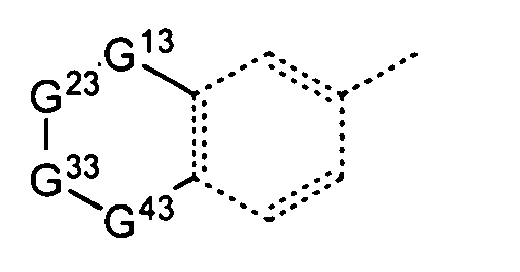
- Item 97: The compound of Item 96 or a pharmaceutically acceptable salt thereof, wherein G43 is an oxygen atom.
- Item 98: The compound of Item 96 or a pharmaceutically acceptable salt thereof, wherein G43 is a sulfur atom.
- Item 99: The compound of any one of Items 96 to 98 or a pharmaceutically acceptable salt thereof, wherein R13d is a 4-methoxybutyl group.
- Item 100:The compound of any one of Items 96 to 98 or a pharmaceutically acceptable salt thereof, wherein R13d is a methoxycarbonylaminoethyl group.
- Item 101 :The compound of any one of Items 89 to 100 or a pharmaceutically acceptable salt thereof, wherein A3 is -(CH2)s3N(R43)CO-.
- Item 102:The compound of any one of Items 89 to 101 or a pharmaceutically acceptable salt thereof, wherein S3 is 2.
- Item 103:The compound of any one of Items 89 to 102 or a pharmaceutically acceptable salt thereof, wherein B3 is a C1-6 alkyl group optionally substituted by one of the members selected from C3-6 cycloalkyl, hydroxy, C1-4 alkoxy, carboxy, C1-4 alkoxycarbonyl, di-(C1-6 alkyl)amino, and aminocarbonyl having optionally a mono- or di-(C1-6 alkyl) substituent; a C2-6 alkenyl group; a C6-10 aryl group optionally substituted by the same or different 1 to 3 groups selected from halogen, C6 aryl, and C6 aryloxy; a C7-14 aralkyl group optionally substituted by the same or different 1 to 3 groups selected from halogen, cyano, C1-4 alkyl having optionally 1 to 3 halogen substituents, hydroxy, C1-4 alkoxy, carboxy, C1-4 alkoxycarbonyl, aminocarbonyl, and C1-4 alkylsulfonylamino; or a 5- to 10-membered monocyclic or polycyclic heteroaryl-C1-4 alkyl group.
- Item 104:A medicament comprising as the active ingredient the compound as set forth in any one of Items 1 to 103 or a pharmaceutically acceptable salt thereof.
- Item 105:A renin inhibitor comprising as the active ingredient the compound as set forth in any one of Items 1 to 103 or a pharmaceutically acceptable salt thereof.
- Item 106:A therapeutic agent for hypertension comprising as the active ingredient the compound as set forth in any one of Items 1 to 103 or a pharmaceutically acceptable salt thereof.
- Item 107:Use of the compound as set forth in any one of Items 1 to 103 or a pharmaceutically acceptable salt thereof in the preparation of a renin inhibitor.
- Item 108:Use of the compound as set forth in any one of Items 1 to 103 or a pharmaceutically acceptable salt thereof in the preparation of a therapeutic agent for hypertension.
- Item 109:A method for treatment of hypertension, which comprises administering an effect amount of the compound as set forth in any one of Items 1 to 103 or a pharmaceutically acceptable salt thereof to a patient in need.
- Item 110:An intermediate compound of the following formula (VII) or a pharmaceutically acceptable salt thereof.
-

- [wherein R37a, R37b, R37c and R37d are independently the same or different and each is a halogen atom, a cyano group, or a group of the formula: -A7-B7 (in which A7 is a single bond, -(CH2)s7O-, -(CH2)s7N(R47)-, -(CH2)s7SO2-, -(CH2)s7CO-, -(CH2)s7COO-, -(CH2)s7N(R47)CO-, -(CH2)s7N(R47)SO2-, -(CH2)s7N(R47)COO-, -(CH2)s7OCON(R47)-, -(CH2)s7O-CO-, -(CH2)s7CON(R47)-, -(CH2)s7N(R47)CON(R47)-, or -(CH2)s7SO2N(R47)-, B7 is a hydrogen atom, an optionally substituted C1-6 alkyl group, an optionally substituted C2-6 alkenyl group, an optionally substituted C2-6 alkynyl group, an optionally substituted C3-10 cycloalkyl group, an optionally substituted C5-6 cycloalkenyl group, an optionally substituted C6-10 aryl group, an optionally substituted C7-14 aralkyl group, an optionally substituted 5- to 10-membered monocyclic or polycyclic heteroaryl group, an optionally substituted 5- to 10-membered monocyclic or polycyclic heteroaryl-C1-4 alkyl group, or an optionally substituted saturated heterocyclic group (provided that when A7 is -(CH2)s7N(R47)-, - (CH2)s7OCON(R47)-, -(CH2)s7CON(R47)-, -(CH2)s7N(R47)CON(R47)-, or -(CH2)s7SO2N(R47)-, then R47 and B7 combine each other to form a ring));
- R47 is a hydrogen atom, an optionally substituted C1-6 alkyl group, an optionally substituted C3-10 cycloalkyl group, an optionally substituted C6-10 aryl group, an optionally substituted C7-14 aralkyl group, or an optionally substituted 5- to 10-membered monocyclic or polycyclic heteroaryl group;
- s7 is 0, 1 or 2 (provided that when A7 is -(CH2)s7N(R47)-, then s7 is 0 or 2, and when A7 is - (CH2)s7CON(R47)-, then s7 is 1 or 2);
- R37e is isopropyl group or cyclopropyl group;
- R37f is a hydrogen atom, a C1-4 alkoxycarbonyl group, a phenyloxycarbonyl group, an allyloxycarbonyl group, a p-toluenesulfonyl group, or a nitrobenzenesulfonyl group (provided that when R37e is a cyclopropyl group, and R37f is a t-butoxycarbonyl group, then (i) the compound where R37a, R37b and R37d are independently a group of the formula: - A7-B7 (in which A7 is a single bond, B7 is a hydrogen atom); R37c is a group of the formula: -A7-B7 (in which A7 is a single bond, and B7 is a C6 aryl group), and
- (ii) the compound where R37a, R37b, R37c, and R37d are independently a group of the formula: -A7-B7(in which A7 is a single bond, and B7 is a hydrogen atom) are excluded].
- Item 111: The compound of Item 110 or a pharmaceutically acceptable salt thereof, wherein R37e is an isopropyl group.
- Item 112: The compound of Item 110 or a pharmaceutically acceptable salt thereof, wherein R37e is a cyclopropyl group.
- Item 113: The compound of any one of Items 110 to 112 or a pharmaceutically acceptable salt thereof, wherein R37f is a hydrogen atom.
- Item 114:The compound of any one of Items 100 to 112 or a pharmaceutically acceptable salt thereof, wherein R37f is a C1-4 alkoxycarbonyl group, or a phenyloxycarbonyl group.
- Item 115: The compound of any one of Items 110 to 114 or a pharmaceutically acceptable salt thereof, wherein R37a, R37b and R37d are independently a group of the formula: -A7-B7 (in which A7 is a single bond, and B7 is a hydrogen atom); R37e is a group of the formula: -A7-B7(in which A7 is a single bond, -(CH2)s7O-, or -(CH2)s7COO-, B7 is a hydrogen atom, an optionally substituted C6-10 aryl group, an optionally substituted C7-14 aralkyl group, or an optionally substituted 5- or 6-membered monocyclic or polycyclic heteroaryl group).
- Item 116: The compound of any one of Items 110 to 114, or a pharmaceutically acceptable salt thereof, wherein R37a, R37c and R37d are independently a group of the formula: -A7-B7 (in which A7 is a single bond, and B7 is a hydrogen atom); R37b is a group of the formula: -A7-B7(in which A7 is a single bond, -(CH2)s7O-, -(CH2)s7N(R47)-, -(CH2)s7COO-, -(CH2)s7N(R47)CO-, -(CH2)s7N(R47)SO2-, -(CH2)s7N(R47)COO-, -(CH2)s7OCON(R47)-, or -(CH2)s7CON(R47)-, B7 is a hydrogen atom, an optionally substituted C1-6 alkyl group, an optionally substituted C6-10 aryl group, an optionally substituted C7-14 aralkyl group, or an optionally substituted 5- or 6-membered saturated heterocyclic group).
- Item 117: The compound of any one of Items 110 to 114, or a pharmaceutically acceptable salt thereof, wherein R37a, R37b and R37c are independently a group of the formula: -A7-B7 (in which A7 is a single bond, and B7 is a hydrogen atom); R37d is a group of the formula: -A7-B7(in which A7 is a single bond, -(CH2)s7O-, -(CH2)s7N(R47)-, -(CH2)s7COO-, -(CH2)s7N(R47)CO-, -(CH2)s7N(R47)SO2-, -(CH2)s7N(R47)COO-, -(CH2)s7OCON(R47)-, or -(CH2)s7CON(R47)-, B7 is a hydrogen atom, an optionally substituted C1-6 alkyl group, an optionally substituted C2-6 alkenyl group, an optionally substituted C6-10 aryl group, an optionally substituted C7-14 aralkyl group, an optionally substituted 5- or 6-membered monocyclic or polycyclic heteroaryl group, an optionally substituted 5- or 6-membered monocyclic or polycyclic heteroaryl-C1-4 alkyl group, or an optionally substituted 5- or 6-membered saturated heterocyclic group).
- Item 118: The compound of Item 117 or a pharmaceutically acceptable salt thereof, wherein B7 for R37d is a hydrogen atom, an optionally substituted C1-6 alkyl group, an optionally substituted C2-6 alkenyl group, an optionally substituted C6-10 aryl group, an optionally substituted C7-14 aralkyl group, or an optionally substituted 5- or 6-membered saturated heterocyclic group.
- Item 119: The compound of any one of Items 110 to 114 or a pharmaceutically acceptable salt thereof, wherein R37a, R37b, R37c and R37d are independently a group of the formula: -A7-B7 (in which A7 is a single bond, and B7 is a hydrogen atom).
- Hereinafter, the compound of the formula (I) or a pharmaceutically acceptable salt thereof are occasionally referred to as "the compound of the present invention".
- The compound of the present invention shows an excellent renin inhibitory activity and is useful as a therapeutic agent for hypertension.
- Hereinafter, the present invention will be illustrated in more detail. In the present specification, the number of the carbon atom in definitions for substituents may be expressed, for example, as "C1-6". For example, the expression of "C1-6 alkyl" is the same as the expression of an alkyl group having 1 to 6 carbon atoms. In addition, in the present specification, any group without a term of "an optionally substituted" or "substituted" means a "unsubstituted" group. For example, "C1-6 alkyl" means a "unsubstituted" one.
- The term "group" in the present specification means a monovalent group unless specified otherwise. For example, the "alkyl group" means a monovalent saturated hydrocarbon group. In addition, in the explanation of each group in the present specification, the term "group" may be omitted. Further, the number of the substituents as defined with "an optionally substituted" or "substituted" is not necessarily limited, and it can be either one or more as long as the substitution can be possible. The definition for each group is also applied to cases where said group is a part of other groups, unless indicated specifically.
- The "halogen atom" is, for example, fluorine atom, chlorine atom, bromine atom or iodine atom.
- The "C1-6 alkyl group" means a straight or branched chain saturated hydrocarbon group having 1 to 6 carbon atoms, and preferable one is a C1-4 alkyl group. Examples of the C1-6 alkyl group are methyl, ethyl, propyl, isopropyl, butyl, isobutyl, sec-butyl, tert-butyl, pentyl, isopentyl, neopentyl, 1-ethylpropyl, hexyl, isohexyl, 1,1-dimethylbutyl, 2,2-dimethylbutyl, 3,3-dimethylbutyl, 2-ethylbutyl, etc.
- The "C1-6 alkyl group" for "B" includes a group where a C2-4 ring is formed on the 1-carbon atom of the saturated hydrocarbon group, for example, groups of the following formulae are exemplified:

- The "C2-6 alkenyl group" means a straight or branched chain unsaturated hydrocarbon group having 2 to 6 carbon atoms and one double bond, and includes, for example, vinyl, propenyl, methylpropenyl, butenyl or methylbutenyl, etc.
- The "C2-6 alkynyl group" means a straight chain or branched chain unsaturated hydrocarbon group having 2 to 6 carbon atoms and one triple bond, and includes, for example, ethynyl, 1-propinyl, 2-propinyl, 2-butynyl, pentynyl or hexynyl, etc.
- The "C3-10 cycloalkyl group" means a saturated cyclic hydrocarbon group having 3 to 10 carbon atoms, and a preferable one is a C3-6 cycloalkyl group. Examples of the "C3-10 cycloalkyl group" are cyclopropyl, cyclobutyl, cyclopentyl, cyclohexyl, cycloheptyl, adamantyl or norbornyl, etc.
- The "C3-10 cycloalkyl group" for "B" also includes a saturated bicyclic group. Examples thereof are the groups of the following formulae:

- The "C3-6 cycloalkyl-C1-4 alkyl group" means a group where a C3-6 cycloalkyl is attached to a C1-4 alkyl. Examples thereof are cyclopropylmethyl, cyclobutylmethyl, cyclopentylmethyl, cyclohexylmethyl, etc.
- The "C5-6 cycloalkenyl group" means a cyclic unsaturated hydrocarbon group having a double bond, and includes, for example, 1-cyclopentenyl, 1-cyclohexenyl, etc.
- The "C6-10 aryl group" means an aromatic hydrocarbon group having 6 to 10 carbon atoms. Preferable one is a C6 aryl group (phenyl). Examples of the C6-10 aryl group are phenyl, 1-naphthyl or 2-naphthyl, etc.
- The "C7-14 aralkyl group" means a C6-10 aryl-C1-4 alkyl group, which is a group where the above-mentioned alkyl group is attached to the above-mentioned aryl group. Preferable one is a C7-10 aralkyl group (a C6 aryl-C1-4 alkyl group). Examples of the C7-14 aralkyl group are benzyl, 2-phenylethyl, 1-phenylpropyl or 1-naphthylmethyl, etc.
- The "heteroaryl group" includes, for example, a 5- to 10-membered monocyclic or polycyclic group, etc., and said group contains the same or different one or more heteroatoms (e.g., 1 to 4 heteroatoms) selected from nitrogen atom, sulfur atom and oxygen atom. Preferable one is, for example, a 5- or 6-membered monocyclic group containing one heteroatom selected from nitrogen atom, sulfur atom and oxygen atom. Examples of the heteroaryl group are pyrrolyl, thienyl, benzothienyl, benzofuranyl, benzoxazolyl, benzothiazolyl, furyl, oxazolyl, thiazolyl, isoxazolyl, imidazolyl, pyrazolyl, pyridyl, pyrazyl, pyrimidyl, pyridazinyl, quinolyl, isoquinolyl, triazolyl, triazinyl, tetrazolyl, indolyl, imidazo[1,2-a]pyridyl, dibenzofuranyl, benzimidazolyl, quinoxalyl, cinnolyl, quinazolyl, indazolyl, naphthyridyl, quinolinoly, or isoquinolinolyl, etc.
- The "heteroaryl-C1-4 alkyl group" means a group where the above-mentioned alkyl group is substituted to the above-mentioned heteroaryl group. The heteroaryl moiety of said group includes the same ones as exemplified as the above-mentioned heteroaryl group, for example, a 5- or 6-membered monocyclic heteroaryl-C1-4 alkyl, such as 2-pyridylmethyl, etc.
- The "C1-6 alkyl moiety" of the "C1-6 alkoxy group" is the same as the above-mentioned C1-6 alkyl. Preferable one is a C1-4 alkoxy group. Examples of the C1-6 alkoxy group are methoxy, ethoxy, propoxy, isopropoxy, butoxy, isobutoxy, sec-butoxy, tert-butoxy, etc.
- The "C1-6 alkyl moiety" of the "C1-6 alkylthio group" is the same as the above-mentioned C1-6 alkyl. Preferable one is a C1-4 alkylthio group. Examples of the C1-6 alkylthio group are methylthio, ethylthio, propylthio, isopropylthio, butylthio, sec-butylthio, tert-butylthio, pentylthio or hexylthio, etc.
- The "C1-6 alkyl moiety" of the "C1-6 alkylsulfinyl group" is the same as the above-mentioned C1-6 alkyl. Preferable one is a C1-4 alkylsulfinyl group. Examples of the C1-6 alkylsulfinyl group are methylsulfinyl, ethylsulfinyl, propylsulfinyl, isopropylsulfinyl, butylsulfinyl, pentylsulfinyl or hexylsulfinyl, etc.
- The "C1-6 alkyl moiety" of the "C1-6 alkylsulfonyl group" is the same as the above-mentioned C1-6 alkyl. Preferable one is a C1-4 alkylsulfonyl group. Examples of the C1-6 alkylsulfonyl group are methylsulfonyl, ethylsulfonyl, propylsulfonyl, isopropylsulfonyl, butylsulfonyl, pentylsulfonyl or hexylsulfonyl, etc.
- The "C6-10 aryl moiety" of the "C6-10 arylthio group" is the same as the above-mentioned C6-10 aryl. Examples of the C6-10 arylthio group are phenylthio, 1-naphthylthio or 2-naphthylthio, etc.
- The "C6-10 aryl moiety" of the "C6-10 arylsulfinyl group" is the same as the above-mentioned C6-10 aryl. Examples of the C6-10 arylsulfinyl group are phenylsulfinyl, 1-naphthylsulfinyl or 2-naphthylsulfinyl, etc.
- The "C6-10 aryl moiety" of the "C6-10 arylsulfonyl group" is the same as the above-mentioned C6-10 aryl. Examples of the C6-10 arylsulfonyl group are phenylsulfonyl, tosyl, 1-naphthylsulfonyl or 2-naphthylsulfonyl.
- The "C3-10 cycloalkyl moiety" of the "C3-10 cycloalkoxy group" is the same as the above-mentioned C3-10 cycloalkyl. Preferable one is a C3-6 cycloalkoxy group, etc. Examples of the C3-10 cycloalkoxy group are cyclopropyloxy, cyclobutyloxy, cyclopentyloxy, cyclohexyloxy, cycloheptyloxy, adamantyloxy or norbomyloxy, etc.
- The "C6-10 aryl moiety" of the "C6-10 aryloxy group" is the same as the above-mentioned C6-10 aryl. Preferable one is a C6 aryloxy (phenyloxy). Examples of the C6-10 aryloxy group are phenoxyl, 1-naphthyloxy or 2-naphthyloxy, etc.
- The "C7-14 aralkyloxy group" means a C6-10 aryl-C1-4 alkyloxy group. The "C7-14 aralkyl moiety" is the same as the above-mentioned C7-14 aralkyl. Preferable one is a C6 aryl-C1-4 alkyloxy group (phenyl-C1-4 alkyloxy group). Examples of the C7-14 aralkyloxy group are benzyloxy, phenethyloxy, naphthylmethyloxy, etc.
- The "C1-4 alkoxycarbonyl group" means a group where the above-mentioned "C1-4 alkoxy group" is attached to a carbonyl group. Examples thereof are methoxycarbonyl, ethoxycarbonyl, propoxycarbonyl, 2-propoxycarbonyl or tert-butoxycarbonyl, etc.
- The "C3-6 cycloalkoxycarbonyl group" is a group where the above-mentioned "C3-6 cycloalkoxy group" is attached to a carbonyl group. Examples of the C3-6 cycloalkoxy moiety are ones as exemplified as the above-mentioned cycloalkoxy group.
- The "C1-4 alkylcarbonyl group" means a group where the above-mentioned "C1-4 alkyl group" is attached to a carbonyl group. Examples thereof are acetyl, propionyl or butyryl, etc.
- The "C3-10 cycloalkylcarbonyl group" means a group where the above-mentioned "C3-10 cycloalkyl group" is attached to a carbonyl group. Preferable one includes a C3-6 cycloalkylcarbonyl group. Examples thereof are cyclopropylcarbonyl, cyclobutylcarbonyl, cyclopentylcarbonyl, cyclohexylcarbonyl, adamantylcarbonyl or norbomylcarbonyl, etc.
- The "C6-10 arylcarbonyl group" means a group where the above-mentioned "C6-10 aryl group" is attached to a carbonyl group. The "C6-10 aryl moiety" is the same as the above-mentioned "C6-10 aryl group". Preferable one is a "C6 arylcarbonyl group" (phenylcarbonyl group). Examples of the "C6-10 arylcarbonyl group" are benzoyl, 1-naphthoyl or 2-naphthoyl, etc.
- The "heteroarylcarbonyl group" means a group where the above-mentioned heteroaryl is attached to a carbonyl group. The "heteroaryl moiety" is the same as ones exemplified as the above-mentioned heteroaryl group. Examples thereof are 2-pyridylcarbonyl, etc.
- The "C1-4 alkyl moiety" of the "C1-4 alkylcarbonyloxy group" is the same as the above-mentioned C1-4 alkyl group. Examples thereof are methylcarbonyloxy, ethylcarbonyloxy, isopropylcarbonyloxy, etc.
- The "C3-6 cycloalkyl moiety" of the "C3-6 cycloalkylcarbonyloxy group" is the same as ones exemplified as the above-mentioned C3-6 cycloalkyl group. Examples thereof are cyclopropylcarbonyloxy, cyclobutylcarbonyloxy, cyclopentylcarbonyloxy, etc.
- The "C1-4 alkylcarbonylamino group" means a group where one of the above-mentioned "C1-4 alkylcarbonyl group" is attached to an amino group. Examples thereof are methylcarbonylamino, ethylcarbonylamino, etc.
- The "C1-4 alkoxycarbonylamino group" means a group where one of the above-mentioned "C1-4 alkoxycarbonyl group" is attached to an amino group. Examples thereof are methoxycarbonylamino, ethoxycarbonylamino, etc.
- The "C1-4 alkylsulfonylamino group" means a group where one of the above-mentioned "C1-4 alkylsulfonyl group" is attached to an amino group. Examples thereof are methylsulfonylamino, ethylsulfonylamino, etc.
- The "saturated heterocyclic group" includes a 5- or 6-membered saturated heterocyclic group containing the same or different 1 to 3 heteroatoms selected from nitrogen atom, oxygen atom and sulfur atom. Said nitrogen atom, oxygen atom and sulfur atom are ring-forming atoms. Examples thereof are pyranyl, tetrahydrofuryl, pyrrolidinyl, imidazolidinyl, piperidinyl, morpholinyl, thiomorpholinyl, dioxothiomorpholinyl, hexamethyleneiminyl, oxazolidinyl, thiazolidinyl, imidazolidinyl, oxoimidazolidinyl, dioxoimidazolidinyl, oxooxazolidinyl, dioxooxazolidinyl, dioxothiazolidinyl, tetrahydrofuranyl, tetrahydropyridinyl, or 1,4-dihydropyrrolidine, etc. Said group does not bind at the ring-forming nitrogen atom. Namely, said group does not include a concept such as pyrrolidino group.
- The above-mentioned "saturated heterocyclic group" may form a condensed ring with a 6-membered aromatic hydrocarbon or a 6-membered unsaturated heterocyclic group. For example, said "saturated heterocyclic group" includes a bicyclic 11- or 12-membered "saturated heterocyclic group" wherein the above mentioned 5- or 6-membere saturated heterocyclic group is condensed with a 6-membered aromatic hydrocarbon group or a 6-membered unsaturated heterocyclic group. The 6-membered aromatic hydrocarbon group includes benzene, etc. The 6-membered unsaturated heterocyclic group includes pyridine, pyrimidine, or pyridazine, etc. Examples thereof are dihydroindolyl, dihydroisoindolyl, dihydropurinyl, dihydrothiazolopyrimidinyl, dihydrobenzodioxanyl, isoindolinyl, indazolyl, pyrrolidinyl, tetrahydroquinolinyl, decahydroquinolinyl, tetrahydroisoquinolinyl, decahydroisoquinolinyl, tetrahydronaphthyridinyl or tetrahydropyridoazepinyl, etc.
- The "optionally substituted amino group" includes an amino group, a mono-substituted amino group, a di-substituted amino group, or a 5- or 6-membered cyclic amino group.
- The "mono-substituted amino group" includes an amino group substituted by one group selected from C1-6 alkyl, C3-6 cycloalkyl, C3-6 cycloalkyl-C1-4 alkyl and benzyl. The "C1-6 alkyl", the "C3-6 cycloalkyl" and the "C3-6 cycloalkyl-C1-4 alkyl" are the same as defined above.
- Examples of the "amino group substituted by a mono-(C1-6 alkyl)" are methylamino, ethylamino, etc.
- Examples of the "amino group substituted by a mono-(C3-6 cycloalkyl)" are cyclopropylamino, cyclobutylamino, cyclopentylamino, etc.
- Examples of the "amino group substituted by a mono-(C3-6 cycloalkyl-C1-4 alkyl)" are cyclopropylmethylamino, cyclobutylmethylamino, cyclopentylmethylamino, etc.
- The "di-substituted amino group" means an amino group substituted by the same or different 2 groups selected from C1-6 alkyl, C3-6 cycloalkyl, C3-6 cycloalkyl-C1-4 alkyl and benzyl. The C1-6 alkyl, the C3-6 cycloalkyl, the C1-4 alkylcarbonyl and the C3-6 cycloalkylcarbonyl are the same as defined above.
- Examples of the "amino group substituted by di-C1-6 alkyl" are dimethylamino, diethylamino, etc.
- Examples of the "amino group substituted by di-(C3-6 cycloalkyl)" are dicyclopropylamino, dicyclobutylamino, cyclodipentylamino, etc.
- Examples of the "amino group substituted by a C1-6 alkyl and a benzyl" are N-methyl-N-benzylamino, N-ethyl-N-benzylamino, etc.
- Examples of the "amino group substituted by a C3-6 cycloalkyl and a benzyl" are N-cyclopropyl-N-benzylamino, N-cyclopentyl-N-benzylamino, N-cyclohexyl-N-benzylamino, etc.
- The "5- or 6-membered cyclic amino group" means a cyclic amino group consisting of 5 members or 6 members. Said group binds at the ring-forming nitrogen atom. Examples thereof are pyrrolidino, piperidino, morpholino, thiomorpholino, thiomorpholino oxide, thimorpholino dioxide, piperazino, etc. Said ring may be optionally substituted by a C1-4 alkyl or hydroxy group.
- The substituent of the "optionally substituted C1-6 alkyl group" includes, for example,
- (a) a halogen atom,
- (b) a cyano group,
- (c) a C3-6 cycloalkyl group (said group being optionally substituted by halogen, hydroxy or C1-4 alkoxy),
- (d) a hydroxy group,
- (e) a C1-4 alkoxy group (being otionally substituted by fluorine),
- (f) a C3-6 cycloalkyloxy group,
- (g) a C6 aryloxy group (said group being optionally substituted by the same or different groups selected from halogen, cyano and C1-4 alkoxy),
- (h) a benzyloxy group,
- (i) a formyl group,
- (j) a C1-4 alkylcarbonyl group,
- (k) a C3-6 cycloalkylcarbonyl group,
- (l) a phenylcarbonyl group,
- (m) a benzylcarbonyl group,
- (n) a formylcarbonyloxy group,
- (o) a C1-4 alkylcarbonyloxy group,
- (p) a C3-6 cycloalkylcarbonyloxy group,
- (q) a carboxyl group,
- (r) a C1-4 alkoxycarbonyl group,
- (s) a C3-6 cycloalkoxycarbonyl group,
- (t) an amino group,
- (u) a mono-substituted amino group (said group being substituted by (ul) C1-6 alkyl, (u2) C3-6 cycloalkyl, (u3) C3-6 cycloalkyl-C1-4 alkyl, or (u4) benzyl),
- (v) a di-substituted amino group (said group being substituted by the same or different 2 groups selected from the above-mentioned (ul)∼(u4)),
- (w) a 5- or 6-membered cyclic amino group,
- (x) an optionally substituted aminocarbonyl group, or
- (y) an optionally substituted aminocarbonyloxy group.
- The above-mentioned "optionally substituted aminocarbonyl group" means a group where the "optionally substituted amino" is attached to a carbonyl group. The "substituted amino" includes a mono-substituted amino group, a di-substituted amino group or a 5- or 6-membered cyclic amino. The substituent of the mono- or di-substituted amino includes, for example, a C1-6 alkyl, a C3-6 cycloalkyl, a C3-6 cycloalkyl-C1-4 alkyl, or benzyl.
- The "mono-substituted aminocarbonyl group" includes, for example, an aminocarbonyl group substituted by the above-mentioned mono-(C1-6 alkyl), or an aminocarbonyl group substituted by mono-(C3-6 cycloalkyl).
- Examples of the aminocarbonyl group substituted by mono-(C1-6 alkyl) are methylaminocarbonyl, ethylaminocarbonyl, etc.
- Examples of the aminocarbonyl group substituted by mono-(C3-6 cycloalkyl) are cyclopropylaminocarbonyl, cyclobutylaminocarbonyl, cyclopentylaminocarbonyl, etc.
- The "di-substituted aminocarbonyl group" includes, for example, an aminocarbonyl group substituted by a C1-6 alkyl and a C1-6 alkyl, an aminocarbonyl group substituted by a C1-6 alkyl and a C3-6 cycloalkyl, or an aminocarbonyl group substituted by a C1-6 alkyl and a benzyl.
- Examples of the "aminocarbonyl group substituted by a C1-6 alkyl and a C1-6 alkyl" are N-methyl-N-methylaminocarbonyl, N-methyl-N-ethylaminocarbonyl, etc.
- Examples of the "aminocarbonyl group substituted by a C1-6 alkyl and a C3-6 cycloalkyl" are N-methyl-N-cyclopropylcarbonylamino, N-methyl-N-cyclobutylcarbonylamino, N-methyl-N-cyclopentylcarbonylamino, etc.
- Examples of the "aminocarbonyl group substituted by a C1-6 alkyl and a benzyl" are N-methyl-N-benzylamino, N-ethyl-N-benzylamino, etc.
- The "5- or 6-membered cyclic aminocarbonyl group" may be optionally substituted by a C6-10 aryloxy. Examples thereof are 3-phenyloxypyrrolidinocarbonyl, etc.
- The "optionally substituted aminocarbonyl moiety" of the above-mentioned optionally substituted aminocarbonyloxy group is the same as the above-mentioned optionally substituted aminocarbonyl group. Examples thereof are aminocarbonyloxy, etc.
- The substituent of the optionally substituted C1-6 alkyl group for R1a is preferably a halogen atom.
- The substituent of the optionally substituted C1-6 alkyl group for R1c is preferably a C1-4 alkoxycarbonyl.
- The substituent of the optionally substituted C1-6 alkyl group for R2 is preferably a halogen atom or a C3-6 cycloalkyl group.
- The substituent of the optionally substituted C1-6 alkyl group for B is preferably the following groups:
- (a2) a halogen atom,
- (b2) a C3-6 cycloalkyl (being optionally substituted by halogen, hydroxy or C1-4 alkoxy),
- (c2) a hydroxy group,
- (d2) a C1-4 alkoxy,
- (e2) a C3-6 cycloalkoxy,
- (f2) a C6 aryloxy (being optionally substituted by C1-4 alkyl),
- (g2) a carboxy,
- (h2) a C1-4 alkoxycarbonyl,
- (i2) an amino (being optionally substituted by C1-6 alkyl or benzyl), and
- (j2) an aminocarbonyl (the amino moiety being optionally substituted by C1-6 alkyl, C3-6 cycloalkyl, or C3-6 cycloalkyl-C1-4 alkyl).
- When B is a C1-6 alkyl group substituted by mono-(C1-6 alkyl)-substituted amino, the C1-6 alkyl moiety of the amino moiety may optionally be substituted by a carbamoyl group, a mono- or di-(C1-6 alkyl)aminocarbonyl, or a 5- or 6-membered cyclic aminocarbonyl (provided that A should be a single bond, and B should be an optionally substituted C1-6 alkyl group (in which (C1-6 alkyl)amino and the cyclic amino moiety are the same as defined above)). Examples of the C1-6 alkyl of the above-mentioned amino moiety are the following compounds.
-

- The substituents of the "optionally substituted C1-6 alkyl group" for B may be optionally substituted by the same or different 1 to 3 groups selected from the above-mentioned group. For example, when A is a single bond, then said group may be optionally substituted by two groups of the above-mentioned (b2) and (j2). When A is a group other than a single bond, then said groups may be optionally substituted by two groups of the above-mentioned (b2) and (d2).
- Examples thereof are the following groups.
-

- The substituents of the "optionally substituted C1-6 alkoxy group" are, for example, a group selected from the above-mentioned (a) to (y) (in which the substituent of the mono-substituted amino group in (u) is restricted to a C1-6 alkyl group and a C3-6 cycloalkyl group, and the same as for (v), (x) and (y)).
- The substituent of the "optionally substituted C1-6 alkoxy group" for R1a is preferably, for example, a halogen atom, a C1-4 alkoxy or a C3-6 cycloalkyl.
- The substituent of the "substituted C1-6 alkoxy group" for R1b is preferably hydroxy, a C1-4 alkoxy, trifluoromethyl, trifluoromethoxy, difluoromethoxy, carboxy, a mono- C1-6 alkylcarbonylamino, or mono-C1-6 alkoxycarbonylamino.
- The substituent of the "optionally substituted C1-6 alkoxy group" for R1c is preferably a halogen atom, a C3-6 cycloalkyl, a C1-4 alkoxycarbonyl, a mono- or di-(C1-6 alkyl)-substituted aminocarbonyl, or a 5- or 6-membered saturated heterocyclic group.
- The substituent of the "optionally substituted C2-6 alkenyl group" and the "optionally substituted C2-6 alkynyl group" is, for example, a group selected from the above-mentioned (a) to (s).
- The substituent of the "optionally substituted C3-10 cycloalkyl group" and the "optionally substituted C3-10 cycloalkyloxy group" is, for example, a group selected from the above-mentioned (x), a halogen atom, a C1-4 alkyl and a C6-10 aryl group (said aryl group being optionally substituted by a halogen atom, a C1-4 alkyl, a hydroxy group, or a C1-4 alkoxy).
- The substituent of the "optionally substituted C5-6 cycloalkenyl group" is, for example, a group selected from the above-mentioned (a) to (s) and a nitro group.
- The substituent of the "optionally substituted C1-4 alkylcarbonyl group" and the "optionally substituted C3-10 cycloalkylcarbonyl group" is, for example, a group selected from the above-mentioned (a) to (h) and nitro group.
- The substituent of the "optionally substituted C1-6 alkylthio group", the "optionally substituted C1-6 alkylsulfinyl group", the "optionally substituted C1-6 alkylsulfonyl group" and the "optionally substituted C1-4 alkoxycarbonyl group" is, for example, a group selected from a halogen atom, a hydroxy group, a nitro group, a cyano group, and the above-mentioned (d) to (h).
- The substituent of the "optionally substituted C6-10 aryl group" and the "optionally substituted 5- to 10-membered monocyclic or polycyclic heteroaryl group" is, for example, the same or different 1 to 3 groups selected from the following groups:
- (a3) a halogen atom,
- (b3) a cyano group,
- (c3) a C1-4 alkyl group,
- (d3) a C1-4 alkoxy group,
- (e3) a C6-10 aryl group (said group being optionally substituted by (e31) cyano, (e32) carboxy, (e33) C1-4 alky optionally substituted by carboxy, or (e34) C1-4 alkoxy optionally substituted by fluorine, hydroxy, or carboxy),
- (f3) a C6 aryloxy,
- (g3) a C7-10 aralkyloxy (being optionally substituted by C1-4 alkoxy),
- (h3) an aminocarbonyl (the amino moiety being optionally substituted by C1-6 alkyl), and
- (i3) a C1-4 alkylsulfonylamino.
- The substituent of the "optionally substituted C6-10 aryl group" for B is preferably a group selected from the above-mentioned (a3), (b3), (c3), (d3), (e3), (f3), and (g3)
- When A is a single bond, then B is preferably a C6 aryl group substituted by a C6 aryl (having optionally the same substituents as defined for the above-mentioned (e3)).
- The substituent of the "optionally substituted C6-10 aryloxy group" and the "optionally substituted 5- to 10-membered monocyclic or polycyclic heteroaryloxy group" includes, for example, the above-mentioned (a3) to (i3), etc.
- The substituent of the aryl moiety of the "optionally substituted C7-14 aralkyl group" is a group selected from the following groups:
- (a4) a halogen atom,
- (b4) a cyano group,
- (c4) a C1-4 alkyl group (being optionally substituted by 1 to 3 halogen atoms),
- (d4) a hydroxy group,
- (e4) a C1-4 alkoxy group (being optionally substituted by 1 o 3 halogen atoms),
- (f4) a carboxyl group,
- (g4) a C1-4 alkoxycarbonyl group,
- (h4) a C6 aryl group (being optionally substituted by C1-4 alkoxy)
- (i4) a C6 aryloxy group,
- (j4) a C7-10 aralkyloxy group,
- (k4) an aminocarbonyl group (the amino moiety being optionally substituted by C1-6 alkyl),
- (l4) a C1-4 alkylsulfonylamino group, and
- (m4) a C1-4 alkylsulfonyl group.
- The substituent of the above-mentioned (a4) to (m4) may substitute on the C1-4 alkyl moiety of the C7-14 aralkyl group (C6-10 aryl-C1-4 alkyl group).
- The substituent of the "optionally substituted C7-14 aralkyl group" for R1a and R1c is preferably (a4).
- The substituent of the "optionally substituted C7-14 aralkyl group" for B is preferably the same or different 1 to 3 groups selected from (a4), (b4), (c4), (d4), (e4), (f4), (g4), (k4) and (l4).
- The substituent of the "optionally substituted C7-14 aralkyloxy group" includes the above-mentioned (a4) to (m4), etc.
- The substituent of the "optionally substituted C7-14 aralkyloxy group" for R1a includes (a4) and (k4), etc.
- The "optionally substituted C7-14 aralkyloxy group" for R1c is preferably a C7-10 aralkyloxy group.
- The substituent of the heteroaryl moiety of the "optionally substituted 5- to 10-membered monocyclic or polycyclic heteroaryl-C1-4 alkyl group" includes the same ones as exemplified as a substituent of the "optionally substituted 5- to 10-membered monocyclic or polycyclic heteroaryl group".
- The "optionally substituted 5- to 10-membered monocyclic or polycyclic heteroaryl-C1-4 alkyl group" for B is preferably a 5- or 6-membered monocyclic heteroaryl-C1-4 alkyl group.
- The substituent of the "saturated heterocyclic group" and the "saturated heterocycle" includes, for example, the following groups:
- (a5) a halogen atom,
- (b5) a hydroxy group,
- (c5) a nitro group,
- (d5) a cyano group,
- (e5) a C1-4 alkyl group (being optionally substituted by 1 to 3 halogen atoms),
- (f5) a C1-4 alkoxy group (being optionally substituted by 1 to 3 halogen atoms),
- (g5) a carboxyl group,
- (h5) a C1-4 alkoxycarbonyl group,
- (i5) a C3-6 cycloalkoxycarbonyl group,
- (j5) an amino group (being optionally substituted by C1-4 alkyl),
- (k5) a C6 aryl group,
- (l5) an aminocarbonyl group,
- (m5) an oxo group, or
- (n5) a thioxo group.
- The "optionally substituted saturated heterocyclic group" for R1c is preferably a 5- or 6-membered saturated heterocyclic group.
- The "optionally substituted saturated heterocyclic group" for B is preferably, for example, a 5- or 6-membered saturated heterocyclic group containing the same or different 1 to 3 heteroatoms selected from nitrogen atom, oxygen atom and sulfur atom.
- The phrase that R1a is a hydrogen atom; R1b and R1c may combine each other to form a condensed ring with the benzene ring containing at least one heteroatom means that two of the above-mentioned definitions form a bicyclic condensed ring containing at least one heteroatom with the benzene ring to which said definitions attach. Herein, the "bicyclic condensed ring" includes a condensed ring of a 5-membered ring and a benzene ring, or a 6-membered ring and a benzene ring. The 5-membered ring and the 6-membered ring in the above-mentioned condensed ring are saturated ones, respectively. The heteroatom in said definitions is a nitrogen atom, an oxygen atom or a sulfur atom, and preferable one is a nitrogen atom or an oxygen atom, and may occasionally be the same or different two atoms.
- The compounds wherein R1a is a hydrogen atom; R1b and R1c may combine each other to form a condensed ring containing at least one heteroatom with the benzene ring includes compounds having a partial structure of the following formula:
-

- [wherein, (i) G1 is -N(R1d)-, G2 is -CO-, G3 is -C(R1c)(R1f)-, and G4 is -CH2-, an oxygen atom, a sulfur atom, or does not exist at all,
- (ii) G1 is -N(R1d)-, G2 is -CO-, G3 is -N(R1d)-, and G4 does not exist at all (R1ds for G1 and G3 are independent each other),
- (iii) G1 is an oxygen atom, G2 is -CH2-, G3 is an oxygen atom, and G4 does not exist at all, or
- (iv) G1 is an oxygen atom, G2 is -CH2-, G3 is -CH2-, and G4 is an oxygen atom;
- Examples of R1e and R1f are, for example, one group selected from the following groups:
- (a6) a hydrogen atom,
- (b6) a halogen atom,
- (c6) a hydroxy group,
- (d6) a cyano group,
- (e6) a C3-6 cycloalkyl group,
- (f6) a C1-6 alkyl group (said group being optionally substituted by
- (f61) C1-6 alkoxy,
- (f62) C3-6 cycloalkyl,
- (f63) C3-6 cycloalkyloxy,
- (f64) C7-10 aralkyloxy, or
- (f65) aminocarbonyl (being optionally substituted by C1-6 alkyl)),
- (g6) a C6-10 aryl group (being optionally substituted by halogen),
- (h6) a C7-14 aralkyl group (being optionally substituted by halogen),
- (i6) an aminocarbonyl group (being optionally substituted by C1-6 alkyl), and
- (j6) a 5- to 10-membered monocyclic or polycyclic heteroaryl group (being optionally substituted by C1-4 alkyl).
- The binding position of A in the "group of the formula: -A-B" is explained below. The "group of the formula: -A-B" means, for example, a group of the formula:
-(CH2)sO-H when A is -(CH2)sO-, and B is a hydrogen atom. - When A is -(CH2)sN(R4)-, -(CH2)sOCON(R4)-, -(CH2)sCON(R4)-, -(CH2)sN(R4)CON(R4)- or -(CH2)sSO2N(R4), the phrase that R4 and B combine each other to form a ring means that the N(R4)- moiety forms a 5- or 6-membered cyclic amino group. For example, A includes a group of the following formulae:
-


- The above-mentioned cyclic amino groups are optionally substituted by the same substituents for the above-mentioned saturated heterocyclic group. Examples thereof are 4-hydroxypiperidino; 2-methoxymorpholino; 4-formylpiperidino; 4-methoxycarbonylpiperidino; 4-aminocarbonylpiperidino; 4-N-methylaminopiperidino; 3-phenylpyrrolidino; 4-dimethylaminopiperidino, etc.
- The phrase that "two of R3a, R3b, R3c and R3d are a hydrogen atom, and the remaining two groups combine each other to form a fused ring with a hetero ring" means that the remaining two groups of the above-mentioned definitions form a fused ring with a hetero ring (pyrrolidine ring, piperidine ring, etc.) to which they attach. Said fused ring includes, for example, a bicyclic ring or a tricyclic ring containing one nitrogen atom and 5 to 10 carbon atoms, and preferably a bicyclic ring. Examples thereof are groups of the following structures:

- With respect to each substituent of the compound of the formula (I), more preferable other embodiments are illustrated hereinbelow.
- Preferable groups for R1a, R1b, and R1c for the following partial structure are as follows.

- R1a is a group selected from the following groups:
- (a7) a hydrogen atom,
- (b7) a halogen atom,
- (c7) a hydroxy group,
- (d7) a cyano group,
- (e7) a C1-6 alkyl group (being optionally substituted by halogen),
- (f7) a C2-6 alkenyl group,
- (g7) a C3-6 cycloalkyl group,
- (h7) a C1-6 alkoxy group (said group being optionally substituted by
- (h71) halogen,
- (h72) C1-4 alkoxy, or
- (h73) C3-6 cycloalkyl),
- (i7) a C3-6 cycloalkoxy group,
- (j7) a C6-10 aryl group,
- (k7) a C6 aryloxy group, and
- (l7) a C7-10 aralkyloxy group (said group being optionally substituted by
- (l71) halogen, or
- (l72) mono- or di-(C1-6 alkyl)-substituted aminocarbonyl).
- More preferable R1a is a group selected from a hydrogen atom; a halogen atom; a hydroxy group; a cyano group; a C1-6 alkyl group; a C1-6 alkoxy group having optionally substituted by halogen, C1-4 alkoxy or C3-6 cycloalkyl; a C3-6 cycloalkoxy group; a C6 aryl group; and a C7-10 aralkyloxy group optionally substituted by halogen or aminocarbonyl having a mono- or di-(C1-6 alkyl) substituent.
- Further preferable R1a is a group selected from a hydrogen atom, a halogen atom, a hydroxy group, a cyano group and a C1-6 alkyl group.
- Especially preferable R1a is a group selected from a hydrogen atom, a halogen atom, a cyano group and a C1-6 alkyl group.
- R1b is a group selected from the following groups:
- (a8) a C1-6 alkyl group (said group being substituted by mono- C1-6 alkoxycarbonylamino),
- (b8) an amino group (said group being optionally substituted by C1-6 alkyl having optionally a C1-4 alkoxy substituent), and
- (c8) a C1-6 alkoxy group (said group being substituted by
- (c81) hydroxy,
- (c82) C1-4 alkoxy,
- (c83) C3-6 cycloalkoxy,
- (c84) trifluoromethyl,
- (c85) trifluoromethoxy,
- (c86) difluoromethoxy,
- (c87) carboxyl,
- (c88) C1-4 alkoxycarbonylamino, or
- (c89) C1-4 alkylcarbonylamino).
- R1b is preferably a C1-6 alkoxy group being substituted by one group selected from C1-4 alkoxy, carboxy, C1-4 alkoxycarbonylamino, and C1-4 alkylcarbonylamino.
- More preferable R1b is a C1-6 alkoxy group being substituted by C1-4 alkoxy or C1-4 alkoxycarbonylamino.
- Especially preferable R1b is a C1-4 alkoxy-substituted C1-6 alkoxy group. Further, 3-methoxypropyloxy group is especially preferable.
- R1c is a group selected from the following groups:
- (a9) a hydrogen atom,
- (b9) a halogen atom,
- (c9) a hydroxy group,
- (d9) a cyano group,
- (e9) a C1-6 alkyl group (being optionally substituted by C1-4 alkoxycarbonyl),
- (f9) a C7-10 aralkyl group,
- (g9) a C1-6 alkoxy group (said group being optionally substituted by
- (g 91) halogen,
- (g92) C3-6 cycloalkyl,
- (g93) mono- or di-(C1-6 alkyl)-substituted aminocarbonyl,
- (g94) 5- or 6-membered saturated heterocycle, or
- (g95) C1-4 alkoxycarbonyl),
- (h9) a C3-6 cycloalkoxy group,
- (i9) a C6 aryloxy group,
- (j9) a C7-10 aralkyloxy group (being optionally substituted by mono- or di-(C1-6 alkyl)aminocarbonyl), and
- (k9) a 5- or 6-membered saturated heterocyclic group.
- Further preferable R1c is a hydrogen atom; a C1-6 alkoxy group optionally substituted by halogen, C3-6 cycloalkyl, mono- or di-(C1-6 alkyl)-substituted aminocarbonyl, or 5- or 6-membered saturated heterocycle; a C3-6 cycloalkoxy group; a C6 aryloxy group; a C7-10 aralkyloxy group; or a 5- or 6-membered saturated heterocyclic group.
- The above-mentioned partial structure is preferably a partial structure selected from the following groups.
-


- Especially preferable R1c is a C1-6 alkoxy group.
- Preferable embodiment for the following partial structure is as follows.
-

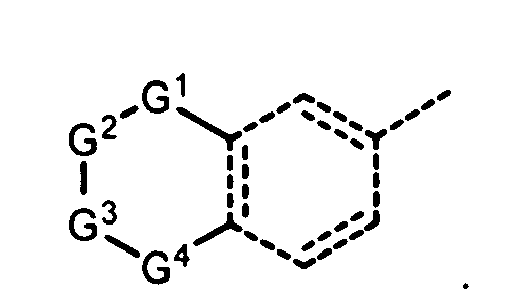
-
- [wherein (i) G1 is -N(R1d)-, G2 is -CO-, G3 is -C(R1e)(R1f)-, and G4 is -CH2-, oxygen atom, sulfur atom, or does not exist at all,
- (ii) G1 is -N(R1d)-, G2 is -CO-, G3 is -N(R1d)-, and G4 does not exist at all (R1d for G1 and G3 are independent to each other),
- (iii) G1 is an oxygen atom, G2 is -CH2-, G3 is an oxygen atom, and G4 does not exist at all, or
- (iv) G1 is an oxygen atom, G2 is -CH2-, G3 is -CH2-, and G4 is an oxygen atom;
- Examples of said definitions are groups as indicated by the following chemical structures, provided that the ring expressed with dashed line(s) in said chemical structure means a benzene ring, and the ring expressed with solid line(s) means a condensed ring formed by combining R1b and R1c with the above-mentioned benzene ring.
-


- In the above-mentioned partial structure, R1d is preferably a C1-6 alkyl group optionally substituted by C1-6 alkoxy or mono-C1-6 alkoxycarbonylamino.
- R1d is preferably a C1-6 alkyl group optionally substituted by C1-6 alkoxy, and 4-methoxybutyl group is more preferable.
- R1d is preferably a C1-6 alkyl group optionally substituted by mono-C1-6 alkoxycarbonylamino, and methoxycarbonylaminoethyl group is more preferable.
- The compounds having the above-mentioned partial structure wherein G1 is -N(R1d)-; G2is -CO-; G3 is -C(R1e)(R1f)-; G4 is an oxygen atom or a sulfur atom; R1d is a C1-6 alkyl group substituted by C1-6 alkoxy or mono-C1-6 alkoxycarbonylamino; R1e and R1f are independently the same or different and each is a hydrogen atom, a C1-6 alkyl group optionally substituted by C1-6 alkoxy, a C6-10 aryl group having optionally a halogen substituent, or an aminocarbonyl group being substituted by mono- or di-(C1-6 alkyl) are preferable.
- Preferable R2 in the formula (I) is a group selected from the following groups:
- (a10) a C1-6 alkyl group (being optionally substituted by C3-6 cycloalkyl),
- (b10) a C3-6 cycloalkyl group,
- (c10) a C6 aryl group (being optionally substituted by halogen), and
- (d10) a C7-10 aralkyl group (being optionally substituted by halogen).
- R2 is preferably a C1-6 alkyl group, and isopropyl group is especially preferable.
- Preferable B of the group of the formula: -A-B is a group selected from the following groups:
- (a11) a hydrogen atom,
- (b11) a C1-6 alkyl group (being optionally substituted by a group selected from the above-mentioned (a2) to (j2)),
- (c11) a C2-6 alkenyl group,
- (d11) a C3-6 cycloalkyl group,
- (e11) a C6 aryl group (said group being optionally substituted by the same or different 1 to 3 groups selected from the above-mentioned (a3) to (i3)),
- (f11) a C7-14 aralkyl group (said group being optionally substituted by the same or different 1 to 3 groups selected from the above-mentioned (a4) to (m4)),
- (g11) a 5- or 6-membered monocyclic heteroaryl group (being optionally substituted by halogen or C6 aryl),
- (h11) a 5- or 6-membered monocyclic heteroaryl-C1-4 alkyl group (said group being optionally substituted by C1-4 alkyl), and
- (i11) a 5- or 6-membered saturated heterocyclic group.
- More preferable B is a group selected from a hydrogen atom; a C1-6 alkyl group (said group being optionally substituted by C3-6 cycloalkyl, hydroxy, C1-4 alkoxy, carboxy, C1-4 alkoxycarbonyl, di-(C1-6 alkyl)-substituted amino, or aminocarbonyl optionally substituted by mono- or di-(C1-6 alkyl)); a C2-6 alkenyl group; a C6-10 aryl group (said group being optionally substituted by the same or different 1 to 3 groups selected from halogen, C6 aryl, and C6 aryloxy); a C7-14 aralkyl group (said group being optionally substituted by the same or different 1 to 3 groups selected from halogen, cyano, C1-4 alkyl having optionally 1 to 3 halogen substituents, hydroxy, C1-4 alkoxy, carboxy, C1-4 alkoxycarbonyl, aminocarbonyl, and C1-4 alkylsulfonylamino); and 5- or 6-membered monocyclic heteroaryl-C1-4 alkyl group.
- Preferable R4 in the formula (I) is a group selected from a hydrogen atom, a C1-6 alkyl group, a C3-6 cycloalkyl group and a C7 aralkyl group.
- More preferable R4 is a group selected from a hydrogen atom and a C3-6 cycloalkyl group, and especially preferable one is a C3-6 cycloalkyl group.
- The present compounds of the more preferable embodiments of the present invention include the compounds of the following formula.
- (1) The compound of the following formula (Ia) or a pharmaceutically acceptable salt thereof.
-


-
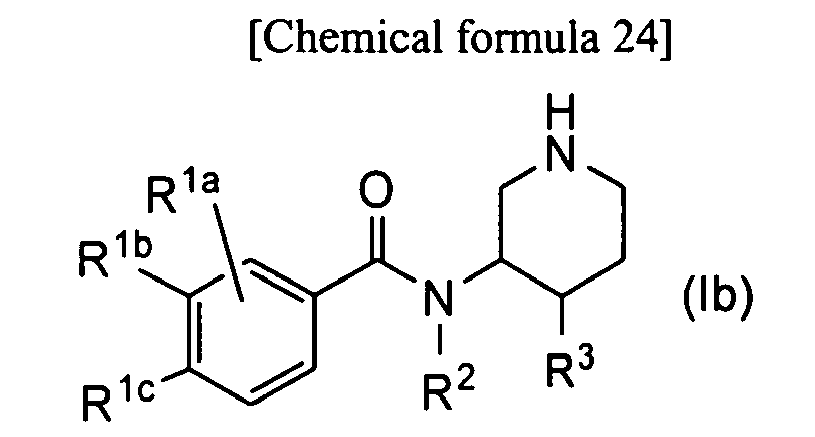
- is limited to those wherein R1a, R1b, R1c and R2 are as defined in Item 1;
- R3 is one of the above-mentioned R3a, R3b, R3c, and R3d (in which R3a, R3b, R3c and R3d are as defined in Item 1, provided that when R3 is a group of the formula: -A-B, then A is a single bond, and B is an optionally substituted C6 aryl group, or an optionally substituted 5- to 10-membered monocyclic or polycyclic heteroaryl group. Said C6 aryl group is substituted at the 3-position thereof by cyano, carboxy, C1-4 alkyl having optionally a carboxy substituent, or a C6 aryl group optionally substituted by a C14 alkoxy optionally substituted by fluorine, hydroxy, or carboxy)]
- The compounds of any one of Items 2 to 57 wherein the formula (I) is replaced by the formula (Ia) and a pharmaceutically acceptable salt thereof are also included in the present invention.
- (2) The compound of the following formula (IIa) or a pharmaceutically acceptable salt thereof.
-

- [wherein R12a, R12b, R12c, R22, R32a, R32b, R32c and R32d are as defined in Item 58, provided that in the formula (IIa), the compound of the following formula:
-

- is limited to those wherein R12a, R12b, R12c and R22 are as defined in Item 58, and R32c is the same as R3 of the formula (Ib)].
- The compounds of any one of Items 59 to 88 wherein the formula (II) is replaced by the formula (IIa) and a pharmaceutically acceptable salt thereof are also included in the present invention.
- (3) The compound of the following formula (Ic) or a pharmaceutically acceptable salt thereof.
-

-

- is limited to those wherein R1a, R1b, R1c and R2 are as defined in Item 1; R3 is one of the above-mentioned R3a, R3b, R3c, and R3d (in which R3a, R3b, R3c and R3d are as defined in the formula (I)),
provided that when R3 is a group of the formula: -A-B, then (i) A is -(CH2)sN(R4)CO-, or -(CH2)sN(R4)COO-; B is as defined in Item 1; R4 is an optionally substituted C3-10 cycloalkyl group, an optionally substituted C6-10 aryl group, or an optionally substituted 5- to 10-membered monocyclic or polycyclic heteroaryl group, - (ii) A is -(CH2)sN(R4)-; B is as defined in Item 1; R4 is an optionally substituted C3-10 cycloalkyl group, or an optionally substituted 5- to 10-membered monocyclic or polycyclic heteroaryl group,
- (iii) A is -(CH2)sN(R4)SO2-, -(CH2)sOCON(R4)- or -(CH2)sSO2N(R4)-; B is as defined in Item 1; R4 is an optionally substituted C3-10 cycloalkyl group, or an optionally substituted 5- to 10-membered monocyclic or polycyclic heteroaryl group,
- (iv) A is -(CH2)sN(R4)CON(H)-; B is as defined in Item 1; R4 is an optionally substituted C3-10 cycloalkyl group, or an optionally substituted 5- to 10-membered monocyclic or polycyclic heteroaryl group,
- (v) A is -(CH2)sCON(R4)-; B is as defined in Item 1; R4 is a C1-6 alkyl group, an optionally substituted C6-10 aryl group, or an optionally substituted C7-14 aralkyl group,
- (vi) A is -(CH2)sSO2-, -(CH2)sCO-, or -(CH2)sCOO-; B is a hydrogen atom, an optionally substituted C3-10 cycloalkyl group, an optionally substituted C5-6 cycloalkenyl group, or an optionally substituted C6-10 aryl group, or
- (vii) A is a single bond; B is a hydrogen atom, an optionally substituted C3-10 cycloalkyl group, an optionally substituted C5-6 cycloalkenyl group, an optionally substituted C6-10 aryl group, an optionally substituted 5- to 10-membered monocyclic or polycyclic heteroaryl group, or an optionally substituted saturated heterocyclic group].
- The compounds of any one of Item 2 to 57 wherein the formula (I) is replaced by the formula (Ic) or a pharmaceutically acceptable salt thereof are also included in the present invention.
- (4) The compound of the following formula (IIc) or a pharmaceutically acceptable salt thereof.
-

[wherein R12a, R12b, R12c, R22, R32a, R32b, R32c and R32d are as defined in Item 58, provided that in the formula (IIc), the compound of the following formula: -

- is limited to those wherein R12a, R12b, R12c and R22 are as defined in Item 58; R32d is as defined in the formula (II), provided that when R32d is a group of the formula: -A2-B2, then (i) A2 is - (CH2)s2N(R42)CO-, or -(CH2)s2N(R42)COO-; B2 is as defined in Item 58; R42 is an optionally substituted C3-10 cycloalkyl group, an optionally substituted C6-10 aryl group, or an optionally substituted 5- to 10-membered monocyclic or polycyclic heteroaryl group,
- (ii) A2 is -(CH2)s2N(R42)-; B2 is as defined in Item 58; R42 is an optionally substituted C3-10 cycloalkyl group, or an optionally substituted 5- to 10-membered monocyclic or polycyclic heteroaryl group,
- (iii) A2 is -(CH2)s2N(R42)SO2-, -(CH2)s2OCON(R42)-, or -(CH2)s2SO2N(R42)-; B2 is as defined in Item 58; R42 is an optionally substituted C3-10 cycloalkyl group, or an optionally substituted 5- to 10-membered monocyclic or polycyclic heteroaryl group,
- (iv) A2 is -(CH2)sN(R42)CON(H)-; B2 is as defined in Item 58; R42 is an optionally substituted C3-10 cycloalkyl group, or an optionally substituted 5- to 10-membered monocyclic or polycyclic heteroaryl group,
- (v) A2 is -(CH2)s2CON(R42)-; B2 is as defined in Item 58; R42 is a C1-6 alkyl group, an optionally substituted C6-10 aryl group, or an optionally substituted C7-14 aralkyl group,
- (vi) A2 is -(CH2)s2SO2-, -(CH2)s2CO-, or -(CH2)s2COO-; B2 is a hydrogen atom, an optionally substituted C3-10 cycloalkyl group, an optionally substituted C5-6 cycloalkenyl group, or an optionally substituted C6-10 aryl group, or
- (vii) A2 is a single bond; B2 is a hydrogen atom, an optionally substituted C3-10 cycloalkyl group, an optionally substituted C5-6 cycloalkenyl group, an optionally substituted C6-10 aryl group, an optionally substituted 5- to 10-membered monocyclic or polycyclic heteroaryl group, or an optionally substituted saturated heterocyclic group].
- The present invention also includes the compounds disclosed in any one of Items 59 to Item 88, wherein the compound of the formula (II) is replaced by the compound of the formula (IIc) or a pharmaceutically acceptable salt thereof.
- (5) The compound of the following formula (Ie), or a pharmaceutically acceptable salt thereof.
-

- The present invention also includes the compounds as listed in Items 2 to Items 57, wherein the compound of the formula (I) is replaced by the compound of the formula (Ie).
- (6) The compound of the following formula (IIe) or a pharmaceutically acceptable salt thereof.

- [wherein R12a, R12b, R12c, R22, R32a, R32b, R32c and R32d are as defined in Item 58, provided that in the formula (IIe), the compounds of the formulae (IIb) and (IId) are limited to ones as disclosed above]
- The present invention also includes the compound as disclosed in any one of Items 59 to 88, where the compound of the formula (II) is replaced by the compound of the formula (IIe), or a pharmaceutically acceptable salt thereof.
- (7) The compound of the following formula (III), or a pharmaceutically acceptable salt thereof.

- In the compound of the above-mentioned formula (III), the condensed ring is preferably a condensed ring having a partial structure of the following formula:

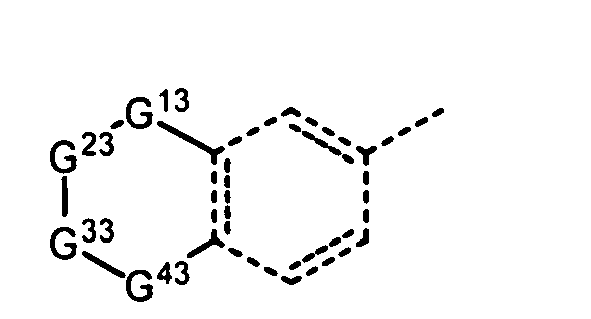
- The compound of the following formula (IIIa), or a pharmaceutically acceptable salt thereof.

- In the compound of the above-mentioned formula (IIIa), the compounds having a stereostructure of the following formula are preferable.
-

- In the compounds of the above-mentioned formula (IIIa'), the compounds having a stereo structure of the following formula are preferable.

- In the compounds of the formulae (IIIa), (IIIa') and (IIIa"), the preferable compounds are ones wherein R13a is a hydrogen atom; R13b is a C1-6 alkoxy group substituted by C1-4 alkoxy; R33d is a group of the formula: -A3-B3 (in which A3 is -(CH2)s3N(R43)CO-, or -(CH2)s3N(R43)CON(H)-, B3 is an optionally substituted C1-6 alkyl group, an optionally substituted C2-6 alkenyl group, an optionally substituted C6-10 aryl group, an optionally substituted C7-14 aralkyl group, or an optionally substituted 5- or 6-membered monocyclic heteroaryl-C1-4 alkyl group); R43 is a C3-6 cycloalkyl group; s3 is 1, or 2.
- In the compounds of the formulae (IIIa) and (IIIa'), the preferable compounds are ones wherein R13a is a hydrogen atom; R13b is a C1-6 alkoxy group substituted by C1-4 alkoxy; when A3 for R33d is - (CH2)2N(R43)CO-, then B3 is an optionally substituted C1-6 alkyl group, an optionally substituted C2-6 alkenyl group, an optionally substituted C7-14 aralkyl group, or an optionally substituted 5- or 6-membered monocyclic heteroaryl-C1-4 alkyl group, or when A3 for R33d is -(CH2)2N(R43)CONH-, then B3 is an optionally substituted C6-10 aryl group; R43 is a C3-6 cycloalkyl group; s3 is 1 or 2.
- (8) The compound of the following formula (IIIb), or a pharmaceutically acceptable salt thereof.

-A2-B2 (in which A2 and B2 are as defined in Item 58)] - In the compound of the above-mentioned formula (IIIb), the preferable compounds are ones having a stereo structure of the following formula:

- In the compounds of the above-mentioned formula (IIIb'), the preferable compounds are ones having a stereo structure of the following formula:

- (9) The compound of the following formula (IIIc), or a pharmaceutically acceptable salt thereof.


-A2-B2 (in which A2 and B2 are as defined in Item 58)] - In the compounds of the above-mentioned formula (IIIc), the preferable compounds are ones having a stereostructure of the following formula:

- In the compounds of the above-mentioned formula (IIIc'), the preferable compounds are ones having a stereostructure of the following formula:

- (10) The compounds of the following formula (IIId), or a pharmaceutically acceptable salt thereof.

- (11) The compound of the following formula (IVa), or a pharmaceutically acceptable salt thereof.


- (12) The compound of the following formula (IVb), or a pharmaceutically acceptable salt thereof.

- (13) The compound of the following formula (Va), or a pharmaceutically acceptable salt thereof.

- (14) The compound of the following formula (Vb), or a pharmaceutically acceptable salt thereof.

- (15) The compound of the following formula (Vc), or a pharmaceutically acceptable salt thereof.


- In the compounds of the formulae (Vb) and (Vc), the preferable compounds are ones wherein G13, G23, G33, and G43 are as defined above; R33d is a group of the formula: -A3-B3 (in which A3 is - (CH2)s3N(R43)CO-, or -(CH2)s3N(R43)CON(H)-; B3 is an optionally substituted C1-6 alkyl group, an optionally substituted C2-6 alkenyl group, an optionally substituted C6-10 aryl group, an optionally substituted C7-14 aralkyl group, or an optionally substituted 5- or 6-membered monocyclic heteroaryl-C1-4 alkyl group); R43 is a C3-6 cycloalkyl group; and s3 is 1, or 2.
- (18) The compound of the following formula (Vd), or a pharmaceutically acceptable salt thereof.

- Preferable embodiment for each definition of the above formula (Vd) is the same as one of the embodiments of Items 24 to 30.
- (19) The compound of the following formula (Ve), or a pharmaceutically acceptable salt thereof.
-

- In the compounds of the formulae (Vd) and (Ve), the preferable compounds are ones wherein R1d is a C1-6 alkyl group substituted by C1-6 alkoxy; R1e and R1f are independently the same or different and each is selected from a hydrogen atom and a C1-6 alkyl group optionally substituted by C1-6 alkoxy.
- In the compounds as defined in the above-mentioned (1) to (19), the preferable embodiment for each substituents for "B", and the preferable embodiment for each substituent for "B2" and "B3" are the same as defined for the preferable embodiment of each substituent of the above "B".
- The preferable compound of the intermediate of the above-mentioned formula (VII) are the following compounds. In addition, in those formulae, the concrete example of R37a, R37b, R37c and R37d are the same ones as the concrete examples of R3a, R3b, R3c and R3d in the formula (I). The preferable embodiment for each definition for "B7" is the same as the preferable embodiment of each definition for "B" and the preferable embodiment for each definition of "B2" and "B3".
- R37f of the formula (VII) may be a hydrogen atom, a protecting group being able to be removed by hydrogenation, or a protecting group being able to be removed under acidic conditions. The above-mentioned protecting group includes, for example, protecting groups disclosed in "PROTECTIVE GROUPS IN ORGANIC SYNTHESIS, John Willey and Sons, 4th edition", as far as said protecting group does not affect any harmful effects on the desired compound.
- Concrete examples of said protecting groups are, for example, carbamate protecting groups (e.g., C1-4 alkoxycarbonyl group such as t-butoxycarbonyl, etc., benzyloxycarbonyl group, allyloxycarbonyl group, etc.), amide protecting groups (e.g., trifluoroacetyl group, etc.), imide protecting groups (e.g., phthaloyl group, etc.), or sulfonamide protecting groups (e.g., p-toluenesulfonyl group, or 2-nitrobenzenesulfonyl group).
- The protecting groups being able to be removed by hydrogenation or under acidic conditions are, for example, in addition to C1-4 alkoxycarbonyl group, benzyloxycarbonyl group, allyloxycarbonyl group, p-toluenesulfonyl group, or nitrobenzenesulfonyl group, a group selected from the following compounds. In the following compounds, R5a and R5b are independently the same or different, and each is a hydrogen atom, a nitro group, a C1-4 alkoxy group, or a C1-4 alkylsulfinyl group.
-

-


- The preferable compound of the intermediate compound (VII) are listed below.
- (1) The compound of the following formula (VIIa):

- (2) The compound of the following formula (VIIb):

- (3) The compound of the following formula (VIIc):

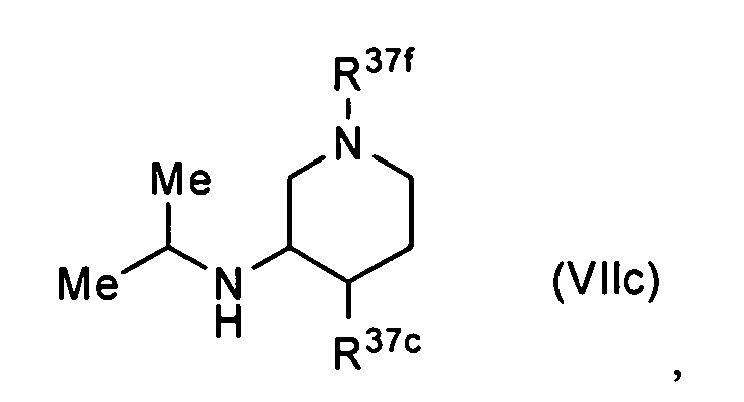
- (4) The compound of the following formula (VIId):

- In addition, the compound of the above-mentioned formula (VII) is preferably ones having the following stereostructure (wherein the symbols are as defined above).

- When the bond is expressed by a wedged solid or wedged broken line in the following disclosure, such as the formulae (F2), (F4), (F6), (F7) and (F8), it indicates the absolution configuration of a substituent, when the bond is expressed by a heavy line such as the formulae (F1), (F3), and (F5), then it indicates the relative configuration of a substituent (e.g., the formula (F1) indicates (±)-cis form).
-

- The pharmaceutically acceptable salt includes a salt with an inorganic acid such as hydrochloride, hydrobromide, sulfate, phosphate, nitrate, or a salt with an organic acid such as acetate, propionate, oxalate, succinate, lactate, malate, tartrate, citrate, maleate, fumarate, methanesulfonate, benzenesulfonate, p-toluenesulfonate, or ascorbate, etc.
- In addition, the present invention includes the compound of the formula (I) or a prodrug thereof, or a pharmaceutically acceptable salt thereof. Further, the present invention also includes a hydrate thereof or a solvate thereof such as ethanolate. Further, the present invention includes a crystalline form of every embodiment.
- The term "prodrug of the compound of the formula (I)" used in the present specification means a compound which is converted into the compound of the formula (I) in the living body by reaction by an enzyme or gastric acid under physiological conditions, namely, a compound which is converted into the compound of the formula (I) by oxidization, reduction, hydrolysis, etc. enzymatically, or by hydrolysis by gastric acid.
- The compound of the formula (I) may exist in the form of a tautomer. Accordingly, the present invention also includes a tautomer of the compound of the formula (I).
- The compound of the present invention may contain at least one asymmetric carbon atom. Accordingly, the present invention includes not only the racemic mixture of the present compound but also optically active compounds of the present compound. When the compound of the present invention has two or more asymmetric carbon atoms, then steric isomerism may occasionally occur. Accordingly, the present invention also includes these stereoisomers and a mixture thereof.
- The compound of the present invention may have an axial isomerism due to rotational hindrance at a phenyl group and a carbonyl group. Because of this axial isomerism, the present invention includes the stereoisomers of the following formulae.

- The present compound can be exemplified by the following compounds. In the following Tables, the compounds as expressed, for example, by No.1 (T1:H;T2:H;T3:H;T4:H;T5:H;T6:Q65;T7:Q211;T8:H;T9:H;T10:Q64) indicates the following compound (free base of Example 1).
-

-


No. T1 T2 T3 T4 T5 T6 T7 T8 T9 T10 1 H H H H H Q65 Q211 H H Q64 2 H H Q301 H H Q65 Q211 H H Q64 3 H H Q71 H H Q65 Q211 H H Q64 4 H H Q72 H H Q65 Q211 H H Q64 5 H H Q73 H H Q65 Q211 H H Q64 6 H H Q74 H H Q65 Q211 H H Q64 7 H H H H H Q65 Q211 H H Q108 8 Q75 H H H H Q65 Q211 H Cl Q64 9 Q76 H H H H Q65 Q211 H Cl Q64 10 Q77 H H H H Q65 Q211 H H Q64 11 Q78 H H H H Q65 Q211 H H Q64 12 Q79 H H H H Q65 Q211 H H Q64 13 Q80 H H H H Q65 Q211 H H Q64 14 Q81 H H H H Q65 Q211 H H Q64 15 H H H H H Q189 Q211 H H Q64 16 Q83 H H H H Q65 Q211 H H Q64 17 H Q73 H H H Q65 Q211 H H Q64 18 H H H H H Q65 Q211 H H Q62 19 H H H H H Q65 Q211 H Q109 Q64 20 H Q85 H H H Q65 Q211 H H Q64 21 H Q86 H H H Q65 Q211 H H Q64 22 H Q84 H H H Q65 Q211 H H Q64 23 H H H H H Q65 Q211 H H Q109 24 H H H H H Q65 Q211 H H Q110 25 H H H H H Q65 Q211 H H Q111 26 H H H H H Q65 Q211 H H Q112 27 H H H H H Q65 Q211 H H Q63 28 H H H H H Q65 Q211 H H Q113 -


No. T1 T2 T3 T4 T5 T6 T7 T8 T9 T10 29 H H H H H Q65 Q211 H H Q114 30 H Q88 H H H Q65 Q211 H H Q64 31 H Q190 H H H Q65 Q211 H H Q64 32 H Q90 H H H Q65 Q211 H H Q64 33 H Q91 H H H Q65 Q211 H H Q64 34 H H Q92 H H Q65 Q211 H H Q64 35 H Q93 H H H Q65 Q211 H H Q64 36 H Q94 H H H Q65 Q211 H H Q64 37 H Q95 H H H Q65 Q211 H H Q64 38 H Q96 H H H Q65 Q211 H H Q64 39 H Q97 H H H Q65 Q211 H H Q64 40 Q98 H H H H Q65 Q211 H H Q64 41 Q99 H H H H Q65 Q211 H H Q64 42 H H H H H Q65 Q211 H Cl Q64 43 Q100 H H H H Q65 Q211 H H Q64 44 Q101 H H H H Q65 Q211 H H Q64 45 Q102 H H H H Q65 Q211 H H Q64 46 H Q103 H H H Q65 Q211 H H Q64 47 H Q104 H H H Q65 Q211 H H Q64 48 H Q105 H H H Q65 Q211 H H Q64 49 H H H H H Q65 Q211 H H Q191 50 H Q106 H H H Q65 Q211 H H Q64 51 H Q107 H H H Q65 Q211 H H Q64 -


No. T1 T2 T3 T4 T5 T6 T7 T8 T9 T10 52 Q157 H H H H Q65 Q211 H H Q64 53 Q240 H H H H Q65 Q211 H H Q64 54 Q241 H H H H Q65 Q211 H H Q64 55 H H Q242 H H Q65 Q211 H H Q109 56 H H H H H Q65 Q213 H H Q64 57 H H H H H Q65 Q212 H H Q64 58 H H H H H Q65 Q214 H H Q64 59 H H H H H Q65 Q213 H Br Q64 60 H H H H H Q65 Q217 H H Q64 61 H H H H H Q65 Q218 H H Q64 62 H H H H H Q65 Q219 H H Q64 63 H H H H H Q175 Q211 H Cl Q64 64 Q82 H H H H Q65 Q211 H Cl Q64 65 H H H H H Q65 Q213 H Q113 Q64 66 H H H H H Q65 Q220 H H Q64 67 Q247 H H H H Q65 Q211 H H Q64 68 Q248 H H H H Q65 Q211 H H Q64 69 Q249 H H H H Q65 Q211 H H Q64 70 Q250 H H H H Q65 Q211 H H Q64 71 H Q105 H H H Q65 Q211 H Cl Q64 72 H H H H H Q65 Q211 H H Q191 73 H H H H H Q57 Q211 H Cl Q64 74 Q251 H H H H Q65 Q211 H H Q64 75 Q252 H H H H Q65 Q211 H H Q64 76 H H H H H Q57 Br H H Q64 77 H H H H H Q222 Q211 Q65 Cl Q64 78 H H H H H Q65 Q223 H Cl Q64 -


No. T1 T2 T3 T4 T5 T6 T7 T8 T9 T10 79 Q156 H H H H Q65 Q211 H Cl Q64 80 Q116 H H H H Q65 Q211 H Me Q64 81 H H H H H Q65 Q213 H CN Q64 82 H H H H H Q65 H Q224 H Q64 83 H H H H H Q65 H Q174 H Q64 84 H H H H H Q65 H Q227 H Q64 85 H H H H H Q65 H Q225 H Q64 86 H H H H H Q65 H Q226 H Q64 87 H H H H H Q65 Q228 H H Q64 88 H H H H H Q65 Q228 H H Q64 89 Q118 H H H H Q65 Q211 H H Q64 90 Q254 H H H H Q65 Q211 H H Q64 91 Q255 H H H H Q65 Q211 H H Q64 92 Q256 H H H H Q65 Q211 H H Q64 93 Q257 H H H H Q65 Q211 H H Q64 94 Q119 H H H H Q65 Q211 H H Q64 95 H H H H H Q65 Q229 H H Q64 96 H H H H H Q65 Q230 H H Q64 97 H H H H H Q65 Q231 H H Q64 98 Q259 H H H H Q65 Q211 H H Q64 99 Q260 H H H H Q65 Q211 H H Q64 100 Q261 H H H H Q65 Q211 H H Q64 101 Q262 H H H H Q65 Q211 H H Q64 102 Q263 H H H H Q65 Q211 H H Q64 103 H H H H H Q65 Q232 H H Q64 104 H H H H H Q65 Q233 H H Q64 105 Q264 H H H H Q65 Q211 H H Q64 106 Q265 H H H H Q65 Q211 H H Q64 -

No. T1 T2 T3 T4 T5 T6 T7 T8 T9 T10 107 Q266 H H H H Q65 Q211 H H Q64 108 Q267 H H H H Q65 Q211 H H Q64 109 Q268 H H H H Q65 Q211 H H Q64 110 Q269 H H H H Q65 Q211 H H Q64 111 H H H H H Q65 Q234 H H Q64 112 H H H H H Q65 Q234 H H Q64 113 Q120 H H H H Q65 Q211 H H Q64 114 Q270 H H H H Q65 Q211 H H Q64 115 Q271 H H H H Q65 Q211 H H Q64 116 Q272 H H H H Q65 Q211 H H Q64 117 Q273 H H H H Q65 Q211 H H Q64 118 Q274 H H H H Q65 Q211 H H Q64 119 Q275 H H H H Q65 Q211 H H Q64 120 Q276 H H H H Q65 Q211 H H Q64 121 Q121 H H H H Q65 Q211 H H Q64 122 Q122 H H H H Q65 Q211 H H Q64 123 Q277 H H H H Q65 Q211 H H Q64 124 Q278 H H H H Q65 Q211 H H Q64 125 Q279 H H H H Q65 Q211 H H Q64 126 Q199 H H H H Q65 Q211 H Cl Q64 127 Q197 H H H H Q65 Q211 H H Q64 128 Q123 H H H H Q65 Q211 H H Q64 129 Q124 H H H H Q65 Q211 H H Q64 130 Q125 H H H H Q65 Q211 H H Q64 131 Q126 H H H H Q65 Q211 H H Q64 132 Q127 H H H H Q65 Q211 H H Q64 133 H H H H H Q65 H Q132 H Q64 134 H H H H H Q65 H Q214 H Q64 -


No. T1 T2 T3 T4 No. T1 T2 T3 T4 No. T1 T2 T3 T4 135 H Q40 H H 155 Q66 H H H 175 Q84 H H H 136 H Q235 H H 156 Q67 H H H 176 Q117 H H H 137 H Q192 H H 157 Q140 H H H 177 Q280 H H H 138 H Q236 H H 158 Q142 H H H 178 Q85 H H H 139 H Q237 H H 159 Q143 H H H 179 Q86 H H H 140 H Q159 H H 160 Q144 H H H 180 Q75 H H H 141 H Q239 H H 161 Q145 H H H 181 Q76 H H H 142 H Q238 H H 162 Q146 H H H 182 Q55 H H H 143 H H Q242 H 163 Q156 H H H 183 Q53 H H H 144 H H Q243 H 164 Q160 H H H 184 Q196 H H H 145 H H Q244 H 165 Q161 H H H 185
186Q52
Q51H
HH
HH
H146 H H Q245 H 166 Q162 H H H 187 Q54 H H H 147 Q128 H H H 167 Q163 H H H 188 Q40 H H H 148 Q129 H H H 168 Q164 H H H 189 Q45 H H H 149 Q130 H H H 169 Q166 H H H 190 Q82 H H H 150 Q165 H H H 170 Q167 H H H 191 H Q89 H H 151 Q136 H H H 171 Q168 H H H 192 H Q241 H H 152 Q137 H H H 172 Q169 H H H 193 Q246 H H H 153 Q138 H H H 173 Q155 H H H 194 Q253 H H H 154 Q139 H H H 174 Q156 H H H -


No. T1 T2 T3 T4 T5 T6 T7 T8 T9 T10 195 H H H H H Q65 Q209 H H Q64 196 H H H H H Q65 Q132 H H Q64 197 Q82 H H H H Q60 Q211 H H Q64 198 Q173 H H H H Q208 Q211 H H Q64 199 H H H H H Q65 Q215 H H Q64 200 H H H H H Q65 Q210 H H Q64 201 H H H H H Q65 Q216 H H Q64 202 Q162 H H H H Q59 Q211 H H Q64 203 Q161 H H H H Q60 Q211 H H Q64 204 Q160 H H H H Q208 Q211 H H Q64 205 Q164 H H H H Q59 Q211 H H Q64 206 H H H H H Q65 Q213 H Q92 Q64 207 Q142 H H H H Q60 Q211 H H Q64 208 Q143 H H H H Q59 Q211 H H Q64 209 Q137 H H H H Q60 Q211 H H Q64 210 Q138 H H H H Q208 Q211 H H Q64 211 Q139 H H H H Q60 Q211 H H Q64 212 H H H H H Q65 Q213 H Cl Q64 213 Q143 H H H H Q60 Q211 H H Q64 214 H H H H H Q65 Q213 H CN Q64 215 H H H H H Q65 Q228 H H Q64 216 H H H H H Q65 Q229 H H Q64 217 H H H H H Q65 Q230 H H Q64 218 H H H H H Q65 Q231 H H Q64 219 Q146 H H H H Q59 Q211 H H Q64 220 Q116 H H H H Q60 Q211 H H Q64 221 Q118 H H H H Q208 Q211 H H Q64 222 Q119 H H H H Q60 Q211 H H Q64 223 Q120 H H H H Q60 Q211 H H Q64 224 Q121 H H H H Q208 Q211 H H Q64 225 Q122 H H H H Q59 Q211 H H Q64 226 H H H H H Q65 H Q65 H Q64 -


No. T1 T2 T3 T4 T5 T6 T7 T8 T9 T10 227 H H H H H Q65 H Q209 H Q64 228 Q123 H H H H Q60 H H H Q64 229 H H H H H Q65 H Q210 H Q64 230 H H H H H Q65 H Q211 H Q64 231 H H H H H Q65 H Q212 H Q64 232 H H H H H Q65 H Q213 H Q64 233 Q124 H H H H Q59 H H H Q64 234 Q125 H H H H Q60 H H H Q64 235 Q126 H H H H Q208 H H H Q64 236 Q127 H H H H Q59 H H H Q64 237 Q128 H H H H Q60 H H H Q64 238 Q129 H H H H Q208 H H H Q64 239 H H Q242 H H Q65 Q211 H H H 240 Q130 H H H H Q59 H H H Q64 241 H H Q242 H H Q65 Q211 H H Q63 242 H H Q242 H H Q65 Q211 H H Q113 243 G1154 H H H H Q65 Q213 H H Q64 244 Q199 H H H H Q65 Q213 H H Q64 245 Q200 H H H H Q65 Q213 H H Q64 246 H H H H H Q65 H H H Q64 247 H H H H H Q65 Br H H Q64 248 H H H H H Q221 Q213 H Cl Q64 249 H H H H H Q221 Q213 H Br Q64 250 H H H H H Q222 Q213 H Cl Q64 -


No. T1 T2 T3 T4 T11 No. T1 T2 T3 T4 T11 251 H H H H Q181 263 H H H H Q183 252 H H H H Q198 264 H H H H Q176 253 H H H H Q178 265 H H H H Q201 254 Q83 H H H Q180 266 Q120 H H H Q202 255 H H H H Q194 267 Q127 H H H Q203 256 H H H H Q186 268 H H H H Q204 257 H H H H Q195 269 H H H H Q203 258 H H H H Q182 270 H H H H Q205 259 H H H H Q184 271 Q120 H H H Q206 260 H H H H Q177 272 Q128 H H H Q207 261 H H H H Q180 273 Q102 H H H Q180 262 H H H H Q185 -


No. T1 T2 T3 T4 No. T1 T2 T3 T4 No. T1 T2 T3 T4 274 H Q1 H H 299 H Q26 H H 324 H Q50 H H 275 H Q2 H H 300 H Q35 H H 325 H Q51 H H 276 H Q3 H H 301 H Q36 H H 326 Q38 H H H 277 H Q4 H H 302 H Q37 H H 327 Q174 H H H 278 H Q5 H H 303 H H Q27 H 328 Q53 H H H 279 H Q6 H H 304 H H Q28 H 329 Q128 Q109 H H 280 H Q7 H H 305 H H Q29 H 330 Q128 Q113 H H 281 H Q8 H H 306 H H Q30 H 331 Q45 H H H 282 H Q9 H H 307 H H Q31 H 332 Q46 H H H 283 H Q10 H H 308 H H Q32 H 333 Q47 H H H 284 H Q11 H H 309 H H Q33 H 334 Q48 H H H 285 H Q12 H H 310 H H Q34 H 335 Q35 H H H 286 H Q13 H H 311 H Q39 H H 336 Q17 H H H 287 H Q14 H H 312 H Q38 H H 337 Q15 H H H 288 H Q15 H H 313 H Q41 H H 338 Q2 H H H 289 H Q16 H H 314 H H H Q40 339 Q43 H H H 290 H Q17 H H 315 H H H Q41 340 Q44 H H H 291 H Q18 H H 316 H Q42 H H 341 Q35 Q2 H H 292 H Q19 H H 317 H Q43 H H 342 Q35 Q6 H H 293 H Q20 H H 318 H Q44 H H 343 Q35 Q15 H H 294 H Q21 H H 319 H Q45 H H 344 Q15 Q35 H H 295 H Q22 H H 320 H Q46 H H 345 Q35 H Q34 H 296 H Q23 H H 321 H Q47 H H 346 Q15 H Q33 H 297 H Q24 H H 322 H Q48 H H 347 Q54 H Q33 H 298 H Q25 H H 323 H Q49 H H 348 Q43 H Q34 H -


No. T1 T2 T3 T4 No. T1 T2 T3 T4 No. T1 T2 T3 T4 349 H H H Q40 356 H Q37 H H 363 Q52 H H H 350 H H H Q41 357 H H Q27 H 364 Q53 H H H 351 H H H Q45 358 H H Q28 H 365 Q54 H H H 352 H H H Q13 359 H H Q29 H 366 Q42 H H H 353 H H H Q51 360 H Q50 H H 354 H H H Q46 361 H Q51 H H 355 H H H Q35 362 Q51 H H H -

No. T1 T2 T3 T4 T5 T6 T7 T8 T9 T10 367 H Q1 H H H Q56 Q211 H H Q64 368 H Q15 H H H Q57 Q211 H H Q62 369 H Q35 H H H Q58 Q211 H H Q62 370 H Q45 H H H Q59 Q211 H H Q62 371 H Q35 H H H Q60 Q211 H H Q62 372 H Q1 H H H Q61 Q211 H H Q62 373 H Q15 H H H Q65 Q193 H H Q63 374 Q35 Q1 H H H Q57 Q211 H H Q62 375 Q15 H H H H Q57 Q211 H H Q62 376 H H Q34 H H Q57 Q211 H H Q62 377 H H Q27 H H Q65 Q193 H H Q64 378 H H H H H Q57 Q211 H Cl Q64 379 H Q35 H H H Q65 Q211 H Cl Q64 -


No. T1 T2 T3 T4 T11 No. T12 380 H Q35 H H Q68 389 Q187 381 H Q1 H H Q68 390 Q188 382 Q35 H H H Q68 391 Q115 383 Q15 H H H Q68 392 Q70 384 H Q35 H H Q69 385 Q45 H H H Q69 386 H Q15 H H Q69 387 H H Q34 H Q68 388 H H H Q40 Q68 -


No. T1 T2 T3 T4 T5 T6 T7 T8 T9 T10 393 Q104 H H H H Q65 Q211 H H Q64 394 Q105 H H H H Q65 Q211 H H Q64 395 H H H H H Q65 Q211 H H Q191 396 Q106 H H H H Q65 Q211 H H Q64 397 Q107 H H H H Q65 Q211 H H Q64 398 Q264 H H H H Q65 Q211 H Q113 Q64 399 Q265 H H H H Q65 Q211 H Q109 Q64 400 Q266 H H H H Q65 Q211 H Q131 Q64 401 Q267 H H H H Q65 Q211 H Q132 Q64 402 Q269 H H H H Q65 Q211 H Q134 Q64 403 Q272 H H H H Q65 Q211 H Q218 Q64 404 Q274 H H H H Q65 Q211 H Q62 Q64 405 Q279 H H H H Q65 Q211 H Q133 Q64 406 Q199 H H H H Q65 Q211 H Cl Q64 407 Q196 H H H H Q65 Q211 H H Q64 408 Q280 H H H H Q65 Q211 H Cl Q64 409 Q129 H H H H Q65 Q211 H Cl Q64 410 Q246 H H H H Q65 Q211 H H Q64 411 Q173 H H H H Q65 Q211 H H Q64 412 Q254 H H H H Q65 Q211 H Cl Q64 413 Q255 H H H H Q65 Q211 H Cl Q64 414 Q256 H H H H Q65 Q211 H Cl Q64 415 Q257 H H H H Q65 Q211 H Cl Q64 416 Q259 H H H H Q65 Q211 H Cl Q64 417 Q260 H H H H Q65 Q211 H Cl Q64 418 Q261 H H H H Q65 Q211 H Cl Q64 419 Q262 H H H H Q65 Q211 H Cl Q64 420 Q268 H H H H Q65 Q211 H H Q64 -


No. T1 T2 T3 T4 T5 T6 T7 T8 T9 T10 421 Q153 H H H H Q65 Q211 H H Q170 422 Q153 H H H H Q65 Q211 H H Q171 423 Q258 H H H H Q65 Q211 H H Q64 424 Q263 H H H H Q65 Q211 H Q134 Q64 425 Q128 H H H H Q65 Q211 H H Q172 426 Q265 H H H H Q65 Q213 H H Q64 427 Q266 H H H H Q65 Q212 H H Q64 428 Q271 H H H H Q65 Q213 H H Q64 429 Q274 H H H H Q65 Q213 H H Q64 430 Q154 H H H H Q65 Q211 H H Q64 431 Q141 H H H H Q65 Q211 H H Q64 432 Q200 H H H H Q65 Q211 H H Q64 433 Q281 H H H H Q65 Q211 H H Q64 434 Q282 H H H H Q65 Q211 H H Q64 435 Q38 H H H H Q65 Q213 H H Q64 436 Q283 H H H H Q65 Q211 H H Q64 437 Q284 H H H H Q65 Q211 H H Q64 438 Q285 H H H H Q65 Q211 H H Q64 439 H H H H H Q65 H H H Q64 440 H H H Q109 H Q65 Q211 H H Q64 441 H H H H H Q65 Q211 Q65 H Q64 442 H H H H H Q65 Br H H Q64 443 H H H H H Q65 H Q209 H Q64 444 H H H H H Q65 H Q135 H Q64 445 H H H H H Q65 H Q228 H Q64 446 H H H H H Q65 H Q229 H Q64 447 H H H H H Q65 H Q230 H Q64 448 H H H H H Q65 H Q231 H Q64 -


No. T1 T2 T3 T4 T5 T6 T7 T8 T9 T10 449 H H H H H Q65 H Q214 H Q64 450 H H H H H Q65 H Q92 H Q64 451 H H H H H Q65 Q209 H H Q64 452 H H H H H Q65 Q135 H H Q64 453 H H H H H Q65 Q215 H H Q64 454 H H H H H Q65 Q210 H H Q64 455 H H H H H Q65 Q216 H H Q64 456 H H H H H Q65 Q213 H H Q64 457 H H H H H Q65 Q212 H H Q64 458 H H H H H Q65 Q214 H H Q64 459 H H H H H Q65 Q213 H Br Q64 460 H H H H H Q65 Q213 H Q65 Q64 461 H H H H H Q65 Q218 H H Q64 462 H H H H H Q65 Q219 H H Q64 463 H H H H H Q175 Q211 H Cl Q64 464 H H H H H Q175 Q213 H Q113 Q64 465 H H H H H Q65 Q220 H H Q64 466 H H H H H Q65 Q286 H H Q64 467 H H H H H Q65 Q213 H Cl Q64 468 H H H H H Q221 Q211 H Cl Q64 469 H H H H H Q221 Br H H Q64 470 H H H H H Q222 Q211 H Cl Q64 471 H H H H H Q65 Q223 H H Q64 472 H H H H H Q65 Q223 H H Q64 473 H Q147 H H H Q65 Q211 H H Q64 474 H Q148 H H H Q65 Q211 H H Q64 475 H Q149 H H H Q65 Q211 H H Q64 476 H Q150 H H H Q65 Q211 H H Q64 477 H Q151 H H H Q65 Q211 H H Q64 478 H Q152 H H H Q65 Q211 H H Q64 479 H Q153 H H H Q65 Q211 H H Q64 480 H Q87 H H H Q65 Q211 H H Q64 481 H Q158 H H H Q65 Q211 H H Q64 -


No. T1 T2 T3 T4 T11 No. T1 T2 T3 T4 T11 482 H H H H Q287 495 H H H H Q179 483 H H H H Q288 496 Q253 H H H Q287 484 Q265 H H H Q185 497 Q278 H H H Q287 485 Q83 H H H Q183 498 Q265 H H H Q287 486 Q271 H H H Q177 499 Q265 H H H Q185 487 Q266 H H H Q177 500 Q278 H H H Q294 488 Q66 H H H Q201 501 Q265 H H H Q295 489 H H H H Q289 502 Q278 H H H Q296 490 H H H H Q180 503 Q265 H H H Q297 491 Q266 H H H Q289 504 Q265 H H H Q298 492 H H H H Q290 505 Q265 H H H Q299 493 H H H H Q291 506 Q265 H H H Q300 494 H H H H Q292 -

No. T1 T9 507 Q264 Q293 508 Q266 Q193 509 Q133 Q293 - Each abbreviation used in the above-mentioned Tables indicates a partial structure selected from the following partial structures.
-


-


-


-


-


-


-


-


- The process for preparing the compound of the formula (I) of the present invention will be illustrated hereinbelow by Examples, but the present invention should not be construed to be limited thereto. In addition, in order to simplify the description of the present invention, the following abbreviations may be used in the present specification.
- Boc:
- tert-butoxycarbonyl group
- Cbz:
- benzyloxycarbonyl group
- TMS:
- trimethylsilyl group
- TBS:
- tert-butyldimethylsilyl group
- SEM:
- 2-[(trimethylsilyl)ethoxy]methyl group
- Ac:
- acetyl group
- Me:
- methyl group
- Et:
- ethyl group
- Pr:
- propyl group
- i-Pr:
- isopropyl group
- Bu:
- butyl group
- i-Bu:
- isobutyl group
- t-Bu:
- tert-butyl group
- Ph:
- phenyl group
- Bn:
- benzyl group
- Ms:
- methanesulfonyl group
- TFA:
- trifluoroacetic acid
- Alloc:
- allyloxycarbonyl group
- Tf:
- trifluoromethanesulfonate
- The compound of the formula (I) may be synthesized from the well-known compound by a combination of the well-known methods, for example, by the following Methods. In addition, the compound of the formula (I) may be synthesized by suitably combining the following Methods due to the kinds of the starting compounds.
- The compound of the formula (I) or a pharmaceutically acceptable salt thereof may be prepared, for example, by the following method.

- [wherein R1a, R1b, R1c, R3a, R3b, R3c, R3d, R2, and n are as defined in the above-mentioned Item 1; R117 is a C1-3 alkyl group optionally substituted by fluorine, C3-6 cycloalkyl or C1-3 alkoxy, or a C3-6 cycloalkyl group optionally substituted by fluorine or C1-3 alkoxy; R118 is a C1-2 alkyl group; R119 is a C1-5 alkyl group optionally substituted by fluorine, C3-6 cycloalkyl or C1-3 alkoxy, or a C3-6 cycloalkyl group optionally substituted by fluorine or C1-3 alkoxy; R120 is a fluorine atom or a C1-3 alkoxy group; m104 is an integer of 0, 1, 2, or 3; X1 is a hydroxy group or a chlorine atom; X2 is iodine atom, bromine atom, chlorine atom, methanesulfonyloxy group, trifluoromethanesulfonyloxy group, or p-toluenesulfonyloxy group; Y1 is Cbz, Boc or Alloc]
- When X1 is a hydroxy group, the compound of the formula (1-3) may be synthesized by reacting the compound of the formula (1-1) with the compound of the formula (1-2) in an inert solvent using a condensing agent, and if necessary, in the presence of a base. A phase-transfer catalyst may be used occasionally.
The base may be any conventional ones which are usually used as a base in conventional reactions and is not necessarily defined, and includes, for example, organic bases such as N-methylmorpholine, triethylamine, diisopropylethylamine, tributylamine, 1,8-diazabicyclo[5.4.0]undec-7-ene, 1,5-diazabicyclo[4.3.0]nona-5-ene, 1,4-diazabicyclo[5.4.0]undec-7-ene, pyridine, dimethylaminopyridine, or picoline, etc., or inorganic bases such as sodium hydrogen carbonate, potassium hydrogen carbonate, sodium carbonate, potassium carbonate, sodium hydroxide, or sodium hydride, etc. The phase-transfer catalyst includes, for example, quaternary ammonium salts such as tetrabutylammonium bromide or benzyltriethylammonium bromide, etc. or crown ethers such as 18-crown-6-ether, etc. The condensing agent may be ones as described in Jikken-Kagaku-Koza (edited by Chemical Society of Japan, Maruzen), vol. 22. For example, phosphoric esters such as diethyl cyanophosphate or diphenylphosphorylazide, etc., carbodiimides such as 1-ethyl-3-(3-dimethylaminopropyl)-carbodiimide·hydrochloride, or dicyclohexylcarbodiimide, a combination of a disulfide such as 2,2'-dipyridylsulfide, etc. and a phospine such as triphenylphosphine, a phosphorus halide such as N,N'-bis(2-oxo-3-oxazolidinyl)phosphinic chloride, etc., a combination of an azodicarboxylic diester such as diethylazodicarboxylate, etc., and a phosphine such as triphenylphosphine, etc. or 2-halo-1-lower alkylpyridinium halide such as 2-chloro-1-methylpyridinium iodide, etc. The inert solvent includes, for example, ethers such as tetrahydrofuran, diethyl ether, 1,4-dioxane, or 1,2-dimethoxyethane, etc., hydrocarbons such as hexane, heptane, toluene, benzene, or xylene, etc., halogenated hydrocarbons such as dichloromethane, chloroform, or 1,2-dichloroethane, etc., ketones such as acetone, etc., aprotic solvents such as acetonitrile, N,N'-dimethylformamide, dimethylsulfoxide, or hexamethylenephosphamide, etc., or a mixture of these solvents. The reaction temperature should be suitably selected from the range of about -70°C to about 80°C. - When X1 is a chlorine atom, the compound of the formula (1-3) may be synthesized by reacting the compound of the formula (1-2) with the compound of the formula (1-1) in an inert solvent, and if necessary, in the presence of a base. The base includes, for example, organic bases such as N-methylmorpholine, triethylamine, diisopropylethylamine, tributylamine, 1,8-diazabicyclo[5.4.0]undec-7-ene, 1,5-diazabicyclo[4.3.0]non-5-ene, 1,4-diazabicyclo[5.4.0]undec-7-ene, pyridine, dimethylaminopyridine, or picoline, etc. The base is usually used in an amount of 1 to 20 equivalents to 1 equivalent of the compound of the formula (1-1) wherein X1 is a chlorine atom. The inert solvent includes, for example, halogenated hydrocarbons such as dichloromethane, chloroform, or 1,2-dichloroethane. The reaction temperature should be suitably selected from the range of about -10°C to about 50°C.
- The compound of the formula (1-1) wherein X1 is a chlorine atom may be synthesized by reacting the compound of the formula (1-1) wherein X1 is a hydroxy group with oxalyl chloride or thionyl chloride in an inert solvent in the presence or absence of an additive. The additive includes, for example, dimethylformamide, diethylformamide, etc. The inert solvent includes, for example, halogenated hydrocarbons such as dichloromethane, dichloroethane, or chloroform, etc. The reaction temperature should be suitably selected from the range of about -10°C to about 50°C. After the reaction is completed, the reaction solution is concentrated under reduced pressure in the presence of a hydrocarbon solvent such as benzene or toluene to give the compound of the formula (1-1) wherein X1 is a hydroxy group.
- The compound (1-1) wherein X1 is a hydroxy group may be prepared by using a commercially available reagent or from a well-known compound by a conventional method. For example, the following compounds (1-1a) to (1-1m) may be synthesized by a similar method to the method disclosed in the literature (e.g.,
WO 06/100036 -
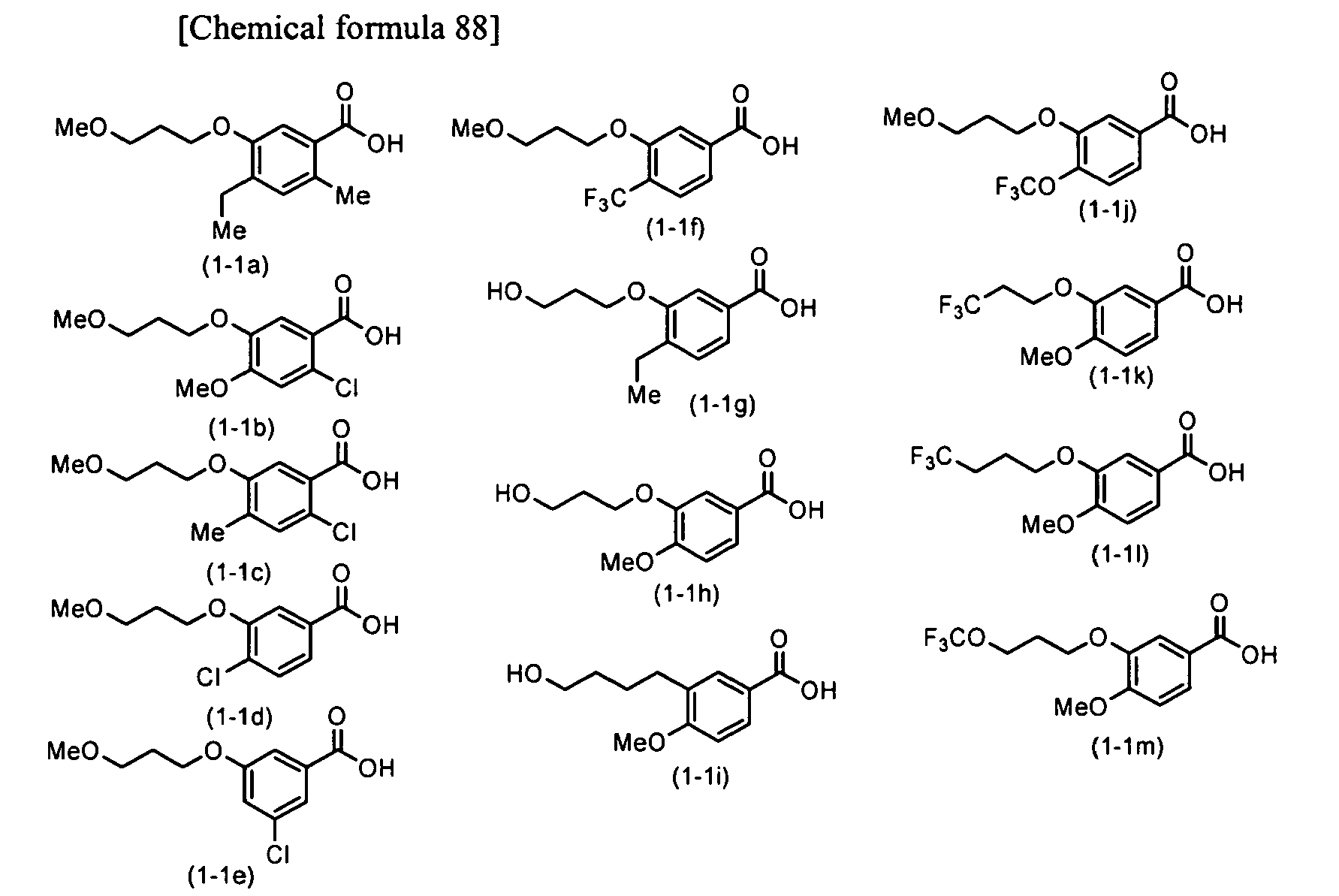
- Among the compounds (1-1), the compound as defined as "bicyclic condensed ring" may be prepared, for example, by a similar method to the method disclosed in the literatures (e.g.,
WO 04/028467 WO 04/007491 - The compound (I) may be synthesized from the compound (1-3) by a similar method to the method disclosed in the literature (e.g., Protective Groups in Organic Synthesis 2nd Edition (John Wiley & Sons, Inc.), etc.).
- The compound (1-2) may be synthesized from the compound (1-4) by a similar method to the method disclosed in Method 1, Step 7. In addition, when R2 of the compound (1-5) is an optionally substituted aryl group or an optionally substituted heteroaryl group, the compound (1-2) may be prepared from the compound (1-4) by a similar method to the method disclosed in the literature (J. Or g. Chem. 71, 6522 (2006), etc.).
- The compound (1-2) may be prepared from the compound (1-4) by a similar method to the method disclosed in the literatures (e.g., J. Org. Chem. 61, 3849 (1996), J. Org. Chem. 68, 4120 (2003), J. Org. Chem. 63, 370 (1998), J. Org. Chem. 70, 2195 (2005), etc.). The following procedures are exemplified.
The compound (1-2) can be prepared by reacting a compound selected from the compound (1-8), the compound (1-9), and the compound (1-10) with the compound (1-4) in an inert solvent in the presence or absence of acetic acid by a reductive amination reaction using a boron hydride compound such as sodium triacetoxyborohydride, sodium cyanoborohydride, etc. The inert solvent includes, for example, halogenated hydrocarbons such as dichloromethane, or dichloroethane, etc.; alcohols such as methanol or ethanol, etc.; ether solvents such as tetrahydrofuran, or 1,4-dioxane, or 1,2-dimethoxyethane, etc. The boron hydride compound may be usually used in an amount of 1 to 3 equivalents to 1 equivalent of the compound (1-4). The reaction temperature should be suitably selected from the range of about - 10°C to about 40°C. - The compound (1-2) may be prepared from the compound (1-6) by a similar method to Step 4 of Method 1.
- By a similar method to Step 1 of Method 1, the compound (1-7) may be prepared from the compound (1-1).
- The compound (1-3) is prepared by reacting the compound (1-7) with the compound (1-5) in an inert solvent in the presence of a base. The base includes, for example, alkali metal salts such as sodium hydrogen carbonate, potassium carbonate, or sodium hydroxide, etc.; organic bases such as triethylamine or 1,8-diazabicyclo[5.4.0]undec-7-ene (DBU), etc.; alkali metal hydrides such as sodium hydride or potassium hydride, etc.; alkali metal alkoxides such as potassium t-butoxide, etc.. When X2 is a chlorine atom or a bromine atom, an additive such as sodium iodide or potassium iodide, etc. may be used. The inert solvent includes, for example, ether solvents such as tetrahydrofuran or 1,4-dioxane, etc.; aprotic solvents such as dimethylformamide or dimethylsulfoxide, etc.; halogenated hydrocarbons such as dichloromethane or dichloroethane, etc., or a mixture of these solvents. The reaction temperature should be suitably selected from the range of about 0°C to about 150°C.
- Among the compounds of the formula (1-4), the compound of the formula (2-3) or a pharmaceutically acceptable salt thereof may be prepared, for example, by the following method.

- The compound (2-2) may be prepared fro the compound (2-1) by a similar method to ones disclosed in the literatures (e.g., Comprehensive Organic transformation, R. C. Laroque, VCH publisher Inc., 1989, etc.). The compound (2-1) may be prepared by a similar method to ones disclosed in the literatures (e.g.,
WO 05/028467 - The compound (2-3) may be prepared from the compound (2-2) in a similar method to ones disclosed in the literatures (e.g., Protective Groups in Organic Synthesis 2nd Edition (John Wiley & Sons, Inc.), etc.).
- Among the compounds of the formula (1-4), the compound of the formula (3-6) or a pharmaceutically acceptable salt thereof may be prepared, for example, by the following method.

- The compound (3-2) may be prepared from the compound (2-1) in a similar method to ones disclosed in the literatures (e.g., Comprehensive Organic transformation, R. C. Laroque, VCH publisher Inc., 1989, etc.). The compound (2-1) may be prepared by a similar method to ones disclosed in the literatures (e.g.,
WO 05/028467 - The compound (3-5) may be prepared from the compound (3-2) by a similar method to ones disclosed in the literatures (e.g., Comprehensive Organic transformation, R. C. Laroque, VCH publisher Inc., 1989, etc.).
- The compound (3-6) may be prepared from the compound (3-5) by a similar method disclosed in the literatures (e.g., Protective Groups in Organic Synthesis 2nd Edition (John Wiley & Sons, Inc.), etc.).
- Among the compounds of the formula (1-4), the compound of the formula (4-3) and the compound of the formula (4-6), or a pharmaceutically acceptable salt thereof may be prepared, for example, by the following method.

- The compound (4-2) may be prepared from the compound (2-1) by a similar method to ones disclosed in the literatures (e.g., Comprehensive Organic transformation, R. C. Laroque, VCH publisher Inc., 1989, etc.). The compound (2-1) may be prepared by a similar method to ones disclosed in the literatures (e.g.,
WO 05/028467 - The compound (4-3) may be prepared from the compound (4-2) by a similar method to ones disclosed in the literatures (e.g. Protective Groups in Organic Synthesis 2nd Edition (John Wiley & Sons, Inc.), etc.).
- The compound (4-5) may be prepared from the compound (4-2) by a similar method to ones disclosed in the literatures (e.g., Comprehensive Organic transformation, R. C. Laroque, VCH publisher Inc., 1989, etc.).
- The compound (4-6) may be prepared from the compound (4-5) by a similar method to ones disclosed in the literatures (e.g., Protective Groups in Organic Synthesis 2nd Edition (John Wiley & Sons, Inc.), etc.).
- Among the compounds of the formula (1-4), the compound of the formula (5-4) or a pharmaceutically acceptable salt thereof may be prepared, for example, by the following method.


- The compound (5-2) may be prepared from the compound (5-1) by a similar method to ones disclosed in the literatures (e.g., Comprehensive Organic transformation, R. C. Laroque, VCH publisher Inc., 1989, etc.). The compound (5-1) may be prepared by a similar method to ones disclosed in the literatures (e.g.,
WO 97/18813 WO 02/10172 WO 02/02525 - The compound (5-3) may be prepared from the compound (5-2) by a similar method to ones disclosed in the literatures (e.g. Comprehensive Organic transformation, R. C. Laroque, VCH publisher Inc., 1989, etc.).
- The compound (5-4) may be prepared from the compound (5-3) by a similar method to ones disclosed in the literatures (e.g., Protective groups in Organic Synthesis 2nd Edition (John Wiley & Sons, Inc.), etc.).
- Among the compounds of the formula (1-4), the compound of the formula (6-5) or a pharmaceutically acceptable salt thereof may be prepared, for example, by the following method.


- The compound (6-1) may be prepared from the compound (5-1) by a similar method to ones disclosed in the literatures (e.g., Comprehensive Organic transformation, R. C. Laroque, VCH publisher Inc., 1989, etc.). The compound (5-1) may be prepared by a similar method to ones disclosed in the literatures (e.g.,
WO 97/18813 WO 02/10172 WO02/02525 - The compound (6-2) may be prepared from the compound (6-1) by a similar method to ones disclosed in the literatures (e.g., Comprehensive Organic transformation, R. C. Laroque, VCH publisher Inc., 1989, J. Or g. Chem. 57, 7194 (1992), etc.).
- The compound (6-4) may be prepared from the compound (6-2) by a similar method to ones disclosed in the literatures (e.g., Comprehensive Organic transformation, R. C. Laroque, VCH publisher Inc., 1989, etc.).
- The compound (6-5) may be prepared from the compound (6-4) by a similar method to ones disclosed in the literatures (e.g., Protective Groups in Organic Synthesis 2nd Edition (John Wiley & Sons, Inc.), etc.).
- Among the compounds of the formula (1-4), the compound of the formula (7-4), the compound of the formula (7-6), and the compound of the formula (7-8) or a pharmaceutically acceptable salt thereof may be prepared, for example, by the following method.


- The compound (7-3) may be prepared from the compound (7-1) by a similar method to ones disclosed in the literatures (e.g., Comprehensive Organic transformation, R. C. Laroque, VCH publisher Inc., 1989; Chem. Pharm. Bull. 40, 102 (1992); J. Med. Chem. 26, 507 (1983), etc.). The compound (7-1) may be prepared by a similar method to ones disclosed in the literatures (e.g.,
WO 05/028467 - The compound (7-4) may be prepared from the compound (7-3) by a similar method to ones disclosed in the literatures (e.g., Protective Groups in Organic Synthesis 2nd Edition (John Wiley & Sons, Inc.), etc.).
- The compound (7-5) may be prepared from the compound (7-3) by a similar method to ones disclosed in the literatures (e.g., Comprehensive Organic transformation, R. C. Laroque, VCH publisher Inc., 1989, etc.).
- The compound (7-6) may be prepared from the compound (7-5) by a similar method to ones disclosed in the literatures (e.g., Protective Groups in Organic Synthesis 2nd Edition (John Wiley & Sons, Inc.), etc.).
- The compound (7-7) may be prepared from the compound (7-1) by a similar method to ones disclosed in the literatures (e.g., Comprehensive Organic transformation, R. C. Laroque, VCH publisher Inc., 1989; J. Org. Chem. 61, 3849 (1996); J. Org. Chem. 68, 4120 (2003); J. Org. Chem. 63, 370 (1998); J. Org. Chem. 70, 2195 (2005), etc.).
- The compound (7-8) may be prepared from the compound (7-7) by a similar method to ones disclosed in the literatures (e.g., Protective Groups in Organic Synthesis 2nd Edition (John Wiley & Sons, Inc.), etc.).
- Among the compounds of the formula (1-4), the compound of the formula (8-4) or a pharmaceutically acceptable salt thereof may be prepared, for example, by the following method.

- The compound (8-1) may be prepared from the compound (7-1) by a similar method to ones disclosed in the literatures (e.g., Comprehensive Organic transformation, R. C. Laroque, VCH publisher Inc., 1989; Synthetic Communications 34, 219 (2004); etc.). The compound (7-1) may be prepared by a similar method to ones disclosed in the literatures (e.g.,
WO 05/028467 - The compound (8-3) may be prepared from the compound (8-1) by a similar method to ones disclosed in the literatures (e.g., Comprehensive Organic transformation, R. C. Laroque, VCH publisher Inc., 1989, etc.).
- The compound (8-4) may be prepared from the compound (8-3) by a similar method to ones disclosed in the literatures (e.g., Protective Groups in Organic Synthesis 2nd Edition (John Wiley & Sons, Inc.), etc.).
- Among the compounds of the formula (1-4), the compound of the formula (9-4) or a pharmaceutically acceptable salt thereof may be prepared, for example by the following method.


- The compound (9-3) may be prepared from the compound (8-1) by a similar method to ones disclosed in the literatures (e.g., Comprehensive Organic transformation, R. C. Laroque, VCH publisher Inc., 1989, etc.).
- The compound (9-4) may be prepared from the compound (9-3) by a similar method to ones disclosed in the literatures (e.g., Protective Groups in Organic Synthesis 2nd Edition (John Wiley & Sons, Inc.), etc.).
- Among the compounds of the formula (1-4), the compound of the formula (10-4) and the compound of the formula (10-6) or a pharmaceutically acceptable salt thereof may be prepared, for example, by the following method.


- The compound (10-2) may be prepared from the compound (7-1) by a similar method to ones disclosed in the literatures (e.g., Tetrahedron: Asymmetry 16, 2599 (2005), etc.). The compound (7-1) may be prepared by a similar method to ones disclosed in the literatures (e.g.,
WO 05/028467 - The compound (10-3) may be prepared from the compound (10-2) by a similar method to ones disclosed in the literatures (e.g., Tetrahedron: Asymmetry 16, 2599 (2005), etc.).
- The compound (10-4) may be prepared from the compound (10-3) by a similar method to ones disclosed in the literatures (e.g., Protective Groups in Organic Synthesis 2nd Edition (John Wiley & Sons, Inc.), etc.).
- The compound (10-5) may be prepared from the compound (10-3) by a similar method to ones disclosed in the literatures (e.g., Comprehensive Organic transformation, R. C. Laroque, VCH publisher Inc., 1989, etc.).
- The compound (10-6) may be prepared from the compound (10-5) by a similar method to ones disclosed in the literatures (e.g., Protective Groups in Organic Synthesis 2nd Edition (John Wiley & Sons, Inc.), etc.).
- Among the compounds of the formula (1-4), the compound of the formula (11-3) and the compound of the formula (11-5) or a pharmaceutically acceptable salt thereof may be prepared, for example, by the following method.

- The compound (11-2) may be prepared from the compound (7-1) by a similar method to ones disclosed in the literatures (e.g., Comprehensive Organic transformation, R. C. Laroque, VCH publisher Inc., 1989;
WO 05/095357 WO 05/085275 WO 05/028467 - The compound (11-3) may be prepared from the compound (11-2) by a similar method to ones disclosed in the literatures (e.g., Protective Groups in Organic Synthesis 2nd Edition (John Wiley & Sons, Inc.), etc.).
- The compound (11-4) may be prepared from the compound (11-2) by a similar method to ones disclosed in the literatures (e.g., Comprehensive Organic transformation, R. C. Laroque, VCH publisher Inc., 1989, etc.).
- The compound (11-5) may be prepared from the compound (11-4) by a similar method to ones disclosed in the literatures (e.g., Protective Groups in Organic Synthesis 2nd Edition (John Wiley & Sons, Inc.), etc.).
- Among the compounds of the formula (1-4), the compound of the formula (12-3) or a pharmaceutically acceptable salt thereof may be prepared, for example, by the following method.


- The compound (12-2) may be prepared from the compound (12-1) by a similar method to ones disclosed in the literatures (e.g., Comprehensive Organic transformation, R. C. Laroque, VCH publisher Inc., 1989, etc.)..
- The compound (12-3) may be prepared from the compound (12-2) by a similar method to ones disclosed in the literatures (e.g., Protective Groups in Organic Synthesis 2nd Edition (John Wiley & Sons, Inc.), etc.).
- Among the compounds of the formula (1-4), the compound of the formula (13-4) and the compound of the formula (13-6) or a pharmaceutically acceptable salt thereof may be prepared, for example, by the following method.

- The compound (13-3) may be prepared from the compound (13-1) by a similar method to ones disclosed in the literatures (e.g., Comprehensive Organic transformation, R. C. Laroque, VCH publisher Inc., 1989, etc.).
- The compound (13-4) may be prepared from the compound (13-3) by a similar method to ones disclosed in the literatures (e.g., Protective Groups in Organic Synthesis 2nd Edition (John Wiley & Sons, Inc.), etc.).
- The compound (13-5) may be prepared from the compound (13-3) by a similar method to ones disclosed in the literatures (e.g., Comprehensive Organic transformation, R. C. Laroque, VCH publisher Inc., 1989, etc.).
- The compound (13-6) may be prepared from the compound (13-5) by a similar method to ones disclosed in the literatures (e.g., Protective Groups in Organic Synthesis 2nd Edition (John Wiley & Sons, Inc.), etc.).
- Among the compounds of the formula (1-4), the compound of the formula (14-2) or a pharmaceutically acceptable salt thereof may be prepared, for example, by the following method.

- The compound (14-1) may be prepared from the compound (6-1) by a similar method to ones disclosed in the literatures (e.g., Comprehensive Organic transformation, R. C. Laroque, VCH publisher Inc., 1989, etc.).
- The compound (14-2) may be prepared from the compound (14-1) by a similar method to ones disclosed in the literatures (e.g., Protective Groups in Organic Synthesis 2nd Edition (John Wiley & Sons, Inc.), etc.).
- Among the compounds of the formula (1-4), the compound of the formula (15-3) or a pharmaceutically acceptable salt thereof may be prepared, for example, by the following method.


- The compound (15-2) may be prepared from the compound (6-2) by a similar method to ones disclosed in the literatures (e.g., Comprehensive Organic transformation, R. C. Laroque, VCH publisher Inc., 1989, etc.).
- The compound (15-3) may be prepared from the compound (15-2) by a similar method to ones disclosed in the literatures (e.g., Protective Groups in Organic Synthesis 2nd Edition (John Wiley & Sons, Inc.), etc.).
- Among the compounds of the formula (1-4), the compound of the formula (16-4) and the compound of the formula (16-6) or a pharmaceutically acceptable salt thereof may be prepared, for example, by the following method.


- The compound (16-2) may be prepared from the compound (16-1) by a similar method to ones disclosed in the literatures (e.g., Tetrahedron: Asymmetry 17, 993 (2006), Comprehensive Organic transformation, R. C. Laroque, VCH publisher Inc., 1989, etc.).
- The compound (16-3) may be prepared from the compound (16-2) by a similar method to ones disclosed in the literatures (e.g., Tetrahedron: Asymmetry 8, 3685 (1997); J. Or g. Chem. 61, 6033 (1996);
JP-A-8-12605 - The compound (16-4) may be prepared from the compound (16-3) by a similar method to ones disclosed in the literatures (e.g., Protective Groups in Organic Synthesis 2nd Edition (John Wiley & Sons, Inc.), etc.).
- The compound (16-5) may be prepared from the compound (16-3) by a similar method to ones disclosed in the literatures (e.g., Comprehensive Organic transformation, R. C. Laroque, VCH publisher Inc., 1989, etc.).
- The compound (16-6) may be prepared from the compound (16-5) by a similar method to ones disclosed in the literatures (e.g., Protective Groups in Organic Synthesis 2nd Edition (John Wiley & Sons, Inc.), etc.).
- Among the compounds of the formula (1-4), the compound of the formula (17-3) and the compound of the formula (17-5) or a pharmaceutically acceptable salt thereof may be prepared, for example, by the following method.

- The compound (17-2) may be prepared from the compound (17-1) by a similar method to ones disclosed in the literatures (e.g., Comprehensive Organic transformation, R. C. Laroque, VCH publisher Inc., 1989;
WO05/085275 - The compound (17-3) may be prepared from the compound (17-2) by a similar method to ones disclosed in the literatures (e.g., Protective Groups in Organic Synthesis 2nd Edition (John Wiley & Sons, Inc.), etc.).
- The compound (17-4) may be prepared from the compound (17-2) by a similar method to ones disclosed in the literatures (e.g., Comprehensive Organic transformation, R. C. Laroque, VCH publisher Inc., 1989, etc.).
- The compound (17-5) may be prepared from the compound (17-4) by a similar method to ones disclosed in the literatures (e.g., Protective Groups in Organic Synthesis 2nd Edition (John Wiley & Sons, Inc.), etc.).
- Among the compounds of the formula (1-4), the compound of the formula (18-5) and the compound of the formula (18-7) or a pharmaceutically acceptable salt thereof may be prepared, for example, by the following method.


- The compound (18-2) may be prepared from the compound (18-1) by a similar method to ones disclosed in the literatures (e.g., Tetrahedron Letters 43, 4275 (2002), etc.).
- The compound (18-4) may be prepared from the compound (18-2) by a similar method to ones disclosed in the literatures (e.g., Comprehensive Organic transformation, R. C. Laroque, VCH publisher Inc., 1989, etc.).
- The compound (18-5) may be prepared from the compound (18-4) by a similar method to ones disclosed in the literatures (e.g., Protective Groups in Organic Synthesis 2nd Edition (John Wiley & Sons, Inc.), etc.).
- The compound (18-6) may be prepared from the compound (18-4) by a similar method to ones disclosed in the literatures (e.g., Comprehensive Organic transformation, R. C. Laroque, VCH publisher Inc., 1989, etc.).
- The compound (18-7) may be prepared from the compound (18-6) by a similar method to ones disclosed in the literatures (e.g., Protective Groups in Organic Synthesis 2nd Edition (John Wiley & Sons, Inc.), etc.).
- Among the compounds of the formula (1-4), the compound of the formula (19-13) or a pharmaceutically acceptable salt thereof may be prepared, for example, by the following method.


- The compound (19-11) may be prepared from the compound (19-1) by a similar method to ones disclosed in the literatures (e.g.,
WO 06/039325 - The compound (19-13) may be prepared from the compound (19-11) by a similar method to ones disclosed in the literatures (e.g., Protective Groups in Organic Synthesis 2nd Edition (John Wiley & Sons, Inc.), etc.).
- Among the compounds of the formula (1-4), the compound of the formula (20-8) a pharmaceutically acceptable salt thereof may be prepared, for example, by the following method.

- The compound (20-7) may be prepared from the compound (20-1) by a similar method to ones disclosed in the literatures (e.g., Bioorganic & Medicinal Chemistry 13, 59 (2005), etc.).
- The compound (20-8) may be prepared from the compound (20-7) by a similar method to ones disclosed in the literatures (e.g., Protective Groups in Organic Synthesis 2nd Edition (John Wiley & Sons, Inc.), etc.).
- Among the compounds of the formula (1-1), the compound of the formula (21-5) or a pharmaceutically acceptable salt thereof may be prepared, for example, by the following method.

- [wherein R121 and R122 are independently an optionally substituted C1-6 alkyl group, an optionally substituted C3-10 cycloalkyl group, an optionally substituted C1-6 alkoxy group, an optionally substituted C3-10 cycloalkyloxy group, or a halogen atom; R123 is a C1-4 alkyl group; R124 is a hydroxy group, a C1-4 alkoxy group, a C3-6 cycloalkoxy group, a trifluoromethyl group, a trifluoromethoxy group, a carboxyl group, a mono-C1-6 alkylcarbonylamino group, or a mono-C1-6 alkoxycarbonylamino group; m105 is an integer of 0 to 4; X6 is a iodine atom, a bromine atom, a chlorine atom, a methanesulfonyloxy group, a trifluoromethanesulfonyloxy group, or a p-toluenesulfonyloxy group]
- The compound (21-2) may be prepared from the compound (21-1) by a similar method to ones disclosed in the literatures (e.g., Protective Groups in Organic Synthesis 2nd Edition (John Wiley & Sons, Inc.), etc.). The compound (21-1) may be a commercially available reagent or may be prepared by a conventional method from well-known compounds, and the following compounds and the following methods can be exemplified.
-
Literatures disclosing methods Literatures disclosing methods 


- The compound (21-4) may be prepared from the compound (21-2) by a similar method to Step 7 of Method 1.
- The compound (21-5) may be prepared from the compound (21-4) by a similar method to ones disclosed in the literatures (e.g., Protective Groups in Organic Synthesis 2nd Edition (John Wiley & Sons, Inc.), etc.).
- Among the compounds of the formula (1-4), the compound of formula (22-3) or a pharmaceutically acceptable salt thereof may be prepared, for example, by the following method.

- The compound (22-2) may be prepared from the compound (22-1) by a similar method to Step 2 of Method 13. The compound (22-1) may be prepared by a similar method to ones disclosed in Method 12.
- The compound (22-3) may be prepared from the compound (22-2) by a similar method to ones disclosed in the literatures (e.g., Protective Groups in Organic Synthesis 2nd Edition (John Wiley & Sons, Inc.), etc.).
- Among the compounds of the formula (1-1), the compound of the formula (23-7) or a pharmaceutically acceptable salt thereof may be prepared, for example, by the following method.

- [wherein X3, R1d, R1e and R1f are as defined in the above; R401 is a C1-6 alkyl group; R402 is a C1-2 alkyl group]
- The compound (23-3) may be prepared by reacting the compound (23-1) with the compound (23-2) in the presence of a phosphine and a condensing agent in an inert solvent. The phosphine includes, for example, triphenylphosphine, etc., and the inert solvent includes, for example, ethers such as tetrahydrofuran, diethyl ether, 1,4-dioxane, 1,2-dimethoxyethane, etc. The condensing agent includes, for example, azodicarboxylic acid diisopropyl ester, etc. The reaction temperature should be selected from the range of about 0°C to about 80°C.
- Step 2 may by carried out, for example, by the following method (i. or ii.).
- i. The compound (23-4) may be prepared by reacting iron and the compound (23-3) in an inert solvent. The inert solvent includes, for example, water, acetic acid, or alcohols such as methanol, ethanol, 2-propanol, etc., or a mixture of these solvents. The reaction temperature should be selected from the range of about 30°C to about 100°C.
- ii. The compound (23-4) may be prepared by subjecting the compound (23-3) to hydrogenation in the presence of palladium carbon or palladium hydroxide in an inert solvent. The inert solvent includes, for example, alcohols such as methanol, ethanol, 2-propanol, etc. or ethers such as tetrahydrofuran, diethyl ether, 1,4-dioxane, 1,2-dimethoxyethane, etc. The reaction temperature should be selected from the range of about 0°C to about 50°C.
- The compound (23-6) may be prepared from the compound (23-4) by a similar method to Step 3 of Method 24.
- The compound (23-7) may be prepared from the compound (23-6) by a similar method to Step 2 of Method 3.
- Among the compounds of the formula (1-1), the compound of the formula (24-6) or a pharmaceutically acceptable salt thereof may be prepared, for example, by the following method.

- [wherein X3, R1d, R1e, R1f, R401 and R402 are as defined in the above; X6 is a bromine atom or a iodine atom]
- The compound (24-2) may be prepared by reacting the compound (24-1) with the compound (23-2) in the presence or absence of a crown ether and in the presence of sodium hydride in an inert solvent. The crown ether includes, for example, 15-crown, etc. The inert solvent includes, for example, ethers such as tetrahydrofuran, diethyl ether, 1,4-dioxane, 1,2-dimethoxyethane, etc. The reaction temperature should be selected from the range from about 0°C to about 50°C.
- The compound (24-3) may be prepared from the compound (24-2) by a similar method to Step 2 of Method 23.
- The compound (24-4) may be prepared by reacting the compound (24-3) with the compound (24-5) in the presence of an inorganic base in an inert solvent. The inorganic base includes, for example, potassium carbonate, sodium hydride, etc. The inert solvent includes, for example, ethers such as tetrahydrofuran, diethyl ether, 1,4-dioxane, 1,2-dimethoxyethane, etc., nitrile solvents such as acetonitrile, propionitrile, etc. The reaction temperature should be selected from the range from about 30°C to about 100°C.
- The compound (24-5) may be prepared by reacting the compound (24-4) under carbon oxide atmosphere in the presence of methanol or ethanol, an organic base, an auxiliary ligand and palladium acetate in an inert solvent. The auxiliary ligand includes diphenylphosphinopropane, etc. The organic base includes N,N-diisopropylethylamine, etc. The inert solvent includes, for example, acetamide solvents such as dimethylacetamide, etc. The reaction temperature should be selected from the range from about 70°C to about 150°C.
- The compound (24-6) may be prepared from the compound (24-5) by a similar method to Step 2 of Method 3.
- Among the compounds of the formula (1-3), the compound of the formula (25-8) or a pharmaceutically acceptable salt thereof may be prepared, for example, by the following method.

- [wherein X3, R1d, n, R401, Y1, R1e, R1f, R3a, R3b, R3c, R3d and R2 are as defined in the above]
- The compound (25-2) may be prepared, for example, by reacting the compound (25-1) with acetic anhydride in a pyridine solvent. The reaction temperature should be selected from the range from about 10°C to about 40°C.
- The compound (25-3) may be prepared from the compound (25-2) in a similar manner to Step 1 of Method 1.
- The compound (25-4) may be prepared from the compound (25-3) in a similar manner to Step 1 of Method 1.
- The compound (25-5) may be prepared by reacting the compound (25-4) with a base in the presence or absence of Amberlite (registered trade name) in an inert solvent. The base includes inorganic bases such as sodium hydrogen carbonate, potassium hydrogen carbonate, sodium carbonate, potassium carbonate, sodium hydroxide, sodium hydride, etc. The inert solvent includes, for example, alcohols such as methanol, ethanol, 2-propanol, etc. The reaction temperature should be selected from the range from about 10°C to about 40°C.
- The compound (25-6) may be prepared from the compound (25-5) in a similar manner to Step 1 of Method 1.
- The compound (25-7) may be prepared from the compound (25-6) in a similar manner to Step 6 of Method 1.
- The compound (25-8) may be prepared from the compound (25-7) in a similar manner to Step 3 of Method 24.
- The compound of the formula (24-6) or a pharmaceutically acceptable salt thereof may be prepared, for example, by the following method.
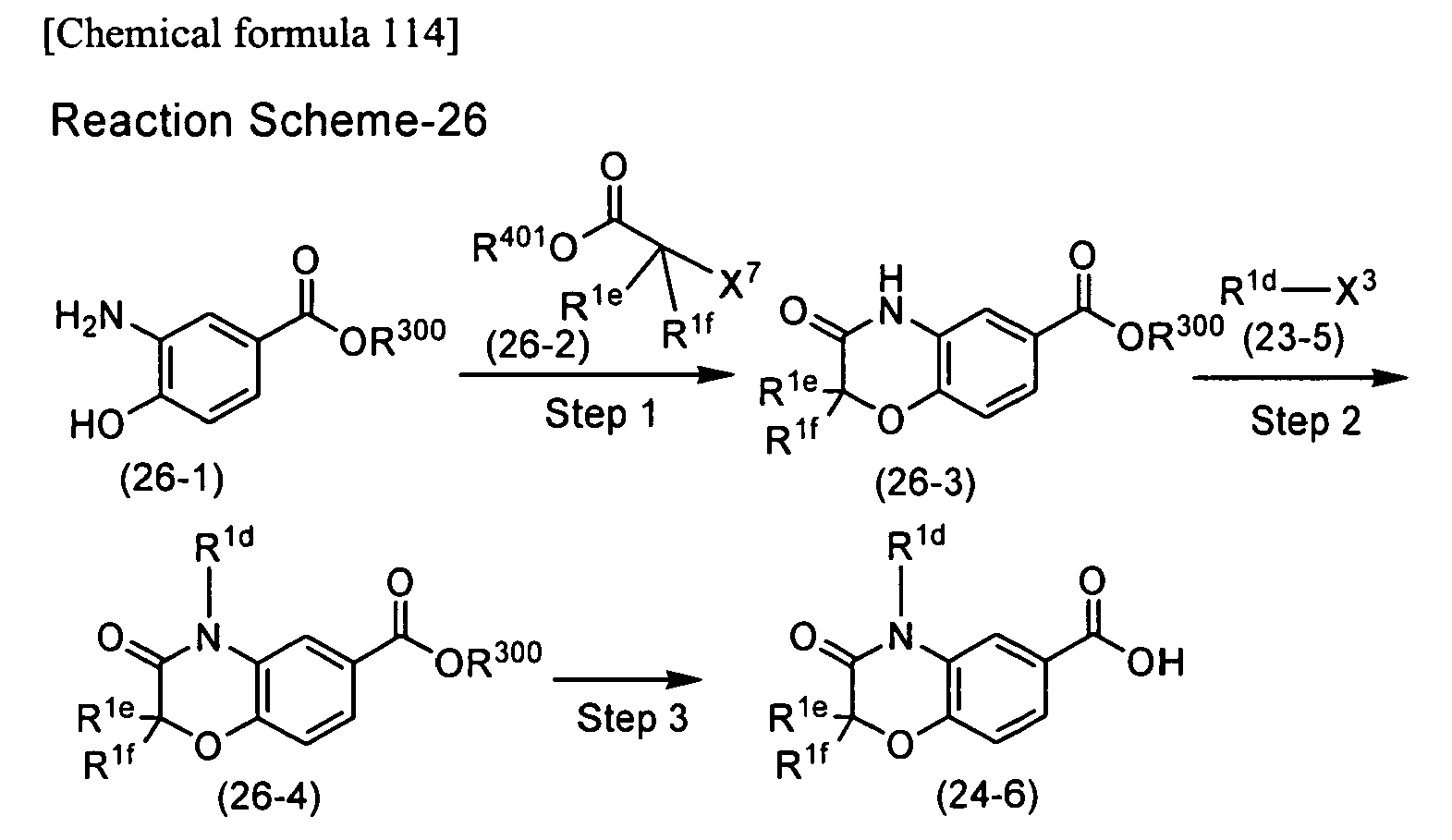
- [wherein X3, R1d, R1e, R1f, R401 and R300 are as defined above; X7 is a bromine atom or a chlorine atom]
- The compound (26-3) may be prepared from the compound (26-1) by a similar method to ones disclosed in the literatures (e.g., Chem. Pharm. Bull. 46, 1716 (1998), etc.).
- The compound (26-4) may be prepared from the compound (26-3) in a similar manner to Step 3 of Method 24.
- The compound (26-6) may be prepared from the compound (26-4) in a similar manner to Step 2 of Method 3.
- Among the compounds of the formula (1-1), the compound of the formula (27-6) or a pharmaceutically acceptable salt thereof may be prepared, for example, by the following method.

- [wherein X3, R1d, X7, R1e, R1f, R401 and R300 are as defined in the above]
- The compound (27-2) may be prepared from the compound (27-1) by a similar method to ones disclosed in the literatures (e.g., Synth. Commun. 27, 2943 (1997), J. Chem. Soc. Perkin Trans 2, 691 (1988), etc.).
- The compound (27-4) may be prepared from the compound (27-2) by a similar method to ones disclosed in the literatures (e.g.,
WO 2005/082872 , etc.). - The compound (27-5) may be prepared from the compound (27-4) by a similar method to Step 3 of Method 24.
- The compound (27-6) may be prepared from the compound (27-5) by a similar method to Step 2 of Method 3.
- Among the compounds of the formula (1-1), the formula (28-6) or a pharmaceutically acceptable salt thereof may be prepared, for example, by the following method.


- [wherein X3, R1d, R1e, R1f and R300 are as defined in the above; R403 is a C1-6 alkyl group; X9 is a iodine atom, a bromine atom, a chlorine atom, a methanesulfonyloxy group, a trifluoromethanesulfonyloxy group or a p-toluenesulfonyloxy group]
- The compound (28-2) may be prepared from the compound (28-1) by a similar method to ones disclosed in the literatures (e.g., J. Am. Chem. Soc. 123, 6989 (2001), J. Or g. Chem. 70, 4360 (2005), Synth. Commun. 29, 591 (1999), etc.).
- The compound (28-3) may be prepared from the compound (28-2) by a similar method to Step 8 of Method 1.
- The compound (28-5) may be prepared from the compound (28-3) by a similar method to ones disclosed in the literatures (e.g.,
WO 2004/096773 , etc.). - The compound (28-6) may be prepared from the compound (28-5) by a similar method to Step 2 of Method 3.
- Among the compounds of the formula (1-2), the compound of the formula (29-3) or a salt thereof may be prepared, for example, by the following method.


- [wherein R112, m100a and Y2 are as defined in the above; R506 is the same as B of the above-mentioned Item 1; R507 is the same as R4 of the above-mentioned Item 1]
- The compound (29-2) may be prepared from the compound (22-1) by a similar method to ones disclosed in the literatures (e.g., Bioorganic & Medicinal Chemistry Letters 1621, 16 (2006),
WO 99/054321 - The compound (29-3) may be prepared from the compound (29-2) by a similar method to ones disclosed in the literatures (e.g., Protective Groups in Organic Synthesis 2nd Edition (John Wiley & Sons, Inc.), etc.).
- Among the compounds of the formula (I), the compound of the formula (30-17) or a salt thereof may be prepared, for example, by the following method.


- The compound (30-2) may be prepared by reacting the compound (30-1) with a base in an inert solvent, followed by reacting the resultant with tert-butyl ethyl malonate. The base includes inorganic bases such as potassium hydride, sodium hydride, etc. The inert solvent includes, for example, aprotic solvents such as N,N'-dimethylformamide, dimethylsulfoxide, hexamethylenephosphoamide, etc. The reaction temperature should be selected from the range from about 10°C to about 40°C.
- The compound (30-3) may be prepared by reacting the compound (30-2) with trifluoroacetic acid in an inert solvent. The inert solvent includes, for example, halogenated hydrocarbon solvents such as dichloromethane, chloroform, 1,2-dichloroethane, etc. The reaction temperature should be selected from the range from about 10°C to about 40°C.
- The compound (30-4) may be prepared by subjecting the compound (30-3) to reduction under hydrogen atmosphere in the presence of palladium carbon in an inert solvent. The inert solvent includes, for example, alcohols such as methanol, ethanol, etc. The reaction temperature should be selected from the range from about 10°C to about 40°C.
- The compound (30-5) may be prepared by reacting the compound (30-4) with di-tert-butyl dicarbonate in an inert solvent. The inert solvent includes, for example, ethers such as dioxane, tetrahydrofuran, etc. The reaction temperature should be selected from the range from about 10°C to about 40°C.
- The compound (30-6) may be prepared by subjecting the compound (30-5) to reduction under hydrogen atmosphere in the presence of platinum oxide in an inert solvent. The inert solvent includes alcohols such as methanol, ethanol, etc. The reaction temperature should be selected from the range from about 10°C to about 40°C.
- The compound (30-7) may be prepared by reacting the compound (30-6) with p-methoxybenzyl chloride in an inert solvent in the presence of an inorganic base. The inorganic base includes potassium carbonate, cesium carbonate, etc. The inert solvent includes, for example, aprotic solvents such as N,N'-dimethylformamide, dimethylsulfoxide, hexamethylenephosphoamide, etc. The reaction temperature should be selected from the range from about 10°C to about 40°C. In addition, in this Step, sodium iodide or potassium iodide may be added.
- The compound (30-8) may be prepared from the compound (30-7) by a similar method to Step 2 of Method 1.
- The compound (30-9) may be prepared from the compound (30-8) by a similar method to Step 4 of Method 1.
- The compound (30-10) may be prepared from the compound (30-9) by a similar method to Step 1 of Method 1.
- The compound (30-11) may be prepared by subjecting the compound (30-10) under hydrogen atmosphere in the presence of palladium carbon in an inert solvent to reduction. The inert solvent includes, for example, alcohols such as methanol, ethanol, etc. The reaction temperature should be selected from the range from about 10°C to about 40°C.
- The compound (30-12) may be prepared from the compound (30-11) by a similar method to Step 4 of Method 30.
- The compound (30-13) may be prepared from the compound (30-12) by a similar method to Step 2 of Method 3.
- The compound (30-14) may be prepared from the compound (30-13) by carrying out the following reactions (i. to ii.) continuously in an inert solvent. The inert solvent may be, for example, ethers such as dioxane, tetrahydrofuran, etc.
- i. the compound (30-13) is reacted with ethyl chloroformate in the presence of triethylamine. The reaction temperature should be selected from the range from about -10°C to about 20°C.
- ii. sodium borohydride is added to the reaction mixture of the above i., and the mixture is reacted. The reaction temperature should be selected from the range from about 0°C to about 20°C.
- The compound (30-15) may be prepared by subjecting the compound (30-14) to Swem oxidation. For instance, dimethylsulfoxide was added to oxalyl chloride in a halogenated hydrocarbon solvents such as dichloromethane, chloroform, 1,2-dichloroethane, etc., and then, the compound (30-14) is added thereto, and further, diisopropylethylamine is added. The reaction temperature should be selected from the range from about -80°C to about -30°C.
- The compound (30-16) may be prepared from the compound (30-15) by a similar method to Step 4 of Method 1.
- The compound (30-17) may be prepared from the compound (30-16) by a similar method to Step 2 of Method 1.
- Among the compounds of the formula (I), the compound of the formula (31-2) or a salt thereof may be prepared, for example, by the following method.


- [wherein R600, R1d, R1e, R1f and R2 are as defined in the above; Z100 is C(O), S(O)2, C(O)O, or C(O)N(R602); R601 is the same as B of the above-mentioned Item 1; R602 is a C1-6 alkyl group; G4 is CH2, an oxygen atom, or a sulfur atom, provided that R600 is the same as R4 of Item 1]
- The compound (31-1) may be prepared from the compound (30-16) by a similar method to ones disclosed in the literatures (e.g., Comprehensive Organic transformation, R. C. Laroque,VCH publisher Inc., 1989 , etc.).
- The compound (31-2) may be prepared from the compound (31-1) by a similar method of Step 2 of Method 1.
- Among the compounds of the formula (I), the formula (32-9) or a salt thereof may be prepared, for example, by the following method.


- The compound (32-1) may be prepared from the compound (30-9) by a similar method to Step 1 of Method 1.
- The compound (32-2) may be prepared from the compound (32-1) by a similar method to Step 10 of Method 30.
- The compound (32-3) may be prepared from the compound (32-2) by a similar method to Step 4 of Method 30.
- The compound (32-4) may be prepared from the compound (32-3) by a similar method to Step 2 of Method 3.
- The compound (32-5) may be prepared from the compound (32-4) by a similar method to Step 13 of Method 30.
- The compound (32-6) may be prepared from the compound (32-5) by a similar method to Step 14 of Method 30.
- The compound (32-7) may be prepared from the compound (32-6) by a similar method to Step 4 of Method 1.
- The compound (32-8) may be prepared from the compound (32-7) by a similar method to Step 1 of Method 31.
- The compound (32-9) may be prepared from the compound (32-8) by a similar method to Step 2 of Method 1.
- In the above-mentioned each step, when the starting compounds used in each reaction has a reactive group such as a hydroxy group, an amino group or a carboxyl group, then these groups at sites other than the sites to be reacted can be protected by a suitable protecting group prior to the reaction, if necessary, and such protecting groups can be removed after each reaction is complete or after some reactions are done, to give the desired compound. The protecting groups protecting a hydroxy group, an amino group, a carboxyl group, etc. may be any conventional protecting groups usually used in the organic chemistry field, and the introduction and the removal of these protecting groups may be carried out by a conventional method (e.g., the methods disclosed in Protective Groups in Organic Synthesis, T. W. Greene, co-written by G. M. Wuts, 2nd edition, John Wiley & Sons, Inc. (1991)).
- For instance, a protecting group for a hydroxy group may be a tert-butyldimethylsilyl group, a methoxymethyl group, a tetrahydropyranyl group, etc. A protecting group for an amino group may be a tert-butyloxycarbonyl group, a benzyloxycarbonyl group, etc. A protecting group for a hydroxy group may be removed by reacting in the presence of an acid such as hydrochloric acid, sulfuric acid, acetic acid, etc. in a solvent such as aqueous methanol, aqueous ethanol, aqueous tetrahydrofuran, etc. In addition, a tert-butyldimethylsilyl group may be removed, for example, in the presence of tetrabutylammonium fluoride in a solvent such as tetrahydrofuran. As for the protecting group for an amino group, tert-butyloxycarbonyl group may be removed, for example, by reacting in the presence of an acid such as hydrochloric acid, trifluoroacetic acid, etc. in a solvent such as aqueous tetrahydrofuran, methylene chloride, chloroform, aqueous methanol, etc. A benzyloxycarbonyl group may be removed, for example, by reacting in the presence of an acid such as hydrobromic acid in a solvent such as acetic acid.
- tert-Butyl ester, ortho ester, acid amide, etc. may be exemplified as a protecting group for a carboxyl group. These protecting groups may be removed, for example, when such a protecting group is a tert-butyl ester, then it can be removed by reacting in the presence of hydrochloric acid in an aqueous solvent. When an ortho ester is used, it can be removed, for example, by treating with an acid in a solvent such as aqueous methanol, aqueous tetrahydrofuran, aqueous 1,2-dimethoxyethane, followed by treatment with an alkali such as sodium hydroxide, etc. When an acid amide is used, then it may be removed, for example, by reacting in the presence of an acid such as hydrochloric acid, sulfuric acid, etc. in a solvent such as water, aqueous methanol, aqueous tetrahydrofuran, etc.
- The compound of the formula (I) includes compounds having an optically-active center, and such compounds may be obtained in a mixture of racemic compounds, or in the form of an optically active compound when an optically active starting compound is used. If necessary, the obtained racemic mixture may be resolved physically or chemically by a conventional method into optical enantiomers thereof, or preferably resolved into diastereomers thereof by a reaction using an optically active resolving agent. Diastereomers in a different form may be resolved by a conventional method such as fractional crystallization.
- The compound of the present invention may be converted into a salt thereof, for example, by mixing with a pharmaceutically acceptable acid in a solvent such as water, methanol, ethanol, acetone, etc. The pharmaceutically acceptable acid includes, for example, inorganic acids such as hydrochloric acid, hydrobromic acid, sulfuric acid, phosphoric acid, nitric acid, etc. or organic acids such as acetic acid, propionic acid, oxalic acid, succinic acid, lactic acid, malic acid, tartaric acid, citric acid, maleic acid, fumaric acid, methanesulfonic acid, p-toluenesulfonic acid, ascorbic acid, etc.
- The compound of the present invention may possibly be applied to the treatment of various diseases because of its renin inhibitory activity. The compounds disclosed in the present specification are useful as a therapeutic agent for hypertension. These compounds are also useful in the control of acute and chronic congestive heart failure. These compounds can be expected to be useful in the treatment of primary or secondary pulmonary hypertension, secondary hyperaldosteronism, primary and secondary pulmonary hyperaldosteronism, kidney failure (such as glomerulonephritis, diabetic nephropathy, glomerulosclerosis, primary renal disease, end-stage renal disease, renovascular hypertension), left ventricular failure, diabetic retinopathy, and for the minimization of vascular diseases such as migraine, Raynaud's disease and atherosclerosis process. In addition, these compounds are also useful in the treatment of diseases relating to elevated intraocular pressure such as glaucoma.
- When the present compound is used in the treatment, it may be administered orally or parenterally (e.g., intravenously, subcutaneously or intramuscularly, locally, rectally, precutaneously, or transnasally) in the form of a pharmaceutical composition. The composition for oral administration may be, for example, tablets, capsules, pills, granules, powders, solutions, suspensions, etc. The composition for parenteral administration may be, for example, aqueous solutions for injection, or oils, ointments, creams, lotions, aerosols, suppositories, adhesive preparations, etc. These preparations may be prepared by a conventional method, and may additionally contain a nontoxic and nonactive carrier or excipient, that is usually used in the pharmaceutical field.
- The dosage may vary depending on each compound, or diseases, ages, body weights, sexes, conditions of each patient, or administration route, etc., and the present compound or a pharmaceutically acceptable salt thereof may usually be administered at a dose of 0.1 to 1000 mg/day, preferably at a dose of 1 to 300 mg/day in an adult (body weight: 50 kg), which is administered once a day or divided into 2 or 3 dosage forms. In addition, the present compound can be administered once in several days to once in several weeks.
- Aiming at the enhancement of the pharmacological activity, the present compound may be used in a combination with a medicament such as an antidiabetic agent, a remedy for antidiabetic complications, an antilipedemic agent, a hypotensive agent, an antiobesity agent, a diuretic agent (hereinafter referred to as combined medicine). The administration timing of the present compound and a combined medicine is not necessarily defined, and they can be administered to a subject simultaneously or administered with time-interval.
In addition, the present compound and a combined medicine may be used in the form of a combination drug. The dosage of a combined medicine may be suitably selected based on the dosage thereof which is clinical used. In addition, the mixing ratio of the present compound and a combined medicine may suitably be determined depending on the subject to be administered, administration route, the disease to be treated, the conditions of a patient, and a kind of combination. For example, when the subject to be administered is human, then a combined medicine is used in an amount of 0.01 to 100 parts by weight to one part by weight of the present compound. - The antidiabetic agent includes insulin preparations (e.g., animal insulin preparations extracted from the bovine pancreas or swine pancreas; genetically-engineered human insulin preparations using Escherichia coli or yeast, etc.), insulin sensitizers (e.g., pioglitazone or hydrochloride thereof, troglitazon, rosiglitazone or a maleate thereof, GI-262570, JTT-501, MCC-555, YM-440, KRP-297, CS-011, etc.), α-glucosidase inhibitors (e.g., voglibose, acarbose, miglitol, emiglitate, etc.), biguanide preparations (e.g., metformine, etc.), insulin secretagogues (e.g., sulfonylurea preparations such as tolbutamide, glibenclamide, gliclazide, chlorpropamide, tolazamide, acetohexamide, glyclopyramide, glimepiride, etc.; repaglinide, senaglinide, nateglinide, mitiglinide, etc.), GLP-1, GLP-1 analogues (exenatide, liraglutide, SUN-E7001, AVE010, BIM-51077, CJC1131, etc.), protein tyrosine phosphatase inhibitors (e.g., vanadic acid, etc.), β3 agonists (e.g., GW-427353B, N-5984, etc.), DPPIV inhibitors (e.g., sitagliptin, vildagliptin, saxagliptin, SYR-322, etc.).
- The therapeutic agents for diabetic complications include aldose reductase inhibitors (e.g., tolrestat, epalrestat, zenarestat, zopolrestat, minarestat, fidarestat, SK-860, CT-112, etc.), neurotrophic factors (e.g., NGF, NT-3, BDNF, etc.), PKC inhibitors (e.g., LY-333531, etc.), AGE inhibitors (e.g., ALT946, pimagedine, pyratoxatin, N-phenacylthiazolium bromide(ALT766), etc.), active oxygen erasers (e.g., thioctic acid, etc.), cerebral vasodilators (e.g., tiapride, mexiletine, etc.). A antilipidemic agent includes HMG-CoA reductase inhibitors (e.g., pravastatin, simvastatin, lovastatin, atorvastatin, fluvastatin, itavastatin or sodium salt thereof, etc.), squalene synthetase inhibitors, ACAT inhibitors, etc. The hypotensive agent includes angiotensin-converting enzyme inhibitors (e.g., captopril, enalapril, alacepril, delapril, lisinopril, imidapril, benazepril, cilazapril, temocapril, trandolapril, etc.), angiotensin II antagonists (e.g., olmesartan medoxomil, candesartan cilexetil, losartan, eprosartan, valsartan, telmisartan, irbesartan, tasosartan, etc.), calcium antagonists (e.g., nicardipine hydrochloride, manidipine hydrochloride, nisoldipine, nitrendipine, nilvadipine, amlodipine, etc.), ACE/NEP inhibitors (e.g., omapatrilat, fasidotril, etc.), beta blockers (e.g., atenolol, bisoprolol, betaxolol, metoprolol, etc.), alpha blockers (e.g., urapidil, terazosin, doxazosin, bunazosin, etc.), alpha beta blockers (e.g., amosulalol, arotinolol, labetalol, carvedilol, etc.).
- The antiobesity agent includes, for example, central anti-obesity agents (e.g., phentermine, sibutramine, amfepramone, dexamphetamine, Mazindol, SR-141716A, etc.), pancreatic lipase inhibitors (e.g., Orlistat, etc.), peptidic appetite suppressors (e.g., leptin, CNTF (ciliary neurotrophic factor), etc.), cholecystokinin antagonists (e.g., lintitript, FPL-15849, etc.). The diuretic agent includes, for example, xanthine derivatives (e.g., theobromine sodium salicylate, theobromine calcium salicylate. etc.), thiazide preparations (e.g., Ethiazide, cyclopenthiazide, trichloromethiazide, cyclopenthiazide, trichlormethiazide, hydrochlorotiazide, hydroflumethiazide, bentylhydrochlorothiazide, penflutizide, polythiazide, methychlothiazide, etc.), antialdosterone preparations (e.g., spirolactone, triamterene, etc.), carbonate dehydratase inhibitors (e.g., acetazolamide, etc.), chlorbenzenesulfonamide preparations (e.g., chlorthalidone, mefruside, indapamide, etc.), azosemide, isosorbide, ethacrynic acid, Piretanide, bumetanide, furosemide, etc.
- The above mentioned combined medicines may be used in a mixture of two or more of these drugs.
- When the present compound is used in a combination of a combined medicine, the dosage of these drugs can be lessened within the safe range, in view of the side effects of the drugs. Accordingly, any possible side effect caused by these drugs may safely be inhibited.
- The present invention is illustrated in more detail by Reference Examples, Examples and Experiments, but the present invention should not be construed to be limited thereto. In addition, the compound names used in the following Reference Examples and Examples are not necessarily based on IUPAC nomenclature. Further, in order to simplify the description, some abbreviations may be used, and these abbreviations are as defined in the above-mentioned definitions.
-

- 3-Hydroxy-4-methoxybenzoic acid (28.8 g) was dissolved in methanol (300 ml), and thereto was added conc. sulfuric acid (1.0 ml), and the mixture was heated under reflux for 18 hours. The reaction mixture was allowed to cool, and concentrated under reduced pressure. To the residue was added a saturated aqueous sodium hydrogen carbonate solution, and the mixture was extracted with ethyl acetate. The organic layer was dried over sodium sulfate, filtered, and concentrated under reduced pressure to give the title compound (30.9 g) as a white solid.
-

- The compound of Reference Example 1 (19.7 g) was dissolved in acetonitrile (250 ml), and thereto were added potassium carbonate (22.4 g) and 1-bromo-3-methoxypropane (18.5 g), and the mixture was heated under reflux for 6 hours. The reaction mixture was allowed to cool, and concentrated under reduced pressure. To the residue was added water, and the mixture was extracted with ethyl acetate. The organic layer was dried over sodium sulfate, filtered, and concentrated under reduced pressure to give the title compound (29.9 g).
-

- The compound of Reference Example 2 (29.9 g) was dissolved in methanol, and thereto was added 1N aqueous sodium hydroxide solution (160 ml), and the mixture was stirred at room temperature for 5 hours. The reaction mixture was concentrated under reduced pressure, and thereto was added water, and the mixture was extracted with ethyl acetate. To the aqueous layer was added 2N hydrochloric acid, and the mixture was extracted twice with ethyl acetate. The combined organic layers were washed with a saturated aqueous sodium chloride solution, dried over sodium sulfate, filtered and concentrated under reduced pressure. The obtained residue was crystallized from ethyl acetate to give the title compound (24.6 g) as a white solid.
1H-NMR (400MHz, CDCl3) 7.76(1H, dd, J = 2.0, 8.4 Hz, 1H), 7.63(d, J = 2.0 Hz, 1H), 6.91(d, J = 8.4 Hz, 1H), 4.18(t, J = 6.5 Hz, 2H), 3.94(s, 3H). 3.59(t, J = 6.2 Hz, 2H), 3.37(s, 3H), 2.17-2.11(m, 2H). -

-

1H-NMR (400MHz, CDCl3) 7.38-7.28(m, 5H), 5.15(d, J = 12.4 Hz, 1H), 5.11(d, J = 12.4 Hz, 1H), 4.59(brs, 1H), 3.69(m, 2H), 3.48(m, 1H), 3.37-3.27(m, 2H), 1.85(m, 1H), 1.73-1.67(m, 1H), 1.54(m, 2H), 1.43(s, 9H).
MS (ESI+) 335(M++1, 100%) -

MS (ESI+) 235 (M++1, 100 %) -

MS (ESI+) 277 (M+1, 100 %). -


1H-NMR (400MHz, CDCl3) 7.37-7.31(m, 5H), 6.91-6.85(m, 3H), 5.18(d, J = 12.4 Hz, 1H), 5.11(d, J = 12.4 Hz, 1H), 4.20-4.12(m, 4H), 3.96-3.87(m, 1H), 3.87(s, 3H), 3.56(t, J = 6.5 Hz, 2H), 3.35(s, 3H), 3.10(brs, 1H), 2.78(brs, 2H), 2.13-2.05(m, 2H), 1.77-1.74(m, 3H), 1.53(m, 1H), 1.26-1.18(m, 6H).
MS (ESI+) 499(M+1, 100%). -

-

MS (ESI+) 235 (M+1, 100%). -


MS (ESI+) 277 (M+1, 100%). -

MS (ESI+) 499 (M+1, 100%). -

-

MS (ESI+) 221 (M+1, 100 %). -

MS (ESI+) 263 (M+1, 100%). -

1H-NMR (300MHz, CDCl3) 7.38-7.31(m, 5H), 6.92-6.83(m, 3H), 5.14(s, 2H), 4.12(t, J = 6.3 Hz, 2H), 3.96-3.88(m, 3H), 3.81-3.64(m, 2H), 3.56(t, J = 6.0 Hz, 2H), 3.47-3.38(m, 1H), 3.35(s, 3H), 2.15-2.06(m, 2H), 2.00(m, 1H), 1.70(m, 1H), 1.24(brs, 6H).
MS (ESI+) 485 (M+1, 100%). -

MS (ESI+) 263 (M+1, 100%). -
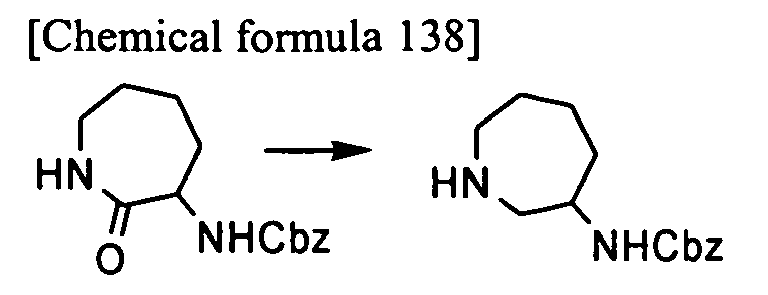
1H-NMR (400MHz, CDCl3) 7.37-7.30(m, 5H), 5.42(m, 1H), 5.09(s, 2H), 3.81(brs, 1H), 2.94-2.87(m, 2H), 2.84-2.81(m, 2H), 1.78-1.53(m, 7H).
MS (ESI+) 249 (M+1, 100%). -

MS (ESI+) 349 (M+1, 100%). -


MS (ESI+) 215 (M+1, 100%). -

MS (ESI+) 215 (M+1, 100%). -
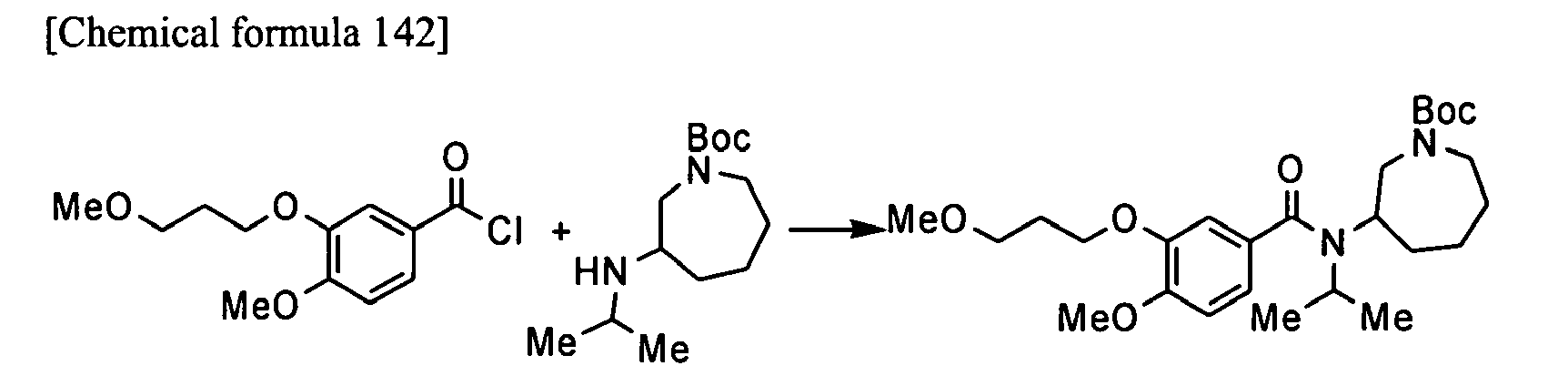
1H-NMR (400MHz, CDCl3) 6.95-6.86(m, 3H), 4.14(t, J = 6.7 Hz, 2H), 3.93-3.92(m, 1H), 3.90(s, 3H), 3.87-3.76(m, 2H), 3.59-3.56(t, J = 6.2 Hz, 2H), 3.47-3.45(m, 1H), 3.36-3.35(m, 1H), 3.35(s, 3H), 3.02(brs, 1H), 2.31-2.25(m, 1H), 2.16 -2.09(m, 5H), 2.01-1.98(m, 1H), 1.85-1.82(m, 1H), 1.60-1.56(m, 1H), 1.25(d, J = 6.6 Hz, 3H), 1.16(d, J = 6.6 Hz, 3H).
MS (ESI+) 479 (M+1, 100%). -


MS (ESI+) 305 (M+1, 100%). -

MS (ESI+) 527 (M+1, 100%). -

MS (ESI+) 437 (M+1, 100%). -

1H-NMR (400MHz, CDCl3) 6.92-6.83(m, 3H), 4.17-3.84(m, 9H), 3.88(s, 3H), 3.56(t, J = 6.1 Hz, 2H), 3.34(s, 3H), 3.17(brs, 1H), 2.85-2.79(m, 1H), 2.14-2.07(m, 2H), 1.94-1.88(m, 1H), 1.67(brs, 1H), 1.47(s, 9H), 1.28-1.08(m, 9H).
MS (ESI+) 537 (M+1, 100%). -

MS (ESI+) 509 (M+1, 100 %). -

MS (ESI+) 495 (M+1, 100 %). -

1H-NMR (400MHz, CDCl3) 7.25-7.22(m, 1H), 6.89-6.81(m, 6H), 4.49(d, J = 12.0 Hz, 1H), 4.42(d, J = 12.0 Hz, 1H), 4.13-4.04(m, 5H), 3.88(s, 3H), 3.77(s, 3H), 3.56(t, J = 6.1 Hz, 2H), 3.46-3.42(m, 2H), 3.35(s, 3H), 3.25(brs, 1H), 3.03-2.84(m, 2H), 2.13-2.05(m, 2H), 1.85(d, J = 13.3 Hz, 1H), 1.66-1.51(m, 2H), 1.46(s, 9H), 1.19-1.14(m, 6H).
MS (ESI+) 615 (M+1, 100 %). -

MS (ESI+) 379(M+1, 100%). -

MS (ESI+) 279 (M+1, 100 %). -

1H-NMR (400MHz, CDCl3) 7.38-7.32(m, 5H), 5.17(s, 2H), 4.34(d, J = 6.1 Hz, 1H), 4.22(d, J = 6.1 Hz, 1H), 3.55(d, J = 10.2 Hz, 2H), 3.45(brs, 2H), 3.06-2.98(m, 1H), 1.85-1.68(m, 4H), 1.25-1.21(m, 1H), 1.05(d, J = 6.3 Hz, 3H), 1.04(d, J = 6.3 Hz, 3H).
MS (ESI+) 321 (M+1, 100 %). -

1H-NMR (400MHz, CDCl3) 7.41-7.34(m, 5H), 6.91(m, 1H), 6.89-6.86(m, 1H), 6.82-6.80(m, 1H), 5.18(d, J = 15.2 Hz, 2H), 4.28(d, J = 14.6 Hz, 1H), 4.19-4.09(m, 3H), 3.93-3.86(m, 1H), 3.87(s 3H), 3.60-3.53(m, 2H), 3.38 -3.34(m, 2H), 3.36(s, 3H), 2.14-2.02(m, 4H), 1.83-1.74(m, 1H), 1.42(d, J = 6.8 Hz, 3H), 1.38(d, J = 6.8 Hz, 3H).
MS (ESI+) 543 (M+1, 100%). -

-

MS (ESI+) 201 (M++1, 100 %). -

1H-NMR (400MHz, CDCl3) 7.21-7.18(m, 2H), 6.87-6.84(m, 2H), 4.62(d, J = 14.4 Hz, 1H), 4.45(d, J = 14.4 Hz, 1H), 3.80(s, 3H), 3.66(s, 3H), 3.44-3.38(m, 2H), 2.83-2.73(m, 1H), 2.62-2.55(m, 1H), 2.50 - 2.41(m, 1H), 2.16-2.11(m, 1H), 2.04-1.95(m, 6H).
MS (ESI+) 311 (M++1, 100%). -

1H-NMR (400MHz, CDCl3) 7.12-7.09(m, 2H), 6.57-6.53(m, 2H), 3.94(brs, 1H), 3.71-3.65(m, 2H), 3.36-3.31(m, 1H), 3.10(m, 1H), 2.90(brs, 1H), 1.99-1.96(m, 1H), 1.76-1.70(m, 1H), 1.60-1.49(m, 2H), 1.45(s, 9H).
MS (ESI+) 534(M+1, 100%). -

1H-NMR (400MHz, CDCl3) 7.28(s, 1H), 7.21-7.18(m, 2H), 6.88-6.85(m, 2H), 4.67(s, 2H), 3.79(s, 3H), 3.72(s, 3H), 2.62(s, 4H).
MS (ESI+) 276 (M+1, 100%). -

1H-NMR (400MHz, CDCl3) 7.21-7.18(m, 2H), 6.87-6.84(m, 2H), 4.62(d, J = 14.4 Hz, 1H), 4.45(d, J = 14.4 Hz, 1H), 3.80(s, 3H), 3.66(s, 3H), 3.44-3.38(m, 2H), 2.83-2.73(m, 1H), 2.62-2.55(m, 1H), 2.50 - 2.41 (m, 1H), 2.16-2.11(m, 1H), 2.04-1.95(m, 6H).
MS (ESI+) 278 (M+1, 100%). -

MS (ESI+) 264 (M+1, 100%). -
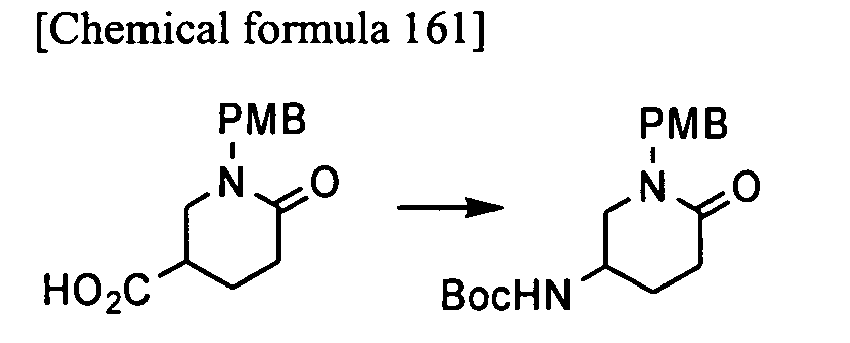
1H-NMR (400MHz, CDCl3) 6.97-6.94(m, 2H), 6.87-6.85(m, 1H), 4.15-4.10(m, 3H), 3.89(s, 3H), 3.59-3.47(m, 4H), 3.35(s, 3H), 3.35-3.27(m, 2H), 3.08(m, 1H), 2.74(m, 1H), 2.15-2.00(m, 3H), 1.69(m, 2H), 1.46(s, 9H), 1.26-1.17(m, 6H).
MS (ESI+) 335 (M+1, 100%). -


1H-NMR (400MHz, CDCl3) 7.30-7.28(m, 2H), 6.88-6.85(m, 2H), 5.45(d, J = 13.6 Hz, 1H), 4.99(d, J = 13.6 Hz, 1H), 4.46(brs, 1H), 3.99-3.97(m, 1H), 3.80(m, 3H), 3.55(dd, J = 4.8, 13.5 Hz, 1H), 3.25-3.18(m, 1H), 3.09-3.01(m, 1H), 2.06-1.99(m, 1H), 1.68-1.59(m, 1H), 1.39(s, 9H).
MS (ESI+) 351 (M+1, 100 %). -

1H-NMR (400MHz, CDCl3) 7.10(d, J = 8.7 Hz, 1H), 6.88-6.86(m, 1H), 4.79(s, 1H), 4.54(m, 1H), 4.36(d, J = 15.8 Hz, 1H), 4.27(d, J = 15.8 Hz, 1H), 4.04(q, J = 7.1 Hz, 2H), 3.93(brs, 1H), 3.80(s, 3H), 3.58-3.50(m, 1H), 3.47-3.43(m, 1H), 3.08-2.94(m, 2H), 2.07-2.01(m, 1H), 1.58-1.51(m, 1H), 1.41(s, 9H), 1.21(t, J = 7.1 Hz, 3H).
MS (ESI+) 405 (M+1, 100 %). -


-
- A:
1H-NMR (400MHz, CDCl3) 7.20(d, J = 8.5 Hz, 2H), 6.88-6.85(m, 2H), 4.85(brs, 1H), 4.12(q, J = 7.1 Hz, 2H), 3.80(s, 3H), 3.66(brs, 1H), 3.58(d, J = 13.1 Hz, 1H), 3.41(d, J = 13.1 Hz, 1H), 3.06(brs, 1H), 2.71 (brd, J = 10.7 Hz, 1H), 2.65(dd, J = 3.7, 14.6 Hz, 1H), 2.43(dd, J = 8.6, 14.6 Hz, 1H), 2.06(brs, 1H), 1.88-1.78(m, 1H), 1.55-1.48(m, 1H), 1.41(s, 9H), 1.24(t, J = 7.1 Hz, 3H).
MS (ESI+) 407 (M+1, 100%). - B:
1H-NMR (400MHz, CDCl3) 7.18(d, J = 8.6 Hz, 2H), 6.86-6.84(m, 2H), 4.85(brs, 1H), 4.13(q, J = 7.1 Hz, 2H), 3.80(s, 3H), 3.77(d, J = 13.2 Hz, 1H), 3.68(brs, 1H), 3.26(d, J = 13.2 Hz, 1H), 2.89(brs, 1H), 2.68(dd, J = 4.9, 14.7 Hz, 1H), 2.50-2.34(m, 2H), 2.43(dd, J = 7.0, 14.7 Hz, 1H), 1.69-1.63(m, 4H), 1.41(s, 9H), 1.25(t, J = 7.1 Hz, 3H).
MS (ESI+) 407 (M+1, 100%). -

MS (ESI+) 307 (M+1, 100%). -


1H-NMR (400MHz, CDCl3) 7.21-7.19(m, 2H), 6.86-6.83(m, 2H), 4.14(t, J = 7.2 Hz, 2H), 3.80(s, 3H), 3.78(d, J = 13.2 Hz, 1H), 3.26(d, J = 13.2 Hz, 1H), 2.84-2.71 (m, 5H), 2.41 (dd, J = 7.8, 14.7 Hz, 1H), 1.91-1.74(m, 3H), 1.49(m, 1H), 1.25(t, J = 7.2 Hz, 3H), 1.21-1.18(m, 1H), 0.99-0.95(m, 6H).
MS (ESI+) 349 (M+1, 100%). -

MS (ESI+) 571 (M+1, 100%). -
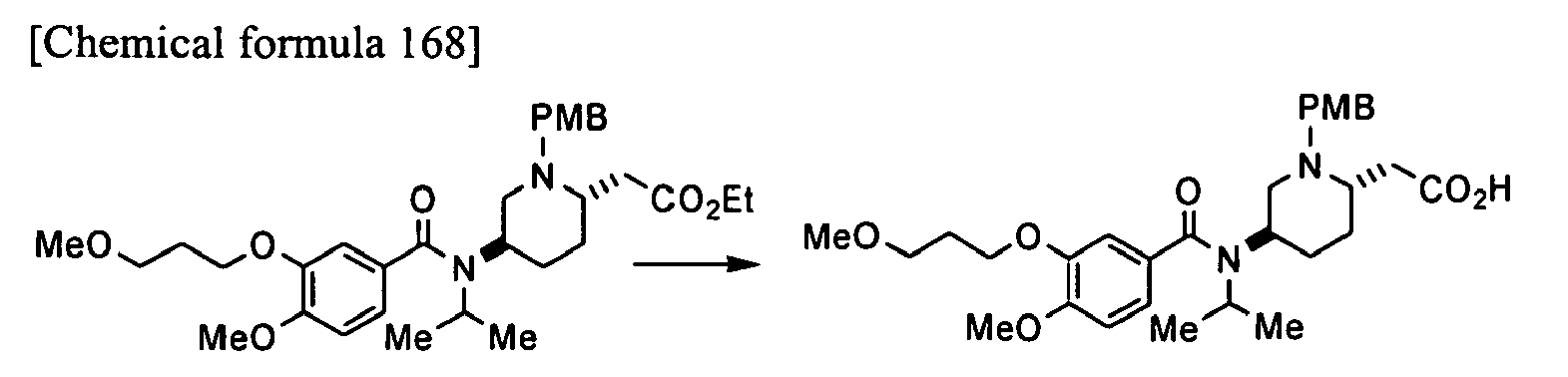
MS (ESI+) 543 (M+1, 100%). -

MS (ESI+) 307 (M+1, 100 %). -

MS (ESI+) 423 (M+1, 100%). -

MS (ESI+) 437 (M+1, 100 %). -

MS (ESI+) 283 (M+1, 100 %). -
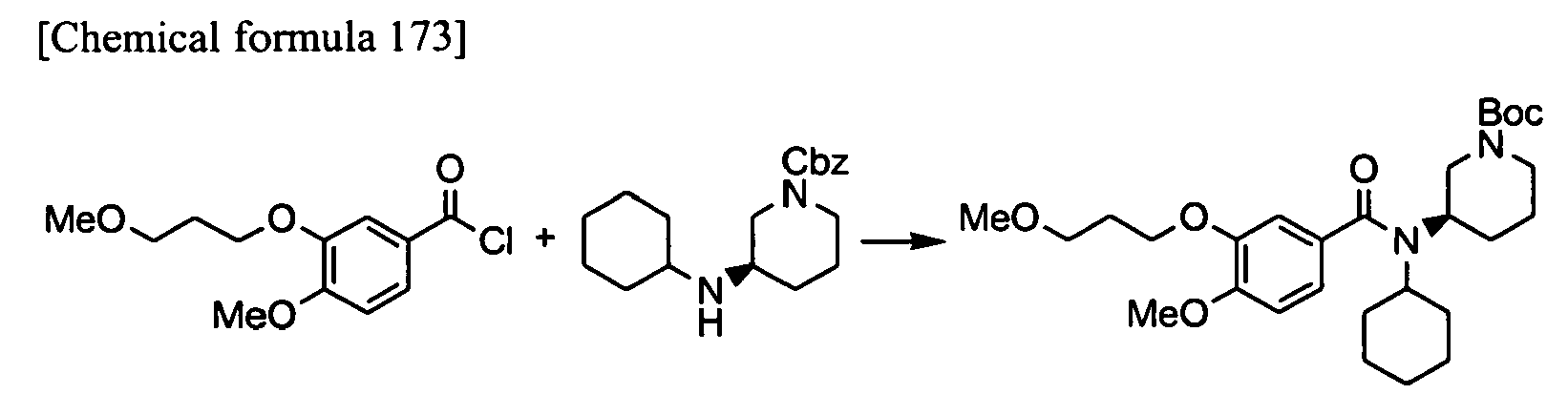
MS (ESI+) 505 (M+1, 100%). -

MS (ESI+) 297(M+1, 100%). -


MS (ESI+) 519 (M+1, 100 %). -

-

MS (ESI+) 548 (M+1, 100%). -

- The title compound (45.7mg) was synthesized in a similar manner to Reference Example 51 except that iodoethane was used instead of iodomethane in Reference Example 51.
MS (ESI+) 451(M+1, 100%). - The compounds as listed in the following Table were synthesized in a similar manner to Reference Example 51.
[Table 1] Ref.Ex. Structure MS (ESI+) 59 
465 (M+1,100%) 60 
477 (M+1,100%) -

-

MS (ESI+) 598 (M+1, 100%). -

MS (ESI+) 551 (M+1, 100 %). -

US Patent 5,817,678 ; 475 mg) as a starting compound, the title compound (341 mg) was obtained as a colorless oily product in a similar manner to Reference Example 15.
1H-NMR (400MHz, CDCl3) δ 5.50-4.50(brs, 1H), 4.45-4.20(m, 2H), 3.69(s, 3H), 3.01-2.95(m, 1H), 2.78-2.60(m, 2H), 2.54-2.49(m, 1H), 2.30-2.23(m, 2H), 1.46(s, 9H), 1.33-1.24(m, 1H), 1.07-1.00(m, 6H).
MS (ESI+) 301 ([M+H]+, 100%). -

MS (ESI+) 523 ([M+H]+, 95 %). -

1H-NMR (400MHz, CDCl3) δ 7.32-7.21(m, 5H), 6.90-6.85(m, 3H), 4.70-4.50(m, 2H), 4.30-3.90(m, 6H), 3.87-3.85(m, 4H), 3.56(t, J=6.1 Hz, 2H), 3.35(s, 3H), 3.00-2.95(m, 4H), 2.80-2.70(m, 1H), 2.12-2.09(m, 2H), 1.90-1.82(m, 1H) 1.45(s, 9H), 1.38-1.24(m, 7H),.
MS (ESI+) 612 ([M+H]+, 31 %). -

US Patent 5,817,678 ; 1.14 g) in ethyleneglycol dimethyl ether (8.0 ml) were added water (8.0 ml) and aqueous lithium hydroxide solution (159 mg), and the mixture was stirred at room temperature for 18 hours. To the reacting solution was added water, and the mixture was washed with toluene. To the aqueous layer was added a 5% aqueous potassium hydrogen sulfate solution, and the mixture was extracted with ethyl acetate. The organic layer was washed with a saturated aqueous sodium chloride solution, dried over sodium sulfate, filtered and concentrated under reduced pressure. The obtained residue was purified by silica gel column chromatography (chloroform/methanol = 100/1 to 100/3) to give the title compound (798 mg) as a colorless oily product.
1H-NMR (400MHz, CDCl3) δ 3.75-3.51(m, 4H), 3.70(s, 3H), 2.88-2.78(m, 2H), 2.15-2.05(m, 2H), 1.44(s, 9H).
MS (ESI+) 288 ([M+H]+, 35 %). -

1H-NMR (400MHz, CDCl3) δ 7.39-7.32(m, 5H), 5.10(s, 2H), 4.98-4.95(m, 1H), 4.14-4.05(m, 1H), 3.98-3.94(m, 2H), 3.68(s, 3H), 3.04-2.97(m, 2H), 2.66-2.60(m, 1H), 2.22-2.20(m, 1H), 1.83-1.80(m, 1H), 1.44(s, 9H).
MS (ESI+) 393 ([M+H]+, 26%). -

1H-NMR (400MHz, CDCl3) δ 4.01-3.90(m, 1H), 3.68(s, 3H), 3.68-3.15(m, 4H), 2.98-2.89(m, 2H), 2.79-2.73(m, 1H), 1.95-1.91(m, 1H), 1.82-1.76(m, 1H), 1.45(s, 9H), 1.05-0.99(m, 6H).
MS (ESI+) 301 ([M+H]+, 30%). -

1H-NMR (400MHz, CDCl3) δ 6.94-6.84(m, 3H), 4.52-4.49(m, 1H), 4.12(t, J=6.5 Hz, 2H), 4.05-4.00(m, 2H), 3.88(s, 3H), 3.72-3.68(m, 4H), 3.56(t, J=6.0 Hz, 2H), 3.35(s, 3H), 3.19-2.92(m, 2H), 2.83-2.79(m, 1H), 2.14-2.04(m, 4H), 1.45(s, 9H), 1.27-1.22(m, 6H).
MS (ESI+) 523 ([M+H]+, 63 %). -

-

MS (ESI+) 523 (M+1, 100%). -

1H-NMR (400MHz, CDCl3) δ 7.69(dd, J = 2.0, 8.5 Hz, 1H), 7.61(d, J = 2.0 Hz, 1H), 7.48-7.46(m, 2H), 7.40-7.36(m, 2H), 7.33-7.31(m, 1H), 6.90(d, J = 8.5 Hz, 1H), 3.93(s, 3H), 3.87(s, 3H). -
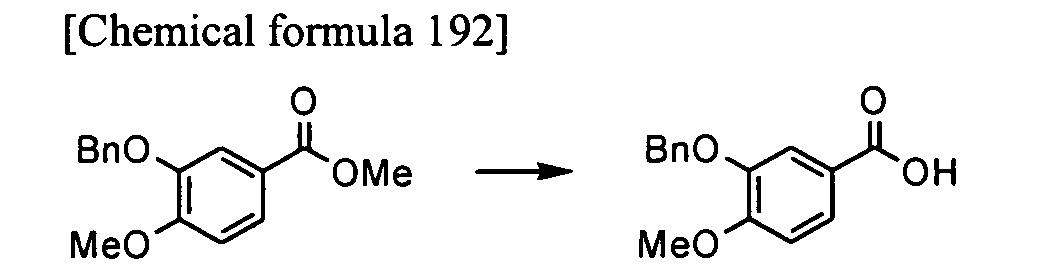
1H-NMR (400MHz, CDCl3) δ 7.77(dd, J = 2.0, 8.4 Hz, 1H), 7.65(d, J = 2.0 Hz, 1H), 7.49-7.47(m, 2H), 7.41-7.37(m, 2H), 7.34-7.32(m, 1H), 6.93(d, J = 8.4 Hz, 1H), 5.20(s, 2H), 3.95(s, 3H). -

MS (ESI+) 243 (M+1, 100 %). -


MS (ESI+) 483 (M+1, 100%). -

MS (ESI+) 393 (M+1, 100 %). -

MS (ESI+) 478 (M+1, 100%). -

MS (ESI+) 571 (M+1, 100 %). -

- The compound of Reference Example 77 (245 mg) was dissolved in methanol (5 ml), and thereto was added a 10 % palladium carbon (304 mg), and the mixture was stirred at room temperature under hydrogen atmosphere for 3 hours. After filtration on celite, the filtrate was concentrated under reduced pressure. To the residue were added tetrahydrofuran (2 ml) and a saturated aqueous sodium hydrogen carbonate solution (2 ml), and further thereto was added di-tert-butyl dicarbonate (188 mg). The mixture was stirred at room temperature for 12 hours. Water was added to the reaction mixture, and the mixture was extracted with ethyl acetate. The organic layer was washed with a saturated aqueous sodium chloride solution, dried over anhydrous sodium sulfate, filtered, and the filtrate was concentrated under reduced pressure. The obtained residue was purified by silica gel column chromatography (developing solvent: hexane/ethyl acetate = 1) to give the title compound (206 mg) as a colorless oily compound.
MS (ESI+) 551 (M+1, 100 %). -

MS (ESI+) 523 (M+1, 100 %). -

MS (ESI+) 579 (M+1, 100 %). -

MS (ESI+) 621 (M+1, 100 %). -

MS (ESI+) 592 (M+1, 100 %). -

MS (ESI+) 592 (M+1, 100 %). -

MS (ESI+) 618 (M+1, 100 %). -

MS (ESI+) 509 (M+1, 100 %). -

MS (ESI+) 509 (M+1, 100 %). -

MS (ESI+) 507 (M+1, 100 %). -

MS (ESI+) 507 (M+1, 100 %). -

MS (ESI+) 548 (M+1, 100 %). -

MS (ESI+) 548 (M+1, 100 %). -

MS (ESI+) 666 (M+1, 100%). -

MS (ESI+) 666 (M+1, 100 %). -

MS (ESI+) 495 ([M+H]+, 14%). -
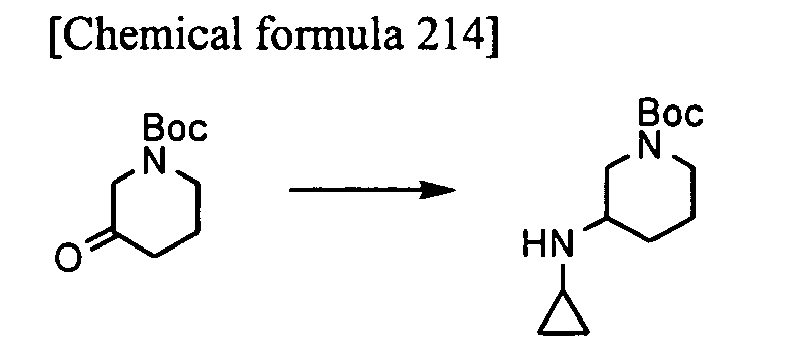
MS (ESI+) 241 (M+1, 100%). -

MS (ESI+) 463 (M+1, 100 %). -


1H-NMR (400MHz, CDCl3) 6.80(d, J = 7.9 Hz, 1H), 6.70-6.67(m, 2H), 4.08(t. J = 6.5 Hz, 2H), 3.85(s, 3H), 3.57(t, J = 6.2 Hz, 2H), 3.35(s, 3H), 2.30(s, 3H), 2.12-2.05(m, 2H). -

1H-NMR (400MHz, CDCl3) 7.05(s, 1H), 6.73(s, 1H), 4.07(t. J = 6.5 Hz, 2H), 3.83(s, 3H), 3.55(t, J = 6.1 Hz, 2H), 3.35(s, 3H), 2.32(s, 3H), 2.12-2.05(m, 2H). -

1H-NMR (400MHz, CDCl3) 10.19(s, 1H), 7.37(s, 1H), 6.69(s, 1H), 4.15(t. J = 6.6 Hz, 2H), 3.93(s, 3H), 3.57(t, J = 6.1 Hz, 2H), 3.36(s, 3H), 2.63(s, 3H), 2.13-2.08(m, 2H). -

1H-NMR (400MHz, CDCl3) 7.65(s, 1H), 6.71(s, 1H), 4.15(t. J = 6.5 Hz, 2H), 3.92(s, 3H), 3.58(t, J = 6.2 Hz, 2H), 3.37(s, 3H), 2.62(s, 3H), 2.15-2.09(m, 2H). -

-

MS (ESI+) 571 (M++1, 45 %). -


MS (ESI+) 585 (M++1, 41 %). -

MS (ESI+) 642 (M++1, 33 %). -


MS (ESI+) 479 (M++1, 100 %). - The compounds (20.7 mg) as listed in the following Table were synthesized in a similar manner to Reference Example 61.
[Table 2] Ref. Ex. Structure Yield (mg) MS (ESI+) 107 
20.7 618 (M+1, 100%) 108 
9.6 646 (M+1, 100%) 109 
35.7 562 (M+1, 100%) -

MS (ESI+) 257 (M+1, 100 %). -


MS (ESI+) 479 (M+1, 100%). -

1H-NMR (400MHz, CDCl3) 10.31(s, 1H), 7.47(s, 1H), 6.88(s, 1H), 5.67(brs, 1H), 3.99(s, 3H). -
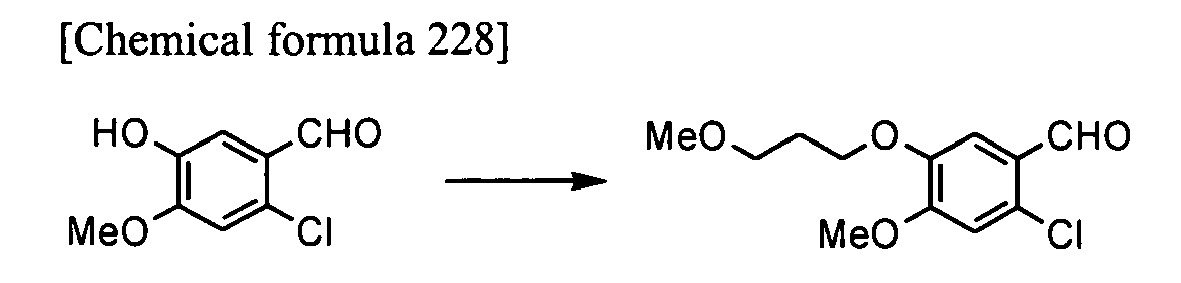
1H-NMR (400MHz, CDCl3) 10.31(s, 1H), 7.42(s, 1H), 6.87(s, 1H), 4.15(t, J= 6.6 Hz, 2H), 3.94(s, 3H), 3.55(t, J = 6.1 Hz, 2H), 3.35(s, 3H), 2.14-2.09(m, 2H). -

1H-NMR (400MHz, CDCl3) 7.58(s, 1H), 6.90(s, 1H), 4.13(t, J= 6.4 Hz, 2H), 3.91(s, 3H), 3.57(t, J = 6.1 Hz, 2H), 3.36(s, 3H), 2.12-2.09(m, 2H). -

-

MS (ESI+) 499 (M+1, 100 %). -

MS (ESI+) 550 (M+1, 100 %). - The compounds (3.2 mg) as listed in the following Table were synthesized in a similar manner to Reference Example 88.
[Table 3] Ref. No. Structure Yield (mg) MS (ESI) 118 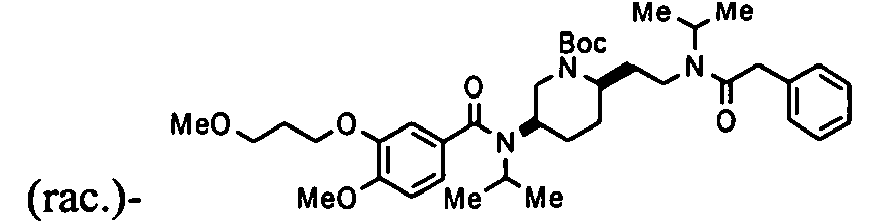
3.2 668 (M+1, 100%) 119 
4.2 696 (M+1, 100%) - The title compound (24.7 mg) was synthesized in a similar manner to Reference Example 103.
[Table 4] Ref. No. Structure Yield (mg) MS (ESI+) 120 
24.7 647(M++1, 45%) 121 
42.3 677(M++1, 40%) 122 
39.0 647(M++1, 36%) 123 
44.5 663(M++1, 29%) 124 
58.1 677(M++1, 36%) -

MS (ESI+) 580 (M++1, 100 %). -

MS (ESI+) 670 (M++1, 25 %). - The compounds (12.6 mg) as listed in the following Table were synthesized in a similar manner to Reference Example 126.
[Table 5] Ref. No. Structure Yield (mg) MS (ESI+) 127 
12.6 684(M++1, 25%) 128 
11.1 712(M++1, 32%) -

Subsequently, said colorless oily compound (0.59 g) was dissolved in ethanol (10 ml), and thereto was added hydrazine monohydrate (459 µl), and the mixture was heated with stirring at 50°C for 3 hours. Ethanol was removed by evaporation, and diluted with diethyl ether. The insoluble white solid was removed by filtration, and the residue was concentrated. To the resultant was added a 10 % aqueous potassium carbonate solution, and the mixture was extracted with ethyl acetate. The organic layer was dried over sodium sulfate, filtered and concentrated under reduced pressure to give a crude amine product (657 mg).
Said crude amine product (90 mg) was dissolved in tetrahydrofuran (2 ml), and thereto was added triethylamine (51 µl), and further thereto was added dropwise isovaleric chloride (33 mg). The mixture was stirred at room temperature overnight. To the reaction mixture was added a 5 % aqueous potassium hydrogen sulfate solution, and the mixture was extracted with ethyl acetate. The organic layer was dried over sodium sulfate, filtered and concentrated under reduced pressure. The obtained residue was purified by preparative thin layer silica gel column chromatography (developing solvent: ethyl acetate) to give the title compound (54.8 mg) as a colorless oily compound.
MS (ESI+) 578 (M++1, 20%). - The compounds (76.5 mg) as listed in the following Table were synthesized in a similar manner to Reference Example 129.
[Table 6] Ref. No. Structure Yield (mg) MS (ESI+) 130 
76.5 628(M++1, 100%) 131 
43.2 628 (M++1, 19%) -

MS (ESI+) 367 (M+1, 100%). -

MS (ESI+) 267 (M+1, 100 %). -


MS (ESI+) 309 (M+1, 100 %). -

MS (ESI+) 531 (M+1, 100 %). -

MS (ESI+) 620 (M+1, 100 %) -

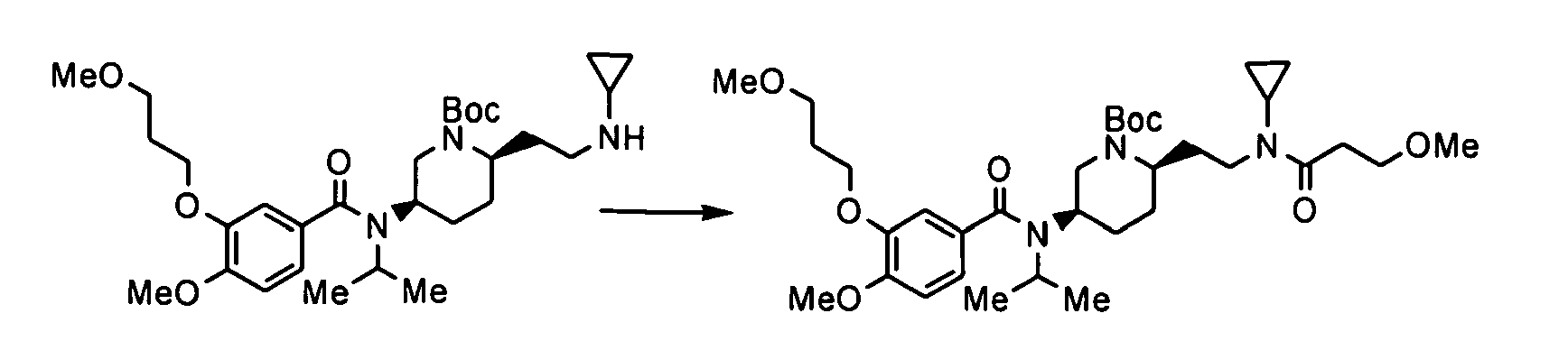
MS (ESI+) 634 (M+1, 100 %) -

MS (ESI+) 648 (M+1, 100 %) -

MS (ESI+) 724 (M+1, 100 %) -

MS (ESI+) 634 (M+1, 100 %) -

MS (ESI+) 648 (M+1, 100%) -

MS (ESI+) 630 (M+1, 100 %) -

MS (ESI+) 657 (M+1, 100 %) -

MS (ESI+) 672 (M+1, 100 %) -

MS (ESI+) 676 (M+1, 100 %) -

MS (ESI+) 648 (M+1, 100 %) -
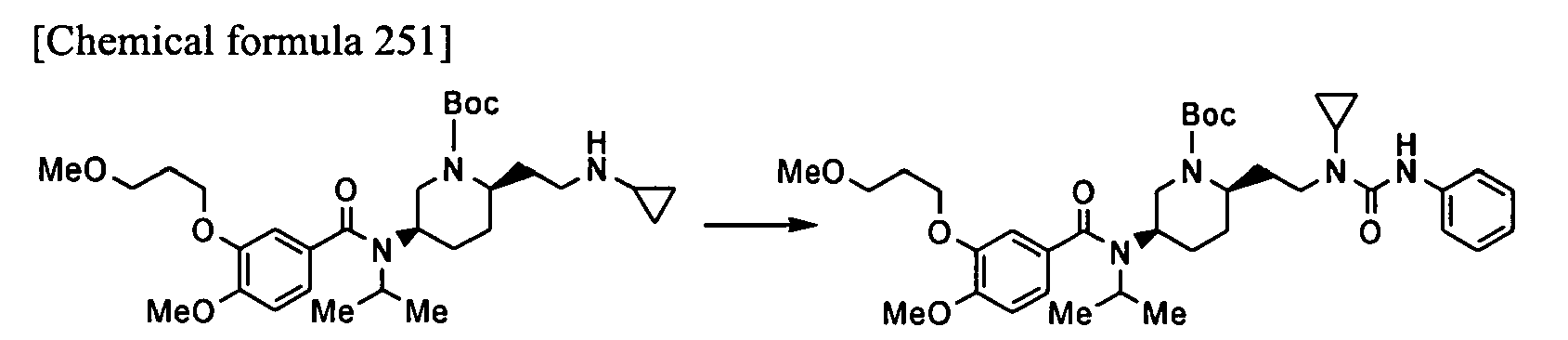
1H-NMR (400MHz, CDCl3) 7.43-7.42(m, 2H), 7.29-7.27(m, 3H), 7.04-6.98(m, 1H), 6.90-6.85(m, 3H), 4.33-4.16(m, 1H), 4.13-4.09(m, 2H), 3.98-3.95(m, 2H), 3.87(s, 3H), 3.75-3.66(m, 1H), 3.56(t, J=6.1 Hz, 2H), 3.42-3.36(m, 1H), 3.34(s, 3H), 3.20-3.00(m, 2H), 2.77-2.66(m, 1H), 2.13-2.04(m, 2H), 1.74-1.55(m, 6H), 1.46(s, 9H), 1.27-1.17(m, 6H), 0.97-0.82(m, 4H).
MS (ESI+) 667 (M+1, 85%). -


1H-NMR (400MHz, CDCl3) 7.38-7.33(m, 5H), 6.87-6.84(m, 3H), 4.25(s, 2H), 4.25-4.15(m, 1H), 4.10(t, J=6.5 Hz, 2H), 3.98-3.95(m, 1H), 3.87(s, 3H), 3.85-3.78(m, 1H), 3.56(t, J=6.1 Hz, 2H), 3.34(s, 3H), 3.20-3.00(m, 2H), 2.80-2.82(m, 1H), 2.49-2.40(m, 1H), 2.25-2.20(m, 1H), 2.11-2.04(m, 2H), 1.65-1.55(m, 6H), 1.46(s, 9H), 1.27-1.17(m, 6H), 0.73-0.70(m, 4H).
MS (ESI+) 702 (M+1, 50 %). -

1H-NMR (400MHz, CDCl3) 6.89-6.84(m, 3H), 4.25-4.22(m, 1H), 4.14-4.09(m, 4H), 4.00-3.90(m, 2H), 3.87(s, 3H), 3.85-3.78(m, 1H), 3.56(t, J=6.1 Hz, 2H), 3.34(s, 3H), 3.25-3.20(m, 1H), 3.20-3.05(m, 2H), 2.70-2.60(m, 1H), 2.13-2.08(m, 3H), 1.80-1.65(m, 4H), 1.65-1.50(m, 1H), 1.46(s, 9H), 1.27-1.17(m, 9H), 0.75-0.59(m, 4H).
MS (ESI+) 620 (M+1, 45 %). -

WO 92/21672
1H-NMR (400MHz, CDCl3) 7.95-7.90(m, 2H), 7.51-7.47(m, 1H), 7.40-7.38(m, 1H), 6.89-6.85(m, 3H), 4.32-4.28(m, 2H), 4.11(t, J=6.5 Hz, 2H), 3.93-3.90(m, 4H), 3.87(s, 3H), 3.56(t, J=6.1 Hz, 2H), 3.34(s, 3H), 3.20-2.90(m, 3H), 2.75-2.65(m, 1H), 2.12-2.04(m, 4H), 1.75-1.65(m, 7H), 1.51-1.45(m, 12H), 1.25-1.15(m, 6H), 0.98-0.95(m, 7H).
MS (ESI+) 766 (M+1, 100 %). -

1H-NMR (400MHz, CDCl3) 7.93-7.90(m, 2H), 7.49-7.47(m, 1H), 7.40-7.36(m, 1H), 6.91-6.82(m, 3H), 4.14-4.08(m, 2H), 4.01-3.90(m, 4H), 3.87(s, 3H), 3.75-3.70(m, 2H), 3.56(t, J=6.1 Hz, 2H), 3.45-3.40(m, 1H), 3.34(s, 3H), 3.20-2.90(m, 3H), 2.75-2.65(m, 1H), 2.15-2.08(m, 3H), 1.85-1.65(m, 4H), 1.45(s, 9H), 1.25-1.15(m, 6H), 0.94-0.90(m, 4H).
MS (ESI+) 710 (M+1, 98 %). -

1H-NMR (400MHz, CDCl3) 7.80-7.73(m, 2H), 7.54-7.51(m, 1H), 7.39-7.34(m, 2H), 6.87-6.84(m, 3H), 5.38-5.25(m, 1H), 4.19-3.80(m, 12H), 3.56(t, J=6.0 Hz, 2H), 3.45-3.40(m, 1H), 3.34(s, 3H), 3.20-2.80(m, 3H), 2.75-2.65(m, 1H), 2.15-2.08(m, 3H), 1.85-1.70(m, 3H), 1.45(s, 9H), 1.24-1.13(m, 6H), 0.87-0.79(m, 4H).
MS (ESI+) 709 (M+1, 100 %). -

1H-NMR (400MHz, CDCl3) 7.92-7.91 (m, 2H), 7.51-7.46(m, 1H), 7.39-7.36(m, 1H), 6.89-6.82(m, 3H), 4.35(q, J=7.1 Hz, 2H), 4.30-4.21(m, 1H), 4.11(t, J=6.4 Hz, 2H), 4.02-3.90(m, 4H), 3.87(s, 3H), 3.85-3.65(m, 2H), 3.55(t, J=6.1 Hz, 2H), 3.50-3.45(m, 1H), 3.34(s, 3H), 3.20-2.90(m, 2H), 2.75-2.65(m, 1H), 2.13-2.04(m, 3H), 1.75-1.65(m, 3H), 1.51-1.50(m, 1H), 1.44(s, 9H), 1.37(t, J=7.1 Hz, 3H), 1.22-1.15(m, 6H), 0.95-0.91(m, 4H).
MS (ESI+) 739 (M+1, 100 %). -

MS (ESI+) 684 (M++1, 100 %). -
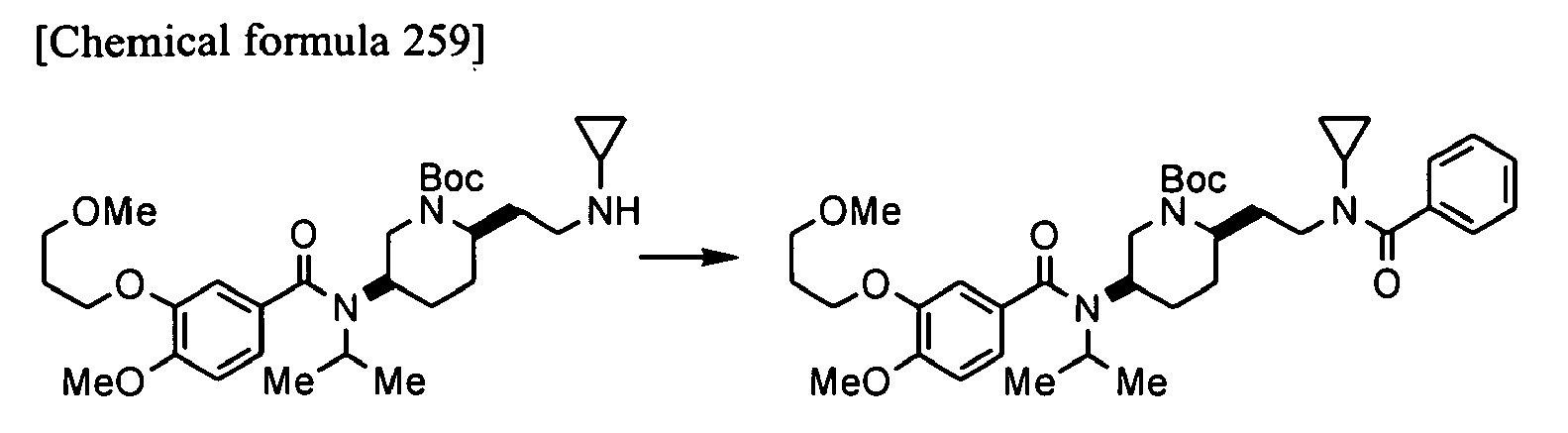
MS (ESI+) 652 (M++1, 100%). -

MS (ESI+) 680 (M++1, 100 %). -

1H-NMR (400MHz, CDCl3) 7.62-7.59(m, 2H), 7.34-7.29(m, 1H), 7.09-7.06(m, 1H), 5.92(brs, 2H), 3.92(s, 3H). -

1H-NMR (400MHz, CDCl3) 7.63-7.61(m, 1H), 7.57-7.56(m, 1H), 7.33(t, J = 8.0 Hz, 1H), 7.10(m, 1H), 4.10(t, J = 6.3 Hz, 2H), 3.91(s, 3H), 3.56(t, J = 6.2 Hz, 2H), 3.36(s, 3H), 2.06(m, 2H). -

1H-NMR (400MHz, CDCl3) 7.72-7.69(m, 1H), 7.64-7.63(m, 1H), 7.37(t, J = 8.0 Hz, 1H), 7.15(ddd, J = 0.9, 2.6, 8.2 Hz, 1H), 4.12(t, J = 6.3 Hz, 2H), 3.59(t, J = 6.2 Hz, 2H), 3.38(s, 3H), 2.14-2.05(m, 2H). -

-

MS (ESI+) 435 (M++1, 100 %). -
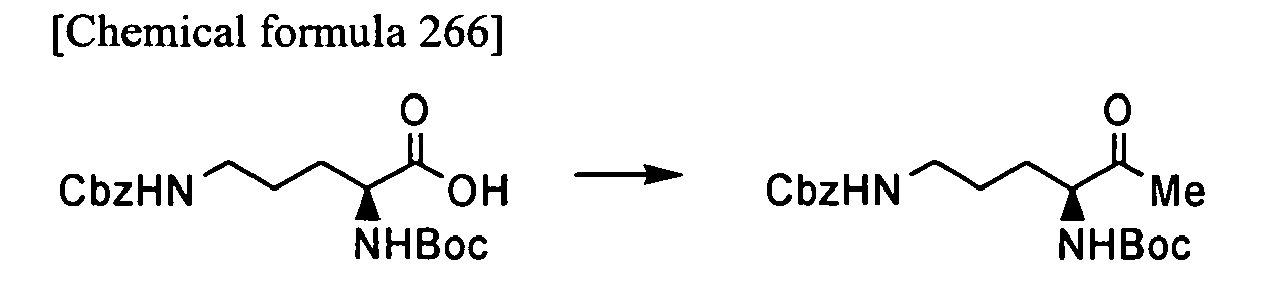
MS (ESI+) 365 (M++1, 100 %). -


MS (ESI+) 215 (M++1, 100 %). -

MS (ESI+) 349 (M++1, 100 %). -

MS (ESI+) 249 (M++1, 100 %). -

MS (ESI+) 291 (M++1, 100 %). -

MS (ESI+) 513 (M++1, 100%). - Reference Example 168
- (a) Methyl 3,5-bis(3-methoxypropoxy)benzoate
- (b) Methyl 3-hydroxy-5-(3-methoxypropoxy)benzoate

- (a) 1H-NMR (400MHz, CDCl3) 7.15-7.11(m, 2H), 6.79(brs, 1H), 6.62-6.61(m, 1H), 4.05(t, J = 6.3 Hz, 2H), 3.89(s, 3H), 3.59(t, J = 6.2 Hz, 2H), 3.38(s, 3H), 2.08-2.02(m, 2H).
- (b) 1H-NMR (400MHz, CDCl3) 7.22-7.18(d, J = 2.3 Hz, 2H), 6.66(t, J = 2.3 Hz, 1H), 4.09(t, J = 7.1 Hz, 4H), 3.90(s, 3H), 3.54(t, J = 6.2 Hz, 4H), 3.36(s, 6H), 2.08-2.02(m, 4H).
-
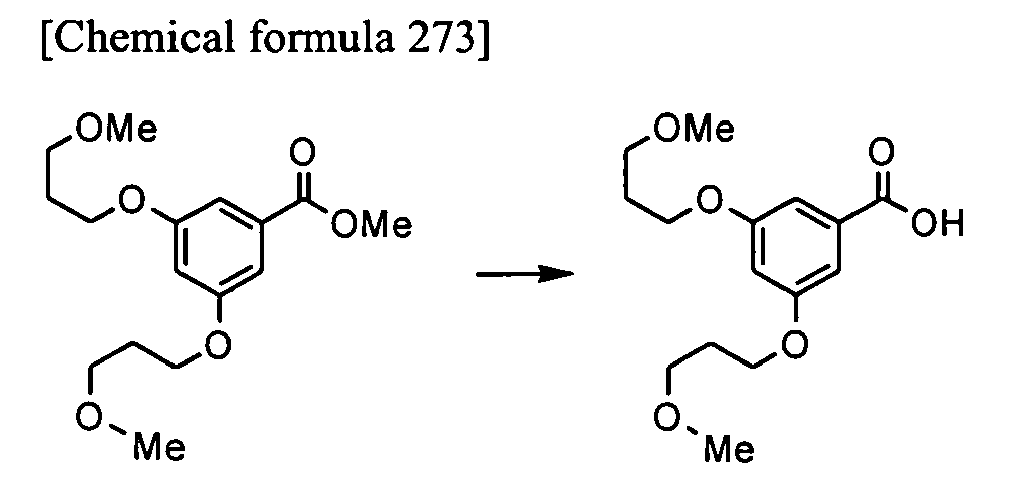
1H-NMR (400MHz, CDCl3) 7.24(d, J = 2.3 Hz, 2H), 6.70(t, J = 2.3 Hz, 1 H), 4.09(t, J = 6.3 Hz, 4H), 3.57(t, J = 6.2 Hz, 4H), 3.37(s, 6H), 2.09-2.03(m, 4H). -


-

MS (ESI+) 523 (M++1, 100 %). -

1H-NMR (400MHz, CDCl3) 7.59(d, J = 8.2 Hz, 1H), 7.55(d, J = 1.8 Hz, 1H), 7.49(dd, J = 1.8, 8.2 Hz, 1H), 4.18(t, J = 6.2 Hz, 2H), 3.91 (s, 3H), 3.61(t, J = 6.1 Hz, 2H), 3.36(s, 3H), 2.15-2.08(m, 2H). -

1H-NMR (400MHz, CDCl3) 7.63(d, J = 8.2 Hz, 1H), 7.60(d, J = 1.7 Hz, 1H), 7.56(dd, J = 1.7, 8.2 Hz, 1H), 4.21 (t, J = 6.2 Hz, 2H), 3.63(t, J = 6.1 Hz, 2H), 3.38(s, 3H), 2.17-2.10(m, 2H). -


-

MS (ESI+) 513 (M++1, 50 %), 515 (M++1, 50 %). -

1H-NMR (400MHz, CDCl3) 7.43-7.32(m, 5H), 7.28-7.27(m, 1H), 7.22-7.21(m, 1H), 6.73(t, J = 2.3 Hz, 1H), 5.07(s, 2H), 4.07(t, J = 6.3 Hz, 2H), 3.90(s, 3H), 3.54(t, J = 6.2 Hz, 2H), 3.36(s, 3H), 2.07-2.01 (m, 2H). -

-

-

MS (ESI+) 541 (M++1, 100 %). -

MS (ESI+) 451 (M++1, 100 %). -

- tert-Butyl (3R)-3-[[3-hydroxy-5-(3-methoxypropoxy)benzoyl](isopropyl)amino]piperidine-1-carboxylate(84.3 mg) was dissolved in dichloromethane (2 ml), and thereto were added triethylamine (52.1 µl), copper acetate (33.9 mg), and phenylboronic acid (45.6 mg). The mixture was stirred at room temperature for 15 hours, and thereto was added a saturated aqueous sodium hydrogen carbonate solution. The mixture was extracted with ethyl acetate, and the organic layer was washed with a saturated aqueous sodium chloride solution, dried over sodium sulfate, filtered and concentrated under reduced pressure. The obtained residue was purified by silica gel column chromatography (developing solvent: hexane/ethyl acetate = 3/1) to give the title compound (44.4 mg) as a colorless oily compound.
MS (ESI+) 527 (M++1, 100 %). -

MS (ESI+) 465 (M++1, 100 %). -

MS (ESI+) 505 (M++1, 100 %). -

MS (ESI+) 493 (M++1, 100 %). -

MS (ESI+) 533 (M++1, 100 %). -

MS (ESI+) 583 (M+1, 100 %). -

MS (ESI+) 511 (M+1, 100 %). -

-

-

-

-

MS (ESI+) 541 (M++1, 100 %). -

MS (ESI+) 451 (M++1, 100 %). -

MS (ESI+) 491 (M+1, 100 %). -

MS (ESI+) 427 (M++1, 100 %). -

MS (ESI+) 539 (M+1, 100 %). -

MS (ESI+) 493 (M++1, 100 %). -
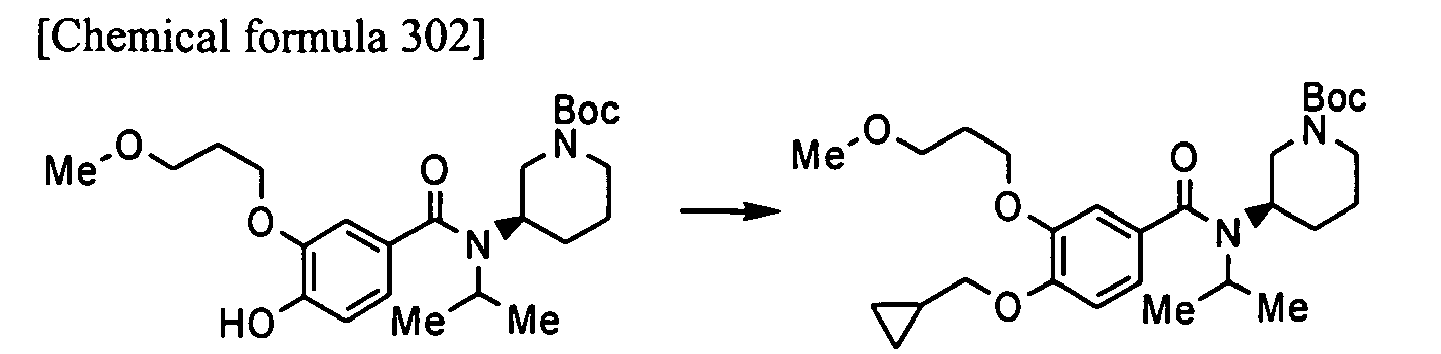
MS (ESI+) 505 (M++1, 100 %). -

MS (ESI+) 533 (M++1, 100 %). -

MS (ESI+) 571 (M++1, 50%), 573(M++1, 50%). -

MS (ESI+) 569 (M++1, 100 %). -

MS (ESI+) 579 (M++1, 100 %). -
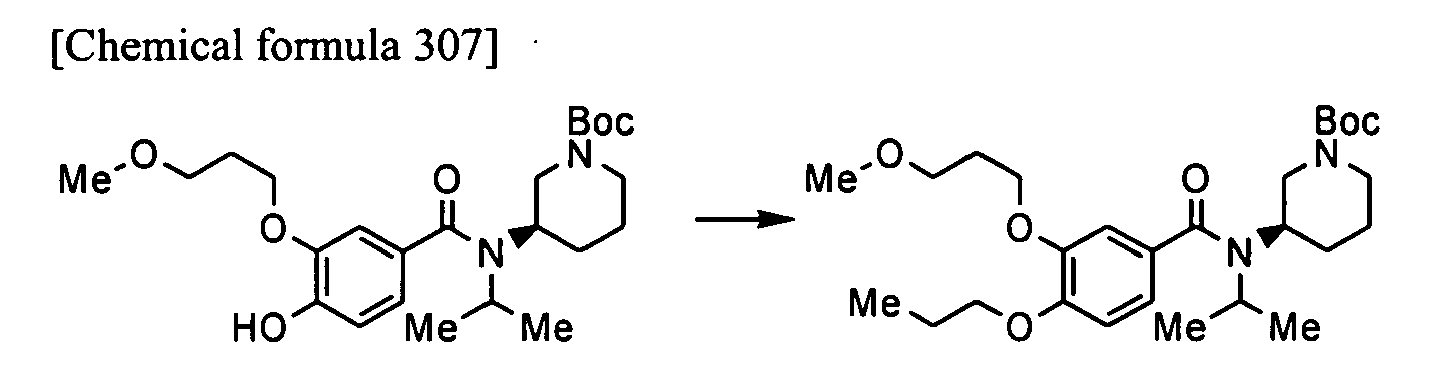
MS (ESI+) 493 (M++1, 100 %). -

MS (ESI+) 497 (M++1, 100 %). -


MS (ESI+) 556 (M++1, 100 %). -

MS (ESI+) 533 (M+1, 100 %). -


MS (ESI+) 535 (M+1, 100 %). -

MS (ESI+) 520 (M+1, 100 %). -

1H-NMR (400MHz, CDCl3) 10.53(s, 1H), 7.88(d, J = 7.9 Hz, 1H), 7.69-7.66(m, 2H),4.45(t, J = 6.5 Hz, 2H), 4.27(t, J = 6.3 Hz, 2H), 3.60(t, J = 6.0 Hz, 2H), 3.54(t, J = 6.2 Hz, 2H), 3.38(s, 3H), 3.37(s, 3H), 2.19-2.12(m, 2H), 2.10-2.03(m, 2H). -

1H-NMR (400MHz, CDCl3) 10.55 (s, 1H), 7.91 (d, J = 8.3 Hz, 1H), 7.75-7.73 (m, 2H), 4.28 (t, J = 6.2 Hz, 2H), 3.61 (t, J = 6.0 Hz, 2H), 3.38 (s, 3H), 2.19-2.13 (m, 2H). -
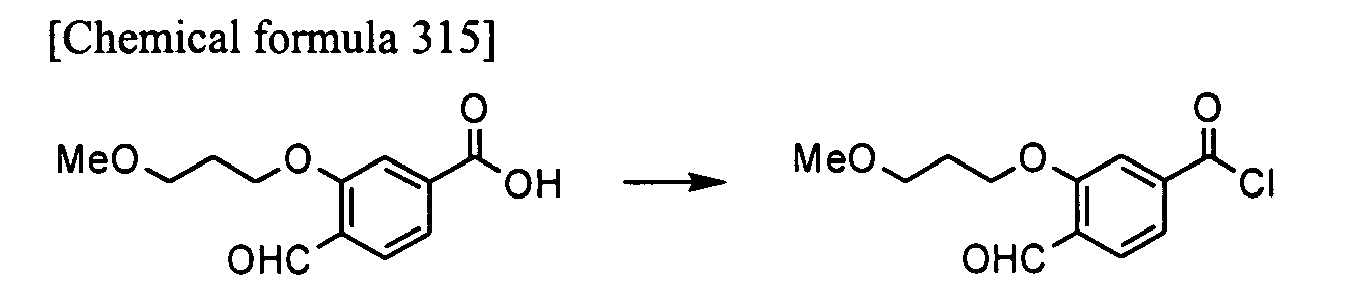
-

MS (ESI+) 463 (M++1, 100 %). -

MS (ESI+) 686 (M+1, 100 %). -

MS (ESI+) 527 (M+1, 100 %). -

- H-NMR (400MHz, CDCl3) 5.09(brs, 1H), 3.69(s, 3H), 3.63-3.57(m, 2H), 3.55-3.46(m, 2H).
-


MS (ESI+) 528 (M++1, 100 %). -

MS (ESI+) 332 (M++1, 50%), 334 (M++1, 50%). -

MS (ESI+) 318 (M++1, 50 %), 320 (M++1, 50 %). -

-

MS (ESI+) 542 (M++1 M++1, 50 %), 544 (M++1, 50%). -

MS (ESI+) 196 (M++1, 50 %), 198 (M++1, 50 %). -

MS (ESI+) 542 (M++1, 100 %). -
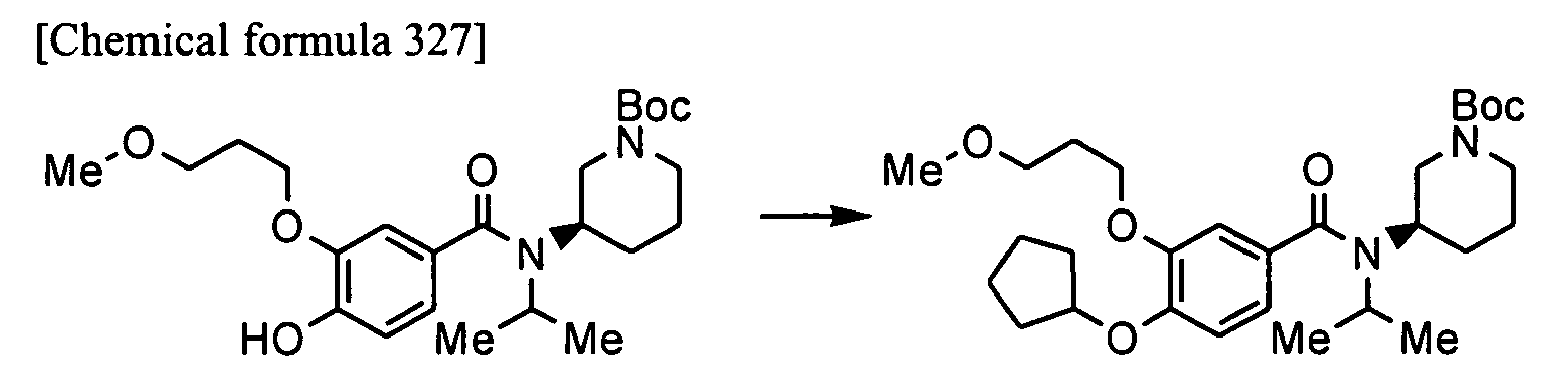
- MS (ESI+) 519 (M++1, 100 %).
-

MS (ESI+) (M++1, 100 %). -

MS (ESI+) (M++1, 100 %). -

- To a solution of the compound of Reference Example 225 (1.80 g) in N,N-dimethylformamide (20 ml) were added sodium hydride (55 % wg, 0.40 g) and 1-bromo-3-methoxypropane (1.40 g), and the mixture was heated with stirring at 80°C. Six hours thereafter, the reaction solution was cooled to 25°C, and thereto was added water. The mixture was extracted with ethyl acetate, and the organic layer was washed with a saturated aqueous sodium chloride solution, dried over magnesium sulfate, filtered and concentrated under reduced pressure. The obtained residue was purified by silica gel column chromatography (hexane/ethyl acetate = 5/1) to give the title compound (1.85 g).
MS (ESI+) (M++1, 100 %). -
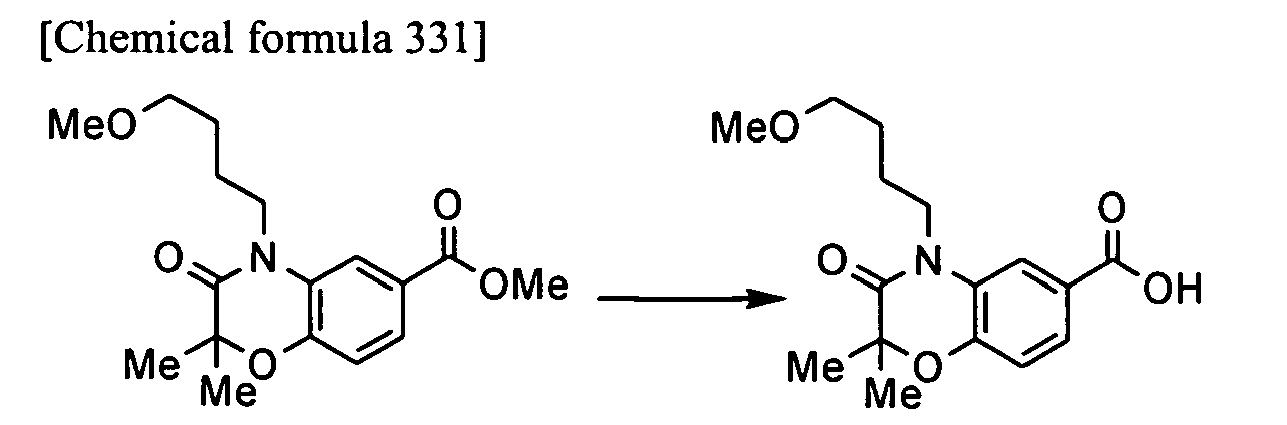
MS (ESI+) (M++1, 100 %). -

MS (ESI+) (M++1, 100 %). -
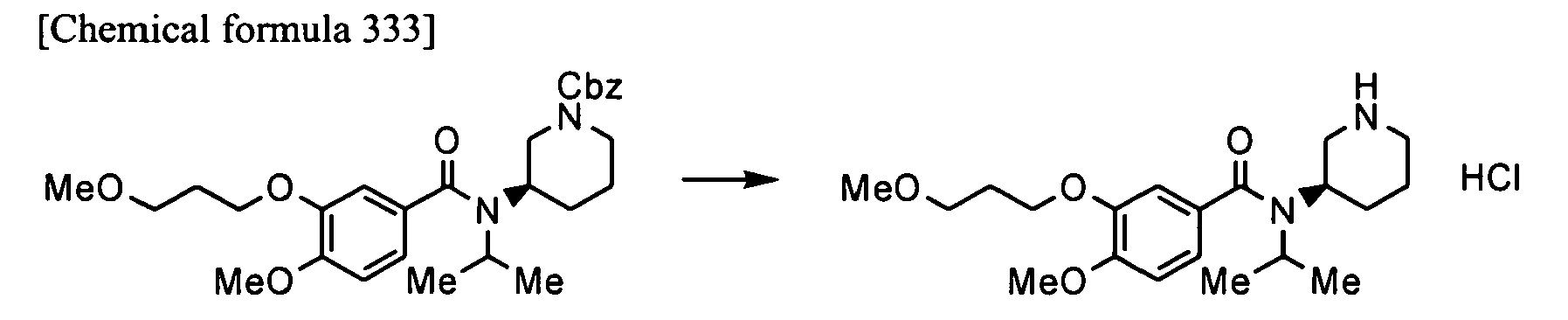
1H-NMR (400MHz, MeOD) 6.93(d, J = 8.3 Hz, 1H), 6.85-6.83(m, 2H), 3.99(t, J = 6.3 Hz, 2H), 3.92(brs, 1H), 3.77(s, 3H), 3.66-3.60(m, 1H), 3.58-3.55(m, 2H), 3.49-3.47(m, 3H), 3.29(m, 1H), 3.24(s, 3H), 2.87-2.81(m, 1H), 2.60(m, 1H), 2.03-1.91(m, 3H), 1.83-1.80(m, 2H), 1.16-1.15(m, 6H).
MS (ESI+) 365 (M++1, 100 %) -

1H-NMR (400MHz, CDCl3) 6.90-6.83(m, 3H), 4.12(t, J = 6.5 Hz, 2H), 3.91-3.86(m, 1H), 3.87(s, 3H), 3.58-3.52(m, 3H), 3.35(s, 3H), 3.10-2.87(m, 3H), 2.40(brs, 2H), 2.13-2.07(m, 3H), 1.79-1.70(m, 3H), 1.26-1.19(m, 6H).
MS (ESI+) 365 (M++1, 100 %) -

1H-NMR (300MHz, CDCl3) 6.93-6.86(m, 3H), 4.27-4.11(m, 2H), 4.12(t, J = 6.6 Hz, 2H), 3.90(s, 3H), 3.81-3.75(m, 1H), 3.68-3.39(m, 3H), 3.57(t, J = 6.0 Hz, 2H), 3.35(s, 3H), 2.88(brs, 1H), 2.56-2.30(m, 2H), 2.16-2.07(m, 2H), 1.24-1.17(m, 6H).
MS (ESI+) 351 (M++1, 100%). -

1H-NMR (400MHz, CDCl3) 6.95-6.86(m, 3H), 4.14(t, J = 6.7 Hz, 2H), 3.93-3.92(m, 1H), 3.90(s, 3H), 3.87-3.76(m, 2H), 3.59-3.56(t, J = 6.2 Hz, 2H), 3.47-3.45(m, 1H), 3.36-3.35(m, 1H), 3.35(s, 3H), 3.02(brs, 1H), 2.31-2.25(m, 1H), 2.16 -2.09(m, 5H), 2.01-1.98(m, 1H), 1.85-1.82(m, 1H), 1.60-1.56(m, 1H), 1.25(d, J = 6.6 Hz, 3H), 1.16(d, J = 6.6 Hz, 3H).
MS (ESI+) 379 (M++1, 100 %). -

1H-NMR (400MHz, CDCl3) 6.92-6.87(m, 3H), 4.19-4.12(m, 5H), 3.88(s, 3H), 3.79-3.76(m, 3H), 3.67-3.63(m, 3H), 3.58-3.52(m, 2H), 3.35(s, 3H), 3.00(m, 1H), 2.17-2.05(m, 2H), 1.69(m, 2H), 1.35-1.08(m, 9H).
MS (ESI+) 437 (M++1, 100 %). -

1H-NMR (400MHz, CDCl3) 7.18-6.89(m, 3H), 4.42-4.15(m, 4H), 3.93-3.87(m, 2H), 3.87(s, 3H), 3.81-3.75(m, 2H), 3.71-3.62(m, 3H), 3.60-3.48(m, 1H), 3.48-3.36(m, 1H), 3.48(s, 3H), 2.38 -2.02(m, 5H), 1.03(s, 6H).
MS (ESI+) 409 (M++1, 100 %). -

1H-NMR (400MHz, CDCl3) 6.92(d, J = 1.8 Hz, 1H), 6.88(dd, J = 1.8, 8.1 Hz, 1H), 6.81(d, J = 8.1 Hz, 1H), 4.19(s, 1H), 4.12(t, J = 6.6 Hz, 1H), 4.07(s, 1H), 3.88(s, 3H), 3.68-3.65(m, 1H), 3.57(t, J = 6.1 Hz, 2H), 3.35(s, 3H), 3.28(s, 2H), 2.78(s, 2H), 2.14-2.02(m, 2H), 2.04-2.02 (m, 1H), 1.88(m, 3H), 1.39(d, J = 6.8 Hz, 6H).
MS (ESI+) 409 (M++1, 100 %). -

1H-NMR (400MHz, MeOD) 7.05-6.98(m, 3H), 4.12-3.98(m, 4H), 3.88(s, 3H), 3.76-3.65(m, 2H), 3.60-3.59(m, 2H), 3.49-3.40(m, 2H), 3.35(s, 3H), 3.06-3.03(m, 2H), 2.16(d, J = 14.6 Hz, 1H), 2.08-2.02(m, 2H), 1.76-1.72(m, 1H), 1.59-1.37(m, 1H), 1.29-1.19(m, 6H).
MS (ESI+) 395 (M++1, 100 %). -

1H-NMR (400MHz, MeOD) 7.16-7.12(m, 1H), 6.87-6.76(m, 6H), 4.45(d, J = 11.8 Hz, 1H), 4.36(d, J = 11.8 Hz, 1H), 3.97-3.90(m, 4H), 3.77(s, 3H), 3.65(s, 3H), 3.58-3.55(m, 2H), 3.49-3.44(m, 2H), 3.41-3.35(m, 2H), 3.24(s, 3H), 3.11(m, 1H), 2.99-2.93(m, 1H), 2.06-2.03(m, 1H), 1.95-1.89(m, 2H), 1.76-1.74(m, 1H), 1.42-1.40(m, 1H), 1.12(d, J = 6.6 Hz, 3H), 1.07(d, J = 6.7 Hz, 3H).
MS (ESI+) 515 (M++1, 100 %). -

1H-NMR (300MHz, CDCl3) 7.22(d, J = 8.7 Hz, 2H), 6.95(d, J = 8.7 Hz, 2H), 6.85-6.81(m, 2H), 6.62(d, J = 8.1 Hz, 1H), 4.65(m, 1H), 3.90(t, J = 6.3 Hz, 2H), 3.79(s, 3H), 3.51(t, J = 6.2 Hz, 2H), 3.36(m, 1H), 3.35(s, 3H), 3.03(brd, J = 12.9 Hz, 1H), 2.68-2.60(m, 1H), 2.45-2.37(m, 1H), 2.05-1.96(m, 3H), 1.96-1.41 (m, 4H).
MS (ESI+) 434 (M++1, 100 %). -

1H NMR (400 MHz, DMSO-d6) δ 9.61-9.58(m, 1H), 8.93-8.90(m, 1H), 7.00-6.98(m, 1H), 6.92-6.86(m, 2H), 4.01(t, J=6.6 Hz, 2H), 3.84-3.73(m, 7H), 3.58-3.55(m, 1H), 3.46(t, J=6.2 Hz, 2H), 3.34(s, 3H), 3.24(s, 3H), 3.11-3.08(m, 2H), 2.90-2.80(m, 1H), 2.16-2.13(m, 1H), 1.97-1.93(m, 2H), 1.04-1.01(m, 6H).
MS (ESI+) 479 (M++1, 100 %). -

1H NMR (400 MHz, DMSO-d6) δ 9.61-9.58(m, 1H), 8.93-8.90(m, 1H), 7.00-6.98(m, 1H), 6.92-6.86(m, 2H), 4.01(t, J=6.6 Hz, 2H), 3.84-3.73(m, 7H), 3.58-3.55(m, 1H), 3.46(t, J=6.2 Hz, 2H), 3.34(s, 3H), 3.24(s, 3H), 3.11-3.08(m, 2H), 2.90-2.80(m, 1H), 2.16-2.13(m, 1H), 1.97-1.93(m, 2H), 1.04-1.01(m, 6H).
MS (ESI+) 521 (M++1, 100 %). -

- The title compound (15.0 mg) was synthesized in a similar manner to Example 4 except that the compound of Reference Example 77 was used instead of the compound of Reference Example 22 in Example 4.
1H NMR (400 MHz, DMSO-d6) δ 9.61-9.58(m, 1H), 8.93-8.90(m, 1H), 7.00-6.98(m, 1H), 6.92-6.86(m, 2H), 4.01(t, J=6.6 Hz, 2H), 3.84-3.73(m, 7H), 3.58-3.55(m, 1H), 3.46(t, J=6.2 Hz, 2H), 3.34(s, 3H), 3.24(s, 3H), 3.11-3.08(m, 2H), 2.90-2.80(m, 1H), 2.16-2.13(m, 1H), 1.97-1.93(m, 2H), 1.04-1.01(m, 6H).
MS (ESI+) 293 (M++1, 100%). -

1H NMR (400 MHz, DMSO-d6) δ 9.61-9.58(m, 1H), 8.93-8.90(m, 1H), 7.00-6.98(m, 1H), 6.92-6.86(m, 2H), 4.01(t, J=6.6 Hz, 2H), 3.84-3.73(m, 7H), 3.58-3.55(m, 1H), 3.46(t, J=6.2 Hz, 2H), 3.34(s, 3H), 3.24(s, 3H), 3.11-3.08(m, 2H), 2.90-2.80(m, 1H), 2.16-2.13(m, 1H), 1.97-1.93(m, 2H), 1.04-1.01(m, 6H).
MS (ESI+) 451(M++1, 100 %). -

1H NMR (400 MHz, DMSO-d6) δ 9.61-9.58(m, 1H), 8.93-8.90(m, 1H), 7.00-6.98(m, 1H), 6.92-6.86(m, 2H), 4.01(t, J=6.6 Hz, 2H), 3.84-3.73(m, 7H), 3.58-3.55(m, 1H), 3.46(t, J=6.2 Hz, 2H), 3.34(s, 3H), 3.24(s, 3H), 3.11-3.08(m, 2H), 2.90-2.80(m, 1H), 2.16-2.13(m, 1H), 1.97-1.93(m, 2H), 1.04-1.01(m, 6H).
MS (ESI+) 423 (M++1, 100%). -

1H NMR (400 MHz, DMSO-d6) δ 9.61-9.58(m, 1H), 8.93-8.90(m, 1H), 7.00-6.98(m, 1H), 6.92-6.86(m, 2H), 4.01(t, J=6.6 Hz, 2H), 3.84-3.73(m, 7H), 3.58-3.55(m, 1H), 3.46(t, J=6.2 Hz, 2H), 3.34(s, 3H), 3.24(s, 3H), 3.11-3.08(m, 2H), 2.90-2.80(m, 1H), 2.16-2.13(m, 1H), 1.97-1.93(m, 2H), 1.04-1.01(m, 6H).
MS (ESI+) 423 (M++1, 100%). -


- The title compound (2.5 mg) was synthesized in a similar manner to Example 4 except that the compound of Reference Example 87 was used instead of the compound of Reference Example 22 in Example 4.
1H NMR (400 MHz, DMSO-d6) δ 9.61-9.58(m, 1H), 8.93-8.90(m, 1H), 7.00-6.98(m, 1H), 6.92-6.86(m, 2H), 4.01(t, J=6.6 Hz, 2H), 3.84-3.73(m, 7H), 3.58-3.55(m, 1H), 3.46(t, J=6.2 Hz, 2H), 3.34(s, 3H), 3.24(s, 3H), 3.11-3.08(m, 2H), 2.90-2.80(m, 1H), 2.16-2.13(m, 1H), 1.97-1.93(m, 2H), 1.04-1.01(m, 6H).
MS (ESI+) 409 (M++1, 100 %). -

1H NMR (400 MHz, DMSO-d6) δ 9.61-9.58(m, 1H), 8.93-8.90(m, 1H), 7.00-6.98(m, 1H), 6.92-6.86(m, 2H), 4.01(t, J=6.6 Hz, 2H), 3.84-3.73(m, 7H), 3.58-3.55(m, 1H), 3.46(t, J=6.2 Hz, 2H), 3.34(s, 3H), 3.24(s, 3H), 3.11-3.08(m, 2H), 2.90-2.80(m, 1H), 2.16-2.13(m, 1H), 1.97-1.93(m, 2H), 1.04-1.01(m, 6H).
MS (ESI+) 492 (M++1, 100 %). -

1H NMR (400 MHz, DMSO-d6) δ 9.61-9.58(m, 1H), 8.93-8.90(m, 1H), 7.00-6.98(m, 1H), 6.92-6.86(m, 2H), 4.01(t, J=6.6 Hz, 2H), 3.84-3.73(m, 7H), 3.58-3.55(m, 1H), 3.46(t, J=6.2 Hz, 2H), 3.34(s, 3H), 3.24(s, 3H), 3.11-3.08(m, 2H), 2.90-2.80(m, 1H), 2.16-2.13(m, 1H), 1.97-1.93(m, 2H), 1.04-1.01(m, 6H).
MS (ESI+) 518 (M++1, 100%). -

1H NMR (400 MHz, DMSO-d6) δ 9.61-9.58(m, 1H), 8.93-8.90(m, 1H), 7.00-6.98(m, 1H), 6.92-6.86(m, 2H), 4.01(t, J=6.6 Hz, 2H), 3.84-3.73(m, 7H), 3.58-3.55(m, 1H), 3.46(t, J=6.2 Hz, 2H), 3.34(s, 3H), 3.24(s, 3H), 3.11-3.08(m, 2H), 2.90-2.80(m, 1H), 2.16-2.13(m, 1H), 1.97-1.93(m, 2H), 1.04-1.01(m, 6H). -

1H NMR (400 MHz, DMSO-d6) δ 9.61-9.58(m, 1H), 8.93-8.90(m, 1H), 7.00-6.98(m, 1H), 6.92-6.86(m, 2H), 4.01(t, J=6.6 Hz, 2H), 3.84-3.73(m, 7H), 3.58-3.55(m, 1H), 3.46(t, J=6.2 Hz, 2H), 3.34(s, 3H), 3.24(s, 3H), 3.11-3.08(m, 2H), 2.90-2.80(m, 1H), 2.16-2.13(m, 1H), 1.97-1.93(m, 2H), 1.04-1.01(m, 6H). MS (ESI+) 378 (M++1, 100%). -
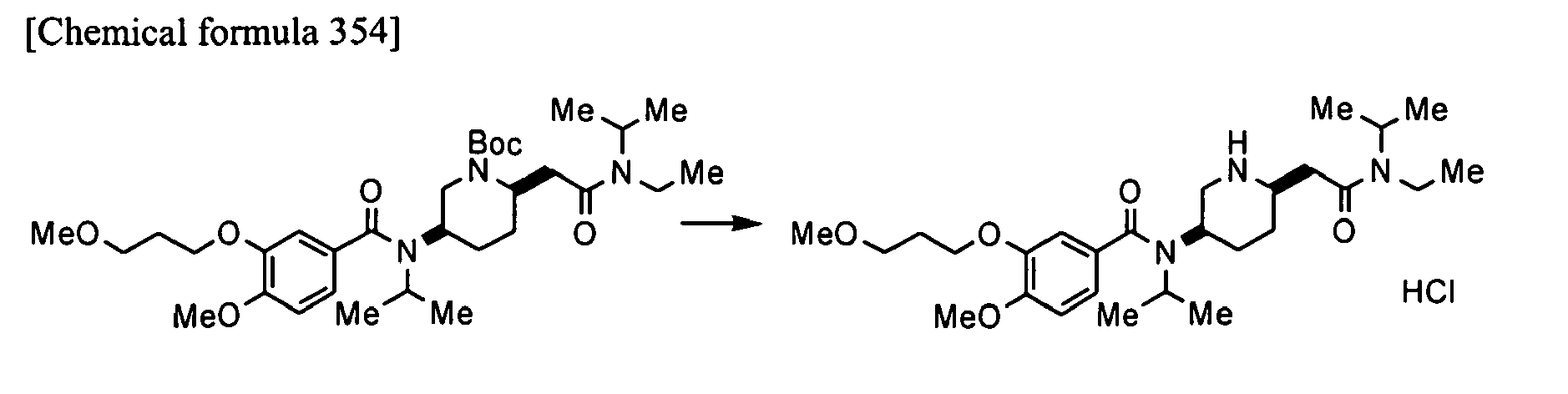
1H NMR (400 MHz, DMSO-d6) δ 9.61-9.58(m, 1H), 8.93-8.90(m, 1H), 7.00-6.98(m, 1H), 6.92-6.86(m, 2H), 4.01(t, J=6.6 Hz, 2H), 3.84-3.73(m, 7H), 3.58-3.55(m, 1H), 3.46(t, J=6.2 Hz, 2H), 3.34(s, 3H), 3.24(s, 3H), 3.11-3.08(m, 2H), 2.90-2.80(m, 1H), 2.16-2.13(m, 1H), 1.97-1.93(m, 2H), 1.04-1.01(m, 6H).
MS (ESI+) 492(M++1, 100%). -

1H NMR (400 MHz, DMSO-d6) δ 9.61-9.58(m, 1H), 8.93-8.90(m, 1H), 7.00-6.98(m, 1H), 6.92-6.86(m, 2H), 4.01(t, J=6.6 Hz, 2H), 3.84-3.73(m, 7H), 3.58-3.55(m, 1H), 3.46(t, J=6.2 Hz, 2H), 3.34(s, 3H), 3.24(s, 3H), 3.11-3.08(m, 2H), 2.90-2.80(m, 1H), 2.16-2.13(m, 1H), 1.97-1.93(m, 2H), 1.04-1.01(m, 6H).
MS (ESI+) 492 (M++1, 100 %). -

1H-NMR (400MHz, MeOD) 7.22-7.14(m, 5H), 6.94(d, J = 8.1 Hz, 1H), 6.88-6.86(m, 2H), 4.00(t, J = 6.3 Hz, 2H), 3.90(s, 2H), 3.78(s, 3H), 3.67-3.53(m, 5H), 3.51-3.40(m, 3H), 3.25(s, 3H), 3.09-3.04(m, 1H), 2.73-2.71 (m, 1H), 2.59(brs, 1H), 2.00-1.89(m, 6H), 1.72-1.69(m, 1H), 1.20-1.10(m, 6H), 0.93(d, J = 6.8 Hz, 2H), 0.83(brs, 2H).
MS (ESI+) 566 (M++1, 100%). -

1H NMR (400 MHz, DMSO-d6) δ 9.61-9.58(m, 1H), 8.93-8.90(m, 1H), 7.00-6.98(m, 1H), 6.92-6.86(m, 2H), 4.01(t, J=6.6 Hz, 2H), 3.84-3.73(m, 7H), 3.58-3.55(m, 1H), 3.46(t, J=6.2 Hz, 2H), 3.34(s, 3H), 3.24(s, 3H), 3.11-3.08(m, 2H), 2.90-2.80(m, 1H), 2.16-2.13(m, 1H), 1.97-1.93(m, 2H), 1.04-1.01(m, 6H).
MS (ESI+) 492(M++1, 100%). -

1H-NMR (400MHz, MeOD) 7.10-7.01 (m, 2H), 6.90(d, J = 8.3 Hz, 1H), 4.17-4.11(m, 1H), 3.99(t, J = 6.3 Hz, 2H), 3.78(s, 3H), 3.48(t, J = 6.2 Hz, 2H), 3.44-3.41(m, 1H), 3.37-3.24(m, 2H), 3.24(s, 3H), 2.92-2.88(m, 1H), 2.85-2.80(m, 1H), 2.26-2.19(m, 1H), 2.09-1.90(m, 4H), 1.78-1.75(m, 1H), 0.64-0.35(m, 2H), 0.45-0.35(m, 2H).
MS (ESI+) 363(M++1, 100%). -

- The title compound (254 mg) was synthesized in a similar manner to Example 10 except that the compound of Reference Example 106 was used instead of the compound of Reference Example 37 in Example 10.
1H-NMR (400MHz, CDCl3) 6.68(s, 1H), 6.63(s, 1H), 4.11-4.04(m, 2H), 3.93-383(m, 1H), 3.85(s, 3H), 3.75-3.70(m, 1H), 3.57-3.49(m, 2H), 3.34(s, 3H), 3.13(m, 1H), 2.99-2.85(m, 2H), 2.70-2.64(m, 1H), 2.23(s, 3H), 2.09-2.05(m, 2H), 1.80-1.54(m, 4H), 1.28-1.07(m, 6H).
MS (ESI+) 379(M++1, 100%). -

1H-NMR (400MHz, MeOD) 6.93(d, J = 8.0 Hz, 1H), 6.88-6.85(m, 2H), 4.01-3.95(m, 4H), 3.77(s, 3H), 3.75-3.71(m, 1H), 3.67-3.55(m 3H), 3.48(t, J = 6.1 Hz, 2H), 3.24(s, 3H), 3.13(dd, J = 5.2, 12.8 Hz, 1H), 2.60(brs, 1H), 2.08-2.02(m, 1H), 1.97-1.91(m, 4H), 1.87-1.73(m, 2H), 1.19-1.11(m, 6H).
MS (ESI+) 409(M++1, 100%). -

1H-NMR (300MHz, CDCl3) 7.29-7.27(m, 3H), 6.98-6.84(m, 6H), 4.13-4.11(m, 2H), 4.04-3.43(m, 7H), 3.87(s, 3H), 3.58-3.54(m, 2H), 3.34(s, 3H), 2.88-2.84(m, 3H), 2.14-2.08(m, 2H), 1.93-1.90(m, 1H), 1.32-1.22(m, 6H).
MS (ESI+) 471(M++1, 100%). -

1H-NMR (300MHz, CDCl3) 7.37-7.27(m, 5H), 6.88-6.85(m, 3H), 4.47(s, 2H), 4.13-4.09(m, 2H), 4.02-3.34(m, 7H), 3.87(s, 3H), 3.58-3.54(m, 2H), 3.34(s, 3H), 2.71-2.50(m, 3H), 2.14-2.06(m, 2H), 1.81-1.78(m, 1H), 1.27-1.17(m, 6H).
MS (ESI+) 485(M++1, 100%). -

1H-NMR (300MHz, CDCl3) 7.32-7.16(m, 5H), 6.89-6.86(m, 3H), 5.61 (bs, 1H), 4.13-4.08(m, 4H), 3.93-3.37(m, 7H), 3.87(s, 3H), 3.58-3.53(m, 2H), 3.34(s, 3H), 2.80-2.78(m, 2H), 2.70-2.60(m, 3H), 2.12-2.08(m, 2H), 1.78-1.76(m, 1H), 1.26-1.19(m, 6H).
MS (ESI+) 542(M++1, 100%). - The compounds as listed in the following Table were obtained in a similar manner to Example 4 except that the compounds of Reference Example 51, Reference Example 53, Reference Example 55, Reference Example 57, and Reference Examples 58 - 60 were used instead of the compound of Reference Example 22 in Example 4 respectively.
[Table 7] Ex. No. Structure 1H-NMR(400MHz, solvent)/MS(ESI+) 32 
1H-NMR(400MHz, MeOD) 7.05(m, 3H), 4.12-4.06(m, 2H), 3.89(s, 3H), 3.61-3.58(m, 2H), 3.40(m, 1H), 3.35-3.31 (m, 5H), 3.26-3.21(m, 1H), 2.99(m, 4H), 2.08-2.02(m, 6H). MS(ESI+) 337(M++1, 100%). 33 
1H-NMR(400MHz, CDCl3) 6.90-6.83(m, 3H). 4.11(t, J = 6.5 Hz, 2H), 3.89(s,3H), 3.56(t, J = 6.1 Hz, 2H), 3.49-3.40(m, 2H), 3.35(s, 3H), 3.11-3.00(m, 3H), 2.66(m, 2H), 2.14-2.07(m, 2H), 1.84-1.56(m, 10H), 1.33-1.10(m, 2H), 0.90-0.84(m, 2H). MS(ESI+) 405(M++1, 100%). 34 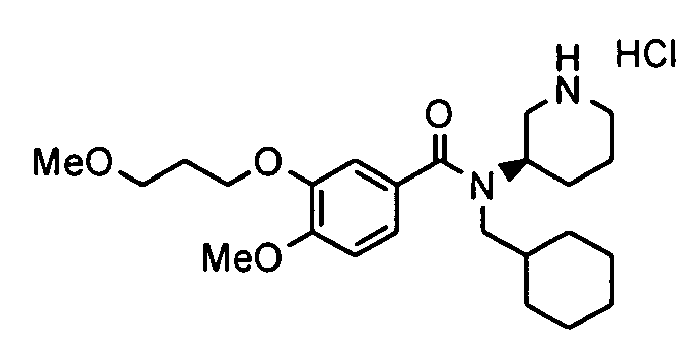
1H-NMR(400MHz, CDCl3) 6.95-6.92(m, 2H), 6.84(d, J = 8.1 Hz, 1H), 4.12(t, J = 6.5 Hz, 2H), 3.88(s, 3H), 3.81-3.74(m, 1H), 3.56(t, J = 6.1 Hz, 2H), 3.50(s, 3H), 3.21-2.71(m, 5H), 2.47(m, 2H), 2.13-2.07(m, 2H), 1.93-1.69(m, 9H), 1.41-1.16(m, 4H), 0.88(m, 2H). MS(ESI+) 419(M++1, 100%). 35 
1H-NMR(400MHz, DMSO-d6) 9.34-9.32(m, 1H), 7.41-7.39(m, 2H), 7.33-7.31(m, 2H), 7.00(m, 3H), 4.59(brs, 2H), 4.18(brs, 1H), 3.95-3.83(m, 2H), 3.78(s, 3H), 3.49-3.44(m, 2H), 3.24(s, 3H), 3.22-3.16(m, 1H), 3.07-3.06(m, 2H), 2.71-2.68(m, 1H), 1.97-1.79(m, 5H), 1.53-1.52(m, 1H). MS(ESI+) 447(M++1, 100%). 36 
1H-NMR(400MHz, DMSO-d6) 7.01-6.98(m, 1H), 6.93-6.89(m, 2H), 4.05-3.99(m,3H), 3.79(s, 3H), 3.49-3.45(m, 2H), 3.33-3.25(m, 2H), 3.24(s, 3H), 3.19-3.16(m, 3H), 2.80-2.77(m, 1H), 2.12-1.90(m, 2H), 1.84(m, 3)H), 1.60-1.56(m, 1H), 1.07-1.05(m, 3H). MS(ESI+) 451(M++1, 100%). 37 
1H-NMR(400MHz, CDCl3) 7.04-7.02(m, 1H), 6.98-6.96(m, 2H), 4.09(t, J = 6.3 Hz, 2H), 3.87(s, 3H), 3.75-3.64(m, 5H), 3.58(t, J = 6.2 Hz, 2H), 3.40(brs, 1H), 3.34(s, 3H), 2.97-2.90(m, 1H), 2.19-2.01(m, 4H), 1.63-1.61(m, 3H), 1.33-1.29(m, 1H), 0.90-0.83(m, 3H). 38 
1H-NMR(400MHz, CDCl3) 6.95-6.88(m, 3H), 4.00-3.98(m, 3H), 3.77(s, 3H), 3.65-3.54(m, 3H), 3.48(t, J = 6.1 Hz, 2H), 3.39(brs, 1H), 3.24(s, 3H), 3.24(m, 1H), 1.99-1.91(m, 4H), 1.69(brs, 1H), 1.23-1.19(m, 1H), 0.93(brs, 1H), 0.45(d, J = 7.6 Hz, 2H), 0.08(brs, 2H). -

1H-NMR (400MHz, CDCl3) 7.00-6.84(m, 3H), 4.13-4.06(m, 3H), 3.93-3.91(m, 1H), 3.88(s, 3H), 3.70-3.61 (m, 1H), 3.56(t, J = 6.1 Hz, 2H), 3.35(s, 3H), 3.29-3.12(m, 4H), 2.63-2.50(m, 4H), 2.14-2.08(m, 2H), 1.88-1.79(m, 2H), 1.51-1.44(m, 2H), 1.38-1.26(m, 8H), 0.94-0.84(m, 4H).
MS (ESI+) 478(M++1, 100%). -

1H NMR (400 MHz, DMSO-d6) δ 9.61-9.58(m, 1H), 8.93-8.90(m, 1H), 7.00-6.98(m, 1H), 6.92-6.86(m, 2H), 4.01(t, J=6.6 Hz, 2H), 3.84-3.73(m, 7H), 3.58-3.55(m, 1H), 3.46(t, J=6.2 Hz, 2H), 3.34(s, 3H), 3.24(s, 3H), 3.11-3.08(m, 2H), 2.90-2.80(m, 1H), 2.16-2.13(m, 1H), 1.97-1.93(m, 2H), 1.04-1.01(m, 6H).
MS (ESI+) 423([M+H]+, 69%). -

1H NMR (400 MHz, DMSO-d6) δ 9.35-9.30(m, 2H), 7.42-7.22(m, 5H), 7.00-6.87(m, 3H), 4.67-4.63(m, 1H), 4.52-4.49(m, 1H), 4.02-3.98(m, 2H), 3.82-3.77(m, 6H), 3.46(t, J=6.3 Hz, 2H), 3.34(s, 3H), 3.23(s, 3H), 3.19-3.17(m, 1H), 3.05-2.95(m, 2H), 2.90-2.87(m, 2H), 2.80-2.75(m, 1H), 1.97-1.91(m, 2H), 1.23-0.93(m, 6H).
MS (ESI+) 512([M+H]+, 100%). -

1H-NMR (300MHz, CDCl3) δ 7.49-7.44(m, 3H), 6.99-6.96(m, 1H), 6.86-6.82(m, 3H), 4.07-3.97(m, 2H), 3.86(s, 3H), 3.81(s, 3H), 3.81-3.61(m, 6H), 3.57-3.52(m, 2H), 3.33(s, 3H), 2.60-2.54(m, 4H), 2.09-2.07(m, 2H), 1.83-1.81(m, 1H), 1.23-1.12(m, 6H).
MS (ESI+) 528(M++1, 100%). -

1H-NMR (300MHz, CDCl3) δ 7.34-7.32(m, 5H), 6.89-6.85(m, 3H), 5.09(s, 2H), 4.10-4.02(m, 2H), 3.87(s, 3H), 3.79-3.62(m, 4H), 3.58-3.53(m, 2H), 3.34(s, 3H), 3.20-3.10(m, 2H), 2.58-2.17(m, 4H), 2.10-2.07(m, 2H), 1.78-1.76(m, 1H), 1.26-1.16(m, 6H).
MS (ESI+) 528(M++1, 100%). -

1H NMR (300 MHz, CDCl3) δ 6.88-6.85(m, 3H), 4.11-4.02(m, 2H), 3.87(s, 3H), 3.80-3.62(m, 6H), 3.58-3.54(m, 2H), 3.34(s, 3H), 2.59-2.55(m, 3H), 2.20-2.10(m, 6H), 1.86-1.83(m, 1H), 1.26-1.18(m, 6H), 0.96-0.92(m, 6H).
MS (ESI+) 478(M++1, 100%). -

MS (ESI+) 441(M++1, 100%). -


1H NMR (300 MHz, CDCl3) δ 7.50-7.39(m, 4H), 7.35-7.26(m, 3H), 7.09-7.03(m, 1H), 6.91-6.85(m, 4H), 4.13-4.09(m, 2H), 4.01(s, 3H), 3.87-3.54(m, 8H), 3.34(s, 3H), 2.65-2.60(m, 3H), 2.15-2.08(m, 2H), 1.87-1.84(m, 2H), 1.24-1.12(m, 6H).
MS (ESI+) 547(M++1, 100%). -

1H NMR (300 MHz, CDCl3) δ 7.42-7.37(m, 3H), 7.31-7.29(m, 2H),6.91-6.84(m, 7H), 5.08(s, 2H), 4.10-4.08(m, 2H), 3.87(s, 3H), 3.79-3.62(m, 6H), 3.57-3.53(m, 2H), 3.34(s, 3H), 2.78-2.74(m, 3H), 2.12-2.07(m, 2H), 1.74-1.70(m, 2H), 1.28-1.16(m, 6H).
MS (ESI+) 577(M++1, 100%). -

1H NMR (300 MHz, CDCl3) δ 7.61-7.55(m, 2H), 7.45-7.26(m, 4H), 7.20-7.09(m, 2H), 6.89-6.84(m, 4H), 4.23-4.11(m, 2H), 3.91 (s, 3H), 3.86-3.62(m, 6H), 3.57-3.53(m, 2H), 3.33(s, 3H), 2.93-2.87(m, 2H), 2.11-2.09(m, 2H), 1.96-1.90(m, 2H), 1.32-1.22(m, 6H).
MS (ESI+) 547(M++1, 100%). -

1H NMR (300 MHz, CDCl3) δ 7.36-7.00(m, 6H), 6.89-6.85(m, 3H), 6.61-6.50(m, 3H), 4.13-4.09(m, 2H), 3.87(s, 3H), 3.80-3.62(m, 6H), 3.58-3.53(m, 2H), 3.34(s, 3H), 2.85-2.81(m, 3H), 2.12-2.08(m, 2H), 1.88-1.86(m, 2H), 1.30-1.20(m, 6H).
MS (ESI+) 563(M++1, 100%). -

1H NMR (300 MHz, CDCl3) δ 7.44-7.29(m, 5H), 7.18-7.12(m, 1H), 6.89-6.84(m, 3H), 6.59-6.45(m, 3H), 5.03(s, 2H), 4.13-4.09(m, 2H), 3.86(s, 3H), 3.79-3.61(m, 6H), 3.57-3.53(m, 2H), 3.34(s, 3H), 2.89-2.82(m, 3H), 2.12-2.08(m, 2H), 1.94-1.90(m, 2H), 1.31-1.21(m, 6H).
MS (ESI+) 577(M++1, 100%). -


1H-NMR (400MHz, MeOD) 6.94(d, J = 8.2 Hz, 1H), 6.88-6.86(m, 2H), 4.00(m,2H), 3.88(m, 1H), 3.78(s, 3H), 3.74-3.71(m, 1H), 3.66-3.55(m, 4H), 3.49(d, J = 6.1 Hz, 2H), 3.25(s, 3H), 3.16-3.12(m, 1H), 2.96-2.87(m, 1H), 2.83-2.78(m, 1H), 2.60(brs, 1H), 2.32(brs, 1H), 1.98-1.92(m, 4H), 1.76-1.70(m, 4H), 1.54-1.36(m, 4H), 1.31-1.26(m, 4H), 1.23-1.05(m, 10H).
MS (ESI+) 546(M++1, 100%). -

1H-NMR (400MHz, MeOD) 6.94(d, J = 7.9 Hz, 1H), 6.89-6.86(m, 2H), 4.00(d,J = 6.3 Hz, 2H), 3.96(m, 1H), 3.78(s, 3H), 3.66-3.55(m, 3H), 3.49(d, J = 6.1 Hz, 2H), 3.25(s, 3H), 3.16(dd, J = 5.2, 13.0 Hz, 1H), 2.78-2.72(m, 1H), 2.63-2.53(m, 3H), 1.93-1.75(m, 5H), 1.20-1.11(m, 6H), 0.66-0.62(m, 2H), 0.44-0.40(m, 2H).
MS (ESI+) 462(M++1, 100%). -

1H-NMR (400MHz, MeOD) 6.96-6.78(m, 2H), 4.03-3.96(m, 3H), 3.76(s, 3H), 3.68-3.57(m, 2H), 3.47(d, J = 6.0 Hz, 2H), 3.33-3.29(m, 1H), 3.24(s, 3H), 2.89-2.83(m, 1H), 2.78-2.68(m, 1H), 2.03-1.81(m, 5H), 1.48-1.43(m, 1H), 1.20-1.06(m, 6H).
MS (ESI+) 399(M++1, 100%). -

1H-NMR (400MHz, MeOD) 6.94(d, J = 8.6 Hz, 1H), 6.88-6.87(m, 2H), 4.01-3.95(m, 3H), 3.78(s, 3H), 3.70-3.54(m, 5H), 3.48(d, J = 6.1 Hz, 2H), 3.24(s, 3H), 2.73-2.69(m, 1H), 2.60(brs, 1H), 2.22-2.17(m, 1H), 1.97-1.91(m, 4H), 1.79-1.77(m, 1H), 1.19-1.11(m, 7H), 0.86-0.84(m, 4H).
MS (ESI+) 448(M++1, 100%). -

1H-NMR (400MHz, MeOD) 7.21-7.13(m, 5H), 6.93(d, J = 8.1 Hz, 1H), 6.87-6.85(m, 2H), 4.01-3.98(m, 3H), 3.77(s, 3H), 3.75(s, 2H), 3.65-3.54(m, 5H), 3.48(t, J = 6.0 Hz, 2H), 3.24(s, 3H), 3.12-3.07(m, 1H), 2.59(brs, 1H), 2.00-1.90(m, 6H), 1.75-1.71(m, 1H), 1.22-1.09(m, 7H), 1.05-1.01(m, 6H).
MS (ESI+) 568(M++1, 100%). -


1H-NMR (400MHz, MeOD) 7.13-7.08(m, 2H), 6.93(d, J = 8.1 Hz, 1H), 6.87-6.85(m, 2H), 6.80-6.75(m, 2H), 4.01-3.98(m, 3H), 3.82(s, 2H), 3.77(s, 3H), 3.67(s, 3H), 3.64-3.43(m, 6H), 3.24(s, 3H), 3.06-3.02(m, 1H), 2.72-2.67(m, 1H), 2.56(brs, 1H), 1.98-1.86(m, 6H), 1.71-1.66(m, 1H), 1.21-1.09(m, 7H), 0.93-0.79(m, 4H).
MS (ESI+) 596(M++1, 100%). -

1H-NMR (300MHz, CDCl3) 6.89-6.87(m, 3H), 5.50-5.48(m, 1H), 4.14-4.09(m, 2H), 3.83(s, 3H), 3.80-3.62(m, 6H), 3.59-3.54(m, 2H), 3.35(s, 3H), 2.70-2.63(m, 3H), 2.15-2.09(m, 3H), 1.78-1.60(m, 2H), 1.29-1.14(m, 12H).
MS (ESI+) 480(M++1, 100%). - The compounds as listed in the following Table were synthesized in a similar manner to Example 53 except that the compounds of Reference Example 126 and Reference Example 127 were used instead of the compound of Reference Example 119 in Example 53, respectively.
[Table 8] Ex. No. Structure MS(ESI+) 58 
570(M++1, 100%). 59 
584(M++1, 100%). -

1H-NMR (400MHz, MeOD) 6.95-6.89(m, 3H), 3.99(d,J = 6.2 Hz, 2H), 3.90(brs, 1H), 3.78(s, 3H), 3.66-3.55(m, 2H), 3.49(d, J = 6.0 Hz, 2H), 3.35(brs, 1H), 3.25(s, 3H), 3.19-3.09(m, 2H), 2.88-2.82(m, 1H), 2.17(brs, 1H), 1.96-1.93(m, 5H), 1.65(brs, 1H), 0.76(brs, 1H).
MS (ESI+) 379(M++1, 100%). -
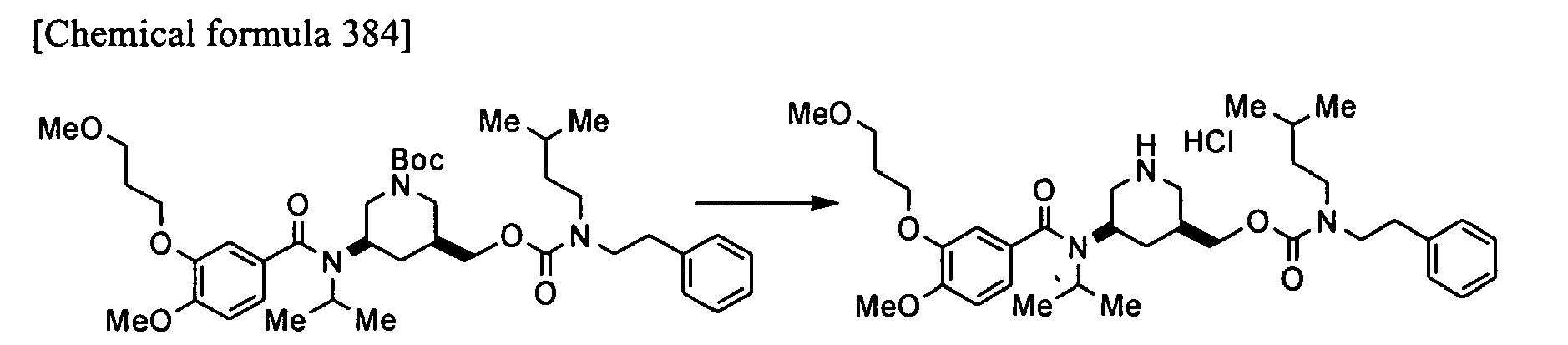
MS (ESI+) 612(M++1, 100%). -

1H-NMR (300MHz, CDCl3) 7.34-7.32(m, 5H), 6.89-6.85(m, 3H), 5.09(s, 2H), 4.10-4.02(m, 2H), 3.87(s, 3H), 3.79-3.62(m, 4H), 3.58-3.53(m, 2H), 3.34(s, 3H), 3.20-3.10(m, 2H), 2.58-2.17(m, 4H), 2.10-2.07(m, 2H), 1.78-1.76(m, 1H), 1.26-1.16(m, 6H).
MS (ESI+) 528(M++1, 100%). -

1H NMR (400 MHz, DMSO-d6) 9.76(m, 1H), 8.99-8.97(m, 1H), 6.99-6.97(m, 1H), 6.90-6.85(m, 2H), 4.30-4.22(m, 2H), 4.01(t, J = 6.7 Hz, 2H), 3.92-3.59(m, 3H), 3.77(s, 3H), 3.53-3.40(m, 5H), 3.28(s, 3H), 3.22(s, 3H), 2.94-2.91(m, 1H), 2.73-2.63(m, 2H), 2.00-1.84(m, 6H), 1.58-1.55(m, 1H), 1.15-1.10(m, 6H), 0.78(m, 4H)
MS (ESI+) 520(M++1, 100%). -

1H NMR (400 MHz, DMSO-d6) 9.2(m, 1H), 8.6(m, 1H), 7.00-6.97(m, 1H), 6.89-6.85(m, 2H), 4.01(t, J = 6.7 Hz, 2H), 3.83-3.80(m, 2H), 3.78(s, 3H), 3.58-3.33(m, 9H), 3.23(s, 3H), 3.22(s, 3H), 2.96-2.95(m, 1H), 2.82-2.66(m, 3H), 1.98-1.86(m, 6H), 1.58-1.56(m, 1H), 1.23-1.12(m, 6H), 0.88-0.76(m, 4H).
MS (ESI+) 534(M++1, 100%) -

1H NMR (400 MHz, DMSO-d6) 9.5(m, 1H), 8.8(m, 1H), 6.99-6.97(m, 1H), 6.90-6.85(m, 2H), 4.00(t, J = 6.7 Hz, 2H), 3.98-3.48(m, 2H), 3.78(s, 3H), 3.48-3.24(m, 5H), 3.21(s, 3H), 3.19(s, 3H), 2.95-2.93(m, 1H), 2.76-2.66(m, 3H), 2.55(m, 2H), 1.98-1.82(m, 8H), 1.78-1.71(m, 2H), 1.58-1.55(m, 1H), 1.18-1.11(m, 6H), 0.86-0.74(m, 4H).
MS (ESI+) 548(M++1, 100%) -

1H NMR (400 MHz, DMSO-d6) 6.99-6.97(m, 1H), 6.91-6.87(m, 2H), 4.46(m, 1H), 4.23-4.00(t, J = 6.7 Hz, 2H), 3.83-3.47(m, 3H), 3.78(s, 3H), 3.47-3.38(m, 6H), 3.23(s, 3H), 2.93(m, 1H), 2.74-2.52(m, 3H), 1.98-1.86(m, 7H), 1.68-1.55(m, 3H), 1.16-1.10(m, 6H), 0.85-0.83(m, 2H), 0.77-0.76(m, 2H).
MS (ESI+) 534(M++1, 100%) -

1H-NMR (400MHz, CD3OD) 7.05-7.03(m, 1H), 6.98-6.95(m, 2H), 4.11-4.06(m, 4H), 3.94-3.91(m, 2H), 3.88(s, 3H), 3.67-3.59(m, 4H), 3.57-3.20(m, 3H), 3.32(s, 3H), 2.85-2.82(m, 1H), 2.60(m, 2H), 2.13-2.01(m, 7H), 1.86-1.83(m, 1H), 1.71-1.68(m, 2H), 1.40-1.21(m, 8H), 1.00-0.98(m, 2H), 0.88-0.85(m, 2H).
MS (ESI+) 548(M++1, 100%) -

1H-NMR (400MHz, CD3OD) 7.05-7.03(m, 1H), 6.98-6.96(m, 2H), 6.35(s, 1H), 4.11-4.06(m, 4H), 3.88(s, 3H), 3.76-3.22(m, 8H), 3.32(s, 3H), 2.13-2.00(m, 8H), 1.93(s, 3H), 1.87-1.79(m, 2H), 1.32-1.13(m, 7H), 0.96-0.90(m, 3H), 0.80(m, 2H).
MS (ESI+) 530(M++1, 100%) -

1H NMR (400 MHz, DMSO-d6) 6.99-6.98(m, 1H), 6.90-6.85(m, 2H), 4.00(t, J = 6.7 Hz, 2H), 3.84(m, 1H), 3.78(s, 3H), 3.65-3.33(m, 6H), 3.23(s, 3H), 3.05-2.71(m, 5H), 1.96-1.85(m, 6H), 1.60(m, 1H), 1.38-1.06(m, 7H), 1.18(s, 6H), 0.86-0.84(m, 2H), 0.77-0.76(m, 2H).
MS (ESI+) 557(M++1, 100%) -

1H-NMR (400MHz, CD3OD) 7.03(m, 1H), 6.98-6.96(m, 2H), 4.11-4.06(m, 4H), 3.88(s, 3H), 3.70-3.40(m, 6H), 3.35(s, 3H), 3.27-3.22(m, 1H), 2.91-2.68(m, 4H), 2.16-2.00(m, 6H), 1.87-1.83(m, 1H), 1.33-1.20(m, 14H), 1.03-1.01(m, 2H), 0.90-0.89(m, 2H).
MS (ESI+) 572(M++1, 100%) -


1H NMR (400 MHz, DMSO-d6) 9.2(m, 1H), 8.6(m, 1H), 7.00-6.97(m, 1H), 6.89-6.85(m, 2H), 4.01(t, J = 6.7 Hz, 2H), 3.83-3.80(m, 2H), 3.78(s, 3H), 3.58-3.33(m, 9H), 3.23(s, 3H), 2.96-2.95(m, 1H), 2.82-2.66(m, 3H), 1.98-1.86(m, 6H), 1.58-1.56(m, 1H), 1.23-1.12(m, 6H), 0.88-0.76(m, 4H).
MS (ESI+) 548(M++1, 100%) -

1H-NMR (400MHz, CD3OD) 7.41-7.26(m, 4H), 7.04-6.95(m, 3H), 4.12-4.07(m, 5H), 3.98(s, 2H), 3.87(s, 3H), 3.59-3.55(m, 5H), 3.42-3.38(m, 2H), 3.34(s, 3H), 3.19-3.14(m, 1H), 3.01-2.96(m, 1H), 2.65-2.58(m, 1H), 2.12-1.98(m, 7H), 1.23-1.01(m, 6H), 1.01-0.98(m, 4H).
MS (ESI+) 600(M++1, 100%) -


1H-NMR (400MHz, CD3OD) 7.26-7.23(m, 2H), 7.18-7.16(m, 5H), 4.09-4.02(m, 5H), 3.98-3.3.89(m, 5H), 3.50(s, 3H), 3.72-3.48(m, 5H), 3.35-3.39(m, 2H), 3.35(s, 3H), 3.15-3.10(m, 1H), 2.95-2.81(m, 1H), 2.75-2.62(m, 1H), 2.12-1.99(m, 7H), 1.23-1.12(m, 6H), 1.02-0.94(m, 4H).
MS (ESI+) 596(M+1, 100%). -

1H-NMR (400MHz, CD3OD) 7.69-7.67(m, 1H), 7.59-7.56(m, 1H), 7.46-7.39(m, 2H), 7.03-6.93(m, 3H), 4.20(s, 2H), 4.09-4.04(m, 5H), 3.97(s, 3H), 3.63-3.50(m, 5H), 3.42-3.38(m, 2H), 3.35(s, 3H), 3.19-3.11(m, 1H), 2.95-2.89(m, 1H), 2.70-2.62(m, 1H), 2.12-1.80(m, 7H), 1.28-1.17(m, 6H), 1.05-0.94(m, 4H).
MS (ESI+) 634(M+1, 100%). -

1H-NMR (400MHz, CD3OD) 8.77-8.72(m, 1H), 8.46-8.40(m, 1H), 7.92-7.86(m, 2H), 7.04-6.94(m, 3H), 4.11-4.01(m, 4H), 3.87(s, 3H), 3.70-3.49(m, 7H), 3.42-3.38(m, 3H), 3.35(s, 3H), 3.21-3.11(m, 1H), 2.99-2.89(m, 1H), 2.75-2.62(m, 1H), 2.18-1.80(m, 7H), 1.25-1.17(m, 6H), 1.10-0.98(m, 4H).
MS (ESI+) 567(M+1, 100%). -

1H-NMR (400MHz, CD3OD) 7.49-7.47(m, 2H), 7.41-7.33(m, 3H), 7.03-6.94(m, 3H), 5.78(s, 1H), 4.10-3.97(m, 5H), 3.86(s, 3H), 3.85-3.76(m, 1H), 3.59-3.55(m, 4H), 3.42-3.38(m, 2H), 3.33(s, 3H), 3.19-3.15(m, 2H), 2.68-2.58(m, 1H), 2.44-2.37(m, 1H), 2.06-1.86(m, 7H), 1.23-1.11(m, 6H), 1.01-0.81(m, 4H).
MS (ESI+) 582(M+1, 100%). -

1H-NMR (400MHz, CD3OD 7.39-7.26(m, 5H), 7.03-6.94(m, 3H), 4.95-4.92(m,1H), 4.67-4.63(m, 1H), 4.14-4.06(m, 5H), 3.86(s, 3H), 3.67-3.55(m, 6H), 3.59-3.55(m, 2H), 3.33(s, 3H), 3.19-3.15(m, 2H), 2.69-2.64(m, 2H), 2.06-1.92(m, 7H), 1.23-1.18(m, 6H), 0.94-0.72(m, 4H).
MS (ESI+) 596(M+l, 100%). -

1H-NMR (400MHz, CD3OD) 8.77-8.71(m, 2H), 8.46-8.40(m, 1H), 7.96-7.94(m, 1H), 7.03-6.93(m, 3H), 4.28-4.26(m, 2H), 4.09-4.07(m, 2H), 3.86(s, 3H), 3.70-3.49(m, 7H), 3.42-3.38(m, 3H), 3.35(s, 3H), 3.21-3.11(m, 1H), 2.99-2.89(m, 1H), 2.75-2.62(m, 1H), 2.18-1.80(m, 7H), 1.22-1.17(m, 6H), 1.10-0.99(m, 4H).
MS (ESI+) 567(M+1, 100%). -

1H-NMR (400MHz, CD3OD) 8.79(s, 1H), 7.41(s, 1H), 7.04-6.93(m, 3H), 4.17(s, 2H), 4.09-4.06(m, 5H), 3.86(s, 3H), 3.70-3.49(m, 8H), 3.35(s, 3H), 3.12-3.12(m, 1H), 2.89-2.81(m, 1H), 2.85-2.74(m, 1H), 2.13-1.98(m, 7H), 1.23-1.17(m, 6H), 1.09-0.95(m, 4H).
MS (ESI+) 556(M+1, 100%). -

1H-NMR (400MHz, CD3OD) 8.75-8.73(m, 2H), 8.00-7.98(m, 2H), 7.04-6.94(m, 3H), 4.37-4.35(m, 2H), 4.09-3.97(m, 4H), 3.87(s, 3H), 3.62-3.55(m, 6H), 3.42-3.38(m, 2H), 3.35(s, 3H), 3.21-3.10(m, 1H), 2.95-2.80(m, 1H), 2.70-2.62(m, 1H), 2.12-1.98(m, 7H), 1.23-1.17(m, 6H), 1.06-0.98(m, 4H).
MS (ESI+) 567(M+1, 100%). -


WO 2005/105780 ), the title compound was synthesized in a similar manner to Example 72 as a colorless oily compound.
1H-NMR (400MHz, CD3OD) 7.32-7.26(m, 2H), 7.10-6.95(m, 5H), 4.10-3.97(m, 6H), 3.86(s, 3H), 3.64-3.57(m, 6H), 3.35(s, 3H), 3.28-3.15(m, 4H), 2.95(s, 3H), 2.82-2.76(m, 1H), 2.75-2.64(m, 1H), 2.06-2.02(m, 7H), 1.24-1.17(m, 6H), 1.02-0.90(m, 4H).
MS (ESI+) 659(M+1, 100%). -

1H-NMR (400MHz, CD3OD) 7.66-7.60(m, 3H), 7.51-7.48(m, 1H), 7.04-6.94(m, 3H), 4.09-4.07(m, 6H), 3.86(s, 3H), 3.62-3.50(m, 6H), 3.42-3.38(m, 2H), 3.33(s, 3H), 3.21-3.11(m, 1H), 2.95-2.88(m, 1H), 2.75-2.67(m, 1H), 2.08-1.80(m, 7H), 1.25-1.17(m, 6H), 1.04-0.94(m, 4H).
MS (ESI+) 591(M+1, 100%). -

1H-NMR (400MHz, CD3OD) 7.46-7.42(m, 2H), 7.30-7.26(m, 2H), 7.08-6.94(m, 4H), 6.88-6.75(m, 2H), 4.10-4.07(m, 3H), 3.86(s, 3H), 3.68-3.65(m, 4H), 3.59-3.51(m, 4H), 3.33(s, 3H), 3.21-3.11(m, 1H), 2.95-2.88(m, 1H), 2.75-2.67(m, 1H), 2.08-1.80(m, 7H), 1.24-1.18(m, 6H), 1.05-0.89(m, 4H).
MS (ESI+) 567(M+1, 100%). -

1H-NMR (400MHz, CD3OD) 7.43-7.36(m, 5H), 7.03-6.94(m, 3H), 4.88(m, 2H), 4.42(s, 2H), 4.09-3.93(m, 4H), 3.86(s, 3H), 3.68-3.64(m, 1H), 3.57(t, J=6.1 Hz, 2H), 3.51-3.47(m, 1H), 3.34(s, 3H), 3.27-3.18(m, 2H), 2.75-2.65(m, 1H), 2.66-2.55(m, 1H), 2.11-1.85(m, 7H), 1.23-1.18(m, 6H), 0.75-0.70(m, 4H).
MS (ESI+) 620(M+1, 50%). -

1H-NMR (400MHz, CD3OD) 7.04-7.01(m, 1H), 6.97-6.94(m, 2H), 4.88(m, 2H), 4.18-4.12(m, 2H), 4.10-4.07(m, 4H), 3.86(s, 3H), 3.71-3.64(m, 1H), 3.57(t, J=6.1 Hz, 2H), 3.54-3.48(m, 2H), 3.34(s, 3H), 3.27-3.20(m, 2H), 2.75-2.65(m, 2H), 2.10-2.00(m, 6H), 1.90-1.82(m, 1H), 1.28(t, J=7.1 Hz, 3H), 1.24-1.21(m, 6H), 0.82-0.68(m, 4H).
MS (ESI+) 520(M+1, 100%). -

1H-NMR (400MHz, CD3OD) 7.96-7.91(m, 2H), 7.55-7.42(m, 2H), 7.03-6.91(m, 3H), 4.08-4.06(m, 4H), 4.01-3.98(m, 1H), 3.86(s, 3H), 3.75-3.51(m, 8H), 3.33(s, 3H), 3.29-3.18(m, 1H), 2.85-2.80(m, 1H), 2.66-2.54(m, 1H), 2.20-1.95(m, 4H), 1.87-1.80(m, 4H), 1.23-1.18(m, 6H), 1.10-1.02(m, 4H).
MS (ESI+) 610(M+1, 100%). -

1H-NMR (400MHz, CD3OD) 7.81-7.75(m, 2H), 7.50-7.41(m, 2H), 7.03-6.91(m, 3H), 4.90-4.88(m, 4H), 4.09-3.91(m, 6H), 3.86(s, 3H), 3.70-3.55(m, 6H), 3.34(s, 3H), 3.27-3.18(m, 1H), 2.85-2.80(m, 1H), 2.70-2.60(m, 1H), 2.15-1.90(m, 6H), 1.87-1.80(m, 1H), 1.23-1.18(m, 6H), 1.04-0.93(m, 4H).
MS (ESI+) 609(M+1, 100%). -

1H-NMR (400MHz, CD3OD) 7.94-7.90(m, 2H), 7.55-7.42(m, 2H), 7.03-6.91(m, 3H), 4.33(q, J=7.1 Hz, 2H), 4.15-3.90(m, 6H), 3.86(s, 3H), 3.75-3.55(m, 7H), 3.33(s, 3H), 3.20-3.15(m, 1H), 2.85-2.80(m, 1H), 2.70-2.60(m, 1H), 2.15-1.90(m, 6H), 1.87-1.75(m, 2H), 1.37(t, J=7.1 Hz, 3H), 1.23-1.17(m, 6H), 1.02-0.93(m, 4H).
MS (ESI+) 638(M+1, 100%). -


1H-NMR (400MHz, MeOD) 7.22-7.19(m, 2H), 6.97-6.92(m, 3H), 6.87-6.85(m, 2H), 4.00-3.95(m, 3H), 3.88(s, 2H), 3.77(s, 3H), 3.68-3.41(m, 7H), 3.24(s, 3H), 3.08-3.06(m, 1H), 2.73(brs, 1H), 2.59(brs, 1H), 1.97-1.88(m, 6H), 1.71-1.69(m, 1H), 1.20-1.09(m, 6H), 0.92-0.83(m, 4H).
MS (ESI+) 584(M++1, 100%). -

1H-NMR (400MHz, MeOD) 7.46-7.42(m, 5H), 6.95-6.86(m, 3H), 4.01-3.95(m, 3H), 3.77(s, 3H), 3.67-3.54(m, 5H), 3.49-3.41(m, 3H), 3.24(s, 3H), 2.86(brs, 1H), 2.64(brs, 1H), 2.22-2.16(m, 1H), 1.97-1.91(m, 3H), 1.78(m, 1H), 1.51(m, 1H), 1.24-1.10(m, 7H), 0.54(brs, 2H), 0.42(brs, 2H).
MS (ESI+) 552(M++1, 100%). -

1H-NMR (400MHz, MeOD) 7.20-7.10(m, 5H), 6.94(d, J = 8.4 Hz, 1H), 6.89-6.86(m, 2H), 4.01-3.98(m, 3H), 3.90-3.82(m, 1H), 3.78(s, 3H), 3.65-3.47(m, 7H), 3.37-3.30(m, 1H), 3.25(s, 3H), 3.07(m, 2H), 2.62-2.50(m, 3H), 1.98-1.85(m, 7H), 1.21-1.11(m, 6H), 0.87-0.79(m, 2H), 0.74-0.68(m, 2H).
MS (ESI+) 580(M++1, 100%). -


1H-NMR (400MHz, MeOD) 7.33-7.29(m, 1H), 6.97-6.94(m, 1H), 6.84-6.83(m, 2H), 4.03-4.00(m, 3H), 3.84(brs, 1H), 3.68-3.59(m, 1H), 3.53-3.48(m, 2H), 3.27-3.24(m, 5H), 2.90-2.87(m, 1H), 2.69(brs, 1H), 2.06-1.83(m, 5H), 1.16(brs, 6H).
MS (ESI+) 335(M++1, 100%). -

1H-NMR (400MHz, CDCl3) 6.91-6.82(m, 3H), 4.24-4.19(m, 1H), 4.15-4.10(m, 3H), 3.90(s, 3H), 3.65-3.55(m, 2H), 3.36-3.34(m, 5H), 3.14(brs, 1H), 3.03-2.95(m, 1H), 2.24(m, 1H), 2.15-2.00(m, 5H), 1.44-1.33(m, 3H), 1.27-1.18(m, 6H).
MS (ESI+) 379(M++1, 100%). -

- The title compound (338 mg) was synthesized in a similar manner to Example 4.
1H NMR (400 MHz, DMSO-d6) 9.27-9.16(m, 2H), 6.51(t, J = 2.2 Hz, 1H), 6.42(d, J = 2.2 Hz, 2H), 4.01 (t, J = 6.4 Hz, 4H), 3.73-3.59(m, 2H), 3.49-3.40(m, 7H), 3.24(s, 6H), 3.14-3.12(m, 1H), 2.76-2.73(m, 1H), 2.55-2.52(m, 1H), 2.02-1.71(m, 6H), 1.14-1.08(m, 6H).
MS (ESI+) 423(M++1, 100%). -


1H-NMR (300MHz, MeOD) 7.63(d, J = 7.8 Hz, 1H), 7.02(d, J = 1.8 Hz, 1H), 6.83(dd, J = 1.8, 7.8 Hz, 2H), 4.16(t, J = 6.3 Hz, 2H), 4.04-3.90(m, 2H), 3.74-3.56(m, 4H), 3.35(m, 4H), 2.98-2.90(m, 1H), 2.75(brs, 1H), 2.11-2.03(m, 3H), 1.94-1.90(m, 2H), 1.24(brs, 6H).
MS (ESI+) 413(M++1, 50%), 415(M++1, 50%). -

1H-NMR (300MHz, MeOD) 7.43-7.32(m, 5H), 6.66-6.64(m, 1H), 6.52-6.47(m, 2H), 5.10(s, 2H), 4.05(m, 3H), 3.88(brs, 1H), 3.75-3.53(m, 6H), 2.96-2.87(m, 1H), 2.74(m, 1H), 2.04-1.96(m, 3H), 1.89-1.86(m, 2H), 1.17(brs, 6H).
MS (ESI+) 441(M++1, 100%). -

1H-NMR(300MHz, MeOD) 6.44-6.42(m, 1H), 6.36-6.31(m, 2H), 4.04-4.00(m, 4H), 3.74-3.63(m, 2H), 3.59-3.53(m, 3H), 3.35(s, 3H), 2.97-2.90(m, 1H), 2.73(brs, 1H), 2.09-1.96(m, 3H), 1.91-1.87(m, 2H), 1.22(brs, 6H).
MS (ESI+) 351(M++1, 100%). -


1H-NMR (400MHz, MeOD) 7.41-7.37(m, 2H), 7.19-7.15(m, 1H), 7.05-7.03(m, 2H), 6.63-6.62(m, 2H), 6.43(m, 1H), 4.06-3.94(m, 4H), 3.75-3.66(m, 1H), 3.59-3.48(m, 3H), 3.37-3.32(m, 4H), 2.95-2.89(m, 1H), 2.70(brs, 1H), 2.07-1.97(m, 3H), 1.87-1.84(m, 2H), 1.19(brs, 6H).
MS (ESI+) 427(M++1, 100%). -
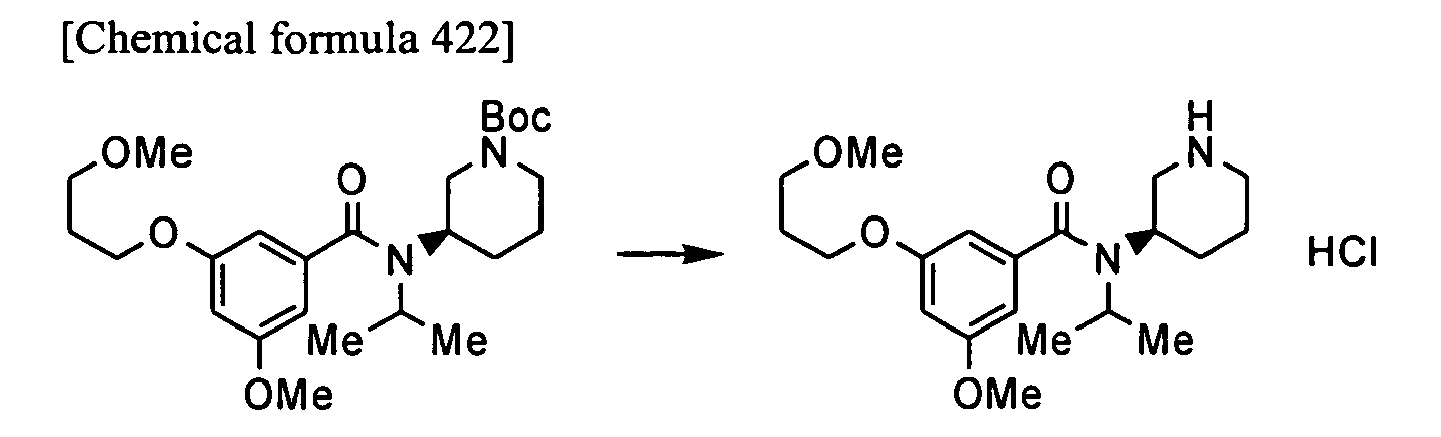
1H-NMR (400MHz, MeOD) 6.57-6.56(m, 1H), 6.46(brs, 2H), 4.07-4.04(m, 3H), 3.93-3.85(m, 1H), 3.80(s, 3H), 3.75-3.66(m, 2H), 3.59-3.54(m, 2H), 3.39(m, 1H), 3.34(s, 3H), 2.96-2.93(m, 1H), 2.74(brs, 1H), 2.04-1.98(m, 3H), 1.91-1.89(m, 2H), 1.22(brs, 6H).
MS (ESI+) 365(M++1, 100%). -

1H-NMR (400MHz, MeOD) 6.55(m, 1H), 6.45(m, 2H), 4.07-4.04(m, 3H), 3.93(brs, 1H), 3.83-3.81(m, 2H), 3.74-3.66(m, 2H), 3.59-3.54(m, 2H), 3.39(m, 1H), 3.34(s, 3H), 2.93(m, 1H), 2.74(brs, 1H), 2.04-1.99(m, 3H), 1.91-1.89(m, 2H), 1.22(brs, 6H), 0.62-0.60(m, 2H), 0.35-0.34(m, 2H).
MS (ESI+) 405(M++1, 100%). -


1H-NMR (400MHz, MeOD) 6.54-6.53(m, 1H), 6.44-6.43(m, 2H), 4.64-4.57(m, 1H), 4.06-4.03(m, 3H), 3.95(brs, 1H), 3.75-3.66(m, 1H), 3.59-3.52(m, 3H), 3.39(m, 1H), 3.34(s, 3H), 2.97-2.91(m, 1H), 2.74(brs, 1H), 2.08-1.98(m, 3H), 1.92-1.89(m, 2H), 1.30(d, J = 6.0 Hz, 6H), 1.22(brs, 6H).
MS (ESI+) 393(M++1, 100%). -

1H-NMR (400MHz, MeOD) 6.54-6.53(m, 1H), 6.44(m, 2H), 4.32-4.30(m, 2H), 4.06-3.95(m, 4H), 3.57-3.54(m, 3H), 3.39(m, 1H), 3.34(s, 3H), 2.94(m, 1H), 2.74(brs, 1H), 2.05-1.89(m, 3H), 1.78(m, 2H), 1.59-1.22(m, 16H).
MS (ESI+) 433(M++1, 100%). -

1H-NMR(300MHz, MeOD) 7.63-7.60(m, 2H), 7.48-7.37(m, 3H), 7.26-7.24(m, 1H), 7.14-7.13(m, 1H), 6.89-6.88(m, 1H), 4.18-4.03(m, 4H), 3.74-3.57(m, 4H), 3.39(m, 1H), 3.35(s, 3H), 2.96(m, 1H), 2.79(m, 1H), 2.10-2.02(m, 3H), 1.93(m, 2H), 1.25(brs, 6H).
MS (ESI+) 411(M++1, 100%). -
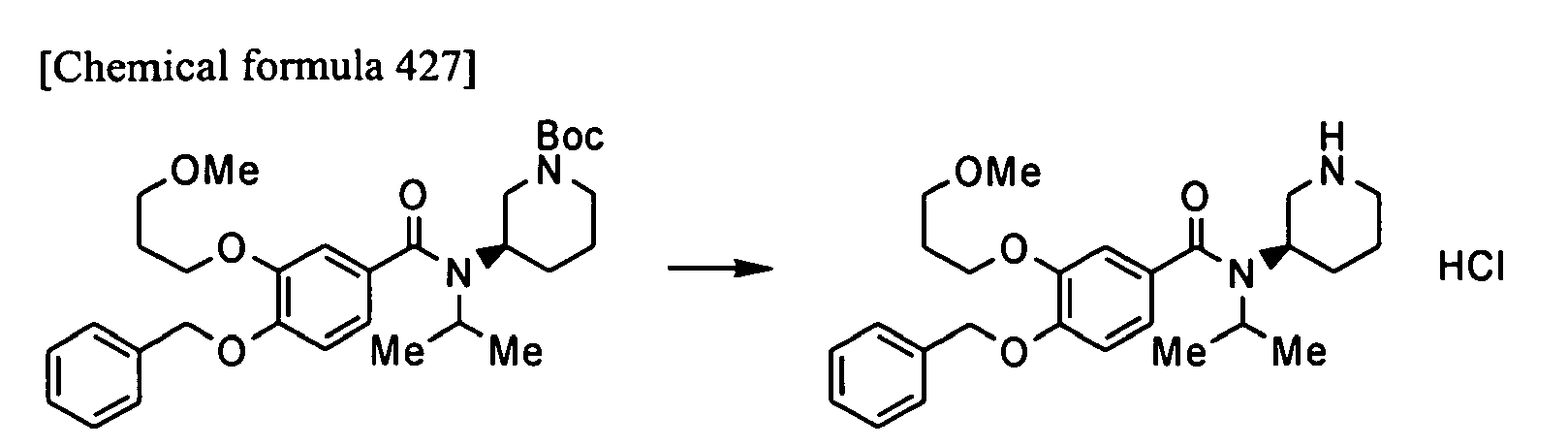
1H-NMR (400MHz, MeOD) 7.46(m, 2H), 7.38-7.34(m, 2H), 7.32-7.28(m, 1H), 7.07(d, J = 8.2 Hz, 1H), 6.98(d, J = 1.8 Hz, 1H), 6.89(dd, J = 1.8, 8.2 Hz, 1H), 5.14(s, 2H),4.1 1(t, J = 6.2 Hz, 2H), 4.00(brs, 1H), 3.75-3.56(m, 5H), 3.39(m, 1H), 3.30(s, 3H), 2.97-2.90(m, 1H), 2.69(brs, 1H), 2.07-2.01(m, 3H), 1.91-1.88(m, 2H), 1.24(brs, 6H).
MS (ESI+) 441(M++1, 100%). -

1H-NMR (400MHz, MeOD) 6.93(d, J = 1.7 Hz, 1H), 6.86(d, J = 8.1 Hz, 1H), 6.82(dd, J = 1.7, 8.1 Hz, 1H), 4.14-4.11(m, 3H), 4.04(brs, 1H), 3.61-3.52(m, 3H), 3.39-3.35(m, 5H), 2.98-2.90(m, 1H), 2.78(brs, 1H), 2.09-2.03(m, 3H), 1.92-1.82(m, 2H), 1.26(brs, 6H).
MS (ESI+) 351(M++1, 100%). -

1H-NMR (400MHz, MeOD) 7.21-7.19(m, 1H), 6.87-6.83(m, 2H), 4.35 -4.29(m, 2H), 4.22-4.16(m, 1H), 4.10-4.06(m, 2H), 3.74-3.65(m, 3H), 3.35-3.32(m, 4H), 2.95(m, 1H), 2.78-2.62(m, 3H), 2.08-2.01(m, 3H), 1.90(m, 2H), 1.59-1.54(m, 2H), 1.41-1.24(m, 8H), 0.94(t, J = 7.2 Hz, 3H).
MS (ESI+) 391(M++1, 100%). -


1H-NMR (400MHz, MeOD) 7.32-7.28(m, 2H), 7.11-7.02(m, 3H), 6.97-6.95(m, 1H), 6.89-6.87(m, 2H), 4.06-4.03(m, 4H), 3.75-3.65(m, 1H), 3.40-3.35(m, 2H), 3.23(t, J = 6.2 Hz, 2H), 3.19(s, 3H), 2.98-2.92(m, 1H), 2.76(brs, 1H), 2.09-2.04(m, 1H), 1.94-1.81(m, 4H), 1.27(brs, 6H).
MS (ESI+) 427(M++1, 100%). -

1H-NMR (400MHz, MeOD) 7.24-7.20(m, 2H), 7.14-7.13(m, 4H), 6.89-6.88(m, 1H), 6.81-6.79(m, 1H), 4.32-4.30(m, 6H), 4.10-4.07(m, 3H), 3.79-3.61(m, 1H), 3.35(s, 3H), 2.95-2.87(m, 5H),2.11-2.05(m, 3H), 1.93-1.90(m, 2H), 1.23(brs, 6H).
MS (ESI+) 439(M++1, 100%). -

1H-NMR (400MHz, MeOD) 7.02(d, J = 8.2 Hz, 1H), 6.96(d, J = 1.8 Hz, 1H), 6.90(dd, J = 1.8, 8.2 Hz, 1H),4.62-4.56(m, 1H), 4.17-4.02(m, 4H), 3.77-3.63(m, 4H), 3.39(m, 1H), 3.34(s, 3H), 2.97-2.91(m, 1H), 2.70(brs, 1H), 2.07-2.00(m, 3H), 1.92-1.89(m, 2H), 1.32(d, J = 6.1 Hz, 6H), 1.25(m, 6H).
MS (ESI+) 393(M++1, 100%). -


1H-NMR (400MHz, MeOD) 6.99-6.90(m, 3H), 4.14-4.09(m, 2H), 4.00(m, 2H), 3.87(m, 2H), 3.72-3.59(m, 4H), 3.39(m, 1H), 3.34(s, 3H), 2.92(m, 1H), 2.69(brs, 1H), 2.04(m, 3H), 1.88(m, 2H), 1.24(m, 7H), 0.60(m, 2H), 0.35(m, 2H).
MS (ESI+) 405(M++1, 100%). -
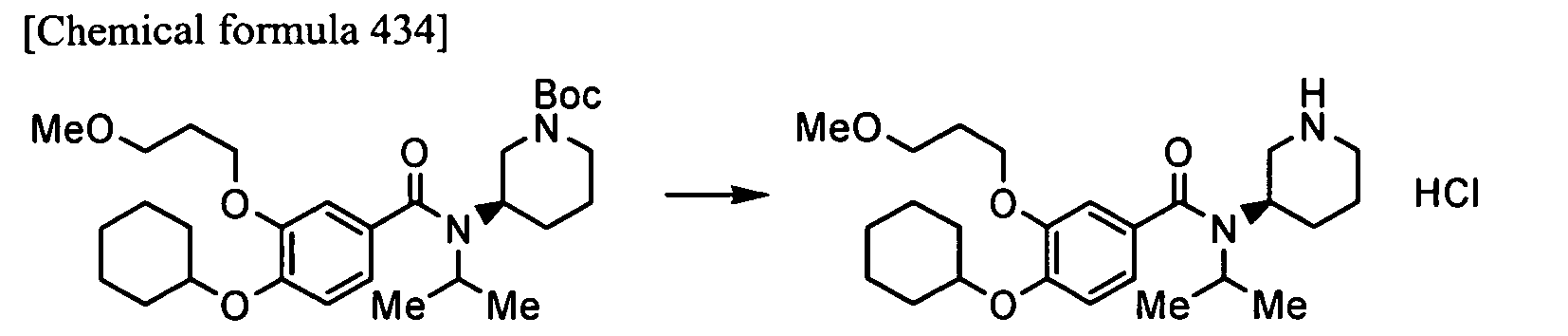
- 1H-NMR (400MHz, MeOD) 7.03-7.01(m, 1H), 6.96-6.95(m, 1H), 6.89(m, 1H), 4.34-4.30(m, 2H), 4.11-3.98(m, 4H), 3.80-3.58(m, 3H), 3.39(m, 1H), 3.34(s, 3H), 2.92(m, 1H), 2.69(brs, 1H), 2.09-2.01(m, 3H), 1.92-1.80(m, 6H), 1.58-1.53(m, 3H), 1.44-1.35(m, 3H), 1.25(brs, 6H).
MS (ESI+) 433(M++1, 100%). -

1H-NMR (400MHz, MeOD) 7.18(m, 1H), 6.93-6.89(m, 1H), 4.59-4.56(m, 1H), 4.09-4.05(m, 3H), 3.79-3.56(m, 4H), 3.39-3.36(m, 2H), 3.34(s, 3H), 2.97(m, 1H), 2.80(m, 1H), 2.11-1.99(m, 3H), 1.95-1.86(m, 2H), 1.35-1.28(m, 9H), 1.19-1.16(m, 3H).
MS (ESI+) 471(M++1, 50%), 473(M++1, 50%). -


1H-NMR (400MHz, MeOD) 7.48-7.35(m, 5H), 7.01(s, 1H), 6.93-6.89(m, 1H), 4.67-4.61(m, 1H), 4.31-4.30(m, 2H), 4.13(m, 2H), 3.78-3.36(m, 6H), 3.31(s, 3H), 2.99-2.85(m, 1H), 2.09-2.03(m, 3H), 1.82-1.73(m, 2H), 1.38-1.26(m, 9H), 1.00(d, J = 6.6 Hz, 3H).
MS (ESI+) 469(M++1, 100%). -

1H-NMR (400MHz, MeOD) 7.00(d, J = 8.2 Hz, 1H), 6.95(d, J = 1.8 Hz, 1H), 6.91(dd, J = 1.8, 8.2 Hz, 1H), 4.12-4.02(m, 6H), 3.74-3.57(m, 4H), 3.39(m, 1H), 3.34(s, 3H), 2.97-2.91 (m, 1H), 2.70(brs, 1H), 2.08-2.00(m, 3H), 1.92-1.89(m, 2H), 1.41(t, J = 7.0 Hz, 3H), 1.25(brs, 6H).
MS (ESI+) 379(M++1, 100%). -

1H-NMR (400MHz, MeOD) 7.00(d, J = 8.2 Hz, 1H), 6.95(d, J = 1.8 Hz, 1H), 6.91 (dd, J = 1.8, 8.2 Hz, 1H), 4.09(t, J = 6.3 Hz, 2H), 4.01-3.98(m, 3H), 3.75-3.58(m, 5H), 3.39(m, 1H), 3.34(s, 3H), 2.98-2.91(m, 1H), 2.70(brs, 1H), 2.05-2.00(m, 3H), 1.93-1.78(m, 4H), 1.26-1.24(m, 6H), 1.06(t, J = 7.4 Hz, 3H).
MS (ESI+) 393(M++1, 100%). -


1H-NMR (400MHz, MeOD) 7.05(d, J = 8.2 Hz, 1H), 6.98(d, J = 1.8 Hz, 1H), 6.92(dd, J = 1.8, 8.2 Hz, 1H), 4.83-4.78(m, 1H), 4.68-4.66(m, 1H), 4.35-4.30(m, 1H), 4.25-4.23(m, 1H), 4.11(t, J = 6.2 Hz, 2H), 4.00(m, 2H), 3.87-3.55(m, 4H), 3.39(m, 1H), 3.34(s, 3H), 2.97-2.91 (m, 1H), 2.69(brs, 1H), 2.09-2.0 1 (m, 3H), 1.93-1.90(m, 2H), 1.25(m, 6H).
MS (ESI+) 397(M++1, 100%). -

- The title compound (7.0 mg) was synthesized in a similar manner to Example 4.
MS (ESI+) 399(M++1, 100%). -

1H-NMR (400MHz, MeOD) 6.88(m, 1H), 6.77-6.73(m, 1H), 4.57-4.54(m, 1H), 4.12-4.03(m, 3H), 3.84-3.56(m, 5H), 3.41-3.39(m, 1H), 3.34(s, 3H), 2.96(m, 1H), 2.80(m, 1H), 2.51-2.44(m, 2H), 2.10-1.98(m, 3H), 1.91-1.89(m, 2H), 1.67-1.56(m, 2H), 1.31(t, J = 6.0 Hz, 6H), 1.21-1.17(m, 6H), 0.95(t, J = 7.3 Hz, 3H).
MS (ESI+) 435(M++1, 100%). -

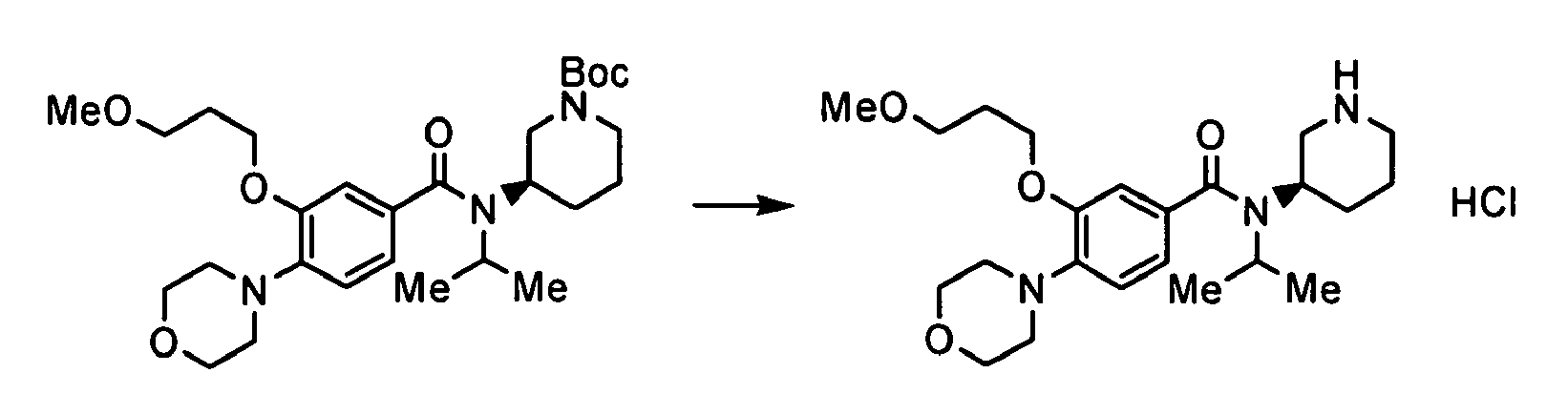
1H-NMR (400MHz, MeOD) 7.62(d, J = 8.2 Hz, 1H), 7.24(s, 1H), 7.10(d, J = 8.2 Hz, 1H), 4.31(t, J = 6.2 Hz, 2H), 4.08-4.06(m, 5H), 3.89-3.87(m, 1H), 3.75-3.58(m, 7H), 3.39-3.36(m, 5H), 2.95(m, 1H), 2.78(brs, 1H), 2.19-2.13(m, 2H), 2.09-2.05(m, 1H), 1.95-1.89(m, 2H), 1.24(brs, 6H).
MS (ESI+) 420(M++1, 100%). -

1H-NMR (400MHz, MeOD) 7.21(d, J = 7.6 Hz, 1H), 6.72-6.69(m, 2H), 5.75(s,1H), 5.19(s, 1H), 4.05-3.95(m, 8H), 3.52(t, J = 6.6 Hz, 2H), 3.38-3.33(m, 1H), 3.36(s, 3H), 3.00-2.98(m, 2H), 2.70-2.56(m, 3H), 2.26(s, 6H), 2.06-1.99(m, 2H), 1.77(m, 2H), 1.34-1.13(m, 12H).
MS (ESI+) 586(M++1, 100%). -

- 1H-NMR (400MHz, MeOD) 7.05-7.04(m, 1H), 6.93-6.89(m, 1H), 4.62-4.56(m, 1H), 4.12-4.05(m, 3H), 3.79-3.72(m, 1H), 3.67-3.56(m, 4H), 3.41-3.38(m, 1H), 3.35(s, 3H), 2.97(m, 1H), 2.81(m, 1H), 2.11-1.97(m, 3H), 1.94-1.85(m, 2H), 1.38-1.16(m, 12H).
MS (ESI+) 427(M++1, 100%). -

1H-NMR (400MHz, MeOD) 7.08-7.07(m, 1H), 6.97-6.93(m, 1H), 4.12-4.02(m, 3H), 3.87(s, 3H), 3.77-3.72(m, 1H), 3.68-3.63(m, 4H), 3.59-3.52(m, 1H), 3.48-3.45(m, 2H), 3.40-3.37(m, 1H), 2.11-2.07(m, 1H), 1.94-1.82(m, 2H), 1.27-1.16(m, 6H).
MS (ESI+) 428(M++1, 100%). -

- 1H-NMR (400MHz, MeOD) 7.63(d, J = 8.0 Hz, 1H), 7.05(d, J = 1.7 Hz, 1H), 6.86(dd, J = 1.7, 8.0 Hz, 1H), 4.12(t, J = 5.7 Hz, 1H), 4.05(brs, 1H), 3.90-3.88(m, 1H), 3.64(s, 3H), 3.59-3.48(m, 3H), 3.35(m, 2H), 2.94-2.91(m, 1H), 2.76(brs, 1H), 2.12-2.06(m, 1H), 1.97-1.84(m, 2H), 1.23(brs, 6H). MS (ESI+) 442(M++1, 50%), 444(M++1, 50%).
-

1H-NMR (400MHz, MeOD) 7.06-7.05(m, 1H), 6.92-6.88(m, 1H), 4.13-4.03(m, 3H), 3.86(s, 3H), 3.77-3.72(m, 1H), 3.67-3.57(m, 5H), 3.41-3.28(m, 3H), 2.98-2.91 (m, 1H), 2.85-2.77(m, 1H), 2.11-2.07(m, 1H), 1.99-1.84(m, 4H), 1.28-1.16(m, 6H).
MS (ESI+) 442(M++1, 100%). -

1H-NMR (400MHz, MeOD) 7.00(d, J = 8.2 Hz, 1H), 6.94(d, J = 1.9 Hz, 1H), 6.91 (dd, J = 1.9, 8.2 Hz, 1H), 4.09-4.04(m, 4H), 3.60-3.57(m, 3H), 3.39-3.30(m, 6H), 2.97-2.90(m, 1H), 2.69(brs, 1H), 2.08-1.99(m, 3H), 1.94-1.79(m, 8H), 1.69-1.64(m, 2H), 1.26(brs, 6H).
MS (ESI+) 419(M++1, 100%). -

MS (ESI+) 432(M++1, 100%). - The compounds of Examples 127 - 135 are listed in the following Table, said compounds being synthesized as an analog compounds of Example 126.

Ex. No. R1d R1e R1f Ex. No. R1d R1e R1f 127 MeO2CNH(CH2)2 Me Me 131 MeO(CH2)3 H Et 128 MeO(CH2)3 (S)-Ph(2,5-F) (R)-Me 132 MeO(CH2)3 CONMe2 Me 129 MeO(CH2)3 Me Et 133 MeO2CNH(CH2)2 (S)-Ph(2,5-F) (R)-Me 130 MeO(CH2)3 H (R)-Me 134 MeO(CH2)3 Me Me 135 MeO(CH2)4 CH2OMe Me - The physiochemical properties of the above compounds are shown below.
The compound of Example 127: MS (ESI+) 447(M++1, 100%).
The compound of Example 128: MS (ESI+) 516(M++1, 100%).
The compound of Example 129: MS (ESI+) 432(M++1, 100%).
The compound of Example 130: MS (ESI+) 404(M++1, 100%).
The compound of Example 131: MS (ESI+) 418(M++1, 100%).
The compound of Example 132: MS (ESI+) 475(M++1, 100%).
The compound of Example 133: MS (ESI+) 545(M++1, 100%).
The compound of Example 134: MS (ESI+) 418(M++1, 100%).
The compound of Example 135: MS (ESI+) 448(M++1, 100%). - The compounds of Examples 136- 169 are listed in the following Tables, said compounds being synthesized as an analog compound of Example 1.
[Table 9] Ex. No. Structure MS(ESI+) 136 
455(M++1, 100%). 137 
498(M++1, 100%). 138 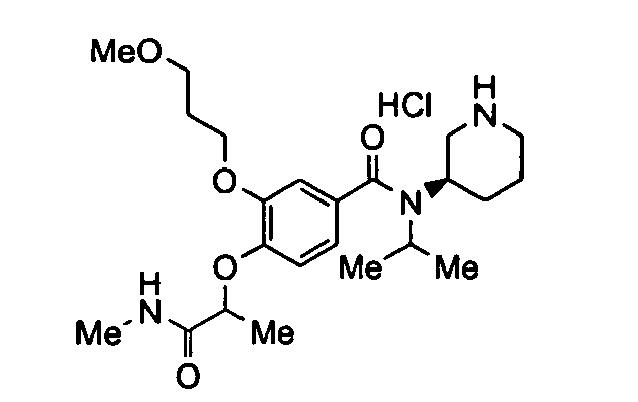
584(M++1, 100%). 139 
464(M++1, 100%). 140 
463(M++1, 100%). 141 
449(M++1,100%). 142 
407(M++1, 100%). -
143 
407(M++1, 100%). 144 
576(M++1, 100%). 145 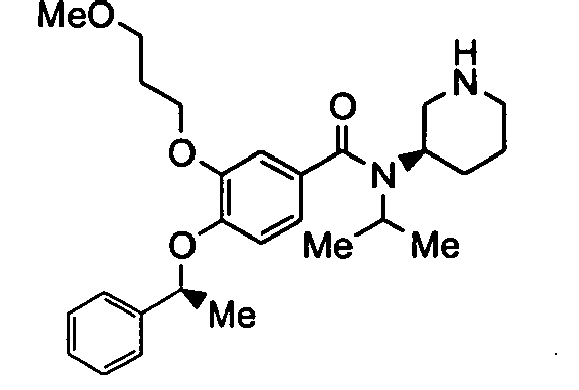
455(M++1, 100%). 146 
534(M++1, 100%). 147 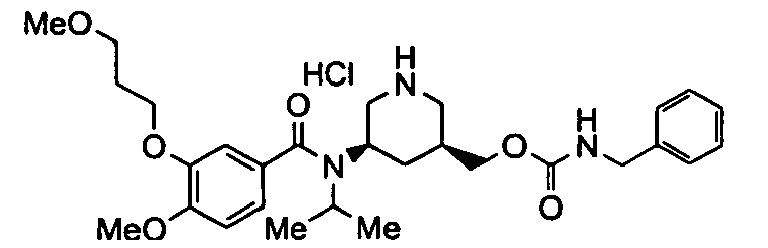
528(M++1, 100%). 148 
618(M++1, 100%). 149 
598(M++1, 100%). 150 
584(M++1, 100%). 151 
582(M++1, 100%). -
152 
596(M++1, 100%). 153 
556(M++1, 100%). 154 
610(M++1, 100%). 155 
517(M++1, 100%). 156 
503(M++1, 100%). 157 
517(M++1, 100%). 158 
593(M++1, 100%). 159 
508(M++1, 100%). 160 
574(M++1, 100%) 161 
576(M++1, 100%) -
162 
562(M++1, 100%) 163 
561(M++1, 100%) 164 
589(M+1, 100%). 165 
418(M++1, 100%). 166 
512(M++1, 100%). 167 
459(M++1, 100%). 168 
459(M++1, 100%). 169 
459(M++1, 100%). - The compounds of Examples 170-172 are listed in the following Table, said comopund being synthesized as an analog compound of Example 126.
-

Ex. No. R1d R1e R1f 170 MeO(CH2)4 H (R)-Me 171 MeO(CH2)4 Me Me 172 MeO(CH2)4 (S)-CH2OMe (R)-Me - (2R)-N-Isopropyl-4-(4-methoxybutyl)-2-methyl-3-oxo-N-[(3R)-piperidin-3-yl]-3,4-dihydro-2H-1,4-benzothiazine-6-carboxyamide hydrochloride, that is the compound of Example 170, was synthesized by the following method.

1H-NMR (400MHz, CDCl3) 9.90-9.59 (brs, 2H), 7.30 (d, 1H, J = 7.6 Hz),7.01 (brs, 1H), 6.87 (d, 1H, J = 7.6 Hz), 4.16-3.70 (m, 4H), 3.48-3.26 (m, 4H), 3.23 (s, 3H), 2.90-2.65 (m, 2H), 2.12-1.45 (m, 8H), 1.38 (d, 3H, J = 7.0 Hz), 1.32-1.06 (m, 6H).
MS (ESI+) 434(M++1, 100%). - tert-Butyl (3R)-3-(isopropyl{[(2R)-4-(4-methoxybutyl)-2-methyl-3-oxo-3,4-dihydro-2H-1,4-benzothiazin-6-yl]carbonyl}amino)piperidine-1-carboxylate was synthesized by the following Method.

1H-NMR (400MHz, CDCl3) 7.38-7.36(m, 1H), 7.09 (brs, 1H), 6.97-6.95 (m, 1H), 4.14-3.74 (m, 5H), 3.49-3.45 (m, 1H), 3.39 (t, 1H, J = 6.3 Hz), 3.31 (s, 3H), 3.15-2.96 (m, 1H), 2.88-2.65 (m, 2H), 1.82-1.55 (m, 7H), 1.54-1.39 (m, 12H), 1.34-1.08 (m, 6H).
MS (ESI+) 534(M++1, 100%). - (2R)-4-(4-Methoxybutyl)-2-methyl-3-oxo-3,4-dihydro-2H-1,4-benzothiazine-6-carboxylic acid was synthesized by the following method.

MS (ESI+) 310(M++1, 100%). - Ethyl (2R)-4-(4-methoxybutyl)-2-methyl-3-oxo-3,4-dihydro-2H-1,4-benzothiazine-6-carboxylate was synthesized by the following method.

MS (ESI+) 338 (M++1, 100%). - Ethyl (2R)-2-methyl-3-oxo-3,4-dihydro-2H-1,4-benzothiazine-6-carboxylate was synthesized by the following method.


MS (ESI+) 252 (M++1, 100%). - Recombinant human renin (50 ng) was reacted in 0.1M HEPES buffer (pH 7.4) containing 0.1M NaCl, 1mM EDTA and 0.1 mg/mL BSA together with a substrate and a test compound at 37°C for one hour. As the substrate, Arg-Glu(EDANS)-Ile-His-Pro-Phe-His-Leu-Val-Ile-His-Thr-Lys(DABCYL)-Arg or DABCYL-γ-Abu-Ile-His-Pro-Phe-His-Leu-Val-Ile-His-Thr-EDANS was added in such an amount so that the final concentration thereof became 4 µM. The elevated fluorescence intensity at the exciting wavelength 340 nm and the fluorescence wavelength 500 nm was measured by a fluorescence plate reader. The concentration of a test compound to be needed to inhibit an enzyme activity in the presence of a test compound in plural concentrations by 50 % was calculated as an IC50 value.
-
[Table 10] Test Compound Human renin inhibitory activity IC50 (µM) Test Compound Human renin inhibitory activity IC50 (µM) Example 1 0.33 Example 58 0.15 Example 14 0.93 Example 59 0.11 Example 20 0.42 Example 64 0.0168 Example 22 0.48 Example 66 0.061 Example 23 0.33 Example 67 0.0129 Example 27 0.19 Example 68 0.0067 Example 31 0.24 Example 69 0.0279 Example 41 0.43 Example 72 0.0037 Example 43 0.77 Example 73 0.0046 Example 45 0.41 Example 74 0.0051 Example 46 0.79 Example 75 0.0047 Example 48 0.62 Example 78 0.00079 Example 49 0.74 Example 81 0.0013 Example 50 0.54 Example 86 0.004 Example 51 0.50 Example 126 0.0217 Example 52 0.59 Example 135 0.0353 Example 53 0.22 Compound A 1.6 Example 55 0.69 Compound B 2.3 Example 57 0.83 - The chemical structures of Compound A and Compound B are shown as follows. Compound A and Compound B are disclosed in Examples of the literature
WO 06/066896 
- The compounds of the present invention are useful as a therapeutic agent for treatment of hypertension. These compounds are also useful in the control of acute and chronic congestive heart failure. These compounds can also be expected to be useful in the treatment of primary and secondary pulmonary hypertension, secondary hyperaldosteronism, primary and secondary pulmonary hyperaldosteronism, kidney failure, such as glomerulonephritis, diabetic nephropathy, glomerulosclerosis, primary kidney disease, end stage kidney disease, renovascular hypertension, left ventricular failure, diabetic retinopathy, and also useful in inhibition of angiopathy such as migraine, Raynaud's disease, and atherosclerosis process as much as possible. In addition, these compounds are useful in the treatment of diseases relating to elevated intraocular pressure such as glaucoma.
[Sequence Listing Free Text] - The amino acid sequence disclosed in Seq ID: 1 is an amino acid sequence used in the renin inhibitory activity assay.
- The amino acid sequence disclosed in Seq ID:2 is an amino acid sequence used in the renin inhibitory activity assay.

R1e and R1f are independently the same or different and each is a hydrogen atom, a halogen atom, a hydroxy group, a carboxyl group, a cyano group, an optionally substituted C1-6 alkyl group, an optionally substituted C2-6 alkenyl group, an optionally substituted C2-6 alkynyl group, an optionally substituted C3-6 cycloalkyl group, an optionally substituted C1-6 alkoxy group, an optionally substituted C3-6 cycloalkoxy group, an optionally substituted amino group, an optionally substituted aminocarbonyl group, an optionally substituted C1-4 alkoxycarbonyl group, an optionally substituted C1-4 alkylcarbonyl group, an optionally substituted C6-10 arylcarbonyl group, an optionally substituted C6-10 aryl group, an optionally substituted C7-14 aralkyl group, an optionally substituted 5- to 10-membered monocyclic or polycyclic heteroaryl group, an optionally substituted C6-10 aryloxy group, an optionally substituted 5- to 10-membered monocyclic or polycyclic heteroaryloxy group, or an optionally substituted C7-14 aralkyloxy group, provided that the ring expressed with dashed line(s) in said chemical structure means a benzene ring].
R1e and R1f are independently the same or different and each is a hydrogen atom, a halogen atom, a hydroxy group, a carboxyl group, a cyano group, an optionally substituted C1-6 alkyl group, an optionally substituted C2-6 alkenyl group, an optionally substituted C2-6 alkynyl group, an optionally substituted C3-6 cycloalkyl group, an optionally substituted C1-6 alkoxy group, an optionally substituted C3-6 cycloalkoxy group, an optionally substituted amino group, an optionally substituted aminocarbonyl group, an optionally substituted C1-4 alkoxycarbonyl group, an optionally substituted C1-4 alkylcarbonyl group, an optionally substituted C6-10 arylcarbonyl group, an optionally substituted C6-10 aryl group, an optionally substituted C7-14 aralkyl group, an optionally substituted 5- to 10-membered monocyclic or polycyclic heteroaryl group, an optionally substituted C6-10 aryloxy group, an optionally substituted 5- to 10-membered monocyclic or polycyclic heteroaryloxy group, or an optionally substituted C7-14 aralkyloxy group, provided that the ring expressed with dashed line(s) in said chemical structure means a benzene ring]
R1e and R1f are independently the same or different and each is a hydrogen atom; a halogen atom; a hydroxy group; a cyano group; a C3-6 cycloalkyl group; a C1-6 alkyl group optionally substituted by C1-4 alkoxy, C3-6 cycloalkyl, or C7-10 aralkyloxy; a C6-10 aryl group having optionally a halogen substituent; a C7-14 aralkyl group having optionally a halogen substituent; an aminocarbonyl group optionally substituted by mono- or di-(C1-6 alkyl); or a 5- to 10-membered monocyclic or polycyclic heteroaryl group optionally substituted by C1-4 alkyl, provided that the ring expressed with dashed line(s) in said chemical structure means a benzene ring).
Claims (44)
- A compound of the formula (I) or a pharmaceutically acceptable salt thereof.
 [wherein R1a is a hydrogen atom, a halogen atom, a hydroxy group, a formyl group, a carboxyl group, a cyano group, an optionally substituted C1-6 alkyl group, an optionally substituted C2-6 alkenyl group, an optionally substituted C2-6 alkynyl group, an optionally substituted C3-6 cycloalkyl group, a C1-6 alkylthio group, a C1-6 alkylsulfonyl group, a C1-6 alkoxy group optionally substituted by halogen, C1-4 alkoxy or C3-6 cycloalkyl, an optionally substituted C3-6 cycloalkoxy group, an optionally substituted amino group, an aminocarbonyl group, a C1-4 alkoxycarbonyl group, a C1-4 alkylcarbonyl group, an optionally substituted C6-10 aryl group, an optionally substituted C6-10 aryloxy group, or an optionally substituted C7-14 aralkyloxy group;R1b is a C1-6 alkyl group substituted by mono-C1-6 alkoxycarbonylamino, an optionally substituted C1-6 alkylsulfinyl group, an optionally substituted C1-6 alkylsulfonyl group, a substituted C1-6 alkoxy group, an optionally substituted amino group, an optionally substituted aminocarbonyl group, an optionally substituted C1-4 alkoxycarbonyl group, or an optionally substituted C1-4 alkylcarbonyl group (where the substituted C1-6 alkoxy group is substituted by one of the members selected from hydroxy, C1-4 alkoxy, C3-6 cycloalkoxy, trifluoromethyl, trifluoromethoxy, difluoroethoxy, carboxy, mono-C1-6 alkylcarbonylamino and mono-C1-6 alkoxycarbonylamino);R1c is a hydrogen atom, a halogen atom, a hydroxy group, a formyl group, a carboxyl group, a cyano group, an optionally substituted C1-6 alkyl group, an optionally substituted C3-6 cycloalkyl group, an optionally substituted C5-6 cycloalkenyl group, an optionally substituted 5- or 6-membered saturated heterocyclic group, an optionally substituted C1-6 alkylthio group, an optionally substituted C1-6 alkylsulfinyl group, an optionally substituted C1-6 alkylsulfonyl group, an optionally substituted C6-10 arylthio group, an optionally substituted C6-10 arylsulfinyl group, an optionally substituted C6-10 arylsulfonyl group, an optionally substituted C1-6 alkoxy group, an optionally substituted C3-6 cycloalkyloxy group, an optionally substituted C6-10 aryloxy group, an optionally substituted C7-14 aralkyloxy group, an optionally substituted amino group, an optionally substituted aminocarbonyl group, an optionally substituted C1-4 alkoxycarbonyl group, an optionally substituted C3-6 cycloalkyloxycarbonyl group, an optionally substituted C1-4 alkylcarbonyl group, an optionally substituted C3-6 cycloalkylcarbonyl group, an optionally substituted C6-10 arylcarbonyl group, an optionally substituted C7-14 aralkyl group, or an optionally substituted 5- to 10-membered monocyclic or polycyclic heteroarylcarbonyl group, orR1a is a hydrogen atom; and R1b and R1c may combine each other to form a condensed ring with a benzene ring, containing at least one heteroatom;R2 is a hydrogen atom, an optionally substituted C1-6 alkyl group, an optionally substituted C2-6 alkenyl group, an optionally substituted C2-6 alkynyl group, an optionally substituted C3-10 cycloalkyl group, an optionally substituted C5-6 cycloalkenyl group, an optionally substituted C6-10 aryl group, an optionally substituted C7-14 aralkyl group, or an optionally substituted 5- to 10-membered monocyclic or polycyclic heteroaryl group (provided that when R1a is a C1-6 alkoxy group having a halogen substituent, then R2 is not a hydrogen atom);R3a, R3b, R3e and R3d are independently the same or different and each is a halogen atom, a cyano group, or a group of the formula: -A-B (in which A is a single bond, -(CH2)sO-, -(CH2)sN(R4)-, - (CH2)sSO2-, -(CH2)sCO-, -(CH2)sCOO-, -(CH2)sN(R4)CO-, -(CH2)sN(R4)SO2-, -(CH2)sN(R4)COO-, -(CH2)sOCON(R4)-, -(CH2)sO-CO-, -(CH2)sCON(R4)-, -(CH2)sN(R4)CON(R4)-, or -(CH2)sSO2N(R4)-,B is a hydrogen atom, an optionally substituted C1-6 alkyl group, an optionally substituted C2-6 alkenyl group, an optionally substituted C2-6 alkynyl group, an optionally substituted C3-10 cycloalkyl group, an optionally substituted C5-6 cycloalkenyl group, an optionally substituted C6-10 aryl group, an optionally substituted C7-14 aralkyl group, an optionally substituted 5- to 10-membered monocyclic or polycyclic heteroaryl group, an optionally substituted 5- to 10-membered monocyclic or polycyclic heteroaryl-C1-4 alkyl group, or an optionally substituted saturated heterocyclic group (provided that when A is -(CH2)sN(R4)-, -(CH2)sOCON(R4)-, -(CH2)sCON(R4)-, -(CH2)SN(R4)CON(R4)-, or -(CH2)sSO2N(R4)-, then R4 and B may combine each other to form a ring)), or two of R3a, R3b, R3c and R3d are a hydrogen atom, and the remaining two groups may combine to form a fused ring with a heterocyclic ring;R4 is a hydrogen atom, an optionally substituted C1-6 alkyl group, an optionally substituted C3-10 cycloalkyl group, an optionally substituted C6-10 aryl group, an optionally substituted C7-14 aralkyl group, or an optionally substituted 5- to 10-membered monocyclic or polycyclic heteroaryl group;s is 0, 1 or 2 (provided that when A is -(CH2)sN(R4)-, then s is 0 or 2, and when A is-(CH2)sCON(R4)-, then s is 1 or 2);n is 0, 1, or 2]
 - The compound according to claim 1 or a pharmaceutically acceptable salt thereof, wherein R1a is a hydrogen atom, a halogen atom, a hydroxy group, a cyano group, a C3-6 cycloalkyl group, a C1-6 alkyl group, or a C3-6 cycloalkoxy group;R1b is a C1-6 alkyl group substituted by mono-C1-6 alkoxycarbonylamino, a substituted C1-6 alkoxy group, or an optionally substituted amino group (in which the substituted C1-6 alkoxy group is substituted by one group selected from hydroxy, C1-4 alkoxy, trifluoromethyl, trifluoromethoxy, difluoromethoxy, carboxy, mono-C1-6 alkylcarbonylamino and mono-C1-6 alkoxycarbonylamino),R1c is a hydrogen atom; a halogen atom; a C1-6 alkoxy group optionally substituted by 1 to 3 halogens or by one group selected from C3-6 cycloalkyl, mono- or di-(C1-6 alkyl)-substituted aminocarbonyl or 5- or 6-membered saturated heterocycle, and C1-4 alkoxycarbonyl; a C3-6 cycloalkyloxy group; or a 5- or 6-membered saturated heterocyclic group, orR1a is a hydrogen atom; and R1b and R1c may combine each other to form a condensed ring with the benzene ring containing at least one heteroatom.
- The compound according to claim 1 or a pharmaceutically acceptable salt thereof, wherein R1a is a hydrogen atom, a halogen atom, a cyano group, a C1-6 alkyl group having optionally a halogen substituent, a C2-6 alkenyl group, a C3-6 cycloalkyl group, a C1-6 alkoxy group having optionally a halogen substituent, or a C3-6 cycloalkoxy group.
- The compound according to claim 3 or a pharmaceutically acceptable salt thereof, wherein R1a is a hydrogen atom, a halogen atom, a cyano group, a C1-6 alkyl group, a C3-6 cycloalkyl group, or a C3-6 cycloalkoxy group.
- The compound according to any one of claims 1 to 4 or a pharmaceutically acceptable salt thereof, wherein R1b is a substituted C1-6 alkoxy group, which is substituted by one group selected from C1-4 alkoxy, carboxy, mono-C1-6 alkylcarbonylamino and mono-C1-6 alkoxycarbonylamino.
- The compound according to claim 5 or a pharmaceutically acceptable salt thereof, wherein R1b is a 3-methoxypropyloxy group.
- The compound according to any one of claims 1 to 6 or a pharmaceutically acceptable salt thereof, wherein R1c is a C1-6 alkoxy group.
- The compound according to claim 1 or a pharmaceutically acceptable salt thereof, wherein R1a is a hydrogen atom; and R1b and R1c combine each other to form a condensed ring with the benzene ring containing at least one heteroatom.
- The compound according to claim 8 or a pharmaceutically acceptable salt thereof, wherein the condensed ring is a condensed ring consisting of a 5- or 6-membered saturated ring and a benzene ring.
- The compound according to claim 9 or a pharmaceutically acceptable salt thereof, wherein the condensed ring has a partial structure of the following formula:
 [wherein (i) G1 is -N(R1d)-, G2 is -CO-, G3 is -C(R1e)(R1f)-, and G4 is -CH2-, an oxygen atom, a sulfur atom, or does not exist at all,(ii) G1 is -N(R1d)-, G2 is -CO-, G3 is -N(R1d)-, and G4 does not exist at all (R1d for G1 and G3 is independent each other),(iii) G1 is an oxygen atom, G2 is -CH2-, G3 is an oxygen atom, and G4 does not exist at all, or(iv) G1 is an oxygen atom, G2 is -CH2-, G3 is -CH2-, and G4 is an oxygen atom;R1d is a hydrogen atom, a C6-10 aryl group, or a C1-6 alkyl group optionally substituted by one of the members selected from hydroxy, C3-6 cycloalkyl, C1-6 alkoxy, C3-6 cycloalkoxy, trifluoromethyl, trifluoromethoxy and mono-C1-6 alkoxycarbonylamino;R1e and R1f are independently the same or different and each is a hydrogen atom, a halogen atom, a hydroxy group, a carboxyl group, a cyano group, an optionally substituted C1-6 alkyl group, an optionally substituted C2-6 alkenyl group, an optionally substituted C2-6 alkynyl group, an optionally substituted C3-6 cycloalkyl group, an optionally substituted C1-6 alkoxy group, an optionally substituted C3-6 cycloalkoxy group, an optionally substituted amino group, an optionally substituted aminocarbonyl group, an optionally substituted C1-4 alkoxycarbonyl group, an optionally substituted C1-4 alkylcarbonyl group, an optionally substituted C6-10 arylcarbonyl group, an optionally substituted C6-10 aryl group, an optionally substituted C7-14 aralkyl group, an optionally substituted 5- to 10-membered monocyclic or polycyclic heteroaryl group, an optionally substituted C6-10 aryloxy group, an optionally substituted 5- to 10-membered monocyclic or polycyclic heteroaryloxy group, or an optionally substituted C7-14 aralkyloxy group, provided that the ring expressed with dashed line(s) in said chemical structure means a benzene ring].
 - The compound according to claim 10 or a pharmaceutically acceptable salt thereof, wherein R1e and R1f are independently the same or different and each is a hydrogen atom; a halogen atom; a hydroxy group; a cyano group; a C3-6 cycloalkyl group; a C1-6 alkyl group optionally substituted by C1-4 alkoxy, C3-6 cycloalkyl, C3-6 cycloalkyloxy, C7-10 aralkyloxy, or aminocarbonyl having optionally a mono- or di-(C1-6 alkyl) substituent; a C6-10 aryl group having optionally a halogen substituent; a C7-14 aralkyl group having optionally a halogen substituent; an optionally substituted aminocarbonyl group; or a 5- to 10-membered monocyclic or polycyclic heteroaryl group optionally substituted by C1-4 alkyl.
- The compound according to any one of claims 1 to 11 or a pharmaceutically acceptable salt thereof, wherein R2 is a C1-6 alkyl group having optionally a C3-6 cycloalkyl substituent, a C3-6 cycloalkyl group, a C6-10 aryl group having optionally a halogen substituent, or a C7-14 aralkyl group having optionally a halogen substituent.
- The compound according to claim 12 or a pharmaceutically acceptable salt thereof, wherein R2 is a C1-6 alkyl group or a C3-6 cycloalkyl group.
- The compound according to claim 13 or a pharmaceutically acceptable salt thereof, wherein R2 is isopropyl group.
- The compound according to any one of claims 1 to 14 or a pharmaceutically acceptable salt thereof, wherein R3a, R3b, R3c, and R3d are independently a group of the formula: -A-B (in which A is a single bond, -(CH2)sO-, -(CH2)sN(R4)-, -(CH2)sSO2-, -(CH2)sCO-, -(CH2)sCOO-, -(CH2)sN(R4)CO-, -(CH2)sN(R4)SO2-, -(CH2)sN(R4)COO-, -(CH2)sOCON(R4)-, -(CH2)sO-CO-, -(CH2)sCON(R4)-, -(CH2)sN(R4)CON(R4)-, or -(CH2)sSO2N(R4)-,B is a hydrogen atom; an optionally substituted C1-6 alkyl group; a C2-6 alkenyl group; a C3-10 cycloalkyl group; a C6-10 aryl group optionally substituted by the same or different 1 to 3 groups selected from halogen, cyano, C1-4 alkyl, C1-4 alkoxy, cyano, carboxy, C1-4 alkyl having optionally carboxy substituent, or C6 aryl having optionally a C1-4 alkoxy substituent (said C1-4 alkoxy being optionally substituted by fluorine, hydroxy, or carboxy), C6 aryloxy, C7-10 aralkyloxy having optionally a C1-4 alkoxy substituent, aminocarbonyl having optionally a mono- or di-(C1-6 alkyl) substituent, and C1-4 alkylsulfonylamino; a C7-14 aralkyl group optionally substituted by the same or different 1 to 3 groups selected from halogen, cyano, C1-4 alkyl having optionally a halogen substituent, hydroxy, C1-4 alkoxy having optionally a halogen substituent, carboxy, C1-4 alkoxycarbony, C6 aryl having optionally a C1-4 alkoxy substituent, a C6 aryloxy, C7-10 aralkyloxy, aminocarbonyl having optionally a mono- or di-(C1-4 alkyl) substituent, C1-4 alkylsulfonylamino and C1-4 alkylsulfonyl; a 5- or 6-membered monocyclic heteroaryl group optionally substituted by halogen or C6 aryl; a 5- or 6-membered monocyclic heteroaryl-C1-4 alkyl group optionally substituted by C1-4 alkyl; or a 5- or 6-membered saturated heterocyclic group (provided that when A is -(CH2)sN(R4)-, -(CH2)sOCON(R4)-, -(CH2)sCON(R4)-, -(CH2)sN(R4)CON(R4)-, or -(CH2)sSO2N(R4)-, then R4 and B combine each other to form a ring)).
- The compound according to claim 15 or a pharmaceutically acceptable salt thereof, wherein R4 is a hydrogen atom, a C1-6 alkyl group, a C3-6 cycloalkyl group, a C6-10 aryl group, a C7-14 aralkyl group, or a 5- to 10-membered monocyclic or polycyclic heteroaryl group.
- The compound according to any one of claims 1 to 16 or a pharmaceutically acceptable salt thereof, wherein R3a, R3b, R3c and R3d attach to the piperidine ring at the substitution positions as shown in the following formula:

- The compound according to claim 17 or a pharmaceutically acceptable salt thereof, wherein R3a, R3b and R3c are a group of the formula: -A-B (in which A is a single bond, B is a hydrogen atom);R3d is a group of the formula: -A-B (in which A is a single bond, -(CH2)sO-, -(CH2)sN(R4)-, -(CH2)sCOO-, -(CH2)sN(R4)CO-, -(CH2)sN(R4)SO2-, -(CH2)sN(R4)COO-, - (CH2)sOCON(R4)-, or -(CH2)sCON(R4)-, B is a hydrogen atom, an optionally substituted C1-6 alkyl group, an optionally substituted C2-6 alkenyl group, an optionally substituted C6-10 aryl group, an optionally substituted C7-14 aralkyl group, an optionally substituted 5- to 10-membered monocyclic or polycyclic heteroaryl-C1-4 alkyl group, or an optionally substituted 5- or 6-membered saturated heterocyclic group).
- The compound according to claim 18 or a pharmaceutically acceptable salt thereof, wherein A is -(CH2)sN(R4)CO-.
- The compound according to claim 18 or a pharmaceutically acceptable salt thereof, wherein A for R3d is -(CH2)sN(R4)CO-, -(CH2)sN(R4)SO2-, or -(CH2)sN(R4)COO-; B for R3d is an optionally substituted C1-6 alkyl group, an optionally substituted C2-6 alkenyl group, an optionally substituted C6-10 aryl group, an optionally substituted C7-14 aralkyl group, or an optionally substituted 5- to 10-membered monocyclic or polycyclic heteroaryl-C1-4 alkyl group; and R4 is a C3-6 cycloalkyl group.
- The compound according to any one of claims 18 to 20 or a pharmaceutically acceptable salt thereof, wherein B is a C1-6 alkyl group optionally substituted by one group selected from C3-6 cycloalkyl, hydroxy, C1-4 alkoxy, carboxy, C1-4 alkoxycarbonyl, di-(C1-6 alkyl)amino, and aminocarbonyl having optionally a mono- or di-(C1-6 alkyl) substituent; a C2-6 alkenyl group; a C6-10 aryl group optionally substituted by the same or different 1 to 3 groups selected from halogen, C6 aryl and C6 aryloxy; a C7-14 aralkyl group optionally substituted by the same or different 1 to 3 groups selected from halogen, cyano, C1-4 alkyl having optionally 1 to 3 halogen substituents, hydroxy, C1-4 alkoxy, carboxy, C1-4 alkoxycarbonyl, aminocarbonyl, and C1-4 alkylsulfonylamino; or a 5- to 10-membered monocyclic or polycyclic heteroaryl-C1-4 alkyl group.
- The compound according to any one of claims 18 to 21 or a pharmaceutically acceptable salt thereof, wherein s is 2.
- The compound according to any one of claims 18 to 22 or a pharmaceutically acceptable salt thereof, wherein R4 is a C3-6 cycloalkyl group.
- The compound according to any one of claims 1 to 17 or a pharmaceutically acceptable salt thereof, wherein R3a, R3b, R3c and R3d are independently a group of the formula: -A-B (in which A is a single bond, B is a hydrogen atom).
- The compound according to any one of claims 1 to 17 or a pharmaceutically acceptable salt thereof, wherein n is 1.
- A compound of the following formula (III) or a pharmaceutically acceptable salt thereof.
 [wherein R13a is a hydrogen atom, a halogen atom, a cyano group, a C1-6 alkyl group having optionally a halogen substituent, a C3-6 cycloalkyl group, or a C3-6 cycloalkoxy group;R13b is a C1-6 alkoxy group substituted by one group selected from C1-4 alkoxy, carboxy, mono-C1-6 alkylcarbonylamino and mono-C1-6 alkoxycarbonylamino,R13c is a C1-6 alkoxy group, or R13a is a hydrogen atom; R13b and R13c combine each other to form a condensed ring with the benzene ring containing at least one heteroatom;R33d is a group of the formula: -A3-B3 (in which A3 is -(CH2)s3N(R43)-, -(CH2)s3N(R43)CO-, -(CH2)s3N(R43)SO2-, -(CH2)s3N(R43)COO-, -(CH2)s3OCON(R43)-, -(CH2)s3CON(R43)-, -(CH2)s3N(R43)CON(H)-, or -(CH2)s3SO2N(R43)-, B3 is a hydrogen atom, an optionally substituted C1-6 alkyl group, an optionally substituted C2-6 alkenyl group, an optionally substituted C2-6 alkynyl group, an optionally substituted C3-10 cycloalkyl group, an optionally substituted C5-6 cycloalkenyl group, an optionally substituted C6-10 aryl group, an optionally substituted C7-14 aralkyl group, an optionally substituted 5- to 10-membered monocyclic or polycyclic heteroaryl group, an optionally substituted 5- to 10-membered monocyclic or polycyclic heteroaryl-C1-4 alkyl group, or an optionally substituted saturated heterocyclic group (provided that when A3 is -(CH2)s3N(R43)-, -(CH2)s3OCON(R43)-, -(CH2)s3CON(R43)-, or -(CH2)s3SO2N(R43)-, then R43 and B3 combine each other to form a ring));R43 is a C3-6 cycloalkyl group;and s3 is 0, 1 or 2].
 - The compound according to claim 26 or a pharmaceutically acceptable salt thereof, wherein R13a is a hydrogen atom.
- The compound according to claim 26 or a pharmaceutically acceptable salt thereof, wherein R13a is a halogen atom.
- The compound according to claim 26 or a pharmaceutically acceptable salt thereof, wherein R13a is a C1-6 alkyl group.
- The compound according to claim 26 or a pharmaceutically acceptable salt thereof, wherein R13a is a cyano group.
- The compound according to any one of claims 26 to 30 or a pharmaceutically acceptable salt thereof, wherein R13b is a C1-6 alkoxy group substituted by C1-4 alkoxy.
- The compound according to claim 31 or a pharmaceutically acceptable salt thereof, wherein R13b is a 3-methoxypropyloxy group.
- The compound according to claim 26 or a pharmaceutically acceptable salt thereof, wherein the condensed ring is a condensed ring having a partial structure of the following formula:
 [wherein G13 is -N(R13d)-, G23 is -CO-, G33 is -C(R13e)(R13f)-, and G43 is an oxygen atom or a sulfur atom; R13d is a C1-6 alkyl group optionally substituted by C1-6 alkoxy or mono-C1-6 alkoxycarbonylamino; R13e and R13f are independently the same or different and each is a hydrogen atom; a halogen atom; a hydroxy group; a cyano group; a C3-6 cycloalkyl group; a C1-6 alkyl group optionally substituted by C1-4 alkoxy, C3-6 cycloalkyl, or C7-10 aralkyloxy; a C6-10 aryl group having optionally a halogen substituent; a C7-14 aralkyl group having optionally a halogen substituent; an aminocarbonyl group having optionally a mono- or di-(C1-6 alkyl) substituent; or a 5- to 10-membered monocyclic or polycyclic heteroaryl group having optionally a C1-4 alkyl substituent, provided that the ring expressed with dashed lines in said chemical structure means a benzene ring].
 - The compound according to claim 33 or a pharmaceutically acceptable salt thereof, wherein G43 is an oxygen atom.
- The compound according to claim 33 or a pharmaceutically acceptable salt thereof, wherein G43 is a sulfur atom.
- The compound according to any one of claims 33 to 35 or a pharmaceutically acceptable salt thereof, wherein R13d is a 4-methoxybutyl group.
- The compound according to any one of claims 26 to 36 or a pharmaceutically acceptable salt thereof, wherein A3 is -(CH2)s3N(R43)CO-.
- The compound according to any one of claims 26 to 37 or a pharmaceutically acceptable salt thereof, wherein S3 is 2.
- A renin inhibitor comprising as the active ingredient the compound as set forth in any one of claims 1 to 38 or a pharmaceutically acceptable salt thereof.
- A therapeutic agent for hypertension comprising as the active ingredient the compound as set forth in any one of claims 1 to 38 or a pharmaceutically acceptable salt thereof.
- A compound of the following formula (VII) or a pharmaceutically acceptable salt thereof.
 [wherein R37a, R37b, R37c and R37d are independently the same or different and each is a halogen atom, a cyano group, or a group of the formula: -A7-B7 (in which A7 is a single bond, -(CH2)s7O-, -(CH2)s7N(R47)-, -(CH2)s7SO2-, -(CH2)s7CO-, -(CH2)s7COO-, -(CH2)s7N(R47)CO-, -(CH2)s7N(R47)SO2-, -(CH2)s7N(R47)COO-, -(CH2)s7OCON(R47)-, -(CH2)s7O-CO-, -(CH2)s7CON(R47)-, -(CH2)s7N(R47)CON(R47)-, or -(CH2)s7SO2N(R47)-, B7 is a hydrogen atom, an optionally substituted C1-6 alkyl group, an optionally substituted C2-6 alkenyl group, an optionally substituted C2-6 alkynyl group, an optionally substituted C3-10 cycloalkyl group, an optionally substituted C5-6 cycloalkenyl group, an optionally substituted C6-10 aryl group, an optionally substituted C7-14 aralkyl group, an optionally substituted 5- to 10-membered monocyclic or polycyclic heteroaryl group, an optionally substituted 5- to 10-membered monocyclic or polycyclic heteroaryl-C1-4 alkyl group, or an optionally substituted saturated heterocyclic group (provided that when A7 is -(CH2)s7N(R47)-, - (CH2)s7OCON(R47)-, -(CH2)s7CON(R47)-, or -(CH2)s7SO2N(R47)-, then R47 and B7 combine each other to form a ring));R47 is a hydrogen atom, an optionally substituted C1-6 alkyl group, an optionally substituted C3-10 cycloalkyl group, an optionally substituted C6-10 aryl group, an optionally substituted C7-14 aralkyl group, or an optionally substituted 5- to 10-membered monocyclic or polycyclic heteroaryl group;s7 is 0, 1 or 2 (provided that when A7 is -(CH2)s7N(R47)-, the s7 is 0 or 2, and when A7 is - (CH2)s7CON(R47)-, then s7 is I or 2);R37e is an isopropyl group or a cyclopropyl group;R37f is a hydrogen atom, a C1-4 alkoxycarbonyl group, a benzyloxycarbonyl group, an allyloxycarbonyl group, a p-toluenesulfonyl group, or a nitrobenzenesulfonyl group (provided that when R37e is a cyclopropyl group, and R37f is a t-butoxycarbonyl group, then (i) the compound where R37a, R37b and R37d are a group of the formula: -A7-B7 (in which A7 is a single bond, B7 is a hydrogen atom); R37c is a group of the formula: -A7-B7 (in which A7 is a single bond, and B7 is a C6 aryl group), and (ii) the compound where R37a, R37b, R37c, and R37d are independently a group of the formula: -A7-B7 (in which A7 is a single bond, and B7 is a hydrogen atom) are excluded].
 - The compound according to claim 41 or a salt thereof, wherein R37e is isopropyl group.
- The compound according to claim 41 or a salt thereof, wherein R37e is cyclopropyl group.
- The compound according to any one of claims 41 to 43 or a salt thereof, wherein R37f is a hydrogen atom.
Applications Claiming Priority (4)
| Application Number | Priority Date | Filing Date | Title |
|---|---|---|---|
| JP2007022513 | 2007-01-31 | ||
| JP2007050871 | 2007-02-28 | ||
| JP2007338384 | 2007-12-27 | ||
| PCT/JP2008/051418 WO2008093737A1 (en) | 2007-01-31 | 2008-01-30 | Amide derivative |
Publications (2)
| Publication Number | Publication Date |
|---|---|
| EP2119702A1 true EP2119702A1 (en) | 2009-11-18 |
| EP2119702A4 EP2119702A4 (en) | 2010-12-08 |
Family
ID=39674045
Family Applications (1)
| Application Number | Title | Priority Date | Filing Date |
|---|---|---|---|
| EP08704181A Pending EP2119702A4 (en) | 2007-01-31 | 2008-01-30 | AMIDE DERIVATIVE |
Country Status (5)
| Country | Link |
|---|---|
| US (1) | US20100056497A1 (en) |
| EP (1) | EP2119702A4 (en) |
| JP (1) | JPWO2008093737A1 (en) |
| TW (1) | TW200901999A (en) |
| WO (1) | WO2008093737A1 (en) |
Cited By (2)
| Publication number | Priority date | Publication date | Assignee | Title |
|---|---|---|---|---|
| US8329691B2 (en) | 2007-10-15 | 2012-12-11 | Takeda Pharmaceutical Company Limited | Amide compounds and use of the same |
| EP2447264A4 (en) * | 2009-06-24 | 2012-12-12 | Dainippon Sumitomo Pharma Co | N-SUBSTITUTED CYCLIC AMINO DERIVATIVE |
Families Citing this family (6)
| Publication number | Priority date | Publication date | Assignee | Title |
|---|---|---|---|---|
| WO2009072643A1 (en) * | 2007-12-03 | 2009-06-11 | Takeda Pharmaceutical Company Limited | Nitrogen-containing heterocyclic compound and use thereof |
| JP2011037712A (en) * | 2007-12-08 | 2011-02-24 | Dainippon Sumitomo Pharma Co Ltd | 4-arylphenyl derivative |
| AU2008339351B2 (en) * | 2007-12-19 | 2013-02-28 | Sumitomo Dainippon Pharma Co., Ltd. | Bicyclic heterocyclic derivative |
| JO3465B1 (en) | 2008-06-19 | 2020-07-05 | Takeda Pharmaceuticals Co | Heterocyclic compound and use thereof |
| RU2517701C2 (en) * | 2009-01-27 | 2014-05-27 | Ф. Хоффманн-Ля Рош Аг | Aroylamino- and heteroaroylamino-substituted piperidines as glyt-1 inhibitors |
| CN116969831B (en) * | 2023-08-01 | 2025-09-23 | 菏泽皓元医药科技有限公司 | A kind of intermediate of monepantel and preparation method thereof |
Family Cites Families (27)
| Publication number | Priority date | Publication date | Assignee | Title |
|---|---|---|---|---|
| US5112864A (en) | 1991-05-30 | 1992-05-12 | G. D. Searle & Co. | PLA2 inhibitors as antiinflammatories |
| JPH0812605A (en) | 1994-04-28 | 1996-01-16 | Chisso Corp | Liquid crystalline compound, liquid crystal composition and liquid crystal display element |
| GB9604311D0 (en) | 1996-02-29 | 1996-05-01 | Merck & Co Inc | Inhibitors of farnesyl-protein transferase |
| JP2000500502A (en) | 1995-11-22 | 2000-01-18 | メルク エンド カンパニー インコーポレーテッド | Farnesyl-protein transferase inhibitor |
| WO1999054321A1 (en) | 1998-04-21 | 1999-10-28 | Aventis Pharma Limited | Substituted diamines and their use as cell adhesion inhibitors |
| MXPA02012712A (en) | 2000-06-30 | 2003-04-25 | Bristol Myers Squibb Pharma Co | N-ureidoheterocycloaklyl-piperidines as modulators of chemokine receptor activity. |
| FR2812635B1 (en) | 2000-08-01 | 2002-10-11 | Aventis Pharma Sa | NOVEL HETEROCYCLIC COMPOUNDS, PREPARATION AND USE AS MEDICAMENTS IN PARTICULAR AS ANTI-BACTERIALS |
| US6849620B2 (en) * | 2001-10-26 | 2005-02-01 | Pfizer Inc | N-(azabicyclo moieties)-substituted hetero-bicyclic aromatic compounds for the treatment of disease |
| US6951868B2 (en) * | 2001-11-09 | 2005-10-04 | Pfizer Inc. | Azabicyclic-phenyl-fused-heterocyclic compounds for treatment of disease |
| EA011807B1 (en) | 2002-07-10 | 2009-06-30 | Лаборатуар Сероно Са | Azolidinone-vinyl fused-benzene derivatives |
| WO2004028467A2 (en) | 2002-09-25 | 2004-04-08 | University Of Wyoming | Diagnosis of bovine viral diarrhea virus |
| US20040204455A1 (en) * | 2003-04-10 | 2004-10-14 | Cody Wayne Livingston | Piperidine derivative rennin inhibitors |
| GB0309440D0 (en) | 2003-04-25 | 2003-06-04 | Lilly Co Eli | Quinolone derivatives |
| DE10326565A1 (en) * | 2003-06-12 | 2004-12-30 | Robert Bosch Gmbh | Process for producing an insulating ceramic composite material and insulating ceramic composite material |
| ES2305776T3 (en) * | 2003-06-17 | 2008-11-01 | Pfizer Inc. | DERIVATIVES OF N-PIRROLIDIN-3-IL-AMIDA AS INHIBITORS OF THE RE-CAPTURE OF SEROTONINE AND NORADRENALINE. |
| WO2005028467A1 (en) | 2003-09-15 | 2005-03-31 | Anadys Pharmaceuticals, Inc. | Antibacterial 3,5-diaminopiperidine-substitute aromatic and heteroaromatic compounds |
| WO2005053663A2 (en) * | 2003-11-24 | 2005-06-16 | Eli Lilly And Company | Norepinephrine reuptake inhibitors useful for treatment of cognitive failure |
| US7205330B2 (en) | 2004-02-27 | 2007-04-17 | Schering Corporation | Inhibitors of hepatitis C virus NS3 protease |
| EP1726587B1 (en) | 2004-03-02 | 2010-09-01 | Dainippon Sumitomo Pharma Co., Ltd. | Benzothiazin-3-one compound and intermediate therefor |
| US20090036448A1 (en) | 2004-03-30 | 2009-02-05 | Taisho Pharmecutical Co., Ltd. | Pyrimidine derivatives and methods of treatment related to the use thereof |
| JP2007535551A (en) | 2004-04-28 | 2007-12-06 | バーテックス ファーマシューティカルズ インコーポレイテッド | Compositions useful as inhibitors of ROCK and other protein kinases |
| EP1796669B1 (en) | 2004-10-01 | 2010-09-22 | Merck Sharp & Dohme Corp. | Aminopiperidines as dipeptidyl peptidase-iv inhibitors for the treatment or prevention of diabetes |
| GB0428250D0 (en) * | 2004-12-23 | 2005-01-26 | Novartis Ag | Organic compounds |
| GB0428526D0 (en) | 2004-12-30 | 2005-02-09 | Novartis Ag | Organic compounds |
| GB0504850D0 (en) | 2005-03-09 | 2005-04-13 | Novartis Ag | Organic compounds |
| GB0505969D0 (en) | 2005-03-23 | 2005-04-27 | Novartis Ag | Organic compounds |
| AU2008339351B2 (en) * | 2007-12-19 | 2013-02-28 | Sumitomo Dainippon Pharma Co., Ltd. | Bicyclic heterocyclic derivative |
-
2008
- 2008-01-30 US US12/524,921 patent/US20100056497A1/en not_active Abandoned
- 2008-01-30 EP EP08704181A patent/EP2119702A4/en active Pending
- 2008-01-30 JP JP2008556153A patent/JPWO2008093737A1/en not_active Withdrawn
- 2008-01-30 WO PCT/JP2008/051418 patent/WO2008093737A1/en not_active Ceased
- 2008-01-31 TW TW097103808A patent/TW200901999A/en unknown
Cited By (3)
| Publication number | Priority date | Publication date | Assignee | Title |
|---|---|---|---|---|
| US8329691B2 (en) | 2007-10-15 | 2012-12-11 | Takeda Pharmaceutical Company Limited | Amide compounds and use of the same |
| EP2447264A4 (en) * | 2009-06-24 | 2012-12-12 | Dainippon Sumitomo Pharma Co | N-SUBSTITUTED CYCLIC AMINO DERIVATIVE |
| US8658639B2 (en) | 2009-06-24 | 2014-02-25 | Dainippon Sumitomo Pharma Co., Ltd | N-substituted-cyclic amino derivative |
Also Published As
| Publication number | Publication date |
|---|---|
| US20100056497A1 (en) | 2010-03-04 |
| JPWO2008093737A1 (en) | 2010-05-20 |
| WO2008093737A1 (en) | 2008-08-07 |
| EP2119702A4 (en) | 2010-12-08 |
| TW200901999A (en) | 2009-01-16 |
Similar Documents
| Publication | Publication Date | Title |
|---|---|---|
| EP3328843B1 (en) | 1,3,4-oxadiazole sulfonamide derivative compounds as histone deacetylase 6 inhibitor, and the pharmaceutical composition comprising the same | |
| JP3048558B2 (en) | D-proline derivative | |
| EP1372653B1 (en) | Acylated piperidine derivatives as melanocortin-4 receptor agonists | |
| EP3833438B1 (en) | Substituted benzimidazoles as pad4 inhibitors | |
| US20100056497A1 (en) | Amide derivative | |
| AU7692798A (en) | Analogs of duocarmycin and cc-1065 | |
| JP2010163361A (en) | Quinoline derivatives | |
| EP2243779A1 (en) | Bicyclic heterocyclic derivative | |
| EP2385040A1 (en) | Nitrogen-containing heterocyclic derivatives and drugs containing the same as the active ingredient | |
| RU2156763C2 (en) | Nitrogen-containing heterocyclic derivatives, pharmaceutical composition based on said and method of treatment or prophylaxis of thrombotic diseases | |
| DE69429328T2 (en) | N- (3-PIPERIDINYLCARBONYL) -B-ALANINE DERIVATIVES AS PAF ANTAGONISTS | |
| EP2447264A1 (en) | N-substituted-cyclic amino derivative | |
| EP2920165A1 (en) | Dihydropyrazole gpr40 modulators | |
| EP1780210A1 (en) | Novel cyclic aminobenzoic acid derivative | |
| TWI807300B (en) | 1,3,4-oxadiazole derivative compounds as histone deacetylase 6 inhibitor, and the pharmaceutical composition comprising the same | |
| KR20090075832A (en) | Piperidine or piperazine substituted tetrahydro-naphthalene-1-carboxylic acid MTP inhibitory compounds | |
| AU2006227199A1 (en) | Beta-lactamylalkanoic acids for treating premenstrual disorders | |
| JP2010064982A (en) | Alkylamino derivative | |
| JP2010208947A (en) | Quinolone derivative | |
| EP0774460A1 (en) | Benzoic acid compound and use thereof as medicine | |
| WO2002096892A1 (en) | Oxadiazole derivative compounds and drugs containing these compounds as the active ingredient | |
| JPH09510731A (en) | Bottom K N- (2- (pyrrolidinyl-1) -1-phenylethyl) acetamide as a receptor antagonist | |
| JP2010229034A (en) | Bicyclic pyrrole derivative | |
| US20100113549A1 (en) | Pyrrolidine compounds | |
| JP2011037712A (en) | 4-arylphenyl derivative |
Legal Events
| Date | Code | Title | Description |
|---|---|---|---|
| PUAI | Public reference made under article 153(3) epc to a published international application that has entered the european phase |
Free format text: ORIGINAL CODE: 0009012 |
|
| 17P | Request for examination filed |
Effective date: 20090827 |
|
| AK | Designated contracting states |
Kind code of ref document: A1 Designated state(s): AT BE BG CH CY CZ DE DK EE ES FI FR GB GR HR HU IE IS IT LI LT LU LV MC MT NL NO PL PT RO SE SI SK TR |
|
| DAX | Request for extension of the european patent (deleted) | ||
| A4 | Supplementary search report drawn up and despatched |
Effective date: 20101105 |
|
| 18W | Application withdrawn |
Effective date: 20121231 |
|
| D18W | Application withdrawn (deleted) | ||
| STAA | Information on the status of an ep patent application or granted ep patent |
Free format text: STATUS: THE APPLICATION HAS BEEN WITHDRAWN |
|
| R18W | Application withdrawn (corrected) |
Effective date: 20121231 |