EP2119669A1 - Microporous crystalline material of zeolitic nature, zeolite itq-39, method of preparation and uses - Google Patents
Microporous crystalline material of zeolitic nature, zeolite itq-39, method of preparation and uses Download PDFInfo
- Publication number
- EP2119669A1 EP2119669A1 EP08718461A EP08718461A EP2119669A1 EP 2119669 A1 EP2119669 A1 EP 2119669A1 EP 08718461 A EP08718461 A EP 08718461A EP 08718461 A EP08718461 A EP 08718461A EP 2119669 A1 EP2119669 A1 EP 2119669A1
- Authority
- EP
- European Patent Office
- Prior art keywords
- sio
- reaction mixture
- sda
- source
- mixture
- Prior art date
- Legal status (The legal status is an assumption and is not a legal conclusion. Google has not performed a legal analysis and makes no representation as to the accuracy of the status listed.)
- Granted
Links
- 238000000034 method Methods 0.000 title claims abstract description 32
- 239000002178 crystalline material Substances 0.000 title claims abstract description 19
- 239000010457 zeolite Substances 0.000 title claims description 30
- HNPSIPDUKPIQMN-UHFFFAOYSA-N dioxosilane;oxo(oxoalumanyloxy)alumane Chemical compound O=[Si]=O.O=[Al]O[Al]=O HNPSIPDUKPIQMN-UHFFFAOYSA-N 0.000 title claims description 25
- 229910021536 Zeolite Inorganic materials 0.000 title claims description 24
- 238000002360 preparation method Methods 0.000 title abstract description 5
- 239000000203 mixture Substances 0.000 claims abstract description 70
- 239000000463 material Substances 0.000 claims abstract description 20
- 238000002441 X-ray diffraction Methods 0.000 claims abstract description 18
- 230000003647 oxidation Effects 0.000 claims abstract description 12
- 238000007254 oxidation reaction Methods 0.000 claims abstract description 12
- 150000001767 cationic compounds Chemical class 0.000 claims abstract description 10
- 229910052729 chemical element Inorganic materials 0.000 claims abstract description 10
- 229910001411 inorganic cation Inorganic materials 0.000 claims abstract description 10
- 150000002894 organic compounds Chemical class 0.000 claims abstract description 9
- 150000004819 silanols Chemical class 0.000 claims abstract description 5
- 238000010521 absorption reaction Methods 0.000 claims abstract description 4
- 238000000926 separation method Methods 0.000 claims abstract description 4
- 230000009466 transformation Effects 0.000 claims abstract description 4
- VYPSYNLAJGMNEJ-UHFFFAOYSA-N Silicium dioxide Chemical compound O=[Si]=O VYPSYNLAJGMNEJ-UHFFFAOYSA-N 0.000 claims description 148
- 239000000377 silicon dioxide Substances 0.000 claims description 73
- 229910052681 coesite Inorganic materials 0.000 claims description 72
- 229910052906 cristobalite Inorganic materials 0.000 claims description 72
- 229910052682 stishovite Inorganic materials 0.000 claims description 72
- 229910052905 tridymite Inorganic materials 0.000 claims description 72
- XLYOFNOQVPJJNP-UHFFFAOYSA-N water Substances O XLYOFNOQVPJJNP-UHFFFAOYSA-N 0.000 claims description 38
- 239000011541 reaction mixture Substances 0.000 claims description 26
- 150000002892 organic cations Chemical class 0.000 claims description 12
- -1 fluoride ions Chemical class 0.000 claims description 11
- 238000002425 crystallisation Methods 0.000 claims description 10
- XLYOFNOQVPJJNP-UHFFFAOYSA-M hydroxide Chemical compound [OH-] XLYOFNOQVPJJNP-UHFFFAOYSA-M 0.000 claims description 9
- 229910052782 aluminium Inorganic materials 0.000 claims description 8
- 229910052796 boron Inorganic materials 0.000 claims description 8
- 229910052733 gallium Inorganic materials 0.000 claims description 8
- 229910052732 germanium Inorganic materials 0.000 claims description 8
- 238000010438 heat treatment Methods 0.000 claims description 8
- 229910052719 titanium Inorganic materials 0.000 claims description 8
- 150000001768 cations Chemical class 0.000 claims description 7
- 229910052804 chromium Inorganic materials 0.000 claims description 7
- 229910052742 iron Inorganic materials 0.000 claims description 7
- 229910052718 tin Inorganic materials 0.000 claims description 7
- 229910052720 vanadium Inorganic materials 0.000 claims description 7
- 230000007547 defect Effects 0.000 claims description 4
- 150000003839 salts Chemical class 0.000 claims description 4
- 239000003054 catalyst Substances 0.000 claims description 3
- 229910052809 inorganic oxide Inorganic materials 0.000 claims description 3
- 239000002250 absorbent Substances 0.000 claims description 2
- 230000002745 absorbent Effects 0.000 claims description 2
- 239000002253 acid Substances 0.000 claims description 2
- 229910052784 alkaline earth metal Inorganic materials 0.000 claims 1
- 150000001342 alkaline earth metals Chemical class 0.000 claims 1
- 229910004298 SiO 2 Inorganic materials 0.000 abstract 1
- BOTDANWDWHJENH-UHFFFAOYSA-N Tetraethyl orthosilicate Chemical compound CCO[Si](OCC)(OCC)OCC BOTDANWDWHJENH-UHFFFAOYSA-N 0.000 description 13
- OKKJLVBELUTLKV-UHFFFAOYSA-N Methanol Chemical compound OC OKKJLVBELUTLKV-UHFFFAOYSA-N 0.000 description 9
- 238000003786 synthesis reaction Methods 0.000 description 9
- LFQSCWFLJHTTHZ-UHFFFAOYSA-N Ethanol Chemical compound CCO LFQSCWFLJHTTHZ-UHFFFAOYSA-N 0.000 description 8
- KRHYYFGTRYWZRS-UHFFFAOYSA-N Fluorane Chemical compound F KRHYYFGTRYWZRS-UHFFFAOYSA-N 0.000 description 8
- 230000015572 biosynthetic process Effects 0.000 description 8
- 238000003756 stirring Methods 0.000 description 8
- 239000007787 solid Substances 0.000 description 7
- RWRDLPDLKQPQOW-UHFFFAOYSA-N Pyrrolidine Chemical compound C1CCNC1 RWRDLPDLKQPQOW-UHFFFAOYSA-N 0.000 description 6
- PNEYBMLMFCGWSK-UHFFFAOYSA-N aluminium oxide Inorganic materials [O-2].[O-2].[O-2].[Al+3].[Al+3] PNEYBMLMFCGWSK-UHFFFAOYSA-N 0.000 description 6
- 239000003795 chemical substances by application Substances 0.000 description 6
- 150000004985 diamines Chemical class 0.000 description 5
- 239000012153 distilled water Substances 0.000 description 5
- 238000001914 filtration Methods 0.000 description 5
- IJGRMHOSHXDMSA-UHFFFAOYSA-N Atomic nitrogen Chemical compound N#N IJGRMHOSHXDMSA-UHFFFAOYSA-N 0.000 description 4
- 229910000831 Steel Inorganic materials 0.000 description 4
- 239000004809 Teflon Substances 0.000 description 4
- 229920006362 Teflon® Polymers 0.000 description 4
- 229910052593 corundum Inorganic materials 0.000 description 4
- 238000001035 drying Methods 0.000 description 4
- 230000008030 elimination Effects 0.000 description 4
- 238000003379 elimination reaction Methods 0.000 description 4
- 230000007062 hydrolysis Effects 0.000 description 4
- 238000006460 hydrolysis reaction Methods 0.000 description 4
- 239000000047 product Substances 0.000 description 4
- OGHBATFHNDZKSO-UHFFFAOYSA-N propan-2-olate Chemical compound CC(C)[O-] OGHBATFHNDZKSO-UHFFFAOYSA-N 0.000 description 4
- 239000010959 steel Substances 0.000 description 4
- 238000005406 washing Methods 0.000 description 4
- 229910001845 yogo sapphire Inorganic materials 0.000 description 4
- RTZKZFJDLAIYFH-UHFFFAOYSA-N Diethyl ether Chemical compound CCOCC RTZKZFJDLAIYFH-UHFFFAOYSA-N 0.000 description 3
- 239000000306 component Substances 0.000 description 3
- 229910052751 metal Inorganic materials 0.000 description 3
- 239000002184 metal Substances 0.000 description 3
- 230000001483 mobilizing effect Effects 0.000 description 3
- 239000000126 substance Substances 0.000 description 3
- YGDZKYYCJUNORF-UHFFFAOYSA-N 1-propylpiperidin-4-one Chemical compound CCCN1CCC(=O)CC1 YGDZKYYCJUNORF-UHFFFAOYSA-N 0.000 description 2
- CSNNHWWHGAXBCP-UHFFFAOYSA-L Magnesium sulfate Chemical compound [Mg+2].[O-][S+2]([O-])([O-])[O-] CSNNHWWHGAXBCP-UHFFFAOYSA-L 0.000 description 2
- FAPWRFPIFSIZLT-UHFFFAOYSA-M Sodium chloride Chemical compound [Na+].[Cl-] FAPWRFPIFSIZLT-UHFFFAOYSA-M 0.000 description 2
- LDDQLRUQCUTJBB-UHFFFAOYSA-N ammonium fluoride Chemical compound [NH4+].[F-] LDDQLRUQCUTJBB-UHFFFAOYSA-N 0.000 description 2
- 239000013078 crystal Substances 0.000 description 2
- XMBWDFGMSWQBCA-UHFFFAOYSA-N hydrogen iodide Chemical compound I XMBWDFGMSWQBCA-UHFFFAOYSA-N 0.000 description 2
- 150000004679 hydroxides Chemical class 0.000 description 2
- 150000002739 metals Chemical class 0.000 description 2
- 229910052757 nitrogen Inorganic materials 0.000 description 2
- 239000002244 precipitate Substances 0.000 description 2
- 239000002243 precursor Substances 0.000 description 2
- 238000007669 thermal treatment Methods 0.000 description 2
- NWUYHJFMYQTDRP-UHFFFAOYSA-N 1,2-bis(ethenyl)benzene;1-ethenyl-2-ethylbenzene;styrene Chemical compound C=CC1=CC=CC=C1.CCC1=CC=CC=C1C=C.C=CC1=CC=CC=C1C=C NWUYHJFMYQTDRP-UHFFFAOYSA-N 0.000 description 1
- YUDYOZMCTYRVGA-UHFFFAOYSA-N 1-propyl-4-pyrrolidin-1-ylpiperidine Chemical compound C1CN(CCC)CCC1N1CCCC1 YUDYOZMCTYRVGA-UHFFFAOYSA-N 0.000 description 1
- KRHYYFGTRYWZRS-UHFFFAOYSA-M Fluoride anion Chemical compound [F-] KRHYYFGTRYWZRS-UHFFFAOYSA-M 0.000 description 1
- 238000005481 NMR spectroscopy Methods 0.000 description 1
- 229910020889 NaBH3 Inorganic materials 0.000 description 1
- 239000006096 absorbing agent Substances 0.000 description 1
- 238000005119 centrifugation Methods 0.000 description 1
- 238000012512 characterization method Methods 0.000 description 1
- 239000008119 colloidal silica Substances 0.000 description 1
- 238000001816 cooling Methods 0.000 description 1
- 238000002447 crystallographic data Methods 0.000 description 1
- 238000000354 decomposition reaction Methods 0.000 description 1
- 238000010586 diagram Methods 0.000 description 1
- 230000004069 differentiation Effects 0.000 description 1
- 238000000921 elemental analysis Methods 0.000 description 1
- 238000001704 evaporation Methods 0.000 description 1
- 150000004820 halides Chemical class 0.000 description 1
- 230000036571 hydration Effects 0.000 description 1
- 238000006703 hydration reaction Methods 0.000 description 1
- 125000002887 hydroxy group Chemical group [H]O* 0.000 description 1
- 239000003456 ion exchange resin Substances 0.000 description 1
- 229920003303 ion-exchange polymer Polymers 0.000 description 1
- 150000002500 ions Chemical class 0.000 description 1
- 229910052943 magnesium sulfate Inorganic materials 0.000 description 1
- 229920001467 poly(styrenesulfonates) Polymers 0.000 description 1
- 239000000843 powder Substances 0.000 description 1
- 125000001436 propyl group Chemical group [H]C([*])([H])C([H])([H])C([H])([H])[H] 0.000 description 1
- 230000005855 radiation Effects 0.000 description 1
- 239000012429 reaction media Substances 0.000 description 1
- 238000006268 reductive amination reaction Methods 0.000 description 1
- 239000011347 resin Substances 0.000 description 1
- 229920005989 resin Polymers 0.000 description 1
- 229920006395 saturated elastomer Polymers 0.000 description 1
- 229910052710 silicon Inorganic materials 0.000 description 1
- 239000010703 silicon Substances 0.000 description 1
- 229910052814 silicon oxide Inorganic materials 0.000 description 1
- 239000011780 sodium chloride Substances 0.000 description 1
- 239000012265 solid product Substances 0.000 description 1
- LPSKDVINWQNWFE-UHFFFAOYSA-M tetrapropylazanium;hydroxide Chemical compound [OH-].CCC[N+](CCC)(CCC)CCC LPSKDVINWQNWFE-UHFFFAOYSA-M 0.000 description 1
- 238000011282 treatment Methods 0.000 description 1
Images

Classifications
-
- B—PERFORMING OPERATIONS; TRANSPORTING
- B01—PHYSICAL OR CHEMICAL PROCESSES OR APPARATUS IN GENERAL
- B01J—CHEMICAL OR PHYSICAL PROCESSES, e.g. CATALYSIS OR COLLOID CHEMISTRY; THEIR RELEVANT APPARATUS
- B01J29/00—Catalysts comprising molecular sieves
- B01J29/04—Catalysts comprising molecular sieves having base-exchange properties, e.g. crystalline zeolites
-
- B—PERFORMING OPERATIONS; TRANSPORTING
- B01—PHYSICAL OR CHEMICAL PROCESSES OR APPARATUS IN GENERAL
- B01J—CHEMICAL OR PHYSICAL PROCESSES, e.g. CATALYSIS OR COLLOID CHEMISTRY; THEIR RELEVANT APPARATUS
- B01J29/00—Catalysts comprising molecular sieves
- B01J29/04—Catalysts comprising molecular sieves having base-exchange properties, e.g. crystalline zeolites
- B01J29/06—Crystalline aluminosilicate zeolites; Isomorphous compounds thereof
- B01J29/70—Crystalline aluminosilicate zeolites; Isomorphous compounds thereof of types characterised by their specific structure not provided for in groups B01J29/08 - B01J29/65
-
- B—PERFORMING OPERATIONS; TRANSPORTING
- B01—PHYSICAL OR CHEMICAL PROCESSES OR APPARATUS IN GENERAL
- B01J—CHEMICAL OR PHYSICAL PROCESSES, e.g. CATALYSIS OR COLLOID CHEMISTRY; THEIR RELEVANT APPARATUS
- B01J20/00—Solid sorbent compositions or filter aid compositions; Sorbents for chromatography; Processes for preparing, regenerating or reactivating thereof
- B01J20/02—Solid sorbent compositions or filter aid compositions; Sorbents for chromatography; Processes for preparing, regenerating or reactivating thereof comprising inorganic material
- B01J20/10—Solid sorbent compositions or filter aid compositions; Sorbents for chromatography; Processes for preparing, regenerating or reactivating thereof comprising inorganic material comprising silica or silicate
- B01J20/16—Alumino-silicates
- B01J20/18—Synthetic zeolitic molecular sieves
-
- C—CHEMISTRY; METALLURGY
- C01—INORGANIC CHEMISTRY
- C01B—NON-METALLIC ELEMENTS; COMPOUNDS THEREOF; METALLOIDS OR COMPOUNDS THEREOF NOT COVERED BY SUBCLASS C01C
- C01B39/00—Compounds having molecular sieve and base-exchange properties, e.g. crystalline zeolites; Their preparation; After-treatment, e.g. ion-exchange or dealumination
- C01B39/02—Crystalline aluminosilicate zeolites; Isomorphous compounds thereof; Direct preparation thereof; Preparation thereof starting from a reaction mixture containing a crystalline zeolite of another type, or from preformed reactants; After-treatment thereof
- C01B39/46—Other types characterised by their X-ray diffraction pattern and their defined composition
- C01B39/48—Other types characterised by their X-ray diffraction pattern and their defined composition using at least one organic template directing agent
Definitions
- the present invention belongs to the technical field of zeolite microporous crystalline materials, useful as absorbers, catalysts and components of catalysers, for the processes of transformation, absorption and separation of organic compounds.
- Zeolites are microporous crystalline materials formed by a framework of T04 tetrahedra sharing all their vertices, giving rise to a three-dimensional structure containing channels and/or cavities of molecular dimensions. They are of variable composition and T generally represents atoms with formal oxidation state of +3 or +4, such as Si, Ge, Ti, Al, B, Ga, etc. When any of the atoms T has an oxidation state of less than +4, the crystalline framework formed presents negative charges that are compensated by the presence of organic or inorganic cations in the channels or cavities.
- zeolites can be represented by the following empirical formula: x (M 1/n XO 2 ) : y YO 2 : z R : w H 2 O where M is one or several organic or inorganic cations with charge +n; X is one or several trivalent elements; Y is one or several tetravalent elements, generally Si; and R is one or several organic cations.
- the chemical composition of a zeolite (as it is synthesised or after heating) has a range that is characteristic of each zeolite and its method of preparation.
- each zeolite with a specific system of channels and cavities gives rise to a characteristic X-ray diffraction pattern, which enables differentiation between them.
- zeolites have been synthesised in the presence of an organic molecule that acts as a directing agent for the structure.
- the organic molecules that act as structure directing agents (SDA) generally contain nitrogen in their composition and can give rise to stable organic cations in the reaction medium.
- SDA structure directing agents
- the mobilisation of the precursor species during synthesis of zeolites can be carried out in the presence of hydroxyl groups and an alkaline medium, which can be introduced as the hydroxide of the same SDA, such as, for example, tetrapropylammonium hydroxide in the case of zeolite ZSM-5.
- Fluoride ions can also act as mobilising agents in the synthesis of zeolites.
- the use of HF in water at low pH is disclosed as a mobilising agent of silica for the synthesis of zeolite ZSM-5.
- the present invention relates to a new microporous crystalline zeolite, identified as "zeolite ITQ-39", and the process of its preparation.
- This material both in the heated and the synthesised form without heating, has an X-ray diffraction pattern that is different from other known zeolite materials and therefore is characteristic of this material.
- the present invention relates, firstly, to a zeolite microporous crystalline material that has, in the heated state and in the absence of defects in its crystalline framework manifested by the presence of silanols, the empirical formula: x (M 1/n XO 2 ): y YO 2 : SiO 2 in which M is selected from H + , an inorganic cation of charge +n, and a mixture of both, X is at least one chemical element in the oxidation state of +3, Y is at least one chemical element in the oxidation state +4 other than Si, x takes a value between 0 and 0.3, both included, y takes a value between 0 and 0.1, both included, and such that the material, as it is synthesised, has an X-ray diffraction pattern with at least the values of angle 2 ⁇ (degrees) and relative intensities (I/I 0 ) shown in Table I, I 0 being the intensity of the most intense peak to which a value of 100
- the zeolite microporous crystalline material according to the invention after heating to eliminate the occluded organic compounds inside, has an X-ray diffraction pattern with at least the values of angle 2 ⁇ (degrees) and relative intensities (I/I 0 ) indicated in Table II: Table II 2 ⁇ (degrees) ⁇ 0.5 Intensity (I/I 0 ) 7.8 mf 8.6 d (h) 14.8 d 15.8 d 19.4 d 21.4 m 22.1 f 23.0 mf 26.3 m 27.6 d 32.0 d 43.9 d where d, m, f, mf and h have the same meaning as before.
- the element X is preferably selected from Al, Ga, B, Fe, Cr and mixtures of these.
- the element Y is preferably selected from Ge, Ti, Sn, V and mixtures of these.
- x preferably takes a value of less than 0.3.
- the zeolite microporous crystalline material ITQ-39 has, in the heated state and in the absence of defects in its crystalline framework manifested by the presence of silanols, the empirical formula: x (M 1/n XO 2 ): y YO 2 : SiO 2 in which
- the X-ray diffraction patterns of ITQ-39 were obtained by the powder method using a fixed divergence slit of 1/4° and using the K ⁇ radiation of Cu. It should be taken into account that the diffraction data listed for this sample of zeolite ITQ-39 as simple or unique lines can be formed by multiple overlaps or superpositions of reflections that, under certain conditions such as differences in crystallographic changes can appear as resolved or partially resolved lines. Generally, crystallographic changes can include small variations in the unit cell parameters and/or changes in the crystal symmetry without these producing a change in structure. Thus, the positions, widths and relative intensities of the peaks depend to a certain extent on the chemical composition of the material and on the degree of hydration and crystal size.
- This diagram is characterised by the values of angle 2 ⁇ (degrees) and relative intensities (I/I ⁇ ) shown in Table III.
- the X-ray diffraction pattern of the previous sample of ITQ-39 after being heated at 580°C to eliminate occluded organic compounds inside is shown in Figure 3 .
- This diffraction pattern is characterised by the values of angle 2 ⁇ (degrees) and relative intensities (I/I 0 ) that are shown in Table IV.
- Table IV The comparison of the X-ray diffraction patterns of zeolite ITQ-39 as synthesised and after heating show the great thermal stability of the material.
- the present invention relates to a process for synthesising the microporous crystalline material ITQ-39, characterised in that the reaction mixture comprises at least:
- the mixture is heated to a temperature of between 80 and 200°C until crystallisation is achieved and in that the reaction mixture has a composition, in terms of molar ratios, in the ranges:
- reaction mixture comprises exclusively:
- reaction mixture additionally comprises:
- reaction mixture additionally comprises:
- reaction mixture additionally comprises:
- the reaction mixture comprises:
- composition of the reaction mixture giving rise to obtaining the ITQ-39 material can be generally represented by the following formula, with the values of parameters indicating the molar ratios:
- the components of the synthesis mixture can originate from different sources and the times and conditions of crystallisation may be affected by this.
- the thermal treatment of the mixture is carried out at a temperature of between 130 and 200°C.
- the thermal treatment of the reaction mixture can be performed either statically or with stirring of the mixture.
- the solid product is separated by filtration or centrifugation and is dried. Subsequent heating at temperatures higher than 350°C, preferably between 400 and 1000°C causes decomposition of the occluded organic residues inside the zeolite and their removal, leaving the zeolite channels free.
- the source of SiO 2 can be, for example, tetraethyl orthosilicate, colloidal silica, amorphous silica or a mixture of these.
- the fluoride anion is used as a mobilising agent for the precursor species.
- the source of fluoride ions is preferably HF, NH 4 F or a mixture of both.
- the organic cation represented by SDA-1
- SDA-1 is added to the reaction mixture preferably in the form of a salt, for example, a halide, or in the form of a hydroxide and, additionally, a source of alkaline metal, alkaline earth ions or a mixture of both (M) can be added in the form of a hydroxide or a salt.
- a source of alkaline metal, alkaline earth ions or a mixture of both (M) can be added in the form of a hydroxide or a salt.
- the organic cation SDA-1 is synthesised following the process represented in the following schema:
- some crystalline material ITQ-39 of the present invention is added to the reaction mixture as crystallisation promoter in a quantity in the range of 0.01 and 20% by weight, preferably between 0.05 and 10% by weight with respect to the total added inorganic oxides.
- the material produced by this invention can be pelletised in accordance with known techniques and can be used as a catalyst or catalyser component in processes of transformation of organic compounds or as absorbent in processes of absorption and separation of organic compounds.
- the ITQ-39 material used in these applications can be in its acid form and/or exchanged with suitable cations.
- Example 1 Preparation of the dication shown in Figure 1 in the form of a dihydroxide.
- the quarternisation of the diamine is performed as follows: 100 g of propyl idodide are added on a solution of 43.5 g of diamine in 70 ml of MeOH. The mixture is maintained with continuous stirring at ambient temperature for 7 days, when a white precipitate is formed. The solid is vacuum filtered. The characterisation of this solid by elemental analysis and nuclear magnetic resonance of 1 H and of 13 C confirms that it is the diiodide of the cation [SDA-1] 2+ that is shown in Figure 1 .
- the iodide of the cation is exchanged for a hydroxide using an ion exchange resin in accordance with the following process: 44 mmol of the iodide of the cation ([SDA-1]I 2 ) are dissolved in water. 89 g of Dowex SBR resin are added to the solution obtained and this is maintained with stirring until the next day. Then the mixture is filtered, washed with distilled water and a solution of the dihydroxide of the cation shown in Figure 1 ([SDA-1](OH) 2 ) is obtained. This is evaluated with aqueous HCl using phenolphaline as an indicator, obtaining an exchange efficiency higher than 90%. The final solution contains 0.62 equivalents of hydroxide per 1000 g of solution.
- the gel is heated statically for 7 days in steel autoclave with an internal Teflon cover at 150°C.
- the solid obtained after filtration, washing with distilled water and drying at 100°C is ITQ-39.
- 0.096 g of Al isopropoxide are added over 5 g of tetraethyl orthosilicate (TEOS). Then, 19.04 g of a solution of [SDA-1](OH) 2 is added, where SDA-1 is the dication shown in Figure 1 , which contains 0.63 equivalents of hydroxide in 1000 g. The mixture is allowed to evaporate while stirring until complete elimination of the ethanol from the hydrolysis of the TEOS plus the quantity of water required to reach the final composition indicated. Finally, 0.5 g of a solution of hydrofluoric acid (48% HF by weight) is added. The composition of the gel is:
- the gel is statically heated for 12 days in steel autoclave with an internal Teflon cover at 135 ⁇ .
- the solid obtained after filtration, washing with distilled water and drying at 100°C is ITQ-39.
- the gel is statically heated for 14 days in steel autoclave with an internal Teflon cover at 150 ⁇ .
- the solid obtained after filtration, washing with distilled water and drying at 100°C is ITQ-39.
- the gel is statically heated for 11 days in steel autoclave with an internal Teflon cover at 150°C.
- the solid obtained after filtering, washing with distilled water and drying at 100°C is ITQ-39 and its X-ray diffraction pattern is shown in Figure 2 .
- the solid after heating in air at 580°C for six hours maintains the zeolite structure, as can be deduced from the X-ray diffraction pattern shown in Figure 3 .
Landscapes
- Chemical & Material Sciences (AREA)
- Organic Chemistry (AREA)
- Chemical Kinetics & Catalysis (AREA)
- Engineering & Computer Science (AREA)
- Materials Engineering (AREA)
- Life Sciences & Earth Sciences (AREA)
- General Life Sciences & Earth Sciences (AREA)
- Geology (AREA)
- Inorganic Chemistry (AREA)
- Crystallography & Structural Chemistry (AREA)
- Analytical Chemistry (AREA)
- Silicates, Zeolites, And Molecular Sieves (AREA)
Abstract
Description
- The present invention belongs to the technical field of zeolite microporous crystalline materials, useful as absorbers, catalysts and components of catalysers, for the processes of transformation, absorption and separation of organic compounds.
- Zeolites are microporous crystalline materials formed by a framework of T04 tetrahedra sharing all their vertices, giving rise to a three-dimensional structure containing channels and/or cavities of molecular dimensions. They are of variable composition and T generally represents atoms with formal oxidation state of +3 or +4, such as Si, Ge, Ti, Al, B, Ga, etc. When any of the atoms T has an oxidation state of less than +4, the crystalline framework formed presents negative charges that are compensated by the presence of organic or inorganic cations in the channels or cavities. These channels and cavities can also hold organic molecules and H2O, so that the chemical composition of zeolites can be represented by the following empirical formula:
x (M1/nXO2) : y YO2 : z R : w H2O
where M is one or several organic or inorganic cations with charge +n; X is one or several trivalent elements; Y is one or several tetravalent elements, generally Si; and R is one or several organic cations. Although the nature of M, X, Y and R and the values of x, y, z, y and w can be modified by post-synthesis treatments, the chemical composition of a zeolite (as it is synthesised or after heating) has a range that is characteristic of each zeolite and its method of preparation. - The crystalline structure of each zeolite, with a specific system of channels and cavities gives rise to a characteristic X-ray diffraction pattern, which enables differentiation between them.
- Many zeolites have been synthesised in the presence of an organic molecule that acts as a directing agent for the structure. The organic molecules that act as structure directing agents (SDA) generally contain nitrogen in their composition and can give rise to stable organic cations in the reaction medium. The mobilisation of the precursor species during synthesis of zeolites can be carried out in the presence of hydroxyl groups and an alkaline medium, which can be introduced as the hydroxide of the same SDA, such as, for example, tetrapropylammonium hydroxide in the case of zeolite ZSM-5. Fluoride ions can also act as mobilising agents in the synthesis of zeolites. For example in the patent
EP-A-337479 - The present invention relates to a new microporous crystalline zeolite, identified as "zeolite ITQ-39", and the process of its preparation. This material, both in the heated and the synthesised form without heating, has an X-ray diffraction pattern that is different from other known zeolite materials and therefore is characteristic of this material.
- The present invention relates, firstly, to a zeolite microporous crystalline material that has, in the heated state and in the absence of defects in its crystalline framework manifested by the presence of silanols, the empirical formula:
x (M1/nXO2): y YO2 : SiO2
in which
M is selected from H+, an inorganic cation of charge +n, and a mixture of both,
X is at least one chemical element in the oxidation state of +3,
Y is at least one chemical element in the oxidation state +4 other than Si,
x takes a value between 0 and 0.3, both included,
y takes a value between 0 and 0.1, both included,
and such that the material, as it is synthesised, has an X-ray diffraction pattern with at least the values of angle 2θ (degrees) and relative intensities (I/I0) shown in Table I, I0 being the intensity of the most intense peak to which a value of 100 is assigned:Table I 2θ (degrees)±0.5 Intensity (I/I0) 7.8 f 8.5 d (h) 15.8 d 19.3 d 21.4 m 22.0 f 22.8 mf 26.2 d 27.5 d 32.0 d 43.5 d - m is a relatively medium intensity between 20 and 40%,
- f is a relatively strong intensity between 40 and 60%,
- mf is a relatively very strong intensity between 60 and 100%, and
- h relates to the fact this peak of diffraction appears as a shoulder.
- The zeolite microporous crystalline material according to the invention, after heating to eliminate the occluded organic compounds inside, has an X-ray diffraction pattern with at least the values of angle 2θ (degrees) and relative intensities (I/I0) indicated in Table II:
Table II 2θ (degrees)±0.5 Intensity (I/I0) 7.8 mf 8.6 d (h) 14.8 d 15.8 d 19.4 d 21.4 m 22.1 f 23.0 mf 26.3 m 27.6 d 32.0 d 43.9 d - The element X is preferably selected from Al, Ga, B, Fe, Cr and mixtures of these.
- The element Y is preferably selected from Ge, Ti, Sn, V and mixtures of these.
- In the empirical formula above, "x" preferably takes a value of less than 0.3.
- In the empirical formula above, "y" preferably takes a value of less than 0.05.
- According to a specially preferred embodiment of the present invention, the zeolite microporous crystalline material ITQ-39 has, in the heated state and in the absence of defects in its crystalline framework manifested by the presence of silanols, the empirical formula:
x (M1/nXO2): y YO2 : SiO2
in which - M is selected from H+, at least an inorganic cation of charge +n, and a mixture of both,
- X is at least one chemical element in the oxidation state of +3, selected from Al, Ga, B, Fe, Cr and mixtures of these,
- Y is at least one chemical element in the oxidation state of +4 other than Si, selected from Ge, Ti, Sn, V and mixtures of these,
- x takes a value between 0 and 0.3, both included,
- y takes a value between 0 and 0.05, both included,
- The X-ray diffraction patterns of ITQ-39 were obtained by the powder method using a fixed divergence slit of 1/4° and using the Kα radiation of Cu. It should be taken into account that the diffraction data listed for this sample of zeolite ITQ-39 as simple or unique lines can be formed by multiple overlaps or superpositions of reflections that, under certain conditions such as differences in crystallographic changes can appear as resolved or partially resolved lines. Generally, crystallographic changes can include small variations in the unit cell parameters and/or changes in the crystal symmetry without these producing a change in structure. Thus, the positions, widths and relative intensities of the peaks depend to a certain extent on the chemical composition of the material and on the degree of hydration and crystal size.
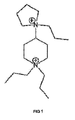
- In particular, when the framework is exclusively composed of silicon and aluminium oxides, in a molar ratio Si/Al = 13 and it has been synthesised in the presence of fluoride anions using the quaternary diammonium dication as the structure directing agent shown in
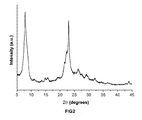
Figure 1 , which will be called SDA-1 throughout this invention, zeolite ITQ-39 as it is synthesised presents an X-ray diffraction pattern as shown inFigure 2 . This diagram is characterised by the values of angle 2θ (degrees) and relative intensities (I/Iθ) shown in Table III.Table III 2θ (degrees) Intensity (I/I0) 7.8198 49.56 8.6885 13.82 15.7045 4.51 19.2097 7.54 21.3591 32.59 22.0000 45.40 22.7964 100.00 25.0561 9.92 26.2576 13.17 27.4230 7.01 28.7596 6.87 29.4369 5.87 31.9616 5.07 34.1133 1.72 36.1252 1.17 36.7736 2.03 42.6035 1.28 43.4655 5.76 - The X-ray diffraction pattern of the previous sample of ITQ-39 after being heated at 580°C to eliminate occluded organic compounds inside is shown in
Figure 3 . This diffraction pattern is characterised by the values of angle 2θ (degrees) and relative intensities (I/I0) that are shown in Table IV. The comparison of the X-ray diffraction patterns of zeolite ITQ-39 as synthesised and after heating show the great thermal stability of the material.Table IV 2θ (degrees) Intensity (I/I0) 7.8461 100.00 8.7039 37.71 11.0092 1.47 13.6688 2.40 14.7903 5.20 15.7731 5.95 19.2573 5.47 21.4378 28.77 22.1339 44.61 22.9739 95.99 25.1759 15.59 26.3257 20.77 27.6284 12.92 29.1717 12.52 32.1493 7.69 34.3923 2.64 36.4259 1.95 43.9105 4.31 - In a second aspect, the present invention relates to a process for synthesising the microporous crystalline material ITQ-39, characterised in that the reaction mixture comprises at least:
- one or more sources of SiO2,
- one or several sources of the organic cation SDA-1,
- one or more sources of fluoride ions, and
- water;
- the mixture is heated to a temperature of between 80 and 200°C until crystallisation is achieved and in that the reaction mixture has a composition, in terms of molar ratios, in the ranges:
- SDA-1(OH)2/SiO2 = 0.01-1.0,
- F/SiO2 = 0.1-3.0, and
- H2O/SiO2 = 0.5-50.
- According to a particular embodiment of the process, the reaction mixture comprises exclusively:
- one or more sources of SiO2,
- one or several sources of the organic cation SDA-1,
- one or more sources of fluoride ions, and
- water,
- SDA-1(OH)2/SiO2 = 0.01-1.0,
- F/SiO2 = 0.1-3.0, and
- H2O/SiO2 = 0.5-50.
- According to a particular additional embodiment of the process, the reaction mixture additionally comprises:
- a source of one or several trivalent elements X,
- SDA-1(OH)2/SiO2 = 0.01-1.0,
- X2O3/SiO2 = 0-0.15, excluding the value 0,
- F/SiO2 = 0.1-3.0, and
- H2O/SiO2 = 0.5-50.
- According to a particular additional embodiment of the process, the reaction mixture additionally comprises:
- a source of one or several other tetravalent elements Y, other than Si,
- SDA-1(OH)2/SiO2 = 0.01-1.0,
- YO2/SiO2 = 0-0.1, excluding the value 0,
- F/SiO2 = 0.1-3.0, and
- H2O/SiO2 = 0.5-50.
- According to a particular additional embodiment of the process, the reaction mixture additionally comprises:
- a source of one or several other tetravalent elements Y, other than Si,
- a source of one or several trivalent elements X,
- SDA-1(OH)2/SiO2 = 0.01-1.0,
- X2O3/SiO2 = 0-0.15, excluding the value 0,
- YO2/SiO2 = 0-0.1, excluding the value 0,
- F/SiO2 = 0.1-3.0, and
- H2O/SiO2 = 0.5-50.
- According to a particular preferred embodiment of the process, the reaction mixture comprises:
- a source of SiO2,
- a source of one or several other tetravalent elements Y, other than Si,
- a source of one or several trivalent elements X selected from Al, B, Ga, Fe, Cr and mixtures of these,
- a source of inorganic cations M of charge +n, selected from the alkaline metals, alkaline earths and mixtures of these,
- a source of organic cation SDA-12+, which is shown in
Figure 1 , - water;
- SDA-1(OH)2/SiO2 = 0.1-1.0,
- M1/nOH/SiO2 = 0-0.2
- X2O3/SiO2 = 0-0.07
- YO2/SiO2 = 0-0.05
- F/SiO2 = 0.1-2.0,
- H2O/SiO2 = 1-20.
- The composition of the reaction mixture giving rise to obtaining the ITQ-39 material can be generally represented by the following formula, with the values of parameters indicating the molar ratios:
- r SDA-1(OH)2 : s M1/nOH : t X2O3 : u YO2 : v F : SiO2 : w H2O
- r = SDA-1(OH)2/SiO2 = 0.01-1.0, preferably 0.1-1.0,
- s = M)1/nOH/SiO2 = 0-1.0, preferably 0-0.2,
- t = X2O3/SiO2 = 0-0.15, preferably 0-0.07,
- u = YO2/SiO2 = 0-0.1, preferably 0-0.05,
- v = F/SiO2 = 0.1-3.0, preferably 0.1-2.0,
- w = H2O/SiO2 = 0.5-50, preferably 1-20.
- The components of the synthesis mixture can originate from different sources and the times and conditions of crystallisation may be affected by this.
- Preferably, the thermal treatment of the mixture is carried out at a temperature of between 130 and 200°C. The thermal treatment of the reaction mixture can be performed either statically or with stirring of the mixture. After the crystallisation is complete, the solid product is separated by filtration or centrifugation and is dried. Subsequent heating at temperatures higher than 350°C, preferably between 400 and 1000°C causes decomposition of the occluded organic residues inside the zeolite and their removal, leaving the zeolite channels free.
- The source of SiO2 can be, for example, tetraethyl orthosilicate, colloidal silica, amorphous silica or a mixture of these.
- The fluoride anion is used as a mobilising agent for the precursor species. The source of fluoride ions is preferably HF, NH4F or a mixture of both.
- The organic cation, represented by SDA-1, is added to the reaction mixture preferably in the form of a salt, for example, a halide, or in the form of a hydroxide and, additionally, a source of alkaline metal, alkaline earth ions or a mixture of both (M) can be added in the form of a hydroxide or a salt. The organic cation SDA-1 is synthesised following the process represented in the following schema:

- In this process, a reductive amination reaction is carried out of 1-propyl-4-piperidone (product B) with pyrrolidine (product A) giving rise to the corresponding diamine (product C). The diamine is diquarternised by propyl halide to be transformed into the SDA-1 dication (product D).
- According to a particular embodiment of the process, some crystalline material ITQ-39 of the present invention is added to the reaction mixture as crystallisation promoter in a quantity in the range of 0.01 and 20% by weight, preferably between 0.05 and 10% by weight with respect to the total added inorganic oxides.
- In addition, the material produced by this invention can be pelletised in accordance with known techniques and can be used as a catalyst or catalyser component in processes of transformation of organic compounds or as absorbent in processes of absorption and separation of organic compounds.
- The ITQ-39 material used in these applications can be in its acid form and/or exchanged with suitable cations.
- The organic cation is prepared as follows: 30 g of pyrrolidine are dissolved in 200 ml of methanol and this solution is acidified with HCl (5 N in methanol) to reach pH = 7.5, continuously cooling the mixture in an external bath at 0°C. Then 37 g of 1-propyl-4-piperidone are added, followed by 10.5 g of NaBH3CN. The resulting mixture is maintained at ambient temperature and stirred continuously for 72 hours.
- To this mixture, HCl is added slowly to reach a pH less than 2, displacing the HCN by means of a continuous current of nitrogen. The resulting solution is concentrated by means of a rotavapor and a solution of KOH (25% by weight) is added until reaching a pH higher than 12. In this step, a white precipitate appears. The resulting mixture is saturated with NaCl and poured over water. Finally, the diamine, 1-propyl-4-pyrrolidin-1-yl-piperidine, is extracted with diethyl ether and dried with anhydrous MgSO4.
- The quarternisation of the diamine is performed as follows: 100 g of propyl idodide are added on a solution of 43.5 g of diamine in 70 ml of MeOH. The mixture is maintained with continuous stirring at ambient temperature for 7 days, when a white precipitate is formed. The solid is vacuum filtered. The characterisation of this solid by elemental analysis and nuclear magnetic resonance of 1H and of 13C confirms that it is the diiodide of the cation [SDA-1]2+ that is shown in
Figure 1 . - The iodide of the cation is exchanged for a hydroxide using an ion exchange resin in accordance with the following process: 44 mmol of the iodide of the cation ([SDA-1]I2) are dissolved in water. 89 g of Dowex SBR resin are added to the solution obtained and this is maintained with stirring until the next day. Then the mixture is filtered, washed with distilled water and a solution of the dihydroxide of the cation shown in
Figure 1 ([SDA-1](OH)2) is obtained. This is evaluated with aqueous HCl using phenolphaline as an indicator, obtaining an exchange efficiency higher than 90%. The final solution contains 0.62 equivalents of hydroxide per 1000 g of solution. - 0.480 g of Al isopropoxide are added over 10 g of tetraethyl orthosilicate (TEOS). Then, 39.83 g of a solution of [SDA-1](OH)2 are added, where SDA-1 is the dication shown in
Figure 1 , which contains 0.62 equivalents of hydroxide in 1000 g. The mixture is left evaporating while stirring until complete elimination of the ethanol from the hydrolysis of the TEOS plus the quantity of water required to reach the final composition indicated. Finally, 1.03 g of a solution of hydrofluoric acid (48% HF by weight) is added. The composition of the gel is: - SiO2 : 0.0245 Al2O3 : 0.26 [SDA-1](OH)2 : 0.51 HF : 2.47 H2O
- where SDA-1 is the dication shown in
figure 1 . - The gel is heated statically for 7 days in steel autoclave with an internal Teflon cover at 150°C. The solid obtained after filtration, washing with distilled water and drying at 100°C is ITQ-39.
- 0.096 g of Al isopropoxide are added over 5 g of tetraethyl orthosilicate (TEOS). Then, 19.04 g of a solution of [SDA-1](OH)2 is added, where SDA-1 is the dication shown in
Figure 1 , which contains 0.63 equivalents of hydroxide in 1000 g. The mixture is allowed to evaporate while stirring until complete elimination of the ethanol from the hydrolysis of the TEOS plus the quantity of water required to reach the final composition indicated. Finally, 0.5 g of a solution of hydrofluoric acid (48% HF by weight) is added. The composition of the gel is: - SiO2 : 0.0098 Al2O3 : 0.25 [SDA-1](OH)2 : 0.50 HF : 2.43 H2O
- where SDA-1 is the dication shown in
figure 1 . - The gel is statically heated for 12 days in steel autoclave with an internal Teflon cover at 135□. The solid obtained after filtration, washing with distilled water and drying at 100°C is ITQ-39.
- 0.384 g of Al isopropoxide are added over 2 g of tetraethyl orthosilicate (TEOS). Then, 8.96 g of a solution of [SDA-1](OH)2 is added, where SDA-1 is the dication shown in
Figure 1 , which contains 0.62 equivalents of hydroxide in 1000 g. The mixture is allowed to evaporate while stirring until complete elimination of the ethanol from the hydrolysis of the TEOS plus the quantity of water required to reach the final composition indicated. Finally, 0.235 g of a solution of hydrofluoric acid (48% HF by weight) is added. The composition of the gel is: - SiO2 : 0.098 Al2O3 : 0.29 [SDA-1](OH)2 : 0.59 HF : 2.4 H2O
- where SDA-1 is the dication shown in
figure 1 . - The gel is statically heated for 14 days in steel autoclave with an internal Teflon cover at 150□. The solid obtained after filtration, washing with distilled water and drying at 100°C is ITQ-39.
- 1.21 g of Al isopropoxide are added over 15.94 g of tetraethyl orthosilicate (TEOS). Then, 58.55 g of a solution of [SDA-1](OH)2 is added, where SDA-1 is the dication shown in
Figure 1 , which contains 0.63 equivalents of hydroxide in 1000 g. The mixture is allowed to evaporate while stirring until complete elimination of the ethanol from the hydrolysis of the TEOS plus the quantity of water required to reach the final composition indicated. Finally, 1.58 g of a solution of hydrofluoric acid (48% HF by weight) is added. The composition of the gel is: - SiO2 : 0.039 Al2O3 : 0.24 [SDA-1](OH)2 : 0.50 HF : 1.62 H2O
- where SDA-1 is the dication shown in
figure 1 . - The gel is statically heated for 11 days in steel autoclave with an internal Teflon cover at 150°C. The solid obtained after filtering, washing with distilled water and drying at 100°C is ITQ-39 and its X-ray diffraction pattern is shown in
Figure 2 . The solid after heating in air at 580°C for six hours maintains the zeolite structure, as can be deduced from the X-ray diffraction pattern shown inFigure 3 . -
-
Figure 1 shows the organic cation, in the presence of which the zeolite ITQ-39 is synthesised. -
Figure 2 shows the most characteristic peaks of the X-ray diffraction pattern of the ITQ-39 material, as it is synthesised according to example 5. -
Figure 3 shows the most characteristic peaks of the X-ray diffraction pattern of the material of example 5 after heating.
Claims (19)
- A zeolite microporous crystalline material characterised in that it has, in the heated state and in the absence of defects in its crystalline framework manifested by the presence of silanols, the empirical formula:
x (M1/nXO2) : y YO2 : SiO2
in whichM is selected from H+, at least one inorganic cation of charge +n, and a mixture of both,X is at least one chemical element in the oxidation state of +3,Y is at least one chemical element in the oxidation state +4 other than Si,x takes a value between 0 and 0.3, both included,y takes a value between 0 and 0.1, both included,and in that the material, after heating, has an X-ray diffraction pattern that presents at least the following diffraction peaks at values of angle 2θ (degrees) and relative intensities:where2θ (degrees)±0.5 Intensity (I/I0) 7.8 mf 8.6 d (h) 14.8 d 15.8 d 19.4 d 21.4 m 22.1 f 23.0 mf 26.3 m 27.6 d 32.0 d 43.9 d d is a relatively weak intensity between 0 and 20%,m is a relatively medium intensity between 20 and 40%,f is a relatively strong intensity between 40 and 60%,mf is a relatively very strong intensity between 60 and 100%, andh relates to the fact this peak of diffraction appears as a shoulder. - A zeolite microporous crystalline material according to claim 1, characterised in that X is selected from Al, Ga, B, Fe, Cr and mixtures of these.
- A zeolite microporous crystalline material according to claim 1, characterised in that Y is selected from Ge, Ti, Sn, V and a mixture of these.
- A zeolite microporous crystalline material according to claim 1, characterised in that "x" takes a value less than 0.2.
- A zeolite microporous crystalline material according to claim 1, characterised in that "y" takes a value less than 0.05.
- A zeolite microporous crystalline material according to claim 1, characterised in that it has, in the heated state and in the absence of defects in its crystalline framework manifested by the presence of silanols, the empirical formula:
x (M1/nXO2) : y YO2 : SiO2
in whichM is selected from H+, at least one inorganic cation of charge +n selected from alkaline, alkaline earth metals and combinations of these and a mixture of both, whereX is at least one chemical element in the oxidation state of +3, selected from Al, Ga, B, Fe, Cr and mixtures of these,Y is at least one chemical element in the oxidation state of +4 other than Si, selected from Ge, Ti, Sn, V and mixtures of these,x takes a value between 0 and 0.3, both included,y takes a value between 0 and 0.05, both included,and the material, as synthesised, has an X-ray diffraction pattern with at least the following values of angle 2θ (degrees) and relative intensities:2θ (degrees)±0.5 Intensity (I/l0) 7.8 f 8.5 d (h) 15.8 d 19.3 d 21.4 m 22.0 f 22.8 mf 26.2 d 27.5 d 32.0 d 43.5 d 2θ (degrees)±0.5 Intensity (I/I0) 7.8 mf 8.6 d (h) 14.8 d 15.8 d 19.4 d 21.4 m 22.1 f 23.0 mf 26.3 m 27.6 d 32.0 d 43.9 d d is a relatively weak intensity between 0 and 20%,m is a relatively medium intensity between 20 and 40%,f is a relatively strong intensity between 40 and 60%,mf is a relatively very strong intensity between 60 and 100%, andh relates to the fact this peak of diffraction appears as a shoulder. - A process for synthesising the microporous crystalline material of any one of the claims 1 to 6, characterised in that the reaction mixture comprises at least:one or more sources of SiO2,a source of an organic dication SDA-1, the formula of which is shown in Figure 1,one or more sources of fluoride ions, andwater;the mixture is heated to a temperature of between 80 and 200°C until crystallisation is achieved and in that the reaction mixture has a composition, in terms of molar ratios, in the ranges:SDA-1(OH)2/SiO2 = 0.01-1.0,F/SiO2 = 0.1-3.0,H2O/SiO2 = 0.5-50.
- A process for synthesising the microporous crystalline material of any one of the claims 1 to 6, characterised in that the reaction mixture comprises exclusively:one or more sources of SiO2,a source of an organic dication SDA-1, the formula of which is shown in Figure 1,one or more sources of fluoride ions, andwater;the mixture is heated to a temperature of between 80 and 200°C until crystallisation is achieved and in that the reaction mixture has a composition, in terms of molar ratios, in the ranges:SDA-1(OH)2/SiO2 = 0.01-1.0,F/SiO2 = 0.1-3.0,H2O/SiO2 = 0.5-50.
- A process according to claim 7, characterised in that the reaction mixture additionally comprises:a source of one or several trivalent elements X,and in that the reaction mixture has a composition, in terms of molar ratios, in the ranges:SDA-1(OH)2/SiO2 = 0.01-1.0,X2O3/SiO2 = 0-0.15, excluding the value 0,F/SiO2 = 0.1-3.0, andH2O/SiO2 = 0.5-50.
- A process according to claim 7, characterised in that the reaction mixture additionally comprises:a source of one or several other tetravalent elements Y, other than Si,and in that the reaction mixture has a composition, in terms of molar ratios, in the ranges:SDA-1(OH)2/SiO2 = 0.01-1.0,YO2/SiO2 = 0-0.1, excluding the value 0,F/SiO2 = 0.1-3.0, andH2O/SiO2 = 0.5-50.
- A process according to claim 7, characterised in that the reaction mixture additionally comprises:a source of one or several other tetravalent elements Y, other than Si,a source of one or several trivalent elements X,and in that the reaction mixture has a composition, in terms of molar ratios, in the ranges:SDA-1(OH)2/SiO2 = 0.01-1.0,X2O3/SiO2 = 0-0.15, excluding the value 0,YO2/SiO2 = 0-0.1, excluding the value 0,F/SiO2 = 0.1-3.0, andH2O/SiO2 = 0.5-50.
- A process according to claim 7, characterised in that the reaction mixture comprises:a source of SiO2,a source of one or several tetravalent elements Y, other than Si, selected from Ge, Ti, Sn, V and mixtures of these,a source of one or several trivalent elements X selected from Al, B, Ga, Fe, Cr and mixtures of these,a source of inorganic cations M of charge +n,a source of an organic dication SDA-1, the formula of which is shown in Figure 1,a source of fluoride ions andwater;the mixture is heated to a temperature of between 80 and 200°C until crystallisation is achieved and in that the reaction mixture has a composition, in terms of molar ratios, in the ranges:SDA-1(OH)2/SiO2 = 0.01-1.0,M1/nOH/SiO2 = 0-1.0X2O3/SiO2 = 0-0.15YO2/SiO2 = 0-0.1F/SiO2 = 0.1-3.0,H2O/SiO2 = 0.5-50.
- A process according to claim 7, characterised in that the organic cation SDA-1, shown in Figure 1, is added in a form selected from hydroxide, another salt and mixture of the hydroxide and another salt.
- A process according to claim 7, characterised in that a quantity of crystalline material ITQ-39 is added to the reaction mixture as a crystallisation promoter, in a quantity of between 0.01 and 20% by weight with respect to the total added inorganic oxides.
- A process according to claim 7, characterised in that a quantity of crystalline material ITQ-39 is added to the reaction mixture as a crystallisation promoter, in a quantity of between 0.05 and 10% by weight with respect to the total added inorganic oxides.
- Use of an active form of the material of claim 1 as a catalyst or component of catalysers in processes of transformation of organic compounds.
- Use of an active form of the material in claim 1 in processes of separation of organic compounds.
- Use of an active form of the material in claim 1 as an absorbent in processes of absorption of organic compounds.
- Use according to any of the claims 16 to 18, characterised in that said material is in the form selected from the acid, exchanged with cations and a mixture of both forms.
Applications Claiming Priority (2)
| Application Number | Priority Date | Filing Date | Title |
|---|---|---|---|
| ES200700334A ES2303787B2 (en) | 2007-02-01 | 2007-02-01 | "MICROPOROUS CRYSTAL MATERIAL OF ZEOLITIC NATURE, ZEOLITA ITQ-39, PREPARATION PROCEDURE AND USES". |
| PCT/ES2008/070014 WO2008092984A1 (en) | 2007-02-01 | 2008-01-31 | Microporous crystalline material of zeolitic nature, zeolite itq-39, method of preparation and uses |
Publications (3)
| Publication Number | Publication Date |
|---|---|
| EP2119669A1 true EP2119669A1 (en) | 2009-11-18 |
| EP2119669A4 EP2119669A4 (en) | 2016-02-24 |
| EP2119669B1 EP2119669B1 (en) | 2019-03-20 |
Family
ID=39669759
Family Applications (1)
| Application Number | Title | Priority Date | Filing Date |
|---|---|---|---|
| EP08718461.0A Active EP2119669B1 (en) | 2007-02-01 | 2008-01-31 | Microporous crystalline material of zeolitic nature, zeolite itq-39, method of preparation and uses |
Country Status (4)
| Country | Link |
|---|---|
| US (1) | US8226925B2 (en) |
| EP (1) | EP2119669B1 (en) |
| ES (2) | ES2303787B2 (en) |
| WO (1) | WO2008092984A1 (en) |
Cited By (4)
| Publication number | Priority date | Publication date | Assignee | Title |
|---|---|---|---|---|
| WO2013175014A1 (en) * | 2012-05-24 | 2013-11-28 | Air Fuel Synthesis Limited | Methanol conversion process |
| EP2876147A4 (en) * | 2012-07-19 | 2016-03-30 | Consejo Superior Investigacion | METHOD FOR OLIGOMERIZING ALKENES USING THE ITQ-39 ZEOLITHE |
| EP3206991A4 (en) * | 2014-10-15 | 2018-03-28 | Basf Se | Solidothermal synthesis of zeolitic materials and zeolites obtained therefrom |
| JP2025081527A (en) * | 2020-10-21 | 2025-05-27 | 東ソー株式会社 | 4-ammoniopiperidinium salt and use of the same |
Families Citing this family (2)
| Publication number | Priority date | Publication date | Assignee | Title |
|---|---|---|---|---|
| BRPI1102638B1 (en) * | 2011-06-16 | 2020-10-20 | Universidade Federal Do Rio Grande Do Sul | zeolite and mesoporous materials organized as filler for the formulation of rubber compounds, thermoplastic rubber, plastic and product manufacturing |
| ES2421063B1 (en) * | 2012-01-25 | 2014-06-26 | Consejo Superior De Investigaciones Cientificas (Csic) | ITQ-38 material, its procedure for obtaining and its use |
Family Cites Families (12)
| Publication number | Priority date | Publication date | Assignee | Title |
|---|---|---|---|---|
| US5007997A (en) * | 1988-03-23 | 1991-04-16 | Chevron Research Company | Zeolite SSZ-26 |
| DE3812592A1 (en) | 1988-04-15 | 1989-10-26 | Deggendorfer Werft Eisenbau | METHOD FOR PRODUCING ZEOLITES |
| FR2752567B1 (en) * | 1996-08-23 | 1998-10-16 | Inst Francais Du Petrole | ZEOLITHE NU-88, ITS PREPARATION PROCESS AND ITS CATALYTIC APPLICATIONS |
| US5968473A (en) * | 1998-12-18 | 1999-10-19 | Uop Llc | Stannosilicate molecular sieves |
| US6616911B2 (en) * | 2000-03-07 | 2003-09-09 | Chevron U.S.A. Inc. | Process for preparing zeolites using pyrrolidinium cations |
| US6787124B2 (en) * | 2002-03-15 | 2004-09-07 | Exxonmobil Research And Engineering Company | Synthetic porous crystalline material, EMM-1, its synthesis and use |
| ES2228278B1 (en) * | 2003-09-29 | 2006-06-01 | Universidad Politecnica De Valencia. | MICROPOROUS CRYSTAL MATERIAL OF NATURE ZEOLITICA (ZEOLITA ITQ-28). |
| WO2005113438A1 (en) * | 2004-04-20 | 2005-12-01 | Uop Llc | Uzm-16: a crystalline aluminosilicate zeolitic material |
| US7022308B1 (en) * | 2004-09-22 | 2006-04-04 | Chevron U.S.A. Inc. | Preparation of molecular sieve SSZ-33 |
| ES2263369B1 (en) * | 2005-02-02 | 2007-12-16 | Universidad Politecnica De Valencia | MICROPOROUS CRYSTAL MATERIAL OF ZEOLITIC NATURE, ZEOLITA ITQ-32, PREPARATION AND USE PROCEDURE. |
| US7998457B2 (en) * | 2008-11-25 | 2011-08-16 | Chevron U.S.A. Inc. | Molecular sieve SSZ-83 |
| US8865121B2 (en) * | 2009-06-18 | 2014-10-21 | Basf Se | Organotemplate-free synthetic process for the production of a zeolitic material |
-
2007
- 2007-02-01 ES ES200700334A patent/ES2303787B2/en not_active Expired - Fee Related
-
2008
- 2008-01-31 US US12/525,506 patent/US8226925B2/en not_active Expired - Fee Related
- 2008-01-31 ES ES08718461T patent/ES2728311T3/en active Active
- 2008-01-31 EP EP08718461.0A patent/EP2119669B1/en active Active
- 2008-01-31 WO PCT/ES2008/070014 patent/WO2008092984A1/en not_active Ceased
Non-Patent Citations (1)
| Title |
|---|
| See references of WO2008092984A1 * |
Cited By (8)
| Publication number | Priority date | Publication date | Assignee | Title |
|---|---|---|---|---|
| WO2013175014A1 (en) * | 2012-05-24 | 2013-11-28 | Air Fuel Synthesis Limited | Methanol conversion process |
| GB2519005A (en) * | 2012-05-24 | 2015-04-08 | Air Fuel Synthesis Ltd | Methanol conversion process |
| EP2876147A4 (en) * | 2012-07-19 | 2016-03-30 | Consejo Superior Investigacion | METHOD FOR OLIGOMERIZING ALKENES USING THE ITQ-39 ZEOLITHE |
| US9550706B2 (en) | 2012-07-19 | 2017-01-24 | Exxonmobil Chemical Patents Inc. | Method for oligomerising alkenes using the ITQ-39 zeolite |
| EP3206991A4 (en) * | 2014-10-15 | 2018-03-28 | Basf Se | Solidothermal synthesis of zeolitic materials and zeolites obtained therefrom |
| US10301185B2 (en) | 2014-10-15 | 2019-05-28 | Basf Se | Solidothermal synthesis of zeolitic materials and zeolites obtained therefrom |
| JP2025081527A (en) * | 2020-10-21 | 2025-05-27 | 東ソー株式会社 | 4-ammoniopiperidinium salt and use of the same |
| JP7831662B2 (en) | 2020-10-21 | 2026-03-17 | 東ソー株式会社 | 4-Ammoniapiperidinium salts and their uses |
Also Published As
| Publication number | Publication date |
|---|---|
| ES2303787A1 (en) | 2008-08-16 |
| EP2119669B1 (en) | 2019-03-20 |
| ES2303787B2 (en) | 2009-06-12 |
| WO2008092984A1 (en) | 2008-08-07 |
| US8226925B2 (en) | 2012-07-24 |
| EP2119669A4 (en) | 2016-02-24 |
| ES2728311T3 (en) | 2019-10-23 |
| US20090312177A1 (en) | 2009-12-17 |
Similar Documents
| Publication | Publication Date | Title |
|---|---|---|
| KR102382437B1 (en) | Material itq-55, method for preparation and use | |
| JP5974170B2 (en) | Method for preparing aluminosilicate zeolite SSZ-33 | |
| US9815705B2 (en) | Synthesis of molecular sieve SSZ-98 | |
| JP6178847B2 (en) | Method for producing aluminosilicate zeolite SSZ-56 | |
| EP2119669B1 (en) | Microporous crystalline material of zeolitic nature, zeolite itq-39, method of preparation and uses | |
| US6849248B2 (en) | Porous crystalline material (zeolite ITQ-21), the preparation method thereof and use of same in the catalytic conversion of organic compounds | |
| US7582278B2 (en) | Microporous crystalline zeolite material, zeolite ITQ-32, preparation method thereof and use of same | |
| US7553477B2 (en) | Zeolitic microporous crystalline material with an LTA structure (ITQ-29), preparation method thereof and uses of same in organic compound separation and transformation processes | |
| EP1413553A1 (en) | Synthesis of itq-17 in the absence of fluoride ions | |
| EP1997779B1 (en) | A microporous crystalline material, zeolite itq-37, preparation method and use | |
| US7008612B2 (en) | Porous crystalline material (ITQ-21) and the method of obtaining the same in the absence of fluoride ions | |
| EP1681268B1 (en) | Microporous crystalline zeolite material, zeolite itq-28, production method thereof and use of same | |
| US9259720B2 (en) | Method for making molecular sieve SSZ-100 | |
| US9272270B2 (en) | Molecular sieve SSZ-100 | |
| WO2015050753A1 (en) | Method for preparing cha-type molecular sieves using an alkali metal silicate precursor and novel structure directing agents |
Legal Events
| Date | Code | Title | Description |
|---|---|---|---|
| PUAI | Public reference made under article 153(3) epc to a published international application that has entered the european phase |
Free format text: ORIGINAL CODE: 0009012 |
|
| 17P | Request for examination filed |
Effective date: 20090824 |
|
| AK | Designated contracting states |
Kind code of ref document: A1 Designated state(s): AT BE BG CH CY CZ DE DK EE ES FI FR GB GR HR HU IE IS IT LI LT LU LV MC MT NL NO PL PT RO SE SI SK TR |
|
| DAX | Request for extension of the european patent (deleted) | ||
| RAP1 | Party data changed (applicant data changed or rights of an application transferred) |
Owner name: UNIVERSIDAD POLITECNICA DE VALENCIA Owner name: CONSEJO SUPERIOR DE INVESTIGACIONES CIENTIFICAS |
|
| RA4 | Supplementary search report drawn up and despatched (corrected) |
Effective date: 20160121 |
|
| RIC1 | Information provided on ipc code assigned before grant |
Ipc: B01J 20/18 20060101ALI20160115BHEP Ipc: B01J 29/70 20060101ALI20160115BHEP Ipc: C01B 39/48 20060101AFI20160115BHEP Ipc: B01J 29/04 20060101ALI20160115BHEP |
|
| STAA | Information on the status of an ep patent application or granted ep patent |
Free format text: STATUS: EXAMINATION IS IN PROGRESS |
|
| 17Q | First examination report despatched |
Effective date: 20180125 |
|
| GRAP | Despatch of communication of intention to grant a patent |
Free format text: ORIGINAL CODE: EPIDOSNIGR1 |
|
| STAA | Information on the status of an ep patent application or granted ep patent |
Free format text: STATUS: GRANT OF PATENT IS INTENDED |
|
| INTG | Intention to grant announced |
Effective date: 20181011 |
|
| GRAS | Grant fee paid |
Free format text: ORIGINAL CODE: EPIDOSNIGR3 |
|
| GRAA | (expected) grant |
Free format text: ORIGINAL CODE: 0009210 |
|
| STAA | Information on the status of an ep patent application or granted ep patent |
Free format text: STATUS: THE PATENT HAS BEEN GRANTED |
|
| AK | Designated contracting states |
Kind code of ref document: B1 Designated state(s): AT BE BG CH CY CZ DE DK EE ES FI FR GB GR HR HU IE IS IT LI LT LU LV MC MT NL NO PL PT RO SE SI SK TR |
|
| REG | Reference to a national code |
Ref country code: GB Ref legal event code: FG4D |
|
| REG | Reference to a national code |
Ref country code: CH Ref legal event code: EP |
|
| REG | Reference to a national code |
Ref country code: DE Ref legal event code: R096 Ref document number: 602008059413 Country of ref document: DE |
|
| REG | Reference to a national code |
Ref country code: AT Ref legal event code: REF Ref document number: 1110330 Country of ref document: AT Kind code of ref document: T Effective date: 20190415 |
|
| REG | Reference to a national code |
Ref country code: IE Ref legal event code: FG4D |
|
| REG | Reference to a national code |
Ref country code: NL Ref legal event code: FP |
|
| PG25 | Lapsed in a contracting state [announced via postgrant information from national office to epo] |
Ref country code: NO Free format text: LAPSE BECAUSE OF FAILURE TO SUBMIT A TRANSLATION OF THE DESCRIPTION OR TO PAY THE FEE WITHIN THE PRESCRIBED TIME-LIMIT Effective date: 20190620 Ref country code: FI Free format text: LAPSE BECAUSE OF FAILURE TO SUBMIT A TRANSLATION OF THE DESCRIPTION OR TO PAY THE FEE WITHIN THE PRESCRIBED TIME-LIMIT Effective date: 20190320 Ref country code: LT Free format text: LAPSE BECAUSE OF FAILURE TO SUBMIT A TRANSLATION OF THE DESCRIPTION OR TO PAY THE FEE WITHIN THE PRESCRIBED TIME-LIMIT Effective date: 20190320 Ref country code: SE Free format text: LAPSE BECAUSE OF FAILURE TO SUBMIT A TRANSLATION OF THE DESCRIPTION OR TO PAY THE FEE WITHIN THE PRESCRIBED TIME-LIMIT Effective date: 20190320 |
|
| REG | Reference to a national code |
Ref country code: LT Ref legal event code: MG4D |
|
| PG25 | Lapsed in a contracting state [announced via postgrant information from national office to epo] |
Ref country code: HR Free format text: LAPSE BECAUSE OF FAILURE TO SUBMIT A TRANSLATION OF THE DESCRIPTION OR TO PAY THE FEE WITHIN THE PRESCRIBED TIME-LIMIT Effective date: 20190320 Ref country code: LV Free format text: LAPSE BECAUSE OF FAILURE TO SUBMIT A TRANSLATION OF THE DESCRIPTION OR TO PAY THE FEE WITHIN THE PRESCRIBED TIME-LIMIT Effective date: 20190320 Ref country code: GR Free format text: LAPSE BECAUSE OF FAILURE TO SUBMIT A TRANSLATION OF THE DESCRIPTION OR TO PAY THE FEE WITHIN THE PRESCRIBED TIME-LIMIT Effective date: 20190621 Ref country code: BG Free format text: LAPSE BECAUSE OF FAILURE TO SUBMIT A TRANSLATION OF THE DESCRIPTION OR TO PAY THE FEE WITHIN THE PRESCRIBED TIME-LIMIT Effective date: 20190620 |
|
| REG | Reference to a national code |
Ref country code: AT Ref legal event code: MK05 Ref document number: 1110330 Country of ref document: AT Kind code of ref document: T Effective date: 20190320 |
|
| REG | Reference to a national code |
Ref country code: ES Ref legal event code: FG2A Ref document number: 2728311 Country of ref document: ES Kind code of ref document: T3 Effective date: 20191023 |
|
| PG25 | Lapsed in a contracting state [announced via postgrant information from national office to epo] |
Ref country code: IT Free format text: LAPSE BECAUSE OF FAILURE TO SUBMIT A TRANSLATION OF THE DESCRIPTION OR TO PAY THE FEE WITHIN THE PRESCRIBED TIME-LIMIT Effective date: 20190320 Ref country code: SK Free format text: LAPSE BECAUSE OF FAILURE TO SUBMIT A TRANSLATION OF THE DESCRIPTION OR TO PAY THE FEE WITHIN THE PRESCRIBED TIME-LIMIT Effective date: 20190320 Ref country code: EE Free format text: LAPSE BECAUSE OF FAILURE TO SUBMIT A TRANSLATION OF THE DESCRIPTION OR TO PAY THE FEE WITHIN THE PRESCRIBED TIME-LIMIT Effective date: 20190320 Ref country code: RO Free format text: LAPSE BECAUSE OF FAILURE TO SUBMIT A TRANSLATION OF THE DESCRIPTION OR TO PAY THE FEE WITHIN THE PRESCRIBED TIME-LIMIT Effective date: 20190320 Ref country code: PT Free format text: LAPSE BECAUSE OF FAILURE TO SUBMIT A TRANSLATION OF THE DESCRIPTION OR TO PAY THE FEE WITHIN THE PRESCRIBED TIME-LIMIT Effective date: 20190720 Ref country code: CZ Free format text: LAPSE BECAUSE OF FAILURE TO SUBMIT A TRANSLATION OF THE DESCRIPTION OR TO PAY THE FEE WITHIN THE PRESCRIBED TIME-LIMIT Effective date: 20190320 |
|
| PG25 | Lapsed in a contracting state [announced via postgrant information from national office to epo] |
Ref country code: PL Free format text: LAPSE BECAUSE OF FAILURE TO SUBMIT A TRANSLATION OF THE DESCRIPTION OR TO PAY THE FEE WITHIN THE PRESCRIBED TIME-LIMIT Effective date: 20190320 |
|
| PG25 | Lapsed in a contracting state [announced via postgrant information from national office to epo] |
Ref country code: AT Free format text: LAPSE BECAUSE OF FAILURE TO SUBMIT A TRANSLATION OF THE DESCRIPTION OR TO PAY THE FEE WITHIN THE PRESCRIBED TIME-LIMIT Effective date: 20190320 Ref country code: IS Free format text: LAPSE BECAUSE OF FAILURE TO SUBMIT A TRANSLATION OF THE DESCRIPTION OR TO PAY THE FEE WITHIN THE PRESCRIBED TIME-LIMIT Effective date: 20190720 |
|
| REG | Reference to a national code |
Ref country code: DE Ref legal event code: R097 Ref document number: 602008059413 Country of ref document: DE |
|
| PLBE | No opposition filed within time limit |
Free format text: ORIGINAL CODE: 0009261 |
|
| STAA | Information on the status of an ep patent application or granted ep patent |
Free format text: STATUS: NO OPPOSITION FILED WITHIN TIME LIMIT |
|
| PG25 | Lapsed in a contracting state [announced via postgrant information from national office to epo] |
Ref country code: DK Free format text: LAPSE BECAUSE OF FAILURE TO SUBMIT A TRANSLATION OF THE DESCRIPTION OR TO PAY THE FEE WITHIN THE PRESCRIBED TIME-LIMIT Effective date: 20190320 |
|
| 26N | No opposition filed |
Effective date: 20200102 |
|
| PG25 | Lapsed in a contracting state [announced via postgrant information from national office to epo] |
Ref country code: SI Free format text: LAPSE BECAUSE OF FAILURE TO SUBMIT A TRANSLATION OF THE DESCRIPTION OR TO PAY THE FEE WITHIN THE PRESCRIBED TIME-LIMIT Effective date: 20190320 |
|
| PG25 | Lapsed in a contracting state [announced via postgrant information from national office to epo] |
Ref country code: TR Free format text: LAPSE BECAUSE OF FAILURE TO SUBMIT A TRANSLATION OF THE DESCRIPTION OR TO PAY THE FEE WITHIN THE PRESCRIBED TIME-LIMIT Effective date: 20190320 |
|
| PGFP | Annual fee paid to national office [announced via postgrant information from national office to epo] |
Ref country code: GB Payment date: 20191231 Year of fee payment: 13 |
|
| PG25 | Lapsed in a contracting state [announced via postgrant information from national office to epo] |
Ref country code: MC Free format text: LAPSE BECAUSE OF FAILURE TO SUBMIT A TRANSLATION OF THE DESCRIPTION OR TO PAY THE FEE WITHIN THE PRESCRIBED TIME-LIMIT Effective date: 20190320 |
|
| REG | Reference to a national code |
Ref country code: CH Ref legal event code: PL |
|
| REG | Reference to a national code |
Ref country code: BE Ref legal event code: MM Effective date: 20200131 |
|
| PG25 | Lapsed in a contracting state [announced via postgrant information from national office to epo] |
Ref country code: LU Free format text: LAPSE BECAUSE OF NON-PAYMENT OF DUE FEES Effective date: 20200131 |
|
| PG25 | Lapsed in a contracting state [announced via postgrant information from national office to epo] |
Ref country code: CH Free format text: LAPSE BECAUSE OF NON-PAYMENT OF DUE FEES Effective date: 20200131 Ref country code: BE Free format text: LAPSE BECAUSE OF NON-PAYMENT OF DUE FEES Effective date: 20200131 Ref country code: LI Free format text: LAPSE BECAUSE OF NON-PAYMENT OF DUE FEES Effective date: 20200131 |
|
| PG25 | Lapsed in a contracting state [announced via postgrant information from national office to epo] |
Ref country code: IE Free format text: LAPSE BECAUSE OF NON-PAYMENT OF DUE FEES Effective date: 20200131 |
|
| GBPC | Gb: european patent ceased through non-payment of renewal fee |
Effective date: 20210131 |
|
| PG25 | Lapsed in a contracting state [announced via postgrant information from national office to epo] |
Ref country code: GB Free format text: LAPSE BECAUSE OF NON-PAYMENT OF DUE FEES Effective date: 20210131 |
|
| PGFP | Annual fee paid to national office [announced via postgrant information from national office to epo] |
Ref country code: DE Payment date: 20220329 Year of fee payment: 15 |
|
| PG25 | Lapsed in a contracting state [announced via postgrant information from national office to epo] |
Ref country code: MT Free format text: LAPSE BECAUSE OF FAILURE TO SUBMIT A TRANSLATION OF THE DESCRIPTION OR TO PAY THE FEE WITHIN THE PRESCRIBED TIME-LIMIT Effective date: 20190320 Ref country code: CY Free format text: LAPSE BECAUSE OF FAILURE TO SUBMIT A TRANSLATION OF THE DESCRIPTION OR TO PAY THE FEE WITHIN THE PRESCRIBED TIME-LIMIT Effective date: 20190320 |
|
| PGFP | Annual fee paid to national office [announced via postgrant information from national office to epo] |
Ref country code: NL Payment date: 20220126 Year of fee payment: 15 Ref country code: FR Payment date: 20220126 Year of fee payment: 15 Ref country code: ES Payment date: 20220211 Year of fee payment: 15 |
|
| REG | Reference to a national code |
Ref country code: DE Ref legal event code: R119 Ref document number: 602008059413 Country of ref document: DE |
|
| REG | Reference to a national code |
Ref country code: NL Ref legal event code: MM Effective date: 20230201 |
|
| PG25 | Lapsed in a contracting state [announced via postgrant information from national office to epo] |
Ref country code: NL Free format text: LAPSE BECAUSE OF NON-PAYMENT OF DUE FEES Effective date: 20230201 Ref country code: DE Free format text: LAPSE BECAUSE OF NON-PAYMENT OF DUE FEES Effective date: 20230801 |
|
| PG25 | Lapsed in a contracting state [announced via postgrant information from national office to epo] |
Ref country code: FR Free format text: LAPSE BECAUSE OF NON-PAYMENT OF DUE FEES Effective date: 20230131 |
|
| REG | Reference to a national code |
Ref country code: ES Ref legal event code: FD2A Effective date: 20240402 |
|
| PG25 | Lapsed in a contracting state [announced via postgrant information from national office to epo] |
Ref country code: ES Free format text: LAPSE BECAUSE OF NON-PAYMENT OF DUE FEES Effective date: 20230201 |
|
| PG25 | Lapsed in a contracting state [announced via postgrant information from national office to epo] |
Ref country code: ES Free format text: LAPSE BECAUSE OF NON-PAYMENT OF DUE FEES Effective date: 20230201 |