EP2117253A1 - Transmitter, receiver, mobile station, wireless base station, mobile communication system and mobile communication method - Google Patents
Transmitter, receiver, mobile station, wireless base station, mobile communication system and mobile communication method Download PDFInfo
- Publication number
- EP2117253A1 EP2117253A1 EP07860376A EP07860376A EP2117253A1 EP 2117253 A1 EP2117253 A1 EP 2117253A1 EP 07860376 A EP07860376 A EP 07860376A EP 07860376 A EP07860376 A EP 07860376A EP 2117253 A1 EP2117253 A1 EP 2117253A1
- Authority
- EP
- European Patent Office
- Prior art keywords
- data unit
- information
- layer
- information elements
- mac
- Prior art date
- Legal status (The legal status is an assumption and is not a legal conclusion. Google has not performed a legal analysis and makes no representation as to the accuracy of the status listed.)
- Withdrawn
Links
Images



Classifications
-
- H—ELECTRICITY
- H04—ELECTRIC COMMUNICATION TECHNIQUE
- H04W—WIRELESS COMMUNICATION NETWORKS
- H04W28/00—Network traffic management; Network resource management
- H04W28/02—Traffic management, e.g. flow control or congestion control
- H04W28/06—Optimizing the usage of the radio link, e.g. header compression, information sizing, discarding information
- H04W28/065—Optimizing the usage of the radio link, e.g. header compression, information sizing, discarding information using assembly or disassembly of packets
-
- H—ELECTRICITY
- H04—ELECTRIC COMMUNICATION TECHNIQUE
- H04W—WIRELESS COMMUNICATION NETWORKS
- H04W80/00—Wireless network protocols or protocol adaptations to wireless operation
- H04W80/02—Data link layer protocols
-
- H—ELECTRICITY
- H04—ELECTRIC COMMUNICATION TECHNIQUE
- H04L—TRANSMISSION OF DIGITAL INFORMATION, e.g. TELEGRAPHIC COMMUNICATION
- H04L47/00—Traffic control in data switching networks
- H04L47/10—Flow control; Congestion control
- H04L47/36—Flow control; Congestion control by determining packet size, e.g. maximum transfer unit [MTU]
-
- H—ELECTRICITY
- H04—ELECTRIC COMMUNICATION TECHNIQUE
- H04L—TRANSMISSION OF DIGITAL INFORMATION, e.g. TELEGRAPHIC COMMUNICATION
- H04L47/00—Traffic control in data switching networks
- H04L47/10—Flow control; Congestion control
- H04L47/36—Flow control; Congestion control by determining packet size, e.g. maximum transfer unit [MTU]
- H04L47/365—Dynamic adaptation of the packet size
-
- H—ELECTRICITY
- H04—ELECTRIC COMMUNICATION TECHNIQUE
- H04L—TRANSMISSION OF DIGITAL INFORMATION, e.g. TELEGRAPHIC COMMUNICATION
- H04L69/00—Network arrangements, protocols or services independent of the application payload and not provided for in the other groups of this subclass
- H04L69/22—Parsing or analysis of headers
-
- H—ELECTRICITY
- H04—ELECTRIC COMMUNICATION TECHNIQUE
- H04W—WIRELESS COMMUNICATION NETWORKS
- H04W28/00—Network traffic management; Network resource management
- H04W28/02—Traffic management, e.g. flow control or congestion control
- H04W28/06—Optimizing the usage of the radio link, e.g. header compression, information sizing, discarding information
Definitions
- the present invention relates to a transmitter apparatus, a receiver apparatus, a mobile station, a radio base station, a mobile communication system and a mobile communication method.
- a mobile communication system standardized by the 3GPP (3rd Generation Partnership Project) is configured as follows. Specifically, a radio base station NodeB (transmitter apparatus) is configured to transmit a DCCH (Dedicated Control Channel), a DTCH (Dedicated Traffic Channel), a CCCH (Common Control Channel) and the like, to a mobile station UE (receiver apparatus) in downlink.
- a radio base station NodeB transmitter apparatus
- DCCH Dedicated Control Channel
- DTCH Dedicated Traffic Channel
- CCCH Common Control Channel
- the mobile station UE transmitter apparatus
- the radio base station NodeB receives a DCCH, a DTCH, a CCCH and the like.
- the radio base station NodeB transmitter apparatus
- MTCH MBMS Traffic Channel
- MCCH MBMS Control Channel
- the radio base station NodeB transmitter apparatus
- the radio base station NodeB is configured to transmit an HS-SCCH (High Speed Shared Control Channel), an HS-PDSCH (High Speed Physical Downlink Shared Channel) and the like, to the mobile station UE (receiver).
- HS-SCCH High Speed Shared Control Channel
- HS-PDSCH High Speed Physical Downlink Shared Channel
- the radio base station NodeB transmitter apparatus
- the radio base station NodeB is configured to generate an MAC-hs PDU in the MAC-hs layer by multiplexing MAC-d PDUs (Protocol Data Units) received from the MAC-d layer, and to transmit the generated MAC-hs PDU by using the HS-DSCH (High Speed Downlink Shared Channel) associated with the HS-PDSCH.
- MAC-hs PDU Protocol Data Units
- HS-DSCH High Speed Downlink Shared Channel
- the MAC-d PDUs multiplexed into the MAC-hs PDU are in a fixed size for each MAC-d flow.
- an MAC header is added to the MAC-hs PDU in the MAC-hs layer of the radio base station NodeB (transmitter apparatus), the MAC header including an "SID (Size Index Identifier)" indicative of the size of an MAC-d PDU for each MAC-d flow, and "N (Number of MAC-d PDUs)" indicative of the number of the MAC-d PDUs.
- SID Size Index Identifier
- the conventional HSDPA does not allow an MAC-hs header to include identification information for identifying information elements (for example, an MAC control block and the like) other than the MAC-d PDU, and to include size information indicating the respective sizes of these information elements.
- the conventional HSDPA has a problem that information elements with variable sizes, other than the MAC-d PDU, cannot be multiplexed into the MAC-hs PDU.
- the present invention has been made in consideration of the forgoing problem, and aims to provide a transmitter apparatus and a receiver apparatus which enable multiplexing of not only a higher layer data unit but also control information and padding information into a first data unit.
- a first aspect of the present invention is summarized as a transmitter apparatus including: a first data unit generator section configured to generate a first data unit by multiplexing information elements in a first layer; and a first data unit transmitter section configured to transmit the generated first data unit, wherein the information elements each is any of a higher layer data unit received from a layer higher than the first layer, control information and padding information, the first data unit generator section is configured to add header information to the first data unit, the header information including identification information identifying a type of each of the information elements multiplexed into the first data unit.
- the header information may include information element size information indicating a size of each of the information elements, in addition to the identification information.
- a second aspect of the present invention is summarized as a receiver apparatus including: a first data unit receiver section configured to receive a first data unit in a first layer; and an extractor section configured to extract each of information elements from the first data unit received in the first layer, according to identification information being included in header information in the first data unit and identifying a type of each of the information elements, wherein each of the information elements is any of a higher layer data unit, control information, and padding information.
- the extractor section can be configured to extract the information elements from the first data unit according to not only the identification information but also information element size information indicating a size of each of the information elements.
- a third aspect of the present invention is summarized as a mobile station including: a first data unit generator section configured to generate a first data unit by multiplexing information elements, in a first layer; and a first data unit transmitter section configured to transmit the generated first data unit, wherein each of the information elements is any of a higher layer data unit received from a layer higher than the first layer, control information, and padding information, and the first data unit generator section is configured to add header information to the first data unit, the header information including identification information identifying a type of each of the information elements multiplexed into the first data unit.
- a fourth aspect of the present invention is summarized as a radio base station including: a first data unit generator section configured to generate a first data unit by multiplexing information elements in a first layer; and a first data unit transmitter section configured to transmit the generated first data unit, wherein each of the information elements is any of a higher layer data unit received from a layer higher than the first layer, control information and padding information, and the first data unit generator section is configured to add header information to the first data unit, the header information including identification information identifying a type of each of the information elements multiplexed into the first data unit.
- a fifth aspect of the present invention is summarized as a mobile station including: a first data unit receiver section configured to receive a first data unit in a first layer; and an extractor section configured to extract each of information elements from the first data unit received in the first layer, according to identification information being included in header information in the first data unit and identifying a type of each of the information elements, wherein each of the information elements is any of a higher layer data unit, control information, and padding information.
- a sixth aspect of the present invention is summarized as a radio base station including: a first data unit receiver section configured to receive a first data unit in a first layer; and an extractor section configured to extract each of information elements from the first data unit received in the first layer, according to identification information being included in header information in the first data unit and identifying a type of each of the information elements, wherein each of the information elements is any of a higher layer data unit, control information, and padding information.
- a seventh aspect of the present invention is summarized as a mobile communication system configured to allow a mobile station and a radio base station to communicate with each other, wherein the mobile station includes: a first data unit generator section configured to generate a first data unit by multiplexing information elements in a first layer; and a first data unit transmitter section configured to transmit the generated first data unit, and the radio base station includes: a first data unit receiver section configured to receive the first data unit transmitted by the mobile station; and an extractor section configured to extract each of information elements from the received first data unit, according to identification information being included in header information in the first data unit and identifying a type of each of the information elements, each of the information elements is any of a higher layer data unit received from a layer higher than the first layer, control information, and padding information, and the first data unit generator section is configured to add the header information to the first data unit, the header information including identification information identifying a type of each of the information elements multiplexed into the first data unit.
- a eighth aspect of the present invention is summarized as a mobile communication system configured to allow a mobile station and a radio base station to communicate with each other, wherein the radio base station includes: a first data unit generator section configured to generate a first data unit by multiplexing information elements in a first layer; and a first data unit transmitter section configured to transmit the generated first data unit, and the mobile station includes: a first data unit receiver section configured to receive the first data unit transmitted by the mobile station; and an extractor section configured to extract each of information elements from the received first data unit, according to identification information being included in header information in the first data unit and identifying a type of each of the information elements, each of the information elements is any of a higher layer data unit received from a layer higher than the first layer, control information, and padding information, and the first data unit generator section is configured to add the header information to the first data unit, the header information including identification information identifying a type of each of the information elements multiplexed into the first data unit.
- a ninth aspect of the present invention is summarized as a mobile communication method for allowing a mobile station and a radio base station to communicate with each other, the method including steps: (A) generating, at the mobile station, a first data unit by multiplexing information elements in a first layer; (B) transmitting, at the mobile station, the generated first data unit; (C) receiving, at the radio base station, the first data unit transmitted by the mobile station; and (D) extracting, at the radio base station, each of the information elements from the received first data unit, according to identification information being included in header information of the first data unit and indicating a type of each of the information elements, wherein each of the information elements is any of a higher layer data unit received from a layer higher than the first layer, control information, and padding information, and in the step (A), the mobile station adds the header information to the first data unit, the header information including identification information identifying a type of each of the information elements multiplexed into the first data unit.
- a tenth aspect of the present invention is summarized as a mobile communication method for allowing a mobile station and a radio base station to communicate with each other, the method including steps: (A) generating, at the radio base station, a first data unit by multiplexing information elements in a first layer; (B) transmitting, at the radio base station, the generated first data unit; (C) receiving, at the mobile station, the first data unit transmitted by the radio base station; and (D) extracting, at the mobile station, each of the information elements from the received first data unit, according to identification information being included in header information of the first data unit and indicating a type of each of the information elements, wherein each of the information elements is any of a higher layer data unit received from a layer higher than the first layer, control information, and padding information, and in the step (A), the radio base station adds the header information to the first data unit, the header information including identification information identifying a type of each of the information elements multiplexed into the first data unit.
- a configuration of a mobile communication system including a transmitter apparatus 10 and a receiver apparatus 30 according to a first embodiment of the present invention The configuration of the mobile communication system according to the present embodiment is one standardized under LTE (Long Term Evaluation).
- a radio base station eNodeB may be the transmitter apparatus 10 according to the present embodiment, and a mobile station UE may be the receiver apparatus 30 according to the present embodiment.
- a radio base station eNodeB may be the receiver apparatus 30 according to the present embodiment, and a mobile station UE may be the transmitter apparatus 10 according to the present embodiment.
- the transmitter apparatus 10 includes an MAC-SDU (Service Data Unit) receiver section 11, an MAC-PDU generator section 12 and an MAC-PDU transmitter section 13, which serve as an MAC (Media Access Control) layer (first layer) function.
- MAC-SDU Service Data Unit
- MAC-PDU generator section 12 an MAC-PDU transmitter section 13 which serve as an MAC (Media Access Control) layer (first layer) function.
- MAC-PDU transmitter section 13 serve as an MAC (Media Access Control) layer (first layer) function.
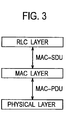
- the MAC-SDU receiver section 11 is configured to receive an MAC-SDU (a higher layer data unit) from an RLC (Radio Link Control) layer (a layer higher than an MAC layer) (see Fig. 3 ).
- RLC Radio Link Control
- the MAC-PDU generator section 12 is configured to generate an MAC-PDU by multiplexing information elements in the MAC layer.
- each of the information elements is any of an MAC-SDU received from the RLC layer, an MAC control block (control information), and a Padding (padding information).
- control information an MAC control block
- Padding a Padding information
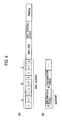
- the MAC-PDU generator section 12 is configured to add an MAC header shown in Fig. 4 to an MAC-PDU, when multiplexing multiple information elements into the MAC-PDU (specifically, when multiplexing the MAC-SDU, the MAC control block and the Padding).
- the sizes of the MAC-SDU, the MAC control block, and the Padding are variable.
- the MAC header shown in Fig. 4 includes sets A to C each composed of "LI", "C/T” and "E.”
- the set A is for the MAC-SDU
- the set B is for the MAC control block
- the set C is for the Padding.
- LI Length Indicator
- FI Information element size information indicating the size of each information element.
- "LI" in the set A indicates the size of the MAC-SDU
- "LI” in the set B indicates the size of the MAC control block
- "LI" in the set C indicates the size of the Padding.
- C/T is identification information identifying a type of each of information elements multiplexed into the MAC-PDU.
- “C/T” in the set A is information for identifying a logical channel used for the MAC-SDU
- C/T" in the set B is information for identifying the MAC control block
- “C/T” in the set C is information for identifying the Padding.
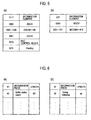
- Figs. 5 (a) and 5 (b) show examples of information elements identified by the "C/T".
- Fig. 5(a) shows examples of "C/T” included in the MAC header of the MAC-PDU transmitted in a downlink channel or an uplink channel for normal communications.
- Fig. 5(b) shows examples of "C/T” included in the MAC header of the MAC-PDU transmitted in a channel for multicast communications.
- the MAC control block multiplexed into the MAC-PDU includes one or more elements each composed of an "ID" and an "information piece".
- Figs. 6(a) and 6(b) show examples of correspondences between the "IDs" and "information pieces" constituting the MAC control block.
- Fig. 6 (a) shows an example of the MAC control block multiplexed into the MAC-PDU transmitted in an uplink channel for normal communications
- Fig. 6(b) shows an example of the MAC control block multiplexed into the MAC-PDU transmitted in a downlink channel for normal communications.
- the length (size) of each of the "information pieces” is determined in advance as shown in Fig. 6(a) .
- the "E (Extension)” is information indicating whether or not the "E” itself is positioned at the end of the MAC header. For example, when “E” is “0", the “E” indicates that the “E” itself is positioned at the end of the MAC header, and is followed by any one of the MAC-SDU, the MAC control block and the Padding.
- the MAC-PDU transmitter section 13 is configured to transmit, as a single transport block, the MAC-PDU generated by the MAC-PDU generator section 12, to a physical layer (see Fig. 3 ).
- the receiver apparatus 30 includes an MAC-PDU receiver section 31, an MAC header analyzer section 32 and an MAC-SDU transmitter section 33, which serve as an MAC layer function.
- the MAC-PDU receiver section 31 is configured to receive the MAC-PDU transmitted by the transmitter apparatus 10, through the physical layer (see Fig. 3 ).
- the MAC header analyzer section 32 is configured to identify the type of each of information elements, which are multiplexed into the MAC-PDU received in the MAC layer, according to "C/T" included in the MAC header of the MAC-PDU, and to detect the size of each of the information elements (the MAC-SDU, the MAC control block, and the Padding) multiplexed into the MAC-PDU, according to the "LI (information element size information )" included in the MAC header.
- C/T included in the MAC header of the MAC-PDU
- LI information element size information
- the MAC header analyzer section 32 can detect the end of the MAC header according to the "E" included in the MAC header of the MAC-PDU.
- the MAC-SDU transmitter section 34 is configured to extract each of the information elements from the MAC-PDU, according to the size of the information element detected by the MAC header analyzer section 33.
- the MAC-SDU transmitter section 34 is configured to transmit the extracted MAC-SDU to the RLC layer.
- an MAC layer function of the transmitter apparatus 10 receives an MAC-SDU to be transmitted to the receiver apparatus 30, from the RLC layer of the transmitter apparatus 10, and generates a necessary MAC control block.
- step S102 the MAC layer function determines whether or not the total size of the information elements (the MAC-SDU and the MAC control block) to be multiplexed is smaller than the size of an MAC-PDU notified by the physical layer.
- the MAC layer function performs padding processing in step S103 so that the total size of the information elements to be multiplexed can be equal to the size of the MAC-PDU (in other words, adds a necessary length of a Padding). Then, this operation proceeds to step S104.
- the MAC layer function when it is determined the total size is not smaller than the size of the MAC-PDU (is larger than the size of the MAC-PDU or is equal to the size of the MAC-PDU), the MAC layer function generates an MAC header in step S104 without performing the padding processing.
- the MAC header here generated includes a set of "LI", "C/T” and "E" associated with each of the information elements to be multiplexed.
- step S105 the MAC layer function generates an MAC-PDU to which the generated MAC header is added, and transmits the generated MAC-PDU to the receiver apparatus 30 through the physical layer of the transmitter apparatus 10.
- the MAC layer function of the receiver apparatus 30 receives the MAC-PDU transmitted by the transmitter apparatus 10, through the physical layer of the receiver apparatus 30.
- step S202 an MAC layer function of the receiver apparatus 30 analyzes the MAC added to the received MAC-PDU.
- step S203 the MAC layer function of the receiver apparatus 30 identifies the information elements multiplexed into the MAC-PDU, according to "C/T" included in the MAC header, and acquires the identified information elements (for example, the MAC-SDU), according to "LI" included in the MAC header.
- the MAC layer function of the receiver apparatus 30 iteratively performs step S203 until a value set for the "E" included in the MAC header becomes "0".
- the mobile communication system according to the first embodiment of the present invention is capable of setting "C/T" for identifying the MAC control block and the Padding and "LI" indicating the sizes of the MAC control block and the Padding, in the MAC header, and thereby enables multiplexing of the MAC control block and the Padding with variable lengths for an MAC-PDU.
- the present invention enables provision of a transmitter apparatus and a receiver apparatus which are capable of multiplexing not only a higher layer data unit but also control information and padding information into a first data unit.
Landscapes
- Engineering & Computer Science (AREA)
- Computer Networks & Wireless Communication (AREA)
- Signal Processing (AREA)
- Computer Security & Cryptography (AREA)
- Mobile Radio Communication Systems (AREA)
- Time-Division Multiplex Systems (AREA)
Abstract
Description
- The present invention relates to a transmitter apparatus, a receiver apparatus, a mobile station, a radio base station, a mobile communication system and a mobile communication method.
- As shown in
Fig. 1 , a mobile communication system standardized by the 3GPP (3rd Generation Partnership Project) is configured as follows. Specifically, a radio base station NodeB (transmitter apparatus) is configured to transmit a DCCH (Dedicated Control Channel), a DTCH (Dedicated Traffic Channel), a CCCH (Common Control Channel) and the like, to a mobile station UE (receiver apparatus) in downlink. - On the other hand, in uplink, the mobile station UE (transmitter apparatus) is configured to transmit a DCCH, a DTCH, a CCCH and the like, to the radio base station NodeB (receiver apparatus).
- Moreover, as a logical channel for MBMS (Multimedia Broadcast and Multicast Service) standardized by the 3GPP, the radio base station NodeB (transmitter apparatus) is configured to transmit an MTCH (MBMS Traffic Channel) and an MCCH (MBMS Control Channel) to the mobile station UE (receiver apparatus) in downlink.
- In addition, in downlink, as a physical channel for the HSDPA (High Speed Downlink Packet Access) that is the downlink high speed packet communication standard defined by the 3GPP, the radio base station NodeB (transmitter apparatus) is configured to transmit an HS-SCCH (High Speed Shared Control Channel), an HS-PDSCH (High Speed Physical Downlink Shared Channel) and the like, to the mobile station UE (receiver).
- Additionally, in the HSDPA, the radio base station NodeB (transmitter apparatus) is configured to generate an MAC-hs PDU in the MAC-hs layer by multiplexing MAC-d PDUs (Protocol Data Units) received from the MAC-d layer, and to transmit the generated MAC-hs PDU by using the HS-DSCH (High Speed Downlink Shared Channel) associated with the HS-PDSCH.
- Here, the MAC-d PDUs multiplexed into the MAC-hs PDU are in a fixed size for each MAC-d flow. As shown in
Fig. 10 , an MAC header is added to the MAC-hs PDU in the MAC-hs layer of the radio base station NodeB (transmitter apparatus), the MAC header including an "SID (Size Index Identifier)" indicative of the size of an MAC-d PDU for each MAC-d flow, and "N (Number of MAC-d PDUs)" indicative of the number of the MAC-d PDUs. - The conventional HSDPA, however, does not allow an MAC-hs header to include identification information for identifying information elements (for example, an MAC control block and the like) other than the MAC-d PDU, and to include size information indicating the respective sizes of these information elements. Thus, the conventional HSDPA has a problem that information elements with variable sizes, other than the MAC-d PDU, cannot be multiplexed into the MAC-hs PDU.
- Non-Patent Document 1: 3GPP TS 25.321 v7.0.0
- Hence, the present invention has been made in consideration of the forgoing problem, and aims to provide a transmitter apparatus and a receiver apparatus which enable multiplexing of not only a higher layer data unit but also control information and padding information into a first data unit.
- A first aspect of the present invention is summarized as a transmitter apparatus including: a first data unit generator section configured to generate a first data unit by multiplexing information elements in a first layer; and a first data unit transmitter section configured to transmit the generated first data unit, wherein the information elements each is any of a higher layer data unit received from a layer higher than the first layer, control information and padding information, the first data unit generator section is configured to add header information to the first data unit, the header information including identification information identifying a type of each of the information elements multiplexed into the first data unit.
- In the first aspect of the present invention, the header information may include information element size information indicating a size of each of the information elements, in addition to the identification information.
- A second aspect of the present invention is summarized as a receiver apparatus including: a first data unit receiver section configured to receive a first data unit in a first layer; and an extractor section configured to extract each of information elements from the first data unit received in the first layer, according to identification information being included in header information in the first data unit and identifying a type of each of the information elements, wherein each of the information elements is any of a higher layer data unit, control information, and padding information.
- In the second aspect, the extractor section can be configured to extract the information elements from the first data unit according to not only the identification information but also information element size information indicating a size of each of the information elements.
- A third aspect of the present invention is summarized as a mobile station including: a first data unit generator section configured to generate a first data unit by multiplexing information elements, in a first layer; and a first data unit transmitter section configured to transmit the generated first data unit, wherein each of the information elements is any of a higher layer data unit received from a layer higher than the first layer, control information, and padding information, and the first data unit generator section is configured to add header information to the first data unit, the header information including identification information identifying a type of each of the information elements multiplexed into the first data unit.
- A fourth aspect of the present invention is summarized as a radio base station including: a first data unit generator section configured to generate a first data unit by multiplexing information elements in a first layer; and a first data unit transmitter section configured to transmit the generated first data unit, wherein each of the information elements is any of a higher layer data unit received from a layer higher than the first layer, control information and padding information, and the first data unit generator section is configured to add header information to the first data unit, the header information including identification information identifying a type of each of the information elements multiplexed into the first data unit.
- A fifth aspect of the present invention is summarized as a mobile station including: a first data unit receiver section configured to receive a first data unit in a first layer; and an extractor section configured to extract each of information elements from the first data unit received in the first layer, according to identification information being included in header information in the first data unit and identifying a type of each of the information elements, wherein each of the information elements is any of a higher layer data unit, control information, and padding information.
- A sixth aspect of the present invention is summarized as a radio base station including: a first data unit receiver section configured to receive a first data unit in a first layer; and an extractor section configured to extract each of information elements from the first data unit received in the first layer, according to identification information being included in header information in the first data unit and identifying a type of each of the information elements, wherein each of the information elements is any of a higher layer data unit, control information, and padding information.
- A seventh aspect of the present invention is summarized as a mobile communication system configured to allow a mobile station and a radio base station to communicate with each other, wherein the mobile station includes: a first data unit generator section configured to generate a first data unit by multiplexing information elements in a first layer; and a first data unit transmitter section configured to transmit the generated first data unit, and the radio base station includes: a first data unit receiver section configured to receive the first data unit transmitted by the mobile station; and an extractor section configured to extract each of information elements from the received first data unit, according to identification information being included in header information in the first data unit and identifying a type of each of the information elements, each of the information elements is any of a higher layer data unit received from a layer higher than the first layer, control information, and padding information, and the first data unit generator section is configured to add the header information to the first data unit, the header information including identification information identifying a type of each of the information elements multiplexed into the first data unit.
- A eighth aspect of the present invention is summarized as a mobile communication system configured to allow a mobile station and a radio base station to communicate with each other, wherein the radio base station includes: a first data unit generator section configured to generate a first data unit by multiplexing information elements in a first layer; and a first data unit transmitter section configured to transmit the generated first data unit, and the mobile station includes: a first data unit receiver section configured to receive the first data unit transmitted by the mobile station; and an extractor section configured to extract each of information elements from the received first data unit, according to identification information being included in header information in the first data unit and identifying a type of each of the information elements, each of the information elements is any of a higher layer data unit received from a layer higher than the first layer, control information, and padding information, and the first data unit generator section is configured to add the header information to the first data unit, the header information including identification information identifying a type of each of the information elements multiplexed into the first data unit.
- A ninth aspect of the present invention is summarized as a mobile communication method for allowing a mobile station and a radio base station to communicate with each other, the method including steps: (A) generating, at the mobile station, a first data unit by multiplexing information elements in a first layer; (B) transmitting, at the mobile station, the generated first data unit; (C) receiving, at the radio base station, the first data unit transmitted by the mobile station; and (D) extracting, at the radio base station, each of the information elements from the received first data unit, according to identification information being included in header information of the first data unit and indicating a type of each of the information elements, wherein each of the information elements is any of a higher layer data unit received from a layer higher than the first layer, control information, and padding information, and in the step (A), the mobile station adds the header information to the first data unit, the header information including identification information identifying a type of each of the information elements multiplexed into the first data unit.
- A tenth aspect of the present invention is summarized as a mobile communication method for allowing a mobile station and a radio base station to communicate with each other, the method including steps: (A) generating, at the radio base station, a first data unit by multiplexing information elements in a first layer; (B) transmitting, at the radio base station, the generated first data unit; (C) receiving, at the mobile station, the first data unit transmitted by the radio base station; and (D) extracting, at the mobile station, each of the information elements from the received first data unit, according to identification information being included in header information of the first data unit and indicating a type of each of the information elements, wherein each of the information elements is any of a higher layer data unit received from a layer higher than the first layer, control information, and padding information, and in the step (A), the radio base station adds the header information to the first data unit, the header information including identification information identifying a type of each of the information elements multiplexed into the first data unit. BRIEF DESCRIPTION OF THE DRAWINGS
-
- [
Fig. 1] Fig. 1 is an overall configuration diagram of a mobile communication system according to a first embodiment of the present invention. - [
Fig. 2] Fig. 2 is a functional block diagram of a transmitter apparatus according to the first embodiment of the present invention. - [
Fig. 3] Fig. 3 is a diagram showing a protocol stack in the mobile communication system according to the first embodiment of the present invention. - [
Fig. 4] Fig. 4 is a diagram showing an example of a format of an MAC-PDU transmitted by a transmitter apparatus according to the first embodiment of the present invention. - [
Fig. 5] Fig. 5 is a diagram showing examples of information elements identified according to "C/T" included in an MAC header of an MAC-PDU transmitted by the transmitter apparatus according to the first embodiment of the present invention. - [
Fig. 6] Fig. 6 is a diagram for explaining MAC control blocks multiplexed into an MAC-PDU transmitted by the transmitter apparatus according to the first embodiment of the present invention. - [
Fig. 7] Fig. 7 is a functional block diagram of a receiver apparatus according to the first embodiment of the present invention. - [
Fig. 8] Fig. 8 is a flowchart showing an operation of the transmitter apparatus according to the first embodiment of the present invention. - [
Fig. 9] Fig. 9 is a flowchart showing an operation of the receiver apparatus according to the first embodiment of the present invention. - [
Fig. 10] Fig. 10 is a diagram showing an example of a format of an MAC-hs PDU used in HSDPA. - With reference to
Figs. 1 to 9 , descriptions will be given of a configuration of a mobile communication system including a transmitter apparatus 10 and a receiver apparatus 30 according to a first embodiment of the present invention. The configuration of the mobile communication system according to the present embodiment is one standardized under LTE (Long Term Evaluation). - Here, a radio base station eNodeB may be the transmitter apparatus 10 according to the present embodiment, and a mobile station UE may be the receiver apparatus 30 according to the present embodiment. Instead, a radio base station eNodeB may be the receiver apparatus 30 according to the present embodiment, and a mobile station UE may be the transmitter apparatus 10 according to the present embodiment.
- As shown in
Fig. 2 , the transmitter apparatus 10 includes an MAC-SDU (Service Data Unit)receiver section 11, an MAC-PDU generator section 12 and an MAC-PDU transmitter section 13, which serve as an MAC (Media Access Control) layer (first layer) function. - The MAC-
SDU receiver section 11 is configured to receive an MAC-SDU (a higher layer data unit) from an RLC (Radio Link Control) layer (a layer higher than an MAC layer) (seeFig. 3 ). - The MAC-
PDU generator section 12 is configured to generate an MAC-PDU by multiplexing information elements in the MAC layer. - Here, each of the information elements is any of an MAC-SDU received from the RLC layer, an MAC control block (control information), and a Padding (padding information). Note that, the MAC control block (control information), and the Padding (padding information) are not those received from the RLC layer.
- For example, the MAC-
PDU generator section 12 is configured to add an MAC header shown inFig. 4 to an MAC-PDU, when multiplexing multiple information elements into the MAC-PDU (specifically, when multiplexing the MAC-SDU, the MAC control block and the Padding). Here, the sizes of the MAC-SDU, the MAC control block, and the Padding are variable. - The MAC header shown in
Fig. 4 includes sets A to C each composed of "LI", "C/T" and "E." The set A is for the MAC-SDU, the set B is for the MAC control block and the set C is for the Padding. - In this regard, "LI (Length Indicator)" is information element size information indicating the size of each information element. In the example of
Fig. 4 , "LI" in the set A indicates the size of the MAC-SDU, "LI" in the set B indicates the size of the MAC control block, and "LI" in the set C indicates the size of the Padding. - Then, "C/T" is identification information identifying a type of each of information elements multiplexed into the MAC-PDU. In the example of
Fig. 4 , "C/T" in the set A is information for identifying a logical channel used for the MAC-SDU, "C/T" in the set B is information for identifying the MAC control block, and "C/T" in the set C is information for identifying the Padding. -
Figs. 5 (a) and 5 (b) show examples of information elements identified by the "C/T".Fig. 5(a) shows examples of "C/T" included in the MAC header of the MAC-PDU transmitted in a downlink channel or an uplink channel for normal communications.Fig. 5(b) shows examples of "C/T" included in the MAC header of the MAC-PDU transmitted in a channel for multicast communications. - In
Fig. 5(a) , "C/T"="0000" identifies the MAC-SDU for a DCCH, "C/T"="0001 to 1000" identifies the MAC-SDUs forDTCHs # 1 to #8, "C/T"="1001" identifies the MAC-SDUs for a CCCH, "C/T"="1010" identifies the MAC control block, and "C/T"="1011" identifies the Padding. - Moreover, in
Fig. 5(b) , "C/T"="0000" identifies the MAC-SDU for an MCCH, "C/T"="0001 to 1111" identifies the MAC-SDUs forMTCHs # 1 to #15. - Note that, as shown in
Fig. 4(b) , the MAC control block multiplexed into the MAC-PDU includes one or more elements each composed of an "ID" and an "information piece". - Here,
Figs. 6(a) and 6(b) show examples of correspondences between the "IDs" and "information pieces" constituting the MAC control block.Fig. 6 (a) shows an example of the MAC control block multiplexed into the MAC-PDU transmitted in an uplink channel for normal communications, whileFig. 6(b) shows an example of the MAC control block multiplexed into the MAC-PDU transmitted in a downlink channel for normal communications. - In
Fig. 6(a) , the "information piece" identified by "ID"="00" is "Buffer status report" indicating an absolute value or a relative value of a buffer amount. Here, the length (size) of each of the "information pieces" is determined in advance as shown inFig. 6(a) . - In
Fig. 6(b) , the "information piece" identified by "ID"="00" is "Timing Advance". Here, the length (size) of each of the "information pieces" is also determined in advance as shown inFig. 6(b) . - In addition, the "E (Extension)" is information indicating whether or not the "E" itself is positioned at the end of the MAC header. For example, when "E" is "0", the "E" indicates that the "E" itself is positioned at the end of the MAC header, and is followed by any one of the MAC-SDU, the MAC control block and the Padding.
- On the other hand, when "E" is "1", the "E" indicates that the "E" itself is not positioned at the end of the MAC header, but is followed by another set composed of "LI", "C/T" and "E".
- In the example of
Fig. 4 , the "E" in the set A and the set B indicates that the "E" is not positioned at the end of the MAC header, while the "E" in the set C indicates that the "E" is positioned at the end of the MAC header. - The MAC-
PDU transmitter section 13 is configured to transmit, as a single transport block, the MAC-PDU generated by the MAC-PDU generator section 12, to a physical layer (seeFig. 3 ). - As shown in
Fig. 7 , the receiver apparatus 30 includes an MAC-PDU receiver section 31, an MACheader analyzer section 32 and an MAC-SDU transmitter section 33, which serve as an MAC layer function. - The MAC-
PDU receiver section 31 is configured to receive the MAC-PDU transmitted by the transmitter apparatus 10, through the physical layer (seeFig. 3 ). - The MAC
header analyzer section 32 is configured to identify the type of each of information elements, which are multiplexed into the MAC-PDU received in the MAC layer, according to "C/T" included in the MAC header of the MAC-PDU, and to detect the size of each of the information elements (the MAC-SDU, the MAC control block, and the Padding) multiplexed into the MAC-PDU, according to the "LI (information element size information )" included in the MAC header. - Note that the MAC
header analyzer section 32 can detect the end of the MAC header according to the "E" included in the MAC header of the MAC-PDU. - The MAC-SDU transmitter section 34 is configured to extract each of the information elements from the MAC-PDU, according to the size of the information element detected by the MAC
header analyzer section 33. - Moreover, the MAC-SDU transmitter section 34 is configured to transmit the extracted MAC-SDU to the RLC layer.
- With reference to
Figs. 8 and9 , description will be given of an operation of the mobile communication system according to the first embodiment of the present invention. - In the first place, an operation of the transmitter apparatus 10 according to the present embodiment will be described with reference to
Fig. 8 . - As shown in
Fig. 10 , in step S101, an MAC layer function of the transmitter apparatus 10 receives an MAC-SDU to be transmitted to the receiver apparatus 30, from the RLC layer of the transmitter apparatus 10, and generates a necessary MAC control block. - In step S102, the MAC layer function determines whether or not the total size of the information elements (the MAC-SDU and the MAC control block) to be multiplexed is smaller than the size of an MAC-PDU notified by the physical layer.
- If it is determined that the total size is smaller than the size of the MAC-PDU, the MAC layer function performs padding processing in step S103 so that the total size of the information elements to be multiplexed can be equal to the size of the MAC-PDU (in other words, adds a necessary length of a Padding). Then, this operation proceeds to step S104.
- On the other hand, when it is determined the total size is not smaller than the size of the MAC-PDU (is larger than the size of the MAC-PDU or is equal to the size of the MAC-PDU), the MAC layer function generates an MAC header in step S104 without performing the padding processing. The MAC header here generated includes a set of "LI", "C/T" and "E" associated with each of the information elements to be multiplexed.
- In step S105, the MAC layer function generates an MAC-PDU to which the generated MAC header is added, and transmits the generated MAC-PDU to the receiver apparatus 30 through the physical layer of the transmitter apparatus 10.
- In the second place, an operation of the receiver apparatus 30 according to the present embodiment will be described with reference to
Fig. 9 . - As shown in
Fig. 9 , the MAC layer function of the receiver apparatus 30 receives the MAC-PDU transmitted by the transmitter apparatus 10, through the physical layer of the receiver apparatus 30. - In step S202, an MAC layer function of the receiver apparatus 30 analyzes the MAC added to the received MAC-PDU.
- In step S203, the MAC layer function of the receiver apparatus 30 identifies the information elements multiplexed into the MAC-PDU, according to "C/T" included in the MAC header, and acquires the identified information elements (for example, the MAC-SDU), according to "LI" included in the MAC header.
- Note that the MAC layer function of the receiver apparatus 30 iteratively performs step S203 until a value set for the "E" included in the MAC header becomes "0".
- (Operations and Effects of Mobile Communication System According to First Embodiment of the Present Invention) The mobile communication system according to the first embodiment of the present invention is capable of setting "C/T" for identifying the MAC control block and the Padding and "LI" indicating the sizes of the MAC control block and the Padding, in the MAC header, and thereby enables multiplexing of the MAC control block and the Padding with variable lengths for an MAC-PDU.
- Hereinabove, the present invention has been described in detail by use of the foregoing embodiment. It is obvious, however, to those skilled in the art that the present invention should not be limited to the embodiment described in this description. The present invention is implementable as modified and improved embodiments without departing from the sprit and the scope of the present invention defined by the description of the scope of the appended claims. Therefore, the explanation of this description is intended only to explain an illustrative example of the present invention, and is not intended to impose any limitation on the present invention.
- As has been described above, the present invention enables provision of a transmitter apparatus and a receiver apparatus which are capable of multiplexing not only a higher layer data unit but also control information and padding information into a first data unit.
Claims (12)
- A transmitter apparatus comprising:a first data unit generator section configured to generate a first data unit by multiplexing information elements in a first layer; anda first data unit transmitter section configured to transmit the generated first data unit, whereineach of the information elements is any of a higher layer data unit received from a layer higher than the first layer, control information and padding information, andthe first data unit generator section is configured to add header information to the first data unit, the header information including identification information identifying a type of each of the information elements multiplexed into the first data unit.
- The transmitter apparatus according to claim 1, wherein
the header information includes information element size information indicating a size of each of the information elements, in addition to the identification information. - A receiver apparatus comprising:a first data unit receiver section configured to receive a first data unit in a first layer; andan extractor section configured to extract each of information elements from the first data unit received in the first layer, according to identification information being included in header information in the first data unit and identifying a type of each of the information elements, whereineach of the information elements is any of a higher layer data unit, control information, and padding information.
- The receiver apparatus according to claim 3, wherein
the extractor section is configured to extract the information elements from the first data unit according to not only the identification information but also information element size information indicating a size of each of the information elements. - A mobile station comprising:a first data unit generator section configured to generate a first data unit by multiplexing information elements, in a first layer; anda first data unit transmitter section configured to transmit the generated first data unit, whereineach of the information elements is any of a higher layer data unit received from a layer higher than the first layer, control information, and padding information, andthe first data unit generator section is configured to add header information to the first data unit, the header information including identification information identifying a type of each of the information elements multiplexed into the first data unit.
- A radio base station comprising:a first data unit generator section configured to generate a first data unit by multiplexing information elements in a first layer; anda first data unit transmitter section configured to transmit the generated first data unit, whereineach of the information elements is any of a higher layer data unit received from a layer higher than the first layer, control information and padding information, andthe first data unit generator section is configured to add header information to the first data unit, the header information including identification information identifying a type of each of the information elements multiplexed into the first data unit.
- A mobile station comprising:a first data unit receiver section configured to receive a first data unit in a first layer; andan extractor section configured to extract each of information elements from the first data unit received in the first layer, according to identification information being included in header information in the first data unit and identifying a type of each of the information elements, whereineach of the information elements is any of a higher layer data unit, control information, and padding information.
- A radio base station comprising:a first data unit receiver section configured to receive a first data unit in a first layer; andan extractor section configured to extract each of information elements from the first data unit received in the first layer, according to identification information being included in header information in the first data unit and identifying a type of each of the information elements, whereineach of the information elements is any of a higher layer data unit, control information, and padding information.
- A mobile communication system configured to allow a mobile station and a radio base station to communicate with each other, wherein
the mobile station comprises:a first data unit generator section configured to generate a first data unit by multiplexing information elements in a first layer; anda first data unit transmitter section configured to transmit the generated first data unit, andthe radio base station comprises:a first data unit receiver section configured to receive the first data unit transmitted by the mobile station; andan extractor section configured to extract each of information elements from the received first data unit, according to identification information being included in header information in the first data unit and identifying a type of each of the information elements,each of the information elements is any of a higher layer data unit received from a layer higher than the first layer, control information, and padding information, and
the first data unit generator section is configured to add the header information to the first data unit, the header information including identification information identifying a type of each of the information elements multiplexed into the first data unit. - A mobile communication system configured to allow a mobile station and a radio base station to communicate with each other, wherein
the radio base station comprises:a first data unit generator section configured to generate a first data unit by multiplexing information elements in a first layer; anda first data unit transmitter section configured to transmit the generated first data unit, andeach of the information elements is any of a higher layer data unit received from a layer higher than the first layer, control information, and padding information, and
the mobile station comprises:a first data unit receiver section configured to receive the first data unit transmitted by the mobile station; andan extractor section configured to extract each of information elements from the received first data unit, according to identification information being included in header information in the first data unit and identifying a type of each of the information elements,
the first data unit generator section is configured to add the header information to the first data unit, the header information including identification information identifying a type of each of the information elements multiplexed into the first data unit. - A mobile communication method for allowing a mobile station and a radio base station to communicate with each other, the method comprising steps:(A) generating, at the mobile station, a first data unit by multiplexing information elements in a first layer;(B) transmitting, at the mobile station, the generated first data unit;(C) receiving, at the radio base station, the first data unit transmitted by the mobile station; and(D) extracting, at the radio base station, each of the information elements from the received first data unit, according to identification information being included in header information of the first data unit and indicating a type of each of the information elements, wherein
each of the information elements is any of a higher layer data unit received from a layer higher than the first layer, control information, and padding information, and
in the step (A), the mobile station adds the header information to the first data unit, the header information including identification information identifying a type of each of the information elements multiplexed into the first data unit. - A mobile communication method for allowing a mobile station and a radio base station to communicate with each other,
the method comprising steps:(A) generating, at the radio base station, a first data unit by multiplexing information elements in a first layer;(B) transmitting, at the radio base station, the generated first data unit;(C) receiving, at the mobile station, the first data unit transmitted by the radio base station; and(D) extracting, at the mobile station, each of the information elements from the received first data unit, according to identification information being included in header information of the first data unit and indicating a type of each of the information elements, wherein
each of the information elements is any of a higher layer data unit received from a layer higher than the first layer, control information, and padding information, and
in the step (A), the radio base station adds the header information to the first data unit, the header information including identification information identifying a type of each of the information elements multiplexed into the first data unit.
Applications Claiming Priority (2)
| Application Number | Priority Date | Filing Date | Title |
|---|---|---|---|
| JP2006356655 | 2006-12-28 | ||
| PCT/JP2007/075154 WO2008081881A1 (en) | 2006-12-28 | 2007-12-27 | Transmitter, receiver, mobile station, wireless base station, mobile communication system and mobile communication method |
Publications (2)
| Publication Number | Publication Date |
|---|---|
| EP2117253A1 true EP2117253A1 (en) | 2009-11-11 |
| EP2117253A4 EP2117253A4 (en) | 2012-10-10 |
Family
ID=39588561
Family Applications (1)
| Application Number | Title | Priority Date | Filing Date |
|---|---|---|---|
| EP07860376A Withdrawn EP2117253A4 (en) | 2006-12-28 | 2007-12-27 | TRANSMITTER, RECEIVER, MOBILE STATION, WIRELESS BASE STATION, MOBILE COMMUNICATION SYSTEM, AND MOBILE COMMUNICATION METHOD |
Country Status (9)
| Country | Link |
|---|---|
| US (1) | US8400962B2 (en) |
| EP (1) | EP2117253A4 (en) |
| JP (2) | JPWO2008081881A1 (en) |
| KR (1) | KR20090096490A (en) |
| CN (1) | CN101574003B (en) |
| AU (1) | AU2007340497A1 (en) |
| BR (1) | BRPI0720961A2 (en) |
| RU (1) | RU2009127537A (en) |
| WO (1) | WO2008081881A1 (en) |
Families Citing this family (2)
| Publication number | Priority date | Publication date | Assignee | Title |
|---|---|---|---|---|
| WO2017018538A1 (en) * | 2015-07-30 | 2017-02-02 | 京セラ株式会社 | Wireless terminal |
| EP3319252A1 (en) | 2016-11-04 | 2018-05-09 | Panasonic Intellectual Property Corporation of America | Efficient multiplexing of control information in transport block |
Family Cites Families (14)
| Publication number | Priority date | Publication date | Assignee | Title |
|---|---|---|---|---|
| JP2002141947A (en) | 2000-08-30 | 2002-05-17 | Alcatel Usa Sourcing Lp | System and method for transporting bearer traffic in signaling server using real time bearer protocol |
| KR100790131B1 (en) * | 2001-08-24 | 2008-01-02 | 삼성전자주식회사 | Signaling method between media access control layer entities in packet communication system |
| GB2386513B (en) * | 2002-02-07 | 2004-08-25 | Samsung Electronics Co Ltd | Apparatus and method for transmitting/receiving serving hs-scch set information in an hsdpa communication system |
| KR100926707B1 (en) * | 2002-11-05 | 2009-11-17 | 엘지전자 주식회사 | Data communication method of mobile communication system |
| KR100889865B1 (en) | 2002-11-07 | 2009-03-24 | 엘지전자 주식회사 | Communication method of wireless mobile communication system |
| CN1806401B (en) | 2003-07-14 | 2010-10-20 | 三星电子株式会社 | Method and apparatus for generating packet data to support multiple services in wireless packet data communication system |
| KR101088338B1 (en) * | 2004-02-04 | 2011-11-30 | 이비덴 가부시키가이샤 | Multilayer printed wiring board |
| US20050185609A1 (en) | 2004-02-16 | 2005-08-25 | Esa Malkamaki | Communication method, user terminal, network element and computer program |
| KR100889866B1 (en) * | 2004-06-14 | 2009-03-24 | 엘지전자 주식회사 | Method of processing transmission data unit in data transmission / reception system of radio protocol layer |
| KR100921241B1 (en) | 2004-06-16 | 2009-10-12 | 엘지전자 주식회사 | Data unit processing system of communication system |
| US7525908B2 (en) * | 2004-09-24 | 2009-04-28 | M-Stack Limited | Data unit management in communications |
| US8189615B2 (en) | 2004-12-23 | 2012-05-29 | Nokia Corporation | Method and apparatus for communicating scheduling information from a UE to a radio access network |
| US7408895B2 (en) * | 2005-04-20 | 2008-08-05 | Interdigital Technology Corporation | Method and apparatus for scheduling transmissions via an enhanced dedicated channel |
| JP4923849B2 (en) | 2006-08-21 | 2012-04-25 | 富士通株式会社 | Wireless receiver |
-
2007
- 2007-12-27 WO PCT/JP2007/075154 patent/WO2008081881A1/en not_active Ceased
- 2007-12-27 CN CN2007800488723A patent/CN101574003B/en not_active Expired - Fee Related
- 2007-12-27 JP JP2008552155A patent/JPWO2008081881A1/en active Pending
- 2007-12-27 KR KR20097013691A patent/KR20090096490A/en not_active Abandoned
- 2007-12-27 US US12/521,529 patent/US8400962B2/en not_active Expired - Fee Related
- 2007-12-27 RU RU2009127537/09A patent/RU2009127537A/en not_active Application Discontinuation
- 2007-12-27 EP EP07860376A patent/EP2117253A4/en not_active Withdrawn
- 2007-12-27 BR BRPI0720961-4A2A patent/BRPI0720961A2/en not_active IP Right Cessation
- 2007-12-27 AU AU2007340497A patent/AU2007340497A1/en not_active Abandoned
-
2011
- 2011-04-04 JP JP2011083124A patent/JP4847618B2/en not_active Expired - Fee Related
Also Published As
| Publication number | Publication date |
|---|---|
| JP4847618B2 (en) | 2011-12-28 |
| CN101574003B (en) | 2013-03-27 |
| KR20090096490A (en) | 2009-09-10 |
| WO2008081881A1 (en) | 2008-07-10 |
| AU2007340497A1 (en) | 2008-07-10 |
| JP2011142683A (en) | 2011-07-21 |
| EP2117253A4 (en) | 2012-10-10 |
| RU2009127537A (en) | 2011-02-10 |
| US20110149840A1 (en) | 2011-06-23 |
| US8400962B2 (en) | 2013-03-19 |
| CN101574003A (en) | 2009-11-04 |
| JPWO2008081881A1 (en) | 2010-04-30 |
| BRPI0720961A2 (en) | 2014-03-18 |
Similar Documents
| Publication | Publication Date | Title |
|---|---|---|
| EP2201698B1 (en) | Method and apparatus for layer 2 processing and creation of protocol data units for wireless communications | |
| US7675942B2 (en) | Reducing overheads of a protocol data unit in a wireless communication system | |
| KR100651344B1 (en) | Method for improving data processing speed in mobile communication system using high speed forward packet access method and mobile communication system | |
| JP4616417B2 (en) | Transmitter, receiver, mobile station and radio base station | |
| CN101425884A (en) | Data transmission method and device for uplink in radio communication | |
| US20100040064A1 (en) | Transmitter apparatus | |
| US8400962B2 (en) | Transmitter apparatus, receiver apparatus, mobile station, radio base station, mobile communication system and mobile communication method |
Legal Events
| Date | Code | Title | Description |
|---|---|---|---|
| PUAI | Public reference made under article 153(3) epc to a published international application that has entered the european phase |
Free format text: ORIGINAL CODE: 0009012 |
|
| 17P | Request for examination filed |
Effective date: 20090716 |
|
| AK | Designated contracting states |
Kind code of ref document: A1 Designated state(s): AT BE BG CH CY CZ DE DK EE ES FI FR GB GR HU IE IS IT LI LT LU LV MC MT NL PL PT RO SE SI SK TR |
|
| RIC1 | Information provided on ipc code assigned before grant |
Ipc: H04W 4/00 20090101AFI20091009BHEP Ipc: H04J 3/00 20060101ALI20091009BHEP |
|
| DAX | Request for extension of the european patent (deleted) | ||
| A4 | Supplementary search report drawn up and despatched |
Effective date: 20120907 |
|
| RIC1 | Information provided on ipc code assigned before grant |
Ipc: H04W 28/06 20090101AFI20120903BHEP |
|
| STAA | Information on the status of an ep patent application or granted ep patent |
Free format text: STATUS: THE APPLICATION IS DEEMED TO BE WITHDRAWN |
|
| 18D | Application deemed to be withdrawn |
Effective date: 20130326 |