EP2116526B1 - Derivates of substituted tartaric aicd and usage for preparating beta secretase inhibitors - Google Patents
Derivates of substituted tartaric aicd and usage for preparating beta secretase inhibitors Download PDFInfo
- Publication number
- EP2116526B1 EP2116526B1 EP07702276.2A EP07702276A EP2116526B1 EP 2116526 B1 EP2116526 B1 EP 2116526B1 EP 07702276 A EP07702276 A EP 07702276A EP 2116526 B1 EP2116526 B1 EP 2116526B1
- Authority
- EP
- European Patent Office
- Prior art keywords
- methyl
- alkyl
- propionylamino
- compound
- dihydroxy
- Prior art date
- Legal status (The legal status is an assumption and is not a legal conclusion. Google has not performed a legal analysis and makes no representation as to the accuracy of the status listed.)
- Not-in-force
Links
- 239000002439 beta secretase inhibitor Substances 0.000 title description 4
- 125000002496 methyl group Chemical group [H]C([H])([H])* 0.000 claims description 213
- 150000001875 compounds Chemical class 0.000 claims description 121
- OKKJLVBELUTLKV-UHFFFAOYSA-N Methanol Chemical compound OC OKKJLVBELUTLKV-UHFFFAOYSA-N 0.000 claims description 83
- 125000004169 (C1-C6) alkyl group Chemical group 0.000 claims description 77
- 125000003342 alkenyl group Chemical group 0.000 claims description 62
- YMWUJEATGCHHMB-UHFFFAOYSA-N Dichloromethane Chemical compound ClCCl YMWUJEATGCHHMB-UHFFFAOYSA-N 0.000 claims description 58
- 238000000034 method Methods 0.000 claims description 56
- -1 nitro, hydroxy, amino Chemical group 0.000 claims description 47
- ZMXDDKWLCZADIW-UHFFFAOYSA-N N,N-Dimethylformamide Chemical compound CN(C)C=O ZMXDDKWLCZADIW-UHFFFAOYSA-N 0.000 claims description 46
- WYURNTSHIVDZCO-UHFFFAOYSA-N Tetrahydrofuran Chemical compound C1CCOC1 WYURNTSHIVDZCO-UHFFFAOYSA-N 0.000 claims description 38
- XEKOWRVHYACXOJ-UHFFFAOYSA-N Ethyl acetate Chemical compound CCOC(C)=O XEKOWRVHYACXOJ-UHFFFAOYSA-N 0.000 claims description 33
- WQDUMFSSJAZKTM-UHFFFAOYSA-N Sodium methoxide Chemical compound [Na+].[O-]C WQDUMFSSJAZKTM-UHFFFAOYSA-N 0.000 claims description 30
- LFQSCWFLJHTTHZ-UHFFFAOYSA-N Ethanol Chemical compound CCO LFQSCWFLJHTTHZ-UHFFFAOYSA-N 0.000 claims description 27
- HEMHJVSKTPXQMS-UHFFFAOYSA-M Sodium hydroxide Chemical compound [OH-].[Na+] HEMHJVSKTPXQMS-UHFFFAOYSA-M 0.000 claims description 27
- VEXZGXHMUGYJMC-UHFFFAOYSA-N Hydrochloric acid Chemical compound Cl VEXZGXHMUGYJMC-UHFFFAOYSA-N 0.000 claims description 24
- RTZKZFJDLAIYFH-UHFFFAOYSA-N Diethyl ether Chemical compound CCOCC RTZKZFJDLAIYFH-UHFFFAOYSA-N 0.000 claims description 21
- 125000000217 alkyl group Chemical group 0.000 claims description 21
- 125000000118 dimethyl group Chemical group [H]C([H])([H])* 0.000 claims description 20
- KWYUFKZDYYNOTN-UHFFFAOYSA-M Potassium hydroxide Chemical compound [OH-].[K+] KWYUFKZDYYNOTN-UHFFFAOYSA-M 0.000 claims description 18
- 150000003839 salts Chemical class 0.000 claims description 18
- 125000004178 (C1-C4) alkyl group Chemical group 0.000 claims description 16
- 239000002904 solvent Substances 0.000 claims description 16
- QAOWNCQODCNURD-UHFFFAOYSA-N Sulfuric acid Chemical compound OS(O)(=O)=O QAOWNCQODCNURD-UHFFFAOYSA-N 0.000 claims description 15
- 238000006555 catalytic reaction Methods 0.000 claims description 14
- 239000012453 solvate Substances 0.000 claims description 14
- 201000010099 disease Diseases 0.000 claims description 13
- 208000037265 diseases, disorders, signs and symptoms Diseases 0.000 claims description 13
- 150000004677 hydrates Chemical class 0.000 claims description 13
- VHYFNPMBLIVWCW-UHFFFAOYSA-N 4-Dimethylaminopyridine Chemical compound CN(C)C1=CC=NC=C1 VHYFNPMBLIVWCW-UHFFFAOYSA-N 0.000 claims description 12
- 125000000392 cycloalkenyl group Chemical group 0.000 claims description 12
- 125000001495 ethyl group Chemical group [H]C([H])([H])C([H])([H])* 0.000 claims description 12
- 125000000623 heterocyclic group Chemical group 0.000 claims description 12
- 230000003287 optical effect Effects 0.000 claims description 12
- RYHBNJHYFVUHQT-UHFFFAOYSA-N 1,4-Dioxane Chemical compound C1COCCO1 RYHBNJHYFVUHQT-UHFFFAOYSA-N 0.000 claims description 11
- 239000002253 acid Substances 0.000 claims description 10
- 229940126214 compound 3 Drugs 0.000 claims description 10
- 229910052760 oxygen Inorganic materials 0.000 claims description 10
- 239000008194 pharmaceutical composition Substances 0.000 claims description 10
- 229910052717 sulfur Inorganic materials 0.000 claims description 10
- WFDIJRYMOXRFFG-UHFFFAOYSA-N Acetic anhydride Chemical compound CC(=O)OC(C)=O WFDIJRYMOXRFFG-UHFFFAOYSA-N 0.000 claims description 9
- 208000024827 Alzheimer disease Diseases 0.000 claims description 9
- QOSSAOTZNIDXMA-UHFFFAOYSA-N Dicylcohexylcarbodiimide Chemical compound C1CCCCC1N=C=NC1CCCCC1 QOSSAOTZNIDXMA-UHFFFAOYSA-N 0.000 claims description 9
- 239000003960 organic solvent Substances 0.000 claims description 9
- 125000006552 (C3-C8) cycloalkyl group Chemical group 0.000 claims description 8
- 125000003118 aryl group Chemical group 0.000 claims description 8
- 229940125782 compound 2 Drugs 0.000 claims description 8
- 229910052736 halogen Inorganic materials 0.000 claims description 8
- 238000004519 manufacturing process Methods 0.000 claims description 8
- 238000010992 reflux Methods 0.000 claims description 8
- 125000000753 cycloalkyl group Chemical group 0.000 claims description 7
- 150000002367 halogens Chemical class 0.000 claims description 7
- 230000008569 process Effects 0.000 claims description 7
- MIOPJNTWMNEORI-GMSGAONNSA-N (S)-camphorsulfonic acid Chemical compound C1C[C@@]2(CS(O)(=O)=O)C(=O)C[C@@H]1C2(C)C MIOPJNTWMNEORI-GMSGAONNSA-N 0.000 claims description 6
- YXFVVABEGXRONW-UHFFFAOYSA-N Toluene Chemical compound CC1=CC=CC=C1 YXFVVABEGXRONW-UHFFFAOYSA-N 0.000 claims description 6
- 229940125898 compound 5 Drugs 0.000 claims description 6
- 239000000546 pharmaceutical excipient Substances 0.000 claims description 6
- 125000001424 substituent group Chemical group 0.000 claims description 6
- CSCPPACGZOOCGX-UHFFFAOYSA-N Acetone Chemical compound CC(C)=O CSCPPACGZOOCGX-UHFFFAOYSA-N 0.000 claims description 5
- 206010059245 Angiopathy Diseases 0.000 claims description 5
- FEWJPZIEWOKRBE-JCYAYHJZSA-N Dextrotartaric acid Chemical compound OC(=O)[C@H](O)[C@@H](O)C(O)=O FEWJPZIEWOKRBE-JCYAYHJZSA-N 0.000 claims description 5
- 201000010374 Down Syndrome Diseases 0.000 claims description 5
- 206010044688 Trisomy 21 Diseases 0.000 claims description 5
- 230000003412 degenerative effect Effects 0.000 claims description 5
- 206010023497 kuru Diseases 0.000 claims description 5
- 150000007522 mineralic acids Chemical class 0.000 claims description 5
- QGZKDVFQNNGYKY-UHFFFAOYSA-N Ammonia Chemical compound N QGZKDVFQNNGYKY-UHFFFAOYSA-N 0.000 claims description 4
- 150000001412 amines Chemical class 0.000 claims description 4
- 239000007864 aqueous solution Substances 0.000 claims description 4
- 125000001797 benzyl group Chemical group [H]C1=C([H])C([H])=C(C([H])=C1[H])C([H])([H])* 0.000 claims description 4
- WTEOIRVLGSZEPR-UHFFFAOYSA-N boron trifluoride Chemical compound FB(F)F WTEOIRVLGSZEPR-UHFFFAOYSA-N 0.000 claims description 4
- 125000004432 carbon atom Chemical group C* 0.000 claims description 4
- 229940125904 compound 1 Drugs 0.000 claims description 4
- 229960001270 d- tartaric acid Drugs 0.000 claims description 4
- 239000003937 drug carrier Substances 0.000 claims description 4
- 125000005842 heteroatom Chemical group 0.000 claims description 4
- 229910052757 nitrogen Inorganic materials 0.000 claims description 4
- BWHMMNNQKKPAPP-UHFFFAOYSA-L potassium carbonate Substances [K+].[K+].[O-]C([O-])=O BWHMMNNQKKPAPP-UHFFFAOYSA-L 0.000 claims description 4
- 229940080818 propionamide Drugs 0.000 claims description 4
- 125000002023 trifluoromethyl group Chemical group FC(F)(F)* 0.000 claims description 4
- 239000005711 Benzoic acid Substances 0.000 claims description 3
- 235000014113 dietary fatty acids Nutrition 0.000 claims description 3
- 239000000194 fatty acid Substances 0.000 claims description 3
- 229930195729 fatty acid Natural products 0.000 claims description 3
- 150000004665 fatty acids Chemical class 0.000 claims description 3
- 229910052739 hydrogen Inorganic materials 0.000 claims description 3
- 239000001257 hydrogen Substances 0.000 claims description 3
- 125000004435 hydrogen atom Chemical class [H]* 0.000 claims description 3
- 125000002887 hydroxy group Chemical group [H]O* 0.000 claims description 3
- JOXIMZWYDAKGHI-UHFFFAOYSA-N toluene-4-sulfonic acid Chemical compound CC1=CC=C(S(O)(=O)=O)C=C1 JOXIMZWYDAKGHI-UHFFFAOYSA-N 0.000 claims description 3
- NWUYHJFMYQTDRP-UHFFFAOYSA-N 1,2-bis(ethenyl)benzene;1-ethenyl-2-ethylbenzene;styrene Chemical compound C=CC1=CC=CC=C1.CCC1=CC=CC=C1C=C.C=CC1=CC=CC=C1C=C NWUYHJFMYQTDRP-UHFFFAOYSA-N 0.000 claims description 2
- VHUUQVKOLVNVRT-UHFFFAOYSA-N Ammonium hydroxide Chemical compound [NH4+].[OH-] VHUUQVKOLVNVRT-UHFFFAOYSA-N 0.000 claims description 2
- 229910015900 BF3 Inorganic materials 0.000 claims description 2
- QWOJMRHUQHTCJG-UHFFFAOYSA-N CC([CH2-])=O Chemical group CC([CH2-])=O QWOJMRHUQHTCJG-UHFFFAOYSA-N 0.000 claims description 2
- 239000002841 Lewis acid Substances 0.000 claims description 2
- 229910021529 ammonia Inorganic materials 0.000 claims description 2
- 235000011114 ammonium hydroxide Nutrition 0.000 claims description 2
- 239000012442 inert solvent Substances 0.000 claims description 2
- 239000003456 ion exchange resin Substances 0.000 claims description 2
- 229920003303 ion-exchange polymer Polymers 0.000 claims description 2
- 150000002576 ketones Chemical class 0.000 claims description 2
- 150000007517 lewis acids Chemical class 0.000 claims description 2
- 229910000027 potassium carbonate Inorganic materials 0.000 claims description 2
- QDRKDTQENPPHOJ-UHFFFAOYSA-N sodium ethoxide Chemical compound [Na+].CC[O-] QDRKDTQENPPHOJ-UHFFFAOYSA-N 0.000 claims description 2
- 125000005843 halogen group Chemical group 0.000 claims 1
- IAZDPXIOMUYVGZ-UHFFFAOYSA-N Dimethylsulphoxide Chemical compound CS(C)=O IAZDPXIOMUYVGZ-UHFFFAOYSA-N 0.000 description 123
- 125000006297 carbonyl amino group Chemical group [H]N([*:2])C([*:1])=O 0.000 description 79
- 238000002360 preparation method Methods 0.000 description 76
- 238000005160 1H NMR spectroscopy Methods 0.000 description 48
- 239000007787 solid Substances 0.000 description 47
- 230000002194 synthesizing effect Effects 0.000 description 35
- XBDQKXXYIPTUBI-UHFFFAOYSA-N Propionic acid Substances CCC(O)=O XBDQKXXYIPTUBI-UHFFFAOYSA-N 0.000 description 34
- XLYOFNOQVPJJNP-UHFFFAOYSA-N water Substances O XLYOFNOQVPJJNP-UHFFFAOYSA-N 0.000 description 20
- HEDRZPFGACZZDS-MICDWDOJSA-N Trichloro(2H)methane Chemical compound [2H]C(Cl)(Cl)Cl HEDRZPFGACZZDS-MICDWDOJSA-N 0.000 description 16
- 235000019260 propionic acid Nutrition 0.000 description 15
- IUVKMZGDUIUOCP-BTNSXGMBSA-N quinbolone Chemical compound O([C@H]1CC[C@H]2[C@H]3[C@@H]([C@]4(C=CC(=O)C=C4CC3)C)CC[C@@]21C)C1=CCCC1 IUVKMZGDUIUOCP-BTNSXGMBSA-N 0.000 description 15
- 238000004992 fast atom bombardment mass spectroscopy Methods 0.000 description 14
- 102100021257 Beta-secretase 1 Human genes 0.000 description 12
- 108010043324 Amyloid Precursor Protein Secretases Proteins 0.000 description 11
- 102000002659 Amyloid Precursor Protein Secretases Human genes 0.000 description 11
- 125000000896 monocarboxylic acid group Chemical group 0.000 description 11
- 101000894895 Homo sapiens Beta-secretase 1 Proteins 0.000 description 10
- 230000002776 aggregation Effects 0.000 description 10
- 238000004220 aggregation Methods 0.000 description 10
- 238000002451 electron ionisation mass spectrometry Methods 0.000 description 10
- 125000002924 primary amino group Chemical group [H]N([H])* 0.000 description 10
- VYPSYNLAJGMNEJ-UHFFFAOYSA-N Silicium dioxide Chemical compound O=[Si]=O VYPSYNLAJGMNEJ-UHFFFAOYSA-N 0.000 description 9
- DZHSAHHDTRWUTF-SIQRNXPUSA-N amyloid-beta polypeptide 42 Chemical group C([C@@H](C(=O)N[C@@H](C)C(=O)N[C@@H](CCC(O)=O)C(=O)N[C@@H](CC(O)=O)C(=O)N[C@H](C(=O)NCC(=O)N[C@@H](CO)C(=O)N[C@@H](CC(N)=O)C(=O)N[C@@H](CCCCN)C(=O)NCC(=O)N[C@@H](C)C(=O)N[C@H](C(=O)N[C@@H]([C@@H](C)CC)C(=O)NCC(=O)N[C@@H](CC(C)C)C(=O)N[C@@H](CCSC)C(=O)N[C@@H](C(C)C)C(=O)NCC(=O)NCC(=O)N[C@@H](C(C)C)C(=O)N[C@@H](C(C)C)C(=O)N[C@@H]([C@@H](C)CC)C(=O)N[C@@H](C)C(O)=O)[C@@H](C)CC)C(C)C)NC(=O)[C@H](CC=1C=CC=CC=1)NC(=O)[C@@H](NC(=O)[C@H](CC(C)C)NC(=O)[C@H](CCCCN)NC(=O)[C@H](CCC(N)=O)NC(=O)[C@H](CC=1N=CNC=1)NC(=O)[C@H](CC=1N=CNC=1)NC(=O)[C@@H](NC(=O)[C@H](CCC(O)=O)NC(=O)[C@H](CC=1C=CC(O)=CC=1)NC(=O)CNC(=O)[C@H](CO)NC(=O)[C@H](CC(O)=O)NC(=O)[C@H](CC=1N=CNC=1)NC(=O)[C@H](CCCNC(N)=N)NC(=O)[C@H](CC=1C=CC=CC=1)NC(=O)[C@H](CCC(O)=O)NC(=O)[C@H](C)NC(=O)[C@@H](N)CC(O)=O)C(C)C)C(C)C)C1=CC=CC=C1 DZHSAHHDTRWUTF-SIQRNXPUSA-N 0.000 description 9
- 230000001747 exhibiting effect Effects 0.000 description 9
- BDAGIHXWWSANSR-UHFFFAOYSA-N formic acid Substances OC=O BDAGIHXWWSANSR-UHFFFAOYSA-N 0.000 description 9
- 238000000746 purification Methods 0.000 description 9
- 0 **C(C(**)C(N*)=O)C(N*)=O Chemical compound **C(C(**)C(N*)=O)C(N*)=O 0.000 description 8
- 230000002401 inhibitory effect Effects 0.000 description 8
- 239000012074 organic phase Substances 0.000 description 8
- 238000003756 stirring Methods 0.000 description 8
- 230000008021 deposition Effects 0.000 description 7
- 239000012046 mixed solvent Substances 0.000 description 7
- 229960002572 phenprobamate Drugs 0.000 description 7
- ZMANZCXQSJIPKH-UHFFFAOYSA-N Triethylamine Chemical compound CCN(CC)CC ZMANZCXQSJIPKH-UHFFFAOYSA-N 0.000 description 6
- 239000003814 drug Substances 0.000 description 6
- 239000000741 silica gel Substances 0.000 description 6
- 229910002027 silica gel Inorganic materials 0.000 description 6
- 239000000758 substrate Substances 0.000 description 6
- 208000037259 Amyloid Plaque Diseases 0.000 description 5
- PEDCQBHIVMGVHV-UHFFFAOYSA-N Glycerine Chemical compound OCC(O)CO PEDCQBHIVMGVHV-UHFFFAOYSA-N 0.000 description 5
- 239000007853 buffer solution Substances 0.000 description 5
- 239000007795 chemical reaction product Substances 0.000 description 5
- GIZCKBSSWNIUMZ-UHFFFAOYSA-N methyl 4-(aminomethyl)benzoate;hydrochloride Chemical compound Cl.COC(=O)C1=CC=C(CN)C=C1 GIZCKBSSWNIUMZ-UHFFFAOYSA-N 0.000 description 5
- 230000004770 neurodegeneration Effects 0.000 description 5
- 208000015122 neurodegenerative disease Diseases 0.000 description 5
- 230000002829 reductive effect Effects 0.000 description 5
- 239000000243 solution Substances 0.000 description 5
- 102000013455 Amyloid beta-Peptides Human genes 0.000 description 4
- 108010090849 Amyloid beta-Peptides Proteins 0.000 description 4
- XDTMQSROBMDMFD-UHFFFAOYSA-N Cyclohexane Chemical compound C1CCCCC1 XDTMQSROBMDMFD-UHFFFAOYSA-N 0.000 description 4
- 239000007832 Na2SO4 Substances 0.000 description 4
- PMZURENOXWZQFD-UHFFFAOYSA-L Sodium Sulfate Chemical compound [Na+].[Na+].[O-]S([O-])(=O)=O PMZURENOXWZQFD-UHFFFAOYSA-L 0.000 description 4
- QTBSBXVTEAMEQO-UHFFFAOYSA-N acetic acid Substances CC(O)=O QTBSBXVTEAMEQO-UHFFFAOYSA-N 0.000 description 4
- WGQKYBSKWIADBV-UHFFFAOYSA-N benzylamine Chemical compound NCC1=CC=CC=C1 WGQKYBSKWIADBV-UHFFFAOYSA-N 0.000 description 4
- 238000006243 chemical reaction Methods 0.000 description 4
- 238000003776 cleavage reaction Methods 0.000 description 4
- 230000000694 effects Effects 0.000 description 4
- 238000001704 evaporation Methods 0.000 description 4
- 230000008020 evaporation Effects 0.000 description 4
- 239000007788 liquid Substances 0.000 description 4
- 239000012452 mother liquor Substances 0.000 description 4
- 239000012071 phase Substances 0.000 description 4
- 230000007017 scission Effects 0.000 description 4
- 229910052938 sodium sulfate Inorganic materials 0.000 description 4
- 239000000725 suspension Substances 0.000 description 4
- WPGPRLVPWACBHW-UHFFFAOYSA-N (4-methoxy-4-oxobutyl)azanium;chloride Chemical compound Cl.COC(=O)CCCN WPGPRLVPWACBHW-UHFFFAOYSA-N 0.000 description 3
- FBPFZTCFMRRESA-FSIIMWSLSA-N D-Glucitol Natural products OC[C@H](O)[C@H](O)[C@@H](O)[C@H](O)CO FBPFZTCFMRRESA-FSIIMWSLSA-N 0.000 description 3
- LYCAIKOWRPUZTN-UHFFFAOYSA-N Ethylene glycol Chemical compound OCCO LYCAIKOWRPUZTN-UHFFFAOYSA-N 0.000 description 3
- DNIAPMSPPWPWGF-UHFFFAOYSA-N Propylene glycol Chemical compound CC(O)CO DNIAPMSPPWPWGF-UHFFFAOYSA-N 0.000 description 3
- 239000004480 active ingredient Substances 0.000 description 3
- 210000004556 brain Anatomy 0.000 description 3
- 210000004900 c-terminal fragment Anatomy 0.000 description 3
- KRKNYBCHXYNGOX-UHFFFAOYSA-N citric acid Chemical compound OC(=O)CC(O)(C(O)=O)CC(O)=O KRKNYBCHXYNGOX-UHFFFAOYSA-N 0.000 description 3
- 239000002552 dosage form Substances 0.000 description 3
- 239000000839 emulsion Substances 0.000 description 3
- 238000001914 filtration Methods 0.000 description 3
- NPZTUJOABDZTLV-UHFFFAOYSA-N hydroxybenzotriazole Substances O=C1C=CC=C2NNN=C12 NPZTUJOABDZTLV-UHFFFAOYSA-N 0.000 description 3
- 238000002347 injection Methods 0.000 description 3
- 239000007924 injection Substances 0.000 description 3
- 230000004060 metabolic process Effects 0.000 description 3
- 239000000600 sorbitol Substances 0.000 description 3
- 235000010356 sorbitol Nutrition 0.000 description 3
- 239000000829 suppository Substances 0.000 description 3
- 239000006188 syrup Substances 0.000 description 3
- 235000020357 syrup Nutrition 0.000 description 3
- UYBWIEGTWASWSR-UHFFFAOYSA-N 1,3-diaminopropan-2-ol Chemical compound NCC(O)CN UYBWIEGTWASWSR-UHFFFAOYSA-N 0.000 description 2
- VHFVKMTVMIZMIK-UHFFFAOYSA-N 1-(3-chlorophenyl)piperazine Chemical compound ClC1=CC=CC(N2CCNCC2)=C1 VHFVKMTVMIZMIK-UHFFFAOYSA-N 0.000 description 2
- IQXXEPZFOOTTBA-UHFFFAOYSA-N 1-benzylpiperazine Chemical compound C=1C=CC=CC=1CN1CCNCC1 IQXXEPZFOOTTBA-UHFFFAOYSA-N 0.000 description 2
- IIZPXYDJLKNOIY-JXPKJXOSSA-N 1-palmitoyl-2-arachidonoyl-sn-glycero-3-phosphocholine Chemical compound CCCCCCCCCCCCCCCC(=O)OC[C@H](COP([O-])(=O)OCC[N+](C)(C)C)OC(=O)CCC\C=C/C\C=C/C\C=C/C\C=C/CCCCC IIZPXYDJLKNOIY-JXPKJXOSSA-N 0.000 description 2
- JBIJLHTVPXGSAM-UHFFFAOYSA-N 2-naphthylamine Chemical compound C1=CC=CC2=CC(N)=CC=C21 JBIJLHTVPXGSAM-UHFFFAOYSA-N 0.000 description 2
- WOYZXEVUWXQVNV-UHFFFAOYSA-N 4-phenoxyaniline Chemical compound C1=CC(N)=CC=C1OC1=CC=CC=C1 WOYZXEVUWXQVNV-UHFFFAOYSA-N 0.000 description 2
- 101710150192 Beta-secretase 1 Proteins 0.000 description 2
- 102000004506 Blood Proteins Human genes 0.000 description 2
- 108010017384 Blood Proteins Proteins 0.000 description 2
- VZCYOOQTPOCHFL-OWOJBTEDSA-N Fumaric acid Chemical compound OC(=O)\C=C\C(O)=O VZCYOOQTPOCHFL-OWOJBTEDSA-N 0.000 description 2
- DHMQDGOQFOQNFH-UHFFFAOYSA-N Glycine Chemical compound NCC(O)=O DHMQDGOQFOQNFH-UHFFFAOYSA-N 0.000 description 2
- AFVFQIVMOAPDHO-UHFFFAOYSA-N Methanesulfonic acid Chemical compound CS(O)(=O)=O AFVFQIVMOAPDHO-UHFFFAOYSA-N 0.000 description 2
- NBIIXXVUZAFLBC-UHFFFAOYSA-N Phosphoric acid Chemical compound OP(O)(O)=O NBIIXXVUZAFLBC-UHFFFAOYSA-N 0.000 description 2
- 239000002202 Polyethylene glycol Substances 0.000 description 2
- UIIMBOGNXHQVGW-UHFFFAOYSA-M Sodium bicarbonate Chemical compound [Na+].OC([O-])=O UIIMBOGNXHQVGW-UHFFFAOYSA-M 0.000 description 2
- FAPWRFPIFSIZLT-UHFFFAOYSA-M Sodium chloride Chemical compound [Na+].[Cl-] FAPWRFPIFSIZLT-UHFFFAOYSA-M 0.000 description 2
- FEWJPZIEWOKRBE-UHFFFAOYSA-N Tartaric acid Natural products [H+].[H+].[O-]C(=O)C(O)C(O)C([O-])=O FEWJPZIEWOKRBE-UHFFFAOYSA-N 0.000 description 2
- 235000010489 acacia gum Nutrition 0.000 description 2
- 239000001785 acacia senegal l. willd gum Substances 0.000 description 2
- CEGOLXSVJUTHNZ-UHFFFAOYSA-K aluminium tristearate Chemical compound [Al+3].CCCCCCCCCCCCCCCCCC([O-])=O.CCCCCCCCCCCCCCCCCC([O-])=O.CCCCCCCCCCCCCCCCCC([O-])=O CEGOLXSVJUTHNZ-UHFFFAOYSA-K 0.000 description 2
- 229940063655 aluminum stearate Drugs 0.000 description 2
- 229940067621 aminobutyrate Drugs 0.000 description 2
- 230000002421 anti-septic effect Effects 0.000 description 2
- 235000013871 bee wax Nutrition 0.000 description 2
- 230000015572 biosynthetic process Effects 0.000 description 2
- 230000037396 body weight Effects 0.000 description 2
- 239000000872 buffer Substances 0.000 description 2
- 239000002775 capsule Substances 0.000 description 2
- 239000001913 cellulose Substances 0.000 description 2
- 229920002678 cellulose Polymers 0.000 description 2
- 235000010980 cellulose Nutrition 0.000 description 2
- 239000003795 chemical substances by application Substances 0.000 description 2
- 230000001684 chronic effect Effects 0.000 description 2
- 239000006071 cream Substances 0.000 description 2
- DEKPYXUDJRABNK-UHFFFAOYSA-N dimethyl 5-aminobenzene-1,3-dicarboxylate Chemical compound COC(=O)C1=CC(N)=CC(C(=O)OC)=C1 DEKPYXUDJRABNK-UHFFFAOYSA-N 0.000 description 2
- 229940079593 drug Drugs 0.000 description 2
- BEFDCLMNVWHSGT-UHFFFAOYSA-N ethenylcyclopentane Chemical compound C=CC1CCCC1 BEFDCLMNVWHSGT-UHFFFAOYSA-N 0.000 description 2
- BTCSSZJGUNDROE-UHFFFAOYSA-N gamma-aminobutyric acid Chemical compound NCCCC(O)=O BTCSSZJGUNDROE-UHFFFAOYSA-N 0.000 description 2
- 235000011187 glycerol Nutrition 0.000 description 2
- 239000004519 grease Substances 0.000 description 2
- 238000001727 in vivo Methods 0.000 description 2
- 238000007918 intramuscular administration Methods 0.000 description 2
- 238000007912 intraperitoneal administration Methods 0.000 description 2
- 238000007914 intraventricular administration Methods 0.000 description 2
- JVTAAEKCZFNVCJ-UHFFFAOYSA-N lactic acid Chemical compound CC(O)C(O)=O JVTAAEKCZFNVCJ-UHFFFAOYSA-N 0.000 description 2
- 239000000787 lecithin Substances 0.000 description 2
- 235000010445 lecithin Nutrition 0.000 description 2
- 229940067606 lecithin Drugs 0.000 description 2
- 239000006210 lotion Substances 0.000 description 2
- HQKMJHAJHXVSDF-UHFFFAOYSA-L magnesium stearate Chemical compound [Mg+2].CCCCCCCCCCCCCCCCCC([O-])=O.CCCCCCCCCCCCCCCCCC([O-])=O HQKMJHAJHXVSDF-UHFFFAOYSA-L 0.000 description 2
- 238000002844 melting Methods 0.000 description 2
- 230000008018 melting Effects 0.000 description 2
- 239000002480 mineral oil Substances 0.000 description 2
- 235000010446 mineral oil Nutrition 0.000 description 2
- 239000000203 mixture Substances 0.000 description 2
- 210000002682 neurofibrillary tangle Anatomy 0.000 description 2
- 239000002674 ointment Substances 0.000 description 2
- 239000003208 petroleum Substances 0.000 description 2
- 239000006187 pill Substances 0.000 description 2
- 229920001223 polyethylene glycol Polymers 0.000 description 2
- 239000001267 polyvinylpyrrolidone Substances 0.000 description 2
- 229920000036 polyvinylpyrrolidone Polymers 0.000 description 2
- 235000013855 polyvinylpyrrolidone Nutrition 0.000 description 2
- 239000011734 sodium Substances 0.000 description 2
- 239000004334 sorbic acid Substances 0.000 description 2
- 235000010199 sorbic acid Nutrition 0.000 description 2
- 229940075582 sorbic acid Drugs 0.000 description 2
- 239000003826 tablet Substances 0.000 description 2
- 239000011975 tartaric acid Substances 0.000 description 2
- 229960001367 tartaric acid Drugs 0.000 description 2
- 235000002906 tartaric acid Nutrition 0.000 description 2
- 230000000699 topical effect Effects 0.000 description 2
- VZCYOOQTPOCHFL-UHFFFAOYSA-N trans-butenedioic acid Natural products OC(=O)C=CC(O)=O VZCYOOQTPOCHFL-UHFFFAOYSA-N 0.000 description 2
- JNYAEWCLZODPBN-JGWLITMVSA-N (2r,3r,4s)-2-[(1r)-1,2-dihydroxyethyl]oxolane-3,4-diol Chemical compound OC[C@@H](O)[C@H]1OC[C@H](O)[C@H]1O JNYAEWCLZODPBN-JGWLITMVSA-N 0.000 description 1
- BJEPYKJPYRNKOW-REOHCLBHSA-N (S)-malic acid Chemical compound OC(=O)[C@@H](O)CC(O)=O BJEPYKJPYRNKOW-REOHCLBHSA-N 0.000 description 1
- ZORQXIQZAOLNGE-UHFFFAOYSA-N 1,1-difluorocyclohexane Chemical compound FC1(F)CCCCC1 ZORQXIQZAOLNGE-UHFFFAOYSA-N 0.000 description 1
- CHHHXKFHOYLYRE-UHFFFAOYSA-M 2,4-Hexadienoic acid, potassium salt (1:1), (2E,4E)- Chemical compound [K+].CC=CC=CC([O-])=O CHHHXKFHOYLYRE-UHFFFAOYSA-M 0.000 description 1
- KJEBULYHNRNJTE-UHFFFAOYSA-N 2,6-dimethyl-4-(3-nitrophenyl)-1,4-dihydropyridine-3,5-dicarboxylic acid O3-(2-methoxyethyl) ester O5-(3-phenylprop-2-enyl) ester Chemical compound COCCOC(=O)C1=C(C)NC(C)=C(C(=O)OCC=CC=2C=CC=CC=2)C1C1=CC=CC([N+]([O-])=O)=C1 KJEBULYHNRNJTE-UHFFFAOYSA-N 0.000 description 1
- LEACJMVNYZDSKR-UHFFFAOYSA-N 2-octyldodecan-1-ol Chemical compound CCCCCCCCCCC(CO)CCCCCCCC LEACJMVNYZDSKR-UHFFFAOYSA-N 0.000 description 1
- BMYNFMYTOJXKLE-UHFFFAOYSA-N 3-azaniumyl-2-hydroxypropanoate Chemical compound NCC(O)C(O)=O BMYNFMYTOJXKLE-UHFFFAOYSA-N 0.000 description 1
- 235000019489 Almond oil Nutrition 0.000 description 1
- GUBGYTABKSRVRQ-XLOQQCSPSA-N Alpha-Lactose Chemical compound O[C@@H]1[C@@H](O)[C@@H](O)[C@@H](CO)O[C@H]1O[C@@H]1[C@@H](CO)O[C@H](O)[C@H](O)[C@H]1O GUBGYTABKSRVRQ-XLOQQCSPSA-N 0.000 description 1
- 241000416162 Astragalus gummifer Species 0.000 description 1
- 101150058765 BACE1 gene Proteins 0.000 description 1
- GBSVKCPVENJDDB-FGZHOGPDSA-N CC(O[C@H]([C@H](C(Nc1cc(C(OC)=O)cc(C(OC)=O)c1)=O)OC(C)=O)C(NCc(cc1)ccc1C(OC)=O)=O)=O Chemical compound CC(O[C@H]([C@H](C(Nc1cc(C(OC)=O)cc(C(OC)=O)c1)=O)OC(C)=O)C(NCc(cc1)ccc1C(OC)=O)=O)=O GBSVKCPVENJDDB-FGZHOGPDSA-N 0.000 description 1
- YQOUAMCKYRAKBJ-ISJGIBHGSA-N CC(O[C@H]([C@H](C(Nc1cc2ccccc2cc1)=O)OC(C)=O)C(N[C@@H](Cc1ccccc1)C(OC)=O)=O)=O Chemical compound CC(O[C@H]([C@H](C(Nc1cc2ccccc2cc1)=O)OC(C)=O)C(N[C@@H](Cc1ccccc1)C(OC)=O)=O)=O YQOUAMCKYRAKBJ-ISJGIBHGSA-N 0.000 description 1
- XVSFRWRFXAZQRN-SKSSAGQDSA-M CC(O[C@H]([C@H](C(O)=O)OC(C)=O)C(N[AlH2])=O)=O Chemical compound CC(O[C@H]([C@H](C(O)=O)OC(C)=O)C(N[AlH2])=O)=O XVSFRWRFXAZQRN-SKSSAGQDSA-M 0.000 description 1
- XAKITKDHDMPGPW-PHDIDXHHSA-N CC(O[C@H]([C@H](C(O1)=O)OC(C)=O)C1=O)=O Chemical compound CC(O[C@H]([C@H](C(O1)=O)OC(C)=O)C1=O)=O XAKITKDHDMPGPW-PHDIDXHHSA-N 0.000 description 1
- NQIDBUPOJIBRBT-IAGOWNOFSA-N COC(c1cc(C(OC)=O)cc(NC([C@@H]([C@H](C(NCc2ccccc2)=O)O)O)=O)c1)=O Chemical compound COC(c1cc(C(OC)=O)cc(NC([C@@H]([C@H](C(NCc2ccccc2)=O)O)O)=O)c1)=O NQIDBUPOJIBRBT-IAGOWNOFSA-N 0.000 description 1
- RYKWBTQJCYKETO-QZTJIDSGSA-N COC(c1ccc(CNC([C@@H]([C@H](C(Nc2cc(C(OC)=O)cc(C(OC)=O)c2)=O)O)O)=O)cc1)=O Chemical compound COC(c1ccc(CNC([C@@H]([C@H](C(Nc2cc(C(OC)=O)cc(C(OC)=O)c2)=O)O)O)=O)cc1)=O RYKWBTQJCYKETO-QZTJIDSGSA-N 0.000 description 1
- 229920002134 Carboxymethyl cellulose Polymers 0.000 description 1
- 229920002261 Corn starch Polymers 0.000 description 1
- FBPFZTCFMRRESA-JGWLITMVSA-N D-glucitol Chemical compound OC[C@H](O)[C@@H](O)[C@H](O)[C@H](O)CO FBPFZTCFMRRESA-JGWLITMVSA-N 0.000 description 1
- 102000004190 Enzymes Human genes 0.000 description 1
- 108090000790 Enzymes Proteins 0.000 description 1
- 108010010803 Gelatin Proteins 0.000 description 1
- WQZGKKKJIJFFOK-GASJEMHNSA-N Glucose Natural products OC[C@H]1OC(O)[C@H](O)[C@@H](O)[C@@H]1O WQZGKKKJIJFFOK-GASJEMHNSA-N 0.000 description 1
- 239000004354 Hydroxyethyl cellulose Substances 0.000 description 1
- 229920000663 Hydroxyethyl cellulose Polymers 0.000 description 1
- DGAQECJNVWCQMB-PUAWFVPOSA-M Ilexoside XXIX Chemical compound C[C@@H]1CC[C@@]2(CC[C@@]3(C(=CC[C@H]4[C@]3(CC[C@@H]5[C@@]4(CC[C@@H](C5(C)C)OS(=O)(=O)[O-])C)C)[C@@H]2[C@]1(C)O)C)C(=O)O[C@H]6[C@@H]([C@H]([C@@H]([C@H](O6)CO)O)O)O.[Na+] DGAQECJNVWCQMB-PUAWFVPOSA-M 0.000 description 1
- 206010061218 Inflammation Diseases 0.000 description 1
- GUBGYTABKSRVRQ-QKKXKWKRSA-N Lactose Natural products OC[C@H]1O[C@@H](O[C@H]2[C@H](O)[C@@H](O)C(O)O[C@@H]2CO)[C@H](O)[C@@H](O)[C@H]1O GUBGYTABKSRVRQ-QKKXKWKRSA-N 0.000 description 1
- 239000004166 Lanolin Substances 0.000 description 1
- 238000005481 NMR spectroscopy Methods 0.000 description 1
- GRYLNZFGIOXLOG-UHFFFAOYSA-N Nitric acid Chemical compound O[N+]([O-])=O GRYLNZFGIOXLOG-UHFFFAOYSA-N 0.000 description 1
- FXFLKMYVERUHAO-FGZHOGPDSA-N O[C@H]([C@H](C(N(CC1)CCN1c1cccc(Cl)c1)=O)O)C(Nc1cc2ccccc2cc1)=O Chemical compound O[C@H]([C@H](C(N(CC1)CCN1c1cccc(Cl)c1)=O)O)C(Nc1cc2ccccc2cc1)=O FXFLKMYVERUHAO-FGZHOGPDSA-N 0.000 description 1
- 229910019142 PO4 Inorganic materials 0.000 description 1
- 102000035195 Peptidases Human genes 0.000 description 1
- 108091005804 Peptidases Proteins 0.000 description 1
- 229920003171 Poly (ethylene oxide) Polymers 0.000 description 1
- 229920001214 Polysorbate 60 Polymers 0.000 description 1
- OFOBLEOULBTSOW-UHFFFAOYSA-N Propanedioic acid Natural products OC(=O)CC(O)=O OFOBLEOULBTSOW-UHFFFAOYSA-N 0.000 description 1
- 102000007327 Protamines Human genes 0.000 description 1
- 108010007568 Protamines Proteins 0.000 description 1
- 239000004365 Protease Substances 0.000 description 1
- 206010039966 Senile dementia Diseases 0.000 description 1
- VMHLLURERBWHNL-UHFFFAOYSA-M Sodium acetate Chemical compound [Na+].CC([O-])=O VMHLLURERBWHNL-UHFFFAOYSA-M 0.000 description 1
- DBMJMQXJHONAFJ-UHFFFAOYSA-M Sodium laurylsulphate Chemical compound [Na+].CCCCCCCCCCCCOS([O-])(=O)=O DBMJMQXJHONAFJ-UHFFFAOYSA-M 0.000 description 1
- KDYFGRWQOYBRFD-UHFFFAOYSA-N Succinic acid Natural products OC(=O)CCC(O)=O KDYFGRWQOYBRFD-UHFFFAOYSA-N 0.000 description 1
- 229930006000 Sucrose Natural products 0.000 description 1
- CZMRCDWAGMRECN-UGDNZRGBSA-N Sucrose Chemical compound O[C@H]1[C@H](O)[C@@H](CO)O[C@@]1(CO)O[C@@H]1[C@H](O)[C@@H](O)[C@H](O)[C@@H](CO)O1 CZMRCDWAGMRECN-UGDNZRGBSA-N 0.000 description 1
- 229920001615 Tragacanth Polymers 0.000 description 1
- 230000002159 abnormal effect Effects 0.000 description 1
- 235000011054 acetic acid Nutrition 0.000 description 1
- 239000000654 additive Substances 0.000 description 1
- 239000000443 aerosol Substances 0.000 description 1
- 239000008168 almond oil Substances 0.000 description 1
- BJEPYKJPYRNKOW-UHFFFAOYSA-N alpha-hydroxysuccinic acid Natural products OC(=O)C(O)CC(O)=O BJEPYKJPYRNKOW-UHFFFAOYSA-N 0.000 description 1
- PNEYBMLMFCGWSK-UHFFFAOYSA-N aluminium oxide Inorganic materials [O-2].[O-2].[O-2].[Al+3].[Al+3] PNEYBMLMFCGWSK-UHFFFAOYSA-N 0.000 description 1
- 229910000147 aluminium phosphate Inorganic materials 0.000 description 1
- 150000001413 amino acids Chemical class 0.000 description 1
- 239000003708 ampul Substances 0.000 description 1
- 230000003444 anaesthetic effect Effects 0.000 description 1
- 239000008365 aqueous carrier Substances 0.000 description 1
- 239000012166 beeswax Substances 0.000 description 1
- WQZGKKKJIJFFOK-VFUOTHLCSA-N beta-D-glucose Chemical compound OC[C@H]1O[C@@H](O)[C@H](O)[C@@H](O)[C@@H]1O WQZGKKKJIJFFOK-VFUOTHLCSA-N 0.000 description 1
- 239000011230 binding agent Substances 0.000 description 1
- 230000000903 blocking effect Effects 0.000 description 1
- 230000008499 blood brain barrier function Effects 0.000 description 1
- 210000001218 blood-brain barrier Anatomy 0.000 description 1
- 230000036760 body temperature Effects 0.000 description 1
- KDYFGRWQOYBRFD-NUQCWPJISA-N butanedioic acid Chemical compound O[14C](=O)CC[14C](O)=O KDYFGRWQOYBRFD-NUQCWPJISA-N 0.000 description 1
- 239000001506 calcium phosphate Substances 0.000 description 1
- 229910000389 calcium phosphate Inorganic materials 0.000 description 1
- 235000011010 calcium phosphates Nutrition 0.000 description 1
- 239000001768 carboxy methyl cellulose Substances 0.000 description 1
- 235000010948 carboxy methyl cellulose Nutrition 0.000 description 1
- 239000008112 carboxymethyl-cellulose Substances 0.000 description 1
- 235000015165 citric acid Nutrition 0.000 description 1
- 229940110456 cocoa butter Drugs 0.000 description 1
- 235000019868 cocoa butter Nutrition 0.000 description 1
- 208000010877 cognitive disease Diseases 0.000 description 1
- 239000008119 colloidal silica Substances 0.000 description 1
- 239000000084 colloidal system Substances 0.000 description 1
- 239000003086 colorant Substances 0.000 description 1
- 229940125890 compound Ia Drugs 0.000 description 1
- 238000007796 conventional method Methods 0.000 description 1
- 238000001816 cooling Methods 0.000 description 1
- 239000008120 corn starch Substances 0.000 description 1
- QTLPZFIGTRQFMC-UHFFFAOYSA-N cyclohexanecarboxylic acid;hydrochloride Chemical compound Cl.OC(=O)C1CCCCC1 QTLPZFIGTRQFMC-UHFFFAOYSA-N 0.000 description 1
- 230000003247 decreasing effect Effects 0.000 description 1
- 230000007812 deficiency Effects 0.000 description 1
- 238000003745 diagnosis Methods 0.000 description 1
- FSBVERYRVPGNGG-UHFFFAOYSA-N dimagnesium dioxido-bis[[oxido(oxo)silyl]oxy]silane hydrate Chemical compound O.[Mg+2].[Mg+2].[O-][Si](=O)O[Si]([O-])([O-])O[Si]([O-])=O FSBVERYRVPGNGG-UHFFFAOYSA-N 0.000 description 1
- ZPWVASYFFYYZEW-UHFFFAOYSA-L dipotassium hydrogen phosphate Chemical compound [K+].[K+].OP([O-])([O-])=O ZPWVASYFFYYZEW-UHFFFAOYSA-L 0.000 description 1
- 229910000396 dipotassium phosphate Inorganic materials 0.000 description 1
- 235000019797 dipotassium phosphate Nutrition 0.000 description 1
- BNIILDVGGAEEIG-UHFFFAOYSA-L disodium hydrogen phosphate Chemical compound [Na+].[Na+].OP([O-])([O-])=O BNIILDVGGAEEIG-UHFFFAOYSA-L 0.000 description 1
- 238000010494 dissociation reaction Methods 0.000 description 1
- 230000005593 dissociations Effects 0.000 description 1
- 239000008157 edible vegetable oil Substances 0.000 description 1
- 239000003792 electrolyte Substances 0.000 description 1
- 239000003995 emulsifying agent Substances 0.000 description 1
- 150000002148 esters Chemical class 0.000 description 1
- 230000005284 excitation Effects 0.000 description 1
- 239000000945 filler Substances 0.000 description 1
- 239000000796 flavoring agent Substances 0.000 description 1
- 235000013355 food flavoring agent Nutrition 0.000 description 1
- 239000001530 fumaric acid Substances 0.000 description 1
- 235000011087 fumaric acid Nutrition 0.000 description 1
- 230000002496 gastric effect Effects 0.000 description 1
- 239000000499 gel Substances 0.000 description 1
- 239000008273 gelatin Substances 0.000 description 1
- 229920000159 gelatin Polymers 0.000 description 1
- 235000019322 gelatine Nutrition 0.000 description 1
- 235000011852 gelatine desserts Nutrition 0.000 description 1
- 238000003209 gene knockout Methods 0.000 description 1
- 239000008103 glucose Substances 0.000 description 1
- 125000005456 glyceride group Chemical group 0.000 description 1
- 229960005150 glycerol Drugs 0.000 description 1
- 229960002449 glycine Drugs 0.000 description 1
- 235000013905 glycine and its sodium salt Nutrition 0.000 description 1
- 239000008187 granular material Substances 0.000 description 1
- 230000003862 health status Effects 0.000 description 1
- IPCSVZSSVZVIGE-UHFFFAOYSA-N hexadecanoic acid Chemical compound CCCCCCCCCCCCCCCC(O)=O IPCSVZSSVZVIGE-UHFFFAOYSA-N 0.000 description 1
- 235000019447 hydroxyethyl cellulose Nutrition 0.000 description 1
- 239000007943 implant Substances 0.000 description 1
- 230000004054 inflammatory process Effects 0.000 description 1
- 238000001802 infusion Methods 0.000 description 1
- 238000007913 intrathecal administration Methods 0.000 description 1
- 238000001990 intravenous administration Methods 0.000 description 1
- 238000010253 intravenous injection Methods 0.000 description 1
- 150000002500 ions Chemical class 0.000 description 1
- 239000004310 lactic acid Substances 0.000 description 1
- 235000014655 lactic acid Nutrition 0.000 description 1
- 239000008101 lactose Substances 0.000 description 1
- 235000019388 lanolin Nutrition 0.000 description 1
- 229940039717 lanolin Drugs 0.000 description 1
- FEWJPZIEWOKRBE-LWMBPPNESA-N levotartaric acid Chemical compound OC(=O)[C@@H](O)[C@H](O)C(O)=O FEWJPZIEWOKRBE-LWMBPPNESA-N 0.000 description 1
- 229940040145 liniment Drugs 0.000 description 1
- 239000000865 liniment Substances 0.000 description 1
- 239000008297 liquid dosage form Substances 0.000 description 1
- 239000000314 lubricant Substances 0.000 description 1
- 239000008176 lyophilized powder Substances 0.000 description 1
- 239000000391 magnesium silicate Substances 0.000 description 1
- 235000019359 magnesium stearate Nutrition 0.000 description 1
- 229910000386 magnesium trisilicate Inorganic materials 0.000 description 1
- 235000019793 magnesium trisilicate Nutrition 0.000 description 1
- 229940099273 magnesium trisilicate Drugs 0.000 description 1
- VZCYOOQTPOCHFL-UPHRSURJSA-N maleic acid Chemical compound OC(=O)\C=C/C(O)=O VZCYOOQTPOCHFL-UPHRSURJSA-N 0.000 description 1
- 239000011976 maleic acid Substances 0.000 description 1
- 239000001630 malic acid Substances 0.000 description 1
- 235000011090 malic acid Nutrition 0.000 description 1
- 238000001819 mass spectrum Methods 0.000 description 1
- 239000000155 melt Substances 0.000 description 1
- 206010027175 memory impairment Diseases 0.000 description 1
- 230000037323 metabolic rate Effects 0.000 description 1
- 229940098779 methanesulfonic acid Drugs 0.000 description 1
- OJURWUUOVGOHJZ-UHFFFAOYSA-N methyl 2-[(2-acetyloxyphenyl)methyl-[2-[(2-acetyloxyphenyl)methyl-(2-methoxy-2-oxoethyl)amino]ethyl]amino]acetate Chemical compound C=1C=CC=C(OC(C)=O)C=1CN(CC(=O)OC)CCN(CC(=O)OC)CC1=CC=CC=C1OC(C)=O OJURWUUOVGOHJZ-UHFFFAOYSA-N 0.000 description 1
- 239000004292 methyl p-hydroxybenzoate Substances 0.000 description 1
- 235000010270 methyl p-hydroxybenzoate Nutrition 0.000 description 1
- 210000000274 microglia Anatomy 0.000 description 1
- 238000002156 mixing Methods 0.000 description 1
- 230000003020 moisturizing effect Effects 0.000 description 1
- SYSQUGFVNFXIIT-UHFFFAOYSA-N n-[4-(1,3-benzoxazol-2-yl)phenyl]-4-nitrobenzenesulfonamide Chemical class C1=CC([N+](=O)[O-])=CC=C1S(=O)(=O)NC1=CC=C(C=2OC3=CC=CC=C3N=2)C=C1 SYSQUGFVNFXIIT-UHFFFAOYSA-N 0.000 description 1
- GQEZCXVZFLOKMC-UHFFFAOYSA-N n-alpha-hexadecene Natural products CCCCCCCCCCCCCCC=C GQEZCXVZFLOKMC-UHFFFAOYSA-N 0.000 description 1
- 210000005036 nerve Anatomy 0.000 description 1
- 210000002569 neuron Anatomy 0.000 description 1
- 230000019581 neuron apoptotic process Effects 0.000 description 1
- 239000002858 neurotransmitter agent Substances 0.000 description 1
- 230000007935 neutral effect Effects 0.000 description 1
- 229910017604 nitric acid Inorganic materials 0.000 description 1
- 235000003715 nutritional status Nutrition 0.000 description 1
- 239000003921 oil Substances 0.000 description 1
- 235000019198 oils Nutrition 0.000 description 1
- 229940100688 oral solution Drugs 0.000 description 1
- 239000007935 oral tablet Substances 0.000 description 1
- 150000007524 organic acids Chemical class 0.000 description 1
- 235000005985 organic acids Nutrition 0.000 description 1
- 230000036961 partial effect Effects 0.000 description 1
- 231100000915 pathological change Toxicity 0.000 description 1
- 230000036285 pathological change Effects 0.000 description 1
- WVDDGKGOMKODPV-ZQBYOMGUSA-N phenyl(114C)methanol Chemical compound O[14CH2]C1=CC=CC=C1 WVDDGKGOMKODPV-ZQBYOMGUSA-N 0.000 description 1
- NBIIXXVUZAFLBC-UHFFFAOYSA-K phosphate Chemical compound [O-]P([O-])([O-])=O NBIIXXVUZAFLBC-UHFFFAOYSA-K 0.000 description 1
- 239000010452 phosphate Substances 0.000 description 1
- 235000021317 phosphate Nutrition 0.000 description 1
- 229920000058 polyacrylate Polymers 0.000 description 1
- 229920001184 polypeptide Polymers 0.000 description 1
- 229920001451 polypropylene glycol Polymers 0.000 description 1
- 239000004302 potassium sorbate Substances 0.000 description 1
- 235000010241 potassium sorbate Nutrition 0.000 description 1
- 229940069338 potassium sorbate Drugs 0.000 description 1
- 229920001592 potato starch Polymers 0.000 description 1
- 239000000843 powder Substances 0.000 description 1
- 102000004196 processed proteins & peptides Human genes 0.000 description 1
- 108090000765 processed proteins & peptides Proteins 0.000 description 1
- 239000000047 product Substances 0.000 description 1
- 230000000750 progressive effect Effects 0.000 description 1
- 239000004405 propyl p-hydroxybenzoate Substances 0.000 description 1
- 235000010232 propyl p-hydroxybenzoate Nutrition 0.000 description 1
- QELSKZZBTMNZEB-UHFFFAOYSA-N propylparaben Chemical compound CCCOC(=O)C1=CC=C(O)C=C1 QELSKZZBTMNZEB-UHFFFAOYSA-N 0.000 description 1
- 229950008679 protamine sulfate Drugs 0.000 description 1
- 229910000275 saponite Inorganic materials 0.000 description 1
- 229920006395 saturated elastomer Polymers 0.000 description 1
- 239000000377 silicon dioxide Substances 0.000 description 1
- 229910052708 sodium Inorganic materials 0.000 description 1
- 239000001632 sodium acetate Substances 0.000 description 1
- 235000017281 sodium acetate Nutrition 0.000 description 1
- 235000017557 sodium bicarbonate Nutrition 0.000 description 1
- 229910000030 sodium bicarbonate Inorganic materials 0.000 description 1
- 239000011780 sodium chloride Substances 0.000 description 1
- 235000019333 sodium laurylsulphate Nutrition 0.000 description 1
- 239000001593 sorbitan monooleate Substances 0.000 description 1
- 235000011069 sorbitan monooleate Nutrition 0.000 description 1
- 229940035049 sorbitan monooleate Drugs 0.000 description 1
- 239000007921 spray Substances 0.000 description 1
- 230000000707 stereoselective effect Effects 0.000 description 1
- 238000007920 subcutaneous administration Methods 0.000 description 1
- 239000005720 sucrose Substances 0.000 description 1
- 239000000375 suspending agent Substances 0.000 description 1
- 150000003892 tartrate salts Chemical class 0.000 description 1
- ISIJQEHRDSCQIU-UHFFFAOYSA-N tert-butyl 2,7-diazaspiro[4.5]decane-7-carboxylate Chemical compound C1N(C(=O)OC(C)(C)C)CCCC11CNCC1 ISIJQEHRDSCQIU-UHFFFAOYSA-N 0.000 description 1
- MHXBHWLGRWOABW-UHFFFAOYSA-N tetradecyl octadecanoate Chemical compound CCCCCCCCCCCCCCCCCC(=O)OCCCCCCCCCCCCCC MHXBHWLGRWOABW-UHFFFAOYSA-N 0.000 description 1
- 235000010487 tragacanth Nutrition 0.000 description 1
- 239000000196 tragacanth Substances 0.000 description 1
- 229940116362 tragacanth Drugs 0.000 description 1
- QORWJWZARLRLPR-UHFFFAOYSA-H tricalcium bis(phosphate) Chemical compound [Ca+2].[Ca+2].[Ca+2].[O-]P([O-])([O-])=O.[O-]P([O-])([O-])=O QORWJWZARLRLPR-UHFFFAOYSA-H 0.000 description 1
- 229940099259 vaseline Drugs 0.000 description 1
- 235000013311 vegetables Nutrition 0.000 description 1
- 239000001993 wax Substances 0.000 description 1
- 239000003871 white petrolatum Substances 0.000 description 1
- 150000003751 zinc Chemical class 0.000 description 1
Classifications
-
- C—CHEMISTRY; METALLURGY
- C07—ORGANIC CHEMISTRY
- C07C—ACYCLIC OR CARBOCYCLIC COMPOUNDS
- C07C235/00—Carboxylic acid amides, the carbon skeleton of the acid part being further substituted by oxygen atoms
- C07C235/02—Carboxylic acid amides, the carbon skeleton of the acid part being further substituted by oxygen atoms having carbon atoms of carboxamide groups bound to acyclic carbon atoms and singly-bound oxygen atoms bound to the same carbon skeleton
- C07C235/04—Carboxylic acid amides, the carbon skeleton of the acid part being further substituted by oxygen atoms having carbon atoms of carboxamide groups bound to acyclic carbon atoms and singly-bound oxygen atoms bound to the same carbon skeleton the carbon skeleton being acyclic and saturated
- C07C235/16—Carboxylic acid amides, the carbon skeleton of the acid part being further substituted by oxygen atoms having carbon atoms of carboxamide groups bound to acyclic carbon atoms and singly-bound oxygen atoms bound to the same carbon skeleton the carbon skeleton being acyclic and saturated having the nitrogen atom of at least one of the carboxamide groups bound to a carbon atom of a six-membered aromatic ring
-
- A—HUMAN NECESSITIES
- A61—MEDICAL OR VETERINARY SCIENCE; HYGIENE
- A61P—SPECIFIC THERAPEUTIC ACTIVITY OF CHEMICAL COMPOUNDS OR MEDICINAL PREPARATIONS
- A61P25/00—Drugs for disorders of the nervous system
-
- A—HUMAN NECESSITIES
- A61—MEDICAL OR VETERINARY SCIENCE; HYGIENE
- A61P—SPECIFIC THERAPEUTIC ACTIVITY OF CHEMICAL COMPOUNDS OR MEDICINAL PREPARATIONS
- A61P25/00—Drugs for disorders of the nervous system
- A61P25/28—Drugs for disorders of the nervous system for treating neurodegenerative disorders of the central nervous system, e.g. nootropic agents, cognition enhancers, drugs for treating Alzheimer's disease or other forms of dementia
-
- A—HUMAN NECESSITIES
- A61—MEDICAL OR VETERINARY SCIENCE; HYGIENE
- A61P—SPECIFIC THERAPEUTIC ACTIVITY OF CHEMICAL COMPOUNDS OR MEDICINAL PREPARATIONS
- A61P43/00—Drugs for specific purposes, not provided for in groups A61P1/00-A61P41/00
-
- A—HUMAN NECESSITIES
- A61—MEDICAL OR VETERINARY SCIENCE; HYGIENE
- A61P—SPECIFIC THERAPEUTIC ACTIVITY OF CHEMICAL COMPOUNDS OR MEDICINAL PREPARATIONS
- A61P9/00—Drugs for disorders of the cardiovascular system
- A61P9/14—Vasoprotectives; Antihaemorrhoidals; Drugs for varicose therapy; Capillary stabilisers
-
- C—CHEMISTRY; METALLURGY
- C07—ORGANIC CHEMISTRY
- C07C—ACYCLIC OR CARBOCYCLIC COMPOUNDS
- C07C235/00—Carboxylic acid amides, the carbon skeleton of the acid part being further substituted by oxygen atoms
- C07C235/02—Carboxylic acid amides, the carbon skeleton of the acid part being further substituted by oxygen atoms having carbon atoms of carboxamide groups bound to acyclic carbon atoms and singly-bound oxygen atoms bound to the same carbon skeleton
- C07C235/04—Carboxylic acid amides, the carbon skeleton of the acid part being further substituted by oxygen atoms having carbon atoms of carboxamide groups bound to acyclic carbon atoms and singly-bound oxygen atoms bound to the same carbon skeleton the carbon skeleton being acyclic and saturated
- C07C235/12—Carboxylic acid amides, the carbon skeleton of the acid part being further substituted by oxygen atoms having carbon atoms of carboxamide groups bound to acyclic carbon atoms and singly-bound oxygen atoms bound to the same carbon skeleton the carbon skeleton being acyclic and saturated having the nitrogen atom of at least one of the carboxamide groups bound to an acyclic carbon atom of a hydrocarbon radical substituted by carboxyl groups
-
- C—CHEMISTRY; METALLURGY
- C07—ORGANIC CHEMISTRY
- C07C—ACYCLIC OR CARBOCYCLIC COMPOUNDS
- C07C237/00—Carboxylic acid amides, the carbon skeleton of the acid part being further substituted by amino groups
- C07C237/28—Carboxylic acid amides, the carbon skeleton of the acid part being further substituted by amino groups having the carbon atom of at least one of the carboxamide groups bound to a carbon atom of a non-condensed six-membered aromatic ring of the carbon skeleton
- C07C237/42—Carboxylic acid amides, the carbon skeleton of the acid part being further substituted by amino groups having the carbon atom of at least one of the carboxamide groups bound to a carbon atom of a non-condensed six-membered aromatic ring of the carbon skeleton having nitrogen atoms of amino groups bound to the carbon skeleton of the acid part, further acylated
-
- C—CHEMISTRY; METALLURGY
- C07—ORGANIC CHEMISTRY
- C07D—HETEROCYCLIC COMPOUNDS
- C07D235/00—Heterocyclic compounds containing 1,3-diazole or hydrogenated 1,3-diazole rings, condensed with other rings
- C07D235/02—Heterocyclic compounds containing 1,3-diazole or hydrogenated 1,3-diazole rings, condensed with other rings condensed with carbocyclic rings or ring systems
- C07D235/04—Benzimidazoles; Hydrogenated benzimidazoles
- C07D235/06—Benzimidazoles; Hydrogenated benzimidazoles with only hydrogen atoms, hydrocarbon or substituted hydrocarbon radicals, directly attached in position 2
-
- C—CHEMISTRY; METALLURGY
- C07—ORGANIC CHEMISTRY
- C07D—HETEROCYCLIC COMPOUNDS
- C07D295/00—Heterocyclic compounds containing polymethylene-imine rings with at least five ring members, 3-azabicyclo [3.2.2] nonane, piperazine, morpholine or thiomorpholine rings, having only hydrogen atoms directly attached to the ring carbon atoms
- C07D295/16—Heterocyclic compounds containing polymethylene-imine rings with at least five ring members, 3-azabicyclo [3.2.2] nonane, piperazine, morpholine or thiomorpholine rings, having only hydrogen atoms directly attached to the ring carbon atoms acylated on ring nitrogen atoms
- C07D295/18—Heterocyclic compounds containing polymethylene-imine rings with at least five ring members, 3-azabicyclo [3.2.2] nonane, piperazine, morpholine or thiomorpholine rings, having only hydrogen atoms directly attached to the ring carbon atoms acylated on ring nitrogen atoms by radicals derived from carboxylic acids, or sulfur or nitrogen analogues thereof
- C07D295/182—Radicals derived from carboxylic acids
- C07D295/185—Radicals derived from carboxylic acids from aliphatic carboxylic acids
-
- C—CHEMISTRY; METALLURGY
- C07—ORGANIC CHEMISTRY
- C07C—ACYCLIC OR CARBOCYCLIC COMPOUNDS
- C07C2601/00—Systems containing only non-condensed rings
- C07C2601/12—Systems containing only non-condensed rings with a six-membered ring
- C07C2601/14—The ring being saturated
Definitions
- the present invention relates to derivatives of substituted tartaric acid, processes for preparing them, a pharmaceutical composition comprising them, and usage thereof as ⁇ -secretase inhibitors for preparing a medicament for treating and/or preventing chronic neurodegenerative diseases such as Alzheimer's disease and other diseases induced by aggregation or deposition of ⁇ -amyloid peptide.
- Alzheimer's disease is a familiar chronic neurodegenerative disease, which is clinically expressed as progressive hypomnesia and cognitive disorder, and final loss of self-care ability, and is pathologically characterized by the occurrence of neurofibrillary tangle inside nerve cells and extracellular senile plaque.
- the principal components of senile plaque include a series of ⁇ -amyloid peptides, A ⁇ , having various lengths.
- a ⁇ is a polypeptide containing 39 to 43 amino acids, and is derived from ⁇ -amyloid precursor protein, ⁇ -APP.
- ⁇ -APP ⁇ -amyloid precursor protein
- Non-amyloid route refers to cleavage of ⁇ -APP with ⁇ -secretase, ⁇ -secretase, without resulting in A ⁇ .
- Amyloid route refers to cleavage of ⁇ -APP at N-terminal with ⁇ -secretase, to form ⁇ -CTF (C-terminal fragments) including entire A ⁇ sequence, followed by cleavage of ⁇ -CTF with ⁇ -secretase to result in A ⁇ .
- ⁇ -secretase belongs to Asp protease, and is also called as BACE1, Asp2 or Memapsin-2 ( Sinha S, Anderson JP, Barbour R, et al: Nature, 1999, 402(6761): 537-540 ). Due to disequilibrium of production and metabolism, dissociation and aggregation of A ⁇ , an abnormal amount of A ⁇ gradually aggregates to form senile plaque, which subsequently leads to pathological changes including neurofibrillary tangle, microgliocyte inflammation, neuron apoptosis, neurotransmitter deficiency and etc., and finally results in senile dementia.
- ⁇ -Secretase is a rate-limiting enzyme for producing A ⁇ .
- Alzheimer's disease by inhibiting the activity of ⁇ -secretase to decrease or block the production of A ⁇ , to thereby reduce the content of A ⁇ , and prevent aggregation of A ⁇ in brain which leads to the formation of senile plaque ( Hardy J, Dennis DJ. Science, 2002, 297:353-356 .). Meanwhile, it is also possible to prevent or treat other diseases such as amyloid degenerative angiopathy, Kuru's disease and Down's syndrome induced by aggregation or deposition of A ⁇ .
- BACE1 gene knock-out mouse had no production of A ⁇ in brain, and lived substantially normally, which further demonstrated that it was possible to prevent or treat diseases induced by aggregation or deposition of A ⁇ , in particular neurodegenerative diseases such as Alzheimer's disease, by blocking the production of A ⁇ , while, as presumed, would not result in much great side effect ( Roberds SL, Anderson J, Basi G, et al: Hum Mol Genet, 2001, 10(12): 1317-1324 .).
- WO2004022523 describes compounds of formula (AA), (I) and (X):
- WO03040096 describes compounds of formula (I): that have the common structural moiety. 1,3-diamino-2-hydroxypropane.
- Wilkins S.M., et al discloses some compounds which have the structural moiety
- the objection of the invention is to search for and develop ⁇ -secretase inhibitors, which are used for treating or preventing relevant neurodegenerative diseases such as Alzheimer's disease and the like and other diseases such as amyloid degenerative angiopathy, Kuru's disease and Down's syndrome induced by aggregation or deposition of ⁇ -amyloid peptide, by inhibiting the activity of ⁇ -secretase to decrease or block the metabolism of ⁇ -amyloid precursor protein with ⁇ -secretase to result in ⁇ -amyloid peptide, to thereby reduce the content of ⁇ -amyloid peptide, and prevent aggregation of ⁇ -amyloid peptide in brain which leads to the formation of senile plaque.
- relevant neurodegenerative diseases such as Alzheimer's disease and the like and other diseases such as amyloid degenerative angiopathy, Kuru's disease and Down's syndrome induced by aggregation or deposition of ⁇ -amyloid peptide
- ⁇ -secretase inhibitors can be used for treating or preventing relevant neurodegenerative diseases such as Alzheimer's disease and the like and other diseases such as amyloid degenerative angiopathy, Kuru's disease and Down's syndrome induced by aggregation or deposition of ⁇ -amyloid peptide.
- the present invention discloses selected compounds of formula I, or all possible optical isomers or tautomers , pharmaceutically acceptable salts, solvates or hydrates thereof: wherein:
- the present invention also discloses selected compounds of formula Ia: wherein:
- the present invention also discloses selected compounds of formula Ib: wherein:
- C 1 -C 22 linear or branched alkyl is more preferably C 1 -C 6 linear or branched alkyl
- C 2 -C 22 linear or branched alkenyl is more preferably C 2 -C 6 linear or branched alkenyl
- the present invention relates to the following compounds of formula Ia:
- the present invention further relates to suitable pharmaceutically acceptable salts, solvates or hydrates of the compound of formula I selected from the group consisting of compounds (1) to (31), wherein the pharmaceutically acceptable salts include, but not limited to, salts formed by the compound of formula I with various inorganic acids such as hydrochloric acid, sulfuric acid, phosphoric acid, phosphorous acid, hydrobromic acid and nitric acid, and salts formed with various organic acids such as maleic acid, malic acid, fumaric acid, succinic acid, tartaric acid, citric acid, acetic acid, lactic acid, methanesulfonic acid, toluene-p-sulfonic acid, palmic acid and etc.
- various inorganic acids such as hydrochloric acid, sulfuric acid, phosphoric acid, phosphorous acid, hydrobromic acid and nitric acid
- salts formed with various organic acids such as maleic acid, malic acid, fumaric acid, succinic acid, tartaric acid, citric acid
- Some compounds of the invention may be crystallized or recrystallized with water or various organic solvents, and in this case, various solvates may be formed.
- the present invention involves those stoichiometric solvates, including hydrates, as well as compounds with variable amount of water formed by lyophylization.
- the present invention further relates to various optical isomers or tautomers of the compound of formula I selected from the group consisting of compounds (1) to (31).
- a part of the compounds of the invention may exist in the forms of optical isomers or tautomers, and their all possible forms, in particular the forms of pure optical isomers or tautomers , are in the scope of the invention.
- Different forms of said isomers may be separated or resolved from other forms of isomers by various conventional means, or certain isomers may be obtained by various conventional synthetic processes or stereospecific or asymmetric synthetic processes.
- the compounds of formula I are for officinal use, it may be understood that they had better to be provided in pure form, for example, with a purity of at least 60%, more suitably 75%, more preferably 85%, most preferably at least 98% (% refers to weight percentage).
- the present invention relates to processes for preparing a compound of formula I selected from the group consisting of compounds (1) to (31), or pharmaceutically acceptable salts, solvates or hydrates thereof.
- the present invention provides processes for preparing a compound of formula I selected from the group consisting of compounds (1) to (31), or pharmaceutically acceptable salts, solvates or hydrates thereof, which are respectively described below in terms of sub-class structures of the compounds.
- the present invention provides a pharmaceutical composition, comprising a compound of formula I selected from the group consisting of compounds (1) to (31), or all possible optical isomers or tautomers , pharmaceutically acceptable salts, solvates or hydrates thereof, and at least one pharmaceutically acceptable carrier or excipient.
- the present invention relates to use of a compound of formula I selected from the group consisting of compounds (1) to (31), or all possible optical isomers or tautomers , pharmaceutically acceptable salts, solvates or hydrates thereof for the manufacture of a medicament for treating and preventing diseases induced by aggregation or deposition of A ⁇ , the diseases including, but not limited to, Alzheimer's disease, amyloid degenerative angiopathy, Kuru's disease and Down's syndrome.
- the compound of formula I or pharmaceutically acceptable salts thereof may be used alone, or together with a pharmaceutically acceptable carrier or excipient in the form of a pharmaceutical composition.
- a pharmaceutically acceptable carrier or excipient When used in the form of a pharmaceutical composition, an effective amount of the compound of formula I or its pharmaceutically acceptable salt and one or more pharmaceutically acceptable carrier or excipient are combined and made into an appropriate administration form or dosage form by means of mixing, granulating, compressing or dissolving the components in suitable mode.
- the pharmaceutical composition comprising the compound of the invention may be administered in any of the following routes: orally, inhaled by spray, rectally, nasally, vaginally, topically, parenterally such as subcutaneous, intravenous, intramuscular, intraperitoneal, intrathecal, intraventricular, intrasternal or encephalic injection or infusion, or administered with the aid of an explanted reservoir, wherein the administration routes by orally, intramuscular, intraperitoneal or intravenous injection are preferred.
- the intraventricular administration route is preferred to thereby surmount a possible relatively low blood-brain barrier transmissivity of the compound.
- the compound of the invention or the pharmaceutical composition comprising the compound of the invention may be administered in a unit dosage form.
- the dosage form may be in a liquid form, or a solid form.
- the liquid form includes true solution, colloids, particulates, emulsions, suspensions.
- Other forms include tablets, capsules, dropping pills, aerosols, pills, powder, solutions, suspensions, emulsions, granules, suppository, lyophilized powder for injection, clathrates, implants, patches, liniment, and etc.
- the pharmaceutical composition of the invention may further comprise a commonly used carrier that includes, but not limited to, ion exchanger, alumina, aluminum stearate, lecithin, serum protein such as human serum protein, buffer such as phosphate, glycerin, sorbic acid, potassium sorbate, a mixture of partial glycerine esters of saturated vegetable fatty acids, water, salt or electrolyte, such as protamine sulfate, disodium hydrogen phosphate, potassium hydrogen phosphate, sodium chloride, zinc salt, colloidal silica, magnesium trisilicate, polyvinylpyrrolidone, cellulose, polyethylene glycol, sodium carboxymethylcellose, polyacrylate, beeswax, lanolin, and etc.
- the amount of the carrier in the pharmaceutical composition may be 1% to 98% by weight, usually about 80% by weight. For the convenience, topical anesthetic, antiseptic, buffer and etc. may be directly dissolved in the carrier.
- Oral tablets and capsules may comprise excipients e.g., binders such as syrup, Arabic gum, sorbitol, tragacanth, or polyvinylpyrrolidone, fillers such as lactose, sucrose, corn starch, calcium phosphate, sorbitol, aminoacetic acid, lubricant such as magnesium stearate, saponite, polyethylene glycol, silica, disintegrating agent such as potato starch, or acceptable moisturizing agent such as sodium lauryl sulfate. Tablets may be coated by using known methods in pharmaceutics.
- excipients e.g., binders such as syrup, Arabic gum, sorbitol, tragacanth, or polyvinylpyrrolidone
- fillers such as lactose, sucrose, corn starch, calcium phosphate, sorbitol, aminoacetic acid, lubricant such as magnesium stearate, saponite, polyethylene glycol, silic
- Oral solution may be made as a suspension of water and oil, a solution, an emulsion, a syrup or an elixir, or made as a dried product to which water or other medium is added before use.
- This liquid preparation may comprise conventional additives, e.g., suspending agent such as sorbitol, cellulose mdiethyl ether, glucose syrup, gelatin, hydroxyethyl cellulose, carboxymethyl cellulose, aluminum stearate gel, hydrogenated edible grease; emulsifying agent such as lecithin, sorbitan monooleate, Arabic gum; or non-aqueous carrier (possibly including edible oil), such as almond oil, grease such as glycerin, ethylene glycol, or ethanol; antiseptic such as methyl or propyl p-hydroxybenzoate, sorbic acid.
- a flavoring agent or a colorant may be added.
- Suppository may comprise a conventional suppository substrate, and the excipient, such as cocoa butter, other glyceride or beewax, is in solid state at room temperature, while melts to release drug at body temperature.
- the excipient such as cocoa butter, other glyceride or beewax
- the liquid dosage form is usually made of the compound and a sterilized carrier.
- the preferred carrier is water.
- the compound can be dissolved in the carrier or made into a suspension.
- the compound is firstly dissolved in water, and then filtered and sterilized before being packaged into an enclosed bottle or ampoule.
- the compound of the invention may be made into a suitable form of ointment, lotion or cream, wherein the active ingredient is suspended or dissolved in one or more carrier(s).
- the carrier used for an ointment includes, but not limited to, mineral oil, liquid vaseline, white vaseline, propylene glycol, polyoxyethylene, polyoxypropylene, emulsified wax and water;
- the carrier used for a lotion and a cream includes, but not limited to, mineral oil, sorbitan monostearic ester, Tween 60, cetyl esters wax, hexadecylene aromatic alcohol, 2-octyl dodecanol, benzanol and water.
- the medicament may contain 0.1% by weight, or more suitably 10% to 60% by weight, of an active ingredient. Nevertheless, when the medicament includes unit dosages, each of the unit dosages had better comprise 1 to 500 mg of an active ingredient.
- administration dosage and manner of the compound described therein directed to different patients depend on various factors, such as age, body weight, gender, natural health status and nutrient status of the patient, active strength of the compound, administration time, metabolic rate, degree of severity of the disease, and subjective judgment made by the doctor for diagnosis/treatment.
- the preferred administration dosage is within 0.01 to 100 mg/kg body weight/day.
- the optimum administration dosage and interval of compound of formula I are determined by the property of the compound and external conditions such as administration form, route and site, and the optimum administration dosage can be determined according to a conventional technique. Meanwhile, it shall also be understood that the optimum period of treatment, i.e., the dosage of the compound of formula I per day within a predetermined time of period, may be determined by a well-known method in the art.
- the resulting reaction product was alkalified with a 4% sodium bicarbonate solution to a pH of about 8, and extracted with CH 2 Cl 2 twice; the obtained organic phases were discarded; the remaining water phase was adjusted with 1 M HCl to a pH value of 1 to 2, and extracted with CH 2 Cl 2 for three times, then the obtained organic phases were combined, dried with anhydrous Na 2 SO 4 , and subjected to solvent removal by evaporation, to thereby obtain 4.60 g of a white solid, yield 83.9%.
- Step 1 L-(2R,3R)-2,3-diacetoxy-3-(3,5-dimethoxycarbonylphenylcarbamoyl) propionic acid
- Step 1 Preparation of methyl L-(4R,5R)-5-(naphthyl-2-amino)carbonyl-2,2-dimethyl-1,3-dioxolane-4-formyl-L-phenprobamate
- Step 1 Preparation of methyl L-(4R,5R)-4-(5-benzylaminocarbonyl-2,2-dimethyl-1,3-dioxolane-4-formyl)aminobutyrate
- Step 1 Preparation of methyl L-(4R,5R)-4-(5-naphthyl-2-amino)carbonyl-2,2-dimethyl-1,3-dioxolane-4-formate
- Step 1 Preparation of methyl L-(4R,5R)-4- ⁇ [(5-naphthyl-2-aminocarbonyl-2,2-dimethyl-1,3-dioxolane-4-formyl)amino]-methyl ⁇ cyclohexanecarboxylate
- Step 1 Preparation of methyl L-(2R,3R)-2-[3-(3-di-n-propylaminoformyl-phenylcarbamoyl)-2,3-diacetoxy-propionylamino]-3-phenyl-propionate
- Step 2 Preparation of ethyl L-(2R,3R)-2-[3-(3-di-n-propylaminoformyl-phenylcarbamoyl)-2,3-dihydroxy-propionylamino]-3-phenyl-propionate
- a sodium acetate analytical buffer solution (50 nM, pH 4.5) containing BACE1 (1.0 U/ml), a substrate of BACE1 (750 nM Rh-EVNLDAEFK-Quencher), a compound of the present invention (100 ⁇ M) was incubated at 25 °C for 60 minutes.
- the fluorescence intensity was determined by using a TECANGENios fluorimeter with a slit width of 10 nm, an excitation wavelength of 535 nm and an emission wavelength of 585 nm.
- Inhibitory rate % 1 ⁇ S ⁇ S 0 / C ⁇ C 0 * 100 %
Landscapes
- Organic Chemistry (AREA)
- Chemical & Material Sciences (AREA)
- Health & Medical Sciences (AREA)
- Bioinformatics & Cheminformatics (AREA)
- Engineering & Computer Science (AREA)
- General Health & Medical Sciences (AREA)
- Medicinal Chemistry (AREA)
- Nuclear Medicine, Radiotherapy & Molecular Imaging (AREA)
- General Chemical & Material Sciences (AREA)
- Pharmacology & Pharmacy (AREA)
- Life Sciences & Earth Sciences (AREA)
- Animal Behavior & Ethology (AREA)
- Chemical Kinetics & Catalysis (AREA)
- Public Health (AREA)
- Veterinary Medicine (AREA)
- Neurosurgery (AREA)
- Biomedical Technology (AREA)
- Neurology (AREA)
- Cardiology (AREA)
- Heart & Thoracic Surgery (AREA)
- Hospice & Palliative Care (AREA)
- Vascular Medicine (AREA)
- Psychiatry (AREA)
- Acyclic And Carbocyclic Compounds In Medicinal Compositions (AREA)
- Pharmaceuticals Containing Other Organic And Inorganic Compounds (AREA)
- Organic Low-Molecular-Weight Compounds And Preparation Thereof (AREA)
- Low-Molecular Organic Synthesis Reactions Using Catalysts (AREA)
Description
- The present invention relates to derivatives of substituted tartaric acid, processes for preparing them, a pharmaceutical composition comprising them, and usage thereof as β-secretase inhibitors for preparing a medicament for treating and/or preventing chronic neurodegenerative diseases such as Alzheimer's disease and other diseases induced by aggregation or deposition of β-amyloid peptide.
- Alzheimer's disease is a familiar chronic neurodegenerative disease, which is clinically expressed as progressive hypomnesia and cognitive disorder, and final loss of self-care ability, and is pathologically characterized by the occurrence of neurofibrillary tangle inside nerve cells and extracellular senile plaque. The principal components of senile plaque include a series of β-amyloid peptides, Aβ, having various lengths.
- Aβ is a polypeptide containing 39 to 43 amino acids, and is derived from β-amyloid precursor protein, β-APP. There are two routes for cleavage of β-APP in vivo: non-amyloid route and amyloid route. Non-amyloid route refers to cleavage of β-APP with α-secretase, γ-secretase, without resulting in Aβ. Amyloid route refers to cleavage of β-APP at N-terminal with β-secretase, to form β-CTF (C-terminal fragments) including entire Aβ sequence, followed by cleavage of β-CTF with γ-secretase to result in Aβ.
- β-secretase belongs to Asp protease, and is also called as BACE1, Asp2 or Memapsin-2 (Sinha S, Anderson JP, Barbour R, et al: Nature, 1999, 402(6761): 537-540). Due to disequilibrium of production and metabolism, dissociation and aggregation of Aβ, an abnormal amount of Aβ gradually aggregates to form senile plaque, which subsequently leads to pathological changes including neurofibrillary tangle, microgliocyte inflammation, neuron apoptosis, neurotransmitter deficiency and etc., and finally results in senile dementia. β-Secretase is a rate-limiting enzyme for producing Aβ. Thus, it is possible to prevent or treat Alzheimer's disease by inhibiting the activity of β-secretase to decrease or block the production of Aβ, to thereby reduce the content of Aβ, and prevent aggregation of Aβ in brain which leads to the formation of senile plaque (Hardy J, Dennis DJ. Science, 2002, 297:353-356.). Meanwhile, it is also possible to prevent or treat other diseases such as amyloid degenerative angiopathy, Kuru's disease and Down's syndrome induced by aggregation or deposition of Aβ.
- BACE1 gene knock-out mouse had no production of Aβ in brain, and lived substantially normally, which further demonstrated that it was possible to prevent or treat diseases induced by aggregation or deposition of Aβ, in particular neurodegenerative diseases such as Alzheimer's disease, by blocking the production of Aβ, while, as presumed, would not result in much great side effect (Roberds SL, Anderson J, Basi G, et al: Hum Mol Genet, 2001, 10(12): 1317-1324.).
-
- Some compounds have the structural moiety

-
- All those compounds have the common structural moiety. 1,3-diamino-2-hydroxypropane.
- Similarly,
WO03040096 
- Wilkins S.M., et al discloses some compounds which have the structural moiety

- The objection of the invention is to search for and develop β-secretase inhibitors, which are used for treating or preventing relevant neurodegenerative diseases such as Alzheimer's disease and the like and other diseases such as amyloid degenerative angiopathy, Kuru's disease and Down's syndrome induced by aggregation or deposition of β-amyloid peptide, by inhibiting the activity of β-secretase to decrease or block the metabolism of β-amyloid precursor protein with β-secretase to result in β-amyloid peptide, to thereby reduce the content of β-amyloid peptide, and prevent aggregation of β-amyloid peptide in brain which leads to the formation of senile plaque.
- By study, the present inventors discover that the following compound of formula I has the activity of inhibiting β-secretase, and is capable of decreasing the metabolism of β-amyloid precursor protein with β-secretase to result in β-amyloid peptide, to thereby reduce the content of β-amyloid peptide and prevent aggregation or deposition of β-amyloid peptide in vivo. Thus, β-secretase inhibitors can be used for treating or preventing relevant neurodegenerative diseases such as Alzheimer's disease and the like and other diseases such as amyloid degenerative angiopathy, Kuru's disease and Down's syndrome induced by aggregation or deposition of β-amyloid peptide.
- The present invention is as defined in subject matter of claims 1 to 5.
- In one aspect, the present invention discloses selected compounds of formula I, or all possible optical isomers or tautomers, pharmaceutically acceptable salts, solvates or hydrates thereof:

- X is O, S;
- Z is CH2, O, S, NH;
- R1 is C1-C22 linear or branched alkyl, C2-C22 linear or branched alkenyl, C3-C8 cycloalkyl, C5-C7 cycloalkenyl or Ar1, wherein the alkyl or alkenyl radical is unsubstituted or substituted by one or more of the following groups: halogen, nitro, hydroxy, amino, cyano, carboxy, Ar2, C3-C8 cycloalkyl, C5-C7 cycloalkenyl, O-(C1-C4)-alkyl or Ar2, CO-(C1-C4)-alkyl or Ar2, SO-(C1-C4)-alkyl or Ar2, N-[(C1-C6)-alkyl]2, NH-(C1-C6)-alkyl or Ar2, N-[(C1-C6)-alkyl Ar2], COO-(C1-C6)-alkyl or Ar2, CONH-(C1-C6)-alkyl or Ar2, SONH-(C1-C6)-alkyl or Ar2; in addition, the C atoms in the alkyl and alkenyl radicals are optionally spaced by -O-, -S-, -NH-, -N=, -S-, -Ar2-, -SO-, -CO-, -COO-, -CONH-, -SOO-, -SONH-, -N[(C1-C6)-alkyl or Ar2]-;
- R2 and R3, which are the same or different, are independently selected from the group consisting of hydrogen, hydroxy, C1-C12 linear or branched alkyl, C2-C12 linear or branched alkenyl, C3-C7 cycloalkyl, Ar1, (C1-C6)-Ar1, -CO-(C1-C6)-alkyl or alkenyl or Ar1, -SO-(C1-C6)-alkyl or alkenyl or Ar1, SOO-(C1-C6)-alkyl or alkenyl;
- Ar, Ar1 and Ar2 are independently selected from the group consisting of aromatic carbocycles or heterocycles, wherein each of the cycles consists of 5 to 7 members, and the number of the cycles is monocycle, bicycle or tricycle; the heterocycle includes 1 to 6 heteroatoms selected from the group consisting of O, S, N; the aromatic carbocycles or heterocycles are unsubstituted, or substituted by 1 to 4 groups selected from the group consisting of halogen, nitro, hydroxy, amino, cyano, carboxy, methylol, trifluoromethyl, phenoxy, benzyloxy, anilino, benzylamino, C1-C7 linear or branched alkyl, C2-C7 linear or branched alkenyl, C3-C7 cycloalkyl, C5-C7 cycloalkenyl, -O-(C1-C6)-alkyl or alkenyl, -CO-(C1-C6)-alkyl or alkenyl, -SO-(C1-C6)-alkyl or alkenyl, -NH-(C1-C6)-alkyl or alkenyl, -N-[(C1-C6)-alkyl or alkenyl]2, -COO-(C1-C6)-alkyl or alkenyl, -CONH-(C1-C6)-alkyl or alkenyl, -SONH-(C1-C6)-alkyl or alkenyl, -CON[(C1-C6)-alkyl or alkenyl]2, -SON[(C1-C6)-alkyl or alkenyl]2;
- the substituent R2X- and the substituent R3X- have the same or different configuration, being R-configuration or S-configuration.
- The present invention also discloses selected compounds of formula Ia:

- Z is CH2, O, S, NH;
- R1 is C1-C22 linear or branched alkyl, C2-C22 linear or branched alkenyl, C3-C8 cycloalkyl, C5-C7 cycloalkenyl or Ar1, wherein the alkyl or alkenyl radical is unsubstituted or substituted by one or more of the following groups: halogen, nitro, hydroxy, amino, cyano, carboxy, Ar2, C3-C8 cycloalkyl, C5-C7 cycloalkenyl, O-(C1-C4)-alkyl or Ar2, CO-(C1-C4)-alkyl or Ar2, SO-(C1-C4)-alkyl or Ar2, N-[(C1C6)-alkyl]2, NH-(C1-C6)-alkyl or Ar2, N-[(C1-C6)-alkyl Ar2], COO-(C1-C6)-alkyl or Ar2, CONH-(C1-C6)-alkyl or Ar2, SONH-(C1-C6)-alkyl or Ar2; in addition, the C atoms in the alkyl and alkenyl radicals are optionally spaced by -O-, -S-, -NH-, -N=, -S-, -Ar2-, -SO-, -CO-, -COO-, -CONH-, -SOO-, -SONH-, -N[(C1-C6)-alkyl or Ar2]-;
- R2 and R3, which are the same or different, are independently selected from the group consisting of hydrogen, hydroxy, C1-C12 linear or branched alkyl, C2-C12 linear or branched alkenyl, C3-C7 cycloalkyl, Ar1, (C1-C6)-Ar1, -CO-(C1-C6)-alkyl or alkenyl or Ar1, -SO-(C1-C6)-alkyl or alkenyl or Ar1, SOO-(C1-C6)-alkyl or alkenyl;
- Ar, Ar1 and Ar2 are independently selected from the group consisting of aromatic carbocycles or heterocycles, wherein each of the cycles consists of 5 to 7 members, and the number of the cycles is monocycle, bicycle or tricycle; the heterocycle includes 1 to 6 heteroatoms selected from the group consisting of O, S, N; the aromatic carbocycles or heterocycles are unsubstituted, or substituted by 1 to 4 groups selected from the group consisting of halogen, nitro, hydroxy, amino, cyano, carboxy, methylol, trifluoromethyl, phenoxy, benzyloxy, anilino, benzylamino, C1-C7 linear or branched alkyl, C2-C7 linear or branched alkenyl, C3-C7 cycloalkyl, C5-C7 cycloalkenyl, -O-(C1-C6)-alkyl or alkenyl, -CO-(C1-C6)-alkyl or alkenyl, -SO-(C1-C6)-alkyl or alkenyl, -NH-(C1-C6)-alkyl or alkenyl, -N-[(C1-C6)-alkyl or alkenyl]2, -COO-(C1-C6)-alkyl or alkenyl, -CONH-(C1-C6)-alkyl or alkenyl, -SONH-(C1-C6)-alkyl or alkenyl, -CON[(C1-C6)-alkyl or alkenyl]2, -SON[(C1-C6)-alkyl or alkenyl]2;
- the substituent R2X- and the substituent R3X- have the same or different configuration, being R-configuration or S-configuration.
- The present invention also discloses selected compounds of formula Ib:

- Z is CH2, O, S, NH;
- R1 is C1-C22 linear or branched alkyl, C2-C22 linear or branched alkenyl, C3-C8 cycloalkyl, C5-C7 cycloalkenyl or Ar1, wherein the alkyl or alkenyl radical is unsubstituted or substituted by one or more of the following groups: halogen, nitro, hydroxy, amino, cyano, carboxy, Ar2, C3-C8 cycloalkyl, C5-C7 cycloalkenyl, O-(C1-C4)-alkyl or Ar2, CO-(C1-C4)-alkyl or Ar2, SO-(C1-C4)-alkyl or Ar2, N-[(C1-C6)-alkyl]2, NH-(C1-C6)-alkyl or Ar2, N-[(C1-C6)-alkyl Ar2], COO-(C1-C6)-alkyl or Ar2, CONH-(C1-C6)-alkyl or Ar2, SONH-(C1-C6)-alkyl or Ar2; in addition, the C atoms in the alkyl and alkenyl radicals are optionally spaced by -O-, -S-, -NH-, -N=, -S-, -Ar2-, -SO-, -CO-, -COO-, -CONH-, -SOO-, -SONH-, -N[(C1-C6)-alkyl or Ar2]-;
- Ar, Ar1 and Ar2 are independently selected from the group consisting of aromatic carbocycles or heterocycles, wherein each of the cycles consists of 5 to 7 members, and the number of the cycles is monocycle, bicycle or tricycle; the heterocycle includes 1 to 6 heteroatoms selected from the group consisting of O, S, N; the aromatic carbocycles or heterocycles are unsubstituted, or substituted by 1 to 4 groups selected from the group consisting of halogen, nitro, hydroxy, amino, cyano, carboxy, methylol, trifluoromethyl, phenoxy, benzyloxy, anilino, benzylamino, C1-C7 linear or branched alkyl, C2-C7 linear or branched alkenyl, C3-C7 cycloalkyl, C5-C7 cycloalkenyl, -O-(C1-C6)-alkyl or alkenyl, -CO-(C1-C6)-alkyl or alkenyl, -SO-(C1-C6)-alkyl or alkenyl, -NH-(C1-C6)-alkyl or alkenyl, -N-[(C1-C6)-alkyl or alkenyl]2, -COO-(C1-C6)-alkyl or alkenyl, -CONH-(C1-C6)-alkyl or alkenyl, -SONH-(C1-C6)-alkyl or alkenyl, -CON[(C1-C6)-alkyl or alkenyl]2, -SON[(C1-C6)-alkyl or alkenyl]2;
- the two hydroxy radicals have the same or different configuration, being R-configuration or S-configuration.
- As for R1 in the above compound of formula I, Ia or Ib, its definition "C1-C22 linear or branched alkyl" is more preferably C1-C6 linear or branched alkyl, and its definition "C2-C22 linear or branched alkenyl" is more preferably C2-C6 linear or branched alkenyl.
- The present invention relates to the following compounds of formula Ia:
- (1) Methyl L-(2R,3R)-2-[2,3-diacetoxy-3-(naphthalen-2-ylcarbamoyl)-propionylamino]-3-phenyl-propionate;
- (2) Methyl L-(2R,3R)-4-{[2,3-diacetoxy-3-(4-phenoxy-phenylcarbamoyl)-propionylamino]methyl}-benzoate;
- (3) Methyl L-(2R,3R)-4-[2,3-diacetoxy-3-(4-phenoxy-phenylcarbamoyl)-propionylamino]-butyrate;
- (4) Methyl L-(2R,3R)-4-{ [3-(3-di-n-propylaminoformyl-phenylcarbamoyl)-2,3-diacetoxy-propionylamino]methyl}-benzoate;
- (5) Dimethyl L-(2R,3R)-5-[2,3-diacetoxy-3-(1-methoxycarbonyl-2-phenyl-ethylcarbamoyl)-propionylamino]-isophthalate;
- (6) Dimethyl L-(2R,3R)-5-[2,3-diacetoxy-3-(4-methoxycarbonyl-benzylcarbamoyl)-propionylamino]-isophthalate;
- (7) L-(2R,3R)-N-benzyl-2,3-diacetoxy-3-(4-benzyl-piperazin-1-yl-formyl)-propionamide;
- It also relates to the following compounds of formula Ib :
- (8) Methyl L-(2R,3R)-2-(3-benzylcarbamoyl-2,3-dihydroxy-propionylamino)-3-phenyl-propionate;
- (9) Methyl L-(2R,3R)-4-[(3-benzylcarbamoyl-2,3-dihydroxy-propionylamino) methyl]-benzoate;
- (10) L-(2R,3R)-2-(3-benzylcarbamoyl-2,3-dihydroxy-propionylamino)-3-phenylpropionic acid;
- (11) Methyl L-(2R,3R)-4-(3-benzylcarbamoyl-2,3-dihydroxy-propionylaminomethyl)-cyclohexanecarboxylate;
- (12) L-(2R,3R)-4-[(3-benzylcarbamoyl-2,3-dihydroxy-propionylamino)methyl]-benzoic acid;
- (13) Methyl L-(2R,3R)-4-(3-benzylcarbamoyl-2,3-dihydroxy-propionylamino)-butyrate;
- (14) L-(2R,3R)-4-(3-benzylcarbamoyl-2,3-dihydroxy-propionylamino)-butyric acid;
- (15) L-(2R,3R)-4-[(3-benzylcarbamoyl-2,3-dihydroxy-propionylamino)methyl]-cyclohexanecarboxylic acid;
- (16) Dimethyl L-(2R,3R)-5-(3-benzylcarbamoyl-2,3-dihydroxy-propionylamino)-isophthalate;
- (17) Methyl L-(2R,3R)-4-{ [2,3-dihydroxy-3-(naphthalen-2-ylcarbamoyl)-propionylamino]methyl}-benzoate;
- (18) Methyl L-(2R,3R)-4-{ [2,3-dihydroxy-3-(naphthalen-2-ylcarbamoyl)-propionylamino]methyl}-cyclohexanecarboxylate;
- (19) Methyl L-(2R,3R)-2-[2,3-dihydroxy-3-(naphthalen-2-ylcarbamoyl)-propionylamino]-3-phenyl-propionate;
- (20) Ethyl L-(2R,3R)-2-[2,3-dihydroxy-3-(4-phenoxy-phenylcarbamoyl)-propionylamino]-3-phenyl-propionate;
- (21) Methyl L-(2R,3R)-4-{[2,3-dihydroxy-3-(4-phenoxy-phenylcarbamoyl)-propionylamino]methyl}-bezoate;
- (22) Methyl L-(2R,3R)-4-[2,3-dihydroxy-3-(4-phenoxy-phenylcarbamoyl)-propionylamino]-butyrate;
- (23) Methyl L-(2R,3R)-4-[2,3-dihydroxy-3-(naphthalen-2-ylcarbamoyl)-propionylamino]-butyrate;
- (24) Ethyl L-(2R,3R)-2-[3-(3-di-n-propylaminoformyl-phenylcarbamoyl)-2,3-dihydroxy-propionylamino]-3-phenyl-propionate;
- (25) Benzyl L-(2R,3R)-4-(3-benzylcarbamoyl-2,3-dihydroxy-propionylamino)-butyrate;
- (26) Ethyl L-(2R,3R)-4-[2,3-dihydroxy-3-(4-phenoxy-phenylcarbamoyl)-propionylamino]-cyclohexanecarboxylate;
- (27) Dimethyl L-(2R,3R)-5-[2,3-dihydroxy-3-(1-methoxycarbonyl-2-phenyl-ethylcarbamoyl)-propionylamino]-isophthalate;
- (28) Methyl L-(2R,3R)-4-{ [3-(3-di-n-propylaminoformyl-phenylcarbamoyl)-2,3-dihydroxy-propionylamino]methyl}benzoate;
- (29) L-(2R,3R)-4-[4-(3-chlorophenyl)-piperazin-1-yl]-2,3-dihydroxy-N-naphthalen-2-yl-4-oxo-butyramide;
- (30) L-(2R,3R)-3-{4-[4-(3-chlorophenyl)-piperazin-1-yl]-2,3-dihydroxy-4-oxy-butyrylamino }-N,N-di-n-propyl-benzamide;
- (31) Dimethyl L-(2R,3R)-5-[2,3-dihydroxy-3-(4-methoxycarbonyl-benzylcarbamoyl)-propionylamino]-isophthalate;
- The present invention further relates to suitable pharmaceutically acceptable salts, solvates or hydrates of the compound of formula I selected from the group consisting of compounds (1) to (31), wherein the pharmaceutically acceptable salts include, but not limited to, salts formed by the compound of formula I with various inorganic acids such as hydrochloric acid, sulfuric acid, phosphoric acid, phosphorous acid, hydrobromic acid and nitric acid, and salts formed with various organic acids such as maleic acid, malic acid, fumaric acid, succinic acid, tartaric acid, citric acid, acetic acid, lactic acid, methanesulfonic acid, toluene-p-sulfonic acid, palmic acid and etc. Some compounds of the invention may be crystallized or recrystallized with water or various organic solvents, and in this case, various solvates may be formed. The present invention involves those stoichiometric solvates, including hydrates, as well as compounds with variable amount of water formed by lyophylization.
- The present invention further relates to various optical isomers or tautomers of the compound of formula I selected from the group consisting of compounds (1) to (31). A part of the compounds of the invention may exist in the forms of optical isomers or tautomers, and their all possible forms, in particular the forms of pure optical isomers or tautomers, are in the scope of the invention. Different forms of said isomers may be separated or resolved from other forms of isomers by various conventional means, or certain isomers may be obtained by various conventional synthetic processes or stereospecific or asymmetric synthetic processes. Since the compounds of formula I are for officinal use, it may be understood that they had better to be provided in pure form, for example, with a purity of at least 60%, more suitably 75%, more preferably 85%, most preferably at least 98% (% refers to weight percentage).
- In another aspect, the present invention relates to processes for preparing a compound of formula I selected from the group consisting of compounds (1) to (31), or pharmaceutically acceptable salts, solvates or hydrates thereof. In particular, the present invention provides processes for preparing a compound of formula I selected from the group consisting of compounds (1) to (31), or pharmaceutically acceptable salts, solvates or hydrates thereof, which are respectively described below in terms of sub-class structures of the compounds.
- The process for preparing the compound of formula Ia wherein R2 and R3 both are -CO-CH3, and R1, Ar and Z are as defined above, is described as follows:
- (i) under the catalysis of an acid such as sulfuric acid, compound 1 (L- or D-tartaric acid) and a lower fatty acid anhydride such as acetic anhydride are reacted by reflux, to obtain compound 2;

- (ii) compound 2 is dissolved in a suitable solvent such as THF, dichloromethane or N,N-dimethylformamide, and acylated with equimolar of ArNH2, to obtain compound 3, wherein Ar is as defined above;
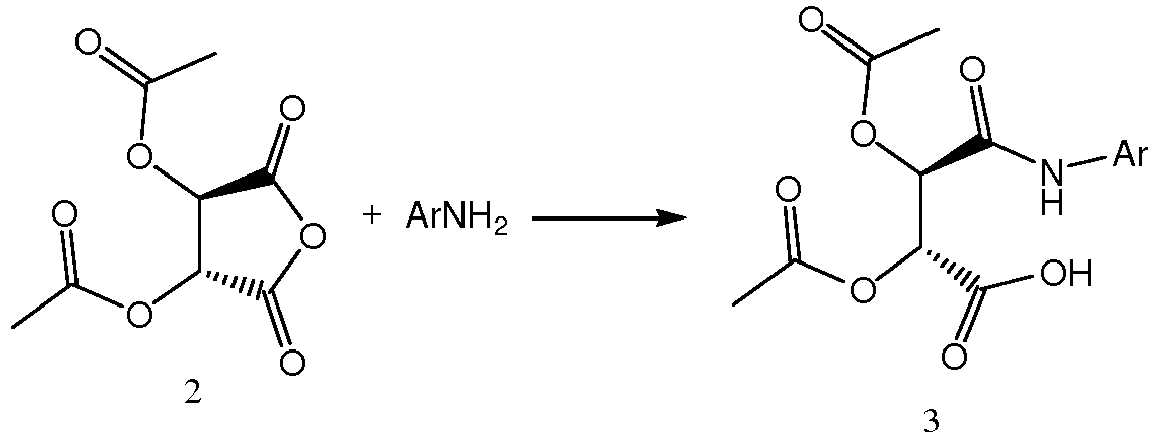
- (iii) compound 3 is dissolved in a suitable solvent such as THF, dichloromethane or N,N-dimethylformamide, and, under the catalysis of a suitable amount of dicyclohexylcarbodiimide, camphorsulfonic acid and 4-dimethylaminopyridine, is acylated with R1ZH (amine), wherein R1 and Z are as defined above, to obtain a specific compound of formula Ia of the invention;

- (iv) compound Ia is dissolved in a suitable solvent such as THF, methanol, ethanol, aminolyzed with a concentrated ammonia water or ammonia, hydrolyzed with sodium hydroxide, potassium hydroxide or potassium carbonate, and transesterified with sodium methoxide or sodium ethoxide, to obtain a specific compound of formula Ib of the invention.

- The process for preparing the compound of formula Ib, wherein R1, Ar and Z are as defined above, is described as follows:
- (i) under the catalysis of an acid such as sulfuric acid, a strong acid type ion exchange resin, compound 1 (L- or D-tartaric acid) is reacted by reflux with a fatty alcohol ROH wherein R is C1-C4 alkyl, such as methanol or ethanol, to obtain compound 2;

- (ii) under the catalysis of a protic acid or Lewis acid such as toluene-p-sulfonic acid or boron trifluoride, compound 2 is reacted by reflux with a ketone of formula R3C(O)R4 wherein R3 and R4 are C1-C4 alkyl, such as acetone, in an inert solvent such as THF or toluene, to obtain a ketal compound 3;

- (iii) compound 3 is dissolved in an organic solvent such as THF or dioxane, and is reacted with an aqueous solution of a base such as sodium hydroxide or potassium hydroxide (having a concentration of 1N, and used in a molar ratio of 1:1 in relative to compound 3) at 0°C to room temperature, and then acidified with an inorganic acid such as hydrochloric acid (having a concentration of 1N), and further extracted with an organic solvent such as dichloromethane, diethyl ether or ethyl acetate, to obtain compound 4;

- (iv) compound 4 is dissolved in a suitable solvent such as THF, dichloromethane or N,N-dimethylformamide, and, under the catalysis of a suitable amount of dicyclohexylcarbodiimide, camphorsulfonic acid and 4-dimethylaminopyridine, is acylated with ArNH2, to obtain compound 5;

- (v) compound 5 is dissolved in an organic solvent such as THF or dioxane, and is reacted with an aqueous solution of a base such as sodium hydroxide or potassium hydroxide (having a concentration of 1N, and used in a molar ratio of 1:1 in relative to compound 5) at 0°C to room temperature, and then acidified with an inorganic acid such as hydrochloric acid (having a concentration of 1N), and further extracted with an organic solvent such as dichloromethane, diethyl ether or ethyl acetate, to obtain compound 6;

- (vi) compound 6 is dissolved in a suitable solvent such as THF, dichloromethane or N,N-dimethylformamide, and, under the catalysis of a suitable amount of dicyclohexylcarbodiimide, camphorsulfonic acid and 4-dimethylaminopyridine, is acylated with R1ZH (amine), wherein R1 and Z are as defined above, to obtain compound 7;

- (vii) compound 7 is dissolved in a suitable solvent such as methanol or ethanol, and, under the catalysis of a suitable amount of a protic acid such as hydrochloric acid or sulfuric acid, is deprotected to remove acetonide group, to obtain a specific compound of formula Ib of the invention.

- As for more detailed information about the preparation of the compound of formula I, please see the examples.
- In one further aspect, the present invention provides a pharmaceutical composition, comprising a compound of formula I selected from the group consisting of compounds (1) to (31), or all possible optical isomers or tautomers, pharmaceutically acceptable salts, solvates or hydrates thereof, and at least one pharmaceutically acceptable carrier or excipient.
- In one still further aspect, the present invention relates to use of a compound of formula I selected from the group consisting of compounds (1) to (31), or all possible optical isomers or tautomers, pharmaceutically acceptable salts, solvates or hydrates thereof for the manufacture of a medicament for treating and preventing diseases induced by aggregation or deposition of Aβ, the diseases including, but not limited to, Alzheimer's disease, amyloid degenerative angiopathy, Kuru's disease and Down's syndrome.
- The compound of formula I or pharmaceutically acceptable salts thereof may be used alone, or together with a pharmaceutically acceptable carrier or excipient in the form of a pharmaceutical composition. When used in the form of a pharmaceutical composition, an effective amount of the compound of formula I or its pharmaceutically acceptable salt and one or more pharmaceutically acceptable carrier or excipient are combined and made into an appropriate administration form or dosage form by means of mixing, granulating, compressing or dissolving the components in suitable mode.
- The pharmaceutical composition comprising the compound of the invention may be administered in any of the following routes: orally, inhaled by spray, rectally, nasally, vaginally, topically, parenterally such as subcutaneous, intravenous, intramuscular, intraperitoneal, intrathecal, intraventricular, intrasternal or encephalic injection or infusion, or administered with the aid of an explanted reservoir, wherein the administration routes by orally, intramuscular, intraperitoneal or intravenous injection are preferred. In addition, in order to enable the compound of the invention or the pharmaceutical composition comprising it to be effective for treating neutral nerve system, the intraventricular administration route is preferred to thereby surmount a possible relatively low blood-brain barrier transmissivity of the compound.
- The compound of the invention or the pharmaceutical composition comprising the compound of the invention may be administered in a unit dosage form. The dosage form may be in a liquid form, or a solid form. The liquid form includes true solution, colloids, particulates, emulsions, suspensions. Other forms include tablets, capsules, dropping pills, aerosols, pills, powder, solutions, suspensions, emulsions, granules, suppository, lyophilized powder for injection, clathrates, implants, patches, liniment, and etc.
- The pharmaceutical composition of the invention may further comprise a commonly used carrier that includes, but not limited to, ion exchanger, alumina, aluminum stearate, lecithin, serum protein such as human serum protein, buffer such as phosphate, glycerin, sorbic acid, potassium sorbate, a mixture of partial glycerine esters of saturated vegetable fatty acids, water, salt or electrolyte, such as protamine sulfate, disodium hydrogen phosphate, potassium hydrogen phosphate, sodium chloride, zinc salt, colloidal silica, magnesium trisilicate, polyvinylpyrrolidone, cellulose, polyethylene glycol, sodium carboxymethylcellose, polyacrylate, beeswax, lanolin, and etc. The amount of the carrier in the pharmaceutical composition may be 1% to 98% by weight, usually about 80% by weight. For the convenience, topical anesthetic, antiseptic, buffer and etc. may be directly dissolved in the carrier.
- Oral tablets and capsules may comprise excipients e.g., binders such as syrup, Arabic gum, sorbitol, tragacanth, or polyvinylpyrrolidone, fillers such as lactose, sucrose, corn starch, calcium phosphate, sorbitol, aminoacetic acid, lubricant such as magnesium stearate, saponite, polyethylene glycol, silica, disintegrating agent such as potato starch, or acceptable moisturizing agent such as sodium lauryl sulfate. Tablets may be coated by using known methods in pharmaceutics.
- Oral solution may be made as a suspension of water and oil, a solution, an emulsion, a syrup or an elixir, or made as a dried product to which water or other medium is added before use. This liquid preparation may comprise conventional additives, e.g., suspending agent such as sorbitol, cellulose mdiethyl ether, glucose syrup, gelatin, hydroxyethyl cellulose, carboxymethyl cellulose, aluminum stearate gel, hydrogenated edible grease; emulsifying agent such as lecithin, sorbitan monooleate, Arabic gum; or non-aqueous carrier (possibly including edible oil), such as almond oil, grease such as glycerin, ethylene glycol, or ethanol; antiseptic such as methyl or propyl p-hydroxybenzoate, sorbic acid. If desired, a flavoring agent or a colorant may be added.
- Suppository may comprise a conventional suppository substrate, and the excipient, such as cocoa butter, other glyceride or beewax, is in solid state at room temperature, while melts to release drug at body temperature.
- For non-gastric administration, the liquid dosage form is usually made of the compound and a sterilized carrier. The preferred carrier is water. According to the carrier selected and the drug concentration, the compound can be dissolved in the carrier or made into a suspension. When making an injection solution, the compound is firstly dissolved in water, and then filtered and sterilized before being packaged into an enclosed bottle or ampoule.
- For topical application on skin, the compound of the invention may be made into a suitable form of ointment, lotion or cream, wherein the active ingredient is suspended or dissolved in one or more carrier(s). The carrier used for an ointment includes, but not limited to, mineral oil, liquid vaseline, white vaseline, propylene glycol, polyoxyethylene, polyoxypropylene, emulsified wax and water; the carrier used for a lotion and a cream includes, but not limited to, mineral oil, sorbitan monostearic ester, Tween 60, cetyl esters wax, hexadecylene aromatic alcohol, 2-octyl dodecanol, benzanol and water.
- According to the administration mode, the medicament may contain 0.1% by weight, or more suitably 10% to 60% by weight, of an active ingredient. Nevertheless, when the medicament includes unit dosages, each of the unit dosages had better comprise 1 to 500 mg of an active ingredient.
- Further, the administration dosage and manner of the compound described therein directed to different patients depend on various factors, such as age, body weight, gender, natural health status and nutrient status of the patient, active strength of the compound, administration time, metabolic rate, degree of severity of the disease, and subjective judgment made by the doctor for diagnosis/treatment. The preferred administration dosage is within 0.01 to 100 mg/kg body weight/day.
- It shall be understood that the optimum administration dosage and interval of compound of formula I are determined by the property of the compound and external conditions such as administration form, route and site, and the optimum administration dosage can be determined according to a conventional technique. Meanwhile, it shall also be understood that the optimum period of treatment, i.e., the dosage of the compound of formula I per day within a predetermined time of period, may be determined by a well-known method in the art.
- The melting point of the compound was determined by using RY-1 melting point apparatus, the thermometer being not calibrated. Mass spectrum was determined by using Micromass ZabSpec high resolution mass spectrometer (resolution 1000). 1H NMR was determined by using JNM-ECA-400 superconductive NMR spectrometer, the working frequency being 1H NMR 400MHz. Specific rotation was determined by using PE-243B polarimeter, λNa = 589 nm, the temperature being 20 °C.
-

- 10.00 g (66.7 mmol) L-tartaric acid was dissolved in 31.5 ml acetic anhydride, to which was added 0.3 ml concentrated sulfuric acid with stirring; the resulting mixture was slowly heated till to reflux, and continuously stirred for 40 minutes, followed by cooling down to room temperature; a solid was precipitated, filtered, and washed with anhydrous diethyl ether, to obtain 10.00 g of a yellowish solid, yield 69.4%.
- 3.30 g (15.3 mmol) L-(4R,5R)-2,3-diacetoxy-succinic anhydride was dissolved in 20 ml dichloromethane, to which, in ice bath, was added dropwise 2.19 g (15.3 mmol) 2-naphthylamine dissolved in 6 ml dichloromethane, followed by stirring for 4 hours, till completion of reaction. The resulting reaction product was alkalified with a 4% sodium bicarbonate solution to a pH of about 8, and extracted with CH2Cl2 twice; the obtained organic phases were discarded; the remaining water phase was adjusted with 1 M HCl to a pH value of 1 to 2, and extracted with CH2Cl2 for three times, then the obtained organic phases were combined, dried with anhydrous Na2SO4, and subjected to solvent removal by evaporation, to thereby obtain 4.60 g of a white solid, yield 83.9%. 1H-NMR (DMSO, 400 MHz), δ (ppm): 2.00(3H, s, CH3), 2.06(3H, s, CH3), 5.65(1H, d, J = 2.80Hz, CH), 5.74(1H, d, J = 2.80Hz, CH), 7.43(1H, t, J = 8.12Hz, ArH), 7.49(1H, t, J = 8.40Hz, ArH), 7.58(1H, d, J = 8.96Hz, ArH), 7.87(3H, m, ArH), 8.21(1H, s, ArH), 10.43(1H, s, CONH), 13.85(1H, br, COOH); FAB-MS m/e(%): 360.1([M+1]+, 100), 318(32).
- 0.36 g (1.0 mmol) L-(2R,3R)-2,3-diacetoxy-3-(naphthalen-2-ylcarbamoyl)-propionic acid and 0.22 g (1.0 mmol) methyl L-phenprobamate hydrochloride were dissolved in 10 ml anhydrous THF, to which were further added 0.20 g (1.5 mmol) HOBt, 0.12 g (1.0 mmol) triethylamine and 0.31 g (1.5 mmol) DCC, followed by reacting at room temperature with stirring for 2 hours; the solid resulted from the reaction was removed by filtration; the remaining mother liquor was evaporated to dryness under reduced pressure to obtain an oily matter, which was loaded on a silica gel chromatographic column, and eluted with cyclohexane:ethyl acetate = 2:1, to obtain 0.22 g of a white solid, yield 41.4%, specific rotation [α]D 20= -14.3°(20 mg/2 ml, DMF). 1H-NMR (DMSO, 400 MHz), δ (ppm): 2.10(3H, s, CH3), 2.13(3H, s, CH3), 3.05(2H, m, CH2), 3.66(3H, s, CH3), 4.49(1H, m, CH), 5.54(1H, d, J = 2.52Hz, CH), 5.66(1H, d, J = 2.56Hz, CH), 7.18-7.24(5H, m, ArH), 7.43(1H, t, J = 7.00Hz, ArH), 7.48(1H, t, J = 6.72Hz, ArH), 7.58(1H, m, ArH), 7.85(3H, m, ArH), 8.17(1H, d, J = 1.96Hz, ArH), 8.59(1H, d, J = 8.12Hz, CONH), 10.39(1H, s, CONH); HREI-MS Calcd. for C28H28N2O8: 520.1846, found: 520.1831.
-

- According to the procedures in Step 2 of Example 1, 7.49 g (34.6 mmol) L-(4R,5R)-2,3-diacetoxy-succinic anhydride and 6.41 g (34.6 mmol) p-phenoxyaniline were reacted to obtain 8.97 g of a grey solid, yield 64.8%, specific rotation [α]D 20= -10.3°(20 mg/2 ml, CHsOH). 1H-NMR (DMSO, 400 MHz), δ (ppm): 2.06(3H, s, CH3), 2.13(3H, s, CH3), 5.58(1H, d, J = 2.80Hz, CH), 5.64(1H, d, J = 3.08Hz, CH), 6.90(4H, m, ArH), 7.12(1H, t, J = 7.28Hz, ArH), 7.37(2H, t, J = 7.56Hz, ArH), 7.55(2H, d, J = 8.96Hz, ArH), 10.24(1H, s, CONH), 13.88(1H, br, COOH); FAB-MS m/e(%): 402.1([M+1]+, 100), 360.0(36).
- 2.00 g (5.00 mmol) L-(2R,3R)-2,3-diacetoxy-3-(4-phenoxy-phenylcarbamoyl)propionic acid and 1.01 g (5.00 mmol) methyl 4-aminomethylbenzoate hydrochloride were reacted according to the procedures of synthesizing compound (1), to obtain 1.60 g of a white solid, yield 58.3%, specific rotation [α]D 20= +7.5°(20 mg/2 ml, DMF). 1H-NMR (DMSO, 400 MHz), δ (ppm): 2.07(3H, s, CH3), 2.11(3H, s, CH3), 3.84(3H, s, CH3), 4.31(1H, m, ×CH2), 4.51(1H, m, ×CH2), 5.58(1H, d, J = 2.52Hz, CH), 5.75(1H, d, J = 2.80Hz, CH), 6.98(4H, m, ArH), 7.11(1H, t, J = 7.60Hz, ArH), 7.38(4H, m, ArH), 7.52(2H, d, J = 8.96Hz, ArH), 7.93(2H, d, J = 8.40Hz, ArH), 8.86(1H, t, J = 6.16Hz, CONH), 10.27(1H, s, CONH); HREI-MS Calcd. for C29H28N2O9: 548.1791, found: 548.1791.
-
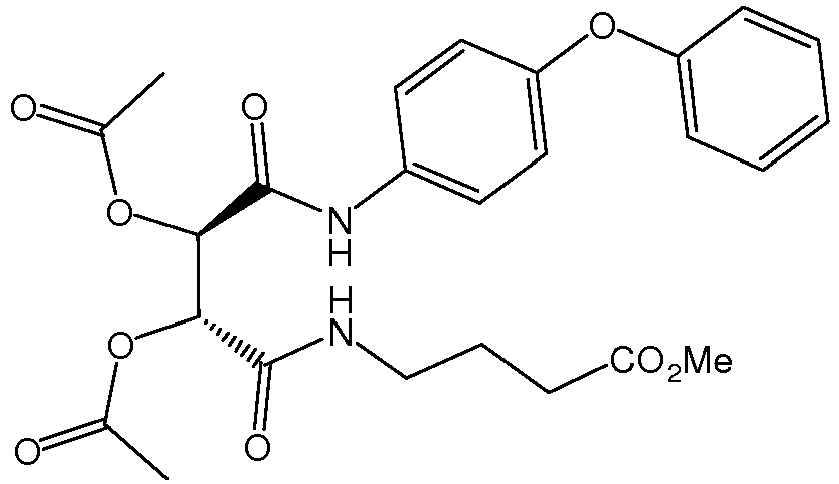
- 2.00 g (5.00 mmol) L-(2R,3R)-2,3-diacetoxy-3-(4-phenoxy-phenylcarbamoyl) propionic acid prepared in Example 2 and 0.77 g (5.00 mmol) methyl 4-aminobutyrate hydrochloride were reacted according to the procedures of synthesizing compound (1), to obtain 1.20 g of a white solid, yield 48.0%, specific rotation [α]D 20= +8.1°(20 mg/2 ml, DMF). 1H-NMR (CDCl3, 400 MHz), δ (ppm): 1.85(2H, m, CH2), 2.20(6H, s, 2×CH3), 2.37(2H, m, CH2), 3.34(2H, m, CH2), 3.66(3H, s, CH3), 5.74 (2H, s, 2×CH), 6.89(1H, br, CONH), 6.97(4H, m, ArH), 7.08(1H, t, J = 7.56Hz, ArH), 7.32(2H, t, J = 8.12Hz, ArH), 7.44(2H, d, J = 8.56Hz, ArH), 8.54(1H, br, CONH); HREI-MS Calcd. for C25H28N2O9: 500.1795, found: 500.1780.
-

- According to the procedures in Step 2 of Example 1, 5.2 g (24.1 mmol) L-(4R,5R)-2,3-diacetoxy-succinic anhydride and 5.30 g (24.1 mmol) p-phenoxyaniline were reacted, to obtain 6.40 g of a yellowish solid, yield 62.7%, specific rotation [α]D 20= -10.1°(20 mg/2 ml, CH3OH). 1H-NMR (DMSO, 400 MHz), δ (ppm): 0.67(3H, s, CH3), 0.90(3H, s, CH3), 1.46(2H, s, CH2), 1.58(2H, s, CH2), 2.05(3H, s, CH3), 2.15(3H, s, CH3), 3.10(2H, s, CH2), 3.33(2H, s, CH2), 3.91(3H, s, CH3), 5.58(1H, d, J = 3.08Hz, CH), 5.67(1H, d, J = 2.80Hz, CH), 7.04(1H, d, J = 7.56Hz, ArH), 7.38(1H, t, J = 7.84Hz, ArH), 7.54(2H, d, J = 8.96Hz, ArH), 10.32(1H, s, CONH), 13.74(1H, br, COOH); FAB-MS m/e(%): 437.1([M+1]+, 100),335.9(16).
- 1.50 g (3.44 mmol) L-(2R,3R)-2,3-diacetoxy-3-(3-di-n-propylaminoformyl-phenylcarbamoyl)propionic acid and 0.70 g (3.44 mmol) methyl 4-aminomethylbenzoate hydrochloride were reacted according to the procedures of synthesizing compound (1), to obtain 1.20 g of a white solid, yield 59.8%, specific rotation [α]D 20= +17.8°(20 mg/2 ml, DMF). 1H-NMR (CDCl3, 400 MHz), δ (ppm): 0.73(3H, t, J = 7.32Hz, CH3), 0.96(3H, t, J = 7.28Hz, CH3), 1.51(2H, m, CH2), 1.66(2H, m, CH2), 2.10(3H, s, CH3), 2.11(3H, s, CH3), 3.13(2H, t, J = 7.60Hz, CH2), 3.40(2H, m, CH2), 4.38(1H, m, ×CH2), 4.58(1H, m, ×CH2), 5.78(1H, d, J = 3.12Hz, CH), 5.80(1H, d, J = 3.08Hz, CH), 7.06(1H, d, J = 7.56Hz, ArH), 7.25-7.31(4H, m, ArH), 7.40(1H, br, CONH), 7.54(1H, d, J = 8.12Hz, ArH), 7.96(2H, d, J = 8.12Hz, ArH), 8.90(1H, br, CONH); FAB-MS m/e(%): 584.0([M+1]+, 100).
-

- According to the procedures in Step 2 of Example 1, 7.43 g (34.4 mmol) L-(4R,5R)-2,3-diacetoxy-succinic anhydride and 7.20 g (24.1 mmol) dimethyl 5-amino-isophthalate were reacted, to obtain 10.00 g of a yellowish oily matter, yield 70.1%, specific rotation [α]D 20= -6.3°(20 mg/2 ml, CH3OH). 1H-NMR (DMSO, 400 MHz), δ (ppm): 2.06(3H, s, CH3), 2.16(3H, s, CH3), 3.90(6H, s, 2×CH3), 5.61(1H, d, J = 2.80Hz, CH), 5.69(1H, d, J = 3.08Hz, CH), 8.21(1H, s, ArH), 8.48(2H, s, ArH), 10.69(1H, s, CONH), 13.77(1H, br, COOH); FAB-MS m/e(%): 426.0([M+1]+, 100), 384.0(22).
- 1.50 g (3.53 mmol) L-(2R,3R)-2,3-diacetoxy-3-(3,5-dimethoxycarbonylphenyl carbamoyl)propionic acid and 0.76 g (3.53 mmol) methyl L-phenprobamate hydrochloride were reacted according to the procedures of synthesizing compound (1), to obtain 1.10 g of a white solid, yield 53.2%, specific rotation [α]D 20= -8.1°(20 mg/2 ml, DMF). 1H-NMR (CDCl3, 400 MHz), δ (ppm): 2.05(3H, s, CH3), 2.21(3H, s, CH3), 3.14(2H, m, CH2), 3.76(3H, s, CH3), 3.95(6H, s, 2×CH3), 4.91(1H, m, CH), 5.78(1H, d, J = 3.36Hz, CH), 5.80(1H, d, J = 3.04Hz, CH), 6.57(1H, d, J = 8.12Hz, CONH), 706(2H, m, ArH), 7.27(3H, m, ArH), 7.38(2H, d, J = 1.40Hz, ArH), 8.43(1H, br, CONH), 8.45(1H, s, ArH); HREI-MS Calcd. for C28H30N2O12: 586.1799, found: 586.1777.
-

- 1.50 g (3.53 mmol) of L-(2R,3R)-2,3-diacetoxy-3-(3,5-dimethoxycarbonyl phenylcarbamoyl)propionic acid prepared in Example 5 and 0.71 g (3.53 mmol) methyl 4-aminomethylbenzoate hydrochloride were reacted according to the procedures of synthesizing compound (1), to obtain 0.42 g of a white solid, yield 20.8%. 1H-NMR (DMSO, 400 MHz), δ (ppm): 2.10(6H, s, 2×CH3), 3.84(3H, s, CH3) 3.90(6H, s, 2xCH3), 4.33(1H, m, ×CH2), 4.50(1H, m, ×CH2), 5.60(1H, d, J = 2.80Hz, CH), 5.77(1H, d, J = 3.08Hz, CH), 7.38(2H, d, J = 8.40Hz, ArH), 7.91(2H, d, J = 8.12Hz, ArH), 7.90(1H, d, J = 1.40Hz, ArH), 8.45(2H, d, J = 1.40Hz, ArH), 8.89(1H, t, J = 6.16Hz, CONH), 8.89(1H, s, CONH); HREI-MS Calcd. for C27H28N2O12: 572.1642, found: 572.1661.
-

- According to the procedures in Step 2 of Example 1, 2.16 g (10.0 mmol) L-(4R,5R)-2,3-diacetoxy-succinic anhydride and 1.07 g (10.0 mmol) benzylamine were reacted, to obtain 2.80 g of a white solid, yield 86.7%. 1H-NMR (DMSO, 400 MHz), δ (ppm): 2.00(3H, s, CH3), 2.12(3H, s, CH3), 4.23(1H, m, ×CH2), 4.37(1H, m, ×CH2), 5.52(1H, d, J = 2.52Hz, CH), 5.54(1H, d, J = 2.52Hz, CH), 7.19-7.31(5H, m, ArH), 8.76(1H, t, J = 6.16Hz, CONH), 13.70(1H, br, COOH); FAB-MS m/e(%): 324.0([M+1]+, 100), 91.0(20).
- 1.24 g (3.83 mmol) L-(2R,3R)-2,3-diacetoxy-3-(benzylcarbamoyl)propionic acid and 0.67 g (3.83 mmol) 4-benzylpiperazine were reacted according to the procedures of synthesizing compound (1), to obtain 0.80 g of a white solid, yield 43.4%. 1H-NMR (CDCl3, 400 MHz), δ (ppm): 1.94(1H, m, ×CH2), 2.06(3H, s, CH3), 2.15(3H, s, CH3), 2.40(2H, m, CH2), 2.42(2H, m, CH2), 3.34(1H, br, ×CH2), 3.61(3H, s, CH3), 3.64(2H, s, CH2), 4.35(1H, m, ×CH2), 4.64(1H, m, ×CH2), 5.66(1H, d, J = 3.64Hz, CH), 5.87(1H, d, J = 3.64Hz, CH), 6.72(1H, t, J = 6.04Hz, CONH), 7.27-7.33(10H, m, ArH); FAB-MS m/e(%): 482.0([M+1]+, 100).
-

- 8.59 g (39.4 mmol) L-(4R,SR)-2,2-dimethyl-1,3-dioxolane-4,5-dicarboxylic dimethyl ester was dissolved in 200 ml water/dioxane (volume ratio of 1:1) mixed solvent, to which was slowly added dropwise 39.4 ml 1 M NaOH within 30 minutes, followed by reacting with stirring at room temperature for 1 hour; the resulting reaction product was extracted with CH2Cl2 for three times; the obtained organic phases were discarded; the remaining water phase was adjusted with 1 M HCl to a pH value of 2 to 3, and extracted with CH2Cl2 for three times; the obtained organic phases were combined, dried with anhydrous Na2SO4, subjected to solvent removal by evaporation, loaded on a silica gel chromatographic column, and eluted in sequence with petroleum ether: ethyl acetate = 5:1, and with ethyl acetate, to thereby obtain 6.8 g of a yellowish oily mater, yield 84.6%, specific rotation [α]D20= -51.2°(20 mg/2 ml, CH3OH). 1H-NMR (CDCl3, 400 MHz), δ (ppm): 1.50(3H, s, CH3), 1.52(3H, s, CH3), 3.84(2H, s, CH2), 4.83(1H, d, J = 5.60Hz, CH), 4.89(1H, d, J = 5.64Hz, CH), 9.76(1H, br, OH).
- 6.0 g (29.4 mmol) L-(4R,SR)-2,2-dimethyl-1,3-dioxolane-4,5-dicarboxylic monomethyl ester and 3.78 g (35.2 mmol) benzylamine were dissolved in 140 ml anhydrous THF, to which were further added 5.96 g (44 mol)HOBt, and 9.08 g (44 mol) DCC, followed by reacting at room temperature for 2 hours; solid matter resulted from the reaction was removed by filtration; the remaining mother liquor was evaporated to dryness under reduced pressure to obtain an oily matter, which was loaded on a silica gel chromatographic column, and eluted with petroleum ether: ethyl acetate = 3:1, to obtain 7.8 g of a colorless oily matter, yield 86.4%. 1H-NMR (CDCl3, 400 MHz), δ (ppm): 1.33(3H, t, JHH=7.00Hz, CH3), 1.45(3H, s, CH3), 1.46(3H, s, CH3), 4.30(2H, q, J = 7.00Hz, CH2), 4.44-4.55(2H, m, CH2), 4.77(1H, d, J = 5.52Hz, CH), 4.82(1H, d, J = 5.30Hz, CH), 6.82(1H, br, CONH), 7.26-7.38(5H, m, ArH).
- 7.56 g (24.6 mmol) methyl of L-(4R,5R)-5-benzylaminocarbonyl-2,2-dimethyl-1,3-dioxolane-4-formate was dissolved in 300 ml water/dioxane (volume ratio of 1:1) mixed solvent, to which was slowly added dropwise 24.6 ml 1 M NaOH within 30 minutes, followed by reacting with stirring at room temperature for 1 hour; the resulting reaction product was extracted with CH2Cl2 for three times; the obtained organic phases were discarded; the remaining water phase was adjusted with 1 M HCl to a pH value of 2, and extracted with CH2Cl2 for three times; the obtained organic phases were combined, dried with anhydrous Na2SO4, and subjected to solvent removal by evaporation, to thereby obtain 6.5 g of a yellowish oily matter, yield 94.4%. 1H-NMR (CDCl3, 400 MHz), δ (ppm): 1.46(3H, s, CH3), 1.51(3H, s, CH3), 4.58-4.65(4H, m, CH2 and 2×CH), 7.30(1H, br, CONH), 7.31-7.37(5H, m, ArH), 11.25(1H, br, OH).
- 0.28 g (1.0 mmol) L-(4R,5R)-5-benzylaminocarbonyl-2,2-dimethyl-1,3-dioxolane-4-formic acid and 0.20 g (1.0 mmol) methyl 4-aminomethylbenzoate hydrochloride were dissolved in 10 ml anhydrous THF, to which were further added 0.20 g (1.5 mmol) HOBt, 0.12 g (1.0 mmol) triethylamine and 0.31 g (1.5 mmol) DCC, followed by reacting at room temperature with stirring for 2 hours; solid matter resulted from the reaction was removed by filtration; the remaining mother liquor was evaporated to dryness under reduced pressure to obtain an oily matter, which was loaded on a silica gel chromatographic column, and eluted with cyclohexane:ethyl acetate = 3:1, to obtain 0.25 g of a colorless oily matter, yield 58.5%, specific rotation [α]D 20= -33.8°(20 mg/2 ml, CH3OH). 1H-NMR (DMSO, 400 MHz), δ (ppm): 1.41(6H, s, 2×CH3), 3.84(3H, m, CH3), 4.33(2H, t, J = 6.16Hz, CH2), 4.40(2H, t, J = 6.16Hz, CH2), 4.59(1H, d, J = 6.44Hz, CH), 4.63(1H, d, J = 4.76Hz, CH), 7.26-7.32(5H, m, ArH), 7.41(2H, d, J = 8.12Hz, ArH), 7.91(2H, d, J = 8.12Hz, ArH), 8.71(1H, t, J = 6.16Hz, CONH), 8.83(1H, t, J = 6.16Hz, CONH); FAB-MS m/e(%): 427.1([M+1]+, 100), 91.2(32).
- 0.20 g (0.47 mmol) methyl L-(4R,5R)-4-{[(5-benzylaminocarbonyl-2,2-dimethyl-1,3-dioxolane-4-formyl)amino]-methyl}benzoate was dissolved in 10 ml methanol, to which was added 0.5 ml 1 N HCl, followed by reacting with reflux for 8 hours; the resulting reaction product was evaporated to dryness under reduced pressure to obtain an oily matter, which was loaded on a silica gel chromatographic column, and eluted with cyclohexane:ethyl acetate = 1:1, to obtain 0.10 g of a white solid, yield 55.2%, mp: 205-206 °C, specific rotation [α]D 20= +90.4°(20 mg/2 ml, CH3OH). 1H-NMR (DMSO, 400 MHz), δ (ppm): 3.84(3H, s, CH3), 4.28-4.50(6H, m, 2×CH2 and 2×CH), 5.77(2H, m, 2×OH), 7.22(1H, m, ArH), 7.30(4H, m, ArH), 7.44(2H, d, J = 8.12Hz, ArH), 7.89(2H, d, J = 8.12Hz, ArH), 8.71(1H, t, J = 6.16Hz, CONH), 8.83(1H, t, J = 6.16Hz, CONH); EI-MS m/e(%): 386.1(M+, 40), 194.0(92), 91.1(100); HREI-MS Calcd. for C20H22N2O6: 386.1478, found: 386.1490.
-
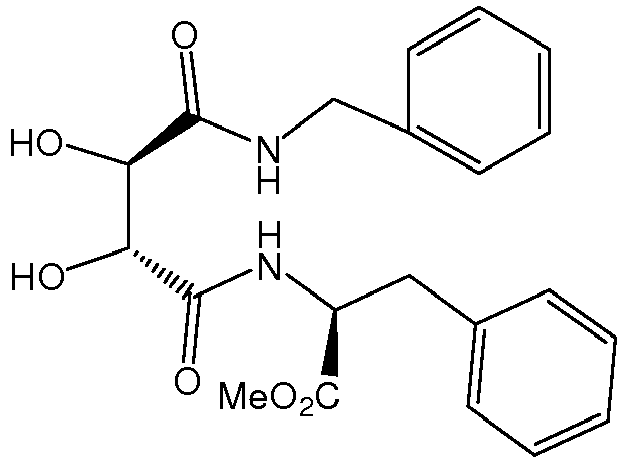
- According to the procedures in Step 4 of Example 8, 0.56 g (2.0 mmol) L-(4R,5R)-5-benzylaminocarbonyl-2,2-dimethyl-1,3-dioxolane-4-formic acid prepared in Example 8 and 0.44 g (2.0 mmol) methyl L-phenprobamate hydrochloride were reacted, to obtain 0.88 g of a colorless oily matter, exhibiting a single spot by TLC, without further purification, yield 100.0%.
- 0.60 g (1.36 mmol) methyl L-(4R,5R)-5-(naphthyl-2-amino)carbonyl-2,2-dimethyl-1,3-dioxolane-4-formyl-L-phenprobamate was dissolved in 10 ml methanol, and reacted according to the procedures of synthesizing compound (8), to obtain 0.30 g of a white solid, yield 55.1%, specific rotation [α]D20= +86.4°(20 mg/2 ml, CH3OH). 1H-NMR (DMSO, 400 MHz), δ (ppm): 3.05(2H, m, CH2), 3.61(3H, s, CH3), 4.27-4.40(4H, m, CH2 and 2×CH), 4.58(H, m, CH), 5.61(1H, d, J = 7.28Hz, OH), 5.83(1H, d, J = 7.56Hz, OH), 7.18-7.29(10H, m, ArH), 7.90(1H, d, J = 8.12Hz, CONH), 8.21(1H, t, J = 6.16Hz, CONH); EI-MS m/e(%): 400.1(M+, 30), 194.0(62), 91.1(100); HREI-MS Calcd. for C21H24N2O6: 400.1634, found: 400.1623.
-

- 0.20 g (0.50 mmol) methyl L-(2R,3R)-2-(3-benzylcarbamoyl-2,3-dihydroxy-propionylamino)-3-phenyl-propionate prepared in Example 9 was dissolved in 5 ml water/dioxane (volume ratio of 1:1) mixed solvent, to which was added 1 ml 1 N NaOH, followed by reacting with stirring at room temperature for 4 hours; the resulting reaction product was extracted with CH2Cl2 for three times; the obtained organic phases were discarded; the remaining water phase was adjusted with 1 M HCl to a pH value of 2, and extracted with CH2Cl2 for three times; the obtained organic phases were combined, dried with anhydrous Na2SO4, and subjected to solvent removal by evaporation, to thereby obtain 0.07 g of a white solid, yield 36.2%, mp: 236-238 °C, specific rotation [α]D 20= +118°(20 mg/2 ml, CH3OH). 1H-NMR (DMSO, 400 MHz), δ (ppm): 3.04(2H, m, CH2), 4.28-4.39(4H, m, CH2 and 2×CH), 4.55(H, m, CH), 5.58(1H, br, OH), 5.83(1H, d, J = 7.56Hz, OH), 7.18-7.30(10H, m, ArH), 7.69(1H, d, J = 7.84Hz, CONH), 8.21(1H, t, J = 5.88Hz, CONH), 13.00(1H, br, COOH); FAB-MS m/e(%): 387.1([M+1]+, 100),91.0(82).
-

- According to the procedures in Step 4 of Example 8, 0.62 g (2.2 mmol) L-(4R,5R)-5-benzylaminocarbonyl-2,2-dimethyl-1,3-dioxolane-4-formic acid prepared in Example 8 and 0.46 g (2.2 mmol) methyl (4-aminomethyl) cyclohexanecarboxylate hydrochloride were reacted, to obtain 0.42 g of a colorless oily matter, yield 44.2%, specific rotation [α]D 20= -34.3°(20 mg/2 ml, CH3OH). 1H-NMR (DMSO, 400 MHz), δ (ppm): 0.93(2H, m, CH2), 1.24(2H, m, CH2), 1.40(7H, m, 2×CH3 and ½×CH2), 1.69(2H, d, J = 12.6Hz, CH2), 1.88(2H, d, J = 11.2Hz, CH2), 2.22(1H, m, ×CH2), 2.96(2H, m, CH2), 3.57(3H, s, CH3), 4.31(2H, d, J = 11.4Hz, CH2), 4.51(1H, d, J = 6.44Hz, CH), 4.55(1H, d, J = 6.44Hz, CH), 7.23-7.31(5H, m, ArH), 8.14(1H, t, J = 5.48Hz, CONH), 8.81(1H, t, J = 6.16Hz, CONH); EI-MS m/e(%): 432.2(M+, 35), 176.1(84), 91.1(100).
- 0.40 g (0.93 mmol) methyl L-(4R,5R)-4-{[(5-benzylaminocarbonyl-2,2-dimethyl-1,3-dioxolane-4-formyl)amino]-methyl}cyclohexanecarboxylate was dissolved in 10 ml methanol, and reacted according to the procedures of synthesizing compound (8), to obtain 0.11 g of a white solid, yield 29.4%, mp: 153-154 °C, specific rotation [α]D 20= +83.9°(20 mg/2 ml, CH3OH). 1H-NMR (DMSO, 400 MHz), δ (ppm): 0.92(2H, m, CH2), 1.26(2H, m, CH2), 1.42(1H, m, CH), 1.74(2H, m, CH2), 1.86(2H, m, CH2), 2.22(1H, m, CH), 2.97(2H, m, CH2), 3.59(3H, s, CH3), 4.26-4.39(4H, m, CH2 and 2×CH), 5.60(2H, m, 2×OH), 7.21(1H, m, ArH), 7.28(4H, m, ArH), 7.64(1H, t, J = 6.16Hz, CONH), 8.19(1H, t, J = 6.44Hz, CONH); EI-MS m/e(%): 392.1(M+, 20), 258.1(92), 91.0(100); HREI-MS Calcd. for C20H28N2O6: 392.1947, found: 392.1951.
-

- 0.40 g (0.93 mmol) methyl L-(2R,3R)-4-[(3-benzylcarbamoyl-2,3-dihydroxy-propionylamino)methyl]-benzoate prepared in Example 8 was dissolved in 5 ml water/dioxane (volume ratio of 1:1) mixed solvent, and reacted according to the procedures of synthesizing compound (10), to obtain 0.05 g of a white solid, yield 7.7%, mp: 177-178 °C, specific rotation [α]D 20= +106°(20 mg/2 ml, DMF). 1H-NMR (DMSO, 400 MHz), δ (ppm): 4.28-4.48(6H, m, 2×CH2 and 2×CH), 5.77(2H, m, 2×OH), 7.22(1H, m, ArH), 7.30(4H, m, ArH), 7.41(2H, d, J = 8.16Hz, ArH), 7.87(2H, d, J = 8.12Hz, ArH), 8.71(1H, t, J = 6.48Hz, CONH), 8.83(1H, t, J = 6.48Hz, CONH), 12.81(1H, br, COOH); FAB-MS m/e(%): 373.2([M+1]+, 100), 318.4(40), 274.4(72).
-

- According to the procedures in Step 4 of Example 8, 1.68 g (6.0 mmol) L-(4R,5R)-5-benzylaminocarbonyl-2,2-dimethyl-1,3-dioxolane-4-formic acid prepared in Example 8 and 0.90 g (6.0 mmol) methyl 4-aminobutyrate hydrochloride were reacted, to obtain 1.20 g of a colorless oily matter, yield 52.9%, specific rotation [α]D 20= -33.4°(20 mg/2 ml, CH3OH). 1H-NMR (DMSO, 400 MHz), δ (ppm): 1.39(6H, s, 2×CH3), 1.69(2H, m, CH2), 2.31(2H, t, J = 7.56Hz, CH2), 3.12(2H, m, CH2), 3.58(3H, s, CH3), 4.32(2H, d, J = 6.16Hz, CH2), 4.51(1H, d, J = 6.16Hz, CH), 4.54(1H, d, J = 6.16Hz, CH), 7.22-7.34(5H, m, ArH), 8.19(1H, t, J = 5.60Hz, CONH), 8.81(1H, t, J = 5.88Hz, CONH); EI-MS m/e(%): 378.1(M+, 35), 186(63), 176.1(100), 91.1(98).
- 1.20 g (3.17 mmol) methyl L-(4R,5R)-4-(5-benzylaminocarbonyl-2,2-dimethyl-1,3-dioxolane-4-formyl)aminobutyrate was dissolved in 10 ml methanol, and reacted according to the procedures of synthesizing compound (8), to obtain 0.40 g of a white solid, yield 37.3%, mp: 142-145 °C, specific rotation [α]d20= +84.8°(20 mg/2 ml, CHsOH). 1H-NMR (DMSO, 400 MHz), δ (ppm): 1.69(2H, m, CH2), 2.31(2H, t, J = 7.00Hz, CH2), 3.13(2H, m, CH2), 3.58(3H, s, CH3), 4.27-4.39(4H, m, CH2 and 2×CH), 5.59(2H, m, 2×OH), 7.22(1H, m, ArH), 7.29(4H, m, ArH), 7.78(1H, t, J = 6.20Hz, CONH), 8.18(1H, t, J = 6.44Hz, CONH), 12.81(1H, br, COOH); EI-MS m/e(%): 338.1(M+, 10), 204.1(84), 91.1(100); HREI-MS Calcd. for C16H22N2O6: 338.1478, found: 338.1480.
-

- 0.40 g (1.18 mmol) methyl L-(2R,3R)-4-(3-benzylcarbamoyl-2,3-dihydroxy-propionylamino)-butyrate prepared in Example 13 was dissolved in 5 ml water/dioxane (volume ratio of 1:1) mixed solvent, and reacted according to the procedures of synthesizing compound (10), to obtain 0.20 g of a white solid, yield 52.2%, mp: 169-170 °C, specific rotation [α]D20= +86.2°(20 mg/2 ml, CH3OH). 1H-NMR (DMSO, 400 MHz), δ (ppm): 1.66(2H, m, CH2), 2.22(2H, t, J = 7.00Hz, CH2), 3.13(2H, m, CH2), 4.26-4.38(4H, m, CH2 and 2×CH), 5.57(2H, m, 2×OH), 7.21(1H, m, ArH), 7.29(4H, m, ArH), 7.75(1H, t, J = 6.16Hz, CONH), 8.18(1H, t, J = 6.96Hz, CONH), 12.00(1H, br, COOH); FAB-MS m/e(%): 325.2([M+1]+, 100), 194.1(18), 91.1(47).
-

- 0.50 g (1.28 mmol) methyl L-(2R,3R)-4-(3-benzylcarbamoyl-2,3-dihydroxy-propionylaminomethyl)-cyclohexanecarboxylate prepared in Example 11 was dissolved in 5 ml water/dioxane (volume ratio of 1:1) mixed solvent, and reacted according to the procedures of synthesizing compound (10), to obtain 0.30 g of a white solid, yield 62.2%, mp: 236-238 °C, specific rotation [α]d20= +80.2°(20 mg/2 ml, CH3OH). 1H-NMR (DMSO, 400 MHz), δ (ppm): 0.90(2H, m, CH2), 1.22(2H, m, CH2), 1.40(1H, m, CH), 1.73(2H, m, CH2), 1.88(2H, m, CH2), 2.01(1H, m, CH), 2.98(2H, m, CH2), 4.27-4.40(4H, m, CH2 and 2×CH), 5.60(2H, m, 2×OH), 7.21(1H, m, ArH), 7.28(4H, m, ArH), 7.64(1H, t, J = 5.92Hz, CONH), 8.20(1H, t, J = 6.44Hz, CONH); 11.95(1H, br, COOH); FAB-MS m/e(%): 379.2([M+1]+, 100), 91.1(17).
-

- According to the procedures in Step 4 of Example 8, 2.80 g (10.0 mmol) L-(4R,5R)-5-benzylaminocarbonyl-2,2-dimethyl-1,3-dioxolane-4-formic acid prepared in Example 8 and 2.10 g (10.0 mmol) dimethyl 5-amino-isophthalate were reacted, to obtain 1.70 g of a white solid, mp: 146-147 °C, yield 36.2%, specific rotation [α]D 20= -47.8°(20 mg/2 ml, CH3OH). 1H-NMR (DMSO, 400 MHz), δ (ppm): 1.46(6H, s, 2×CH2), 4.35(2H, d, J = 6.16Hz, CH2), 4.72(1H, d, J = 6.44Hz, CH), 4.76(1H, d, J = 6.44Hz, CH), 7.22-7.35(5H, m, ArH), 8.21(1H, s, ArH), 8.59(2H, s, ArH), 8.75(1H, br, CONH), 10.68(1H, s, CONH); EI-MS m/e(%): 470.2(M+, 65), 209.1(51), 176.1(98), 91.1(100).
- 1.10 g (2.34 mmol) dimethyl L-(4R,5R)-5-[(5-benzylaminocarbonyl-2,2-dimethyl-1,3-dioxolane-4-formyl)amino]-isophthalatewas dissolved in 10 ml methanol, and reacted according to the procedures of synthesizing compound (8), to obtain 0.40 g of a white solid, yield 39.7%, specific rotation [α]d20= +137.0°(20 mg/2 ml, CH3OH). 1H-NMR (DMSO, 400 MHz), δ (ppm): 3.58(6H, s, 2×CH3), 4.27-4.50(4H, m, CH2 and 2×CH), 5.89(1H, d, J = 7.00Hz, OH), 5.97(1H, d, J = 7.28Hz, OH), 7.21(1H, m, ArH), 7.30(4H, m, ArH), 8.18(1H, t, J = 1.40Hz, ArH), 8.33(1H, t, J = 6.32Hz, CONH), 8.70(2H, d, J = 1.44Hz, ArH), 10.29(1H, s, CONH); EI-MS m/e(%): 430.0(M+, 15), 194.0(49), 91.0(100); HREI-MS Calcd. for C21H22N2O8: 430.1376, found: 430.1361.
-

- According to the procedures in Step 2 of Example 8, 6.0 g (29.4 mmol) L-(4R,SR)-2,2-dimethyl-1,3-dioxolane-4,5-dicarboxylic monomethyl ester prepared in Example 8 and 5.03 g (35.2 mmol) 2-naphthylamine were reacted, to obtain 8.5 g of an oily matter, exhibiting a single spot by TLC, without further purification, yield 87.9%.
- 8.09 g (24.6 mmol) methyl L-(4R,5R)-4-(5-naphthyl-2-amino)carbonyl-2,2-dimethyl-1,3-dioxolane-4-formate was dissolved in 300 ml water/dioxane (volume ratio of 1:1) mixed solvent, and reacted according to the procedures in Step 3 of Example 8, to obtain 6.0 g of a yellowish solid, yield 77.4%, mp: 168-169 °C, specific rotation [α]D 20= -44.1°(20 mg/2 ml, CH3OH). 1H-NMR (DMSO, 400 MHz), δ (ppm): 1.45(3H, s, CH3), 1.46(3H, s, CH3), 4.80(1H, d, J = 5.88Hz, CH), 4.84(1H, d, J = 5.88Hz, CH), 7.42(1H, t, J = 6.72Hz, ArH), 7.49(1H, t, J = 6.72Hz, ArH), 7.66(2H, m, ArH), 7.83-7.90(3H, m, ArH), 8.35(1H, s, ArH), 10.40(1H, br, CONH), 13.25(1H, br, COOH); FAB-MS m/e(%): 316.2([M+1]+, 100),143.2(19).
- 1.28 g (4.0 mmol) L-(4R,5R)-4-(5-naphthyl-2-amino)carbonyl-2,2-dimethyl-1,3-dioxolane-4-formic acid and 0.80 g (2.0 mmol) methyl (4-aminomethyl)benzoate were reacted according to the procedures in Step 4 of Example 8, to obtain 1.24 g of a colorless oily matter, yield 67.1%, specific rotation [α]D 20= -58.9°(20 mg/2 ml, DMF). 1H-NMR (DMSO, 400 MHz), δ (ppm): 1.47(3H, s, CH3), 1.49(3H, s, CH3), 3.83(3H, s, CH3), 4.42(2H, m, CH2), 4.75(1H, d, J = 6.20Hz, CH), 4.81(1H, d, J = 6.44Hz, CH), 7.41-7.49(4H, m, ArH), 7.68(1H, m, ArH); 7.66(1H, m, ArH), 7.83-7.92(5H, m, ArH), 8.35(1H, s, ArH), 8.89(1H, t, J = 6.16Hz, CONH), 10.45(1H, br, CONH); HREI-MS Calcd. for C26H26N2O6: 462.1791, found: 462.1788.
- 1.10 g (2.38 mmol) methyl L-(4R,SR)-4-{ [(5-naphthyl-2-aminocarbonyl-2,2-dimethyl-1,3-dioxolane-4-formyl)amino]-methyl}benzoate was dissolved in 10 ml methanol, and reacted according to the procedures of synthesizing compound (8), to obtain 0.80 g of a white solid, yield 79.6%, specific rotation [α]D 20= +174.0°(20 mg/2 ml, CHsOH). 1H-NMR (DMSO, 400 MHz), δ (ppm): 3.85(3H, s, CH3), 4.38(1H, d, J = 15.68Hz, CH), 4.53(1H, d, J = 1.68Hz, ×CH2), 4.52(2H, m, CH and ½×CH2), 6.02(2H, br, 2×OH), 7.40-7.49(4H, m, ArH), 7.69-7.91(6H, m, ArH), 8.45(1H, t, J = 1.40Hz, ArH), 8.8.47(1H,br, CONH), 9.86(1H, br, CONH); EI-MS m/e(%): 422.0(M+, 45), 143.2(100); HREI-MS Calcd. for C23H22N2O6: 422.1480, found: 422.1480.
-

- 0.64 g (2.0 mmol) L-(4R,5R)-4-(5-naphthyl-2-amino)carbonyl-2,2-dimethyl-1,3-dioxolane-4-formic acid prepared in Example 17 and 0.41 g (2.0 mmol) methyl (4-aminomethyl)cyclohexanecarboxylate hydrochloride were reacted according to the procedures in Step 4 of Example 8, to obtain 0.70 g of a white solid, mp: 130-131 °C, yield 74.8%, specific rotation [α]D 20= -61.6°(20 mg/2 ml, DMF). 1H-NMR (DMSO, 400 MHz), δ (ppm): 0.93(2H, m, CH2), 1.28(2H, m, CH2), 1.40(7H, m, 2×CH3 and ½×CH2), 1.71(2H, d, J = 12.36Hz, CH2), 1.87(2H, d, J = 11.48Hz, CH2), 2.22(1H, m, ×CH2), 2.99(2H, t, J = 6.44Hz, CH2), 3.57(3H, s, CH3), 4.70(2H, d, J = 6.72Hz, 2×CH), 7.43(1H, t, J = 6.72Hz, ArH), 7.49(1H, t, J = 8.16Hz, ArH), 7.66(2H, m, ArH), 7.83-7.89(3H, m, ArH), 8.17(1H, br, CONH), 8.34(1H, s, ArH), 10.39(1H, br, CONH); HREI-MS Calcd. for C26H32N2O6: 468.2260, found: 468.2261.
- 0.50 g (1.07 mmol) methyl L-(4R,5R)-4-{[(5-naphthyl-2-aminocarbonyl-2,2-dimethyl-1,3-dioxolane-4-formyl)amino]-methyl}cyclohexanecarboxylate was dissolved in 10 ml methanol, and reacted according to the procedures of synthesizing compound (8), to obtain 0.22 g of a white solid, yield 48.1%. 1H-NMR (DMSO, 400 MHz), δ (ppm): 0.93(2H, m, CH2), 1.27(2H, m, CH2), 1.46(1H, m, CH), 1.74(2H, m, CH2), 1.98(2H, m, CH2), 2.23(1H, m, CH), 2.97(2H, m, CH2), 3.57(3H, s, CH3), 4.34(1H, d, J = 5.32Hz, CH), 4.45(1H, d, J = 7.00Hz, CH), 5.78(1H, d, J = 7.00Hz, OH), 5.95(1H, d, J = 7.00Hz, OH), 7.41(1H, t, J = 6.76Hz, ArH), 7.47(1H, t, J = 7.00Hz, ArH), 7.72-7.87(5H, m, ArH), 8.44(1H, s, CONH), 9.80(1H, s, CONH); EI-MS m/e(%): 428.2(M+, 60), 258.1(30), 143.1(100); HREI-MS Calcd. for C23H28N2O6: 428.1947, found: 428.1947.
-

- 0.45 g (0.87 mmol) methyl L-(2R,3R)-2-[2,3-diacetoxy-3-(naphthalen-2-ylcarbamoyl)-propionylamino]-3-phenyl-propionate prepared in Example 1, and 0.05 g (0.92 mmol) sodium methoxide were dissolved in 10 ml methanol, reacted at room temperature with stirring for 12 hours, and filtered; the resulting mother liquor was evaporated to dryness under reduced pressure to obtain an oily matter, which was loaded on a silica gel chromatographic column, and eluted with cyclohexane:ethyl acetate = 3:1, to obtain 0.28 g of an oily matter, yield 41.4%, yield 74.7%, specific rotation [α]D 20= +129.5°(20 mg/2 ml, DMF). 1H-NMR (DMSO, 400 MHz), δ (ppm): 3.08(2H, m, CH2), 3.63(3H, s, CH3), 4.35 (1H, d, J = 7.28Hz, CH), 4.45(1H, d, J = 7.28Hz, CH), 4.63 (1H, q, J = 7.28Hz, CH), 5.89(1H, d, J = 7.00Hz, OH), 5.96(1H, d, J = 7.00Hz, OH), 7.18-7.28(5H, m, ArH), 7.40(1H, t, J = 7.00Hz, ArH), 7.45(1H, t, J = 7.00Hz, ArH), 7.78-7.93(5H, m, ArH), 8.42(1H, s, CONH), 9.77(1H, s, CONH); HREI-MS Calcd. for C24H24N2O6: 436.1637, found: 436.1637.
-

- 2.00 g (5.00 mmol) L-(2R,3R)-2,3-diacetoxy-3-(4-phenoxy-phenylcarbamoyl) propionic acid prepared in Example 2 and 1.08 g (5.00 mmol) methyl L-phenprobamate hydrochloride were reacted according to the procedures of synthesizing compound (1), to obtain 1.20 g of a white solid, exhibiting a single spot by TLC, without further purification, yield 42.7%.
- 0.45 g (0.80 mmol) methyl L-(2R,3R)-2-[2,3-diacetoxy-3-(4-phenoxy-phenylcarbamoyl)-propionylamino]-3-phenyl-propionate, 0.05 g (0.92 mmol) sodium methoxide were dissolved in 10 ml ethanol, and reacted according to the procedures of synthesizing compound (19), to obtain 0.24 g of a white solid, yield 61.0%, specific rotation [α]D 20= +113.0°(20 mg/2 ml, CH3OH). 1H-NMR (DMSO, 400 MHz), δ (ppm): 1.14(3H, t, J = 7.00Hz, CH3), 3.06(2H, d, J = 6.72Hz, CH2), 4.07(2H, q, J = 7.28Hz, CH2), 4.31 (1H, d, J = 7.00Hz, CH), 4.40(1H, d, J = 7.00Hz, CH), 4.59(1H, m, CH), 5.81(1H, d, J = 7.04Hz, OH), 5.92(1H, d, J = 7.32Hz, OH), 6.97(4H, m, ArH), 7.10(1H, t, J = 7.28Hz, ArH), 7.17-7.30(5H, m, ArH), 7.36(2H, m, ArH), 7.74(2H, d, J = 6.72Hz, ArH), 7.87(1H, t, J = 8.12Hz, CONH), 9.65(1H, s, CONH); HREI-MS Calcd. for C27H28N2O7: 492.1897, found: 492.1901.
-

- 0.50 g (0.91 mmol) methyl L-(2R,3R)-4-{[2,3-diacetoxy-3-(4-phenoxy-phenylcarbamoyl)-propionylamino]methyl}-benzoate prepared in Example 2, 0.05 g (0.92 mmol) sodium methoxide were dissolved in 10 ml methanol, and reacted according to the procedures of synthesizing compound (19), to obtain 0.25 g of a white solid, yield 59.2%, specific rotation [α] D 20= +138.0°(20 mg/2 ml, DMSO). 1H-NMR (DMSO, 400 MHz), δ (ppm): 3.84(3H, s, CH3), 4.39(2H, m, CH and ½×CH2), 4.47(2H, m, CH and ½×CH2), 5.87 (1H, d, J = 7.00Hz, OH), 5.97(1H, d, J = 7.00Hz, OH), 6.97(4H, m, ArH), 7.11(1H, t, J = 7.28Hz, ArH), 7.36(2H, t, J = 7.56Hz, ArH), 7.44(2H, d, J = 8.40Hz, ArH), 7.78(2H, d, J = 7.00Hz, ArH), 7.90(2H, d, J = 8.48Hz, ArH), 8.47(1H, t, J = 6.44Hz, CONH), 9.71(1H, s, CONH); HREI-MS Calcd. for C25H24N2O7: 464.1584, found: 464.1590.
-
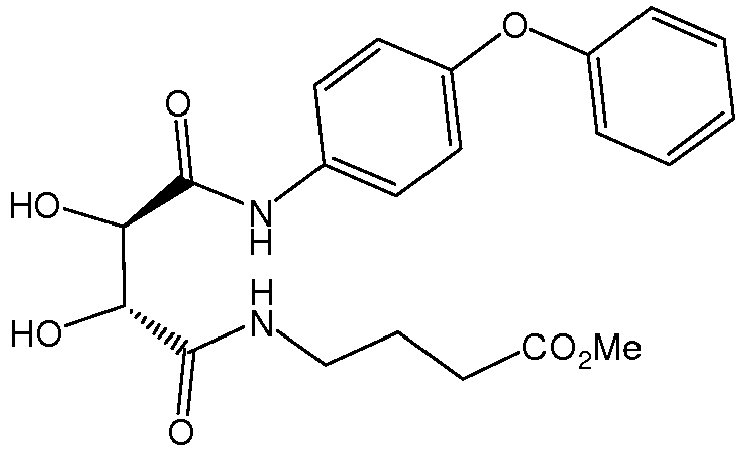
- 0.64 g (1.30 mmol) methyl L-(2R,3R)-4-[2,3-diacetoxy-3-(4-phenoxy-phenylcarbamoyl)-propionylamino]-butyrate prepared in Example 3, 0.05 g (0.92 mmol) sodium methoxide were dissolved in 10 ml methanol, and reacted according to the procedures of synthesizing compound (19), to obtain 0.33g of a white solid, yield 61.0%, specific rotation [α]D 20= +120.0°(20 mg/2 ml, DMSO). 1H-NMR (DMSO, 400 MHz), δ (ppm): 1.69(2H, m, CH2), 2.32(2H, m, CH2), 3.18(2H, m, CH2), 3.58(3H, s, CH3), 4.30(1H, d, J = 7.00Hz, CH), 4.40(1H, d, J = 7.00Hz, CH), 5.69(1H, d, J = 7.00Hz, OH), 5.84(1H, d, J = 7.00Hz, OH), 6.97(4H, m, ArH), 7.10(1H, t, J = 7.28Hz, ArH), 7.36(2H, t, J = 7.56Hz, ArH), 7.75(2H, d, J = 8.96Hz, ArH), 7.83(1H, t, J = 6.16Hz, CONH), 9.65(1H, s, CONH); HREI-MS Calcd. for C21H24N2O7: 416.1584, found: 416.1589.
-

- 1.80 g (5.00 mmol) L-(2R,3R)-2,3-diacetoxy-3-(naphthalen-2-ylcarbamoyl)-propionic acid prepared in Example 1 and 0.77 g (5.00 mmol) methyl 4-aminobutyrate hydrochloride were reacted according to the procedures of synthesizing compound (1), to obtain 0.45 g of a white solid, exhibiting a single spot by TLC, without further purification, yield 19.6%.
- 0.45 g (1.00 mmol) methyl L-(2R,3R)-4-[2,3-diacetoxy-3-(naphthalen-2-ylcarbamoyl)-propionylamino]-butyrate, 0.05 g (0.92 mmol) sodium methoxide were dissolved in 10 ml methanol, and reacted according to the procedures of synthesizing compound (19), to obtain 0.23 g of a white solid, yield 61.2%, specific rotation [α]D 20= +157.0°(20 mg/2 ml, DMSO). 1H-NMR (DMSO, 400 MHz), δ (ppm): 1.70(2H, t, J = 7.32Hz, CH2), 1.70(2H, t, J = 7.32Hz, CH2), 2.32(2H, m, CH2), 3.19(2H, m, CH2), 3.19(3H, s, CH3), 4.33 (1H, d, J = 7.28Hz, CH), 4.46(1H, d, J = 7.28Hz, CH), 5.75(1H, d, J = 7.00Hz, OH), 5.92(1H, d, J = 7.04Hz, OH), 7.41(1H, t, J = 8.12Hz,, ArH), 7.47(1H, t, J = 7.00Hz, ArH), 7.75-7.7.87(5H, m, ArH), 8.43(1H, s, CONH), 9.77(1H, s, CONH); HREI-MS Calcd. for C19H22N2O6: 374.1478, found: 374.1461.
-
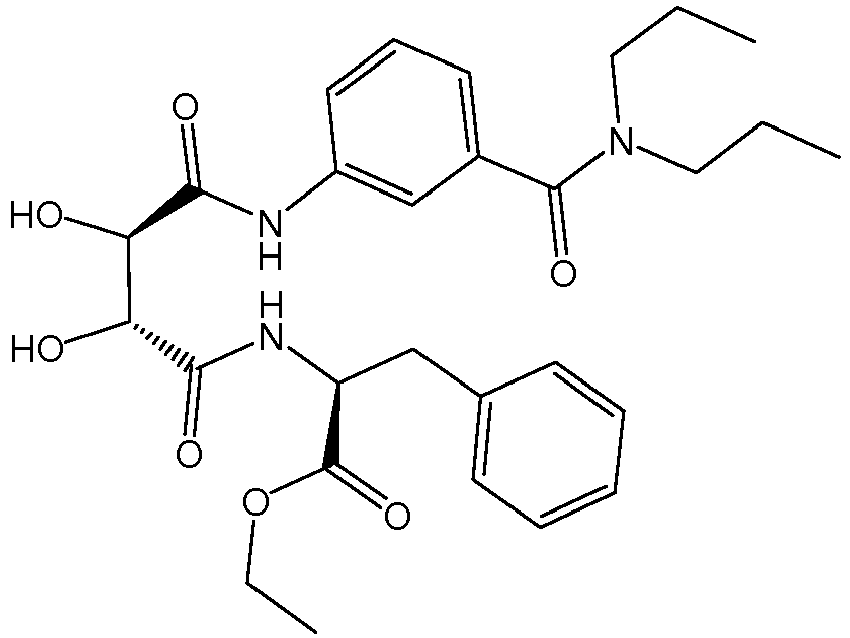
- 1.50 g (3.44 mmol) L-(2R,3R)-2,3-diacetoxy-3-(3-di-n-propylaminoformyl-phenylcarbamoyl)propionic acid prepared in Example 4 and 0.74 g (3.44 mmol) methyl L-phenprobamate hydrochloride were reacted according to the procedures of synthesizing compound (1), to obtain 2.00 g of an oily matter, exhibiting a single spot by TLC, without further purification, yield 97.4%.
- 0.90 g (1.54 mmol) methyl L-(2R,3R)-2-[3-(3-di-n-propylaminoformyl-phenylcarbamoyl)-2,3-diacetoxy-propionylamino]-3-phenyl-propionate, 0.05 g (0.92 mmol) sodium methoxide were dissolved in 10 ml ethanol, and reacted according to the procedures of synthesizing compound (19), to obtain 0.22 g of a white solid, yield 27.1%. 1H-NMR (DMSO, 400 MHz), δ (ppm): 0.67(3H, m, CH3), 0.91(3H, m, CH3), 1.15(3H, t, J = 7.28Hz, CH3), 1.48(2H, m, CH2), 1.61(2H, m, CH2), 3.06(2H, d, J = 6.44Hz, CH2), 3.07(2H, m, CH2), 3.37(2H, m, CH2), 4.07(2H,q, J = 7.00Hz, CH2), 4.34 (1H, d, J = 1.68Hz, CH), 4.41(1H, d, J = 1.68Hz, CH), 5.92(2H, br, 2xOH), 7.03(1H, d, J = 7.56Hz, ArH), 7.17-7.30(5H, m, ArH), 7.39(1H, t, J = 7.84Hz, ArH), 7.68(1H, d, J = 8.12Hz, ArH), 7.76(1H, s, ArH), 7.85(1H, d, J = 7.88Hz, CONH), 9.72(1H, s, CONH); HREI-MS Calcd. for C28H37N3O7: 527.2632, found: 527.2633.
-

- 1.24 g (3.83 mmol) L-(2R,3R)-2,3-diacetoxy-3-(benzylcarbamoyl)propionic acid prepared in Example 7 and 0.98 g (3.83 mmol)4-benzylpiperazine were reacted according to the procedures of synthesizing compound (1), to obtain 0.60 g of an oily matter, exhibiting a single spot by TLC, without further purification, yield 60.5%.
- 0.42 g (1.00 mmol) methyl L-(2R,3R)-4-(3-benzylcarbamoyl-2,3-diacetoxy-propionylamino)-butyrate, 0.05 g (0.92 mmol) sodium methoxide were dissolved in 10 ml benzyl alcohol, and reacted according to the procedures of synthesizing compound (19), to obtain 0.10 g of a white solid, yield 61.2%, specific rotation [α]D 20= +60.9°(20 mg/2 ml, DMF). Or, they were reacted according to the procedures of synthesizing compound (8), to obtain 0.40 g of a white solid, yield 39.7%, specific rotation [α]D 20= +137.0°(20 mg/2 ml, CH3OH). 1H-NMR (DMSO, 400 MHz), δ (ppm): 1.71(2H, m, CH2), 2.37(2H, t, J = 7.00Hz, CH2), 3.15(2H, m, CH2), 4.25-4.40(4H, m, CH2 and 2xCH), 5.08(2H, s, CH2), 5.58(1H, d, J = 7.28Hz, OH), 5.61(1H, d, J = 7.00Hz, OH), 7.21-37(10H, m, ArH), 7.80(1H, t, J = 6.16Hz, CONH), 8.19(2H, d, J = 6.44Hz, CONH); HREI-MS Calcd. for C22H26N2O6: 414.1791, found: 414.1785.
-

- 2.00 g (5.00 mmol) L-(2R,3R)-2,3-diacetoxy-3-(4-phenoxy-phenylcarbamoyl)propionic acid prepared in Example 2 and 1.01 g (5.00 mmol) methyl 4-aminomethylbenzoate hydrochloride were reacted according to the procedures of synthesizing compound (1), to obtain 1.67 g of an oily matter, exhibiting a single spot by TLC, without further purification, yield 60.3%.
- 0.45 g (0.81 mmol) methyl L-(2R,3R)-4-[2,3-diacetoxy-3-(4-phenoxy-phenylcarbamoyl)-propionylamino]-cyclohexanecarboxylate, 0.05 g (0.92 mmol) sodium methoxide were dissolved in 10 ml ethanol, and reacted according to the procedures of synthesizing compound (19), to obtain 0.28 g of a white solid, yield 71.2%. 1H-NMR (DMSO, 400 MHz), δ (ppm): 0.93(2H, m, CH2), 1.15(3H, t, J = 7.28Hz, CH3), 1.31(2H, m, CH2), 1.44(1H, m, CH), 1.75(2H, m, CH2), 1.87(2H, m, CH2), 2.20(1H, m, CH), 2.99(2H, m, CH2), 4.04(2H, q, J = 7.28Hz, CH2), 4.31 (1H, d, J = 7.00Hz, CH), 4.40(1H, d, J = 7.28Hz, CH), 5.71(1H, d, J = 7.00Hz, OH), 5.84(1H, d, J = 7.28Hz, OH), 6.97(4H, m, ArH), 7.10(1H, t, J = 7.60Hz, ArH), 7.36(2H, t, J = 7.60Hz, ArH), 7.70(1H, t, J = 6.16Hz, CONH), 7.77(2H, d, J = 7.00Hz, ArH), 9.65(1H, s, CONH); HREI-MS Calcd. for C26H32N2O7: 484.2210, found: 484.2213.
-

- 0.72 g (1.23 mmol) dimethyl L-(2R,3R)-5-[2,3-diacetoxy-3-(1-methoxycarbonyl-2-phenyl-ethylcarbamoyl)-propionylamino]-isophthalate prepared in Example 5, 0.05 g (0.92 mmol) sodium methoxide were dissolved in 10 ml methanol, and reacted according to the procedures of synthesizing compound (19), to obtain 0.34 g of a white solid, yield 55.1%. 1H-NMR (CDCl3, 400 MHz), δ (ppm): 3.07(2H, m, CH2), 3.63(3H, s, CH3), 3.89(6H, s, 2xCH3), 4.33(1H, m, CH), 4.43(1H, m, CH), 4.63(1H, q, J = 7.28Hz, CH), 5.81(1H, br, OH), 5.95(1H, br, OH), 7.17-7.28(5H, m, ArH), 7.92(1H, d, J = 8.16Hz, CONH), 8.19(1H, d, J = 1.40Hz, ArH), 8.67(1H, d, J = 1.40Hz, ArH), 10.22(1H, s, CONH); HREI-MS Calcd. for C28H30N2O12: 586.1799, found: 586.1777.
-
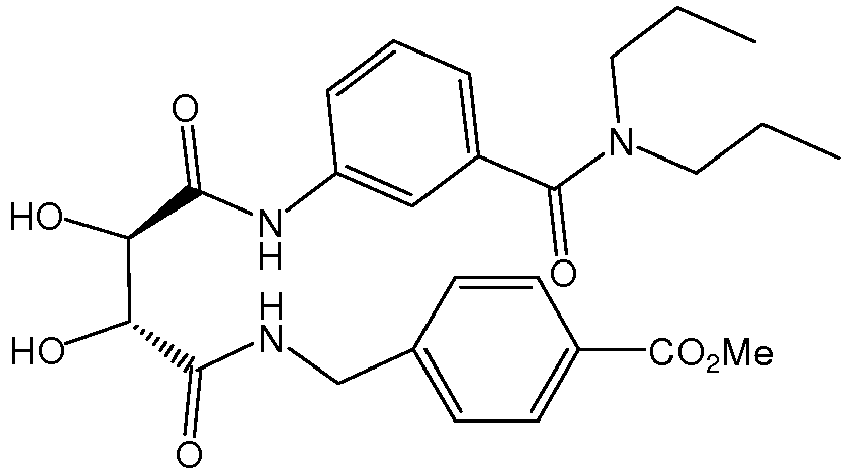
- 0.50 g (0.86 mmol)methyl L-(2R,3R)-4-{[3-(3-di-n-propylaminoformyl-phenylcarbamoyl)- 2,3-diacetoxy-propionylamino]methyl}-benzoate prepared in Example 4, and 0.05 g (0.92 mmol) sodium methoxide were dissolved in 10 ml methanol, and reacted according to the procedures of synthesizing compound (19), to obtain 0.15 g of a white solid, yield 35.1%. 1H-NMR (DMSO, 400 MHz), δ (ppm): 0.67(3H, m, CH3), 0.91(3H, m, CH3), 1.48(2H, m, CH2), 1.58(2H, m, CH2), 3.12(2H, m, CH2), 3.34(2H, m, CH2), 3.85(3H, m, CH3), 4.34-4.49(4H, m, 2xCH and CH2), 5.87(1H, br, OH), 5.97(1H, br, OH), 6.99(1H, d, J = 7.56Hz, ArH), 7.36(1H, t, J = 7.84Hz, ArH), 7.45(2H, d, J = 8.40Hz, ArH), 7.74(1H, d, J = 8.40Hz, ArH), 7.82(1H, s, ArH), 7.89(2H, d, J = 8.40Hz, ArH), 8.45(1H, t, J = 6.44Hz, CONH), 9.81(1H, s, CONH); FAB-MS m/e(%): 500.1([M+1]+, 100).
-

- 2.00 g (5.57 mmol) L-(2R,3R)-2,3-diacetoxy-3-(naphthalen-2-ylcarbamoyl)-propionic acid prepared in Example 1 and 1.10 g (5.57 mmol) N-3-chlorophenylpiperazine were reacted according to the procedures of synthesizing compound (1), to obtain 1.00 g of an oily matter, exhibiting a single spot by TLC, without further purification, yield 33.4%.
- 0.60 g (1.12 mmol) L-(2R,3R)-4-[4-(3-chlorophenyl)-piperazin-1-yl]-2,3-diacetoxy-N-naphthalen-2-yl-4-oxo-butyramide, 0.05 g (0.92 mmol) sodium methoxide were dissolved in 10 ml methanol, and reacted according to the procedures of synthesizing compound (19), to obtain 0.30 g of a white solid, yield 59.3%, specific rotation [α]D 20= +26.5°(20 mg/2 ml, DMF). 1H-NMR (DMSO, 400 MHz), δ (ppm): 3.23(4H, m, 2×CH2), 3.76(4H, m, 2×CH2), 4.35(1H, s, CH), 4.81(1H, d, J = 4.48Hz, CH), 5.17(1H, d, J = 7.32Hz, OH), 6.02(1H, d, J = 6.16Hz, OH), 6.82(1H, d, J = 7.84Hz" ArH), 6.93(1H, d, J = 8.40Hz, ArH), 6.99(1H, s, ArH), 7.23(1H, t, J = 8.12Hz, ArH), 7.41(1H, t, J = 7.00Hz, ArH), 7.47(1H, t, J = 7.00Hz, ArH), 7.30-7.89(4H, m, ArH), 8.39(1H, s, ArH), 9.85(1H, s, CONH); HREI-MS Calcd. for C24H24N3O4Cl: 453.1455, found: 453.1449.
-

- 2.37 g (5.57 mmol) L-(2R,3R)-2,3-diacetoxy-3-(3-di-n-propylaminoformyl-phenylcarbamoyl)propionic acid prepared in Example 4 and 1.10 g (5.57 mmol) 3-chlorophenylpiperazine were reacted according to the procedures of synthesizing compound (1), to obtain 1.00 g of an oily matter, exhibiting a single spot by TLC, without further purification, yield 29.7%.
- 0.32 g (0.52 mmol) L-(2R,3R)-3-{4-[4-(3-chlorophenyl)-piperazin-1-yl]-2,3-diacetoxy-4-oxo-butyrylamino}-N,N-di-n-propyl-benzamide, 0.02 g (0.34 mmol) sodium methoxide were dissolved in 5 ml methanol, and reacted according to the procedures of synthesizing compound (19), to obtain 0.08 g of a white solid, yield 28.9%. 1H-NMR (DMSO, 400 MHz), δ (ppm): 0.67(3H, t, J = 6.16Hz, CH3), 0.91(3H, t, J = 6.48Hz, CH3), 1.46(2H, q, J = 6.16Hz, CH2), 1.60(2H, q, J = 6.44Hz, CH2), 3.12(2H, m, CH2), 3.22(4H, m, 2×CH2), 3.36(2H, m, CH2), 3.76(4H, m, 2×CH2), 4.28(1H, m, CH), 4.77(1H, m, CH), 5.11(1H, d, J = 7.56Hz, OH), 5.96(1H, d, J = 6.72Hz, OH), 6.80(1H, d, J = 8.40Hz, ArH), 6.92(1H, d, J = 8.12Hz, ArH), 7.00(2H, m, ArH), 7.23(1H, t, J = 7.84Hz, ArH), 7.36(1H, t, J = 7.88Hz, ArH), 7.73(1H, d, J = 8.44Hz, ArH), 7.78(1H, s, ArH), 9.81(1H, s, CONH); HREI-MS Calcd. for C27H35N4O5Cl: 530.2296, found: 530.2295.
-

- 0.34 g (0.59 mmol) dimethyl L-(2R,3R)-5-[2,3-diacetoxy-3-(4-methoxycarbonyl-benzylcarbamoyl)-propionylamino]-isophthalate prepared in Example 6, 0.02 g (0.34 mmol) sodium methoxide were dissolved in 5 ml methanol, and reacted according to the procedures of synthesizing compound (19), to obtain 0.16 g of a white solid, yield 55.2%. 1H-NMR (DMSO, 400 MHz), δ (ppm): 3.84(3H, s, CH3) 3.90(6H, s, 2×CH3), 4.33-4.50(4H, m, 2xCH and CH2), 5.91(1H, d, J = 7.00Hz, OH), 5.97(1H, d, J = 7.00Hz, OH), 7.45(2H, d, J = 8.12Hz, ArH), 7.90(2H, d, J = 8.12Hz, ArH), 8.19(1H, s, ArH), 8.50(1H, t, J = 6.16Hz, CONH), 8.45(2H, d, J = 1.12Hz, ArH), 10.28(1H, s, CONH); HREI-MS Calcd. for C23H24N2O10: 488.1431, found: 488.1449.
- A sodium acetate analytical buffer solution (50 nM, pH 4.5) containing BACE1 (1.0 U/ml), a substrate of BACE1 (750 nM Rh-EVNLDAEFK-Quencher), a compound of the present invention (100 µM) was incubated at 25 °C for 60 minutes. The fluorescence intensity was determined by using a TECANGENios fluorimeter with a slit width of 10 nm, an excitation wavelength of 535 nm and an emission wavelength of 585 nm.

- C: the fluorescence intensity of the control (BACE1, substrate and analytical buffer solution) as determined after incubating for 60 minutes.
- C0: the fluorescence intensity of the control (BACE1, substrate and analytical buffer solution) as determined after incubating for 0 minute.
- S: the fluorescence intensity of the sample (BACE1, substrate, compound of the present invention and analytical buffer solution) as determined after incubating for 60 minutes.
- S0: the fluorescence intensity of the sample (BACE1, substrate, compound of the present invention and analytical buffer solution) as determined after incubating for 0 minute.
- The results of BACE1-inhibiting activity were shown in Table 1.
Table 1: Results of BACE1-inhibiting activity Example No. Concentration of the compound (µM) Inhibitory rate (%) 3 100 39.0 14 100 22.5 16 100 26.5 17 100 45.3 18 100 22.3 19 100 35.0


Claims (5)
- A compound of formula I, or all possible optical isomers or tautomers pharmaceutically acceptable salts, solvates or hydrates thereof:
 X is O, S;Z is CH2, O, S, NH;R1 is C1-C22 linear or branched alkyl, C2-C22 linear or branched alkenyl, C3-C8 cycloalkyl, C5-C7 cycloalkenyl or Ar1, wherein the alkyl or alkenyl radical is unsubstituted or substituted by one or more of the following groups: halogen, nitro, hydroxy, amino, cyano, carboxy, Ar2, C3-C8 cycloalkyl, C5-C7 cycloalkenyl, O-(C1-C4)-alkyl or Ar2, CO-(C1-C4)-alkyl or Ar2, SO-(C1-C4)-alkyl or Ar2, N-[(C1-C6)-alkyl]2, NH-(C1-C6)-alkyl or Ar2, N-[(C1-C6)-alkyl Ar2], COO-(C1-C6)-alkyl or Ar2, CONH-(C1-C6)-alkyl or Ar2, SONH-(C1-C6)-alkyl or Ar2; in addition, the C atoms in the alkyl and alkenyl radicals are optionally spaced by -O-, -S-, -NH-, -N=, -S-, -Ar2-, -SO-, -CO-, -COO-, -CONH-, -SOO-, -SONH-, -N[(C1-C6)-alkyl or Ar2]-;R2 and R3, which are the same or different, are independently selected from the group consisting of hydrogen, hydroxy, C1-C12 linear or branched alkyl, C2-C12 linear or branched alkenyl, C3-C7 cycloalkyl, Ar1, (C1-C6)-Ar1, -CO-(C1-C6)-alkyl or alkenyl or Ar1, -SO-(C1-C6)-alkyl or alkenyl or Ar1, SOO-(C1-C6)-alkyl or alkenyl;Ar, Ar1 and Ar2 are independently selected from the group consisting of aromatic carbocycles or heterocycles, wherein each of the cycles consists of 5 to 7 members, and the number of the cycles is monocycle, bicycle or tricycle; the heterocycle includes 1 to 6 heteroatoms selected from the group consisting of O, S, N; the aromatic carbocycles or heterocycles are unsubstituted, or substituted by 1 to 4 groups selected from the group consisting of halogen, nitro, hydroxy, amino, cyano, carboxy, methylol, trifluoromethyl, phenoxy, benzyloxy, anilino, benzylamino, C1-C7 linear or branched alkyl, C2-C7 linear or branched alkenyl, C3-C7 cycloalkyl, C5-C7 cycloalkenyl, -O-(C1-C6)-alkyl or alkenyl, -CO-(C1-C6)-alkyl or alkenyl, -SO-(C1-C6)-alkyl or alkenyl, -NH-(C1-C6)-alkyl or alkenyl, -N-[(C1-C6)-alkyl or alkenyl]2, -COO-(C1-C6)-alkyl or alkenyl, -CONH-(C1-C6)-alkyl or alkenyl, -SONH-(C1-C6)-alkyl or alkenyl, -CON[(C1-C6)-alkyl or alkenyl]2, -SON[(C1-C6)-alkyl or alkenyl]2;the substituent R2X- and the substituent R3X- have the same or different configuration, being R-configuration or S-configuration;wherein the compound is selected from the group consisting of:(1) Methyl L-(2R,3R)-2-[2,3-diacetoxy-3-(naphthalen-2-ylcarbamoyl)-propionylamino]-3-phenyl-propionate;(2) Methyl L-(2R,3R)-4-{[2,3-diacetoxy-3-(4-phenoxy-phenylcarbamoyl)-propionylamino]methyl}-benzoate;(3) Methyl L-(2R,3R)-4-[2,3-diacetoxy-3-(4-phenoxy-phenylcarbamoyl)-propionylamino]-butyrate;(4) Methyl L-(2R,3R)-4-{[3-(3-di-n-propylaminoformyl-phenylcarbamoyl)-2,3-diacetoxy-propionylamino]methyl}-benzoate;(5) Dimethyl L-(2R,3R)-5-[2,3-diacetoxy-3-(1-methoxycarbonyl-2-phenyl-ethylcarbamoyl)-propionylamino]-isophthalate;(6) Dimethyl L-(2R,3R)-5-[2,3-diacetoxy-3-(4-methoxycarbonyl-benzylcarbamoyl)-propionylamino]-isophthalate;(16) Dimethyl L-(2R,3R)-5-(3-benzylcarbamoyl-2,3-dihydroxy-propionylamino)-isophthalate;(17) Methyl L-(2R,3R)-4-1[2,3-dihydroxy-3-(naphthalen-2-ylcarbamoyl)-propionylamino]methyl}-benzoate;(18) Methyl L-(2R,3R)-4-1[2,3-dihydroxy-3-(naphthalen-2-ylcarbamoyl)-propionylamino]methyl}-cyclohexanecarboxylate;(19) Methyl L-(2R,3R)-2-[2,3-dihydroxy-3-(naphthalen-2-ylcarbamoyl)-propionylamino]-3-phenyl-propionate;(20) Ethyl L-(2R,3R)-2-[2,3-dihydroxy-3-(4-phenoxy-phenylcarbamoyl)-propionylamino]-3-phenyl-propionate;(21) Methyl L-(2R,3R)-4-1[2,3-dihydroxy-3-(4-phenoxy-phenylcarbamoyl)-propionylamino]methyl}-bezoate;(22) Methyl L-(2R,3R)-4-[2,3-dihydroxy-3-(4-phenoxy-phenylcarbamoyl)-propionylamino]-butyrate;(23) Methyl L-(2R,3R)-4-[2,3-dihydroxy-3-(naphthalen-2-ylcarbamoyl)-propionylamino]-butyrate;(24) Ethyl L-(2R,3R)-2-[3-(3-di-n-propylaminoformyl-phenylcarbamoyl)-2,3-dihydroxy-propionylamino]-3-phenyl-propionate;(26) Ethyl L-(2R,3R)-4-[2,3-dihydroxy-3-(4-phenoxy-phenylcarbamoyl)-propionylamino]-cyclohexanecarboxylate;(27) Dimethyl L-(2R,3R)-5-[2,3-dihydroxy-3-(1-methoxycarbonyl-2-phenyl-ethylcarbamoyl)-propionylamino]-isophthalate;(28) Methyl L-(2R,3R)-4-{[3-(3-di-n-propylaminoformyl-phenylcarbamoyl)-2,3-dihydroxy-propionylamino]methyl}benzoate;(29) L-(2R,3R)-4-[4-(3-chlorophenyl)-piperazin-1-yl]-2,3-dihydroxy-N-naphthalen-2-yl-4-oxo-butyramide;(30) L-(2R,3R)-3-{4-[4-(3-chlorophenyl)-piperazin-1-yl]-2,3-dihydroxy-4-oxo-butyrylamino}-N,N-di-n-propyl-benzamide; and(31) Dimethyl L-(2R,3R)-5-[2,3-dihydroxy-3-(4-methoxycarbonyl-benzylcarbamoyl)-propionylamino]-isophthalate.
 - A compound selected from the group consisting of:(7) L-(2R,3R)-N-benzyl-2,3-diacetoxy-3-(4-benzyl-piperazin-1-yl-formyl)-propionamide;(8) Methyl L-(2R,3R)-2-(3-benzylcarbamoyl-2,3-dihydroxy-propionylamino)-3-phenyl-propionate;(9) Methyl L-(2R,3R)-4-[(3-benzylcarbamoyl-2,3-dihydroxy-propionylamino) methyl]-benzoate;(10) L-(2R,3R)-2-(3-benzylcarbamoyl-2,3-dihydroxy-propionylamino)-3-phenylpropionic acid;(11) Methyl L-(2R,3R)-4-(3-benzylcarbamoyl-2,3-dihydroxy-propionylaminomethyl)-cyclohexanecarboxylate;(12) L-(2R,3R)-4-[(3-benzylcarbamoyl-2,3-dihydroxy-propionylamino)methyl]-benzoic acid;(13) Methyl L-(2R,3R)-4-(3-benzylcarbamoyl-2,3-dihydroxy-propionylamino)-butyrate;(14) L-(2R,3R)-4-(3-benzylcarbamoyl-2,3-dihydroxy-propionylamino)-butyric acid;(15) L-(2R,3R)-4-[(3-benzylcarbamoyl-2,3-dihydroxy-propionylamino)methyl]-cyclohexanecarboxylic acid; and(25) Benzyl L-(2R,3R)-4-(3-benzylcarbamoyl-2,3-dihydroxy-propionylamino)-butyrate;or all possible optical isomers or tautomers pharmaceutically acceptable salts, solvates or hydrates thereof.
- A process for preparing a compound of formula I selected from the group consisting of the compounds (1) to (31) according to claim 1,a) as for the compound of formula la wherein R2 and R3 both are -CO-CH3, and R1, Ar and Z are as defined in claim 1, the process comprises the steps of:(i) under the catalysis of an acid such as sulfuric acid, compound 1 (L- or D-tartaric acid) and a lower fatty acid anhydride such as acetic anhydride are reacted by reflux, to obtain compound 2;
 (ii) compound 2 is dissolved in a suitable solvent such as THF, dichloromethane or N,N-dimethylformamide, and acylated with equimolar of ArNH2, to obtain compound 3, wherein Ar is as defined in claim 1;
 (iii) compound 3 is dissolved in a suitable solvent such as THF, dichloromethane or N,N-dimethylformamide, and, under the catalysis of a suitable amount of dicyclohexylcarbodiimide, camphorsulfonic acid and 4-dimethylaminopyridine, is acylated with R1ZH (amine), wherein R1 and Z are as defined in claim 1, to obtain a specific compound of formula la of the invention;
 (iv) compound la is dissolved in a suitable solvent such as THF, methanol, ethanol, aminolyzed with a concentrated ammonia water or ammonia, hydrolyzed with sodium hydroxide, potassium hydroxide or potassium carbonate, and transesterified with sodium methoxide or sodium ethoxide, to obtain a further specific compound of formula la, i.e., a compound of formula Ib, of the invention;
 b) as for the compound of formula Ib, wherein R1, Ar and Z are as defined in claim 1, the process comprises the steps of:(i) under the catalysis of an acid such as sulfuric acid, a strong acid type ion exchange resin, compound 1 (L- or D-tartaric acid) is reacted by reflux with a fatty alcohol ROH wherein R is C1-C4 alkyl, such as methanol or ethanol, to obtain compound 2;
 (ii) under the catalysis of a protic acid or Lewis acid such as toluene-p-sulfonic acid or boron trifluoride, compound 2 is reacted by reflux with a ketone of formula R3C(O)R4 wherein R3 and R4 are C1-C4 alkyl, such as acetone, in an inert solvent such as THF or toluene, to obtain a ketal compound 3;
 (iii) compound 3 is dissolved in an organic solvent such as THF or dioxane, and is reacted with an aqueous solution of a base such as sodium hydroxide or potassium hydroxide (having a concentration of 1N, and used in a molar ratio of 1:1 in relative to compound 3) at 0°C to room temperature, and then acidified with an inorganic acid such as hydrochloric acid (having a concentration of 1N), and further extracted with an organic solvent such as dichloromethane, diethyl ether or ethyl acetate, to obtain compound 4;
 (iv) compound 4 is dissolved in a suitable solvent such as THF, dichloromethane or N,N-dimethylformamide, and, under the catalysis of a suitable amount of dicyclohexylcarbodiimide, camphorsulfonic acid and 4-dimethylaminopyridine, is acylated with ArNH2, to obtain compound 5;
 (v) compound 5 is dissolved in an organic solvent such as THF or dioxane, and is reacted with an aqueous solution of a base such as sodium hydroxide or potassium hydroxide (having a concentration of 1N, and used in a molar ratio of 1:1 in relative to compound 5) at 0°C to room temperature, and then acidified with an inorganic acid such as hydrochloric acid (having a concentration of 1N), and further extracted with an organic solvent such as dichloromethane, diethyl ether or ethyl acetate, to obtain compound 6;
 (vi) compound 6 is dissolved in a suitable solvent such as THF, dichloromethane or N,N-dimethylformamide, and, under the catalysis of a suitable amount of dicyclohexylcarbodiimide, camphorsulfonic acid and 4-dimethylaminopyridine, is acylated with R1ZH (amine), wherein R1 and Z are as defined above, to obtain compound 7;
 (vii) compound 7 is dissolved in a suitable solvent such as methanol or ethanol, and, under the catalysis of a suitable amount of a protic acid such as hydrochloric acid or sulfuric acid, is deprotected to remove acetonide group, to obtain a specific compound of formula Ib of the invention,
- A pharmaceutical composition comprising a compound of formula I selected from the group consisting of compounds (1) to (31) according to claim 1, or all possible optical isomers or tautomers pharmaceutically acceptable salts, solvates or hydrates thereof, and at least one pharmaceutically acceptable carrier or excipient.
- A compound of formula I selected from the group consisting of compounds (1) to (31) according to claim 1, or all possible optical isomers or tautomers, pharmaceutically acceptable salts, solvates or hydrates thereof for use for treating and/or preventing Alzheimer's disease, amyloid degenerative angiopathy, Kuru's diseases or Down's syndrome.
Applications Claiming Priority (2)
| Application Number | Priority Date | Filing Date | Title |
|---|---|---|---|
| CN2006101561367A CN101209976B (en) | 2006-12-29 | 2006-12-29 | Substituted tartaric acid derivatives and use thereof for preparing beta-secretase inhibitor |
| PCT/CN2007/000389 WO2008080268A1 (en) | 2006-12-29 | 2007-02-05 | Derivates of substituted tartaric aicd and usage for preparating beta secretase inhibitors |
Publications (3)
| Publication Number | Publication Date |
|---|---|
| EP2116526A1 EP2116526A1 (en) | 2009-11-11 |
| EP2116526A4 EP2116526A4 (en) | 2012-02-29 |
| EP2116526B1 true EP2116526B1 (en) | 2018-04-18 |
Family
ID=39588117
Family Applications (1)
| Application Number | Title | Priority Date | Filing Date |
|---|---|---|---|
| EP07702276.2A Not-in-force EP2116526B1 (en) | 2006-12-29 | 2007-02-05 | Derivates of substituted tartaric aicd and usage for preparating beta secretase inhibitors |
Country Status (5)
| Country | Link |
|---|---|
| US (1) | US8268884B2 (en) |
| EP (1) | EP2116526B1 (en) |
| JP (1) | JP5314597B2 (en) |
| CN (1) | CN101209976B (en) |
| WO (1) | WO2008080268A1 (en) |
Families Citing this family (3)
| Publication number | Priority date | Publication date | Assignee | Title |
|---|---|---|---|---|
| US7763609B2 (en) | 2003-12-15 | 2010-07-27 | Schering Corporation | Heterocyclic aspartyl protease inhibitors |
| WO2011072257A2 (en) * | 2009-12-10 | 2011-06-16 | The Regents Of The University Of California | Amyloid binding agents |
| CN102816129B (en) * | 2011-06-07 | 2015-08-12 | 中国人民解放军军事医学科学院毒物药物研究所 | The benzene dicarboxylic acid derivative that isothiazoline (alkane) ketone replaces and the purposes as beta-secretase inhibitor thereof |
Citations (1)
| Publication number | Priority date | Publication date | Assignee | Title |
|---|---|---|---|---|
| WO2005121130A2 (en) * | 2004-06-02 | 2005-12-22 | Schering Corporation | Chemical compounds and pharmaceutical compositions containing them for the treatment of inflammatory disorders |
Family Cites Families (15)
| Publication number | Priority date | Publication date | Assignee | Title |
|---|---|---|---|---|
| US2742500A (en) * | 1953-12-22 | 1956-04-17 | Du Pont | Resolution of phenylaminopropanediols and intermediates |
| US3527735A (en) * | 1966-04-11 | 1970-09-08 | Phillips Petroleum Co | Preparation of polyamides from p - phenylene diamine and tartaric acid |
| JPH0285227A (en) * | 1988-05-12 | 1990-03-26 | Takeda Chem Ind Ltd | Optically active compound, liquid crystal composition containing the compound, and liquid crystal light modulator using the composition |
| JPH03266819A (en) * | 1990-03-16 | 1991-11-27 | Fuji Electric Co Ltd | Nonlinear optical material |
| CA2268098A1 (en) * | 1996-10-11 | 1998-04-23 | Warner-Lambert Company | Aspartate ester inhibitors of interleukin-1.beta. converting enzyme |
| JP4161291B2 (en) * | 2001-03-02 | 2008-10-08 | 東レ・ファインケミカル株式会社 | Method for producing optically active substance |
| RS50504A (en) * | 2001-11-08 | 2007-04-10 | Elan Pharmaceuticals Inc., | N,n'-substituted-1,3-diamino-2- hydroxypropane derivatives |
| NZ538625A (en) | 2002-09-06 | 2008-05-30 | Pharmacia & Upjohn Co Llc | 1,3-Diamino-2-hydroxypropane prodrug derivatives |
| JP2007516207A (en) * | 2003-06-30 | 2007-06-21 | メルク エンド カムパニー インコーポレーテッド | N-alkylphenylcarboxamide β-secretase inhibitors for the treatment of Alzheimer's disease |
| MXPA06010899A (en) * | 2004-03-25 | 2006-12-15 | Elan Pharm Inc | 2-amino- and 2-thio-substituted 1,3-diaminopropanes. |
| US7638513B2 (en) * | 2004-06-02 | 2009-12-29 | Schering Corporation | Compounds for the treatment of inflammatory disorders |
| US7659289B2 (en) * | 2004-09-17 | 2010-02-09 | Comentis, Inc. | Hydroxyethylene-based β-secretase inhibitors and use thereof |
| CN1305863C (en) * | 2004-12-27 | 2007-03-21 | 浙江大学 | Method for synthesizing (S)-isopropyl-(2-piperidine) phenyl-methylhistamine |
| JP2006282605A (en) * | 2005-04-01 | 2006-10-19 | Sumitomo Chemical Co Ltd | Method for producing (3S, 4R) -trans-4- (4-fluorophenyl) -3-hydroxymethylpiperidine (+)-2'-chlorotaltranyl acid monohydrate and method for recovering optical resolution agent |
| KR20090053813A (en) * | 2006-09-13 | 2009-05-27 | 사노피-아벤티스 | Tartrate Derivatives Used as Coagulation Factor Inhibitors |
-
2006
- 2006-12-29 CN CN2006101561367A patent/CN101209976B/en not_active Expired - Fee Related
-
2007
- 2007-02-05 EP EP07702276.2A patent/EP2116526B1/en not_active Not-in-force
- 2007-02-05 WO PCT/CN2007/000389 patent/WO2008080268A1/en not_active Ceased
- 2007-02-05 JP JP2009543325A patent/JP5314597B2/en not_active Expired - Fee Related
- 2007-02-05 US US12/521,425 patent/US8268884B2/en not_active Expired - Fee Related
Patent Citations (1)
| Publication number | Priority date | Publication date | Assignee | Title |
|---|---|---|---|---|
| WO2005121130A2 (en) * | 2004-06-02 | 2005-12-22 | Schering Corporation | Chemical compounds and pharmaceutical compositions containing them for the treatment of inflammatory disorders |
Also Published As
| Publication number | Publication date |
|---|---|
| WO2008080268A8 (en) | 2009-08-13 |
| US20100331345A1 (en) | 2010-12-30 |
| WO2008080268A1 (en) | 2008-07-10 |
| US8268884B2 (en) | 2012-09-18 |
| CN101209976B (en) | 2012-01-11 |
| JP5314597B2 (en) | 2013-10-16 |
| CN101209976A (en) | 2008-07-02 |
| EP2116526A4 (en) | 2012-02-29 |
| EP2116526A1 (en) | 2009-11-11 |
| JP2010514705A (en) | 2010-05-06 |
Similar Documents
| Publication | Publication Date | Title |
|---|---|---|
| EP0665216B1 (en) | Urea derivatives and their use as acat inhibitors | |
| DE602004006631T2 (en) | MATRIX METALOPROTEASE INHIBITORS | |
| DE69912379T2 (en) | Antithrombotic agents | |
| DE60310582T2 (en) | 2,5-DIOXOIMIDAZOLIDIN-4-YLACETAMIDE AND ANALOGUE AS INHIBITORS OF METAL PROTEINASE MMP12 | |
| DE69205327T2 (en) | Urea derivatives, processes for their preparation and medicines containing them. | |
| EP3765439B1 (en) | Novel calcium salt polymorphs as anti-inflammatory, immunomodulatory and anti-proliferatory agents | |
| EP0686625A1 (en) | Anthranilic acid derivative | |
| EP0559046A1 (en) | N-amidinopiperidinyl(3/4)- or N-amidino-1,4-Oxazinyl(2)-substituted sulfonamides, process for their preparation and use as thrombin inhibitors | |
| JP2013509376A (en) | 2-Aryl-propionamide derivatives useful as bradykinin receptor antagonists and pharmaceutical compositions containing them | |
| DE60006542T2 (en) | CONNECTIONS THAT INHIBIT TRYPTASE ACTIVITY | |
| DE69819206T2 (en) | matrix metalloproteinase | |
| DE69903053T2 (en) | DIAMINOCYCLOBUTEN-3,4-DIONE DERIVATIVES, THEIR PRODUCTION AND THEIR USE | |
| CN103958465A (en) | Phenyl derivative | |
| HUT57705A (en) | Process for producing acat-inhibitors | |
| EP2116526A1 (en) | Derivates of substituted tartaric aicd and usage for preparating beta secretase inhibitors | |
| EP0520427A1 (en) | Cyclopropenone derivatives | |
| JPS61286359A (en) | N-((5-(trifluoromethyl)-6-methoxy-1-naphthalenyl) thioxomethyl or carbonyl)-n-methylglycineamide | |
| KR20010013790A (en) | Crystalline Roxifiban | |
| DE19748040A1 (en) | Carboxylic acid derivatives, processes for their preparation and pharmaceutical preparations containing these compounds | |
| RU2394020C2 (en) | Crystalline acyl-cholesterin acytransferase inhibitor | |
| JP2006232686A (en) | New carnosine ester compound | |
| EP4094762A1 (en) | Treatment of neurological indications | |
| DE69911250T2 (en) | AMIDOMALONIMIDES AND THEIR USE AS MATRIX METALLOPROTEINASE INHIBITORS | |
| EP1907350B1 (en) | Salt of fumaric acid and 3-(2-dimethylamino)methyl(cyclohex-1-yl))phenol and its crystalline forms | |
| HK40035594A (en) | Novel calcium salt polymorphs as anti-inflammatory, immunomodulatory and anti-proliferatory agents |
Legal Events
| Date | Code | Title | Description |
|---|---|---|---|
| PUAI | Public reference made under article 153(3) epc to a published international application that has entered the european phase |
Free format text: ORIGINAL CODE: 0009012 |
|
| 17P | Request for examination filed |
Effective date: 20090728 |
|
| AK | Designated contracting states |
Kind code of ref document: A1 Designated state(s): AT BE BG CH CY CZ DE DK EE ES FI FR GB GR HU IE IS IT LI LT LU LV MC NL PL PT RO SE SI SK TR |
|
| DAX | Request for extension of the european patent (deleted) | ||
| A4 | Supplementary search report drawn up and despatched |
Effective date: 20120131 |
|
| RIC1 | Information provided on ipc code assigned before grant |
Ipc: A61K 31/4965 20060101ALI20120124BHEP Ipc: A61P 25/28 20060101ALI20120124BHEP Ipc: C07D 235/06 20060101ALI20120124BHEP Ipc: C07C 235/12 20060101AFI20120124BHEP Ipc: A61K 31/16 20060101ALI20120124BHEP Ipc: C07D 241/04 20060101ALI20120124BHEP Ipc: A61P 25/00 20060101ALI20120124BHEP Ipc: A61P 43/00 20060101ALI20120124BHEP |
|
| STAA | Information on the status of an ep patent application or granted ep patent |
Free format text: STATUS: EXAMINATION IS IN PROGRESS |
|
| 17Q | First examination report despatched |
Effective date: 20161209 |
|
| GRAP | Despatch of communication of intention to grant a patent |
Free format text: ORIGINAL CODE: EPIDOSNIGR1 |
|
| STAA | Information on the status of an ep patent application or granted ep patent |
Free format text: STATUS: GRANT OF PATENT IS INTENDED |
|
| INTG | Intention to grant announced |
Effective date: 20171123 |
|
| GRAJ | Information related to disapproval of communication of intention to grant by the applicant or resumption of examination proceedings by the epo deleted |
Free format text: ORIGINAL CODE: EPIDOSDIGR1 |
|
| STAA | Information on the status of an ep patent application or granted ep patent |
Free format text: STATUS: EXAMINATION IS IN PROGRESS |
|
| GRAR | Information related to intention to grant a patent recorded |
Free format text: ORIGINAL CODE: EPIDOSNIGR71 |
|
| GRAS | Grant fee paid |
Free format text: ORIGINAL CODE: EPIDOSNIGR3 |
|
| STAA | Information on the status of an ep patent application or granted ep patent |
Free format text: STATUS: GRANT OF PATENT IS INTENDED |
|
| GRAA | (expected) grant |
Free format text: ORIGINAL CODE: 0009210 |
|
| STAA | Information on the status of an ep patent application or granted ep patent |
Free format text: STATUS: THE PATENT HAS BEEN GRANTED |
|
| INTC | Intention to grant announced (deleted) | ||
| AK | Designated contracting states |
Kind code of ref document: B1 Designated state(s): AT BE BG CH CY CZ DE DK EE ES FI FR GB GR HU IE IS IT LI LT LU LV MC NL PL PT RO SE SI SK TR |
|
| INTG | Intention to grant announced |
Effective date: 20180309 |
|
| REG | Reference to a national code |
Ref country code: GB Ref legal event code: FG4D |
|
| REG | Reference to a national code |
Ref country code: CH Ref legal event code: EP |
|
| REG | Reference to a national code |
Ref country code: AT Ref legal event code: REF Ref document number: 990289 Country of ref document: AT Kind code of ref document: T Effective date: 20180515 |
|
| REG | Reference to a national code |
Ref country code: IE Ref legal event code: FG4D |
|
| REG | Reference to a national code |
Ref country code: DE Ref legal event code: R096 Ref document number: 602007054588 Country of ref document: DE |
|
| REG | Reference to a national code |
Ref country code: NL Ref legal event code: MP Effective date: 20180418 |
|
| REG | Reference to a national code |
Ref country code: LT Ref legal event code: MG4D |
|
| PG25 | Lapsed in a contracting state [announced via postgrant information from national office to epo] |
Ref country code: NL Free format text: LAPSE BECAUSE OF FAILURE TO SUBMIT A TRANSLATION OF THE DESCRIPTION OR TO PAY THE FEE WITHIN THE PRESCRIBED TIME-LIMIT Effective date: 20180418 |
|
| PG25 | Lapsed in a contracting state [announced via postgrant information from national office to epo] |
Ref country code: PL Free format text: LAPSE BECAUSE OF FAILURE TO SUBMIT A TRANSLATION OF THE DESCRIPTION OR TO PAY THE FEE WITHIN THE PRESCRIBED TIME-LIMIT Effective date: 20180418 Ref country code: FI Free format text: LAPSE BECAUSE OF FAILURE TO SUBMIT A TRANSLATION OF THE DESCRIPTION OR TO PAY THE FEE WITHIN THE PRESCRIBED TIME-LIMIT Effective date: 20180418 Ref country code: SE Free format text: LAPSE BECAUSE OF FAILURE TO SUBMIT A TRANSLATION OF THE DESCRIPTION OR TO PAY THE FEE WITHIN THE PRESCRIBED TIME-LIMIT Effective date: 20180418 Ref country code: BG Free format text: LAPSE BECAUSE OF FAILURE TO SUBMIT A TRANSLATION OF THE DESCRIPTION OR TO PAY THE FEE WITHIN THE PRESCRIBED TIME-LIMIT Effective date: 20180718 Ref country code: ES Free format text: LAPSE BECAUSE OF FAILURE TO SUBMIT A TRANSLATION OF THE DESCRIPTION OR TO PAY THE FEE WITHIN THE PRESCRIBED TIME-LIMIT Effective date: 20180418 Ref country code: LT Free format text: LAPSE BECAUSE OF FAILURE TO SUBMIT A TRANSLATION OF THE DESCRIPTION OR TO PAY THE FEE WITHIN THE PRESCRIBED TIME-LIMIT Effective date: 20180418 |
|
| PG25 | Lapsed in a contracting state [announced via postgrant information from national office to epo] |
Ref country code: GR Free format text: LAPSE BECAUSE OF FAILURE TO SUBMIT A TRANSLATION OF THE DESCRIPTION OR TO PAY THE FEE WITHIN THE PRESCRIBED TIME-LIMIT Effective date: 20180719 Ref country code: LV Free format text: LAPSE BECAUSE OF FAILURE TO SUBMIT A TRANSLATION OF THE DESCRIPTION OR TO PAY THE FEE WITHIN THE PRESCRIBED TIME-LIMIT Effective date: 20180418 |
|
| REG | Reference to a national code |
Ref country code: AT Ref legal event code: MK05 Ref document number: 990289 Country of ref document: AT Kind code of ref document: T Effective date: 20180418 |
|
| PG25 | Lapsed in a contracting state [announced via postgrant information from national office to epo] |
Ref country code: PT Free format text: LAPSE BECAUSE OF FAILURE TO SUBMIT A TRANSLATION OF THE DESCRIPTION OR TO PAY THE FEE WITHIN THE PRESCRIBED TIME-LIMIT Effective date: 20180820 |
|
| REG | Reference to a national code |
Ref country code: DE Ref legal event code: R097 Ref document number: 602007054588 Country of ref document: DE |
|
| PG25 | Lapsed in a contracting state [announced via postgrant information from national office to epo] |
Ref country code: CZ Free format text: LAPSE BECAUSE OF FAILURE TO SUBMIT A TRANSLATION OF THE DESCRIPTION OR TO PAY THE FEE WITHIN THE PRESCRIBED TIME-LIMIT Effective date: 20180418 Ref country code: DK Free format text: LAPSE BECAUSE OF FAILURE TO SUBMIT A TRANSLATION OF THE DESCRIPTION OR TO PAY THE FEE WITHIN THE PRESCRIBED TIME-LIMIT Effective date: 20180418 Ref country code: EE Free format text: LAPSE BECAUSE OF FAILURE TO SUBMIT A TRANSLATION OF THE DESCRIPTION OR TO PAY THE FEE WITHIN THE PRESCRIBED TIME-LIMIT Effective date: 20180418 Ref country code: AT Free format text: LAPSE BECAUSE OF FAILURE TO SUBMIT A TRANSLATION OF THE DESCRIPTION OR TO PAY THE FEE WITHIN THE PRESCRIBED TIME-LIMIT Effective date: 20180418 Ref country code: SK Free format text: LAPSE BECAUSE OF FAILURE TO SUBMIT A TRANSLATION OF THE DESCRIPTION OR TO PAY THE FEE WITHIN THE PRESCRIBED TIME-LIMIT Effective date: 20180418 Ref country code: RO Free format text: LAPSE BECAUSE OF FAILURE TO SUBMIT A TRANSLATION OF THE DESCRIPTION OR TO PAY THE FEE WITHIN THE PRESCRIBED TIME-LIMIT Effective date: 20180418 |
|
| PLBE | No opposition filed within time limit |
Free format text: ORIGINAL CODE: 0009261 |
|
| STAA | Information on the status of an ep patent application or granted ep patent |
Free format text: STATUS: NO OPPOSITION FILED WITHIN TIME LIMIT |
|
| PG25 | Lapsed in a contracting state [announced via postgrant information from national office to epo] |
Ref country code: IT Free format text: LAPSE BECAUSE OF FAILURE TO SUBMIT A TRANSLATION OF THE DESCRIPTION OR TO PAY THE FEE WITHIN THE PRESCRIBED TIME-LIMIT Effective date: 20180418 |
|
| 26N | No opposition filed |
Effective date: 20190121 |
|
| PGFP | Annual fee paid to national office [announced via postgrant information from national office to epo] |
Ref country code: DE Payment date: 20190122 Year of fee payment: 13 Ref country code: GB Payment date: 20190130 Year of fee payment: 13 |
|
| PG25 | Lapsed in a contracting state [announced via postgrant information from national office to epo] |
Ref country code: SI Free format text: LAPSE BECAUSE OF FAILURE TO SUBMIT A TRANSLATION OF THE DESCRIPTION OR TO PAY THE FEE WITHIN THE PRESCRIBED TIME-LIMIT Effective date: 20180418 |
|
| PGFP | Annual fee paid to national office [announced via postgrant information from national office to epo] |
Ref country code: DE Payment date: 20190122 Year of fee payment: 13 Ref country code: FR Payment date: 20190225 Year of fee payment: 13 |
|
| REG | Reference to a national code |
Ref country code: CH Ref legal event code: PL |
|
| PG25 | Lapsed in a contracting state [announced via postgrant information from national office to epo] |
Ref country code: MC Free format text: LAPSE BECAUSE OF FAILURE TO SUBMIT A TRANSLATION OF THE DESCRIPTION OR TO PAY THE FEE WITHIN THE PRESCRIBED TIME-LIMIT Effective date: 20180418 Ref country code: LU Free format text: LAPSE BECAUSE OF NON-PAYMENT OF DUE FEES Effective date: 20190205 |
|
| REG | Reference to a national code |
Ref country code: BE Ref legal event code: MM Effective date: 20190228 |
|
| REG | Reference to a national code |
Ref country code: IE Ref legal event code: MM4A |
|
| PG25 | Lapsed in a contracting state [announced via postgrant information from national office to epo] |
Ref country code: LI Free format text: LAPSE BECAUSE OF NON-PAYMENT OF DUE FEES Effective date: 20190228 Ref country code: CH Free format text: LAPSE BECAUSE OF NON-PAYMENT OF DUE FEES Effective date: 20190228 |
|
| PG25 | Lapsed in a contracting state [announced via postgrant information from national office to epo] |
Ref country code: IE Free format text: LAPSE BECAUSE OF NON-PAYMENT OF DUE FEES Effective date: 20190205 |
|
| PG25 | Lapsed in a contracting state [announced via postgrant information from national office to epo] |
Ref country code: BE Free format text: LAPSE BECAUSE OF NON-PAYMENT OF DUE FEES Effective date: 20190228 |
|
| PG25 | Lapsed in a contracting state [announced via postgrant information from national office to epo] |
Ref country code: TR Free format text: LAPSE BECAUSE OF FAILURE TO SUBMIT A TRANSLATION OF THE DESCRIPTION OR TO PAY THE FEE WITHIN THE PRESCRIBED TIME-LIMIT Effective date: 20180418 |
|
| REG | Reference to a national code |
Ref country code: DE Ref legal event code: R119 Ref document number: 602007054588 Country of ref document: DE |
|
| GBPC | Gb: european patent ceased through non-payment of renewal fee |
Effective date: 20200205 |
|
| PG25 | Lapsed in a contracting state [announced via postgrant information from national office to epo] |
Ref country code: FR Free format text: LAPSE BECAUSE OF NON-PAYMENT OF DUE FEES Effective date: 20200229 Ref country code: GB Free format text: LAPSE BECAUSE OF NON-PAYMENT OF DUE FEES Effective date: 20200205 Ref country code: DE Free format text: LAPSE BECAUSE OF NON-PAYMENT OF DUE FEES Effective date: 20200901 |
|
| PG25 | Lapsed in a contracting state [announced via postgrant information from national office to epo] |
Ref country code: CY Free format text: LAPSE BECAUSE OF FAILURE TO SUBMIT A TRANSLATION OF THE DESCRIPTION OR TO PAY THE FEE WITHIN THE PRESCRIBED TIME-LIMIT Effective date: 20180418 |
|
| PG25 | Lapsed in a contracting state [announced via postgrant information from national office to epo] |
Ref country code: IS Free format text: LAPSE BECAUSE OF FAILURE TO SUBMIT A TRANSLATION OF THE DESCRIPTION OR TO PAY THE FEE WITHIN THE PRESCRIBED TIME-LIMIT Effective date: 20180818 |
|
| PG25 | Lapsed in a contracting state [announced via postgrant information from national office to epo] |
Ref country code: HU Free format text: LAPSE BECAUSE OF FAILURE TO SUBMIT A TRANSLATION OF THE DESCRIPTION OR TO PAY THE FEE WITHIN THE PRESCRIBED TIME-LIMIT; INVALID AB INITIO Effective date: 20070205 |