EP2115069B1 - Thermosetting composition - Google Patents
Thermosetting composition Download PDFInfo
- Publication number
- EP2115069B1 EP2115069B1 EP08708402.6A EP08708402A EP2115069B1 EP 2115069 B1 EP2115069 B1 EP 2115069B1 EP 08708402 A EP08708402 A EP 08708402A EP 2115069 B1 EP2115069 B1 EP 2115069B1
- Authority
- EP
- European Patent Office
- Prior art keywords
- alkyl
- thermosetting composition
- composition according
- cycloalkyl
- groups
- Prior art date
- Legal status (The legal status is an assumption and is not a legal conclusion. Google has not performed a legal analysis and makes no representation as to the accuracy of the status listed.)
- Active
Links
Classifications
-
- C—CHEMISTRY; METALLURGY
- C08—ORGANIC MACROMOLECULAR COMPOUNDS; THEIR PREPARATION OR CHEMICAL WORKING-UP; COMPOSITIONS BASED THEREON
- C08L—COMPOSITIONS OF MACROMOLECULAR COMPOUNDS
- C08L61/00—Compositions of condensation polymers of aldehydes or ketones; Compositions of derivatives of such polymers
- C08L61/34—Condensation polymers of aldehydes or ketones with monomers covered by at least two of the groups C08L61/04, C08L61/18 and C08L61/20
-
- C—CHEMISTRY; METALLURGY
- C08—ORGANIC MACROMOLECULAR COMPOUNDS; THEIR PREPARATION OR CHEMICAL WORKING-UP; COMPOSITIONS BASED THEREON
- C08L—COMPOSITIONS OF MACROMOLECULAR COMPOUNDS
- C08L61/00—Compositions of condensation polymers of aldehydes or ketones; Compositions of derivatives of such polymers
- C08L61/04—Condensation polymers of aldehydes or ketones with phenols only
- C08L61/06—Condensation polymers of aldehydes or ketones with phenols only of aldehydes with phenols
- C08L61/12—Condensation polymers of aldehydes or ketones with phenols only of aldehydes with phenols with polyhydric phenols
-
- C—CHEMISTRY; METALLURGY
- C08—ORGANIC MACROMOLECULAR COMPOUNDS; THEIR PREPARATION OR CHEMICAL WORKING-UP; COMPOSITIONS BASED THEREON
- C08G—MACROMOLECULAR COMPOUNDS OBTAINED OTHERWISE THAN BY REACTIONS ONLY INVOLVING UNSATURATED CARBON-TO-CARBON BONDS
- C08G73/00—Macromolecular compounds obtained by reactions forming a linkage containing nitrogen with or without oxygen or carbon in the main chain of the macromolecule, not provided for in groups C08G12/00 - C08G71/00
-
- C—CHEMISTRY; METALLURGY
- C08—ORGANIC MACROMOLECULAR COMPOUNDS; THEIR PREPARATION OR CHEMICAL WORKING-UP; COMPOSITIONS BASED THEREON
- C08G—MACROMOLECULAR COMPOUNDS OBTAINED OTHERWISE THAN BY REACTIONS ONLY INVOLVING UNSATURATED CARBON-TO-CARBON BONDS
- C08G73/00—Macromolecular compounds obtained by reactions forming a linkage containing nitrogen with or without oxygen or carbon in the main chain of the macromolecule, not provided for in groups C08G12/00 - C08G71/00
- C08G73/02—Polyamines
- C08G73/0233—Polyamines derived from (poly)oxazolines, (poly)oxazines or having pendant acyl groups
-
- C—CHEMISTRY; METALLURGY
- C08—ORGANIC MACROMOLECULAR COMPOUNDS; THEIR PREPARATION OR CHEMICAL WORKING-UP; COMPOSITIONS BASED THEREON
- C08K—Use of inorganic or non-macromolecular organic substances as compounding ingredients
- C08K5/00—Use of organic ingredients
- C08K5/16—Nitrogen-containing compounds
- C08K5/34—Heterocyclic compounds having nitrogen in the ring
- C08K5/35—Heterocyclic compounds having nitrogen in the ring having also oxygen in the ring
- C08K5/357—Six-membered rings
-
- C—CHEMISTRY; METALLURGY
- C08—ORGANIC MACROMOLECULAR COMPOUNDS; THEIR PREPARATION OR CHEMICAL WORKING-UP; COMPOSITIONS BASED THEREON
- C08L—COMPOSITIONS OF MACROMOLECULAR COMPOUNDS
- C08L61/00—Compositions of condensation polymers of aldehydes or ketones; Compositions of derivatives of such polymers
Definitions
- thermosetting compositions which comprise (a) 97 to 40 percent by weight of one or more bis dihydrobenzoxazines on the basis of bisphenols, (b) 3 to 60 percent by weight of at least one bisphenol, and (c) optionally a curing catalyst.
- the invention also relates to the use of this composition for the manufacture of any materials with a cured resin of this thermosetting composition.
- Benzoxazine compounds have been employed satisfactorily to produce prepregs, laminates, moulding material, RTM (resin transfer moulding) systems, sealants, sinter powders, cast articles, structural composites parts, varnishes, surface coatings, electrical and electronic components by impregnating, coating, laminating or moulding processes.
- RTM resin transfer moulding
- Such resins are dimension stable and have good electrical and mechanical resistance, low shrinkage, low water absorption, medium to high glass transition temperatures and good retaining properties, in term of mechanical properties.
- Benzoxazine compounds can easily be produced in several, well known ways by the reaction of bisphenols with a primary amine and formaldehyde, whereby the process can be carried out in the presence of solvents (see for example US 5,152,993 or US 5,266,695 ) or in the absence of solvents (see for example US 5,543,516 ).
- solvents see for example US 5,152,993 or US 5,266,695
- US 5,543,516 The common manufacture and various curing possibilities using hardeners such as novolacs, polyepoxides or polyamines optionally together with a catalyst, or the catalytical and/or thermal curing as well as the valuable properties of the resins make this class of thermosetting resins attractive.
- EP 0 789 056 A2 describes a thermosetting resin composition with improved curability comprising dihydrobenzoxazines of polyphenols such as novolacs or bisphenol A and novolac phenolic resins.
- the composition is used as adhesives or for the manufacture of moulded articles, coatings, sealings, prepregs for printed wiring boards and metal-clad laminates with low water absorbance, improved none-flammability and high heat resistance.
- the use of polyhydroxy functional novolacs results in sometimes undesirable high reactivities (low gel times) and in higher cross-linked resins, which in general are more brittle.
- WO 2006/035021 A1 describes bisbenzoxazines on the basis of phenolphthalein for the preparation of polymers, which show a high temperature stability and a good none-flammability. Polymerisation may be carried out in presence of catalytic amounts of catalysts, such as thiodipropionic acid, phenols or sulfonyl diphenol. The use of bisphenols as hardeners is not mentioned in WO 2006/035021 A1 .
- WO 00/27921 A1 discloses a ternary composition comprising 10 to 80 weight percent of a benzoxazine monomer, 10 to 80 weight percent of an epoxy reactant and 1 to 80 weight percent of a phenolic resin or phenolic compound.
- the use of bisphenols as hardeners for thermosetting compositions comprising bis(dihydrobenzoxazine) is not disclosed in WO 00/27921 A1 .
- the present invention is related to a thermosetting composition according to claim 1. Moreover, the present invention is related to the use of such composition for the manufacture of a moulded article, a surface coating, a composite or a laminate. Also, the present invention is related to a cured product manufactured from such composition. Subject-matter of the dependent claims are related to preferred embodiments.
- thermosetting polymers which show high temperature stability due to their unexpectedly high glass transition temperatures, good mechanical and also physical properties. Depending on the selection of monomers, even a reduced combustibility can be achieved.
- a first object of the invention is a thermosetting composition comprising
- composition according to the invention comprises
- thermosetting compositions in addition have a sufficiently high reactivity. Therefore, in a further preferred embodiment, the composition according to the invention comprises
- the composition according to the invention is cured at high temperatures such as above 130 °C.
- Curing catalysts are useful therefore to accelerate the curing process. These are preferably incorporated in low levels in order to avoid formation of volatile decomposition products which would effect the properties of the thermosetting plastics.
- the amount of curing catalyst is preferably at most 5, further preferred 0.001 to 4, more preferably 0.01 to 3, especially preferred 0.1 to 2 and in particular 0.1 to 1.5 percent by weight, based on the amount of components (a), and (b).
- the curing catalysts of the present invention are protonic acids, especially aliphatic or aromatic mono- or polycarboxylic acids, sulfonic acids and phosphonic acids, having 1 to 20 and preferably 2 to 12 carbon atoms.
- the aliphatic and aromatic residues may be unsubstituted or substituted with one or more C 1 -C 6 alkyl, C 1 -C 6 hydroxyalkyl or C 1 -C 6 alkoxy groups, halogen (F or CI), hydroxyl or amino.
- Preferred substituents are C 1 -C 4 alkyl, C 1 -C 4 hydroxyalkyl or C 1 -C 4 alkoxy groups, F or Cl.
- the carboxylic acid may contain preferably 1 to 4 and more preferably 1 or 2 carboxylic groups.
- the aliphatic or aromatic residue can be selected from alkanes, alkenes, cycloalkanes, heterocycloalkanes, cycloalkenes, heterocycloalkenes, carbocyclic or heterocyclic aromates, such as C 1 -C 18 alkyl, C 1 -C 18 alkenyl, C 3 -C 12 cycloalkyl, C 3 -C 12 heterocycloalkyl, C 6 -C 18 aryl, C 6 -C 18 heteroaryl.
- a preferred group of carboxylic acids is selected from those of formulae X 2 -C n H 2n -COOH and X 2 -C 6 -C 10 arylen-COOH, wherein X 2 is hydrogen or the group -COOH, and n is a number of 1 to 12, preferably 1 to 6.
- carboxylic acids are acetic acid, propanoic acid, butanoic acid, octanoic acid, dodecanoic acid, octanoic acid, maleic acid, succinic acid, nonyl- or dodecylsuccinic acid, glutaric acid, adipic acid, pimelic acid, suberic acid, azelaic acid, benzoic acid, phthalic acid, isophthalic acid, terephthalic acid and naphthalene dicarboxylic acid.
- Other examples are methyl sulfonic acid, trifluoromethyl sulfonic acid, phenyl sulfonic acid, toluyl sulfonic acid, methyl phosphonic acid and phenyl phosphonic acid.
- An especially preferred curing catalyst is adipic acid.
- Bis(dihydrobenzoxazines) on the basis of bisphenols are well known, commercially available and can be prepared according to well known and published methods.
- Bis(dihydrobenzoxazines) on the basis of bisphenols may correspond to formula I, wherein
- radicals R 1 to R 3 are alkyl, alkoxy or alkoxyalkyl
- those alkoyl or alkoxy radicals can be straight-chained or branched and may contain 1 to 12, more preferably 1 to 8 and most preferably 1 to 4 C atoms.
- alkyl groups are methyl, ethyl, isopropyl, n-propyl, n-butyl, isobutyl, sec-butyl, tert-butyl and the various isomeric pentyl, hexyl, heptyl, octyl, nonyl, decyl, undecyl, dodecyl, tridecyl, tetradecyl, pentadecyl, hexadecyl, heptadecyl and octadecyl groups.
- Suitable alkoxy groups are, for example, methoxy, ethoxy, isopropoxy, n-propoxy, n-butoxy, isobutoxy, sec-butoxy, tert-butoxy and the various isomeric pentyloxy, hexyloxy, heptyloxy, octyloxy, nonyloxy, decyloxy, undecyloxy, dodecyloxy, tridecyloxy, tetradecyloxy, pentadecyloxy, hexadecyloxy, heptadecyloxy and octadecyloxy groups.
- alkoxyalkyl groups are 2-methoxyethyl, 2-ethoxyethyl, 2-methoxypropyl, 3-methoxypropyl, 4-methoxybutyl and 4-ethoxybutyl.
- Cycloalkyl is preferably C 5 -C 8 cycloalkyl, especially C 5 - or C 6 -cycloalkyl. Some examples thereof are cyclopentyl, methylcyclopentyl, cyclohexyl, cycloheptyl and cyclooctyl.
- Aryl groups are, for example, phenyl, naphthyl and anthryl.
- Aralkyl preferably contains from 7 to 12 carbon atoms and especially from 7 to 11 carbon atoms. It may be, for example, benzyl, phenethyl, 3-phenylpropyl, ⁇ -methylbenzyl, 4-phenylbutyl or ⁇ , ⁇ -dimethylbenzyl.
- R 1 is preferably C 1 -C 12 alkyl, C 5 -C 8 cycloalkyl or C 5 -C 8 cycloalkyl-C 1 -C 2 alkyl that is unsubstituted or substituted by one or more C 1 -C 4 alkyl groups or C 1 -C 4 alkoxy groups, C 6 -C 10 aryl or C 6 -C 10 aryl-C 1 -C 2 alkyl that is unsubstituted or substituted by one or more C 1 -C 4 alkyl groups or C 1 -C 4 alkoxy groups.
- R 1 is C 1 -C 6 alkyl, or phenyl or benzyl - both unsubstituted or substituted by one or more methyl groups or methoxy groups.
- compounds of formula I are preferred, in which R 1 is isopropyl, iso- or tertiary-butyl, n-pentyl or phenyl.
- R 2 in the compounds of formula I is preferably hydrogen.
- Cycloalkylen X 1 may be a polycycloalkylen having 2 to 4 condensed and/or bridged carbon cycles such as bicyclo-[2,2,1]-heptanylene ortricyclo-[2,1,0]-decanylene.
- X 1 is preferably a direct bond or more preferably a bivalent bridging group selected from -O-, -S-, -S(O)-, -S(O) 2 -, -C(O)-, -P(O)(OR 3 )O-, -OP(OR 3 )O-, -OP(OR 3 )-, -P(OR 3 )-, -P(R 3 )-, C 1 -C 2 -alkylen, and C 1 -C 12 alkyliden, wherein R 3 C 1 -C 4 alkyl, C 5 - or C 6 -cycloalkyl, phenyl or benzyl.
- R 3 is preferably H, C 1 -C 12 alkyl, C 5 - or C 6 -cycloalkyl, C 5 - or C 6 -cycloalkyl-methyl or -ethyl, phenyl, benzyl or 1-phenyleth-2-yl. If R 3 is part of the groups P(O)(OR 3 )O-, -OP(OR 3 )O-, - OP(OR 3 )-, -P(OR 3 )- and -P(R 3 ), then it is preferably not hydrogen.
- R 3 is selected from C 1 -C 4 alkyl, cyclohexyl, phenyl or benzyl.
- bisphenols used to prepare bis(dihydrobenzoxazines) are 4,4'-dihydroxybiphenyl, (4-hydroxyphenyl) 2 C(O) (DHBP), bi(4-hydroxyphenyl)ether, bi(4-hydroxyphenyl)thioether, bisphenol A, bisphenol AP, bisphenol E, bisphenol H, bisphenol F, bisphenol S, bisphenol Z, phenolphthalein and bi(4-hydroxyphenyl)tricyclo-[2,1,0]-decan.
- the bisphenol component (b) may be selected from hydrochinone, resorcinol, catechol, or from bisphenols of formula II, wherein
- R 3 in formula II may independently have the same preferred meanings as R3 in in formula I.
- R 4 in formula II may independently have the same preferred meanings as R 2 in formula I.
- R 4 is in particular hydrogen or C 1 -C 4 alkyl, such as methyl or ethyl.
- X 2 preferably is a direct bond or a bivalent bridging group selected from -O-, -S-, -S(O) 2 -, -C(O)-, -NR 3 , C 1 -C 4 alkylen (for example methylene or 1,2-ethylene), C 2 -C 6 alkyliden (for example ethylidene, 1,1- or 2,2-propylidene, 1,1- or 2,2-butylidene, 1,1-, 2,2- or 3,3-pen-tylidene, or 1,1-, 2,2- or 3,3-hexylidene) or C 5 -C 8 cycloalkyliden (cyclopentylidene, cyclohexylidene or cyclooctylidene), whereby R 3 is preferably hydrogen or C 1 -C 4 alkyl.
- R 3 is preferably hydrogen or C 1 -C 4 alkyl.
- X 2 is a bivalent bridging group selected from -S-, and -S(O) 2 -.
- Preferred bisphenols of formula II are 4,4'dihydroxy-biphenyl, (4-hydroxyphenyl) 2 C(O) (DHBP), bi(4-hydroxyphenyl)ether, bi(4-hydroxyphenyl)thioether, bisphenol A, bisphenol AP, bisphenol E, bisphenol H, bisphenol F, bisphenol S and bisphenol Z.
- Bisphenols with sulfur containing bridging groups may be selected if improvement of high flammability resistance is desired.
- thermosetting resins can be tailored for certain applications by addition of usual additives.
- additives are of particular importance:
- aromatic polyamines e.g. bisphenyldiamines such as 4,4'-diaminodiphenylsulfone or methylene bisaniline
- aromatic polyamines are present.
- the amount of these may range from 0.01 to 5 percent by weight, preferably 0.1 to 3 percent by weight, and especially preferred 0.5 to 2 percent by weight, based on the total amount of components (a) and (b).
- 4,4'-diaminodiphenylsulfone is used.
- thermosetting composition according to the invention can also comprise a solvent or a solvent mixture, especially when it is used as laminating or surface coating composition.
- solvents that are particularly suitable include methylethylketone, acetone, N-methyl-2-pyrrolidone, N,N-dimethyl formamide, pentanol, butanol, dioxolane, isopropanol, methoxy propanol, methoxy propanol acetate, dimethylformamide, glycols, glycol acetates and toluene, xylene.
- the ketones and the glycols are especially preferred.
- the laminating composition will contain 20 to 30 % by weight, preferably 30% by weight, of a solvent.
- thermosetting composition according to the invention can be cured or pre-cured at temperatures of about 130 to 240 °C, preferably 150 to 220 °C and in particular 160 to 200 °C for the manufacture of prepregs, laminates or hot melting moulding processes.
- thermosetting composition according to the invention can be used for example for the manufacture of composites from prepregs or B stage resins, and RTM (resin transfer moulding) systems.
- thermosetting compositions according to the invention can be used, for example, as solvent-free casting resins, surface coating resins, laminating resins, moulding resins, potting resins, encapsulating resins and adhesives to produce moulded or coated articles or composites for the electrical and electronic industry, in the automotive and aerospace industry, or for surface protection of many articles, e.g. pipes and pipelines.
- Solid substrates for coating purposes may be selected from metal, metal alloys, wood, glass, minerals such as silicates, corundum or boron nitride, and plastics.
- the cured resins possess a high chemical resistance, corrosion resistance, mechanical resistance, durability, hardness, toughness, flexibility, temperature resistance or stability (high glass transition temperatures), reduced combustibility, adhesion to substrates and de-lamination resistance.
- Another object of the invention relates to the use of the thermosetting composition according to the invention for the manufacture of moulded articles, surface coatings, composites and laminates.
- thermosetting composition according to the invention A further object of the invention are cured products manufactured from the thermosetting composition according to the invention.
- thermosetting compositions A) Preparation of thermosetting compositions
- a solid mixture of (in parts by weight) component (a) benzoxazine, component (b) bisphenol and optionally curing catalyst (c) is molten at 130-140°C under thorough stirring.
- the gel time of such homogenous mixture is measured on a hot plate at 180°C.
- the gel time has been determined according to the standard test method IPC-TM-650-2.3.18, however, the measurement has been carried out on a hot plate of 180°C instead of 171°C.
- the mixture is cured in an oven at 200°C for 90 minutes.
- the onset temperature (onset T), temperature peak (T peak), enthalpy and glass transition temperature (Tg) has been determined on a DSC machine of Mettler type DSC 823 (condition: from 30 to 350°C, heating rate 20°C/min).
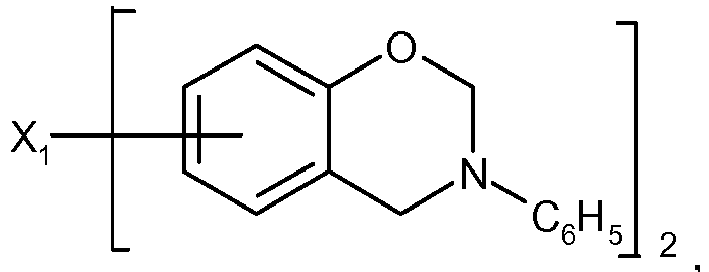
- benzoxazines used correspond to formula wherein X 1 is -CH 2 - (bisphenol F benzoxazine), 2,2-propylidene (bisphenol A benzoxazine) or 1(3H)-isobenzofuranone-3,3'-ylidene.
- C1 and C2 are also comparative examples.
Landscapes
- Chemical & Material Sciences (AREA)
- Health & Medical Sciences (AREA)
- Chemical Kinetics & Catalysis (AREA)
- Medicinal Chemistry (AREA)
- Polymers & Plastics (AREA)
- Organic Chemistry (AREA)
- Compositions Of Macromolecular Compounds (AREA)
- Reinforced Plastic Materials (AREA)
- Phenolic Resins Or Amino Resins (AREA)
- Paints Or Removers (AREA)
- Macromolecular Compounds Obtained By Forming Nitrogen-Containing Linkages In General (AREA)
Description
- This invention relates to thermosetting compositions which comprise (a) 97 to 40 percent by weight of one or more bis dihydrobenzoxazines on the basis of bisphenols, (b) 3 to 60 percent by weight of at least one bisphenol, and (c) optionally a curing catalyst. The invention also relates to the use of this composition for the manufacture of any materials with a cured resin of this thermosetting composition.
- Benzoxazine compounds have been employed satisfactorily to produce prepregs, laminates, moulding material, RTM (resin transfer moulding) systems, sealants, sinter powders, cast articles, structural composites parts, varnishes, surface coatings, electrical and electronic components by impregnating, coating, laminating or moulding processes. Such resins are dimension stable and have good electrical and mechanical resistance, low shrinkage, low water absorption, medium to high glass transition temperatures and good retaining properties, in term of mechanical properties.
- Benzoxazine compounds can easily be produced in several, well known ways by the reaction of bisphenols with a primary amine and formaldehyde, whereby the process can be carried out in the presence of solvents (see for example
US 5,152,993 orUS 5,266,695 ) or in the absence of solvents (see for exampleUS 5,543,516 ). The common manufacture and various curing possibilities using hardeners such as novolacs, polyepoxides or polyamines optionally together with a catalyst, or the catalytical and/or thermal curing as well as the valuable properties of the resins make this class of thermosetting resins attractive. -
EP 0 789 056 A2 describes a thermosetting resin composition with improved curability comprising dihydrobenzoxazines of polyphenols such as novolacs or bisphenol A and novolac phenolic resins. The composition is used as adhesives or for the manufacture of moulded articles, coatings, sealings, prepregs for printed wiring boards and metal-clad laminates with low water absorbance, improved none-flammability and high heat resistance. The use of polyhydroxy functional novolacs results in sometimes undesirable high reactivities (low gel times) and in higher cross-linked resins, which in general are more brittle. -
WO 2006/035021 A1 describes bisbenzoxazines on the basis of phenolphthalein for the preparation of polymers, which show a high temperature stability and a good none-flammability. Polymerisation may be carried out in presence of catalytic amounts of catalysts, such as thiodipropionic acid, phenols or sulfonyl diphenol. The use of bisphenols as hardeners is not mentioned inWO 2006/035021 A1 . -
WO 00/27921 A1 WO 00/27921 A1 - The present invention is related to a thermosetting composition according to claim 1. Moreover, the present invention is related to the use of such composition for the manufacture of a moulded article, a surface coating, a composite or a laminate. Also, the present invention is related to a cured product manufactured from such composition. Subject-matter of the dependent claims are related to preferred embodiments.
- It has now been surprisingly found that bisphenols are excellent hardeners for the polymerization of bis(dihydrobenzoxazine) compounds with improved reactivity and correspondingly lower gel times. It was further found that the additional combination with catalytic amounts of a protonic acid additionally increases the reactivity and further substantially shortens the gel time. It was also found that a composition comprising bis(dihydrobenzoxazine) compounds, bisphenols and optionally a catalyst such as a protonic acid possess an unusual high latency and storage stability regarding the increased reactivity. The admixed components can therefore be stored in one container and shipped to users, which is an economic advantage and much more comfortable for users. Additionally, the processability and control during moulding operations such as pressing is improved by the reduction of flow through the higher reactivity, which results in improved dimensional accuracy. The incorporation of the mere difunctional bisphenols in the polymer network results in thermosetting polymers, which show high temperature stability due to their unexpectedly high glass transition temperatures, good mechanical and also physical properties. Depending on the selection of monomers, even a reduced combustibility can be achieved.
- A first object of the invention is a thermosetting composition comprising
- (a) 97 to 40 percent by weight of at least one bis(dihydrobenzoxazine) prepared by the reaction of an unsubstituted or substituted bisphenol with at least one unsubstituted position ortho to each hydroxyl group, formaldehyde and a primary amine; and
- (b) 3 to 60 percent by weight of at least one bisphenol selected from hydrochinone, resorcinol, catechol, or from bisphenols of formula II,

- R4 is hydrogen, dialkylamino; alkylthio; alkylsulfonyl; C1-C18alkyl; C1-C18alkoxy; C1-C18alkoxyalkyl; C5-C12cycloalkyl that is unsubstituted or substituted by one or more C1-C6alkyl groups or C1-C6alkoxy groups; C6-C12aryl that is unsubstituted or substituted by one or more C1-C6alkyl groups or C1-C6alkoxy groups; or C7-C13aralkyl that is unsubstituted or substituted by one or more C1-C6alkyl groups or C1-C6alkoxy groups;
- X2 is a direct bond or a bivalent bridging group selected from -O-, -S-, -S(O)-, -S(O)2-, -C(O)-, -NR3-, -O-C(O)-, -O-C(O)-O-, -SO2-O-, -O-SO2-O-, -NR3-C(O)-, -NR3-C(O)-O-, -NR3-C(O)-NR3-, -NR3SO2-, -NR3-SO2-O-, -O-SO2NR3-,-NR3SO2-NR3-, -P(O)(OR3)O-, -OP(OR3)O-, -(O)P(OR3)-, -P(OR3)-, -P(R3)-, -O-(O)P(R3)-O-, C1-C18alkylen, C2-C18alkyliden, C3-C12cycloalkyliden, -Si(OR3)2- and -Si(R3)2-; and
- R3 is H or C1-C12alkyl, C5- or C6-cycloalkyl, C5- or C6-cycloalkyl-methyl or -ethyl, phenyl, benzyl or 1-phenyleth-2-yl, wherein the percent by weight refer to the total amount of components (a) and (b) with the proviso that (a) and (b) add up to 100 %; (c) a protonic acid curing catalyst; and (d) optionally other components.
- In a preferred embodiment, the composition according to the invention comprises
- (a) 95 to 50, preferably 95 to 60 and more preferably 94 to 70 percent by weight of at least one bis(dihydrobenzoxazine), and
- (b) 5 to 50, preferably 5 to 40 and more preferably 6 to 30 percent by weight of at least one bisphenol.
- It was found that cured resins with a lower content of bisphenols possess higher glass transition temperatures and thermostability, respectively. Such thermosetting compositions in addition have a sufficiently high reactivity. Therefore, in a further preferred embodiment, the composition according to the invention comprises
- (a) 97 to 75, preferably 96 to 80, more preferably 95 to 80 and most preferably 94 to 85 percent by weight of at least one bis(dihydrobenzoxazine); and
- (b) 3 to 25, preferably 4 to 20, more preferably 5 to 20 and most preferably 6 to 15 percent by weight of at least one bisphenol.
- The composition according to the invention is cured at high temperatures such as above 130 °C. Curing catalysts are useful therefore to accelerate the curing process. These are preferably incorporated in low levels in order to avoid formation of volatile decomposition products which would effect the properties of the thermosetting plastics. The amount of curing catalyst is preferably at most 5, further preferred 0.001 to 4, more preferably 0.01 to 3, especially preferred 0.1 to 2 and in particular 0.1 to 1.5 percent by weight, based on the amount of components (a), and (b).
- The curing catalysts of the present invention are protonic acids, especially aliphatic or aromatic mono- or polycarboxylic acids, sulfonic acids and phosphonic acids, having 1 to 20 and preferably 2 to 12 carbon atoms. The aliphatic and aromatic residues linking the carboxylic groups may contain hetero atoms and groups such as O, S, -N=, -NH- and -N(C1-C4alkyl)-. The aliphatic and aromatic residues may be unsubstituted or substituted with one or more C1-C6alkyl, C1-C6hydroxyalkyl or C1-C6alkoxy groups, halogen (F or CI), hydroxyl or amino. Preferred substituents are C1-C4alkyl, C1-C4hydroxyalkyl or C1-C4alkoxy groups, F or Cl. The carboxylic acid may contain preferably 1 to 4 and more preferably 1 or 2 carboxylic groups. The aliphatic or aromatic residue can be selected from alkanes, alkenes, cycloalkanes, heterocycloalkanes, cycloalkenes, heterocycloalkenes, carbocyclic or heterocyclic aromates, such as C1-C18alkyl, C1-C18alkenyl, C3-C12cycloalkyl, C3-C12heterocycloalkyl, C6-C18aryl, C6-C18heteroaryl. A preferred group of carboxylic acids is selected from those of formulae X2-CnH2n-COOH and X2-C6-C10arylen-COOH, wherein X2 is hydrogen or the group -COOH, and n is a number of 1 to 12, preferably 1 to 6.
- Some preferred examples for carboxylic acids are acetic acid, propanoic acid, butanoic acid, octanoic acid, dodecanoic acid, octanoic acid, maleic acid, succinic acid, nonyl- or dodecylsuccinic acid, glutaric acid, adipic acid, pimelic acid, suberic acid, azelaic acid, benzoic acid, phthalic acid, isophthalic acid, terephthalic acid and naphthalene dicarboxylic acid. Other examples are methyl sulfonic acid, trifluoromethyl sulfonic acid, phenyl sulfonic acid, toluyl sulfonic acid, methyl phosphonic acid and phenyl phosphonic acid.
- An especially preferred curing catalyst is adipic acid.
- Bis(dihydrobenzoxazines) on the basis of bisphenols are well known, commercially available and can be prepared according to well known and published methods. Bis(dihydrobenzoxazines) on the basis of bisphenols may correspond to formula I,

- R1 is C1-C18alkyl, or C3-C12cycloalkyl, C3-C12cycloalkyl-C1-C4alkyl, C6-C18aryl or C6-C18aryl-C1-C4alkyl, which are unsubstituted or substituted by one or more C1-C6alkyl groups or C1-C6alkoxy groups;
- R2 hydrogen, dialkylamino; alkylthio; alkylsulfonyl; C1-C18alkyl; C1-C18alkoxy; C1-C18alkoxyalkyl; C5-C12cycloalkyl that is unsubstituted or substituted by one or more C1-C6alkyl groups or C1-C6alkoxy groups; C6-C12aryl that is unsubstituted or substituted by one or more C1-C6alkyl groups or C1-C6alkoxy groups; or C7-C13aralkyl that is unsubstituted or substituted by one or more C1-C6alkyl groups or C1-C6alkoxy groups;
- X1 is a direct bond or a bivalent bridging group selected from -O-, -S-, -S(O)-, -S(O)2-, -C(O)-, -NR3-, -O-C(O)-, -O-C(O)-O-, -SO2-O-, -O-SO2-O-, -NR3-C(O)-, -NR3-C(O)-O-, -NR3-C(O)-NR3-, -NR3SO2-, -NR3-SO2-O-, -O-SO2NR3-,-NR3SO2-NR3-, -P(O)(OR3)O-, -OP(OR3)O-, -(O)P(OR3)-, -P(OR3)-, -P(R3)-, -O-(O)P(R3)-O-, C1-C18alkylen, C2-C18alkyliden, C3-C12cycloalkylen or -cycloalkyliden, -Si(OR3)2- and -Si(R3)2-; and
- R3 is H or C1-C12alkyl, C5- or C6-cycloalkyl, C5- or C6-cycloalkyl-methyl or -ethyl, phenyl, benzyl or 1-phenyleth-2-yl.
- When the radicals R1 to R3 are alkyl, alkoxy or alkoxyalkyl, those alkoyl or alkoxy radicals can be straight-chained or branched and may contain 1 to 12, more preferably 1 to 8 and most preferably 1 to 4 C atoms.
- Examples of alkyl groups are methyl, ethyl, isopropyl, n-propyl, n-butyl, isobutyl, sec-butyl, tert-butyl and the various isomeric pentyl, hexyl, heptyl, octyl, nonyl, decyl, undecyl, dodecyl, tridecyl, tetradecyl, pentadecyl, hexadecyl, heptadecyl and octadecyl groups.
- Suitable alkoxy groups are, for example, methoxy, ethoxy, isopropoxy, n-propoxy, n-butoxy, isobutoxy, sec-butoxy, tert-butoxy and the various isomeric pentyloxy, hexyloxy, heptyloxy, octyloxy, nonyloxy, decyloxy, undecyloxy, dodecyloxy, tridecyloxy, tetradecyloxy, pentadecyloxy, hexadecyloxy, heptadecyloxy and octadecyloxy groups.
- Examples of alkoxyalkyl groups are 2-methoxyethyl, 2-ethoxyethyl, 2-methoxypropyl, 3-methoxypropyl, 4-methoxybutyl and 4-ethoxybutyl.
- Cycloalkyl is preferably C5-C8cycloalkyl, especially C5- or C6-cycloalkyl. Some examples thereof are cyclopentyl, methylcyclopentyl, cyclohexyl, cycloheptyl and cyclooctyl.
Aryl groups are, for example, phenyl, naphthyl and anthryl. - Aralkyl preferably contains from 7 to 12 carbon atoms and especially from 7 to 11 carbon atoms. It may be, for example, benzyl, phenethyl, 3-phenylpropyl, α-methylbenzyl, 4-phenylbutyl or α,α-dimethylbenzyl.
- R1 is preferably C1-C12alkyl, C5-C8cycloalkyl or C5-C8cycloalkyl-C1-C2alkyl that is unsubstituted or substituted by one or more C1-C4alkyl groups or C1-C4alkoxy groups, C6-C10aryl or C6-C10aryl-C1-C2alkyl that is unsubstituted or substituted by one or more C1-C4alkyl groups or C1-C4alkoxy groups.
- In a more preferred embodiment of the present invention, R1 is C1-C6alkyl, or phenyl or benzyl - both unsubstituted or substituted by one or more methyl groups or methoxy groups. According to the invention, compounds of formula I are preferred, in which R1 is isopropyl, iso- or tertiary-butyl, n-pentyl or phenyl.
- R2 in the compounds of formula I is preferably hydrogen.
- Cycloalkylen X1 may be a polycycloalkylen having 2 to 4 condensed and/or bridged carbon cycles such as bicyclo-[2,2,1]-heptanylene ortricyclo-[2,1,0]-decanylene.
- X1 is preferably a direct bond or more preferably a bivalent bridging group selected from -O-, -S-, -S(O)-, -S(O)2-, -C(O)-, -P(O)(OR3)O-, -OP(OR3)O-, -OP(OR3)-, -P(OR3)-, -P(R3)-, C1-C2-alkylen, and C1-C12alkyliden, wherein R3 C1-C4alkyl, C5- or C6-cycloalkyl, phenyl or benzyl.
- It was found that S and P containing bridging groups improve flammability resistance and these groups may be selected if said resistance is desired.
- R3 is preferably H, C1-C12alkyl, C5- or C6-cycloalkyl, C5- or C6-cycloalkyl-methyl or -ethyl, phenyl, benzyl or 1-phenyleth-2-yl. If R3 is part of the groups P(O)(OR3)O-, -OP(OR3)O-, - OP(OR3)-, -P(OR3)- and -P(R3), then it is preferably not hydrogen.
- In a preferred embodiment, R3 is selected from C1-C4alkyl, cyclohexyl, phenyl or benzyl.
- Some preferred examples of bisphenols used to prepare bis(dihydrobenzoxazines) are 4,4'-dihydroxybiphenyl, (4-hydroxyphenyl)2C(O) (DHBP), bi(4-hydroxyphenyl)ether, bi(4-hydroxyphenyl)thioether, bisphenol A, bisphenol AP, bisphenol E, bisphenol H, bisphenol F, bisphenol S, bisphenol Z, phenolphthalein and bi(4-hydroxyphenyl)tricyclo-[2,1,0]-decan.
- The bisphenol component (b) may be selected from hydrochinone, resorcinol, catechol, or from bisphenols of formula II,

- R4 is hydrogen, dialkylamino; alkylthio; alkylsulfonyl; C1-C18alkyl; C1-C18alkoxy; C1-C18alkoxyalkyl; C5-C12cycloalkyl that is unsubstituted or substituted by one or more C1-C6alkyl groups or C1-C6alkoxy groups; C6-C12aryl that is unsubstituted or substituted by one or more C1-C6alkyl groups or C1-C6alkoxy groups; or C7-C13aralkyl that is unsubstituted or substituted by one or more C1-C6alkyl groups or C1-C6alkoxy groups;
- X2 is a direct bond or a bivalent bridging group selected from -O-, -S-, -S(O)-, -S(O)2-, -C(O)-, -NR3-, -O-C(O)-, -O-C(O)-O-, -SO2-O-, -O-SO2-O-, -NR3-C(O)-, -NR3-C(O)-O-, -NR3-C(O)-NR3-, -NR3SO2-, -NR3-SO2-O-, -O-SO2NR3-,-NR3SO2-NR3-, -P(O)(OR3)O-, -OP(OR3)O-, -(O)P(OR3)-, -P(OR3)-, -P(R3)-, -O-(O)P(R3)-O-, C1-C18alkylen, C2-C18alkyliden, C3-C12cycloalkyliden, -Si(OR3)2- and -Si(R3)2-; and
- R3 is H or C1-C12alkyl, C5- or C6-cycloalkyl, C5- or C6-cycloalkyl-methyl or -ethyl, phenyl, benzyl or 1-phenyleth-2-yl.
- R3 in formula II may independently have the same preferred meanings as R3 in in formula I.
- R4 in formula II may independently have the same preferred meanings as R2 in formula I. R4 is in particular hydrogen or C1-C4alkyl, such as methyl or ethyl.
- X2 preferably is a direct bond or a bivalent bridging group selected from -O-, -S-, -S(O)2-, -C(O)-, -NR3, C1-C4alkylen (for example methylene or 1,2-ethylene), C2-C6alkyliden (for example ethylidene, 1,1- or 2,2-propylidene, 1,1- or 2,2-butylidene, 1,1-, 2,2- or 3,3-pen-tylidene, or 1,1-, 2,2- or 3,3-hexylidene) or C5-C8cycloalkyliden (cyclopentylidene, cyclohexylidene or cyclooctylidene), whereby R3 is preferably hydrogen or C1-C4alkyl.
- If an improved flammability resistance is desired, X2 is a bivalent bridging group selected from -S-, and -S(O)2-.
- Preferred bisphenols of formula II are 4,4'dihydroxy-biphenyl, (4-hydroxyphenyl)2C(O) (DHBP), bi(4-hydroxyphenyl)ether, bi(4-hydroxyphenyl)thioether, bisphenol A, bisphenol AP, bisphenol E, bisphenol H, bisphenol F, bisphenol S and bisphenol Z. Bisphenols with sulfur containing bridging groups may be selected if improvement of high flammability resistance is desired.
- The properties of the thermosetting resins can be tailored for certain applications by addition of usual additives. The following additives are of particular importance:
- reinforcement fibers, such as glass, quartz, carbon, mineral and synthetic fibers (Keflar, Nomex), natural fibres, such as flax, jute, sisal, hemp in the usual forms of short fibers, staple fibers, threads, fabrics or mats;
- plasticizers, especially phosphorus compounds;
- mineral fillers, such as oxides, carbides, nitrides, silicates and salts, e.g. quartz powder, fused silica, aluminium oxide, glass powder, mica, kaolin, dolomite,carbon black or graphite; pigments and dyestuffs;
- micro hollow spheres;
- metal powders;
- flame retardants;
- defoaming agents;
- slip agents;
- thixotropes;
- adhesion promoters; and
- mould release agents.
- It was also surprisingly found that the presence of aromatic polyamines, e.g. bisphenyldiamines such as 4,4'-diaminodiphenylsulfone or methylene bisaniline, in the thermosetting resin composition improves the adhesion of the cured resin to metallic surfaces, such as copper surfaces. Therefore, in a further preferred embodiment of the invention, aromatic polyamines are present. The amount of these may range from 0.01 to 5 percent by weight, preferably 0.1 to 3 percent by weight, and especially preferred 0.5 to 2 percent by weight, based on the total amount of components (a) and (b). Preferably, 4,4'-diaminodiphenylsulfone is used.
- The thermosetting composition according to the invention can also comprise a solvent or a solvent mixture, especially when it is used as laminating or surface coating composition. Examples of solvents that are particularly suitable include methylethylketone, acetone, N-methyl-2-pyrrolidone, N,N-dimethyl formamide, pentanol, butanol, dioxolane, isopropanol, methoxy propanol, methoxy propanol acetate, dimethylformamide, glycols, glycol acetates and toluene, xylene. The ketones and the glycols are especially preferred. Typically, the laminating composition will contain 20 to 30 % by weight, preferably 30% by weight, of a solvent.
- The thermosetting composition according to the invention can be cured or pre-cured at temperatures of about 130 to 240 °C, preferably 150 to 220 °C and in particular 160 to 200 °C for the manufacture of prepregs, laminates or hot melting moulding processes.
- The thermosetting composition according to the invention can be used for example for the manufacture of composites from prepregs or B stage resins, and RTM (resin transfer moulding) systems.
- The thermosetting compositions according to the invention can be used, for example, as solvent-free casting resins, surface coating resins, laminating resins, moulding resins, potting resins, encapsulating resins and adhesives to produce moulded or coated articles or composites for the electrical and electronic industry, in the automotive and aerospace industry, or for surface protection of many articles, e.g. pipes and pipelines.
- Curing of the composition and an impregnation and lamination process is explained in the following:
- (1) A benzoxazine-containing formulation is applied to or impregnated into a substrate by rolling, dipping, spraying, other known techniques and/or combinations thereof. The substrate is typically a woven or nonwoven fiber mat containing, for instance, glass fibers, carbon or mineral fibers or paper.
- (2) The impregnated substrate is "B-staged" by heating at a temperature sufficient to evaporate solvent (if the latter is present) in the benzoxazine formulation and to partially cure the benzoxazine formulation, so that the impregnated substrate can be handled easily. The "B- staging" step is usually carried out at a temperature of from 80°C to 220 °C and for a time of from 1 minute to 15 minutes. The impregnated substrate that results from "B-staging" is called a "prepreg". The temperature is most commonly 100 °C for composites and 130 °C to 200°C for electrical laminates.
- (3) One or more sheets of prepreg are stacked on top of each other or may alternate with one or more sheets of a conductive material, such as copper foil, if an electrical laminate is desired.
- (4) The laid-up sheets are pressed at high temperature and pressure for a time sufficient to cure the resin and form a laminate. The temperature of this lamination step is usually between 100 °C and 240 °C, and is most often between 165 °C and 190 °C. The lamination step may also be carried out in two or more stages, such as a first stage between 100°C and 150 °C and a second stage at between 165 °C and 190 °C. The pressure is usually from 50 N/cm2 and 500 N/cm2. The lamination step is usually carried out for a time of from 1 minute to 200 minutes, and most often for 45 minutes to 90 minutes. The lamination step may optionally be carried out at higher temperatures for shorter times (such as in continuous lamination processes) or for longer times at lower temperatures (such as in low energy press processes).
- (5) Optionally, the resulting laminate, for example, a copper-clad laminate, may be post-treated by heating for a time at high temperature and ambient pressure. The temperature of post-treatment is usually between 120 °C and 250 °C. The post-treatment time usually is between 30 minutes and 12 hours.
- Solid substrates for coating purposes may be selected from metal, metal alloys, wood, glass, minerals such as silicates, corundum or boron nitride, and plastics.
- The cured resins possess a high chemical resistance, corrosion resistance, mechanical resistance, durability, hardness, toughness, flexibility, temperature resistance or stability (high glass transition temperatures), reduced combustibility, adhesion to substrates and de-lamination resistance.
- Another object of the invention relates to the use of the thermosetting composition according to the invention for the manufacture of moulded articles, surface coatings, composites and laminates.
- A further object of the invention are cured products manufactured from the thermosetting composition according to the invention.
- The following examples explain the invention.
- A solid mixture of (in parts by weight) component (a) benzoxazine, component (b) bisphenol and optionally curing catalyst (c) is molten at 130-140°C under thorough stirring. The gel time of such homogenous mixture is measured on a hot plate at 180°C. The gel time has been determined according to the standard test method IPC-TM-650-2.3.18, however, the measurement has been carried out on a hot plate of 180°C instead of 171°C. The mixture is cured in an oven at 200°C for 90 minutes. The onset temperature (onset T), temperature peak (T peak), enthalpy and glass transition temperature (Tg) has been determined on a DSC machine of Mettler type DSC 823 (condition: from 30 to 350°C, heating rate 20°C/min).
- The results are given in the following Tables 1 and 2.
Table 1 A1 A2 A3 A4 A5 A6 bisphenol F benzoxazine 10 10 10 10 phenolphthalein benzoxazine 10 bisphenol A benzoxazine 10 4,4'-dihydroxydiphenylsulfone 1 1 1 0.4 0.4 1.2 bisphenol A adipic acid 0.56 benzoic acid gel time/180 °C (sec) 455 323 430 1140 148 317 DSC 30-350°C, 20 °C/min onset T (°C) 195 192 204 220 176 188 T peak (°C) 226 229 233 240 208 215 enthalpy (J/g) 243 171 224 228 225 243 Tg after 90 min / 200 °C 185 215 179 169 183 179 Table 2 A7 A8 A9 A10 C1 C2 bisphenol F benzoxazine 10 10 10 10 phenolphthalein benzoxazine 10 bisphenol A benzoxazine 10 4,4'-dihydroxydiphenylsulfone 1.2 0.4 bisphenol A 0.40 2 phenol-formaldehyde novolaca 1 adipic acid 0.1 benzoic acid 0.1 gel time / 180 °C (sec) 250 311 973 511 2040 720 DSC 30-350 °C, 20 °C/min onset (°C) 185 186 218 192 240 196 T peak (°C) 212 208 236 218 254 236 enthalpy (J/g) 254 267 274 272 290 204 Tg after 90 min / 200 °C 185 162 163 157 a = DURITE® SD-1702 ex Borden Chemical, Inc.; viscosity at 150°C: 1400-2400 cps; Mw: 2500; Mn: 600 - Remarks: The examples (A1 to A10) summarized in Tables 1 and 2 demonstrate enhanced reaction (shorter gel times) when a protonic acid catalyst is used in addition (A5, A7 and A8). Unusual high glass transition temperatures result, especially when dicarboxylic acids such as adipic acid are used as catalysts. Examples A1 to A4, A6, A9 and A10 are comparative examples.
- The benzoxazines used correspond to formula
- C1 and C2 are also comparative examples.
Claims (15)
- A thermosetting composition comprising(a) 97 to 40 percent by weight of at least one bis(dihydrobenzoxazine) prepared by the reaction of an unsubstituted or substituted bisphenol with at least one unsubstituted position ortho to each hydroxyl group, formaldehyde and a primary amine; and(b) 3 to 60 percent by weight of at least one bisphenol selected from hydrochinone, resorcinol, catechol, or from bisphenols of formula II,
 R4 is hydrogen, dialkylamino; alkylthio; alkylsulfonyl; C1-C18alkyl; C1-C18alkoxy; C1-C18alkoxyalkyl; C5-C12cycloalkyl that is unsubstituted or substituted by one or more C1-C6alkyl groups or C1-C6alkoxy groups; C6-C12aryl that is unsubstituted or substituted by one or more C1-C6alkyl groups or C1-C6alkoxy groups; or C7-C13aralkyl that is unsubstituted or substituted by one or more C1-C6alkyl groups or C1-C6alkoxy groups;X2 is a direct bond or a bivalent bridging group selected from -O-, -S-, -S(O)-, -S(O)2-, -C(O)-, -NR3-, -O-C(O)-, -O-C(O)-O-, -SO2-O-, -O-SO2-O-, -NR3-C(O)-, -NR3-C(O)-O-, -NR3-C(O)-NR3-, -NR3SO2-, -NR3-SO2-O-, -O-SO2NR3-,-NR3SO2-NR3-, -P(O)(OR3)O-, -OP(OR3)O-, -(O)P(OR3)-, -P(OR3)-, -P(R3)-, -O-(O)P(R3)-O-, C1-C18alkylen, C2-C18alkyliden, C3-C12cycloalkyliden, -Si(OR3)2- and -Si(R3)2-; andR3 is H or C1-C12alkyl, C5- or C6-cycloalkyl, C5- or C6-cycloalkyl-methyl or -ethyl, phenyl, benzyl or 1-phenyleth-2-ylwherein the percent by weight refer to the total amount of components (a) and (b), with the proviso that (a) and (b) add up to 100 percent by weight;(c) a protonic acid curing catalyst; and(d) optionally other components.
 - A thermosetting composition according to claim 1, which comprises(a) 95 to 50, preferably 95 to 60 and more preferably 94 to 70 percent by weight of at least one bis(dihydrobenzoxazine), and(b) 5 to 50, preferably 5 to 40 and more preferably 6 to 30 percent by weight of at least one bisphenol.
- A thermosetting composition according to claim 1, which comprises(a) 97 to 75, preferably 95 to 80 and more preferably 94 to 85 percent by weight of at least one bis(dihydrobenzoxazine); and(b) 3 to 25, preferably 5 to 20 and more preferably 6 to 15 percent by weight of at least one bisphenol.
- A thermosetting composition according to any of claims 1 to 3, which comprises as component (a) bis(dihydrobenzoxazines) of formula I,
 R1 is C1-C18alkyl, or C3-C12cycloalkyl, C3-C12cycloalkyl-C1-C4alkyl, C6-C18aryl or C6-C18aryl-C1-C4alkyl, which are unsubstituted or substituted by one or more C1-C6alkyl groups or C1-C6alkoxy groups;R2 hydrogen, dialkylamino; alkylthio; alkylsulfonyl; C1-C18alkyl; C1-C18alkoxy; C1-C18alkoxyalkyl; C5-C12cycloalkyl that is unsubstituted or substituted by one or more C1-C6alkyl groups or C1-C6alkoxy groups; C6-C12aryl that is unsubstituted or substituted by one or more C1-C6alkyl groups or C1-C6alkoxy groups; or C7-C13aralkyl that is unsubstituted or substituted by one or more C1-C6alkyl groups or C1-C6alkoxy groups;X1 is a direct bond or a bivalent bridging group selected from -O-, -S-, -S(O)-, -S(O)2-, -C(O)-, -NR3-, -O-C(O)-, -O-C(O)-O-, -SO2-O-, -O-SO2-O-, -NR3-C(O)-, -NR3-C(O)-O-, -NR3-C(O)-NR3-, -NR3SO2-, -NR3-SO2-O-, -O-SO2NR3-,-NR3SO2-NR3-, -P(O)(OR3)O-, -OP(OR3)O-, -(O)P(OR3)-, -P(OR3)-, -P(R3)-, -O-(O)P(R3)-O-, C1-C18alkylen, C2-C18alkyliden, C3-C12cycloalkyliden, -Si(OR3)2- and -Si(R3)2-; andR3 is H or C1-C12alkyl, C5- or C6-cycloalkyl, C5- or C6-cycloalkyl-methyl or -ethyl, phenyl, benzyl or 1-phenyleth-2-yl.
 - A thermosetting composition according to claim 4, wherein R1 is C1-C6alkyl, or phenyl or benzyl that is unsubstituted or substituted by one or more methyl groups or methoxy groups.
- A thermosetting composition according to claims 4 or 5, wherein R2 in the compounds of formula I is hydrogen.
- A thermosetting composition according to claim 6, wherein X1 is a direct bond or a bivalent bridging group selected from -O-, -S-, -S(O)-, -S(O)2-, -C(O)-, -P(O)(OR3)O-, -OP(OR3)O-, -OP(OR3)-, -P(OR3)-, -P(R3)-, C1-C2alkylen, and C1-C12alkyliden, wherein R3 C1-C4alkyl, C5-or C6-cycloalkyl, phenyl or benzyl.
- A thermosetting composition according to any of claims 4 to 7, wherein R3 is H, C1-C12alkyl, C5- or C6-cycloalkyl, C5- or C6-cycloalkyl-methyl or -ethyl, phenyl, benzyl or 1-phenyleth-2-yl, with the proviso that R3 is in the groups -P(O)(OR3)O-, -OP(OR3)O-, - OP(OR3)-, -P(OR3)- and -P(R3)- not hydrogen.
- A thermosetting composition according to any of claims 1 to 8, wherein in formula (II) R4 is hydrogen or C1-C4alkyl.
- A thermosetting composition according to any of claims 1 to 9, wherein in formula (II) X2 is a direct bond or a
bivalent bridging group selected from -O-, -S-, -S(O)2-, -C(O)-, -NR3-, C1-C4alkylen, C2-C6alkyliden or C5-C8cycloalkyliden, whereby R3 is hydrogen or C1-C4alkyl. - A thermosetting composition according to any of claims 1 to 10, wherein in formula (II) X2 is a bivalent bridging group selected from -S-, and -S(O)2-.
- A thermosetting composition according to any of claims 1 to 11, which additionally comprises an aromatic polyamine.
- A thermosetting composition according to any of claims 1 to 12, wherin the curing catalyst (c) is adipic acid.
- Use of the thermosetting composition according to any of claims 1 to 13 for the manufacture of a moulded article, a surface coating, a composite or a laminate.
- Cured products manufactured from the thermosetting composition according to any of claims 1 to 13.
Priority Applications (2)
| Application Number | Priority Date | Filing Date | Title |
|---|---|---|---|
| EP08708402.6A EP2115069B1 (en) | 2007-02-08 | 2008-01-30 | Thermosetting composition |
| PL08708402T PL2115069T3 (en) | 2007-02-08 | 2008-01-30 | Thermosetting composition |
Applications Claiming Priority (3)
| Application Number | Priority Date | Filing Date | Title |
|---|---|---|---|
| EP07101986 | 2007-02-08 | ||
| EP08708402.6A EP2115069B1 (en) | 2007-02-08 | 2008-01-30 | Thermosetting composition |
| PCT/EP2008/051085 WO2008095837A1 (en) | 2007-02-08 | 2008-01-30 | Thermosetting composition |
Publications (2)
| Publication Number | Publication Date |
|---|---|
| EP2115069A1 EP2115069A1 (en) | 2009-11-11 |
| EP2115069B1 true EP2115069B1 (en) | 2021-01-13 |
Family
ID=37986875
Family Applications (1)
| Application Number | Title | Priority Date | Filing Date |
|---|---|---|---|
| EP08708402.6A Active EP2115069B1 (en) | 2007-02-08 | 2008-01-30 | Thermosetting composition |
Country Status (11)
| Country | Link |
|---|---|
| US (1) | US8852382B2 (en) |
| EP (1) | EP2115069B1 (en) |
| JP (1) | JP5590893B2 (en) |
| KR (1) | KR101457449B1 (en) |
| CN (2) | CN101605851B (en) |
| DK (1) | DK2115069T3 (en) |
| ES (1) | ES2855147T3 (en) |
| HU (1) | HUE053812T2 (en) |
| PL (1) | PL2115069T3 (en) |
| TW (1) | TWI419926B (en) |
| WO (1) | WO2008095837A1 (en) |
Families Citing this family (15)
| Publication number | Priority date | Publication date | Assignee | Title |
|---|---|---|---|---|
| ATE474875T1 (en) * | 2007-02-08 | 2010-08-15 | Huntsman Adv Mat Switzerland | HEAT CURRENT COMPOSITION |
| WO2012015604A1 (en) * | 2010-07-28 | 2012-02-02 | Huntsman Advanced Materials Americas Llc | Solvent-free benzoxazine based thermosetting resin composition |
| US9611360B2 (en) | 2011-03-28 | 2017-04-04 | 3M Innovative Properties Company | Curable composition, article, method of curing, and tack-free reaction product |
| KR20140021613A (en) * | 2011-03-28 | 2014-02-20 | 쓰리엠 이노베이티브 프로퍼티즈 컴파니 | Curable composition, article, method of curing, and reaction product |
| WO2013119388A1 (en) * | 2012-02-10 | 2013-08-15 | 3M Innovative Properties Company | Anticorrosion coatings |
| AT513190B9 (en) * | 2012-08-08 | 2014-05-15 | Berndorf Hueck Band Und Pressblechtechnik Gmbh | Apparatus and method for plasma coating a substrate, in particular a press plate |
| US20140072800A1 (en) * | 2012-09-07 | 2014-03-13 | E I Du Pont De Nemours And Company | Coated article comprising a curable composition comprising bis-benzoxazine and an amino-functionalized triazine |
| US20140073736A1 (en) * | 2012-09-07 | 2014-03-13 | E I Du Pont Nemours And Company | Curable composition comprising bis-benzoxazine, method of curing, and the cured composition so formed |
| US20140069693A1 (en) * | 2012-09-07 | 2014-03-13 | E I Du Pont De Nemours And Company | Multi-layer article comprising discrete conductive pathways contacting a curable composition comprising bis-benzoxazine |
| US9169393B2 (en) | 2013-07-25 | 2015-10-27 | 3M Innovative Properties Company | Anticorrosion coatings |
| JP2017526793A (en) * | 2014-09-12 | 2017-09-14 | ヘンケル アイピー アンド ホールディング ゲゼルシャフト ミット ベシュレンクテル ハフツング | Cationic cured benzoxazine composition |
| US10882955B2 (en) | 2015-06-09 | 2021-01-05 | 3M Innovative Properties Company | Ammonium salt catalyzed benzoxazine polymerization |
| EP3334591B1 (en) * | 2015-08-10 | 2021-11-03 | Cytec Industries Inc. | Prepreg material capable of providing lightning strike protection and burn-through resistance and method for its manufacture |
| JP7579883B2 (en) * | 2020-04-15 | 2024-11-08 | 株式会社カネカ | Crosslinkable thermoplastic resin compositions and methods for forming same, and methods for forming cured thermoplastic resins - Patents.com |
| CN114015194B (en) * | 2021-10-19 | 2023-10-20 | 航天特种材料及工艺技术研究所 | A polybenzoxazine aerogel and its preparation method |
Family Cites Families (18)
| Publication number | Priority date | Publication date | Assignee | Title |
|---|---|---|---|---|
| US4507428A (en) * | 1984-02-17 | 1985-03-26 | Monsanto Company | Aqueous dispersions of polyamines and poly(dihydrobenzoxazines) |
| US4501864A (en) * | 1983-12-22 | 1985-02-26 | Monsanto Company | Polymerizable compositions comprising polyamines and poly(dihydrobenzoxazines) |
| JP3487083B2 (en) * | 1996-02-09 | 2004-01-13 | 日立化成工業株式会社 | Thermosetting resin composition and cured product thereof |
| JPH1112356A (en) * | 1997-06-20 | 1999-01-19 | Shikoku Chem Corp | Thermosetting resin composition |
| JPH11279310A (en) * | 1998-03-31 | 1999-10-12 | Asahi Chem Ind Co Ltd | Composition for phenol resin foamed body and its foamed body |
| US6207786B1 (en) * | 1998-11-10 | 2001-03-27 | Edison Polymer Innovation Corporation | Ternary systems of benzoxazine, epoxy, and phenolic resins |
| JP4207101B2 (en) | 1999-05-25 | 2009-01-14 | 日立化成工業株式会社 | Resin composition for semiconductor encapsulation and resin-encapsulated semiconductor device |
| US6376080B1 (en) * | 1999-06-07 | 2002-04-23 | Loctite Corporation | Method for preparing polybenzoxazine |
| JP2001220445A (en) | 2000-02-07 | 2001-08-14 | Hitachi Chem Co Ltd | Method for producing polysilane |
| JP2001220455A (en) * | 2000-02-10 | 2001-08-14 | Mitsubishi Gas Chem Co Inc | Prepreg and laminate |
| JP2002047391A (en) * | 2000-07-31 | 2002-02-12 | Hitachi Chem Co Ltd | Thermosetting resin composition for sealing and electronic component device |
| MY142518A (en) | 2001-01-10 | 2010-12-15 | Hitachi Chemical Co Ltd | Dihydrobenzoxazine ring-containing resin, phenolic-triazine-aldehyde condensate and epoxy resin |
| JP2003147165A (en) | 2001-08-29 | 2003-05-21 | Osaka City | Thermosetting resin composition |
| JP3911410B2 (en) * | 2001-11-30 | 2007-05-09 | 富士重工業株式会社 | Manufacturing method for composite products |
| JP3986445B2 (en) * | 2003-02-17 | 2007-10-03 | 東都化成株式会社 | Method for producing high-purity epoxy resin and epoxy resin composition |
| CN1207325C (en) | 2003-04-30 | 2005-06-22 | 四川大学 | Modified benzoxazine resin capable of using for RTM and process for preparing same |
| US20070191555A1 (en) * | 2004-03-30 | 2007-08-16 | Hatsuo Ishida | Thermosetting resin composition and its article |
| US7649060B2 (en) * | 2005-12-02 | 2010-01-19 | Henkel Corporation | Curable compositions |
-
2008
- 2008-01-30 DK DK08708402.6T patent/DK2115069T3/en active
- 2008-01-30 CN CN2008800043137A patent/CN101605851B/en active Active
- 2008-01-30 EP EP08708402.6A patent/EP2115069B1/en active Active
- 2008-01-30 ES ES08708402T patent/ES2855147T3/en active Active
- 2008-01-30 JP JP2009548656A patent/JP5590893B2/en active Active
- 2008-01-30 HU HUE08708402A patent/HUE053812T2/en unknown
- 2008-01-30 KR KR1020097014086A patent/KR101457449B1/en active Active
- 2008-01-30 PL PL08708402T patent/PL2115069T3/en unknown
- 2008-01-30 WO PCT/EP2008/051085 patent/WO2008095837A1/en not_active Ceased
- 2008-01-30 US US12/525,936 patent/US8852382B2/en active Active
- 2008-01-31 CN CN2008800043122A patent/CN101605837B/en active Active
- 2008-02-05 TW TW097104720A patent/TWI419926B/en active
Non-Patent Citations (1)
| Title |
|---|
| None * |
Also Published As
| Publication number | Publication date |
|---|---|
| US8852382B2 (en) | 2014-10-07 |
| JP5590893B2 (en) | 2014-09-17 |
| TW200846410A (en) | 2008-12-01 |
| DK2115069T3 (en) | 2021-03-29 |
| KR101457449B1 (en) | 2014-11-03 |
| TWI419926B (en) | 2013-12-21 |
| WO2008095837A1 (en) | 2008-08-14 |
| PL2115069T3 (en) | 2021-07-05 |
| US20100015343A1 (en) | 2010-01-21 |
| CN101605837A (en) | 2009-12-16 |
| CN101605851A (en) | 2009-12-16 |
| HUE053812T2 (en) | 2021-07-28 |
| CN101605837B (en) | 2013-06-12 |
| CN101605851B (en) | 2013-05-08 |
| KR20090116697A (en) | 2009-11-11 |
| EP2115069A1 (en) | 2009-11-11 |
| ES2855147T3 (en) | 2021-09-23 |
| JP2010518207A (en) | 2010-05-27 |
Similar Documents
| Publication | Publication Date | Title |
|---|---|---|
| US8852382B2 (en) | Thermosetting composition | |
| EP2115034B1 (en) | Thermosetting composition | |
| TWI643879B (en) | Preparation method of benzoxazine-containing resin composition, prepreg and laminate made from same | |
| KR101627598B1 (en) | Thermosetting Composition | |
| AU2010309998B2 (en) | Thermosetting composition | |
| TWI475048B (en) | Phosphoric acid resistant polymaleimide prepolymer compositions | |
| JPH10259248A (en) | Thermosetting composition and its hardened material | |
| JP2004217941A (en) | Thermosetting composition and its cured product |
Legal Events
| Date | Code | Title | Description |
|---|---|---|---|
| PUAI | Public reference made under article 153(3) epc to a published international application that has entered the european phase |
Free format text: ORIGINAL CODE: 0009012 |
|
| 17P | Request for examination filed |
Effective date: 20090605 |
|
| AK | Designated contracting states |
Kind code of ref document: A1 Designated state(s): AT BE BG CH CY CZ DE DK EE ES FI FR GB GR HR HU IE IS IT LI LT LU LV MC MT NL NO PL PT RO SE SI SK TR |
|
| 17Q | First examination report despatched |
Effective date: 20100113 |
|
| DAX | Request for extension of the european patent (deleted) | ||
| RAP1 | Party data changed (applicant data changed or rights of an application transferred) |
Owner name: HUNTSMANN ADVANCED MATERIALS LICENSING (SWITZERLAN |
|
| STAA | Information on the status of an ep patent application or granted ep patent |
Free format text: STATUS: EXAMINATION IS IN PROGRESS |
|
| RAP1 | Party data changed (applicant data changed or rights of an application transferred) |
Owner name: HUNTSMAN ADVANCED MATERIALS LICENSING (SWITZERLAND |
|
| GRAP | Despatch of communication of intention to grant a patent |
Free format text: ORIGINAL CODE: EPIDOSNIGR1 |
|
| STAA | Information on the status of an ep patent application or granted ep patent |
Free format text: STATUS: GRANT OF PATENT IS INTENDED |
|
| INTG | Intention to grant announced |
Effective date: 20200108 |
|
| GRAJ | Information related to disapproval of communication of intention to grant by the applicant or resumption of examination proceedings by the epo deleted |
Free format text: ORIGINAL CODE: EPIDOSDIGR1 |
|
| STAA | Information on the status of an ep patent application or granted ep patent |
Free format text: STATUS: EXAMINATION IS IN PROGRESS |
|
| INTC | Intention to grant announced (deleted) | ||
| GRAP | Despatch of communication of intention to grant a patent |
Free format text: ORIGINAL CODE: EPIDOSNIGR1 |
|
| STAA | Information on the status of an ep patent application or granted ep patent |
Free format text: STATUS: GRANT OF PATENT IS INTENDED |
|
| INTG | Intention to grant announced |
Effective date: 20201028 |
|
| GRAS | Grant fee paid |
Free format text: ORIGINAL CODE: EPIDOSNIGR3 |
|
| GRAA | (expected) grant |
Free format text: ORIGINAL CODE: 0009210 |
|
| STAA | Information on the status of an ep patent application or granted ep patent |
Free format text: STATUS: THE PATENT HAS BEEN GRANTED |
|
| AK | Designated contracting states |
Kind code of ref document: B1 Designated state(s): AT BE BG CH CY CZ DE DK EE ES FI FR GB GR HR HU IE IS IT LI LT LU LV MC MT NL NO PL PT RO SE SI SK TR |
|
| REG | Reference to a national code |
Ref country code: GB Ref legal event code: FG4D |
|
| REG | Reference to a national code |
Ref country code: CH Ref legal event code: EP |
|
| REG | Reference to a national code |
Ref country code: DE Ref legal event code: R096 Ref document number: 602008063649 Country of ref document: DE |
|
| REG | Reference to a national code |
Ref country code: IE Ref legal event code: FG4D |
|
| REG | Reference to a national code |
Ref country code: AT Ref legal event code: REF Ref document number: 1353805 Country of ref document: AT Kind code of ref document: T Effective date: 20210215 |
|
| REG | Reference to a national code |
Ref country code: NL Ref legal event code: FP |
|
| REG | Reference to a national code |
Ref country code: DK Ref legal event code: T3 Effective date: 20210326 Ref country code: NO Ref legal event code: T2 Effective date: 20210113 |
|
| REG | Reference to a national code |
Ref country code: SE Ref legal event code: TRGR |
|
| REG | Reference to a national code |
Ref country code: FI Ref legal event code: FGE |
|
| REG | Reference to a national code |
Ref country code: LT Ref legal event code: MG9D |
|
| REG | Reference to a national code |
Ref country code: HU Ref legal event code: AG4A Ref document number: E053812 Country of ref document: HU |
|
| PG25 | Lapsed in a contracting state [announced via postgrant information from national office to epo] |
Ref country code: GR Free format text: LAPSE BECAUSE OF FAILURE TO SUBMIT A TRANSLATION OF THE DESCRIPTION OR TO PAY THE FEE WITHIN THE PRESCRIBED TIME-LIMIT Effective date: 20210414 Ref country code: HR Free format text: LAPSE BECAUSE OF FAILURE TO SUBMIT A TRANSLATION OF THE DESCRIPTION OR TO PAY THE FEE WITHIN THE PRESCRIBED TIME-LIMIT Effective date: 20210113 Ref country code: LT Free format text: LAPSE BECAUSE OF FAILURE TO SUBMIT A TRANSLATION OF THE DESCRIPTION OR TO PAY THE FEE WITHIN THE PRESCRIBED TIME-LIMIT Effective date: 20210113 Ref country code: BG Free format text: LAPSE BECAUSE OF FAILURE TO SUBMIT A TRANSLATION OF THE DESCRIPTION OR TO PAY THE FEE WITHIN THE PRESCRIBED TIME-LIMIT Effective date: 20210413 Ref country code: PT Free format text: LAPSE BECAUSE OF FAILURE TO SUBMIT A TRANSLATION OF THE DESCRIPTION OR TO PAY THE FEE WITHIN THE PRESCRIBED TIME-LIMIT Effective date: 20210513 |
|
| PG25 | Lapsed in a contracting state [announced via postgrant information from national office to epo] |
Ref country code: LV Free format text: LAPSE BECAUSE OF FAILURE TO SUBMIT A TRANSLATION OF THE DESCRIPTION OR TO PAY THE FEE WITHIN THE PRESCRIBED TIME-LIMIT Effective date: 20210113 |
|
| REG | Reference to a national code |
Ref country code: ES Ref legal event code: FG2A Ref document number: 2855147 Country of ref document: ES Kind code of ref document: T3 Effective date: 20210923 |
|
| PG25 | Lapsed in a contracting state [announced via postgrant information from national office to epo] |
Ref country code: LU Free format text: LAPSE BECAUSE OF NON-PAYMENT OF DUE FEES Effective date: 20210130 Ref country code: IS Free format text: LAPSE BECAUSE OF FAILURE TO SUBMIT A TRANSLATION OF THE DESCRIPTION OR TO PAY THE FEE WITHIN THE PRESCRIBED TIME-LIMIT Effective date: 20210513 |
|
| REG | Reference to a national code |
Ref country code: DE Ref legal event code: R097 Ref document number: 602008063649 Country of ref document: DE |
|
| PG25 | Lapsed in a contracting state [announced via postgrant information from national office to epo] |
Ref country code: MC Free format text: LAPSE BECAUSE OF FAILURE TO SUBMIT A TRANSLATION OF THE DESCRIPTION OR TO PAY THE FEE WITHIN THE PRESCRIBED TIME-LIMIT Effective date: 20210113 Ref country code: EE Free format text: LAPSE BECAUSE OF FAILURE TO SUBMIT A TRANSLATION OF THE DESCRIPTION OR TO PAY THE FEE WITHIN THE PRESCRIBED TIME-LIMIT Effective date: 20210113 |
|
| PLBE | No opposition filed within time limit |
Free format text: ORIGINAL CODE: 0009261 |
|
| STAA | Information on the status of an ep patent application or granted ep patent |
Free format text: STATUS: NO OPPOSITION FILED WITHIN TIME LIMIT |
|
| PG25 | Lapsed in a contracting state [announced via postgrant information from national office to epo] |
Ref country code: RO Free format text: LAPSE BECAUSE OF FAILURE TO SUBMIT A TRANSLATION OF THE DESCRIPTION OR TO PAY THE FEE WITHIN THE PRESCRIBED TIME-LIMIT Effective date: 20210113 Ref country code: SK Free format text: LAPSE BECAUSE OF FAILURE TO SUBMIT A TRANSLATION OF THE DESCRIPTION OR TO PAY THE FEE WITHIN THE PRESCRIBED TIME-LIMIT Effective date: 20210113 |
|
| 26N | No opposition filed |
Effective date: 20211014 |
|
| PG25 | Lapsed in a contracting state [announced via postgrant information from national office to epo] |
Ref country code: IE Free format text: LAPSE BECAUSE OF NON-PAYMENT OF DUE FEES Effective date: 20210130 |
|
| PG25 | Lapsed in a contracting state [announced via postgrant information from national office to epo] |
Ref country code: SI Free format text: LAPSE BECAUSE OF FAILURE TO SUBMIT A TRANSLATION OF THE DESCRIPTION OR TO PAY THE FEE WITHIN THE PRESCRIBED TIME-LIMIT Effective date: 20210113 |
|
| PG25 | Lapsed in a contracting state [announced via postgrant information from national office to epo] |
Ref country code: IS Free format text: LAPSE BECAUSE OF FAILURE TO SUBMIT A TRANSLATION OF THE DESCRIPTION OR TO PAY THE FEE WITHIN THE PRESCRIBED TIME-LIMIT Effective date: 20210513 |
|
| REG | Reference to a national code |
Ref country code: AT Ref legal event code: UEP Ref document number: 1353805 Country of ref document: AT Kind code of ref document: T Effective date: 20210113 |
|
| PG25 | Lapsed in a contracting state [announced via postgrant information from national office to epo] |
Ref country code: CY Free format text: LAPSE BECAUSE OF FAILURE TO SUBMIT A TRANSLATION OF THE DESCRIPTION OR TO PAY THE FEE WITHIN THE PRESCRIBED TIME-LIMIT Effective date: 20210113 |
|
| PG25 | Lapsed in a contracting state [announced via postgrant information from national office to epo] |
Ref country code: MT Free format text: LAPSE BECAUSE OF FAILURE TO SUBMIT A TRANSLATION OF THE DESCRIPTION OR TO PAY THE FEE WITHIN THE PRESCRIBED TIME-LIMIT Effective date: 20210113 |
|
| REG | Reference to a national code |
Ref country code: GB Ref legal event code: 732E Free format text: REGISTERED BETWEEN 20241114 AND 20241120 |
|
| P01 | Opt-out of the competence of the unified patent court (upc) registered |
Free format text: CASE NUMBER: APP_66662/2024 Effective date: 20241217 |
|
| PG25 | Lapsed in a contracting state [announced via postgrant information from national office to epo] |
Ref country code: TR Free format text: LAPSE BECAUSE OF FAILURE TO SUBMIT A TRANSLATION OF THE DESCRIPTION OR TO PAY THE FEE WITHIN THE PRESCRIBED TIME-LIMIT Effective date: 20210113 |
|
| REG | Reference to a national code |
Ref country code: CH Ref legal event code: U11 Free format text: ST27 STATUS EVENT CODE: U-0-0-U10-U11 (AS PROVIDED BY THE NATIONAL OFFICE) Effective date: 20260201 |
|
| PGFP | Annual fee paid to national office [announced via postgrant information from national office to epo] |
Ref country code: NL Payment date: 20260122 Year of fee payment: 19 |
|
| PGFP | Annual fee paid to national office [announced via postgrant information from national office to epo] |
Ref country code: HU Payment date: 20260211 Year of fee payment: 19 |
|
| PGFP | Annual fee paid to national office [announced via postgrant information from national office to epo] |
Ref country code: SE Payment date: 20260126 Year of fee payment: 19 |
|
| PGFP | Annual fee paid to national office [announced via postgrant information from national office to epo] |
Ref country code: GB Payment date: 20260126 Year of fee payment: 19 |
|
| PGFP | Annual fee paid to national office [announced via postgrant information from national office to epo] |
Ref country code: ES Payment date: 20260210 Year of fee payment: 19 |
|
| PGFP | Annual fee paid to national office [announced via postgrant information from national office to epo] |
Ref country code: NO Payment date: 20260120 Year of fee payment: 19 Ref country code: DE Payment date: 20260127 Year of fee payment: 19 Ref country code: DK Payment date: 20260123 Year of fee payment: 19 |
|
| PGFP | Annual fee paid to national office [announced via postgrant information from national office to epo] |
Ref country code: AT Payment date: 20260119 Year of fee payment: 19 |
|
| PGFP | Annual fee paid to national office [announced via postgrant information from national office to epo] |
Ref country code: BE Payment date: 20260123 Year of fee payment: 19 Ref country code: FI Payment date: 20260122 Year of fee payment: 19 Ref country code: IT Payment date: 20260123 Year of fee payment: 19 |
|
| PGFP | Annual fee paid to national office [announced via postgrant information from national office to epo] |
Ref country code: FR Payment date: 20260127 Year of fee payment: 19 |
|
| PGFP | Annual fee paid to national office [announced via postgrant information from national office to epo] |
Ref country code: CH Payment date: 20260201 Year of fee payment: 19 Ref country code: CZ Payment date: 20260126 Year of fee payment: 19 |
|
| PGFP | Annual fee paid to national office [announced via postgrant information from national office to epo] |
Ref country code: PL Payment date: 20260122 Year of fee payment: 19 |