EP2114043A1 - Resource allocation method and apparatus thereof - Google Patents
Resource allocation method and apparatus thereof Download PDFInfo
- Publication number
- EP2114043A1 EP2114043A1 EP08290406A EP08290406A EP2114043A1 EP 2114043 A1 EP2114043 A1 EP 2114043A1 EP 08290406 A EP08290406 A EP 08290406A EP 08290406 A EP08290406 A EP 08290406A EP 2114043 A1 EP2114043 A1 EP 2114043A1
- Authority
- EP
- European Patent Office
- Prior art keywords
- synchronized
- allocating
- value
- subframes
- radio frames
- Prior art date
- Legal status (The legal status is an assumption and is not a legal conclusion. Google has not performed a legal analysis and makes no representation as to the accuracy of the status listed.)
- Granted
Links
- 238000000034 method Methods 0.000 title claims abstract description 33
- 238000013468 resource allocation Methods 0.000 title claims abstract description 14
- 230000001360 synchronised effect Effects 0.000 claims abstract description 132
- 238000010295 mobile communication Methods 0.000 claims abstract description 16
- 230000005540 biological transmission Effects 0.000 claims abstract description 3
- 230000011664 signaling Effects 0.000 claims description 8
- 238000004590 computer program Methods 0.000 claims description 3
- 238000002620 method output Methods 0.000 claims 1
- 238000010586 diagram Methods 0.000 description 3
- 238000004891 communication Methods 0.000 description 2
- 238000013459 approach Methods 0.000 description 1
- 230000001174 ascending effect Effects 0.000 description 1
- 238000013461 design Methods 0.000 description 1
- 230000007774 longterm Effects 0.000 description 1
- 238000005259 measurement Methods 0.000 description 1
- 230000032258 transport Effects 0.000 description 1
- 239000002699 waste material Substances 0.000 description 1
Images



Classifications
-
- H—ELECTRICITY
- H04—ELECTRIC COMMUNICATION TECHNIQUE
- H04W—WIRELESS COMMUNICATION NETWORKS
- H04W72/00—Local resource management
- H04W72/30—Resource management for broadcast services
-
- H—ELECTRICITY
- H04—ELECTRIC COMMUNICATION TECHNIQUE
- H04W—WIRELESS COMMUNICATION NETWORKS
- H04W56/00—Synchronisation arrangements
-
- H—ELECTRICITY
- H04—ELECTRIC COMMUNICATION TECHNIQUE
- H04W—WIRELESS COMMUNICATION NETWORKS
- H04W72/00—Local resource management
- H04W72/04—Wireless resource allocation
- H04W72/044—Wireless resource allocation based on the type of the allocated resource
- H04W72/0453—Resources in frequency domain, e.g. a carrier in FDMA
-
- H—ELECTRICITY
- H04—ELECTRIC COMMUNICATION TECHNIQUE
- H04W—WIRELESS COMMUNICATION NETWORKS
- H04W88/00—Devices specially adapted for wireless communication networks, e.g. terminals, base stations or access point devices
- H04W88/08—Access point devices
Definitions
- the connection between a wireless terminal and a network element of a wireless wideband communication network is generally established via an air interface.
- the air interface can be a wireless wideband system compliant with the IEEE 802.16 or Long Term Evolution (LTE) standard.
- LTE Long Term Evolution
- the wideband wireless systems, apart from the unicast communications, may also provide multicast and broadcast services to the wireless terminals.
- the broadcasting mode uses the network capabilities to send information to all destinations without congesting the network capacity, using either broadcast channels or different world routing methods. A more controlled approach is reached using the multicast mode, as it transports the packets to a group of destinations simultaneously, delivering the message over each link of the network only once and creating copies only when the link to the destinations split.
- the wireless terminals may receive several versions of the same packets or frames within a multicast and broadcast zone from several base station transmitters. This can be used, for example, for multimedia broadcast and multicast services.
- the terminals may take advantage of the plurality of packets using the principle of macro diversity and thus improving the reception quality of the signal. In this context, terminals always need to know which resource entities are synchronized and which are not synchronized in order to correctly perform measurements of the reference symbols.
- the invention provides a resource allocation method for a network element adapted for multimedia broadcast and synchronized services in a mobile communication system, the mobile communication system comprising a plurality of base stations synchronized for data transmission, the method comprises: inputting a set of synchronized subframe numbers per radio frame and a total number of radio frames, wherein each radio frame contains a predefined number of subframes; selecting a first value of the set of synchronized subframe numbers; first allocating the first value as a number of synchronized subframes per frame to the total number of radio frames; second allocating the first value as the number of synchronized subframes per frame to a first half of the total number of radio frames, if the first allocating step is not performed; and selecting a second value of the set of synchronized subframe numbers.
- the method further comprises: third allocating the second value as the number of synchronized subframes per frame to the first half of the total number of radio frames, if the first and second allocating step is not performed; forth allocating the second value as the number of synchronized subframes per frame to a second half of the total number of radio frames, if the second allocating step is performed; selecting a third value of the set of synchronized subframe numbers; fifth allocating the third value as the number of synchronized subframes per frame to a third half of the second half of radio frames, if the first and forth allocating step is not performed, wherein one of the allocating steps is performed according to bandwidth requirements of the multimedia broadcast and synchronized services.
- Embodiments of the invention are advantageous in that it allows a flexible allocation of the synchronized subframes on each single radio frame according to the number of synchronized subframes required for each multimedia broadcast and multicast service. At the same time, it reduces the number of combinatorial possibilities in order to minimize the necessary signaling and synchronization between the network elements and the wireless terminal.
- the minimization of signaling resources is a primary requirement in the design of single frequency networks subframe allocation.
- the embodiments allow signaling a limited number of synchronized subframe allocations per frame, so that the total number of synchronized subframes can get adjusted to the service requirements and the bandwidth that each multimedia broadcast and multicast service requires.
- bandwidth requirements of the multimedia broadcast and synchronized services are small, a minimum number of the set of synchronized subframes can be allocated for all the radio frames. If the bandwidth requirements are higher, half or all the radio frames can allocate the maximum number of the set of synchronized subframes.
- the method further comprises: sixth allocating the second value as the number of synchronized subframes per frame to the total number of radio frames, if none of previous allocating steps is performed; selecting a forth value of the set of synchronized subframe numbers; and seventh allocating the forth value as the number of synchronized subframes per frame to a forth half of the second half of radio frames, if the fifth allocating step is performed.
- synchronized subframe refers to a subframe using the same time and frequency resources throughout a plurality of base stations adapted for multicast and broadcast service.
- Embodiments of the invention further comprise outputting a look up table with a set of allocation possibilities.
- the set of synchronized subframe numbers is obtained by iteratively halving a maximum number of synchronized subframes per frame. If the maximum number of synchronized subframes per frame is not a power of two number, a next highest power of two number is used for obtaining the set of synchronized subframe numbers.
- a first radio frame is allocated with the first value and a second radio frame contiguous to the first radio frame is allocated with the second value.
- the network element is a base station, wherein the total number of radio frames is transmitted by the plurality of synchronized base stations.
- the synchronized subframes are used for the multimedia broadcast and synchronized service.
- the synchronized subframes are MBSFN subframes.
- the MBSFN subframes carry multimedia broadcast and multicast services (MBMS) in a coordinated way within a single frequency network.
- MBMS multimedia broadcast and multicast services
- the total number of possibilities to consider and to signal depends on the set of synchronized subframes and the allocation possibilities for each of these subframes, that correspond to the total of the radio frames, half of the radio frames or none of the radio frames that get allocated.
- the order of radio frames does not require following the order of descending or ascending synchronized subframe occurrences.
- the invention relates to a network element for a mobile communication system, being operable to perform in accordance with any one of the preceding claims.
- the network element is a base station.
- the base station performs at least one of the first to seventh allocating steps, wherein the base station sends a signaling to a wireless terminal indicating one of the first to seventh allocating steps.
- the network element is a wireless terminal.
- the invention relates to a mobile communication system, the mobile communication system being operable to perform in accordance with any one of the preceding embodiments.
- the invention in another aspect, relates to a computer program product stored on a storage medium, comprising executable program means for causing a network element to perform a method according to any of the preceding embodiments when the program is run on the network element.
- Fig. 1 shows a resource allocation method 100 for a network element adapted for multimedia broadcast and multicast service in a mobile communication system.
- the method 100 allocates synchronized subframes within a radio frame that are used for multicast and broadcast services in the mobile communication system.
- a complete flexibility of the alignment of synchronized resources within a given repetition period would amount to a high amount of overhead or signaling resources.
- a set of global definitions for subframe allocations per radio frame, from which only one can be configured at a time for all radio frames would lead to a poor distribution of the resources. In this case, the resources cannot get adjusted to the service and bandwidth requirements and may lead to a waste of resources.
- adding and removing services would get more complex in the context of multimedia broadcast and multicast services. For instance, if all radio frames have exactly four synchronized subframes, it can be difficult to add a service that only needs two of these subframes. In this case, either the other two synchronized subframes remain unused and wasted, or another existing service is reallocated to the other two synchronized subframes, increasing the complexity in the synchronized network.
- the embodiments solve all the disadvantages explained above with the resource allocation method.
- the first step 101 defines the set of synchronized subframe numbers per radio frame (SF) and a total number of radio frames (RF). From this set of synchronized subframe numbers, a first value is selected.
- a second step 102 it is decided whether all the radio frames get allocated this first value as the number of synchronized subframes per frame. If that is the case, the step 103 assigns all the frames with the selected first value of synchronized subframes. As all the frames are selected, the step 104 finishes the method. Otherwise, if not all the radio frames are assigned, a fifth step 105 request whether half of the radio frames get assigned this first value of synchronized subframes per frame. If the answer is affirmative, the step 106 assigns the first value of synchronized subframes to half of the total of radio frames. Then, the step 107 selects the next second value of the set of synchronized subframe numbers. The step 107 is also reached if there is no assignment of half of the radio frames from step 105.
- step 108 the a request is made if the second value corresponds to the second to last value of the set of synchronized subframe numbers. If no, then the method returns to the step 102, where this second iteration will take into account if some of the radio frames have already been allocated with synchronized subframes. If the second value corresponds to the second to last value of the set of synchronized subframe numbers, a ninth step 109 assigns the last subframe value to all the radio frames that have not been previously allocated with the synchronized subframes and in a step 110 the method finishes.
- Each frame contains a predefined value of subframes and each subframe may correspond to a synchronized or to a non-synchronized subframe.
- the synchronized subframes may be used for multicast and broadcast services in a single frequency network, where a group of base stations are synchronized to transmit the same signal regarding these synchronized subframes simultaneously and at the same frequency.
- Fig. 2 shows a tree representation 200 of the different possibilities that the resource allocation can take for a set of synchronized subframe numbers per radio frame as 6, 4, 2 and 1.
- This set of synchronized subframe numbers may have been initialized or the set could have been calculated starting from the maximum number of subframes, and dividing by 2.
- the maximum number of subframes is not to a power of 2
- the next highest power of 2 number is used as dividend
- This next highest number of power of 2 is not used for the allocation of the number of subframes, as only the predefined maximum number is the maximum allowed for the allocation.
- the maximum number of subframes corresponds to 6 and the next highest power of 2 number, there is 8, is divided by 2 three times, in order to obtain the other number of subframes 4, 2, 1.
- the first possibility of the algorithm is to assign to each frame of the total number of frames, that for the example corresponds to 32 radio frames, six subframes within a radio frame in 201.
- the second possibility corresponds to assigning to half of the total radio frames, or 16, six subframes for each radio frame on 202.
- the third possibility is that none of these frames gets assigned six subframes per radio frame, so that the next value of the set of synchronized subframe numbers if selected, that in this example correspond to four. If half of the radio frames have been already selected, then the second half of radio frames can get assigned four synchronized subframes on 203, or a half of this remaining second half gets assigned four subframes per frame, as in 204.
- radio frame If no radio frame has been assigned six subframes per radio frame, then all 32 radio frames can get assigned four subframes as in 205. In a further possibility, half of this total of radio frames, corresponding to 16 radio frames, gets assigned four synchronized subframe per radio frame as in 206. Of the remaining half, a half of it may get assigned eight subframes as in 209. As long as there are any remaining unassigned radio frames, the allocations method will continue, or until the last value of the set of synchronized subframe numbers is achieved. In that case, the remaining unassigned subframes get assigned this last value of synchronized subframes, that in this example correspond to one synchronized subframe per radio frame.
- a third value will be used. Again, if a half of the remaining unassigned radio frames gets assigned two synchronized subframes per radio frames, as in 207, the remaining radio frames get assigned one synchronized subframe per radio frame, as in 208. Alternatively, the eight remaining subframes may get assigned two synchronized subframes per radio frame, as in 210.
- Fig. 3 shows an example 300 of the allocation of 32 radio frames in 301 and three different types of allocated subframes 302-304, that includes synchronized and not synchronized subframes.
- the synchronized subframes may be also known as MBMS single frequency network (MBSFN) subframes.
- the frame 302 contains four synchronized or MBSFN subframes
- the frame 303 contains two MBSFN subframes
- the frame 304 includes one MBSFN subframe.
- the first 16 radio frames of the total of radio frames 301 contains four synchronized subframes per frame, wherein for all the radio frames, each frame contains ten subframes.
- the second half of radio frames is divided into frames that contain two synchronized subframes and frames with one synchronized subframe.
- the eight frames contain two synchronized subframes each and in the remaining eight radio frames 306, each frame contains one synchronized subframe.
- the total number, and the location of the MBSFN subframes is replicated by a plurality of base stations that are synchronized for providing multicast and broadcast services, and that transmit simultaneously this total number of radio frames 301 with this specific allocation of MBSFN subframes.
- Fig. 4 shows another possible distribution 400 of the different types of frames within the total number of frames 401.
- This example contains also three types of frames 402-404, with four, two and one synchronized subframes respectively. After the allocation of the number of frames that contain each type of frame, that in this example corresponds to 16 frames with four MBSFN subframes, eight frames with two MBSFN subframes and eight frames with one MBSFN subframe, as in 405, any possible distribution is possible.
- the distribution of 401 shows that every second frame 406 contains four MBSFN subframes. The remaining frames are split by two MBSFN subframes per frame in 407 and one MBSFN subframe per radio frame in 408.
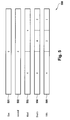
- Fig. 5 shows five different allocation possibilities 500, depending on the number of synchronized subframes allocated per radio frame.
- a first type of allocation 501 all available radio frames get assigned six synchronized subframes per radio frame. This first type is selected if a maximum bandwidth requirement is needed for a first type of multimedia broadcast and multicast services.
- a second type of allocation 502 all the radio frames get assigned four synchronized subframes, if a second type of multimedia broadcast and multicast services requires intermediate bandwidth.
- a third type of allocation 503 half of the total number of radio frames gets assigned six synchronized subframes and the other half gets assigned four synchronized subframes.
- the first type of services require the maximum bandwidth and get allocated six synchronized subframes.
- the second type of services require and intermediate bandwidth and get allocated four synchronized subframes.
- a fourth type of allocation 504 half of the total number of radio frames gets assigned six synchronized subframes. A quarter of the total number of radio frames gets assigned four synchronized subframes per radio frame. The remaining quarter of the total number of radio frames gets assigned two synchronized subframes per radio frame.
- This allocation refers to a first, second and third type of services with maximum, intermediate and low bandwidth requirements, respectively.
- a first half of the total number of radio frames gets allocated six synchronized subframes. The second half is further divided by a third half that gets allocated two synchronized subframes per radio frame and the remaining forth half gets assigned one synchronized subframe per radio frame.
- This allocation refers to a first, second and forth type of services with maximum, intermediate and very low bandwidth requirements, respectively.
- Fig. 6 shows a network element for a mobile communication system 600, the network element 601 comprising means for inputting 602 a set of synchronized subframe numbers per radio frame and the total number of radio frames; means for 603 selecting a value of the set of synchronized subframe numbers and means for 604 allocating the selected value to a total number of radio frames or to half of the unassigned radio frames. If there are any remaining unallocated frames, the means for allocating 604 allocates a second value of the set of synchronized subframe numbers for allocating at least a portion of the unassigned radio frames.
- the network element 601 further comprises means for 605 transmitting a signaling 607 to a wireless terminal 606 indicating the allocating step, that is the configuration of the total number of radio frames and the synchronized subframes per radio frame.
- the wireless terminal 606 may comprise the means for inputting 602, means for selecting 603 and means for allocating 604.
Landscapes
- Engineering & Computer Science (AREA)
- Computer Networks & Wireless Communication (AREA)
- Signal Processing (AREA)
- Mobile Radio Communication Systems (AREA)
Abstract
Description
- The connection between a wireless terminal and a network element of a wireless wideband communication network is generally established via an air interface. The air interface can be a wireless wideband system compliant with the IEEE 802.16 or Long Term Evolution (LTE) standard. The wideband wireless systems, apart from the unicast communications, may also provide multicast and broadcast services to the wireless terminals. The broadcasting mode uses the network capabilities to send information to all destinations without congesting the network capacity, using either broadcast channels or different world routing methods. A more controlled approach is reached using the multicast mode, as it transports the packets to a group of destinations simultaneously, delivering the message over each link of the network only once and creating copies only when the link to the destinations split.
- The wireless terminals may receive several versions of the same packets or frames within a multicast and broadcast zone from several base station transmitters. This can be used, for example, for multimedia broadcast and multicast services. The terminals may take advantage of the plurality of packets using the principle of macro diversity and thus improving the reception quality of the signal. In this context, terminals always need to know which resource entities are synchronized and which are not synchronized in order to correctly perform measurements of the reference symbols.
- There is therefore a need for a method of resource allocation for multicast and broadcast services, a wireless terminal, and a computer program product for performing the method in accordance with the invention.
- The invention provides a resource allocation method for a network element adapted for multimedia broadcast and synchronized services in a mobile communication system, the mobile communication system comprising a plurality of base stations synchronized for data transmission, the method comprises: inputting a set of synchronized subframe numbers per radio frame and a total number of radio frames, wherein each radio frame contains a predefined number of subframes; selecting a first value of the set of synchronized subframe numbers; first allocating the first value as a number of synchronized subframes per frame to the total number of radio frames; second allocating the first value as the number of synchronized subframes per frame to a first half of the total number of radio frames, if the first allocating step is not performed; and selecting a second value of the set of synchronized subframe numbers.
- The method further comprises: third allocating the second value as the number of synchronized subframes per frame to the first half of the total number of radio frames, if the first and second allocating step is not performed; forth allocating the second value as the number of synchronized subframes per frame to a second half of the total number of radio frames, if the second allocating step is performed; selecting a third value of the set of synchronized subframe numbers; fifth allocating the third value as the number of synchronized subframes per frame to a third half of the second half of radio frames, if the first and forth allocating step is not performed,
wherein one of the allocating steps is performed according to bandwidth requirements of the multimedia broadcast and synchronized services. - Embodiments of the invention are advantageous in that it allows a flexible allocation of the synchronized subframes on each single radio frame according to the number of synchronized subframes required for each multimedia broadcast and multicast service. At the same time, it reduces the number of combinatorial possibilities in order to minimize the necessary signaling and synchronization between the network elements and the wireless terminal. The minimization of signaling resources is a primary requirement in the design of single frequency networks subframe allocation. The embodiments allow signaling a limited number of synchronized subframe allocations per frame, so that the total number of synchronized subframes can get adjusted to the service requirements and the bandwidth that each multimedia broadcast and multicast service requires. If the bandwidth requirements of the multimedia broadcast and synchronized services are small, a minimum number of the set of synchronized subframes can be allocated for all the radio frames. If the bandwidth requirements are higher, half or all the radio frames can allocate the maximum number of the set of synchronized subframes.
- The method further comprises: sixth allocating the second value as the number of synchronized subframes per frame to the total number of radio frames, if none of previous allocating steps is performed; selecting a forth value of the set of synchronized subframe numbers; and seventh allocating the forth value as the number of synchronized subframes per frame to a forth half of the second half of radio frames, if the fifth allocating step is performed.
The term synchronized subframe as herein refers to a subframe using the same time and frequency resources throughout a plurality of base stations adapted for multicast and broadcast service. - Embodiments of the invention further comprise outputting a look up table with a set of allocation possibilities. The set of synchronized subframe numbers is obtained by iteratively halving a maximum number of synchronized subframes per frame. If the maximum number of synchronized subframes per frame is not a power of two number, a next highest power of two number is used for obtaining the set of synchronized subframe numbers.
- In accordance with other embodiments of the invention, a first radio frame is allocated with the first value and a second radio frame contiguous to the first radio frame is allocated with the second value. The network element is a base station, wherein the total number of radio frames is transmitted by the plurality of synchronized base stations. The synchronized subframes are used for the multimedia broadcast and synchronized service. The synchronized subframes are MBSFN subframes. The MBSFN subframes carry multimedia broadcast and multicast services (MBMS) in a coordinated way within a single frequency network.
- The total number of possibilities to consider and to signal depends on the set of synchronized subframes and the allocation possibilities for each of these subframes, that correspond to the total of the radio frames, half of the radio frames or none of the radio frames that get allocated. The order of radio frames does not require following the order of descending or ascending synchronized subframe occurrences.
- In another aspect, the invention relates to a network element for a mobile communication system, being operable to perform in accordance with any one of the preceding claims. In one embodiment, the network element is a base station. In another embodiment, the base station performs at least one of the first to seventh allocating steps, wherein the base station sends a signaling to a wireless terminal indicating one of the first to seventh allocating steps. In a further embodiment, the network element is a wireless terminal.
- In another aspect, the invention relates to a mobile communication system, the mobile communication system being operable to perform in accordance with any one of the preceding embodiments.
- In another aspect, the invention relates to a computer program product stored on a storage medium, comprising executable program means for causing a network element to perform a method according to any of the preceding embodiments when the program is run on the network element.
- In the following preferred embodiments of the invention will be described in greater detail by way of example only making reference to the drawings in which:
- Figure 1
- shows a block diagram of a resource allocation method,
- Figure 2
- shows a tree diagram of the resource allocation method,
- Figure 3
- shows an example of a resource allocation in a period of radio frames,
- Figure 4
- shows a second example of a resource allocation in a second period of radio frames,
- Figure 5
- shows a third example of the resource allocation method
- Figure 6
- shows an example of a network element.
-
Fig. 1 shows aresource allocation method 100 for a network element adapted for multimedia broadcast and multicast service in a mobile communication system. Themethod 100 allocates synchronized subframes within a radio frame that are used for multicast and broadcast services in the mobile communication system. - A complete flexibility of the alignment of synchronized resources within a given repetition period would amount to a high amount of overhead or signaling resources. On the other hand, a set of global definitions for subframe allocations per radio frame, from which only one can be configured at a time for all radio frames, would lead to a poor distribution of the resources. In this case, the resources cannot get adjusted to the service and bandwidth requirements and may lead to a waste of resources. Moreover, adding and removing services would get more complex in the context of multimedia broadcast and multicast services. For instance, if all radio frames have exactly four synchronized subframes, it can be difficult to add a service that only needs two of these subframes. In this case, either the other two synchronized subframes remain unused and wasted, or another existing service is reallocated to the other two synchronized subframes, increasing the complexity in the synchronized network.
- The embodiments solve all the disadvantages explained above with the resource allocation method. The
first step 101 defines the set of synchronized subframe numbers per radio frame (SF) and a total number of radio frames (RF). From this set of synchronized subframe numbers, a first value is selected. - In a
second step 102 it is decided whether all the radio frames get allocated this first value as the number of synchronized subframes per frame. If that is the case, thestep 103 assigns all the frames with the selected first value of synchronized subframes. As all the frames are selected, thestep 104 finishes the method. Otherwise, if not all the radio frames are assigned, afifth step 105 request whether half of the radio frames get assigned this first value of synchronized subframes per frame. If the answer is affirmative, thestep 106 assigns the first value of synchronized subframes to half of the total of radio frames. Then, thestep 107 selects the next second value of the set of synchronized subframe numbers. Thestep 107 is also reached if there is no assignment of half of the radio frames fromstep 105. - In
step 108, the a request is made if the second value corresponds to the second to last value of the set of synchronized subframe numbers. If no, then the method returns to thestep 102, where this second iteration will take into account if some of the radio frames have already been allocated with synchronized subframes. If the second value corresponds to the second to last value of the set of synchronized subframe numbers, aninth step 109 assigns the last subframe value to all the radio frames that have not been previously allocated with the synchronized subframes and in astep 110 the method finishes. Each frame contains a predefined value of subframes and each subframe may correspond to a synchronized or to a non-synchronized subframe. The synchronized subframes may be used for multicast and broadcast services in a single frequency network, where a group of base stations are synchronized to transmit the same signal regarding these synchronized subframes simultaneously and at the same frequency. -
Fig. 2 shows atree representation 200 of the different possibilities that the resource allocation can take for a set of synchronized subframe numbers per radio frame as 6, 4, 2 and 1. - This set of synchronized subframe numbers may have been initialized or the set could have been calculated starting from the maximum number of subframes, and dividing by 2. In the case that the maximum number of subframes is not to a power of 2, the next highest power of 2 number is used as dividend This next highest number of power of 2 is not used for the allocation of the number of subframes, as only the predefined maximum number is the maximum allowed for the allocation. In the
fig. 2 , the maximum number of subframes corresponds to 6 and the next highest power of 2 number, there is 8, is divided by 2 three times, in order to obtain the other number ofsubframes - The first possibility of the algorithm is to assign to each frame of the total number of frames, that for the example corresponds to 32 radio frames, six subframes within a radio frame in 201. The second possibility corresponds to assigning to half of the total radio frames, or 16, six subframes for each radio frame on 202. The third possibility is that none of these frames gets assigned six subframes per radio frame, so that the next value of the set of synchronized subframe numbers if selected, that in this example correspond to four. If half of the radio frames have been already selected, then the second half of radio frames can get assigned four synchronized subframes on 203, or a half of this remaining second half gets assigned four subframes per frame, as in 204.
- If no radio frame has been assigned six subframes per radio frame, then all 32 radio frames can get assigned four subframes as in 205. In a further possibility, half of this total of radio frames, corresponding to 16 radio frames, gets assigned four synchronized subframe per radio frame as in 206. Of the remaining half, a half of it may get assigned eight subframes as in 209. As long as there are any remaining unassigned radio frames, the allocations method will continue, or until the last value of the set of synchronized subframe numbers is achieved. In that case, the remaining unassigned subframes get assigned this last value of synchronized subframes, that in this example correspond to one synchronized subframe per radio frame.
- If for example a first half of the total of radio frames has been assigned six synchronized subframes, as in 202 and a half of the remaining unassigned frames has been assigned four synchronized subframes, a third value will be used. Again, if a half of the remaining unassigned radio frames gets assigned two synchronized subframes per radio frames, as in 207, the remaining radio frames get assigned one synchronized subframe per radio frame, as in 208. Alternatively, the eight remaining subframes may get assigned two synchronized subframes per radio frame, as in 210.
-
Fig. 3 shows an example 300 of the allocation of 32 radio frames in 301 and three different types of allocated subframes 302-304, that includes synchronized and not synchronized subframes. - The synchronized subframes may be also known as MBMS single frequency network (MBSFN) subframes. The
frame 302 contains four synchronized or MBSFN subframes, theframe 303 contains two MBSFN subframes and theframe 304 includes one MBSFN subframe. The first 16 radio frames of the total of radio frames 301, contains four synchronized subframes per frame, wherein for all the radio frames, each frame contains ten subframes. The second half of radio frames is divided into frames that contain two synchronized subframes and frames with one synchronized subframe. In 305, the eight frames contain two synchronized subframes each and in the remaining eightradio frames 306, each frame contains one synchronized subframe. The total number, and the location of the MBSFN subframes is replicated by a plurality of base stations that are synchronized for providing multicast and broadcast services, and that transmit simultaneously this total number of radio frames 301 with this specific allocation of MBSFN subframes. -
Fig. 4 shows anotherpossible distribution 400 of the different types of frames within the total number offrames 401. This example contains also three types of frames 402-404, with four, two and one synchronized subframes respectively. After the allocation of the number of frames that contain each type of frame, that in this example corresponds to 16 frames with four MBSFN subframes, eight frames with two MBSFN subframes and eight frames with one MBSFN subframe, as in 405, any possible distribution is possible. The distribution of 401 shows that everysecond frame 406 contains four MBSFN subframes. The remaining frames are split by two MBSFN subframes per frame in 407 and one MBSFN subframe per radio frame in 408. -
Fig. 5 shows fivedifferent allocation possibilities 500, depending on the number of synchronized subframes allocated per radio frame. In a first type ofallocation 501, all available radio frames get assigned six synchronized subframes per radio frame. This first type is selected if a maximum bandwidth requirement is needed for a first type of multimedia broadcast and multicast services. In a second type ofallocation 502, all the radio frames get assigned four synchronized subframes, if a second type of multimedia broadcast and multicast services requires intermediate bandwidth. In a third type ofallocation 503, half of the total number of radio frames gets assigned six synchronized subframes and the other half gets assigned four synchronized subframes. In this third type of allocation, the first type of services require the maximum bandwidth and get allocated six synchronized subframes. The second type of services require and intermediate bandwidth and get allocated four synchronized subframes. - In a fourth type of
allocation 504, half of the total number of radio frames gets assigned six synchronized subframes. A quarter of the total number of radio frames gets assigned four synchronized subframes per radio frame. The remaining quarter of the total number of radio frames gets assigned two synchronized subframes per radio frame. This allocation refers to a first, second and third type of services with maximum, intermediate and low bandwidth requirements, respectively. Finally, in a fifth type ofallocation 505, a first half of the total number of radio frames gets allocated six synchronized subframes. The second half is further divided by a third half that gets allocated two synchronized subframes per radio frame and the remaining forth half gets assigned one synchronized subframe per radio frame. This allocation refers to a first, second and forth type of services with maximum, intermediate and very low bandwidth requirements, respectively. -
Fig. 6 shows a network element for amobile communication system 600, the network element 601 comprising means for inputting 602 a set of synchronized subframe numbers per radio frame and the total number of radio frames; means for 603 selecting a value of the set of synchronized subframe numbers and means for 604 allocating the selected value to a total number of radio frames or to half of the unassigned radio frames. If there are any remaining unallocated frames, the means for allocating 604 allocates a second value of the set of synchronized subframe numbers for allocating at least a portion of the unassigned radio frames. The network element 601 further comprises means for 605 transmitting a signaling 607 to awireless terminal 606 indicating the allocating step, that is the configuration of the total number of radio frames and the synchronized subframes per radio frame. Alternatively, thewireless terminal 606 may comprise the means for inputting 602, means for selecting 603 and means for allocating 604. -
100 Flowchart 101 First step 102 Second step 103 Third step 104 Forth step 105 Fifth step 106 Sixth step 107 Seventh step 108 Eight step 109 Ninth step 110 Tenth step 200 Tree diagram 201 All radio frames 202 Half of the radio frames 203 All of the radio frames 204 Half of the radio frames 205 All of the radio frames 206 Half of the radio frames 207 Half of the radio frames 208 The remaining radio frames 209 Half of the remaining radio frames 210 The remaining radio frames 300 Frames allocation 301 Total of radio frames 302 First type of frame 303 Second type of frame 304 Third type of frame 305 First portion of allocation 306 Second portion of allocation 400 Frame allocation 401 Total of radio frames 402 First type of allocation 403 Second type of allocation 404 Third type of allocation 405 Total of allocated radio frames 406 First type of allocated subframes 407 Second type of allocated subframes 408 Third type of allocated subframes 500 Resource allocation possibilities 501 First type of allocation 502 Second type of allocation 503 Third type of allocation 504 Fourth type of allocation 505 Fifth type of allocation 600 Mobile communication system 601 Network element 602 Means for inputting 603 Means for selecting 604 Means for allocating 605 Means for transmitting 606 Wireless terminal 607 signaling
Claims (15)
- A resource allocation method (100) for a network element adapted for multimedia broadcast and synchronized services in a mobile communication system, said mobile communication system comprising a plurality of base stations synchronized for data transmission, the method comprising:- inputting (101) a set of synchronized subframe numbers per radio frame (SF) and a total number of radio frames (RF), wherein each radio frame contains a predefined number of subframes;- selecting (101) a first value of said set of synchronized subframe numbers;- first allocating (103) said first value (SF1) as a number of synchronized subframes per frame to said total number of radio frames;- second allocating (105) said first value as said number of synchronized subframes per frame to a first half of said total number of radio frames, if said first allocating step is not performed;- selecting a second value (107) of said set of synchronized subframe numbers;- third allocating (206) said second value as said number of synchronized subframes per frame to said first half of said total number of radio frames, if said first and second allocating step is not performed;- forth allocating (204) said second value as said number of synchronized subframes per frame to a second half of said total number of radio frames, if said second allocating step is performed;- selecting a third value of said set of synchronized subframe numbers;- fifth allocating (209) said third value as said number of synchronized subframes per frame to a third half of said second half of radio frames, if said first and forth allocating step is not performed,wherein one of said allocating steps is performed according to bandwidth requirements of said multimedia broadcast and synchronized services.
- The method as in claim 1 further comprising:- sixth allocating (205) said second value as said number of synchronized subframes per frame to said total number of radio frames, if none of previous allocating steps is performed;- selecting a forth value of said set of synchronized subframe numbers;- seventh allocating (210) said forth value as said number of synchronized subframes per frame to a forth half of said second half of radio frames, if said fifth allocating step is performed.
- The method of any of the preceding claims, wherein said method outputs a look up table with a set of allocation possibilities.
- The method of any of the preceding claims, wherein said set of synchronized subframe numbers is obtained by iteratively halving a maximum number of synchronized subframes per frame.
- The method of claim 4, wherein if said maximum number of synchronized subframes per frame is not a power of two number, a next highest power of two number is used for obtaining said set of synchronized subframe numbers.
- The method of any of the preceding claims, wherein a first radio frame (406) is allocated with said first value and a second radio frame (407) contiguous to said first radio frame is allocated with said second value.
- The method of any of the preceding claims, wherein said network element is a base station, wherein said total number of radio frames is transmitted by said plurality of synchronized base stations.
- The method of any of the preceding claims, wherein said synchronized subframes are used for said multimedia broadcast and synchronized service.
- The method of any of the preceding claims, wherein said synchronized subframes are MBSFN subframes.
- A network element for a mobile communication system, being operable to perform in accordance with any one of the preceding claims.
- A network element as in claim 10, wherein said network element is a base station.
- A network element as in claim 10, wherein said network element is a wireless terminal.
- The base station as in claim 11, wherein said base station performs at least one of said first to seventh allocating steps, wherein said base station sends a signaling to a wireless terminal indicating one of said first to seventh allocating steps.
- A mobile communication system, the mobile communication system being operable to perform in accordance with any one of the preceding claims 1 to 10.
- A computer program product stored on a storage medium, comprising executable program means for causing a network element to perform a method according to any of the preceding claims 1 to 10 when the program is run on the network element.
Priority Applications (5)
| Application Number | Priority Date | Filing Date | Title |
|---|---|---|---|
| EP08290406A EP2114043B1 (en) | 2008-04-28 | 2008-04-28 | Resource allocation method, network element and computer program product thereof |
| DE602008005410T DE602008005410D1 (en) | 2008-04-28 | 2008-04-28 | Resource allocation method, network element and computer program product therefor |
| AT08290406T ATE501610T1 (en) | 2008-04-28 | 2008-04-28 | RESOURCE ALLOCATION METHOD, NETWORK ELEMENT AND COMPUTER PROGRAM PRODUCT THEREFOR |
| PCT/EP2009/055091 WO2009133081A1 (en) | 2008-04-28 | 2009-04-28 | Resource allocation method and apparatus thereof |
| US12/988,600 US8509250B2 (en) | 2008-04-28 | 2009-04-28 | Resource allocation method and apparatus thereof |
Applications Claiming Priority (1)
| Application Number | Priority Date | Filing Date | Title |
|---|---|---|---|
| EP08290406A EP2114043B1 (en) | 2008-04-28 | 2008-04-28 | Resource allocation method, network element and computer program product thereof |
Publications (2)
| Publication Number | Publication Date |
|---|---|
| EP2114043A1 true EP2114043A1 (en) | 2009-11-04 |
| EP2114043B1 EP2114043B1 (en) | 2011-03-09 |
Family
ID=39830060
Family Applications (1)
| Application Number | Title | Priority Date | Filing Date |
|---|---|---|---|
| EP08290406A Not-in-force EP2114043B1 (en) | 2008-04-28 | 2008-04-28 | Resource allocation method, network element and computer program product thereof |
Country Status (5)
| Country | Link |
|---|---|
| US (1) | US8509250B2 (en) |
| EP (1) | EP2114043B1 (en) |
| AT (1) | ATE501610T1 (en) |
| DE (1) | DE602008005410D1 (en) |
| WO (1) | WO2009133081A1 (en) |
Cited By (1)
| Publication number | Priority date | Publication date | Assignee | Title |
|---|---|---|---|---|
| GB2474006A (en) * | 2009-08-11 | 2011-04-06 | Samsung Electronics Co Ltd | Scheduling MBMS transmissions in subframes of radio frames |
Families Citing this family (1)
| Publication number | Priority date | Publication date | Assignee | Title |
|---|---|---|---|---|
| US10314078B2 (en) * | 2014-06-05 | 2019-06-04 | Sharp Kabushiki Kaisha | Terminal device, base station apparatus, and method |
Citations (3)
| Publication number | Priority date | Publication date | Assignee | Title |
|---|---|---|---|---|
| WO2008023928A2 (en) * | 2006-08-22 | 2008-02-28 | Lg Electronics Inc. | Method of transmitting and receiving control information in a wireless communication system |
| WO2008024321A2 (en) * | 2006-08-21 | 2008-02-28 | Interdigital Technology Corporation | Dynamic resource allocation, scheduling and signaling for variable data rate service in lte |
| EP1903813A1 (en) * | 2006-09-19 | 2008-03-26 | Alcatel Lucent | Method, server and base station for synchronization of multicast and broadcast frame portions in WiMAX systems |
Family Cites Families (2)
| Publication number | Priority date | Publication date | Assignee | Title |
|---|---|---|---|---|
| SE0402321D0 (en) * | 2004-09-23 | 2004-09-23 | Ericsson Telefon Ab L M | Method in a communication system |
| WO2008049028A1 (en) * | 2006-10-17 | 2008-04-24 | Intel Corporation | Device, system, and method for partitioning and framing communication signals in broadband wireless access networks |
-
2008
- 2008-04-28 EP EP08290406A patent/EP2114043B1/en not_active Not-in-force
- 2008-04-28 AT AT08290406T patent/ATE501610T1/en not_active IP Right Cessation
- 2008-04-28 DE DE602008005410T patent/DE602008005410D1/en active Active
-
2009
- 2009-04-28 WO PCT/EP2009/055091 patent/WO2009133081A1/en not_active Ceased
- 2009-04-28 US US12/988,600 patent/US8509250B2/en not_active Expired - Fee Related
Patent Citations (3)
| Publication number | Priority date | Publication date | Assignee | Title |
|---|---|---|---|---|
| WO2008024321A2 (en) * | 2006-08-21 | 2008-02-28 | Interdigital Technology Corporation | Dynamic resource allocation, scheduling and signaling for variable data rate service in lte |
| WO2008023928A2 (en) * | 2006-08-22 | 2008-02-28 | Lg Electronics Inc. | Method of transmitting and receiving control information in a wireless communication system |
| EP1903813A1 (en) * | 2006-09-19 | 2008-03-26 | Alcatel Lucent | Method, server and base station for synchronization of multicast and broadcast frame portions in WiMAX systems |
Cited By (2)
| Publication number | Priority date | Publication date | Assignee | Title |
|---|---|---|---|---|
| GB2474006A (en) * | 2009-08-11 | 2011-04-06 | Samsung Electronics Co Ltd | Scheduling MBMS transmissions in subframes of radio frames |
| GB2474006B (en) * | 2009-08-11 | 2012-05-02 | Samsung Electronics Co Ltd | Network element, wireless communication units and methods for scheduling communications |
Also Published As
| Publication number | Publication date |
|---|---|
| DE602008005410D1 (en) | 2011-04-21 |
| US20110038340A1 (en) | 2011-02-17 |
| US8509250B2 (en) | 2013-08-13 |
| WO2009133081A1 (en) | 2009-11-05 |
| ATE501610T1 (en) | 2011-03-15 |
| EP2114043B1 (en) | 2011-03-09 |
Similar Documents
| Publication | Publication Date | Title |
|---|---|---|
| US10708909B2 (en) | Techniques for reducing overhead in a communications system | |
| EP2308249B1 (en) | Method and apparatus for providing broadcast services | |
| CN106165469A (en) | Scheduling method for base station, small base station and communication link resources | |
| EP3001703A1 (en) | Coverage enhancement for multicast in a cellular network | |
| CN104144484A (en) | Method for establishing data units in mobile communication uplink system supporting multi-connection | |
| TWI387376B (en) | Communication systems and methods with resource management for overlapping multicast and broadcast service zones | |
| CN101242558B (en) | Method, system, base station and device for coordinating service resource | |
| US7512102B2 (en) | Techniques for setting up traffic channels in a communications system | |
| KR101227804B1 (en) | Method and apparatus for transmitting and receiving multimedia broadcast multicast services | |
| CN108307321B (en) | MBMS data transmission method, donor base station, relay node and system | |
| CN101730233A (en) | Resource processing methods | |
| EP2114043B1 (en) | Resource allocation method, network element and computer program product thereof | |
| CN103108391B (en) | A kind of method of allocation identification and device | |
| CN101505452B (en) | Mapping method for uni-frequency network region | |
| CN101657042B (en) | CGI configuration method, message transmission method and device | |
| CN101888591B (en) | Method and system for updating multicast channel configuration information | |
| CN101262633B (en) | Transmission and receiving method for multi-carrier time slot multimedia broadcast and multicast service | |
| CN101146345B (en) | A system and method for dynamically allocating downlink resources in a GPRS system | |
| EP2709416A1 (en) | A method for allocating transmission resource in HD FDD wireless communication systems | |
| CN101883320B (en) | Method, MCE and system for transmission of multicast channel configuration information | |
| CN101262632A (en) | Scrambling Code Allocation Method for Multimedia Broadcast Multicast Service in Time Division Duplex System | |
| CN101146344B (en) | A system and method for dynamically allocating downlink resources in a GPRS system | |
| CN101997855B (en) | Subframe allocation method, device and base station of multicast/broadcast over single frequency network | |
| KR20120119513A (en) | Wireless local network system for transmitting massive data | |
| KR20090090751A (en) | Scheduling method and system for same in wireless communication system |
Legal Events
| Date | Code | Title | Description |
|---|---|---|---|
| PUAI | Public reference made under article 153(3) epc to a published international application that has entered the european phase |
Free format text: ORIGINAL CODE: 0009012 |
|
| AK | Designated contracting states |
Kind code of ref document: A1 Designated state(s): AT BE BG CH CY CZ DE DK EE ES FI FR GB GR HR HU IE IS IT LI LT LU LV MC MT NL NO PL PT RO SE SI SK TR |
|
| AX | Request for extension of the european patent |
Extension state: AL BA MK RS |
|
| 17P | Request for examination filed |
Effective date: 20091014 |
|
| 17Q | First examination report despatched |
Effective date: 20091209 |
|
| AKX | Designation fees paid |
Designated state(s): AT BE BG CH CY CZ DE DK EE ES FI FR GB GR HR HU IE IS IT LI LT LU LV MC MT NL NO PL PT RO SE SI SK TR |
|
| GRAP | Despatch of communication of intention to grant a patent |
Free format text: ORIGINAL CODE: EPIDOSNIGR1 |
|
| RIC1 | Information provided on ipc code assigned before grant |
Ipc: H04W 4/06 20090101AFI20101112BHEP |
|
| RTI1 | Title (correction) |
Free format text: RESOURCE ALLOCATION METHOD, NETWORK ELEMENT AND COMPUTER PROGRAM PRODUCT THEREOF |
|
| GRAS | Grant fee paid |
Free format text: ORIGINAL CODE: EPIDOSNIGR3 |
|
| GRAA | (expected) grant |
Free format text: ORIGINAL CODE: 0009210 |
|
| AK | Designated contracting states |
Kind code of ref document: B1 Designated state(s): AT BE BG CH CY CZ DE DK EE ES FI FR GB GR HR HU IE IS IT LI LT LU LV MC MT NL NO PL PT RO SE SI SK TR |
|
| REG | Reference to a national code |
Ref country code: GB Ref legal event code: FG4D |
|
| REG | Reference to a national code |
Ref country code: CH Ref legal event code: EP |
|
| REG | Reference to a national code |
Ref country code: IE Ref legal event code: FG4D |
|
| REF | Corresponds to: |
Ref document number: 602008005410 Country of ref document: DE Date of ref document: 20110421 Kind code of ref document: P |
|
| REG | Reference to a national code |
Ref country code: DE Ref legal event code: R096 Ref document number: 602008005410 Country of ref document: DE Effective date: 20110421 |
|
| REG | Reference to a national code |
Ref country code: NL Ref legal event code: VDEP Effective date: 20110309 |
|
| PG25 | Lapsed in a contracting state [announced via postgrant information from national office to epo] |
Ref country code: HR Free format text: LAPSE BECAUSE OF FAILURE TO SUBMIT A TRANSLATION OF THE DESCRIPTION OR TO PAY THE FEE WITHIN THE PRESCRIBED TIME-LIMIT Effective date: 20110309 Ref country code: GR Free format text: LAPSE BECAUSE OF FAILURE TO SUBMIT A TRANSLATION OF THE DESCRIPTION OR TO PAY THE FEE WITHIN THE PRESCRIBED TIME-LIMIT Effective date: 20110610 Ref country code: ES Free format text: LAPSE BECAUSE OF FAILURE TO SUBMIT A TRANSLATION OF THE DESCRIPTION OR TO PAY THE FEE WITHIN THE PRESCRIBED TIME-LIMIT Effective date: 20110620 Ref country code: LV Free format text: LAPSE BECAUSE OF FAILURE TO SUBMIT A TRANSLATION OF THE DESCRIPTION OR TO PAY THE FEE WITHIN THE PRESCRIBED TIME-LIMIT Effective date: 20110309 Ref country code: LT Free format text: LAPSE BECAUSE OF FAILURE TO SUBMIT A TRANSLATION OF THE DESCRIPTION OR TO PAY THE FEE WITHIN THE PRESCRIBED TIME-LIMIT Effective date: 20110309 Ref country code: SE Free format text: LAPSE BECAUSE OF FAILURE TO SUBMIT A TRANSLATION OF THE DESCRIPTION OR TO PAY THE FEE WITHIN THE PRESCRIBED TIME-LIMIT Effective date: 20110309 Ref country code: NO Free format text: LAPSE BECAUSE OF FAILURE TO SUBMIT A TRANSLATION OF THE DESCRIPTION OR TO PAY THE FEE WITHIN THE PRESCRIBED TIME-LIMIT Effective date: 20110609 |
|
| LTIE | Lt: invalidation of european patent or patent extension |
Effective date: 20110309 |
|
| PG25 | Lapsed in a contracting state [announced via postgrant information from national office to epo] |
Ref country code: CY Free format text: LAPSE BECAUSE OF FAILURE TO SUBMIT A TRANSLATION OF THE DESCRIPTION OR TO PAY THE FEE WITHIN THE PRESCRIBED TIME-LIMIT Effective date: 20110309 Ref country code: FI Free format text: LAPSE BECAUSE OF FAILURE TO SUBMIT A TRANSLATION OF THE DESCRIPTION OR TO PAY THE FEE WITHIN THE PRESCRIBED TIME-LIMIT Effective date: 20110309 Ref country code: NL Free format text: LAPSE BECAUSE OF FAILURE TO SUBMIT A TRANSLATION OF THE DESCRIPTION OR TO PAY THE FEE WITHIN THE PRESCRIBED TIME-LIMIT Effective date: 20110309 Ref country code: BG Free format text: LAPSE BECAUSE OF FAILURE TO SUBMIT A TRANSLATION OF THE DESCRIPTION OR TO PAY THE FEE WITHIN THE PRESCRIBED TIME-LIMIT Effective date: 20110609 Ref country code: SI Free format text: LAPSE BECAUSE OF FAILURE TO SUBMIT A TRANSLATION OF THE DESCRIPTION OR TO PAY THE FEE WITHIN THE PRESCRIBED TIME-LIMIT Effective date: 20110309 Ref country code: AT Free format text: LAPSE BECAUSE OF FAILURE TO SUBMIT A TRANSLATION OF THE DESCRIPTION OR TO PAY THE FEE WITHIN THE PRESCRIBED TIME-LIMIT Effective date: 20110309 |
|
| PG25 | Lapsed in a contracting state [announced via postgrant information from national office to epo] |
Ref country code: BE Free format text: LAPSE BECAUSE OF FAILURE TO SUBMIT A TRANSLATION OF THE DESCRIPTION OR TO PAY THE FEE WITHIN THE PRESCRIBED TIME-LIMIT Effective date: 20110309 |
|
| PG25 | Lapsed in a contracting state [announced via postgrant information from national office to epo] |
Ref country code: EE Free format text: LAPSE BECAUSE OF FAILURE TO SUBMIT A TRANSLATION OF THE DESCRIPTION OR TO PAY THE FEE WITHIN THE PRESCRIBED TIME-LIMIT Effective date: 20110309 Ref country code: PT Free format text: LAPSE BECAUSE OF FAILURE TO SUBMIT A TRANSLATION OF THE DESCRIPTION OR TO PAY THE FEE WITHIN THE PRESCRIBED TIME-LIMIT Effective date: 20110711 |
|
| PG25 | Lapsed in a contracting state [announced via postgrant information from national office to epo] |
Ref country code: RO Free format text: LAPSE BECAUSE OF FAILURE TO SUBMIT A TRANSLATION OF THE DESCRIPTION OR TO PAY THE FEE WITHIN THE PRESCRIBED TIME-LIMIT Effective date: 20110309 Ref country code: CZ Free format text: LAPSE BECAUSE OF FAILURE TO SUBMIT A TRANSLATION OF THE DESCRIPTION OR TO PAY THE FEE WITHIN THE PRESCRIBED TIME-LIMIT Effective date: 20110309 Ref country code: MC Free format text: LAPSE BECAUSE OF NON-PAYMENT OF DUE FEES Effective date: 20110430 Ref country code: SK Free format text: LAPSE BECAUSE OF FAILURE TO SUBMIT A TRANSLATION OF THE DESCRIPTION OR TO PAY THE FEE WITHIN THE PRESCRIBED TIME-LIMIT Effective date: 20110309 Ref country code: IS Free format text: LAPSE BECAUSE OF FAILURE TO SUBMIT A TRANSLATION OF THE DESCRIPTION OR TO PAY THE FEE WITHIN THE PRESCRIBED TIME-LIMIT Effective date: 20110709 |
|
| PG25 | Lapsed in a contracting state [announced via postgrant information from national office to epo] |
Ref country code: MT Free format text: LAPSE BECAUSE OF FAILURE TO SUBMIT A TRANSLATION OF THE DESCRIPTION OR TO PAY THE FEE WITHIN THE PRESCRIBED TIME-LIMIT Effective date: 20110309 |
|
| PLBE | No opposition filed within time limit |
Free format text: ORIGINAL CODE: 0009261 |
|
| STAA | Information on the status of an ep patent application or granted ep patent |
Free format text: STATUS: NO OPPOSITION FILED WITHIN TIME LIMIT |
|
| REG | Reference to a national code |
Ref country code: IE Ref legal event code: MM4A |
|
| 26N | No opposition filed |
Effective date: 20111212 |
|
| PG25 | Lapsed in a contracting state [announced via postgrant information from national office to epo] |
Ref country code: DK Free format text: LAPSE BECAUSE OF FAILURE TO SUBMIT A TRANSLATION OF THE DESCRIPTION OR TO PAY THE FEE WITHIN THE PRESCRIBED TIME-LIMIT Effective date: 20110309 Ref country code: PL Free format text: LAPSE BECAUSE OF FAILURE TO SUBMIT A TRANSLATION OF THE DESCRIPTION OR TO PAY THE FEE WITHIN THE PRESCRIBED TIME-LIMIT Effective date: 20110309 |
|
| REG | Reference to a national code |
Ref country code: CH Ref legal event code: PCOW Free format text: ALCATEL LUCENT;3, AVENUE OCTAVE GREARD;75007 PARIS (FR) |
|
| REG | Reference to a national code |
Ref country code: DE Ref legal event code: R097 Ref document number: 602008005410 Country of ref document: DE Effective date: 20111212 |
|
| PG25 | Lapsed in a contracting state [announced via postgrant information from national office to epo] |
Ref country code: IE Free format text: LAPSE BECAUSE OF NON-PAYMENT OF DUE FEES Effective date: 20110428 |
|
| PG25 | Lapsed in a contracting state [announced via postgrant information from national office to epo] |
Ref country code: IT Free format text: LAPSE BECAUSE OF FAILURE TO SUBMIT A TRANSLATION OF THE DESCRIPTION OR TO PAY THE FEE WITHIN THE PRESCRIBED TIME-LIMIT Effective date: 20110309 |
|
| REG | Reference to a national code |
Ref country code: CH Ref legal event code: PL |
|
| PG25 | Lapsed in a contracting state [announced via postgrant information from national office to epo] |
Ref country code: CH Free format text: LAPSE BECAUSE OF NON-PAYMENT OF DUE FEES Effective date: 20120430 Ref country code: LI Free format text: LAPSE BECAUSE OF NON-PAYMENT OF DUE FEES Effective date: 20120430 |
|
| PG25 | Lapsed in a contracting state [announced via postgrant information from national office to epo] |
Ref country code: LU Free format text: LAPSE BECAUSE OF NON-PAYMENT OF DUE FEES Effective date: 20110428 |
|
| PG25 | Lapsed in a contracting state [announced via postgrant information from national office to epo] |
Ref country code: TR Free format text: LAPSE BECAUSE OF FAILURE TO SUBMIT A TRANSLATION OF THE DESCRIPTION OR TO PAY THE FEE WITHIN THE PRESCRIBED TIME-LIMIT Effective date: 20110309 |
|
| REG | Reference to a national code |
Ref country code: GB Ref legal event code: 732E Free format text: REGISTERED BETWEEN 20130926 AND 20131002 |
|
| PG25 | Lapsed in a contracting state [announced via postgrant information from national office to epo] |
Ref country code: HU Free format text: LAPSE BECAUSE OF FAILURE TO SUBMIT A TRANSLATION OF THE DESCRIPTION OR TO PAY THE FEE WITHIN THE PRESCRIBED TIME-LIMIT Effective date: 20110309 |
|
| REG | Reference to a national code |
Ref country code: FR Ref legal event code: GC Effective date: 20131018 |
|
| REG | Reference to a national code |
Ref country code: FR Ref legal event code: RG Effective date: 20141016 |
|
| REG | Reference to a national code |
Ref country code: FR Ref legal event code: PLFP Year of fee payment: 8 |
|
| REG | Reference to a national code |
Ref country code: FR Ref legal event code: CA Effective date: 20150521 |
|
| REG | Reference to a national code |
Ref country code: FR Ref legal event code: CA Effective date: 20150521 |
|
| REG | Reference to a national code |
Ref country code: FR Ref legal event code: PLFP Year of fee payment: 9 |
|
| PGFP | Annual fee paid to national office [announced via postgrant information from national office to epo] |
Ref country code: GB Payment date: 20160421 Year of fee payment: 9 Ref country code: DE Payment date: 20160421 Year of fee payment: 9 |
|
| PGFP | Annual fee paid to national office [announced via postgrant information from national office to epo] |
Ref country code: FR Payment date: 20160421 Year of fee payment: 9 |
|
| REG | Reference to a national code |
Ref country code: DE Ref legal event code: R119 Ref document number: 602008005410 Country of ref document: DE |
|
| GBPC | Gb: european patent ceased through non-payment of renewal fee |
Effective date: 20170428 |
|
| REG | Reference to a national code |
Ref country code: FR Ref legal event code: ST Effective date: 20171229 |
|
| PG25 | Lapsed in a contracting state [announced via postgrant information from national office to epo] |
Ref country code: FR Free format text: LAPSE BECAUSE OF NON-PAYMENT OF DUE FEES Effective date: 20170502 Ref country code: DE Free format text: LAPSE BECAUSE OF NON-PAYMENT OF DUE FEES Effective date: 20171103 |
|
| PG25 | Lapsed in a contracting state [announced via postgrant information from national office to epo] |
Ref country code: GB Free format text: LAPSE BECAUSE OF NON-PAYMENT OF DUE FEES Effective date: 20170428 |