EP2112680A2 - Mass spectrometry substrate and mass spectrometry method - Google Patents
Mass spectrometry substrate and mass spectrometry method Download PDFInfo
- Publication number
- EP2112680A2 EP2112680A2 EP09005656A EP09005656A EP2112680A2 EP 2112680 A2 EP2112680 A2 EP 2112680A2 EP 09005656 A EP09005656 A EP 09005656A EP 09005656 A EP09005656 A EP 09005656A EP 2112680 A2 EP2112680 A2 EP 2112680A2
- Authority
- EP
- European Patent Office
- Prior art keywords
- mass spectrometry
- substrate
- ionizing agent
- equal
- molecule
- Prior art date
- Legal status (The legal status is an assumption and is not a legal conclusion. Google has not performed a legal analysis and makes no representation as to the accuracy of the status listed.)
- Granted
Links
- 238000004949 mass spectrometry Methods 0.000 title claims abstract description 78
- 239000000758 substrate Substances 0.000 title claims abstract description 60
- 238000000034 method Methods 0.000 title claims abstract description 33
- 239000003795 chemical substances by application Substances 0.000 claims abstract description 69
- 150000002500 ions Chemical class 0.000 claims abstract description 35
- 239000000126 substance Substances 0.000 claims abstract description 34
- 238000009835 boiling Methods 0.000 claims abstract description 27
- 230000007935 neutral effect Effects 0.000 claims abstract description 17
- 239000002245 particle Substances 0.000 claims abstract description 14
- 125000000524 functional group Chemical group 0.000 claims abstract description 12
- 230000001678 irradiating effect Effects 0.000 claims abstract description 5
- 125000000896 monocarboxylic acid group Chemical group 0.000 claims abstract 3
- 238000005259 measurement Methods 0.000 claims description 39
- 239000012491 analyte Substances 0.000 claims description 15
- 150000001875 compounds Chemical class 0.000 claims description 12
- BASFCYQUMIYNBI-UHFFFAOYSA-N platinum Chemical compound [Pt] BASFCYQUMIYNBI-UHFFFAOYSA-N 0.000 claims description 11
- 125000003178 carboxy group Chemical group [H]OC(*)=O 0.000 claims description 10
- 229910052737 gold Inorganic materials 0.000 claims description 9
- 239000010931 gold Substances 0.000 claims description 9
- XLOMVQKBTHCTTD-UHFFFAOYSA-N Zinc monoxide Chemical compound [Zn]=O XLOMVQKBTHCTTD-UHFFFAOYSA-N 0.000 claims description 8
- 229910001220 stainless steel Inorganic materials 0.000 claims description 7
- 239000010935 stainless steel Substances 0.000 claims description 7
- PCHJSUWPFVWCPO-UHFFFAOYSA-N gold Chemical compound [Au] PCHJSUWPFVWCPO-UHFFFAOYSA-N 0.000 claims description 5
- 239000000463 material Substances 0.000 claims description 5
- 229910052697 platinum Inorganic materials 0.000 claims description 5
- GWEVSGVZZGPLCZ-UHFFFAOYSA-N Titan oxide Chemical compound O=[Ti]=O GWEVSGVZZGPLCZ-UHFFFAOYSA-N 0.000 claims description 4
- 238000009826 distribution Methods 0.000 claims description 4
- 230000005855 radiation Effects 0.000 claims description 4
- OGIDPMRJRNCKJF-UHFFFAOYSA-N titanium oxide Inorganic materials [Ti]=O OGIDPMRJRNCKJF-UHFFFAOYSA-N 0.000 claims description 4
- 239000011787 zinc oxide Substances 0.000 claims description 4
- XOLBLPGZBRYERU-UHFFFAOYSA-N tin dioxide Chemical compound O=[Sn]=O XOLBLPGZBRYERU-UHFFFAOYSA-N 0.000 claims description 2
- 229910001887 tin oxide Inorganic materials 0.000 claims description 2
- 238000001514 detection method Methods 0.000 abstract description 8
- 230000000052 comparative effect Effects 0.000 description 27
- 239000002253 acid Substances 0.000 description 24
- 108090000765 processed proteins & peptides Proteins 0.000 description 21
- DTQVDTLACAAQTR-UHFFFAOYSA-N Trifluoroacetic acid Chemical compound OC(=O)C(F)(F)F DTQVDTLACAAQTR-UHFFFAOYSA-N 0.000 description 16
- QAOWNCQODCNURD-UHFFFAOYSA-N Sulfuric acid Chemical compound OS(O)(=O)=O QAOWNCQODCNURD-UHFFFAOYSA-N 0.000 description 15
- 239000000523 sample Substances 0.000 description 15
- 238000001228 spectrum Methods 0.000 description 15
- 239000011159 matrix material Substances 0.000 description 13
- 102000004169 proteins and genes Human genes 0.000 description 13
- 108090000623 proteins and genes Proteins 0.000 description 13
- XLYOFNOQVPJJNP-UHFFFAOYSA-N water Substances O XLYOFNOQVPJJNP-UHFFFAOYSA-N 0.000 description 11
- VEXZGXHMUGYJMC-UHFFFAOYSA-N Hydrochloric acid Chemical compound Cl VEXZGXHMUGYJMC-UHFFFAOYSA-N 0.000 description 10
- -1 gallium ions Chemical class 0.000 description 10
- QTBSBXVTEAMEQO-UHFFFAOYSA-N Acetic acid Chemical compound CC(O)=O QTBSBXVTEAMEQO-UHFFFAOYSA-N 0.000 description 9
- 239000007864 aqueous solution Substances 0.000 description 9
- 239000000243 solution Substances 0.000 description 9
- NOESYZHRGYRDHS-UHFFFAOYSA-N insulin Chemical compound N1C(=O)C(NC(=O)C(CCC(N)=O)NC(=O)C(CCC(O)=O)NC(=O)C(C(C)C)NC(=O)C(NC(=O)CN)C(C)CC)CSSCC(C(NC(CO)C(=O)NC(CC(C)C)C(=O)NC(CC=2C=CC(O)=CC=2)C(=O)NC(CCC(N)=O)C(=O)NC(CC(C)C)C(=O)NC(CCC(O)=O)C(=O)NC(CC(N)=O)C(=O)NC(CC=2C=CC(O)=CC=2)C(=O)NC(CSSCC(NC(=O)C(C(C)C)NC(=O)C(CC(C)C)NC(=O)C(CC=2C=CC(O)=CC=2)NC(=O)C(CC(C)C)NC(=O)C(C)NC(=O)C(CCC(O)=O)NC(=O)C(C(C)C)NC(=O)C(CC(C)C)NC(=O)C(CC=2NC=NC=2)NC(=O)C(CO)NC(=O)CNC2=O)C(=O)NCC(=O)NC(CCC(O)=O)C(=O)NC(CCCNC(N)=N)C(=O)NCC(=O)NC(CC=3C=CC=CC=3)C(=O)NC(CC=3C=CC=CC=3)C(=O)NC(CC=3C=CC(O)=CC=3)C(=O)NC(C(C)O)C(=O)N3C(CCC3)C(=O)NC(CCCCN)C(=O)NC(C)C(O)=O)C(=O)NC(CC(N)=O)C(O)=O)=O)NC(=O)C(C(C)CC)NC(=O)C(CO)NC(=O)C(C(C)O)NC(=O)C1CSSCC2NC(=O)C(CC(C)C)NC(=O)C(NC(=O)C(CCC(N)=O)NC(=O)C(CC(N)=O)NC(=O)C(NC(=O)C(N)CC=1C=CC=CC=1)C(C)C)CC1=CN=CN1 NOESYZHRGYRDHS-UHFFFAOYSA-N 0.000 description 8
- 238000001840 matrix-assisted laser desorption--ionisation time-of-flight mass spectrometry Methods 0.000 description 8
- 238000005011 time of flight secondary ion mass spectroscopy Methods 0.000 description 8
- 230000000694 effects Effects 0.000 description 7
- 102000004196 processed proteins & peptides Human genes 0.000 description 7
- 230000035945 sensitivity Effects 0.000 description 7
- KRHYYFGTRYWZRS-UHFFFAOYSA-N Fluorane Chemical compound F KRHYYFGTRYWZRS-UHFFFAOYSA-N 0.000 description 6
- 238000003795 desorption Methods 0.000 description 6
- 238000002360 preparation method Methods 0.000 description 6
- GRYLNZFGIOXLOG-UHFFFAOYSA-N Nitric acid Chemical compound O[N+]([O-])=O GRYLNZFGIOXLOG-UHFFFAOYSA-N 0.000 description 5
- 238000010521 absorption reaction Methods 0.000 description 5
- 150000007513 acids Chemical class 0.000 description 5
- 230000007423 decrease Effects 0.000 description 5
- 238000001819 mass spectrum Methods 0.000 description 5
- 229910017604 nitric acid Inorganic materials 0.000 description 5
- 230000008569 process Effects 0.000 description 5
- 239000002904 solvent Substances 0.000 description 5
- IJGRMHOSHXDMSA-UHFFFAOYSA-N Atomic nitrogen Chemical compound N#N IJGRMHOSHXDMSA-UHFFFAOYSA-N 0.000 description 4
- 102000004877 Insulin Human genes 0.000 description 4
- 108090001061 Insulin Proteins 0.000 description 4
- 238000004458 analytical method Methods 0.000 description 4
- 125000001153 fluoro group Chemical group F* 0.000 description 4
- 238000003384 imaging method Methods 0.000 description 4
- 229940125396 insulin Drugs 0.000 description 4
- 238000000816 matrix-assisted laser desorption--ionisation Methods 0.000 description 4
- 238000002844 melting Methods 0.000 description 4
- 230000008018 melting Effects 0.000 description 4
- BDAGIHXWWSANSR-UHFFFAOYSA-N methanoic acid Natural products OC=O BDAGIHXWWSANSR-UHFFFAOYSA-N 0.000 description 4
- 239000000203 mixture Substances 0.000 description 4
- 150000007524 organic acids Chemical class 0.000 description 4
- ZWEHNKRNPOVVGH-UHFFFAOYSA-N 2-Butanone Chemical compound CCC(C)=O ZWEHNKRNPOVVGH-UHFFFAOYSA-N 0.000 description 3
- WEVYAHXRMPXWCK-UHFFFAOYSA-N Acetonitrile Chemical compound CC#N WEVYAHXRMPXWCK-UHFFFAOYSA-N 0.000 description 3
- UHOVQNZJYSORNB-UHFFFAOYSA-N Benzene Chemical compound C1=CC=CC=C1 UHOVQNZJYSORNB-UHFFFAOYSA-N 0.000 description 3
- YMWUJEATGCHHMB-UHFFFAOYSA-N Dichloromethane Chemical compound ClCCl YMWUJEATGCHHMB-UHFFFAOYSA-N 0.000 description 3
- IAZDPXIOMUYVGZ-UHFFFAOYSA-N Dimethylsulphoxide Chemical compound CS(C)=O IAZDPXIOMUYVGZ-UHFFFAOYSA-N 0.000 description 3
- LFQSCWFLJHTTHZ-UHFFFAOYSA-N Ethanol Chemical compound CCO LFQSCWFLJHTTHZ-UHFFFAOYSA-N 0.000 description 3
- OKKJLVBELUTLKV-UHFFFAOYSA-N Methanol Chemical compound OC OKKJLVBELUTLKV-UHFFFAOYSA-N 0.000 description 3
- ZMXDDKWLCZADIW-UHFFFAOYSA-N N,N-Dimethylformamide Chemical compound CN(C)C=O ZMXDDKWLCZADIW-UHFFFAOYSA-N 0.000 description 3
- YXFVVABEGXRONW-UHFFFAOYSA-N Toluene Chemical compound CC1=CC=CC=C1 YXFVVABEGXRONW-UHFFFAOYSA-N 0.000 description 3
- 238000001704 evaporation Methods 0.000 description 3
- 230000008020 evaporation Effects 0.000 description 3
- 229910052731 fluorine Inorganic materials 0.000 description 3
- 229910052733 gallium Inorganic materials 0.000 description 3
- 239000007789 gas Substances 0.000 description 3
- 238000010884 ion-beam technique Methods 0.000 description 3
- FVAUCKIRQBBSSJ-UHFFFAOYSA-M sodium iodide Chemical compound [Na+].[I-] FVAUCKIRQBBSSJ-UHFFFAOYSA-M 0.000 description 3
- JBDYKGMNMDIHFL-UHFFFAOYSA-N 1-nitroanthracene Chemical compound C1=CC=C2C=C3C([N+](=O)[O-])=CC=CC3=CC2=C1 JBDYKGMNMDIHFL-UHFFFAOYSA-N 0.000 description 2
- WXTMDXOMEHJXQO-UHFFFAOYSA-N 2,5-dihydroxybenzoic acid Chemical compound OC(=O)C1=CC(O)=CC=C1O WXTMDXOMEHJXQO-UHFFFAOYSA-N 0.000 description 2
- QGNCLSQOOODALH-UHFFFAOYSA-N 2-cyano-3-hydroxy-3-phenylprop-2-enoic acid Chemical compound OC(=O)C(C#N)=C(O)C1=CC=CC=C1 QGNCLSQOOODALH-UHFFFAOYSA-N 0.000 description 2
- OSWFIVFLDKOXQC-UHFFFAOYSA-N 4-(3-methoxyphenyl)aniline Chemical compound COC1=CC=CC(C=2C=CC(N)=CC=2)=C1 OSWFIVFLDKOXQC-UHFFFAOYSA-N 0.000 description 2
- CSCPPACGZOOCGX-UHFFFAOYSA-N Acetone Chemical compound CC(C)=O CSCPPACGZOOCGX-UHFFFAOYSA-N 0.000 description 2
- XKRFYHLGVUSROY-UHFFFAOYSA-N Argon Chemical compound [Ar] XKRFYHLGVUSROY-UHFFFAOYSA-N 0.000 description 2
- OKTJSMMVPCPJKN-UHFFFAOYSA-N Carbon Chemical group [C] OKTJSMMVPCPJKN-UHFFFAOYSA-N 0.000 description 2
- CKLJMWTZIZZHCS-UWTATZPHSA-N D-aspartic acid Chemical compound OC(=O)[C@H](N)CC(O)=O CKLJMWTZIZZHCS-UWTATZPHSA-N 0.000 description 2
- 102000012288 Phosphopyruvate Hydratase Human genes 0.000 description 2
- 108010022181 Phosphopyruvate Hydratase Proteins 0.000 description 2
- XUIMIQQOPSSXEZ-UHFFFAOYSA-N Silicon Chemical compound [Si] XUIMIQQOPSSXEZ-UHFFFAOYSA-N 0.000 description 2
- WYURNTSHIVDZCO-UHFFFAOYSA-N Tetrahydrofuran Chemical compound C1CCOC1 WYURNTSHIVDZCO-UHFFFAOYSA-N 0.000 description 2
- 229910052783 alkali metal Inorganic materials 0.000 description 2
- 150000001450 anions Chemical class 0.000 description 2
- 125000003118 aryl group Chemical group 0.000 description 2
- QVGXLLKOCUKJST-UHFFFAOYSA-N atomic oxygen Chemical compound [O] QVGXLLKOCUKJST-UHFFFAOYSA-N 0.000 description 2
- 229910052799 carbon Inorganic materials 0.000 description 2
- 150000001768 cations Chemical class 0.000 description 2
- 230000008859 change Effects 0.000 description 2
- 238000000451 chemical ionisation Methods 0.000 description 2
- 238000006243 chemical reaction Methods 0.000 description 2
- 238000005516 engineering process Methods 0.000 description 2
- 235000019253 formic acid Nutrition 0.000 description 2
- 239000012535 impurity Substances 0.000 description 2
- 230000002401 inhibitory effect Effects 0.000 description 2
- 230000010354 integration Effects 0.000 description 2
- 238000000752 ionisation method Methods 0.000 description 2
- 238000001698 laser desorption ionisation Methods 0.000 description 2
- 229910052751 metal Inorganic materials 0.000 description 2
- 239000002184 metal Substances 0.000 description 2
- 238000002156 mixing Methods 0.000 description 2
- 230000004048 modification Effects 0.000 description 2
- 238000012986 modification Methods 0.000 description 2
- 229910052757 nitrogen Inorganic materials 0.000 description 2
- 229910000510 noble metal Inorganic materials 0.000 description 2
- 230000001590 oxidative effect Effects 0.000 description 2
- MUMZUERVLWJKNR-UHFFFAOYSA-N oxoplatinum Chemical compound [Pt]=O MUMZUERVLWJKNR-UHFFFAOYSA-N 0.000 description 2
- 239000001301 oxygen Substances 0.000 description 2
- 229910052760 oxygen Inorganic materials 0.000 description 2
- 229910003446 platinum oxide Inorganic materials 0.000 description 2
- BDERNNFJNOPAEC-UHFFFAOYSA-N propan-1-ol Chemical compound CCCO BDERNNFJNOPAEC-UHFFFAOYSA-N 0.000 description 2
- 150000003254 radicals Chemical class 0.000 description 2
- 238000005546 reactive sputtering Methods 0.000 description 2
- 238000011160 research Methods 0.000 description 2
- 150000003839 salts Chemical class 0.000 description 2
- 238000001004 secondary ion mass spectrometry Methods 0.000 description 2
- 229910052710 silicon Inorganic materials 0.000 description 2
- 239000010703 silicon Substances 0.000 description 2
- 238000001179 sorption measurement Methods 0.000 description 2
- 235000012431 wafers Nutrition 0.000 description 2
- 102400000344 Angiotensin-1 Human genes 0.000 description 1
- 101800000734 Angiotensin-1 Proteins 0.000 description 1
- 102400000345 Angiotensin-2 Human genes 0.000 description 1
- 101800000733 Angiotensin-2 Proteins 0.000 description 1
- 108090001067 Angiotensinogen Proteins 0.000 description 1
- 102000004881 Angiotensinogen Human genes 0.000 description 1
- 108010064733 Angiotensins Proteins 0.000 description 1
- 102000015427 Angiotensins Human genes 0.000 description 1
- 102400000967 Bradykinin Human genes 0.000 description 1
- 101800004538 Bradykinin Proteins 0.000 description 1
- HEDRZPFGACZZDS-UHFFFAOYSA-N Chloroform Chemical compound ClC(Cl)Cl HEDRZPFGACZZDS-UHFFFAOYSA-N 0.000 description 1
- CKLJMWTZIZZHCS-UHFFFAOYSA-N D-OH-Asp Natural products OC(=O)C(N)CC(O)=O CKLJMWTZIZZHCS-UHFFFAOYSA-N 0.000 description 1
- 229910052688 Gadolinium Inorganic materials 0.000 description 1
- 229930186217 Glycolipid Natural products 0.000 description 1
- 102000003886 Glycoproteins Human genes 0.000 description 1
- 108090000288 Glycoproteins Proteins 0.000 description 1
- QXZGBUJJYSLZLT-UHFFFAOYSA-N H-Arg-Pro-Pro-Gly-Phe-Ser-Pro-Phe-Arg-OH Natural products NC(N)=NCCCC(N)C(=O)N1CCCC1C(=O)N1C(C(=O)NCC(=O)NC(CC=2C=CC=CC=2)C(=O)NC(CO)C(=O)N2C(CCC2)C(=O)NC(CC=2C=CC=CC=2)C(=O)NC(CCCN=C(N)N)C(O)=O)CCC1 QXZGBUJJYSLZLT-UHFFFAOYSA-N 0.000 description 1
- CZGUSIXMZVURDU-JZXHSEFVSA-N Ile(5)-angiotensin II Chemical compound C([C@@H](C(=O)N[C@@H]([C@@H](C)CC)C(=O)N[C@@H](CC=1NC=NC=1)C(=O)N1[C@@H](CCC1)C(=O)N[C@@H](CC=1C=CC=CC=1)C([O-])=O)NC(=O)[C@@H](NC(=O)[C@H](CCCNC(N)=[NH2+])NC(=O)[C@@H]([NH3+])CC([O-])=O)C(C)C)C1=CC=C(O)C=C1 CZGUSIXMZVURDU-JZXHSEFVSA-N 0.000 description 1
- OFOBLEOULBTSOW-UHFFFAOYSA-N Malonic acid Chemical compound OC(=O)CC(O)=O OFOBLEOULBTSOW-UHFFFAOYSA-N 0.000 description 1
- 108010036176 Melitten Proteins 0.000 description 1
- 229910004530 SIMS 5 Inorganic materials 0.000 description 1
- 230000009471 action Effects 0.000 description 1
- 239000000654 additive Substances 0.000 description 1
- 239000002390 adhesive tape Substances 0.000 description 1
- 230000002411 adverse Effects 0.000 description 1
- 230000002776 aggregation Effects 0.000 description 1
- 238000004220 aggregation Methods 0.000 description 1
- 150000001340 alkali metals Chemical class 0.000 description 1
- 125000002947 alkylene group Chemical group 0.000 description 1
- 229910052782 aluminium Inorganic materials 0.000 description 1
- XAGFODPZIPBFFR-UHFFFAOYSA-N aluminium Chemical compound [Al] XAGFODPZIPBFFR-UHFFFAOYSA-N 0.000 description 1
- 229940024606 amino acid Drugs 0.000 description 1
- 150000001413 amino acids Chemical class 0.000 description 1
- 125000003277 amino group Chemical group 0.000 description 1
- ORWYRWWVDCYOMK-HBZPZAIKSA-N angiotensin I Chemical compound C([C@@H](C(=O)N[C@@H]([C@@H](C)CC)C(=O)N[C@@H](CC=1NC=NC=1)C(=O)N1[C@@H](CCC1)C(=O)N[C@@H](CC=1C=CC=CC=1)C(=O)N[C@@H](CC=1NC=NC=1)C(=O)N[C@@H](CC(C)C)C(O)=O)NC(=O)[C@@H](NC(=O)[C@H](CCCN=C(N)N)NC(=O)[C@@H](N)CC(O)=O)C(C)C)C1=CC=C(O)C=C1 ORWYRWWVDCYOMK-HBZPZAIKSA-N 0.000 description 1
- 229950006323 angiotensin ii Drugs 0.000 description 1
- 238000013459 approach Methods 0.000 description 1
- 229910052786 argon Inorganic materials 0.000 description 1
- 229960005261 aspartic acid Drugs 0.000 description 1
- 239000012298 atmosphere Substances 0.000 description 1
- 230000015572 biosynthetic process Effects 0.000 description 1
- 229910052797 bismuth Inorganic materials 0.000 description 1
- JCXGWMGPZLAOME-UHFFFAOYSA-N bismuth atom Chemical compound [Bi] JCXGWMGPZLAOME-UHFFFAOYSA-N 0.000 description 1
- 229910001451 bismuth ion Inorganic materials 0.000 description 1
- QXZGBUJJYSLZLT-FDISYFBBSA-N bradykinin Chemical compound NC(=N)NCCC[C@H](N)C(=O)N1CCC[C@H]1C(=O)N1[C@H](C(=O)NCC(=O)N[C@@H](CC=2C=CC=CC=2)C(=O)N[C@@H](CO)C(=O)N2[C@@H](CCC2)C(=O)N[C@@H](CC=2C=CC=CC=2)C(=O)N[C@@H](CCCNC(N)=N)C(O)=O)CCC1 QXZGBUJJYSLZLT-FDISYFBBSA-N 0.000 description 1
- 150000001721 carbon Chemical group 0.000 description 1
- 125000004432 carbon atom Chemical group C* 0.000 description 1
- 238000010000 carbonizing Methods 0.000 description 1
- 150000001793 charged compounds Chemical class 0.000 description 1
- 239000003153 chemical reaction reagent Substances 0.000 description 1
- 229960001701 chloroform Drugs 0.000 description 1
- 239000011248 coating agent Substances 0.000 description 1
- 238000000576 coating method Methods 0.000 description 1
- 239000000470 constituent Substances 0.000 description 1
- 238000007796 conventional method Methods 0.000 description 1
- 230000003247 decreasing effect Effects 0.000 description 1
- 238000006297 dehydration reaction Methods 0.000 description 1
- 239000006185 dispersion Substances 0.000 description 1
- 239000000975 dye Substances 0.000 description 1
- 230000005684 electric field Effects 0.000 description 1
- 239000012776 electronic material Substances 0.000 description 1
- 239000003623 enhancer Substances 0.000 description 1
- 238000000605 extraction Methods 0.000 description 1
- 238000010265 fast atom bombardment Methods 0.000 description 1
- 238000013467 fragmentation Methods 0.000 description 1
- 238000006062 fragmentation reaction Methods 0.000 description 1
- 229910003472 fullerene Inorganic materials 0.000 description 1
- 229910052736 halogen Inorganic materials 0.000 description 1
- 150000002367 halogens Chemical class 0.000 description 1
- 125000004435 hydrogen atom Chemical group [H]* 0.000 description 1
- GPRLSGONYQIRFK-UHFFFAOYSA-N hydron Chemical compound [H+] GPRLSGONYQIRFK-UHFFFAOYSA-N 0.000 description 1
- 238000009434 installation Methods 0.000 description 1
- 230000003993 interaction Effects 0.000 description 1
- 150000002632 lipids Chemical class 0.000 description 1
- 229920002521 macromolecule Polymers 0.000 description 1
- 238000001906 matrix-assisted laser desorption--ionisation mass spectrometry Methods 0.000 description 1
- 238000000691 measurement method Methods 0.000 description 1
- VDXZNPDIRNWWCW-JFTDCZMZSA-N melittin Chemical compound NCC(=O)N[C@@H]([C@@H](C)CC)C(=O)NCC(=O)N[C@@H](C)C(=O)N[C@@H](C(C)C)C(=O)N[C@@H](CC(C)C)C(=O)N[C@@H](CCCCN)C(=O)N[C@@H](C(C)C)C(=O)N[C@@H](CC(C)C)C(=O)N[C@@H]([C@@H](C)O)C(=O)N[C@@H]([C@@H](C)O)C(=O)NCC(=O)N[C@@H](CC(C)C)C(=O)N1CCC[C@H]1C(=O)N[C@@H](C)C(=O)N[C@@H](CC(C)C)C(=O)N[C@@H]([C@@H](C)CC)C(=O)N[C@@H](CO)C(=O)N[C@H](C(=O)N[C@@H]([C@@H](C)CC)C(=O)N[C@@H](CCCCN)C(=O)N[C@@H](CCCNC(N)=N)C(=O)N[C@@H](CCCCN)C(=O)N[C@@H](CCCNC(N)=N)C(=O)N[C@@H](CCC(N)=O)C(=O)N[C@@H](CCC(N)=O)C(N)=O)CC1=CNC2=CC=CC=C12 VDXZNPDIRNWWCW-JFTDCZMZSA-N 0.000 description 1
- 229910021645 metal ion Inorganic materials 0.000 description 1
- 150000002739 metals Chemical class 0.000 description 1
- 150000007522 mineralic acids Chemical class 0.000 description 1
- 238000006011 modification reaction Methods 0.000 description 1
- 108091005601 modified peptides Proteins 0.000 description 1
- 108091005573 modified proteins Proteins 0.000 description 1
- 102000035118 modified proteins Human genes 0.000 description 1
- 150000002762 monocarboxylic acid derivatives Chemical class 0.000 description 1
- 239000002086 nanomaterial Substances 0.000 description 1
- 238000006396 nitration reaction Methods 0.000 description 1
- 239000003921 oil Substances 0.000 description 1
- 235000005985 organic acids Nutrition 0.000 description 1
- 230000003647 oxidation Effects 0.000 description 1
- 238000007254 oxidation reaction Methods 0.000 description 1
- 125000004430 oxygen atom Chemical group O* 0.000 description 1
- 230000036961 partial effect Effects 0.000 description 1
- 125000005010 perfluoroalkyl group Chemical group 0.000 description 1
- 239000000049 pigment Substances 0.000 description 1
- 239000002798 polar solvent Substances 0.000 description 1
- 239000002861 polymer material Substances 0.000 description 1
- 229910021426 porous silicon Inorganic materials 0.000 description 1
- 239000010453 quartz Substances 0.000 description 1
- 150000005838 radical anions Chemical class 0.000 description 1
- 150000005839 radical cations Chemical class 0.000 description 1
- 230000009467 reduction Effects 0.000 description 1
- 239000012488 sample solution Substances 0.000 description 1
- 239000004065 semiconductor Substances 0.000 description 1
- 238000000926 separation method Methods 0.000 description 1
- VYPSYNLAJGMNEJ-UHFFFAOYSA-N silicon dioxide Inorganic materials O=[Si]=O VYPSYNLAJGMNEJ-UHFFFAOYSA-N 0.000 description 1
- 229910052709 silver Inorganic materials 0.000 description 1
- 239000004332 silver Substances 0.000 description 1
- PCMORTLOPMLEFB-ONEGZZNKSA-N sinapic acid Chemical compound COC1=CC(\C=C\C(O)=O)=CC(OC)=C1O PCMORTLOPMLEFB-ONEGZZNKSA-N 0.000 description 1
- PCMORTLOPMLEFB-UHFFFAOYSA-N sinapinic acid Natural products COC1=CC(C=CC(O)=O)=CC(OC)=C1O PCMORTLOPMLEFB-UHFFFAOYSA-N 0.000 description 1
- 235000009518 sodium iodide Nutrition 0.000 description 1
- 229910001415 sodium ion Inorganic materials 0.000 description 1
- 239000007921 spray Substances 0.000 description 1
- 235000000346 sugar Nutrition 0.000 description 1
- 150000008163 sugars Chemical class 0.000 description 1
- YLQBMQCUIZJEEH-UHFFFAOYSA-N tetrahydrofuran Natural products C=1C=COC=1 YLQBMQCUIZJEEH-UHFFFAOYSA-N 0.000 description 1
- 210000004881 tumor cell Anatomy 0.000 description 1
Images



Classifications
-
- H—ELECTRICITY
- H01—ELECTRIC ELEMENTS
- H01J—ELECTRIC DISCHARGE TUBES OR DISCHARGE LAMPS
- H01J49/00—Particle spectrometers or separator tubes
- H01J49/02—Details
- H01J49/04—Arrangements for introducing or extracting samples to be analysed, e.g. vacuum locks; Arrangements for external adjustment of electron- or ion-optical components
- H01J49/0409—Sample holders or containers
- H01J49/0418—Sample holders or containers for laser desorption, e.g. matrix-assisted laser desorption/ionisation [MALDI] plates or surface enhanced laser desorption/ionisation [SELDI] plates
-
- Y—GENERAL TAGGING OF NEW TECHNOLOGICAL DEVELOPMENTS; GENERAL TAGGING OF CROSS-SECTIONAL TECHNOLOGIES SPANNING OVER SEVERAL SECTIONS OF THE IPC; TECHNICAL SUBJECTS COVERED BY FORMER USPC CROSS-REFERENCE ART COLLECTIONS [XRACs] AND DIGESTS
- Y10—TECHNICAL SUBJECTS COVERED BY FORMER USPC
- Y10T—TECHNICAL SUBJECTS COVERED BY FORMER US CLASSIFICATION
- Y10T436/00—Chemistry: analytical and immunological testing
- Y10T436/24—Nuclear magnetic resonance, electron spin resonance or other spin effects or mass spectrometry
-
- Y—GENERAL TAGGING OF NEW TECHNOLOGICAL DEVELOPMENTS; GENERAL TAGGING OF CROSS-SECTIONAL TECHNOLOGIES SPANNING OVER SEVERAL SECTIONS OF THE IPC; TECHNICAL SUBJECTS COVERED BY FORMER USPC CROSS-REFERENCE ART COLLECTIONS [XRACs] AND DIGESTS
- Y10—TECHNICAL SUBJECTS COVERED BY FORMER USPC
- Y10T—TECHNICAL SUBJECTS COVERED BY FORMER US CLASSIFICATION
- Y10T436/00—Chemistry: analytical and immunological testing
- Y10T436/25—Chemistry: analytical and immunological testing including sample preparation
-
- Y—GENERAL TAGGING OF NEW TECHNOLOGICAL DEVELOPMENTS; GENERAL TAGGING OF CROSS-SECTIONAL TECHNOLOGIES SPANNING OVER SEVERAL SECTIONS OF THE IPC; TECHNICAL SUBJECTS COVERED BY FORMER USPC CROSS-REFERENCE ART COLLECTIONS [XRACs] AND DIGESTS
- Y10—TECHNICAL SUBJECTS COVERED BY FORMER USPC
- Y10T—TECHNICAL SUBJECTS COVERED BY FORMER US CLASSIFICATION
- Y10T436/00—Chemistry: analytical and immunological testing
- Y10T436/25—Chemistry: analytical and immunological testing including sample preparation
- Y10T436/25875—Gaseous sample or with change of physical state
Definitions
- the present invention relates to a substrate for use in mass spectrometry including a process of desorbing and ionizing an object substance to be measured by using a primary beam selected from ions, neutral particles, electrons, and a laser beam, and also to a mass spectrometry method.
- the present invention also relates to imaging detection of constituents of each kind constituting a measurement object, in particular organic substances such as proteins, with a mass spectrometry device including a process of desorbing and ionizing an object substance to be measured by using a primary beam selected from ions, neutral particles, electrons, and a laser beam.
- a mass spectrometry device including a process of desorbing and ionizing an object substance to be measured by using a primary beam selected from ions, neutral particles, electrons, and a laser beam.
- an object substance to be measured is ionized by some method, an electric field or a magnetic field is applied to the ionized substance, separation is performed according to a mass/charge ratio (m/z), and then the measurement object is qualitatively and quantitatively analyzed from an electrically detected mass spectrum.
- m/z mass/charge ratio
- ionization methods such as electron spray ionization (ESI), electron bombardment ionization (EI), chemical ionization (CI), fast atom bombardment (FAB), field desorption (FD), laser desorption ionization (LDI), matrix assisted laser desorption ionization (MALDI), and secondary ion mass spectrometry (SIMS) in which irradiation is performed with elemental ions, element cluster ions, and molecular ions.
- ESI electron spray ionization
- EI electron bombardment ionization
- CI chemical ionization
- FAB fast atom bombardment
- FD field desorption
- LLI laser desorption ionization
- MALDI matrix assisted laser desorption ionization
- SIMS secondary ion mass spectrometry
- a mass spectrum and the like can be measured by irradiating and ionizing a sample with a pulsed laser beam and introducing the ions into an analytical unit, for example, of a time of flight type.
- the MALDI method has found especially broad application in a variety of fields in recent years because this method makes it possible to measure molecules with a high molecular weight such as polymer materials and proteins that have been heretofore difficult to measure.
- the MALDI method makes it possible to satisfy the two above-described conditions enabling mass spectrometry since the method uses a matrix that weakens interaction between the molecules to be measured and, therefore, increases the extraction efficiency of components to be measured as independent molecular units and also since the matrix itself can perform ionization of the molecules that are the measurement object by a reaction induced by laser irradiation.
- Examples of the substance to be measured that is provided with an electric charge include radical cations obtained by pulling electrons off the substance to be measured, radical anions obtained by donating electrons to the substance to be measured, cations obtained by donating a proton or a cation of an alkali metal or silver to the substance to be measured, and anions obtained by donating an anion of a halogen or the like or by deprotonizing.
- radical cations obtained by pulling electrons off the substance to be measured
- radical anions obtained by donating electrons to the substance to be measured cations obtained by donating a proton or a cation of an alkali metal or silver to the substance to be measured
- anions obtained by donating an anion of a halogen or the like or by deprotonizing e.g., in biomolecules such as proteins, a large number of polar groups are present and mass spectrometry can be conducted with a comparatively high sensitivity by cationization based on addition of protons.
- porous silicon has been used in recent years instead of a matrix, thereby making it possible to perform mass spectrometry with a comparatively good sensitivity and in a state in which peaks of impurities derived from the matrix are small, and this approach attracted much attention.
- the operation effect of mass spectrometry using a porous substrate is unclear, apparently because the specific surface area is larger than that of a flat substrate, the number of adsorption points of the analyte molecules is large and the degree of aggregation of these molecules on the substrate is decreased, thereby increasing the ratio of desorption in single molecular units by laser irradiation.
- imaging technology using mass spectrometry has also attracted much attention in recent years. This is because a strong demand arose for specifying the location of developed proteins or impurities that adhered to the surface, for example, in biological tissues such as tumor cells and electronic materials such as semiconductor wafers.
- a process of desorbing and ionizing the analyte molecules is carried out by a device using irradiation with a focused ion beam or laser beam.
- a focused ion beam or laser beam In particular, in SIMS, molecules that have adhered to the surface can be desorbed with a very high efficiency by irradiation with gallium ions or gold ions.
- the molecules with a comparatively high molecular weight that are difficult to desorb because such molecules can be fragmented during irradiation with gallium ions or gold ions, it is still possible to obtain information, even though partial, that relates to the molecules that are the measurement object.
- the problem associated with ionization efficiency of the molecules to be measured becomes particularly serious in mass spectrometry in which irradiation is performed with a laser or gadolinium ions, without using a matrix.
- Japanese Patent Laid-open No. 2006-201042 discloses a method for adding sodium iodide to the molecules to be measured and detecting the molecules as adducts of sodium ions.
- US Patent Application Publication No. 2006/0118711 discloses a method for increasing ionization efficiency by adding an acid such as trifluoroacetic acid, hydrochloric acid, nitric acid, and hydrofluoric acid.
- a metal salt such as an alkali metal salt sometimes makes it possible to ionize the molecules that are the measurement object with good efficiency
- a salt is also known to inhibit ionization, as disclosed in Japanese Patent Laid-open No. 2006-170857 , and is not necessarily effective in increasing the ionization efficiency.
- adding an acid such as trifluoroacetic acid or hydrochloric acid can be effective because the acid has a proton donating capacity and produces no ionization inhibiting effect like metal ions.
- these acids have high volatility. In particular, because of high-vacuum state inside a mass spectrometer, these volatile acids can be volatilized during measurement and the proton donating capacity thereof can change.
- the concentration of acid differs depending on the measurement site or measurement order, and this difference can change the ionization efficiency.
- sulfuric acid is known as a non-volatile acid, but where a solvent such as water contained in the measurement sample evaporates and the concentration of sulfuric acid increases, there is a risk of modifying the molecules that are the measurement object by a strong oxidizing or dehydrating reaction of sulfuric acid.
- the problem arising in mass spectrometry in which an object substance to be measured is desorbed and ionized by using a primary beam selected from ions, neutral particles, electrons, and a laser beam is that the molecules that are the measurement object are difficult to ionize with high efficiency over a long period or uniformly in measurement locations.
- the present invention has been created with consideration for the above-described background art, and the present invention provides a substrate for mass spectrometry and a mass spectrometry method that make it possible to perform high-sensitivity detection of a desorbed/ionized substance that is the measurement object in mass spectrometry in which the substance that is the measurement object is desorbed and ionized.
- a substrate for mass spectrometry that resolves the above-described problems is a substrate for use in mass spectrometry including a process of desorbing and ionizing an object substance to be measured by using a primary beam selected from ions, neutral particles, electrons, and a laser beam, wherein the substrate includes an ionizing agent having two or more functional groups represented by Formula (1) below in a molecule and having a boiling point of equal to or higher than 150°C: -(CF 2 ) COOH (1)
- a mass spectrometry method that resolves the above-described problems includes the steps of placing at least an ionizing agent having two or more functional groups represented by Formula (1) in a molecule and having a boiling point of equal to or higher than 150°C and a molecule that is a measurement object on a substrate, and irradiating the ionizing agent and the molecule that is a measurement object with a primary beam selected from ions, neutral particles, electrons, and a laser beam.
- a mass spectrometry method that resolves the above-described problems is a mass spectrometry method in which information relating to a distribution state of the molecule that is a measurement object is obtained based on mass information acquired by changing an irradiation position of a primary beam selected from ions, neutral particles, electrons, and a laser beam on the ionizing agent and the molecule that is an analyte, wherein the above-described substrate for mass spectrometry is used.
- a substrate for mass spectrometry and a mass spectrometry method that make it possible to perform high-sensitivity detection of a desorbed/ionized substance that is the analyte in mass spectrometry in which the substance that is the measurement object is desorbed and ionized.
- the present invention can provide a substrate for mass spectrometry that makes it possible to perform high-sensitivity detection of a compound with a high molecular weight by desorption/ionization and also effectively inhibit fragmentation so as to create substantially no obstacles to analysis in a low-molecular region in mass spectrometry using desorption and ionization by laser beam irradiation.
- FIG. 1 illustrates mass spectrometry spectra of Examples 1 and 2 and Comparative Example 1.
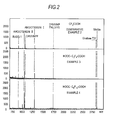
- FIG. 2 illustrates mass spectrometry spectra of Examples 3 and 4 and Comparative Example 2.
- FIG. 3 illustrates mass spectrometry spectra of Example 5 and Comparative Example 3.
- FIG. 4 illustrates mass spectrometry spectra of Example 7 and Comparative Example 5.
- the substrate for mass spectrometry in accordance with the present invention is a substrate for use in mass spectrometry including a process of desorbing and ionizing an object substance to be measured by using a primary beam selected from ions, neutral particles, electrons, and a laser beam, wherein the substrate includes an ionizing agent having two or more functional groups represented by Formula (1) below in a molecule and having a boiling point of equal to or higher than 150°C: -(CF 2 ) COOH (1)
- the ionizing agent does not absorb ultraviolet radiation with a wavelength equal to or greater than 330 nm and equal to or less than 370 nm may be used.
- the ionizing agent may be a compound represented by General Formula (2) below: HOOC- (CF 2 ) n-COOH (2) where n is integer equal to or greater than 2 and equal to or less than 7.
- the substrate for mass spectrometry may be formed from a material selected from gold, platinum, stainless steel, titanium oxide, zinc oxide, tin oxide, and ITO.
- the mass spectrometry method in accordance with the present invention includes the steps of: placing at least an ionizing agent having two or more functional groups represented by Formula (1) in a molecule and having a boiling point of equal to or higher than 150°C and a analyte molecule on a substrate, and irradiating the ionizing agent and the molecule that is a measurement object with a primary beam selected from ions, neutral particles, electrons, and a laser beam.
- An ionizing agent may be coated on the substrate and a solution including an analyte molecule may be coated on the ionizing agent.
- a solution including an ionizing agent and a molecule that is a measurement object may be coated on the substrate.
- Information relating to a distribution state of an object substance to be measured may be obtained based on mass information acquired by changing an irradiation position of a primary beam selected from ions, neutral particles, electrons, and a laser beam on the ionizing agent and the molecule that is a measurement object.
- the mass spectrometry method in accordance with the present invention is a mass spectrometry method in which information relating to a distribution state of an object substance to be measured is obtained based on mass information acquired by changing an irradiation location of a primary beam selected from ions, neutral particles, electrons, and a laser beam, wherein the above-described substrate for mass spectrometry is used.
- Biological substances such as proteins and peptides have a structure in which a plurality of amino acids are bounded by amido bonds, and in ionization thereof a comparatively large number of cites to which protons have been donated are present.
- detection in a mass spectrometer can be performed by ionization caused by protonization.
- the easiness of protonization differs among the substances and is not constant.
- an electric charge of the protein or peptide that is a solute becomes zero in the vicinity of the isoelectric point, and in a state under this isoelectric point, the solute can be protonized. Therefore, a compound with a certain high proton donating ability may be used for protonizing the target protein or peptide.
- the aforementioned Japanese Patent Laid-open No. 2006-153493 discloses using an acid such as trifluoroacetic acid, hydrochloric acid, nitric acid, hydrofluoric acid, acetic acid, and formic acid and describes a certain effect obtained.
- organic acids other than trifluoroacetic acid are not that strong.
- a carboxyl group is a portion that acts as an acid, but this functional group is also contained in an amino group. In particular, in asparagic acid and the like, even though one carboxyl group is used in an amido bond due to a peptide bond, there is yet another carboxylic group.
- Trifluoroacetic acid has a carbon atom bonded to a carboxyl group and fluorine atoms with strong electron attraction ability. Therefore this acid is stronger than acetic acid or formic acid, and proton donating ability can be increased.
- gas pressure in the ionization chamber in MALDI-TOF, MS, or TOF-SIMS typically corresponds to a high-vacuum state in order to prevent the generated ion species from being eliminated by collisions with the surrounding gas molecules.
- an organic acid with a low molecular weight such as forming acid, acetic acid, and nitric acid will be volatilized and efficacy thereof as a proton donor will decrease.
- an inorganic acid such as hydrochloric acid and hydrofluoric acid is in an aqueous solution state, but it can be assumed that after water has evaporated, the acid will be similarly volatilized and efficacy thereof as a proton donor will decrease.
- nitric acid has a boiling point of about 123°C due to the formation of an azeotropic mixture.
- the degree of vacuum in a mass spectrometer is high and with acids obtained by dissolving an acid in a gaseous state, it is difficult to retain a sufficient amount of acid under vacuum conditions of the mass spectrometer and an action of protonizing the object substance to be measured is difficult to maintain.
- sulfuric acid is not an evaporable acid, it has a strong oxidizing ability and high viscosity. Even when a dilute solution of sulfuric acid is used, the concentration of sulfuric acid rises with evaporation of water.
- an aqueous solution system is suitable as a field in which a protein or peptide as a molecule that is a measurement object is brought into contact with a proton donor and that the proton donor also has to be soluble in water.
- a molecular weight increases, a melting point or boiling point rises, and the ability to remain under high-vacuum conditions rises.
- the adverse effect of introducing a unit having an aromatic ring to raise a melting point or a boiling point is that absorption of ultraviolet radiation rises, and in an ionization method of a laser irradiation type, the proton-donating agent absorbs the irradiated laser beam, thereby inhibiting desorption and ionization of the object substance to be measured, whereas in a measurement method using a matrix molecule, crystallinity of matrix is inhibited.
- a compound having two or more functional groups represented by Formula (1) in a molecule maintains proton donating ability and solubility in water, while having a high boiling point, and is advantageously suitable as an ionizing agent for mass spectrometry.
- molecules of a non-aromatic system have substantially no absorption in an ultraviolet region and absorb no irradiation energy as ionizing agents in mass spectrometry using laser irradiation, thereby enabling effective absorption of irradiation energy by a matrix or a substrate. As a result, the adsorption of the molecule to be measured is not inhibited.
- the number of functional groups represented by Formula (1) above that are present in one molecule of the ionizing agent in accordance with the present invention may be two or more, and from the standpoint of handleability, two or three functional groups may be used.
- the structure of the ionizing agent molecule other than the portion represented by Formula (1) above is not particularly limited, provided that the boiling point of the molecule can be equal to or higher than 150°C. However, in order to avoid strong absorption in the infrared region with a wavelength of equal to or greater than 330 nm and equal to or smaller than 370 nm, a nonaromatic unit and a unit that does not decrease a proton donating ability of the molecule as a whole may be used.
- an alkylene unit substituted with a fluorine atom can be advantageously used because a boiling point can be increased, while maintaining the proton donating ability and without increasing the absorption in the infrared region with a wavelength of equal to or greater than 330 nm and equal to or smaller than 370 nm, and a perfluorodicarboxylic acid in which a unit represented by Formula (1) above is bonded to both ends of a perfluoroalkylene chain can be used especially advantageously.
- the perfluoroalkylene chain length is too long, it can be expected that decrease in solubility in water will be more significant than effect on boiling point or proton donating ability. Accordingly, the number of carbon atoms in the perfluoroalkylene chain linking the units represented by Formula (1) above may be equal to or greater than 2 and equal to or smaller than 5.
- a dicarboxylic acid represented by General Formula (2) may be used as the ionizing agent where n is integer equal to or greater than 2 and equal to or less than 7, preferably equal to or greater than 2 and equal to or less than 5.
- the following three methods for using the ionizing agent can be considered:(1) the ionizing agent is coated on a sample substrate for mass spectrometry, and then a reagent to be used in mass spectrometry, such as an analyte or a matrix is coated; (2) a solution obtained by simultaneously mixing the ionizing agent in accordance with the present invention with an analyte or a matrix is coated on a substrate; and (3) an analyte or a matrix is coated on a substrate and then the ionizing agent in accordance with the present invention is coated.
- the present invention is not limited to any of these methods, but in the case the ionizing agent is coated in advance on the substrate, the ionizing agent is not lost on evaporation or volatilization and, therefore, the efficacy of the ionizing agent can be demonstrated to the greatest extent.
- noble metals such as gold and platinum
- metals such as stainless steel and aluminum, silicon, titanium oxide, and zinc oxide
- a noble metal such as platinum, and also stainless steel, titanium oxide, and zinc oxide can be advantageously used as the substrate to be coated in advance with the ionizing agent in accordance with the present invention because variation in electric properties caused by oxidation can be avoided.
- a substrate with a flat shape may be used.
- the contact frequency of the measurement object molecule to be measured and the ionizing agent present on the substrate is increased. Accordingly such shape of the aforementioned materials may be used.
- a matrix molecule can be used if necessary.
- Well-known conventional materials such as nitroanthracene (9NA) 44, 2,5-dihydroxybenzoic acid (DHB), sinapinic acid, and ⁇ -cyanohydroxycinnamic acid (CHCA) can be used as the matrix molecule.
- a polar solvent such as water may be contained.
- a solvent with a boiling point equal to or lower than 150°C, such as equal to or lower than 120°C may be used.
- gold ions or gold cluster ions, bismuth ions or bismuth cluster ions, fullerene ions, electrons, rare gases, ultraviolet laser, infrared laser, and visible light laser can be used as a primary beam selected from ions, neutral particles, electrons, and a laser beam.
- Examples of the object substance to be measured for use in accordance with the present invention include proteins, modified proteins, peptides, modified peptides, sugars, lipids, glycoproteins, glycolipids, DNA, RNA, synthetic macromolecules, dyes, pigments, and additives.
- a platinum oxide layer of a dendritic structure was formed to a thickness of 1000 nm by a reactive sputtering method on a mirror finished stainless steel (SUS 430, 30 mm ⁇ 30 mm ⁇ t0.6 mm).
- the supported amount of Pt in this case was 0.27 mg/cm 2 .
- the reactive sputtering was conducted under the following conditions: total pressure 4 Pa, oxygen flow rate ratio (QO 2 /(Q Ar + Q O2 )) 70%, substrate temperature 80°C, power input 4.9 W/cm 2 .
- QO 2 denotes an oxygen flow rate
- Q Ar denotes an argon flow rate.
- the platinum oxide of the dendritic structure was subjected to reduction for 30 min at 120°C in a 2% H 2 /He atmosphere (1 atm), and a substrate having a dendritic platinum nanostructure was obtained.
- the substrate was cut to 0.6 mm and adhesively fixed with a conductive two-side adhesive tape to a stainless steel target substrate for MALDI-TOF MS (Brucker Co.).
- a 1 wt.% aqueous solution, 2 ⁇ L, of perfluorodicarboxylic acid (boiling point 150°C/5 mm Hg) having the below-described structural formula was dropped on a substrate produced in the Substrate Example 1 and dried.
- the substrate was mounted on a MALDI-TOF MS device (REFLEX-III TM , manufactured by Brucker Daltonics Co.).
- An accelerating voltage was set to 26.5 kV and peaks from a mass number of 800 to 3000 were picked up.
- Sample preparation and mass spectrometry were carried out in the same manner as in Example 1, except that the ionizing agent was changed to a compound (boiling point equal to or higher than 150°C) represented by the structural formula below.
- Sample preparation and mass spectrometry were carried out in the same manner as in Example 1, except that the ionizing agent was changed to trifluoroacetic acid (boiling point 74°C).
- the substrate was mounted on a MALDI-TOF MS device (REFLEX-III TM , manufactured by Brucker Daltonics Co.).
- An accelerating voltage was set to 26.5 kV and peaks from a mass number of 700 to 3000 were picked up.
- Mass spectrometry was carried out in the same manner as in Example 3, except that trifluoroacetic acid was used as the ionizing agent.
- Comparison of the spectra obtained in Examples 3 and 4 and Comparative Example 2 demonstrates that where measurements are conducted in a state in which the ionizing agent in accordance with the present invention is mixed with a measurement object, sample the ionizing agent in accordance with the present invention makes it possible to detect the object molecule to be measured with higher sensitivity.
- Mass spectrometry was carried out in the same manner as in Example 1, except that a substrate was used with a roughened surface obtained by immersing a mirror finished stainless steel (SUS 430, 30 mm ⁇ 30 mm ⁇ t0.6 mm) for 20 min in concentrated hydrochloric acid (37 wt.%) and rinsing for 2 min.
- a mirror finished stainless steel SUS 430, 30 mm ⁇ 30 mm ⁇ t0.6 mm
- Mass spectrometry was carried out in the same manner as in Example 5, except that no ionizing agent was used.
- Example 5 Mass spectra obtained in Example 5 and Comparative Example 3 are shown in FIG. 3 .
- Example 5 Comparison of the spectra obtained in Example 5 and Comparative Example 3 demonstrates that the ionizing agent in accordance with the present invention makes it possible to detect the object molecule to be measured with very high sensitivity.
- Mass spectrometry was conducted in the same manner as in Comparative Example 3, except that a TOF-SIMS method (measurement conditions identical to those of Example 6) was used.
- Example 6 Comparison of the spectra obtained in Example 6 and Comparative Example 4 demonstrates that the ionizing agent in accordance with the present invention increased detection sensitivity of the object molecule to be measured.
- a mixed aqueous solution including Insulin (compositional formula: C 254 H 377 N 65 O 75 S 6 , molecular weight 5773.49) and Insulin Chain B Oxidized (compositional formula: C 157 H 232 N 40 O 47 S 2 , molecular weight 3495.89) at 2 ⁇ g/L each was prepared, perfluorodicarboxylic acid (boiling point equal to or higher than 150°C) represented by the following structural formula was added as an ionizing agent to obtain a content ratio thereof of 2 wt.% and a measurement sample solution was prepared.
- the solution, 0.1 ⁇ l, was dropped on a silicon wafer that has been vapor deposited with gold and dried under atmospheric pressure. Mass spectrometry was then conducted in the below-described measurement device.
- Example 7 Spectra obtained in Example 7 and Comparative Example 5 are shown in FIG. 4 .
- Example 7 an Insulin monoproton adduct and diproton adduct and an Insulin Chain B Oxidized monocation were detected, whereas in Comparative Example 6 these peaks were extremely weak, thereby confirming the effect of the ionizing agent of Examples.
- Ionizing agents used in Examples 1 and 2 and Comparative Examples 1 and 5 were placed in quartz tubes with an inner diameter of 3 mm and the tubes were immersed for 30 min in an oil bath at 150°C. When the residual amount of each ionizing agent was then checked, no residue of the ionizing agent of Comparative Example 1 was found to be present.
- the present invention makes it possible to detect a desorbed/ionized object substance to be measured with high sensitivity in mass spectrometry in which the object substance to be measured is desorbed and ionized. Therefore, the substrate in accordance with the present invention can be used as an ionization enhancer in mass spectrometry.
Landscapes
- Physics & Mathematics (AREA)
- Optics & Photonics (AREA)
- Chemical & Material Sciences (AREA)
- Analytical Chemistry (AREA)
- Other Investigation Or Analysis Of Materials By Electrical Means (AREA)
Abstract
- (CF2) COOH (1)
wherein the ionizing agent has a boiling point of equal to or higher than 150°C and an object molecule to be measured on a substrate and irradiating the ionizing agent and the object molecule to be measured with a primary beam selected from ions, neutral particles, electrons, and a laser beam.
Description
- The present invention relates to a substrate for use in mass spectrometry including a process of desorbing and ionizing an object substance to be measured by using a primary beam selected from ions, neutral particles, electrons, and a laser beam, and also to a mass spectrometry method.
- Furthermore, the present invention also relates to imaging detection of constituents of each kind constituting a measurement object, in particular organic substances such as proteins, with a mass spectrometry device including a process of desorbing and ionizing an object substance to be measured by using a primary beam selected from ions, neutral particles, electrons, and a laser beam.
- In a mass spectrometry device, an object substance to be measured is ionized by some method, an electric field or a magnetic field is applied to the ionized substance, separation is performed according to a mass/charge ratio (m/z), and then the measurement object is qualitatively and quantitatively analyzed from an electrically detected mass spectrum. In this case, a variety of ionization methods are used, such as electron spray ionization (ESI), electron bombardment ionization (EI), chemical ionization (CI), fast atom bombardment (FAB), field desorption (FD), laser desorption ionization (LDI), matrix assisted laser desorption ionization (MALDI), and secondary ion mass spectrometry (SIMS) in which irradiation is performed with elemental ions, element cluster ions, and molecular ions. For example, in laser ionization mass spectrometer, a mass spectrum and the like can be measured by irradiating and ionizing a sample with a pulsed laser beam and introducing the ions into an analytical unit, for example, of a time of flight type.
- To enable mass spectrometry of the object substance to be measured, a state has to be formed in which the substance contained in the analyte is an independent molecular unit, and this independent molecular unit has to have a positive or negative electric charge. Among the above-described mass spectrometry methods, the MALDI method has found especially broad application in a variety of fields in recent years because this method makes it possible to measure molecules with a high molecular weight such as polymer materials and proteins that have been heretofore difficult to measure. This is apparently because the MALDI method makes it possible to satisfy the two above-described conditions enabling mass spectrometry since the method uses a matrix that weakens interaction between the molecules to be measured and, therefore, increases the extraction efficiency of components to be measured as independent molecular units and also since the matrix itself can perform ionization of the molecules that are the measurement object by a reaction induced by laser irradiation.
- Examples of the substance to be measured that is provided with an electric charge include radical cations obtained by pulling electrons off the substance to be measured, radical anions obtained by donating electrons to the substance to be measured, cations obtained by donating a proton or a cation of an alkali metal or silver to the substance to be measured, and anions obtained by donating an anion of a halogen or the like or by deprotonizing. In particular, in biomolecules such as proteins, a large number of polar groups are present and mass spectrometry can be conducted with a comparatively high sensitivity by cationization based on addition of protons.
- In the field of mass spectrometry using laser irradiation, porous silicon has been used in recent years instead of a matrix, thereby making it possible to perform mass spectrometry with a comparatively good sensitivity and in a state in which peaks of impurities derived from the matrix are small, and this approach attracted much attention. Although the operation effect of mass spectrometry using a porous substrate is unclear, apparently because the specific surface area is larger than that of a flat substrate, the number of adsorption points of the analyte molecules is large and the degree of aggregation of these molecules on the substrate is decreased, thereby increasing the ratio of desorption in single molecular units by laser irradiation.
- Furthermore, imaging technology using mass spectrometry has also attracted much attention in recent years. This is because a strong demand arose for specifying the location of developed proteins or impurities that adhered to the surface, for example, in biological tissues such as tumor cells and electronic materials such as semiconductor wafers.
- In imaging technology based on mass spectrometry, a process of desorbing and ionizing the analyte molecules is carried out by a device using irradiation with a focused ion beam or laser beam. In particular, in SIMS, molecules that have adhered to the surface can be desorbed with a very high efficiency by irradiation with gallium ions or gold ions. As for the molecules with a comparatively high molecular weight that are difficult to desorb, because such molecules can be fragmented during irradiation with gallium ions or gold ions, it is still possible to obtain information, even though partial, that relates to the molecules that are the measurement object.
- In mass spectrometry of such a type that uses irradiation with laser or with gallium ions or gold ions, the desorption of molecules can also proceed in a state of neutral molecules or neutral radicals, rather than only in a state of ions. Detection in mass spectrometers is performed on the basis of charge information of molecules that are desorbed in monomolecular units. The resultant problem is that neutral molecules or radicals cannot be detected even when the desorbed number thereof is large.
- The problem associated with ionization efficiency of the molecules to be measured becomes particularly serious in mass spectrometry in which irradiation is performed with a laser or gadolinium ions, without using a matrix.
- To resolve this problem, examples of Japanese Patent Laid-open No.
2006-201042 US Patent Application Publication No. 2006/0118711 (corresponding to Japanese Patent Laid-open No.2006-153493 - However, although the addition of a metal salt such as an alkali metal salt sometimes makes it possible to ionize the molecules that are the measurement object with good efficiency, such a salt is also known to inhibit ionization, as disclosed in Japanese Patent Laid-open No.
2006-170857 - As described hereinabove, with the conventional methods, the problem arising in mass spectrometry in which an object substance to be measured is desorbed and ionized by using a primary beam selected from ions, neutral particles, electrons, and a laser beam is that the molecules that are the measurement object are difficult to ionize with high efficiency over a long period or uniformly in measurement locations.
- The present invention has been created with consideration for the above-described background art, and the present invention provides a substrate for mass spectrometry and a mass spectrometry method that make it possible to perform high-sensitivity detection of a desorbed/ionized substance that is the measurement object in mass spectrometry in which the substance that is the measurement object is desorbed and ionized.
- A substrate for mass spectrometry that resolves the above-described problems is a substrate for use in mass spectrometry including a process of desorbing and ionizing an object substance to be measured by using a primary beam selected from ions, neutral particles, electrons, and a laser beam, wherein the substrate includes an ionizing agent having two or more functional groups represented by Formula (1) below in a molecule and having a boiling point of equal to or higher than 150°C:
-(CF2) COOH (1)
- A mass spectrometry method that resolves the above-described problems includes the steps of placing at least an ionizing agent having two or more functional groups represented by Formula (1) in a molecule and having a boiling point of equal to or higher than 150°C and a molecule that is a measurement object on a substrate, and irradiating the ionizing agent and the molecule that is a measurement object with a primary beam selected from ions, neutral particles, electrons, and a laser beam.
- Furthermore, a mass spectrometry method that resolves the above-described problems is a mass spectrometry method in which information relating to a distribution state of the molecule that is a measurement object is obtained based on mass information acquired by changing an irradiation position of a primary beam selected from ions, neutral particles, electrons, and a laser beam on the ionizing agent and the molecule that is an analyte, wherein the above-described substrate for mass spectrometry is used.
- In accordance with the present invention, it is possible to provide a substrate for mass spectrometry and a mass spectrometry method that make it possible to perform high-sensitivity detection of a desorbed/ionized substance that is the analyte in mass spectrometry in which the substance that is the measurement object is desorbed and ionized.
- Furthermore, the present invention can provide a substrate for mass spectrometry that makes it possible to perform high-sensitivity detection of a compound with a high molecular weight by desorption/ionization and also effectively inhibit fragmentation so as to create substantially no obstacles to analysis in a low-molecular region in mass spectrometry using desorption and ionization by laser beam irradiation.
- Further features of the present invention will become apparent from the following description of exemplary embodiments with reference to the attached drawings.
-
FIG. 1 illustrates mass spectrometry spectra of Examples 1 and 2 and Comparative Example 1. -
FIG. 2 illustrates mass spectrometry spectra of Examples 3 and 4 and Comparative Example 2. -
FIG. 3 illustrates mass spectrometry spectra of Example 5 and Comparative Example 3. -
FIG. 4 illustrates mass spectrometry spectra of Example 7 and Comparative Example 5. - The present invention will be described below in greater detail.
- The substrate for mass spectrometry in accordance with the present invention is a substrate for use in mass spectrometry including a process of desorbing and ionizing an object substance to be measured by using a primary beam selected from ions, neutral particles, electrons, and a laser beam, wherein the substrate includes an ionizing agent having two or more functional groups represented by Formula (1) below in a molecule and having a boiling point of equal to or higher than 150°C:
-(CF2) COOH (1)
- The ionizing agent does not absorb ultraviolet radiation with a wavelength equal to or greater than 330 nm and equal to or less than 370 nm may be used.
- The ionizing agent may be a compound represented by General Formula (2) below:
HOOC- (CF2) n-COOH (2)
where n is integer equal to or greater than 2 and equal to or less than 7. - The substrate for mass spectrometry may be formed from a material selected from gold, platinum, stainless steel, titanium oxide, zinc oxide, tin oxide, and ITO.
- The mass spectrometry method in accordance with the present invention includes the steps of: placing at least an ionizing agent having two or more functional groups represented by Formula (1) in a molecule and having a boiling point of equal to or higher than 150°C and a analyte molecule on a substrate, and irradiating the ionizing agent and the molecule that is a measurement object with a primary beam selected from ions, neutral particles, electrons, and a laser beam.
- An ionizing agent may be coated on the substrate and a solution including an analyte molecule may be coated on the ionizing agent.
- A solution including an ionizing agent and a molecule that is a measurement object may be coated on the substrate.
- Information relating to a distribution state of an object substance to be measured may be obtained based on mass information acquired by changing an irradiation position of a primary beam selected from ions, neutral particles, electrons, and a laser beam on the ionizing agent and the molecule that is a measurement object.
- The mass spectrometry method in accordance with the present invention is a mass spectrometry method in which information relating to a distribution state of an object substance to be measured is obtained based on mass information acquired by changing an irradiation location of a primary beam selected from ions, neutral particles, electrons, and a laser beam, wherein the above-described substrate for mass spectrometry is used.
- The results of comprehensive research conducted by the inventors demonstrated that where a substrate for mass spectrometry is used that has an ionizing agent having two or more functional groups represented by Formula (1) in a molecule and having a boiling point of equal to or higher than 150°C, an analyte molecule is protonized with good efficiency and also constant efficiency over a long period.
- Biological substances such as proteins and peptides have a structure in which a plurality of amino acids are bounded by amido bonds, and in ionization thereof a comparatively large number of cites to which protons have been donated are present. As a result, detection in a mass spectrometer can be performed by ionization caused by protonization. However, the easiness of protonization differs among the substances and is not constant. In an aqueous solution of a protein or a peptide, there is a hydrogen ion concentration called an isoelectric point, an electric charge of the protein or peptide that is a solute becomes zero in the vicinity of the isoelectric point, and in a state under this isoelectric point, the solute can be protonized. Therefore, a compound with a certain high proton donating ability may be used for protonizing the target protein or peptide.
- As an example of using compounds with a high proton donating ability in mass spectrometry, for example, the aforementioned Japanese Patent Laid-open No.
2006-153493 - A variety of compounds demonstrating a protonizing effect were studied. The results obtained demonstrated that in order to obtain a protonizing ability stronger than that of a carboxyl group, which is a usual organic acid, a structure has to be obtained in which a fluorine atom is bonded to carbon bonded to a carboxyl group. Furthermore, it was taken into account that to demonstrate efficacy under high-vacuum conditions of a mass spectrometer, the molecule should not be evaporable or volatile. In particular, in the case of compounds with a boiling point equal to or higher than 150°C, the effect can be maintained without immediate volatilization or evaporation even under high-vacuum conditions of a mass spectrometer.
- Furthermore, water is most often used as a solvent in analysis of biosamples such as proteins and peptides. Therefore, it was determined that an aqueous solution system is suitable as a field in which a protein or peptide as a molecule that is a measurement object is brought into contact with a proton donor and that the proton donor also has to be soluble in water. Typically, if a molecular weight increases, a melting point or boiling point rises, and the ability to remain under high-vacuum conditions rises. However, it was found that, for example, if a carbon chain having a fluorine atom is employed to raise a melting point and a boiling point, while maintaining high proton donating ability, although the melting point and boiling point rise, solubility in water decreases to an extreme and the compound cannot be used as a proton donor for a protein or peptide. Furthermore, the adverse effect of introducing a unit having an aromatic ring to raise a melting point or a boiling point is that absorption of ultraviolet radiation rises, and in an ionization method of a laser irradiation type, the proton-donating agent absorbs the irradiated laser beam, thereby inhibiting desorption and ionization of the object substance to be measured, whereas in a measurement method using a matrix molecule, crystallinity of matrix is inhibited.
- Comprehensive research of proton donating agents were conducted and the results obtained demonstrated that a compound having two or more functional groups represented by Formula (1) in a molecule maintains proton donating ability and solubility in water, while having a high boiling point, and is advantageously suitable as an ionizing agent for mass spectrometry. In particular, among such ionizing agents, molecules of a non-aromatic system have substantially no absorption in an ultraviolet region and absorb no irradiation energy as ionizing agents in mass spectrometry using laser irradiation, thereby enabling effective absorption of irradiation energy by a matrix or a substrate. As a result, the adsorption of the molecule to be measured is not inhibited.
- The number of functional groups represented by Formula (1) above that are present in one molecule of the ionizing agent in accordance with the present invention may be two or more, and from the standpoint of handleability, two or three functional groups may be used.
- The structure of the ionizing agent molecule other than the portion represented by Formula (1) above is not particularly limited, provided that the boiling point of the molecule can be equal to or higher than 150°C. However, in order to avoid strong absorption in the infrared region with a wavelength of equal to or greater than 330 nm and equal to or smaller than 370 nm, a nonaromatic unit and a unit that does not decrease a proton donating ability of the molecule as a whole may be used. In particular, an alkylene unit substituted with a fluorine atom can be advantageously used because a boiling point can be increased, while maintaining the proton donating ability and without increasing the absorption in the infrared region with a wavelength of equal to or greater than 330 nm and equal to or smaller than 370 nm, and a perfluorodicarboxylic acid in which a unit represented by Formula (1) above is bonded to both ends of a perfluoroalkylene chain can be used especially advantageously. In this case, where the perfluoroalkylene chain length is too long, it can be expected that decrease in solubility in water will be more significant than effect on boiling point or proton donating ability. Accordingly, the number of carbon atoms in the perfluoroalkylene chain linking the units represented by Formula (1) above may be equal to or greater than 2 and equal to or smaller than 5.
- For these reasons, a dicarboxylic acid represented by General Formula (2) may be used as the ionizing agent where n is integer equal to or greater than 2 and equal to or less than 7, preferably equal to or greater than 2 and equal to or less than 5.
- Specific structural formulas of ionizing agents that can be used in accordance with the present invention are presented hereinbelow in TABLE I by way of examples, but the present invention is not limited to these exemplary compounds.

- In accordance with the present invention, the following three methods for using the ionizing agent can be considered:(1) the ionizing agent is coated on a sample substrate for mass spectrometry, and then a reagent to be used in mass spectrometry, such as an analyte or a matrix is coated; (2) a solution obtained by simultaneously mixing the ionizing agent in accordance with the present invention with an analyte or a matrix is coated on a substrate; and (3) an analyte or a matrix is coated on a substrate and then the ionizing agent in accordance with the present invention is coated.
- The present invention is not limited to any of these methods, but in the case the ionizing agent is coated in advance on the substrate, the ionizing agent is not lost on evaporation or volatilization and, therefore, the efficacy of the ionizing agent can be demonstrated to the greatest extent.
- In accordance with the present invention, well-known materials, for example, noble metals such as gold and platinum, metals such as stainless steel and aluminum, silicon, titanium oxide, and zinc oxide can be selected as a sample substrate for mass spectrometry. In particular, a noble metal such as platinum, and also stainless steel, titanium oxide, and zinc oxide can be advantageously used as the substrate to be coated in advance with the ionizing agent in accordance with the present invention because variation in electric properties caused by oxidation can be avoided. A substrate with a flat shape may be used. In particular, when a substrate with peaks and valleys with a difference in height between the deepest valley and the highest peak of from 10 nm to about 200 nm is used, the contact frequency of the measurement object molecule to be measured and the ionizing agent present on the substrate is increased. Accordingly such shape of the aforementioned materials may be used.
- In accordance with the present invention, a matrix molecule can be used if necessary. Well-known conventional materials such as nitroanthracene (9NA) 44, 2,5-dihydroxybenzoic acid (DHB), sinapinic acid, and α-cyanohydroxycinnamic acid (CHCA) can be used as the matrix molecule.
- Well-known conventional solvents such as water, ethanol, methanol, propyl alcohol, tetrahydrofuran, acetonitrile, dimethylformamide, DMSO, benzene, toluene, dichloromethane, trichloromethane, acetone, and methyl ethyl ketone can be used as the solvent for preparing a sample for use in mass spectrometry, but taking into account the proton donating ability of the ionizing agent in accordance with the present invention, a polar solvent such as water may be contained. Furthermore, in order to avoid problems associated with handling of mass spectrometry samples, a solvent with a boiling point equal to or lower than 150°C, such as equal to or lower than 120°C, may be used.
- In accordance with the present invention, gold ions or gold cluster ions, bismuth ions or bismuth cluster ions, fullerene ions, electrons, rare gases, ultraviolet laser, infrared laser, and visible light laser can be used as a primary beam selected from ions, neutral particles, electrons, and a laser beam.
- Examples of the object substance to be measured for use in accordance with the present invention include proteins, modified proteins, peptides, modified peptides, sugars, lipids, glycoproteins, glycolipids, DNA, RNA, synthetic macromolecules, dyes, pigments, and additives.
- Examples of the present invention will be described below in greater detail.
- A platinum oxide layer of a dendritic structure was formed to a thickness of 1000 nm by a reactive sputtering method on a mirror finished stainless steel (SUS 430, 30 mm × 30 mm × t0.6 mm). The supported amount of Pt in this case was 0.27 mg/cm2. The reactive sputtering was conducted under the following conditions: total pressure 4 Pa, oxygen flow rate ratio (QO2/(QAr + QO2)) 70%, substrate temperature 80°C, power input 4.9 W/cm2. Here QO2 denotes an oxygen flow rate and QAr denotes an argon flow rate.
- The platinum oxide of the dendritic structure was subjected to reduction for 30 min at 120°C in a 2% H2/He atmosphere (1 atm), and a substrate having a dendritic platinum nanostructure was obtained. The substrate was cut to 0.6 mm and adhesively fixed with a conductive two-side adhesive tape to a stainless steel target substrate for MALDI-TOF MS (Brucker Co.).
- A sample (MassPREP Peptides Mixture, Waters Co.) prepared by mixing peptides of nine types: RASG-1 (molecular weight Mw = 1000.49), Angiotensin frag. 1-7 (Mw = 898.47), bradykinin (Mw = 1059.56), Angiotensin I (Mw = 1295.68), Angiotensin II (Mw = 1045.53), Renin substrate (Mw = 1757.93), Enolase T35 (Mw = 1871.96), Enolase T37 (Mw = 2827.28), Melittin (Mw = 2845.74) was used. The content of each peptide was about 1.0 nmol.
- Water was added to the peptide mixture sample to obtain a concentration of each peptide of about 10 µmol/L. When 1 µL of the peptide solution was dropped and dried, a state was assumed in which the content of each peptide per 1 spot of the analyte sample was about 10 pmol.
- A 1 wt.% aqueous solution, 2 µL, of perfluorodicarboxylic acid (boiling point 150°C/5 mm Hg) having the below-described structural formula was dropped on a substrate produced in the Substrate Example 1 and dried.

- Then, 1 µL of the peptide solution prepared in Preparation Example 1 of object substance to be measured was dropped on the substrate and dried.
- The substrate was mounted on a MALDI-TOF MS device (REFLEX-III™, manufactured by Brucker Daltonics Co.). An irradiation laser in the MALDI-TOF MS measurements was a nitrogen laser (wavelength = 337 nm) and a positive ion reflector mode was used. The measurements were conducted at an irradiation laser intensity that is by 2% higher than the intensity at which a new ion peak is revealed, a spectrum of 20 pulses was integrated in one site, the spectra were integrated over 10 sites, and a spectrum was obtained in which signal intensities obtained from a total of 200 pulses of laser irradiation were added up.
- An accelerating voltage was set to 26.5 kV and peaks from a mass number of 800 to 3000 were picked up.
- Sample preparation and mass spectrometry were carried out in the same manner as in Example 1, except that the ionizing agent was changed to a compound (boiling point equal to or higher than 150°C) represented by the structural formula below.

- Sample preparation and mass spectrometry were carried out in the same manner as in Example 1, except that the ionizing agent was changed to trifluoroacetic acid (boiling point 74°C).
- Mass spectra obtained in Examples 1 and 2 and Comparative Example 1 are shown in
FIG. 1 . - Comparison of the spectra obtained in Examples 1 and 2 and Comparative Example 1 demonstrates that using a mass spectrometry substrate obtained by coating a substrate with the ionizing agent in accordance with the present invention makes it possible to detect the analyte molecule to be measured with higher sensitivity.
- A sample (MassPREP Peptides Mixture, Waters Co.) in which nine peptides were mixed in the same manner as in Preparation Example 1 of analyte was dissolved in a 1 wt.% aqueous solution prepared by dissolving perfluorodicarboxylic acid (boiling point 150°C/5 mm Hg) represented by the following formula:

- The substrate was mounted on a MALDI-TOF MS device (REFLEX-III™, manufactured by Brucker Daltonics Co.). An irradiation laser in the MALDI-TOF MS measurements was a nitrogen laser (wavelength = 337 nm) and a positive ion reflector mode was used. The measurements were conducted at an irradiation laser intensity that is by 2% higher than the intensity at which a new ion peak is revealed, a spectrum of 20 pulses was integrated in one site, the spectra were integrated over 10 sites, and a spectrum was obtained in which signal intensities obtained from a total of 200 pulses of laser irradiation were added up.
- An accelerating voltage was set to 26.5 kV and peaks from a mass number of 700 to 3000 were picked up.
- Sample preparation and mass spectrometry were carried out in the same manner as in Example 3, except that the ionizing agent was changed to perfluorodicarboxylic acid (boiling point equal to or higher than 150°C) represented by the structural formula below.

- Mass spectrometry was carried out in the same manner as in Example 3, except that trifluoroacetic acid was used as the ionizing agent.
- Mass spectra obtained in Examples 3 and 4 and Comparative Example 2 are shown in
FIG. 2 . - Comparison of the spectra obtained in Examples 3 and 4 and Comparative Example 2 demonstrates that where measurements are conducted in a state in which the ionizing agent in accordance with the present invention is mixed with a measurement object, sample the ionizing agent in accordance with the present invention makes it possible to detect the object molecule to be measured with higher sensitivity.
- Mass spectrometry was carried out in the same manner as in Example 1, except that a substrate was used with a roughened surface obtained by immersing a mirror finished stainless steel (SUS 430, 30 mm × 30 mm × t0.6 mm) for 20 min in concentrated hydrochloric acid (37 wt.%) and rinsing for 2 min.
- Mass spectrometry was carried out in the same manner as in Example 5, except that no ionizing agent was used.
- Mass spectra obtained in Example 5 and Comparative Example 3 are shown in
FIG. 3 . - Comparison of the spectra obtained in Example 5 and Comparative Example 3 demonstrates that the ionizing agent in accordance with the present invention makes it possible to detect the object molecule to be measured with very high sensitivity.
- Examination was conducted in the same manner as in Example 5, except that mass spectrometry was conducted by TOF-SIMS rather than by MALDI-TOF MS. The TOF-SIMS was conducted under the following conditions.
- In the TOF-SIMS analysis, the measurements were conducted using a TOF-SIMS IV device manufactured by ION TOF Co. under the following conditions:
- Primary ions: 25 kV Ga+, 2.4 pA (pulse current value) sawtooth scan mode.
- Primary ion pulse frequency: 3.3 kHz (300 µs/shot).
- Primary ion pulse width: about 0.8 ns.
- Primary ion beam diameter: about 3 µm.
- Measurement region: 300 µm × 300 µm.
- Number of pixels of the secondary ion image: 128 × 128. Integration time: about 400 sec.
- Mass spectrometry was conducted in the same manner as in Comparative Example 3, except that a TOF-SIMS method (measurement conditions identical to those of Example 6) was used.
- An attempt was made to prepare an aqueous solution of a monocarboxylic acid (boiling point 218°C) having attached thereto a perfluoroalkyl chain and represented by the following structural formula as an ionizing agent, but the acid was difficult to dissolve. Therefore, mass spectrometry could not be conducted.

- Comparison of the spectra obtained in Example 6 and Comparative Example 4 demonstrates that the ionizing agent in accordance with the present invention increased detection sensitivity of the object molecule to be measured.
- A mixed aqueous solution including Insulin (compositional formula: C254H377N65O75S6, molecular weight 5773.49) and Insulin Chain B Oxidized (compositional formula: C157H232N40O47S2, molecular weight 3495.89) at 2 µg/L each was prepared, perfluorodicarboxylic acid (boiling point equal to or higher than 150°C) represented by the following structural formula

- In the TOF-SIMS analysis, the measurements were conducted using a TOF-
SIMS 5 device manufactured by ION TOF Co. under the following conditions: - Primary ions: 25 kV Bi+, 0.3 pA (pulse current value) sawtooth scan mode
- Primary ion pulse frequency: 2.5 kHz (300 µs/shot).
- Primary ion pulse width: about 0.8 ns.
- Primary ion beam diameter: about 3 µm.
- Measurement region: 300 µm × 300 µm.
- Number of pixels of the secondary ion image: 128 × 128. Integration time: about 400 sec.
- Mass spectrometry was conducted in the same manner as in Comparative Example 7, except that trifluoroacetic acid served as an ionizing agent.
- Spectra obtained in Example 7 and Comparative Example 5 are shown in
FIG. 4 . In Example 7, an Insulin monoproton adduct and diproton adduct and an Insulin Chain B Oxidized monocation were detected, whereas in Comparative Example 6 these peaks were extremely weak, thereby confirming the effect of the ionizing agent of Examples. - Reference examples confirming volatility of ionizing agents are shown in the reference examples.
- A total of 3 µL of each aqueous solution of ionizing agent (the ionizing agent of Comparative Example 5 was a dispersion) used in Examples 1 and 2 and comparative Examples 1 and 5 were dropped on mirror-finished sample substrates (manufactured by Brucker Daltonics Co.) of MALDI-TOF MS and dried. The substrates were mounted on a mass spectrometer (REFLEX-III™, manufactured by Brucker Daltonics Co.) and allowed to stay for 30 min under a high-vacuum state (2 × 10⁻⁷ Torr) in the mass spectrometer. The substrates were then taken out, and the ionizing agents remaining on the substrate surface were checked under a microscope. The result obtained demonstrated that in Examples 1 and 2 and Comparative Example 5, the ionizing agents could be confirmed to be present on the substrate even after the device layer installation, whereas no traces of the ionizing agent used in Comparative Example 1 could be confirmed to be present.
- Ionizing agents used in Examples 1 and 2 and Comparative Examples 1 and 5 were placed in quartz tubes with an inner diameter of 3 mm and the tubes were immersed for 30 min in an oil bath at 150°C. When the residual amount of each ionizing agent was then checked, no residue of the ionizing agent of Comparative Example 1 was found to be present.
- The present invention makes it possible to detect a desorbed/ionized object substance to be measured with high sensitivity in mass spectrometry in which the object substance to be measured is desorbed and ionized. Therefore, the substrate in accordance with the present invention can be used as an ionization enhancer in mass spectrometry.
- While the present invention has been described with reference to exemplary embodiments, it is to be understood that the invention is not limited to the disclosed exemplary embodiments. The scope of the following claims is to be accorded the broadest interpretation so as to encompass all such modifications and equivalent structures and functions.
Claims (8)
- A substrate for use in mass spectrometry comprising an ionizing agent having two or more functional groups represented by Formula (1) below in a molecule:
-(CF2) COOH (1)
wherein the ionizing agent has a boiling point of equal to or higher than 150°C. - The substrate for mass spectrometry according to claim 1, wherein the ionizing agent does not absorb ultraviolet radiation with a wavelength equal to or greater than 330 nm and equal to or less than 370 nm.
- The substrate for mass spectrometry according to claim 1, wherein the ionizing agent is a compound represented by General Formula (2) below:
HOOC- (CF2) n-COOH (2)
wherein n is integer of equal to or greater than 2 and equal to or less than 7. - The substrate for mass spectrometry according to claim 1, wherein the substrate for mass spectrometry is formed from a material selected from gold, platinum, stainless steel, titanium oxide, zinc oxide, tin oxide, and ITO.
- A mass spectrometry method comprising:placing at least an ionizing agent having two or more functional groups represented by Formula (1) below in a molecule:
-(CF2) COOH (1)
and wherein the ionizing agent has a boiling point of equal to or higher than 150°C and a molecule that is a measurement object on a substrate; andirradiating the ionizing agent and the molecule that is a measurement object with a primary beam selected from ions, neutral particles, electrons, and a laser beam. - The mass spectrometry method according to claim 5, wherein the ionizing agent does not absorb ultraviolet radiation with a wavelength equal to or greater than 330 nm and equal to or less than 370 nm.
- The mass spectrometry method according to claim 5, wherein the ionizing agent is a compound represented by General Formula (2) below:
HOOC- (CF2) n-COOH (2)
wherein n is integer of equal to or greater than 2 and equal to or less than 7. - A mass spectrometry method according to claim 5, wherein information relating to a distribution state of an object substance to be measured is obtained based on mass information acquired by changing an irradiation position of a primary beam selected from ions, neutral particles, electrons, and a laser beam on the ionizing agent and the analyte molecule.
Applications Claiming Priority (1)
| Application Number | Priority Date | Filing Date | Title |
|---|---|---|---|
| JP2008114483A JP5084597B2 (en) | 2008-04-24 | 2008-04-24 | Mass spectrometry substrate and mass spectrometry method |
Publications (3)
| Publication Number | Publication Date |
|---|---|
| EP2112680A2 true EP2112680A2 (en) | 2009-10-28 |
| EP2112680A3 EP2112680A3 (en) | 2012-09-05 |
| EP2112680B1 EP2112680B1 (en) | 2014-04-30 |
Family
ID=40749218
Family Applications (1)
| Application Number | Title | Priority Date | Filing Date |
|---|---|---|---|
| EP09005656.5A Not-in-force EP2112680B1 (en) | 2008-04-24 | 2009-04-22 | Mass spectrometry substrate and mass spectrometry method |
Country Status (3)
| Country | Link |
|---|---|
| US (1) | US8217340B2 (en) |
| EP (1) | EP2112680B1 (en) |
| JP (1) | JP5084597B2 (en) |
Cited By (2)
| Publication number | Priority date | Publication date | Assignee | Title |
|---|---|---|---|---|
| WO2011122692A1 (en) | 2010-03-30 | 2011-10-06 | Canon Kabushiki Kaisha | Mass spectrometry method |
| EP3751274A4 (en) * | 2018-02-09 | 2021-11-03 | Hamamatsu Photonics K.K. | Sample support body and production method for sample support body |
Families Citing this family (7)
| Publication number | Priority date | Publication date | Assignee | Title |
|---|---|---|---|---|
| JP5947533B2 (en) | 2011-01-19 | 2016-07-06 | キヤノン株式会社 | Information acquisition method |
| US9588095B2 (en) | 2012-07-24 | 2017-03-07 | Massachusetts Institute Of Technology | Reagents for oxidizer-based chemical detection |
| US10345281B2 (en) | 2014-04-04 | 2019-07-09 | Massachusetts Institute Of Technology | Reagents for enhanced detection of low volatility analytes |
| JP5518152B2 (en) * | 2012-09-05 | 2014-06-11 | キヤノン株式会社 | Mass spectrometer, composition for mass spectrometry, and mass spectrometry method |
| US10816530B2 (en) | 2013-07-23 | 2020-10-27 | Massachusetts Institute Of Technology | Substrate containing latent vaporization reagents |
| CN110887891A (en) * | 2019-11-07 | 2020-03-17 | 广东省测试分析研究所(中国广州分析测试中心) | Micro-extraction-nano-liter electrospray ion source system in capillary and application |
| JP6895553B1 (en) * | 2020-03-06 | 2021-06-30 | 浜松ホトニクス株式会社 | Sample support, ionization method and mass spectrometry method |
Citations (3)
| Publication number | Priority date | Publication date | Assignee | Title |
|---|---|---|---|---|
| US20060118711A1 (en) | 2004-11-25 | 2006-06-08 | Canon Kabushiki Kaisha | In-plane distribution measurement method |
| JP2006170857A (en) | 2004-12-16 | 2006-06-29 | Toyo Kohan Co Ltd | Method for mass spectrometry of biomolecules on a solid support and solid support therefor |
| JP2006201042A (en) | 2005-01-21 | 2006-08-03 | National Institute Of Advanced Industrial & Technology | Ionization substrate for mass spectrometry and mass spectrometer |
Family Cites Families (6)
| Publication number | Priority date | Publication date | Assignee | Title |
|---|---|---|---|---|
| EP1181705A2 (en) * | 1999-04-29 | 2002-02-27 | Ciphergen Biosystems, Inc. | Sample holder with hydrophobic coating for gas phase mass spectrometers |
| US6469217B2 (en) * | 2000-05-01 | 2002-10-22 | Nippon Mektron, Ltd. | Process for preparing fluoropolymer |
| US20030138823A1 (en) * | 2001-11-05 | 2003-07-24 | Irm, Llc | Sample preparation methods for maldi mass spectrometry |
| JP2006010681A (en) * | 2004-05-25 | 2006-01-12 | Sumitomo Chemical Co Ltd | Sample preparation method for matrix-assisted laser desorption mass spectrometry |
| JP2008514900A (en) * | 2004-07-30 | 2008-05-08 | アデザ・バイオメデイカル・コーポレイシヨン | Oncofetal fibronectin as a marker of disease and other conditions and methods for detection of oncofetal fibronectin |
| JP4939263B2 (en) * | 2006-03-10 | 2012-05-23 | キヤノン株式会社 | High-sensitivity mass spectrometer and analysis method |
-
2008
- 2008-04-24 JP JP2008114483A patent/JP5084597B2/en not_active Expired - Fee Related
-
2009
- 2009-04-21 US US12/427,583 patent/US8217340B2/en not_active Expired - Fee Related
- 2009-04-22 EP EP09005656.5A patent/EP2112680B1/en not_active Not-in-force
Patent Citations (4)
| Publication number | Priority date | Publication date | Assignee | Title |
|---|---|---|---|---|
| US20060118711A1 (en) | 2004-11-25 | 2006-06-08 | Canon Kabushiki Kaisha | In-plane distribution measurement method |
| JP2006153493A (en) | 2004-11-25 | 2006-06-15 | Canon Inc | Information acquisition method |
| JP2006170857A (en) | 2004-12-16 | 2006-06-29 | Toyo Kohan Co Ltd | Method for mass spectrometry of biomolecules on a solid support and solid support therefor |
| JP2006201042A (en) | 2005-01-21 | 2006-08-03 | National Institute Of Advanced Industrial & Technology | Ionization substrate for mass spectrometry and mass spectrometer |
Cited By (5)
| Publication number | Priority date | Publication date | Assignee | Title |
|---|---|---|---|---|
| WO2011122692A1 (en) | 2010-03-30 | 2011-10-06 | Canon Kabushiki Kaisha | Mass spectrometry method |
| EP2553442A4 (en) * | 2010-03-30 | 2013-11-27 | Canon Kk | MASS SPECTROMETRY METHOD |
| US9448241B2 (en) | 2010-03-30 | 2016-09-20 | Canon Kabushiki Kaisha | Mass spectrometry method for a polypeptide including a cysteine residue |
| EP3751274A4 (en) * | 2018-02-09 | 2021-11-03 | Hamamatsu Photonics K.K. | Sample support body and production method for sample support body |
| US11393667B2 (en) | 2018-02-09 | 2022-07-19 | Hamamatsu Photonics K.K. | Sample support body and production method for sample support body |
Also Published As
| Publication number | Publication date |
|---|---|
| JP2009264911A (en) | 2009-11-12 |
| EP2112680B1 (en) | 2014-04-30 |
| US20090266982A1 (en) | 2009-10-29 |
| EP2112680A3 (en) | 2012-09-05 |
| JP5084597B2 (en) | 2012-11-28 |
| US8217340B2 (en) | 2012-07-10 |
Similar Documents
| Publication | Publication Date | Title |
|---|---|---|
| EP2112680B1 (en) | Mass spectrometry substrate and mass spectrometry method | |
| JP5078456B2 (en) | Mass spectrometry substrate, mass spectrometry method, and mass spectrometer | |
| US8598521B2 (en) | Vaporization device and method for imaging mass spectrometry | |
| Valaskovic et al. | Attomole-sensitivity electrospray source for large-molecule mass spectrometry | |
| Sampson et al. | Intact and top-down characterization of biomolecules and direct analysis using infrared matrix-assisted laser desorption electrospray ionization coupled to FT-ICR mass spectrometry | |
| Hettich et al. | Investigation of UV matrix-assisted laser desorption Fourier transform mass spectrometry for peptides | |
| Murray et al. | Aerosol matrix-assisted laser desorption ionization mass spectrometry | |
| Huang et al. | Effects of matrix, electrospray solution, and laser light on the desorption and ionization mechanisms in electrospray-assisted laser desorption ionization mass spectrometry | |
| CN103483223B (en) | Alpha-cyano-4-hydroxycinnamic acid n-propyl, preparation method and application | |
| US7446309B2 (en) | In-plane distribution measurement method | |
| Tuomikoski et al. | Preparation of porous n-type silicon sample plates for desorption/ionization on silicon mass spectrometry (DIOS-MS) | |
| CN112858459A (en) | Matrix sample preparation method and matrix-assisted laser desorption ionization time-of-flight mass spectrometry analysis method | |
| Silina et al. | The role of physical and chemical properties of Pd nanostructured materials immobilized on inorganic carriers on ion formation in atmospheric pressure laser desorption/ionization mass spectrometry | |
| Shomo et al. | Laser desorption Fourier transform ion cyclotron resonance mass spectrometry vs. fast atom bombardment magnetic sector mass spectrometry for drug analysis | |
| US8415615B2 (en) | Information acquisition method | |
| Moshkunov et al. | Improvement of biomolecular analysis in thin films using in situ matrix enhanced secondary ion mass spectrometry | |
| US20100090105A1 (en) | Ionization Device | |
| Dashtiev et al. | Positive and negative analyte ion yield in matrix-assisted laser desorption/ionization | |
| JP5518152B2 (en) | Mass spectrometer, composition for mass spectrometry, and mass spectrometry method | |
| Beeson et al. | Aerosol matrix-assisted laser desorption ionization: effects of analyte concentration and matrix-to-analyte ratio | |
| US9552972B2 (en) | Method for ion production | |
| Wahl et al. | Thin gold film-assisted laser desorption/ionization Fourier transform ion cyclotron resonance mass spectrometry of biomolecules | |
| Okuno et al. | Reduction of Cu (II) and riboflavin in DIOS mass spectrometry | |
| ASAKAWA et al. | Determination of dynamic ranges for quantitative analysis using electrospray droplet impact ionization and matrix-assisted laser desorption ionization | |
| Pól et al. | Application of silicon nanowires and indium tin oxide surfaces in desorption electrospray ionization |
Legal Events
| Date | Code | Title | Description |
|---|---|---|---|
| PUAI | Public reference made under article 153(3) epc to a published international application that has entered the european phase |
Free format text: ORIGINAL CODE: 0009012 |
|
| AK | Designated contracting states |
Kind code of ref document: A2 Designated state(s): AT BE BG CH CY CZ DE DK EE ES FI FR GB GR HR HU IE IS IT LI LT LU LV MC MK MT NL NO PL PT RO SE SI SK TR |
|
| PUAL | Search report despatched |
Free format text: ORIGINAL CODE: 0009013 |
|
| AK | Designated contracting states |
Kind code of ref document: A3 Designated state(s): AT BE BG CH CY CZ DE DK EE ES FI FR GB GR HR HU IE IS IT LI LT LU LV MC MK MT NL NO PL PT RO SE SI SK TR |
|
| AX | Request for extension of the european patent |
Extension state: AL BA RS |
|
| RIC1 | Information provided on ipc code assigned before grant |
Ipc: H01J 49/04 20060101AFI20120730BHEP |
|
| 17P | Request for examination filed |
Effective date: 20130305 |
|
| GRAP | Despatch of communication of intention to grant a patent |
Free format text: ORIGINAL CODE: EPIDOSNIGR1 |
|
| INTG | Intention to grant announced |
Effective date: 20131002 |
|
| GRAP | Despatch of communication of intention to grant a patent |
Free format text: ORIGINAL CODE: EPIDOSNIGR1 |
|
| GRAS | Grant fee paid |
Free format text: ORIGINAL CODE: EPIDOSNIGR3 |
|
| GRAA | (expected) grant |
Free format text: ORIGINAL CODE: 0009210 |
|
| INTG | Intention to grant announced |
Effective date: 20140303 |
|
| AK | Designated contracting states |
Kind code of ref document: B1 Designated state(s): AT BE BG CH CY CZ DE DK EE ES FI FR GB GR HR HU IE IS IT LI LT LU LV MC MK MT NL NO PL PT RO SE SI SK TR |
|
| REG | Reference to a national code |
Ref country code: CH Ref legal event code: EP Ref country code: GB Ref legal event code: FG4D |
|
| REG | Reference to a national code |
Ref country code: AT Ref legal event code: REF Ref document number: 665613 Country of ref document: AT Kind code of ref document: T Effective date: 20140515 |
|
| REG | Reference to a national code |
Ref country code: IE Ref legal event code: FG4D |
|
| REG | Reference to a national code |
Ref country code: DE Ref legal event code: R096 Ref document number: 602009023617 Country of ref document: DE Effective date: 20140612 |
|
| REG | Reference to a national code |
Ref country code: AT Ref legal event code: MK05 Ref document number: 665613 Country of ref document: AT Kind code of ref document: T Effective date: 20140430 |
|
| REG | Reference to a national code |
Ref country code: LT Ref legal event code: MG4D |
|
| REG | Reference to a national code |
Ref country code: NL Ref legal event code: VDEP Effective date: 20140430 |
|
| PG25 | Lapsed in a contracting state [announced via postgrant information from national office to epo] |
Ref country code: IS Free format text: LAPSE BECAUSE OF FAILURE TO SUBMIT A TRANSLATION OF THE DESCRIPTION OR TO PAY THE FEE WITHIN THE PRESCRIBED TIME-LIMIT Effective date: 20140830 Ref country code: LT Free format text: LAPSE BECAUSE OF FAILURE TO SUBMIT A TRANSLATION OF THE DESCRIPTION OR TO PAY THE FEE WITHIN THE PRESCRIBED TIME-LIMIT Effective date: 20140430 Ref country code: GR Free format text: LAPSE BECAUSE OF FAILURE TO SUBMIT A TRANSLATION OF THE DESCRIPTION OR TO PAY THE FEE WITHIN THE PRESCRIBED TIME-LIMIT Effective date: 20140731 Ref country code: CY Free format text: LAPSE BECAUSE OF FAILURE TO SUBMIT A TRANSLATION OF THE DESCRIPTION OR TO PAY THE FEE WITHIN THE PRESCRIBED TIME-LIMIT Effective date: 20140430 Ref country code: NO Free format text: LAPSE BECAUSE OF FAILURE TO SUBMIT A TRANSLATION OF THE DESCRIPTION OR TO PAY THE FEE WITHIN THE PRESCRIBED TIME-LIMIT Effective date: 20140730 Ref country code: NL Free format text: LAPSE BECAUSE OF FAILURE TO SUBMIT A TRANSLATION OF THE DESCRIPTION OR TO PAY THE FEE WITHIN THE PRESCRIBED TIME-LIMIT Effective date: 20140430 Ref country code: FI Free format text: LAPSE BECAUSE OF FAILURE TO SUBMIT A TRANSLATION OF THE DESCRIPTION OR TO PAY THE FEE WITHIN THE PRESCRIBED TIME-LIMIT Effective date: 20140430 Ref country code: BG Free format text: LAPSE BECAUSE OF FAILURE TO SUBMIT A TRANSLATION OF THE DESCRIPTION OR TO PAY THE FEE WITHIN THE PRESCRIBED TIME-LIMIT Effective date: 20140730 |
|
| PG25 | Lapsed in a contracting state [announced via postgrant information from national office to epo] |
Ref country code: SE Free format text: LAPSE BECAUSE OF FAILURE TO SUBMIT A TRANSLATION OF THE DESCRIPTION OR TO PAY THE FEE WITHIN THE PRESCRIBED TIME-LIMIT Effective date: 20140430 Ref country code: AT Free format text: LAPSE BECAUSE OF FAILURE TO SUBMIT A TRANSLATION OF THE DESCRIPTION OR TO PAY THE FEE WITHIN THE PRESCRIBED TIME-LIMIT Effective date: 20140430 Ref country code: LV Free format text: LAPSE BECAUSE OF FAILURE TO SUBMIT A TRANSLATION OF THE DESCRIPTION OR TO PAY THE FEE WITHIN THE PRESCRIBED TIME-LIMIT Effective date: 20140430 Ref country code: HR Free format text: LAPSE BECAUSE OF FAILURE TO SUBMIT A TRANSLATION OF THE DESCRIPTION OR TO PAY THE FEE WITHIN THE PRESCRIBED TIME-LIMIT Effective date: 20140430 Ref country code: ES Free format text: LAPSE BECAUSE OF FAILURE TO SUBMIT A TRANSLATION OF THE DESCRIPTION OR TO PAY THE FEE WITHIN THE PRESCRIBED TIME-LIMIT Effective date: 20140430 Ref country code: PL Free format text: LAPSE BECAUSE OF FAILURE TO SUBMIT A TRANSLATION OF THE DESCRIPTION OR TO PAY THE FEE WITHIN THE PRESCRIBED TIME-LIMIT Effective date: 20140430 |
|
| PG25 | Lapsed in a contracting state [announced via postgrant information from national office to epo] |
Ref country code: PT Free format text: LAPSE BECAUSE OF FAILURE TO SUBMIT A TRANSLATION OF THE DESCRIPTION OR TO PAY THE FEE WITHIN THE PRESCRIBED TIME-LIMIT Effective date: 20140901 |
|
| PG25 | Lapsed in a contracting state [announced via postgrant information from national office to epo] |
Ref country code: CZ Free format text: LAPSE BECAUSE OF FAILURE TO SUBMIT A TRANSLATION OF THE DESCRIPTION OR TO PAY THE FEE WITHIN THE PRESCRIBED TIME-LIMIT Effective date: 20140430 Ref country code: EE Free format text: LAPSE BECAUSE OF FAILURE TO SUBMIT A TRANSLATION OF THE DESCRIPTION OR TO PAY THE FEE WITHIN THE PRESCRIBED TIME-LIMIT Effective date: 20140430 Ref country code: BE Free format text: LAPSE BECAUSE OF FAILURE TO SUBMIT A TRANSLATION OF THE DESCRIPTION OR TO PAY THE FEE WITHIN THE PRESCRIBED TIME-LIMIT Effective date: 20140430 Ref country code: RO Free format text: LAPSE BECAUSE OF FAILURE TO SUBMIT A TRANSLATION OF THE DESCRIPTION OR TO PAY THE FEE WITHIN THE PRESCRIBED TIME-LIMIT Effective date: 20140430 Ref country code: DK Free format text: LAPSE BECAUSE OF FAILURE TO SUBMIT A TRANSLATION OF THE DESCRIPTION OR TO PAY THE FEE WITHIN THE PRESCRIBED TIME-LIMIT Effective date: 20140430 Ref country code: SK Free format text: LAPSE BECAUSE OF FAILURE TO SUBMIT A TRANSLATION OF THE DESCRIPTION OR TO PAY THE FEE WITHIN THE PRESCRIBED TIME-LIMIT Effective date: 20140430 |
|
| REG | Reference to a national code |
Ref country code: DE Ref legal event code: R097 Ref document number: 602009023617 Country of ref document: DE |
|
| PLBE | No opposition filed within time limit |
Free format text: ORIGINAL CODE: 0009261 |
|
| STAA | Information on the status of an ep patent application or granted ep patent |
Free format text: STATUS: NO OPPOSITION FILED WITHIN TIME LIMIT |
|
| PG25 | Lapsed in a contracting state [announced via postgrant information from national office to epo] |
Ref country code: IT Free format text: LAPSE BECAUSE OF FAILURE TO SUBMIT A TRANSLATION OF THE DESCRIPTION OR TO PAY THE FEE WITHIN THE PRESCRIBED TIME-LIMIT Effective date: 20140430 |
|
| 26N | No opposition filed |
Effective date: 20150202 |
|
| REG | Reference to a national code |
Ref country code: DE Ref legal event code: R097 Ref document number: 602009023617 Country of ref document: DE Effective date: 20150202 |
|
| PG25 | Lapsed in a contracting state [announced via postgrant information from national office to epo] |
Ref country code: SI Free format text: LAPSE BECAUSE OF FAILURE TO SUBMIT A TRANSLATION OF THE DESCRIPTION OR TO PAY THE FEE WITHIN THE PRESCRIBED TIME-LIMIT Effective date: 20140430 |
|
| PG25 | Lapsed in a contracting state [announced via postgrant information from national office to epo] |
Ref country code: LU Free format text: LAPSE BECAUSE OF FAILURE TO SUBMIT A TRANSLATION OF THE DESCRIPTION OR TO PAY THE FEE WITHIN THE PRESCRIBED TIME-LIMIT Effective date: 20150422 Ref country code: MC Free format text: LAPSE BECAUSE OF FAILURE TO SUBMIT A TRANSLATION OF THE DESCRIPTION OR TO PAY THE FEE WITHIN THE PRESCRIBED TIME-LIMIT Effective date: 20140430 |
|
| REG | Reference to a national code |
Ref country code: CH Ref legal event code: PL |
|
| REG | Reference to a national code |
Ref country code: IE Ref legal event code: MM4A |
|
| PG25 | Lapsed in a contracting state [announced via postgrant information from national office to epo] |
Ref country code: CH Free format text: LAPSE BECAUSE OF NON-PAYMENT OF DUE FEES Effective date: 20150430 Ref country code: LI Free format text: LAPSE BECAUSE OF NON-PAYMENT OF DUE FEES Effective date: 20150430 |
|
| REG | Reference to a national code |
Ref country code: FR Ref legal event code: ST Effective date: 20151231 |
|
| PG25 | Lapsed in a contracting state [announced via postgrant information from national office to epo] |
Ref country code: FR Free format text: LAPSE BECAUSE OF NON-PAYMENT OF DUE FEES Effective date: 20150430 |
|
| PG25 | Lapsed in a contracting state [announced via postgrant information from national office to epo] |
Ref country code: IE Free format text: LAPSE BECAUSE OF NON-PAYMENT OF DUE FEES Effective date: 20150422 |
|
| PG25 | Lapsed in a contracting state [announced via postgrant information from national office to epo] |
Ref country code: MT Free format text: LAPSE BECAUSE OF FAILURE TO SUBMIT A TRANSLATION OF THE DESCRIPTION OR TO PAY THE FEE WITHIN THE PRESCRIBED TIME-LIMIT Effective date: 20140430 |
|
| PG25 | Lapsed in a contracting state [announced via postgrant information from national office to epo] |
Ref country code: HU Free format text: LAPSE BECAUSE OF FAILURE TO SUBMIT A TRANSLATION OF THE DESCRIPTION OR TO PAY THE FEE WITHIN THE PRESCRIBED TIME-LIMIT; INVALID AB INITIO Effective date: 20090422 |
|
| PGFP | Annual fee paid to national office [announced via postgrant information from national office to epo] |
Ref country code: GB Payment date: 20170420 Year of fee payment: 9 Ref country code: DE Payment date: 20170430 Year of fee payment: 9 |
|
| PG25 | Lapsed in a contracting state [announced via postgrant information from national office to epo] |
Ref country code: TR Free format text: LAPSE BECAUSE OF FAILURE TO SUBMIT A TRANSLATION OF THE DESCRIPTION OR TO PAY THE FEE WITHIN THE PRESCRIBED TIME-LIMIT Effective date: 20140430 |
|
| PG25 | Lapsed in a contracting state [announced via postgrant information from national office to epo] |
Ref country code: MK Free format text: LAPSE BECAUSE OF FAILURE TO SUBMIT A TRANSLATION OF THE DESCRIPTION OR TO PAY THE FEE WITHIN THE PRESCRIBED TIME-LIMIT Effective date: 20140430 |
|
| REG | Reference to a national code |
Ref country code: DE Ref legal event code: R119 Ref document number: 602009023617 Country of ref document: DE |
|
| GBPC | Gb: european patent ceased through non-payment of renewal fee |
Effective date: 20180422 |
|
| PG25 | Lapsed in a contracting state [announced via postgrant information from national office to epo] |
Ref country code: DE Free format text: LAPSE BECAUSE OF NON-PAYMENT OF DUE FEES Effective date: 20181101 |
|
| PG25 | Lapsed in a contracting state [announced via postgrant information from national office to epo] |
Ref country code: GB Free format text: LAPSE BECAUSE OF NON-PAYMENT OF DUE FEES Effective date: 20180422 |