EP2112144A1 - Novel pyran derivatives, their preparation and use thereof in perfumery - Google Patents
Novel pyran derivatives, their preparation and use thereof in perfumery Download PDFInfo
- Publication number
- EP2112144A1 EP2112144A1 EP08305118A EP08305118A EP2112144A1 EP 2112144 A1 EP2112144 A1 EP 2112144A1 EP 08305118 A EP08305118 A EP 08305118A EP 08305118 A EP08305118 A EP 08305118A EP 2112144 A1 EP2112144 A1 EP 2112144A1
- Authority
- EP
- European Patent Office
- Prior art keywords
- methyl
- formula
- compound
- pyran
- pentyl
- Prior art date
- Legal status (The legal status is an assumption and is not a legal conclusion. Google has not performed a legal analysis and makes no representation as to the accuracy of the status listed.)
- Withdrawn
Links
- 238000002360 preparation method Methods 0.000 title description 15
- 125000004309 pyranyl group Chemical class O1C(C=CC=C1)* 0.000 title description 3
- 150000001875 compounds Chemical class 0.000 claims abstract description 89
- 239000000203 mixture Substances 0.000 claims abstract description 37
- 238000000034 method Methods 0.000 claims abstract description 28
- 125000000217 alkyl group Chemical group 0.000 claims abstract description 18
- -1 2-methyl-but-2-enoyl Chemical group 0.000 claims description 41
- JOXIMZWYDAKGHI-UHFFFAOYSA-N toluene-4-sulfonic acid Chemical compound CC1=CC=C(S(O)(=O)=O)C=C1 JOXIMZWYDAKGHI-UHFFFAOYSA-N 0.000 claims description 22
- YXFVVABEGXRONW-UHFFFAOYSA-N Toluene Chemical compound CC1=CC=CC=C1 YXFVVABEGXRONW-UHFFFAOYSA-N 0.000 claims description 18
- 239000002253 acid Substances 0.000 claims description 18
- 125000000740 n-pentyl group Chemical group [H]C([H])([H])C([H])([H])C([H])([H])C([H])([H])C([H])([H])* 0.000 claims description 10
- 238000010992 reflux Methods 0.000 claims description 10
- VOGOLJPJZFCODS-UHFFFAOYSA-N 4-methyl-2-pentyl-3,6-dihydro-2h-pyran Chemical compound CCCCCC1CC(C)=CCO1 VOGOLJPJZFCODS-UHFFFAOYSA-N 0.000 claims description 9
- JSCQZQGJMYHFFL-UHFFFAOYSA-N 4-methyl-6-pentyl-3,6-dihydro-2h-pyran Chemical compound CCCCCC1OCCC(C)=C1 JSCQZQGJMYHFFL-UHFFFAOYSA-N 0.000 claims description 9
- 150000007513 acids Chemical class 0.000 claims description 9
- 125000004432 carbon atom Chemical group C* 0.000 claims description 9
- 125000004169 (C1-C6) alkyl group Chemical group 0.000 claims description 8
- UNNGUFMVYQJGTD-UHFFFAOYSA-N 2-Ethylbutanal Chemical compound CCC(CC)C=O UNNGUFMVYQJGTD-UHFFFAOYSA-N 0.000 claims description 8
- 125000000882 C2-C6 alkenyl group Chemical group 0.000 claims description 8
- 229910052799 carbon Inorganic materials 0.000 claims description 8
- 125000002915 carbonyl group Chemical group [*:2]C([*:1])=O 0.000 claims description 8
- 238000006243 chemical reaction Methods 0.000 claims description 8
- 239000000796 flavoring agent Substances 0.000 claims description 8
- JARKCYVAAOWBJS-UHFFFAOYSA-N hexanal Chemical compound CCCCCC=O JARKCYVAAOWBJS-UHFFFAOYSA-N 0.000 claims description 8
- SGDHXQQFXPKEGL-UHFFFAOYSA-N 4-methyl-2-pentan-3-yloxan-4-ol Chemical compound CCC(CC)C1CC(C)(O)CCO1 SGDHXQQFXPKEGL-UHFFFAOYSA-N 0.000 claims description 7
- KDIQPQCVGGPHNI-UHFFFAOYSA-N 4-methylidene-2-pentyloxane Chemical compound CCCCCC1CC(=C)CCO1 KDIQPQCVGGPHNI-UHFFFAOYSA-N 0.000 claims description 7
- QAOWNCQODCNURD-UHFFFAOYSA-N Sulfuric acid Chemical compound OS(O)(=O)=O QAOWNCQODCNURD-UHFFFAOYSA-N 0.000 claims description 7
- 125000004435 hydrogen atom Chemical group [H]* 0.000 claims description 7
- 239000004615 ingredient Substances 0.000 claims description 7
- 125000003538 pentan-3-yl group Chemical group [H]C([H])([H])C([H])([H])C([H])(*)C([H])([H])C([H])([H])[H] 0.000 claims description 7
- 239000002904 solvent Substances 0.000 claims description 7
- FYGHSUNMUKGBRK-UHFFFAOYSA-N 1,2,3-trimethylbenzene Chemical compound CC1=CC=CC(C)=C1C FYGHSUNMUKGBRK-UHFFFAOYSA-N 0.000 claims description 6
- AKLPIACFRKFSDF-UHFFFAOYSA-N 4-methyl-2-pentan-3-yl-3,6-dihydro-2h-pyran Chemical compound CCC(CC)C1CC(C)=CCO1 AKLPIACFRKFSDF-UHFFFAOYSA-N 0.000 claims description 6
- UUEVNRIIYHUHGY-UHFFFAOYSA-N 4-methyl-6-pentan-3-yl-3,6-dihydro-2h-pyran Chemical compound CCC(CC)C1OCCC(C)=C1 UUEVNRIIYHUHGY-UHFFFAOYSA-N 0.000 claims description 6
- UPMHIRMSLLVDSG-UHFFFAOYSA-N 4-methylidene-2-pentan-3-yloxane Chemical compound CCC(CC)C1CC(=C)CCO1 UPMHIRMSLLVDSG-UHFFFAOYSA-N 0.000 claims description 6
- 235000019634 flavors Nutrition 0.000 claims description 6
- UAEPNZWRGJTJPN-UHFFFAOYSA-N methylcyclohexane Chemical compound CC1CCCCC1 UAEPNZWRGJTJPN-UHFFFAOYSA-N 0.000 claims description 6
- WUVQVUUYAWBQPD-UHFFFAOYSA-N (4-methyl-2-pentan-3-yloxan-4-yl) acetate Chemical compound CCC(CC)C1CC(C)(OC(C)=O)CCO1 WUVQVUUYAWBQPD-UHFFFAOYSA-N 0.000 claims description 5
- PTBUMJFYZQXHOM-UHFFFAOYSA-N (4-methyl-2-pentan-3-yloxan-4-yl) propanoate Chemical compound CCC(CC)C1CC(C)(OC(=O)CC)CCO1 PTBUMJFYZQXHOM-UHFFFAOYSA-N 0.000 claims description 5
- ZQKYPVWOMASGCW-UHFFFAOYSA-N (4-methyl-2-pentyloxan-4-yl) acetate Chemical compound CCCCCC1CC(C)(OC(C)=O)CCO1 ZQKYPVWOMASGCW-UHFFFAOYSA-N 0.000 claims description 4
- 239000002537 cosmetic Substances 0.000 claims description 4
- 239000003456 ion exchange resin Substances 0.000 claims description 4
- 229920003303 ion-exchange polymer Polymers 0.000 claims description 4
- XDTMQSROBMDMFD-UHFFFAOYSA-N Cyclohexane Chemical compound C1CCCCC1 XDTMQSROBMDMFD-UHFFFAOYSA-N 0.000 claims description 3
- CTQNGGLPUBDAKN-UHFFFAOYSA-N O-Xylene Chemical compound CC1=CC=CC=C1C CTQNGGLPUBDAKN-UHFFFAOYSA-N 0.000 claims description 3
- 125000002777 acetyl group Chemical group [H]C([H])([H])C(*)=O 0.000 claims description 3
- 125000004063 butyryl group Chemical group O=C([*])C([H])([H])C([H])([H])C([H])([H])[H] 0.000 claims description 3
- 239000003795 chemical substances by application Substances 0.000 claims description 3
- 230000000873 masking effect Effects 0.000 claims description 3
- GYNNXHKOJHMOHS-UHFFFAOYSA-N methyl-cycloheptane Natural products CC1CCCCCC1 GYNNXHKOJHMOHS-UHFFFAOYSA-N 0.000 claims description 3
- 125000001501 propionyl group Chemical group O=C([*])C([H])([H])C([H])([H])[H] 0.000 claims description 3
- 125000003774 valeryl group Chemical group O=C([*])C([H])([H])C([H])([H])C([H])([H])C([H])([H])[H] 0.000 claims description 3
- 239000008096 xylene Substances 0.000 claims description 3
- 150000008065 acid anhydrides Chemical class 0.000 claims description 2
- 125000002252 acyl group Chemical group 0.000 claims description 2
- 239000000654 additive Substances 0.000 claims description 2
- 239000000834 fixative Substances 0.000 claims description 2
- 235000013305 food Nutrition 0.000 claims description 2
- 235000013355 food flavoring agent Nutrition 0.000 claims description 2
- 239000003960 organic solvent Substances 0.000 claims description 2
- HEDRZPFGACZZDS-MICDWDOJSA-N Trichloro(2H)methane Chemical compound [2H]C(Cl)(Cl)Cl HEDRZPFGACZZDS-MICDWDOJSA-N 0.000 description 88
- GSSXLFACIJSBOM-UHFFFAOYSA-N 2h-pyran-2-ol Chemical class OC1OC=CC=C1 GSSXLFACIJSBOM-UHFFFAOYSA-N 0.000 description 45
- 238000001644 13C nuclear magnetic resonance spectroscopy Methods 0.000 description 22
- 238000005160 1H NMR spectroscopy Methods 0.000 description 22
- 150000001732 carboxylic acid derivatives Chemical class 0.000 description 15
- QTBSBXVTEAMEQO-UHFFFAOYSA-N Acetic acid Chemical compound CC(O)=O QTBSBXVTEAMEQO-UHFFFAOYSA-N 0.000 description 12
- CPJRRXSHAYUTGL-UHFFFAOYSA-N isopentenyl alcohol Chemical compound CC(=C)CCO CPJRRXSHAYUTGL-UHFFFAOYSA-N 0.000 description 12
- 150000004880 oxines Chemical class 0.000 description 12
- WFDIJRYMOXRFFG-UHFFFAOYSA-N Acetic anhydride Chemical compound CC(=O)OC(C)=O WFDIJRYMOXRFFG-UHFFFAOYSA-N 0.000 description 9
- 239000000047 product Substances 0.000 description 8
- 238000004821 distillation Methods 0.000 description 7
- 239000003205 fragrance Substances 0.000 description 7
- DTQVDTLACAAQTR-UHFFFAOYSA-N Trifluoroacetic acid Chemical compound OC(=O)C(F)(F)F DTQVDTLACAAQTR-UHFFFAOYSA-N 0.000 description 6
- GUJOJGAPFQRJSV-UHFFFAOYSA-N dialuminum;dioxosilane;oxygen(2-);hydrate Chemical compound O.[O-2].[O-2].[O-2].[Al+3].[Al+3].O=[Si]=O.O=[Si]=O.O=[Si]=O.O=[Si]=O GUJOJGAPFQRJSV-UHFFFAOYSA-N 0.000 description 6
- 150000002170 ethers Chemical class 0.000 description 6
- SYSQUGFVNFXIIT-UHFFFAOYSA-N n-[4-(1,3-benzoxazol-2-yl)phenyl]-4-nitrobenzenesulfonamide Chemical class C1=CC([N+](=O)[O-])=CC=C1S(=O)(=O)NC1=CC=C(C=2OC3=CC=CC=C3N=2)C=C1 SYSQUGFVNFXIIT-UHFFFAOYSA-N 0.000 description 6
- CZCBTSFUTPZVKJ-UHFFFAOYSA-N rose oxide Chemical compound CC1CCOC(C=C(C)C)C1 CZCBTSFUTPZVKJ-UHFFFAOYSA-N 0.000 description 6
- 239000000243 solution Substances 0.000 description 6
- 241000755716 Convallaria Species 0.000 description 5
- 235000009046 Convallaria majalis Nutrition 0.000 description 5
- 239000012043 crude product Substances 0.000 description 5
- CSNNHWWHGAXBCP-UHFFFAOYSA-L Magnesium sulfate Chemical compound [Mg+2].[O-][S+2]([O-])([O-])[O-] CSNNHWWHGAXBCP-UHFFFAOYSA-L 0.000 description 4
- UIIMBOGNXHQVGW-UHFFFAOYSA-M Sodium bicarbonate Chemical compound [Na+].OC([O-])=O UIIMBOGNXHQVGW-UHFFFAOYSA-M 0.000 description 4
- 238000005984 hydrogenation reaction Methods 0.000 description 4
- KVWWIYGFBYDJQC-UHFFFAOYSA-N methyl dihydrojasmonate Chemical compound CCCCCC1C(CC(=O)OC)CCC1=O KVWWIYGFBYDJQC-UHFFFAOYSA-N 0.000 description 4
- KDLHZDBZIXYQEI-UHFFFAOYSA-N palladium Substances [Pd] KDLHZDBZIXYQEI-UHFFFAOYSA-N 0.000 description 4
- 0 CC1(CC(*)OCC1)O* Chemical compound CC1(CC(*)OCC1)O* 0.000 description 3
- LFQSCWFLJHTTHZ-UHFFFAOYSA-N Ethanol Chemical compound CCO LFQSCWFLJHTTHZ-UHFFFAOYSA-N 0.000 description 3
- 150000001299 aldehydes Chemical class 0.000 description 3
- 239000006071 cream Substances 0.000 description 3
- 230000032050 esterification Effects 0.000 description 3
- 238000005886 esterification reaction Methods 0.000 description 3
- 150000002148 esters Chemical class 0.000 description 3
- 229910052901 montmorillonite Inorganic materials 0.000 description 3
- 239000002304 perfume Substances 0.000 description 3
- 229930007790 rose oxide Natural products 0.000 description 3
- 239000004753 textile Substances 0.000 description 3
- NWUYHJFMYQTDRP-UHFFFAOYSA-N 1,2-bis(ethenyl)benzene;1-ethenyl-2-ethylbenzene;styrene Chemical compound C=CC1=CC=CC=C1.CCC1=CC=CC=C1C=C.C=CC1=CC=CC=C1C=C NWUYHJFMYQTDRP-UHFFFAOYSA-N 0.000 description 2
- QUMXDOLUJCHOAY-UHFFFAOYSA-N 1-Phenylethyl acetate Chemical compound CC(=O)OC(C)C1=CC=CC=C1 QUMXDOLUJCHOAY-UHFFFAOYSA-N 0.000 description 2
- NKSNSUNDYIIIIQ-UHFFFAOYSA-N 4-methyl-2-pentyloxan-4-ol Chemical compound CCCCCC1CC(C)(O)CCO1 NKSNSUNDYIIIIQ-UHFFFAOYSA-N 0.000 description 2
- HBAQYPYDRFILMT-UHFFFAOYSA-N 8-[3-(1-cyclopropylpyrazol-4-yl)-1H-pyrazolo[4,3-d]pyrimidin-5-yl]-3-methyl-3,8-diazabicyclo[3.2.1]octan-2-one Chemical class C1(CC1)N1N=CC(=C1)C1=NNC2=C1N=C(N=C2)N1C2C(N(CC1CC2)C)=O HBAQYPYDRFILMT-UHFFFAOYSA-N 0.000 description 2
- LSNNMFCWUKXFEE-UHFFFAOYSA-M Bisulfite Chemical compound OS([O-])=O LSNNMFCWUKXFEE-UHFFFAOYSA-M 0.000 description 2
- WEEGYLXZBRQIMU-UHFFFAOYSA-N Eucalyptol Chemical compound C1CC2CCC1(C)OC2(C)C WEEGYLXZBRQIMU-UHFFFAOYSA-N 0.000 description 2
- HIGQPQRQIQDZMP-DHZHZOJOSA-N Neryl acetate Natural products CC(C)=CCC\C(C)=C\COC(C)=O HIGQPQRQIQDZMP-DHZHZOJOSA-N 0.000 description 2
- 241000208125 Nicotiana Species 0.000 description 2
- 235000002637 Nicotiana tabacum Nutrition 0.000 description 2
- WUOACPNHFRMFPN-UHFFFAOYSA-N alpha-terpineol Chemical compound CC1=CCC(C(C)(C)O)CC1 WUOACPNHFRMFPN-UHFFFAOYSA-N 0.000 description 2
- 125000004429 atom Chemical group 0.000 description 2
- 235000013405 beer Nutrition 0.000 description 2
- QUKGYYKBILRGFE-UHFFFAOYSA-N benzyl acetate Chemical compound CC(=O)OCC1=CC=CC=C1 QUKGYYKBILRGFE-UHFFFAOYSA-N 0.000 description 2
- 235000015895 biscuits Nutrition 0.000 description 2
- 239000012267 brine Substances 0.000 description 2
- 230000003197 catalytic effect Effects 0.000 description 2
- 229920001429 chelating resin Polymers 0.000 description 2
- QMVPMAAFGQKVCJ-UHFFFAOYSA-N citronellol Chemical compound OCCC(C)CCC=C(C)C QMVPMAAFGQKVCJ-UHFFFAOYSA-N 0.000 description 2
- JOZKFWLRHCDGJA-UHFFFAOYSA-N citronellol acetate Chemical compound CC(=O)OCCC(C)CCC=C(C)C JOZKFWLRHCDGJA-UHFFFAOYSA-N 0.000 description 2
- 238000004140 cleaning Methods 0.000 description 2
- 235000013365 dairy product Nutrition 0.000 description 2
- 230000018044 dehydration Effects 0.000 description 2
- 238000006297 dehydration reaction Methods 0.000 description 2
- SQIFACVGCPWBQZ-UHFFFAOYSA-N delta-terpineol Natural products CC(C)(O)C1CCC(=C)CC1 SQIFACVGCPWBQZ-UHFFFAOYSA-N 0.000 description 2
- 235000014505 dips Nutrition 0.000 description 2
- 235000021186 dishes Nutrition 0.000 description 2
- HIGQPQRQIQDZMP-UHFFFAOYSA-N geranil acetate Natural products CC(C)=CCCC(C)=CCOC(C)=O HIGQPQRQIQDZMP-UHFFFAOYSA-N 0.000 description 2
- AOGQPLXWSUTHQB-UHFFFAOYSA-N hexyl acetate Chemical compound CCCCCCOC(C)=O AOGQPLXWSUTHQB-UHFFFAOYSA-N 0.000 description 2
- 125000002887 hydroxy group Chemical group [H]O* 0.000 description 2
- 235000015243 ice cream Nutrition 0.000 description 2
- CDOSHBSSFJOMGT-UHFFFAOYSA-N linalool Chemical compound CC(C)=CCCC(C)(O)C=C CDOSHBSSFJOMGT-UHFFFAOYSA-N 0.000 description 2
- 239000006210 lotion Substances 0.000 description 2
- 229910052943 magnesium sulfate Inorganic materials 0.000 description 2
- 235000019341 magnesium sulphate Nutrition 0.000 description 2
- 238000004519 manufacturing process Methods 0.000 description 2
- 239000000463 material Substances 0.000 description 2
- 235000013622 meat product Nutrition 0.000 description 2
- 239000003921 oil Substances 0.000 description 2
- 238000000746 purification Methods 0.000 description 2
- 239000011541 reaction mixture Substances 0.000 description 2
- 229920006395 saturated elastomer Polymers 0.000 description 2
- 235000015067 sauces Nutrition 0.000 description 2
- 230000008786 sensory perception of smell Effects 0.000 description 2
- 235000011888 snacks Nutrition 0.000 description 2
- 235000017557 sodium bicarbonate Nutrition 0.000 description 2
- 229910000030 sodium bicarbonate Inorganic materials 0.000 description 2
- HPALAKNZSZLMCH-UHFFFAOYSA-M sodium;chloride;hydrate Chemical compound O.[Na+].[Cl-] HPALAKNZSZLMCH-UHFFFAOYSA-M 0.000 description 2
- 235000014347 soups Nutrition 0.000 description 2
- 229940116411 terpineol Drugs 0.000 description 2
- 235000014101 wine Nutrition 0.000 description 2
- 239000011592 zinc chloride Substances 0.000 description 2
- JIAARYAFYJHUJI-UHFFFAOYSA-L zinc dichloride Chemical compound [Cl-].[Cl-].[Zn+2] JIAARYAFYJHUJI-UHFFFAOYSA-L 0.000 description 2
- CRDAMVZIKSXKFV-YFVJMOTDSA-N (2-trans,6-trans)-farnesol Chemical compound CC(C)=CCC\C(C)=C\CC\C(C)=C\CO CRDAMVZIKSXKFV-YFVJMOTDSA-N 0.000 description 1
- NVIPUOMWGQAOIT-UHFFFAOYSA-N (E)-7-Hexadecen-16-olide Natural products O=C1CCCCCC=CCCCCCCCCO1 NVIPUOMWGQAOIT-UHFFFAOYSA-N 0.000 description 1
- QMVPMAAFGQKVCJ-SNVBAGLBSA-N (R)-(+)-citronellol Natural products OCC[C@H](C)CCC=C(C)C QMVPMAAFGQKVCJ-SNVBAGLBSA-N 0.000 description 1
- UFLHIIWVXFIJGU-ARJAWSKDSA-N (Z)-hex-3-en-1-ol Chemical compound CC\C=C/CCO UFLHIIWVXFIJGU-ARJAWSKDSA-N 0.000 description 1
- DYLIWHYUXAJDOJ-OWOJBTEDSA-N (e)-4-(6-aminopurin-9-yl)but-2-en-1-ol Chemical compound NC1=NC=NC2=C1N=CN2C\C=C\CO DYLIWHYUXAJDOJ-OWOJBTEDSA-N 0.000 description 1
- WSTQLNQRVZNEDV-CSKARUKUSA-N (e)-4-methyldec-3-en-5-ol Chemical compound CCCCCC(O)C(\C)=C\CC WSTQLNQRVZNEDV-CSKARUKUSA-N 0.000 description 1
- PUKWIVZFEZFVAT-UHFFFAOYSA-N 2,2,5-trimethyl-5-pentylcyclopentan-1-one Chemical compound CCCCCC1(C)CCC(C)(C)C1=O PUKWIVZFEZFVAT-UHFFFAOYSA-N 0.000 description 1
- HGDVHRITTGWMJK-UHFFFAOYSA-N 2,6-dimethylheptan-2-ol Chemical compound CC(C)CCCC(C)(C)O HGDVHRITTGWMJK-UHFFFAOYSA-N 0.000 description 1
- IXQGCWUGDFDQMF-UHFFFAOYSA-N 2-Ethylphenol Chemical compound CCC1=CC=CC=C1O IXQGCWUGDFDQMF-UHFFFAOYSA-N 0.000 description 1
- ZHOOOLQOWQVYOE-UHFFFAOYSA-N 2-cyclohexylidene-2-phenylacetonitrile Chemical compound C=1C=CC=CC=1C(C#N)=C1CCCCC1 ZHOOOLQOWQVYOE-UHFFFAOYSA-N 0.000 description 1
- OHRBQTOZYGEWCJ-UHFFFAOYSA-N 3-(3-propan-2-ylphenyl)butanal Chemical compound CC(C)C1=CC=CC(C(C)CC=O)=C1 OHRBQTOZYGEWCJ-UHFFFAOYSA-N 0.000 description 1
- JFTSYAALCNQOKO-UHFFFAOYSA-N 3-(4-ethylphenyl)-2,2-dimethylpropanal Chemical compound CCC1=CC=C(CC(C)(C)C=O)C=C1 JFTSYAALCNQOKO-UHFFFAOYSA-N 0.000 description 1
- CZSXBBWOROMVEW-UHFFFAOYSA-N 4,4a,5,9b-tetrahydroindeno[1,2-d][1,3]dioxine Chemical compound C12=CC=CC=C2CC2C1OCOC2 CZSXBBWOROMVEW-UHFFFAOYSA-N 0.000 description 1
- YXVSKJDFNJFXAJ-UHFFFAOYSA-N 4-cyclohexyl-2-methylbutan-2-ol Chemical compound CC(C)(O)CCC1=CC=CC=C1 YXVSKJDFNJFXAJ-UHFFFAOYSA-N 0.000 description 1
- YVSNOTITPICPTB-UHFFFAOYSA-N 4-methyl-2-(2-methylpropyl)oxan-4-ol Chemical compound CC(C)CC1CC(C)(O)CCO1 YVSNOTITPICPTB-UHFFFAOYSA-N 0.000 description 1
- NSCMQZRZNXXKDZ-UHFFFAOYSA-N 4-methyl-2-pentan-3-yloxane Chemical compound CCC(CC)C1CC(C)CCO1 NSCMQZRZNXXKDZ-UHFFFAOYSA-N 0.000 description 1
- OVRKATYHWPCGPZ-UHFFFAOYSA-N 4-methyloxane Chemical compound CC1CCOCC1 OVRKATYHWPCGPZ-UHFFFAOYSA-N 0.000 description 1
- NVIPUOMWGQAOIT-DUXPYHPUSA-N 7-hexadecen-1,16-olide Chemical compound O=C1CCCCC\C=C\CCCCCCCCO1 NVIPUOMWGQAOIT-DUXPYHPUSA-N 0.000 description 1
- QTBSBXVTEAMEQO-UHFFFAOYSA-M Acetate Chemical compound CC([O-])=O QTBSBXVTEAMEQO-UHFFFAOYSA-M 0.000 description 1
- JOZKFWLRHCDGJA-LLVKDONJSA-N Citronellyl acetate Natural products CC(=O)OCC[C@H](C)CCC=C(C)C JOZKFWLRHCDGJA-LLVKDONJSA-N 0.000 description 1
- FKUPPRZPSYCDRS-UHFFFAOYSA-N Cyclopentadecanolide Chemical compound O=C1CCCCCCCCCCCCCCO1 FKUPPRZPSYCDRS-UHFFFAOYSA-N 0.000 description 1
- UFHFLCQGNIYNRP-UHFFFAOYSA-N Hydrogen Chemical compound [H][H] UFHFLCQGNIYNRP-UHFFFAOYSA-N 0.000 description 1
- 206010020751 Hypersensitivity Diseases 0.000 description 1
- SIKJAQJRHWYJAI-UHFFFAOYSA-N Indole Chemical compound C1=CC=C2NC=CC2=C1 SIKJAQJRHWYJAI-UHFFFAOYSA-N 0.000 description 1
- 241000234269 Liliales Species 0.000 description 1
- 241001465754 Metazoa Species 0.000 description 1
- BZLVMXJERCGZMT-UHFFFAOYSA-N Methyl tert-butyl ether Chemical compound COC(C)(C)C BZLVMXJERCGZMT-UHFFFAOYSA-N 0.000 description 1
- 235000001466 Ribes nigrum Nutrition 0.000 description 1
- 241001312569 Ribes nigrum Species 0.000 description 1
- LMETVDMCIJNNKH-UHFFFAOYSA-N [(3,7-Dimethyl-6-octenyl)oxy]acetaldehyde Chemical compound CC(C)=CCCC(C)CCOCC=O LMETVDMCIJNNKH-UHFFFAOYSA-N 0.000 description 1
- VJDDQSBNUHLBTD-GGWOSOGESA-N [(e)-but-2-enoyl] (e)-but-2-enoate Chemical compound C\C=C\C(=O)OC(=O)\C=C\C VJDDQSBNUHLBTD-GGWOSOGESA-N 0.000 description 1
- 229940022663 acetate Drugs 0.000 description 1
- 230000007815 allergy Effects 0.000 description 1
- 230000001166 anti-perspirative effect Effects 0.000 description 1
- 239000003213 antiperspirant Substances 0.000 description 1
- 125000003118 aryl group Chemical group 0.000 description 1
- 239000002585 base Substances 0.000 description 1
- 229940007550 benzyl acetate Drugs 0.000 description 1
- JGQFVRIQXUFPAH-UHFFFAOYSA-N beta-citronellol Natural products OCCC(C)CCCC(C)=C JGQFVRIQXUFPAH-UHFFFAOYSA-N 0.000 description 1
- 239000006227 byproduct Substances 0.000 description 1
- 239000003054 catalyst Substances 0.000 description 1
- 238000012512 characterization method Methods 0.000 description 1
- 239000003610 charcoal Substances 0.000 description 1
- 239000007795 chemical reaction product Substances 0.000 description 1
- 229960005233 cineole Drugs 0.000 description 1
- 235000000484 citronellol Nutrition 0.000 description 1
- 239000004927 clay Substances 0.000 description 1
- 239000012141 concentrate Substances 0.000 description 1
- 238000001816 cooling Methods 0.000 description 1
- 229940019836 cyclamen aldehyde Drugs 0.000 description 1
- 239000003599 detergent Substances 0.000 description 1
- XSNQECSCDATQEL-UHFFFAOYSA-N dihydromyrcenol Chemical compound C=CC(C)CCCC(C)(C)O XSNQECSCDATQEL-UHFFFAOYSA-N 0.000 description 1
- 229930008394 dihydromyrcenol Natural products 0.000 description 1
- 238000010790 dilution Methods 0.000 description 1
- 239000012895 dilution Substances 0.000 description 1
- 238000001035 drying Methods 0.000 description 1
- WFEISWUNAJPLRX-ONNFQVAWSA-N dupical Chemical compound C12CCCC2C2C\C(=C/CCC=O)C1C2 WFEISWUNAJPLRX-ONNFQVAWSA-N 0.000 description 1
- 230000000694 effects Effects 0.000 description 1
- 230000007613 environmental effect Effects 0.000 description 1
- 125000001495 ethyl group Chemical class [H]C([H])([H])C([H])([H])* 0.000 description 1
- 238000001704 evaporation Methods 0.000 description 1
- 230000008020 evaporation Effects 0.000 description 1
- 230000001815 facial effect Effects 0.000 description 1
- 239000000499 gel Substances 0.000 description 1
- UFLHIIWVXFIJGU-UHFFFAOYSA-N hex-3-en-1-ol Natural products CCC=CCCO UFLHIIWVXFIJGU-UHFFFAOYSA-N 0.000 description 1
- 229910052739 hydrogen Inorganic materials 0.000 description 1
- 239000001257 hydrogen Substances 0.000 description 1
- 230000000774 hypoallergenic effect Effects 0.000 description 1
- 229930002839 ionone Natural products 0.000 description 1
- 150000002499 ionone derivatives Chemical class 0.000 description 1
- SDQFDHOLCGWZPU-UHFFFAOYSA-N lilial Chemical compound O=CC(C)CC1=CC=C(C(C)(C)C)C=C1 SDQFDHOLCGWZPU-UHFFFAOYSA-N 0.000 description 1
- 239000007788 liquid Substances 0.000 description 1
- HIGQPQRQIQDZMP-FLIBITNWSA-N neryl acetate Chemical compound CC(C)=CCC\C(C)=C/COC(C)=O HIGQPQRQIQDZMP-FLIBITNWSA-N 0.000 description 1
- BOPPSUHPZARXTH-UHFFFAOYSA-N ocean propanal Chemical compound O=CC(C)CC1=CC=C2OCOC2=C1 BOPPSUHPZARXTH-UHFFFAOYSA-N 0.000 description 1
- 230000003287 optical effect Effects 0.000 description 1
- 239000012074 organic phase Substances 0.000 description 1
- 229910052763 palladium Inorganic materials 0.000 description 1
- 230000008447 perception Effects 0.000 description 1
- SATCULPHIDQDRE-UHFFFAOYSA-N piperonal Chemical compound O=CC1=CC=C2OCOC2=C1 SATCULPHIDQDRE-UHFFFAOYSA-N 0.000 description 1
- 239000000843 powder Substances 0.000 description 1
- WYVAMUWZEOHJOQ-UHFFFAOYSA-N propionic anhydride Chemical compound CCC(=O)OC(=O)CC WYVAMUWZEOHJOQ-UHFFFAOYSA-N 0.000 description 1
- 230000001105 regulatory effect Effects 0.000 description 1
- 150000003839 salts Chemical class 0.000 description 1
- 238000007127 saponification reaction Methods 0.000 description 1
- 230000035807 sensation Effects 0.000 description 1
- 235000019615 sensations Nutrition 0.000 description 1
- 230000001953 sensory effect Effects 0.000 description 1
- 230000014860 sensory perception of taste Effects 0.000 description 1
- 238000000926 separation method Methods 0.000 description 1
- 239000002453 shampoo Substances 0.000 description 1
- 239000000344 soap Substances 0.000 description 1
- 235000014214 soft drink Nutrition 0.000 description 1
- 239000007787 solid Substances 0.000 description 1
- 235000015096 spirit Nutrition 0.000 description 1
- 239000000126 substance Substances 0.000 description 1
- 239000000454 talc Substances 0.000 description 1
- 229910052623 talc Inorganic materials 0.000 description 1
- 150000003505 terpenes Chemical class 0.000 description 1
- 235000007586 terpenes Nutrition 0.000 description 1
- 150000003527 tetrahydropyrans Chemical class 0.000 description 1
- 239000000606 toothpaste Substances 0.000 description 1
- VJDDQSBNUHLBTD-UHFFFAOYSA-N trans-crotonic acid-anhydride Natural products CC=CC(=O)OC(=O)C=CC VJDDQSBNUHLBTD-UHFFFAOYSA-N 0.000 description 1
- 238000011282 treatment Methods 0.000 description 1
- XLYOFNOQVPJJNP-UHFFFAOYSA-N water Substances O XLYOFNOQVPJJNP-UHFFFAOYSA-N 0.000 description 1
- ZFNVDHOSLNRHNN-UHFFFAOYSA-N xi-3-(4-Isopropylphenyl)-2-methylpropanal Chemical compound O=CC(C)CC1=CC=C(C(C)C)C=C1 ZFNVDHOSLNRHNN-UHFFFAOYSA-N 0.000 description 1
Classifications
-
- C—CHEMISTRY; METALLURGY
- C07—ORGANIC CHEMISTRY
- C07D—HETEROCYCLIC COMPOUNDS
- C07D309/00—Heterocyclic compounds containing six-membered rings having one oxygen atom as the only ring hetero atom, not condensed with other rings
- C07D309/02—Heterocyclic compounds containing six-membered rings having one oxygen atom as the only ring hetero atom, not condensed with other rings having no double bonds between ring members or between ring members and non-ring members
- C07D309/08—Heterocyclic compounds containing six-membered rings having one oxygen atom as the only ring hetero atom, not condensed with other rings having no double bonds between ring members or between ring members and non-ring members with hetero atoms or with carbon atoms having three bonds to hetero atoms with at the most one bond to halogen, e.g. ester or nitrile radicals, directly attached to ring carbon atoms
- C07D309/10—Oxygen atoms
- C07D309/12—Oxygen atoms only hydrogen atoms and one oxygen atom directly attached to ring carbon atoms, e.g. tetrahydropyranyl ethers
-
- C—CHEMISTRY; METALLURGY
- C07—ORGANIC CHEMISTRY
- C07D—HETEROCYCLIC COMPOUNDS
- C07D309/00—Heterocyclic compounds containing six-membered rings having one oxygen atom as the only ring hetero atom, not condensed with other rings
- C07D309/02—Heterocyclic compounds containing six-membered rings having one oxygen atom as the only ring hetero atom, not condensed with other rings having no double bonds between ring members or between ring members and non-ring members
- C07D309/04—Heterocyclic compounds containing six-membered rings having one oxygen atom as the only ring hetero atom, not condensed with other rings having no double bonds between ring members or between ring members and non-ring members with only hydrogen atoms, hydrocarbon or substituted hydrocarbon radicals, directly attached to ring carbon atoms
-
- A—HUMAN NECESSITIES
- A23—FOODS OR FOODSTUFFS; TREATMENT THEREOF, NOT COVERED BY OTHER CLASSES
- A23L—FOODS, FOODSTUFFS OR NON-ALCOHOLIC BEVERAGES, NOT OTHERWISE PROVIDED FOR; PREPARATION OR TREATMENT THEREOF
- A23L33/00—Modifying nutritive qualities of foods; Dietetic products; Preparation or treatment thereof
- A23L33/10—Modifying nutritive qualities of foods; Dietetic products; Preparation or treatment thereof using additives
-
- A—HUMAN NECESSITIES
- A61—MEDICAL OR VETERINARY SCIENCE; HYGIENE
- A61K—PREPARATIONS FOR MEDICAL, DENTAL OR TOILETRY PURPOSES
- A61K47/00—Medicinal preparations characterised by the non-active ingredients used, e.g. carriers or inert additives; Targeting or modifying agents chemically bound to the active ingredient
- A61K47/06—Organic compounds, e.g. natural or synthetic hydrocarbons, polyolefins, mineral oil, petrolatum or ozokerite
- A61K47/22—Heterocyclic compounds, e.g. ascorbic acid, tocopherol or pyrrolidones
-
- A—HUMAN NECESSITIES
- A61—MEDICAL OR VETERINARY SCIENCE; HYGIENE
- A61K—PREPARATIONS FOR MEDICAL, DENTAL OR TOILETRY PURPOSES
- A61K8/00—Cosmetics or similar toiletry preparations
- A61K8/18—Cosmetics or similar toiletry preparations characterised by the composition
- A61K8/30—Cosmetics or similar toiletry preparations characterised by the composition containing organic compounds
- A61K8/49—Cosmetics or similar toiletry preparations characterised by the composition containing organic compounds containing heterocyclic compounds
- A61K8/4973—Cosmetics or similar toiletry preparations characterised by the composition containing organic compounds containing heterocyclic compounds with oxygen as the only hetero atom
- A61K8/498—Cosmetics or similar toiletry preparations characterised by the composition containing organic compounds containing heterocyclic compounds with oxygen as the only hetero atom having 6-membered rings or their condensed derivatives, e.g. coumarin
-
- A—HUMAN NECESSITIES
- A61—MEDICAL OR VETERINARY SCIENCE; HYGIENE
- A61Q—SPECIFIC USE OF COSMETICS OR SIMILAR TOILETRY PREPARATIONS
- A61Q13/00—Formulations or additives for perfume preparations
-
- C—CHEMISTRY; METALLURGY
- C07—ORGANIC CHEMISTRY
- C07D—HETEROCYCLIC COMPOUNDS
- C07D309/00—Heterocyclic compounds containing six-membered rings having one oxygen atom as the only ring hetero atom, not condensed with other rings
- C07D309/02—Heterocyclic compounds containing six-membered rings having one oxygen atom as the only ring hetero atom, not condensed with other rings having no double bonds between ring members or between ring members and non-ring members
- C07D309/08—Heterocyclic compounds containing six-membered rings having one oxygen atom as the only ring hetero atom, not condensed with other rings having no double bonds between ring members or between ring members and non-ring members with hetero atoms or with carbon atoms having three bonds to hetero atoms with at the most one bond to halogen, e.g. ester or nitrile radicals, directly attached to ring carbon atoms
- C07D309/10—Oxygen atoms
-
- C—CHEMISTRY; METALLURGY
- C07—ORGANIC CHEMISTRY
- C07D—HETEROCYCLIC COMPOUNDS
- C07D309/00—Heterocyclic compounds containing six-membered rings having one oxygen atom as the only ring hetero atom, not condensed with other rings
- C07D309/16—Heterocyclic compounds containing six-membered rings having one oxygen atom as the only ring hetero atom, not condensed with other rings having one double bond between ring members or between a ring member and a non-ring member
- C07D309/18—Heterocyclic compounds containing six-membered rings having one oxygen atom as the only ring hetero atom, not condensed with other rings having one double bond between ring members or between a ring member and a non-ring member containing only hydrogen and carbon atoms in addition to the ring hetero atom
-
- C—CHEMISTRY; METALLURGY
- C11—ANIMAL OR VEGETABLE OILS, FATS, FATTY SUBSTANCES OR WAXES; FATTY ACIDS THEREFROM; DETERGENTS; CANDLES
- C11B—PRODUCING, e.g. BY PRESSING RAW MATERIALS OR BY EXTRACTION FROM WASTE MATERIALS, REFINING OR PRESERVING FATS, FATTY SUBSTANCES, e.g. LANOLIN, FATTY OILS OR WAXES; ESSENTIAL OILS; PERFUMES
- C11B9/00—Essential oils; Perfumes
-
- C—CHEMISTRY; METALLURGY
- C11—ANIMAL OR VEGETABLE OILS, FATS, FATTY SUBSTANCES OR WAXES; FATTY ACIDS THEREFROM; DETERGENTS; CANDLES
- C11B—PRODUCING, e.g. BY PRESSING RAW MATERIALS OR BY EXTRACTION FROM WASTE MATERIALS, REFINING OR PRESERVING FATS, FATTY SUBSTANCES, e.g. LANOLIN, FATTY OILS OR WAXES; ESSENTIAL OILS; PERFUMES
- C11B9/00—Essential oils; Perfumes
- C11B9/0069—Heterocyclic compounds
- C11B9/0073—Heterocyclic compounds containing only O or S as heteroatoms
- C11B9/008—Heterocyclic compounds containing only O or S as heteroatoms the hetero rings containing six atoms
-
- A—HUMAN NECESSITIES
- A23—FOODS OR FOODSTUFFS; TREATMENT THEREOF, NOT COVERED BY OTHER CLASSES
- A23V—INDEXING SCHEME RELATING TO FOODS, FOODSTUFFS OR NON-ALCOHOLIC BEVERAGES AND LACTIC OR PROPIONIC ACID BACTERIA USED IN FOODSTUFFS OR FOOD PREPARATION
- A23V2002/00—Food compositions, function of food ingredients or processes for food or foodstuffs
Definitions
- the present invention relates to the field of fragrances and flavours. More particularly, the invention relates to new pyran derivatives, their method of preparation, and their use in the fields of perfumery and flavouring.
- Tetrahydropyrans and dihydropyrans belong to an important class of fragrant ingredients and much work has already been done to prepare known compounds, such as Rose Oxide and similar derivatives, from linear or branched alkyl and alkenyl aldehydes as described in US 3,681,263 and WO 04/009749 , or from benzylic aldehydes as described in CH 655 932 .
- the invention is directed to a process of preparation of compounds of formula (I) wherein R represents a linear or branched C5 alkyl group, the process comprising reacting a compound of formula (III) wherein R is as defined in respect of formula (I), with a compound of formula (IV) in the presence of an acid.
- the reaction is carried out in an organic solvent selected from the group comprising toluene, xylene, trimethylbenzene, cyclohexane, and methylcyclohexane, at a temperature of about 70°C to reflux, preferably at 80°C to 90°C, and even more preferably at about 80°C, so as to obtain a compound of formula (I).
- the invention includes all isomers of the compounds of formula (I).
- the compound of formula (III) is selected from the group comprising 2-ethyl-butyraldehyde and hexanal.
- the acid is preferably selected from the group comprising p-toluenesulfonic acid (PTSA), H 2 SO 4 , and supported acids, in particular acids supported on ion exchange resins or on clays.
- Particularly preferred supported acids are H 2 SO 4 , sulfonic acid, and ZnCl 2 supported on clay, such as montmorillonite, or on an ion exchange resin.
- suitable supported catalysts include H 2 SO 4 supported on ion exchange resin, marketed for example under the trade name Amberlyst® 15; sulfonic acid supported on montmorillonite, marketed under the trade name Montmorillonite KSF; and ZnCl 2 supported on montmorillonite, marketed under the trade name Montmorillonite K10.
- the main advantage of supported acids is that they are easy to use, in particular in view of their separation from the reaction product. Furthermore, certain acids such as for example Amberlyst® 15, may be used during several cycles before a loss of activity appears.
- Supported acids are advantageously used in an amount of 5 to 50 %, preferably 10 to 30 %, and even more preferably about 10 % by weight of the weight of compound (III).
- Non-supported acids such as p -toluenesulfonic acid (PTSA) and H 2 SO 4 are advantageously used in an amount of 1 to 10 %, preferably 2 to 5 %, and even more preferably about 5 % by weight of the weight of compound (III)
- the acid may also be a halogenated carboxylic acid or a mixture of a carboxylic acid and a halogenated carboxylic acid.
- a preferred carboxylic acid is acetic acid and a preferred halogenated carboxylic acid is trifluoroacetic acid.
- the molar ratio of carboxylic acid /halogenated carboxylic acid, in particular of acetic acid /trifluoroacetic acid is comprised between 0:100 and 99:1, preferably between 50:50 and 95:5 and even more preferably, the molar ratio is about 85:15.
- the main advantage of using a mixture of a carboxylic acid and halogenated carboxylic acid, instead of the sole halogenated carboxylic acid, is the reduction of costs.
- the process of the invention further comprises a step of saponification, so as to obtain a pyranol of formula (I).
- reaction of compounds (III) and (IV) is carried out during 1 to 48 hours, preferably 1 to 8 hours, and even more preferably about 2 hours.
- Preferred compounds of formula (I) are those wherein R is selected from the group consisting of 1-pentyl, 2-pentyl, 3-pentyl (1-ethyl-propyl), 1-(2-methyl-butyl), 2-(2-methyl-butyl), 2-(3-methyl-butyl), 1-(3-methyl-butyl), and 1-(2,2-dimethyl)-propyl.
- Novel compounds of formula (Ia) are those wherein R is selected from the group consisting of 1-pentyl, 2-pentyl, 3-pentyl (1-ethyl-propyl), 1-(2-methyl-butyl), 2-(2-methyl-butyl), 2-(3-methyl-butyl), 1-(3-methyl-butyl), and 1-(2,2-dimethyl)-propyl.
- Particularly preferred compounds of formula (I) are 2-(1-ethyl-propyl)-4-methyl-tetrahydro- 2H -pyran-4-ol, and 2-(1-pentyl)-4-methyl-tetrahydro- 2H -pyran-4-ol.
- the process further comprises a step of reacting the compound of formula (I) with an acid anhydride of formula (V) R'-O-R' (V), or an acyl halogenide of formula (VI) R'-X (VI), wherein R' is a carbonyl group substituted with a hydrogen or a linear or branched C1-C6 alkyl group or a linear or branched C2-C6 alkenyl group, so as to obtain a compound of formula (Ia) wherein R is as defined in respect of formula (I), and R' is as defined in respect of formulae (V) and (VI).
- R' is selected from the group consisting of acetyl, propionyl, crotonyl (but-2-enoyl), 2-methyl-but-2-enoyl, butyryl, iso-butyryl, 2-methyl-butyryl, valeryl, iso-valeryl, 2-methyl-valeryl, 3-methyl-valeryl, hexenoyl, hex-3-enoyl.
- Preferred compounds of formula (Ia) are 2-(1-ethyl-propyl)-4-methyl-tetrahydro- 2H -pyran-4-yl acetate, propionic acid 2-(1-ethyl-propyl)-4-methyl-tetrahydro- 2H -pyran-4-yl ester, but-2-enoic acid 2-(1-ethyl-propyl)-4-methyl-tetrahydro- 2H -pyran-4-yl ester, but-3-enoic acid 2-(1-ethyl-propyl)-4-methyl-tetrahydro- 2H -pyran-4-yl ester, and 4-methyl-2-(1-pentyl)-tetrahydro- 2H -pyran-4-yl acetate.
- the esterification is carried out according to methods known in the art.
- the process according to the invention may comprise between the cyclisation and the esterification a purification step of the compound of formula (I).
- the esterification may also be carried out with the crude pyranol of formula (I).
- the intermediate purification is particularly advantageous if the reaction mixture contains by-products which are difficult to separate from the final ester, but which may be more easily separated from the pyranol of formula (I).
- the process further comprises dehydrating the compound of formula (I) so as to obtain a compound of formula (II) wherein R is as defined in respect of formula (I), and the dotted lines represent a double bond involving the carbon atom at the 4 position.
- the dehydration is advantageously carried out in a solvent selected from the group consisting of toluene, xylene, trimethylbenzene, cyclohexane, and methylcyclohexane. It is preferably carried out in the same solvent as the preparation of compound (I).
- the reaction is carried out at a temperature of about 70°C to reflux, preferably at refluxing temperature.
- the process comprises, after dehydrating the compound of (I) so as to obtain a compound of formula (II), a step of hydrogenating compound (II) so as to obtain the corresponding 4-methyltetrahydropyran of formula (II')
- the hydrogenation is carried out according to any suitable hydrogenation method known in the art.
- a suitable method is hydrogenation in the presence of Pd (palladium) on charcoal.
- the invention is also directed to compounds of formulae (II) and (II') wherein R represents, independently, a linear or branched C5 alkyl group and the dotted lines represent a double bond involving the carbon atom at the 4 position.
- R represents, independently, a linear or branched C5 alkyl group and the dotted lines represent a double bond involving the carbon atom at the 4 position.
- Compounds of formula (II) are hence wherein R is as defined in respect of general formula (II).
- Compounds of formula (IIa), (IIb), and (IIc) include those wherein R is selected from the group consisting of 1-pentyl, 2-pentyl, 3-pentyl (1-ethyl-propyl), 1-(2-methylbutyl), 2-(2-methyl-butyl), 2-(3-methyl-butyl), 1-(3-methylbutyl), and 1-(2,2-dimethyl)-propyl.
- Preferred compounds of formula (II) are selected among 4-methylene-2-(3-pentyl)-tetrahydro-2H-pyran, 4-methyl-2-(3-pentyl)-5,6-dihydro-2H-pyran, 4-methyl-2-(3-pentyl)-3,6-dihydro-2H-pyran, 4-methylene-2-(1-pentyl)-tetrahydro-2H-pyran, 4-methyl-2-(1-pentyl)-5,6-dihydro-2H-pyran, 4-methyl-2-(1-pentyl)-3,6-dihydro-2H-pyran.
- Novel compounds of formula (I) and (Ia) are another object of the invention.
- Novel compounds of formula (I) are those wherein R is selected from the group consisting of 3-pentyl (1-ethyl-propyl), 1-(2-methyl-butyl), 2-(2-methylbutyl), 2-(3-methyl-butyl), 1-(3-methyl-butyl), and 1-(2,2-dimethyl)-propyl.
- Particularly preferred compounds of formula (I) is 2-(1-ethyl-propyl)-4-methyl-tetrahydro- 2H -pyran-4-ol.
- Novel compounds of formula (Ia) are those wherein R is selected from the group consisting of 1-pentyl, 3-pentyl, 1-(2-methyl-butyl), 2-(2-methyl-butyl), 2-(3-methyl-butyl), 1-(3-methyl-butyl), and 1-(2,2-dimethyl)-propyl and R' is a carbonyl group substituted with a hydrogen atom or a linear or branched C1-C6 alkyl group or a linear or branched C2-C6 alkenyl group.
- R' is selected from the group consisting of acetyl, propionyl, crotonyl (but-2-enoyl), 2-methyl-but-2-enoyl, butyryl, iso-butyryl, 2-methyl-butyryl, valeryl, iso-valeryl, 2-methyl-valeryl, 3-methyl-valeryl, hexenoyl, and hex-3-enoyl.
- Particularly preferred compounds of formula (Ia) are 2-(1-ethyl-propyl)-4-methyl-tetrahydro- 2H -pyran-4-yl acetate, propionic acid 2-(1-ethyl-propyl)-4-methyl-tetrahydro- 2H- pyran-4-yl ester, but-2-enoic acid 2-(1-ethyl-propyl)-4-methyl-tetrahydro- 2H -pyran-4-yl ester, but-3-enoic acid 2-(1-ethyl-propyl)-4-methyl-tetrahydro- 2H -pyran-4-yl ester, and 4-methyl-2-(1-pentyl)-tetrahydro- 2H -pyran-4-yl acetate.
- the compounds of the invention exhibit interesting olfactive properties. Particularly, in comparison to Florol (2-isobutyl-4-methyl-tetrahydro-2H-pyran-4-ol), even though 2-(1-ethyl-propyl)-4-methyl-tetrahydro-2H-pyran-4-ol shows a less intensive starting odour, the note lasts longer, and blends very well in floral composition to enhance (boost) other top note compounds.
- the compounds of the invention are therefore of particular interest in the field of perfumery.
- a further object of the invention is thus the use of a compound of formula (I), wherein R is selected from the group consisting of 3-pentyl (1-ethyl-propyl), 1-(2-methyl-butyl), 2-(2-methyl-butyl), 2-(3-methyl-butyl), 1-(3-methyl-butyl), and 1-(2,2-dimethyl)-propyl; of formula (Ia), wherein R is selected from the group consisting of 1-pentyl, 3-pentyl, 1-(2-methyl-butyl), 2-(2-methyl-butyl), 2-(3-methyl-butyl), 1-(3-methyl-butyl), and 1-(2,2-dimethyl)-propyl and R' is a carbonyl group substituted with a hydrogen atom or a linear or branched C1-C6 alkyl group or a linear or branched C2-C6 alkenyl group; of formula (II), wherein R is linear or branched C5 alkyl, and the
- the invention is also directed to the use of a compound of formula (I), wherein R is selected from the group consisting of 3-pentyl (1-ethyl-propyl), 1-(2-methyl-butyl), 2-(2-methyl-butyl), 2-(3-methyl-butyl), 1-(3-methyl-butyl), and 1-(2,2-dimethyl)-propyl; of formula (Ia), wherein R is selected from the group consisting of 1-pentyl, 3-pentyl, 1-(2-methyl-butyl), 2-(2-methyl-butyl), 2-(3-methyl-butyl), 1-(3-methyl-butyl), and 1-(2,2-dimethyl)-propyl and R' is a carbonyl group substituted with a hydrogen atom or a linear or branched C1-C6 alkyl group or a linear or branched C2-C6 alkenyl group; of formula (II), wherein R is linear or branched C5 alkyl, and the dotted
- the foodstuffs and drinks are preferably selected from the group consisting of dairy products, ice creams, soups, sauces, dips, dishes, meat products, culinary assistances, salted biscuits, snacks, soft drinks, beers, wines and spirits.
- the invention is also directed to the use of a compound of formula (I), wherein R is selected from the group consisting of 3-pentyl (1-ethyl-propyl), 1-(2-methyl-butyl), 2-(2-methylbutyl), 2-(3-methyl-butyl), 1-(3-methyl-butyl), and 1-(2,2-dimethyl)-propyl; of formula (Ia), wherein R is selected from the group consisting of 1-pentyl, 3-pentyl, 1-(2-methylbutyl), 2-(2-methyl-butyl), 2-(3-methyl-butyl), 1-(3-methylbutyl), and 1-(2,2-dimethyl)-propyl and R' is a carbonyl group substituted with a hydrogen atom or
- the invention also provides the use of a compound of formula (I), wherein R is selected from the group consisting of 3-pentyl (1-ethyl-propyl), 1-(2-methyl-butyl), 2-(2-methylbutyl), 2-(3-methyl-butyl), 1-(3-methyl-butyl), and 1-(2,2-dimethyl)-propyl; of formula (Ia), wherein R is selected from the group consisting of 1-pentyl, 3-pentyl, 1-(2-methylbutyl), 2-(2-methyl-butyl), 2-(3-methyl-butyl), 1-(3-methylbutyl), and 1-(2,2-dimethyl)-propyl and R' is a carbonyl group substituted with a hydrogen atom or a linear or branched C1-C6 alkyl group or a linear or branched C2-C6 alkenyl group; of formula (II), wherein R is linear or branched C5 alkyl, and the dotted lines represent a double
- the compounds of the invention may be used in a concentration comprised in a range from 0.001% to 99% in weight, preferably from 0.1% to 50% in weight, more preferably from 0.1% to 30% in weight. It is known by the man skilled in the art that these values depend on the nature of the composition/article to be perfumed and/or flavoured, the desired intensity of the perfume and/or flavour, and of the nature of the other ingredients present in said composition or article. According to a preferred embodiment of the invention, compounds are used in an olfactory effective amount.
- fragment and “fragrant”, as used herein, are used interchangeably whenever a compound or a mixture of compounds is referred to, which is intended to pleasantly stimulate the sense of smell.
- flavouring relates to the flavouring of any liquid or solid, human or animal, in particular of drinks, dairy products, ice creams, soups, sauces, dips, dishes, meat products, culinary assistances, salted biscuits or snacks. It also means the flavouring of beers, wines and tobaccos.
- fragrance effective amount means a level or amount of fragrant/flavouring compound present in a material at which the incorporated compound exhibits a sensory effect.
- masking is meant reducing or eliminating malodour or bad flavour perception generated by one or more molecules entering in the composition of a product.
- isomer in the present invention, means molecules having the same chemical formula, which means same number and types of atoms, but in which the atoms are arranged differently.
- the term “isomer” includes structural isomers, geometric isomers, optical isomers and stereoisomers. It particularly includes the cis / trans isomers of the compounds of formulae (I) and (Ia), the cis isomer being the one where R and the hydroxyl group are both on the same side of the cycle and the trans configuration being the one where R and the hydroxyl group are on a different side of the cycle.
- linear or branched C5 alkyl group comprises all alkyl groups having five carbon atoms.
- Linear C5 alkyl is 1-pentyl.
- Branched C5 alkyl groups are 2-pentyl, 3-pentyl, 1-(2-methyl-butyl), 2-(2-methyl-butyl), 2-(3-methyl-butyl), 1-(3-methyl-butyl), and 1-(2,2-dimethyl)-propyl.
- the 2-(1-ethyl-propyl)-4-methyl-tetrahydro-pyran-4-ol thus obtained is usually a 50:50 mixture of cis / trans isomers.
- the compound is prepared by treating 2-ethylbutyraldehyde and 3-methyl-3-buten-1-ol with a 2 molar equivalent 85:15 mixture of acetic acid / trifluoroacetic acid. The resulting mixture is then treated by KOH in refluxing ethanol to give the pyranol.
- Example 3 4-Methylene-2-(pentan-3-yl)-tetrahydro- 2H -pyran (II-Aa), 4-methyl-2-(pentan-3-yl)-5,6-dihydro- 2H -pyran (II-Ab) et 4-methyl-2-(pentan-3-yl)-3,6-dihydro- 2H -pyran (II-Ac)
- Method A The compound is prepared by dehydration of the corresponding pyranol (Example 1) in the presence of catalytic amount of PTSA in refluxing toluene, using a Dean-Stark apparatus.
- Method B The compound is also directly prepared by refluxing a toluene solution of 2-ethylbutyraldehyde (1 mol) and 3-methyl-3-buten-1-ol with catalytic amount of an acid. After completion of the reaction, the reaction mixture is cooled down, washed with saturated aqueous sodium bicarbonate solution and with brine. The organic phase is dried over magnesium sulphate and filtrated. The solvents are evaporated and the crude product is purified by distillation. The different results for method B are summarised in the table below.
- the recovered product consists in a mixture of isomers ( II-Aa ), ( II-Ab ) and ( II-Ac ).
- Fine distillation with a packed column gives very enriched fractions of the different pyrans a, b or c. Especially a and c are obtained as pure compounds.
- Propionic acid 2-(1-ethyl-propyl)-4-methyl-tetrahydro-pyran-4-yl ester was prepared from the corresponding pyranol (Example 1 or 2) and propionic anhydride according to example 4. It is obtained as a 55:45 mixture of isomers.
- IR (film, cm-1) 1003w, 1082m, 1109m, 1142m, 1195s, 1257w, 1358w, 1379m, 1464m, 1734s, 2877m, 2938m, 2964s.
- esters are prepared from the corresponding pyranol (Example 1 or 2) and crotonic anhydride according to example 4. They are obtained as a 80:20 mixture of isomers and can be separated by fine distillation.
- IR film, cm-1: 970m, 997m, 1060w, 1083m, 1104m, 1142m, 1188s, 1255m, 1295m, 1315m, 1379m, 1446m, 1462m, 1657m, 1717s, 2876m, 2935m, 2963s.
- the compound is obtained as a 95:5 E/Z mixture of enantiomers (ratio of cis / trans isomers: 50:50).
- the compound is obtained as a 20:80 mixture of enantiomers.
- the compound is prepared from hexanal and 3-methyl-3-buten-1-ol according to example 1. It is obtained as a mixture of isomers.
- Example 9 Preparation of 4-methylene-2-(1-pentyl)-tetrahydro-2 H -pyran (II-Ba), 4-methyl-6-(1-pentyl)-3,6-dihydro- 2H -pyran (II-Bb) and 4-methyl-2-(1-pentyl)-3,6-dihydro- 2H -pyran (II-Bc)
- a (4:33:63) mixture of 4-methylene-2-pentyl-tetrahydro-pyran ( II-Ba ), 4-methyl-6-pentyl-3,6-dihydro-2H-pyran ( II-Bb ) and 4-methyl-2-pentyl-3,6-dihydro-2H-pyran ( II-Bc ) is obtained from 3-methyl-3-buten-1-ol and hexanal according to example 3 (Method B, specific conditions according to entry 6).
- the isomers can be separated by fine distillation.
- the compound is prepared by treating the corresponding pyranol (example 8) with acetic anhydride, according to example 4. It is obtained as a 80:20 mixture of isomers.
- IR film, cm -1 ): 606w, 808w, 940w, 1019m, 1045w, 1087m, 1112m, 1145m, 1183m, 1203w, 1238s, 1369m, 1437w, 1462m, 1737s, 2861m, 2932s, 2957s.
- Example 11 Fragrance composition containing the pyranol obtained in example 1
- a Lily of the valley type accord is prepared from the following ingredients: A B NERYL ACETATE 30 30 BENZYL ACETATE 10 10 CITRONELLYL ACETATE 16 16 GERANYL ACETATE 50 50 STYRALLYL ACETATE 5 5 BENZYLIQUE ALCOOL 30 30 PHENYLETHYL ALCOOL 50 50 STYRALLIQUE ALCOOL 3 3 HEXYLCINNAMIQUE ALDEHYDE 90 90 CYCLAMEN ALDEHYDE 17 17 PEONILE 67 67 CASSIS BASE 345F 25 25 CITRONELLOL PUR BBA 60 60 DIHYDROMYRCENOL 50 50 DIMETOL 12 12 ETHYL LINALOL 25 25 PENTALIDE 12 12 METHYL DIHYDROJASMONATE 50 50 HELIONAL 50 50 LILIAL 70 70 MUSC T 10 10 ORANGE TERPENES 10 10 TERPINEOL BI RECTIFIE 25 25 VERDENOL 8 8 AMBRETTOLIDE 2 2 2 EU
- compositions (A, B), containing (A) or not (B) the pyranol from example 1, were used in a textile softener at usual dilution, known to the person of the art.
- the addition of the pyranol in formula A increases considerably the tenacity of the perfume on dried textiles. It brings a more floral-green note, very natural, imparting a fresher sensation to the textile.
- Example 12 Fragrance composition containing the pyranol obtained in example 1
- a Lily of the valley type accord, respecting hypoallergenic constraints is prepared from the following ingredients: PHENYLETHYL ALCOOL PURISSIME 180 DIMETHYLPHENYLETHYLCARBINOL 26 METHYL DIHYDROJASMONATE 490 INDOL 3 IONONE ALPHA 10 TERPINEOL DROIT CRISTALLISE VMF 15 HEXYL ACETATE 4 ALDEHYDE C12 LAURIQUE 10% TEC 2 HEXENYL CIS 3 ACETATE 1 STYRALLYL ACETATE 1 FLORHYDRAL 3 CITRONELLYLOXYACETALDEHYDE 5 FLORALOZONE 5 PHENYLACETIQUE GLYCEROACETAL 7 UNDECAVERTOL 2 VELOUTONE 1 POLYSANTOL 3 CINNAMYL ACETATE 2 PHENYLETHYL ACETATE 3 INDOLAROME 1 DUPICAL 5 DPG 131 Pyranol (Example 1) 100 TOTAL 1000
- Adding the pyranol to the formula brings power to the fragrance and confers to the accord a nice greener, floral, Lily of the valley note.
Landscapes
- Chemical & Material Sciences (AREA)
- Organic Chemistry (AREA)
- Life Sciences & Earth Sciences (AREA)
- Health & Medical Sciences (AREA)
- General Health & Medical Sciences (AREA)
- Veterinary Medicine (AREA)
- Public Health (AREA)
- Animal Behavior & Ethology (AREA)
- Engineering & Computer Science (AREA)
- Chemical Kinetics & Catalysis (AREA)
- Oil, Petroleum & Natural Gas (AREA)
- Wood Science & Technology (AREA)
- Epidemiology (AREA)
- Birds (AREA)
- Mycology (AREA)
- Food Science & Technology (AREA)
- Polymers & Plastics (AREA)
- Nutrition Science (AREA)
- General Chemical & Material Sciences (AREA)
- Medicinal Chemistry (AREA)
- Pharmacology & Pharmacy (AREA)
- Cosmetics (AREA)
- Fats And Perfumes (AREA)
- Seasonings (AREA)
- Pyrane Compounds (AREA)
- Low-Molecular Organic Synthesis Reactions Using Catalysts (AREA)
- Organic Low-Molecular-Weight Compounds And Preparation Thereof (AREA)
- Coloring Foods And Improving Nutritive Qualities (AREA)
- Medicinal Preparation (AREA)
- Detergent Compositions (AREA)
Abstract
A process of preparing a compound of formula (I)
wherein R represents a linear or branched C5 alkyl group, as well as the use of such compounds in a fragrant and/or flavouring composition.
Description
- The present invention relates to the field of fragrances and flavours. More particularly, the invention relates to new pyran derivatives, their method of preparation, and their use in the fields of perfumery and flavouring.
- Tetrahydropyrans and dihydropyrans belong to an important class of fragrant ingredients and much work has already been done to prepare known compounds, such as Rose Oxide and similar derivatives, from linear or branched alkyl and alkenyl aldehydes as described in
US 3,681,263 andWO 04/009749 CH 655 932 - Similarly, pyranols as well as their ester or ether derivatives have also found themselves interests in the aromatic industry as shown in
US 4,963,285 andUS 4,962,090 . - Developing new fragrant pyran derivatives is a huge challenge, since such compounds blend well with other fragrant ingredients, and have good stability in any sort of perfumed bases, used for cosmetics, household products, etc.
- The Applicant thus focused on the preparation of new pyran derivatives.
- The need for new compounds is of great importance for the development of the fragrance industry, which recently had to face stricter international regulatory requirements about the use of certain materials, as well as environmental concerns and customer demands for improved performance. Developing new fragrant and/or flavouring compounds is also important for providing alternatives to already existing fragrant and/or flavouring compounds so as to minimize the risk of allergies due to repeated exposure to the same compounds. Providing new fragrant and/or flavouring compounds as well as means of manufacturing such compounds, is therefore an object of the invention.
- In other words, it is an aim of the present invention to provide a new process of manufacturing fragrant compounds, as well as such compounds.
- The invention is directed to a process of preparation of compounds of formula (I)
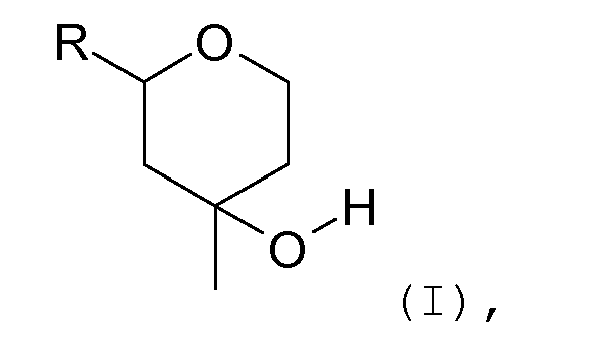
the process comprising reacting a compound of formula (III)
with a compound of formula (IV)
- The invention includes all isomers of the compounds of formula (I).
- In a preferred embodiment the compound of formula (III) is selected from the group comprising 2-ethyl-butyraldehyde and hexanal.
- The acid is preferably selected from the group comprising p-toluenesulfonic acid (PTSA), H2SO4, and supported acids, in particular acids supported on ion exchange resins or on clays. Particularly preferred supported acids are H2SO4, sulfonic acid, and ZnCl2 supported on clay, such as montmorillonite, or on an ion exchange resin. Examples of suitable supported catalysts include H2SO4 supported on ion exchange resin, marketed for example under the trade name Amberlyst® 15; sulfonic acid supported on montmorillonite, marketed under the trade name Montmorillonite KSF; and ZnCl2 supported on montmorillonite, marketed under the trade name Montmorillonite K10. The main advantage of supported acids is that they are easy to use, in particular in view of their separation from the reaction product. Furthermore, certain acids such as for example Amberlyst® 15, may be used during several cycles before a loss of activity appears.
- Supported acids are advantageously used in an amount of 5 to 50 %, preferably 10 to 30 %, and even more preferably about 10 % by weight of the weight of compound (III).
- Non-supported acids, such as p-toluenesulfonic acid (PTSA) and H2SO4 are advantageously used in an amount of 1 to 10 %, preferably 2 to 5 %, and even more preferably about 5 % by weight of the weight of compound (III)
- The acid may also be a halogenated carboxylic acid or a mixture of a carboxylic acid and a halogenated carboxylic acid. A preferred carboxylic acid is acetic acid and a preferred halogenated carboxylic acid is trifluoroacetic acid. When used as a mixture, the molar ratio of carboxylic acid /halogenated carboxylic acid, in particular of acetic acid /trifluoroacetic acid is comprised between 0:100 and 99:1, preferably between 50:50 and 95:5 and even more preferably, the molar ratio is about 85:15. The main advantage of using a mixture of a carboxylic acid and halogenated carboxylic acid, instead of the sole halogenated carboxylic acid, is the reduction of costs. The more halogenated carboxylic acid is replaced by a carboxylic acid, the more the process is interesting from an economic point of view.
- When the acid is a halogenated carboxylic acid or a mixture of a carboxylic acid and a halogenated carboxylic acid, the process of the invention further comprises a step of saponification, so as to obtain a pyranol of formula (I).
- In an advantageous aspect of the invention, the reaction of compounds (III) and (IV) is carried out during 1 to 48 hours, preferably 1 to 8 hours, and even more preferably about 2 hours.
- The process of the invention allows the preparation of compounds of formula (I) in good yields. Preferred compounds of formula (I) are those wherein R is selected from the group consisting of 1-pentyl, 2-pentyl, 3-pentyl (1-ethyl-propyl), 1-(2-methyl-butyl), 2-(2-methyl-butyl), 2-(3-methyl-butyl), 1-(3-methyl-butyl), and 1-(2,2-dimethyl)-propyl. Novel compounds of formula (Ia). Particularly preferred compounds of formula (I) are 2-(1-ethyl-propyl)-4-methyl-tetrahydro-2H-pyran-4-ol, and 2-(1-pentyl)-4-methyl-tetrahydro-2H-pyran-4-ol.
- In a variant of the process of the invention, the process further comprises a step of reacting the compound of formula (I) with
an acid anhydride of formula (V)
R'-O-R' (V),
or
an acyl halogenide of formula (VI)
R'-X (VI),
wherein R' is a carbonyl group substituted with a hydrogen or a linear or branched C1-C6 alkyl group or a linear or branched C2-C6 alkenyl group, so as to obtain a compound of formula (Ia)
- Preferably R' is selected from the group consisting of acetyl, propionyl, crotonyl (but-2-enoyl), 2-methyl-but-2-enoyl, butyryl, iso-butyryl, 2-methyl-butyryl, valeryl, iso-valeryl, 2-methyl-valeryl, 3-methyl-valeryl, hexenoyl, hex-3-enoyl.
- Preferred compounds of formula (Ia) are 2-(1-ethyl-propyl)-4-methyl-tetrahydro-2H-pyran-4-yl acetate, propionic acid 2-(1-ethyl-propyl)-4-methyl-tetrahydro-2H-pyran-4-yl ester, but-2-enoic acid 2-(1-ethyl-propyl)-4-methyl-tetrahydro-2H-pyran-4-yl ester, but-3-enoic acid 2-(1-ethyl-propyl)-4-methyl-tetrahydro-2H-pyran-4-yl ester, and 4-methyl-2-(1-pentyl)-tetrahydro-2H-pyran-4-yl acetate.
- The esterification is carried out according to methods known in the art.
- The process according to the invention may comprise between the cyclisation and the esterification a purification step of the compound of formula (I). However, the esterification may also be carried out with the crude pyranol of formula (I). The intermediate purification is particularly advantageous if the reaction mixture contains by-products which are difficult to separate from the final ester, but which may be more easily separated from the pyranol of formula (I).
- In another aspect of the invention, the process further comprises dehydrating the compound of formula (I) so as to obtain a compound of formula (II)

- The dehydration is advantageously carried out in a solvent selected from the group consisting of toluene, xylene, trimethylbenzene, cyclohexane, and methylcyclohexane. It is preferably carried out in the same solvent as the preparation of compound (I). The reaction is carried out at a temperature of about 70°C to reflux, preferably at refluxing temperature.
- In still another aspect of the invention the process comprises, after dehydrating the compound of (I) so as to obtain a compound of formula (II), a step of hydrogenating compound (II) so as to obtain the corresponding 4-methyltetrahydropyran of formula (II')

- The hydrogenation is carried out according to any suitable hydrogenation method known in the art. A suitable method is hydrogenation in the presence of Pd (palladium) on charcoal.
- The invention is also directed to compounds of formulae (II) and (II')

and the dotted lines represent a double bond involving the carbon atom at the 4 position. Compounds of formula (II) are hence
- Compounds of formula (IIa), (IIb), and (IIc) include those wherein R is selected from the group consisting of 1-pentyl, 2-pentyl, 3-pentyl (1-ethyl-propyl), 1-(2-methylbutyl), 2-(2-methyl-butyl), 2-(3-methyl-butyl), 1-(3-methylbutyl), and 1-(2,2-dimethyl)-propyl.
- Preferred compounds of formula (II) are selected among 4-methylene-2-(3-pentyl)-tetrahydro-2H-pyran, 4-methyl-2-(3-pentyl)-5,6-dihydro-2H-pyran, 4-methyl-2-(3-pentyl)-3,6-dihydro-2H-pyran, 4-methylene-2-(1-pentyl)-tetrahydro-2H-pyran, 4-methyl-2-(1-pentyl)-5,6-dihydro-2H-pyran, 4-methyl-2-(1-pentyl)-3,6-dihydro-2H-pyran.
- Selected novel compounds of formulae (I) and (Ia) are another object of the invention. Novel compounds of formula (I)

- Novel compounds of formula (Ia)

- The compounds of the invention exhibit interesting olfactive properties. Particularly, in comparison to Florol (2-isobutyl-4-methyl-tetrahydro-2H-pyran-4-ol), even though 2-(1-ethyl-propyl)-4-methyl-tetrahydro-2H-pyran-4-ol shows a less intensive starting odour, the note lasts longer, and blends very well in floral composition to enhance (boost) other top note compounds. The compounds of the invention are therefore of particular interest in the field of perfumery.
- A further object of the invention is thus the use of a compound of formula (I), wherein R is selected from the group consisting of 3-pentyl (1-ethyl-propyl), 1-(2-methyl-butyl), 2-(2-methyl-butyl), 2-(3-methyl-butyl), 1-(3-methyl-butyl), and 1-(2,2-dimethyl)-propyl; of formula (Ia), wherein R is selected from the group consisting of 1-pentyl, 3-pentyl, 1-(2-methyl-butyl), 2-(2-methyl-butyl), 2-(3-methyl-butyl), 1-(3-methyl-butyl), and 1-(2,2-dimethyl)-propyl and R' is a carbonyl group substituted with a hydrogen atom or a linear or branched C1-C6 alkyl group or a linear or branched C2-C6 alkenyl group; of formula (II), wherein R is linear or branched C5 alkyl, and the dotted lines represent a double bond involving the carbon atom at the 4 position; or of formula (II'), wherein R is linear or branched C5 alkyl, in the field of perfumery, for the preparation of perfumed bases and concentrates, fragrances, perfumes; topic compositions; cosmetic compositions, such as face and body creams, cleansers, facial treatments, talc powders, hair oils, shampoos, hair lotions, bath oils and salts, shower and bath gels, soaps, body anti-perspirants and deodorizers, pre-shave, shaving and post-shave creams and lotions, creams, toothpastes, mouth baths, pomades; and cleaning products, such as softeners, detergents, air deodorizers and household cleaning supplies.
- The invention is also directed to the use of a compound of formula (I), wherein R is selected from the group consisting of 3-pentyl (1-ethyl-propyl), 1-(2-methyl-butyl), 2-(2-methyl-butyl), 2-(3-methyl-butyl), 1-(3-methyl-butyl), and 1-(2,2-dimethyl)-propyl; of formula (Ia), wherein R is selected from the group consisting of 1-pentyl, 3-pentyl, 1-(2-methyl-butyl), 2-(2-methyl-butyl), 2-(3-methyl-butyl), 1-(3-methyl-butyl), and 1-(2,2-dimethyl)-propyl and R' is a carbonyl group substituted with a hydrogen atom or a linear or branched C1-C6 alkyl group or a linear or branched C2-C6 alkenyl group; of formula (II), wherein R is linear or branched C5 alkyl, and the dotted lines represent a double bond involving the carbon atom at the 4 position; or of formula (II'), wherein R is linear or branched C5 alkyl, as flavouring agent for the preparation of foodstuffs, drinks, and tobacco. The foodstuffs and drinks are preferably selected from the group consisting of dairy products, ice creams, soups, sauces, dips, dishes, meat products, culinary assistances, salted biscuits, snacks, soft drinks, beers, wines and spirits.
The invention is also directed to the use of a compound of formula (I), wherein R is selected from the group consisting of 3-pentyl (1-ethyl-propyl), 1-(2-methyl-butyl), 2-(2-methylbutyl), 2-(3-methyl-butyl), 1-(3-methyl-butyl), and 1-(2,2-dimethyl)-propyl; of formula (Ia), wherein R is selected from the group consisting of 1-pentyl, 3-pentyl, 1-(2-methylbutyl), 2-(2-methyl-butyl), 2-(3-methyl-butyl), 1-(3-methylbutyl), and 1-(2,2-dimethyl)-propyl and R' is a carbonyl group substituted with a hydrogen atom or a linear or branched C1-C6 alkyl group or a linear or branched C2-C6 alkenyl group; of formula (II), wherein R is linear or branched C5 alkyl, and the dotted lines represent a double bond involving the carbon atom at the 4 position; or of formula (II'), wherein R is linear or branched C5 alkyl, as masking agent of odours and/or flavours, e.g. in pharmaceutical, cosmetic or food compositions. - The invention also provides the use of a compound of formula (I), wherein R is selected from the group consisting of 3-pentyl (1-ethyl-propyl), 1-(2-methyl-butyl), 2-(2-methylbutyl), 2-(3-methyl-butyl), 1-(3-methyl-butyl), and 1-(2,2-dimethyl)-propyl; of formula (Ia), wherein R is selected from the group consisting of 1-pentyl, 3-pentyl, 1-(2-methylbutyl), 2-(2-methyl-butyl), 2-(3-methyl-butyl), 1-(3-methylbutyl), and 1-(2,2-dimethyl)-propyl and R' is a carbonyl group substituted with a hydrogen atom or a linear or branched C1-C6 alkyl group or a linear or branched C2-C6 alkenyl group; of formula (II), wherein R is linear or branched C5 alkyl, and the dotted lines represent a double bond involving the carbon atom at the 4 position; or of formula (II'), wherein R is linear or branched C5 alkyl, in combination with other perfuming or flavouring ingredients, solvents or additives or fixatives.
- The compounds of the invention may be used in a concentration comprised in a range from 0.001% to 99% in weight, preferably from 0.1% to 50% in weight, more preferably from 0.1% to 30% in weight. It is known by the man skilled in the art that these values depend on the nature of the composition/article to be perfumed and/or flavoured, the desired intensity of the perfume and/or flavour, and of the nature of the other ingredients present in said composition or article. According to a preferred embodiment of the invention, compounds are used in an olfactory effective amount.
- The terms "fragrance" and "fragrant", as used herein, are used interchangeably whenever a compound or a mixture of compounds is referred to, which is intended to pleasantly stimulate the sense of smell.
- The terms "flavour" and "flavouring", as used herein, are used interchangeably whenever a compound or a mixture of compounds is referred to, which is intended to stimulate the sense of taste and smell. Also in the meaning of the invention, the term "flavouring" relates to the flavouring of any liquid or solid, human or animal, in particular of drinks, dairy products, ice creams, soups, sauces, dips, dishes, meat products, culinary assistances, salted biscuits or snacks. It also means the flavouring of beers, wines and tobaccos.
- The term "olfactory effective amount", as used herein, means a level or amount of fragrant/flavouring compound present in a material at which the incorporated compound exhibits a sensory effect.
- By the term "masking" is meant reducing or eliminating malodour or bad flavour perception generated by one or more molecules entering in the composition of a product.
- The term "isomer", in the present invention, means molecules having the same chemical formula, which means same number and types of atoms, but in which the atoms are arranged differently. The term "isomer" includes structural isomers, geometric isomers, optical isomers and stereoisomers. It particularly includes the cis/trans isomers of the compounds of formulae (I) and (Ia), the cis isomer being the one where R and the hydroxyl group are both on the same side of the cycle and the trans configuration being the one where R and the hydroxyl group are on a different side of the cycle.
- The term "linear or branched C5 alkyl group" comprises all alkyl groups having five carbon atoms. Linear C5 alkyl is 1-pentyl. Branched C5 alkyl groups are 2-pentyl, 3-pentyl, 1-(2-methyl-butyl), 2-(2-methyl-butyl), 2-(3-methyl-butyl), 1-(3-methyl-butyl), and 1-(2,2-dimethyl)-propyl.
- The present invention will be better understood with reference to the following examples. These examples are intended to representative of specific embodiments of the invention, and are not intended as limiting the scope of the invention.
- A 2M solution of 2-ethyl-butyraldehyde (1 eq.) and 3-methyl-3-buten-1-ol (1 eq.) in toluene with 10% weight of Montmorillonite K10 is heated under reflux or at 80°C for 2 hours. After cooling down, the mixture is filtered on a frit and the solvents are evaporated. The crude mixture is then distilled with a Vigreux column under reduced pressure. To get a purer compound, a fine distillation with a packed column can be also performed.
- The results are summarised in the table below.
Conditions Temp. of reaction : reflux Temp. of reaction : 80°C Temp. of reaction : 80°C 2-ethyl-butyraldehyde : 200g (2 mol) 2-ethyl-butyraldehyde : 21g (0.21 mol) 2-ethyl-butyraldehyde : 100g (1 mol) 385g crude product (Pyrans 33%, pyranols 51%, ethers 9%) Crude yield (pyranols) = 53% 37.6g crude product (Pyrans 11 %, pyranols 67%, ethers 15%) Crude yield (pyranols) = 64% 205g crude product (Pyrans 15%, pyranols 58%, ethers 18%) Crude yield (pyranols) = 64% Fractions Bp Mass / Product(s) Bp Mass / Product(s) Bp Mass / Product(s) 80 g 5g Pyrans 8.6g Pyrans I 77-80°C / Pyrans → 68°C / (54%) → 60°C / (54%) 1 kPa (90% 800 Pa 667 Pa purity) Pyranols (35,7%) Pyranols (35,7%) 79g 85-100°C / Pyrans 75-90°C / 18.2g 96-98°C / 87g II 1 kPa (26%) 667 Pa Pyranols (93% 667 Pa Pyranols (95% Pyranols purity) purity) (67%) 5.2g 7.5g 104g Pyranols Pyranols 105°C / Pyranols 105°C / (41%) 109-115°C (73%) III 800 Pa (90%; 667 Pa Pyranyl / 667 Pa Pyranyl purity ethers ethers (54%) (22%) - The 2-(1-ethyl-propyl)-4-methyl-tetrahydro-pyran-4-ol thus obtained is usually a 50:50 mixture of cis/trans isomers.
- Odour: Top notes: Green, floral, Lily of the valley, rosy, Rose oxide.
Dried down notes: Lily of the valley, lemony, musky. - Tenacity on the blotter: 48 hours; more than Rose oxide.
- 1H-NMR (200MHz, CDCl3): δ (ppm) 0.86 (t, J = 7.1 Hz, 6H); 1.18-1.74 (m, 9H); 1.25 (s, 3H); 3.58 (ddd, J = 2.4 Hz, J = 5.2 Hz,J = 11.3 Hz, 1H); 3.71 (dt, J = 2.5 Hz, J = 11.9 Hz, 1H); 3.75-3.90 (m, 1H).
13C-NMR (50MHz, CDCl3): δ (ppm) 11.50 & 11.55; 21.46; 32.01; 38.86; 41.11; 45.65; 63.80; 68.06; 74.40.
MS [e/m (%)]: 186 (M+), 115 (41), 97 (10), 71 (97), 69 (86), 58 (19), 55 (17), 43 (100), 41 (25). - 1H-NMR (200MHz, CDCl3): δ (ppm) 0.86 (t, J = 7.1 Hz, 6H); 1.18-1.74 (m, 9H); 1.31 (s, 3H); 3.24 (ddd, J = 2.1Hz, J = 5Hz, J = 11.4Hz, 1H); 3.38 (dt, J = 3Hz, J = 12Hz, 1H); 3.95 (ddd, J = 1.9Hz, J = 5Hz, J = 11.9Hz, 1H).
13C-NMR (50MHz, CDCl3): δ (ppm) 11.44 & 44.59; 21.58; 25.39; 40.81; 42.91; 45.71; 65.55; 69.27; 77.02.
MS [e/m (%)]: 186 (M+), 115 (34), 71 (87), 69 (71), 58 (13), 55 (15), 43 (100), 41 (23). - The compound is prepared by treating 2-ethylbutyraldehyde and 3-methyl-3-buten-1-ol with a 2 molar equivalent 85:15 mixture of acetic acid / trifluoroacetic acid. The resulting mixture is then treated by KOH in refluxing ethanol to give the pyranol.
- Characterization: as Example 1.
- Method A: The compound is prepared by dehydration of the corresponding pyranol (Example 1) in the presence of catalytic amount of PTSA in refluxing toluene, using a Dean-Stark apparatus.
- Method B: The compound is also directly prepared by refluxing a toluene solution of 2-ethylbutyraldehyde (1 mol) and 3-methyl-3-buten-1-ol with catalytic amount of an acid. After completion of the reaction, the reaction mixture is cooled down, washed with saturated aqueous sodium bicarbonate solution and with brine. The organic phase is dried over magnesium sulphate and filtrated. The solvents are evaporated and the crude product is purified by distillation. The different results for method B are summarised in the table below.
Entry [Ald.] (mol.l-1) Alcohol Acid Time Bp Recovered mass Purity Isomers ratio (a:b:c) Yield 1 2M 2 mol PTSA (5% weight) 3.5 hrs 105-108°C / 4,4 kPa 90.5g 91% 60:17:23 51% 2 2M 2 mol PTSA (5% weight) 3.5 hrs 73-75°C / 800 Pa 132g 83% 54:18:2 8 65% 3 3M 2 mol PTSA (5% weight) 12 days 74°C / 800 Pa 89g 89% 5:21:79 45% 4 3M 1.5 mol H2SO4 (5% weight) 2 days 78°C / 800 Pa 82g 84% 3:13:94 41% 5 3M 1 mol H2SO4 (2% weight) 2 days 92°C / 2,0 kPa 67g 98% 9:18:73 40% 6(*) 1M 1.2 mol PTSA (2% weight) 1 day 94-96°C / 2,3 kPa 116g 88% 3:21:76 61% (*) The 3-methyl-3-buten-1-ol is added dropwise to the refluxing solution of aldehyde with acid. - The recovered product consists in a mixture of isomers (II-Aa ), ( II-Ab ) and (II-Ac).
- Fine distillation with a packed column gives very enriched fractions of the different pyrans a, b or c. Especially a and c are obtained as pure compounds.
- IR (film, cm-1): 887m, 1061m, 1095 s, 1112m, 1379m, 1462m, 1654m, 2846m, 2875s, 2936s, 2962s.
- 1H-NMR (500MHz, CDCl3) : δ (ppm) 0.85 (t, J = 7.5 Hz, 3H); 0.86 (t, J = 7.4 Hz, 3H); 1.18-1.52 (m, 5H); 2.01 (t, J = 12.2 Hz, 1H); 2.09 (dd br, J = 0.8 Hz, J = 13.3 Hz, 1H); 2.15 (d br, J = 13.1 Hz, 1H); 2.25 (dt, J = 5.6 Hz, J = 12.8 Hz, 1H); 3.16 (ddd, J = 2.2 Hz, J = 5.5 Hz, J = 11.2 Hz, 1H); 3.30 (ddd, J = 2.5 Hz, J = 10.5 Hz, J = 11.5 Hz, 1H); 4.04 (dd, J = 5.6 Hz, J = 10.8 Hz, 1H); 4.68 (s, 2H).
13C-NMR (125MHz, CDCl3) : δ (ppm) 11.4; 21.4 & 21.5; 35.4; 37.8; 45.8; 68.9; 80.5; 108.1; 145.4.
MS [e/m (%)]: 168 (M+, 4), 97(100), 96(30), 69(19), 68(21), 67(54), 55(16), 53(16), 43(16), 41(28). - 1H-NMR (500MHz, CDCl3): δ (ppm) 0.87 (d, J = 7.5 Hz, 3H) ; 0.87 (t, J = 6.0 Hz, 3H); 1.18-1.52 (m, 5H); 1.67 (s, 3H); 1.79 (dt, J = 5.5 Hz, J = 13.1 Hz, 1H); 2.16-2.24 (m, 1H); 3.55 (dt, J = 3.6 Hz, J = 10.9 Hz, 1H); 3.96 (ddd, J = 1.3 Hz, J = 5.9 Hz, J = 11.1 Hz, 1H); 4.0-41 (m, 1H); 5.28 (s, 1H).
13C-NMR (125MHz, CDCl3): δ (ppm) 12.0 & 12.1; 21.9 & 22.3; 23.2; 30.2; 46.2; 64.0; 75.5; 122.7; 132.7.
MS [e/m (%)]: 168 (M+, 1), 97(100), 43(12), 41(16). - 1H-NMR (500MHz, CDCl3): δ (ppm) 0.87 (t, J = 7.5 Hz, 6H); 1.2-1.28 (m, 1H); 1.27-1.35 (m, 1H); 1.35-1.47 (m, 1H); 1.45-1.55 (m, 2H); 1,68 (s, 3H); 1.71-1.78 (m, 1H); 1.97-1.06 (m, 1H);
3. 38 (ddd, J = 3. 3 Hz, J = 6.1 Hz, J = 10.0 Hz, 1H) ; 4.11 (q, J = 15.8 Hz, 2H); 5,39 (m, 1H).
13C-NMR (125MHz, CDCl3): δ (ppm) 11.2 & 11.3; 21.2 & 21.3; 23.1; 32.9; 45.6; 66.2; 75.4; 119.6; 132.2.
MS [e/m (%)]: 168 (M+, 5), 124(9), 97(62), 71(17), 69(100), 68(48), 67(32), 55(27), 53(17), 43(40), 41(50). - The compound is prepared by reacting the corresponding pyranol (Example 1) with acetic anhydride at 60°C for 2-3 hours. The excess acetic anhydride and acetic acid are then removed by distillation under reduced pressure. The so obtained product is diluted in t-butyl methyl ether and the solution is washed with water, with saturated aqueous sodium bicarbonate solution and with brine. After drying over magnesium sulphate, the solvent is removed by evaporation.
The crude product is purified by distillation to give 2-(1-ethyl-propyl)-4-methyl-tetrahydro-2H-pyran-4-yl acetate as a mixture of isomers.
Bp = 72°C / 0.51 torr.
IR (film, cm-1): 1020m, 1083m, 1109m, 1144m, 1236s, 1369m, 1464m, 1736s, 2877m, 2935m, 2964s. - 1H-NMR (200MHz, CDCl3) : δ (ppm) 0.86 (t, J = 7.2 Hz, 6H); 1.10-1.65 (m, 7H); 1.61 (s, 3H); 1.86 (dt, J = 5.3 Hz, J = 12.9 Hz, 2H); 1.7-2.3 (m, 2H); 2.01 (s, 3H); 3.35-3.50 (m, 1H); 3.58 (ddd, J = 2.1 Hz, J = 11.7 Hz, J = 12.5 Hz, 1H); 3.82 (ddd, J = 1.2 Hz, J = 5.4 Hz, J = 11.7 Hz, 1H).
13C-NMR (50MHz, CDCl3) : δ (ppm) 11.41 & 11.59; 21.56 & 21.65; 21.63; 22.30; 36.50; 38.35; 45.48; 63.61; 74.25; 79.51; 170.39.
MS [e/m (%)]: 228 (M+), 97 (100), 69 (12), 55 (6), 43 (34), 41 (13). - 1H-NMR (200MHz, CDCl3) : δ (ppm) 0.86 (t, J = 7.2 Hz, 6H); 1.10-1.65 (m, 7H); 1.51 (s, 3H); 1.7-2.3 (m, 2H); 1.97 (s, 3H); 3.29 (ddd, J = 1.6 Hz, J = 4.6 Hz, J = 11.9 Hz, 1H); 3.35-3.50 (m, 1H); 3.93 (ddd, J = 1.7 Hz, J = 5.2 Hz, J = 12.1 Hz, 1H).
13C-NMR (50MHz, CDCl3) : δ (ppm) 11.49 & 11.56; 21.51; 22.48; 26.39; 37.82; 39.85; 45.73; 64.74; 76.06; 80.55; 170.27.
MS [e/m (%)]: idem 1st isomer. - Propionic acid 2-(1-ethyl-propyl)-4-methyl-tetrahydro-pyran-4-yl ester was prepared from the corresponding pyranol (Example 1 or 2) and propionic anhydride according to example 4. It is obtained as a 55:45 mixture of isomers.
IR (film, cm-1): 1003w, 1082m, 1109m, 1142m, 1195s, 1257w, 1358w, 1379m, 1464m, 1734s, 2877m, 2938m, 2964s. - 1H-NMR (200 MHz, CDCl3): δ (ppm) 0.85 (t, J = 7.3 Hz, 6H) ; 1.11 (t, J = 7.2 Hz, 3H) ; 1.15-1.48 (m, 5H); 1.48-1.60 (m, 2H); 1.50 (s, 3H); 1.95-2.05 (m, 1H); 2.15-2.37 (m, 4H); 3.35-3.55 (m, 2H); 3.82 (ddd, 1H, J = 1.1 Hz, J = 5.5 Hz, J = 11.7 Hz).
13C-NMR (50 MHz, CDCl3): δ (ppm) 9.38; 11.37 & 11.58; 21.51; 26.44; 28.86; 36.54; 38.31; 45.45; 63.64; 74.17; 79.17; 173.66.
MS [e/m (%)]: 242 (M+), 169 (2), 168 (2), 153 (2), 140 (5), 97 (100), 69 (15), 57 (17), 43 (43), 41 (13). - 1H-NMR (200 MHz, CDCl3, selected data): δ (ppm) 1.07 (t, J = 7.0 Hz, 3H); 1.61 (s, 3H); 1.82 (dt, J = 5.2 Hz, J = 12.7 Hz, 2H); 2.05-2.15 (m, 2H); 2.15-2.3 (m, 1H) ; 3.22-3.5 (m, 1H) ; 3.55-3.65 (m, 1H) ; 3.93 (ddd, 1H, J = 1.5 Hz, J = 5.1 Hz, J = 11.8 Hz).
13C-NMR (50 MHz, CDCl3): δ (ppm) 9.12; 11.46 & 11.53; 21.47 & 21.61; 21.69; 28.71; 37.86; 39.86; 45.71; 64.75; 76.05; 80.24; 173.66.
MS [e/m (%)]: idem major isomer. - The esters are prepared from the corresponding pyranol (Example 1 or 2) and crotonic anhydride according to example 4. They are obtained as a 80:20 mixture of isomers and can be separated by fine distillation.
- IR (film, cm-1): 970m, 997m, 1060w, 1083m, 1104m, 1142m, 1188s, 1255m, 1295m, 1315m, 1379m, 1446m, 1462m, 1657m, 1717s, 2876m, 2935m, 2963s.
- The compound is obtained as a 95:5 E/Z mixture of enantiomers (ratio of cis/trans isomers: 50:50).
- 1H-NMR (200 MHz, CDCl3): δ (ppm) 0.84 (t, J = 7.2 Hz, 6H); 1.10-1.67 (m, 7H);1.52 (s, 3H); 1.85 (dd, J = 1.7 Hz, J = 6.9 Hz, 3H); 1.97-2.13 (m, 1H); 2.13-2.32 (m, 1H); 3.35-3.52 (m, 1H); 3.59 (dt, J = 2.0 Hz, J = 12.5 Hz, 1H); 3.81 (dd, 1H, J = 4.7 Hz, J = 11.6 Hz); 5.79 (qd, J = 1.6 Hz, J = 15.5 Hz, 1H); 6.88 (qd, J = 6.9 Hz, J = 15.4 Hz, 1H).
13C-NMR (50 MHz, CDCl3): δ (ppm) 11.38 & 11.59; 17.81; 21.51 (2C); 26.48; 36.57; 38.46; 45.46; 63.62; 74.19; 79.17; 124.11; 143.63; 165.61. - 1H-NMR (200 MHz, CDCl3): δ (ppm) 0.85 (t, J = 7.2 Hz, 6H); 1.10-1.55 (m, 6H);1.64 (s, 3H); 1.83 (dd, J = 1.7 Hz, J = 6.9 Hz, 3H); 1.76-1.96 (m, 1H); 1.98-2.15 (m, 2H); 3.30 (ddd, J = 1.5 Hz, J = 4.5 Hz, J = 11.9 Hz, 1H); 3.44 (dt, J = 2.3 Hz, J = 12.4 Hz, 1H); 3.93 (ddd, J = 1.5 Hz, J = 5.2 Hz, J = 11.9 Hz, 1H); 5.75 (qd, J = 1.5 Hz, J = 15.4 Hz, 1H); 6.86 (qd, J = 6.9 Hz, J = 15.5 Hz, 1H).
13C-NMR (50 MHz, CDCl3): δ (ppm) 11.47 & 11.54; 17.74; 21.48 & 21.62; 21.71; 31.90; 39.87; 45.71; 64.74; 76.04; 80.26; 124.20; 143.56; 165.62. - MS [e/m (%)]: (isomer 1 (Z or E)) 254 (M+, <1), 168 (2), 153 (2), 140 (6), 97 (100), 69 (34), 55 (6), 43 (13), 41 (21).
MS [e/m (%)]: (isomer 2 (Z or E)) 254 (M+, <1), 97 (100), 69 (33), 55 (5), 43 (12), 41 (17). - The compound is obtained as a 20:80 mixture of enantiomers.
- 1H-NMR (200 MHz, CDCl3): δ (ppm) 0.84 (t, 6H, J=7.2Hz) ; 1.10-1.25 (m, 3H); 1.25-1.70 (m, 3H); 1.50 (s, 3H); 1.94 (d, 1H, J=7.3Hz); 2.0-2.35 (m, 2H); 3.04 (td, 2H, J=1.4Hz, J=7.1Hz); 5.07-5.12 (m, 1H); 5.15-5.22 (m, 1H); 5.80-6.02 (m, 1H).
13C-NMR (50 MHz, CDCl3): δ (ppm) 11.35 & 11.53; 21.47; 26.38; 36.44; 38.23; 40.58; 45.40; 63.54; 74.05; 79.89; 118.37; 130.56; 170.58.
MS [e/m (%)]: 254 (M+, <1), 163 (13), 97 (100), 69 (53), 55 (8), 43 (15), 41 (32). - 1H-NMR (200 MHz, CDCl3): δ (ppm) 0.85 (t, J = 7.2 Hz, 6H); 1.10-1.55 (m, 6H);1.61 (s, 3H); 1.76-1.96 (m, 1H); 1.98-2.31 (m, 2H); 3.0 (td, J = 1.4 Hz, J = 7.0 Hz, 2H); 3.22-3.40 (m, 1H); 3.40-3.52 (m, 1H); 3.87-3.99 (m, 1H); 5.05-5.21 (m, 2H); 5.80-6.02 (m, 1H).
13C-NMR (50 MHz, CDCl3): δ (ppm) 11.44 & 11.53; 21.60 & 21.66; 26.48; 37.78; 39.79; 40.32; 45.68; 64.71; 76.03; 80.94; 118.16; 130.62; 170.60.
MS [e/m (%)]: idem minor. - The compound is prepared by hydrogenation, in the presence of Pd on charcoal, of the corresponding mixture of pyrans (Example 3).
It consists in a mixture of two diastereoisomers: cis/trans (72:28).
Bp = 76-78°C / 1.5 kPa. - 1H-NMR (CDCl3, 200MHz): δ (ppm) 0.80-0.95 (m, 9H); 1.10-1.70 (m, 9H); 3.18 (ddd, 1H, J = 1.2 Hz, J = 3.28 Hz, J = 11.1 Hz); 3.35 (td, 1H, J = 2.1 Hz, J = 11.8 Hz); 3.97 (ddd, 1H, J = 1.2 Hz, J = 4.5 Hz, J = 11.3 Hz).
13C-NMR (CDCl3, 50MHz): δ (ppm) 11.64, 21.67 & 21.76, 22.57, 30.67, 35.04, 36.98, 46.14, 68.32, 79.30. - 1H-NMR (CDCl3, 200MHz, selected data): δ (ppm) 1.04 (d, 3H, J = 7.1 Hz); 1.65-1.90 (m, 2H); 1.92-2.12 (m, 1H); 3.40-3.95 (m, 3H).
13C-NMR (CDCl3, 50MHz): δ (ppm) 11.24 & 11.27, 18.44, 21.29 & 21.47, 25.02, 32.33, 34.10, 44.47, 62.92, 73.55.
IR (film, cm-1): 1082s, 1097s, 1174m, 1458m, 2840s, 2874s, 2928s, 2959s.
MS [e/m (%)]: (cis) 170(M+), 169(1), 99(100), 81(15), 55(22), 43(35), 41(16).
MS [e/m (%)]: (trans) ibid. - The compound is prepared from hexanal and 3-methyl-3-buten-1-ol according to example 1. It is obtained as a mixture of isomers.
- IR (film, cm-1): 1087m, 1111s, 1173m, 1259m, 1378m, 1463m, 2861s, 2933s, 2958s, 3431m (br).
- 1H-NMR (200MHz, CDCl3): δ (ppm) 0.85 (t, J = 6.4 Hz, 3H); 1.2-1.8 (m, 12H); 1.21 (s, 3H); 3.39 (dt, J = 2.9 Hz, J = 12.0 Hz, 1H); 3.50-3.65 (m, 1H); 3.75-3.87 (m, 1H).
13C-NMR (50MHz, CDCl3): δ (ppm) 13.99; 22.56; 25.14; 31.76; 31.89; 36.14; 38.71; 44.63; 63.56; 67.82; 72.92.
MS [e/m (%)]: 186 (M+), 115 (28), 112 (23), 97 (21), 83 (22), 71 (90), 69 (71), 58 (31), 55 (26), 43 (100), 41 (31). - 1H-NMR (200MHz, CDCl3, selected data): δ (ppm) 1.29 (s, 3H); 3.17-3.32 (m, 1H); 3.72 (dt, J = 2.4 Hz, J = 11.5 Hz, 1H); 3.93 (ddd, J = 1.8 Hz, J = 5.0 Hz, J = 11.9 Hz, 1H).
13C-NMR (50MHz, CDCl3): δ (ppm) 13.99; 22.56; 25.17; 25.38; 31.83; 36.30; 40.63; 46.57; 65.35; 68.82; 75.87.
MS [e/m (%)]: 186 (M+), 115 (38), 71 (92), 69 (68), 58 (25), 55 (20), 43 (100), 41 (27). - A (4:33:63) mixture of 4-methylene-2-pentyl-tetrahydro-pyran ( II-Ba ), 4-methyl-6-pentyl-3,6-dihydro-2H-pyran ( II-Bb ) and 4-methyl-2-pentyl-3,6-dihydro-2H-pyran ( II-Bc ) is obtained from 3-methyl-3-buten-1-ol and hexanal according to example 3 (Method B, specific conditions according to entry 6). The isomers can be separated by fine distillation.
- IR (film, cm-1): 1110m, 1140m, 1381m, 1457m, 2858m, 2931s, 2959s.
- 1H-NMR (200MHz, CDCl3, selected data): δ (ppm) 4.69 (m, 2H). 13C-NMR (50MHz, CDCl3, selected data): δ (ppm) 68.65, 78.83, 108.1.
- 1H-NMR (200MHz, CDCl3): δ (ppm) 0.87 (t, J = 6.3 Hz, 3H), 1.2-1.6 (m, 8H), 1.67 (br s, 3H), 2.0-2.4 (m, 2H), 3.59 (ddd, J = 4.0 Hz, J = 10.1 Hz, J = 11.2 Hz, 1H), 3.97 (ddd, J = 2.3 Hz, J = 5.9 Hz, J = 11.1 Hz, 2H), 5.28-5.34 (m, 1H).
13C-NMR (50MHz, CDCl3): δ (ppm) 14.03, 23.12, 25.03, 30.10, 31.95, 35.67, 35.92, 63.51, 74.03, 124.16, 132.01. - 1H-NMR (200MHz, CDCl3): δ (ppm) 0.88 (t, J = 6.3 Hz, 3H), 1.2-1.6 (m, 8H), 1.67 (br s, 3H), 1.65-2.0 (m, 2H), 3.32-3.51 (m, 1H), 4.05-4.15 (m, 2H), 5.34-5.43 (m, 1H).
13C-NMR (50MHz, CDCl3): δ (ppm) 14.03, 22.61, 22.96, 25.16, 31.91, 395.92 (2C), 65.86, 73.78, 119.71, 131.81. - MS [e/m (%)]: (II-Ba) 168 (M+, 2), 97 (100), 68 (35), 67 (81), 55 (21), 53 (19), 41 (29).
(II-Bb) 168 (M+), 167 (1), 153 (3), 112 (12), 97 (100), 55 (10), 43 (14), 41 (21).
(II-Bc) 168 (M+, 12), 99 (17), 97 (44), 71 (40), 69 (79), 68 (100), 67 (61), 56 (18), 55 (38), 53 (26), 43 (29), 41 (67), 39 (23). - The compound is prepared by treating the corresponding pyranol (example 8) with acetic anhydride, according to example 4.
It is obtained as a 80:20 mixture of isomers. - IR (film, cm-1): 606w, 808w, 940w, 1019m, 1045w, 1087m, 1112m, 1145m, 1183m, 1203w, 1238s, 1369m, 1437w, 1462m, 1737s, 2861m, 2932s, 2957s.
- 1H-NMR (200MHz, CDCl3): δ (ppm) 0.84 (t, J = 6.5 Hz, 3H) ; 1.08-1.60 (m, 10H) ; 1.45 (s, 3H) ; 1.98 (s, 3H), 2.07-2.25 (m, 2H) ; 3.33-3.48 (m, 1H) ; 3.56 (dt, J = 2.0 Hz, J = 12.5 Hz, 1H) ; 3.70-3.80 (m, H).
13C-NMR (50MHz, CDCl3): δ (ppm) 19.95; 22.24; 22.51; 25.05; 26.13; 31.86; 35.96; 36.20; 42.02; 63.31; 72.72; 79.18; 170.29. - 1H-NMR (200MHz, CDCl3, selected data): δ (ppm) 1.60-1.70 (m, 1H); 1.75-1.90 (m, 1H); 1.93 (s, 3H); 3.77-3.83 (m, 1H).
13C-NMR (50MHz, CDCl3): δ (ppm) 19.95; 22.24; 22.51; 25.11; 31.71; 31.86; 36.14; 38.69; 44.62; 63.54; 72.84; 79.97; 170.16. - A Lily of the valley type accord is prepared from the following ingredients:
A B NERYL ACETATE 30 30 BENZYL ACETATE 10 10 CITRONELLYL ACETATE 16 16 GERANYL ACETATE 50 50 STYRALLYL ACETATE 5 5 BENZYLIQUE ALCOOL 30 30 PHENYLETHYL ALCOOL 50 50 STYRALLIQUE ALCOOL 3 3 HEXYLCINNAMIQUE ALDEHYDE 90 90 CYCLAMEN ALDEHYDE 17 17 PEONILE 67 67 CASSIS BASE 345F 25 25 CITRONELLOL PUR BBA 60 60 DIHYDROMYRCENOL 50 50 DIMETOL 12 12 ETHYL LINALOL 25 25 PENTALIDE 12 12 METHYL DIHYDROJASMONATE 50 50 HELIONAL 50 50 LILIAL 70 70 MUSC T 10 10 ORANGE TERPENES 10 10 TERPINEOL BI RECTIFIE 25 25 VERDENOL 8 8 AMBRETTOLIDE 2 2 EUCALYPTOL 1 1 HELIOTROPINE 3 3 HEXENOL CIS 3 3 3 LINALOL 16 16 DPG 0 200 Pyranol (Example 1) 200 0 TOTAL 1000 1000 - These 2 compositions (A, B), containing (A) or not (B) the pyranol from example 1, were used in a textile softener at usual dilution, known to the person of the art. The addition of the pyranol in formula A increases considerably the tenacity of the perfume on dried textiles. It brings a more floral-green note, very natural, imparting a fresher sensation to the textile.
- A Lily of the valley type accord, respecting hypoallergenic constraints, is prepared from the following ingredients:
PHENYLETHYL ALCOOL PURISSIME 180 DIMETHYLPHENYLETHYLCARBINOL 26 METHYL DIHYDROJASMONATE 490 INDOL 3 IONONE ALPHA 10 TERPINEOL DROIT CRISTALLISE VMF 15 HEXYL ACETATE 4 ALDEHYDE C12 LAURIQUE 10% TEC 2 HEXENYL CIS 3 ACETATE 1 STYRALLYL ACETATE 1 FLORHYDRAL 3 CITRONELLYLOXYACETALDEHYDE 5 FLORALOZONE 5 PHENYLACETIQUE GLYCEROACETAL 7 UNDECAVERTOL 2 VELOUTONE 1 POLYSANTOL 3 CINNAMYL ACETATE 2 PHENYLETHYL ACETATE 3 INDOLAROME 1 DUPICAL 5 DPG 131 Pyranol (Example 1) 100 TOTAL 1000 - Adding the pyranol to the formula brings power to the fragrance and confers to the accord a nice greener, floral, Lily of the valley note.
Claims (15)
- A process of preparing a compound of formula (I)


with a compound of formula (IV)
- The process according to Claim 1, characterized in that the acid is selected from the group comprising p-toluene sulfonic acid (PTSA), H2SO4, and supported acids, in particular acids supported on ion exchange resins or on clays.
- Process according to claim 1 or 2, characterized in that the compound of formula (III) is selected from the group comprising 2-ethyl-butyraldehyde and hexanal.
- The process according to any of Claims 1 to 3, characterized in that it further comprises a step of reacting the compound of formula (I) with
an acid anhydride of formula (V)
R'-O-R' (V),
or
an acyl halogenide of formula (VI)
R'-X (VI),
wherein R' is a carbonyl group substituted with a hydrogen atom or a linear or branched C1-C6 alkyl group or linear or branched C2-C6 alkenyl group, so as to obtain a compound of formula (Ia)
- Process according to claim 4, characterized in that R' is selected from the group consisting of acetyl, propionyl, crotonyl (but-2-enoyl), 2-methyl-but-2-enoyl, butyryl, iso-butyryl, 2-methyl-butyryl, valeryl, iso-valeryl, 2-methyl-valeryl, 3-methyl-valeryl, hexenoyl, hex-3-enoyl.
- The process according to any of Claims 1 to 3, characterized in that it further comprises dehydrating the compound of formula (I) so as to obtain a compound of formula (II)

- The process according to Claim 6, characterized in that it further comprises a step of hydrogenating the compound of formula (II) so as to obtain a compound of formula (II')

- Compound of formula

and the dotted lines represent a double bond involving the carbon atom at the 4 position. - Compound according to claim 8, characterized in that it is selected from the group consisting of 4-methylene-2-(3-pentyl)-tetrahydro-2H-pyran, 4-methyl-2-(3-pentyl)-5,6-dihydro-2H-pyran, 4-methyl-2-(3-pentyl)-3,6-dihydro-2H-pyran, 4-methylene-2-(1-pentyl)-tetrahydro-2H-pyran, 4-methyl-2-(1-pentyl)-5,6-dihydro-2H-pyran, and 4-methyl-2-(1-pentyl)-3,6-dihydro-2H-pyran.
- Compounds of formula

- Compound according to claim 10, characterized in that it is selected from the group consisting of 2-(1-ethyl-propyl)-4-methyl-tetrahydro-2H-pyran-4-ol, 2-(1-ethyl-propyl)-4-methyl-tetrahydro-2H-pyran-4-yl acetate, propionic acid 2-(1-ethyl-propyl)-4-methyl-tetrahydro-2H-pyran-4-yl ester, but-2-enoic acid 2-(1-ethyl-propyl)-4-methyl-tetrahydro-2H-pyran-4-yl ester, but-3-enoic acid 2-(1-ethyl-propyl)-4-methyl-tetrahydro-2H-pyran-4-yl ester, and 4-methyl-2-(1-pentyl)-tetrahydro-2H-pyran-4-yl acetate.
- Use of a compound according to any of claims 8 to 11, as a fragrant agent or as a flavouring agent.
- Use of a compound according to any of claims 8 to 11, as a masking agent of odours and/or flavours.
- Use according to claim 12 or 13 characterized in that the compound is comprised in a composition selected from pharmaceutical, cosmetic or food compositions.
- Use according to any of claims 12 to 14 characterized in that the compound is used in combination with other perfuming or flavouring ingredients, solvents, additives or fixatives.
Priority Applications (17)
| Application Number | Priority Date | Filing Date | Title |
|---|---|---|---|
| EP08305118A EP2112144A1 (en) | 2008-04-22 | 2008-04-22 | Novel pyran derivatives, their preparation and use thereof in perfumery |
| KR1020107024929A KR101689660B1 (en) | 2008-04-22 | 2009-04-21 | Novel pyran derivatives, their preparation and use thereof in perfumery |
| JP2011505477A JP5730754B2 (en) | 2008-04-22 | 2009-04-21 | Novel pyran derivatives, their preparation and their use in perfumery production |
| BRPI0911404A BRPI0911404A2 (en) | 2008-04-22 | 2009-04-21 | PIRANE DERIVATIVES, THEIR PREPARATION AND USE IN PERFUMERY |
| EP09735534.1A EP2280949B1 (en) | 2008-04-22 | 2009-04-21 | Novel pyran derivatives, their preparation and use thereof in perfumery |
| CN2009801199630A CN102046614A (en) | 2008-04-22 | 2009-04-21 | Novel pyran derivatives, their preparation and their use in the process of making incense |
| RU2010147360/04A RU2577250C2 (en) | 2008-04-22 | 2009-04-21 | Novel pyrane derivatives, thereof obtaining and application in perfumery |
| PL09735534T PL2280949T3 (en) | 2008-04-22 | 2009-04-21 | Novel pyran derivatives, their preparation and use thereof in perfumery |
| CN201610286309.0A CN106008430B (en) | 2008-04-22 | 2009-04-21 | Novel pyran derivate, its preparation and its purposes in the fragrant technique of system |
| US12/988,704 US9593092B2 (en) | 2008-04-22 | 2009-04-21 | Pyran derivatives, their preparation and use thereof in perfumery |
| MX2010011589A MX2010011589A (en) | 2008-04-22 | 2009-04-21 | Novel pyran derivatives, their preparation and use thereof in perfumery. |
| ES09735534.1T ES2496671T3 (en) | 2008-04-22 | 2009-04-21 | New derivatives of pyrano, its preparation and its use in perfumery |
| PCT/EP2009/054691 WO2009130192A1 (en) | 2008-04-22 | 2009-04-21 | Novel pyran derivatives, their preparation and use thereof in perfumery |
| DK09735534.1T DK2280949T3 (en) | 2008-04-22 | 2009-04-21 | Newly known pyran derivatives, their preparation and use in perfumery |
| ZA2010/07481A ZA201007481B (en) | 2008-04-22 | 2010-10-20 | Novel pyran derivatives, their preparation and uses thereof in perfumery |
| JP2014176349A JP2015028035A (en) | 2008-04-22 | 2014-08-29 | Novel pyran derivatives, their preparation and use thereof in perfumery |
| US15/448,006 US10040776B2 (en) | 2008-04-22 | 2017-03-02 | Pyran derivatives and their preparation |
Applications Claiming Priority (1)
| Application Number | Priority Date | Filing Date | Title |
|---|---|---|---|
| EP08305118A EP2112144A1 (en) | 2008-04-22 | 2008-04-22 | Novel pyran derivatives, their preparation and use thereof in perfumery |
Publications (1)
| Publication Number | Publication Date |
|---|---|
| EP2112144A1 true EP2112144A1 (en) | 2009-10-28 |
Family
ID=39739720
Family Applications (2)
| Application Number | Title | Priority Date | Filing Date |
|---|---|---|---|
| EP08305118A Withdrawn EP2112144A1 (en) | 2008-04-22 | 2008-04-22 | Novel pyran derivatives, their preparation and use thereof in perfumery |
| EP09735534.1A Active EP2280949B1 (en) | 2008-04-22 | 2009-04-21 | Novel pyran derivatives, their preparation and use thereof in perfumery |
Family Applications After (1)
| Application Number | Title | Priority Date | Filing Date |
|---|---|---|---|
| EP09735534.1A Active EP2280949B1 (en) | 2008-04-22 | 2009-04-21 | Novel pyran derivatives, their preparation and use thereof in perfumery |
Country Status (13)
| Country | Link |
|---|---|
| US (2) | US9593092B2 (en) |
| EP (2) | EP2112144A1 (en) |
| JP (2) | JP5730754B2 (en) |
| KR (1) | KR101689660B1 (en) |
| CN (2) | CN106008430B (en) |
| BR (1) | BRPI0911404A2 (en) |
| DK (1) | DK2280949T3 (en) |
| ES (1) | ES2496671T3 (en) |
| MX (1) | MX2010011589A (en) |
| PL (1) | PL2280949T3 (en) |
| RU (1) | RU2577250C2 (en) |
| WO (1) | WO2009130192A1 (en) |
| ZA (1) | ZA201007481B (en) |
Cited By (3)
| Publication number | Priority date | Publication date | Assignee | Title |
|---|---|---|---|---|
| EP3572487A1 (en) * | 2018-05-25 | 2019-11-27 | Basf Se | 2-furyl- and 2-thienyl-substituted di- and tetrahydropyrans for use as aroma chemicals |
| WO2020089134A1 (en) | 2018-10-29 | 2020-05-07 | Basf Se | Preparation of 2-substituted 4-methyl-tetrahydropyrans from 2-substituted 4-hydroxy-4-methyl-tetrahydropyrans as starting materials |
| EP3666763A1 (en) * | 2018-12-13 | 2020-06-17 | Givaudan SA | (2s,4r)-4-methyl-2-(2-methylbut-1-en-1-yl)tetrahydro-2h-pyranen as fragrance ingredient |
Families Citing this family (12)
| Publication number | Priority date | Publication date | Assignee | Title |
|---|---|---|---|---|
| EP2112144A1 (en) * | 2008-04-22 | 2009-10-28 | V. Mane Fils | Novel pyran derivatives, their preparation and use thereof in perfumery |
| ES2660768T3 (en) * | 2010-05-27 | 2018-03-26 | Basf Se | Procedure for the preparation of tetrahydropyranols substituted in position 2 |
| WO2011154330A1 (en) * | 2010-06-10 | 2011-12-15 | Basf Se | Process for the preparation and isolation of 2-substituted tetrahydropyranols |
| CN104918926B9 (en) * | 2013-02-12 | 2017-07-11 | 弗门尼舍有限公司 | Pyran as floral odorant |
| MX379427B (en) * | 2013-04-29 | 2025-03-11 | Basf Se | Method for producing 2-substituted 4-hydroxy-4-methyl-tetrahydropyrans in a reactor cascade |
| EP3207033A1 (en) * | 2014-10-18 | 2017-08-23 | S. H. Kelkar&Company Pvt. Ltd. | Synthesis of chirally enriched 2,4-disubstituted tetrahydropyran-4-ol and its derivatives |
| CN104370867B (en) * | 2014-11-21 | 2017-03-15 | 山东新和成药业有限公司 | A kind of preparation method of 4 methyl 2 (2 methyl-propyl) 4 alcohol of 2H Pentamethylene oxide .s of spice |
| ES2833366T3 (en) | 2015-03-05 | 2021-06-15 | Basf Se | Procedure for the preparation of tetrahydropyranylesters |
| JP7159980B2 (en) * | 2019-06-03 | 2022-10-25 | 株式会社豊田自動織機 | supercharging system |
| EP3838895A1 (en) * | 2019-12-16 | 2021-06-23 | Basf Se | Substituted 4-methylene-tetrahydropyrans, 4-methyl-dihydropyrans and 4-methyl-tetrahydropyrans and use thereof as aroma chemicals |
| CN115974647B (en) * | 2022-12-05 | 2024-09-03 | 江苏宏邦化工科技有限公司 | Method for preparing cola amyl alcohol by taking tetrahydro-4-methyl-2-phenyl-2H-pyran-4-alcohol as raw material |
| EP4731617A1 (en) * | 2023-06-20 | 2026-04-29 | Basf Se | Use of dihydropyran derivatives as aroma chemicals |
Citations (8)
| Publication number | Priority date | Publication date | Assignee | Title |
|---|---|---|---|---|
| US3681263A (en) | 1968-02-23 | 1972-08-01 | Naarden Chem Fab | Process for the preparation of perfume compositions or perfumed articles respectively |
| CH655932A5 (en) | 1983-02-24 | 1986-05-30 | Firmenich & Cie | Pyran derivatives, process for their preparation and their use for the preparation of aliphatic alcohols |
| EP0383446A2 (en) * | 1989-02-09 | 1990-08-22 | INTERNATIONAL FLAVORS & FRAGRANCES INC. | 2,4,4-Trisubstituted tetrahydropyranyl esters and organoleptic uses thereof |
| US4962090A (en) | 1990-03-22 | 1990-10-09 | International Flavors & Fragrances Inc. | 2,4-disubstituted and 2,2,4-trisubstituted tetrahydropyranyl-4-ethers, process for preparing same and perfumery uses thereof |
| EP0770670A2 (en) * | 1995-10-13 | 1997-05-02 | Takasago International Corporation | Perfume composition containing (4R)-cis-4-methyl-2-substituted-tetrahydro-2H-pyran derivative and method for improving fragrance by using it |
| WO2004009749A1 (en) | 2002-07-20 | 2004-01-29 | Givaudan Sa | Fragrance composition |
| EP1493737A1 (en) * | 2003-07-04 | 2005-01-05 | Kao Corporation | Process for producing a pyran compound |
| JP2007154069A (en) * | 2005-12-06 | 2007-06-21 | T Hasegawa Co Ltd | Perfume ingredients and method for producing the same |
Family Cites Families (8)
| Publication number | Priority date | Publication date | Assignee | Title |
|---|---|---|---|---|
| US2452977A (en) * | 1944-12-28 | 1948-11-02 | Shell Dev | Production of cyclic ethers |
| US3414588A (en) * | 1964-01-29 | 1968-12-03 | Mobil Oil Corp | Condensation of aldehydes with unsaturated compounds |
| JPS5320507B2 (en) * | 1972-12-22 | 1978-06-27 | ||
| JPS5225776A (en) * | 1975-08-20 | 1977-02-25 | Kuraray Co Ltd | Preparation of 2,4-disubstituted 6-membered cyclic ethers |
| JPS59155378A (en) * | 1983-02-21 | 1984-09-04 | T Hasegawa Co Ltd | 2,2,6-trimethyl-3-hydroxy-6-vinyltetrahydropyran esters |
| JP4515083B2 (en) * | 2003-07-04 | 2010-07-28 | 花王株式会社 | Process for the preparation of pyran and hydroxypyran mixtures |
| JP2005179270A (en) * | 2003-12-19 | 2005-07-07 | Kao Corp | Method for producing pyran compounds |
| EP2112144A1 (en) * | 2008-04-22 | 2009-10-28 | V. Mane Fils | Novel pyran derivatives, their preparation and use thereof in perfumery |
-
2008
- 2008-04-22 EP EP08305118A patent/EP2112144A1/en not_active Withdrawn
-
2009
- 2009-04-21 WO PCT/EP2009/054691 patent/WO2009130192A1/en not_active Ceased
- 2009-04-21 JP JP2011505477A patent/JP5730754B2/en active Active
- 2009-04-21 CN CN201610286309.0A patent/CN106008430B/en active Active
- 2009-04-21 RU RU2010147360/04A patent/RU2577250C2/en active
- 2009-04-21 CN CN2009801199630A patent/CN102046614A/en active Pending
- 2009-04-21 EP EP09735534.1A patent/EP2280949B1/en active Active
- 2009-04-21 DK DK09735534.1T patent/DK2280949T3/en active
- 2009-04-21 US US12/988,704 patent/US9593092B2/en active Active
- 2009-04-21 MX MX2010011589A patent/MX2010011589A/en active IP Right Grant
- 2009-04-21 ES ES09735534.1T patent/ES2496671T3/en active Active
- 2009-04-21 BR BRPI0911404A patent/BRPI0911404A2/en not_active Application Discontinuation
- 2009-04-21 PL PL09735534T patent/PL2280949T3/en unknown
- 2009-04-21 KR KR1020107024929A patent/KR101689660B1/en active Active
-
2010
- 2010-10-20 ZA ZA2010/07481A patent/ZA201007481B/en unknown
-
2014
- 2014-08-29 JP JP2014176349A patent/JP2015028035A/en active Pending
-
2017
- 2017-03-02 US US15/448,006 patent/US10040776B2/en active Active
Patent Citations (9)
| Publication number | Priority date | Publication date | Assignee | Title |
|---|---|---|---|---|
| US3681263A (en) | 1968-02-23 | 1972-08-01 | Naarden Chem Fab | Process for the preparation of perfume compositions or perfumed articles respectively |
| CH655932A5 (en) | 1983-02-24 | 1986-05-30 | Firmenich & Cie | Pyran derivatives, process for their preparation and their use for the preparation of aliphatic alcohols |
| EP0383446A2 (en) * | 1989-02-09 | 1990-08-22 | INTERNATIONAL FLAVORS & FRAGRANCES INC. | 2,4,4-Trisubstituted tetrahydropyranyl esters and organoleptic uses thereof |
| US4963285A (en) | 1989-02-09 | 1990-10-16 | International Flavors & Fragrances Inc. | 2,4,4-irisubstituted tetrahydro pyranyl esters and organoleptic uses thereof |
| US4962090A (en) | 1990-03-22 | 1990-10-09 | International Flavors & Fragrances Inc. | 2,4-disubstituted and 2,2,4-trisubstituted tetrahydropyranyl-4-ethers, process for preparing same and perfumery uses thereof |
| EP0770670A2 (en) * | 1995-10-13 | 1997-05-02 | Takasago International Corporation | Perfume composition containing (4R)-cis-4-methyl-2-substituted-tetrahydro-2H-pyran derivative and method for improving fragrance by using it |
| WO2004009749A1 (en) | 2002-07-20 | 2004-01-29 | Givaudan Sa | Fragrance composition |
| EP1493737A1 (en) * | 2003-07-04 | 2005-01-05 | Kao Corporation | Process for producing a pyran compound |
| JP2007154069A (en) * | 2005-12-06 | 2007-06-21 | T Hasegawa Co Ltd | Perfume ingredients and method for producing the same |
Non-Patent Citations (1)
| Title |
|---|
| DATABASE CA [online] CHEMICAL ABSTRACTS SERVICE, COLUMBUS, OHIO, US; XP002496269, retrieved from STN Database accession no. 1986:478239 * |
Cited By (8)
| Publication number | Priority date | Publication date | Assignee | Title |
|---|---|---|---|---|
| EP3572487A1 (en) * | 2018-05-25 | 2019-11-27 | Basf Se | 2-furyl- and 2-thienyl-substituted di- and tetrahydropyrans for use as aroma chemicals |
| WO2019224373A1 (en) * | 2018-05-25 | 2019-11-28 | Basf Se | 2-furyl- and 2-thienyl-substituted di- and tetrahydropyrans for use as aroma chemicals |
| CN112204122A (en) * | 2018-05-25 | 2021-01-08 | 巴斯夫欧洲公司 | 2-Furyl- and 2-thienyl-substituted dihydropyrans and tetrahydropyrans for use as aroma chemicals |
| US11993760B2 (en) | 2018-05-25 | 2024-05-28 | Basf Se | 2-furyl- and 2-thienyl-substituted di- and tetrahydropyrans for use as aroma chemicals |
| WO2020089134A1 (en) | 2018-10-29 | 2020-05-07 | Basf Se | Preparation of 2-substituted 4-methyl-tetrahydropyrans from 2-substituted 4-hydroxy-4-methyl-tetrahydropyrans as starting materials |
| CN112955440A (en) * | 2018-10-29 | 2021-06-11 | 巴斯夫欧洲公司 | Preparation of 2-substituted 4-methyltetrahydropyrans starting from 2-substituted 4-hydroxy-4-methyltetrahydropyrans |
| EP3666763A1 (en) * | 2018-12-13 | 2020-06-17 | Givaudan SA | (2s,4r)-4-methyl-2-(2-methylbut-1-en-1-yl)tetrahydro-2h-pyranen as fragrance ingredient |
| WO2020120643A1 (en) * | 2018-12-13 | 2020-06-18 | Givaudan Sa | Improvement in or relating to organic compounds |
Also Published As
| Publication number | Publication date |
|---|---|
| JP2015028035A (en) | 2015-02-12 |
| CN106008430B (en) | 2019-03-19 |
| WO2009130192A1 (en) | 2009-10-29 |
| EP2280949A1 (en) | 2011-02-09 |
| US20170174647A1 (en) | 2017-06-22 |
| ES2496671T3 (en) | 2014-09-19 |
| MX2010011589A (en) | 2011-01-21 |
| US9593092B2 (en) | 2017-03-14 |
| PL2280949T3 (en) | 2014-10-31 |
| RU2010147360A (en) | 2012-05-27 |
| RU2577250C2 (en) | 2016-03-10 |
| KR20110007606A (en) | 2011-01-24 |
| BRPI0911404A2 (en) | 2017-08-22 |
| KR101689660B1 (en) | 2016-12-26 |
| EP2280949B1 (en) | 2014-05-07 |
| ZA201007481B (en) | 2011-06-29 |
| CN106008430A (en) | 2016-10-12 |
| DK2280949T3 (en) | 2014-07-21 |
| JP2011522781A (en) | 2011-08-04 |
| JP5730754B2 (en) | 2015-06-10 |
| US10040776B2 (en) | 2018-08-07 |
| CN102046614A (en) | 2011-05-04 |
| US20110097296A1 (en) | 2011-04-28 |
Similar Documents
| Publication | Publication Date | Title |
|---|---|---|
| EP2280949B1 (en) | Novel pyran derivatives, their preparation and use thereof in perfumery | |
| JP7189285B2 (en) | fragrance substance | |
| CN109310602B (en) | spice material | |
| CN102884034A (en) | Compound with wood fragrance | |
| EP2125767B1 (en) | Pyran derivatives, process of preparation and use thereof in perfumery and flavouring | |
| US20090263336A1 (en) | Novel pyran derivatives and their preparation | |
| CN111689940A (en) | Hexamethyloctahydro bridged methyleneazulene dioxoles | |
| CN113025426A (en) | 1-isopropoxy-1-oxopropan-2-yl pivalate as perfuming ingredient | |
| EP1927593A1 (en) | Pyran derivates, process of preparation and use thereof in perfumery and flavouring | |
| EP1523542B1 (en) | Fragrance composition | |
| EP2904078B1 (en) | Flavor and fragrance formulation (vi) | |
| EP3707120B1 (en) | Aldehydes for use as odorants | |
| JP2014530262A (en) | Incense acetal | |
| US7875737B2 (en) | Pyran derivatives, process of preparation and use thereof in perfumery and flavouring | |
| EP2209389B1 (en) | Bicyclic campholenic derivatives | |
| EP4423054A1 (en) | Alicyclic aliphatic 1,3-dicarbonyl derivatives useful as fragrances | |
| CN105272833A (en) | Novel cyclohexanols and their use in perfume compositions | |
| HK1154570A (en) | Novel pyran derivatives, their preparation and use thereof in perfumery | |
| EP2168941A1 (en) | Novel Glycolate derivatives |
Legal Events
| Date | Code | Title | Description |
|---|---|---|---|
| PUAI | Public reference made under article 153(3) epc to a published international application that has entered the european phase |
Free format text: ORIGINAL CODE: 0009012 |
|
| AK | Designated contracting states |
Kind code of ref document: A1 Designated state(s): AT BE BG CH CY CZ DE DK EE ES FI FR GB GR HR HU IE IS IT LI LT LU LV MC MT NL NO PL PT RO SE SI SK TR |
|
| AX | Request for extension of the european patent |
Extension state: AL BA MK RS |
|
| STAA | Information on the status of an ep patent application or granted ep patent |
Free format text: STATUS: THE APPLICATION IS DEEMED TO BE WITHDRAWN |
|
| 18D | Application deemed to be withdrawn |
Effective date: 20100429 |