EP2110808B1 - A coding method, an encoder and a computer readable medium - Google Patents
A coding method, an encoder and a computer readable medium Download PDFInfo
- Publication number
- EP2110808B1 EP2110808B1 EP08800868A EP08800868A EP2110808B1 EP 2110808 B1 EP2110808 B1 EP 2110808B1 EP 08800868 A EP08800868 A EP 08800868A EP 08800868 A EP08800868 A EP 08800868A EP 2110808 B1 EP2110808 B1 EP 2110808B1
- Authority
- EP
- European Patent Office
- Prior art keywords
- search
- codebook
- pulses
- type
- input signal
- Prior art date
- Legal status (The legal status is an assumption and is not a legal conclusion. Google has not performed a legal analysis and makes no representation as to the accuracy of the status listed.)
- Active
Links
Images


Classifications
-
- G—PHYSICS
- G10—MUSICAL INSTRUMENTS; ACOUSTICS
- G10L—SPEECH ANALYSIS TECHNIQUES OR SPEECH SYNTHESIS; SPEECH RECOGNITION; SPEECH OR VOICE PROCESSING TECHNIQUES; SPEECH OR AUDIO CODING OR DECODING
- G10L19/00—Speech or audio signals analysis-synthesis techniques for redundancy reduction, e.g. in vocoders; Coding or decoding of speech or audio signals, using source filter models or psychoacoustic analysis
- G10L19/04—Speech or audio signals analysis-synthesis techniques for redundancy reduction, e.g. in vocoders; Coding or decoding of speech or audio signals, using source filter models or psychoacoustic analysis using predictive techniques
- G10L19/16—Vocoder architecture
- G10L19/18—Vocoders using multiple modes
- G10L19/24—Variable rate codecs, e.g. for generating different qualities using a scalable representation such as hierarchical encoding or layered encoding
-
- G—PHYSICS
- G10—MUSICAL INSTRUMENTS; ACOUSTICS
- G10L—SPEECH ANALYSIS TECHNIQUES OR SPEECH SYNTHESIS; SPEECH RECOGNITION; SPEECH OR VOICE PROCESSING TECHNIQUES; SPEECH OR AUDIO CODING OR DECODING
- G10L19/00—Speech or audio signals analysis-synthesis techniques for redundancy reduction, e.g. in vocoders; Coding or decoding of speech or audio signals, using source filter models or psychoacoustic analysis
- G10L2019/0001—Codebooks
- G10L2019/0013—Codebook search algorithms
Definitions
- the present invention relates to a vector coding technology, and more particularly to a coding method, an encoder, and a computer readable medium.
- a commonly used fixed codebook is an algebraic codebook.
- the algebraic codebook focuses on pulse positions of target signals, and sets the pulse amplitude to 1 by default, so that only the symbols and positions of the pulses need to be quantified. Certainly, multiple pulses may be superposed at the same position to denote different amplitudes.
- the algebraic codebook is employed for quantization coding, it is important to search positions of pulses in the optimal algebraic codebook corresponding to the target signal.
- Table 1 Track Positions T0 0,4,8.12,16,20.24,28,32,36,40.44,48,52,56,60 T1 1, 5, 9, 13, 17, 21, 25, 29, 33, 37, 41, 45, 49, 53, 57, 61 T2 2,6.10.14,18,22.26,30,34,38,42,46.50,54,58,62 T3 3, 7, 11, 15, 19, 23, 27, 31, 35, 39, 43, 47, 51, 55, 59, 63
- T0 to “T3” are four tracks, and “Positions” are position numbers on each track. It is known from Table 1, 64 positions are divided into 4 tracks, each track has 16 positions, and pulse positions on the four tracks are staggered, so as to ensure various combinations of the pulse positions to the maximum.
- the pulses to be searched on T0 to T3 are respectively P0 to P3.
- two pulses on two adjacent tracks are searched at a time, for example, T0-T1, T1-T2, T2-T3, and T3-T0, so that a final optimal codebook vector is obtained through a four-level search.
- FIG. 1 The detailed process is shown in FIG. 1 , which includes the following steps.
- a first level search is performed on T0-T1 and T2-T3. Firstly, positions of P0 and P1 are searched on T0-T1, in which P0 is searched from 4 positions among 16 positions on the track T0 the 4 positions are determined by extreme values of known reference signals on the track, and P1 is searched from 16 positions on the track T1. Optimal positions of P0 and P1 are determined from the searched 4 ⁇ 16 position combinations according to a set evaluation criterion (for example, a cost function Qk).
- a set evaluation criterion for example, a cost function Qk
- the positions of P2 and P3 are searched on T2-T3, in which P2 is searched from 8 positions among 16 positions on the track T2, the 8 positions are determined by extreme values of known reference signals on the track, and P3 is searched from 16 positions on the track T3, so that the optimal positions of P2 and P3 are determined.
- the search process on this level is completed.
- a second level search is performed on T1-T2 and T3-T0, which is similar to the first level search.
- a third level search is performed on T2-T3 and T0-T1 and a fourth level search is performed on T3-T0 and T1-T2 similarly.
- an optimal new codebook vector is selected, for example, a new codebook vector having a maximum Qk value of the cost function is selected. The maximum Qk value and the corresponding new codebook vector are recoded, for example, ⁇ 4, 33, 42, 7 ⁇ .
- the initial codebook vector here is still the original initial codebook vector, i.e., ⁇ 20, 33, 42, 7 ⁇
- the initial value 33 of P1 is sequentially replaced by other positions on the track T1, which is similar to the process in 1), so as to obtain a maximum Qk value and a corresponding new codebook vector, for example, ⁇ 20, 21, 42, 7 ⁇ through the replacement.
- a maximum value is selected from the obtained four maximum Qk values as a global optimal value, and the corresponding codebook vector, for example, ⁇ 20, 21, 42, 7 ⁇ , serves as an optimal codebook vector for the search of this round.
- the codebook search algorithms used in various existing coding technologies it is difficult for the codebook search algorithms used in various existing coding technologies to meet the requirements for computation complexity and performance. For example, though the depth-first tree search algorithm obtains a desired speech quality under various code rates, the search times are large, and the computation complexity is high. Besides, though the global pulse replacement algorithm has a low computation complexity, a local maximum value may occur, so that the performance is unstable, that is, the algorithm may achieve a good quality under certain signal conditions, but may fail to achieve an desirable quality under other signal conditions.
- various embodiments of the present invention provide a coding method, an encoder, and a computer readable medium capable of lowering computation complexity while improving system performance.
- the present invention relates to a coding method, an encoder and a computer readable storage medium according the independent claims.
- the coding method or device adopts different codebook search algorithms according to varied types of input signals.
- an appropriate search algorithm may be selected according to characteristics of the input signal, certain types of signals for which satisfactory results may be obtained through simple computations may match with search algorithms suitable for these signal types and having low computation complexities, so as to achieve better performance with fewer system resources. Meanwhile, other types of signals that need complicated computations may be processed by more sophisticated search algorithms, thereby ensuring the coding quality.
- CN 1 760 975 A describes a searching method of fixing up codebook quickly for enhanced AMR encoder, including: presetting a correlation coefficient threshold ⁇ 0 ; calculating a correlation coefficient ⁇ between the current sub-frame and the previous sub-frame; comparing the correlation coefficient ⁇ with the correlation coefficient threshold ⁇ 0 ; if ⁇ > ⁇ 0 , the improved pulse replacement algorithm is applied for conducting the codebook search for the current sub-frame, and if ⁇ 0 , the depth first tree search algorithm is applied in the AMR codec for conducting the codebook search for the current sub-frame.
- US 2007/0136054 A1 describes an apparatus and method of searching for a fixed codebook, the apparatus and method selecting an initial fixed codebook appropriate for a speech feature using a pulse replacement method, and determining a pulse replacement number ,a threshold value, etc., to thereby improve sound quality and reduce an amount of unnecessary calculation.
- FIG. 1 is a schematic view of a depth-first tree search procedure in the prior art
- FIG. 2 is a flow chart of a coding method according to an embodiment of the present invention.
- FIG. 3 is a schematic view of a logic structure of an encoder according to an embodiment of the present invention.
- FIG. 4 is a flow chart of a codebook search algorithm according to a first embodiment of the present invention.
- FIG. 5 is a flow chart of a codebook search algorithm according to a second embodiment of the present invention.
- FIG. 6 is a flow chart of a codebook search algorithm according to a third embodiment of the present invention.
- FIG. 7 is a flow chart of a codebook search algorithm according to a fourth embodiment of the present invention.
- FIG. 8 is a flow chart of a codebook search algorithm according to a fifth embodiment of the present invention.
- a coding method is provided in an embodiment of the present invention, which is capable of selecting different codebook search algorithms according to varied types of input signals.
- An encoder using the coding method is also provided in an embodiment of the present invention. The method and the device of the embodiments of the present invention will be respectively described in detail below.
- the coding method in an embodiment of the present invention includes the following blocks.
- the input signal for coding may be a residual signal after adaptive filtering based on a CELP model as well as other similar speech or musical tone signals applicable to vector quantization coding.
- the characteristic parameters are data adapted to describe characteristics of the input signal in certain aspects. The characteristic parameters are analyzed and extracted in frames, and the frame size may be selected according to actual requirements and signal characteristics.
- the characteristic parameters include, but are not limited to, linear prediction coefficient (LPC), linear prediction cepstrum coefficient (LPCC), pitch period coefficient, frame energy, and average zero-crossing rate.
- LPC linear prediction coefficient
- LPCC linear prediction cepstrum coefficient
- pitch period coefficient frame energy, and average zero-crossing rate.
- the type of the input signal is determined according to the characteristic parameters of the input signal.
- the input signal may be classified based on different determination manners, for example, based on different characteristic parameters or combinations of the characteristic parameters, or by setting different threshold values for the characteristic parameters, which is not limited in this embodiment and may be set according to actual requirements.
- an applicable classification mode is to determine specific characteristic parameters as references for the classification and classification criteria according to characteristics of the candidate search algorithms.
- algorithms with a low computation complexity are suitable for processing input signals with periodic characteristics, as it is relatively easy to determine the position of an optimal pulse for this type of signals, thereby effectively lowering the complexity without significantly affecting the system performance.
- algorithms with a high computation complexity are suitable for processing input signals with white noise characteristics, as it is hard to determine the position of an optimal pulse for this type of signals, so that a high quality algorithm may be used to ensure the coding quality. Therefore, characteristic parameters that reflect the periodic characteristics of the input signal may be taken as references for classification, and the type of the input signal is classified into a type with periodic characteristics and a type with white noise characteristics.
- the signal with periodic characteristics is processed by a search algorithm with a low complexity
- the signal with white noise characteristics is processed by a search algorithm with a high complexity.
- characteristic parameters that reflect other characteristics of the input signal may be adopted as auxiliary references for classification or to further subdivide the classification.
- a classification and determination method is given below as an example for illustration.
- the input signal may be classified into four different frame types, namely, an unvoiced frame, a voiced frame, a general frame, and a transition frame.
- the voiced frame and the transition frame may be integrated into one type.
- the unvoiced frame and the gcncral frame belong to the type with white noise characteristics, and the voiced frame and the transition frame belong to the type with periodic characteristics.
- the pitch period coefficient for example, average magnitude difference function (AMDF) may be employed to evaluate the periodic characteristics of the input signal, so as to preliminarily distinguish the type with periodic characteristics from the type with white noise characteristics.
- AMDF average magnitude difference function
- the average zero-crossing rate may be used independently or as an aid for determination, and generally the average zero-crossing rate of a periodic signal is smaller than that of a white noise signal.
- frame energy may be used to determine an unvoiced frame and a general frame.
- the frame energy of the unvoiced frame is lower than that of the general frame, and threshold values may be set for determination.
- the AMDF may be further analyzed to distinguish a voiced frame and a transition frame, or a subdivided value range of the average zero-crossing rate is employed for distinguishing. Certainly, if the voiced frame and the transition frame are integrated into one type, the subdivision is unnecessary.
- classification and determination method is only exemplary, and appropriate characteristic parameters and determination sequences may be selected according to actual requirements and signal characteristics. For example, a classification is first made according to the frame energy, and then a subdivision is performed with structural characteristic parameters.
- vectors to be quantified are generated according to the characteristic parameters of the input signal
- Block 3 has no logical association with Block 2 in terms of the sequence, and may be performed before/after Block 2 or together with Block 2.
- a codebook search is performed on the vectors to be quantified with a corresponding codebook search algorithm according to the determined type of the input signal.
- the codebook search algorithm is configured according to the classification of the type of the input signal, so as to meet the characteristics of the signal.
- the signal classification method based on Block 2 has the following functions.
- a codebook search algorithm having a high complexity and good performance is adapted to process the unvoiced frame signal, for example, a random codebook search algorithm or the depth-first tree search algorithm described in the background of the invention.
- a codebook search algorithm having a high complexity and good performance is adapted to process the general frame, for example, the depth-first tree search algorithm described in the background of the invention.
- a codebook search algorithm having a low complexity is adapted to process the voiced frame and/or the transition frame signal, for example, a codebook search algorithm based on pulse position replacement, particularly the global pulse replacement algorithm described in the background of the invention.
- a codebook search algorithm based on pulse position replacement particularly the global pulse replacement algorithm described in the background of the invention.
- these two frames may also be processed with different codebook search algorithms.
- a codebook search is performed on the vectors to be quantified with the determined codebook search algorithm.
- the encoder includes a characteristic parameter acquisition unit 101, a signal type determination unit 102, a vector generation unit 103, at least two codebook search units 104, and a decision unit 105.
- the characteristic parameter acquisition unit 101 is adapted to acquire characteristic parameters of an input signal.
- the signal type determination unit 102 is adapted to determine a type of the input signal according to the characteristic parameters provided by the characteristic parameter acquisition unit 101.
- the vector generation unit 103 is adapted to generate vectors to be quantified according to the characteristic parameters provided by the characteristic parameter acquisition unit 101.
- the at least two codebook search units are adapted to provide different codebook search algorithms (for example, a codebook search unit 1 provides a depth-first tree search algorithm, and a codebook search unit 2 provides a codebook search algorithm based on pulse position replacement).
- the decision unit 105 is adapted to select a corresponding codebook search algorithm (for example, a codebook search unit 104 is selected in this embodiment), and perform a codebook search on the vectors to be quantified generated by the vector generation unit 103 with the selected codebook search algorithm according to the type of the input signal determined by the signal type determination unit 102. For example, if the decision unit 105 determinates that the type of the input signal is a type with periodic characteristics, the codebook search unit 2 is selected for performing a codebook search, and if the decision unit 105 determines that the type of the input signal is a type with white noise characteristics, the codebook search unit 1 is selected for performing a codebook search.
- a codebook search algorithm for example, a codebook search unit 104 is selected in this embodiment
- the two codebook search units in this embodiment are optional, and if so, the decision unit is adapted to select a corresponding codebook search algorithm and perform a codebook search on the vectors to be quantified with the selected algorithm according to the type of the input signal determined by the signal type determination unit.
- the type of the input signal determined by the signal type determination unit 102 includes a type with periodic characteristics and a type with white noise characteristics.
- the codebook search units 104 include a first-class codebook search unit and a second-class codebook search unit, and the computation complexity of the codebook search algorithm provided by the first-class codebook search unit is lower than that of the codebook search algorithm provided by the second-class codebook search unit.
- the decision unit 105 is adapted to select the first-class codebook search unit according to the type with periodic characteristics and select the second-class codebook search unit according to the type with white noise characteristics.
- the type with white noise characteristics determined by the signal type determination unit 102 includes an unvoiced frame and a general frame, and the type with periodic characteristics determined by the same unit includes a voiced frame and/or a transition frame.
- the second-class codebook search unit in the codebook search unit 104 includes a random codebook search unit and a depth-first search unit.
- the random codebook search unit is adapted to provide a random codebook search algorithm
- the depth-first search unit is adapted to provide a depth-first tree search algorithm
- the first-class codebook search unit in the codebook search unit 104 includes a pulse replacement search unit adapted to provide a codebook search algorithm based on pulse position replacement.
- the decision unit 105 is adapted to select the depth-first search unit according to the general frame and/or the unvoiced frame, and select the pulse replacement search unit according to the voiced frame and/or the transition frame.
- the aforementioned coding method or device in the embodiment of the invention adopts different codebook search algorithms according to varied types of input signals.
- an appropriate search algorithm may be selected according to all possible structural features of the input signal, certain types of signals for satisfactory results may be obtained through simple computations may match with search algorithms suitable for these signal types and having low computation complexities, so as to achieve better performance with fewer system resources. Meanwhile, other types of signals that need complicated computations may be processed by more sophisticated search algorithms, thereby ensuring the coding quality.
- FIG. 4 shows the codebook search algorithm according to a first embodiment of the present invention, which includes the following blocks.
- a basic codebook vector is acquired.
- the basic codebook vector includes position information about N pulses on M tracks, and N, M are positive integers.
- the basic codebook vector is an initial codebook vector functioning as a base for a round of search.
- the quantity distribution of pulses to be searched on each track has been determined according to information such as the bit rates.
- a basic codebook vector is obtained, that is, an initial position of each pulse on each track is obtained.
- the initial position of each pulse may be determined in various manners, which is not limited in the codebook search algorithm of this embodiment. For example, several manners are described as follows:
- a position of the pulse on the track is randomly selected as the initial position of the pulse
- d(i) is a component of a vector signal d in each dimension determined by a target signal to be quantified, which is typically a convolution of the target signal and a pulse response of a pre-filtered weighted synthesis filter
- r LTP (i) is a long-term predicted component of a residual signal r in each dimension
- E d is the energy of the signal d
- E r is the energy of the signal r
- a is a proportional factor, which controls the dependence degree of the reference signal d(i) and varies in value with different bit rates.
- Different values of b(i) on the 64 positions may be computed, and the position with the maximum value of b(i) on T0 to T3 is selected as the initial position of the pulse.
- n pulses are selected as search pulses.
- the n pulses are a part of the N pulses, and n is a positive integer smaller than N.
- the specific implementation is: selecting n pulses from Ns pulses as search pulses, in which the Ns pulses are all of or a part of the N pulses, Ns is a positive integer smaller than or equal to N, and n is a positive integer smaller than Ns; and fixing positions of the pulses other than the n search pulses in the basic codebook vector, and replacing positions of the n search pulses with other positions on the track respectively to obtain a search codebook vector.
- the pulses that may be selected as the search pulses may be all of or just a part of the N pulses, and "the pulses that may be selected as the search pulses" form an "Ns set". In certain sense, if the N pulses include pulses that do not belong to the Ns set, the positions of these pulses are already optimal and do not need to be searched any more.
- the n search pulses may be selected from the Ns pulses in various manners, which are not limited in the codebook search algorithm of this embodiment. For example, several manners are described as follows:
- n and the combinations of the search pulses are randomly selected.
- n is determined (n ⁇ 2), and the combinations of the search pulses are randomly selected.
- corresponding positions of the n search pulses in the basic codebook vector are replaced by other positions on the track where the search pulses are located to obtain a search codebook vector.
- the selected search pulses are P2, P3 in a search process
- the positions of P0, P1 in the basic codebook vector are fixed
- the positions of P2 are respectively replaced by other positions on T2 (for example, t2 positions in total)
- the positions of P3 are respectively replaced by other positions on T3 (for example, t3 positions in total)
- the positions used for replacement on the searched track may be all positions on the track or be selected from a set range, for example, a part of the positions are selected for replacement from the searched track according to the value of a known reference signal.
- Block A3 the search process in Block A2 is performed for K times in a round, and K is a positive integer greater than or equal to 2.
- Two or more search pulses are selected in at least one search process, and the search pulses selected in each search process are not completely the same.
- the cycling times K may be an upper limit set specifically, and a round of search is completed when the search process is performed for K times.
- the embodiment of the present invention may not necessarily limit the value of K. That is, the value of K is not determined, and whether a round of search is completed is determined according to a certain search termination condition. For example, when the selected search pulses have traversed the Ns set, it is determined that a round of search is completed.
- the above two manners may also be integrated, i.e., whether a round of search is completed is determined by the fact whether a search termination condition is satisfied, and meanwhile, the search times may not exceed the set upper limit of K. If the value of K has reached the upper limit, it is considered that a round of search is completed even if the search termination condition is not satisfied.
- Specific rules may be set according to actual requirements, which is not limited in the codebook search algorithm of this embodiment.
- the codebook search algorithm in this embodiment requires that at least one of the K times of search processes is performed on two or more pulses, and the selected search pulses may be distributed on the same or different tracks.
- an optimal codebook vector of this round is selected from the basic codebook vector and the search codebook vectors according to a set evaluation criterion.
- the comparison and evaluation process of the search codebook vector and the basic codebook vector may be carried out at the same time with the search process in Block A2. For example, a "preferred codebook vector" is set and then initialized into a basic codebook vector. After that, a search codebook vector is obtained and compared with the current preferred codebook vector for evaluation. If it is determined that the search codebook vector is superior to the preferred codebook vector, the current preferred codebook vector is replaced by the search codebook vector. The above process is repeated till all K times ofsearches are completed, and the finally obtained preferred codebook vector is the optimal codebook vector of this round. It should be noted that, each search process is based on the basic codebook vector, and only the preferred codebook vector is compared and evaluated.
- the results of the K times of search processes may also be evaluated collectively. For example, the preferred codebook vector obtained after each search process is saved, and the K preferred codebook vectors are compared to select the optimal codebook vector of this round.
- the comparison and evaluation criterion for the search codebook vector and the basic codebook vector is determined according to actual requirements, which is not limited in the codebook search algorithm of this embodiment.
- a cost function (Qk) usually adapted to measure the quality of an algebraic codebook may be employed for comparison.
- Qk cost function
- FIG. 5 shows the codebook search algorithm according to a second embodiment of the present invention on the basis of the first embodiment, which includes the following blocks.
- a basic codebook vector is acquired
- the basic codebook vector includes position information about N pulses on M tracks, and N, M are positive integers.
- This block may be performed according to Block A1 in the first embodiment of the codebook search algorithm.
- the search pulses may be randomly or sequentially selected from the six combinations. In order to make the selection unrepeated each time, the search pulses may be sequentially selected according to the change rules of the combinations; or, all the combinations are saved or numbered in order, and the selected combinations (or numbers) are then deleted.
- Block B3 the search process in Block B2 is performed for K times in a round, and 2 ⁇ K ⁇ C Ns n .
- Two or more search pulses are selected in at least one of the search processes, and the search pulses selected in each search process are not completely the same.
- n As the value of n is fixed, and the combination of the search pulses selected each time is unrepeated, all the possible combinations in the Ns set may be traversed after C Ns n times of searches at the most. Certainly, the upper limit value of K may be restricted lower than C Ns n , and at this point, not all the possible combinations are traversed, but the selected search pulses may still traverse the Ns set.
- an optimal codebook vector of this round is selected from the basic codebook vector and the search codebook vectors according to a set evaluation criterion.
- This block may be performed according to Block A4 in the first embodiment of the codebook search algorithm.
- FIG. 6 shows the codebook search algorithm according to a third embodiment of the present invention, which provides a method capable of being performed repeatedly in multiple rounds based on the first and second embodiments of the codebook search algorithm.
- the method includes the following blocks.
- a basic codebook vector is acquired.
- the basic codebook vector includes position information about N pulses on M tracks, and N, M are positive integers.
- This block may be performed according to Block A1 in the first embodiment of the codebook search algorithm
- This block may be performed according to Blocks A2 to A4 in the first embodiment of the codebook search algorithm, or according to Blocks B2 to B4 in the second embodiment of the codebook search algorithm.
- the determined value of n may be the same or vary in different rounds.
- Block C3 it is determined whether a round number G for search reaches a set upper limit value of G, and if yes, Block C5 is performed; otherwise, Block C4 is performed.
- the optimal codebook vector replaces the original basic codebook vector to serve as a new basic codebook vector, and the process returns to Block C2 to continue searching for an optimal codebook vector of a new round.
- Block C5 an optimal codebook vector of this round is acquired to serve as a final optimal codebook vector.
- FIG. 7 shows the codebook search algorithm according to a fourth embodiment of the present invention, which provides another method capable of being performed repeatedly in multiple rounds based on the first and second embodiments of the codebook search algorithm.
- the method includes the following blocks.
- a basic codebook vector is acquired.
- the basic codebook vector includes position information about N pulses on M tracks, and N, M are positive integers.
- This block may be performed according to Block A1 in the first embodiment of the codebook search algorithm.
- Block D2 K times of search processes are performed in a round to obtain an optimal codebook vector of this round.
- This block may be performed according to Blocks A2 to A4 in the first embodiment of the codebook search algorithm, or according to Blocks B2 to B4 in the second embodiment of the codebook search algorithm.
- Ns N.
- Block D3 it is determined whether a round number G for search reaches a set upper limit value of G or whether the Ns set in the next round is null, and if yes, Block D5 is performed; otherwise, Block D4 is performed.
- the Ns set of each round is determined according to the search result of the previous round, and the specific implementation is shown in Block D4. If the Ns set is null, the search is considered completed. Whether the search is completed or not may also be determined according to the set upper limit value of G when the Ns set is not nulL
- the optimal codebook vector replaces the original basic codebook vector to serve as a new basic codebook vector, so as to obtain pulses in the optimal codebook vector at fixed positions and belonging to the original Ns pulses to serve as the new Ns pulses. After that, the process returns to Block D2 to continue searching for an optimal codebook vector of a new round.
- Block D5 an optimal codebook vector of this round is acquired to serve as a final optimal codebook vector.
- FIG. 8 shows the codebook search algorithm according to a fifth embodiment of the present invention, which provides a specific method for acquiring an initial basic codebook vector based on the above embodiments of the codebook search algorithm.
- the method includes the following blocks.
- Block E1 a quantity distribution of the N pulses on the M tracks is acquired.
- the total number N of the pulses to be searched and the number of the pulses distributed on each track are determined according to related information such as the bit rate.
- a concentrated search range of each track is determined according to several extreme values of a known reference signal on each track, and the concentrated search range at least includes one position on the track.
- the reference signal may adopt the pulse position maximum likelihood function b(i), compute different values of b(i) on all the pulse positions, and respectively select several positions with the maximum value of b(i) on each track as the concentrated search range of each track.
- the number of positions contained in the concentrated search range of each track may be the same or different.
- the concentrated search range of the basic codebook vector is as follows: ⁇ 0 36 32 4 , 1 33 37 5 , 34 2 38 30 , 35 3 31 39 ⁇ ,
- Block E3 a full search is performed in the M concentrated search ranges according to the quantity distribution of the N pulses, and the basic codebook vector is selected from all possible position combinations according to the set evaluation criterion.
- Block E4 K times of search processes are performed in a first round based on the basic codebook vector to obtain an optimal codebook vector of this round.
- This block may be performed according to Blocks A2 to A4 in the first embodiment of the codebook search algorithm, or according to Blocks B2 to B4 in the second embodiment of the codebook search algorithm.
- the positions on each track are divided as shown in Table 1, and the search process includes the following blocks.
- Each search is performed among 4 positions on one track and 12 positions on the other (the counted number of the positions already includes the pulse positions in the basic codebook vector, and the positions to be searched on the track are selected in a manner similar to the determination of the concentrated search range of the basic codebook vector). It is assumed that the optimal codebook vector obtained in the first round search is ⁇ 32, 33, 6, 35 ⁇ , which is obtained when the fixed pulses are P0, P1.
- Ns set of the search pulses is null, that is, all the positions of the pulses in the basic codebook vector are searched.
- the final optimal codebook vector is ⁇ 32, 33, 6, 35 ⁇ .
- the method provided in the above computation examples is applied to perform speech coding on a test sequence formed by 24 man sequences and 24 woman sequences.
- the coding result is compared with the coding result of the existing depth-first tree search procedure in terms of objective speech quality, and the speech qualities obtained by the two methods are equivalent.
- the search times required in the above method is 560, which is much smaller than the search times of 768 required in the depth-first tree search procedure.
- a replacement and search method is performed on different pulse combinations to select the optimal codebook vector, and at least one search is carried out on multiple pulses.
- the optimal codebook vector is selected through replacement from different pulse combinations, the search times are reduced while ensuring the global sense of the search to the maximum.
- the impact of the association between the pulses on the search result is considered, thus further ensuring the quality of the search result.
- the search method provided in the first or second embodiment of the codebook search algorithm may only be applied to a round of search, and other search methods are employed in the rounds before or after.
- the multi-round search method When the multi-round search method is adopted to acquire the final optimal codebook vector, the range of the Ns set is reduced according to the search result of the previous round, which effectively reduces the amount of computation. If a concentrated search method is adopted to acquire the initial basic codebook vector, a high quality basic codebook vector is obtained, and the quality of the search result is further enhanced.
- the encoder classifies the signals into unvoiced, general, voiced, and transition types, but all types of the input signals adopt a single fixed codebook search algorithm for search.
- the method of the present invention adopts a random codebook search algorithm to process the unvoiced frame, adopts a depth-first search algorithm to process the general frame, and adopts the method provided in the computation example of the codebook search algorithm of the present invention to process the voiced frame/transition frame.
- the experiment has the following conclusions by comparing processing results of different speech samples under different sampling rates:
- the weighted segmental signal-to-noise ratio parameter in the coding method of the embodiment of the present invention is higher than that of the method in the original encoder for about 0.0245 on average.
- the algorithm complexity of the coding method in the embodiment of the present invention is measured by million operations per second (MOPS), which is lower than the method in the original encoder for about 0.3185 MOPS on average.
- the perceptual evaluation of speech quality (PESQ) of the coding method in the embodiment of the present invention is lower than the method in the original encoder for about 0.03%, i.e., 0.00127 mean opinion score (MOS), which may almost be ignored.
- PESQ perceptual evaluation of speech quality
- the coding method of the embodiment of the present invention is advantageous in having a lower complexity and better system performance.
- the program is executed in the following blocks: acquiring characteristic parameters of an input signal; determining a type of the input signal according to the characteristic parameters; obtaining vectors to be quantified according to the characteristic parameters; and performing a codebook search on the vectors to be quantified with a codebook search algorithm corresponding to the determined type of the input signal.
- the program may be stored in a computer readable storage medium, such as a ROM, a RAM, a magnetic disk, or an optical disk.
Landscapes
- Engineering & Computer Science (AREA)
- Quality & Reliability (AREA)
- Computational Linguistics (AREA)
- Signal Processing (AREA)
- Health & Medical Sciences (AREA)
- Audiology, Speech & Language Pathology (AREA)
- Human Computer Interaction (AREA)
- Physics & Mathematics (AREA)
- Acoustics & Sound (AREA)
- Multimedia (AREA)
- Compression, Expansion, Code Conversion, And Decoders (AREA)
- Control Of Stepping Motors (AREA)
- Error Detection And Correction (AREA)
Abstract
Description
- The present invention relates to a vector coding technology, and more particularly to a coding method, an encoder, and a computer readable medium.
- In a coding technology based on a code excited linear prediction (CELP) model, it is a very important process to perform quantization coding on residual signals after adaptive filtering. Currently, quantization coding of the residual signals is often performed through fixed codebook searching. A commonly used fixed codebook is an algebraic codebook. The algebraic codebook focuses on pulse positions of target signals, and sets the pulse amplitude to 1 by default, so that only the symbols and positions of the pulses need to be quantified. Certainly, multiple pulses may be superposed at the same position to denote different amplitudes. When the algebraic codebook is employed for quantization coding, it is important to search positions of pulses in the optimal algebraic codebook corresponding to the target signal. Generally, during the search for optimal positions of the pulses, the computation of a full search (that is, to traverse all possible position combinations) is quite complicated, and thus a sub-optimal search algorithm is needed. On the basis of ensuring the quality of the search result, how to reduce the search times and lower down the computation complexity is the main issue to be studied and solved in the coding technology.
- Two existing sub-optimal search methods for searching pulse positions in an algebraic codebook are described as follows.
- 1. Depth-first tree search procedure
- It is assumed that the length of a speech sub-frame is 64 and a pulse number to be searched is N which changes with the code rate. With no other restrictions, the computation for searching N pulses in 64 positions is highly complicated. Therefore, the pulse positions in the algebraic codebook are restrained, and the 64 positions are divided into M tracks. A typical method for dividing the tracks is shown in Table 1.
Table 1 Track Positions T0 0,4,8.12,16,20.24,28,32,36,40.44,48,52,56,60 T1 1, 5, 9, 13, 17, 21, 25, 29, 33, 37, 41, 45, 49, 53, 57, 61 T2 2,6.10.14,18,22.26,30,34,38,42,46.50,54,58,62 T3 3, 7, 11, 15, 19, 23, 27, 31, 35, 39, 43, 47, 51, 55, 59, 63 - In Table 1, "T0" to "T3" are four tracks, and "Positions" are position numbers on each track. It is known from Table 1, 64 positions are divided into 4 tracks, each track has 16 positions, and pulse positions on the four tracks are staggered, so as to ensure various combinations of the pulse positions to the maximum.
- The N pulses to be searched are restrained on M=4 tracks based on a certain quantity distribution. For example, N=4 and one pulse is searched on each track. Other circumstances may be deduced likewise.
- It is assumed that the pulses to be searched on T0 to T3 are respectively P0 to P3. During the search, two pulses on two adjacent tracks are searched at a time, for example, T0-T1, T1-T2, T2-T3, and T3-T0, so that a final optimal codebook vector is obtained through a four-level search. The detailed process is shown in
FIG. 1 , which includes the following steps. - 1) A first level search is performed on T0-T1 and T2-T3. Firstly, positions of P0 and P1 are searched on T0-T1, in which P0 is searched from 4 positions among 16 positions on the track T0 the 4 positions are determined by extreme values of known reference signals on the track, and P1 is searched from 16 positions on the track T1. Optimal positions of P0 and P1 are determined from the searched 4×16 position combinations according to a set evaluation criterion (for example, a cost function Qk). Afterward, the positions of P2 and P3 are searched on T2-T3, in which P2 is searched from 8 positions among 16 positions on the track T2, the 8 positions are determined by extreme values of known reference signals on the track, and P3 is searched from 16 positions on the track T3, so that the optimal positions of P2 and P3 are determined. Thus, the search process on this level is completed.
- 2) A second level search is performed on T1-T2 and T3-T0, which is similar to the first level search.
- 3) A third level search is performed on T2-T3 and T0-T1 and a fourth level search is performed on T3-T0 and T1-T2 similarly.
- 4) Finally, an optimal result is selected from the four-level search as an optimal algebraic codebook. The total search times are 4x(4x 16 + 8x 6)=768.
- 2. Global pulse replacement procedure
- For ease of illustration, it is assumed that the same codebook structure as that of the previous algorithm is used, one pulse is searched on each of the 4 tracks, and the pulses searched on T0 to T3 are respectively P0 to P3. The detailed process includes the following steps.
- 1) An initial codebook vector is determined, which is assumed to be {P0, P1, P2, P3}={20, 33, 42, 7}. P1, P2, and P3 remain unchanged, the initial value 20 of P0 is sequentially replaced by other positions on the track T0, so as to obtain new codebook vectors {0, 33, 42, 7}, {4, 33, 42, 7}, ..., {60, 33, 42, 7}. According to a set evaluation criterion, an optimal new codebook vector is selected, for example, a new codebook vector having a maximum Qk value of the cost function is selected. The maximum Qk value and the corresponding new codebook vector are recoded, for example, {4, 33, 42, 7}.
- 2) P0, P2, and P3 in the initial codebook vector remain unchanged (it should be noted that, the initial codebook vector here is still the original initial codebook vector, i.e., {20, 33, 42, 7}), the initial value 33 of P1 is sequentially replaced by other positions on the track T1, which is similar to the process in 1), so as to obtain a maximum Qk value and a corresponding new codebook vector, for example, {20, 21, 42, 7} through the replacement.
- 3) Processes similar to 1) and 2) are performed on P2 and P3, so as to respectively obtain a maximum Qk value and a corresponding new codebook vector.
- 4) A maximum value is selected from the obtained four maximum Qk values as a global optimal value, and the corresponding codebook vector, for example, {20, 21, 42, 7}, serves as an optimal codebook vector for the search of this round.
- 5) The optimal codebook vector {20, 21, 42, 7} is taken as an initial codebook vector for a new round, the processes from 1) to 4) are then repeated, and this cycle is generally performed for four times to obtain a final optimal codebook vector. Therefore, the total search times are 4x(4x 16)=256
- It is difficult for the codebook search algorithms used in various existing coding technologies to meet the requirements for computation complexity and performance. For example, though the depth-first tree search algorithm obtains a desired speech quality under various code rates, the search times are large, and the computation complexity is high. Besides, though the global pulse replacement algorithm has a low computation complexity, a local maximum value may occur, so that the performance is unstable, that is, the algorithm may achieve a good quality under certain signal conditions, but may fail to achieve an desirable quality under other signal conditions.
- Accordingly, various embodiments of the present invention provide a coding method, an encoder, and a computer readable medium capable of lowering computation complexity while improving system performance.
- The present invention relates to a coding method, an encoder and a computer readable storage medium according the independent claims.
- The dependent claims relate to preferred aspects of the invention.
- The coding method or device adopts different codebook search algorithms according to varied types of input signals. As an appropriate search algorithm may be selected according to characteristics of the input signal, certain types of signals for which satisfactory results may be obtained through simple computations may match with search algorithms suitable for these signal types and having low computation complexities, so as to achieve better performance with fewer system resources. Meanwhile, other types of signals that need complicated computations may be processed by more sophisticated search algorithms, thereby ensuring the coding quality.
-
CN 1 760 975 A -
US 2007/0136054 A1 describes an apparatus and method of searching for a fixed codebook, the apparatus and method selecting an initial fixed codebook appropriate for a speech feature using a pulse replacement method, and determining a pulse replacement number ,a threshold value, etc., to thereby improve sound quality and reduce an amount of unnecessary calculation. -
FIG. 1 is a schematic view of a depth-first tree search procedure in the prior art; -
FIG. 2 is a flow chart of a coding method according to an embodiment of the present invention; -
FIG. 3 is a schematic view of a logic structure of an encoder according to an embodiment of the present invention; -
FIG. 4 is a flow chart of a codebook search algorithm according to a first embodiment of the present invention; -
FIG. 5 is a flow chart of a codebook search algorithm according to a second embodiment of the present invention; -
FIG. 6 is a flow chart of a codebook search algorithm according to a third embodiment of the present invention; -
FIG. 7 is a flow chart of a codebook search algorithm according to a fourth embodiment of the present invention; and -
FIG. 8 is a flow chart of a codebook search algorithm according to a fifth embodiment of the present invention. - A coding method is provided in an embodiment of the present invention, which is capable of selecting different codebook search algorithms according to varied types of input signals. An encoder using the coding method is also provided in an embodiment of the present invention. The method and the device of the embodiments of the present invention will be respectively described in detail below.
- Referring to
FIG. 2 , the coding method in an embodiment of the present invention includes the following blocks. - In
Block 1, characteristic parameters of an input signal are acquired. - In this embodiment, the input signal for coding may be a residual signal after adaptive filtering based on a CELP model as well as other similar speech or musical tone signals applicable to vector quantization coding. Here, the characteristic parameters are data adapted to describe characteristics of the input signal in certain aspects. The characteristic parameters are analyzed and extracted in frames, and the frame size may be selected according to actual requirements and signal characteristics.
- The characteristic parameters include, but are not limited to, linear prediction coefficient (LPC), linear prediction cepstrum coefficient (LPCC), pitch period coefficient, frame energy, and average zero-crossing rate.
- In
Block 2, the type of the input signal is determined according to the characteristic parameters of the input signal. - When the type of the input signal is determined, as the characteristic parameters are in various types, which respectively reflect characteristics of the input signal in certain aspects, the input signal may be classified based on different determination manners, for example, based on different characteristic parameters or combinations of the characteristic parameters, or by setting different threshold values for the characteristic parameters, which is not limited in this embodiment and may be set according to actual requirements.
- As the classification of the signal type is closely related to the subsequent selection of the search algorithm, an applicable classification mode is to determine specific characteristic parameters as references for the classification and classification criteria according to characteristics of the candidate search algorithms.
- For example, algorithms with a low computation complexity are suitable for processing input signals with periodic characteristics, as it is relatively easy to determine the position of an optimal pulse for this type of signals, thereby effectively lowering the complexity without significantly affecting the system performance. Besides, algorithms with a high computation complexity are suitable for processing input signals with white noise characteristics, as it is hard to determine the position of an optimal pulse for this type of signals, so that a high quality algorithm may be used to ensure the coding quality. Therefore, characteristic parameters that reflect the periodic characteristics of the input signal may be taken as references for classification, and the type of the input signal is classified into a type with periodic characteristics and a type with white noise characteristics. As such, the signal with periodic characteristics is processed by a search algorithm with a low complexity, and the signal with white noise characteristics is processed by a search algorithm with a high complexity.
- Certainly, characteristic parameters that reflect other characteristics of the input signal may be adopted as auxiliary references for classification or to further subdivide the classification. A classification and determination method is given below as an example for illustration.
- The input signal may be classified into four different frame types, namely, an unvoiced frame, a voiced frame, a general frame, and a transition frame. The voiced frame and the transition frame may be integrated into one type. The unvoiced frame and the gcncral frame belong to the type with white noise characteristics, and the voiced frame and the transition frame belong to the type with periodic characteristics.
- The pitch period coefficient, for example, average magnitude difference function (AMDF), may be employed to evaluate the periodic characteristics of the input signal, so as to preliminarily distinguish the type with periodic characteristics from the type with white noise characteristics. Certainly, the average zero-crossing rate may be used independently or as an aid for determination, and generally the average zero-crossing rate of a periodic signal is smaller than that of a white noise signal.
- In the type with white noise characteristics, frame energy may be used to determine an unvoiced frame and a general frame. Generally, the frame energy of the unvoiced frame is lower than that of the general frame, and threshold values may be set for determination.
- In the type with periodic characteristics, the AMDF may be further analyzed to distinguish a voiced frame and a transition frame, or a subdivided value range of the average zero-crossing rate is employed for distinguishing. Certainly, if the voiced frame and the transition frame are integrated into one type, the subdivision is unnecessary.
- The above classification and determination method is only exemplary, and appropriate characteristic parameters and determination sequences may be selected according to actual requirements and signal characteristics. For example, a classification is first made according to the frame energy, and then a subdivision is performed with structural characteristic parameters.
- In
Block 3, vectors to be quantified are generated according to the characteristic parameters of the input signal - This block may be carried out in the same manner as the prior art. Moreover,
Block 3 has no logical association withBlock 2 in terms of the sequence, and may be performed before/afterBlock 2 or together withBlock 2. - In
Block 4, a codebook search is performed on the vectors to be quantified with a corresponding codebook search algorithm according to the determined type of the input signal. - The codebook search algorithm is configured according to the classification of the type of the input signal, so as to meet the characteristics of the signal.
- For example, the signal classification method based on
Block 2 has the following functions. - A codebook search algorithm having a high complexity and good performance is adapted to process the unvoiced frame signal, for example, a random codebook search algorithm or the depth-first tree search algorithm described in the background of the invention.
- A codebook search algorithm having a high complexity and good performance is adapted to process the general frame, for example, the depth-first tree search algorithm described in the background of the invention.
- A codebook search algorithm having a low complexity is adapted to process the voiced frame and/or the transition frame signal, for example, a codebook search algorithm based on pulse position replacement, particularly the global pulse replacement algorithm described in the background of the invention. Certainly, if the voiced frame and the transition frame are further classified into two different types of signals, these two frames may also be processed with different codebook search algorithms.
- After the codebook search algorithm is selected, a codebook search is performed on the vectors to be quantified with the determined codebook search algorithm.
- An encoder that implements the aforementioned coding method is described below in an embodiment of the present invention. Referring to
FIG. 3 , the encoder includes a characteristicparameter acquisition unit 101, a signaltype determination unit 102, avector generation unit 103, at least twocodebook search units 104, and adecision unit 105. - The characteristic
parameter acquisition unit 101 is adapted to acquire characteristic parameters of an input signal. - The signal
type determination unit 102 is adapted to determine a type of the input signal according to the characteristic parameters provided by the characteristicparameter acquisition unit 101. - The
vector generation unit 103 is adapted to generate vectors to be quantified according to the characteristic parameters provided by the characteristicparameter acquisition unit 101. - The at least two codebook search units (for example, codebook search units I to n are provided in this embodiment, which are uniformly marked by 104 in
FIG. 3 ) are adapted to provide different codebook search algorithms (for example, acodebook search unit 1 provides a depth-first tree search algorithm, and acodebook search unit 2 provides a codebook search algorithm based on pulse position replacement). - The
decision unit 105 is adapted to select a corresponding codebook search algorithm (for example, acodebook search unit 104 is selected in this embodiment), and perform a codebook search on the vectors to be quantified generated by thevector generation unit 103 with the selected codebook search algorithm according to the type of the input signal determined by the signaltype determination unit 102. For example, if thedecision unit 105 determinates that the type of the input signal is a type with periodic characteristics, thecodebook search unit 2 is selected for performing a codebook search, and if thedecision unit 105 determines that the type of the input signal is a type with white noise characteristics, thecodebook search unit 1 is selected for performing a codebook search. - It should be noted that, the two codebook search units in this embodiment are optional, and if so, the decision unit is adapted to select a corresponding codebook search algorithm and perform a codebook search on the vectors to be quantified with the selected algorithm according to the type of the input signal determined by the signal type determination unit.
- Based on the above example of signal classification described in the method embodiment, the type of the input signal determined by the signal
type determination unit 102 includes a type with periodic characteristics and a type with white noise characteristics. - The
codebook search units 104 include a first-class codebook search unit and a second-class codebook search unit, and the computation complexity of the codebook search algorithm provided by the first-class codebook search unit is lower than that of the codebook search algorithm provided by the second-class codebook search unit. Thedecision unit 105 is adapted to select the first-class codebook search unit according to the type with periodic characteristics and select the second-class codebook search unit according to the type with white noise characteristics. - Further, based on the above example of signal classification described in the method embodiment, the type with white noise characteristics determined by the signal
type determination unit 102 includes an unvoiced frame and a general frame, and the type with periodic characteristics determined by the same unit includes a voiced frame and/or a transition frame. - The second-class codebook search unit in the
codebook search unit 104 includes a random codebook search unit and a depth-first search unit. The random codebook search unit is adapted to provide a random codebook search algorithm, and the depth-first search unit is adapted to provide a depth-first tree search algorithm The first-class codebook search unit in thecodebook search unit 104 includes a pulse replacement search unit adapted to provide a codebook search algorithm based on pulse position replacement. - The
decision unit 105 is adapted to select the depth-first search unit according to the general frame and/or the unvoiced frame, and select the pulse replacement search unit according to the voiced frame and/or the transition frame. - The aforementioned coding method or device in the embodiment of the invention adopts different codebook search algorithms according to varied types of input signals. As an appropriate search algorithm may be selected according to all possible structural features of the input signal, certain types of signals for satisfactory results may be obtained through simple computations may match with search algorithms suitable for these signal types and having low computation complexities, so as to achieve better performance with fewer system resources. Meanwhile, other types of signals that need complicated computations may be processed by more sophisticated search algorithms, thereby ensuring the coding quality.
- In order to provide better coding performance, a codebook search algorithm based on pulse position replacement is described below. This algorithm has a low complexity but good performance, and is applicable to the coding technology of the invention.
-
FIG. 4 shows the codebook search algorithm according to a first embodiment of the present invention, which includes the following blocks. - In
Block A 1, a basic codebook vector is acquired. The basic codebook vector includes position information about N pulses on M tracks, and N, M are positive integers. - Here, the basic codebook vector is an initial codebook vector functioning as a base for a round of search. Generally, before searching pulse positions in an algebraic codebook, the quantity distribution of pulses to be searched on each track has been determined according to information such as the bit rates. Taking a pulse search in the speech quantization coding for example, it is assumed that 64 positions are divided into M=4 tracks according to the manner shown in Table 1, namely, T0, T1, T2, and T3, so that based on different bit rates, the quantity distribution of the pulses may be: N=4, and one pulse is searched on each track; N=8, and two pulses are searched on each track; or N=5, one pulse is searched on T0, T1, and T2 respectively, while two pulses are searched on T3.
- After the quantity distribution of the N pulses on the M tracks is determined, a basic codebook vector is obtained, that is, an initial position of each pulse on each track is obtained. The initial position of each pulse may be determined in various manners, which is not limited in the codebook search algorithm of this embodiment. For example, several manners are described as follows:
- 1) A position of the pulse on the track is randomly selected as the initial position of the pulse;
- 2) The position of each pulse on the corresponding track is determined according to several extreme values of a known reference signal on each track; and
- 3) The initial position of each pulse is obtained through a certain computation mode (that is, by using a basic codebook vector).
- In addition, an optional reference signal is "pulse position maximum likelihood function" (also referred to as pulse amplitude selection signal). This function is denoted by.

- where d(i) is a component of a vector signal d in each dimension determined by a target signal to be quantified, which is typically a convolution of the target signal and a pulse response of a pre-filtered weighted synthesis filter; rLTP(i) is a long-term predicted component of a residual signal r in each dimension; Ed is the energy of the signal d; Er is the energy of the signal r; and a is a proportional factor, which controls the dependence degree of the reference signal d(i) and varies in value with different bit rates. Different values of b(i) on the 64 positions may be computed, and the position with the maximum value of b(i) on T0 to T3 is selected as the initial position of the pulse.
- In Block A2, n pulses are selected as search pulses. The n pulses are a part of the N pulses, and n is a positive integer smaller than N. The specific implementation is: selecting n pulses from Ns pulses as search pulses, in which the Ns pulses are all of or a part of the N pulses, Ns is a positive integer smaller than or equal to N, and n is a positive integer smaller than Ns; and fixing positions of the pulses other than the n search pulses in the basic codebook vector, and replacing positions of the n search pulses with other positions on the track respectively to obtain a search codebook vector.
- The pulses that may be selected as the search pulses may be all of or just a part of the N pulses, and "the pulses that may be selected as the search pulses" form an "Ns set". In certain sense, if the N pulses include pulses that do not belong to the Ns set, the positions of these pulses are already optimal and do not need to be searched any more.
- The n search pulses may be selected from the Ns pulses in various manners, which are not limited in the codebook search algorithm of this embodiment. For example, several manners are described as follows:
- 1) The value of n and the combinations of the search pulses are randomly selected.
- It is assumed that the Ns set altogether has 3 pulses, namely, P0, P1, P2, and the possible combinations include: n=1, taking P1 as the search pulse; n=2, taking P0 and P2 as the search pulses; and n=2, taking P1 and P2 as the search pulses and the like.
- 2) The value of n is determined (n≥2), and the combinations of the search pulses are randomly selected.
- It is assumed that the Ns set altogether has 4 pulses, namely, P0, P1, P2, P3, and n=3, so that the possible combinations include: P0, P1, P2; P0, P2, P3; P0, P1, P3; and P1, P2, P3, which respectively serve as the search pulses.
- After the combination of the search pulses is selected, corresponding positions of the n search pulses in the basic codebook vector are replaced by other positions on the track where the search pulses are located to obtain a search codebook vector.
- It is assumed that the basic codebook vector altogether has N=4 pulses, namely, P0, P1, P2, P3, which are respectively located on M=4 tracks, namely, T0, T1, T2, T3, and one pulse is searched on each track. If the selected search pulses are P2, P3 in a search process, the positions of P0, P1 in the basic codebook vector are fixed, the positions of P2 are respectively replaced by other positions on T2 (for example, t2 positions in total), and the positions of P3 are respectively replaced by other positions on T3 (for example, t3 positions in total), so that altogether (t2 + 1)x(t3 + 1) - 1=t2xt3 + t2 + t3 search codebook vectors are obtained. It should be noted that, the positions used for replacement on the searched track may be all positions on the track or be selected from a set range, for example, a part of the positions are selected for replacement from the searched track according to the value of a known reference signal.
- In Block A3, the search process in Block A2 is performed for K times in a round, and K is a positive integer greater than or equal to 2. Two or more search pulses are selected in at least one search process, and the search pulses selected in each search process are not completely the same.
- In Block A2, the cycling times K may be an upper limit set specifically, and a round of search is completed when the search process is performed for K times.
- Moreover, the embodiment of the present invention may not necessarily limit the value of K. That is, the value of K is not determined, and whether a round of search is completed is determined according to a certain search termination condition. For example, when the selected search pulses have traversed the Ns set, it is determined that a round of search is completed. Certainly, the above two manners may also be integrated, i.e., whether a round of search is completed is determined by the fact whether a search termination condition is satisfied, and meanwhile, the search times may not exceed the set upper limit of K. If the value of K has reached the upper limit, it is considered that a round of search is completed even if the search termination condition is not satisfied. Specific rules may be set according to actual requirements, which is not limited in the codebook search algorithm of this embodiment.
- In order to reflect the association between the pulses in the search result, the codebook search algorithm in this embodiment requires that at least one of the K times of search processes is performed on two or more pulses, and the selected search pulses may be distributed on the same or different tracks.
- In Block A4, an optimal codebook vector of this round is selected from the basic codebook vector and the search codebook vectors according to a set evaluation criterion.
- The comparison and evaluation process of the search codebook vector and the basic codebook vector may be carried out at the same time with the search process in Block A2. For example, a "preferred codebook vector" is set and then initialized into a basic codebook vector. After that, a search codebook vector is obtained and compared with the current preferred codebook vector for evaluation. If it is determined that the search codebook vector is superior to the preferred codebook vector, the current preferred codebook vector is replaced by the search codebook vector. The above process is repeated till all K times ofsearches are completed, and the finally obtained preferred codebook vector is the optimal codebook vector of this round. It should be noted that, each search process is based on the basic codebook vector, and only the preferred codebook vector is compared and evaluated.
- The results of the K times of search processes may also be evaluated collectively. For example, the preferred codebook vector obtained after each search process is saved, and the K preferred codebook vectors are compared to select the optimal codebook vector of this round.
- The comparison and evaluation criterion for the search codebook vector and the basic codebook vector is determined according to actual requirements, which is not limited in the codebook search algorithm of this embodiment. For example, a cost function (Qk) usually adapted to measure the quality of an algebraic codebook may be employed for comparison. Generally the larger the Qk value is, the better the codebook vector quality will be, so that the codebook vector with a larger Qk value may be selected as the preferred codebook vector.
-
FIG. 5 shows the codebook search algorithm according to a second embodiment of the present invention on the basis of the first embodiment, which includes the following blocks. - In Block B1, a basic codebook vector is acquired The basic codebook vector includes position information about N pulses on M tracks, and N, M are positive integers.
- This block may be performed according to Block A1 in the first embodiment of the codebook search algorithm.
- In Block B2, n=n0 search pulses are selected from the Ns pulses; the definition of Ns is the same as that in the first embodiment of the codebook search algorithm; n0 is greater than or equal to 2, and remains unchanged in the current round of search; and the n0 search pulses are only one combination selected from total

- It is assumed that the Ns set altogether has 4 pulses, namely, P0, P1, P2, P3, which are respectively on M=4 tracks, i.e., T0, T1, T2, T3, and one pulse is searched on each track. If it is determined that n=n0=2, and two search pulses are selected from the Ns set, there are altogether

- In Block B3, the search process in Block B2 is performed for K times in a round, and

- As the value of n is fixed, and the combination of the search pulses selected each time is unrepeated, all the possible combinations in the Ns set may be traversed after


- In Block B4, an optimal codebook vector of this round is selected from the basic codebook vector and the search codebook vectors according to a set evaluation criterion.
- This block may be performed according to Block A4 in the first embodiment of the codebook search algorithm.
-
FIG. 6 shows the codebook search algorithm according to a third embodiment of the present invention, which provides a method capable of being performed repeatedly in multiple rounds based on the first and second embodiments of the codebook search algorithm. The method includes the following blocks. - In Block C1, a basic codebook vector is acquired. The basic codebook vector includes position information about N pulses on M tracks, and N, M are positive integers.
- This block may be performed according to Block A1 in the first embodiment of the codebook search algorithm
- In Block C2, Ns=N, and K times of search processes are performed in a round to obtain an optimal codebook vector of this round.
- This block may be performed according to Blocks A2 to A4 in the first embodiment of the codebook search algorithm, or according to Blocks B2 to B4 in the second embodiment of the codebook search algorithm. As Ns=N, the search pulses may be selected from all the pulses of the basic codebook vector. For the method in the second embodiment of the codebook search algorithm, the determined value of n may be the same or vary in different rounds.
- In Block C3, it is determined whether a round number G for search reaches a set upper limit value of G, and if yes, Block C5 is performed; otherwise, Block C4 is performed.
- In Block C4, the optimal codebook vector replaces the original basic codebook vector to serve as a new basic codebook vector, and the process returns to Block C2 to continue searching for an optimal codebook vector of a new round.
- In Block C5, an optimal codebook vector of this round is acquired to serve as a final optimal codebook vector.
-
FIG. 7 shows the codebook search algorithm according to a fourth embodiment of the present invention, which provides another method capable of being performed repeatedly in multiple rounds based on the first and second embodiments of the codebook search algorithm. The method includes the following blocks. - In Block D1, a basic codebook vector is acquired. The basic codebook vector includes position information about N pulses on M tracks, and N, M are positive integers.
- This block may be performed according to Block A1 in the first embodiment of the codebook search algorithm.
- In Block D2, K times of search processes are performed in a round to obtain an optimal codebook vector of this round.
- This block may be performed according to Blocks A2 to A4 in the first embodiment of the codebook search algorithm, or according to Blocks B2 to B4 in the second embodiment of the codebook search algorithm. In the first round, it is set that Ns=N.
- In Block D3, it is determined whether a round number G for search reaches a set upper limit value of G or whether the Ns set in the next round is null, and if yes, Block D5 is performed; otherwise, Block D4 is performed.
- In this embodiment of the codebook search algorithm, the Ns set of each round is determined according to the search result of the previous round, and the specific implementation is shown in Block D4. If the Ns set is null, the search is considered completed. Whether the search is completed or not may also be determined according to the set upper limit value of G when the Ns set is not nulL
- In Block D4, the optimal codebook vector replaces the original basic codebook vector to serve as a new basic codebook vector, so as to obtain pulses in the optimal codebook vector at fixed positions and belonging to the original Ns pulses to serve as the new Ns pulses. After that, the process returns to Block D2 to continue searching for an optimal codebook vector of a new round.
- It is assumed that Ns=N=4 in the first round of search, the Ns set altogether has 4 pulses, namely, P0, P1, P2, P3, which are respectively on M=4 tracks, i.e., T0, T1, T2, T3, and one pulse is searched on each track. If it is determined that n=n0=2 in the first round, K=6 times of searches are performed by traversing all the combinations of the search pulses as in the second embodiment of the codebook search algorithm. The combinations are: P0, P1; P0, P2; P0, P3; P1, P2; P1, P3; P2, P3. It is assumed that the optimal codebook vector of the first round is obtained by searching with the combination of P0, P3, and thus the pulses at fixed positions and belonging to the Ns set of the first round are P1, P2, so that the Ns set of the second round is P1, P2. If it is determined that n=n0=2 in the second round, K=1 time of search is performed. Apparently, the optimal codebook vector of the second round is obtained by searching with the combination of P1, P2, and the fixed pulses in this search are P0, P3. However, it is obvious that the two pulses do not belong to the Ns set of the second round, so that the Ns set in the third round is determined to be null, and the search is completed.
- In Block D5, an optimal codebook vector of this round is acquired to serve as a final optimal codebook vector.
-
FIG. 8 shows the codebook search algorithm according to a fifth embodiment of the present invention, which provides a specific method for acquiring an initial basic codebook vector based on the above embodiments of the codebook search algorithm. The method includes the following blocks. - In Block E1, a quantity distribution of the N pulses on the M tracks is acquired.
- That is, the total number N of the pulses to be searched and the number of the pulses distributed on each track are determined according to related information such as the bit rate.
- In Block E2, a concentrated search range of each track is determined according to several extreme values of a known reference signal on each track, and the concentrated search range at least includes one position on the track.
- The reference signal may adopt the pulse position maximum likelihood function b(i), compute different values of b(i) on all the pulse positions, and respectively select several positions with the maximum value of b(i) on each track as the concentrated search range of each track. The number of positions contained in the concentrated search range of each track may be the same or different.
- For example, altogether M=4 tracks, i.e., T0, T1, T2, T3 are provided, the positions on each track are divided as shown in Table 1, and the pulse positions on each track are rearranged in a descending order according to absolute values of b(i). It is assumed that the rearranged track positions are:

- Thereby, if 4 positions with the maximum absolute value of b(i) on each track are selected as the concentrated search range of the track, the concentrated search range of the basic codebook vector is as follows:

- In Block E3, a full search is performed in the M concentrated search ranges according to the quantity distribution of the N pulses, and the basic codebook vector is selected from all possible position combinations according to the set evaluation criterion.
- As the concentrated search range is generally very small, a full search may be performed to obtain an optimal basic codebook vector. For example, it is assumed that the basic codebook vector altogether has N=4 pulses, namely, P0, P1, P2, P3, which are respectively on M=4 tracks, i.e., T0, T1, T2, T3, and one pulse is searched on each track. As for the search ranges provided in Block E2, the basic codebook vector may be obtained after altogether 4x4x4x4=256 times of searches.
- In Block E4, K times of search processes are performed in a first round based on the basic codebook vector to obtain an optimal codebook vector of this round.
- This block may be performed according to Blocks A2 to A4 in the first embodiment of the codebook search algorithm, or according to Blocks B2 to B4 in the second embodiment of the codebook search algorithm.
- In order to better understand the above embodiment of the codebook search algorithm, a computation example is given below.
- For example, altogether N=4 pulses, i.e., P0, P1, P2, P3 respectively located on M=4 tracks, i.e., T0, T1, T2, T3 are provided, and one pulse is searched on each track. The positions on each track are divided as shown in Table 1, and the search process includes the following blocks.
- 1) In the method for computing an initial basic codebook vector according to the fifth embodiment of the codebook search algorithm, a full search is performed to obtain an initial basic codebook vector from the concentrated search range including 4 positions on each track, which for example is (32, 33, 2, 35), and the required search times are 4x4x4x4=256.
- 2) A first round of search is performed; it is determined that n=n0=2, and K=6 times of searches are performed by traversing all the combinations of the search pulses as in the second embodiment of the codebook search algorithm. Each search is performed among 4 positions on one track and 12 positions on the other (the counted number of the positions already includes the pulse positions in the basic codebook vector, and the positions to be searched on the track are selected in a manner similar to the determination of the concentrated search range of the basic codebook vector). It is assumed that the optimal codebook vector obtained in the first round search is {32, 33, 6, 35}, which is obtained when the fixed pulses are P0, P1. The required search times are 6×(4×12)=288.
- 3) A second round of search is performed; it is determined that n=n0=2, the positions {6, 35} of P2, P3 are fixed, and K=1 time of search is performed on the combination of P0, P1. The search is respectively carried out among 4 positions on T0, T1. It is assumed that the optimal codebook vector obtained in the second round search is {32, 33, 6, 35}, and the required search times are 4x4=16.
- 4) It is determined that the Ns set of the search pulses is null, that is, all the positions of the pulses in the basic codebook vector are searched. The final optimal codebook vector is {32, 33, 6, 35}. The required search times are 256 + 288 + 16=560 in total.
- The method provided in the above computation examples is applied to perform speech coding on a test sequence formed by 24 man sequences and 24 woman sequences. The coding result is compared with the coding result of the existing depth-first tree search procedure in terms of objective speech quality, and the speech qualities obtained by the two methods are equivalent. However, the search times required in the above method is 560, which is much smaller than the search times of 768 required in the depth-first tree search procedure.
- It is known from the aforementioned embodiments of the codebook search algorithm that, in the embodiments of the codebook search algorithm of the present invention, a replacement and search method is performed on different pulse combinations to select the optimal codebook vector, and at least one search is carried out on multiple pulses. As the optimal codebook vector is selected through replacement from different pulse combinations, the search times are reduced while ensuring the global sense of the search to the maximum. Moreover, as at least one search is performed on multiple pulses, the impact of the association between the pulses on the search result is considered, thus further ensuring the quality of the search result. If a method in which the value of n is fixed and different combinations of the search pulses are selected sequentially in a round of search is adopted, the selection of the search pulses is optimized, and the search process becomes more effective. Further, if all the possible combinations of the search pulses are traversed, the global sense of the search result is enhanced, and the quality of the search result is improved. If a multi-round search method is adopted to acquire the final optimal codebook vector, the quality of the search result is improved. Certainly, the search method provided in the first or second embodiment of the codebook search algorithm may only be applied to a round of search, and other search methods are employed in the rounds before or after. When the multi-round search method is adopted to acquire the final optimal codebook vector, the range of the Ns set is reduced according to the search result of the previous round, which effectively reduces the amount of computation. If a concentrated search method is adopted to acquire the initial basic codebook vector, a high quality basic codebook vector is obtained, and the quality of the search result is further enhanced.
- An experiment is performed on a classified encoder to evaluate the application effects of the coding method and encoder provided in the embodiments of the present invention. The encoder classifies the signals into unvoiced, general, voiced, and transition types, but all types of the input signals adopt a single fixed codebook search algorithm for search. In the experiment, the method of the present invention adopts a random codebook search algorithm to process the unvoiced frame, adopts a depth-first search algorithm to process the general frame, and adopts the method provided in the computation example of the codebook search algorithm of the present invention to process the voiced frame/transition frame. The experiment has the following conclusions by comparing processing results of different speech samples under different sampling rates:
- 1) The weighted segmental signal-to-noise ratio parameter in the coding method of the embodiment of the present invention is higher than that of the method in the original encoder for about 0.0245 on average.
- 2) The algorithm complexity of the coding method in the embodiment of the present invention is measured by million operations per second (MOPS), which is lower than the method in the original encoder for about 0.3185 MOPS on average.
- 3) The perceptual evaluation of speech quality (PESQ) of the coding method in the embodiment of the present invention is lower than the method in the original encoder for about 0.03%, i.e., 0.00127 mean opinion score (MOS), which may almost be ignored.
- In view of the above, compared with the method in the original encoder, the coding method of the embodiment of the present invention is advantageous in having a lower complexity and better system performance.
- Persons of ordinary skill in the art should understand that all or a part of the blocks of the method according to the embodiments of the present invention may be implemented through hardware under the instruction of a program. The program is executed in the following blocks: acquiring characteristic parameters of an input signal; determining a type of the input signal according to the characteristic parameters; obtaining vectors to be quantified according to the characteristic parameters; and performing a codebook search on the vectors to be quantified with a codebook search algorithm corresponding to the determined type of the input signal. The program may be stored in a computer readable storage medium, such as a ROM, a RAM, a magnetic disk, or an optical disk.
- In view of the above, the coding method and the encoder of the present invention are described in detail. The principle and implementation of the present invention are illustrated with specific embodiments, and these embodiments are only intended to explain the method and ideas of the present invention. Persons of ordinary skill may make modifications and variations to the implementation and application range of the present invention without departing from the scope of the present invention. Therefore, the above descriptions are not intended to limit the present invention.
Claims (12)
- A coding method, characterized in that the method comprises steps of:acquiring characteristic parameters of an input signal;determining the type of the input signal according to the characteristic parameters, wherein the type of the input signal comprises a periodic characteristic and a white noise characteristic;obtaining vectors to be quantified according to the characteristic parameters; andperforming a codebook search on the vectors to be quantified with a first-class codebook search algorithm when the type of the input signal is the periodic characteristic; performing a codebook search on the vectors to be quantified with a second-class codebook search algorithm when the type of input signal is the white noise characteristics; wherein computation complexity of the first-class codebook search algorithm is lower than that of the second-class codebook search algorithm and the codebook search algorithms are different.
- The coding method according to claim 1, characterized in that
the input signal with the type of the white noise characteristics comprises at least one of a general frame and an unvoiced frame; and
the codebook search algorithm used by the general frame or the unvoiced frame is a depth-first tree search algorithm. - The coding method according to claim 1 or 2, characterized in that
the input signal with the type of the periodic characteristics comprises at least one of a voiced frame and a transition frame; and
the codebook search algorithm used by the voiced frame or the transition frame is a codebook search algorithm based on pulse position replacement. - The coding method according to claim 3, characterized in that the codebook search algorithm based on pulse position replacement comprises:obtaining a basic codebook vector which comprises position information of N pulses on M tracks, wherein N and M are positive integers;selecting n pulses as search pulses, wherein the n pulses are parts of the N pulses and n is a positive integer smaller than N; and replacing position information of the n search pulses respectively with other position information on the tracks to obtain a searched codebook vector;executing the search process for K times, wherein K is a positive integer larger than or equal to 2, at least two or more search pulses are chosen in one of the K search processes , and the chosen search pulses vary in each of the K search processes; andobtaining an optimal codebook vector from the basic codebook vector and the searched codebook vector according to a preset criterion.
- The coding method according to claim 4, characterized in that the selecting the n pulses as the search pulses comprises:selecting n pulses from Ns pulses as the search pulses, wherein the Ns pulses are all or parts of the N pulses, Ns is a positive integer smaller than or equal to N, and n is a positive integer smaller than Ns; andfixing positions of pulses in the basic codebook vector other than the n search pulses.
- The coding method according to claim 5, characterized in that
the selecting n pulses from Ns pulses as the search pulses comprises: determining the value of n, which is larger than or equal to 2, and choosing one of all
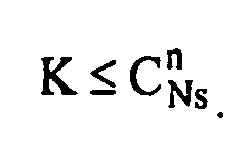
- The coding method according to claim 5, characterized in that the method further comprises steps of:replacing the original basic codebook vector with the optimal codebook vector as a new basic codebook vector, so as to obtain pulses in the optimal codebook vector at fixed positions and belonging to the original Ns pulses to serve as the new Ns pulses, and continue a next round of searching for an optimal codebook vector, andrepeating the process of replacing the original basic codebook vector with the optimal codebook vector replacement till a round number G for search reaches an upper limit.
- The coding method according to claim 5, characterized in that the acquiring the basic codebook vector comprises:acquiring the number of the pulses distributed on each of M tracks, wherein there are N pulses on the M tracks;determining a concentrated search range of each of the tracks according to several extreme values of a known reference signal on each of the tracks, wherein the concentrated search range at least comprises one position on the track; andperforming a full search in the M concentrated search ranges according to the number of the pulses distributed on each of M tracks, and selecting the basic codebook vector from all the position combinations according to the set evaluation criterion.
- An encoder, characterized in that the encoder comprises:a characteristic parameter acquisition unit, adapted to acquire characteristic parameters of an input signal;a signal type determination unit, adapted to determine the type of the input signal according to the characteristic parameters, wherein the type of the input signal comprises a periodic characteristic and a white noise characteristic;a vector generation unit, adapted to generate vectors to be quantified according to the characteristic parameters;a first-class codebook search unit and a second-class codebook search unit each adapted to provide a different codebook search algorithm, and computation complexity of the codebook search algorithm provided by the first-class codebook search unit is lower than that of the codebook search algorithm provided by the second-class codebook search unit; anda decision unit, adapted to perform a codebook search on the vectors to be quantified with a codebook search algorithm corresponding to the type of the input signal determined by the signal type determination unit, wherein the decision unit select the first-class codebook search unit according to the type with the periodic characteristic and select the second-class codebook search unit according to the type with the white noise characteristic.
- The encoder according to claim 9, characterized in that
the input signal with the type of the white noise characteristics determined by the signal type determination unit comprises at least one of a general frame and an unvoiced frame;
the second-class codebook search unit comprises a depth-first search unit adapted to provide a depth-first tree search algorithm; and
the decision unit is adapted to select the second-class codebook search unit according to the type with the white noise characteristics, and select the depth-first search unit according to the general frame or the unvoiced frame. - The encoder according to claim 9 or 10, characterized in that
the input signal with the type of the periodic characteristics determined by the signal type determination unit comprises at least one of a voiced frame and a transition frame;
the first-class codebook search unit comprises a pulse replacement search unit adapted to provide a codebook search algorithm based on pulse position replacement; and
the decision unit is adapted to select the first-class codebook search unit according to the type with the periodic characteristics, and select the pulse replacement search unit according to the voiced frame or the transition frame. - A computer readable storage medium, characterized in that the computer readable storage medium comprises a computer program code, which, when executed by a computer unit, will cause the computer unit to:acquire characteristic parameters of an input signal;determine the type of the input signal according to the characteristic parameters, wherein the type of the input signal comprises a periodic characteristic and a white noise characteristic;obtain vectors to be quantified according to the characteristic parameters; andperform a codebook search on the vectors to be quantified with a first-class codebook search algorithm when the type of the input signal is the periodic characteristic; performing a codebook search on the vectors to be quantified with a second-class codebook search algorithm when the type of input signal is the white noise characteristics; wherein computation complexity of the first-class codebook search algorithm is lower than that of the second-class codebook search algorithm and the codebook search algorithms are different.
Applications Claiming Priority (2)
| Application Number | Priority Date | Filing Date | Title |
|---|---|---|---|
| CN200710165784A CN100578619C (en) | 2007-11-05 | 2007-11-05 | Encoding Methods and Encoders |
| PCT/CN2008/072371 WO2009059513A1 (en) | 2007-11-05 | 2008-09-16 | A coding method, an encoder and a computer readable medium |
Publications (3)
| Publication Number | Publication Date |
|---|---|
| EP2110808A1 EP2110808A1 (en) | 2009-10-21 |
| EP2110808A4 EP2110808A4 (en) | 2010-01-13 |
| EP2110808B1 true EP2110808B1 (en) | 2011-11-09 |
Family
ID=40113736
Family Applications (1)
| Application Number | Title | Priority Date | Filing Date |
|---|---|---|---|
| EP08800868A Active EP2110808B1 (en) | 2007-11-05 | 2008-09-16 | A coding method, an encoder and a computer readable medium |
Country Status (7)
| Country | Link |
|---|---|
| US (1) | US8600739B2 (en) |
| EP (1) | EP2110808B1 (en) |
| JP (2) | JP5532304B2 (en) |
| KR (1) | KR101211922B1 (en) |
| CN (1) | CN100578619C (en) |
| AT (1) | ATE533147T1 (en) |
| WO (1) | WO2009059513A1 (en) |
Cited By (1)
| Publication number | Priority date | Publication date | Assignee | Title |
|---|---|---|---|---|
| RU2638734C2 (en) * | 2013-10-18 | 2017-12-15 | Фраунхофер-Гезелльшафт Цур Фердерунг Дер Ангевандтен Форшунг Е.Ф. | Coding of spectral coefficients of audio signal spectrum |
Families Citing this family (17)
| Publication number | Priority date | Publication date | Assignee | Title |
|---|---|---|---|---|
| US20070136054A1 (en) * | 2005-12-08 | 2007-06-14 | Hyun Woo Kim | Apparatus and method of searching for fixed codebook in speech codecs based on CELP |
| DK2827327T3 (en) * | 2007-04-29 | 2020-10-12 | Huawei Tech Co Ltd | Method for excitation pulse coding |
| CN100578619C (en) | 2007-11-05 | 2010-01-06 | 华为技术有限公司 | Encoding Methods and Encoders |
| CN101577551A (en) | 2009-05-27 | 2009-11-11 | 华为技术有限公司 | Method and device for generating lattice vector quantization codebook |
| CN102243876B (en) * | 2010-05-12 | 2013-08-07 | 华为技术有限公司 | Quantization coding method and quantization coding device of prediction residual signal |
| CN102299760B (en) | 2010-06-24 | 2014-03-12 | 华为技术有限公司 | Pulse codec method and pulse codec |
| EP2798631B1 (en) * | 2011-12-21 | 2016-03-23 | Huawei Technologies Co., Ltd. | Adaptively encoding pitch lag for voiced speech |
| CN103377653B (en) * | 2012-04-20 | 2016-03-16 | 展讯通信(上海)有限公司 | The searching method of algebraically code table and device in voice coding, voice coding method |
| FR3013496A1 (en) * | 2013-11-15 | 2015-05-22 | Orange | TRANSITION FROM TRANSFORMED CODING / DECODING TO PREDICTIVE CODING / DECODING |
| FR3024581A1 (en) * | 2014-07-29 | 2016-02-05 | Orange | DETERMINING A CODING BUDGET OF A TRANSITION FRAME LPD / FD |
| CN105355194A (en) * | 2015-10-22 | 2016-02-24 | 百度在线网络技术(北京)有限公司 | Speech synthesis method and speech synthesis device |
| US10878831B2 (en) | 2017-01-12 | 2020-12-29 | Qualcomm Incorporated | Characteristic-based speech codebook selection |
| CN108417206A (en) * | 2018-02-27 | 2018-08-17 | 四川云淞源科技有限公司 | High speed information processing method based on big data |
| CN115376532B (en) * | 2021-05-20 | 2025-11-07 | 广州广晟数码技术有限公司 | Audio encoding and decoding method, device, equipment and storage medium |
| CN117882095A (en) * | 2021-06-29 | 2024-04-12 | 西门子股份公司 | Solution recommendation method, device, system and storage medium |
| CN117093264A (en) * | 2022-05-13 | 2023-11-21 | 长鑫存储技术有限公司 | Chip select signal generation method and device |
| CN117789740B (en) * | 2024-02-23 | 2024-04-19 | 腾讯科技(深圳)有限公司 | Audio data processing method, device, medium, equipment and program product |
Citations (1)
| Publication number | Priority date | Publication date | Assignee | Title |
|---|---|---|---|---|
| US20070136054A1 (en) * | 2005-12-08 | 2007-06-14 | Hyun Woo Kim | Apparatus and method of searching for fixed codebook in speech codecs based on CELP |
Family Cites Families (37)
| Publication number | Priority date | Publication date | Assignee | Title |
|---|---|---|---|---|
| US5202953A (en) | 1987-04-08 | 1993-04-13 | Nec Corporation | Multi-pulse type coding system with correlation calculation by backward-filtering operation for multi-pulse searching |
| US5701392A (en) | 1990-02-23 | 1997-12-23 | Universite De Sherbrooke | Depth-first algebraic-codebook search for fast coding of speech |
| US5754976A (en) | 1990-02-23 | 1998-05-19 | Universite De Sherbrooke | Algebraic codebook with signal-selected pulse amplitude/position combinations for fast coding of speech |
| CA2010830C (en) | 1990-02-23 | 1996-06-25 | Jean-Pierre Adoul | Dynamic codebook for efficient speech coding based on algebraic codes |
| DE69132987T2 (en) * | 1990-11-02 | 2002-08-29 | Nec Corp., Tokio/Tokyo | Method for coding a speech parameter by transmission of a spectral parameter with a reduced data rate |
| US5187745A (en) | 1991-06-27 | 1993-02-16 | Motorola, Inc. | Efficient codebook search for CELP vocoders |
| CA2141181A1 (en) | 1994-09-21 | 1996-03-22 | Kimberly-Clark Worldwide, Inc. | Wet-resilient webs |
| JPH08179796A (en) | 1994-12-21 | 1996-07-12 | Sony Corp | Speech coding method |
| US5822724A (en) | 1995-06-14 | 1998-10-13 | Nahumi; Dror | Optimized pulse location in codebook searching techniques for speech processing |
| US6393391B1 (en) | 1998-04-15 | 2002-05-21 | Nec Corporation | Speech coder for high quality at low bit rates |
| JP3144284B2 (en) * | 1995-11-27 | 2001-03-12 | 日本電気株式会社 | Audio coding device |
| JP3299099B2 (en) * | 1995-12-26 | 2002-07-08 | 日本電気株式会社 | Audio coding device |
| JP3531342B2 (en) * | 1996-03-29 | 2004-05-31 | ソニー株式会社 | Audio processing device and audio processing method |
| US6480822B2 (en) | 1998-08-24 | 2002-11-12 | Conexant Systems, Inc. | Low complexity random codebook structure |
| JP3180786B2 (en) | 1998-11-27 | 2001-06-25 | 日本電気株式会社 | Audio encoding method and audio encoding device |
| JP4173940B2 (en) * | 1999-03-05 | 2008-10-29 | 松下電器産業株式会社 | Speech coding apparatus and speech coding method |
| WO2001020595A1 (en) * | 1999-09-14 | 2001-03-22 | Fujitsu Limited | Voice encoder/decoder |
| US6510407B1 (en) | 1999-10-19 | 2003-01-21 | Atmel Corporation | Method and apparatus for variable rate coding of speech |
| CA2327041A1 (en) | 2000-11-22 | 2002-05-22 | Voiceage Corporation | A method for indexing pulse positions and signs in algebraic codebooks for efficient coding of wideband signals |
| EP1353323B1 (en) * | 2000-11-27 | 2007-01-17 | Nippon Telegraph and Telephone Corporation | Method, device and program for coding and decoding acoustic parameter, and method, device and program for coding and decoding sound |
| US7206739B2 (en) * | 2001-05-23 | 2007-04-17 | Samsung Electronics Co., Ltd. | Excitation codebook search method in a speech coding system |
| JP2002349429A (en) | 2001-05-28 | 2002-12-04 | Toyota Industries Corp | Variable displacement compressor and method for manufacturing the same |
| DE10140507A1 (en) | 2001-08-17 | 2003-02-27 | Philips Corp Intellectual Pty | Method for the algebraic codebook search of a speech signal coder |
| KR100446630B1 (en) * | 2002-05-08 | 2004-09-04 | 삼성전자주식회사 | Vector quantization and inverse vector quantization apparatus for the speech signal and method thereof |
| US7363218B2 (en) | 2002-10-25 | 2008-04-22 | Dilithium Networks Pty. Ltd. | Method and apparatus for fast CELP parameter mapping |
| KR100463559B1 (en) | 2002-11-11 | 2004-12-29 | 한국전자통신연구원 | Method for searching codebook in CELP Vocoder using algebraic codebook |
| KR100463418B1 (en) * | 2002-11-11 | 2004-12-23 | 한국전자통신연구원 | Variable fixed codebook searching method in CELP speech codec, and apparatus thereof |
| KR100463419B1 (en) | 2002-11-11 | 2004-12-23 | 한국전자통신연구원 | Fixed codebook searching method with low complexity, and apparatus thereof |
| US7249014B2 (en) | 2003-03-13 | 2007-07-24 | Intel Corporation | Apparatus, methods and articles incorporating a fast algebraic codebook search technique |
| KR100556831B1 (en) | 2003-03-25 | 2006-03-10 | 한국전자통신연구원 | How to retrieve fixed codebooks with global pulse replacement |
| CN1240050C (en) | 2003-12-03 | 2006-02-01 | 北京首信股份有限公司 | Invariant codebook fast search algorithm for speech coding |
| CN1760905A (en) | 2004-10-16 | 2006-04-19 | 鸿富锦精密工业(深圳)有限公司 | Electronics competitive bidding system and method |
| CN100498934C (en) * | 2005-10-31 | 2009-06-10 | 连展科技(天津)有限公司 | Novel rapid fixed codebook searching method |
| CN100416652C (en) | 2005-10-31 | 2008-09-03 | 连展科技(天津)有限公司 | Fast Fixed Codebook Search Method for Enhanced AMR Encoder |
| KR100795727B1 (en) | 2005-12-08 | 2008-01-21 | 한국전자통신연구원 | Apparatus and Method for Fixed Codebook Retrieval in CPL based Voice Coder |
| CN100578619C (en) | 2007-11-05 | 2010-01-06 | 华为技术有限公司 | Encoding Methods and Encoders |
| JP5242231B2 (en) | 2008-04-24 | 2013-07-24 | 三菱電機株式会社 | Potential generation circuit and liquid crystal display device |
-
2007
- 2007-11-05 CN CN200710165784A patent/CN100578619C/en active Active
-
2008
- 2008-09-16 KR KR1020097012209A patent/KR101211922B1/en active Active
- 2008-09-16 WO PCT/CN2008/072371 patent/WO2009059513A1/en not_active Ceased
- 2008-09-16 JP JP2009539594A patent/JP5532304B2/en active Active
- 2008-09-16 EP EP08800868A patent/EP2110808B1/en active Active
- 2008-09-16 AT AT08800868T patent/ATE533147T1/en active
-
2009
- 2009-06-09 US US12/481,060 patent/US8600739B2/en active Active
-
2013
- 2013-02-04 JP JP2013019667A patent/JP2013122612A/en active Pending
Patent Citations (1)
| Publication number | Priority date | Publication date | Assignee | Title |
|---|---|---|---|---|
| US20070136054A1 (en) * | 2005-12-08 | 2007-06-14 | Hyun Woo Kim | Apparatus and method of searching for fixed codebook in speech codecs based on CELP |
Cited By (4)
| Publication number | Priority date | Publication date | Assignee | Title |
|---|---|---|---|---|
| RU2638734C2 (en) * | 2013-10-18 | 2017-12-15 | Фраунхофер-Гезелльшафт Цур Фердерунг Дер Ангевандтен Форшунг Е.Ф. | Coding of spectral coefficients of audio signal spectrum |
| US9892735B2 (en) | 2013-10-18 | 2018-02-13 | Fraunhofer-Gesellschaft Zur Foerderung Der Angewandten Forschung E.V. | Coding of spectral coefficients of a spectrum of an audio signal |
| US10115401B2 (en) | 2013-10-18 | 2018-10-30 | Fraunhofer-Gesellschaft Zur Foerderung Der Angewandten Forschung E.V. | Coding of spectral coefficients of a spectrum of an audio signal |
| US10847166B2 (en) | 2013-10-18 | 2020-11-24 | Fraunhofer-Gesellschaft Zur Foerderung Der Angewandten Forschung E.V. | Coding of spectral coefficients of a spectrum of an audio signal |
Also Published As
| Publication number | Publication date |
|---|---|
| WO2009059513A1 (en) | 2009-05-14 |
| EP2110808A1 (en) | 2009-10-21 |
| EP2110808A4 (en) | 2010-01-13 |
| CN100578619C (en) | 2010-01-06 |
| JP5532304B2 (en) | 2014-06-25 |
| KR20090086102A (en) | 2009-08-10 |
| ATE533147T1 (en) | 2011-11-15 |
| US20090248406A1 (en) | 2009-10-01 |
| JP2013122612A (en) | 2013-06-20 |
| US8600739B2 (en) | 2013-12-03 |
| CN101303857A (en) | 2008-11-12 |
| KR101211922B1 (en) | 2012-12-13 |
| JP2010511901A (en) | 2010-04-15 |
Similar Documents
| Publication | Publication Date | Title |
|---|---|---|
| EP2110808A1 (en) | A coding method, an encoder and a computer readable medium | |
| US10535358B2 (en) | Method and apparatus for encoding/decoding speech signal using coding mode | |
| US20040133424A1 (en) | Processing speech signals | |
| KR20090073253A (en) | Method and apparatus for coding transition frame in speech signal | |
| WO2008082133A1 (en) | Method, medium, and apparatus to classify for audio signal, and method, medium and apparatus to encode and/or decode for audio signal using the same | |
| KR100556831B1 (en) | How to retrieve fixed codebooks with global pulse replacement | |
| US20030101050A1 (en) | Real-time speech and music classifier | |
| KR100795727B1 (en) | Apparatus and Method for Fixed Codebook Retrieval in CPL based Voice Coder | |
| US6564182B1 (en) | Look-ahead pitch determination | |
| CN1271925A (en) | Shaped fixed code book searching used for code exciting linear predicting speech encode | |
| US20060149540A1 (en) | System and method for supporting multiple speech codecs | |
| KR100319924B1 (en) | Method for searching Algebraic code in Algebraic codebook in voice coding | |
| Amada et al. | CELP speech coding based on an adaptive pulse position codebook | |
| CN101202047A (en) | Voice signal encoder and voice signal decoder | |
| KR20070085788A (en) | Efficient Audio Coding Using Signal Attributes | |
| CN100412948C (en) | System and method for searching coding vector of voice signal in voice coder | |
| JP3471889B2 (en) | Audio encoding method and apparatus | |
| US20070150266A1 (en) | Search system and method thereof for searching code-vector of speech signal in speech encoder | |
| EP0713208A2 (en) | Pitch lag estimation system | |
| US20070136054A1 (en) | Apparatus and method of searching for fixed codebook in speech codecs based on CELP | |
| CN101118748A (en) | Algebraic codebook search method, device and speech encoder | |
| Kondoz et al. | The Turkish narrow band voice coding and noise pre-processing Nato Candidate | |
| Liu et al. | Improving EVRC half rate by the algebraic VQ-CELP | |
| Kövesi et al. | A multi-rate codec family based on GSM EFR and ITU-t g. 729. | |
| Yang et al. | Optimization strategy on G. 723.1 speech coder algorithm: clustering analysis method and its application |
Legal Events
| Date | Code | Title | Description |
|---|---|---|---|
| PUAI | Public reference made under article 153(3) epc to a published international application that has entered the european phase |
Free format text: ORIGINAL CODE: 0009012 |
|
| 17P | Request for examination filed |
Effective date: 20090608 |
|
| AK | Designated contracting states |
Kind code of ref document: A1 Designated state(s): AT BE BG CH CY CZ DE DK EE ES FI FR GB GR HR HU IE IS IT LI LT LU LV MC MT NL NO PL PT RO SE SI SK TR |
|
| A4 | Supplementary search report drawn up and despatched |
Effective date: 20091210 |
|
| 17Q | First examination report despatched |
Effective date: 20100426 |
|
| DAX | Request for extension of the european patent (deleted) | ||
| GRAP | Despatch of communication of intention to grant a patent |
Free format text: ORIGINAL CODE: EPIDOSNIGR1 |
|
| RIC1 | Information provided on ipc code assigned before grant |
Ipc: H03M 7/00 20060101ALI20110711BHEP Ipc: G10L 19/12 20060101AFI20110711BHEP |
|
| GRAS | Grant fee paid |
Free format text: ORIGINAL CODE: EPIDOSNIGR3 |
|
| GRAA | (expected) grant |
Free format text: ORIGINAL CODE: 0009210 |
|
| AK | Designated contracting states |
Kind code of ref document: B1 Designated state(s): AT BE BG CH CY CZ DE DK EE ES FI FR GB GR HR HU IE IS IT LI LT LU LV MC MT NL NO PL PT RO SE SI SK TR |
|
| REG | Reference to a national code |
Ref country code: GB Ref legal event code: FG4D |
|
| REG | Reference to a national code |
Ref country code: CH Ref legal event code: EP |
|
| REG | Reference to a national code |
Ref country code: IE Ref legal event code: FG4D |
|
| REG | Reference to a national code |
Ref country code: DE Ref legal event code: R096 Ref document number: 602008011285 Country of ref document: DE Effective date: 20120119 |
|
| REG | Reference to a national code |
Ref country code: NL Ref legal event code: T3 |
|
| REG | Reference to a national code |
Ref country code: SE Ref legal event code: TRGR |
|
| LTIE | Lt: invalidation of european patent or patent extension |
Effective date: 20111109 |
|
| PG25 | Lapsed in a contracting state [announced via postgrant information from national office to epo] |
Ref country code: NO Free format text: LAPSE BECAUSE OF FAILURE TO SUBMIT A TRANSLATION OF THE DESCRIPTION OR TO PAY THE FEE WITHIN THE PRESCRIBED TIME-LIMIT Effective date: 20120209 Ref country code: LT Free format text: LAPSE BECAUSE OF FAILURE TO SUBMIT A TRANSLATION OF THE DESCRIPTION OR TO PAY THE FEE WITHIN THE PRESCRIBED TIME-LIMIT Effective date: 20111109 Ref country code: IS Free format text: LAPSE BECAUSE OF FAILURE TO SUBMIT A TRANSLATION OF THE DESCRIPTION OR TO PAY THE FEE WITHIN THE PRESCRIBED TIME-LIMIT Effective date: 20120309 |
|
| PG25 | Lapsed in a contracting state [announced via postgrant information from national office to epo] |
Ref country code: BE Free format text: LAPSE BECAUSE OF FAILURE TO SUBMIT A TRANSLATION OF THE DESCRIPTION OR TO PAY THE FEE WITHIN THE PRESCRIBED TIME-LIMIT Effective date: 20111109 Ref country code: SI Free format text: LAPSE BECAUSE OF FAILURE TO SUBMIT A TRANSLATION OF THE DESCRIPTION OR TO PAY THE FEE WITHIN THE PRESCRIBED TIME-LIMIT Effective date: 20111109 Ref country code: HR Free format text: LAPSE BECAUSE OF FAILURE TO SUBMIT A TRANSLATION OF THE DESCRIPTION OR TO PAY THE FEE WITHIN THE PRESCRIBED TIME-LIMIT Effective date: 20111109 Ref country code: PL Free format text: LAPSE BECAUSE OF FAILURE TO SUBMIT A TRANSLATION OF THE DESCRIPTION OR TO PAY THE FEE WITHIN THE PRESCRIBED TIME-LIMIT Effective date: 20111109 Ref country code: PT Free format text: LAPSE BECAUSE OF FAILURE TO SUBMIT A TRANSLATION OF THE DESCRIPTION OR TO PAY THE FEE WITHIN THE PRESCRIBED TIME-LIMIT Effective date: 20120309 Ref country code: LV Free format text: LAPSE BECAUSE OF FAILURE TO SUBMIT A TRANSLATION OF THE DESCRIPTION OR TO PAY THE FEE WITHIN THE PRESCRIBED TIME-LIMIT Effective date: 20111109 Ref country code: GR Free format text: LAPSE BECAUSE OF FAILURE TO SUBMIT A TRANSLATION OF THE DESCRIPTION OR TO PAY THE FEE WITHIN THE PRESCRIBED TIME-LIMIT Effective date: 20120210 |
|
| PG25 | Lapsed in a contracting state [announced via postgrant information from national office to epo] |
Ref country code: CY Free format text: LAPSE BECAUSE OF FAILURE TO SUBMIT A TRANSLATION OF THE DESCRIPTION OR TO PAY THE FEE WITHIN THE PRESCRIBED TIME-LIMIT Effective date: 20111109 |
|
| PG25 | Lapsed in a contracting state [announced via postgrant information from national office to epo] |
Ref country code: CZ Free format text: LAPSE BECAUSE OF FAILURE TO SUBMIT A TRANSLATION OF THE DESCRIPTION OR TO PAY THE FEE WITHIN THE PRESCRIBED TIME-LIMIT Effective date: 20111109 Ref country code: SK Free format text: LAPSE BECAUSE OF FAILURE TO SUBMIT A TRANSLATION OF THE DESCRIPTION OR TO PAY THE FEE WITHIN THE PRESCRIBED TIME-LIMIT Effective date: 20111109 Ref country code: EE Free format text: LAPSE BECAUSE OF FAILURE TO SUBMIT A TRANSLATION OF THE DESCRIPTION OR TO PAY THE FEE WITHIN THE PRESCRIBED TIME-LIMIT Effective date: 20111109 Ref country code: BG Free format text: LAPSE BECAUSE OF FAILURE TO SUBMIT A TRANSLATION OF THE DESCRIPTION OR TO PAY THE FEE WITHIN THE PRESCRIBED TIME-LIMIT Effective date: 20120209 Ref country code: DK Free format text: LAPSE BECAUSE OF FAILURE TO SUBMIT A TRANSLATION OF THE DESCRIPTION OR TO PAY THE FEE WITHIN THE PRESCRIBED TIME-LIMIT Effective date: 20111109 |
|
| PG25 | Lapsed in a contracting state [announced via postgrant information from national office to epo] |
Ref country code: RO Free format text: LAPSE BECAUSE OF FAILURE TO SUBMIT A TRANSLATION OF THE DESCRIPTION OR TO PAY THE FEE WITHIN THE PRESCRIBED TIME-LIMIT Effective date: 20111109 Ref country code: IT Free format text: LAPSE BECAUSE OF FAILURE TO SUBMIT A TRANSLATION OF THE DESCRIPTION OR TO PAY THE FEE WITHIN THE PRESCRIBED TIME-LIMIT Effective date: 20111109 |
|
| PLBE | No opposition filed within time limit |
Free format text: ORIGINAL CODE: 0009261 |
|
| STAA | Information on the status of an ep patent application or granted ep patent |
Free format text: STATUS: NO OPPOSITION FILED WITHIN TIME LIMIT |
|
| REG | Reference to a national code |
Ref country code: AT Ref legal event code: MK05 Ref document number: 533147 Country of ref document: AT Kind code of ref document: T Effective date: 20111109 |
|
| 26N | No opposition filed |
Effective date: 20120810 |
|
| REG | Reference to a national code |
Ref country code: DE Ref legal event code: R097 Ref document number: 602008011285 Country of ref document: DE Effective date: 20120810 |
|
| PG25 | Lapsed in a contracting state [announced via postgrant information from national office to epo] |
Ref country code: AT Free format text: LAPSE BECAUSE OF FAILURE TO SUBMIT A TRANSLATION OF THE DESCRIPTION OR TO PAY THE FEE WITHIN THE PRESCRIBED TIME-LIMIT Effective date: 20111109 |
|
| PG25 | Lapsed in a contracting state [announced via postgrant information from national office to epo] |
Ref country code: ES Free format text: LAPSE BECAUSE OF FAILURE TO SUBMIT A TRANSLATION OF THE DESCRIPTION OR TO PAY THE FEE WITHIN THE PRESCRIBED TIME-LIMIT Effective date: 20120220 Ref country code: MC Free format text: LAPSE BECAUSE OF NON-PAYMENT OF DUE FEES Effective date: 20120930 |
|
| REG | Reference to a national code |
Ref country code: CH Ref legal event code: PL |
|
| REG | Reference to a national code |
Ref country code: IE Ref legal event code: MM4A |
|
| PG25 | Lapsed in a contracting state [announced via postgrant information from national office to epo] |
Ref country code: FI Free format text: LAPSE BECAUSE OF FAILURE TO SUBMIT A TRANSLATION OF THE DESCRIPTION OR TO PAY THE FEE WITHIN THE PRESCRIBED TIME-LIMIT Effective date: 20111109 |
|
| PG25 | Lapsed in a contracting state [announced via postgrant information from national office to epo] |
Ref country code: CH Free format text: LAPSE BECAUSE OF NON-PAYMENT OF DUE FEES Effective date: 20120930 Ref country code: LI Free format text: LAPSE BECAUSE OF NON-PAYMENT OF DUE FEES Effective date: 20120930 Ref country code: IE Free format text: LAPSE BECAUSE OF NON-PAYMENT OF DUE FEES Effective date: 20120916 |
|
| PG25 | Lapsed in a contracting state [announced via postgrant information from national office to epo] |
Ref country code: MT Free format text: LAPSE BECAUSE OF FAILURE TO SUBMIT A TRANSLATION OF THE DESCRIPTION OR TO PAY THE FEE WITHIN THE PRESCRIBED TIME-LIMIT Effective date: 20111109 |
|
| PG25 | Lapsed in a contracting state [announced via postgrant information from national office to epo] |
Ref country code: TR Free format text: LAPSE BECAUSE OF FAILURE TO SUBMIT A TRANSLATION OF THE DESCRIPTION OR TO PAY THE FEE WITHIN THE PRESCRIBED TIME-LIMIT Effective date: 20111109 |
|
| PG25 | Lapsed in a contracting state [announced via postgrant information from national office to epo] |
Ref country code: LU Free format text: LAPSE BECAUSE OF NON-PAYMENT OF DUE FEES Effective date: 20120916 |
|
| PG25 | Lapsed in a contracting state [announced via postgrant information from national office to epo] |
Ref country code: HU Free format text: LAPSE BECAUSE OF FAILURE TO SUBMIT A TRANSLATION OF THE DESCRIPTION OR TO PAY THE FEE WITHIN THE PRESCRIBED TIME-LIMIT Effective date: 20080916 |
|
| REG | Reference to a national code |
Ref country code: FR Ref legal event code: PLFP Year of fee payment: 9 |
|
| REG | Reference to a national code |
Ref country code: FR Ref legal event code: PLFP Year of fee payment: 10 |
|
| REG | Reference to a national code |
Ref country code: FR Ref legal event code: PLFP Year of fee payment: 11 |
|
| P01 | Opt-out of the competence of the unified patent court (upc) registered |
Effective date: 20230524 |
|
| PGFP | Annual fee paid to national office [announced via postgrant information from national office to epo] |
Ref country code: NL Payment date: 20250814 Year of fee payment: 18 |
|
| PGFP | Annual fee paid to national office [announced via postgrant information from national office to epo] |
Ref country code: DE Payment date: 20250730 Year of fee payment: 18 |
|
| PGFP | Annual fee paid to national office [announced via postgrant information from national office to epo] |
Ref country code: GB Payment date: 20250731 Year of fee payment: 18 |
|
| PGFP | Annual fee paid to national office [announced via postgrant information from national office to epo] |
Ref country code: FR Payment date: 20250808 Year of fee payment: 18 |
|
| PGFP | Annual fee paid to national office [announced via postgrant information from national office to epo] |
Ref country code: SE Payment date: 20250812 Year of fee payment: 18 |