EP2110779A1 - Automated entry of conditional probability data for a decision support apparatus that uses a Bayesian belief network - Google Patents
Automated entry of conditional probability data for a decision support apparatus that uses a Bayesian belief network Download PDFInfo
- Publication number
- EP2110779A1 EP2110779A1 EP08158809A EP08158809A EP2110779A1 EP 2110779 A1 EP2110779 A1 EP 2110779A1 EP 08158809 A EP08158809 A EP 08158809A EP 08158809 A EP08158809 A EP 08158809A EP 2110779 A1 EP2110779 A1 EP 2110779A1
- Authority
- EP
- European Patent Office
- Prior art keywords
- conditional probability
- node
- parent
- probability data
- state
- Prior art date
- Legal status (The legal status is an assumption and is not a legal conclusion. Google has not performed a legal analysis and makes no representation as to the accuracy of the status listed.)
- Ceased
Links
Images



Classifications
-
- G—PHYSICS
- G06—COMPUTING OR CALCULATING; COUNTING
- G06N—COMPUTING ARRANGEMENTS BASED ON SPECIFIC COMPUTATIONAL MODELS
- G06N7/00—Computing arrangements based on specific mathematical models
- G06N7/01—Probabilistic graphical models, e.g. probabilistic networks
Definitions
- This invention relates to a decision support apparatus that uses a Bayesian belief network and to a method and an apparatus for computer aided elicitation of conditional probabilities for use in a Bayesian belief network of such a decision support apparatus.
- a BBN is a known data structure to represent and reason with uncertainty in decision making processes.
- a BBN represents a directed a-cyclic graph (the network) consisting of nodes and arcs.
- the nodes represent the variables and the arcs the dependencies between the variables.
- An arc from node A to node B means that the probability of occurrence of the states of node B depends on the state of node A.
- A is referred to as predecessor or parent of node B, and B in its turn as descendent or child of node A.
- the BBN makes it possible to compute the joint probability distribution for all the variables (nodes) in the belief network.
- the BBN Before it can be used, the BBN has to be constructed.
- the variables of the belief network and their discrete states must be defined, as well as the dependencies between the variables.
- US patent application 2006020568 describes a known software tool that provides the functionality to construct a BBN (i.e. to define nodes and their states and the dependencies between these nodes), to quantify the network (i.e. to input the necessary conditional probabilities), and to perform inference on the network.
- This tool only provides an input module for the conditional probabilities needed without giving guidance and support in how to gather these probabilities, especially in the case when the probabilities are obtained via expert judgement elicitation.
- a number of solutions have been proposed for relieving the elicitation task for discrete BBNs can be relieved.
- a first solution is to make it easier for the assessors to provide the probabilistic assessments required. Van der Gaag, Renooij, Witteman, Aleman and Taal (1999) aim to achieve this by transcribing the conditional probabilities and using a scale containing both numerical and verbal anchors. But the effort needed to assess a full CPT using this method, though reduced, is still exponential in the number of conditioning variables.
- a second solution for relieving the elicitation burden is to reduce the number of probabilistic assessments to be made. This can of course be achieved by reducing the number of conditions (parent nodes) or the number of states of the variables, but such reductions will often be undesirable (e.g. leading to loss of detail needed to inform a decision).
- conditional probability data in a decision support apparatus that uses a Bayesian belief network, wherein the method that allows more of the work involved in defining conditional probabilities to be moved from human experts to a computer without expert knowledge.
- conditional probability data defines conditional probabilities of states of a particular network node as a function of vectors of state values of a set of parent nodes of the particular network node in the Bayesian Belief network, the computer implemented method comprising
- the step of receiving comprises
- the step of receiving comprises inputting, for extreme states of the particular node and each respective parent node, second conditional probability data defining the conditional probability of the extreme states when the respective parent node is in its most favorable and least favorable state for that extreme value respectively. This can be used to support interpolation.
- the step of interpolating comprises assigning influence factors to the further possible vectors of state values, and interpolating the conditional probability data for the further possible vectors from the conditional probability data for said subset, based on the influence factors. In this way, interpolation to any possible state vectors can be realized.
- an alternative input functionality for large CPTs in dedicated BBN software applications is provided. Rather than having to input all values for the CPTs one by one, this embodiment requires only a part of these large CPTs to be specified, thereby saving time and being less prone to input error.
- an apparatus that calculates all values of large CPTs based on a specification of only a part of this CPT.
- This apparatus makes it feasible to address the many occasions in which an expert has to asses the values of a large CPT one by one, previously considered infeasible due to the time needed for the specification and entry of all the probability values needed, the errors made inputting huge amounts of values, the discriminatory power required from the experts to tell apart the many (very) subtly different conditions and the requirements (mathematical) coherency puts on the conditional probabilities specified.
- the apparatus also supports the process of eliciting the information needed from expert assessors to quantify a CPT, by providing the order in which the conditional probabilities should by assessed by the expert, in such a way as to minimize assessment bias due to the anchoring-and-adjustment heuristic.
- conditional probabilities Only part of the conditional probabilities needs to be inputted. In most applications this will mean the difference between the feasibility of inputting the CPT or not. Feasibility with respect to time needed to input the probabilities, the errors made by manually inputting the values, the time needed to elicit the probabilities from experts, the discriminatory power required from the experts to tell apart the many (very) subtly different conditions and with respect to the coherency of the conditional probabilities specified.
- This document describes a methodology for deriving a node's CPT in the general case that the states of the node are ordered and the states of each of its parent nodes can be ordered with respect to the influence these parent nodes have on this node of interest.
- the method requires only a limited amount of probability assessments from experts to determine a node's full CPT; the number of probabilities to be assessed is linear in the number of parent nodes.
- Figure 1 depicts a system for the construction and analysis of BBNs.
- the system comprises a computer (100), coupled to a display device (110), and input devices keyboard (120) and pointing device (121).
- the computer may comprise with a mainboard, a CPU, harddrive and memory.
- a computer program for eliciting information to define a BBN is stored on the harddrive and executed by computer 100. This computer program will be termed BBN software application.
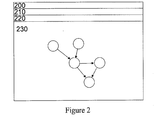
- FIG. 2 shows a schematic drawing of a typical Graphical User Interface (GUI) of a BBN software application.
- GUI Graphical User Interface
- the GUI contains a title bar (200), a menu bar (210) a tool bar (220) and a pane graphically displaying the BBN (230).
- BBN software applications typically support at least the functionalities:
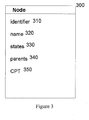
- Figure 3 illustrates information about an instance of a BBN.
- the information comprises set of nodes (300) constituting the BBN, and for each node an information structure defining:
- the CPT is a data structure describing the probabilities of the occurrence of the states of the node, conditional on the states of the parent nodes.
- nodes are constructed by creating information structures.
- its CPT is initially filled with default values for the unconditional probabilities for the states of the node (for example 0 or the reciprocal of the number of states of the node). Adding a state for the node will commonly result in adding an entry for this new state to the CPT with probability 0. Adding a parent for the node will typically result in making the CPT conditional on the states of this parent, by default using the same probabilities (that were already present in the CPT) for each state of the parent. Adding a state to one of the parent nodes of a node will also lead to creating the appropriate entries in the CPT for this added condition.
- the computer executing the BBN software application When the computer executing the BBN software application receives a user input indicating that a user wishes to edit the CPT of a particular node (400), the computer first displays the CPT with its current (default) values (410), and create a of copy CPTc of the current CPT values. Then the computer executing the BBN software application waits for one of three types of user input:
- Known BBN software applications available have CPT input functionality similar to the one described in Figure 4 .
- the probabilities that constitute a node's CPT will have to be entered one by one by the user.
- most dedicated BBN software applications support importing CPT probabilities from other software like MS Excel. When the probabilities of a CPT are elicited from experts, these probabilities will have to be entered one by one in one software application or another.
- conditional probability of each state S of a node is conditional on a vector of states of the parent nodes of that node.
- the total number of possible vector values that is, the number of possible combinations of states of the parent nodes equals the product of the counts of states of the respective parent nodes. If these counts would all be equal, the total number of possible vector values would depend exponentially on the number of parent nodes. As a result, the number of probabilities that would have to be entered can grow large very easily when the number of parents of a node increases, when the prior art input scheme for entering all probabilities is used as described above for Figure 4 .
- Figure 6 shows a flow chart of this task in more detail.
- the computer executing the BBN software application makes a copy of all the parent nodes of the particular node and puts these in a sorted list (600).
- the computer executing the BBN software application asks the user (611) to sort the states of the parent node (612). If the option 'positive' is selected by the user, then the parent's states will be inputted by the user in an order such that the probability of higher states of the node conditional on the current parent state Sp will not decrease if the state of the parent, Sp, is increased.
- the parent state with the highest probability for the highest state of the particular node is referred to as the highest parent state.
- the inputted order of parent states will be such that the probability of higher states of the particular node conditional on the current parent state Sp will not increase if the state of the parent, Sp, is increased.
- the parent state with the lowest probability for the highest state of the particular node is referred to as the highest parent state.
- the computer executing the BBN software application stores the inputted type of influence ('positive' or 'negative') and the inputted order of parent node states in a list with the highest state first in memory (613).
- the computer executing the BBN software application determines a subset of conditional probabilities of the CPT that need to be inputted, the sequence in which they should be elicited from an expert, and finally acquires these probabilities (520).
- Figure 7 shows a flowchart of this task.
- the computer executing the BBN software application creates a sorted list of the states of the particular node (700). If the states indicate values, or ranges of values, of a variable, the states may be ordered according to this value. Then an order of queries is optionally determined from this list (710) to minimize the risk of bias, introduced by (un)intentional use of the anchoring-and-adjustment heuristic by the expert, when the expert enters probabilities. For example, if the rank of the highest state is N, and of the lowest state 1, an order that minimizes bias is: N, 1, N-1, 2, N-3, 3,... until all the states are in the reordered list. Next the application 'walks' through this list from first to last element two times:
- the computer executing the BBN software application queries the user (741) for the probability of the highest and lowest value state of the particular node, S H and S L , conditional on the following states for the parent nodes: the condition wherein the parent node P is in its "most favourable state” and wherein all other parent nodes are in their "least favourable” state.
- the "most favourable" and “least favourable state” of a parent is determined as follows: if a parent node is determined to have a positive influence (in 612), its most favourable state is its highest state (the first state in the list of states for the parent in memory (613)) and its least favourable is its lowest state (the last state in the list). If a parent node is determined to have a negative influence (in 612), its most favourable state is its lowest state (the last state in the list of this parent's states) and its least favourable is its highest state (the last state in the list).
- the computer executing the BBN software application stores the probabilities of 741 in the node's CPT (742).
- the computer executing the BBN software application will ask the user to input for each parent node whether the parent node (530) is negative dominant (value -1) is positive dominant.(value 1) or is not dominant.(value 0).
- a parent node of the particular node is said to be a positive dominant parent node when the conditional probabilities for states of the particular node do not depend on the state of its other parent nodes when the positive dominant parent node is in its most favourable state.
- a parent node of the particular node is said to be a negative dominant parent node when the conditional probabilities for states of the particular node do not depend on the state of its other parent nodes when the positive dominant parent node is in its least favourable state.
- step 540 the computer executing the BBN software application uses the information gathered at 510, 520 and 530 to calculate all the conditional probabilities of the CPT.
- the function 'calculate_CPT' may use the following six auxiliary functions (the CPT is assumed accessible by all functions):
- Function i_i(S) calculates and returns the individual influence factor of the parent for state S.
- the rank of the lowest state is set to be 1, the rank of the highest state is then equal to the number of states of the parent, NS.
- Function i_j(Sp) calculates and returns the joint influence factor for the vector Sp of parent states.
- Function i_j_list(Sp_list) calculates and returns a list of influence factors for the elements of Sp_list, which are vectors of parent states.
- Function prob_i(x, i_j_list) calculates and returns probabilities for the states of the node for influence factor x, computed using a list of elements with influence factors for corresponding to elements of the Sp_List of vector of parent states. x must be in the interval [0,1].
- Function prob_i_av(x, y, i_j_list) calculates and returns the average probabilities for the states of the node on the influence factor interval [min(x,y), max(x,y)]
- the function 'calculate_CPT' calculates all the probabilities of the CPT using the CPT and Sp_Iist from 720-723.
- step 550 the values of the CPT are overwritten with the values calculated at step 540.
- Figure 8 describes an overview of BBN construction comprising a first step wherein definition of goals of the BBN construction and analysis.
- a second step is executed comprising definition of nodes and states.
- a third step is executed comprising determination of network structure (dependencies).
- a fourth step is executed comprising specification of CPTs.
- a fifth step is executed comprising software model construction, construct belief net structure and input CPTs.
- a sixth step is executed comprising analysis.
- a seventh step is executed comprising report.
- non-linear interpolation may be used instead of the linear interpolation employed in the example.
- This includes adjusting the method such that it can deal with synergetic effects between parent influences.
- a synergetic effect has place when the joint influence of parent variables is not equal to the sum of their individual influences.
- the program may be modified to deal with (dis)agreement of influence of parent variables.
- disagreement of parent node influences is dealt with by averaging the probabilities over the interval bounded by a parents individual influence factor and the joint influence factor.
- there are many alternatives for determining the parent weights including e.g. taking equal weights for all parents.
Landscapes
- Physics & Mathematics (AREA)
- Engineering & Computer Science (AREA)
- Theoretical Computer Science (AREA)
- General Physics & Mathematics (AREA)
- Artificial Intelligence (AREA)
- Pure & Applied Mathematics (AREA)
- Data Mining & Analysis (AREA)
- Evolutionary Computation (AREA)
- Algebra (AREA)
- Mathematical Analysis (AREA)
- Mathematical Optimization (AREA)
- Computational Mathematics (AREA)
- Computing Systems (AREA)
- General Engineering & Computer Science (AREA)
- Mathematical Physics (AREA)
- Software Systems (AREA)
- Probability & Statistics with Applications (AREA)
- Stored Programmes (AREA)
Abstract
A computer implemented method for filling in conditional probability data in a Bayesian Belief network based decision support apparatus is provided. The conditional probability data defines conditional probabilities of states of a particular network node as a function of vectors of state values of a set of parent nodes of the particular network node in the Bayesian Belief network. The computer implemented method comprising receiving conditional probability data defining the conditional probabilities for a subset of all possible vectors of combinations of state values of the set of parent nodes and interpolating conditional probability data defining the conditional probabilities for further possible vectors of state values of the set of parent nodes from the elicited conditional probability data.
Description
- This invention relates to a decision support apparatus that uses a Bayesian belief network and to a method and an apparatus for computer aided elicitation of conditional probabilities for use in a Bayesian belief network of such a decision support apparatus.
- Computer based decision support based on Bayesian belief networks (BBNs) has been performed ever since the introduction of BBNs in the 1980s by Kim and Pearl (1983), and has found widespread use in the support of decision making.
- A BBN is a known data structure to represent and reason with uncertainty in decision making processes. A BBN represents a directed a-cyclic graph (the network) consisting of nodes and arcs. The nodes represent the variables and the arcs the dependencies between the variables. An arc from node A to node B means that the probability of occurrence of the states of node B depends on the state of node A. In this case A is referred to as predecessor or parent of node B, and B in its turn as descendent or child of node A. The BBN makes it possible to compute the joint probability distribution for all the variables (nodes) in the belief network. This is done by determining for each variable Xc its conditional probability distribution, where the conditioning variables - if any - are its parent nodes, denoted with pa(Xc ). The full joint probability distribution for all the variables in the network, P(X1 , ... ,Xn ), can then be derived as (Jensen, 2001)

- Before it can be used, the BBN has to be constructed. The variables of the belief network and their discrete states must be defined, as well as the dependencies between the variables.
- For a BNN of realistic problems construction of BBNs and quantification of its probabilities requires a formidable amount of work from experts. The number of probabilities that need to be specified for a node can grow large very easily. For a node with three states that has a parent node with also three states, 9 probabilities need to be specified to determine its conditional probability table (CPT). An additional second and third parent node with three states would consequently require a table of 27 and 81 probabilities, and so on. For many applications these probabilities need to be specified subjectively by experts. Apart from the huge amounts of time it would take to assess all the probabilities for large CPTs, it can also be questioned to what extent assessors can be expected to coherently provide the probabilities at the level of detail required.
- The amount of human work can be kept at a minimum by use of a computer executing a dedicated software tool for construction the BBN and entering its conditional probabilities. However, thus far it has only proved possible to move part of the work into software tools. A major part of the construction work is the entry of conditional probabilities, all of which simply have to be entered by human experts in known software tools.
-
US patent application 2006020568 describes a known software tool that provides the functionality to construct a BBN (i.e. to define nodes and their states and the dependencies between these nodes), to quantify the network (i.e. to input the necessary conditional probabilities), and to perform inference on the network. This tool only provides an input module for the conditional probabilities needed without giving guidance and support in how to gather these probabilities, especially in the case when the probabilities are obtained via expert judgement elicitation. - None of the current software applications for developing and analysing BBNs provide support for the data collecting. The process of posing questions to experts to collect data is called elicitation. The elicitation task is considered a major obstacle in the use of BBNs (Druzdzel and Van der Gaag, 1995).
- A number of solutions have been proposed for relieving the elicitation task for discrete BBNs can be relieved. A first solution is to make it easier for the assessors to provide the probabilistic assessments required. Van der Gaag, Renooij, Witteman, Aleman and Taal (1999) aim to achieve this by transcribing the conditional probabilities and using a scale containing both numerical and verbal anchors. But the effort needed to assess a full CPT using this method, though reduced, is still exponential in the number of conditioning variables.
- A second solution for relieving the elicitation burden is to reduce the number of probabilistic assessments to be made. This can of course be achieved by reducing the number of conditions (parent nodes) or the number of states of the variables, but such reductions will often be undesirable (e.g. leading to loss of detail needed to inform a decision).
- Tang and McCabe (2007) take the approach of reducing the number of assessments to be made. These authors propose to elicit only part of the conditional probabilities required and use piecewise linear interpolation to approximate not-elicited conditional probabilities. Yet, Tang and McCabe restrict their method to work with binary variables only.
- Among others it is an object to provide for a method entering conditional probability data in a decision support apparatus that uses a Bayesian belief network, wherein the method that allows more of the work involved in defining conditional probabilities to be moved from human experts to a computer without expert knowledge.
- According to one aspect a computer implemented method for filling in conditional probability data in a Bayesian Belief network based decision support apparatus is provided, wherein the conditional probability data defines conditional probabilities of states of a particular network node as a function of vectors of state values of a set of parent nodes of the particular network node in the Bayesian Belief network, the computer implemented method comprising
- receiving conditional probability data defining the conditional probabilities for a subset of all possible vectors of combinations of state values of the set of parent nodes;
- interpolating conditional probability data defining the conditional probabilities for further possible vectors of state values of the set of parent nodes from the elicited conditional probability data. By using interpolation, the number of state vectors for which conditional probability data has to be entered by an expert can be minimized.
- In an embodiment, the step of receiving comprises
- inputting, for each state of the particular node, a list of vectors of state values of the set of parent nodes that result in a highest conditional probability of the state of the particular node;
- inputting, for each of the vectors of state values of the set of parent nodes that result in a highest conditional probability, first conditional probability data defining the conditional probability of the states of the particular node as a function of the state of the particular node. By specifically identifying this type of vector and its associated conditional probabilities, the conditional probability data values are provided between which the interpolation is performed that provide the most accurate interpolation results.
- In an embodiment, the step of receiving comprises inputting, for extreme states of the particular node and each respective parent node, second conditional probability data defining the conditional probability of the extreme states when the respective parent node is in its most favorable and least favorable state for that extreme value respectively. This can be used to support interpolation.
- In an embodiment, the step of interpolating comprises assigning influence factors to the further possible vectors of state values, and interpolating the conditional probability data for the further possible vectors from the conditional probability data for said subset, based on the influence factors. In this way, interpolation to any possible state vectors can be realized.
- These and other objects and advantageous aspects of the invention will become apparent from a description of exemplary embodiments, using the following figures.
- Figure 1
- shows a system for construction of a BBN
- Figure 2
- shows a Graphical User Interface (GUI) of a BBN
- Figure 3
- shows information assumed available to and accessible by BBN software application.
- Figure 4
- shows a flowchart of prior art BBN software functionality to input a CPT.
- Figure 5
- shows a flowchart of the CPT input functionality.
- Figure 6
- shows flowchart of the ordering of the parent node states with respect to the influence the practice on the node of interest.
- Figure 7
- shows a flowchart of the determination of the probabilities of the CPT, the elicitation sequence of these and the actual acquisition of these probabilities.
- Figure 8
- shows an overview of BBN construction
- In an embodiment an alternative input functionality for large CPTs in dedicated BBN software applications is provided. Rather than having to input all values for the CPTs one by one, this embodiment requires only a part of these large CPTs to be specified, thereby saving time and being less prone to input error.
- In an embodiment an apparatus is provided that calculates all values of large CPTs based on a specification of only a part of this CPT. This apparatus makes it feasible to address the many occasions in which an expert has to asses the values of a large CPT one by one, previously considered infeasible due to the time needed for the specification and entry of all the probability values needed, the errors made inputting huge amounts of values, the discriminatory power required from the experts to tell apart the many (very) subtly different conditions and the requirements (mathematical) coherency puts on the conditional probabilities specified.
- The apparatus also supports the process of eliciting the information needed from expert assessors to quantify a CPT, by providing the order in which the conditional probabilities should by assessed by the expert, in such a way as to minimize assessment bias due to the anchoring-and-adjustment heuristic.
- Only part of the conditional probabilities needs to be inputted. In most applications this will mean the difference between the feasibility of inputting the CPT or not. Feasibility with respect to time needed to input the probabilities, the errors made by manually inputting the values, the time needed to elicit the probabilities from experts, the discriminatory power required from the experts to tell apart the many (very) subtly different conditions and with respect to the coherency of the conditional probabilities specified.
- This document describes a methodology for deriving a node's CPT in the general case that the states of the node are ordered and the states of each of its parent nodes can be ordered with respect to the influence these parent nodes have on this node of interest. The method requires only a limited amount of probability assessments from experts to determine a node's full CPT; the number of probabilities to be assessed is linear in the number of parent nodes.
- Implemented and incorporated in existing BBN software, this methodology provides the guidance and support needed to quantify BBNs with large conditional probability tables based on expert assessments.
-
Figure 1 depicts a system for the construction and analysis of BBNs.
The system comprises a computer (100), coupled to a display device (110), and input devices keyboard (120) and pointing device (121). The computer may comprise with a mainboard, a CPU, harddrive and memory. A computer program for eliciting information to define a BBN is stored on the harddrive and executed bycomputer 100. This computer program will be termed BBN software application. -
Figure 2 shows a schematic drawing of a typical Graphical User Interface (GUI) of a BBN software application. By way of example, the GUI contains a title bar (200), a menu bar (210) a tool bar (220) and a pane graphically displaying the BBN (230). For the qualitative phase of the construction of a BBN, BBN software applications typically support at least the functionalities: - Add node
- Remove node
- Rename node
- Add state of a node
- Remove state of a node
- Rename state of a node
- Change order of states of a node
- Add arc
- Remove arc
- The quantitative phase of the construction of a BBN is typically supported by the functionality:
- Modify the CPT of a node.
-
Figure 3 illustrates information about an instance of a BBN. In an embodiment we assume that the following information about an instance of a BBN in a particular BBN software application is available to and accessible by the application. The information comprises set of nodes (300) constituting the BBN, and for each node an information structure defining: - • A unique identifier for the node (310)
- • A name of the node (320)
- • The states of the node, constituted by an ordered list of state names with the highest state first (330)
- • The parents of the node, constituted by a list of node identifiers of the parent nodes (340)
- • The CPT of the node
- The CPT is a data structure describing the probabilities of the occurrence of the states of the node, conditional on the states of the parent nodes.
- When the computer executing the BBN software application constructs a BBN, nodes are constructed by creating information structures. When the computer executing the BBN software application constructs a node, its CPT is initially filled with default values for the unconditional probabilities for the states of the node (for example 0 or the reciprocal of the number of states of the node). Adding a state for the node will commonly result in adding an entry for this new state to the CPT with probability 0. Adding a parent for the node will typically result in making the CPT conditional on the states of this parent, by default using the same probabilities (that were already present in the CPT) for each state of the parent. Adding a state to one of the parent nodes of a node will also lead to creating the appropriate entries in the CPT for this added condition.
- So for each node that is in the set of nodes of a BBN instance a CPT structure with default probabilities is assumed to be available. The input functionality for the CPT of a node that dedicated BBN software applications provide is graphically depicted by
Figure 4 . - When the computer executing the BBN software application receives a user input indicating that a user wishes to edit the CPT of a particular node (400), the computer first displays the CPT with its current (default) values (410), and create a of copy CPTc of the current CPT values. Then the computer executing the BBN software application waits for one of three types of user input:
- 1. Cancel: user input is received that the user wishes to cancel the editing of the CPT. The display of the CPT is closed (430), thereby discarding any changes.
- 2. The entry of a probability for a particular state s and a particular instance of parent node states s_p: the application will check whether the value received from the user in put is a probability (440) (i.e. the input value is in the interval [0, 1]). If not, the application will display an error message and discard the input (441) and wait again for new user input (420). If the value entered is a probability, the application will check whether the sum of probabilities of the states of the node for the particular condition does not exceed unity (442). If the sum of probabilities exceeds 1, an error message is displayed and the entry is discarded (441), if not the probability for state s and instance of parent node states s_p in CPTc is overwritten by the new value (443) and the application will wait again for new user input (420).
- 3. OK: user input is received that the user wishes to finalise the editing of the CPT. The application first checks whether for all conditions (i.e. all instances of states of parent nodes) the probabilities of the states of the node sum to unity (450). If not, the application displays an error message describing a condition for which the probabilities do not sum to unity and advises the user to correct the probabilities (451) and waits again for user input (420). If so (the probabilities sum to unity for all conditions), the application overwrites the values of the CPT with the new values from CPTc and closed the display of the CPT (452).
- Known BBN software applications available have CPT input functionality similar to the one described in
Figure 4 . For known BBN software applications the probabilities that constitute a node's CPT will have to be entered one by one by the user. Alternatively most dedicated BBN software applications support importing CPT probabilities from other software like MS Excel. When the probabilities of a CPT are elicited from experts, these probabilities will have to be entered one by one in one software application or another. - In principle, the conditional probability of each state S of a node is conditional on a vector of states of the parent nodes of that node. The total number of possible vector values, that is, the number of possible combinations of states of the parent nodes equals the product of the counts of states of the respective parent nodes. If these counts would all be equal, the total number of possible vector values would depend exponentially on the number of parent nodes. As a result, the number of probabilities that would have to be entered can grow large very easily when the number of parents of a node increases, when the prior art input scheme for entering all probabilities is used as described above for
Figure 4 . - To overcome this problem an alternative way is provided to input values for the CPT of a node, depicted in
Figure 5 . When the user wishes to edit the CPT of a particular node the computer executing the BBN software application first re-orders the states of the parent nodes such that the influence of the parent node on the particular node under consideration (510) is monotonically non-decreasing or non-increasing in the list. -
Figure 6 shows a flow chart of this task in more detail. First the computer executing the BBN software application makes a copy of all the parent nodes of the particular node and puts these in a sorted list (600). Then, for one parent node at a time (610, 614), the computer executing the BBN software application asks the user (611) to sort the states of the parent node (612). If the option 'positive' is selected by the user, then the parent's states will be inputted by the user in an order such that the probability of higher states of the node conditional on the current parent state Sp will not decrease if the state of the parent, Sp, is increased. The parent state with the highest probability for the highest state of the particular node is referred to as the highest parent state. If the option 'negative' is selected by the user, the inputted order of parent states will be such that the probability of higher states of the particular node conditional on the current parent state Sp will not increase if the state of the parent, Sp, is increased. In this case the parent state with the lowest probability for the highest state of the particular node is referred to as the highest parent state. The computer executing the BBN software application stores the inputted type of influence ('positive' or 'negative') and the inputted order of parent node states in a list with the highest state first in memory (613). - Then the computer executing the BBN software application determines a subset of conditional probabilities of the CPT that need to be inputted, the sequence in which they should be elicited from an expert, and finally acquires these probabilities (520).
-
Figure 7 shows a flowchart of this task. First the computer executing the BBN software application creates a sorted list of the states of the particular node (700). If the states indicate values, or ranges of values, of a variable, the states may be ordered according to this value. Then an order of queries is optionally determined from this list (710) to minimize the risk of bias, introduced by (un)intentional use of the anchoring-and-adjustment heuristic by the expert, when the expert enters probabilities. For example, if the rank of the highest state is N, and of thelowest state 1, an order that minimizes bias is: N, 1, N-1, 2, N-3, 3,... until all the states are in the reordered list. Next the application 'walks' through this list from first to last element two times: - 1. The first time for each state S of the particular node the expert is asked to indicate a combination of states Sp_S of the parent nodes that results in the highest conditional probability of the state S, among all possible combinations of states of the patent nodes (721) and the result is stored (722). Herein Sp_S are the states of the parent nodes that influence the node.
- 2. The second time the probabilities for all states of the particular node conditional on the combinations of parent states Sp_S specified in the previous loop, Prob(S1,...,SNS | Sp_S), are queried from the user (731) and stored in the CPT (732).
- In loop (740, 743) evaluating one by one each parent node P, the computer executing the BBN software application queries the user (741) for the probability of the highest and lowest value state of the particular node, SH and SL, conditional on the following states for the parent nodes: the condition wherein the parent node P is in its "most favourable state" and wherein all other parent nodes are in their "least favourable" state. The "most favourable" and "least favourable state" of a parent is determined as follows: if a parent node is determined to have a positive influence (in 612), its most favourable state is its highest state (the first state in the list of states for the parent in memory (613)) and its least favourable is its lowest state (the last state in the list). If a parent node is determined to have a negative influence (in 612), its most favourable state is its lowest state (the last state in the list of this parent's states) and its least favourable is its highest state (the last state in the list). The computer executing the BBN software application stores the probabilities of 741 in the node's CPT (742).
- After acquiring these specific probabilities, the computer executing the BBN software application will ask the user to input for each parent node whether the parent node (530) is negative dominant (value -1) is positive dominant.(value 1) or is not dominant.(value 0). Herein a parent node of the particular node is said to be a positive dominant parent node when the conditional probabilities for states of the particular node do not depend on the state of its other parent nodes when the positive dominant parent node is in its most favourable state. Similarly, a parent node of the particular node is said to be a negative dominant parent node when the conditional probabilities for states of the particular node do not depend on the state of its other parent nodes when the positive dominant parent node is in its least favourable state.
- It should be carefully noted that the amount input data in all these input steps grows at least proportionally to the number of parent nodes. This should be contrasted with the prior art input of conditional probabilities that grows exponentially with the number of parent nodes.
- In
step 540 the computer executing the BBN software application uses the information gathered at 510, 520 and 530 to calculate all the conditional probabilities of the CPT. The function 'calculate_CPT' may use the following six auxiliary functions (the CPT is assumed accessible by all functions): - Function i_i(S): calculates and returns the individual influence factor of the parent for state S. The rank of the lowest state is set to be 1, the rank of the highest state is then equal to the number of states of the parent, NS.
    i_i=(rank(S)-1)/(NS-1)
    IF the user has indicated that the parent has negative
    effect on the node (see step 612, 613)
         i_i=1 - i_i
    ENDIF
    Return: i_i
Function i_j(Sp): calculates and returns the joint influence factor for the vector Sp of parent states.
    i_j_d=0
    i_j_n=0
    FOR each parent
         NS = the number of states of this parent
         S = the state of this parent in Sp
         i_j_n= i_j_n+i_i(S)*(NS-1)
         i_j_d= i_j_d+(NS-1)
    ENDFOR
    i_j= i_j_n/ i_j_d
    Return: i_j
Function i_j_list(Sp_list): calculates and returns a list of influence factors for the elements of Sp_list, which are vectors of parent states.
   FOR each element Sp of Sp_list
        i_j=i_j(SP)
       add i_j to i_j_list
   ENDFOR
   Return: i_j_list
Function prob_i(x, i_j_list): calculates and returns probabilities for the states of the node for influence factor x, computed using a list of elements with influence factors for corresponding to elements of the Sp_List of vector of parent states. x must be in the interval [0,1].
    low=0
    high=1
    FOR each element i_j of i_j_list
         IF i_j.influence_factor > low AND
              i_j.influence_factor <= x
              low=i_j
         ENDIF
         IF i_j.influence_factor <high AND
              i_j.influence_factor >= x
              high=i_j
         ENDIF
         prob_low=vector of probabilities for the parent
              states Sp for which the joint influence factor
              is equal to low. These probabilities can be
              retrieved from the CPT.
         prob_high= vector of probabilities for the parent
              states Sp for which the joint influence factor
              is equal to high. These probabilities can be
              retrieved from the CPT.
         IF high = = low
             prob_i=prob_low
         ELSE
             prob_i=((x-low)*prob_low+(high-x)* prob_high)
                     /(high-low)
         ENDIF
         Return: prob_i
Function prob_i_av(x, y, i_j_list): calculates and returns the average probabilities for the states of the node on the influence factor interval [min(x,y), max(x,y)]
   i_min=-99
   i_max=-99
   prob_i_x=prob_i(x, i_j_list)
   prob_i_y=prob_i(y, i_j_list)
   IF x < y
        i_min=x
        i_max=y
   ELSE
        i_min=y
        i_max=x
   ENDIF
   i_int = list of influence factors consisting of the
   element x and y
   FOR each element i_j of i_j_list
        IF: i_j > i_min AND i_j < i_max
             add i_j to i_int
   ENDFOR
   SORT i_int from low to high
   NI = number of elements of i_int
   I=1
   sum=0
   WHILE I+1 <= NI
       A = element I of i_int
       B = element I+1 of i_int
       sum=sum+(B-A)*(prob_i(A, i_j_list)+prob_i(B,
   i_j_list))/2
      I=I+1
   ENDWHILE
   prob_i_av=sum /(i_max - i_min)
   Return: prob_i_av
Function w_list(Sp_list): calculates and returns a list of parent weights


The function 'calculate_CPT' calculates all the probabilities of the CPT using the CPT and Sp_Iist from 720-723.
Function calculate_CPT(Sp_list, CPT)
   i_j_list=i_j_list(Sp_list)
   w_list=w_list(Sp_list)
   FOR each combination of parent states Sp_c from the CPT
        i_i_list = a list of individual influence factors
              for the parent node states in Sp_c using
              Function i_i(S).
        i_j = i_j(sp_c)
        NS = number of states of the variable
        prob = zero vector of length NS
         FOR each parent
              i_i = current parent individual influence
              factor from i_i_list
              w = current parent weight from w_list
              prob = prob + w*prob_i_av(i_i, i_j, i_j_list)
        ENDFOR
        STORE prob in CPT
   ENDFOR
   FOR each positive dominant parent
        Sp_pos = first element of Sp_list
        prob = retrieve the probabilities for the states
               conditional on Sp_pos from the CPT.
        FOR each combination of parent states Sp_c from the
             CPT
               IF the positive dominant parent has its
                 highest state in Sp_c
                   OVERWRITE the probabilities for this
                             condition in the CPT with
                             the probabilities
                             conditional on Sp_pos.
               ENDIF
        ENDFOR
   ENDFOR
   FOR each negative dominant parent
        Sp_neg = second element of Sp_list
        prob = retrieve the probabilities for the states
               conditional on Sp_neg from the CPT.
        FOR each combination of parent states Sp_c from the
             CPT
               IF the negative dominant parent has its
                 lowest state in Sp_c
                   OVERWRITE the probabilities for this
                             condition in the CPT with
                             the probabilities
                             conditional on Sp_neg.
               ENDIF
        ENDFOR
   ENDFOR
The interpolation is further explained in the appendix of this description, which contains a copy of an article to be published by the inventors.
It may be noted that this results in values of the conditional probabilities that lead to reliable decisions when the BBN is used, because the CPT is anchored on the typical probabilities specified at 520 and the remaining conditional probabilities are derived via interpolation. This ensures a coherent specification of probabilities for the full CPT. For large CPTs one might even expect a far more coherent CPT using this algorithm than when all values would be specified one by one by an expert assessor.
Thus, the dependence on knowledge of experts to enter combined probabilities has been largely replaced by more complicated computations that do not depend on expertise, making it possible to shift more of the burden of determining the probabilities for use in a BBN decision support apparatus to a computer.
Finally, in step 550 the values of the CPT are overwritten with the values calculated at step 540.
It should be appreciated that various alternative implementations are possible. For example, non-linear interpolation may be used instead of the linear interpolation employed in the example. This includes adjusting the method such that it can deal with synergetic effects between parent influences. A synergetic effect has place when the joint influence of parent variables is not equal to the sum of their individual influences. Furthermore, the program may be modified to deal with (dis)agreement of influence of parent variables. Currently disagreement of parent node influences is dealt with by averaging the probabilities over the interval bounded by a parents individual influence factor and the joint influence factor. Furthermore, there are many alternatives for determining the parent weights, including e.g. taking equal weights for all parents.
- Druzdzel, M. J. & Van Der Gaag, L. C. (1995) Elicitation of probabilities for belief networks: combining qualitative and quantitative information. Proceedings of the eleventh conference on uncertainty in artificial intelligence .
- Jensen, F. (2001) Bayesian Networks and Decision Graphs (Information Science and Statistics), Springer.
- Kim, J. & Pearl, J. (1983) A computational model for causal and diagnostic reasoning in inference engines. 8th International Joint Conference on Artificial Intelligence. Karlsruhe, West Germany.
- Tang, Z. & Mccabe, B. (2007) Developing complete conditional probability tables from fractional data for Bayesian belief networks Journal of Computing in Civil Engineering, 21, pp.265-276.
- Wisse, B. W., Gosliga, S. P. V., Elst, N. P. & Barros, A. I. (2008) Relieving the elicitation burden of Bayesian belief networks.





Claims (9)
- A computer implemented method for filling in conditional probability data in a Bayesian Belief network based decision support apparatus, wherein the conditional probability data defines conditional probabilities of states of a particular network node as a function of vectors of state values of a set of parent nodes of the particular network node in the Bayesian Belief network, the computer implemented method comprising- receiving conditional probability data defining the conditional probabilities for a subset of all possible vectors of combinations of state values of the set of parent nodes;- interpolating conditional probability data defining the conditional probabilities for further possible vectors of state values of the set of parent nodes from the elicited conditional probability data.
- A computer implemented method according to claim 1, wherein said receiving comprises- inputting, for each state of the particular node, a list of vectors of state values of the set of parent nodes that result in a highest conditional probability of the state of the particular node;- inputting, for each of the vectors of state values of the set of parent nodes that result in a highest conditional probability, first conditional probability data defining the conditional probability of the states of the particular node as a function of the state of the particular node.
- A computer implemented method according to any one of the preceding claims, wherein said receiving comprises inputting, for extreme states of the particular node and each respective parent node, second conditional probability data defining the conditional probability of the extreme states when the respective parent node is in its most favorable and least favorable state for that extreme value respectively.
- A computer implemented method according to any one of the preceding claims, wherein said interpolating comprises assigning influence factors to the further possible vectors of state values, and interpolating the conditional probability data for the further possible vectors from the conditional probability data for said subset, based on the influence factors.
- A computer implemented method according to any one of the preceding claims, comprising inputting an order of states of parent nodes of the particular node, according to increasingly or decreasingly positive or negative influence of the state of the parent node on the state of the particular node.
- A computer implemented method according to any one of the preceding claims, comprising inputting information indicating for each part node of the particular node whether it is positively or negatively dominant over the particular node.
- A decision support apparatus, comprising an input module configured to enter conditional probability data for the nodes of a Bayesian Belief network, configured to enter the conditional probability data according to any one of the preceding claims.
- An input module for a decision support apparatus, configured to enter conditional probability data for the nodes of a Bayesian Belief network, configured to enter the conditional probability data according to any one of claims 1-6.
- A computer program product, comprising a program of instructions for a programmable computer which, when executed by the programmable computer, cause the programmable computer to perform the method of any one of claims 1-6.
Priority Applications (3)
| Application Number | Priority Date | Filing Date | Title |
|---|---|---|---|
| EP08158809A EP2110779A1 (en) | 2008-03-28 | 2008-06-23 | Automated entry of conditional probability data for a decision support apparatus that uses a Bayesian belief network |
| US12/934,951 US8606741B2 (en) | 2008-03-28 | 2009-03-27 | Automated filling of conditional probability data in a decision support apparatus that uses a Bayesian belief network |
| PCT/NL2009/050156 WO2009120083A1 (en) | 2008-03-28 | 2009-03-27 | Automated filling of conditional probability data in a decision support apparatus that uses a bayesian belief network |
Applications Claiming Priority (2)
| Application Number | Priority Date | Filing Date | Title |
|---|---|---|---|
| EP08153609 | 2008-03-28 | ||
| EP08158809A EP2110779A1 (en) | 2008-03-28 | 2008-06-23 | Automated entry of conditional probability data for a decision support apparatus that uses a Bayesian belief network |
Publications (1)
| Publication Number | Publication Date |
|---|---|
| EP2110779A1 true EP2110779A1 (en) | 2009-10-21 |
Family
ID=39760919
Family Applications (1)
| Application Number | Title | Priority Date | Filing Date |
|---|---|---|---|
| EP08158809A Ceased EP2110779A1 (en) | 2008-03-28 | 2008-06-23 | Automated entry of conditional probability data for a decision support apparatus that uses a Bayesian belief network |
Country Status (1)
| Country | Link |
|---|---|
| EP (1) | EP2110779A1 (en) |
Cited By (3)
| Publication number | Priority date | Publication date | Assignee | Title |
|---|---|---|---|---|
| US9613185B2 (en) | 2014-08-20 | 2017-04-04 | International Business Machines Corporation | Influence filtering in graphical models |
| US9760835B2 (en) | 2014-08-20 | 2017-09-12 | International Business Machines Corporation | Reasoning over cyclical directed graphical models |
| US11140189B2 (en) * | 2013-08-23 | 2021-10-05 | The Boeing Company | System and method for discovering optimal network attack paths |
Citations (1)
| Publication number | Priority date | Publication date | Assignee | Title |
|---|---|---|---|---|
| US20060020568A1 (en) | 2004-07-26 | 2006-01-26 | Charles River Analytics, Inc. | Modeless user interface incorporating automatic updates for developing and using bayesian belief networks |
-
2008
- 2008-06-23 EP EP08158809A patent/EP2110779A1/en not_active Ceased
Patent Citations (1)
| Publication number | Priority date | Publication date | Assignee | Title |
|---|---|---|---|---|
| US20060020568A1 (en) | 2004-07-26 | 2006-01-26 | Charles River Analytics, Inc. | Modeless user interface incorporating automatic updates for developing and using bayesian belief networks |
Non-Patent Citations (32)
| Title |
|---|
| ABRAMSON, B. ET AL.: "Hailfinder: a Bayesian system for forecasting severe weather", INTERNATIONAL JOURNAL OF FORECASTING, vol. 12, 1996, pages 57 - 71, XP007908091, DOI: doi:10.1016/0169-2070(95)00664-8 |
| B. LITTLEWOOD, L. STRIGINI, D. WRIGHT, P.-J. COURTOIS: "Examination of Bayesian belief network for safety assessment of nuclear computer-based systems", ESPRIT PROJECT NO. 20072: DESIGN FOR VALIDATION (DEVA); TECHNICAL REPORT, no. 70, 29 September 1998 (1998-09-29), XP007908111, Retrieved from the Internet <URL:http://research.cs.ncl.ac.uk/cabernet/www.laas.research.ec.org/deva/papers/5a.pdf> * |
| BEDFORD, T. J.; COOKE, R. M.: "Vines - a new graphical model for dependent random variables", ANNALS OF STATISTICS, vol. 10, no. 4, 2002, pages 1031 - 1068 |
| BONAFEDE, C.; GIUDICI, P.: "Bayesian networks for enterprise risk assessment", PHYSICA A, vol. 382, 2007, pages 22 - 28, XP022104654 |
| CHAN, H.; DARWICHE, A.: "When do numbers really matter?", JOURNAL OF ARTIFICIAL INTELLIGENCE RESEARCH, no. 17, 2002, pages 265 - 287 |
| COUPÉ, V. M. ET AL.: "Using sensitivity analysis for efficient quantification of a belief network", ARTIFICIAL INTELLIGENCE IN MEDICINE, vol. 17, 1999, pages 223 - 247 |
| DIEZ, F.: "Parameter adjustment in Bayesian networks. the generalized noisy or-gate, in Proceedings of the 9th Conference on Uncertainty in Artificial Intelligence (UAI93", MORGAN KAUF- MANN, 1993, pages 99 - 105 |
| DRUZDZEL M J; VAN DER GAAG L C: "Elicitation of probabilities for belief networks: combining qualitative and quantitative information", PROCEEDINGS OF THE 11TH CONFERENCE ON UNCERTAINTY IN ARTIFICIAL INTELLIGENCE (UAI'95), 18 August 1995 (1995-08-18) - 20 August 1995 (1995-08-20), pages 141 - 148, XP007908137, Retrieved from the Internet <URL:http://www.pitt.edu/~druzdzel/psfiles/uai95.pdf> * |
| DRUZDZEL, M. J.; VAN DER GAAG, L. C.: "Building probabilistic networks: where do the numbers come from?", IEEE TRANSACTIONS ON KNOWLEDGE AND DATA ENGINEERING, vol. 12, no. 4, 2000, pages 481 - 486, XP002501260, DOI: doi:10.1109/TKDE.2000.868901 |
| DRUZDZEL, M. J.; VAN DER GAAG, L. C.: "Elicitation of probabilities for belief networks: combining qualitative and quantitative information", PROCEEDINGS OF THE ELEVENTH CONFERENCE ON UNCERTAINTY IN ARTIFICIAL INTELLIGENCE, 1995 |
| DRUZDZEL, M. J.; VAN DER GAAG, L. C.: "Elicitation of probabilities for belief networks: combining qualitative and quantitative information", PROCEEDINGS OF THE ELEVENTH CONFERENCE ON UNCERTAINTY IN ARTIFICIAL INTELLIGENCE, 1995, pages 141 - 148, XP007908137 |
| HANEA, A.; KUROWICKA, D.: "Mixed non- parametric continuous and discrete Bayesian belief nets", PROCEEDINGS OF THE FIFTH INTERNATIONAL MATHEMATICAL METHODS IN RELIABILITY (MMR) CONFERENCE, 2007 |
| HANEA, A.; KUROWICKA, D.; COOKE, R. M.: "Hybrid method for quantifying and analyzing bayesian belief nets", QUALITY AND RELIABILITY ENGINEERING INTERNATIONAL, vol. 22, no. 6, 2006, pages 613 - 729, XP007908136, DOI: doi:10.1002/qre.808 |
| HECKERMAN, D.; BREESE, J.: "Causal independence for probabilistic assessment and inference using Bayesian networks", IEEE TRANSACTIONS ON SYSTEMS, MAN AND CYBERNETICS, vol. 26, 1996, pages 826 - 831, XP011056057 |
| HENRION, M.: "Some practical issues in constructing belief networks", UNCERTAINTY IN ARTIFICIAL INTELLIGENCE, vol. 3, 1989, pages 161 - 173 |
| JENSEN, A. L.: "Quantication experience of a dss for mildew management in winter wheat", 1995, article "Working Notes of the Workshop on Building Probabilistic Networks: Where Do the Numbers Come From?", pages: 23 - 31 |
| JENSEN, F.: "Information Science and Statistics", 2001, SPRINGER, article "Bayesian Networks and Decision Graphs" |
| KIM, J.; PEARL, J.: "A computational model for causal and diagnostic reasoning in inference engines", 8TH INTERNATIONAL JOINT CONFERENCE ON ARTIFICIAL INTELLIGENCE, 1983 |
| KIM, J.; PEARL, J.: "A computational model for causal and diagnostic reasoning in inference engines, in '8th International Joint Conference on Artificial Intelligence", KARLSRUHE, WEST GERMANY, 1983, pages 190 - 193 |
| LIN, J.: "Divergence measures based on the shannon entropy", IEEE TRANS. INF. THEORY, vol. 37, 1991, pages 145 - 151 |
| M. P. WELLMAN: "Fundamental concepts of qualitative probabilistic networks", ARTIFICIAL INTELLIGENCE, vol. 44, no. 3, August 1990 (1990-08-01), pages 257 - 303, XP000140329, Retrieved from the Internet <URL:http://dx.doi.org/10.1016/0004-3702(90)90026-V> * |
| MILLER, G.: "The magical number seven, plus or minus two: some limits on our capacity for processing information", PSYCHOLOGICAL REVIEW, vol. 63, 1956, pages 81 - 97 |
| N. E. FENTON, B. LITTLEWOOD, M. NEIL, L. STRIGINI, D. R. WRIGHT, P.-J. COURTOIS: "Bayesian belief network model for the safety assessment of nuclear computer-based systems", ESPRIT PROJECT NO. 20072: DESIGN FOR VALIDATION (DEVA); TECHNICAL REPORT, no. 52, 1997, XP007908110, Retrieved from the Internet <URL:http://research.cs.ncl.ac.uk/cabernet/www.laas.research.ec.org/deva/papers/5B.ps> * |
| N. E. FENTON, M. NEIL, J. G. CABALLERO: "Using ranked nodes to model qualitative judgments in Bayesian networks", IEEE TRANSACTIONS ON KNOWLEDGE AND DATA ENGINEERING, vol. 19, no. 10, 29 May 2007 (2007-05-29), pages 1420 - 1432, XP011191981, Retrieved from the Internet <URL:http://dx.doi.org/10.1109/TKDE.2007.1073> * |
| RENOOIJ, S.: "Probability elicitation for belief networks: issues to consider", THE KNOWLEDGE ENGINEERING REVIEW, vol. 16, no. 3, 2001, pages 255 - 269 |
| TANG, Z.; MCCABE, B.: "Developing complete conditional probability tables from fractional data for Bayesian belief networks", JOURNAL OF COMPUTING IN CIVIL ENGINEERING, vol. 21, 2007, pages 265 - 276, XP008104985, DOI: doi:10.1061/(ASCE)0887-3801(2007)21:4(265) |
| TANG, Z.; MCCABE, B.: "Developing complete conditional probability tables from fractional data for bayesian belief networks", JOURNAL OF COMPUTING IN CIVIL ENGINEERING, vol. 21, no. 4, 2007, pages 265 - 276, XP008104985, DOI: doi:10.1061/(ASCE)0887-3801(2007)21:4(265) |
| VAN DER GAAG, L. C. ET AL.: "How to elicit many probabilities", PROCEEDINGS OF THE FIFTEENTH CONFERENCE ON UNCERTAINTY IN ARTIFICIAL INTELLIGENCE, 1999, pages 647 - 654 |
| WELLMAN, M. P.: "Fundamental concepts of qualitative probabilistic networks", ARTIFICIAL INTELLIGENCE, vol. 44, no. 3, 1990, pages 257 - 303, XP000140329, DOI: doi:10.1016/0004-3702(90)90026-V |
| WISSE, B. W. ET AL., RELIEVING THE ELICITATION BURDEN OF BAYESIAN BELIEF NETWORKS, 2008 |
| Z. TANG, B. MCCABE: "Developing Complete Conditional Probability Tables from Fractional Data for Bayesian Belief Networks", JOURNAL OF COMPUTING IN CIVIL ENGINEERING, vol. 21, no. 4, 1 July 2007 (2007-07-01), pages 265 - 276, XP008104985, Retrieved from the Internet <URL:http://dx.doi.org/10.1061/(ASCE)0887-3801(2007)21:4(265)> * |
| ZAGORECKI, A.; DRUZDZEL, M. J.: "ECAI 2006, 17th European Conference on Artificial Intelligence.", 2006, article "Knowledge engineering for Bayesian networks: How common are Noisy-MAX distributions in practice", pages: 482 - 488 |
Cited By (3)
| Publication number | Priority date | Publication date | Assignee | Title |
|---|---|---|---|---|
| US11140189B2 (en) * | 2013-08-23 | 2021-10-05 | The Boeing Company | System and method for discovering optimal network attack paths |
| US9613185B2 (en) | 2014-08-20 | 2017-04-04 | International Business Machines Corporation | Influence filtering in graphical models |
| US9760835B2 (en) | 2014-08-20 | 2017-09-12 | International Business Machines Corporation | Reasoning over cyclical directed graphical models |
Similar Documents
| Publication | Publication Date | Title |
|---|---|---|
| US8606741B2 (en) | Automated filling of conditional probability data in a decision support apparatus that uses a Bayesian belief network | |
| McCabe et al. | Bayesian predictions of low count time series | |
| Steiger et al. | An improved batch means procedure for simulation output analysis | |
| Lee et al. | A nonparametric Bayesian network approach to assessing system reliability at early design stages | |
| Zhang et al. | A new decision support method for the selection of RP process: knowledge value measuring | |
| Cao et al. | Dynamic learning of sequential choice bandit problem under marketing fatigue | |
| Rougé et al. | Vulnerability: From the conceptual to the operational using a dynamical system perspective | |
| Mendes | A comparison of techniques for web effort estimation | |
| Mendes et al. | Using Bayesian Network to estimate the value of decisions within the context of Value-Based Software Engineering | |
| US12118061B2 (en) | Computerized methods and systems for machine-learned multi-output multi-step forecasting of time-series data | |
| Chen et al. | Designing efficient Bayesian sampling plans for exponential distributions based on samples under a (n, t) simple step-stress test | |
| D'Ambrosio et al. | Some experiments with real-time decision algorithms | |
| CN115586965A (en) | Industrial edge computing service time-sensitive control method considering task execution uncertainty | |
| US20110282801A1 (en) | Risk-sensitive investment strategies under partially observable market conditions | |
| JP2022028611A (en) | Method, apparatus, device, and storage medium used for information processing | |
| Wachter et al. | Visual risk specification and aggregation | |
| Cruze et al. | Comparison of likelihood methods for generalized linear mixed models with application to Quiet Supersonic Flights 2018 data | |
| Price | Direct search nonsmooth constrained optimization via rounded ℓ1 penalty functions | |
| de Angelis et al. | Line sampling for assessing structural reliability with imprecise failure probabilities | |
| JP6517731B2 (en) | Probability density function estimation device, continuous value prediction device, method, and program | |
| KR20210016748A (en) | Apparatus, Method and System for Display Promotion Time | |
| KR102295229B1 (en) | Method, Apparatus and System for Recommending Promotion Time | |
| Rieber et al. | Robust ℓ 1 performance analysis for linear systems with parametric uncertainties | |
| JP5471877B2 (en) | Program and information analyzer | |
| Zacks et al. | On exact and asymptotic properties of two-stage and sequential estimation of the normal mean under Linex loss |
Legal Events
| Date | Code | Title | Description |
|---|---|---|---|
| PUAI | Public reference made under article 153(3) epc to a published international application that has entered the european phase |
Free format text: ORIGINAL CODE: 0009012 |
|
| AK | Designated contracting states |
Kind code of ref document: A1 Designated state(s): AT BE BG CH CY CZ DE DK EE ES FI FR GB GR HR HU IE IS IT LI LT LU LV MC MT NL NO PL PT RO SE SI SK TR |
|
| AX | Request for extension of the european patent |
Extension state: AL BA MK RS |
|
| STAA | Information on the status of an ep patent application or granted ep patent |
Free format text: STATUS: THE APPLICATION HAS BEEN REFUSED |
|
| 18R | Application refused |
Effective date: 20091108 |