EP2109602B1 - Tetracycline derivatives for the treatment of bacterial, viral and parasitic infections - Google Patents
Tetracycline derivatives for the treatment of bacterial, viral and parasitic infections Download PDFInfo
- Publication number
- EP2109602B1 EP2109602B1 EP07867938.8A EP07867938A EP2109602B1 EP 2109602 B1 EP2109602 B1 EP 2109602B1 EP 07867938 A EP07867938 A EP 07867938A EP 2109602 B1 EP2109602 B1 EP 2109602B1
- Authority
- EP
- European Patent Office
- Prior art keywords
- alkyl
- compound
- alkenyl
- alkynyl
- hydrogen
- Prior art date
- Legal status (The legal status is an assumption and is not a legal conclusion. Google has not performed a legal analysis and makes no representation as to the accuracy of the status listed.)
- Active
Links
- 0 CN(C)[C@@]([C@](C[C@](Cc(c(CN(CC=C)C(OC)=O)ccc1O)c1C1=O)C1=C1O)[C@]11O)C(*)=C(C(*)=O)C1=O Chemical compound CN(C)[C@@]([C@](C[C@](Cc(c(CN(CC=C)C(OC)=O)ccc1O)c1C1=O)C1=C1O)[C@]11O)C(*)=C(C(*)=O)C1=O 0.000 description 11
- RQCAOEBGEAMCOG-IXWGDPAOSA-N CCONCc(c(C[C@@H](C[C@@]([C@@H](C(N=O)=C(C(N)=O)C1=N)N(C)C)([C@@]11O)N)C2=C1O)c1C2=O)ccc1O Chemical compound CCONCc(c(C[C@@H](C[C@@]([C@@H](C(N=O)=C(C(N)=O)C1=N)N(C)C)([C@@]11O)N)C2=C1O)c1C2=O)ccc1O RQCAOEBGEAMCOG-IXWGDPAOSA-N 0.000 description 1
- CFHRIODKSQFTAM-YFXODTNBSA-N Cc(cc1)c(C[C@@H](C[C@@H]([C@@H]2N(C)C)[C@@]34[O]=C3C(C(NI)=O)=C2O)C(C2=O)=C4O)c2c1O Chemical compound Cc(cc1)c(C[C@@H](C[C@@H]([C@@H]2N(C)C)[C@@]34[O]=C3C(C(NI)=O)=C2O)C(C2=O)=C4O)c2c1O CFHRIODKSQFTAM-YFXODTNBSA-N 0.000 description 1
Images
Classifications
-
- C—CHEMISTRY; METALLURGY
- C07—ORGANIC CHEMISTRY
- C07C—ACYCLIC OR CARBOCYCLIC COMPOUNDS
- C07C237/00—Carboxylic acid amides, the carbon skeleton of the acid part being further substituted by amino groups
- C07C237/24—Carboxylic acid amides, the carbon skeleton of the acid part being further substituted by amino groups having the carbon atom of at least one of the carboxamide groups bound to a carbon atom of a ring other than a six-membered aromatic ring of the carbon skeleton
- C07C237/26—Carboxylic acid amides, the carbon skeleton of the acid part being further substituted by amino groups having the carbon atom of at least one of the carboxamide groups bound to a carbon atom of a ring other than a six-membered aromatic ring of the carbon skeleton of a ring being part of a condensed ring system formed by at least four rings, e.g. tetracycline
-
- A—HUMAN NECESSITIES
- A61—MEDICAL OR VETERINARY SCIENCE; HYGIENE
- A61K—PREPARATIONS FOR MEDICAL, DENTAL OR TOILETRY PURPOSES
- A61K31/00—Medicinal preparations containing organic active ingredients
- A61K31/65—Tetracyclines
-
- A—HUMAN NECESSITIES
- A61—MEDICAL OR VETERINARY SCIENCE; HYGIENE
- A61P—SPECIFIC THERAPEUTIC ACTIVITY OF CHEMICAL COMPOUNDS OR MEDICINAL PREPARATIONS
- A61P11/00—Drugs for disorders of the respiratory system
- A61P11/02—Nasal agents, e.g. decongestants
-
- A—HUMAN NECESSITIES
- A61—MEDICAL OR VETERINARY SCIENCE; HYGIENE
- A61P—SPECIFIC THERAPEUTIC ACTIVITY OF CHEMICAL COMPOUNDS OR MEDICINAL PREPARATIONS
- A61P17/00—Drugs for dermatological disorders
-
- A—HUMAN NECESSITIES
- A61—MEDICAL OR VETERINARY SCIENCE; HYGIENE
- A61P—SPECIFIC THERAPEUTIC ACTIVITY OF CHEMICAL COMPOUNDS OR MEDICINAL PREPARATIONS
- A61P17/00—Drugs for dermatological disorders
- A61P17/02—Drugs for dermatological disorders for treating wounds, ulcers, burns, scars, keloids, or the like
-
- A—HUMAN NECESSITIES
- A61—MEDICAL OR VETERINARY SCIENCE; HYGIENE
- A61P—SPECIFIC THERAPEUTIC ACTIVITY OF CHEMICAL COMPOUNDS OR MEDICINAL PREPARATIONS
- A61P17/00—Drugs for dermatological disorders
- A61P17/10—Anti-acne agents
-
- A—HUMAN NECESSITIES
- A61—MEDICAL OR VETERINARY SCIENCE; HYGIENE
- A61P—SPECIFIC THERAPEUTIC ACTIVITY OF CHEMICAL COMPOUNDS OR MEDICINAL PREPARATIONS
- A61P25/00—Drugs for disorders of the nervous system
-
- A—HUMAN NECESSITIES
- A61—MEDICAL OR VETERINARY SCIENCE; HYGIENE
- A61P—SPECIFIC THERAPEUTIC ACTIVITY OF CHEMICAL COMPOUNDS OR MEDICINAL PREPARATIONS
- A61P25/00—Drugs for disorders of the nervous system
- A61P25/28—Drugs for disorders of the nervous system for treating neurodegenerative disorders of the central nervous system, e.g. nootropic agents, cognition enhancers, drugs for treating Alzheimer's disease or other forms of dementia
-
- A—HUMAN NECESSITIES
- A61—MEDICAL OR VETERINARY SCIENCE; HYGIENE
- A61P—SPECIFIC THERAPEUTIC ACTIVITY OF CHEMICAL COMPOUNDS OR MEDICINAL PREPARATIONS
- A61P29/00—Non-central analgesic, antipyretic or antiinflammatory agents, e.g. antirheumatic agents; Non-steroidal antiinflammatory drugs [NSAID]
-
- A—HUMAN NECESSITIES
- A61—MEDICAL OR VETERINARY SCIENCE; HYGIENE
- A61P—SPECIFIC THERAPEUTIC ACTIVITY OF CHEMICAL COMPOUNDS OR MEDICINAL PREPARATIONS
- A61P31/00—Antiinfectives, i.e. antibiotics, antiseptics, chemotherapeutics
-
- A—HUMAN NECESSITIES
- A61—MEDICAL OR VETERINARY SCIENCE; HYGIENE
- A61P—SPECIFIC THERAPEUTIC ACTIVITY OF CHEMICAL COMPOUNDS OR MEDICINAL PREPARATIONS
- A61P31/00—Antiinfectives, i.e. antibiotics, antiseptics, chemotherapeutics
- A61P31/04—Antibacterial agents
-
- A—HUMAN NECESSITIES
- A61—MEDICAL OR VETERINARY SCIENCE; HYGIENE
- A61P—SPECIFIC THERAPEUTIC ACTIVITY OF CHEMICAL COMPOUNDS OR MEDICINAL PREPARATIONS
- A61P31/00—Antiinfectives, i.e. antibiotics, antiseptics, chemotherapeutics
- A61P31/12—Antivirals
-
- A—HUMAN NECESSITIES
- A61—MEDICAL OR VETERINARY SCIENCE; HYGIENE
- A61P—SPECIFIC THERAPEUTIC ACTIVITY OF CHEMICAL COMPOUNDS OR MEDICINAL PREPARATIONS
- A61P33/00—Antiparasitic agents
-
- A—HUMAN NECESSITIES
- A61—MEDICAL OR VETERINARY SCIENCE; HYGIENE
- A61P—SPECIFIC THERAPEUTIC ACTIVITY OF CHEMICAL COMPOUNDS OR MEDICINAL PREPARATIONS
- A61P33/00—Antiparasitic agents
- A61P33/02—Antiprotozoals, e.g. for leishmaniasis, trichomoniasis, toxoplasmosis
- A61P33/06—Antimalarials
-
- A—HUMAN NECESSITIES
- A61—MEDICAL OR VETERINARY SCIENCE; HYGIENE
- A61P—SPECIFIC THERAPEUTIC ACTIVITY OF CHEMICAL COMPOUNDS OR MEDICINAL PREPARATIONS
- A61P33/00—Antiparasitic agents
- A61P33/14—Ectoparasiticides, e.g. scabicides
-
- C—CHEMISTRY; METALLURGY
- C07—ORGANIC CHEMISTRY
- C07D—HETEROCYCLIC COMPOUNDS
- C07D207/00—Heterocyclic compounds containing five-membered rings not condensed with other rings, with one nitrogen atom as the only ring hetero atom
- C07D207/02—Heterocyclic compounds containing five-membered rings not condensed with other rings, with one nitrogen atom as the only ring hetero atom with only hydrogen or carbon atoms directly attached to the ring nitrogen atom
- C07D207/18—Heterocyclic compounds containing five-membered rings not condensed with other rings, with one nitrogen atom as the only ring hetero atom with only hydrogen or carbon atoms directly attached to the ring nitrogen atom having one double bond between ring members or between a ring member and a non-ring member
- C07D207/20—Heterocyclic compounds containing five-membered rings not condensed with other rings, with one nitrogen atom as the only ring hetero atom with only hydrogen or carbon atoms directly attached to the ring nitrogen atom having one double bond between ring members or between a ring member and a non-ring member with only hydrogen atoms, hydrocarbon or substituted hydrocarbon radicals, directly attached to ring carbon atoms
-
- C—CHEMISTRY; METALLURGY
- C07—ORGANIC CHEMISTRY
- C07D—HETEROCYCLIC COMPOUNDS
- C07D207/00—Heterocyclic compounds containing five-membered rings not condensed with other rings, with one nitrogen atom as the only ring hetero atom
- C07D207/46—Heterocyclic compounds containing five-membered rings not condensed with other rings, with one nitrogen atom as the only ring hetero atom with hetero atoms directly attached to the ring nitrogen atom
- C07D207/50—Nitrogen atoms
-
- C—CHEMISTRY; METALLURGY
- C07—ORGANIC CHEMISTRY
- C07D—HETEROCYCLIC COMPOUNDS
- C07D211/00—Heterocyclic compounds containing hydrogenated pyridine rings, not condensed with other rings
- C07D211/04—Heterocyclic compounds containing hydrogenated pyridine rings, not condensed with other rings with only hydrogen or carbon atoms directly attached to the ring nitrogen atom
- C07D211/06—Heterocyclic compounds containing hydrogenated pyridine rings, not condensed with other rings with only hydrogen or carbon atoms directly attached to the ring nitrogen atom having no double bonds between ring members or between ring members and non-ring members
- C07D211/08—Heterocyclic compounds containing hydrogenated pyridine rings, not condensed with other rings with only hydrogen or carbon atoms directly attached to the ring nitrogen atom having no double bonds between ring members or between ring members and non-ring members with hydrocarbon or substituted hydrocarbon radicals directly attached to ring carbon atoms
- C07D211/10—Heterocyclic compounds containing hydrogenated pyridine rings, not condensed with other rings with only hydrogen or carbon atoms directly attached to the ring nitrogen atom having no double bonds between ring members or between ring members and non-ring members with hydrocarbon or substituted hydrocarbon radicals directly attached to ring carbon atoms with radicals containing only carbon and hydrogen atoms attached to ring carbon atoms
- C07D211/14—Heterocyclic compounds containing hydrogenated pyridine rings, not condensed with other rings with only hydrogen or carbon atoms directly attached to the ring nitrogen atom having no double bonds between ring members or between ring members and non-ring members with hydrocarbon or substituted hydrocarbon radicals directly attached to ring carbon atoms with radicals containing only carbon and hydrogen atoms attached to ring carbon atoms with hydrocarbon or substituted hydrocarbon radicals attached to the ring nitrogen atom
-
- C—CHEMISTRY; METALLURGY
- C07—ORGANIC CHEMISTRY
- C07D—HETEROCYCLIC COMPOUNDS
- C07D231/00—Heterocyclic compounds containing 1,2-diazole or hydrogenated 1,2-diazole rings
- C07D231/02—Heterocyclic compounds containing 1,2-diazole or hydrogenated 1,2-diazole rings not condensed with other rings
- C07D231/10—Heterocyclic compounds containing 1,2-diazole or hydrogenated 1,2-diazole rings not condensed with other rings having two or three double bonds between ring members or between ring members and non-ring members
- C07D231/12—Heterocyclic compounds containing 1,2-diazole or hydrogenated 1,2-diazole rings not condensed with other rings having two or three double bonds between ring members or between ring members and non-ring members with only hydrogen atoms, hydrocarbon or substituted hydrocarbon radicals, directly attached to ring carbon atoms
-
- C—CHEMISTRY; METALLURGY
- C07—ORGANIC CHEMISTRY
- C07D—HETEROCYCLIC COMPOUNDS
- C07D239/00—Heterocyclic compounds containing 1,3-diazine or hydrogenated 1,3-diazine rings
- C07D239/02—Heterocyclic compounds containing 1,3-diazine or hydrogenated 1,3-diazine rings not condensed with other rings
- C07D239/20—Heterocyclic compounds containing 1,3-diazine or hydrogenated 1,3-diazine rings not condensed with other rings having two double bonds between ring members or between ring members and non-ring members
-
- C—CHEMISTRY; METALLURGY
- C07—ORGANIC CHEMISTRY
- C07D—HETEROCYCLIC COMPOUNDS
- C07D239/00—Heterocyclic compounds containing 1,3-diazine or hydrogenated 1,3-diazine rings
- C07D239/02—Heterocyclic compounds containing 1,3-diazine or hydrogenated 1,3-diazine rings not condensed with other rings
- C07D239/24—Heterocyclic compounds containing 1,3-diazine or hydrogenated 1,3-diazine rings not condensed with other rings having three or more double bonds between ring members or between ring members and non-ring members
- C07D239/26—Heterocyclic compounds containing 1,3-diazine or hydrogenated 1,3-diazine rings not condensed with other rings having three or more double bonds between ring members or between ring members and non-ring members with only hydrogen atoms, hydrocarbon or substituted hydrocarbon radicals, directly attached to ring carbon atoms
-
- C—CHEMISTRY; METALLURGY
- C07—ORGANIC CHEMISTRY
- C07D—HETEROCYCLIC COMPOUNDS
- C07D241/00—Heterocyclic compounds containing 1,4-diazine or hydrogenated 1,4-diazine rings
- C07D241/02—Heterocyclic compounds containing 1,4-diazine or hydrogenated 1,4-diazine rings not condensed with other rings
- C07D241/10—Heterocyclic compounds containing 1,4-diazine or hydrogenated 1,4-diazine rings not condensed with other rings having three double bonds between ring members or between ring members and non-ring members
- C07D241/12—Heterocyclic compounds containing 1,4-diazine or hydrogenated 1,4-diazine rings not condensed with other rings having three double bonds between ring members or between ring members and non-ring members with only hydrogen atoms, hydrocarbon or substituted hydrocarbon radicals, directly attached to ring carbon atoms
-
- C—CHEMISTRY; METALLURGY
- C07—ORGANIC CHEMISTRY
- C07D—HETEROCYCLIC COMPOUNDS
- C07D261/00—Heterocyclic compounds containing 1,2-oxazole or hydrogenated 1,2-oxazole rings
- C07D261/02—Heterocyclic compounds containing 1,2-oxazole or hydrogenated 1,2-oxazole rings not condensed with other rings
-
- C—CHEMISTRY; METALLURGY
- C07—ORGANIC CHEMISTRY
- C07D—HETEROCYCLIC COMPOUNDS
- C07D261/00—Heterocyclic compounds containing 1,2-oxazole or hydrogenated 1,2-oxazole rings
- C07D261/02—Heterocyclic compounds containing 1,2-oxazole or hydrogenated 1,2-oxazole rings not condensed with other rings
- C07D261/04—Heterocyclic compounds containing 1,2-oxazole or hydrogenated 1,2-oxazole rings not condensed with other rings having one double bond between ring members or between a ring member and a non-ring member
-
- C—CHEMISTRY; METALLURGY
- C07—ORGANIC CHEMISTRY
- C07D—HETEROCYCLIC COMPOUNDS
- C07D263/00—Heterocyclic compounds containing 1,3-oxazole or hydrogenated 1,3-oxazole rings
- C07D263/02—Heterocyclic compounds containing 1,3-oxazole or hydrogenated 1,3-oxazole rings not condensed with other rings
- C07D263/30—Heterocyclic compounds containing 1,3-oxazole or hydrogenated 1,3-oxazole rings not condensed with other rings having two or three double bonds between ring members or between ring members and non-ring members
- C07D263/32—Heterocyclic compounds containing 1,3-oxazole or hydrogenated 1,3-oxazole rings not condensed with other rings having two or three double bonds between ring members or between ring members and non-ring members with only hydrogen atoms, hydrocarbon or substituted hydrocarbon radicals, directly attached to ring carbon atoms
-
- C—CHEMISTRY; METALLURGY
- C07—ORGANIC CHEMISTRY
- C07D—HETEROCYCLIC COMPOUNDS
- C07D265/00—Heterocyclic compounds containing six-membered rings having one nitrogen atom and one oxygen atom as the only ring hetero atoms
- C07D265/02—1,2-Oxazines; Hydrogenated 1,2-oxazines
-
- C—CHEMISTRY; METALLURGY
- C07—ORGANIC CHEMISTRY
- C07D—HETEROCYCLIC COMPOUNDS
- C07D265/00—Heterocyclic compounds containing six-membered rings having one nitrogen atom and one oxygen atom as the only ring hetero atoms
- C07D265/28—1,4-Oxazines; Hydrogenated 1,4-oxazines
- C07D265/30—1,4-Oxazines; Hydrogenated 1,4-oxazines not condensed with other rings
-
- C—CHEMISTRY; METALLURGY
- C07—ORGANIC CHEMISTRY
- C07D—HETEROCYCLIC COMPOUNDS
- C07D295/00—Heterocyclic compounds containing polymethylene-imine rings with at least five ring members, 3-azabicyclo [3.2.2] nonane, piperazine, morpholine or thiomorpholine rings, having only hydrogen atoms directly attached to the ring carbon atoms
- C07D295/04—Heterocyclic compounds containing polymethylene-imine rings with at least five ring members, 3-azabicyclo [3.2.2] nonane, piperazine, morpholine or thiomorpholine rings, having only hydrogen atoms directly attached to the ring carbon atoms with substituted hydrocarbon radicals attached to ring nitrogen atoms
- C07D295/12—Heterocyclic compounds containing polymethylene-imine rings with at least five ring members, 3-azabicyclo [3.2.2] nonane, piperazine, morpholine or thiomorpholine rings, having only hydrogen atoms directly attached to the ring carbon atoms with substituted hydrocarbon radicals attached to ring nitrogen atoms substituted by singly or doubly bound nitrogen atoms
- C07D295/125—Heterocyclic compounds containing polymethylene-imine rings with at least five ring members, 3-azabicyclo [3.2.2] nonane, piperazine, morpholine or thiomorpholine rings, having only hydrogen atoms directly attached to the ring carbon atoms with substituted hydrocarbon radicals attached to ring nitrogen atoms substituted by singly or doubly bound nitrogen atoms with the ring nitrogen atoms and the substituent nitrogen atoms attached to the same carbon chain, which is not interrupted by carbocyclic rings
- C07D295/13—Heterocyclic compounds containing polymethylene-imine rings with at least five ring members, 3-azabicyclo [3.2.2] nonane, piperazine, morpholine or thiomorpholine rings, having only hydrogen atoms directly attached to the ring carbon atoms with substituted hydrocarbon radicals attached to ring nitrogen atoms substituted by singly or doubly bound nitrogen atoms with the ring nitrogen atoms and the substituent nitrogen atoms attached to the same carbon chain, which is not interrupted by carbocyclic rings to an acyclic saturated chain
-
- C—CHEMISTRY; METALLURGY
- C07—ORGANIC CHEMISTRY
- C07D—HETEROCYCLIC COMPOUNDS
- C07D307/00—Heterocyclic compounds containing five-membered rings having one oxygen atom as the only ring hetero atom
- C07D307/02—Heterocyclic compounds containing five-membered rings having one oxygen atom as the only ring hetero atom not condensed with other rings
- C07D307/34—Heterocyclic compounds containing five-membered rings having one oxygen atom as the only ring hetero atom not condensed with other rings having two or three double bonds between ring members or between ring members and non-ring members
- C07D307/38—Heterocyclic compounds containing five-membered rings having one oxygen atom as the only ring hetero atom not condensed with other rings having two or three double bonds between ring members or between ring members and non-ring members with substituted hydrocarbon radicals attached to ring carbon atoms
- C07D307/52—Radicals substituted by nitrogen atoms not forming part of a nitro radical
-
- C—CHEMISTRY; METALLURGY
- C07—ORGANIC CHEMISTRY
- C07C—ACYCLIC OR CARBOCYCLIC COMPOUNDS
- C07C2603/00—Systems containing at least three condensed rings
- C07C2603/02—Ortho- or ortho- and peri-condensed systems
- C07C2603/40—Ortho- or ortho- and peri-condensed systems containing four condensed rings
- C07C2603/42—Ortho- or ortho- and peri-condensed systems containing four condensed rings containing only six-membered rings
- C07C2603/44—Naphthacenes; Hydrogenated naphthacenes
- C07C2603/46—1,4,4a,5,5a,6,11,12a- Octahydronaphthacenes, e.g. tetracyclines
-
- Y—GENERAL TAGGING OF NEW TECHNOLOGICAL DEVELOPMENTS; GENERAL TAGGING OF CROSS-SECTIONAL TECHNOLOGIES SPANNING OVER SEVERAL SECTIONS OF THE IPC; TECHNICAL SUBJECTS COVERED BY FORMER USPC CROSS-REFERENCE ART COLLECTIONS [XRACs] AND DIGESTS
- Y02—TECHNOLOGIES OR APPLICATIONS FOR MITIGATION OR ADAPTATION AGAINST CLIMATE CHANGE
- Y02A—TECHNOLOGIES FOR ADAPTATION TO CLIMATE CHANGE
- Y02A50/00—TECHNOLOGIES FOR ADAPTATION TO CLIMATE CHANGE in human health protection, e.g. against extreme weather
- Y02A50/30—Against vector-borne diseases, e.g. mosquito-borne, fly-borne, tick-borne or waterborne diseases whose impact is exacerbated by climate change
Definitions
- tetracyclines were found to be highly effective pharmacologically against rickettsiae; a number of gram-positive and gram-negative bacteria; and the agents responsible for lymphogranuloma venereum, inclusion conjunctivitis, and psittacosis.
- tetracyclines became known as "broad spectrum" antibiotics.
- the tetracyclines as a class rapidly became widely used for therapeutic purposes.
- DE-A-2346535 describes a process for the preparation of tetracycline derivatives substituted in the 7 position comprising first obtaining tetracycline derivatives in the 7 and 9 positions, trasforming the substituent in the 7 position into the desired substituent, and then eliminating the substitutent in the 9-position. Also described are compounds obtained by said process.
- X is CR 6' R 6
- R 4 is NR 4a R 4b
- R 4a and R 4b are each alkyl
- R 2 , R 2' , R 3 , R 5 , R 5' R 6 , R 6' , R 8 , R 9 , R 10 , R 11 and R 12 are each hydrogen and R 7a and R 7b are hydrogen.
- E is OR 7f
- R 7c is hydrogen
- R 7f is alkyl ( e.g ., methyl, ethyl or t-butyl) or allyl.
- E is NR 7d R 7e
- R 7c is alkyl ( e.g ., ethyl)
- R 7d is hydrogen
- R 7e is alkyl ( e.g ., ethyl).
- X is CR 6' R 6
- R 4 is NR 4a
- R 4b are each alkyl ( e.g. , methyl)
- R 2 , R 2' , R 3 , R 4' R 5 , R 5' R 6 , R 6' , R 7a , R 7b , R 8 , R 9 , R 10 , R 11 and R 12 are each hydrogen
- E is OR 7f and R 7c and R 7f are linked to join a ring, for example, a 5- or 6-membered ring ( e.g. ,
- X is CR 6' R 6
- R 4 is NR 4a
- R 4b are each alkyl ( e.g. , methyl)
- R 2 , R 2' , R 3 , R 4' R 5 , R 5' R 6 , R 6' , R 7a , R 7b R 8 , R 9 , R 10 , R 11 and R 12 are each hydrogen
- E is OR 7f
- R 7c and R 7f may be each independently alkyl ( e.g ., methyl or ethyl).
- X is CR 6' R 6
- R 4 is NR 4a
- R 4b are each alkyl ( e.g. , methyl)
- R 2 , R 2' , R 3 , R 4' R 5 , R 5' R 6 , R 6' , R 7a , R 7b , R 7c , R 8 , R 9 , R 10 , R 11 and R 12 are each hydrogen
- E is NR 7d R 7e
- R 7c is alkyl ( e.g ., ethyl)
- R 7d is hydrogen and R 7e is alkyl ( e.g ., ethyl).
- R 7ga R 7gb R 7gc are each alkyl ( e.g ., methyl); r is 1 and R 7c is hydrogen or alkyl ( e.g ., cycloalkyl, for example, cyclopropyl).
- substituted tetracycline compounds of Formula (I) include: and pharmaceutically acceptable salts thereof.
- substituted tetracycline compounds of the invention can be synthesized using the methods described in the following schemes and by using art recognized techniques. All novel substituted tetracycline compounds described herein are included in the invention as compounds.
- Scheme 1 a general synthetic scheme for synthesizing 7-substituted 7-substituted tetracyclines is shown.
- a palladium catalyzed coupling of an iodosancycline ( 1 ) is performed to form a 7-substituted aldehyde intermediate ( 2 ).
- the aldehyde intermediate is reduced in the presence of a hydroxylamine to give the desired product ( 3 ).
- Compounds P, Y, U, DR and DS may be synthesized as described in Scheme 1.
- 7- and 9-substituted tetracycline compounds may be synthesized by reacting the 7-iodo-9-aminoalkyl sancycline derivative ( 4 ) with trimethylsilylethyne in the presence of a palladium catalyst to yield a 7-substituted alkynyl intermediate. Subsequent acid hydrolysis yields the 7-acyl intermediate (5). Further derivitization of the 9-position may be accomplished by reductive alkylation of the amino group with t-butyl aldehyde, hydrogen and palladium on carbon to form compound 6 , which can then be reacted with a primary hydroxylamine to form the oxime 7.
- 7- and 9-substituted tetracycline compounds may also be prepared as shown in Scheme 3. Beginning with a 7-iodo-9-nitro substituted sancycline derivative ( 8 ), a Hiyama coupling followed by acid hydrolysis yields a 7-acyl-9-nitro intermediate ( 9 ). The nitro moiety may then be reduced to the amino group by hydrogen gas in the presence of a palladium catalyst ( 10 ). Reaction of the acyl group with a primary hydroxylamine provides the product 11 .
- Scheme 4 also provides a method for synthesizing 7-substituted tetracyclines.
- a palladium catalyzed carbonylation of an iodosancycline ( 1 ) is performed to form a 7-substituted aldehyde intermediate ( 2 ).
- the aldehyde intermediate is reduced in the presence of a hydroxylamine to give compound 12 , which may then be reacted with formaldehyde and triethylamine, followed by reduction to give the desired product ( 3 ).
- Scheme 5 details the synthesis of substituted tetracyclines with hydroxy in the 10-position.
- a 7-substituted tetracycline compound may be reacted with N-(5-chloro-2-pyridyl)bis(trifluoromethanesulfonimide) to form a trifluoromethane substituted intermediate ( 14 ), which can then be reacted with ammonium formate in the presence of a palladium catalyst to form the desired product ( 15 ).
- a 7-iodo sancycline derivative ( 1 ) may undergo a Stille coupling or a Suzuki coupling by reacting with an alkyl tin derivative or a boronic acid derivative in the presence of a palladium catalyst to form the desired product ( 16 ).
- the 7-substituted oxime derivatives may also be prepared as shown in Scheme 7.
- An 7-iodo sancycline derivative ( 1 ) can be reacted with a substituted alkyne in the presence of palladium to synthesize the alkynyl derivative 17 .
- Compound 17 may be converted to the acyl substituted compound 18 by any technique known in the art.
- the desired oxime product 19 can be obtained by reacting the acyl moiety with a primary hydroxylamine.
- Scheme 8 is a general synthetic scheme showing the synthesis of 7-substitued hydrazone compounds.
- a 7-substituted aldehyde tetracycline derivative, prepared as described above in Scheme 4, is combined with a primary hydrazone to form the desired product 20 .
- 7-substituted hydrazines may also be synthesized as shown in Scheme 9.
- Starting with compound 2, synthesized as described in Scheme 4 above, may be reacted with a secondary hydrazine in the presence of a reducing agent to form compound 21.
- Compound Z may be synthesized as shown in Scheme 9.
- Scheme 10 further depicts a method of synthesizing a 7-substituted aminoalkyl tetracycline compound.
- Compound 2 is reacted with a primary amine in the presence of a reducing agent to form the secondary amine intermediate ( 22 ), which is then mixed with an acid chloride to form compound 23 .
- Compounds F, CV and CW may be synthesized as illustrated in Scheme 10.
- Scheme 11 describes a general method for preparing 9-substituted aminoalkyl substituted tetracycline compounds.
- Compound 24 may be reacted directly with a secondary amine to form compounds similar to 26 .
- compound 24 may be mixed with a primary amine to yield the substituted imine 25 , which may be further reduced to produce the aminoalkyl compound 26 .
- 7-substituted tetracycline may also be prepared as shown in Scheme 12.
- reductive alkylation with a dioxalanyl secondary amine yields the intermediate 27 .
- Subsequently exposing 27 to acidic conditions removes the protecting group to form intermediate 28 , which may then be reacted with a primary amine to form product 29 .
- Compound AL may be synthesized as shown in Scheme 12.
- Schemes 13 and 14 illustrate the general synthesis of cyclobutene 7-substituted tetracycline compounds. Beginning with 30 , tin reagent 31 is synthesized by reacting 30 with a trimethylsilyl substituted alkyltin derivative.
- Scheme 14 continues to show the synthesis of cyclobutenedione 7-substituted tetracycline compounds, by reacting building block 31 with 7-iodo substituted sancycline (1) in a Stille coupling reaction to form 32 .
- the amino substitution of product 33 is accomplished by reacting 32 with a primary amine in methanol.
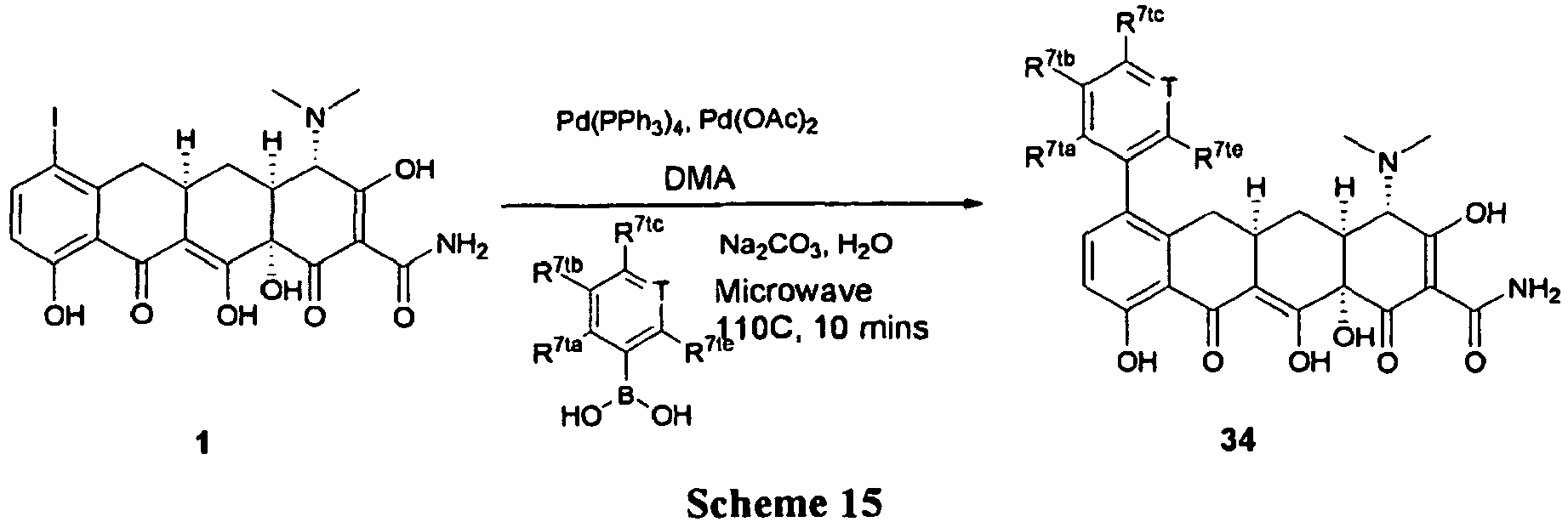
- Scheme 15 depicts generally the synthesis of substituted aromatic 7-substituted tetracycline compounds. Beginning with 1 and performing a Suzuki coupling reaction in the presence of a boronic acid and a palladium catalyst, compounds of general formula 34 are formed.
- Scheme 16 also depicts the synthesis of substituted aromatic 7-substituted tetracycline compounds.
- a Suzuki coupling reaction is performed with a boronic acid in the presence of a palladium catalyst to provide intermediate 35 in which R 7tb is either an amine or a carboxylic acid.
- R 7tb is a carboxylic acidic moiety
- R 7tb is an amino moiety
- Scheme 17 depicts a method for synthesizing aromatic substituted 9-substituted tetracycline compounds.
- a 9-iodo tetracycline derivative is reacted under Suzuki conditions by mixing with a boronic acid in the presence of the appropriate palladium catalyst to give compounds similar to compound 38 .
- Scheme 18 also depicts a method for synthesizing 9-substituted tetracycline compounds by reacting 37 with a palladium catalyst and carbon monoxide in the presence ofN-hydroxysuccinimide to generate an activated ester intermediate. Reaction of this intermediate with nucleophilic compounds such as alcohols, hydroxylamines or amines yields the desired ester, hydroxamic acid or amide, respectively, similar to 39 .
- 9-substituted oxime tetracycline compounds may be prepared as shown in Scheme 19.
- a 9-iodo substituted tetracycline derivative is subjected to Heck conditions to form an alkyne intermediate which is converted to 40 by acid hydrolysis.
- Intermediate 40 is subsequently reacted with an appropriate hydroxylamine to yield the desired product 41.
- 9-substituted-4-dedimethylamino tetracycline compounds may be synthesized starting from minocycline, which is exposed to the dedimethylamino conditions of methyl iodide and zinc to form 4-dedimethylsancycline 44 .
- Intermediate 44 is halogenated at the 9-position to form intermediate 45 , and upon exposing 45 to the appropriate palladium conditions, compounds similar to 46 are formed.
- 9-substituted-4-dedimethylamino doxycycline compounds may be synthesized starting from doxycycline, which is exposed to the dedimethylamino conditions of methyl iodide and zinc to form 4-dedimethyldoxycycline 47 .
- Intermediate 47 is halogenated at the 9-position to form intermediate 48 , and upon exposing 48 to the appropriate palladium conditions, compounds similar to 49 are formed.
- Scheme 23 illustrates the synthesis of 10-substituted tetracycline compounds.
- the 10-position hydroxide is deprotonated in the presence of a strong base, followed by the addition of triflate to form intermediate 50 , which then undergoes either Stille or Suzuki conditions or carbonylation conditions to form compounds similar to 10-substituted compounds 51 .
- Scheme 24 illustrates the synthesis of 7-aminomethyl substituted tetracycline compounds.
- Compound 1 is exposed to a secondary amine in the presence of a reducing agent to from compounds similar to 52 .
- Scheme 25 provides a method for synthesizing 9-aminomethyl substituted tetracycline compounds.
- 9-formyl substituted compound 54 is reacted with a secondary amine in the presence of a reducing agent to provide the 9-aminomethyl substituted tetracycline compounds 55 .
- Scheme 26 illustrates the methods for synthesizing 9-alkyl or 9-carbonyl substituted tetracycline compounds starting with the 9-iodominocycline or 9-iodo-4-dedimethylminocycline compound 56 , followed by palladium catalyzed alkynylation to form intermediate 57 .
- Intermediate 57 may undergo either hydrogenolysis to form 9-alkyl substituted tetracycline compounds ( 58 ) or acid catalyzed hydrolysis to form 9-carbonyl substituted tetracycline compound ( 59 ).
- 9-Alkyl substituted tetracycline compounds may also be synthesized as shown in Scheme 27. Again starting with 9-iodominocycline or 9-iodo-4-dedimethylminocycline compound 56 , either Suzuki or Stille coupling conditions may produce the 9-alkyl substituted tetracycline compounds ( 60 ) or reaction with copper iodide with a fluorinated ester compound yields 9-trifluoroalkyl substituted compound 61 .
- 7-Furanyl substituted tetracycline compounds may be synthesized as illustrated in Scheme 28.
- 7-Iodosancycline ( 1 ) is subjected to a formyl substituted furanyl boronic acid in the presence of palladium (II) acetate and sodium carbonate to yield intermediate 62 .
- a reductive amination is then performed in the presence of an appropriate reducing agent and a secondary amine to convert the formyl moiety to a tertiary alkylamine ( 63 ).
- the substituents of the tertiary amine may be further derivitized, as shown by the reaction of compound 63 with methylchloroformate to form compound 64 .
- 7-Pyridinyl-9-aminocarbonyl substituted tetracyclines may be synthesized as shown in Scheme 29.
- the 7-position of the 7-iodo-9-nitro tetracycline compound ( 8 ) is reacted under Stille conditions to form the 7-pyridinyl intermediate 64 , which is then subjected to reducing conditions to form the 7-pyridinyl-9-amino tetracycline compound 65 .
- the amino moiety of compound 65 is then reacted with a chloroformate to form the desired aminocarbonyl substituent in the 9 position ( 66 ).
- Scheme 30 illustrates methods for preparing both 9-aminomethyl substituted sancycline compounds and 7-substituted-9-aminomethyl tetracycline compounds.
- Sancycline is bromonated at the 7-position with N-bromosuccinimide and iodated at the 9-position with N-iodosuccinimide to form the dihalogenated reactive intermediate 67 , which then undergoes formylation at the 9-position to yield a 7-bromo-9-formyl substituted tetracycline compound ( 68 ).
- Compound 68 may then undergo a reductive amination procedure in the presence of an appropriate secondary amine and a reducing agent to form compound 69 .
- the bromo moiety at the 7-position may then be removed by exposing 69 to palladium on carbon in the presence of hydrogen gas to provide 9-aminomethyl sancycline compounds ( 71 ).
- the reactive intermediate 68 may first be exposed to reductive amination conditions as described above, followed by a pallium-indium cross coupling reaction to form 7-substituted-9-aminomethyl tetracycline compounds ( 70 ).
- 7-Substituted tetracycline compounds may be generally synthesized as shown in Scheme 31.
- a 7-iodo tetracycline compound ( 71 ) may be reacted under Suzuki, Stille or indium-palladium cross coupling reactions to form 7-substituted tetracycline compounds.
- alkyl includes saturated aliphatic groups, including straight-chain alkyl groups (e.g ., methyl, ethyl, propyl, butyl, pentyl, hexyl, heptyl, octyl, nonyl, decyl, etc.), branched-chain alkyl groups (isopropyl, tert-butyl, isobutyl, etc.), cycloalkyl (alicyclic) groups (cyclopropyl, cyclopentyl, cyclohexyl, cycloheptyl, cyclooctyl), alkyl substituted cycloalkyl groups, and cycloalkyl substituted alkyl groups.
- straight-chain alkyl groups e.g ., methyl, ethyl, propyl, butyl, pentyl, hexyl, heptyl, octyl, nonyl, decy
- a straight chain or branched chain alkyl has 6 or fewer carbon atoms in its backbone (e.g ., C 1 -C 6 for straight chain, C 3 -C 6 for branched chain), and more preferably 4 or fewer.
- preferred cycloalkyls have from 3-8 carbon atoms in their ring structure, and more preferably have 5 or 6 carbons in the ring structure.
- the term C 1 -C 6 includes alkyl groups containing 1 to 6 carbon atoms.
- alkyl includes both "unsubstituted alkyls" and “substituted alkyls,” the latter of which refers to alkyl moieties having substituents replacing a hydrogen on one or more carbons of the hydrocarbon backbone.
- Cycloalkyls can be further substituted, e.g ., with the substituents described above.
- An "alkylaryl” or an “arylalkyl” moiety is an alkyl substituted with an aryl ( e.g ., phenylmethyl (benzyl)).
- aryl includes groups, including 5- and 6-membered single-ring aromatic groups that may include from zero to four heteroatoms, for example, benzene, phenyl, pyrrole, furan, thiophene, thiazole, isothiaozole, imidazole, triazole, tetrazole, pyrazole, oxazole, isooxazole, pyridine, pyrazine, pyridazine, and pyrimidine, and the like.
- aryl includes multicyclic aryl groups, e.g ., tricyclic, bicyclic, e.g ., naphthalene, benzoxazole, benzodioxazole, benzothiazole, benzoimidazole, benzothiophene, methylenedioxyphenyl, quinoline, isoquinoline, napthridine, indole, benzofuran, purine, benzofuran, deazapurine, or indolizine.
- multicyclic aryl groups e.g ., tricyclic, bicyclic, e.g ., naphthalene, benzoxazole, benzodioxazole, benzothiazole, benzoimidazole, benzothiophene, methylenedioxyphenyl, quinoline, isoquinoline, napthridine, indole, benzofuran, purine, benzofuran, deazapurine, or indolizine
- aryl groups having heteroatoms in the ring structure may also be referred to as "aryl heterocycles,” “heterocycles,” “heteroaryls” or “heteroaromatics.”
- the aromatic ring can be substituted at one or more ring positions with such substituents as described above, as for example, halogen, hydroxyl, alkoxy, alkylcarbonyloxy, arylcarbonyloxy, alkoxycarbonyloxy, aryloxycarbonyloxy, carboxylate, alkylcarbonyl, alkylaminoacarbonyl, arylalkyl aminocarbonyl, alkenylaminocarbonyl, alkylcarbonyl, arylcarbonyl, arylalkylcarbonyl, alkenylcarbonyl, alkoxycarbonyl, aminocarbonyl, alkylthiocarbonyl, phosphate, phosphonato, phosphinato, cyano, amino (including alkyl amino, dialkyla
- alkenyl includes unsaturated aliphatic groups analogous in length and possible substitution to the alkyls described above, but that contain at least one double bond.
- alkenyl includes straight-chain alkenyl groups (e.g ., ethylenyl, propenyl, butenyl, pentenyl, hexenyl, heptenyl, octenyl, nonenyl, decenyl, etc.), branched-chain alkenyl groups, cycloalkenyl (alicyclic) groups (cyclopropenyl, cyclopentenyl, cyclohexenyl, cycloheptenyl, cyclooctenyl), alkyl or alkenyl substituted cycloalkenyl groups, and cycloalkyl or cycloalkenyl substituted alkenyl groups.
- alkenyl includes straight-chain alkenyl groups (e.g ., ethylenyl, propenyl, butenyl, pentenyl, hexenyl, heptenyl, octenyl,
- a straight chain or branched chain alkenyl group has 6 or fewer carbon atoms in its backbone (e.g ., C 2 -C 6 or straight chain, C 3 -C 6 for branched chain).
- cycloalkenyl groups may have from 3-8 carbon atoms in their ring structure, and more preferably have 5 or 6 carbons in the ring structure.
- the term C 2 -C 6 includes alkenyl groups containing 2 to 6 carbon atoms.
- alkenyl includes both "unsubstituted alkenyls" and “substituted alkenyls,” the latter of which refers to alkenyl moieties having substituents replacing a hydrogen on one or more carbons of the hydrocarbon backbone.
- substituents can include, for example, alkyl groups, alkynyl groups, halogens, hydroxyl, alkylcarbonyloxy, arylcarbonyloxy, alkoxycarbonyloxy, aryloxycarbonyloxy, carboxylate, alkylcarbonyl, arylcarbonyl, alkoxycarbonyl, aminocarbonyl, alkylaminocarbonyl, dialkylaminocarbonyl, alkylthiocarbonyl, alkoxyl, phosphate, phosphonato, phosphinato, cyano, amino (including alkyl amino, dialkylamino, arylamino, diarylamino, and alkylarylamino), acylamino (including alkylcarbonylamino, arylcarbonylamino, carbamoyl and ureido), amidino, imino, sulfhydryl, alkylthio, arylthio, thiocarboxylate,
- alkynyl includes unsaturated aliphatic groups analogous in length and possible substitution to the alkyls described above, but which contain at least one triple bond.
- alkynyl includes straight-chain alkynyl groups (e.g ., ethynyl, propynyl, butynyl, pentynyl, hexynyl, heptynyl, octynyl, nonynyl, decynyl, etc.), branched-chain alkynyl groups, and cycloalkyl or cycloalkenyl substituted alkynyl groups.
- alkynyl includes straight-chain alkynyl groups (e.g ., ethynyl, propynyl, butynyl, pentynyl, hexynyl, heptynyl, octynyl, nonynyl, decynyl, etc.), branched-chain alkynyl groups, and cycloalkyl or cycloalkenyl substituted alkynyl groups.
- a straight chain or branched chain alkynyl group has 6 or fewer carbon atoms in its backbone (e.g ., C 2 -C 6 for straight chain, C 3 -C 6 for branched chain).
- the term C 2 -C 6 includes alkynyl groups containing 2 to 6 carbon atoms.
- alkynyl includes both "unsubstituted alkynyls" and “substituted alkynyls,” the latter of which refers to alkynyl moieties having substituents replacing a hydrogen on one or more carbons of the hydrocarbon backbone.
- substituents can include, for example, alkyl groups, alkynyl groups, halogens, hydroxyl, alkylcarbonyloxy, arylcarbonyloxy, alkoxycarbonyloxy, aryloxycarbonyloxy, carboxylate, alkylcarbonyl, arylcarbonyl, alkoxycarbonyl, aminocarbonyl, alkylaminocarbonyl, dialkylaminocarbonyl, alkylthiocarbonyl, alkoxyl, phosphate, phosphonato, phosphinato, cyano, amino (including alkyl amino, dialkylamino, arylamino, diarylamino, and alkylarylamino), acylamino (including alkylcarbonylamino, arylcarbonylamino, carbamoyl and ureido), amidino, imino, sulfhydryl, alkylthio, arylthio, thiocarboxylate,
- lower alkyl as used herein means an alkyl group, as defined above, but having from one to five carbon atoms in its backbone structure.
- Lower alkenyl and “lower alkynyl” have chain lengths of, for example, 2-5 carbon atoms.
- the alkoxy groups can be substituted with groups such as alkenyl, alkynyl, halogen, hydroxyl, alkylcarbonyloxy, arylcarbonyloxy, alkoxycarbonyloxy, aryloxycarbonyloxy, carboxylate, alkylcarbonyl, arylcarbonyl, alkoxycarbonyl, aminocarbonyl, alkylaminocarbonyl, dialkylaminocarbonyl, alkylthiocarbonyl, alkoxyl, phosphate, phosphonato, phosphinato, cyano, amino (including alkyl amino, dialkylamino, arylamino, diarylamino, and alkylarylamino), acylamino (including alkylcarbonylamino, arylcarbonylamino, carbamoyl and ureido), amidino, imino, sulfhydryl, alkylthio, arylthio, thiocarboxylate
- amine or “amino” includes compounds where a nitrogen atom is covalently bonded to at least one carbon or heteroatom.
- the term includes “alkyl amino” which comprises groups and compounds wherein the nitrogen is bound to at least one additional alkyl group.
- dialkyl amino includes groups wherein the nitrogen atom is bound to at least two additional alkyl groups.
- arylamino and “diarylamino” include groups wherein the nitrogen is bound to at least one or two aryl groups, respectively.
- alkylarylamino alkylaminoaryl or “arylaminoalkyl” refers to an amino group which is bound to at least one alkyl group and at least one aryl group.
- alkaminoalkyl refers to an alkyl, alkenyl, or alkynyl group bound to a nitrogen atom which is also bound to an alkyl group.
- carbonyl or “carboxy” includes compounds and moieties which contain a carbon connected with a double bond to an oxygen atom.
- the carbonyl can be further substituted with any moiety which allows the compounds of the invention to perform its intended function.
- carbonyl moieties may be substituted with alkyls, alkenyls, alkynyls, aryls, alkoxy, aminos, etc.
- moieties which contain a carbonyl include aldehydes, ketones, carboxylic acids, amides, esters, anhydrides, etc.
- thiocarbonyl or "thiocarboxy” includes compounds and moieties which contain a carbon connected with a double bond to a sulfur atom.
- ether includes compounds or moieties which contain an oxygen bonded to two different carbon atoms or heteroatoms.
- alkoxyalkyl which refers to an alkyl, alkenyl, or alkynyl group covalently bonded to an oxygen atom which is covalently bonded to another alkyl group.
- thioether includes compounds and moieties which contain a sulfur atom bonded to two different carbon or hetero atoms.
- examples of thioethers include, alkthioalkyls, alkthioalkenyls, and alkthioalkynyls.
- alkthioalkyls include compounds with an alkyl, alkenyl, or alkynyl group bonded to a sulfur atom which is bonded to an alkyl group.
- alkthioalkenyls and alkthioalkynyls refer to compounds or moieties wherein an alkyl, alkenyl, or alkynyl group is bonded to a sulfur atom which is covalently bonded to an alkynyl group.
- aryl esters phenyl ester
- aryl-lower alkyl esters e.g. , benzyl ester
- substituted e.g ., with methyl, halo, or methoxy substituents
- aryl and aryl-lower alkyl esters amides, lower-alkyl amides, di-lower alkyl amides, and hydroxy amides.
- Preferred prodrug moieties are propionoic acid esters and acyl esters.
- Tetracycline compound responsive state includes states which can be treated, prevented, or otherwise ameliorated by the administration of a tetracycline compound of the invention
- Tetracycline compound responsive states include bacterial, viral, parasitic, and fungal infections (including those which are resistant to other tetracycline compounds), cancer (e.g ., prostate, breast, colon, lung melanoma and lymph cancers and other disorders characterized by unwanted cellular proliferation, including those described in U.S.
- Compound's of the invention can be used to prevent or control important mammalian and veterinary diseases such as diarrhea, urinary tract infections, infections of skin and skin structure, ear, nose and throat infections, wound infection, mastitis and the like.
- the tetracycline responsive state is not a bacterial infection.
- the tetracycline compounds of the invention are essentially non-antibacterial.
- non-antibacterial tetracycline compounds of the invention may have MIC values greater than about 4 ⁇ g/ml (as measured by assays known in the art and/or the assay given in Example 2).
- Tetracycline compound responsive states also include inflammatory process associated states (IPAS).
- inflammatory process associated state includes states in which inflammation or inflammatory factors (e.g ., matrix metalloproteinases (MMPs), nitric oxide (NO), TNF, interleukins, plasma proteins, cellular defense systems, cytokines, lipid metabolites, proteases, toxic radicals, adhesion molecules, etc. ), are involved or are present in an area in aberrant amounts, e.g ., in amounts which may be advantageous to alter, e.g ., to benefit the subject.
- MMPs matrix metalloproteinases
- NO nitric oxide
- TNF interleukins
- plasma proteins e.g ., plasma proteins
- cellular defense systems e.g cytokines
- proteases lipid metabolites
- proteases lipid metabolites
- toxic radicals e.g ., to benefit the subject.
- the term “inflammatory process associated state” also includes states in which there
- the inflammatory process is the response of living tissue to damage.
- the cause of inflammation may be due to physical damage, chemical substances, micro-organisms, tissue necrosis, cancer or other agents.
- Acute inflammation is short-lasting, lasting only a few days. If it is longer lasting however, then it may be referred to as chronic inflammation.
- the tetracycline compounds may also be used to treat infections traditionally treated with tetracycline compounds such as, for example, rickettsiae; a number of gram-positive and gram-negative bacteria; and the agents responsible for lymphogranuloma venereum, inclusion conjunctivitis, or psittacosis.
- the tetracycline compounds may be used to treat infections of, e.g., K. pneumoniae, Salmonella, E. hirae, A. baumanii, B. catarrhalis, H. influenzae, P. aeruginosa, E. faecium, E. coli, S. aureus or E. faecalis.
- the tetracycline compound is used to treat a bacterial infection that is resistant to other tetracycline antibiotic compounds.
- the tetracycline compound of the invention may be administered with a pharmaceutically acceptable carrier.
- the language "effective amount" of the compound is that amount necessary or sufficient to treat or prevent a tetracycline compound responsive state.
- the effective amount can vary depending on such factors as the size and weight of the subject, the type of illness, or the particular tetracycline compound. For example, the choice of the tetracycline compound can affect what constitutes an "effective amount.”
- One of ordinary skill in the art would be able to study the aforementioned factors and make the determination regarding the effective amount of the tetracycline compound without undue experimentation.
- the invention also enables methods of treatment against microorganism infections and associated diseases.
- the methods include administration of an effective amount of one or more tetracycline compounds to a subject.
- the subject can be either a plant or, advantageously, an animal, e.g ., a mammal, e.g ., a human.
- these salts may be readily prepared by treating the tetracycline compound of the invention with an aqueous solution of the desired pharmaceutically acceptable cation and evaporating the resulting solution to dryness, preferably under reduced pressure.
- a lower alkyl alcohol solution of the tetracycline compound of the invention may be mixed with an alkoxide of the desired metal and the solution subsequently evaporated to dryness.
- tablets containing various excipients such as microcrystalline cellulose, sodium citrate, calcium carbonate, dicalcium phosphate and glycine may be employed along with various disintegrants such as starch (and preferably corn, potato or tapioca starch), alginic acid and certain complex silicates, together with granulation binders like polyvinylpyrrolidone, sucrose, gelatin and acacia.
- disintegrants such as starch (and preferably corn, potato or tapioca starch), alginic acid and certain complex silicates, together with granulation binders like polyvinylpyrrolidone, sucrose, gelatin and acacia.
- lubricating agents such as magnesium stearate, sodium lauryl sulfate and talc are often very useful for tabletting purposes.
- tablets, dragees or capsules having talc and/or carbohydrate carrier binder or the like are particularly suitable, the carrier preferably being lactose and/or corn starch and/or potato starch.
- a syrup, elixir or the like can be used wherein a sweetened vehicle is employed.
- Sustained release compositions can be formulated including those wherein the active component is protected with differentially degradable coatings, e.g ., by microencapsulation, multiple coatings, etc.
- the therapeutic methods also will have significant veterinary applications, e.g. , for treatment of livestock such as cattle, sheep, goats, cows, swine and the like; poultry such as chickens, ducks, geese, turkeys and the like; horses; and pets such as dogs and cats.
- livestock such as cattle, sheep, goats, cows, swine and the like
- poultry such as chickens, ducks, geese, turkeys and the like
- horses and pets
- pets such as dogs and cats.
- the compounds of the invention may be used to treat non-animal subjects, such as plants.
- the medicament may include a pharmaceutically acceptable carrier and the tetracycline compound is an effective amount, e.g ., an effective amount to treat a tetracycline responsive state.
- Gram (-) and gram (+) antibacterial minimum inhibitory concentration (MIC) values were obtained using CLSI methodology for anti-bacterial susceptibility testing.
- serial dilutions of compounds were prepared in microdilution plates using a Tecan robotic workstation.
- Mueller Hinton broth cultures of representative sensitive and resistant gram negative strains were grown or adjusted to match the turbidity of a 0.5 McFarland standard. 1:200 dilutions were made in an appropriate broth (cation supplemented Mueller Hinton broth) to allow a final inoculum of 1 x 10 5 cfu.
- Mammalian cell cytotoxicity was assessed to evaluate potential in vivo risks associated with the tetracycline compounds of the invention.
- a soluble, non-toxic redox dye (“Resazurin"; Alamar Blue) was used to assess a tetracycline compound's effect on cellular metabolism.
- Resazurin a soluble, non-toxic redox dye
- cultures of mammalian COS-1 or CHO cells were washed, trypsinized, and harvested.
- Cell suspensions were prepared, seeded into 96-well black-walled microtiter plates, and incubated overnight at 37°C, in 5% CO 2 and approximately 95% humidity. On the next day, serial dilutions of test drug were prepared under sterile conditions and transferred to cell plates.
- the phototoxic potential of the tetracycline compounds used in the methods of the invention was assessed.
- 3T3 fibroblast cells were harvested and plated at a concentration of 1 x 10 5 cells/mL and the plates were incubated overnight at 37°C, in 5% CO 2 and approximately 95% humidity.
- the medium was removed from the plates and replaced with Hanks' Balanced Salt Solution (HBSS). Drug dilutions were made in HBSS and added to the plates.
- HBSS Hanks' Balanced Salt Solution
- Drug dilutions were made in HBSS and added to the plates.
- a duplicate plate was prepared that was not exposed to light as a control for compound toxicity. Plates were then incubated in a dark drawer (for controls), or under UV light (meter reading of 1.6-1.8 mW/cm 2 ) for 50 minutes.
- the half-life of minocycline and a tetracycline compound of the invention were assessed under oxidative conditions, as described in Nilges, et al. ( Nilges M, Enochs W, Swartz H. J. Org. Chem. 1991, 56, 5623-30 ). It is believed that the tissue staining may be caused oxidative instability.
- the tetracycline compounds were subjected to accelerated oxidation in a continuous-flow microreactor using a 15 molar excess of sodium periodate at pH 11 and 22 °C. Aliquots of each reaction mixture were quenched at various time points with ascorbic acid and the disappearance of each compound was determined by RP-HPLC.
- mice Groups of five mice were injected intraperitoneally with a lethal dose of S . aureus RN450 in a medium of mucin. Mice were evaluated at 24 hours to determine survival. Untreated animals experienced 100% mortality. Subcutaneous treatment with a single dose of minocycline, doxycycline or the test compound resulted in 100% survival. In some instances, a dose response study was performed with the compound such that a PD 50 (a dose of compound that protects 50% of the animals) could be calculated. The results are shown in Table 6.
- the tetracycline compounds were assessed in a model of carrageenan induced rat paw inflammation.
- the model used a sub-plantar injection of carrageenan in the rat to induce an inflammatory response.
- the test compound or saline (control) was administered IP 30 minutes before a subplantar injection of carrageenan (1.5 mg/0.1 mL).
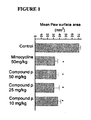
- Paw volume was measured (mm 2 ) before subplantar injection and again 3 hours after the injection of carrageenan using a plethysmometer. The results are shown in Figure 1 .
- Figure 1 compares the modulation of carregeenan induced inflammation of minocycline compared with various doses of compound P.
- Minocycline exhibited an EC 50 at approximately 50 mg/kg, while compound P exhibited similar or improved activity.
Landscapes
- Chemical & Material Sciences (AREA)
- Organic Chemistry (AREA)
- Health & Medical Sciences (AREA)
- Veterinary Medicine (AREA)
- Life Sciences & Earth Sciences (AREA)
- General Health & Medical Sciences (AREA)
- Medicinal Chemistry (AREA)
- Pharmacology & Pharmacy (AREA)
- Animal Behavior & Ethology (AREA)
- Public Health (AREA)
- Nuclear Medicine, Radiotherapy & Molecular Imaging (AREA)
- General Chemical & Material Sciences (AREA)
- Chemical Kinetics & Catalysis (AREA)
- Engineering & Computer Science (AREA)
- Bioinformatics & Cheminformatics (AREA)
- Tropical Medicine & Parasitology (AREA)
- Biomedical Technology (AREA)
- Neurosurgery (AREA)
- Communicable Diseases (AREA)
- Oncology (AREA)
- Dermatology (AREA)
- Neurology (AREA)
- Epidemiology (AREA)
- Virology (AREA)
- Hospice & Palliative Care (AREA)
- Psychiatry (AREA)
- Pain & Pain Management (AREA)
- Otolaryngology (AREA)
- Pulmonology (AREA)
- Rheumatology (AREA)
- Pharmaceuticals Containing Other Organic And Inorganic Compounds (AREA)
- Organic Low-Molecular-Weight Compounds And Preparation Thereof (AREA)
- Pyridine Compounds (AREA)
- Pyrane Compounds (AREA)
- Heterocyclic Carbon Compounds Containing A Hetero Ring Having Nitrogen And Oxygen As The Only Ring Hetero Atoms (AREA)
- Pyrrole Compounds (AREA)
- Furan Compounds (AREA)
- Hydrogenated Pyridines (AREA)
- Indole Compounds (AREA)
- Thiazole And Isothizaole Compounds (AREA)
Description
- The development of the tetracycline antibiotics was the direct result of a systematic screening of soil specimens collected from many parts of the world for evidence of microorganisms capable of producing bactericidal and/or bacteriostatic compositions. The first of these novel compounds was introduced in 1948 under the name chlortetracycline. Two years later, oxytetracycline became available. The elucidation of the chemical structure of these compounds confirmed their similarity and furnished the analytical basis for the production of a third member of this group in 1952, tetracycline. A new family of tetracycline compounds, without the ring-attached methyl group present in earlier tetracyclines, was prepared in 1957 and became publicly available in 1967; and minocycline was in use by 1972.
- Recently, research efforts have focused on developing new tetracycline antibiotic compositions effective under varying therapeutic conditions and routes of administration. New tetracycline analogues have also been investigated which may prove to be equal to or more effective than the originally introduced tetracycline compounds. Examples include
U.S. Patent Nos. 2,980,584 ;2,990,331 ;3,062,717 ;3,165,531 ;3,454,697 ;3,557,280 ;3,674,859 ;3,957,980 ;4,018,889 ;4,024,272 ; and4,126,680 . These patents are representative of the range of pharmaceutically active tetracycline and tetracycline analogue compositions. - Historically, soon after their initial development and introduction, the tetracyclines were found to be highly effective pharmacologically against rickettsiae; a number of gram-positive and gram-negative bacteria; and the agents responsible for lymphogranuloma venereum, inclusion conjunctivitis, and psittacosis. Hence, tetracyclines became known as "broad spectrum" antibiotics. With the subsequent establishment of their in vitro antimicrobial activity, effectiveness in experimental infections, and pharmacological properties, the tetracyclines as a class rapidly became widely used for therapeutic purposes. However, this widespread use of tetracyclines for both major and minor illnesses and diseases led directly to the emergence of resistance to these antibiotics even among highly susceptible bacterial species both commensal and pathogenic (e.g., pneumococci and Salmonella). The rise of tetracycline-resistant organisms has resulted in a general decline in use of tetracyclines as antibiotics of choice.
-
US-A-20042454 -
WO-A-03057169 -
WO-A-0204407 -
DE-A-2346535 describes a process for the preparation of tetracycline derivatives substituted in the 7 position comprising first obtaining tetracycline derivatives in the 7 and 9 positions, trasforming the substituent in the 7 position into the desired substituent, and then eliminating the substitutent in the 9-position. Also described are compounds obtined by said process. -
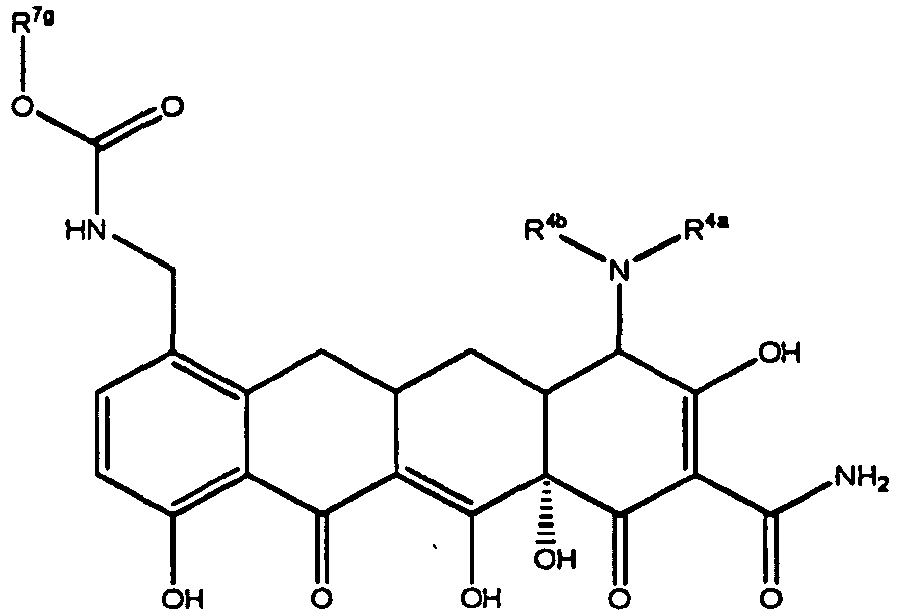
WO-A-2007133798 relates to the use of substituted tetracycline compounds for regulation of expression of nucleic acids operably linked to a tetracycline operator system. The invention pertains to compounds used in a regulatory system which utilizes components of the Tet repressor/operator/inducer system of prokaryotes to regulate gene expression in cells. Use of certain substituted tetracycline compounds, as featured in the methods of the invention, result in improved dose-response results when compared to those for e.g., tetracycline and doxycycline. Certain methods of the invention thus allow for enhanced control of the Tet repressor/operator/inducer system in regulating gene expression in cells. - In one embodiment, the invention pertains, at least in part, to substituted tetracycline compounds of Formula I:

- X is CHC(R13Y'Y), CR6'R6, C=CR6'R6, S, NR6, or O;
- E is NR7dR7e, OR7f or (CH2C(=W')WR7g where R7c is alkyl, W is CR7iR7j, W' is NR7h, R7h is alkoxy, and R7g, R7i and R7j are each hydrogen;
- R2, R2', R4', R4a and R4b are each independently hydrogen, alkyl, alkenyl, alkynyl, alkoxy, alkylthio, alkylsulfinyl, alkylsulfonyl, alkylamino, arylalkyl, aryl, heterocyclic or heteroaromatic;
- R3, R10, R11 and R12 are each hydrogen;
- R4 is NR4aR4b, alkyl, alkenyl, alkynyl, hydroxyl, halogen, or hydrogen;
- R5 and R5' are each hydroxyl, hydrogen, thiol, alkanoyl, aroyl, alkaroyl, aryl, heteroaromatic, alkyl, alkenyl, alkynyl, alkoxy, alkylthio, alkylsulfinyl, alkylsulfonyl, alkylamino, arylalkyl, alkyl carbonyloxy, or aryl carbonyloxy;
- R6 and R6' are each independently hydrogen, methylene, absent, hydroxyl, halogen, thiol, alkyl, alkenyl, alkynyl, aryl, alkoxy, alkylthio, alkylsulfinyl, alkylsulfonyl, alkylamino, or an arylalkyl;
- R7a, R7b, R7c, R7d, R7e, R7f, R7g, R7h, R7i, R7j and R7k are each independently hydrogen, allyl, alkyl, alkenyl, alkynyl, hydroxyl, alkoxy, alkylthio, alkylsulfinyl, alkylsulfonyl, amino, alkylamino, aminoalkyl, acyl, aryl, arylalkyl, alkylcarbonyloxy, alkylcarbonyloxylalkyl or arylcarbonyloxy, or R7c and R7d or R7c and R7f are linked to form a ring;
- R8 is hydrogen, hydroxyl, halogen, thiol, alkyl, alkenyl, alkynyl, aryl, alkoxy, alkylthio, alkylsulfinyl, alkylsulfonyl, alkylamino, or an arylalkyl;
- R9 is hydrogen, nitro, alkyl, alkenyl, alkynyl, aryl, alkoxy, alkylthio, alkylsulfinyl, alkylsulfonyl, arylalkyl, amino, aminoalkyl, amido, arylalkenyl, arylalkynyl, thionitroso, or -(CH2)0-3(NR9c)0-1C(=Z')ZR9a;
- Z is CR9dR9e, S, NR9b or O;
- Z' is O, S, or NR9f;
- R9a, R9b, R9c, R9d, R9e and R9f are each independently hydrogen, acyl, alkyl, alkenyl, alkynyl, alkoxy, alkylthio, alkylsulfinyl, alkylsulfonyl, alkylamino, arylalkyl, aryl, heterocyclic, heteroaromatic;
- R13 is hydrogen, hydroxy, alkyl, alkenyl, alkynyl, alkoxy, alkylthio, alkylsulfinyl, alkylsulfonyl, alkylamino, or an arylalkyl; and
- Y' and Y are each independently hydrogen, halogen, hydroxyl, cyano, sulfhydryl, amino, amido, alkyl, alkenyl, alkynyl, alkoxy, alkylthio, alkylsulfinyl, alkylsulfonyl, alkylamino, or an arylalkyl, and pharmaceutically acceptable salts thereof;
- or
- or

- In one embodiment, the invention pertains, at least in part, to a pharmaceutical composition comprising a therapeutically effective amount of a tetracycline compound as described above or a compound listed in Table 2, and a pharmaceutically acceptable carrier.
- In another further embodiment, the invention pertains, at least in part, to a tetracycline compound described above for use in the treatment of a bacterial infection, a viral infection, or a parasitic infection.
-
Figure 1 is a graphical comparison of the modulation of carregeenan induced inflammation in the rat paw edema model between minocycline and compound P. - The present invention pertains, at least in part, to novel substituted tetracycline compounds as decribed above. These tetracycline compounds can be used to treat numerous tetracycline compound-responsive states, such as bacterial infections, inflammation, and neoplasms, as well as other known applications for minocycline and tetracycline compounds in general, such as blocking tetracycline efflux and modulation of gene expression. The term "tetracycline compound" includes many compounds with a similar ring structure to tetracycline. Examples of tetracycline compounds include: chlortetracycline, oxytetracycline, demeclocycline, methacycline, sancycline, chelocardin, rolitetracycline, lymecycline, apicycline; clomocycline, guamecycline, meglucycline, mepylcycline, penimepicycline, pipacycline, etamocycline, penimocycline, etc. Other derivatives and analogues comprising a similar four ring structure are also included (See Rogalski, "Chemical Modifications of Tetracyclines"). Table 1 depicts tetracycline and several known other tetracycline derivatives.
Table 1 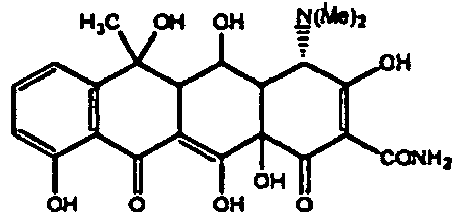


Oxytetracycline Demeclocycline Minocycline 


Methacycline Doxycycline Chlortetracycline 


Tetracycline Sancycline Chelocardin - Other tetracycline compounds which may be modified using the methods of the invention include 6-demethyl-6-deoxy-4-dedimethylaminotetracycline; tetracyclino-pyrazole; 7-chloro-4-dedimethylaminotetracycline; 4-hydroxy-4-dedimethylaminotetracycline; 12α-deoxy-4-dedimethylaminotetracycline; 5-hydroxy-6α-deoxy-4-dedimethylaminotetracycline; 4-dedimethylamino-12α-deoxyanhydrotetracycline; 7-dimethylamino-6-demethyl-6-deoxy-4-dedimethylaminotetracycline; tetracyclinonitrile; 4-oxo-4-dedimethylaminotetracycline 4,6-hemiketal; 4-oxo-11a Cl-4-dedimethylaminotetracycline-4,6-hemiketal; 5a,6-anhydro-4-hydrazon-4-dedimethylamino tetracycline; 4-hydroxyimino-4-dedimethylamino tetracyclines; 4-hydroxyimino-4-dedimethylamino 5a,6-anhydrotetracyclines; 4-amino-4- dedimethylamino-5a, 6 anhydrotetracycline; 4-methylamino-4-dedimethylamino tetracycline; 4-hydrazono-11a-chloro-6-deoxy-6-demethyl-6-methylene-4-dedimethylamino tetracycline; tetracycline quaternary ammonium compounds; anhydrotetracycline betaines; 4-hydroxy-6-methyl pretetramides; 4-keto tetracyclines; 5-keto tetracyclines; 5a, 11a dehydro tetracyclines; 11a C1-6, 12 hemiketal tetracyclines; 11a C1-6-methylene tetracyclines; 6, 13 diol tetracyclines; 6-benzylthiomethylene tetracyclines; 7, 11a-dichloro-6-fluoro-methyl-6-deoxy tetracyclines; 6-fluoro (α)-6-demethyl-6-deoxy tetracyclines; 6-fluoro (β)-6-demethyl-6-deoxy tetracyclines;6-α acetoxy-6-demethyl tetracyclines; 6-β acetoxy-6-demethyl tetracyclines; 7, 13-epithiotetracyclines; oxytetracyclines; pyrazolotetracyclines; 11a halogens of tetracyclines; 12a formyl and other esters of tetracyclines; 5, 12a esters of tetracyclines; 10, 12a- diesters of tetracyclines; isotetracycline; 12-a-deoxyanhydro tetracyclines; 6-demethyl-12a-deoxy-7-chloroanhydrotetracyclines; B-nortetracyclines; 7-methoxy-6-demethyl-6-deoxytetracyclines; 6-demethyl-6-deoxy-5a-epitetracyclines; 8-hydroxy-6-demethyl-6-deoxy tetracyclines; monardene; chromocycline; 5a methyl-6-demethyl-6-deoxy tetracyclines; 6-oxa tetracyclines, and 6 thia tetracyclines.
- In one embodiment, the invention pertains includes substituted tetracycline compound of Formula I as described above or


- In one embodiment, X is CR6'R6, R4 is NR4aR4b, R4a and R4b are each alkyl, and R2, R2', R3, R5, R5' R6, R6', R8, R9, R10, R11 and R12 are each hydrogen and R7a and R7b are hydrogen. In a further embodiment, E is OR7f, R7c is hydrogen, and R7f is alkyl (e.g., methyl, ethyl or t-butyl) or allyl.
- In another embodiment, R7c is alkyl (e.g., methyl or ethyl) and R7f is alkyl (e.g., methyl, ethyl, isopropyl or t-butyl), which may be substituted with a halogen (e.g., fluorine).
- In yet another embodiment, R7c and R7f are linked to join a ring.
- In one embodiment, E is NR7dR7e, R7c is alkyl (e.g., ethyl), R7d is hydrogen and R7e is alkyl (e.g., ethyl).
- In a further embodiment, E is CH2C(=W')WR7g, R7c is alkyl (e.g., methyl), W is CR7iR7j and R7g, R7i and R7j are each hydrogen. In a further embodiment, W' is NR7h and R7h is alkoxy (e.g., ethoxy).
- In one embodiment, X is CR6'R6, R4 is NR4aR4b, R4a and R4b are each alkyl (e.g., methyl); R2, R2', R3, R4' R5, R5' R6, R6', R7a, R7b, R7c, R8, R9, R10, R11 and R12 are each hydrogen; E is OR7f; R7f is allyl (e.g., CH2=CHCH2-) or alkyl (e.g., ethyl; isopropyl; t-butyl; alkoxy substituted alkyl (e.g., methoxyethyl); halogen substituted alkyl (e.g., alkyl substituted with fluorine, for example, FCH2CH2-; F2CHCH2-; CF3CH2- or CF2H-); alkylcarbonylalkyl (e.g., CH3CO(CH2)n-, in which n is an integer from 0-6, for example 1); alkoxycarbonylalkyl (e.g., CH3OCO(CH2)m-, in which m is an integer from 0-6, for example 1) or carboxylatealkyl (HOOC(CH2)q-, in which q is an integer from 0-6, for example 1).
- In one embodiment, X is CR6'R6, R4 is NR4aR4b, R4a and R4b are each alkyl (e.g., methyl); R2, R2', R3, R4' R5, R5' R6, R6', R7a, R7b, R8, R9, R10, R11 and R12 are each hydrogen; E is OR7f and R7c and R7f are linked to join a ring, for example, a 5- or 6-membered ring (e.g.,

- In another embodiment, X is CR6'R6, R4 is NR4aR4b, R4a and R4b are each alkyl (e.g., methyl); R2, R2', R3, R4' R5, R5' R6, R6', R7a, R7bR8, R9, R10, R11 and R12 are each hydrogen; E is OR7f; R7c and R7f may be each independently alkyl (e.g., methyl or ethyl).
- In yet another embodiment, X is CR6'R6, R4 is NR4aR4b, R4a and R4b are each alkyl (e.g., methyl); R2, R2', R3, R4' R5, R5' R6, R6', R7a, R7b, R7c, R8, R9, R10, R11 and R12 are each hydrogen; E is NR7dR7e; R7c is alkyl (e.g., ethyl); R7d is hydrogen and R7e is alkyl (e.g., ethyl).
- In a further embodiment, In one embodiment, X is CR6'R6, R4 is NR4aR4b, R4a and R4b are each alkyl (e.g., methyl); R2, R2', R3, R4' R5, R5' R6, R6', R7a, R7b, R7c, R8, R9, R10, R11 and R12 are each hydrogen; E is -C(=W')WR7g; W and W' are each oxygen; R7g is alkylcarbonyloxyalkyl (e.g., R7gaR7gbR7gcCOO(CH2)r- in which r is an integer between 1 and 5 and R7gaR7gbR7gc are each independently alkyl or hydrogen). In one embodiment, wherein R7gaR7gbR7gc are each alkyl (e.g., methyl); r is 1 and R7c is hydrogen or alkyl (e.g., cycloalkyl, for example, cyclopropyl).
- Examples of substituted tetracycline compounds of Formula (I) include:


- The substituted tetracycline compounds of the invention can be synthesized using the methods described in the following schemes and by using art recognized techniques. All novel substituted tetracycline compounds described herein are included in the invention as compounds.
- In Scheme 1, a general synthetic scheme for synthesizing 7-substituted 7-substituted tetracyclines is shown. A palladium catalyzed coupling of an iodosancycline (1) is performed to form a 7-substituted aldehyde intermediate (2). The aldehyde intermediate is reduced in the presence of a hydroxylamine to give the desired product (3). Compounds P, Y, U, DR and DS may be synthesized as described in Scheme 1.

- 7- and 9-substituted tetracycline compounds may be synthesized by reacting the 7-iodo-9-aminoalkyl sancycline derivative (4) with trimethylsilylethyne in the presence of a palladium catalyst to yield a 7-substituted alkynyl intermediate. Subsequent acid hydrolysis yields the 7-acyl intermediate (5). Further derivitization of the 9-position may be accomplished by reductive alkylation of the amino group with t-butyl aldehyde, hydrogen and palladium on carbon to form compound 6, which can then be reacted with a primary hydroxylamine to form the oxime 7.

- 7- and 9-substituted tetracycline compounds may also be prepared as shown in Scheme 3. Beginning with a 7-iodo-9-nitro substituted sancycline derivative (8), a Hiyama coupling followed by acid hydrolysis yields a 7-acyl-9-nitro intermediate (9). The nitro moiety may then be reduced to the amino group by hydrogen gas in the presence of a palladium catalyst (10). Reaction of the acyl group with a primary hydroxylamine provides the product 11.

- Scheme 4 also provides a method for synthesizing 7-substituted tetracyclines. As described above, a palladium catalyzed carbonylation of an iodosancycline (1) is performed to form a 7-substituted aldehyde intermediate (2). The aldehyde intermediate is reduced in the presence of a hydroxylamine to give compound 12, which may then be reacted with formaldehyde and triethylamine, followed by reduction to give the desired product (3). Compounds AA, AM, AB, AE, AF, AG, DV, DW, DX, DY, DZ, EA, EB, EC, ED, EE, EF, EG and EH may be synthesized as illustrated in Scheme 4.


- Scheme 5 details the synthesis of substituted tetracyclines with hydroxy in the 10-position. A 7-substituted tetracycline compound may be reacted with N-(5-chloro-2-pyridyl)bis(trifluoromethanesulfonimide) to form a trifluoromethane substituted intermediate (14), which can then be reacted with ammonium formate in the presence of a palladium catalyst to form the desired product (15).

- Scheme 6 outlines the general synthesis of 7-substituted tetracyclines. A 7-iodo sancycline derivative (1) may undergo a Stille coupling or a Suzuki coupling by reacting with an alkyl tin derivative or a boronic acid derivative in the presence of a palladium catalyst to form the desired product (16).

- The 7-substituted oxime derivatives may also be prepared as shown in Scheme 7. An 7-iodo sancycline derivative (1) can be reacted with a substituted alkyne in the presence of palladium to synthesize the alkynyl derivative 17. Compound 17 may be converted to the acyl substituted compound 18 by any technique known in the art. The desired oxime product 19 can be obtained by reacting the acyl moiety with a primary hydroxylamine.

- Scheme 8 is a general synthetic scheme showing the synthesis of 7-substitued hydrazone compounds. A 7-substituted aldehyde tetracycline derivative, prepared as described above in Scheme 4, is combined with a primary hydrazone to form the desired
product 20.
- 7-substituted hydrazines may also be synthesized as shown in Scheme 9. Starting with compound 2, synthesized as described in Scheme 4 above, may be reacted with a secondary hydrazine in the presence of a reducing agent to form compound 21. Compound Z may be synthesized as shown in Scheme 9.

-
Scheme 10 further depicts a method of synthesizing a 7-substituted aminoalkyl tetracycline compound. Compound 2 is reacted with a primary amine in the presence of a reducing agent to form the secondary amine intermediate (22), which is then mixed with an acid chloride to form compound 23. Compounds F, CV and CW may be synthesized as illustrated inScheme 10.
- Scheme 11 describes a general method for preparing 9-substituted aminoalkyl substituted tetracycline compounds. Compound 24 may be reacted directly with a secondary amine to form compounds similar to 26. Alternatively, compound 24 may be mixed with a primary amine to yield the substituted imine 25, which may be further reduced to produce the aminoalkyl compound 26.

- 7-substituted tetracycline may also be prepared as shown in Scheme 12. Starting again with compound 2, reductive alkylation with a dioxalanyl secondary amine yields the intermediate 27. Subsequently exposing 27 to acidic conditions removes the protecting group to form intermediate 28, which may then be reacted with a primary amine to form product 29. Compound AL may be synthesized as shown in Scheme 12.

- Schemes 13 and 14 illustrate the general synthesis of cyclobutene 7-substituted tetracycline compounds. Beginning with 30, tin reagent 31 is synthesized by reacting 30 with a trimethylsilyl substituted alkyltin derivative.

- Scheme 14 continues to show the synthesis of cyclobutenedione 7-substituted tetracycline compounds, by reacting building block 31 with 7-iodo substituted sancycline (1) in a Stille coupling reaction to form 32. The amino substitution of product 33 is accomplished by reacting 32 with a primary amine in methanol.

- Scheme 15 depicts generally the synthesis of substituted aromatic 7-substituted tetracycline compounds. Beginning with 1 and performing a Suzuki coupling reaction in the presence of a boronic acid and a palladium catalyst, compounds of general formula 34 are formed.
- Scheme 16 also depicts the synthesis of substituted aromatic 7-substituted tetracycline compounds. Again, starting from 7-iodo substituted sancycline (1), a Suzuki coupling reaction is performed with a boronic acid in the presence of a palladium catalyst to provide intermediate 35 in which R7tb is either an amine or a carboxylic acid. If R7tb is a carboxylic acidic moiety, a coupling to a secondary amine in the presence of base and a typical coupling reagent to form 7-substituted tetracyclines similar to 36a. If R7tb is an amino moiety, a coupling to an acid chloride or carboxylic acid in the presence of a base and a typical coupling reagent to form 7-substituted tetracyclines similar to 36b.

- Scheme 17 depicts a method for synthesizing aromatic substituted 9-substituted tetracycline compounds. A 9-iodo tetracycline derivative is reacted under Suzuki conditions by mixing with a boronic acid in the presence of the appropriate palladium catalyst to give compounds similar to compound 38.

- Scheme 18 also depicts a method for synthesizing 9-substituted tetracycline compounds by reacting 37 with a palladium catalyst and carbon monoxide in the presence ofN-hydroxysuccinimide to generate an activated ester intermediate. Reaction of this intermediate with nucleophilic compounds such as alcohols, hydroxylamines or amines yields the desired ester, hydroxamic acid or amide, respectively, similar to 39.

- 9-substituted oxime tetracycline compounds may be prepared as shown in Scheme 19. A 9-iodo substituted tetracycline derivative is subjected to Heck conditions to form an alkyne intermediate which is converted to 40 by acid hydrolysis. Intermediate 40 is subsequently reacted with an appropriate hydroxylamine to yield the desired product 41.

- As shown in
Scheme 20, 7-substituted tetracycline compounds can also be prepared by reacting the acyl intermediate 41 with hydrogen bromide to form the α-bromoketone substituted tetracycline 42. By reacting the brominated tetracycline with a secondary amine, followed by exposure to an acid chloride, the desired product 43 can be formed.
- As shown in Scheme 21, 9-substituted-4-dedimethylamino tetracycline compounds may be synthesized starting from minocycline, which is exposed to the dedimethylamino conditions of methyl iodide and zinc to form 4-dedimethylsancycline 44. Intermediate 44 is halogenated at the 9-position to form intermediate 45, and upon exposing 45 to the appropriate palladium conditions, compounds similar to 46 are formed.

- As shown in Scheme 22, 9-substituted-4-dedimethylamino doxycycline compounds may be synthesized starting from doxycycline, which is exposed to the dedimethylamino conditions of methyl iodide and zinc to form 4-dedimethyldoxycycline 47. Intermediate 47 is halogenated at the 9-position to form intermediate 48, and upon exposing 48 to the appropriate palladium conditions, compounds similar to 49 are formed.

- Scheme 23 illustrates the synthesis of 10-substituted tetracycline compounds. Starting with minocycline, the 10-position hydroxide is deprotonated in the presence of a strong base, followed by the addition of triflate to form intermediate 50, which then undergoes either Stille or Suzuki conditions or carbonylation conditions to form compounds similar to 10-substituted compounds 51.

- Scheme 24 illustrates the synthesis of 7-aminomethyl substituted tetracycline compounds. Compound 1 is exposed to a secondary amine in the presence of a reducing agent to from compounds similar to 52.

- Scheme 25 provides a method for synthesizing 9-aminomethyl substituted tetracycline compounds. 9-formyl substituted compound 54 is reacted with a secondary amine in the presence of a reducing agent to provide the 9-aminomethyl substituted tetracycline compounds 55.

- Scheme 26 illustrates the methods for synthesizing 9-alkyl or 9-carbonyl substituted tetracycline compounds starting with the 9-iodominocycline or 9-iodo-4-dedimethylminocycline compound 56, followed by palladium catalyzed alkynylation to form intermediate 57. Intermediate 57 may undergo either hydrogenolysis to form 9-alkyl substituted tetracycline compounds (58) or acid catalyzed hydrolysis to form 9-carbonyl substituted tetracycline compound (59).

- 9-Alkyl substituted tetracycline compounds may also be synthesized as shown in Scheme 27. Again starting with 9-iodominocycline or 9-iodo-4-dedimethylminocycline compound 56, either Suzuki or Stille coupling conditions may produce the 9-alkyl substituted tetracycline compounds (60) or reaction with copper iodide with a fluorinated ester compound yields 9-trifluoroalkyl substituted compound 61.

- 7-Furanyl substituted tetracycline compounds may be synthesized as illustrated in Scheme 28. 7-Iodosancycline (1) is subjected to a formyl substituted furanyl boronic acid in the presence of palladium (II) acetate and sodium carbonate to yield intermediate 62. A reductive amination is then performed in the presence of an appropriate reducing agent and a secondary amine to convert the formyl moiety to a tertiary alkylamine (63). The substituents of the tertiary amine may be further derivitized, as shown by the reaction of compound 63 with methylchloroformate to form compound 64.

- 7-Pyridinyl-9-aminocarbonyl substituted tetracyclines may be synthesized as shown in Scheme 29. The 7-position of the 7-iodo-9-nitro tetracycline compound (8) is reacted under Stille conditions to form the 7-pyridinyl intermediate 64, which is then subjected to reducing conditions to form the 7-pyridinyl-9-amino tetracycline compound 65. The amino moiety of compound 65 is then reacted with a chloroformate to form the desired aminocarbonyl substituent in the 9 position (66).

- Scheme 30 illustrates methods for preparing both 9-aminomethyl substituted sancycline compounds and 7-substituted-9-aminomethyl tetracycline compounds. Sancycline is bromonated at the 7-position with N-bromosuccinimide and iodated at the 9-position with N-iodosuccinimide to form the dihalogenated reactive intermediate 67, which then undergoes formylation at the 9-position to yield a 7-bromo-9-formyl substituted tetracycline compound (68). Compound 68 may then undergo a reductive amination procedure in the presence of an appropriate secondary amine and a reducing agent to form compound 69. The bromo moiety at the 7-position may then be removed by exposing 69 to palladium on carbon in the presence of hydrogen gas to provide 9-aminomethyl sancycline compounds (71). Alternatively, the reactive intermediate 68 may first be exposed to reductive amination conditions as described above, followed by a pallium-indium cross coupling reaction to form 7-substituted-9-aminomethyl tetracycline compounds (70).

- 7-Substituted tetracycline compounds may be generally synthesized as shown in Scheme 31. A 7-iodo tetracycline compound (71) may be reacted under Suzuki, Stille or indium-palladium cross coupling reactions to form 7-substituted tetracycline compounds.

- The term "alkyl" includes saturated aliphatic groups, including straight-chain alkyl groups (e.g., methyl, ethyl, propyl, butyl, pentyl, hexyl, heptyl, octyl, nonyl, decyl, etc.), branched-chain alkyl groups (isopropyl, tert-butyl, isobutyl, etc.), cycloalkyl (alicyclic) groups (cyclopropyl, cyclopentyl, cyclohexyl, cycloheptyl, cyclooctyl), alkyl substituted cycloalkyl groups, and cycloalkyl substituted alkyl groups. In certain embodiments, a straight chain or branched chain alkyl has 6 or fewer carbon atoms in its backbone (e.g., C1-C6 for straight chain, C3-C6 for branched chain), and more preferably 4 or fewer. Likewise, preferred cycloalkyls have from 3-8 carbon atoms in their ring structure, and more preferably have 5 or 6 carbons in the ring structure. The term C1-C6 includes alkyl groups containing 1 to 6 carbon atoms.
- Moreover, the term alkyl includes both "unsubstituted alkyls" and "substituted alkyls," the latter of which refers to alkyl moieties having substituents replacing a hydrogen on one or more carbons of the hydrocarbon backbone. Such substituents can include, for example, alkenyl, alkynyl, halogen, hydroxyl, alkylcarbonyloxy, arylcarbonyloxy, alkoxycarbonyloxy, aryloxycarbonyloxy, carboxylate, alkylcarbonyl, arylcarbonyl, alkoxycarbonyl, aminocarbonyl, alkylaminocarbonyl, dialkylaminocarbonyl, alkylthiocarbonyl, alkoxyl, phosphate, phosphonato, phosphinato, cyano, amino (including alkyl amino, dialkylamino, arylamino, diarylamino, and alkylarylamino), acylamino (including alkylcarbonylamino, arylcarbonylamino, carbamoyl and ureido), amidino, imino, sulfhydryl, alkylthio, arylthio, thiocarboxylate, sulfates, alkylsulfinyl, sulfonato, sulfamoyl, sulfonamido, nitro, trifluoromethyl, cyano, azido, heterocyclyl, alkylaryl, or an aromatic or heteroaromatic moiety. Cycloalkyls can be further substituted, e.g., with the substituents described above. An "alkylaryl" or an "arylalkyl" moiety is an alkyl substituted with an aryl (e.g., phenylmethyl (benzyl)).
- The term "aryl" includes groups, including 5- and 6-membered single-ring aromatic groups that may include from zero to four heteroatoms, for example, benzene, phenyl, pyrrole, furan, thiophene, thiazole, isothiaozole, imidazole, triazole, tetrazole, pyrazole, oxazole, isooxazole, pyridine, pyrazine, pyridazine, and pyrimidine, and the like. Furthermore, the term "aryl" includes multicyclic aryl groups, e.g., tricyclic, bicyclic, e.g., naphthalene, benzoxazole, benzodioxazole, benzothiazole, benzoimidazole, benzothiophene, methylenedioxyphenyl, quinoline, isoquinoline, napthridine, indole, benzofuran, purine, benzofuran, deazapurine, or indolizine. Those aryl groups having heteroatoms in the ring structure may also be referred to as "aryl heterocycles," "heterocycles," "heteroaryls" or "heteroaromatics." The aromatic ring can be substituted at one or more ring positions with such substituents as described above, as for example, halogen, hydroxyl, alkoxy, alkylcarbonyloxy, arylcarbonyloxy, alkoxycarbonyloxy, aryloxycarbonyloxy, carboxylate, alkylcarbonyl, alkylaminoacarbonyl, arylalkyl aminocarbonyl, alkenylaminocarbonyl, alkylcarbonyl, arylcarbonyl, arylalkylcarbonyl, alkenylcarbonyl, alkoxycarbonyl, aminocarbonyl, alkylthiocarbonyl, phosphate, phosphonato, phosphinato, cyano, amino (including alkyl amino, dialkylamino, arylamino, diarylamino, and alkylarylamino), acylamino (including alkylcarbonylamino, arylcarbonylamino, carbamoyl and ureido), amidino, imino, sulfhydryl, alkylthio, arylthio, thiocarboxylate, sulfates, alkylsulfinyl, sulfonato, sulfamoyl, sulfonamido, nitro, trifluoromethyl, cyano, azido, heterocyclyl, alkylaryl, or an aromatic or heteroaromatic moiety. Aryl groups can also be fused or bridged with alicyclic or heterocyclic rings which are not aromatic so as to form a polycycle (e.g., tetralin).
- The term "alkenyl" includes unsaturated aliphatic groups analogous in length and possible substitution to the alkyls described above, but that contain at least one double bond.
- For example, the term "alkenyl" includes straight-chain alkenyl groups (e.g., ethylenyl, propenyl, butenyl, pentenyl, hexenyl, heptenyl, octenyl, nonenyl, decenyl, etc.), branched-chain alkenyl groups, cycloalkenyl (alicyclic) groups (cyclopropenyl, cyclopentenyl, cyclohexenyl, cycloheptenyl, cyclooctenyl), alkyl or alkenyl substituted cycloalkenyl groups, and cycloalkyl or cycloalkenyl substituted alkenyl groups. In certain embodiments, a straight chain or branched chain alkenyl group has 6 or fewer carbon atoms in its backbone (e.g., C2-C6 or straight chain, C3-C6 for branched chain). Likewise, cycloalkenyl groups may have from 3-8 carbon atoms in their ring structure, and more preferably have 5 or 6 carbons in the ring structure. The term C2-C6 includes alkenyl groups containing 2 to 6 carbon atoms.
- Moreover, the term alkenyl includes both "unsubstituted alkenyls" and "substituted alkenyls," the latter of which refers to alkenyl moieties having substituents replacing a hydrogen on one or more carbons of the hydrocarbon backbone. Such substituents can include, for example, alkyl groups, alkynyl groups, halogens, hydroxyl, alkylcarbonyloxy, arylcarbonyloxy, alkoxycarbonyloxy, aryloxycarbonyloxy, carboxylate, alkylcarbonyl, arylcarbonyl, alkoxycarbonyl, aminocarbonyl, alkylaminocarbonyl, dialkylaminocarbonyl, alkylthiocarbonyl, alkoxyl, phosphate, phosphonato, phosphinato, cyano, amino (including alkyl amino, dialkylamino, arylamino, diarylamino, and alkylarylamino), acylamino (including alkylcarbonylamino, arylcarbonylamino, carbamoyl and ureido), amidino, imino, sulfhydryl, alkylthio, arylthio, thiocarboxylate, sulfates, alkylsulfinyl, sulfonato, sulfamoyl, sulfonamido, nitro, trifluoromethyl, cyano, azido, heterocyclyl, alkylaryl, or an aromatic or heteroaromatic moiety.
- The term "alkynyl" includes unsaturated aliphatic groups analogous in length and possible substitution to the alkyls described above, but which contain at least one triple bond.
- For example, the term "alkynyl" includes straight-chain alkynyl groups (e.g., ethynyl, propynyl, butynyl, pentynyl, hexynyl, heptynyl, octynyl, nonynyl, decynyl, etc.), branched-chain alkynyl groups, and cycloalkyl or cycloalkenyl substituted alkynyl groups. In certain embodiments, a straight chain or branched chain alkynyl group has 6 or fewer carbon atoms in its backbone (e.g., C2-C6 for straight chain, C3-C6 for branched chain). The term C2-C6 includes alkynyl groups containing 2 to 6 carbon atoms.
- Moreover, the term alkynyl includes both "unsubstituted alkynyls" and "substituted alkynyls," the latter of which refers to alkynyl moieties having substituents replacing a hydrogen on one or more carbons of the hydrocarbon backbone. Such substituents can include, for example, alkyl groups, alkynyl groups, halogens, hydroxyl, alkylcarbonyloxy, arylcarbonyloxy, alkoxycarbonyloxy, aryloxycarbonyloxy, carboxylate, alkylcarbonyl, arylcarbonyl, alkoxycarbonyl, aminocarbonyl, alkylaminocarbonyl, dialkylaminocarbonyl, alkylthiocarbonyl, alkoxyl, phosphate, phosphonato, phosphinato, cyano, amino (including alkyl amino, dialkylamino, arylamino, diarylamino, and alkylarylamino), acylamino (including alkylcarbonylamino, arylcarbonylamino, carbamoyl and ureido), amidino, imino, sulfhydryl, alkylthio, arylthio, thiocarboxylate, sulfates, alkylsulfinyl, sulfonato, sulfamoyl, sulfonamido, nitro, trifluoromethyl, cyano, azido, heterocyclyl, alkylaryl, or an aromatic or heteroaromatic moiety.
- Unless the number of carbons is otherwise specified, "lower alkyl" as used herein means an alkyl group, as defined above, but having from one to five carbon atoms in its backbone structure. "Lower alkenyl" and "lower alkynyl" have chain lengths of, for example, 2-5 carbon atoms.
- The term "acyl" includes compounds and moieties which contain the acyl radical (CH3CO-) or a carbonyl group. It includes substituted acyl moieties. The term "substituted acyl" includes acyl groups where one or more of the hydrogen atoms are replaced by for example, alkyl groups, alkynyl groups, halogens, hydroxyl, alkylcarbonyloxy, arylcarbonyloxy, alkoxycarbonyloxy, aryloxycarbonyloxy, carboxylate, alkylcarbonyl, arylcarbonyl, alkoxycarbonyl, aminocarbonyl, alkylaminocarbonyl, dialkylaminocarbonyl, alkylthiocarbonyl, alkoxyl, phosphate, phosphonato, phosphinato, cyano, amino (including alkyl amino, dialkylamino, arylamino, diarylamino, and alkylarylamino), acylamino (including alkylcarbonylamino, arylcarbonylamino, carbamoyl and ureido), amidino, imino, sulfhydryl, alkylthio, arylthio, thiocarboxylate, sulfates, alkylsulfinyl, sulfonato, sulfamoyl, sulfonamido, nitro, trifluoromethyl, cyano, azido, heterocyclyl, alkylaryl, or an aromatic or heteroaromatic moiety.
- The term "acylamino" includes moieties wherein an acyl moiety is bonded to an amino group. For example, the term includes alkylcarbonylamino, arylcarbonylamino, carbamoyl and ureido groups.
- The term "aroyl" includes compounds and moieties with an aryl or heteroaromatic moiety bound to a carbonyl group. Examples of aroyl groups include phenylcarboxy, naphthyl carboxy, etc.
- The terms "alkoxyalkyl," "alkylaminoalkyl" and "thioalkoxyalkyl" include alkyl groups, as described above, which further include oxygen, nitrogen or sulfur atoms replacing one or more carbons of the hydrocarbon backbone, e.g., oxygen, nitrogen or sulfur atoms.
- The term "alkoxy" includes substituted and unsubstituted alkyl, alkenyl, and alkynyl groups covalently linked to an oxygen atom. Examples of alkoxy groups include methoxy, ethoxy, isopropyloxy, propoxy, butoxy, and pentoxy groups. Examples of substituted alkoxy groups include halogenated alkoxy groups. The alkoxy groups can be substituted with groups such as alkenyl, alkynyl, halogen, hydroxyl, alkylcarbonyloxy, arylcarbonyloxy, alkoxycarbonyloxy, aryloxycarbonyloxy, carboxylate, alkylcarbonyl, arylcarbonyl, alkoxycarbonyl, aminocarbonyl, alkylaminocarbonyl, dialkylaminocarbonyl, alkylthiocarbonyl, alkoxyl, phosphate, phosphonato, phosphinato, cyano, amino (including alkyl amino, dialkylamino, arylamino, diarylamino, and alkylarylamino), acylamino (including alkylcarbonylamino, arylcarbonylamino, carbamoyl and ureido), amidino, imino, sulfhydryl, alkylthio, arylthio, thiocarboxylate, sulfates, alkylsulfinyl, sulfonato, sulfamoyl, sulfonamido, nitro, trifluoromethyl, cyano, azido, heterocyclyl, alkylaryl, or an aromatic or heteroaromatic moieties. Examples of halogen substituted alkoxy groups include fluoromethoxy, difluoromethoxy, trifluoromethoxy, chloromethoxy, dichloromethoxy, trichloromethoxy, etc.
- The term "amine" or "amino" includes compounds where a nitrogen atom is covalently bonded to at least one carbon or heteroatom. The term includes "alkyl amino" which comprises groups and compounds wherein the nitrogen is bound to at least one additional alkyl group. The term "dialkyl amino" includes groups wherein the nitrogen atom is bound to at least two additional alkyl groups. The term "arylamino" and "diarylamino" include groups wherein the nitrogen is bound to at least one or two aryl groups, respectively. The term "alkylarylamino," "alkylaminoaryl" or "arylaminoalkyl" refers to an amino group which is bound to at least one alkyl group and at least one aryl group. The term "alkaminoalkyl" refers to an alkyl, alkenyl, or alkynyl group bound to a nitrogen atom which is also bound to an alkyl group.
- The term "amide," "amido" or "aminocarbonyl" includes compounds or moieties which contain a nitrogen atom which is bound to the carbon of a carbonyl or a thiocarbonyl group. The term includes "alkaminocarbonyl" or "alkylaminocarbonyl" groups which include alkyl, alkenyl, aryl or alkynyl groups bound to an amino group bound to a carbonyl group. It includes arylaminocarbonyl and arylcarbonylamino groups which include aryl or heteroaryl moieties bound to an amino group which is bound to the carbon of a carbonyl or thiocarbonyl group. The terms "alkylaminocarbonyl," "alkenylaminocarbonyl," "alkynylaminocarbonyl," "arylaminocarbonyl," "alkylcarbonylamino," "alkenylcarbonylamino," "alkynylcarbonylamino," and "arylcarbonylamino" are included in term "amide." Amides also include urea groups (aminocarbonylamino) and carbamates (oxycarbonylamino).
- The term "carbonyl" or "carboxy" includes compounds and moieties which contain a carbon connected with a double bond to an oxygen atom. The carbonyl can be further substituted with any moiety which allows the compounds of the invention to perform its intended function. For example, carbonyl moieties may be substituted with alkyls, alkenyls, alkynyls, aryls, alkoxy, aminos, etc. Examples of moieties which contain a carbonyl include aldehydes, ketones, carboxylic acids, amides, esters, anhydrides, etc.
- The term "thiocarbonyl" or "thiocarboxy" includes compounds and moieties which contain a carbon connected with a double bond to a sulfur atom.
- The term "ether" includes compounds or moieties which contain an oxygen bonded to two different carbon atoms or heteroatoms. For example, the term includes "alkoxyalkyl" which refers to an alkyl, alkenyl, or alkynyl group covalently bonded to an oxygen atom which is covalently bonded to another alkyl group.
- The term "ester" includes compounds and moieties which contain a carbon or a heteroatom bound to an oxygen atom which is bonded to the carbon of a carbonyl group. The term "ester" includes alkoxycarboxy groups such as methoxycarbonyl, ethoxycarbonyl, propoxycarbonyl, butoxycarbonyl, pentoxycarbonyl, etc. The alkyl, alkenyl, or alkynyl groups are as defined above.
- The term "thioether" includes compounds and moieties which contain a sulfur atom bonded to two different carbon or hetero atoms. Examples of thioethers include, alkthioalkyls, alkthioalkenyls, and alkthioalkynyls. The term "alkthioalkyls" include compounds with an alkyl, alkenyl, or alkynyl group bonded to a sulfur atom which is bonded to an alkyl group. Similarly, the term "alkthioalkenyls" and alkthioalkynyls" refer to compounds or moieties wherein an alkyl, alkenyl, or alkynyl group is bonded to a sulfur atom which is covalently bonded to an alkynyl group.
- The term "hydroxy" or "hydroxyl" includes groups with an -OH or -O-.
- The term "halogen" includes fluorine, bromine, chlorine, iodine, etc. The term "perhalogenated" generally refers to a moiety wherein all hydrogens are replaced by halogen atoms.
- The terms "polycyclyl" or "polycyclic radical" refer to two or more cyclic rings (e.g., cycloalkyls, cycloalkenyls, cycloalkynyls, aryls and/or heterocyclyls) in which two or more carbons are common to two adjoining rings, e.g., the rings are "fused rings." Rings that are joined through non-adjacent atoms are termed "bridged" rings. Each of the rings of the polycycle can be substituted with such substituents as described above, as for example, halogen, hydroxyl, alkylcarbonyloxy, arylcarbonyloxy, alkoxycarbonyloxy, aryloxycarbonyloxy, carboxylate, alkylcarbonyl, alkoxycarbonyl, alkylaminoacarbonyl, arylalkylaminocarbonyl, alkenylaminocarbonyl, alkylcarbonyl, arylcarbonyl, arylalkyl carbonyl, alkenylcarbonyl, aminocarbonyl, alkylthiocarbonyl, alkoxyl, phosphate, phosphonato, phosphinato, cyano, amido, amino (including alkyl amino, dialkylamino, arylamino, diarylamino, and alkylarylamino), acylamino (including alkylcarbonylamino, arylcarbonylamino, carbamoyl and ureido), amidino, imino, sulfhydryl, alkylthio, arylthio, thiocarboxylate, sulfates, alkylsulfinyl, sulfonato, sulfamoyl, sulfonamido, nitro, trifluoromethyl, cyano, azido, heterocyclyl, alkyl, alkylaryl, or an aromatic or heteroaromatic moiety.
- The term "heteroatom" includes atoms of any element other than carbon or hydrogen. Preferred heteroatoms are nitrogen, oxygen, sulfur and phosphorus.
- The term "prodrug moiety" includes moieties which can be metabolized in vivo to a hydroxyl group and moieties which may advantageously remain esterified in vivo. Preferably, the prodrugs moieties are metabolized in vivo by esterases or by other mechanisms to hydroxyl groups or other advantageous groups. Examples of prodrugs and their uses are well known in the art (See, e.g., Berge et al. (1977) "Pharmaceutical Salts" J. Pharm. Sci. 66:1-19). The prodrugs can be prepared in situ during the final isolation and purification of the compounds, or by separately reacting the purified compound in its free acid form or hydroxyl with a suitable esterifying agent. Hydroxyl groups can be converted into esters via treatment with a carboxylic acid. Examples of prodrug moieties include substituted and unsubstituted, branch or unbranched lower alkyl ester moieties, (e.g., propionoic acid esters), lower alkenyl esters, di-lower alkylamino lower-alkyl esters (e.g., dimethylaminoethyl ester), acylamino lower alkyl esters (e.g., acetyloxymethyl ester), acyloxy lower alkyl esters (e.g., pivaloyloxymethyl ester), aryl esters (phenyl ester), aryl-lower alkyl esters (e.g., benzyl ester), substituted (e.g., with methyl, halo, or methoxy substituents) aryl and aryl-lower alkyl esters, amides, lower-alkyl amides, di-lower alkyl amides, and hydroxy amides. Preferred prodrug moieties are propionoic acid esters and acyl esters.
- It will be noted that the structure of some of the tetracycline compounds of this invention includes asymmetric carbon atoms. It is to be understood accordingly that the isomers arising from such asymmetry (e.g., all enantiomers and diastereomers) are included within the scope of this invention, unless indicated otherwise. Such isomers can be obtained in substantially pure form by classical separation techniques and by stereochemically controlled synthesis. Furthermore, the structures and other compounds and moieties discussed in this application also include all tautomers thereof.
- The invention also pertains to the tetracycline compounds of the invention for use in treating a tetracycline responsive state such as a bacterial infection, a viral infection, or a parasitic infection. The method comprises administering to a subject an effective amount of a tetracycline compound of the invention such that the tetracycline responsive state is treated.
- The term "treating" includes curing as well as ameliorating at least one symptom of the state, disease or disorder, e.g., the tetracycline compound responsive state.
- The language "tetracycline compound responsive state" or "tetracycline responsive state" includes states which can be treated, prevented, or otherwise ameliorated by the administration of a tetracycline compound of the invention Tetracycline compound responsive states include bacterial, viral, parasitic, and fungal infections (including those which are resistant to other tetracycline compounds), cancer (e.g., prostate, breast, colon, lung melanoma and lymph cancers and other disorders characterized by unwanted cellular proliferation, including those described in
U.S. 6,100,248 ), arthritis, osteoporosis, diabetes, stroke, AMI, aortic aneurysm, neurodegenerative diseases and other states for which tetracycline compounds have been found to be active (see, for example,U.S. Patent Nos. 5,789,395 ;5,834,450 ;6,277,061 and5,532,227 . Compound's of the invention can be used to prevent or control important mammalian and veterinary diseases such as diarrhea, urinary tract infections, infections of skin and skin structure, ear, nose and throat infections, wound infection, mastitis and the like. In addition, methods for treating neoplasms using tetracycline compounds of the invention are also described (van der Bozert et al., Cancer Res., 48:6686-6690 (1988)). In a further embodiment, the tetracycline responsive state is not a bacterial infection. In another embodiment, the tetracycline compounds of the invention are essentially non-antibacterial. For example, non-antibacterial tetracycline compounds of the invention may have MIC values greater than about 4 µg/ml (as measured by assays known in the art and/or the assay given in Example 2). - Tetracycline compound responsive states also include inflammatory process associated states (IPAS). The term "inflammatory process associated state" includes states in which inflammation or inflammatory factors (e.g., matrix metalloproteinases (MMPs), nitric oxide (NO), TNF, interleukins, plasma proteins, cellular defense systems, cytokines, lipid metabolites, proteases, toxic radicals, adhesion molecules, etc.), are involved or are present in an area in aberrant amounts, e.g., in amounts which may be advantageous to alter, e.g., to benefit the subject. The term "inflammatory process associated state" also includes states in which there is an increase in acute phase proteins (e.g., C-reactive protein). The inflammatory process is the response of living tissue to damage. The cause of inflammation may be due to physical damage, chemical substances, micro-organisms, tissue necrosis, cancer or other agents. Acute inflammation is short-lasting, lasting only a few days. If it is longer lasting however, then it may be referred to as chronic inflammation.
- Tetracycline responsive states also include inflammatory disorders. Inflammatory disorders are generally characterized by heat, redness, swelling, pain and loss of function. Examples of causes of inflammatory disorders include microbial infections (e.g., bacterial and fungal infections), physical agents (e.g., burns, radiation, and trauma), chemical agents (e.g., toxins and caustic substances), tissue necrosis and various types of immunologic reactions.
- Tetracycline compound responsive states also include NO associated states. The term "NO associated state" includes states which involve or are associated with nitric oxide (NO) or inducible nitric oxide synthase (iNOS). NO associated state includes states which are characterized by aberrant amounts of NO and/or iNOS. Preferably, the NO associated state can be treated by administering tetracycline compounds of the invention. The disorders, diseases and states described in
U.S. Patents Nos. 6,231,894 ;6,015,804 ;5,919,774 ; and5,789,395 are also included as NO associated states. - Other examples of tetracycline compound responsive states include malaria and chronic infections (bacterial, viral and fungal. The compounds of the invention may be administered in combination with standard cancer therapy, such as chemotherapy.
- The language "in combination with" another therapeutic agent or treatment includes co-administration of the tetracycline compound, (e.g., inhibitor) and with the other therapeutic agent or treatment, administration of the tetracycline compound first, followed by the other therapeutic agent or treatment and administration of the other therapeutic agent or treatment first, followed by the tetracycline compound. The other therapeutic agent may be any agent that is known in the art to treat, prevent, or reduce the symptoms of a particular tetracycline responsive state. Furthermore, the other therapeutic agent may be any agent of benefit to the patient when administered in combination with the administration of a tetracycline compound.
- Bacterial infections may be caused by a wide variety of gram positive and gram negative bacteria. Some of the compounds of the invention are useful as antibiotics against organisms which are resistant and/or sensitive to other tetracycline compounds. The antibiotic activity of the tetracycline compounds of the invention may by using the in vitro standard broth dilution method described in Waitz, J.A., CLSI, Document M7-A2, vol. 10, no. 8, pp. 13-20, 2nd edition, Villanova, PA (1990).
- The tetracycline compounds may also be used to treat infections traditionally treated with tetracycline compounds such as, for example, rickettsiae; a number of gram-positive and gram-negative bacteria; and the agents responsible for lymphogranuloma venereum, inclusion conjunctivitis, or psittacosis. The tetracycline compounds may be used to treat infections of, e.g., K. pneumoniae, Salmonella, E. hirae, A. baumanii, B. catarrhalis, H. influenzae, P. aeruginosa, E. faecium, E. coli, S. aureus or E. faecalis. In one embodiment, the tetracycline compound is used to treat a bacterial infection that is resistant to other tetracycline antibiotic compounds. The tetracycline compound of the invention may be administered with a pharmaceutically acceptable carrier.
- The language "effective amount" of the compound is that amount necessary or sufficient to treat or prevent a tetracycline compound responsive state. The effective amount can vary depending on such factors as the size and weight of the subject, the type of illness, or the particular tetracycline compound. For example, the choice of the tetracycline compound can affect what constitutes an "effective amount." One of ordinary skill in the art would be able to study the aforementioned factors and make the determination regarding the effective amount of the tetracycline compound without undue experimentation.
- The invention also enables methods of treatment against microorganism infections and associated diseases. The methods include administration of an effective amount of one or more tetracycline compounds to a subject. The subject can be either a plant or, advantageously, an animal, e.g., a mammal, e.g., a human.
- In therapeutic methods, one or more tetracycline compounds of the invention may be administered alone to a subject, or more typically a compound of the invention will be administered as part of a pharmaceutical composition in mixture with conventional excipient, i.e., pharmaceutically acceptable organic or inorganic carrier substances suitable for parenteral, oral or other desired administration and which do not deleteriously react with the active compounds and are not deleterious to the recipient thereof.
- The invention also pertains to pharmaceutical compositions comprising a therapeutically effective amount of a tetracycline compound of the invention and a pharmaceutically acceptable carrier.
- The language "pharmaceutically acceptable carrier" includes substances capable of being coadministered with the tetracycline compound(s), and which allow both to perform their intended function, e.g., treat or prevent a tetracycline responsive state. Suitable pharmaceutically acceptable carriers include water, salt solutions, alcohol, vegetable oils, polyethylene glycols, gelatin, lactose, amylose, magnesium stearate, talc, silicic acid, viscous paraffin, perfume oil, fatty acid monoglycerides and diglycerides, petroethral fatty acid esters, hydroxymethyl-cellulose, polyvinylpyrrolidone, etc. The pharmaceutical preparations can be sterilized and if desired mixed with auxiliary agents, e.g., lubricants, preservatives, stabilizers, wetting agents, emulsifiers, salts for influencing osmotic pressure, buffers, colorings, flavorings and/or aromatic substances and the like which do not deleteriously react with the active compounds of the invention.
- The tetracycline compounds of the invention that are basic in nature are capable of forming a wide variety of salts with various inorganic and organic acids. The acids that may be used to prepare pharmaceutically acceptable acid addition salts of the tetracycline compounds of the invention that are basic in nature are those that form non-toxic acid addition salts, i.e., salts containing pharmaceutically acceptable anions, such as the hydrochloride, hydrobromide, hydroiodide, nitrate, sulfate, bisulfate, phosphate, acid phosphate, isonicotinate, acetate, lactate, salicylate, citrate, acid citrate, tartrate, pantothenate, bitartrate, ascorbate, succinate, maleate, gentisinate, fumarate, gluconate, glucaronate, saccharate, formate, benzoate, glutamate, methanesulfonate, ethanesulfonate, benzenesulfonate, p-toluenesulfonate and palmoate [i.e., 1,1'-methylene-bis-(2-hydroxy-3-naphthoate)] salts. Although such salts must be pharmaceutically acceptable for administration to a subject, e.g., a mammal, it is often desirable in practice to initially isolate a tetracycline compound of the invention from the reaction mixture as a pharmaceutically unacceptable salt and then simply convert the latter back to the free base compound by treatment with an alkaline reagent and subsequently convert the latter free base to a pharmaceutically acceptable acid addition salt. The acid addition salts of the base compounds of this invention are readily prepared by treating the base compound with a substantially equivalent amount of the chosen mineral or organic acid in an aqueous solvent medium or in a suitable organic solvent, such as methanol or ethanol. Upon careful evaporation of the solvent, the desired solid salt is readily obtained. The preparation of other tetracycline compounds of the invention not specifically described in the foregoing experimental section can be accomplished using combinations of the reactions described above that will be apparent to those skilled in the art.
- The preparation of other tetracycline compounds of the invention not specifically described in the foregoing experimental section can be accomplished using combinations of the reactions described above that will be apparent to those skilled in the art.
- The tetracycline compounds of the invention that are acidic in nature are capable of forming a wide variety of base salts. The chemical bases that may be used as reagents to prepare pharmaceutically acceptable base salts of those tetracycline compounds of the invention that are acidic in nature are those that form non-toxic base salts with such compounds. Such non-toxic base salts include those derived from such pharmaceutically acceptable cations such as alkali metal cations (e.g., potassium and sodium) and alkaline earth metal cations (e.g., calcium and magnesium), ammonium or water-soluble amine addition salts such as N-methylglucamine-(meglumine), and the lower alkanolammonium and other base salts of pharmaceutically acceptable organic amines. The pharmaceutically acceptable base addition salts of tetracycline compounds of the invention that are acidic in nature may be formed with pharmaceutically acceptable cations by conventional methods. Thus, these salts may be readily prepared by treating the tetracycline compound of the invention with an aqueous solution of the desired pharmaceutically acceptable cation and evaporating the resulting solution to dryness, preferably under reduced pressure. Alternatively, a lower alkyl alcohol solution of the tetracycline compound of the invention may be mixed with an alkoxide of the desired metal and the solution subsequently evaporated to dryness.
- The preparation of other tetracycline compounds of the invention not specifically described in the foregoing experimental section can be accomplished using combinations of the reactions described above that will be apparent to those skilled in the art.
- The tetracycline compounds of the invention and pharmaceutically acceptable salts thereof can be administered via either the oral, parenteral or topical routes. In general, these compounds are most desirably administered in effective dosages, depending upon the weight and condition of the subject being treated and the particular route of administration chosen. Variations may occur depending upon the species of the subject being treated and its individual response to said medicament, as well as on the type of pharmaceutical formulation chosen and the time period and interval at which such administration is carried out.
- The pharmaceutical compositions of the invention may be administered alone or in combination with other known compositions for treating tetracycline responsive states in a subject, e.g., a mammal. Preferred mammals include pets (e.g., cats, dogs, ferrets, etc.), farm animals (cows, sheep, pigs, horses, goats, etc.), lab animals (rats, mice, monkeys, etc.), and primates (chimpanzees, humans, gorillas). The language "in combination with" a known composition is intended to include simultaneous administration of the composition of the invention and the known composition, administration of the composition of the invention first, followed by the known composition and administration of the known composition first, followed by the composition of the invention.
- The tetracycline compounds of the invention may be administered alone or in combination with pharmaceutically acceptable carriers or diluents by any of the routes previously mentioned, and the administration may be carried out in single or multiple doses. For example, the novel therapeutic agents of this invention can be administered advantageously in a wide variety of different dosage forms, i.e., they may be combined with various pharmaceutically acceptable inert carriers in the form of tablets, capsules, lozenges, troches, hard candies, powders, sprays (e.g., aerosols, etc.), creams, salves, suppositories, jellies, gels, pastes, lotions, ointments, aqueous suspensions, injectable solutions, elixirs, syrups, and the like. Such carriers include solid diluents or fillers, sterile aqueous media and various non-toxic organic solvents, etc. Moreover, oral pharmaceutical compositions can be suitably sweetened and/or flavored. In general, the therapeutically-effective compounds of this invention are present in such dosage forms at concentration levels ranging from about 5.0% to about 70% by weight.
- For oral administration, tablets containing various excipients such as microcrystalline cellulose, sodium citrate, calcium carbonate, dicalcium phosphate and glycine may be employed along with various disintegrants such as starch (and preferably corn, potato or tapioca starch), alginic acid and certain complex silicates, together with granulation binders like polyvinylpyrrolidone, sucrose, gelatin and acacia. Additionally, lubricating agents such as magnesium stearate, sodium lauryl sulfate and talc are often very useful for tabletting purposes. Solid compositions of a similar type may also be employed as fillers in gelatin capsules; preferred materials in this connection also include lactose or milk sugar as well as high molecular weight polyethylene glycols. When aqueous suspensions and/or elixirs are desired for oral administration, the active ingredient may be combined with various sweetening or flavoring agents, coloring matter or dyes, and, if so desired, emulsifying and/or suspending agents as well, together with such diluents as water, ethanol, propylene glycol, glycerin and various like combinations thereof. The compositions of the invention may be formulated such that the tetracycline compositions are released over a period of time after administration.
- For parenteral administration (including intraperitoneal, subcutaneous, intravenous, intradermal or intramuscular injection), solutions of a therapeutic compound of the present invention in either sesame or peanut oil or in aqueous propylene glycol may be employed. The aqueous solutions should be suitably buffered (preferably pH greater than 8) if necessary and the liquid diluent first rendered isotonic. These aqueous solutions are suitable for intravenous injection purposes. The oily solutions are suitable for intraarticular, intramuscular and subcutaneous injection purposes. The preparation of all these solutions under sterile conditions is readily accomplished by standard pharmaceutical techniques well known to those skilled in the art. For parenteral application, examples of suitable preparations include solutions, preferably oily or aqueous solutions as well as suspensions, emulsions, or implants, including suppositories. Therapeutic compounds may be formulated in sterile form in multiple or single dose formats such as being dispersed in a fluid carrier such as sterile physiological saline or 5% saline dextrose solutions commonly used with injectables.
- Additionally, it is also possible to administer the compounds of the present invention topically when treating inflammatory conditions of the skin. Examples of methods of topical administration include transdermal, buccal or sublingual application. For topical applications, therapeutic compounds can be suitably admixed in a pharmacologically inert topical carrier such as a gel, an ointment, a lotion or a cream. Such topical carriers include water, glycerol, alcohol, propylene glycol, fatty alcohols, triglycerides, fatty acid esters, or mineral oils. Other possible topical carriers are liquid petrolatum, isopropylpalmitate, polyethylene glycol, ethanol 95%, polyoxyethylene monolauriate 5% in water, sodium lauryl sulfate 5% in water, and the like. In addition, materials such as anti-oxidants, humectants, viscosity stabilizers and the like also may be added if desired.
- For enteral application, particularly suitable are tablets, dragees or capsules having talc and/or carbohydrate carrier binder or the like, the carrier preferably being lactose and/or corn starch and/or potato starch. A syrup, elixir or the like can be used wherein a sweetened vehicle is employed. Sustained release compositions can be formulated including those wherein the active component is protected with differentially degradable coatings, e.g., by microencapsulation, multiple coatings, etc.
- In addition to treatment of human subjects, the therapeutic methods also will have significant veterinary applications, e.g., for treatment of livestock such as cattle, sheep, goats, cows, swine and the like; poultry such as chickens, ducks, geese, turkeys and the like; horses; and pets such as dogs and cats. Also, the compounds of the invention may be used to treat non-animal subjects, such as plants.
- It will be appreciated that the actual preferred amounts of active compounds used in a given therapy will vary according to the specific compound being utilized, the particular compositions formulated, the mode of application, the particular site of administration, etc. Optimal administration rates for a given protocol of administration can be readily ascertained by those skilled in the art using conventional dosage determination tests conducted with regard to the foregoing guidelines.
- In general, compounds of the invention for use in treatment can be administered to a subject in dosages used in prior tetracycline therapies. See, for example, the Physicians' Desk Reference. For example, a suitable effective dose of one or more compounds of the invention will be in the range of from 0.01 to 100 milligrams per kilogram of body weight of recipient per day, preferably in the range of from 0.1 to 50 milligrams per kilogram body weight of recipient per day, more preferably in the range of 1 to 20 milligrams per kilogram body weight of recipient per day. The desired dose is suitably administered once daily, or several sub-doses, e.g., 2 to 5 sub-doses, are administered at appropriate intervals through the day, or other appropriate schedule.
- It will also be understood that normal, conventionally known precautions will be taken regarding the administration of tetracyclines generally to ensure their efficacy under normal use circumstances. Especially when employed for therapeutic treatment of humans and animals in vivo, the practitioner should take all sensible precautions to avoid conventionally known contradictions and toxic effects. Thus, the conventionally recognized adverse reactions of gastrointestinal distress and inflammations, the renal toxicity, hypersensitivity reactions, changes in blood, and impairment of absorption through aluminum, calcium, and magnesium ions should be duly considered in the conventional manner.
- Also described herein is the use of a tetracycline compound of Formula I, II, III. IIIa, IV, IVa, V, Va, VI, VII, VIIa, VIII, VIIIa, IX, IXa, X, Xa, XI, Xa, XII, XIII, XIV, XV or XVI or a compound listed in Table 2, or any other compound described herein, for the preparation of a medicament. The medicament may include a pharmaceutically acceptable carrier and the tetracycline compound is an effective amount, e.g., an effective amount to treat a tetracycline responsive state.
- In one embodiment, the substituted tetracycline compound is a compound of Table 2.
Table 2 Code Compound Code Compound F 
P 
U 
DR 
DS 
Y 
DV 
Z 
DW 
AA 
DX 
AB 
DY 
DZ 
EA 
AE 
EB 
AF 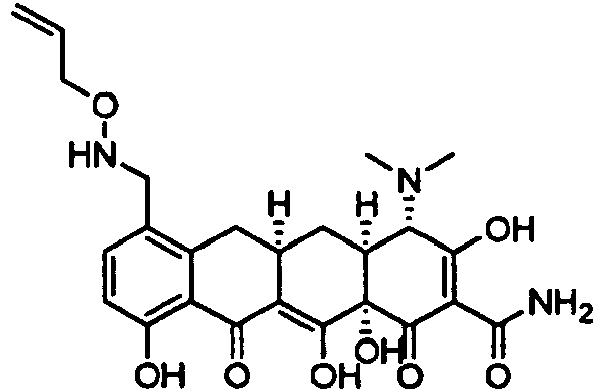
EC 
AG 
ED 
EE 
EF 
EG 
EH 
AL 
AM 
CV 
CW 
-

- A solution of 7-formylsanscycline TFA salt (2.23 g) and N,O-dimethylhydroxylamine hydrochloride (780 mg) in N,N-dimethylacetamide (15 mL) was stirred for 10 minutes at room temperature under argon atmosphere. To this solution was added sodium cyanoborohydride (302 mg). The solution was stirred for 5 minutes and monitored by LC-MS. The reaction mixture was poured into diethyl ether, and the resulting precipitates were collected by filtration under vacuum. The crude product was purified by preparative HPLC (C18 column, linear gradient 10-40% acetonitrile in 20 mM aqueous triethanolamine, pH 7.4). The prep-HPLC fractions were collected, and the organic solvent (acetonitrile) was evaporated in vacuo. The resulting aqueous solution was loaded onto a clean PDVB SPE column, washed with distilled water, then with a 0.1 M sodium acetate solution followed by distilled water. The product was eluted with 0.1% TFA in acetonitrile. After concentrating under vacuum, 565 mg was obtained as a TFA salt. The TFA salt was converted to the hydrochloride salt by adding methanolic HCl followed by in vacuo evaporation. This process was repeated twice to give a yellow solid. ESIMS: m/z 488 (MH+). 1H NMR (300 MHz, CD3OD δ 7.46 (1H, J = 8.6 Hz), 6.81 (d, 1H, J = 8.6 Hz), 4.09 (d, 1H, J = 1.0 Hz), 3.79 (d, 1H, J = 13.1 Hz), 3.73 (d, 1H, J = 13.1 Hz), 3.36 (m, 1H), 3.27 (s, 3H), 3.08-2.95 (8H), 2.61 (s, 3H), 2.38 (t, 1H, J = 14.8), 2.22 (m, 1H), 1.64 (m, 1H). Compounds Y, U and DR were prepared in a similar manner, and compound DS may be synthesized in a similar manner.
-

- An amount of 7-formyl-sancycline (1.5 g) was combined with methanol (30 mL) and O-(ethoxy)methylamine (1.5 g). The reaction solution was stirred at room temperature for 3 hours under a blanket of argon and was monitored by HPLC and LC/MS. The solvent was evaporated in vacuo and a yellow solid (2.3 g) was isolated as an oxime. ESIMS: m/z 485 (MH+).
- The oxime (2.3 g) was suspended in methanol saturated with HCl (45 mL) and cooled in an ice bath. An amount of 585 mg of NaCNBH3 was added in small batches followed by a few drops of methanol saturated with HCl via syringe. The reducing agent was added over the course of 2 hours and the reaction was monitored by HPLC and LC/MS. The solvent was evaporated in vacuo and was purified. The compound purified by HPLC (C18, linear gradient 10-45% acetonitrile in 20mM aqueous triethanolamine, pH 7.4). The purified compound was dried in vacuo and redissolved in methanol (20mL) saturated with HCl to exchange the salt. The compound was dried overnight over P2O5 to yield the product (0.21mg, 13%) as a yellow powder. ESIMS: m/z 488 (MH+). 1H NMR (300 MHz, CD3OD) δ 7.63 (1H, d, J = 9Hz), 6.93 (1H, d, J = 9Hz), 4.53 (s, 1H), 4.17 (m, 3H), 3.25 (m, 1H), 3.07 (m, 8H), 2.44 (m, 1H), 2.31 (m, 1H), 1.62 (m, 1H), 1.29 (3H, t, J = 7 Hz). Compounds AM, AB, AE, AF and AG were prepared in a similar manner.
-

- A solution of 7-formylsancycline (1.8 mmol) and O-isopropylhydroxylamine hydrochloride (9 mmol) in methanol (25 mL) was stirred overnight. The solvent was reduced and the crude product was used for the next reaction without further purification. A solution of 7-(isopropoxyimino-methyl)-sancycline (2 mmol) in methanol saturated with HCl was cooled in an ice-bath and NaCNBH3 was added portion-wise while stirring at the same temperature. The solvent was evaporated and the crude product was purified by prep-HPLC using C18 column (linear gradient 15-30% acetonitrile in 20 mM aqueous triethanolamine, pH 7.4) to give a yellow solid: MS (Mz+1 = 502); 1H NMR (300 MHz, CD3OD) δ 7.63 (d, 1H, J = 8.7 Hz), 6.92 (d, 1H, J = 8.7 Hz), 4.44 (m, 1H), 4.14 (d, 1H, J = 1.2 Hz), 3.27-2.97 (9H), 2.43 (t, 1H, J = 14.4), 2.27 (m, 1H), 1.29 (m, 6H). Compounds AM, AB, AE, AF, AG, DX, DZ, EA, EB and ED were prepared in a similar manner and compounds EE and EF may be synthesized in a similar manner.
-

- A solution of 7-formylsancyline (4 mmol) and 2-fluoroethylhydroxylamine hydrochloride (10 mmol) in methanol (50 mL) was stirred overnight, after which LC-MS showed completion of the reaction. The solvent was reduced and the crude product was used for the next reaction without further purification. To a cooled solution of 7-(2'-fluoro-ethoxyimino-methyl)-sancycline (2 mmol) in methanol saturated with HCl was added portion-wise NaCNBH3 (8 mmol) over 8 hours while stirring at the same temperature. The solvent was reduced and the crude product was purified by prep-HPLC using C18 column (linear gradient 10-40% acetonitrile in 20 mM aqueous triethanolamine, pH 7.4) to give a yellow solid: MS (Mz+1 = 506); 1H NMR (300 MHz, CD3OD) δ 7.65 (d, 1H, J = 8.8 Hz), 6.93 (d, 1H, J = 8.8 Hz), 4.75 (m, 1H), 4.61-4.55 (3H), 4.46 (m, 1H), 4.36 (m, 1H), 4.16 (d, 1H, J = 1.2 Hz), 3.26-2.97 (9H), 2.45 (t, 1H, J = 14.4), 2.31 (m, 1H), 1.63 (m, 1H). Compounds AM, AB, AE, AF, AG, DX, DZ, EA, EB and ED were prepared in a similar manner and compounds EE and EF may be synthesized in a similar manner.
-

- A solution of 7-formylsancycline (2 mmol) and 3-aminooxy-propionnitrile (4 mmol) in methanol (30 mL) was stirred overnight. The solvent was reduced and the crude product was used for the next reaction without further purification. A solution of 7-(2'-cyanoethoxyimmuno-methyl)-sancycline in methanol and HCl was cooled with an ice-bath and NaCNBH3 was added portion-wise and stirred for 1.5 hours. The solvent was evaporated and the compound was purified by prep-HPLC using C-18 column (linear gradient 10-40% acetonitrile in 20 mM aqueous triethanolamine, pH 7.4) to give a yellow solid: MS (Mz+1 = 513); 1H NMR (300 MHz, CD3OD) δ 7.47 (d, 1H, J = 8.8 Hz), 6.86 (d, 1H, J = 8.8 Hz), 5.11 (d, 1H, J = 15.9 Hz), 4.96 (d, 1H, J = 15.9 Hz), 4.41 (m, 2H), 4.11 (s, 1H), 3.50 (t, 2H, J = 8.4 Hz), 3.20-2.94 (9H), 2.38 (t, 1H, J = 15.3 Hz), 2.28 (m, 1H), 1.60 (m, 1H). Compounds AM, AB, AE, AF, AG, DX, DZ, EA, EB and ED were prepared in a similar manner and compounds EE and EF may be synthesized in a similar manner.
-

- An amount of 7-formyl sancycline (0.5 g) was combined with 1,2-diethylhydrazine (0.546 g), triethylamine (0.472 g) and DMA (10 mL) and was stirred at room temperature under a blanket of argon 45 minutes. An amount of NaCNBH3 (0.084 g) was added to reaction mixture and stirred overnight at room temperature. Reaction monitored by HPLC and LC/MS and complete by morning. Poured reaction mixture into water (0.1% TFA), loaded onto a prepared 5g DVB cartridge, and eluted with CH3CN (0.1% TFA). Compound purified by HPLC (C18, linear gradient 5-60% acetonitrile in 20mM aqueous triethanolamine, pH 7.4). Purified compound was dried in vacuo and redissolved in methanol (20mL) saturated with HCl to exchange the salt. The compound was dried overnight over P2O5 to yield the product (0.030g, 6%) as a yellow powder. ESIMS: m/z 515 (MH+). 1H NMR (300 MHz, CD3OD) δ 7.53 (1H, d, J = 9Hz), 6.87 (1H, d, J = 9Hz), 4.18 (m, 1H), 4.06 (s, 2H), 3.19 (m, 1H), 3.00 (m, 10H), 2.40 (m, 1H), 2.20 (m, 1H), 1.64 (m, 1H), 1.24 (3H, t, J = 9Hz), 1.13 (m, 3H).
-

- A solution of 7-formylsancycline (1.5 mmol) and allylamine (4.5 mmol) in 1,2-dichloroethane (50 mL) was stirred for 30 minutes. Sodium triacetoxyborohydride was added and stirred for additional 3 hours. The solvent and excess reagent was evaporated and the crude material was purified by prep-HPLC using C 18 column (linear gradient 15-30 acetonitrile in water with 0.2% formic acid) to give 7-allylaminomethyl-sancycline as a yellow solid: ESIMS: m/z 484 (MH+).
- To a solution of 7-allylaminomethyl-sancycline (0.78 mmol) in N,N-dimethylacetamide (7 mL) was added methylchloroformate (1.6 mmol) dropwise and the reaction mixture was stirred for 1 hour. An additional amount of methylchloroformate (1.6 mmol) was added and stirred for additional 3 hours. The resulting product was purified by prep prep-HPLC using C 18 column (linear gradient 15-30 acetonitrile in water with 0.2% formic acid) to give a yellow solid: ESIMS: m/z 542 (MH+); 1H NMR (300 MHz, CD3OD) δ 7.34 (1H, d, J = 8.5 Hz), 6.82 (1H, d, J = 8.5 Hz), 5.71 (m, 1H), 5.06 (m, 2H), 4.47 (m, 2H), 4.08 (1H, d, J = 0.9 Hz), 3.84-3.65 (m, 2H), 3.71 (s, 3H), 3.21-2.92 (9H), 2.30-1.94 (2H), 1.59 (m, 1H).
-

- A solution of 7-formylsancycline (2 mmol) and methyl-(2-methyl-[1,3]dioxolan-2-ylmethyl)-amine (6 mmol) in N,N-dimethylformamide (30 mL) was stirred for 40 minutes. Sodium triacetoxyborohydride (6 mmol) was added and the reaction was stirred for 6 hours. The solvent was evaporated and the crude material was dissolved in a mixture of tetrahydrofuran (10 mL), acetic acid (10 mL) and 6M HCl (10 mL). This solution was stirred at 60 °C for 6 hours. Upon completion, the solvent and excess reagents were evaporated and the crude material was purified by prep-HPLC using C18 column (linear gradient 20-50% acetonitrile in 20 mM aqueous triethanolamine, pH 7.4) to give 7-{[(methyl-2'-oxo-propyl)-methyl-amino]-methyl}-sancycline as a yellow solid: ESIMS m/z 514 (MH+).
- A solution of 7-{[methyl-(2'-oxo-propyl)-amino]-methyl}-sancycline (0.63 mmol) and O-ethylhydroxyamine hydrochloride (3.15 mmol) in methanol (15 mL) was stirred for 8 hours. The solvent was evaporated and purified by prep-HPLC using C18 column (linear gradient 20-50% acetonitrile in 20 mM aqueous triethanolamine, pH 7.4) to give a yellow solid: ESIMS m/z 557 (MH+); 1H NMR (300 MHz, CD3OD) δ 7.69 (1H, d, J = 8.7 Hz), 6.99 (1H, d, J = 8.7 Hz), 4.65 (m, 1H), 4.35 (m, 1H), 4.24 (2H, q, J = 7.1 Hz), 4.15 (s, 1H), 4.07 (brs, 2H), 3.24-2.85 (12H), 2.50 (m, 1H), 2.30 (m, 1H), 1.95 (s, 3H), 1.52 (m, 1H), 1.31 (3H, t, J = 7.1 Hz).
-

- A mixture of 7-aminomethylsancycline TFA salt (1.5 g) and ammonium sulfite (100 mg) in a mixture of 40 mL of acetonitrile and 40 mL of saturated sodium hydrogen carbonate was purged with argon for 15 minutes. A solution of the chloroformate in dry acetonitrile was slowly added to the reaction mixture. The reaction mixture was then stirred for additional 1 hour. The desired material was extracted with several portions of ethyl acetate. The combined ethyl acetate solution was washed once with brine and solvent evaporated. The product was obtained via C18 column (linear gradient 5-30% acetonitrile in water with 0.1% TFA). ESIMS: m/z 602 (MH+). 1H NMR (300 MHz, CD3OD) δ 7.46 (d, 1H), 6.82(d, 1H), 5.72-5.67 (m, 2H), 4.15-4.40 (m, 2H), 4.07 (s, 1H,), 3.2-2.90 (m, 9H), 2.40-2.15 (m, 2H), 1.68-1.50 (m, 1H), 1.10 (s, 9H). Compound CW was also prepared as described above.
- In this example, the gram (+) and gram (-) antibacterial activities of the tetracycline compounds used in the methods of the invention were assessed.
- Gram (-) and gram (+) antibacterial minimum inhibitory concentration (MIC) values (µg/mL) were obtained using CLSI methodology for anti-bacterial susceptibility testing. On each day of testing, serial dilutions of compounds were prepared in microdilution plates using a Tecan robotic workstation. Mueller Hinton broth cultures of representative sensitive and resistant gram negative strains were grown or adjusted to match the turbidity of a 0.5 McFarland standard. 1:200 dilutions were made in an appropriate broth (cation supplemented Mueller Hinton broth) to allow a final inoculum of 1 x 10⁵ cfu. Plates were incubated at 35 °C in ambient air for 18-24 hours, were read spectrophotometrically and checked manually for evidence of bacterial growth. The lowest dilution of compound that inhibited growth was recorded as the MIC. Lysed horse blood was used to supplement broth for testing S. pneumoniae. The MIC's for each compound were assessed against S. aureus, S. pneumoniae, P. acnes, E. coli and B. theta. The results are shown in Table 3. Good antibacterial activity (e.g., less than about 4 µg/mL) is indicated by "***," modest antibacterial activity (between about 4 and 8 µg/mL) is indicated by "**," or weak or no antibacterial activity (greater than about 8 µg/mL) is indicated by "*." The symbol "-" indicates that no data was obtained.

- In this example, the cytotoxicity of the tetracycline compounds used in the methods of the invention were assessed.
- Mammalian cell cytotoxicity was assessed to evaluate potential in vivo risks associated with the tetracycline compounds of the invention. A soluble, non-toxic redox dye ("Resazurin"; Alamar Blue) was used to assess a tetracycline compound's effect on cellular metabolism. At the onset of the experiment, cultures of mammalian COS-1 or CHO cells were washed, trypsinized, and harvested. Cell suspensions were prepared, seeded into 96-well black-walled microtiter plates, and incubated overnight at 37°C, in 5% CO2 and approximately 95% humidity. On the next day, serial dilutions of test drug were prepared under sterile conditions and transferred to cell plates. Plates were then incubated under the above conditions for 24 hours. Following the incubation period, the media/drug was aspirated, and 50 µL of resazurin was added. Plates were then incubated under the above conditions for 2 hours and then in the dark at room temperature for an additional 30 minutes. Fluorescence measurements were taken (excitation 535 nm, emission 590 nm) and toxic effects in treated versus control cells were compared based on the degree of fluorescence in each well. The results are shown in Table 4. Minocycline and doxycycline toxicity scores are shown for comparison. Compounds which showed cytotoxicity at concentrations of less than about 35 µg/mL are indicated by "***," compounds which showed cytoxicity at concentrations between about 35 and 75 µg/mL are indicated by "**," and compounds that showed minimal or no cytoxicity are indicated by "*" (e.g., at concentrations greater than about 75 µg/mL).
Table 4 Compound COS-1 Cytotoxicity IC50 (µg/mL) CHO Cytotoxicity IC50 (µg/mL) Compound COS-1 Cytotoxicity IC50 (µg/mL) CHO Cytotoxicity IC50 (µg/mL) Minocycline * * DR ** ** Doxycycline * * DV *** *** F *** *** DW * * P * * DX *** ** U * ** DY * * Y * * DZ *** *** Z * * EA * * AA * * ED *** *** AB *** *** AE * *** AF ** ** AL *** *** AM * * - In this example, the phototoxic potential of the tetracycline compounds used in the methods of the invention was assessed. In particular, 3T3 fibroblast cells were harvested and plated at a concentration of 1 x 10⁵ cells/mL and the plates were incubated overnight at 37°C, in 5% CO2 and approximately 95% humidity. On the following day the medium was removed from the plates and replaced with Hanks' Balanced Salt Solution (HBSS). Drug dilutions were made in HBSS and added to the plates. For each compound tested, a duplicate plate was prepared that was not exposed to light as a control for compound toxicity. Plates were then incubated in a dark drawer (for controls), or under UV light (meter reading of 1.6-1.8 mW/cm2) for 50 minutes. Cells were then washed with HBSS, fresh medium was added, and plates were incubated overnight as described above. The following day neutral red was added as an indicator of cell viability. The plates were then incubated for an additional 3 hours. Cells were then washed with HBSS and blotted on absorbent paper to remove excess liquid. A solution of 50% EtOH, 10% glacial acetic acid was added and after 20 minutes incubation, and the plate's absorbance at 535 nm was read using a Wallace Victor 5 spectrophotometer. The phototoxicity reflected the difference between the light-treated and control cultures. The results are given in Table 5. Results for the tetracycline derivative COL-3, as well doxycycline and minocycline are shown for comparison. Compounds which showed phototoxicity are indicated by "****" (e.g., less than 5 µg/mL), compounds which showed moderate phototoxicity are indicated by "***" (e.g., greater than about 5 µg/mL and less than about 25 µg/mL), compounds which showed some phototoxicity are indicated by "**" (e.g., greater than about 25 µg/mL and less than about 75 µg/mL) and compounds that showed minimal or no phototoxicity are indicated by "*" (e.g., greater than about 75 µg/mL).

- In this example, the half-life of minocycline and a tetracycline compound of the invention were assessed under oxidative conditions, as described in Nilges, et al. (Nilges M, Enochs W, Swartz H. J. Org. Chem. 1991, 56, 5623-30). It is believed that the tissue staining may be caused oxidative instability. The tetracycline compounds were subjected to accelerated oxidation in a continuous-flow microreactor using a 15 molar excess of sodium periodate at pH 11 and 22 °C. Aliquots of each reaction mixture were quenched at various time points with ascorbic acid and the disappearance of each compound was determined by RP-HPLC. Pseudo first-order rate constants and t1/2 values were obtained from the plots of log (Ao-At/Ao) versus time, where Ao is the HPLC area determined for each compound at time = 0 and At is the HPLC area at time = t. The results indicated that minocycline had a half-life for oxidation of 8.2 seconds, while compound B had a half-life for oxidation of 495 seconds.
- In this example, the in vivo anti-bacterial activity of the tetracycline compounds used in the methods of the invention were assessed.
- Groups of five mice were injected intraperitoneally with a lethal dose of S. aureus RN450 in a medium of mucin. Mice were evaluated at 24 hours to determine survival. Untreated animals experienced 100% mortality. Subcutaneous treatment with a single dose of minocycline, doxycycline or the test compound resulted in 100% survival. In some instances, a dose response study was performed with the compound such that a PD50 (a dose of compound that protects 50% of the animals) could be calculated. The results are shown in Table 6.
Table 6 Compound Dose (mg/kg) Percent Survival PD50 (mg/kg) Untreated - 0(0/5) -- Minocycline 5 100 (5/5) 0.72 Doxycycline 5 100 (5/5) 0.13 P 5 100 (5/5) 0.13 AA 5 100 (5/5) -- AF 0.23 DV 1.1 DW 0.48 DX 0.58 0.58 DZ 1.11 - To asses the anti-inflammatory potential of the tetracycline compounds used in the methods of the invention, the tetracycline compounds were assessed in a model of carrageenan induced rat paw inflammation. The model used a sub-plantar injection of carrageenan in the rat to induce an inflammatory response. The test compound or saline (control) was administered IP 30 minutes before a subplantar injection of carrageenan (1.5 mg/0.1 mL). Paw volume was measured (mm2) before subplantar injection and again 3 hours after the injection of carrageenan using a plethysmometer. The results are shown in
Figure 1 . Significant differences as determined by a Kruskal-Wallis One Way ANOVA are noted between the inflammation of the untreated controls versus treated animals (p = 0.5) -
Figure 1 compares the modulation of carregeenan induced inflammation of minocycline compared with various doses of compound P. Minocycline exhibited an EC50 at approximately 50 mg/kg, while compound P exhibited similar or improved activity.
Claims (19)
- A compound of formula I or a pharmaceutically acceptable salt thereof:
 X is CHC(R13Y'Y), CR6'R6, C=CR6'R6, S, NR6, or O;E is NR7dR7e, OR7f or -(CH2) C(=W')WR7g where R7c is alkyl, W is CR7iR7j, W' is NR7h, R7h is alkoxy, and R7g, R7i and R7j are each hydrogen;R2, R2' , R4' , R4a and R4b are each independently hydrogen, alkyl, alkenyl, alkynyl, alkoxy, alkylthio, alkylsulfinyl, alkylsulfonyl, alkylamino, arylalkyl, aryl, heterocyclic or heteroaromatic;R3, R10, R11 and R12 are each hydrogen;R4 is NR4aR4b, alkyl, alkenyl, alkynyl, hydroxyl, halogen, or hydrogen;R5 and R5' are each independently hydroxyl, hydrogen, thiol, alkanoyl, aroyl, alkaroyl, aryl, heteroaromatic, alkyl, alkenyl, alkynyl, alkoxy, alkylthio, alkylsulfinyl, alkylsulfonyl, alkylamino, arylalkyl, alkyl carbonyloxy, or aryl carbonyloxy;R6 and R6' are each independently hydrogen, methylene, absent, hydroxyl, halogen, thiol, alkyl, alkenyl, alkynyl, aryl, alkoxy, alkylthio, alkylsulfinyl, alkylsulfonyl, alkylamino, or an arylalkyl;R7a, R7b , R7c , R7d , R7e and R7f are each independently hydrogen, allyl, alkyl, alkenyl, alkynyl, hydroxyl, alkoxy, alkylthio, alkylsulfinyl, alkylsulfonyl, amino, alkylamino, aminoalkyl, acyl, aryl, arylalkyl, alkylcarbonyloxy, or arylcarbonyloxy, or R7c and R7d or R7c and R7f are linked to form a ring;R8 is hydrogen, hydroxyl, halogen, thiol, alkyl, alkenyl, alkynyl, aryl, alkoxy, alkylthio, alkylsulfinyl, alkylsulfonyl, alkylamino, or an arylalkyl;R9 is hydrogen, nitro, alkyl, alkenyl, alkynyl, aryl, alkoxy, alkylthio, alkylsulfinyl, alkylsulfonyl, arylalkyl, amino, aminoalkyl, amido, arylalkenyl, arylalkynyl, thionitroso, or -(CH2)0-3(NR9c)0-1C(=Z')ZR9a;Z is CR9dR9e, S, NR9b or O;Z' is O, S, or NR9f;R9a, R9b, R9c, R9d, R9e and R9f are each independently hydrogen, acyl, alkyl, alkenyl, alkynyl, alkoxy, alkylthio, alkylsulfinyl, alkylsulfonyl, alkylamino, arylalkyl, aryl, heterocyclic, or heteroaromatic;R13 is hydrogen, hydroxy, alkyl, alkenyl, alkynyl, alkoxy, alkylthio, alkylsulfinyl, alkylsulfonyl, alkylamino, or an arylalkyl; andY' and Y are each independently hydrogen, halogen, hydroxyl, cyano, sulfhydryl, amino, amido, alkyl, alkenyl, alkynyl, alkoxy, alkylthio, alkylsulfinyl, alkylsulfonyl, alkylamino, or an arylalkyl;or
 oror a pharmaceutically salt thereof;
wherein the term "alkyl" includes both unsubstituted alkyl moieties and substituted alkyl moieties having substituents replacing a hydrogen on one or more carbons of the backbone structure, wherein said substituents are selected from alkenyl, alkynyl, halogen, hydroxyl, alkylcarbonyloxy, arylcarbonyloxy, alkoxycarbonyloxy, aryloxycarbonyloxy, carboxylate, alkylcarbonyl, arylcarbonyl, alkoxycarbonyl, aminocarbonyl, alkylaminocarbonyl, dialkylaminocarbonyl, alkylthiocarbonyl, alkoxy, phosphate, phosphonato, phosphinato, cyano, amino, acylamino, amidino, imino, sulfhydryl, alkylthio, arylthio, thiocarboxylate, sulfates, alkylsulfinyl, sulfonato, sulfamoyl, sulfonamido, nitro, trifluoromethyl, azido, heterocyclyl, alkylaryl, aromatic and heteroaromatic;
wherein the term "alkenyl" includes both unsubstituted alkenyl moieties and substituted alkenyl moieties having substituents replacing a hydrogen on one or more carbons of the backbone structure, wherein said substituents are selected from alkyl, alkynyl, halogen, hydroxyl, alkylcarbonyloxy, arylcarbonyloxy, alkoxycarbonyloxy, aryloxycarbonyloxy, carboxylate, alkylcarbonyl, arylcarbonyl, alkoxycarbonyl, aminocarbonyl, alkylaminocarbonyl, dialkylaminocarbonyl, alkylthiocarbonyl, alkoxy, phosphate, phosphonato, phosphinato, cyano, amino, acylamino, amidino, imino, sulfhydryl, alkylthio, arylthio, thiocarboxylate, sulfates, alkylsulfinyl, sulfonato, sulfamoyl, sulfonamido, nitro, trifluoromethyl, azido, heterocyclyl, alkylaryl, aromatic and heteroaromatic;
wherein the term "alkynyl" includes both unsubstituted alkynyl moieties and substituted alkenyl moieties having substituents replacing a hydrogen on one or more carbons of the backbone structure, wherein said substituents are selected from alkyl, halogen, hydroxyl, alkylcarbonyloxy, arylcarbonyloxy, alkoxycarbonyloxy, aryloxycarbonyloxy, carboxylate, alkylcarbonyl, arylcarbonyl, alkoxycarbonyl, aminocarbonyl, alkylaminocarbonyl, dialkylaminocarbonyl, alkylthiocarbonyl, alkoxy, phosphate, phosphonato, phosphinato, cyano, amino, acylamino, amidino, imino, sulfhydryl, alkylthio, arylthio, thiocarboxylate, sulfates, alkylsulfinyl, sulfonato, sulfamoyl, sulfonamido, nitro, trifluoromethyl, azido, heterocyclyl, alkylaryl, aromatic and heteroaromatic;
wherein the term "aryl" includes 5- and 6-membered single-ring aromatic groups that may include from zero to four heteroatoms, optionally substituted at one or more ring positions by a substituent selected from halogen, hydroxyl, alkoxy, alkylcarbonyloxy, arylcarbonyloxy, alkoxycarbonyloxy, aryloxycarbonyloxy, carboxylate, alkylcarbonyl, alkylaminoacarbonyl, arylalkyl aminocarbonyl, alkenylaminocarbonyl, arylcarbonyl, arylalkylcarbonyl, alkenylcarbonyl, alkoxycarbonyl, aminocarbonyl, alkylthiocarbonyl, phosphate, phosphonato, phosphinato, cyano, amino, acylamino, amidino, imino, sulfhydryl, alkylthio, arylthio, thiocarboxylate, sulfates, alkylsulfinyl, sulfonato, sulfamoyl, sulfonamido, nitro, trifluoromethyl, azido, heterocyclyl and alkylaryl;
wherein the term "acyl" includes acyl substituted with alkyl, alkenyl, alkynyl, halogen, hydroxyl, alkalkylcarbonyloxy, arylcarbonyloxy, alkoxycarbonyloxy, aryloxycarbonyloxy, carboxylate, alkylcarbonyl, alkylaminoacarbonyl, arylalkyl aminocarbonyl, alkenylaminocarbonyl, arylcarbonyl, arylalkylcarbonyl, alkenylcarbonyl, alkoxycarbonyl, aminocarbonyl, alkylthiocarbonyl, phosphate, phosphonato, phosphinato, cyano, amino, acylamino, amidino, imino, sulfhydryl, alkylthio, arylthio, thiocarboxylate, sulfates, alkylsulfinyl, sulfonato, sulfamoyl, sulfonamido, nitro, trifluoromethyl, azido, heterocyclyl, alkylaryl, aromatic and heteroaromatic; and
wherein the term "alkoxy" includes an alkyl or an alkenyl or an alkynyl group covalently linked to an oxygen atom and optionally substituted with a group selected from alkenyl, alkynyl, halogen, hydroxyl, alkylcarbonyloxy, arylcarbonyloxy, alkoxycarbonyloxy, aryloxycarbonyloxy, carboxylate, alkylcarbonyl, arylcarbonyl, alkoxycarbonyl, aminocarbonyl, alkylaminocarbonyl, dialkylaminocarbonyl, alkylthiocarbonyl, phosphate, phosphonato, phosphinato, cyano, amino, acylamino, amidino, imino, sulfhydryl, alkylthio, arylthio, thiocarboxylate, sulfates, alkylsulfinyl, sulfonato, sulfamoyl, sulfonamido, nitro, trifluoromethyl, azido, heterocyclyl, alkylaryl, aromatic and heteroaromatic. - The compound of claim 1, wherein X is CR6'R6, R4 is NR4aR4b, R4a and R4b are each alkyl, and R2, R2', R3, R4' R5, R5' R6, R6', R8, R9, R10, R11 and R12 are each hydrogen.
- The compound of claim 1 or 2, wherein R7a and R7b are hydrogen.
- The compound of any one of claims 1-3, wherein E is OR7f.
- The compound of claim 4, wherein R7c is hydrogen.
- The compound of claim 5, wherein R7f is alkyl.
- The compound of claim 6, wherein said alkyl is unsubstituted alkyl.
- The compound of claim 5, wherein R7f is allyl.
- The compound of claim 4, wherein R7c is alkyl.
- The compound of claim 9, wherein said alkyl is methyl.
- The compound of claim 10, wherein R7f is alkyl.
- The compound of claim 11, wherein said alkyl is methyl or ethyl.
- The compound of anyone of claims 1-3, wherein E is NR7dR7e.
- The compound of claim 1, wherein said compound is selected from the group consisting of:


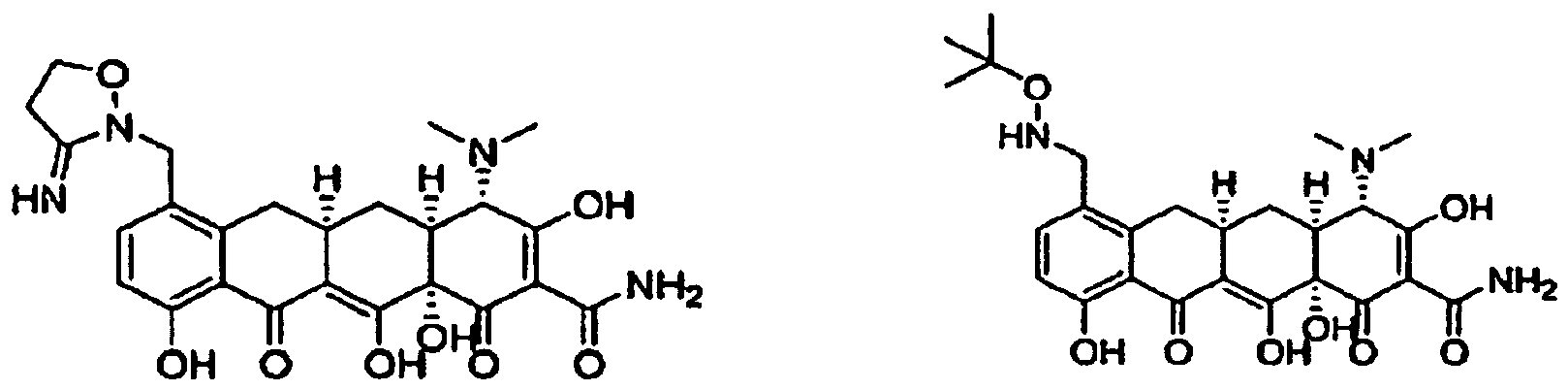


- A compound of any one of claims 1-14 for use in the treatment of a bacterial infection, a viral infection, or a parasitic infection.
- A compound of any one of claims 1-14 for use in the treatment of malaria.
- A pharmaceutical composition comprising a therapeutically effective amount of a compound of any one of claims 1-14 and a pharmaceutically acceptable carrier.
- The compound of claim 1, wherein said compound is

- The compound of claim 1, wherein said compound is

Priority Applications (7)
| Application Number | Priority Date | Filing Date | Title |
|---|---|---|---|
| EP12151178.6A EP2450347B1 (en) | 2006-12-21 | 2007-12-21 | Tetracycline derivatives for the treatment of bacterial, viral and parasitic infections |
| PL07867938T PL2109602T3 (en) | 2006-12-21 | 2007-12-21 | Tetracycline derivatives for the treatment of bacterial, viral and parasitic infections |
| EP15188848.4A EP3045449A1 (en) | 2006-12-21 | 2007-12-21 | Tetracycline derivatives for the treatment of bacterial, viral and parasitic infections |
| EP12151177.8A EP2455367B1 (en) | 2006-12-21 | 2007-12-21 | Tetracycline derivatives for the treatment of bacterial, viral and parasitic infections |
| EP12151179A EP2452935A3 (en) | 2006-12-21 | 2007-12-21 | Tetracycline derivatives for the treatment of bacterial, viral and parasitic infections |
| SI200731452T SI2109602T1 (en) | 2006-12-21 | 2007-12-21 | Tetracycline derivatives for the treatment of bacterial, viral and parasitic infections |
| EP20198210.5A EP3812372A3 (en) | 2006-12-21 | 2007-12-21 | 7-heterocyclyl substituted sancycline derivatives for treating bacterial, viral and parasitic infections (e.g. malaria) or inflammatory diseases |
Applications Claiming Priority (3)
| Application Number | Priority Date | Filing Date | Title |
|---|---|---|---|
| US87631306P | 2006-12-21 | 2006-12-21 | |
| US94300307P | 2007-06-08 | 2007-06-08 | |
| PCT/US2007/026178 WO2008079339A2 (en) | 2006-12-21 | 2007-12-21 | Tetracycline derivatives for the treatment of bacterial, viral and parasitic infections |
Related Child Applications (8)
| Application Number | Title | Priority Date | Filing Date |
|---|---|---|---|
| EP12151178.6A Division-Into EP2450347B1 (en) | 2006-12-21 | 2007-12-21 | Tetracycline derivatives for the treatment of bacterial, viral and parasitic infections |
| EP12151178.6A Division EP2450347B1 (en) | 2006-12-21 | 2007-12-21 | Tetracycline derivatives for the treatment of bacterial, viral and parasitic infections |
| EP20198210.5A Division EP3812372A3 (en) | 2006-12-21 | 2007-12-21 | 7-heterocyclyl substituted sancycline derivatives for treating bacterial, viral and parasitic infections (e.g. malaria) or inflammatory diseases |
| EP12151179A Division-Into EP2452935A3 (en) | 2006-12-21 | 2007-12-21 | Tetracycline derivatives for the treatment of bacterial, viral and parasitic infections |
| EP15188848.4A Division EP3045449A1 (en) | 2006-12-21 | 2007-12-21 | Tetracycline derivatives for the treatment of bacterial, viral and parasitic infections |
| EP12151177.8A Division EP2455367B1 (en) | 2006-12-21 | 2007-12-21 | Tetracycline derivatives for the treatment of bacterial, viral and parasitic infections |
| EP12151177.8A Division-Into EP2455367B1 (en) | 2006-12-21 | 2007-12-21 | Tetracycline derivatives for the treatment of bacterial, viral and parasitic infections |
| EP12151180 Division-Into | 2012-01-13 |
Publications (2)
| Publication Number | Publication Date |
|---|---|
| EP2109602A2 EP2109602A2 (en) | 2009-10-21 |
| EP2109602B1 true EP2109602B1 (en) | 2014-02-12 |
Family
ID=39495878
Family Applications (6)
| Application Number | Title | Priority Date | Filing Date |
|---|---|---|---|
| EP12151178.6A Not-in-force EP2450347B1 (en) | 2006-12-21 | 2007-12-21 | Tetracycline derivatives for the treatment of bacterial, viral and parasitic infections |
| EP15188848.4A Withdrawn EP3045449A1 (en) | 2006-12-21 | 2007-12-21 | Tetracycline derivatives for the treatment of bacterial, viral and parasitic infections |
| EP12151177.8A Not-in-force EP2455367B1 (en) | 2006-12-21 | 2007-12-21 | Tetracycline derivatives for the treatment of bacterial, viral and parasitic infections |
| EP07867938.8A Active EP2109602B1 (en) | 2006-12-21 | 2007-12-21 | Tetracycline derivatives for the treatment of bacterial, viral and parasitic infections |
| EP12151179A Withdrawn EP2452935A3 (en) | 2006-12-21 | 2007-12-21 | Tetracycline derivatives for the treatment of bacterial, viral and parasitic infections |
| EP20198210.5A Withdrawn EP3812372A3 (en) | 2006-12-21 | 2007-12-21 | 7-heterocyclyl substituted sancycline derivatives for treating bacterial, viral and parasitic infections (e.g. malaria) or inflammatory diseases |
Family Applications Before (3)
| Application Number | Title | Priority Date | Filing Date |
|---|---|---|---|
| EP12151178.6A Not-in-force EP2450347B1 (en) | 2006-12-21 | 2007-12-21 | Tetracycline derivatives for the treatment of bacterial, viral and parasitic infections |
| EP15188848.4A Withdrawn EP3045449A1 (en) | 2006-12-21 | 2007-12-21 | Tetracycline derivatives for the treatment of bacterial, viral and parasitic infections |
| EP12151177.8A Not-in-force EP2455367B1 (en) | 2006-12-21 | 2007-12-21 | Tetracycline derivatives for the treatment of bacterial, viral and parasitic infections |
Family Applications After (2)
| Application Number | Title | Priority Date | Filing Date |
|---|---|---|---|
| EP12151179A Withdrawn EP2452935A3 (en) | 2006-12-21 | 2007-12-21 | Tetracycline derivatives for the treatment of bacterial, viral and parasitic infections |
| EP20198210.5A Withdrawn EP3812372A3 (en) | 2006-12-21 | 2007-12-21 | 7-heterocyclyl substituted sancycline derivatives for treating bacterial, viral and parasitic infections (e.g. malaria) or inflammatory diseases |
Country Status (15)
| Country | Link |
|---|---|
| US (5) | US8318706B2 (en) |
| EP (6) | EP2450347B1 (en) |
| JP (8) | JP5583411B2 (en) |
| KR (1) | KR101538175B1 (en) |
| AU (1) | AU2007338747B2 (en) |
| BR (1) | BRPI0720569B8 (en) |
| CA (3) | CA2673466C (en) |
| DK (1) | DK2109602T3 (en) |
| ES (2) | ES2548261T3 (en) |
| IL (4) | IL270446B2 (en) |
| MX (1) | MX2009006846A (en) |
| PL (1) | PL2109602T3 (en) |
| PT (1) | PT2109602E (en) |
| SI (1) | SI2109602T1 (en) |
| WO (1) | WO2008079339A2 (en) |
Families Citing this family (35)
| Publication number | Priority date | Publication date | Assignee | Title |
|---|---|---|---|---|
| US8088820B2 (en) | 2001-04-24 | 2012-01-03 | Paratek Pharmaceuticals, Inc. | Substituted tetracycline compounds for the treatment of malaria |
| WO2006047671A2 (en) | 2004-10-25 | 2006-05-04 | Paratek Pharmaceuticals, Inc. | 4-aminotetracyclines and methods of use thereof |
| WO2006084265A1 (en) | 2005-02-04 | 2006-08-10 | Paratek Pharmaceuticals, Inc. | 11a, 12-DERIVATIVES OF TETRACYCLINE COMPOUNDS |
| US8440646B1 (en) | 2006-10-11 | 2013-05-14 | Paratek Pharmaceuticals, Inc. | Substituted tetracycline compounds for treatment of Bacillus anthracis infections |
| EP2450347B1 (en) * | 2006-12-21 | 2015-06-24 | Paratek Pharmaceuticals, Inc. | Tetracycline derivatives for the treatment of bacterial, viral and parasitic infections |
| PT2120963T (en) | 2006-12-21 | 2018-12-17 | Paratek Pharm Innc | TETRACYCLINE COMPOUNDS REPLACED FOR TREATMENT OF INFLAMMATORY SKIN DISORDERS |
| BRPI0813990A2 (en) * | 2007-07-06 | 2011-09-13 | Paratek Pharmaceuticals, Inc. | Methods for Synthesizing Substituted Minocycline Compounds |
| US20090253660A1 (en) | 2008-03-05 | 2009-10-08 | Paratek Pharmaceuticals, Inc. | Minocycline Compounds and Methods of Use Thereof |
| JP2011517697A (en) * | 2008-04-14 | 2011-06-16 | パラテック ファーマシューティカルズ インコーポレイテッド | Substituted tetracycline compounds |
| US20100190755A1 (en) * | 2008-09-19 | 2010-07-29 | Paul Abato | Tetracycline compounds for the treatment of rheumatoid arthritis and related methods of treatment |
| WO2010129057A2 (en) | 2009-05-08 | 2010-11-11 | Tetraphase Pharmaceuticals, Inc. | Tetracycline compounds |
| HUE037852T2 (en) * | 2009-08-28 | 2018-09-28 | Tetraphase Pharmaceuticals Inc | Tetracycline compounds |
| US8754054B2 (en) | 2010-07-09 | 2014-06-17 | Albany Molecular Research, Inc. | Antibacterial compounds, methods of making them, and uses thereof |
| US9255068B2 (en) * | 2011-05-12 | 2016-02-09 | Warner Chilcott Company, Llc | Crystalline salts of (4S,4AS,5AR,12AS)-4-dimethylamino-3,10,12,12A-tetrahydroxy-7-[methoxy(methyl)amino)-methyl] acid amide and methods of using the same |
| HUE036696T2 (en) | 2011-07-26 | 2018-07-30 | Kbp Biosciences Usa Inc | 9-aminomethyl substituted tetracycline compounds |
| WO2013072703A1 (en) * | 2011-11-18 | 2013-05-23 | Redx Pharma Limited | Antibacterial drug derivatives |
| CN103387512B (en) * | 2012-05-08 | 2016-08-31 | 成都睿智化学研究有限公司 | A kind of Preparation Method And Their Intermediate of minocycline |
| CA2873412A1 (en) * | 2012-05-14 | 2013-11-21 | Paratek Pharmaceuticals, Inc. | Methods of using (4s,4as,5ar,12as)-4-dimethylamino-3,10,12,12a-tetrahydroxy-7-[(methoxy(methyl)amino)-methyl]-1,11-dioxo-1,4,4a,5,5a,6,11,12a-octahydro-naphthacene-2-carboxylic acid amide |
| US20150166470A1 (en) * | 2012-05-30 | 2015-06-18 | Paratek Pharmaceuticals, Inc. | 7-disubstituted-phenyl tetracycline derivatives |
| JP2015525766A (en) * | 2012-07-13 | 2015-09-07 | パラテック ファーマシューティカルズ インコーポレイテッド | Tetracycline compounds for the treatment of neurodegenerative disorders |
| SMT201900096T1 (en) | 2012-08-31 | 2019-02-28 | Tetraphase Pharmaceuticals Inc | Tetracycline compounds |
| JP2016089002A (en) * | 2014-10-31 | 2016-05-23 | 出光興産株式会社 | Monomer and polymer having benzofuranothiophene skeleton, and organic thin-film solar cell material using the polymer |
| DE102015013086A1 (en) | 2015-10-01 | 2017-04-06 | Jutta Regina Giller | Attic for building |
| GB201615693D0 (en) | 2016-09-15 | 2016-11-02 | Combinatorx Infection Ltd | Combinations |
| MA46567A (en) | 2016-10-19 | 2019-08-28 | Tetraphase Pharmaceuticals Inc | ERAVACYCLINE CRYSTALLINE FORMS |
| SG10201913599RA (en) | 2016-11-01 | 2020-02-27 | Paratek Pharm Innc | 9-aminomethyl minocycline compounds and use thereof in treating community-acquired bacterial pneumonia (cabp) |
| AU2018303807B2 (en) | 2017-07-21 | 2023-08-24 | Almirall, Llc | Treatment of non-inflammatory lesions |
| KR102011721B1 (en) * | 2017-11-28 | 2019-08-19 | 고려대학교 산학협력단 | Novel agar-derived oligosaccharides for inhibiting staphylococci |
| CN115380022A (en) * | 2018-04-06 | 2022-11-22 | 帕拉特克药品公司 | Preparation method of sarracycline hydrochloride |
| CN109970590A (en) * | 2018-12-20 | 2019-07-05 | 深圳市祥根生物科技有限公司 | A kind of preparation method of 7- amino minocycline ring element |
| CN109574868B (en) * | 2018-12-28 | 2021-11-16 | 天津阿尔塔科技有限公司 | Preparation method of tetracycline and epimer deuterated internal standard substance thereof |
| US20230181027A1 (en) * | 2019-06-28 | 2023-06-15 | Mayo Foundation For Medical Education And Research | Methods and materials for treating neuromyelitis optica spectrum diseases |
| WO2021231314A1 (en) * | 2020-05-11 | 2021-11-18 | Paratek Pharmaceuticals Inc. | Methods of treating covid-19 using tetracycline compounds |
| CN111574392A (en) * | 2020-05-27 | 2020-08-25 | 浙江工业大学 | A kind of preparation method of 6-desmethyl-6-anhydrotetracycline |
| WO2025175063A1 (en) * | 2024-02-14 | 2025-08-21 | Cyclone Therapeutics, Inc. | Tetracycline derivatives, and uses thereof |
Family Cites Families (112)
| Publication number | Priority date | Publication date | Assignee | Title |
|---|---|---|---|---|
| US34656A (en) | 1862-03-11 | Improvement in liquids for exciting galvanic batteries | ||
| US2990331A (en) | 1956-11-23 | 1961-06-27 | Pfizer & Co C | Stable solutions of salts of tetracyclines for parenteral administration |
| US2980584A (en) | 1957-10-29 | 1961-04-18 | Pfizer & Co C | Parenteral magnesium oxytetracycline acetic or lactic acid carboxamide vehicle preparation |
| US3062717A (en) | 1958-12-11 | 1962-11-06 | Pfizer & Co C | Intramuscular calcium tetracycline acetic or lactic acid carboxamide vehicle preparation |
| US3047617A (en) * | 1959-05-18 | 1962-07-31 | Pfizer & Co C | Alkanoic acid esters of 5-hydroxytetracycline and process for preparation |
| GB921252A (en) | 1960-03-09 | 1963-03-20 | Erba Carlo Spa | New tetracycline derivatives |
| US3165531A (en) | 1962-03-08 | 1965-01-12 | Pfizer & Co C | 13-substituted-6-deoxytetracyclines and process utilizing the same |
| GB1108310A (en) | 1964-04-30 | 1968-04-03 | Pfizer & Co C | Derivatives of 6-methylene-tetracycline and process for their preparation |
| US3345379A (en) * | 1965-02-26 | 1967-10-03 | American Cyanamid Co | 7-imidomethyl-6-demethyl-6-deoxytetracyclines |
| US3454697A (en) | 1965-06-08 | 1969-07-08 | American Cyanamid Co | Tetracycline antibiotic compositions for oral use |
| US3304227A (en) | 1965-07-15 | 1967-02-14 | Loyal E Loveless | Antibiotic-containing animal feed |
| NL6607516A (en) | 1966-05-31 | 1967-12-01 | ||
| DE1767891C3 (en) | 1968-06-28 | 1980-10-30 | Pfizer | Process for the preparation of aqueous medicinal solutions for parenteral, peroral and local use containing a tetracycline derivative |
| CA999855A (en) | 1972-09-18 | 1976-11-16 | Societa' Farmaceutici Italia S.P.A. | Process for the preparation of tetracyclines derivatives in the 7 position |
| US3957980A (en) | 1972-10-26 | 1976-05-18 | Pfizer Inc. | Doxycycline parenteral compositions |
| DE2527568A1 (en) | 1974-06-25 | 1976-01-15 | Farmaceutici Italia | PROCESS FOR THE PRODUCTION OF ALKYLTE TRACYCLINES AND NEW TETRACYCLIN DERIVATIVES |
| DE2442829A1 (en) | 1974-09-06 | 1976-03-18 | Merck Patent Gmbh | TETRACYCLIC COMPOUNDS AND PROCEDURES FOR THEIR PRODUCTION |
| US4018889A (en) | 1976-01-02 | 1977-04-19 | Pfizer Inc. | Oxytetracycline compositions |
| US4126680A (en) | 1977-04-27 | 1978-11-21 | Pfizer Inc. | Tetracycline antibiotic compositions |
| US5589470A (en) | 1990-02-26 | 1996-12-31 | Trustees Of Tufts College | Reducing tetracycline resistance in living cells |
| US4806529A (en) | 1982-11-18 | 1989-02-21 | Trustees Of Tufts College, Tufts University | Tetracycline activity enhancement |
| US5064821A (en) | 1982-11-18 | 1991-11-12 | Trustees Of Tufts College | Method and compositions for overcoming tetracycline resistance within living cells |
| US4935412A (en) | 1983-12-29 | 1990-06-19 | The Research Foundation Of State University Of New York | Non-antibacterial tetracycline compositions possessing anti-collagenolytic properties and methods of preparing and using same |
| US4704383A (en) | 1983-12-29 | 1987-11-03 | The Research Foundation Of State University Of New York | Non-antibacterial tetracycline compositions possessing anti-collagenolytic properties and methods of preparing and using same |
| US4666897A (en) | 1983-12-29 | 1987-05-19 | Research Foundation Of State University | Inhibition of mammalian collagenolytic enzymes by tetracyclines |
| US4925833A (en) | 1983-12-29 | 1990-05-15 | The Research Foundation Of State University Of New York | Use of tetracycline to enhance bone protein synthesis and/or treatment of osteoporosis |
| USRE34656E (en) | 1983-12-29 | 1994-07-05 | The Research Foundation Of State University Of New York | Use of tetracycline to enhance bone protein synthesis and/or treatment of bone deficiency |
| US4806372A (en) | 1985-02-15 | 1989-02-21 | Georgia Oil & Gas Co., Inc. | Nitrite-free-curing of bacon and product thereof |
| US5308839A (en) | 1989-12-04 | 1994-05-03 | The Research Foundation Of State University Of New York | Composition comprising non-steroidal anti-inflammatory agent tenidap and effectively non-antibacterial tetracycline |
| JP3016587B2 (en) | 1989-12-04 | 2000-03-06 | ザ・リサーチ・ファンデーション・オブ・ステート・ユニバーシティ・オブ・ニューヨーク | Combination of non-steroidal anti-inflammatory drug and tetracycline |
| DE4031168A1 (en) | 1990-10-03 | 1992-04-16 | Degussa | CERAMIC MATERIAL FOR VENEERING METALLIC DENTAL REPLACEMENT |
| US5770588A (en) | 1991-02-11 | 1998-06-23 | The Research Foundation Of State University Of New York | Non-antibacterial tetracycline compositions of the prevention and treatment of root caries |
| US5231017A (en) | 1991-05-17 | 1993-07-27 | Solvay Enzymes, Inc. | Process for producing ethanol |
| US6756365B2 (en) | 1991-11-06 | 2004-06-29 | Trustees Of Tufts College | Reducing tetracycline resistance in living cells |
| US5258371A (en) | 1992-05-29 | 1993-11-02 | Kuraray Co., Ltd. | Method to reduce connective tissue destruction |
| US6043225A (en) | 1992-06-12 | 2000-03-28 | Board Of Regents Of The University Of Washington | Diagnosis and treatment of arterial chlamydial granuloma |
| DE69304292T2 (en) | 1992-11-17 | 1997-01-02 | Univ New York | Tetracyclines including non-antimicrobial, chemically modified tetracyclines inhibiting excessive collagen cross-linking in diabetes |
| US6043231A (en) | 1993-03-02 | 2000-03-28 | The Research Foundation Of State Univ. Of New York | Inhibition of excessive phospholipase A2 activity and/or production by non-antimicrobial tetracyclines |
| US5523297A (en) | 1993-03-02 | 1996-06-04 | The Research Foundation Of State University Of New York | Inhibition of excessive phospholipase A2 activity and/or production by non-antimicrobial tetracyclines |
| US5668122A (en) | 1993-07-28 | 1997-09-16 | Fife; Rose S. | Method to treat cancer with tetracyclines |
| AU1279095A (en) | 1994-02-17 | 1995-09-04 | Pfizer Inc. | 9-(substituted amino)-alpha-6-deoxy-5-oxy tetracycline derivatives, their preparation and their use as antibiotics |
| US5843925A (en) | 1994-12-13 | 1998-12-01 | American Cyanamid Company | Methods for inhibiting angiogenesis, proliferation of endothelial or tumor cells and tumor growth |
| CA2219277A1 (en) | 1995-05-03 | 1996-11-07 | Pfizer Limited | Novel tetracycline derivatives |
| US5834449A (en) | 1996-06-13 | 1998-11-10 | The Research Foundation Of State University Of New York | Treatment of aortic and vascular aneurysms with tetracycline compounds |
| US5827840A (en) | 1996-08-01 | 1998-10-27 | The Research Foundation Of State University Of New York | Promotion of wound healing by chemically-modified tetracyclines |
| US5789395A (en) | 1996-08-30 | 1998-08-04 | The Research Foundation Of State University Of New York | Method of using tetracycline compounds for inhibition of endogenous nitric oxide production |
| US5919774A (en) | 1996-12-10 | 1999-07-06 | Eli Lilly And Company | Pyrroles as sPLA2 inhibitors |
| US5837696A (en) | 1997-01-15 | 1998-11-17 | The Research Foundation Of State University Of New York | Method of inhibiting cancer growth |
| US5773430A (en) | 1997-03-13 | 1998-06-30 | Research Foundation Of State University Of New York | Serine proteinase inhibitory activity by hydrophobic tetracycline |
| US5929055A (en) | 1997-06-23 | 1999-07-27 | The Research Foundation Of State University Of New York | Therapeutic method for management of diabetes mellitus |
| JP2002501026A (en) | 1998-01-23 | 2002-01-15 | トルスティーズ オブ トゥフツ カレッジ | Pharmaceutically active compounds and uses thereof |
| US6277061B1 (en) | 1998-03-31 | 2001-08-21 | The Research Foundation Of State University Of New York | Method of inhibiting membrane-type matrix metalloproteinase |
| US6015804A (en) | 1998-09-11 | 2000-01-18 | The Research Foundation Of State University Of New York | Method of using tetracycline compounds to enhance interleukin-10 production |
| US5977091A (en) | 1998-09-21 | 1999-11-02 | The Research Foundation Of State University Of New York | Method of preventing acute lung injury |
| US5998390A (en) | 1998-09-28 | 1999-12-07 | The Research Foundation Of State University Of New York | Combination of bisphosphonate and tetracycline |
| US6256365B1 (en) | 1999-08-16 | 2001-07-03 | Analogic Corporation | Apparatus and method for reconstruction of images in a computed tomography system using oblique slices |
| US6849615B2 (en) | 1999-09-14 | 2005-02-01 | Paratek Pharmaceuticals, Inc. | 13-substituted methacycline compounds |
| PT1240133E (en) | 1999-09-14 | 2006-07-31 | Tufts College | PROCESSES FOR PREPARING TETRACYCLINES SUBSTITUTED WITH CHEMICALS BASED ON TRANSITIONAL METALS |
| US6500812B2 (en) | 1999-09-14 | 2002-12-31 | Paratek Pharmaceuticals, Inc. | 13-substituted methacycline compounds |
| US6231894B1 (en) | 1999-10-21 | 2001-05-15 | Duke University | Treatments based on discovery that nitric oxide synthase is a paraquat diaphorase |
| CA2397863A1 (en) | 2000-01-24 | 2001-07-26 | Trustees Of Tufts College | Tetracycline compounds for treatment of cryptosporidium parvum related disorders |
| WO2001074761A1 (en) | 2000-03-31 | 2001-10-11 | Trustees Of Tufts College | 7-and 9-carbamate, urea, thiourea, thiocarbamate, and heteroaryl-amino substituted tetracycline compounds |
| US6642270B2 (en) | 2000-05-15 | 2003-11-04 | Paratek Pharmaceuticals, Inc. | 7-substituted fused ring tetracycline compounds |
| CN103356996A (en) | 2000-05-19 | 2013-10-23 | 埃米林药品公司 | Treatment of acute coronary syndrome with GLP-1 |
| US20040224927A1 (en) | 2000-06-16 | 2004-11-11 | Trustees Of Tufts College | 7-N-substituted phenyl tetracycline compounds |
| US20020132798A1 (en) | 2000-06-16 | 2002-09-19 | Nelson Mark L. | 7-phenyl-substituted tetracycline compounds |
| WO2001098236A2 (en) | 2000-06-16 | 2001-12-27 | Trustees Of Tufts College | 7-phenyl-substituted tetracycline compounds |
| SI1301467T1 (en) | 2000-07-07 | 2007-02-28 | Tufts College | 9-substituted minocycline compounds |
| US7094806B2 (en) | 2000-07-07 | 2006-08-22 | Trustees Of Tufts College | 7, 8 and 9-substituted tetracycline compounds |
| ATE504562T1 (en) | 2000-07-07 | 2011-04-15 | Tufts College | 7-, 8- AND 9-SUBSTITUTED TETRACYCLINE COMPOUNDS |
| US20050143353A1 (en) | 2000-07-07 | 2005-06-30 | Paratek Pharmaceuticals, Inc. | 13-Substituted methacycline compounds |
| IL153672A0 (en) | 2000-07-07 | 2003-07-06 | Tufts College | 7-substituted tetracycline compounds |
| EP1368305B1 (en) | 2001-03-13 | 2008-08-13 | Paratek Pharmaceuticals, Inc. | 7, 9-substituted tetracycline compounds |
| AU2002250331A1 (en) | 2001-03-13 | 2002-09-24 | Paratek Pharmaceuticals, Inc. | 7-pyrollyl tetracycline compounds and methods of use thereof |
| US7553828B2 (en) | 2001-03-13 | 2009-06-30 | Paratek Pharmaceuticals, Inc. | 9-aminomethyl substituted minocycline compounds |
| EP1241160A1 (en) | 2001-03-13 | 2002-09-18 | Glaxo Group Limited | Tetracycline derivatives and their use as antibiotic agents |
| WO2002072031A2 (en) | 2001-03-14 | 2002-09-19 | Paratek Pharmaceuticals, Inc. | Substituted tetracycline compounds as synergistic antifungal agents |
| CA2457234A1 (en) | 2001-03-14 | 2002-09-19 | Mark L. Nelson | Substituted tetracycline compounds as antifungal agents |
| US8088820B2 (en) * | 2001-04-24 | 2012-01-03 | Paratek Pharmaceuticals, Inc. | Substituted tetracycline compounds for the treatment of malaria |
| DE60235083D1 (en) * | 2001-04-24 | 2010-03-04 | Paratek Pharm Innc | SUBSTITUTED TETRACYCLIN COMPOUNDS FOR THE TREATMENT OF MALARIA |
| JP2004537544A (en) | 2001-07-13 | 2004-12-16 | パラテック ファーマシューティカルズ インコーポレイテッド | Tetracycline compounds with targeted therapeutic activity |
| US20060194773A1 (en) | 2001-07-13 | 2006-08-31 | Paratek Pharmaceuticals, Inc. | Tetracyline compounds having target therapeutic activities |
| WO2003055441A2 (en) | 2001-08-02 | 2003-07-10 | Paratek Pharmaceuticals, Inc. | Medicaments |
| AU2002323688A1 (en) | 2001-09-10 | 2003-03-24 | Paratek Pharmaceuticals, Inc. | Computational method for determining oral bioavailability |
| ES2551708T3 (en) * | 2002-01-08 | 2015-11-23 | Paratek Pharmaceuticals, Inc. | 4-Dedimethylamino tetracycline compounds |
| EP1482926A4 (en) * | 2002-03-08 | 2006-04-12 | Paratek Pharm Innc | Amino-methyl substituted tetracycline compounds |
| WO2003079984A2 (en) * | 2002-03-21 | 2003-10-02 | Paratek Pharmaceuticals, Inc. | Substituted tetracycline compounds |
| CA2476792A1 (en) | 2002-04-16 | 2003-10-30 | Collagenex Pharmaceuticals, Inc. | Methods of simultaneously treating ocular rosacea and acne rosacea |
| EA200900540A1 (en) | 2002-07-12 | 2009-12-30 | Пэрэтек Фамэсьютикэлс, Инк. | SUBSTITUTED COMPOUNDS OF TETRACYCLINE, PHARMACEUTICAL COMPOSITION AND METHOD FOR TREATMENT OF TETRACYCLINE-SENSITIVE CONDITION IN SUBJECT |
| AU2003287218C1 (en) * | 2002-10-24 | 2010-07-15 | Paratek Pharmaceuticals, Inc. | Substituted tetracycline compounds for the treatment of malaria |
| CA2503446C (en) | 2002-10-24 | 2012-12-18 | Paratek Pharmaceuticals, Inc. | Methods of using substituted tetracycline compounds to modulate rna |
| WO2004064728A2 (en) * | 2003-01-16 | 2004-08-05 | Paratek Pharmaceuticals, Inc. | Use of specific tetracycline compounds in therapy |
| WO2004091513A2 (en) | 2003-04-10 | 2004-10-28 | Paratek Pharmaceuticals, Inc. | 9-aminomethyl substituted minocycline compounds |
| US20060287283A1 (en) | 2003-07-09 | 2006-12-21 | Paratek Pharmaceuticals, Inc. | Prodrugs of 9-aminomethyl tetracycline compounds |
| JP4738333B2 (en) * | 2003-07-09 | 2011-08-03 | パラテック ファーマシューティカルズ インコーポレイテッド | Prodrugs of 9-aminomethyltetracycline compounds |
| EP1648859B1 (en) | 2003-07-09 | 2013-02-27 | Paratek Pharmaceuticals, Inc. | Substituted tetracycline compounds |
| US7786099B2 (en) | 2004-01-15 | 2010-08-31 | Paratek Pharmaceuticals, Inc. | Aromatic a-ring derivatives of tetracycline compounds |
| WO2005082860A1 (en) | 2004-02-27 | 2005-09-09 | National Research Council Of Canada | Tetracyclines and their use as calpain inhibitors |
| US7807842B2 (en) * | 2004-05-21 | 2010-10-05 | President And Fellows Of Harvard College | Synthesis of tetracyclines and analogues thereof |
| WO2006047671A2 (en) | 2004-10-25 | 2006-05-04 | Paratek Pharmaceuticals, Inc. | 4-aminotetracyclines and methods of use thereof |
| EP2269991A3 (en) * | 2004-10-25 | 2011-09-21 | Paratek Pharmaceuticals, Inc. | Substituted tetracycline compounds |
| WO2006084265A1 (en) | 2005-02-04 | 2006-08-10 | Paratek Pharmaceuticals, Inc. | 11a, 12-DERIVATIVES OF TETRACYCLINE COMPOUNDS |
| US20070015738A1 (en) * | 2005-07-15 | 2007-01-18 | Walker Stephen G | Use of non-antibacterial tetracycline formulations for inhibiting bacterial spores from becoming infectious vegetative cells |
| JP2009502809A (en) * | 2005-07-21 | 2009-01-29 | パラテック ファーマシューティカルズ インコーポレイテッド | 10-Substituted Tetracycline and Method of Use |
| US9078811B2 (en) | 2006-01-24 | 2015-07-14 | Paratek Pharmaceuticals, Inc. | Methods of increasing oral bioavailability of tetracyclines |
| CA2652347A1 (en) | 2006-05-15 | 2007-11-22 | Paratek Pharmaceuticals, Inc. | Methods of regulating expression of genes or of gene products using substituted tetracycline compounds |
| US8440646B1 (en) | 2006-10-11 | 2013-05-14 | Paratek Pharmaceuticals, Inc. | Substituted tetracycline compounds for treatment of Bacillus anthracis infections |
| EP2450347B1 (en) * | 2006-12-21 | 2015-06-24 | Paratek Pharmaceuticals, Inc. | Tetracycline derivatives for the treatment of bacterial, viral and parasitic infections |
| WO2008127722A1 (en) | 2007-04-12 | 2008-10-23 | Paratek Pharmaceuticals, Inc. | Methods for treating spinal muscular atrophy using tetracycline compounds |
| JP2010525069A (en) | 2007-04-27 | 2010-07-22 | パラテック ファーマシューティカルズ インコーポレイテッド | Method for synthesizing and purifying aminoalkyltetracycline compound |
| BRPI0813990A2 (en) | 2007-07-06 | 2011-09-13 | Paratek Pharmaceuticals, Inc. | Methods for Synthesizing Substituted Minocycline Compounds |
| US20100190755A1 (en) * | 2008-09-19 | 2010-07-29 | Paul Abato | Tetracycline compounds for the treatment of rheumatoid arthritis and related methods of treatment |
-
2007
- 2007-12-21 EP EP12151178.6A patent/EP2450347B1/en not_active Not-in-force
- 2007-12-21 EP EP15188848.4A patent/EP3045449A1/en not_active Withdrawn
- 2007-12-21 EP EP12151177.8A patent/EP2455367B1/en not_active Not-in-force
- 2007-12-21 EP EP07867938.8A patent/EP2109602B1/en active Active
- 2007-12-21 KR KR1020097015172A patent/KR101538175B1/en active Active
- 2007-12-21 IL IL270446A patent/IL270446B2/en unknown
- 2007-12-21 EP EP12151179A patent/EP2452935A3/en not_active Withdrawn
- 2007-12-21 ES ES12151178.6T patent/ES2548261T3/en active Active
- 2007-12-21 DK DK07867938.8T patent/DK2109602T3/en active
- 2007-12-21 PL PL07867938T patent/PL2109602T3/en unknown
- 2007-12-21 ES ES07867938.8T patent/ES2463457T3/en active Active
- 2007-12-21 PT PT78679388T patent/PT2109602E/en unknown
- 2007-12-21 WO PCT/US2007/026178 patent/WO2008079339A2/en not_active Ceased
- 2007-12-21 EP EP20198210.5A patent/EP3812372A3/en not_active Withdrawn
- 2007-12-21 AU AU2007338747A patent/AU2007338747B2/en active Active
- 2007-12-21 CA CA2673466A patent/CA2673466C/en active Active
- 2007-12-21 IL IL302749A patent/IL302749A/en unknown
- 2007-12-21 MX MX2009006846A patent/MX2009006846A/en active IP Right Grant
- 2007-12-21 SI SI200731452T patent/SI2109602T1/en unknown
- 2007-12-21 JP JP2009542938A patent/JP5583411B2/en active Active
- 2007-12-21 CA CA3051994A patent/CA3051994A1/en not_active Abandoned
- 2007-12-21 US US11/963,540 patent/US8318706B2/en active Active
- 2007-12-21 BR BRPI0720569A patent/BRPI0720569B8/en active IP Right Grant
- 2007-12-21 CA CA2925939A patent/CA2925939C/en active Active
-
2010
- 2010-12-20 JP JP2010283844A patent/JP2011093914A/en active Pending
-
2012
- 2012-11-27 US US13/686,639 patent/US9012433B2/en active Active
-
2014
- 2014-06-12 JP JP2014121362A patent/JP6061897B2/en not_active Expired - Fee Related
- 2014-09-21 IL IL234755A patent/IL234755A/en active IP Right Grant
-
2015
- 2015-03-26 US US14/669,238 patent/US20160046561A1/en not_active Abandoned
- 2015-08-17 JP JP2015160343A patent/JP2015205939A/en not_active Withdrawn
-
2017
- 2017-03-01 IL IL25085817A patent/IL250858B/en not_active IP Right Cessation
- 2017-12-13 JP JP2017238683A patent/JP2018039846A/en not_active Ceased
-
2019
- 2019-03-04 JP JP2019038753A patent/JP2019081802A/en not_active Withdrawn
-
2021
- 2021-01-04 US US17/140,206 patent/US20210395189A1/en not_active Abandoned
- 2021-01-27 JP JP2021010842A patent/JP2021063137A/en not_active Withdrawn
-
2023
- 2023-11-24 JP JP2023199075A patent/JP2024009235A/en active Pending
-
2025
- 2025-01-21 US US19/032,452 patent/US20250388531A1/en active Pending
Also Published As
Similar Documents
| Publication | Publication Date | Title |
|---|---|---|
| US20260015317A1 (en) | Substituted tetracycline compounds for treatment of inflammatory skin disorders | |
| EP2455367B1 (en) | Tetracycline derivatives for the treatment of bacterial, viral and parasitic infections | |
| EP1805134B1 (en) | 4-aminotetracyclines and methods of use thereof | |
| US7696186B2 (en) | 7,9-substituted tetracycline compounds | |
| US8481513B2 (en) | 3, 10, and 12a substituted tetracycline compounds | |
| US20050143352A1 (en) | Substituted tetracycline compounds | |
| US20060003971A1 (en) | Aromatic a-ring derivatives of tetracycline compounds | |
| HK1135101B (en) | Tetracycline derivatives for the treatment of bacterial, viral and parasitic infections | |
| AU2012216640A1 (en) | 4-aminotetracyclines and methods of use thereof | |
| HK1170218B (en) | Tetracycline derivatives for the treatment of bacterial, viral and parasitic infections | |
| HK1137144A (en) | Substituted tetracycline compounds for treatment of inflammatory skin disorders | |
| HK1137144B (en) | Substituted tetracycline compounds for treatment of inflammatory skin disorders | |
| HK1155386A (en) | Substituted tetracycline compounds | |
| HK1155385A (en) | Substituted tetracycline compounds |
Legal Events
| Date | Code | Title | Description |
|---|---|---|---|
| PUAI | Public reference made under article 153(3) epc to a published international application that has entered the european phase |
Free format text: ORIGINAL CODE: 0009012 |
|
| 17P | Request for examination filed |
Effective date: 20090715 |
|
| AK | Designated contracting states |
Kind code of ref document: A2 Designated state(s): AT BE BG CH CY CZ DE DK EE ES FI FR GB GR HU IE IS IT LI LT LU LV MC MT NL PL PT RO SE SI SK TR |
|
| RIN1 | Information on inventor provided before grant (corrected) |
Inventor name: VERMA, ATUL Inventor name: PAN, JINGWEN Inventor name: NELSON, MARK Inventor name: GRIER, MARK Inventor name: BERNIAC, JOEL Inventor name: BHATIA, BEENA Inventor name: ASSEFA, HAREGEWEIN Inventor name: HONEYMAN, LAURA Inventor name: BOWSER, TODD Inventor name: ISMAIL, MOHAMED Inventor name: ABATO, PAUL Inventor name: KIM, OAK K. |
|
| 17Q | First examination report despatched |
Effective date: 20100108 |
|
| DAX | Request for extension of the european patent (deleted) | ||
| REG | Reference to a national code |
Ref country code: HK Ref legal event code: DE Ref document number: 1135101 Country of ref document: HK |
|
| GRAP | Despatch of communication of intention to grant a patent |
Free format text: ORIGINAL CODE: EPIDOSNIGR1 |
|
| GRAP | Despatch of communication of intention to grant a patent |
Free format text: ORIGINAL CODE: EPIDOSNIGR1 |
|
| INTG | Intention to grant announced |
Effective date: 20130710 |
|
| GRAS | Grant fee paid |
Free format text: ORIGINAL CODE: EPIDOSNIGR3 |
|
| GRAA | (expected) grant |
Free format text: ORIGINAL CODE: 0009210 |
|
| AK | Designated contracting states |
Kind code of ref document: B1 Designated state(s): AT BE BG CH CY CZ DE DK EE ES FI FR GB GR HU IE IS IT LI LT LU LV MC MT NL PL PT RO SE SI SK TR |
|
| REG | Reference to a national code |
Ref country code: GB Ref legal event code: FG4D |
|
| REG | Reference to a national code |
Ref country code: CH Ref legal event code: EP |
|
| REG | Reference to a national code |
Ref country code: AT Ref legal event code: REF Ref document number: 652092 Country of ref document: AT Kind code of ref document: T Effective date: 20140215 |
|
| REG | Reference to a national code |
Ref country code: IE Ref legal event code: FG4D |
|
| REG | Reference to a national code |
Ref country code: DE Ref legal event code: R096 Ref document number: 602007035118 Country of ref document: DE Effective date: 20140327 |
|
| REG | Reference to a national code |
Ref country code: NL Ref legal event code: T3 |
|
| REG | Reference to a national code |
Ref country code: CH Ref legal event code: NV Representative=s name: DR. LUSUARDI AG, CH |
|
| REG | Reference to a national code |
Ref country code: DK Ref legal event code: T3 Effective date: 20140512 |
|
| REG | Reference to a national code |
Ref country code: PT Ref legal event code: SC4A Free format text: AVAILABILITY OF NATIONAL TRANSLATION Effective date: 20140512 |
|
| REG | Reference to a national code |
Ref country code: SE Ref legal event code: TRGR |
|
| REG | Reference to a national code |
Ref country code: ES Ref legal event code: FG2A Ref document number: 2463457 Country of ref document: ES Kind code of ref document: T3 Effective date: 20140528 |
|
| REG | Reference to a national code |
Ref country code: RO Ref legal event code: EPE |
|
| REG | Reference to a national code |
Ref country code: EE Ref legal event code: FG4A Ref document number: E009300 Country of ref document: EE Effective date: 20140619 |
|
| PG25 | Lapsed in a contracting state [announced via postgrant information from national office to epo] |
Ref country code: CY Free format text: LAPSE BECAUSE OF FAILURE TO SUBMIT A TRANSLATION OF THE DESCRIPTION OR TO PAY THE FEE WITHIN THE PRESCRIBED TIME-LIMIT Effective date: 20140212 |
|
| REG | Reference to a national code |
Ref country code: HK Ref legal event code: GR Ref document number: 1135101 Country of ref document: HK |
|
| REG | Reference to a national code |
Ref country code: PL Ref legal event code: T3 |
|
| REG | Reference to a national code |
Ref country code: SK Ref legal event code: T3 Ref document number: E 16988 Country of ref document: SK |
|
| REG | Reference to a national code |
Ref country code: DE Ref legal event code: R097 Ref document number: 602007035118 Country of ref document: DE |
|
| REG | Reference to a national code |
Ref country code: HU Ref legal event code: AG4A Ref document number: E021024 Country of ref document: HU |
|
| PLBE | No opposition filed within time limit |
Free format text: ORIGINAL CODE: 0009261 |
|
| STAA | Information on the status of an ep patent application or granted ep patent |
Free format text: STATUS: NO OPPOSITION FILED WITHIN TIME LIMIT |
|
| 26N | No opposition filed |
Effective date: 20141113 |
|
| REG | Reference to a national code |
Ref country code: DE Ref legal event code: R097 Ref document number: 602007035118 Country of ref document: DE Effective date: 20141113 |
|
| REG | Reference to a national code |
Ref country code: FR Ref legal event code: PLFP Year of fee payment: 9 |
|
| PG25 | Lapsed in a contracting state [announced via postgrant information from national office to epo] |
Ref country code: BG Free format text: LAPSE BECAUSE OF FAILURE TO SUBMIT A TRANSLATION OF THE DESCRIPTION OR TO PAY THE FEE WITHIN THE PRESCRIBED TIME-LIMIT Effective date: 20140212 |
|
| PG25 | Lapsed in a contracting state [announced via postgrant information from national office to epo] |
Ref country code: GR Free format text: LAPSE BECAUSE OF FAILURE TO SUBMIT A TRANSLATION OF THE DESCRIPTION OR TO PAY THE FEE WITHIN THE PRESCRIBED TIME-LIMIT Effective date: 20140513 |
|
| REG | Reference to a national code |
Ref country code: FR Ref legal event code: PLFP Year of fee payment: 10 |
|
| PG25 | Lapsed in a contracting state [announced via postgrant information from national office to epo] |
Ref country code: IT Free format text: LAPSE BECAUSE OF NON-PAYMENT OF DUE FEES Effective date: 20151221 |
|
| PG25 | Lapsed in a contracting state [announced via postgrant information from national office to epo] |
Ref country code: IT Free format text: LAPSE BECAUSE OF NON-PAYMENT OF DUE FEES Effective date: 20151221 |
|
| PGRI | Patent reinstated in contracting state [announced from national office to epo] |
Ref country code: IT Effective date: 20170710 |
|
| REG | Reference to a national code |
Ref country code: FR Ref legal event code: PLFP Year of fee payment: 11 |
|
| REG | Reference to a national code |
Ref country code: DE Ref legal event code: R082 Ref document number: 602007035118 Country of ref document: DE Representative=s name: HL KEMPNER PATENTANWAELTE, SOLICITORS (ENGLAND, DE Ref country code: DE Ref legal event code: R082 Ref document number: 602007035118 Country of ref document: DE Representative=s name: HL KEMPNER PATENTANWALT, RECHTSANWALT, SOLICIT, DE Ref country code: DE Ref legal event code: R082 Ref document number: 602007035118 Country of ref document: DE Representative=s name: HL KEMPNER PARTG MBB, DE |
|
| P01 | Opt-out of the competence of the unified patent court (upc) registered |
Effective date: 20230511 |
|
| PGFP | Annual fee paid to national office [announced via postgrant information from national office to epo] |
Ref country code: LU Payment date: 20240327 Year of fee payment: 17 Ref country code: NL Payment date: 20240326 Year of fee payment: 17 Ref country code: IE Payment date: 20240327 Year of fee payment: 17 |
|
| PGFP | Annual fee paid to national office [announced via postgrant information from national office to epo] |
Ref country code: MC Payment date: 20240321 Year of fee payment: 17 |
|
| PGFP | Annual fee paid to national office [announced via postgrant information from national office to epo] |
Ref country code: FI Payment date: 20240325 Year of fee payment: 17 |
|
| PGFP | Annual fee paid to national office [announced via postgrant information from national office to epo] |
Ref country code: SE Payment date: 20240327 Year of fee payment: 17 Ref country code: DK Payment date: 20240325 Year of fee payment: 17 Ref country code: BE Payment date: 20240327 Year of fee payment: 17 |
|
| PGFP | Annual fee paid to national office [announced via postgrant information from national office to epo] |
Ref country code: CH Payment date: 20240402 Year of fee payment: 17 |
|
| PGFP | Annual fee paid to national office [announced via postgrant information from national office to epo] |
Ref country code: PT Payment date: 20241205 Year of fee payment: 18 |
|
| PGFP | Annual fee paid to national office [announced via postgrant information from national office to epo] |
Ref country code: LT Payment date: 20241203 Year of fee payment: 18 |
|
| PGFP | Annual fee paid to national office [announced via postgrant information from national office to epo] |
Ref country code: PL Payment date: 20241204 Year of fee payment: 18 |
|
| PGFP | Annual fee paid to national office [announced via postgrant information from national office to epo] |
Ref country code: EE Payment date: 20241203 Year of fee payment: 18 Ref country code: LV Payment date: 20241203 Year of fee payment: 18 |
|
| PGFP | Annual fee paid to national office [announced via postgrant information from national office to epo] |
Ref country code: HU Payment date: 20241209 Year of fee payment: 18 Ref country code: IS Payment date: 20241210 Year of fee payment: 18 Ref country code: AT Payment date: 20241204 Year of fee payment: 18 |
|
| PGFP | Annual fee paid to national office [announced via postgrant information from national office to epo] |
Ref country code: CZ Payment date: 20241206 Year of fee payment: 18 |
|
| PGFP | Annual fee paid to national office [announced via postgrant information from national office to epo] |
Ref country code: RO Payment date: 20241209 Year of fee payment: 18 Ref country code: SK Payment date: 20241203 Year of fee payment: 18 |
|
| PGFP | Annual fee paid to national office [announced via postgrant information from national office to epo] |
Ref country code: MT Payment date: 20241203 Year of fee payment: 18 |
|
| PGFP | Annual fee paid to national office [announced via postgrant information from national office to epo] |
Ref country code: SI Payment date: 20241202 Year of fee payment: 18 |
|
| PGFP | Annual fee paid to national office [announced via postgrant information from national office to epo] |
Ref country code: TR Payment date: 20241210 Year of fee payment: 18 |
|
| PG25 | Lapsed in a contracting state [announced via postgrant information from national office to epo] |
Ref country code: MC Free format text: LAPSE BECAUSE OF NON-PAYMENT OF DUE FEES Effective date: 20241231 |
|
| PG25 | Lapsed in a contracting state [announced via postgrant information from national office to epo] |
Ref country code: FI Free format text: LAPSE BECAUSE OF NON-PAYMENT OF DUE FEES Effective date: 20241221 |
|
| REG | Reference to a national code |
Ref country code: DK Ref legal event code: EBP Effective date: 20241231 |
|
| REG | Reference to a national code |
Ref country code: SE Ref legal event code: EUG |
|
| REG | Reference to a national code |
Ref country code: CH Ref legal event code: PL |
|
| REG | Reference to a national code |
Ref country code: NL Ref legal event code: MM Effective date: 20250101 |
|
| PG25 | Lapsed in a contracting state [announced via postgrant information from national office to epo] |
Ref country code: LU Free format text: LAPSE BECAUSE OF NON-PAYMENT OF DUE FEES Effective date: 20241221 |
|
| PG25 | Lapsed in a contracting state [announced via postgrant information from national office to epo] |
Ref country code: NL Free format text: LAPSE BECAUSE OF NON-PAYMENT OF DUE FEES Effective date: 20250101 |
|
| REG | Reference to a national code |
Ref country code: BE Ref legal event code: MM Effective date: 20241231 |
|
| PG25 | Lapsed in a contracting state [announced via postgrant information from national office to epo] |
Ref country code: BE Free format text: LAPSE BECAUSE OF NON-PAYMENT OF DUE FEES Effective date: 20241231 |
|
| PG25 | Lapsed in a contracting state [announced via postgrant information from national office to epo] |
Ref country code: CH Free format text: LAPSE BECAUSE OF NON-PAYMENT OF DUE FEES Effective date: 20241231 |
|
| PG25 | Lapsed in a contracting state [announced via postgrant information from national office to epo] |
Ref country code: IE Free format text: LAPSE BECAUSE OF NON-PAYMENT OF DUE FEES Effective date: 20241221 |
|
| PGFP | Annual fee paid to national office [announced via postgrant information from national office to epo] |
Ref country code: GB Payment date: 20251229 Year of fee payment: 19 |
|
| PG25 | Lapsed in a contracting state [announced via postgrant information from national office to epo] |
Ref country code: DK Free format text: LAPSE BECAUSE OF NON-PAYMENT OF DUE FEES Effective date: 20241231 |
|
| PGFP | Annual fee paid to national office [announced via postgrant information from national office to epo] |
Ref country code: IT Payment date: 20251219 Year of fee payment: 19 |
|
| PGFP | Annual fee paid to national office [announced via postgrant information from national office to epo] |
Ref country code: FR Payment date: 20251226 Year of fee payment: 19 |
|
| PGFP | Annual fee paid to national office [announced via postgrant information from national office to epo] |
Ref country code: ES Payment date: 20260102 Year of fee payment: 19 |
|
| PGFP | Annual fee paid to national office [announced via postgrant information from national office to epo] |
Ref country code: DE Payment date: 20251229 Year of fee payment: 19 |