EP2108672A1 - Room temperature curable fluoropolyether rubber composition and cured product - Google Patents
Room temperature curable fluoropolyether rubber composition and cured product Download PDFInfo
- Publication number
- EP2108672A1 EP2108672A1 EP09251071A EP09251071A EP2108672A1 EP 2108672 A1 EP2108672 A1 EP 2108672A1 EP 09251071 A EP09251071 A EP 09251071A EP 09251071 A EP09251071 A EP 09251071A EP 2108672 A1 EP2108672 A1 EP 2108672A1
- Authority
- EP
- European Patent Office
- Prior art keywords
- group
- room temperature
- integer
- groups
- component
- Prior art date
- Legal status (The legal status is an assumption and is not a legal conclusion. Google has not performed a legal analysis and makes no representation as to the accuracy of the status listed.)
- Withdrawn
Links
- 239000000203 mixture Substances 0.000 title claims abstract description 48
- 229920001971 elastomer Polymers 0.000 title claims abstract description 20
- VYPSYNLAJGMNEJ-UHFFFAOYSA-N Silicium dioxide Chemical compound O=[Si]=O VYPSYNLAJGMNEJ-UHFFFAOYSA-N 0.000 claims abstract description 41
- -1 platinum group compound Chemical class 0.000 claims abstract description 24
- 150000001875 compounds Chemical class 0.000 claims abstract description 23
- 239000000377 silicon dioxide Substances 0.000 claims abstract description 19
- 239000003963 antioxidant agent Substances 0.000 claims abstract description 13
- 230000002209 hydrophobic effect Effects 0.000 claims abstract description 12
- 239000000843 powder Substances 0.000 claims abstract description 10
- 229920006136 organohydrogenpolysiloxane Polymers 0.000 claims abstract description 9
- 125000005010 perfluoroalkyl group Chemical group 0.000 claims abstract description 8
- 230000003078 antioxidant effect Effects 0.000 claims abstract description 7
- 125000006551 perfluoro alkylene group Chemical group 0.000 claims abstract description 6
- 125000004435 hydrogen atom Chemical group [H]* 0.000 claims description 10
- 230000003197 catalytic effect Effects 0.000 claims description 6
- 125000000391 vinyl group Chemical group [H]C([*])=C([H])[H] 0.000 claims description 6
- 229910052739 hydrogen Inorganic materials 0.000 claims description 5
- 239000001257 hydrogen Substances 0.000 claims description 5
- 239000010702 perfluoropolyether Substances 0.000 claims description 4
- 238000013007 heat curing Methods 0.000 claims description 2
- 125000001183 hydrocarbyl group Chemical group 0.000 claims 1
- 239000002904 solvent Substances 0.000 abstract description 13
- 125000003342 alkenyl group Chemical group 0.000 abstract description 11
- 239000000126 substance Substances 0.000 abstract description 9
- 230000035699 permeability Effects 0.000 abstract description 8
- 235000006708 antioxidants Nutrition 0.000 description 11
- 238000001723 curing Methods 0.000 description 9
- 230000000704 physical effect Effects 0.000 description 9
- XUIMIQQOPSSXEZ-UHFFFAOYSA-N Silicon Chemical group [Si] XUIMIQQOPSSXEZ-UHFFFAOYSA-N 0.000 description 7
- 239000003054 catalyst Substances 0.000 description 7
- BASFCYQUMIYNBI-UHFFFAOYSA-N platinum Chemical compound [Pt] BASFCYQUMIYNBI-UHFFFAOYSA-N 0.000 description 7
- RIOQSEWOXXDEQQ-UHFFFAOYSA-N triphenylphosphine Chemical compound C1=CC=CC=C1P(C=1C=CC=CC=1)C1=CC=CC=C1 RIOQSEWOXXDEQQ-UHFFFAOYSA-N 0.000 description 6
- 238000010438 heat treatment Methods 0.000 description 5
- 150000002430 hydrocarbons Chemical group 0.000 description 5
- 238000006459 hydrosilylation reaction Methods 0.000 description 5
- 229910052751 metal Inorganic materials 0.000 description 5
- 239000002184 metal Substances 0.000 description 5
- 125000002496 methyl group Chemical group [H]C([H])([H])* 0.000 description 5
- GVJHHUAWPYXKBD-UHFFFAOYSA-N (±)-α-Tocopherol Chemical compound OC1=C(C)C(C)=C2OC(CCCC(C)CCCC(C)CCCC(C)C)(C)CCC2=C1C GVJHHUAWPYXKBD-UHFFFAOYSA-N 0.000 description 4
- CIWBSHSKHKDKBQ-JLAZNSOCSA-N Ascorbic acid Chemical compound OC[C@H](O)[C@H]1OC(=O)C(O)=C1O CIWBSHSKHKDKBQ-JLAZNSOCSA-N 0.000 description 4
- UQSXHKLRYXJYBZ-UHFFFAOYSA-N Iron oxide Chemical compound [Fe]=O UQSXHKLRYXJYBZ-UHFFFAOYSA-N 0.000 description 4
- 238000007259 addition reaction Methods 0.000 description 4
- 230000000052 comparative effect Effects 0.000 description 4
- 230000000694 effects Effects 0.000 description 4
- 229910052731 fluorine Inorganic materials 0.000 description 4
- 239000011737 fluorine Substances 0.000 description 4
- 229920001973 fluoroelastomer Polymers 0.000 description 4
- 125000000962 organic group Chemical group 0.000 description 4
- 150000001282 organosilanes Chemical class 0.000 description 4
- 125000005375 organosiloxane group Chemical class 0.000 description 4
- 238000003860 storage Methods 0.000 description 4
- 239000000758 substrate Substances 0.000 description 4
- 229920002554 vinyl polymer Polymers 0.000 description 4
- NLZUEZXRPGMBCV-UHFFFAOYSA-N Butylhydroxytoluene Chemical compound CC1=CC(C(C)(C)C)=C(O)C(C(C)(C)C)=C1 NLZUEZXRPGMBCV-UHFFFAOYSA-N 0.000 description 3
- ISWSIDIOOBJBQZ-UHFFFAOYSA-N Phenol Chemical compound OC1=CC=CC=C1 ISWSIDIOOBJBQZ-UHFFFAOYSA-N 0.000 description 3
- YXFVVABEGXRONW-UHFFFAOYSA-N Toluene Chemical compound CC1=CC=CC=C1 YXFVVABEGXRONW-UHFFFAOYSA-N 0.000 description 3
- 150000001412 amines Chemical class 0.000 description 3
- 229940045985 antineoplastic platinum compound Drugs 0.000 description 3
- 125000004432 carbon atom Chemical group C* 0.000 description 3
- 239000006229 carbon black Substances 0.000 description 3
- 239000003795 chemical substances by application Substances 0.000 description 3
- 238000005530 etching Methods 0.000 description 3
- 239000004615 ingredient Substances 0.000 description 3
- 150000003961 organosilicon compounds Chemical class 0.000 description 3
- 150000002989 phenols Chemical class 0.000 description 3
- 125000001997 phenyl group Chemical group [H]C1=C([H])C([H])=C(*)C([H])=C1[H] 0.000 description 3
- 150000003058 platinum compounds Chemical class 0.000 description 3
- 239000011253 protective coating Substances 0.000 description 3
- GVJHHUAWPYXKBD-IEOSBIPESA-N (R)-alpha-Tocopherol Natural products OC1=C(C)C(C)=C2O[C@@](CCC[C@H](C)CCC[C@H](C)CCCC(C)C)(C)CCC2=C1C GVJHHUAWPYXKBD-IEOSBIPESA-N 0.000 description 2
- 125000003903 2-propenyl group Chemical group [H]C([*])([H])C([H])=C([H])[H] 0.000 description 2
- 229910002012 Aerosil® Inorganic materials 0.000 description 2
- VTYYLEPIZMXCLO-UHFFFAOYSA-L Calcium carbonate Chemical compound [Ca+2].[O-]C([O-])=O VTYYLEPIZMXCLO-UHFFFAOYSA-L 0.000 description 2
- 239000004971 Cross linker Substances 0.000 description 2
- PXGOKWXKJXAPGV-UHFFFAOYSA-N Fluorine Chemical compound FF PXGOKWXKJXAPGV-UHFFFAOYSA-N 0.000 description 2
- QIGBRXMKCJKVMJ-UHFFFAOYSA-N Hydroquinone Chemical compound OC1=CC=C(O)C=C1 QIGBRXMKCJKVMJ-UHFFFAOYSA-N 0.000 description 2
- OAICVXFJPJFONN-UHFFFAOYSA-N Phosphorus Chemical compound [P] OAICVXFJPJFONN-UHFFFAOYSA-N 0.000 description 2
- NINIDFKCEFEMDL-UHFFFAOYSA-N Sulfur Chemical compound [S] NINIDFKCEFEMDL-UHFFFAOYSA-N 0.000 description 2
- GWEVSGVZZGPLCZ-UHFFFAOYSA-N Titan oxide Chemical compound O=[Ti]=O GWEVSGVZZGPLCZ-UHFFFAOYSA-N 0.000 description 2
- 229930003427 Vitamin E Natural products 0.000 description 2
- XLOMVQKBTHCTTD-UHFFFAOYSA-N Zinc monoxide Chemical compound [Zn]=O XLOMVQKBTHCTTD-UHFFFAOYSA-N 0.000 description 2
- 239000002253 acid Substances 0.000 description 2
- 239000000654 additive Substances 0.000 description 2
- 150000001298 alcohols Chemical class 0.000 description 2
- 125000000217 alkyl group Chemical group 0.000 description 2
- 229940087168 alpha tocopherol Drugs 0.000 description 2
- PNEYBMLMFCGWSK-UHFFFAOYSA-N aluminium oxide Inorganic materials [O-2].[O-2].[O-2].[Al+3].[Al+3] PNEYBMLMFCGWSK-UHFFFAOYSA-N 0.000 description 2
- 125000003710 aryl alkyl group Chemical group 0.000 description 2
- 125000003118 aryl group Chemical group 0.000 description 2
- 125000001797 benzyl group Chemical group [H]C1=C([H])C([H])=C(C([H])=C1[H])C([H])([H])* 0.000 description 2
- 125000000484 butyl group Chemical group [H]C([*])([H])C([H])([H])C([H])([H])C([H])([H])[H] 0.000 description 2
- YCIMNLLNPGFGHC-UHFFFAOYSA-N catechol Chemical compound OC1=CC=CC=C1O YCIMNLLNPGFGHC-UHFFFAOYSA-N 0.000 description 2
- 238000006243 chemical reaction Methods 0.000 description 2
- IJOOHPMOJXWVHK-UHFFFAOYSA-N chlorotrimethylsilane Chemical compound C[Si](C)(C)Cl IJOOHPMOJXWVHK-UHFFFAOYSA-N 0.000 description 2
- 239000011248 coating agent Substances 0.000 description 2
- 238000000576 coating method Methods 0.000 description 2
- 238000013329 compounding Methods 0.000 description 2
- 239000006258 conductive agent Substances 0.000 description 2
- 125000000113 cyclohexyl group Chemical group [H]C1([H])C([H])([H])C([H])([H])C([H])(*)C([H])([H])C1([H])[H] 0.000 description 2
- 125000001495 ethyl group Chemical group [H]C([H])([H])C([H])([H])* 0.000 description 2
- 125000001153 fluoro group Chemical group F* 0.000 description 2
- 229910021485 fumed silica Inorganic materials 0.000 description 2
- WIGCFUFOHFEKBI-UHFFFAOYSA-N gamma-tocopherol Natural products CC(C)CCCC(C)CCCC(C)CCCC1CCC2C(C)C(O)C(C)C(C)C2O1 WIGCFUFOHFEKBI-UHFFFAOYSA-N 0.000 description 2
- FFUAGWLWBBFQJT-UHFFFAOYSA-N hexamethyldisilazane Chemical compound C[Si](C)(C)N[Si](C)(C)C FFUAGWLWBBFQJT-UHFFFAOYSA-N 0.000 description 2
- 125000004051 hexyl group Chemical group [H]C([H])([H])C([H])([H])C([H])([H])C([H])([H])C([H])([H])C([H])([H])* 0.000 description 2
- 239000011256 inorganic filler Substances 0.000 description 2
- 229910003475 inorganic filler Inorganic materials 0.000 description 2
- RLSSMJSEOOYNOY-UHFFFAOYSA-N m-cresol Chemical compound CC1=CC=CC(O)=C1 RLSSMJSEOOYNOY-UHFFFAOYSA-N 0.000 description 2
- 238000000034 method Methods 0.000 description 2
- 238000002156 mixing Methods 0.000 description 2
- QWVGKYWNOKOFNN-UHFFFAOYSA-N o-cresol Chemical compound CC1=CC=CC=C1O QWVGKYWNOKOFNN-UHFFFAOYSA-N 0.000 description 2
- 125000002347 octyl group Chemical group [H]C([*])([H])C([H])([H])C([H])([H])C([H])([H])C([H])([H])C([H])([H])C([H])([H])C([H])([H])[H] 0.000 description 2
- 239000003921 oil Substances 0.000 description 2
- 230000003647 oxidation Effects 0.000 description 2
- 238000007254 oxidation reaction Methods 0.000 description 2
- 238000010525 oxidative degradation reaction Methods 0.000 description 2
- IWDCLRJOBJJRNH-UHFFFAOYSA-N p-cresol Chemical compound CC1=CC=C(O)C=C1 IWDCLRJOBJJRNH-UHFFFAOYSA-N 0.000 description 2
- 238000012856 packing Methods 0.000 description 2
- 125000000286 phenylethyl group Chemical group [H]C1=C([H])C([H])=C(C([H])=C1[H])C([H])([H])C([H])([H])* 0.000 description 2
- 229910052698 phosphorus Inorganic materials 0.000 description 2
- 239000011574 phosphorus Substances 0.000 description 2
- DOIRQSBPFJWKBE-UHFFFAOYSA-N phthalic acid di-n-butyl ester Natural products CCCCOC(=O)C1=CC=CC=C1C(=O)OCCCC DOIRQSBPFJWKBE-UHFFFAOYSA-N 0.000 description 2
- 239000004014 plasticizer Substances 0.000 description 2
- 229910052697 platinum Inorganic materials 0.000 description 2
- 229920000642 polymer Polymers 0.000 description 2
- 125000001436 propyl group Chemical group [H]C([*])([H])C([H])([H])C([H])([H])[H] 0.000 description 2
- GHMLBKRAJCXXBS-UHFFFAOYSA-N resorcinol Chemical compound OC1=CC=CC(O)=C1 GHMLBKRAJCXXBS-UHFFFAOYSA-N 0.000 description 2
- 229910052710 silicon Inorganic materials 0.000 description 2
- 125000001424 substituent group Chemical group 0.000 description 2
- 229910052717 sulfur Inorganic materials 0.000 description 2
- 239000011593 sulfur Substances 0.000 description 2
- 125000000999 tert-butyl group Chemical group [H]C([H])([H])C(*)(C([H])([H])[H])C([H])([H])[H] 0.000 description 2
- OGIDPMRJRNCKJF-UHFFFAOYSA-N titanium oxide Inorganic materials [Ti]=O OGIDPMRJRNCKJF-UHFFFAOYSA-N 0.000 description 2
- 229960000984 tocofersolan Drugs 0.000 description 2
- AOBORMOPSGHCAX-DGHZZKTQSA-N tocofersolan Chemical compound OCCOC(=O)CCC(=O)OC1=C(C)C(C)=C2O[C@](CCC[C@H](C)CCC[C@H](C)CCCC(C)C)(C)CCC2=C1C AOBORMOPSGHCAX-DGHZZKTQSA-N 0.000 description 2
- 125000003944 tolyl group Chemical group 0.000 description 2
- 239000004034 viscosity adjusting agent Substances 0.000 description 2
- 235000019165 vitamin E Nutrition 0.000 description 2
- 239000011709 vitamin E Substances 0.000 description 2
- 229940046009 vitamin E Drugs 0.000 description 2
- 239000002076 α-tocopherol Substances 0.000 description 2
- 235000004835 α-tocopherol Nutrition 0.000 description 2
- 125000000229 (C1-C4)alkoxy group Chemical group 0.000 description 1
- HMVBQEAJQVQOTI-SOFGYWHQSA-N (e)-3,5-dimethylhex-3-en-1-yne Chemical compound CC(C)\C=C(/C)C#C HMVBQEAJQVQOTI-SOFGYWHQSA-N 0.000 description 1
- GRGVQLWQXHFRHO-AATRIKPKSA-N (e)-3-methylpent-3-en-1-yne Chemical compound C\C=C(/C)C#C GRGVQLWQXHFRHO-AATRIKPKSA-N 0.000 description 1
- KOMNUTZXSVSERR-UHFFFAOYSA-N 1,3,5-tris(prop-2-enyl)-1,3,5-triazinane-2,4,6-trione Chemical compound C=CCN1C(=O)N(CC=C)C(=O)N(CC=C)C1=O KOMNUTZXSVSERR-UHFFFAOYSA-N 0.000 description 1
- SJBBXFLOLUTGCW-UHFFFAOYSA-N 1,3-bis(trifluoromethyl)benzene Chemical compound FC(F)(F)C1=CC=CC(C(F)(F)F)=C1 SJBBXFLOLUTGCW-UHFFFAOYSA-N 0.000 description 1
- QYLFHLNFIHBCPR-UHFFFAOYSA-N 1-ethynylcyclohexan-1-ol Chemical compound C#CC1(O)CCCCC1 QYLFHLNFIHBCPR-UHFFFAOYSA-N 0.000 description 1
- WGGNJZRNHUJNEM-UHFFFAOYSA-N 2,2,4,4,6,6-hexamethyl-1,3,5,2,4,6-triazatrisilinane Chemical compound C[Si]1(C)N[Si](C)(C)N[Si](C)(C)N1 WGGNJZRNHUJNEM-UHFFFAOYSA-N 0.000 description 1
- MXSKJYLPNPYQHH-UHFFFAOYSA-N 2,4-dimethyl-6-(1-methylcyclohexyl)phenol Chemical compound CC1=CC(C)=C(O)C(C2(C)CCCCC2)=C1 MXSKJYLPNPYQHH-UHFFFAOYSA-N 0.000 description 1
- CZNRFEXEPBITDS-UHFFFAOYSA-N 2,5-bis(2-methylbutan-2-yl)benzene-1,4-diol Chemical compound CCC(C)(C)C1=CC(O)=C(C(C)(C)CC)C=C1O CZNRFEXEPBITDS-UHFFFAOYSA-N 0.000 description 1
- JZODKRWQWUWGCD-UHFFFAOYSA-N 2,5-di-tert-butylbenzene-1,4-diol Chemical compound CC(C)(C)C1=CC(O)=C(C(C)(C)C)C=C1O JZODKRWQWUWGCD-UHFFFAOYSA-N 0.000 description 1
- BVUXDWXKPROUDO-UHFFFAOYSA-N 2,6-di-tert-butyl-4-ethylphenol Chemical compound CCC1=CC(C(C)(C)C)=C(O)C(C(C)(C)C)=C1 BVUXDWXKPROUDO-UHFFFAOYSA-N 0.000 description 1
- 125000001731 2-cyanoethyl group Chemical group [H]C([H])(*)C([H])([H])C#N 0.000 description 1
- CEBKHWWANWSNTI-UHFFFAOYSA-N 2-methylbut-3-yn-2-ol Chemical compound CC(C)(O)C#C CEBKHWWANWSNTI-UHFFFAOYSA-N 0.000 description 1
- NECRQCBKTGZNMH-UHFFFAOYSA-N 3,5-dimethylhex-1-yn-3-ol Chemical compound CC(C)CC(C)(O)C#C NECRQCBKTGZNMH-UHFFFAOYSA-N 0.000 description 1
- HFYAEUXHCMTPOL-UHFFFAOYSA-N 3-Methyl-1-penten-3-ol Chemical compound CCC(C)(O)C=C HFYAEUXHCMTPOL-UHFFFAOYSA-N 0.000 description 1
- MQSZOZMNAJHVML-UHFFFAOYSA-N 3-phenylbut-1-yn-1-ol Chemical compound OC#CC(C)C1=CC=CC=C1 MQSZOZMNAJHVML-UHFFFAOYSA-N 0.000 description 1
- 238000004438 BET method Methods 0.000 description 1
- 229910052582 BN Inorganic materials 0.000 description 1
- PZNSFCLAULLKQX-UHFFFAOYSA-N Boron nitride Chemical compound N#B PZNSFCLAULLKQX-UHFFFAOYSA-N 0.000 description 1
- 0 CC(C(O*Nc(cc1)ccc1Nc1ccccc1)=O)=C Chemical compound CC(C(O*Nc(cc1)ccc1Nc1ccccc1)=O)=C 0.000 description 1
- YFVXSLVWISGOGG-UHFFFAOYSA-N C[S-](C)c1ccccc1 Chemical compound C[S-](C)c1ccccc1 YFVXSLVWISGOGG-UHFFFAOYSA-N 0.000 description 1
- KXFSUVJPEQYUGN-UHFFFAOYSA-N C[Si](C)(C)c1ccccc1 Chemical compound C[Si](C)(C)c1ccccc1 KXFSUVJPEQYUGN-UHFFFAOYSA-N 0.000 description 1
- OKTJSMMVPCPJKN-UHFFFAOYSA-N Carbon Chemical compound [C] OKTJSMMVPCPJKN-UHFFFAOYSA-N 0.000 description 1
- 239000004970 Chain extender Substances 0.000 description 1
- ZZZCUOFIHGPKAK-UHFFFAOYSA-N D-erythro-ascorbic acid Natural products OCC1OC(=O)C(O)=C1O ZZZCUOFIHGPKAK-UHFFFAOYSA-N 0.000 description 1
- VGGSQFUCUMXWEO-UHFFFAOYSA-N Ethene Chemical compound C=C VGGSQFUCUMXWEO-UHFFFAOYSA-N 0.000 description 1
- 239000005977 Ethylene Substances 0.000 description 1
- UFHFLCQGNIYNRP-UHFFFAOYSA-N Hydrogen Chemical compound [H][H] UFHFLCQGNIYNRP-UHFFFAOYSA-N 0.000 description 1
- MHAJPDPJQMAIIY-UHFFFAOYSA-N Hydrogen peroxide Chemical compound OO MHAJPDPJQMAIIY-UHFFFAOYSA-N 0.000 description 1
- 239000002211 L-ascorbic acid Substances 0.000 description 1
- 235000000069 L-ascorbic acid Nutrition 0.000 description 1
- NFHFRUOZVGFOOS-UHFFFAOYSA-N Pd(PPh3)4 Substances [Pd].C1=CC=CC=C1P(C=1C=CC=CC=1)C1=CC=CC=C1.C1=CC=CC=C1P(C=1C=CC=CC=1)C1=CC=CC=C1.C1=CC=CC=C1P(C=1C=CC=CC=1)C1=CC=CC=C1.C1=CC=CC=C1P(C=1C=CC=CC=1)C1=CC=CC=C1 NFHFRUOZVGFOOS-UHFFFAOYSA-N 0.000 description 1
- KJTLSVCANCCWHF-UHFFFAOYSA-N Ruthenium Chemical compound [Ru] KJTLSVCANCCWHF-UHFFFAOYSA-N 0.000 description 1
- BQCADISMDOOEFD-UHFFFAOYSA-N Silver Chemical compound [Ag] BQCADISMDOOEFD-UHFFFAOYSA-N 0.000 description 1
- 229930003268 Vitamin C Natural products 0.000 description 1
- FMRLDPWIRHBCCC-UHFFFAOYSA-L Zinc carbonate Chemical compound [Zn+2].[O-]C([O-])=O FMRLDPWIRHBCCC-UHFFFAOYSA-L 0.000 description 1
- WYUIWUCVZCRTRH-UHFFFAOYSA-N [[[ethenyl(dimethyl)silyl]amino]-dimethylsilyl]ethene Chemical compound C=C[Si](C)(C)N[Si](C)(C)C=C WYUIWUCVZCRTRH-UHFFFAOYSA-N 0.000 description 1
- 230000001464 adherent effect Effects 0.000 description 1
- 230000002411 adverse Effects 0.000 description 1
- 150000001336 alkenes Chemical class 0.000 description 1
- 125000003545 alkoxy group Chemical group 0.000 description 1
- 125000005370 alkoxysilyl group Chemical group 0.000 description 1
- 125000002947 alkylene group Chemical group 0.000 description 1
- 125000000732 arylene group Chemical group 0.000 description 1
- 229960005070 ascorbic acid Drugs 0.000 description 1
- 230000015572 biosynthetic process Effects 0.000 description 1
- 238000009835 boiling Methods 0.000 description 1
- 229910000019 calcium carbonate Inorganic materials 0.000 description 1
- 229910052799 carbon Inorganic materials 0.000 description 1
- NQZFAUXPNWSLBI-UHFFFAOYSA-N carbon monoxide;ruthenium Chemical compound [Ru].[Ru].[Ru].[O+]#[C-].[O+]#[C-].[O+]#[C-].[O+]#[C-].[O+]#[C-].[O+]#[C-].[O+]#[C-].[O+]#[C-].[O+]#[C-].[O+]#[C-].[O+]#[C-].[O+]#[C-] NQZFAUXPNWSLBI-UHFFFAOYSA-N 0.000 description 1
- 229910000420 cerium oxide Inorganic materials 0.000 description 1
- UNJPQTDTZAKTFK-UHFFFAOYSA-K cerium(iii) hydroxide Chemical compound [OH-].[OH-].[OH-].[Ce+3] UNJPQTDTZAKTFK-UHFFFAOYSA-K 0.000 description 1
- 125000001309 chloro group Chemical group Cl* 0.000 description 1
- XSDCTSITJJJDPY-UHFFFAOYSA-N chloro-ethenyl-dimethylsilane Chemical compound C[Si](C)(Cl)C=C XSDCTSITJJJDPY-UHFFFAOYSA-N 0.000 description 1
- 125000004218 chloromethyl group Chemical group [H]C([H])(Cl)* 0.000 description 1
- 239000000084 colloidal system Substances 0.000 description 1
- 239000002131 composite material Substances 0.000 description 1
- 230000001010 compromised effect Effects 0.000 description 1
- 238000006482 condensation reaction Methods 0.000 description 1
- 150000004696 coordination complex Chemical class 0.000 description 1
- 239000006071 cream Substances 0.000 description 1
- 238000004132 cross linking Methods 0.000 description 1
- 125000004093 cyano group Chemical group *C#N 0.000 description 1
- 125000004122 cyclic group Chemical group 0.000 description 1
- 125000000392 cycloalkenyl group Chemical group 0.000 description 1
- 125000002704 decyl group Chemical group [H]C([H])([H])C([H])([H])C([H])([H])C([H])([H])C([H])([H])C([H])([H])C([H])([H])C([H])([H])C([H])([H])C([H])([H])* 0.000 description 1
- 230000002950 deficient Effects 0.000 description 1
- CRHLEZORXKQUEI-UHFFFAOYSA-N dialuminum;cobalt(2+);oxygen(2-) Chemical compound [O-2].[O-2].[O-2].[O-2].[O-2].[Al+3].[Al+3].[Co+2].[Co+2] CRHLEZORXKQUEI-UHFFFAOYSA-N 0.000 description 1
- LIKFHECYJZWXFJ-UHFFFAOYSA-N dimethyldichlorosilane Chemical compound C[Si](C)(Cl)Cl LIKFHECYJZWXFJ-UHFFFAOYSA-N 0.000 description 1
- 239000000806 elastomer Substances 0.000 description 1
- RTZKZFJDLAIYFH-UHFFFAOYSA-N ether Substances CCOCC RTZKZFJDLAIYFH-UHFFFAOYSA-N 0.000 description 1
- 238000011156 evaluation Methods 0.000 description 1
- 239000000945 filler Substances 0.000 description 1
- 239000012530 fluid Substances 0.000 description 1
- 238000005187 foaming Methods 0.000 description 1
- 238000009472 formulation Methods 0.000 description 1
- 239000000446 fuel Substances 0.000 description 1
- 125000000524 functional group Chemical group 0.000 description 1
- 239000011521 glass Substances 0.000 description 1
- 125000005843 halogen group Chemical group 0.000 description 1
- 239000012760 heat stabilizer Substances 0.000 description 1
- 239000010720 hydraulic oil Substances 0.000 description 1
- 125000002887 hydroxy group Chemical group [H]O* 0.000 description 1
- LWIGVRDDANOFTD-UHFFFAOYSA-N hydroxy(dimethyl)silane Chemical compound C[SiH](C)O LWIGVRDDANOFTD-UHFFFAOYSA-N 0.000 description 1
- 239000001023 inorganic pigment Substances 0.000 description 1
- 230000002452 interceptive effect Effects 0.000 description 1
- 229910052741 iridium Inorganic materials 0.000 description 1
- GKOZUEZYRPOHIO-UHFFFAOYSA-N iridium atom Chemical compound [Ir] GKOZUEZYRPOHIO-UHFFFAOYSA-N 0.000 description 1
- BEJNERDRQOWKJM-UHFFFAOYSA-N kojic acid Chemical compound OCC1=CC(=O)C(O)=CO1 BEJNERDRQOWKJM-UHFFFAOYSA-N 0.000 description 1
- 229960004705 kojic acid Drugs 0.000 description 1
- WZNJWVWKTVETCG-UHFFFAOYSA-N kojic acid Natural products OC(=O)C(N)CN1C=CC(=O)C(O)=C1 WZNJWVWKTVETCG-UHFFFAOYSA-N 0.000 description 1
- 230000007774 longterm Effects 0.000 description 1
- ZLNQQNXFFQJAID-UHFFFAOYSA-L magnesium carbonate Chemical compound [Mg+2].[O-]C([O-])=O ZLNQQNXFFQJAID-UHFFFAOYSA-L 0.000 description 1
- 239000001095 magnesium carbonate Substances 0.000 description 1
- 229910000021 magnesium carbonate Inorganic materials 0.000 description 1
- 235000014380 magnesium carbonate Nutrition 0.000 description 1
- 239000011656 manganese carbonate Substances 0.000 description 1
- 235000006748 manganese carbonate Nutrition 0.000 description 1
- 229940093474 manganese carbonate Drugs 0.000 description 1
- 229910000016 manganese(II) carbonate Inorganic materials 0.000 description 1
- XMWCXZJXESXBBY-UHFFFAOYSA-L manganese(ii) carbonate Chemical compound [Mn+2].[O-]C([O-])=O XMWCXZJXESXBBY-UHFFFAOYSA-L 0.000 description 1
- 150000002736 metal compounds Chemical class 0.000 description 1
- 238000003801 milling Methods 0.000 description 1
- 239000010705 motor oil Substances 0.000 description 1
- 125000001624 naphthyl group Chemical group 0.000 description 1
- 229910000510 noble metal Inorganic materials 0.000 description 1
- 150000002894 organic compounds Chemical class 0.000 description 1
- 239000012860 organic pigment Substances 0.000 description 1
- 150000001367 organochlorosilanes Chemical class 0.000 description 1
- 150000002903 organophosphorus compounds Chemical class 0.000 description 1
- BMMGVYCKOGBVEV-UHFFFAOYSA-N oxo(oxoceriooxy)cerium Chemical compound [Ce]=O.O=[Ce]=O BMMGVYCKOGBVEV-UHFFFAOYSA-N 0.000 description 1
- 238000004806 packaging method and process Methods 0.000 description 1
- 150000002941 palladium compounds Chemical class 0.000 description 1
- 239000002245 particle Substances 0.000 description 1
- 125000006340 pentafluoro ethyl group Chemical group FC(F)(F)C(F)(F)* 0.000 description 1
- 239000002530 phenolic antioxidant Substances 0.000 description 1
- 125000000843 phenylene group Chemical group C1(=C(C=CC=C1)*)* 0.000 description 1
- 150000003018 phosphorus compounds Chemical class 0.000 description 1
- 238000002360 preparation method Methods 0.000 description 1
- 230000001681 protective effect Effects 0.000 description 1
- 230000009257 reactivity Effects 0.000 description 1
- 230000002829 reductive effect Effects 0.000 description 1
- 230000003014 reinforcing effect Effects 0.000 description 1
- 239000012763 reinforcing filler Substances 0.000 description 1
- 239000011347 resin Substances 0.000 description 1
- 229920005989 resin Polymers 0.000 description 1
- 230000000452 restraining effect Effects 0.000 description 1
- 230000000979 retarding effect Effects 0.000 description 1
- 229910052703 rhodium Inorganic materials 0.000 description 1
- 239000010948 rhodium Substances 0.000 description 1
- MHOVAHRLVXNVSD-UHFFFAOYSA-N rhodium atom Chemical compound [Rh] MHOVAHRLVXNVSD-UHFFFAOYSA-N 0.000 description 1
- 229910052707 ruthenium Inorganic materials 0.000 description 1
- SCPYDCQAZCOKTP-UHFFFAOYSA-N silanol Chemical compound [SiH3]O SCPYDCQAZCOKTP-UHFFFAOYSA-N 0.000 description 1
- 239000010703 silicon Substances 0.000 description 1
- HBMJWWWQQXIZIP-UHFFFAOYSA-N silicon carbide Chemical compound [Si+]#[C-] HBMJWWWQQXIZIP-UHFFFAOYSA-N 0.000 description 1
- 229910010271 silicon carbide Inorganic materials 0.000 description 1
- 150000003377 silicon compounds Chemical class 0.000 description 1
- 229920002379 silicone rubber Polymers 0.000 description 1
- 239000004945 silicone rubber Substances 0.000 description 1
- 229910000679 solder Inorganic materials 0.000 description 1
- 150000003464 sulfur compounds Chemical class 0.000 description 1
- 239000005051 trimethylchlorosilane Substances 0.000 description 1
- AAPLIUHOKVUFCC-UHFFFAOYSA-N trimethylsilanol Chemical compound C[Si](C)(C)O AAPLIUHOKVUFCC-UHFFFAOYSA-N 0.000 description 1
- 235000019154 vitamin C Nutrition 0.000 description 1
- 239000011718 vitamin C Substances 0.000 description 1
- 235000012431 wafers Nutrition 0.000 description 1
- XLYOFNOQVPJJNP-UHFFFAOYSA-N water Substances O XLYOFNOQVPJJNP-UHFFFAOYSA-N 0.000 description 1
- 239000001993 wax Chemical class 0.000 description 1
- 239000011667 zinc carbonate Substances 0.000 description 1
- 235000004416 zinc carbonate Nutrition 0.000 description 1
- 229910000010 zinc carbonate Inorganic materials 0.000 description 1
- 239000011787 zinc oxide Substances 0.000 description 1
Classifications
-
- C—CHEMISTRY; METALLURGY
- C08—ORGANIC MACROMOLECULAR COMPOUNDS; THEIR PREPARATION OR CHEMICAL WORKING-UP; COMPOSITIONS BASED THEREON
- C08G—MACROMOLECULAR COMPOUNDS OBTAINED OTHERWISE THAN BY REACTIONS ONLY INVOLVING UNSATURATED CARBON-TO-CARBON BONDS
- C08G65/00—Macromolecular compounds obtained by reactions forming an ether link in the main chain of the macromolecule
- C08G65/02—Macromolecular compounds obtained by reactions forming an ether link in the main chain of the macromolecule from cyclic ethers by opening of the heterocyclic ring
- C08G65/32—Polymers modified by chemical after-treatment
- C08G65/329—Polymers modified by chemical after-treatment with organic compounds
- C08G65/336—Polymers modified by chemical after-treatment with organic compounds containing silicon
-
- C—CHEMISTRY; METALLURGY
- C08—ORGANIC MACROMOLECULAR COMPOUNDS; THEIR PREPARATION OR CHEMICAL WORKING-UP; COMPOSITIONS BASED THEREON
- C08G—MACROMOLECULAR COMPOUNDS OBTAINED OTHERWISE THAN BY REACTIONS ONLY INVOLVING UNSATURATED CARBON-TO-CARBON BONDS
- C08G65/00—Macromolecular compounds obtained by reactions forming an ether link in the main chain of the macromolecule
- C08G65/002—Macromolecular compounds obtained by reactions forming an ether link in the main chain of the macromolecule from unsaturated compounds
- C08G65/005—Macromolecular compounds obtained by reactions forming an ether link in the main chain of the macromolecule from unsaturated compounds containing halogens
- C08G65/007—Macromolecular compounds obtained by reactions forming an ether link in the main chain of the macromolecule from unsaturated compounds containing halogens containing fluorine
-
- C—CHEMISTRY; METALLURGY
- C08—ORGANIC MACROMOLECULAR COMPOUNDS; THEIR PREPARATION OR CHEMICAL WORKING-UP; COMPOSITIONS BASED THEREON
- C08G—MACROMOLECULAR COMPOUNDS OBTAINED OTHERWISE THAN BY REACTIONS ONLY INVOLVING UNSATURATED CARBON-TO-CARBON BONDS
- C08G65/00—Macromolecular compounds obtained by reactions forming an ether link in the main chain of the macromolecule
- C08G65/02—Macromolecular compounds obtained by reactions forming an ether link in the main chain of the macromolecule from cyclic ethers by opening of the heterocyclic ring
- C08G65/32—Polymers modified by chemical after-treatment
- C08G65/329—Polymers modified by chemical after-treatment with organic compounds
- C08G65/333—Polymers modified by chemical after-treatment with organic compounds containing nitrogen
- C08G65/33348—Polymers modified by chemical after-treatment with organic compounds containing nitrogen containing isocyanate group
-
- C—CHEMISTRY; METALLURGY
- C08—ORGANIC MACROMOLECULAR COMPOUNDS; THEIR PREPARATION OR CHEMICAL WORKING-UP; COMPOSITIONS BASED THEREON
- C08L—COMPOSITIONS OF MACROMOLECULAR COMPOUNDS
- C08L71/00—Compositions of polyethers obtained by reactions forming an ether link in the main chain; Compositions of derivatives of such polymers
- C08L71/02—Polyalkylene oxides
-
- C—CHEMISTRY; METALLURGY
- C09—DYES; PAINTS; POLISHES; NATURAL RESINS; ADHESIVES; COMPOSITIONS NOT OTHERWISE PROVIDED FOR; APPLICATIONS OF MATERIALS NOT OTHERWISE PROVIDED FOR
- C09D—COATING COMPOSITIONS, e.g. PAINTS, VARNISHES OR LACQUERS; FILLING PASTES; CHEMICAL PAINT OR INK REMOVERS; INKS; CORRECTING FLUIDS; WOODSTAINS; PASTES OR SOLIDS FOR COLOURING OR PRINTING; USE OF MATERIALS THEREFOR
- C09D183/00—Coating compositions based on macromolecular compounds obtained by reactions forming in the main chain of the macromolecule a linkage containing silicon, with or without sulfur, nitrogen, oxygen, or carbon only; Coating compositions based on derivatives of such polymers
- C09D183/04—Polysiloxanes
- C09D183/08—Polysiloxanes containing silicon bound to organic groups containing atoms other than carbon, hydrogen, and oxygen
-
- C—CHEMISTRY; METALLURGY
- C08—ORGANIC MACROMOLECULAR COMPOUNDS; THEIR PREPARATION OR CHEMICAL WORKING-UP; COMPOSITIONS BASED THEREON
- C08G—MACROMOLECULAR COMPOUNDS OBTAINED OTHERWISE THAN BY REACTIONS ONLY INVOLVING UNSATURATED CARBON-TO-CARBON BONDS
- C08G2650/00—Macromolecular compounds obtained by reactions forming an ether link in the main chain of the macromolecule
- C08G2650/28—Macromolecular compounds obtained by reactions forming an ether link in the main chain of the macromolecule characterised by the polymer type
- C08G2650/46—Macromolecular compounds obtained by reactions forming an ether link in the main chain of the macromolecule characterised by the polymer type containing halogen
- C08G2650/48—Macromolecular compounds obtained by reactions forming an ether link in the main chain of the macromolecule characterised by the polymer type containing halogen containing fluorine, e.g. perfluropolyethers
-
- C—CHEMISTRY; METALLURGY
- C08—ORGANIC MACROMOLECULAR COMPOUNDS; THEIR PREPARATION OR CHEMICAL WORKING-UP; COMPOSITIONS BASED THEREON
- C08G—MACROMOLECULAR COMPOUNDS OBTAINED OTHERWISE THAN BY REACTIONS ONLY INVOLVING UNSATURATED CARBON-TO-CARBON BONDS
- C08G77/00—Macromolecular compounds obtained by reactions forming a linkage containing silicon with or without sulfur, nitrogen, oxygen or carbon in the main chain of the macromolecule
- C08G77/04—Polysiloxanes
- C08G77/22—Polysiloxanes containing silicon bound to organic groups containing atoms other than carbon, hydrogen and oxygen
- C08G77/24—Polysiloxanes containing silicon bound to organic groups containing atoms other than carbon, hydrogen and oxygen halogen-containing groups
-
- C—CHEMISTRY; METALLURGY
- C08—ORGANIC MACROMOLECULAR COMPOUNDS; THEIR PREPARATION OR CHEMICAL WORKING-UP; COMPOSITIONS BASED THEREON
- C08L—COMPOSITIONS OF MACROMOLECULAR COMPOUNDS
- C08L83/00—Compositions of macromolecular compounds obtained by reactions forming in the main chain of the macromolecule a linkage containing silicon with or without sulfur, nitrogen, oxygen or carbon only; Compositions of derivatives of such polymers
- C08L83/04—Polysiloxanes
Definitions
- This invention relates to fluoropolyether rubber compositions which briefly cure at room temperature into products having the advantages of solvent resistance, chemical resistance, heat resistance, low-temperature properties, low moisture permeability and electrical properties.
- Fluoroelastomer compositions which cure by an addition reaction between alkenyl groups and hydrosilyl groups are known in the art. These compositions can be cured by brief heating. The cured products have excellent solvent resistance, chemical resistance, heat resistance low-temperature properties, low moisture permeability and excellent electrical properties. The compositions are used in many industrial applications where such properties are required.
- curable fluoroelastomer compositions utilizing condensation reaction of alkoxysilyl or hydroxysilyl groups. Since curing to depth takes several days, parts require a lapse of time between formation and service use. Low productivity is a problem.
- Patent Document 1 JP-A 8-225742 ( USP 5,486,565 )
- Patent Document 2 JP 3748054 ( USP 6,740,725 , EP 1273618 )
- An object herein is to provide new and useful fluoropolyether rubber compositions, methods of making and using them and cured products thereof.
- the composition cures briefly at room temperature and has the advantages of solvent resistance, chemical resistance, heat resistance, low-temperature properties, low moisture permeability, electrical properties, and shelf stability.
- a fluoropolyether rubber composition comprising (A) a polyfluoro compound having at least two alkenyl groups per molecule, (B) a fluorinated organohydrogenpolysiloxane having at least one perfluorooxyalkyl, perfluoroalkyl, perfluorooxyalkylene or perfluoroalkylene group and at least two silicon-bonded hydrogen atoms (i.e., Si-H groups) per molecule, (C) a platinum group compound, (D) hydrophobic silica powder, and (E) an antioxidant cures briefly at room temperature into a product having the advantages of solvent resistance, chemical resistance, heat resistance, low-temperature properties, low moisture permeability, and electrical properties, and the composition is shelf stable.
- the invention provides a room temperature curable fluoropolyether rubber composition
- a room temperature curable fluoropolyether rubber composition comprising (A) a polyfluoro compound, (B) a fluorinated organohydrogenpolysiloxane having at least one perfluorooxyalkyl, perfluoroalkyl, perfluorooxyalkylene or perfluoroalkylene group and at least two silicon-bonded hydrogen atoms per molecule, (C) a catalytic amount of a platinum group compound, (D) hydrophobic silica powder, and (E) an antioxidant.
- the components are present as a first part consisting of components (A), (C), (D) and (E) and a second part consisting of components (A), (B) and (D), and the first and second parts are mixed on use.
- a cured product obtained by heat curing the composition is also provided.
- the fluoropolyether rubber compositions disclosed are found to cure rapidly at room temperature into cured products having the advantages of solvent resistance, chemical resistance, heat resistance, low-temperature properties, low moisture permeability, and electrical properties.
- the composition has shelf stability.
- Component (A) is a polyfluoro compound having at least two alkenyl groups per molecule and preferably represented by the general formula (1).
- X is -CH 2 -, -CH 2 O-, -CH 2 OCH 2 - or -Y-NR-CO-, wherein Y is -CH 2 - or an o-, m- or p-dimethylsilylphenylene group of structural formula (Z): and R is hydrogen or a substituted or unsubstituted monovalent hydrocarbon group.
- X' is -CH 2 -, -OCH 2 -, -CH 2 OCH 2 -or -CO-NR-Y'-, wherein Y' is -CH 2 - or an o-, m- or p-dimethylsilylphenylene group of structural formula (Z'): and R is as defined above.
- Rf is a divalent perfluoropolyether group, and "a" is each independently 0 or 1.
- R is hydrogen or a substituted or unsubstituted, monovalent hydrocarbon group having preferably 1 to 12 carbon atoms, and more preferably 1 to 10 carbon atoms.
- hydrocarbon groups include alkyl groups such as methyl, ethyl, propyl, butyl, hexyl, cyclohexyl and octyl; aryl groups such as phenyl and tolyl; aralkyl groups such as benzyl and phenylethyl; and substituted forms of the foregoing in which some or all hydrogen atoms are substituted by halogen atoms such as fluorine.
- Rf is a divalent perfluoropolyether structure, preferably having the general formula (i) or (ii). -C t F 2t -[OCF 2 CF(CF 3 )] p -O-CF 2 (CF 2 ) r CF 2 -O-[CF(CF 3 )CF 2 O] q -C t F 2t - (i)
- p and q are integers of 1 to 150, the sum of p and q is 2 to 200, r is an integer of 0 to 6, and t is 2 or 3.
- u is an integer of 1 to 200
- v is an integer of 1 to 50
- t is as defined above.
- Rf group examples include those of the following three formulas: wherein m and n are each an integer of at least 1, and the sum of m+n is from 2 to 200; wherein m and n are each an integer of at least 1, and the sum of m+n is from 2 to 200; and wherein m is an integer of 1 to 200, and n is an integer of 1 to 50.
- the divalent groups with the structure of the first formula are most preferred. Examples of the polyfluoro compound of formula (1) are given below.
- n and n are each an integer of at least 1, and the sum of m+n is from 2 to 200.
- the linear polyfluoro compound of formula (1) has a viscosity at 23°C in the range of 5 to 100,000 mPa-s, preferably 5,000 to 50,000 mPa-s, as measured by a rotational viscometer.
- polyfluoro compounds may be used singly or as a combination of two or more thereof.
- Component (B) is a fluorinated organohydrogenpolysiloxane having at least two, preferably at least three silicon-bonded hydrogen atoms (sometimes referred to below as hydrosilyl groups, or Si-H groups) per molecule. It functions as a crosslinker or chain extender for component (A).
- component (B) should have on the molecule at least one fluorine-bearing group selected from among monovalent perfluoroalkyl groups, monovalent perfluorooxyalkyl groups, divalent perfluoroalkylene groups and divalent perfluorooxyalkylene groups.
- fluorine-bearing groups include those of the following general formulas: C g F 2g+1 - (wherein g is an integer from 1 to 20, and preferably from 2 to 10), -C g F 2g - (wherein g is an integer from 1 to 20, and preferably from 2 to 10), F-[CF(CF 3 )CF 2 O] f -C h F 2h - (wherein f is an integer from 2 to 200, and preferably from 2 to 100, and h is an integer from 1 to 3), -CF(CF 3 )-[OCF 2 CF(CF 3 )] i -O-CF 2 CF 2 -O-[CF(CF 3 )CF 2 O] j -CF(CF 3 )- (wherein i and j are each an integer of at least 1, the sum of i+j is from 2 to 200, and preferably from 2 to 100), and - (CF 2 CF 2 O) r -(CF 2 O)
- Divalent linkages for connecting the above perfluoroalkyl, perfluorooxyalkyl, perfluoroalkylene or perfluorooxyalkylene groups to silicon atoms include alkylene and arylene groups and combinations thereof, which may be separated by an ether bond, amide bond, carbonyl bond or the like.
- linkages having 2 to 12 carbon atoms such as -CH 2 CH 2 -, -CH 2 CH 2 CH 2 -, -CH 2 CH 2 CH 2 OCH 2 -, -CH 2 CH 2 CH 2 -NH-CO-, -CH 2 CH 2 CH 2 -N(Ph)-CO-, -CH 2 CH 2 CH 2 -N(CH 3 )-CO-, and -CH 2 CH 2 CH 2 -O-CO-, and -Ph'-N(CH 3 )-CO-.
- the fluorinated organohydrogenpolysiloxane as component (B) has a monovalent substituent bonded to a silicon atom, examples of which include substituted or unsubstituted C 1 -C 20 hydrocarbon groups, for example, alkyl groups such as methyl, ethyl, propyl, butyl, hexyl, cyclohexyl, octyl and decyl, alkenyl groups such as vinyl and allyl, aryl groups such as phenyl, tolyl and naphthyl, aralkyl groups such as benzyl and phenylethyl, and substituted forms of the foregoing in which at least some hydrogen atoms are substituted by chlorine atoms
- the fluorinated organohydrogenpolysiloxane as component (B) may have a cyclic, chain-like or three-dimensional network structure or combinations thereof.
- the fluorinated organohydrogenpolysiloxane generally has 3 to 60 silicon atoms, and preferably 4 to 30 silicon atoms.
- fluorinated organohydrogenpolysiloxane as component (B) are given below. These compounds may be used alone or in admixture.
- Component (B) is included in an amount effective for curing component (A), and preferably an amount corresponding to 0.5 to 5.0 moles, and more preferably 1.0 to 2.0 moles, of hydrosilyl (Si-H) groups on component (B) per mole of total alkenyl groups (e.g., vinyl, allyl, cycloalkenyl groups) on component (A). If there are too few hydrosilyl groups, a sufficient degree of crosslinking may not be reached, resulting in an under-cured product. On the other hand, too many hydrosilyl groups may lead to such drawbacks as preferential chain extension, under-cure, foaming and poor heat resistance.
- hydrosilyl (Si-H) groups on component (B) per mole of total alkenyl groups (e.g., vinyl, allyl, cycloalkenyl groups) on component (A). If there are too few hydrosilyl groups, a sufficient degree of crosslinking may not be reached, resulting in an under-cured product
- the compound which is compatible with component (A) is desirably selected in order to obtain a uniform cured product.
- Component (C) is a hydrosilylation catalyst which promotes addition reaction between alkenyl groups in component (A) and hydrosilyl groups in component (B).
- Such hydrosilylation catalysts are generally noble metal compounds which are expensive. Of these, use is often made of platinum and platinum compounds which are more readily available.
- platinum compounds include chloroplatinic acid and complexes of chloroplatinic acid with olefins (e.g., ethylene), alcohols or vinyl siloxanes, and metallic platinum on supports such as silica, alumina and carbon.
- olefins e.g., ethylene
- platinum group metal catalysts other than platinum compounds include rhodium, ruthenium, iridium and palladium compounds, specific examples of which are RhCl(PPh 3 ) 3 , RhCl(CO)(PPh 3 ) 2 , Ru 3 (CO) 12 , IrCl(CO)(PPh 3 ) 2 and Pd(PPh 3 ) 4 .
- Component (C) may be used in a catalytic amount, for example, in an amount of 0.1 to 500 ppm of platinum group metal based on the total weight of components (A) and (B).
- Component (D) is hydrophobic silica powder which functions to impart appropriate physical strength to the cured product of the composition.
- This hydrophobic silica powder is obtained by hydrophobic treatment of finely divided silica which is well known as a filler for silicone rubber.
- the silica powder should preferably have a specific surface area of at least 50 m 2 /g, and more preferably 50 to 400 m 2 /g, as measured by the standard BET method. If the BET specific surface area is less than 50 m 2 /g, the cured product may have insufficient physical strength. If the surface area is more than 400 m 2 /g, the silica powder may be unevenly dispersed, interfering with compounding operation.
- finely divided silica examples include fumed silica, precipitated silica and colloid silica, with the fumed silica being most preferred.
- Hydrophobic agents used in the treatment of finely divided silica are typically silicon compounds including organochlorosilanes such as trimethylchlorosilane, dimethylvinylchlorosilane, and dimethyldichlorosilane; organosilazanes such as hexamethyldisilazane, 1,3-divinyl-1,1,3,3-tetramethyldisilazane, and hexamethylcyclotrisilazane; and organohydroxysilanes such as trimethylhydroxysilane and dimethylhydroxysilane, which may be used alone or in admixture.
- organochlorosilanes such as trimethylchlorosilane, dimethylvinylchlorosilane, and dimethyldichlorosilane
- organosilazanes such as hexamethyldisilazane, 1,3-divinyl-1,1,3,3-tetramethyldisilazane, and hexamethylcyclo
- Fluorinated organosilanes and fluorinated organosiloxanes are also useful as the hydrophobic agent for finely divided silica.
- the fluorinated organosilanes and organosiloxanes used herein may be organosilanes and organosiloxanes having per molecule at least one monovalent perfluorooxyalkyl, monovalent perfluoroalkyl, divalent perfluorooxyalkylene or divalent perfluoroalkylene group, and at least one silicon-bonded hydroxyl group and/or alkoxy group (preferably C 1 -C 6 , more preferably C 1 -C 4 alkoxy).
- Their molecular structure is not particularly limited.
- the hydrophobic agent may be added when a mixture of linear polyfluoro compound (A) and finely divided silica is heat kneaded in a milling means such as a kneader. If necessary, a small amount of water is added before heat treatment is performed, thereby effecting silanol treatment on silica particle surfaces.
- the heat treatment is performed at a temperature in the range of 100 to 200°C. This improves the miscibility of hydrophobic silica powder (D) with other components for thereby restraining the composition from the "crepe hardening" phenomenon during shelf storage and ameliorating the flow of the composition.
- component (D) is usually compounded in an amount of 5 to 50 parts by weight, preferably 10 to 30 parts by weight per 100 parts by weight of component (A). If the amount of component (D) is less than 5 pbw, cured physical properties may be poor. If the amount of component (D) exceeds 50 pbw, the resulting composition may become less flowing and inefficient to work and mold, and cured physical properties may be poor.
- Component (E) is an antioxidant which functions to inhibit oxidation of alkenyl and other organic groups on component (A) and to prevent the platinum group compound (C) from losing its catalytic activity.
- the platinum group compound (C) is added in a larger amount, and hence, alkenyl and other organic groups on component (A) are susceptible to more oxidative degradation.
- alkenyl groups are oxidized, not only a reduced amount of functional groups are available for curing reaction, but also hydroperoxide and other oxides resulting from oxidation can deprive the platinum group compound of its catalytic activity.
- the addition of antioxidant (E) is essential.
- Suitable antioxidants include phenolic compounds, amines, sulfur compounds, phosphorus compounds, waxes, and metal complexes of the foregoing, and naturally occurring compounds and derivatives thereof such as vitamin C (L-ascorbic acid), vitamin E ( ⁇ -tocopherol) and kojic acid. Most of these compounds are commercially available and any commercially available antioxidants may be used herein.
- Suitable phenolic antioxidants include mono- and dihydric phenols of the following formula: wherein R a is hydrogen or C 1 -C 10 hydrocarbon group, and n' is 1 or 2, for example, phenol, o-cresol, m-cresol, p-cresol, catechol, resorcinol, hydroquinone, 2,6-di-t-butyl-4-methylphenol, 2,6-di-t-butyl-4-ethylphenol, 2,4-dimethyl-6-(1-methylcyclohexyl)phenol, 2,5-di-t-butylhydroquinone, and 2,5-di-t-pentylhydroquinone; and polynuclear phenols of the following formulas.
- Suitable amine antioxidants include those of the following formulas.
- Suitable sulfur, phosphorus, metal complex and composite antioxidants include those of the following formulas.
- t-Bu is -C(CH 3 ) 3 .
- Component (E) is preferably compounded in an amount of 0.01 to 10% by weight, more preferably 0.05 to 5% by weight based on the overall composition consisting of components (A) to (E). Less amounts of the antioxidant may fail to achieve the desired addition effect whereas excessive amounts may affect rubber physical properties after curing, for example, detracting from strength.
- optional ingredients may also be included in the fluoropolyether rubber composition of the invention to increase its utility.
- optional ingredients include plasticizers, viscosity modifiers, flexibilizers, hydrosilylation catalyst regulators, inorganic fillers (exclusive of component D), and the like. These additives may be included in any respective amounts that allow the objects of the invention to be attained and that do not compromise the properties of the composition or the physical properties of the cured product thereof.
- Polyfluoromonoalkenyl compounds of the general formula (2) below and/or polyfluoro compounds of the general formulas (3) and (4) below may be used as the plasticizer, viscosity modifier and/or flexibilizer.
- Rf 2 -(X') a -CH CH 2 (2)
- Rf 2 has the general formula (iii): F-[CF(CF 3 )CF 2 O] w -C t F 2t - (iii) wherein t is as defined above, and w is an integer of 1 to 150 which is smaller than the sum of p+q plus r and smaller than the sum u+v for the Rf group in above component (A).
- A is a group of the formula: C s F 2s+1 -, wherein s is 1 to 3, and c is an integer of 1 to 200 which is smaller than the sum of p+q plus r and smaller than the sum u+v for the Rf group in above component (A).
- A is as defined above, and d and e are each integers of 1 to 200 such that the sum d+e is smaller than the sum of p+q plus r and smaller than the sum u+v for the Rf group in above component (A).
- Examples of polyfluoromonoalkenyl compounds of formula (2) include those of the following structural formulas.
- n is an integer of 1 to 200.
- polyfluoro compounds of formulas (3) and (4) include those of the following structural formulas. CF 3 O-(CF 2 CF 2 CF 2 O) n -CF 2 CF 3 CF 3 -[(OCF 2 CF 2 ) n (OCF 2 ) m ]-O-CF 3
- n and n are each an integer from 1 to 200, and the sum m+n is from 1 to 200.
- the polyfluoro compound of formula (2), (3) or (4) is preferably included in an amount of 1 to 100 parts, and more preferably 10 to 50 parts by weight, per 100 parts by weight of component (A). Less than 1 pbw of the polyfluoro compound may fail to achieve the desired addition effect whereas more than 50 pbw may adversely affect the hardness and rubber strength of the cured product and is thus undesired in the application where such cured physical properties are required.
- suitable hydrosilylation catalyst regulators include acetylenic alcohols such as 1-ethynyl-1-hydroxycyclohexane, 3-methyl-1-butyn-3-ol, 3,5-dimethyl-1-hexyn-3-ol, 3-methyl-1-penten-3-ol and phenylbutynol; 3-methyl-3-penten-1-yne, 3,5-dimethyl-3-hexen-1-yne and triallyl isocyanurate; polyvinylsiloxane compounds and organophosphorus compounds. The addition of these compounds helps to achieve an appropriate balance of curing reactivity and shelf stability.
- acetylenic alcohols such as 1-ethynyl-1-hydroxycyclohexane, 3-methyl-1-butyn-3-ol, 3,5-dimethyl-1-hexyn-3-ol, 3-methyl-1-penten-3-ol and phenylbutynol
- 3-methyl-3-penten-1-yne 3,5-di
- inorganic fillers include reinforcing or semi-reinforcing fillers such as calcium carbonate; inorganic pigments such as titanium oxide, iron oxide, carbon black and cobalt aluminate; heat stabilizers such as titanium oxide, iron oxide, carbon black, cerium oxide, cerium hydroxide, zinc carbonate, magnesium carbonate and manganese carbonate; heat conductive agents such as alumina, boron nitride, silicon carbide and metal powders; and electrical conductive agents such as carbon black, silver powder and conductive zinc oxide.
- organic pigments and other organic compounds may also be added. These additives may be added in any desired amounts as long as the objects of the invention are not compromised.
- the composition may be prepared by uniformly mixing components (A) to (E) and other optional ingredients on a suitable mixing apparatus such as a planetary mixer, Ross mixer, Hobart mixer or two-roll mill.
- a suitable mixing apparatus such as a planetary mixer, Ross mixer, Hobart mixer or two-roll mill.
- the components are preferably grouped in two parts, a first including or consisting of (A), (C), (D) and (E) and a second including or consisting of (A), (B) and (D).
- first and second parts are mixed together.
- the packaging of the composition in two parts has the advantages of shelf stability and ease of handling because curing reaction does not start until the two parts are mixed and the composition can be stored at room temperature for a long period of time.
- Suitable solvents include fluorochemical solvents (solvents containing fluorine in their molecule), such as m-xylene hexafluoride, alkyl perfluoroalkyl ethers, perfluoroalkyl ethers, and mixtures thereof. Of these fluorochemical solvents, those having a boiling point of up to 150°C are preferred for ease of coating.
- the substrate is preferably treated with a primer before the composition is applied thereto.
- the fluoropolyether rubber composition of the invention cures even at room temperature within a short time into a product having the advantages of chemical resistance, solvent resistance, low moisture permeability, and heat resistance, it is adherent and bondable to various substrates and is less fouling and less residual. Because of these advantages, the composition finds use in many applications, for example, as back side protective coating during etching of silicon wafers, moisture-proof masks on electrodes in LC displays and PDP, protective coating during etching of LC glass, masks during coating of cream solder, masks during etching of flexible copper-clad printed boards, and oil resistant protective coating on automotive electronic parts. Since the composition cures at room temperature and has rubber physical properties, it can be readily applied to those places where heating should be avoided during application.
- Such examples include rubber parts in chemical plants such as O-rings, packings, oil seals, and gaskets; rubber parts in aircraft such as O-rings, face seals, packings, and gaskets in fluid piping for engine oil, jet fuel, hydraulic oil and Skydrol®.
- Compositions were prepared by compounding components as Parts A and B in accordance with the formulation of Table 1.
- Table 1 Component (pbw)
- Example 1 Example 2
- Example 3 Comparative Example 1 Part A Part B Part A Part B Part A Part B Part A Part B A Part B A A-1 100 100 100 100 100 A-2 100 100 B B-1 5.71 7.13 7.13 7.13 B-2 1.44 C C-1 0.20 0.20 0.30 0.20 D D-1 10.0 10.0 15.0 15.0 10.0 10.0 10.0 10.0 10.0 10.0 E E-1 0.20 E-2 0.20 0.30
- A-1 polymer of the formula:
- A-2 polymer of the formula:
- vitamin E-2 ⁇ -tocopherol (vitamin E)
Landscapes
- Chemical & Material Sciences (AREA)
- Chemical Kinetics & Catalysis (AREA)
- Organic Chemistry (AREA)
- Health & Medical Sciences (AREA)
- Medicinal Chemistry (AREA)
- Polymers & Plastics (AREA)
- General Chemical & Material Sciences (AREA)
- Life Sciences & Earth Sciences (AREA)
- Engineering & Computer Science (AREA)
- Materials Engineering (AREA)
- Wood Science & Technology (AREA)
- Compositions Of Macromolecular Compounds (AREA)
Abstract
A fluoropolyether rubber composition comprising (A) a polyfluoro compound having at least two alkenyl groups, (B) a fluorinated organohydrogenpolysiloxane having at least one perfluorooxyalkyl, perfluoroalkyl, perfluorooxyalkylene or perfluoroalkylene group and at least two Si-H groups, (C) a platinum group compound, (D) hydrophobic silica powder, and (E) an antioxidant cures briefly at room temperature into a product having the advantages of solvent resistance, chemical resistance, heat resistance, low-temperature properties, low moisture permeability, and electrical properties.
Description
- This invention relates to fluoropolyether rubber compositions which briefly cure at room temperature into products having the advantages of solvent resistance, chemical resistance, heat resistance, low-temperature properties, low moisture permeability and electrical properties.
- Fluoroelastomer compositions which cure by an addition reaction between alkenyl groups and hydrosilyl groups are known in the art. These compositions can be cured by brief heating. The cured products have excellent solvent resistance, chemical resistance, heat resistance low-temperature properties, low moisture permeability and excellent electrical properties. The compositions are used in many industrial applications where such properties are required.
- In electric and electronic parts and other applications, when substrates and devices having relatively low heat resistance are to be protected, heating may be avoided in forming protective films. In such situations, it is difficult to cure to completion fluoroelastomer compositions of the addition reaction cure type.
- One known solution to this problem is by increasing the amount of platinum group compound as a hydrosilylation catalyst so as to lower the curing temperature. However, if a high concentration of platinum group compound is present in an uncured elastomer composition, alkenyl and other organic groups on a polyfluoro compound as the base component are vulnerable to oxidative degradation over time, and the oxidized products can affect the catalyst activity. This exacerbates the storage stability of such compositions.
- Also proposed are curable fluoroelastomer compositions utilizing condensation reaction of alkoxysilyl or hydroxysilyl groups. Since curing to depth takes several days, parts require a lapse of time between formation and service use. Low productivity is a problem.
- Under the circumstances, there is a need for a fluoroelastomer composition which cures briefly at room temperature into a product having the advantages of solvent resistance, chemical resistance, heat resistance, low-temperature properties, low moisture permeability, electrical properties and which is shelf stable.
Citation List
Patent Document 1:JP-A 8-225742 USP 5,486,565 )
Patent Document 2:JP 3748054
(USP 6,740,725 ,EP 1273618 ) - An object herein is to provide new and useful fluoropolyether rubber compositions, methods of making and using them and cured products thereof. In preferred embodiments, the composition cures briefly at room temperature and has the advantages of solvent resistance, chemical resistance, heat resistance, low-temperature properties, low moisture permeability, electrical properties, and shelf stability.
- The inventors have discovered that a fluoropolyether rubber composition comprising (A) a polyfluoro compound having at least two alkenyl groups per molecule, (B) a fluorinated organohydrogenpolysiloxane having at least one perfluorooxyalkyl, perfluoroalkyl, perfluorooxyalkylene or perfluoroalkylene group and at least two silicon-bonded hydrogen atoms (i.e., Si-H groups) per molecule, (C) a platinum group compound, (D) hydrophobic silica powder, and (E) an antioxidant cures briefly at room temperature into a product having the advantages of solvent resistance, chemical resistance, heat resistance, low-temperature properties, low moisture permeability, and electrical properties, and the composition is shelf stable. The invention provides a room temperature curable fluoropolyether rubber composition comprising (A) a polyfluoro compound, (B) a fluorinated organohydrogenpolysiloxane having at least one perfluorooxyalkyl, perfluoroalkyl, perfluorooxyalkylene or perfluoroalkylene group and at least two silicon-bonded hydrogen atoms per molecule, (C) a catalytic amount of a platinum group compound, (D) hydrophobic silica powder, and (E) an antioxidant. The polyfluoro compound (A) has the general formula (1):
CH2=CH-(X)a-Rf-(X')a-CH=CH2 (1)
wherein X is -CH2-, -CH2O-, -CH2OCH2- or -Y-NR-CO-; Y is -CH2-or an o-, m- or p-dimethylsilylphenylene group of structural formula (Z):

-CtF2t-[OCF2CF(CF3)]p-O-CF2(CF2)rCF2-O-[CF(CF3)CF2O]q-CtF2t- (i)
wherein p and q are integers of 1 to 150, the sum of p and q is 2 to 200, r is an integer of 0 to 6, and t is 2 or 3, or the general formula (ii):
-CtF2t-[OCF2CF(CF3)]u-(OCF2)v-OCtF2t- (ii)
wherein u is an integer of 1 to 200, v is an integer of 1 to 50, and t is as defined above. - In a preferred embodiment, the components are present as a first part consisting of components (A), (C), (D) and (E) and a second part consisting of components (A), (B) and (D), and the first and second parts are mixed on use.
- A cured product obtained by heat curing the composition is also provided.
- The fluoropolyether rubber compositions disclosed are found to cure rapidly at room temperature into cured products having the advantages of solvent resistance, chemical resistance, heat resistance, low-temperature properties, low moisture permeability, and electrical properties. The composition has shelf stability.
- In the specification, the singular forms "a," "an" and "the" include plural referents unless the context clearly dictates otherwise. In the formulas, "Me" stands for methyl, "Ph" for phenyl, and Ph' for phenylene
- Component (A) is a polyfluoro compound having at least two alkenyl groups per molecule and preferably represented by the general formula (1).
CH2=CH-(X)a-Rf-(X')a-CH=CH2 (1)
Herein X is -CH2-, -CH2O-, -CH2OCH2- or -Y-NR-CO-, wherein Y is -CH2- or an o-, m- or p-dimethylsilylphenylene group of structural formula (Z):

- R is hydrogen or a substituted or unsubstituted, monovalent hydrocarbon group having preferably 1 to 12 carbon atoms, and more preferably 1 to 10 carbon atoms. Specific examples of hydrocarbon groups include alkyl groups such as methyl, ethyl, propyl, butyl, hexyl, cyclohexyl and octyl; aryl groups such as phenyl and tolyl; aralkyl groups such as benzyl and phenylethyl; and substituted forms of the foregoing in which some or all hydrogen atoms are substituted by halogen atoms such as fluorine.
- Rf is a divalent perfluoropolyether structure, preferably having the general formula (i) or (ii).
-CtF2t-[OCF2CF(CF3)]p-O-CF2(CF2)rCF2-O-[CF(CF3)CF2O]q-CtF2t- (i)
- In formula (i), p and q are integers of 1 to 150, the sum of p and q is 2 to 200, r is an integer of 0 to 6, and t is 2 or 3.
-CtF2t-[OCF2CF(CF3)]u-(OCF2)v-OCtF2t- (ii)
- In formula (ii), u is an integer of 1 to 200, v is an integer of 1 to 50, and t is as defined above.
- Preferred examples of Rf group include those of the following three formulas:



- In the above formulas, m and n are each an integer of at least 1, and the sum of m+n is from 2 to 200.
- Desirably, the linear polyfluoro compound of formula (1) has a viscosity at 23°C in the range of 5 to 100,000 mPa-s, preferably 5,000 to 50,000 mPa-s, as measured by a rotational viscometer.
- These polyfluoro compounds may be used singly or as a combination of two or more thereof.
- Component (B) is a fluorinated organohydrogenpolysiloxane having at least two, preferably at least three silicon-bonded hydrogen atoms (sometimes referred to below as hydrosilyl groups, or Si-H groups) per molecule. It functions as a crosslinker or chain extender for component (A).
- For good compatibility with and dispersibility in component (A) and uniformity after curing, component (B) should have on the molecule at least one fluorine-bearing group selected from among monovalent perfluoroalkyl groups, monovalent perfluorooxyalkyl groups, divalent perfluoroalkylene groups and divalent perfluorooxyalkylene groups.
- Illustrative examples of such fluorine-bearing groups include those of the following general formulas:
CgF2g+1-
(wherein g is an integer from 1 to 20, and preferably from 2 to 10),
-CgF2g-
(wherein g is an integer from 1 to 20, and preferably from 2 to 10),
F-[CF(CF3)CF2O]f-ChF2h-
(wherein f is an integer from 2 to 200, and preferably from 2 to 100, and h is an integer from 1 to 3),
-CF(CF3)-[OCF2CF(CF3)]i-O-CF2CF2-O-[CF(CF3)CF2O]j-CF(CF3)-
(wherein i and j are each an integer of at least 1, the sum of i+j is from 2 to 200, and preferably from 2 to 100), and
- (CF2CF2O)r-(CF2O)s-CF2-
(wherein r and s are each an integer of at least 1 and the sum of r+s is from 2 to 200, and preferably from 2 to 100). - Divalent linkages for connecting the above perfluoroalkyl, perfluorooxyalkyl, perfluoroalkylene or perfluorooxyalkylene groups to silicon atoms include alkylene and arylene groups and combinations thereof, which may be separated by an ether bond, amide bond, carbonyl bond or the like. Specific examples include linkages having 2 to 12 carbon atoms, such as -CH2CH2-, -CH2CH2CH2-, -CH2CH2CH2OCH2-, -CH2CH2CH2-NH-CO-, -CH2CH2CH2-N(Ph)-CO-, -CH2CH2CH2-N(CH3)-CO-, and -CH2CH2CH2-O-CO-, and -Ph'-N(CH3)-CO-.
- Besides the organic group containing a mono- or divalent fluorinated substituent, i.e., perfluoroalkyl, perfluorooxyalkyl, perfluoroalkylene or perfluorooxyalkylene group, the fluorinated organohydrogenpolysiloxane as component (B) has a monovalent substituent bonded to a silicon atom, examples of which include substituted or unsubstituted C1-C20 hydrocarbon groups, for example, alkyl groups such as methyl, ethyl, propyl, butyl, hexyl, cyclohexyl, octyl and decyl, alkenyl groups such as vinyl and allyl, aryl groups such as phenyl, tolyl and naphthyl, aralkyl groups such as benzyl and phenylethyl, and substituted forms of the foregoing in which at least some hydrogen atoms are substituted by chlorine atoms, cyano groups or the like, such as chloromethyl, chloropropyl and cyanoethyl.
- The fluorinated organohydrogenpolysiloxane as component (B) may have a cyclic, chain-like or three-dimensional network structure or combinations thereof.
- Although no particular limit is imposed on the number of silicon atoms in the fluorinated organohydrogenpolysiloxane, it generally has 3 to 60 silicon atoms, and preferably 4 to 30 silicon atoms.
- Examples of the fluorinated organohydrogenpolysiloxane as component (B) are given below. These compounds may be used alone or in admixture.


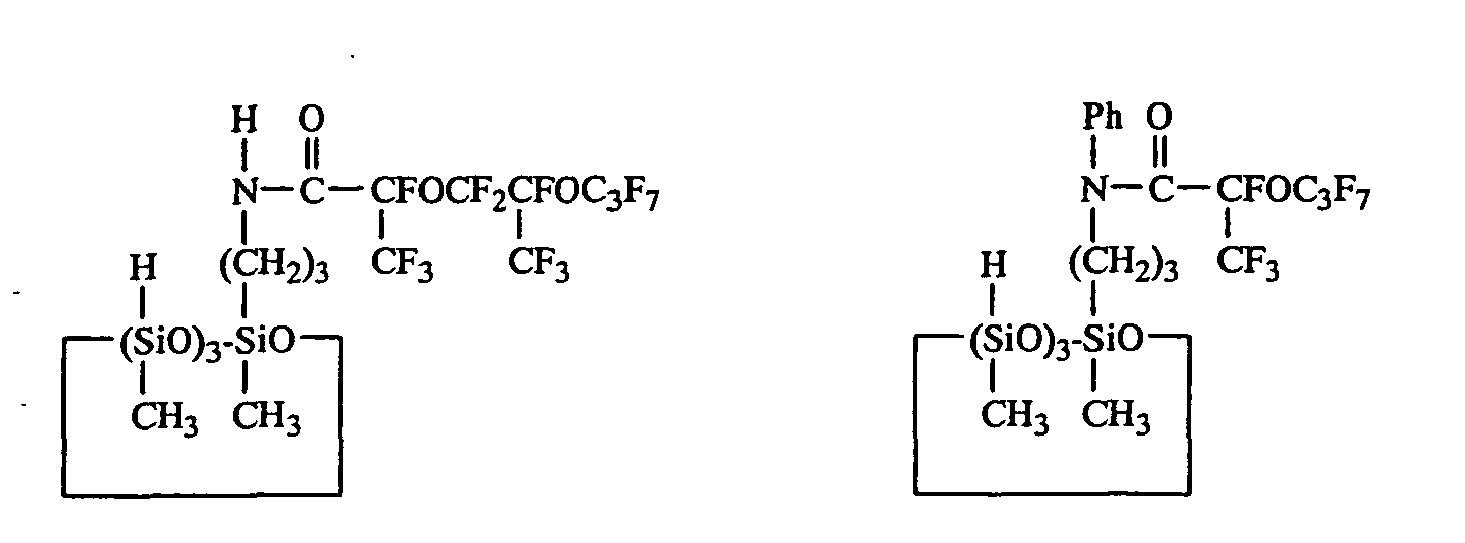

- Component (B) is included in an amount effective for curing component (A), and preferably an amount corresponding to 0.5 to 5.0 moles, and more preferably 1.0 to 2.0 moles, of hydrosilyl (Si-H) groups on component (B) per mole of total alkenyl groups (e.g., vinyl, allyl, cycloalkenyl groups) on component (A). If there are too few hydrosilyl groups, a sufficient degree of crosslinking may not be reached, resulting in an under-cured product. On the other hand, too many hydrosilyl groups may lead to such drawbacks as preferential chain extension, under-cure, foaming and poor heat resistance.
- As the crosslinker (B), the compound which is compatible with component (A) is desirably selected in order to obtain a uniform cured product.
- Component (C) is a hydrosilylation catalyst which promotes addition reaction between alkenyl groups in component (A) and hydrosilyl groups in component (B). Such hydrosilylation catalysts are generally noble metal compounds which are expensive. Of these, use is often made of platinum and platinum compounds which are more readily available.
- Exemplary platinum compounds include chloroplatinic acid and complexes of chloroplatinic acid with olefins (e.g., ethylene), alcohols or vinyl siloxanes, and metallic platinum on supports such as silica, alumina and carbon. Known platinum group metal catalysts other than platinum compounds include rhodium, ruthenium, iridium and palladium compounds, specific examples of which are RhCl(PPh3)3, RhCl(CO)(PPh3)2, Ru3(CO)12, IrCl(CO)(PPh3)2 and Pd(PPh3)4.
- Component (C) may be used in a catalytic amount, for example, in an amount of 0.1 to 500 ppm of platinum group metal based on the total weight of components (A) and (B).
- Component (D) is hydrophobic silica powder which functions to impart appropriate physical strength to the cured product of the composition.
- This hydrophobic silica powder is obtained by hydrophobic treatment of finely divided silica which is well known as a filler for silicone rubber. The silica powder should preferably have a specific surface area of at least 50 m2/g, and more preferably 50 to 400 m2/g, as measured by the standard BET method. If the BET specific surface area is less than 50 m2/g, the cured product may have insufficient physical strength. If the surface area is more than 400 m2/g, the silica powder may be unevenly dispersed, interfering with compounding operation.
- Examples of the finely divided silica include fumed silica, precipitated silica and colloid silica, with the fumed silica being most preferred.
- Hydrophobic agents used in the treatment of finely divided silica are typically silicon compounds including organochlorosilanes such as trimethylchlorosilane, dimethylvinylchlorosilane, and dimethyldichlorosilane; organosilazanes such as hexamethyldisilazane, 1,3-divinyl-1,1,3,3-tetramethyldisilazane, and hexamethylcyclotrisilazane; and organohydroxysilanes such as trimethylhydroxysilane and dimethylhydroxysilane, which may be used alone or in admixture. Fluorinated organosilanes and fluorinated organosiloxanes are also useful as the hydrophobic agent for finely divided silica. The fluorinated organosilanes and organosiloxanes used herein may be organosilanes and organosiloxanes having per molecule at least one monovalent perfluorooxyalkyl, monovalent perfluoroalkyl, divalent perfluorooxyalkylene or divalent perfluoroalkylene group, and at least one silicon-bonded hydroxyl group and/or alkoxy group (preferably C1-C6, more preferably C1-C4 alkoxy). Their molecular structure is not particularly limited.
- In a preferred mode of hydrophobic treatment of silica with fluorinated organosilanes or organosiloxanes, the hydrophobic agent may be added when a mixture of linear polyfluoro compound (A) and finely divided silica is heat kneaded in a milling means such as a kneader. If necessary, a small amount of water is added before heat treatment is performed, thereby effecting silanol treatment on silica particle surfaces. The heat treatment is performed at a temperature in the range of 100 to 200°C. This improves the miscibility of hydrophobic silica powder (D) with other components for thereby restraining the composition from the "crepe hardening" phenomenon during shelf storage and ameliorating the flow of the composition.
- (D) is usually compounded in an amount of 5 to 50 parts by weight, preferably 10 to 30 parts by weight per 100 parts by weight of component (A). If the amount of component (D) is less than 5 pbw, cured physical properties may be poor. If the amount of component (D) exceeds 50 pbw, the resulting composition may become less flowing and inefficient to work and mold, and cured physical properties may be poor.
- Component (E) is an antioxidant which functions to inhibit oxidation of alkenyl and other organic groups on component (A) and to prevent the platinum group compound (C) from losing its catalytic activity. In those compositions characterized by brief curing at room temperature as in the invention, the platinum group compound (C) is added in a larger amount, and hence, alkenyl and other organic groups on component (A) are susceptible to more oxidative degradation. Particularly when alkenyl groups are oxidized, not only a reduced amount of functional groups are available for curing reaction, but also hydroperoxide and other oxides resulting from oxidation can deprive the platinum group compound of its catalytic activity. In order to prevent these factors from retarding cure or causing defective cure during long-term storage, the addition of antioxidant (E) is essential.
- Suitable antioxidants include phenolic compounds, amines, sulfur compounds, phosphorus compounds, waxes, and metal complexes of the foregoing, and naturally occurring compounds and derivatives thereof such as vitamin C (L-ascorbic acid), vitamin E (α-tocopherol) and kojic acid. Most of these compounds are commercially available and any commercially available antioxidants may be used herein.
- Suitable phenolic antioxidants include mono- and dihydric phenols of the following formula:


- Suitable amine antioxidants include those of the following formulas.


- Suitable sulfur, phosphorus, metal complex and composite antioxidants include those of the following formulas.


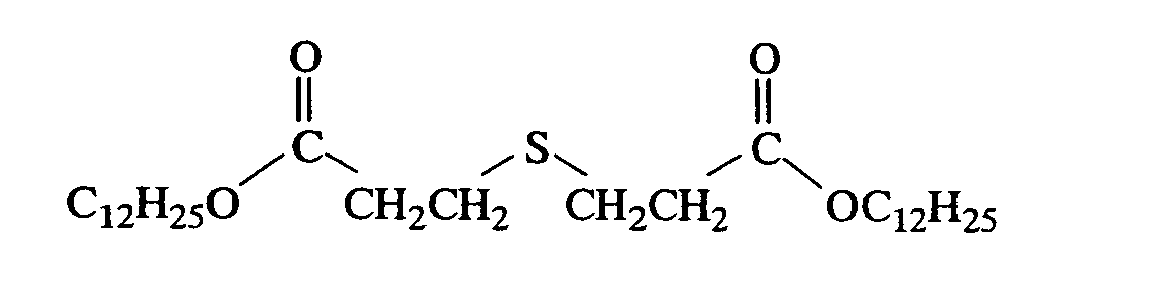

- Component (E) is preferably compounded in an amount of 0.01 to 10% by weight, more preferably 0.05 to 5% by weight based on the overall composition consisting of components (A) to (E). Less amounts of the antioxidant may fail to achieve the desired addition effect whereas excessive amounts may affect rubber physical properties after curing, for example, detracting from strength.
- Since some phosphorus or sulfur-containing antioxidants can deprive the platinum group compound (C) substantially of its catalytic activity in addition reaction, it is rather desirable to use naturally occurring, phenolic and amine antioxidants.
- In addition to above components (A) to (E), optional ingredients may also be included in the fluoropolyether rubber composition of the invention to increase its utility. Such optional ingredients include plasticizers, viscosity modifiers, flexibilizers, hydrosilylation catalyst regulators, inorganic fillers (exclusive of component D), and the like. These additives may be included in any respective amounts that allow the objects of the invention to be attained and that do not compromise the properties of the composition or the physical properties of the cured product thereof.
- Polyfluoromonoalkenyl compounds of the general formula (2) below and/or polyfluoro compounds of the general formulas (3) and (4) below may be used as the plasticizer, viscosity modifier and/or flexibilizer.
Rf2-(X')a-CH=CH2 (2)
- In formula (2), X' and "a" are as defined above, and Rf2 has the general formula (iii):
F-[CF(CF3)CF2O]w-CtF2t- (iii)
wherein t is as defined above, and w is an integer of 1 to 150 which is smaller than the sum of p+q plus r and smaller than the sum u+v for the Rf group in above component (A).
A-O-(CF2CF2CF2O)c-A (3)
- In formula (3), A is a group of the formula: CsF2s+1-, wherein s is 1 to 3, and c is an integer of 1 to 200 which is smaller than the sum of p+q plus r and smaller than the sum u+v for the Rf group in above component (A).
A-O-(CF2O)d(CF2CF2O)e-A (4)
- In formula (4), A is as defined above, and d and e are each integers of 1 to 200 such that the sum d+e is smaller than the sum of p+q plus r and smaller than the sum u+v for the Rf group in above component (A).
- Examples of polyfluoromonoalkenyl compounds of formula (2) include those of the following structural formulas.

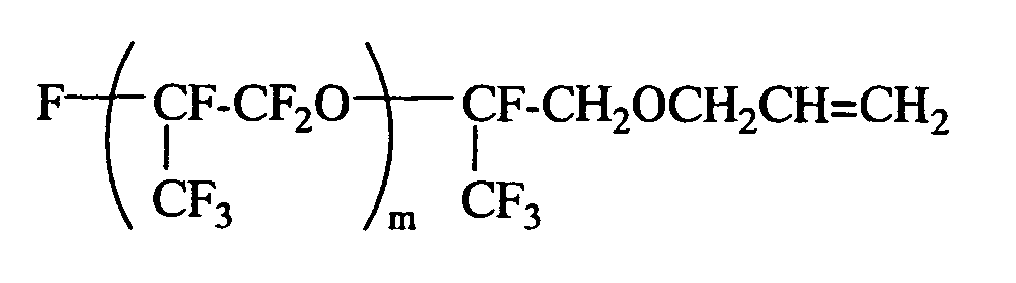


- Herein m is an integer of 1 to 200.
- Examples of polyfluoro compounds of formulas (3) and (4) include those of the following structural formulas.
CF3O-(CF2CF2CF2O)n-CF2CF3
CF3-[(OCF2CF2)n(OCF2)m]-O-CF3
- Herein m and n are each an integer from 1 to 200, and the sum m+n is from 1 to 200.
- In the composition, the polyfluoro compound of formula (2), (3) or (4) is preferably included in an amount of 1 to 100 parts, and more preferably 10 to 50 parts by weight, per 100 parts by weight of component (A). Less than 1 pbw of the polyfluoro compound may fail to achieve the desired addition effect whereas more than 50 pbw may adversely affect the hardness and rubber strength of the cured product and is thus undesired in the application where such cured physical properties are required.
- Illustrative examples of suitable hydrosilylation catalyst regulators include acetylenic alcohols such as 1-ethynyl-1-hydroxycyclohexane, 3-methyl-1-butyn-3-ol, 3,5-dimethyl-1-hexyn-3-ol, 3-methyl-1-penten-3-ol and phenylbutynol; 3-methyl-3-penten-1-yne, 3,5-dimethyl-3-hexen-1-yne and triallyl isocyanurate; polyvinylsiloxane compounds and organophosphorus compounds. The addition of these compounds helps to achieve an appropriate balance of curing reactivity and shelf stability.
- Illustrative examples of inorganic fillers include reinforcing or semi-reinforcing fillers such as calcium carbonate; inorganic pigments such as titanium oxide, iron oxide, carbon black and cobalt aluminate; heat stabilizers such as titanium oxide, iron oxide, carbon black, cerium oxide, cerium hydroxide, zinc carbonate, magnesium carbonate and manganese carbonate; heat conductive agents such as alumina, boron nitride, silicon carbide and metal powders; and electrical conductive agents such as carbon black, silver powder and conductive zinc oxide. Besides, organic pigments and other organic compounds may also be added. These additives may be added in any desired amounts as long as the objects of the invention are not compromised.
- No particular limitation is imposed on the method for preparing the composition. For example, the composition may be prepared by uniformly mixing components (A) to (E) and other optional ingredients on a suitable mixing apparatus such as a planetary mixer, Ross mixer, Hobart mixer or two-roll mill.
- On storage, the components are preferably grouped in two parts, a first including or consisting of (A), (C), (D) and (E) and a second including or consisting of (A), (B) and (D). On use, the first and second parts are mixed together. The packaging of the composition in two parts has the advantages of shelf stability and ease of handling because curing reaction does not start until the two parts are mixed and the composition can be stored at room temperature for a long period of time.
- Prior to the use of the room temperature curable fluoropolyether rubber composition, it may be dissolved in a solvent in an appropriate concentration depending on its application or service use. Suitable solvents include fluorochemical solvents (solvents containing fluorine in their molecule), such as m-xylene hexafluoride, alkyl perfluoroalkyl ethers, perfluoroalkyl ethers, and mixtures thereof. Of these fluorochemical solvents, those having a boiling point of up to 150°C are preferred for ease of coating.
- Where the composition must be bonded to a substrate of metal or organic resin, the substrate is preferably treated with a primer before the composition is applied thereto.
- While the fluoropolyether rubber composition of the invention cures even at room temperature within a short time into a product having the advantages of chemical resistance, solvent resistance, low moisture permeability, and heat resistance, it is adherent and bondable to various substrates and is less fouling and less residual. Because of these advantages, the composition finds use in many applications, for example, as back side protective coating during etching of silicon wafers, moisture-proof masks on electrodes in LC displays and PDP, protective coating during etching of LC glass, masks during coating of cream solder, masks during etching of flexible copper-clad printed boards, and oil resistant protective coating on automotive electronic parts. Since the composition cures at room temperature and has rubber physical properties, it can be readily applied to those places where heating should be avoided during application. Such examples include rubber parts in chemical plants such as O-rings, packings, oil seals, and gaskets; rubber parts in aircraft such as O-rings, face seals, packings, and gaskets in fluid piping for engine oil, jet fuel, hydraulic oil and Skydrol®.
- Examples and Comparative Examples are given below by way of illustration of the invention and not by way of limitation. All parts are by weight (pbw).
- Compositions were prepared by compounding components as Parts A and B in accordance with the formulation of Table 1.
Table 1 Component (pbw) Example 1 Example 2 Example 3 Comparative Example 1 Part A Part B Part A Part B Part A Part B Part A Part B A A-1 100 100 100 100 100 100 A-2 100 100 B B-1 5.71 7.13 7.13 7.13 B-2 1.44 C C-1 0.20 0.20 0.30 0.20 D D-1 10.0 10.0 15.0 15.0 10.0 10.0 10.0 10.0 E E-1 0.20 E-2 0.20 0.30 -

-

-

-

-

-

-

-
- 1. Cure test
In each Example, Parts A and B were thoroughly mixed and cast into a mold of 100x150x2 mm where the composition was held at room temperature (23°C) for one hour, after which its cured state was examined. - 2. Shelf stability
In each Example, Parts A and B were separately held at 40°C for 2 weeks before the same cure test as above was performed. The cured state of aged sample was compared with that of fresh sample. - 3. Rubber physical properties
The results are shown in Table 2.
| Test item | Example 1 | Example 2 | Example 3 | Comparative Example 1 | |
| Cure | Good | Good | Good | Good | |
| Shelf stability | Intact | Intact | Intact | Under-cured | |
| Physical properties | Hardness | 38 | 43 | 36 | 35 |
| Tensile strength, MPa | 4.6 | 6.3 | 5.6 | 5.0 | |
| Elongation at break, % | 220 | 310 | 280 | 280 | |
Claims (3)
- A room temperature curable fluoropolyether rubber composition comprising(A) a polyfluoro compound having the general formula (1):
CH2=CH-(X)a-Rf-(X')a-CH=CH2 (1)
wherein X is -CH2-, -CH2O-, -CH2OCH2- or -Y-NR-CO-; Y is -CH2-or an o-, m- or p-dimethylsilylphenylene group of structural formula (Z):

the subscript "a" is independently 0 or 1;
Rf is a divalent perfluoropolyether group of the general formula (i):
-CtF2t-[OCF2CF(CF3)]p-O-CF2(CF2)rCF2-O-[CF(CF3)CF2O]q-CtF2t- (i)
wherein p and q are integers of 1 to 150, the sum of p and q is 2 to 200, r is an integer of 0 to 6, and t is 2 or 3, or the general formula (ii):
-CtF2t-[OCF2CF(CF3)]u-(OCF2)v-OCtF2t- (ii)
wherein u is an integer of 1 to 200, v is an integer of 1 to 50, and t is as defined above,(B) a fluorinated organohydrogenpolysiloxane having at least one perfluorooxyalkyl, perfluoroalkyl, perfluorooxyalkylene or perfluoroalkylene group and at least two silicon-bonded hydrogen atoms per molecule,(C) a catalytic amount of a platinum group compound,(D) hydrophobic silica powder, and(E) an antioxidant. - The room temperature curable fluoropolyether rubber composition of claim 1 wherein the components are present as a first part consisting of components (A), (C), (D) and (E) and a second part consisting of components (A), (B) and (D), and the first and second parts are mixed on use.
- A cured product obtained by heat curing the composition of claim 1 or 2.
Applications Claiming Priority (1)
| Application Number | Priority Date | Filing Date | Title |
|---|---|---|---|
| JP2008101583A JP5035555B2 (en) | 2008-04-09 | 2008-04-09 | Room temperature curable fluoropolyether rubber composition and cured product thereof |
Publications (1)
| Publication Number | Publication Date |
|---|---|
| EP2108672A1 true EP2108672A1 (en) | 2009-10-14 |
Family
ID=40677869
Family Applications (1)
| Application Number | Title | Priority Date | Filing Date |
|---|---|---|---|
| EP09251071A Withdrawn EP2108672A1 (en) | 2008-04-09 | 2009-04-09 | Room temperature curable fluoropolyether rubber composition and cured product |
Country Status (3)
| Country | Link |
|---|---|
| US (1) | US20090258986A1 (en) |
| EP (1) | EP2108672A1 (en) |
| JP (1) | JP5035555B2 (en) |
Families Citing this family (9)
| Publication number | Priority date | Publication date | Assignee | Title |
|---|---|---|---|---|
| JP2009091547A (en) * | 2007-09-21 | 2009-04-30 | Shin Etsu Chem Co Ltd | Addition-curing silicone rubber composition, cured product thereof and crosslinking agent |
| WO2011052757A1 (en) | 2009-10-29 | 2011-05-05 | 日本ポリプロ株式会社 | Manufacturing method for propylene polymer |
| JP5459033B2 (en) * | 2010-04-14 | 2014-04-02 | 信越化学工業株式会社 | Adhesive composition |
| JP5799930B2 (en) * | 2012-10-19 | 2015-10-28 | 信越化学工業株式会社 | Curable fluoropolyether gel composition and gel product using the cured product |
| JP6160540B2 (en) * | 2014-03-31 | 2017-07-12 | 信越化学工業株式会社 | Curable perfluoropolyether gel composition and gel product using the cured product |
| JP6565723B2 (en) * | 2015-02-04 | 2019-08-28 | 信越化学工業株式会社 | Photocurable fluoropolyether rubber composition, cured product thereof, and curing method thereof |
| LT6538B (en) | 2016-11-18 | 2018-06-25 | Uab "Airplus1 Lituanica" | ESCALATOR'S SHOE BAR DISINFECTION SYSTEM AND METHOD |
| JP6927798B2 (en) * | 2017-08-23 | 2021-09-01 | 信越化学工業株式会社 | Curable perfluoropolyether adhesive composition, adhesives and adhesive tapes using the cured product |
| JP7306334B2 (en) | 2020-06-11 | 2023-07-11 | 信越化学工業株式会社 | Organohydrogenpolysiloxane having perfluoropolyether blocks and method for producing the same |
Citations (7)
| Publication number | Priority date | Publication date | Assignee | Title |
|---|---|---|---|---|
| US5486565A (en) | 1994-12-02 | 1996-01-23 | Dow Corning Corporation | Organosilicon compounds and low temperature curing organosiloxane compositions containing same |
| US5665794A (en) * | 1996-05-20 | 1997-09-09 | Dow Corning Corporation | Method for controlling cure initiation and curing times of platinum group metal curing fluorosilicone compositions |
| EP1033387A2 (en) * | 1999-03-02 | 2000-09-06 | Shin-Etsu Chemical Co., Ltd. | Curable fluoropolyether base rubber compositions |
| EP1114846A2 (en) * | 2000-01-07 | 2001-07-11 | Shin-Etsu Chemical Co., Ltd. | Curable fluoropolyther base rubber compositions |
| EP1217025A1 (en) * | 2000-11-30 | 2002-06-26 | Shin-Etsu Chemical Co., Ltd. | Curable fluoropolyether base rubber compositions |
| EP1273618A1 (en) | 2001-06-28 | 2003-01-08 | Shin-Etsu Chemical Co., Ltd. | Room temperature curable organopolysiloxane compositions |
| EP1384741A1 (en) * | 2002-07-22 | 2004-01-28 | Shin-Etsu Chemical Co., Ltd. | Curable fluoropolyether composition and rubber article |
Family Cites Families (6)
| Publication number | Priority date | Publication date | Assignee | Title |
|---|---|---|---|---|
| JP4016239B2 (en) * | 2000-07-05 | 2007-12-05 | 信越化学工業株式会社 | Curable fluoropolyether rubber composition |
| EP1580233B1 (en) * | 2002-12-05 | 2008-09-17 | Daikin Industries, Ltd. | Fluorine-containing polymer composition and cured body |
| WO2005116134A1 (en) * | 2004-05-28 | 2005-12-08 | Kaneka Corporation | Curable composition and cured product thereof |
| US20050277731A1 (en) * | 2004-06-11 | 2005-12-15 | Shin-Etsu Chemical Co., Ltd. | Curable perfluoropolyether compositions and rubber or gel articles comprising the same |
| DE602007001540D1 (en) * | 2006-02-13 | 2009-08-27 | Shinetsu Chemical Co | Curable fluoropolyether compositions and one-piece molded resin / rubber products |
| JP5303864B2 (en) * | 2007-05-21 | 2013-10-02 | 信越化学工業株式会社 | Curable fluoropolyether composition and integrally molded product of cured rubber and organic resin using the same |
-
2008
- 2008-04-09 JP JP2008101583A patent/JP5035555B2/en not_active Expired - Fee Related
-
2009
- 2009-04-03 US US12/418,046 patent/US20090258986A1/en not_active Abandoned
- 2009-04-09 EP EP09251071A patent/EP2108672A1/en not_active Withdrawn
Patent Citations (10)
| Publication number | Priority date | Publication date | Assignee | Title |
|---|---|---|---|---|
| US5486565A (en) | 1994-12-02 | 1996-01-23 | Dow Corning Corporation | Organosilicon compounds and low temperature curing organosiloxane compositions containing same |
| JPH08225742A (en) | 1994-12-02 | 1996-09-03 | Dow Corning Corp | Cold-curing organosiloxane composition |
| US5665794A (en) * | 1996-05-20 | 1997-09-09 | Dow Corning Corporation | Method for controlling cure initiation and curing times of platinum group metal curing fluorosilicone compositions |
| EP1033387A2 (en) * | 1999-03-02 | 2000-09-06 | Shin-Etsu Chemical Co., Ltd. | Curable fluoropolyether base rubber compositions |
| EP1114846A2 (en) * | 2000-01-07 | 2001-07-11 | Shin-Etsu Chemical Co., Ltd. | Curable fluoropolyther base rubber compositions |
| EP1217025A1 (en) * | 2000-11-30 | 2002-06-26 | Shin-Etsu Chemical Co., Ltd. | Curable fluoropolyether base rubber compositions |
| EP1273618A1 (en) | 2001-06-28 | 2003-01-08 | Shin-Etsu Chemical Co., Ltd. | Room temperature curable organopolysiloxane compositions |
| US6740725B2 (en) | 2001-06-28 | 2004-05-25 | Shin-Etsu Chemical Co., Ltd. | Room temperature curable organopolysiloxane compositions |
| JP3748054B2 (en) | 2001-06-28 | 2006-02-22 | 信越化学工業株式会社 | Room temperature curable organopolysiloxane composition |
| EP1384741A1 (en) * | 2002-07-22 | 2004-01-28 | Shin-Etsu Chemical Co., Ltd. | Curable fluoropolyether composition and rubber article |
Also Published As
| Publication number | Publication date |
|---|---|
| JP5035555B2 (en) | 2012-09-26 |
| US20090258986A1 (en) | 2009-10-15 |
| JP2009249568A (en) | 2009-10-29 |
Similar Documents
| Publication | Publication Date | Title |
|---|---|---|
| US20090258986A1 (en) | Room temperature curable fluoropolyether rubber composition and cured product | |
| EP2383318B1 (en) | Adhesive composition | |
| EP1170320B1 (en) | Curable fluoropolyether base rubber compositions | |
| EP1217025B1 (en) | Curable fluoropolyether base rubber compositions | |
| EP1223194B1 (en) | Curable fluorinated elastomer compositions, their preparation and use | |
| EP1995289B1 (en) | Heat-curable fluoropolyether adhesive composition and bonding method | |
| EP2345709B1 (en) | Addition-cure fluoropolyether adhesive composition | |
| EP2719737B1 (en) | Adhesive Composition | |
| EP1780253A2 (en) | Adhesive composition | |
| EP1614718A1 (en) | Curable fluoropolyether compositions, their preparation and use | |
| EP1528092B1 (en) | Adhesive composition | |
| US6441079B2 (en) | Curable fluoropolyether base rubber compositions | |
| EP1486534A1 (en) | Adhesive compositions, their preparation and use | |
| JP5110280B2 (en) | Curable fluoropolyether rubber composition | |
| EP2725064B1 (en) | Curable Fluoropolyether Gel Composition and Gel Article | |
| EP1422260B1 (en) | Curable fluoropolyether rubber compositions and rubber articles | |
| EP1571192B1 (en) | Fluoropolyether adhesive composition | |
| JP3944721B2 (en) | Curable fluoropolyether composition and rubber product | |
| EP1413588A1 (en) | Curable compositions | |
| EP4516858A1 (en) | Heat-curable perfluoropolyether rubber composition | |
| JP2002327110A (en) | Curable fluoropolyether rubber composition | |
| EP1715005A1 (en) | Curable fluoropolyether rubber compositions and rubber articles | |
| EP4656667A1 (en) | Curable composition |
Legal Events
| Date | Code | Title | Description |
|---|---|---|---|
| PUAI | Public reference made under article 153(3) epc to a published international application that has entered the european phase |
Free format text: ORIGINAL CODE: 0009012 |
|
| AK | Designated contracting states |
Kind code of ref document: A1 Designated state(s): AT BE BG CH CY CZ DE DK EE ES FI FR GB GR HR HU IE IS IT LI LT LU LV MC MK MT NL NO PL PT RO SE SI SK TR |
|
| 17P | Request for examination filed |
Effective date: 20091116 |
|
| 17Q | First examination report despatched |
Effective date: 20100119 |
|
| STAA | Information on the status of an ep patent application or granted ep patent |
Free format text: STATUS: THE APPLICATION IS DEEMED TO BE WITHDRAWN |
|
| 18D | Application deemed to be withdrawn |
Effective date: 20100601 |