EP2107628A1 - Fuel cell module and manufacturing method thereof - Google Patents
Fuel cell module and manufacturing method thereof Download PDFInfo
- Publication number
- EP2107628A1 EP2107628A1 EP09004996A EP09004996A EP2107628A1 EP 2107628 A1 EP2107628 A1 EP 2107628A1 EP 09004996 A EP09004996 A EP 09004996A EP 09004996 A EP09004996 A EP 09004996A EP 2107628 A1 EP2107628 A1 EP 2107628A1
- Authority
- EP
- European Patent Office
- Prior art keywords
- rubber
- crosslinking
- separator
- electrode member
- disposed
- Prior art date
- Legal status (The legal status is an assumption and is not a legal conclusion. Google has not performed a legal analysis and makes no representation as to the accuracy of the status listed.)
- Granted
Links
Images



Classifications
-
- H—ELECTRICITY
- H01—ELECTRIC ELEMENTS
- H01M—PROCESSES OR MEANS, e.g. BATTERIES, FOR THE DIRECT CONVERSION OF CHEMICAL ENERGY INTO ELECTRICAL ENERGY
- H01M8/00—Fuel cells; Manufacture thereof
- H01M8/02—Details
- H01M8/0271—Sealing or supporting means around electrodes, matrices or membranes
- H01M8/028—Sealing means characterised by their material
- H01M8/0284—Organic resins; Organic polymers
-
- H—ELECTRICITY
- H01—ELECTRIC ELEMENTS
- H01M—PROCESSES OR MEANS, e.g. BATTERIES, FOR THE DIRECT CONVERSION OF CHEMICAL ENERGY INTO ELECTRICAL ENERGY
- H01M8/00—Fuel cells; Manufacture thereof
- H01M8/02—Details
- H01M8/0202—Collectors; Separators, e.g. bipolar separators; Interconnectors
- H01M8/0258—Collectors; Separators, e.g. bipolar separators; Interconnectors characterised by the configuration of channels, e.g. by the flow field of the reactant or coolant
-
- H—ELECTRICITY
- H01—ELECTRIC ELEMENTS
- H01M—PROCESSES OR MEANS, e.g. BATTERIES, FOR THE DIRECT CONVERSION OF CHEMICAL ENERGY INTO ELECTRICAL ENERGY
- H01M8/00—Fuel cells; Manufacture thereof
- H01M8/02—Details
- H01M8/0202—Collectors; Separators, e.g. bipolar separators; Interconnectors
- H01M8/0267—Collectors; Separators, e.g. bipolar separators; Interconnectors having heating or cooling means, e.g. heaters or coolant flow channels
-
- H—ELECTRICITY
- H01—ELECTRIC ELEMENTS
- H01M—PROCESSES OR MEANS, e.g. BATTERIES, FOR THE DIRECT CONVERSION OF CHEMICAL ENERGY INTO ELECTRICAL ENERGY
- H01M8/00—Fuel cells; Manufacture thereof
- H01M8/02—Details
- H01M8/0271—Sealing or supporting means around electrodes, matrices or membranes
-
- H—ELECTRICITY
- H01—ELECTRIC ELEMENTS
- H01M—PROCESSES OR MEANS, e.g. BATTERIES, FOR THE DIRECT CONVERSION OF CHEMICAL ENERGY INTO ELECTRICAL ENERGY
- H01M8/00—Fuel cells; Manufacture thereof
- H01M8/02—Details
- H01M8/0271—Sealing or supporting means around electrodes, matrices or membranes
- H01M8/0286—Processes for forming seals
-
- H—ELECTRICITY
- H01—ELECTRIC ELEMENTS
- H01M—PROCESSES OR MEANS, e.g. BATTERIES, FOR THE DIRECT CONVERSION OF CHEMICAL ENERGY INTO ELECTRICAL ENERGY
- H01M8/00—Fuel cells; Manufacture thereof
- H01M8/24—Grouping of fuel cells, e.g. stacking of fuel cells
- H01M8/241—Grouping of fuel cells, e.g. stacking of fuel cells with solid or matrix-supported electrolytes
-
- H—ELECTRICITY
- H01—ELECTRIC ELEMENTS
- H01M—PROCESSES OR MEANS, e.g. BATTERIES, FOR THE DIRECT CONVERSION OF CHEMICAL ENERGY INTO ELECTRICAL ENERGY
- H01M8/00—Fuel cells; Manufacture thereof
- H01M8/24—Grouping of fuel cells, e.g. stacking of fuel cells
- H01M8/2457—Grouping of fuel cells, e.g. stacking of fuel cells with both reactants being gaseous or vaporised
-
- H—ELECTRICITY
- H01—ELECTRIC ELEMENTS
- H01M—PROCESSES OR MEANS, e.g. BATTERIES, FOR THE DIRECT CONVERSION OF CHEMICAL ENERGY INTO ELECTRICAL ENERGY
- H01M8/00—Fuel cells; Manufacture thereof
- H01M8/24—Grouping of fuel cells, e.g. stacking of fuel cells
- H01M8/2465—Details of groupings of fuel cells
- H01M8/2483—Details of groupings of fuel cells characterised by internal manifolds
-
- H—ELECTRICITY
- H01—ELECTRIC ELEMENTS
- H01M—PROCESSES OR MEANS, e.g. BATTERIES, FOR THE DIRECT CONVERSION OF CHEMICAL ENERGY INTO ELECTRICAL ENERGY
- H01M8/00—Fuel cells; Manufacture thereof
- H01M8/10—Fuel cells with solid electrolytes
- H01M2008/1095—Fuel cells with polymeric electrolytes
-
- Y—GENERAL TAGGING OF NEW TECHNOLOGICAL DEVELOPMENTS; GENERAL TAGGING OF CROSS-SECTIONAL TECHNOLOGIES SPANNING OVER SEVERAL SECTIONS OF THE IPC; TECHNICAL SUBJECTS COVERED BY FORMER USPC CROSS-REFERENCE ART COLLECTIONS [XRACs] AND DIGESTS
- Y02—TECHNOLOGIES OR APPLICATIONS FOR MITIGATION OR ADAPTATION AGAINST CLIMATE CHANGE
- Y02E—REDUCTION OF GREENHOUSE GAS [GHG] EMISSIONS, RELATED TO ENERGY GENERATION, TRANSMISSION OR DISTRIBUTION
- Y02E60/00—Enabling technologies; Technologies with a potential or indirect contribution to GHG emissions mitigation
- Y02E60/30—Hydrogen technology
- Y02E60/50—Fuel cells
-
- Y—GENERAL TAGGING OF NEW TECHNOLOGICAL DEVELOPMENTS; GENERAL TAGGING OF CROSS-SECTIONAL TECHNOLOGIES SPANNING OVER SEVERAL SECTIONS OF THE IPC; TECHNICAL SUBJECTS COVERED BY FORMER USPC CROSS-REFERENCE ART COLLECTIONS [XRACs] AND DIGESTS
- Y02—TECHNOLOGIES OR APPLICATIONS FOR MITIGATION OR ADAPTATION AGAINST CLIMATE CHANGE
- Y02P—CLIMATE CHANGE MITIGATION TECHNOLOGIES IN THE PRODUCTION OR PROCESSING OF GOODS
- Y02P70/00—Climate change mitigation technologies in the production process for final industrial or consumer products
- Y02P70/50—Manufacturing or production processes characterised by the final manufactured product
-
- Y—GENERAL TAGGING OF NEW TECHNOLOGICAL DEVELOPMENTS; GENERAL TAGGING OF CROSS-SECTIONAL TECHNOLOGIES SPANNING OVER SEVERAL SECTIONS OF THE IPC; TECHNICAL SUBJECTS COVERED BY FORMER USPC CROSS-REFERENCE ART COLLECTIONS [XRACs] AND DIGESTS
- Y10—TECHNICAL SUBJECTS COVERED BY FORMER USPC
- Y10T—TECHNICAL SUBJECTS COVERED BY FORMER US CLASSIFICATION
- Y10T29/00—Metal working
- Y10T29/49—Method of mechanical manufacture
- Y10T29/49002—Electrical device making
- Y10T29/49108—Electric battery cell making
- Y10T29/49114—Electric battery cell making including adhesively bonding
Definitions
- the present invention relates to a fuel cell module in which an electrode member and a separator are integrated, and a manufacturing method thereof.
- a Fuel cell generating electricity from electrochemical reactions of gases has a high power generation efficiency and an extremely small impact on the environment since the discharged gas is clean.
- the proton-exchange membrane fuel cell is capable of operating at relatively low temperatures and has a large output density. For this reason, its application to various fields such as power generation and as a power source for automobiles is anticipated.
- a cell in which separators sandwich a membrane electrode assembly (MEA) or the like serves as the unit of power generation.
- the MEA is formed from a polymer membrane (electrolyte membrane) acting as an electrolyte, and a pair of electrode catalyst layers (a fuel electrode (anode) catalyst layer and an oxygen electrode (cathode) catalyst layer) respectively arranged on both sides of the electrolyte membrane in the thickness direction.
- a gas diffusion layer is further disposed on the surfaces of the pair of electrode catalyst layers.
- Fuel gas such as hydrogen is supplied to the fuel electrode side, while an oxidizing gas such as oxygen and air is supplied to the oxygen electrode side.
- the supplied gas, the electrolyte, and the electrode catalyst layers are subjected to an electrochemical reaction at the three-phase boundary to generate electricity.
- the proton-exchange membrane fuel cell is structured by sandwiching a cell stack in which a plurality of the above cells are stacked together between end plates or the like disposed on both ends of the fuel cell in the cell stacking direction.
- a manifold serving as a flow path for gas or water is formed on the peripheral edge portion of the cell stack. Mixing of the gases supplied to the respective electrodes creates issues such as lowered power generation efficiency. Also, the electrolyte membrane exhibits proton conductance in a state with water contained therein. Therefore, during operation the electrolyte must maintain a wet state. Accordingly, in order to prevent gas mixing and leakage, as well as maintain a wet state within the cells, a seal member is disposed on the peripheral edge portion of the manifold and the MEA (see Japanese Patent Application Publication Nos. JP-A-2007-188834 , JP-A-2007-149472 , and JP-A-2007-66766 for examples).
- a gasket structure which integrates the electrode member and the seal member is known.
- liquid rubber is poured into the peripheral edge portion of the electrode member which is formed from the MEA, the gas diffusion layer, and so forth, and injection molding is carried out.
- the first issue is the low mechanical strength of the seal member.
- liquid rubber such as silicone rubber is used as the seal member.
- most liquid rubber has a low molecular weight.
- there is little tensile strength after crosslinking Since the liquid rubber also does not stretch much, the liquid rubber does not easily follow the expansion and contraction of the electrolyte membrane as a result of moisture and the like.
- silicone rubber does not have sufficient adhesiveness or acid resistance, which is problematic in terms of sealability and durability.
- the second issue concerns the need for special treatment when liquid rubber is used so that the liquid rubber does not excessively impregnate a porous layer during molding. Namely, when pouring and molding liquid rubber into the peripheral edge portion of the electrode member, the liquid rubber impregnates porous layers such as the gas diffusion layer. In such case, impregnation of the liquid rubber is difficult to control. Therefore, the flow of gas is impeded at regions excessively impregnated with the liquid rubber, and power generation performance is reduced by a corresponding amount.
- the porosity of a part of the porous layer is decreased in advance by plugging or the like.
- Japanese Patent Application Publication No. JP-A-2007-149472 a part of the porous layer is compressed to increase density.
- the third issue is the risk of deformation of the electrolyte membrane during injection molding due to the injection pressure of the liquid rubber.
- the electrolyte membrane is a thin polymer film. Therefore, the flow of liquid rubber during injection molding may press against and deform the electrolyte membrane. If the electrolyte membrane is deformed, obtaining a desired power generation performance becomes difficult.
- the proton-exchange membrane fuel cell is structured by stacking a plurality of electrode members, in which the MEA, the gas diffusion layer, and the like are stacked, via separators.
- the stacking operation performed while maintaining each of the members at predetermined positions is difficult. For this reason, the assembly operation is extremely laborious and results in poor productivity.
- the electrode member is integrated, which facilitates stacking by a corresponding amount.
- the present invention has been developed in view of such circumstances, and it is an object of the present invention to provide a fuel cell module in which an electrode member and a separator are integrated using an adhesive rubber member with high sealability, and a manufacturing method thereof.
- a fuel cell module includes: an electrode member having a membrane electrode assembly, which is formed from an electrolyte membrane and a pair of electrode catalyst layers that is disposed on both sides of the electrolyte membrane in the thickness direction, and having a pair of porous layers disposed on both sides of the membrane electrode assembly in the thickness direction; and a separator disposed layered on the electrode member so as to contact at least one of the porous layers, characterized in that an adhesive rubber member is disposed on a peripheral edge portion of the electrode member, which seals the peripheral edge portion and of which a tensile product is 1, 500 MPa ⁇ % or more, the electrode member and the separator are integrated by the adhesive rubber member.
- the electrode member and the separator are integrated by the adhesive rubber member. Therefore, a fuel cell can be easily assembled mainly by stacking the fuel cell modules of the present invention. This in turn improves productivity.
- each module can be extracted as necessary to enable inspection and repair. If a failure occurs in a module, it is also easy to replace only that particular module.
- the peripheral edge portion of the electrode member is sealed by the adhesive rubbermember.
- the tensile product of the adhesive rubber member is equal to or greater than 1,500 MPa ⁇ %.
- the tensile product is defined as a product of tensile strength and breaking elongation, i.e., [tensile strength (MPa) ⁇ breaking elongation (%)].
- MPa tensile strength
- breaking elongation %
- a larger tensile product indicates that more energy is required to break.
- values measured in accordance with JIS K6251 (2004) are employed for the tensile strength and breaking elongation. Measurements for tensile strength and breaking elongation were performed using No. 5 dumbbell specimens.
- the adhesive rubber member has adhesiveness. There is thus no need to use a separate adhesive agent, and the electrode member and the separator can be strongly adhered together by the adhesive rubber member.
- the adhesive rubber member is formed from solid rubber, and the electrode member and the separator are stacked, and a pre-crosslinking composition of the solid rubber is arranged so as to coat the peripheral edge portion of the electrode member and contact the separator, whereby the electrode member, the separator and the solid rubber are integral molded.
- solid rubber in the present specification is an expression to "liquid rubber” and refers to kneadable rubber that is a solid at room temperature.
- rubber in a solid state rather than liquid rubber is used in the present configuration.
- the adhesive rubber member has considerable tensile strength and elongation. Due to the use of solid rubber, the amount by which the porous layer is impregnated can be regulated. There is thus no need for special treatment during molding. Since liquid rubber is not used, there is also no risk of the electrolyte membrane deforming because of the injection pressure.
- the pre-crosslinking composition of the solid rubber includes the following contents of (A) to (D) : (A) at least one rubber component selected from a group consisting of ethylene-propylene rubber, ethylene-propylene-diene rubber, acrylonitrile-butadiene rubber, and hydrogenated acrylonitrile-butadiene rubber; (B) a crosslinking agent selected from organic peroxides of which a 1-hour half-life period temperature is lower than or equal to 130°C; (C) a crosslinking auxiliary agent; and (D) an adhesive component formed of at least one of a resorcinol compound together with a melamine compound and a silane coupling agent.
- A at least one rubber component selected from a group consisting of ethylene-propylene rubber, ethylene-propylene-diene rubber, acrylonitrile-butadiene rubber, and hydrogenated acrylonitrile-butadiene rubber
- B a crosslinking agent selected from organic peroxides of which
- a rubber in which the pre-crosslinking composition including the contents of the above (A) to (D) is made to crosslink has low gas permeability.
- the sealability of the adhesive rubber member can be increased.
- organic peroxides of which a 1-hour half-life period temperature is lower than or equal to 130°C are used as a crosslinking agent in the present configuration (the above (B)).
- half-life period is a time until the concentration of the organic peroxide becomes half an initial value.
- the term “half-life period temperature” is indicative of the decomposition temperature of the organic peroxide.
- the term "1-hour half-life period” is the temperature when the half-life period is 1 hour.
- a lower 1-hour half-life period indicates a greater tendency toward decomposition at low temperatures.
- an organic peroxide whose 1-hour half-life period temperature is lower than or equal to 130°C
- crosslinking can be achieved at a lower temperature (i.e., lower than or equal to 130°C) and in a shorter period. Therefore, deterioration of the electrolyte membrane due to heating during molding (crosslinking) can also be suppressed.
- the crosslinking agent of (B) is not prone to curing defects caused by impurities, contamination, and the like. Therefore, the crosslinking agent of (B) is resistant to the effects of the surrounding environment during operations and easy to handle.
- a resorcinol compound and a melamine compound are used in the adhesive component of (D), then the melamine compound is the methylene donor and the resorcinol compound is the methylene recipient.
- chemical bonds are formed between the resorcinol compound, and the rubber component and a mating member, due to the donation of a methylene group. Whereby, the rubber component and the mating member are adhered.
- a silane coupling agent is used in the adhesive component of (D)
- chemical bonds are formed between the rubber component and the mating member via the silane coupling agent, whereby both are adhered together.
- a high adhesion force is achieved due to these adhesive components, and the adhesion force is not prone to decreasing even in the operation environment of a fuel cell. Accordingly, good sealability can be secured even when the fuel cell is operated for a long period. In other words, the operation reliability of the fuel cell is improved.
- the porous layer disposed on one side of the membrane electrode assembly in the thickness direction has at least one of a gas diffusion layer, and a gas flow path layer whose porosity is larger than that of the gas diffusion layer
- the porous layer disposed on another side of the membrane electrode assembly in the thickness direction has at least one of a gas diffusion layer, and a gas flow path layer whose porosity is larger than that of the gas diffusion layer.
- the structures of the respective porous layers arranged on both sides of the membrane electrode assembly (MEA) in the thickness direction may be identical or different.
- at least one of the pair of porous layers has a gas diffusion layer and a gas flow path layer.
- the gas diffusion layer serves to spread supplied gas in the thickness direction and supply gas to the entire surface of the adjacent electrode catalyst layer.
- the gas flow path layer serves to supply gas delivered via the adjacent separator to the MEA or the gas diffusion layer.
- the gas flow path layer mainly serves to guide gas in a predetermined direction. Therefore in order to decrease the pressure loss of the gas flow and increase drainage, the porosity of the gas flow path layer is larger than that of the gas diffusion layer.
- gas can be evenly supplied to all of one or another side of the MEA in the thickness direction.
- At least one porous layer among the pair of porous layers has the gas diffusion layer, and an area of the membrane electrode assembly is larger than an area of at least one gas diffusion layer.
- the gas diffusion layer is respectively arranged on both sides of the MEA in the thickness direction, the leakage of gas from the end side of one of the gas diffusion layers to the end side of the other gas diffusion layer is suppressed by the adhesive rubber member, which has impregnated both end sides of the gas diffusion layers.
- the adhesive rubber member does not sufficiently impregnate and there is gas leaking from the end side of one of the gas diffusion layers, if the area of the MEA is large as in the present configuration, then the adhesive rubber member coating the MEA and the peripheral edge portion thereof becomes a barrier and can reliably prevent gas from leaking to the end side of the other gas diffusion layer.
- a first manufacturing method of a fuel cell module of the present invention includes the steps of: preforming a pre-crosslinking composition of solid rubber having adhesiveness into a predetermined shape (a preforming step); stacking in a forming die an electrode member having a membrane electrode assembly, which is formed from an electrolyte membrane and a pair of electrode catalyst layers that is disposed on both sides of the electrolyte membrane in the thickness direction, and having a pair of porous layers disposed on both sides of the membrane electrode assembly in the thickness direction, and a separator, such that the separator contacts at least one porous layer and the preformed pre-crosslinking composition is arranged so as to coat a peripheral edge portion of the electrode member and contact the separator (a member arrangement step); and pressurizing and heating the forming die, whereby the pre-crosslinking composition crosslinks and impregnates the porous layers of the electrode member, and the electrode member and the separator are integrated by the solid rubber (an integration step).
- the fuel cell module of the present invention can be easily manufactured.
- the preformed pre-crosslinking composition is used as a reference to enable easy positioning of the electrode member.
- an excessive portion of the pre-crosslinking composition with respect to the cavity of the forming die can be employed to regulate the impregnation amount of the solid rubber after integration. There is thus no need for special treatment in order to suppress excessive impregnation. Since liquid rubber is not used, there is also no risk of the electrolyte membrane deforming because of the injection pressure of the liquid rubber.
- the peripheral edge portion of the electrode member is sealed by solid rubber (the adhesive rubber member).
- the solid rubber has adhesiveness and impregnates the end portion of the porous layer. For this reason, the peripheral edge portion of the electrode member has high sealability. In addition, the solid rubber has high tensile strength and elongation.
- a second manufacturing method of a fuel cell module of the present invention includes the steps of: preforming a pre-crosslinking composition of solid rubber having adhesiveness into a predetermined shape (a first preforming step); arranging in a preforming die an electrode member having a membrane electrode assembly, which is formed from an electrolyte membrane and a pair of electrode catalyst layers that is disposed on both sides of the electrolyte membrane in the thickness direction, and having a pair of porous layers disposed on both sides of the membrane electrode assembly in the thickness direction, and the preformed pre-crosslinking composition, such that a peripheral edge portion of the electrode member is coated by the pre-crosslinking composition, and pressurizing the preforming die while maintaining the preforming die at a temperature at which crosslinking does not occur in the pre-crosslinking composition to obtain a preform in which the pre-crosslinking composition is preliminarily integrated with the peripheral edge portion of the electrode member (a second preforming step) ; and stacking and arranging within
- the second manufacturing method of the present invention has the same operations and effects as the first manufacturing method of the present invention with respect to the usage of solid rubber.
- the fuel cell module of the present invention can be easily manufactured by stacking and arranging in the forming die the separator and the preform, wherein the pre-crosslinking composition is preliminarily integrated with the peripheral edge portion of the electrode member, and then performing integral molding.
- an excessive portion of the pre-crosslinking composition with respect to the cavities of the preforming die and forming die can be employed to regulate the impregnation amount of the solid rubber after integration. There is thus no need for special treatment in order to suppress excessive impregnation.
- the pre-crosslinking composition in the second preforming step, is preliminarily integrated with the peripheral edge portion of the electrode member to produce a preform. Therefore in the subsequent integration step, the positioning of the electrode member in which a plurality of members is stacked, the separator, and the preformed pre-crosslinking composition can be easily performed in comparison to individually arranging the members.
- FIG. 1 shows a perspective view of the proton-exchange membrane fuel cell.
- a proton-exchange membrane fuel cell 9 is structured by a plurality of stacked modules M. End plates 93, 94 are respectively arranged on both ends in the stacking direction of the module M.
- the end plates 93, 94 are made of stainless steel and have a rectangular plate shape.
- an air supply hole 90a that supplies air (oxidizing gas), an air discharge hole 90b that discharges air, a hydrogen supply hole 91a that supplies hydrogen (fuel gas), a hydrogen discharge hole 91b that discharges hydrogen, a coolant supply hole 92a that supplies coolant, and a coolant discharge hole 92b that discharges coolant.
- the module M is also formed with a plurality of through holes described later that correspond to the holes 90a, 90b, 91a, 91b, 92a, 92b. Accordingly, flow paths for air, hydrogen, and coolant are respectively provided penetrating in the stacking direction of the module M of the proton-exchange membrane fuel cell 9.
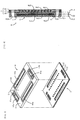
- FIG. 2 shows a perspective view of the module M
- FIG. 3 shows an exploded perspective view of the module M
- FIG. 4 shows a IV-IV cross-sectional view of FIG. 2
- the module M has an electrode member 2, a separator 3, and an adhesive rubber member 4.
- the electrode member 2 includes an MEA 20, an anode porous layer 21a, and a cathode porous layer 21b.
- the MEA 20 is formed from an electrolyte membrane 22, an anode catalyst layer 23a, and a cathode catalyst layer 23b.
- the electrolyte membrane 22 is a perfluorosulfonic acid film, and has a thin rectangular plate shape.
- the anode catalyst layer 23a has a thin rectangular plate shape and is disposed so as to cover the top side of the electrolyte membrane 22.
- the anode catalyst layer 23a includes carbon particles that support platinum.
- the cathode catalyst layer 23b has the same structure as the anode catalyst layer 23a, and is disposed so as to cover the bottom side of the electrolyte membrane 22.
- the anode porous layer 21a is provided with a gas diffusion layer 24a and a gas flow path layer 25a.
- the gas diffusion layer 24a is made of carbon paper and has a thin rectangular plate shape.
- the gas diffusion layer 24a is disposed on the top side of the anode catalyst layer 23a of the MEA 20.
- the porosity of the gas diffusion layer 24a is approximately 60%.
- the gas diffusion layer 24a has a generally similar configuration to the MEA 20.
- the gas diffusion layer 24a is also smaller than the MEA 20. Namely, the area of the gas diffusion layer 24a is smaller than the area of the MEA 20. Therefore, the outer edge of the gas diffusion layer 24a is disposed more inward than the outer edge of the MEA 20.
- the gas flow path layer 25a is made of sintered foam metal and has a thin rectangular plate shape.
- the gas flow path layer 25a is disposed on the top side of the gas diffusion layer 24a.
- the porosity of the gas flow path layer 25a is approximately 70 to 80%.
- the area of the gas flow path layer 25a is smaller than the area of the gas diffusion layer 24a.
- the cathode porous layer 21b is provided with a gas diffusion layer 24b and a gas flow path layer 25b.
- the gas diffusion layer 24b has the same structure as the gas diffusion layer 24a and is disposed on the bottom side of the cathode catalyst layer 23b of the MEA 20.
- the area of the gas diffusion layer 24b is identical to the area of the MEA 20. Accordingly, the outer edge of the gas diffusion layer 24b is disposed on the same plane as the outer edge of the MEA 20.
- the gas flow path layer 25b has the same structure as the gas flow path layer 25a and is disposed on the bottom side of the gas diffusion layer 24b. The area of the gas flow path layer 25b is smaller than the area of the gas diffusion layer 24b.
- the separator 3 has a rectangular plate shape and is arranged stacked below the electrode member 2.
- the separator 3 is formed by stacking, starting from the top, a cathode plate 30, an intermediate plate 31, and an anode plate 32.
- the cathode plate 30 is made of stainless steel and is disposed so as to contact the bottom side of the gas flow path layer 25b.
- the anode plate 32 is in contact with the top side of a module (not shown) that is stacked below the module M.
- the respective plates 30, 31, 32 structuring the separator 3 are each formed with a plurality of through holes. Accordingly, paths for air, hydrogen, and coolant are formed inside the separator 3.
- the adhesive rubber member 4 has an oblong frame configuration and is formed from solid rubber with adhesiveness that uses ethylene-propylene-diene rubber (EPDM) as the rubber component.
- EPDM ethylene-propylene-diene rubber
- the tensile product of the adhesive rubber member 4 is 1,500 MPa ⁇ %.
- the adhesive rubber member 4 coats the peripheral edge portion of the electrode member 2 and adheres to the cathode plate 30 of the separator 3. Through holes 40a, 40b, 41a, 41b, 42a, 42b are formed along the four sides of the adhesive rubber member 4.
- the through hole 40a corresponds to the air supply hole 90a, the through hole 40b to the air discharge hole 90b, the through hole 41a to the hydrogen supply hole 91a, the through hole 41b to the hydrogen discharge hole 91b, the through hole 42a to the coolant supply hole 92a, and the through hole 42b to the coolant discharge hole 92b.
- a convex portion 43 is formed on the top side of the adhesive rubber member 4 so as to surround the respective through holes 40a, 40b, 41a, 41b, 42a, 42b.
- the convex portion 43 is pressed and deformed by a fastening force in the stacking direction.
- a seal line is formed around the respective through holes 40a, 40b, 41a, 41b, 42a, 42b, thereby suppressing the leakage of air, hydrogen, and coolant.
- FIG. 5 shows a cross-sectional view of a forming die in an open state.
- FIG. 6 shows an expanded view of the inside of a dotted circle VI in FIG. 5 .
- a forming die 5 is provided with an upper die 50 and a lower die 51.
- a concave portion 500 is formed on the bottom side of the upper die 50, and a concave portion 510 is formed on the top side of the lower die 51.
- a cavity is defined by the concave portions 500, 510.
- a structural element of the module M is initially prepared. First, a first pre-crosslinking rubber member 4a and a second pre-crosslinking rubber member 4b are prepared that will become the adhesive rubber member 4 after molding.
- the first pre-crosslinking rubber member 4a has the shape of an upper portion when the adhesive rubber member 4 is divided into top and bottom portions along the line of the top side of the MEA 20.
- the second pre-crosslinking rubber member 4b has the shape of a lower portion when the adhesive rubber member 4 is divided into top and bottom portions along the line of the top side of the MEA 20.
- a pre-crosslinking composition of solid rubber that uses EPDM as the rubber component is preformed to produce the first pre-crosslinking rubber member 4a and the second pre-crosslinking rubber member 4b (a preforming step).
- a compression portion 44a is disposed on the bottom side of the first pre-crosslinking rubber member 4a.
- a compression portion 44b is disposed on the top side of the second pre-crosslinking rubber member 4b (shown by a dotted line in FIG. 5 ). More specifically, as shown expanded in FIG. 6 , the compression portion 44a with a thickness d1 is disposed on the bottom side of the first pre-crosslinking rubber member 4a.
- the total volume of the first pre-crosslinking rubber member 4a and the second pre-crosslinking rubber member 4b is larger than the content of the cavity by the volume of the compression portions 44a, 44b.
- the first pre-crosslinking rubber member 4a and the second pre-crosslinking rubber member 4b are accommodated within the cavity while being compressed by an amount corresponding to the compression portions 44a, 44b.
- Forming in such a state results in the first pre-crosslinking rubber member 4a, which has melted due to heating and pressurization during forming, impregnating the end portion of the anode porous layer 21a (the gas diffusion layer 24a and the gas flow path layer 25a) so as to release a corresponding amount of compression.
- the second pre-crosslinking rubber member 4b which has melted due to heating and pressurization during forming, impregnates the end portion of the cathode porous layer 21b (the gas diffusion layer 24b and the gas flow path layer 25b) so as to release a corresponding amount of compression.
- the separator 3 is prepared. More specifically, the cathode plate 30, the intermediate plate 31, and the anode plate 32 are joined by an adhesive agent or the like to produce the separator 3.
- the electrode member 2 is prepared.
- the electrode member 2 is formed by stacking in order from the top the gas flow path layer 25a, the gas diffusion layer 24a, the MEA 20, the gas diffusion layer 24b; and the gas flow path layer 25b.
- the gas diffusion layer 24a is joined by hot pressing to the top side of the MEA 20 and the gas diffusion layer 24b is joined by hot pressing to the bottom side of the MEA 20 in order to produce an assembly.
- the assembly produced here is referred to as a "MEGA" below.
- the respective structural elements are arranged within the forming die 5 (a member arrangement step).
- the separator 3 is first disposed in the concave portion 510 of the lower die 51.
- the second pre-crosslinking rubber member 4b is then layered on the separator 3.
- the gas flow path layer 25b is centrally arranged within the frame of the second pre-crosslinking rubber member 4b.
- the MEGA is subsequently layered on the gas flow path layer 25b.
- the first pre-crosslinking rubber member 4a is disposed on the second pre-crosslinking rubber member 4b.
- the gas flow path layer 25a is layered on the MEGA. Thereafter, the upper die 50 and the lower die 51 are aligned to close the die.
- FIG. 7 shows a cross-sectional view of the forming die in a closed state.
- FIG. 8 shows an expanded view of the inside of a dotted circle VIII in FIG. 7 .
- the first pre-crosslinking rubber member 4a arranged inside the cavity defined by the upper die 50 and the lower die 51 are the first pre-crosslinking rubber member 4a, the second pre-crosslinking rubber member 4b, the electrode member 2, and the separator 3.
- the peripheral edge portion of the electrode member 2 is coated by the first pre-crosslinking rubber member 4a and the second pre-crosslinking rubber member 4b.
- the second pre-crosslinking rubber member 4b is in contact with the separator 3.
- the first pre-crosslinking rubber member 4a and the second pre-crosslinking rubber member 4b crosslink while respectively impregnating the end portions of the anode porous layer 21a (the gas diffusion layer 24a and the gas flow path layer 25a) and the cathode porous layer 21b (the gas diffusion layer 24b and the gas flow path layer 25b) of the electrode member 2. More specifically, as shown expanded in FIG. 8 , the first pre-crosslinking rubber member 4a impregnates the end portion of the gas flow path layer 25a only by a length d2, and impregnates the end portion of the gas diffusion layer 24a only by a length d3.
- the second pre-crosslinking rubber member 4b impregnates the end portion of the gas flow path layer 25b only by the length d2, and impregnates the end portion of the gas diffusion layer 24b only by the length d3.
- the first pre-crosslinking rubber member 4a and the second pre-crosslinking rubber member 4b thus integrate by crosslinking to become the adhesive rubber member 4. Accordingly, the electrode member 2 and the separator 3 are integrated by the adhesive rubber member 4 (an integration step).
- the modules M can be stacked to efficiently assemble the proton-exchange membrane fuel cell 9.
- the module M can also be extracted as necessary to enable inspection or repair.
- the adhesive rubber member 4 of the module M is formed from solid rubber with adhesiveness that uses EPDM as the rubber component. Therefore, the tensile product of the adhesive rubber member 4 is large. Furthermore, the adhesive rubber member 4 also has good acid resistance. As a consequence, the sealed regions have high durability. Even without the use of an adhesive agent, the adhesive rubber member 4, the electrode member 2, and the separator 3 can be strongly adhered together.
- the adhesive rubber member 4 is not prone to losing adhesiveness even in the operation environment of the proton-exchange membrane fuel cell 9. Therefore, during operation good sealability can be secured by the adhesive rubber member 4. Accordingly, the proton-exchange membrane fuel cell 9 can be stably operated over a long period.
- the module M can be easily manufactured compared to the case of injection molding using liquid rubber.
- the amount of impregnation to the end portion of the anode porous layer 21a can be regulated by the compression portion 44a of the first pre-crosslinking rubber member 4a. There is thus no need for special treatment in order to regulate the amount of impregnation.
- Positioning of the electrode member 2 can also be easily performed using the first pre-crosslinking rubber member 4a and the second pre-crosslinking rubber member 4b as a reference.
- the area of the MEA 20 is larger than the area of the gas diffusion layer 24a. Accordingly, even if the adhesive rubber member 4 has not sufficiently impregnated the end portion of the gas diffusion layer 24a, the adhesive rubber member 4 coating the MEA 20 and a peripheral edge portion thereof acts as a barrier, thereby suppressing the leakage of gas to the end side of the gas diffusion layer 24b.
- the module of the present embodiment and the module of the first embodiment differ in that during the module manufacturing process, a preform is produced in advance, wherein a pre-crosslinking composition is preliminarily integrated with the peripheral edge portion of the electrode member. Accordingly, the description here will mainly concern this difference.
- FIG. 9 shows a cross-sectional view of a preforming die in an open state.
- the electrode member is shown with the respective structural elements stacked. Also, portions corresponding to FIG. 5 are indicated as the same symbols.
- a preforming die 6 is provided with an upper die 60 and a lower die 61.
- a concave portion 600 is formed on the bottom side of the upper die 60, and a concave portion 610 is formed on the top side of the lower die 61. When the die is closed, a cavity is defined by the concave portions 600, 610.
- the first pre-crosslinking rubber member 4a and the secondpre-crosslinking rubber member 4b are produced by preforming a pre-crosslinking composition of solid rubber that uses EPDM as the rubber component (a first preforming step).
- the compression portion 44a is disposed on the bottom side of the first pre-crosslinking rubber member 4a.
- the compression portion 44b is disposed on the top side of the second pre-crosslinking rubber member 4b (shown by a dotted line in FIG. 9 ).
- the total volume of the first pre-crosslinking rubber member 4a and the second pre-crosslinking rubber member 4b is larger than the content of the cavity by the volume of the compression portions 44a, 44b. Therefore, as described earlier, once the die is closed, the first pre-crosslinking rubber member 4a and the second pre-crosslinking rubber member 4b are accommodated within the cavity while being compressed by an amount corresponding to the compression portions 44a, 44b.
- the electrode member 2 is formed by stacking in order from the top the gas flow path layer 25a, the gas diffusion layer 24a, the MEA 20, the gas diffusion layer 24b, and the gas flow path layer 25b.
- the gas diffusion layer 24a is joined by hot pressing to the top side of the MEA 20 and the gas diffusion layer 24b is joined by hot pressing to the bottom side of the MEA 20 (MEGA).
- the second pre-crosslinking rubber member 4b is first disposed in the concave portion 610 of the lower die 61.
- the gas flow path layer 25b is then centrally arranged within the frame of the second pre-crosslinking rubber member 4b.
- the MEGA (the gas diffusion layer 24a / the MEA 20 / the gas diffusion layer 24b) is subsequently layered on the gas flow path layer 25b.
- the first pre-crosslinking rubber member 4a is disposed on the second pre-crosslinking rubber member 4b.
- the gas flow path layer 25a is layered on the MEGA. Thereafter, the upper die 60 and the lower die 61 are aligned to close the die.
- the preforming die 6 is heated to around a temperature at which the first pre-crosslinking rubber member 4a and the second pre-crosslinking rubber member 4b do not crosslink. Accordingly, the first pre-crosslinking rubber member 4a and the second pre-crosslinking rubber member 4b partially impregnate the end portions of the anode porous layer 21a (the gas diffusion layer 24a and the gas flow path layer 25a) and the cathode porous layer 21b (the gas diffusion layer 24b and the gas flow path layer 25b) of the electrode member 2, respectively. Meanwhile, since the heating temperature is lower than the crosslinking temperature, the first pre-crosslinking rubber member 4a and the second pre-crosslinking rubber member 4b do not crosslink. Thus, the electrode member 2, and the first pre-crosslinking rubber member 4a and the second pre-crosslinking rubber member 4b, are preliminarily integrated to become a preform (a second preforming step).
- FIG. 10 shows a cross-sectional view of the obtained preform.
- a preform 45 is formed from the electrode member 2 and a pre-crosslinking combined rubber member 46.
- the pre-crosslinking combined rubber member 46 is an assembly of the first pre-crosslinking rubber member 4a and the second pre-crosslinking rubber member 4b.
- the pre-crosslinking combined rubber member 46 partially impregnates (not shown) and is fixed to the peripheral edge portion of the electrode member 2.
- the obtained preform 45 is next disposed in the forming die 5 along with the separator 3 (see FIG. 5 ). Namely, after disposing the separator 3 in the concave portion 510 of the lower die 51, the preform 45 is layered on the separator 3. The upper die 50 and the lower die 51 are then aligned to close the die.
- the pre-crosslinking combined rubber member 46 becomes crosslinked while further impregnating the end portions of the anode porous layer 21a (the gas diffusion layer 24a and the gas flow path layer 25a) and the cathode porous layer 21b (the gas diffusion layer 24b and the gas flow path layer 25b) of the electrode member 2.
- the pre-crosslinking combined rubber member 46 becomes the adhesive rubber member 4 due to crosslinking. Accordingly, the electrode member 2 and the separator 3 are integrated by the adhesive rubber member 4 (an integration step).
- the module of the present embodiment has operations and effects similar to the module of the first embodiment regarding parts with common structures. According to the manufacturing method of the module of the present embodiment, by producing the preform 45 in advance, positioning of the structural elements of the electrode member 2 can be more easily performed in the integration step. Thus, the fuel cell module of the present invention can be manufactured with greater efficiency.
- the pre-crosslinking rubber member 4a is preformed so as to have the shape of an upper portion when the adhesive rubber member 4 is divided into top and bottom portions along the line of the top side of the MEA 20.
- the second pre-crosslinking rubber member 4b is also preformed so as to have the shape of a lower portion when the adhesive rubber member 4 is divided into top and bottom portions along the line of the top side of the MEA 20 (see FIG. 4 ). Therefore, the first pre-crosslinking rubber member 4a and the second pre-crosslinking rubber member 4b both have a convex portion 43 (before crosslinking and likewise below in the present embodiment).
- the forming of the convex portion 43 is not necessarily required during the preforming of the pre-crosslinking composition (the first preforming step).
- the convex portion 43 may be formed by a step separate from the first preforming step.
- the convex portion 43 may be formed by providing a convex portion formation step between the second preforming step and the integration step.
- the convex portion 43 may be formed while crosslinking is performed in the integration step.
- Embodiments of the fuel cell module of the present invention were described above. However, embodiments are not particularly limited to those described above. Various modified embodiments and improved embodiments which can be carried out by those skilled in the art are also accepted.
- the respective elements structuring the fuel cell module are not limited to the above embodiments in terms of material, shape, size, and the like.
- a perfluorophosphonic acid film, a perfluorocarboxylic acid film, or a hydrocarbon polymer film may be used for the electrolyte membrane.
- the pair of porous layers is structured from a gas diffusion layer and a gas flowpath layer with different porosities. In such case, the porosity, area, thickness, and the like of both layers should be set as appropriate.
- the configurations of the pair of porous layers may be identical or different.
- the fuel cell module may be structured by stacking the separator and an electrode member having porous layers with different configurations as described in (1) and (2) below.
- a porous layer disposed on one side of the MEA in the thickness direction is formed from a gas diffusion layer that is disposed on one side of the MEA in the thickness direction and a gas flow path layer that is disposed on one side of the gas diffusion layer in the thickness direction and that has a greater porosity than the gas diffusion layer.
- a porous layer disposed on another side of the MEA in the thickness direction is formed from a gas flow path layer disposed on the other side of the MEA in the thickness direction.
- a porous layer disposed on one side of the MEA in the thickness direction is formed from a gas diffusion layer that is disposed on one side of the MEA in the thickness direction and a gas flow path layer that is disposed on one side of the gas diffusion layer in the thickness direction and that has a greater porosity than the gas diffusion layer.
- a porous layer disposed on another side of the MEA in the thickness direction is formed from a gas diffusion layer disposed on the other side of the MEA in the thickness direction.
- the area of one gas diffusion layer is smaller than the area of the MEA.
- the areas of the pair of gas diffusion layers may be the same as the area of the MEA.
- the areas of both layers may each be smaller than the area of the MEA.
- the separator has a three-layer structure.
- the structure of the separator is not particularly limited thereby.
- pre-crosslinking rubber members (a preformed pre-crosslinking composition) are used in the manufacturing of the fuel cell modules, which have shapes that divide into two the adhesive rubber member.
- the pre-crosslinking rubber member is not necessarily required to be a divided body of the adhesive rubber member.
- the thickness and material of the pre-crosslinking rubber member may be adjusted depending on the properties required by the seal region.
- rubbers made of different materials may be used for each seal region. Depending on the type of rubber, the heating temperature and the like during the integration step may also be adjusted.
- heating to around a temperature at which the pre-crosslinking composition does not crosslink is performed to preliminarily integrate the electrode member and the pre-crosslinking composition (the second preforming step)
- the temperature of the present step as well may be adjusted as appropriate depending on the type of rubber.
- the adhesive rubber member will be described in detail below.
- a rubber material with adhesiveness wherein a crosslinked item thereof has a tensile product of 1,500 MPa ⁇ % or more, can be used as the adhesive rubber member.
- the Mooney viscosity of the rubber member before crosslinking is preferably 40 M at 80°C [40 ML (1+4) 80°C] or more.
- the Mooney viscosity employs a value measured in accordance with JIS K6300-1 (2001).
- a solid rubber containing a rubber component such as the following may be used: ethylene-polypropylene rubber (EPM), ethylene-polypropylene-diene rubber (EPDM), acrylonitrile-butadiene rubber (NBR), hydrogenated acrylonitrile-butadiene rubber (H-NBR), styrene-butadiene rubber (SBR), and butadiene rubber (BR).
- EPM ethylene-polypropylene rubber
- EPDM ethylene-polypropylene-diene rubber
- NBR acrylonitrile-butadiene rubber
- H-NBR hydrogenated acrylonitrile-butadiene rubber
- SBR styrene-butadiene rubber
- BR butadiene rubber
- the Type A durometer hardness of the crosslinked item is preferably 50 or more.
- Type A durometer hardness is a hardness measured by a Type A durometer as specified in JIS K6253 (2006) .
- a rubber composition including the following contents of (A) to (D) is capable of crosslinking at a low temperature, and is well-suited in terms of high adhesive reliability and sealability of the crosslinked item.
- A One or more rubber components selected from a group consisting of ethylene-propylene rubber (EPM), ethylene-propylene-diene rubber (EPDM), acrylonitrile-butadiene rubber (NBR), and hydrogenated acrylonitrile-butadiene rubber (H-NBR);
- EPM ethylene-propylene rubber
- EPDM ethylene-propylene-diene rubber
- NBR acrylonitrile-butadiene rubber
- H-NBR hydrogenated acrylonitrile-butadiene rubber
- B a crosslinking agent selected from organic peroxides of which a 1-hour half-life period temperature is lower than or equal to 130°C
- C a crosslinking auxiliary agent
- D an adhesive component formed of at least one of a resorcinol compound together with
- the crosslinking agent (B) is selected from organic peroxides of which the 1-hour half-life period temperature is lower than or equal to 130°C.
- organic peroxides include peroxyketal, peroxyester, diacyl peroxide, peroxydicarbonate, and the like.
- at least one of the peroxyketal and the peroxyester of which the 1-hour half-life period temperature is higher than or equal to 100°C is preferably employed, since crosslinking easily occurs at a temperature of approximately 130°C and the rubber composition in which the crosslinking agent is added and kneaded can be handled easily.
- one with a 1-hour half-life period temperature of 110°C or higher is preferable.
- peroxyketal examples include n-butyl 4,4-di(t-butylperoxy)valerate, 2,2-di(t-butylperoxy)butane, 2,2-di(4,4-di(t-butylperoxy)cyclohexyl)propane, 1,1-di(t-butylperoxy)cyclohexane, 1,1-di(t-hexylperoxy)cyclohexane, 1,1-di(t-hexylperoxy)-3,3,5-trimethylcyclohexane, 1,1-di(t-butylperoxy)-2-methylcyclohexane, and the like.
- peroxyester examples include t-butyl peroxybenzoate, t-butyl peroxyacetate, t-hexyl peroxybenzoate, 2,5-dimethyl-2,5-di(benzoylperoxy)hexane, t-butyl peroxy-2-ethylhexyl monocarbonate, t-butyl peroxylaurate, t-butyl peroxyisopropylmonocarbonate, t-butyl peroxy-3,5,5-trimethylhexanoate, t-butyl peroxymaleic acid, t-hexyl peroxyisopropylmonocarbonate, and the like.
- 1,1-di(t-butylperoxy)cyclohexane and t-butyl peroxyacetate are preferable, since the crosslinking agent using them is easily stored.
- the amount of the crosslinking agent is preferably greater than or equal to 1 part by weight with respect to 100 parts by weight of the rubber component (A) described above so that the crosslinking reaction progresses sufficiently. In consideration of the storage stability of the prepared rubber composition, it is preferably less than or equal to 5 parts by weight.
- the crosslinking auxiliary agent (C) may appropriately be selected according to the type of crosslinking agent (B) described above.
- the crosslinking auxiliary agent include a maleimide compound, triallyl cyanurate (TAC), triallyl isocyanurate (TAIC), trimethylolpropane trimethacrylate (TMPT), and the like. Particularly, using the maleimide compound is preferable since the crosslinking speed becomes faster.
- the amount of the crosslinking auxiliary agent is preferably greater than or equal to 0. 1 parts by weight with respect to 100 parts by weight of the rubber component (A) described above so that the crosslinking reaction progresses sufficiently.
- the amount of the crosslinking auxiliary agent is preferably less than or equal to 3 parts by weight, since the adhesive force decreases when the crosslinking reaction becomes too fast due to a large amount of the crosslinking auxiliary agent.
- the adhesive component (D) is formed of at least one of the resorcinol compound together with the melamine compound and the silane coupling agent. That is, the adhesive component may be only the resorcinol compound and the melamine compound, or only the silane coupling agent. In the case where both the resorcinol compound together with the melamine compound and the silane coupling agent are included, the adhesive force is further improved.
- the resorcinol compound examples include resorcin, modified resorcin-formaldehyde resin, resorcin-formaldehyde (RF) resin, and the like. A single one or a mixture of two or more of these may be used.
- the modified resorcin-formaldehyde resin is preferable in terms of low volatility, low hygroscopicity, and high compatibility with rubber.
- the modified resorcin-formaldehyde resin include those represented by general formulas (1) to (3) below. One shown by the general formula (1) is particularly preferable. Note that reference symbol "R” indicates a hydrocarbon group in the general formula (1). Reference symbols "n” all indicate an integer in the general formulas (1) to (3).
- the amount of the resorcinol compound is preferably greater than or equal to 0.1 parts by weight with respect to 100 parts by weight of the rubber component (A) described above. It is more preferably greater than or equal to 0.5 parts by weight.
- the amount of the resorcinol compound is preferably less than or equal to 10 parts by weight, since an excessive amount of the resorcinol compound causes a decrease in the properties of rubber. It is more preferably less than or equal to 5 parts by weight.
- the melamine compound examples include a methylated formaldehyde melamine polymer, hexamethylene tetramine, and the like. One or more of these compounds may be used singly or in combination. These are decomposed by heat in the crosslinking, and supply formaldehyde to the system. Particularly, the methylated formaldehyde melamine polymer is preferable in terms of low volatility, low hygroscopicity, and high compatibility with rubber.
- the methylated formaldehyde melamine polymer represented by a general formula (4) below is preferable, for example. In the formula (4), reference symbol "n" indicates an integer.
- the compound ratio of the resorcinol compound and the melamine compound is preferably in a range of 1:0.5 to 1:2 by weight. It is more preferably in a range of 1:0.77 to 1:1.5.
- the compound ratio of the melamine compound with respect to the resorcinol compound is less than 0. 5
- the tensile strength, the stretch, and the like of the rubber tend to slightly decrease.
- the compound ratio of the melamine compound exceeds 2
- the adhesive force reaches a limit. Therefore, further increase in the compound ratio of the melamine compound leads to an increase in cost.
- the silane coupling agent may appropriately be selected in consideration of the adhesiveness and the like from a group of compounds having an epoxy group, an amino group, a vinyl group, or the like as a functional group.
- Examples include vinyltrimethoxysilane, vinyltriethoxysilane, vinyl-tris(2-methoxyethoxy)silane, 3-methacryloxypropyltrimethoxysilane, 3-methacryloxypropyltriethoxysilane, 3-glycidoxypropyltrimethoxysilane, 3-glycidoxypropyltriethoxysilane, 3-glycidoxypropylmethyldiethoxysilane, 2-(3,4-epoxycyclohexyl)ethyltrimethoxysilane, N-2(aminoethyl)3-aminopropyltrimethoxysilane, 3-aminopropyltrimethoxysilane, N-phenyl-3-aminopropyltrimethoxys
- One or more of these compounds may be used singly or in combination. Particularly, when one or more selected from the group of compounds having an epoxy group is used, the adhesive force is improved, and the adhesive force hardly decreases even in the operational environment of a fuel cell. Specifically, 3-glycidoxypropyltrimethoxysilane, 3-glycidoxypropyltriethoxysilane, 3-glycidoxypropylmethyldiethoxysilane, 2-(3,4-epoxycyclohexyl)ethyltrimethoxysilane, and the like are preferable.
- the amount of the silane coupling agent is preferably greater than or equal to 0.5 parts by weight with respect to 100 parts by weight of the rubber component (A) described above. It is more preferably greater than or equal to 2 parts by weight.
- the amount of the silane coupling agent is preferably less than or equal to 10 parts by weight, and more preferably, less than or equal to 6 parts by weight.
- the rubber composition may include various additives which are used as additives for general rubber other than the contents of (A) to (D) described above.
- carbon black as a reinforcing agent.
- the grade of the carbon black is not particularly limited, and may appropriately be selected from SAF, ISAF, HAF, MAF, FEF, GPF, SRF, FT, MT, and the like.
- the amount of the carbon black is preferably greater than or equal to 30 parts by weight with respect to 100 parts by weight of the rubber component (A) described above.
- the amount of the carbon black is preferably less than or equal to 150 parts by weight in consideration of the easiness of kneading, forming processability, and the like.
- the softeners include: petroleum-based softeners such as process oil, lubricating oil, paraffin, liquid paraffin, and petrolatum; fatty oil-based softeners such as castor oil, linseed oil, canola oil, and palm oil; waxes such as tall oil, a rubber substitute, beeswax, carnauba wax, and lanolin; linoleic acid; palmitic acid; stearic acid; lauric acid; and the like.
- the amount of the softener is preferably up to approximately 40 parts by weight with respect to 100 parts by weight of the rubber component (A) described above.
- the plasticizers include organic acid derivatives such as dioctyl phthalate (DOP) and phosphoric acid derivatives such as tricresyl phosphate.
- the amount of the plasticizer is preferably approximately 40 parts by weight at most with respect to 100 parts by weight of the rubber component (A) described above, in a similar manner to that of the softener.
- the antioxidants include phenolic antioxidants, imidazole-based antioxidants, waxes, and the like, and the amount is preferably approximately 0.5 to 10 parts by weight with respect to 100 parts by weight of the rubber component (A) described above.
- the rubber composition can be prepared by mixing the contents of (A) to (D) described above and the various additives as necessary.
- the respective materials other than the crosslinking agent (B), the crosslinking auxiliary agent (C), and the adhesive component (D) are mixed in advance, and then are kneaded for several minutes at 80 to 140°C. After the kneaded product is cooled, the crosslinking agent (B), the crosslinking auxiliary agent (C), and the adhesive component (D) are added, and are kneaded for 5 to 30 minutes at a roll temperature of 40 to 70°C using a roller such as an open roller, whereby the rubber composition can be prepared.
- the adhesive component (D) may be added at the time of the preparatory mixture.
Landscapes
- Life Sciences & Earth Sciences (AREA)
- Engineering & Computer Science (AREA)
- Manufacturing & Machinery (AREA)
- Sustainable Development (AREA)
- Sustainable Energy (AREA)
- Chemical & Material Sciences (AREA)
- Chemical Kinetics & Catalysis (AREA)
- Electrochemistry (AREA)
- General Chemical & Material Sciences (AREA)
- Fuel Cell (AREA)
- Inert Electrodes (AREA)
Abstract
Description
- The present invention relates to a fuel cell module in which an electrode member and a separator are integrated, and a manufacturing method thereof.
- A Fuel cell generating electricity from electrochemical reactions of gases has a high power generation efficiency and an extremely small impact on the environment since the discharged gas is clean. Among these, the proton-exchange membrane fuel cell is capable of operating at relatively low temperatures and has a large output density. For this reason, its application to various fields such as power generation and as a power source for automobiles is anticipated.
- In the proton-exchange membrane fuel cell, a cell in which separators sandwich a membrane electrode assembly (MEA) or the like serves as the unit of power generation. The MEA is formed from a polymer membrane (electrolyte membrane) acting as an electrolyte, and a pair of electrode catalyst layers (a fuel electrode (anode) catalyst layer and an oxygen electrode (cathode) catalyst layer) respectively arranged on both sides of the electrolyte membrane in the thickness direction. On the surfaces of the pair of electrode catalyst layers a gas diffusion layer is further disposed. Fuel gas such as hydrogen is supplied to the fuel electrode side, while an oxidizing gas such as oxygen and air is supplied to the oxygen electrode side. The supplied gas, the electrolyte, and the electrode catalyst layers are subjected to an electrochemical reaction at the three-phase boundary to generate electricity. The proton-exchange membrane fuel cell is structured by sandwiching a cell stack in which a plurality of the above cells are stacked together between end plates or the like disposed on both ends of the fuel cell in the cell stacking direction.
- A manifold serving as a flow path for gas or water is formed on the peripheral edge portion of the cell stack. Mixing of the gases supplied to the respective electrodes creates issues such as lowered power generation efficiency. Also, the electrolyte membrane exhibits proton conductance in a state with water contained therein. Therefore, during operation the electrolyte must maintain a wet state. Accordingly, in order to prevent gas mixing and leakage, as well as maintain a wet state within the cells, a seal member is disposed on the peripheral edge portion of the manifold and the MEA (see Japanese Patent Application Publication Nos.
JP-A-2007-188834 JP-A-2007-149472 JP-A-2007-66766 - As disclosed in Japanese Patent Application Publication Nos.
JP-A-2007-188834 JP-A-2007-149472 - However, such conventional gasket structures are plagued by the following three issues. The first issue is the low mechanical strength of the seal member. In the convention gasket structures, liquid rubber such as silicone rubber is used as the seal member. But most liquid rubber has a low molecular weight. As a consequence, there is little tensile strength after crosslinking. Since the liquid rubber also does not stretch much, the liquid rubber does not easily follow the expansion and contraction of the electrolyte membrane as a result of moisture and the like. Furthermore, silicone rubber does not have sufficient adhesiveness or acid resistance, which is problematic in terms of sealability and durability.
- The second issue concerns the need for special treatment when liquid rubber is used so that the liquid rubber does not excessively impregnate a porous layer during molding. Namely, when pouring and molding liquid rubber into the peripheral edge portion of the electrode member, the liquid rubber impregnates porous layers such as the gas diffusion layer. In such case, impregnation of the liquid rubber is difficult to control. Therefore, the flow of gas is impeded at regions excessively impregnated with the liquid rubber, and power generation performance is reduced by a corresponding amount. To regulate the amount of liquid rubber impregnated, in Japanese Patent Application Publication No.
JP-A-2007-188834 JP-A-2007-149472 - The third issue is the risk of deformation of the electrolyte membrane during injection molding due to the injection pressure of the liquid rubber. The electrolyte membrane is a thin polymer film. Therefore, the flow of liquid rubber during injection molding may press against and deform the electrolyte membrane. If the electrolyte membrane is deformed, obtaining a desired power generation performance becomes difficult.
- As mentioned above, the proton-exchange membrane fuel cell is structured by stacking a plurality of electrode members, in which the MEA, the gas diffusion layer, and the like are stacked, via separators. In addition to the positioning of each member, the stacking operation performed while maintaining each of the members at predetermined positions is difficult. For this reason, the assembly operation is extremely laborious and results in poor productivity. As examples, according to the gasket structures disclosed in Japanese Patent Application Publication Nos.
JP-A-2007-188834 JP-A-2007-149472 JP-A-2007-66766 - The present invention has been developed in view of such circumstances, and it is an object of the present invention to provide a fuel cell module in which an electrode member and a separator are integrated using an adhesive rubber member with high sealability, and a manufacturing method thereof.
- (1) According to a first aspect of the present invention, a fuel cell module includes: an electrode member having a membrane electrode assembly, which is formed from an electrolyte membrane and a pair of electrode catalyst layers that is disposed on both sides of the electrolyte membrane in the thickness direction, and having a pair of porous layers disposed on both sides of the membrane electrode assembly in the thickness direction; and a separator disposed layered on the electrode member so as to contact at least one of the porous layers, characterized in that an adhesive rubber member is disposed on a peripheral edge portion of the electrode member, which seals the peripheral edge portion and of which a tensile product is 1, 500 MPa·% or more, the electrode member and the separator are integrated by the adhesive rubber member.
- In the fuel cell module according to the present invention, the electrode member and the separator are integrated by the adhesive rubber member. Therefore, a fuel cell can be easily assembled mainly by stacking the fuel cell modules of the present invention. This in turn improves productivity. In addition, each module can be extracted as necessary to enable inspection and repair. If a failure occurs in a module, it is also easy to replace only that particular module.
- According to the fuel cell module of the present invention, the peripheral edge portion of the electrode member is sealed by the adhesive rubbermember. Here, the tensile product of the adhesive rubber member is equal to or greater than 1,500 MPa·%. As a consequence, the sealed regions have good durability. The tensile product is defined as a product of tensile strength and breaking elongation, i.e., [tensile strength (MPa) × breaking elongation (%)]. A larger tensile product indicates that more energy is required to break. In the present specification, values measured in accordance with JIS K6251 (2004) are employed for the tensile strength and breaking elongation. Measurements for tensile strength and breaking elongation were performed using No. 5 dumbbell specimens. In addition, the adhesive rubber member has adhesiveness. There is thus no need to use a separate adhesive agent, and the electrode member and the separator can be strongly adhered together by the adhesive rubber member.
- (2) According to a second aspect of the present invention, in the above configuration of (1), it is preferable that the adhesive rubber member is formed from solid rubber, and the electrode member and the separator are stacked, and a pre-crosslinking composition of the solid rubber is arranged so as to coat the peripheral edge portion of the electrode member and contact the separator, whereby the electrode member, the separator and the solid rubber are integral molded.
- The term "solid rubber" in the present specification is an expression to "liquid rubber" and refers to kneadable rubber that is a solid at room temperature. In other words, rubber in a solid state rather than liquid rubber is used in the present configuration. This consequently resolves the above three issues caused by using liquid rubber. That is, the adhesive rubber member has considerable tensile strength and elongation. Due to the use of solid rubber, the amount by which the porous layer is impregnated can be regulated. There is thus no need for special treatment during molding. Since liquid rubber is not used, there is also no risk of the electrolyte membrane deforming because of the injection pressure.
- (3) According to a third aspect of the present invention, in the above configuration of (2), it is preferable that the pre-crosslinking composition of the solid rubber includes the following contents of (A) to (D) : (A) at least one rubber component selected from a group consisting of ethylene-propylene rubber, ethylene-propylene-diene rubber, acrylonitrile-butadiene rubber, and hydrogenated acrylonitrile-butadiene rubber; (B) a crosslinking agent selected from organic peroxides of which a 1-hour half-life period temperature is lower than or equal to 130°C; (C) a crosslinking auxiliary agent; and (D) an adhesive component formed of at least one of a resorcinol compound together with a melamine compound and a silane coupling agent.
- A rubber in which the pre-crosslinking composition including the contents of the above (A) to (D) is made to crosslink has low gas permeability. Thus according to the present configuration, the sealability of the adhesive rubber member can be increased. In addition, organic peroxides of which a 1-hour half-life period temperature is lower than or equal to 130°C are used as a crosslinking agent in the present configuration (the above (B)). Here, the term "half-life period" is a time until the concentration of the organic peroxide becomes half an initial value. Accordingly, the term "half-life period temperature" is indicative of the decomposition temperature of the organic peroxide. The term "1-hour half-life period" is the temperature when the half-life period is 1 hour. In other words, a lower 1-hour half-life period indicates a greater tendency toward decomposition at low temperatures. By using an organic peroxide whose 1-hour half-life period temperature is lower than or equal to 130°C, crosslinking can be achieved at a lower temperature (i.e., lower than or equal to 130°C) and in a shorter period. Therefore, deterioration of the electrolyte membrane due to heating during molding (crosslinking) can also be suppressed. The crosslinking agent of (B) is not prone to curing defects caused by impurities, contamination, and the like. Therefore, the crosslinking agent of (B) is resistant to the effects of the surrounding environment during operations and easy to handle.
- If a resorcinol compound and a melamine compound are used in the adhesive component of (D), then the melamine compound is the methylene donor and the resorcinol compound is the methylene recipient. During crosslinking, chemical bonds are formed between the resorcinol compound, and the rubber component and a mating member, due to the donation of a methylene group. Whereby, the rubber component and the mating member are adhered. If a silane coupling agent is used in the adhesive component of (D), then chemical bonds are formed between the rubber component and the mating member via the silane coupling agent, whereby both are adhered together. A high adhesion force is achieved due to these adhesive components, and the adhesion force is not prone to decreasing even in the operation environment of a fuel cell. Accordingly, good sealability can be secured even when the fuel cell is operated for a long period. In other words, the operation reliability of the fuel cell is improved.
- (4) According to a fourth aspect of the present invention, in the above configuration of (1), it is preferable that among the pair of porous layers disposed on both sides of the membrane electrode assembly in the thickness direction, the porous layer disposed on one side of the membrane electrode assembly in the thickness direction has at least one of a gas diffusion layer, and a gas flow path layer whose porosity is larger than that of the gas diffusion layer, and the porous layer disposed on another side of the membrane electrode assembly in the thickness direction has at least one of a gas diffusion layer, and a gas flow path layer whose porosity is larger than that of the gas diffusion layer.
- The structures of the respective porous layers arranged on both sides of the membrane electrode assembly (MEA) in the thickness direction may be identical or different. According to the present configuration, at least one of the pair of porous layers has a gas diffusion layer and a gas flow path layer. The gas diffusion layer serves to spread supplied gas in the thickness direction and supply gas to the entire surface of the adjacent electrode catalyst layer. Meanwhile, the gas flow path layer serves to supply gas delivered via the adjacent separator to the MEA or the gas diffusion layer. In other words, the gas flow path layer mainly serves to guide gas in a predetermined direction. Therefore in order to decrease the pressure loss of the gas flow and increase drainage, the porosity of the gas flow path layer is larger than that of the gas diffusion layer. For example, by structuring the two porous layers with different porosities, gas can be evenly supplied to all of one or another side of the MEA in the thickness direction.
- (5) According to a fifth aspect of the present invention, in the above configuration of (4), it is preferable that at least one porous layer among the pair of porous layers has the gas diffusion layer, and an area of the membrane electrode assembly is larger than an area of at least one gas diffusion layer. For example, when the gas diffusion layer is respectively arranged on both sides of the MEA in the thickness direction, the leakage of gas from the end side of one of the gas diffusion layers to the end side of the other gas diffusion layer is suppressed by the adhesive rubber member, which has impregnated both end sides of the gas diffusion layers. However, even in a case where the adhesive rubber member does not sufficiently impregnate and there is gas leaking from the end side of one of the gas diffusion layers, if the area of the MEA is large as in the present configuration, then the adhesive rubber member coating the MEA and the peripheral edge portion thereof becomes a barrier and can reliably prevent gas from leaking to the end side of the other gas diffusion layer.
- (6) According to a sixth aspect of the present invention, a first manufacturing method of a fuel cell module of the present invention includes the steps of: preforming a pre-crosslinking composition of solid rubber having adhesiveness into a predetermined shape (a preforming step); stacking in a forming die an electrode member having a membrane electrode assembly, which is formed from an electrolyte membrane and a pair of electrode catalyst layers that is disposed on both sides of the electrolyte membrane in the thickness direction, and having a pair of porous layers disposed on both sides of the membrane electrode assembly in the thickness direction, and a separator, such that the separator contacts at least one porous layer and the preformed pre-crosslinking composition is arranged so as to coat a peripheral edge portion of the electrode member and contact the separator (a member arrangement step); and pressurizing and heating the forming die, whereby the pre-crosslinking composition crosslinks and impregnates the porous layers of the electrode member, and the electrode member and the separator are integrated by the solid rubber (an integration step).
- In the first manufacturing method of the present invention, solid rubber is used instead of liquid rubber. Thus according to the first manufacturing method of the present invention, by arranging the preformed pre-crosslinking composition inside the forming die together with the electrode member and the separator and performing integral molding, the fuel cell module of the present invention can be easily manufactured.
- In the member arrangement step, the preformed pre-crosslinking composition is used as a reference to enable easy positioning of the electrode member. In addition, an excessive portion of the pre-crosslinking composition with respect to the cavity of the forming die can be employed to regulate the impregnation amount of the solid rubber after integration. There is thus no need for special treatment in order to suppress excessive impregnation. Since liquid rubber is not used, there is also no risk of the electrolyte membrane deforming because of the injection pressure of the liquid rubber.
- In the integration step, the peripheral edge portion of the electrode member is sealed by solid rubber (the adhesive rubber member). The solid rubber has adhesiveness and impregnates the end portion of the porous layer. For this reason, the peripheral edge portion of the electrode member has high sealability. In addition, the solid rubber has high tensile strength and elongation. Thus according to the first manufacturing method of the present invention, a fuel cell module can be manufactured with high durability at a sealed region.
- (7) According to a seventh aspect of the present invention, a second manufacturing method of a fuel cell module of the present invention includes the steps of: preforming a pre-crosslinking composition of solid rubber having adhesiveness into a predetermined shape (a first preforming step); arranging in a preforming die an electrode member having a membrane electrode assembly, which is formed from an electrolyte membrane and a pair of electrode catalyst layers that is disposed on both sides of the electrolyte membrane in the thickness direction, and having a pair of porous layers disposed on both sides of the membrane electrode assembly in the thickness direction, and the preformed pre-crosslinking composition, such that a peripheral edge portion of the electrode member is coated by the pre-crosslinking composition, and pressurizing the preforming die while maintaining the preforming die at a temperature at which crosslinking does not occur in the pre-crosslinking composition to obtain a preform in which the pre-crosslinking composition is preliminarily integrated with the peripheral edge portion of the electrode member (a second preforming step) ; and stacking and arranging within a forming die the preform and a separator such that the separator contacts the pre-crosslinking composition and at least one of the porous layers of the electrode member, and pressurizing and heating the forming die such that the pre-crosslinking composition crosslinks and impregnates the porous layers of the electrode member, and the electrode member and the separator are integrated by the solid rubber (an integration step).
- The second manufacturing method of the present invention has the same operations and effects as the first manufacturing method of the present invention with respect to the usage of solid rubber. Namely, the fuel cell module of the present invention can be easily manufactured by stacking and arranging in the forming die the separator and the preform, wherein the pre-crosslinking composition is preliminarily integrated with the peripheral edge portion of the electrode member, and then performing integral molding. In addition, an excessive portion of the pre-crosslinking composition with respect to the cavities of the preforming die and forming die can be employed to regulate the impregnation amount of the solid rubber after integration. There is thus no need for special treatment in order to suppress excessive impregnation.
- According to the second manufacturing method of the present invention, in the second preforming step, the pre-crosslinking composition is preliminarily integrated with the peripheral edge portion of the electrode member to produce a preform. Therefore in the subsequent integration step, the positioning of the electrode member in which a plurality of members is stacked, the separator, and the preformed pre-crosslinking composition can be easily performed in comparison to individually arranging the members.
-
-
FIG. 1 is a perspective view of a proton-exchange membrane fuel cell provided with a fuel cell module according to a first embodiment of the present invention; -
FIG. 2 is a perspective view of the fuel cell module; -
FIG. 3 is an exploded perspective view of the fuel cell module; -
FIG. 4 is a IV-IV cross-sectional view ofFIG. 2 ; -
FIG. 5 is a cross-sectional view of a forming die in an open state; -
FIG. 6 is an expanded view of the inside of a dotted circle VI inFIG. 5 ; -
FIG. 7 is a cross-sectional view of the forming die in a closed state; -
FIG. 8 is an expanded view of the inside of a dotted circle VIII inFIG. 7 ; -
FIG. 9 is a cross-sectional view of a preforming die in an open state according to a second embodiment of the present invention; and -
FIG. 10 is a cross-sectional view of a preform. - Hereinafter, embodiments of a fuel cell module according to the present invention will be described.
- The configuration of a proton-exchange membrane fuel cell provided with a fuel cell module (referred to as a "module" below as appropriate) according to the present embodiment will be explained.
FIG. 1 shows a perspective view of the proton-exchange membrane fuel cell. As illustrated inFIG. 1 , a proton-exchangemembrane fuel cell 9 is structured by a plurality of stacked modulesM. End plates The end plates end plate 93 are an air supply hole 90a that supplies air (oxidizing gas), anair discharge hole 90b that discharges air, ahydrogen supply hole 91a that supplies hydrogen (fuel gas), ahydrogen discharge hole 91b that discharges hydrogen, a coolant supply hole 92a that supplies coolant, and acoolant discharge hole 92b that discharges coolant. The module M is also formed with a plurality of through holes described later that correspond to theholes membrane fuel cell 9. - The configuration of the fuel cell module according to the present embodiment will be explained next.
FIG. 2 shows a perspective view of the module M, andFIG. 3 shows an exploded perspective view of the module M.FIG. 4 shows a IV-IV cross-sectional view ofFIG. 2 . As illustrated inFIGS. 2 to 4 , the module M has anelectrode member 2, aseparator 3, and anadhesive rubber member 4. - The
electrode member 2 includes anMEA 20, an anodeporous layer 21a, and a cathodeporous layer 21b. TheMEA 20 is formed from anelectrolyte membrane 22, ananode catalyst layer 23a, and acathode catalyst layer 23b. - The
electrolyte membrane 22 is a perfluorosulfonic acid film, and has a thin rectangular plate shape. Theanode catalyst layer 23a has a thin rectangular plate shape and is disposed so as to cover the top side of theelectrolyte membrane 22. Theanode catalyst layer 23a includes carbon particles that support platinum. Thecathode catalyst layer 23b has the same structure as theanode catalyst layer 23a, and is disposed so as to cover the bottom side of theelectrolyte membrane 22. - The anode
porous layer 21a is provided with a gas diffusion layer 24a and a gas flow path layer 25a. The gas diffusion layer 24a is made of carbon paper and has a thin rectangular plate shape. The gas diffusion layer 24a is disposed on the top side of theanode catalyst layer 23a of theMEA 20. The porosity of the gas diffusion layer 24a is approximately 60%. The gas diffusion layer 24a has a generally similar configuration to theMEA 20. The gas diffusion layer 24a is also smaller than theMEA 20. Namely, the area of the gas diffusion layer 24a is smaller than the area of theMEA 20. Therefore, the outer edge of the gas diffusion layer 24a is disposed more inward than the outer edge of theMEA 20. The gas flow path layer 25a is made of sintered foam metal and has a thin rectangular plate shape. The gas flow path layer 25a is disposed on the top side of the gas diffusion layer 24a. The porosity of the gas flow path layer 25a is approximately 70 to 80%. The area of the gas flow path layer 25a is smaller than the area of the gas diffusion layer 24a. - The cathode
porous layer 21b is provided with agas diffusion layer 24b and a gasflow path layer 25b. Thegas diffusion layer 24b has the same structure as the gas diffusion layer 24a and is disposed on the bottom side of thecathode catalyst layer 23b of theMEA 20. The area of thegas diffusion layer 24b is identical to the area of theMEA 20. Accordingly, the outer edge of thegas diffusion layer 24b is disposed on the same plane as the outer edge of theMEA 20. The gasflow path layer 25b has the same structure as the gas flow path layer 25a and is disposed on the bottom side of thegas diffusion layer 24b. The area of the gasflow path layer 25b is smaller than the area of thegas diffusion layer 24b. - The
separator 3 has a rectangular plate shape and is arranged stacked below theelectrode member 2. Theseparator 3 is formed by stacking, starting from the top, acathode plate 30, anintermediate plate 31, and ananode plate 32. Thecathode plate 30 is made of stainless steel and is disposed so as to contact the bottom side of the gasflow path layer 25b. Theanode plate 32 is in contact with the top side of a module (not shown) that is stacked below the module M. Therespective plates separator 3 are each formed with a plurality of through holes. Accordingly, paths for air, hydrogen, and coolant are formed inside theseparator 3. - The
adhesive rubber member 4 has an oblong frame configuration and is formed from solid rubber with adhesiveness that uses ethylene-propylene-diene rubber (EPDM) as the rubber component. The tensile product of theadhesive rubber member 4 is 1,500 MPa·%. Theadhesive rubber member 4 coats the peripheral edge portion of theelectrode member 2 and adheres to thecathode plate 30 of theseparator 3. Throughholes adhesive rubber member 4. The through hole 40a corresponds to the air supply hole 90a, the throughhole 40b to theair discharge hole 90b, the through hole 41a to thehydrogen supply hole 91a, the throughhole 41b to thehydrogen discharge hole 91b, the through hole 42a to the coolant supply hole 92a, and the throughhole 42b to thecoolant discharge hole 92b. Aconvex portion 43 is formed on the top side of theadhesive rubber member 4 so as to surround the respective throughholes membrane fuel cell 9, theconvex portion 43 is pressed and deformed by a fastening force in the stacking direction. Thus, a seal line is formed around the respective throughholes - The manufacturing method of the fuel cell module according to the present embodiment will be explained next.
FIG. 5 shows a cross-sectional view of a forming die in an open state.FIG. 6 shows an expanded view of the inside of a dotted circle VI inFIG. 5 . As illustrated inFIG. 5 , a formingdie 5 is provided with anupper die 50 and alower die 51. Aconcave portion 500 is formed on the bottom side of theupper die 50, and aconcave portion 510 is formed on the top side of thelower die 51. When the die is closed, a cavity is defined by theconcave portions - A structural element of the module M is initially prepared. First, a first pre-crosslinking rubber member 4a and a second
pre-crosslinking rubber member 4b are prepared that will become theadhesive rubber member 4 after molding. The first pre-crosslinking rubber member 4a has the shape of an upper portion when theadhesive rubber member 4 is divided into top and bottom portions along the line of the top side of theMEA 20. Similarly, the secondpre-crosslinking rubber member 4b has the shape of a lower portion when theadhesive rubber member 4 is divided into top and bottom portions along the line of the top side of theMEA 20. A pre-crosslinking composition of solid rubber that uses EPDM as the rubber component is preformed to produce the first pre-crosslinking rubber member 4a and the secondpre-crosslinking rubber member 4b (a preforming step). - A compression portion 44a is disposed on the bottom side of the first pre-crosslinking rubber member 4a. Likewise, a compression portion 44b is disposed on the top side of the second
pre-crosslinking rubber member 4b (shown by a dotted line inFIG. 5 ). More specifically, as shown expanded inFIG. 6 , the compression portion 44a with a thickness d1 is disposed on the bottom side of the first pre-crosslinking rubber member 4a. Here, the total volume of the first pre-crosslinking rubber member 4a and the secondpre-crosslinking rubber member 4b is larger than the content of the cavity by the volume of the compression portions 44a, 44b. Therefore, as described later, once the die is closed, the first pre-crosslinking rubber member 4a and the secondpre-crosslinking rubber member 4b are accommodated within the cavity while being compressed by an amount corresponding to the compression portions 44a, 44b. Forming in such a state results in the first pre-crosslinking rubber member 4a, which has melted due to heating and pressurization during forming, impregnating the end portion of the anodeporous layer 21a (the gas diffusion layer 24a and the gas flow path layer 25a) so as to release a corresponding amount of compression. Likewise, the secondpre-crosslinking rubber member 4b, which has melted due to heating and pressurization during forming, impregnates the end portion of the cathodeporous layer 21b (thegas diffusion layer 24b and the gasflow path layer 25b) so as to release a corresponding amount of compression. - Second, the
separator 3 is prepared. More specifically, thecathode plate 30, theintermediate plate 31, and theanode plate 32 are joined by an adhesive agent or the like to produce theseparator 3. - Third, the
electrode member 2 is prepared. Theelectrode member 2 is formed by stacking in order from the top the gas flow path layer 25a, the gas diffusion layer 24a, theMEA 20, thegas diffusion layer 24b; and the gasflow path layer 25b. Here, the gas diffusion layer 24a is joined by hot pressing to the top side of theMEA 20 and thegas diffusion layer 24b is joined by hot pressing to the bottom side of theMEA 20 in order to produce an assembly. The assembly produced here is referred to as a "MEGA" below. - Next, the respective structural elements are arranged within the forming die 5 (a member arrangement step). The
separator 3 is first disposed in theconcave portion 510 of thelower die 51. The secondpre-crosslinking rubber member 4b is then layered on theseparator 3. In addition, the gasflow path layer 25b is centrally arranged within the frame of the secondpre-crosslinking rubber member 4b. The MEGA is subsequently layered on the gasflow path layer 25b. Next, the first pre-crosslinking rubber member 4a is disposed on the secondpre-crosslinking rubber member 4b. Finally, the gas flow path layer 25a is layered on the MEGA. Thereafter, theupper die 50 and thelower die 51 are aligned to close the die. -
FIG. 7 shows a cross-sectional view of the forming die in a closed state.FIG. 8 shows an expanded view of the inside of a dotted circle VIII inFIG. 7 . As illustrated inFIG. 7 , arranged inside the cavity defined by theupper die 50 and thelower die 51 are the first pre-crosslinking rubber member 4a, the secondpre-crosslinking rubber member 4b, theelectrode member 2, and theseparator 3. The peripheral edge portion of theelectrode member 2 is coated by the first pre-crosslinking rubber member 4a and the secondpre-crosslinking rubber member 4b. In addition, the secondpre-crosslinking rubber member 4b is in contact with theseparator 3. When the formingdie 5 is heated in this state, the first pre-crosslinking rubber member 4a and the secondpre-crosslinking rubber member 4b crosslink while respectively impregnating the end portions of the anodeporous layer 21a (the gas diffusion layer 24a and the gas flow path layer 25a) and the cathodeporous layer 21b (thegas diffusion layer 24b and the gasflow path layer 25b) of theelectrode member 2. More specifically, as shown expanded inFIG. 8 , the first pre-crosslinking rubber member 4a impregnates the end portion of the gas flow path layer 25a only by a length d2, and impregnates the end portion of the gas diffusion layer 24a only by a length d3. Similarly, the secondpre-crosslinking rubber member 4b impregnates the end portion of the gasflow path layer 25b only by the length d2, and impregnates the end portion of thegas diffusion layer 24b only by the length d3. The first pre-crosslinking rubber member 4a and the secondpre-crosslinking rubber member 4b thus integrate by crosslinking to become theadhesive rubber member 4. Accordingly, theelectrode member 2 and theseparator 3 are integrated by the adhesive rubber member 4 (an integration step). - The operations and effects of the fuel cell module according to the present embodiment will be explained next. According to the present embodiment, the modules M can be stacked to efficiently assemble the proton-exchange
membrane fuel cell 9. The module M can also be extracted as necessary to enable inspection or repair. In addition, theadhesive rubber member 4 of the module M is formed from solid rubber with adhesiveness that uses EPDM as the rubber component. Therefore, the tensile product of theadhesive rubber member 4 is large. Furthermore, theadhesive rubber member 4 also has good acid resistance. As a consequence, the sealed regions have high durability. Even without the use of an adhesive agent, theadhesive rubber member 4, theelectrode member 2, and theseparator 3 can be strongly adhered together. Also, theadhesive rubber member 4 is not prone to losing adhesiveness even in the operation environment of the proton-exchangemembrane fuel cell 9. Therefore, during operation good sealability can be secured by theadhesive rubber member 4. Accordingly, the proton-exchangemembrane fuel cell 9 can be stably operated over a long period. - Since solid rubber is used, the module M can be easily manufactured compared to the case of injection molding using liquid rubber. For example, the amount of impregnation to the end portion of the anode
porous layer 21a can be regulated by the compression portion 44a of the first pre-crosslinking rubber member 4a. There is thus no need for special treatment in order to regulate the amount of impregnation. Furthermore, there is no risk of theelectrolyte membrane 22 deforming due to the injection pressure of the liquid rubber. Positioning of theelectrode member 2 can also be easily performed using the first pre-crosslinking rubber member 4a and the secondpre-crosslinking rubber member 4b as a reference. - According to the present embodiment, the area of the
MEA 20 is larger than the area of the gas diffusion layer 24a. Accordingly, even if theadhesive rubber member 4 has not sufficiently impregnated the end portion of the gas diffusion layer 24a, theadhesive rubber member 4 coating theMEA 20 and a peripheral edge portion thereof acts as a barrier, thereby suppressing the leakage of gas to the end side of thegas diffusion layer 24b. - The module of the present embodiment and the module of the first embodiment differ in that during the module manufacturing process, a preform is produced in advance, wherein a pre-crosslinking composition is preliminarily integrated with the peripheral edge portion of the electrode member. Accordingly, the description here will mainly concern this difference.
-
FIG. 9 shows a cross-sectional view of a preforming die in an open state. InFIG. 9 , the electrode member is shown with the respective structural elements stacked. Also, portions corresponding toFIG. 5 are indicated as the same symbols. As illustrated inFIG. 9 , a preformingdie 6 is provided with anupper die 60 and alower die 61. Aconcave portion 600 is formed on the bottom side of theupper die 60, and aconcave portion 610 is formed on the top side of thelower die 61. When the die is closed, a cavity is defined by theconcave portions - Similar to the first embodiment above, the first pre-crosslinking rubber member 4a and the secondpre-
crosslinking rubber member 4b are produced by preforming a pre-crosslinking composition of solid rubber that uses EPDM as the rubber component (a first preforming step). The compression portion 44a is disposed on the bottom side of the first pre-crosslinking rubber member 4a. Likewise, the compression portion 44b is disposed on the top side of the secondpre-crosslinking rubber member 4b (shown by a dotted line inFIG. 9 ). The total volume of the first pre-crosslinking rubber member 4a and the secondpre-crosslinking rubber member 4b is larger than the content of the cavity by the volume of the compression portions 44a, 44b. Therefore, as described earlier, once the die is closed, the first pre-crosslinking rubber member 4a and the secondpre-crosslinking rubber member 4b are accommodated within the cavity while being compressed by an amount corresponding to the compression portions 44a, 44b. - The
electrode member 2 is formed by stacking in order from the top the gas flow path layer 25a, the gas diffusion layer 24a, theMEA 20, thegas diffusion layer 24b, and the gasflow path layer 25b. The gas diffusion layer 24a is joined by hot pressing to the top side of theMEA 20 and thegas diffusion layer 24b is joined by hot pressing to the bottom side of the MEA 20 (MEGA). - The second
pre-crosslinking rubber member 4b is first disposed in theconcave portion 610 of thelower die 61. The gasflow path layer 25b is then centrally arranged within the frame of the secondpre-crosslinking rubber member 4b. The MEGA (the gas diffusion layer 24a / theMEA 20 / thegas diffusion layer 24b) is subsequently layered on the gasflow path layer 25b. Next, the first pre-crosslinking rubber member 4a is disposed on the secondpre-crosslinking rubber member 4b. Finally, the gas flow path layer 25a is layered on the MEGA. Thereafter, theupper die 60 and thelower die 61 are aligned to close the die. - In this state, the preforming die 6 is heated to around a temperature at which the first pre-crosslinking rubber member 4a and the second
pre-crosslinking rubber member 4b do not crosslink. Accordingly, the first pre-crosslinking rubber member 4a and the secondpre-crosslinking rubber member 4b partially impregnate the end portions of the anodeporous layer 21a (the gas diffusion layer 24a and the gas flow path layer 25a) and the cathodeporous layer 21b (thegas diffusion layer 24b and the gasflow path layer 25b) of theelectrode member 2, respectively. Meanwhile, since the heating temperature is lower than the crosslinking temperature, the first pre-crosslinking rubber member 4a and the secondpre-crosslinking rubber member 4b do not crosslink. Thus, theelectrode member 2, and the first pre-crosslinking rubber member 4a and the secondpre-crosslinking rubber member 4b, are preliminarily integrated to become a preform (a second preforming step). -
FIG. 10 shows a cross-sectional view of the obtained preform. As illustrated inFIG. 10 , apreform 45 is formed from theelectrode member 2 and a pre-crosslinkingcombined rubber member 46. The pre-crosslinkingcombined rubber member 46 is an assembly of the first pre-crosslinking rubber member 4a and the secondpre-crosslinking rubber member 4b. The pre-crosslinkingcombined rubber member 46 partially impregnates (not shown) and is fixed to the peripheral edge portion of theelectrode member 2. - The obtained
preform 45 is next disposed in the formingdie 5 along with the separator 3 (seeFIG. 5 ). Namely, after disposing theseparator 3 in theconcave portion 510 of thelower die 51, thepreform 45 is layered on theseparator 3. Theupper die 50 and thelower die 51 are then aligned to close the die. When the formingdie 5 is heated in this state, the pre-crosslinkingcombined rubber member 46 becomes crosslinked while further impregnating the end portions of the anodeporous layer 21a (the gas diffusion layer 24a and the gas flow path layer 25a) and the cathodeporous layer 21b (thegas diffusion layer 24b and the gasflow path layer 25b) of theelectrode member 2. The pre-crosslinkingcombined rubber member 46 becomes theadhesive rubber member 4 due to crosslinking. Accordingly, theelectrode member 2 and theseparator 3 are integrated by the adhesive rubber member 4 (an integration step). - The module of the present embodiment has operations and effects similar to the module of the first embodiment regarding parts with common structures. According to the manufacturing method of the module of the present embodiment, by producing the
preform 45 in advance, positioning of the structural elements of theelectrode member 2 can be more easily performed in the integration step. Thus, the fuel cell module of the present invention can be manufactured with greater efficiency. - Note that in the present embodiment, similar to the first embodiment, the pre-crosslinking rubber member 4a is preformed so as to have the shape of an upper portion when the
adhesive rubber member 4 is divided into top and bottom portions along the line of the top side of theMEA 20. The secondpre-crosslinking rubber member 4b is also preformed so as to have the shape of a lower portion when theadhesive rubber member 4 is divided into top and bottom portions along the line of the top side of the MEA 20 (seeFIG. 4 ). Therefore, the first pre-crosslinking rubber member 4a and the secondpre-crosslinking rubber member 4b both have a convex portion 43 (before crosslinking and likewise below in the present embodiment). However, the forming of theconvex portion 43 is not necessarily required during the preforming of the pre-crosslinking composition (the first preforming step). In other words, theconvex portion 43 may be formed by a step separate from the first preforming step. For example, theconvex portion 43 may be formed by providing a convex portion formation step between the second preforming step and the integration step. Alternatively, theconvex portion 43 may be formed while crosslinking is performed in the integration step. - Embodiments of the fuel cell module of the present invention were described above. However, embodiments are not particularly limited to those described above. Various modified embodiments and improved embodiments which can be carried out by those skilled in the art are also accepted.
- Namely, the respective elements structuring the fuel cell module are not limited to the above embodiments in terms of material, shape, size, and the like. For example, in addition to the perfluorosulfonic acid film, a perfluorophosphonic acid film, a perfluorocarboxylic acid film, or a hydrocarbon polymer film may be used for the electrolyte membrane. In the above embodiments, the pair of porous layers is structured from a gas diffusion layer and a gas flowpath layer with different porosities. In such case, the porosity, area, thickness, and the like of both layers should be set as appropriate. Furthermore, the configurations of the pair of porous layers may be identical or different. For example, the fuel cell module may be structured by stacking the separator and an electrode member having porous layers with different configurations as described in (1) and (2) below.
- According to an electrode member having the present configuration, a porous layer disposed on one side of the MEA in the thickness direction is formed from a gas diffusion layer that is disposed on one side of the MEA in the thickness direction and a gas flow path layer that is disposed on one side of the gas diffusion layer in the thickness direction and that has a greater porosity than the gas diffusion layer. A porous layer disposed on another side of the MEA in the thickness direction is formed from a gas flow path layer disposed on the other side of the MEA in the thickness direction.
- According to an electrode member having the present configuration, a porous layer disposed on one side of the MEA in the thickness direction is formed from a gas diffusion layer that is disposed on one side of the MEA in the thickness direction and a gas flow path layer that is disposed on one side of the gas diffusion layer in the thickness direction and that has a greater porosity than the gas diffusion layer. A porous layer disposed on another side of the MEA in the thickness direction is formed from a gas diffusion layer disposed on the other side of the MEA in the thickness direction.
- In the above embodiments, the area of one gas diffusion layer is smaller than the area of the MEA. However, the areas of the pair of gas diffusion layers may be the same as the area of the MEA. Conversely, the areas of both layers may each be smaller than the area of the MEA. In the above embodiments, the separator has a three-layer structure. However, the structure of the separator is not particularly limited thereby.
- In the above embodiments, pre-crosslinking rubber members (a preformed pre-crosslinking composition) are used in the manufacturing of the fuel cell modules, which have shapes that divide into two the adhesive rubber member. However, the pre-crosslinking rubber member is not necessarily required to be a divided body of the adhesive rubber member. In the case where a divided body is used, the thickness and material of the pre-crosslinking rubber member may be adjusted depending on the properties required by the seal region. Furthermore, rubbers made of different materials may be used for each seal region. Depending on the type of rubber, the heating temperature and the like during the integration step may also be adjusted. In the above second embodiment, heating to around a temperature at which the pre-crosslinking composition does not crosslink is performed to preliminarily integrate the electrode member and the pre-crosslinking composition (the second preforming step) The temperature of the present step as well may be adjusted as appropriate depending on the type of rubber. The adhesive rubber member will be described in detail below.
- In the fuel cell module of the present invention, a rubber material with adhesiveness, wherein a crosslinked item thereof has a tensile product of 1,500 MPa·% or more, can be used as the adhesive rubber member. The Mooney viscosity of the rubber member before crosslinking is preferably 40 M at 80°C [40 ML (1+4) 80°C] or more. The Mooney viscosity employs a value measured in accordance with JIS K6300-1 (2001). More specifically, a solid rubber containing a rubber component such as the following may be used: ethylene-polypropylene rubber (EPM), ethylene-polypropylene-diene rubber (EPDM), acrylonitrile-butadiene rubber (NBR), hydrogenated acrylonitrile-butadiene rubber (H-NBR), styrene-butadiene rubber (SBR), and butadiene rubber (BR). The Type A durometer hardness of the crosslinked item (the adhesive rubber member) is preferably 50 or more. Type A durometer hardness is a hardness measured by a Type A durometer as specified in JIS K6253 (2006) .
- For example, a rubber composition including the following contents of (A) to (D) is capable of crosslinking at a low temperature, and is well-suited in terms of high adhesive reliability and sealability of the crosslinked item. (A) One or more rubber components selected from a group consisting of ethylene-propylene rubber (EPM), ethylene-propylene-diene rubber (EPDM), acrylonitrile-butadiene rubber (NBR), and hydrogenated acrylonitrile-butadiene rubber (H-NBR); (B) a crosslinking agent selected from organic peroxides of which a 1-hour half-life period temperature is lower than or equal to 130°C; (C) a crosslinking auxiliary agent; and (D) an adhesive component formed of at least one of a resorcinol compound together with a melamine compound and a silane coupling agent.
- The crosslinking agent (B) is selected from organic peroxides of which the 1-hour half-life period temperature is lower than or equal to 130°C. Such organic peroxides include peroxyketal, peroxyester, diacyl peroxide, peroxydicarbonate, and the like. Particularly, at least one of the peroxyketal and the peroxyester of which the 1-hour half-life period temperature is higher than or equal to 100°C is preferably employed, since crosslinking easily occurs at a temperature of approximately 130°C and the rubber composition in which the crosslinking agent is added and kneaded can be handled easily. Particularly, one with a 1-hour half-life period temperature of 110°C or higher is preferable.
- Examples of the peroxyketal include n-
butyl 4,4-di(t-butylperoxy)valerate, 2,2-di(t-butylperoxy)butane, 2,2-di(4,4-di(t-butylperoxy)cyclohexyl)propane, 1,1-di(t-butylperoxy)cyclohexane, 1,1-di(t-hexylperoxy)cyclohexane, 1,1-di(t-hexylperoxy)-3,3,5-trimethylcyclohexane, 1,1-di(t-butylperoxy)-2-methylcyclohexane, and the like. Examples of the peroxyester include t-butyl peroxybenzoate, t-butyl peroxyacetate, t-hexyl peroxybenzoate, 2,5-dimethyl-2,5-di(benzoylperoxy)hexane, t-butyl peroxy-2-ethylhexyl monocarbonate, t-butyl peroxylaurate, t-butyl peroxyisopropylmonocarbonate, t-butyl peroxy-3,5,5-trimethylhexanoate, t-butyl peroxymaleic acid, t-hexyl peroxyisopropylmonocarbonate, and the like. Particularly, 1,1-di(t-butylperoxy)cyclohexane and t-butyl peroxyacetate are preferable, since the crosslinking agent using them is easily stored. - The amount of the crosslinking agent is preferably greater than or equal to 1 part by weight with respect to 100 parts by weight of the rubber component (A) described above so that the crosslinking reaction progresses sufficiently. In consideration of the storage stability of the prepared rubber composition, it is preferably less than or equal to 5 parts by weight.
- The crosslinking auxiliary agent (C) may appropriately be selected according to the type of crosslinking agent (B) described above. Examples of the crosslinking auxiliary agent include a maleimide compound, triallyl cyanurate (TAC), triallyl isocyanurate (TAIC), trimethylolpropane trimethacrylate (TMPT), and the like. Particularly, using the maleimide compound is preferable since the crosslinking speed becomes faster. In this case, the amount of the crosslinking auxiliary agent is preferably greater than or equal to 0. 1 parts by weight with respect to 100 parts by weight of the rubber component (A) described above so that the crosslinking reaction progresses sufficiently. The amount of the crosslinking auxiliary agent is preferably less than or equal to 3 parts by weight, since the adhesive force decreases when the crosslinking reaction becomes too fast due to a large amount of the crosslinking auxiliary agent.
- The adhesive component (D) is formed of at least one of the resorcinol compound together with the melamine compound and the silane coupling agent. That is, the adhesive component may be only the resorcinol compound and the melamine compound, or only the silane coupling agent. In the case where both the resorcinol compound together with the melamine compound and the silane coupling agent are included, the adhesive force is further improved.
- Examples of the resorcinol compound include resorcin, modified resorcin-formaldehyde resin, resorcin-formaldehyde (RF) resin, and the like. A single one or a mixture of two or more of these may be used. Particularly, the modified resorcin-formaldehyde resin is preferable in terms of low volatility, low hygroscopicity, and high compatibility with rubber. Examples of the modified resorcin-formaldehyde resin include those represented by general formulas (1) to (3) below. One shown by the general formula (1) is particularly preferable. Note that reference symbol "R" indicates a hydrocarbon group in the general formula (1). Reference symbols "n" all indicate an integer in the general formulas (1) to (3).


- In order to obtain a desired adhesive force, the amount of the resorcinol compound is preferably greater than or equal to 0.1 parts by weight with respect to 100 parts by weight of the rubber component (A) described above. It is more preferably greater than or equal to 0.5 parts by weight. The amount of the resorcinol compound is preferably less than or equal to 10 parts by weight, since an excessive amount of the resorcinol compound causes a decrease in the properties of rubber. It is more preferably less than or equal to 5 parts by weight.
- Examples of the melamine compound include a methylated formaldehyde melamine polymer, hexamethylene tetramine, and the like. One or more of these compounds may be used singly or in combination. These are decomposed by heat in the crosslinking, and supply formaldehyde to the system. Particularly, the methylated formaldehyde melamine polymer is preferable in terms of low volatility, low hygroscopicity, and high compatibility with rubber. The methylated formaldehyde melamine polymer represented by a general formula (4) below is preferable, for example. In the formula (4), reference symbol "n" indicates an integer. Particularly, a mixture including 43 to 44% by weight of a compound in which n = 1, 27 to 30% by weight of a compound in which n = 2, and 26 to 30% by weight of a compound in which n = 3 in the general formula (4) is preferable.

- The compound ratio of the resorcinol compound and the melamine compound is preferably in a range of 1:0.5 to 1:2 by weight. It is more preferably in a range of 1:0.77 to 1:1.5. In the case where the compound ratio of the melamine compound with respect to the resorcinol compound is less than 0. 5, the tensile strength, the stretch, and the like of the rubber tend to slightly decrease. On the other hand, when the compound ratio of the melamine compound exceeds 2, the adhesive force reaches a limit. Therefore, further increase in the compound ratio of the melamine compound leads to an increase in cost.
- The silane coupling agent may appropriately be selected in consideration of the adhesiveness and the like from a group of compounds having an epoxy group, an amino group, a vinyl group, or the like as a functional group. Examples include vinyltrimethoxysilane, vinyltriethoxysilane,
vinyl-tris(2-methoxyethoxy)silane,
3-methacryloxypropyltrimethoxysilane,
3-methacryloxypropyltriethoxysilane,
3-glycidoxypropyltrimethoxysilane,
3-glycidoxypropyltriethoxysilane,
3-glycidoxypropylmethyldiethoxysilane,
2-(3,4-epoxycyclohexyl)ethyltrimethoxysilane,
N-2(aminoethyl)3-aminopropyltrimethoxysilane,
3-aminopropyltrimethoxysilane,
N-phenyl-3-aminopropyltrimethoxysilane, and the like. One or more of these compounds may be used singly or in combination. Particularly, when one or more selected from the group of compounds having an epoxy group is used, the adhesive force is improved, and the adhesive force hardly decreases even in the operational environment of a fuel cell. Specifically,
3-glycidoxypropyltrimethoxysilane,
3-glycidoxypropyltriethoxysilane,
3-glycidoxypropylmethyldiethoxysilane,
2-(3,4-epoxycyclohexyl)ethyltrimethoxysilane, and the like are preferable. - In order to obtain a desired adhesive force, the amount of the silane coupling agent is preferably greater than or equal to 0.5 parts by weight with respect to 100 parts by weight of the rubber component (A) described above. It is more preferably greater than or equal to 2 parts by weight. An excessive amount of silane coupling agent leads to a decrease in the properties of rubber, and possibly a decrease in processability. Therefore, the amount of the silane coupling agent is preferably less than or equal to 10 parts by weight, and more preferably, less than or equal to 6 parts by weight.
- The rubber composition may include various additives which are used as additives for general rubber other than the contents of (A) to (D) described above. For example, it is preferable to include carbon black as a reinforcing agent. The grade of the carbon black is not particularly limited, and may appropriately be selected from SAF, ISAF, HAF, MAF, FEF, GPF, SRF, FT, MT, and the like. In order to obtain desired durability, the amount of the carbon black is preferably greater than or equal to 30 parts by weight with respect to 100 parts by weight of the rubber component (A) described above. Note that the amount of the carbon black is preferably less than or equal to 150 parts by weight in consideration of the easiness of kneading, forming processability, and the like.
- Other additives include a softener, a plasticizer, an antioxidant, a tackifier, a processing aid, and the like. The softeners include: petroleum-based softeners such as process oil, lubricating oil, paraffin, liquid paraffin, and petrolatum; fatty oil-based softeners such as castor oil, linseed oil, canola oil, and palm oil; waxes such as tall oil, a rubber substitute, beeswax, carnauba wax, and lanolin; linoleic acid; palmitic acid; stearic acid; lauric acid; and the like. The amount of the softener is preferably up to approximately 40 parts by weight with respect to 100 parts by weight of the rubber component (A) described above. The plasticizers include organic acid derivatives such as dioctyl phthalate (DOP) and phosphoric acid derivatives such as tricresyl phosphate. The amount of the plasticizer is preferably approximately 40 parts by weight at most with respect to 100 parts by weight of the rubber component (A) described above, in a similar manner to that of the softener. The antioxidants include phenolic antioxidants, imidazole-based antioxidants, waxes, and the like, and the amount is preferably approximately 0.5 to 10 parts by weight with respect to 100 parts by weight of the rubber component (A) described above.
- The rubber composition can be prepared by mixing the contents of (A) to (D) described above and the various additives as necessary. For example, the respective materials other than the crosslinking agent (B), the crosslinking auxiliary agent (C), and the adhesive component (D) are mixed in advance, and then are kneaded for several minutes at 80 to 140°C. After the kneaded product is cooled, the crosslinking agent (B), the crosslinking auxiliary agent (C), and the adhesive component (D) are added, and are kneaded for 5 to 30 minutes at a roll temperature of 40 to 70°C using a roller such as an open roller, whereby the rubber composition can be prepared. Note that the adhesive component (D) may be added at the time of the preparatory mixture.
Claims (7)
- A fuel cell module(M) including:an electrode member(2) having a membrane electrode assembly(20), which is formed from an electrolyte membrane(22) and a pair of electrode catalyst layers (23a, 23b) that is disposed on both sides of the electrolyte membrane (22) in the thickness direction, and having a pair of porous layers (21a, 21b) disposed on both sides of the membrane electrode assembly(20) in the thickness direction; anda separator (3) disposed layered on the electrode member (2) so as to contact at least one of the porous layers(21a,21b),
characterized in thatan adhesive rubber member (4) is disposed on a peripheral edge portion of the electrode member(2), which seals the peripheral edge portion and of which a tensile product is 1,500 MPa·% or more,the electrode member (2) and the separator (3) are integrated by the adhesive rubber member(4). - The fuel cell module(M) according to claim 1, wherein
the adhesive rubber member (4) is formed from solid rubber, and
the electrode member (2) and the separator (3) are stacked, and a pre-crosslinking composition of the solid rubber is arranged so as to coat the peripheral edge portion of the electrode member (2) and contact the separator (3), whereby the electrode member (2), the separator (3) and the solid rubber are integral molded. - The fuel cell module(M) according to claim 2, wherein
the pre-crosslinking composition of the solid rubber includes the following contents of (A) to (D):(A) at least one rubber component selected from a group consisting of ethylene-propylene rubber, ethylene-propylene-diene rubber, acrylonitrile-butadiene rubber, and hydrogenated acrylonitrile-butadiene rubber;(B) a crosslinking agent selected from organic peroxides of which a 1-hour half-life period temperature is lower than or equal to 130°C;(C) a crosslinking auxiliary agent; and(D) an adhesive component formed of at least one of a resorcinol compound together with a melamine compound and a silane coupling agent. - The fuel cell module(M) according to any one of claims 1 to 3, wherein
among the pair of porous layers (21a, 21b) disposed on both sides of the membrane electrode assembly(20) in the thickness direction,
the porous layer (21a) disposed on one side of the membrane electrode assembly(20) in the thickness direction has at least one of a gas diffusion layer (24a), and a gas flow path layer (25a) whose porosity is larger than that of the gas diffusion layer (24a), and
the porous layer(21b) disposed on another side of the membrane electrode assembly(20) in the thickness direction has at least one of a gas diffusion layer (24b), and a gas flow path layer (25b) whose porosity is larger than that of the gas diffusion layer(24b). - The fuel cell module(M) according to claim 4, wherein
at least one porous layer(21a) among the pair of porous layers(21a,21b) has the gas diffusion layer(24a), and
an area of the membrane electrode assembly(20) is larger than an area of at least one gas diffusion layer(24a). - A manufacturing method of a fuel cell module(M) comprising the steps of:preforming a pre-crosslinking composition of solid rubber having adhesiveness into a predetermined shape;stacking in a forming die (5) an electrode member (2) having a membrane electrode assembly(20), which is formed from an electrolyte membrane(22) and a pair of electrode catalyst layers (23a, 23b) that is disposed on both sides of the electrolyte membrane(22) in the thickness direction, and having a pair of porous layers(21a,21b) disposed on both sides of the membrane electrode assembly(20) in the thickness direction, and a separator (3), such that the separator (3) contacts at least one porous layer(21b) and the preformed pre-crosslinking composition (4a, 4b) is arranged so as to coat a peripheral edge portion of the electrode member (2) and contact the separator (3); andpressurizing and heating the forming die (5), whereby the pre-crosslinking composition (4a,4b) crosslinks and impregnates the porous layers(21a,21b) of the electrode member(2), and the electrode member (2) and the separator (3) are integrated by the solid rubber.
- A manufacturing method of a fuel cell module(M) comprising the steps of:preforming a pre-crosslinking composition of solid rubber having adhesiveness into a predetermined shape;arranging in a preforming die(6) an electrode member(2) having a membrane electrode assembly(20), which is formed from an electrolyte membrane(22) and a pair of electrode catalyst layers (23a, 23b) that is disposed on both sides of the electrolyte membrane(22) in the thickness direction, and having a pair of porous layers(21a,21b) disposed on both sides of the membrane electrode assembly(20) in the thickness direction, and the preformed pre-crosslinking composition(4a,4b), such that a peripheral edge portion of the electrode member(2) is coated by the pre-crosslinking composition(4a,4b), and pressurizing the preforming die(6) while maintaining the preforming die(6) at a temperature at which crosslinking does not occur in the pre-crosslinking composition(4a,4b) to obtain a perform(45) in which the pre-crosslinking composition(4a,4b) is preliminarily integrated with the peripheral edge portion of the electrode member(2); andstacking and arranging within a forming die(5) the perform(45) and a separator(3) such that the separator(3) contacts the pre-crosslinking composition (46) and at least one of the porous layers(21b) of the electrode member(2), and pressurizing and heating the forming die(5) such that the pre-crosslinking composition(46) crosslinks and impregnates the porous layers(21a,21b) of the electrode member(2), and the electrode member(2) and the separator(3) are integrated by the solid rubber.
Applications Claiming Priority (1)
| Application Number | Priority Date | Filing Date | Title |
|---|---|---|---|
| JP2008097876A JP4526093B2 (en) | 2008-04-04 | 2008-04-04 | Fuel cell module |
Publications (2)
| Publication Number | Publication Date |
|---|---|
| EP2107628A1 true EP2107628A1 (en) | 2009-10-07 |
| EP2107628B1 EP2107628B1 (en) | 2020-05-06 |
Family
ID=40791568
Family Applications (1)
| Application Number | Title | Priority Date | Filing Date |
|---|---|---|---|
| EP09004996.6A Not-in-force EP2107628B1 (en) | 2008-04-04 | 2009-04-03 | Fuel cell module and manufacturing method thereof |
Country Status (3)
| Country | Link |
|---|---|
| US (1) | US8679702B2 (en) |
| EP (1) | EP2107628B1 (en) |
| JP (1) | JP4526093B2 (en) |
Cited By (4)
| Publication number | Priority date | Publication date | Assignee | Title |
|---|---|---|---|---|
| WO2010114140A1 (en) * | 2009-04-01 | 2010-10-07 | Tokai Rubber Industries, Ltd. | Manufacturing method of cell assembly for fuel cell and manufacturing method of fuel cell |
| WO2010114139A1 (en) * | 2009-04-01 | 2010-10-07 | Tokai Rubber Industries, Ltd. | Manufacturing method of fuel cell module and manufacturing method of fuel cell |
| CN108701843A (en) * | 2016-01-29 | 2018-10-23 | 住友电气工业株式会社 | Solid oxide fuel cell |
| CN108808054A (en) * | 2017-05-04 | 2018-11-13 | 通用汽车环球科技运作有限责任公司 | The method for manufacturing fuel cell pack |
Families Citing this family (19)
| Publication number | Priority date | Publication date | Assignee | Title |
|---|---|---|---|---|
| EP1842259A4 (en) | 2004-12-28 | 2008-05-28 | Utc Fuel Cells Llc | Mea seal structure containing catalyzed layer |
| JP5186317B2 (en) * | 2007-09-21 | 2013-04-17 | 東海ゴム工業株式会社 | Adhesive seal member for fuel cell |
| JP5219774B2 (en) * | 2008-12-17 | 2013-06-26 | 東海ゴム工業株式会社 | Adhesive seal member for fuel cell |
| JP5439160B2 (en) * | 2009-12-24 | 2014-03-12 | 日本碍子株式会社 | Method for manufacturing solid oxide fuel cell, and method for manufacturing molded body of divided body of cell |
| JP5428923B2 (en) * | 2010-02-16 | 2014-02-26 | Nok株式会社 | Seal structure for fuel cell |
| JP5097243B2 (en) * | 2010-04-28 | 2012-12-12 | 東海ゴム工業株式会社 | Manufacturing method of fuel cell module |
| JP5396337B2 (en) * | 2010-05-31 | 2014-01-22 | 東海ゴム工業株式会社 | Adhesive seal member for fuel cell |
| JP5673684B2 (en) * | 2010-09-16 | 2015-02-18 | トヨタ自動車株式会社 | Membrane electrode assembly, fuel cell using the same, and method for producing membrane electrode assembly |
| US10103391B2 (en) | 2011-01-28 | 2018-10-16 | Audi Ag | Fuel cell seal |
| JP5829048B2 (en) * | 2011-05-19 | 2015-12-09 | 住友理工株式会社 | Fuel cell assembly and manufacturing method thereof |
| WO2013069491A1 (en) * | 2011-11-10 | 2013-05-16 | 本田技研工業株式会社 | Fuel cell assembly and method of manufacturing same, and bonding part manufacturing method and device |
| CA2866812C (en) * | 2012-03-09 | 2017-03-14 | Nissan Motor Co., Ltd. | Fuel cell stack and seal plate used for the same |
| WO2013147020A1 (en) * | 2012-03-30 | 2013-10-03 | 東海ゴム工業株式会社 | Rubber composition and sealed fuel cell |
| EP3188293B1 (en) * | 2014-08-26 | 2020-08-05 | Panasonic Intellectual Property Management Co., Ltd. | Fuel cell module, fuel cell stack, and method for producing fuel cell module |
| KR102683801B1 (en) * | 2018-12-12 | 2024-07-09 | 현대자동차주식회사 | Elastomer cell frame for fuel cell and manufacturing method thereof and unit cell comprising thereof |
| KR102683799B1 (en) * | 2018-12-12 | 2024-07-09 | 현대자동차주식회사 | Elastomer cell frame for fuel cell and manufacturing method thereof and unit cell comprising thereof |
| KR20210015384A (en) | 2019-08-02 | 2021-02-10 | 현대자동차주식회사 | Elastomeric cell frame for fuel cell and manufacturing method thereof and unit cell comprising thereof |
| KR102948183B1 (en) * | 2019-12-13 | 2026-04-02 | 현대자동차주식회사 | Elastomeric dummy cell frame and fuel cell stack using the same |
| DE102023124126A1 (en) | 2023-09-07 | 2025-03-13 | Schaeffler Technologies AG & Co. KG | Stack of electrochemical cells and plate-shaped element of a cell stack |
Citations (9)
| Publication number | Priority date | Publication date | Assignee | Title |
|---|---|---|---|---|
| US5264299A (en) * | 1991-12-26 | 1993-11-23 | International Fuel Cells Corporation | Proton exchange membrane fuel cell support plate and an assembly including the same |
| US6057054A (en) * | 1997-07-16 | 2000-05-02 | Ballard Power Systems Inc. | Membrane electrode assembly for an electrochemical fuel cell and a method of making an improved membrane electrode assembly |
| US20040137307A1 (en) * | 2002-11-27 | 2004-07-15 | Daisuke Okonogi | Seal construction for fuel cell |
| US20050020740A1 (en) * | 2001-12-28 | 2005-01-27 | Matsunaga Shin-Ya | Rubber composition for fuel-cell sealing part, hard-disk-drive topcover gasket part, or wire connector sealing part and use thereof |
| US20060036017A1 (en) * | 2004-08-11 | 2006-02-16 | Adam Gronowski | Rubber composition comprising modified filler |
| US20060183014A1 (en) * | 2005-02-14 | 2006-08-17 | Henkel Corporation | Method and composition for bonding and sealing fuel cell components |
| JP2007066766A (en) | 2005-08-31 | 2007-03-15 | Nissan Motor Co Ltd | Electrolyte membrane-electrode assembly |
| JP2007149472A (en) | 2005-11-28 | 2007-06-14 | Uchiyama Mfg Corp | Gasket molding method of constituent member for fuel cell |
| JP2007188834A (en) | 2006-01-16 | 2007-07-26 | Toyota Motor Corp | FUEL CELL COMPONENT AND METHOD FOR PRODUCING FUEL CELL COMPONENT |
Family Cites Families (12)
| Publication number | Priority date | Publication date | Assignee | Title |
|---|---|---|---|---|
| JPH0845517A (en) * | 1994-07-28 | 1996-02-16 | Tanaka Kikinzoku Kogyo Kk | Sealing structure for polymer electrolyte fuel cell and manufacturing method thereof |
| WO2002043172A1 (en) * | 2000-11-21 | 2002-05-30 | Nok Corporation | Constituent part for fuel cell |
| JP4224668B2 (en) * | 2001-06-15 | 2009-02-18 | Nok株式会社 | Fuel cell components |
| DE10160905B4 (en) * | 2001-12-12 | 2007-07-19 | Carl Freudenberg Kg | Sealing arrangement for fuel cells, method for producing and using such a sealing arrangement |
| CH696075A5 (en) * | 2002-06-06 | 2006-12-15 | Miller Balthasar C M | A process for preparing an ion-permeable and electrically conductive, sheet material, as well as material obtainable by the process, and the fuel cell. |
| JP2004214019A (en) * | 2002-12-27 | 2004-07-29 | Nissan Motor Co Ltd | Fuel cell |
| JP2005011662A (en) * | 2003-06-19 | 2005-01-13 | Tigers Polymer Corp | Method for forming fuel cell sealing material |
| US20050014056A1 (en) * | 2003-07-14 | 2005-01-20 | Umicore Ag & Co. Kg | Membrane electrode unit for electrochemical equipment |
| WO2005035247A2 (en) * | 2003-08-29 | 2005-04-21 | E.I. Dupont De Nemours And Company | Unitized membrane electrode assembly and process for its preparation |
| JP2009518462A (en) * | 2005-12-02 | 2009-05-07 | インテグリス・インコーポレーテッド | Low impurity elastomer material |
| JP5186754B2 (en) | 2006-11-14 | 2013-04-24 | トヨタ自動車株式会社 | Fuel cell |
| JP5186317B2 (en) * | 2007-09-21 | 2013-04-17 | 東海ゴム工業株式会社 | Adhesive seal member for fuel cell |
-
2008
- 2008-04-04 JP JP2008097876A patent/JP4526093B2/en not_active Expired - Fee Related
-
2009
- 2009-03-30 US US12/414,206 patent/US8679702B2/en active Active
- 2009-04-03 EP EP09004996.6A patent/EP2107628B1/en not_active Not-in-force
Patent Citations (9)
| Publication number | Priority date | Publication date | Assignee | Title |
|---|---|---|---|---|
| US5264299A (en) * | 1991-12-26 | 1993-11-23 | International Fuel Cells Corporation | Proton exchange membrane fuel cell support plate and an assembly including the same |
| US6057054A (en) * | 1997-07-16 | 2000-05-02 | Ballard Power Systems Inc. | Membrane electrode assembly for an electrochemical fuel cell and a method of making an improved membrane electrode assembly |
| US20050020740A1 (en) * | 2001-12-28 | 2005-01-27 | Matsunaga Shin-Ya | Rubber composition for fuel-cell sealing part, hard-disk-drive topcover gasket part, or wire connector sealing part and use thereof |
| US20040137307A1 (en) * | 2002-11-27 | 2004-07-15 | Daisuke Okonogi | Seal construction for fuel cell |
| US20060036017A1 (en) * | 2004-08-11 | 2006-02-16 | Adam Gronowski | Rubber composition comprising modified filler |
| US20060183014A1 (en) * | 2005-02-14 | 2006-08-17 | Henkel Corporation | Method and composition for bonding and sealing fuel cell components |
| JP2007066766A (en) | 2005-08-31 | 2007-03-15 | Nissan Motor Co Ltd | Electrolyte membrane-electrode assembly |
| JP2007149472A (en) | 2005-11-28 | 2007-06-14 | Uchiyama Mfg Corp | Gasket molding method of constituent member for fuel cell |
| JP2007188834A (en) | 2006-01-16 | 2007-07-26 | Toyota Motor Corp | FUEL CELL COMPONENT AND METHOD FOR PRODUCING FUEL CELL COMPONENT |
Cited By (9)
| Publication number | Priority date | Publication date | Assignee | Title |
|---|---|---|---|---|
| WO2010114140A1 (en) * | 2009-04-01 | 2010-10-07 | Tokai Rubber Industries, Ltd. | Manufacturing method of cell assembly for fuel cell and manufacturing method of fuel cell |
| WO2010114139A1 (en) * | 2009-04-01 | 2010-10-07 | Tokai Rubber Industries, Ltd. | Manufacturing method of fuel cell module and manufacturing method of fuel cell |
| US9017901B2 (en) | 2009-04-01 | 2015-04-28 | Sumitomo Riko Company Limited | Manufacturing method of cell assembly for fuel cell and manufacturing method of fuel cell |
| US9178242B2 (en) | 2009-04-01 | 2015-11-03 | Toyota Jidosha Kabushiki Kaisha | Manufacturing method of fuel cell module and manufacturing method of fuel cell |
| US9437883B2 (en) | 2009-04-01 | 2016-09-06 | Sumitomo Riko Company Limited | Manufacturing method of fuel cell module and manufacturing method of fuel cell |
| CN108701843A (en) * | 2016-01-29 | 2018-10-23 | 住友电气工业株式会社 | Solid oxide fuel cell |
| EP3410524A4 (en) * | 2016-01-29 | 2018-12-26 | Sumitomo Electric Industries, Ltd. | Solid-oxide-type fuel cell |
| CN108701843B (en) * | 2016-01-29 | 2021-04-27 | 住友电气工业株式会社 | solid oxide fuel cell |
| CN108808054A (en) * | 2017-05-04 | 2018-11-13 | 通用汽车环球科技运作有限责任公司 | The method for manufacturing fuel cell pack |
Also Published As
| Publication number | Publication date |
|---|---|
| JP2009252479A (en) | 2009-10-29 |
| US20090253014A1 (en) | 2009-10-08 |
| EP2107628B1 (en) | 2020-05-06 |
| JP4526093B2 (en) | 2010-08-18 |
| US8679702B2 (en) | 2014-03-25 |
Similar Documents
| Publication | Publication Date | Title |
|---|---|---|
| US8679702B2 (en) | Fuel cell module and manufacturing method thereof | |
| EP2415110B1 (en) | Manufacturing method of fuel cell module and manufacturing method of fuel cell | |
| EP2415111B1 (en) | Manufacturing method of cell assembly for fuel cell and manufacturing method of fuel cell | |
| EP2096701B1 (en) | Fuell cell, fuel cell stack, and method for manufacturing fuel cell | |
| JP5186317B2 (en) | Adhesive seal member for fuel cell | |
| JP5829048B2 (en) | Fuel cell assembly and manufacturing method thereof | |
| EP2833453A1 (en) | Rubber composition and sealed fuel cell | |
| JP6190607B2 (en) | Fuel cell seal | |
| US8722277B2 (en) | Fuel cell and method for manufacturing same | |
| EP2919309A1 (en) | Seal member for fuel cell and fuel cell seal body using same | |
| JP6190608B2 (en) | Fuel cell seal | |
| EP2701224B1 (en) | Adhesive sealing member for fuel cells | |
| WO2007096012A1 (en) | Membrane electrode assembly with reinforced sealing structure | |
| JP5268313B2 (en) | Adhesive seal member for fuel cell | |
| JP5097243B2 (en) | Manufacturing method of fuel cell module | |
| KR100838117B1 (en) | Gasket-integrated membrane electrode assembly of polymer electrolyte fuel cell and manufacturing method thereof |
Legal Events
| Date | Code | Title | Description |
|---|---|---|---|
| PUAI | Public reference made under article 153(3) epc to a published international application that has entered the european phase |
Free format text: ORIGINAL CODE: 0009012 |
|
| AK | Designated contracting states |
Kind code of ref document: A1 Designated state(s): AT BE BG CH CY CZ DE DK EE ES FI FR GB GR HR HU IE IS IT LI LT LU LV MC MK MT NL NO PL PT RO SE SI SK TR |
|
| 17P | Request for examination filed |
Effective date: 20100407 |
|
| 17Q | First examination report despatched |
Effective date: 20130108 |
|
| RAP1 | Party data changed (applicant data changed or rights of an application transferred) |
Owner name: TOYOTA JIDOSHA KABUSHIKI KAISHA Owner name: TOKAI RUBBER INDUSTRIES, LTD. |
|
| RAP1 | Party data changed (applicant data changed or rights of an application transferred) |
Owner name: TOYOTA JIDOSHA KABUSHIKI KAISHA Owner name: SUMITOMO RIKO COMPANY LIMITED |
|
| STAA | Information on the status of an ep patent application or granted ep patent |
Free format text: STATUS: EXAMINATION IS IN PROGRESS |
|
| REG | Reference to a national code |
Ref country code: DE Ref legal event code: R079 Ref document number: 602009061936 Country of ref document: DE Free format text: PREVIOUS MAIN CLASS: H01M0008020000 Ipc: H01M0008241000 |
|
| GRAP | Despatch of communication of intention to grant a patent |
Free format text: ORIGINAL CODE: EPIDOSNIGR1 |
|
| STAA | Information on the status of an ep patent application or granted ep patent |
Free format text: STATUS: GRANT OF PATENT IS INTENDED |
|
| RIC1 | Information provided on ipc code assigned before grant |
Ipc: H01M 8/0297 20160101ALI20191011BHEP Ipc: H01M 8/0286 20160101ALI20191011BHEP Ipc: H01M 8/1018 20160101ALN20191011BHEP Ipc: H01M 8/0284 20160101ALI20191011BHEP Ipc: H01M 8/241 20160101AFI20191011BHEP |
|
| INTG | Intention to grant announced |
Effective date: 20191105 |
|
| GRAS | Grant fee paid |
Free format text: ORIGINAL CODE: EPIDOSNIGR3 |
|
| RAP1 | Party data changed (applicant data changed or rights of an application transferred) |
Owner name: SUMITOMO RIKO COMPANY LIMITED Owner name: TOYOTA JIDOSHA KABUSHIKI KAISHA |
|
| RIN1 | Information on inventor provided before grant (corrected) |
Inventor name: TANAHASHI, HIDEAKI Inventor name: SATO, KENJI Inventor name: KADONO, HIDEYA Inventor name: ISHIOKA, YUTAKA Inventor name: HAGA, SHINICHI Inventor name: SHIZUKU, FUMISHIGE |
|
| GRAA | (expected) grant |
Free format text: ORIGINAL CODE: 0009210 |
|
| STAA | Information on the status of an ep patent application or granted ep patent |
Free format text: STATUS: THE PATENT HAS BEEN GRANTED |
|
| AK | Designated contracting states |
Kind code of ref document: B1 Designated state(s): AT BE BG CH CY CZ DE DK EE ES FI FR GB GR HR HU IE IS IT LI LT LU LV MC MK MT NL NO PL PT RO SE SI SK TR |
|
| REG | Reference to a national code |
Ref country code: GB Ref legal event code: FG4D |
|
| REG | Reference to a national code |
Ref country code: CH Ref legal event code: EP Ref country code: AT Ref legal event code: REF Ref document number: 1268297 Country of ref document: AT Kind code of ref document: T Effective date: 20200515 |
|
| REG | Reference to a national code |
Ref country code: IE Ref legal event code: FG4D |
|
| REG | Reference to a national code |
Ref country code: DE Ref legal event code: R096 Ref document number: 602009061936 Country of ref document: DE |
|
| REG | Reference to a national code |
Ref country code: LT Ref legal event code: MG4D |
|
| REG | Reference to a national code |
Ref country code: NL Ref legal event code: MP Effective date: 20200506 |
|
| PG25 | Lapsed in a contracting state [announced via postgrant information from national office to epo] |
Ref country code: IS Free format text: LAPSE BECAUSE OF FAILURE TO SUBMIT A TRANSLATION OF THE DESCRIPTION OR TO PAY THE FEE WITHIN THE PRESCRIBED TIME-LIMIT Effective date: 20200906 Ref country code: PT Free format text: LAPSE BECAUSE OF FAILURE TO SUBMIT A TRANSLATION OF THE DESCRIPTION OR TO PAY THE FEE WITHIN THE PRESCRIBED TIME-LIMIT Effective date: 20200907 Ref country code: FI Free format text: LAPSE BECAUSE OF FAILURE TO SUBMIT A TRANSLATION OF THE DESCRIPTION OR TO PAY THE FEE WITHIN THE PRESCRIBED TIME-LIMIT Effective date: 20200506 Ref country code: NO Free format text: LAPSE BECAUSE OF FAILURE TO SUBMIT A TRANSLATION OF THE DESCRIPTION OR TO PAY THE FEE WITHIN THE PRESCRIBED TIME-LIMIT Effective date: 20200806 Ref country code: GR Free format text: LAPSE BECAUSE OF FAILURE TO SUBMIT A TRANSLATION OF THE DESCRIPTION OR TO PAY THE FEE WITHIN THE PRESCRIBED TIME-LIMIT Effective date: 20200807 Ref country code: SE Free format text: LAPSE BECAUSE OF FAILURE TO SUBMIT A TRANSLATION OF THE DESCRIPTION OR TO PAY THE FEE WITHIN THE PRESCRIBED TIME-LIMIT Effective date: 20200506 Ref country code: LT Free format text: LAPSE BECAUSE OF FAILURE TO SUBMIT A TRANSLATION OF THE DESCRIPTION OR TO PAY THE FEE WITHIN THE PRESCRIBED TIME-LIMIT Effective date: 20200506 |
|
| PG25 | Lapsed in a contracting state [announced via postgrant information from national office to epo] |
Ref country code: BG Free format text: LAPSE BECAUSE OF FAILURE TO SUBMIT A TRANSLATION OF THE DESCRIPTION OR TO PAY THE FEE WITHIN THE PRESCRIBED TIME-LIMIT Effective date: 20200806 Ref country code: HR Free format text: LAPSE BECAUSE OF FAILURE TO SUBMIT A TRANSLATION OF THE DESCRIPTION OR TO PAY THE FEE WITHIN THE PRESCRIBED TIME-LIMIT Effective date: 20200506 Ref country code: LV Free format text: LAPSE BECAUSE OF FAILURE TO SUBMIT A TRANSLATION OF THE DESCRIPTION OR TO PAY THE FEE WITHIN THE PRESCRIBED TIME-LIMIT Effective date: 20200506 |
|
| REG | Reference to a national code |
Ref country code: AT Ref legal event code: MK05 Ref document number: 1268297 Country of ref document: AT Kind code of ref document: T Effective date: 20200506 |
|
| PG25 | Lapsed in a contracting state [announced via postgrant information from national office to epo] |
Ref country code: NL Free format text: LAPSE BECAUSE OF FAILURE TO SUBMIT A TRANSLATION OF THE DESCRIPTION OR TO PAY THE FEE WITHIN THE PRESCRIBED TIME-LIMIT Effective date: 20200506 |
|
| PG25 | Lapsed in a contracting state [announced via postgrant information from national office to epo] |
Ref country code: AT Free format text: LAPSE BECAUSE OF FAILURE TO SUBMIT A TRANSLATION OF THE DESCRIPTION OR TO PAY THE FEE WITHIN THE PRESCRIBED TIME-LIMIT Effective date: 20200506 Ref country code: ES Free format text: LAPSE BECAUSE OF FAILURE TO SUBMIT A TRANSLATION OF THE DESCRIPTION OR TO PAY THE FEE WITHIN THE PRESCRIBED TIME-LIMIT Effective date: 20200506 Ref country code: DK Free format text: LAPSE BECAUSE OF FAILURE TO SUBMIT A TRANSLATION OF THE DESCRIPTION OR TO PAY THE FEE WITHIN THE PRESCRIBED TIME-LIMIT Effective date: 20200506 Ref country code: RO Free format text: LAPSE BECAUSE OF FAILURE TO SUBMIT A TRANSLATION OF THE DESCRIPTION OR TO PAY THE FEE WITHIN THE PRESCRIBED TIME-LIMIT Effective date: 20200506 Ref country code: IT Free format text: LAPSE BECAUSE OF FAILURE TO SUBMIT A TRANSLATION OF THE DESCRIPTION OR TO PAY THE FEE WITHIN THE PRESCRIBED TIME-LIMIT Effective date: 20200506 Ref country code: EE Free format text: LAPSE BECAUSE OF FAILURE TO SUBMIT A TRANSLATION OF THE DESCRIPTION OR TO PAY THE FEE WITHIN THE PRESCRIBED TIME-LIMIT Effective date: 20200506 Ref country code: CZ Free format text: LAPSE BECAUSE OF FAILURE TO SUBMIT A TRANSLATION OF THE DESCRIPTION OR TO PAY THE FEE WITHIN THE PRESCRIBED TIME-LIMIT Effective date: 20200506 |
|
| REG | Reference to a national code |
Ref country code: DE Ref legal event code: R097 Ref document number: 602009061936 Country of ref document: DE |
|
| PG25 | Lapsed in a contracting state [announced via postgrant information from national office to epo] |
Ref country code: PL Free format text: LAPSE BECAUSE OF FAILURE TO SUBMIT A TRANSLATION OF THE DESCRIPTION OR TO PAY THE FEE WITHIN THE PRESCRIBED TIME-LIMIT Effective date: 20200506 Ref country code: SK Free format text: LAPSE BECAUSE OF FAILURE TO SUBMIT A TRANSLATION OF THE DESCRIPTION OR TO PAY THE FEE WITHIN THE PRESCRIBED TIME-LIMIT Effective date: 20200506 |
|
| PLBE | No opposition filed within time limit |
Free format text: ORIGINAL CODE: 0009261 |
|
| STAA | Information on the status of an ep patent application or granted ep patent |
Free format text: STATUS: NO OPPOSITION FILED WITHIN TIME LIMIT |
|
| 26N | No opposition filed |
Effective date: 20210209 |
|
| PGFP | Annual fee paid to national office [announced via postgrant information from national office to epo] |
Ref country code: FR Payment date: 20210309 Year of fee payment: 13 |
|
| PG25 | Lapsed in a contracting state [announced via postgrant information from national office to epo] |
Ref country code: SI Free format text: LAPSE BECAUSE OF FAILURE TO SUBMIT A TRANSLATION OF THE DESCRIPTION OR TO PAY THE FEE WITHIN THE PRESCRIBED TIME-LIMIT Effective date: 20200506 |
|
| PG25 | Lapsed in a contracting state [announced via postgrant information from national office to epo] |
Ref country code: MC Free format text: LAPSE BECAUSE OF FAILURE TO SUBMIT A TRANSLATION OF THE DESCRIPTION OR TO PAY THE FEE WITHIN THE PRESCRIBED TIME-LIMIT Effective date: 20200506 |
|
| GBPC | Gb: european patent ceased through non-payment of renewal fee |
Effective date: 20210403 |
|
| PG25 | Lapsed in a contracting state [announced via postgrant information from national office to epo] |
Ref country code: LU Free format text: LAPSE BECAUSE OF NON-PAYMENT OF DUE FEES Effective date: 20210403 |
|
| REG | Reference to a national code |
Ref country code: BE Ref legal event code: MM Effective date: 20210430 |
|
| PG25 | Lapsed in a contracting state [announced via postgrant information from national office to epo] |
Ref country code: CH Free format text: LAPSE BECAUSE OF NON-PAYMENT OF DUE FEES Effective date: 20210430 Ref country code: LI Free format text: LAPSE BECAUSE OF NON-PAYMENT OF DUE FEES Effective date: 20210430 Ref country code: GB Free format text: LAPSE BECAUSE OF NON-PAYMENT OF DUE FEES Effective date: 20210403 |
|
| PG25 | Lapsed in a contracting state [announced via postgrant information from national office to epo] |
Ref country code: IE Free format text: LAPSE BECAUSE OF NON-PAYMENT OF DUE FEES Effective date: 20210403 |
|
| PG25 | Lapsed in a contracting state [announced via postgrant information from national office to epo] |
Ref country code: BE Free format text: LAPSE BECAUSE OF NON-PAYMENT OF DUE FEES Effective date: 20210430 |
|
| PGFP | Annual fee paid to national office [announced via postgrant information from national office to epo] |
Ref country code: DE Payment date: 20220302 Year of fee payment: 14 |
|
| PG25 | Lapsed in a contracting state [announced via postgrant information from national office to epo] |
Ref country code: FR Free format text: LAPSE BECAUSE OF NON-PAYMENT OF DUE FEES Effective date: 20220430 |
|
| PG25 | Lapsed in a contracting state [announced via postgrant information from national office to epo] |
Ref country code: HU Free format text: LAPSE BECAUSE OF FAILURE TO SUBMIT A TRANSLATION OF THE DESCRIPTION OR TO PAY THE FEE WITHIN THE PRESCRIBED TIME-LIMIT; INVALID AB INITIO Effective date: 20090403 Ref country code: CY Free format text: LAPSE BECAUSE OF FAILURE TO SUBMIT A TRANSLATION OF THE DESCRIPTION OR TO PAY THE FEE WITHIN THE PRESCRIBED TIME-LIMIT Effective date: 20200506 |
|
| REG | Reference to a national code |
Ref country code: DE Ref legal event code: R119 Ref document number: 602009061936 Country of ref document: DE |
|
| PG25 | Lapsed in a contracting state [announced via postgrant information from national office to epo] |
Ref country code: DE Free format text: LAPSE BECAUSE OF NON-PAYMENT OF DUE FEES Effective date: 20231103 |
|
| PG25 | Lapsed in a contracting state [announced via postgrant information from national office to epo] |
Ref country code: MK Free format text: LAPSE BECAUSE OF FAILURE TO SUBMIT A TRANSLATION OF THE DESCRIPTION OR TO PAY THE FEE WITHIN THE PRESCRIBED TIME-LIMIT Effective date: 20200506 |
|
| PG25 | Lapsed in a contracting state [announced via postgrant information from national office to epo] |
Ref country code: MT Free format text: LAPSE BECAUSE OF FAILURE TO SUBMIT A TRANSLATION OF THE DESCRIPTION OR TO PAY THE FEE WITHIN THE PRESCRIBED TIME-LIMIT Effective date: 20200506 |
|
| PG25 | Lapsed in a contracting state [announced via postgrant information from national office to epo] |
Ref country code: TR Free format text: LAPSE BECAUSE OF FAILURE TO SUBMIT A TRANSLATION OF THE DESCRIPTION OR TO PAY THE FEE WITHIN THE PRESCRIBED TIME-LIMIT Effective date: 20200506 |