EP2107078A1 - Organopolysiloxane having carboxyl groups - Google Patents
Organopolysiloxane having carboxyl groups Download PDFInfo
- Publication number
- EP2107078A1 EP2107078A1 EP09251038A EP09251038A EP2107078A1 EP 2107078 A1 EP2107078 A1 EP 2107078A1 EP 09251038 A EP09251038 A EP 09251038A EP 09251038 A EP09251038 A EP 09251038A EP 2107078 A1 EP2107078 A1 EP 2107078A1
- Authority
- EP
- European Patent Office
- Prior art keywords
- organopolysiloxane
- group
- integer
- groups
- weight
- Prior art date
- Legal status (The legal status is an assumption and is not a legal conclusion. Google has not performed a legal analysis and makes no representation as to the accuracy of the status listed.)
- Granted
Links
Classifications
-
- C—CHEMISTRY; METALLURGY
- C08—ORGANIC MACROMOLECULAR COMPOUNDS; THEIR PREPARATION OR CHEMICAL WORKING-UP; COMPOSITIONS BASED THEREON
- C08G—MACROMOLECULAR COMPOUNDS OBTAINED OTHERWISE THAN BY REACTIONS ONLY INVOLVING UNSATURATED CARBON-TO-CARBON BONDS
- C08G77/00—Macromolecular compounds obtained by reactions forming a linkage containing silicon with or without sulfur, nitrogen, oxygen or carbon in the main chain of the macromolecule
- C08G77/04—Polysiloxanes
- C08G77/14—Polysiloxanes containing silicon bound to oxygen-containing groups
-
- A—HUMAN NECESSITIES
- A61—MEDICAL OR VETERINARY SCIENCE; HYGIENE
- A61K—PREPARATIONS FOR MEDICAL, DENTAL OR TOILETRY PURPOSES
- A61K8/00—Cosmetics or similar toiletry preparations
- A61K8/02—Cosmetics or similar toiletry preparations characterised by special physical form
- A61K8/11—Encapsulated compositions
-
- A—HUMAN NECESSITIES
- A61—MEDICAL OR VETERINARY SCIENCE; HYGIENE
- A61K—PREPARATIONS FOR MEDICAL, DENTAL OR TOILETRY PURPOSES
- A61K8/00—Cosmetics or similar toiletry preparations
- A61K8/18—Cosmetics or similar toiletry preparations characterised by the composition
- A61K8/72—Cosmetics or similar toiletry preparations characterised by the composition containing organic macromolecular compounds
- A61K8/84—Cosmetics or similar toiletry preparations characterised by the composition containing organic macromolecular compounds obtained by reactions otherwise than those involving only carbon-carbon unsaturated bonds
- A61K8/89—Polysiloxanes
- A61K8/891—Polysiloxanes saturated, e.g. dimethicone, phenyl trimethicone, C24-C28 methicone or stearyl dimethicone
-
- A—HUMAN NECESSITIES
- A61—MEDICAL OR VETERINARY SCIENCE; HYGIENE
- A61Q—SPECIFIC USE OF COSMETICS OR SIMILAR TOILETRY PREPARATIONS
- A61Q1/00—Make-up preparations; Body powders; Preparations for removing make-up
- A61Q1/02—Preparations containing skin colorants, e.g. pigments
-
- A—HUMAN NECESSITIES
- A61—MEDICAL OR VETERINARY SCIENCE; HYGIENE
- A61Q—SPECIFIC USE OF COSMETICS OR SIMILAR TOILETRY PREPARATIONS
- A61Q19/00—Preparations for care of the skin
-
- C—CHEMISTRY; METALLURGY
- C08—ORGANIC MACROMOLECULAR COMPOUNDS; THEIR PREPARATION OR CHEMICAL WORKING-UP; COMPOSITIONS BASED THEREON
- C08G—MACROMOLECULAR COMPOUNDS OBTAINED OTHERWISE THAN BY REACTIONS ONLY INVOLVING UNSATURATED CARBON-TO-CARBON BONDS
- C08G77/00—Macromolecular compounds obtained by reactions forming a linkage containing silicon with or without sulfur, nitrogen, oxygen or carbon in the main chain of the macromolecule
- C08G77/04—Polysiloxanes
- C08G77/38—Polysiloxanes modified by chemical after-treatment
-
- A—HUMAN NECESSITIES
- A61—MEDICAL OR VETERINARY SCIENCE; HYGIENE
- A61K—PREPARATIONS FOR MEDICAL, DENTAL OR TOILETRY PURPOSES
- A61K2800/00—Properties of cosmetic compositions or active ingredients thereof or formulation aids used therein and process related aspects
- A61K2800/40—Chemical, physico-chemical or functional or structural properties of particular ingredients
- A61K2800/42—Colour properties
- A61K2800/43—Pigments; Dyes
Definitions
- the present invention relates to an organopolysiloxane having carboxyl groups, specifically to an organopolysiloxane having two carboxyl groups per silicon atom.
- the organopolysiloxane has high reactivity with various kinds of substrates and affinity with unctuous agents.
- Organopolysiloxanes are used in various industrial fields such as electric, electrical, automobile, office automation equipment, medical care, cosmetic, food, and architecture industries. According to requirements and usages in each of the fields, organopolysiloxanes having various kinds of organic substituent groups have been developed.
- An organopolysiloxane having a carboxyl group or its salts, hereinafter collectively referred to as "carboxyl group” has been also developed for the reason that the carboxyl group is useful for surface-treating fibers, paper, human hair and inorganic fillers because of its functionalities such as reactivity and electrolytic property.
- organopolysiloxanes having the following carboxyl group is known.
- WO 96/32432 A1 describes an organopolysiloxane having the following group:
- JP 2002-114849A describes an organopolysiloxane having either of the following groups: wherein X is -O- or -NH-, M is a hydrogen atom, metal, ammonium or the like.
- USP 6,592,854 B1 describes an organopolysiloxane having the following groups: -(R 1 O) a -R 2 -(OR 3 ) b -COOM wherein M is a hydrogen atom, alkali metal, ammonium or the like.
- WO 03/095530 A1 and WO 03/094871 A1 describe an organopolysiloxane having the following group:
- the first three organopolysiloxanes have only one carboxyl group bonded to a silicon atom.
- the fourth organopolysiloxane has two carboxyl groups per silicon atom.
- it has a drawback that it has to be prepared from a special organopolysiloxane having two terminal amino groups or a special organopolysiloxane having an amino group and a hydroxyl group.
- the fifth organopolysiloxane is relatively easy to prepare. However, its affinity with unctuous agents such as hydrocarbon unctuous agent is not satisfactory.
- An object of the present invention is therefore to provide an organopolysiloxane which has two carboxyl groups bonded to a silicon atom and has highly reactive carboxyl groups and affinity with unctuous agents.
- the present invention is an organopolysiloxane represented by the following average compositional formula (1): R 1 a R 2 b R 3 c SiO (a-b-c)/2 (1) wherein R 1 is selected from the group consisting of C1-30 alkyl, C1-30 fluoroalkyl, C6-30 aryl, and C6-30 aralkyl groups, R 2 is a group represented by the following formula (2), provided that R 2 is bonded to at least one terminal end of the organopolysiloxane when c equals 0, wherein R 4 is a C2-20 divalent hydrocarbon group which has an oxygen atom or no oxygen atom, each R 5 is, independently, a hydrogen atom, a monovalent cation, or a C1-10 alkyl group, provided that at least one of R 5 's is a hydrogen atom or a monovalent cation, each R 6 is, independently, a hydrogen atom or a C1-6 alkyl group, and R 7 is a hydrogen atom or
- the aforesaid organopolysiloxane of the present invention is highly reactive because of terminal carboxyl groups, so that it is useful for applications where high reactivity is required such as surface treatment of powder.
- the organopolysiloxane has high affinity with unctuous agents and, particularly, the one having R 3 has higher affinity with unctuous agents.
- Surface-treated powder with the organopolysiloxane is highly dispersive in unctuous agent.
- R 1 is a group selected from the group consisting of C1-30 alkyl, C1-30 fluoroalkyl, C6-30 aryl and C6-30 aralkyl groups.
- R 1 include alkyl groups such as methyl, ethyl, propyl, butyl, pentyl, hexyl, heptyl, octyl, nonyl, decyl, and stearyl groups; alicyclic groups such as cyclopentyl and cyclohexyl groups: aryl groups such as phenyl, and tolyl groups; aralkyl groups such as benzyl, and phenetyl groups; and fluoroalkyl groups such as trifluoropropyl and heptadecafluorodecyl groups.
- C1-15 alkyl and phenyl groups are preferred, and a methyl group is more preferred.
- R 2 is represented by the following formula (2): wherein a R 4 is a C2-20, preferably C2-12, divalent hydrocarbon group, which may have an oxygen atom.
- R 4 include alkylene groups such as ethylene, propylene, hexamethylene, decamethylene, and hexadecamethylene groups; and oxyalkylene groups such as oxyethylene and oxypropylene groups, among which ethylene and propylene groups are preferred.
- R 2 is bonded to at least one end of the organopolysiloxane.
- R 2 may be bonded to an end of the R 3 and may be bonded to a site other than the ends of the organopolysiloxane main chain.
- R 2 is bonded to an end of the organopolysiloxane main chain, and more preferably there is only one R2 that is bonded to an end of the organopolysiloxane main chain.
- the terminal R 2 allows fast reaction with a surface of substrate such as powder, and the rest part of the organopolysiloxane achieves good affinity with an unctuous agent.
- Each of R 5 is, independently, a hydrogen atom, a monovalent cation or a C1-10 alkyl group, provided that at least one of R 5 's is a hydrogen atom or a monovalent cation.
- the monovalent cation include ions of alkali metals such as lithium, sodium, and potassium; ammonium and alkylammonium.
- the alkyl group include methyl, ethyl, propyl, and isopropyl groups.
- R 5 is a hydrogen atom, a sodium ion or a potassium ion.
- R 6 is each, independently, a hydrogen atom or a C1-6 alkyl group, and preferably a hydrogen atom or a methyl group.
- R 7 is a hydrogen atom or a C1-6 alkyl group, and preferably a hydrogen atom or a methyl group.
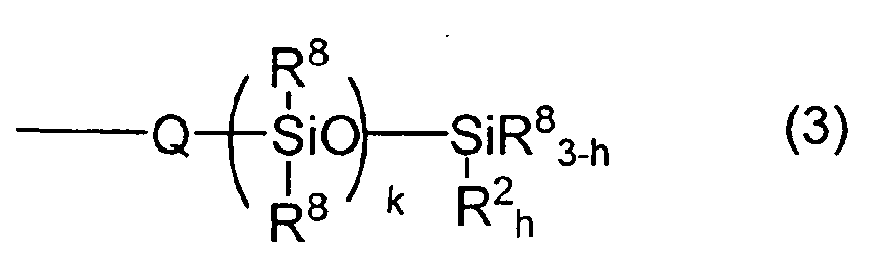
- R 3 is a group represented by the following formula (3): wherein each R 8 is, independently, selected from the group consisting of C1-30 alkyl, C1-30 fluoroalkyl, C6-30 aryl, and C6-30 aralkyl groups. Examples of R 8 include those aforementioned for R 1 among which a methyl group is preferred.
- Q is C d H 2d , wherein d is an integer of from 1 to 5, preferably from 2 to 4, or an oxygen atom, preferably C 2 H 4 .
- k is an integer of from 0 to 500, preferably from 1 to 100, and more preferably from 5 to 60.
- h is an integer of from 0 to 3, preferably 0.
- a is a number of from 1.5 to 2.5, preferably from 1.8 to 2.3
- b is a number of from 0.001 to 1.5, preferably from 0.01 to 0.5, and more preferably from 0.01 to 0.09
- c is a number of from 0 to 1.5, preferably from 0 to 0.6, more preferably from 0 to 0.3.
- An organopolysiloxane with b being smaller than the aforementioned lower limit may not have sufficient reactivity and adsorption capability of carboxyl groups.
- an organopolysiloxane with b and c being greater than 1.5 tends to have a viscosity too high to handle with ease.
- An exemplary organopolysiloxane of the present organopolysiloxane is represented by the following formula: wherein Q and h are as defined above, l is an integer of from 0 to 500, m is an integer of from 0 to 50, n is an integer of from 0 to 50, p is an integer of from 0 to 50, q is an integer of from 0 to 500, r is an integer of from 0 to 50, f and g are integers of from 0 to 3, provided that 1 ⁇ f+g.
- l is an integer of from 5 to 60
- m is an integer of from 0 to 10
- n is an integer of from 1 to 10
- p is an integer of from 0 to 10
- q is an integer of from 1 to 100
- r is an integer of from 0 to 5
- f, g and h are 0 or 1, provided that f+g+h is at least one, 5 ⁇ l+m ⁇ 550.
- l+m ranges from 10 to 300
- q+r ranges from 1 to 100, more preferably from 5 to 60.
- the organopolysiloxane having carboxyl groups of the present invention can be prepared by a method comprising the steps of:
- an organopolysiloxane with its proton being replaced with a monovalent cation can be prepared.
- the organohydrogenpolysiloxane used in the step (1) can be linear or branched.
- the branched organohydrogenpolysiloxane is the one having a network structure with a (R 1 SiO 3/2 ) unit and/or a (SiO 4/2 ) unit.
- a SiH bond is located on at least one end of a main chain of the organohydrogenpolysiloxane. It may be located at an end of a side-chain, if there is a side-chain. It bond may be located at a site other than the ends when there is a silicone side-chain, but preferably at an end.
- R 6 and R 7 are as defined above and n is an integer of from 0 to 18, preferably from 0 to 10.
- the acid anhydride compound include succinic acid anhydride and derivatives thereof such as vinyl succinic acid anhydride, allyl succinic acid anhydride, allyl-2-methylsuccinic acid anhydride, allyl-2,3-dimethyl succinic acid anhydride, and allyl-2-ethyl succinic acid anhydride.
- allyl succinic acid anhydride is used.
- the addition reaction in the step (1) is preferably performed in the presence of a platinum or rhodium catalyst.
- a platinum or rhodium catalyst examples include chloroplatinic acid, chloroplatinic acid modified with an alcohol, and a complex of chloroplatinic acid with a vinylsiloxane.
- An amount of the catalyst to be used may be a catalytically effective amount, i.e., a catalytic amount, which is usually at most 50 ppm, particularly at most 20 ppm, as platinum or rhodium metal.
- the reaction may be performed in an organic solvent as needed.
- organic solvent examples include aliphatic alcohols such as methanol, ethanol, 2-propanol and butanol; aromatic hydrocarbons such as toluene and xylene; aliphatic or alicyclic hydrocarbons such as n-pentane, n-hexane, and cyclohexane; and halogenated hydrocarbons such as dichloromethane, chloroform, and carbon tetrachloride.
- Reaction conditions for the addition reaction are not limited to particular ones. Preferably, the reaction is performed under reflux for 1 to 10 hours.
- R 3 with Q being C d H 2d and h being 0 can be introduced to the organopolysiloxane by subjecting an organopolysiloxane represented by the following formula (5) having an unsaturated group at an end to an addition reaction in parallel with the addition reaction of the aforesaid acid anhydride.
- R 8 , k, and d are as defined above.
- R 3 with Q being an oxygen atom can be prepared by forming a siloxane backbone through an equilibration reaction and then reacting the organohydrogenpolysiloxane thus obtained with the aforementioned acid anhydride of the formula (4).
- the ring-opening reaction in the step (2) is performed by adding water to reactants according to a conventional method.
- An amount of water to be added is at least an equivalent molar amount, preferably from two- to five-fold molar amounts, of the acid anhydride group.
- the reaction may be performed in an organic solvent as needed. Examples of the organic solvent include those listed for the step (1).
- the reaction conditions for the ring-opening reaction are not limited to the particular ones. Preferably, the reaction is performed at a temperature of from room temperature to a reflux temperature for 1 to 10 hours.
- a basic catalyst such as an amine or ammonium in an amount of from 1 to 1,000 ppm may be added to promote the ring-opening reaction.
- Examples of the base used in the step (3) include metal hydroxides such as sodium hydroxide and potassium hydroxide, and amines such as ammonia water and trialkylamine.
- the metal hydroxides can be added in the form of an aqueous solution or alcoholic solution.
- the organopolysiloxane of the present invention has a carboxyl equivalent (g/mol) of from 100 to 50000, preferably from 500 to 10000, more preferably from 500 to 5000.
- the organopolysiloxane preferably has a viscosity of from 10 to 1,000,000mm 2 /sec, more preferably from 10 to 100,000mm 2 /sec.
- the organopolysiloxane preferably has a weight average molecular weight reduced to polystyrene of from 200 to 100,000, more preferably from 200 to 50,000. If the weight average molecular weight exceeds 100,000, viscosity becomes too high to handle with ease.
- an organopolysiloxane having a weight average molecular weight below 200 has too little siloxane units to make the best of the siloxane units.
- the organopolysiloxane of the present invention is used for treating surfaces of organic resins, fibers, and powder, preferably powder, to provide the surface with water resistance and affinity with unctuous agents.
- unctuous agents include hydrocarbon, ester, and silicone unctuous agents.
- hydrocarbon unctuous agent include ozokerite, ⁇ -olefin oligomer, light isoparaffin, isododecane, isohexadecane, light liquid isoparaffin, squalane, synthetic squalane, plant-origin squalane and squalene, among which isododecane and isohexadecane are preferred.
- ester unctuous agent examples include diisobutyl adipate, 2-hexyldecyl adipate, di-2-heptylundecyl adipate, N-alkyl glycol monoisostearate, isocetyl isostearate, trimethylolpropane triisostearate, ethylene glycol di-2-ethylhexanoate, cetyl 2-ethylhexanoate, trimethylolpropane tri-2-ethylhexanoate, pentaerythritol tetra-2-ethylhexanoate, cetyl octanoate, octyldodecyl gum ester, oleyl oleate, octyldodecyl oleate, decyl oleate, isononyl isononanate, neopentyl glycol dicaprirate, trieth
- glyceride oils include acetoglyceryl, glycerol triisooctanoate, glyceryl triisostearate, glyceryl triisopalmitate, glyceryl monostearate, glyceryl di-2-heptylundecanoate, glyceryl trimyristate, and diglyceryl myristyl isostearate, among which isocetyl isostearate, cetyl octanoate, and isononyl isononanate.
- silicone unctuous agent examples include linear or branched organopolysiloxanes having low to high viscosities such as dimethylpolysiloxane, tristrimethylsiloxymethylsilane, caprylyl methicone, phenyltrimethicone, tetrakistrimethylsiloxysilane, methylphenylpolysiloxane, methylhexylpolysiloxane, methylhydrogenpolysiloxane, and copolymers of dimethylsiloxane and methylphenylsiloxane; cyclic organopolysiloxanes such as octamethylcyclotetrasiloxane, decamethylcyclopentasiloxane, dodecamethylcyclohexasiloxane, and tetramethyl-tetrahydrogencyclotetrasiloxane; amino-modified oganopolysiloxanes, pyrrolidon
- the powder to be treated with the organopolysiloxane is not limited to particular ones. Preferred are powder of titanium dioxide, zinc oxide and sericite.
- IR and 1H-NMR spectral analyses of the liquid identified it as an organopolysiloxane having acid anhydride groups represented by the following formula (8):
- IR and 1H-NMR spectral analyses of the liquid identified it as an organopolysiloxane having carboxyl groups represented by the following formula (9):
- IR and 1 H-NMR spectral analyses of the liquid identified it as an organopolysiloxane having acid anhydride groups represented by the following formula (12):
- IR and 1 H-NMR spectral analyses of the liquid identified it as an organopolysiloxane having carboxyl groups represented by the following formula (13):
- IR and 1 H-NMR spectral analyses of the liquid identified it as an organopolysiloxane having acid anhydride groups represented by the following formula (15):
- IR and 1 H-NMR spectral analyses of the liquid identified it as an organopolysiloxane having carboxyl groups represented by the following formula (16):
- IR and 1 H-NMR spectral analyses of the liquid identified it as an organopolysiloxane having acid anhydride groups represented by the following formula (18):
- IR and 1 H-NMR spectral analyses of the liquid identified it as an organopolysiloxane having carboxyl groups represented by the following formula (19):
- Powder of titanium dioxide or zinc oxide was treated with the organopolysiloxanes obtained in the above Examples, Comparative Examples, and a surface treatment agent (Comparative example 3), respectively, according to the formulation shown in the following Table.
- a reactor 98 parts by weight of titanium dioxide or zinc oxide powder, which had not been surface-treated and dried under vacuum, were placed, to which a solution of an organopolysiloxane dissolved in about 100 parts by weight of toluene was gradually added while stirring the powder.
- a temperature of the reactor was raised from room temperature to about 120 °C to remove toluene, and then to 150 °C at which temperature the powder was stirred for 3 hours.
- Dispersions of the surface-treated powders were prepared. In 50 ml of isododecane, 2.5 g of each surface-treated powder was dispersed with a bead mill. The dispersion obtained was transferred to a 50-ml test tube. The dispersion in the test tube was left standing for 2 days, and then visually observed for sedimentation of the powder. As references, dispersions of titanium dioxide powder and zinc oxide powder which had not been surface-treated were prepared in the same manner. Results are shown in the following Table 2. In the Table, values in the second column indicate a height of the uppermost powder after 2 day-standing relative to an initial height, that is, "1.0" indicates no sedimentation. A smaller value indicates a larger degree of sedimentation. Table 2 Surface-treated powder Stability of dispersion 1 1.0 2 1.0 3 1.0 4 0.9 5 0.7 6 0.8 7 0.5 8 0.8 9 0.7 10 0.6 Non-treated titanium dioxide 0.2 Non-treated zinc oxide 0.2
- the organopolysiloxane of the present invention because of characteristics of carboxyl groups, is suitable for modifying organic resins or fibers and surface-treating powder.
- the treated surface shows high affinity with an unctuous agent. Particularly, dispersivity of powder is significantly improved.
- the organopolysiloxane therefore, is useful for applications where high dispersivity of powder is required, for example, cosmetics such as skincare and makeup products, and coatings.
Landscapes
- Health & Medical Sciences (AREA)
- Life Sciences & Earth Sciences (AREA)
- Chemical & Material Sciences (AREA)
- Animal Behavior & Ethology (AREA)
- Veterinary Medicine (AREA)
- Public Health (AREA)
- General Health & Medical Sciences (AREA)
- Polymers & Plastics (AREA)
- Organic Chemistry (AREA)
- Medicinal Chemistry (AREA)
- Chemical Kinetics & Catalysis (AREA)
- Birds (AREA)
- Epidemiology (AREA)
- Dermatology (AREA)
- General Chemical & Material Sciences (AREA)
- Silicon Polymers (AREA)
Abstract
R1 a R2 b R3 c SiO(4-a-b-c)/2 (1)
wherein R1 is selected from the group consisting of C1-30 alkyl, C1-30 fluoroalkyl, C6-30 aryl, and C6-30 aralkyl groups,
R2 is a group represented by the following formula (2), provided that R2 is bonded to at least one terminal end of the organopolysiloxane when c equals 0,

a is a number of from 1.5 to 2.5,
b is a number of from 0.001 to 1.5, and
c is a number of from 0 to 1.5.
Description
- The present invention relates to an organopolysiloxane having carboxyl groups, specifically to an organopolysiloxane having two carboxyl groups per silicon atom. The organopolysiloxane has high reactivity with various kinds of substrates and affinity with unctuous agents.
- Organopolysiloxanes are used in various industrial fields such as electric, electrical, automobile, office automation equipment, medical care, cosmetic, food, and architecture industries. According to requirements and usages in each of the fields, organopolysiloxanes having various kinds of organic substituent groups have been developed. An organopolysiloxane having a carboxyl group or its salts, hereinafter collectively referred to as "carboxyl group", has been also developed for the reason that the carboxyl group is useful for surface-treating fibers, paper, human hair and inorganic fillers because of its functionalities such as reactivity and electrolytic property.
- For example, an organopolysiloxanes having the following carboxyl group is known.

-
WO 96/32432 A1 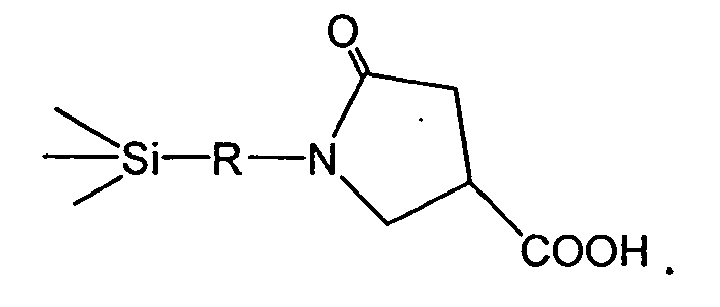
-
JP 2002-114849A 

USP 6,592,854 B1 describes an organopolysiloxane having the following groups:
-(R1O)a-R2-(OR3)b-COOM
wherein M is a hydrogen atom, alkali metal, ammonium or the like.
WO 03/095530 A1 WO 03/094871 A1 
- In the above organopolysiloxanes, the first three organopolysiloxanes have only one carboxyl group bonded to a silicon atom. The fourth organopolysiloxane has two carboxyl groups per silicon atom. However, it has a drawback that it has to be prepared from a special organopolysiloxane having two terminal amino groups or a special organopolysiloxane having an amino group and a hydroxyl group. The fifth organopolysiloxane is relatively easy to prepare. However, its affinity with unctuous agents such as hydrocarbon unctuous agent is not satisfactory.
- An object of the present invention is therefore to provide an organopolysiloxane which has two carboxyl groups bonded to a silicon atom and has highly reactive carboxyl groups and affinity with unctuous agents.
- The present invention is an organopolysiloxane represented by the following average compositional formula (1):
R1 aR2 bR3 cSiO(a-b-c)/2 (1)
wherein R1 is selected from the group consisting of C1-30 alkyl, C1-30 fluoroalkyl, C6-30 aryl, and C6-30 aralkyl groups, R2 is a group represented by the following formula (2), provided that R2 is bonded to at least one terminal end of the organopolysiloxane when c equals 0,
R3 is a group represented by the following formula (3):
a is a number of from 1.5 to 2.5,
b is a number of from 0.001 to 1.5, and
c is a number of from 0 to 1.5. - The aforesaid organopolysiloxane of the present invention is highly reactive because of terminal carboxyl groups, so that it is useful for applications where high reactivity is required such as surface treatment of powder. The organopolysiloxane has high affinity with unctuous agents and, particularly, the one having R3 has higher affinity with unctuous agents. Surface-treated powder with the organopolysiloxane is highly dispersive in unctuous agent.
- In the compositional formula (1), R1 is a group selected from the group consisting of C1-30 alkyl, C1-30 fluoroalkyl, C6-30 aryl and C6-30 aralkyl groups. Examples of R1 include alkyl groups such as methyl, ethyl, propyl, butyl, pentyl, hexyl, heptyl, octyl, nonyl, decyl, and stearyl groups; alicyclic groups such as cyclopentyl and cyclohexyl groups: aryl groups such as phenyl, and tolyl groups; aralkyl groups such as benzyl, and phenetyl groups; and fluoroalkyl groups such as trifluoropropyl and heptadecafluorodecyl groups. Among these, C1-15 alkyl and phenyl groups are preferred, and a methyl group is more preferred.
- R2 is represented by the following formula (2):

- R2 is bonded to at least one end of the organopolysiloxane. In the organopolysiloxane having R3, R2 may be bonded to an end of the R3 and may be bonded to a site other than the ends of the organopolysiloxane main chain. Preferably, R2 is bonded to an end of the organopolysiloxane main chain, and more preferably there is only one R2 that is bonded to an end of the organopolysiloxane main chain. It is considered, though not to limit the present invention, the terminal R2 allows fast reaction with a surface of substrate such as powder, and the rest part of the organopolysiloxane achieves good affinity with an unctuous agent.
- Each of R5 is, independently, a hydrogen atom, a monovalent cation or a C1-10 alkyl group, provided that at least one of R5's is a hydrogen atom or a monovalent cation. Examples of the monovalent cation include ions of alkali metals such as lithium, sodium, and potassium; ammonium and alkylammonium. Examples of the alkyl group include methyl, ethyl, propyl, and isopropyl groups. Preferably, R5 is a hydrogen atom, a sodium ion or a potassium ion.
- R6 is each, independently, a hydrogen atom or a C1-6 alkyl group, and preferably a hydrogen atom or a methyl group. R7 is a hydrogen atom or a C1-6 alkyl group, and preferably a hydrogen atom or a methyl group.
- In the formula (1), R3 is a group represented by the following formula (3):

- In the formula (1), a is a number of from 1.5 to 2.5, preferably from 1.8 to 2.3, b is a number of from 0.001 to 1.5, preferably from 0.01 to 0.5, and more preferably from 0.01 to 0.09, and c is a number of from 0 to 1.5, preferably from 0 to 0.6, more preferably from 0 to 0.3. An organopolysiloxane with b being smaller than the aforementioned lower limit may not have sufficient reactivity and adsorption capability of carboxyl groups. On the other hand, an organopolysiloxane with b and c being greater than 1.5 tends to have a viscosity too high to handle with ease.
- An exemplary organopolysiloxane of the present organopolysiloxane is represented by the following formula:


- The organopolysiloxane having carboxyl groups of the present invention can be prepared by a method comprising the steps of:
- (1) subjecting an organohydrogenpolysiloxane having hydrogen atoms at the sites where R2 and R3 are to be bonded and an acid anhydride compound represented by the following formula (4) to an addition reaction,

- (2) subjecting a product obtained in the step (1) to a ring-opening reaction in the presence of water.
- With an additional step (3) reacting a carboxylic acid obtained in the step (2) with an organic or inorganic base, an organopolysiloxane with its proton being replaced with a monovalent cation can be prepared.
- The organohydrogenpolysiloxane used in the step (1) can be linear or branched. The branched organohydrogenpolysiloxane is the one having a network structure with a (R1SiO3/2) unit and/or a (SiO4/2) unit. A SiH bond is located on at least one end of a main chain of the organohydrogenpolysiloxane. It may be located at an end of a side-chain, if there is a side-chain. It bond may be located at a site other than the ends when there is a silicone side-chain, but preferably at an end.
- In the formula (4), R6 and R7 are as defined above and n is an integer of from 0 to 18, preferably from 0 to 10. Examples of the acid anhydride compound include succinic acid anhydride and derivatives thereof such as vinyl succinic acid anhydride, allyl succinic acid anhydride, allyl-2-methylsuccinic acid anhydride, allyl-2,3-dimethyl succinic acid anhydride, and allyl-2-ethyl succinic acid anhydride. Preferably, allyl succinic acid anhydride is used.
- The addition reaction in the step (1) is preferably performed in the presence of a platinum or rhodium catalyst. Examples of preferred catalyst include chloroplatinic acid, chloroplatinic acid modified with an alcohol, and a complex of chloroplatinic acid with a vinylsiloxane. An amount of the catalyst to be used may be a catalytically effective amount, i.e., a catalytic amount, which is usually at most 50 ppm, particularly at most 20 ppm, as platinum or rhodium metal. The reaction may be performed in an organic solvent as needed. Examples of the organic solvent include aliphatic alcohols such as methanol, ethanol, 2-propanol and butanol; aromatic hydrocarbons such as toluene and xylene; aliphatic or alicyclic hydrocarbons such as n-pentane, n-hexane, and cyclohexane; and halogenated hydrocarbons such as dichloromethane, chloroform, and carbon tetrachloride. Reaction conditions for the addition reaction are not limited to particular ones. Preferably, the reaction is performed under reflux for 1 to 10 hours.
- In the step (1), R3 with Q being CdH2d and h being 0 can be introduced to the organopolysiloxane by subjecting an organopolysiloxane represented by the following formula (5) having an unsaturated group at an end to an addition reaction in parallel with the addition reaction of the aforesaid acid anhydride.

- In the formula (5), R8, k, and d are as defined above. R3 with Q being an oxygen atom can be prepared by forming a siloxane backbone through an equilibration reaction and then reacting the organohydrogenpolysiloxane thus obtained with the aforementioned acid anhydride of the formula (4).
- The ring-opening reaction in the step (2) is performed by adding water to reactants according to a conventional method. An amount of water to be added is at least an equivalent molar amount, preferably from two- to five-fold molar amounts, of the acid anhydride group. The reaction may be performed in an organic solvent as needed. Examples of the organic solvent include those listed for the step (1). The reaction conditions for the ring-opening reaction are not limited to the particular ones. Preferably, the reaction is performed at a temperature of from room temperature to a reflux temperature for 1 to 10 hours. A basic catalyst such as an amine or ammonium in an amount of from 1 to 1,000 ppm may be added to promote the ring-opening reaction.
- In the ring-opening reaction, use of a C1-10 alcohol or its metal alcoholate in place of water produces an organopolysiloxane with R5 being C1-10 alkyl group in the formula (2).
- Examples of the base used in the step (3) include metal hydroxides such as sodium hydroxide and potassium hydroxide, and amines such as ammonia water and trialkylamine. The metal hydroxides can be added in the form of an aqueous solution or alcoholic solution.
- The organopolysiloxane of the present invention has a carboxyl equivalent (g/mol) of from 100 to 50000, preferably from 500 to 10000, more preferably from 500 to 5000. For good handling property, the organopolysiloxane preferably has a viscosity of from 10 to 1,000,000mm2/sec, more preferably from 10 to 100,000mm2/sec. Further, the organopolysiloxane preferably has a weight average molecular weight reduced to polystyrene of from 200 to 100,000, more preferably from 200 to 50,000. If the weight average molecular weight exceeds 100,000, viscosity becomes too high to handle with ease. On the other hand, an organopolysiloxane having a weight average molecular weight below 200 has too little siloxane units to make the best of the siloxane units.
- The organopolysiloxane of the present invention is used for treating surfaces of organic resins, fibers, and powder, preferably powder, to provide the surface with water resistance and affinity with unctuous agents. Examples of the unctuous agents include hydrocarbon, ester, and silicone unctuous agents. Examples of the hydrocarbon unctuous agent include ozokerite, α-olefin oligomer, light isoparaffin, isododecane, isohexadecane, light liquid isoparaffin, squalane, synthetic squalane, plant-origin squalane and squalene, among which isododecane and isohexadecane are preferred.
- Examples of the ester unctuous agent include diisobutyl adipate, 2-hexyldecyl adipate, di-2-heptylundecyl adipate, N-alkyl glycol monoisostearate, isocetyl isostearate, trimethylolpropane triisostearate, ethylene glycol di-2-ethylhexanoate, cetyl 2-ethylhexanoate, trimethylolpropane tri-2-ethylhexanoate, pentaerythritol tetra-2-ethylhexanoate, cetyl octanoate, octyldodecyl gum ester, oleyl oleate, octyldodecyl oleate, decyl oleate, isononyl isononanate, neopentyl glycol dicaprirate, triethyl citrate, 2-ethylhexyl succinate, amyl acetate, ethyl acetate, butyl acetate, isocetyl stearate, butyl stearate, diisopropyl sebacinate, di-2-ethylhexyl sebacinate, cetyl lactate, myristyl lactate, isopropyl palmitate, 2-ethylhexyl palmitate, 2-hexyldecyl palmitate, 2-heptylundecyl palmitate, cholesteryl 12-hydroxystearate, dipentaerythritol fatty acid esters, isopropyl myristate, octyldodecyl myristate, 2-hexyldecyl myristate, myristyl myristate, hexyldecyl dimethyloctanoate, ethyl laurate, hexyl laurate, 2-octyldodecyl N-lauroyl-L-glutamate, and diisostearyl. Examples of glyceride oils include acetoglyceryl, glycerol triisooctanoate, glyceryl triisostearate, glyceryl triisopalmitate, glyceryl monostearate, glyceryl di-2-heptylundecanoate, glyceryl trimyristate, and diglyceryl myristyl isostearate, among which isocetyl isostearate, cetyl octanoate, and isononyl isononanate.
- Examples of the silicone unctuous agent include linear or branched organopolysiloxanes having low to high viscosities such as dimethylpolysiloxane, tristrimethylsiloxymethylsilane, caprylyl methicone, phenyltrimethicone, tetrakistrimethylsiloxysilane, methylphenylpolysiloxane, methylhexylpolysiloxane, methylhydrogenpolysiloxane, and copolymers of dimethylsiloxane and methylphenylsiloxane; cyclic organopolysiloxanes such as octamethylcyclotetrasiloxane, decamethylcyclopentasiloxane, dodecamethylcyclohexasiloxane, and tetramethyl-tetrahydrogencyclotetrasiloxane; amino-modified oganopolysiloxanes, pyrrolidonyl-modified oganopolysiloxanes, pyrrolidonyl/carboxyl-modified organopolysiloxanes; silicone rubbers such as gummy dimethylpolysiloxanes having high polymerization degrees, gummy amino-modified organopolysiloxanes, and gummy dimethylsiloxane/methylphenylsiloxane copolymers and solutions of silicone rubber in cyclic organopolysiloxane; trimethylsiloxysilicate, and solutions of trimethylsiloxysilicate in cyclic siloxane, higher alkoxy-modified silicones such as stearoxysilicone, higher fatty acid-modified silicones, alkyl-modified silicones, long chain alkyl-modified silicones, amino acid-modified silicones, fluorinated silicones, silicone resins and solutions of silicone resins, among which cyclic organopolysiloxanes such as octamethylcyclotetrasiloxane, decamethylcyclopentasiloxane, dodecamethylcyclohexasiloxane, tetramethyl-tetrahydrogencyclotetrasiloxane, and tetramethyltetraphenylcyclotetrasiloxane are preferred.
- The powder to be treated with the organopolysiloxane is not limited to particular ones. Preferred are powder of titanium dioxide, zinc oxide and sericite.
- The present invention is explained in further detail below with reference to examples, but the present invention is in no way limited by the examples. In the following, "%" means "% by weight" unless otherwise specified.
- In a reactor, were placed 241 parts by weight of an organohydrogenpolysiloxane represented by the following formula (6):


IR 1H-NMR(CDCl3) 2963cm-1(C-H) 0ppm(s,192H,Si-CH3) 1867cm-1(C=O) 0.5ppm(t,2H,Si-CH2) 1790cm-1(C=O) 0.9ppm(t,3H,C-CH3) 1260cm-1(Si-CH3) 1.3ppm(m,4H,C-CH2) 1100 to 1020cm-1(Si-O) 1.4ppm(m,2H,C-CH2) 1.8ppm(m,2H,C-CH2) 2.6ppm(m,1H,CH-CO) 3.1ppm(m,2H,CH2-CO) - To 250 parts by weight of the above organopolysiloxane having acid anhydride groups, 100 parts by weight of tetrahydrofuran and 5.4 parts by weight of water were added, which were then subjected to a reaction under reflux for 5 hours. The reaction mixture was subjected to vacuum distillation, whereby a liquid having a viscosity of 147 mm2/s and a carboxyl equivalent of 1290 g/mol was obtained with 97% yield. IR and 1H-NMR spectral analyses of the liquid identified it as an organopolysiloxane having carboxyl groups represented by the following formula (9):

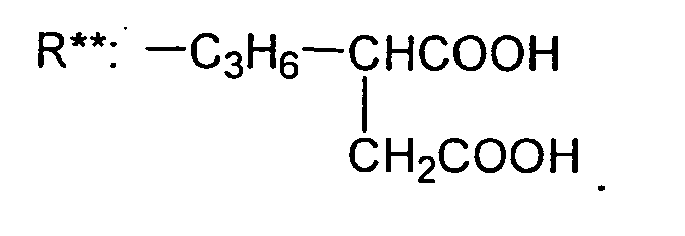
IR 1H-NMR(CDCl3) 3300 to 2500cm-1(-OH) 0ppm(s,189H,Si-CH3) 2965cm-1(C-H) 0.5ppm(t,6H,Si-CH2) 1716cm-1(C=O) 1.4ppm (m, 6H, C-CH2) 1260cm-1(Si-CH3) 1.8ppm(m,6H,C-CH2) 1100 to 1020cm-1(Si-O) 2.5ppm(m,3H,CH-CO) 2.8ppm(m,6H,CH2-CO) 11.5ppm(s,2H,-COOH) - In a reactor, were placed 240 parts by weight of an organohydrogenpolysiloxane represented by the following formula (10) :
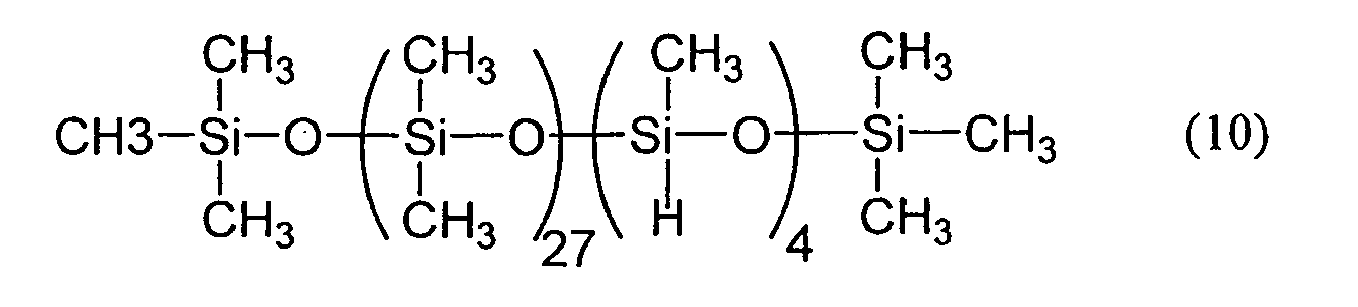


IR 1H-NMR(CDCl3) 2963cm-1(C-H) 0ppm(s,330H,Si-CH3) 1867cm-1(C=O) 0.4ppm(m,8H,Si-CH2) 1790cm-1(C=O) 0.5ppm(t,4H,Si-CH2) 1260cm-1(Si-CH3),1100 to 1020c 1.4ppm(m,4H,C-CH2) m-1(Si-O) 1.7ppm(m,4H,C-CH2) 2.4ppm(m,2H,CH-CO) 2.8ppm(m,4H,CH2-CO) - To 250 parts by weight of the above organopolysiloxane having acid anhydride groups, 100 parts by weight of tetrahydrofuran and 7.2 parts by weight of water were added, which were then subjected to a reaction under reflux for 5 hours. The reaction mixture was subjected to vacuum distillation, whereby a liquid having a viscosity of 850 mm2/s and a carboxyl equivalent of 1110 g/mol was obtained with 95% yield. IR and 1H-NMR spectral analyses of the liquid identified it as an organopolysiloxane having carboxyl groups represented by the following formula (13):


IR 1H-NMR(CDCl3) 3300 to 2500cm-1(-OH) 0ppm(s,330H,Si-CH3) 2965cm-1(C-H) 0.4ppm(m,8H,Si-CH2)0.5ppm(t,4H, 1715cm-1(C=O) Si-CH2) 1260cm-1(Si-CH3) 1.4ppm(m,4H,C-CH2) 1100 to 1020cm-1(Si-O) 1.7ppm(m,4H,C-CH2) 2.4ppm(m,2H,CH-CO) 2.8ppm(m,4H,CH2-CO)11.0ppm(s,4H ,COOH) - In a reactor, were placed 228 parts by weight of an organohydrogenpolysiloxane represented by the following formula (14):


IR 1H-NMR(CDCl3) 2963cm-1(C-H) 0ppm(s,189H,Si-CH3) 1867cm-1(C=O) 0.5ppm(t,6H,Si-CH2) 1790cm-1(C=O) 1.4ppm(m,6H,C-CH2) 1260cm-1(Si-CH3 1.8ppm(m,6H,C-CH2) 1100 to 1020cm-1(Si-O) 2.6ppm(m,3H,CH-CO) 3.1ppm(m,6H,CH2-CO) - To 250 parts by weight of the above organopolysiloxane having acid anhydride groups, 100 parts by weight of tetrahydrofuran and 7.2 parts by weight of water were added, which were then subjected to a reaction under reflux for 5 hours. The reaction mixture was subjected to vacuum distillation, whereby a liquid having a viscosity of 8700mm2/s and a carboxyl equivalent of 435g/mol was obtained with 97% yield. IR and 1H-NMR spectral analyses of the liquid identified it as an organopolysiloxane having carboxyl groups represented by the following formula (16):
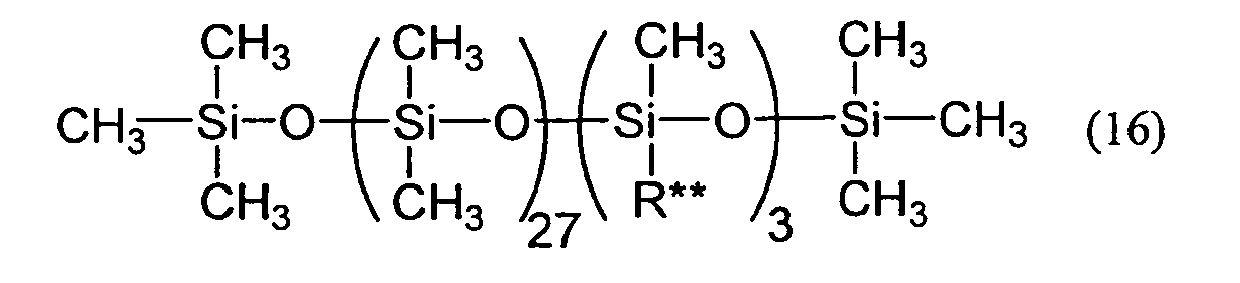
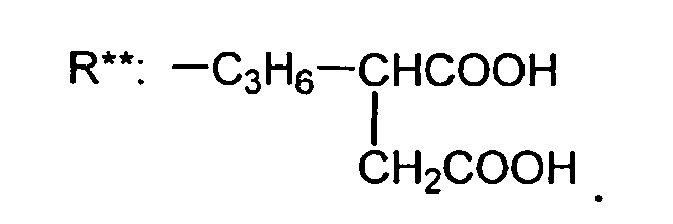
IR 1H-NMR(CDCl3) 3300 to 2500cm-1(-OH) 0ppm(s,189H,Si-CH3) 2963cm-1(C-H) 1.5ppm(t,6H,Si-CH2) 1716cm-1(C=O) 1.4ppm(m,6H,C-CH2) 1260cm-1(Si-CH3) 1.8ppm(m,6H,C-CH2) 1100 to 1020cm-1(Si-O) 2.5ppm(m,3H,CH-CO) 2.8ppm(m,6H,CH2-CO) 11.3ppm(s,6H,-COOH) - In a reactor, were placed 266 parts by weight of an organohydrogenpolysiloxane represented by the following formula (17) :


IR 1H-NMR(CDCl3) 2965,2925,2856cm-1(C-H) 0ppm(s,120H,Si-CH3) 1867cm-1(C=O) 0.5ppm(m,20H,Si-CH2) 1790cm-1(C=O) 0.9ppm(t,18H,C-CH3) 1260cm-1(Si-CH3) 1.3ppm(m,120H,C-CH2) 1100 to 1020cm-1(Si-O) 1.4ppm(m,8H,C-CH2) 1.8ppm(m,8H,C-CH2) 2.6ppm(m,4H,CH-CO) 3.1ppm(m,8H,CH2-CO) - To 250 parts by weight of the above organopolysiloxane having acid anhydride groups, 100 parts by weight of tetrahydrofuran and 14.4 parts by weight of water were added, which were then subjected to a reaction under reflux for 5 hours. The reaction mixture was subjected to vacuum distillation, whereby a liquid having a viscosity of 9800 mm2/s and a carboxyl equivalent of 415 g/mol was obtained with 96% yield. IR and 1H-NMR spectral analyses of the liquid identified it as an organopolysiloxane having carboxyl groups represented by the following formula (19):


IR 1H-NMR(CDCl3) 3300 to 2500cm-1(-OH) 0ppm(s,120H,Si-CH3) 2965,2925,2856cm-1(C-H) 0.5ppm(t,20H,Si-CH2) 1715cm-1(C=O) 0.9ppm(t,18H,C-CH3) 1260cm-1(Si-CH3) 1.3ppm(m,120H,C-CH2) 1100 to 1020cm-1(Si-O) 1.4ppm(m,8H,C-CH2) 1.8ppm(m,8H,C-CH2) 2.5ppm(m,4H,CH-CO) 2.8ppm(m,8H,CH2-CO) 11.4ppm(s,8H,-COOH) - Powder of titanium dioxide or zinc oxide was treated with the organopolysiloxanes obtained in the above Examples, Comparative Examples, and a surface treatment agent (Comparative example 3), respectively, according to the formulation shown in the following Table. In a reactor, 98 parts by weight of titanium dioxide or zinc oxide powder, which had not been surface-treated and dried under vacuum, were placed, to which a solution of an organopolysiloxane dissolved in about 100 parts by weight of toluene was gradually added while stirring the powder. A temperature of the reactor was raised from room temperature to about 120 °C to remove toluene, and then to 150 °C at which temperature the powder was stirred for 3 hours.
Table 1 Surface-treated powder Powder, parts by weight Organopolysiloxane, parts by weight Titanium dioxide Zinc oxide Ex.1 Ex.2 Com.Ex .1 Comp.E x.2 Comp.E x.3 1 98 2 2 98 2 3 98 2 4 98 2 5 98 2 6 98 2 7 98 2 8 98 2 9 98 2 10 98 2 - Surface treatment agent used in Comparative Example 3: An organopolysiloxane having carboxyl groups represented by the following formula:

- Dispersions of the surface-treated powders were prepared. In 50 ml of isododecane, 2.5 g of each surface-treated powder was dispersed with a bead mill. The dispersion obtained was transferred to a 50-ml test tube. The dispersion in the test tube was left standing for 2 days, and then visually observed for sedimentation of the powder. As references, dispersions of titanium dioxide powder and zinc oxide powder which had not been surface-treated were prepared in the same manner. Results are shown in the following Table 2. In the Table, values in the second column indicate a height of the uppermost powder after 2 day-standing relative to an initial height, that is, "1.0" indicates no sedimentation. A smaller value indicates a larger degree of sedimentation.
Table 2 Surface-treated powder Stability of dispersion 1 1.0 2 1.0 3 1.0 4 0.9 5 0.7 6 0.8 7 0.5 8 0.8 9 0.7 10 0.6 Non-treated titanium dioxide 0.2 Non-treated zinc oxide 0.2 - As shown in Table 2, powders treated with the organopolysiloxanes of the Examples hardly settled down, indicating good dispersivity. In contrast, the powders treated with the organopolysiloxane which does not have terminal carboxyl groups or a silicone side-chain showed sedimentation. Particularly, Comparative Example 3 showed significant sedimentation.
- The organopolysiloxane of the present invention, because of characteristics of carboxyl groups, is suitable for modifying organic resins or fibers and surface-treating powder. The treated surface shows high affinity with an unctuous agent. Particularly, dispersivity of powder is significantly improved. The organopolysiloxane, therefore, is useful for applications where high dispersivity of powder is required, for example, cosmetics such as skincare and makeup products, and coatings.
Claims (5)
- An organopolysiloxane represented by the following average compositional formula (1):
R1 aR2 bR3 cSiO(a-b-c)/2 (1)
wherein R1 is selected from the group consisting of C1-30 alkyl, C1-30 fluoroalkyl, C6-30 aryl, and C6-30 aralkyl groups, R2 is a group represented by the following formula (2), provided that R2 is bonded to at least one terminal end of the organopolysiloxane when c equals 0,
R3 is a group represented by the following formula (3):
a is a number of from 1.5 to 2.5,
b is a number of from 0.001 to 1.5, and
c is a number of from 0 to 1.5. - The organopolysiloxane according to claim 1, wherein each R5 is, independently, a hydrogen atom, a sodium ion or a potassium ion.
- The organopolysiloxane according to claim 1 or 2, wherein R6 and R7 are hydrogen atoms.
- The organopolysiloxane according to any one of claims 1 to 3, wherein b is a number of from 0.001 to 0.1.
- A surface treatment agent for a powder, said surface treatment agent comprising an organopolysiloxane according to any one of claims 1 to 4.
Applications Claiming Priority (2)
| Application Number | Priority Date | Filing Date | Title |
|---|---|---|---|
| JP2008097561 | 2008-04-03 | ||
| JP2009073665A JP5353357B2 (en) | 2008-04-03 | 2009-03-25 | Organopolysiloxane having a carboxyl group |
Publications (2)
| Publication Number | Publication Date |
|---|---|
| EP2107078A1 true EP2107078A1 (en) | 2009-10-07 |
| EP2107078B1 EP2107078B1 (en) | 2014-05-07 |
Family
ID=40671383
Family Applications (1)
| Application Number | Title | Priority Date | Filing Date |
|---|---|---|---|
| EP09251038.7A Active EP2107078B1 (en) | 2008-04-03 | 2009-04-02 | Organopolysiloxane having carboxyl groups |
Country Status (3)
| Country | Link |
|---|---|
| US (1) | US8026330B2 (en) |
| EP (1) | EP2107078B1 (en) |
| JP (1) | JP5353357B2 (en) |
Cited By (3)
| Publication number | Priority date | Publication date | Assignee | Title |
|---|---|---|---|---|
| WO2015167963A1 (en) * | 2014-04-28 | 2015-11-05 | Dow Corning Corporation | Cross-linked composition and cosmetic composition comprising the same |
| WO2017103791A1 (en) * | 2015-12-15 | 2017-06-22 | Novartis Ag | Polymerizable polysiloxanes with hydrophilic substituents |
| WO2022179972A1 (en) | 2021-02-23 | 2022-09-01 | Byk-Chemie Gmbh | Polysiloxane dispersing agent |
Families Citing this family (16)
| Publication number | Priority date | Publication date | Assignee | Title |
|---|---|---|---|---|
| JP5299147B2 (en) * | 2009-07-28 | 2013-09-25 | 信越化学工業株式会社 | Ester group-containing organopolysiloxane and cosmetic containing the same |
| JP5776634B2 (en) * | 2011-07-06 | 2015-09-09 | 信越化学工業株式会社 | Succinic anhydride group-containing cyclic organosiloxane, process for producing the same, organosiloxane composition, and thermosetting resin composition |
| EP3063208B1 (en) | 2013-10-31 | 2017-10-18 | Dow Corning Corporation | Cross-linked composition and method of forming the same |
| US10092780B2 (en) | 2013-10-31 | 2018-10-09 | Dow Silicones Corporation | Cosmetic composition comprising a carboxy-functional elastomer |
| EP3063227B1 (en) | 2013-10-31 | 2020-09-02 | Dow Silicones Corporation | Cross-linked composition and method of forming the same |
| JP6586554B2 (en) | 2014-04-15 | 2019-10-09 | ジェイオーコスメティックス株式会社 | Cosmetics |
| WO2018165434A1 (en) | 2017-03-08 | 2018-09-13 | Dow Silicones Corporation | Long lasting cosmetic composition comprising silicone elastomer |
| KR102718540B1 (en) | 2018-04-30 | 2024-10-22 | 다우 글로벌 테크놀로지스 엘엘씨 | Crosslinked composition, personal care composition comprising same, and method of forming same |
| JP7422354B2 (en) | 2018-08-15 | 2024-01-26 | ジェイオーコスメティックス株式会社 | cosmetics |
| CN112689500B (en) | 2018-08-15 | 2023-09-12 | 陶氏东丽株式会社 | Oil-in-water emulsified cosmetics |
| JP7306786B2 (en) | 2018-08-15 | 2023-07-11 | ダウ・東レ株式会社 | Aqueous dispersion composition and use thereof |
| KR102850890B1 (en) | 2018-08-15 | 2025-08-27 | 다우 도레이 캄파니 리미티드 | Oil-in-water emulsion cosmetics |
| US12569428B2 (en) | 2019-04-10 | 2026-03-10 | Dow Toray Co., Ltd. | Oil-in-water cleansing cosmetic composition |
| CN113710226B (en) | 2019-04-24 | 2024-02-27 | 陶氏东丽株式会社 | Cosmetics |
| JP7519818B2 (en) * | 2020-06-16 | 2024-07-22 | 株式会社カネカ | Modified siloxane dianhydride and polyimide resin |
| JP7811965B2 (en) * | 2024-06-04 | 2026-02-06 | 株式会社トクヤマ | Silicone composition and polysiloxane compound |
Citations (7)
| Publication number | Priority date | Publication date | Assignee | Title |
|---|---|---|---|---|
| US4486405A (en) * | 1983-04-19 | 1984-12-04 | William H. Rorer, Inc. | Pigmented cosmetic vehicle containing a mixture of alkoxylated surfactants |
| WO1996032432A1 (en) | 1995-04-12 | 1996-10-17 | Mona Industries, Inc. | Organosilicone having a carboxyl functional group thereon |
| US6103222A (en) * | 1995-12-02 | 2000-08-15 | The Procter & Gamble Company | Cosmetic compositions |
| JP2002114849A (en) | 2000-10-05 | 2002-04-16 | Kao Corp | Organopolysiloxane |
| US6592854B1 (en) | 1996-11-12 | 2003-07-15 | L'Oréal S. A. | Cosmetic composition containing an anionic or nonionic polymer and a carboxylic silicon |
| WO2003094871A1 (en) | 2002-05-09 | 2003-11-20 | The Procter & Gamble Company | Personal care compositions comprising a dicarboxy functionalized polyorganosiloxane |
| WO2003095530A1 (en) | 2002-05-09 | 2003-11-20 | The Procter & Gamble Company | Home care compositions comprising a dicarboxy functionalized polyorganosiloxane |
Family Cites Families (21)
| Publication number | Priority date | Publication date | Assignee | Title |
|---|---|---|---|---|
| US4598135A (en) * | 1985-10-31 | 1986-07-01 | General Electric Company | Method for making norbornane anhydride substituted polyorganosiloxane |
| DE3627757A1 (en) * | 1986-08-16 | 1988-02-18 | Basf Ag | METHOD FOR PRODUCING FLAT PRINTING PLATES |
| US4876152A (en) * | 1988-03-28 | 1989-10-24 | Ppg Industries, Inc. | Water-proofing composition |
| LU87350A1 (en) * | 1988-09-28 | 1990-04-06 | Oreal | COSMETIC APPLICATION OF DIESTER FUNCTIONAL POLYSILOXANES AND COMPOSITIONS IMPLEMENTED |
| DE4133621A1 (en) * | 1991-10-10 | 1993-04-22 | Inst Neue Mat Gemein Gmbh | COMPOSITE MATERIALS CONTAINING NANOSCALE PARTICLES, METHOD FOR THE PRODUCTION THEREOF AND THEIR USE FOR OPTICAL ELEMENTS |
| JPH05331291A (en) * | 1992-06-03 | 1993-12-14 | Shin Etsu Chem Co Ltd | Acid anhydride group-containing organopolysiloxane and its production |
| DE4244951C2 (en) * | 1992-12-01 | 1998-08-06 | Minnesota Mining & Mfg | New poly:siloxane cpd(s) and carboxylic acid derivs., prepn. and use |
| EP0648890B1 (en) * | 1993-10-19 | 1996-12-11 | Minnesota Mining And Manufacturing Company | High performance oil and water repellent compositions |
| FR2737214B1 (en) * | 1995-07-25 | 1997-10-24 | Rhone Poulenc Chimie | POLYFUNCTIONAL PERHALOGENATED POLYORGANOSILOXANES AND PROCESSES FOR OBTAINING THEM |
| US6545115B2 (en) * | 1996-12-11 | 2003-04-08 | Rhodia Chimie | Process for preparing a stable silicone oil containing SiH groups and hydrosilylable functions |
| DE19822618C1 (en) * | 1998-05-20 | 2000-02-24 | Fraunhofer Ges Forschung | Coating powder composition for metal substrates contains a carboxy-reactive binder and a carboxy-functional hardener made by hydrolysis and condensation of an aryl-alkoxy-silane and a carboxy-functional silane |
| FR2781491B1 (en) * | 1998-07-21 | 2002-12-20 | Rhodia Chimie Sa | USE OF A FUNCTIONALIZED SILICONE COMPOSITION FOR THE PRODUCTION OF HYDROPHOBIC AND / OR OLEOPHOBIC COATING AND / OR IMPREGNATION, WITH LOW SURFACE ENERGY |
| JP2001226486A (en) * | 1999-12-08 | 2001-08-21 | Asahi Kasei Corp | Polyorganosiloxane |
| JP4013023B2 (en) * | 2000-10-05 | 2007-11-28 | 信越化学工業株式会社 | Organosilicon compound |
| JP2002309149A (en) * | 2001-04-09 | 2002-10-23 | Asahi Kasei Corp | Water-based pigment dispersant |
| RU2299894C2 (en) * | 2002-05-09 | 2007-05-27 | Родиа Шими | Dicarboxy group-containing organosilicon compounds and their use |
| JP4751570B2 (en) * | 2002-09-11 | 2011-08-17 | 東レ・ダウコーニング株式会社 | Organopolysiloxane-modified polysaccharide and method for producing the same |
| JP2005194388A (en) * | 2004-01-07 | 2005-07-21 | Shin Etsu Chem Co Ltd | Silicone and method for producing the same |
| JP4993983B2 (en) * | 2005-09-28 | 2012-08-08 | 信越化学工業株式会社 | Organopolysiloxane surface treatment agent system, powder surface-treated with the treatment agent system, and cosmetics containing the powder |
| JP4865388B2 (en) * | 2006-04-07 | 2012-02-01 | 株式会社 資生堂 | Surface-treated zinc oxide powder and cosmetics containing the same |
| EP2024421A1 (en) * | 2006-06-02 | 2009-02-18 | Ciba Holding Inc. | Antimicrobial acids and salts |
-
2009
- 2009-03-25 JP JP2009073665A patent/JP5353357B2/en active Active
- 2009-04-02 EP EP09251038.7A patent/EP2107078B1/en active Active
- 2009-04-02 US US12/417,403 patent/US8026330B2/en active Active
Patent Citations (7)
| Publication number | Priority date | Publication date | Assignee | Title |
|---|---|---|---|---|
| US4486405A (en) * | 1983-04-19 | 1984-12-04 | William H. Rorer, Inc. | Pigmented cosmetic vehicle containing a mixture of alkoxylated surfactants |
| WO1996032432A1 (en) | 1995-04-12 | 1996-10-17 | Mona Industries, Inc. | Organosilicone having a carboxyl functional group thereon |
| US6103222A (en) * | 1995-12-02 | 2000-08-15 | The Procter & Gamble Company | Cosmetic compositions |
| US6592854B1 (en) | 1996-11-12 | 2003-07-15 | L'Oréal S. A. | Cosmetic composition containing an anionic or nonionic polymer and a carboxylic silicon |
| JP2002114849A (en) | 2000-10-05 | 2002-04-16 | Kao Corp | Organopolysiloxane |
| WO2003094871A1 (en) | 2002-05-09 | 2003-11-20 | The Procter & Gamble Company | Personal care compositions comprising a dicarboxy functionalized polyorganosiloxane |
| WO2003095530A1 (en) | 2002-05-09 | 2003-11-20 | The Procter & Gamble Company | Home care compositions comprising a dicarboxy functionalized polyorganosiloxane |
Cited By (9)
| Publication number | Priority date | Publication date | Assignee | Title |
|---|---|---|---|---|
| WO2015167963A1 (en) * | 2014-04-28 | 2015-11-05 | Dow Corning Corporation | Cross-linked composition and cosmetic composition comprising the same |
| KR20160141863A (en) * | 2014-04-28 | 2016-12-09 | 다우 코닝 코포레이션 | Cross-linked composition and cosmetic composition comprising the same |
| CN106232100A (en) * | 2014-04-28 | 2016-12-14 | 道康宁公司 | Crosslinking composition and cosmetic composition comprising the crosslinking composition |
| US10357445B2 (en) | 2014-04-28 | 2019-07-23 | Dow Silicones Corporation | Cross-linked composition and cosmetic composition comprising the same |
| CN106232100B (en) * | 2014-04-28 | 2020-08-28 | 美国陶氏有机硅公司 | Cross-linked composition and cosmetic composition comprising the same |
| WO2017103791A1 (en) * | 2015-12-15 | 2017-06-22 | Novartis Ag | Polymerizable polysiloxanes with hydrophilic substituents |
| US10227435B2 (en) | 2015-12-15 | 2019-03-12 | Novartis Ag | Polymerizable polysiloxanes with hydrophilic substituents |
| WO2022179972A1 (en) | 2021-02-23 | 2022-09-01 | Byk-Chemie Gmbh | Polysiloxane dispersing agent |
| CN116888192A (en) * | 2021-02-23 | 2023-10-13 | 毕克化学有限公司 | Polysiloxane dispersant |
Also Published As
| Publication number | Publication date |
|---|---|
| US20090253885A1 (en) | 2009-10-08 |
| EP2107078B1 (en) | 2014-05-07 |
| US8026330B2 (en) | 2011-09-27 |
| JP2009263643A (en) | 2009-11-12 |
| JP5353357B2 (en) | 2013-11-27 |
Similar Documents
| Publication | Publication Date | Title |
|---|---|---|
| EP2107078B1 (en) | Organopolysiloxane having carboxyl groups | |
| US6545085B2 (en) | Polar solvent compatible polyethersiloxane elastomers | |
| JP6369888B2 (en) | Novel liquid organopolysiloxane and use thereof | |
| KR100674559B1 (en) | New Silicone Compounds and Cosmetics Using the Same | |
| US8877886B2 (en) | Production method of deodorized polyoxyalkylene-modified polysiloxane composition | |
| US10626222B2 (en) | Organic group-modified organosilicon resin, making method, and cosmetics | |
| EP1230292B1 (en) | Polar solvent compatible polyethersiloxane elastomers | |
| US12600821B2 (en) | Crosslinked organosilicon resin, a method for producing same, and a cosmetic | |
| US9078836B2 (en) | Block type-modified organopolysiloxane, method for using the organopolysiloxane, cosmetic, and method for producing the organopolysiloxane | |
| EP2228053A1 (en) | Swollen silicone composition and process of producing same | |
| US11007127B2 (en) | Bicontinuous microemulsion composition and cosmetic | |
| EP2581401B1 (en) | Glycerol group-containing organopolysiloxane, cosmetic, and method for producing glycerol group-containing organopolysiloxane | |
| US6797742B2 (en) | Polar solvent compatible polyethersiloxane elastomers | |
| EP2641929B1 (en) | Novel organopolysiloxane, cosmetic containing thereof, and method for preparing organopolysiloxane | |
| JP7704647B2 (en) | Silicone-modified pullulan, composition containing the modified pullulan, and cosmetic | |
| EP4159793A1 (en) | Catechol functional organopolysiloxane, method for producing same, and powder treatment agent | |
| JP5624455B2 (en) | Polysiloxane-N, N-dihydrocarbylene sugar-modified multiblock copolymer and method for producing the same | |
| JPWO2014104258A1 (en) | Method for producing transparent or translucent liquid glycerin derivative-modified silicone composition |
Legal Events
| Date | Code | Title | Description |
|---|---|---|---|
| PUAI | Public reference made under article 153(3) epc to a published international application that has entered the european phase |
Free format text: ORIGINAL CODE: 0009012 |
|
| AK | Designated contracting states |
Kind code of ref document: A1 Designated state(s): AT BE BG CH CY CZ DE DK EE ES FI FR GB GR HR HU IE IS IT LI LT LU LV MC MK MT NL NO PL PT RO SE SI SK TR |
|
| 17P | Request for examination filed |
Effective date: 20100224 |
|
| 17Q | First examination report despatched |
Effective date: 20100408 |
|
| GRAP | Despatch of communication of intention to grant a patent |
Free format text: ORIGINAL CODE: EPIDOSNIGR1 |
|
| INTG | Intention to grant announced |
Effective date: 20131126 |
|
| GRAS | Grant fee paid |
Free format text: ORIGINAL CODE: EPIDOSNIGR3 |
|
| GRAA | (expected) grant |
Free format text: ORIGINAL CODE: 0009210 |
|
| AK | Designated contracting states |
Kind code of ref document: B1 Designated state(s): AT BE BG CH CY CZ DE DK EE ES FI FR GB GR HR HU IE IS IT LI LT LU LV MC MK MT NL NO PL PT RO SE SI SK TR |
|
| REG | Reference to a national code |
Ref country code: GB Ref legal event code: FG4D |
|
| RAP2 | Party data changed (patent owner data changed or rights of a patent transferred) |
Owner name: SHIN-ETSU CHEMICAL CO., LTD. |
|
| RIN2 | Information on inventor provided after grant (corrected) |
Inventor name: KAMEI, MASANAO |
|
| REG | Reference to a national code |
Ref country code: AT Ref legal event code: REF Ref document number: 666651 Country of ref document: AT Kind code of ref document: T Effective date: 20140515 |
|
| REG | Reference to a national code |
Ref country code: IE Ref legal event code: FG4D |
|
| REG | Reference to a national code |
Ref country code: DE Ref legal event code: R096 Ref document number: 602009023839 Country of ref document: DE Effective date: 20140618 |
|
| REG | Reference to a national code |
Ref country code: AT Ref legal event code: MK05 Ref document number: 666651 Country of ref document: AT Kind code of ref document: T Effective date: 20140507 |
|
| REG | Reference to a national code |
Ref country code: NL Ref legal event code: VDEP Effective date: 20140507 |
|
| REG | Reference to a national code |
Ref country code: LT Ref legal event code: MG4D |
|
| PG25 | Lapsed in a contracting state [announced via postgrant information from national office to epo] |
Ref country code: CY Free format text: LAPSE BECAUSE OF FAILURE TO SUBMIT A TRANSLATION OF THE DESCRIPTION OR TO PAY THE FEE WITHIN THE PRESCRIBED TIME-LIMIT Effective date: 20140507 Ref country code: FI Free format text: LAPSE BECAUSE OF FAILURE TO SUBMIT A TRANSLATION OF THE DESCRIPTION OR TO PAY THE FEE WITHIN THE PRESCRIBED TIME-LIMIT Effective date: 20140507 Ref country code: GR Free format text: LAPSE BECAUSE OF FAILURE TO SUBMIT A TRANSLATION OF THE DESCRIPTION OR TO PAY THE FEE WITHIN THE PRESCRIBED TIME-LIMIT Effective date: 20140808 Ref country code: LT Free format text: LAPSE BECAUSE OF FAILURE TO SUBMIT A TRANSLATION OF THE DESCRIPTION OR TO PAY THE FEE WITHIN THE PRESCRIBED TIME-LIMIT Effective date: 20140507 Ref country code: IS Free format text: LAPSE BECAUSE OF FAILURE TO SUBMIT A TRANSLATION OF THE DESCRIPTION OR TO PAY THE FEE WITHIN THE PRESCRIBED TIME-LIMIT Effective date: 20140907 Ref country code: NO Free format text: LAPSE BECAUSE OF FAILURE TO SUBMIT A TRANSLATION OF THE DESCRIPTION OR TO PAY THE FEE WITHIN THE PRESCRIBED TIME-LIMIT Effective date: 20140807 |
|
| PG25 | Lapsed in a contracting state [announced via postgrant information from national office to epo] |
Ref country code: HR Free format text: LAPSE BECAUSE OF FAILURE TO SUBMIT A TRANSLATION OF THE DESCRIPTION OR TO PAY THE FEE WITHIN THE PRESCRIBED TIME-LIMIT Effective date: 20140507 Ref country code: AT Free format text: LAPSE BECAUSE OF FAILURE TO SUBMIT A TRANSLATION OF THE DESCRIPTION OR TO PAY THE FEE WITHIN THE PRESCRIBED TIME-LIMIT Effective date: 20140507 Ref country code: LV Free format text: LAPSE BECAUSE OF FAILURE TO SUBMIT A TRANSLATION OF THE DESCRIPTION OR TO PAY THE FEE WITHIN THE PRESCRIBED TIME-LIMIT Effective date: 20140507 Ref country code: PL Free format text: LAPSE BECAUSE OF FAILURE TO SUBMIT A TRANSLATION OF THE DESCRIPTION OR TO PAY THE FEE WITHIN THE PRESCRIBED TIME-LIMIT Effective date: 20140507 Ref country code: ES Free format text: LAPSE BECAUSE OF FAILURE TO SUBMIT A TRANSLATION OF THE DESCRIPTION OR TO PAY THE FEE WITHIN THE PRESCRIBED TIME-LIMIT Effective date: 20140507 Ref country code: SE Free format text: LAPSE BECAUSE OF FAILURE TO SUBMIT A TRANSLATION OF THE DESCRIPTION OR TO PAY THE FEE WITHIN THE PRESCRIBED TIME-LIMIT Effective date: 20140507 |
|
| PG25 | Lapsed in a contracting state [announced via postgrant information from national office to epo] |
Ref country code: PT Free format text: LAPSE BECAUSE OF FAILURE TO SUBMIT A TRANSLATION OF THE DESCRIPTION OR TO PAY THE FEE WITHIN THE PRESCRIBED TIME-LIMIT Effective date: 20140908 |
|
| PG25 | Lapsed in a contracting state [announced via postgrant information from national office to epo] |
Ref country code: RO Free format text: LAPSE BECAUSE OF FAILURE TO SUBMIT A TRANSLATION OF THE DESCRIPTION OR TO PAY THE FEE WITHIN THE PRESCRIBED TIME-LIMIT Effective date: 20140507 Ref country code: SK Free format text: LAPSE BECAUSE OF FAILURE TO SUBMIT A TRANSLATION OF THE DESCRIPTION OR TO PAY THE FEE WITHIN THE PRESCRIBED TIME-LIMIT Effective date: 20140507 Ref country code: EE Free format text: LAPSE BECAUSE OF FAILURE TO SUBMIT A TRANSLATION OF THE DESCRIPTION OR TO PAY THE FEE WITHIN THE PRESCRIBED TIME-LIMIT Effective date: 20140507 Ref country code: CZ Free format text: LAPSE BECAUSE OF FAILURE TO SUBMIT A TRANSLATION OF THE DESCRIPTION OR TO PAY THE FEE WITHIN THE PRESCRIBED TIME-LIMIT Effective date: 20140507 Ref country code: BE Free format text: LAPSE BECAUSE OF FAILURE TO SUBMIT A TRANSLATION OF THE DESCRIPTION OR TO PAY THE FEE WITHIN THE PRESCRIBED TIME-LIMIT Effective date: 20140507 Ref country code: DK Free format text: LAPSE BECAUSE OF FAILURE TO SUBMIT A TRANSLATION OF THE DESCRIPTION OR TO PAY THE FEE WITHIN THE PRESCRIBED TIME-LIMIT Effective date: 20140507 |
|
| REG | Reference to a national code |
Ref country code: DE Ref legal event code: R097 Ref document number: 602009023839 Country of ref document: DE |
|
| PG25 | Lapsed in a contracting state [announced via postgrant information from national office to epo] |
Ref country code: NL Free format text: LAPSE BECAUSE OF FAILURE TO SUBMIT A TRANSLATION OF THE DESCRIPTION OR TO PAY THE FEE WITHIN THE PRESCRIBED TIME-LIMIT Effective date: 20140507 |
|
| PLBE | No opposition filed within time limit |
Free format text: ORIGINAL CODE: 0009261 |
|
| STAA | Information on the status of an ep patent application or granted ep patent |
Free format text: STATUS: NO OPPOSITION FILED WITHIN TIME LIMIT |
|
| 26N | No opposition filed |
Effective date: 20150210 |
|
| PG25 | Lapsed in a contracting state [announced via postgrant information from national office to epo] |
Ref country code: IT Free format text: LAPSE BECAUSE OF FAILURE TO SUBMIT A TRANSLATION OF THE DESCRIPTION OR TO PAY THE FEE WITHIN THE PRESCRIBED TIME-LIMIT Effective date: 20140507 |
|
| REG | Reference to a national code |
Ref country code: DE Ref legal event code: R097 Ref document number: 602009023839 Country of ref document: DE Effective date: 20150210 |
|
| PG25 | Lapsed in a contracting state [announced via postgrant information from national office to epo] |
Ref country code: SI Free format text: LAPSE BECAUSE OF FAILURE TO SUBMIT A TRANSLATION OF THE DESCRIPTION OR TO PAY THE FEE WITHIN THE PRESCRIBED TIME-LIMIT Effective date: 20140507 |
|
| PG25 | Lapsed in a contracting state [announced via postgrant information from national office to epo] |
Ref country code: MC Free format text: LAPSE BECAUSE OF FAILURE TO SUBMIT A TRANSLATION OF THE DESCRIPTION OR TO PAY THE FEE WITHIN THE PRESCRIBED TIME-LIMIT Effective date: 20140507 Ref country code: LU Free format text: LAPSE BECAUSE OF FAILURE TO SUBMIT A TRANSLATION OF THE DESCRIPTION OR TO PAY THE FEE WITHIN THE PRESCRIBED TIME-LIMIT Effective date: 20150402 |
|
| REG | Reference to a national code |
Ref country code: CH Ref legal event code: PL |
|
| REG | Reference to a national code |
Ref country code: IE Ref legal event code: MM4A |
|
| PG25 | Lapsed in a contracting state [announced via postgrant information from national office to epo] |
Ref country code: LI Free format text: LAPSE BECAUSE OF NON-PAYMENT OF DUE FEES Effective date: 20150430 Ref country code: CH Free format text: LAPSE BECAUSE OF NON-PAYMENT OF DUE FEES Effective date: 20150430 |
|
| REG | Reference to a national code |
Ref country code: FR Ref legal event code: PLFP Year of fee payment: 8 |
|
| PG25 | Lapsed in a contracting state [announced via postgrant information from national office to epo] |
Ref country code: IE Free format text: LAPSE BECAUSE OF NON-PAYMENT OF DUE FEES Effective date: 20150402 |
|
| PG25 | Lapsed in a contracting state [announced via postgrant information from national office to epo] |
Ref country code: MT Free format text: LAPSE BECAUSE OF FAILURE TO SUBMIT A TRANSLATION OF THE DESCRIPTION OR TO PAY THE FEE WITHIN THE PRESCRIBED TIME-LIMIT Effective date: 20140507 |
|
| REG | Reference to a national code |
Ref country code: FR Ref legal event code: PLFP Year of fee payment: 9 |
|
| PG25 | Lapsed in a contracting state [announced via postgrant information from national office to epo] |
Ref country code: HU Free format text: LAPSE BECAUSE OF FAILURE TO SUBMIT A TRANSLATION OF THE DESCRIPTION OR TO PAY THE FEE WITHIN THE PRESCRIBED TIME-LIMIT; INVALID AB INITIO Effective date: 20090402 Ref country code: BG Free format text: LAPSE BECAUSE OF FAILURE TO SUBMIT A TRANSLATION OF THE DESCRIPTION OR TO PAY THE FEE WITHIN THE PRESCRIBED TIME-LIMIT Effective date: 20140507 |
|
| PG25 | Lapsed in a contracting state [announced via postgrant information from national office to epo] |
Ref country code: TR Free format text: LAPSE BECAUSE OF FAILURE TO SUBMIT A TRANSLATION OF THE DESCRIPTION OR TO PAY THE FEE WITHIN THE PRESCRIBED TIME-LIMIT Effective date: 20140507 |
|
| REG | Reference to a national code |
Ref country code: FR Ref legal event code: PLFP Year of fee payment: 10 |
|
| PG25 | Lapsed in a contracting state [announced via postgrant information from national office to epo] |
Ref country code: MK Free format text: LAPSE BECAUSE OF FAILURE TO SUBMIT A TRANSLATION OF THE DESCRIPTION OR TO PAY THE FEE WITHIN THE PRESCRIBED TIME-LIMIT Effective date: 20140507 |
|
| PGFP | Annual fee paid to national office [announced via postgrant information from national office to epo] |
Ref country code: DE Payment date: 20250305 Year of fee payment: 17 |
|
| PGFP | Annual fee paid to national office [announced via postgrant information from national office to epo] |
Ref country code: GB Payment date: 20260316 Year of fee payment: 18 |
|
| PGFP | Annual fee paid to national office [announced via postgrant information from national office to epo] |
Ref country code: FR Payment date: 20260309 Year of fee payment: 18 |