EP2107067A1 - Boron catalysed peptide synthesis - Google Patents
Boron catalysed peptide synthesis Download PDFInfo
- Publication number
- EP2107067A1 EP2107067A1 EP08154034A EP08154034A EP2107067A1 EP 2107067 A1 EP2107067 A1 EP 2107067A1 EP 08154034 A EP08154034 A EP 08154034A EP 08154034 A EP08154034 A EP 08154034A EP 2107067 A1 EP2107067 A1 EP 2107067A1
- Authority
- EP
- European Patent Office
- Prior art keywords
- peptide
- acid
- boron compound
- amino acid
- phe
- Prior art date
- Legal status (The legal status is an assumption and is not a legal conclusion. Google has not performed a legal analysis and makes no representation as to the accuracy of the status listed.)
- Withdrawn
Links
- 229910052796 boron Inorganic materials 0.000 title claims description 7
- ZOXJGFHDIHLPTG-UHFFFAOYSA-N Boron Chemical compound [B] ZOXJGFHDIHLPTG-UHFFFAOYSA-N 0.000 title claims description 6
- 238000010647 peptide synthesis reaction Methods 0.000 title description 6
- 108090000765 processed proteins & peptides Proteins 0.000 claims abstract description 94
- 238000000034 method Methods 0.000 claims abstract description 85
- 150000001413 amino acids Chemical class 0.000 claims abstract description 64
- 150000001639 boron compounds Chemical class 0.000 claims abstract description 42
- 238000005859 coupling reaction Methods 0.000 claims abstract description 31
- 238000010168 coupling process Methods 0.000 claims abstract description 30
- 230000008878 coupling Effects 0.000 claims abstract description 29
- 102000004196 processed proteins & peptides Human genes 0.000 claims abstract description 28
- 230000015572 biosynthetic process Effects 0.000 claims abstract description 27
- 108010038807 Oligopeptides Proteins 0.000 claims abstract description 17
- 102000015636 Oligopeptides Human genes 0.000 claims abstract description 17
- 229920001184 polypeptide Polymers 0.000 claims abstract description 13
- 108010016626 Dipeptides Proteins 0.000 claims abstract description 11
- XLYOFNOQVPJJNP-UHFFFAOYSA-N water Substances O XLYOFNOQVPJJNP-UHFFFAOYSA-N 0.000 claims description 42
- UHDDEIOYXFXNNJ-UHFFFAOYSA-N (3,4,5-trifluorophenyl)boronic acid Chemical compound OB(O)C1=CC(F)=C(F)C(F)=C1 UHDDEIOYXFXNNJ-UHFFFAOYSA-N 0.000 claims description 21
- 239000012429 reaction media Substances 0.000 claims description 21
- 125000003118 aryl group Chemical group 0.000 claims description 15
- 125000001424 substituent group Chemical group 0.000 claims description 14
- DBZAICSEFBVFHL-UHFFFAOYSA-N (2,6-difluorophenyl)boronic acid Chemical compound OB(O)C1=C(F)C=CC=C1F DBZAICSEFBVFHL-UHFFFAOYSA-N 0.000 claims description 11
- 125000000217 alkyl group Chemical group 0.000 claims description 10
- 210000004899 c-terminal region Anatomy 0.000 claims description 10
- 125000004122 cyclic group Chemical group 0.000 claims description 10
- 239000003054 catalyst Substances 0.000 claims description 7
- 125000003277 amino group Chemical group 0.000 claims description 6
- KUYKHFBIYPHYOF-UHFFFAOYSA-N ClC1=C(Cl)C(Cl)=C2OBOC2=C1Cl Chemical compound ClC1=C(Cl)C(Cl)=C2OBOC2=C1Cl KUYKHFBIYPHYOF-UHFFFAOYSA-N 0.000 claims description 5
- UYANAUSDHIFLFQ-UHFFFAOYSA-N borinic acid Chemical class OB UYANAUSDHIFLFQ-UHFFFAOYSA-N 0.000 claims description 5
- 125000002843 carboxylic acid group Chemical group 0.000 claims description 5
- KGBXLFKZBHKPEV-UHFFFAOYSA-N boric acid Chemical compound OB(O)O KGBXLFKZBHKPEV-UHFFFAOYSA-N 0.000 claims description 4
- 239000004327 boric acid Substances 0.000 claims description 4
- 125000005843 halogen group Chemical group 0.000 claims description 4
- 239000006227 byproduct Substances 0.000 claims description 3
- WFADCDXWIFNRJC-UHFFFAOYSA-N (4-bromo-2,3,5,6-tetrafluorophenyl)boronic acid Chemical compound OB(O)C1=C(F)C(F)=C(Br)C(F)=C1F WFADCDXWIFNRJC-UHFFFAOYSA-N 0.000 claims description 2
- 125000005620 boronic acid group Chemical class 0.000 claims description 2
- 238000002360 preparation method Methods 0.000 claims description 2
- YXFVVABEGXRONW-UHFFFAOYSA-N Toluene Chemical compound CC1=CC=CC=C1 YXFVVABEGXRONW-UHFFFAOYSA-N 0.000 description 66
- 229940024606 amino acid Drugs 0.000 description 53
- 235000001014 amino acid Nutrition 0.000 description 53
- 238000004128 high performance liquid chromatography Methods 0.000 description 37
- RRONHWAVOYADJL-HNNXBMFYSA-N (2s)-3-phenyl-2-(phenylmethoxycarbonylamino)propanoic acid Chemical compound C([C@@H](C(=O)O)NC(=O)OCC=1C=CC=CC=1)C1=CC=CC=C1 RRONHWAVOYADJL-HNNXBMFYSA-N 0.000 description 33
- 239000000203 mixture Substances 0.000 description 20
- 238000003786 synthesis reaction Methods 0.000 description 20
- 238000010992 reflux Methods 0.000 description 16
- 239000007788 liquid Substances 0.000 description 14
- -1 aryl boronic acid compound Chemical class 0.000 description 13
- 238000006243 chemical reaction Methods 0.000 description 13
- 150000001875 compounds Chemical class 0.000 description 13
- 239000000126 substance Substances 0.000 description 13
- ZMXDDKWLCZADIW-UHFFFAOYSA-N N,N-Dimethylformamide Chemical compound CN(C)C=O ZMXDDKWLCZADIW-UHFFFAOYSA-N 0.000 description 12
- 239000012071 phase Substances 0.000 description 12
- 239000002608 ionic liquid Substances 0.000 description 11
- 239000002253 acid Substances 0.000 description 10
- 125000004429 atom Chemical group 0.000 description 10
- IMNFDUFMRHMDMM-UHFFFAOYSA-N N-Heptane Chemical compound CCCCCCC IMNFDUFMRHMDMM-UHFFFAOYSA-N 0.000 description 9
- 125000005842 heteroatom Chemical group 0.000 description 9
- QVDXUKJJGUSGLS-LURJTMIESA-N methyl L-leucinate Chemical compound COC(=O)[C@@H](N)CC(C)C QVDXUKJJGUSGLS-LURJTMIESA-N 0.000 description 9
- SECXISVLQFMRJM-UHFFFAOYSA-N N-Methylpyrrolidone Chemical compound CN1CCCC1=O SECXISVLQFMRJM-UHFFFAOYSA-N 0.000 description 8
- 239000003153 chemical reaction reagent Substances 0.000 description 8
- 238000001704 evaporation Methods 0.000 description 8
- 230000008020 evaporation Effects 0.000 description 8
- 150000003839 salts Chemical class 0.000 description 8
- 238000009835 boiling Methods 0.000 description 7
- 239000003480 eluent Substances 0.000 description 7
- 239000007858 starting material Substances 0.000 description 7
- ZWEHNKRNPOVVGH-UHFFFAOYSA-N 2-Butanone Chemical compound CCC(C)=O ZWEHNKRNPOVVGH-UHFFFAOYSA-N 0.000 description 6
- WEVYAHXRMPXWCK-UHFFFAOYSA-N Acetonitrile Chemical compound CC#N WEVYAHXRMPXWCK-UHFFFAOYSA-N 0.000 description 6
- COLNVLDHVKWLRT-QMMMGPOBSA-N L-phenylalanine Chemical compound OC(=O)[C@@H](N)CC1=CC=CC=C1 COLNVLDHVKWLRT-QMMMGPOBSA-N 0.000 description 6
- AFVFQIVMOAPDHO-UHFFFAOYSA-N Methanesulfonic acid Chemical compound CS(O)(=O)=O AFVFQIVMOAPDHO-UHFFFAOYSA-N 0.000 description 6
- 125000003545 alkoxy group Chemical group 0.000 description 6
- RPHKPDYJGQVFLN-PMACEKPBSA-N benzyl n-[(2s)-1-[[(2s)-1-amino-4-methyl-1-oxopentan-2-yl]amino]-1-oxo-3-phenylpropan-2-yl]carbamate Chemical compound C([C@@H](C(=O)N[C@@H](CC(C)C)C(N)=O)NC(=O)OCC=1C=CC=CC=1)C1=CC=CC=C1 RPHKPDYJGQVFLN-PMACEKPBSA-N 0.000 description 6
- 239000000463 material Substances 0.000 description 6
- PYLWMHQQBFSUBP-UHFFFAOYSA-N monofluorobenzene Chemical compound FC1=CC=CC=C1 PYLWMHQQBFSUBP-UHFFFAOYSA-N 0.000 description 6
- HBAQYPYDRFILMT-UHFFFAOYSA-N 8-[3-(1-cyclopropylpyrazol-4-yl)-1H-pyrazolo[4,3-d]pyrimidin-5-yl]-3-methyl-3,8-diazabicyclo[3.2.1]octan-2-one Chemical class C1(CC1)N1N=CC(=C1)C1=NNC2=C1N=C(N=C2)N1C2C(N(CC1CC2)C)=O HBAQYPYDRFILMT-UHFFFAOYSA-N 0.000 description 5
- 239000003463 adsorbent Substances 0.000 description 5
- 150000001412 amines Chemical group 0.000 description 5
- 125000002887 hydroxy group Chemical group [H]O* 0.000 description 5
- 239000000047 product Substances 0.000 description 5
- 229920000742 Cotton Polymers 0.000 description 4
- IAZDPXIOMUYVGZ-UHFFFAOYSA-N Dimethylsulphoxide Chemical compound CS(C)=O IAZDPXIOMUYVGZ-UHFFFAOYSA-N 0.000 description 4
- XEKOWRVHYACXOJ-UHFFFAOYSA-N Ethyl acetate Chemical compound CCOC(C)=O XEKOWRVHYACXOJ-UHFFFAOYSA-N 0.000 description 4
- VEXZGXHMUGYJMC-UHFFFAOYSA-N Hydrochloric acid Chemical class Cl VEXZGXHMUGYJMC-UHFFFAOYSA-N 0.000 description 4
- CTQNGGLPUBDAKN-UHFFFAOYSA-N O-Xylene Chemical compound CC1=CC=CC=C1C CTQNGGLPUBDAKN-UHFFFAOYSA-N 0.000 description 4
- SMWDFEZZVXVKRB-UHFFFAOYSA-N Quinoline Chemical compound N1=CC=CC2=CC=CC=C21 SMWDFEZZVXVKRB-UHFFFAOYSA-N 0.000 description 4
- UIIMBOGNXHQVGW-UHFFFAOYSA-M Sodium bicarbonate Chemical compound [Na+].OC([O-])=O UIIMBOGNXHQVGW-UHFFFAOYSA-M 0.000 description 4
- DKGAVHZHDRPRBM-UHFFFAOYSA-N Tert-Butanol Chemical compound CC(C)(C)O DKGAVHZHDRPRBM-UHFFFAOYSA-N 0.000 description 4
- HEDRZPFGACZZDS-MICDWDOJSA-N Trichloro(2H)methane Chemical compound [2H]C(Cl)(Cl)Cl HEDRZPFGACZZDS-MICDWDOJSA-N 0.000 description 4
- RDOXTESZEPMUJZ-UHFFFAOYSA-N anisole Chemical compound COC1=CC=CC=C1 RDOXTESZEPMUJZ-UHFFFAOYSA-N 0.000 description 4
- 150000001543 aryl boronic acids Chemical class 0.000 description 4
- 229910052794 bromium Inorganic materials 0.000 description 4
- FUSUHKVFWTUUBE-UHFFFAOYSA-N buten-2-one Chemical compound CC(=O)C=C FUSUHKVFWTUUBE-UHFFFAOYSA-N 0.000 description 4
- 125000003178 carboxy group Chemical group [H]OC(*)=O 0.000 description 4
- 150000001732 carboxylic acid derivatives Chemical group 0.000 description 4
- 229910052801 chlorine Inorganic materials 0.000 description 4
- MVPPADPHJFYWMZ-UHFFFAOYSA-N chlorobenzene Chemical compound ClC1=CC=CC=C1 MVPPADPHJFYWMZ-UHFFFAOYSA-N 0.000 description 4
- 229910052731 fluorine Inorganic materials 0.000 description 4
- 238000002347 injection Methods 0.000 description 4
- 239000007924 injection Substances 0.000 description 4
- 229910052740 iodine Inorganic materials 0.000 description 4
- 229910052757 nitrogen Inorganic materials 0.000 description 4
- 229910052760 oxygen Inorganic materials 0.000 description 4
- 239000002245 particle Substances 0.000 description 4
- 125000001997 phenyl group Chemical group [H]C1=C([H])C([H])=C(*)C([H])=C1[H] 0.000 description 4
- HXITXNWTGFUOAU-UHFFFAOYSA-N phenylboronic acid Chemical class OB(O)C1=CC=CC=C1 HXITXNWTGFUOAU-UHFFFAOYSA-N 0.000 description 4
- 239000000376 reactant Substances 0.000 description 4
- 238000007086 side reaction Methods 0.000 description 4
- 125000005346 substituted cycloalkyl group Chemical group 0.000 description 4
- 229910052717 sulfur Inorganic materials 0.000 description 4
- 238000000825 ultraviolet detection Methods 0.000 description 4
- 239000008096 xylene Substances 0.000 description 4
- MTCFGRXMJLQNBG-REOHCLBHSA-N (2S)-2-Amino-3-hydroxypropansäure Chemical compound OC[C@H](N)C(O)=O MTCFGRXMJLQNBG-REOHCLBHSA-N 0.000 description 3
- 239000004475 Arginine Substances 0.000 description 3
- DCXYFEDJOCDNAF-UHFFFAOYSA-N Asparagine Natural products OC(=O)C(N)CC(N)=O DCXYFEDJOCDNAF-UHFFFAOYSA-N 0.000 description 3
- UHOVQNZJYSORNB-UHFFFAOYSA-N Benzene Chemical compound C1=CC=CC=C1 UHOVQNZJYSORNB-UHFFFAOYSA-N 0.000 description 3
- WHUUTDBJXJRKMK-UHFFFAOYSA-N Glutamic acid Natural products OC(=O)C(N)CCC(O)=O WHUUTDBJXJRKMK-UHFFFAOYSA-N 0.000 description 3
- XUJNEKJLAYXESH-REOHCLBHSA-N L-Cysteine Chemical compound SC[C@H](N)C(O)=O XUJNEKJLAYXESH-REOHCLBHSA-N 0.000 description 3
- ODKSFYDXXFIFQN-BYPYZUCNSA-P L-argininium(2+) Chemical compound NC(=[NH2+])NCCC[C@H]([NH3+])C(O)=O ODKSFYDXXFIFQN-BYPYZUCNSA-P 0.000 description 3
- DCXYFEDJOCDNAF-REOHCLBHSA-N L-asparagine Chemical compound OC(=O)[C@@H](N)CC(N)=O DCXYFEDJOCDNAF-REOHCLBHSA-N 0.000 description 3
- CKLJMWTZIZZHCS-REOHCLBHSA-N L-aspartic acid Chemical compound OC(=O)[C@@H](N)CC(O)=O CKLJMWTZIZZHCS-REOHCLBHSA-N 0.000 description 3
- WHUUTDBJXJRKMK-VKHMYHEASA-N L-glutamic acid Chemical compound OC(=O)[C@@H](N)CCC(O)=O WHUUTDBJXJRKMK-VKHMYHEASA-N 0.000 description 3
- ZDXPYRJPNDTMRX-VKHMYHEASA-N L-glutamine Chemical compound OC(=O)[C@@H](N)CCC(N)=O ZDXPYRJPNDTMRX-VKHMYHEASA-N 0.000 description 3
- HNDVDQJCIGZPNO-YFKPBYRVSA-N L-histidine Chemical compound OC(=O)[C@@H](N)CC1=CN=CN1 HNDVDQJCIGZPNO-YFKPBYRVSA-N 0.000 description 3
- KDXKERNSBIXSRK-YFKPBYRVSA-N L-lysine Chemical compound NCCCC[C@H](N)C(O)=O KDXKERNSBIXSRK-YFKPBYRVSA-N 0.000 description 3
- AYFVYJQAPQTCCC-GBXIJSLDSA-N L-threonine Chemical compound C[C@@H](O)[C@H](N)C(O)=O AYFVYJQAPQTCCC-GBXIJSLDSA-N 0.000 description 3
- QIVBCDIJIAJPQS-VIFPVBQESA-N L-tryptophane Chemical compound C1=CC=C2C(C[C@H](N)C(O)=O)=CNC2=C1 QIVBCDIJIAJPQS-VIFPVBQESA-N 0.000 description 3
- OUYCCCASQSFEME-QMMMGPOBSA-N L-tyrosine Chemical compound OC(=O)[C@@H](N)CC1=CC=C(O)C=C1 OUYCCCASQSFEME-QMMMGPOBSA-N 0.000 description 3
- KDXKERNSBIXSRK-UHFFFAOYSA-N Lysine Natural products NCCCCC(N)C(O)=O KDXKERNSBIXSRK-UHFFFAOYSA-N 0.000 description 3
- 239000004472 Lysine Substances 0.000 description 3
- OKKJLVBELUTLKV-UHFFFAOYSA-N Methanol Chemical compound OC OKKJLVBELUTLKV-UHFFFAOYSA-N 0.000 description 3
- JUJWROOIHBZHMG-UHFFFAOYSA-N Pyridine Chemical compound C1=CC=NC=C1 JUJWROOIHBZHMG-UHFFFAOYSA-N 0.000 description 3
- MTCFGRXMJLQNBG-UHFFFAOYSA-N Serine Natural products OCC(N)C(O)=O MTCFGRXMJLQNBG-UHFFFAOYSA-N 0.000 description 3
- AYFVYJQAPQTCCC-UHFFFAOYSA-N Threonine Natural products CC(O)C(N)C(O)=O AYFVYJQAPQTCCC-UHFFFAOYSA-N 0.000 description 3
- 239000004473 Threonine Substances 0.000 description 3
- QIVBCDIJIAJPQS-UHFFFAOYSA-N Tryptophan Natural products C1=CC=C2C(CC(N)C(O)=O)=CNC2=C1 QIVBCDIJIAJPQS-UHFFFAOYSA-N 0.000 description 3
- 125000003342 alkenyl group Chemical group 0.000 description 3
- 125000000304 alkynyl group Chemical group 0.000 description 3
- 150000001450 anions Chemical class 0.000 description 3
- 235000009697 arginine Nutrition 0.000 description 3
- 229960003121 arginine Drugs 0.000 description 3
- ODKSFYDXXFIFQN-UHFFFAOYSA-N arginine Natural products OC(=O)C(N)CCCNC(N)=N ODKSFYDXXFIFQN-UHFFFAOYSA-N 0.000 description 3
- 150000001491 aromatic compounds Chemical class 0.000 description 3
- 125000003710 aryl alkyl group Chemical group 0.000 description 3
- 235000009582 asparagine Nutrition 0.000 description 3
- 229960001230 asparagine Drugs 0.000 description 3
- 235000003704 aspartic acid Nutrition 0.000 description 3
- 229960005261 aspartic acid Drugs 0.000 description 3
- OQFSQFPPLPISGP-UHFFFAOYSA-N beta-carboxyaspartic acid Natural products OC(=O)C(N)C(C(O)=O)C(O)=O OQFSQFPPLPISGP-UHFFFAOYSA-N 0.000 description 3
- 125000004432 carbon atom Chemical group C* 0.000 description 3
- 238000001816 cooling Methods 0.000 description 3
- 235000018417 cysteine Nutrition 0.000 description 3
- 229960002433 cysteine Drugs 0.000 description 3
- XUJNEKJLAYXESH-UHFFFAOYSA-N cysteine Natural products SCC(N)C(O)=O XUJNEKJLAYXESH-UHFFFAOYSA-N 0.000 description 3
- 238000004821 distillation Methods 0.000 description 3
- 235000013922 glutamic acid Nutrition 0.000 description 3
- 229960002989 glutamic acid Drugs 0.000 description 3
- 239000004220 glutamic acid Substances 0.000 description 3
- 235000004554 glutamine Nutrition 0.000 description 3
- ZDXPYRJPNDTMRX-UHFFFAOYSA-N glutamine Natural products OC(=O)C(N)CCC(N)=O ZDXPYRJPNDTMRX-UHFFFAOYSA-N 0.000 description 3
- 229960002743 glutamine Drugs 0.000 description 3
- 235000014304 histidine Nutrition 0.000 description 3
- 229960002885 histidine Drugs 0.000 description 3
- HNDVDQJCIGZPNO-UHFFFAOYSA-N histidine Natural products OC(=O)C(N)CC1=CN=CN1 HNDVDQJCIGZPNO-UHFFFAOYSA-N 0.000 description 3
- 150000004678 hydrides Chemical class 0.000 description 3
- 229930195733 hydrocarbon Natural products 0.000 description 3
- 150000002430 hydrocarbons Chemical class 0.000 description 3
- RAXXELZNTBOGNW-UHFFFAOYSA-N imidazole Natural products C1=CNC=N1 RAXXELZNTBOGNW-UHFFFAOYSA-N 0.000 description 3
- 239000007791 liquid phase Substances 0.000 description 3
- 235000018977 lysine Nutrition 0.000 description 3
- 229960003646 lysine Drugs 0.000 description 3
- 229940098779 methanesulfonic acid Drugs 0.000 description 3
- 239000002808 molecular sieve Substances 0.000 description 3
- 230000000269 nucleophilic effect Effects 0.000 description 3
- 238000000746 purification Methods 0.000 description 3
- 239000011541 reaction mixture Substances 0.000 description 3
- 229960001153 serine Drugs 0.000 description 3
- 235000004400 serine Nutrition 0.000 description 3
- URGAHOPLAPQHLN-UHFFFAOYSA-N sodium aluminosilicate Chemical compound [Na+].[Al+3].[O-][Si]([O-])=O.[O-][Si]([O-])=O URGAHOPLAPQHLN-UHFFFAOYSA-N 0.000 description 3
- 239000002904 solvent Substances 0.000 description 3
- 125000000547 substituted alkyl group Chemical group 0.000 description 3
- 125000003107 substituted aryl group Chemical group 0.000 description 3
- 235000008521 threonine Nutrition 0.000 description 3
- 229960002898 threonine Drugs 0.000 description 3
- 229960004799 tryptophan Drugs 0.000 description 3
- 235000002374 tyrosine Nutrition 0.000 description 3
- 229960004441 tyrosine Drugs 0.000 description 3
- OUYCCCASQSFEME-UHFFFAOYSA-N tyrosine Natural products OC(=O)C(N)CC1=CC=C(O)C=C1 OUYCCCASQSFEME-UHFFFAOYSA-N 0.000 description 3
- 239000002699 waste material Substances 0.000 description 3
- 0 *N[C@@](Cc1ccccc1)C(O)=O Chemical compound *N[C@@](Cc1ccccc1)C(O)=O 0.000 description 2
- WSLDOOZREJYCGB-UHFFFAOYSA-N 1,2-Dichloroethane Chemical compound ClCCCl WSLDOOZREJYCGB-UHFFFAOYSA-N 0.000 description 2
- LMDZBCPBFSXMTL-UHFFFAOYSA-N 1-Ethyl-3-(3-dimethylaminopropyl)carbodiimide Substances CCN=C=NCCCN(C)C LMDZBCPBFSXMTL-UHFFFAOYSA-N 0.000 description 2
- ASOKPJOREAFHNY-UHFFFAOYSA-N 1-Hydroxybenzotriazole Chemical compound C1=CC=C2N(O)N=NC2=C1 ASOKPJOREAFHNY-UHFFFAOYSA-N 0.000 description 2
- FCEHBMOGCRZNNI-UHFFFAOYSA-N 1-benzothiophene Chemical compound C1=CC=C2SC=CC2=C1 FCEHBMOGCRZNNI-UHFFFAOYSA-N 0.000 description 2
- FPQQSJJWHUJYPU-UHFFFAOYSA-N 3-(dimethylamino)propyliminomethylidene-ethylazanium;chloride Chemical compound Cl.CCN=C=NCCCN(C)C FPQQSJJWHUJYPU-UHFFFAOYSA-N 0.000 description 2
- KDCGOANMDULRCW-UHFFFAOYSA-N 7H-purine Chemical compound N1=CNC2=NC=NC2=C1 KDCGOANMDULRCW-UHFFFAOYSA-N 0.000 description 2
- UJOBWOGCFQCDNV-UHFFFAOYSA-N 9H-carbazole Chemical compound C1=CC=C2C3=CC=CC=C3NC2=C1 UJOBWOGCFQCDNV-UHFFFAOYSA-N 0.000 description 2
- XDTMQSROBMDMFD-UHFFFAOYSA-N Cyclohexane Chemical compound C1CCCCC1 XDTMQSROBMDMFD-UHFFFAOYSA-N 0.000 description 2
- RGSFGYAAUTVSQA-UHFFFAOYSA-N Cyclopentane Chemical compound C1CCCC1 RGSFGYAAUTVSQA-UHFFFAOYSA-N 0.000 description 2
- YLQBMQCUIZJEEH-UHFFFAOYSA-N Furan Chemical compound C=1C=COC=1 YLQBMQCUIZJEEH-UHFFFAOYSA-N 0.000 description 2
- DHMQDGOQFOQNFH-UHFFFAOYSA-N Glycine Chemical compound NCC(O)=O DHMQDGOQFOQNFH-UHFFFAOYSA-N 0.000 description 2
- FFEARJCKVFRZRR-BYPYZUCNSA-N L-methionine Chemical compound CSCC[C@H](N)C(O)=O FFEARJCKVFRZRR-BYPYZUCNSA-N 0.000 description 2
- JGFZNNIVVJXRND-UHFFFAOYSA-N N,N-Diisopropylethylamine (DIPEA) Chemical compound CCN(C(C)C)C(C)C JGFZNNIVVJXRND-UHFFFAOYSA-N 0.000 description 2
- UFWIBTONFRDIAS-UHFFFAOYSA-N Naphthalene Chemical compound C1=CC=CC2=CC=CC=C21 UFWIBTONFRDIAS-UHFFFAOYSA-N 0.000 description 2
- OFBQJSOFQDEBGM-UHFFFAOYSA-N Pentane Chemical compound CCCCC OFBQJSOFQDEBGM-UHFFFAOYSA-N 0.000 description 2
- PCNDJXKNXGMECE-UHFFFAOYSA-N Phenazine Natural products C1=CC=CC2=NC3=CC=CC=C3N=C21 PCNDJXKNXGMECE-UHFFFAOYSA-N 0.000 description 2
- 239000004793 Polystyrene Substances 0.000 description 2
- KYQCOXFCLRTKLS-UHFFFAOYSA-N Pyrazine Chemical compound C1=CN=CC=N1 KYQCOXFCLRTKLS-UHFFFAOYSA-N 0.000 description 2
- YTPLMLYBLZKORZ-UHFFFAOYSA-N Thiophene Chemical compound C=1C=CSC=1 YTPLMLYBLZKORZ-UHFFFAOYSA-N 0.000 description 2
- 150000007513 acids Chemical class 0.000 description 2
- DZBUGLKDJFMEHC-UHFFFAOYSA-N acridine Chemical compound C1=CC=CC2=CC3=CC=CC=C3N=C21 DZBUGLKDJFMEHC-UHFFFAOYSA-N 0.000 description 2
- 235000008206 alpha-amino acids Nutrition 0.000 description 2
- 150000001408 amides Chemical class 0.000 description 2
- MWPLVEDNUUSJAV-UHFFFAOYSA-N anthracene Chemical compound C1=CC=CC2=CC3=CC=CC=C3C=C21 MWPLVEDNUUSJAV-UHFFFAOYSA-N 0.000 description 2
- 125000002915 carbonyl group Chemical group [*:2]C([*:1])=O 0.000 description 2
- 230000003197 catalytic effect Effects 0.000 description 2
- 150000001768 cations Chemical class 0.000 description 2
- 125000000753 cycloalkyl group Chemical group 0.000 description 2
- 230000003247 decreasing effect Effects 0.000 description 2
- TXCDCPKCNAJMEE-UHFFFAOYSA-N dibenzofuran Chemical compound C1=CC=C2C3=CC=CC=C3OC2=C1 TXCDCPKCNAJMEE-UHFFFAOYSA-N 0.000 description 2
- IYYZUPMFVPLQIF-UHFFFAOYSA-N dibenzothiophene Chemical compound C1=CC=C2C3=CC=CC=C3SC2=C1 IYYZUPMFVPLQIF-UHFFFAOYSA-N 0.000 description 2
- 150000002009 diols Chemical class 0.000 description 2
- 125000006575 electron-withdrawing group Chemical group 0.000 description 2
- 150000002148 esters Chemical class 0.000 description 2
- 235000019439 ethyl acetate Nutrition 0.000 description 2
- 125000000524 functional group Chemical group 0.000 description 2
- 125000001183 hydrocarbyl group Chemical group 0.000 description 2
- 150000004693 imidazolium salts Chemical class 0.000 description 2
- 238000000622 liquid--liquid extraction Methods 0.000 description 2
- 238000002844 melting Methods 0.000 description 2
- 230000008018 melting Effects 0.000 description 2
- 235000006109 methionine Nutrition 0.000 description 2
- 229930182817 methionine Natural products 0.000 description 2
- 229960004452 methionine Drugs 0.000 description 2
- UZKWTJUDCOPSNM-UHFFFAOYSA-N methoxybenzene Substances CCCCOC=C UZKWTJUDCOPSNM-UHFFFAOYSA-N 0.000 description 2
- VLKZOEOYAKHREP-UHFFFAOYSA-N n-Hexane Chemical compound CCCCCC VLKZOEOYAKHREP-UHFFFAOYSA-N 0.000 description 2
- YNPNZTXNASCQKK-UHFFFAOYSA-N phenanthrene Chemical compound C1=CC=C2C3=CC=CC=C3C=CC2=C1 YNPNZTXNASCQKK-UHFFFAOYSA-N 0.000 description 2
- RDOWQLZANAYVLL-UHFFFAOYSA-N phenanthridine Chemical compound C1=CC=C2C3=CC=CC=C3C=NC2=C1 RDOWQLZANAYVLL-UHFFFAOYSA-N 0.000 description 2
- XYFCBTPGUUZFHI-UHFFFAOYSA-O phosphonium Chemical compound [PH4+] XYFCBTPGUUZFHI-UHFFFAOYSA-O 0.000 description 2
- 229910052698 phosphorus Inorganic materials 0.000 description 2
- 229920002223 polystyrene Polymers 0.000 description 2
- 125000006239 protecting group Chemical group 0.000 description 2
- XSCHRSMBECNVNS-UHFFFAOYSA-N quinoxaline Chemical compound N1=CC=NC2=CC=CC=C21 XSCHRSMBECNVNS-UHFFFAOYSA-N 0.000 description 2
- 238000011084 recovery Methods 0.000 description 2
- 238000000926 separation method Methods 0.000 description 2
- 229910000030 sodium bicarbonate Inorganic materials 0.000 description 2
- 239000007787 solid Substances 0.000 description 2
- 238000000638 solvent extraction Methods 0.000 description 2
- 230000006641 stabilisation Effects 0.000 description 2
- ITMCEJHCFYSIIV-UHFFFAOYSA-M triflate Chemical compound [O-]S(=O)(=O)C(F)(F)F ITMCEJHCFYSIIV-UHFFFAOYSA-M 0.000 description 2
- 238000010626 work up procedure Methods 0.000 description 2
- VASOMTXTRMYSKD-UHFFFAOYSA-N (2,3,4,5,6-pentafluorophenyl)boronic acid Chemical compound OB(O)C1=C(F)C(F)=C(F)C(F)=C1F VASOMTXTRMYSKD-UHFFFAOYSA-N 0.000 description 1
- PLVCYMZAEQRYHJ-UHFFFAOYSA-N (2-bromophenyl)boronic acid Chemical compound OB(O)C1=CC=CC=C1Br PLVCYMZAEQRYHJ-UHFFFAOYSA-N 0.000 description 1
- 125000004178 (C1-C4) alkyl group Chemical group 0.000 description 1
- 125000004191 (C1-C6) alkoxy group Chemical group 0.000 description 1
- 125000004169 (C1-C6) alkyl group Chemical group 0.000 description 1
- 125000006700 (C1-C6) alkylthio group Chemical group 0.000 description 1
- 125000005913 (C3-C6) cycloalkyl group Chemical group 0.000 description 1
- ZGLLUEAYLAHJKB-UHFFFAOYSA-N 1,1,1-trifluoro-n-(trifluoromethyl)methanamine Chemical compound FC(F)(F)NC(F)(F)F ZGLLUEAYLAHJKB-UHFFFAOYSA-N 0.000 description 1
- BCMCBBGGLRIHSE-UHFFFAOYSA-N 1,3-benzoxazole Chemical compound C1=CC=C2OC=NC2=C1 BCMCBBGGLRIHSE-UHFFFAOYSA-N 0.000 description 1
- RYHBNJHYFVUHQT-UHFFFAOYSA-N 1,4-Dioxane Chemical compound C1COCCO1 RYHBNJHYFVUHQT-UHFFFAOYSA-N 0.000 description 1
- FPIRBHDGWMWJEP-UHFFFAOYSA-N 1-hydroxy-7-azabenzotriazole Chemical compound C1=CN=C2N(O)N=NC2=C1 FPIRBHDGWMWJEP-UHFFFAOYSA-N 0.000 description 1
- WJFKNYWRSNBZNX-UHFFFAOYSA-N 10H-phenothiazine Chemical compound C1=CC=C2NC3=CC=CC=C3SC2=C1 WJFKNYWRSNBZNX-UHFFFAOYSA-N 0.000 description 1
- 238000005160 1H NMR spectroscopy Methods 0.000 description 1
- HYZJCKYKOHLVJF-UHFFFAOYSA-N 1H-benzimidazole Chemical compound C1=CC=C2NC=NC2=C1 HYZJCKYKOHLVJF-UHFFFAOYSA-N 0.000 description 1
- BAXOFTOLAUCFNW-UHFFFAOYSA-N 1H-indazole Chemical compound C1=CC=C2C=NNC2=C1 BAXOFTOLAUCFNW-UHFFFAOYSA-N 0.000 description 1
- JVSFQJZRHXAUGT-UHFFFAOYSA-N 2,2-dimethylpropanoyl chloride Chemical compound CC(C)(C)C(Cl)=O JVSFQJZRHXAUGT-UHFFFAOYSA-N 0.000 description 1
- VEPOHXYIFQMVHW-XOZOLZJESA-N 2,3-dihydroxybutanedioic acid (2S,3S)-3,4-dimethyl-2-phenylmorpholine Chemical compound OC(C(O)C(O)=O)C(O)=O.C[C@H]1[C@@H](OCCN1C)c1ccccc1 VEPOHXYIFQMVHW-XOZOLZJESA-N 0.000 description 1
- YOETUEMZNOLGDB-UHFFFAOYSA-N 2-methylpropyl carbonochloridate Chemical compound CC(C)COC(Cl)=O YOETUEMZNOLGDB-UHFFFAOYSA-N 0.000 description 1
- CSDQQAQKBAQLLE-UHFFFAOYSA-N 4-(4-chlorophenyl)-4,5,6,7-tetrahydrothieno[3,2-c]pyridine Chemical compound C1=CC(Cl)=CC=C1C1C(C=CS2)=C2CCN1 CSDQQAQKBAQLLE-UHFFFAOYSA-N 0.000 description 1
- XWHHYOYVRVGJJY-QMMMGPOBSA-N 4-fluoro-L-phenylalanine Chemical compound OC(=O)[C@@H](N)CC1=CC=C(F)C=C1 XWHHYOYVRVGJJY-QMMMGPOBSA-N 0.000 description 1
- GJCOSYZMQJWQCA-UHFFFAOYSA-N 9H-xanthene Chemical compound C1=CC=C2CC3=CC=CC=C3OC2=C1 GJCOSYZMQJWQCA-UHFFFAOYSA-N 0.000 description 1
- BTBUEUYNUDRHOZ-UHFFFAOYSA-N Borate Chemical compound [O-]B([O-])[O-] BTBUEUYNUDRHOZ-UHFFFAOYSA-N 0.000 description 1
- CPELXLSAUQHCOX-UHFFFAOYSA-M Bromide Chemical compound [Br-] CPELXLSAUQHCOX-UHFFFAOYSA-M 0.000 description 1
- 125000001433 C-terminal amino-acid group Chemical group 0.000 description 1
- 125000000882 C2-C6 alkenyl group Chemical group 0.000 description 1
- 125000003601 C2-C6 alkynyl group Chemical group 0.000 description 1
- GLFPMZYZMRDERC-UHFFFAOYSA-N CC(C1F)(C=C(B(O)O)C=C1F)F Chemical compound CC(C1F)(C=C(B(O)O)C=C1F)F GLFPMZYZMRDERC-UHFFFAOYSA-N 0.000 description 1
- KXDHJXZQYSOELW-UHFFFAOYSA-M Carbamate Chemical compound NC([O-])=O KXDHJXZQYSOELW-UHFFFAOYSA-M 0.000 description 1
- 239000004215 Carbon black (E152) Substances 0.000 description 1
- VEXZGXHMUGYJMC-UHFFFAOYSA-M Chloride anion Chemical compound [Cl-] VEXZGXHMUGYJMC-UHFFFAOYSA-M 0.000 description 1
- COLNVLDHVKWLRT-MRVPVSSYSA-N D-phenylalanine Chemical compound OC(=O)[C@H](N)CC1=CC=CC=C1 COLNVLDHVKWLRT-MRVPVSSYSA-N 0.000 description 1
- QOSSAOTZNIDXMA-UHFFFAOYSA-N Dicylcohexylcarbodiimide Chemical compound C1CCCCC1N=C=NC1CCCCC1 QOSSAOTZNIDXMA-UHFFFAOYSA-N 0.000 description 1
- KRHYYFGTRYWZRS-UHFFFAOYSA-M Fluoride anion Chemical compound [F-] KRHYYFGTRYWZRS-UHFFFAOYSA-M 0.000 description 1
- 239000004471 Glycine Substances 0.000 description 1
- ZRALSGWEFCBTJO-UHFFFAOYSA-N Guanidine Chemical class NC(N)=N ZRALSGWEFCBTJO-UHFFFAOYSA-N 0.000 description 1
- UFHFLCQGNIYNRP-UHFFFAOYSA-N Hydrogen Chemical compound [H][H] UFHFLCQGNIYNRP-UHFFFAOYSA-N 0.000 description 1
- ONIBWKKTOPOVIA-BYPYZUCNSA-N L-Proline Chemical compound OC(=O)[C@@H]1CCCN1 ONIBWKKTOPOVIA-BYPYZUCNSA-N 0.000 description 1
- QNAYBMKLOCPYGJ-REOHCLBHSA-N L-alanine Chemical compound C[C@H](N)C(O)=O QNAYBMKLOCPYGJ-REOHCLBHSA-N 0.000 description 1
- ZGUNAGUHMKGQNY-ZETCQYMHSA-N L-alpha-phenylglycine zwitterion Chemical compound OC(=O)[C@@H](N)C1=CC=CC=C1 ZGUNAGUHMKGQNY-ZETCQYMHSA-N 0.000 description 1
- AGPKZVBTJJNPAG-WHFBIAKZSA-N L-isoleucine Chemical compound CC[C@H](C)[C@H](N)C(O)=O AGPKZVBTJJNPAG-WHFBIAKZSA-N 0.000 description 1
- FORGMRSGVSYZQR-YFKPBYRVSA-N L-leucinamide Chemical compound CC(C)C[C@H](N)C(N)=O FORGMRSGVSYZQR-YFKPBYRVSA-N 0.000 description 1
- ROHFNLRQFUQHCH-YFKPBYRVSA-N L-leucine Chemical compound CC(C)C[C@H](N)C(O)=O ROHFNLRQFUQHCH-YFKPBYRVSA-N 0.000 description 1
- KZSNJWFQEVHDMF-BYPYZUCNSA-N L-valine Chemical compound CC(C)[C@H](N)C(O)=O KZSNJWFQEVHDMF-BYPYZUCNSA-N 0.000 description 1
- ROHFNLRQFUQHCH-UHFFFAOYSA-N Leucine Natural products CC(C)CC(N)C(O)=O ROHFNLRQFUQHCH-UHFFFAOYSA-N 0.000 description 1
- NTIZESTWPVYFNL-UHFFFAOYSA-N Methyl isobutyl ketone Chemical compound CC(C)CC(C)=O NTIZESTWPVYFNL-UHFFFAOYSA-N 0.000 description 1
- UIHCLUNTQKBZGK-UHFFFAOYSA-N Methyl isobutyl ketone Natural products CCC(C)C(C)=O UIHCLUNTQKBZGK-UHFFFAOYSA-N 0.000 description 1
- SOWBFZRMHSNYGE-UHFFFAOYSA-N Monoamide-Oxalic acid Natural products NC(=O)C(O)=O SOWBFZRMHSNYGE-UHFFFAOYSA-N 0.000 description 1
- 125000000729 N-terminal amino-acid group Chemical group 0.000 description 1
- ADENQGQWSPPCDL-UHFFFAOYSA-N NC(C1(Cc2ccccc2)CC1)=O Chemical compound NC(C1(Cc2ccccc2)CC1)=O ADENQGQWSPPCDL-UHFFFAOYSA-N 0.000 description 1
- 238000005481 NMR spectroscopy Methods 0.000 description 1
- 229910002651 NO3 Inorganic materials 0.000 description 1
- 239000007832 Na2SO4 Substances 0.000 description 1
- NHNBFGGVMKEFGY-UHFFFAOYSA-N Nitrate Chemical compound [O-][N+]([O-])=O NHNBFGGVMKEFGY-UHFFFAOYSA-N 0.000 description 1
- IOVCWXUNBOPUCH-UHFFFAOYSA-M Nitrite anion Chemical compound [O-]N=O IOVCWXUNBOPUCH-UHFFFAOYSA-M 0.000 description 1
- PRZXHBOMTVGLPB-UHFFFAOYSA-N OC(C1(Cc2ccccc2)CC1)=O Chemical compound OC(C1(Cc2ccccc2)CC1)=O PRZXHBOMTVGLPB-UHFFFAOYSA-N 0.000 description 1
- ZCQWOFVYLHDMMC-UHFFFAOYSA-N Oxazole Chemical compound C1=COC=N1 ZCQWOFVYLHDMMC-UHFFFAOYSA-N 0.000 description 1
- 229910019142 PO4 Inorganic materials 0.000 description 1
- ONIBWKKTOPOVIA-UHFFFAOYSA-N Proline Natural products OC(=O)C1CCCN1 ONIBWKKTOPOVIA-UHFFFAOYSA-N 0.000 description 1
- WTKZEGDFNFYCGP-UHFFFAOYSA-N Pyrazole Chemical compound C=1C=NNC=1 WTKZEGDFNFYCGP-UHFFFAOYSA-N 0.000 description 1
- CZPWVGJYEJSRLH-UHFFFAOYSA-N Pyrimidine Chemical compound C1=CN=CN=C1 CZPWVGJYEJSRLH-UHFFFAOYSA-N 0.000 description 1
- KAESVJOAVNADME-UHFFFAOYSA-N Pyrrole Chemical compound C=1C=CNC=1 KAESVJOAVNADME-UHFFFAOYSA-N 0.000 description 1
- RWRDLPDLKQPQOW-UHFFFAOYSA-N Pyrrolidine Chemical class C1CCNC1 RWRDLPDLKQPQOW-UHFFFAOYSA-N 0.000 description 1
- PMZURENOXWZQFD-UHFFFAOYSA-L Sodium Sulfate Chemical compound [Na+].[Na+].[O-]S([O-])(=O)=O PMZURENOXWZQFD-UHFFFAOYSA-L 0.000 description 1
- ZMZDMBWJUHKJPS-UHFFFAOYSA-M Thiocyanate anion Chemical compound [S-]C#N ZMZDMBWJUHKJPS-UHFFFAOYSA-M 0.000 description 1
- DTQVDTLACAAQTR-UHFFFAOYSA-M Trifluoroacetate Chemical compound [O-]C(=O)C(F)(F)F DTQVDTLACAAQTR-UHFFFAOYSA-M 0.000 description 1
- XSQUKJJJFZCRTK-UHFFFAOYSA-N Urea Chemical class NC(N)=O XSQUKJJJFZCRTK-UHFFFAOYSA-N 0.000 description 1
- KZSNJWFQEVHDMF-UHFFFAOYSA-N Valine Natural products CC(C)C(N)C(O)=O KZSNJWFQEVHDMF-UHFFFAOYSA-N 0.000 description 1
- DGEZNRSVGBDHLK-UHFFFAOYSA-N [1,10]phenanthroline Chemical compound C1=CN=C2C3=NC=CC=C3C=CC2=C1 DGEZNRSVGBDHLK-UHFFFAOYSA-N 0.000 description 1
- ZYJSSPSJJJYJIT-UHFFFAOYSA-N [3,5-bis(1,1,2,2,3,3,4,4,5,5,6,6,7,7,8,8,9,9,10,10,10-henicosafluorodecyl)phenyl]boronic acid Chemical compound OB(O)C1=CC(C(F)(F)C(F)(F)C(F)(F)C(F)(F)C(F)(F)C(F)(F)C(F)(F)C(F)(F)C(F)(F)C(F)(F)F)=CC(C(F)(F)C(F)(F)C(F)(F)C(F)(F)C(F)(F)C(F)(F)C(F)(F)C(F)(F)C(F)(F)C(F)(F)F)=C1 ZYJSSPSJJJYJIT-UHFFFAOYSA-N 0.000 description 1
- BPTABBGLHGBJQR-UHFFFAOYSA-N [3,5-bis(trifluoromethyl)phenyl]boronic acid Chemical compound OB(O)C1=CC(C(F)(F)F)=CC(C(F)(F)F)=C1 BPTABBGLHGBJQR-UHFFFAOYSA-N 0.000 description 1
- 230000002378 acidificating effect Effects 0.000 description 1
- 239000012190 activator Substances 0.000 description 1
- 239000003905 agrochemical Substances 0.000 description 1
- 235000004279 alanine Nutrition 0.000 description 1
- 229960003767 alanine Drugs 0.000 description 1
- 150000001338 aliphatic hydrocarbons Chemical class 0.000 description 1
- 125000005907 alkyl ester group Chemical group 0.000 description 1
- 150000001370 alpha-amino acid derivatives Chemical class 0.000 description 1
- 150000001371 alpha-amino acids Chemical class 0.000 description 1
- 230000009435 amidation Effects 0.000 description 1
- 238000007112 amidation reaction Methods 0.000 description 1
- 125000000539 amino acid group Chemical group 0.000 description 1
- 150000003868 ammonium compounds Chemical class 0.000 description 1
- 150000008064 anhydrides Chemical class 0.000 description 1
- 239000000010 aprotic solvent Substances 0.000 description 1
- 150000004945 aromatic hydrocarbons Chemical class 0.000 description 1
- 125000004104 aryloxy group Chemical group 0.000 description 1
- 239000011324 bead Substances 0.000 description 1
- RFRXIWQYSOIBDI-UHFFFAOYSA-N benzarone Chemical compound CCC=1OC2=CC=CC=C2C=1C(=O)C1=CC=C(O)C=C1 RFRXIWQYSOIBDI-UHFFFAOYSA-N 0.000 description 1
- 125000001797 benzyl group Chemical group [H]C1=C([H])C([H])=C(C([H])=C1[H])C([H])([H])* 0.000 description 1
- 125000001584 benzyloxycarbonyl group Chemical group C(=O)(OCC1=CC=CC=C1)* 0.000 description 1
- YSRVDLQDMZJEDO-UHFFFAOYSA-N bis(1,1,2,2,2-pentafluoroethyl)phosphinic acid Chemical compound FC(F)(F)C(F)(F)P(=O)(O)C(F)(F)C(F)(F)F YSRVDLQDMZJEDO-UHFFFAOYSA-N 0.000 description 1
- 238000006664 bond formation reaction Methods 0.000 description 1
- ZADPBFCGQRWHPN-UHFFFAOYSA-N boronic acid Chemical compound OBO ZADPBFCGQRWHPN-UHFFFAOYSA-N 0.000 description 1
- 239000012267 brine Substances 0.000 description 1
- ZTHQBROSBNNGPU-UHFFFAOYSA-M butyl sulfate(1-) Chemical compound CCCCOS([O-])(=O)=O ZTHQBROSBNNGPU-UHFFFAOYSA-M 0.000 description 1
- 150000001718 carbodiimides Chemical class 0.000 description 1
- 150000001721 carbon Chemical group 0.000 description 1
- 229910052799 carbon Inorganic materials 0.000 description 1
- 239000011203 carbon fibre reinforced carbon Substances 0.000 description 1
- 239000000969 carrier Substances 0.000 description 1
- PBAYDYUZOSNJGU-UHFFFAOYSA-N chelidonic acid Natural products OC(=O)C1=CC(=O)C=C(C(O)=O)O1 PBAYDYUZOSNJGU-UHFFFAOYSA-N 0.000 description 1
- 238000004587 chromatography analysis Methods 0.000 description 1
- 238000009833 condensation Methods 0.000 description 1
- 230000005494 condensation Effects 0.000 description 1
- 230000021615 conjugation Effects 0.000 description 1
- 239000008406 cosmetic ingredient Substances 0.000 description 1
- 239000007822 coupling agent Substances 0.000 description 1
- 150000003983 crown ethers Chemical class 0.000 description 1
- 125000000000 cycloalkoxy group Chemical group 0.000 description 1
- 238000000354 decomposition reaction Methods 0.000 description 1
- 230000001419 dependent effect Effects 0.000 description 1
- 238000010511 deprotection reaction Methods 0.000 description 1
- 238000004090 dissolution Methods 0.000 description 1
- 238000005265 energy consumption Methods 0.000 description 1
- KIWBPDUYBMNFTB-UHFFFAOYSA-M ethyl sulfate Chemical compound CCOS([O-])(=O)=O KIWBPDUYBMNFTB-UHFFFAOYSA-M 0.000 description 1
- 235000013305 food Nutrition 0.000 description 1
- 125000002485 formyl group Chemical group [H]C(*)=O 0.000 description 1
- 230000002068 genetic effect Effects 0.000 description 1
- 229960002449 glycine Drugs 0.000 description 1
- 229910052736 halogen Inorganic materials 0.000 description 1
- 150000002367 halogens Chemical class 0.000 description 1
- 238000010438 heat treatment Methods 0.000 description 1
- DMEGYFMYUHOHGS-UHFFFAOYSA-N heptamethylene Natural products C1CCCCCC1 DMEGYFMYUHOHGS-UHFFFAOYSA-N 0.000 description 1
- IDUWTCGPAPTSFB-UHFFFAOYSA-N hexyl hydrogen sulfate Chemical compound CCCCCCOS(O)(=O)=O IDUWTCGPAPTSFB-UHFFFAOYSA-N 0.000 description 1
- 229910052739 hydrogen Inorganic materials 0.000 description 1
- 239000001257 hydrogen Substances 0.000 description 1
- 125000004435 hydrogen atom Chemical group [H]* 0.000 description 1
- XMBWDFGMSWQBCA-UHFFFAOYSA-N hydrogen iodide Chemical compound I XMBWDFGMSWQBCA-UHFFFAOYSA-N 0.000 description 1
- ZMZDMBWJUHKJPS-UHFFFAOYSA-N hydrogen thiocyanate Natural products SC#N ZMZDMBWJUHKJPS-UHFFFAOYSA-N 0.000 description 1
- 150000003949 imides Chemical class 0.000 description 1
- 125000000879 imine group Chemical group 0.000 description 1
- 239000012535 impurity Substances 0.000 description 1
- 239000004615 ingredient Substances 0.000 description 1
- 238000002955 isolation Methods 0.000 description 1
- 235000014705 isoleucine Nutrition 0.000 description 1
- 229960000310 isoleucine Drugs 0.000 description 1
- AGPKZVBTJJNPAG-UHFFFAOYSA-N isoleucine Natural products CCC(C)C(N)C(O)=O AGPKZVBTJJNPAG-UHFFFAOYSA-N 0.000 description 1
- CTAPFRYPJLPFDF-UHFFFAOYSA-N isoxazole Chemical compound C=1C=NOC=1 CTAPFRYPJLPFDF-UHFFFAOYSA-N 0.000 description 1
- 229960003136 leucine Drugs 0.000 description 1
- 235000005772 leucine Nutrition 0.000 description 1
- QDLAGTHXVHQKRE-UHFFFAOYSA-N lichenxanthone Natural products COC1=CC(O)=C2C(=O)C3=C(C)C=C(OC)C=C3OC2=C1 QDLAGTHXVHQKRE-UHFFFAOYSA-N 0.000 description 1
- 238000004519 manufacturing process Methods 0.000 description 1
- 239000000155 melt Substances 0.000 description 1
- 229910001507 metal halide Inorganic materials 0.000 description 1
- 150000005309 metal halides Chemical class 0.000 description 1
- 150000004702 methyl esters Chemical class 0.000 description 1
- JZMJDSHXVKJFKW-UHFFFAOYSA-M methyl sulfate(1-) Chemical compound COS([O-])(=O)=O JZMJDSHXVKJFKW-UHFFFAOYSA-M 0.000 description 1
- 238000012544 monitoring process Methods 0.000 description 1
- 125000002950 monocyclic group Chemical group 0.000 description 1
- 230000007935 neutral effect Effects 0.000 description 1
- 239000012074 organic phase Substances 0.000 description 1
- 239000003960 organic solvent Substances 0.000 description 1
- WCPAKWJPBJAGKN-UHFFFAOYSA-N oxadiazole Chemical compound C1=CON=N1 WCPAKWJPBJAGKN-UHFFFAOYSA-N 0.000 description 1
- VLTRZXGMWDSKGL-UHFFFAOYSA-N perchloric acid Chemical compound OCl(=O)(=O)=O VLTRZXGMWDSKGL-UHFFFAOYSA-N 0.000 description 1
- 229950000688 phenothiazine Drugs 0.000 description 1
- 229960005190 phenylalanine Drugs 0.000 description 1
- 235000008729 phenylalanine Nutrition 0.000 description 1
- COLNVLDHVKWLRT-UHFFFAOYSA-N phenylalanine Natural products OC(=O)C(N)CC1=CC=CC=C1 COLNVLDHVKWLRT-UHFFFAOYSA-N 0.000 description 1
- UYWQUFXKFGHYNT-UHFFFAOYSA-N phenylmethyl ester of formic acid Natural products O=COCC1=CC=CC=C1 UYWQUFXKFGHYNT-UHFFFAOYSA-N 0.000 description 1
- NBIIXXVUZAFLBC-UHFFFAOYSA-K phosphate Chemical compound [O-]P([O-])([O-])=O NBIIXXVUZAFLBC-UHFFFAOYSA-K 0.000 description 1
- 239000010452 phosphate Substances 0.000 description 1
- 150000004714 phosphonium salts Chemical class 0.000 description 1
- 125000003367 polycyclic group Chemical group 0.000 description 1
- 229920000642 polymer Polymers 0.000 description 1
- 239000011148 porous material Substances 0.000 description 1
- 125000002924 primary amino group Chemical group [H]N([H])* 0.000 description 1
- 235000013930 proline Nutrition 0.000 description 1
- 229960002429 proline Drugs 0.000 description 1
- 238000000425 proton nuclear magnetic resonance spectrum Methods 0.000 description 1
- PBMFSQRYOILNGV-UHFFFAOYSA-N pyridazine Chemical compound C1=CC=NN=C1 PBMFSQRYOILNGV-UHFFFAOYSA-N 0.000 description 1
- UMLDUMMLRZFROX-UHFFFAOYSA-N pyridin-2-ylboronic acid Chemical class OB(O)C1=CC=CC=N1 UMLDUMMLRZFROX-UHFFFAOYSA-N 0.000 description 1
- UMJSCPRVCHMLSP-UHFFFAOYSA-N pyridine Natural products COC1=CC=CN=C1 UMJSCPRVCHMLSP-UHFFFAOYSA-N 0.000 description 1
- 125000001453 quaternary ammonium group Chemical group 0.000 description 1
- JWVCLYRUEFBMGU-UHFFFAOYSA-N quinazoline Chemical compound N1=CN=CC2=CC=CC=C21 JWVCLYRUEFBMGU-UHFFFAOYSA-N 0.000 description 1
- 238000009877 rendering Methods 0.000 description 1
- 229920006395 saturated elastomer Polymers 0.000 description 1
- 229910052711 selenium Inorganic materials 0.000 description 1
- 229910052710 silicon Inorganic materials 0.000 description 1
- 229910052938 sodium sulfate Inorganic materials 0.000 description 1
- HPALAKNZSZLMCH-UHFFFAOYSA-M sodium;chloride;hydrate Chemical compound O.[Na+].[Cl-] HPALAKNZSZLMCH-UHFFFAOYSA-M 0.000 description 1
- 239000000243 solution Substances 0.000 description 1
- 238000003756 stirring Methods 0.000 description 1
- 125000005415 substituted alkoxy group Chemical group 0.000 description 1
- BDHFUVZGWQCTTF-UHFFFAOYSA-N sulfonic acid Chemical group OS(=O)=O BDHFUVZGWQCTTF-UHFFFAOYSA-N 0.000 description 1
- QOISWWBTZMFUEL-NSHDSACASA-N tert-butyl (2s)-2-amino-3-phenylpropanoate Chemical compound CC(C)(C)OC(=O)[C@@H](N)CC1=CC=CC=C1 QOISWWBTZMFUEL-NSHDSACASA-N 0.000 description 1
- HBEJJYHFTZDAHZ-QMMMGPOBSA-N tert-butyl (2s)-2-amino-4-methylpentanoate Chemical compound CC(C)C[C@H](N)C(=O)OC(C)(C)C HBEJJYHFTZDAHZ-QMMMGPOBSA-N 0.000 description 1
- 125000000999 tert-butyl group Chemical group [H]C([H])([H])C(*)(C([H])([H])[H])C([H])([H])[H] 0.000 description 1
- 150000003512 tertiary amines Chemical class 0.000 description 1
- VLLMWSRANPNYQX-UHFFFAOYSA-N thiadiazole Chemical compound C1=CSN=N1.C1=CSN=N1 VLLMWSRANPNYQX-UHFFFAOYSA-N 0.000 description 1
- 150000003573 thiols Chemical group 0.000 description 1
- 229930192474 thiophene Natural products 0.000 description 1
- JOXIMZWYDAKGHI-UHFFFAOYSA-N toluene-4-sulfonic acid Chemical compound CC1=CC=C(S(O)(=O)=O)C=C1 JOXIMZWYDAKGHI-UHFFFAOYSA-N 0.000 description 1
- 231100000331 toxic Toxicity 0.000 description 1
- 230000002588 toxic effect Effects 0.000 description 1
- 125000005500 uronium group Chemical group 0.000 description 1
- 238000005292 vacuum distillation Methods 0.000 description 1
- 229960004295 valine Drugs 0.000 description 1
- 235000014393 valine Nutrition 0.000 description 1
- 239000004474 valine Substances 0.000 description 1
- 239000003039 volatile agent Substances 0.000 description 1
Classifications
-
- C—CHEMISTRY; METALLURGY
- C07—ORGANIC CHEMISTRY
- C07K—PEPTIDES
- C07K1/00—General methods for the preparation of peptides, i.e. processes for the organic chemical preparation of peptides or proteins of any length
- C07K1/06—General methods for the preparation of peptides, i.e. processes for the organic chemical preparation of peptides or proteins of any length using protecting groups or activating agents
- C07K1/08—General methods for the preparation of peptides, i.e. processes for the organic chemical preparation of peptides or proteins of any length using protecting groups or activating agents using activating agents
- C07K1/088—General methods for the preparation of peptides, i.e. processes for the organic chemical preparation of peptides or proteins of any length using protecting groups or activating agents using activating agents containing other elements, e.g. B, Si, As
-
- C—CHEMISTRY; METALLURGY
- C07—ORGANIC CHEMISTRY
- C07K—PEPTIDES
- C07K5/00—Peptides containing up to four amino acids in a fully defined sequence; Derivatives thereof
- C07K5/04—Peptides containing up to four amino acids in a fully defined sequence; Derivatives thereof containing only normal peptide links
- C07K5/06—Dipeptides
- C07K5/06008—Dipeptides with the first amino acid being neutral
- C07K5/06078—Dipeptides with the first amino acid being neutral and aromatic or cycloaliphatic
Definitions
- the invention relates to a method for synthesising a dipeptide, an oligopeptide or a polypeptide.
- Peptides have many applications, for instance as a pharmaceutical, a food or feed ingredient, an agrochemical or a cosmetic ingredient.
- peptides any chain of two or more ⁇ -amino acids.
- an ⁇ -amino acid is meant, unless specified otherwise.
- the term 'peptides' includes dipeptides, oligopeptides and polypeptides.
- a dipeptide is based on two amino acids.
- the term 'oligopeptide' is used for peptides based on 3-200 amino acids, in particular based on 3-100, more in particular based on 3-50 amino acids, in particular any linear or cyclic chain of 3-200 amino acids, more preferably of 3-100 or 3-50 amino acids.
- polypeptides' is used for peptides based on a higher number of amino acids than specified for oligopeptides.
- amino acids respectively peptides of which one or more amino functions, one or more carboxylic acid functions, and/or one or more other functions, such as one or more side group functions ( e . g . hydroxyl functions, thiol functions and the like) which may be present, are protected are meant to be included, unless indicated otherwise.
- Peptides may be synthesised by known chemical peptide synthesis as described for instance by N. Sewald and H.-D. Jakubke in “Peptides: Chemistry and Biology” as published by Wiley-VCH in 2002 (ISBN 3-527-30405-3), sections 4.1, 4.2, 4.3 and 4.4 (pages 135 - 208 ).
- an N-terminal amine protected amino acid or peptide having a free C-terminal carboxylic moiety is coupled with a C-terminal carboxyl protected amino acid or peptide having a free N-terminal amine moiety.
- isobutyl chloroformate and pivaloyl chloride may be used in combination with a tertiary amine or carbodiimides like N,N-dicyclohexyl carbodiimide (DCC) and 1-ethyl-3-(3-dimethylaminopropyl)-carbodiimide hydrochloride (EDC) combined with 1-hydroxy-1H-benzotriazole (HOBt) or 1-hydroxy-7-aza-1H-benzotriazole (HOAt).
- DCC N,N-dicyclohexyl carbodiimide
- EDC 1-ethyl-3-(3-dimethylaminopropyl)-carbodiimide hydrochloride
- HBt 1-hydroxy-1H-benzotriazole
- HOAt 1-hydroxy-7-aza-1H-benzotriazole
- frequently used coupling reagents are phosphonium reagents or uronium reagents.
- the coupling reagents are expensive and/or toxic and give rise to much waste since they are needed in at least (almost) stoichiometric amounts.
- the reactive functionalities on the amino acid side chain groups should be protected, such as the side chain functionalities of aspartic acid, glutamic acid, lysine, histidine, arginine, serine, threonine, asparagine, glutamine, tyrosine, tryptophan and cysteine. Protection and deprotection of the side chain functionalities is laborious, time consuming and cost-inefficient. Nevertheless, even if all side chain functionalities are protected, several side reactions may occur during the formation of the peptidic bond.
- a laborious aqueous (usually acidic and/or alkaline) work-up is required to get rid of the waste of coupling reagents and auxiliaries and of the side-products.
- laborious purification techniques such as chromatography are required to purify the desired (protected) peptide.
- a considerable amount of desired peptide product may be lost, rendering the process cost-inefficient.
- Such methods may, e . g ., increase flexibility in peptide synthesis and/or allow the synthesis of specific peptides that are not or relatively difficult to obtain using known methodology.
- the present invention relates to a method of synthesising a dipeptide, an oligopeptide or a polypeptide comprising coupling a first amino acid or peptide to a second amino acid or peptide in the presence of a boron compound, which boron compound comprises a boron oxygen bond, said boron compound catalysing the formation of a peptidic bond, wherein one of the stereoisomers is formed in excess of the other stereoisomer or - in case more than two stereoisomers of the peptide exist - in excess of each of the other stereoisomers (alone or taken together).
- the invention relates to a method for synthesising a cyclic oligopeptide or a cyclic polypeptide, comprising forming a peptidic bond between the N-terminal amino group and the C-terminal carboxylic acid group of an oligopeptide or polypeptide, in the presence of a boron compound, said boron compound comprising a boron oxygen bond, which boron compound catalyses the formation of a peptidic bond, wherein one of the stereoisomers is formed in excess of the other stereoisomer or- in case more than two stereoisomers of the peptide exist - in excess of each of the other stereoisomers (alone or taken together).
- the invention relates to the use of a boron compound comprising a boron oxygen bond as a catalyst in the preparation of a stereomerically pure peptide.
- starting compound The first amino acid or peptide and the second amino acid or peptide may be referred herein after as “starting compound” or “starting compounds”.
- a method of the invention may in particular provide a cheaper, more efficient method. Further, no stoichiometric amounts of reagents to couple the reactants (the peptide(s)/amino acid(s) to be coupled) are required; thereby the production of waste is reduced. It is also envisaged that the isolation of the synthesised peptide is simpler. Further, it is envisaged that the coupling can be carried out adequately, without having to protect all the side chain functionalities of the amino acids mentioned above when discussing known chemical methods.
- a method according to the invention can suitably be carried out under essentially water-free conditions, in particular in a solvent comprising less than 2 wt. % water, more in particular less than 1 wt. % water, less than 0.5 wt. % water, or less than 0.1 wt. % water.
- a method according to the invention can suitably be carried out without needing active cooling.
- the boron compound generally has a high chemical stability, under suitable coupling conditions, which allows the catalyst to be re-used a plurality of times, whilst catalytic activity is substantially maintained.
- the boron compound can withstand extreme conditions, such as high temperature ( e . g . above 100 °C), without being substantially inactivated. This is advantageous with respect to flexibility in choosing reaction conditions. It also facilitates choosing separation conditions for separating the synthesised peptide and the boron compound and/or for separating the boron compound from the reaction medium, before, during or after recovery of the synthesised peptide.
- the boron compound may for instance be recovered from the reaction mixture by liquid-liquid extraction, by forming a polar liquid phase and an apolar (or less polar) liquid phase, wherein the boron compound has a high affinity for the polar phase and the synthesised peptide has affinity for the apolar (or less polar) phase.
- the polar phase may for instance comprise one or more polar liquids selected from the group of water, dimethylformamide (DMF), dimethylsulfoxide (DMSO), N-methyl pyrrolidinone (NMP), and ionic liquids.
- the apolar phase is typically chosen such that it at least substantially does not dissolve in the polar phase.
- the apolar phase may for instance comprise one or more apolar liquids selected from the group of aromatic and aliphatic hydrocarbons.
- Such hydrocarbons may optionally comprise one or more substituents (as long as the substituent does not render the hydrocarbon substantially soluble in the polar phase).
- the substituent may be a halogen atom.
- Examples of (optionally substituted) hydrocarbons that may be used are toluene, xylene, n-pentane, n-hexane, n-heptane, cyclopentane and fluorobenzene.
- the peptide respectively boron compound can be recovered from the apolar phase (or less polar phase) respectively from the polar phase, in a manner known in the art, e . g ., by evaporation of the liquid phase.
- a method according to the invention is versatile in that various amino acids or peptides can be coupled to each other.
- a method of the invention can be used to couple any two amino acids, to couple any amino acid to any terminal amino acid residue of a peptide, or to couple any N-terminal amino acid residue of a peptide to any C-terminal amino acid residue of a peptide.
- amidation catalysts for catalysing the formation of amides by reacting a carboxylic acid and an amine are known in the art.
- pages 1611-1613, Latta et al describe the use of a pyridineboronic acid derivative attached to a polystyrene solid support for coupling a carboxylic acid and an amine.
- starting compounds may be used wherein one of the enantiomers of the amino acid or one of the diastereomers of the peptide of which the N-terminal amino group participates in the coupling and one of the enantiomers of the amino acid or one of the diastereomers of the peptide of which the C-terminal carboxyl group participates in the coupling are present in an enantiomeric excess (e.e.) or a diastereomeric excess (d.e.) of 90-100 %, preferably of 95-100 %, more preferably of 99-100 %, in particular of 99.5-100 %, more in particular of 99.8-100 %, to provide one of the enantiomers or diastereoisomers of the formed peptide in an enantiomeric excess or a diastereoisomeric excess.
- a desired stereoisomer is formed with an e.e. or a d.e. of more than 25 %.
- the e.e. or the d.e. may be at least 30 %, at least 50 %, at least 65 %, at least 85 %, at least 90 % or at least 95 %.
- preparing a peptide in an e.e. or a d.e. of 98 % or more, 99 % or more, or 99.5 % or more is feasible, if starting from compounds that are stereomerically pure.
- stereoisomers compounds which have the same molecular formula and the same sequence of covalently bonded atoms, but different spatial orientations of those atoms.
- chiral centre is meant a grouping of atoms consisting of a central atom and distinguishable covalently bound atoms, such that the interchange of any two of the covalently bound atoms leads to a stereoisomer.
- a chiral centre is a carbon atom bearing four different covalently bound atoms.
- stereoisomers stereoisomers which are not enantiomers.
- organic moiety is in particular meant to include linear or branched, optionally substituted alkyl, alkenyl or alkynyl groups; optionally substituted cycloalkyl groups which optionally have one or more unsaturated, exocyclic or endocyclic, carbon carbon bonds; optionally substituted aryl groups; and optionally substituted aralkyl groups.
- Alkyl groups may in particular comprise 1-12 carbons.
- Alkenyl or alkynyl groups may in particular comprise 2-12 carbons.
- Cycloalkyl groups or aryl groups may in particular comprise 3-18 carbons more in particular 3-12 carbons.
- Aralkyl groups may in particular comprise 5-19 carbons, more in particular 5-13 carbons.
- An alkyl, alkenyl or alkynyl group optionally comprises one or more heteroatoms in a chain thereof.
- a cycloalkyl, aryl or aralkyl group optionally comprises one or more heteroatoms in a ring thereof.
- the heteroatom may in particular be selected from the group of B, S, N, O, P, Si, Se, more in particular from B, S, O and N.
- an organic moiety may in particular be substituted with one or more functional groups comprising one or more heteroatoms, which heteroatoms may in particular be selected from the group of halogens, P, Si, B, O, S, Se and N.
- Substituents include in particular halogen atoms, partially halogenated alkyl groups, fully halogenated alkyl groups, partially halogenated alkoxy groups, fully halogenated alkoxy groups, amino groups, carbonyl groups, imine groups, carboxylic acid groups and sulphonic acid groups.
- a substituent may be selected amongst the group of F, Cl, Br, I, optionally substituted C 1-6 alkyl, optionally substituted C 2-6 alkenyl, optionally substituted C 2-6 alkynyl, optionally substituted C 1-6 alkoxy, optionally substituted C 1-6 alkylthio, optionally substituted C 3-6 cycloalkyl, optionally substituted OC 3-6 cycloalkoxy, optionally substituted OCH 2 -phenyl, OH, NO 2 , CN, phenyl, and NR x R y .
- R x and R y are organic moieties which may in particular independently be selected from the group of H, optionally substituted C 1-4 alkyl, optionally substituted cycloalkyl, phenyl, benzyl and phenetyl.
- the boron compound may in particular be a boron based acid or an organoborane.
- boron based acid is in particular a compound represented by the following structural formula.
- R 1 and R 2 are independently selected from the group of hydroxyl and organic moieties.
- R 1 and R 2 may both be a hydroxyl, in which case the compound is boric acid.
- the compound may be referred to as a boronic acid.
- R 1 and R 2 both are organic moieties, or if the R 1 and R 2 together form a single organic moiety, such as an organic ring structure, the compound may be referred to as a borinic acid.
- R 1 and/or R 2 may independently be selected from the group of hydroxyl, optionally substituted alkyl, optionally substituted aryl, optionally substituted cycloalkyl, optionally substituted alkoxy and optionally substituted aryloxy.
- organoborane in particular is a compound represented by the following structural formula.
- R 3 and R 4 are independently selected from the group of hydrogen and organic moieties. In an embodiment, R 3 and R 4 together form an organic ring structure.
- the integer n is 0 or 1, Preferably, n is 1.
- R 3 and/or R 4 may independently be selected from the group of optionally substituted alkyl, optionally substituted aryl and optionally substituted cycloalkyl.
- the boron compound is an aromatic compound, which optionally contains one or more further heteroatoms.
- the aromatic compound typically comprises one or more aromatic rings. One or more of said rings may be free of any heteroatoms.
- one or more of said rings comprise one or more electron withdrawing moieties in the ring.
- one or more of the rings of the aromatic compound comprise one or more electron withdrawing groups as substituents attached to the ring, in addition to the boron moiety.
- one or more rings comprise 2, 3, 4, 5 or 6 electron withdrawing groups as substituents, on the ring.
- Preferred electron withdrawing substituents in a boron compound used in a method of the invention are substituents selected from the group of F, Cl, Br, I, halogenated alkyl groups and halogenated alkoxygroups.
- the halogenated alkyl or alkoxy group may be represented by the formula O w -C x H y X z , wherein each X independently represents F, Cl, Br or I; w is 0 or 1; x is an integer of at least 1, preferably chosen in the range of 1-12, in particular in the range of 1-6; and y+z equals 2x+1.
- the halogenated alkyl is CF 3 , C 2 F 5 or C 3 F 7 .
- An alkoxy group may in particular be present at the meta position, relative to the boron moiety.
- an aryl boronic acid compound is used.
- aryl boronic acid is used herein to refer to a compound comprising a boronic acid group, which is directly bound to an aromatic ring of an aromatic moiety (see Formula I, wherein R 1 is OH and R 2 is an aryl.)
- the aryl group may in particular comprise 6-18 carbon atoms, more in particular 6-12 carbon atoms.
- aromatic as used in this application is meant to refer to a conjugated ring system of unsaturated bonds, lone pairs, or empty orbitals, which exhibit a stabilisation stronger than would be expected by the stabilisation of conjugation (alternate double and single bonds) alone.
- the aromatic has a delocalised conjugated ⁇ -system, a coplanar structure, contributing atoms arranged in one or more rings, and 4 n +2 delocalised ⁇ -electrons (wherein n is a non-negative integer).
- aromatics include acridine, anthracene, benzene, benzimidazole, benzofuran, benzopyrazole, benzopyridine, benzothiophene, benzoxazole, carbazole, dibenzofuran, dibenzothiophene, furan, imidazole, isoxadiazole, isoxazole, naphthalene, oxadiazole, oxazole, phenanthrene, phenanthridine, phenanthroline, phenazine, phenothiazine, purine, pyrazine, pyrazole, pyridazine, pyridine, pyrimidine, pyrole, quinazoline, quinoline, quinoxaline, thiadiazole, thiophene, and xanthene.
- aryl boronic acid may be selected from the group of dihalogen phenylboronic acids, trihalogen phenylboronic acids, tetrahalogen phenylboronic acids and pentahalogen phenylboronic acids.
- aryl boronic acid may be selected from 2,6-difluorophenylboronic acid, 3,4,5-trifluorophenylboronic acid, pentafluorophenyl boronic acid, 4-bromo-2,3,5,6 tetrafluorophenylboronic acid, 3,5-bis(trifluoromethyl)phenyl boronic acid, 3, 5-bis(perfluorodecyl)phenyl boronic acid, dimesitylene borinic acid and 4,5,6,7-tetrachlorobenzo[d][1,3,2]dioxaborole.
- the aryl boronic acid can for instance comprise an optionally substituted ring system, which rings system may be monocyclic or polycyclic, with at least 2, at least 3, at least 4, at least 5 or at least 6 carbon atoms.
- rings system may be monocyclic or polycyclic, with at least 2, at least 3, at least 4, at least 5 or at least 6 carbon atoms.
- One or more heteroatoms may be present in the ring, in particular one or more heteroatoms selected from N, S and O, provided that the aromatic character is maintained.
- the upper limit for the number of atoms forming the ring system is in principle not critical, as long as the ring system does not hinder the reaction to an unacceptable extent. In particular the number of atoms forming the ring system may be 20 or less, 14 or less, or 12 or less, e . g . 6.
- R 3 and R 4 preferably form an aryl together, in particular a phenyl.
- the aryl, in particular the phenyl comprises one or more further electron withdrawing substituents, in particular one or more electron withdrawing substituents as mentioned above. More in particular the substituents may be selected from F, Cl, Br, I, halogenated alkyl groups and halogenated alkoxygroups, such as those described above.
- the organoborane is selected from perchlorocatecholborane and perfluorocatecholborane.
- the catalyst concentration may be added in a relatively low or relatively high concentration.
- the concentration is at least 0.01 mol %, in particular at least 0.1 mol %, more in particular at least 0.5 mol %, or at least 1.0 mol %, based on the molar concentration of the first amino acid or peptide and the second amino acid or peptide, taken together.
- the upper limit is in principle not critical.
- the concentration is usually 100 mol % or less, in particular 50 mol % or less, more in particular 10 mol % or less, based on the molar concentration of the first amino acid or peptide and the second amino acid or peptide, taken together.
- An amino acid used for synthesising the dipeptide, the oligopeptide or the polypeptide may be proteinogenic or non-proteinogenic.
- a peptide used for synthesising the oligopeptide or the polypeptide may be formed of proteinogenic amino acids, non-proteinogenic acids or a combination of one or more proteinogenic amino acids and one or more non-proteinogenic acids. Proteinogenic amino acids are the amino acids that are encoded by the genetic code.
- Proteinogenic amino acids include: alanine, valine, leucine, isoleucine, serine, threonine, methionine, cysteine, asparagine, glutamine, tyrosine, tryptophan, glycine, aspartic acid, glutamic acid, histidine, lysine, arginine, proline and phenylalanine.
- non-proteinogenic amino acids are phenylglycine and 4-fluoro-phenylalanine.
- the invention may be used for coupling two identical amino acids or peptides, the invention is also particularly suitable to couple amino acids or peptides that are different from each other.
- first amino acid or peptide is an N-terminal protected amino acid or peptide and/or the second amino acid or peptide is a C-terminal protected amino acid or peptide.
- the method can be carried out without needing to protect amino acid side functionalities in order to avoid the risk of excessive side-reactions.
- side groups of one or more amino acid (residues) selected from histidine, arginine, serine, threonine, tryptophan, tyrosine, asparagine, glutamine, methionine and cysteine do not need to be protected in order to avoid the risk of excessive reaction between the side group and another functional group in the reaction medium, although such groups may be protected if desired.
- side groups of aspartic acid, glutamic acid and/or lysine are preferably protected.
- Suitable protecting groups for the side-chain functionalities, for the N-terminal amino groups and for the C-terminal carboxylic acid groups are generally known in the art, e . g . from N. Sewald and H.-D. Jakubke in "Peptides: Chemistry and Biology” as published by Wiley-VCH in 2002 (ISBN 3-527-30405-3), Chapter 4 .
- Carboxyl groups can for instance be protected as their ester, in particular as their alkyl ester, such as a C 1 -C 5 ester or their benzyl ester.
- the carboxyl group can be amidated to form a carboxyamide.
- good results have been achieved with a method wherein the C-terminal carboxylic acid is esterified to form a methyl ester or a t -butyl ester.
- N-protecting groups include carbonyl type protecting groups, for instance 'Z' ( i . e . benzyloxycarbonyl), 'Boc' ( i . e . t -butyloxycarbonyl), 'For' ( i . e . formyl) and 'PhAc' ( i . e . phenacetyl).
- carbonyl type protecting groups for instance 'Z' ( i . e . benzyloxycarbonyl), 'Boc' ( i . e . t -butyloxycarbonyl), 'For' ( i . e . formyl) and 'PhAc' ( i . e . phenacetyl).
- At least one of the starting compounds is a peptide synthesised by a method of the invention.
- a further amino acid can be coupled to a peptide synthesised in a method of the invention.
- the invention also allows coupling of two or more oligopeptides, which have been prepared in the presence of the boron compound, to each other in the presence of a boron compound - catalysing the coupling.
- the oligopeptides may be selected from oligopeptides formed of 2-10 amino acids, more in particular from the group of dipeptides, tripeptides and tetrapeptides.
- Suitable concentrations for the first amino acid or peptide and the second amino acid or peptide, which are to be coupled, may in principle be chosen within wide limits.
- the molar ratio of nucleophilic amino acid or peptide ( i . e . providing the N-terminal amino group for the coupling) to electrophilic amino acid or peptide ( i . e . providing the C-terminal carboxylic acid group for the coupling) is at least 0.5, in particular at least 0.8, more in particular at least 0.9.
- said ratio is about 1.0 (to provide stoichiometric conditions) or larger than 1.0.
- said ratio is 1.1 or more, more in particular 1.2 or more.
- An excess of nucleophilic amino acid or peptide compared to the electrophilic amino acid or peptide is in particular preferred for improving yield and/or obtaining the desired synthesised peptide in a high e.e. or d.e..
- the molar ratio of nucleophilic amino acid or peptide to electrophilic amino acid or peptide is 10 or less, in particular 5 or less, more in particular 2.5 or less, 1.5 or less, or 1.3 or less.
- the total concentration of the first amino acid or peptide and the second amino acid or peptide is usually at least 0.1 wt. %, preferably at least 1 wt. % in particular at least 10 wt. %, based on total weight of the reaction medium.
- the concentration may be up to the saturation concentration at which these starting compounds dissolve, although in principle it is not necessary that the starting compounds fully dissolve.
- said total concentration may be up to 30 wt. %, more in particular up to 25 wt. %.
- Suitable reaction media are in particular organic liquids and ionic liquids, wherein the compounds to be coupled are at least partially soluble at the used concentration.
- a suitable organic liquid may in particular be selected from the group of aprotic solvents, such as from the group of toluene, xylene, mesitilene, anisole, fluorobenzene, chlorobenzene, 1,4-dioxane, 4-methyl-2-pentanone, N,N-dimethylformamide, 1,2-dichloroethane, methylethylketone, cyclohexane, methyl vinyl ketone, NMP and the like, including mixtures of two or more of said liquids. Good results have in particular been achieved with fluorobenzene and with toluene.
- aprotic solvents such as from the group of toluene, xylene, mesitilene, anisole, fluorobenzene, chlorobenzene, 1,4-dioxane, 4-methyl-2-pentanone, N,N-dimethylformamide, 1,2-dichloroethane, methylethyl
- water is removed by evaporation (e . g . distillative).
- the reaction medium may have a higher boiling point than water and/or form an azeotrope with water.
- a reaction medium may be chosen that has a higher boiling point than water, i . e . above 100 °C at 1 atm., e . g . of at least 110 °C.
- examples of such media are toluene, xylene, mesitilene, anisole, chlorobenzene, N,N-dimethyl-formamide and NMP.
- the reaction medium forms an azeotrope with water, preferably at a water to reaction medium ratio (wt. to wt.) of 1:99 or more, in particular of 3:97 or more, more in particular of 5:95 or more.
- the lower limit of said ratio may be as low as 99:1 or even lower, in particular said ratio may be 25:75 or more, more in particular 50:50 or more.
- Reaction media that form an azeotrope with water are generally known in the art.
- Such media include toluene, fluorobenzene, cyclohexane, xylene, 1,2-dichloroethane, methyl ethyl ketone and methyl vinyl ketone.
- an ionic liquid is used.
- An ionic liquid is a liquid formed of a salt that is liquid under the process conditions, such as a melt of a salt.
- Ionic liquids generally have a boiling point well over 100 °C and a low vapour pressure below the boiling point, allowing easy and efficient removal of water by evaporation.
- the ionic liquid used in a method of the invention has a melting point below the reaction temperature, usually a melting point below 100 °C, preferably of 50 °C or less, in particular of 25 °C or less. Such liquid may be referred to as a room temperature liquid salt. Salts that form an ionic liquid are known in the art.
- US-A 4,764,440 discloses ionic liquids comprising a mixture of a metal halide and a hydrocarbyl-saturated onium salt, wherein at least one of the hydrocarbyl groups is an aromatic hydrocarbyl group.
- US-A 5,892,124 discloses liquid salts of the general formula Q + A - , wherein Q + represents quaternary ammonium or phosphonium, and A - represents various anions including tetrachloroaluminate and trichlorozincate.
- WO 02/26381 describes various ionic liquids, including ionic liquids comprising a salt of the following cations and/or anions:
- the coupling can be carried out in a single solution phase, wherein the compounds to be coupled or the compound to be cyclised and the boron compound is dissolved in a solvent, in particular an organic liquid or ionic liquid, as mentioned above.
- boron compound is immobilised onto a support, in particular a solid support.
- Suitable supports onto which a boron compound can be immobilised and manners for immobilising the boron compound may be based on those known in the art.
- the boron compound may be immobilised onto beads or onto a monolithic structure.
- Suitable carriers include polymers such as polystyrene and the like.
- the temperature is chosen sufficiently high to allow the coupling to proceed at a desired rate. Usually, the coupling takes place while heating. Usually the temperature exceeds 30 °C. In particular the temperature may be 50 °C or more, or 80 °C or more. The temperature is typically chosen at or below the boiling point (at the existing pressure) of the medium wherein the coupling normally takes place. In order to avoid substantial decomposition of the peptide that is formed, and/or in view of an efficient energy consumption, and/or for synthesising a peptide of interest in a high e.e. or d.e., the temperature preferably is below 170 °C, more preferably 150 °C or less. In a particularly preferred method, the temperature is 120°C or less.
- water may be removed by evaporation, such as by distillation and/or azeotropic water removal.
- water is removed using a material that adsorbs water and/or using a chemical reaction wherein water is one of the reactants.
- the reaction medium may be a liquid as described above, or a different reaction medium.
- a suitable water-adsorbing material is a molecular sieve (molsieve) which adsorbs water or another hygroscopic material. Suitable molsieves are commercially available and include molsieves having a pore size in the range of 3-4 A ( e . g .
- a suitable way of removing water is by a chemical reaction, e . g ., by reacting the water with an (inorganic) hydride, such as calcium hydride.
- water is continuously removed.
- a Dean-Stark apparatus a Soxhlet apparatus or the like may be used.
- the coupling in the presence of the boron compound is typically carried out under conditions, whereby reaction medium is refluxed while water is removed continuously.
- the pressure may be atmospheric, sub-atmospheric or super-atmospheric. By increasing respectively decreasing the pressure, the reflux temperature, and thereby the reaction temperature, can be increased respectively decreased.
- the pressure is at least 1 mbara, preferably at least 5 mbara.
- the pressure is 10 bara or less, preferably about 1 bara or less.
- Two or more ways of water removal may be used, in combination.
- distillation may be used in combination with an adsorbent.
- reaction medium usually an organic solvent
- reaction medium usually an organic solvent
- the evaporated liquid is treated with the adsorbent, optionally after condensation, to remove the water.
- the dried reaction medium may thereafter be led back to the reaction mixture.
- a Soxhlet apparatus comprising an adsorbent (such as molecular sieves) or a compound that reacts with water (such as a hydride) is particularly suitable.
- water is continuously or intermittently removed by evaporation, in particular by distillation, e . g . vacuum distillation, whilst continuously or intermittently fresh reaction medium (having a lower water content than the reaction mixture wherein water is being formed as a result of the coupling) is added.
- the amount of added reaction medium is typically sufficient to replace reaction medium that is evaporated, together with the water that is evaporated.
- Such embodiment is in particular advantageous in view of a high reaction rate, whilst obtaining a peptide with a satisfactory d.e. or e.e.
- Analytical HPLC method 1 (for monitoring the conversions of the coupling reactions and determining the d.e. of Z-Phe-Leu-NH 2 ) was performed on an HP1090 Liquid Chromatograph, using a reversed-phase column (Inertsil ODS-3, C18, 5 ⁇ m particle size, 150 mm length, 4.6 mm internal diameter) at 40°C. UV detection was performed at 220 nm using a UV-VIS 204 Linear spectrometer.
- the gradient program was: 0-25 min linear gradient ramp from 5% to 98% eluent B and from 25-30 min at 5% eluent B (eluent A: 0.5 mL/L methane sulfonic acid (MSA) in H 2 O, eluent B 0.5 mL/L MSA in acetonitrile).
- eluent A 0.5 mL/L methane sulfonic acid (MSA) in H 2 O
- MSA methane sulfonic acid
- MSA methane sulfonic acid
- UV detection was performed at 210 nm using a UV-VIS 204 Linear spectrometer. The flow was 1 mL/min. Injection volumes were 5 ⁇ L.
- R t (D-Phe) 6.90 min
- R t (L-Phe) 8.82 min.
- Analytical HPLC method 3 (for determining the d.e. of Z-Phe-Leu-O t Bu) was performed on 2 Lichrosphere diol columns (150 mm length, 4.6 mm internal diameter, 5 ⁇ m particle size) in series at 8 °C with n -heptane/ t -butanol (98.75/1.25, v/v) as the eluent.
- UV detection was performed at 220 nm using a UV-VIS 204 Linear spectrometer. The flow was 1.6 mL/min. Injection volumes were 10 ⁇ L.
- R t (Z-L-Phe-L-Leu-O t Bu) 16.30 min
- R t (Z-D-Phe-L-Leu-O t Bu) 17.61 min.
- Analytical HPLC method 4 (for determining the d.e. of Z-Phe-Leu-OMe) was performed on 2 Lichrosphere diol columns (150 mm length, 4.6 mm internal diameter, 5 ⁇ m particle size) connected in series at 8 °C with n -heptane/ t -butanol (93.25/6.75, v/v) as the eluent.
- UV detection was performed at 220 nm using a UV-VIS 204 Linear spectrometer. The flow was 1.6 mL/min. Injection volumes were 10 ⁇ L.
- R t (Z-L-Phe-L-Leu-OMe) 7.96 min
- R t (Z-D-Phe-L-Leu-OMe) 10.04 min.
- H-Phe-O t Bu, H-Leu-OMe, H-Leu-O t Bu and H-Leu-NH 2 were prepared from the corresponding commercial HCl salts (Bachem, Zwitserland) by dissolution into a mixture of sat. aqueous NaHCO 3 and EtOAc. After stirring vigorously for 1 hour, the layers were separated and the organic phase was concentrated in vacuo and the volatiles co-evaporated in vacuo with toluene. The resulting free amine was used as such for the reaction.
- EXAMPLE 1 SYNTHESIS OF Z-PHE-PHE-O T BU USING 2,6-DIFLUOROPHENYLBORONIC ACID
- H-Phe-O t Bu L-phenylalanine tert -butylester, 0.97 mmol
- Z-Phe-OH N -benzyloxycarbonyl-L-phenylalanine,1 mmol
- 2,6-difluorophenylboronic acid 0.05 mmol, 5 mol%
- HPLC (method 1) indicated that all H-Phe-O t Bu had been converted and only Z-Phe-Phe-O t Bu had been formed.
- EXAMPLE 2 SYNTHESIS OF Z-PHE-LEU-O T BU USING 2,6-DIFLUOROPHENYLBORONIC ACID
- EXAMPLE 3 SYNTHESIS OF Z-PHE-LEU-O T BU USING 2,6-DIFLUOROPHENYLBORONIC ACID
- EXAMPLE 4 SYNTHESIS OF Z-PHE-LEU-O T BU USING 3,4,5-TRIFLUOROPHENYLBORONIC ACID
- EXAMPLE 5 SYNTHESIS OF Z-PHE-LEU-O T BU USING 3,4,5-TRIFLUOROPHENYLBORONIC ACID
- EXAMPLE 6 SYNTHESIS OF Z-PHE-LEU-O T BU USING 3,4,5-TRIFLUOROPHENYLBORONIC ACID
- EXAMPLE 7 SYNTHESIS OF Z-PHE-LEU-OME USING 3,4,5-TRIFLUOROPHENYLBORONIC ACID
- EXAMPLE 8 SYNTHESIS OF Z-PHE-LEU-OME USING 3,4,5-TRIFLUOROPHENYLBORONIC ACID
- EXAMPLE 9 SYNTHESIS OF Z-PHE-LEU-O T BU USING DIMESITYLENEBORINIC ACID
- EXAMPLE 10 SYNTHESIS OF Z-PHE-LEU-NH 2 USING 2,6-DIFLUOROPHENYLBORONIC ACID
- EXAMPLE 11 SYNTHESIS OF Z-PHE-LEU-NH 2 USING BORIC ACID
- EXAMPLE 12 SYNTHESIS OF Z-PHE-LEU-OME USING 3,4,5-TRIFLUOROPHENYLBORONIC ACID
- EXAMPLE 13 SYNTHESIS OF Z-PHE-LEU-OME USING 3,4,5-TRIFLUOROPHENYLBORONIC ACID
- EXAMPLE 14 SYNTHESIS OF Z-PHE-LEU-O T BU USING 3,4,5-TRIFLUOROPHENYLBORONIC ACID
- EXAMPLE 15 SYNTHESIS OF Z-PHE-LEU-O T BU USING 4,5,6,7-Tetrachlorobenzo[ D ][1,3,2]Dioxaborole
- EXAMPLE 16 SYNTHESIS OF Z-PHE-LEU-OME USING 3,4,5-TRIFLUOROPHENYLBORONIC ACID
Landscapes
- Chemical & Material Sciences (AREA)
- Organic Chemistry (AREA)
- General Health & Medical Sciences (AREA)
- Life Sciences & Earth Sciences (AREA)
- Biochemistry (AREA)
- Biophysics (AREA)
- Health & Medical Sciences (AREA)
- Genetics & Genomics (AREA)
- Medicinal Chemistry (AREA)
- Molecular Biology (AREA)
- Proteomics, Peptides & Aminoacids (AREA)
- Analytical Chemistry (AREA)
- Organic Low-Molecular-Weight Compounds And Preparation Thereof (AREA)
Abstract
The invention relates to a method of synthesising a dipeptide, an oligopeptide or polypeptide comprising coupling a first amino acid or peptide to a second amino acid or peptide in the presence of a boron compound comprising a boron oxygen bond, which boron compound catalyses the formation of a peptidic bond, wherein one of the stereoisomers is formed in excess of the other stereoisomer or stereoisomers.
Description
- The invention relates to a method for synthesising a dipeptide, an oligopeptide or a polypeptide.
- Peptides have many applications, for instance as a pharmaceutical, a food or feed ingredient, an agrochemical or a cosmetic ingredient.
- For the purpose of this invention, with peptides is meant any chain of two or more α-amino acids. Hereinafter, when referred to an amino acid, an α-amino acid is meant, unless specified otherwise. For the purpose of this invention, the term 'peptides' includes dipeptides, oligopeptides and polypeptides. A dipeptide is based on two amino acids. The term 'oligopeptide' is used for peptides based on 3-200 amino acids, in particular based on 3-100, more in particular based on 3-50 amino acids, in particular any linear or cyclic chain of 3-200 amino acids, more preferably of 3-100 or 3-50 amino acids. The term 'polypeptides' is used for peptides based on a higher number of amino acids than specified for oligopeptides. When referred herein to an amino acid or a peptide, amino acids respectively peptides of which one or more amino functions, one or more carboxylic acid functions, and/or one or more other functions, such as one or more side group functions (e.g. hydroxyl functions, thiol functions and the like) which may be present, are protected are meant to be included, unless indicated otherwise.
- Peptides may be synthesised by known chemical peptide synthesis as described for instance by N. Sewald and H.-D. Jakubke in "Peptides: Chemistry and Biology" as published by Wiley-VCH in 2002 (ISBN 3-527-30405-3), sections 4.1, 4.2, 4.3 and 4.4 (pages 135 - 208). In these chemical methods, an N-terminal amine protected amino acid or peptide having a free C-terminal carboxylic moiety is coupled with a C-terminal carboxyl protected amino acid or peptide having a free N-terminal amine moiety. In known chemical peptide synthesis always an at least (almost) stoichiometric amount of a coupling reagent is required, usually combined with activators or bases as for instance explained by N. Sewald and H.-D. Jakubke in "Peptides: Chemistry and Biology" as published by Wiley-VCH in 2002 (ISBN 3-527-30405-3), section 4.3 (pages 184 - 204). For instance, isobutyl chloroformate and pivaloyl chloride may be used in combination with a tertiary amine or carbodiimides like N,N-dicyclohexyl carbodiimide (DCC) and 1-ethyl-3-(3-dimethylaminopropyl)-carbodiimide hydrochloride (EDC) combined with 1-hydroxy-1H-benzotriazole (HOBt) or 1-hydroxy-7-aza-1H-benzotriazole (HOAt). Other examples of frequently used coupling reagents are phosphonium reagents or uronium reagents. Usually, the coupling reagents are expensive and/or toxic and give rise to much waste since they are needed in at least (almost) stoichiometric amounts. Additionally, since the reagents are reactive chemicals, usually the reactive functionalities on the amino acid side chain groups should be protected, such as the side chain functionalities of aspartic acid, glutamic acid, lysine, histidine, arginine, serine, threonine, asparagine, glutamine, tyrosine, tryptophan and cysteine. Protection and deprotection of the side chain functionalities is laborious, time consuming and cost-inefficient. Nevertheless, even if all side chain functionalities are protected, several side reactions may occur during the formation of the peptidic bond. After each coupling step a laborious aqueous (usually acidic and/or alkaline) work-up is required to get rid of the waste of coupling reagents and auxiliaries and of the side-products. In some cases laborious purification techniques such as chromatography are required to purify the desired (protected) peptide. During the aqueous work-up and other required purification steps, a considerable amount of desired peptide product may be lost, rendering the process cost-inefficient.
- Further, in general known chemical methods to synthesise peptides require active cooling (usually to 10 °C or less, e.g. down to -30 °C) in order to sufficiently suppress side-reactions, such as racemisation or epimerisation.
- Thus, there remains a need for alternative methods for peptide synthesis. Such methods may, e.g., increase flexibility in peptide synthesis and/or allow the synthesis of specific peptides that are not or relatively difficult to obtain using known methodology.
- It is an object of the invention to provide a method that may serve as an alternative to known chemical methods, in particular to provide a method that overcomes one or more of the above described disadvantages. One or more other objects that may be met will be apparent from the description below.
- It has now been found possible to synthesise a dipeptide, an oligopeptide or a polypeptide using a specific type of catalysts, capable of catalysing peptidic bond formation.
- Accordingly, the present invention relates to a method of synthesising a dipeptide, an oligopeptide or a polypeptide comprising coupling a first amino acid or peptide to a second amino acid or peptide in the presence of a boron compound, which boron compound comprises a boron oxygen bond, said boron compound catalysing the formation of a peptidic bond, wherein one of the stereoisomers is formed in excess of the other stereoisomer or - in case more than two stereoisomers of the peptide exist - in excess of each of the other stereoisomers (alone or taken together).
- In addition, the invention relates to a method for synthesising a cyclic oligopeptide or a cyclic polypeptide, comprising forming a peptidic bond between the N-terminal amino group and the C-terminal carboxylic acid group of an oligopeptide or polypeptide, in the presence of a boron compound, said boron compound comprising a boron oxygen bond, which boron compound catalyses the formation of a peptidic bond, wherein one of the stereoisomers is formed in excess of the other stereoisomer or- in case more than two stereoisomers of the peptide exist - in excess of each of the other stereoisomers (alone or taken together).
- In addition, the invention relates to the use of a boron compound comprising a boron oxygen bond as a catalyst in the preparation of a stereomerically pure peptide.
- The first amino acid or peptide and the second amino acid or peptide may be referred herein after as "starting compound" or "starting compounds".
- Compared to known chemical methods, such as described above, a method of the invention may in particular provide a cheaper, more efficient method. Further, no stoichiometric amounts of reagents to couple the reactants (the peptide(s)/amino acid(s) to be coupled) are required; thereby the production of waste is reduced. It is also envisaged that the isolation of the synthesised peptide is simpler. Further, it is envisaged that the coupling can be carried out adequately, without having to protect all the side chain functionalities of the amino acids mentioned above when discussing known chemical methods.
- Also, a method according to the invention can suitably be carried out under essentially water-free conditions, in particular in a solvent comprising less than 2 wt. % water, more in particular less than 1 wt. % water, less than 0.5 wt. % water, or less than 0.1 wt. % water.
- In addition, a method according to the invention can suitably be carried out without needing active cooling.
- The boron compound generally has a high chemical stability, under suitable coupling conditions, which allows the catalyst to be re-used a plurality of times, whilst catalytic activity is substantially maintained. In particular, the boron compound can withstand extreme conditions, such as high temperature (e.g. above 100 °C), without being substantially inactivated. This is advantageous with respect to flexibility in choosing reaction conditions. It also facilitates choosing separation conditions for separating the synthesised peptide and the boron compound and/or for separating the boron compound from the reaction medium, before, during or after recovery of the synthesised peptide.
- The boron compound may for instance be recovered from the reaction mixture by liquid-liquid extraction, by forming a polar liquid phase and an apolar (or less polar) liquid phase, wherein the boron compound has a high affinity for the polar phase and the synthesised peptide has affinity for the apolar (or less polar) phase. The polar phase may for instance comprise one or more polar liquids selected from the group of water, dimethylformamide (DMF), dimethylsulfoxide (DMSO), N-methyl pyrrolidinone (NMP), and ionic liquids. The apolar phase is typically chosen such that it at least substantially does not dissolve in the polar phase. The apolar phase may for instance comprise one or more apolar liquids selected from the group of aromatic and aliphatic hydrocarbons. Such hydrocarbons may optionally comprise one or more substituents (as long as the substituent does not render the hydrocarbon substantially soluble in the polar phase). For instance, the substituent may be a halogen atom. Examples of (optionally substituted) hydrocarbons that may be used are toluene, xylene, n-pentane, n-hexane, n-heptane, cyclopentane and fluorobenzene.
- After the liquid-liquid extraction, the peptide respectively boron compound can be recovered from the apolar phase (or less polar phase) respectively from the polar phase, in a manner known in the art, e.g., by evaporation of the liquid phase.
- Further, a method according to the invention is versatile in that various amino acids or peptides can be coupled to each other. In principle, a method of the invention can be used to couple any two amino acids, to couple any amino acid to any terminal amino acid residue of a peptide, or to couple any N-terminal amino acid residue of a peptide to any C-terminal amino acid residue of a peptide.
- Moreover, it has surprisingly been found possible to carry out a method according to the invention, starting from starting compounds that have a high degree of enantiomeric and/or diastereomeric purity, without complete racemisation or epimerisation. It is noted that amidation catalysts for catalysing the formation of amides by reacting a carboxylic acid and an amine are known in the art. In Synthesis 2001, No 11, 28 August 2001, pages 1611-1613, Latta et al. describe the use of a pyridineboronic acid derivative attached to a polystyrene solid support for coupling a carboxylic acid and an amine. Further, reference is made to preliminary studies relating to the synthesis the dipeptide Z-Phe-Ala-OtBu without specifying reaction conditions. Latta et al. state that complete racemisation of the Phe-residue had occurred, i.e. no stereoisomer had been formed in excess over the other three stereoisomers.
- In a method according to the invention, in particular starting compounds may be used wherein one of the enantiomers of the amino acid or one of the diastereomers of the peptide of which the N-terminal amino group participates in the coupling and one of the enantiomers of the amino acid or one of the diastereomers of the peptide of which the C-terminal carboxyl group participates in the coupling are present in an enantiomeric excess (e.e.) or a diastereomeric excess (d.e.) of 90-100 %, preferably of 95-100 %, more preferably of 99-100 %, in particular of 99.5-100 %, more in particular of 99.8-100 %, to provide one of the enantiomers or diastereoisomers of the formed peptide in an enantiomeric excess or a diastereoisomeric excess. Compounds having an e.e. or a d.e. of 99.0-100 %, in particular 99.5-100 %, more in particular of 99.8-100 % may hereinafter also referred to as "stereomerically pure".
- Usually, in a method of the invention a desired stereoisomer is formed with an e.e. or a d.e. of more than 25 %. In particular, the e.e. or the d.e. may be at least 30 %, at least 50 %, at least 65 %, at least 85 %, at least 90 % or at least 95 %. It is envisaged that at least in some embodiments, preparing a peptide in an e.e. or a d.e. of 98 % or more, 99 % or more, or 99.5 % or more, is feasible, if starting from compounds that are stereomerically pure.
- For the purpose of this invention, with "stereoisomers" are meant compounds which have the same molecular formula and the same sequence of covalently bonded atoms, but different spatial orientations of those atoms.
- For the purpose of this invention, with "chiral centre" is meant a grouping of atoms consisting of a central atom and distinguishable covalently bound atoms, such that the interchange of any two of the covalently bound atoms leads to a stereoisomer. Typically, a chiral centre is a carbon atom bearing four different covalently bound atoms.
- For the purpose of this invention, with "enantiomers" are meant stereoisomers that are nonsuperimposable complete mirror images of each other.
- For the purpose of this invention, with "diastereoisomers" (or "diastereomers") are meant stereoisomers which are not enantiomers.
- Within the context of the present invention the term "organic moiety" is in particular meant to include linear or branched, optionally substituted alkyl, alkenyl or alkynyl groups; optionally substituted cycloalkyl groups which optionally have one or more unsaturated, exocyclic or endocyclic, carbon carbon bonds; optionally substituted aryl groups; and optionally substituted aralkyl groups. Alkyl groups may in particular comprise 1-12 carbons. Alkenyl or alkynyl groups may in particular comprise 2-12 carbons. Cycloalkyl groups or aryl groups may in particular comprise 3-18 carbons more in particular 3-12 carbons. Aralkyl groups may in particular comprise 5-19 carbons, more in particular 5-13 carbons.
- An alkyl, alkenyl or alkynyl group optionally comprises one or more heteroatoms in a chain thereof. A cycloalkyl, aryl or aralkyl group optionally comprises one or more heteroatoms in a ring thereof. The heteroatom may in particular be selected from the group of B, S, N, O, P, Si, Se, more in particular from B, S, O and N.
- If substituted, an organic moiety may in particular be substituted with one or more functional groups comprising one or more heteroatoms, which heteroatoms may in particular be selected from the group of halogens, P, Si, B, O, S, Se and N. Substituents include in particular halogen atoms, partially halogenated alkyl groups, fully halogenated alkyl groups, partially halogenated alkoxy groups, fully halogenated alkoxy groups, amino groups, carbonyl groups, imine groups, carboxylic acid groups and sulphonic acid groups.
- More specifically, a substituent may be selected amongst the group of F, Cl, Br, I, optionally substituted C1-6 alkyl, optionally substituted C2-6 alkenyl, optionally substituted C2-6 alkynyl, optionally substituted C1-6 alkoxy, optionally substituted C1-6 alkylthio, optionally substituted C3-6 cycloalkyl, optionally substituted OC3-6 cycloalkoxy, optionally substituted OCH2-phenyl, OH, NO2, CN, phenyl, and NRxRy. Herein, Rx and Ry are organic moieties which may in particular independently be selected from the group of H, optionally substituted C1-4 alkyl, optionally substituted cycloalkyl, phenyl, benzyl and phenetyl.
- When referred herein to an acid both the neutral and its ionised form or forms (its conjugated base(s)) are meant to be included. Also salts of an acid and anhydrides of the acid are meant to be included in the term "acid".
- The boron compound may in particular be a boron based acid or an organoborane.
- As used herein a boron based acid is in particular a compound represented by the following structural formula.

- Herein R1 and R2 are independently selected from the group of hydroxyl and organic moieties. R1 and R2 may both be a hydroxyl, in which case the compound is boric acid. In case one of R1 and R2 is a hydroxyl and the other an organic moiety, the compound may be referred to as a boronic acid. In case R1 and R2 both are organic moieties, or if the R1 and R2 together form a single organic moiety, such as an organic ring structure, the compound may be referred to as a borinic acid.
- In particular R1 and/or R2 may independently be selected from the group of hydroxyl, optionally substituted alkyl, optionally substituted aryl, optionally substituted cycloalkyl, optionally substituted alkoxy and optionally substituted aryloxy.
- As used herein an organoborane in particular is a compound represented by the following structural formula.

- Herein R3 and R4 are independently selected from the group of hydrogen and organic moieties. In an embodiment, R3 and R4 together form an organic ring structure. The integer n is 0 or 1, Preferably, n is 1.
- In particular R3 and/or R4 may independently be selected from the group of optionally substituted alkyl, optionally substituted aryl and optionally substituted cycloalkyl.
- In a preferred embodiment the boron compound is an aromatic compound, which optionally contains one or more further heteroatoms. The aromatic compound typically comprises one or more aromatic rings. One or more of said rings may be free of any heteroatoms. In an embodiment, one or more of said rings comprise one or more electron withdrawing moieties in the ring. Preferably one or more of the rings of the aromatic compound comprise one or more electron withdrawing groups as substituents attached to the ring, in addition to the boron moiety. Thus, in a preferred embodiment, one or more rings comprise 2, 3, 4, 5 or 6 electron withdrawing groups as substituents, on the ring.
- Preferred electron withdrawing substituents in a boron compound used in a method of the invention, are substituents selected from the group of F, Cl, Br, I, halogenated alkyl groups and halogenated alkoxygroups. The halogenated alkyl or alkoxy group may be represented by the formula Ow-CxHyXz, wherein each X independently represents F, Cl, Br or I; w is 0 or 1; x is an integer of at least 1, preferably chosen in the range of 1-12, in particular in the range of 1-6; and y+z equals 2x+1. Preferably the number of halogen atoms is larger than the number of hydrogen atoms, more preferably z equals 2x+1 (i.e. y=0). In a specific embodiment, the halogenated alkyl is CF3, C2F5 or C3F7. An alkoxy group may in particular be present at the meta position, relative to the boron moiety.
- In a particularly preferred embodiment, an aryl boronic acid compound is used. The term "aryl boronic acid" is used herein to refer to a compound comprising a boronic acid group, which is directly bound to an aromatic ring of an aromatic moiety (see Formula I, wherein R1 is OH and R2 is an aryl.) The aryl group may in particular comprise 6-18 carbon atoms, more in particular 6-12 carbon atoms.
- The term "aromatic" as used in this application is meant to refer to a conjugated ring system of unsaturated bonds, lone pairs, or empty orbitals, which exhibit a stabilisation stronger than would be expected by the stabilisation of conjugation (alternate double and single bonds) alone. The aromatic has a delocalised conjugated π-system, a coplanar structure, contributing atoms arranged in one or more rings, and 4n+2 delocalised π-electrons (wherein n is a non-negative integer). Examples of aromatics include acridine, anthracene, benzene, benzimidazole, benzofuran, benzopyrazole, benzopyridine, benzothiophene, benzoxazole, carbazole, dibenzofuran, dibenzothiophene, furan, imidazole, isoxadiazole, isoxazole, naphthalene, oxadiazole, oxazole, phenanthrene, phenanthridine, phenanthroline, phenazine, phenothiazine, purine, pyrazine, pyrazole, pyridazine, pyridine, pyrimidine, pyrole, quinazoline, quinoline, quinoxaline, thiadiazole, thiophene, and xanthene.
- In particular the aryl boronic acid may be selected from the group of dihalogen phenylboronic acids, trihalogen phenylboronic acids, tetrahalogen phenylboronic acids and pentahalogen phenylboronic acids. More in particular the aryl boronic acid may be selected from 2,6-difluorophenylboronic acid, 3,4,5-trifluorophenylboronic acid, pentafluorophenyl boronic acid, 4-bromo-2,3,5,6 tetrafluorophenylboronic acid, 3,5-bis(trifluoromethyl)phenyl boronic acid, 3, 5-bis(perfluorodecyl)phenyl boronic acid, dimesitylene borinic acid and 4,5,6,7-tetrachlorobenzo[d][1,3,2]dioxaborole. In particular, good results have been achieved with 2,6-difluorophenylboronic acid or with 3,4,5-trifluorophenylboronic acid, 2-bromophenyl boronic acid, 4,5,6,7-tetrachlorobenzo[d][1,3,2]dioxaborole and dimesitylene borinic acid.
- The aryl boronic acid can for instance comprise an optionally substituted ring system, which rings system may be monocyclic or polycyclic, with at least 2, at least 3, at least 4, at least 5 or at least 6 carbon atoms. One or more heteroatoms, may be present in the ring, in particular one or more heteroatoms selected from N, S and O, provided that the aromatic character is maintained. The upper limit for the number of atoms forming the ring system is in principle not critical, as long as the ring system does not hinder the reaction to an unacceptable extent. In particular the number of atoms forming the ring system may be 20 or less, 14 or less, or 12 or less, e.g. 6.
- If an organoborane is used, R3 and R4 preferably form an aryl together, in particular a phenyl. Preferably, the aryl, in particular the phenyl, comprises one or more further electron withdrawing substituents, in particular one or more electron withdrawing substituents as mentioned above. More in particular the substituents may be selected from F, Cl, Br, I, halogenated alkyl groups and halogenated alkoxygroups, such as those described above. In a specific embodiment, the organoborane is selected from perchlorocatecholborane and perfluorocatecholborane.
- Dependent on the catalytic activity and a desired coupling rate the catalyst concentration may be added in a relatively low or relatively high concentration. Usually, the concentration is at least 0.01 mol %, in particular at least 0.1 mol %, more in particular at least 0.5 mol %, or at least 1.0 mol %, based on the molar concentration of the first amino acid or peptide and the second amino acid or peptide, taken together.
- The upper limit is in principle not critical. In view of cost-efficiency and recovery efficiency (in relation to separation of the product and the catalyst, which may be re-used), the concentration is usually 100 mol % or less, in particular 50 mol % or less, more in particular 10 mol % or less, based on the molar concentration of the first amino acid or peptide and the second amino acid or peptide, taken together.
- An amino acid used for synthesising the dipeptide, the oligopeptide or the polypeptide may be proteinogenic or non-proteinogenic. A peptide used for synthesising the oligopeptide or the polypeptide may be formed of proteinogenic amino acids, non-proteinogenic acids or a combination of one or more proteinogenic amino acids and one or more non-proteinogenic acids. Proteinogenic amino acids are the amino acids that are encoded by the genetic code. Proteinogenic amino acids include: alanine, valine, leucine, isoleucine, serine, threonine, methionine, cysteine, asparagine, glutamine, tyrosine, tryptophan, glycine, aspartic acid, glutamic acid, histidine, lysine, arginine, proline and phenylalanine. Examples of non-proteinogenic amino acids are phenylglycine and 4-fluoro-phenylalanine.
- Although the invention may be used for coupling two identical amino acids or peptides, the invention is also particularly suitable to couple amino acids or peptides that are different from each other.
- In an embodiment the first amino acid or peptide is an N-terminal protected amino acid or peptide and/or the second amino acid or peptide is a C-terminal protected amino acid or peptide.
- In addition, at least in some embodiments, the method can be carried out without needing to protect amino acid side functionalities in order to avoid the risk of excessive side-reactions. This is in particular an advantage over known chemical peptide synthesis. In particular, at least in some embodiments side groups of one or more amino acid (residues) selected from histidine, arginine, serine, threonine, tryptophan, tyrosine, asparagine, glutamine, methionine and cysteine do not need to be protected in order to avoid the risk of excessive reaction between the side group and another functional group in the reaction medium, although such groups may be protected if desired. In order to reduce the risk of undesired side reactions, in particular side groups of aspartic acid, glutamic acid and/or lysine, are preferably protected. Suitable protecting groups for the side-chain functionalities, for the N-terminal amino groups and for the C-terminal carboxylic acid groups are generally known in the art, e.g. from N. Sewald and H.-D. Jakubke in "Peptides: Chemistry and Biology" as published by Wiley-VCH in 2002 (ISBN 3-527-30405-3), Chapter 4.
- Carboxyl groups can for instance be protected as their ester, in particular as their alkyl ester, such as a C1-C5 ester or their benzyl ester. Alternatively, the carboxyl group can be amidated to form a carboxyamide. In particular, good results have been achieved with a method wherein the C-terminal carboxylic acid is esterified to form a methyl ester or a t-butyl ester.
- Examples of suitable N-protecting groups include carbonyl type protecting groups, for instance 'Z' (i.e. benzyloxycarbonyl), 'Boc' (i.e. t-butyloxycarbonyl), 'For' (i.e. formyl) and 'PhAc' (i.e. phenacetyl).
- In a specific embodiment, at least one of the starting compounds is a peptide synthesised by a method of the invention. For instance, to a peptide synthesised in a method of the invention, a further amino acid can be coupled. The invention also allows coupling of two or more oligopeptides, which have been prepared in the presence of the boron compound, to each other in the presence of a boron compound - catalysing the coupling. In particular in such an embodiment, the oligopeptides may be selected from oligopeptides formed of 2-10 amino acids, more in particular from the group of dipeptides, tripeptides and tetrapeptides. It is also possible to couple a peptide synthesised in a method according to the invention to a further peptide by a coupling technique other than by using a boron compound as defined herein, to form a larger peptide, which technique may be known in the art per se, e.g. chemical ligation, using stoichiometric coupling agents.
- Suitable concentrations for the first amino acid or peptide and the second amino acid or peptide, which are to be coupled, may in principle be chosen within wide limits. Usually the molar ratio of nucleophilic amino acid or peptide (i.e. providing the N-terminal amino group for the coupling) to electrophilic amino acid or peptide (i.e. providing the C-terminal carboxylic acid group for the coupling) is at least 0.5, in particular at least 0.8, more in particular at least 0.9. In a preferred method said ratio is about 1.0 (to provide stoichiometric conditions) or larger than 1.0. In a particularly preferred method said ratio is 1.1 or more, more in particular 1.2 or more. An excess of nucleophilic amino acid or peptide compared to the electrophilic amino acid or peptide is in particular preferred for improving yield and/or obtaining the desired synthesised peptide in a high e.e. or d.e..
- Usually the molar ratio of nucleophilic amino acid or peptide to electrophilic amino acid or peptide is 10 or less, in particular 5 or less, more in particular 2.5 or less, 1.5 or less, or 1.3 or less.
- In terms of concentrations, the total concentration of the first amino acid or peptide and the second amino acid or peptide is usually at least 0.1 wt. %, preferably at least 1 wt. % in particular at least 10 wt. %, based on total weight of the reaction medium. In general, the concentration may be up to the saturation concentration at which these starting compounds dissolve, although in principle it is not necessary that the starting compounds fully dissolve. In particular said total concentration may be up to 30 wt. %, more in particular up to 25 wt. %.
- Suitable reaction media are in particular organic liquids and ionic liquids, wherein the compounds to be coupled are at least partially soluble at the used concentration.
- A suitable organic liquid may in particular be selected from the group of aprotic solvents, such as from the group of toluene, xylene, mesitilene, anisole, fluorobenzene, chlorobenzene, 1,4-dioxane, 4-methyl-2-pentanone, N,N-dimethylformamide, 1,2-dichloroethane, methylethylketone, cyclohexane, methyl vinyl ketone, NMP and the like, including mixtures of two or more of said liquids. Good results have in particular been achieved with fluorobenzene and with toluene.
- Usually, water (formed as a side-product during the coupling) is removed during the coupling. This is desired for an efficient synthesis.
- In an embodiment, water is removed by evaporation (e.g. distillative). For efficient water removal in this embodiment, the reaction medium may have a higher boiling point than water and/or form an azeotrope with water.
- In particular in case water is to be removed by evaporation, a reaction medium may be chosen that has a higher boiling point than water, i.e. above 100 °C at 1 atm., e.g. of at least 110 °C. Examples of such media are toluene, xylene, mesitilene, anisole, chlorobenzene, N,N-dimethyl-formamide and NMP.
- In a particularly preferred embodiment, the reaction medium forms an azeotrope with water, preferably at a water to reaction medium ratio (wt. to wt.) of 1:99 or more, in particular of 3:97 or more, more in particular of 5:95 or more. The lower limit of said ratio may be as low as 99:1 or even lower, in particular said ratio may be 25:75 or more, more in particular 50:50 or more. By carrying out the method in a reaction medium wherein the water content is below the water content in the azeotrope, water (formed in the coupling and/or water present as an impurity in the reaction medium) can easily be removed by evaporation, also if the boiling point of the reaction medium is below the boiling point of water. Reaction media that form an azeotrope with water are generally known in the art. Such media include toluene, fluorobenzene, cyclohexane, xylene, 1,2-dichloroethane, methyl ethyl ketone and methyl vinyl ketone.
- In a specific embodiment, an ionic liquid is used. An ionic liquid is a liquid formed of a salt that is liquid under the process conditions, such as a melt of a salt. Ionic liquids generally have a boiling point well over 100 °C and a low vapour pressure below the boiling point, allowing easy and efficient removal of water by evaporation. The ionic liquid used in a method of the invention, has a melting point below the reaction temperature, usually a melting point below 100 °C, preferably of 50 °C or less, in particular of 25 °C or less. Such liquid may be referred to as a room temperature liquid salt. Salts that form an ionic liquid are known in the art.
- For instance,
US-A 4,764,440 discloses ionic liquids comprising a mixture of a metal halide and a hydrocarbyl-saturated onium salt, wherein at least one of the hydrocarbyl groups is an aromatic hydrocarbyl group. -
US-A 5,892,124 discloses liquid salts of the general formula Q+A-, wherein Q+ represents quaternary ammonium or phosphonium, and A- represents various anions including tetrachloroaluminate and trichlorozincate. -
WO 02/26381 - cations selected from the group of monosubstituted imidazolium compounds, disubstituted imidazolium compounds, trisubstitued imidazolium compounds, pyridinium compounds, pyrrolidinium compounds, phosphonium compounds, ammonium compounds, guanidinium compounds and isouronium compounds, including combinations thereof.
- anions selected from the group of chloride, bromide, iodide, nitrate, nitrite, fluoride, phosphate, imide, amide, borate, tosylate, tetrafluoroborate, hexafluoroborate, hexafluorophosphate, trifluoromethanesulfonate, methylsulphate, bis(pentafluoroethyl)phosphinate, thiocyanate, octylsulphate, hexylsulphate, butylsulphate, ethylsulphate, hexafluoroantimonate, bis-(pentafluoroethyl)phospinate, bis-(trifluoromethyl)imide, trifluoroacetate, bis-trifluorsulfonimide, triflate and dicyanamide, including combinations thereof.
- The coupling can be carried out in a single solution phase, wherein the compounds to be coupled or the compound to be cyclised and the boron compound is dissolved in a solvent, in particular an organic liquid or ionic liquid, as mentioned above.
- It is also possible to make use of a heterogeneous system, wherein the boron compound is immobilised onto a support, in particular a solid support. Suitable supports onto which a boron compound can be immobilised and manners for immobilising the boron compound may be based on those known in the art. For instance, the boron compound may be immobilised onto beads or onto a monolithic structure. Suitable carriers include polymers such as polystyrene and the like.
- The temperature is chosen sufficiently high to allow the coupling to proceed at a desired rate. Usually, the coupling takes place while heating. Usually the temperature exceeds 30 °C. In particular the temperature may be 50 °C or more, or 80 °C or more. The temperature is typically chosen at or below the boiling point (at the existing pressure) of the medium wherein the coupling normally takes place. In order to avoid substantial decomposition of the peptide that is formed, and/or in view of an efficient energy consumption, and/or for synthesising a peptide of interest in a high e.e. or d.e., the temperature preferably is below 170 °C, more preferably 150 °C or less. In a particularly preferred method, the temperature is 120°C or less.
- As indicated above, water may be removed by evaporation, such as by distillation and/or azeotropic water removal. In a further embodiment, water is removed using a material that adsorbs water and/or using a chemical reaction wherein water is one of the reactants. In an embodiment wherein a water adsorbing material or a material that reacts with water is used, the reaction medium may be a liquid as described above, or a different reaction medium. A suitable water-adsorbing material is a molecular sieve (molsieve) which adsorbs water or another hygroscopic material. Suitable molsieves are commercially available and include molsieves having a pore size in the range of 3-4 A (e.g. available from Acros). Other hygroscopic materials are generally known in the art. A suitable way of removing water is by a chemical reaction, e.g., by reacting the water with an (inorganic) hydride, such as calcium hydride.
- In an embodiment, water is continuously removed. In particular, a Dean-Stark apparatus, a Soxhlet apparatus or the like may be used. Herein, the coupling in the presence of the boron compound is typically carried out under conditions, whereby reaction medium is refluxed while water is removed continuously. The pressure may be atmospheric, sub-atmospheric or super-atmospheric. By increasing respectively decreasing the pressure, the reflux temperature, and thereby the reaction temperature, can be increased respectively decreased. Usually the pressure is at least 1 mbara, preferably at least 5 mbara. Usually the pressure is 10 bara or less, preferably about 1 bara or less.
- Two or more ways of water removal may be used, in combination. For example distillation may be used in combination with an adsorbent. In such embodiment reaction medium (usually an organic solvent) containing water is evaporated and the evaporated liquid is treated with the adsorbent, optionally after condensation, to remove the water. The dried reaction medium may thereafter be led back to the reaction mixture. For such an embodiment, a Soxhlet apparatus comprising an adsorbent (such as molecular sieves) or a compound that reacts with water (such as a hydride) is particularly suitable. Direct contact of adsorbent with the boron compound and the reactants is thus avoided, which is desired in case the adsorbent may interfere with the boron compound, the reactants or the formed product, which may be for instance the case if a hydride is used.
- In an advantageous embodiment, water is continuously or intermittently removed by evaporation, in particular by distillation, e.g. vacuum distillation, whilst continuously or intermittently fresh reaction medium (having a lower water content than the reaction mixture wherein water is being formed as a result of the coupling) is added. The amount of added reaction medium is typically sufficient to replace reaction medium that is evaporated, together with the water that is evaporated. Such embodiment is in particular advantageous in view of a high reaction rate, whilst obtaining a peptide with a satisfactory d.e. or e.e.
- The invention will now be illustrated by the following examples.
- Chemicals were obtained from commercial sources and used without further purification. 1H NMR spectra were recorded on a Bruker Avance 300MHz NMR (300.1 MHz) spectrometer and chemical shifts are given in ppm (δ) relative to CDCl3 (7.26 ppm). 3A molecular sieves (molsieves) (8 to 12 mesh, Acros) were activated under reduced pressure at 200°C.
- Analytical HPLC method 1 (for monitoring the conversions of the coupling reactions and determining the d.e. of Z-Phe-Leu-NH2) was performed on an HP1090 Liquid Chromatograph, using a reversed-phase column (Inertsil ODS-3, C18, 5 µm particle size, 150 mm length, 4.6 mm internal diameter) at 40°C. UV detection was performed at 220 nm using a UV-VIS 204 Linear spectrometer. The gradient program was: 0-25 min linear gradient ramp from 5% to 98% eluent B and from 25-30 min at 5% eluent B (eluent A: 0.5 mL/L methane sulfonic acid (MSA) in H2O, eluent B 0.5 mL/L MSA in acetonitrile). The flow was 1 mL/min from 0-25 min and 2 mL/min from 25-29.8 min, then back to 1 mL/min until stop at 30 min. Injection volumes were 20 µL. Rt (Z-Phe-Phe-O t Bu) = 23.53 min, Rt (Z-Phe-OH) = 15.99 min, Rt (H-Phe-O t Bu) = 8.53 min, Rt (Z-Phe-Leu-OMe) = 20.23 min, Rt (Z-Phe-Leu-O t Bu) = 23.02 min, Rt (Z-D-Phe-L-Leu-NH2) = 16.34 min, Rt (Z-L-Phe-L-Leu-NH2) = 16.14 min, Rt (Phe) = 2.12 min.
- Analytical HPLC method 2 (for determining the e.e. of Phe) was performed on a Crownether Cr(+) Daicel column (150 mm length, 4.0 mm internal diameter, 5µm particle size) at 25 °C with 10 mM aqueous HClO4 (pH = 2.0) as the eluent. UV detection was performed at 210 nm using a UV-VIS 204 Linear spectrometer. The flow was 1 mL/min. Injection volumes were 5 µL. Rt (D-Phe) = 6.90 min, Rt (L-Phe) = 8.82 min.
- Analytical HPLC method 3 (for determining the d.e. of Z-Phe-Leu-O t Bu) was performed on 2 Lichrosphere diol columns (150 mm length, 4.6 mm internal diameter, 5 µm particle size) in series at 8 °C with n-heptane/t-butanol (98.75/1.25, v/v) as the eluent. UV detection was performed at 220 nm using a UV-VIS 204 Linear spectrometer. The flow was 1.6 mL/min. Injection volumes were 10 µL. Rt (Z-L-Phe-L-Leu-O t Bu) = 16.30 min, Rt (Z-D-Phe-L-Leu-O t Bu) = 17.61 min.
- Analytical HPLC method 4 (for determining the d.e. of Z-Phe-Leu-OMe) was performed on 2 Lichrosphere diol columns (150 mm length, 4.6 mm internal diameter, 5 µm particle size) connected in series at 8 °C with n-heptane/t-butanol (93.25/6.75, v/v) as the eluent. UV detection was performed at 220 nm using a UV-VIS 204 Linear spectrometer. The flow was 1.6 mL/min. Injection volumes were 10 µL. Rt (Z-L-Phe-L-Leu-OMe) = 7.96 min, Rt (Z-D-Phe-L-Leu-OMe) = 10.04 min.
- H-Phe-O t Bu, H-Leu-OMe, H-Leu-O t Bu and H-Leu-NH2 were prepared from the corresponding commercial HCl salts (Bachem, Zwitserland) by dissolution into a mixture of sat. aqueous NaHCO3 and EtOAc. After stirring vigorously for 1 hour, the layers were separated and the organic phase was concentrated in vacuo and the volatiles co-evaporated in vacuo with toluene. The resulting free amine was used as such for the reaction.
-

- To 214 mg H-Phe-O t Bu (L-phenylalanine tert-butylester, 0.97 mmol) were added 299 mg Z-Phe-OH (N-benzyloxycarbonyl-L-phenylalanine,1 mmol), 8 mg 2,6-difluorophenylboronic acid (0.05 mmol, 5 mol%) and 50 mL toluene. This mixture was heated under reflux for 16 h using a Dean-Stark distilling trap filled with 10 g of 3 A molsieves. HPLC (method 1) indicated that all H-Phe-O t Bu had been converted and only Z-Phe-Phe-O t Bu had been formed. After cooling to ambient temperature the mixture was diluted with 200 mL EtOAc and washed with sat. aqueous NaHCO3 (2 x 200 mL), aqueous HCl (pH 2, 2 x 200 mL) and brine (100 mL), dried (Na2SO4) and concentrated in vacuo giving the pure dipeptide.
- 1H-NMR (CDCl3) δ 7.20-6.90 (m, 15 H), 6.43 (br s, 1H), 5.40 (br s, 1 H), 4.95 (s, 2H), 4.60 (m, 1H), 4.38 (m, 1H), 2.93 (m, 4H), 1.25 (s, 9H).
- To assess the stereochemical purity, the product was dissolved in 100 mL 6 N aqueous HCl and heated under reflux for 4 h. HPLC (method 1) indicated that the product had been completely hydrolysed to Phe. After evaporation of the solvents in vacuo the residue was dissolved in a mixture of 50 mL H2O/acetonitrile (1/1, v/v) and 5 mL MeOH. The enantiomeric excess of Phe was determined by HPLC (method 2) to be 75%. Assuming that only the N-terminal Phe residue had racemized this would mean that the e.e. of the N-terminal Phe residue is 50%.
-

- To 94 mg H-Leu-O t Bu (L-leucine tert-butylester, 0.5 mmol) were added 150 mg Z-Phe-OH (0.5 mmol, 1 equiv.), 4 mg 2,6-difluorophenylboronic acid (0.025 mmol, 5 mol%) and 10 mL toluene. This mixture was heated under reflux for 16 h using a Dean-Stark distilling trap filled with 10 g of 3 A molsieves. HPLC (method 1) indicated that 56% Z-Phe-OH had been converted and only Z-Phe-Leu-O t Bu had been formed. Analytical HPLC (method 3) indicated a d.e. of 43%.
-

- To 94 mg H-Leu-O t Bu (0.5 mmol) were added 150 mg Z-Phe-OH (0.5 mmol, 1 equiv.), 4 mg 2,6-difluorophenylboronic acid (0.025 mmol, 5 mol%) and 10 mL toluene. This mixture was heated under reflux for 16 h using a dropping funnel with pressure equalizer filled with cotton wool and 3 g of CaH2. HPLC (method 1) indicated that 57% Z-Phe-OH had been converted and only Z-Phe-Leu-O t Bu had been formed. Analytical HPLC (method 3) indicated a d.e. of 36%.
-

- To 94 mg H-Leu-O t Bu (0.5 mmol) were added 150 mg Z-Phe-OH (0.5 mmol, 1 equiv.), 4 mg 3,4,5-trifluorophenylboronic acid (0.025 mmol, 5 mol%) and 10 mL toluene. This mixture was heated under reflux for 16 h using a Dean-Stark distilling trap filled with 10 g of 3 A molsieves. HPLC (method 1) indicated that 54% Z-Phe-OH had been converted and only Z-Phe-Leu-O t Bu had been formed. Analytical HPLC (method 3) indicated a d.e. of 55%.
-

- To 84 mg H-Leu-O t Bu (0.45 mmol) were added 150 mg Z-Phe-OH (0.5 mmol, 1.1 equiv.), 4 mg 3,4,5-trifluorophenylboronic acid (0.025 mmol, 5 mol%) and 10 mL toluene. This mixture was heated under reflux for 16 h using a Dean-Stark distilling trap filled with 10 g of 3 A molsieves. HPLC (method 1) indicated that 55% Z-Phe-OH had been converted and only Z-Phe-Leu-O t Bu had been formed. Analytical HPLC (method 3) indicated a d.e. of 55%.
-

- To 94 mg H-Leu-O t Bu (0.5 mmol) were added 150 mg Z-Phe-OH (0.5 mmol, 1 equiv.), 4 mg 3,4,5-trifluorophenylboronic acid (0.025 mmol, 5 mol%) and 10 mL fluorobenzene. This mixture was heated under reflux for 16 h using a Dean-Stark distilling trap filled with 10 g of 3 A molsieves. HPLC (method 1) indicated that 34% Z-Phe-OH had been converted and only Z-Phe-Leu-O t Bu had been formed. Analytical HPLC (method 3) indicated a d.e. of 84%.
-

- To 73 mg H-Leu-OMe (L-leucine methylester, 0.5 mmol) were added 150 mg Z-Phe-OH (0.5 mmol, 1 equiv.), 4 mg 3,4,5-trifluorophenylboronic acid (0.025 mmol, 5 mol%) and 10 mL toluene. This mixture was heated under reflux for 16 h using a Dean-Stark distilling trap filled with 10 g of 3 A molsieves. HPLC (method 1) indicated that 47% Z-Phe-OH had been converted and only Z-Phe-Leu-OMe had been formed. Analytical HPLC (method 4) indicated a d.e. of 75%.
-
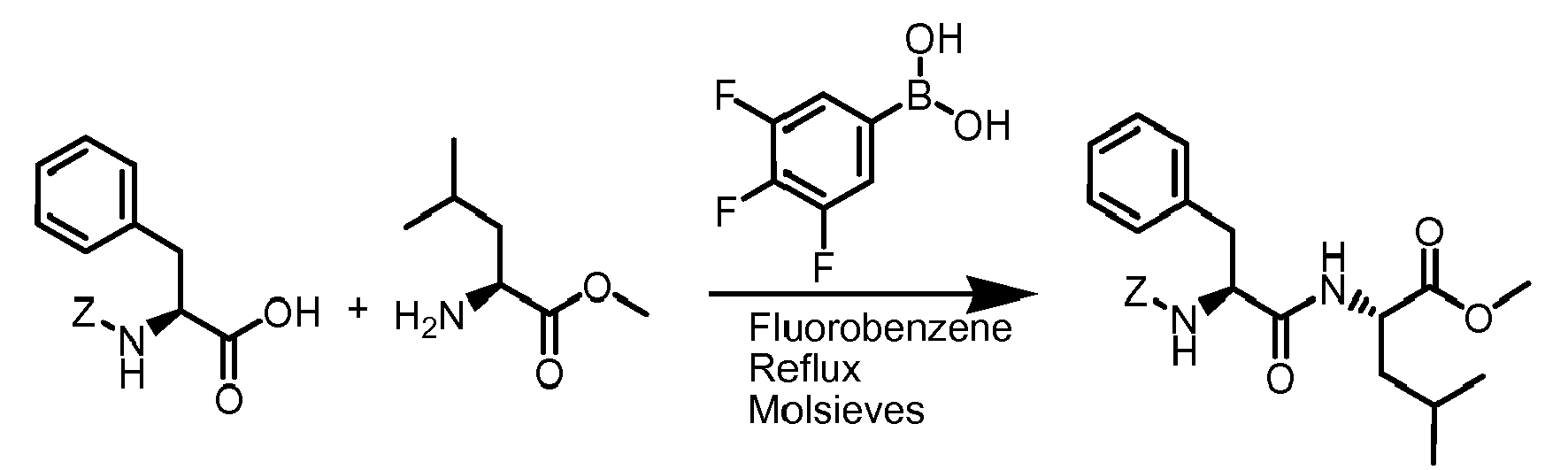
- To 73 mg H-Leu-OMe (0.5 mmol) were added 150 mg Z-Phe-OH (0.5 mmol, 1 equiv.), 4 mg 3,4,5-trifluorophenylboronic acid (0.025 mmol, 5 mol%) and 10 mL fluorobenzene. This mixture was heated under reflux for 16 h using a Dean-Stark distilling trap filled with 10 g of 3 A molsieves. HPLC (method 1) indicated that 18% Z-Phe-OH had been converted and only Z-Phe-Leu-OMe had been formed. Analytical HPLC (method 4) indicated a d.e. of 86%.
-

- To 94 mg H-Leu-O t Bu (0.5 mmol) were added 150 mg Z-Phe-OH (0.5 mmol, 1 equiv.), 7 mg dimesityleneborinic acid (0.025 mmol, 5 mol%) and 10 mL toluene. This mixture was heated under reflux for 16 h using a Dean-Stark distilling trap filled with 10 g of 3 A molsieves. HPLC (method 1) indicated that 64% Z-Phe-OH had been converted and only Z-Phe-Leu-O t Bu had been formed. Analytical HPLC (method 3) indicated a d.e. of 53%.
-

- To 130 mg H-Leu-NH2 (L-leucine amide, 1 mmol) were added 299 mg Z-Phe-OH (1 mmol, 1 equiv.), 8 mg 2,6-difluorophenylboronic acid (0.05 mmol, 5 mol%) and 20 mL toluene. This mixture was heated under reflux for 16 h using a dropping funnel with pressure equalizer filled with cotton wool and 3 g of CaH2. HPLC (method 1) indicated that 50% Z-Phe-OH had been converted and only Z-Phe-Leu-NH2 had been formed. Analytical HPLC (method 1) indicated a d.e. of 35%.
-

- To 187 mg H-Leu-NH2 (1 mmol) were added 299 mg Z-Phe-OH (1 mmol, 1 equiv.), 3 mg boric acid (0.05 mmol, 5 mol%) and 20 mL toluene. This mixture was heated under reflux for 16 h using a dropping funnel with pressure equalizer filled with cotton wool and 3 g of CaH2. HPLC (method 1) indicated that 48% Z-Phe-OH had been converted and only Z-Phe-Leu-NH2 had been formed. Analytical HPLC (method 1) indicated a d.e. of 29%.
-
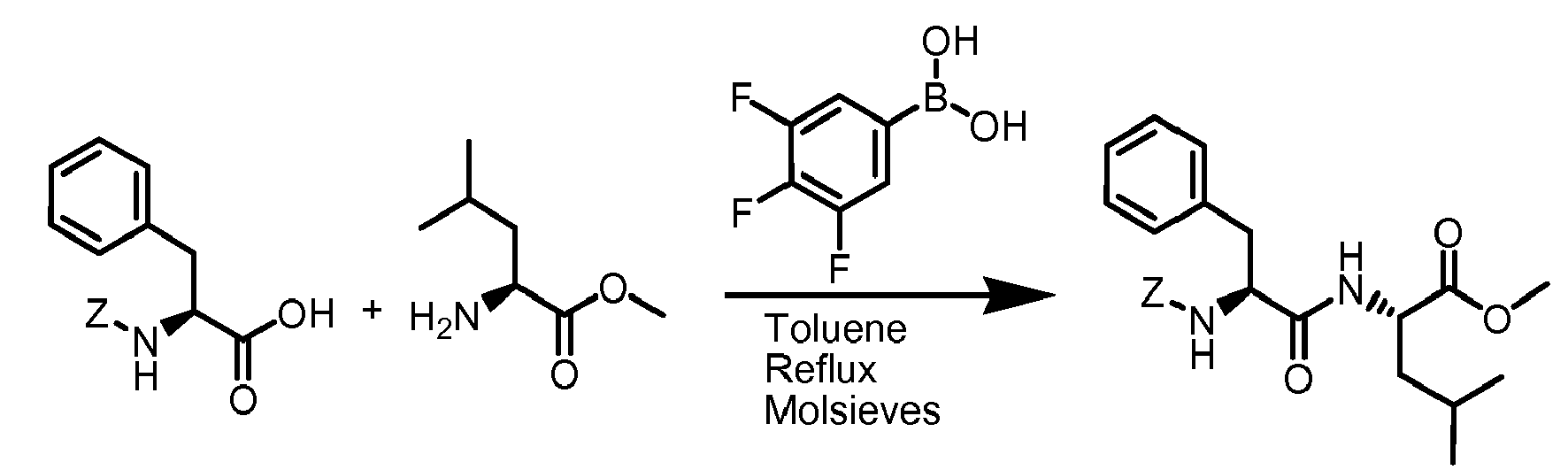
- To 73 mg H-Leu-OMe (0.5 mmol) were added 150 mg Z-Phe-OH (0.5 mmol, 1 equiv.), 4 mg 3,4,5-trifluorophenylboronic acid (0.025 mmol, 5 mol%) and 10 mL toluene. This mixture was heated under reflux under reduced pressure (511 mbara) for 7 h using a Dean-Stark distilling trap filled with 10 g of 3 A molsieves. HPLC (method 1) indicated that 22% Z-Phe-OH had been converted and only Z-Phe-Leu-OMe had been formed. Analytical HPLC (method 4) indicated a d.e. of 97%.
-

- To 91 mg H-Leu-OMe·HCl (0.5 mmol) were added 150 mg Z-Phe-OH (0.5 mmol, 1 equiv.), 4 mg 3,4,5-trifluorophenylboronic acid (0.025 mmol, 5 mol%), 8.3 µL N,N-diisopropylethylamine (0,05 mmol) and 10 mL toluene. This mixture was heated under reflux under reduced pressure (511 mbara) for 24 h using a Dean-Stark distilling trap filled with 10 g of 3 A molsieves. HPLC (method 1) indicated that 16% Z-Phe-OH had been converted and only Z-Phe-Leu-OMe had been formed. Analytical HPLC (method 4) indicated a d.e. of 94%.
-

- To 150 mg Z-Phe-OH (0.5 mmol) were added 468 mg H-Leu-O t Bu (2.5 mmol, 5 equiv.), 4 mg 3,4,5-trifluorophenylboronic acid (0.025 mmol, 5 mol%), and 10 mL toluene. This mixture was refluxed for 66 h using a dropping funnel with pressure equalizer filled with cotton wool and 3 g molsieves. HPLC (method 1) indicated that 60% Z-Phe-OH had been converted and only Z-Phe-Leu-O t Bu had been formed. Analytical HPLC (method 3) indicated a d.e. of 85%.
-

- To 73 mg H-Leu-OMe (0.5 mmol) were added 150 mg Z-Phe-OH (0.5 mmol, 1 equiv.), 4 mg 4,5,6,7-tetrachlorobenzo[d][1,3,2]dioxaborole (0.025 mmol, 5 mol%) and 10 mL toluene. This mixture was heated under reflux under reduced pressure (511 mbara) for 17 h using a Dean-Stark distilling trap filled with 10 g of 3 A molsieves. HPLC (method 1) indicated that 40% Z-Phe-OH had been converted and only Z-Phe-Leu-OMe had been formed. Analytical HPLC (method 4) indicated a d.e. of 90%.
-

- To 73 mg H-Leu-OMe (0.5 mmol) were added 150 mg Z-Phe-OH (0.5 mmol, 1 equiv.), 4 mg 3,4,5-trifluorophenylboronic acid (0.025 mmol, 5 mol%) and 10 mL toluene. The reaction was heated to distill off the wet toluene while new dry toluene was added dropwise to maintain a constant reaction volume. HPLC (method 1) indicated that after 5.5 hours 35% Z-Phe-OH had been converted and only Z-Phe-Leu-OMe had been formed. Analytical HPLC (method 4) indicated a d.e. of 84%.
Claims (13)
- Method of synthesising a dipeptide, an oligopeptide or a polypeptide comprising coupling a first amino acid or peptide to a second amino acid or peptide in the presence of a boron compound comprising a boron oxygen bond, which boron compound catalyses the formation of a peptidic bond, wherein one of the stereoisomers is formed in excess of the other stereoisomer or - in case more than two stereoisomers of the peptide exist - in excess of each of the other stereoisomers, alone or taken together.
- Method according to claim 1, wherein the first amino acid or peptide is an N-terminal protected amino acid or peptide and/or wherein the second amino acid or peptide is a C-terminal protected amino acid or peptide.
- Method for synthesising a cyclic oligopeptide or a cyclic polypeptide, comprising forming a peptidic bond between the N-terminal amino group and the C-terminal carboxylic acid group of an oligopeptide or polypeptide, in the presence of a boron compound, which boron compound catalyses the formation of a peptidic bond, wherein one of the stereoisomers is formed in excess of the other stereoisomer or - in case more than two stereoisomers of the peptide exist - in excess of each of the other stereoisomers, alone or taken together.
- Method according to claim 1, 2 or 3, wherein the boron compound is selected from the group of boric acid, borinic acids, boronic acids and organoboranes.
- Method according to claim 4, wherein the boron compound comprises an aryl group to which a boron atom is directly bound.
- Method according to claim 5, wherein the aryl group comprises at least one (further) electron withdrawing substituent, preferably at least one substituent selected from the group of halogen atoms, partially halogenated alkyl groups and fully halogenated alkyl groups.
- Method according to claim 6, wherein the boron compound is selected from the group of 2,6-difluorophenylboronic acid, 3,4,5-trifluorophenylboronic acid, 4-bromo-2,3,5,6 tetrafluorophenylboronic acid, dimesitylene borinic acid and 4,5,6,7-tetrachlorobenzo[d][1,3,2]dioxaborole.
- Method according to any of the preceding claims, wherein water - formed as a side-product of the coupling reaction - is removed from a reaction medium wherein the coupling is carried out.
- Method according to any of the preceding claims, wherein the stereoisomer formed in excess of the other stereoisomer or other stereoisomers is synthesised with an enantiomeric excess or a diastereomeric excess of at least 30 %, preferably with an enantiomeric excess or a diastereomeric excess of at least 50 %, in particular with an enantiomeric excess or a diastereomeric excess of at least 65 %, more in particular with an enantiomeric excess or a diastereomeric excess of at least 85 %.
- Method according to any of the preceding claims, wherein the boron compound is dissolved in a solution also comprising the first amino acid or peptide and the second amino acid or peptide.
- Method according to any of the claims 1-9, wherein the boron compound is immobilised on a support.
- Use of a boron compound comprising a boron oxygen bond as a catalyst in the preparation of a stereomerically pure peptide.
- Use according to claim 12, wherein the boron compound is a boron compound as described in any of the claims 4, 5, 6, 7 or 11.
Priority Applications (1)
| Application Number | Priority Date | Filing Date | Title |
|---|---|---|---|
| EP08154034A EP2107067A1 (en) | 2008-04-03 | 2008-04-03 | Boron catalysed peptide synthesis |
Applications Claiming Priority (1)
| Application Number | Priority Date | Filing Date | Title |
|---|---|---|---|
| EP08154034A EP2107067A1 (en) | 2008-04-03 | 2008-04-03 | Boron catalysed peptide synthesis |
Publications (1)
| Publication Number | Publication Date |
|---|---|
| EP2107067A1 true EP2107067A1 (en) | 2009-10-07 |
Family
ID=39708301
Family Applications (1)
| Application Number | Title | Priority Date | Filing Date |
|---|---|---|---|
| EP08154034A Withdrawn EP2107067A1 (en) | 2008-04-03 | 2008-04-03 | Boron catalysed peptide synthesis |
Country Status (1)
| Country | Link |
|---|---|
| EP (1) | EP2107067A1 (en) |
Cited By (2)
| Publication number | Priority date | Publication date | Assignee | Title |
|---|---|---|---|---|
| US12036286B2 (en) | 2021-03-18 | 2024-07-16 | Seagen Inc. | Selective drug release from internalized conjugates of biologically active compounds |
| RU2860564C1 (en) * | 2025-07-03 | 2026-04-21 | Общество с ограниченной ответственностью "ГрафтБио" | Method for obtaining peptide complex |
Citations (3)
| Publication number | Priority date | Publication date | Assignee | Title |
|---|---|---|---|---|
| US4764440A (en) | 1987-05-05 | 1988-08-16 | Eveready Battery Company | Low temperature molten compositions |
| US5892124A (en) | 1996-12-27 | 1999-04-06 | Institut Français Du Petrole | Process for dienoic condensation known as the diels-alder reaction |
| WO2002026381A2 (en) | 2000-09-27 | 2002-04-04 | Scionix Limited | Ionic liquids and their use |
-
2008
- 2008-04-03 EP EP08154034A patent/EP2107067A1/en not_active Withdrawn
Patent Citations (3)
| Publication number | Priority date | Publication date | Assignee | Title |
|---|---|---|---|---|
| US4764440A (en) | 1987-05-05 | 1988-08-16 | Eveready Battery Company | Low temperature molten compositions |
| US5892124A (en) | 1996-12-27 | 1999-04-06 | Institut Français Du Petrole | Process for dienoic condensation known as the diels-alder reaction |
| WO2002026381A2 (en) | 2000-09-27 | 2002-04-04 | Scionix Limited | Ionic liquids and their use |
Non-Patent Citations (7)
| Title |
|---|
| LATTA, SYNTHESIS, no. 11, 28 August 2001 (2001-08-28), pages 1611 - 1613 |
| MONTALBETTI ET AL: "Amide bond formation and peptide coupling", TETRAHEDRON, ELSEVIER SCIENCE PUBLISHERS, AMSTERDAM, NL, vol. 61, no. 46, 14 November 2005 (2005-11-14), pages 10827 - 10852, XP005131356, ISSN: 0040-4020 * |
| N. SEWALD; H.-D. JAKUBKE: "Peptides: Chemistry and Biology", 2002, WILEY-VCH |
| N. SEWALD; H.-D. JAKUBKE: "Peptides: Chemistry and Biology", 2002, WILEY-VCH, pages: 184 - 204 |
| N. SEWALD; H.-D. JAKUBKE: "Peptides: Chemistry and Biology", vol. 4, 2002, WILEY-VCH |
| PELTER A ET AL: "SOME AMIDE FORMING REACTIONS INVOLVING BORON REAGENTS", TETRAHEDRON, vol. 26, no. 6, 1970, pages 1539 - 1544, XP002493630, ISSN: 0040-4020 * |
| VAN LEEUWEN S H ET AL: "The synthesis of amides and dipeptides from unprotected amino acids by a simultaneous protection-activation strategy using boron trifluoride diethyl etherate", TETRAHEDRON LETTERS, ELSEVIER, AMSTERDAM, vol. 46, no. 4, 24 January 2005 (2005-01-24), pages 653 - 656, XP004695938, ISSN: 0040-4039 * |
Cited By (2)
| Publication number | Priority date | Publication date | Assignee | Title |
|---|---|---|---|---|
| US12036286B2 (en) | 2021-03-18 | 2024-07-16 | Seagen Inc. | Selective drug release from internalized conjugates of biologically active compounds |
| RU2860564C1 (en) * | 2025-07-03 | 2026-04-21 | Общество с ограниченной ответственностью "ГрафтБио" | Method for obtaining peptide complex |
Similar Documents
| Publication | Publication Date | Title |
|---|---|---|
| O'Donnell et al. | Enantioselective solid-phase synthesis of α-amino acid derivatives | |
| Liu et al. | Simultaneous deprotection and purification of BOC-amines based on ionic resin capture | |
| FI102379B (en) | Urethane-protected amino acid N-carboxyanhydrides | |
| Reichwein et al. | Synthesis of cyclic peptides by ring-closing metathesis | |
| KR100861031B1 (en) | Process for rapid solution synthesis of peptides | |
| US20230242572A1 (en) | a-CARBONYL ALKENYL ESTER PREPARATION METHOD THEREFOR AND APPLICATION THEREOF | |
| JP4803352B2 (en) | Process for producing amino acid-N-carboxyanhydride | |
| HU228392B1 (en) | Process for producing n-carboxi-anhidrides | |
| Inokuma | Synthesis of non-canonical amino acids and peptide containing them for establishment of the template for drug discovery | |
| EP2107067A1 (en) | Boron catalysed peptide synthesis | |
| Métro et al. | Amino Acids and Peptides in Ball Milling | |
| Zhou et al. | Chiral polyamines from reduction of polypeptides: asymmetric pyridoxamine-mediated transaminations | |
| Cativiela et al. | Efficient access to all four stereoisomers of phenylalanine cyclopropane analogues by chiral HPLC | |
| Damer et al. | Rh‐Catalyzed Hydroamination of Allenes: Asymmetric N‐Allylation of Amino Acids and Peptides | |
| US11453648B2 (en) | Method for producing orotic acid derivative | |
| KR20090021361A (en) | Pseudoproline Dipeptide | |
| Herrera-Guzmán et al. | A practical method for the synthesis of small peptides using DCC and HOBt as activators in H 2 O–THF while avoiding the use of protecting groups | |
| JP7688397B2 (en) | Methods for producing peptides | |
| JP3996671B2 (en) | Method for producing N-alkoxycarbonylated, N-alkenyloxycarbonylated or N-arylalkoxycarbonylated amino acids | |
| AU2009224802C1 (en) | Peptide synthesis method using N-carboxyanhydride (UNCA) | |
| Demin et al. | Synthesis of glutaryl-containing derivatives of GRGD and KRGD peptides | |
| Ferron et al. | Design and scalable synthesis of new chiral selectors. Part 1: Synthesis and characterization of a new constrained cyclopeptide from unnatural bulky amino acids | |
| JP2011503226A (en) | Stereoselective production method of amino acid derivatives | |
| JP4378745B2 (en) | Novel carbonic acid ester and amidation reaction using the same | |
| FR3016879A1 (en) | PROCESS FOR THE PREPARATION OF N-ACYL BENZOTRIAZOLE |
Legal Events
| Date | Code | Title | Description |
|---|---|---|---|
| PUAI | Public reference made under article 153(3) epc to a published international application that has entered the european phase |
Free format text: ORIGINAL CODE: 0009012 |
|
| AK | Designated contracting states |
Kind code of ref document: A1 Designated state(s): AT BE BG CH CY CZ DE DK EE ES FI FR GB GR HR HU IE IS IT LI LT LU LV MC MT NL NO PL PT RO SE SI SK TR |
|
| AX | Request for extension of the european patent |
Extension state: AL BA MK RS |
|
| STAA | Information on the status of an ep patent application or granted ep patent |
Free format text: STATUS: THE APPLICATION HAS BEEN WITHDRAWN |
|
| 18W | Application withdrawn |
Effective date: 20100121 |