EP2106138B1 - System and method for digital rights management control using video analytics - Google Patents
System and method for digital rights management control using video analytics Download PDFInfo
- Publication number
- EP2106138B1 EP2106138B1 EP08251587A EP08251587A EP2106138B1 EP 2106138 B1 EP2106138 B1 EP 2106138B1 EP 08251587 A EP08251587 A EP 08251587A EP 08251587 A EP08251587 A EP 08251587A EP 2106138 B1 EP2106138 B1 EP 2106138B1
- Authority
- EP
- European Patent Office
- Prior art keywords
- video
- payment card
- frame
- rights management
- digital rights
- Prior art date
- Legal status (The legal status is an assumption and is not a legal conclusion. Google has not performed a legal analysis and makes no representation as to the accuracy of the status listed.)
- Active
Links
Images





Classifications
-
- H—ELECTRICITY
- H04—ELECTRIC COMMUNICATION TECHNIQUE
- H04N—PICTORIAL COMMUNICATION, e.g. TELEVISION
- H04N21/00—Selective content distribution, e.g. interactive television or video on demand [VOD]
- H04N21/80—Generation or processing of content or additional data by content creator independently of the distribution process; Content per se
- H04N21/83—Generation or processing of protective or descriptive data associated with content; Content structuring
- H04N21/835—Generation of protective data, e.g. certificates
-
- H—ELECTRICITY
- H04—ELECTRIC COMMUNICATION TECHNIQUE
- H04N—PICTORIAL COMMUNICATION, e.g. TELEVISION
- H04N21/00—Selective content distribution, e.g. interactive television or video on demand [VOD]
- H04N21/20—Servers specifically adapted for the distribution of content, e.g. VOD servers; Operations thereof
- H04N21/23—Processing of content or additional data; Elementary server operations; Server middleware
- H04N21/234—Processing of video elementary streams, e.g. splicing of video streams or manipulating encoded video stream scene graphs
- H04N21/23418—Processing of video elementary streams, e.g. splicing of video streams or manipulating encoded video stream scene graphs involving operations for analysing video streams, e.g. detecting features or characteristics
-
- H—ELECTRICITY
- H04—ELECTRIC COMMUNICATION TECHNIQUE
- H04N—PICTORIAL COMMUNICATION, e.g. TELEVISION
- H04N21/00—Selective content distribution, e.g. interactive television or video on demand [VOD]
- H04N21/20—Servers specifically adapted for the distribution of content, e.g. VOD servers; Operations thereof
- H04N21/23—Processing of content or additional data; Elementary server operations; Server middleware
- H04N21/234—Processing of video elementary streams, e.g. splicing of video streams or manipulating encoded video stream scene graphs
- H04N21/2343—Processing of video elementary streams, e.g. splicing of video streams or manipulating encoded video stream scene graphs involving reformatting operations of video signals for distribution or compliance with end-user requests or end-user device requirements
- H04N21/234318—Processing of video elementary streams, e.g. splicing of video streams or manipulating encoded video stream scene graphs involving reformatting operations of video signals for distribution or compliance with end-user requests or end-user device requirements by decomposing into objects, e.g. MPEG-4 objects
-
- H—ELECTRICITY
- H04—ELECTRIC COMMUNICATION TECHNIQUE
- H04N—PICTORIAL COMMUNICATION, e.g. TELEVISION
- H04N21/00—Selective content distribution, e.g. interactive television or video on demand [VOD]
- H04N21/20—Servers specifically adapted for the distribution of content, e.g. VOD servers; Operations thereof
- H04N21/25—Management operations performed by the server for facilitating the content distribution or administrating data related to end-users or client devices, e.g. end-user or client device authentication, learning user preferences for recommending movies
- H04N21/254—Management at additional data server, e.g. shopping server, rights management server
- H04N21/2541—Rights Management
-
- H—ELECTRICITY
- H04—ELECTRIC COMMUNICATION TECHNIQUE
- H04N—PICTORIAL COMMUNICATION, e.g. TELEVISION
- H04N21/00—Selective content distribution, e.g. interactive television or video on demand [VOD]
- H04N21/40—Client devices specifically adapted for the reception of or interaction with content, e.g. set-top-box [STB]; Operations thereof
- H04N21/45—Management operations performed by the client for facilitating the reception of or the interaction with the content or administrating data related to the end-user or to the client device itself, e.g. learning user preferences for recommending movies, resolving scheduling conflicts
- H04N21/454—Content or additional data filtering, e.g. blocking advertisements
- H04N21/4545—Input to filtering algorithms, e.g. filtering a region of the image
- H04N21/45452—Input to filtering algorithms, e.g. filtering a region of the image applied to an object-based stream, e.g. MPEG-4 streams
-
- H—ELECTRICITY
- H04—ELECTRIC COMMUNICATION TECHNIQUE
- H04N—PICTORIAL COMMUNICATION, e.g. TELEVISION
- H04N21/00—Selective content distribution, e.g. interactive television or video on demand [VOD]
- H04N21/40—Client devices specifically adapted for the reception of or interaction with content, e.g. set-top-box [STB]; Operations thereof
- H04N21/45—Management operations performed by the client for facilitating the reception of or the interaction with the content or administrating data related to the end-user or to the client device itself, e.g. learning user preferences for recommending movies, resolving scheduling conflicts
- H04N21/462—Content or additional data management e.g. creating a master electronic programme guide from data received from the Internet and a Head-end or controlling the complexity of a video stream by scaling the resolution or bit-rate based on the client capabilities
- H04N21/4627—Rights management associated to the content
-
- H—ELECTRICITY
- H04—ELECTRIC COMMUNICATION TECHNIQUE
- H04N—PICTORIAL COMMUNICATION, e.g. TELEVISION
- H04N21/00—Selective content distribution, e.g. interactive television or video on demand [VOD]
- H04N21/80—Generation or processing of content or additional data by content creator independently of the distribution process; Content per se
- H04N21/83—Generation or processing of protective or descriptive data associated with content; Content structuring
- H04N21/835—Generation of protective data, e.g. certificates
- H04N21/8355—Generation of protective data, e.g. certificates involving usage data, e.g. number of copies or viewings allowed
-
- H—ELECTRICITY
- H04—ELECTRIC COMMUNICATION TECHNIQUE
- H04N—PICTORIAL COMMUNICATION, e.g. TELEVISION
- H04N7/00—Television systems
- H04N7/16—Analogue secrecy systems; Analogue subscription systems
- H04N7/173—Analogue secrecy systems; Analogue subscription systems with two-way working, e.g. subscriber sending a programme selection signal
- H04N7/17309—Transmission or handling of upstream communications
- H04N7/17318—Direct or substantially direct transmission and handling of requests
Definitions
- This invention is related to the field of video analytics.
- this invention is related to the configuration of digital rights management for a video through the use of video analytics.
- Digital rights management is used to control the viewing and copying of digital files such as music recordings. For example, a musician may wish to sell digital copies of their music, but prevent the purchaser from distributing copies of the music.
- DRM may be used to allow users to view a video over the Internet, but prevent them from saving a copy of the video.
- DRM is also useful for the protection of sensitive data within a company. For example, DRM for a computer file may be configured to allow access and copying by certain users, and to prevent access by all other users. Such uses of DRM to protect the intellectual property rights of owners of digital files have become widespread.
- a video monitoring system may include a large number of cameras continually streaming video to a video processing system. Some of these cameras may capture sensitive information, while others only capture non-critical information. Still other cameras may pan into sensitive areas, while others may capture sensitive information periodically while normally capturing non-critical information. Configuring DRM for such a system is enormously complicated since the desired configuration not only varies from camera to camera, but also varies within the video stream from a single camera.
- BROWN ET AL "Enabling Video Privacy through Computer Vision", IEEE SECURITY AND PRIVACY, IEEE COMPUTER SOCIETY, NEW YORK, NY, US, vol. 3, no.
- a method for controlling digital rights management of video comprising:
- Configuring digital rights management may include prohibiting copying frames of the video that show the payment card while allowing copying frames of the video that do not show the payment card.
- Processing at least one frame from the video may comprise detecting an object other than the payment card shown in the video frame; and configuring digital rights management for the video frame separately for the payment card and the object other than the payment card.
- Processing at least one frame from the video may comprise detecting an event shown in the video frame, wherein the event is indicated by the signal; and in response to the signal, configuring digital rights management for the video frame based on the detection of the event.
- a video processing system comprising:
- a computer-readable medium having instructions stored thereon for operating a computer system, wherein the instructions, when executed by the computer system, direct the computer system to receive a video, comprising a plurality of frames, and wherein the instructions further direct the computer system to:
- Figure 1 is a block diagram illustrating a video system for controlling digital rights management of video data
- Figure 2 is a flow diagram illustrating a method for controlling digital rights management of video data
- Figure 3 is a block diagram illustrating a video system for controlling digital rights management of video data
- Figure 4 is a flow diagram illustrating a method for controlling digital rights management of video data
- Figure 5 is a flow diagram illustrating a method for controlling digital rights management of video data
- Figure 6 is a flow diagram illustrating a method for controlling digital rights management of video data
- Figure 7 is an illustration of an example video frame in a video system for controlling digital rights management of video data
- Figure 8 is an illustration of an example video frame in a video system for controlling digital rights management of video data
- Figure 9 is an illustration of an example video frame in a video system for controlling digital rights management of video data
- Figure 10 is an illustration of an example video frame in a video system for controlling digital rights management of video data.
- Figure 11 is a block diagram illustrating a computer system including a computer configured to operate as a video processing system for controlling digital rights management of video data.
- DRM digital rights management
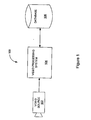
- FIG. 1 is a block diagram illustrating a video system 100 for controlling digital rights management (DRM) of video data.
- video processing system 104 is coupled with video source 102 and database 106.
- Video source 102 captures video and passes this data to video processing system 104 which analyzes the video, configures the digital rights management for the video, and stores the video in database 106.
- Other embodiments of video processing system 104 may pass video data from video source 102 directly to database 106 for recording, and then process the video retrieved from database 106 at a later time.
- Video processing system 104 analyzes the video to determine the contents of the video and then configures the digital rights management for application to the video.
- Digital rights management may be configured to apply to an entire video stream, or portions of video data.
- a video stream recording a transaction at a cashier's register may include video of the cashier scanning a customer's items, then accepting a credit card from the customer in payment for the items. While the scanning operation may not be worth protecting, the customer's credit card number must be protected by digital rights management.
- This example demonstrates two functions of video processing system 104. First, video processing system 104 detects the presence of the credit card, or other object, in the video. Next, video processing system 104 configures the DRM for the video to protect the credit card information.
- video processing system 104 may analyze individual frames of the video stream to detect any objects in the video appearing to be credit cards.
- video processing system 104 may receive a signal from the cashier's station that a credit card is in use, such as when the customer swipes the card in a credit card reader. This signal may act to trigger video processing system 104 to begin analysis of the video looking for credit cards in the frames of the video stream, or to begin DRM at that time in the video.
- DRM may be applied to the portion of the video where the customer's credit card is visible.
- the DRM may be configured to allow copying of the video except for the portion where the credit card is in sight.
- This DRM may be configured in any of a variety of methods.
- the DRM may be configured to obscure the video during the portion of the data stream where the credit card is visible.
- video processing system 104 may configure the DRM for the video such that when the video is read from database 106, only the portions of the video where the credit card is not visible are read.
- Other embodiments may obscure portions of the frames of the video where the credit card is located. This allows a user to see all of the transaction but not the credit card itself. This example is illustrated in Figures 9 and 10 and described below.
- FIG. 2 is a flow diagram illustrating a method for controlling digital rights management of video data. Reference numbers from Figure 2 are indicated parenthetically below.
- Video processing system 104 receives a video from video source 102, (operation 200 ). Video processing system 104 then processes at least one frame from the video to determine the contents of the video, (operation 202 ). Video processing system 104 next configures the digital rights management for the video based on the contents of the video, (operation 204 ). As discussed above, this configuration of the DRM may take a wide variety of forms, including applying DRM to the entire video, applying DRM to some portion of the video, or applying DRM to some locations or objects within the video. Some embodiments may configure the DRM to control how many times a user may view the video, or to prevent copying the video or burning the video to a CD, DVD, hard drive, or other storage device.
- FIG 3 is a block diagram illustrating a video system 300 for controlling digital rights management of video data. Similar to the video system 100 illustrated in Figure 1 , video processing system 104 is coupled with video source 102, and database 106. This example also includes video source 302 also coupled with video processing system 104 and computer system 304 coupled with database 106. Video processing system 104 analyses video from video source 102, video source 302, and database 106 and configures DRM for this video to control the access that computer system 304 has to the video data stored on database 106.
- the DRM may be configured to allow only certain users of computer system 304 access to video data in database 106, or it may be configured to block or obscure portions of videos stored in database 106 when they are accessed by computer system 304.
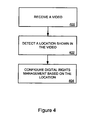
- FIG. 4 is a flow diagram illustrating a method for controlling digital rights management of video data. Reference numbers from Figure 4 are indicated parenthetically below. As discussed above, it may be desired to configure DRM for a video such that some locations shown in the video, such as a pharmacy counter, have a different level of protection than other locations.
- Video processing system 104 receives a video from video source 102, video source 302, or database 106, (operation 400 ). Video processing system 104 detects a location shown in the video stream, (operation 402 ). Video processing system 104 then configures the digital rights management for the video based on the location, (operation 404 ).
- the DRM may be configured to allow unlimited copying of portions of the video showing some locations while prohibiting copying of portions of the video showing other locations. Some examples may obscure some locations within the video when accessed by some users, while allowing other users to view all locations within the video.
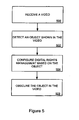
- FIG. 5 is a flow diagram illustrating a method for controlling digital rights management of video data. Reference numbers from Figure 5 are indicated parenthetically below. As discussed above, it may be desired to configure DRM for a video stream such that some objects shown in the video, such as a credit card, have a different level of protection than other locations.
- Video processing system 104 receives a video from video source 102, video source 302, or database 106, (operation 500 ). Video processing system 104 detects an object shown in the video, (operation 502 ). Video processing system 104 then configures the digital rights management for the video based on the object, (operation 504 ). Optionally, video processing system 104 obscures the object in the video, (operation 506 ).
- the DRM may be configured to allow unlimited copying of portions of the video showing some objects while prohibiting copying of portions of the video showing other objects.
- the entire video may contain sensitive objects, requiring the DRM to be configured to prohibit copying of the entire video.
- Some examples may obscure some objects within the video when accessed by some users, while allowing other users to view the entire frame of the video.
- any object containing personal information such as a driver's license, social security card, credit card, debit card, check book, cell phone screens, and other such objects may be detected and protected by video processing system 104.
- video processing system 104 may be configured to detect a wide variety of objects and to configure DRM separately for each object.
- a plurality of sensitive objects may be present in a single video frame, and video processing system 104 may configure DRM based on these different objects.
- faces may be detected and obscured to prevent identification of individuals, and protect their privacy. This may be important in such cases as witness interviews, surveys, and the like where individual privacy rights are important.
- FIG. 6 is a flow diagram illustrating a method for controlling digital rights management of video data. Reference numbers from Figure 6 are indicated parenthetically below.
- Video processing system 104 receives a video from video source 102, video source 302, or database 106, (operation 600 ).
- Video processing system 104 detects an event shown in the video, (operation 602 ).
- Video processing system 104 then configures the digital rights management for the video based on the event, (operation 604 ).
- video processing system 104 obscures at least a portion of the video during the event, (operation 606 ).
- the DRM may be configured to allow unlimited copying of portions of the video showing some events while prohibiting copying of portions of the video showing other events. Some examples may obscure a portion of the video during the event when accessed by some users, while allowing other users to view the entire video.
- FIG 7 is an illustration of an example video frame 700 in a video system for controlling digital rights management of video data.
- This example video frame 700 includes product shelf 702 and product shelf 704.
- product shelf 704 contains items with higher privacy expectations than product shelf 702.
- product shelf 704 may contain pharmaceuticals, while product shelf 702 may contain breakfast cereal.
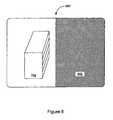
- FIG 8 is an illustration of an example video frame 800 in a video system for controlling digital rights management of video data.
- product shelf 704 has been obscured by video processing system 104 such that a black screen 802 covers the area within video frame 800 occupied by product shelf 704, while product shelf 702 is fully visible.
- This selective DRM may be applied on a frame-by-frame basis in the situation where a camera pans, shifts, or zooms over protected areas.
- FIG 9 is an illustration of an example video frame 900 in a video system for controlling digital rights management of video data.
- customer 902 stands at counter 914 while clerk 904 scans a quantity of items 910 that customer 902 is purchasing.
- Clerk 904 scans each item 910 over the scanner 906 and then places the items 910 on conveyor belt 908.
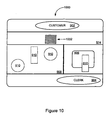
- customer 902 has placed their credit card 912 on counter 914 prior to paying for the items 910. Since the information printed on the customer's 902 credit card 912 is sensitive, it is desired to apply DRM selectively to credit card 912 while allowing video of the remainder of the transaction to be freely read and copied.
- DRM may be configured to selectively apply to credit card 912 using the method illustrated in Figure 5 .
- FIG 10 is an illustration of an example video frame 1000 in a video system for controlling digital rights management of video data.
- credit card 912 has been obscured by a black box 1002 within the video frame 1000.
- Other embodiments may configure the DRM for this video to prohibit viewing and copying of frames where credit card 912 is visible, while this example simply obscures credit card 912.
- This selective DRM may be applied on a frame-by-frame basis in the situation where a camera pans, shifts, or zooms over protected objects.
- video system 300 may be, comprise, or include computer systems. This includes, but is not limited to video processing system 104, database 106, and computer system 304. These computer systems are illustrated, by way of example, in Figure 11 .
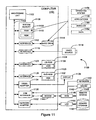
- FIG 11 is a block diagram illustrating a computer system 1100 including a computer 1101 configured to operate as a video processing system 104, such as that illustrated in Figures 1 and 3 .
- Computer system 1100 includes computer 1101 which in turn includes processing unit 1102, system memory 1106, and system bus 1104 that couples various system components including system memory 1106 to processing unit 1102.
- Processing unit 1102 may be any of a wide variety of processors or logic circuits, including the Intel X86 series, Pentium, Itanium, and other devices from a wide variety of vendors.
- Processing unit 1102 may include a single processor, a dual-core processor, a quad-core processor or any other configuration of processors, all within the scope of the present invention.
- Computer 1101 could be comprised of a programmed general-purpose computer, although those skilled in the art will appreciate that programmable or special purpose circuitry and equipment may be used.
- Computer system 1100 may be distributed among multiple devices that together comprise elements 1102-1162.
- System bus 1104 architectures such as PCI, VESA, Microchannel, ISA, and EISA, available for use within computer 1101, and in some embodiments multiple system buses may be used within computer 1101.
- System memory 1106 includes random access memory (RAM) 1108, and read only memory (ROM) 1110.
- System ROM 1110 may include a basic input/output system (BIOS), which contains low-level routines used in transferring data between different elements within the computer, particularly during start-up of the computer.
- BIOS basic input/output system
- System memory 1106 can include any one or combination of volatile memory elements (e.g ., random access memory (RAM, such as DRAM, SRAM, SDRAM, etc .)) and nonvolatile memory elements (e.g ., ROM, hard drive, tape, CDROM, etc .). Moreover, system memory 1106 may incorporate electronic, magnetic, optical, and/or other types of storage media. Note that system memory 1106 can have a distributed architecture, where various components are situated remote from one another, but can be accessed by processing unit 1102.
- volatile memory elements e.g ., random access memory (RAM, such as DRAM, SRAM, SDRAM, etc .)
- nonvolatile memory elements e.g ., ROM, hard drive, tape, CDROM, etc .
- system memory 1106 may incorporate electronic, magnetic, optical, and/or other types of storage media. Note that system memory 1106 can have a distributed architecture, where various components are situated remote from one another, but can be accessed by processing unit 1102.
- Processing unit 1102 receives software instructions from system memory 1106 or other storage elements and executes these instructions directing processing unit 1102 to operate in a method as described herein.
- These software instructions may include operating system 1156, applications 1158, modules 1160, utilities, drivers, networking software, and data 1162.
- Software may comprise firmware, or some other form of machine-readable processing instructions.
- Computer 1101 also includes hard drive 1114 coupled to system bus 1104 through hard drive interface 1112, CD-ROM drive 1124 containing CD-ROM disk 1126 coupled to system bus 1104 through CD-ROM drive interface 1122, and DVD-ROM drive 1133 containing DVD-ROM disk 1132 coupled to system bus 1104 through DVD-ROM drive interface 1128.
- hard drive 1114 coupled to system bus 1104 through hard drive interface 1112
- CD-ROM drive 1124 containing CD-ROM disk 1126 coupled to system bus 1104 through CD-ROM drive interface 1122
- DVD-ROM drive 1133 containing DVD-ROM disk 1132 coupled to system bus 1104 through DVD-ROM drive interface 1128.
- storage elements such as flash memory cards and tape drives
- Computer 1101 further includes video interface 1122 coupled to processing unit 1102 through system bus 1104, configured to receive video data from a video source 1124.
- This video source 1124 may be any combination of video cameras, video players, video recorders, or any other devices capable of transmitting video data to computer 1101.
- Video source 1124 may correspond to video sources 102 and 302 shown in Figures 1 and 3 .
- Computer 1101 also includes video adaptor 1134 configured to drive display 1136, and universal serial bus (USB) interface 1138 configured to receive user inputs from keyboard 1140 and mouse 1142.
- USB interface 1138 is also configured to interface with modem 1144 allowing communication with remote system 1148 through a wide area network (WAN) 1146, such as the internet.
- WAN wide area network
- USB interface 1138 and network adaptor 1152 may be configured to operate as input ports capable of receiving video data from database 106 and as output ports to store videos and digital rights management configurations associated with the videos to database 106.
- Computer 1101 further includes network adaptor 1152 configured to communicate to remote system 1148 through a local area network (LAN) 1145.
- LAN local area network
- network adaptors 1152 and network configurations available to allow communication with remote systems 1148, and any may be used in other embodiments.
- networks may include Ethernet connections or wireless connections.
- Networks may be local to a single office or site, or may be as broad and inclusive as the Internet or Usenet.
- Remote systems 1148 may include memory storage 1150 in a very wide variety of configurations.
- each block can be interpreted to represent a module, segment, or portion of code, which comprises one or more executable instructions for implementing the specified logical function(s).
- the functions noted in the blocks may occur out of the order. For example, two blocks shown in succession may in fact be executed substantially concurrently or the blocks may sometimes be executed in the reverse order, depending upon the functionality involved.
- any of the programs listed herein can include an ordered listing of executable instructions for implementing logical functions (such as depicted in the flowcharts), can be embodied in any computer-readable medium for use by or in connection with an instruction execution system, apparatus, or device, such as a computer-based system, processor-containing system, or other system that can fetch the instructions from the instruction execution system, apparatus, or device and execute the instructions.
- a "computer-readable medium” can be any means that can contain, store, communicate, propagate, or transport the program for use by or in connection with the instruction execution system, apparatus, or device.
- the computer readable medium can be, for example but not limited to, an electronic, magnetic, optical, electromagnetic, infrared, or semiconductor system, apparatus, or device. More specific examples (a nonexhaustive list) of the computer-readable medium could include an electrical connection (electronic) having one or more wires, a portable computer diskette (magnetic), a random access memory (RAM) (electronic), a read-only memory (ROM) (electronic), an erasable programmable read-only memory (EPROM or Flash memory) (electronic), an optical fiber (optical), and a portable compact disc read-only memory (CDROM) (optical).
- the scope of the certain embodiments of this disclosure can include embodying the functionality described in logic embodied in hardware or software-configured mediums.
Landscapes
- Engineering & Computer Science (AREA)
- Multimedia (AREA)
- Signal Processing (AREA)
- Computer Security & Cryptography (AREA)
- Databases & Information Systems (AREA)
- Television Signal Processing For Recording (AREA)
- Management, Administration, Business Operations System, And Electronic Commerce (AREA)
- Two-Way Televisions, Distribution Of Moving Picture Or The Like (AREA)
- Testing, Inspecting, Measuring Of Stereoscopic Televisions And Televisions (AREA)
Description
- This invention is related to the field of video analytics. In particular, this invention is related to the configuration of digital rights management for a video through the use of video analytics.
- Digital rights management (DRM) is used to control the viewing and copying of digital files such as music recordings. For example, a musician may wish to sell digital copies of their music, but prevent the purchaser from distributing copies of the music. Likewise, DRM may be used to allow users to view a video over the Internet, but prevent them from saving a copy of the video. DRM is also useful for the protection of sensitive data within a company. For example, DRM for a computer file may be configured to allow access and copying by certain users, and to prevent access by all other users. Such uses of DRM to protect the intellectual property rights of owners of digital files have become widespread.
- In a video monitoring environment including a number of video sources, DRM becomes much more complicated. For example, a video monitoring system may include a large number of cameras continually streaming video to a video processing system. Some of these cameras may capture sensitive information, while others only capture non-critical information. Still other cameras may pan into sensitive areas, while others may capture sensitive information periodically while normally capturing non-critical information. Configuring DRM for such a system is enormously complicated since the desired configuration not only varies from camera to camera, but also varies within the video stream from a single camera.
BROWN ET AL: "Enabling Video Privacy through Computer Vision", IEEE SECURITY AND PRIVACY, IEEE COMPUTER SOCIETY, NEW YORK, NY, US, vol. 3, no. 3, 1 May 2005 (2005-05-01), pages 50-57, XP011134788 ISSN: 1540-7993, MOBILE MULTIMEDIA/IMAGE PROCESSING FOR MILITARY AND SECURITY APPLICATIONS 20 APRIL 2006 ORLANDO, FL, USA, vol. 6250, no. 1, 20 April 2006 (2006-04-20), pages 62500M-1, XP002549190 Proceedings of the SPIE - The International Society for Optical Engineering SPIE-Int Soc. Opt. Eng USA ISSN: 0277-786X, 2005 INTERNATIONAL CONFERENCE ON IMAGE PROCESSING, 11-14 SEPT. 2005 GENOVA, ITALY, 11 September 2005 (2005-09-11), - 14 September 2005 (2005-09-14) pages 11-868, XP002549191 2005 International Conference on Image Processing IEEE Piscataway, NJ, USA ISBN: 0-7803-9134-9, SCHIFF J ET AL: "Respectful cameras; detecting visual markers in real-time to address privacy concerns" INTELLIGENT ROBOTS AND SYSTEMS, 2007. IROS 2007. IEEE/RSJ INTERNATIONAL CONFERENCE ON, IEEE, PISCATAWAY, NJ, USA, 29 October 2007 (2007-10-29), pages 971-978, XP031222121 ISBN: 978-4244-0911-2,
all disclose systems and methods for controlling video privacy. - According to an aspect of the invention there is provided a method for controlling digital rights management of video, comprising:
- receiving a video comprising a plurality of frames;
- the method characterized by:
- receiving a signal from a transaction station indicating that a payment card is in use; in response to the signal, beginning analyzing the video for the purposes of digital rights management by processing at least one frame from the video to detect the payment card in the video frame; configuring digital rights management for the video frame to provide the frame with the payment card unobscured only to certain users for viewing and to provide the frame with the payment card obscured to other users.
- Configuring digital rights management may include prohibiting copying frames of the video that show the payment card while allowing copying frames of the video that do not show the payment card. Processing at least one frame from the video may comprise detecting an object other than the payment card shown in the video frame; and configuring digital rights management for the video frame separately for the payment card and the object other than the payment card.
- Processing at least one frame from the video may comprise detecting an event shown in the video frame, wherein the event is indicated by the signal; and in response to the signal, configuring digital rights management for the video frame based on the detection of the event.
- According to another aspect of the invention, there is provided a video processing system comprising:
- a video interface configured to receive video;
- a signal interface configured to receive signals from a transaction station; and
- a processor electrically coupled with the two interfaces;
- the processor configured to:
- receive a video from the video interface, comprising a plurality of frames;
- wherein the video processing system characterized by the processor configured to: receive a signal from the signal interface indicating that a payment card is in use;
- in response to the signal, process at least one frame from the video to detect the payment card in the video frame; and configure digital rights management for the video frame to provide the frame with the payment card unobscured only to certain users for viewing and to provide the frame with the payment card obscured to other users.
- According to a yet further aspect of the invention, there is provided a computer-readable medium having instructions stored thereon for operating a computer system, wherein the instructions, when executed by the computer system, direct the computer system to receive a video, comprising a plurality of frames, and wherein the instructions further direct the computer system to:
- receive a signal from a transaction station indicating that a payment card is in use;
- in response to the signal, begin analyzing the video for the purposes of digital rights management by processing at least one frame from the video to detect a payment card in the video frame; and configure digital rights management for the video frame by prohibiting copying frames of the video that show the payment card while allowing copying frames of the video that do not show the payment card and by providing the frame with the payment card unobscured only to certain users for viewing and to provide the frame with the payment card obscured to other users.
- Many aspects of the disclosure can be better understood with reference to the following drawings. The components in the drawings are not necessarily to scale, emphasis instead being placed upon clearly illustrating the principles of the present disclosure. Moreover, in the drawings, like reference numerals designate corresponding parts throughout the several views. While several embodiments are described in connection with these drawings, there is no intent to limit the disclosure to the embodiment or embodiments disclosed herein. On the contrary, the intent is to cover all alternatives, modifications, and equivalents.
-
Figure 1 is a block diagram illustrating a video system for controlling digital rights management of video data; -
Figure 2 is a flow diagram illustrating a method for controlling digital rights management of video data; -
Figure 3 is a block diagram illustrating a video system for controlling digital rights management of video data; -
Figure 4 is a flow diagram illustrating a method for controlling digital rights management of video data; -
Figure 5 is a flow diagram illustrating a method for controlling digital rights management of video data; -
Figure 6 is a flow diagram illustrating a method for controlling digital rights management of video data; -
Figure 7 is an illustration of an example video frame in a video system for controlling digital rights management of video data; -
Figure 8 is an illustration of an example video frame in a video system for controlling digital rights management of video data; -
Figure 9 is an illustration of an example video frame in a video system for controlling digital rights management of video data; -
Figure 10 is an illustration of an example video frame in a video system for controlling digital rights management of video data; and -
Figure 11 is a block diagram illustrating a computer system including a computer configured to operate as a video processing system for controlling digital rights management of video data. - As discussed above, in many applications, such as surveillance systems, it is often desirable to protect portions of video data, while allowing unlimited copying of the remainder of the data. For example, some locations may be inherently sensitive to propagation of video data, such as a pharmacy counter in a supermarket. If a panning camera is capable of recording video of a wide area that includes a pharmacy counter, it may be desirable to configure digital rights management (DRM) such that the video may be freely copied except for the portions of the video showing the pharmacy counter in order to protect patient privacy. It may also be advantageous to configure the DRM such that only certain authorized users may view the portions of the video showing the pharmacy counter, while all other users would not be able to view that portion of the video data.
-
Figure 1 is a block diagram illustrating avideo system 100 for controlling digital rights management (DRM) of video data. In thisexample video system 100,video processing system 104 is coupled withvideo source 102 anddatabase 106.Video source 102 captures video and passes this data tovideo processing system 104 which analyzes the video, configures the digital rights management for the video, and stores the video indatabase 106. Other embodiments ofvideo processing system 104 may pass video data fromvideo source 102 directly todatabase 106 for recording, and then process the video retrieved fromdatabase 106 at a later time.Video processing system 104 analyzes the video to determine the contents of the video and then configures the digital rights management for application to the video. - Digital rights management may be configured to apply to an entire video stream, or portions of video data. For example, a video stream recording a transaction at a cashier's register may include video of the cashier scanning a customer's items, then accepting a credit card from the customer in payment for the items. While the scanning operation may not be worth protecting, the customer's credit card number must be protected by digital rights management. This example demonstrates two functions of
video processing system 104. First,video processing system 104 detects the presence of the credit card, or other object, in the video. Next,video processing system 104 configures the DRM for the video to protect the credit card information. - The presence of a credit card, or any other desired object, may be recognized using any of a variety of methods. For example,
video processing system 104 may analyze individual frames of the video stream to detect any objects in the video appearing to be credit cards. Alternately,video processing system 104 may receive a signal from the cashier's station that a credit card is in use, such as when the customer swipes the card in a credit card reader. This signal may act to triggervideo processing system 104 to begin analysis of the video looking for credit cards in the frames of the video stream, or to begin DRM at that time in the video. - In this example, DRM may be applied to the portion of the video where the customer's credit card is visible. The DRM may be configured to allow copying of the video except for the portion where the credit card is in sight. This DRM may be configured in any of a variety of methods. The DRM may be configured to obscure the video during the portion of the data stream where the credit card is visible. Alternatively,
video processing system 104 may configure the DRM for the video such that when the video is read fromdatabase 106, only the portions of the video where the credit card is not visible are read. Other embodiments may obscure portions of the frames of the video where the credit card is located. This allows a user to see all of the transaction but not the credit card itself. This example is illustrated inFigures 9 and10 and described below. -
Figure 2 is a flow diagram illustrating a method for controlling digital rights management of video data. Reference numbers fromFigure 2 are indicated parenthetically below.Video processing system 104 receives a video fromvideo source 102, (operation 200).Video processing system 104 then processes at least one frame from the video to determine the contents of the video, (operation 202).Video processing system 104 next configures the digital rights management for the video based on the contents of the video, (operation 204). As discussed above, this configuration of the DRM may take a wide variety of forms, including applying DRM to the entire video, applying DRM to some portion of the video, or applying DRM to some locations or objects within the video. Some embodiments may configure the DRM to control how many times a user may view the video, or to prevent copying the video or burning the video to a CD, DVD, hard drive, or other storage device. -
Figure 3 is a block diagram illustrating avideo system 300 for controlling digital rights management of video data. Similar to thevideo system 100 illustrated inFigure 1 ,video processing system 104 is coupled withvideo source 102, anddatabase 106. This example also includesvideo source 302 also coupled withvideo processing system 104 andcomputer system 304 coupled withdatabase 106.Video processing system 104 analyses video fromvideo source 102,video source 302, anddatabase 106 and configures DRM for this video to control the access thatcomputer system 304 has to the video data stored ondatabase 106. - For example, the DRM may be configured to allow only certain users of
computer system 304 access to video data indatabase 106, or it may be configured to block or obscure portions of videos stored indatabase 106 when they are accessed bycomputer system 304. -
Figure 4 is a flow diagram illustrating a method for controlling digital rights management of video data. Reference numbers fromFigure 4 are indicated parenthetically below. As discussed above, it may be desired to configure DRM for a video such that some locations shown in the video, such as a pharmacy counter, have a different level of protection than other locations.Video processing system 104 receives a video fromvideo source 102,video source 302, ordatabase 106, (operation 400).Video processing system 104 detects a location shown in the video stream, (operation 402).Video processing system 104 then configures the digital rights management for the video based on the location, (operation 404). In this example, the DRM may be configured to allow unlimited copying of portions of the video showing some locations while prohibiting copying of portions of the video showing other locations. Some examples may obscure some locations within the video when accessed by some users, while allowing other users to view all locations within the video. -
Figure 5 is a flow diagram illustrating a method for controlling digital rights management of video data. Reference numbers fromFigure 5 are indicated parenthetically below. As discussed above, it may be desired to configure DRM for a video stream such that some objects shown in the video, such as a credit card, have a different level of protection than other locations.Video processing system 104 receives a video fromvideo source 102,video source 302, ordatabase 106, (operation 500).Video processing system 104 detects an object shown in the video, (operation 502).Video processing system 104 then configures the digital rights management for the video based on the object, (operation 504). Optionally,video processing system 104 obscures the object in the video, (operation 506). In this example, the DRM may be configured to allow unlimited copying of portions of the video showing some objects while prohibiting copying of portions of the video showing other objects. In some cases, the entire video may contain sensitive objects, requiring the DRM to be configured to prohibit copying of the entire video. Some examples may obscure some objects within the video when accessed by some users, while allowing other users to view the entire frame of the video. - There are a very wide variety of objects that may be detected and protected by DRM in various embodiments. For example, any object containing personal information, such as a driver's license, social security card, credit card, debit card, check book, cell phone screens, and other such objects may be detected and protected by
video processing system 104. In these examples,video processing system 104 may be configured to detect a wide variety of objects and to configure DRM separately for each object. Further, a plurality of sensitive objects may be present in a single video frame, andvideo processing system 104 may configure DRM based on these different objects. In some systems, faces may be detected and obscured to prevent identification of individuals, and protect their privacy. This may be important in such cases as witness interviews, surveys, and the like where individual privacy rights are important. -
Figure 6 is a flow diagram illustrating a method for controlling digital rights management of video data. Reference numbers fromFigure 6 are indicated parenthetically below. As discussed above, it may be desired to configure DRM for a video such that some events shown in the video, such as a transaction at a pharmacy counter, have a different level of protection than other locations.Video processing system 104 receives a video fromvideo source 102,video source 302, ordatabase 106, (operation 600).Video processing system 104 detects an event shown in the video, (operation 602).Video processing system 104 then configures the digital rights management for the video based on the event, (operation 604). Optionally,video processing system 104 obscures at least a portion of the video during the event, (operation 606). In this example, the DRM may be configured to allow unlimited copying of portions of the video showing some events while prohibiting copying of portions of the video showing other events. Some examples may obscure a portion of the video during the event when accessed by some users, while allowing other users to view the entire video. -
Figure 7 is an illustration of anexample video frame 700 in a video system for controlling digital rights management of video data. Thisexample video frame 700 includesproduct shelf 702 andproduct shelf 704. In this example,product shelf 704 contains items with higher privacy expectations thanproduct shelf 702. Forexample product shelf 704 may contain pharmaceuticals, whileproduct shelf 702 may contain breakfast cereal. Thus, it may be desirable to configure different levels of DRM for the two shelves, using the method illustrated inFigure 4 . -
Figure 8 is an illustration of anexample video frame 800 in a video system for controlling digital rights management of video data. In this example,product shelf 704 has been obscured byvideo processing system 104 such that ablack screen 802 covers the area withinvideo frame 800 occupied byproduct shelf 704, whileproduct shelf 702 is fully visible. This selective DRM may be applied on a frame-by-frame basis in the situation where a camera pans, shifts, or zooms over protected areas. -
Figure 9 is an illustration of anexample video frame 900 in a video system for controlling digital rights management of video data. In this example of a video camera looking down on a cashier's register,customer 902 stands atcounter 914 whileclerk 904 scans a quantity ofitems 910 thatcustomer 902 is purchasing.Clerk 904 scans eachitem 910 over thescanner 906 and then places theitems 910 onconveyor belt 908. In thisframe 900,customer 902 has placed theircredit card 912 oncounter 914 prior to paying for theitems 910. Since the information printed on the customer's 902credit card 912 is sensitive, it is desired to apply DRM selectively tocredit card 912 while allowing video of the remainder of the transaction to be freely read and copied. Thus, DRM may be configured to selectively apply tocredit card 912 using the method illustrated inFigure 5 . -
Figure 10 is an illustration of anexample video frame 1000 in a video system for controlling digital rights management of video data. In this example,credit card 912 has been obscured by ablack box 1002 within thevideo frame 1000. Other embodiments may configure the DRM for this video to prohibit viewing and copying of frames wherecredit card 912 is visible, while this example simply obscurescredit card 912. This selective DRM may be applied on a frame-by-frame basis in the situation where a camera pans, shifts, or zooms over protected objects. - The methods, systems, devices, processors, equipment, and servers described above may be implemented with, contain, or be executed by one or more computer systems. The methods described above may also be stored on a computer readable medium for execution by a computer system. Many of the elements of
video system 300 may be, comprise, or include computer systems. This includes, but is not limited tovideo processing system 104,database 106, andcomputer system 304. These computer systems are illustrated, by way of example, inFigure 11 . -
Figure 11 is a block diagram illustrating acomputer system 1100 including acomputer 1101 configured to operate as avideo processing system 104, such as that illustrated inFigures 1 and3 .Computer system 1100 includescomputer 1101 which in turn includesprocessing unit 1102,system memory 1106, andsystem bus 1104 that couples various system components includingsystem memory 1106 toprocessing unit 1102.Processing unit 1102 may be any of a wide variety of processors or logic circuits, including the Intel X86 series, Pentium, Itanium, and other devices from a wide variety of vendors.Processing unit 1102 may include a single processor, a dual-core processor, a quad-core processor or any other configuration of processors, all within the scope of the present invention.Computer 1101 could be comprised of a programmed general-purpose computer, although those skilled in the art will appreciate that programmable or special purpose circuitry and equipment may be used.Computer system 1100 may be distributed among multiple devices that together comprise elements 1102-1162. - There are a wide variety of
system bus 1104 architectures, such as PCI, VESA, Microchannel, ISA, and EISA, available for use withincomputer 1101, and in some embodiments multiple system buses may be used withincomputer 1101.System memory 1106 includes random access memory (RAM) 1108, and read only memory (ROM) 1110.System ROM 1110 may include a basic input/output system (BIOS), which contains low-level routines used in transferring data between different elements within the computer, particularly during start-up of the computer.System memory 1106 can include any one or combination of volatile memory elements (e.g., random access memory (RAM, such as DRAM, SRAM, SDRAM, etc.)) and nonvolatile memory elements (e.g., ROM, hard drive, tape, CDROM, etc.). Moreover,system memory 1106 may incorporate electronic, magnetic, optical, and/or other types of storage media. Note thatsystem memory 1106 can have a distributed architecture, where various components are situated remote from one another, but can be accessed byprocessing unit 1102. -
Processing unit 1102 receives software instructions fromsystem memory 1106 or other storage elements and executes these instructions directingprocessing unit 1102 to operate in a method as described herein. These software instructions may includeoperating system 1156,applications 1158,modules 1160, utilities, drivers, networking software, anddata 1162. Software may comprise firmware, or some other form of machine-readable processing instructions. -
Computer 1101 also includeshard drive 1114 coupled tosystem bus 1104 throughhard drive interface 1112, CD-ROM drive 1124 containing CD-ROM disk 1126 coupled tosystem bus 1104 through CD-ROM drive interface 1122, and DVD-ROM drive 1133 containing DVD-ROM disk 1132 coupled tosystem bus 1104 through DVD-ROM drive interface 1128. There are a wide variety of other storage elements, such as flash memory cards and tape drives, available for inclusion incomputer 1101, which may be coupled tosystem bus 1104 through a wide variety of interfaces. Also, these storage elements may be distributed among multiple devices, as shown here, and also may situated remote from each other, but can be accessed byprocessing unit 1102. -
Computer 1101 further includesvideo interface 1122 coupled toprocessing unit 1102 throughsystem bus 1104, configured to receive video data from avideo source 1124. Thisvideo source 1124 may be any combination of video cameras, video players, video recorders, or any other devices capable of transmitting video data tocomputer 1101.Video source 1124 may correspond tovideo sources Figures 1 and3 . -
Computer 1101 also includesvideo adaptor 1134 configured to drivedisplay 1136, and universal serial bus (USB)interface 1138 configured to receive user inputs fromkeyboard 1140 andmouse 1142. Other user interfaces could comprise a voice recognition interface, microphone and speakers, graphical display, touch screen, game pad, scanner, printer, or some other type of user device. These user interfaces may be distributed among multiple user devices.USB interface 1138 is also configured to interface with modem 1144 allowing communication withremote system 1148 through a wide area network (WAN) 1146, such as the internet.USB interface 1138 and network adaptor 1152 may be configured to operate as input ports capable of receiving video data fromdatabase 106 and as output ports to store videos and digital rights management configurations associated with the videos todatabase 106. -
Computer 1101 further includes network adaptor 1152 configured to communicate toremote system 1148 through a local area network (LAN) 1145. There are a wide variety of network adaptors 1152 and network configurations available to allow communication withremote systems 1148, and any may be used in other embodiments. For example, networks may include Ethernet connections or wireless connections. Networks may be local to a single office or site, or may be as broad and inclusive as the Internet or Usenet.Remote systems 1148 may includememory storage 1150 in a very wide variety of configurations. - One should note that the flowcharts included herein show the architecture, functionality, and/or operation of a possible implementation of software. In this regard, each block can be interpreted to represent a module, segment, or portion of code, which comprises one or more executable instructions for implementing the specified logical function(s). It should also be noted that in some alternative implementations, the functions noted in the blocks may occur out of the order. For example, two blocks shown in succession may in fact be executed substantially concurrently or the blocks may sometimes be executed in the reverse order, depending upon the functionality involved.
- One should note that any of the programs listed herein, which can include an ordered listing of executable instructions for implementing logical functions (such as depicted in the flowcharts), can be embodied in any computer-readable medium for use by or in connection with an instruction execution system, apparatus, or device, such as a computer-based system, processor-containing system, or other system that can fetch the instructions from the instruction execution system, apparatus, or device and execute the instructions. In the context of this document, a "computer-readable medium" can be any means that can contain, store, communicate, propagate, or transport the program for use by or in connection with the instruction execution system, apparatus, or device. The computer readable medium can be, for example but not limited to, an electronic, magnetic, optical, electromagnetic, infrared, or semiconductor system, apparatus, or device. More specific examples (a nonexhaustive list) of the computer-readable medium could include an electrical connection (electronic) having one or more wires, a portable computer diskette (magnetic), a random access memory (RAM) (electronic), a read-only memory (ROM) (electronic), an erasable programmable read-only memory (EPROM or Flash memory) (electronic), an optical fiber (optical), and a portable compact disc read-only memory (CDROM) (optical). In addition, the scope of the certain embodiments of this disclosure can include embodying the functionality described in logic embodied in hardware or software-configured mediums.
Claims (15)
- A method for controlling digital rights management of video, comprising:receiving a video comprising a plurality of frames;the method characterized by:receiving a signal from a transaction station indicating that a payment card is in use;in response to the signal, beginning analyzing the video for the purposes of digital rights management by processing at least one frame from the video to detect the payment card in the video frame;configuring digital rights management for the video frame to provide the frame with the payment card unobscured only to certain users for viewing and to provide the frame with the payment card obscured to other users.
- The method of claim 1, wherein configuring digital rights management includes prohibiting copying frames of the video that show the payment card while allowing copying frames of the video that do not show the payment card.
- The method of claim 1, wherein the payment card is a credit card.
- The method of claim 1, wherein processing at least one frame from the video further comprises:detecting an object other than the payment card shown in the video frame; andconfiguring digital rights management for the video frame separately for the payment card and the object other than the payment card.
- The method of claim 4, wherein configuring digital rights management includes obscuring the payment card and the object other than the payment card in the video frame based on different levels of protection.
- The method of claim 1, wherein processing at least one frame from the video comprises:detecting an event shown in the video frame, wherein the event is indicated by the signal; andin response to the signal, configuring digital rights management for the video frame based on the detection of the event.
- The method of claim 6, wherein configuring digital rights management includes obscuring at least a portion of the video frame during the event.
- A video processing system comprising:a video interface configured to receive video;a signal interface configured to receive signals from a transaction station; anda processor electrically coupled with the two interfaces;the processor configured to:receive a video from the video interface, comprising a plurality of frames;wherein the video processing system characterized by the processor configured to:receive a signal from the signal interface indicating that a payment card is in use;in response to the signal, process at least one frame from the video to detect the payment card in the video frame; andconfigure digital rights management for the video frame to provide the frame with the payment card unobscured only to certain users for viewing and to provide the frame with the payment card obscured to other users.
- The video processing system of claim 8, wherein the processor is also configured to configure digital rights management by prohibiting copying frames of the video that show the payment card while allowing copying frames of the video that do not show the payment card.
- The method of claim 1, wherein the payment card is a credit card.
- The video processing system of claim 8, wherein the processor is also configured to process at least one frame from the video by:detecting an object other than the payment card shown in the video frame; andconfiguring digital rights management for the video frame separately for the payment card and the object other than the payment card.
- The video processing system of claim 11, wherein the processor is also configured to configure digital rights management by obscuring the payment card and the object other than the payment card in the video frame based on different levels of protection.
- The video processing system of claim 8, wherein the processor is also configured to process at least one frame from the video by:detecting an event shown in the video frame, wherein the event is indicated by the signal; andin response to the signal, configuring digital rights management for the video frame based on the detection of the event.
- The video processing system of claim 13, wherein the processor is also configured to configure digital rights management by obscuring at least a portion of the video frame during the event.
- A computer-readable medium having instructions stored thereon for operating a computer system, wherein the instructions, when executed by the computer system, direct the computer system to receive a video, comprising a plurality of frames, and wherein the instructions further direct the computer system to:receive a signal from a transaction station indicating that a payment card is in use;in response to the signal, begin analyzing the video for the purposes of digital rights management by processing at least one frame from the video to detect a payment card in the video frame; andconfigure digital rights management for the video frame by prohibiting copying frames of the video that show the payment card while allowing copying frames of the video that do not show the payment card and by providing the frame with the payment card unobscured only to certain users for viewing and to provide the frame with the payment card obscured to other users.
Applications Claiming Priority (1)
| Application Number | Priority Date | Filing Date | Title |
|---|---|---|---|
| US12/057,442 US9769542B2 (en) | 2008-03-28 | 2008-03-28 | System and method for digital rights management control using video analytics |
Publications (3)
| Publication Number | Publication Date |
|---|---|
| EP2106138A2 EP2106138A2 (en) | 2009-09-30 |
| EP2106138A3 EP2106138A3 (en) | 2009-12-02 |
| EP2106138B1 true EP2106138B1 (en) | 2011-09-14 |
Family
ID=39627590
Family Applications (1)
| Application Number | Title | Priority Date | Filing Date |
|---|---|---|---|
| EP08251587A Active EP2106138B1 (en) | 2008-03-28 | 2008-04-30 | System and method for digital rights management control using video analytics |
Country Status (3)
| Country | Link |
|---|---|
| US (1) | US9769542B2 (en) |
| EP (1) | EP2106138B1 (en) |
| CA (1) | CA2627165C (en) |
Families Citing this family (3)
| Publication number | Priority date | Publication date | Assignee | Title |
|---|---|---|---|---|
| US9769542B2 (en) | 2008-03-28 | 2017-09-19 | Verint Americas Inc. | System and method for digital rights management control using video analytics |
| US10015543B1 (en) | 2010-03-08 | 2018-07-03 | Citrix Systems, Inc. | Video traffic, quality of service and engagement analytics system and method |
| CN116057362A (en) * | 2020-06-01 | 2023-05-02 | 前视红外系统股份公司 | Elevated temperature screening systems and methods |
Family Cites Families (9)
| Publication number | Priority date | Publication date | Assignee | Title |
|---|---|---|---|---|
| US20030001978A1 (en) * | 2001-06-12 | 2003-01-02 | Xsides Corporation | Method and system for enhancing display functionality in a set-top box environment |
| US20040093337A1 (en) * | 2001-08-09 | 2004-05-13 | Shen Sheng Mei | Unified rights management for ipmp system |
| JP2004023733A (en) * | 2002-06-20 | 2004-01-22 | Canon Inc | Image capturing apparatus and control method thereof |
| US7711647B2 (en) * | 2004-06-10 | 2010-05-04 | Akamai Technologies, Inc. | Digital rights management in a distributed network |
| EP1769637A2 (en) * | 2004-07-09 | 2007-04-04 | Emitall Surveillance S.A. | Smart video surveillance system ensuring privacy |
| US7714878B2 (en) * | 2004-08-09 | 2010-05-11 | Nice Systems, Ltd. | Apparatus and method for multimedia content based manipulation |
| US8972876B2 (en) * | 2006-05-26 | 2015-03-03 | Sugarcrm Inc. | Customer relationship management system and method |
| US8130823B2 (en) * | 2007-12-19 | 2012-03-06 | Broadcom Corporation | Channel adaptive video transmission system for use with layered video coding and methods for use therewith |
| US9769542B2 (en) | 2008-03-28 | 2017-09-19 | Verint Americas Inc. | System and method for digital rights management control using video analytics |
-
2008
- 2008-03-28 US US12/057,442 patent/US9769542B2/en active Active
- 2008-04-30 CA CA2627165A patent/CA2627165C/en active Active
- 2008-04-30 EP EP08251587A patent/EP2106138B1/en active Active
Non-Patent Citations (1)
| Title |
|---|
| CAVALLARO A: "Privacy in Video Surveillance [In the Spotlight]", IEEE SIGNAL PROCESSING MAGAZINE, IEEE SERVICE CENTER, PISCATAWAY, NJ, US, vol. 24, no. 2, 1 March 2007 (2007-03-01), pages 168 - 166, XP011201344, ISSN: 1053-5888 * |
Also Published As
| Publication number | Publication date |
|---|---|
| CA2627165C (en) | 2012-03-27 |
| US20090249486A1 (en) | 2009-10-01 |
| CA2627165A1 (en) | 2008-07-14 |
| US9769542B2 (en) | 2017-09-19 |
| EP2106138A2 (en) | 2009-09-30 |
| EP2106138A3 (en) | 2009-12-02 |
Similar Documents
| Publication | Publication Date | Title |
|---|---|---|
| AU2022200493B2 (en) | Preserving privacy in surveillance | |
| Adams et al. | The future of video analytics for surveillance and its ethical implications | |
| US20250371953A1 (en) | Theft monitoring and identification system for self service point of sale | |
| AU2015324346B2 (en) | Credit card with built-in sensor for fraud detection | |
| US10044985B1 (en) | Video monitoring using plenoptic cameras and mirrors | |
| Carter | Computer crime categories: How techno-criminals operate | |
| US10878670B1 (en) | Method for protecting product against theft and computer device | |
| US9769542B2 (en) | System and method for digital rights management control using video analytics | |
| JP2016162256A (en) | Information processing apparatus and information processing program | |
| Atrey et al. | Intelligent multimedia surveillance | |
| CN113919630B (en) | A method, system and device for detecting corporate economic crimes | |
| Ramajayam et al. | Saliency-aware privacy protection in augmented reality systems | |
| Haider AbdAlkreem et al. | Detect people's faces and protect them by providing high privacy based on deep learning | |
| US20130286225A1 (en) | Advanced Video Camera Privacy Lock | |
| Fried | Information security and new technology Potential Threats and Solutions | |
| Assessment | Mitigation | |
| Bouarara et al. | A New Swarm Intelligence Technique of Artificial Haemostasis System for Suspicious Person Detection with Visual Result Mining | |
| Pawlicka et al. | Why Do Law Enforcement Agencies Need AI for Analyzing Big Data? | |
| Huang et al. | New threats against object detector with non-local block | |
| Tamilkodi et al. | Enhancing IoT Security Through Anomaly Detection and Intrusion Prevention in Cyber-Physical System | |
| Malik et al. | Integrating Cybersecurity, Data Governance, and Privacy Legislation in FinTech: A Framework for IP Management and Innovation in Nigerian Financial Services | |
| Pappachen et al. | ADOPTING REGULATORY TECHNOLOGY IN BANKING | |
| Kenny et al. | Surveillance and Physical Security in the Cloud | |
| Bhatele et al. | The fundamentals of medical image restoration | |
| Sommer | Industrial espionage: analysing the risk |
Legal Events
| Date | Code | Title | Description |
|---|---|---|---|
| PUAI | Public reference made under article 153(3) epc to a published international application that has entered the european phase |
Free format text: ORIGINAL CODE: 0009012 |
|
| AK | Designated contracting states |
Kind code of ref document: A2 Designated state(s): AT BE BG CH CY CZ DE DK EE ES FI FR GB GR HR HU IE IS IT LI LT LU LV MC MT NL NO PL PT RO SE SI SK TR |
|
| AX | Request for extension of the european patent |
Extension state: AL BA MK RS |
|
| PUAL | Search report despatched |
Free format text: ORIGINAL CODE: 0009013 |
|
| RIC1 | Information provided on ipc code assigned before grant |
Ipc: H04N 7/173 20060101AFI20090724BHEP Ipc: H04N 7/24 20060101ALI20091014BHEP |
|
| AK | Designated contracting states |
Kind code of ref document: A3 Designated state(s): AT BE BG CH CY CZ DE DK EE ES FI FR GB GR HR HU IE IS IT LI LT LU LV MC MT NL NO PL PT RO SE SI SK TR |
|
| AX | Request for extension of the european patent |
Extension state: AL BA MK RS |
|
| 17P | Request for examination filed |
Effective date: 20100527 |
|
| 17Q | First examination report despatched |
Effective date: 20100715 |
|
| AKX | Designation fees paid |
Designated state(s): DE FR GB |
|
| GRAP | Despatch of communication of intention to grant a patent |
Free format text: ORIGINAL CODE: EPIDOSNIGR1 |
|
| GRAS | Grant fee paid |
Free format text: ORIGINAL CODE: EPIDOSNIGR3 |
|
| GRAA | (expected) grant |
Free format text: ORIGINAL CODE: 0009210 |
|
| AK | Designated contracting states |
Kind code of ref document: B1 Designated state(s): DE FR GB |
|
| REG | Reference to a national code |
Ref country code: GB Ref legal event code: FG4D |
|
| REG | Reference to a national code |
Ref country code: DE Ref legal event code: R096 Ref document number: 602008009756 Country of ref document: DE Effective date: 20111110 |
|
| PLBE | No opposition filed within time limit |
Free format text: ORIGINAL CODE: 0009261 |
|
| STAA | Information on the status of an ep patent application or granted ep patent |
Free format text: STATUS: NO OPPOSITION FILED WITHIN TIME LIMIT |
|
| 26N | No opposition filed |
Effective date: 20120615 |
|
| REG | Reference to a national code |
Ref country code: DE Ref legal event code: R097 Ref document number: 602008009756 Country of ref document: DE Effective date: 20120615 |
|
| REG | Reference to a national code |
Ref country code: FR Ref legal event code: PLFP Year of fee payment: 9 |
|
| REG | Reference to a national code |
Ref country code: FR Ref legal event code: PLFP Year of fee payment: 10 |
|
| REG | Reference to a national code |
Ref country code: FR Ref legal event code: PLFP Year of fee payment: 11 |
|
| P01 | Opt-out of the competence of the unified patent court (upc) registered |
Effective date: 20230524 |
|
| PGFP | Annual fee paid to national office [announced via postgrant information from national office to epo] |
Ref country code: DE Payment date: 20250305 Year of fee payment: 18 |
|
| PGFP | Annual fee paid to national office [announced via postgrant information from national office to epo] |
Ref country code: GB Payment date: 20260312 Year of fee payment: 19 |
|
| PGFP | Annual fee paid to national office [announced via postgrant information from national office to epo] |
Ref country code: FR Payment date: 20260309 Year of fee payment: 19 |