EP2103300A1 - Cosmetic - Google Patents
Cosmetic Download PDFInfo
- Publication number
- EP2103300A1 EP2103300A1 EP07860236A EP07860236A EP2103300A1 EP 2103300 A1 EP2103300 A1 EP 2103300A1 EP 07860236 A EP07860236 A EP 07860236A EP 07860236 A EP07860236 A EP 07860236A EP 2103300 A1 EP2103300 A1 EP 2103300A1
- Authority
- EP
- European Patent Office
- Prior art keywords
- group
- acid
- hours
- poe
- vitamin
- Prior art date
- Legal status (The legal status is an assumption and is not a legal conclusion. Google has not performed a legal analysis and makes no representation as to the accuracy of the status listed.)
- Granted
Links
- 239000002537 cosmetic Substances 0.000 title claims abstract description 31
- IAYPIBMASNFSPL-UHFFFAOYSA-N Ethylene oxide Chemical group C1CO1 IAYPIBMASNFSPL-UHFFFAOYSA-N 0.000 claims abstract description 105
- 150000003712 vitamin E derivatives Chemical class 0.000 claims abstract description 55
- WYURNTSHIVDZCO-UHFFFAOYSA-N Tetrahydrofuran Chemical group C1CCOC1 WYURNTSHIVDZCO-UHFFFAOYSA-N 0.000 claims abstract description 49
- 150000003839 salts Chemical class 0.000 claims abstract description 47
- 125000002496 methyl group Chemical group [H]C([H])([H])* 0.000 claims abstract description 44
- 125000004435 hydrogen atom Chemical group [H]* 0.000 claims abstract description 25
- 125000001476 phosphono group Chemical group [H]OP(*)(=O)O[H] 0.000 claims abstract description 12
- 125000000896 monocarboxylic acid group Chemical group 0.000 claims abstract description 11
- 125000002252 acyl group Chemical group 0.000 claims abstract description 10
- 239000002904 solvent Substances 0.000 claims description 46
- 125000004432 carbon atom Chemical group C* 0.000 claims description 18
- 125000000217 alkyl group Chemical group 0.000 claims description 11
- 125000006355 carbonyl methylene group Chemical group [H]C([H])([*:2])C([*:1])=O 0.000 claims description 10
- 238000001035 drying Methods 0.000 abstract description 17
- 230000001804 emulsifying effect Effects 0.000 abstract description 15
- 230000003381 solubilizing effect Effects 0.000 abstract description 11
- 230000003078 antioxidant effect Effects 0.000 abstract description 6
- 229910006069 SO3H Inorganic materials 0.000 abstract 2
- 125000004169 (C1-C6) alkyl group Chemical group 0.000 abstract 1
- 125000000020 sulfo group Chemical group O=S(=O)([*])O[H] 0.000 abstract 1
- 229920003171 Poly (ethylene oxide) Polymers 0.000 description 107
- 239000000047 product Substances 0.000 description 95
- KWYUFKZDYYNOTN-UHFFFAOYSA-M Potassium hydroxide Chemical compound [OH-].[K+] KWYUFKZDYYNOTN-UHFFFAOYSA-M 0.000 description 87
- GVJHHUAWPYXKBD-UHFFFAOYSA-N d-alpha-tocopherol Natural products OC1=C(C)C(C)=C2OC(CCCC(C)CCCC(C)CCCC(C)C)(C)CCC2=C1C GVJHHUAWPYXKBD-UHFFFAOYSA-N 0.000 description 86
- LFQSCWFLJHTTHZ-UHFFFAOYSA-N Ethanol Chemical group CCO LFQSCWFLJHTTHZ-UHFFFAOYSA-N 0.000 description 82
- -1 vitamin E sulfuric acid esters Chemical class 0.000 description 75
- 230000032683 aging Effects 0.000 description 68
- GVJHHUAWPYXKBD-IEOSBIPESA-N (R)-alpha-Tocopherol Natural products OC1=C(C)C(C)=C2O[C@@](CCC[C@H](C)CCC[C@H](C)CCCC(C)C)(C)CCC2=C1C GVJHHUAWPYXKBD-IEOSBIPESA-N 0.000 description 62
- 229960000984 tocofersolan Drugs 0.000 description 57
- 235000001815 DL-alpha-tocopherol Nutrition 0.000 description 54
- 239000011627 DL-alpha-tocopherol Substances 0.000 description 54
- 238000004519 manufacturing process Methods 0.000 description 53
- OKKJLVBELUTLKV-UHFFFAOYSA-N Methanol Chemical compound OC OKKJLVBELUTLKV-UHFFFAOYSA-N 0.000 description 51
- XLYOFNOQVPJJNP-UHFFFAOYSA-N water Substances O XLYOFNOQVPJJNP-UHFFFAOYSA-N 0.000 description 48
- 238000011156 evaluation Methods 0.000 description 41
- AKEJUJNQAAGONA-UHFFFAOYSA-N sulfur trioxide Chemical compound O=S(=O)=O AKEJUJNQAAGONA-UHFFFAOYSA-N 0.000 description 38
- 238000006243 chemical reaction Methods 0.000 description 36
- HEMHJVSKTPXQMS-UHFFFAOYSA-M Sodium hydroxide Chemical compound [OH-].[Na+] HEMHJVSKTPXQMS-UHFFFAOYSA-M 0.000 description 35
- 238000001816 cooling Methods 0.000 description 35
- NBIIXXVUZAFLBC-UHFFFAOYSA-N Phosphoric acid Chemical compound OP(O)(O)=O NBIIXXVUZAFLBC-UHFFFAOYSA-N 0.000 description 30
- 239000002585 base Substances 0.000 description 27
- 239000003921 oil Substances 0.000 description 27
- 235000019198 oils Nutrition 0.000 description 27
- KRKNYBCHXYNGOX-UHFFFAOYSA-N citric acid Chemical compound OC(=O)CC(O)(C(O)=O)CC(O)=O KRKNYBCHXYNGOX-UHFFFAOYSA-N 0.000 description 24
- 230000018044 dehydration Effects 0.000 description 24
- 238000006297 dehydration reaction Methods 0.000 description 24
- 239000003054 catalyst Substances 0.000 description 22
- 239000002304 perfume Substances 0.000 description 22
- 239000000839 emulsion Substances 0.000 description 21
- 239000006210 lotion Substances 0.000 description 21
- 150000001875 compounds Chemical class 0.000 description 20
- QAOWNCQODCNURD-UHFFFAOYSA-N Sulfuric acid Chemical compound OS(O)(=O)=O QAOWNCQODCNURD-UHFFFAOYSA-N 0.000 description 19
- IJGRMHOSHXDMSA-UHFFFAOYSA-N Atomic nitrogen Chemical group N#N IJGRMHOSHXDMSA-UHFFFAOYSA-N 0.000 description 18
- 229910001873 dinitrogen Inorganic materials 0.000 description 18
- 238000004945 emulsification Methods 0.000 description 18
- 239000007864 aqueous solution Substances 0.000 description 17
- 238000001914 filtration Methods 0.000 description 17
- CIWBSHSKHKDKBQ-JLAZNSOCSA-N Ascorbic acid Chemical compound OC[C@H](O)[C@H]1OC(=O)C(O)=C1O CIWBSHSKHKDKBQ-JLAZNSOCSA-N 0.000 description 16
- 239000000243 solution Substances 0.000 description 16
- 230000002087 whitening effect Effects 0.000 description 16
- RTZKZFJDLAIYFH-UHFFFAOYSA-N Diethyl ether Chemical compound CCOCC RTZKZFJDLAIYFH-UHFFFAOYSA-N 0.000 description 15
- YXFVVABEGXRONW-UHFFFAOYSA-N Toluene Chemical compound CC1=CC=CC=C1 YXFVVABEGXRONW-UHFFFAOYSA-N 0.000 description 15
- 229910000147 aluminium phosphate Inorganic materials 0.000 description 15
- 150000002500 ions Chemical class 0.000 description 15
- 239000002245 particle Substances 0.000 description 15
- PUPZLCDOIYMWBV-UHFFFAOYSA-N (+/-)-1,3-Butanediol Chemical compound CC(O)CCO PUPZLCDOIYMWBV-UHFFFAOYSA-N 0.000 description 14
- PEDCQBHIVMGVHV-UHFFFAOYSA-N Glycerine Chemical compound OCC(O)CO PEDCQBHIVMGVHV-UHFFFAOYSA-N 0.000 description 14
- 229930003427 Vitamin E Natural products 0.000 description 14
- WIGCFUFOHFEKBI-UHFFFAOYSA-N gamma-tocopherol Natural products CC(C)CCCC(C)CCCC(C)CCCC1CCC2C(C)C(O)C(C)C(C)C2O1 WIGCFUFOHFEKBI-UHFFFAOYSA-N 0.000 description 14
- XAEFZNCEHLXOMS-UHFFFAOYSA-M potassium benzoate Chemical compound [K+].[O-]C(=O)C1=CC=CC=C1 XAEFZNCEHLXOMS-UHFFFAOYSA-M 0.000 description 14
- 238000004885 tandem mass spectrometry Methods 0.000 description 14
- 229940046009 vitamin E Drugs 0.000 description 14
- 235000019165 vitamin E Nutrition 0.000 description 14
- 239000011709 vitamin E Substances 0.000 description 14
- 239000004359 castor oil Substances 0.000 description 13
- 238000002360 preparation method Methods 0.000 description 13
- QTBSBXVTEAMEQO-UHFFFAOYSA-N Acetic acid Chemical compound CC(O)=O QTBSBXVTEAMEQO-UHFFFAOYSA-N 0.000 description 12
- 239000002202 Polyethylene glycol Substances 0.000 description 12
- XSQUKJJJFZCRTK-UHFFFAOYSA-N Urea Chemical compound NC(N)=O XSQUKJJJFZCRTK-UHFFFAOYSA-N 0.000 description 12
- 235000019438 castor oil Nutrition 0.000 description 12
- ZEMPKEQAKRGZGQ-XOQCFJPHSA-N glycerol triricinoleate Natural products CCCCCC[C@@H](O)CC=CCCCCCCCC(=O)OC[C@@H](COC(=O)CCCCCCCC=CC[C@@H](O)CCCCCC)OC(=O)CCCCCCCC=CC[C@H](O)CCCCCC ZEMPKEQAKRGZGQ-XOQCFJPHSA-N 0.000 description 12
- KWIUHFFTVRNATP-UHFFFAOYSA-N glycine betaine Chemical compound C[N+](C)(C)CC([O-])=O KWIUHFFTVRNATP-UHFFFAOYSA-N 0.000 description 12
- 229920001223 polyethylene glycol Polymers 0.000 description 12
- 229920001296 polysiloxane Polymers 0.000 description 12
- 239000002884 skin cream Substances 0.000 description 12
- 239000011734 sodium Substances 0.000 description 12
- RBACIKXCRWGCBB-UHFFFAOYSA-N 1,2-Epoxybutane Chemical compound CCC1CO1 RBACIKXCRWGCBB-UHFFFAOYSA-N 0.000 description 11
- 229960005070 ascorbic acid Drugs 0.000 description 11
- 230000000052 comparative effect Effects 0.000 description 11
- 239000003995 emulsifying agent Substances 0.000 description 11
- 239000000284 extract Substances 0.000 description 11
- 229910052708 sodium Inorganic materials 0.000 description 11
- OGBUMNBNEWYMNJ-UHFFFAOYSA-N batilol Chemical compound CCCCCCCCCCCCCCCCCCOCC(O)CO OGBUMNBNEWYMNJ-UHFFFAOYSA-N 0.000 description 10
- 238000010438 heat treatment Methods 0.000 description 10
- BXWNKGSJHAJOGX-UHFFFAOYSA-N hexadecan-1-ol Chemical compound CCCCCCCCCCCCCCCCO BXWNKGSJHAJOGX-UHFFFAOYSA-N 0.000 description 10
- 239000000203 mixture Substances 0.000 description 10
- QCDWFXQBSFUVSP-UHFFFAOYSA-N 2-phenoxyethanol Chemical compound OCCOC1=CC=CC=C1 QCDWFXQBSFUVSP-UHFFFAOYSA-N 0.000 description 9
- UHOVQNZJYSORNB-UHFFFAOYSA-N Benzene Chemical compound C1=CC=CC=C1 UHOVQNZJYSORNB-UHFFFAOYSA-N 0.000 description 9
- XMSXQFUHVRWGNA-UHFFFAOYSA-N Decamethylcyclopentasiloxane Chemical compound C[Si]1(C)O[Si](C)(C)O[Si](C)(C)O[Si](C)(C)O[Si](C)(C)O1 XMSXQFUHVRWGNA-UHFFFAOYSA-N 0.000 description 9
- DGAQECJNVWCQMB-PUAWFVPOSA-M Ilexoside XXIX Chemical compound C[C@@H]1CC[C@@]2(CC[C@@]3(C(=CC[C@H]4[C@]3(CC[C@@H]5[C@@]4(CC[C@@H](C5(C)C)OS(=O)(=O)[O-])C)C)[C@@H]2[C@]1(C)O)C)C(=O)O[C@H]6[C@@H]([C@H]([C@@H]([C@H](O6)CO)O)O)O.[Na+] DGAQECJNVWCQMB-PUAWFVPOSA-M 0.000 description 9
- ZMXDDKWLCZADIW-UHFFFAOYSA-N N,N-Dimethylformamide Chemical compound CN(C)C=O ZMXDDKWLCZADIW-UHFFFAOYSA-N 0.000 description 9
- GOOHAUXETOMSMM-UHFFFAOYSA-N Propylene oxide Chemical group CC1CO1 GOOHAUXETOMSMM-UHFFFAOYSA-N 0.000 description 9
- 238000000862 absorption spectrum Methods 0.000 description 9
- 239000002253 acid Substances 0.000 description 9
- QGZKDVFQNNGYKY-UHFFFAOYSA-N ammonia Natural products N QGZKDVFQNNGYKY-UHFFFAOYSA-N 0.000 description 9
- 229920001577 copolymer Polymers 0.000 description 9
- 230000000694 effects Effects 0.000 description 9
- 239000000194 fatty acid Substances 0.000 description 9
- LNOPIUAQISRISI-UHFFFAOYSA-N n'-hydroxy-2-propan-2-ylsulfonylethanimidamide Chemical compound CC(C)S(=O)(=O)CC(N)=NO LNOPIUAQISRISI-UHFFFAOYSA-N 0.000 description 9
- 229960005323 phenoxyethanol Drugs 0.000 description 9
- VEXZGXHMUGYJMC-UHFFFAOYSA-N Hydrochloric acid Chemical compound Cl VEXZGXHMUGYJMC-UHFFFAOYSA-N 0.000 description 8
- WQDUMFSSJAZKTM-UHFFFAOYSA-N Sodium methoxide Chemical compound [Na+].[O-]C WQDUMFSSJAZKTM-UHFFFAOYSA-N 0.000 description 8
- 238000007259 addition reaction Methods 0.000 description 8
- 239000001509 sodium citrate Substances 0.000 description 8
- NLJMYIDDQXHKNR-UHFFFAOYSA-K sodium citrate Chemical compound O.O.[Na+].[Na+].[Na+].[O-]C(=O)CC(O)(CC([O-])=O)C([O-])=O NLJMYIDDQXHKNR-UHFFFAOYSA-K 0.000 description 8
- 238000003756 stirring Methods 0.000 description 8
- 229940058015 1,3-butylene glycol Drugs 0.000 description 7
- 239000002211 L-ascorbic acid Substances 0.000 description 7
- 235000000069 L-ascorbic acid Nutrition 0.000 description 7
- 235000011114 ammonium hydroxide Nutrition 0.000 description 7
- 235000019437 butane-1,3-diol Nutrition 0.000 description 7
- 238000001514 detection method Methods 0.000 description 7
- 235000014113 dietary fatty acids Nutrition 0.000 description 7
- 150000002148 esters Chemical class 0.000 description 7
- 229930195729 fatty acid Natural products 0.000 description 7
- 235000011187 glycerol Nutrition 0.000 description 7
- 238000001819 mass spectrum Methods 0.000 description 7
- GYDJEQRTZSCIOI-LJGSYFOKSA-N tranexamic acid Chemical class NC[C@H]1CC[C@H](C(O)=O)CC1 GYDJEQRTZSCIOI-LJGSYFOKSA-N 0.000 description 7
- XDOFQFKRPWOURC-UHFFFAOYSA-N 16-methylheptadecanoic acid Chemical compound CC(C)CCCCCCCCCCCCCCC(O)=O XDOFQFKRPWOURC-UHFFFAOYSA-N 0.000 description 6
- ASKIVFGGGGIGKH-UHFFFAOYSA-N 2,3-dihydroxypropyl 16-methylheptadecanoate Chemical compound CC(C)CCCCCCCCCCCCCCC(=O)OCC(O)CO ASKIVFGGGGIGKH-UHFFFAOYSA-N 0.000 description 6
- YMWUJEATGCHHMB-UHFFFAOYSA-N Dichloromethane Chemical compound ClCCl YMWUJEATGCHHMB-UHFFFAOYSA-N 0.000 description 6
- AFVFQIVMOAPDHO-UHFFFAOYSA-N Methanesulfonic acid Chemical compound CS(O)(=O)=O AFVFQIVMOAPDHO-UHFFFAOYSA-N 0.000 description 6
- DKGAVHZHDRPRBM-UHFFFAOYSA-N Tert-Butanol Chemical compound CC(C)(C)O DKGAVHZHDRPRBM-UHFFFAOYSA-N 0.000 description 6
- 229910052783 alkali metal Inorganic materials 0.000 description 6
- 239000004202 carbamide Substances 0.000 description 6
- NOPFSRXAKWQILS-UHFFFAOYSA-N docosan-1-ol Chemical compound CCCCCCCCCCCCCCCCCCCCCCO NOPFSRXAKWQILS-UHFFFAOYSA-N 0.000 description 6
- 229930182478 glucoside Natural products 0.000 description 6
- 239000000463 material Substances 0.000 description 6
- VLKZOEOYAKHREP-UHFFFAOYSA-N n-Hexane Chemical compound CCCCCC VLKZOEOYAKHREP-UHFFFAOYSA-N 0.000 description 6
- GLDOVTGHNKAZLK-UHFFFAOYSA-N octadecan-1-ol Chemical compound CCCCCCCCCCCCCCCCCCO GLDOVTGHNKAZLK-UHFFFAOYSA-N 0.000 description 6
- FJKROLUGYXJWQN-UHFFFAOYSA-N papa-hydroxy-benzoic acid Natural products OC(=O)C1=CC=C(O)C=C1 FJKROLUGYXJWQN-UHFFFAOYSA-N 0.000 description 6
- 230000035484 reaction time Effects 0.000 description 6
- 238000001953 recrystallisation Methods 0.000 description 6
- 238000001226 reprecipitation Methods 0.000 description 6
- 238000000926 separation method Methods 0.000 description 6
- 238000010898 silica gel chromatography Methods 0.000 description 6
- 159000000000 sodium salts Chemical class 0.000 description 6
- 239000000126 substance Substances 0.000 description 6
- 239000011732 tocopherol Substances 0.000 description 6
- 229960001295 tocopherol Drugs 0.000 description 6
- 229960000401 tranexamic acid Drugs 0.000 description 6
- GZIFEOYASATJEH-VHFRWLAGSA-N δ-tocopherol group Chemical group C[C@@]1(OC2=C(C=C(C=C2CC1)O)C)CCC[C@@H](CCC[C@@H](CCCC(C)C)C)C GZIFEOYASATJEH-VHFRWLAGSA-N 0.000 description 6
- FKKAGFLIPSSCHT-UHFFFAOYSA-N 1-dodecoxydodecane;sulfuric acid Chemical compound OS(O)(=O)=O.CCCCCCCCCCCCOCCCCCCCCCCCC FKKAGFLIPSSCHT-UHFFFAOYSA-N 0.000 description 5
- QGZKDVFQNNGYKY-UHFFFAOYSA-O Ammonium Chemical compound [NH4+] QGZKDVFQNNGYKY-UHFFFAOYSA-O 0.000 description 5
- VHUUQVKOLVNVRT-UHFFFAOYSA-N Ammonium hydroxide Chemical compound [NH4+].[OH-] VHUUQVKOLVNVRT-UHFFFAOYSA-N 0.000 description 5
- LYCAIKOWRPUZTN-UHFFFAOYSA-N Ethylene glycol Chemical compound OCCO LYCAIKOWRPUZTN-UHFFFAOYSA-N 0.000 description 5
- 229920002125 Sokalan® Polymers 0.000 description 5
- GWEVSGVZZGPLCZ-UHFFFAOYSA-N Titan oxide Chemical compound O=[Ti]=O GWEVSGVZZGPLCZ-UHFFFAOYSA-N 0.000 description 5
- 150000004945 aromatic hydrocarbons Chemical class 0.000 description 5
- IWWCATWBROCMCW-UHFFFAOYSA-N batyl alcohol Natural products CCCCCCCCCCCCCCCCCCOC(O)CO IWWCATWBROCMCW-UHFFFAOYSA-N 0.000 description 5
- 229960003237 betaine Drugs 0.000 description 5
- 230000015572 biosynthetic process Effects 0.000 description 5
- 229960000541 cetyl alcohol Drugs 0.000 description 5
- 238000001360 collision-induced dissociation Methods 0.000 description 5
- 150000004292 cyclic ethers Chemical class 0.000 description 5
- 239000004205 dimethyl polysiloxane Substances 0.000 description 5
- 235000013870 dimethyl polysiloxane Nutrition 0.000 description 5
- SZXQTJUDPRGNJN-UHFFFAOYSA-N dipropylene glycol Chemical compound OCCCOCCCO SZXQTJUDPRGNJN-UHFFFAOYSA-N 0.000 description 5
- 150000002170 ethers Chemical class 0.000 description 5
- 150000004665 fatty acids Chemical class 0.000 description 5
- 239000007789 gas Substances 0.000 description 5
- 239000001307 helium Substances 0.000 description 5
- 229910052734 helium Inorganic materials 0.000 description 5
- SWQJXJOGLNCZEY-UHFFFAOYSA-N helium atom Chemical compound [He] SWQJXJOGLNCZEY-UHFFFAOYSA-N 0.000 description 5
- 229930195733 hydrocarbon Natural products 0.000 description 5
- 239000002563 ionic surfactant Substances 0.000 description 5
- 238000000034 method Methods 0.000 description 5
- 238000002156 mixing Methods 0.000 description 5
- 229920000435 poly(dimethylsiloxane) Polymers 0.000 description 5
- GEHJYWRUCIMESM-UHFFFAOYSA-L sodium sulfite Chemical compound [Na+].[Na+].[O-]S([O-])=O GEHJYWRUCIMESM-UHFFFAOYSA-L 0.000 description 5
- PRAKJMSDJKAYCZ-UHFFFAOYSA-N squalane Chemical compound CC(C)CCCC(C)CCCC(C)CCCCC(C)CCCC(C)CCCC(C)C PRAKJMSDJKAYCZ-UHFFFAOYSA-N 0.000 description 5
- 238000003786 synthesis reaction Methods 0.000 description 5
- FFJCNSLCJOQHKM-CLFAGFIQSA-N (z)-1-[(z)-octadec-9-enoxy]octadec-9-ene Chemical compound CCCCCCCC\C=C/CCCCCCCCOCCCCCCCC\C=C/CCCCCCCC FFJCNSLCJOQHKM-CLFAGFIQSA-N 0.000 description 4
- VBICKXHEKHSIBG-UHFFFAOYSA-N 1-monostearoylglycerol Chemical compound CCCCCCCCCCCCCCCCCC(=O)OCC(O)CO VBICKXHEKHSIBG-UHFFFAOYSA-N 0.000 description 4
- AYUKNFXLSTVUAB-UHFFFAOYSA-N 2-[2-[2-(2,2-dimethylpropanoyloxy)propoxy]propoxy]propyl 2,2-dimethylpropanoate Chemical compound CC(C)(C)C(=O)OC(C)COC(C)COC(C)COC(=O)C(C)(C)C AYUKNFXLSTVUAB-UHFFFAOYSA-N 0.000 description 4
- BANXPJUEBPWEOT-UHFFFAOYSA-N 2-methyl-Pentadecane Chemical compound CCCCCCCCCCCCCC(C)C BANXPJUEBPWEOT-UHFFFAOYSA-N 0.000 description 4
- XTHFKEDIFFGKHM-UHFFFAOYSA-N Dimethoxyethane Chemical compound COCCOC XTHFKEDIFFGKHM-UHFFFAOYSA-N 0.000 description 4
- IAZDPXIOMUYVGZ-UHFFFAOYSA-N Dimethylsulphoxide Chemical compound CS(C)=O IAZDPXIOMUYVGZ-UHFFFAOYSA-N 0.000 description 4
- BIVBRWYINDPWKA-VLQRKCJKSA-L Glycyrrhizinate dipotassium Chemical compound [K+].[K+].O([C@@H]1[C@@H](O)[C@H](O)[C@H](O[C@@H]1O[C@H]1CC[C@]2(C)[C@H]3C(=O)C=C4[C@@H]5C[C@](C)(CC[C@@]5(CC[C@@]4(C)[C@]3(C)CC[C@H]2C1(C)C)C)C(O)=O)C([O-])=O)[C@@H]1O[C@H](C([O-])=O)[C@@H](O)[C@H](O)[C@H]1O BIVBRWYINDPWKA-VLQRKCJKSA-L 0.000 description 4
- UQSXHKLRYXJYBZ-UHFFFAOYSA-N Iron oxide Chemical compound [Fe]=O UQSXHKLRYXJYBZ-UHFFFAOYSA-N 0.000 description 4
- LRHPLDYGYMQRHN-UHFFFAOYSA-N N-Butanol Chemical compound CCCCO LRHPLDYGYMQRHN-UHFFFAOYSA-N 0.000 description 4
- IMNFDUFMRHMDMM-UHFFFAOYSA-N N-Heptane Chemical compound CCCCCCC IMNFDUFMRHMDMM-UHFFFAOYSA-N 0.000 description 4
- ZMANZCXQSJIPKH-UHFFFAOYSA-N Triethylamine Chemical class CCN(CC)CC ZMANZCXQSJIPKH-UHFFFAOYSA-N 0.000 description 4
- 150000008065 acid anhydrides Chemical class 0.000 description 4
- 125000003158 alcohol group Chemical group 0.000 description 4
- 150000001298 alcohols Chemical class 0.000 description 4
- 150000008044 alkali metal hydroxides Chemical class 0.000 description 4
- 150000001350 alkyl halides Chemical class 0.000 description 4
- AZDRQVAHHNSJOQ-UHFFFAOYSA-N alumane Chemical class [AlH3] AZDRQVAHHNSJOQ-UHFFFAOYSA-N 0.000 description 4
- 150000001408 amides Chemical class 0.000 description 4
- 150000003863 ammonium salts Chemical class 0.000 description 4
- 235000010323 ascorbic acid Nutrition 0.000 description 4
- 239000011668 ascorbic acid Substances 0.000 description 4
- 150000001732 carboxylic acid derivatives Chemical class 0.000 description 4
- 239000006071 cream Substances 0.000 description 4
- DMEGYFMYUHOHGS-UHFFFAOYSA-N cycloheptane Chemical compound C1CCCCCC1 DMEGYFMYUHOHGS-UHFFFAOYSA-N 0.000 description 4
- 229940101029 dipotassium glycyrrhizinate Drugs 0.000 description 4
- 239000003814 drug Substances 0.000 description 4
- 239000000686 essence Substances 0.000 description 4
- 239000000706 filtrate Substances 0.000 description 4
- 230000003472 neutralizing effect Effects 0.000 description 4
- YGSDEFSMJLZEOE-UHFFFAOYSA-N salicylic acid Chemical compound OC(=O)C1=CC=CC=C1O YGSDEFSMJLZEOE-UHFFFAOYSA-N 0.000 description 4
- 229930182490 saponin Natural products 0.000 description 4
- 235000017709 saponins Nutrition 0.000 description 4
- 150000007949 saponins Chemical class 0.000 description 4
- 238000005063 solubilization Methods 0.000 description 4
- 230000007928 solubilization Effects 0.000 description 4
- 125000001424 substituent group Chemical group 0.000 description 4
- DLYUQMMRRRQYAE-UHFFFAOYSA-N tetraphosphorus decaoxide Chemical compound O1P(O2)(=O)OP3(=O)OP1(=O)OP2(=O)O3 DLYUQMMRRRQYAE-UHFFFAOYSA-N 0.000 description 4
- 239000002562 thickening agent Substances 0.000 description 4
- 229930003799 tocopherol Natural products 0.000 description 4
- 235000010384 tocopherol Nutrition 0.000 description 4
- 239000003799 water insoluble solvent Substances 0.000 description 4
- 239000002076 α-tocopherol Substances 0.000 description 4
- 235000004835 α-tocopherol Nutrition 0.000 description 4
- RYHBNJHYFVUHQT-UHFFFAOYSA-N 1,4-Dioxane Chemical compound C1COCCO1 RYHBNJHYFVUHQT-UHFFFAOYSA-N 0.000 description 3
- OUCGJMIVSYHBEC-UHFFFAOYSA-N 2-ethylhexyl 2-ethylhexanoate Chemical compound CCCCC(CC)COC(=O)C(CC)CCCC OUCGJMIVSYHBEC-UHFFFAOYSA-N 0.000 description 3
- IZZIWIAOVZOBLF-UHFFFAOYSA-N 5-methyloxysalicylic acid Natural products COC1=CC=C(O)C(C(O)=O)=C1 IZZIWIAOVZOBLF-UHFFFAOYSA-N 0.000 description 3
- WFDIJRYMOXRFFG-UHFFFAOYSA-N Acetic anhydride Chemical compound CC(=O)OC(C)=O WFDIJRYMOXRFFG-UHFFFAOYSA-N 0.000 description 3
- ZAKOWWREFLAJOT-CEFNRUSXSA-N D-alpha-tocopherylacetate Chemical compound CC(=O)OC1=C(C)C(C)=C2O[C@@](CCC[C@H](C)CCC[C@H](C)CCCC(C)C)(C)CCC2=C1C ZAKOWWREFLAJOT-CEFNRUSXSA-N 0.000 description 3
- GZIFEOYASATJEH-UHFFFAOYSA-N D-delta tocopherol Natural products OC1=CC(C)=C2OC(CCCC(C)CCCC(C)CCCC(C)C)(C)CCC2=C1 GZIFEOYASATJEH-UHFFFAOYSA-N 0.000 description 3
- ZAFNJMIOTHYJRJ-UHFFFAOYSA-N Diisopropyl ether Chemical compound CC(C)OC(C)C ZAFNJMIOTHYJRJ-UHFFFAOYSA-N 0.000 description 3
- XEKOWRVHYACXOJ-UHFFFAOYSA-N Ethyl acetate Chemical compound CCOC(C)=O XEKOWRVHYACXOJ-UHFFFAOYSA-N 0.000 description 3
- 229920002907 Guar gum Polymers 0.000 description 3
- 239000004166 Lanolin Substances 0.000 description 3
- FXHOOIRPVKKKFG-UHFFFAOYSA-N N,N-Dimethylacetamide Chemical compound CN(C)C(C)=O FXHOOIRPVKKKFG-UHFFFAOYSA-N 0.000 description 3
- CTQNGGLPUBDAKN-UHFFFAOYSA-N O-Xylene Chemical compound CC1=CC=CC=C1C CTQNGGLPUBDAKN-UHFFFAOYSA-N 0.000 description 3
- 229910019142 PO4 Inorganic materials 0.000 description 3
- KEAYESYHFKHZAL-UHFFFAOYSA-N Sodium Chemical compound [Na] KEAYESYHFKHZAL-UHFFFAOYSA-N 0.000 description 3
- 239000006096 absorbing agent Substances 0.000 description 3
- 125000002777 acetyl group Chemical group [H]C([H])([H])C(*)=O 0.000 description 3
- 239000000654 additive Substances 0.000 description 3
- 230000000996 additive effect Effects 0.000 description 3
- WGVKWNUPNGFDFJ-DQCZWYHMSA-N beta-Tocopherol Natural products OC1=CC(C)=C2O[C@@](CCC[C@H](C)CCC[C@H](C)CCCC(C)C)(C)CCC2=C1C WGVKWNUPNGFDFJ-DQCZWYHMSA-N 0.000 description 3
- 239000003240 coconut oil Substances 0.000 description 3
- ZAKOWWREFLAJOT-UHFFFAOYSA-N d-alpha-Tocopheryl acetate Natural products CC(=O)OC1=C(C)C(C)=C2OC(CCCC(C)CCCC(C)CCCC(C)C)(C)CCC2=C1C ZAKOWWREFLAJOT-UHFFFAOYSA-N 0.000 description 3
- 235000010389 delta-tocopherol Nutrition 0.000 description 3
- 125000000118 dimethyl group Chemical group [H]C([H])([H])* 0.000 description 3
- 229960000735 docosanol Drugs 0.000 description 3
- 229940079593 drug Drugs 0.000 description 3
- 238000005886 esterification reaction Methods 0.000 description 3
- 125000001495 ethyl group Chemical group [H]C([H])([H])C([H])([H])* 0.000 description 3
- 239000000499 gel Substances 0.000 description 3
- 229940074052 glyceryl isostearate Drugs 0.000 description 3
- 235000010417 guar gum Nutrition 0.000 description 3
- 239000000665 guar gum Substances 0.000 description 3
- 229960002154 guar gum Drugs 0.000 description 3
- 229940039717 lanolin Drugs 0.000 description 3
- 235000019388 lanolin Nutrition 0.000 description 3
- 229940057995 liquid paraffin Drugs 0.000 description 3
- FPYJFEHAWHCUMM-UHFFFAOYSA-N maleic anhydride Chemical compound O=C1OC(=O)C=C1 FPYJFEHAWHCUMM-UHFFFAOYSA-N 0.000 description 3
- 229940098779 methanesulfonic acid Drugs 0.000 description 3
- 229910000403 monosodium phosphate Inorganic materials 0.000 description 3
- 235000019799 monosodium phosphate Nutrition 0.000 description 3
- GOQYKNQRPGWPLP-UHFFFAOYSA-N n-heptadecyl alcohol Natural products CCCCCCCCCCCCCCCCCO GOQYKNQRPGWPLP-UHFFFAOYSA-N 0.000 description 3
- 239000002736 nonionic surfactant Substances 0.000 description 3
- 239000003960 organic solvent Substances 0.000 description 3
- 235000021317 phosphate Nutrition 0.000 description 3
- 229920000058 polyacrylate Polymers 0.000 description 3
- BDAWXSQJJCIFIK-UHFFFAOYSA-N potassium methoxide Chemical compound [K+].[O-]C BDAWXSQJJCIFIK-UHFFFAOYSA-N 0.000 description 3
- LPNYRYFBWFDTMA-UHFFFAOYSA-N potassium tert-butoxide Chemical compound [K+].CC(C)(C)[O-] LPNYRYFBWFDTMA-UHFFFAOYSA-N 0.000 description 3
- YRJKYHIIYRGTCC-UHFFFAOYSA-M potassium;2-hydroxy-4-methoxybenzoate Chemical compound [K+].COC1=CC=C(C([O-])=O)C(O)=C1 YRJKYHIIYRGTCC-UHFFFAOYSA-M 0.000 description 3
- 239000001397 quillaja saponaria molina bark Substances 0.000 description 3
- 229940047670 sodium acrylate Drugs 0.000 description 3
- AJPJDKMHJJGVTQ-UHFFFAOYSA-M sodium dihydrogen phosphate Chemical compound [Na+].OP(O)([O-])=O AJPJDKMHJJGVTQ-UHFFFAOYSA-M 0.000 description 3
- 239000012312 sodium hydride Substances 0.000 description 3
- 229910000104 sodium hydride Inorganic materials 0.000 description 3
- 239000001488 sodium phosphate Substances 0.000 description 3
- 238000012916 structural analysis Methods 0.000 description 3
- 230000000475 sunscreen effect Effects 0.000 description 3
- 239000000516 sunscreening agent Substances 0.000 description 3
- 239000004094 surface-active agent Substances 0.000 description 3
- YLQBMQCUIZJEEH-UHFFFAOYSA-N tetrahydrofuran Natural products C=1C=COC=1 YLQBMQCUIZJEEH-UHFFFAOYSA-N 0.000 description 3
- OGIDPMRJRNCKJF-UHFFFAOYSA-N titanium oxide Inorganic materials [Ti]=O OGIDPMRJRNCKJF-UHFFFAOYSA-N 0.000 description 3
- 229940042585 tocopherol acetate Drugs 0.000 description 3
- VLPFTAMPNXLGLX-UHFFFAOYSA-N trioctanoin Chemical compound CCCCCCCC(=O)OCC(OC(=O)CCCCCCC)COC(=O)CCCCCCC VLPFTAMPNXLGLX-UHFFFAOYSA-N 0.000 description 3
- 229940088594 vitamin Drugs 0.000 description 3
- 229930003231 vitamin Natural products 0.000 description 3
- 229920001285 xanthan gum Polymers 0.000 description 3
- 235000010493 xanthan gum Nutrition 0.000 description 3
- 239000000230 xanthan gum Substances 0.000 description 3
- 229940082509 xanthan gum Drugs 0.000 description 3
- 239000008096 xylene Substances 0.000 description 3
- 239000002446 δ-tocopherol Substances 0.000 description 3
- MTCFGRXMJLQNBG-REOHCLBHSA-N (2S)-2-Amino-3-hydroxypropansäure Chemical compound OC[C@H](N)C(O)=O MTCFGRXMJLQNBG-REOHCLBHSA-N 0.000 description 2
- DSEKYWAQQVUQTP-XEWMWGOFSA-N (2r,4r,4as,6as,6as,6br,8ar,12ar,14as,14bs)-2-hydroxy-4,4a,6a,6b,8a,11,11,14a-octamethyl-2,4,5,6,6a,7,8,9,10,12,12a,13,14,14b-tetradecahydro-1h-picen-3-one Chemical compound C([C@H]1[C@]2(C)CC[C@@]34C)C(C)(C)CC[C@]1(C)CC[C@]2(C)[C@H]4CC[C@@]1(C)[C@H]3C[C@@H](O)C(=O)[C@@H]1C DSEKYWAQQVUQTP-XEWMWGOFSA-N 0.000 description 2
- GHOKWGTUZJEAQD-ZETCQYMHSA-N (D)-(+)-Pantothenic acid Chemical compound OCC(C)(C)[C@@H](O)C(=O)NCCC(O)=O GHOKWGTUZJEAQD-ZETCQYMHSA-N 0.000 description 2
- LZDKZFUFMNSQCJ-UHFFFAOYSA-N 1,2-diethoxyethane Chemical compound CCOCCOCC LZDKZFUFMNSQCJ-UHFFFAOYSA-N 0.000 description 2
- RXYPXQSKLGGKOL-UHFFFAOYSA-N 1,4-dimethylpiperazine Chemical compound CN1CCN(C)CC1 RXYPXQSKLGGKOL-UHFFFAOYSA-N 0.000 description 2
- PQUXFUBNSYCQAL-UHFFFAOYSA-N 1-(2,3-difluorophenyl)ethanone Chemical compound CC(=O)C1=CC=CC(F)=C1F PQUXFUBNSYCQAL-UHFFFAOYSA-N 0.000 description 2
- CMCBDXRRFKYBDG-UHFFFAOYSA-N 1-dodecoxydodecane Chemical compound CCCCCCCCCCCCOCCCCCCCCCCCC CMCBDXRRFKYBDG-UHFFFAOYSA-N 0.000 description 2
- KOHHBTQELIHMOP-UHFFFAOYSA-N 1-dodecoxydodecane;octadecanoic acid Chemical compound CCCCCCCCCCCCCCCCCC(O)=O.CCCCCCCCCCCCOCCCCCCCCCCCC KOHHBTQELIHMOP-UHFFFAOYSA-N 0.000 description 2
- FDCJDKXCCYFOCV-UHFFFAOYSA-N 1-hexadecoxyhexadecane Chemical compound CCCCCCCCCCCCCCCCOCCCCCCCCCCCCCCCC FDCJDKXCCYFOCV-UHFFFAOYSA-N 0.000 description 2
- OVYMWJFNQQOJBU-UHFFFAOYSA-N 1-octanoyloxypropan-2-yl octanoate Chemical compound CCCCCCCC(=O)OCC(C)OC(=O)CCCCCCC OVYMWJFNQQOJBU-UHFFFAOYSA-N 0.000 description 2
- WAYINTBTZWQNSN-UHFFFAOYSA-N 11-methyldodecyl 3,5,5-trimethylhexanoate Chemical compound CC(C)CCCCCCCCCCOC(=O)CC(C)CC(C)(C)C WAYINTBTZWQNSN-UHFFFAOYSA-N 0.000 description 2
- 238000005160 1H NMR spectroscopy Methods 0.000 description 2
- 229940043268 2,2,4,4,6,8,8-heptamethylnonane Drugs 0.000 description 2
- RKJGFHYCZPZJPE-UHFFFAOYSA-N 2,2-bis(16-methylheptadecanoyloxymethyl)butyl 16-methylheptadecanoate Chemical compound CC(C)CCCCCCCCCCCCCCC(=O)OCC(CC)(COC(=O)CCCCCCCCCCCCCCC(C)C)COC(=O)CCCCCCCCCCCCCCC(C)C RKJGFHYCZPZJPE-UHFFFAOYSA-N 0.000 description 2
- YQTCQNIPQMJNTI-UHFFFAOYSA-N 2,2-dimethylpropan-1-one Chemical group CC(C)(C)[C]=O YQTCQNIPQMJNTI-UHFFFAOYSA-N 0.000 description 2
- JNAYPSWVMNJOPQ-UHFFFAOYSA-N 2,3-bis(16-methylheptadecanoyloxy)propyl 16-methylheptadecanoate Chemical compound CC(C)CCCCCCCCCCCCCCC(=O)OCC(OC(=O)CCCCCCCCCCCCCCC(C)C)COC(=O)CCCCCCCCCCCCCCC(C)C JNAYPSWVMNJOPQ-UHFFFAOYSA-N 0.000 description 2
- WXTMDXOMEHJXQO-UHFFFAOYSA-N 2,5-dihydroxybenzoic acid Chemical compound OC(=O)C1=CC(O)=CC=C1O WXTMDXOMEHJXQO-UHFFFAOYSA-N 0.000 description 2
- HVNMCCPQUIEPCT-UHFFFAOYSA-N 2-(dimethylazaniumyl)pentanoate Chemical compound CCCC(N(C)C)C(O)=O HVNMCCPQUIEPCT-UHFFFAOYSA-N 0.000 description 2
- NGNBDVOYPDDBFK-UHFFFAOYSA-N 2-[2,4-di(pentan-2-yl)phenoxy]acetyl chloride Chemical compound CCCC(C)C1=CC=C(OCC(Cl)=O)C(C(C)CCC)=C1 NGNBDVOYPDDBFK-UHFFFAOYSA-N 0.000 description 2
- SVTBMSDMJJWYQN-UHFFFAOYSA-N 2-methylpentane-2,4-diol Chemical compound CC(O)CC(C)(C)O SVTBMSDMJJWYQN-UHFFFAOYSA-N 0.000 description 2
- UIVPNOBLHXUKDX-UHFFFAOYSA-N 3,5,5-trimethylhexyl 3,5,5-trimethylhexanoate Chemical compound CC(C)(C)CC(C)CCOC(=O)CC(C)CC(C)(C)C UIVPNOBLHXUKDX-UHFFFAOYSA-N 0.000 description 2
- ZFGOPJASRDDARH-UHFFFAOYSA-N 3-[[10,13-dimethyl-17-(6-methylheptan-2-yl)-2,3,4,7,8,9,11,12,14,15,16,17-dodecahydro-1h-cyclopenta[a]phenanthren-3-yl]oxy]-10,13-dimethyl-17-(6-methylheptan-2-yl)-2,3,4,7,8,9,11,12,14,15,16,17-dodecahydro-1h-cyclopenta[a]phenanthrene Chemical compound C12CCC3(C)C(C(C)CCCC(C)C)CCC3C2CC=C(C2)C1(C)CCC2OC1CC2=CCC3C4CCC(C(C)CCCC(C)C)C4(C)CCC3C2(C)CC1 ZFGOPJASRDDARH-UHFFFAOYSA-N 0.000 description 2
- AUZQQIPZESHNMG-UHFFFAOYSA-N 3-methoxysalicylic acid Chemical compound COC1=CC=CC(C(O)=O)=C1O AUZQQIPZESHNMG-UHFFFAOYSA-N 0.000 description 2
- WHNPOQXWAMXPTA-UHFFFAOYSA-N 3-methylbut-2-enamide Chemical compound CC(C)=CC(N)=O WHNPOQXWAMXPTA-UHFFFAOYSA-N 0.000 description 2
- VHYFNPMBLIVWCW-UHFFFAOYSA-N 4-Dimethylaminopyridine Chemical compound CN(C)C1=CC=NC=C1 VHYFNPMBLIVWCW-UHFFFAOYSA-N 0.000 description 2
- ALYNCZNDIQEVRV-UHFFFAOYSA-N 4-aminobenzoic acid Chemical compound NC1=CC=C(C(O)=O)C=C1 ALYNCZNDIQEVRV-UHFFFAOYSA-N 0.000 description 2
- MRIXVKKOHPQOFK-UHFFFAOYSA-N 4-methoxysalicylic acid Chemical compound COC1=CC=C(C(O)=O)C(O)=C1 MRIXVKKOHPQOFK-UHFFFAOYSA-N 0.000 description 2
- HNDYULRADYGBDU-UHFFFAOYSA-N 8-methylnonyl benzoate Chemical compound CC(C)CCCCCCCOC(=O)C1=CC=CC=C1 HNDYULRADYGBDU-UHFFFAOYSA-N 0.000 description 2
- JRLTTZUODKEYDH-UHFFFAOYSA-N 8-methylquinoline Chemical group C1=CN=C2C(C)=CC=CC2=C1 JRLTTZUODKEYDH-UHFFFAOYSA-N 0.000 description 2
- HRPVXLWXLXDGHG-UHFFFAOYSA-N Acrylamide Chemical compound NC(=O)C=C HRPVXLWXLXDGHG-UHFFFAOYSA-N 0.000 description 2
- 229920001817 Agar Polymers 0.000 description 2
- 229920002101 Chitin Polymers 0.000 description 2
- HEDRZPFGACZZDS-UHFFFAOYSA-N Chloroform Chemical compound ClC(Cl)Cl HEDRZPFGACZZDS-UHFFFAOYSA-N 0.000 description 2
- XDTMQSROBMDMFD-UHFFFAOYSA-N Cyclohexane Chemical compound C1CCCCC1 XDTMQSROBMDMFD-UHFFFAOYSA-N 0.000 description 2
- QXNVGIXVLWOKEQ-UHFFFAOYSA-N Disodium Chemical class [Na][Na] QXNVGIXVLWOKEQ-UHFFFAOYSA-N 0.000 description 2
- QIGBRXMKCJKVMJ-UHFFFAOYSA-N Hydroquinone Chemical compound OC1=CC=C(O)C=C1 QIGBRXMKCJKVMJ-UHFFFAOYSA-N 0.000 description 2
- 244000280244 Luffa acutangula Species 0.000 description 2
- 235000009814 Luffa aegyptiaca Nutrition 0.000 description 2
- TWRXJAOTZQYOKJ-UHFFFAOYSA-L Magnesium chloride Chemical compound [Mg+2].[Cl-].[Cl-] TWRXJAOTZQYOKJ-UHFFFAOYSA-L 0.000 description 2
- 239000004909 Moisturizer Substances 0.000 description 2
- JGFZNNIVVJXRND-UHFFFAOYSA-N N,N-Diisopropylethylamine (DIPEA) Chemical compound CCN(C(C)C)C(C)C JGFZNNIVVJXRND-UHFFFAOYSA-N 0.000 description 2
- SJRJJKPEHAURKC-UHFFFAOYSA-N N-Methylmorpholine Chemical compound CN1CCOCC1 SJRJJKPEHAURKC-UHFFFAOYSA-N 0.000 description 2
- WHNWPMSKXPGLAX-UHFFFAOYSA-N N-Vinyl-2-pyrrolidone Chemical compound C=CN1CCCC1=O WHNWPMSKXPGLAX-UHFFFAOYSA-N 0.000 description 2
- YBGZDTIWKVFICR-JLHYYAGUSA-N Octyl 4-methoxycinnamic acid Chemical compound CCCCC(CC)COC(=O)\C=C\C1=CC=C(OC)C=C1 YBGZDTIWKVFICR-JLHYYAGUSA-N 0.000 description 2
- NKSOSPOXQKNIKJ-CLFAGFIQSA-N Polyoxyethylene dioleate Chemical compound CCCCCCCC\C=C/CCCCCCCC(=O)OCCOC(=O)CCCCCCC\C=C/CCCCCCCC NKSOSPOXQKNIKJ-CLFAGFIQSA-N 0.000 description 2
- ZLMJMSJWJFRBEC-UHFFFAOYSA-N Potassium Chemical compound [K] ZLMJMSJWJFRBEC-UHFFFAOYSA-N 0.000 description 2
- JUJWROOIHBZHMG-UHFFFAOYSA-N Pyridine Chemical compound C1=CC=NC=C1 JUJWROOIHBZHMG-UHFFFAOYSA-N 0.000 description 2
- VYGQUTWHTHXGQB-FFHKNEKCSA-N Retinol Palmitate Chemical compound CCCCCCCCCCCCCCCC(=O)OC\C=C(/C)\C=C\C=C(/C)\C=C\C1=C(C)CCCC1(C)C VYGQUTWHTHXGQB-FFHKNEKCSA-N 0.000 description 2
- VMHLLURERBWHNL-UHFFFAOYSA-M Sodium acetate Chemical compound [Na+].CC([O-])=O VMHLLURERBWHNL-UHFFFAOYSA-M 0.000 description 2
- 241000246044 Sophora flavescens Species 0.000 description 2
- QAOWNCQODCNURD-UHFFFAOYSA-L Sulfate Chemical compound [O-]S([O-])(=O)=O QAOWNCQODCNURD-UHFFFAOYSA-L 0.000 description 2
- GSEJCLTVZPLZKY-UHFFFAOYSA-N Triethanolamine Chemical compound OCCN(CCO)CCO GSEJCLTVZPLZKY-UHFFFAOYSA-N 0.000 description 2
- TVXBFESIOXBWNM-UHFFFAOYSA-N Xylitol Natural products OCCC(O)C(O)C(O)CCO TVXBFESIOXBWNM-UHFFFAOYSA-N 0.000 description 2
- XLOMVQKBTHCTTD-UHFFFAOYSA-N Zinc monoxide Chemical compound [Zn]=O XLOMVQKBTHCTTD-UHFFFAOYSA-N 0.000 description 2
- DRRMRHKHTQRWMB-UHFFFAOYSA-N [3-(2-ethylhexanoyloxy)-2,2-bis(2-ethylhexanoyloxymethyl)propyl] 2-ethylhexanoate Chemical compound CCCCC(CC)C(=O)OCC(COC(=O)C(CC)CCCC)(COC(=O)C(CC)CCCC)COC(=O)C(CC)CCCC DRRMRHKHTQRWMB-UHFFFAOYSA-N 0.000 description 2
- 150000007513 acids Chemical class 0.000 description 2
- 239000008272 agar Substances 0.000 description 2
- 150000001338 aliphatic hydrocarbons Chemical class 0.000 description 2
- 229910052784 alkaline earth metal Inorganic materials 0.000 description 2
- 238000005904 alkaline hydrolysis reaction Methods 0.000 description 2
- POJWUDADGALRAB-UHFFFAOYSA-N allantoin Chemical compound NC(=O)NC1NC(=O)NC1=O POJWUDADGALRAB-UHFFFAOYSA-N 0.000 description 2
- 229940087168 alpha tocopherol Drugs 0.000 description 2
- WPYMKLBDIGXBTP-UHFFFAOYSA-N benzoic acid Chemical compound OC(=O)C1=CC=CC=C1 WPYMKLBDIGXBTP-UHFFFAOYSA-N 0.000 description 2
- QBEUXDWEKIOSIL-UHFFFAOYSA-N benzyl 5-amino-1h-pyrazole-4-carboxylate Chemical compound N1N=CC(C(=O)OCC=2C=CC=CC=2)=C1N QBEUXDWEKIOSIL-UHFFFAOYSA-N 0.000 description 2
- 229940066595 beta tocopherol Drugs 0.000 description 2
- FUWUEFKEXZQKKA-UHFFFAOYSA-N beta-thujaplicin Chemical compound CC(C)C=1C=CC=C(O)C(=O)C=1 FUWUEFKEXZQKKA-UHFFFAOYSA-N 0.000 description 2
- WMNULTDOANGXRT-UHFFFAOYSA-N bis(2-ethylhexyl) butanedioate Chemical compound CCCCC(CC)COC(=O)CCC(=O)OCC(CC)CCCC WMNULTDOANGXRT-UHFFFAOYSA-N 0.000 description 2
- 125000000484 butyl group Chemical group [H]C([*])([H])C([H])([H])C([H])([H])C([H])([H])[H] 0.000 description 2
- 125000002057 carboxymethyl group Chemical group [H]OC(=O)C([H])([H])[*] 0.000 description 2
- 239000003795 chemical substances by application Substances 0.000 description 2
- 150000001805 chlorine compounds Chemical class 0.000 description 2
- NEHMKBQYUWJMIP-UHFFFAOYSA-N chloromethane Chemical compound ClC NEHMKBQYUWJMIP-UHFFFAOYSA-N 0.000 description 2
- 235000019864 coconut oil Nutrition 0.000 description 2
- 238000007796 conventional method Methods 0.000 description 2
- SBZXBUIDTXKZTM-UHFFFAOYSA-N diglyme Chemical compound COCCOCCOC SBZXBUIDTXKZTM-UHFFFAOYSA-N 0.000 description 2
- SZLIWAKTUJFFNX-UHFFFAOYSA-N dihydrocitronellol benzoate Natural products CC(C)CCCC(C)CCOC(=O)C1=CC=CC=C1 SZLIWAKTUJFFNX-UHFFFAOYSA-N 0.000 description 2
- FOBPTJZYDGNHLR-UHFFFAOYSA-N diphosphorus Chemical compound P#P FOBPTJZYDGNHLR-UHFFFAOYSA-N 0.000 description 2
- UKMSUNONTOPOIO-UHFFFAOYSA-N docosanoic acid Chemical compound CCCCCCCCCCCCCCCCCCCCCC(O)=O UKMSUNONTOPOIO-UHFFFAOYSA-N 0.000 description 2
- POULHZVOKOAJMA-UHFFFAOYSA-N dodecanoic acid Chemical compound CCCCCCCCCCCC(O)=O POULHZVOKOAJMA-UHFFFAOYSA-N 0.000 description 2
- 125000004185 ester group Chemical group 0.000 description 2
- 238000001704 evaporation Methods 0.000 description 2
- 230000008020 evaporation Effects 0.000 description 2
- 150000008131 glucosides Chemical class 0.000 description 2
- 125000003976 glyceryl group Chemical group [H]C([*])([H])C(O[H])([H])C(O[H])([H])[H] 0.000 description 2
- LPLVUJXQOOQHMX-QWBHMCJMSA-N glycyrrhizinic acid Chemical compound O([C@@H]1[C@@H](O)[C@H](O)[C@H](O[C@@H]1O[C@@H]1C([C@H]2[C@]([C@@H]3[C@@]([C@@]4(CC[C@@]5(C)CC[C@@](C)(C[C@H]5C4=CC3=O)C(O)=O)C)(C)CC2)(C)CC1)(C)C)C(O)=O)[C@@H]1O[C@H](C(O)=O)[C@@H](O)[C@H](O)[C@H]1O LPLVUJXQOOQHMX-QWBHMCJMSA-N 0.000 description 2
- 150000008282 halocarbons Chemical class 0.000 description 2
- IPCSVZSSVZVIGE-UHFFFAOYSA-N hexadecanoic acid Chemical compound CCCCCCCCCCCCCCCC(O)=O IPCSVZSSVZVIGE-UHFFFAOYSA-N 0.000 description 2
- XJNUECKWDBNFJV-UHFFFAOYSA-N hexadecyl 2-ethylhexanoate Chemical compound CCCCCCCCCCCCCCCCOC(=O)C(CC)CCCC XJNUECKWDBNFJV-UHFFFAOYSA-N 0.000 description 2
- ZSIAUFGUXNUGDI-UHFFFAOYSA-N hexan-1-ol Chemical compound CCCCCCO ZSIAUFGUXNUGDI-UHFFFAOYSA-N 0.000 description 2
- 229920006007 hydrogenated polyisobutylene Polymers 0.000 description 2
- 230000002209 hydrophobic effect Effects 0.000 description 2
- BJRNKVDFDLYUGJ-RMPHRYRLSA-N hydroquinone O-beta-D-glucopyranoside Chemical compound O[C@@H]1[C@@H](O)[C@H](O)[C@@H](CO)O[C@H]1OC1=CC=C(O)C=C1 BJRNKVDFDLYUGJ-RMPHRYRLSA-N 0.000 description 2
- 125000002887 hydroxy group Chemical group [H]O* 0.000 description 2
- JEIPFZHSYJVQDO-UHFFFAOYSA-N iron(III) oxide Inorganic materials O=[Fe]O[Fe]=O JEIPFZHSYJVQDO-UHFFFAOYSA-N 0.000 description 2
- 229940100554 isononyl isononanoate Drugs 0.000 description 2
- KUVMKLCGXIYSNH-UHFFFAOYSA-N isopentadecane Natural products CCCCCCCCCCCCC(C)C KUVMKLCGXIYSNH-UHFFFAOYSA-N 0.000 description 2
- JVTAAEKCZFNVCJ-UHFFFAOYSA-N lactic acid Chemical compound CC(O)C(O)=O JVTAAEKCZFNVCJ-UHFFFAOYSA-N 0.000 description 2
- 239000007788 liquid Substances 0.000 description 2
- VQHSOMBJVWLPSR-WUJBLJFYSA-N maltitol Chemical compound OC[C@H](O)[C@@H](O)[C@@H]([C@H](O)CO)O[C@H]1O[C@H](CO)[C@@H](O)[C@H](O)[C@H]1O VQHSOMBJVWLPSR-WUJBLJFYSA-N 0.000 description 2
- 239000000845 maltitol Substances 0.000 description 2
- 235000010449 maltitol Nutrition 0.000 description 2
- 229940035436 maltitol Drugs 0.000 description 2
- HEBKCHPVOIAQTA-UHFFFAOYSA-N meso ribitol Natural products OCC(O)C(O)C(O)CO HEBKCHPVOIAQTA-UHFFFAOYSA-N 0.000 description 2
- 229910052987 metal hydride Inorganic materials 0.000 description 2
- 150000004681 metal hydrides Chemical class 0.000 description 2
- 229940073584 methylene chloride Drugs 0.000 description 2
- 230000001333 moisturizer Effects 0.000 description 2
- JXTPJDDICSTXJX-UHFFFAOYSA-N n-Triacontane Natural products CCCCCCCCCCCCCCCCCCCCCCCCCCCCCC JXTPJDDICSTXJX-UHFFFAOYSA-N 0.000 description 2
- TVMXDCGIABBOFY-UHFFFAOYSA-N octane Chemical compound CCCCCCCC TVMXDCGIABBOFY-UHFFFAOYSA-N 0.000 description 2
- 150000007524 organic acids Chemical class 0.000 description 2
- 239000010452 phosphate Substances 0.000 description 2
- 229920000642 polymer Polymers 0.000 description 2
- 229920000137 polyphosphoric acid Polymers 0.000 description 2
- 229910052700 potassium Inorganic materials 0.000 description 2
- 239000011591 potassium Substances 0.000 description 2
- XOJVVFBFDXDTEG-UHFFFAOYSA-N pristane Chemical compound CC(C)CCCC(C)CCCC(C)CCCC(C)C XOJVVFBFDXDTEG-UHFFFAOYSA-N 0.000 description 2
- BDERNNFJNOPAEC-UHFFFAOYSA-N propan-1-ol Chemical compound CCCO BDERNNFJNOPAEC-UHFFFAOYSA-N 0.000 description 2
- 125000001325 propanoyl group Chemical group O=C([*])C([H])([H])C([H])([H])[H] 0.000 description 2
- 125000001436 propyl group Chemical group [H]C([*])([H])C([H])([H])C([H])([H])[H] 0.000 description 2
- ZUFQODAHGAHPFQ-UHFFFAOYSA-N pyridoxine hydrochloride Chemical compound Cl.CC1=NC=C(CO)C(CO)=C1O ZUFQODAHGAHPFQ-UHFFFAOYSA-N 0.000 description 2
- 125000001453 quaternary ammonium group Chemical group 0.000 description 2
- 229960004889 salicylic acid Drugs 0.000 description 2
- 230000001953 sensory effect Effects 0.000 description 2
- 229940001482 sodium sulfite Drugs 0.000 description 2
- 235000010265 sodium sulphite Nutrition 0.000 description 2
- 229940032094 squalane Drugs 0.000 description 2
- 239000003381 stabilizer Substances 0.000 description 2
- KDYFGRWQOYBRFD-UHFFFAOYSA-N succinic acid Chemical compound OC(=O)CCC(O)=O KDYFGRWQOYBRFD-UHFFFAOYSA-N 0.000 description 2
- 150000003462 sulfoxides Chemical class 0.000 description 2
- MGSRCZKZVOBKFT-UHFFFAOYSA-N thymol Chemical compound CC(C)C1=CC=C(C)C=C1O MGSRCZKZVOBKFT-UHFFFAOYSA-N 0.000 description 2
- JOXIMZWYDAKGHI-UHFFFAOYSA-N toluene-4-sulfonic acid Chemical compound CC1=CC=C(S(O)(=O)=O)C=C1 JOXIMZWYDAKGHI-UHFFFAOYSA-N 0.000 description 2
- REZQBEBOWJAQKS-UHFFFAOYSA-N triacontan-1-ol Chemical compound CCCCCCCCCCCCCCCCCCCCCCCCCCCCCCO REZQBEBOWJAQKS-UHFFFAOYSA-N 0.000 description 2
- BJAARRARQJZURR-UHFFFAOYSA-N trimethylazanium;hydroxide Chemical group O.CN(C)C BJAARRARQJZURR-UHFFFAOYSA-N 0.000 description 2
- 229940118594 trimethylolpropane triisostearate Drugs 0.000 description 2
- 229940099259 vaseline Drugs 0.000 description 2
- 235000013343 vitamin Nutrition 0.000 description 2
- 239000011782 vitamin Substances 0.000 description 2
- 239000001993 wax Substances 0.000 description 2
- 239000000811 xylitol Substances 0.000 description 2
- 235000010447 xylitol Nutrition 0.000 description 2
- 229960002675 xylitol Drugs 0.000 description 2
- HEBKCHPVOIAQTA-SCDXWVJYSA-N xylitol Chemical compound OC[C@H](O)[C@@H](O)[C@H](O)CO HEBKCHPVOIAQTA-SCDXWVJYSA-N 0.000 description 2
- 239000011590 β-tocopherol Substances 0.000 description 2
- 235000007680 β-tocopherol Nutrition 0.000 description 2
- WTVHAMTYZJGJLJ-UHFFFAOYSA-N (+)-(4S,8R)-8-epi-beta-bisabolol Natural products CC(C)=CCCC(C)C1(O)CCC(C)=CC1 WTVHAMTYZJGJLJ-UHFFFAOYSA-N 0.000 description 1
- YBJHBAHKTGYVGT-ZKWXMUAHSA-N (+)-Biotin Chemical compound N1C(=O)N[C@@H]2[C@H](CCCCC(=O)O)SC[C@@H]21 YBJHBAHKTGYVGT-ZKWXMUAHSA-N 0.000 description 1
- RGZSQWQPBWRIAQ-CABCVRRESA-N (-)-alpha-Bisabolol Chemical compound CC(C)=CCC[C@](C)(O)[C@H]1CCC(C)=CC1 RGZSQWQPBWRIAQ-CABCVRRESA-N 0.000 description 1
- VBURMNYQYXSQEL-VFAVKCLXSA-N (2R)-2-[(1S)-1,2-dihydroxyethyl]-3,4-dihydroxy-2H-furan-5-one (Z)-octadec-9-enoic acid Chemical compound OC[C@H](O)[C@H]1OC(=O)C(O)=C1O.CCCCCCCC\C=C/CCCCCCCC(O)=O.CCCCCCCC\C=C/CCCCCCCC(O)=O VBURMNYQYXSQEL-VFAVKCLXSA-N 0.000 description 1
- AFQOCSDOKGNDNA-OBEHBXMUSA-N (2R)-2-[(1S)-1,2-dihydroxyethyl]-3,4-dihydroxy-2H-furan-5-one (Z)-octadec-9-enoic acid Chemical compound OC[C@H](O)[C@H]1OC(=O)C(O)=C1O.CCCCCCCC\C=C/CCCCCCCC(O)=O AFQOCSDOKGNDNA-OBEHBXMUSA-N 0.000 description 1
- KIUKXJAPPMFGSW-DNGZLQJQSA-N (2S,3S,4S,5R,6R)-6-[(2S,3R,4R,5S,6R)-3-Acetamido-2-[(2S,3S,4R,5R,6R)-6-[(2R,3R,4R,5S,6R)-3-acetamido-2,5-dihydroxy-6-(hydroxymethyl)oxan-4-yl]oxy-2-carboxy-4,5-dihydroxyoxan-3-yl]oxy-5-hydroxy-6-(hydroxymethyl)oxan-4-yl]oxy-3,4,5-trihydroxyoxane-2-carboxylic acid Chemical compound CC(=O)N[C@H]1[C@H](O)O[C@H](CO)[C@@H](O)[C@@H]1O[C@H]1[C@H](O)[C@@H](O)[C@H](O[C@H]2[C@@H]([C@@H](O[C@H]3[C@@H]([C@@H](O)[C@H](O)[C@H](O3)C(O)=O)O)[C@H](O)[C@@H](CO)O2)NC(C)=O)[C@@H](C(O)=O)O1 KIUKXJAPPMFGSW-DNGZLQJQSA-N 0.000 description 1
- IRVNEGRHQKGRGD-WPXUHFOISA-N (2r)-2-[(1s)-1,2-dihydroxyethyl]-3,4-dihydroxy-2h-furan-5-one;hexadecanoic acid Chemical compound OC[C@H](O)[C@H]1OC(=O)C(O)=C1O.CCCCCCCCCCCCCCCC(O)=O.CCCCCCCCCCCCCCCC(O)=O IRVNEGRHQKGRGD-WPXUHFOISA-N 0.000 description 1
- PBTPTBMYJPCXRQ-MGMRMFRLSA-N (2r)-2-[(1s)-1,2-dihydroxyethyl]-3,4-dihydroxy-2h-furan-5-one;hexadecanoic acid Chemical compound OC[C@H](O)[C@H]1OC(=O)C(O)=C1O.CCCCCCCCCCCCCCCC(O)=O PBTPTBMYJPCXRQ-MGMRMFRLSA-N 0.000 description 1
- MHUOEHQATDLJFZ-WPXUHFOISA-N (2r)-2-[(1s)-1,2-dihydroxyethyl]-3,4-dihydroxy-2h-furan-5-one;octadecanoic acid Chemical compound OC[C@H](O)[C@H]1OC(=O)C(O)=C1O.CCCCCCCCCCCCCCCCCC(O)=O.CCCCCCCCCCCCCCCCCC(O)=O MHUOEHQATDLJFZ-WPXUHFOISA-N 0.000 description 1
- MRAMPOPITCOOIN-VIFPVBQESA-N (2r)-n-(3-ethoxypropyl)-2,4-dihydroxy-3,3-dimethylbutanamide Chemical compound CCOCCCNC(=O)[C@H](O)C(C)(C)CO MRAMPOPITCOOIN-VIFPVBQESA-N 0.000 description 1
- HOVAGTYPODGVJG-UVSYOFPXSA-N (3s,5r)-2-(hydroxymethyl)-6-methoxyoxane-3,4,5-triol Chemical compound COC1OC(CO)[C@@H](O)C(O)[C@H]1O HOVAGTYPODGVJG-UVSYOFPXSA-N 0.000 description 1
- YYGNTYWPHWGJRM-UHFFFAOYSA-N (6E,10E,14E,18E)-2,6,10,15,19,23-hexamethyltetracosa-2,6,10,14,18,22-hexaene Chemical compound CC(C)=CCCC(C)=CCCC(C)=CCCC=C(C)CCC=C(C)CCC=C(C)C YYGNTYWPHWGJRM-UHFFFAOYSA-N 0.000 description 1
- AFDXODALSZRGIH-QPJJXVBHSA-N (E)-3-(4-methoxyphenyl)prop-2-enoic acid Chemical compound COC1=CC=C(\C=C\C(O)=O)C=C1 AFDXODALSZRGIH-QPJJXVBHSA-N 0.000 description 1
- WBYWAXJHAXSJNI-VOTSOKGWSA-M .beta-Phenylacrylic acid Natural products [O-]C(=O)\C=C\C1=CC=CC=C1 WBYWAXJHAXSJNI-VOTSOKGWSA-M 0.000 description 1
- MLAIBORYGCJZNW-UHFFFAOYSA-N 1-(aminomethyl)cyclohexane-1-carboxylic acid;hydrochloride Chemical compound Cl.NCC1(C(O)=O)CCCCC1 MLAIBORYGCJZNW-UHFFFAOYSA-N 0.000 description 1
- PVOAHINGSUIXLS-UHFFFAOYSA-N 1-Methylpiperazine Chemical compound CN1CCNCC1 PVOAHINGSUIXLS-UHFFFAOYSA-N 0.000 description 1
- KBPLFHHGFOOTCA-UHFFFAOYSA-N 1-Octanol Chemical compound CCCCCCCCO KBPLFHHGFOOTCA-UHFFFAOYSA-N 0.000 description 1
- HPXBUZKQKHKEHH-UHFFFAOYSA-N 1-decoxypentadecane Chemical compound CCCCCCCCCCCCCCCOCCCCCCCCCC HPXBUZKQKHKEHH-UHFFFAOYSA-N 0.000 description 1
- UYZQWKKNVBJVOF-UHFFFAOYSA-N 1-decoxytetradecane Chemical compound CCCCCCCCCCCCCCOCCCCCCCCCC UYZQWKKNVBJVOF-UHFFFAOYSA-N 0.000 description 1
- JPPRXACMNPYJNK-UHFFFAOYSA-N 1-docosoxydocosane Chemical compound CCCCCCCCCCCCCCCCCCCCCCOCCCCCCCCCCCCCCCCCCCCCC JPPRXACMNPYJNK-UHFFFAOYSA-N 0.000 description 1
- UUWJHAWPCRFDHZ-UHFFFAOYSA-N 1-dodecoxydodecane;phosphoric acid Chemical compound OP(O)(O)=O.CCCCCCCCCCCCOCCCCCCCCCCCC UUWJHAWPCRFDHZ-UHFFFAOYSA-N 0.000 description 1
- ANZDLPHEZHHGBH-UHFFFAOYSA-N 1-hexoxydecane Chemical compound CCCCCCCCCCOCCCCCC ANZDLPHEZHHGBH-UHFFFAOYSA-N 0.000 description 1
- AVFZOVWCLRSYKC-UHFFFAOYSA-N 1-methylpyrrolidine Chemical compound CN1CCCC1 AVFZOVWCLRSYKC-UHFFFAOYSA-N 0.000 description 1
- HBXWUCXDUUJDRB-UHFFFAOYSA-N 1-octadecoxyoctadecane Chemical compound CCCCCCCCCCCCCCCCCCOCCCCCCCCCCCCCCCCCC HBXWUCXDUUJDRB-UHFFFAOYSA-N 0.000 description 1
- FPIPGXGPPPQFEQ-UHFFFAOYSA-N 13-cis retinol Natural products OCC=C(C)C=CC=C(C)C=CC1=C(C)CCCC1(C)C FPIPGXGPPPQFEQ-UHFFFAOYSA-N 0.000 description 1
- LQXBZWFNAKZUNM-UHFFFAOYSA-N 16-methyl-1-(16-methylheptadecoxy)heptadecane Chemical compound CC(C)CCCCCCCCCCCCCCCOCCCCCCCCCCCCCCCC(C)C LQXBZWFNAKZUNM-UHFFFAOYSA-N 0.000 description 1
- MPDGHEJMBKOTSU-YKLVYJNSSA-N 18beta-glycyrrhetic acid Chemical compound C([C@H]1C2=CC(=O)[C@H]34)[C@@](C)(C(O)=O)CC[C@]1(C)CC[C@@]2(C)[C@]4(C)CC[C@@H]1[C@]3(C)CC[C@H](O)C1(C)C MPDGHEJMBKOTSU-YKLVYJNSSA-N 0.000 description 1
- OSBNQQXXUPNGNT-UHFFFAOYSA-N 2,2-bis(tetradecanoyloxymethyl)butyl tetradecanoate Chemical compound CCCCCCCCCCCCCC(=O)OCC(CC)(COC(=O)CCCCCCCCCCCCC)COC(=O)CCCCCCCCCCCCC OSBNQQXXUPNGNT-UHFFFAOYSA-N 0.000 description 1
- LRZBIPQJHILPJI-UHFFFAOYSA-N 2,3-dihydroxypropyl 2-(2,3-dihydroxypropyl)octadecanoate Chemical compound CCCCCCCCCCCCCCCCC(CC(O)CO)C(=O)OCC(O)CO LRZBIPQJHILPJI-UHFFFAOYSA-N 0.000 description 1
- PQXKWPLDPFFDJP-UHFFFAOYSA-N 2,3-dimethyloxirane Chemical compound CC1OC1C PQXKWPLDPFFDJP-UHFFFAOYSA-N 0.000 description 1
- QIJIUJYANDSEKG-UHFFFAOYSA-N 2,4,4-trimethylpentan-2-amine Chemical class CC(C)(C)CC(C)(C)N QIJIUJYANDSEKG-UHFFFAOYSA-N 0.000 description 1
- XPALGXXLALUMLE-UHFFFAOYSA-N 2-(dimethylamino)tetradecanoic acid Chemical compound CCCCCCCCCCCCC(N(C)C)C(O)=O XPALGXXLALUMLE-UHFFFAOYSA-N 0.000 description 1
- JGUMTYWKIBJSTN-UHFFFAOYSA-N 2-ethylhexyl 4-[[4,6-bis[4-(2-ethylhexoxycarbonyl)anilino]-1,3,5-triazin-2-yl]amino]benzoate Chemical compound C1=CC(C(=O)OCC(CC)CCCC)=CC=C1NC1=NC(NC=2C=CC(=CC=2)C(=O)OCC(CC)CCCC)=NC(NC=2C=CC(=CC=2)C(=O)OCC(CC)CCCC)=N1 JGUMTYWKIBJSTN-UHFFFAOYSA-N 0.000 description 1
- JUIYTAQAHOONSH-UHFFFAOYSA-N 2-hydroxy-4-propan-2-yloxybenzoic acid Chemical compound CC(C)OC1=CC=C(C(O)=O)C(O)=C1 JUIYTAQAHOONSH-UHFFFAOYSA-N 0.000 description 1
- IXKMJGZLCSWMTD-UHFFFAOYSA-N 2-hydroxy-4-propoxybenzoic acid Chemical compound CCCOC1=CC=C(C(O)=O)C(O)=C1 IXKMJGZLCSWMTD-UHFFFAOYSA-N 0.000 description 1
- AAUQLHHARJUJEH-UHFFFAOYSA-N 2-hydroxy-5-methoxybenzoic acid Natural products COC1=CC=CC(O)=C1C(O)=O AAUQLHHARJUJEH-UHFFFAOYSA-N 0.000 description 1
- VHCJSVNQEBEVMO-UHFFFAOYSA-N 2-hydroxy-5-propoxybenzoic acid Chemical compound CCCOC1=CC=C(O)C(C(O)=O)=C1 VHCJSVNQEBEVMO-UHFFFAOYSA-N 0.000 description 1
- RFVNOJDQRGSOEL-UHFFFAOYSA-N 2-hydroxyethyl octadecanoate Chemical compound CCCCCCCCCCCCCCCCCC(=O)OCCO RFVNOJDQRGSOEL-UHFFFAOYSA-N 0.000 description 1
- NRWMBHYHFFGEEC-MDZDMXLPSA-N 3-[(e)-octadec-9-enoxy]propane-1,2-diol Chemical compound CCCCCCCC\C=C\CCCCCCCCOCC(O)CO NRWMBHYHFFGEEC-MDZDMXLPSA-N 0.000 description 1
- BMYNFMYTOJXKLE-UHFFFAOYSA-N 3-azaniumyl-2-hydroxypropanoate Chemical compound NCC(O)C(O)=O BMYNFMYTOJXKLE-UHFFFAOYSA-N 0.000 description 1
- CDOUZKKFHVEKRI-UHFFFAOYSA-N 3-bromo-n-[(prop-2-enoylamino)methyl]propanamide Chemical compound BrCCC(=O)NCNC(=O)C=C CDOUZKKFHVEKRI-UHFFFAOYSA-N 0.000 description 1
- PKYUNJWBVAXPMG-UHFFFAOYSA-N 3-ethoxy-2-hydroxybenzoic acid Chemical compound CCOC1=CC=CC(C(O)=O)=C1O PKYUNJWBVAXPMG-UHFFFAOYSA-N 0.000 description 1
- NDHNBHXAALUAAJ-UHFFFAOYSA-N 4,5-dimorpholin-4-yl-1h-pyridazin-6-one Chemical compound C1COCCN1C=1C(O)=NN=CC=1N1CCOCC1 NDHNBHXAALUAAJ-UHFFFAOYSA-N 0.000 description 1
- JBRMEFWJFBHUKG-UHFFFAOYSA-N 4-[(diaminomethylideneamino)methyl]cyclohexane-1-carboxylic acid Chemical compound NC(N)=NCC1CCC(C(O)=O)CC1 JBRMEFWJFBHUKG-UHFFFAOYSA-N 0.000 description 1
- RNGFVIMNTYOBTK-UHFFFAOYSA-N 4-butoxy-2-hydroxybenzoic acid Chemical compound CCCCOC1=CC=C(C(O)=O)C(O)=C1 RNGFVIMNTYOBTK-UHFFFAOYSA-N 0.000 description 1
- DVZPQHRWOUXUPU-UHFFFAOYSA-N 4-ethoxy-2-hydroxybenzoic acid Chemical compound CCOC1=CC=C(C(O)=O)C(O)=C1 DVZPQHRWOUXUPU-UHFFFAOYSA-N 0.000 description 1
- KGPNGYABEKLGJP-YGRDELDPSA-N 5-[1-[(1r,2r)-2-[(1r,3r)-2,2-dimethyl-3-(3-oxobutyl)cyclopropyl]-1-methyl-3-oxocyclopentyl]-3-methylbutyl]-2,4,6-trihydroxybenzene-1,3-dicarbaldehyde Chemical compound CC(C)CC([C@]1(C)[C@H](C(=O)CC1)[C@@H]1C([C@@H]1CCC(C)=O)(C)C)C1=C(O)C(C=O)=C(O)C(C=O)=C1O KGPNGYABEKLGJP-YGRDELDPSA-N 0.000 description 1
- SQDAZGGFXASXDW-UHFFFAOYSA-N 5-bromo-2-(trifluoromethoxy)pyridine Chemical compound FC(F)(F)OC1=CC=C(Br)C=N1 SQDAZGGFXASXDW-UHFFFAOYSA-N 0.000 description 1
- ZZKFPIOJAOEMQL-UHFFFAOYSA-N 5-ethoxy-2-hydroxybenzoic acid Chemical compound CCOC1=CC=C(O)C(C(O)=O)=C1 ZZKFPIOJAOEMQL-UHFFFAOYSA-N 0.000 description 1
- LIFHMKCDDVTICL-UHFFFAOYSA-N 6-(chloromethyl)phenanthridine Chemical compound C1=CC=C2C(CCl)=NC3=CC=CC=C3C2=C1 LIFHMKCDDVTICL-UHFFFAOYSA-N 0.000 description 1
- 244000215068 Acacia senegal Species 0.000 description 1
- 240000000073 Achillea millefolium Species 0.000 description 1
- 235000007754 Achillea millefolium Nutrition 0.000 description 1
- 241000157282 Aesculus Species 0.000 description 1
- POJWUDADGALRAB-PVQJCKRUSA-N Allantoin Natural products NC(=O)N[C@@H]1NC(=O)NC1=O POJWUDADGALRAB-PVQJCKRUSA-N 0.000 description 1
- 241001116389 Aloe Species 0.000 description 1
- 241000544270 Angelica acutiloba Species 0.000 description 1
- 241000086254 Arnica montana Species 0.000 description 1
- 235000003826 Artemisia Nutrition 0.000 description 1
- 235000003261 Artemisia vulgaris Nutrition 0.000 description 1
- LITUBCVUXPBCGA-WMZHIEFXSA-N Ascorbyl stearate Chemical compound CCCCCCCCCCCCCCCCCC(=O)OC[C@H](O)[C@H]1OC(=O)C(O)=C1O LITUBCVUXPBCGA-WMZHIEFXSA-N 0.000 description 1
- 241000416162 Astragalus gummifer Species 0.000 description 1
- 235000021357 Behenic acid Nutrition 0.000 description 1
- 239000005711 Benzoic acid Substances 0.000 description 1
- 235000018185 Betula X alpestris Nutrition 0.000 description 1
- 235000018212 Betula X uliginosa Nutrition 0.000 description 1
- 241000167854 Bourreria succulenta Species 0.000 description 1
- NLZUEZXRPGMBCV-UHFFFAOYSA-N Butylhydroxytoluene Chemical compound CC1=CC(C(C)(C)C)=C(O)C(C(C)(C)C)=C1 NLZUEZXRPGMBCV-UHFFFAOYSA-N 0.000 description 1
- UEQVLKWMHAYVLO-MGCOHNPYSA-N C1C[C@@H](CN)CC[C@@H]1C(=O)OC1=CC=C(O)C=C1C(O)=O Chemical compound C1C[C@@H](CN)CC[C@@H]1C(=O)OC1=CC=C(O)C=C1C(O)=O UEQVLKWMHAYVLO-MGCOHNPYSA-N 0.000 description 1
- AVWTXYWHGFHGQD-ZKCHVHJHSA-N CNC(=O)[C@H]1CC[C@H](CN)CC1 Chemical compound CNC(=O)[C@H]1CC[C@H](CN)CC1 AVWTXYWHGFHGQD-ZKCHVHJHSA-N 0.000 description 1
- CGFLSLCULCAOAI-HAQNSBGRSA-N COc1ccc(cc1)C(=O)[C@H]1CC[C@H](CN)CC1 Chemical compound COc1ccc(cc1)C(=O)[C@H]1CC[C@H](CN)CC1 CGFLSLCULCAOAI-HAQNSBGRSA-N 0.000 description 1
- GAWIXWVDTYZWAW-UHFFFAOYSA-N C[CH]O Chemical group C[CH]O GAWIXWVDTYZWAW-UHFFFAOYSA-N 0.000 description 1
- UXVMQQNJUSDDNG-UHFFFAOYSA-L Calcium chloride Chemical compound [Cl-].[Cl-].[Ca+2] UXVMQQNJUSDDNG-UHFFFAOYSA-L 0.000 description 1
- 239000004215 Carbon black (E152) Substances 0.000 description 1
- VQAWRQZAAIQXHM-UHFFFAOYSA-N Cepharanthine Natural products O1C(C=C2)=CC=C2CC(C=23)N(C)CCC3=CC=3OCOC=3C=2OC(=CC=23)C(OC)=CC=2CCN(C)C3CC2=CC=C(O)C1=C2 VQAWRQZAAIQXHM-UHFFFAOYSA-N 0.000 description 1
- GHOKWGTUZJEAQD-UHFFFAOYSA-N Chick antidermatitis factor Natural products OCC(C)(C)C(O)C(=O)NCCC(O)=O GHOKWGTUZJEAQD-UHFFFAOYSA-N 0.000 description 1
- 229920001661 Chitosan Polymers 0.000 description 1
- 229920001287 Chondroitin sulfate Polymers 0.000 description 1
- WBYWAXJHAXSJNI-SREVYHEPSA-N Cinnamic acid Chemical compound OC(=O)\C=C/C1=CC=CC=C1 WBYWAXJHAXSJNI-SREVYHEPSA-N 0.000 description 1
- 102000008186 Collagen Human genes 0.000 description 1
- 108010035532 Collagen Proteins 0.000 description 1
- 239000001879 Curdlan Substances 0.000 description 1
- 229920002558 Curdlan Polymers 0.000 description 1
- NZNMSOFKMUBTKW-UHFFFAOYSA-N Cyclohexanecarboxylic acid Natural products OC(=O)C1CCCCC1 NZNMSOFKMUBTKW-UHFFFAOYSA-N 0.000 description 1
- FBPFZTCFMRRESA-FSIIMWSLSA-N D-Glucitol Natural products OC[C@H](O)[C@H](O)[C@@H](O)[C@H](O)CO FBPFZTCFMRRESA-FSIIMWSLSA-N 0.000 description 1
- FBPFZTCFMRRESA-JGWLITMVSA-N D-glucitol Chemical compound OC[C@H](O)[C@@H](O)[C@H](O)[C@H](O)CO FBPFZTCFMRRESA-JGWLITMVSA-N 0.000 description 1
- 244000000626 Daucus carota Species 0.000 description 1
- 235000002767 Daucus carota Nutrition 0.000 description 1
- 229920002307 Dextran Polymers 0.000 description 1
- BWLUMTFWVZZZND-UHFFFAOYSA-N Dibenzylamine Chemical class C=1C=CC=CC=1CNCC1=CC=CC=C1 BWLUMTFWVZZZND-UHFFFAOYSA-N 0.000 description 1
- XBPCUCUWBYBCDP-UHFFFAOYSA-N Dicyclohexylamine Chemical class C1CCCCC1NC1CCCCC1 XBPCUCUWBYBCDP-UHFFFAOYSA-N 0.000 description 1
- IUMSDRXLFWAGNT-UHFFFAOYSA-N Dodecamethylcyclohexasiloxane Chemical compound C[Si]1(C)O[Si](C)(C)O[Si](C)(C)O[Si](C)(C)O[Si](C)(C)O[Si](C)(C)O1 IUMSDRXLFWAGNT-UHFFFAOYSA-N 0.000 description 1
- ZGTMUACCHSMWAC-UHFFFAOYSA-L EDTA disodium salt (anhydrous) Chemical compound [Na+].[Na+].OC(=O)CN(CC([O-])=O)CCN(CC(O)=O)CC([O-])=O ZGTMUACCHSMWAC-UHFFFAOYSA-L 0.000 description 1
- 241000195950 Equisetum arvense Species 0.000 description 1
- 239000004386 Erythritol Substances 0.000 description 1
- UNXHWFMMPAWVPI-UHFFFAOYSA-N Erythritol Natural products OCC(O)C(O)CO UNXHWFMMPAWVPI-UHFFFAOYSA-N 0.000 description 1
- IMROMDMJAWUWLK-UHFFFAOYSA-N Ethenol Chemical compound OC=C IMROMDMJAWUWLK-UHFFFAOYSA-N 0.000 description 1
- FPVVYTCTZKCSOJ-UHFFFAOYSA-N Ethylene glycol distearate Chemical compound CCCCCCCCCCCCCCCCCC(=O)OCCOC(=O)CCCCCCCCCCCCCCCCC FPVVYTCTZKCSOJ-UHFFFAOYSA-N 0.000 description 1
- 229920000219 Ethylene vinyl alcohol Polymers 0.000 description 1
- PIICEJLVQHRZGT-UHFFFAOYSA-N Ethylenediamine Chemical class NCCN PIICEJLVQHRZGT-UHFFFAOYSA-N 0.000 description 1
- 235000010099 Fagus sylvatica Nutrition 0.000 description 1
- 240000000731 Fagus sylvatica Species 0.000 description 1
- 240000001972 Gardenia jasminoides Species 0.000 description 1
- 229920002527 Glycogen Polymers 0.000 description 1
- MPDGHEJMBKOTSU-UHFFFAOYSA-N Glycyrrhetinsaeure Natural products C12C(=O)C=C3C4CC(C)(C(O)=O)CCC4(C)CCC3(C)C1(C)CCC1C2(C)CCC(O)C1(C)C MPDGHEJMBKOTSU-UHFFFAOYSA-N 0.000 description 1
- 229920000084 Gum arabic Polymers 0.000 description 1
- SQUHHTBVTRBESD-UHFFFAOYSA-N Hexa-Ac-myo-Inositol Natural products CC(=O)OC1C(OC(C)=O)C(OC(C)=O)C(OC(C)=O)C(OC(C)=O)C1OC(C)=O SQUHHTBVTRBESD-UHFFFAOYSA-N 0.000 description 1
- 235000013717 Houttuynia Nutrition 0.000 description 1
- 240000000691 Houttuynia cordata Species 0.000 description 1
- 240000005074 Hymenocallis caribaea Species 0.000 description 1
- MLSJBGYKDYSOAE-DCWMUDTNSA-N L-Ascorbic acid-2-glucoside Chemical compound OC[C@H](O)[C@H]1OC(=O)C(O[C@@H]2[C@@H]([C@@H](O)[C@H](O)[C@@H](CO)O2)O)=C1O MLSJBGYKDYSOAE-DCWMUDTNSA-N 0.000 description 1
- BVHLGVCQOALMSV-JEDNCBNOSA-N L-lysine hydrochloride Chemical compound Cl.NCCCC[C@H](N)C(O)=O BVHLGVCQOALMSV-JEDNCBNOSA-N 0.000 description 1
- 239000005639 Lauric acid Substances 0.000 description 1
- 235000017858 Laurus nobilis Nutrition 0.000 description 1
- VTAJIXDZFCRWBR-UHFFFAOYSA-N Licoricesaponin B2 Natural products C1C(C2C(C3(CCC4(C)CCC(C)(CC4C3=CC2)C(O)=O)C)(C)CC2)(C)C2C(C)(C)CC1OC1OC(C(O)=O)C(O)C(O)C1OC1OC(C(O)=O)C(O)C(O)C1O VTAJIXDZFCRWBR-UHFFFAOYSA-N 0.000 description 1
- 241000234435 Lilium Species 0.000 description 1
- 229920000161 Locust bean gum Polymers 0.000 description 1
- 229920000057 Mannan Polymers 0.000 description 1
- AHVYPIQETPWLSZ-UHFFFAOYSA-N N-methyl-pyrrolidine Natural products CN1CC=CC1 AHVYPIQETPWLSZ-UHFFFAOYSA-N 0.000 description 1
- MBBZMMPHUWSWHV-BDVNFPICSA-N N-methylglucamine Chemical class CNC[C@H](O)[C@@H](O)[C@H](O)[C@H](O)CO MBBZMMPHUWSWHV-BDVNFPICSA-N 0.000 description 1
- GRYLNZFGIOXLOG-UHFFFAOYSA-N Nitric acid Chemical compound O[N+]([O-])=O GRYLNZFGIOXLOG-UHFFFAOYSA-N 0.000 description 1
- 241000209485 Nuphar Species 0.000 description 1
- YQINWFJNFJEWHH-UCLHFMLVSA-N OC[C@H](O)[C@H]1OC(=O)C(O)=C1O.CCCCCCCCCCCCCCCC(O)=O.CCCCCCCCCCCCCCCC(O)=O.CCCCCCCCCCCCCCCC(O)=O Chemical compound OC[C@H](O)[C@H]1OC(=O)C(O)=C1O.CCCCCCCCCCCCCCCC(O)=O.CCCCCCCCCCCCCCCC(O)=O.CCCCCCCCCCCCCCCC(O)=O YQINWFJNFJEWHH-UCLHFMLVSA-N 0.000 description 1
- NGUBAXUPKACQCL-UCLHFMLVSA-N OC[C@H](O)[C@H]1OC(=O)C(O)=C1O.CCCCCCCCCCCCCCCCCC(O)=O.CCCCCCCCCCCCCCCCCC(O)=O.CCCCCCCCCCCCCCCCCC(O)=O Chemical compound OC[C@H](O)[C@H]1OC(=O)C(O)=C1O.CCCCCCCCCCCCCCCCCC(O)=O.CCCCCCCCCCCCCCCCCC(O)=O.CCCCCCCCCCCCCCCCCC(O)=O NGUBAXUPKACQCL-UCLHFMLVSA-N 0.000 description 1
- QDTPSCIFGGYXJD-IPKXSQMUSA-N OC[C@H](O)[C@H]1OC(=O)C(O)=C1O.CCCCCCCC\C=C/CCCCCCCC(O)=O.CCCCCCCC\C=C/CCCCCCCC(O)=O.CCCCCCCC\C=C/CCCCCCCC(O)=O Chemical compound OC[C@H](O)[C@H]1OC(=O)C(O)=C1O.CCCCCCCC\C=C/CCCCCCCC(O)=O.CCCCCCCC\C=C/CCCCCCCC(O)=O.CCCCCCCC\C=C/CCCCCCCC(O)=O QDTPSCIFGGYXJD-IPKXSQMUSA-N 0.000 description 1
- 241000596467 Ononis Species 0.000 description 1
- 241000736199 Paeonia Species 0.000 description 1
- 235000006484 Paeonia officinalis Nutrition 0.000 description 1
- 235000021314 Palmitic acid Nutrition 0.000 description 1
- DJWYOLJPSHDSAL-UHFFFAOYSA-N Pantethine Natural products OCC(C)(C)C(O)C(=O)NCCC(=O)NCCSSCCNC(=O)CCNC(=O)C(O)C(C)(C)CO DJWYOLJPSHDSAL-UHFFFAOYSA-N 0.000 description 1
- IMQLKJBTEOYOSI-UHFFFAOYSA-N Phytic acid Natural products OP(O)(=O)OC1C(OP(O)(O)=O)C(OP(O)(O)=O)C(OP(O)(O)=O)C(OP(O)(O)=O)C1OP(O)(O)=O IMQLKJBTEOYOSI-UHFFFAOYSA-N 0.000 description 1
- 241000218657 Picea Species 0.000 description 1
- 108010039918 Polylysine Proteins 0.000 description 1
- 239000004372 Polyvinyl alcohol Substances 0.000 description 1
- 244000197580 Poria cocos Species 0.000 description 1
- 235000008599 Poria cocos Nutrition 0.000 description 1
- XBDQKXXYIPTUBI-UHFFFAOYSA-M Propionate Chemical compound CCC([O-])=O XBDQKXXYIPTUBI-UHFFFAOYSA-M 0.000 description 1
- 241000736243 Pyrola rotundifolia Species 0.000 description 1
- VYGQUTWHTHXGQB-UHFFFAOYSA-N Retinol hexadecanoate Natural products CCCCCCCCCCCCCCCC(=O)OCC=C(C)C=CC=C(C)C=CC1=C(C)CCCC1(C)C VYGQUTWHTHXGQB-UHFFFAOYSA-N 0.000 description 1
- AUNGANRZJHBGPY-SCRDCRAPSA-N Riboflavin Chemical compound OC[C@@H](O)[C@@H](O)[C@@H](O)CN1C=2C=C(C)C(C)=CC=2N=C2C1=NC(=O)NC2=O AUNGANRZJHBGPY-SCRDCRAPSA-N 0.000 description 1
- 241000220317 Rosa Species 0.000 description 1
- KYWSCMDFVARMPN-LCSVLAELSA-N Saikosaponin D Chemical compound O([C@@H]1[C@@H](O)[C@H](O[C@@H]2[C@@]([C@H]3[C@]([C@@H]4[C@@]([C@@]5(C[C@@H](O)[C@]67CO[C@]5([C@@H]6CC(C)(C)CC7)C=C4)C)(C)CC3)(C)CC2)(C)CO)O[C@@H]([C@@H]1O)C)[C@@H]1O[C@H](CO)[C@@H](O)[C@H](O)[C@H]1O KYWSCMDFVARMPN-LCSVLAELSA-N 0.000 description 1
- 241001647091 Saxifraga granulata Species 0.000 description 1
- 235000017089 Scutellaria baicalensis Nutrition 0.000 description 1
- 240000004534 Scutellaria baicalensis Species 0.000 description 1
- 240000003377 Shepherdia canadensis Species 0.000 description 1
- 235000018324 Shepherdia canadensis Nutrition 0.000 description 1
- VYPSYNLAJGMNEJ-UHFFFAOYSA-N Silicium dioxide Chemical compound O=[Si]=O VYPSYNLAJGMNEJ-UHFFFAOYSA-N 0.000 description 1
- 229920002385 Sodium hyaluronate Polymers 0.000 description 1
- DBMJMQXJHONAFJ-UHFFFAOYSA-M Sodium laurylsulphate Chemical compound [Na+].CCCCCCCCCCCCOS([O-])(=O)=O DBMJMQXJHONAFJ-UHFFFAOYSA-M 0.000 description 1
- 229920002472 Starch Polymers 0.000 description 1
- 241000967294 Swertia japonica Species 0.000 description 1
- 235000005212 Terminalia tomentosa Nutrition 0.000 description 1
- 244000125380 Terminalia tomentosa Species 0.000 description 1
- BHEOSNUKNHRBNM-UHFFFAOYSA-N Tetramethylsqualene Natural products CC(=C)C(C)CCC(=C)C(C)CCC(C)=CCCC=C(C)CCC(C)C(=C)CCC(C)C(C)=C BHEOSNUKNHRBNM-UHFFFAOYSA-N 0.000 description 1
- 239000005844 Thymol Substances 0.000 description 1
- 235000007303 Thymus vulgaris Nutrition 0.000 description 1
- 240000002657 Thymus vulgaris Species 0.000 description 1
- 229920001615 Tragacanth Polymers 0.000 description 1
- ZJCCRDAZUWHFQH-UHFFFAOYSA-N Trimethylolpropane Chemical compound CCC(CO)(CO)CO ZJCCRDAZUWHFQH-UHFFFAOYSA-N 0.000 description 1
- PHYFQTYBJUILEZ-UHFFFAOYSA-N Trioleoylglycerol Natural products CCCCCCCCC=CCCCCCCCC(=O)OCC(OC(=O)CCCCCCCC=CCCCCCCCC)COC(=O)CCCCCCCC=CCCCCCCCC PHYFQTYBJUILEZ-UHFFFAOYSA-N 0.000 description 1
- 244000081822 Uncaria gambir Species 0.000 description 1
- FPIPGXGPPPQFEQ-BOOMUCAASA-N Vitamin A Natural products OC/C=C(/C)\C=C\C=C(\C)/C=C/C1=C(C)CCCC1(C)C FPIPGXGPPPQFEQ-BOOMUCAASA-N 0.000 description 1
- 229930003270 Vitamin B Natural products 0.000 description 1
- 229930003756 Vitamin B7 Natural products 0.000 description 1
- 229930003316 Vitamin D Natural products 0.000 description 1
- QYSXJUFSXHHAJI-XFEUOLMDSA-N Vitamin D3 Natural products C1(/[C@@H]2CC[C@@H]([C@]2(CCC1)C)[C@H](C)CCCC(C)C)=C/C=C1\C[C@@H](O)CCC1=C QYSXJUFSXHHAJI-XFEUOLMDSA-N 0.000 description 1
- 241000289690 Xenarthra Species 0.000 description 1
- NCHJGQKLPRTMAO-XWVZOOPGSA-N [(2R)-2-[(2R,3R,4S)-3,4-dihydroxyoxolan-2-yl]-2-hydroxyethyl] 16-methylheptadecanoate Chemical compound CC(C)CCCCCCCCCCCCCCC(=O)OC[C@@H](O)[C@H]1OC[C@H](O)[C@H]1O NCHJGQKLPRTMAO-XWVZOOPGSA-N 0.000 description 1
- UDRYFKCHZFVZGJ-UHFFFAOYSA-N [5-hexadecanoyloxy-4-(hexadecanoyloxymethyl)-6-methylpyridin-3-yl]methyl hexadecanoate Chemical compound CCCCCCCCCCCCCCCC(=O)OCC1=CN=C(C)C(OC(=O)CCCCCCCCCCCCCCC)=C1COC(=O)CCCCCCCCCCCCCCC UDRYFKCHZFVZGJ-UHFFFAOYSA-N 0.000 description 1
- 235000010489 acacia gum Nutrition 0.000 description 1
- 239000000205 acacia gum Substances 0.000 description 1
- KXKVLQRXCPHEJC-UHFFFAOYSA-N acetic acid trimethyl ester Natural products COC(C)=O KXKVLQRXCPHEJC-UHFFFAOYSA-N 0.000 description 1
- 229940048053 acrylate Drugs 0.000 description 1
- NIXOWILDQLNWCW-UHFFFAOYSA-N acrylic acid group Chemical group C(C=C)(=O)O NIXOWILDQLNWCW-UHFFFAOYSA-N 0.000 description 1
- 125000005907 alkyl ester group Chemical group 0.000 description 1
- 150000005215 alkyl ethers Chemical class 0.000 description 1
- 150000008051 alkyl sulfates Chemical class 0.000 description 1
- OENHQHLEOONYIE-UKMVMLAPSA-N all-trans beta-carotene Natural products CC=1CCCC(C)(C)C=1/C=C/C(/C)=C/C=C/C(/C)=C/C=C/C=C(C)C=CC=C(C)C=CC1=C(C)CCCC1(C)C OENHQHLEOONYIE-UKMVMLAPSA-N 0.000 description 1
- FPIPGXGPPPQFEQ-OVSJKPMPSA-N all-trans-retinol Chemical compound OC\C=C(/C)\C=C\C=C(/C)\C=C\C1=C(C)CCCC1(C)C FPIPGXGPPPQFEQ-OVSJKPMPSA-N 0.000 description 1
- 150000004347 all-trans-retinol derivatives Chemical class 0.000 description 1
- 229960000458 allantoin Drugs 0.000 description 1
- 235000011399 aloe vera Nutrition 0.000 description 1
- RGZSQWQPBWRIAQ-LSDHHAIUSA-N alpha-Bisabolol Natural products CC(C)=CCC[C@@](C)(O)[C@@H]1CCC(C)=CC1 RGZSQWQPBWRIAQ-LSDHHAIUSA-N 0.000 description 1
- AEMOLEFTQBMNLQ-BKBMJHBISA-N alpha-D-galacturonic acid Chemical compound O[C@H]1O[C@H](C(O)=O)[C@H](O)[C@H](O)[C@H]1O AEMOLEFTQBMNLQ-BKBMJHBISA-N 0.000 description 1
- SOGAXMICEFXMKE-UHFFFAOYSA-N alpha-Methyl-n-butyl acrylate Natural products CCCCOC(=O)C(C)=C SOGAXMICEFXMKE-UHFFFAOYSA-N 0.000 description 1
- TUFYVOCKVJOUIR-UHFFFAOYSA-N alpha-Thujaplicin Natural products CC(C)C=1C=CC=CC(=O)C=1O TUFYVOCKVJOUIR-UHFFFAOYSA-N 0.000 description 1
- 229910021529 ammonia Inorganic materials 0.000 description 1
- BTBJBAZGXNKLQC-UHFFFAOYSA-N ammonium lauryl sulfate Chemical compound [NH4+].CCCCCCCCCCCCOS([O-])(=O)=O BTBJBAZGXNKLQC-UHFFFAOYSA-N 0.000 description 1
- 229940063953 ammonium lauryl sulfate Drugs 0.000 description 1
- 229940040526 anhydrous sodium acetate Drugs 0.000 description 1
- 229940101006 anhydrous sodium sulfite Drugs 0.000 description 1
- 239000003963 antioxidant agent Substances 0.000 description 1
- 235000006708 antioxidants Nutrition 0.000 description 1
- 229960000271 arbutin Drugs 0.000 description 1
- 244000030166 artemisia Species 0.000 description 1
- 235000009052 artemisia Nutrition 0.000 description 1
- 239000012298 atmosphere Substances 0.000 description 1
- 235000013871 bee wax Nutrition 0.000 description 1
- 239000012166 beeswax Substances 0.000 description 1
- 229940092738 beeswax Drugs 0.000 description 1
- 229940116226 behenic acid Drugs 0.000 description 1
- XVAMCHGMPYWHNL-UHFFFAOYSA-N bemotrizinol Chemical compound OC1=CC(OCC(CC)CCCC)=CC=C1C1=NC(C=2C=CC(OC)=CC=2)=NC(C=2C(=CC(OCC(CC)CCCC)=CC=2)O)=N1 XVAMCHGMPYWHNL-UHFFFAOYSA-N 0.000 description 1
- UPABQMWFWCMOFV-UHFFFAOYSA-N benethamine Chemical class C=1C=CC=CC=1CNCCC1=CC=CC=C1 UPABQMWFWCMOFV-UHFFFAOYSA-N 0.000 description 1
- JUHORIMYRDESRB-UHFFFAOYSA-N benzathine Chemical class C=1C=CC=CC=1CNCCNCC1=CC=CC=C1 JUHORIMYRDESRB-UHFFFAOYSA-N 0.000 description 1
- 235000010233 benzoic acid Nutrition 0.000 description 1
- 229960004365 benzoic acid Drugs 0.000 description 1
- WQZGKKKJIJFFOK-VFUOTHLCSA-N beta-D-glucose Chemical compound OC[C@H]1O[C@@H](O)[C@H](O)[C@@H](O)[C@@H]1O WQZGKKKJIJFFOK-VFUOTHLCSA-N 0.000 description 1
- 235000013734 beta-carotene Nutrition 0.000 description 1
- 239000011648 beta-carotene Substances 0.000 description 1
- TUPZEYHYWIEDIH-WAIFQNFQSA-N beta-carotene Natural products CC(=C/C=C/C=C(C)/C=C/C=C(C)/C=C/C1=C(C)CCCC1(C)C)C=CC=C(/C)C=CC2=CCCCC2(C)C TUPZEYHYWIEDIH-WAIFQNFQSA-N 0.000 description 1
- 229960002747 betacarotene Drugs 0.000 description 1
- 229940036350 bisabolol Drugs 0.000 description 1
- HHGZABIIYIWLGA-UHFFFAOYSA-N bisabolol Natural products CC1CCC(C(C)(O)CCC=C(C)C)CC1 HHGZABIIYIWLGA-UHFFFAOYSA-N 0.000 description 1
- RDHPKYGYEGBMSE-UHFFFAOYSA-N bromoethane Chemical compound CCBr RDHPKYGYEGBMSE-UHFFFAOYSA-N 0.000 description 1
- 125000004063 butyryl group Chemical group O=C([*])C([H])([H])C([H])([H])C([H])([H])[H] 0.000 description 1
- 239000001110 calcium chloride Substances 0.000 description 1
- 229910001628 calcium chloride Inorganic materials 0.000 description 1
- 159000000007 calcium salts Chemical class 0.000 description 1
- 239000004204 candelilla wax Substances 0.000 description 1
- 235000013868 candelilla wax Nutrition 0.000 description 1
- 229940073532 candelilla wax Drugs 0.000 description 1
- 239000004203 carnauba wax Substances 0.000 description 1
- 229940082483 carnauba wax Drugs 0.000 description 1
- 235000013869 carnauba wax Nutrition 0.000 description 1
- 235000010418 carrageenan Nutrition 0.000 description 1
- 239000000679 carrageenan Substances 0.000 description 1
- 229920001525 carrageenan Polymers 0.000 description 1
- 229940113118 carrageenan Drugs 0.000 description 1
- 230000003197 catalytic effect Effects 0.000 description 1
- YVPXVXANRNDGTA-WDYNHAJCSA-N cepharanthine Chemical compound C1C(C=C2)=CC=C2OC(=C2)C(OC)=CC=C2C[C@H](C2=C3)N(C)CCC2=CC(OC)=C3OC2=C(OCO3)C3=CC3=C2[C@H]1N(C)CC3 YVPXVXANRNDGTA-WDYNHAJCSA-N 0.000 description 1
- 229910000420 cerium oxide Inorganic materials 0.000 description 1
- 239000007795 chemical reaction product Substances 0.000 description 1
- 235000019693 cherries Nutrition 0.000 description 1
- VDANGULDQQJODZ-UHFFFAOYSA-N chloroprocaine Chemical class CCN(CC)CCOC(=O)C1=CC=C(N)C=C1Cl VDANGULDQQJODZ-UHFFFAOYSA-N 0.000 description 1
- 229940059329 chondroitin sulfate Drugs 0.000 description 1
- VZWXIQHBIQLMPN-UHFFFAOYSA-N chromane Chemical group C1=CC=C2CCCOC2=C1 VZWXIQHBIQLMPN-UHFFFAOYSA-N 0.000 description 1
- 229940114081 cinnamate Drugs 0.000 description 1
- 235000013985 cinnamic acid Nutrition 0.000 description 1
- 229930016911 cinnamic acid Natural products 0.000 description 1
- 150000001868 cobalt Chemical class 0.000 description 1
- AGVAZMGAQJOSFJ-WZHZPDAFSA-M cobalt(2+);[(2r,3s,4r,5s)-5-(5,6-dimethylbenzimidazol-1-yl)-4-hydroxy-2-(hydroxymethyl)oxolan-3-yl] [(2r)-1-[3-[(1r,2r,3r,4z,7s,9z,12s,13s,14z,17s,18s,19r)-2,13,18-tris(2-amino-2-oxoethyl)-7,12,17-tris(3-amino-3-oxopropyl)-3,5,8,8,13,15,18,19-octamethyl-2 Chemical compound [Co+2].N#[C-].[N-]([C@@H]1[C@H](CC(N)=O)[C@@]2(C)CCC(=O)NC[C@@H](C)OP(O)(=O)O[C@H]3[C@H]([C@H](O[C@@H]3CO)N3C4=CC(C)=C(C)C=C4N=C3)O)\C2=C(C)/C([C@H](C\2(C)C)CCC(N)=O)=N/C/2=C\C([C@H]([C@@]/2(CC(N)=O)C)CCC(N)=O)=N\C\2=C(C)/C2=N[C@]1(C)[C@@](C)(CC(N)=O)[C@@H]2CCC(N)=O AGVAZMGAQJOSFJ-WZHZPDAFSA-M 0.000 description 1
- 229920001436 collagen Polymers 0.000 description 1
- 239000003086 colorant Substances 0.000 description 1
- 238000004040 coloring Methods 0.000 description 1
- 150000001879 copper Chemical class 0.000 description 1
- 229940078035 curdlan Drugs 0.000 description 1
- 235000019316 curdlan Nutrition 0.000 description 1
- 125000004122 cyclic group Chemical group 0.000 description 1
- VZFUCHSFHOYXIS-UHFFFAOYSA-N cycloheptane carboxylic acid Natural products OC(=O)C1CCCCCC1 VZFUCHSFHOYXIS-UHFFFAOYSA-N 0.000 description 1
- 229960002086 dextran Drugs 0.000 description 1
- ZBCBWPMODOFKDW-UHFFFAOYSA-N diethanolamine Chemical class OCCNCCO ZBCBWPMODOFKDW-UHFFFAOYSA-N 0.000 description 1
- 150000005332 diethylamines Chemical class 0.000 description 1
- 229940105990 diglycerin Drugs 0.000 description 1
- GPLRAVKSCUXZTP-UHFFFAOYSA-N diglycerol Chemical compound OCC(O)COCC(O)CO GPLRAVKSCUXZTP-UHFFFAOYSA-N 0.000 description 1
- 235000019329 dioctyl sodium sulphosuccinate Nutrition 0.000 description 1
- YVIGPQSYEAOLAD-UHFFFAOYSA-L disodium;dodecyl phosphate Chemical compound [Na+].[Na+].CCCCCCCCCCCCOP([O-])([O-])=O YVIGPQSYEAOLAD-UHFFFAOYSA-L 0.000 description 1
- POULHZVOKOAJMA-UHFFFAOYSA-M dodecanoate Chemical compound CCCCCCCCCCCC([O-])=O POULHZVOKOAJMA-UHFFFAOYSA-M 0.000 description 1
- TVACALAUIQMRDF-UHFFFAOYSA-N dodecyl dihydrogen phosphate Chemical compound CCCCCCCCCCCCOP(O)(O)=O TVACALAUIQMRDF-UHFFFAOYSA-N 0.000 description 1
- MOTZDAYCYVMXPC-UHFFFAOYSA-N dodecyl hydrogen sulfate Chemical compound CCCCCCCCCCCCOS(O)(=O)=O MOTZDAYCYVMXPC-UHFFFAOYSA-N 0.000 description 1
- 229940043264 dodecyl sulfate Drugs 0.000 description 1
- MCPKSFINULVDNX-UHFFFAOYSA-N drometrizole Chemical compound CC1=CC=C(O)C(N2N=C3C=CC=CC3=N2)=C1 MCPKSFINULVDNX-UHFFFAOYSA-N 0.000 description 1
- 229960003720 enoxolone Drugs 0.000 description 1
- UNXHWFMMPAWVPI-ZXZARUISSA-N erythritol Chemical compound OC[C@H](O)[C@H](O)CO UNXHWFMMPAWVPI-ZXZARUISSA-N 0.000 description 1
- 235000019414 erythritol Nutrition 0.000 description 1
- 229940009714 erythritol Drugs 0.000 description 1
- 239000010696 ester oil Substances 0.000 description 1
- 230000032050 esterification Effects 0.000 description 1
- CCIVGXIOQKPBKL-UHFFFAOYSA-M ethanesulfonate Chemical compound CCS([O-])(=O)=O CCIVGXIOQKPBKL-UHFFFAOYSA-M 0.000 description 1
- BEFDCLMNVWHSGT-UHFFFAOYSA-N ethenylcyclopentane Chemical compound C=CC1CCCC1 BEFDCLMNVWHSGT-UHFFFAOYSA-N 0.000 description 1
- TUKWPCXMNZAXLO-UHFFFAOYSA-N ethyl 2-nonylsulfanyl-4-oxo-1h-pyrimidine-6-carboxylate Chemical compound CCCCCCCCCSC1=NC(=O)C=C(C(=O)OCC)N1 TUKWPCXMNZAXLO-UHFFFAOYSA-N 0.000 description 1
- PQJJJMRNHATNKG-UHFFFAOYSA-N ethyl bromoacetate Chemical compound CCOC(=O)CBr PQJJJMRNHATNKG-UHFFFAOYSA-N 0.000 description 1
- KGPNGYABEKLGJP-UHFFFAOYSA-N eucalyptone Natural products C1CC(=O)C(C2C(C2CCC(C)=O)(C)C)C1(C)C(CC(C)C)C1=C(O)C(C=O)=C(O)C(C=O)=C1O KGPNGYABEKLGJP-UHFFFAOYSA-N 0.000 description 1
- 238000000605 extraction Methods 0.000 description 1
- 235000013305 food Nutrition 0.000 description 1
- 238000009472 formulation Methods 0.000 description 1
- 125000000524 functional group Chemical group 0.000 description 1
- 229960005219 gentisic acid Drugs 0.000 description 1
- 239000011521 glass Substances 0.000 description 1
- 150000002301 glucosamine derivatives Chemical class 0.000 description 1
- 229940075507 glyceryl monostearate Drugs 0.000 description 1
- 229940096919 glycogen Drugs 0.000 description 1
- LPLVUJXQOOQHMX-UHFFFAOYSA-N glycyrrhetinic acid glycoside Natural products C1CC(C2C(C3(CCC4(C)CCC(C)(CC4C3=CC2=O)C(O)=O)C)(C)CC2)(C)C2C(C)(C)C1OC1OC(C(O)=O)C(O)C(O)C1OC1OC(C(O)=O)C(O)C(O)C1O LPLVUJXQOOQHMX-UHFFFAOYSA-N 0.000 description 1
- 239000001685 glycyrrhizic acid Substances 0.000 description 1
- 229960004949 glycyrrhizic acid Drugs 0.000 description 1
- UYRUBYNTXSDKQT-UHFFFAOYSA-N glycyrrhizic acid Natural products CC1(C)C(CCC2(C)C1CCC3(C)C2C(=O)C=C4C5CC(C)(CCC5(C)CCC34C)C(=O)O)OC6OC(C(O)C(O)C6OC7OC(O)C(O)C(O)C7C(=O)O)C(=O)O UYRUBYNTXSDKQT-UHFFFAOYSA-N 0.000 description 1
- 235000019410 glycyrrhizin Nutrition 0.000 description 1
- 229940074774 glycyrrhizinate Drugs 0.000 description 1
- 150000002357 guanidines Chemical class 0.000 description 1
- 229940093915 gynecological organic acid Drugs 0.000 description 1
- IUJAMGNYPWYUPM-UHFFFAOYSA-N hentriacontane Chemical compound CCCCCCCCCCCCCCCCCCCCCCCCCCCCCCC IUJAMGNYPWYUPM-UHFFFAOYSA-N 0.000 description 1
- WPEXVRDUEAJUGY-UHFFFAOYSA-B hexacalcium;(2,3,4,5,6-pentaphosphonatooxycyclohexyl) phosphate Chemical compound [Ca+2].[Ca+2].[Ca+2].[Ca+2].[Ca+2].[Ca+2].[O-]P([O-])(=O)OC1C(OP([O-])([O-])=O)C(OP([O-])([O-])=O)C(OP([O-])([O-])=O)C(OP([O-])([O-])=O)C1OP([O-])([O-])=O WPEXVRDUEAJUGY-UHFFFAOYSA-B 0.000 description 1
- ACGUYXCXAPNIKK-UHFFFAOYSA-N hexachlorophene Chemical compound OC1=C(Cl)C=C(Cl)C(Cl)=C1CC1=C(O)C(Cl)=CC(Cl)=C1Cl ACGUYXCXAPNIKK-UHFFFAOYSA-N 0.000 description 1
- 229960004068 hexachlorophene Drugs 0.000 description 1
- ARBOVOVUTSQWSS-UHFFFAOYSA-N hexadecanoyl chloride Chemical compound CCCCCCCCCCCCCCCC(Cl)=O ARBOVOVUTSQWSS-UHFFFAOYSA-N 0.000 description 1
- DWMMZQMXUWUJME-UHFFFAOYSA-N hexadecyl octanoate Chemical compound CCCCCCCCCCCCCCCCOC(=O)CCCCCCC DWMMZQMXUWUJME-UHFFFAOYSA-N 0.000 description 1
- 125000004051 hexyl group Chemical group [H]C([H])([H])C([H])([H])C([H])([H])C([H])([H])C([H])([H])C([H])([H])* 0.000 description 1
- 229940051250 hexylene glycol Drugs 0.000 description 1
- 235000010181 horse chestnut Nutrition 0.000 description 1
- 229920002674 hyaluronan Polymers 0.000 description 1
- 229960003160 hyaluronic acid Drugs 0.000 description 1
- 150000002430 hydrocarbons Chemical class 0.000 description 1
- 125000001165 hydrophobic group Chemical group 0.000 description 1
- WGCNASOHLSPBMP-UHFFFAOYSA-N hydroxyacetaldehyde Natural products OCC=O WGCNASOHLSPBMP-UHFFFAOYSA-N 0.000 description 1
- 238000002347 injection Methods 0.000 description 1
- 239000007924 injection Substances 0.000 description 1
- 229910052500 inorganic mineral Inorganic materials 0.000 description 1
- 229960000367 inositol Drugs 0.000 description 1
- CDAISMWEOUEBRE-GPIVLXJGSA-N inositol Chemical compound O[C@H]1[C@H](O)[C@@H](O)[C@H](O)[C@H](O)[C@@H]1O CDAISMWEOUEBRE-GPIVLXJGSA-N 0.000 description 1
- 230000010354 integration Effects 0.000 description 1
- 150000002505 iron Chemical class 0.000 description 1
- WTFXARWRTYJXII-UHFFFAOYSA-N iron(2+);iron(3+);oxygen(2-) Chemical compound [O-2].[O-2].[O-2].[O-2].[Fe+2].[Fe+3].[Fe+3] WTFXARWRTYJXII-UHFFFAOYSA-N 0.000 description 1
- SZVJSHCCFOBDDC-UHFFFAOYSA-N iron(II,III) oxide Inorganic materials O=[Fe]O[Fe]O[Fe]=O SZVJSHCCFOBDDC-UHFFFAOYSA-N 0.000 description 1
- 125000000959 isobutyl group Chemical group [H]C([H])([H])C([H])(C([H])([H])[H])C([H])([H])* 0.000 description 1
- 229940119170 jojoba wax Drugs 0.000 description 1
- 239000004310 lactic acid Substances 0.000 description 1
- 235000014655 lactic acid Nutrition 0.000 description 1
- 229940070765 laurate Drugs 0.000 description 1
- 229910003002 lithium salt Inorganic materials 0.000 description 1
- 159000000002 lithium salts Chemical class 0.000 description 1
- 235000010420 locust bean gum Nutrition 0.000 description 1
- 239000000711 locust bean gum Substances 0.000 description 1
- 229910001629 magnesium chloride Inorganic materials 0.000 description 1
- 159000000003 magnesium salts Chemical class 0.000 description 1
- VZCYOOQTPOCHFL-UPHRSURJSA-N maleic acid Chemical compound OC(=O)\C=C/C(O)=O VZCYOOQTPOCHFL-UPHRSURJSA-N 0.000 description 1
- 229910052751 metal Inorganic materials 0.000 description 1
- 239000002184 metal Substances 0.000 description 1
- 229910000000 metal hydroxide Inorganic materials 0.000 description 1
- 150000004692 metal hydroxides Chemical class 0.000 description 1
- HOVAGTYPODGVJG-UHFFFAOYSA-N methyl beta-galactoside Natural products COC1OC(CO)C(O)C(O)C1O HOVAGTYPODGVJG-UHFFFAOYSA-N 0.000 description 1
- 229940050176 methyl chloride Drugs 0.000 description 1
- WBYWAXJHAXSJNI-UHFFFAOYSA-N methyl p-hydroxycinnamate Natural products OC(=O)C=CC1=CC=CC=C1 WBYWAXJHAXSJNI-UHFFFAOYSA-N 0.000 description 1
- 239000004200 microcrystalline wax Substances 0.000 description 1
- 229940114937 microcrystalline wax Drugs 0.000 description 1
- 235000019808 microcrystalline wax Nutrition 0.000 description 1
- 239000011707 mineral Substances 0.000 description 1
- 150000007522 mineralic acids Chemical class 0.000 description 1
- 239000001788 mono and diglycerides of fatty acids Substances 0.000 description 1
- 150000002780 morpholines Chemical class 0.000 description 1
- WQEPLUUGTLDZJY-UHFFFAOYSA-N n-Pentadecanoic acid Natural products CCCCCCCCCCCCCCC(O)=O WQEPLUUGTLDZJY-UHFFFAOYSA-N 0.000 description 1
- 238000006386 neutralization reaction Methods 0.000 description 1
- 150000002815 nickel Chemical class 0.000 description 1
- 229910017604 nitric acid Inorganic materials 0.000 description 1
- 239000012299 nitrogen atmosphere Substances 0.000 description 1
- GSGDTSDELPUTKU-UHFFFAOYSA-N nonoxybenzene Chemical compound CCCCCCCCCOC1=CC=CC=C1 GSGDTSDELPUTKU-UHFFFAOYSA-N 0.000 description 1
- QEWXHPFKSMVJKX-UHFFFAOYSA-N octadecanoic acid;1-octadecoxyoctadecane Chemical compound CCCCCCCCCCCCCCCCCC(O)=O.CCCCCCCCCCCCCCCCCCOCCCCCCCCCCCCCCCCCC QEWXHPFKSMVJKX-UHFFFAOYSA-N 0.000 description 1
- WTBAHSZERDXKKZ-UHFFFAOYSA-N octadecanoyl chloride Chemical compound CCCCCCCCCCCCCCCCCC(Cl)=O WTBAHSZERDXKKZ-UHFFFAOYSA-N 0.000 description 1
- WNIFXKPDILJURQ-JKPOUOEOSA-N octadecyl (2s,4as,6ar,6as,6br,8ar,10s,12as,14br)-10-hydroxy-2,4a,6a,6b,9,9,12a-heptamethyl-13-oxo-3,4,5,6,6a,7,8,8a,10,11,12,14b-dodecahydro-1h-picene-2-carboxylate Chemical compound C1C[C@H](O)C(C)(C)[C@@H]2CC[C@@]3(C)[C@]4(C)CC[C@@]5(C)CC[C@@](C(=O)OCCCCCCCCCCCCCCCCCC)(C)C[C@H]5C4=CC(=O)[C@@H]3[C@]21C WNIFXKPDILJURQ-JKPOUOEOSA-N 0.000 description 1
- WWZKQHOCKIZLMA-UHFFFAOYSA-M octanoate Chemical compound CCCCCCCC([O-])=O WWZKQHOCKIZLMA-UHFFFAOYSA-M 0.000 description 1
- ZPIRTVJRHUMMOI-UHFFFAOYSA-N octoxybenzene Chemical compound CCCCCCCCOC1=CC=CC=C1 ZPIRTVJRHUMMOI-UHFFFAOYSA-N 0.000 description 1
- 230000003287 optical effect Effects 0.000 description 1
- 235000005985 organic acids Nutrition 0.000 description 1
- 150000007530 organic bases Chemical class 0.000 description 1
- BMMGVYCKOGBVEV-UHFFFAOYSA-N oxo(oxoceriooxy)cerium Chemical compound [Ce]=O.O=[Ce]=O BMMGVYCKOGBVEV-UHFFFAOYSA-N 0.000 description 1
- 239000012186 ozocerite Substances 0.000 description 1
- BJRNKVDFDLYUGJ-UHFFFAOYSA-N p-hydroxyphenyl beta-D-alloside Natural products OC1C(O)C(O)C(CO)OC1OC1=CC=C(O)C=C1 BJRNKVDFDLYUGJ-UHFFFAOYSA-N 0.000 description 1
- 229940082831 paeonia suffruticosa root extract Drugs 0.000 description 1
- ZQTHOIGMSJMBLM-BUJSFMDZSA-N pangamic acid Chemical compound CN(C)CC(=O)OC[C@@H](O)[C@@H](O)[C@H](O)[C@@H](O)C(O)=O ZQTHOIGMSJMBLM-BUJSFMDZSA-N 0.000 description 1
- 235000008975 pantethine Nutrition 0.000 description 1
- 239000011581 pantethine Substances 0.000 description 1
- DJWYOLJPSHDSAL-ROUUACIJSA-N pantethine Chemical compound OCC(C)(C)[C@@H](O)C(=O)NCCC(=O)NCCSSCCNC(=O)CCNC(=O)[C@H](O)C(C)(C)CO DJWYOLJPSHDSAL-ROUUACIJSA-N 0.000 description 1
- 229960000903 pantethine Drugs 0.000 description 1
- 235000019161 pantothenic acid Nutrition 0.000 description 1
- 239000011713 pantothenic acid Substances 0.000 description 1
- 229940055726 pantothenic acid Drugs 0.000 description 1
- 239000012188 paraffin wax Substances 0.000 description 1
- 229940078498 peg-5 glyceryl stearate Drugs 0.000 description 1
- 229940023750 peg-60 glyceryl isostearate Drugs 0.000 description 1
- WXZMFSXDPGVJKK-UHFFFAOYSA-N pentaerythritol Chemical compound OCC(CO)(CO)CO WXZMFSXDPGVJKK-UHFFFAOYSA-N 0.000 description 1
- WCVRQHFDJLLWFE-UHFFFAOYSA-N pentane-1,2-diol Chemical compound CCCC(O)CO WCVRQHFDJLLWFE-UHFFFAOYSA-N 0.000 description 1
- 125000001147 pentyl group Chemical group C(CCCC)* 0.000 description 1
- NBIIXXVUZAFLBC-UHFFFAOYSA-K phosphate Chemical compound [O-]P([O-])([O-])=O NBIIXXVUZAFLBC-UHFFFAOYSA-K 0.000 description 1
- 150000003904 phospholipids Chemical class 0.000 description 1
- 229950004354 phosphorylcholine Drugs 0.000 description 1
- 150000004885 piperazines Chemical class 0.000 description 1
- 239000000419 plant extract Substances 0.000 description 1
- 229920001495 poly(sodium acrylate) polymer Polymers 0.000 description 1
- 229920002401 polyacrylamide Polymers 0.000 description 1
- 239000004584 polyacrylic acid Substances 0.000 description 1
- 229940113116 polyethylene glycol 1000 Drugs 0.000 description 1
- 229940093430 polyethylene glycol 1500 Drugs 0.000 description 1
- 229920001451 polypropylene glycol Polymers 0.000 description 1
- 229920002451 polyvinyl alcohol Polymers 0.000 description 1
- RPDAUEIUDPHABB-UHFFFAOYSA-N potassium ethoxide Chemical compound [K+].CC[O-] RPDAUEIUDPHABB-UHFFFAOYSA-N 0.000 description 1
- ONQDVAFWWYYXHM-UHFFFAOYSA-M potassium lauryl sulfate Chemical compound [K+].CCCCCCCCCCCCOS([O-])(=O)=O ONQDVAFWWYYXHM-UHFFFAOYSA-M 0.000 description 1
- 229940116985 potassium lauryl sulfate Drugs 0.000 description 1
- 239000000843 powder Substances 0.000 description 1
- 239000003755 preservative agent Substances 0.000 description 1
- MFDFERRIHVXMIY-UHFFFAOYSA-N procaine Chemical class CCN(CC)CCOC(=O)C1=CC=C(N)C=C1 MFDFERRIHVXMIY-UHFFFAOYSA-N 0.000 description 1
- UMJSCPRVCHMLSP-UHFFFAOYSA-N pyridine Natural products COC1=CC=CN=C1 UMJSCPRVCHMLSP-UHFFFAOYSA-N 0.000 description 1
- 239000002994 raw material Substances 0.000 description 1
- 238000010992 reflux Methods 0.000 description 1
- 229960000342 retinol acetate Drugs 0.000 description 1
- QGNJRVVDBSJHIZ-QHLGVNSISA-N retinyl acetate Chemical compound CC(=O)OC\C=C(/C)\C=C\C=C(/C)\C=C\C1=C(C)CCCC1(C)C QGNJRVVDBSJHIZ-QHLGVNSISA-N 0.000 description 1
- 235000019173 retinyl acetate Nutrition 0.000 description 1
- 239000011770 retinyl acetate Substances 0.000 description 1
- 229940108325 retinyl palmitate Drugs 0.000 description 1
- 235000019172 retinyl palmitate Nutrition 0.000 description 1
- 239000011769 retinyl palmitate Substances 0.000 description 1
- 229940119485 safflower extract Drugs 0.000 description 1
- 235000002020 sage Nutrition 0.000 description 1
- 229930192014 saikosaponin Natural products 0.000 description 1
- CDAISMWEOUEBRE-UHFFFAOYSA-N scyllo-inosotol Natural products OC1C(O)C(O)C(O)C(O)C1O CDAISMWEOUEBRE-UHFFFAOYSA-N 0.000 description 1
- NRWMBHYHFFGEEC-UHFFFAOYSA-N selachyl alcohol Natural products CCCCCCCCC=CCCCCCCCCOCC(O)CO NRWMBHYHFFGEEC-UHFFFAOYSA-N 0.000 description 1
- 229960001153 serine Drugs 0.000 description 1
- UQDJGEHQDNVPGU-UHFFFAOYSA-N serine phosphoethanolamine Chemical compound [NH3+]CCOP([O-])(=O)OCC([NH3+])C([O-])=O UQDJGEHQDNVPGU-UHFFFAOYSA-N 0.000 description 1
- 238000007086 side reaction Methods 0.000 description 1
- 229920002545 silicone oil Polymers 0.000 description 1
- 229920002050 silicone resin Polymers 0.000 description 1
- 229920002379 silicone rubber Polymers 0.000 description 1
- 239000001632 sodium acetate Substances 0.000 description 1
- 235000017281 sodium acetate Nutrition 0.000 description 1
- 229940080236 sodium cetyl sulfate Drugs 0.000 description 1
- HRZFUMHJMZEROT-UHFFFAOYSA-L sodium disulfite Chemical compound [Na+].[Na+].[O-]S(=O)S([O-])(=O)=O HRZFUMHJMZEROT-UHFFFAOYSA-L 0.000 description 1
- 229940037001 sodium edetate Drugs 0.000 description 1
- QDRKDTQENPPHOJ-UHFFFAOYSA-N sodium ethoxide Chemical compound [Na+].CC[O-] QDRKDTQENPPHOJ-UHFFFAOYSA-N 0.000 description 1
- GCLGEJMYGQKIIW-UHFFFAOYSA-H sodium hexametaphosphate Chemical compound [Na]OP1(=O)OP(=O)(O[Na])OP(=O)(O[Na])OP(=O)(O[Na])OP(=O)(O[Na])OP(=O)(O[Na])O1 GCLGEJMYGQKIIW-UHFFFAOYSA-H 0.000 description 1
- 235000019982 sodium hexametaphosphate Nutrition 0.000 description 1
- 229940010747 sodium hyaluronate Drugs 0.000 description 1
- 229940075560 sodium lauryl sulfoacetate Drugs 0.000 description 1
- 235000019333 sodium laurylsulphate Nutrition 0.000 description 1
- 235000010262 sodium metabisulphite Nutrition 0.000 description 1
- 229950005425 sodium myristyl sulfate Drugs 0.000 description 1
- NNMHYFLPFNGQFZ-UHFFFAOYSA-M sodium polyacrylate Chemical compound [Na+].[O-]C(=O)C=C NNMHYFLPFNGQFZ-UHFFFAOYSA-M 0.000 description 1
- YWIVKILSMZOHHF-QJZPQSOGSA-N sodium;(2s,3s,4s,5r,6r)-6-[(2s,3r,4r,5s,6r)-3-acetamido-2-[(2s,3s,4r,5r,6r)-6-[(2r,3r,4r,5s,6r)-3-acetamido-2,5-dihydroxy-6-(hydroxymethyl)oxan-4-yl]oxy-2-carboxy-4,5-dihydroxyoxan-3-yl]oxy-5-hydroxy-6-(hydroxymethyl)oxan-4-yl]oxy-3,4,5-trihydroxyoxane-2- Chemical compound [Na+].CC(=O)N[C@H]1[C@H](O)O[C@H](CO)[C@@H](O)[C@@H]1O[C@H]1[C@H](O)[C@@H](O)[C@H](O[C@H]2[C@@H]([C@@H](O[C@H]3[C@@H]([C@@H](O)[C@H](O)[C@H](O3)C(O)=O)O)[C@H](O)[C@@H](CO)O2)NC(C)=O)[C@@H](C(O)=O)O1 YWIVKILSMZOHHF-QJZPQSOGSA-N 0.000 description 1
- CAVXVRQDZKMZDB-UHFFFAOYSA-M sodium;2-[dodecanoyl(methyl)amino]ethanesulfonate Chemical compound [Na+].CCCCCCCCCCCC(=O)N(C)CCS([O-])(=O)=O CAVXVRQDZKMZDB-UHFFFAOYSA-M 0.000 description 1
- UKSFMDODPANKJI-UHFFFAOYSA-M sodium;2-[methyl(octadecanoyl)amino]ethanesulfonate Chemical compound [Na+].CCCCCCCCCCCCCCCCCC(=O)N(C)CCS([O-])(=O)=O UKSFMDODPANKJI-UHFFFAOYSA-M 0.000 description 1
- UAJTZZNRJCKXJN-UHFFFAOYSA-M sodium;2-dodecoxy-2-oxoethanesulfonate Chemical compound [Na+].CCCCCCCCCCCCOC(=O)CS([O-])(=O)=O UAJTZZNRJCKXJN-UHFFFAOYSA-M 0.000 description 1
- GGHPAKFFUZUEKL-UHFFFAOYSA-M sodium;hexadecyl sulfate Chemical compound [Na+].CCCCCCCCCCCCCCCCOS([O-])(=O)=O GGHPAKFFUZUEKL-UHFFFAOYSA-M 0.000 description 1
- RUTSRVMUIGMTHJ-UHFFFAOYSA-M sodium;tetradec-1-ene-1-sulfonate Chemical compound [Na+].CCCCCCCCCCCCC=CS([O-])(=O)=O RUTSRVMUIGMTHJ-UHFFFAOYSA-M 0.000 description 1
- UPUIQOIQVMNQAP-UHFFFAOYSA-M sodium;tetradecyl sulfate Chemical compound [Na+].CCCCCCCCCCCCCCOS([O-])(=O)=O UPUIQOIQVMNQAP-UHFFFAOYSA-M 0.000 description 1
- 239000012453 solvate Substances 0.000 description 1
- 235000010199 sorbic acid Nutrition 0.000 description 1
- 239000004334 sorbic acid Substances 0.000 description 1
- 229940075582 sorbic acid Drugs 0.000 description 1
- 239000000600 sorbitol Substances 0.000 description 1
- 229960002920 sorbitol Drugs 0.000 description 1
- 235000010356 sorbitol Nutrition 0.000 description 1
- 229940031439 squalene Drugs 0.000 description 1
- TUHBEKDERLKLEC-UHFFFAOYSA-N squalene Natural products CC(=CCCC(=CCCC(=CCCC=C(/C)CCC=C(/C)CC=C(C)C)C)C)C TUHBEKDERLKLEC-UHFFFAOYSA-N 0.000 description 1
- 235000019698 starch Nutrition 0.000 description 1
- 239000008107 starch Substances 0.000 description 1
- 229940032147 starch Drugs 0.000 description 1
- 239000007858 starting material Substances 0.000 description 1
- WNIFXKPDILJURQ-UHFFFAOYSA-N stearyl glycyrrhizinate Natural products C1CC(O)C(C)(C)C2CCC3(C)C4(C)CCC5(C)CCC(C(=O)OCCCCCCCCCCCCCCCCCC)(C)CC5C4=CC(=O)C3C21C WNIFXKPDILJURQ-UHFFFAOYSA-N 0.000 description 1
- 239000001384 succinic acid Substances 0.000 description 1
- 150000003871 sulfonates Chemical class 0.000 description 1
- 238000006277 sulfonation reaction Methods 0.000 description 1
- 125000001273 sulfonato group Chemical group [O-]S(*)(=O)=O 0.000 description 1
- 239000000454 talc Substances 0.000 description 1
- 229910052623 talc Inorganic materials 0.000 description 1
- 125000000999 tert-butyl group Chemical group [H]C([H])([H])C(*)(C([H])([H])[H])C([H])([H])[H] 0.000 description 1
- TUNFSRHWOTWDNC-HKGQFRNVSA-N tetradecanoic acid Chemical compound CCCCCCCCCCCCC[14C](O)=O TUNFSRHWOTWDNC-HKGQFRNVSA-N 0.000 description 1
- LPWCRLGKYWVLHQ-UHFFFAOYSA-N tetradecanoyl chloride Chemical compound CCCCCCCCCCCCCC(Cl)=O LPWCRLGKYWVLHQ-UHFFFAOYSA-N 0.000 description 1
- QEMXHQIAXOOASZ-UHFFFAOYSA-N tetramethylammonium Chemical class C[N+](C)(C)C QEMXHQIAXOOASZ-UHFFFAOYSA-N 0.000 description 1
- 239000001577 tetrasodium phosphonato phosphate Substances 0.000 description 1
- 229960000790 thymol Drugs 0.000 description 1
- 239000001585 thymus vulgaris Substances 0.000 description 1
- 239000004408 titanium dioxide Substances 0.000 description 1
- 125000003944 tolyl group Chemical group 0.000 description 1
- 230000001988 toxicity Effects 0.000 description 1
- 231100000419 toxicity Toxicity 0.000 description 1
- VZCYOOQTPOCHFL-UHFFFAOYSA-N trans-butenedioic acid Natural products OC(=O)C=CC(O)=O VZCYOOQTPOCHFL-UHFFFAOYSA-N 0.000 description 1
- UUJLHYCIMQOUKC-UHFFFAOYSA-N trimethyl-[oxo(trimethylsilylperoxy)silyl]peroxysilane Chemical compound C[Si](C)(C)OO[Si](=O)OO[Si](C)(C)C UUJLHYCIMQOUKC-UHFFFAOYSA-N 0.000 description 1
- PHYFQTYBJUILEZ-IUPFWZBJSA-N triolein Chemical compound CCCCCCCC\C=C/CCCCCCCC(=O)OCC(OC(=O)CCCCCCC\C=C/CCCCCCCC)COC(=O)CCCCCCC\C=C/CCCCCCCC PHYFQTYBJUILEZ-IUPFWZBJSA-N 0.000 description 1
- 229940117972 triolein Drugs 0.000 description 1
- LENZDBCJOHFCAS-UHFFFAOYSA-N tris Chemical class OCC(N)(CO)CO LENZDBCJOHFCAS-UHFFFAOYSA-N 0.000 description 1
- 239000008513 turmeric extract Substances 0.000 description 1
- 229940052016 turmeric extract Drugs 0.000 description 1
- 235000020240 turmeric extract Nutrition 0.000 description 1
- 235000019155 vitamin A Nutrition 0.000 description 1
- 239000011719 vitamin A Substances 0.000 description 1
- 239000011720 vitamin B Substances 0.000 description 1
- 235000019156 vitamin B Nutrition 0.000 description 1
- 239000011715 vitamin B12 Substances 0.000 description 1
- 239000011716 vitamin B2 Substances 0.000 description 1
- 239000011726 vitamin B6 Substances 0.000 description 1
- 239000011735 vitamin B7 Substances 0.000 description 1
- 235000011912 vitamin B7 Nutrition 0.000 description 1
- 235000019166 vitamin D Nutrition 0.000 description 1
- 239000011710 vitamin D Substances 0.000 description 1
- 150000003710 vitamin D derivatives Chemical group 0.000 description 1
- 229940045997 vitamin a Drugs 0.000 description 1
- 229940046008 vitamin d Drugs 0.000 description 1
- 150000003722 vitamin derivatives Chemical class 0.000 description 1
- 238000005406 washing Methods 0.000 description 1
- 229920003169 water-soluble polymer Polymers 0.000 description 1
- 150000003751 zinc Chemical class 0.000 description 1
- 239000011787 zinc oxide Substances 0.000 description 1
- UHVMMEOXYDMDKI-JKYCWFKZSA-L zinc;1-(5-cyanopyridin-2-yl)-3-[(1s,2s)-2-(6-fluoro-2-hydroxy-3-propanoylphenyl)cyclopropyl]urea;diacetate Chemical compound [Zn+2].CC([O-])=O.CC([O-])=O.CCC(=O)C1=CC=C(F)C([C@H]2[C@H](C2)NC(=O)NC=2N=CC(=CC=2)C#N)=C1O UHVMMEOXYDMDKI-JKYCWFKZSA-L 0.000 description 1
- 239000004711 α-olefin Substances 0.000 description 1
- 125000001020 α-tocopherol group Chemical group 0.000 description 1
- OENHQHLEOONYIE-JLTXGRSLSA-N β-Carotene Chemical compound CC=1CCCC(C)(C)C=1\C=C\C(\C)=C\C=C\C(\C)=C\C=C\C=C(/C)\C=C\C=C(/C)\C=C\C1=C(C)CCCC1(C)C OENHQHLEOONYIE-JLTXGRSLSA-N 0.000 description 1
- 229930007845 β-thujaplicin Natural products 0.000 description 1
- WGVKWNUPNGFDFJ-UHFFFAOYSA-N β-tocopherol group Chemical group CC1(OC2=C(C=C(C(=C2CC1)C)O)C)CCCC(CCCC(CCCC(C)C)C)C WGVKWNUPNGFDFJ-UHFFFAOYSA-N 0.000 description 1
Images

Classifications
-
- A—HUMAN NECESSITIES
- A61—MEDICAL OR VETERINARY SCIENCE; HYGIENE
- A61K—PREPARATIONS FOR MEDICAL, DENTAL OR TOILETRY PURPOSES
- A61K8/00—Cosmetics or similar toiletry preparations
- A61K8/18—Cosmetics or similar toiletry preparations characterised by the composition
- A61K8/30—Cosmetics or similar toiletry preparations characterised by the composition containing organic compounds
- A61K8/67—Vitamins
-
- C—CHEMISTRY; METALLURGY
- C07—ORGANIC CHEMISTRY
- C07D—HETEROCYCLIC COMPOUNDS
- C07D311/00—Heterocyclic compounds containing six-membered rings having one oxygen atom as the only hetero atom, condensed with other rings
- C07D311/02—Heterocyclic compounds containing six-membered rings having one oxygen atom as the only hetero atom, condensed with other rings ortho- or peri-condensed with carbocyclic rings or ring systems
- C07D311/04—Benzo[b]pyrans, not hydrogenated in the carbocyclic ring
- C07D311/58—Benzo[b]pyrans, not hydrogenated in the carbocyclic ring other than with oxygen or sulphur atoms in position 2 or 4
- C07D311/70—Benzo[b]pyrans, not hydrogenated in the carbocyclic ring other than with oxygen or sulphur atoms in position 2 or 4 with two hydrocarbon radicals attached in position 2 and elements other than carbon and hydrogen in position 6
- C07D311/72—3,4-Dihydro derivatives having in position 2 at least one methyl radical and in position 6 one oxygen atom, e.g. tocopherols
-
- A—HUMAN NECESSITIES
- A61—MEDICAL OR VETERINARY SCIENCE; HYGIENE
- A61K—PREPARATIONS FOR MEDICAL, DENTAL OR TOILETRY PURPOSES
- A61K8/00—Cosmetics or similar toiletry preparations
- A61K8/18—Cosmetics or similar toiletry preparations characterised by the composition
- A61K8/72—Cosmetics or similar toiletry preparations characterised by the composition containing organic macromolecular compounds
- A61K8/84—Cosmetics or similar toiletry preparations characterised by the composition containing organic macromolecular compounds obtained by reactions otherwise than those involving only carbon-carbon unsaturated bonds
- A61K8/86—Polyethers
-
- A—HUMAN NECESSITIES
- A61—MEDICAL OR VETERINARY SCIENCE; HYGIENE
- A61Q—SPECIFIC USE OF COSMETICS OR SIMILAR TOILETRY PREPARATIONS
- A61Q1/00—Make-up preparations; Body powders; Preparations for removing make-up
- A61Q1/02—Preparations containing skin colorants, e.g. pigments
-
- A—HUMAN NECESSITIES
- A61—MEDICAL OR VETERINARY SCIENCE; HYGIENE
- A61Q—SPECIFIC USE OF COSMETICS OR SIMILAR TOILETRY PREPARATIONS
- A61Q17/00—Barrier preparations; Preparations brought into direct contact with the skin for affording protection against external influences, e.g. sunlight, X-rays or other harmful rays, corrosive materials, bacteria or insect stings
- A61Q17/04—Topical preparations for affording protection against sunlight or other radiation; Topical sun tanning preparations
-
- A—HUMAN NECESSITIES
- A61—MEDICAL OR VETERINARY SCIENCE; HYGIENE
- A61Q—SPECIFIC USE OF COSMETICS OR SIMILAR TOILETRY PREPARATIONS
- A61Q19/00—Preparations for care of the skin
-
- A—HUMAN NECESSITIES
- A61—MEDICAL OR VETERINARY SCIENCE; HYGIENE
- A61Q—SPECIFIC USE OF COSMETICS OR SIMILAR TOILETRY PREPARATIONS
- A61Q19/00—Preparations for care of the skin
- A61Q19/02—Preparations for care of the skin for chemically bleaching or whitening the skin
-
- A—HUMAN NECESSITIES
- A61—MEDICAL OR VETERINARY SCIENCE; HYGIENE
- A61Q—SPECIFIC USE OF COSMETICS OR SIMILAR TOILETRY PREPARATIONS
- A61Q19/00—Preparations for care of the skin
- A61Q19/08—Anti-ageing preparations
-
- A—HUMAN NECESSITIES
- A61—MEDICAL OR VETERINARY SCIENCE; HYGIENE
- A61Q—SPECIFIC USE OF COSMETICS OR SIMILAR TOILETRY PREPARATIONS
- A61Q5/00—Preparations for care of the hair
- A61Q5/06—Preparations for styling the hair, e.g. by temporary shaping or colouring
-
- A—HUMAN NECESSITIES
- A61—MEDICAL OR VETERINARY SCIENCE; HYGIENE
- A61K—PREPARATIONS FOR MEDICAL, DENTAL OR TOILETRY PURPOSES
- A61K2800/00—Properties of cosmetic compositions or active ingredients thereof or formulation aids used therein and process related aspects
- A61K2800/40—Chemical, physico-chemical or functional or structural properties of particular ingredients
- A61K2800/52—Stabilizers
- A61K2800/522—Antioxidants; Radical scavengers
Definitions
- the present invention relates to cosmetics containinga vitamin E derivative or a salt thereof. More specifically, the present invention relates to cosmetics that have no stickiness (in particular, the stickiness during drying after the application on the skin), are excellent in feeling in use, and which can contain with the variety and quantity of blendable oil components by the improvement of solubilizing ability and emulsifying ability.
- vitamin E derivatives have been synthesized, and they have been suggested as an antioxidantcomponent and a moisture retaining component.
- Specific examples include vitamin E sulfuric acid esters (see unexamined patent publication (Kokai) No. 55-13214 ), polyethoxylated vitamin E (see unexamined patent publication (Kokai) No. 5-194474 and No. 11-35577 ), polyoxypropylene-polyoxyethylene vitamin E (see unexamined patent publication (Kohyo) No. 2002-517389 ), and polyoxypropylene-polyoxyethylene vitamin E with an added functional group (see unexamined patent publication (Kokai) No. 2003-277392 ).
- the compound was also suggested as a solubilizing agent, in which the vitamin E portion and the polyoxypropylene portion are hydrophobic groups and the polyoxyethylene portion is a hydrophilic group.
- the present inventors have diligently studied to solve the above-described conventional problems and to provide a vitamin E derivative having both the antioxidant activity and excellent moisture retaining property as well as much better emulsifying ability and solubilizing ability.
- vitamin E derivatives having hydrophobic butylene oxide groups and hydrophilic ethylene oxide groups, as the substituent, at position 6 of the chroman skeleton of vitamin E have equal to or a higher antioxidantactivity and moisture retaining property than the above-described conventional vitamin E derivatives.
- the surfactant performances such as the emulsifying ability and solubilizing ability, they also have a much higher activity and effect compared with the conventional vitamin E derivatives.
- the present inventors have found that they have a remarkably excellent effect, in a lotion etc., in reducing a sticky feeling on the skin (in particular, the sticky feeling during drying after the application on the skin), thus leading to completion of the present invention.
- the present invention provides cosmetics containinga vitamin E derivative or a salt thereof that is represented by the following formula (I):
- the present invention provides the above-described cosmetics in which R 1 , R 2 and R 3 in formula (I) are methyl groups.
- the present invention provides the above-described cosmetics in which R 1 and R 3 in formula (I) are methyl groups and R 2 is a hydrogen atom.
- the present invention provides the above-described cosmetics in which R 1 in formula (I) is a hydrogen atom and R 2 and R 3 are methyl groups.
- the present invention provides the above-described cosmetics in which R 1 and R 2 in formula (I) are hydrogen atoms and R 3 is a methyl group.
- the present invention provides the above-described cosmetics in which R 4 in formula (I) is a hydrogen atom.
- R 4 in formula (I) represents an alkanoyl group having 1 to 6 carbon atoms, an alkyl group having 1 to 6 carbon atoms, an SO 3 H group, a P(O)(OH) 2 group, a CH 2 COOH group, or a COCH 2 CH(SO 3 H)COOH group.
- the present invention provides a solubilizing agent that comprises a vitamin E derivative represented by the above-described formula (I) or a salt thereof.
- a sticky feeling on the skin (in particular, the sticky feeling during drying after the application on the skin) can be remarkably reduced while keeping a much better emulsifying ability and solubilizing ability as well as maintaining both antioxidantactivity and an excellent moisture retaining property.
- the cosmetics excellent in the feeling in use such as a light fresh feeling, a permeation feeling, and affinity for the skin can be provided.
- Fig. 1 is a graph that illustrates a comparison in the moisture retaining effect for Production Examples 1, 3, and 7 and ComparativeExamples 1, 2, and 3, which were used in the examples.
- the cosmetics of the present invention comprise a vitamin E derivative represented by the following formula (I) or a salt thereof.
- R 1 , R 2 , and R 3 independently represent a hydrogen atom or a methyl group.
- R 4 represents a hydrogen atom, an alkanoyl group having carbonatoms 1 to 6, an alkyl group having 1 to 6 carbon atoms, an SO 3 H group, a P(O)(OH) 2 group, a CH 2 COOH group, or a COCH 2 CH(SO 3 H)COOH group.
- the above-described alkanoyl group having 1 to 6 carbon atoms can be either linear or branched.
- Specific examples include an acetyl group, a propanoyl group, a butyryl group, an isobutyryl group, and a pivaloyl group.
- an acetyl group, a propanoyl group, and a pivaloyl group are preferable, and an acetyl group is more preferable from the standpoint of synthesis.
- the above-described alkyl group having 1 to 6 carbon atoms can be either linear or branched.
- Specific examples include a methyl group, an ethyl group, a propyl group, a butyl group, an isobutyl group, a t-butyl group, a pentyl group, and a hexyl group.
- a methyl group, an ethyl group, a propyl group, and a butyl group are preferable, and a methyl group and an ethyl group are more preferable from the standpoint of synthesis.
- An SO 3 H group, a P(O)(OH) 2 group, a CH 2 COOH group, or a COCH 2 CH(SO 3 H)COOH group can form a salt with a base.
- a base There are no particular limitations as the base, if the toxicity is low and the antioxidant activity and moisture retaining property of the vitamin E derivative represented by the above-described formula (I) are not affected.
- salts include alkali metal salts such as sodium salt, potassium salt, and lithium salt; alkaline earth metal salts such as calcium salt and magnesium salt; metal salts such as aluminum salt, iron salt, zinc salt, copper salt, nickel salt, and cobalt salt; and inorganic salts such as ammonium salt; organic amine salts such as t-octylamine salt, dibenzylamine salt, morpholine salt, glucosamine salt, phenylglycinealkyl ester salt, ethylenediamine salt, N-methylglucamine salt, guanidine salt, diethylamine salt, triethylamine salt, dicyclohexylamine salt, N,N'-dibenzylethylenediamine salt, chloroprocaine salt, procaine salt, diethanolamine salt, N-benzyl-phenethylamine salt, piperazine salt, tetramethylammonium salt, and tris(hydroxymethyl)aminomethane salt.
- the base is not limited to these examples.
- alkali metal salts, alkaline earth metal salts, and ammonium salt are preferable from the standpoint of synthesis. More preferable salts are sodium salt, potassium salt, 1/2magnesium salt, 1/2calciuml salt, and ammonium salt, and sodium salt and ammonium salt are more preferable.
- R 4 in formula (I) represents an SO 3 H group or a P(O)(OH) 2 group and that they are in a salt form.
- the symbols k and n respectively represent any one of numbers 0 to 30. They are preferably 0 to 25, and more preferably 0 to 20 (however, k and n do not take 0 simultaneously).
- the symbol m represents any one of numbers 1 to 30, preferably 1 to 10, and more preferably 1 to 5.
- the more preferable combination of k, m, and n is a combination in which k and n are respectively 0 to 20 (however, k and n do not take 0 simultaneously) and m is 1 to 5.
- the compound represented by the above-described formula (I) has an asymmetric carbonin the molecule, and there are stereoisomers, namely, D-form and L-form. Each of them and an arbitrary mixture thereof are all included in the present invention.
- the compound represented by the above-described formula (I) When allowed to stand in the atmosphere, it may absorb water, adsorb water, or form a hydrate. Those cases are also included in the present invention.
- the compound represented by the above-described formula (I) may absorb a certain other solvent and form a solvate. Those cases are also included in the present invention.
- Vitamin E derivatives or salts thereof represented by the above-described formula (I) can be prepared, for example, by the method shown in the following production process chart.
- Step 1 a vitamin E derivative (alcohol form) represented by the above-described formula (I-a) is produced by the addition of ethylene oxide and/or butylene oxide, in the presence of a base catalyst, to a vitamin E represented by the above-described formula (II) [in the formula, R 1 , R 2 , and R 3 are respectively as defined for the above-described formula (I)].
- vitamin E either synthetic or natural vitamin Es can be used.
- Specific examples include ⁇ -tocopherol (5,7,8-trimethyl form) in which R 1 , R 2 , and R 3 are methyl groups in the above-described formula (II); ⁇ -tocopherol (5,8-dimethyl form) in which R 1 and R 3 are methyl groups and R 2 is a hydrogen atom; Y-tocopherol (7,8-dimethyl form) in which R 2 and R 3 are methyl groups and R 1 is a hydrogen atom; and ⁇ -tocopherol (8-methyl form) in which R 3 is a hydrogen atom and R 1 and R 2 are methyl groups.
- commercial products can be preferably used, for example, a natural vitamin E (e.g., D- ⁇ -tocopherol, manufactured by Sigma-Aldrich Japan K.K.) and a synthetic vitamin E (e.g., DL- ⁇ -tocopherol, manufactured by Wako Pure Chemical Industries, Ltd.).
- a natural vitamin E e.g., D- ⁇ -tocopherol, manufactured by Sigma-Aldrich Japan K.K.
- a synthetic vitamin E e.g., DL- ⁇ -tocopherol, manufactured by Wako Pure Chemical Industries, Ltd.
- alkali metal hydroxides such as sodium hydroxide and potassium hydroxide
- alkali metal alkoxides such as sodium methoxide and potassium t-butoxide
- metal hydrides such as sodium hydride and aluminum hydride
- quaternary ammonium hydroxides such as quaternary trimethylammonium hydroxides.
- potassium hydroxide, sodium hydroxide, etc. are preferably used becauseof easy handling.
- the amount of a base catalyst varies depending upon reaction conditions and it is not limited in particular. In order to suppress side reactions, however, it is preferable to normally use 0.05 to 10 mass % with respect to vitamin E, which is the starting material, and it is more preferable to use 0.05 to 5 mass %.
- the above-described addition reaction is conducted in the presence or absenceof a solvent.
- the reaction in the presence of a solvent is more preferable from the standpoint of lowering the viscosity of the entire reaction system.
- the solvent used is not limited in particular so far as it is not involved in the addition reaction.
- examples include aromatic hydrocarbons such as toluene, xylene, and benzene; aliphatic hydrocarbons such as hexane, heptane, and octane; alicyclic hydrocarbons such as cyclohexane and cycloheptane; cyclic ethers such as tetrahydrofuran and dioxane; ethers such as diethyl ether, diisopropyl ether, ethylene glycol dimethyl ether, ethylene glycol diethyl ether, and diethyleneglycol dimethyl ether; amides such as dimethylformamide and dimethylacetamide; and sulfoxides such as dimethylsulfoxide.
- aromatic hydrocarbons, alicyclic hydrocarbons, cyclic ethers, ethers, etc. are preferably used.
- butylene oxide is normally injected.
- Butylene oxide preferably used in the present invention is 1,2-butylene oxide or 2,3-butylene oxide.
- the injection temperature and reaction temperature are normally from room temperature to 200 °C, preferably from 50 to 200 °C, and more preferably from 80 to 180 °C.
- the reaction time varies depending upon the reaction temperature; it is normally from 1 to 24 hours, preferably from 1 to 12 hours, and more preferably from 1 to 10 hours.
- the reaction solution is cooled and the used base (catalyst) is neutralized with an acid.
- acids include mineral acids such as hydrochloric acid, sulfuric acid, nitric acid, hydrobromic acid, and phosphoric acid; and organic acids such as methanesulfonic acid, ethanesulfonic acid, acetic acid, and p-toluenesulfonic acid.
- the acid is not limited by these examples.
- hydrochloric acid, sulfuric acid, phosphoric acid, methanesulfonic acid, acetic acid, etc. are preferable, and more preferably, hydrochloric acid, phosphoric acid, methanesulfonic acid, acetic acid, etc. are used.
- the desired product is obtained by a conventional treatment, for example, by adding water and a water-insoluble organic solvent, extracting, drying, and subsequentlyremoving the organic solvent.
- a generated salt is insoluble
- the desired product can also be obtained by filtering the salt and removing the organic solvent.
- the obtained desired compound namely the compound represented by formula (I-a)
- Step 2 The compound obtained as described above and represented by formula (I-a) is a vitamin E derivative (alcohol form) in which R 4 is a hydrogen atom in formula (I) of the present invention.
- the compound represented by the above-described formula (I-a) can be converted, by introducing the substituent R 4 (however, R 4 is other than a hydrogen atom) as desired, to a derivative in which an alkanoyl group having 1 to 6 carbon atoms, an alkyl group having 1 to 6 carbon atoms, an SO 3 H group, a P(O)(OH) 2 group, a CH 2 COOH group, a COCH 2 CH(SO 3 H)COOH group, or a salt thereof is introduced.
- the introduction of the above-described substituent R 4 can be conducted according to the following methods (1) to (6). However, the method is not limited to these examples.
- An alkanoyl group having 1 to 6 carbon atoms is introduced by the reaction with an acid chloride or acid anhydride in the presence of a base and either in the presence or absenceof a solvent.
- bases include organic bases such as triethylamine, diisopropylethylamine, pyridine, 4-dimethylaminopyridine, 1-methylpiperazine, 4-methylmorpholine, 1,4-dimethylpiperazine and 1-methylpyrrolidine.
- the solvent is not limited in particular so far as it is not involved in the addition reaction.
- examples include aromatic hydrocarbons such as toluene, xylene, and benzene; aliphatic hydrocarbons such as hexane, heptane, and octane; alicyclic hydrocarbons such as cyclohexane and cycloheptane; cyclic ethers such as tetrahydrofuran and dioxane; ethers such as diethyl ether, diisopropyl ether, ethylene glycol dimethyl ether, ethylene glycol diethyl ether, and diethyleneglycol dimethyl ether; amides such as dimethylformamide and dimethylacetamide; and sulfoxides such as dimethylsulfoxide.
- aromatic hydrocarbons, alicyclic hydrocarbons, cyclic ethers, ethers, etc. are preferably used.
- acid chlorides include myristic acid chloride, palmitic acid chloride, and stearic acid chloride.
- acid anhydrides include maleic anhydride and acetic anhydride.
- the acid chloride and acid anhydride are not limited to these examples.
- the reaction temperature varies depending upon acid chlorides and acid anhydrides; it is normally from -20 °C to 100 °C, preferably from 0 to 100°C, and more preferably from 0 to 50 °C.
- the reaction time varies depending upon the reaction temperature; it is normally from 1 to 24 hours, preferably from 1 to 8 hours, and more preferably from 1 to 4 hours.
- the desired product is obtained by a conventional treatment, for example, by adding water and a water-insoluble solvent, neutralizing as necessary, extracting, drying, and subsequently removing the solvent.
- a generated salt is insoluble
- the desired product can also be obtained by filtering the salt and removing the solvent. If necessary, the obtained desired compound can be purified by recrystallization, reprecipitation, or the separation by silica gel chromatography etc.
- An alkyl group having 1 to 6 carbon atoms is introduced by the reaction with an alkyl halide in the presence of a base and either in the presence or absence of a solvent.
- bases include alkali metal hydroxides such as sodium hydroxide and potassium hydroxide; alkali metal alkoxides such as sodium methoxide and potassium t-butoxide; metal hydrides such as sodium hydride and aluminum hydride; and quaternary ammonium hydroxides such as quaternary trimethylammonium hydroxides.
- the solvent is not limited in particular so far as it is not involved in the addition reaction, and the solvents listed in the above-described (1) can be preferably used.
- alkyl halides examples include methyl chloride and ethyl bromide. However, the alkyl halide is not limited to these examples.
- the reaction temperature varies depending upon the alkyl halide; it is normally from -20 °C to 100 °C, preferably from 0 to 100 °C, and more preferably from 0 to 50 °C.
- the reaction time varies depending upon the reaction temperature; it is normally from 1 to 24 hours, preferably from 1 to 8 hours, and more preferably from 1 to 4 hours.
- the desired product is obtained by a conventional treatment, for example, by adding water and a water-insoluble solvent, neutralizing as necessary, extracting, drying, and subsequently removing the solvent.
- a generated salt is insoluble
- the desired product can also be obtained by filtering the salt and removing the solvent. If necessary, the obtained desired compound can be purified by recrystallization, reprecipitation, or the separation by silica gel chromatography etc.
- An SO 3 H group is introduced by the reaction with sulfamic acid or sulfuric anhydride in the presence of urea and either in the presence or absenceof a solvent.
- the solvent is not limited in particular so far as it is not involved in the addition reaction, and the solvents listed in the above-described (1) can be suitably used.
- the reaction temperature is normally from -20 °C to 100 °C, preferably from 0 to 100 °C, and more preferably from 0 to 50 °C.
- the reaction time varies depending upon the reaction temperature; it is normally from 1 to 24 hours, preferably from 1 to 8 hours, and more preferably from 1 to 4 hours.
- the desired product is obtained by a conventional treatment, for example, by adding water and a water-insoluble solvent, neutralizing as necessary, extracting, drying, and subsequently removing the solvent.
- a generated salt is insoluble
- the desired product can also be obtained by filtering the salt and removing the solvent. If necessary, the obtained desired compound can be purified by recrystallization, reprecipitation, or the separation by silica gel chromatography etc.
- the solvent is not limited in particular so far as it is not involved in the addition reaction, and the solvents listed in the above-described (1) can be preferably used
- the reaction temperature varies depending upon whether diphosphorus pentaoxide is used or polyphosphoric acid is used; it is normally from room temperature to 200 °C, preferably from room temperature to 150 °C, and more preferably from room temperature to 150 °C.
- the reaction time varies depending upon the reaction temperature; it is normally from 1 to 24 hours, preferably from 1 to 8 hours, and more preferably from 1 to 4 hours.
- the desired product is obtained by a conventional treatment, for example, by adding water and a water-insoluble solvent, neutralizing as necessary, extracting, drying, and subsequently removing the solvent.
- a generated salt is insoluble
- the desired product can also be obtained by filtering the salt and removing the solvent. If necessary, the obtained desired compound can be purified by recrystallization, reprecipitation, or the separation by silica gel chromatography etc.
- a CH 2 COOH group is introduced by the reaction with an alkyl monochloroacetate or alkyl monobromoacetate, in the presence of a base and either in the presence or absenceof a solvent, and by the subsequent alkaline hydrolysis of the ester group.
- bases include alkali metal hydroxides such as sodium hydroxide and potassium hydroxide; alkali metal alkoxides such as sodium methoxide,potassium methoxide, sodium ethoxide, potassium ethoxide, and potassium t-butoxide; and metal hydroxides such as sodium hydride and aluminum hydride. Alkali metal alkoxides etc. are more preferably used.
- the solvent is not limited in particular so far as it is not involved in the addition reaction.
- alcohols such as methanol,ethanol, propanol, butanol, t-butanol; cyclic ethers such as tetrahydrofuran and dioxane; and amides such as dimethylformamide and dimethylacetamide are preferable.
- the solvent is not limited to these examples. Among them, alcohols such as methanol,ethanol, propanol, butanol, and t-butanol are more preferable.
- the reaction temperature is not limited in particular; it is normally from room temperature to 100 °C, preferably from room temperature to 80 °C, and more preferably from room temperature to 50 °C.
- the reaction time varies depending upon the reaction temperature; it is normally from 1 to 24 hours, preferably from 1 to 12 hours, and more preferably from 1 to 8 hours.
- the step in which the ester group is converted to a carboxylic acid or carboxylate salt by alkaline hydrolysis can be achieved with the use of an aqueous solution of an alkali metal hydroxide such as sodium hydroxide or potassium hydroxide.
- an alkali metal hydroxide such as sodium hydroxide or potassium hydroxide.
- the pH is adjusted to 2 - 4 with the use of an acid such as hydrochloric acid, sulfuric acid, or phosphoric acid.
- the carboxylic acid can be obtained by extracting with a solvent, drying, and removing the solvent.
- halogenated hydrocarbons such as methylenechloride and chloroform; aromatic hydrocarbons such as toluene, xylene, and benzene; esters such as ethyl acetate and methyl acetate; and ethers such as diethyl ether and diisopropyl ether are preferable.
- aromatic hydrocarbons such as toluene, xylene, and benzene
- esters such as ethyl acetate and methyl acetate
- ethers such as diethyl ether and diisopropyl ether are preferable.
- halogenated hydrocarbons are even more preferable.
- the obtained desired compound can be used as it is in the succeeding step. If necessary, however, the compound can be purified by the conventional method such as recrystallization, reprecipitation, or the separation by silica gel chromatography etc.
- a COCH 2 CH(SO 3 H)COOH group is introduced by the esterification reaction with maleic anhydride, in the presence of a catalytic amount of sodium acetate, and by the subsequent reaction with an aqueous solution of sodium sulfite.
- the reaction temperature of esterification is normally from 50 to 200 °C, preferably from 60 to 150 °C, and more preferably from 70 to 100 °C.
- the reaction temperature with an aqueous solution of sodium sulfite is normally from 50 to 200 °C, preferably from 60 to 150 °C, and more preferably from 70 to 100 °C.
- the moisture retaining property and antioxidantactivity of the vitamin E derivatives of the present invention are comparable or higher compared with vitamin E or the conventional vitamin E derivatives proposed in patent literatures 1 to 5.
- the properties as a surfactant such as an emulsifieror solubilizing agent are better than the conventional vitamin E derivatives becauseof the introduction of hydrophobic butylene oxide groups. Accordingly, when a vitamin E derivative represented by the above-described formula (I) is blended into cosmetics, the variety and quantity range of blendable additive oil components can be increased. Specifically, the blending quantity of an oil component can be increased about 1.2 to 1.5 times compared with the case in which the conventional vitamin E derivative is used.
- the excellent effect in that there is no sticky feeling (especially, no sticky feeling during drying after the application on the skin) is also noteworthy. This effect was long-felt needed in the past especially for a lotion etc.
- the product of the present invention can also be used, as an emulsifieror solubilizing agent, in pharmaceuticals, cosmetics, etc.
- the blending quantity of a vitamin E derivative represented by the above-described formula (I) or a salt thereof in cosmetics is not limited in particular.
- a comparable blending quantity to that of a nonionic surfactant or ionic surfactant normally used as an emulsifieror solubilizing agent is preferable.
- 0.01 to 5.0 mass % with respect to the total amount of a cosmetic is preferable, and more preferably it is 0.05 to 3.0 mass %.
- Ionic surfactants include alkyl phosphate such as sodium lauryl phosphate and lauryl phosphate; POE alkyl ether phosphates such as POE (1) lauryl ether phosphate and sodium laurel phosphate; N-acyl taurine salts such as sodium N-cocoyl N-methyltaurate, sodium N-lauroyl N-methyltaurate, sodium N-myristoyl N-methyltaurate, sodium N-palmitoyl N-methyltaurate and sodium N-stearoyl N-methyltaurate; alkyl sulfates such as ammonium lauryl sulfate, potassium lauryl sulfate, sodium lauryl sulfate, triethanolamine lauryl sulfate, sodium myristyl sulfate and sodium cetyl sulfate; POE alkyl ether sulfate such as sodium POE (3 mol) alkyl (C 12-15 ) ether sul
- Ampholytic surfactants include betaine acetate-type ampholytic surfactants such as lauryl dimethylamino acetic acid betaine, coconut oil fatty acid amide propyl dimethylamino acetic acid betaine and coconut oil fatty acid amide propyl dimethylamino acetic acid betaine; and imidazoline-type ampholytic surfactants such as sodium N-coconut oil fatty acid acyl-N-carboxymethyl-N-hydroxyethyl ethylenediamine.
- betaine acetate-type ampholytic surfactants such as lauryl dimethylamino acetic acid betaine, coconut oil fatty acid amide propyl dimethylamino acetic acid betaine and coconut oil fatty acid amide propyl dimethylamino acetic acid betaine
- imidazoline-type ampholytic surfactants such as sodium N-coconut oil fatty acid acyl-N-carboxymethyl-N-hydroxyethyl ethylenediamine
- Oils include ester oils such as tripropylene glycol dineopentanoate, isodecyl benzoate, propylene glycol dicaprylate, isononyl isononanoate, cetyl 2-ethylhexanoate, glyceryl tri-2-ethylhexanoate, pentaerythritol tetra-2-ethylhexanoate, di-2-ethylhexyl succinate and 2-ethylhexyl 2-ethylhexanoate; hydrocarbon oils such as liquid paraffin, ozocerite, squalane, pristane, paraffin, ceresin, squalene, vaseline, microcrystalline wax, polyethylenewax and Fisher- Tropsch wax; silicone oils such as chain polysiloxanes (e.g.
- dimethylpolysiloxane methylphenyl polysiloxane, diphenyl polysiloxane etc.
- cyclic polysiloxanes e.g. decamethylcyclopentasiloxane, dodecamethylcyclohexasiloxane etc.
- silicone resins having a three-dimensional network structure
- silicone rubbers having an average molecular weight of 200,000 or more and various modified polysiloxanes (e.g.
- waxes such as bees wax, candelilla wax, carnauba wax, lanolin, liquid lanolin and jojoba wax
- higher alcohols such as hexyl alcohol, octyl alcohol, cetyl alcohol, stearil alcohol, seryl alcohol, behenyl alcohol, triacontyl alcohol, selachyl alcohol and batyl alcohol
- higher fatty acids such as lauric acid, myristic acid, palmitic acid and behenic acid.
- Thickeners include acrylamide thickeners such as vinylpyrrolidone/2-acrylamide-2-methylpropane sulfonic acid copolymer, dimethyl acrylamide/2-acrylamide-2-methylpropane sulfonic acid copolymer, amide acrylate/2-acrylamide-2-methylpropane sulfonic acid copolymer, a mixture of polyacrylic acid and sodium polyacrylate, sodium acrylate/2-acrylamide-2-methylpropane sulfonic acid copolymer, ammonium polyacrylate, polyacrylamide/ammonium polyacrylate copolymer and acrylamide/sodium acrylate copolymer; acrylic thickeners such as carboxy vinyl polymer and alkyl-modified carboxy vinyl polymer; water-soluble polymers such as carrageenan, pectine, mannan, curdlan, chondroitin sulfate, starch, glycogen, gum arabic, sodium hyaluronate, gum tragacanth, xant
- Moisturizers include polyethylene glycol, glycerin, diglycerin, 1, 3-btylene glycol, erythritol,sorbitol, xylitol, maltitol, 1, 2-pentanediol and hexylene glycol.
- UV absorbers include, for example, cinnamic acid type UV absorbers such as para-aminobenzoic acid, octyl-p-methoxy cinnamate (2-ethylhexyl-p-methoxy cinnamate), glycerylmono-2-ethyl hexanoyl-di-p- methoxy cinnamate and methyl bis (trimethylsiloxy) silyl isopentyl trimethoxy cinnamate; 2, 2'-hydroxy-5-methylphenylbenzotriazole; 2-(2'-hydroxy-5'-t-octylphenyl)-benzotriazole; 2-(2'-hydroxy-5'-methylphenyl)-benzotriazole, 4-methoxy-4'-t-butyl dibenzoylmethane; 5-(3, 3-dimethyl-2-norbornilidene)-3-pentane-2-on; bis-ethylhex
- UV scatterers include, for example, powders such as fine particulate titanium oxide having an average particle size of 10-100 nm, fine particulate zinc oxide, fine particulate iron oxide and fine particulate cerium oxide.
- Drugs include L-ascorbic acid; L-ascorbic acid monoalkyl esters such as L-ascorbic acid monostearate, L-ascorbic acid monopalmitate and L-ascorbic acid monooleate; L-ascorbic acid monoesters such as L-ascorbic acid monophosphate ester and L-ascorbic acid-2-sulfate ester; L-ascorbic acid dialkyl esters such as L-ascorbic acid distearate, L-ascorbic acid dipalmitate and L-ascorbic acid dioleate; L-ascorbic acid trialkyl esters such as L-ascorbic acid tristearate, L-ascorbic acid tripalmitate and L-ascorbic acid trioleate; L-ascorbic acid triesters such as L-ascorbic acid triphosphate ester; L-ascorbic acid glucosides such as L-ascorbic acid-2-glucoside;
- esters of tranexamic acid and hydroquinone e.g. 4-(trans-aminomethyl cyclohexane carboxylic acid) 4'-hydroxyphenyl ester, etc.
- esters of tranexamic acid and gentisic acid e.g. 2-(trans-4-aminomethyl cyclohexyl carbonyloxy)-5-hydroxy benzoic acid, etc.
- amides of tranexamic acid e.g.
- vitamin A palmitate, vitamin A acetate, etc. vitamin B group (e.g. vitamin B 6 hydrochloride, vitamin B 6 tripalmitate, vitamin B 6 dioctanoate, vitamin B 2 and its derivatives, vitamin B 12 , vitamin B 15 and its derivatives, etc.), vitamin D group, vitamin H, pantothenic acid and pantethine; Y-orizanol; allantoin; glycyrrhizic acid (glycyrrhizinate); glycyrrhetic acid; stearyl glycyrrhetinate; hinokitiol; bisabolol; eucalyptone; thymol; inositol; saponins such as saikosaponin,carrot saponin, loofah saponin and soapberry saponin; various drugs such as pantothenyl ethyl ether, arbutin and cepharanthine; plant extracts such as dock
- various perfumes and lower alcohols such as ethanol can be blended.
- antioxidants such as butylhydroxytoluene, ⁇ -tocopherol, and phytin; and preservatives such as benzoic acid, salicylic acid, sorbic acid, paraoxybenzoic acid alkyl ester, phenoxyethanol, hexachlorophene, and ⁇ -polylysine can be blended as the stabilizing agent.
- Organic and inorganic acids such as citric acid, lactic acid, and hexametaphosphoric acid; and salts thereof can also be blended.
- the cosmetics containinga vitamin E derivative represented by the above-described formula (I) of the present invention or a salt thereof can be especially preferably used in a lotion, milky lotion, essence, skin cream, etc. They are also suitably used in a hair treatment agent, hair styling agent, etc.
- the blending quantities are all expressed in mass %.
- reaction product namely, 106.1 g of maleate of DL- ⁇ -tocopherol ethylene oxide/butylene oxide/ethylene oxide addition product was loaded into a four-neck flask containing 10.1 g of anhydrous sodium sulfite beforehand dissolved in 174.3 g of pure water at 40-50 °C. The temperature was increased to 70-80 °C to carry out sulfonation, and stirring was carried out at the same temperature for 3.0 hours. The reaction solution was cooled, the pH was adjusted to 6.5 with 20% sodium hydroxide aqueous solution, and 290.0 g (yield: 98.0%) of the aqueous solution of the desired product was obtained.
- samples were prepared by blending 0.05 mass % or 0.1 mass % of a material to be solubilized, 3 mass % of a solubilizing agent, 5 mass % of ethanol, and the balance of ion-exchanged water.
- oil components namely, vitamin E acetate, trioctanoin, isohexadecane, decamethylcyclopentasiloxane, and perfume were used.
- solubilizing agent Production Examples 1, 2, and 6, Comparative Examples 1, 2, 3, and 4, and POE(60 mol) hydrogenated castor oil, which is a nonionic surfactant and widely used as a solubilizing agent and emulsifier, were used.
- Table 1 Components Content (Mass %) Ion-exchanged water to 100 Ethanol 5 Material to be solubilized (vitamin E acetate, decamethylcyclopentasiloxane, isohexadecane, trioctanoin, perfume) 0.05, 0.1 Solubilizing agent (Production Examples 1, 2 and 6, Comparative-Examples 1, 2, 3 and 4, POE (60 mol) hydrogenated castor oil) 3
- the solubilizing ability was investigated with use of the above-described respective samples.
- the solubilizing ability was determined by measuring the turbidity at 25 °C with an integration type turbidimeter TR-35 (manufactured by the former Mitsubishi Chemical Corporation, which is presently Dia Instruments Co. Ltd.) and a glass cell (width: 50 mm, depth: 30 mm, height: 50 mm; manufactured by Mitsubishi Chemical Corporation). The results are shown in Tables 2 and 3.
- the sensory evaluation for the feeling in use was conducted with the use of Samples 16 to 23 (lotion) having compositions shown in Table 5.
- the evaluation of the feeling in use was conducted for the (1) affinity for the skin, (2) stickiness and moist feeling, and (3) permeation feeling, with the actual usage test by 10 professional female panelists according to the following method. The evaluation was based on the respective evaluation criteria.
- the actual usage test by 10 professional female panelists was conducted for the spreadability on the skin.
- the evaluation was based on the following evaluation criteria.
- the actual usage test by 10 professional female panelists was conducted for the sticky feeling during drying after the application on the skin.
- the evaluation was based on the following evaluation criteria.
- the actual usage test by 10 professional female panelists was conducted for the light fresh feeling.
- the evaluation was based on the following evaluation criteria.
- the actual usage test by 10 professional female panelists was conducted for the permeation feeling.
- the evaluation was based on the following evaluation criteria.
- Example 1 O/W type milky lotion
- component (1) Into component (1), components (2), (3), (12), and (14) to (17) were added and dissolved, and a water phase at 70 °C was prepared by heating. Separately, an oil phase was prepared by heating a mixture of (4), (5) to (11), (13), and (18) to 70 °C. This oil phase was added to the water phase, and the emulsification was carried out with a homomixer. The emulsion particle size was 5 ⁇ m or smaller. After the completion of emulsification, the desired O/W type milky lotion was obtained by rapidly cooling to 40 °C or lower and by carrying out dehydration and filtration,.
- component (1) Into component (1) in the main pot, components (2), (3), (6), (7), (13) to (17), and (19) were added and dissolved. In separate pots, component (11) was dissolved in component (4), and component (8) was dissolved in component (5) by heating. A water phase was prepared by adding these solutions to the main pot. Separately, an oil phase was prepared by uniformly dissolving components (9), (10), (12), and (18) at 70 °C. While the water phase at 70 °C was being treated with a homomixer, the oil phase at 70 °C was gradually added to emulsify it. The emulsion particle size was 10 to 30 ⁇ m. After the completion of emulsification, the desired gel essence was obtained by rapidly cooling to 40 °C or lower and by carrying out dehydration and filtration.
- components (14) to (16) were added (alcohol part).
- components (3) to (13) were added in series to component (1) and uniformly dissolved.
- the alcohol part was added the desired lotion, and the desired lotion was obtained by dissolving uniformly with stirring.
- Components (1) to (8) were mixed and uniformly dissolved at 70 °C (oil phase).
- components (9) to (17) were mixed and uniformly dissolved at 70 °C (water phase).
- the emulsification was carried out with a homomixer while gradually adding the oil phase to the water phase maintained at 70 °C.
- the emulsion particle size was 5 to 10 ⁇ m. After the completion of emulsification, the desired skin cream was obtained by rapidly cooling to 40 °C or lower.
- Components (1) to (8) were mixed and uniformly dissolved at 70 °C (oil phase).
- components (9) to (16) were mixed and uniformly dissolved at 70 °C (water phase).
- the emulsification was carried out with a homomixer while gradually adding the oil phase to the water phase maintained at 70 °C.
- the emulsion particle size was 5 ⁇ m. After the completion of emulsification, the desired hair styling cream was obtained by rapidly cooling to 40 °C or lower.
- Components (1) to (7) were mixed and uniformly dissolved at 70 °C (oil phase).
- components (8) to (16) were mixed and uniformly dissolved at 70 °C (water phase).
- the emulsification was carried out with a homomixer while gradually adding the oil phase to the water phase maintained at 70 °C.
- the emulsion particle size was 10 to 20 ⁇ m. After the completion of emulsification, the desired O/W emulsion foundation was obtained by rapidly cooling to 40 °C or lower.
- Components (1) to (7) were mixed and uniformly dissolved at 70 °C (oil phase).
- components (8) to (16) were mixed and uniformly dissolved at 70 °C (water phase).
- the emulsification was carried out with a homomixer while gradually adding the oil phase to the water phase maintained at 70 °C.
- the emulsion particle size was 10 to 15 ⁇ m.
- the desired O/W emulsion sunscreen was obtained by rapidly cooling to 40 °C or lower.
- Components (1) to (7) were mixed and uniformly dissolved at 70 °C (oil phase).
- components (8) to (17) were mixed and uniformly dissolved at 70 °C (water phase).
- the emulsification was carried out with a homomixer while gradually adding the oil phase to the water phase maintained at 70 °C.
- the emulsion particle size was 10 to 15 ⁇ m. After the completion of emulsification, the desired whitening skin cream was obtained by rapidly cooling to 40 °C or lower.
- Components (1) to (7) were mixed and uniformly dissolved at 70 °C (oil phase).
- components (8) to (17) were mixed and uniformly dissolved at 70 °C (water phase).
- the emulsification was carried out with a homomixer while gradually adding the oil phase to the water phase maintained at 70 °C.
- the emulsion particle size was 10 to 15 ⁇ m. After the completion of emulsification, the desired whitening skin cream was obtained by rapidly cooling to 40 °C or lower.
- Components (1) to (7) were mixed and uniformly dissolved at 70 °C (oil phase).
- components (8) to (17) were mixed and uniformly dissolved at 70 °C (water phase).
- the emulsification was carried out with a homomixer while gradually adding the oil phase to the water phase maintained at 70 °C.
- the emulsion particle size was 10 to 15 ⁇ m. After the completion of emulsification, the desired whitening skin cream was obtained by rapidly cooling to 40 °C or lower.
Landscapes
- Health & Medical Sciences (AREA)
- Life Sciences & Earth Sciences (AREA)
- Public Health (AREA)
- Animal Behavior & Ethology (AREA)
- General Health & Medical Sciences (AREA)
- Veterinary Medicine (AREA)
- Dermatology (AREA)
- Organic Chemistry (AREA)
- Chemical & Material Sciences (AREA)
- Birds (AREA)
- Epidemiology (AREA)
- Gerontology & Geriatric Medicine (AREA)
- Cosmetics (AREA)
Abstract
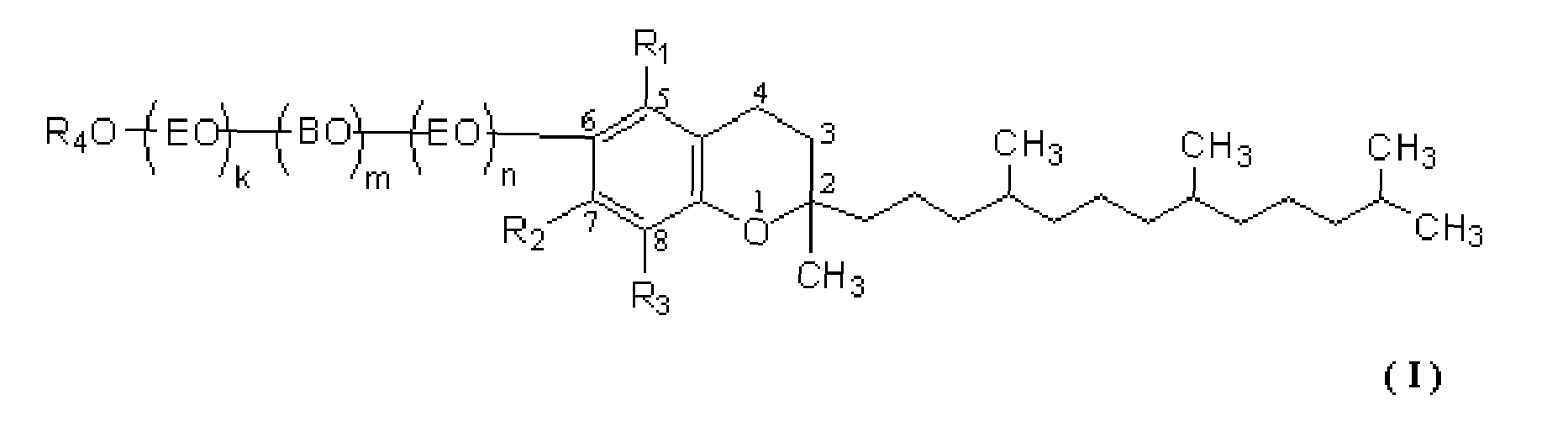
Description
- This application claims the priority of Japanese Patent Application No.
2006-350365 filed on December 26, 2006 - The present invention relates to cosmetics containinga vitamin E derivative or a salt thereof. More specifically, the present invention relates to cosmetics that have no stickiness (in particular, the stickiness during drying after the application on the skin), are excellent in feeling in use, and which can contain with the variety and quantity of blendable oil components by the improvement of solubilizing ability and emulsifying ability.
- In recent years, various vitamin E derivatives have been synthesized, and they have been suggested as an antioxidantcomponent and a moisture retaining component. Specific examples include vitamin E sulfuric acid esters (see unexamined patent publication (Kokai) No.
55-13214 5-194474 11-35577 2002-517389 2003-277392 2003-277392 - These conventional vitamin E derivatives are satisfactory in the functions as an antioxidantcomponent or a moisture retaining component. However, the functions as a solubilizing agent or an emulsifier are still unsatisfactory, and they cannot realistically be used as a cosmetic raw material.
- In addition, a lotion etc. that has no sticky feeling during drying after the application on the skin and is excellent in the feeling in use has been awaited.
- The present inventors have diligently studied to solve the above-described conventional problems and to provide a vitamin E derivative having both the antioxidant activity and excellent moisture retaining property as well as much better emulsifying ability and solubilizing ability. As a result, the present inventors have found that vitamin E derivatives having hydrophobic butylene oxide groups and hydrophilic ethylene oxide groups, as the substituent, at
position 6 of the chroman skeleton of vitamin E have equal to or a higher antioxidantactivity and moisture retaining property than the above-described conventional vitamin E derivatives. In the surfactant performances such as the emulsifying ability and solubilizing ability, they also have a much higher activity and effect compared with the conventional vitamin E derivatives. In addition, the present inventors have found that they have a remarkably excellent effect, in a lotion etc., in reducing a sticky feeling on the skin (in particular, the sticky feeling during drying after the application on the skin), thus leading to completion of the present invention. - That is, the present invention provides cosmetics containinga vitamin E derivative or a salt thereof that is represented by the following formula (I):

- wherein R1 , R2, and R3 independently represent a hydrogen atom or a methyl group;
- R4 represents a hydrogen atom, an alkanoyl group having
carbon atoms 1 to 6, an alkyl group having 1 to 6 carbon atoms, an SO3 H group, a P(O)(OH)2 group, a CH2 COOH group, or a COCH2 CH(SO3 H)COOH group; EO represents an ethylene oxide group; BO represents a butylene oxide group; k and n independently represent any one of numbers 0 to 30 (however, k and n do not take 0 simultaneously); and m represents any one ofnumbers 1 to 30. - The present invention provides the above-described cosmetics in which R1 , R2 and R3 in formula (I) are methyl groups.
- The present invention provides the above-described cosmetics in which R1 and R3 in formula (I) are methyl groups and R2 is a hydrogen atom.
- The present invention provides the above-described cosmetics in which R1 in formula (I) is a hydrogen atom and R2 and R3 are methyl groups.
- The present invention provides the above-described cosmetics in which R1 and R2 in formula (I) are hydrogen atoms and R3 is a methyl group.
- The present invention provides the above-described cosmetics in which R4 in formula (I) is a hydrogen atom.
- The present invention provides the above-described cosmetics in which R4 in formula (I) represents an alkanoyl group having 1 to 6 carbon atoms, an alkyl group having 1 to 6 carbon atoms, an SO3 H group, a P(O)(OH)2 group, a CH2 COOH group, or a COCH2 CH(SO3 H)COOH group.
- In addition, the present invention provides a solubilizing agent that comprises a vitamin E derivative represented by the above-described formula (I) or a salt thereof.
- Accordingto the present invention, a sticky feeling on the skin (in particular, the sticky feeling during drying after the application on the skin) can be remarkably reduced while keeping a much better emulsifying ability and solubilizing ability as well as maintaining both antioxidantactivity and an excellent moisture retaining property. In addition, the cosmetics excellent in the feeling in use such as a light fresh feeling, a permeation feeling, and affinity for the skin can be provided.
-
Fig. 1 is a graph that illustrates a comparison in the moisture retaining effect for Production Examples 1, 3, and 7 and ComparativeExamples 1, 2, and 3, which were used in the examples. - Hereinafter, the present invention will be described in detail.
- The cosmetics of the present invention comprise a vitamin E derivative represented by the following formula (I) or a salt thereof.

- In the above-described formula (I), respective substituents are as follows. In the formula, EO represents an ethylene oxide group, and BO represents a butylene oxide group.
- R1, R2, and R3 independently represent a hydrogen atom or a methyl group. As the preferable combination of R1, R2, and R3, a combination in which R1, R2 and R3 are methyl groups (5,7,8-trimethyl form, the case in which the starting vitamin E is α-tocopherol); a combination in which R1 and R3 are methyl groups and R2 is a hydrogen atom (5,8-dimethyl form, the case in which the starting vitamin E is β-tocopherol); a combination in which R1 is a hydrogen atom and R2 and R3 are methyl groups (7,8-dimethyl form, the case in which the starting vitamin E is Y-tocopherol), and a combination in which R1 and R2 are hydrogen atoms and R3 is a methyl group (8-methyl form, the case in which the starting vitamin E is δ-tocopherol) can be listed.
- R4 represents a hydrogen atom, an alkanoyl
group having carbonatoms 1 to 6, an alkyl group having 1 to 6 carbon atoms, an SO3 H group, a P(O)(OH)2 group, a CH2 COOH group, or a COCH2 CH(SO3 H)COOH group. - The above-described alkanoyl group having 1 to 6 carbon atoms can be either linear or branched. Specific examples include an acetyl group, a propanoyl group, a butyryl group, an isobutyryl group, and a pivaloyl group. Among them, an acetyl group, a propanoyl group, and a pivaloyl group are preferable, and an acetyl group is more preferable from the standpoint of synthesis.
- The above-described alkyl group having 1 to 6 carbon atoms can be either linear or branched. Specific examples include a methyl group, an ethyl group, a propyl group, a butyl group, an isobutyl group, a t-butyl group, a pentyl group, and a hexyl group. Among them, a methyl group, an ethyl group, a propyl group, and a butyl group are preferable, and a methyl group and an ethyl group are more preferable from the standpoint of synthesis.
- An SO3 H group, a P(O)(OH)2 group, a CH2 COOH group, or a COCH2 CH(SO3 H)COOH group can form a salt with a base. There are no particular limitations as the base, if the toxicity is low and the antioxidant activity and moisture retaining property of the vitamin E derivative represented by the above-described formula (I) are not affected. Examples of such salts include alkali metal salts such as sodium salt, potassium salt, and lithium salt; alkaline earth metal salts such as calcium salt and magnesium salt; metal salts such as aluminum salt, iron salt, zinc salt, copper salt, nickel salt, and cobalt salt; and inorganic salts such as ammonium salt; organic amine salts such as t-octylamine salt, dibenzylamine salt, morpholine salt, glucosamine salt, phenylglycinealkyl ester salt, ethylenediamine salt, N-methylglucamine salt, guanidine salt, diethylamine salt, triethylamine salt, dicyclohexylamine salt, N,N'-dibenzylethylenediamine salt, chloroprocaine salt, procaine salt, diethanolamine salt, N-benzyl-phenethylamine salt, piperazine salt, tetramethylammonium salt, and tris(hydroxymethyl)aminomethane salt. However, the base is not limited to these examples. Among them, alkali metal salts, alkaline earth metal salts, and ammonium salt are preferable from the standpoint of synthesis. More preferable salts are sodium salt, potassium salt, 1/2magnesium salt, 1/2calciuml salt, and ammonium salt, and sodium salt and ammonium salt are more preferable.
- In the present invention from the standpoint of solubilizing ability, it is more preferable that R4 in formula (I) represents an SO3 H group or a P(O)(OH)2 group and that they are in a salt form.
- The symbols k and n respectively represent any one of numbers 0 to 30. They are preferably 0 to 25, and more preferably 0 to 20 (however, k and n do not take 0 simultaneously). The symbol m represents any one of
numbers 1 to 30, preferably 1 to 10, and more preferably 1 to 5. The more preferable combination of k, m, and n is a combination in which k and n are respectively 0 to 20 (however, k and n do not take 0 simultaneously) and m is 1 to 5. - In the present invention, the compound represented by the above-described formula (I) has an asymmetric carbonin the molecule, and there are stereoisomers, namely, D-form and L-form. Each of them and an arbitrary mixture thereof are all included in the present invention.
- When the compound represented by the above-described formula (I) is allowed to stand in the atmosphere, it may absorb water, adsorb water, or form a hydrate. Those cases are also included in the present invention.
- In addition, the compound represented by the above-described formula (I) may absorb a certain other solvent and form a solvate. Those cases are also included in the present invention.
- Vitamin E derivatives or salts thereof represented by the above-described formula (I) can be prepared, for example, by the method shown in the following production process chart.

- (Step 1) In
step 1, a vitamin E derivative (alcohol form) represented by the above-described formula (I-a) is produced by the addition of ethylene oxide and/or butylene oxide, in the presence of a base catalyst, to a vitamin E represented by the above-described formula (II) [in the formula, R1 , R2, and R3 are respectively as defined for the above-described formula (I)]. - As for vitamin E, either synthetic or natural vitamin Es can be used. Specific examples include α-tocopherol (5,7,8-trimethyl form) in which R1, R2, and R3 are methyl groups in the above-described formula (II); β-tocopherol (5,8-dimethyl form) in which R1 and R3 are methyl groups and R2 is a hydrogen atom; Y-tocopherol (7,8-dimethyl form) in which R2 and R3 are methyl groups and R1 is a hydrogen atom; and δ-tocopherol (8-methyl form) in which R3 is a hydrogen atom and R1 and R2 are methyl groups. In the present invention, commercial products can be preferably used, for example, a natural vitamin E (e.g., D-α-tocopherol, manufactured by Sigma-Aldrich Japan K.K.) and a synthetic vitamin E (e.g., DL-α-tocopherol, manufactured by Wako Pure Chemical Industries, Ltd.).
- Examples of base catalysts (= alkaline catalysts) used in the addition reaction include alkali metal hydroxides such as sodium hydroxide and potassium hydroxide; alkali metal alkoxides such as sodium methoxide and potassium t-butoxide; metal hydrides such as sodium hydride and aluminum hydride; and quaternary ammonium hydroxides such as quaternary trimethylammonium hydroxides. Among them, potassium hydroxide, sodium hydroxide, etc. are preferably used becauseof easy handling.
- The amount of a base catalyst varies depending upon reaction conditions and it is not limited in particular. In order to suppress side reactions, however, it is preferable to normally use 0.05 to 10 mass % with respect to vitamin E, which is the starting material, and it is more preferable to use 0.05 to 5 mass %.
- The above-described addition reaction is conducted in the presence or absenceof a solvent. The reaction in the presence of a solvent is more preferable from the standpoint of lowering the viscosity of the entire reaction system.
- The solvent used is not limited in particular so far as it is not involved in the addition reaction. Examples include aromatic hydrocarbons such as toluene, xylene, and benzene; aliphatic hydrocarbons such as hexane, heptane, and octane; alicyclic hydrocarbons such as cyclohexane and cycloheptane; cyclic ethers such as tetrahydrofuran and dioxane; ethers such as diethyl ether, diisopropyl ether, ethylene glycol dimethyl ether, ethylene glycol diethyl ether, and diethyleneglycol dimethyl ether; amides such as dimethylformamide and dimethylacetamide; and sulfoxides such as dimethylsulfoxide. However, the solvent is not limited to these examples. Among them, aromatic hydrocarbons, alicyclic hydrocarbons, cyclic ethers, ethers, etc. are preferably used.
- Ethylene oxide and/or butylene oxide is normally injected. Butylene oxide preferably used in the present invention is 1,2-butylene oxide or 2,3-butylene oxide.
- The injection temperature and reaction temperature (aging temperature) are normally from room temperature to 200 °C, preferably from 50 to 200 °C, and more preferably from 80 to 180 °C. The reaction time (aging time) varies depending upon the reaction temperature; it is normally from 1 to 24 hours, preferably from 1 to 12 hours, and more preferably from 1 to 10 hours.
- After the reaction, the reaction solution is cooled and the used base (catalyst) is neutralized with an acid. Examples of acids include mineral acids such as hydrochloric acid, sulfuric acid, nitric acid, hydrobromic acid, and phosphoric acid; and organic acids such as methanesulfonic acid, ethanesulfonic acid, acetic acid, and p-toluenesulfonic acid. However, the acid is not limited by these examples. Among them, hydrochloric acid, sulfuric acid, phosphoric acid, methanesulfonic acid, acetic acid, etc. are preferable, and more preferably, hydrochloric acid, phosphoric acid, methanesulfonic acid, acetic acid, etc. are used.
- After neutralization, the desired product is obtained by a conventional treatment, for example, by adding water and a water-insoluble organic solvent, extracting, drying, and subsequentlyremoving the organic solvent. When a generated salt is insoluble, the desired product can also be obtained by filtering the salt and removing the organic solvent. If necessary, the obtained desired compound, namely the compound represented by formula (I-a), can be purified by recrystallization, reprecipitation, or the separation by silica gel chromatography etc.
- (Step 2) The compound obtained as described above and represented by formula (I-a) is a vitamin E derivative (alcohol form) in which R4 is a hydrogen atom in formula (I) of the present invention.
- The compound represented by the above-described formula (I-a) can be converted, by introducing the substituent R4 (however, R4 is other than a hydrogen atom) as desired, to a derivative in which an alkanoyl group having 1 to 6 carbon atoms, an alkyl group having 1 to 6 carbon atoms, an SO3 H group, a P(O)(OH)2 group, a CH2 COOH group, a COCH2 CH(SO3 H)COOH group, or a salt thereof is introduced. The introduction of the above-described substituent R4 can be conducted according to the following methods (1) to (6). However, the method is not limited to these examples.
- (1) An alkanoyl group having 1 to 6 carbon atoms is introduced by the reaction with an acid chloride or acid anhydride in the presence of a base and either in the presence or absenceof a solvent.
- Preferable examples of bases include organic bases such as triethylamine, diisopropylethylamine, pyridine, 4-dimethylaminopyridine, 1-methylpiperazine, 4-methylmorpholine, 1,4-dimethylpiperazine and 1-methylpyrrolidine.
- The solvent is not limited in particular so far as it is not involved in the addition reaction. Examples include aromatic hydrocarbons such as toluene, xylene, and benzene; aliphatic hydrocarbons such as hexane, heptane, and octane; alicyclic hydrocarbons such as cyclohexane and cycloheptane; cyclic ethers such as tetrahydrofuran and dioxane; ethers such as diethyl ether, diisopropyl ether, ethylene glycol dimethyl ether, ethylene glycol diethyl ether, and diethyleneglycol dimethyl ether; amides such as dimethylformamide and dimethylacetamide; and sulfoxides such as dimethylsulfoxide. However, the solvent is not limited to these examples. Among them, aromatic hydrocarbons, alicyclic hydrocarbons, cyclic ethers, ethers, etc. are preferably used.
- Examples of acid chlorides include myristic acid chloride, palmitic acid chloride, and stearic acid chloride. Examples of acid anhydrides include maleic anhydride and acetic anhydride. However, the acid chloride and acid anhydride are not limited to these examples.
- The reaction temperature varies depending upon acid chlorides and acid anhydrides; it is normally from -20 °C to 100 °C, preferably from 0 to 100°C, and more preferably from 0 to 50 °C.
- The reaction time varies depending upon the reaction temperature; it is normally from 1 to 24 hours, preferably from 1 to 8 hours, and more preferably from 1 to 4 hours.
- After the completion of the reaction, the desired product is obtained by a conventional treatment, for example, by adding water and a water-insoluble solvent, neutralizing as necessary, extracting, drying, and subsequently removing the solvent. When a generated salt is insoluble, the desired product can also be obtained by filtering the salt and removing the solvent. If necessary, the obtained desired compound can be purified by recrystallization, reprecipitation, or the separation by silica gel chromatography etc.
- (2) An alkyl group having 1 to 6 carbon atoms is introduced by the reaction with an alkyl halide in the presence of a base and either in the presence or absence of a solvent.
- Preferable examples of bases include alkali metal hydroxides such as sodium hydroxide and potassium hydroxide; alkali metal alkoxides such as sodium methoxide and potassium t-butoxide; metal hydrides such as sodium hydride and aluminum hydride; and quaternary ammonium hydroxides such as quaternary trimethylammonium hydroxides.
- The solvent is not limited in particular so far as it is not involved in the addition reaction, and the solvents listed in the above-described (1) can be preferably used.
- Examples of alkyl halides include methyl chloride and ethyl bromide. However, the alkyl halide is not limited to these examples.
- The reaction temperature varies depending upon the alkyl halide; it is normally from -20 °C to 100 °C, preferably from 0 to 100 °C, and more preferably from 0 to 50 °C.
- The reaction time varies depending upon the reaction temperature; it is normally from 1 to 24 hours, preferably from 1 to 8 hours, and more preferably from 1 to 4 hours.
- After the completion of the reaction, the desired product is obtained by a conventional treatment, for example, by adding water and a water-insoluble solvent, neutralizing as necessary, extracting, drying, and subsequently removing the solvent. When a generated salt is insoluble, the desired product can also be obtained by filtering the salt and removing the solvent. If necessary, the obtained desired compound can be purified by recrystallization, reprecipitation, or the separation by silica gel chromatography etc.
- (3) An SO3 H group is introduced by the reaction with sulfamic acid or sulfuric anhydride in the presence of urea and either in the presence or absenceof a solvent.
- The solvent is not limited in particular so far as it is not involved in the addition reaction, and the solvents listed in the above-described (1) can be suitably used.
- The reaction temperature is normally from -20 °C to 100 °C, preferably from 0 to 100 °C, and more preferably from 0 to 50 °C.
- The reaction time varies depending upon the reaction temperature; it is normally from 1 to 24 hours, preferably from 1 to 8 hours, and more preferably from 1 to 4 hours.
- After the completion of the reaction, the desired product is obtained by a conventional treatment, for example, by adding water and a water-insoluble solvent, neutralizing as necessary, extracting, drying, and subsequently removing the solvent. When a generated salt is insoluble, the desired product can also be obtained by filtering the salt and removing the solvent. If necessary, the obtained desired compound can be purified by recrystallization, reprecipitation, or the separation by silica gel chromatography etc.
- (4) A P(O)(OH)2 group is introduced by the reaction with diphosphorus pentaoxide (= phosphoric anhydride) or polyphosphoric acid either in the presence or absence of a solvent.
- The solvent is not limited in particular so far as it is not involved in the addition reaction, and the solvents listed in the above-described (1) can be preferably used
- The reaction temperature varies depending upon whether diphosphorus pentaoxide is used or polyphosphoric acid is used; it is normally from room temperature to 200 °C, preferably from room temperature to 150 °C, and more preferably from room temperature to 150 °C.
- The reaction time varies depending upon the reaction temperature; it is normally from 1 to 24 hours, preferably from 1 to 8 hours, and more preferably from 1 to 4 hours.
- After the completion of the reaction, the desired product is obtained by a conventional treatment, for example, by adding water and a water-insoluble solvent, neutralizing as necessary, extracting, drying, and subsequently removing the solvent. When a generated salt is insoluble, the desired product can also be obtained by filtering the salt and removing the solvent. If necessary, the obtained desired compound can be purified by recrystallization, reprecipitation, or the separation by silica gel chromatography etc.
- (5) A CH2 COOH group is introduced by the reaction with an alkyl monochloroacetate or alkyl monobromoacetate, in the presence of a base and either in the presence or absenceof a solvent, and by the subsequent alkaline hydrolysis of the ester group.
- Examples of bases include alkali metal hydroxides such as sodium hydroxide and potassium hydroxide; alkali metal alkoxides such as sodium methoxide,potassium methoxide, sodium ethoxide, potassium ethoxide, and potassium t-butoxide; and metal hydroxides such as sodium hydride and aluminum hydride. Alkali metal alkoxides etc. are more preferably used.
- The solvent is not limited in particular so far as it is not involved in the addition reaction. However, alcohols such as methanol,ethanol, propanol, butanol, t-butanol; cyclic ethers such as tetrahydrofuran and dioxane; and amides such as dimethylformamide and dimethylacetamide are preferable. The solvent, however, is not limited to these examples. Among them, alcohols such as methanol,ethanol, propanol, butanol, and t-butanol are more preferable.
- The reaction temperature is not limited in particular; it is normally from room temperature to 100 °C, preferably from room temperature to 80 °C, and more preferably from room temperature to 50 °C.
- The reaction time varies depending upon the reaction temperature; it is normally from 1 to 24 hours, preferably from 1 to 12 hours, and more preferably from 1 to 8 hours.
- The step in which the ester group is converted to a carboxylic acid or carboxylate salt by alkaline hydrolysis can be achieved with the use of an aqueous solution of an alkali metal hydroxide such as sodium hydroxide or potassium hydroxide.
- After the reaction, the pH is adjusted to 2 - 4 with the use of an acid such as hydrochloric acid, sulfuric acid, or phosphoric acid. The carboxylic acid can be obtained by extracting with a solvent, drying, and removing the solvent.
- As the extraction solvent, halogenated hydrocarbons such as methylenechloride and chloroform; aromatic hydrocarbons such as toluene, xylene, and benzene; esters such as ethyl acetate and methyl acetate; and ethers such as diethyl ether and diisopropyl ether are preferable. Among them, halogenated hydrocarbons are even more preferable.
- The obtained desired compound can be used as it is in the succeeding step. If necessary, however, the compound can be purified by the conventional method such as recrystallization, reprecipitation, or the separation by silica gel chromatography etc.
- (6) A COCH2 CH(SO3 H)COOH group is introduced by the esterification reaction with maleic anhydride, in the presence of a catalytic amount of sodium acetate, and by the subsequent reaction with an aqueous solution of sodium sulfite.
- The reaction temperature of esterification is normally from 50 to 200 °C, preferably from 60 to 150 °C, and more preferably from 70 to 100 °C.
- The reaction temperature with an aqueous solution of sodium sulfite is normally from 50 to 200 °C, preferably from 60 to 150 °C, and more preferably from 70 to 100 °C.
- The compounds obtained in the above-described (3), (4), (5) and (6) can be converted, as necessary, to a desired salt with the use of a base by the conventional method.
- The moisture retaining property and antioxidantactivity of the vitamin E derivatives of the present invention are comparable or higher compared with vitamin E or the conventional vitamin E derivatives proposed in
patent literatures 1 to 5. However, the properties as a surfactant such as an emulsifieror solubilizing agent are better than the conventional vitamin E derivatives becauseof the introduction of hydrophobic butylene oxide groups. Accordingly, when a vitamin E derivative represented by the above-described formula (I) is blended into cosmetics, the variety and quantity range of blendable additive oil components can be increased. Specifically, the blending quantity of an oil component can be increased about 1.2 to 1.5 times compared with the case in which the conventional vitamin E derivative is used. - The excellent effect in that there is no sticky feeling (especially, no sticky feeling during drying after the application on the skin) is also noteworthy. This effect was long-felt needed in the past especially for a lotion etc. The product of the present invention can also be used, as an emulsifieror solubilizing agent, in pharmaceuticals, cosmetics, etc.
- The blending quantity of a vitamin E derivative represented by the above-described formula (I) or a salt thereof in cosmetics is not limited in particular. However, when it is used as an emulsifieror solubilizing agent, a comparable blending quantity to that of a nonionic surfactant or ionic surfactant normally used as an emulsifieror solubilizing agent is preferable. Specifically, 0.01 to 5.0 mass % with respect to the total amount of a cosmetic is preferable, and more preferably it is 0.05 to 3.0 mass %. When oil components are blended in the cosmetics of the present invention,
- When cosmetics are prepared with the use of a vitamin E derivative represented by the above-described formula (I) or a salt thereof, it is possible to arbitrarily blend other additive components, which are normally blendable into cosmetics, so far as the effect of the present invention is not undermined. Specific examples of such components include surfactants, oils, thickeners, moisturizers, UV absorbers, UV scatterers, drugs, perfumes, coloring agents, and stabilizing agents. However, the additive components are not limited to these examples.
- Non-ionic surfactants include POE (= polyoxyethylene) alkyl ethers such as POE cetyl ether (POE 7), POE cetyl ether (POE 10), POE oleyl ether (POE 6), POE oleyl ether (POE 10), POE stearyl ether (POE 6), POE oleyl ether (POE 8), POE lauryl ether (POE 5), POE hexyldecyl ether (POE 5), POE isostearyl ether (POE 5), POE octyldodecyl ether (POE 5), POE decyl pentadecyl ether (POE 10), POE behenyl ether (POE 10), POE decyl tetradecyl ether (POE 10) and POE cholesteryl ether (POE 10); POE alkylphenyl ethers such as POE nonylphenyl ether (POE 5), POE octylphenyl ether (POE 5) etc.; POE alkyl ether stearates such as POE stearyl ether stearate (POE 12), POE lauryl ether stearate (POE10), POE lauryl ether stearate (POE 15) and POE lauryl ether isostearate (POE 10); esters of ethylene glycol with fatty acid /polyethylene glycol such as ethylene glycol dilaurate /polyethylene glycol (POE 8), ethylene glycol dilaurate /polyethylene glycol (POE 12), ethylene glycol monostearate /polyethylene glycol (POE 5), ethylene glycol distearate /polyethylene glycol (POE 12) and ethylene glycol dioleate /polyethylene glycol (POE 12); polyethyleneglycol fatty acid esters such as polyethyleneglycol isostearate (POE 6), polyethylene glycol diisostearate (POE 12) and polyethyleneglycol monooleate(POE 6); POE glyceryl fatty acid esters such as POE glyceryl isostearate (POE 5), POE glyceryl isostearate (POE 6) and POE glyceryl isostearate (POE 8); POE glyceryl tri-fatty acid esters such as POE glyceryl triisostearate (POE 20), POE glyceryl trioleate (POE 20) and POE glyceryl triisostearate (POE 7); POE trimethylolpropane tri-fatty acid esters such as POE trimethylolpropane trimyristate (POE 20), POE trymethylolpropane triisostearate (POE 20), POE trymethylolpropane triisostearate (POE 20), POE trimethylolpropane triisostearate (POE 25) and POE trimethylolpropane triisostearate (POE 30); POE-hydrogenated castor oils and their derivatives such as POE-hydrogenated castor oil (POE 20), POE castor oil (POE 20), POE-hydrogenated castor oil laurate (POE 20), POE-hydrogenated castor oil isostearate (POE 20), POE-hydrogenated castor oil isostearate (POE 30), POE-hydrogenated castor oil triisostearate (POE 40) and POE-hydrogenated castor oil triisostearate (POE 50); POE glycerin monostearate (POE 5); sorbitan-monoisostearate; glycerin monostearate (Self-emulsifying); diglyceryl monostearate; and cetostearyl glucoside.
- Ionic surfactants include alkyl phosphate such as sodium lauryl phosphate and lauryl phosphate; POE alkyl ether phosphates such as POE (1) lauryl ether phosphate and sodium laurel phosphate; N-acyl taurine salts such as sodium N-cocoyl N-methyltaurate, sodium N-lauroyl N-methyltaurate, sodium N-myristoyl N-methyltaurate, sodium N-palmitoyl N-methyltaurate and sodium N-stearoyl N-methyltaurate; alkyl sulfates such as ammonium lauryl sulfate, potassium lauryl sulfate, sodium lauryl sulfate, triethanolamine lauryl sulfate, sodium myristyl sulfate and sodium cetyl sulfate; POE alkyl ether sulfate such as sodium POE (3 mol) alkyl (C12-15) ether sulfate, triethanolamine POE (3 mol) alkyl (C12-15) ether sulfate, ammonium POE (2 mol) lauryl ether sulfate, sodium POE (2 mol) lauryl ether sulfate, triethanolamine POE (2 mol) lauryl ether sulfate, sodium POE (3 mol) lauryl ether sulfate and sodium POE (2 mol) lauryl ether sulfate; and sulfonates such as sodium lauryl sulfoacetate, sodium tetradecene sulfonate and dioctyl sodium sulfosuccinate.
- Ampholytic surfactants include betaine acetate-type ampholytic surfactants such as lauryl dimethylamino acetic acid betaine, coconut oil fatty acid amide propyl dimethylamino acetic acid betaine and coconut oil fatty acid amide propyl dimethylamino acetic acid betaine; and imidazoline-type ampholytic surfactants such as sodium N-coconut oil fatty acid acyl-N-carboxymethyl-N-hydroxyethyl ethylenediamine.
- Oils include ester oils such as tripropylene glycol dineopentanoate, isodecyl benzoate, propylene glycol dicaprylate, isononyl isononanoate, cetyl 2-ethylhexanoate, glyceryl tri-2-ethylhexanoate, pentaerythritol tetra-2-ethylhexanoate, di-2-ethylhexyl succinate and 2-ethylhexyl 2-ethylhexanoate; hydrocarbon oils such as liquid paraffin, ozocerite, squalane, pristane, paraffin, ceresin, squalene, vaseline, microcrystalline wax, polyethylenewax and Fisher- Tropsch wax; silicone oils such as chain polysiloxanes (e.g. dimethylpolysiloxane, methylphenyl polysiloxane, diphenyl polysiloxane etc.), cyclic polysiloxanes (e.g. decamethylcyclopentasiloxane, dodecamethylcyclohexasiloxane etc.), silicone resins having a three-dimensional network structure, silicone rubbers having an average molecular weight of 200,000 or more and various modified polysiloxanes (e.g. amino-modified polysiloxane, polyether-modified polysiloxane, alkyl-modified polysiloxane, fluorine-modified polysiloxane etc.); waxes such as bees wax, candelilla wax, carnauba wax, lanolin, liquid lanolin and jojoba wax; higher alcohols such as hexyl alcohol, octyl alcohol, cetyl alcohol, stearil alcohol, seryl alcohol, behenyl alcohol, triacontyl alcohol, selachyl alcohol and batyl alcohol; and higher fatty acids such as lauric acid, myristic acid, palmitic acid and behenic acid.
- Thickeners include acrylamide thickeners such as vinylpyrrolidone/2-acrylamide-2-methylpropane sulfonic acid copolymer, dimethyl acrylamide/2-acrylamide-2-methylpropane sulfonic acid copolymer, amide acrylate/2-acrylamide-2-methylpropane sulfonic acid copolymer, a mixture of polyacrylic acid and sodium polyacrylate, sodium acrylate/2-acrylamide-2-methylpropane sulfonic acid copolymer, ammonium polyacrylate, polyacrylamide/ammonium polyacrylate copolymer and acrylamide/sodium acrylate copolymer; acrylic thickeners such as carboxy vinyl polymer and alkyl-modified carboxy vinyl polymer; water-soluble polymers such as carrageenan, pectine, mannan, curdlan, chondroitin sulfate, starch, glycogen, gum arabic, sodium hyaluronate, gum tragacanth, xanthan gum, mucoitin sulfuric acid, hydroxyethyl guar gum, carboxymethyl guar gum, guar gum, dextran, kerato sulfuric acid, locust bean gum, succinoglycan, chitin, chitosan, carboxymethyl chitin and agar.
- Moisturizers include polyethylene glycol, glycerin, diglycerin, 1, 3-btylene glycol, erythritol,sorbitol, xylitol, maltitol, 1, 2-pentanediol and hexylene glycol.
- UV absorbers include, for example, cinnamic acid type UV absorbers such as para-aminobenzoic acid, octyl-p-methoxy cinnamate (2-ethylhexyl-p-methoxy cinnamate), glycerylmono-2-ethyl hexanoyl-di-p- methoxy cinnamate and methyl bis (trimethylsiloxy) silyl isopentyl trimethoxy cinnamate; 2, 2'-hydroxy-5-methylphenylbenzotriazole; 2-(2'-hydroxy-5'-t-octylphenyl)-benzotriazole; 2-(2'-hydroxy-5'-methylphenyl)-benzotriazole, 4-methoxy-4'-t-butyl dibenzoylmethane; 5-(3, 3-dimethyl-2-norbornilidene)-3-pentane-2-on; bis-ethylhexyloxyphenol methoxyphenyl triazine; 2, 4, 6-tris[4-(2-ethylhexyloxycarbonyl) anilino]-1, 3, 5-triazine; and dimorpholino pyridazinone.
- UV scatterers include, for example, powders such as fine particulate titanium oxide having an average particle size of 10-100 nm, fine particulate zinc oxide, fine particulate iron oxide and fine particulate cerium oxide.
- Drugs include L-ascorbic acid; L-ascorbic acid monoalkyl esters such as L-ascorbic acid monostearate, L-ascorbic acid monopalmitate and L-ascorbic acid monooleate; L-ascorbic acid monoesters such as L-ascorbic acid monophosphate ester and L-ascorbic acid-2-sulfate ester; L-ascorbic acid dialkyl esters such as L-ascorbic acid distearate, L-ascorbic acid dipalmitate and L-ascorbic acid dioleate; L-ascorbic acid trialkyl esters such as L-ascorbic acid tristearate, L-ascorbic acid tripalmitate and L-ascorbic acid trioleate; L-ascorbic acid triesters such as L-ascorbic acid triphosphate ester; L-ascorbic acid glucosides such as L-ascorbic acid-2-glucoside; tranexamic acid dimers (e.g. trans-4-(trans-aminomethyl cyclohexane carbonyl) aminomethyl cyclohexane carboxylic acid hydrochloride, etc.), esters of tranexamic acid and hydroquinone (e.g. 4-(trans-aminomethyl cyclohexane carboxylic acid) 4'-hydroxyphenyl ester, etc.), esters of tranexamic acid and gentisic acid (e.g. 2-(trans-4-aminomethyl cyclohexyl carbonyloxy)-5-hydroxy benzoic acid, etc.), amides of tranexamic acid (e.g. trans-4-aminomethyl cyclohexane carboxylic acid methylamide, trans-4-(p-methoxybenzoyl) aminomethyl cyclohexane carboxylic acid, trans-4-guanidinomethyl cyclohexane carboxylic acid, etc.), salts of tranexamic acid or derivatives; alkoxy salicylic acids such as 3-methoxy salicylic acid, 3-ethoxy salicylic acid, 4-methoxy salicylic acid, 4-ethoxy salicylic acid, 4-propoxy salicylic acid, 4-isopropoxy salicylic acid, 4-butoxy salicylic acid, 5-methoxy salicylic acid, 5-ethoxy salicylic acid, 5-propoxy salicylic acid and salts thereof; vitamins such as vitamin A, vitamin A derivatives (e.g. vitamin A palmitate, vitamin A acetate, etc.), vitamin B group (e.g. vitamin B6 hydrochloride, vitamin B6 tripalmitate, vitamin B6 dioctanoate, vitamin B2 and its derivatives, vitamin B12, vitamin B15 and its derivatives, etc.), vitamin D group, vitamin H, pantothenic acid and pantethine; Y-orizanol; allantoin; glycyrrhizic acid (glycyrrhizinate); glycyrrhetic acid; stearyl glycyrrhetinate; hinokitiol; bisabolol; eucalyptone; thymol; inositol; saponins such as saikosaponin,carrot saponin, loofah saponin and soapberry saponin; various drugs such as pantothenyl ethyl ether, arbutin and cepharanthine; plant extracts such as dock, sophora angustifolia,nuphar, orange,sage, yarrow, mall, Swertia japonica, thyme, angelica acutiloba, spruce, birch, field horsetail, loofah, horse chestnut, saxifragesarmentosa, scutellaria baicalensis, arnica, lily, artemisia,peony, aloe, gardenia and cherry leaf; and β-carotene.
- In addition, various perfumes and lower alcohols such as ethanol can be blended. Furthermore, antioxidants such as butylhydroxytoluene, δ-tocopherol, and phytin; and preservatives such as benzoic acid, salicylic acid, sorbic acid, paraoxybenzoic acid alkyl ester, phenoxyethanol, hexachlorophene, and ε-polylysine can be blended as the stabilizing agent. Organic and inorganic acids such as citric acid, lactic acid, and hexametaphosphoric acid; and salts thereof can also be blended.
- The cosmetics containinga vitamin E derivative represented by the above-described formula (I) of the present invention or a salt thereof can be especially preferably used in a lotion, milky lotion, essence, skin cream, etc. They are also suitably used in a hair treatment agent, hair styling agent, etc.
- Hereinafter, the present invention will be described in further detail with reference to examples. However, the present invention is not limited by the following examples. The blending quantities are all expressed in mass %.
- Into an autoclave, 205.1 g of DL-α-tocopherol and 0.61 g of potassium hydroxide (0.30 mass % with respect to DL-α-tocopherol), as the base catalyst, were loaded. After the inside of the vessel was replaced with nitrogen gas, the temperature was increased to 100-110 °C, and the dehydration was conducted for 0.5 hours. Then, the temperature was increased to 130-140 °C, 21.0 g of ethylene oxide was injected over the course of 0.5 hours, and aging was carried out for 4.0 hours. Subsequently, 68.6 g of butylene oxide was injected at 140-150 °C over the course of 0.5 hours, and then aging was carried out for 2.0 hours. After the completion of aging, the cooling was carried out, and 366.2 g of the desired product was obtained.
- Infrared absorption spectrum v cm-1 (neat): 2922, 2868, 1462, 1414, 1378, 1257, 1091, 988, 942, 920, 910, 875, 853.
- Into a four-neck flask, 366.2 g of the DL-α-tocopherol ethylene oxide/butylene oxide/ethylene oxide addition product (k = 5, m = 2, n = 1, block), which was synthesized in the above-described (i), was added, and the temperature was increased to 100-110 °C. To this was added 0.22 g of monosodium phosphate, and then 2.17 g of urea and 41.2 g of sulfamic acid were added while the same temperature was being maintained. At the same temperature, aging was carried out for 6 hours while the sulfamic acid was being added. Then the cooling was carried out, 500 g of methanol and 6.0 g of aqueous ammonia were added, and the filtration was conducted. To the obtained solution, 20.8 g of potassium hydroxide was added, the methanol was removed by heating, 240 g of ethanol was added, and the filtration was conducted. Excess ethanol was removed by heating the filtrate, and 370 g of the desired product (10% residual ethanol is contained) was obtained.
- Infrared absorption spectrum v cm-1 (neat): 2926, 2870, 1461, 1415, 1377, 1255, 1090, 1025, 948, 922, 861.
- Under reduced pressure, 5 g of the product was dried at 80 °C for 5 hours, and 4.5 g of the desired product (dry product) was obtained.
- Infrared absorption spectrum v cm-1 (neat): 2922, 2867, 1461, 1414, 1377, 1253, 1090, 1027, 996, 948, 924, 899, 856.
- 1H-NMR: 0.83-0.87 (12.5H), 0.92-1.00 (5.2H), 1.05-1.80 (31.7H), 2.07 (3H), 2.13 (3H), 2.17 (3H), 2.56 (2.6H), 3.59-3.73 (71.3H).
- The product was confirmed, from the following data, to be the potassium salt of DL-α-tocopherol ethylene oxide/butylene oxide/ethylene oxide addition product sulfuric acid ester [in the above-described formula (I), k = 5, m = 2, n = 1, block, R1 , R2, R3 = CH3 , R4 = potassium salt of SO3 ].
- (1) m/z 917.60: ion obtained by potassium removal, C4 9 H8 9 O1 3 S1
Multiple-collisioninduced dissociation (MSn) mass spectrum (electrospray (negative ion detection), helium collision gas)
MS/MS - (2) m/z 487: (1) - 430 (tocopherol)
- (3) m/z 443: (2) - 44 (EO)
MS/MS/MS - (4) m/z 371: (3) - 72 (BO)
MS/MS/MS/MS - (5) m/z 299: (4) - 72 (BO)
MS/MS/MS/MS/MS - (6) m/z 255: (5)-44 (EO)
- (7) m/z 211: (5)-88 (2EO).
- Into an autoclave, 134.6 g of DL-α-tocopherol and 0.40 g of potassium hydroxide, as the base catalyst, were loaded. After the inside of the vessel was replaced with nitrogen gas, the temperature was increased to 100-110 °C, and the dehydration was conducted for 0.5 5 hours. Then the temperature was increased to 140-150 °C, and 45.0 g of 1,2-butylene oxide was injected over the course of 0.5 hours. While the same temperature was being maintained, aging was carried out for 4.0 hours. Subsequently, 220.0 g of ethylene oxide was injected over the course of 2.5 hours, and then aging was carried out for 2.0 hours. After the completion of aging, the cooling was carried out, and the product was neutralized with phosphoric acid aqueous solution and purified. The formed salt was filtered, and 347.2 g of the desired product (yield: 86.8%) was obtained.
- 1H-NMR: 0.83-0.87 (13.2H), 0.92-1.00 (5.7H), 1.05-1.80 (31.2H), 2.07 (3H), 2.13 (3H), 2.17 (3H), 2.56 (1.8H), 3.59-3.73 (29.9H).
- The product was confirmed, from the following data, to be DL-α-tocopherol ethylene oxide/butylene oxide/ethylene oxide addition product [in the above-described formula (I), m = 2, n = 0, R1, R2 , R3 = CH3 , R4 = H].
-
- (1) m/z 1296.95: ammonium addition ion, C69 H1 3 0 O2 0 + NH4 (ammonia is derived from the mobile phase solvent) (m/z: mass/charge ratio)
Collision-induced dissociation (MS/MS) mass spectrum (electrospray (positive ion detection), helium collision gas)
MS/MS - (2) m/z 1261: (1) -18 (H2O)
- (3) m/z 1217, 1173, 1129, 1085, 1041, 997, 953, 909, 865, 821, 777, 733, 689, 645, 601, 557:
- (2) -44xN(N= 1-16, EO)
- (3) m/z 485: (2) - 44 x 16 - 72 (BO)
- (4) m/z 1279: (1)-18 (NH4)
- (5) m/z 849: (4) - 430 (tocopherol)
- (6) m/z 777: (5) - 72 (BO)
- (7) m/z 705: (6) - 72 (BO)
- (8) m/z 661, 617, 573, 529, 485, 441, 397: (2) - 44 x N (N = 1-7, EO).
- Into an autoclave, 60.5 g of DL-α-tocopherol (manufactured by Riken Vitamin Co., Ltd.) and 0.24 g of potassium hydroxide, as the base catalyst, were loaded. After the inside of the vessel was replaced with nitrogen gas, the temperature was increased to 100-110 °C, and the dehydration was conducted for 0.5 hours. Then, the temperature was increased to 130-140 °C, and 86.5 g of ethylene oxide (manufactured by Nippon Shokubai Co., Ltd.) was injected over the course of 1.5 hours. While the same temperature was being maintained, aging was carried out for 1.0 hour. Subsequently, 16.3 g of 1,2-butylene oxide (manufactured by Tokyo Chemical Industry Co., Ltd.) was injected over the course of 0.5 hours, and then aging was carried out for 2.0 hours. Lastly, 86.3 g of ethylene oxide was injected over the course of 1.0 hour, and then aging was carried out for 1.0 hour. After the completion of aging, the cooling was carried out, the product was neutralized with phosphoric acid aqueous solution and purified, the formed salt was filtered, and 210.0 g (yield: 84.0%) of the desired product was obtained.
- Into an autoclave, 177.2 g of DL-α-tocopherol and 0.53 g (0.30 mass % with respect to DL-α-tocopherol) of potassium hydroxide, as the alkaline catalyst, were loaded. After the inside of the vessel was replaced with nitrogen gas, the temperature was increased to 100-110 °C, and the dehydration was conducted for 0.5 hours. Then, the temperature was increased to 130-140 °C, 54.3 g of ethylene oxide was injected over the course of 0.5 hours, and then aging was carried out for 2.0 hours. Subsequently, 59.3 g of butylene oxide was injected at 140-150 °C over the course of 0.5 hours, and then aging was carried out for 4.0 hours. Lastly, 108.6 g of ethylene oxide was injected at 130-140 °C over the course of 1.0 hour, and then aging was carried out for 2.0 hours. After the completion of aging, the cooling was carried out, and 360.0 g of the desired product was obtained.
- Infrared absorption spectrum v cm-1 (neat): 2926, 2868, 1460, 1377, 1350, 1252, 996,945,914.
- Into an autoclave, 94.5 g of DL-α-tocopherol and 0.38 g of potassium hydroxide, as the base catalyst, were loaded. After the inside of the vessel was replaced with nitrogen gas, the temperature was increased to 100-110 °C, and the dehydration was conducted for 0.5 hours. Then, the temperature was increased to 130-140 °C, and 50.9 g of 1,2-butylene oxide was injected over the course of 1.5 hours. While the same temperature was being maintained, aging was carried out for 2.0 hours. Subsequently, 154.5 g of ethylene oxide was injected over the course of 1.5 hours, and then aging was carried out for 2.0 hours. After the completion of aging, the cooling was carried out, and the product was neutralized with phosphoric acid aqueous solution and purified. The formed salt was filtered, and 246.5 g (yield: 82.1%) of the desired product was obtained.
- Into an autoclave, 205.1 g of DL-α-tocopherol and 0.61 g (0.30 mass % with respect to DL-α-tocopherol) of potassium hydroxide, as the alkaline catalyst, were loaded. After the inside of the vessel was replaced with nitrogen gas, the temperature was increased to 100-110 °C, and the dehydration was conducted for 0.5 hours. Then, the temperature was increased to 130-140 °C, 21.0 g of ethylene oxide was injected over the course of 0.5 hours, and then aging was carried out for 2.0 hours. Subsequently, 68.6 g of butylene oxide was injected at 140-150 °C over the course of 0.5 hours, and then aging was carried out for 4.0 hours. Lastly, 104.8 g of ethylene oxide was injected at 130-140 °C over the course of 1.5 hours, and then aging was carried out for 2.0 hours. After the completion of aging, the cooling was carried out, and 366.2 g of the desired product was obtained.
- Infrared absorption spectrum v cm-1 (neat): 2922, 2868, 1462, 1414, 1378, 1257, 1091, 988, 942, 920, 910, 875, 853.
- Into an autoclave, 83.3 g of D-α-tocopherol and 0.22 g of potassium hydroxide, as the base catalyst, were loaded. After the inside of the vessel was replaced with nitrogen gas, the temperature was increased to 100-110 °C, and the dehydration was conducted for 0.5 hours. Then, the temperature was increased to 130-140 °C, and 79.8 g of ethylene oxide was injected over the course of 1.0 hour. While the same temperature was being maintained, aging was carried out for 2.0 hours. Subsequently, 15.0 g of 1,2-butylene oxide was injected over the course of 0.5 hours, and then aging was carried out for 1.5 hours. Lastly, 91.2 g of ethylene oxide was injected over the course of 1.5 hours, and then aging was carried out for 2.0 hours. After the completion of aging, the cooling was carried out, and the product was neutralized with phosphoric acid aqueous solution and purified. The formed salt was filtered, and 238.0 g (yield: 88.3%) of the desired product was obtained.
- Into a four-neck flask, 360.0 g of the DL-α-tocopherol ethylene oxide/butylene oxide/ethylene oxide addition product (k = 6, m = 2, n = 3), which was synthesized in Production Example 3, was placed, and the temperature was increased to 100-110 °C. To this was added 0.19 g of monosodium phosphate, and 1.86 g of urea and 37.2 g of sulfamic acid were added while the same temperature was being maintained. At the same temperature, aging was carried out for 6 hours while the sulfamic acid was being added. Then the cooling was carried out, 500 g of methanol and 6.0 g of aqueous ammonia were added, and the filtration was conducted. To the obtained solution, 19.9 g of potassium hydroxide was added, the methanol was removed by heating, 240 g of ethanol was added, and the filtration was conducted. Excess ethanol was removed by heating the filtrate, and 354 g (10% residual ethanol is contained) of the desired product was obtained.
- Infrared absorption spectrum v cm-1 (neat): 2923, 2869, 1456, 1417, 1376, 1254, 1089, 1032, 949, 927, 893, 879, 853.
- Into an autoclave, 142.9 g of DL-α-tocopherol and 0.57 g of potassium hydroxide, as the base catalyst, were loaded. After the inside of the vessel was replaced with nitrogen gas, the temperature was increased to 100-110 °C, and the dehydration was conducted for 0.5 hours. Then, the temperature was increased to 130-140 °C, and 29.2 g of ethylene oxide was injected over the course of 15 minutes. While the same temperature was being maintained, aging was carried out for 1.0 hour. Subsequently, 38.5 g of 1,2-butylene oxide was injected over the course of 0.5 hours, and then aging was carried out for 3.0 hours. Lastly, 117.2 g of ethylene oxide was injected over the course of 1.5 hours, and then aging was carried out for 2.0 hours. After the completion of aging, the cooling was carried out, the product was neutralized with phosphoric acid aqueous solution and purified. The formed salt was filtered, and 245.0 g (yield: 74.6%) of the desired product was obtained.
- Into an autoclave, 142.7 g of DL-α-tocopherol and 0.57 g of potassium hydroxide, as the base catalyst, were loaded. After the inside of the vessel was replaced with nitrogen gas, the temperature was increased to 100-110 °C, and the dehydration was conducted for 0.5 hours. Then, the temperature was increased to 130-140 °C, and 29.1 g of ethylene oxide was injected over the course of 15 minutes. While the same temperature was being maintained, aging was carried out for 1.0 hour. Subsequently, 38.4 g of 1,2-butylene oxide was injected over the course of 0.5 hours, and then aging was carried out for 3.0 hours. Lastly, 146.2 g of ethylene oxide was injected over the course of 1.0 hour, and then aging was carried out for 2.0 hours. After the completion of aging, the cooling was carried out, and the product was neutralized with phosphoric acid aqueous solution and purified. The formed salt was filtered, and 276.0 g (yield: 77.3%) of the desired product was obtained.
- Into an autoclave, 135.4 g of DL-α-tocopherol and 0.54 g of potassium hydroxide, as the base catalyst, were loaded. After the inside of the vessel was replaced with nitrogen gas, the temperature was increased to 100-110 °C, and the dehydration was conducted for 0.5 hours. Then, the temperature was increased to 130-140 °C, and 27.7 g of ethylene oxide was injected over the course of 15 minutes. While the same temperature was being maintained, aging was carried out for 1.0 hour. Subsequently, 36.5 g of 1,2-butylene oxide was injected over the course of 0.5 hours, and then aging was carried out for 3.0 hours. Lastly, 167.2 g of ethylene oxide was injected over the course of 1.5 hours, and then aging was carried out for 2.0 hours. After the completion of aging, the cooling was carried out, and the product was neutralized with phosphoric acid aqueous solution and purified. The formed salt was filtered, and 303.0 g (yield: 82.5%) of the desired product was obtained.
- Into an autoclave, 119.5 g of DL-α-tocopherol and 0.48 g of potassium hydroxide, as the base catalyst, were loaded. After the inside of the vessel was replaced with nitrogen gas, the temperature was increased to 100-110 °C, and the dehydration was conducted for 0.5 hours. Then, the temperature was increased to 130-140 °C, 24.4 g of ethylene oxide was injected over the course of 15 minutes. While the same temperature was being maintained, aging was carried out for 1.0 hour. Subsequently, 32.1 g of 1,2-butylene oxide was injected over the course of 0.5 hours, and then aging was carried out for 3.0 hours. Lastly, 171.9 g of ethylene oxide was injected over the course of 1.5 hours, and then aging was carried out for 2.0 hours. After the completion of aging, the cooling was carried out, and the product was neutralized with phosphoric acid aqueous solution and purified. The formed salt was filtered, and 265.6 g (yield: 76.2%) of the desired product was obtained.
- Into an autoclave, 111.0 g of DL-α-tocopherol and 0.44 g of potassium hydroxide, as the base catalyst, were loaded. After the inside of the vessel was replaced with nitrogen gas, the temperature was increased to 100-110 °C, and the dehydration was conducted for 0.5 hours. Then, the temperature was increased to 130-140 °C, 29.9 g of 1,2-butylene oxide was injected over the course of 0.5 hours, and then aging was carried out for 3.0 hours. Subsequently, 158.7 g of ethylene oxide was injected over the course of 1.5 hours, and then aging was carried out for 2.0 hours.
- After the completion of aging, the cooling was carried out. Into a four-neck flask, 280.0 g of the synthesized DL-α-tocopherol ethylene oxide/butylene oxide/ethylene oxide (k = 14, m = 2, n = 0) was taken and loaded, the temperature was increased to 100-110 °C, and the dehydration was conducted. While the same temperature was being maintained, 4.41 g of urea and 30.9 g of sulfamic acid were added in installments. At the same temperature, aging was carried out for 3 hours, and then the cooling was carried out. After 260 g of methanol and 4.3 g of aqueous ammonia were added, the filtration was conducted. To the obtained solution, 13.8 g of potassium hydroxide was added, the methanol was removed by heating, and 230 g (yield: 75.8%) of the desired product was obtained.
- Into an autoclave, 96.2 g of DL-α-tocopherol and 0.38 g of potassium hydroxide, as the base catalyst, were loaded. After the inside of the vessel was replaced with nitrogen gas, the temperature was increased to 100-110 °C, and the dehydration was conducted for 0.5 hours. Then, the temperature was increased to 130-140 °C, 25.9 g of 1,2-butylene oxide was injected over the course of 0.5 hours, and then aging was carried out for 3.0 hours. Subsequently, 137.5 g of ethylene oxide was injected over the course of 1.5 hours, and then aging was carried out for 2.0 hours.
- After the completion of aging, the cooling was carried out. Into a beaker, 240.0 g of the synthesized DL-α-tocopherol ethylene oxide/butylene oxide/ethylene oxide (k = 14, m = 2, n = 0) was taken and loaded, the temperature was increased to 100-110 °C, and the dehydration was conducted. After dehydration, the cooling was carried out, and then 10.21 g of phosphoric anhydride was added in installments while the temperature was being increased from 40 °C to 80 °C. The aging was carried out at 80 °C for 4.5 hours, and then the cooling was carried out, and 70 g of methanol and 9.71 g of potassium methylate (= potassium methoxide)were added. After filtering the obtained methanol solution, the methanol was removed, and 171.3 g (yield: 68.5%) of the desired product was obtained.
- Into an autoclave, 100.0 g of the DL-α-tocopherol ethylene oxide/butylene oxide/ethylene oxide addition product (k = 14, m = 2, n = 2), which was synthesized in Production Example 12, was taken and placed, and 7.84 g of maleic anhydride and 0.50 g of anhydrous sodium acetate were loaded. After the inside of the vessel was replaced with nitrogen gas, the temperature was increased to 70-80 °C, and the esterification reaction was carried out for 3 hours. The thus obtained reaction product, namely, 106.1 g of maleate of DL-α-tocopherol ethylene oxide/butylene oxide/ethylene oxide addition product was loaded into a four-neck flask containing 10.1 g of anhydrous sodium sulfite beforehand dissolved in 174.3 g of pure water at 40-50 °C. The temperature was increased to 70-80 °C to carry out sulfonation, and stirring was carried out at the same temperature for 3.0 hours. The reaction solution was cooled, the pH was adjusted to 6.5 with 20% sodium hydroxide aqueous solution, and 290.0 g (yield: 98.0%) of the aqueous solution of the desired product was obtained.
- Into a four-neck flask, 25.0 g of the DL-α-tocopherol ethylene oxide/butylene oxide/ethylene oxide addition product (k = 14, m = 2, n = 2), which was synthesized in Production Example 12, was taken and loaded, and 750 mL of toluene was added. Under a nitrogen atmosphere, azeotropic dehydration was carried out at 100-110 °C for 1 hour, and then cooling to 30 °C was carried out. After the addition of 32.0 mL of 1.0 M-potassium tert-butoxide/tert-butanol solution, stirring was carried out at room temperature for 1 hour. After 1 hour, 18.68 g of ethyl bromoacetate was added, and the reaction was carried out under reflux for 2 hours while being stirred at 110 °C. After the reaction, cooling to 30 °C was carried out, and stirring was carried out at room temperature for 18 hours. After the completion of stirring, filtration was carried out with the use of Celite. Toluene was removed with an evaporator, and 20.5 g of the carboxylic acid ethyl ester of DL-α-tocopherol ethylene oxide/butylene oxide/ethylene oxide addition product was obtained. Subsequently, 20.5 g of the carboxylic acid ethyl ester and 200 mL of 1 N-NaOH were loaded into a four-neck flask, and the reaction was carried out at room temperature for 4 hours. After the completion of the reaction, the solution was cooled to 5 °C, and the pH was adjusted to 3 with 2 N-HCl. The reaction solution was extracted with 100 mL of methylenechloride five times. After washing with 50 mL of pure water, the solvent was removed, and 20.1 g of the carboxylic acid was obtained. The carboxylic acid (20.1 g) was dissolved in 100 mL of methanol,and a methanol solution containing0.83 g of sodium methoxide was added. After sodium replacement, the solvent was removed, and 20.2 g (yield: 75.9%) of the desired product was obtained.
-

- Into an autoclave, 50.7 g of DL-α-tocopherol and 0.20 g of potassium hydroxide, as the base catalyst, were loaded. After the inside of the vessel was replaced with nitrogen gas, the temperature was increased to 100-110 °C, and the dehydration was conducted for 0.5 hours. Then, the temperature was increased to 130-140 °C, 155.3 g of ethylene oxide was injected over the course of 4.0 hours. While the same temperature was being maintained, aging was carried out for 2.0 hours. After the completion of aging, the cooling was carried out, and the product was neutralized with phosphoric acid aqueous solution and purified. The formed salt was filtered, and 172.0 g (yield: 83.4%) of the desired compound represented by the above-described formula (III), was obtained.
- Infrared absorption spectrum v cm-1 (neat): 2865.9, 1458.7, 1350.7, 1252.2, 1104.9, 946.3.
-

- Into an autoclave, 94.5 g of DL-α-tocopherol and 0.38 g of potassium hydroxide, as the base catalyst, were loaded. After the inside of the vessel was replaced with nitrogen gas, the temperature was increased to 100-110 °C, and the dehydration was conducted for 0.5 hours. Then, the temperature was increased to 130-140 °C, and 50.9 g of propylene oxide was injected over the course of 1.5 hours. While the same temperature was being maintained, aging was carried out for 2.0 hours. Subsequently, 154.5 g of ethylene oxide was injected over the course of 1.5 hours, and then aging was carried out for 2.0 hours. After the completion of aging, the cooling was carried out, and the product was neutralized with phosphoric acid aqueous solution and purified. The formed salt was filtered, and 246.5 g (yield: 82.1%) of the desired product, which is represented by the above-described formula (IV), was obtained.
- Infrared absorption spectrum v cm-1 (neat): 2866.6, 1458.2, 1375.8, 1254.9, 1108.9, 938.5.
-

- Into an autoclave, 60.5 g of DL-α-tocopherol (manufactured by Wako Pure Chemical Industries, Ltd.) and 0.24 g of potassium hydroxide, as the alkaline catalyst, were loaded. After the inside of the vessel was replaced with nitrogen gas, the temperature was increased to 100-110 °C, and the dehydration was conducted for 0.5 hours. Then, the temperature was increased to 130-140 °C, and 86.5 g of ethylene oxide (Nippon Shokubai Co., Ltd.) was injected over the course of 1.5 hours. While the same temperature was being maintained, aging was carried out for 1.0 hour. Subsequently, 16.3 g of propylene oxide (Nippon Shokubai Co., Ltd.) was injected over the course of 0.5 hours, and then aging was carried out for 2.0 hours. Lastly, 86.3 g of ethylene oxide was injected over the course of 1.0 hour, and then aging was carried out for 1.0 hour. After the completion of aging, the cooling was carried out, and the product was neutralized with phosphoric acid aqueous solution and purified. The formed salt was filtered, and the DL-α-tocopherol ethylene oxide/butylene oxide/ethylene oxide addition product (compound in which the terminal group, namely NaO3 SO group, of the compound represented by the above-described formula (V) is replaced with an OH group) was obtained. Subsequently, 50.4 g of the above-described synthesized vitamin E derivative was placed into a four-neck flask, the temperature was increased to 100-110 °C, and the dehydration was conducted. While the same temperature was being maintained, 0.81 g of urea and 3.96 g of sulfamic acid were added in installments. The aging was carried out at the same temperature for 3 hours, and then the cooling was carried out. After 50 g of methanol and 1.3 g of aqueous ammonia were added, filtration was conducted. To the obtained solution, 2.5 g of 50% sodium hydroxide aqueous solution was added, the methanol was removed by heating, and 49.0 g (yield: 91.8%) of the desired product, which is represented by the above-described formula (V), was obtained.
- Infrared absorption spectrum v cm-1 (neat): 2868.2, 1459.6, 1348.8, 1253.6, 1105.7, 1032.3, 859.7, 946.8.
-

- Into an autoclave, 212.2 g of DL-α-tocopherol and 0.64 g of potassium hydroxide, as the alkaline catalyst, were loaded. After the inside of the vessel was replaced with nitrogen gas, the temperature was increased to 100-110 °C, and the dehydration was conducted for 0.5 hours. Then, the temperature was increased to 130-140 °C, and 21.7 g of ethylene oxide was injected over the course of 0.5 hours. While the same temperature was being maintained, aging was carried out for 2.0 hours. Subsequently, 57.1 g of propylene oxide was injected at 130-140 °C over the course of 0.5 hours, and then aging was carried out for 3.0 hours. Lastly, 108.4 g of ethylene oxide was injected at 130-140 °C over the course of 1.5 hours, and then aging was carried out for 2.0 hours. After the completion of aging, the cooling was carried out. Into a four-neck flask, 343.1 g of the synthesized DL-α-tocopherol ethylene oxide/butylene oxide/ethylene oxide addition product (compound in which the terminal group, namely KO3 SO group, of the compound represented by the above-described formula (VI) is replaced with an OH group) was taken and loaded, and the temperature was increased to 100-110 °C. To this was added 0.21 g of monosodium phosphate, and 2.09 g of urea and 41.7 g of sulfamic acid were added while the same temperature was being maintained. At the same temperature, aging was carried out for 6 hours while the sulfamic acid was being added. Then the cooling was carried out, 400 g of methanol and 6.0 g of aqueous ammonia were added, and the filtration was conducted. To the obtained filtrate, 21.0 g of potassium hydroxide was added, the methanol was removed by heating, 240 g of ethanol was subsequently added, and the filtration was conducted. The filtrate was heated, the excessethanol was removed, and 385 g (yield: 85%) of the desired product, which is represented by the above-described formula (VI), was obtained.
- The product was confirmed, from the following data, to be the potassium salt of DL-α-tocopherol ethylene oxide/propylene oxide/ethylene oxide addition product sulfuric acid ester represented by the above-described structural formula.
Mass spectrum (electrospray (negative ion detection)) - (1) m/z 889.57: ion obtained by potassium removal, C4 7 H8 5 O13 S1
MS/MS - (2) m/z 459: (1) - 430 (tocopherol)
- (3) m/z 415: (2) - 44 (EO)
MS/MS/MS - (4) m/z 357: (3) - 58 (PO)
MS/MS/MS/MS - (5) m/z 299: (4) - 58 (PO)
MS/MS/MS/MS/MS - (6) m/z 255: (5)-44 (EO)
- (7) m/z 211: (5)-88 (2EO)
- On a filter paper that is 2 cm by 2 cm square, 10 µL of each sample was dropped. The samples were from the above-described Production Examples 1,3, and 6, and from
ComparativeExamples Fig. 1 . - As is clear from
Fig. 1 , the moisture retaining properties of the vitamin E derivatives (salt) of Production Examples 1,3, and 6 were confirmed to be better compared with those of the vitamin E derivatives (salt) of Comparative Examples 1, 2, and 3. - As shown in Table 1, samples were prepared by blending 0.05 mass % or 0.1 mass % of a material to be solubilized, 3 mass % of a solubilizing agent, 5 mass % of ethanol, and the balance of ion-exchanged water.
- As the material to be solubilized, four kinds of oil components, namely, vitamin E acetate, trioctanoin, isohexadecane, decamethylcyclopentasiloxane, and perfume were used.
- As the solubilizing agent, Production Examples 1, 2, and 6, Comparative Examples 1, 2, 3, and 4, and POE(60 mol) hydrogenated castor oil, which is a nonionic surfactant and widely used as a solubilizing agent and emulsifier, were used.
Table 1 Components Content (Mass %) Ion-exchanged water to 100 Ethanol 5 Material to be solubilized (vitamin E acetate, decamethylcyclopentasiloxane, isohexadecane, trioctanoin, perfume) 0.05, 0.1 Solubilizing agent (Production Examples 1, 2 and 6, Comparative-Examples 1, 2, 3 and 4, POE (60 mol) hydrogenated castor oil) 3 - The solubilizing ability was investigated with use of the above-described respective samples. The solubilizing ability was determined by measuring the turbidity at 25 °C with an integration type turbidimeter TR-35 (manufactured by the former Mitsubishi Chemical Corporation, which is presently Dia Instruments Co. Ltd.) and a glass cell (width: 50 mm, depth: 30 mm, height: 50 mm; manufactured by Mitsubishi Chemical Corporation). The results are shown in Tables 2 and 3.


- As is clear from the results shown in Tables 2 and 3, the turbidity was 20 or lower for all Production Examples 1, 2, and 6; thus it was confirmed that their solubilizing ability was excellent. On the other hand, the turbidity exceeded 20 for some of Comparative Examples 1 to 4 and POE(60 mol) hydrogenated castor oil; thus it was confirmed that their solubilizing ability was inferior.
- The oil phase containing2 mass % of squalane, trioctanoin, or dimethyl silicone (6mPa·s), as the material to be emulsified, and 1 mass % of Production Example 1,
ComparativeExample 1,ComparativeExample 2,ComparativeExample 3, or POE(60 mol) hydrogenated castor oil, as an emulsifier, was gradually added, for emulsification, to the water phase containingion-exchanged water (balance) and ethanol (3 mass %) and being stirred with a homomixer at 9000 rpm; thusSamples 1 to 15 shown in Table 4 were prepared. The emulsion particles were visually observed with an optical microscope, and the emulsion particle size (µm) was measured. The results are shown in Table 4. In the table, the value in the parenthesis of the emulsion particle size indicates the size of dotted emulsion particles observed in the emulsion.

- As is clear from the results in Table 4, the emulsion particle sizes of
Samples 1 to 3, in which Production Example 1 was used, were very small. - The sensory evaluation for the feeling in use was conducted with the use of Samples 16 to 23 (lotion) having compositions shown in Table 5. The evaluation of the feeling in use was conducted for the (1) affinity for the skin, (2) stickiness and moist feeling, and (3) permeation feeling, with the actual usage test by 10 professional female panelists according to the following method. The evaluation was based on the respective evaluation criteria.
- The actual usage test by 10 professional female panelists was conducted for the spreadability on the skin. The evaluation was based on the following evaluation criteria.
-
- ⊚ : All 10 panelists evaluated that the affinity for the skin was good during use.
- ○ : 7 to 9 panelists evaluated that the affinity for the skin was good during use.
- Δ : 3 to 6 panelists evaluated that the affinity for the skin was good during use.
- × : 0 to 2 panelists evaluated that the affinity for the skin was good during use.
- The actual usage test by 10 professional female panelists was conducted for the sticky feeling during drying after the application on the skin. The evaluation was based on the following evaluation criteria.
-
- ⊚: All 10 panelists evaluated that there was no stickiness during drying and there was a moist feeling in use.
- ○: 7 to 9 panelists evaluated that there was no stickiness during drying and there was a moist feeling in use.
- Δ: 3 to 6 panelists evaluated that there was no stickiness during drying and there was a moist feeling in use.
- ×: 0 to 2 panelists evaluated that there was no stickiness during drying and there was a moist feeling in use.
- The actual usage test by 10 professional female panelists was conducted for the light fresh feeling. The evaluation was based on the following evaluation criteria.
-
- ⊚: All 10 panelists evaluated that there was a light fresh feeling in use.
- ○: 7 to 9 panelists evaluated that there was a light fresh feeling in use.
- Δ: 3 to 6 panelists evaluated that there was a light fresh feeling in use.
- ×: 0 to 2 panelists evaluated that there was a light fresh feeling in use.
- The actual usage test by 10 professional female panelists was conducted for the permeation feeling. The evaluation was based on the following evaluation criteria.
-
- ⊚: All 10 panelists evaluated that there was a permeation feeling in use.
- ○: 7 to 9 panelists evaluated that there was a permeation feeling in use.
- Δ: 3 to 6 panelists evaluated that there was a permeation feeling in use.
- ×: 0 to 2 panelists evaluated that there was a permeation feeling in use.
- The results are shown in Table 5.
Table 5 Component (mass %) Sample 16 Sample 17 Sample 18 Sample 19 Sample 20 Sample 21 Sample 22 Sample 23 Ion-exchanged water Balance Balance Balance Balance Balance Balance Balance Balance Ethenol 5 5 5 5 5 5 5 5 Perfume (material to be solubilized) 0.05 0.05 0.05 0.05 0.05 0.05 0.05 0.05 Production Example 1 (emulsifier) 1 - - - - - - - Production Example 2 (emulsifier) - 1 - - - - - - Production Example 3 (emulsifier) - - 1 - - - - - Comparative Example 1 (emulsifier) - - - 1 - - - - Comparative Example 2 (emulsifier) - - - - 1 - - - Comparative Example 3 (emulsifier) - - - - - 1 - - Comparative Example 4 (emulsifier)- - - - - - 1 - POE (60 mol) hydrogenated castor oil (emulsifier) - - - - - - - 1 Affinity for the skin ⊚ ○ ○ ⊚ ○ △ ⊚ × Sticky feeling ⊚ ⊚ ⊚ ○ △ △ △ × Light fresh feeling ⊚ ⊚ ⊚ △ △ ○ ⊚ × Permeation feeling ⊚ ⊚ ○ ○ △ ○ ⊚ × - More formulation examples are shown below.
-
(Component) (Mass %) (1) Ion exchanged water Balance (2) Dipropylene glycol 5.0 (3) 1, 3-butylene glycol 1.0 (4) Vaseline 1.0 (5) Pentaerythrityl tetraoctanoate 3.0 (6) Trimethylsiloxy silicate (50% solution) ( * 1 ) 1.0 (7) Cetyl alcohol 0.5 (8) Stearyl alcohol 0.5 (9) PEG-60 glyceryl isostearate 0.3 (10) Vitamin E derivative of Production Example 1 0.5 (11) PEG-5 glyceryl stearate 0.5 (12) Dipotassium glycyrrhizinate 0.1 (13) Vitamin E acetate 0.5 (14) Gambir extract 0.1 (15) Beech bud extract 0.1 (16) Turmeric extract 0.1 (17) Phenoxyethanol 0.2 (18) Perfume 0.1 ( * 1 ) : BY11-018 (50% decamethylcyclopentasiloxane solution; manufactured by Toray Dow Coming Silicone Co., Ltd.) - Into component (1), components (2), (3), (12), and (14) to (17) were added and dissolved, and a water phase at 70 °C was prepared by heating. Separately, an oil phase was prepared by heating a mixture of (4), (5) to (11), (13), and (18) to 70 °C. This oil phase was added to the water phase, and the emulsification was carried out with a homomixer. The emulsion particle size was 5µm or smaller. After the completion of emulsification, the desired O/W type milky lotion was obtained by rapidly cooling to 40 °C or lower and by carrying out dehydration and filtration,.
- For the obtained O/W type milky lotion, similar evaluations to Test Examples 3 and 4 were conducted. As a result, it was found that the vitamin E derivative of Production Example 1 had an excellent emulsifying ability and the feeling in use was excellent (evaluation of feeling in use: the affinity for the skin, sticky feeling, light fresh feeling, and permeation feeling were all ⊚).
-
(Component) (Mass %) (1) Ion exchanged water Balance (2) Alkyl-modifiedcarboxyvinyl polymer 0.1 (3) Carboxyvinyl polymer 0.4 (4) Ethanol 3.0 (5) 1, 3-butylene glycol 4.0 (6) Glycerin 1.0 (7) PEG-20 1.0 (8) Polyvinyl alcohol 0.1 (9) Cetyl octanoate 3.0 (10) Dimetylpolysiloxane (6 mPa·s) 3.0 (11) Vitamin E derivative of Production Example 2 1.0 (12) Behenyl alcohol 0.1 (13) Potassium hydroxide 0.1 (14) Safflower extract 0.1 (15) Poria cocos extract 0.1 (16) White lily extract 0.1 (17) Phenoxyethanol 0.1 (18) Perfume 0.1 (19) Coloring material 0.1 - Into component (1) in the main pot, components (2), (3), (6), (7), (13) to (17), and (19) were added and dissolved. In separate pots, component (11) was dissolved in component (4), and component (8) was dissolved in component (5) by heating. A water phase was prepared by adding these solutions to the main pot. Separately, an oil phase was prepared by uniformly dissolving components (9), (10), (12), and (18) at 70 °C. While the water phase at 70 °C was being treated with a homomixer, the oil phase at 70 °C was gradually added to emulsify it. The emulsion particle size was 10 to 30 µm. After the completion of emulsification, the desired gel essence was obtained by rapidly cooling to 40 °C or lower and by carrying out dehydration and filtration.
- For the obtained gel essence, similar evaluations to Test Examples 3 and 4 were conducted. As a result, it was found that the vitamin E derivative of Production Example 2 had an excellent emulsifying ability and the feeling in use was excellent (evaluation of feeling in use: the affinity for the skin, sticky feeling, light fresh feeling, and permeation feeling were all ⊚).
-
(Component) (Mass %) (1) Ion exchanged water Balance (2) Ethanol 5.0 (3) Glycerin 2.0 (4) Dipropylene glycol 5.0 (5) Xylitol 1.0 (6) Polyethylene glycol 1000 0.5 (7) Vitamin E derivative of Production Example 4 0.5 (8) Salicylic acid 0.1 (9) Dipotassium glycyrrhizinate 0.05 (10) Houttuynia herb extract 0.6 (11) Saxifrage sarmentosa extract 0.1 (12) Sodium citrate 0.35 (13) Sodium hexametaphosphate 0.01 (14) Phenoxyethanol 0.3 (15) Perfume 0.001 (16) Dimethylsilicone (6 mPa·s) 0.02 - To a mixture of components (2) and (7), components (14) to (16) were added (alcohol part). On the other hand, components (3) to (13) were added in series to component (1) and uniformly dissolved. To this was added the alcohol part, and the desired lotion was obtained by dissolving uniformly with stirring.
- For the obtained lotion, similar evaluations to Test Examples 2 and 4 were conducted. As a result, it was found that the turbidity was 12.0, the solubilization of dimethyl silicone and perfumes were excellent, and the feeling in use was excellent (evaluation of feeling in use: the affinity for the skin, sticky feeling, light fresh feeling, and permeation feeling were all ⊚).
-
(Component) (Mass %) (1) Ion exchanged water Balance (2) Ethanol 3.0 (3) Glycerin 5.0 (4) 1, 3-butylene glycol 4.0 (5) POE (3 mol) methyl glucoside 2.0 (6) POE (14 mol) POP (7 mol) dimethyl eter 1.0 (7) Xanthan gum 0.1 (8) Vitamin E derivative of Production Example 5 0.3 (9) Potassium 4-methoxy-salicylate 1.0 (10) Dipotassium glycyrrhizinate 0.05 (11) L-serine 0.001 (12) Ethyl ascorbic acid 0.1 (13) Calcium chloride 0.001 (14) Magnesium chloride 0.002 (15) Shinleaf extract 0.01 (16) Ononis extract 0.1 (17) Saiko extract 0.05 (18) Tocopherol 0.001 (19) Citric acid (food grade) 0.02 (20) Sodium citrate 0.08 (21) Phenoxyethanol 0.5 (22) Perfume 0.1 (23) Tripropylene glycol dineopentanoate 0.05 - To a mixture of components (2) and (8), components (18) and (21) to (23) were added (alcohol part). On the other hand, components (3) to (7), (9) to (17), and (19) to (20) were added in series to component (1) and dissolved. To this was added the alcohol part, and the desired whitening lotion was obtained by dissolving uniformly with stirring.
- For the obtained lotion, similar evaluations to Test Examples 2 and 4 were conducted. As a result, it was found that the turbidity was 19.0, the solubilization of tripropylene glycol dineopentanoate and perfume was excellent, and the feeling in use was excellent (evaluation of feeling in use: the affinity for the skin, sticky feeling, light fresh feeling, and permeation feeling were all ⊚).
-
(Component) (Mass %) (1) Ion exchanged water Balance (2) Ethanol 8.0 (3) Glycerin 2.5 (4) Dipropylene glycol 3.0 (5) Polyethylene glycol 1500 3.0 (6) Vitamin E derivative of Production Example 7 0.4 (7) Tranexamic acid 2.0 (8) Maltitol 0.1 (9) L-lysine hydrochloride 0.001 (10) Sophora angustifolia extract 0.001 (11) Rose extract 0.001 (12) Marine collagen solution 0.01 (13) Betaine lauryl sulfate 0.015 (14) Isostearic acid 0.01 (15) Citric acid 0.002 (16) Sodium citrate 0.008 (17) Sodium pyrosulfite 0.003 (18) Sodium edetate 0.03 (19) Phenoxyethanol 0.35 (20) Perfume 0.03 (21) Isotridecyl isononanoate 0.02 - To a mixture of components (2) and (6), components (14) and (19) to (21) were added (alcohol part). On the other hand, components (3) to (5), (7) to (13), and (15) to (18) were added in series to component (1) and dissolved. To this was added the alcohol part, and the desired whitening lotion was obtained by dissolving uniformly with stirring.
- For the obtained lotion, similar evaluations to Test Examples 2 and 4 were conducted. As a result, it was found that the turbidity was 15.9, the solubilization of isotridecyl isononanoate and perfume was excellent, and the feeling in use was excellent (evaluation of feeling in use: the affinity for the skin, sticky feeling, light fresh feeling, and permeation feeling were all ⊚).
-
(Component) (Mass %) (1) Ion-exchanged water Balance (2) Ethanol 5.0 (3) Glycerin 8.5 (4) Dipropylene glycol 5.0 (5) Xanthan gum 0.06 (6) Vitamin E derivative of Production Example 9 1.0 (7) Ascorbic acid glucoside 2.0 (8) Dipotassium glycyrrhizinate 0.05 (9) Hydrogenated phospholipid 0.01 (11) 2-phosphorylcholine/butylmethacrylate copolymer solution 0.01 (12) Hyaluronic acid 0.001 (13) Paeonia suffruticosa root extract 0.05 (14) Potassium hydroxide 0.4 (15) Citric acid 0.03 (16) Sodium citrate 0.17 (17) Sodium edentate 0.1 (18) Paraben 0.2 (19) Perfume 0.3 (20) Decamethylcyclopentasiloxane 0.1 - To a mixture of components (2) and (6), components (18) to (20) were added (alcohol part). On the other hand, components (3) to (5) and (8) to (17) were added in series to component (1) and dissolved. To this was added the alcohol part, and the desired whitening lotion was obtained by dissolving uniformly with stirring.
- For the obtained lotion, similar evaluations to Test Examples 2 and 4 were conducted. As a result, it was found that the turbidity was 11.5, the solubilization of decamethylcyclopentasiloxane and perfume was excellent, and the feeling in use was excellent (evaluation of feeling in use: the affinity for the skin, sticky feeling, light fresh feeling, and permeation feeling were all ⊚).
-
(Component) (Mass %) (1) Liquid paraffin 2.0 (2) Decamethylcyclopentasiloxane 6.0 (3) Isodecyl benzoate 6.0 (4) Vitamin E derivative of Production Example 10 3.0 (5) Cetearyl glucoside ("MONTANOV 68" manufactured by SEPIC Co., Ltd.) 0.5 (6) Cetyl alcohol 2.5 (7) Batyl alcohol 2.5 (8) Perfume 0.1 (9) Ion-exchanged water Balance (10) 1, 3-butylene glycol 3.0 (11) Ascorbic acid glucoside 2.0 (12) Paraben 0.15 (13) Ethanol 3.0 (14) Sodium hydroxide 0.4 (15) Vinylpyrrolidone/2-acrylamide-2-methylpropanesulfonic acid copolymer ("ASRISTOFLEX AVC" manufactured by CLARIANT Corp.) 0.5 (16) Citric acid 0.09 (17) Sodium citrate 0.01 - Components (1) to (8) were mixed and uniformly dissolved at 70 °C (oil phase). On the other hand, components (9) to (17) were mixed and uniformly dissolved at 70 °C (water phase). The emulsification was carried out with a homomixer while gradually adding the oil phase to the water phase maintained at 70 °C. The emulsion particle size was 5 to 10 µm. After the completion of emulsification, the desired skin cream was obtained by rapidly cooling to 40 °C or lower.
- For the obtained skin cream, similar evaluations to Test Examples 3 and 4 were conducted. As a result, it was found that the vitamin E derivative of Production Example 10 had an excellent emulsifying ability and the feeling in use was excellent (evaluation of feeling in use: the affinity for the skin, sticky feeling, light fresh feeling, and permeation feeling were all ⊚).
-
(Component) (Mass %) (1) Isoparaffin 3.0 (2) Dimethylpolysiloxane (20 mPa·s) 7.0 (3) Propylene glycol dicaprylate 5.0 (4) Stearyl alcohol 2.0 (5) Batyl alcohol 2.0 (6) POE (6 mol) oleyl ether 0.3 (7) Vitamin E derivative of Production Example 11 4.0 (8) Perfume 0.1 (9) Hydrolyzed silk 0.1 (10) Ion-exchanged water Balance (11) Glycerin 2.5 (12) Ethanol 3.0 (13) Phenoxyethanol 0.5 (14) Carboxyvinyl polymer 0.2 (15) Potassium hydroxide 0.05 (16) Sodium acrylate/2-acrylamide-2- methylpropanesulfonic acid copolymer ("SIMULGEL EG" manufactured by SEPIC Co., Ltd.) 0.5 - Components (1) to (8) were mixed and uniformly dissolved at 70 °C (oil phase). On the other hand, components (9) to (16) were mixed and uniformly dissolved at 70 °C (water phase). The emulsification was carried out with a homomixer while gradually adding the oil phase to the water phase maintained at 70 °C. The emulsion particle size was 5 µm. After the completion of emulsification, the desired hair styling cream was obtained by rapidly cooling to 40 °C or lower.
- For the obtained hair styling cream, similar evaluations to Test Examples 3 and 4 were conducted. As a result, it was found that the vitamin E derivative of Production Example 11 had an excellent emulsifying ability and the feeling in use was excellent (evaluation of feeling in use: the affinity for the skin, sticky feeling, light fresh feeling, and permeation feeling were all ⊚).
-
(Component) (Mass %) (1) Liquid lanolin 2.0 (2) Liquid paraffin 4.0 (3) 2-ethylhexyl 2-ethylhexanoate 5.0 (4) Glycerylmonostearate 0.1 (5) Ethylene glycol dioleate/polyethylene glycol ("EMALEX 600 dio" manufactured by Nihon-Emulsion Co., Ltd.) 0.5 (6) Vitamin E derivative of Production Example 12 2.5 (7) Perfume 0.1 (8) Ion-exchanged water Balance (9) Dipropylene glycol 2.5 (10) Ethanol 1.0 (11) Paraben 0.1 (12) Talc 3.0 (13) Titanium dioxide 5.0 (14) Red iron oxide (Colcothar) 0.5 (15) Yellow iron oxide 1.4 (16) Black iron oxide 0.1 - Components (1) to (7) were mixed and uniformly dissolved at 70 °C (oil phase). On the other hand, components (8) to (16) were mixed and uniformly dissolved at 70 °C (water phase). The emulsification was carried out with a homomixer while gradually adding the oil phase to the water phase maintained at 70 °C. The emulsion particle size was 10 to 20 µm. After the completion of emulsification, the desired O/W emulsion foundation was obtained by rapidly cooling to 40 °C or lower.
- For the obtained O/W emulsion foundation, a similar evaluation to Test Example 2 was conducted. As a result, it was found that the vitamin E derivative of Production Example 12 had an excellent emulsifying ability and the feeling in use was excellent.
-
(Component) (Mass %) (1) Octyl paramethoxycinnamate 6.0 (2) Glyceryloctyl diparamethoxycinnamate 2.0 (3) 4-tert-butyl-4'-methoxybenzoylmethane 2.0 (4) Pentaerythritol tetra(octanoate/paramethoxycinnamate) 1.0 (5) Isononyl isononanoate 2.5 (6) Tripropylene glycol dineopentanoate 2.5 (7) Decamethylcyclopentasiloxane 2.0 (8) Dimethylpolysiloxane (6 mPa·s) 1.0 (9) Vitamin E derivative of Production Example 13 5.0 (10) Polyether-modified silicone (HLB 10) 1.0 (11) Ion-exchanged water Balance (12) Ethanol 3.0 (13) Ammonium polyacrylate ("SIMULGEL A" manufactured by SEPIC Co., Ltd.) 0.5 (14) Perfume 0.1 (15) Hydrophilic fine titanium oxide ("Titanium oxide MT 062" manufactured by Tayca corporation) 1.0 - Components (1) to (7) were mixed and uniformly dissolved at 70 °C (oil phase). On the other hand, components (8) to (16) were mixed and uniformly dissolved at 70 °C (water phase). The emulsification was carried out with a homomixer while gradually adding the oil phase to the water phase maintained at 70 °C. The emulsion particle size was 10 to 15 µm. After the completion of emulsification, the desired O/W emulsion sunscreen was obtained by rapidly cooling to 40 °C or lower.
- For the obtained O/W emulsion sunscreen, a similar evaluation to Test Example 3 was conducted. As a result, it was found that the vitamin E derivative of Production Example 13 had an excellent emulsifying ability and the feeling in use was excellent.
-
(Component) (Mass %) (1) Hydrogenated polyisobutene 2.0 (2) Decamethylcyclopentasiloxane 6.0 (3) 2-ethylhexyl 2-ethylhexanoate 3.0 (4) Vitamin E derivative of Production Example 14 3.0 (5) Cetyl alcohol 2.5 (6) Batyl alcohol 2.5 (7) Perfume 0.1 (8) Ion-exchanged water Balance (9) 1, 3-butylene glycol 3.0 (10) Tranexamic acid 2.0 (11) Ascorbic acid phosphate magnesium ester 1.0 (12) Paraben 0.15 (13) Ethanol 3.0 (14) Sodium hydroxide 0.4 (15) Alkyl-modifiedcarboxyvinyl polymer 0.5 (16) Citric acid 0.09 (17) Sodium citrate 0.01 - Components (1) to (7) were mixed and uniformly dissolved at 70 °C (oil phase). On the other hand, components (8) to (17) were mixed and uniformly dissolved at 70 °C (water phase). The emulsification was carried out with a homomixer while gradually adding the oil phase to the water phase maintained at 70 °C. The emulsion particle size was 10 to 15 µm. After the completion of emulsification, the desired whitening skin cream was obtained by rapidly cooling to 40 °C or lower.
- For the obtained whitening skin cream, similar evaluations to Test Examples 3 and 4 were conducted. As a result, it was found that the vitamin E derivative Production Example 14 had an excellent emulsifying ability and the feeling in use was excellent (evaluation of feeling in use: the affinity for the skin, sticky feeling, light fresh feeling, and permeation feeling were all ⊚).
-
(Component) (Mass %) (1) α-olefin oligomer 3.0 (2) Dimethylpolysiloxane (6 mPa·s) 5.0 (3) Di-2-ethylhexyl succinate 2.0 (4) Vitamin E derivative of Production Example 15 3.0 (5) Cetyl alcohol 2.5 (6) Batyl alcohol 2.5 (7) Perfume 0.1 (8) Ion-exchanged water Balance (9) 1, 3-butylene glycol 3.0 (10) Trimethylglycine 1.0 (11) Potassium 4-methoxysalicylate 2.0 (12) Phenoxyethanol 0.15 (13) Ethanol 3.0 (14) Sodium hydroxide 0.4 (15) Dimethylacrylamide/2-acrylamide-2-methylpropanesulfonic acid copolymer ("SUpolymer G-1" manufactured by Toho Chemical Industry Co., Ltd.) 0.5 (16) Citric acid 0.09 (17) Sodium citrate 0.01 - Components (1) to (7) were mixed and uniformly dissolved at 70 °C (oil phase). On the other hand, components (8) to (17) were mixed and uniformly dissolved at 70 °C (water phase). The emulsification was carried out with a homomixer while gradually adding the oil phase to the water phase maintained at 70 °C. The emulsion particle size was 10 to 15 µm. After the completion of emulsification, the desired whitening skin cream was obtained by rapidly cooling to 40 °C or lower.
- For the obtained whitening skin cream, similar evaluations to Test Examples 3 and 4 were conducted. As a result, it was found that the vitamin E derivative of Production Example 15 had an excellent emulsifying ability and the feeling in use was excellent (evaluation of feeling in use: the affinity for the skin, sticky feeling, light fresh feeling, and permeation feeling were all ⊚).
-
(Component) (Mass %) (1) Hydrogenated polyisobutene 3.0 (2) Dimethylpolysiloxane (6 mPa·s) 5.0 (3) Cetyl ethylhexanoate 2.0 (4) Vitamin E derivative of Production Example 16 4.0 (5) Stearyl alcohol 1.0 (6) Behenyl alcohol 1.5 (7) Perfume 0.1 (8) Ion-exchanged water Balance (9) 1, 3-butylene glycol 3.0 (10) Trimethylglycine 1.0 (11) Potassium 4- methoxysalicylate 1.0 (12) Ascorbic acid glucoside 1.0 (13) Phenoxyethanol 0.15 (14) Ethanol 3.0 (15) Sodium hydroxide 0.4 (16) Agar 0.2 (17) Citric acid 0.09 (18) Sodium citrate 0.01 - Components (1) to (7) were mixed and uniformly dissolved at 70 °C (oil phase). On the other hand, components (8) to (17) were mixed and uniformly dissolved at 70 °C (water phase). The emulsification was carried out with a homomixer while gradually adding the oil phase to the water phase maintained at 70 °C. The emulsion particle size was 10 to 15 µm. After the completion of emulsification, the desired whitening skin cream was obtained by rapidly cooling to 40 °C or lower.
- For the obtained whitening skin cream, similar evaluations to Test Examples 3 and 4 were conducted. As a result, it was found that the vitamin E derivative of Production Example 16 had an excellent emulsifying ability and the feeling in use was excellent (evaluation of feeling in use: the affinity for the skin, sticky feeling, light fresh feeling, and permeation feeling were all ⊚).
Claims (8)
- A cosmetic containinga vitamin E derivative represented by the following formula (I) or a salt thereof:
 wherein R1, R2, and R3 independently represent a hydrogen atom or a methyl group;R4 represents a hydrogen atom, an alkanoyl group having carbon atoms 1 to 6, an alkyl group having 1 to 6 carbon atoms, an SO3 H group, a P(O)(OH)2 group, a CH2 COOH group, or a COCH2 CH(SO3 H)COOH group; EO represents an ethylene oxide group; BO represents a butylene oxide group; k and n independently represent any one of numbers 0 to 30 (however, k and n do not take 0 simultaneously); and m represents any one of numbers 1 to 30.
 - The cosmetic according to claim 1 in which R1 , R2 and R3 in formula (I) are methyl groups.
- The cosmetic according to claim 1 in which R1 and R3 in formula (I) are methyl groups and R2 is a hydrogen atom.
- The cosmetic according to claim 1 in which R1 in formula (I) is a hydrogen atom and R2 and R3 are methyl groups.
- The cosmetic according to claim 1 in which R1 and R2 in formula (I) are hydrogen atoms and R3 is a methyl group.
- The cosmetic according to any of claims 1 to 5 in which R4 in formula (I) is a hydrogen atom.
- The cosmetic according to any of claims 1 to 6 in which R4 in formula (I) represents any one of an alkanoyl group having 1 to 6 carbon atoms, an alkyl group having 1 to 6 carbon atoms, an SO3 H group, a P(O)(OH)2 group, a CH2 COOH group, or a COCH2 CH(SO3 H)COOH group.
- A solubilizing agent that comprises a vitamin E derivative represented by the following formula (I) or a salt thereof:
 wherein R1, R2 , and R3 independently represent a hydrogen atom or a methyl group;R4 represents a hydrogen atom, an alkanoyl group having carbon atoms 1 to 6, an alkyl group having 1 to 6 carbon atoms, an SO3 H group, a P(O)(OH)2 group, a CH2 COOH group, or a COCH2 CH(SO3 H)COOH group; EO represents an ethylene oxide group; BO represents a butylene oxide group; k and n independently represent any one of numbers 0 to 30 (however, k and n do not take 0 simultaneously); and m represents any one of numbers 1 to 30.
Applications Claiming Priority (2)
| Application Number | Priority Date | Filing Date | Title |
|---|---|---|---|
| JP2006350365A JP2008156326A (en) | 2006-12-26 | 2006-12-26 | Cosmetic |
| PCT/JP2007/075007 WO2008078787A1 (en) | 2006-12-26 | 2007-12-26 | Cosmetic |
Publications (3)
| Publication Number | Publication Date |
|---|---|
| EP2103300A1 true EP2103300A1 (en) | 2009-09-23 |
| EP2103300A4 EP2103300A4 (en) | 2010-10-06 |
| EP2103300B1 EP2103300B1 (en) | 2012-02-08 |
Family
ID=39562578
Family Applications (1)
| Application Number | Title | Priority Date | Filing Date |
|---|---|---|---|
| EP07860236A Not-in-force EP2103300B1 (en) | 2006-12-26 | 2007-12-26 | Cosmetic formulations of vitamine E derivatives |
Country Status (10)
| Country | Link |
|---|---|
| US (1) | US8080581B2 (en) |
| EP (1) | EP2103300B1 (en) |
| JP (1) | JP2008156326A (en) |
| KR (1) | KR20090094082A (en) |
| CN (1) | CN101610752A (en) |
| AT (1) | ATE544442T1 (en) |
| AU (1) | AU2007339189B2 (en) |
| ES (1) | ES2382975T3 (en) |
| RU (1) | RU2418573C2 (en) |
| WO (1) | WO2008078787A1 (en) |
Cited By (2)
| Publication number | Priority date | Publication date | Assignee | Title |
|---|---|---|---|---|
| RU2467005C1 (en) * | 2011-07-15 | 2012-11-20 | Федеральное государственное унитарное предприятие "Государственный научный центр "Научно-исследовательский институт органических полупродуктов и красителей" (ФГУП "ГНЦ "НИОПИК") | METHOD OF OBTAINING POLYALKYLENEGLYCOL ESTERS OF α-TOCOFEROL |
| WO2012168120A3 (en) * | 2011-06-08 | 2013-02-07 | Henkel Ag & Co. Kgaa | Lightweight styling agents |
Families Citing this family (4)
| Publication number | Priority date | Publication date | Assignee | Title |
|---|---|---|---|---|
| JP5502261B2 (en) * | 2006-12-26 | 2014-05-28 | 日本乳化剤株式会社 | Amphiphilic vitamin E derivatives |
| KR102722468B1 (en) * | 2014-11-10 | 2024-10-25 | 가부시키가이샤 시세이도 | Method for evaluating glow of skin, method for examining skin glow improvers, and skin glow improver |
| JP7233168B2 (en) * | 2017-04-17 | 2023-03-06 | 株式会社ミルボン | Skin composition and skin treatment method |
| EP4161984A1 (en) * | 2020-06-05 | 2023-04-12 | Basf Se | Non-ionic and anionic surfactants based on tocopherol |
Family Cites Families (9)
| Publication number | Priority date | Publication date | Assignee | Title |
|---|---|---|---|---|
| JPS5513214A (en) | 1978-07-14 | 1980-01-30 | Nisshin Flour Milling Co Ltd | Vitamin e sulfate and its preparation |
| JPS63112622A (en) * | 1986-10-30 | 1988-05-17 | Agency Of Ind Science & Technol | Polybasic acid polyether derivative and surfactant comprising same |
| KR940010888B1 (en) | 1991-03-29 | 1994-11-19 | 주식회사 태평양 | Polyethoxylated Vitamin E and Manufacturing Method Thereof |
| KR100195291B1 (en) | 1997-07-12 | 1999-06-15 | 서경배 | Nonionic vitamin E derivatives and a method for the preparation thereof, and polymeric amphiphilic vesicles made therefrom |
| KR20000000840A (en) | 1998-06-03 | 2000-01-15 | 김영대 | NOVEL POLYOXYPROYLENEPOLYOXYETHYlLENE VITAMIN E AND PROCESS FOR PRODUCING THE SAME |
| US6045826A (en) * | 1999-04-02 | 2000-04-04 | National Research Council Of Canada | Water-soluble compositions of bioactive lipophilic compounds |
| DE50003908D1 (en) * | 2000-08-04 | 2003-11-06 | W Kolb Ag Hedingen Dr | Tocopheryl alkoxylates, their production and use in cosmetic and pharmaceutical formulations |
| JP4334872B2 (en) * | 2002-01-16 | 2009-09-30 | 日本乳化剤株式会社 | Vitamin E derivative |
| JP4367463B2 (en) | 2006-07-07 | 2009-11-18 | 日本ビクター株式会社 | Speech encoding method and speech decoding method |
-
2006
- 2006-12-26 JP JP2006350365A patent/JP2008156326A/en active Pending
-
2007
- 2007-12-26 WO PCT/JP2007/075007 patent/WO2008078787A1/en not_active Ceased
- 2007-12-26 KR KR1020097010982A patent/KR20090094082A/en not_active Withdrawn
- 2007-12-26 US US12/519,442 patent/US8080581B2/en not_active Expired - Fee Related
- 2007-12-26 RU RU2009128328/15A patent/RU2418573C2/en not_active IP Right Cessation
- 2007-12-26 AU AU2007339189A patent/AU2007339189B2/en not_active Expired - Fee Related
- 2007-12-26 EP EP07860236A patent/EP2103300B1/en not_active Not-in-force
- 2007-12-26 ES ES07860236T patent/ES2382975T3/en active Active
- 2007-12-26 CN CNA2007800485566A patent/CN101610752A/en active Pending
- 2007-12-26 AT AT07860236T patent/ATE544442T1/en active
Non-Patent Citations (2)
| Title |
|---|
| No further relevant documents disclosed * |
| See also references of WO2008078787A1 * |
Cited By (2)
| Publication number | Priority date | Publication date | Assignee | Title |
|---|---|---|---|---|
| WO2012168120A3 (en) * | 2011-06-08 | 2013-02-07 | Henkel Ag & Co. Kgaa | Lightweight styling agents |
| RU2467005C1 (en) * | 2011-07-15 | 2012-11-20 | Федеральное государственное унитарное предприятие "Государственный научный центр "Научно-исследовательский институт органических полупродуктов и красителей" (ФГУП "ГНЦ "НИОПИК") | METHOD OF OBTAINING POLYALKYLENEGLYCOL ESTERS OF α-TOCOFEROL |
Also Published As
| Publication number | Publication date |
|---|---|
| RU2418573C2 (en) | 2011-05-20 |
| EP2103300B1 (en) | 2012-02-08 |
| EP2103300A4 (en) | 2010-10-06 |
| KR20090094082A (en) | 2009-09-03 |
| US20100010241A1 (en) | 2010-01-14 |
| CN101610752A (en) | 2009-12-23 |
| WO2008078787A1 (en) | 2008-07-03 |
| US8080581B2 (en) | 2011-12-20 |
| AU2007339189A1 (en) | 2008-07-03 |
| ATE544442T1 (en) | 2012-02-15 |
| JP2008156326A (en) | 2008-07-10 |
| ES2382975T3 (en) | 2012-06-15 |
| RU2009128328A (en) | 2011-02-10 |
| AU2007339189B2 (en) | 2013-01-31 |
Similar Documents
| Publication | Publication Date | Title |
|---|---|---|
| EP2103300B1 (en) | Cosmetic formulations of vitamine E derivatives | |
| US5455035A (en) | Clear two-phase cosmetic composition | |
| EP2740462B1 (en) | Oil-in-water-type emulsion cosmetic | |
| US8551458B2 (en) | Composition containing a hydroxylated diphenylmethane derivative | |
| US20120093896A1 (en) | Use of nanodispersions to protect water-soluble ingredients in cosmetic end formulations | |
| US8697750B2 (en) | Oil-in-water type emulsion skin cosmetic | |
| KR101434141B1 (en) | Aqueous cosmetic preparation for skin | |
| BRPI0816234B1 (en) | ASCORBIC ACID OR SALT BY THE SAME, METHOD OF PRODUCTION OF THE SAME, AND COSMETIC | |
| JP2010535162A (en) | Aqueous composition comprising alkoxylated phosphate triester | |
| EP2742929A1 (en) | Water-in-oil-type skin-whitening cosmetic | |
| US20180116946A1 (en) | Novel cosmetic emulsions provided in foam form, method for obtaining same and cosmetic use thereof | |
| US5478560A (en) | External dermatological composition | |
| EP0523738A1 (en) | Silicone derivative and cosmetic composition comprising the same | |
| US6541016B1 (en) | Mixtures of alkylphosphoric esters and use thereof as cosmetic and pharmaceutical emulsifiers | |
| JP4786419B2 (en) | Composition containing ascorbic acid-2-phosphate derivative | |
| HK1139591A (en) | Cosmetic | |
| EP2813208B1 (en) | Ascorbic acid derivative composition and method for producing same, ascorbic acid derivative solution, and external preparation for skin | |
| EP0729741A1 (en) | Clear two-phase cosmetic composition | |
| JP2021501168A (en) | Compounds suitable for personal care and cosmetic applications | |
| JP2001278981A (en) | New polymer and cosmetic using the same | |
| KR20160036041A (en) | Novel uses of alkyl polyglycosides for solubilising vitamin e in water, compositions comprising same | |
| JP2003137793A (en) | Water-soluble polymer antibacterial agent | |
| JP2008127340A (en) | Fatty acid esters and cosmetics | |
| CA2143521A1 (en) | Clear two-phase cosmetic composition | |
| HK1198927B (en) | Aqueous cosmetic preparation for skin |
Legal Events
| Date | Code | Title | Description |
|---|---|---|---|
| PUAI | Public reference made under article 153(3) epc to a published international application that has entered the european phase |
Free format text: ORIGINAL CODE: 0009012 |
|
| 17P | Request for examination filed |
Effective date: 20090708 |
|
| AK | Designated contracting states |
Kind code of ref document: A1 Designated state(s): AT BE BG CH CY CZ DE DK EE ES FI FR GB GR HU IE IS IT LI LT LU LV MC MT NL PL PT RO SE SI SK TR |
|
| DAX | Request for extension of the european patent (deleted) | ||
| A4 | Supplementary search report drawn up and despatched |
Effective date: 20100906 |
|
| RIC1 | Information provided on ipc code assigned before grant |
Ipc: A61Q 17/04 20060101ALI20110804BHEP Ipc: A61Q 1/02 20060101ALI20110804BHEP Ipc: C07D 311/72 20060101ALI20110804BHEP Ipc: A61K 8/67 20060101AFI20110804BHEP Ipc: A61Q 19/00 20060101ALI20110804BHEP Ipc: A61Q 19/02 20060101ALI20110804BHEP Ipc: A61Q 5/06 20060101ALI20110804BHEP |
|
| RTI1 | Title (correction) |
Free format text: COSMETIC FORMULATIONS OF VITAMINE E DERIVATIVES |
|
| GRAP | Despatch of communication of intention to grant a patent |
Free format text: ORIGINAL CODE: EPIDOSNIGR1 |
|
| GRAS | Grant fee paid |
Free format text: ORIGINAL CODE: EPIDOSNIGR3 |
|
| GRAA | (expected) grant |
Free format text: ORIGINAL CODE: 0009210 |
|
| AK | Designated contracting states |
Kind code of ref document: B1 Designated state(s): AT BE BG CH CY CZ DE DK EE ES FI FR GB GR HU IE IS IT LI LT LU LV MC MT NL PL PT RO SE SI SK TR |
|
| REG | Reference to a national code |
Ref country code: GB Ref legal event code: FG4D |
|
| REG | Reference to a national code |
Ref country code: CH Ref legal event code: EP Ref country code: AT Ref legal event code: REF Ref document number: 544442 Country of ref document: AT Kind code of ref document: T Effective date: 20120215 |
|
| REG | Reference to a national code |
Ref country code: DE Ref legal event code: R096 Ref document number: 602007020630 Country of ref document: DE Effective date: 20120412 |
|
| REG | Reference to a national code |
Ref country code: NL Ref legal event code: VDEP Effective date: 20120208 |
|
| REG | Reference to a national code |
Ref country code: ES Ref legal event code: FG2A Ref document number: 2382975 Country of ref document: ES Kind code of ref document: T3 Effective date: 20120615 |
|
| LTIE | Lt: invalidation of european patent or patent extension |
Effective date: 20120208 |
|
| PG25 | Lapsed in a contracting state [announced via postgrant information from national office to epo] |
Ref country code: LT Free format text: LAPSE BECAUSE OF FAILURE TO SUBMIT A TRANSLATION OF THE DESCRIPTION OR TO PAY THE FEE WITHIN THE PRESCRIBED TIME-LIMIT Effective date: 20120208 Ref country code: NL Free format text: LAPSE BECAUSE OF FAILURE TO SUBMIT A TRANSLATION OF THE DESCRIPTION OR TO PAY THE FEE WITHIN THE PRESCRIBED TIME-LIMIT Effective date: 20120208 Ref country code: IS Free format text: LAPSE BECAUSE OF FAILURE TO SUBMIT A TRANSLATION OF THE DESCRIPTION OR TO PAY THE FEE WITHIN THE PRESCRIBED TIME-LIMIT Effective date: 20120608 |
|
| PG25 | Lapsed in a contracting state [announced via postgrant information from national office to epo] |
Ref country code: FI Free format text: LAPSE BECAUSE OF FAILURE TO SUBMIT A TRANSLATION OF THE DESCRIPTION OR TO PAY THE FEE WITHIN THE PRESCRIBED TIME-LIMIT Effective date: 20120208 Ref country code: PT Free format text: LAPSE BECAUSE OF FAILURE TO SUBMIT A TRANSLATION OF THE DESCRIPTION OR TO PAY THE FEE WITHIN THE PRESCRIBED TIME-LIMIT Effective date: 20120608 Ref country code: PL Free format text: LAPSE BECAUSE OF FAILURE TO SUBMIT A TRANSLATION OF THE DESCRIPTION OR TO PAY THE FEE WITHIN THE PRESCRIBED TIME-LIMIT Effective date: 20120208 Ref country code: LV Free format text: LAPSE BECAUSE OF FAILURE TO SUBMIT A TRANSLATION OF THE DESCRIPTION OR TO PAY THE FEE WITHIN THE PRESCRIBED TIME-LIMIT Effective date: 20120208 Ref country code: GR Free format text: LAPSE BECAUSE OF FAILURE TO SUBMIT A TRANSLATION OF THE DESCRIPTION OR TO PAY THE FEE WITHIN THE PRESCRIBED TIME-LIMIT Effective date: 20120509 Ref country code: BE Free format text: LAPSE BECAUSE OF FAILURE TO SUBMIT A TRANSLATION OF THE DESCRIPTION OR TO PAY THE FEE WITHIN THE PRESCRIBED TIME-LIMIT Effective date: 20120208 |
|
| REG | Reference to a national code |
Ref country code: AT Ref legal event code: MK05 Ref document number: 544442 Country of ref document: AT Kind code of ref document: T Effective date: 20120208 |
|
| PG25 | Lapsed in a contracting state [announced via postgrant information from national office to epo] |
Ref country code: CY Free format text: LAPSE BECAUSE OF FAILURE TO SUBMIT A TRANSLATION OF THE DESCRIPTION OR TO PAY THE FEE WITHIN THE PRESCRIBED TIME-LIMIT Effective date: 20120208 |
|
| PG25 | Lapsed in a contracting state [announced via postgrant information from national office to epo] |
Ref country code: DK Free format text: LAPSE BECAUSE OF FAILURE TO SUBMIT A TRANSLATION OF THE DESCRIPTION OR TO PAY THE FEE WITHIN THE PRESCRIBED TIME-LIMIT Effective date: 20120208 Ref country code: SI Free format text: LAPSE BECAUSE OF FAILURE TO SUBMIT A TRANSLATION OF THE DESCRIPTION OR TO PAY THE FEE WITHIN THE PRESCRIBED TIME-LIMIT Effective date: 20120208 Ref country code: RO Free format text: LAPSE BECAUSE OF FAILURE TO SUBMIT A TRANSLATION OF THE DESCRIPTION OR TO PAY THE FEE WITHIN THE PRESCRIBED TIME-LIMIT Effective date: 20120208 Ref country code: CZ Free format text: LAPSE BECAUSE OF FAILURE TO SUBMIT A TRANSLATION OF THE DESCRIPTION OR TO PAY THE FEE WITHIN THE PRESCRIBED TIME-LIMIT Effective date: 20120208 Ref country code: SE Free format text: LAPSE BECAUSE OF FAILURE TO SUBMIT A TRANSLATION OF THE DESCRIPTION OR TO PAY THE FEE WITHIN THE PRESCRIBED TIME-LIMIT Effective date: 20120208 Ref country code: EE Free format text: LAPSE BECAUSE OF FAILURE TO SUBMIT A TRANSLATION OF THE DESCRIPTION OR TO PAY THE FEE WITHIN THE PRESCRIBED TIME-LIMIT Effective date: 20120208 |
|
| PG25 | Lapsed in a contracting state [announced via postgrant information from national office to epo] |
Ref country code: SK Free format text: LAPSE BECAUSE OF FAILURE TO SUBMIT A TRANSLATION OF THE DESCRIPTION OR TO PAY THE FEE WITHIN THE PRESCRIBED TIME-LIMIT Effective date: 20120208 |
|
| PLBE | No opposition filed within time limit |
Free format text: ORIGINAL CODE: 0009261 |
|
| STAA | Information on the status of an ep patent application or granted ep patent |
Free format text: STATUS: NO OPPOSITION FILED WITHIN TIME LIMIT |
|
| 26N | No opposition filed |
Effective date: 20121109 |
|
| PG25 | Lapsed in a contracting state [announced via postgrant information from national office to epo] |
Ref country code: AT Free format text: LAPSE BECAUSE OF FAILURE TO SUBMIT A TRANSLATION OF THE DESCRIPTION OR TO PAY THE FEE WITHIN THE PRESCRIBED TIME-LIMIT Effective date: 20120208 |
|
| PGFP | Annual fee paid to national office [announced via postgrant information from national office to epo] |
Ref country code: IT Payment date: 20121218 Year of fee payment: 6 |
|
| REG | Reference to a national code |
Ref country code: DE Ref legal event code: R097 Ref document number: 602007020630 Country of ref document: DE Effective date: 20121109 |
|
| PGFP | Annual fee paid to national office [announced via postgrant information from national office to epo] |
Ref country code: DE Payment date: 20121220 Year of fee payment: 6 Ref country code: FR Payment date: 20130130 Year of fee payment: 6 Ref country code: ES Payment date: 20121226 Year of fee payment: 6 |
|
| PG25 | Lapsed in a contracting state [announced via postgrant information from national office to epo] |
Ref country code: BG Free format text: LAPSE BECAUSE OF FAILURE TO SUBMIT A TRANSLATION OF THE DESCRIPTION OR TO PAY THE FEE WITHIN THE PRESCRIBED TIME-LIMIT Effective date: 20120508 Ref country code: MC Free format text: LAPSE BECAUSE OF NON-PAYMENT OF DUE FEES Effective date: 20121231 |
|
| REG | Reference to a national code |
Ref country code: CH Ref legal event code: PL |
|
| GBPC | Gb: european patent ceased through non-payment of renewal fee |
Effective date: 20121226 |
|
| REG | Reference to a national code |
Ref country code: IE Ref legal event code: MM4A |
|
| PG25 | Lapsed in a contracting state [announced via postgrant information from national office to epo] |
Ref country code: IE Free format text: LAPSE BECAUSE OF NON-PAYMENT OF DUE FEES Effective date: 20121226 Ref country code: CH Free format text: LAPSE BECAUSE OF NON-PAYMENT OF DUE FEES Effective date: 20121231 Ref country code: LI Free format text: LAPSE BECAUSE OF NON-PAYMENT OF DUE FEES Effective date: 20121231 |
|
| PG25 | Lapsed in a contracting state [announced via postgrant information from national office to epo] |
Ref country code: GB Free format text: LAPSE BECAUSE OF NON-PAYMENT OF DUE FEES Effective date: 20121226 Ref country code: MT Free format text: LAPSE BECAUSE OF FAILURE TO SUBMIT A TRANSLATION OF THE DESCRIPTION OR TO PAY THE FEE WITHIN THE PRESCRIBED TIME-LIMIT Effective date: 20120208 |
|
| PG25 | Lapsed in a contracting state [announced via postgrant information from national office to epo] |
Ref country code: TR Free format text: LAPSE BECAUSE OF FAILURE TO SUBMIT A TRANSLATION OF THE DESCRIPTION OR TO PAY THE FEE WITHIN THE PRESCRIBED TIME-LIMIT Effective date: 20120208 |
|
| PG25 | Lapsed in a contracting state [announced via postgrant information from national office to epo] |
Ref country code: LU Free format text: LAPSE BECAUSE OF NON-PAYMENT OF DUE FEES Effective date: 20121226 |
|
| REG | Reference to a national code |
Ref country code: DE Ref legal event code: R119 Ref document number: 602007020630 Country of ref document: DE |
|
| PG25 | Lapsed in a contracting state [announced via postgrant information from national office to epo] |
Ref country code: HU Free format text: LAPSE BECAUSE OF FAILURE TO SUBMIT A TRANSLATION OF THE DESCRIPTION OR TO PAY THE FEE WITHIN THE PRESCRIBED TIME-LIMIT Effective date: 20071226 |
|
| REG | Reference to a national code |
Ref country code: FR Ref legal event code: ST Effective date: 20140829 |
|
| REG | Reference to a national code |
Ref country code: DE Ref legal event code: R119 Ref document number: 602007020630 Country of ref document: DE Effective date: 20140701 |
|
| PG25 | Lapsed in a contracting state [announced via postgrant information from national office to epo] |
Ref country code: DE Free format text: LAPSE BECAUSE OF NON-PAYMENT OF DUE FEES Effective date: 20140701 |
|
| PG25 | Lapsed in a contracting state [announced via postgrant information from national office to epo] |
Ref country code: FR Free format text: LAPSE BECAUSE OF NON-PAYMENT OF DUE FEES Effective date: 20131231 |
|
| REG | Reference to a national code |
Ref country code: ES Ref legal event code: FD2A Effective date: 20150708 |
|
| PG25 | Lapsed in a contracting state [announced via postgrant information from national office to epo] |
Ref country code: ES Free format text: LAPSE BECAUSE OF NON-PAYMENT OF DUE FEES Effective date: 20131227 |
|
| PG25 | Lapsed in a contracting state [announced via postgrant information from national office to epo] |
Ref country code: IT Free format text: LAPSE BECAUSE OF NON-PAYMENT OF DUE FEES Effective date: 20131231 |
|
| PG25 | Lapsed in a contracting state [announced via postgrant information from national office to epo] |
Ref country code: IT Free format text: LAPSE BECAUSE OF NON-PAYMENT OF DUE FEES Effective date: 20131226 |