EP2103020B1 - Method, apparatus and computer program to signal additional modulation scheme without additional signalling overhead - Google Patents
Method, apparatus and computer program to signal additional modulation scheme without additional signalling overhead Download PDFInfo
- Publication number
- EP2103020B1 EP2103020B1 EP08702381.8A EP08702381A EP2103020B1 EP 2103020 B1 EP2103020 B1 EP 2103020B1 EP 08702381 A EP08702381 A EP 08702381A EP 2103020 B1 EP2103020 B1 EP 2103020B1
- Authority
- EP
- European Patent Office
- Prior art keywords
- modulation
- indicator
- control message
- code set
- transmission
- Prior art date
- Legal status (The legal status is an assumption and is not a legal conclusion. Google has not performed a legal analysis and makes no representation as to the accuracy of the status listed.)
- Active
Links
Images



Classifications
-
- H—ELECTRICITY
- H04—ELECTRIC COMMUNICATION TECHNIQUE
- H04L—TRANSMISSION OF DIGITAL INFORMATION, e.g. TELEGRAPHIC COMMUNICATION
- H04L1/00—Arrangements for detecting or preventing errors in the information received
- H04L1/0001—Systems modifying transmission characteristics according to link quality, e.g. power backoff
- H04L1/0002—Systems modifying transmission characteristics according to link quality, e.g. power backoff by adapting the transmission rate
- H04L1/0003—Systems modifying transmission characteristics according to link quality, e.g. power backoff by adapting the transmission rate by switching between different modulation schemes
-
- H—ELECTRICITY
- H04—ELECTRIC COMMUNICATION TECHNIQUE
- H04L—TRANSMISSION OF DIGITAL INFORMATION, e.g. TELEGRAPHIC COMMUNICATION
- H04L27/00—Modulated-carrier systems
- H04L27/0012—Modulated-carrier systems arrangements for identifying the type of modulation
-
- H—ELECTRICITY
- H04—ELECTRIC COMMUNICATION TECHNIQUE
- H04L—TRANSMISSION OF DIGITAL INFORMATION, e.g. TELEGRAPHIC COMMUNICATION
- H04L1/00—Arrangements for detecting or preventing errors in the information received
- H04L1/0001—Systems modifying transmission characteristics according to link quality, e.g. power backoff
- H04L1/0023—Systems modifying transmission characteristics according to link quality, e.g. power backoff characterised by the signalling
- H04L1/0025—Transmission of mode-switching indication
-
- H—ELECTRICITY
- H04—ELECTRIC COMMUNICATION TECHNIQUE
- H04L—TRANSMISSION OF DIGITAL INFORMATION, e.g. TELEGRAPHIC COMMUNICATION
- H04L1/00—Arrangements for detecting or preventing errors in the information received
- H04L1/0078—Avoidance of errors by organising the transmitted data in a format specifically designed to deal with errors, e.g. location
- H04L1/0086—Unequal error protection
- H04L1/0088—Unequal error protection in control part
-
- H—ELECTRICITY
- H04—ELECTRIC COMMUNICATION TECHNIQUE
- H04L—TRANSMISSION OF DIGITAL INFORMATION, e.g. TELEGRAPHIC COMMUNICATION
- H04L1/00—Arrangements for detecting or preventing errors in the information received
- H04L1/02—Arrangements for detecting or preventing errors in the information received by diversity reception
- H04L1/06—Arrangements for detecting or preventing errors in the information received by diversity reception using space diversity
-
- H—ELECTRICITY
- H04—ELECTRIC COMMUNICATION TECHNIQUE
- H04L—TRANSMISSION OF DIGITAL INFORMATION, e.g. TELEGRAPHIC COMMUNICATION
- H04L27/00—Modulated-carrier systems
- H04L27/0008—Modulated-carrier systems arrangements for allowing a transmitter or receiver to use more than one type of modulation
Definitions
- These teachings generally relate to wireless mobile telecommunication systems with adaptive modulation.
- Particular embodiments relate to the HSDPA aspects of the 3 rd generation partnership project (3GPP of 3GPP2) where the used modulation is either QPSK or 16QAM depending on the Node B scheduler decision.
- 3GPP of 3GPP2 3 rd generation partnership project
- the 3GPP Release-5/6/7 specifications define HSDPA with adaptive modulation where the used modulation is either QPSK or 16QAM depending on the Node B scheduler decision. See for example 3GPP TS 25.212 "Multiplexing and channel coding ". Recently the discussion on introducing also the possibility to use 64QAM with HSDPA has emerged in 3GPP. At the same time 3GPP is specifying a MIMO (multiple input - multiple output) multiantenna technique for HSDPA MIMO requiring some redesigning for the HSDPA related control channels.
- MIMO multiple input - multiple output
- the current HS-SCCH structure used to inform the format of the actual high speed downlink shared channel (HS-DSCH) transmission (including the used modulation) is split into two parts.
- Part 1 contains 8 bits, 7 bits to inform the used high speed physical downlink shared channel (HS-PDSCH) codes for the HS-DSCH transmission and one bit (QPSK/16QAM) informing the used modulation on those HS-PDSCH codes.
- Part 2 contains further information such as transport block size, hybrid automatic repeat request (HARQ) information, etc.
- HARQ hybrid automatic repeat request
- the high speed shared control channel (HS-SCCH) transmission starts 5120 chips earlier than the HS-DSCH transmission in order to allow the user equipment (UE) receiver to get the 1 st part of the HS-SCCH before the HS-DSCH reception starts and thus know in advance the codes and modulation used on the HS-DSCH, as best shown in figure 1 .
- the intention is further to add at least two bits of the antenna weights used for the HS-DSCH transmission to Part 1 for giving also this MIMO specific information to the receiver. Also, one bit will be added to indicate the number of streams used i.e. single-stream or dual-stream transmission.
- the dual-stream transmission consists of a primary stream and a secondary stream.
- the modulation type (QPSK/16QAM/64QAM) for the secondary stream is always equal to or lower than the modulation of the primary stream.
- the first problem is how to add a new modulation (64QAM) indication to the part1 of the HS-SCCH.
- multi-stream transmission enables the use of space division multiple access (SDMA) methods, where simultaneous data streams can be transmitted to different UEs.
- SDMA space division multiple access
- a method that includes in a first case, sending a first part of a first control message and thereafter sending a first transmission using a first modulation.
- the first part of the first control message includes a modulation indicator that indicates the first modulation and a first channelization code set indicator that indicates channelization codes for the first transmission.
- a second case includes sending a first part of a second control message and thereafter sending a second transmission using a second modulation.
- the first part of the second control message includes a modulation indicator that indicates other than the first modulation, another modulation indicator that specifically indicates the second modulation, and a second channelization code set indicator that indicates channelization codes for the second transmission.
- the second channelization code set indicator is shorter than the first channelization code set indicator by the size of the another modulation indicator.
- a memory embodying a program of machine-readable instructions executable by a digital data processor to perform actions directed toward specifying adaptive modulation for transmission.
- the actions include for a first case sending a first part of a first control message and thereafter sending a first transmission using a first modulation.
- the first part of the first control message includes a modulation indicator that indicates the first modulation and a first channelization code set indicator that indicates channelization codes for the first transmission.
- the actions further includes for a second case sending a first part of a second control message and thereafter sending a second transmission using a second modulation.
- the first part of the second control message includes a modulation indicator that indicates other than the first modulation, another modulation indicator that specifically indicates a second modulation, and a second channelization code set indicator that indicates channelization codes for the second transmission.
- the second channelization code set indicator is shorter than the first channelization code set indicator by the size of the another modulation indicator.
- an apparatus that includes a transmitter and a modulator coupled to a processor such that in a first case the transmitter is adapted to send a first part of a first control message and thereafter to modulate and send a first transmission using a first modulation.
- the first part of the first control message includes a modulation indicator that indicates the first modulation and a first channelization code set indicator that indicates channelization codes for the first transmission.
- the apparatus is further configured in a second case such that the transmitter is adapted to send a first part of a second control message and thereafter to modulate and send a second transmission using a second modulation.
- the first part of the second control message includes a modulation indicator that indicates other than the first modulation, another modulation indicator that specifically indicates the second modulation, and a second channelization code set indicator that indicates channelization codes for the second transmission.
- the second channelization code set indicator is shorter than the first channelization code set indicator by the size of the another modulation indicator.
- an apparatus that includes means for arranging a control message according to a first case and according to a second case, and means for sending the control message.
- the means for arranging and the means for sending are for sending a first part of a first control message and thereafter for sending a first transmission using a first modulation, where the first part of the first control message includes a modulation indicator that indicates the first modulation and a first channelization code set indicator that indicates channelization codes for the first transmission.
- the means for arranging and the means for sending are for sending a first part of a second control message and thereafter for sending a second transmission using a second modulation, where the first part of the second control message includes a modulation indicator that indicates other than the first modulation, another modulation indicator that specifically indicates the second modulation, and a second channelization code set indicator that indicates channelization codes for the second transmission.
- the second channelization code set indicator is shorter than the first channelization code set indicator by the size of the another modulation indicator.
- the means for arranging includes a digital processor and the means for sending includes a transmitter, and further the first modulation is QPSK and other than the first modulation is QAM and the another modulation scheme indicator selects between 16QAM and 64QAM.
- each of the modulation indicators is one bit, the first channelization code set indicator is seven bits and for the second case the means for arranging shortens the second channelization code set indicator by a least significant bit to six bits to make room in the first part of the second control message for the another modulation indicator.
- According to another embodiment of the invention is a method that includes, in a first case, determining a first modulation from a modulation indicator of a first part of a received first control message and determining channelization codes for a first transmission from a first channelization code set indicator of the first part of the first control message, and demodulating the received first transmission according to the determined first modulation.
- this method in a second case, is determining other than the first modulation from a modulation indicator of a first part of a received second control message, determining a specific second modulation that is other than the first modulation from another modulation indicator of the first part of the second control message, determining channelization codes for a second transmission from a second channelization code set indicator of the first part of the second control message, and demodulating the received second transmission according to the determined specific second modulation.
- the second channelization code set indicator is shorter than the first channelization code set indicator by the size of the another modulation indicator.
- a memory embodying a program of machine-readable instructions executable by a digital data processor to perform actions directed toward specifying adaptive modulation for transmission.
- the actions include, in a first case, determining a first modulation from a modulation indicator of a first part of a received first control message and determining channelization codes for a first transmission from a first channelization code set indicator of the first part of the first control message, and demodulating the received first transmission according to the determined first modulation.
- the actions include, in a second case, determining other than the first modulation from a modulation indicator of a first part of a received second control message, determining a specific second modulation that is other than the first modulation from another modulation indicator of the first part of the second control message, determining channelization codes for a second transmission from a second channelization code set indicator of the first part of the second control message, and demodulating the received second transmission according to the determined specific second modulation.
- the second channelization code set indicator is shorter than the first channelization code set indicator by the size of the another modulation indicator.
- an apparatus that includes a receiver coupled to a processor that are adapted in a first case to determine a first modulation from a modulation indicator of a first part of a received first control message and to determine channelization codes for a first transmission from a first channelization code set indicator of the first part of the first control message, and to demodulate the received first transmission according to the determined first modulation.
- the receiver and processor are adapted in a second case to determine other than the first modulation scheme from a modulation indicator of a first part of a received second control message, to determine a specific second modulation that is other than the first modulation from another modulation indicator of the first part of the second control message, to determine channelization codes for a second transmission from a second channelization code set indicator of the first part of the second control message, and to demodulate the received second transmission according to the determined specific second modulation.
- the second channelization code set indicator is shorter than the first channelization code set indicator by the size of the another modulation indicator.
- an apparatus that includes means for receiving coupled to processing means which are adapted in a first case for determining a first modulation from a modulation indicator of a first part of a received first control message and for determining channelization codes for a first transmission from a first channelization code set indicator of the first part of the first control message and for demodulating the received first transmission according to the determined first modulation.
- the means for receiving and processing means are adapted in a second case for determining other than the first modulation from a modulation indicator of a first part of a received second control message, for determining a specific second modulation that is other than the first modulation from another modulation indicator of the first part of the second control message, for determining channelization codes for a second transmission from a second channelization code set indicator of the first part of the second control message, and for demodulating the received second transmission according to the determined specific second modulation, where the second channelization code set indicator is shorter than the first channelization code set indicator by the size of the another modulation indicator.
- the receiving means includes a receiver
- the processing means includes a processor
- the first part of the first control message and the first part of the second control message are of equal lengths
- the first modulation is QPSK and other than the first modulation is QAM
- the another modulation indicator selects between 16QAM and 64QAM.
- FIGs 2a and 2b show diagrams of the UMTS packet network architecture, according to some embodiments of the present invention.
- the UMTS packet network architecture includes the major architectural elements of user equipment (UE) 20, UMTS terrestrial radio access network (UTRAN) 22, and core network (CN) 24.
- the UE also referred to as a "terminal” herein
- the UE does not itself form part of the wireless network 22 but is interfaced to the UTRAN over a radio (Uu) interface 26, while the UTRAN interfaces to the core network (CN) over a (wired) lu interface 28.
- FIG. 2b shows some further details of the architecture, particularly the UTRAN, which includes multiple radio network subsystems (RNSs) RRNS1, RNS2, each of which contains at least one controller of network access nodes 22a, 22b such as a radio network controller (RNC) (named variously in different radio technologies, such as for example mobility management entity MME or gateway GW).
- RNC radio network controller
- each RNC may be connected to multiple Node Bs B1 through B5 which are the UMTS counterparts to GSM (global system for mobile communications) base stations.
- Each Node B may be in radio contact with multiple UEs via the radio interface (Uu) 26 shown in Fig. 2b .
- a given UE may be in radio contact with multiple Node Bs even if one or more of the Node Bs are connected to different RNCs.
- a UE1 in Fig. 2b may be in radio contact with Node B2 of RNS1 and Node B3 of RNS2 where Node B2 and Node B3 are neighboring Node Bs. This may occur, for example, when the UE1 is in a handover situation and there is a change in the connection from one Node B to another.
- the RNCs of different RNSs may be connected by an lur interface 29 which allows mobile UEs to stay in contact with both RNCs while traversing from a cell belonging to a Node B of one RNC to a cell belonging to a Node B of another RNC.
- Figure 2c illustrates a simplified block diagram of various electronic devices form Figure 2b that are suitable for use in practicing the exemplary embodiments of this invention.
- a wireless network 22 is adapted for communication between a UE 30 and a Node B 32 (termed an e-Node B in some radio access technologies).
- the network 22 may include a gateway GW/serving mobility entity MME/radio network controller RNC 32 or other radio controller function known by various terms in different wireless communication systems.
- the UE 30 includes a data processor (DP) 30A, a memory (MEM) 30B that stores a program (PROG) 30C, and one or more suitable radio frequency (RF) transceivers 30D (two shown) coupled to one or more antennas 30E (two shown) for bidirectional wireless communications over one or more wireless links 26 with the Node B 32.
- DP data processor
- MEM memory
- PROG program
- RF radio frequency
- connection means any connection or coupling, either direct or indirect, between two or more elements, and may encompass the presence of one or more intermediate elements between two elements that are “connected” or “coupled” together.
- the coupling or connection between the elements can be physical, logical, or a combination thereof.
- two elements may be considered to be “connected” or “coupled” together by the use of one or more wires, cables and printed electrical connections, as well as by the use of electromagnetic energy, such as electromagnetic energy having wavelengths in the radio frequency region, the microwave region and the optical (both visible and invisible) region, as non-limiting examples.
- the Node B 32 also includes a DP 32A, a MEM 32B, that stores a PROG 32C, and one or more suitable RF transceivers 32D (two shown) coupled to one or more antennas 32E (two shown).
- the Node B 32 may be coupled via a data path 36 (e.g., lub or S1 interface) to the serving or other GW/MME/RNC 34.
- the GW/MME/RNC 34 includes a DP 34A, a MEM 34B that stores a PROG 34C, and a suitable modem and/or transceiver (not shown) for communication with the Node B 32 over the lub link 36.
- a scheduler 32F that schedule the various UEs under its control according to these teachings.
- the Node B 32 of a WCDMA or an LTE system is fairly autonomous in its scheduling and need not coordinate with the GW/MME/RNC 34 excepting during handover of one of its UEs to another Node B as noted above.
- At least one of the PROGs 30C, 32C and 34C is assumed to include program instructions that, when executed by the associated DP, enable the electronic device to operate in accordance with the exemplary embodiments of this invention, as detailed above.
- Inherent in the DPs 30A, 32A, and 34A is a clock to enable synchronism among the various apparatus for transmissions and receptions within the appropriate time intervals and slots required, as the scheduling grants and the granted resources/subframes are time dependent.
- the PROGs 30C, 32C, 34C may be embodied in software, firmware and/or hardware, as is appropriate.
- the exemplary embodiments of this invention may be implemented by computer software stored in the MEM 30B and executable by the DP 30A of the UE 30 and similar for the other MEM 32B and DP 32A of the Node B 32, or by hardware, or by a combination of software and/or firmware and hardware in any or all of the devices shown.
- the various embodiments of the UE 30 can include, but are not limited to, mobile stations, cellular telephones, personal digital assistants (PDAs) having wireless communication capabilities, portable computers having wireless communication capabilities, image capture devices such as digital cameras having wireless communication capabilities, gaming devices having wireless communication capabilities, music storage and playback appliances having wireless communication capabilities, Internet appliances permitting wireless Internet access and browsing, as well as portable units or terminals that incorporate combinations of such functions.
- PDAs personal digital assistants
- portable computers having wireless communication capabilities
- image capture devices such as digital cameras having wireless communication capabilities
- gaming devices having wireless communication capabilities
- music storage and playback appliances having wireless communication capabilities
- Internet appliances permitting wireless Internet access and browsing, as well as portable units or terminals that incorporate combinations of such functions.
- the MEMs 30B, 32B and 34B may be of any type suitable to the local technical environment and may be implemented using any suitable data storage technology, such as semiconductor-based memory devices, magnetic memory devices and systems, optical memory devices and systems, fixed memory and removable memory.
- the DPs 30A, 32A and 34A may be of any type suitable to the local technical environment, and may include one or more of general purpose computers, special purpose computers, microprocessors, digital signal processors (DSPs) and processors based on a multi-core processor architecture, as non-limiting examples.
- the Node Bs cooperate with UE1, UE2 or UE3 and extend the HS-SCCH signaling so as to include information of 64QAM and the use of SDMA (multi user MIMO) without having to increase the number of bits transmitted on the HS-SCCH.
- This is done by jointly encoding the bits for modulation and number of streams and conveying the new information using the unused combinations.
- embodiments of the invention provide a new technique how to signal multi-user MU-MIMO/SDMA transmission and higher order modulation (64QAM) using 2bits in the control channel bitfield for HSDPA/HS-DSCH (which is signaled on HS-SCCH). By using this new method, there is no need to change the HS-SCCH format. Only the interpretation of the content of the HS-SCCH is changed.
- FIG. 3 shows a flowchart generally indicated as 10 setting forth the basic steps 10a, 10b according to some embodiments of the preset invention.
- an embodiment of the invention is to check the number of streams indication bit, and if only a single-stream is used, then the unused other stream modulation scheme bit is interpreted as additional modulation info bit for the single-stream or as an indication of an SDMA operation. For example, if the number of streams (NS) bit indicates that a single-stream is used, then the other stream modulation scheme (MS) bit is interpreted as follows: Primary stream MS bit Other stream MS bit Indicated modulation 0 0 QPSK 0 1 16QAM 1 0 64QAM 1 1 128QAM
- the restricted combination of modulation scheme bits indicates that 64QAM will be used for primary stream.
- the 64QAM usage for secondary stream can be indicated by interpreting one code information bit as 16QAM/64QAM selection. For example, if the number of streams (NS) bit indicates that the dual-stream is used, then the modulation scheme (MS) bits are interpreted as follows: Primary stream MS bit Secondary stream MS bit Indicated modulation for primary stream Indicated modulation for secondary stream 0 0 QPSK QPSK 0 1 64QAM 16QAM/64QAM 1 0 16QAM QPSK 1 1 16QAM 16QAM
- the restricted bit combination (0 1) indicates 64QAM for the primary stream, and the modulation usage for the secondary stream depends on one code information bit.
- the solution to the SDMA indication problem is similar to the single stream solution, i.e. the other stream modulation scheme (MS) bit is interpreted as follows: Primary steam MS bit Other stream MS bit SDMA transmission Indicated modulation 0 0 Off QPSK 0 1 On QPSK 1 0 Off 16QAM 1 1 On 16QAM
- Figure 4 Network Node 100.
- Figure 4 shows, by way of example, a network node generally indicated as 100 according to the present invention that may form part of the RNS, RNC, node Bs or some combination thereof consistent with that shown in Figure 2a and 2b , and consistent with that shown and described herein.
- the scope of the invention is not intended to be limited to where the functionality of the network node is implemented in the network.
- the network node B 100 includes one or more modules 102 and 104, as well as other node B modules 106.
- the one or more modules 102 may be configured for jointly encoding bits containing information about an existing modulation technique or an existing antenna transmission technique in order to extend signaling to include new information about an additional modulation technique or the use of an additional antenna transmission technique without having to increase the number of bits transmitted in the signaling; while the one or more modules 104 may be configured for conveying the new information in unused combinations of the encoded bits.
- the functionality of the modules 102 and 104 may be implemented using hardware, software, firmware, or a combination thereof, although the scope of the invention is not intended to be limited to any particular embodiment thereof.
- the module 102 would be one or more microprocessor-based architectures having a microprocessor, a random access memory (RAM), a read only memory (ROM), input/output devices and control, data and address buses connecting the same.
- RAM random access memory
- ROM read only memory
- input/output devices and control, data and address buses connecting the same A person skilled in the art would be able to program such a microprocessor-based implementation to perform the functionality described herein without undue experimentation.
- the scope of the invention is not intended to be limited to any particular implementation using technology known or later developed in the future.
- the scope of the invention is intended to include the module 102 and 104 being a stand alone module in the combination with other circuitry for implementing another module.
- the other Node B modules 106 and the functionality thereof are known in the art, do not form part of the underlying invention per se, and are not described in detail herein.
- the other Node B modules 206 may include one or more other modules in the RNS, RNC, Node B or some combination thereof, which are known in the art and not described herein.
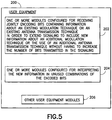
- Figure 5 Terminal or UE 200.
- Figure 5 shows, by way of example, a terminal or UE generally indicated as 200 according to the present invention that may form part of the network shown in Figure 2a and 2b , consistent with that shown and described herein.
- the terminal or UE includes one or more modules 102 and 204, as well as and other user equipment modules 206.
- the one or more modules 202 may be configured for receiving jointly encoded bits containing information about an existing modulation technique or an existing antenna transmission technique in order to extend signaling to include new information about an additional modulation technique or the use of an additional antenna transmission technique without having to increase the number of bits transmitted in the signaling; while the one or more modules 204 may be configured for interpreting the new information in unused combinations of the encoded bits.
- the functionality of the module 202 and 204 may be implemented using hardware, software, firmware, or a combination thereof, although the scope of the invention is not intended to be limited to any particular embodiment thereof.
- the module 102 would be one or more microprocessor-based architectures having a microprocessor, a random access memory (RAM), a read only memory (ROM), input/output devices and control, data and address buses connecting the same.
- RAM random access memory
- ROM read only memory
- input/output devices and control, data and address buses connecting the same A person skilled in the art would be able to program such a microprocessor-based implementation to perform the functionality described herein without undue experimentation.
- the scope of the invention is not intended to be limited to any particular implementation using technology known or later developed in the future.
- the scope of the invention is intended to include the module 102 being a stand alone module in the combination with other circuitry for implementing another module.
- the other UE modules 206 and the functionality thereof are known in the art, do not form part of the underlying invention per se, and are not described in detail herein.
- the other UE modules 206 may include other modules such as a UMTS subscriber identity module (USIM) and mobile equipment (ME) module, which are known in the art and not described herein.
- USIM UMTS subscriber identity module
- ME mobile equipment
- This implementation outlines a new technique for HS-SCCH structures that would support all the 4 combinations without explicitly defining a separate HS-SCCH structure for each mode of operation separately.
- the technique maintains the Part1/Part2 separation of the HS-SCCH and has two different formats for Part2 in MIMO mode, one for single and one for dual stream transmission.
- the design assumptions and targets should be able to support all the combinations, MIMO operation, no MIMO operation and operation with and without 64QAM with only two HS-SCCH structures, one for MIMO and one for no MIMO case.
- the target is also to do this in a backwards compatible manner.
- MIMO and/or 64QAM are separately signaled to the UE if both the UE and the Node B support these features and the network decides to activate them. This signalling is the basis for the UE to know how to receive the HS-PDSCH. It is further identified that 64QAM support only impacts the Part1.
- 64QAM signalling should not cost anything in performance for the 16QAM MIMO operation.
- HS-SCCH for non-MIMO with/without 64QAM .
- 64QAM 64QAM support
- Part2 may remain the same regardless of 64QAM support and only the indication of 64QAM modulation needs to be included in the Part1.
- This technique of allowing to have the same number of information bits and thus the same coding and rate matching leading to the same HS-SCCH performance is to reinterpret the channelization code set information bits when 64QAM is configured to the link and QAM transmission is indicated by the modulation scheme information bit, shown by way of example, as follows: Table 1: HS-SCCH Part1 structure for non-MIMO operation Modulation scheme information Code Set info Used Modulation QPSK/QAM 16/64QAM 64QAM not configured 0 N/A 7 bits (Rel-5) QPSK 1 N/A 7 bits (Rel-5) 16QAM 64QAM configured 0 N/A 7 bits (Rel-5) QPSK 1 0* 6 bits (1) 16QAM 1 1* 6 bits (1) 64QAM 1) The LSB fixed to 1 and not signalled leading to available number of codes ⁇ 1,3,5,7,9,11,13,15 ⁇
- HS-SCCH Part2 structure for non-MIMO operation would be as defined for Rel-5 regardless of whether 64QAM is configured or not.
- HS-SCCH Part1 structure is set forth in Table 1 by way of example as one possible mapping and/or implementation of the present invention.
- the scope of the invention is also intended to include other possible mappings and/or implementations either now known or later developed in the future.
- embodiments are envisioned having a mapping of, e.g., 1, 3, 5, 7, 10, 12 13 and 15.
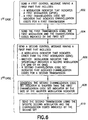
- Figure 6 is a process flow diagram showing an embodiment of the invention from the perspective of the Node B, conveniently divided into first and second cases that are meant to run sequentially.
- the Node B sends a first control message.
- a modulation indicator that indicates a first modulation such as QPSK
- a first channelization code set indicator that indicates a channelization code for a first transmission.
- that first transmission is sent, and it is modulated with the first modulation and uses the channelization codes identified by the first channelization code set indicator.
- the second case begins at block 606, where the Node B sends a second control message which has in its first part a modulation indicator that indicates other than the first modulation (e.g., QAM), an additional modulation indicator that selects between variances of the 'other than the first modulation' (e.g., selects between 16QAM and 64QAM), and a second channelization code set indicator that indicates a channelization code for a second transmission.
- a condition is stated at block 608: the second channelization code set indicator is shorter than the first channelization code set indicator by the length of the 'another modulation indicator', which in an exemplary embodiment is one bit since the 'another modulation indicator' selects only between 16QAM and 64QAM.
- that second transmission is sent using the specific modulation selected by the 'another modulation indicator', and using channelization codes associated with the second channelization code set indicator.
- Figure 7 is similar to Figure 6 but from the perspective of the user equipment/mobile terminal.
- the mobile apparatus receives a first control message. In a first part of that first control message there is a modulation indicator and a first channelization code set indicator.
- the user equipment determines from the received modulation indicator a first modulation (e.g., QPSK) and from the first channelization code set indicator the channelization codes for a first transmission.
- a first modulation e.g., QPSK
- the received first transmission is demodulated using the determined first modulation, and decoded using the channelization codes that were determined from the first channelization code set indicator.
- the second case begins at block 710, where the user equipment receives a second control message which has in its first part a modulation indicator, an additional modulation indicator, and a second channelization code set indicator.
- a condition of those items of the second control message (first part of it) is stated at block 712: the second channelization code set indicator is shorter than the first channelization code set indicator by the length of the 'another modulation indicator', which in an exemplary embodiment similar to that of Figure 6 is one bit since the 'another modulation indicator' selects only between 16QAM and 64QAM.
- the user equipment determines at block 714 an 'other than the first modulation' (e.g., QAM) from the modulation indicator of the second control message, determines a specific second modulation from the 'another modulation indicator' (e.g., 16QAM or 64QAM), and determines a channelization code for a second transmission from the second channelization code set indicator.
- the user equipment receives that second transmission, and at block 718 the user equipment demodulates the second transmission using the determined second modulation, and decodes the second transmission using the channelization code that was determined from the second channelization code set indicator.
- Part1 structure optimized for supporting MIMO without 64QAM may first implement Part1 structure optimized for supporting MIMO without 64QAM and then extend that structure to take the possible 64QAM introduction into account.
- rank indication and antenna weight information bits increases the number of bits of Part1 already by almost 40% we try to limit the additional bits of Part1 to these three.
- Table 2 HS-SCCH Part1 structure for MIMO operation without 64QAM Rank Modulation1 Modulation2 Code Set Info Antenna weight Used modulation 0 0 N/A 7 bits (Rel-5) 2 bits QPSK 0 1 N/A 7 bits (Rel-5) 2 bits 16QAM 1 0 N/A 7 bits (Rel-5) 2 bits QPSK/QPSK 1 1 0 6 bits (1) 2 bits 16QAM/QPSK 1 1 1 6 bits (1) 2 bits 16QAM/16QAM 1)
- the LSB would not be signalled and would be fixed to 1 leading to available number of codes ⁇ 1,3,5,7,9,11,13,15 ⁇
- Part2 structure needs to be redefined to support dual-stream operation and in a single stream case the larger space for addressing HARQ processes
- HS-SCCH Part1 structure for MIMO operation is set forth in Table 2 by way of example as one possible mapping and/or implementation of the present invention.
- the scope of the invention is also intended to include other possible mappings and/or implementations either now known or later developed in the future.
- embodiments are envisioned having a mapping having start codes of ⁇ 1, 2, 3, 4, 5, 6, 7, 8 ⁇ and the # of codes as ⁇ 8, 9, 10, 11, 12, 13, 14, 15 ⁇ .
- Table 3 HS-SCCH Part2 structure for MIMO operation TrBik size HARQ ID RV and Constellation NDI CRC/UE ID Total Rel-5 bits 3 bits 3 bits 1 bit 16 bits bits Single stream 6 bits 4 bits 2 bits (1) 16 bits 28 bits Dual stream 2x6 bits 2 x 3 bits (2) 2 x 2 bits (1) 16 bits 38 bits 1) RV, Constellation version and NDI can be jointly coded to a 2-bit HARQ transmission format 2) Primary stream always transmitting to processes 0,...,7, secondary stream always transmitting to processes 8,...,15
- Part2 The same format for Part2 can be used also if 64QAM is supported.
- HS-SCCH for MIMO with 64QAM .
- the Part1 format for MIMO without 64QAM can be easily extended to support also 64QAM.
- the LSB would not be signalled and would be fixed to 1 leading to available number of codes ⁇ 1,3,5,7,9,11
- This implementation for Rel-7 HS-SCCH supports MIMO and 64QAM both separately and together by having principally only two different HS-SCCHs with both having a different interpretation depending on whether or not 64QAM is configured.
- Embodiments of this invention jointly encode bits containing information about an existing modulation technique or an existing antenna transmission technique in order to extend signaling to include new information about an additional modulation technique or the use of an additional antenna transmission technique, without having to increase the number of bits transmitted in the signaling; and conveying the new information in unused combinations of the encoded bits.
- the signaling may take the form of a high speed shared control channel (HS-SCCH) that forms part of a high speed downlink packet access (HSDPA).
- HS-SCCH high speed shared control channel
- HSDPA high speed downlink packet access
- the existing modulation technique may include quadrature phase shift keying (QPSK), 16 quadrature amplitude modulation (16QAM), or some combination thereof, and the additional modulation technique may include 64 quadrature amplitude modulation (64QAM).
- QPSK quadrature phase shift keying
- 16QAM 16 quadrature amplitude modulation
- 64QAM 64 quadrature amplitude modulation
- the existing antenna transmission technique may include single-stream or dual-stream transmission, and the additional antenna transmission technique may include the use of space division multiple access methods using a multiple input and multiple output (MIMO) technique.
- MIMO multiple input and multiple output
- the number of data streams is checked, and if there is only one data stream, then an unused other stream modulation scheme bit is interpreted as an additional modulation information bit for single-stream or as an indication of a space division multiple access operation.
- an unused other stream modulation scheme bit is interpreted as an additional modulation information bit for single-stream or as an indication of a space division multiple access operation.
- a restricted combination of modulation scheme bits indicates that the new modulation technique will be used for the primary stream.
- the modulation usage for the secondary stream may be indicated by interpreting one code information bit as either one modulation scheme or another.
- Embodiments of the invention may be implemented in apparatus that may take the form of either user equipment or terminal, a network node, such as a Node B, a network or system, a computer program product or some combination thereof.
- the network node B may feature one or more modules configured for jointly encoding bits containing information about an existing modulation technique or an existing antenna transmission technique in order to extend signaling to include new information about an additional modulation technique or the use of an additional antenna transmission technique without having to increase the number of bits transmitted in the signaling; and one or more modules configured for conveying the new information in unused combinations of the encoded bits, in accordance with some embodiments of the present invention and consistent with that described herein.
- the user equipment or terminal may feature one or more modules configured for receiving jointly encoded bits containing information about an existing modulation technique or an existing antenna transmission technique in order to extend signaling to include new information about an additional modulation technique or the use of an additional antenna transmission technique without having to increase the number of bits transmitted in the signaling; and one or more modules configured for interpreting the new information in unused combinations of the encoded bits, in accordance with some embodiments of the present invention and consistent with that described herein.
- the system would have such a network node B and/or such user equipment for cooperating in such a manner in accordance with some embodiments of the invention and consistent with that described herein.
- Embodiments of the invention may also take the form of a computer program product with a program code, which program code is stored on a machine readable carrier or memory, for carrying out such functionality, when the computer program is run in a processor or control module of such a network node B or user equipment.
- the invention include a device, including chip hardware, comprising one or more integrated circuits for performing such functionality.
- the device may take the form of an application specific integrated circuit (ASIC) for performing the functionality thereof.
- ASIC application specific integrated circuit
- the chip hardware may form part of the terminal or the network node that forms part of the serving cell.
Landscapes
- Engineering & Computer Science (AREA)
- Signal Processing (AREA)
- Computer Networks & Wireless Communication (AREA)
- Quality & Reliability (AREA)
- Mobile Radio Communication Systems (AREA)
- Digital Transmission Methods That Use Modulated Carrier Waves (AREA)
Description
- This application claims priority to
US Provisional Patent Application No. 60/879,726 (filed January 9, 2007 - These teachings generally relate to wireless mobile telecommunication systems with adaptive modulation. Particular embodiments relate to the HSDPA aspects of the 3rd generation partnership project (3GPP of 3GPP2) where the used modulation is either QPSK or 16QAM depending on the Node B scheduler decision.
- The following abbreviations are used in the text below.
- HSDPA
- high speed downlink packet access
- HS-DSCH
- high speed downlink shared channel
- HS-PDSCH
- high speed physical downlink shared channel
- HS-SCCH
- high speed shared control channel
- QAM
- quadrature amplitude modulation
- QPSK
- quadrature phase shift keying
- RNC
- radio network controller
- SDMA
- space division multiple access
- UE
- user equipment
- The 3GPP Release-5/6/7 specifications define HSDPA with adaptive modulation where the used modulation is either QPSK or 16QAM depending on the Node B scheduler decision. See for example 3GPP TS 25.212 "Multiplexing and channel coding". Recently the discussion on introducing also the possibility to use 64QAM with HSDPA has emerged in 3GPP. At the same time 3GPP is specifying a MIMO (multiple input - multiple output) multiantenna technique for HSDPA MIMO requiring some redesigning for the HSDPA related control channels.
- The current HS-SCCH structure used to inform the format of the actual high speed downlink shared channel (HS-DSCH) transmission (including the used modulation) is split into two parts.
Part 1 contains 8 bits, 7 bits to inform the used high speed physical downlink shared channel (HS-PDSCH) codes for the HS-DSCH transmission and one bit (QPSK/16QAM) informing the used modulation on those HS-PDSCH codes.Part 2 contains further information such as transport block size, hybrid automatic repeat request (HARQ) information, etc. - The high speed shared control channel (HS-SCCH) transmission starts 5120 chips earlier than the HS-DSCH transmission in order to allow the user equipment (UE) receiver to get the 1st part of the HS-SCCH before the HS-DSCH reception starts and thus know in advance the codes and modulation used on the HS-DSCH, as best shown in
figure 1 . - With HSDPA MIMO the intention is further to add at least two bits of the antenna weights used for the HS-DSCH transmission to
Part 1 for giving also this MIMO specific information to the receiver. Also, one bit will be added to indicate the number of streams used i.e. single-stream or dual-stream transmission. The dual-stream transmission consists of a primary stream and a secondary stream. The modulation type (QPSK/16QAM/64QAM) for the secondary stream is always equal to or lower than the modulation of the primary stream. However, the first problem is how to add a new modulation (64QAM) indication to the part1 of the HS-SCCH. - Moreover, multi-stream transmission enables the use of space division multiple access (SDMA) methods, where simultaneous data streams can be transmitted to different UEs. However, there is a second problem - how to inform different UEs that SDMA transmission is ongoing, because this knowledge is beneficial in the receiver design.
- An example of a working assumption for defining the new HS-SCCH structure for MIMO operation may be seen at document R1-062485 entitled "Details of HS-SCCH signalling for Rel-7 MIMO", from 3GPP TSG RAN WG1 Meeting #46bis (Seoul, Korea, 9-13 October 2006 by Philips).
- One solution to the problem is to do as was done with the antenna weight bits with MIMO, i.e. make room for one additional bit to the
part 1 by reducing the error correction coding of thepart 1. See, for example, document R1-062935 entitled "Higher Order Modulation for HSPA - Impact on RAN1 specifications", from that same 3GPP RAN1 meeting and by Ericsson. - Moreover, another prior art solution to the problem is to introduce one extra bit to signal SDMA operation. See, for example, document R1-062032 entitled "HS-SCCH in support of D-TxAA", from that same 3GPP RAN1 meeting and by Qualcomm Europe.
- There is a need in the art for a solution to these problems without substantially increasing the signalling overhead as in the above proposed solutions.
- According to an embodiment of the invention is a method that includes in a first case, sending a first part of a first control message and thereafter sending a first transmission using a first modulation. The first part of the first control message includes a modulation indicator that indicates the first modulation and a first channelization code set indicator that indicates channelization codes for the first transmission. Further in the method, a second case includes sending a first part of a second control message and thereafter sending a second transmission using a second modulation. The first part of the second control message includes a modulation indicator that indicates other than the first modulation, another modulation indicator that specifically indicates the second modulation, and a second channelization code set indicator that indicates channelization codes for the second transmission. The second channelization code set indicator is shorter than the first channelization code set indicator by the size of the another modulation indicator.
- According to another embodiment of the invention is a memory embodying a program of machine-readable instructions executable by a digital data processor to perform actions directed toward specifying adaptive modulation for transmission. In this embodiment the actions include for a first case sending a first part of a first control message and thereafter sending a first transmission using a first modulation. The first part of the first control message includes a modulation indicator that indicates the first modulation and a first channelization code set indicator that indicates channelization codes for the first transmission. The actions further includes for a second case sending a first part of a second control message and thereafter sending a second transmission using a second modulation. The first part of the second control message includes a modulation indicator that indicates other than the first modulation, another modulation indicator that specifically indicates a second modulation, and a second channelization code set indicator that indicates channelization codes for the second transmission. The second channelization code set indicator is shorter than the first channelization code set indicator by the size of the another modulation indicator.
- According to another embodiment of the invention is an apparatus that includes a transmitter and a modulator coupled to a processor such that in a first case the transmitter is adapted to send a first part of a first control message and thereafter to modulate and send a first transmission using a first modulation. The first part of the first control message includes a modulation indicator that indicates the first modulation and a first channelization code set indicator that indicates channelization codes for the first transmission. The apparatus is further configured in a second case such that the transmitter is adapted to send a first part of a second control message and thereafter to modulate and send a second transmission using a second modulation. The first part of the second control message includes a modulation indicator that indicates other than the first modulation, another modulation indicator that specifically indicates the second modulation, and a second channelization code set indicator that indicates channelization codes for the second transmission. The second channelization code set indicator is shorter than the first channelization code set indicator by the size of the another modulation indicator.
- According to another embodiment of the invention is an apparatus that includes means for arranging a control message according to a first case and according to a second case, and means for sending the control message. For the first case the means for arranging and the means for sending are for sending a first part of a first control message and thereafter for sending a first transmission using a first modulation, where the first part of the first control message includes a modulation indicator that indicates the first modulation and a first channelization code set indicator that indicates channelization codes for the first transmission. For the second case the means for arranging and the means for sending are for sending a first part of a second control message and thereafter for sending a second transmission using a second modulation, where the first part of the second control message includes a modulation indicator that indicates other than the first modulation, another modulation indicator that specifically indicates the second modulation, and a second channelization code set indicator that indicates channelization codes for the second transmission. The second channelization code set indicator is shorter than the first channelization code set indicator by the size of the another modulation indicator. In a particular embodiment of this aspect of the invention, the means for arranging includes a digital processor and the means for sending includes a transmitter, and further the first modulation is QPSK and other than the first modulation is QAM and the another modulation scheme indicator selects between 16QAM and 64QAM. In a further particular embodiment each of the modulation indicators is one bit, the first channelization code set indicator is seven bits and for the second case the means for arranging shortens the second channelization code set indicator by a least significant bit to six bits to make room in the first part of the second control message for the another modulation indicator.
- According to another embodiment of the invention is a method that includes, in a first case, determining a first modulation from a modulation indicator of a first part of a received first control message and determining channelization codes for a first transmission from a first channelization code set indicator of the first part of the first control message, and demodulating the received first transmission according to the determined first modulation. Further in this method in a second case, is determining other than the first modulation from a modulation indicator of a first part of a received second control message, determining a specific second modulation that is other than the first modulation from another modulation indicator of the first part of the second control message, determining channelization codes for a second transmission from a second channelization code set indicator of the first part of the second control message, and demodulating the received second transmission according to the determined specific second modulation. The second channelization code set indicator is shorter than the first channelization code set indicator by the size of the another modulation indicator.
- According to another embodiment of the invention is a memory embodying a program of machine-readable instructions executable by a digital data processor to perform actions directed toward specifying adaptive modulation for transmission. In this embodiment of the invention the actions include, in a first case, determining a first modulation from a modulation indicator of a first part of a received first control message and determining channelization codes for a first transmission from a first channelization code set indicator of the first part of the first control message, and demodulating the received first transmission according to the determined first modulation. The actions include, in a second case, determining other than the first modulation from a modulation indicator of a first part of a received second control message, determining a specific second modulation that is other than the first modulation from another modulation indicator of the first part of the second control message, determining channelization codes for a second transmission from a second channelization code set indicator of the first part of the second control message, and demodulating the received second transmission according to the determined specific second modulation. The second channelization code set indicator is shorter than the first channelization code set indicator by the size of the another modulation indicator.
- According to another embodiment of the invention is an apparatus that includes a receiver coupled to a processor that are adapted in a first case to determine a first modulation from a modulation indicator of a first part of a received first control message and to determine channelization codes for a first transmission from a first channelization code set indicator of the first part of the first control message, and to demodulate the received first transmission according to the determined first modulation. The receiver and processor are adapted in a second case to determine other than the first modulation scheme from a modulation indicator of a first part of a received second control message, to determine a specific second modulation that is other than the first modulation from another modulation indicator of the first part of the second control message, to determine channelization codes for a second transmission from a second channelization code set indicator of the first part of the second control message, and to demodulate the received second transmission according to the determined specific second modulation. The second channelization code set indicator is shorter than the first channelization code set indicator by the size of the another modulation indicator.
- According to another embodiment of the invention is an apparatus that includes means for receiving coupled to processing means which are adapted in a first case for determining a first modulation from a modulation indicator of a first part of a received first control message and for determining channelization codes for a first transmission from a first channelization code set indicator of the first part of the first control message and for demodulating the received first transmission according to the determined first modulation. The means for receiving and processing means are adapted in a second case for determining other than the first modulation from a modulation indicator of a first part of a received second control message, for determining a specific second modulation that is other than the first modulation from another modulation indicator of the first part of the second control message, for determining channelization codes for a second transmission from a second channelization code set indicator of the first part of the second control message, and for demodulating the received second transmission according to the determined specific second modulation, where the second channelization code set indicator is shorter than the first channelization code set indicator by the size of the another modulation indicator. In a particular embodiment of this aspect of the invention, the receiving means includes a receiver, the processing means includes a processor, the first part of the first control message and the first part of the second control message are of equal lengths, the first modulation is QPSK and other than the first modulation is QAM, and the another modulation indicator selects between 16QAM and 64QAM.
- The foregoing and other objects, features and advantages of the present invention will become more apparent in light of the following detailed description of exemplary embodiments thereof.
- The Figures are not drawn to scale and include the following:
-
Figure 1 shows a known timing relation between the HS-SCCH and the associated HS-PDSCH. -
Figures 2a and2b show block diagrams of the UMTS packet network architecture according to some embodiments of the preset invention, andFigure 2c shows details of certain of the devices ofFigure 2b . -
Figure 3 shows a flowchart showing steps according to some embodiments of the preset invention. -
Figure 4 shows a block diagram of a network node B according to some embodiments of the present invention. -
Figure 5 shows a block diagram of user equipment or a terminal according to an embodiment of the present invention. -
Figure 6 is a process flow diagram illustrating steps according to an embodiment of the invention from the network perspective. -
Figure 7 is a process flow diagram illustrating steps according to an embodiment of the invention from the perspective of a user equipment. -
Figures 2a and2b show diagrams of the UMTS packet network architecture, according to some embodiments of the present invention. InFigure 2a , the UMTS packet network architecture includes the major architectural elements of user equipment (UE) 20, UMTS terrestrial radio access network (UTRAN) 22, and core network (CN) 24. The UE (also referred to as a "terminal" herein) does not itself form part of thewireless network 22 but is interfaced to the UTRAN over a radio (Uu)interface 26, while the UTRAN interfaces to the core network (CN) over a (wired)lu interface 28.Figure 2b shows some further details of the architecture, particularly the UTRAN, which includes multiple radio network subsystems (RNSs) RRNS1, RNS2, each of which contains at least one controller ofnetwork access nodes Fig. 2b . A given UE may be in radio contact with multiple Node Bs even if one or more of the Node Bs are connected to different RNCs. For instance, a UE1 inFig. 2b may be in radio contact with Node B2 of RNS1 and Node B3 of RNS2 where Node B2 and Node B3 are neighboring Node Bs. This may occur, for example, when the UE1 is in a handover situation and there is a change in the connection from one Node B to another. The RNCs of different RNSs may be connected by anlur interface 29 which allows mobile UEs to stay in contact with both RNCs while traversing from a cell belonging to a Node B of one RNC to a cell belonging to a Node B of another RNC. -
Figure 2c illustrates a simplified block diagram of various electronic devices formFigure 2b that are suitable for use in practicing the exemplary embodiments of this invention. InFigure 2c awireless network 22 is adapted for communication between aUE 30 and a Node B 32 (termed an e-Node B in some radio access technologies). Thenetwork 22 may include a gateway GW/serving mobility entity MME/radionetwork controller RNC 32 or other radio controller function known by various terms in different wireless communication systems. TheUE 30 includes a data processor (DP) 30A, a memory (MEM) 30B that stores a program (PROG) 30C, and one or more suitable radio frequency (RF)transceivers 30D (two shown) coupled to one ormore antennas 30E (two shown) for bidirectional wireless communications over one ormore wireless links 26 with theNode B 32. - The terms "connected," "coupled," or any variant thereof, mean any connection or coupling, either direct or indirect, between two or more elements, and may encompass the presence of one or more intermediate elements between two elements that are "connected" or "coupled" together. The coupling or connection between the elements can be physical, logical, or a combination thereof. As employed herein two elements may be considered to be "connected" or "coupled" together by the use of one or more wires, cables and printed electrical connections, as well as by the use of electromagnetic energy, such as electromagnetic energy having wavelengths in the radio frequency region, the microwave region and the optical (both visible and invisible) region, as non-limiting examples.
- The
Node B 32 also includes aDP 32A, aMEM 32B, that stores aPROG 32C, and one or moresuitable RF transceivers 32D (two shown) coupled to one ormore antennas 32E (two shown). TheNode B 32 may be coupled via a data path 36 (e.g., lub or S1 interface) to the serving or other GW/MME/RNC 34. The GW/MME/RNC 34 includes aDP 34A, aMEM 34B that stores aPROG 34C, and a suitable modem and/or transceiver (not shown) for communication with theNode B 32 over thelub link 36. - Also within the
Node B 32 is ascheduler 32F that schedule the various UEs under its control according to these teachings. Generally, theNode B 32 of a WCDMA or an LTE system is fairly autonomous in its scheduling and need not coordinate with the GW/MME/RNC 34 excepting during handover of one of its UEs to another Node B as noted above. - At least one of the
PROGs DPs - The
PROGs MEM 30B and executable by theDP 30A of theUE 30 and similar for theother MEM 32B andDP 32A of theNode B 32, or by hardware, or by a combination of software and/or firmware and hardware in any or all of the devices shown. - In general, the various embodiments of the
UE 30 can include, but are not limited to, mobile stations, cellular telephones, personal digital assistants (PDAs) having wireless communication capabilities, portable computers having wireless communication capabilities, image capture devices such as digital cameras having wireless communication capabilities, gaming devices having wireless communication capabilities, music storage and playback appliances having wireless communication capabilities, Internet appliances permitting wireless Internet access and browsing, as well as portable units or terminals that incorporate combinations of such functions. - The
MEMs DPs - In accordance with an embodiment of the invention, the Node Bs (see also
Figure 4 ) cooperate with UE1, UE2 or UE3 and extend the HS-SCCH signaling so as to include information of 64QAM and the use of SDMA (multi user MIMO) without having to increase the number of bits transmitted on the HS-SCCH. This is done by jointly encoding the bits for modulation and number of streams and conveying the new information using the unused combinations. In effect, embodiments of the invention provide a new technique how to signal multi-user MU-MIMO/SDMA transmission and higher order modulation (64QAM) using 2bits in the control channel bitfield for HSDPA/HS-DSCH (which is signaled on HS-SCCH). By using this new method, there is no need to change the HS-SCCH format. Only the interpretation of the content of the HS-SCCH is changed. -
Figure 3 shows a flowchart generally indicated as 10 setting forth thebasic steps - In operation, an embodiment of the invention is to check the number of streams indication bit, and if only a single-stream is used, then the unused other stream modulation scheme bit is interpreted as additional modulation info bit for the single-stream or as an indication of an SDMA operation. For example, if the number of streams (NS) bit indicates that a single-stream is used, then the other stream modulation scheme (MS) bit is interpreted as follows:
Primary stream MS bit Other stream MS bit Indicated modulation 0 0 QPSK 0 1 16QAM 1 0 64QAM 1 1 128QAM - Alternatively, if a dual-stream transmission is used, then the restricted combination of modulation scheme bits indicates that 64QAM will be used for primary stream. The 64QAM usage for secondary stream can be indicated by interpreting one code information bit as 16QAM/64QAM selection. For example, if the number of streams (NS) bit indicates that the dual-stream is used, then the modulation scheme (MS) bits are interpreted as follows:
Primary stream MS bit Secondary stream MS bit Indicated modulation for primary stream Indicated modulation for secondary stream 0 0 QPSK QPSK 0 1 64QAM 16QAM/ 64QAM 1 0 16QAM QPSK 1 1 16QAM 16QAM - Now the restricted bit combination (0 1) indicates 64QAM for the primary stream, and the modulation usage for the secondary stream depends on one code information bit.
- Moreover, the solution to the SDMA indication problem is similar to the single stream solution, i.e. the other stream modulation scheme (MS) bit is interpreted as follows:
Primary steam MS bit Other stream MS bit SDMA transmission Indicated modulation 0 0 Off QPSK 0 1 On QPSK 1 0 Off 16QAM 1 1 On 16QAM -
Figure 4 :Network Node 100.Figure 4 shows, by way of example, a network node generally indicated as 100 according to the present invention that may form part of the RNS, RNC, node Bs or some combination thereof consistent with that shown inFigure 2a and2b , and consistent with that shown and described herein. The scope of the invention is not intended to be limited to where the functionality of the network node is implemented in the network. Thenetwork node B 100 includes one ormore modules node B modules 106. - Consistent with that shown and described herein, the one or
more modules 102 may be configured for jointly encoding bits containing information about an existing modulation technique or an existing antenna transmission technique in order to extend signaling to include new information about an additional modulation technique or the use of an additional antenna transmission technique without having to increase the number of bits transmitted in the signaling; while the one ormore modules 104 may be configured for conveying the new information in unused combinations of the encoded bits. - By way of example, the functionality of the
modules module 102 would be one or more microprocessor-based architectures having a microprocessor, a random access memory (RAM), a read only memory (ROM), input/output devices and control, data and address buses connecting the same. A person skilled in the art would be able to program such a microprocessor-based implementation to perform the functionality described herein without undue experimentation. The scope of the invention is not intended to be limited to any particular implementation using technology known or later developed in the future. Moreover, the scope of the invention is intended to include themodule - The other
Node B modules 106 and the functionality thereof are known in the art, do not form part of the underlying invention per se, and are not described in detail herein. For example, the otherNode B modules 206 may include one or more other modules in the RNS, RNC, Node B or some combination thereof, which are known in the art and not described herein. -
Figure 5 : Terminal orUE 200.Figure 5 shows, by way of example, a terminal or UE generally indicated as 200 according to the present invention that may form part of the network shown inFigure 2a and2b , consistent with that shown and described herein. The terminal or UE includes one ormore modules user equipment modules 206. - Consistent with that shown and described herein, the one or
more modules 202 may be configured for receiving jointly encoded bits containing information about an existing modulation technique or an existing antenna transmission technique in order to extend signaling to include new information about an additional modulation technique or the use of an additional antenna transmission technique without having to increase the number of bits transmitted in the signaling; while the one ormore modules 204 may be configured for interpreting the new information in unused combinations of the encoded bits. - By way of example, the functionality of the
module module 102 would be one or more microprocessor-based architectures having a microprocessor, a random access memory (RAM), a read only memory (ROM), input/output devices and control, data and address buses connecting the same. A person skilled in the art would be able to program such a microprocessor-based implementation to perform the functionality described herein without undue experimentation. The scope of the invention is not intended to be limited to any particular implementation using technology known or later developed in the future. Moreover, the scope of the invention is intended to include themodule 102 being a stand alone module in the combination with other circuitry for implementing another module. - The
other UE modules 206 and the functionality thereof are known in the art, do not form part of the underlying invention per se, and are not described in detail herein. For example, theother UE modules 206 may include other modules such as a UMTS subscriber identity module (USIM) and mobile equipment (ME) module, which are known in the art and not described herein. - A Further Implementation. The following is a further implementation in which some provisions take place in the signalling structures for the 64QAM operation with MIMO.
- In addition to the HS-SCCH defined for Rel-5 HSDPA RAN1, there is a need to define a HS-SCCH supporting 64QAM, a HS-SCCH structure supporting MIMO and possibly provide also a support for MIMO with 64QAM on the HS-SCCH structure defined for MIMO.
- This implementation outlines a new technique for HS-SCCH structures that would support all the 4 combinations without explicitly defining a separate HS-SCCH structure for each mode of operation separately. The technique maintains the Part1/Part2 separation of the HS-SCCH and has two different formats for Part2 in MIMO mode, one for single and one for dual stream transmission.
- The design assumptions and targets. The basic design should be able to support all the combinations, MIMO operation, no MIMO operation and operation with and without 64QAM with only two HS-SCCH structures, one for MIMO and one for no MIMO case. The target is also to do this in a backwards compatible manner.
- It is further assumed that the usage of MIMO and/or 64QAM is separately signaled to the UE if both the UE and the Node B support these features and the network decides to activate them. This signalling is the basis for the UE to know how to receive the HS-PDSCH. It is further identified that 64QAM support only impacts the Part1.
- Finally, 64QAM signalling should not cost anything in performance for the 16QAM MIMO operation.
- HS-SCCH for non-MIMO with/without 64QAM. Based on the aforementioned, one may take the Rel-5 HS-SCCH as a basis for 64QAM support. Part2 may remain the same regardless of 64QAM support and only the indication of 64QAM modulation needs to be included in the Part1.
- This technique of allowing to have the same number of information bits and thus the same coding and rate matching leading to the same HS-SCCH performance is to reinterpret the channelization code set information bits when 64QAM is configured to the link and QAM transmission is indicated by the modulation scheme information bit, shown by way of example, as follows:
Table 1: HS-SCCH Part1 structure for non-MIMO operation Modulation scheme information Code Set info Used Modulation QPSK/ QAM 16/64QAM 64QAM not configured 0 N/A 7 bits (Rel-5) QPSK 1 N/A 7 bits (Rel-5) 16QAM 64QAM configured 0 N/A 7 bits (Rel-5) QPSK 1 0* 6 bits(1) 16QAM 1 1* 6 bits(1) 64QAM 1) The LSB fixed to 1 and not signalled leading to available number of codes {1,3,5,7,9,11,13,15} - HS-SCCH Part2 structure for non-MIMO operation would be as defined for Rel-5 regardless of whether 64QAM is configured or not.
- Moreover, the aforementioned HS-SCCH Part1 structure is set forth in Table 1 by way of example as one possible mapping and/or implementation of the present invention. However, the scope of the invention is also intended to include other possible mappings and/or implementations either now known or later developed in the future. For example, embodiments are envisioned having a mapping of, e.g., 1, 3, 5, 7, 10, 12 13 and 15.
-
Figure 6 is a process flow diagram showing an embodiment of the invention from the perspective of the Node B, conveniently divided into first and second cases that are meant to run sequentially. Atblock 602 the Node B sends a first control message. In a first part of that first control message there is a modulation indicator that indicates a first modulation such as QPSK, and a first channelization code set indicator that indicates a channelization code for a first transmission. Atblock 604 that first transmission is sent, and it is modulated with the first modulation and uses the channelization codes identified by the first channelization code set indicator. The second case begins atblock 606, where the Node B sends a second control message which has in its first part a modulation indicator that indicates other than the first modulation (e.g., QAM), an additional modulation indicator that selects between variances of the 'other than the first modulation' (e.g., selects between 16QAM and 64QAM), and a second channelization code set indicator that indicates a channelization code for a second transmission. A condition is stated at block 608: the second channelization code set indicator is shorter than the first channelization code set indicator by the length of the 'another modulation indicator', which in an exemplary embodiment is one bit since the 'another modulation indicator' selects only between 16QAM and 64QAM. Atblock 610 then, that second transmission is sent using the specific modulation selected by the 'another modulation indicator', and using channelization codes associated with the second channelization code set indicator. -
Figure 7 is similar toFigure 6 but from the perspective of the user equipment/mobile terminal. Atblock 702 the mobile apparatus receives a first control message. In a first part of that first control message there is a modulation indicator and a first channelization code set indicator. Atblock 704 the user equipment determines from the received modulation indicator a first modulation (e.g., QPSK) and from the first channelization code set indicator the channelization codes for a first transmission. Atblock 706 that first transmission is received. Atblock 708 the received first transmission is demodulated using the determined first modulation, and decoded using the channelization codes that were determined from the first channelization code set indicator. The second case begins atblock 710, where the user equipment receives a second control message which has in its first part a modulation indicator, an additional modulation indicator, and a second channelization code set indicator. A condition of those items of the second control message (first part of it) is stated at block 712: the second channelization code set indicator is shorter than the first channelization code set indicator by the length of the 'another modulation indicator', which in an exemplary embodiment similar to that ofFigure 6 is one bit since the 'another modulation indicator' selects only between 16QAM and 64QAM. Having received the second control message, the user equipment then determines atblock 714 an 'other than the first modulation' (e.g., QAM) from the modulation indicator of the second control message, determines a specific second modulation from the 'another modulation indicator' (e.g., 16QAM or 64QAM), and determines a channelization code for a second transmission from the second channelization code set indicator. Atblock 716 the user equipment receives that second transmission, and atblock 718 the user equipment demodulates the second transmission using the determined second modulation, and decodes the second transmission using the channelization code that was determined from the second channelization code set indicator. - HS-SCCH for MIMO without 64QAM. Based on the aforementioned, one may first implement Part1 structure optimized for supporting MIMO without 64QAM and then extend that structure to take the possible 64QAM introduction into account. As the rank indication and antenna weight information bits increases the number of bits of Part1 already by almost 40% we try to limit the additional bits of Part1 to these three.
Table 2: HS-SCCH Part1 structure for MIMO operation without 64QAM Rank Modulation1 Modulation2 Code Set Info Antenna weight Used modulation 0 0 N/A 7 bits (Rel-5) 2 bits QPSK 0 1 N/A 7 bits (Rel-5) 2 bits 16QAM 1 0 N/A 7 bits (Rel-5) 2 bits QPSK/ QPSK 1 1 0 6 bits (1)2 bits 16QAM/ QPSK 1 1 1 6 bits (1)2 bits 16QAM/16QAM 1) The LSB would not be signalled and would be fixed to 1 leading to available number of codes {1,3,5,7,9,11,13,15} - In case of MIMO operation the Part2 structure needs to be redefined to support dual-stream operation and in a single stream case the larger space for addressing HARQ processes
- Moreover, the aforementioned HS-SCCH Part1 structure for MIMO operation is set forth in Table 2 by way of example as one possible mapping and/or implementation of the present invention. However, the scope of the invention is also intended to include other possible mappings and/or implementations either now known or later developed in the future. For example, embodiments are envisioned having a mapping having start codes of {1, 2, 3, 4, 5, 6, 7, 8} and the # of codes as {8, 9, 10, 11, 12, 13, 14, 15}.
Table 3: HS-SCCH Part2 structure for MIMO operation TrBik size HARQ ID RV and Constellation NDI CRC/UE ID Total Rel-5 bits 3 bits 3 bits 1 bit 16 bits bits Single stream 6 bits 4 bits 2 bits (1)16 bits 28 bits Dual stream 2x6 bits 2 x 3 bits(2) 2 x 2 bits (1)16 bits 38 bits 1) RV, Constellation version and NDI can be jointly coded to a 2-bit HARQ transmission format
2) Primary stream always transmitting to processes 0,...,7, secondary stream always transmitting to processes 8,...,15 - The same format for Part2 can be used also if 64QAM is supported.
- HS-SCCH for MIMO with 64QAM. The Part1 format for MIMO without 64QAM can be easily extended to support also 64QAM.
Table 4: HS-SCCH Part1 structure for MIMO operation with 64QAM configured Rank Modulation1 Modulation2 Code Set Info Antenna weight Used modulation 0 0 N/A 7 bits 2 bits QPSK 0 10 N/A 6 bits (1)2 bits 16QAM 0 11 N/A 6 bits (1)2 bits 64QAM 1 0 0 6 bits (1)2 bits QPSK / QPSK 1 10 0 5 bits (2)2 bits 16QAM / QPSK 1 10 1 5 bits (2)2 bits 16QAM / 16QAM 1 11 0 5 bits (2)2 bits 64QAM / QPSK 1 11 10 4 bits (3)2 bits 64QAM / 16QAM 1 11 11 4 bits (3)2 bits 64QAM / 64QAM 1) The LSB would not be signalled and would be fixed to 1 leading to available number of codes {1,3,5,7,9,11,13,15}
2) Available start codes: {1,2,3,4,5,6,7,8}, available number of codes: {8,10,12,15}
3) Available start codes: {1,3,5,7}, available number of codes: {8,10,12, 15} - Conclusions. This implementation for Rel-7 HS-SCCH supports MIMO and 64QAM both separately and together by having principally only two different HS-SCCHs with both having a different interpretation depending on whether or not 64QAM is configured.
- Embodiments of this invention jointly encode bits containing information about an existing modulation technique or an existing antenna transmission technique in order to extend signaling to include new information about an additional modulation technique or the use of an additional antenna transmission technique, without having to increase the number of bits transmitted in the signaling; and conveying the new information in unused combinations of the encoded bits.
- The signaling may take the form of a high speed shared control channel (HS-SCCH) that forms part of a high speed downlink packet access (HSDPA).
- In some embodiments, the existing modulation technique may include quadrature phase shift keying (QPSK), 16 quadrature amplitude modulation (16QAM), or some combination thereof, and the additional modulation technique may include 64 quadrature amplitude modulation (64QAM).
- The existing antenna transmission technique may include single-stream or dual-stream transmission, and the additional antenna transmission technique may include the use of space division multiple access methods using a multiple input and multiple output (MIMO) technique.
- In operation, the number of data streams is checked, and if there is only one data stream, then an unused other stream modulation scheme bit is interpreted as an additional modulation information bit for single-stream or as an indication of a space division multiple access operation. Alternatively, if a dual data stream transmission is used, then a restricted combination of modulation scheme bits indicates that the new modulation technique will be used for the primary stream. The modulation usage for the secondary stream may be indicated by interpreting one code information bit as either one modulation scheme or another.
- Embodiments of the invention may be implemented in apparatus that may take the form of either user equipment or terminal, a network node, such as a Node B, a network or system, a computer program product or some combination thereof.
- For example, the network node B may feature one or more modules configured for jointly encoding bits containing information about an existing modulation technique or an existing antenna transmission technique in order to extend signaling to include new information about an additional modulation technique or the use of an additional antenna transmission technique without having to increase the number of bits transmitted in the signaling; and one or more modules configured for conveying the new information in unused combinations of the encoded bits, in accordance with some embodiments of the present invention and consistent with that described herein.
- Alternatively, the user equipment or terminal may feature one or more modules configured for receiving jointly encoded bits containing information about an existing modulation technique or an existing antenna transmission technique in order to extend signaling to include new information about an additional modulation technique or the use of an additional antenna transmission technique without having to increase the number of bits transmitted in the signaling; and one or more modules configured for interpreting the new information in unused combinations of the encoded bits, in accordance with some embodiments of the present invention and consistent with that described herein.
- The system would have such a network node B and/or such user equipment for cooperating in such a manner in accordance with some embodiments of the invention and consistent with that described herein.
- Embodiments of the invention may also take the form of a computer program product with a program code, which program code is stored on a machine readable carrier or memory, for carrying out such functionality, when the computer program is run in a processor or control module of such a network node B or user equipment.
- The invention include a device, including chip hardware, comprising one or more integrated circuits for performing such functionality. The device may take the form of an application specific integrated circuit (ASIC) for performing the functionality thereof. For example, the chip hardware may form part of the terminal or the network node that forms part of the serving cell.
- It should be understood that, unless stated otherwise herein, any of the features, characteristics, alternatives or modifications described regarding a particular embodiment herein may also be applied, used, or incorporated with any other embodiment described herein. Although the invention has been described and illustrated with respect to exemplary embodiments thereof, the foregoing and various other additions and omissions may be made therein and thereto without departing from the scope of the present invention.
Claims (15)
- A method comprising:in a first case, sending a first part of a first control message and thereafter sending a first transmission using a first modulation, wherein the first part of the first control message comprises:a modulation indicator that indicates the first modulation and a first channelization code set indicator that indicates channelization codes for thefirst transmission;andin a second case, sending a first part of a second control message and thereafter sending a second transmission using a second modulation, wherein the first part of the second control message comprises:wherein the second channelization code set indicator is shorter than the first channelization code set indicator by the size of the another modulation indicator.a modulation indicator that indicates other than the first modulation;another modulation indicator that specifically indicates the second modulation; anda second channelization code set indicator that indicates channelization codes for the second transmission;
- The method of claim 1, wherein the first part of the first control message and the first part of the second control message are of equal lengths.
- The method of claim 1, wherein the first modulation is QPSK and the other than the first modulation is QAM and the another modulation indicator selects between 16QAM and 64QAM.
- The method of claim 3, further comprising in a third case sending a first part of a third control message and thereafter sending a third transmission using 16QAM modulation to a user equipment that is not enabled for 64QAM, wherein the first part of the third control message comprises:a modulation indicator that indicates other than the first modulation scheme;anda third channelization code set indicator that indicates channelization codes for the third transmission, wherein the third channelization code set indicator is the same length as the first channelization code set indicator.
- The method of claim 4, according to the table, wherein columns represent respectively whether or not the intended recipient of the first or second or third transmission is enabled for 64QAM, the modulation indicator, the another modulation indicator, the length of the channelization code set indicator, and the modulation used for the first or second or third transmission, and wherein the first and third rows represent the first case, the second row represents the third case, and the fourth and fifth rows represent the second case.
Modulation scheme indicator Code Set Info Used Modulation QPSK/QAM 16/64QAM 64QAM not configured 0 N/A 7 bits QPSK 1 N/A 7 bits 16QAM 64QAM configured 0 N/A 7 bits QPSK 1 0 6 bits 16QAM 1 1 6 bits 64QAM - The method of claim 1, wherein each of the modulation indicators is one bit, the first channelization code set indicator is seven bits, and the second channelization code set indicator is six bits.
- The method of claim 6, wherein for the second case the second channelization code set indicator is shortened by a least significant bit to make room in the first part of the second control message for the another modulation indicator.
- A memory embodying a program of machine-readable instructions executable by a digital data processor to perform actions directed toward specifying adaptive modulation for transmission, the actions comprising:in a first case, sending a first part of a first control message and thereafter sending a first transmission using a first modulation, wherein the first part of the first control message comprises:a modulation indicator that indicates the first modulation and a first channelization code set indicator that indicates channelization codes for thefirst transmission;andin a second case, sending a first part of a second control message and thereafter sending a second transmission using a second modulation, wherein the first part of the second control message comprises:wherein the second channelization code set indicator is shorter than the first channelization code set indicator by the size of the another modulation indicator.a modulation indicator that indicates other than the first modulation;another modulation indicator that specifically indicates a second modulation; anda second channelization code set indicator that indicates channelization codes for the second transmission;
- The memory of claim 8, wherein the first modulation is QPSK and the other than the first modulation is QAM and the another modulation indicator selects between 16QAM and 64QAM.
- An apparatus comprising:a transmitter and a modulator coupled to a processor such that:in a first case, the transmitter is adapted to send a first part of a first control message and thereafter to modulate and send a first transmission using a first modulation, wherein the first part of the first control message comprises:a modulation indicator that indicates the first modulation and a first channelization code set indicator that indicates channelization codes for thefirst transmission;andin a second case, the transmitter is adapted to send a first part of a second control message and thereafter to modulate and send a second transmission using a second modulation, wherein the first part of the second control message comprises:a modulation indicator that indicates other than the first modulation;another modulation indicator that specifically indicates the second modulation; anda second channelization code set indicator that indicates channelization codes for the second transmission;wherein the second channelization code set indicator is shorter than the first channelization code set indicator by the size of the another modulation indicator.
- The apparatus of claim 10, wherein the first part of the first control message and the first part of the second control message are of equal lengths.
- The apparatus of claim 10, wherein the first modulation is QPSK and other than the first modulation is QAM and the another modulation indicator selects between 16QAM and 64QAM.
- A method comprising:in a first case, determining a first modulation from a modulation indicator of a first part of a received first control message and determining channelization codes for a first transmission from a first channelization code set indicator of the first part of the first control message;demodulating the received first transmission according to the determined first modulation;in a second case, determining other than the first modulation from a modulation indicator of a first part of a received second control message;determining a specific second modulation that is other than the first modulation from another modulation indicator of the first part of the second control message;determining channelization codes for a second transmission from a second channelization code set indicator of the first part of the second control message; anddemodulating the received second transmission according to the determined specific second modulation,wherein the second channelization code set indicator is shorter than the first channelization code set indicator by the size of the another modulation indicator.
- The method of claim 13, wherein the first modulation is QPSK and the other than the first modulation is QAM and the another modulation indicator selects between 16QAM and 64QAM.
- An apparatus comprising a receiver coupled to a processor and adapted:in a first case to determine a first modulation from a modulation indicator of a first part of a received first control message and to determine channelization codes for a first transmission from a first channelization code set indicator of the first part of the first control message;to demodulate the received first transmission according to the determined first modulation;and adapted in a second case to determine other than the first modulation scheme from a modulation indicator of a first part of a received second control message;to determine a specific second modulation that is other than the first modulation from another modulation indicator of the first part of the second control message;to determine channelization codes for a second transmission from a second channelization code set indicator of the first part of the second control message; andto demodulate the received second transmission according to the determined specific second modulation,wherein the second channelization code set indicator is shorter than the first channelization code set indicator by the size of the another modulation indicator.
Applications Claiming Priority (2)
| Application Number | Priority Date | Filing Date | Title |
|---|---|---|---|
| US87972607P | 2007-01-09 | 2007-01-09 | |
| PCT/IB2008/050058 WO2008084444A2 (en) | 2007-01-09 | 2008-01-09 | Method, apparatus and computer program to signal additional modulation scheme without additional signalling overhead |
Publications (2)
| Publication Number | Publication Date |
|---|---|
| EP2103020A2 EP2103020A2 (en) | 2009-09-23 |
| EP2103020B1 true EP2103020B1 (en) | 2018-03-07 |
Family
ID=39494231
Family Applications (1)
| Application Number | Title | Priority Date | Filing Date |
|---|---|---|---|
| EP08702381.8A Active EP2103020B1 (en) | 2007-01-09 | 2008-01-09 | Method, apparatus and computer program to signal additional modulation scheme without additional signalling overhead |
Country Status (6)
| Country | Link |
|---|---|
| US (1) | US7916749B2 (en) |
| EP (1) | EP2103020B1 (en) |
| JP (1) | JP4840889B2 (en) |
| KR (1) | KR101052374B1 (en) |
| CN (1) | CN101647221B (en) |
| WO (1) | WO2008084444A2 (en) |
Families Citing this family (13)
| Publication number | Priority date | Publication date | Assignee | Title |
|---|---|---|---|---|
| CN101296165B (en) * | 2007-04-27 | 2011-09-21 | 华为技术有限公司 | Method and device for sending control signaling |
| CN101836408B (en) * | 2007-11-30 | 2012-10-03 | 中兴通讯股份有限公司 | Method for indicating modulation mode in high speed downlink packet accessing |
| CN102821426B (en) * | 2008-08-05 | 2017-04-12 | 华为技术有限公司 | Network resource configuration method, equipment and system |
| CN101668336B (en) * | 2008-09-04 | 2012-05-02 | 电信科学技术研究院 | Method and equipment for MIMO transmission of high-speed packet access evolution system |
| CN101742650B (en) * | 2008-11-25 | 2012-07-04 | 电信科学技术研究院 | Method, base station and terminal for transmitting and receiving HS-SCCH |
| ES2363905B1 (en) * | 2009-09-18 | 2012-06-22 | Vodafone España, S.A.U. | DIVERSITY OF MULTIPORT TRANSMISSION IN UTRAN FOR HSDPA. |
| CN102056282A (en) * | 2009-10-30 | 2011-05-11 | 华为技术有限公司 | Communication method in packet access network, base station and relay node |
| US20110176519A1 (en) * | 2009-11-17 | 2011-07-21 | Pavan Kumar Vitthaladevuni | Signalling of Multiple-User Multiple-Input and Multiple-Output Transmissions in High-Speed Packet Access Systems |
| CN102104957B (en) * | 2009-12-21 | 2013-10-09 | 华为技术有限公司 | Method and device for indicating multiple user-multiple input multiple output (MU-MIMO) mode |
| BR112012020260A2 (en) * | 2010-02-12 | 2016-05-03 | Interdigital Patent Holdings | send feedback to multiple receive link carriers |
| CN102223718B (en) * | 2010-04-15 | 2014-12-10 | 鼎桥通信技术有限公司 | HSDPA scheduler and scheduling method employing MU MIMO technology |
| CN104333405B (en) | 2011-12-26 | 2018-07-20 | 华为技术有限公司 | Control method for sending information and base station |
| CN103686847B (en) * | 2012-09-13 | 2018-08-21 | 中兴通讯股份有限公司 | A kind of optimization method, system and the device of high-speed slender body theory multithread |
Family Cites Families (6)
| Publication number | Priority date | Publication date | Assignee | Title |
|---|---|---|---|---|
| CA2380039C (en) * | 2001-04-03 | 2008-12-23 | Samsung Electronics Co., Ltd. | Method of transmitting control data in cdma mobile communication system |
| KR100754552B1 (en) * | 2001-12-28 | 2007-09-05 | 삼성전자주식회사 | High speed common control channel transceiver and method in communication system using high speed forward packet access method |
| US7301929B2 (en) * | 2002-08-09 | 2007-11-27 | Spyder Navigations, L.L.C. | Method and system for transport block size signaling based on modulation type for HSDPA |
| US7289452B2 (en) * | 2002-10-24 | 2007-10-30 | Nokia Corporation | Transport block size (TBS) signaling enhancement |
| JP4576868B2 (en) * | 2004-04-14 | 2010-11-10 | 富士通株式会社 | Wireless device, receiving method, mobile station |
| WO2008053323A2 (en) | 2006-10-30 | 2008-05-08 | Nokia Corporation | Additional modulation information signaling for high speed downlink packet access |
-
2008
- 2008-01-09 CN CN2008800078013A patent/CN101647221B/en active Active
- 2008-01-09 EP EP08702381.8A patent/EP2103020B1/en active Active
- 2008-01-09 WO PCT/IB2008/050058 patent/WO2008084444A2/en not_active Ceased
- 2008-01-09 KR KR1020097016609A patent/KR101052374B1/en not_active Expired - Fee Related
- 2008-01-09 US US12/008,302 patent/US7916749B2/en active Active
- 2008-01-09 JP JP2009545266A patent/JP4840889B2/en not_active Expired - Fee Related
Also Published As
| Publication number | Publication date |
|---|---|
| EP2103020A2 (en) | 2009-09-23 |
| JP2010516139A (en) | 2010-05-13 |
| WO2008084444A2 (en) | 2008-07-17 |
| CN101647221B (en) | 2013-02-13 |
| KR101052374B1 (en) | 2011-07-28 |
| KR20090096555A (en) | 2009-09-10 |
| US20080212608A1 (en) | 2008-09-04 |
| US7916749B2 (en) | 2011-03-29 |
| JP4840889B2 (en) | 2011-12-21 |
| CN101647221A (en) | 2010-02-10 |
| WO2008084444A3 (en) | 2008-09-12 |
Similar Documents
| Publication | Publication Date | Title |
|---|---|---|
| US7916749B2 (en) | Method, apparatus and computer program to signal additional modulation scheme without additional signalling overhead | |
| US8363624B2 (en) | Method and apparatus for sending signaling information via channel IDS | |
| EP1672818B1 (en) | Wireless communication apparatus | |
| CN1618240B (en) | Method and apparatus for a reverse link supplemental channel scheduling | |
| KR101151817B1 (en) | Method for transmitting up link contorl signal in mobile communication system | |
| CA2658346C (en) | Feedback of precoding control indication (pci) and channel quality indication (cqi) in a wireless communication system | |
| US9100969B2 (en) | Physical layer feedback for in-device coexistence interference mitigation | |
| CN110832796B (en) | Data processing method, terminal device and network device | |
| US7864738B2 (en) | Apparatus, method and computer program product providing hybrid ARQ feedback for HSDPA MIMO | |
| JPWO2008013173A1 (en) | Reception device, transmission device, and communication method | |
| EP1871131A1 (en) | Mobile communication system, mobile station, base station, and communication control method | |
| CN104509020B (en) | Method and apparatus for delivering demodulation pilot information in a multi-antenna wireless communication system | |
| TW201218678A (en) | HARQ ACK/NACK signaling for multi-carrier HSDPA | |
| KR20040105255A (en) | Method and apparatus for a reverse link supplemental channel scheduling | |
| US20160056931A1 (en) | Multi-System Coordinated Communication Method and Apparatus, and Communications Node | |
| WO2011086533A1 (en) | Harq acknowledgment channel coding for 4-carrier hsdpa mimo | |
| CN102957501A (en) | Adaptive indicating method of rank in MIMO (multiple-input multiple-output) system, network side network element and terminal | |
| JP5187358B2 (en) | Wireless communication device |
Legal Events
| Date | Code | Title | Description |
|---|---|---|---|
| PUAI | Public reference made under article 153(3) epc to a published international application that has entered the european phase |
Free format text: ORIGINAL CODE: 0009012 |
|
| 17P | Request for examination filed |
Effective date: 20090709 |
|
| AK | Designated contracting states |
Kind code of ref document: A2 Designated state(s): AT BE BG CH CY CZ DE DK EE ES FI FR GB GR HR HU IE IS IT LI LT LU LV MC MT NL NO PL PT RO SE SI SK TR |
|
| DAX | Request for extension of the european patent (deleted) | ||
| RAP1 | Party data changed (applicant data changed or rights of an application transferred) |
Owner name: NOKIA CORPORATION |
|
| RAP1 | Party data changed (applicant data changed or rights of an application transferred) |
Owner name: NOKIA TECHNOLOGIES OY |
|
| STAA | Information on the status of an ep patent application or granted ep patent |
Free format text: STATUS: EXAMINATION IS IN PROGRESS |
|
| 17Q | First examination report despatched |
Effective date: 20170209 |
|
| GRAP | Despatch of communication of intention to grant a patent |
Free format text: ORIGINAL CODE: EPIDOSNIGR1 |
|
| STAA | Information on the status of an ep patent application or granted ep patent |
Free format text: STATUS: GRANT OF PATENT IS INTENDED |
|
| RIC1 | Information provided on ipc code assigned before grant |
Ipc: H04L 1/06 20060101ALI20170906BHEP Ipc: H04L 1/00 20060101AFI20170906BHEP Ipc: H04L 27/00 20060101ALI20170906BHEP |
|
| INTG | Intention to grant announced |
Effective date: 20170928 |
|
| GRAS | Grant fee paid |
Free format text: ORIGINAL CODE: EPIDOSNIGR3 |
|
| GRAA | (expected) grant |
Free format text: ORIGINAL CODE: 0009210 |
|
| STAA | Information on the status of an ep patent application or granted ep patent |
Free format text: STATUS: THE PATENT HAS BEEN GRANTED |
|
| AK | Designated contracting states |
Kind code of ref document: B1 Designated state(s): AT BE BG CH CY CZ DE DK EE ES FI FR GB GR HR HU IE IS IT LI LT LU LV MC MT NL NO PL PT RO SE SI SK TR |
|
| REG | Reference to a national code |
Ref country code: GB Ref legal event code: FG4D |
|
| REG | Reference to a national code |
Ref country code: CH Ref legal event code: EP Ref country code: AT Ref legal event code: REF Ref document number: 977641 Country of ref document: AT Kind code of ref document: T Effective date: 20180315 |
|
| REG | Reference to a national code |
Ref country code: IE Ref legal event code: FG4D |
|
| REG | Reference to a national code |
Ref country code: DE Ref legal event code: R096 Ref document number: 602008054312 Country of ref document: DE |
|
| REG | Reference to a national code |
Ref country code: NL Ref legal event code: FP |
|
| REG | Reference to a national code |
Ref country code: LT Ref legal event code: MG4D |
|
| PG25 | Lapsed in a contracting state [announced via postgrant information from national office to epo] |
Ref country code: CY Free format text: LAPSE BECAUSE OF FAILURE TO SUBMIT A TRANSLATION OF THE DESCRIPTION OR TO PAY THE FEE WITHIN THE PRESCRIBED TIME-LIMIT Effective date: 20180307 Ref country code: LT Free format text: LAPSE BECAUSE OF FAILURE TO SUBMIT A TRANSLATION OF THE DESCRIPTION OR TO PAY THE FEE WITHIN THE PRESCRIBED TIME-LIMIT Effective date: 20180307 Ref country code: HR Free format text: LAPSE BECAUSE OF FAILURE TO SUBMIT A TRANSLATION OF THE DESCRIPTION OR TO PAY THE FEE WITHIN THE PRESCRIBED TIME-LIMIT Effective date: 20180307 Ref country code: FI Free format text: LAPSE BECAUSE OF FAILURE TO SUBMIT A TRANSLATION OF THE DESCRIPTION OR TO PAY THE FEE WITHIN THE PRESCRIBED TIME-LIMIT Effective date: 20180307 Ref country code: NO Free format text: LAPSE BECAUSE OF FAILURE TO SUBMIT A TRANSLATION OF THE DESCRIPTION OR TO PAY THE FEE WITHIN THE PRESCRIBED TIME-LIMIT Effective date: 20180607 Ref country code: ES Free format text: LAPSE BECAUSE OF FAILURE TO SUBMIT A TRANSLATION OF THE DESCRIPTION OR TO PAY THE FEE WITHIN THE PRESCRIBED TIME-LIMIT Effective date: 20180307 |
|
| REG | Reference to a national code |
Ref country code: AT Ref legal event code: MK05 Ref document number: 977641 Country of ref document: AT Kind code of ref document: T Effective date: 20180307 |
|
| PG25 | Lapsed in a contracting state [announced via postgrant information from national office to epo] |
Ref country code: GR Free format text: LAPSE BECAUSE OF FAILURE TO SUBMIT A TRANSLATION OF THE DESCRIPTION OR TO PAY THE FEE WITHIN THE PRESCRIBED TIME-LIMIT Effective date: 20180608 Ref country code: SE Free format text: LAPSE BECAUSE OF FAILURE TO SUBMIT A TRANSLATION OF THE DESCRIPTION OR TO PAY THE FEE WITHIN THE PRESCRIBED TIME-LIMIT Effective date: 20180307 Ref country code: LV Free format text: LAPSE BECAUSE OF FAILURE TO SUBMIT A TRANSLATION OF THE DESCRIPTION OR TO PAY THE FEE WITHIN THE PRESCRIBED TIME-LIMIT Effective date: 20180307 Ref country code: BG Free format text: LAPSE BECAUSE OF FAILURE TO SUBMIT A TRANSLATION OF THE DESCRIPTION OR TO PAY THE FEE WITHIN THE PRESCRIBED TIME-LIMIT Effective date: 20180607 |
|
| PG25 | Lapsed in a contracting state [announced via postgrant information from national office to epo] |
Ref country code: EE Free format text: LAPSE BECAUSE OF FAILURE TO SUBMIT A TRANSLATION OF THE DESCRIPTION OR TO PAY THE FEE WITHIN THE PRESCRIBED TIME-LIMIT Effective date: 20180307 Ref country code: RO Free format text: LAPSE BECAUSE OF FAILURE TO SUBMIT A TRANSLATION OF THE DESCRIPTION OR TO PAY THE FEE WITHIN THE PRESCRIBED TIME-LIMIT Effective date: 20180307 Ref country code: PL Free format text: LAPSE BECAUSE OF FAILURE TO SUBMIT A TRANSLATION OF THE DESCRIPTION OR TO PAY THE FEE WITHIN THE PRESCRIBED TIME-LIMIT Effective date: 20180307 |
|
| PG25 | Lapsed in a contracting state [announced via postgrant information from national office to epo] |
Ref country code: SK Free format text: LAPSE BECAUSE OF FAILURE TO SUBMIT A TRANSLATION OF THE DESCRIPTION OR TO PAY THE FEE WITHIN THE PRESCRIBED TIME-LIMIT Effective date: 20180307 Ref country code: CZ Free format text: LAPSE BECAUSE OF FAILURE TO SUBMIT A TRANSLATION OF THE DESCRIPTION OR TO PAY THE FEE WITHIN THE PRESCRIBED TIME-LIMIT Effective date: 20180307 Ref country code: AT Free format text: LAPSE BECAUSE OF FAILURE TO SUBMIT A TRANSLATION OF THE DESCRIPTION OR TO PAY THE FEE WITHIN THE PRESCRIBED TIME-LIMIT Effective date: 20180307 |
|
| REG | Reference to a national code |
Ref country code: DE Ref legal event code: R097 Ref document number: 602008054312 Country of ref document: DE |
|
| PG25 | Lapsed in a contracting state [announced via postgrant information from national office to epo] |
Ref country code: PT Free format text: LAPSE BECAUSE OF FAILURE TO SUBMIT A TRANSLATION OF THE DESCRIPTION OR TO PAY THE FEE WITHIN THE PRESCRIBED TIME-LIMIT Effective date: 20180709 |
|
| PLBE | No opposition filed within time limit |
Free format text: ORIGINAL CODE: 0009261 |
|
| STAA | Information on the status of an ep patent application or granted ep patent |
Free format text: STATUS: NO OPPOSITION FILED WITHIN TIME LIMIT |
|
| PG25 | Lapsed in a contracting state [announced via postgrant information from national office to epo] |
Ref country code: DK Free format text: LAPSE BECAUSE OF FAILURE TO SUBMIT A TRANSLATION OF THE DESCRIPTION OR TO PAY THE FEE WITHIN THE PRESCRIBED TIME-LIMIT Effective date: 20180307 |
|
| 26N | No opposition filed |
Effective date: 20181210 |
|
| PG25 | Lapsed in a contracting state [announced via postgrant information from national office to epo] |
Ref country code: SI Free format text: LAPSE BECAUSE OF FAILURE TO SUBMIT A TRANSLATION OF THE DESCRIPTION OR TO PAY THE FEE WITHIN THE PRESCRIBED TIME-LIMIT Effective date: 20180307 Ref country code: IT Free format text: LAPSE BECAUSE OF FAILURE TO SUBMIT A TRANSLATION OF THE DESCRIPTION OR TO PAY THE FEE WITHIN THE PRESCRIBED TIME-LIMIT Effective date: 20180307 |
|
| PG25 | Lapsed in a contracting state [announced via postgrant information from national office to epo] |
Ref country code: MC Free format text: LAPSE BECAUSE OF FAILURE TO SUBMIT A TRANSLATION OF THE DESCRIPTION OR TO PAY THE FEE WITHIN THE PRESCRIBED TIME-LIMIT Effective date: 20180307 |
|
| REG | Reference to a national code |
Ref country code: CH Ref legal event code: PL |
|
| PG25 | Lapsed in a contracting state [announced via postgrant information from national office to epo] |
Ref country code: LU Free format text: LAPSE BECAUSE OF NON-PAYMENT OF DUE FEES Effective date: 20190109 |
|
| REG | Reference to a national code |
Ref country code: BE Ref legal event code: MM Effective date: 20190131 |
|
| REG | Reference to a national code |
Ref country code: IE Ref legal event code: MM4A |
|
| PG25 | Lapsed in a contracting state [announced via postgrant information from national office to epo] |
Ref country code: BE Free format text: LAPSE BECAUSE OF NON-PAYMENT OF DUE FEES Effective date: 20190131 |
|
| PG25 | Lapsed in a contracting state [announced via postgrant information from national office to epo] |
Ref country code: CH Free format text: LAPSE BECAUSE OF NON-PAYMENT OF DUE FEES Effective date: 20190131 Ref country code: LI Free format text: LAPSE BECAUSE OF NON-PAYMENT OF DUE FEES Effective date: 20190131 |
|
| PG25 | Lapsed in a contracting state [announced via postgrant information from national office to epo] |
Ref country code: IE Free format text: LAPSE BECAUSE OF NON-PAYMENT OF DUE FEES Effective date: 20190109 |
|
| PG25 | Lapsed in a contracting state [announced via postgrant information from national office to epo] |
Ref country code: MT Free format text: LAPSE BECAUSE OF NON-PAYMENT OF DUE FEES Effective date: 20190109 |
|
| PG25 | Lapsed in a contracting state [announced via postgrant information from national office to epo] |
Ref country code: IS Free format text: LAPSE BECAUSE OF FAILURE TO SUBMIT A TRANSLATION OF THE DESCRIPTION OR TO PAY THE FEE WITHIN THE PRESCRIBED TIME-LIMIT Effective date: 20180707 |
|
| PG25 | Lapsed in a contracting state [announced via postgrant information from national office to epo] |
Ref country code: HU Free format text: LAPSE BECAUSE OF FAILURE TO SUBMIT A TRANSLATION OF THE DESCRIPTION OR TO PAY THE FEE WITHIN THE PRESCRIBED TIME-LIMIT; INVALID AB INITIO Effective date: 20080109 |
|
| P01 | Opt-out of the competence of the unified patent court (upc) registered |
Effective date: 20230527 |
|
| PGFP | Annual fee paid to national office [announced via postgrant information from national office to epo] |
Ref country code: GB Payment date: 20251204 Year of fee payment: 19 |
|
| PGFP | Annual fee paid to national office [announced via postgrant information from national office to epo] |
Ref country code: NL Payment date: 20251215 Year of fee payment: 19 Ref country code: FR Payment date: 20251208 Year of fee payment: 19 |
|
| PGFP | Annual fee paid to national office [announced via postgrant information from national office to epo] |
Ref country code: DE Payment date: 20251203 Year of fee payment: 19 |
|
| PGFP | Annual fee paid to national office [announced via postgrant information from national office to epo] |
Ref country code: TR Payment date: 20260108 Year of fee payment: 19 |