EP2102215B1 - 4,5,6,7-tetrahydro-thieno [2,3-c]pyridines as h3 modulators - Google Patents
4,5,6,7-tetrahydro-thieno [2,3-c]pyridines as h3 modulators Download PDFInfo
- Publication number
- EP2102215B1 EP2102215B1 EP07857234A EP07857234A EP2102215B1 EP 2102215 B1 EP2102215 B1 EP 2102215B1 EP 07857234 A EP07857234 A EP 07857234A EP 07857234 A EP07857234 A EP 07857234A EP 2102215 B1 EP2102215 B1 EP 2102215B1
- Authority
- EP
- European Patent Office
- Prior art keywords
- thieno
- piperidin
- yloxy
- dihydro
- pyridin
- Prior art date
- Legal status (The legal status is an assumption and is not a legal conclusion. Google has not performed a legal analysis and makes no representation as to the accuracy of the status listed.)
- Not-in-force
Links
- 0 CCN(C(*)(*)C(C)C(*)(**)C(C)(C)*C1(C)*)C1(*)S Chemical compound CCN(C(*)(*)C(C)C(*)(**)C(C)(C)*C1(C)*)C1(*)S 0.000 description 4
Classifications
-
- C—CHEMISTRY; METALLURGY
- C07—ORGANIC CHEMISTRY
- C07D—HETEROCYCLIC COMPOUNDS
- C07D495/00—Heterocyclic compounds containing in the condensed system at least one hetero ring having sulfur atoms as the only ring hetero atoms
- C07D495/02—Heterocyclic compounds containing in the condensed system at least one hetero ring having sulfur atoms as the only ring hetero atoms in which the condensed system contains two hetero rings
- C07D495/04—Ortho-condensed systems
-
- A—HUMAN NECESSITIES
- A61—MEDICAL OR VETERINARY SCIENCE; HYGIENE
- A61P—SPECIFIC THERAPEUTIC ACTIVITY OF CHEMICAL COMPOUNDS OR MEDICINAL PREPARATIONS
- A61P3/00—Drugs for disorders of the metabolism
- A61P3/04—Anorexiants; Antiobesity agents
-
- A—HUMAN NECESSITIES
- A61—MEDICAL OR VETERINARY SCIENCE; HYGIENE
- A61P—SPECIFIC THERAPEUTIC ACTIVITY OF CHEMICAL COMPOUNDS OR MEDICINAL PREPARATIONS
- A61P3/00—Drugs for disorders of the metabolism
- A61P3/06—Antihyperlipidemics
-
- A—HUMAN NECESSITIES
- A61—MEDICAL OR VETERINARY SCIENCE; HYGIENE
- A61P—SPECIFIC THERAPEUTIC ACTIVITY OF CHEMICAL COMPOUNDS OR MEDICINAL PREPARATIONS
- A61P3/00—Drugs for disorders of the metabolism
- A61P3/08—Drugs for disorders of the metabolism for glucose homeostasis
- A61P3/10—Drugs for disorders of the metabolism for glucose homeostasis for hyperglycaemia, e.g. antidiabetics
-
- A—HUMAN NECESSITIES
- A61—MEDICAL OR VETERINARY SCIENCE; HYGIENE
- A61P—SPECIFIC THERAPEUTIC ACTIVITY OF CHEMICAL COMPOUNDS OR MEDICINAL PREPARATIONS
- A61P43/00—Drugs for specific purposes, not provided for in groups A61P1/00-A61P41/00
Definitions
- the present invention is concerned with new 4,5,6,7-tetrahydro-thieno[2,3-c] pyridine derivatives, their manufacture, pharmaceutical compositions containing them and their use as medicaments.
- the active compounds of the present invention are useful in treating obesity and other disorders.
- the present invention relates to compounds of the general formula wherein
- the compounds of formula I are antagonists and/or inverse agonists at the histamine 3 receptor (H3 receptor).
- Histamine (2-(4-imidazolyl) ethylamine) is one of the aminergic neurotransmitters which is widely distributed throughout the body, e. g. the gastrointestinal tract ( Burks 1994 in Johnson L.R. ed., Physiology of the Gastrointestinal Tract, Raven Press, NY, pp. 211- 242 ). Histamine regulates a variety of digestive pathophysiological events like gastric acid secretion, intestinal motility ( Leurs et al., Br J. Pharmacol. 1991, 102, pp 179-185 ), vasomotor responses, intestinal inflammatory responses and allergic reactions ( Raithel et al., Int. Arch. Allergy Immunol.
- histamine is synthesized in histaminergic cell bodies which are found centrally in the tuberomammillary nucleus of the posterior basal hypothalamus. From there, the histaminergic cell bodies project to various brain regions ( Panula et al., Proc. Natl. Acad. Sci. USA 1984, 81, 2572-2576 ; Inagaki et al., J. Comp. Neurol 1988, 273, 283 - 300 ).
- histamine mediates all its actions in both the CNS and the periphery through four distinct histamine receptors, the histamine H1, H2 H3 and H4 receptors.
- H3 receptors are predominantly localized in the central nervous system (CNS). As an autoreceptor H3 receptors constitutively inhibit the synthesis and secretion of histamine from histaminergic neurons ( Arrang et al., Nature 1983, 302, 832-837 ; Arrang et al., Neuroscience 1987, 23, 149-157 ). As heteroreceptors, H3 receptors also modulate the release of other neurotransmitters such as acetylcholine, dopamine, serotonin and norepinephrine among others in both the central nervous system and in peripheral organs, such as lungs, cardiovascular system and gastrointestinal tract ( Clapham & Kilpatrik, Br. J. Pharmacol.
- H3 receptors are constitutively active, meaning that even without exogenous histamine, the receptor is tonically activated. In the case of an inhibitory receptor such as the H3 receptor, this inherent activity causes tonic inhibition of neurotransmitter release. Therefore it may be important that a H3R antagonist would also have inverse agonist activity to both block exogenous histamine effects and to shift the receptor from its constitutively active (inhibitory) form to a neutral state.
- H3 receptors in the mammalian CNS indicates the physiological role of this receptor. Therefore the therapeutic potential as a novel drug development target in various indications has been proposed.
- H3R ligands - as antagonists, inverse agonists, agonists or partial agonists - may influence the histamine levels or the secretion of neurotransmitters in the brain and the periphery and thus may be useful in the treatment of several disorders.
- disorders include obesity, ( Masaki et al; Endocrinol. 2003, 144, 2741-2748 ; Hancock et al., European J. of Pharmacol.
- cardiovascular disorders such as acute myocardial infarction, dementia and cognitive disorders such as attention deficit hyperactivity disorder (ADHD) and Alzheimer's disease, neurological disorders such as schizophrenia, depression, epilepsy, Parkinson's disease, and seizures or convulsions, sleep disorders, narcolepsy, pain, gastrointestinal disorders, vestibular dysfunction such as Morbus Meniere, drug abuse and motion sickness ( Timmermann, J. Med. Chem. 1990, 33, 4-11 ).
- ADHD attention deficit hyperactivity disorder
- neurological disorders such as schizophrenia, depression, epilepsy, Parkinson's disease, and seizures or convulsions
- sleep disorders such as schizophrenia, depression, epilepsy, Parkinson's disease, and seizures or convulsions
- sleep disorders such as schizophrenia, depression, epilepsy, Parkinson's disease, and seizures or convulsions
- sleep disorders such as schizophrenia, depression, epilepsy, Parkinson's disease, and seizures or convulsions
- sleep disorders such as schizophrenia, depression, epilepsy, Parkinson's disease, and seizures or convulsions
- sleep disorders
- H3 receptor antagonists respectively inverse agonists.
- Such antagonists / inverse agonists are useful as therapeutically active substances, particularly in the treatment and/or prevention of diseases which are associated with the modulation of H3 receptors.
- EP 0 421 861 Al refers to the preparation of tetrahydrothienopyridines as elastase and platelet aggregation inhibitors.
- Stark Expert Opinon on Therapeutic Patents 2003, Vol. 13(6), 851-865 , reports on recent advances in histamine H3/H4 receptor ligands. Berlin et al., Expert Opinon on Therapeutic Patents 2007, Vol. 17(6), 675-687 , describes recent advances in the development of histamine H3 antagonists.
- alkyl refers to a branched or straight-chain monovalent saturated aliphatic hydrocarbon radical of one to twenty carbon atoms, preferably one to sixteen carbon atoms, more preferably one to ten carbon atoms.
- lower alkyl or "C 1 -C 7 -alkyl”, alone or in combination, signifies a straight-chain or branched-chain alkyl group with 1 to 7 carbon atoms, preferably a straight or branched-chain alkyl group with 1 to 6 carbon atoms and particularly preferred a straight or branched-chain alkyl group with 1 to 4 carbon atoms
- straight-chain and branched C 1 -C 7 alkyl groups are methyl, ethyl, propyl, isopropyl, butyl, isobutyl, tert.-butyl, the isomeric pentyls, the isomeric hexyls, the isomeric heptyls and the isomeric octyls, preferably methyl and ethyl and most preferred methyl.
- cycloalkyl or "C 3-7 -cycloalkyl” denotes a saturated carbocyclic group containing from 3 to 7 carbon atoms, such as cyclopropyl, cyclobutyl, cyclopentyl, cyclohexyl or cycloheptyl. Especially preferred are cyclopropyl, cyclopentyl and cyclohexyl.
- lower cycloalkylalkyl or "C 3-7 -cycloalkyl-C 1-7 -alkyl” refers to lower alkyl groups as defined above wherein at least one of the hydrogen atoms of the lower alkyl group is replaced by cycloalkyl.
- a preferred example is cyclohexylmethyl.
- lower alkoxy refers to the group R'-O-, wherein R' is lower alkyl and the term “lower alkyl” has the previously given significance.
- lower alkoxy groups are e.g. methoxy, ethoxy, n-propoxy, isopropoxy, n-butoxy, isobutoxy, sec. butoxy and tert.-butoxy, preferably methoxy and ethoxy and most preferred methoxy.
- lower alkoxyalkyl or "C 1-7 -alkoxy-C 1-7 -alkyl” refers to lower alkyl groups as defined above wherein at least one of the hydrogen atoms of the lower alkyl groups is replaced by an alkoxy group, preferably methoxy or ethoxy.
- alkoxy group preferably methoxy or ethoxy.
- preferred lower alkoxyalkyl groups are 2-methoxyethyl or 3-methoxypropyl.
- halogen refers to fluorine, chlorine, bromine and iodine, with fluorine, chlorine and bromine being preferred.
- lower halogenalkyl or "halogen-C 1-7 -alkyl” refers to lower alkyl groups as defined above wherein at least one of the hydrogen atoms of the lower alkyl group is replaced by a halogen atom, preferably fluoro or chloro, most preferably fluoro.
- halogen atom preferably fluoro or chloro, most preferably fluoro.
- preferred halogenated lower alkyl groups are trifluoromethyl, difluoromethyl, fluoromethyl and chloromethyl, with trifluoromethyl being especially preferred.
- carbamoyl refers to the group -CO-NH 2 .
- lower phenylalkyl or "phenyl-C 1-7 -alkyl” to lower alkyl groups as defined above wherein at least one of the hydrogen atoms of the lower alkyl group is replaced by a phenyl group.
- Preferred lower phenylalkyl groups are benzyl or phenethyl.
- form a 4-, 5-, 6- or 7-membered heterocyclic ring optionally containing a further heteroatom selected from nitrogen, oxygen or sulfur refers to a saturated N-heterocyclic ring, which may optionally contain a further nitrogen, oxygen or sulfur atom, such as azetidinyl, pyrrolidinyl, imidazolidinyl, pyrazolidinyl, oxazolidinyl, isoxazolidinyl, thiazolidinyl, isothiazolidinyl, piperidinyl, piperazinyl, morpholinyl, thiomorpholinyl, or azepanyl.
- a "4-, 5-, 6- or 7-membered heterocyclic ring containing a sulfinyl group or a sulfonyl group” means a N-heterocyclic ring that contains a -S(O)-group or a -SO 2 - group, for example 1-oxothiomorpholinyl or 1,1-dioxothiomorpholinyl.
- the heterocyclic ring may be unsubstituted or substituted by one, two or three groups independently selected from lower alkyl, halogen, cyano, lower alkoxy and phenyl, wherein phenyl is unsubstituted or substituted with one or two groups independently selected from lower alkyl, halogen and lower alkoxy.
- salts refers to those salts which retain the biological effectiveness and properties of the free bases or free acids, which are not biologically or otherwise undesirable.
- the salts are formed with inorganic acids such as hydrochloric acid, hydrobromic acid, sulfuric acid, nitric acid, phosphoric acid and the like, preferably hydrochloric acid, and organic acids such as acetic acid, propionic acid, glycolic acid, pyruvic acid, oxylic acid, maleic acid, malonic acid, salicylic acid, succinic acid, fumaric acid, tartaric acid, citric acid, benzoic acid, cinnamic acid, mandelic acid, methanesulfonic acid, ethanesulfonic acid, p-toluenesulfonic acid, salicylic acid, N-acetylcystein and the like.
- salts derived from an inorganic base include, but are not limited to, the sodium, potassium, lithium, ammonium, calcium, magnesium salts and the like.
- Salts derived from organic bases include, but are not limited to salts of primary, secondary, and tertiary amines, substituted amines including naturally occurring substituted amines, cyclic amines and basic ion exchange resins, such as isopropylamine, trimethylamine, diethylamine, triethylamine, tripropylamine, ethanolamine, lysine, arginine, N-ethylpiperidine, piperidine, polyamine resins and the like.
- the compound of formula I can also be present in the form of zwitterions. Particularly preferred pharmaceutically acceptable salts of compounds of formula I are the hydrochloride salts.
- the compounds of formula I can also be solvated, e.g. hydrated.
- the solvation can be effected in the course of the manufacturing process or can take place e.g. as a consequence of hygroscopic properties of an initially anhydrous compound of formula I (hydration).
- pharmaceutically acceptable salts also includes physiologically acceptable solvates.
- “Isomers” are compounds that have identical molecular formulae but that differ in the nature or the sequence of bonding of their atoms or in the arrangement of their atoms in space. Isomers that differ in the arrangement of their atoms in space are termed “stereoisomers”. Stereoisomers that are not mirror images of one another are termed “diastereoisomers”, and stereoisomers that are non-superimposable mirror images are termed “enantiomers”, or sometimes optical isomers. A carbon atom bonded to four nonidentical substituents is termed a "chiral center”.
- the present invention relates to compounds of the general formula wherein
- a group of preferred compounds of the present invention are compounds of formula I, wherein R 1 is -CO-R 3 and wherein R 3 is selected from the group consisting of C 1-7 -alkyl, C 3-7 -cycloalkyl-C 1-7 -alkyl, wherein the cycloalkyl ring may be unsubstituted or substituted with one or two groups independently selected from C 1-7 -alkyl, and phenyl, wherein the phenyl ring may be unsubstituted or substituted with one or two groups independently selected from C 1-7 -alkyl, cyano, halogen, halogen-C 1-7 -alkyl and C 1-7 -alkoxy.
- R 1 is -CO-R 3 and wherein R 3 is phenyl
- the phenyl ring may be unsubstituted or substituted with one or two groups independently selected from C 1-7 -alkyl, cyano, halogen, halogen-C 1-7 -alkyl and C 1-7 -alkoxy, with those compounds wherein R 3 is phenyl substituted with one or two groups independently selected from halogen, halogen-C 1-7 -alkyl and C 1-7 -alkoxy, being most preferred.
- R 1 is -CO-NR 4 R 5 and wherein R 4 and R 5 independently from each other are selected from the group consisting of hydrogen, C 1-7 -alkyl, C 1-7 -alkoxy-C 1-7 -alkyl, phenyl unsubstituted or substituted with one or two groups independently selected from C 1-7 -alkyl, halogen, C 1-7 -alkoxy and halogen-C 1-7 -alkyl, and phenyl-C 1-7 -alkyl, wherein phenyl is unsubstituted or substituted with one or two groups independently selected from C 1-7 -alkyl, halogen, C 1-7 -alkoxy and halogen-C 1-7 -alkyl, or R 4 and R 5 together with the nitrogen atom to which they are attached form a 4-, 5-, 6-or 7-membered heterocyclic ring optionally containing a further heteroatom selected
- R 1 is -CO-NR 4 R 5 and wherein R 4 and R 5 independently from each other are selected from the group consisting of hydrogen, C 1-7 -alkyl, C 1-7 -alkoxy-C 1-7 -alkyl, phenyl unsubstituted or substituted with one or two groups independently selected from C 1-7 -alkyl, halogen, C 1-7 -alkoxy and halogen-C 1-7 -alkyl, and phenyl-C 1-7 -alkyl, wherein phenyl is unsubstituted or substituted with one or two groups independently selected from C 1-7 -alkyl, halogen, C 1-7 -alkoxy and halogen-C 1-7 -alkyl, with those compounds, wherein R 4 and R 5 independently from each other are hydrogen or C 1-7 -alkyl, being especially preferred.
- At least one of R 4 and R 5 is not hydrogen.
- R 1 is -CO-NR 4 R 5 and wherein R 4 and R 5 together with the nitrogen atom to which they are attached form a 4-, 5-, 6- or 7-membered heterocyclic ring optionally containing a further heteroatom selected from nitrogen, oxygen or sulfur, a sulfinyl group or a sulfonyl group, said heterocyclic ring being unsubstituted or substituted with one or two groups independently selected from C 1-7 -alkyl, halogen, cyano, C 1-7 -alkoxy and phenyl, wherein phenyl is unsubstituted or substituted with one or two groups independently selected from C 1-7 -alkyl, halogen and C 1-7 -alkoxy.
- R 1 is -CO-NR 4 R 5 and wherein R 4 and R 5 together with the nitrogen atom to which they are attached form a heterocyclic ring selected from the group consisting of pyrrolidinyl, piperidinyl, piperazinyl and morpholinyl, said heterocyclic ring being unsubstituted or substituted with one or two groups independently selected from C 1-7 -alkyl, halogen, cyano, C 1-7 -alkoxy and phenyl, wherein phenyl is unsubstituted or substituted with one or two groups independently selected from C 1-7 -alkyl, halogen and C 1-7 -alkoxy.
- R 1 is SO 2 -R 6 and wherein R 6 is selected from the group consisting of C 1-7 -alkyl, C 1-7 -alkoxy-C 1-7 -alkyl, C 3-7 -cycloalkyl-C 1-7 -alkyl, wherein the cycloalkyl ring may be unsubstituted or substituted with one or two groups independently selected from C 1-7 -alkyl, halogen and C 1-7 -alkoxy, and phenyl, wherein the phenyl ring may be unsubstituted or substituted with one or two groups independently selected from C 1-7 -alkyl, cyano, halogen, halogen-C 1-7 -alkyl and C 1-7 -alkoxy.
- R 1 is SO 2 -R 6 and wherein R 6 is C 1-7 -alkyl or phenyl, wherein the phenyl ring may be unsubstituted or substituted with one or two groups selected from C 1-7 -alkyl and halogen.
- those compounds of formula I are preferred, wherein A is CR 11 R 11' and R 7 , R 7' , R 8 , R 8 ', R 9 , R 9' , R 10 , R 10' , R 11 and R 11' independently from each other are hydrogen or C 1-7 -alkyl, with those compounds of formula I, wherein R 7 , R 7' , R 8 , R 8' , R 9 , R 9' , R 10 , R 10' , R 11 and R 11' are hydrogen, being especially preferred.
- R 2 signifies wherein p is 0 or 1; and R 13 is C 1-7 -alkyl or C 3-7 -cycloalkyl.
- R 2 signifies wherein q is 1, 2 or 3; and R 14 and R 15 independently from each other are C 1-7 -alkyl.
- Compounds of formula I may form acid addition salts with acids, such as conventional pharmaceutically acceptable acids, for example hydrochloride, hydrobromide, phosphate, acetate, fumarate, maleate, salicylate, sulphate, pyruvate, citrate, lactate, mandelate, tartarate, and methanesulphonate.
- acids such as conventional pharmaceutically acceptable acids, for example hydrochloride, hydrobromide, phosphate, acetate, fumarate, maleate, salicylate, sulphate, pyruvate, citrate, lactate, mandelate, tartarate, and methanesulphonate.
- acids such as conventional pharmaceutically acceptable acids, for example hydrochloride, hydrobromide, phosphate, acetate, fumarate, maleate, salicylate, sulphate, pyruvate, citrate, lactate, mandelate, tartarate, and methanesulphonate.
- hydrochloride salts solvates and hydrate
- Compounds of formula I can have one or more asymmetric carbon atoms and can exist in the form of optically pure enantiomers, mixtures of enantiomers such as, for example, racemates, optically pure diastereoisomers, mixtures of diastereoisomers, diastereoisomeric racemates or mixtures of diastereoisomeric racemates.
- the optically active forms can be obtained for example by resolution of the racemates, by asymmetric synthesis or asymmetric chromatography (chromatography with a chiral adsorbens or eluant). The invention embraces all of these forms.
- the compounds of general formula I in this invention may be derivatised at functional groups to provide derivatives which are capable of conversion back to the parent compound in vivo.
- Physiologically acceptable and metabolically labile derivatives, which are capable of producing the parent compounds of general formula I in vivo are also within the scope of this invention.
- a further aspect of the present invention is the process for the manufacture of compounds of formula I as defined above, which process comprises coupling an amine of the formula II wherein R 2 is as defined herein before, with an halogenide of the formula III R 1 -X III wherein R 1 is as defined herein before and X is halogen, in the presence of a base to obtain a compound of the formula I and if desired, converting the compound obtained into a pharmaceutically acceptable salt.
- the compounds of formula R 1 -X (III) are acid halogenides, carbamoyl halogenides or sulfonyl halogenides wherein X signifies halogen such as e.g. chloride, iodide or bromide, preferably chloride.
- the base to be used is preferably a tertiary amine, with triethylamine (TEA) and diisopropylamine (DIPEA) being especially preferred.
- the compounds of formula I can be manufactured by the methods given below, by the methods given in the examples or by analogous methods.
- Appropriate reaction conditions for the individual reaction steps are known to a person skilled in the art.
- the reaction sequence is not limited to the one displayed in scheme 1, however, depending on the starting materials and their respective reactivity the sequence of reaction steps can be freely altered.
- Starting materials are either commercially available or can be prepared by methods analogous to the methods given below, by methods described in references cited in the description or in the examples, or by methods known in the art.
- the compounds of formula I of the present invention can be used as medicaments for the treatment and/or prevention of diseases which are associated with the modulation of H3 receptors.
- the expression 'diseases associated with the modulation of H3 receptors' means diseases which can be treated and/or prevented by modulation of H3 receptors.
- diseases encompass, but are not limited to, obesity, metabolic syndrome (syndrome X), neurological diseases including Alzheimer's disease, dementia, age-related memory dysfunction, mild cognitive impairment, cognitive deficit, attention deficit hyperactivity disorder, epilepsy, neuropathic pain, inflammatory pain, migraine, Parkinson's disease, multiple sclerosis, stroke, dizziness, schizophrenia, depression, addiction, motion sickness and sleep disorders including narcolepsy, and other diseases including asthma, allergy, allergy-induced airway responses, congestion, chronic obstructive pulmonary disease and gastro-intestinal disorders.
- diseases encompass, but are not limited to, obesity, metabolic syndrome (syndrome X), neurological diseases including Alzheimer's disease, dementia, age-related memory dysfunction, mild cognitive impairment, cognitive deficit, attention deficit hyperactivity disorder, epilepsy, neuropathic pain, inflammatory pain, migraine, Parkinson's disease, multiple sclerosis, stroke,
- the expression 'diseases associated with modulation of H3 receptors' relates to obesity, metabolic syndrome (syndrome X), and other eating disorders, with obesity being especially preferred.
- the invention therefore also relates to pharmaceutical compositions comprising a compound as defined above and a pharmaceutically acceptable carrier and/or adjuvant.
- the invention relates to compounds as defined above for use as therapeutically active substances, particularly as therapeutic active substances for the treatment and/or prevention of diseases which are associated with the modulation of H3 receptors.
- the invention relates to the use of compounds of formula I as defined above for the preparation of medicaments for the treatment and/or prevention of diseases which are associated with the modulation of H3 receptors.
- the use of compounds of formula I as defined above for the preparation of medicaments for the treatment and/or prevention of obesity is preferred.
- the present invention relates to the use of a compound of formula I for the manufacture of a medicament for the treatment and prevention of obesity in a patient who is also receiving treatment with a lipase inhibitor and particularly, wherein the lipase inhibitor is orlistat.
- Suitable other drugs include, but are not limited to, anorectic agents, lipase inhibitors, selective serotonin reuptake inhibitors (SSRI) and agents that stimulate metabolism of body fat. Combinations or associations of the above agents may be encompassing separate, sequential or simultaneous administration.
- lipase inhibitor refers to compounds which are capable of inhibiting the action of lipases, for example gastric and pancreatic lipases.
- lipases for example gastric and pancreatic lipases.
- orlistat and lipstatin as described in U.S. Patent No. 4,598,089 are potent inhibitor of lipases.
- Lipstatin is a natural product of microbial origin, and orlistat is the result of a hydrogenation of lipstatin.
- Other lipase inhibitors include a class of compound commonly referred to as panclicins. Panclicins are analogues of orlistat (Mutoh et al, 1994).
- lipase inhibitor refers also to polymer bound lipase inhibitors for example described in International Patent Application WO 99/34786 (Geltex Pharmaceuticals Inc.). These polymers are characterized in that they have been substituted with one or more groups that inhibit lipases.
- lipase inhibitor also comprises pharmaceutically acceptable salts of these compounds.
- lipase inhibitor preferably refers to tetrahydrolipstatin. Administration of a therapeutically effective amount of a compound according to formula I in combination or association with a therapeutically effective amount of tetrahydrolipstatin is especially preferred.
- Tetrahydrolipstatin is a known compound useful for the control or prevention of obesity and hyperlipidemia. See, U.S. Patent No. 4,598,089, issued July 1, 1986 , which also discloses processes for making orlistat and U.S. Patent No. 6,004,996 , which discloses appropriate pharmaceutical compositions. Further suitable pharmaceutical compositions are described for example in International Patent Applications WO 00/09122 and WO 00/09123 . Additional processes for the preparation of orlistat are disclosed in European Patent Applications Publication Nos. 0 185 359 , 0 189 577 , 0 443 449 , and 0 524 495 .
- Suitable anorectic agents of use in combination with a compound of the present invention include, but are not limited to, APD356, aminorex, amphechloral, amphetamine, axokine, benzphetamine, bupropion, chlorphentermine, clobenzorex, cloforex, clominorex, clortermine, CP945598, cyclexedrine, CYT009-GhrQb, dexfenfluramine, dextroamphetamine, diethylpropion, diphemethoxidine, N-ethylamphetamine, fenbutrazate, fenfluramine, fenisorex, fenproporex, fludorex, fluminorex, furfurylmethylamphetamine, levamfetamine, levophacetoperane, mazindol, mefenorex, metamfepramone, methamphetamine, metreleptin, norp
- anorectic agents are sibutramine, rimonabant and phentermine.
- Suitable selective serotonin reuptake inhibitors of use in combination with a compound of the present invention include: fluoxetine, fluvoxamine, paroxetine and sertraline, and pharmaceutically acceptable salts thereof.
- Suitable agents that stimulate metabolism of body fat include, but are not limited to, growth hormone agonist (e.g. AOD-9604).
- a compound of formula I in the manufacture of a medicament for the treatment and prevention of obesity in a patient who is also receiving treatment with a compound selected from the group consisting of a lipase inhibitor, an anorectic agent, a selective serotonin reuptake inhibitor, and an agent that stimulates metabolism of body fat, is also an object of the present invention.
- a compound of formula I in the manufacture of a medicament for the treatment and prevention of obesity in a patient who is also receiving treatment with a a lipase inhibitor, preferably with tetrahydrolipstatin, is also an object of the present invention.
- NIDDM non-insulin dependent diabetes mellitus
- an object of the invention is the simultaneous, separate or sequential administration of a compound according to formula I and a lipase inhibitor, particularly tetrahydrolipstatin.
- Type II diabetes non-insulin dependent diabetes mellitus (NIDDM)
- NIDDM non-insulin dependent diabetes mellitus
- anti-diabetic agent refers to compounds selected from the group consisting of 1) PPAR ⁇ agonists such as pioglitazone (actos) or rosiglitazone (avandia), and the like; 2) biguanides such as metformin (glucophage), and the like; 3) sulfonylureas such as glibenclamide, glimepiride (amaryl), glipizide (glucotrol), glyburide (DiaBeta), and the like; 4) nonsulfonylureas such as nateglinide (starlix), repaglimide (prandin), and the like; 5) PPAR ⁇ / ⁇ agonists such as GW-2331, and the like 6) DPP-IV- inhibitors such as LAF-237 (vildagliptin), MK-0431, BMS-477118 (saxagliptin) or GSK23A and the like; 7) Glucokina
- an object of the invention is the simultaneous, separate or sequential administration of a compound according to formula I and a therapeutically effective amount of an anti-diabetic agent.
- lipid lowering agent refers to compounds selected from the group consisting of 1) bile acid sequestrants such as cholestyramine (questran), colestipol (colestid), and the like; 2) HMG-CoA reductase inhibitors such as atorvastatin (lipitor), cerivastatin (baycol), fluvastatin (lescol), pravastatin (pravachol), simvastatin (zocor) and the like; 3) cholesterol absorption inhibitors such as ezetimibe, and the like; 4) CETP inhibitors such as torcetrapib, JTT 705, and the like; 5) PPAR ⁇ -agonists such as beclofibrate, gemfibrozil (lopid), fenofibrate (lipidil), bezafibrate (bezalip), and the like; 6) lipoprotein synthesis inhibitors such as niacin, and the like; and 7) niacin receptor agonists such as nicotinic acid
- an object of the invention is the simultaneous, separate or sequential administration of a compound according to formula I and a therapeutically effective amount of a lipid lowering agent.
- anti-hypertensive agent or "blood-pressure lowering agent” refers to compounds selected from the group consisting of 1) Angiotensin-converting Enzyme (ACE) Inhibitors including benazepril (lotensin), captopril (capoten), enalapril (vasotec), fosinopril (monopril), lisinopril (prinivil, zestril), moexipril (univasc), perindopril (coversum), quinapril (accupril), ramipril (altace), trandolapril (mavik), and the like; 2) Angiotensin II Receptor Antagonists including candesartan (atacand), eprosartan (teveten), irbesartan (avapro), losartan (cozaar), telmisartan (micadisc), valsartan (diovan), and the like; 3) Adrenergic Blockers
- an object of the invention is the simultaneous, separate or sequential administration of a compound according to formula I and a therapeutically effective amount of a anti-hypertensive agent.
- the compounds of formula I and their pharmaceutically acceptable salts possess valuable pharmacological properties. Specifically, it has been found that the compounds of the present invention are good histamine 3 receptor (H3R) antagonists and/or inverse agonists.
- H3R histamine 3 receptor
- the filtration was made using a cell-harvester and the filter plates were then washed five times with ice cold washing buffer containing 0.5 M NaCl. After harvesting, the plates were dried at 55 °C for 60 min, then we added scintillation fluid (Microscint 40, 40 microl in each well) and the amount of radioactivity on the filter was determined in Packard top-counter after shaking the plates for two hours at 200 rpm at room temperature.
- scintillation fluid Meroscint 40, 40 microl in each well
- Binding Buffer 50 mM Tris-HCl pH 7.4 and 5 mM MgCl 2 x6H 2 O pH 7.4.
- Washing Buffer 50 mM Tris-HCl pH 7.4 and 5 mM MgCl 2 x6H 2 O and 0.5 M NaCl pH 7.4.
- the compounds of the present invention exhibit K i values within the range of about 1 nM to about 1000 nM, preferably of about 1 nM to about 100 nM, and more preferably of about 1 nM to about 50 nM.
- the following table shows measured values for some selected compounds of the present invention.
- K i (nM) Example 10 31.3
- Example 20 40.9
- Example 32 33.6
- Example 44 41.7
- Example 64 13.1
- Demonstration of additional biological activities of the compounds of the present invention may be accomplished through in vitro, ex vivo, and in vivo assays that are well known in the art.
- in vitro, ex vivo, and in vivo assays that are well known in the art.
- the following assays may be used.
- db/db mice obtained from Jackson Laboratories, Bar Harbor, ME are bled (by either eye or tail vein) and grouped according to equivalent mean blood glucose levels. They are dosed orally (by gavage in a pharmaceutically acceptable vehicle) with the test compound once daily for 7 to 14 days. At this point, the animals are bled again by eye or tail vein and blood glucose levels are determined.
- hApoAl mice obtained from Jackson Laboratories, Bar Harbor, ME are bled (by either eye or tail vein) and grouped according to equivalent mean serum triglyceride levels. They are dosed orally (by gavage in a pharmaceutically acceptable vehicle) with the test compound once daily for 7 to 14 days. The animals are then bled again by eye or tail vein, and serum triglyceride levels are determined.
- mice are bled and grouped with equivalent mean plasma HDL-cholesterol levels. The mice are orally dosed once daily with vehicle or test compound for 7 to 14 days, and then bled on the following day. Plasma is analyzes for HDL-cholesterol.
- the compounds of formula I and their pharmaceutically acceptable salts and esters can be used as medicaments, e.g. in the form of pharmaceutical preparations for enteral, parenteral or topical administration. They can be administered, for example, perorally, e.g. in the form of tablets, coated tablets, dragées, hard and soft gelatine capsules, solutions, emulsions or suspensions, rectally, e.g. in the form of suppositories, parenterally, e.g. in the form of injection solutions or infusion solutions, or topically, e.g. in the form of ointments, creams or oils.
- the production of the pharmaceutical preparations can be effected in a manner which will be familiar to any person skilled in the art by bringing the described compounds of formula I and their pharmaceutically acceptable, into a galenical administration form together with suitable, non-toxic, inert, therapeutically compatible solid or liquid carrier materials and, if desired, usual pharmaceutical adjuvants.
- Suitable carrier materials are not only inorganic carrier materials, but also organic carrier materials.
- lactose, corn starch or derivatives thereof, talc, stearic acid or its salts can be used as carrier materials for tablets, coated tablets, dragées and hard gelatine capsules.
- Suitable carrier materials for soft gelatine capsules are, for example, vegetable oils, waxes, fats and semi-solid and liquid polyols (depending on the nature of the active ingredient no carriers are, however, required in the case of soft gelatine capsules).
- Suitable carrier materials for the production of solutions and syrups are, for example, water, polyols, sucrose, invert sugar and the like.
- Suitable carrier materials for injection solutions are, for example, water, alcohols, polyols, glycerol and vegetable oils.
- Suitable carrier materials for suppositories are, for example, natural or hardened oils, waxes, fats and semi-liquid or liquid polyols.
- Suitable carrier materials for topical preparations are glycerides, semi-synthetic and synthetic glycerides, hydrogenated oils, liquid waxes, liquid paraffins, liquid fatty alcohols, sterols, polyethylene glycols and cellulose derivatives.
- Usual stabilizers preservatives, wetting and emulsifying agents, consistency-improving agents, flavour-improving agents, salts for varying the osmotic pressure, buffer substances, solubilizers, colorants and masking agents and antioxidants come into consideration as pharmaceutical adjuvants.
- the dosage of the compounds of formula I can vary within wide limits depending on the disease to be controlled, the age and the individual condition of the patient and the mode of administration, and will, of course, be fitted to the individual requirements in each particular case. For adult patients a daily dosage of about 1 mg to about 1000 mg, especially about 1 mg to about 100 mg, comes into consideration. Depending on the dosage it is convenient to administer the daily dosage in several dosage units.
- the pharmaceutical preparations conveniently contain about 0.1-500 mg, preferably 0.5-100 mg, of a compound of formula I.
- 1-pyrrolidinecarbonyl chloride (commercially available) 392.2 56 372.55 2-(1-isobutyl-piperidin-4-yloxy)-6-methanesulfonyl-4,5,6,7-tetrahydro-thieno[2,3- c ]pyridine 2-(1-isobutyl-piperidin-4-yloxy)-4,5,6,7-tetrahydro-thieno [2,3-c]pyridine (Intermediate 3) and methanesulfonyl chloride (commercially available) 373.2 57 434.62 6-benzenesulfonyl-2-(1-isobutyl-piperidin-4-yloxy)-4,5,6,7-tetrahydro-thieno[2,3- c ]pyridine 2-(1-isobutyl-piperidin-4-yloxy)-4,5,6,7-tetrahydro-thieno[2,3-c]pyridine (Intermediate 3) and benzen
- Film coated tablets containing the following ingredients can be manufactured in a conventional manner: Ingredients Per tablet Kernel: Compound of formula (I) 10.0 mg 200.0 mg Microcrystalline cellulose 23.5 mg 43.5 mg Lactose hydrous 60.0 mg 70.0 mg Povidone K30 12.5 mg 15.0 mg Sodium starch glycolate 12.5 mg 17.0 mg Magnesium stearate 1.5 mg 4.5 mg (Kernel Weight) 120.0 mg 350.0 mg Film Coat: Hydroxypropyl methyl cellulose 3.5 mg 7.0 mg Polyethylene glycol 6000 0.8 mg 1.6 mg Talc 1.3 mg 2.6 mg Iron oxide (yellow) 0.8 mg 1.6 mg Titanium dioxide 0.8 mg 1.6 mg
- the active ingredient is sieved and mixed with microcrystalline cellulose and the mixture is granulated with a solution of polyvinylpyrrolidone in water.
- the granulate is mixed with sodium starch glycolate and magnesiumstearate and compressed to yield kernels of 120 or 350 mg respectively.
- the kernels are lacquered with an aqueous solution / suspension of the above mentioned film coat.
- Capsules containing the following ingredients can be manufactured in a conventional manner: Ingredients Per capsule Compound of formula (I) 25.0 mg Lactose 150.0 mg Maize starch 20.0 mg Talc 5.0 mg
- the components are sieved and mixed and filled into capsules of size 2.
- Injection solutions can have the following composition: Compound of formula (I) 3.0 mg Gelatine 150.0 mg Phenol 4.7 mg Sodium carbonate to obtain a final pH of 7 Water for injection solutions ad 1.0 ml
- Soft gelatin capsules containing the following ingredients can be manufactured in a conventional manner: Capsule contents Compound of formula (I) 5.0 mg Yellow wax 8.0 mg Hydrogenated Soya bean oil 8.0 mg Partially hydrogenated plant oils 34.0 mg Soya bean oil 110.0 mg Weight of capsule contents 165.0 mg Gelatin capsule Gelatin 75.0 mg Glycerol 85 % 32.0 mg Karion 83 8.0 mg (dry matter) Titanium dioxide 0.4 mg Iron oxide yellow 1.1 mg
- the active ingredient is dissolved in a warm melting of the other ingredients and the mixture is filled into soft gelatin capsules of appropriate size.
- the filled soft gelatin capsules are treated according to the usual procedures.
- Sachets containing the following ingredients can be manufactured in a conventional manner: Compound of formula (I) 50.0 mg Lactose, fine powder 1015.0 mg Microcrystalline cellulose (AVICEL PH 102) 1400.0 mg Sodium carboxymethyl cellulose 14.0 mg Polyvinylpyrrolidone K 30 10.0 mg Magnesium stearate 10.0 mg Flavoring additives 1.0 mg
- the active ingredient is mixed with lactose, microcrystalline cellulose and sodium carboxymethyl cellulose and granulated with a mixture of polyvinylpyrrolidone in water.
- the granulate is mixed with magnesium stearate and the flavoring additives and filled into sachets.
Landscapes
- Health & Medical Sciences (AREA)
- Chemical & Material Sciences (AREA)
- Organic Chemistry (AREA)
- Diabetes (AREA)
- Pharmacology & Pharmacy (AREA)
- General Health & Medical Sciences (AREA)
- Veterinary Medicine (AREA)
- Chemical Kinetics & Catalysis (AREA)
- General Chemical & Material Sciences (AREA)
- Medicinal Chemistry (AREA)
- Nuclear Medicine, Radiotherapy & Molecular Imaging (AREA)
- Bioinformatics & Cheminformatics (AREA)
- Engineering & Computer Science (AREA)
- Life Sciences & Earth Sciences (AREA)
- Animal Behavior & Ethology (AREA)
- Public Health (AREA)
- Obesity (AREA)
- Hematology (AREA)
- Child & Adolescent Psychology (AREA)
- Emergency Medicine (AREA)
- Endocrinology (AREA)
- Heterocyclic Carbon Compounds Containing A Hetero Ring Having Oxygen Or Sulfur (AREA)
- Pharmaceuticals Containing Other Organic And Inorganic Compounds (AREA)
- Plural Heterocyclic Compounds (AREA)
- Medicines That Contain Protein Lipid Enzymes And Other Medicines (AREA)
Abstract
Description
- The present invention is concerned with new 4,5,6,7-tetrahydro-thieno[2,3-c] pyridine derivatives, their manufacture, pharmaceutical compositions containing them and their use as medicaments. The active compounds of the present invention are useful in treating obesity and other disorders.
- In particular, the present invention relates to compounds of the general formula
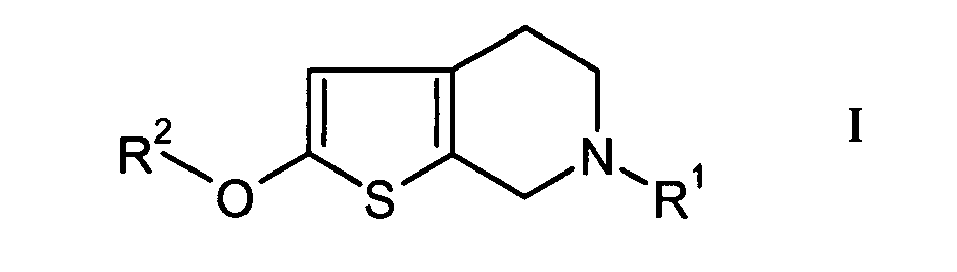
- R1
- is selected from the group consisting of
-CO-R3, wherein
R3 is selected from the group consisting of C1-7-alkyl,
C3-7-cycloalkyl-C1-7-alkyl, wherein the cycloalkyl ring may be unsubstituted or substituted with one or two groups independently selected from C1-7-alkyl; and phenyl, wherein the phenyl ring may be unsubstituted or substituted with one or two groups independently selected from C1-7-alkyl, cyano, halogen, halogen-C1-7-alkyl and C1-7-alkoxy,
-CO-NR4R5, wherein
R4 and R5 independently from each other are selected from the group consisting of hydrogen, C1-7-alkyl, C1-7-alkoxy-C1-7-alkyl, phenyl unsubstituted or substituted with one or two groups independently selected from C1-7-alkyl, halogen, C1-7-alkoxy and C1-7-halogen-C1-7-alkyl, and phenyl-C1-7-alkyl, wherein phenyl is unsubstituted or substituted with one or two groups independently selected from C1-7-alkyl, halogen, C1-7-alkoxy and halogen-C1-7-alkyl,
or R4 and R5 together with the nitrogen atom to which they are attached form a 4-, 5-, 6- or 7-membered heterocyclic ring optionally containing a further heteroatom selected from nitrogen, oxygen or sulfur, a sulfinyl group or a sulfonyl group, said heterocyclic ring being unsubstituted or substituted with one or two groups independently selected from C1-7-alkyl, halogen, cyano, C1-7-alkoxy and phenyl, wherein phenyl is unsubstituted or substituted with one or two groups independently selected from C1-7-alkyl, halogen and C1-7- alkoxy, and
-SO2-R6, wherein
R6 is selected from the group consisting of C1-7-alkyl, C1-7-alkoxy-C1-7-alkyl, cycloalkyl-C1-7-alkyl, wherein the cycloalkyl ring may be unsubstituted or substituted with one or two groups independently selected from C1-7-alkyl, halogen and C1-7-alkoxy; and
phenyl, wherein the phenyl ring may be unsubstituted or substituted with one or two groups independently selected from C1-7-alkyl, cyano, halogen, halogen-C1-7-alkyl and C1-7-alkoxy; - R2
- is a group selected from


m is 0, 1 or 2;
n is 0, 1 or 2;
A is selected from -CR11R11'-, O, S or -NR12;
R7, R7', R8, R8', R9, R9', R10, R10', R11 and R11' independently from each other are hydrogen or C1-7-alkyl;
R12 is hydrogen or C1-7-alkyl;
p is 0, 1 or 2;
R13 is C1-7-alkyl or C3-7-cycloalkyl;
q is 1, 2 or 3; and
R14 and R15 independently from each other are C1-7-alkyl; - The compounds of formula I are antagonists and/or inverse agonists at the histamine 3 receptor (H3 receptor).
- Histamine (2-(4-imidazolyl) ethylamine) is one of the aminergic neurotransmitters which is widely distributed throughout the body, e. g. the gastrointestinal tract (Burks 1994 in Johnson L.R. ed., Physiology of the Gastrointestinal Tract, Raven Press, NY, pp. 211- 242). Histamine regulates a variety of digestive pathophysiological events like gastric acid secretion, intestinal motility (Leurs et al., Br J. Pharmacol. 1991, 102, pp 179-185), vasomotor responses, intestinal inflammatory responses and allergic reactions (Raithel et al., Int. Arch. Allergy Immunol. 1995, 108, 127-133). In the mammalian brain, histamine is synthesized in histaminergic cell bodies which are found centrally in the tuberomammillary nucleus of the posterior basal hypothalamus. From there, the histaminergic cell bodies project to various brain regions (Panula et al., Proc. Natl. Acad. Sci. USA 1984, 81, 2572-2576; Inagaki et al., J. Comp. Neurol 1988, 273, 283 - 300).
- According to current knowledge, histamine mediates all its actions in both the CNS and the periphery through four distinct histamine receptors, the histamine H1, H2 H3 and H4 receptors.
- H3 receptors are predominantly localized in the central nervous system (CNS). As an autoreceptor H3 receptors constitutively inhibit the synthesis and secretion of histamine from histaminergic neurons (Arrang et al., Nature 1983, 302, 832-837; Arrang et al., Neuroscience 1987, 23, 149-157). As heteroreceptors, H3 receptors also modulate the release of other neurotransmitters such as acetylcholine, dopamine, serotonin and norepinephrine among others in both the central nervous system and in peripheral organs, such as lungs, cardiovascular system and gastrointestinal tract (Clapham & Kilpatrik, Br. J. Pharmacol. 1982, 107, 919- 923; Blandina et al. in The Histamine H3 Receptor (Leurs RL and Timmermann H eds, 1998, pp 27-40, Elsevier, Amsterdam, The Netherlands). H3 receptors are constitutively active, meaning that even without exogenous histamine, the receptor is tonically activated. In the case of an inhibitory receptor such as the H3 receptor, this inherent activity causes tonic inhibition of neurotransmitter release. Therefore it may be important that a H3R antagonist would also have inverse agonist activity to both block exogenous histamine effects and to shift the receptor from its constitutively active (inhibitory) form to a neutral state.
- The wide distribution of H3 receptors in the mammalian CNS indicates the physiological role of this receptor. Therefore the therapeutic potential as a novel drug development target in various indications has been proposed.
- The administration of H3R ligands - as antagonists, inverse agonists, agonists or partial agonists - may influence the histamine levels or the secretion of neurotransmitters in the brain and the periphery and thus may be useful in the treatment of several disorders. Such disorders include obesity, (Masaki et al; Endocrinol. 2003, 144, 2741-2748; Hancock et al., European J. of Pharmacol. 2004, 487, 183-197), cardiovascular disorders such as acute myocardial infarction, dementia and cognitive disorders such as attention deficit hyperactivity disorder (ADHD) and Alzheimer's disease, neurological disorders such as schizophrenia, depression, epilepsy, Parkinson's disease, and seizures or convulsions, sleep disorders, narcolepsy, pain, gastrointestinal disorders, vestibular dysfunction such as Morbus Meniere, drug abuse and motion sickness (Timmermann, J. Med. Chem. 1990, 33, 4-11).
- It is therefore an object of the present invention to provide selective, directly acting H3 receptor antagonists respectively inverse agonists. Such antagonists / inverse agonists are useful as therapeutically active substances, particularly in the treatment and/or prevention of diseases which are associated with the modulation of H3 receptors.
-
EP 0 421 861 Al refers to the preparation of tetrahydrothienopyridines as elastase and platelet aggregation inhibitors. Stark, Expert Opinon on Therapeutic Patents 2003, Vol. 13(6), 851-865, reports on recent advances in histamine H3/H4 receptor ligands. Berlin et al., Expert Opinon on Therapeutic Patents 2007, Vol. 17(6), 675-687, describes recent advances in the development of histamine H3 antagonists. - In the present description the term "alkyl", alone or in combination with other groups, refers to a branched or straight-chain monovalent saturated aliphatic hydrocarbon radical of one to twenty carbon atoms, preferably one to sixteen carbon atoms, more preferably one to ten carbon atoms.
- The term "lower alkyl" or "C1-C7-alkyl", alone or in combination, signifies a straight-chain or branched-chain alkyl group with 1 to 7 carbon atoms, preferably a straight or branched-chain alkyl group with 1 to 6 carbon atoms and particularly preferred a straight or branched-chain alkyl group with 1 to 4 carbon atoms Examples of straight-chain and branched C1-C7 alkyl groups are methyl, ethyl, propyl, isopropyl, butyl, isobutyl, tert.-butyl, the isomeric pentyls, the isomeric hexyls, the isomeric heptyls and the isomeric octyls, preferably methyl and ethyl and most preferred methyl.
- The term "cycloalkyl" or "C3-7-cycloalkyl" denotes a saturated carbocyclic group containing from 3 to 7 carbon atoms, such as cyclopropyl, cyclobutyl, cyclopentyl, cyclohexyl or cycloheptyl. Especially preferred are cyclopropyl, cyclopentyl and cyclohexyl.
- The term "lower cycloalkylalkyl" or "C3-7-cycloalkyl-C1-7-alkyl" refers to lower alkyl groups as defined above wherein at least one of the hydrogen atoms of the lower alkyl group is replaced by cycloalkyl. A preferred example is cyclohexylmethyl.
- The term "lower alkoxy" refers to the group R'-O-, wherein R' is lower alkyl and the term "lower alkyl" has the previously given significance. Examples of lower alkoxy groups are e.g. methoxy, ethoxy, n-propoxy, isopropoxy, n-butoxy, isobutoxy, sec. butoxy and tert.-butoxy, preferably methoxy and ethoxy and most preferred methoxy.
- The term "lower alkoxyalkyl" or "C1-7-alkoxy-C1-7-alkyl" refers to lower alkyl groups as defined above wherein at least one of the hydrogen atoms of the lower alkyl groups is replaced by an alkoxy group, preferably methoxy or ethoxy. Among the preferred lower alkoxyalkyl groups are 2-methoxyethyl or 3-methoxypropyl.
- The term "halogen" refers to fluorine, chlorine, bromine and iodine, with fluorine, chlorine and bromine being preferred.
- The term "lower halogenalkyl" or "halogen-C1-7-alkyl" refers to lower alkyl groups as defined above wherein at least one of the hydrogen atoms of the lower alkyl group is replaced by a halogen atom, preferably fluoro or chloro, most preferably fluoro. Among the preferred halogenated lower alkyl groups are trifluoromethyl, difluoromethyl, fluoromethyl and chloromethyl, with trifluoromethyl being especially preferred.
- The term "carbamoyl" refers to the group -CO-NH2.
- The term "lower phenylalkyl" or "phenyl-C1-7-alkyl" to lower alkyl groups as defined above wherein at least one of the hydrogen atoms of the lower alkyl group is replaced by a phenyl group. Preferred lower phenylalkyl groups are benzyl or phenethyl.
- The term "form a 4-, 5-, 6- or 7-membered heterocyclic ring optionally containing a further heteroatom selected from nitrogen, oxygen or sulfur" refers to a saturated N-heterocyclic ring, which may optionally contain a further nitrogen, oxygen or sulfur atom, such as azetidinyl, pyrrolidinyl, imidazolidinyl, pyrazolidinyl, oxazolidinyl, isoxazolidinyl, thiazolidinyl, isothiazolidinyl, piperidinyl, piperazinyl, morpholinyl, thiomorpholinyl, or azepanyl. A "4-, 5-, 6- or 7-membered heterocyclic ring containing a sulfinyl group or a sulfonyl group" means a N-heterocyclic ring that contains a -S(O)-group or a -SO2- group, for example 1-oxothiomorpholinyl or 1,1-dioxothiomorpholinyl. The heterocyclic ring may be unsubstituted or substituted by one, two or three groups independently selected from lower alkyl, halogen, cyano, lower alkoxy and phenyl, wherein phenyl is unsubstituted or substituted with one or two groups independently selected from lower alkyl, halogen and lower alkoxy.
- The term "pharmaceutically acceptable salts" refers to those salts which retain the biological effectiveness and properties of the free bases or free acids, which are not biologically or otherwise undesirable. The salts are formed with inorganic acids such as hydrochloric acid, hydrobromic acid, sulfuric acid, nitric acid, phosphoric acid and the like, preferably hydrochloric acid, and organic acids such as acetic acid, propionic acid, glycolic acid, pyruvic acid, oxylic acid, maleic acid, malonic acid, salicylic acid, succinic acid, fumaric acid, tartaric acid, citric acid, benzoic acid, cinnamic acid, mandelic acid, methanesulfonic acid, ethanesulfonic acid, p-toluenesulfonic acid, salicylic acid, N-acetylcystein and the like. In addition these salts may be prepared form addition of an inorganic base or an organic base to the free acid. Salts derived from an inorganic base include, but are not limited to, the sodium, potassium, lithium, ammonium, calcium, magnesium salts and the like. Salts derived from organic bases include, but are not limited to salts of primary, secondary, and tertiary amines, substituted amines including naturally occurring substituted amines, cyclic amines and basic ion exchange resins, such as isopropylamine, trimethylamine, diethylamine, triethylamine, tripropylamine, ethanolamine, lysine, arginine, N-ethylpiperidine, piperidine, polyamine resins and the like. The compound of formula I can also be present in the form of zwitterions. Particularly preferred pharmaceutically acceptable salts of compounds of formula I are the hydrochloride salts.
- The compounds of formula I can also be solvated, e.g. hydrated. The solvation can be effected in the course of the manufacturing process or can take place e.g. as a consequence of hygroscopic properties of an initially anhydrous compound of formula I (hydration). The term "pharmaceutically acceptable salts" also includes physiologically acceptable solvates.
- "Isomers" are compounds that have identical molecular formulae but that differ in the nature or the sequence of bonding of their atoms or in the arrangement of their atoms in space. Isomers that differ in the arrangement of their atoms in space are termed "stereoisomers". Stereoisomers that are not mirror images of one another are termed "diastereoisomers", and stereoisomers that are non-superimposable mirror images are termed "enantiomers", or sometimes optical isomers. A carbon atom bonded to four nonidentical substituents is termed a "chiral center".
- In detail, the present invention relates to compounds of the general formula

- R1
- is selected from the group consisting of
-CO-R3, wherein
R3 is selected from the group consisting of
C1-7-alkyl,
C3-7-cycloalkylalkyl, wherein the cycloalkyl ring may be unsubstituted or substituted with one or two groups independently selected from C1-7-alkyl; phenyl, wherein the phenyl ring may be unsubstituted or substituted with one or two groups independently selected from C1-7-alkyl, cyano, halogen, halogen-C1-7-alkyl and C1-7-alkoxy,
-CO-NR4R5, wherein
R4 and R5 independently from each other are selected from the group consisting of hydrogen, C1-7-alkyl, C1-7-alkoxy-C1-7-alkyl, phenyl unsubstituted or substituted with one or two groups independently selected from C1-7-alkyl, halogen, C1-7-alkoxy and halogen-C1-7-alkyl, and phenyl-C1-7-alkyl, wherein phenyl is unsubstituted or substituted with one or two groups independently selected from C1-7-alkyl, halogen, C1-7-alkoxy and halogen-C1-7-alkyl,
or R4 and R5 together with the nitrogen atom to which they are attached form a 4-, 5-, 6- or 7-membered heterocyclic ring optionally containing a further heteroatom selected from nitrogen, oxygen or sulfur, a sulfinyl group or a sulfonyl group, said heterocyclic ring being unsubstituted or substituted with one or two groups independently selected from C1-7-alkyl, halogen, cyano, C1-7-alkoxy and phenyl, wherein phenyl is unsubstituted or substituted with one or two groups independently selected from C1-7-alkyl, halogen and C1-7- alkoxy, and
-SO2-R6, wherein R6 is selected from the group consisting of C1-7-alkyl, C1-7-alkoxy-C1-7-alkyl,
C3-7-cycloalkyl-C1-7-alkyl, wherein the cycloalkyl ring may be unsubstituted or substituted with one or two groups independently selected from C1-7-alkyl, halogen and C1-7-alkoxy;
phenyl, wherein the phenyl ring may be unsubstituted or substituted with one or two groups independently selected from C1-7-alkyl, cyano, halogen, halogen-C1-7-alkyl and C1-7-alkoxy; - R2
- is a group selected from


- m
- is 0, 1 or 2;
- n
- is 0, 1 or 2;
- A
- is selected from -CR11R11'-, O, S or -NR12;
- R7, R7', R8, R8', R9, R9', R10, R10', R11 and R11'
- independently from each other are hydrogen or C1-7-alkyl;
- R12
- is hydrogen or C1-7- alkyl;
- p
- is 0, 1 or 2;
- R13
- is C1-7-alkyl or C3-7-cycloalkyl;
- q
- is 1, 2 or 3; and
- R14 and R15
- independently from each other are C1-7-alkyl;
- A group of preferred compounds of the present invention are compounds of formula I, wherein R1 is -CO-R3 and wherein R3 is selected from the group consisting of C1-7-alkyl, C3-7-cycloalkyl-C1-7-alkyl, wherein the cycloalkyl ring may be unsubstituted or substituted with one or two groups independently selected from C1-7-alkyl, and phenyl, wherein the phenyl ring may be unsubstituted or substituted with one or two groups independently selected from C1-7-alkyl, cyano, halogen, halogen-C1-7-alkyl and C1-7-alkoxy.
- Compounds of formula I, wherein R1 is -CO-R3 and wherein R3 is C1-7-alkyl or C3-7-cycloalkylalkyl, wherein the cycloalkyl ring may be unsubstituted or substituted with one or two groups independently selected from C1-7-alkyl, are especially preferred, with those compounds, wherein R3 is C1-7-alkyl, being more preferred, and with those compounds of formula I, wherein R3 is C4-5-alkyl such as isobutyl or 2,2-dimethylpropyl, being most preferred.
- Also preferred are compounds of formula I according to the invention, wherein R1 is -CO-R3 and wherein R3 is phenyl, wherein the phenyl ring may be unsubstituted or substituted with one or two groups independently selected from C1-7-alkyl, cyano, halogen, halogen-C1-7-alkyl and C1-7-alkoxy, with those compounds wherein R3 is phenyl substituted with one or two groups independently selected from halogen, halogen-C1-7-alkyl and C1-7-alkoxy, being most preferred.
- Also preferred are compounds of formula I of the present invention are compounds of formula I, wherein R1 is -CO-NR4R5 and wherein R4 and R5 independently from each other are selected from the group consisting of hydrogen, C1-7-alkyl, C1-7-alkoxy-C1-7-alkyl, phenyl unsubstituted or substituted with one or two groups independently selected from C1-7-alkyl, halogen, C1-7-alkoxy and halogen-C1-7-alkyl, and phenyl-C1-7-alkyl, wherein phenyl is unsubstituted or substituted with one or two groups independently selected from C1-7-alkyl, halogen, C1-7-alkoxy and halogen-C1-7-alkyl, or R4 and R5 together with the nitrogen atom to which they are attached form a 4-, 5-, 6-or 7-membered heterocyclic ring optionally containing a further heteroatom selected from nitrogen, oxygen or sulfur, a sulfinyl group or a sulfonyl group, said heterocyclic ring being unsubstituted or substituted with one or two groups independently selected from C1-7-alkyl, halogen, cyano, C1-7-alkoxy and phenyl, wherein phenyl is unsubstituted or substituted with one or two groups independently selected from C1-7-alkyl, halogen and C1-7-alkoxy.
- More preferred are compounds of formula I, wherein R1 is -CO-NR4R5 and wherein R4 and R5 independently from each other are selected from the group consisting of hydrogen, C1-7-alkyl, C1-7-alkoxy-C1-7-alkyl, phenyl unsubstituted or substituted with one or two groups independently selected from C1-7-alkyl, halogen, C1-7-alkoxy and halogen-C1-7-alkyl, and phenyl-C1-7-alkyl, wherein phenyl is unsubstituted or substituted with one or two groups independently selected from C1-7-alkyl, halogen, C1-7-alkoxy and halogen-C1-7-alkyl, with those compounds, wherein R4 and R5 independently from each other are hydrogen or C1-7-alkyl, being especially preferred.
- More preferably, at least one of R4 and R5 is not hydrogen.
- Also more preferred are those compounds of formula I according to the invention, wherein R1 is -CO-NR4R5 and wherein R4 and R5 together with the nitrogen atom to which they are attached form a 4-, 5-, 6- or 7-membered heterocyclic ring optionally containing a further heteroatom selected from nitrogen, oxygen or sulfur, a sulfinyl group or a sulfonyl group, said heterocyclic ring being unsubstituted or substituted with one or two groups independently selected from C1-7-alkyl, halogen, cyano, C1-7-alkoxy and phenyl, wherein phenyl is unsubstituted or substituted with one or two groups independently selected from C1-7-alkyl, halogen and C1-7-alkoxy.
- Within this group, those compounds are preferred, wherein R1 is -CO-NR4R5 and wherein R4 and R5 together with the nitrogen atom to which they are attached form a heterocyclic ring selected from the group consisting of pyrrolidinyl, piperidinyl, piperazinyl and morpholinyl, said heterocyclic ring being unsubstituted or substituted with one or two groups independently selected from C1-7-alkyl, halogen, cyano, C1-7-alkoxy and phenyl, wherein phenyl is unsubstituted or substituted with one or two groups independently selected from C1-7-alkyl, halogen and C1-7-alkoxy.
- Further preferred are compounds of formula I according to the present invention, wherein R1 is SO2-R6 and wherein R6 is selected from the group consisting of C1-7-alkyl, C1-7-alkoxy-C1-7-alkyl,
C3-7-cycloalkyl-C1-7-alkyl, wherein the cycloalkyl ring may be unsubstituted or substituted with one or two groups independently selected from C1-7-alkyl, halogen
and C1-7-alkoxy, and
phenyl, wherein the phenyl ring may be unsubstituted or substituted with one or two groups independently selected from C1-7-alkyl, cyano, halogen, halogen-C1-7-alkyl and C1-7-alkoxy. - Within this group, compounds of formula I are preferred, wherein R1 is SO2-R6 and wherein R6 is C1-7-alkyl or phenyl, wherein the phenyl ring may be unsubstituted or substituted with one or two groups selected from C1-7-alkyl and halogen.
- Further preferred compounds of formula I according to the present invention are those compounds, wherein R2 signifies

- m
- is 0 or 1;
- n
- is 1;
- A
- is selected from -CR11R11'-, O, S or -NR12;
- R7, R7', R8, R8', R9, R9', R10, R11', R11 and R11'
- independently from each other are hydrogen or C1-7-alkyl; and
- R12
- is hydrogen or C1-7-alkyl.
- Within this group, those compounds of formula I are preferred, wherein A is CR11R11' and R7, R7', R8, R8', R9, R9', R10, R10', R11 and R11' independently from each other are hydrogen or C1-7-alkyl, with those compounds of formula I, wherein R7, R7', R8, R8', R9, R9', R10, R10', R11 and R11' are hydrogen, being especially preferred.
- Also preferred are compounds of formula I, wherein A is O, with those compounds of formula I, wherein A is O and R7, R7', R8, R8', R9, R9', R10 and R10' are hydrogen, being especially preferred.
- Further preferred are compounds of formula I according to the invention, wherein R2 signifies

- Within this group, those compounds are especially preferred, wherein R13 is isopropyl or isobutyl.
- Further preferred are compounds of formula I according to the invention, wherein R2 signifies

- Within this group, those compounds are especially preferred, wherein q is 1 and R14 and R15 are methyl.
- Examples of preferred compounds of formula I are the following:
- morpholin-4-yl-[2-(3-piperidin-1-yl-propoxy)-4,7-dihydro-5H-thieno[2,3-c]pyridin-6-yl] -methanone,
- piperidin-1-yl-[2-(3-piperidin-1-yl-propoxy)-4,7-dihydro-5H-thieno[2,3-c]pyridin-6-yl]-methanone,
- (4-methyl-piperazin-1-yl)-[2-(3-piperidin-1-yl-propoxy)-4,7-dihydro-5H-thieno[2,3-c]pyridin-6-yl]-methanone,
- [2-(3-piperidin-1-yl-propoxy)-4,7-dihydro-5H-thieno[2,3-c]pyridin-6-yl]-pyrrolidin-1-yl-methanone,
- (4-methoxy-piperidin-1-yl)-[2-(3-piperidin-1-yl-propoxy)-4,7-dihydro-5H-thieno[2,3-c]pyridin-6-yl]-methanone,
- [2-(3-piperidin-1-yl-propoxy)-4,7-dihydro-5H-thieno[2,3-c]pyridin-6-yl]-(4-o-tolyl-piperazin-1-yl)-methanone,
- 3-methyl-1-[2-(3-piperidin-1-yl-propoxy)-4,7-dihydro-5H-thieno[2,3-c]pyridin-6-yl]-butan-1-one,
- 3,3-dimethyl-1-[2-(3-piperidin-1-yl-propoxy)-4,7-dihydro-5H-thieno[2,3-c]pyridin-6-yl]-butan-1-one,
- (4-methoxy-phenyl)-[2-(3-piperidin-1-yl-propoxy)-4,7-dihydro-5H-thieno[2,3-c]pyridin-6-yl]-methanone,
- (3-fluoro-phenyl)-[2-(3-piperidin-1-yl-propoxy)-4,7-dihydro-5H-thieno[2,3-c]pyridin-6-yl]-methanone,
- (3-chloro-phenyl)-[2-(3-piperidin-1-yl-propoxy)-4,7-dihydro-5H-thieno[2,3-c]pyridin-6-yl]-methanone,
- 6-methanesulfonyl-2-(3-piperidin-1-yl-propoxy)-4,5,6,7-tetrahydro-thieno[2,3-c]pyridine,
- 6-(3-fluoro-benzenesulfonyl)-2-(3-piperidin-1-yl-propoxy)-4,5,6,7-tetrahydro-thieno[2,3-c]pyridine,
- 2-(3-piperidin-1-yl-propoxy)-6-(toluene-4-sulfonyl)-4,5,6,7-tetrahydro-thieno[2,3-c]pyridine,
- 2-(3-piperidin-1-yl-propoxy)-6-(toluene-2-sulfonyl)-4,5,6,7-tetrahydro-thieno[2,3-c]pyridine,
- 6-(4-ethyl-benzenesulfonyl)-2-(3-piperidin-1-yl-propoxy)-4,5,6,7-tetrahydro-thieno[2,3-c]pyridine,
- 6-(4-tert-butyl-benzenesulfonyl)-2-(3-piperidin-1-yl-propoxy)-4,5,6,7-tetrahydro-thieno[2,3-c]pyridine,
- 6-benzenesulfonyl-2-(3-piperidin-1-yl-propoxy)-4,5,6,7-tetrahydro-thieno[2,3-c]pyridine,
- 6-(4-isopropyl-benzenesulfonyl)-2-(3-piperidin-1-yl-propoxy)-4,5,6,7-tetrahydro-thieno[2,3-c]pyridine,
- 3,3-dimethyl-1-[2-(3-pyrrolidin-1-yl-propoxy)-4,7-dihydro-5H-thieno[2,3-c]pyridin-6-yl]-butan-1-one,
- (3-chloro-phenyl)-[2-(3-pyrrolidin-1-yl-propoxy)-4,7-dihydro-5H-thieno[2,3-c]pyridin-6-yl]-methanone,
- (2-chloro-phenyl)-[2-(3-pyrrolidin-1-yl-propoxy)-4,7-dihydro-5H-thieno[2,3-c]pyridin-6-yl]-methanone,
- [2-(3-pyrrolidin-1-yl-propoxy)-4,7-dihydro-5H-thieno[2,3-c]pyridin-6-yl]-(4-trifluoromethyl-phenyl)-methanone,
- phenyl-[2-(3-pyrrolidin-1-yl-propoxy)-4,7-dihydro-5H-thieno[2,3-c]pyridin-6-yl]-methanone,
- (3-methoxy-phenyl)-[2-(3-pyrrolidin-1-yl-propoxy)-4,7-dihydro-5H-thieno[2,3-c]pyridin-6-yl]-methanone,
- morpholin-4-yl-[2-(3-pyrrolidin-1-yl-propoxy)-4,7-dihydro-5H-thieno[2,3-c]pyridin-6-yl]-methanone,
- pyrrolidin-1-yl-[2-(3-pyrrolidin-1-yl-propoxy)-4,7-dihydro-5H-thieno[2,3-c]pyridin-6-yl]-methanone,
- piperidin-1-yl-[2-(3-pyrrolidin-1-yl-propoxy)-4,7-dihydro-5H-thieno[2,3-c]pyridin-6-yl]-methanone,
- (4-methyl-piperazin-1-yl)-[2-(3-pyrrolidin-1-yl-propoxy)-4,7-dihydro-5H-thieno[2,3-c]pyridin-6-yl]-methanone,
- 2-(3-pyrrolidin-1-yl-propoxy)-4,7-dihydro-5H-thieno[2,3-c]pyridin-6-yl]-(4-o-tolyl-piperazin-1-yl)-methanone,
- 6-methanesulfonyl-2-(3-pyrrolidin-1-yl-propoxy)-4,5,6,7-tetrahydro-thieno[2,3-c]pyridine,
- 6-benzenesulfonyl-2-(3-pyrrolidin-1-yl-propoxy)-4,5,6,7-tetrahydro-thieno[2,3-c]pyridine,
- 2-(3-pyrrolidin-1-yl-propoxy)-6-(toluene-4-sulfonyl)-4,5,6,7-tetrahydro-thieno[2,3-c] pyridine,
- 2-(3-pyrrolidin-1-yl-propoxy)-6-(toluene-2-sulfonyl)-4,5,6,7-tetrahydro-thieno[2,3-c]pyridine,
- 2-(3-pyrrolidin-1-yl-propoxy)-6-(toluene-3-sulfonyl)-4,5,6,7-tetrahydro-thieno[2,3-c]pyridine,
- 6-(4-ethyl-benzenesulfonyl)-2-(3-pyrrolidin-1-yl-propoxy)-4,5,6,7-tetrahydro-thieno[2,3-c]pyridine,
- 6-(4-isopropyl-benzenesulfonyl)-2-(3-pyrrolidin-1-yl-propoxy)-4,5,6,7-tetrahydro-thieno[2,3-c]pyridine,
- 6-(4-tert-butyl-benzenesulfonyl)-2-(3-pyrrolidin-1-yl-propoxy)-4,5,6,7-tetrahydro-thieno[2,3-c]pyridine,
- 6-(3-fluoro-benzenesulfonyl)-2-(3-pyrrolidin-1-yl-propoxy)-4,5,6,7-tetrahydro-thieno[2,3-c]pyridine,
- 6-(propane-2-sulfonyl)-2-3-pyrrolidin-1-yl-propoxy)-4,5,6,7-tetrahydro-thieno[2,3-c]pyridine,
- [2-(1-isobutyl-piperidin-4-yloxy)-4,7-dihydro-5H-thieno[2,3-c]pyridin-6-yl]-phenyl-methanone,
- 1-[2-(1-isobutyl-piperidin-4-yloxy)-4,7-dihydro-5H-thieno[2,3-c]pyridin-6-yl-butan-1-one,
- 1-[2-(1-isobutyl-piperidin-4-yloxy)-4,7-dihydro-5H-thieno[2,3-c]pyridin-6-yl]-pentan-1-one,
- 1-[2-(1-isobutyl-piperidin-4-yloxy)-4,7-dihydro-5H-thieno[2,3-c]pyridin-6-yl]-3,3-dimethyl-butan-1-one,
- [2-(1-isobutyl-piperidin-4-yloxy)-4,7-dihydro-5H-thieno[2,3-c]pyridin-6-yl]-(3-methoxy-phenyl)-methanone,
- [2-(1-isobutyl-piperidin-4-yloxy)-4,7-dihydro-5H-thieno[2,3-c]pyridin-6-yl]-(4-methoxy-phenyl)-methanone,
- (4-fluoro-phenyl)-[2-(1-isobutyl-piperidin-4-yloxy)-4,7-dihydro-5H-thieno[2,3-c]pyridin-6-yl]-methanone,
- (3-fluoro-phenyl)-[2-(1-isobutyl-piperidin-4-yloxy)-4,7-dihydro-5H-thieno[2,3-c]pyridin-6-yl]-methanone,
- [2-(1-isobutyl-piperidin-4-yloxy)-4,7-dihydro-5H-thieno[2,3-c]pyridin-6-yl](4-trifluoromethyl-phenyl)-methanone,
- (3-chloro-phenyl)-[2-(1-isobutyl-piperidin-4-yloxy)-4,7-dihydro-5H-thieno[2,3-c]pyridin-6-yl]-methanone,
- (2-chloro-phenyl)-[2-(1-isobutyl-piperidin-4-yloxy)-4,7-dihydro-5H-thieno[2,3-c]pyridin-6-yl]-methanone,
- [2-(1-isobutyl-piperidin-4-yloxy)-4,7-dihydro-5H-thieno[2,3-c]pyridin-6-yl]-morpholin-4-yl-methanone,
- 2-(1-isobutyl-piperidin-4-yloxy)-4,7-dihydro-5H-thieno[2,3-c]pyridine-6-carboxcylic acid diethylamide,
- [2-(1-isobutyl-piperidin-4-yloxy)-4,7-dihydro-5H-thieno[2,3-c]pyridin-6-yl]-piperidin-1-yl-methanone,
- [2-(1-isobutyl-piperidin-4-yloxy)-4,7-dihydro-5H-thieno[2,3-c]pyridin-6-yl]-pyrrolidin-1-yl-methanone,
- 2-(1-isobutyl-piperidin-4-yloxy)-6-methanesulfonyl-4,5,6,7-tetrahydro-thieno[2,3-c]pyridine,
- 6-benzenesulfonyl-2-(1-isobutyl-piperidin-4-yloxy)-4,5,6,7-tetrahydro-thieno[2,3-c]pyridine,
- 2-(1-isobutyl-piperidin-4-yloxy)-6-(toluene-4-sulfonyl)-4,5,6,7-tetrahydro-thieno[2,3-c]pyridine,
- 2-(1-isobutyl-piperidin-4-yloxy)-6-(toluene-2-sulfonyl)-4,5,6,7-tetrahydro-thieno[2,3-c]pyridine,
- 2-(1-isobutyl-piperidin-4-yloxy)-6-(toluene-3-sulfonyl)-4,5,6,7-tetrahydro-thieno[2,3-c]pyridine,
- 6-(4-ethyl-benzenesulfonyl)-2-(1-isobutyl-piperidin-4-yloxy)-4,5,6,7-tetrahydro-thieno[2,3-c]pyridine,
- 6-(3-fluoro-benzenesulfonyl)-2-(1-isobutyl-piperidin-4-yloxy)-4,5,6,7-tetrahydro-thieno[2,3-c]pyridine,
- 1-[2-(1-isopropyl-piperidin-4-yloxy)-4,7-dihydro-5H-thieno[2,3-c]pyridin-6-yl]-butan-1-one,
- 1-[2-(1-isopropyl-piperidin-4-yloxy)-4,7-dihydro-5H-thieno[2,3-c]pyridin-6-yl]-3-methyl-butan-1-one,
- 1-[2-(1-isopropyl-piperidin-4-yloxy)-4,7-dihydro-5H-thieno[2,3-c]pyridin-6-yl]-3,3-dimethyl-butan-1-one,
- [2-(1-isopropyl-piperidin-4-yloxy)-4,7-dihydro-5H-thieno[2,3-c]pyridin-6-yl]-(4-trifluoromethyl-phenyl)-methanone,
- (3-chloro-phenyl)-[2-(1-isopropyl-piperidin-4-yloxy)-4,7-dihydro-5H-thieno[2,3-c]pyridin-6-yl]-methanone,
- [2-(1-isopropyl-piperidin-4-yloxy)-4,7-dihydro-5H-thieno[2,3-c]pyridin-6-yl]-(3-methoxy-phenyl)-methanone,
- [2-(1-isopropyl-piperidin-4-yloxy)-4,7-dihydro-5H-thieno[2,3-c]pyridin-6-yl]-(4-methoxy-phenyl)-methanone,
- (4-fluoro-phenyl)-[2-(1-isopropyl-piperidin-4-yloxy)-4,7-dihydro-5H-thieno[2,3-c]pyridin-6-yl]-methanone,
- (3-fluoro-phenyl)-[2-(1-isopropyl-piperidin-4-yloxy)-4,7-dihydro-5H-thieno[2,3-c]pyridin-6-yl]-methanone,
- (2-chloro-phenyl)-[2-(1-isopropyl-piperidin-4-yloxy)-4,7-dihydro-5H-thieno[2,3-c]pyridin-6-yl]-methanone,
- [2-(1-isopropyl-piperidin-4-yloxy)-4,7-dihydro-5H-thieno[2,3-c]pyridin-6-yl]-(2-methoxy-phenyl)-methanone,
- (2-fluoro-phenyl)-[2-(1-isopropyl-piperidin-4-yloxy)-4,7-dihydro-5H-thieno[2,3-c]pyridin-6-yl]-methanone,
- [2-(1-isopropyl-piperidin-4-yloxy)-4,7-dihydro-5H-thieno[2,3-c]pyridin-6-yl]-morpholin-4-yl-methanone,
- 2-(1-isopropyl-piperidin-4-yloxy)-4,7-dihydro-5H-thieno[2,3-c]pyridine-6-carboxylic acid diethylamide,
- [2-(1-isopropyl-piperidin-4-yloxy)-4,7-dihydro-5H-thieno[2,3-c]pyridin-6-yl]-piperidin-1-yl-methanone,
- 2-(1-isopropyl-piperidin-4-yloxy)-4,7-dihydro-5H-thieno[2,3-c]pyridine-6-carboxylic acid methylamide,
- [2-(1-isopropyl-piperidin-4-yloxy)-4,7-dihydro-5H-thieno[2,3-c]pyridin-6-yl]-(4-methyl-piperazin-1-yl)-methanone,
- 2-(1-isopropyl-piperidin-4-yloxy)-4,7-dihydro-5H-thieno[2,3-c]pyridine-6-carboxylic acid ethylamide,
- 2-(1-isopropyl-piperidin-4-yloxy)-4,7-dihydro-5H-thieno[2,3-c]pyridine-6-carboxylic acid isopropylamide,
- 2-(1-isopropyl-piperidin-4-yloxy)-4,7-dihydro-5H-thieno[2,3-c]pyridine-6-carboxylic acid butylamide,
- [2-(1-isopropyl-piperidin-4-yloxy)-4,7-dihydro-5H-thieno[2,3-c]pyridin-6-yl]-(4-o-tolyl-piperazin-1-yl)-methanone,
- 2-(1-isopropyl-piperidin-4-yloxy)-6-methanesulfonyl-4,5,6,7-tetrahydro-thieno[2,3-c]pyridine,
- 6-benzenesulfonyl-2-(1-isopropyl-piperidin-4-yloxy)-4,5,6,7-tetrahydro-thieno[2,3-c]pyridine,
- 2-(1-isopropyl-piperidin-4-yloxy)-6-(toluene-4-sulfonyl)-4,5,6,7-tetrahydro-thieno[2,3-c]pyridine,
- 2-(1-isopropyl-piperidin-4-yloxy)-6-(toluene-2-sulfonyl)-4,5,6,7-tetrahydro-thieno[2,3-c]pyridine,
- 2-(1-isopropyl-piperidin-4-yloxy)-6-(toluene-3-sulfonyl)-4,5,6,7-tetrahydro-thieno[2,3-c]pyridine,
- 6-(4-ethyl-benzenesulfonyl)-2-(1-isopropyl-piperidin-4-yloxy)-4,5,6,7-tetrahydro-thieno[2,3-c]pyridine,
- 6-(4-isopropyl-benzenesulfonyl)-2-(1-isopropyl-piperidin-4-yloxy)-4,5,6,7-tetrahydro-thieno[2,3-c]pyridine,
- 6-(4-tert-butyl-benzenesulfonyl)-2-(1-isopropyl-piperidin-4-yloxy)-4,5,6,7-tetrahydro-thieno[2,3-c]pyridine,
- 6-(3-fluoro-benzenesulfonyl)-2-(1-isopropyl-piperidin-4-yloxy)-4,5,6,7-tetrahydro-thieno[2,3-c]pyridine,
- 2-(1-isopropyl-piperidin-4-yloxy)-6-(propane-2-sulfonyl)-4,5,6,7-tetrahydro-thieno[2,3-c]pyridine,
- 2-(1-isopropyl-pyrrolidin-3-yloxy)-6-(toluene-4-sulfonyl)-4,5,6,7-tetrahydro-thieno[2,3-c]pyridine,
- 6-(4-tert-butyl-benzenesulfonyl)-2-(1-isopropyl-pyrrolidin-3-yloxy)-4,5,6,7-tetrahydro-thieno[2,3-c]pyridine,
- 6-(4-isopropyl-benzenesulfonyl)-2-(1-isopropyl-pyrrolidin-3-yloxy)-4,5,6,7-tetrahydro-thieno[2,3-c]pyridine,
- (4-chloro-phenyl)-[2-(3-morpholin-4-yl-propoxy)-4,7-dihydro-5H-thieno[2,3-c]pyridin-6-yl]-methanone,
- (3-chloro-phenyl)-[2-(3-morpholin-4-yl-propoxy)-4,7-dihydro-5H-thieno[2,3-c]pyridin-6-yl]-methanone,
- dimethyl-{2-[6-(toluene-2-sulfonyl)-4,5,6,7-tetrahydro-thieno[2,3-c]pyridin-2-yloxy]-ethyl}-amine,
- (2-chloro-phenyl)-[2-(2-dimethylamino-ethoxy)-4,7-dihydro-5H-thieno[2,3-c]pyridin-6-yl]-methanone,
- {2-[6-(4-isopropyl-benzenesulfonyl)-4,5,6,7-tetrahydro-thieno[2,3-c]pyridin-2-yloxy]-ethyl}-dimethyl-amine,
- Particularly preferred compounds of formula I of the present invention are the following:
- 3-methyl-1-[2-(3-piperidin-1-yl-propoxy)-4,7-dihydro-5H-thieno[2,3-c]pyridin-6-yl]-butan-1-one,
- 3,3-dimethyl-1-[2-(3-piperidin-1-yl-propoxy)-4,7-dihydro-5H-thieno[2,3-c]pyridin-6-yl]-butan-1-one,
- 6-benzenesulfonyl-2-(3-pyrrolidin-1-yl-propoxy)-4,5,6,7-tetrahydro-thieno[2,3-c]pyridine,
- 1-[2-(1-isopropyl-piperidin-4-yloxy)-4,7-dihydro-5H-thieno[2,3-c]pyridin-6-yl]-butan-1-one,
- 1-[2-(1-isopropyl-piperidin-4-yloxy)-4,7-dihydro-5H-thieno[2,3-c]pyridin-6-yl]-3-methyl-butan-1-one,
- 1-[2-(1-isopropyl-piperidin-4-yloxy)-4,7-dihydro-5H-thieno[2,3-c]pyridin-6-yl]-3,3-dimethyl-butan-1-one,
- (3-chloro-phenyl)-[2-(1-isopropyl-piperidin-4-yloxy)-4,7-dihydro-5H-thieno[2,3-c]pyridin-6-yl]-methanone,
- [2-(1-isopropyl-piperidin-4-yloxy)-4,7-dihydro-5H-thieno[2,3-c]pyridin-6-yl]-(3-methoxy-phenyl) -methanone,
- (4-fluoro-phenyl)-[2-(1-isopropyl-piperidin-4-yloxy)-4,7-dihydro-5H-thieno[2,3-c]pyridin-6-yl]-methanone,
- (3-fluoro-phenyl)-[2-(1-isopropyl-piperidin-4-yloxy)-4,7-dihydro-5H-thieno[2,3-c]pyridin-6-yl]-methanone,
- (2-chloro-phenyl)-[2-(1-isopropyl-piperidin-4-yloxy)-4,7-dihydro-5H-thieno[2,3-c]pyridin-6-yl]-methanone,
- (2-fluoro-phenyl)-[2-(1-isopropyl-piperidin-4-yloxy)-4,7-dihydro-5H-thieno[2,3-c]pyridin-6-yl]-methanone,
- [2-(1-isopropyl-piperidin-4-yloxy)-4,7-dihydro-5H-thieno[2,3-c]pyridin-6-yl]-morpholin-4-yl-methanone,
- [2-(1-isopropyl-piperidin-4-yloxy)-4,7-dihydro-5H-thieno[2,3-c]pyridin-6-yl]-piperidin-1-yl-methanone,
- [2-(1-isopropyl-piperidin-4-yloxy)-4,7-dihydro-5H-thieno[2,3-c]pyridin-6-yl]-(4-methyl-piperazin-1-yl) -methanone,
- 2-(1-isopropyl-piperidin-4-yloxy)-6-(toluene-2-sulfonyl)-4,5,6,7-tetrahydro-thieno[2,3-c]pyridine,
- 6-(3-fluoro-benzenesulfonyl)-2-(1-isopropyl-piperidin-4-yloxy)-4,5,6,7-tetrahydro-thieno[2,3-c]pyridine,
- Furthermore, the pharmaceutically acceptable salts of the compounds of formula I and the pharmaceutically acceptable esters of the compounds of formula I individually constitute preferred embodiments of the present invention.
- Compounds of formula I may form acid addition salts with acids, such as conventional pharmaceutically acceptable acids, for example hydrochloride, hydrobromide, phosphate, acetate, fumarate, maleate, salicylate, sulphate, pyruvate, citrate, lactate, mandelate, tartarate, and methanesulphonate. Preferred are the hydrochloride salts. Also solvates and hydrates of compounds of formula I and their salts form part of the present invention.
- Compounds of formula I can have one or more asymmetric carbon atoms and can exist in the form of optically pure enantiomers, mixtures of enantiomers such as, for example, racemates, optically pure diastereoisomers, mixtures of diastereoisomers, diastereoisomeric racemates or mixtures of diastereoisomeric racemates. The optically active forms can be obtained for example by resolution of the racemates, by asymmetric synthesis or asymmetric chromatography (chromatography with a chiral adsorbens or eluant). The invention embraces all of these forms.
- It will be appreciated, that the compounds of general formula I in this invention may be derivatised at functional groups to provide derivatives which are capable of conversion back to the parent compound in vivo. Physiologically acceptable and metabolically labile derivatives, which are capable of producing the parent compounds of general formula I in vivo are also within the scope of this invention.
- A further aspect of the present invention is the process for the manufacture of compounds of formula I as defined above, which process comprises
coupling an amine of the formula II
R1-X III
wherein R1 is as defined herein before and X is halogen,
in the presence of a base to obtain a compound of the formula I
converting the compound obtained into a pharmaceutically acceptable salt. - The compounds of formula R1-X (III) are acid halogenides, carbamoyl halogenides or sulfonyl halogenides wherein X signifies halogen such as e.g. chloride, iodide or bromide, preferably chloride. The base to be used is preferably a tertiary amine, with triethylamine (TEA) and diisopropylamine (DIPEA) being especially preferred.
- The preparation of compounds of formula I of the present invention may be carried out in sequential or convergent synthetic routes. Syntheses of the compounds of the invention are shown in the following scheme. The skills required for carrying out the reaction and purification of the resulting products are known to those skilled in the art. The substituents and indices used in the following description of the processes have the significance given herein before unless indicated to the contrary.
- In more detail, the compounds of formula I can be manufactured by the methods given below, by the methods given in the examples or by analogous methods. Appropriate reaction conditions for the individual reaction steps are known to a person skilled in the art. The reaction sequence is not limited to the one displayed in scheme 1, however, depending on the starting materials and their respective reactivity the sequence of reaction steps can be freely altered. Starting materials are either commercially available or can be prepared by methods analogous to the methods given below, by methods described in references cited in the description or in the examples, or by methods known in the art.

- a) IV is described in literature (
W02001/032655 ) and can serve as a potential starting material for the synthesis of compounds of formula I. 6-Trityl-4,5,6,7-tetrahydro-thieno[2,3-c]pyridine IV can be converted to the respective 6-trityl-5,6,7,7a-tetrahydro-4H-thieno[2,3-c]pyridin-2-one V under various conditions and reactions such as those described in: Comprehensive Organic Transformations: A Guide to Functional Group Preparations, 2nd Edition, Richard C. Larock. John Wiley & Sons, New York, N.Y. 1999). However, it is convenient to deprotonate IV with a base in the presence of a solvent and react the intermediate with tri-n-butyl borate. Subsequent oxidation can be achieved with oxidizing agents. There is no particular restriction on the nature of the solvent to be employed, provided that it has no adverse effect on the reaction or the reagents involved and that it can dissolve the reagents, at least to some extent. Examples for suitable solvents include tetrahydrofurane (THF) and the like. There is no particular restriction on the nature of the base used in this stage, and any base commonly used in this type of reaction may equally be employed here. Examples of such bases include n-butyl lithium, and the like. The reaction can take place over a wide range of temperatures, and the precise reaction temperature is not critical to the invention. It is convenient to carry out the reaction with heating from -78 °C to reflux temperature. There is no particular restriction on the nature of the oxidizing agent used in this stage, and any reagent commonly used in this type of reaction may equally be employed here. Examples of such oxidizing agents include H2O2, and the like. The time required for the reaction may also vary widely, depending on many factors, notably the reaction temperature and the nature of the reagents. However, a period of from 0.5 h to several days will usually suffice to yield compounds of formula V. - b) Nucleophilic substitutions of aminoalkyl halides are widely described in literature. For reaction conditions described in literature affecting such reactions see for example: Comprehensive Organic Transformations: A Guide to Functional Group Preparations, 2nd Edition, Richard C. Larock. John Wiley & Sons, New York, N.Y. 1999). However, we find it convenient to transform aminoalkyl halides of the formula R2-Y with 6-trityl-5,6,7,7a-tetrahydro-4H-thieno[2,3-c]pyridin-2-one V to the respective thieno[2,3-c]pyridine derivative VI in the presence of a base and a solvent. There is no particular restriction on the nature of the solvent to be employed, provided that it has no adverse effect on the reaction or the reagents involved and that it can dissolve the reagents, at least to some extent. Examples for suitable solvents include dimethylformamide (DMF) and the like. There is no particular restriction on the nature of the base used in this stage, and any base commonly used in this type of reaction may equally be employed here. Examples of such bases include Cs2CO3, and the like. The reaction can take place over a wide range of temperatures, and the precise reaction temperature is not critical to the invention. It is convenient to carry out the reaction with heating from ambient temperature to reflux. The time required for the reaction may also vary widely, depending on many factors, notably the reaction temperature and the nature of the reagents. However, a period of from 0.5 h to several days will usually suffice to yield compounds VI.
- c) Protecting group manipulations are widely described in literature. For reaction conditions described in literature affecting such reactions see for example: Handbook of Reagents for Organic Synthesis: Activating and Agents and Protecting Groups, Anthony J. Pearson.; William R: Roush, Editors. John Wiley, Chichester, UK, 1999 or Protecting Groups, Philip J. Kocienski, Georg Thieme 1994, Stuttgart, New York. The trityl protected nitrogen in VI can be liberated in many ways and under varying reaction. However, it is convenient to cleave the protecting group from VI under acidic conditions in the presence or the absence of a solvent to access thieno[2,3-c]pyridine derivatives II. There is no particular restriction on the nature of the solvent to be employed, provided that it has no adverse effect on the reaction or the reagents involved and that it can dissolve the reagents, at least to some extent. Even the acid itself can serve as the solvent. There is no particular restriction on the nature of the acid used in this stage, and any acid commonly used in this type of reaction may equally be employed here. Examples of such acids include trifluoroacetic acid (TFA), and the like. The reaction can take place over a wide range of temperatures, and the precise reaction temperature is not critical to the invention. It is convenient to carry out the reaction with heating from ambient temperature to reflux. The time required for the reaction may also vary widely, depending on many factors, notably the reaction temperature and the nature of the reagents. However, a period of from 0.5 h to several days will usually suffice to yield compounds of formula II.
- d) The coupling of the amine functionality with electrophiles is widely described in literature and the procedures are known to those in the art (For reaction conditions described in literature affecting such reactions see for example: Comprehensive Organic Transformations: A Guide to Functional Group Preparations, 2nd Edition, Richard C. Larock. John Wiley & Sons, New York, N.Y. 1999). The respective amines II can conveniently be transformed to the respective sulfonamides, amides or ureas through coupling of V with sulfonyl halogenides, acid halogenides or carbamoyl halogenides of the formula R1-X wherein X is halogenide, preferably chloride (either commercially available or accessible by methods described in references or by methods known in the art; as appropriate). Alternatively, the amines II can also be added to isocyanates of the formula R4-N=C=O to obtain the respective compounds of formula I, wherein R1 is - CO-NHR4. It is convenient to carry out the reaction in a solvent and in the presence of a base. There is no particular restriction on the nature of the solvent to be employed, provided that it has no adverse effect on the reaction or the reagents involved and that it can dissolve the reagents, at least to some extent. Examples for suitable solvents include dichloromethane (DCM), dioxane, THF, and the like. There is no particular restriction on the nature of the base used in this stage, and any base commonly used in this type of reaction may equally be employed here. Examples of such bases include triethylamine and diisopropylethyl-amine (DIPEA), and the like. The reaction can take place over a wide range of temperatures, and the precise reaction temperature is not critical to the invention. It is convenient to carry out the reaction with heating from ambient temperature to reflux. The time required for the reaction may also vary widely, depending on many factors, notably the reaction temperature and the nature of the reagents. However, a period of from 0.5 h to several days will usually suffice to yield thieno[2,3-c]pyridine derivatives of formula I.
- As described above, the compounds of formula I of the present invention can be used as medicaments for the treatment and/or prevention of diseases which are associated with the modulation of H3 receptors.
- In this context, the expression 'diseases associated with the modulation of H3 receptors' means diseases which can be treated and/or prevented by modulation of H3 receptors. Such diseases encompass, but are not limited to, obesity, metabolic syndrome (syndrome X), neurological diseases including Alzheimer's disease, dementia, age-related memory dysfunction, mild cognitive impairment, cognitive deficit, attention deficit hyperactivity disorder, epilepsy, neuropathic pain, inflammatory pain, migraine, Parkinson's disease, multiple sclerosis, stroke, dizziness, schizophrenia, depression, addiction, motion sickness and sleep disorders including narcolepsy, and other diseases including asthma, allergy, allergy-induced airway responses, congestion, chronic obstructive pulmonary disease and gastro-intestinal disorders.
- In a preferable aspect, the expression 'diseases associated with modulation of H3 receptors' relates to obesity, metabolic syndrome (syndrome X), and other eating disorders, with obesity being especially preferred.
- The invention therefore also relates to pharmaceutical compositions comprising a compound as defined above and a pharmaceutically acceptable carrier and/or adjuvant.
- Further, the invention relates to compounds as defined above for use as therapeutically active substances, particularly as therapeutic active substances for the treatment and/or prevention of diseases which are associated with the modulation of H3 receptors.
- In addition, the invention relates to the use of compounds of formula I as defined above for the preparation of medicaments for the treatment and/or prevention of diseases which are associated with the modulation of H3 receptors. The use of compounds of formula I as defined above for the preparation of medicaments for the treatment and/or prevention of obesity is preferred.
- Furthermore, the present invention relates to the use of a compound of formula I for the manufacture of a medicament for the treatment and prevention of obesity in a patient who is also receiving treatment with a lipase inhibitor and particularly, wherein the lipase inhibitor is orlistat.
- It is a further preferred object of the present invention to provide a therapeutically effective amount of a compound according to formula I for use in the treatment or prevention of obesity and obesity related disorders in combination or association with a therapeutically effective amount of other drugs for the treatment of obesity or eating disorders so that together they give effective relief. Suitable other drugs include, but are not limited to, anorectic agents, lipase inhibitors, selective serotonin reuptake inhibitors (SSRI) and agents that stimulate metabolism of body fat. Combinations or associations of the above agents may be encompassing separate, sequential or simultaneous administration.
- The term "lipase inhibitor" refers to compounds which are capable of inhibiting the action of lipases, for example gastric and pancreatic lipases. For example orlistat and lipstatin as described in
U.S. Patent No. 4,598,089 are potent inhibitor of lipases. Lipstatin is a natural product of microbial origin, and orlistat is the result of a hydrogenation of lipstatin. Other lipase inhibitors include a class of compound commonly referred to as panclicins. Panclicins are analogues of orlistat (Mutoh et al, 1994). The term "lipase inhibitor" refers also to polymer bound lipase inhibitors for example described in International Patent ApplicationWO 99/34786 - Tetrahydrolipstatin (orlistat) is a known compound useful for the control or prevention of obesity and hyperlipidemia. See,
U.S. Patent No. 4,598,089, issued July 1, 1986 , which also discloses processes for making orlistat andU.S. Patent No. 6,004,996 , which discloses appropriate pharmaceutical compositions. Further suitable pharmaceutical compositions are described for example in International Patent ApplicationsWO 00/09122 WO 00/09123 0 185 359 ,0 189 577 ,0 443 449 , and0 524 495 . - Suitable anorectic agents of use in combination with a compound of the present invention include, but are not limited to, APD356, aminorex, amphechloral, amphetamine, axokine, benzphetamine, bupropion, chlorphentermine, clobenzorex, cloforex, clominorex, clortermine, CP945598, cyclexedrine, CYT009-GhrQb, dexfenfluramine, dextroamphetamine, diethylpropion, diphemethoxidine, N-ethylamphetamine, fenbutrazate, fenfluramine, fenisorex, fenproporex, fludorex, fluminorex, furfurylmethylamphetamine, levamfetamine, levophacetoperane, mazindol, mefenorex, metamfepramone, methamphetamine, metreleptin, norpseudoephedrine, pentorex, phendimetrazine, phenmetrazine, phentermine, phenylpropanolamine, picilorex, rimonabant, sibutramine, SLV319, SNAP 7941, SR147778 (Surinabant), steroidal plant extract (e.g. P57) and TM30338 and pharmaceutically acceptable salts thereof.
- Most preferable anorectic agents are sibutramine, rimonabant and phentermine.
- Suitable selective serotonin reuptake inhibitors of use in combination with a compound of the present invention include: fluoxetine, fluvoxamine, paroxetine and sertraline, and pharmaceutically acceptable salts thereof.
- Suitable agents that stimulate metabolism of body fat include, but are not limited to, growth hormone agonist (e.g. AOD-9604).
- The use of a compound of formula I in the manufacture of a medicament for the treatment and prevention of obesity in a patient who is also receiving treatment with a compound selected from the group consisting of a lipase inhibitor, an anorectic agent, a selective serotonin reuptake inhibitor, and an agent that stimulates metabolism of body fat, is also an object of the present invention.
- The use of a compound of formula I in the manufacture of a medicament for the treatment and prevention of obesity in a patient who is also receiving treatment with a a lipase inhibitor, preferably with tetrahydrolipstatin, is also an object of the present invention.
- It is a further preferred object to provide a therapeutically effective amount of a compound according to formula I for use in treatment or prevention of Type II diabetes (non-insulin dependent diabetes mellitus (NIDDM)) in combination or association with a therapeutically effective amount of a lipase inhibitor, particularly, wherein the lipase inhibitor is tetrahydrolipstatin. Also an object of the invention is the simultaneous, separate or sequential administration of a compound according to formula I and a lipase inhibitor, particularly tetrahydrolipstatin.
- It is a further preferred object to provide a therapeutically effective amount of a compound according to formula I for use in treatment or prevention of Type II diabetes (non-insulin dependent diabetes mellitus (NIDDM)) in combination or association with a therapeutically effective amount of an anti-diabetic agent.
- The term "anti-diabetic agent" refers to compounds selected from the group consisting of 1) PPARγ agonists such as pioglitazone (actos) or rosiglitazone (avandia), and the like; 2) biguanides such as metformin (glucophage), and the like; 3) sulfonylureas such as glibenclamide, glimepiride (amaryl), glipizide (glucotrol), glyburide (DiaBeta), and the like; 4) nonsulfonylureas such as nateglinide (starlix), repaglimide (prandin), and the like; 5) PPARα/γ agonists such as GW-2331, and the like 6) DPP-IV- inhibitors such as LAF-237 (vildagliptin), MK-0431, BMS-477118 (saxagliptin) or GSK23A and the like; 7) Glucokinase activators such as the compounds disclosed in e.g.
WO 00/58293 Al - Also an object of the invention is the simultaneous, separate or sequential administration of a compound according to formula I and a therapeutically effective amount of an anti-diabetic agent.
- The use of a compound of formula I in the manufacture of a medicament for the treatment and prevention of Type II diabetes in a patient who is also receiving treatment with an anti-diabetic agent is also an object of the present invention.
- It is a further preferred object to provide a therapeutically effective amount of a compound according to formula I for use in treatment or prevention of dyslipidemias in combination or association with a therapeutically effective amount of a lipid lowering agent.
- The term "lipid lowering agent" refers to compounds selected from the group consisting of 1) bile acid sequestrants such as cholestyramine (questran), colestipol (colestid), and the like; 2) HMG-CoA reductase inhibitors such as atorvastatin (lipitor), cerivastatin (baycol), fluvastatin (lescol), pravastatin (pravachol), simvastatin (zocor) and the like; 3) cholesterol absorption inhibitors such as ezetimibe, and the like; 4) CETP inhibitors such as torcetrapib, JTT 705, and the like; 5) PPARα-agonists such as beclofibrate, gemfibrozil (lopid), fenofibrate (lipidil), bezafibrate (bezalip), and the like; 6) lipoprotein synthesis inhibitors such as niacin, and the like; and 7) niacin receptor agonists such as nicotinic acid, and the like.
- Also an object of the invention is the simultaneous, separate or sequential administration of a compound according to formula I and a therapeutically effective amount of a lipid lowering agent.
- The use of a compound of formula I in the manufacture of a medicament for the treatment and prevention of dyslipidemias in a patient who is also receiving treatment with a lipid lowering agent, is also an object of the present invention.
- It is a further preferred object to provide a therapeutically effective amount of a compound according to formula I for use in treatment or prevention of hypertension in combination or association with a therapeutically effective amount of an anti-hypertensive agent.
- The term "anti-hypertensive agent" or "blood-pressure lowering agent" refers to compounds selected from the group consisting of 1) Angiotensin-converting Enzyme (ACE) Inhibitors including benazepril (lotensin), captopril (capoten), enalapril (vasotec), fosinopril (monopril), lisinopril (prinivil, zestril), moexipril (univasc), perindopril (coversum), quinapril (accupril), ramipril (altace), trandolapril (mavik), and the like; 2) Angiotensin II Receptor Antagonists including candesartan (atacand), eprosartan (teveten), irbesartan (avapro), losartan (cozaar), telmisartan (micadisc), valsartan (diovan), and the like; 3) Adrenergic Blockers (peripheral or central) such as the beta-adrenergic blockers including acebutolol (sectrol), atenolol (tenormin), betaxolol (kerlone), bisoprolol (zebeta), carteolol (cartrol), metoprolol (lopressor; toprol-XL), nadolol (corgard), penbutolol (levatol), pindolol (visken), propranolol (inderal), timolol (blockadren) and the like; alpha/beta adrenergic blockers including carvedilol (coreg), labetalol (normodyne), and the like; alpha-1 adrenergic blockers including prazosin (minipress), doxazosin (cardura), terazosin (hytrin), phenoxybenzamine (dibenzyline), and the like; peripheral adrenergic-neuronal blockers including guanadrel (hylorel), guanethidine (ismelin), reserpine (serpasil), and the like; alpha-2 adrenergic blockers including α-methyldopa (aldomet), clonidine (catapres), guanabenz (wytensin), guanfacine (tenex), and the like; 4) Blood Vessel Dilators (Vasodilators) including hydralazine (apresoline), minoxidil (lonitren), clonidine (catapres), and the like; 5) Calcium Channel Blockers including amlodipine (norvasc), felodipine (plendil), isradipine (dynacirc), nicardipine (cardine sr), nifedipine (procardia, adalat), nisoldipine (sular), diltiazem (cardizem), verapamil (isoptil), and the like; 6) Diuretics such as thiazides and thiazides-like agents, including hydrochlorothiazide (hydrodiuril, microzide), chlorothiazide (diuril), chlorthalidone (hygroton), indapamide (lozol), metolazone (mykrox), and the like; loop diuretics, such as bumetanide (bumex) and furosemide (lasix), ethacrynic acid (edecrin), torsemide (demadex), and the like; potassium-sparing diuretics including amiloride (midamor), triamterene (dyrenium), spironolactone (aldactone), and the tiamenidine (symcor) and the like; 7) Tyrosine Hydroxylase Inhibitors, including metyrosine (demser), and the like; 8) Neutral Endopeptidase Inhibitors, including BMS-186716 (omapatrilat), UK-79300 (candoxatril), ecadotril (sinorphan), BP-1137 (fasidotril), UK-79300 (sampatrilat) and the like; and 9) Endothelin Antagonists including tezosentan (RO0610612), A308165, and the like.
- Also an object of the invention is the simultaneous, separate or sequential administration of a compound according to formula I and a therapeutically effective amount of a anti-hypertensive agent.
- The use of a compound of formula I in the manufacture of a medicament for the treatment and prevention of hypertension in a patient who is also receiving treatment with an anti-hypertensive agent, is also an object of the present invention.
- As described above, the compounds of formula I and their pharmaceutically acceptable salts possess valuable pharmacological properties. Specifically, it has been found that the compounds of the present invention are good histamine 3 receptor (H3R) antagonists and/or inverse agonists.
- The following test was carried out in order to determine the activity of the compounds of formula (I).
- Saturation binding experiments were performed using HR3-CHO membranes prepared as described in Takahashi, K, Tokita, S., Kotani, H. (2003) J. Pharmacol. Exp. Therapeutics 307, 213-218.
- An appropriate amount of membrane (60 to 80 µg protein/well) was incubated with increasing concentrations of 3H(R)α-Methylhistamine di-hydrochloride (0.10 to 10 nM). Non specific binding was determined using a 200 fold excess of cold (R)α-Methylhistamine dihydrobromide (500 nM final concentration). The incubation was carried out at room temperature (in deep-well plates shaking for three hours). The final volume in each well was 250 µl. The incubation was followed by rapid filtration on GF/B filters (pre-soaked with 100 µl of 0.5% PEI in Tris 50 mM shaking at 200 rpm for two hours). The filtration was made using a cell-harvester and the filter plates were then washed five times with ice cold washing buffer containing 0.5 M NaCl. After harvesting, the plates were dried at 55 °C for 60 min, then we added scintillation fluid (Microscint 40, 40 microl in each well) and the amount of radioactivity on the filter was determined in Packard top-counter after shaking the plates for two hours at 200 rpm at room temperature.
- Binding Buffer: 50 mM Tris-HCl pH 7.4 and 5 mM MgCl2x6H2O pH 7.4. Washing Buffer: 50 mM Tris-HCl pH 7.4 and 5 mM MgCl2x6H2O and 0.5 M NaCl pH 7.4.
- Indirect measurement of affinity of H3R inverse agonists: twelve increasing concentrations (ranging from 10 µM to 0.3 nM) of the selected compounds were always tested in competition binding experiments using membrane of the human H3R-CHO cell line. An appropriate amount of protein, e.g. approximately 500cpm binding of RAMH at Kd, were incubated for 1 hour at room temperature in 250 µl final volume in 96-well plates in presence of 3H(R)α-methylhistamine (1 nM final concentration = Kd). Non-specific binding was determined using a 200 fold excess of cold (R)α - methylhistamine dihydrobromide.
- All compounds were tested at a single concentration in duplicate. Compounds that showed an inhibition of [3H]-RAMH by more than 50% were tested again to determine IC50 in a serial dilution experiment, meaning concentrations were spanning 10 points starting from 4.6 x 10⁻⁶ M to 1.0 x 10⁻⁹ M. The dilution factor was 1/2.15 for the whole series. The concentration at which 50% inhibition of the radioligand 3H(R)α-methylhistamine is obtained (the IC50) is determined from the linear regression of a plot of the logarithm of the concentration versus percent inhibition measured for the different concentrations. Ki's were calculated from IC50 based on Cheng-Prusoff equation (Cheng, Y, Prusoff, WH (1973) Biochem Pharmacol 22, 3099-3108): Ki = IC50 / [1 + D/Kd] wherein D is the concentration of the radioligand and Kd is the binding constant for the radioligand binding to the receptor under the conditions used in the competition experiment.
- The compounds of the present invention exhibit Ki values within the range of about 1 nM to about 1000 nM, preferably of about 1 nM to about 100 nM, and more preferably of about 1 nM to about 50 nM. The following table shows measured values for some selected compounds of the present invention.
Ki (nM) Example 10 31.3 Example 20 40.9 Example 32 33.6 Example 44 41.7 Example 64 13.1 Example 94 64.3 - Demonstration of additional biological activities of the compounds of the present invention may be accomplished through in vitro, ex vivo, and in vivo assays that are well known in the art. For example, to demonstrate the efficacy of a pharmaceutical agent for the treatment of obesity-related disorders such as diabetes, Syndrome X, or atherosclerotic disease and related disorders such as hypertriglyceridemia and hypercholesteremia, the following assays may be used.
- db/db mice (obtained from Jackson Laboratories, Bar Harbor, ME) are bled (by either eye or tail vein) and grouped according to equivalent mean blood glucose levels. They are dosed orally (by gavage in a pharmaceutically acceptable vehicle) with the test compound once daily for 7 to 14 days. At this point, the animals are bled again by eye or tail vein and blood glucose levels are determined.
- hApoAl mice (obtained from Jackson Laboratories, Bar Harbor, ME) are bled (by either eye or tail vein) and grouped according to equivalent mean serum triglyceride levels. They are dosed orally (by gavage in a pharmaceutically acceptable vehicle) with the test compound once daily for 7 to 14 days. The animals are then bled again by eye or tail vein, and serum triglyceride levels are determined.
- To determine plasma HDL-cholesterol levels, hApoAl mice are bled and grouped with equivalent mean plasma HDL-cholesterol levels. The mice are orally dosed once daily with vehicle or test compound for 7 to 14 days, and then bled on the following day. Plasma is analyzes for HDL-cholesterol.
- The compounds of formula I and their pharmaceutically acceptable salts and esters can be used as medicaments, e.g. in the form of pharmaceutical preparations for enteral, parenteral or topical administration. They can be administered, for example, perorally, e.g. in the form of tablets, coated tablets, dragées, hard and soft gelatine capsules, solutions, emulsions or suspensions, rectally, e.g. in the form of suppositories, parenterally, e.g. in the form of injection solutions or infusion solutions, or topically, e.g. in the form of ointments, creams or oils.
- The production of the pharmaceutical preparations can be effected in a manner which will be familiar to any person skilled in the art by bringing the described compounds of formula I and their pharmaceutically acceptable, into a galenical administration form together with suitable, non-toxic, inert, therapeutically compatible solid or liquid carrier materials and, if desired, usual pharmaceutical adjuvants.
- Suitable carrier materials are not only inorganic carrier materials, but also organic carrier materials. Thus, for example, lactose, corn starch or derivatives thereof, talc, stearic acid or its salts can be used as carrier materials for tablets, coated tablets, dragées and hard gelatine capsules. Suitable carrier materials for soft gelatine capsules are, for example, vegetable oils, waxes, fats and semi-solid and liquid polyols (depending on the nature of the active ingredient no carriers are, however, required in the case of soft gelatine capsules). Suitable carrier materials for the production of solutions and syrups are, for example, water, polyols, sucrose, invert sugar and the like. Suitable carrier materials for injection solutions are, for example, water, alcohols, polyols, glycerol and vegetable oils. Suitable carrier materials for suppositories are, for example, natural or hardened oils, waxes, fats and semi-liquid or liquid polyols. Suitable carrier materials for topical preparations are glycerides, semi-synthetic and synthetic glycerides, hydrogenated oils, liquid waxes, liquid paraffins, liquid fatty alcohols, sterols, polyethylene glycols and cellulose derivatives.
- Usual stabilizers, preservatives, wetting and emulsifying agents, consistency-improving agents, flavour-improving agents, salts for varying the osmotic pressure, buffer substances, solubilizers, colorants and masking agents and antioxidants come into consideration as pharmaceutical adjuvants.
- The dosage of the compounds of formula I can vary within wide limits depending on the disease to be controlled, the age and the individual condition of the patient and the mode of administration, and will, of course, be fitted to the individual requirements in each particular case. For adult patients a daily dosage of about 1 mg to about 1000 mg, especially about 1 mg to about 100 mg, comes into consideration. Depending on the dosage it is convenient to administer the daily dosage in several dosage units.
- The pharmaceutical preparations conveniently contain about 0.1-500 mg, preferably 0.5-100 mg, of a compound of formula I.
- The following examples serve to illustrate the present invention in more detail. They are, however, not intended to limit its scope in any manner.
- To a solution of 10 g (26.3 mmol) 6-trityl-4,5,6,7-tetrahydro-thieno[2,3-c]pyridine (as prepared in
WO 2001/032655 ) in 40 mL THF was added butyl lithium (78.9 mmol, 31.56 mL) at -20 °C. The mixture was stirred for 2 h at room temperature and then cooled to -40 °C, then a solution of tri-n-butyl borate (21.29 mL, 78.9 mmol) in 20 mL THF was added dropwise. The mixture was stirred for 2 h at room temperature. After the solution was cooled to -60 °C, 30% H2O2 (14 mL, 118.4 mmol) was added and allowed to stir over night at room temperature. Water was added and the reaction solution was stirred for 5 minutes and then extracted with dichloromethane. After removing the solvent 9 g of crude 6-trityl-5,6,7,7a-tetrahydro-4H-thieno[2,3-c]pyridin-2-one was obtained (89% yield). - A mixture of 10 g (25.2 mmol) 6-trityl-5,6,7,7a-tetrahydro-4H-thieno[2,3-c]pyridin-2-one, 5.8 g (34 mmol) 1-(3-chloropropyl)-piperidine (commercially available) and 20.5 g (63 mmol) Cs2CO3 in 200 mL of DMF solvent were heated to 80 °C for 10 h. After removal of the solvent, the residue was purified with column chromatograph to give 11.5 g of pure product as brown oil. (84% yield).
- A mixture of 9 g (0.172 mmol) 2-(3-piperidin-1-yl-propoxy)-6-trityl-4,5,6,7-tetrahydro-thieno[2,3-c]pyridine and 145 mL (1.89 mol) TFA in 290 mL of DCM was stirred at room temperature for 1 h. After evaporation under vacuo, the residue was dissolved in water, adjusted to basic pH with aqueous NH3H2O and extracted with DCM. The organic phase was dried and concentrated to give 4 g of the product as a brown oil (83% yield).
- In analogy to the procedure described for the synthesis of 2-(3-piperidin-1-yl-propoxy)-4,5,6,7-tetrahydro-thieno[2,3-c]pyridine (intermediate 1) the title compound was prepared from 6-trityl-5,6,7,7a-tetrahydro-4H-thieno[2,3-c]pyridin-2-one (intermediate 1, step 1) and 1-(3-chloro-propyl)-pyrrolidine (commercially available). The trityl-group was subsequently cleaved with TFA.
- In analogy to the procedure described for the synthesis of 2-(3-piperidin-1-yl-propoxy)-4,5,6,7-tetrahydro-thieno[2,3-c]pyridine (intermediate 1) the title compound was prepared from 6-trityl-5,6,7,7a-tetrahydro-4H-thieno[2,3-c]pyridin-2-one (intermediate 1, step 1) and 4-bromo-1-isobutyl-piperidine (commercially available). The trityl-group was subsequently cleaved with TFA.
- In analogy to the procedure described for the synthesis of 2-(3-piperidin-1-yl-propoxy)-4,5,6,7-tetrahydro-thieno[2,3-c]pyridine (intermediate 1) the title compound was prepared from 6-trityl-5,6,7,7a-tetrahydro-4H-thieno[2,3-c]pyridin-2-one (intermediate 1, step 1) and 4-bromo-1-isopropyl-piperidine (commercially available). The trityl-group was subsequently cleaved with TFA.
- In analogy to the procedure described for the synthesis of 2-(3-piperidin-1-yl-propoxy)-4,5,6,7-tetrahydro-thieno[2,3-c]pyridine (intermediate 1) the title compound was prepared from 6-trityl-5,6,7,7a-tetrahydro-4H-thieno[2,3-c]pyridin-2-one (intermediate 1, step 1) and 3-bromo-1-isopropyl-pyrrolidine (commercially available). The trityl-group was subsequently cleaved with TFA.
- In analogy to the procedure described for the synthesis of 2-(3-piperidin-1-yl-propoxy)-4,5,6,7-tetrahydro-thieno[2,3-c]pyridine (intermediate 1) the title compound was prepared from 6-trityl-5,6,7,7a-tetrahydro-4H-thieno[2,3-c]pyridin-2-one (intermediate 1, step 1) and 4-(3-chloro-propyl)-morpholine (commercially available). The trityl-group was subsequently cleaved with TFA.
- In analogy to the procedure described for the synthesis of 2-(3-piperidin-1-yl-propoxy)-4,5,6,7-tetrahydro-thieno[2,3-c]pyridine (intermediate 1) the title compound was prepared from 6-trityl-5,6,7,7a-tetrahydro-4H-thieno[2,3-c]pyridin-2-one (intermediate 1, step 1) and diethylamino ethyl chloride (commercially available). The trityl-group was subsequently cleaved with TFA.
- To a stirred solution of triphosgene (7.4 g, 0.025 mmol) in dichloromethane (200 mL) at 0 °C was added dropwise a solution of 4-methoxy-piperidine hydrochloride salt (10 g, 0.066 mmol) and pyridine (10.9 g, 0.139 mmol) in dichloromethane (100 mL). The mixture was stirred over night and filtered through a silica pad, eluted with dichloromethane and evaporated. After trituration with diisopropyl ether, the mixture was used without purification.
- In analogy to the procedure described for the synthesis of 4-methoxy-piperidine-1-carbonyl chloride the title compound was prepared from triphosgene and butylamine (commercially available).
- A mixture of 100 mg (0.357 mmol) 2-(3-piperidin-1-yl-propoxy)-4,5,6,7-tetrahydro-thieno[2,3-c]pyridine (intermediate 1), 64 mg (0.428 mmol) of morpholine-4-carbonyl chloride (commercially available) and 43 mg (0.428 mmol) of triethyl amine in 10 mL DCM was stirred at room temperature overnight. After concentration in vacuo, the residue was purified by HPLC to give 52.3 mg of the product as white powder (37.2% yield). MS (m/e): 394.2 (MH+).
- In analogy to the procedure described for the synthesis of morpholin-4-yl-[2-(3-piperidin-1-yl-propoxy)-4,7-dihydro-5H-thieno[2,3-c]pyridin-6-yl] -methanone (example 1) further 6;7- thieno[2,3-c]pyridine derivatives have been synthesized from their respective starting materials mentioned in table 1. The examples are shown in table 1 and comprise example 2- example 101.
Table 1 No MW Name Starting materials MW found [MH+] 2 391.58 piperidin-1-yl-[2-(3-piperidin-1-yl-propoxy)-4,7-dihydro-5H-thieno[2,3-c]pyridin-6-yl]-methanone 2-(3-piperidin-1-yl-propoxy)-4,5,6,7-tetrahydro-thieno[2,3-c]pyridine (intermediate 1) and piperidinecarbonyl chloride (commercially available) 392.3 3 406.59 (4-methyl-piperazin-1-yl)-[2-(3-piperidin-1-yl-propoxy)-4,7-dihydro-5H-thieno[2,3-c]pyridin-6-yl]-methanone 2-(3-piperidin-1-yl-propoxy)-4,5,6,7-tetrahydro-thieno[2,3-c]pyridine (intermediate 1) and 4-methylpiperazine-1-carbonyl chloride (commercially available) 407.1 4 377.55 [2-(3-piperidin-1-yl-propoxy)-4,7-dihydro-5H-thieno[2,3-c]pyridin-6-yl]-pyrrolidin-1-yl-methanone 2-(3-piperidin-1-yl-propoxy)-4,5,6,7-tetrahydro-thieno[2,3-c]pyridine (intermediate 1) and 1-pyrrolidinecarbonyl chloride (commercially available) 378.2 5 421.6 (4-methoxy-piperidin-1-yl)-[2-(3-piperidin-1-yl-propoxy)-4,7-dihydro-5H-thieno[2,3-c]pyridin-6-yl]-methanone 2-(3-piperidin-1-yl-propoxy)-4,5,6,7-tetrahydro-thieno[2,3-c]pyridine (intermediate 1) and 4-methoxy-piperidine-1-carbonyl chloride (intermediate 8) 422.1 6 482.69 [2-(3-piperidin-1-yl-propoxy)-4,7-dihydro-5H-thieno[2,3-c]pyridin-6-yl]-(4-o-tolyl-piperazin-1-yl)-methanone 2-(3-piperidin-1-yl-propoxy)-4,5,6,7-tetrahydro-thieno[2,3-c]pyridine (intermediate 1) and 4-o-tolyl-piperazine-1-carbonyl chloride (WO 96/02525 A1) 483.1 7 364.55 3-methyl-1-[2-(3-piperidin-1-yl-propoxy)-4,7-dihydro-5H-thieno[2,3-c]pyridin-6-yl]-butan-1-one 2-(3-piperidin-1-yl-propoxy)-4,5,6,7-tetrahydro-thieno[2,3-c]pyridine (intermediate 1) and 3-methyl-butyryl chloride (commercially available) 365.2 8 378.58 3,3-dimethyl-1-[2-(3-piperidin-1-yl-propoxy)-4,7-dihydro-5H-thieno[2,3-c]pyridin-6-yl]-butan-1-one 2-(3-piperidin-1-yl-propoxy)-4,5,6,7-tetrahydro-thieno[2,3-c]pyridine (intermediate 1) and 3,3-dimethyl-butyryl chloride (commercially available) 379.2 9 414.57 (4-methoxy-phenyl)-[2-(3-piperidin-1-yl-propoxy)-4,7-dihydro-5H-thieno[2,3-c]pyridin-6-yl]-methanone 2-(3-piperidin-1-yl-propoxcy)-4,5,6,7-tetrahydro-thieno[2,3-c]pyridine (intermediate 1) and 4-methoxy-benzoyl chloride (commercially available) 415.2 10 402.53 (3-fluoro-phenyl)-[2-(3-piperidin-1-yl-propoxy)-4,7-dihydro-5H-thieno[2,3-c]pyridin-6-yl]-methanone 2-(3-piperidin-1-yl-propoxy)-4,5,6,7-tetrahydro-thieno[2,3-c]pyridine (intermediate 1) and 3-fluoro-benzoyl chloride (commercially available) 403.1 11 418.99 (3-chloro-phenyl)-[2-(3-piperidin-1-yl-propoxy)-4,7-dihydro-5H-thieno[2,3-c]pyridin-6-yl]-methanone 2-(3-piperidin-1-yl-propoxy)-4,5,6,7-tetrahydro-thieno[2,3-c]pyridine (intermediate 1) and 3-chloro-benzoyl chloride (commercially available) 419.0 12 358.52 6-methanesulfonyl-2-(3-piperidin-1-yl-propoxy)-4,5,6,7-tetrahydro-thieno[2,3-c]pyridine 2-(3-piperidin-1-yl-propoxy)-4,5,6,7-tetrahydro-thieno[2,3-c]pyridine (intermediate 1) and methanesulfonyl chloride (commercially available) 359.1 13 438.59 6-(3-fluoro-benzenesulfonyl)-2-(3-piperidin-1-yl-propoxy)-4,5,6,7-tetrahydro-thieno[2,3-c]pyridine 2-(3-piperidin-1-yl-propoxy)-4,5,6,7-tetrahydro-thieno[2,3-c]pyridine (intermediate 1) and 3-fluoro-benzenesulfonyl chloride (commercially available) 439.1 14 434.62 2-(3-piperidin-1-yl-propoxy)-6-(toluene-4-sulfonyl)-4,5,6,7-tetrahydro-thieno[2,3-c]pyridine 2-(3-piperidin-1-yl-propoxy)-4,5,6,7-tetrahydro-thieno[2,3-c]pyridine (intermediate 1) and 4-methyl-benzenesulfonyl chloride (commercially available) 435.1 15 434.62 2-(3-piperidin-1-yl-propoxy)-6-(toluene-2-sulfonyl)-4,5,6,7-tetrahydro-thieno[2,3-c]pyridine 2-(3-piperidin-1-yl-propoxy)-4,5,6,7-tetrahydro-thieno[2,3-c]pyridine (intermediate 1) and 2-methyl-benzenesulfonyl chloride (commercially available) 435.1 16 448.65 6-(4-ethyl-benzenesulfonyl)-2-(3-piperidin-1-yl-propoxy)-4,5,6,7-tetrahydro-thieno[2,3-c]pyridine 2-(3-piperidin-1-yl-propoxy)-4,5,6,7-tetrahydro-thieno[2,3-c]pyridine (intermediate 1) and 4-ethyl-benzenesulfonyl chloride (commercially available) 449.2 17 476.7 6-(4-tert-butyl-benzenesulfonyl)-2-(3-piperidin-1-yl-propoxy)-4,5,6,7-tetrahydro-thieno[2,3-c]pyridine 2-(3-piperidin-1-yl-propoxy)-4,5,6,7-tetrahydro-thieno[2,3-c]pyridine (intermediate 1) and 4-tert-butyl-benzenesulfonyl chloride (commercially available) 477.2 18 420.6 6-benzenesulfonyl-2-(3-piperidin-1-yl-propoxy)-4,5,6,7-tetrahydro-thieno [2,3-c] pyridine 2-(3-piperidin-1-yl-propoxy)-4,5,6,7-tetrahydro-thieno[2,3-c]pyridine (intermediate 1) and benzenesulfonyl chloride (commercially available) 421.1 19 462.68 6-(4-isopropyl-benzenesulfonyl)-2-(3-piperidin-1-yl-propoxy)-4,5,6,7-tetrahydro-thieno[2,3-c]pyridine 2-(3-piperidin-1-yl-propoxy)-4,5,6,7-tetrahydro-thieno[2,3-c]pyridine (intermediate 1) and 4-isopropyl-benzenesulfonyl chloride (commercially available) 463.1 20 364.55 3,3-dimethyl-1-[2-(3-pyrrolidin-1-yl-propoxy)-4,7-dihydro-5H-thieno[2,3-c]pyridin-6-yl]-butan-1-one 2-(3-pyrrolidin-1-yl-propoxy)-4,5,6,7-tetrahydro-thieno[2,3-c]pyridine (intermediate 2) and 3,3-dimethyl-butyryl chloride (commercially available) 365.2 21 404.96 (3-chloro-phenyl)-[2-(3-pyrrolidin-1-yl-propoxy)-4,7-dihydro-5H-thieno[2,3-c]pyridin-6-yl]-methanone 2-(3-pyrrolidin-1-yl-propoxy)-4,5,6,7-tetrahydro-thieno[2,3-c]pyridine (intermediate 2) and 3-chloro-benzoyl chloride (commercially available) 405.1 22 404.96 (2-chloro-phenyl)-[2-(3-pyrrolidin-1-yl-propoxy)-4,7-dihydro-5H-thieno[2,3-c]pyridin-6-yl]-methanone 2-(3-pyrrolidin-1-yl-propoxy)-4,5,6,7-tetrahydro-thieno[2,3-c]pyridine (intermediate 2) and 2-chloro-benzoyl chloride (commercially available) 405.2 23 438.51 [2-(3-pyrrolidin-1-yl-propoxy)-4,7-dihydro-5H-thieno[2,3-c]pyridin-6-yl]-(4-trifluoromethyl-phenyl)-methanone 2-(3-pyrrolidin-1-yl-propoxy)-4,5,6,7-tetrahydro-thieno[2,3-c]pyridine (intermediate 2) and 4-trifluoromethyl benzoyl chloride (commercially available) 439.2 24 370.51 phenyl-[2-(3-pyrrolidin-1-yl-propoxy)-4,7-dihydro-5H-thieno[2,3-c]pyridin-6-yl]-methanone 2-(3-pyrrolidin-1-yl-propoxy)-4,5,6,7-tetrahydro-thieno[2,3-c]pyridine (intermediate 2) and benzoyl chloride (commercially available) 371.3 25 400.54 (3-methoxy-phenyl)-[2-(3-pyrrolidin-1-yl-propoxy)-4,7-dihydro-5H-thieno[2,3-c]pyridin-6-yl]-methanone 2-(3-pyrrolidin-1-yl-propoxy)-4,5,6,7-tetrahydro-thieno[2,3-c]pyridine (intermediate 2) and 3-methoxy-benzoyl chloride (commercially available) 401.3 26 379.52 morpholin-4-yl-[2-(3-pyrrolidin-1-yl-propoxy)-4,7-dihydro-5H-thieno[2,3-c]pyridin-6-yl]-methanone 2-(3-pyrrolidin-1-yl-propoxy)-4,5,6,7-tetrahydro-thieno[2,3-c]pyridine (intermediate 2) and 4-morpholinyl carbonyl chloride (commercially available) 380.2 27 363.52 pyrrolidin-1-yl-[2-(3-pyrrolidin-1-yl-propoxy)-4,7-dihydro-5H-thieno[2,3-c]pyridin-6-yl]-methanone 2-(3-pyrrolidin-1-yl-propoxy)-4,5,6,7-tetrahydro-thienc[2,3-c]pyridine (intermediate 2) and 1-pyrrolidinecarbonyl chloride (commercially available) 364.2 28 377.55 piperidin-1-yl-[2-(3-pyrrolidin-1-yl-propoxy)-4,7-dihydro-5H-thieno[2,3-c]pyridin-6-yl]-methanone 2-(3-pyrrolidin-1-yl-propoxy)-4,5,6,7-tetrahydro-thieno[2,3-c]pyridine (intermediate 2) and piperidinecarbonyl chloride (commercially available) 378.3 29 392.57 (4-methyl-piperazin-1-yl)-[2-(3-pyrrolidin-1-yl-propoxy)-4,7-dihydro-5H-thieno[2,3-c]pyridin-6-yl]-methanone 2-(3-pyrrolidin-1-yl-propoxy)-4,5,6,7-tetrahydro-thieno[2,3-c]pyridine (intermediate 2) and 4-methylpiperazine-1-carbonyl chloride (commercially available) 393.1 30 468.66 2-(3-pyrrolidin-1-yl-propoxy)-4,7-dihydro-5H-thieno[2,3-c]pyridin-6-yl]-(4-o-tolyl-piperazin-1-yl)-methanone 2-(3-pyrrolidm-1-yl-propoxy)-4,5,6,7-tetrahydro-thieno[2,3-c]pyridine (intermediate 2) and 4-o-tolyl-piperazine-1-carbonyl chloride (WO 96/02525 A1) 469.1 31 344.5 6-methanesulfonyl-2-(3-pyrrolidin-1-yl-propoxy)-4,5,6,7-tetrahydro-thieno[2,3-c]pyridine 2-(3-pyrrolidin-1-yl-propoxy)-4,5,6,7-tetrahydro-thieno[2,3-c]pyridine (intermediate 2) and methanesulfonyl chloride (commercially available) 345.1 32 406.57 6-benzenesulfonyl-2-(3-pyrrolidin-1-yl-propoxy)-4,5,6,7-tetrahydro-thieno[2,3-c]pyridine 2-(3-pyrrolidin-1-yl-propoxy)-4,5,6,7-tetrahydro-thieno[2,3-c]pyridine (intermediate 2) and benzenesulfonyl chloride (commercially available) 407.1 33 420.6 2-(3-pyrrolidin-1-yl-propoxy)-6-(toluene-4-sulfonyl)-4,5,6,7-tetrahydro-thieno[2,3-c]pyridine 2-(3-pyrrolidin-1-yl-propoxy)-4,5,6,7-tetrahydro-thieno[2,3-c]pyridine (intermediate 2) and 4-methyl-benzenesulfonyl chloride (commercially available) 421.1 34 420.6 2-(3-pyrrolidin-1-yl-propoxy)-6-(toluene-2-sulfonyl)-4,5,6,7-tetrahydro-thieno[2,3-c]pyridine 2-(3-pyrrolidin-1-yl-propoxy)-4,5,6,7-tetrahydro-thieno[2,3-c]pyridine (intermediate 2) and 2-methyl-benzenesulfonyl chloride (commercially available) 421.1 35 420.6 2-(3-pyrrolidin-1-yl-propoxy)-6-(toluene-3-sulfonyl)-4,5,6,7-tetrahydro-thieno[2,3-c]pyridine 2-(3-pyrrolidin-1-yl-propoxy)-4,5,6,7-tetrahydro-thieno[2,3-c]pyridine (intermediate 2) and 3-methyl-benzenesulfonyl chloride (commercially available) 421.1 36 434.62 6-(4-ethyl-benzenesulfonyl)-2-(3-pyrrolidin-1-yl-propoxy)-4,5,6,7-tetrahydro-thieno[2,3-c] pyridine 2-(3-pyrrolidin-1-yl-propoxy)-2-(3-pyrrolidin-1-yl-propoxy)-4,5,6,7-tetrahydro-thieno[2,3-c]pyridine (intermediate 2) and 4-ethyl-benzenesulfonyl chloride (commercially available) 435 37 448.65 6-(4-isopropyl-benzenesulfonyl)-2-(3-pyrrohdin-1-yl-propoxy)-4,5,6,7-tetrahydro-thieno[2,3-c]pyridine 2-(3-pyrrolidin-1-yl-propoxy)-4,5,6,7-tetrahydro-thieno[2,3-c]pyridine (intermediate 2) and 4-isopropyl-benzenesulfonyl chloride (commercially available) 449.2 38 462.68 6-(4-tert-butyl-benzenesulfonyl)-2-(3-pyrrolidin-1-yl-propoxy)-4,5,6,7-tetrahydro-thieno[2,3-c]pyridine 2-(3-pyrrolidin-1-yl-propoxy)-4,5,6,7-tetrahydro-thieno[2,3-c]pyridine (intermediate 2) and 4-tert-butyl-benzenesulfonyl chloride (commercially available) 463.1 39 424.56 6-(3-fluoro-benzenesulfonyl)-2-(3-pyrrolidin-1-yl-propoxy)-4,5,6,7-tetrahydro-thieno[2,3-c]pyridine 2-(3-pyrrolidin-1-yl-propoxy)-4,5,6,7-tetrahydro-thieno[2,3-c]pyridine (intermediate 2) and 3-fluoro-benzenesulfonyl chloride (commercially available) 425.1 40 372.55 6-(propane-2-sulfonyl)-2-(3-pyrrolidin-1-yl-propoxy)-4,5,6,7-tetrahydro-thieno[2,3-c]pyridine 2-(3-pyrrolidin-1-yl-propoxy)-4,5,6,7-tetrahydro-thieno[2,3-c]pyridine (intermediate 2) and propane-2-sulfonyl chloride (commercially available) 373.0 41 398.57 [2-(1-isobutyl-piperidin-4-yloxy)-4,7-dihydro-5H-thieno[2,3-c]pyridin-6-yl]-phenyl-methanone 2-(1-isobutyl-piperidin-4-yloxy)-4,5,6,7-tetrahydro-thieno[2,3-c]pyridine(Intermediate 3) and benzoyl chloride (commercially available) 399.3 42 364.55 1-[2-(1-isobutyl-piperidin-4-yloxy)-4,7-dihydro-5H-thieno[2,3-c]pyridin-6-yl]-butan-1-one 2-(1-isobutyl-piperidin-4-yloxy)-4,5,6,7-tetrahydro-thieno[2,3-c]pyridine (Intermediate 3) and butyryl chloride (commercially available) 365.3 43 378.58 1-[2-(1-isobutyl-piperidin-4-yloxy)-4,7-dihydro-5H-thieno[2,3- c]pyridin-6-yl]-pentan-1-one 2-(1-isobutyl-piperidin-4-yloxy)-4,5,6,7-tetrahydro-thieno[2,3-c]pyridine (Intermediate 3) and pentanoyl chloride (commercially available) 379.3 44 392.6 1-[2-(1-isobutyl-piperidin-4-yloxy)-4,7-dihydro-5H-thieno[2,3-c]pyridin-6-yl]-3,3-dimethyl-butan-1-one 2-(1-isobutyl-piperidin-4-yloxy)-4,5,6,7-tetrahydro-thieno[2,3-c]pyridine (Intermediate 3) and 3,3-dimethyl-butyryl chloride (commercially available) 393.3 45 428.59 [2-(1-isobutyl-piperidin-4-yloxy)-4,7-dihydro-5H-thieno[2,3-c]pyridin-6-yl]-(3-methoxy-phenyl)-methanone 2-(1-isobutyl-piperidin-4-yloxy)-4,5,6,7-tetrahydro-thieno[2,3-c]pyridine (Intermediate 3) and 3-methoxy-benzoyl chloride (commercially available) 429.2 46 428.59 [2-(1-isobutyl-piperidin-4-yloxy)-4,7-dihydro-5H-thieno[2,3-c]pyridin-6-yl]-(4-methoxy-phenyl)-methanone 2-(1-isobutyl-piperidin-4-yloxy)-4,5,6,7-tetrahydro-thieno[2,3-c]pyridine (Intermediate 3) and 4-methoxy-benzoyl chloride (commercially available) 429.2 47 416.56 (4-fluoro-phenyl)-[2-(1-isobutyl-piperidin-4-yloxy)-4,7-dihydro-5H-thieno[2,3-c]pyridin-6-yl]-methanone 2-(1-isobutyl-piperidin-4-yloxy)-4,5,6,7-tetrahydro-thieno[2,3-c]pyridine (Intermediate 3) and 4-fluoro-benzoyl chloride (commercially available) 417.2 48 416.56 (3-fluoro-phenyl)-[2-(1-isobutyl-piperidin-4-yloxy)-4,7-dihydro-5H-thieno[2,3-c]pyridin-6-yl]-methanone 2-(1-isobutyl-piperidin-4-yloxy)-4,5,6,7-tetrahydro-thieno[2,3-c]pyridine (Intermediate 3) and 3-fluoro-benzoyl chloride (commercially available) 417.1 49 466.57 [2-(1-isobutyl-piperidin-4-yloxy)-4,7-dihydro-5H-thieno[2,3-c]pyridin-6-yl]-(4-trifluoromethyl-phenyl)-methanone 2-(1-isobutyl-piperidin-4-yloxy)-4,5,6,7-tetrahydro-thieno[2,3-c]pyridine (Intermediate 3) and 4-trifluoromethyl-benzoyl chloride (commercially available) 467.0 50 433.01 (3-chloro-phenyl)-[2-(1-isobutyl-piperidin-4-yloxy)-4,7-dihydro-5H-thieno[2,3-c]pyridin-6-yl]-methanone 2-(1-isobutyl-piperidin-4-yloxy)-4,5,6,7-tetrahydro-thieno[2,3-c]pyridine (Intermediate 3) and 3-chloro-benzoyl chloride (commercially available) 433.0 51 433.01 (2-chloro-phenyl)-[2-(1-isobutyl-piperidin-4-yloxy)-4,7-dihydro-5H-thieno[2,3-c]pyridin-6-yl]-methanone 2-(1-isobutyl-piperidin-4-yloxy)-4,5,6,7-tetrahydro-thieno[2,3-c]pyridine (Intermediate 3) and 2-chloro-benzoyl chloride (commercially available) 433.0 52 407.58 [2-(1-isobutyl-piperidin-4-yloxy)-4,7-dihydro-5H-thieno[2,3-c]pyridin-6-yl]-morpholin-4-yl-methanone 2-(1-isobutyl-piperidin-4-yloxy)-4,5,6,7-tetrahydro-thieno[2,3-c]pyridine (Intermediate 3) and 4-morpholinyl carbonyl chloride (commercially available) 408.2 53 393.59 2-(1-isobutyl-piperidin-4-yloxy)-4,7-dihydro-5H-thieno[2,3-c]pyridine-6-carboxylic acid diethylamide 2-(1-isobutyl-piperidin-4-yloxy)-4,5,6,7-tetrahydro-thieno[2,3-c]pyridine (Intermediate 3) and diethyl carbamoyl chloride (commercially available) 394.3 54 405.6 [2-(1-isobutyl-piperidin-4-yloxy)-4,7-dihydro-5H-thieno[2,3-c]pyridin-6-yl]-piperidin-1-yl-methanone 2-(1-isobutyl-piperidin-4-yloxy)-4,5,6,7-tetrahydro-thieno[2,3-c]pyridine (Intermediate 3) and piperidinecarbonyl chloride (commercially available) 406.3 55 391.58 [2-(1-isobutyl-piperidin-4-yloxy)-4,7-dihydro-5H-thieno[2,3-c]pyridin-6-yl] -pyrrolidin-1-yl-methanone 2-(1-isobutyl-piperidin-4-yloxy)-4,5,6,7-tetrahydro-thieno[2,3-c]pyridine (Intermediate 3) and. 1-pyrrolidinecarbonyl chloride (commercially available) 392.2 56 372.55 2-(1-isobutyl-piperidin-4-yloxy)-6-methanesulfonyl-4,5,6,7-tetrahydro-thieno[2,3-c]pyridine 2-(1-isobutyl-piperidin-4-yloxy)-4,5,6,7-tetrahydro-thieno [2,3-c]pyridine (Intermediate 3) and methanesulfonyl chloride (commercially available) 373.2 57 434.62 6-benzenesulfonyl-2-(1-isobutyl-piperidin-4-yloxy)-4,5,6,7-tetrahydro-thieno[2,3-c]pyridine 2-(1-isobutyl-piperidin-4-yloxy)-4,5,6,7-tetrahydro-thieno[2,3-c]pyridine (Intermediate 3) and benzenesulfonyl chloride (commercially available) 435.2 58 448.65 2-(1-isobutyl-piperidin-4-yloxy)-6-(toluene-4-sulfonyl)-4,5,6,7-tetrahydro-thieno[2,3- c]pyridine 2-(1-isobutyl-piperidin-4-yloxy)-4,5,6,7-tetrahydro-thieno[2,3-c]pyridine (Intermediate 3) and 4-methyl-benzenesulfonyl chloride (commercially available) 449.2 59 448.65 2-(1-isobutyl-piperidin-4-yloxy)-6-(toluene-2-sulfonyl)-4,5,6,7-tetrahydro-thieno[2,3-c]pyridine 2-(1-isobutyl-piperidin-4-yloxy)-4,5,6,7-tetrahydro-thieno[2,3-c]pyridine (Intermediate 3) and 2-methyl-benzenesulfonyl chloride (commercially available) 449.2 60 448.65 2-(1-isobutyl-piperidin-4-yloxy)-6-(toluene-3-sulfonyl)-4,5,6,7-tetrahydro-thieno[2,3-c]pyridine 2-(1-isobutyl-piperidin-4-yloxy)-4,5,6,7-tetrahydro-thieno[2,3-c]pyridine (Intermediate 3) and 3-methyl-benzenesulfonyl chloride (commercially available) 449.2 61 462.68 6-(4-ethyl-benzenesulfonyl)-2-(1-isobutyl-piperidin-4-yloxy)-4,5,6,7-tetrahydro-thieno [2,3-c]pyridine 2-(1-isobutyl-piperidin-4-yloxy)-4,5,6,7-tetrahydro-thieno[2,3-c]pyridine (Intermediate 3) and 4-ethyl-benzenesulfonyl chloride (commercially available) 463.2 62 452.61 6-(3-fluoro-benzenesulfonyl)-2-(1isobutyl-piperidin-4-yloxy)-4,5,6,7-tetrahydro-thieno[2,3-c]pyridine 2-(1-isobutyl-piperidin-4-yloxy)-4,5,6,7-tetrahydro-thieno[2,3-c]pyridine (Intermediate 3) and 3-fluoro-benzenesulfonyl chloride (commercially available) 453.2 63 350.52 1-[2-(1-isopropyl-piperidin-4-yloxy)-4,7-dihydro-5H-thieno[2,3-c]pyridin-6-yl]-butan-1- one 2-(1-isopropyl-piperidin-4-yloxy)-4,5,6,7-tetrahydro-thieno[2,3-c]pyridine (intermediate 4) and butyryl chloride (commercially available) 351.2 64 364.55 1-[2-(1-isopropyl-piperidin-4-yloxy)-4,7-dihydro-5H-thieno[2,3-c]pyridin-6-yl]-3-methyl-butan-1-one 2-(1-isopropyl-piperidin-4-yloxy)-4,5,6,7-tetrahydro-thieno[2,3-c]pyridine (intermediate 4) and 3-methyl-butyryl chloride (commercially available) 365.2 65 378.58 1-[2-(1-isopropyl-piperidin-4-yloxy)-4,7-dihydro-5H-thieno[2,3-c]pyridin-6-yl]-3,3-dimethyl-butan-1-one 2-(1-isopropyl-piperidin-4-yloxy)-4,5,6,7-tetrahydro-thieno[2,3-c]pyridine thieno 2,3-c]pyndme (intermediate 4) and 3,3-dimethyl-butyryl chloride (commercially available) 379.3 66 452.54 [2-(1-isopropyl-piperidin-4-yloxy)-4,7-dihydro-5H-thieno[2,3-c]pyridin-6-yl]-(4-trifluoromethyl-phenyl)-methanone 2-(1-isopropyl-piperidin-4-yloxy)-4,5,6,7-tetrahydro-thieno[2,3-c]pyridine (intermediate 4 and 4-trifluoromethyl benzoyl chloride (commercially available) 453.3 67 418.99 (3-chloro-phenyl)-[2-(1-isopropyl-piperidin-4-yloxy)-4,7-dihydro-5H-thieno[2,3-c]pyridin-6-yl]-methanone 2-(1-isopropyl-piperidin-4-yloxy)-4,5,6,7-tetrahydro-thieno[2,3-c]pyridine 4) and 3-chloro-benzoyl chloride (commercially available) 419.3 68 414.57 [2-(1-isopropyl-piperidin-4-yloxy)-4,7-dihydro-5H-thieno[2,3-c]pyridin-6-yl]-(3-methoxy-phenyl)-methanone 2-(1-isopropyl-piperidin-4-yloxy)-4,5,6,7-tetrahydro-thieno[2,3-c]pyridine (intermediate 4) and 3-methoxy-benzoyl chloride (commercially available) 415.3 69 414.57 [2-(1-isopropyl-piperidin-4-yloyy)-4,7-dihydro-5H-thieno[2,3-c]pyridin-6-yl]-(4- methoxy-phenyl)-methanone 2-(1-isopropyl-piperidin-4-yloxy)-4,5,6,7-tetrahydro-thieno[2,3-c]pyridine (intermediate 4) and 4-methoxy-benzoyl chloride (commercially available) 415.3 70 402.53 (4-fluoro-phenyl)-[2-(1-isopropyl-piperidin-4-yloxy)-4,7-dihydro-5H-thieno[2,3-c]pyridin-6-yl]-methanone 2-(1-isopropyl-piperidin-4-yloxy)-4,5,6,7-tetrahydro-thieno[2,3-c]pyridine (intermediate 4) and 4-fluoro-benzoyl chloride (commercially available) 403.3 71 402.53 (3-fluoro-phenyl)-[2-(1-isopropyl-piperidin-4-yloxy)-4,7-dihydro-5H-thieno[2,3-c]pyridin-6-yl]-methanone 2-(1-isopropyl-piperidin-4-yloxy)-4,5,6,7-tetrahydro-thieno[2,3-c]pyridine thieno2,3-cpyridine (intermediate 4) and 3-fluoro-benzoyl chloride (commercially available) 403.3 72 418.99 (2-chloro-phenyl)-[2-(1-isopropyl-piperidin-4-thieno[2,3-c]pyridine yloxy)-4,7-dihydro-5H-thieno[2,3-c]pyridin-6-yl]-methanone 2-(1-isopropyl-piperidin-4-yloxy)-4,5,6,7-tetrahydro-(intermediate 4) and 2-chloro-benzoyl chloride (commercially available) 419.2 73 414.57 [2-(1-isopropyl-piperidin-4-yloxy)-4,7-dihydro-5H-thieno[2,3-c]pyridin-6-yl]-(2-methoxy-phenyl)-methanone 2-(1-isopropyl-piperidin-4-yloxy)-4,5,6,7-tetrahydro-thieno[2,3-c]pyridine (intermediate 4) and 2-methoxy-benzoyl chloride (commercially available) 415.3 74 402.53 (2-fluoro-phenyl)-[2-(1-isopropyl-piperidin-4-yloxy)-4,7-dihydro-5H-yl]-methanone 2-(1-isopropyl-piperidin-4-yloxy)-4,5,6,7-tetrahydro-thieno[2,3-c]pyridine (intermediate 4) and (commercially available) 403.3 75 393.55 [2-(1-isopropyl-piperidin-4-yloxy)-4,7-dihydro-5H-thieno[2,3-c]pyridin-6-yl]-morpholin-4-yl-methanone 2-(1-isopropyl-piperidin-4-yloxy)-4,5,6,7-tetrahydro-thieno[2,3-c]pyridine (intermediate 4) and 4-morpholinyl carbonyl chloride (commercially available) 394.3 76 379.57 2-(1-isopropyl-piperidin-4-yloxy)-4,7-dihydro- 4-yloxy)-4,7-dihydro-5H-thieno[2,3-c]pyridine-6-carboxylic acid diethylamide 2-(1-isopropyl-piperidin-4-yloxy) -4,5,6,7-tetrahydro-thieno[2,3-c]pyridine (intermediate 4) and diethyl carbamoyl chloride (commercially available) 380.3 77 391.58 [2-(1-isopropyl-piperidin-4-yloxy)-4,7-dihydro-5H-thieno[2,3-c]pyridin-6-yl]-piperidin-1-yl-methanone 2-(1-isopropyl-piperidin-4-yloxy)-4,5,6,7-tetrahydro-thieno[2,3-c]pyridine (intermediate 4) and piperidinecarbonyl chloride (commercially available) 392.3 78 337.49 2-(1-isopropyl-piperidin-4-yloxy)-4,7-dihydro-4-yloxy)-4,7-dihydro-5H-thieno[2,3-c]pyridine-6-carboacylic acid methylamide 2-(1-isopropyl-piperidin-4-yloxy)-4,5,6,7-tetrahydro-thieno[2,3-c]pyridine (intermediate 4) and methyl isocyanate (commercially available) 338.1 79 406.59 [2-(1-isopropyl-piperidin-4-yloxy)-4,7-dihydro-5H-thieno[2,3-c]pyridin-6-yl]-(4-methyl-piperazin-1-yl)-methanone 2-(1-isopropyl-piperidin-4-yloxy)-4,5,6,7-tetrahydro-thieno[2,3-c]pyridine (intermediate 4) and 4-methylpiperazine-1-carbonyl chloride (commercially available) 407.1 80 351.51 2-(1-isopropyl-piperidin-4-yloxy)-4,7-dihydro-5H-thieno[2,3-c]pyridine-6-carboxylic acid ethylamide 2-(1-isopropyl-piperidin-4-yloxy)-4,5,6,7-tetrahydro-thieno[2,3-c]pyridine (intermediate 4) and ethyl isocyanate (commercially available) 352.1 81 365.54 2-(1-isopropyl-pipendin-4-yloxy)-4,7-dihydro-5H-thieno[2,3-c]pyridine-6-carboxylic acid isopropylamide 2-(1-isopropyl-piperidin-4-yloxy)-4,5,6,7-tetrahydro-thieno[2,3-c]pyridine (intermediate 4) and isopropyl isocyanate (commercially available) 366.1 82 379.57 2-(1-isopropyl-piperidin-4-yloxy)-4,7-dihydro-5H-thieno[2,3-c]pyridine-6-carboxylic acid butylamide 2-(1-isopropyl-piperidin-4-yloacy)-4,5,6,7-tetrahydro-thieno[2,3-c]pyridine (intermediate 4) and N-butyl carbamoyl chloride (intermediate 9) 380.2 83 482.69 [2-(1-isopropyl-piperidin-4-yloxy)-4,7-dihydro-5H-thieno[2,3-c]pyridin-6-yl]-(4-o-tolyl-piperazin-1-yl)-methanone 2-(1-isopropyl-piperidin-4-yloxy)-4,5,6,7-tetrahydro-thieno[2,3-c]pyridine (intermediate 4) and 4-o-tolyl-piperazine-1-carbonyl chloride (WO 96/02525 A1) 483.1 84 358.52 2-(1-isopropyl-piperidin-4-yloxy)-6-methanesulfonyl-4,5,6,7-tetrahydro-thieno [2,3-c]pyridine 2-(1-isopropyl-piperidin-4-yloxy)-4,5,6,7-tetrahydro-thieno[2,3-c]pyridine (intermediate 4) and methanesulfonyl chloride (commercially available) 359.2 85 420.6 6-benzenesulfonyl-2-(1-isopropyl-piperidin-4-yloxy)-4,5,6,7-tetrahydro-thieno[2,3-c]pyridine 2-(1-isopropyl-piperidin-4-yloxy)-4,5,6,7-tetrahydro-thieno[2,3-c]pyridine (intermediate 4) and benzenesulfonyl chloride (commercially available) 421.2 86 434.62 2-(1-isopropyl-piperidin-4-yloxy)-6-(toluene-4-sulfonyl)-4,5,6,7-tetrahydro-thieno[2,3-c]pyridine 2-(1-isopropyl-piperidin-4-yloxy)-4,5,6,7-tetrahydro-thieno[2,3-c]pyridine (intermediate 4) and 4-methyl-benzenesulfonyl chloride (commercially available) 435.3 87 434.62 2-(1-isopropyl-piperidin-4-yloxy)-6-(toluene-2-sulfonyl)-4,5,6,7-tetrahydro-thieno[2,3-c]pyridine 2-(1-isopropyl-piperidin-4-yloxy)-4,5,6,7-tetrahydro-thieno[2,3-c]pyridine (intermediate 4) and 2-methyl-benzenesulfonyl chloride (commercially available) 435.3 88 434.62 2-(1-isopropyl-piperidin-4-yloxy)-6-(toluene-3-sulfonyl)-4,5,6,7-tetrahydro-thieno[2,3-c]pyridine 2-(1-isopropyl-piperidin-4-yloxy)-4,5,6,7-tetrahydro-thieno[2,3-c]pyridine (intermediate 4) and 3-methyl-benzenesulfonyl chloride (commercially available) 435.3 89 448.65 6-(4-ethyl-benzenesulfonyl)-2-(1-isopropyl-piperidin-4-yloxy)-4,5,6,7-tetrahydro-thieno[2,3-c]pyridine 2-(1-isopropyl-piperidin-4-yloxy)-4,5,6,7-tetrahydro-thieno[2,3-c]pyridine (intermediate 4) and 4-ethyl-benzenesulfonyl chloride (commercially available) 449.2 90 462.68 6-(4-isopropyl-benzenesulfonyl)-2-(1-isopropyl-piperidin-4-yloxy)-4,5,6,7-tetrahydro-thieno[2,3-c]pyridine 2-(1-isopropyl-piperidin-4-yloxy)-4,5,6,7-tetrahydro-thieno[2,3-c]pyridine (intermediate 4) and 4-isopropyl-benzenesulfonyl chloride (commercially available) 463.3 91 476.7 6-(4-tert-butyl-benzenesulfonyl)-2-(1-isopropyl-piperidin-4-yloxy)-4,5,6,7-tetrahydro-thieno [2,3-c]pyridine 2-(1-isopropyl-piperidin-4-yloxy)-4,5,6,7-tetrahydro-thieno[2,3-c]pyridine (intermediate 4) and 4-tert-butyl-benzenesulfonyl chloride (commercially available) 477.3 92 438.59 6-(3-fluoro-benzenesulfonyl)-2-(1-isopropyl-piperidin-4-yloxy)-4,5,6,7-tetrahydro-thieno [2,3-c]pyridine 2-(1-isopropyl-piperidin-4-yloxy)-4,5,6,7-tetrahydro-thieno[2,3-c]pyridine (intermediate 4) and 3-fluoro-benzenesulfonyl chloride (commercially available) 439.3 93 386.58 2-(1-isopropyl-piperidin-4-yloxy)-6-(propane-2-sulfonyl)-4,5,6,7-tetrahydro-thieno[2,3-c]pyridine 2-(1-isopropyl-piperidin-4-yloxy)-4,5,6,7-tetrahydro-thieno[2,3-c]pyridine (intermediate 4) and (intermediate 4) and chloride propane-2-sulfonyl (commercially available) 387.1 94 420.6 2-(1-isopropyl-pyrrolidin-3-yloacy)-6-(toluene-4-sulfonyl)-4,5,6,7-tetrahydro-thieno[2,3-c]pyridine 2-(1-isopropyl-pyrrolidin-3-yloxy)-4,5,6,7-tetrahydro-thieno[2,3-c]pyridine (intermediate 5) and 4-methyl-benzenesulfonyl chloride (commercially available) 421.0 95 462.68 6-(4-tert-butyl-benzenesulfonyl)-2-(1-isopropyl-pyrrolidin-3-yloxy)-4,5,6,7-tetrahydro-thieno[2,3-c]pyridine 2-(1-isopropyl-pyrrolidin-3-yloxy)-4,5,6,7-tetrahydro-thieno[2,3-c]pyridine (intermediate 5) and 4-tert-butyl-benzenesulfonyl chloride (commercially available) 463.0 96 448.65 6-(4-isopropyl-benzenesulfonyl)-2-(1-isopropyl-pyrrolidin-3-yloxy)-4,5,6,7-tetrahydro-thieno[2,3-c]pyridine 2-(1-isopropyl-pyrrolidin-3-yloxy)-4,5,6,7-tetrahydro-thieno[2,3-c]pyridine (intermediate 5) and 4-isopropyl-benzenesulfonyl chloride (commercially available) 449.0 97 420.96 (4-chloro-phenyl)-[2-(3-morpholin-4-yl-propoxy)-4,7-dihydro-5H-thieno[2,3-c]pyridin-6-yl]-methanone 2-(3-morpholin-4-yl-propoxy)-4,5,6,7-tetrahydro-thieno[2,3-c]pyridine (intermediate 6) and 4-chloro-benzoyl chloride (commercially available) 421.1 98 420.96 (3-chloro-phenyl)-[2-(3-morpholin-4-yl-propoxy)-4,7-dihydro-5H-thieno[2,3-c]pyridin-6-yl]-methanone 2-(3-morpholin-4-yl-propoxy)-4,5,6,7-tetrahydro-thieno[2,3-c]pyridine (intermediate 6) and 3-chloro-benzoyl chloride (commercially available) 421.1 99 380.53 dimethyl-{2-[6-(toluene-2-sulfonyl)-4,5,6,7-tetrahydro-thieno[2,3-c]pyridin-2-yloxy] -ethyl}-amine dimethyl-[2-(4,5,6,7-tetrahydro-thieno[2,3-c]pyridin-2-yloxy)-ethyl]-amine (intermediate 7) and 2-methyl-benzenesulfonyl chloride (commercially available) 381.1 100 364.9 (2-chloro-phenyl)-[2-(2-dimethylamino-ethoxy)-4,7-dihydro-5H-thieno[2,3-c]pyridin-6-yl]-methanone dimethyl-[2-(4,5,6,7-tetrahydro-thieno[2,3-c]pyridin-2-yloxy)-ethyl]-amine (intermediate 7) and 2-chloro-benzoyl chloride (commercially available) 365.1 101 408.58 {2-[6-(4-isopropyl-benzenesulfonyl)-4,5,6,7-tetrahydro-thieno[2,3-c]pyridin-2-yloxy]-ethyl}-dimethyl-amine dimethyl-[2-(4,5,6,7-tetrahydro-thieno[2,3-c]pyridin-2-yloxy)-ethyl]-amine (intermediate 7) and 4-isopropyl-benzenesulfonyl chloride (commercially available) 409.1 - Film coated tablets containing the following ingredients can be manufactured in a conventional manner:
Ingredients Per tablet Kernel: Compound of formula (I) 10.0 mg 200.0 mg Microcrystalline cellulose 23.5 mg 43.5 mg Lactose hydrous 60.0 mg 70.0 mg Povidone K30 12.5 mg 15.0 mg Sodium starch glycolate 12.5 mg 17.0 mg Magnesium stearate 1.5 mg 4.5 mg (Kernel Weight) 120.0 mg 350.0 mg Film Coat: Hydroxypropyl methyl cellulose 3.5 mg 7.0 mg Polyethylene glycol 6000 0.8 mg 1.6 mg Talc 1.3 mg 2.6 mg Iron oxide (yellow) 0.8 mg 1.6 mg Titanium dioxide 0.8 mg 1.6 mg - The active ingredient is sieved and mixed with microcrystalline cellulose and the mixture is granulated with a solution of polyvinylpyrrolidone in water. The granulate is mixed with sodium starch glycolate and magnesiumstearate and compressed to yield kernels of 120 or 350 mg respectively. The kernels are lacquered with an aqueous solution / suspension of the above mentioned film coat.
- Capsules containing the following ingredients can be manufactured in a conventional manner:
Ingredients Per capsule Compound of formula (I) 25.0 mg Lactose 150.0 mg Maize starch 20.0 mg Talc 5.0 mg - The components are sieved and mixed and filled into capsules of size 2.
- Injection solutions can have the following composition:
Compound of formula (I) 3.0 mg Gelatine 150.0 mg Phenol 4.7 mg Sodium carbonate to obtain a final pH of 7 Water for injection solutions ad 1.0 ml - Soft gelatin capsules containing the following ingredients can be manufactured in a conventional manner:
Capsule contents Compound of formula (I) 5.0 mg Yellow wax 8.0 mg Hydrogenated Soya bean oil 8.0 mg Partially hydrogenated plant oils 34.0 mg Soya bean oil 110.0 mg Weight of capsule contents 165.0 mg Gelatin capsule Gelatin 75.0 mg Glycerol 85 % 32.0 mg Karion 83 8.0 mg (dry matter) Titanium dioxide 0.4 mg Iron oxide yellow 1.1 mg - The active ingredient is dissolved in a warm melting of the other ingredients and the mixture is filled into soft gelatin capsules of appropriate size. The filled soft gelatin capsules are treated according to the usual procedures.
- Sachets containing the following ingredients can be manufactured in a conventional manner:
Compound of formula (I) 50.0 mg Lactose, fine powder 1015.0 mg Microcrystalline cellulose (AVICEL PH 102) 1400.0 mg Sodium carboxymethyl cellulose 14.0 mg Polyvinylpyrrolidone K 30 10.0 mg Magnesium stearate 10.0 mg Flavoring additives 1.0 mg - The active ingredient is mixed with lactose, microcrystalline cellulose and sodium carboxymethyl cellulose and granulated with a mixture of polyvinylpyrrolidone in water. The granulate is mixed with magnesium stearate and the flavoring additives and filled into sachets.
Claims (27)
- Compounds of the general formula
 R1 is selected from the group consisting of
-CO-R3, wherein
R3 is selected from the group consisting of
C1-7-alkyl,
C3-7-cycloalkyl-C1-7-alkyl, wherein the cycloalkyl ring may be unsubstituted or substituted with one or two groups independently selected from C1-7-alkyl, and
phenyl, wherein the phenyl ring may be unsubstituted or substituted with one or two groups independently selected from C1-7-alkyl, cyano, halogen, halogen-C1-7-alkyl and C1-7-alkoxy,
-CO-NR4R5, wherein
R4 and R5 independently from each other are selected from the group consisting of hydrogen, C1-7-alkyl, C1-7-alkoxy-C1-7-alkyl, phenyl unsubstituted or substituted with one or two groups independently selected from C1-7-alkyl, halogen, C1-7-alkoxy and halogen-C1-7-alkyl, and phenyl-C1-7-alkyl, wherein phenyl is unsubstituted or substituted with one or two groups independently selected from C1-7-alkyl, halogen, C1-7-alkoxy and halogen-C1-7-alkyl,
or R4 and R5 together with the nitrogen atom to which they are attached form a 4-, 5-, 6- or 7-membered heterocyclic ring optionally containing a further heteroatom selected from nitrogen, oxygen or sulfur, a sulfinyl group or a sulfonyl group, said heterocyclic ring being unsubstituted or substituted with one or two groups independently selected from C1-7-alkyl, halogen, cyano, C1-7- alkoxy and phenyl, wherein phenyl is unsubstituted or substituted with one or two groups independently selected from C1-7-alkyl, halogen and C1-7- alkoxy, and
-SO2-R6, wherein
R6 is selected from the group consisting of C1-7-alkyl, C1-7-alkoxy-C1-7-alkyl, cycloalkyl-C1-7-alkyl, wherein the cycloalkyl ring may be unsubstituted or substituted with one or two groups independently selected from C1-7-alkyl, halogen and C1-7-alkoxy, and
phenyl, wherein the phenyl ring may be unsubstituted or substituted with one or two groups independently selected from C1-7-alkyl, cyano, halogen, halogen-C1-7-alkyl and C1-7-alkoxy;R2 is a group selected fromwherein
 m is 0, 1 or 2;n is 0, 1 or 2;A is selected from -CR11R11'-, O, S or -NR12;R7, R7', R8, R8', R9, R9', R10, R10', R11 and R11' independently from each other are hydrogen or C1-7-alkyl;R12 is hydrogen or C1-7-alkyl;p is 0, 1 or 2;R13 is C1-7-alkyl or C3-7-cycloalkyl;q is 1, 2 or 3; andR14 and R15 independently from each other are C1-7-alkyl;and pharmaceutically acceptable salts thereof.
 - Compounds of formula I according to claim 1, wherein R1 is -CO-R3 and
wherein R3 is selected from the group consisting of
C1-7-alkyl,
C3-7-cycloalkyl-C3-7-alkyl, wherein the cycloalkyl ring may be unsubstituted or substituted with one or two groups independently selected from C3-7-alkyl, and phenyl, wherein the phenyl ring may be unsubstituted or substituted with one or two groups independently selected from C1-7-alkyl, cyano, halogen, halogen-C1-7-alkyl and C1-7-alkoxy. - Compounds of formula I according to claims 1 or 2, wherein R1 is -CO-R3 and wherein R3 is C1-7-alkyl or phenyl, wherein the phenyl ring may be unsubstituted or substituted with one or two groups independently selected from C1-7-alkyl, cyano, halogen, halogen-C1-7-alkyl and C1-7-alkoxy.
- Compounds of formula I according to any one of claims 1 to 3, wherein R1 is -CO-R3 and wherein R3 is C1-7-alkyl.
- Compounds of formula I according to any one of claims 1 to 3, wherein R1 is -CO-R3 and wherein R3 is phenyl, wherein the phenyl ring may be unsubstituted or substituted with one or two groups independently selected from C1-7-alkyl, cyano, halogen, halogen-C1-7-alkyl and C1-7-alkoxy.
- Compounds of formula I according to any one of claims 1 to 3 or 5, wherein R1 is -CO-R3 and wherein R3 is phenyl substituted with one or two groups independently selected from halogen, halogen-C1-7-alkyl and C1-7-alkoxy.
- Compounds of formula I according to claim 1, wherein R1 is -CO-NR4R5 and wherein R4 and R5 independently from each other are selected from the group consisting of
hydrogen, C1-7-alkyl, C1-7-alkoxy-C1-7-alkyl,
phenyl unsubstituted or substituted with one or two groups independently selected from C1-7-alkyl, halogen, C1-7-alkoxy and halogen-C1-7-alkyl, and
phenyl-C1-7-alkyl, wherein phenyl is unsubstituted or substituted with one or two groups independently selected from C1-7-alkyl, halogen, C1-7-alkoxy and halogen-C1-7-alkyl,
or R4 and R5 together with the nitrogen atom to which they are attached form a 4-, 5-, 6-or 7-membered heterocyclic ring optionally containing a further heteroatom selected from nitrogen, oxygen or sulfur, a sulfinyl group or a sulfonyl group, said heterocyclic ring being unsubstituted or substituted with one or two groups independently selected from lower alkyl, halogen, cyano, lower alkoxy and phenyl, wherein phenyl is unsubstituted or substituted with one or two groups independently selected from C1-7-alkyl, halogen and C1-7-alkoxy. - Compounds of formula I according to claims 1 or 7, wherein R1 is -CO-NR4R5 and wherein R4 and R5 independently from each other are hydrogen or C1-7-alkyl.
- Compounds of formula I according to claims 1 or 7, wherein R1 is -CO-NR4R5 and wherein R4 and R5 together with the nitrogen atom to which they are attached form a 4-, 5-, 6- or 7-membered heterocyclic ring optionally containing a further heteroatom selected from nitrogen, oxygen or sulfur, a sulfinyl group or a sulfonyl group, said heterocyclic ring being unsubstituted or substituted with one or two groups independently selected from C1-7-alkyl, halogen, cyano, C1-7-alkoxy and phenyl, wherein phenyl is unsubstituted or substituted with one or two groups independently selected from C1-\7-alkyl, halogen and C1-7-alkoxy.
- Compounds of formula I according to any one of claims 1, 7 or 9, wherein R1 is -CO-NR4R5 and wherein R4 and R5 together with the nitrogen atom to which they are attached form a heterocyclic ring selected from the group consisting of pyrrolidinyl, piperidinyl, piperazinyl and morpholinyl, said heterocyclic ring being unsubstituted or substituted with one or two groups independently selected from C1-7-alkyl, halogen, cyano, C1-7-alkoxy and phenyl, wherein phenyl is unsubstituted or substituted with one or two groups independently selected from C1-7-alkyl, halogen and C1-7-alkoxy.
- Compounds of formula I according to claim 1, wherein R1 is SO2-R6 and wherein R6 is selected from the group consisting of C1-7-alkyl, C1-7-alkoxy-C1-7-alkyl, C3-7-cycloalkyl-C1-7-alkyl, wherein the cycloalkyl ring may be unsubstituted or substituted with one or two groups independently selected from C1-7-alkyl, halogen and C1-7-alkoxy, and
phenyl, wherein the phenyl ring may be unsubstituted or substituted with one or two groups independently selected from C1-7-alkyl, cyano, halogen, halogen-C1-7-alkyl and C1-7-alkoxy. - Compounds of formula 1 according to claims 1 or 11, wherein R1 is SO2-R6 and wherein R6 is C1-7-alkyl or phenyl, wherein the phenyl ring may be unsubstituted or substituted with one or two groups selected from C1-7-alkyl and halogen.
- Compounds of formula I according to any one of claims 1 to 12, wherein R2 signifies
 m is 0 or 1;n is 1;A is selected from -CR11R11'-, O, S or -NR12;R7, R7', R8, R8', R9, R9', R10, R10', R11 and R11' independently from each other are hydrogen or C1-7-alkyl; andR12 is hydrogen or C1-7-alkyl.
 - Compounds of formula I according to any one of claims 1 to 13, wherein A is CR11R11' and R7, R7', R8, R8', R9, R9', R10, R10', R11 and R11' independently from each other are hydrogen.
- Compounds of formula I according to any one of claims 1 to 13, wherein A is O and R7, R7', R8, R8', R9, R9', R10 and R10' are hydrogen.
- Compounds of formula 1 according to any one of claims 1 to 12, wherein R2 signifies

- Compounds of formula I according to any one of claims 1 to 12 or 16, wherein R13 is isopropyl or isobutyl.
- Compounds of formula I according to any one of claims 1 to 12, wherein R2 signifies

- Compounds of formula I according to claim 1, selected from the group consisting of
morpholin-4-yl-[2-(3-piperidin-1-yl-propoxy)-4,7-dihydro-5H-thieno[2,3-c]pyridin-6-yl]-methanone,
piperidin-1-yl-[2-(3-piperidin-1-yl-propoxy)-4,7-dihydro-5H-thieno[2,3-c]pyndin-6-yl]-methanone,
(4-methyl-piperazin-1-yl)-[2-(3-piperidin-1-yl-propoxy)-4,7-dihydro-5H-thieno[2,3-c]pyridin-6-yl]-methanone,
[2-(3-piperidin-1-yl-propoxy)-4,7-dihydro-5H-thieno[2,3-c]pyridin-6-yl]-pyrrolidin-1-yl-methanone,
(4-methoxy-piperidin-1-yl)-[2-(3-piperidin-1-yl-propoxy)-4,7-dihydro-5H-thieno[2,3-c]pyridin-6-yl]-methanone,
[2-(3-piperidin-1-yl-propoxy)-4,7-dihydro-5H-thieno[2,3-c]pyridin-6-yl]-(4-o-tolyl-piperazin-1-yl)-methanone,
3-methyl-1-[2-(3-piperidin-1-yl-propoxy)-4,7-dihydro-5H-thieno[2,3-c]pyridin-6-yl]-butan-1-one,
3,3-dimethyl-1-[2-(3-piperidin-1-yl-propoxy)-4,7-dihydro-5H-thieno[2,3-c]pyridin-6-yl]-butan-1-one,
(4-methoxy-phenyl)-[2-(3-piperidin-1-yl-propoxy)-4,7-dihydro-5H-thieno[2,3-c]pyridin-6-yl]-methanone,
(3-fluoro-phenyl)-[2-(3-piperidin-1-yl-propoxy)-4,7-dihydro-5H-thieno[2,3-c]pyridin-6-yl]-methanone,
(3-chloro-phenyl)-[2-(3-piperidin-1-yl-propoxy)-4,7-dihydro-5H-thieno[2,3-c]pyridin-6-yl]-methanone,
6-methanesulfonyl-2-(3-piperidin-1-yl-propoxy)-4,5,6,7-tetrahydro-thieno[2,3-c]pyridine,
6-(3-fluoro-benzenesulfonyl)-2-(3-piperidin-1-yl-propoxy)-4,5,6,7-tetrahydro-thieno[2,3-c]pyridine,
2-(3-piperidin-1-yl-propoxy)-6-(toluene-4-sulfonyl)-4,5,6,7-tetrahydro-thieno[2,3-c]pyridine,
2-(3-piperidin-1-yl-propoxy)-6-(toluene-2-sulfonyl)-4,5,6,7-tetrahydro-thieno[2,3-c]pyridine,
6-(4-ethyl-benzenesulfonyl)-2-(3-piperidin-1-yl-propoxy)-4,5,6,7-tetrahydro-thieno[2,3-c]pyridine,
6-(4-tert-butyl-benzenesulfonyl)-2-(3-piperidin-1-yl-propoxy)-4,5,6,7-tetrahydro-thieno[2,3-c]pyridine,
6-benzenesulfonyl-2-(3-piperidin-1-yl-propoxy)-4,5,6,7-tetrahydro-thieno[2,3-c]pyridine,
6-(4-isopropyl-benzenesulfonyl)-2-(3-piperidin-1-yl-propoxy)-4,5,6,7-tetrahydro-thieno[2,3-c]pyridine,
3,3-dimethyl-1-[2-(3-pyrrolidin-1-yl-propoxy)-4,7-dihydro-5H-thieno[2,3-c]pyridin-6-yl]-butan-1-one,
(3-chloro-phenyl)-[2-(3-pyrrolidin-1-yl-propoxy)-4,7-dihydro-5H-thieno[2,3-c]pyridin-6-yl]-methanone,
(2-chloro-phenyl)-[2-(3-pyrrolidin-1-yl-propoxy)-4,7-dihydro-5H-thieno[2,3-c]pyridin-6-yl]-methanone,
[2-(3-pyrrolidin-1-yl-propoxy)-4,7-dihydro-5H-thieno[2,3-c]pyridin-6-yl]-(4-trifluoromethyl-phenyl)-methanone,
phenyl-[2-(3-pyrrolidin-1-yl-propoxy)-4,7-dihydro-5H-thieno[2,3-c]pyridin-6-yl]-methanone,
(3-methoxy-phenyl)-[2-(3-pyrrolidin-1-yl-propoxy)-4,7-dihydro-5H-thieno[2,3-c]pyridin-6-yl]-methanone,
morpholin-4-yl-[2-(3-pyrrolidin-1-yl-propoxy)-4,7-dihydro-5H-thieno[2,3-c]pyridin-6-yl]-methanone,
pyrrolidin-1-yl-[2-(3-pyrrolidin-1-yl-propoxy)-4,7-dihydro-5H-thieno[2,3-c]pyridin-6-yl]-methanone,
piperidin-1-yl-[2-(3-pyrrolidin-1-yl-propoxy)-4,7-dihydro-5H-thieno[2,3-c]pyridin-6-yl]-methanone,
(4-methyl-piperazin-1-yl)-[2-(3-pyrrolidin-1-yl-propoxy)-4,7-dihydro-5H-thieno[2,3-c]pyridin-6-yl]-methanone,
2-(3-pyrrolidin-1-yl-propoxy)-4,7-dihydro-5H-thieno[2,3-c]pyridin-6-yl]-(4-o-tolyl-piperazin-1-yl)-methanone,
6-methanesulfonyl-2-(3-pyrrolidin-1-yl-propoxy)-4,5,6,7-tetrahydro-thieno[2,3-c]pyridine,
6-benzenesulfonyl-2-(3-pyrrolidin-1-yl-propoxy)-4,5,6,7-tetrahydro-thieno[2,3-c]pyridine,
2-(3-pyrrolidin-1-yl-propoxy)-6-(toluene-4-sulfonyl)-4,5,6,7-tetrahydro-thieno[2,3-c]pyridine,
2-(3-pyrrolidin-1-yl-propoxy)-6-(toluene-2-sulfonyl)-4,5,6,7-tetrahydro-thieno[2,3-c]pyridine,
2-(3-pyrrolidin-1-yl-propoxy)-6-(toluene-3-sulfonyl)-4,5,6,7-tetrahydro-thieno[2,3-c]pyridine,
6-(4-ethyl-benzenesulfonyl)-2-(3-pyrrolidin-1-yl-propoxy)-4,5,6,7-tetrahydro-thieno[2,3-c]pyridine,
6-(4-isopropyl-benzenesulfonyl)-2-(3-pyrrolidin-1-yl-propoxy)-4,5,6,7-tetrahydro-thieno[2,3-c]pyridine,
6-(4-tert-butyl-benzenesulfonyl)-2-(3-pyrrolidin-1-yl-propoxy)-4,5,6,7-tetrahydro-thieno[2,3-c]pyridine,
6-(3-fluoro-benzenesulfonyl)-2-(3-pyrrolidin-1-yl-propoxy)-4,5,6,7-tetrahydro-thieno[2,3-c]pyridine,
6-(propane-2-sulfonyl)-2-(3-pyrrolidin-1-yl-propoxy)-4,5,6,7-tetrahydro-thieno[2,3-c]pyridine,
[2-(1-isobutyl-piperidin-4-yloxy)-4,7-dihydro-5H-thieno[2,3-c]pyridin-6-yl]-phenyl-methanone,
1-[2-(1-isobutyl-piperidin-4-yloxy)-4,7-dihydro-5H-thieno[2,3-c]pyridin-6-yl]-butan-1-one,
1-[2-(1-isobutyl-piperidin-4-yloxy)-4,7-dihydro-5H-thieno[2,3-c]pyridin-6-yl]-pentan-1-one,
1-[2-(1-isobutyl-piperidin-4-yloxy)-4,7-dihydro-5H-thieno[2,3-c]pyridin-6-yl]-3,3-dimethyl-butan-1-one,
[2-(1-isobutyl-piperidin-4-yloxy)-4,7-dihydro-5H-thieno[2,3-c]pyridin-6-yl]-(3-methoxy-phenyl)-methanone,
[2-(1-isobutyl-piperidin-4-yloxy)-4,7-dihydro-5H-thieno[2,3-c]pyridin-6-yl]-(4-methoxy-phenyl)-methanone,
(4-fluoro-phenyl)-[2-(1-isobutyl-piperidin-4-yloxy)-4,7-dihydro-5H-thieno[2,3-c]pyridin-6-yl]-methanone,
(3-fluoro-phenyl)-[2-(1-isobutyl-piperidin-4-yloxy)-4,7-dihydro-5H-thieno[2,3-c]pyridin-6-yl]-methanone,
[2-(1-isobutyl-piperidin-4-yloxy)-4,7-dihydro-5H-thieno[2,3-c]pyridin-6-yl]-(4-trifluoromethyl-phenyl)-methanone,
(3-chloro-phenyl)-[2-(1-isobutyl-piperidin-4-yloxy)-4,7-dihydro-5H-thieno[2,3-c]pyridin-6-yl]-methanone,
(2-chloro-phenyl)-[2-(1-isobutyl-piperidin-4-yloxy)-4,7-dihydro-5H-thieno[2,3-c]pyridin-6-yl]-methanone,
[2-(1-isobutyl-piperidin-4-yloxy)-4,7-dihydro-5H-thieno[2,3-c]pyridin-6-yl]-morpholin-4-yl-methanone,
2-(1-isobutyl-piperidin-4-yloxy)-4,7-dihydro-5H-thieno[2,3-c]pyridine-6-carboxylic acid diethylamide,
[2-(1-isobutyl-piperidin-4-yloxy)-4,7-dihydro-5H-thieno[2,3-c]pyridin-6-yl]-piperidin-1-yl-methanone,
[2-(1-isobutyl-piperidin-4-yloxy)-4,7-dihydro-5H-thieno[2,3-c]pyridin-6-yl]-pyrrolidin-1-yl-methanone,
2-(1-isobutyl-piperidin-4-yloxy)-6-methanesulfonyl-4,5,6,7-tetrahydro-thieno[2,3-c]pyridine,
6-benzenesulfonyl-2-(1-isobutyl-piperidin-4-yloxy)-4,5,6,7-tetrahydro-thieno[2,3-c]pyridine,
2-(1-isobutyl-piperidin-4-yloxy)-6-(toluene-4-sulfonyl)-4,5,6,7-tetrahydro-thieno[2,3-c]pyridine,
2-(1-isobutyl-piperidin-4-yloxy)-6-(toluene-2-sulfonyl)-4,5,6,7-tetrahydro-thieno[2,3-c]pyridine,
2-(1-isobutyl-piperidin-4-yloxy)-6-(toluene-3-sulfonyl)-4,5,6,7-tetrahydro-thieno[2,3-c]pyridine,
6-(4-ethyl-benzenesulfonyl)-2-(1-isobutyl-piperidin-4-yloq)-4,5,6,7-tetrahydro-thieno[2,3-c]pyridine,
6-(3-fluoro-benzenesulfonyl)-2-(1-isobutyl-piperidin-4-yloxy)-4,5,6,7-tetrahydro-thieno[2,3-c]pyridine,
1-[2-(-isopropyl-piperidin-4-yloxy)-4,7-dihydro-5H-thieno[2,3-c]pyridin-6-yl]-butan-1-one,
1-[2-(1-isopropyl-piperidin-4-yloxy)-4,7-dihydro-5H-thieno[2,3-c]pyridin-6-yl]-3-methyl-butan-1-one,
1-[2-(1-isopropyl-piperidin-4-yloxy)-4,7-dihydro-5H-thieno[2,3-c]pyridin-6-yl]-3,3-dimethyl-butan-1-one,
[2-(1-isopropyl-piperidin-4-yloxy)-4,7-dihydro-5H-thieno[2,3-c]pyridin-6-yl]-(4-trifluoromethyl-phenyl)-methanone,
(3-chloro-phenyl)-[2-(1-isopropyl-piperidin-4-yloxy)-4,7-dihydro-5H-thieno[2,3-c]pyridin-6-yl]-methanone,
[2-(1-isopropyl-piperidin-4-yloxy)-4,7-dihydro-5H-thieno[2,3-c]pyridin-6-yl]-(3-methoxy-phenyl)-methanone,
[2-(1-isopropyl-piperidin-4-yloxy)-4,7-dihydro-5H-thieno[2,3-c]pyridin-6-yl]-(4-methoxy-phenyl)-methanone,
(4-fluoro-phenyl)-[2-(1-isopropyl-piperidin-4-yloxy)-4,7-dihydro-5H-thieno[2,3-c]pyridin-6-yl]-methanone,
(3-fluoro-phenyl)-[2-(1-isopropyl-piperidin-4-yloxy)-4,7-dihydro-5H-thieno[2,3-c]pyridin-6-yl]-methanone,
(2-chloro-phenyl)-[2-(1-isopropyl-piperidin-4-yloxy)-4,7-dihydro-5H-thieno[2,3-c]pyridin-6-yl]-methanone,
[2-(1-isopropyl-piperidin-4-yloxy)-4,7-dihydro-5H-thieno[2,3-c]pyridin-6-yl]-(2-methoxy-phenyl)-methanone,
(2-fluoro-phenyl)-[2-(1-isopropyl-piperidin-4-yloxy)-4,7-dihydro-5H-thieno[2,3-c]pyridin-6-yl]-methanone,
[2-(1-isopropyl-piperidin-4-yloxy)-4,7-dihydro-5H-thieno[2,3-c]pyridin-6-yl]-morpholin-4-yl-methanone,
2-(1-isopropyl-piperidin-4-yloxy)-4,7-dihydro-5H-thieno[2,3-c]pyridine-6-carboxylic aciddiethylamide,
[2-(1-isopropyl-piperidin-4-yloxy)-4,7-dihydro-5H-thieno[2,3-c]pyridin-6-yl]-piperidin-1-yl-methanone,
2-(1-isopropyl-piperidin-4-yloxy)-4,7-dihydro-5H-thieno[2,3-c]pyridine-6-carboxylic acid methylamide,
[2-(1-isopropyl-piperidin-4-yloxy)-4,7-dihydro-5H-thieno[2,3-c]pyridin-6-yl]-(4-methyl-piperazin-1-yl)-methanone,
2-(1-isopropyl-piperidin-4-yloxy)-4,7-dihydro-5H-thieno[2,3-c]pyridine-6-carboxylic acid ethylamide,
2-(1-isopropyl-piperidin-4-yloxy)-4,7-dihydro-5H-thieno[2,3-c]pyridine-6-carboxylic acidisopropylamide,
2-(1-isopropyl-piperidin-4-yloxy)-4,7-dihydro-5H-thieno[2,3-c]pyridine-6-carboxylic acid butylamide,
[2-(1-isopropyl-piperidin-4-yloxy)-4,7-dihydro-5H-thieno[2,3-c]pyridin-6-yl]-(4-o-tolyl-piperazin-1-yl)-methanone,
2-(1-isopropyl-piperidin-4-yloxy)-6-methanesulfonyl-4,5,6,7-tetrahydro-thieno[2,3-c]pyridine,
6-benzenesulfonyl-2-(1-isopropyl-piperidin-4-yloxy)-4,5,6,7-tetrahydro-thieno[2,3-c]pyridine,
2-(1-isopropyl-piperidin-4-yloxy)-6-(toluene-4-sulfonyl)-4,5,6,7-tetrahydro-thieno[2,3-c]pyridine,
2-(1-isopropyl-piperidin-4-yloxy)-6-(toluene-2-sulfonyl)-4,5,6,7-tetrahydro-thieno[2,3-c]pyridine,
2-(1-isopropyl-piperidin-4-yloxy)-6-(toluene-3-sulfonyl)-4,5,6,7-tetrahydro-thieno[2,3-c]pyridine,
6-(4-ethyl-benzenesulfonyl)-2-(1-isopropyl-piperidin-4-yloxy)-4,5,6,7-tetrahydro-thieno[2,3-c]pyridine,
6-(4-isopropyl-benzenesulfonyl)-2-(1-isopropyl-piperidin-4-yloxy)-4,5,6,7-tetrahydro-thieno[2,3-c]pyridine,
6-(4-tert-butyl-benzenesulfonyl)-2-(1-isopropyl-piperidin-4-yloxy)-4,5,6,7-tetrahydro-thieno[2,3-c]pyridine,
6-(3-fluoro-benzenesulfonyl)-2-(1-isopropyl-piperidin-4-yloxy)-4,5,6,7-tetrahydro-thieno[2,3-c]pyridine,
2-(1-isopropyl-piperidin-4-yloxy)-6-(propane-2-sulfonyl)-4,5,6,7-tetrahydro-thieno[2,3-c]pyridine,
2-(1-isopropyl-pyrrolidin-3-yloxiy)-6-(toluene-4-sulfonyl)-4,5,6,7-tetrahydro-thieno[2,3-c]pyridine,
6-(4-tert-butyl-benzenesulfonyl)-2-(1-isopropyl-pyrrolidin-3-yloxy)-4,5,6,7-tetrahydro-thieno[2,3-c]pyridine,
6-(4-isopropyl-benzenesulfonyl)-2-(1-isopropyl-pyrrolidin-3-yloxy)-4,5,6,7-tetrahydro-thieno[2,3-c]pyridine,
(4-chloro-phenyl)-[2-(3-morpholin-4-yl-propoxy)-4,7-dihydro-5H-thieno[2,3-c]pyridin-6-yl]-methanone,
(3-chloro-phenyl)-[2-(3-morpholin-4-yl-propoxy)-4,7-dihydro-5H-thieno[2,3-c]pyridin-6-yl]-methanone,
dimethyl-{2-[6-(toluene-2-sulfonyl)-4,5,6,7-tetrahydro-thieno[2,3-c]pyridin-2-yloxy]-ethyl}-amine,
(2-chloro-phenyl)-[2-(2-dimethylamino-ethoxy)-4,7-dihydro-5H-thieno[2,3-c]pyridin-6-yl]-methanone,
{2-[6-(4-isopropyl-benzenesulfonyl)-4,5,6,7-tetrahydro-thieno[2,3-c]pyridin-2-yloxy]-ethyl}-dimethyl-amine,
and pharmaceutically acceptable salts thereof. - Compounds of formula 1 according to claim 1, selected from the group consisting of
3-methyl-1-[2-(3-piperidin-1-yl-propoxy)-4,7-dihydro-5H-thieno[2,3-c]pyridin-6-yl]-butan-1-one,
3,3-dimethyl-1-[2-(3-piperidin-1-yl-propoxy)-4,7-dihydro-5H-thieno[2,3-c]pyridin-6-yl]-butan-1-one,
6-benzenesulfonyl-2-(3-pyrrolidin-1-yl-propoxy)-4,5,6,7-tetrahydro-thieno[2,3-c]pyridine,
1-[2-(1-isopropyl-piperidin-4-yloxy)-4,7-dihydro-5H-thieno[2,3-c]pyridin-6-yl]-butan-1-one,
1-[2-(1-isopropyl-piperidin-4-yloxy)-4,7-dihydro-5H-thieno[2,3-c ]pyridin-6-yl]-3-methyl-butan-1-one,
1-[2-(1-isopropyl-piperidin-4-yloxy)-4,7-dihydro-5H-thieno[2,3-c]pyridin-6-yl]-3,3-dimethyl-butan-1-one,
(3-chloro-phenyl)-[2-(1-isopropyl-piperidin-4-yloxy)-4,7-dihydro-5H-thieno[2,3-c]pyridin-6-yl]-methanone,
[2-(1-isopropyl-piperidin-4-yloxy)-4,7-dihydro-5H-thieno[2,3-c]pyridin-6-yl]-(3-methoxy-phenyl)-methanone,
(4-fluoro-phenyl)-[2-(1-isopropyl-piperidin-4-yloxy)-4,7-dihydro-5H-thieno[2,3-c]pyridin-6-yl]-methanone,
(3-fluoro-phenyl)-[2-(1-isopropyl-piperidin-4-yloxy)-4,7-dihydro-5H-thieno[2,3-c]pyridin-6-yl]-methanone,
(2-chloro-phenyl)-[2-(1-isopropyl-piperidin-4-yloxy)-4,7-dihydro-5H-thieno[2,3-c]pyridin-6-yl]-methanone,
(2-fluoro-phenyl)-[2-(1-isopropyl-piperidin-4-yloxy)-4,7-dihydro-5H-thieno[2,3-c]pyridin-6-yl]-methanone,
[2-(-isopropyl-piperidin-4-yloxy)-4,7-dihydro-5H-thieno[2,3-c]pyridin-6-yl]-morpholin-4-yl-methanone,
[2-(1-isopropyl-piperidin-4-yloxy)-4,7-dihydro-5H-thieno[2,3-c]pyridin-6-yl]-piperidin-1-yl-methanone,
[2-(1-isopropyl-piperidin-4-yloxy)-4,7-dihydro-5H-thieno[2,3-c]pyridin-6-yl]-(4-methyl-piperazin-1-yl)-methanone,
2-(1-isopropyl-piperidin-4-yloxy)-6-(toluene-2-sulfonyl)-4,5,6,7-tetrahydro-thieno[2,3-c]pyridine,
6-(3-fluoro-benzenesulfonyl)-2-(1-isopropyl-piperidin-4-yloxy)-4,5,6,7-tetrahydro-thieno[2,3-c]pyridine,
and pharmaceutically acceptable salts thereof. - A process for the manufacture of compounds according to any one of claims 1 to 20, which process comprises
coupling an amine of the formula II
R1-X III
wherein R1 is as defined in claim 1 and X is halogen,
in the presence of a base to obtain a compound of the formula I
converting the compound obtained into a pharmaceutically acceptable salt. - Pharmaceutical compositions comprising a compound according to any one of claims 1 to 20 as well as a pharmaceutically acceptable carrier and/or adjuvant.
- Pharmaceutical compositions according to claim 22 for the treatment and/or prevention of diseases which are associated with the modulation of H3 receptors.
- Compounds according to any one of claims 1 to 20 for use as therapeutically active substances.
- Compounds according to any one of claims 1 to 20 for use as therapeutically active substances for the treatment and/or prevention of diseases which are associated with the modulation of H3 receptors.
- The use of compounds according to any one of claims 1 to 20 for the preparation of medicaments for the treatment and/or prevention of diseases which are associated with the modulation of H3 receptors.
- The use according to claim 26 for the treatment and/or prevention of obesity.
Priority Applications (1)
| Application Number | Priority Date | Filing Date | Title |
|---|---|---|---|
| EP07857234A EP2102215B1 (en) | 2006-12-08 | 2007-11-28 | 4,5,6,7-tetrahydro-thieno [2,3-c]pyridines as h3 modulators |
Applications Claiming Priority (3)
| Application Number | Priority Date | Filing Date | Title |
|---|---|---|---|
| EP06125715 | 2006-12-08 | ||
| EP07857234A EP2102215B1 (en) | 2006-12-08 | 2007-11-28 | 4,5,6,7-tetrahydro-thieno [2,3-c]pyridines as h3 modulators |
| PCT/EP2007/062930 WO2008068174A1 (en) | 2006-12-08 | 2007-11-28 | 4,5,6,7-tetrahydro-thieno [2,3-c] pyridines as h3 modulators |
Publications (2)
| Publication Number | Publication Date |
|---|---|
| EP2102215A1 EP2102215A1 (en) | 2009-09-23 |
| EP2102215B1 true EP2102215B1 (en) | 2010-09-01 |
Family
ID=38988092
Family Applications (1)
| Application Number | Title | Priority Date | Filing Date |
|---|---|---|---|
| EP07857234A Not-in-force EP2102215B1 (en) | 2006-12-08 | 2007-11-28 | 4,5,6,7-tetrahydro-thieno [2,3-c]pyridines as h3 modulators |
Country Status (9)
| Country | Link |
|---|---|
| US (1) | US20080146559A1 (en) |
| EP (1) | EP2102215B1 (en) |
| JP (1) | JP2010511657A (en) |
| CN (1) | CN101541810A (en) |
| AT (1) | ATE479691T1 (en) |
| CA (1) | CA2670902A1 (en) |
| DE (1) | DE602007008947D1 (en) |
| ES (1) | ES2348964T3 (en) |
| WO (1) | WO2008068174A1 (en) |
Families Citing this family (2)
| Publication number | Priority date | Publication date | Assignee | Title |
|---|---|---|---|---|
| JP2009531314A (en) * | 2006-03-10 | 2009-09-03 | ニューロジェン・コーポレーション | Piperazinyloxoalkyltetrahydroisoquinolines and related analogs |
| AU2010360038B2 (en) * | 2010-09-02 | 2014-05-15 | Suven Life Sciences Limited | Heterocyclyl compounds as Histamine H3 receptor ligands |
Family Cites Families (10)
| Publication number | Priority date | Publication date | Assignee | Title |
|---|---|---|---|---|
| CA1247547A (en) | 1983-06-22 | 1988-12-28 | Paul Hadvary | Leucine derivatives |
| CA1270837A (en) | 1984-12-21 | 1990-06-26 | Hoffmann-La Roche Limited | Oxetanones |
| CA1328881C (en) | 1984-12-21 | 1994-04-26 | Pierre Barbier | Process for the manufacture of oxetanones |
| FR2652579B1 (en) * | 1989-10-02 | 1992-01-24 | Sanofi Sa | DERIVATIVES OF 2-HYDROXY THIOPHENE AND FURANNE CONDENSED WITH A NITROGEN CYCLE, ON THE PREPARATION PROCESS AND THEIR THERAPEUTIC APPLICATION. |
| CA2035972C (en) | 1990-02-23 | 2006-07-11 | Martin Karpf | Process for the preparation of oxetanones |
| US5274143A (en) | 1991-07-23 | 1993-12-28 | Hoffmann-La Roche Inc. | Process for the preparation of (R)-3-hexyl-5,6-dihydro-4-hydroxy-6-undecyl-2H-pyran-2-one and (R)-5,6-dihydro-6-undecyl-2H-pyran-2,4(3H)-dione |
| US6004996A (en) | 1997-02-05 | 1999-12-21 | Hoffman-La Roche Inc. | Tetrahydrolipstatin containing compositions |
| US6267952B1 (en) | 1998-01-09 | 2001-07-31 | Geltex Pharmaceuticals, Inc. | Lipase inhibiting polymers |
| BR9912980B1 (en) | 1998-08-14 | 2013-10-22 | ORALLY MANAGEMENT PHARMACEUTICAL COMPOSITION, MASKING TABLE CONTAINING THE SAME AND USING THE SAME | |
| DE69916288T2 (en) | 1998-08-14 | 2005-03-24 | F. Hoffmann-La Roche Ag | LIPASE-HEMMER AND CHITOSAN-CONTAINING MEDICINAL PRODUCTS |
-
2007
- 2007-11-20 US US11/942,755 patent/US20080146559A1/en not_active Abandoned
- 2007-11-28 EP EP07857234A patent/EP2102215B1/en not_active Not-in-force
- 2007-11-28 CN CNA2007800440601A patent/CN101541810A/en active Pending
- 2007-11-28 DE DE602007008947T patent/DE602007008947D1/en active Active
- 2007-11-28 CA CA002670902A patent/CA2670902A1/en not_active Abandoned
- 2007-11-28 ES ES07857234T patent/ES2348964T3/en active Active
- 2007-11-28 JP JP2009539703A patent/JP2010511657A/en active Pending
- 2007-11-28 AT AT07857234T patent/ATE479691T1/en not_active IP Right Cessation
- 2007-11-28 WO PCT/EP2007/062930 patent/WO2008068174A1/en not_active Ceased
Also Published As
| Publication number | Publication date |
|---|---|
| CA2670902A1 (en) | 2008-06-12 |
| ATE479691T1 (en) | 2010-09-15 |
| WO2008068174A9 (en) | 2009-06-18 |
| JP2010511657A (en) | 2010-04-15 |
| CN101541810A (en) | 2009-09-23 |
| DE602007008947D1 (en) | 2010-10-14 |
| US20080146559A1 (en) | 2008-06-19 |
| ES2348964T3 (en) | 2010-12-17 |
| WO2008068174A1 (en) | 2008-06-12 |
| EP2102215A1 (en) | 2009-09-23 |
Similar Documents
| Publication | Publication Date | Title |
|---|---|---|
| EP2029534B1 (en) | 1h-indol-5-yl-piperazin-1-yl-methanone derivatives | |
| EP1966199B1 (en) | Azaindole-2-carboxamide derivatives | |
| EP1971605B1 (en) | Pyrrolo [2 , 3-b] pyridine derivatives as h3 receptor modulators | |
| EP2118089B1 (en) | Indol-2-yl-piperazin-1-yl-methanone derivatives | |
| EP1963318B1 (en) | Pyrrolo[2,3-c]pyridine derivatives | |
| EP1841734B1 (en) | 5-aminoindole derivatives | |
| EP2118057A1 (en) | (indol-4-yl)- or (indol-5-yl)-piperazinylmethanone derivatives for the treatment of obesity | |
| EP1960383A1 (en) | 5-substituted indole-2-carboxamide derivatives | |
| US20080146559A1 (en) | 4,5,6,7-Tetrahydro-Thieno [2,3-C] Pyridine Derivatives | |
| EP2102214B1 (en) | 4, 5, 6, 7-tetrahydro-thieno [3, 2-c] pyridine derivatives as h3 modulators | |
| MX2008007546A (en) | Pyrrolo [2 , 3-b]pyridine derivatives as h3 receptor modulators |
Legal Events
| Date | Code | Title | Description |
|---|---|---|---|
| PUAI | Public reference made under article 153(3) epc to a published international application that has entered the european phase |
Free format text: ORIGINAL CODE: 0009012 |
|
| 17P | Request for examination filed |
Effective date: 20090708 |
|
| AK | Designated contracting states |
Kind code of ref document: A1 Designated state(s): AT BE BG CH CY CZ DE DK EE ES FI FR GB GR HU IE IS IT LI LT LU LV MC MT NL PL PT RO SE SI SK TR |
|
| 17Q | First examination report despatched |
Effective date: 20091112 |
|
| DAX | Request for extension of the european patent (deleted) | ||
| GRAP | Despatch of communication of intention to grant a patent |
Free format text: ORIGINAL CODE: EPIDOSNIGR1 |
|
| GRAS | Grant fee paid |
Free format text: ORIGINAL CODE: EPIDOSNIGR3 |
|
| GRAA | (expected) grant |
Free format text: ORIGINAL CODE: 0009210 |
|
| AK | Designated contracting states |
Kind code of ref document: B1 Designated state(s): AT BE BG CH CY CZ DE DK EE ES FI FR GB GR HU IE IS IT LI LT LU LV MC MT NL PL PT RO SE SI SK TR |
|
| REG | Reference to a national code |
Ref country code: GB Ref legal event code: FG4D |
|
| REG | Reference to a national code |
Ref country code: CH Ref legal event code: EP |
|
| REG | Reference to a national code |
Ref country code: IE Ref legal event code: FG4D |
|
| REF | Corresponds to: |
Ref document number: 602007008947 Country of ref document: DE Date of ref document: 20101014 Kind code of ref document: P |
|
| REG | Reference to a national code |
Ref country code: ES Ref legal event code: FG2A Effective date: 20101203 |
|
| REG | Reference to a national code |
Ref country code: NL Ref legal event code: VDEP Effective date: 20100901 |
|
| PG25 | Lapsed in a contracting state [announced via postgrant information from national office to epo] |
Ref country code: AT Free format text: LAPSE BECAUSE OF FAILURE TO SUBMIT A TRANSLATION OF THE DESCRIPTION OR TO PAY THE FEE WITHIN THE PRESCRIBED TIME-LIMIT Effective date: 20100901 Ref country code: LT Free format text: LAPSE BECAUSE OF FAILURE TO SUBMIT A TRANSLATION OF THE DESCRIPTION OR TO PAY THE FEE WITHIN THE PRESCRIBED TIME-LIMIT Effective date: 20100901 Ref country code: FI Free format text: LAPSE BECAUSE OF FAILURE TO SUBMIT A TRANSLATION OF THE DESCRIPTION OR TO PAY THE FEE WITHIN THE PRESCRIBED TIME-LIMIT Effective date: 20100901 |
|
| PGFP | Annual fee paid to national office [announced via postgrant information from national office to epo] |
Ref country code: FR Payment date: 20101109 Year of fee payment: 4 |
|
| LTIE | Lt: invalidation of european patent or patent extension |
Effective date: 20100901 |
|
| PG25 | Lapsed in a contracting state [announced via postgrant information from national office to epo] |
Ref country code: SI Free format text: LAPSE BECAUSE OF FAILURE TO SUBMIT A TRANSLATION OF THE DESCRIPTION OR TO PAY THE FEE WITHIN THE PRESCRIBED TIME-LIMIT Effective date: 20100901 Ref country code: PL Free format text: LAPSE BECAUSE OF FAILURE TO SUBMIT A TRANSLATION OF THE DESCRIPTION OR TO PAY THE FEE WITHIN THE PRESCRIBED TIME-LIMIT Effective date: 20100901 Ref country code: CY Free format text: LAPSE BECAUSE OF FAILURE TO SUBMIT A TRANSLATION OF THE DESCRIPTION OR TO PAY THE FEE WITHIN THE PRESCRIBED TIME-LIMIT Effective date: 20100901 |
|
| PGFP | Annual fee paid to national office [announced via postgrant information from national office to epo] |
Ref country code: DE Payment date: 20101130 Year of fee payment: 4 |
|
| PG25 | Lapsed in a contracting state [announced via postgrant information from national office to epo] |
Ref country code: LV Free format text: LAPSE BECAUSE OF FAILURE TO SUBMIT A TRANSLATION OF THE DESCRIPTION OR TO PAY THE FEE WITHIN THE PRESCRIBED TIME-LIMIT Effective date: 20100901 Ref country code: SE Free format text: LAPSE BECAUSE OF FAILURE TO SUBMIT A TRANSLATION OF THE DESCRIPTION OR TO PAY THE FEE WITHIN THE PRESCRIBED TIME-LIMIT Effective date: 20100901 Ref country code: GR Free format text: LAPSE BECAUSE OF FAILURE TO SUBMIT A TRANSLATION OF THE DESCRIPTION OR TO PAY THE FEE WITHIN THE PRESCRIBED TIME-LIMIT Effective date: 20101202 Ref country code: NL Free format text: LAPSE BECAUSE OF FAILURE TO SUBMIT A TRANSLATION OF THE DESCRIPTION OR TO PAY THE FEE WITHIN THE PRESCRIBED TIME-LIMIT Effective date: 20100901 |
|
| PG25 | Lapsed in a contracting state [announced via postgrant information from national office to epo] |
Ref country code: SK Free format text: LAPSE BECAUSE OF FAILURE TO SUBMIT A TRANSLATION OF THE DESCRIPTION OR TO PAY THE FEE WITHIN THE PRESCRIBED TIME-LIMIT Effective date: 20100901 Ref country code: PT Free format text: LAPSE BECAUSE OF FAILURE TO SUBMIT A TRANSLATION OF THE DESCRIPTION OR TO PAY THE FEE WITHIN THE PRESCRIBED TIME-LIMIT Effective date: 20110103 Ref country code: CZ Free format text: LAPSE BECAUSE OF FAILURE TO SUBMIT A TRANSLATION OF THE DESCRIPTION OR TO PAY THE FEE WITHIN THE PRESCRIBED TIME-LIMIT Effective date: 20100901 Ref country code: EE Free format text: LAPSE BECAUSE OF FAILURE TO SUBMIT A TRANSLATION OF THE DESCRIPTION OR TO PAY THE FEE WITHIN THE PRESCRIBED TIME-LIMIT Effective date: 20100901 Ref country code: IS Free format text: LAPSE BECAUSE OF FAILURE TO SUBMIT A TRANSLATION OF THE DESCRIPTION OR TO PAY THE FEE WITHIN THE PRESCRIBED TIME-LIMIT Effective date: 20110101 Ref country code: RO Free format text: LAPSE BECAUSE OF FAILURE TO SUBMIT A TRANSLATION OF THE DESCRIPTION OR TO PAY THE FEE WITHIN THE PRESCRIBED TIME-LIMIT Effective date: 20100901 |
|
| PG25 | Lapsed in a contracting state [announced via postgrant information from national office to epo] |
Ref country code: MC Free format text: LAPSE BECAUSE OF NON-PAYMENT OF DUE FEES Effective date: 20101130 Ref country code: BE Free format text: LAPSE BECAUSE OF FAILURE TO SUBMIT A TRANSLATION OF THE DESCRIPTION OR TO PAY THE FEE WITHIN THE PRESCRIBED TIME-LIMIT Effective date: 20100901 |
|
| PGFP | Annual fee paid to national office [announced via postgrant information from national office to epo] |
Ref country code: ES Payment date: 20101119 Year of fee payment: 4 |
|
| PLBE | No opposition filed within time limit |
Free format text: ORIGINAL CODE: 0009261 |
|
| STAA | Information on the status of an ep patent application or granted ep patent |
Free format text: STATUS: NO OPPOSITION FILED WITHIN TIME LIMIT |
|
| 26N | No opposition filed |
Effective date: 20110606 |
|
| PG25 | Lapsed in a contracting state [announced via postgrant information from national office to epo] |
Ref country code: DK Free format text: LAPSE BECAUSE OF FAILURE TO SUBMIT A TRANSLATION OF THE DESCRIPTION OR TO PAY THE FEE WITHIN THE PRESCRIBED TIME-LIMIT Effective date: 20100901 |
|
| REG | Reference to a national code |
Ref country code: DE Ref legal event code: R097 Ref document number: 602007008947 Country of ref document: DE Effective date: 20110606 |
|
| PG25 | Lapsed in a contracting state [announced via postgrant information from national office to epo] |
Ref country code: IE Free format text: LAPSE BECAUSE OF NON-PAYMENT OF DUE FEES Effective date: 20101128 |
|
| PG25 | Lapsed in a contracting state [announced via postgrant information from national office to epo] |
Ref country code: IT Free format text: LAPSE BECAUSE OF NON-PAYMENT OF DUE FEES Effective date: 20101128 Ref country code: MT Free format text: LAPSE BECAUSE OF FAILURE TO SUBMIT A TRANSLATION OF THE DESCRIPTION OR TO PAY THE FEE WITHIN THE PRESCRIBED TIME-LIMIT Effective date: 20100901 |
|
| PGFP | Annual fee paid to national office [announced via postgrant information from national office to epo] |
Ref country code: IT Payment date: 20101130 Year of fee payment: 4 |
|
| REG | Reference to a national code |
Ref country code: CH Ref legal event code: PL |
|
| GBPC | Gb: european patent ceased through non-payment of renewal fee |
Effective date: 20111128 |
|
| PG25 | Lapsed in a contracting state [announced via postgrant information from national office to epo] |
Ref country code: LI Free format text: LAPSE BECAUSE OF NON-PAYMENT OF DUE FEES Effective date: 20111130 Ref country code: CH Free format text: LAPSE BECAUSE OF NON-PAYMENT OF DUE FEES Effective date: 20111130 |
|
| REG | Reference to a national code |
Ref country code: FR Ref legal event code: ST Effective date: 20120731 |
|
| PG25 | Lapsed in a contracting state [announced via postgrant information from national office to epo] |
Ref country code: IT Free format text: LAPSE BECAUSE OF NON-PAYMENT OF DUE FEES Effective date: 20111128 |
|
| REG | Reference to a national code |
Ref country code: DE Ref legal event code: R119 Ref document number: 602007008947 Country of ref document: DE Effective date: 20120601 |
|
| PG25 | Lapsed in a contracting state [announced via postgrant information from national office to epo] |
Ref country code: LU Free format text: LAPSE BECAUSE OF NON-PAYMENT OF DUE FEES Effective date: 20101128 Ref country code: HU Free format text: LAPSE BECAUSE OF FAILURE TO SUBMIT A TRANSLATION OF THE DESCRIPTION OR TO PAY THE FEE WITHIN THE PRESCRIBED TIME-LIMIT Effective date: 20110302 Ref country code: BG Free format text: LAPSE BECAUSE OF FAILURE TO SUBMIT A TRANSLATION OF THE DESCRIPTION OR TO PAY THE FEE WITHIN THE PRESCRIBED TIME-LIMIT Effective date: 20100901 |
|
| PG25 | Lapsed in a contracting state [announced via postgrant information from national office to epo] |
Ref country code: TR Free format text: LAPSE BECAUSE OF FAILURE TO SUBMIT A TRANSLATION OF THE DESCRIPTION OR TO PAY THE FEE WITHIN THE PRESCRIBED TIME-LIMIT Effective date: 20100901 Ref country code: GB Free format text: LAPSE BECAUSE OF NON-PAYMENT OF DUE FEES Effective date: 20111128 |
|
| PG25 | Lapsed in a contracting state [announced via postgrant information from national office to epo] |
Ref country code: FR Free format text: LAPSE BECAUSE OF NON-PAYMENT OF DUE FEES Effective date: 20111130 |
|
| REG | Reference to a national code |
Ref country code: ES Ref legal event code: FD2A Effective date: 20130603 |
|
| PG25 | Lapsed in a contracting state [announced via postgrant information from national office to epo] |
Ref country code: DE Free format text: LAPSE BECAUSE OF NON-PAYMENT OF DUE FEES Effective date: 20120601 |
|
| PG25 | Lapsed in a contracting state [announced via postgrant information from national office to epo] |
Ref country code: ES Free format text: LAPSE BECAUSE OF NON-PAYMENT OF DUE FEES Effective date: 20111129 |
|
| PG25 | Lapsed in a contracting state [announced via postgrant information from national office to epo] |
Ref country code: BG Free format text: LAPSE BECAUSE OF FAILURE TO SUBMIT A TRANSLATION OF THE DESCRIPTION OR TO PAY THE FEE WITHIN THE PRESCRIBED TIME-LIMIT Effective date: 20101201 |