EP2100522A1 - New selenium containing composites, their use and a process for preparing the same - Google Patents
New selenium containing composites, their use and a process for preparing the same Download PDFInfo
- Publication number
- EP2100522A1 EP2100522A1 EP08290234A EP08290234A EP2100522A1 EP 2100522 A1 EP2100522 A1 EP 2100522A1 EP 08290234 A EP08290234 A EP 08290234A EP 08290234 A EP08290234 A EP 08290234A EP 2100522 A1 EP2100522 A1 EP 2100522A1
- Authority
- EP
- European Patent Office
- Prior art keywords
- dispersion
- seleno
- cystine
- composite
- comprised
- Prior art date
- Legal status (The legal status is an assumption and is not a legal conclusion. Google has not performed a legal analysis and makes no representation as to the accuracy of the status listed.)
- Withdrawn
Links
- BUGBHKTXTAQXES-UHFFFAOYSA-N Selenium Chemical compound [Se] BUGBHKTXTAQXES-UHFFFAOYSA-N 0.000 title claims abstract description 103
- 239000011669 selenium Substances 0.000 title claims abstract description 96
- 239000002131 composite material Substances 0.000 title claims abstract description 93
- 229910052711 selenium Inorganic materials 0.000 title claims abstract description 51
- 238000004519 manufacturing process Methods 0.000 title description 2
- 239000006185 dispersion Substances 0.000 claims abstract description 73
- 239000000920 calcium hydroxide Substances 0.000 claims abstract description 72
- AXCZMVOFGPJBDE-UHFFFAOYSA-L calcium dihydroxide Chemical compound [OH-].[OH-].[Ca+2] AXCZMVOFGPJBDE-UHFFFAOYSA-L 0.000 claims abstract description 67
- 229910001861 calcium hydroxide Inorganic materials 0.000 claims abstract description 67
- JULROCUWKLNBSN-IMJSIDKUSA-N (2r)-2-amino-3-[[(2r)-2-amino-2-carboxyethyl]diselanyl]propanoic acid Chemical compound OC(=O)[C@@H](N)C[Se][Se]C[C@H](N)C(O)=O JULROCUWKLNBSN-IMJSIDKUSA-N 0.000 claims abstract description 54
- VTHJTEIRLNZDEV-UHFFFAOYSA-L magnesium dihydroxide Chemical compound [OH-].[OH-].[Mg+2] VTHJTEIRLNZDEV-UHFFFAOYSA-L 0.000 claims abstract description 38
- 239000000347 magnesium hydroxide Substances 0.000 claims abstract description 38
- 229910001862 magnesium hydroxide Inorganic materials 0.000 claims abstract description 38
- 239000007900 aqueous suspension Substances 0.000 claims abstract description 37
- 238000002360 preparation method Methods 0.000 claims abstract description 21
- 239000000203 mixture Substances 0.000 claims abstract description 12
- JULROCUWKLNBSN-UHFFFAOYSA-N selenocystine Chemical compound OC(=O)C(N)C[Se][Se]CC(N)C(O)=O JULROCUWKLNBSN-UHFFFAOYSA-N 0.000 claims description 106
- 229910021532 Calcite Inorganic materials 0.000 claims description 70
- ZKZBPNGNEQAJSX-UHFFFAOYSA-N selenocysteine Natural products [SeH]CC(N)C(O)=O ZKZBPNGNEQAJSX-UHFFFAOYSA-N 0.000 claims description 54
- 238000000034 method Methods 0.000 claims description 34
- 239000011159 matrix material Substances 0.000 claims description 28
- 238000006243 chemical reaction Methods 0.000 claims description 25
- VTYYLEPIZMXCLO-UHFFFAOYSA-L calcium carbonate Substances [Ca+2].[O-]C([O-])=O VTYYLEPIZMXCLO-UHFFFAOYSA-L 0.000 claims description 23
- 238000010438 heat treatment Methods 0.000 claims description 15
- 238000010926 purge Methods 0.000 claims description 12
- 229910000019 calcium carbonate Inorganic materials 0.000 claims description 11
- 238000001816 cooling Methods 0.000 claims description 11
- 239000011261 inert gas Substances 0.000 claims description 11
- 229910018143 SeO3 Inorganic materials 0.000 claims description 9
- OYPRJOBELJOOCE-UHFFFAOYSA-N Calcium Chemical compound [Ca] OYPRJOBELJOOCE-UHFFFAOYSA-N 0.000 claims description 5
- ZLNQQNXFFQJAID-UHFFFAOYSA-L magnesium carbonate Chemical compound [Mg+2].[O-]C([O-])=O ZLNQQNXFFQJAID-UHFFFAOYSA-L 0.000 claims description 5
- 239000001095 magnesium carbonate Substances 0.000 claims description 5
- 229910000021 magnesium carbonate Inorganic materials 0.000 claims description 5
- 235000013305 food Nutrition 0.000 claims description 4
- 239000008194 pharmaceutical composition Substances 0.000 claims description 3
- 229940091258 selenium supplement Drugs 0.000 description 37
- XLYOFNOQVPJJNP-UHFFFAOYSA-N water Substances O XLYOFNOQVPJJNP-UHFFFAOYSA-N 0.000 description 35
- 238000002474 experimental method Methods 0.000 description 20
- 235000011116 calcium hydroxide Nutrition 0.000 description 17
- 239000011575 calcium Substances 0.000 description 16
- 238000013467 fragmentation Methods 0.000 description 12
- 238000006062 fragmentation reaction Methods 0.000 description 12
- 239000000725 suspension Substances 0.000 description 12
- XKRFYHLGVUSROY-UHFFFAOYSA-N Argon Chemical compound [Ar] XKRFYHLGVUSROY-UHFFFAOYSA-N 0.000 description 10
- 239000000243 solution Substances 0.000 description 10
- 238000001228 spectrum Methods 0.000 description 10
- 230000035484 reaction time Effects 0.000 description 9
- 230000015572 biosynthetic process Effects 0.000 description 8
- 239000002105 nanoparticle Substances 0.000 description 8
- 238000001556 precipitation Methods 0.000 description 8
- 239000002245 particle Substances 0.000 description 7
- 239000012071 phase Substances 0.000 description 7
- 239000000126 substance Substances 0.000 description 7
- 229910052786 argon Inorganic materials 0.000 description 6
- 230000000694 effects Effects 0.000 description 6
- 238000000192 extended X-ray absorption fine structure spectroscopy Methods 0.000 description 6
- BVKZGUZCCUSVTD-UHFFFAOYSA-L Carbonate Chemical compound [O-]C([O-])=O BVKZGUZCCUSVTD-UHFFFAOYSA-L 0.000 description 5
- 241000282414 Homo sapiens Species 0.000 description 5
- QVGXLLKOCUKJST-UHFFFAOYSA-N atomic oxygen Chemical compound [O] QVGXLLKOCUKJST-UHFFFAOYSA-N 0.000 description 5
- 239000007789 gas Substances 0.000 description 5
- 238000002347 injection Methods 0.000 description 5
- 239000007924 injection Substances 0.000 description 5
- 239000011859 microparticle Substances 0.000 description 5
- 229910052760 oxygen Inorganic materials 0.000 description 5
- 239000001301 oxygen Substances 0.000 description 5
- 238000003860 storage Methods 0.000 description 5
- 238000002441 X-ray diffraction Methods 0.000 description 4
- 150000001875 compounds Chemical class 0.000 description 4
- 238000004090 dissolution Methods 0.000 description 4
- 229910052500 inorganic mineral Inorganic materials 0.000 description 4
- 238000005259 measurement Methods 0.000 description 4
- 235000010755 mineral Nutrition 0.000 description 4
- 239000011707 mineral Substances 0.000 description 4
- 229940082569 selenite Drugs 0.000 description 4
- MCAHWIHFGHIESP-UHFFFAOYSA-L selenite(2-) Chemical compound [O-][Se]([O-])=O MCAHWIHFGHIESP-UHFFFAOYSA-L 0.000 description 4
- 239000011781 sodium selenite Substances 0.000 description 4
- 239000012265 solid product Substances 0.000 description 4
- 238000001179 sorption measurement Methods 0.000 description 4
- 238000003786 synthesis reaction Methods 0.000 description 4
- 231100000331 toxic Toxicity 0.000 description 4
- 230000002588 toxic effect Effects 0.000 description 4
- 206010013496 Disturbance in attention Diseases 0.000 description 3
- 102000006587 Glutathione peroxidase Human genes 0.000 description 3
- 108700016172 Glutathione peroxidases Proteins 0.000 description 3
- 229910003424 Na2SeO3 Inorganic materials 0.000 description 3
- 238000004998 X ray absorption near edge structure spectroscopy Methods 0.000 description 3
- 238000012512 characterization method Methods 0.000 description 3
- 239000013078 crystal Substances 0.000 description 3
- 230000001419 dependent effect Effects 0.000 description 3
- 238000001095 inductively coupled plasma mass spectrometry Methods 0.000 description 3
- 239000000463 material Substances 0.000 description 3
- 229910052751 metal Inorganic materials 0.000 description 3
- 239000002184 metal Substances 0.000 description 3
- 238000005070 sampling Methods 0.000 description 3
- IJGRMHOSHXDMSA-UHFFFAOYSA-N Atomic nitrogen Chemical compound N#N IJGRMHOSHXDMSA-UHFFFAOYSA-N 0.000 description 2
- 102000004190 Enzymes Human genes 0.000 description 2
- 108090000790 Enzymes Proteins 0.000 description 2
- 239000004201 L-cysteine Substances 0.000 description 2
- 241001465754 Metazoa Species 0.000 description 2
- 102000013090 Thioredoxin-Disulfide Reductase Human genes 0.000 description 2
- 108010079911 Thioredoxin-disulfide reductase Proteins 0.000 description 2
- 239000012670 alkaline solution Substances 0.000 description 2
- 238000013459 approach Methods 0.000 description 2
- RQPZNWPYLFFXCP-UHFFFAOYSA-L barium dihydroxide Chemical compound [OH-].[OH-].[Ba+2] RQPZNWPYLFFXCP-UHFFFAOYSA-L 0.000 description 2
- 229910052791 calcium Inorganic materials 0.000 description 2
- 238000005119 centrifugation Methods 0.000 description 2
- 239000011248 coating agent Substances 0.000 description 2
- 238000000576 coating method Methods 0.000 description 2
- 239000000084 colloidal system Substances 0.000 description 2
- 238000010494 dissociation reaction Methods 0.000 description 2
- 230000005593 dissociations Effects 0.000 description 2
- 239000010419 fine particle Substances 0.000 description 2
- 238000004128 high performance liquid chromatography Methods 0.000 description 2
- 239000012535 impurity Substances 0.000 description 2
- 238000010348 incorporation Methods 0.000 description 2
- 230000006911 nucleation Effects 0.000 description 2
- 238000010899 nucleation Methods 0.000 description 2
- 230000003647 oxidation Effects 0.000 description 2
- 238000007254 oxidation reaction Methods 0.000 description 2
- 239000011343 solid material Substances 0.000 description 2
- 230000009466 transformation Effects 0.000 description 2
- FDKWRPBBCBCIGA-REOHCLBHSA-N (2r)-2-azaniumyl-3-$l^{1}-selanylpropanoate Chemical compound [Se]C[C@H](N)C(O)=O FDKWRPBBCBCIGA-REOHCLBHSA-N 0.000 description 1
- QNRATNLHPGXHMA-XZHTYLCXSA-N (r)-(6-ethoxyquinolin-4-yl)-[(2s,4s,5r)-5-ethyl-1-azabicyclo[2.2.2]octan-2-yl]methanol;hydrochloride Chemical compound Cl.C([C@H]([C@H](C1)CC)C2)CN1[C@@H]2[C@H](O)C1=CC=NC2=CC=C(OCC)C=C21 QNRATNLHPGXHMA-XZHTYLCXSA-N 0.000 description 1
- PMYDPQQPEAYXKD-UHFFFAOYSA-N 3-hydroxy-n-naphthalen-2-ylnaphthalene-2-carboxamide Chemical compound C1=CC=CC2=CC(NC(=O)C3=CC4=CC=CC=C4C=C3O)=CC=C21 PMYDPQQPEAYXKD-UHFFFAOYSA-N 0.000 description 1
- 241000284284 Chalia Species 0.000 description 1
- FDKWRPBBCBCIGA-UWTATZPHSA-N D-Selenocysteine Natural products [Se]C[C@@H](N)C(O)=O FDKWRPBBCBCIGA-UWTATZPHSA-N 0.000 description 1
- 108090000698 Formate Dehydrogenases Proteins 0.000 description 1
- 108010063599 Glycine reductase Proteins 0.000 description 1
- 241000282412 Homo Species 0.000 description 1
- 108010020056 Hydrogenase Proteins 0.000 description 1
- 102000011845 Iodide peroxidase Human genes 0.000 description 1
- 108010036012 Iodide peroxidase Proteins 0.000 description 1
- RJFAYQIBOAGBLC-BYPYZUCNSA-N Selenium-L-methionine Chemical compound C[Se]CC[C@H](N)C(O)=O RJFAYQIBOAGBLC-BYPYZUCNSA-N 0.000 description 1
- RJFAYQIBOAGBLC-UHFFFAOYSA-N Selenomethionine Natural products C[Se]CCC(N)C(O)=O RJFAYQIBOAGBLC-UHFFFAOYSA-N 0.000 description 1
- 238000003917 TEM image Methods 0.000 description 1
- RTAQQCXQSZGOHL-UHFFFAOYSA-N Titanium Chemical compound [Ti] RTAQQCXQSZGOHL-UHFFFAOYSA-N 0.000 description 1
- 239000002253 acid Substances 0.000 description 1
- 239000000654 additive Substances 0.000 description 1
- 230000002411 adverse Effects 0.000 description 1
- 238000013019 agitation Methods 0.000 description 1
- 235000001014 amino acid Nutrition 0.000 description 1
- 150000001413 amino acids Chemical class 0.000 description 1
- 230000009286 beneficial effect Effects 0.000 description 1
- 230000004071 biological effect Effects 0.000 description 1
- 125000003178 carboxy group Chemical group [H]OC(*)=O 0.000 description 1
- 239000003086 colorant Substances 0.000 description 1
- 238000012790 confirmation Methods 0.000 description 1
- 239000002181 crystalline organic material Substances 0.000 description 1
- 230000003247 decreasing effect Effects 0.000 description 1
- 230000007812 deficiency Effects 0.000 description 1
- 238000007872 degassing Methods 0.000 description 1
- 238000003795 desorption Methods 0.000 description 1
- 238000001514 detection method Methods 0.000 description 1
- 235000005911 diet Nutrition 0.000 description 1
- 230000000378 dietary effect Effects 0.000 description 1
- BVTBRVFYZUCAKH-UHFFFAOYSA-L disodium selenite Chemical compound [Na+].[Na+].[O-][Se]([O-])=O BVTBRVFYZUCAKH-UHFFFAOYSA-L 0.000 description 1
- 239000000839 emulsion Substances 0.000 description 1
- 238000001914 filtration Methods 0.000 description 1
- -1 for example Substances 0.000 description 1
- 239000012634 fragment Substances 0.000 description 1
- 230000007062 hydrolysis Effects 0.000 description 1
- 238000006460 hydrolysis reaction Methods 0.000 description 1
- 238000001027 hydrothermal synthesis Methods 0.000 description 1
- XLYOFNOQVPJJNP-UHFFFAOYSA-M hydroxide Chemical compound [OH-] XLYOFNOQVPJJNP-UHFFFAOYSA-M 0.000 description 1
- 150000002484 inorganic compounds Chemical class 0.000 description 1
- 229910010272 inorganic material Inorganic materials 0.000 description 1
- 150000002500 ions Chemical class 0.000 description 1
- 238000000608 laser ablation Methods 0.000 description 1
- 238000004811 liquid chromatography Methods 0.000 description 1
- 230000001404 mediated effect Effects 0.000 description 1
- 150000002739 metals Chemical class 0.000 description 1
- 239000000693 micelle Substances 0.000 description 1
- 238000000386 microscopy Methods 0.000 description 1
- 238000002253 near-edge X-ray absorption fine structure spectrum Methods 0.000 description 1
- 229910052757 nitrogen Inorganic materials 0.000 description 1
- 230000010355 oscillation Effects 0.000 description 1
- 238000001139 pH measurement Methods 0.000 description 1
- 238000010587 phase diagram Methods 0.000 description 1
- 230000010363 phase shift Effects 0.000 description 1
- 230000001766 physiological effect Effects 0.000 description 1
- 239000004033 plastic Substances 0.000 description 1
- 239000000047 product Substances 0.000 description 1
- 238000011002 quantification Methods 0.000 description 1
- 238000011084 recovery Methods 0.000 description 1
- 150000003342 selenium Chemical class 0.000 description 1
- 125000003748 selenium group Chemical group *[Se]* 0.000 description 1
- 229940055619 selenocysteine Drugs 0.000 description 1
- 235000016491 selenocysteine Nutrition 0.000 description 1
- 229960002718 selenomethionine Drugs 0.000 description 1
- 239000004065 semiconductor Substances 0.000 description 1
- 239000011655 sodium selenate Substances 0.000 description 1
- 229960001881 sodium selenate Drugs 0.000 description 1
- 235000018716 sodium selenate Nutrition 0.000 description 1
- 229960001471 sodium selenite Drugs 0.000 description 1
- 235000015921 sodium selenite Nutrition 0.000 description 1
- 239000007787 solid Substances 0.000 description 1
- 239000007790 solid phase Substances 0.000 description 1
- 238000004729 solvothermal method Methods 0.000 description 1
- 238000006467 substitution reaction Methods 0.000 description 1
- 239000010414 supernatant solution Substances 0.000 description 1
- 230000002194 synthesizing effect Effects 0.000 description 1
- 239000010936 titanium Substances 0.000 description 1
- 229910052719 titanium Inorganic materials 0.000 description 1
- 231100000419 toxicity Toxicity 0.000 description 1
- 230000001988 toxicity Effects 0.000 description 1
- 231100000027 toxicology Toxicity 0.000 description 1
- 239000011573 trace mineral Substances 0.000 description 1
- 235000013619 trace mineral Nutrition 0.000 description 1
- 239000012498 ultrapure water Substances 0.000 description 1
- 238000001947 vapour-phase growth Methods 0.000 description 1
- 230000000007 visual effect Effects 0.000 description 1
- 229910021511 zinc hydroxide Inorganic materials 0.000 description 1
Images




Classifications
-
- A—HUMAN NECESSITIES
- A61—MEDICAL OR VETERINARY SCIENCE; HYGIENE
- A61K—PREPARATIONS FOR MEDICAL, DENTAL OR TOILETRY PURPOSES
- A61K31/00—Medicinal preparations containing organic active ingredients
- A61K31/185—Acids; Anhydrides, halides or salts thereof, e.g. sulfur acids, imidic, hydrazonic or hydroximic acids
- A61K31/19—Carboxylic acids, e.g. valproic acid
- A61K31/195—Carboxylic acids, e.g. valproic acid having an amino group
- A61K31/197—Carboxylic acids, e.g. valproic acid having an amino group the amino and the carboxyl groups being attached to the same acyclic carbon chain, e.g. gamma-aminobutyric acid [GABA], beta-alanine, epsilon-aminocaproic acid or pantothenic acid
- A61K31/198—Alpha-amino acids, e.g. alanine or edetic acid [EDTA]
-
- A—HUMAN NECESSITIES
- A23—FOODS OR FOODSTUFFS; TREATMENT THEREOF, NOT COVERED BY OTHER CLASSES
- A23L—FOODS, FOODSTUFFS OR NON-ALCOHOLIC BEVERAGES, NOT OTHERWISE PROVIDED FOR; PREPARATION OR TREATMENT THEREOF
- A23L33/00—Modifying nutritive qualities of foods; Dietetic products; Preparation or treatment thereof
- A23L33/10—Modifying nutritive qualities of foods; Dietetic products; Preparation or treatment thereof using additives
- A23L33/16—Inorganic salts, minerals or trace elements
- A23L33/165—Complexes or chelates
-
- A—HUMAN NECESSITIES
- A61—MEDICAL OR VETERINARY SCIENCE; HYGIENE
- A61K—PREPARATIONS FOR MEDICAL, DENTAL OR TOILETRY PURPOSES
- A61K33/00—Medicinal preparations containing inorganic active ingredients
- A61K33/04—Sulfur, selenium or tellurium; Compounds thereof
-
- C—CHEMISTRY; METALLURGY
- C01—INORGANIC CHEMISTRY
- C01B—NON-METALLIC ELEMENTS; COMPOUNDS THEREOF; METALLOIDS OR COMPOUNDS THEREOF NOT COVERED BY SUBCLASS C01C
- C01B19/00—Selenium; Tellurium; Compounds thereof
- C01B19/02—Elemental selenium or tellurium
-
- C—CHEMISTRY; METALLURGY
- C01—INORGANIC CHEMISTRY
- C01F—COMPOUNDS OF THE METALS BERYLLIUM, MAGNESIUM, ALUMINIUM, CALCIUM, STRONTIUM, BARIUM, RADIUM, THORIUM, OR OF THE RARE-EARTH METALS
- C01F11/00—Compounds of calcium, strontium, or barium
- C01F11/18—Carbonates
-
- C—CHEMISTRY; METALLURGY
- C01—INORGANIC CHEMISTRY
- C01F—COMPOUNDS OF THE METALS BERYLLIUM, MAGNESIUM, ALUMINIUM, CALCIUM, STRONTIUM, BARIUM, RADIUM, THORIUM, OR OF THE RARE-EARTH METALS
- C01F11/00—Compounds of calcium, strontium, or barium
- C01F11/18—Carbonates
- C01F11/181—Preparation of calcium carbonate by carbonation of aqueous solutions and characterised by control of the carbonation conditions
-
- C—CHEMISTRY; METALLURGY
- C01—INORGANIC CHEMISTRY
- C01P—INDEXING SCHEME RELATING TO STRUCTURAL AND PHYSICAL ASPECTS OF SOLID INORGANIC COMPOUNDS
- C01P2002/00—Crystal-structural characteristics
- C01P2002/70—Crystal-structural characteristics defined by measured X-ray, neutron or electron diffraction data
- C01P2002/72—Crystal-structural characteristics defined by measured X-ray, neutron or electron diffraction data by d-values or two theta-values, e.g. as X-ray diagram
-
- C—CHEMISTRY; METALLURGY
- C01—INORGANIC CHEMISTRY
- C01P—INDEXING SCHEME RELATING TO STRUCTURAL AND PHYSICAL ASPECTS OF SOLID INORGANIC COMPOUNDS
- C01P2002/00—Crystal-structural characteristics
- C01P2002/70—Crystal-structural characteristics defined by measured X-ray, neutron or electron diffraction data
- C01P2002/76—Crystal-structural characteristics defined by measured X-ray, neutron or electron diffraction data by a space-group or by other symmetry indications
-
- C—CHEMISTRY; METALLURGY
- C01—INORGANIC CHEMISTRY
- C01P—INDEXING SCHEME RELATING TO STRUCTURAL AND PHYSICAL ASPECTS OF SOLID INORGANIC COMPOUNDS
- C01P2004/00—Particle morphology
- C01P2004/01—Particle morphology depicted by an image
- C01P2004/04—Particle morphology depicted by an image obtained by TEM, STEM, STM or AFM
-
- C—CHEMISTRY; METALLURGY
- C01—INORGANIC CHEMISTRY
- C01P—INDEXING SCHEME RELATING TO STRUCTURAL AND PHYSICAL ASPECTS OF SOLID INORGANIC COMPOUNDS
- C01P2004/00—Particle morphology
- C01P2004/30—Particle morphology extending in three dimensions
- C01P2004/32—Spheres
-
- C—CHEMISTRY; METALLURGY
- C01—INORGANIC CHEMISTRY
- C01P—INDEXING SCHEME RELATING TO STRUCTURAL AND PHYSICAL ASPECTS OF SOLID INORGANIC COMPOUNDS
- C01P2004/00—Particle morphology
- C01P2004/60—Particles characterised by their size
- C01P2004/61—Micrometer sized, i.e. from 1-100 micrometer
-
- C—CHEMISTRY; METALLURGY
- C01—INORGANIC CHEMISTRY
- C01P—INDEXING SCHEME RELATING TO STRUCTURAL AND PHYSICAL ASPECTS OF SOLID INORGANIC COMPOUNDS
- C01P2006/00—Physical properties of inorganic compounds
- C01P2006/60—Optical properties, e.g. expressed in CIELAB-values
Definitions
- the invention relates to new selenium containing composites, their use and a process for preparing the same.
- Selenium is well known for its photochemical and semiconductor properties and has been successfully used in solar cells, rectifiers, photographic exposure meters and xerography ( J. M. Song, J. H. Zhu, S. H. Yu, J. Phys. Chem. B. 110 (2006) 23790 ; Y. Ding, Q. Li, Y. Jia, L. Chen, J. Xing, Y. Qian, J. Crystal Growth 241 (2002) 489 ; Y. Bai, Y. Wang, Y. Zhou, W. Li, W. Zheng, Materials Letters (2007 ) doi:10.1416/j.matlet.2007.11.098).
- Selenium is also a key trace element required in small quantities in humans and animals for the function of a number of selenium-dependent enzymes, such as glutathione peroxidase (GPX) and thioredoxin reductase; however this element can also be toxic in larger doses.
- GPX glutathione peroxidase
- thioredoxin reductase thioredoxin reductase
- elemental selenium nanoparticles have been fabricated through various approaches, such as laser ablation, solution-phase approach, vapour-phase growth, electrochemical synthesis, photothermally assisted solution phase, ultrasonic, hydrothermal or solvothermal method and micelle-mediated synthesis J. M. Song, J. H. Zhu, S. H. Yu, J. Phys. Chem. B. 110 (2006) 23790 ).
- Calcium carbonate is an inorganic compound that has been widely studied due to its abundance in nature as a mineral and biomineral. Calcium carbonate particles are found in three polymorph structures, which are generally classified as rhombic calcite, needle-like aragonite and spherical vaterite. Calcite belonging to Trigonal-Hexagonal-Scalenohedral crystallographic class is the most stable phase at room temperature under normal atmospheric conditions, while aragonite and vaterite belong to Orthorombic-Dipyramidal class and Hexagonal-Dihexagonal Dipyramidal class, respectively. The later are metastable polymorphs which readily transform into the stable calcite.
- One of the aims of the invention is to provide a process of preparation of an elemental selenium containing composite.
- Another aim of the invention is to provide compositions containing elemental selenium.
- Another aim is to provide an elemental selenium containing composite allowing the delivery of a bioavailable form of selenium.
- Still another aim is to provide a process for synthesizing elemental selenium with controlled morphology.
- the present invention relates to the use of a seleno-L-cystine or a derivative thereof in an aqueous suspension of Ca(OH) 2 or Mg(OH) 2 , for preparing an initial dispersion of seleno-L-cystine in said aqueous suspension, said seleno-L-cystine being liable to be fragmented under an appropriate concentration of O 2 and to be used for the preparation of a selenium containing composite or compositions containing said composite.
- new selenium containing composites in this specification means a composite which contains one of the two different forms (red or grey) of elemental selenium (0).
- the seleno-Lcystine is constituted of two seleno-L-cysteine molecules bound by a diselenide bridge.
- the seleno-L-cysteine is an amino acid present in several enzymes (for example glutathione peroxidases, tetraiodothyronine 5' deiodinases, thioredoxin reductases, formate dehydrogenases, glycine reductases and some hydrogenases).
- glutathione peroxidases for example glutathione peroxidases, tetraiodothyronine 5' deiodinases, thioredoxin reductases, formate dehydrogenases, glycine reductases and some hydrogenases.
- selenium derivatives are, but without being limited to them, sodium selenite, seleno methionine, sodium selenate, selenocysteine.
- Seleno-L-cystine is the preferred compound but seleno-D-cystine or a mixture of seleno-L-cystine and seleno-D-cystine can also be used.
- fragmentation is meant a process of breaking into fragment, for example by hydrolysis of the C-Se bonds.
- suspension means a mixture of finely divided Ca(OH) 2 or Mg(OH) 2 in water.
- Ca(OH) 2 or Mg(OH) 2 are preferred but the invention is not limited to them. Any other dihydroxide minerals can be used such as Ba(OH) 2 , Zn(OH) 2 , Ba(OH) 2 , provided they are not toxic for human organism.
- dispersion means a mixture in which fine particles of seleno-L-cystine are scattered throughout water.
- composite » is meant an assembly of at least two non miscible materials giving rise to new properties which are absent from each of the materials when taken alone.
- Elemental selenium (Se° or Se(O)) can be found under several forms such as a amorphous form the colour of which is red, or a crystalline form, the colour of which is grey.
- the above defined composite is prepared by reaction of said initial dispersion of seleno-L-cystine in an aqueous suspension of Ca(OH) 2 or Mg(OH) 2 with a gaseous CO 2 source.
- the CO 2 source can be pure or concentrated CO 2 gas, i.e. CO 2 gas containing a small proportion of SO x or NO x , or a mixture of CO 2 gas with an inert gas such as, for example, nitrogen or argon, preferably pure CO 2 source, in particular pure CO 2 source with a purity of 99.995%.
- the concentration of O 2 used in the above defined preparation of said dispersion is comprised from about 1 to about 9 mg/l H2O .
- 9 mg/l H2O is the maximum concentration of oxygen in water in the standard conditions.
- the concentration of O 2 used in the above defined preparation of said dispersion is comprised from about 1 mg/l H2O to about 7 mg/l H2O , preferably from about 5 mg/l H2O to about 7 mg/l H2O , in particular 6 mg/l H2O .
- the O 2 concentration used herein corresponds to a low or poor concentration, i.e., a concentration lower than the concentration of O 2 in the initial dispersion Ca(OH) 2 or Mg(OH) 2 and seleno-L-cystine.
- the ratio (w/w) Ca(OH) 2 or Mg(OH) 2 / seleno-L-cystine used for the above defined preparation of said dispersion is comprised from about 1 to about to 15, in particular 15.
- said selenium containing composite defined above consists of a calcium or magnesium carbonate matrix on which red elemental selenium (Se°) under amorphous form is deposited.
- calcium or magnesium carbonate matrix is meant a surrounding substance within which something else originates, develops, or is contained.
- Ca(OH) 2 leads to a carbonate matrix also named calcite matrix and the use of Mg(OH) 2 leads to a magnesium carbonate matrix.
- the calcite matrix is constituted by nano- and micro-rhombohedral crystals ( ⁇ 2 ⁇ m) and micrometric agglomerates and/or aggregates ( ⁇ 5 ⁇ m).
- the composite is constituted of spherical selenium nanoparticles ( ⁇ 500nm) deposited on the calcite matrix and the spherical Se nanoparticles give a stable red coloration to the composite.
- the concentration of O 2 used in the above defined preparation of said dispersion is comprised from about 7 mg/l H2O to about 9 mg/l H2O , in particular 9mg/l H2O .
- the O 2 concentration used herein corresponds to a rich or high concentration, i.e., a concentration corresponding to the initial concentration of O 2 in the aqueous Ca(OH) 2 or Mg(OH) 2 suspension.
- the ratio (w/w) Ca(OH) 2 or Mg(OH) 2 / seleno-L-cystine for the above defined preparation of said dispersion is comprised from about 15 to about to 60 , in particular 15.
- said composite consists of a calcite matrix containing grey elemental selenium (Se°) under crystalline form.
- the composite is characterized by hexagonal selenium microparticles ( ⁇ 25 ⁇ m) dispersed in the calcite matrix. For this case, a grey coloration of composite is observed.
- the present invention relates to a composite of calcite matrix containing elemental selenium under a bioavailable form.
- bioavailable form is meant a form of selenium which is absorbed or becomes available at the site of physiological activity after administration.
- the composite above defined is constituted of said elemental selenium under amorphous form deposited on said calcite matrix.
- the observed coloration of the composite is therefore red and is stable during several weeks of storage at room conditions and without protection from the light.
- the composite above defined is constituted of said elemental selenium under a crystalline form dispersed in said calcite matrix.
- the observed coloration of the composite is therefore grey and is stable during several weeks of storage at room conditions and without protection from the light.
- the present invention relates to a dispersion of seleno-L-cystine containing oxidized selenocystine under SeO 3 2- form, in an aqueous suspension Ca(OH) 2 or Mg(OH) 2 .
- the seleno-L-cystine in Ca(OH) 2 alkaline solution undergoes a partial oxidation, before the introduction of CO 2 into said initial dispersion, to Se (IV) and Se(VI) due to the alkaline medium and dissolved oxygen.
- the atomic selenium ratio (w/w) SeO 3 2- / selenocystine of the above defined dispersion is comprised from about 0.01 to about 0.25, in particular 0.25, wherein the concentration of O 2 is comprised from about 1 mg/l H2O to about 7 mg/l H2O , preferably from about 5 mg/l H2O to about 7 mg/l H 2 O, in particular 6 mg/l H2O .
- the atomic selenium ratio (w/w) SeO 3 2- /selenocystine of the above defined dispersion is comprised from about 0.26 to about 0.40, in particular 0.40, wherein the concentration of O 2 is comprised from about 7 mg/l H2O to about 9 mg/l H2O , in particular 9mg/l H2O .
- the present invention relates to a food composition
- a food composition comprising an elemental selenium containing composite wherein the dosage of said composite is appropriate for an intake from 11 ⁇ g/day to 400 ⁇ g/day, preferably from 55 to 70 ⁇ g/day.
- the human daily dosage for men is 70 ⁇ g/day and for women 55 ⁇ g/day.
- the selenium contained in the composite of the food composition of the invention can be red or grey.
- the present invention relates to a pharmaceutical composition
- a pharmaceutical composition comprising an elemental selenium containing composite wherein the dosage of said composite is appropriate for an administration from 10 ⁇ g/day to 70 ⁇ g/day, preferably from 55 to 70 ⁇ g/day.
- the selenium contained in the composite of the pharmaceutical composition can be red or grey.
- the present invention relates to a process of preparation of a selenium containing composite comprising a carbonation step of an initial dispersion of seleno-L-cystine in an aqueous suspension of Ca(OH) 2 or Mg(OH) 2 with an appropriate concentration of O 2 .
- carbonation step is meant a reaction step of seleno-L-cystine in an aqueous suspension of Ca(OH) 2 or Mg(OH) 2 with a CO 2 source as defined above to obtain a matrix of a mineral carbonate such as a calcite or magnesium carbonate, i.e. an elemental selenium containing composite.
- a mineral carbonate such as a calcite or magnesium carbonate, i.e. an elemental selenium containing composite.
- the above defined process of preparation of the composite comprises the following steps:
- the inert gas introduced optionally in step b) can be any inert gas, preferably heavier than O 2 such as Ar, Kr et Xe.
- the typical color of calcite is white, while the typical colors of elemental selenium are grey and red.
- the elemental selenium obtained is under a crystalline form or an amorphous form respectively and thus the composite is grey or red respectively.
- the selenite-oxyanion produced during heating of Ca(OH) 2 suspension follows a complex path during carbonation process. Firstly, its solution concentration was drastically decreased by adsorption/incorporation on/in calcite matrix, leading to the unusual morphologies for calcite "ex. star-like morphologies" ( Figure 6 ). And secondly, a slight concentration increase was observed caused by a dissolution process of calcite fine particles due to a high molar excess of CO 2 in the system.
- Se K-edge EXAFS The corresponding Se K-edge EXAFS are shown in Figure 8 .
- the Fourier transform peaks at about 2.1 ⁇ (uncorrected for phase shift) in the spectra of elemental Se and of selenocystine are due to Se-Se backscattering within the coordination sphere. This is also the strongest peak in the Fourier transform spectra of the three calcite samples.
- Red and grey elemental Se are discernable by the intensity of the 1st and 2 nd shells, the ones for grey Se being much stronger due to the higher structural order.
- the spectrum of sample 5 is very similar to that of grey Se, while samples 2 and 3 are closer to red Se.
- Se-O backscattering peak of the Se(IV) reference Na 2 SeO 3
- All three sample spectra show a contribution from this shell, although much lower in intensity than the pure Se(IV) compound. It can therefore be concluded that all samples contain a small amount of Se(IV) adsorbed/incorporated onto/into calcite in addition to Se(0). This is in agreement with XANES results.
- the available quantity of oxygen in the suspension controls the fragmentation process of the selenocystine, leading to the precipitation/growth of elemental selenium with two different morphologies and different sizes of particles.
- the concentration of O 2 of the above process of preparation is comprised from about 1 mg/l H2O to about 7 mg/l H2O , preferably from about 5 mg/l H2O to about 7 mg/l H 2 O, in particular 6 mg/l H2O .
- the elemental selenium obtained is under an amorphous form and thus the composite is red.
- the concentration of O 2 of the above process of preparation is comprised is comprised from about 7 mg/l H2O to about 9 mg/l H2O , in particular 9mg/l H2O .
- the elemental selenium obtained here is under a crystalline form and thus the composite is grey.
- the amorphous form of the elemental selenium depends not only on the concentration of O 2 but also on the ratio (w/w) Ca(OH) 2 or Mg(OH) 2 / seleno-L-cystine which must be comprised between 1 and 15.
- the Ar pressure must be comprised from 50 bars to 90 bars, preferably from 60 to 90 bars, more preferably from 70 to 90 and preferably from 80 to 90 bars, in particular 90 bars.
- the pressure must be higher than 50 bars in order to obtain red selenium. If the pressure is lower than 50 bars, the concentration of O 2 is still too high to obtain red selenium and the elemental selenium obtained is grey.
- the total reaction time comprises introducing Ar into said dispersion and heating said dispersion, purging pressurized heated dispersion, introducing CO 2 and reacting, cooling at about 35°C, depressurizing and centrifuging to obtain said composite.
- the total reaction time is therefore comprised from about 100 min to about 255 min, preferably from about 150 to about 220, in particular 200 min.
- the CO 2 source is introduced in excess and allows acidifying the pressurized heated dispersion. If the ratio is above 0.6, said dispersion will be too acid and the reaction will not run. Under these temperature and pressure conditions, the vapour phase consists mainly of an Ar and CO 2 mixture with the CO 2 in a supercritical state (see Figure 1 ).
- the pressure and temperature control is critical for the control of the size and the structure of the particles of the matrix.
- the red coloration of composite starts to be observable when 50 mg/kg water are used and the colour intensity increases with an increase of selenocystine dose. This coloration behaviour was reproducible at a constant calcium hydroxide dose (3 g/kg water for this study). The coloration of composite was stable in the aqueous suspension even after several weeks of storage at room conditions and without protection from the light.
- the red composite was mainly characterized by spherical selenium nanoparticles ( ⁇ 500 nm) deposited on the calcite matrix.
- the carbonate matrix was constituted by nano- and micro rhombohedral crystals ( ⁇ 2 ⁇ m) and micrometric agglomerates and/or aggregates ( ⁇ 5 ⁇ m) ( Figure 2 ).
- the crystalline form of the elemental selenium depends not only on the concentration of O 2 but also on the ratio (w/w) Ca(OH) 2 or Mg(OH) 2 / seleno-L-cystine which must be higher than 15.
- the optional step of introducing Ar must not be done and the dispersion cited above is directly heated to 90°C at atmospheric pressure.
- the total reaction time comprises heating said dispersion, introducing CO 2 and reacting, cooling at about 35°C, depressurizing and centrifuging to obtain said composite.
- the total reaction time is therefore comprised from about 85 min to about 195 min, preferably from about 100 to about 160, in particular 135 min.
- the grey intensity is slightly dependent on the selenocystine dose from 50 to 200 mg/kg water .
- the composite coloration was also stable in the aqueous suspension even after several weeks of storage at room conditions and without protection from the light.
- Example 1 Precipitation/growth of calcite with unusual morphologies
- the sampling with time of the suspensions in the reactor allowed the identification of the nucleation stage, characterized by the formation of an apparent stable emulsion after about two minutes of reaction time.
- Example 2 Synthesis of elemental selenium composite Under O 2 -poor conditions or system with a purge step.
- the gas argon with 99.999% chemical purity (provided by Linde Gas S.A.) was injected into the reaction cell in order to control the pressure at 90 bars during 30 minutes.
- the suspension was heated to 90°C with a furnace adapted to the reactor.
- the pressure increased into the system, but it was kept constant at about 90 bars by using successive manual purge until the temperature was stabilized (about 90 minutes).
- the autoclave was removed from the heating system and immersed in cold water.
- the reaction cell was depressurized during the water cooling period. After water cooling at 35°C (about 15 minutes) the autoclave was disassembled, and the solid product was carefully recovered and separated by centrifugation (30 minutes at 12,000 rpm), decanting the supernatant solutions.
- the carbonation yield based on the Ca(OH) 2 -CaCO 3 transformation is about 96 % estimated by mass balance.
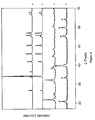
- XRD measures show a complete conversion of Ca(OH) 2 and a complete selenocystine fragmentation because, after carbonation, no more Ca(OH) 2 is observed and no traces of selenocystine have been found.
- the microstructure characterization of the red composite by using x-ray diffraction suggests a complete Ca(OH) 2 -calcite conversion, i.e. that the metastable crystalline phases of CaCO 3 , such as vaterite and aragonite were not produced during the Ca(OH) 2 carbonation process in the experiments of the invention.
- Concerning the selenocystine this crystalline organic material was not identified on the x-ray diffraction spectra for red selenium containing composite ( Figure 3 ). This suggests a complete chemical transformation or water dissolution of the selenocystine in this experiment and explains the precipitation of red nano-particles of elemental selenium (observed by SEM and TEM microscopy).
- Example 4 Synthesis of elemental selenium composite under O 2 -rich conditions or system without a purge step.
- the carbonation yield based on the Ca(OH) 2 -CaCO 3 transformation is about 96 % estimated by mass balance.
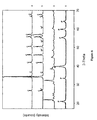
- XRD measures show a complete conversion of Ca(OH) 2 and a complete selenocystine fragmentation because, after carbonation, no longer Ca(OH) 2 is observed and no traces of selenocystine have been found.
- This figure also shows a complete Ca(OH) 2 -Calcite conversion under O 2 -rich conditions, revealing that the oxygenated conditions in the suspension have not significant effect on the carbonation process efficiency.
Landscapes
- Chemical & Material Sciences (AREA)
- Health & Medical Sciences (AREA)
- Organic Chemistry (AREA)
- Life Sciences & Earth Sciences (AREA)
- Inorganic Chemistry (AREA)
- Public Health (AREA)
- Animal Behavior & Ethology (AREA)
- Geology (AREA)
- Veterinary Medicine (AREA)
- General Health & Medical Sciences (AREA)
- Medicinal Chemistry (AREA)
- Pharmacology & Pharmacy (AREA)
- Epidemiology (AREA)
- Nutrition Science (AREA)
- Engineering & Computer Science (AREA)
- Mycology (AREA)
- Polymers & Plastics (AREA)
- Food Science & Technology (AREA)
- Coloring Foods And Improving Nutritive Qualities (AREA)
- Pharmaceuticals Containing Other Organic And Inorganic Compounds (AREA)
Abstract
Description
- The invention relates to new selenium containing composites, their use and a process for preparing the same.
- Selenium is well known for its photochemical and semiconductor properties and has been successfully used in solar cells, rectifiers, photographic exposure meters and xerography ( J. M. Song, J. H. Zhu, S. H. Yu, J. Phys. Chem. B. 110 (2006) 23790; Y. Ding, Q. Li, Y. Jia, L. Chen, J. Xing, Y. Qian, J. Crystal Growth 241 (2002) 489; Y. Bai, Y. Wang, Y. Zhou, W. Li, W. Zheng, Materials Letters (2007) doi:10.1416/j.matlet.2007.11.098). Selenium is also a key trace element required in small quantities in humans and animals for the function of a number of selenium-dependent enzymes, such as glutathione peroxidase (GPX) and thioredoxin reductase; however this element can also be toxic in larger doses.
- Both the beneficial and toxic effects of selenium are based on concentration ingested and on its chemical forms (E. Kapolna, M. Shah, J. A. Caruso, P. Fodor, Food Chemistry 101 (2007) 1398; A. Tarze, M. Dauplais, I. Grigoras, M. Lazard, N. T. Ha-Duong, F. Barbier, S. Blanquet, P. Plateau, J. Biol. Chem. 282/12 (2007) 8759; R. Caputo, S. Capone, M. Della Greca, L. Longobardo, G. Pinto, Tetrahedron Letters 48 (2007) 1425; D. Peng, J. Zhang, Q. Liu, E. Will Taylor, J. Inorg. Biochem. 101 (2007) 1457; J. E. Spallholz, D. J. Hoffman, Aquatic Toxicology 57 (2002) 27; M. S. Stewart, J. E. Spallholz, K. H. Neldner, B. C. Pence, Free Radic. Biol. Med 26 (1999) 42; M. Ochsenkuhn-Petropoulou, F. Tsopelas, Anal. Chim. Acta 467 (2002) 167).
- Inorganic and organic forms have been identified in the Nature. In addition, the selenium can easily form compounds with metals and occurs in about 50 minerals. It is present in four different oxidation states in aqueous and subsurface systems, namely -2, 0, +4 and +6 (K. H. Goh, T. T. Lim, Chemosphere 55, (2004) 849; C. Munier-Lamy, S. Deneux-Mustin, C. Mustin, D. Merlet , J. Berthelin, C. Leyval, J. Environ. Radioactivity (2007) doi:10.1016/j.jenvrad.2007.04.001 ; M. Simonoff, C. Sergeant, S. poulain, M. S. Pravikoff, Comptes Rendus Chimie (2007) doi :10.1016/J.crci.2007.02.010). Obviously, the fate and transport of Se in contaminated sites are very much influenced by its chemical form and speciation.
- Recently, elemental selenium nanoparticles have been fabricated through various approaches, such as laser ablation, solution-phase approach, vapour-phase growth, electrochemical synthesis, photothermally assisted solution phase, ultrasonic, hydrothermal or solvothermal method and micelle-mediated synthesis J. M. Song, J. H. Zhu, S. H. Yu, J. Phys. Chem. B. 110 (2006) 23790).
- Calcium carbonate is an inorganic compound that has been widely studied due to its abundance in nature as a mineral and biomineral. Calcium carbonate particles are found in three polymorph structures, which are generally classified as rhombic calcite, needle-like aragonite and spherical vaterite. Calcite belonging to Trigonal-Hexagonal-Scalenohedral crystallographic class is the most stable phase at room temperature under normal atmospheric conditions, while aragonite and vaterite belong to Orthorombic-Dipyramidal class and Hexagonal-Dihexagonal Dipyramidal class, respectively. The later are metastable polymorphs which readily transform into the stable calcite. The specific formation of one of the polymorphs of crystalline calcium carbonate particles depends mainly on the precipitation conditions, such as pH, temperature and supersaturation. Supersaturation is usually considered to be the main controlling factor (Y. S. Han, G. Hadiko, M. Fuji, M. Takahashi, J. Crystal Growth 276 (2005) 541).
- Many experimental studies have been reported about the synthetic precipitation of the various forms of calcium carbonate and the conditions under which these may be produced, including the importance of initial supersaturation, temperature, pressure, pH and hydrodynamics. The effect of impurities and additives has also been well studied (L. Moore, J. D. Hopwood, R. J. Davey, J. Crystal Growth 261 (2004) 93; K. J. Westin, A. C. Rasmuson, J. Colloids Interface Sci. 282 (2005) 370; H. Tsuno, H. Kagi, T. Akagi, Bull. Chem. Soc. Jpn. 74 (2001) 479; Y. Fujita, G. D. Redden, J. Ingram, M. M. Cortez, G. Ferris, R. W. Smith, Geochem. Cosmochem. A. 68 (2004) 3261; S. J. Freij, A. Godelitsas, A. Putnis, J. Crystal Growth 273 (2005) 535; L. A. Gower, D. A. Tirrell, J. Crystal Growth 191 (1998) 153; R. G. Jonasson, K. Rispler, B. Wiwchar, W. D. Gunter, Chem. Geol. 132 (1996) 215; A. Chrissanthopoulos, N. P. Tzanetos, A. K. Andreopoulou, J. Kallitsis, E. Dalas, J. Crystal Growth 280 (2005) 594; M. Menadakis, G. Maroulis, P. G. Koutsoukos, Computational Materials Science 38 (2007) 522; E. Dousi, J. Kallitsis, A. Chrisssanthopoulos, A. H. Mangood, E. Dalas, J. Crystal Growth 253 (2003) 496; L. Pastero, E. Costa, B. Alessandria, M. Rubbo, D. Aquilano, J. Crystal Growth 247 (2003) 472; Y. J. Lee, R. Reeder, Geochem.Cosmochem. A. 70 (2006) 2253; M. Temmam, J. Paquette, H. Vali, Geochem. Cosmochem. A. 64 (2000) 2417; E. Dalas, A. Chalias, D. Gatos, K. Barlos, J. Colloids Interface Sci. 300 (2006) 536; G. Montes-Hernandez, F. Renard, N. Geoffroy, L. Charlet, J. Pironon, J. Crystal Growth 308 (2007) 228).
- Searching and designing novel methods to synthesize elemental selenium with controlled morphology is important from the viewpoint of fundamental issues and application. For example, recently, the Se0 nanoparticles are attracting more and more attention due to their excellent high biological activity and lower toxicity in animals and man.
- One of the aims of the invention is to provide a process of preparation of an elemental selenium containing composite.
- Another aim of the invention is to provide compositions containing elemental selenium.
- Another aim is to provide an elemental selenium containing composite allowing the delivery of a bioavailable form of selenium.
- Still another aim is to provide a process for synthesizing elemental selenium with controlled morphology.
- The present invention relates to the use of a seleno-L-cystine or a derivative thereof in an aqueous suspension of Ca(OH)2 or Mg(OH)2, for preparing an initial dispersion of seleno-L-cystine in said aqueous suspension, said seleno-L-cystine being liable to be fragmented under an appropriate concentration of O2 and to be used for the preparation of a selenium containing composite or compositions containing said composite.
- The expression "new selenium containing composites" in this specification means a composite which contains one of the two different forms (red or grey) of elemental selenium (0).
- The seleno-Lcystine is constituted of two seleno-L-cysteine molecules bound by a diselenide bridge.
- The seleno-L-cysteine is an amino acid present in several enzymes (for example glutathione peroxidases, tetraiodothyronine 5' deiodinases, thioredoxin reductases, formate dehydrogenases, glycine reductases and some hydrogenases).
- The terms "seleno-L-cystine", "selenocystine" can be used alternatively and refers to the same meaning.
- It can be chemically or biologically synthesized or is commercially available from a lot of suppliers such as Sigma-Aldrich.
- By the expression "derivative thereof" is meant any selenium containing compound that can be used instead of seleno-L-cystine.
- Examples of selenium derivatives are, but without being limited to them, sodium selenite, seleno methionine, sodium selenate, selenocysteine.
- Seleno-L-cystine is the preferred compound but seleno-D-cystine or a mixture of seleno-L-cystine and seleno-D-cystine can also be used.
- By "fragmentation" is meant a process of breaking into fragment, for example by hydrolysis of the C-Se bonds.
- The term "suspension" means a mixture of finely divided Ca(OH)2 or Mg(OH)2 in water.
- According to the invention, Ca(OH)2 or Mg(OH)2 are preferred but the invention is not limited to them. Any other dihydroxide minerals can be used such as Ba(OH)2, Zn(OH)2, Ba(OH)2, provided they are not toxic for human organism.
- The term "dispersion" means a mixture in which fine particles of seleno-L-cystine are scattered throughout water.
- By « composite » is meant an assembly of at least two non miscible materials giving rise to new properties which are absent from each of the materials when taken alone.
- Elemental selenium (Se° or Se(O)) can be found under several forms such as a amorphous form the colour of which is red, or a crystalline form, the colour of which is grey.
- In a preferred embodiment, the above defined composite is prepared by reaction of said initial dispersion of seleno-L-cystine in an aqueous suspension of Ca(OH)2 or Mg(OH)2 with a gaseous CO2 source.
- The carbonation of calcium hydroxide described by the global well-known reaction,
Ca(OH)2(s) + CO 2(aq) → CaCO 3(s) + H 2 O
which is an exothermic process that concerns simultaneously the dissolution of Ca(OH)2,
CO 2(aq) + H 2 O → CO 3 2- + 2H +
- The CO2 source can be pure or concentrated CO2 gas, i.e. CO2 gas containing a small proportion of SOx or NOx, or a mixture of CO2 gas with an inert gas such as, for example, nitrogen or argon, preferably pure CO2 source, in particular pure CO2 source with a purity of 99.995%.
- In a preferred embodiment, the concentration of O2 used in the above defined preparation of said dispersion is comprised from about 1 to about 9 mg/lH2O.
- 9 mg/lH2O is the maximum concentration of oxygen in water in the standard conditions.
- Below 1 mg/lH2O, the concentration of oxygen is too low to obtain a fragmentation of seleno-L-cystine.
- In a more preferred embodiment, the concentration of O2 used in the above defined preparation of said dispersion is comprised from about 1 mg/lH2O to about 7 mg/lH2O, preferably from about 5 mg/lH2O to about 7 mg/l H2O, in particular 6 mg/lH2O.
- The O2 concentration used herein corresponds to a low or poor concentration, i.e., a concentration lower than the concentration of O2 in the initial dispersion Ca(OH)2 or Mg(OH)2 and seleno-L-cystine.
- In another preferred embodiment, the ratio (w/w) Ca(OH)2 or Mg(OH)2 / seleno-L-cystine used for the above defined preparation of said dispersion is comprised from about 1 to about to 15, in particular 15.
- In another preferred embodiment, said selenium containing composite defined above consists of a calcium or magnesium carbonate matrix on which red elemental selenium (Se°) under amorphous form is deposited.
- By "calcium or magnesium carbonate matrix" is meant a surrounding substance within which something else originates, develops, or is contained.
- The use of Ca(OH)2 leads to a carbonate matrix also named calcite matrix and the use of Mg(OH)2 leads to a magnesium carbonate matrix.
- The calcite matrix is constituted by nano- and micro-rhombohedral crystals (<2µm) and micrometric agglomerates and/or aggregates (<5µm).
- Thus, under a poor concentration of O2 and a ratio Ca(OH)2 or Mg(OH)2 / seleno-L-cystine comprised from about 1 to about to 15, the fragmentation of seleno-L-cystine gives rise to the red amorphous form of elemental selenium which is deposited on the matrix, i.e. present at the surface of the matrix but not included in said matrix.
- The terms "adsorbed" or "adsorption" can also be used in this description and have the same meaning that "deposited" or "deposit".
- The composite is constituted of spherical selenium nanoparticles (<500nm) deposited on the calcite matrix and the spherical Se nanoparticles give a stable red coloration to the composite.
- In a more preferred embodiment, the concentration of O2 used in the above defined preparation of said dispersion is comprised from about 7 mg/lH2O to about 9 mg/lH2O, in particular 9mg/lH2O.
- The O2 concentration used herein corresponds to a rich or high concentration, i.e., a concentration corresponding to the initial concentration of O2 in the aqueous Ca(OH)2 or Mg(OH)2 suspension.
- According to another preferred embodiment, the ratio (w/w) Ca(OH)2 or Mg(OH)2 / seleno-L-cystine for the above defined preparation of said dispersion is comprised from about 15 to about to 60 , in particular 15.
- According to a more preferred embodiment, said composite consists of a calcite matrix containing grey elemental selenium (Se°) under crystalline form.
- Thus, under a rich concentration of O2 and a ratio Ca(OH)2 or Mg(OH)2 / seleno-L-cystine comprised from about 15 to about to 60, the fragmentation of seleno-L-cystine gives rise to the grey crystalline form of elemental selenium which is dispersed in the carbonate matrix.
- The composite is characterized by hexagonal selenium microparticles (<25µm) dispersed in the calcite matrix. For this case, a grey coloration of composite is observed.
- In another aspect, the present invention relates to a composite of calcite matrix containing elemental selenium under a bioavailable form.
- By "bioavailable form" is meant a form of selenium which is absorbed or becomes available at the site of physiological activity after administration.
- In a preferred embodiment, the composite above defined is constituted of said elemental selenium under amorphous form deposited on said calcite matrix.
- The observed coloration of the composite is therefore red and is stable during several weeks of storage at room conditions and without protection from the light.
- In a preferred embodiment, the composite above defined is constituted of said elemental selenium under a crystalline form dispersed in said calcite matrix.
- The observed coloration of the composite is therefore grey and is stable during several weeks of storage at room conditions and without protection from the light.
- According to another aspect, the present invention relates to a dispersion of seleno-L-cystine containing oxidized selenocystine under SeO3 2- form, in an aqueous suspension Ca(OH)2 or Mg(OH)2.
- The seleno-L-cystine in Ca(OH)2 alkaline solution undergoes a partial oxidation, before the introduction of CO2 into said initial dispersion, to Se (IV) and Se(VI) due to the alkaline medium and dissolved oxygen.
- In a preferred embodiment, the atomic selenium ratio (w/w) SeO3 2-/ selenocystine of the above defined dispersion is comprised from about 0.01 to about 0.25, in particular 0.25, wherein the concentration of O2 is comprised from about 1 mg/lH2O to about 7 mg/lH2O, preferably from about 5 mg/lH2O to about 7 mg/l H2O, in particular 6 mg/lH2O.
- The liquid chromatography coupled to ICPMS detection revealed that selenocystine was rapidly fragmented in Ca(OH)2 alkaline solutions (pH ≅ 12.5 measured at 25°C). Here, about 25% of initial atomic selenium contained in the selenocystine (experiment with 200mg/kgwater) was oxidized to Se(IV) under O2-poor conditions. (Table 1).
Table 1. The HPLC/ICPMS measurements of twelve solution samples of a hydrothermal carbonation-selonocystine fragmentation experiment under O2 poor concentration and 200 mg/kg water of seleno cystine. Concentrations are given in mg (Se) l-1 t min SeCyst SeIV SeVI pH 25°C 0 0.86 ± 0.08 24 ± 1 nd 12.60 2 nd 9.1 ± 0.7 nq 12.43 6 8.9 ± 0.4 0.37 ± 0.01 nq 7.44 10 9.3 ± 0.1 0.95 ± 0.02 nd 7.30 30 4.0 ± 0.2 1.7 ± 0.2 nq 7.34 60 nd 2.5 ± 0.1 nd 7.10 t: reaction time concerning the experiment (t=0 "before CO2 injection in the reactor"); SeCyst: seleno-L-cystine; SeIV: selenite (SeO3 -2); SeVI: selenate (SeO4 -2); pH25°C: pH measured at 25°C; nd: not detected; nq: not quantifiable. - In a more preferred embodiment, the atomic selenium ratio (w/w) SeO3 2-/selenocystine of the above defined dispersion is comprised from about 0.26 to about 0.40, in particular 0.40, wherein the concentration of O2 is comprised from about 7 mg/lH2O to about 9 mg/lH2O, in particular 9mg/lH2O.
- Conversely, about 40% of initial atomic selenium contained in the selenocystine (experiment with 100mg/kgwater) was mainly oxidized to Se(IV) and a slight amount oxidized to (VI) under O2-rich conditions (Table 2).
Table 2. The HPLC/ICPMS measurements of twelve solution samples of a hydrothermal carbonation-selonocystine fragmentation experiment under O2 rich concentration and 100 mg/kg water of seleno cystine. Concentrations given in mg (Se) l-1 t min SeCyst SeIV SeVI pH 25°C 0 nd 17 ± 1 0.21 ± 0.02 12.63 2 nd 4.7 ± 0.2 0.27 ± 0.01 12.58 6 0.68 ± 0.05 1.5 ± 0.1 0.22 ± 0.2 8.03 10 0.65 ± 0.05 4.0 ± 0.3 0.27 ± 0.02 7.30 30 0.15 ± 0.03 5.6 ± 0.2 0.25 ± 0.02 7.28 60 nd 5.7 ± 0.3 0.24 ± 0.02 7.15 t: reaction time concerning the experiment (t=0 "before CO2 injection in the reactor"); SeCyst: seleno-L-cystine; SeIV: selenite (SeO3 -2); SeVI: selenate (SeO4 -2); pH25°C: pH measured at 25°C; nd: not detected; nq: not quantifiable. - According to another aspect, the present invention relates to a food composition comprising an elemental selenium containing composite wherein the dosage of said composite is appropriate for an intake from 11 µg/day to 400µg/day, preferably from 55 to 70 µg/day.
- Selenium is necessary for the human organism but is toxic at high doses.
- According to Lucia Letavayová (Toxicology, Volume 227, Issues 1-2, 3 October 2006, Pages 1-14) an intake of <11 µg/day results in deficiency problems and based on human studies, intakes of 400 µg/day were established as the maximum safe dietary dose with no observed adverse effect.
- According to J. E. Spallholz et al. (Sci. Total Environ. 323, 21-32 (2004), the human daily dosage for men is 70 µg/day and for women 55 µg/day.
- The selenium contained in the composite of the food composition of the invention can be red or grey.
- According to another aspect, the present invention relates to a pharmaceutical composition comprising an elemental selenium containing composite wherein the dosage of said composite is appropriate for an administration from 10 µg/day to 70 µg/day, preferably from 55 to 70 µg/day.
- The selenium contained in the composite of the pharmaceutical composition can be red or grey.
- In another aspect, the present invention relates to a process of preparation of a selenium containing composite comprising a carbonation step of an initial dispersion of seleno-L-cystine in an aqueous suspension of Ca(OH)2 or Mg(OH)2 with an appropriate concentration of O2.
- By "carbonation step" is meant a reaction step of seleno-L-cystine in an aqueous suspension of Ca(OH)2 or Mg(OH)2 with a CO2 source as defined above to obtain a matrix of a mineral carbonate such as a calcite or magnesium carbonate, i.e. an elemental selenium containing composite.
- In a preferred embodiment, the above defined process of preparation of the composite, comprises the following steps:
- a) introducing seleno-L-cystine in an aqueous suspension of Ca(OH)2 or Mg(OH)2 to obtain a dispersion of seleno-L-cystine in said aqueous suspension of Ca(OH)2 or Mg(OH)2,
- b) optionnally introducing an inert gas into said dispersion at a pressure comprised from 50 bars to 90 bars, in particular 90 bars during 15 to 60 minutes, in particular 30 min, to obtain a pressurized dispersion,
- c) heating the above dispersion obtained in step a) or b) at a temperature from about 70°C to about 90°C, in particular to about 90°C to obtain a heated optionally pressurized dispersion,
- d) in case when an inert gas has been introduced, purging said heated pressurized dispersion until atmospheric pressure to obtain a heated depressurized dispersion in which the O2 concentration is lower than the O2 concentration at atmospheric pressure,
- e) introducing into said heated dispersion or heated depressurized dispersion a gaseous CO2 source and reacting during 10 to 30 minutes, in particular 30 minutes to obtain an aqueous suspension of a selenium containing composite,
- f) cooling, depressurising and centrifuging the above said aqueous suspension to obtain said selenium containing composite.
- The inert gas introduced optionally in step b) can be any inert gas, preferably heavier than O2 such as Ar, Kr et Xe.
- Macroscopically, the typical color of calcite is white, while the typical colors of elemental selenium are grey and red.
- The introduction of the inert gas followed by heating and then purging allows the partial substitution of O2 by the inert gas and thus lowers the concentration of O2 dissolved in the dispersion.
- Therefore, depending on the optional introduction of Ar or not, the elemental selenium obtained is under a crystalline form or an amorphous form respectively and thus the composite is grey or red respectively.
- Table 1 shows that before the CO2 injection in the reactor (t=0), the selonocystine was slightly detected in the solution, but the kinetic data revealed a selenocystine desorption/liberation process from Ca(OH)2 particles during carbonation process (t≠0), this effect being preferentially noticed under O2-poor conditions.
- This suggests that a significant proportion of the initial SeCyst was adsorbed onto the Ca(OH)2 particles. Consequently, at higher adsorbed quantity of SeCyst, i.e. under O2-poor conditions, the precipitation/growth of spherical nanoparticles of red elemental selenium was favoured during the carbonation process.
- Conversely, at lower adsorbed quantity of SeCyst, i.e. under O-rich conditions, the precipitation/growth of hexagonal microparticles of grey elemental selenium was favored during carbonation process.
- The selenite-oxyanion produced during heating of Ca(OH)2 suspension follows a complex path during carbonation process. Firstly, its solution concentration was drastically decreased by adsorption/incorporation on/in calcite matrix, leading to the unusual morphologies for calcite "ex. star-like morphologies" (
Figure 6 ). And secondly, a slight concentration increase was observed caused by a dissolution process of calcite fine particles due to a high molar excess of CO2 in the system. - The adsorption and/or incorporation of selenite (SeO3 -2) on/in the calcite were supported by XANES and EXAFS spectrometry. This powerful technique allowed also the identification and quantification of different selenium forms co-existing with calcite for three selected solid samples (labelled
calcite 2,calcite 3 andcalcite 5 infigures 8 and9 and Table 2). - The Se K-edge XANES spectra of the three calcite samples are dominated by a white line at 12,656.5 eV, indicative of elemental Se (
Figure 7 .) (L. Charlet, A. C. Scheinost, C. Tournassat, J. M. Greneche, A. Gehin, A. Fernandez-Martinez, S. Coudert, D. Tisserand, J. Brendle, Geochim. Cosmochim. Acta 71 (2007) 5731). - Since the white line peak position of selenocystine is about 2 eV above that of elemental Se, it can be discarded that substantial amounts of selenocystine is present in the samples.
Samples - The corresponding Se K-edge EXAFS are shown in
Figure 8 . The Fourier transform peaks at about 2.1 Å (uncorrected for phase shift) in the spectra of elemental Se and of selenocystine are due to Se-Se backscattering within the coordination sphere. This is also the strongest peak in the Fourier transform spectra of the three calcite samples. - Red and grey elemental Se are discernable by the intensity of the 1st and 2nd shells, the ones for grey Se being much stronger due to the higher structural order. The spectrum of
sample 5 is very similar to that of grey Se, whilesamples - The Se-O backscattering peak of the Se(IV) reference, Na2SeO3, occurs at a smaller distance of 1.4 Å. All three sample spectra show a contribution from this shell, although much lower in intensity than the pure Se(IV) compound. It can therefore be concluded that all samples contain a small amount of Se(IV) adsorbed/incorporated onto/into calcite in addition to Se(0). This is in agreement with XANES results.
- To further support this tentative phase identification and to derive quantitative information, linear combination fits were performed of the k3-weighted EXAFS spectra (Table 2). In confirmation of the visual interpretation of EXAFS spectra,
sample calcite 5 contains a large amount of grey Se, while the other two samples are dominated by red Se. - Note that satisfying fits were achieved only, when a reference spectrum of the aqueous selenite was added for samples calcite 2 and
calcite 3, and the reference spectrum of a Se(IV) solid phase was added forsample calcite 5. The relative amount of Se(IV) corresponds to the relative height of the Se-O Fourier peak (Figure 8 ).Table 2 Linear combination fit of k3-weighted EXAFS spectra. Sample Se grey Se red Se(IV) Sum Calcite 2 0.02 0.87 0.12 1.01 Calcite 30.15 0.50 0.28 0.93 Calcite 50.74 0.07 0.23 1.04 Calcite 2: experiment under O2-poor conditions, 100 mg/kgwater of selenocystine, 1 hour of reaction.
Calcite 3: experiment under O2-poor conditions, 50 mg/kgwater of selenocystine, 1 hour of reaction.
Calcite 5: experiment under O2-rich conditions, 100 mg/kgwater of selenocystine, 1 hour of reaction.
Se(IV) correspond to Se(IV)aquo and Na2SeO3 references in Charlet et al. (L. Charlet, A. C. Scheinost, C. Tournassat, J. M. Greneche, A. Gehin, A. Fernandez-Martinez, S. Coudert, D. Tisserand, J. Brendle, Geochim. Cosmochim. Acta 71 (2007) 5731). - Thereofore, the available quantity of oxygen in the suspension controls the fragmentation process of the selenocystine, leading to the precipitation/growth of elemental selenium with two different morphologies and different sizes of particles.
- Consequently, it is demonstrated that the fragmentation process of selenocystine under O2-poor or O2-rich conditions participates to the precipitation/growth of calcite with unusual morphologies.
- In a preferred embodiment the concentration of O2 of the above process of preparation is comprised from about 1 mg/lH2O to about 7 mg/lH2O, preferably from about 5 mg/lH2O to about 7 mg/l H2O, in particular 6 mg/lH2O.
- The elemental selenium obtained is under an amorphous form and thus the composite is red.
- In a preferred embodiment the concentration of O2 of the above process of preparation is comprised is comprised from about 7 mg/lH2O to about 9 mg/lH2O, in particular 9mg/lH2O.
- The elemental selenium obtained here is under a crystalline form and thus the composite is grey.
- In a more preferred embodiment the above defined process of preparation comprises the following steps:
- a) introducing seleno-L-cystine, in an aqueous suspension of Ca(OH)2 or Mg(OH)2, the ratio (w/w) Ca(OH)2 or Mg(OH)2/ seleno-L-cystine being comprised from about 1 to about to 15, in particular 15, to obtain an initial dispersion of seleno-L-cystine,
- b) introducing a inert gas such as Ar into said dispersion at a pressure from about 50 to about 90 bars, in particular 90 bars, during from about 15 min to 60 min, in particular 30 min to obtain to obtain a pressurized dispersion,
- c) heating the above pressurized dispersion at a temperature from about 70°C to about 90°C, in particular 90°C during from about 30 to about 120 min, preferably from about 60 to about 90 min, in particular 60 min, while maintaining the pressure of step b) constant, to obtain a heated pressurized dispersion,
- d) purging said heated pressurized dispersion until atmospheric pressure to obtain a heated depressurized dispersion in which the O2 concentration is lower than the O2 concentration at atmospheric pressure,
- e) introducing into said heated depressurized dispersion, a gaseous CO2 source, the ratio (w/w) Ca(OH)2 or Mg(OH)2/ CO2 being comprised from about from about 0.6 to about 0.15, preferably from about 0.3 to about 0.2, in particular 0.21, and adjusting the pressure from about 70 bars to about 90 bars, in particular 90 bars with Ar and reacting during 10 to 30 minutes, in particular 30 minutes to obtain an aqueous suspension of a selenium containing composite,
- f) cooling at about 35°C, depressurizing and centrifuging said aqueous suspension to obtain said selenium containing composite.
- The amorphous form of the elemental selenium depends not only on the concentration of O2 but also on the ratio (w/w) Ca(OH)2 or Mg(OH)2/ seleno-L-cystine which must be comprised between 1 and 15.
- At this ratio, the pressure of the Ar introduced allows to reduce the O2 concentration. The Ar pressure must be comprised from 50 bars to 90 bars, preferably from 60 to 90 bars, more preferably from 70 to 90 and preferably from 80 to 90 bars, in particular 90 bars.
- Nevertheless, the pressure must be higher than 50 bars in order to obtain red selenium. If the pressure is lower than 50 bars, the concentration of O2 is still too high to obtain red selenium and the elemental selenium obtained is grey.
- The total reaction time comprises introducing Ar into said dispersion and heating said dispersion, purging pressurized heated dispersion, introducing CO2 and reacting, cooling at about 35°C, depressurizing and centrifuging to obtain said composite.
- The total reaction time is therefore comprised from about 100 min to about 255 min, preferably from about 150 to about 220, in particular 200 min.
- The CO2 source is introduced in excess and allows acidifying the pressurized heated dispersion. If the ratio is above 0.6, said dispersion will be too acid and the reaction will not run. Under these temperature and pressure conditions, the vapour phase consists mainly of an Ar and CO2 mixture with the CO2 in a supercritical state (see
Figure 1 ). The pressure and temperature control is critical for the control of the size and the structure of the particles of the matrix. - The red coloration of composite starts to be observable when 50 mg/kgwater are used and the colour intensity increases with an increase of selenocystine dose. This coloration behaviour was reproducible at a constant calcium hydroxide dose (3 g/kgwater for this study). The coloration of composite was stable in the aqueous suspension even after several weeks of storage at room conditions and without protection from the light.
- Microscopically, the red composite was mainly characterized by spherical selenium nanoparticles (< 500 nm) deposited on the calcite matrix. The carbonate matrix was constituted by nano- and micro rhombohedral crystals (< 2 µm) and micrometric agglomerates and/or aggregates (< 5 µm) (
Figure 2 ). - In a more preferred embodiment the above defined process of preparation comprises the following steps:
- a) introducing seleno-L-cystine, in an aqueous suspension of Ca(OH)2 or Mg(OH)2, the ratio (w/w) Ca(OH)2 or Mg(OH)2/ seleno-L-cystine being comprised from about 15 to about to 60, in particular 15, to obtain an initial dispersion of seleno-L-cystine,
- b) heating the above dispersion at about 70°C to about 90°C, in particular 90°C during from about 30 min to about 120 min, preferably from about 60 min to about 90 min, in particular 60 min, while maintaining the pressure of step b) constant, to obtain a heated dispersion,
- c) introducing into said heated dispersion, a gaseous CO2 source, the ratio (w/w) Ca(OH)2 or Mg(OH)2/ CO2 being comprised from about from about 0.6 to about 0.15, preferably from about 0.3 to about 0.2, in particular 0.21, and adjusting the pressure from about 70 bars to about 90 bars, in particular 90 bars with Ar and reacting during 10 to 30 minutes, in particular 30 minutes to obtain an aqueous suspension of a selenium containing composite,
- d) cooling at about 35°C, depressurizing and centrifuging said aqueous suspension to obtain said selenium containing composite.
- The crystalline form of the elemental selenium depends not only on the concentration of O2 but also on the ratio (w/w) Ca(OH)2 or Mg(OH)2/ seleno-L-cystine which must be higher than 15.
- In this case, the optional step of introducing Ar must not be done and the dispersion cited above is directly heated to 90°C at atmospheric pressure.
- The following steps are identical as above.
- The total reaction time comprises heating said dispersion, introducing CO2 and reacting, cooling at about 35°C, depressurizing and centrifuging to obtain said composite.
- The total reaction time is therefore comprised from about 85 min to about 195 min, preferably from about 100 to about 160, in particular 135 min.
- The grey intensity is slightly dependent on the selenocystine dose from 50 to 200 mg/kgwater. The composite coloration was also stable in the aqueous suspension even after several weeks of storage at room conditions and without protection from the light.
- Microscopic observations showed that the composite was characterized by elongated hexagonal selenium microparticles (<25µm) dispersed in the calcite matrix (
Figure 4 ). -
-
Figure 1 shows the experimental Pressure-Temperature conditions represented on a pressure-temperature phase diagram for CO2. -
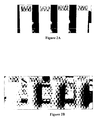
Figures 2A and 2B represent the coloration change of elemental selenium containing composite at different selenocystine doses at different times of reaction with CO2 and under O2-poor conditions. It is to be noted that the elemental selenium containing composite was manually dispersed to take these photographs. -
Figure 2A : composite obtained with 50 mg/kg of selenocystine (grey elemental selenium containing composite).
From left to right tubes : t = 0, t = 2, t = 7, t = 10 min -
Figure 2B : 200 mg/kg of selenocystine (red elemental selenium containing composite obtained).
From left to right tubes : t = 0, t = 2, t = 6, t = 10 min. -
Figures 3A, 3B, 3C and 3D represent the red elemental selenium containing composite synthesized by hydrothermal carbonation of calcium hydroxide coupled with a complex selenocystine fragmentation under O2-poor conditions. -
Figures 3A and 3B : Backscattering SEM observations "without metal coating"; -
Figures 3C and 3D : TEM micrographs. -
Figure 4 represents XRD measurements of starting solid materials (calcium hydroxide and selenocystine) and solid products (pure calcite and red elemental selenium containing composite). Hydrothermal carbonation of calcium hydroxide under O2-poor conditions (P=90 bars, T=90 °C; Ca(OH)2 dose=3 g/kgwater; Selenocystine dose=200 mg/kgwater; 1 hour of reaction time with CO2. P: Portlandite, C: Calcite).
Thelower graph 1 represents the starting Ca (OH)2: portlandite.- The
graph 2 represents the starting selenocystine. - The
graph 3 represents the red elemental selenium composite synthesized with 200 mg of selenocystine. - The
upper graph 4 represents the calcite synthesized without 200 mg of selenocystine.
- The
-
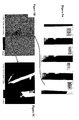
Figures 5A, 5B, 5C represent the coloration change of grey elemental selenium containing composite synthesized by hydrothermal carbonation with CO2 of calcium hydroxide with selenocystine, at different times of reaction and under O2-rich conditions -
Figure 5A : composite obtained with 200 mg/kg selenocystine (grey elemental selenium containing composite).
From left to right tubes : t = 0, t = 2, t = 7, t = 10 min. -
Figure 5B and 5C : Backscattering SEM observations "without metal coating" of the composite obtained with tube t = 10 min, -
Figure 6 represents XRD measurements of starting solid materials (calcium hydroxide and selenocystine) and solid products (pure calcite and gray Se0/calcite composite). Hydrothermal carbonation of calcium hydroxide under O2-rich conditions (P=90 bars, T=90 °C; Ca(OH)2 dose=3 g/kgwater; selenocystine dose=200 mg/kgwater; 1 hour of reaction time with CO2. P: portlandite, C: calcite.
Thelower graph 1 represents the starting Ca (OH)2: portlandite.- The
graph 2 represents the starting selenocystine. - The
graph 3 represents the red elemental selenium composite synthesized with 200 mg of selenocystine. - The
upper graph 4 represents the calcite synthesized without 200 mg of selenocystine.
- The
-
Figures 7A, 7B, 7C, 7D, 7E, 7F, 7G, 7H and 7I represent the hydrothermal carbonation process without or with initial selenocystine dose (200 mg/kgwater) -
Figures 7A, 7B and 7C : rhombohedral nano- and micro-particles of calcite (hydrothermal carbonation process without initial selenocystine dose). -
Figures 7D, 7E, 7F, 7G, 7H and 7I : unusual morphology for calcite "star-like morphologies" (with initial selenocystine dose 200 mg/kgwater). -
Figure 8 represents the Se K-edge XANES of three calcite samples in comparison to select references.- The
graphs 1 have been obtained with the reference of Se(0) red amorphous and Se(0) grey trigonal. - The
graphs 2 have been obtained withcalcite - Calcite 2: experiment under O2-poor conditions, 100 mg/kgwater of selenocytine, 1 hour of reaction;
- Calcite 3: experiment under O2-poor conditions, 50 mg/kgwater of selenocytine, 1 hour of reaction.
- Calcite 5: experiment under O2-rich conditions, 100 mg/kgwater of selenocytine, 1 hour of reaction.
- The
graph 3 has been obtained with Na2SeO3. - The
graph 4 has been obtained with the selenocystine reference.
- The
-
Figure 9A and 9B represent the Se K-edge EXAFS spectra (Fig 9A : left) and corresponding Fourier transforms (Fig 9B : right) of the three calcite samples and select references.- The
graphs 1 have been obtained with the reference of Se(0) red amorphous (lower graph and Se(0) grey trigonal (upper graph). - The
graphs 2 have been obtained withcalcite -
Calcite 2, experiment under O2-poor conditions, 100 mg/kgwater of selenocytine, 1 hour of reaction; -
Calcite 3, experiment under O2-poor conditions, 50 mg/kgwater of selenocytine, 1 hour of reaction. -
Calcite 5, experiment under O2-rich conditions, 100 mg/kgwater of selenocytine, 1 hour of reaction.
-
- The
graph 3 has been obtained with Na2SeO3. - The
graph 4 has been obtained with the selenocystine reference.
- The
- For these experiments, the hydrothermal carbonation of calcium hydroxide described by the global well-known reaction,
Ca(OH)2(s) + CO 2(aq) → CaCO 3(s) + H 2 O
is an exothermic process that concerns simultaneously the dissolution of Ca(OH)2,
CO 2(aq) + H 2 O → CO 3 2- + 2H +
- These processes produce a fast supersaturation (SI ) of the solution with respect to calcite,

where (Ca 2+) and (CO3 2- ) are the activities of calcium and carbonate ions in the solution, respectively, and Ksp is the thermodynamic solubility product of calcite. Then, the nucleation stage (formation of nuclei or critical cluster) takes place in the system,
Ca 2+ + CO 3 2- → CaCO 3 (nuclei)
- The sampling with time of the suspensions in the reactor allowed the identification of the nucleation stage, characterized by the formation of an apparent stable emulsion after about two minutes of reaction time.
- Finally, the crystal growth occurred spontaneously until the equilibrium calcite and the solution was reached,
CaCO 3 (nuclei) → CaCO 3 (calcite)
- For this study, it was demonstrated that the selenocystine fragmentation during heating and carbonation process had insignificant effect on the Ca(OH)2-calcite conversion.
- One liter of high-purity water with electrical resistivity of 18.2 MΩ·cm, 3 g of commercial portlandite Ca(OH)2 (calcium hydroxide provided by Sigma-Aldrich) with 96% chemical purity (3% CaCO3 and 1% other impurities) and different quantities (0, 50, 100 or 200 mg) of seleno-L-cystine CO2HCH(NH2)CH2(Se)2CH2CH(NH2)CO2H (provided by Sigma-Aldrich) with chemical purity (≥98.0%) were placed in a titanium reactor (Parr© autoclave with internal volume of two liters). The hydroxide and selenocystine particles were immediately dispersed with mechanical agitation (400 rpm) to obtain a dispersion of seleno-L-cystine in an aqueous suspension of calcium hydroxide.
- Then, at room temperature the gas argon with 99.999% chemical purity (provided by Linde Gas S.A.) was injected into the reaction cell in order to control the pressure at 90 bars during 30 minutes.
- After this time period, the suspension was heated to 90°C with a furnace adapted to the reactor. During heating stage the pressure increased into the system, but it was kept constant at about 90 bars by using successive manual purge until the temperature was stabilized (about 90 minutes).
- Then, about 20 ml of suspension were sampled in the reactor (t=0) and immediately a flash purge was carried out until atmospheric pressure was reached. The argon adsorption in the suspension, the heating stage and the gas purge, allowed a partial removal of dissolved oxygen from the suspension (O2-poor conditions).
- When the atmospheric pressure was reached in the reactor, 14.5 g of CO2 with 99.995% chemical purity (provided by Linde Gas S.A.) were injected in the reactor and the total pressure in the system was immediately adjusted to 90 bar by argon injection and reacting during 30 minutes.
- After this, a semi-batch system (sampling with time) was performed in order to measure the pH (using MA235 pH/ion analyzer) and, calcium and selenium concentration (using ICP Perkin Elmer Optima 3300 DV) in filtered solutions. For this case, about 20 ml of suspension were sampled in the reactor as a function of time (t=2, 6, 10, 30 and 60 minutes) during composite formation. It is to be noted that the pH measurement was carried out at 25 °C after filtration, cooling and degasification of the solutions
- At the end of the experiment, the autoclave was removed from the heating system and immersed in cold water. The reaction cell was depressurized during the water cooling period. After water cooling at 35°C (about 15 minutes) the autoclave was disassembled, and the solid product was carefully recovered and separated by centrifugation (30 minutes at 12,000 rpm), decanting the supernatant solutions.
- Finally, the solid product was dried directly in the centrifugation flasks for 72 h at 65°C, manually recovered and stocked in plastic flasks.
- The carbonation yield based on the Ca(OH)2-CaCO3 transformation is about 96 % estimated by mass balance. XRD measures show a complete conversion of Ca(OH)2 and a complete selenocystine fragmentation because, after carbonation, no more Ca(OH)2 is observed and no traces of selenocystine have been found.
- The microstructure characterization of the red composite by using x-ray diffraction, suggests a complete Ca(OH)2-calcite conversion, i.e. that the metastable crystalline phases of CaCO3, such as vaterite and aragonite were not produced during the Ca(OH)2 carbonation process in the experiments of the invention. Concerning the selenocystine, this crystalline organic material was not identified on the x-ray diffraction spectra for red selenium containing composite (
Figure 3 ). This suggests a complete chemical transformation or water dissolution of the selenocystine in this experiment and explains the precipitation of red nano-particles of elemental selenium (observed by SEM and TEM microscopy). - The dispersion of seleno-L-cystine in an aqueous suspension of calcium hydroxide of example 2 was directly heated to 90°C at atmospheric pressure. During heating stage the pressure increased into the system, but it was kept constant at about 90 bars by using successive manual purge until the temperature was stabilized (about 90 minutes). When the temperature was stabilized, about 20 ml of suspension were sampled in the reactor (t=0).
- Then, 14.5 g of CO2 were injected into the reactor and the total pressure in the system was immediately adjusted at 90 bars by argon injection and reacting during 30 minutes.
- After the pressure setting, the sampling and composite recovery procedures were identical to the O2-poor system described above (exemple 1).
- The carbonation yield based on the Ca(OH)2-CaCO3 transformation is about 96 % estimated by mass balance. XRD measures show a complete conversion of Ca(OH)2 and a complete selenocystine fragmentation because, after carbonation, no longer Ca(OH)2 is observed and no traces of selenocystine have been found.
- For these experiments, it was demonstrated that a grey composite can be produced under O2-rich conditions. For this case, the grey intensity seems to be slightly dependent on the selenocystine dose from 50 to 200 mg/kgwater. The composite coloration was also stable in the aqueous suspension even after several weeks of storage at room conditions and without protection from the light.
- Microscopic observations showed that the composite was characterized by elongated hexagonal selenium microparticles (<25µm) dispersed in the calcite matrix (
Figure 4 ). In addition, the X-ray diffraction measurements support these microscopic observations. It is well known that the trigonal or hexagonal morphologies are the most stable crystalline phases for Se0. Here, a small proportion contained in a given composite can be identified by X-ray diffraction measurements (Figure 5 ). - This figure also shows a complete Ca(OH)2-Calcite conversion under O2-rich conditions, revealing that the oxygenated conditions in the suspension have not significant effect on the carbonation process efficiency.
Claims (23)
- Use of a seleno-L-cystine or a derivative thereof in an aqueous suspension of Ca(OH)2 or Mg(OH)2, for preparing an initial dispersion of seleno-L-cystine in said aqueous suspension, said seleno-L-cystine being liable to be fragmented under an appropriate concentration of O2 and to be used for the preparation of a selenium containing composite or compositions containing said composite.
- Use according to claim 1, wherein said composite is prepared by reaction of said initial dispersion with a gaseous CO2 source.
- Use according to claim 1 or 2, wherein the concentration of O2 is comprised from about 1 to about 9 mg/lH2O.
- Use according to anyone of claims 1 to 3, wherein the concentration of O2 is comprised from about 1 mg/lH2O to about 7 mg/lH2O, preferably from about 5 mg/lH2O to about 7 mg/l H2O, in particular 6 mg/lH2O.
- Use according to claim 4, wherein the ratio (w/w) Ca(OH)2 or Mg(OH)2 / seleno-L-cystine is comprised from about 1 to about to 15, in particular 15.
- Use according to claim 5, wherein said selenium containing composite consists of a calcium or magnesium carbonate matrix on which red elemental selenium (Se°) under amorphous form is deposited.
- Use according to anyone of claims 1 to 3, wherein the concentration of O2 is comprised from about 7 mg/lH2O to about 9 mg/lH2O, in particular 9mg/lH2O.
- Use according to claim 7, wherein the ratio (w/w) Ca(OH)2 or Mg(OH)2 / seleno-L-cystine is comprised from about 15 to about to 60 , in particular 15.
- Use according to claim 8, wherein said composite consists of a calcite matrix containing a grey elemental selenium (Se°) under crystalline form.
- Composite of calcite matrix containing elemental selenium under a bioavailable form.
- Composite according to claim 10, wherein said elemental selenium is under amorphous form and is deposited on said calcite matrix.
- Composite according to claim 10, wherein said elemental selenium is under a crystalline form and is dispersed in said calcite matrix.
- Dispersion of seleno-L-cystine containing oxidized selenocystine under SeO3 2- form, in an aqueous suspension Ca(OH)2 or Mg(OH)2.
- Dispersion according to claim 13, wherein the atomic selenium ratio (w/w) SeO3 2-/selenocystine is comprised from about 0.01 to about 0.25, in particular 0.25, wherein the concentration of O2 is comprised from about 1 mg/lH2O to about 7 mg/lH2O, preferably from about 5 mg/lH2O to about 7 mg/l H2O, in particular 6 mg/lH2O.
- Dispersion according to claim 13, wherein the atomic selenium ratio (w/w) SeO3 2-/selenocystine is comprised from about 0.26 to about 0.40, in particular 0.40, wherein the concentration of O2 is comprised from about 7 mg/lH2O to about 9 mg/lH2O, in particular 9mg/lH2O.
- Food composition comprising an elemental selenium containing composite wherein the dosage of said composite is appropriate for an intake from 11 µg/day to 400µg/day, preferably from 55 to 70 µg/day.
- Pharmaceutical composition comprising an elemental selenium containing composite wherein the dosage of said composite is appropriate for an administration from 11 µg/day to 400 µg/day, preferably from 55 to 70 µg/day.
- Process of preparation of a selenium containing composite comprising a carbonation step of an initial dispersion of seleno-L-cystine in an aqueous suspension of Ca(OH)2 or Mg(OH)2 with an appropriate concentration of O2.
- Process of preparation according to claim 18, comprising the following steps:a) introducing seleno-L-cystine in an aqueous suspension of Ca(OH)2 or Mg(OH)2 to obtain a dispersion of seleno-L-cystine in said aqueous suspension of Ca(OH)2 or Mg(OH)2,b) optionnally introducing an inert gas into said dispersion at a pressure comprised from 50 bars to 90 bars, in particular 90 bars during 15 to 60 minutes, in particular 30 min, to obtain a pressurized dispersion,c) heating the above dispersion obtained in step a) or b) at a temperature from about 70°C to about 90°C, in particular to about 90°C to obtain a heated optionally pressurized dispersion,d) in case when an inert gas has been introduced, purging said heated pressurized dispersion until atmospheric pressure to obtain a heated depressurized dispersion in which the O2 concentration is lower than the O2 concentration at atmospheric pressure,e) introducing into said heated dispersion or heated depressurized dispersion a gaseous CO2 source and reacting during 10 to 30 minutes, in particular 30 minutes to obtain an aqueous suspension of a selenium containing composite,f) cooling, depressurising and centrifuging the above said aqueous suspension to obtain said selenium containing composite.
- Process of preparation according to claim 18 or 19, wherein the concentration of O2 is comprised from about 1 mg/lH2O to about 7 mg/lH2O, preferably from about 5 mg/lH2O to about 7 mg/l H2O, in particular 6 mg/lH2O.
- Process of preparation according to claim 18 or 19, wherein the concentration of O2 is comprised from about 7 mg/lH2O to about 9 mg/lH2O, in particular 9mg/lH2O.
- Process of preparation according to anyone of claims 18 to 20, comprising the following steps:a) introducing seleno-L-cystine, in an aqueous suspension of Ca(OH)2 or Mg(OH)2, the ratio (w/w) Ca(OH)2 or Mg(OH)2/ seleno-L-cystine being comprised from about 1 to about to 15, in particular 15, to obtain an initial dispersion of seleno-L-cystine,b) introducing a inert gas such as Ar into said dispersion at a pressure from about 50 to about 90 bars, in particular 90 bars, during from about 15 min to 60 min, in particular 30 min to obtain to obtain a pressurized dispersion,c) heating the above pressurized dispersion at a temperature from about 70°C to about 90°C, in particular 90°C during from about 30 to about 120 min, preferably from about 60 to about 90 min, in particular 60 min, while maintaining the pressure of step b) constant, to obtain a heated pressurized dispersion,d) purging said heated pressurized dispersion until atmospheric pressure to obtain a heated depressurized dispersion in which the O2 concentration is lower than the O2 concentration at atmospheric pressure,e) introducing into said heated depressurized dispersion, a gaseous CO2 source, the ratio (w/w) Ca(OH)2 or Mg(OH)2/ CO2 being comprised from about from about 0.6 to about 0.15, preferably from about 0.3 to about 0.2, in particular 0.21, and adjusting the pressure from about 70 bars to about 90 bars, in particular 90 bars with Ar and reacting during 10 to 30 minutes, in particular 30 minutes to obtain an aqueous suspension of a selenium containing composite,f) cooling at about 35°C, depressurizing and centrifuging said aqueous suspension to obtain said selenium containing composite.
- Process of preparation according to anyone of claims 18, 19 or 21, under a rich O2 atmosphere, comprising the following steps:a) introducing seleno-L-cystine, in an aqueous suspension of Ca(OH)2 or Mg(OH)2, the ratio (w/w) Ca(OH)2 or Mg(OH)2/ seleno-L-cystine being comprised from about 15 to about to 60, in particular 15, to obtain an initial dispersion of seleno-L-cystine,b) heating the above dispersion at about 70°C to about 90°C, in particular 90°C during from about 30 min to about 120 min, preferably from about 60 min to about 90 min, in particular 60 min, while maintaining the pressure of step b) constant, to obtain a heated dispersion,c) introducing into said heated dispersion, a gaseous CO2 source, the ratio (w/w) Ca(OH)2 or Mg(OH)2/ CO2 being comprised from about from about 0.6 to about 0.15, preferably from about 0.3 to about 0.2, in particular 0.21, and adjusting the pressure from about 70 bars to about 90 bars, in particular 90 bars with Ar and reacting during 10 to 30 minutes, in particular 30 minutes to obtain an aqueous suspension of a selenium containing composite,d) cooling at about 35°C, depressurizing and centrifuging said aqueous suspension to obtain said selenium containing composite.
Priority Applications (2)
| Application Number | Priority Date | Filing Date | Title |
|---|---|---|---|
| EP08290234A EP2100522A1 (en) | 2008-03-12 | 2008-03-12 | New selenium containing composites, their use and a process for preparing the same |
| PCT/EP2009/052741 WO2009112465A1 (en) | 2008-03-12 | 2009-03-09 | New selenium containing composites, their use and a process for preparing the same |
Applications Claiming Priority (1)
| Application Number | Priority Date | Filing Date | Title |
|---|---|---|---|
| EP08290234A EP2100522A1 (en) | 2008-03-12 | 2008-03-12 | New selenium containing composites, their use and a process for preparing the same |
Publications (1)
| Publication Number | Publication Date |
|---|---|
| EP2100522A1 true EP2100522A1 (en) | 2009-09-16 |
Family
ID=39677654
Family Applications (1)
| Application Number | Title | Priority Date | Filing Date |
|---|---|---|---|
| EP08290234A Withdrawn EP2100522A1 (en) | 2008-03-12 | 2008-03-12 | New selenium containing composites, their use and a process for preparing the same |
Country Status (2)
| Country | Link |
|---|---|
| EP (1) | EP2100522A1 (en) |
| WO (1) | WO2009112465A1 (en) |
Citations (3)
| Publication number | Priority date | Publication date | Assignee | Title |
|---|---|---|---|---|
| US6090414A (en) * | 1970-05-20 | 2000-07-18 | Life Science Labs, Inc. | Method and composition to reduce cancer incidence |
| DE20116346U1 (en) * | 2001-10-05 | 2001-12-20 | Orthomol pharmazeutische Vertriebs GmbH, 40764 Langenfeld | Micronutrient combination product, among others with vitamins and carotenoids |
| EP1762233A1 (en) * | 2005-09-08 | 2007-03-14 | Felix Schielein | Preventitive for oxygen-induced damages from diving |
-
2008
- 2008-03-12 EP EP08290234A patent/EP2100522A1/en not_active Withdrawn
-
2009
- 2009-03-09 WO PCT/EP2009/052741 patent/WO2009112465A1/en not_active Ceased
Patent Citations (3)
| Publication number | Priority date | Publication date | Assignee | Title |
|---|---|---|---|---|
| US6090414A (en) * | 1970-05-20 | 2000-07-18 | Life Science Labs, Inc. | Method and composition to reduce cancer incidence |
| DE20116346U1 (en) * | 2001-10-05 | 2001-12-20 | Orthomol pharmazeutische Vertriebs GmbH, 40764 Langenfeld | Micronutrient combination product, among others with vitamins and carotenoids |
| EP1762233A1 (en) * | 2005-09-08 | 2007-03-14 | Felix Schielein | Preventitive for oxygen-induced damages from diving |
Non-Patent Citations (39)
| Title |
|---|
| A. CHRISSANTHOPOULOS ET AL., J. CRYSTAL GROWTH, vol. 280, 2005, pages 594 |
| A. TARZE ET AL., J. BIOL. CHEM., 2007, pages 8759 |
| C. MUNIER-LAMY ET AL., J. ENVIRON. RADIOACTIVITY, 2007 |
| D. PENG ET AL., J. INORG. BIOCHEM., vol. 101, 2007, pages 1457 |
| E. DALAS ET AL., J. COLLOIDS INTERFACE SCI., vol. 300, 2006, pages 536 |
| E. DOUSI ET AL., J. CRYSTAL GROWTH, vol. 253, 2003, pages 496 |
| E. KAPOLNA ET AL., FOOD CHEMISTRY, vol. 101, 2007, pages 1398 |
| G. MONTES-HERNANDEZ ET AL., J. CRYSTAL GROWTH, vol. 308, 2007, pages 228 |
| G. MONTES-HERNANDEZ, A. FERNANDEZ-MARTINEZ, L. CHARLET, F. RENARD, A.C. SCHEINOST, M. BUENO: "Synthesis of a Se0/Calcite Composite Using hydrothermal Carbonation of Ca(OH)2 Coupled to a Complex Selenocystine Fragmentation", CRYSTAL GROWTH AND DESIGN, vol. 8, no. 7, 28 May 2008 (2008-05-28), pages 2497 - 2504, XP002492557 * |
| GAO X ET AL: "HOLLOW SPHERE SELENIUM NANOPARTICLES: THEIR IN-VITRO ANTI HYDROXYL RADICAL EFFECT", ADVANCED MATERIALS, WILEY VCH, WEINHEIM, DE, vol. 14, no. 4, 19 February 2002 (2002-02-19), pages 290 - 293, XP001132509, ISSN: 0935-9648 * |
| H. TSUNO; H. KAGI; T. AKAGI, BULL. CHEM. SOC. JPN., vol. 74, 2001, pages 479 |
| J. E. SPALLHOLZ ET AL., SCI. TOTAL ENVIRON., vol. 323, 2004, pages 21 - 32 |
| J. E. SPALLHOLZ; D. J. HOFFMAN, AQUATIC TOXICOLOGY, vol. 57, 2002, pages 27 |
| J. M. SONG; J. H. ZHU; S. H. YU, J. PHYS. CHEM. B, vol. 110, 2006, pages 237 - 90 |
| J. M. SONG; J. H. ZHU; S. H. YU, J. PHYS. CHEM. B, vol. 110, 2006, pages 23790 |
| J.-S. ZHANG, X.-Y. GAO, L.-D. ZHANG, Y.-P. BAO: "Biological effects of a nano red elemental selenium", BIOFACTORS, vol. 15, 2001, pages 27 - 38, XP009104615 * |
| K. H. GOH; T. T. LIM, CHEMOSPHERE, vol. 55, 2004, pages 849 |
| K. J. WESTIN; A. C. RASMUSON, J. COLLOIDS INTERFACE SCI., vol. 282, 2005, pages 370 |
| L. A. GOWER; D. A. TIRRELL, J. CRYSTAL GROWTH, vol. 191, 1998, pages 153 |
| L. CHARLET ET AL., GEOCHIM. COSMOCHIM. ACTA, vol. 71, 2007, pages 5731 |
| L. MOORE; J. D. HOPWOOD; R. J. DAVEY, J. CRYSTAL GROWTH, vol. 261, 2004, pages 93 |
| L. PASTERO ET AL., J. CRYSTAL GROWTH, vol. 247, 2003, pages 472 |
| LUCIA LETAVAYOVA, TOXICOLOGY, vol. 227, 3 October 2006 (2006-10-03), pages 1 - 14 |
| M. MENADAKIS; G. MAROULIS; P. G. KOUTSOUKOS, COMPUTATIONAL MATERIALS SCIENCE, vol. 38, 2007, pages 522 |
| M. OCHSENKUHN-PETROPOULOU; F. TSOPELAS, ANAL. CHIM. ACTA, vol. 467, 2002, pages 167 |
| M. S. STEWART ET AL., FREE RADIC. BIOL. MED, vol. 26, 1999, pages 42 |
| M. SIMONOFF ET AL., COMPTES RENDUS CHIMIE, 2007 |
| M. TEMMAM; J. PAQUETTE; H. VALI, GEOCHEM. COSMOCHEM. A, vol. 64, 2000, pages 2417 |
| MONTES-HERNANDEZ ET AL: "Calcite precipitation from CO2-H2O-Ca(OH)2 slurry under high pressure of CO2", JOURNAL OF CRYSTAL GROWTH, ELSEVIER, AMSTERDAM, NL, vol. 308, no. 1, 2 October 2007 (2007-10-02), pages 228 - 236, XP022283212, ISSN: 0022-0248 * |
| MONTES-HERNANDEZ G ET AL: "Textural properties of synthetic nano-calcite produced by hydrothermal carbonation of calcium hydroxide", JOURNAL OF CRYSTAL GROWTH, ELSEVIER, AMSTERDAM, NL, vol. 310, no. 11, 19 February 2008 (2008-02-19), pages 2946 - 2953, XP022640578, ISSN: 0022-0248 * |
| Q. LU, F. GAO, S. KOMARNENI: "Cellulose-directed Growth of Selenium Nanobelts in Solution", CHEM. MATER., vol. 18, 2006, pages 159 - 163, XP002492556 * |
| R. CAPUTO ET AL., TETRAHEDRON LETTERS, vol. 48, 2007, pages 1425 |
| R. G. JONASSON ET AL., CHEM. GEOL., vol. 132, 1996, pages 215 |
| S. J. FREIJ; A. GODELITSAS; A. PUTNIS, J. CRYSTAL GROWTH, vol. 273, 2005, pages 535 |
| Y. BAI ET AL., MATERIALS LETTERS, 2007 |
| Y. DING ET AL., J. CRYSTAL GROWTH, vol. 241, 2002, pages 489 |
| Y. FUJITA ET AL., GEOCHEM. COSMOCHEM. A., vol. 68, 2004, pages 3261 |
| Y. J. LEE; R. REEDER, GEOCHEM.COSMOCHEM. A, vol. 70, 2006, pages 2253 |
| Y. S. HAN ET AL., J. CRYSTAL GROWTH, vol. 276, 2005, pages 541 |
Also Published As
| Publication number | Publication date |
|---|---|
| WO2009112465A1 (en) | 2009-09-17 |
Similar Documents
| Publication | Publication Date | Title |
|---|---|---|
| Knez et al. | The magnetic field influence on the polymorph composition of CaCO3 precipitated from carbonized aqueous solutions | |
| Li et al. | Hydrothermal synthesis of flower-like SrCO3 nanostructures | |
| Liang et al. | High-gravity-assisted controlled synthesis of lanthanum carbonate for highly-efficient adsorption of phosphate | |
| Zhang et al. | Acceleration of CO2 mineralisation of alkaline brines with nickel nanoparticles catalysts in continuous tubular reactor | |
| Shamsipur et al. | Applying Taguchi robust design to the optimization of synthesis of barium carbonate nanorods via direct precipitation | |
| KR20110124317A (en) | High yield and high speed synthesis method for the preparation of metal organic salts | |
| Montes-Hernandez et al. | Textural properties of synthetic nano-calcite produced by hydrothermal carbonation of calcium hydroxide | |
| Ma et al. | In-vitro study on calcium carbonate crystal growth mediated by organic matrix extracted from fresh water pearls | |
| Faatz et al. | Mineralization of calcium carbonate by controlled release of carbonate in aqueous solution | |
| Sabbides et al. | The crystallization of calcium carbonate in artificial seawater; role of the substrate | |
| Dong et al. | Preparation and characterization of anhydrous magnesium carbonate under the present of potassium ions solution | |
| Zheng et al. | Bioinspired controllable CaCO3 synthesis from solid waste by an “all in one” amino acid-in strategy: implication for CO2 mineralization | |
| Luo et al. | Use of Ca-containing industrial waste brine for CO2 sequestration and recovery of NaCl and Na2SO4 | |
| Jiang et al. | Hydrothermal synthesis of monodisperse single-crystalline alpha-quartz nanospheres | |
| Zhao et al. | Synthesis of ThO 2 nanostructures through a hydrothermal approach: influence of hexamethylenetetramine (HMTA) and sodium dodecyl sulfate (SDS) | |
| Yan et al. | Study on the growth mechanism of porous spherical calcium carbonate synthesized by carbonization controlled by amino acids | |
| Polat et al. | Effect of L-alanyl-glycine dipeptide on calcium oxalate crystallization in artificial urine | |
| Li et al. | Protein‐assisted synthesis of double‐shelled CaCO3 microcapsules and their mineralization with heavy metal ions | |
| EP2100522A1 (en) | New selenium containing composites, their use and a process for preparing the same | |
| Li et al. | Facile fabrication of AgCl nanoparticles and their application in adsorptive desulfurization | |
| Saraya | Effect of L (+) ascorbic acid and monosodium glutamate concentration on the morphology of calcium carbonate | |
| Zhang et al. | Preparation and optical properties of Cu2O hollow microsphere film and hollow nanosphere powder via a simple liquid reduction approach | |
| Li et al. | Synthesis of high purity Li2CO3 and MgCO3· 3H2O in a homogeneous-like organic phase | |
| Aljohani et al. | Impact of different phase structure nano Al2O3 arc discharge prepared on MB dye removal | |
| Henderson et al. | Controlled variation of calcite morphology using simple carboxylic acids |
Legal Events
| Date | Code | Title | Description |
|---|---|---|---|
| PUAI | Public reference made under article 153(3) epc to a published international application that has entered the european phase |
Free format text: ORIGINAL CODE: 0009012 |
|
| AK | Designated contracting states |
Kind code of ref document: A1 Designated state(s): AT BE BG CH CY CZ DE DK EE ES FI FR GB GR HR HU IE IS IT LI LT LU LV MC MT NL NO PL PT RO SE SI SK TR |
|
| AX | Request for extension of the european patent |
Extension state: AL BA MK RS |
|
| AKX | Designation fees paid |
Designated state(s): FR |
|
| REG | Reference to a national code |
Ref country code: DE Ref legal event code: 8566 |
|
| STAA | Information on the status of an ep patent application or granted ep patent |
Free format text: STATUS: THE APPLICATION IS DEEMED TO BE WITHDRAWN |
|
| 18D | Application deemed to be withdrawn |
Effective date: 20100317 |