EP2098477A1 - Process for adjusting the friction coefficient between surfaces of two solid objects - Google Patents
Process for adjusting the friction coefficient between surfaces of two solid objects Download PDFInfo
- Publication number
- EP2098477A1 EP2098477A1 EP08152459A EP08152459A EP2098477A1 EP 2098477 A1 EP2098477 A1 EP 2098477A1 EP 08152459 A EP08152459 A EP 08152459A EP 08152459 A EP08152459 A EP 08152459A EP 2098477 A1 EP2098477 A1 EP 2098477A1
- Authority
- EP
- European Patent Office
- Prior art keywords
- process according
- particles
- liquid material
- magnetic
- external stimulus
- Prior art date
- Legal status (The legal status is an assumption and is not a legal conclusion. Google has not performed a legal analysis and makes no representation as to the accuracy of the status listed.)
- Withdrawn
Links
- 238000000034 method Methods 0.000 title claims abstract description 26
- 230000008569 process Effects 0.000 title claims abstract description 26
- 239000007787 solid Substances 0.000 title claims abstract description 9
- 239000011344 liquid material Substances 0.000 claims abstract description 29
- 239000002245 particle Substances 0.000 claims description 35
- XUIMIQQOPSSXEZ-UHFFFAOYSA-N Silicon Chemical group [Si] XUIMIQQOPSSXEZ-UHFFFAOYSA-N 0.000 claims description 14
- 229910052710 silicon Inorganic materials 0.000 claims description 14
- 239000010703 silicon Substances 0.000 claims description 14
- 239000006249 magnetic particle Substances 0.000 claims description 9
- XEEYBQQBJWHFJM-UHFFFAOYSA-N Iron Chemical compound [Fe] XEEYBQQBJWHFJM-UHFFFAOYSA-N 0.000 claims description 8
- 230000005684 electric field Effects 0.000 claims description 8
- 239000000084 colloidal system Substances 0.000 claims description 6
- 239000004973 liquid crystal related substance Substances 0.000 claims description 6
- 239000012071 phase Substances 0.000 claims description 6
- 239000002253 acid Substances 0.000 claims description 5
- 239000004927 clay Substances 0.000 claims description 5
- 230000005670 electromagnetic radiation Effects 0.000 claims description 5
- 150000003839 salts Chemical class 0.000 claims description 5
- XLOMVQKBTHCTTD-UHFFFAOYSA-N Zinc monoxide Chemical compound [Zn]=O XLOMVQKBTHCTTD-UHFFFAOYSA-N 0.000 claims description 4
- HVYWMOMLDIMFJA-DPAQBDIFSA-N cholesterol Chemical compound C1C=C2C[C@@H](O)CC[C@]2(C)[C@@H]2[C@@H]1[C@@H]1CC[C@H]([C@H](C)CCCC(C)C)[C@@]1(C)CC2 HVYWMOMLDIMFJA-DPAQBDIFSA-N 0.000 claims description 4
- 229910052742 iron Inorganic materials 0.000 claims description 4
- 239000003960 organic solvent Substances 0.000 claims description 4
- 239000000049 pigment Substances 0.000 claims description 4
- 230000008859 change Effects 0.000 claims description 3
- SZVJSHCCFOBDDC-UHFFFAOYSA-N iron(II,III) oxide Inorganic materials O=[Fe]O[Fe]O[Fe]=O SZVJSHCCFOBDDC-UHFFFAOYSA-N 0.000 claims description 3
- 239000002480 mineral oil Substances 0.000 claims description 3
- 235000015112 vegetable and seed oil Nutrition 0.000 claims description 3
- 239000008158 vegetable oil Substances 0.000 claims description 3
- GWEVSGVZZGPLCZ-UHFFFAOYSA-N Titan oxide Chemical compound O=[Ti]=O GWEVSGVZZGPLCZ-UHFFFAOYSA-N 0.000 claims description 2
- 238000005054 agglomeration Methods 0.000 claims description 2
- 230000002776 aggregation Effects 0.000 claims description 2
- 229910001919 chlorite Inorganic materials 0.000 claims description 2
- 229910052619 chlorite group Inorganic materials 0.000 claims description 2
- QBWCMBCROVPCKQ-UHFFFAOYSA-N chlorous acid Chemical compound OCl=O QBWCMBCROVPCKQ-UHFFFAOYSA-N 0.000 claims description 2
- 235000012000 cholesterol Nutrition 0.000 claims description 2
- 230000007423 decrease Effects 0.000 claims description 2
- 230000001419 dependent effect Effects 0.000 claims description 2
- 229910052900 illite Inorganic materials 0.000 claims description 2
- NLYAJNPCOHFWQQ-UHFFFAOYSA-N kaolin Chemical compound O.O.O=[Al]O[Si](=O)O[Si](=O)O[Al]=O NLYAJNPCOHFWQQ-UHFFFAOYSA-N 0.000 claims description 2
- 229910052622 kaolinite Inorganic materials 0.000 claims description 2
- 239000007791 liquid phase Substances 0.000 claims description 2
- 235000010446 mineral oil Nutrition 0.000 claims description 2
- VGIBGUSAECPPNB-UHFFFAOYSA-L nonaaluminum;magnesium;tripotassium;1,3-dioxido-2,4,5-trioxa-1,3-disilabicyclo[1.1.1]pentane;iron(2+);oxygen(2-);fluoride;hydroxide Chemical compound [OH-].[O-2].[O-2].[O-2].[O-2].[O-2].[F-].[Mg+2].[Al+3].[Al+3].[Al+3].[Al+3].[Al+3].[Al+3].[Al+3].[Al+3].[Al+3].[K+].[K+].[K+].[Fe+2].O1[Si]2([O-])O[Si]1([O-])O2.O1[Si]2([O-])O[Si]1([O-])O2.O1[Si]2([O-])O[Si]1([O-])O2.O1[Si]2([O-])O[Si]1([O-])O2.O1[Si]2([O-])O[Si]1([O-])O2.O1[Si]2([O-])O[Si]1([O-])O2.O1[Si]2([O-])O[Si]1([O-])O2 VGIBGUSAECPPNB-UHFFFAOYSA-L 0.000 claims description 2
- 230000002441 reversible effect Effects 0.000 claims description 2
- 229910021647 smectite Inorganic materials 0.000 claims description 2
- 239000000725 suspension Substances 0.000 claims description 2
- OGIDPMRJRNCKJF-UHFFFAOYSA-N titanium oxide Inorganic materials [Ti]=O OGIDPMRJRNCKJF-UHFFFAOYSA-N 0.000 claims description 2
- 230000007704 transition Effects 0.000 claims description 2
- XLYOFNOQVPJJNP-UHFFFAOYSA-N water Substances O XLYOFNOQVPJJNP-UHFFFAOYSA-N 0.000 claims description 2
- 239000011787 zinc oxide Substances 0.000 claims description 2
- HEMHJVSKTPXQMS-UHFFFAOYSA-M Sodium hydroxide Chemical compound [OH-].[Na+] HEMHJVSKTPXQMS-UHFFFAOYSA-M 0.000 description 9
- KWYUFKZDYYNOTN-UHFFFAOYSA-M Potassium hydroxide Chemical compound [OH-].[K+] KWYUFKZDYYNOTN-UHFFFAOYSA-M 0.000 description 6
- VEXZGXHMUGYJMC-UHFFFAOYSA-N Hydrochloric acid Chemical compound Cl VEXZGXHMUGYJMC-UHFFFAOYSA-N 0.000 description 5
- 239000007788 liquid Substances 0.000 description 5
- FAPWRFPIFSIZLT-UHFFFAOYSA-M Sodium chloride Chemical compound [Na+].[Cl-] FAPWRFPIFSIZLT-UHFFFAOYSA-M 0.000 description 4
- QTBSBXVTEAMEQO-UHFFFAOYSA-N Acetic acid Chemical compound CC(O)=O QTBSBXVTEAMEQO-UHFFFAOYSA-N 0.000 description 3
- CSCPPACGZOOCGX-UHFFFAOYSA-N Acetone Chemical compound CC(C)=O CSCPPACGZOOCGX-UHFFFAOYSA-N 0.000 description 3
- LFQSCWFLJHTTHZ-UHFFFAOYSA-N Ethanol Chemical compound CCO LFQSCWFLJHTTHZ-UHFFFAOYSA-N 0.000 description 3
- YXFVVABEGXRONW-UHFFFAOYSA-N Toluene Chemical compound CC1=CC=CC=C1 YXFVVABEGXRONW-UHFFFAOYSA-N 0.000 description 3
- 230000008901 benefit Effects 0.000 description 3
- VLKZOEOYAKHREP-UHFFFAOYSA-N n-Hexane Chemical compound CCCCCC VLKZOEOYAKHREP-UHFFFAOYSA-N 0.000 description 3
- FVAUCKIRQBBSSJ-UHFFFAOYSA-M sodium iodide Chemical compound [Na+].[I-] FVAUCKIRQBBSSJ-UHFFFAOYSA-M 0.000 description 3
- RTZKZFJDLAIYFH-UHFFFAOYSA-N Diethyl ether Chemical compound CCOCC RTZKZFJDLAIYFH-UHFFFAOYSA-N 0.000 description 2
- KFZMGEQAYNKOFK-UHFFFAOYSA-N Isopropanol Chemical compound CC(C)O KFZMGEQAYNKOFK-UHFFFAOYSA-N 0.000 description 2
- GRYLNZFGIOXLOG-UHFFFAOYSA-N Nitric acid Chemical compound O[N+]([O-])=O GRYLNZFGIOXLOG-UHFFFAOYSA-N 0.000 description 2
- CDBYLPFSWZWCQE-UHFFFAOYSA-L Sodium Carbonate Chemical compound [Na+].[Na+].[O-]C([O-])=O CDBYLPFSWZWCQE-UHFFFAOYSA-L 0.000 description 2
- DBMJMQXJHONAFJ-UHFFFAOYSA-M Sodium laurylsulphate Chemical compound [Na+].CCCCCCCCCCCCOS([O-])(=O)=O DBMJMQXJHONAFJ-UHFFFAOYSA-M 0.000 description 2
- QAOWNCQODCNURD-UHFFFAOYSA-N Sulfuric acid Chemical compound OS(O)(=O)=O QAOWNCQODCNURD-UHFFFAOYSA-N 0.000 description 2
- -1 aluminum-nickel-cobalt Chemical compound 0.000 description 2
- 230000000694 effects Effects 0.000 description 2
- 230000005611 electricity Effects 0.000 description 2
- FEIWNULTQYHCDN-UHFFFAOYSA-N mbba Chemical compound C1=CC(CCCC)=CC=C1N=CC1=CC=C(OC)C=C1 FEIWNULTQYHCDN-UHFFFAOYSA-N 0.000 description 2
- 229910017604 nitric acid Inorganic materials 0.000 description 2
- FGIUAXJPYTZDNR-UHFFFAOYSA-N potassium nitrate Chemical compound [K+].[O-][N+]([O-])=O FGIUAXJPYTZDNR-UHFFFAOYSA-N 0.000 description 2
- OTYBMLCTZGSZBG-UHFFFAOYSA-L potassium sulfate Chemical compound [K+].[K+].[O-]S([O-])(=O)=O OTYBMLCTZGSZBG-UHFFFAOYSA-L 0.000 description 2
- 229910052939 potassium sulfate Inorganic materials 0.000 description 2
- 239000001120 potassium sulphate Substances 0.000 description 2
- 235000011151 potassium sulphates Nutrition 0.000 description 2
- JHJLBTNAGRQEKS-UHFFFAOYSA-M sodium bromide Chemical compound [Na+].[Br-] JHJLBTNAGRQEKS-UHFFFAOYSA-M 0.000 description 2
- 239000011780 sodium chloride Substances 0.000 description 2
- 230000003068 static effect Effects 0.000 description 2
- AYYWUKWHSHVSLJ-UHFFFAOYSA-N (4-octan-2-yloxycarbonylphenyl) 4-(4-octoxyphenyl)benzoate Chemical compound C1=CC(OCCCCCCCC)=CC=C1C1=CC=C(C(=O)OC=2C=CC(=CC=2)C(=O)OC(C)CCCCCC)C=C1 AYYWUKWHSHVSLJ-UHFFFAOYSA-N 0.000 description 1
- WRIDQFICGBMAFQ-UHFFFAOYSA-N (E)-8-Octadecenoic acid Natural products CCCCCCCCCC=CCCCCCCC(O)=O WRIDQFICGBMAFQ-UHFFFAOYSA-N 0.000 description 1
- WCJUJMPIFZMWOZ-UHFFFAOYSA-N 1-pentyl-4-phenylcyclohexa-2,4-diene-1-carbonitrile Chemical group C1=CC(CCCCC)(C#N)CC=C1C1=CC=CC=C1 WCJUJMPIFZMWOZ-UHFFFAOYSA-N 0.000 description 1
- LQJBNNIYVWPHFW-UHFFFAOYSA-N 20:1omega9c fatty acid Natural products CCCCCCCCCCC=CCCCCCCCC(O)=O LQJBNNIYVWPHFW-UHFFFAOYSA-N 0.000 description 1
- AFSMJYXTFQDZKO-UHFFFAOYSA-N 5-(4-octan-2-yloxycarbonylphenyl)-1-octoxy-4-phenylcyclohexa-2,4-diene-1-carboxylic acid Chemical compound CCCCCCCCOC1(CC(=C(C=C1)C2=CC=CC=C2)C3=CC=C(C=C3)C(=O)OC(C)CCCCCC)C(=O)O AFSMJYXTFQDZKO-UHFFFAOYSA-N 0.000 description 1
- QSBYPNXLFMSGKH-UHFFFAOYSA-N 9-Heptadecensaeure Natural products CCCCCCCC=CCCCCCCCC(O)=O QSBYPNXLFMSGKH-UHFFFAOYSA-N 0.000 description 1
- 239000005642 Oleic acid Substances 0.000 description 1
- ZQPPMHVWECSIRJ-UHFFFAOYSA-N Oleic acid Natural products CCCCCCCCC=CCCCCCCCC(O)=O ZQPPMHVWECSIRJ-UHFFFAOYSA-N 0.000 description 1
- 235000019482 Palm oil Nutrition 0.000 description 1
- ZLMJMSJWJFRBEC-UHFFFAOYSA-N Potassium Chemical compound [K] ZLMJMSJWJFRBEC-UHFFFAOYSA-N 0.000 description 1
- WCUXLLCKKVVCTQ-UHFFFAOYSA-M Potassium chloride Chemical group [Cl-].[K+] WCUXLLCKKVVCTQ-UHFFFAOYSA-M 0.000 description 1
- 235000019484 Rapeseed oil Nutrition 0.000 description 1
- UIIMBOGNXHQVGW-DEQYMQKBSA-M Sodium bicarbonate-14C Chemical compound [Na+].O[14C]([O-])=O UIIMBOGNXHQVGW-DEQYMQKBSA-M 0.000 description 1
- 235000019486 Sunflower oil Nutrition 0.000 description 1
- 150000007513 acids Chemical class 0.000 description 1
- 125000003158 alcohol group Chemical group 0.000 description 1
- 150000001298 alcohols Chemical class 0.000 description 1
- 229910052796 boron Inorganic materials 0.000 description 1
- UVZUFUGNHDDLRQ-LLHZKFLPSA-N cholesteryl benzoate Chemical compound O([C@@H]1CC2=CC[C@H]3[C@@H]4CC[C@@H]([C@]4(CC[C@@H]3[C@@]2(C)CC1)C)[C@H](C)CCCC(C)C)C(=O)C1=CC=CC=C1 UVZUFUGNHDDLRQ-LLHZKFLPSA-N 0.000 description 1
- 239000010941 cobalt Substances 0.000 description 1
- 229910017052 cobalt Inorganic materials 0.000 description 1
- GUTLYIVDDKVIGB-UHFFFAOYSA-N cobalt atom Chemical compound [Co] GUTLYIVDDKVIGB-UHFFFAOYSA-N 0.000 description 1
- KPLQYGBQNPPQGA-UHFFFAOYSA-N cobalt samarium Chemical compound [Co].[Sm] KPLQYGBQNPPQGA-UHFFFAOYSA-N 0.000 description 1
- 239000011258 core-shell material Substances 0.000 description 1
- 150000002170 ethers Chemical class 0.000 description 1
- QXJSBBXBKPUZAA-UHFFFAOYSA-N isooleic acid Natural products CCCCCCCC=CCCCCCCCCC(O)=O QXJSBBXBKPUZAA-UHFFFAOYSA-N 0.000 description 1
- 239000000944 linseed oil Substances 0.000 description 1
- 239000010687 lubricating oil Substances 0.000 description 1
- ZQPPMHVWECSIRJ-KTKRTIGZSA-N oleic acid Chemical compound CCCCCCCC\C=C/CCCCCCCC(O)=O ZQPPMHVWECSIRJ-KTKRTIGZSA-N 0.000 description 1
- 239000004006 olive oil Substances 0.000 description 1
- 239000002540 palm oil Substances 0.000 description 1
- 239000011591 potassium Substances 0.000 description 1
- 229910052700 potassium Inorganic materials 0.000 description 1
- 239000004323 potassium nitrate Substances 0.000 description 1
- 235000010333 potassium nitrate Nutrition 0.000 description 1
- 230000005855 radiation Effects 0.000 description 1
- 229910000938 samarium–cobalt magnet Inorganic materials 0.000 description 1
- 239000008159 sesame oil Substances 0.000 description 1
- 235000011803 sesame oil Nutrition 0.000 description 1
- 229910000029 sodium carbonate Inorganic materials 0.000 description 1
- 235000009518 sodium iodide Nutrition 0.000 description 1
- 239000002600 sunflower oil Substances 0.000 description 1
Images


Classifications
-
- B—PERFORMING OPERATIONS; TRANSPORTING
- B81—MICROSTRUCTURAL TECHNOLOGY
- B81B—MICROSTRUCTURAL DEVICES OR SYSTEMS, e.g. MICROMECHANICAL DEVICES
- B81B5/00—Devices comprising elements which are movable in relation to each other, e.g. comprising slidable or rotatable elements
-
- B—PERFORMING OPERATIONS; TRANSPORTING
- B81—MICROSTRUCTURAL TECHNOLOGY
- B81B—MICROSTRUCTURAL DEVICES OR SYSTEMS, e.g. MICROMECHANICAL DEVICES
- B81B2201/00—Specific applications of microelectromechanical systems
- B81B2201/03—Microengines and actuators
- B81B2201/034—Electrical rotating micromachines
Definitions
- the present invention relates to a process for adjusting the friction coefficient between a surface of a first solid object and a surface of a second solid object which surfaces are at least partly connected by means of a liquid material.
- MEMS micro electro mechanical systems
- Object of the present invention is to provide a process that improves the reliability of the operation of MEMS and that attractively deals with the above-mentioned problem.
- the present invention relates to a process for adjusting the friction coefficient between a surface of a first solid object and a surface of a second solid object which surfaces are at least partly connected by means of a liquid material, wherein the shear behaviour of the liquid material is adjusted by subjecting at least part of the liquid material to an external stimulus.
- the surface of a silicon rotor and a silicon housing in a MEMS device can very easily be separated from each other after use, thus avoiding that the surfaces will be damaged and ensuring an attractive reproducibility of the micro system over a longer period of time.
- the external stimulus to be used according to the present invention suitably establishes a change in the concentration, the agglomeration, the conglomeration or the stacking of particles that are present in the liquid material, or said stimulus establishes a phase transition in the liquid material.
- the liquid material to be used in accordance with the present invention is a colloid or a suspension.
- the liquid material is a colloid.
- the particles present in the liquid material are charged or magnetic particles.
- Suitable examples of charged particles include clay particles and pigment particles.
- the charged particles are clay particles.
- the clay particles are kaolinite, smectite, illite or chlorite particles.
- the pigment particles are titanium oxide or zinc oxide particles.
- Suitable examples of magnetic particles include iron particles, magnetite particles, samarium-cobalt particles, cobalt particles, aluminum-nickel-cobalt, titanium-cobalt-nickel-aluminum particles, and neodinium-iron-boron particles.
- the magnetic particles are iron particles or magnetite particles. More preferably, the magnetic particles are iron particles.
- the magnetic particles may suitably comprise a magnetic phase and a non-magnetic phase. Suitable examples of such particles include core-shell particles. Such magnetic particles have the advantage that the shape, surface charge and mechanical properties of the particle can be tuned independently from the magnetic properties.
- the liquid material is a colloid
- the liquid phase of the colloid comprises water, a mineral oil, a vegetable oil or an organic solvent.
- Suitable examples of mineral oils include petroleums, paraffins, and lubricating oils.
- Suitable examples of vegetable oils include rape seed oils, olive oils, linseed oils, sunflower oils, palm oils and sesame oils.
- organic solvents include ethers, alcohols such ethanol and isopropanol, hexane, toluene, acetone, and oleic acid.
- the organic solvent is an alcohol or an ether.
- the liquid material to be used in accordance with the present invention comprises liquid crystals.
- liquid crystals include cholesterol derivates, cholesteryl benzoate, p-methoxybenzylidene-p'-n-butylaniline, cyanobiphenyls, 4-cyano-4-n-pentylbiphenyl (5CB), 4-(1-methylheptyloxycarbonyl)phenyl-4-octyloxybiphenyl-4-carboxylate (MHPOBC), dipalmitoylphospatidylcholine (DPPC), sodium dodecyl sulfate (SDS) and 4-n-methoxybenzylidene-4-n-butylaniline (MBBA).
- the liquid crystals comprise MBBA.
- the external stimulus to be used in accordance with the present invention is suitably heat, pressure, electro-magnetic radiation, a magnetic field, an electric field, an addition of an acid or a base, or the addition of a salt.
- the external stimulus is heat or a magnetic field.
- the heat is applied by means of electrical current
- the temperature to be applied when heat is used can suitably be in the range of from 0-150 °C, preferably in the range of from 20-100°C.
- electro-magnetic radiation examples include UV (ultraviolet), IR (infra-red), visible light, X-ray radiation.
- the electro-magnetic radiation is IR or UV. More preferably, the electro-magnetic radiation is IR.
- the magnetic field strength can suitably be in the range of from 0-5 Tesla.
- the magnetic field strength is in the range of from 0-1.5 Tesla.
- the electric field strength can suitably be in the range of from 0-3000,000 V/m.
- the electric field strength is in the range of from 0-30,000V/m.
- addition acids to be used include hydrochloric acid, acetic acid, sulfuric acid and nitric acid.
- the addition acid is hydrochloric or nitric acid. More preferably, the addition acid is hydrochloric acid.
- Suitable examples of addition bases include sodium hydroxide, sodium carbonate, sodium bicarbonate, potassium hydroxide, and potassium.
- the addition base is sodium hydroxide or potassium hydroxide. More preferably, the addition base is sodium hydroxide.
- salts to be used include sodium chloride, sodium iodide, sodium bromide, potassium sulphate and potassium nitrate.
- the salt is sodium chloride or potassium sulphate. More preferably, the salt is potassium chloride salt.
- liquid material is subjected to the external stimulus.
- all of the liquid material is subjected to the external stimulus.
- the friction coefficient between the surfaces of the first and second object decreases.
- the adjustment of the shear behaviour of the liquid material is reversible. This has the advantage that movement can be applied at will, while holding position is also possible.
- the friction coefficient between the surfaces of the first and second object is directionally dependent. This means that the object can be moved in one direction, while maintaining its orientation in another direction.
- Suitable examples of first objects include a silicon housing in a MEMS, and a silicon wafer handler.
- the first object is a silicon housing.
- Suitable examples of second objects include a silicon rotor and a silicon wafer.
- the second object is a silicon rotor in a MEMS (Micro Electro Mechanical System).
- MEMS Micro Electro Mechanical System
- the first object is a silicon housing and the second object is a silicon rotor in a MEMS (Micro Electro Mechanical System).
- MEMS Micro Electro Mechanical System
Landscapes
- Engineering & Computer Science (AREA)
- Computer Hardware Design (AREA)
- Microelectronics & Electronic Packaging (AREA)
- Lubricants (AREA)
- Electrochromic Elements, Electrophoresis, Or Variable Reflection Or Absorption Elements (AREA)
Abstract
Description
- The present invention relates to a process for adjusting the friction coefficient between a surface of a first solid object and a surface of a second solid object which surfaces are at least partly connected by means of a liquid material.
- It is well appreciated that in the application of micro electro mechanical systems (MEMS), the moving parts can become stuck to the static parts. This is due to the fact that the static and moving parts (e.g. a miniature silicon rotor in a silicon housing) are very small, flat and close to each other. Surface effects therefore play a large role, and sticking can occur. As a result of the sticking, the MEMS can become non-functional (i.e., the moving parts can not move anymore), or an external force has to be applied to release the moving part, with the substantial risk of damaging the MEMS.
- Object of the present invention is to provide a process that improves the reliability of the operation of MEMS and that attractively deals with the above-mentioned problem.
- Surprisingly, it has now been found that this can be established when the friction coefficient between the surfaces is adjusted by means of a change in the shear behaviour of the liquid material by subjecting at least part of the liquid material to an external stimulus.
- Accordingly, the present invention relates to a process for adjusting the friction coefficient between a surface of a first solid object and a surface of a second solid object which surfaces are at least partly connected by means of a liquid material, wherein the shear behaviour of the liquid material is adjusted by subjecting at least part of the liquid material to an external stimulus.
- In accordance with the present invention the surface of a silicon rotor and a silicon housing in a MEMS device can very easily be separated from each other after use, thus avoiding that the surfaces will be damaged and ensuring an attractive reproducibility of the micro system over a longer period of time.
- The external stimulus to be used according to the present invention suitably establishes a change in the concentration, the agglomeration, the conglomeration or the stacking of particles that are present in the liquid material, or said stimulus establishes a phase transition in the liquid material.
- Preferably, the liquid material to be used in accordance with the present invention is a colloid or a suspension.
- More preferably, the liquid material is a colloid.
- Suitably, the particles present in the liquid material are charged or magnetic particles.
- Suitable examples of charged particles include clay particles and pigment particles. Preferably, the charged particles are clay particles.-
- Preferably, the clay particles are kaolinite, smectite, illite or chlorite particles.
- Preferably, the pigment particles are titanium oxide or zinc oxide particles.
- Suitable examples of magnetic particles include iron particles, magnetite particles, samarium-cobalt particles, cobalt particles, aluminum-nickel-cobalt, titanium-cobalt-nickel-aluminum particles, and neodinium-iron-boron particles.
- Preferably, the magnetic particles are iron particles or magnetite particles. More preferably, the magnetic particles are iron particles.
- The magnetic particles may suitably comprise a magnetic phase and a non-magnetic phase. Suitable examples of such particles include core-shell particles. Such magnetic particles have the advantage that the shape, surface charge and mechanical properties of the particle can be tuned independently from the magnetic properties.
- When in accordance with the present invention the liquid material is a colloid, the liquid phase of the colloid comprises water, a mineral oil, a vegetable oil or an organic solvent.
- Suitable examples of mineral oils include petroleums, paraffins, and lubricating oils.
- Suitable examples of vegetable oils include rape seed oils, olive oils, linseed oils, sunflower oils, palm oils and sesame oils.
- Suitable examples of organic solvents include ethers, alcohols such ethanol and isopropanol, hexane, toluene, acetone, and oleic acid.
- Preferably, the organic solvent is an alcohol or an ether.
- Suitably, the liquid material to be used in accordance with the present invention comprises liquid crystals.
- Suitable examples of such liquid crystals include cholesterol derivates, cholesteryl benzoate, p-methoxybenzylidene-p'-n-butylaniline, cyanobiphenyls, 4-cyano-4-n-pentylbiphenyl (5CB), 4-(1-methylheptyloxycarbonyl)phenyl-4-octyloxybiphenyl-4-carboxylate (MHPOBC), dipalmitoylphospatidylcholine (DPPC), sodium dodecyl sulfate (SDS) and 4-n-methoxybenzylidene-4-n-butylaniline (MBBA). Preferably, the liquid crystals comprise MBBA.
- The use of such liquid crystals has the advantage that the gap between the two surfaces can be made smaller than for particles.
- The external stimulus to be used in accordance with the present invention is suitably heat, pressure, electro-magnetic radiation, a magnetic field, an electric field, an addition of an acid or a base, or the addition of a salt.
- Preferably, the external stimulus is heat or a magnetic field.
- When heat is used as the external stimulus suitably use is made of electrical current or radiative effects.
- Preferably, the heat is applied by means of electrical current
- The temperature to be applied when heat is used can suitably be in the range of from 0-150 °C, preferably in the range of from 20-100°C.
- Suitable examples of electro-magnetic radiation include UV (ultraviolet), IR (infra-red), visible light, X-ray radiation.
- Preferably, the electro-magnetic radiation is IR or UV. More preferably, the electro-magnetic radiation is IR.
- When a magnetic field is used, the magnetic field strength can suitably be in the range of from 0-5 Tesla. Preferably, the magnetic field strength is in the range of from 0-1.5 Tesla.
- When an electric field is used, the electric field strength can suitably be in the range of from 0-3000,000 V/m. Preferably, the electric field strength is in the range of from 0-30,000V/m.
- Suitable examples of addition acids to be used include hydrochloric acid, acetic acid, sulfuric acid and nitric acid. Preferably, the addition acid is hydrochloric or nitric acid. More preferably, the addition acid is hydrochloric acid.
- Suitable examples of addition bases include sodium hydroxide, sodium carbonate, sodium bicarbonate, potassium hydroxide, and potassium.
- Preferably, the addition base is sodium hydroxide or potassium hydroxide. More preferably, the addition base is sodium hydroxide.
- Suitable examples of salts to be used include sodium chloride, sodium iodide, sodium bromide, potassium sulphate and potassium nitrate. Preferably, the salt is sodium chloride or potassium sulphate. More preferably, the salt is potassium chloride salt.
- In accordance with the present invention suitably all or substantially all of the liquid material is subjected to the external stimulus. Preferably, all of the liquid material is subjected to the external stimulus.
- Preferably, in the process according to the present invention the friction coefficient between the surfaces of the first and second object decreases.
- Preferably, the adjustment of the shear behaviour of the liquid material is reversible. This has the advantage that movement can be applied at will, while holding position is also possible.
- Preferably, the friction coefficient between the surfaces of the first and second object is directionally dependent. This means that the object can be moved in one direction, while maintaining its orientation in another direction.
- Suitable examples of first objects include a silicon housing in a MEMS, and a silicon wafer handler.
- Preferably, the first object is a silicon housing.
- Suitable examples of second objects include a silicon rotor and a silicon wafer.
- Preferably, the second object is a silicon rotor in a MEMS (Micro Electro Mechanical System).
- In a very attractive embodiment of the present invention, the first object is a silicon housing and the second object is a silicon rotor in a MEMS (Micro Electro Mechanical System).
- The present invention will now be illustrated by means of
Figure 1-3 . -
Figure 1 shows a typical layout for a MEMS device: a rotor (1) is connected through a shaft (2) to a housing (3). The disc on top of the rotor (1) has a large surface, which comes close to the housing (4). Due to attractive forces between the disk and the housing, the rotor can become stuck to the housing, making movement impossible. -
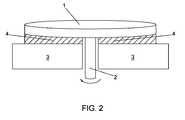
Figure 2 shows the same MEMS, but this time with a liquid (4) filling the gap between the disk and the housing. The movement of the disk on top of the housing is now determined by the shear behaviour of the liquid. -
Figure 3 shows how by means of an electrical switch (6) and a direct current electricity source (5) an electrical potential can be applied over the gap between the disk and the housing (4). If the switch is closed, an electrical field will be present over the liquid in the gap. If a variable potential electricity source is used, the strength of the electrical field in the liquid (4) can be continually adjusted. By choosing an appropriate liquid (4) for which the shear properties depend on the size and/or direction of the electric field, one can thus influence the movement of the rotor (1) with respect tot the housing (3).
Claims (20)
- A process for adjusting the friction coefficient between a surface of a first solid object and a surface of a second solid object which surfaces are at least partly connected by means of a liquid material, wherein the shear behaviour of the liquid material is adjusted by subjecting at least part of the liquid material to an external stimulus.
- The process according to claim 1, wherein the external stimulus establishes a change in the concentration, the agglomeration, the conglomeration or the stacking of particles that are present in the liquid material, or said stimulus establishes a phase transition in the liquid material.
- The process according to claim 1 or 2, wherein the liquid material is a colloid or a suspension.
- The process according to claim 2 or 3, wherein the particles present in the liquid material are charged or magnetic particles.
- The process according to claim 4, wherein the charged particles are clay particles.
- The process according to claim 5, wherein the clay particles are kaolinite, smectite, illite or chlorite particles.
- The process according to claim 4, wherein the charged particles are pigment particles.
- The process according to claim 7, wherein the pigment particles are titanium oxide or zinc oxide particles.
- The process according to claim 4, wherein the magnetic particles are iron or magnetite particles.
- The process according to claim 4 or 9, wherein the magnetic particles comprise a magnetic phase and a non-magnetic phase.
- The process according to any one of claims 3-10, wherein the liquid phase of the colloid comprises water, a mineral oil, a vegetable oil or an organic solvent.
- The process according to any one of claims 1-11, wherein the liquid material comprises liquid crystals.
- The process according to claim 12, wherein the liquid crystals comprise cholesterol derivates.
- The process according to any one of claims 1-13, wherein the external stimulus is heat, pressure, electro-magnetic radiation, a magnetic field, an electric field, an addition of an acid or a base, or a salt.
- The process according to claim 14, wherein the external stimulus is heat or a magnetic field.
- The process according to any one of claims 1-15, wherein all or substantially all of the liquid material is subjected to the external stimulus.
- The process according to any one of claims 1-16, wherein the friction coefficient decreases.
- The process according to any one of claims 1-17, wherein the adjustment of the shear behaviour of the liquid material is reversible.
- The process according to any one of claims 1-16, wherein the adjustment of the friction coefficient is directionally dependent.
- The process according to any one of claims 1-19, wherein the first object is a silicon housing and the second object is a silicon rotor in a MEMS (Micro Electro Mechanical System).
Priority Applications (2)
| Application Number | Priority Date | Filing Date | Title |
|---|---|---|---|
| EP08152459A EP2098477A1 (en) | 2008-03-07 | 2008-03-07 | Process for adjusting the friction coefficient between surfaces of two solid objects |
| PCT/NL2009/050102 WO2009110799A1 (en) | 2008-03-07 | 2009-03-06 | Process for adjusting the coefficient of friction between surfaces of two solid objects |
Applications Claiming Priority (1)
| Application Number | Priority Date | Filing Date | Title |
|---|---|---|---|
| EP08152459A EP2098477A1 (en) | 2008-03-07 | 2008-03-07 | Process for adjusting the friction coefficient between surfaces of two solid objects |
Publications (1)
| Publication Number | Publication Date |
|---|---|
| EP2098477A1 true EP2098477A1 (en) | 2009-09-09 |
Family
ID=39735013
Family Applications (1)
| Application Number | Title | Priority Date | Filing Date |
|---|---|---|---|
| EP08152459A Withdrawn EP2098477A1 (en) | 2008-03-07 | 2008-03-07 | Process for adjusting the friction coefficient between surfaces of two solid objects |
Country Status (2)
| Country | Link |
|---|---|
| EP (1) | EP2098477A1 (en) |
| WO (1) | WO2009110799A1 (en) |
Families Citing this family (1)
| Publication number | Priority date | Publication date | Assignee | Title |
|---|---|---|---|---|
| US10317998B2 (en) | 2017-06-26 | 2019-06-11 | Microsoft Technology Licensing, Llc | Flexible magnetic actuator |
-
2008
- 2008-03-07 EP EP08152459A patent/EP2098477A1/en not_active Withdrawn
-
2009
- 2009-03-06 WO PCT/NL2009/050102 patent/WO2009110799A1/en not_active Ceased
Non-Patent Citations (3)
| Title |
|---|
| DATABASE INSPEC [online] THE INSTITUTION OF ELECTRICAL ENGINEERS, STEVENAGE, GB; June 1994 (1994-06-01), KIMURA Y ET AL: "Control of friction coefficient by applying electric fields across liquid crystal boundary films", XP002495880, Database accession no. 4720405 * |
| HIRANO M ET AL: "Superlubricity mechanism for micro electro mechanical systems", MICRO ELECTRO MECHANICAL SYSTEMS, 1997. MEMS ' 97, PROCEEDINGS, IEEE., TENTH ANNUAL INTERNATIONAL WORKSHOP ON NAGOYA, JAPAN 26-30 JAN. 1997, NEW YORK, NY, USA,IEEE, US, 26 January 1997 (1997-01-26), pages 436 - 441, XP010216946, ISBN: 978-0-7803-3744-2 * |
| WEAR SWITZERLAND, vol. 175, no. 1-2, 1994, pages 143 - 149, ISSN: 0043-1648 * |
Also Published As
| Publication number | Publication date |
|---|---|
| WO2009110799A1 (en) | 2009-09-11 |
Similar Documents
| Publication | Publication Date | Title |
|---|---|---|
| US8652386B2 (en) | Alignment of carbon nanotubes comprising magnetically sensitive metal oxides in nanofluids | |
| CN107108479B (en) | Three-dimensional structure of mesogenic ligand-functionalized nanoparticles and methods of making and using the same | |
| US20040265150A1 (en) | Magnetic membrane system | |
| Kim et al. | Design, fabrication and testing of a serial kinematic MEMS XY stage for multifinger manipulation | |
| US9341742B2 (en) | Magnetic assembly of nonmagnetic particles into photonic crystal structures | |
| US20110303772A1 (en) | Utilization of the naturally occuring magnetic constituents of ores | |
| WO2011066525A2 (en) | Apparatus and method for treating a subterranean formation using diversion | |
| Huang et al. | A remotely driven and controlled micro-gripper fabricated from light-induced deformation smart material | |
| Ooi et al. | Picking up and placing a liquid marble using dielectrophoresis | |
| Zablotsky et al. | Features of magnetorheology of biocompatible chain-forming ferrofluids with multi-core magnetic nanoparticles: Experiment and simulation | |
| Katiyar et al. | Magnetoviscoelastic characteristics of superparamagnetic oxides (Fe, Ni) based ferrofluids | |
| US6824701B1 (en) | Magnetorheological fluids with an additive package | |
| US10475601B2 (en) | Tunneling nanomechanical switches and tunable plasmonic nanogaps | |
| WO2009110799A1 (en) | Process for adjusting the coefficient of friction between surfaces of two solid objects | |
| Floyd et al. | Microparticle manipulation using multiple untethered magnetic micro-robots on an electrostatic surface | |
| CN114873555B (en) | A method and device for modulating friction between superlubricating interfaces | |
| Fu et al. | Smart microgrippers for bioMEMS applications | |
| Kumar et al. | Design and development of ferrofluids materials | |
| Šafarič et al. | One-finger gripper based on the variable van der Waals force used for a single nano/micro-sized object | |
| CN104395229A (en) | Nanostructures with faces of different functional properties | |
| Srivastava et al. | In-situ synthesis of magnetic (NiFe2O4/CuO/FeO) nanocomposites | |
| Khomenko et al. | Molecular dynamics of aluminum nanoparticles friction on graphene | |
| Auernhammer et al. | Intrinsic position sensing of a Ni–Mn–Ga microactuator | |
| Bhat et al. | Estimation and reduction of the adhesion forces between ionic polymer metal composite and micro-objects | |
| CN103684040A (en) | Magnetostrictive inertial impact rotating driver |
Legal Events
| Date | Code | Title | Description |
|---|---|---|---|
| PUAI | Public reference made under article 153(3) epc to a published international application that has entered the european phase |
Free format text: ORIGINAL CODE: 0009012 |
|
| AK | Designated contracting states |
Kind code of ref document: A1 Designated state(s): AT BE BG CH CY CZ DE DK EE ES FI FR GB GR HR HU IE IS IT LI LT LU LV MC MT NL NO PL PT RO SE SI SK TR |
|
| AX | Request for extension of the european patent |
Extension state: AL BA MK RS |
|
| AKX | Designation fees paid | ||
| REG | Reference to a national code |
Ref country code: DE Ref legal event code: 8566 |
|
| RAP1 | Party data changed (applicant data changed or rights of an application transferred) |
Owner name: NEDERLANDSE ORGANISATIE VOOR TOEGEPAST -NATUURWETE |
|
| STAA | Information on the status of an ep patent application or granted ep patent |
Free format text: STATUS: THE APPLICATION IS DEEMED TO BE WITHDRAWN |
|
| 18D | Application deemed to be withdrawn |
Effective date: 20100310 |