EP2098049B1 - Ring tone visualizer - Google Patents
Ring tone visualizer Download PDFInfo
- Publication number
- EP2098049B1 EP2098049B1 EP07825843.1A EP07825843A EP2098049B1 EP 2098049 B1 EP2098049 B1 EP 2098049B1 EP 07825843 A EP07825843 A EP 07825843A EP 2098049 B1 EP2098049 B1 EP 2098049B1
- Authority
- EP
- European Patent Office
- Prior art keywords
- image
- ring tone
- visual effect
- low frequency
- database
- Prior art date
- Legal status (The legal status is an assumption and is not a legal conclusion. Google has not performed a legal analysis and makes no representation as to the accuracy of the status listed.)
- Not-in-force
Links
- 230000000007 visual effect Effects 0.000 claims description 113
- 238000000034 method Methods 0.000 claims description 52
- 238000001228 spectrum Methods 0.000 claims description 10
- 230000001131 transforming effect Effects 0.000 claims description 8
- 230000008569 process Effects 0.000 description 24
- 230000005236 sound signal Effects 0.000 description 10
- 238000004891 communication Methods 0.000 description 9
- 230000009466 transformation Effects 0.000 description 9
- 230000000694 effects Effects 0.000 description 5
- 238000010586 diagram Methods 0.000 description 4
- 238000012545 processing Methods 0.000 description 4
- 238000005070 sampling Methods 0.000 description 4
- 230000006870 function Effects 0.000 description 3
- 230000000295 complement effect Effects 0.000 description 2
- 230000001419 dependent effect Effects 0.000 description 2
- 230000007246 mechanism Effects 0.000 description 2
- 230000006399 behavior Effects 0.000 description 1
- 230000001413 cellular effect Effects 0.000 description 1
- 230000008859 change Effects 0.000 description 1
- 238000001914 filtration Methods 0.000 description 1
- 239000004973 liquid crystal related substance Substances 0.000 description 1
- 238000010295 mobile communication Methods 0.000 description 1
- 238000012986 modification Methods 0.000 description 1
- 230000004048 modification Effects 0.000 description 1
- 230000001151 other effect Effects 0.000 description 1
- 230000003595 spectral effect Effects 0.000 description 1
- 230000003068 static effect Effects 0.000 description 1
- 230000001960 triggered effect Effects 0.000 description 1
- 238000012800 visualization Methods 0.000 description 1
Images





Classifications
-
- H—ELECTRICITY
- H04—ELECTRIC COMMUNICATION TECHNIQUE
- H04M—TELEPHONIC COMMUNICATION
- H04M1/00—Substation equipment, e.g. for use by subscribers
- H04M1/57—Arrangements for indicating or recording the number of the calling subscriber at the called subscriber's set
- H04M1/575—Means for retrieving and displaying personal data about calling party
- H04M1/576—Means for retrieving and displaying personal data about calling party associated with a pictorial or graphical representation
-
- G—PHYSICS
- G10—MUSICAL INSTRUMENTS; ACOUSTICS
- G10H—ELECTROPHONIC MUSICAL INSTRUMENTS; INSTRUMENTS IN WHICH THE TONES ARE GENERATED BY ELECTROMECHANICAL MEANS OR ELECTRONIC GENERATORS, OR IN WHICH THE TONES ARE SYNTHESISED FROM A DATA STORE
- G10H1/00—Details of electrophonic musical instruments
- G10H1/36—Accompaniment arrangements
- G10H1/361—Recording/reproducing of accompaniment for use with an external source, e.g. karaoke systems
- G10H1/368—Recording/reproducing of accompaniment for use with an external source, e.g. karaoke systems displaying animated or moving pictures synchronized with the music or audio part
-
- H—ELECTRICITY
- H04—ELECTRIC COMMUNICATION TECHNIQUE
- H04M—TELEPHONIC COMMUNICATION
- H04M19/00—Current supply arrangements for telephone systems
- H04M19/02—Current supply arrangements for telephone systems providing ringing current or supervisory tones, e.g. dialling tone or busy tone
- H04M19/04—Current supply arrangements for telephone systems providing ringing current or supervisory tones, e.g. dialling tone or busy tone the ringing-current being generated at the substations
-
- G—PHYSICS
- G10—MUSICAL INSTRUMENTS; ACOUSTICS
- G10H—ELECTROPHONIC MUSICAL INSTRUMENTS; INSTRUMENTS IN WHICH THE TONES ARE GENERATED BY ELECTROMECHANICAL MEANS OR ELECTRONIC GENERATORS, OR IN WHICH THE TONES ARE SYNTHESISED FROM A DATA STORE
- G10H2210/00—Aspects or methods of musical processing having intrinsic musical character, i.e. involving musical theory or musical parameters or relying on musical knowledge, as applied in electrophonic musical tools or instruments
- G10H2210/031—Musical analysis, i.e. isolation, extraction or identification of musical elements or musical parameters from a raw acoustic signal or from an encoded audio signal
- G10H2210/066—Musical analysis, i.e. isolation, extraction or identification of musical elements or musical parameters from a raw acoustic signal or from an encoded audio signal for pitch analysis as part of wider processing for musical purposes, e.g. transcription, musical performance evaluation; Pitch recognition, e.g. in polyphonic sounds; Estimation or use of missing fundamental
-
- G—PHYSICS
- G10—MUSICAL INSTRUMENTS; ACOUSTICS
- G10H—ELECTROPHONIC MUSICAL INSTRUMENTS; INSTRUMENTS IN WHICH THE TONES ARE GENERATED BY ELECTROMECHANICAL MEANS OR ELECTRONIC GENERATORS, OR IN WHICH THE TONES ARE SYNTHESISED FROM A DATA STORE
- G10H2230/00—General physical, ergonomic or hardware implementation of electrophonic musical tools or instruments, e.g. shape or architecture
- G10H2230/005—Device type or category
- G10H2230/021—Mobile ringtone, i.e. generation, transmission, conversion or downloading of ringing tones or other sounds for mobile telephony; Special musical data formats or protocols therefor
-
- H—ELECTRICITY
- H04—ELECTRIC COMMUNICATION TECHNIQUE
- H04M—TELEPHONIC COMMUNICATION
- H04M1/00—Substation equipment, e.g. for use by subscribers
- H04M1/72—Mobile telephones; Cordless telephones, i.e. devices for establishing wireless links to base stations without route selection
- H04M1/724—User interfaces specially adapted for cordless or mobile telephones
- H04M1/72403—User interfaces specially adapted for cordless or mobile telephones with means for local support of applications that increase the functionality
- H04M1/72427—User interfaces specially adapted for cordless or mobile telephones with means for local support of applications that increase the functionality for supporting games or graphical animations
Definitions
- a method may comprise retrieving a ring tone, an image, and a visual effect from a database based on a client line identifier CLI.
- the method may further comprise generating high and low frequency samples based on the ring tone and deriving based on the frequency samples, a set of values.
- the method further comprises transforming, using the derived set of value and the visual effect, the retrieved image , where values derived from high frequency samples are used to magnify the retrieved image and values derived from low frequency samples are used to rotate the retrieved image. Then, the transformed image is displayed.
- transforming the retrieved image may include creating an image based on the frequency samples and the visual effect independently of the retrieved image.
- the database may include one or more visual effects and metadata associated with the visual effects.
- the database may include a visual effect that generates images of sinusoidal waves.
- the device may further comprise means for associating a visual effect, an image, or a ring tone with a CLI.
- the device may further comprise means for receiving a call; and means for determining a CLI based on the call.
- a method may comprise receiving a call.
- the method may further comprise identifying a ring tone, an image, and a visual effect based on the call. Additionally, the method may comprise playing the ring tone to announce the call and displaying the image while the ring tone is playing. The method may further comprise modifying the image, using the visual effect, in sync with the playing of the ring tone.
- the method may further comprise producing a client line identifier based on the call.
- a communication device may allow a user to customize the device.
- the user may customize the device by associating a ring tone, an image and/or a visual effect with a party from which an incoming call is received.
- the device may play the ring tone and display the image on its screen. While the ring tone is being played, frequency information in the ring tone may be periodically extracted and used as inputs to apply the visual effect.
- Fig. 1 depicts an exemplary device in which systems and methods described herein can be implemented.
- Device 100 may include a communication device, such as any of the following devices that incorporate or are adapted to incorporate a display screen 102: a radio telephone; a personal communications system (PCS) terminal that may combine cellular radiotelephone with data processing, facsimile, and data communications capabilities; a mobile telephone; an electronic notepad; a laptop; a personal computer (PC); a personal digital assistant (PDA) that can include a radiotelephone, pager, Internet/intranet access, web browser, organizer, calendar, and/or Global Positioning System (GPS) receiver; a landline telephone; or any device with sufficient computing power and memory to support functions described herein.
- a communication device such as any of the following devices that incorporate or are adapted to incorporate a display screen 102: a radio telephone; a personal communications system (PCS) terminal that may combine cellular radiotelephone with data processing, facsimile, and data communications capabilities; a mobile telephone; an
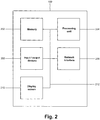
- Fig. 2 shows a block diagram of exemplary device 100.
- Device 100 may include memory 202, processing unit 204, input/output devices 206, network interface 208, display screen 210, and communication bus 212.
- Memory 202 may include static memory, such as read only memory (ROM), and/or dynamic memory, such as random access memory (RAM), for storing data and machine-readable instructions.
- ROM read only memory
- RAM random access memory
- Memory 202 may also include storage devices, such as a floppy disk, CD ROM, CD read/write (R/W) disc, and/or flash memory, as well as other types of storage devices.
- Processing unit 204 may include one or more processors, microprocessors, and/or processing logic capable of controlling device 100.
- Input/output devices 206 may include a keyboard, mouse, speaker, microphone, digital camera, digital video camera, and/or other types of devices for converting physical events or phenomena to and/or from digital signals that pertain to device 100.
- Network interface 208 may include any transceiver-like mechanism that enables device 100 to communicate with other devices and/or systems.
- communication interface 208 may include mechanisms for communicating via a network, such as the Internet, a terrestrial wireless network, a satellite-based network, etc.
- network interface 208 may include a modem, an Ethernet interface to a LAN, and/or an interface/connection for connecting device 100 to other devices.
- Display screen 210 may include a device that can display signals generated by device 100 as images on a screen.
- Examples of a display screen include a liquid crystal display (LCD) screen, cathode ray tube (CRT) display screen, organic light-emitting diode (OLED) display screen, surface-conduction electron-emitter display (SED) screen, plasma display screen, field emission display (FED) screen, and bistable display screen.
- LCD liquid crystal display
- CRT cathode ray tube
- OLED organic light-emitting diode
- SED surface-conduction electron-emitter display
- FED field emission display
- bistable display screen bistable display screen.
- device 100 may include one or more display screens.
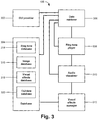
- Fig. 3 illustrates a functional block diagram of exemplary components that are either included in or implemented by device 100.
- the components may be in hardware and/or in software, and may include Client Line Identifier (CLI) provider 302, database 304, data retriever 306, ring tone player 308, audio visualizer 310, and/or visual effects manager 312.
- CLI Client Line Identifier
- CLI provider 302 may include a device or program for obtaining a CLI based on an incoming call.
- CLI Client Line Identifier
- CLI provider 302 may provide other components in Fig. 3 with CLIs.
- Examples of a visual effect include a process that modifies an image by rotating and/or magnifying it; a process that swirls an image by holding the edges of the image in place and turning image elements within the edges around a fixed point; a process that generates images of sinusoidal waves; a process that changes the color of an image; a process that shakes an image; and a process that combines a number of the aforementioned visual effects or provides other effects.
- CLI-data database 320 may include CLIs, metadata about CLIs (e.g., caller name) and one or more pieces of information, each of which associates a CLI with a ring tone, an image, and/or a visual effect.
- CLI-data database 320 may be searched, using as a key the CLI that identifies a calling party, to obtain references to a ring tone, an image and/or a visual effect. The references, in turn, may be used to retrieve the ring tone, which may be played by device 100 to indicate the incoming call, to retrieve the image, which may be displayed by device 100, and to retrieve the visual effect.
- Fig. 3 shows database 304 as having ring tone database 314, image database 316, visual effects database 318, and CLI-data database 320
- database 304 that includes all information in ring tone database 314, image database 316, visual effects database 318, and CLI-data database 320 as a single table. Given a CLI as a key, the table may be searched for a ring tone, an image, and a visual effect.
- Data retriever 306 may include software and/or hardware for receiving a CLI from CLI provider 302 and for retrieving a ring tone, an image, and/or a visual effect from database 304, using the CLI as a key. Data retriever 306 may provide other components in Fig. 3 with the ring tone, image, and/or visual effect. If data retriever 306 fails to locate a ring tone, an image, and/or a visual effect for a given CLI, data retriever may 306 return a default ring tone, image (e.g., an image of caller name and phone number) and/or visual effect.
- image e.g., an image of caller name and phone number
- Ring tone player 308 may include software and/or hardware for accepting a ring tone as an input, for playing the ring tone, and generating an audio signal and sets of frequency samples from the ring tone.
- a set of frequency samples may represent a characteristic of the audio signal within a sampling time window of a preset duration.
- the samples may represent a Discrete Fourier Transform of the audio signal.
- the samples may represent the power spectrum of the audio signal in the DFT frequency domain.
- Visual effects manager 312 may include hardware and/or software for accepting user inputs for managing visual effects. For instance, when a user interacts with visual effects manager 312, visual effects manager 312 may associate a CLI with a ring tone, an image, and/or a visual effect. When visual effects manager 312 makes an association, the association may be inserted into CLI-data database 320. In addition, visual effects manager 312 may retrieve, on behalf of the user and through the use of data retriever 306, CLIs in CLI-data database 320, ring tones in ring tone database 314, images in image database 316, and/or visual effects in visual effects database 318. Furthermore, on behalf of the user, visual effects manager 312 may download and/or transmit ring tones, images, and/or visual effects to and from other devices 100.
- visual effects manager 312 may associate more than one visual effect and/or image with a particular CLI. When separate calls are received in sequence from the same party, different visual effects may be alternately applied.
- playing the ring tone may include generating an audio signal.
- the audio signal may be used to drive a number of input/output devices 206, such as one or more speakers or earphones.
- sets of frequency samples may be generated at predetermined time intervals.
- the time window for which a set of frequency samples are generated may be contiguous with preceding and succeeding time windows.
- the duration of each time window may be equivalent to the time interval.
- a set of frequency samples may represent, depending on implementation, frequency characteristics of the audio signal within a time window. For instance, a set of frequency samples may represent a Discrete Fourier Transform (DFT) of the audio signal.
- DFT Discrete Fourier Transform
- a set of frequency samples are received from ring tone player 308.
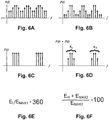
- Fig. 6A shows the set of frequency samples. The samples are depicted as being in the DFT frequency domain. Repeating portions of the frequency samples and those in the negative part the frequency domain are not shown.
- a power spectrum may be derived from the samples.
- Fig. 6B shows the power spectrum that is derived from the samples in Fig. 6A .
- two band-pass filters may be applied to the power spectrum.
- Fig. 6C shows the upper and lower bands of the two band-pass filters, and
- Fig. 6D shows the result of applying the band-pass filters to the power spectrum.
- the energy in each band may be evaluated, by adding up the magnitudes of the samples in each band.
- the energy contained in the lower band, indicated as E L in Fig. 6D may be used to determine the angle by which the retrieved image may be rotated, and the energy contained in the higher band, indicated as E H in Fig. 6D , may be used to determine a percentage of magnification that may be applied to the image.
- the angle of rotation and the percentage of magnification may be determined.
- Fig. 6E shows an exemplary formula for deriving the degree of rotation from E L .
- the rotation in degrees may be computed by first normalizing E L to some constant E MAX1 , such that E L /E MAX1 is less than one, and then by multiplying E L /E MAX1 by 360.
- the value of E MAX1 may be determined in many different ways, and in one implementation, it may be determined by, during the implementation of the exemplary visual effect, calculating the maximum spectral energy that may be present in the lower frequency band for a number of ring tones.
- Fig. 6F shows an exemplary formula for deriving the percentage of magnification based on E H .
- the percentage of magnification may be determined by first normalizing E H to some constant E MAX2 , such that (E MAX2 + E H )/E MAX2 is between 1 and 2.
- the value of E MAX2 may be determined in ways similar to those for E MAX1 .
- Fig. 7C shows an image 706 that is derived from image 704 in Fig. 7B by magnifying it in accordance with the formula in Fig. 6F . While a ring tone is played, and if the audio signal shifts to higher tones, energy E H in higher frequencies becomes larger. Therefore, the image may be magnified in accordance with the ring tone.
- the new image that is derived by rotating and magnifying the original image may be shown on display screen 210.
- whether the ring tone is still being played is determined. If the ring tone is not being played, the visual effect may terminate. Otherwise, the visual effect may begin anew at block 502.
- a user may have the ability to manage visual effects and the associations between visual effects and CLIs, ring tones, and/or images.
- Fig. 8 illustrates an exemplary process for managing the visual effects and the associations.
- Metadata associated with CLIs, ring tones, images, and/or visual effects may be retrieved and presented on display screen 102, so that a user may select, at block 804, a CLI, a ring tone, an image, and/or a visual effect.
- the selected CLI, ring tone, image, and/or visual effects is/are retrieved.
- an association between CLI, ring tone, image and/or visual effect may be created and inserted into CLI-data database 320, respectively. For example, an association between a phone number, the visual effect illustrated in Fig. 5 , and image 702 may be created and inserted into CLI-data database 320.
- hardware/software components in Fig. 3 may be configured so that data other than images, ring tones, and visual effects are passed to and from the components.
- visual effects database 318 may be modified to include a number of parameters as well as programs and data for applying a visual effect to an image.
- parameters include: the number of frequency samples that are expected from ring tone player 308 by a particular visual effect each time the samples are conveyed from ring tone player 308 to audio visualizer 310; and the duration of a sampling interval over which the frequency samples are generated.
- audio visualizer 310 may be modified so that when it receives a visual effect from data retriever 306, it passes a number of parameters to ring tone player 308.
- the parameters may specify: the number of frequency samples that are expected from ring tone player 308 by a particular visual effect each time the samples are conveyed from ring tone player 308 to audio visualizer 310; and the duration of a sampling interval over which the frequency samples are generated.
- a user powers up phone 100 that is shown in Fig. 7A .
- Anders receives a call from Birgitta.
- phone 100 obtains the CLI that is associated with Birgitta, and using the CLI, retrieves a ring tone, which is a snippet of "Aldrig Mer," by Patrik Isaksson, from database 304.
- a ring tone which is a snippet of "Aldrig Mer," by Patrik Isaksson
- the ring tone is conveyed to ring tone player 308, and image 702 and the visual effect are conveyed to audio visualizer 310.
- ring tone player 308 Given the ring tone, ring tone player 308 generates an acoustic signal and frequency samples.
- the acoustic signal is used to drive a speaker, and the frequency samples are provided to audio visualizer 310.
- the samples represent the power spectrum of the acoustic signal and that they are as shown in Fig. 6B .
- energies in a low frequency band and a high frequency band are determined by filtering the samples with band pass filters that are shown in Fig. 6C and by adding up the magnitudes of the filtered samples in each band.
- the energies are used to determine the angle of rotation and the percentage of magnification in accordance with the formulas in Fig. 6E and 6F .
- Image 702 is transformed by rotating it by the computed angle and by magnifying by the computed percentage of magnification. Transformed image 706 is shown on its display screen.
- block 506 may be performed before block 504.
- non-dependent blocks such as blocks 408 and 410, may represent acts that can be performed in parallel.
- certain non-dependent blocks such as block 806, may be omitted.
Landscapes
- Engineering & Computer Science (AREA)
- Signal Processing (AREA)
- Physics & Mathematics (AREA)
- Acoustics & Sound (AREA)
- Multimedia (AREA)
- Telephone Function (AREA)
Description
- Implementations described herein are related to portable devices, and in particular, pertain to methods and apparatuses for displaying an image or images that change as a ring tone is played on a portable device.
- A portable device may allow a user to customize the phone in many ways. For example, the phone may allow the user to associate a particular ring tone with the identity of a party making an incoming call. Such customization, however, may be inadequate for some users that wish to further personalize their phones.
-
DE 10351817A1 illustrates a method using control electronics with a processor integrated into an electronic device to display musical work as a number of two-dimensional or three-dimensional color elements on the display under program control depending on the number of tones and/or bars so as to correspond to the sequence of tones and/or bars of the work or ring tone sequence. -
US2006/152678A illustretes a method for generating a slide show in harmony with music. With the method, the user is able to compose an attractive and interesting slide show by a convenient and simple method. The steps of the method comprises: analyzing audio data to obtain reference points, wherein the reference points include at least one beat point of said audio data; obtaining image effects for images; selecting at least one first level point and at least one second level point from the reference points; and composing a slide show of the images with the image effects in association with the audio data, wherein the image effects are controlled according to the first level point and the displaying of the images is controlled according to the second level point. -
US2005/070241A1 illustrates a mobile communications device having a wireless transceiver to facilitate communications, memory, and a processor. The processor may be configured to analyze an audio file stored in the memory, and extract or generate synchronizing information from the audio file. The processor synchronizes one or more complementary multi-media effects, such as lights, a camera, or a tactile feedback generator, with the audio file based on the synchronizing information. Alternatively, a user may input synchronizing information about the audio file via an interface on the communications device. The processor may then control the complementary multi-media effects in synchronization with the input synchronizing information. -
US2005/049005A1 illustrates a mobile telephone for displaying graphically enhanced images. The mobile station has a display for displaying images as directed by a processor. At the user's request a displayed image will be graphically enhanced using an algorithm that takes into account audio inputs being received by the mobile station, either through its normal voice microphone or through another dedicated to this function. The audio input may also be input received previously and stored, and may have been received from another device for the purpose of sharing the visualization experience. The graphically enhanced image is displayed for the user's entertainment and changes as the audio input changes. The image itself may have been captured by the mobile station if it is capable of doing so, or it may have been received over the Internet or another network, or selected from a collection stored on the mobile station itself. - According to one aspect, a method may comprise retrieving a ring tone, an image, and a visual effect from a database based on a client line identifier CLI. The method may further comprise generating high and low frequency samples based on the ring tone and deriving based on the frequency samples, a set of values. The method further comprises transforming, using the derived set of value and the visual effect, the retrieved image , where values derived from high frequency samples are used to magnify the retrieved image and values derived from low frequency samples are used to rotate the retrieved image. Then, the transformed image is displayed.
- Additionally, the method may further comprise obtaining the CLI based on an incoming call.
- Additionally, the method may further comprise retrieving the CLI based on a user selection.
- Additionally, generating frequency samples may include generating sets of frequency samples of a power spectrum of the ring tone.
- Additionally, generating sets of frequency samples may include generating each set of frequency samples at a predetermined time interval.
- Additionally, generating frequency samples may include generating frequency samples based on the ring tone while the ring tone is being played.
- Additionally, the method may further comprise associating a visual effect, an image, or a ring tone with a CLI.
- Additionally, transforming the retrieved image may include swirling the image based on the frequency samples and the visual effect.
- Additionally, transforming the retrieved image may include creating an image based on the frequency samples and the visual effect independently of the retrieved image.
- According to another aspect, a device may comprise a display screen. The device may further comprise a processor to obtain an audio recording and a visual effect from a database based on an identity of a party making an incoming call, to determine frequency information associated with the audio recording, to generate an image based on the frequency information and the visual effect, and to display the generated image on the display screen.
- Additionally, the database may include an association between the audio recording and the visual effect.
- Additionally, the database may include one or more visual effects and metadata associated with the visual effects.
- Additionally, the database may include a visual effect that generates images of sinusoidal waves.
- Additionally, the processor may be configured to retrieve an image from the database, and modify the retrieved image based on the frequency information.
- Additionally, the database may include a visual effect for swirling an image.
- According to a further aspect, a device may comprise means for locating a ring tone, an image, and a visual effect from a database based on a client line identifier (CLI), means for outputting frequency samples from the ring tone, means for generating an image using the frequency samples and the visual effect, and means for displaying the generated image on a display screen.
- Additionally, the database may include a visual effect for swirling an image.
- Additionally, the device may further comprise means for associating a visual effect, an image, or a ring tone with a CLI.
- Additionally, the device may further comprise means for receiving a call; and means for determining a CLI based on the call.
- According to yet another aspect, a method may comprise receiving a call. The method may further comprise identifying a ring tone, an image, and a visual effect based on the call. Additionally, the method may comprise playing the ring tone to announce the call and displaying the image while the ring tone is playing. The method may further comprise modifying the image, using the visual effect, in sync with the playing of the ring tone.
- Additionally, the method may further comprise producing a client line identifier based on the call.
- The accompanying drawings, which are incorporated in and constitute a part of this specification, illustrate one or more embodiments described herein and, together with the description, explain the embodiments. In the drawings,
-
Fig. 1 depicts an exemplary device in which systems and methods described herein can be implemented; -
Fig. 2 shows a block diagram of the exemplary device ofFig. 1 ; -
Fig. 3 illustrates a functional block diagram of exemplary components that are either included in or implemented by the device ofFig. 1 ; -
Fig. 4A shows an exemplary process for visualizing a ring tone; -
Fig. 4B shows an exemplary process for playing a ring tone and applying a visual effect; -
Fig. 5 illustrates a flowchart of an exemplary visual effect and its image transformation process; -
Fig. 6A shows a set of frequency samples from the ring tone player ofFig. 3 ; -
Fig. 6B shows a power spectrum that is derived from the samples inFig. 6A ; -
Fig. 6C shows the upper and lower bands of two band-pass filters; -
Fig. 6D shows the result of applying the band-pass filters ofFig. 6C to the power spectrum ofFig. 6B ; -
Fig. 6E shows an exemplary formula for deriving a degree of rotation for transforming an image; -
Fig. 6F shows an exemplary formula for deriving a percentage of magnification for transforming an image; -
Fig. 7A illustrates an exemplary image in the image database ofFig. 3 ; -
Fig. 7B illustrates an image that is derived from the exemplary image inFig. 7A by rotating the image; -
Fig. 7C illustrates an image that is derived by magnifying the image inFig. 7B ; and -
Fig. 8 illustrates an exemplary process for managing visual effects. - The following detailed description refers to the accompanying drawings. The same reference numbers in different drawings may identify the same or similar elements. In addition, the term "ring tone" or "ringtone," as used herein, refers to a digital audio recording, played by a device to indicate an incoming call.
- A communication device may allow a user to customize the device. In the following implementations, the user may customize the device by associating a ring tone, an image and/or a visual effect with a party from which an incoming call is received. Upon receiving a call from the party, the device may play the ring tone and display the image on its screen. While the ring tone is being played, frequency information in the ring tone may be periodically extracted and used as inputs to apply the visual effect.
-
Fig. 1 depicts an exemplary device in which systems and methods described herein can be implemented.Device 100 may include a communication device, such as any of the following devices that incorporate or are adapted to incorporate a display screen 102: a radio telephone; a personal communications system (PCS) terminal that may combine cellular radiotelephone with data processing, facsimile, and data communications capabilities; a mobile telephone; an electronic notepad; a laptop; a personal computer (PC); a personal digital assistant (PDA) that can include a radiotelephone, pager, Internet/intranet access, web browser, organizer, calendar, and/or Global Positioning System (GPS) receiver; a landline telephone; or any device with sufficient computing power and memory to support functions described herein. -
Fig. 2 shows a block diagram ofexemplary device 100.Device 100 may includememory 202, processingunit 204, input/output devices 206,network interface 208,display screen 210, andcommunication bus 212.Memory 202 may include static memory, such as read only memory (ROM), and/or dynamic memory, such as random access memory (RAM), for storing data and machine-readable instructions.Memory 202 may also include storage devices, such as a floppy disk, CD ROM, CD read/write (R/W) disc, and/or flash memory, as well as other types of storage devices. -
Processing unit 204 may include one or more processors, microprocessors, and/or processing logic capable of controllingdevice 100. Input/output devices 206 may include a keyboard, mouse, speaker, microphone, digital camera, digital video camera, and/or other types of devices for converting physical events or phenomena to and/or from digital signals that pertain todevice 100. -
Network interface 208 may include any transceiver-like mechanism that enablesdevice 100 to communicate with other devices and/or systems. For example,communication interface 208 may include mechanisms for communicating via a network, such as the Internet, a terrestrial wireless network, a satellite-based network, etc. Additionally or alternatively,network interface 208 may include a modem, an Ethernet interface to a LAN, and/or an interface/connection for connectingdevice 100 to other devices. -
Display screen 210 may include a device that can display signals generated bydevice 100 as images on a screen. Examples of a display screen include a liquid crystal display (LCD) screen, cathode ray tube (CRT) display screen, organic light-emitting diode (OLED) display screen, surface-conduction electron-emitter display (SED) screen, plasma display screen, field emission display (FED) screen, and bistable display screen. In practice,device 100 may include one or more display screens. -
Communication bus 212 may provide an interface through which components ofdevice 100 can communicate with one another. -
Fig. 3 illustrates a functional block diagram of exemplary components that are either included in or implemented bydevice 100. The components may be in hardware and/or in software, and may include Client Line Identifier (CLI)provider 302,database 304,data retriever 306,ring tone player 308,audio visualizer 310, and/orvisual effects manager 312. -
CLI provider 302 may include a device or program for obtaining a CLI based on an incoming call. Briefly, the term "Client Line Identifier" (CLI), as used herein, may refer to a string or a sequence of characters that uniquely identifies the party that is making the incoming call (e.g., phone number).CLI provider 302 may provide other components inFig. 3 with CLIs. -
Database 304 may include records, tables, ordered lists, linked lists, files and/or organized data structures that may be searched and modified.Database 304 may act as an information repository of ring tones, images, visual effects, and/or a set of associations between ring tones, images, and CLIs. - More specifically,
database 304 may includering tone database 314,image database 316,visual effects database 318, and CLI-data database 320.Ring tone database 314 may include digital audio recordings that are played bydevice 100 to indicate an incoming call and metadata (e.g., ring tone name) that are associated with the digital audio recordings.Image database 316 may include images that may be shown ondisplay screen 210 ofdevice 100 and metadata (e.g., image name, image size) that are associated with the pictures or images. The term "image," as used herein, may refer to a picture, a graphics image, a video, or any visual information that can be displayed.Visual effects database 318 may include programs or sets of data, herein referred to as "visual effects," that can be used to generate an image or to modify an image when a ring tone is played. In addition,visual effects database 318 may include metadata (e.g., description of visual effects) that are associated with the visual effects. - Examples of a visual effect include a process that modifies an image by rotating and/or magnifying it; a process that swirls an image by holding the edges of the image in place and turning image elements within the edges around a fixed point; a process that generates images of sinusoidal waves; a process that changes the color of an image; a process that shakes an image; and a process that combines a number of the aforementioned visual effects or provides other effects.
- CLI-
data database 320 may include CLIs, metadata about CLIs (e.g., caller name) and one or more pieces of information, each of which associates a CLI with a ring tone, an image, and/or a visual effect. CLI-data database 320 may be searched, using as a key the CLI that identifies a calling party, to obtain references to a ring tone, an image and/or a visual effect. The references, in turn, may be used to retrieve the ring tone, which may be played bydevice 100 to indicate the incoming call, to retrieve the image, which may be displayed bydevice 100, and to retrieve the visual effect. Within CLI-data database 320, a CLI that is associated with one type of data (e.g., ring tone) may not necessarily be associated with other types of data (e.g., image or visual effect). Conversely, it is possible that a CLI is associated with a ring tone, an image, and a visual effect. - While
Fig. 3 showsdatabase 304 as havingring tone database 314,image database 316,visual effects database 318, and CLI-data database 320, it is possible to implementdatabase 304 that includes all information inring tone database 314,image database 316,visual effects database 318, and CLI-data database 320 as a single table. Given a CLI as a key, the table may be searched for a ring tone, an image, and a visual effect. -
Data retriever 306 may include software and/or hardware for receiving a CLI fromCLI provider 302 and for retrieving a ring tone, an image, and/or a visual effect fromdatabase 304, using the CLI as a key.Data retriever 306 may provide other components inFig. 3 with the ring tone, image, and/or visual effect. Ifdata retriever 306 fails to locate a ring tone, an image, and/or a visual effect for a given CLI, data retriever may 306 return a default ring tone, image (e.g., an image of caller name and phone number) and/or visual effect. -
Ring tone player 308 may include software and/or hardware for accepting a ring tone as an input, for playing the ring tone, and generating an audio signal and sets of frequency samples from the ring tone. Depending on implementations, a set of frequency samples may represent a characteristic of the audio signal within a sampling time window of a preset duration. For example, in one implementation, the samples may represent a Discrete Fourier Transform of the audio signal. In another implementation, the samples may represent the power spectrum of the audio signal in the DFT frequency domain. -
Audio visualizer 310 may include hardware and/or software for accepting as inputs an image and a visual effect fromdata retriever 306 and sets of frequency samples fromring tone player 308. When a ring tone is played,audio visualizer 310 may use each set of the frequency samples fromring tone player 308 in applying the visual effect to the image. The application of the visual effect may generate an image or images that may be shown ondisplay screen 210. -
Visual effects manager 312 may include hardware and/or software for accepting user inputs for managing visual effects. For instance, when a user interacts withvisual effects manager 312,visual effects manager 312 may associate a CLI with a ring tone, an image, and/or a visual effect. Whenvisual effects manager 312 makes an association, the association may be inserted into CLI-data database 320. In addition,visual effects manager 312 may retrieve, on behalf of the user and through the use ofdata retriever 306, CLIs in CLI-data database 320, ring tones inring tone database 314, images inimage database 316, and/or visual effects invisual effects database 318. Furthermore, on behalf of the user,visual effects manager 312 may download and/or transmit ring tones, images, and/or visual effects to and fromother devices 100. - In an alternative implementation,
visual effects manager 312 may associate more than one visual effect and/or image with a particular CLI. When separate calls are received in sequence from the same party, different visual effects may be alternately applied. -
Fig. 4A shows an exemplary process for visualizing a ring tone. Atblock 402, a CLI may be obtained. Obtaining the CLI may be triggered by various events, such as an incoming call or a request fromvisual effects manager 312. Atblock 404, the CLI may be used as a key todatabase 304 for retrieving a ring tone, an image, and/or a visual effect. - More specifically, when
database 304 is searched with a CLI, CLI-data database 320 may provide the references to a ring tone, an image, and/or a visual effect that are associated with the CLI. Once the references are acquired from CLI-data database 320, they may be used to retrieve the ring tone, the image, and/or the visual effect fromring tone database 314,image database 316, and/orvisual effects database 318, respectively. If there is no user-defined association between the CLI and a ring tone, an image and/or a visual effect, a default ring tone, image and/or visual effect may be retrieved. The retrieved ring tone may be conveyed to ringtone player 308 and the retrieved image and/or visual effect may be conveyed toaudio visualizer 310. - At
block 406, the ring tone may be played and the visual effect may be applied.Fig. 4B shows an exemplary process for playing the ring tone and applying the visual effect. - As shown at
block 408, playing the ring tone may include generating an audio signal. The audio signal may be used to drive a number of input/output devices 206, such as one or more speakers or earphones. Atblock 410, sets of frequency samples may be generated at predetermined time intervals. The time window for which a set of frequency samples are generated may be contiguous with preceding and succeeding time windows. In addition, the duration of each time window may be equivalent to the time interval. A set of frequency samples may represent, depending on implementation, frequency characteristics of the audio signal within a time window. For instance, a set of frequency samples may represent a Discrete Fourier Transform (DFT) of the audio signal. - At
block 412, the retrieved visual effect may be applied. Applying the visual effect may include generating and displaying images based on the sets of frequency samples and/or based on the image retrieved atblock 404. To generate the images, the frequency samples may be digitally processed to derive a set of values, which are used as inputs to an image transformation process that is applied to the retrieved image. If the visual effect generates its own images, as in the case where the visual effect produces a time-varying graph of sine waves, the retrieved image may not be used in applying the transformation process. The specifics of a transformation process may depend on the particular visual effect that is associated with and retrieved using the CLI. The transformed images may be generated and displayed while the ring tone is played. -
Fig. 5 illustrates a flowchart of an exemplary visual effect and its image transformation process, which are described with further reference toFigs. 6A-6F . In the exemplary visual effect, the transformation process includes a rotation and a magnification of a retrieved image. In addition, a set of values that are used as inputs to the transformation process may include the angle of rotation and the size of magnification, and they may be determined based on high frequency and low frequency energies in frequency samples that are received fromring tone player 308. - As shown at
block 502, a set of frequency samples are received fromring tone player 308.Fig. 6A shows the set of frequency samples. The samples are depicted as being in the DFT frequency domain. Repeating portions of the frequency samples and those in the negative part the frequency domain are not shown. - At
block 504, a power spectrum may be derived from the samples.Fig. 6B shows the power spectrum that is derived from the samples inFig. 6A . Atblock 506, two band-pass filters may be applied to the power spectrum.Fig. 6C shows the upper and lower bands of the two band-pass filters, andFig. 6D shows the result of applying the band-pass filters to the power spectrum. - At
block 508, the energy in each band may be evaluated, by adding up the magnitudes of the samples in each band. The energy contained in the lower band, indicated as EL inFig. 6D , may be used to determine the angle by which the retrieved image may be rotated, and the energy contained in the higher band, indicated as EH inFig. 6D , may be used to determine a percentage of magnification that may be applied to the image. - At
block 510, the angle of rotation and the percentage of magnification may be determined.Fig. 6E shows an exemplary formula for deriving the degree of rotation from EL. The rotation in degrees may be computed by first normalizing EL to some constant EMAX1, such that EL/EMAX1 is less than one, and then by multiplying EL/EMAX1 by 360. The value of EMAX1 may be determined in many different ways, and in one implementation, it may be determined by, during the implementation of the exemplary visual effect, calculating the maximum spectral energy that may be present in the lower frequency band for a number of ring tones. -
Fig. 6F shows an exemplary formula for deriving the percentage of magnification based on EH. The percentage of magnification may be determined by first normalizing EH to some constant EMAX2, such that (EMAX2 + EH)/EMAX2 is between 1 and 2. The value of EMAX2 may be determined in ways similar to those for EMAX1. - At
block 512, the angle of rotation and the percentage of magnification may be used as inputs to the image transformation process that may be applied to the retrieved image.Fig. 7A shows anexemplary image 702 prior to the transformation.Fig. 7B shows animage 704 that is derived from theimage 702 inFig. 7A by rotating it in accordance with the formula inFig. 6E . While a ring tone is being played, and if the audio signal shifts to lower tones, energy EL in lower frequencies becomes larger. Therefore, the image may rotate in accordance with the ring tone. -
Fig. 7C shows animage 706 that is derived fromimage 704 inFig. 7B by magnifying it in accordance with the formula inFig. 6F . While a ring tone is played, and if the audio signal shifts to higher tones, energy EH in higher frequencies becomes larger. Therefore, the image may be magnified in accordance with the ring tone. - Returning to
Fig. 5 , atblock 514, the new image that is derived by rotating and magnifying the original image may be shown ondisplay screen 210. Atblock 516, whether the ring tone is still being played is determined. If the ring tone is not being played, the visual effect may terminate. Otherwise, the visual effect may begin anew atblock 502. - In the above embodiment, a user may have the ability to manage visual effects and the associations between visual effects and CLIs, ring tones, and/or images.
Fig. 8 illustrates an exemplary process for managing the visual effects and the associations. - At
block 802, metadata associated with CLIs, ring tones, images, and/or visual effects, may be retrieved and presented ondisplay screen 102, so that a user may select, atblock 804, a CLI, a ring tone, an image, and/or a visual effect. Atblock 806, the selected CLI, ring tone, image, and/or visual effects is/are retrieved. Atblocks data database 320, respectively. For example, an association between a phone number, the visual effect illustrated inFig. 5 , andimage 702 may be created and inserted into CLI-data database 320. - In an alternative implementation, hardware/software components in
Fig. 3 (i.e.,database 304,data retriever 306,ring tone player 308, and audio visualizer 310) may be configured so that data other than images, ring tones, and visual effects are passed to and from the components. - Referring back to
Fig. 3 ,visual effects database 318 may be modified to include a number of parameters as well as programs and data for applying a visual effect to an image. Examples of parameters include: the number of frequency samples that are expected fromring tone player 308 by a particular visual effect each time the samples are conveyed fromring tone player 308 toaudio visualizer 310; and the duration of a sampling interval over which the frequency samples are generated. -
Data retriever 306, when it retrieves a visual effect foraudio visualizer 310, may also retrieve the parameters and convey them to ringtone player 308. Upon receiving the parameters and the ring tone,ring tone player 308 may periodically supplyaudio visualizer 310 with the specified number of frequency samples at the specified sampling intervals. - In yet another implementation,
audio visualizer 310 may be modified so that when it receives a visual effect fromdata retriever 306, it passes a number of parameters to ringtone player 308. The parameters may specify: the number of frequency samples that are expected fromring tone player 308 by a particular visual effect each time the samples are conveyed fromring tone player 308 toaudio visualizer 310; and the duration of a sampling interval over which the frequency samples are generated. - The following example illustrates processes involved in using a ring tone visualizer, with references to
Figs. 3, 6B-6F, and 7A-7C . In the figures that illustrate signals in the DFT frequency domain, only non-repeating portions of the signals in the non-negative part of the domain are shown. - Assume that a user, Anders, powers up
phone 100 that is shown inFig. 7A . After powering up, Anders receives a call from Birgitta. With the arrival of the call,phone 100 obtains the CLI that is associated with Birgitta, and using the CLI, retrieves a ring tone, which is a snippet of "Aldrig Mer," by Patrik Isaksson, fromdatabase 304. In addition, it retrievesimage 702 and a visual effect. The ring tone is conveyed to ringtone player 308, andimage 702 and the visual effect are conveyed toaudio visualizer 310. - Given the ring tone,
ring tone player 308 generates an acoustic signal and frequency samples. The acoustic signal is used to drive a speaker, and the frequency samples are provided toaudio visualizer 310. - In this example, it is assumed that the samples represent the power spectrum of the acoustic signal and that they are as shown in
Fig. 6B . Based on the samples, energies in a low frequency band and a high frequency band are determined by filtering the samples with band pass filters that are shown inFig. 6C and by adding up the magnitudes of the filtered samples in each band. The energies are used to determine the angle of rotation and the percentage of magnification in accordance with the formulas inFig. 6E and 6F .Image 702 is transformed by rotating it by the computed angle and by magnifying by the computed percentage of magnification. Transformedimage 706 is shown on its display screen. - While the ring tone is being played, additional frequency samples are received from ring tone player and, thus,
image 702 rotates, expands and contracts with the ring tone. - The foregoing description of embodiments provides illustration, but is not intended to be exhaustive or to limit the embodiments to the precise form disclosed. Modifications and variations are possible in light of the above teachings or may be acquired from practice of the teachings.
- For example, while series of blocks have been described with regard to processes illustrated in
Figs.4A, 4B ,5 , and8 , the order of the blocks may be modified in other implementations. For example, block 506 may be performed beforeblock 504. In addition, non-dependent blocks, such asblocks block 806, may be omitted. - It will be apparent that aspects described herein may be implemented in many different forms of software, firmware, and hardware in the implementations illustrated in the figures. The actual software code or specialized control hardware used to implement aspects does not limit the invention. Thus, the operation and behavior of the aspects were described without reference to the specific software code - it being understood that software and control hardware can be designed to implement the aspects based on the description herein.
- No element, act, or instruction used in the present application should be construed as critical or essential to the invention unless explicitly described as such. Also, as used herein, the article "a" is intended to include one or more items. Where only one item is intended, the term "one" or similar language is used. Further, the phrase "based on" is intended to mean "based, at least in part, on" unless explicitly stated otherwise.
- It should be emphasized that the term "comprises/comprising" when used in this specification is taken to specify the presence of stated features, integers, steps or components but does not preclude the presence or addition of one or more other features, integers, steps, components, or groups thereof.
- Further, certain portions of the invention have been described as "logic" that performs one or more functions. This logic may include hardware, such as a processor, an application specific integrated circuit, or a field programmable gate array, software, or a combination of hardware and software.
Claims (15)
- A method comprising:retrieving a ring tone, an image, and a visual effect from a database(304) based on a client line identifier CLI (404);generating high and low frequency samples based on the ring tone (410);deriving based on the frequency samples, a set of values;transforming, using the derived set of value and the visual effect, the retrieved image , where values derived from high frequency samples are used to magnify the retrieved image and values derived from low frequency samples are used to rotate the retrieved image (512); anddisplaying the transformed image(412).
- The method as in claim 1, further comprising:obtaining the CLI based on an incoming call (402).
- The method as in claim 1 or claim 2, further comprising:retrieving the CLI based on a user selection (402).
- The method as in any of claims 1-3, wherein the generating high and low frequency samples includes:generating the high and low frequency samples from a power spectrum of the ring tone (410).
- The method as in any of claims 1-4, wherein the generating high and low frequency samples includes:generating the high and low frequency samples at a predetermined time interval.
- The method as in any of claims 1-5, wherein the generating high and low frequency samples includes:generating the high and low frequency samples based on the ring tone while the ring tone is being played.
- The method as in claim 1 any of claims 1-6, further comprising:associating a visual effect, an image, or a ring tone with a CLL.
- The method as in any of claims 1-7, wherein transforming the retrieved image includes:swirling the image based on the one or more high and low frequency samples and the visual effect.
- The method as in any of claims 1-8, wherein transforming the retrieved image includes:creating an image based on the high and low frequency samples and the visual effect independently of the retrieved image.
- A device (100) comprising:a display screen (102); anda processor (204) to:obtain an audio recording and a visual effect from a database (304) based on an identity of a party making an incoming call;determine high and low frequency information associated with the audio recording;derive based on the high and low frequency information, a set of values;modify an image based on the values derived from the high and low frequency information and the visual effect, where when modifying the image, the processor is configured to magnify the image based on the values derived from high frequency information and rotate the image based on the values derived from low frequency information; and display the modified image on the display screen (210).
- The device (100) as in claim 10, wherein the database (304) includes: an association between the audio recording and the visual effect.
- The device (100) as in claim 10 or claim 11, wherein the database (304) includes:one or more visual effects and metadata associated with the visual effects.
- The device (100) as in any of claims 10-12, wherein the database (304) includes:a visual effect that generates images of sinusoidal waves.
- The device (100) as in any of claims 10-13, wherein the processor (204) is configured to:retrieve the image from the database (304), and modify the retrieved image based on the high and low frequency information.
- The device (100) as in any of claims 10-14, wherein the database (304) includes:a visual effect for swirling an image.
Applications Claiming Priority (2)
| Application Number | Priority Date | Filing Date | Title |
|---|---|---|---|
| US11/616,094 US7970119B2 (en) | 2006-12-26 | 2006-12-26 | Ring tone visualizer |
| PCT/IB2007/052459 WO2008078205A1 (en) | 2006-12-26 | 2007-06-26 | Ring tone visualizer |
Publications (2)
| Publication Number | Publication Date |
|---|---|
| EP2098049A1 EP2098049A1 (en) | 2009-09-09 |
| EP2098049B1 true EP2098049B1 (en) | 2016-12-21 |
Family
ID=38941930
Family Applications (1)
| Application Number | Title | Priority Date | Filing Date |
|---|---|---|---|
| EP07825843.1A Not-in-force EP2098049B1 (en) | 2006-12-26 | 2007-06-26 | Ring tone visualizer |
Country Status (4)
| Country | Link |
|---|---|
| US (1) | US7970119B2 (en) |
| EP (1) | EP2098049B1 (en) |
| CN (1) | CN101652982A (en) |
| WO (1) | WO2008078205A1 (en) |
Families Citing this family (9)
| Publication number | Priority date | Publication date | Assignee | Title |
|---|---|---|---|---|
| DE102006047247A1 (en) * | 2006-10-06 | 2008-04-10 | Evonik Goldschmidt Gmbh | Oil-in-water emulsion e.g. useful for preparing cosmetic, dermatological or pharmaceutical compositions comprises a nonionic emulsifier, a cationic emulsifier, a cosurfactant and an oil |
| US8134727B1 (en) | 2006-11-27 | 2012-03-13 | Ringcentral, Inc. | Message preview control |
| US7970119B2 (en) * | 2006-12-26 | 2011-06-28 | Sony Ericsson Mobile Communications Ab | Ring tone visualizer |
| US8260363B2 (en) * | 2009-06-25 | 2012-09-04 | Embarq Holdings Company, Llc | Visual ringer |
| US8334888B2 (en) * | 2009-08-27 | 2012-12-18 | Apple Inc. | Dynamically generated ring tones |
| US20130218902A1 (en) * | 2012-02-17 | 2013-08-22 | Ring Central, Inc. | Shared directory system |
| US8670529B1 (en) | 2012-12-17 | 2014-03-11 | Ringcentral, Inc. | Context aware help system |
| US8831191B1 (en) | 2013-06-28 | 2014-09-09 | Ringcentral, Inc. | Call preview system |
| KR20150024650A (en) * | 2013-08-27 | 2015-03-09 | 삼성전자주식회사 | Method and apparatus for providing visualization of sound in a electronic device |
Family Cites Families (23)
| Publication number | Priority date | Publication date | Assignee | Title |
|---|---|---|---|---|
| US7831244B2 (en) * | 1999-06-30 | 2010-11-09 | Silverbrook Research Pty Ltd | Retrieving an image via a coded surface |
| US6990361B2 (en) * | 2001-11-01 | 2006-01-24 | Lutche Michelle R | Light-emitting apparatus and portable communications device having same |
| US8008561B2 (en) * | 2003-01-17 | 2011-08-30 | Motorola Mobility, Inc. | Audio file format with mapped lighting effects and method for controlling lighting effects using an audio file format |
| US7280647B2 (en) * | 2003-08-07 | 2007-10-09 | Microsoft Corporation | Dynamic photo caller identification |
| US7366295B2 (en) * | 2003-08-14 | 2008-04-29 | John David Patton | Telephone signal generator and methods and devices using the same |
| US20050049005A1 (en) | 2003-08-29 | 2005-03-03 | Ken Young | Mobile telephone with enhanced display visualization |
| US7966034B2 (en) | 2003-09-30 | 2011-06-21 | Sony Ericsson Mobile Communications Ab | Method and apparatus of synchronizing complementary multi-media effects in a wireless communication device |
| DE10351817A1 (en) | 2003-10-29 | 2005-05-25 | Haase, Rainer | Program-controlled visually detectable representation of musical works, especially on mobile phones, involves displaying 2 or 3 dimensional color elements under program control depending on number of tones and/or bars |
| KR20050087368A (en) * | 2004-02-26 | 2005-08-31 | 엘지전자 주식회사 | Transaction apparatus of bell sound for wireless terminal |
| US7209153B2 (en) * | 2004-03-03 | 2007-04-24 | Barbara Lehman | System and method of representing personal profile in auditory form |
| US20050196127A1 (en) * | 2004-03-05 | 2005-09-08 | Cole Adam R. | Port for an electronic device |
| DE102004013861A1 (en) * | 2004-03-16 | 2005-10-13 | Deutsche Telekom Ag | Provision of personalized display information in the case of a telecommunications initiation |
| US7236226B2 (en) | 2005-01-12 | 2007-06-26 | Ulead Systems, Inc. | Method for generating a slide show with audio analysis |
| US7599719B2 (en) * | 2005-02-14 | 2009-10-06 | John D. Patton | Telephone and telephone accessory signal generator and methods and devices using the same |
| US20060184893A1 (en) * | 2005-02-17 | 2006-08-17 | Raymond Chow | Graphics controller providing for enhanced control of window animation |
| US20060274144A1 (en) * | 2005-06-02 | 2006-12-07 | Agere Systems, Inc. | Communications device with a visual ring signal and a method of generating a visual signal |
| EP1744526A1 (en) * | 2005-07-13 | 2007-01-17 | Sony Ericsson Mobile Communications AB | Method and apparatus for acquiring further information about caller using caller ID |
| US20070116212A1 (en) * | 2005-10-07 | 2007-05-24 | Microsoft Corporation | Dynamic call announcement using recipient identification |
| US7467982B2 (en) * | 2005-11-17 | 2008-12-23 | Research In Motion Limited | Conversion from note-based audio format to PCM-based audio format |
| CN101379807A (en) | 2006-02-21 | 2009-03-04 | 诺基亚公司 | Video sequence for music alarm |
| US20070245384A1 (en) * | 2006-04-12 | 2007-10-18 | Edward Walter | External notification methods and apparatus for cellular communications |
| US8370747B2 (en) * | 2006-07-31 | 2013-02-05 | Sony Mobile Communications Ab | Method and system for adapting a visual user interface of a mobile radio terminal in coordination with music |
| US7970119B2 (en) * | 2006-12-26 | 2011-06-28 | Sony Ericsson Mobile Communications Ab | Ring tone visualizer |
-
2006
- 2006-12-26 US US11/616,094 patent/US7970119B2/en not_active Expired - Fee Related
-
2007
- 2007-06-26 EP EP07825843.1A patent/EP2098049B1/en not_active Not-in-force
- 2007-06-26 CN CN200780048088A patent/CN101652982A/en active Pending
- 2007-06-26 WO PCT/IB2007/052459 patent/WO2008078205A1/en not_active Ceased
Non-Patent Citations (1)
| Title |
|---|
| None * |
Also Published As
| Publication number | Publication date |
|---|---|
| EP2098049A1 (en) | 2009-09-09 |
| US7970119B2 (en) | 2011-06-28 |
| CN101652982A (en) | 2010-02-17 |
| WO2008078205A1 (en) | 2008-07-03 |
| US20080152124A1 (en) | 2008-06-26 |
Similar Documents
| Publication | Publication Date | Title |
|---|---|---|
| WO2008078205A1 (en) | Ring tone visualizer | |
| CN112738623B (en) | Video file generation method, device, terminal and storage medium | |
| US8135114B2 (en) | Method and apparatus for creating an answer tone for a computing device with phone capabilities or a telephone | |
| EP4336846A1 (en) | Audio sharing method and apparatus, device, and medium | |
| CN105632508B (en) | Audio processing method and audio processing device | |
| US9141960B2 (en) | Venue and event recommendations for a user of a portable media player device | |
| EP3644160B1 (en) | Apparatus and methods of extending application services | |
| US8145278B2 (en) | System and method for ringtone shuffle | |
| US8334888B2 (en) | Dynamically generated ring tones | |
| US20160379611A1 (en) | Systems and Method for Music Remixing | |
| US8548531B2 (en) | Method and system of creating customized ringtones | |
| RU2382514C2 (en) | System and method for automatic generation of user video data for call signals and transmitting context information | |
| WO2020108045A1 (en) | Video playback method and apparatus and multimedia data playback method | |
| CN117082292A (en) | Video generation methods, devices, equipment, storage media and program products | |
| CN104038774B (en) | Generate the method and device of ring signal file | |
| US20110018808A1 (en) | Information display method for portable terminal and apparatus using the same | |
| CN103841278B (en) | The processing method of song program request, apparatus and system | |
| US7526566B2 (en) | Methods of operating radio communications devices including predefined streaming times and addresses and related devices | |
| CN105976807B (en) | Music player and method | |
| CN114363691A (en) | Speech subtitle synthesis method, device, computer equipment and storage medium | |
| CN111613195B (en) | Audio splicing method and device and storage medium | |
| CN113936676A (en) | Sound adjusting method and device and electronic equipment | |
| KR20050102991A (en) | Method and apparatus for generating vibration on mobile communication terminal | |
| JP4726670B2 (en) | Information communication device, information processing program, and information communication system | |
| US8954834B1 (en) | System for communicating information to a mobile device using portable code widgets |
Legal Events
| Date | Code | Title | Description |
|---|---|---|---|
| PUAI | Public reference made under article 153(3) epc to a published international application that has entered the european phase |
Free format text: ORIGINAL CODE: 0009012 |
|
| 17P | Request for examination filed |
Effective date: 20090623 |
|
| AK | Designated contracting states |
Kind code of ref document: A1 Designated state(s): AT BE BG CH CY CZ DE DK EE ES FI FR GB GR HU IE IS IT LI LT LU LV MC MT NL PL PT RO SE SI SK TR |
|
| RIN1 | Information on inventor provided before grant (corrected) |
Inventor name: ERICSSON, ANDERS |
|
| DAX | Request for extension of the european patent (deleted) | ||
| 17Q | First examination report despatched |
Effective date: 20130812 |
|
| RAP1 | Party data changed (applicant data changed or rights of an application transferred) |
Owner name: SONY MOBILE COMMUNICATIONS AB |
|
| RIN1 | Information on inventor provided before grant (corrected) |
Inventor name: ERICSON, ANDERS |
|
| RAP1 | Party data changed (applicant data changed or rights of an application transferred) |
Owner name: III HOLDINGS 1, LLC |
|
| GRAP | Despatch of communication of intention to grant a patent |
Free format text: ORIGINAL CODE: EPIDOSNIGR1 |
|
| INTG | Intention to grant announced |
Effective date: 20160718 |
|
| GRAJ | Information related to disapproval of communication of intention to grant by the applicant or resumption of examination proceedings by the epo deleted |
Free format text: ORIGINAL CODE: EPIDOSDIGR1 |
|
| GRAR | Information related to intention to grant a patent recorded |
Free format text: ORIGINAL CODE: EPIDOSNIGR71 |
|
| GRAS | Grant fee paid |
Free format text: ORIGINAL CODE: EPIDOSNIGR3 |
|
| GRAA | (expected) grant |
Free format text: ORIGINAL CODE: 0009210 |
|
| INTC | Intention to grant announced (deleted) | ||
| AK | Designated contracting states |
Kind code of ref document: B1 Designated state(s): AT BE BG CH CY CZ DE DK EE ES FI FR GB GR HU IE IS IT LI LT LU LV MC MT NL PL PT RO SE SI SK TR |
|
| INTG | Intention to grant announced |
Effective date: 20161115 |
|
| REG | Reference to a national code |
Ref country code: GB Ref legal event code: FG4D |
|
| REG | Reference to a national code |
Ref country code: CH Ref legal event code: EP |
|
| REG | Reference to a national code |
Ref country code: IE Ref legal event code: FG4D |
|
| REG | Reference to a national code |
Ref country code: AT Ref legal event code: REF Ref document number: 856363 Country of ref document: AT Kind code of ref document: T Effective date: 20170115 |
|
| REG | Reference to a national code |
Ref country code: DE Ref legal event code: R096 Ref document number: 602007049258 Country of ref document: DE |
|
| PG25 | Lapsed in a contracting state [announced via postgrant information from national office to epo] |
Ref country code: LV Free format text: LAPSE BECAUSE OF FAILURE TO SUBMIT A TRANSLATION OF THE DESCRIPTION OR TO PAY THE FEE WITHIN THE PRESCRIBED TIME-LIMIT Effective date: 20161221 |
|
| REG | Reference to a national code |
Ref country code: LT Ref legal event code: MG4D |
|
| REG | Reference to a national code |
Ref country code: NL Ref legal event code: MP Effective date: 20161221 |
|
| PG25 | Lapsed in a contracting state [announced via postgrant information from national office to epo] |
Ref country code: LT Free format text: LAPSE BECAUSE OF FAILURE TO SUBMIT A TRANSLATION OF THE DESCRIPTION OR TO PAY THE FEE WITHIN THE PRESCRIBED TIME-LIMIT Effective date: 20161221 Ref country code: GR Free format text: LAPSE BECAUSE OF FAILURE TO SUBMIT A TRANSLATION OF THE DESCRIPTION OR TO PAY THE FEE WITHIN THE PRESCRIBED TIME-LIMIT Effective date: 20170322 Ref country code: SE Free format text: LAPSE BECAUSE OF FAILURE TO SUBMIT A TRANSLATION OF THE DESCRIPTION OR TO PAY THE FEE WITHIN THE PRESCRIBED TIME-LIMIT Effective date: 20161221 |
|
| REG | Reference to a national code |
Ref country code: AT Ref legal event code: MK05 Ref document number: 856363 Country of ref document: AT Kind code of ref document: T Effective date: 20161221 |
|
| REG | Reference to a national code |
Ref country code: FR Ref legal event code: PLFP Year of fee payment: 11 |
|
| PG25 | Lapsed in a contracting state [announced via postgrant information from national office to epo] |
Ref country code: FI Free format text: LAPSE BECAUSE OF FAILURE TO SUBMIT A TRANSLATION OF THE DESCRIPTION OR TO PAY THE FEE WITHIN THE PRESCRIBED TIME-LIMIT Effective date: 20161221 |
|
| PG25 | Lapsed in a contracting state [announced via postgrant information from national office to epo] |
Ref country code: NL Free format text: LAPSE BECAUSE OF FAILURE TO SUBMIT A TRANSLATION OF THE DESCRIPTION OR TO PAY THE FEE WITHIN THE PRESCRIBED TIME-LIMIT Effective date: 20161221 |
|
| PG25 | Lapsed in a contracting state [announced via postgrant information from national office to epo] |
Ref country code: SK Free format text: LAPSE BECAUSE OF FAILURE TO SUBMIT A TRANSLATION OF THE DESCRIPTION OR TO PAY THE FEE WITHIN THE PRESCRIBED TIME-LIMIT Effective date: 20161221 Ref country code: RO Free format text: LAPSE BECAUSE OF FAILURE TO SUBMIT A TRANSLATION OF THE DESCRIPTION OR TO PAY THE FEE WITHIN THE PRESCRIBED TIME-LIMIT Effective date: 20161221 Ref country code: EE Free format text: LAPSE BECAUSE OF FAILURE TO SUBMIT A TRANSLATION OF THE DESCRIPTION OR TO PAY THE FEE WITHIN THE PRESCRIBED TIME-LIMIT Effective date: 20161221 Ref country code: IS Free format text: LAPSE BECAUSE OF FAILURE TO SUBMIT A TRANSLATION OF THE DESCRIPTION OR TO PAY THE FEE WITHIN THE PRESCRIBED TIME-LIMIT Effective date: 20170421 Ref country code: CZ Free format text: LAPSE BECAUSE OF FAILURE TO SUBMIT A TRANSLATION OF THE DESCRIPTION OR TO PAY THE FEE WITHIN THE PRESCRIBED TIME-LIMIT Effective date: 20161221 |
|
| PGFP | Annual fee paid to national office [announced via postgrant information from national office to epo] |
Ref country code: FR Payment date: 20170518 Year of fee payment: 11 Ref country code: GB Payment date: 20170526 Year of fee payment: 11 |
|
| PG25 | Lapsed in a contracting state [announced via postgrant information from national office to epo] |
Ref country code: AT Free format text: LAPSE BECAUSE OF FAILURE TO SUBMIT A TRANSLATION OF THE DESCRIPTION OR TO PAY THE FEE WITHIN THE PRESCRIBED TIME-LIMIT Effective date: 20161221 Ref country code: PL Free format text: LAPSE BECAUSE OF FAILURE TO SUBMIT A TRANSLATION OF THE DESCRIPTION OR TO PAY THE FEE WITHIN THE PRESCRIBED TIME-LIMIT Effective date: 20161221 Ref country code: IT Free format text: LAPSE BECAUSE OF FAILURE TO SUBMIT A TRANSLATION OF THE DESCRIPTION OR TO PAY THE FEE WITHIN THE PRESCRIBED TIME-LIMIT Effective date: 20161221 Ref country code: BG Free format text: LAPSE BECAUSE OF FAILURE TO SUBMIT A TRANSLATION OF THE DESCRIPTION OR TO PAY THE FEE WITHIN THE PRESCRIBED TIME-LIMIT Effective date: 20170321 Ref country code: PT Free format text: LAPSE BECAUSE OF FAILURE TO SUBMIT A TRANSLATION OF THE DESCRIPTION OR TO PAY THE FEE WITHIN THE PRESCRIBED TIME-LIMIT Effective date: 20170421 Ref country code: BE Free format text: LAPSE BECAUSE OF FAILURE TO SUBMIT A TRANSLATION OF THE DESCRIPTION OR TO PAY THE FEE WITHIN THE PRESCRIBED TIME-LIMIT Effective date: 20161221 Ref country code: ES Free format text: LAPSE BECAUSE OF FAILURE TO SUBMIT A TRANSLATION OF THE DESCRIPTION OR TO PAY THE FEE WITHIN THE PRESCRIBED TIME-LIMIT Effective date: 20161221 |
|
| REG | Reference to a national code |
Ref country code: DE Ref legal event code: R097 Ref document number: 602007049258 Country of ref document: DE |
|
| PLBE | No opposition filed within time limit |
Free format text: ORIGINAL CODE: 0009261 |
|
| STAA | Information on the status of an ep patent application or granted ep patent |
Free format text: STATUS: NO OPPOSITION FILED WITHIN TIME LIMIT |
|
| PGFP | Annual fee paid to national office [announced via postgrant information from national office to epo] |
Ref country code: DE Payment date: 20170623 Year of fee payment: 11 |
|
| 26N | No opposition filed |
Effective date: 20170922 |
|
| PG25 | Lapsed in a contracting state [announced via postgrant information from national office to epo] |
Ref country code: DK Free format text: LAPSE BECAUSE OF FAILURE TO SUBMIT A TRANSLATION OF THE DESCRIPTION OR TO PAY THE FEE WITHIN THE PRESCRIBED TIME-LIMIT Effective date: 20161221 |
|
| PG25 | Lapsed in a contracting state [announced via postgrant information from national office to epo] |
Ref country code: MC Free format text: LAPSE BECAUSE OF FAILURE TO SUBMIT A TRANSLATION OF THE DESCRIPTION OR TO PAY THE FEE WITHIN THE PRESCRIBED TIME-LIMIT Effective date: 20161221 |
|
| REG | Reference to a national code |
Ref country code: CH Ref legal event code: PL |
|
| PG25 | Lapsed in a contracting state [announced via postgrant information from national office to epo] |
Ref country code: SI Free format text: LAPSE BECAUSE OF FAILURE TO SUBMIT A TRANSLATION OF THE DESCRIPTION OR TO PAY THE FEE WITHIN THE PRESCRIBED TIME-LIMIT Effective date: 20161221 |
|
| REG | Reference to a national code |
Ref country code: IE Ref legal event code: MM4A |
|
| PG25 | Lapsed in a contracting state [announced via postgrant information from national office to epo] |
Ref country code: CH Free format text: LAPSE BECAUSE OF NON-PAYMENT OF DUE FEES Effective date: 20170630 Ref country code: LI Free format text: LAPSE BECAUSE OF NON-PAYMENT OF DUE FEES Effective date: 20170630 Ref country code: LU Free format text: LAPSE BECAUSE OF NON-PAYMENT OF DUE FEES Effective date: 20170626 Ref country code: IE Free format text: LAPSE BECAUSE OF NON-PAYMENT OF DUE FEES Effective date: 20170626 |
|
| PG25 | Lapsed in a contracting state [announced via postgrant information from national office to epo] |
Ref country code: MT Free format text: LAPSE BECAUSE OF NON-PAYMENT OF DUE FEES Effective date: 20170626 |
|
| REG | Reference to a national code |
Ref country code: DE Ref legal event code: R119 Ref document number: 602007049258 Country of ref document: DE |
|
| GBPC | Gb: european patent ceased through non-payment of renewal fee |
Effective date: 20180626 |
|
| PG25 | Lapsed in a contracting state [announced via postgrant information from national office to epo] |
Ref country code: GB Free format text: LAPSE BECAUSE OF NON-PAYMENT OF DUE FEES Effective date: 20180626 Ref country code: FR Free format text: LAPSE BECAUSE OF NON-PAYMENT OF DUE FEES Effective date: 20180630 Ref country code: DE Free format text: LAPSE BECAUSE OF NON-PAYMENT OF DUE FEES Effective date: 20190101 |
|
| PG25 | Lapsed in a contracting state [announced via postgrant information from national office to epo] |
Ref country code: HU Free format text: LAPSE BECAUSE OF FAILURE TO SUBMIT A TRANSLATION OF THE DESCRIPTION OR TO PAY THE FEE WITHIN THE PRESCRIBED TIME-LIMIT; INVALID AB INITIO Effective date: 20070626 |
|
| PG25 | Lapsed in a contracting state [announced via postgrant information from national office to epo] |
Ref country code: CY Free format text: LAPSE BECAUSE OF NON-PAYMENT OF DUE FEES Effective date: 20161221 |
|
| PG25 | Lapsed in a contracting state [announced via postgrant information from national office to epo] |
Ref country code: TR Free format text: LAPSE BECAUSE OF FAILURE TO SUBMIT A TRANSLATION OF THE DESCRIPTION OR TO PAY THE FEE WITHIN THE PRESCRIBED TIME-LIMIT Effective date: 20161221 |