EP2097464B1 - Polyamide polyols and polyurethanes, methods for making and using, and products made therefrom - Google Patents
Polyamide polyols and polyurethanes, methods for making and using, and products made therefrom Download PDFInfo
- Publication number
- EP2097464B1 EP2097464B1 EP07869006.2A EP07869006A EP2097464B1 EP 2097464 B1 EP2097464 B1 EP 2097464B1 EP 07869006 A EP07869006 A EP 07869006A EP 2097464 B1 EP2097464 B1 EP 2097464B1
- Authority
- EP
- European Patent Office
- Prior art keywords
- acid
- carbon atoms
- group
- polyurethane
- diisocyanate
- Prior art date
- Legal status (The legal status is an assumption and is not a legal conclusion. Google has not performed a legal analysis and makes no representation as to the accuracy of the status listed.)
- Not-in-force
Links
- 239000004814 polyurethane Substances 0.000 title claims description 110
- 229920002635 polyurethane Polymers 0.000 title claims description 107
- 239000004952 Polyamide Substances 0.000 title claims description 95
- 229920002647 polyamide Polymers 0.000 title claims description 95
- 229920005862 polyol Polymers 0.000 title claims description 40
- 238000000034 method Methods 0.000 title claims description 35
- 150000003077 polyols Chemical class 0.000 title claims description 35
- 125000004432 carbon atom Chemical group C* 0.000 claims description 100
- 150000002430 hydrocarbons Chemical group 0.000 claims description 73
- 150000002009 diols Chemical class 0.000 claims description 72
- 150000004985 diamines Chemical group 0.000 claims description 68
- -1 polyethylene Polymers 0.000 claims description 66
- 239000000203 mixture Substances 0.000 claims description 60
- 125000002887 hydroxy group Chemical group [H]O* 0.000 claims description 56
- OFOBLEOULBTSOW-UHFFFAOYSA-N Malonic acid Chemical group OC(=O)CC(O)=O OFOBLEOULBTSOW-UHFFFAOYSA-N 0.000 claims description 49
- 125000004433 nitrogen atom Chemical group N* 0.000 claims description 38
- ULQISTXYYBZJSJ-UHFFFAOYSA-N 12-hydroxyoctadecanoic acid Chemical compound CCCCCCC(O)CCCCCCCCCCC(O)=O ULQISTXYYBZJSJ-UHFFFAOYSA-N 0.000 claims description 33
- 150000001732 carboxylic acid derivatives Chemical class 0.000 claims description 33
- 235000014113 dietary fatty acids Nutrition 0.000 claims description 31
- 239000000194 fatty acid Substances 0.000 claims description 31
- 229930195729 fatty acid Natural products 0.000 claims description 31
- 230000001070 adhesive effect Effects 0.000 claims description 30
- 239000000853 adhesive Substances 0.000 claims description 29
- GLUUGHFHXGJENI-UHFFFAOYSA-N Piperazine Chemical compound C1CNCCN1 GLUUGHFHXGJENI-UHFFFAOYSA-N 0.000 claims description 26
- 125000005442 diisocyanate group Chemical group 0.000 claims description 19
- 239000000758 substrate Substances 0.000 claims description 19
- NGEWQZIDQIYUNV-UHFFFAOYSA-N L-valinic acid Natural products CC(C)C(O)C(O)=O NGEWQZIDQIYUNV-UHFFFAOYSA-N 0.000 claims description 18
- NAQMVNRVTILPCV-UHFFFAOYSA-N hexane-1,6-diamine Chemical compound NCCCCCCN NAQMVNRVTILPCV-UHFFFAOYSA-N 0.000 claims description 18
- GJBRTCPWCKRSTQ-UHFFFAOYSA-N decanedioic acid Chemical compound OC(=O)CCCCCCCCC(O)=O.OC(=O)CCCCCCCCC(O)=O GJBRTCPWCKRSTQ-UHFFFAOYSA-N 0.000 claims description 17
- 150000001991 dicarboxylic acids Chemical class 0.000 claims description 17
- 229940114072 12-hydroxystearic acid Drugs 0.000 claims description 16
- 239000005056 polyisocyanate Substances 0.000 claims description 15
- 229920001228 polyisocyanate Polymers 0.000 claims description 15
- UPMLOUAZCHDJJD-UHFFFAOYSA-N 4,4'-Diphenylmethane Diisocyanate Chemical compound C1=CC(N=C=O)=CC=C1CC1=CC=C(N=C=O)C=C1 UPMLOUAZCHDJJD-UHFFFAOYSA-N 0.000 claims description 14
- 238000004519 manufacturing process Methods 0.000 claims description 14
- 229920000642 polymer Polymers 0.000 claims description 14
- 239000004215 Carbon black (E152) Substances 0.000 claims description 13
- 229930195733 hydrocarbon Natural products 0.000 claims description 13
- IJFXRHURBJZNAO-UHFFFAOYSA-N 3-hydroxybenzoic acid Chemical compound OC(=O)C1=CC=CC(O)=C1 IJFXRHURBJZNAO-UHFFFAOYSA-N 0.000 claims description 12
- WHBMMWSBFZVSSR-UHFFFAOYSA-N 3-hydroxybutyric acid Chemical compound CC(O)CC(O)=O WHBMMWSBFZVSSR-UHFFFAOYSA-N 0.000 claims description 12
- FJKROLUGYXJWQN-UHFFFAOYSA-N 4-hydroxybenzoic acid Chemical compound OC(=O)C1=CC=C(O)C=C1 FJKROLUGYXJWQN-UHFFFAOYSA-N 0.000 claims description 12
- RTZKZFJDLAIYFH-UHFFFAOYSA-N Diethyl ether Chemical compound CCOCC RTZKZFJDLAIYFH-UHFFFAOYSA-N 0.000 claims description 12
- AEMRFAOFKBGASW-UHFFFAOYSA-N Glycolic acid Chemical compound OCC(O)=O AEMRFAOFKBGASW-UHFFFAOYSA-N 0.000 claims description 12
- VHRGRCVQAFMJIZ-UHFFFAOYSA-N cadaverine Chemical compound NCCCCCN VHRGRCVQAFMJIZ-UHFFFAOYSA-N 0.000 claims description 12
- JVTAAEKCZFNVCJ-UHFFFAOYSA-N lactic acid Chemical compound CC(O)C(O)=O JVTAAEKCZFNVCJ-UHFFFAOYSA-N 0.000 claims description 12
- XEUHNWODXVYLFD-UHFFFAOYSA-N heptanedioic acid Chemical compound OC(=O)CCCCCC(O)=O.OC(=O)CCCCCC(O)=O XEUHNWODXVYLFD-UHFFFAOYSA-N 0.000 claims description 11
- YVSCCMNRWFOKDU-UHFFFAOYSA-N hexanedioic acid Chemical compound OC(=O)CCCCC(O)=O.OC(=O)CCCCC(O)=O YVSCCMNRWFOKDU-UHFFFAOYSA-N 0.000 claims description 11
- WPBWJEYRHXACLR-UHFFFAOYSA-N nonanedioic acid Chemical compound OC(=O)CCCCCCCC(O)=O.OC(=O)CCCCCCCC(O)=O WPBWJEYRHXACLR-UHFFFAOYSA-N 0.000 claims description 11
- TWHMVKPVFOOAMY-UHFFFAOYSA-N octanedioic acid Chemical compound OC(=O)CCCCCCC(O)=O.OC(=O)CCCCCCC(O)=O TWHMVKPVFOOAMY-UHFFFAOYSA-N 0.000 claims description 11
- YJCJVMMDTBEITC-UHFFFAOYSA-N 10-hydroxycapric acid Chemical compound OCCCCCCCCCC(O)=O YJCJVMMDTBEITC-UHFFFAOYSA-N 0.000 claims description 10
- UGAGPNKCDRTDHP-UHFFFAOYSA-N 16-hydroxyhexadecanoic acid Chemical compound OCCCCCCCCCCCCCCCC(O)=O UGAGPNKCDRTDHP-UHFFFAOYSA-N 0.000 claims description 10
- UHOVQNZJYSORNB-UHFFFAOYSA-N Benzene Chemical compound C1=CC=CC=C1 UHOVQNZJYSORNB-UHFFFAOYSA-N 0.000 claims description 9
- IQPQWNKOIGAROB-UHFFFAOYSA-N isocyanate group Chemical group [N-]=C=O IQPQWNKOIGAROB-UHFFFAOYSA-N 0.000 claims description 9
- XQXPVVBIMDBYFF-UHFFFAOYSA-N 4-hydroxyphenylacetic acid Chemical compound OC(=O)CC1=CC=C(O)C=C1 XQXPVVBIMDBYFF-UHFFFAOYSA-N 0.000 claims description 8
- PIICEJLVQHRZGT-UHFFFAOYSA-N Ethylenediamine Chemical compound NCCN PIICEJLVQHRZGT-UHFFFAOYSA-N 0.000 claims description 8
- JZUHIOJYCPIVLQ-UHFFFAOYSA-N 2-methylpentane-1,5-diamine Chemical compound NCC(C)CCCN JZUHIOJYCPIVLQ-UHFFFAOYSA-N 0.000 claims description 7
- IMUDHTPIFIBORV-UHFFFAOYSA-N aminoethylpiperazine Chemical compound NCCN1CCNCC1 IMUDHTPIFIBORV-UHFFFAOYSA-N 0.000 claims description 7
- XBZSBBLNHFMTEB-UHFFFAOYSA-N cyclohexane-1,3-dicarboxylic acid Chemical class OC(=O)C1CCCC(C(O)=O)C1 XBZSBBLNHFMTEB-UHFFFAOYSA-N 0.000 claims description 7
- BDJRBEYXGGNYIS-UHFFFAOYSA-N nonanedioic acid Chemical compound OC(=O)CCCCCCCC(O)=O BDJRBEYXGGNYIS-UHFFFAOYSA-N 0.000 claims description 7
- AFENDNXGAFYKQO-VKHMYHEASA-N (S)-2-hydroxybutyric acid Chemical compound CC[C@H](O)C(O)=O AFENDNXGAFYKQO-VKHMYHEASA-N 0.000 claims description 6
- OPCJOXGBLDJWRM-UHFFFAOYSA-N 1,2-diamino-2-methylpropane Chemical compound CC(C)(N)CN OPCJOXGBLDJWRM-UHFFFAOYSA-N 0.000 claims description 6
- PWGJDPKCLMLPJW-UHFFFAOYSA-N 1,8-diaminooctane Chemical compound NCCCCCCCCN PWGJDPKCLMLPJW-UHFFFAOYSA-N 0.000 claims description 6
- LFSYUSUFCBOHGU-UHFFFAOYSA-N 1-isocyanato-2-[(4-isocyanatophenyl)methyl]benzene Chemical compound C1=CC(N=C=O)=CC=C1CC1=CC=CC=C1N=C=O LFSYUSUFCBOHGU-UHFFFAOYSA-N 0.000 claims description 6
- DDHUNHGZUHZNKB-UHFFFAOYSA-N 2,2-dimethylpropane-1,3-diamine Chemical compound NCC(C)(C)CN DDHUNHGZUHZNKB-UHFFFAOYSA-N 0.000 claims description 6
- JWTVQZQPKHXGFM-UHFFFAOYSA-N 2,5-dimethylhexane-2,5-diamine Chemical compound CC(C)(N)CCC(C)(C)N JWTVQZQPKHXGFM-UHFFFAOYSA-N 0.000 claims description 6
- BOBATFKNMFWLFG-UHFFFAOYSA-N 2-amino-2-cyano-n-methylacetamide Chemical compound CNC(=O)C(N)C#N BOBATFKNMFWLFG-UHFFFAOYSA-N 0.000 claims description 6
- FWVNWTNCNWRCOU-UHFFFAOYSA-N 2-hydroxy-3,3-dimethylbutanoic acid Chemical compound CC(C)(C)C(O)C(O)=O FWVNWTNCNWRCOU-UHFFFAOYSA-N 0.000 claims description 6
- NYHNVHGFPZAZGA-UHFFFAOYSA-N 2-hydroxyhexanoic acid Chemical compound CCCCC(O)C(O)=O NYHNVHGFPZAZGA-UHFFFAOYSA-N 0.000 claims description 6
- BWLBGMIXKSTLSX-UHFFFAOYSA-N 2-hydroxyisobutyric acid Chemical compound CC(C)(O)C(O)=O BWLBGMIXKSTLSX-UHFFFAOYSA-N 0.000 claims description 6
- OLSDAJRAVOVKLG-UHFFFAOYSA-N 3-hydroxymandelic acid Chemical compound OC(=O)C(O)C1=CC=CC(O)=C1 OLSDAJRAVOVKLG-UHFFFAOYSA-N 0.000 claims description 6
- 229940090248 4-hydroxybenzoic acid Drugs 0.000 claims description 6
- GXAMYUGOODKVRM-UHFFFAOYSA-N Flurecol Chemical compound C1=CC=C2C(C(=O)O)(O)C3=CC=CC=C3C2=C1 GXAMYUGOODKVRM-UHFFFAOYSA-N 0.000 claims description 6
- SMEROWZSTRWXGI-UHFFFAOYSA-N Lithocholsaeure Natural products C1CC2CC(O)CCC2(C)C2C1C1CCC(C(CCC(O)=O)C)C1(C)CC2 SMEROWZSTRWXGI-UHFFFAOYSA-N 0.000 claims description 6
- ATUOYWHBWRKTHZ-UHFFFAOYSA-N Propane Chemical compound CCC ATUOYWHBWRKTHZ-UHFFFAOYSA-N 0.000 claims description 6
- FDLQZKYLHJJBHD-UHFFFAOYSA-N [3-(aminomethyl)phenyl]methanamine Chemical compound NCC1=CC=CC(CN)=C1 FDLQZKYLHJJBHD-UHFFFAOYSA-N 0.000 claims description 6
- PWSKHLMYTZNYKO-UHFFFAOYSA-N heptane-1,7-diamine Chemical compound NCCCCCCCN PWSKHLMYTZNYKO-UHFFFAOYSA-N 0.000 claims description 6
- 239000004310 lactic acid Substances 0.000 claims description 6
- 235000014655 lactic acid Nutrition 0.000 claims description 6
- SMEROWZSTRWXGI-HVATVPOCSA-N lithocholic acid Chemical compound C([C@H]1CC2)[C@H](O)CC[C@]1(C)[C@@H]1[C@@H]2[C@@H]2CC[C@H]([C@@H](CCC(O)=O)C)[C@@]2(C)CC1 SMEROWZSTRWXGI-HVATVPOCSA-N 0.000 claims description 6
- SXJVFQLYZSNZBT-UHFFFAOYSA-N nonane-1,9-diamine Chemical compound NCCCCCCCCCN SXJVFQLYZSNZBT-UHFFFAOYSA-N 0.000 claims description 6
- PMOWTIHVNWZYFI-UHFFFAOYSA-N o-Coumaric acid Natural products OC(=O)C=CC1=CC=CC=C1O PMOWTIHVNWZYFI-UHFFFAOYSA-N 0.000 claims description 6
- KIDHWZJUCRJVML-UHFFFAOYSA-N putrescine Chemical compound NCCCCN KIDHWZJUCRJVML-UHFFFAOYSA-N 0.000 claims description 6
- DVKJHBMWWAPEIU-UHFFFAOYSA-N toluene 2,4-diisocyanate Chemical compound CC1=CC=C(N=C=O)C=C1N=C=O DVKJHBMWWAPEIU-UHFFFAOYSA-N 0.000 claims description 6
- RUELTTOHQODFPA-UHFFFAOYSA-N toluene 2,6-diisocyanate Chemical compound CC1=C(N=C=O)C=CC=C1N=C=O RUELTTOHQODFPA-UHFFFAOYSA-N 0.000 claims description 6
- XFNJVJPLKCPIBV-UHFFFAOYSA-N trimethylenediamine Chemical compound NCCCN XFNJVJPLKCPIBV-UHFFFAOYSA-N 0.000 claims description 6
- 229940008841 1,6-hexamethylene diisocyanate Drugs 0.000 claims description 5
- LVRFTAZAXQPQHI-UHFFFAOYSA-N 2-hydroxy-4-methylvaleric acid Chemical compound CC(C)CC(O)C(O)=O LVRFTAZAXQPQHI-UHFFFAOYSA-N 0.000 claims description 5
- UGUYQBMBIJFNRM-OQFOIZHKSA-N [(z)-but-2-en-2-yl]benzene Chemical compound C\C=C(\C)C1=CC=CC=C1 UGUYQBMBIJFNRM-OQFOIZHKSA-N 0.000 claims description 5
- RRAMGCGOFNQTLD-UHFFFAOYSA-N hexamethylene diisocyanate Chemical compound O=C=NCCCCCCN=C=O RRAMGCGOFNQTLD-UHFFFAOYSA-N 0.000 claims description 5
- NIMLQBUJDJZYEJ-UHFFFAOYSA-N isophorone diisocyanate Chemical compound CC1(C)CC(N=C=O)CC(C)(CN=C=O)C1 NIMLQBUJDJZYEJ-UHFFFAOYSA-N 0.000 claims description 5
- KKSDGJDHHZEWEP-UHFFFAOYSA-N m-hydroxycinnamic acid Natural products OC(=O)C=CC1=CC=CC(O)=C1 KKSDGJDHHZEWEP-UHFFFAOYSA-N 0.000 claims description 5
- KKSDGJDHHZEWEP-SNAWJCMRSA-N trans-3-coumaric acid Chemical compound OC(=O)\C=C\C1=CC=CC(O)=C1 KKSDGJDHHZEWEP-SNAWJCMRSA-N 0.000 claims description 5
- YOHJBUSNVWWMDP-BQYQJAHWSA-N (e)-2,3-bis(2-isocyanatoethyl)but-2-enedioic acid Chemical compound O=C=NCC/C(C(=O)O)=C(/CCN=C=O)C(O)=O YOHJBUSNVWWMDP-BQYQJAHWSA-N 0.000 claims description 4
- RTTZISZSHSCFRH-UHFFFAOYSA-N 1,3-bis(isocyanatomethyl)benzene Chemical compound O=C=NCC1=CC=CC(CN=C=O)=C1 RTTZISZSHSCFRH-UHFFFAOYSA-N 0.000 claims description 4
- JFRQLKNEDLLXOQ-UHFFFAOYSA-N 1,3-diisocyanato-2,4-dimethylbenzene Chemical compound CC1=CC=C(N=C=O)C(C)=C1N=C=O JFRQLKNEDLLXOQ-UHFFFAOYSA-N 0.000 claims description 4
- OHTRJOZKRSVAOX-UHFFFAOYSA-N 1,3-diisocyanato-2-methylcyclohexane Chemical compound CC1C(N=C=O)CCCC1N=C=O OHTRJOZKRSVAOX-UHFFFAOYSA-N 0.000 claims description 4
- VGHSXKTVMPXHNG-UHFFFAOYSA-N 1,3-diisocyanatobenzene Chemical compound O=C=NC1=CC=CC(N=C=O)=C1 VGHSXKTVMPXHNG-UHFFFAOYSA-N 0.000 claims description 4
- GNQKHBSIBXSFFD-UHFFFAOYSA-N 1,3-diisocyanatocyclohexane Chemical compound O=C=NC1CCCC(N=C=O)C1 GNQKHBSIBXSFFD-UHFFFAOYSA-N 0.000 claims description 4
- OHLKMGYGBHFODF-UHFFFAOYSA-N 1,4-bis(isocyanatomethyl)benzene Chemical compound O=C=NCC1=CC=C(CN=C=O)C=C1 OHLKMGYGBHFODF-UHFFFAOYSA-N 0.000 claims description 4
- ALQLPWJFHRMHIU-UHFFFAOYSA-N 1,4-diisocyanatobenzene Chemical compound O=C=NC1=CC=C(N=C=O)C=C1 ALQLPWJFHRMHIU-UHFFFAOYSA-N 0.000 claims description 4
- CDMDQYCEEKCBGR-UHFFFAOYSA-N 1,4-diisocyanatocyclohexane Chemical compound O=C=NC1CCC(N=C=O)CC1 CDMDQYCEEKCBGR-UHFFFAOYSA-N 0.000 claims description 4
- KIAZLPPFFCCZJS-UHFFFAOYSA-N 1,5-diisocyanato-2,3-dimethylbenzene Chemical compound CC1=CC(N=C=O)=CC(N=C=O)=C1C KIAZLPPFFCCZJS-UHFFFAOYSA-N 0.000 claims description 4
- FWWWRCRHNMOYQY-UHFFFAOYSA-N 1,5-diisocyanato-2,4-dimethylbenzene Chemical compound CC1=CC(C)=C(N=C=O)C=C1N=C=O FWWWRCRHNMOYQY-UHFFFAOYSA-N 0.000 claims description 4
- ATOUXIOKEJWULN-UHFFFAOYSA-N 1,6-diisocyanato-2,2,4-trimethylhexane Chemical compound O=C=NCCC(C)CC(C)(C)CN=C=O ATOUXIOKEJWULN-UHFFFAOYSA-N 0.000 claims description 4
- URHPTYWRULWLGI-UHFFFAOYSA-N 1-bromo-2,4-diisocyanatobenzene Chemical compound BrC1=CC=C(N=C=O)C=C1N=C=O URHPTYWRULWLGI-UHFFFAOYSA-N 0.000 claims description 4
- SZBXTBGNJLZMHB-UHFFFAOYSA-N 1-chloro-2,4-diisocyanatobenzene Chemical compound ClC1=CC=C(N=C=O)C=C1N=C=O SZBXTBGNJLZMHB-UHFFFAOYSA-N 0.000 claims description 4
- SIYBFAKKDKDECW-UHFFFAOYSA-N 1-ethoxy-2,4-diisocyanatobenzene Chemical compound CCOC1=CC=C(N=C=O)C=C1N=C=O SIYBFAKKDKDECW-UHFFFAOYSA-N 0.000 claims description 4
- XCEMCDPYQJMOMF-UHFFFAOYSA-N 1-isocyanato-2,4-bis[(4-isocyanatocyclohexyl)methyl]cyclohexane Chemical compound C1CC(N=C=O)CCC1CC1CC(CC2CCC(CC2)N=C=O)C(N=C=O)CC1 XCEMCDPYQJMOMF-UHFFFAOYSA-N 0.000 claims description 4
- KDLIYVDINLSKGR-UHFFFAOYSA-N 1-isocyanato-4-(4-isocyanatophenoxy)benzene Chemical compound C1=CC(N=C=O)=CC=C1OC1=CC=C(N=C=O)C=C1 KDLIYVDINLSKGR-UHFFFAOYSA-N 0.000 claims description 4
- QILYSOTYPKBIDW-UHFFFAOYSA-N 2,4-diisocyanato-1-(2-phenylethenyl)benzene Chemical compound O=C=NC1=CC(N=C=O)=CC=C1C=CC1=CC=CC=C1 QILYSOTYPKBIDW-UHFFFAOYSA-N 0.000 claims description 4
- VZDIRINETBAVAV-UHFFFAOYSA-N 2,4-diisocyanato-1-methylcyclohexane Chemical compound CC1CCC(N=C=O)CC1N=C=O VZDIRINETBAVAV-UHFFFAOYSA-N 0.000 claims description 4
- QPHSZIVDNBHZBT-UHFFFAOYSA-N 2,5-diisocyanatopentanoic acid Chemical compound O=C=NC(C(=O)O)CCCN=C=O QPHSZIVDNBHZBT-UHFFFAOYSA-N 0.000 claims description 4
- VWYHWAHYVKZKHI-UHFFFAOYSA-N N=C=O.N=C=O.C1=CC(N)=CC=C1C1=CC=C(N)C=C1 Chemical compound N=C=O.N=C=O.C1=CC(N)=CC=C1C1=CC=C(N)C=C1 VWYHWAHYVKZKHI-UHFFFAOYSA-N 0.000 claims description 4
- QORUGOXNWQUALA-UHFFFAOYSA-N N=C=O.N=C=O.N=C=O.C1=CC=C(C(C2=CC=CC=C2)C2=CC=CC=C2)C=C1 Chemical compound N=C=O.N=C=O.N=C=O.C1=CC=C(C(C2=CC=CC=C2)C2=CC=CC=C2)C=C1 QORUGOXNWQUALA-UHFFFAOYSA-N 0.000 claims description 4
- 229920000538 Poly[(phenyl isocyanate)-co-formaldehyde] Polymers 0.000 claims description 4
- 239000004698 Polyethylene Substances 0.000 claims description 4
- 125000005907 alkyl ester group Chemical group 0.000 claims description 4
- DZYFUUQMKQBVBY-UHFFFAOYSA-N bis(2-isocyanatoethyl) carbonate Chemical compound O=C=NCCOC(=O)OCCN=C=O DZYFUUQMKQBVBY-UHFFFAOYSA-N 0.000 claims description 4
- WXRKRFDRDWCLPW-UHFFFAOYSA-N bis(2-oxycyanoethyl) cyclohexene-1,2-dicarboxylate Chemical compound [O-][N+]#CCCOC(=O)C1=C(C(=O)OCCC#[N+][O-])CCCC1 WXRKRFDRDWCLPW-UHFFFAOYSA-N 0.000 claims description 4
- KQWGXHWJMSMDJJ-UHFFFAOYSA-N cyclohexyl isocyanate Chemical compound O=C=NC1CCCCC1 KQWGXHWJMSMDJJ-UHFFFAOYSA-N 0.000 claims description 4
- KORSJDCBLAPZEQ-UHFFFAOYSA-N dicyclohexylmethane-4,4'-diisocyanate Chemical compound C1CC(N=C=O)CCC1CC1CCC(N=C=O)CC1 KORSJDCBLAPZEQ-UHFFFAOYSA-N 0.000 claims description 4
- WUDNUHPRLBTKOJ-UHFFFAOYSA-N ethyl isocyanate Chemical compound CCN=C=O WUDNUHPRLBTKOJ-UHFFFAOYSA-N 0.000 claims description 4
- 125000000843 phenylene group Chemical group C1(=C(C=CC=C1)*)* 0.000 claims description 4
- 229920000573 polyethylene Polymers 0.000 claims description 4
- SBJCUZQNHOLYMD-UHFFFAOYSA-N 1,5-Naphthalene diisocyanate Chemical compound C1=CC=C2C(N=C=O)=CC=CC2=C1N=C=O SBJCUZQNHOLYMD-UHFFFAOYSA-N 0.000 claims description 3
- KGRVJHAUYBGFFP-UHFFFAOYSA-N 2,2'-Methylenebis(4-methyl-6-tert-butylphenol) Chemical compound CC(C)(C)C1=CC(C)=CC(CC=2C(=C(C=C(C)C=2)C(C)(C)C)O)=C1O KGRVJHAUYBGFFP-UHFFFAOYSA-N 0.000 claims description 3
- VILCJCGEZXAXTO-UHFFFAOYSA-N 2,2,2-tetramine Chemical compound NCCNCCNCCN VILCJCGEZXAXTO-UHFFFAOYSA-N 0.000 claims description 3
- PISLZQACAJMAIO-UHFFFAOYSA-N 2,4-diethyl-6-methylbenzene-1,3-diamine Chemical compound CCC1=CC(C)=C(N)C(CC)=C1N PISLZQACAJMAIO-UHFFFAOYSA-N 0.000 claims description 3
- CNGWWDANJOSJGV-UHFFFAOYSA-N 2-[(2,6-diisocyanatophenyl)methyl]furan Chemical compound O=C=NC1=CC=CC(N=C=O)=C1CC1=CC=CO1 CNGWWDANJOSJGV-UHFFFAOYSA-N 0.000 claims description 3
- RYONYLONAVARPB-UHFFFAOYSA-N 2-nonyldecane-1,10-diamine Chemical compound CCCCCCCCCC(CN)CCCCCCCCN RYONYLONAVARPB-UHFFFAOYSA-N 0.000 claims description 3
- RNLHGQLZWXBQNY-UHFFFAOYSA-N 3-(aminomethyl)-3,5,5-trimethylcyclohexan-1-amine Chemical compound CC1(C)CC(N)CC(C)(CN)C1 RNLHGQLZWXBQNY-UHFFFAOYSA-N 0.000 claims description 3
- MONKMMOKPDOZIP-UHFFFAOYSA-N 3-[1-(3-aminopropyl)piperazin-2-yl]propan-1-amine Chemical compound NCCCC1CNCCN1CCCN MONKMMOKPDOZIP-UHFFFAOYSA-N 0.000 claims description 3
- KCGKUMZADDHXEJ-UHFFFAOYSA-N 3-octyldodecane-1,12-diamine Chemical compound CCCCCCCCC(CCN)CCCCCCCCCN KCGKUMZADDHXEJ-UHFFFAOYSA-N 0.000 claims description 3
- YBRVSVVVWCFQMG-UHFFFAOYSA-N 4,4'-diaminodiphenylmethane Chemical compound C1=CC(N)=CC=C1CC1=CC=C(N)C=C1 YBRVSVVVWCFQMG-UHFFFAOYSA-N 0.000 claims description 3
- OXEZLYIDQPBCBB-UHFFFAOYSA-N 4-(3-piperidin-4-ylpropyl)piperidine Chemical compound C1CNCCC1CCCC1CCNCC1 OXEZLYIDQPBCBB-UHFFFAOYSA-N 0.000 claims description 3
- DZIHTWJGPDVSGE-UHFFFAOYSA-N 4-[(4-aminocyclohexyl)methyl]cyclohexan-1-amine Chemical compound C1CC(N)CCC1CC1CCC(N)CC1 DZIHTWJGPDVSGE-UHFFFAOYSA-N 0.000 claims description 3
- RPNUMPOLZDHAAY-UHFFFAOYSA-N Diethylenetriamine Chemical compound NCCNCCN RPNUMPOLZDHAAY-UHFFFAOYSA-N 0.000 claims description 3
- 239000005700 Putrescine Substances 0.000 claims description 3
- XZAHJRZBUWYCBM-UHFFFAOYSA-N [1-(aminomethyl)cyclohexyl]methanamine Chemical compound NCC1(CN)CCCCC1 XZAHJRZBUWYCBM-UHFFFAOYSA-N 0.000 claims description 3
- ISKQADXMHQSTHK-UHFFFAOYSA-N [4-(aminomethyl)phenyl]methanamine Chemical compound NCC1=CC=C(CN)C=C1 ISKQADXMHQSTHK-UHFFFAOYSA-N 0.000 claims description 3
- YQLZOAVZWJBZSY-UHFFFAOYSA-N decane-1,10-diamine Chemical compound NCCCCCCCCCCN YQLZOAVZWJBZSY-UHFFFAOYSA-N 0.000 claims description 3
- USIUVYZYUHIAEV-UHFFFAOYSA-N diphenyl ether Chemical compound C=1C=CC=CC=1OC1=CC=CC=C1 USIUVYZYUHIAEV-UHFFFAOYSA-N 0.000 claims description 3
- QFTYSVGGYOXFRQ-UHFFFAOYSA-N dodecane-1,12-diamine Chemical compound NCCCCCCCCCCCCN QFTYSVGGYOXFRQ-UHFFFAOYSA-N 0.000 claims description 3
- CJYCVQJRVSAFKB-UHFFFAOYSA-N octadecane-1,18-diamine Chemical compound NCCCCCCCCCCCCCCCCCCN CJYCVQJRVSAFKB-UHFFFAOYSA-N 0.000 claims description 3
- 229920000768 polyamine Polymers 0.000 claims description 3
- 239000010695 polyglycol Substances 0.000 claims description 3
- 229920000151 polyglycol Polymers 0.000 claims description 3
- 239000001294 propane Substances 0.000 claims description 3
- AOHJOMMDDJHIJH-UHFFFAOYSA-N propylenediamine Chemical compound CC(N)CN AOHJOMMDDJHIJH-UHFFFAOYSA-N 0.000 claims description 3
- 229960001124 trientine Drugs 0.000 claims description 3
- 239000002253 acid Substances 0.000 description 35
- 238000006243 chemical reaction Methods 0.000 description 22
- 150000004665 fatty acids Chemical class 0.000 description 21
- 238000006467 substitution reaction Methods 0.000 description 20
- 150000001875 compounds Chemical class 0.000 description 16
- 239000000047 product Substances 0.000 description 16
- 150000001412 amines Chemical class 0.000 description 14
- 239000000565 sealant Substances 0.000 description 14
- IJGRMHOSHXDMSA-UHFFFAOYSA-N Atomic nitrogen Chemical compound N#N IJGRMHOSHXDMSA-UHFFFAOYSA-N 0.000 description 12
- 239000000539 dimer Substances 0.000 description 10
- 150000001735 carboxylic acids Chemical class 0.000 description 9
- 229910052736 halogen Inorganic materials 0.000 description 9
- 125000004435 hydrogen atom Chemical group [H]* 0.000 description 9
- 229910052799 carbon Inorganic materials 0.000 description 8
- 125000004122 cyclic group Chemical group 0.000 description 8
- 150000002367 halogens Chemical class 0.000 description 8
- 125000001931 aliphatic group Chemical group 0.000 description 7
- 229920001451 polypropylene glycol Polymers 0.000 description 7
- 238000009472 formulation Methods 0.000 description 6
- 239000012948 isocyanate Substances 0.000 description 6
- 150000002513 isocyanates Chemical class 0.000 description 6
- 150000002596 lactones Chemical class 0.000 description 6
- 229910052757 nitrogen Inorganic materials 0.000 description 6
- QIQXTHQIDYTFRH-UHFFFAOYSA-N octadecanoic acid Chemical compound CCCCCCCCCCCCCCCCCC(O)=O QIQXTHQIDYTFRH-UHFFFAOYSA-N 0.000 description 6
- 229920006395 saturated elastomer Polymers 0.000 description 6
- OKTJSMMVPCPJKN-UHFFFAOYSA-N Carbon Chemical compound [C] OKTJSMMVPCPJKN-UHFFFAOYSA-N 0.000 description 5
- 229920002396 Polyurea Polymers 0.000 description 5
- 235000021355 Stearic acid Nutrition 0.000 description 5
- 239000003054 catalyst Substances 0.000 description 5
- 229920001971 elastomer Polymers 0.000 description 5
- 239000000806 elastomer Substances 0.000 description 5
- OQCDKBAXFALNLD-UHFFFAOYSA-N octadecanoic acid Natural products CCCCCCCC(C)CCCCCCCCC(O)=O OQCDKBAXFALNLD-UHFFFAOYSA-N 0.000 description 5
- 239000002516 radical scavenger Substances 0.000 description 5
- 239000011541 reaction mixture Substances 0.000 description 5
- 239000008117 stearic acid Substances 0.000 description 5
- 239000003784 tall oil Substances 0.000 description 5
- CFQZKFWQLAHGSL-FNTYJUCDSA-N (3e,5e,7e,9e,11e,13e,15e,17e)-18-[(3e,5e,7e,9e,11e,13e,15e,17e)-18-[(3e,5e,7e,9e,11e,13e,15e)-octadeca-3,5,7,9,11,13,15,17-octaenoyl]oxyoctadeca-3,5,7,9,11,13,15,17-octaenoyl]oxyoctadeca-3,5,7,9,11,13,15,17-octaenoic acid Chemical compound OC(=O)C\C=C\C=C\C=C\C=C\C=C\C=C\C=C\C=C\OC(=O)C\C=C\C=C\C=C\C=C\C=C\C=C\C=C\C=C\OC(=O)C\C=C\C=C\C=C\C=C\C=C\C=C\C=C\C=C CFQZKFWQLAHGSL-FNTYJUCDSA-N 0.000 description 4
- XDOFQFKRPWOURC-UHFFFAOYSA-N 16-methylheptadecanoic acid Chemical compound CC(C)CCCCCCCCCCCCCCC(O)=O XDOFQFKRPWOURC-UHFFFAOYSA-N 0.000 description 4
- ALYNCZNDIQEVRV-UHFFFAOYSA-N 4-aminobenzoic acid Chemical compound NC1=CC=C(C(O)=O)C=C1 ALYNCZNDIQEVRV-UHFFFAOYSA-N 0.000 description 4
- UFHFLCQGNIYNRP-UHFFFAOYSA-N Hydrogen Chemical compound [H][H] UFHFLCQGNIYNRP-UHFFFAOYSA-N 0.000 description 4
- NBIIXXVUZAFLBC-UHFFFAOYSA-N Phosphoric acid Chemical compound OP(O)(O)=O NBIIXXVUZAFLBC-UHFFFAOYSA-N 0.000 description 4
- 150000007513 acids Chemical class 0.000 description 4
- 125000000217 alkyl group Chemical group 0.000 description 4
- 239000003963 antioxidant agent Substances 0.000 description 4
- 235000006708 antioxidants Nutrition 0.000 description 4
- 125000003118 aryl group Chemical group 0.000 description 4
- QVGXLLKOCUKJST-UHFFFAOYSA-N atomic oxygen Chemical compound [O] QVGXLLKOCUKJST-UHFFFAOYSA-N 0.000 description 4
- 125000000753 cycloalkyl group Chemical group 0.000 description 4
- 239000001257 hydrogen Substances 0.000 description 4
- 229910052739 hydrogen Inorganic materials 0.000 description 4
- 239000001301 oxygen Substances 0.000 description 4
- 229910052760 oxygen Inorganic materials 0.000 description 4
- 229920003023 plastic Polymers 0.000 description 4
- 239000004033 plastic Substances 0.000 description 4
- 229920005906 polyester polyol Polymers 0.000 description 4
- RUOJZAUFBMNUDX-UHFFFAOYSA-N propylene carbonate Chemical compound CC1COC(=O)O1 RUOJZAUFBMNUDX-UHFFFAOYSA-N 0.000 description 4
- 229920005989 resin Polymers 0.000 description 4
- 239000011347 resin Substances 0.000 description 4
- 239000000126 substance Substances 0.000 description 4
- LYCAIKOWRPUZTN-UHFFFAOYSA-N Ethylene glycol Chemical compound OCCO LYCAIKOWRPUZTN-UHFFFAOYSA-N 0.000 description 3
- 229920000122 acrylonitrile butadiene styrene Polymers 0.000 description 3
- 239000004676 acrylonitrile butadiene styrene Substances 0.000 description 3
- 238000007112 amidation reaction Methods 0.000 description 3
- 125000003277 amino group Chemical group 0.000 description 3
- 238000004458 analytical method Methods 0.000 description 3
- 125000003178 carboxy group Chemical group [H]OC(*)=O 0.000 description 3
- MTHSVFCYNBDYFN-UHFFFAOYSA-N diethylene glycol Chemical compound OCCOCCO MTHSVFCYNBDYFN-UHFFFAOYSA-N 0.000 description 3
- 150000002148 esters Chemical class 0.000 description 3
- 238000005187 foaming Methods 0.000 description 3
- 125000000524 functional group Chemical group 0.000 description 3
- 239000000463 material Substances 0.000 description 3
- 238000005259 measurement Methods 0.000 description 3
- 239000000376 reactant Substances 0.000 description 3
- 230000009257 reactivity Effects 0.000 description 3
- XLYOFNOQVPJJNP-UHFFFAOYSA-N water Substances O XLYOFNOQVPJJNP-UHFFFAOYSA-N 0.000 description 3
- PEDCQBHIVMGVHV-UHFFFAOYSA-N Glycerine Chemical compound OCC(O)CO PEDCQBHIVMGVHV-UHFFFAOYSA-N 0.000 description 2
- ISWSIDIOOBJBQZ-UHFFFAOYSA-N Phenol Chemical compound OC1=CC=CC=C1 ISWSIDIOOBJBQZ-UHFFFAOYSA-N 0.000 description 2
- DNIAPMSPPWPWGF-UHFFFAOYSA-N Propylene glycol Chemical compound CC(O)CO DNIAPMSPPWPWGF-UHFFFAOYSA-N 0.000 description 2
- PPBRXRYQALVLMV-UHFFFAOYSA-N Styrene Chemical compound C=CC1=CC=CC=C1 PPBRXRYQALVLMV-UHFFFAOYSA-N 0.000 description 2
- NIXOWILDQLNWCW-UHFFFAOYSA-N acrylic acid group Chemical group C(C=C)(=O)O NIXOWILDQLNWCW-UHFFFAOYSA-N 0.000 description 2
- 229920006397 acrylic thermoplastic Polymers 0.000 description 2
- 239000000654 additive Substances 0.000 description 2
- 150000001298 alcohols Chemical class 0.000 description 2
- 229910000147 aluminium phosphate Inorganic materials 0.000 description 2
- 229960004050 aminobenzoic acid Drugs 0.000 description 2
- 230000003078 antioxidant effect Effects 0.000 description 2
- WPYMKLBDIGXBTP-UHFFFAOYSA-N benzoic acid Chemical compound OC(=O)C1=CC=CC=C1 WPYMKLBDIGXBTP-UHFFFAOYSA-N 0.000 description 2
- WERYXYBDKMZEQL-UHFFFAOYSA-N butane-1,4-diol Chemical compound OCCCCO WERYXYBDKMZEQL-UHFFFAOYSA-N 0.000 description 2
- 238000000576 coating method Methods 0.000 description 2
- 229920001577 copolymer Polymers 0.000 description 2
- 230000008878 coupling Effects 0.000 description 2
- 238000010168 coupling process Methods 0.000 description 2
- 238000005859 coupling reaction Methods 0.000 description 2
- 230000001419 dependent effect Effects 0.000 description 2
- 238000006471 dimerization reaction Methods 0.000 description 2
- 239000000835 fiber Substances 0.000 description 2
- 239000012530 fluid Substances 0.000 description 2
- 239000006260 foam Substances 0.000 description 2
- IPCSVZSSVZVIGE-UHFFFAOYSA-N hexadecanoic acid Chemical compound CCCCCCCCCCCCCCCC(O)=O IPCSVZSSVZVIGE-UHFFFAOYSA-N 0.000 description 2
- 239000004615 ingredient Substances 0.000 description 2
- 239000007788 liquid Substances 0.000 description 2
- 238000002844 melting Methods 0.000 description 2
- 230000008018 melting Effects 0.000 description 2
- QSHDDOUJBYECFT-UHFFFAOYSA-N mercury Chemical compound [Hg] QSHDDOUJBYECFT-UHFFFAOYSA-N 0.000 description 2
- 229910052753 mercury Inorganic materials 0.000 description 2
- 150000002762 monocarboxylic acid derivatives Chemical class 0.000 description 2
- 150000002763 monocarboxylic acids Chemical class 0.000 description 2
- 238000004806 packaging method and process Methods 0.000 description 2
- 239000004014 plasticizer Substances 0.000 description 2
- 229920003229 poly(methyl methacrylate) Polymers 0.000 description 2
- 238000012643 polycondensation polymerization Methods 0.000 description 2
- 238000002360 preparation method Methods 0.000 description 2
- YPFDHNVEDLHUCE-UHFFFAOYSA-N propane-1,3-diol Chemical compound OCCCO YPFDHNVEDLHUCE-UHFFFAOYSA-N 0.000 description 2
- 239000007787 solid Substances 0.000 description 2
- ISXSCDLOGDJUNJ-UHFFFAOYSA-N tert-butyl prop-2-enoate Chemical compound CC(C)(C)OC(=O)C=C ISXSCDLOGDJUNJ-UHFFFAOYSA-N 0.000 description 2
- 238000012360 testing method Methods 0.000 description 2
- 229920001169 thermoplastic Polymers 0.000 description 2
- 239000004416 thermosoftening plastic Substances 0.000 description 2
- 238000011282 treatment Methods 0.000 description 2
- 150000003628 tricarboxylic acids Chemical class 0.000 description 2
- ZZXUZKXVROWEIF-UHFFFAOYSA-N 1,2-butylene carbonate Chemical compound CCC1COC(=O)O1 ZZXUZKXVROWEIF-UHFFFAOYSA-N 0.000 description 1
- AGZBYPLKMOGQHK-UHFFFAOYSA-N 1-(3-aminophenyl)-2-(4-aminophenyl)ethanol Chemical compound C1=CC(N)=CC=C1CC(O)C1=CC=CC(N)=C1 AGZBYPLKMOGQHK-UHFFFAOYSA-N 0.000 description 1
- VOJGFKORBRQWSB-UHFFFAOYSA-N 10-hydroxydecanoic acid 3-(3-hydroxyphenyl)prop-2-enoic acid Chemical compound OC(=O)C=Cc1cccc(O)c1.OCCCCCCCCCC(O)=O VOJGFKORBRQWSB-UHFFFAOYSA-N 0.000 description 1
- 125000000022 2-aminoethyl group Chemical group [H]C([*])([H])C([H])([H])N([H])[H] 0.000 description 1
- KIHBGTRZFAVZRV-UHFFFAOYSA-N 2-hydroxyoctadecanoic acid Chemical compound CCCCCCCCCCCCCCCCC(O)C(O)=O KIHBGTRZFAVZRV-UHFFFAOYSA-N 0.000 description 1
- WLJVXDMOQOGPHL-PPJXEINESA-N 2-phenylacetic acid Chemical compound O[14C](=O)CC1=CC=CC=C1 WLJVXDMOQOGPHL-PPJXEINESA-N 0.000 description 1
- ZMSQJSMSLXVTKN-UHFFFAOYSA-N 4-[2-(2-morpholin-4-ylethoxy)ethyl]morpholine Chemical compound C1COCCN1CCOCCN1CCOCC1 ZMSQJSMSLXVTKN-UHFFFAOYSA-N 0.000 description 1
- SOWMBGODYFBAHM-UHFFFAOYSA-N 9-hydroxynonanoic acid;2-(4-hydroxyphenyl)acetic acid Chemical compound OC(=O)CC1=CC=C(O)C=C1.OCCCCCCCCC(O)=O SOWMBGODYFBAHM-UHFFFAOYSA-N 0.000 description 1
- RSWGJHLUYNHPMX-UHFFFAOYSA-N Abietic-Saeure Natural products C12CCC(C(C)C)=CC2=CCC2C1(C)CCCC2(C)C(O)=O RSWGJHLUYNHPMX-UHFFFAOYSA-N 0.000 description 1
- NLHHRLWOUZZQLW-UHFFFAOYSA-N Acrylonitrile Chemical compound C=CC#N NLHHRLWOUZZQLW-UHFFFAOYSA-N 0.000 description 1
- 239000005711 Benzoic acid Substances 0.000 description 1
- BVKZGUZCCUSVTD-UHFFFAOYSA-L Carbonate Chemical compound [O-]C([O-])=O BVKZGUZCCUSVTD-UHFFFAOYSA-L 0.000 description 1
- 239000009261 D 400 Substances 0.000 description 1
- JOYRKODLDBILNP-UHFFFAOYSA-N Ethyl urethane Chemical compound CCOC(N)=O JOYRKODLDBILNP-UHFFFAOYSA-N 0.000 description 1
- KMTRUDSVKNLOMY-UHFFFAOYSA-N Ethylene carbonate Chemical compound O=C1OCCO1 KMTRUDSVKNLOMY-UHFFFAOYSA-N 0.000 description 1
- 239000005057 Hexamethylene diisocyanate Substances 0.000 description 1
- 239000004831 Hot glue Substances 0.000 description 1
- 239000005058 Isophorone diisocyanate Substances 0.000 description 1
- UFWIBTONFRDIAS-UHFFFAOYSA-N Naphthalene Chemical compound C1=CC=CC2=CC=CC=C21 UFWIBTONFRDIAS-UHFFFAOYSA-N 0.000 description 1
- 235000021314 Palmitic acid Nutrition 0.000 description 1
- 229930182556 Polyacetal Natural products 0.000 description 1
- 239000005062 Polybutadiene Substances 0.000 description 1
- 239000004721 Polyphenylene oxide Substances 0.000 description 1
- 239000004743 Polypropylene Substances 0.000 description 1
- KHPCPRHQVVSZAH-HUOMCSJISA-N Rosin Natural products O(C/C=C/c1ccccc1)[C@H]1[C@H](O)[C@@H](O)[C@@H](O)[C@@H](CO)O1 KHPCPRHQVVSZAH-HUOMCSJISA-N 0.000 description 1
- BLRPTPMANUNPDV-UHFFFAOYSA-N Silane Chemical compound [SiH4] BLRPTPMANUNPDV-UHFFFAOYSA-N 0.000 description 1
- 229920002334 Spandex Polymers 0.000 description 1
- 239000004433 Thermoplastic polyurethane Substances 0.000 description 1
- ZJCCRDAZUWHFQH-UHFFFAOYSA-N Trimethylolpropane Chemical compound CCC(CO)(CO)CO ZJCCRDAZUWHFQH-UHFFFAOYSA-N 0.000 description 1
- 150000008065 acid anhydrides Chemical class 0.000 description 1
- 239000002318 adhesion promoter Substances 0.000 description 1
- 239000013466 adhesive and sealant Substances 0.000 description 1
- 150000007933 aliphatic carboxylic acids Chemical class 0.000 description 1
- 229920000180 alkyd Polymers 0.000 description 1
- 125000005263 alkylenediamine group Chemical group 0.000 description 1
- 238000005275 alloying Methods 0.000 description 1
- 230000009435 amidation Effects 0.000 description 1
- 125000003368 amide group Chemical group 0.000 description 1
- 125000003710 aryl alkyl group Chemical group 0.000 description 1
- 239000011324 bead Substances 0.000 description 1
- 235000010233 benzoic acid Nutrition 0.000 description 1
- 239000011230 binding agent Substances 0.000 description 1
- 230000015572 biosynthetic process Effects 0.000 description 1
- 239000002981 blocking agent Substances 0.000 description 1
- 239000006227 byproduct Substances 0.000 description 1
- BRPQOXSCLDDYGP-UHFFFAOYSA-N calcium oxide Chemical compound [O-2].[Ca+2] BRPQOXSCLDDYGP-UHFFFAOYSA-N 0.000 description 1
- 239000000292 calcium oxide Substances 0.000 description 1
- ODINCKMPIJJUCX-UHFFFAOYSA-N calcium oxide Inorganic materials [Ca]=O ODINCKMPIJJUCX-UHFFFAOYSA-N 0.000 description 1
- 150000004649 carbonic acid derivatives Chemical class 0.000 description 1
- 125000002843 carboxylic acid group Chemical group 0.000 description 1
- 239000004359 castor oil Substances 0.000 description 1
- 235000019438 castor oil Nutrition 0.000 description 1
- 150000001805 chlorine compounds Chemical class 0.000 description 1
- 239000004927 clay Substances 0.000 description 1
- 230000002860 competitive effect Effects 0.000 description 1
- 239000004035 construction material Substances 0.000 description 1
- 238000007796 conventional method Methods 0.000 description 1
- 239000002537 cosmetic Substances 0.000 description 1
- 230000007812 deficiency Effects 0.000 description 1
- 239000003599 detergent Substances 0.000 description 1
- 230000000447 dimerizing effect Effects 0.000 description 1
- SZXQTJUDPRGNJN-UHFFFAOYSA-N dipropylene glycol Chemical compound OCCCOCCCO SZXQTJUDPRGNJN-UHFFFAOYSA-N 0.000 description 1
- 238000005516 engineering process Methods 0.000 description 1
- 238000001125 extrusion Methods 0.000 description 1
- 239000000945 filler Substances 0.000 description 1
- 238000009408 flooring Methods 0.000 description 1
- 239000002816 fuel additive Substances 0.000 description 1
- 239000011521 glass Substances 0.000 description 1
- 230000009477 glass transition Effects 0.000 description 1
- 235000011187 glycerol Nutrition 0.000 description 1
- ZEMPKEQAKRGZGQ-XOQCFJPHSA-N glycerol triricinoleate Natural products CCCCCC[C@@H](O)CC=CCCCCCCCC(=O)OC[C@@H](COC(=O)CCCCCCCC=CC[C@@H](O)CCCCCC)OC(=O)CCCCCCCC=CC[C@H](O)CCCCCC ZEMPKEQAKRGZGQ-XOQCFJPHSA-N 0.000 description 1
- 235000019589 hardness Nutrition 0.000 description 1
- 238000010438 heat treatment Methods 0.000 description 1
- XXMIOPMDWAUFGU-UHFFFAOYSA-N hexane-1,6-diol Chemical compound OCCCCCCO XXMIOPMDWAUFGU-UHFFFAOYSA-N 0.000 description 1
- 229920001519 homopolymer Polymers 0.000 description 1
- 239000012943 hotmelt Substances 0.000 description 1
- 238000001746 injection moulding Methods 0.000 description 1
- 150000003951 lactams Chemical class 0.000 description 1
- 238000010030 laminating Methods 0.000 description 1
- 238000003475 lamination Methods 0.000 description 1
- 239000010985 leather Substances 0.000 description 1
- 239000000314 lubricant Substances 0.000 description 1
- 229920002521 macromolecule Polymers 0.000 description 1
- 239000000395 magnesium oxide Substances 0.000 description 1
- CPLXHLVBOLITMK-UHFFFAOYSA-N magnesium oxide Inorganic materials [Mg]=O CPLXHLVBOLITMK-UHFFFAOYSA-N 0.000 description 1
- AXZKOIWUVFPNLO-UHFFFAOYSA-N magnesium;oxygen(2-) Chemical compound [O-2].[Mg+2] AXZKOIWUVFPNLO-UHFFFAOYSA-N 0.000 description 1
- 229910052751 metal Inorganic materials 0.000 description 1
- 239000002184 metal Substances 0.000 description 1
- 150000002739 metals Chemical class 0.000 description 1
- 238000005555 metalworking Methods 0.000 description 1
- 125000001570 methylene group Chemical group [H]C([H])([*:1])[*:2] 0.000 description 1
- 230000004048 modification Effects 0.000 description 1
- 238000012986 modification Methods 0.000 description 1
- 239000003607 modifier Substances 0.000 description 1
- 239000000178 monomer Substances 0.000 description 1
- WQEPLUUGTLDZJY-UHFFFAOYSA-N n-Pentadecanoic acid Natural products CCCCCCCCCCCCCCC(O)=O WQEPLUUGTLDZJY-UHFFFAOYSA-N 0.000 description 1
- SLCVBVWXLSEKPL-UHFFFAOYSA-N neopentyl glycol Chemical compound OCC(C)(C)CO SLCVBVWXLSEKPL-UHFFFAOYSA-N 0.000 description 1
- 239000003973 paint Substances 0.000 description 1
- 230000036961 partial effect Effects 0.000 description 1
- WXZMFSXDPGVJKK-UHFFFAOYSA-N pentaerythritol Chemical compound OCC(CO)(CO)CO WXZMFSXDPGVJKK-UHFFFAOYSA-N 0.000 description 1
- 230000000704 physical effect Effects 0.000 description 1
- 239000000049 pigment Substances 0.000 description 1
- 229920006122 polyamide resin Polymers 0.000 description 1
- 229920002857 polybutadiene Polymers 0.000 description 1
- 239000004417 polycarbonate Substances 0.000 description 1
- 229920000515 polycarbonate Polymers 0.000 description 1
- 229920000728 polyester Polymers 0.000 description 1
- 229920006149 polyester-amide block copolymer Polymers 0.000 description 1
- 229920000570 polyether Polymers 0.000 description 1
- 238000006116 polymerization reaction Methods 0.000 description 1
- 229920005903 polyol mixture Polymers 0.000 description 1
- 229920000098 polyolefin Polymers 0.000 description 1
- 229920006324 polyoxymethylene Polymers 0.000 description 1
- 229920001155 polypropylene Polymers 0.000 description 1
- 229920006295 polythiol Polymers 0.000 description 1
- 229920005749 polyurethane resin Polymers 0.000 description 1
- 229920003226 polyurethane urea Polymers 0.000 description 1
- 150000003141 primary amines Chemical class 0.000 description 1
- 230000008569 process Effects 0.000 description 1
- 230000035484 reaction time Effects 0.000 description 1
- 230000002787 reinforcement Effects 0.000 description 1
- WBHHMMIMDMUBKC-QJWNTBNXSA-N ricinoleic acid Chemical compound CCCCCC[C@@H](O)C\C=C/CCCCCCCC(O)=O WBHHMMIMDMUBKC-QJWNTBNXSA-N 0.000 description 1
- 238000007789 sealing Methods 0.000 description 1
- 150000003333 secondary alcohols Chemical class 0.000 description 1
- 150000003335 secondary amines Chemical class 0.000 description 1
- 238000007086 side reaction Methods 0.000 description 1
- 229910000077 silane Inorganic materials 0.000 description 1
- 239000000243 solution Substances 0.000 description 1
- 239000002904 solvent Substances 0.000 description 1
- 239000004759 spandex Substances 0.000 description 1
- 241000894007 species Species 0.000 description 1
- 239000003381 stabilizer Substances 0.000 description 1
- 238000003756 stirring Methods 0.000 description 1
- 238000003860 storage Methods 0.000 description 1
- PXQLVRUNWNTZOS-UHFFFAOYSA-N sulfanyl Chemical class [SH] PXQLVRUNWNTZOS-UHFFFAOYSA-N 0.000 description 1
- 238000003786 synthesis reaction Methods 0.000 description 1
- LXEJRKJRKIFVNY-UHFFFAOYSA-N terephthaloyl chloride Chemical compound ClC(=O)C1=CC=C(C(Cl)=O)C=C1 LXEJRKJRKIFVNY-UHFFFAOYSA-N 0.000 description 1
- 150000003509 tertiary alcohols Chemical class 0.000 description 1
- TUNFSRHWOTWDNC-HKGQFRNVSA-N tetradecanoic acid Chemical compound CCCCCCCCCCCCC[14C](O)=O TUNFSRHWOTWDNC-HKGQFRNVSA-N 0.000 description 1
- 239000004753 textile Substances 0.000 description 1
- 238000007669 thermal treatment Methods 0.000 description 1
- 229920002803 thermoplastic polyurethane Polymers 0.000 description 1
- 229920001187 thermosetting polymer Polymers 0.000 description 1
- KHPCPRHQVVSZAH-UHFFFAOYSA-N trans-cinnamyl beta-D-glucopyranoside Natural products OC1C(O)C(O)C(CO)OC1OCC=CC1=CC=CC=C1 KHPCPRHQVVSZAH-UHFFFAOYSA-N 0.000 description 1
- 238000012546 transfer Methods 0.000 description 1
- ZIBGPFATKBEMQZ-UHFFFAOYSA-N triethylene glycol Chemical compound OCCOCCOCCO ZIBGPFATKBEMQZ-UHFFFAOYSA-N 0.000 description 1
- 238000005829 trimerization reaction Methods 0.000 description 1
- 150000004670 unsaturated fatty acids Chemical class 0.000 description 1
- 235000021122 unsaturated fatty acids Nutrition 0.000 description 1
- 235000013311 vegetables Nutrition 0.000 description 1
- 239000003039 volatile agent Substances 0.000 description 1
- 239000001993 wax Substances 0.000 description 1
- 238000004804 winding Methods 0.000 description 1
Classifications
-
- C—CHEMISTRY; METALLURGY
- C08—ORGANIC MACROMOLECULAR COMPOUNDS; THEIR PREPARATION OR CHEMICAL WORKING-UP; COMPOSITIONS BASED THEREON
- C08G—MACROMOLECULAR COMPOUNDS OBTAINED OTHERWISE THAN BY REACTIONS ONLY INVOLVING UNSATURATED CARBON-TO-CARBON BONDS
- C08G18/00—Polymeric products of isocyanates or isothiocyanates
- C08G18/06—Polymeric products of isocyanates or isothiocyanates with compounds having active hydrogen
- C08G18/28—Polymeric products of isocyanates or isothiocyanates with compounds having active hydrogen characterised by the compounds used containing active hydrogen
- C08G18/40—High-molecular-weight compounds
- C08G18/60—Polyamides or polyester-amides
- C08G18/603—Polyamides
-
- C—CHEMISTRY; METALLURGY
- C08—ORGANIC MACROMOLECULAR COMPOUNDS; THEIR PREPARATION OR CHEMICAL WORKING-UP; COMPOSITIONS BASED THEREON
- C08G—MACROMOLECULAR COMPOUNDS OBTAINED OTHERWISE THAN BY REACTIONS ONLY INVOLVING UNSATURATED CARBON-TO-CARBON BONDS
- C08G18/00—Polymeric products of isocyanates or isothiocyanates
- C08G18/06—Polymeric products of isocyanates or isothiocyanates with compounds having active hydrogen
- C08G18/08—Processes
- C08G18/10—Prepolymer processes involving reaction of isocyanates or isothiocyanates with compounds having active hydrogen in a first reaction step
- C08G18/12—Prepolymer processes involving reaction of isocyanates or isothiocyanates with compounds having active hydrogen in a first reaction step using two or more compounds having active hydrogen in the first polymerisation step
-
- C—CHEMISTRY; METALLURGY
- C08—ORGANIC MACROMOLECULAR COMPOUNDS; THEIR PREPARATION OR CHEMICAL WORKING-UP; COMPOSITIONS BASED THEREON
- C08G—MACROMOLECULAR COMPOUNDS OBTAINED OTHERWISE THAN BY REACTIONS ONLY INVOLVING UNSATURATED CARBON-TO-CARBON BONDS
- C08G18/00—Polymeric products of isocyanates or isothiocyanates
- C08G18/06—Polymeric products of isocyanates or isothiocyanates with compounds having active hydrogen
- C08G18/28—Polymeric products of isocyanates or isothiocyanates with compounds having active hydrogen characterised by the compounds used containing active hydrogen
- C08G18/30—Low-molecular-weight compounds
- C08G18/32—Polyhydroxy compounds; Polyamines; Hydroxyamines
- C08G18/3225—Polyamines
- C08G18/3228—Polyamines acyclic
-
- C—CHEMISTRY; METALLURGY
- C08—ORGANIC MACROMOLECULAR COMPOUNDS; THEIR PREPARATION OR CHEMICAL WORKING-UP; COMPOSITIONS BASED THEREON
- C08G—MACROMOLECULAR COMPOUNDS OBTAINED OTHERWISE THAN BY REACTIONS ONLY INVOLVING UNSATURATED CARBON-TO-CARBON BONDS
- C08G18/00—Polymeric products of isocyanates or isothiocyanates
- C08G18/06—Polymeric products of isocyanates or isothiocyanates with compounds having active hydrogen
- C08G18/28—Polymeric products of isocyanates or isothiocyanates with compounds having active hydrogen characterised by the compounds used containing active hydrogen
- C08G18/30—Low-molecular-weight compounds
- C08G18/34—Carboxylic acids; Esters thereof with monohydroxyl compounds
- C08G18/348—Hydroxycarboxylic acids
-
- C—CHEMISTRY; METALLURGY
- C08—ORGANIC MACROMOLECULAR COMPOUNDS; THEIR PREPARATION OR CHEMICAL WORKING-UP; COMPOSITIONS BASED THEREON
- C08G—MACROMOLECULAR COMPOUNDS OBTAINED OTHERWISE THAN BY REACTIONS ONLY INVOLVING UNSATURATED CARBON-TO-CARBON BONDS
- C08G18/00—Polymeric products of isocyanates or isothiocyanates
- C08G18/06—Polymeric products of isocyanates or isothiocyanates with compounds having active hydrogen
- C08G18/28—Polymeric products of isocyanates or isothiocyanates with compounds having active hydrogen characterised by the compounds used containing active hydrogen
- C08G18/40—High-molecular-weight compounds
- C08G18/4009—Two or more macromolecular compounds not provided for in one single group of groups C08G18/42 - C08G18/64
-
- C—CHEMISTRY; METALLURGY
- C08—ORGANIC MACROMOLECULAR COMPOUNDS; THEIR PREPARATION OR CHEMICAL WORKING-UP; COMPOSITIONS BASED THEREON
- C08G—MACROMOLECULAR COMPOUNDS OBTAINED OTHERWISE THAN BY REACTIONS ONLY INVOLVING UNSATURATED CARBON-TO-CARBON BONDS
- C08G18/00—Polymeric products of isocyanates or isothiocyanates
- C08G18/06—Polymeric products of isocyanates or isothiocyanates with compounds having active hydrogen
- C08G18/28—Polymeric products of isocyanates or isothiocyanates with compounds having active hydrogen characterised by the compounds used containing active hydrogen
- C08G18/40—High-molecular-weight compounds
- C08G18/42—Polycondensates having carboxylic or carbonic ester groups in the main chain
-
- C—CHEMISTRY; METALLURGY
- C08—ORGANIC MACROMOLECULAR COMPOUNDS; THEIR PREPARATION OR CHEMICAL WORKING-UP; COMPOSITIONS BASED THEREON
- C08G—MACROMOLECULAR COMPOUNDS OBTAINED OTHERWISE THAN BY REACTIONS ONLY INVOLVING UNSATURATED CARBON-TO-CARBON BONDS
- C08G18/00—Polymeric products of isocyanates or isothiocyanates
- C08G18/06—Polymeric products of isocyanates or isothiocyanates with compounds having active hydrogen
- C08G18/28—Polymeric products of isocyanates or isothiocyanates with compounds having active hydrogen characterised by the compounds used containing active hydrogen
- C08G18/40—High-molecular-weight compounds
- C08G18/48—Polyethers
- C08G18/4825—Polyethers containing two hydroxy groups
-
- C—CHEMISTRY; METALLURGY
- C08—ORGANIC MACROMOLECULAR COMPOUNDS; THEIR PREPARATION OR CHEMICAL WORKING-UP; COMPOSITIONS BASED THEREON
- C08G—MACROMOLECULAR COMPOUNDS OBTAINED OTHERWISE THAN BY REACTIONS ONLY INVOLVING UNSATURATED CARBON-TO-CARBON BONDS
- C08G18/00—Polymeric products of isocyanates or isothiocyanates
- C08G18/06—Polymeric products of isocyanates or isothiocyanates with compounds having active hydrogen
- C08G18/28—Polymeric products of isocyanates or isothiocyanates with compounds having active hydrogen characterised by the compounds used containing active hydrogen
- C08G18/40—High-molecular-weight compounds
- C08G18/48—Polyethers
- C08G18/50—Polyethers having heteroatoms other than oxygen
- C08G18/5021—Polyethers having heteroatoms other than oxygen having nitrogen
- C08G18/5024—Polyethers having heteroatoms other than oxygen having nitrogen containing primary and/or secondary amino groups
-
- C—CHEMISTRY; METALLURGY
- C08—ORGANIC MACROMOLECULAR COMPOUNDS; THEIR PREPARATION OR CHEMICAL WORKING-UP; COMPOSITIONS BASED THEREON
- C08G—MACROMOLECULAR COMPOUNDS OBTAINED OTHERWISE THAN BY REACTIONS ONLY INVOLVING UNSATURATED CARBON-TO-CARBON BONDS
- C08G18/00—Polymeric products of isocyanates or isothiocyanates
- C08G18/06—Polymeric products of isocyanates or isothiocyanates with compounds having active hydrogen
- C08G18/28—Polymeric products of isocyanates or isothiocyanates with compounds having active hydrogen characterised by the compounds used containing active hydrogen
- C08G18/40—High-molecular-weight compounds
- C08G18/62—Polymers of compounds having carbon-to-carbon double bonds
-
- C—CHEMISTRY; METALLURGY
- C08—ORGANIC MACROMOLECULAR COMPOUNDS; THEIR PREPARATION OR CHEMICAL WORKING-UP; COMPOSITIONS BASED THEREON
- C08G—MACROMOLECULAR COMPOUNDS OBTAINED OTHERWISE THAN BY REACTIONS ONLY INVOLVING UNSATURATED CARBON-TO-CARBON BONDS
- C08G18/00—Polymeric products of isocyanates or isothiocyanates
- C08G18/06—Polymeric products of isocyanates or isothiocyanates with compounds having active hydrogen
- C08G18/70—Polymeric products of isocyanates or isothiocyanates with compounds having active hydrogen characterised by the isocyanates or isothiocyanates used
- C08G18/72—Polyisocyanates or polyisothiocyanates
- C08G18/74—Polyisocyanates or polyisothiocyanates cyclic
- C08G18/76—Polyisocyanates or polyisothiocyanates cyclic aromatic
- C08G18/7657—Polyisocyanates or polyisothiocyanates cyclic aromatic containing two or more aromatic rings
-
- C—CHEMISTRY; METALLURGY
- C08—ORGANIC MACROMOLECULAR COMPOUNDS; THEIR PREPARATION OR CHEMICAL WORKING-UP; COMPOSITIONS BASED THEREON
- C08G—MACROMOLECULAR COMPOUNDS OBTAINED OTHERWISE THAN BY REACTIONS ONLY INVOLVING UNSATURATED CARBON-TO-CARBON BONDS
- C08G69/00—Macromolecular compounds obtained by reactions forming a carboxylic amide link in the main chain of the macromolecule
- C08G69/02—Polyamides derived from amino-carboxylic acids or from polyamines and polycarboxylic acids
- C08G69/26—Polyamides derived from amino-carboxylic acids or from polyamines and polycarboxylic acids derived from polyamines and polycarboxylic acids
- C08G69/265—Polyamides derived from amino-carboxylic acids or from polyamines and polycarboxylic acids derived from polyamines and polycarboxylic acids from at least two different diamines or at least two different dicarboxylic acids
-
- C—CHEMISTRY; METALLURGY
- C08—ORGANIC MACROMOLECULAR COMPOUNDS; THEIR PREPARATION OR CHEMICAL WORKING-UP; COMPOSITIONS BASED THEREON
- C08G—MACROMOLECULAR COMPOUNDS OBTAINED OTHERWISE THAN BY REACTIONS ONLY INVOLVING UNSATURATED CARBON-TO-CARBON BONDS
- C08G69/00—Macromolecular compounds obtained by reactions forming a carboxylic amide link in the main chain of the macromolecule
- C08G69/40—Polyamides containing oxygen in the form of ether groups
-
- C—CHEMISTRY; METALLURGY
- C09—DYES; PAINTS; POLISHES; NATURAL RESINS; ADHESIVES; COMPOSITIONS NOT OTHERWISE PROVIDED FOR; APPLICATIONS OF MATERIALS NOT OTHERWISE PROVIDED FOR
- C09J—ADHESIVES; NON-MECHANICAL ASPECTS OF ADHESIVE PROCESSES IN GENERAL; ADHESIVE PROCESSES NOT PROVIDED FOR ELSEWHERE; USE OF MATERIALS AS ADHESIVES
- C09J175/00—Adhesives based on polyureas or polyurethanes; Adhesives based on derivatives of such polymers
- C09J175/04—Polyurethanes
Definitions
- the present invention relates to polyols and polyurethanes, to methods of making a using, and to products made therefrom.
- the present invention relates to polyamide polyols and polyurethanes, to methods of making such polyols and polyurethanes, and to products made therefrom.
- the present invention relates to polyamide diols and polyurethanes, to methods of making such diols and polyurethanes, and to products made therefrom.
- a polyurethane may generally be described a polymer consisting of a chain of organic units joined by urethane links. Any number of polyurethanes of various physical properties may be produced, making them widely used in a variety of applications as flexible and rigid foams, durable elastomers and high performance adhesives and sealants, fibers, seals, gaskets, condoms, carpet underlay, and hard plastic parts.
- the main polyurethane producing reaction is between a diisocyanate and a polyol.
- U. S. Pat. No. 5,021,507 issued June 4, 1991, to Stanley et al. , discloses acrylic modified reactive urethane hot melt adhesive compositions.
- the addition to urethane prepolymers of low molecular weight polymers formed from ethylenically unsaturated monomers which do not contain active hydrogen provides a hot melt adhesive which can be readily coated at a viscosity of 3000 to 50,000 cps. at 120 C. without the need for additional tackifiers or plasticizers and which has improved initial cohesive strength as well as improved strength after aging of the cured bond.
- the ethylenically unsaturated monomers are polymerized in the non-isocyanate containing components of the isocyanate terminated prepolymer.
- U. S. Pat. No. 5,075,407 issued December 24, 1991, to Cody et al. , discloses a foamable thermosetting polyurethane structural adhesive compositions and processes for producing the same.
- the method includes dispersing a water-generating curing composition into a polyurethane base resin to form a nonactivated adhesive composite, and activating the same by heating to form an adhesive composition.
- Another aspect of the invention relates to dispersing a water-generating compound and an amineterminated solid polyamide resin into the polyurethane base resin and heatactivating the same to form an adhesive composition.
- U. S. Pat. No. 5,130,382 issued July 14, 1992, to Speranza et al. , discloses hydroxy terminated polyoxypropylene polyamides, by reacting an excess of a dicarboxylic acid component with a diamine mixture composed of a higher molecular weight polyoxypropylene diamine and a lower molecular weight polyoxypropylene diamine, and by reacting the intermediate polyamide with a molar excess of an oxyethylene amino alcohol.
- U. S. Pat. No. 5,455,309 issued October 3, 1995, to Albini et al. discloses methods of making and using thermoplastic poly(amide-urethane) block copolymers having excellent flexibility at low temperatures.
- the methods comprise reacting substantially linear polyamides, the polyamides being based on dimerized fatty acids and terminated by carboxyl and/or amino groups and aliphatic or cycloaliphatic polyethers and/or reaction products thereof with 2,3-epoxypropanol.
- the reaction products contain substantially no free isocyanate groups or epoxide groups.
- the invention also relates to the use of these products as adhesives and corrosion inhibitors for metallic and/or wooden materials.
- Soluble PA was prepared by the reaction of 1-(m-aminophenyl)-2-(p-aminophenyl)ethanol and terephthaloyl chloride.
- the PU prepolymer and PA were blended, and the clear, transparent solutions were cast on glass substrates; this was followed by thermal treatments at various temperatures to produce reactions between the isocyanate group of the PU prepolymer and the hydroxyl group of PA.
- the opaque poly(urethane amide) films showed various properties, from those of plastics to those of elastomers, depending on the ratio of the PU and PA components.
- U. S. Pat. No. 6,465,104 issued October 15, 2002, to Krebs et al. discloses modified polyurethane hotmelt adhesive compositions which are solid at room temperature and capable of being cured by moisture are obtained by combining the reaction product of a polyisocyanate and a low molecular weight polymer derived from ethylenically unsaturated monomers and containing active hydrogen groups such as hydroxyl with an isocyanatecontaining polyurethane prepolymer derived from one or more polyols.
- the low molecular weight polymer component may, for example, be obtained by free radical polymerization of mixtures of unsaturated monocarboxylic acids, alkyl esters of unsaturated monocarboxylic acids, and/or hydroxyalkyl esters of unsaturated monocarboxylic acids.
- the polyurethane adhesive or sealant composition comprises in percentages by weight (a) from about 20% to about 75% of a urethane prepolymer; (b) from about 1% to about 66% of a reactive, hydroxyl containing, or a nonreactive polymer formed from ethylenically unsaturated monomers; and (c) from about 20% to about 75% of a thermoplastic resin.
- the polyurethane adhesive or sealant composition comprises, in percentages by weight of the polyurethane composition (a) from about 10% to about 90% of a urethane prepolymer; and (b) from about 5% to about 90% of a thermoplastic resin which is an ethylene vinylacetate/ethylene acrylate terpolymer.
- a resin composition is prepared by reacting components comprising dibasic acid, diamine, polyol and monoalcohol, wherein (a) at least 50 equivalent percent of the dibasic acid comprises polymerized fatty acid; (b) at least 50 equivalent percent of the diamine comprises ethylene diamine; (c) 10-60 equivalent percent of the total of the hydroxyl and amine equivalents provided by diamine, polyol and monoalcohol are provided by monoalcohol; and (d) no more than 50 equivalent percent of the total of the hydroxyl and amine equivalents provided by diamine, polyol and monoalcohol are provided by polyol.
- This resin composition may be formulated into, for example, personal care products, fragrance releasing products and candles.
- a composition comprising (a) a resin composition comprising a block copolymer of the formula hydrocarbon-polyether-polyamide-polyether-hydrocarbon; and (b) a polar liquid.
- the block copolymer may be prepared by a process comprising reacting together reactants comprising dimer acid, diamine, and a polyether having termination at one end selected from amine, hydroxyl and carboxyl, and termination at another end selected from hydrocarbons.
- the polar liquid may be one or more of an aromatic liquid, a polar aprotic liquid, a ketonecontaining liquid, an ester-containing liquid, an ether-containing liquid, an amide-containing liquid and a sulfoxide-containing liquid.
- the composition may be a gel at room temperature.
- a method of making a polyamide diol includes contacting a diamine, dicarboxylic acid and a hydroxy substituted carboxylic acid together under conditions sufficient to form the polyamide diol.
- the diamine comprises polymeric diamines and non-polymeric diamines.
- a method of making polyurethane of the present invention includes contacting a diisocyanate and a polyamide diol together under conditions sufficient to form a polyurethane.
- an article of manufacture comprising a substrate and polyurethane of the present invention supported by the substrate.
- the polyurethane is of the formula
- a method for adhering includes bringing together a first surface, a second surface, and a polyurethane adhesive which is a polyurethane of the present invention.
- the polyurethane adhesive is of the formula
- a low molecular weight polyamide diol containing hydroxyl functionality suitable for use in polyurethane synthesis.
- This polyamide diol composition is shown in the following EQN. 1:
- any like variable in EQN. 1 or incorporated therein will be independently selected, and may be the same and different.
- the two T's shown in EQN . 1 are independently selected and may be the same or different.
- n is the number of repeating units and will generally be selected to provide a polyamide diol with a molecular weight of at least 1000. More particularly, n will be selected to provide a polyamide diol having a molecular weight ranging on the low end from 1000, 2000, 2500, 5000, to on the high end to 5000, 10000, 50000, 100000 or 200000. As a suitable non-limiting example, n will be selected to provide a polyamide diol having a molecular weight ranging from about 2500 to about 5000.
- n will generally be lower for higher molecular weight repeating units and higher for lower molecular weight repeating units. Without limiting selection of n to provide the desired molecular weights as detailed above, n will be at least 1, and in some non-limiting embodiments will generally be in the range of 1 to 350, 1000, 10000 or more.
- Each T is independently selected and may be the same or different.
- at least one T will be derived from a hydroxy substituted carboxylic acid.
- the compounds where both T's are X-R1 -(C-O) will comprise at least 80, 85, 90 or 95 weight percent of the mixture, and the compounds where at least one T is H will comprises the balance, based on the total with of the compounds of EQN. 1 in the mixture.
- X is generally H or OH. Each X is independently selected and may be the same or different.
- R1 may be generally described as a hydrocarbon group, with optional substitution of the carbon and hydrogen atoms.
- the carbon atoms of R1 may be linear, branched or cyclic.
- R1 is preferably an alkyl or cycloalkyl group.
- R1 may be saturated or unsaturated. If cyclic R1 may have some degree of aromaticity.
- the number of carbon atoms in R1 will range on the low end from 2, 4, or 6 and on the high end to 18, 24, 36, or 54.
- Non-limiting examples of suitable ranges of carbon atoms in R1 include 2 to 54, 4 to 36, and 6 to 24. Any desired suitable substitution may be made, non-limiting examples of which include substitution of any hydrogen with halogen, and/or substitution of any carbon with oxygen or nitrogen.
- R1 contains halogen substitution of one or more hydrogen atoms.
- Each R1 is independently selected and may be the same or different.
- R2 may be generally described as a hydrocarbon group, with optional substitution of the carbon and hydrogen atoms.
- the carbon atoms of R2 may be linear, branched or cyclic.
- R2 is preferably an alkyl or cycloalkyl group.
- R2 may be saturated or unsaturated. If cyclic R2 may have some degree of aromaticity.
- the number of carbon atoms in R2 will range on the low end from 2, 4, 6, 12, 16 or 18 and on the high end to 10, 12, 18, 36, or 54.
- suitable ranges of carbon atoms in R2 include 2 to 54, 2 to 36, 2 to 18, 2 to 10, 1 2 to 54, 16 to 54, and 18 to 54.
- R2 contains halogen substitution of one or more hydrogen atoms.
- Each R2 is independently selected and may be the same or different.
- Z is a diamine which may be generally described as having a pair of nitrogen atoms N joined by a hydrocarbon link L therebetween, with resultant amine groups being primary or secondary amines.
- Z connects to the polymer chain by the nitrogen atoms on each end of Z.
- the link L between the pair of nitrogen atoms it may be one or more hydrocarbon groups.
- Each Z is independently selected and may be the same or different.
- the link L between the pair of nitrogen atoms may be a hydrocarbon group R3 between the nitrogen atoms as shown in EQN 2 below, or it may a cyclical hydrocarbon group in which one (EQN. 4) or both (EQN. 3) of the pair of nitrogen atoms may be incorporated into and linked, represented by the two R3 groups as shown in EQNs. 3 and 4 below.
- R3 may be generally described as a hydrocarbon group, with optional substitution of the carbon and hydrogen atoms.
- the carbon atoms of R3 may be linear, branched or cyclic.
- R3 is preferably an alkyl or cycloalkyl group.
- R3 may be saturated or unsaturated. If cyclic R3 may have some degree of aromaticity. Any desired suitable substitution may be made, non-limiting examples of which include substitution of any hydrogen with halogen, and/or substitution of any carbon with oxygen or nitrogen.
- R3 contains halogen substitution of one or more hydrogen atoms.
- Each R3 is independently selected and may be the same or different.
- the total number of carbon atoms in the link L will depend on whether the diamine is a lower alkyl diamine, dimer acid containing diamine, or a polymeric diamine.
- the number of carbon atoms in R3 will then depend on the number of carbon atoms in link L, and then on whether the diamine is of the form of EQN. 2, 3 or 4.
- the number of carbon atoms in L will range on the low end from 2, 4, or 6 and on the high end to 10, 12 or 24.
- suitable ranges of carbon atoms in L include 2 to 10, 2 to 12, and 2 to 24.
- the number of carbon atoms in L will range on the low end from 26, 32 or 36 and on the high end to 54 or 60.
- suitable ranges of carbon atoms in L include 26 to 60, 32 to 54, and 36 to 54.
- the diamine is a polymeric diamine (generally described as oligomers with amine functionalty on both ends, with the preceding lower alkyl diamine and dimer acid containing diamine being considered "nonpolymeric diamines")
- the number of carbon atoms in L will range on the low end from 50 or 75 and on the high end to 100, 150, or 200.
- suitable ranges of carbon atoms in L include 50 to 250, 75 to 150 and 75 to 100.
- Molecular weight will of course depend upon the chemical structure of the polymeric diamine. As a non-limiting example, commercially available polymeric diamines have molecular weights in the range of about 148 to about 4000. Of course, polymeric diamines with molecular weights outside of that range may be utilized.
- polyamides as a class of polymer are well known in the art.
- polyamides are commonly prepared via a condensation polymerization process whereby diamines are reacted with polyacids such as a polycarboxylic acid.
- polyamide diols of the present invention are likewise conveniently prepared by reacting diamines with polyacids, except that hydroxy substituted carboxylic acid or a lactone is also included in the reaction mixture.
- the polyamide diols of EQN. 1 may be obtained by reacting a diamine, a dicarboxylic substituted acid, and a hydroxy substituted carboxylic acid or lactone in a condensation polymerization reaction to form the desired polyamide diol.
- any suitable diamine may be utilized in the present invention, with the understanding that the particular diamine selected will generally depend on the ultimate polyamide diol desired, and/or on the ultimate polyurethane desired.
- a mixture of diamines is utilized providing a polyamide diol of EQN. 1 with a mixture of Z groups dependent upon the mixture of diamines.
- the mixture of diamines comprises in the range from 0.1, 4.5, 7, 50, or 70 weight percent polymeric amine, ranging up to 5.5, 9, 20, 75, 80 or 99.9 weight percent polymeric amine, with the weight percent based on the total weight of the diamines in the mixture of diamines.
- non-polymeric amines make up 100 weight percent less the weight percent of the polymeric amines. More preferably, polymeric amines comprise in the range of about 50 to 80 weight percent, even more preferably in the range of about 70 to 75 weight percent of the mixture of amines.
- the diamine compound may be one or more of an aliphatic, cycloaliphatic or aromatic diamine compound having from 2 to 200 carbon atoms.
- suitable diamines include those having the formulas of EQNs. 2, 3 and 4 above wherein the amine groups are protonated.
- Non-limiting examples of diamines suitable for use in the present invention include alkylene diamine compounds, ethylene diamine, 1,2-diaminopropane, 1,3-diaminopropane, 1,4-diaminobutane, p-xylene diamine, 1,6-hexamethylene diamine, 2,-methylpentamethylene diamine, 4,4'-methylenebis(cyclohexylamine), 1,2-diamino-2-methylpropane, 1,5-diaminopentane, 2,2-dimethyl-1,3-propanediamine, 2-methyl-1,5-pentanediamine, 1,7- diaminoheptane, 1,8-diaminooctane, 2,5-dimethyl-2,5-hexanediamine, 1,9- diaminononane, 2,2-di-(4-cyclohexylamine)propane, polyglycol diamines, isophorone diamine, m-xylene di
- the diamines for use in the present invention include ethylenediamine, hexamethylenediamine, piperazine, polyoxyalkylenediamines such as polyoxypropylenediamines, m-xylenediamine.
- the diamines for use in the present invention include ethylenediamine, hexamethylenediamine, piperazine, N-aminoethylpiperazine, and polyoxypropylenediamines.
- Ether-containing diamines may be utilized in those instances where it is desired to lower the melting point of the polyamide diol and increase compatibility with other polyols normally used in polyurethane formulations such as polypropylene glycol.
- Non-limiting examples of ether-containing diamaines include polyoxyalkylenediamines, and polyoxypropylenediamine.
- hexamethylenediamine or ethylenediaminediamine will comprise an equivalent percent of the diamine which will range on the low end from 0.1, 12, or 25 equivalent percent to on the high end to 35, 50, or 100 equivalent percent.
- suitable ranges of hexamethylenediamine or preferably ethylenediaminediamine include 0.1 to 100 equivalent percent, 12 to 50 equivalent percent, and 25 to 35 equivalent percent.
- piperazine when utilized, it will comprise an equivalent percent of the diamine which will range on the low end from 0.1, 10, 25, 35, or 55 equivalent percent to on the high end to 20, 30, 35, 65, 80, 90, or 100 equivalent percent.
- suitable ranges of piperazine include 0.1 to 80 equivalent percent, 35 to 65 equivalent percent, and 55 to 65 equivalent percent.
- polyoxyalkylenediamine a non-limiting example of which includes polyoxypropylenediamine
- it will comprise an equivalent percent of the diamine which will range on the low end from 0.1, 4.5, 7, 25, 50, or 70 equivalent percent to on the high end to 5.5, 9, 20, 50, 75, 80 or 100 equivalent percent.
- the equivalent percent utilized will vary depending upon the particular polyoxyalkylenediamaine utilized and its molecular weight.
- suitable ranges of polyoxypropylenediamine include 0.1 to 20 equivalent percent, 7 to 9 equivalent percent (for Jeffamine D2000 having a MW of 2000), and 4.5 to 5.5 equivalent percent (for Jeffamine D400 having a MW of 400).
- the preferred mixture of diamines will comprise a polymeric diamine and a non-polymeric diamine, with weight percentages as described above.
- the non-polymeric diamine will comprise piperazine in the weight percentages as described above.
- the mixture of diamines will comprise polyoxypropylenediamine, piperazine and etheylenediamine, in the weight percentages as described above.
- any suitable dicarboxylic acid may be utilized in the present invention.
- the particular dicarboxylic acid selected will generally depend on the ultimate polyamide diol desired, and/or on the ultimate polyurethane desired.
- Dicarboxylic acids useful in the present invention include any dicarboxylic acid in which the carboxylic acid groups are separated by a bivalent hydrocarbon group which may be saturated or unsaturated, aliphatic, aromatic or cycloaliphatic or which may have two or more aliphatic, aromatic or cycloaliphatic. Also, any polycarboxylic acid in which the average functionality (number of functional groups per molecule) is greater than two, may be used. Corresponding acid anhydrides, esters, and acid chlorides of the foregoing acids are also suitable for use in the present invention and are encompassed by the term "dicarboxylic acid.”
- Non-limiting examples of dicarboxylic acids suitable for use in the present invention include those of EQN. 5 below, wherein R2 is as described above.
- Polymerized fatty acids are suitable for use as a dicarboxylic acid in the present invention.
- the term "polymerized fatty acid” is intended to include any acid obtained by dimerizing saturated, ethylenically unsaturated or acetylenically unsaturated naturally occurring or synthetic monobasic aliphatic carboxylic acids containing as many as 54 or more carbon atoms.
- Polymerized fatty acids are a well known material of commerce, typically formed by heating long-chain unsaturated fatty acids, usually monocarboxylic acids, to about 200-250°C in the presence of a clay catalyst in order that the fatty acids polymerize.
- the product typically comprises dimer acid, isomeric dimmers, such as dicarboxylic acid formed by dimerization of the fatty acid, and trimer acid, such as tricarboxylic acid formed by trimerization of the fatty acid, and higher polymers.
- the polymerized fatty acid useful in this invention may be a liquid with an acid number of about 180-200. It may be hydrogenated or non-hydrogenated.
- Suitable monocarboxylic acids include C14, C16, C18, C20 and C22 monocarboxylic acids, which upon dimerization results respectively in C28, C32, C36, C40 and C44 dicarboxylic acids.
- polymerization will generally produce C36 dicarboxylic acid and C54 tricarboxylic acid (as well as some unreacted C18 monocarboxylic acid).
- a common source of such species can be found in tall oil fatty acid.
- the dicarboxylic acid mixture may comprise polymerized fatty acid and further comprise any dicarboxylic acid of EQN. 5 that is not a polymerized fatty acid, described as follows.
- suitable dicarboxylic acids which are not polymerized fatty acids include oxalic, glutaric, malonic, adipic, succinic, suberic, sebacic, azelaic, dodecanedioic, pimelic, terephthalic, isophthalic, phthalic, napthalene dicarboxylic acids and 1,4- or 1,3-cyclohexane dicarboxylic acids.
- suitable dicarboxylic acids which are not polymerized fatty acids include 1,6- hexanedioic acid (adipic acid), 1,7-heptanedioic acid (pimelic acid), 1,8- octanedioic acid (suberic acid), 1,9-nonanedioic acid (azelaic acid), or 1,10-decanedioic acid (sebacic acid).
- the dicarboxylic acid comprises at least 40% of the acid equivalents from polymerized fatty acids. In other embodiments, the dicarboxylic acid comprises in the range of about 40, 50, 60 or 60 to about 40, 50, 60, 70, 80, 90 or 100% of the acid equivalents from polymerized fatty acids. Non-limiting examples of suitable ranges include 40 to 100%, 40-80%, and 50-70%. The balance is from dicarboxylic acids which are not derived from polymerized fatty acids.
- Polymerized fatty acid may contain large amounts of trimer acid, for example 15-20% in first pass dimer acid, or smaller amounts in the range of 4-6% of trimer acid in second pass dimer acid. Either can be used effectively.
- the added functionality from the additional trimer acid can be controlled by also adding the necessary amount of a hydroxy substituted carboxylic acid, or a monoacid such as stearic acid or tall oil fatty acid, or any monoacids mentioned below.
- the functionality of the polyamide diol resin can be determined by measuring its hydroxyl number, amine number, and number average molecular weight Mn (from GPC). The functionality is equal to the sum of the hydroxyl and amine numbers times Mn divided by 56,100.
- the added hydroxy substituted carboxylic acid or a monoacid can be adjusted to preferably keep the functionality in the range of about 2 ⁇ 0.5, preferably 2 ⁇ 0.25, and more preferably 2 ⁇ 0.15.
- any suitable hydroxy substituted carboxylic acid may be utilized in the present invention.
- the particular hydroxy substituted carboxylic acid selected will generally depend on the ultimate polyamide diol desired, and on the ultimate polyurethane desired.
- Non-limiting examples of hydroxy substituted carboxylic acids suitable for use in the present invention include those of EQN. 6 below, wherein X and R1 are as described above.
- Non-limiting examples of hydroxy substituted carboxylic acids suitable for use on the present invention include 12-hydroxy stearic acid, 12-hydroxy olec acid (riconoleic acid) (may in some instances lower softening point), glycolic acid, lactic acid, 2-hydroxybutyric acid, 3-hydroxybutyric acid, 3-hydroxybenzoic acid, 4-hydroxybenzoic acid, 2-hydroxycinnamic acid, 3-hydroxycinnamic acid 10-hydroxydecanoic acid, 2-hydroxy-3,3-dimethylbutyric acid, 9-hydroxy-9-fluorenecarboxylic acid, 16-hydroxyhexadecanoic acid, 2-hydroxyhexanoic acid, alpha-hydroxyisobutyric acid, 2-hydroxyisocaproic acid, alpha-hydroxyisovaleric acid, 3-hydroxymandelic acid, and 9-hydroxynonanoic acid 4-hydroxyphenylacetic acid. More preferred hydroxy substituted carboxylic acids comprising in the range of 6 to 24 carbon atoms, even more preferred in the range of 6 to
- the most preferred compounds are those with secondary OH for low reactivity with carboxylic acid but high reactivity with isocyanate that also have the hydroxyl greater than 6 bonds from the acid group to minimize internal side reactions.
- Suitable non-limiting examples include 12-hydroxystearic acid and lithocholic acid.
- Hydroxy substituted carboxylic acids with secondary alcohols will have an OH group hindered from reaction with carboxylic acids to form unwanted esters but still reactive enough to react with isocyanates.
- Non-limiting examples include lactic acid, 2-hydroxybutyric acid, 3-hydroxybutyric acid, 2-hydroxy-3,3-dimethylbutyric acid, 2-hydroxyhexanoic acid, and alpha-hydroxyisovaleric acid.
- Hydroxy substituted carboxylic acids with tertiary alcohols have an OH that is more sterically hindered. While they should provide good yields of polyols, they may react much slower with the isocyanates. Non-limiting examples include 9-hydroxy-9-fluorenecarboxylic acid and alpha-hydroxyisobutyric acid.
- Hydroxy substituted carboxylic acids with primary OH groups should give some useful polyol product, and may give ester by-products.
- Non-limiting examples include glycolic acid, 10-hydroxydecanoic acid, 16-hydroxydecanoic acid and 9-hydroxynonanoic acid.
- Hydroxy substituted carboxylic acids with aromatic OH groups should give good yields of polyol, but they may also give thermally unstable polyurethanes which would not be recommended for most hot melt applications.
- the addition of hydrogenated dimer may be used to improve thermal stability.
- Non-limiting examples include 3-hydroxybenzoic acid, 4-hydroxybenzoic acid, 2-hydroxycinnamic acid, 3-hydroxycinnamic acid, and 3-hydroxymandelic acid.
- the hydroxy substituted carboxylic acid be sufficiently sterically hindered to reduce competition of the 2° OH group on the acid (which will result in a undesired polyester) with the amine groups on the diamine (which will result in the desired polyamide).
- the acid in the reaction mixture will generally comprise in the range of about 2-40 equivalent percent hydroxy substituted carboxylic acid preferably 2-20 equivalent percent hydroxy substituted carboxylic acid, to provide a hydroxyl number in the range of about of 0 - 70, preferably 20-35 mg KOH/gm.
- Suitable lactones include those derived from suitable hydroxy substituted carboxylic acids.
- Suitable lactones include those disclosed in U.S. Patent No. 7,112,699 , which is hereby incorporated by reference.
- any suitable amount of hydroxy substituted carboxylic acid may be included in the reaction mixture.
- the hydroxy substituted carboxylic acid is included in the reaction mixture to provide a polyamide diol with a desired hydroxyl number.
- the hydroxy substituted carboxylic acid is included in the reaction mixture in sufficient quantity to give a polyamide with an hydroxyl number that ranges on the low end ranges from 0, 10 or 20, to on high end to 25, 35, 50 or 75.
- a non-limiting example of a suitable hydroxyl number range includes 20 to 35.
- Any monoacid may be utilized in the present invention which will provide the desired polyamide diol of the present invention.
- type of monoacids suitable include those without other functional groups besides the carboxyl group reactive to acids, amines, or alcohols. While not necessary, preferably the monoacid is not highly volatile for ease in conducting the reaction. Thus, while monoacids of higher volatility may be utilized, those may make it more difficult to conduct the reaction.
- Non-limiting examples of monoacids suitable for use in the present invention include stearic acid, isostearic acid (may be used to lower softening point), tall oil fatty acid, vegetable fatty acids, palmitic acid, myristic acid, benzoic acid, p-aminobenzoic acid (PABA), and phenylacetic acid,
- the monoacid is stearic acid, isostearic acid or tall oil fatty acid. Even more preferably, the monoacid is stearic acid.
- the polyamide diols of EQN. 1 may be obtained by reacting the above described diamine, dicarboxylic acid, and hydroxy substituted carboxylic acid under suitable reaction conditions to form the desired polyamide diol.
- any conventional process for preparing a polyamide resin may be employed.
- the various reactants may be blended and heated gradually to a temperature in the range of about 200 C to about 240 C. During the temperature elevation, condensed water and any volatilized amine may be removed.
- a phosphoric acid catalyst may also be employed to accelerate and improve the efficiency of the reaction.
- exemplary suitable catalysts include acid compounds such as phosphoric acid, oxides or carbonates of alkaline nature such as magnesium oxide or calcium oxide and halogen salts of polyvalent metals and acids.
- the catalyst is present in an amount of from about 0% to about 3% by weight of the resin, preferably in an amount of from about 0.005% to about 0.500% by weight, most preferably in an amount of about 0.01% by weight.
- the amidation reaction may be carried out under any suitable conditions the will result in production of a polyamide diol of EQN. 1.
- either the acids or amines can be in slight excess with the amount of excess controlling the molecular weight.
- the resulting polyamide diol may have any desirable molecular weight, in some non-limiting embodiments it is at least 1000 Daltons. In other non-limiting embodiments the resulting polyamide diol will have a molecular weight which will range on the low end from 1000, 2000, 2500 or 5000 to a high end of 5000, 10,000, 50,000, 100,000 or 200,000 Daltons.
- the amidation may be carried out for any suitable reaction time to any suitable reaction extent. In some non-limiting embodiments, the amidation reaction is substantially over when the acid number or amine number less than 4 mg KOH/gm.
- the acid number may preferably be reduced by use of any suitable acid scavenger.
- the acid scavenger may be a carbonate scavenger. More particularly, the scavenger may be an alkylene carbonate.
- suitable alkylene carbonates include C2 to C10 alkylene carbonates, non-limiting examples of which include ethylene carbonate, propylene carbonate and butylene carbonate.
- the acid number may preferably be reduced to less than 1 by treatment with 4 equivalents of alkylene carbonate based on the residual acid content.
- This treatment with an acid scavenger may be utilized to avoid excess foaming, or to control the rate of foaming, in any subsequent reaction of the polyamide diol with diisocyanate.
- foaming is desired.
- the polyamide diol of the present invention is useful as a material for the making of polyurethanes.
- Non-limiting examples of polyurethanes include those described below, as well as any others which may be made from the present polyamide diol.
- the polyamide polyol of the present invention finds utility in a wide variety of uses as are known for polyamides, polyols, and polyurethanes (including those polyurethane uses described below for the polyurethanes of the present invention).
- Non-limiting examples of utilities include leather finishing, thermoplastic compositions for injection molding and extrusion, engineered components, flooring, alkyds, rosin tackifiers, lubricants, cosmetics, fuel additives, plasticizers, synthetic waxes, detergents, metalworking, hydraulic fluids, heat transfer fluids, antifoams, demulsifiers, and polyurethane CASE applications, coatings, adhesives, sealants and elastomers.
- the present disclosure is directed to such products made from the present polyamide diol, and to methods of making and using such products.
- the present invention also includes polyurethanes represented by the following EQN 7:
- n is the number of repeating units, and is at least 1, with its upper limit merely limited by the type of polyurethane desired. In some non-limiting embodiments, m will generally range on the low end from 1, 10, or 35, and on the high end to 50, 100, 300, 1000, or 10,000. Non-limiting examples of suitable ranges include from 1 to 50, from 1 to 100, and from 1 to 300. Of course, where desired, n may be greater then 10,000.
- R4 may be generally described as a hydrocarbon group, with optional substitution of the carbon and hydrogen atoms.
- the carbon atoms of R4 may be linear, branched or cyclic.
- R4 is preferably an alkyl or cycloalkyl group.
- R4 may be saturated or unsaturated. If cyclic R4 may have some degree of aromaticity.
- the number of carbon atoms in R4 will range on the low end from 2, 4, or 6 and on the high end to 10, 50, or 100.
- Non-limiting examples of suitable ranges of carbon atoms in R4 include 2 to 10, 2 to 50, and 2 to 100.
- Any desired suitable substitution may be made, non-limiting examples of which include substitution of any hydrogen with halogen, and/or substitution of any carbon with oxygen or nitrogen.
- R4 may contain halogen substitution of one or more hydrogen atoms.
- Each R4 is independently selected and may be the same or different.
- P is a repeating unit version of the polyamide diol of EQN. 1 less the end hydrogen atoms. It should be understood that for each occurrence of P in EQN. 7, P is independently selected and may be the same or different.
- Polyurethanes as a class of polymer are well known in the art. As is very well known in the art, polyurethanes are commonly prepared by reaction of a diisocyanate and a polyol.
- T is H
- P may in some non-limiting embodiments be a mixture of polyamide diol with polyamide. Reaction of the polyol with diisocyanate will result in a polyurethane. Reaction of the polyamide with diisocyanate will result in a polyurea. Further embodiments of this invention are directed to compositions of a polyurethane, compositions of polyurea, and to compositions comprising both the polyurethane and polyurea.
- a polyurethane of EQN. 7 is obtained by reacting a diisocyanate with the polyamide diol of EQN. 1.
- Exemplary suitable polyisocyanate compounds useful for preparing a polyurethane base resin for use in the present invention include aromatic, aliphatic, cycloaliphatic, and aralkyl polyisocyanate compounds containing from 6 to 100 carbon atoms.
- aliphatic polyisocyanate as used herein includes any organic polyisocyanate compound in which the isocyanate groups are attached to saturated carbon atoms.
- the polyisocyanate compound employed contains two isocyanate groups, however, polyisocyanate compounds containing greater than two isocyanate groups are suitable for use in preparing the polyurethane resin of the invention providing that the resulting urethane compound is a liquid or thermoplastic solid.
- a mixture or a blend of more than one polyisocyanate compound may also be employed.
- polymers (dimers or greater) of polyisocyanate compounds may be utilized.
- polyisocyanate compounds are exemplary suitable compounds for use in the invention: 4,4'-diphenylmethane diisocyanate; 2,4'-diphenylmethane diisocyanate; toluene-2,4-diisocyanate; toluene-2,6-diisocyanate; 3-phenyl-2-ethylenediisocyanate; 1,5-naphthalene diisocyanate; 1,8-naphthalene diisocyanate; cumene-2,4-diisocyanate; 4-methyoxy-1,3-phenylene diisocyanate; 4-chloro-1,3-phenylenediisocyanate; 4-bromo-1,3-phenylene diisocyanate; 4-ethyloxy-1,3-phenylenediisocyanate; 2,4'-diisocyanatodiphenyl ether; 5,6-dimethyl-1,3-phenylenediisocyanate; 2,4-d
- Preferred polyisocyanate compounds include 4,4'-diphenylmethane diisocyanate; 2,4'-diphenylmethane diisocyanate; toluene-2,4-diisocyanate; toluene-2,6-diisocyanate; 1,6-hexamethylenediisocyanate; and 3-isocyanatomethyl-3,5,5-trimethylcyclohexyl isocyanate.
- More preferred polyisocyanate compounds include 4,4'-diphenylmethane diisocyanate; 2,4'-diphenylmethane diisocyanate; toluene-2,4-diisocyanate; and toluene-2,6-diisocyanate.
- the polyol component for the polyurethane reaction will include the polyamide diol of EQN. 1, and may optionally include other polyols as are commonly utilized in the manufacture of polyurethanes.
- the optional polyols which may be included with the polyamide diols include polyacrylic polyols, polyester polyols, polyether polyols, polyamide diols, polycarbonate polyols, polyesteramide polyols, polythioether polyols, polyacetal polyols, polyurethane polyols, polybutadiene polyols or copolymers with acrylonitrile or styrene for example, castor oil and its derivatives and any monomeric polyols such as ethylene glycol, 1,2-propylene glycol, diethylene glycol, triethylene glycol, dipropylene glycol, trimethylene glycol, 1,3- and 1,4-butane diol; hexamethylene glycol, neopentyl glycol, glycerin, trimethylolpropane and pentaerythritol.
- Polyurethane can be made in a variety of densities and hardnesses by varying the type of monomer(s) used and adding other substances to modify their characteristics, notably density, or enhance their performance. As with other polymers, any number of additives may be used to improve the fire performance, stability in difficult chemical environments and other properties of the polyurethane products.
- the diisocyanate exerts some influence.
- the cure rate is influenced by the functional group reactivity and the number of functional isocyanate groups.
- the mechanical properties are influenced by the functionality and the molecular shape.
- the choice of diisocyanate also affects the stability of the polyurethane upon exposure to light. Polyurethanes made with aromatic diisocyanates yellow with exposure to light, whereas those made with aliphatic diisocyanates are stable.
- polyurethane adhesive or sealant composition of the present invention will vary depending upon the specific end use. Other ingredients may also be incorporated into the adhesive or sealant composition as dictated by the nature of the desired composition as well known by those having ordinary skill in the art.
- the adhesive or sealant compositions may be used directly as described above, if desired the adhesive or sealant compositions of the present invention may also be formulated with conventional additives as are known in the art, non-limiting examples of which include plasticizers, compatible tackifiers, catalysts, fillers, anti-oxidants, pigments, mercapto/silane adhesion promoters, stabilizers and the like.
- conventional additives as are known in the art, non-limiting examples of which include plasticizers, compatible tackifiers, catalysts, fillers, anti-oxidants, pigments, mercapto/silane adhesion promoters, stabilizers and the like.
- the adhesive or sealant compositions are readily prepared using methods generally known in the art.
- the resultant polyurethanes are useful in applications as are well known for prior art polyurethanes.
- the resultant polyurethanes may be formulated into thermoplastic polyurethanes or thermoset polyurethanes.
- the polyurethanes of the present invention (as well as the above described polyamide diols) may be useful in the making of flexible and rigid foams, elastomers, cast elastomers, sealants, textiles, fibers, gaskets, binders, coatings, linings, adhesives, molded products, paints, plastic compositions with other plastics, packaging, RIM products, molded products, spandex, construction materials, furniture, carpeting, carpet cushion, bedding, footwear, decorative materials, millable gums, mine reinforcements, CASE applications, just to name a few.
- the present disclosure is directed to such products made from the present polyurethanes (as well as the present above described polyamide diol), and to methods of making and using such products.
- Some embodiments of the resultant polyurethanes will provide a moisture curable adhesive with good tack, green strength, open time, and/or good adhesion after curing to substrates used in large scale lamination or profile wrap application. Some embodiments of the resultant polyurethane exhibit good adhesion to substrates like ABS, Poly(Acrylonitrile Butadiene Styrene).
- the present invention is also believed to have utility in adhesion to or with other polymers such as, PVC, polyacrylics, polyolefins (C2 to C8 homopolymers, copolymers thereof, and mixtures thereof), such as polyethylene and polypropylene, and any polymer compositions containing at least one of the same.
- products may be produced by application of the polyurethane adhesive to a substrate.
- the resulting adhesive or sealant compositions when appropriately formulated, may be used as hot melt adhesives in virtually any packaging application in which adhesive or sealant compositions are commonly employed with a substrate, including case and carton forming and sealing, tube winding, bag manufacture, glued lap, paper and flexible film laminating.
- Blocked isocyanates may improve shelf life of these adhesive or sealant compositions.
- isocyanates may include HDI, IPDI TDI TmXDI, and MDI.
- suitable blocking agents include alcohols, lactams, cetoxims and active methylene group compounds. The substrates will have applied to a portion thereof the adhesive composition.
- the substrate may have substantially all of one surface coated, or may be coated on two sides.
- the adhesive or sealant composition may be applied as a bead, whereby a minor portion of the substrate has applied thereto the adhesive.
- Any conventional method of applying the adhesive or sealants to the particular substrates may be employed. These methods are well known in the field of adhesives or sealants.
- EDA ethylene diamine
- Cenwax ® A means 12-hydroxystearic acid
- D-2000 means polyoxypropylenediamine with a molecular weight of about 2000
- D-400 means polyoxypropylenediamine with a molecular weight of about 400
- Unitol ® BKS means tall oil fatty acid
- Century 1224 means stearic acid
- Unitol 1 8 is a dimer acid
- prop. carb means propylene carbonate
- ODS means Anox ODS antioxidant
- 20 means Anox 20 antioxidant.
- the reactants listed in Table 1 below were charged to a 3000 mL vessel and heated gradually with stirring to a maximum reaction temperature of about 220°C. The reactants were held at that temperature for about 8 hours under a mild stream of dry nitrogen. Water was distilled off as it was formed. After the 8 hour hold, the reaction was judged to be sufficiently complete as determined by acid number measurement of samples (3 to 4). Next, four equivalents of propylene carbonate based on the acid number were added to the flask and the reaction was held at 220C for 1 to 2 additional hours. Analysis of a new sample confirmed that the acid number was below 1. The flask was evacuated to a vacuum of about 29 inches of mercury below atmospheric pressure and held there for 1 hour to remove any unreacted propylene carbonate and other volatiles. The final antioxidants were added and allowed to dissolve for 15 minutes. Then the resin was poured into cans to cool to an amber soft solid.
- the polyamide diol formulations of Examples 1-5 were used to make polyurethane adhesives.
- PPG 2000 is polypropylene glycol with an average molecular weight of 2000
- Rubinate 9433 is MDI high in the 2,4' isomer available from Huntsman
- Isonate 125M is a 98% pure 4,4'-MDI available from Dow Chemical
- Modaflow 2100 is a flow modifier available from Cytech
- Dynacoll 7360 is a polyester polyol from Degussa with an OH # of about 30 and a molecular weight of 3500.
- a polyol mixture is made by melting a mixture of the PPG 2000, selected polyamide diol of Examples 1-5, and the other polyol (Dynacoll 7360, Dynacoll 7380 or Dianal MB-3068) in a stirred flask at 100C.
- the Modaflow 2100 is added and the flask is evacuated to a vacuum of 29 inches of mercury to remove traces of water.
- the flask is vented with nitrogen and the MDI added.
- the reaction is stirred at for one hour (at 100-105C for Ex. 1-4 and 4A, and at 120-130C for the remaining examples) under a partial vacuum to remove bubbles.
- the resulting isocyanate terminated polyurethane is coated onto substrates for adhesive testing.
- This table compares polyamide diol polyurethane #5, mixed polyamide diol / acrylic polyol polyurethane #6, and, as controls, an acrylic polyol polyurethane #7 and a polyester polyol polyurethane #8.
- Polyurethanes #5 and #6 show increased adhesion to the ABS, PVC, and acrylic substrates compared to the one of the controls both in subjective testing and in the numerical measurements we have been doing (in progress).
- EMX-21 is a proprietary commercial acrylic polyol based PUR adhesive made by FasTech Inc. EMX-21 is similar in composition to example 7 in Table 2.
- the present invention has been illustrated mainly by reference to polyamide diols. However, the present invention should be broadly understood in terms of any suitable polyamide polyol in place of the polyamide diol. So the present invention relates to polyamide diol compositions, to method of making and use thereof, and to products made therefrom, and to polyurethanes made therefrom.
- a method of making a polyol comprising:
- the polymeric diamine may e.g. comprise polyoxyalkylenediamine, and the non-polymeric diamine comprises at least one selected from the group consisting of ethylene diamine, 1,2-diaminopropane, 1,3-diaminopropane, 1,4-diaminobutane, p-xylene diamine, 1,6-hexamethylene diamine, 2,-methylpentamethylene diamine, 4,4'-methylenebis(cyclohexylamine), 1,2-diamino-2-methylpropane, 1,5-diaminopentane, 2,2-dimethyl-1,3-propanediamine, 2-methyl-1,5-pentanediamine, 1,7-diaminoheptane, 1,8-diaminooctane, 2,5-dimethyl-2,5-hexanediamine, 1,9-diaminononane, 2,2-di-(4- cyclohexylamine)propane, poly
- the dicarboxylic acid may e.g. comprise at least one selected from the group of lower alkyl dicarboxylic acids consisting of oxalic, glutaric, malonic, adipic, succinic, suberic, sebacic, azelaic, dodecanedioic, pimelic, terephthalic, iosphthalic, phthalic, napthalene, dicarboxylic acids and 1,4- or 1,3-cyclohexane dicarboxylic acids, and at least one selected from the group of fatty acid dicarboxylic acids selected from the group consisting of C28 to C44 dicarboxylic acids.
- lower alkyl dicarboxylic acids consisting of oxalic, glutaric, malonic, adipic, succinic, suberic, sebacic, azelaic, dodecanedioic, pimelic, terephthalic, iosphthalic, phthalic, napthalen
- the hydroxy substituted carboxylic acid may e.g. comprise at least one selected from the group consisting of 12-hydroxy stearic acid, glycolic acid, lactic acid, 2-hydroxybutyric acid, 3-hydroxybutyric acid, 3-hydroxybenzoic acid, 4-hydroxybenzoic acid, 2-hydroxycinnamic acid, 3-hydroxycinnamic acid, 10-hydroxydecanoic acid, 2-hydroxy-3,3-dimethylbutyric acid, 9-hydroxy-9-fluorenecarboxylic acid, 16-hydroxyhexadecanoic acid, 2-hydroxyhexanoic acid, alpha-hydroxyisobutyric acid, 2-hydroxyisocaproic acid, alpha-hydroxyisovaleric acid, 3-hydroxymandelic acid, and 9-hydroxynonanoic acid; and, 4-hydroxyphenylacetic acid.
- the dicarboxylic acid may e.g. comprise at least one selected from the group of lower alkyl dicarboxylic acids consisting of 1,6-hexanedioic acid (adipic acid), 1,7-heptanedioic acid (pimelic acid), 1,8-octanedioic acid (suberic acid), 1,9-nonanedioic acid (azelaic acid), or 1,10-decanedioic acid (sebacic acid); and at least one selected from the group of fatty acid dicarboxylic acids selected from the group consisting of C32 to C40 dicarboxylic acids.
- the hydroxy substituted carboxylic acid may e.g. comprise at least one selected from the group consisting of 12-hydroxy stearic acid, and lithocholic acid.
- the dicarboxylic acid may e.g. comprise at least one selected from the group of lower alkyl dicarboxylic acids consisting of 1,6-hexanedioic acid (adipic acid), 1,7-heptanedioic acid (pimelic acid), 1,8-octanedioic acid (suberic acid), 1,9-nonanedioic acid (azelaic acid), or 1,10-decanedioic acid (sebacic acid); and a C36 dicarboxylic acid.
- the hydroxy substituted carboxylic acid may e.g. comprise 12-hydroxy stearic acid.
- the dicarboxylic acid may e.g. comprise 1,10-decanedioic acid (sebacic acid) and C36 dicarboxylic acid.
- the polymeric diamine may e.g. comprise polyoxyalkylenediamine
- the non-polymeric diamine comprises at least one selected from the group consisting of ethylenediamine, hexamethylenediamine, piperazine, m-xylenediamine, 1,2-diamino-2-methylpropane, 1,5-diaminopentane, 2,2-dimethyl-1,3-propanediamine, 2-methyl-1,5-pentanediamine, 1,7-diaminoheptane, 1,8-diaminooctane, 2,5-dimethyl-2,5-hexanediamine, N-aminoethylpiperazine, and 1,9-diaminononane.
- the dicarboxylic acid may e.g. comprise at least one selected from the group of lower alkyl dicarboxylic acids consisting of oxalic, glutaric, malonic, adipic, succinic, suberic, sebacic, azelaic, dodecanedioic, pimelic, terephthalic, isophthalic, phthalic, napthalene dicarboxylic acids and 1,4- or 1,3-cyclohexane dicarboxylic acids, and at least one selected from the group of fatty acid dicarboxylic acids selected from the group consisting of C28 to C44 dicarboxylic acids.
- lower alkyl dicarboxylic acids consisting of oxalic, glutaric, malonic, adipic, succinic, suberic, sebacic, azelaic, dodecanedioic, pimelic, terephthalic, isophthalic, phthalic, napthalene dicarboxy
- the hydroxy substituted carboxylic acid may e.g. comprise at least one selected from the group consisting of 12-hydroxyl stearic acid, glycolic acid, lactic acid, 2-hydroxybutyric acid, 3-hydroxybutyric acid, 3-hydroxybenzoic acid, 4-hydroxybenzoic acid, 2-hydroxycinnamic acid, 3-hydroxycinnamic acid, 10-hydroxydecanoic acid, 2-hydroxy-3,3-dimethylbutyric acid, 9-hydroxy-9-fluorenecarboxylic acid, 16-hydroxyhexadecanoic acid, 2-hydroxyhexanoic acid, alpha-hydroxyisobutyric acid, 2-hydroxyisocaproic acid, alpha-hydroxyisovaleric acid, 3-hydroxymandelic acid, and 9-hydroxynonanoic acid; and, 4-hydroxyphenylacetic acid.
- the dicarboxylic acid may e.g. comprise at least one selected from the group of lower alkyl dicarboxylic acids consisting of 1,6-hexanedioic acid (adipic acid), 1,7-heptanedioic acid (pimelic acid), 1,8-octanedioic acid (suberic acid), 1,9-nonanedioic acid (azelaic acid), or 1,10-decanedioic acid (sebacic acid); and at least one selected from the group of fatty acid dicarboxylic acids selected from the group consisting of C32 to C40 dicarboxylic acids.
- the hydroxy substituted carboxylic acid may e.g. comprise at least one selected from the group consisting of 12-hydroxy stearic acid, and lithocholic acid.
- the dicarboxylic acid may e.g. comprise at least one selected from the group of lower alkyl dicarboxylic acids consisting of 1,6-hexanedioic acid (adipic acid), 1,7-heptanedioic acid (pimelic acid), 1,8-octanedioic acid (suberic acid), 1,9-nonanedioic acid (azelaic acid), or 1,10-decanedioic acid (sebacic acid); and comprises a C36 dicarboxylic acid.
- the hydroxy substituted carboxylic acid may e.g. comprise 12-hydroxy stearic acid.
- the dicarboxylic acid may e.g. comprise 1,10-decanedioic acid (sebacic acid) and C36 dicarboxylic acid.
- the polymeric diamine may e.g. comprise polyoxypropylenediamines diamine and the non-polymeric diamine comprises piperazine.
- the dicarboxylic acid may e.g. comprise at least one selected from the group of lower alkyl dicarboxylic acids consisting of oxalic, glutaric, malonic, adipic, succinic, suberic, sebacic, azelaic, dodecanedioic, pimelic, terephthalic, isophthalic, phthalic, napthalene dicarboxylic acids and 1,4- or 1,3-cyclohexane dicarboxylic acids, and at least one selected from the group of fatty acid dicarboxylic acids selected from the group consisting of C28 to C44 dicarboxylic acids.
- lower alkyl dicarboxylic acids consisting of oxalic, glutaric, malonic, adipic, succinic, suberic, sebacic, azelaic, dodecanedioic, pimelic, terephthalic, isophthalic, phthalic, napthalene dicarboxy
- the hydroxy substituted carboxylic acid comprises at least one selected from the group consisting of 12-hydroxy stearic acid, glycolic acid, lactic acid, 2-hydroxybutyric acid, 3-hydroxybutyric acid, 3-hydroxybenzoic acid, 4-hydroxybenzoic acid, 2-hydroxycinnamic acid, 3-hydroxycinnamic acid, 10-hydroxydecanoic acid, 2-hydroxy-3,3-dimethylbutyric acid, 9-hydroxy-9-fluorenecarboxylic acid, 16-hydroxyhexadecanoic acid, 2-hydroxyhexanoic acid, alpha-hydroxyisobutyric acid, 2-hydroxyisocaproic acid, alpha-hydroxyisovaleric acid, 3-hydroxymandelic acid, and 9-hydroxynonanoic acid; and, 4-hydroxyphenylacetic acid.
- the dicarboxylic acid may e.g. comprise at least one selected from the group of lower alkyl dicarboxylic acids consisting of 1,6-hexanedioic acid (adipic acid), 1,7-heptanedioic acid (pimelic acid), 1,8-octanedioic acid (suberic acid), 1,9-nonanedioic acid (azelaic acid), or 1,10-decanedioic acid (sebacic acid); and at least one selected from the group of fatty acid dicarboxylic acids selected from the group consisting of C32 to C40 dicarboxylic acids.
- the hydroxy substituted carboxylic acid may e.g. comprise at least one selected from the group consisting of 12-hydroxy stearic acid, and lithocholic acid.
- the dicarboxylic acid may e.g. comprise at least one selected from the group of lower alkyl dicarboxylic acids consisting of 1,6-hexanedioic acid (adipic acid), 1,7-heptanedioic acid (pimelic acid), 1,8-octanedioic acid (suberic acid), 1,9-nonanedioic acid (azelaic acid), or 1,10-decanedioic acid (sebacic acid); and a C36 dicarboxylic acid.
- the hydroxy substituted carboxylic acid may e.g. comprise 12-hydroxy stearic acid.
- the dicarboxylic acid may e.g. comprise 1,10-decanedioic acid (sebacic acid) and a C36 dicarboxylic acid.
- L may e.g. comprise in the range of 2 to 200 carbon atoms.
- R1 may e.g. comprise in the range of 4 to 36 carbon atoms.
- R1 may e.g. comprise in the range of 6 to 18 carbon atoms.
- R1 may e.g. comprise 18 carbon atoms.
- At least one R2 may e.g. comprise in the range of 2 to 12 carbon atoms, and at least one R2 may e.g. comprise in the range of 28 to 44 carbon atoms.
- R1 may e.g. comprise in the range of 4 to 36 carbon atoms.
- R1 may e.g. comprise in the range of 6 to 18 carbon atoms.
- R1 may e.g. comprise 18 carbon atoms.
- At least one R2 may e.g. comprise 10 carbon atoms, and at least one R2 may e.g. comprise 36 carbon atoms.
- R1 may e.g. comprise in the range of 4 to 36 carbon atoms.
- R1 may e.g. comprise in the range of 6 to 18 carbon atoms.
- R1 may e.g. comprise 18 carbon atoms.
- L may e.g. comprise in the range of 2 to 200 carbon atoms.
- R1 may e.g. comprise in the range of 4 to 36 carbon atoms; and wherein R4 comprises in the range of 2 to 100 carbon atoms.
- R1 may e.g. comprise in the range of 6 to 18 carbon atoms.
- R1 may e.g. comprise 18 carbon atoms.
- At least one R2 may comprise in the range of 2 to 12 carbon atoms, and at least one R2 may e.g. comprise in the range of 28 to 44 carbon atoms; and wherein R4 comprises in the range of 2 to 50 carbon atoms.
- R1 may e.g. comprise in the range of 4 to 36 carbon atoms.
- R1 may e.g.
- a method of making polyurethane of the present invention comprising contacting a diisocyanate and a polyamide diol together under conditions sufficient to form a polyurethane.
- the diisocyanate may e.g. comprise at least one selected from the group consisting of 4,4'-diphenylmethane diisocyanate; 2,4'-diphenylmethane diisocyanate; toluene-2,4-diiosocyanate; toluene-2,6-diisocyanate; 3-phenyl-2-ethylenediisocyanate; 1,5-naphthalene diisocyanate; 1,8-naphthalene diisocyanate; cumene-2,4-diisocyanate; 4-methyoxy-1,3-phenylene diisocyanate; 4-chloro-1,3-phenylenediisocyanate; 4-bromo-1,3-phenylene diisocyanate; 4-ethyloxy-1,3-phenylenediisocyanate; 2,4'-diisocyanatodiphenyl ether; 5,6-dimethyl-1,3-phenylenediiso
- the diisocyanate may e.g.
- an article of manufacture comprising:
Landscapes
- Chemical & Material Sciences (AREA)
- Organic Chemistry (AREA)
- Health & Medical Sciences (AREA)
- Chemical Kinetics & Catalysis (AREA)
- Medicinal Chemistry (AREA)
- Polymers & Plastics (AREA)
- Polyurethanes Or Polyureas (AREA)
- Polyamides (AREA)
Description
- The present invention relates to polyols and polyurethanes, to methods of making a using, and to products made therefrom. In another aspect, the present invention relates to polyamide polyols and polyurethanes, to methods of making such polyols and polyurethanes, and to products made therefrom. In even another aspect, the present invention relates to polyamide diols and polyurethanes, to methods of making such diols and polyurethanes, and to products made therefrom.
- A polyurethane may generally be described a polymer consisting of a chain of organic units joined by urethane links. Any number of polyurethanes of various physical properties may be produced, making them widely used in a variety of applications as flexible and rigid foams, durable elastomers and high performance adhesives and sealants, fibers, seals, gaskets, condoms, carpet underlay, and hard plastic parts.
- In general, the main polyurethane producing reaction is between a diisocyanate and a polyol.
- There are a number of patents relating to polyurethanes and polyamides, including the following.
-
U. S. Pat. No. 5,021,507, issued June 4, 1991, to Stanley et al. , discloses acrylic modified reactive urethane hot melt adhesive compositions. As disclosed therein, the addition to urethane prepolymers of low molecular weight polymers formed from ethylenically unsaturated monomers which do not contain active hydrogen provides a hot melt adhesive which can be readily coated at a viscosity of 3000 to 50,000 cps. at 120 C. without the need for additional tackifiers or plasticizers and which has improved initial cohesive strength as well as improved strength after aging of the cured bond. In a preferred embodiment of the invention, the ethylenically unsaturated monomers are polymerized in the non-isocyanate containing components of the isocyanate terminated prepolymer. -
U. S. Pat. No. 5,075,407, issued December 24, 1991, to Cody et al. , discloses a foamable thermosetting polyurethane structural adhesive compositions and processes for producing the same. The method includes dispersing a water-generating curing composition into a polyurethane base resin to form a nonactivated adhesive composite, and activating the same by heating to form an adhesive composition. Another aspect of the invention relates to dispersing a water-generating compound and an amineterminated solid polyamide resin into the polyurethane base resin and heatactivating the same to form an adhesive composition. -
U. S. Pat. No. 5,130,382, issued July 14, 1992, to Speranza et al. , discloses hydroxy terminated polyoxypropylene polyamides, by reacting an excess of a dicarboxylic acid component with a diamine mixture composed of a higher molecular weight polyoxypropylene diamine and a lower molecular weight polyoxypropylene diamine, and by reacting the intermediate polyamide with a molar excess of an oxyethylene amino alcohol. -
U. S. Pat. No. 5,455,309 issued October 3, 1995, to Albini et al. , discloses methods of making and using thermoplastic poly(amide-urethane) block copolymers having excellent flexibility at low temperatures. The methods comprise reacting substantially linear polyamides, the polyamides being based on dimerized fatty acids and terminated by carboxyl and/or amino groups and aliphatic or cycloaliphatic polyethers and/or reaction products thereof with 2,3-epoxypropanol. The reaction products contain substantially no free isocyanate groups or epoxide groups. The invention also relates to the use of these products as adhesives and corrosion inhibitors for metallic and/or wooden materials. -
U. S. Pat. Nos. 5,783,657 5,998,570 respectively issued July 21, 1998 and December 7, 1999, both to Pavlin et al., disclose that a low molecular weight, ester-terminated polyamide may be blended with a liquid hydrocarbon to form a transparent composition having gel consistency. The gel contains about 5-50% ester-terminated polyamide, with the remainder preferably being pure hydrocarbon. The gels are useful in formulating personal care products and other articles wherein some degree of gel-like or self-supporting consistency is desired. -
U. S. Pat. No. 5,866,656 issued February 2, 1999, to Hung et al. , discloses polyurethane hotmelt adhesives with reactive acrylic copolymers. -
U. S. Pat. No. 5,902,841 , issued May 11, 1999, to Jaeger et al. , discloses a phase change ink composition is disclosed wherein the ink composition utilizes colorant in combination with a selected phase change ink carrier composition containing at least one hydroxy-functional fatty amide compound. - "Preparation of high-temperature polyurethane by alloying with reactive polyamide," J. Polym. Sci., Part A, Polym. Chem., 2002, vol. 40, no20, pp. 3497-3503 (28 ref.), published online September 3, 2002, discloses a series of novel poly(urethane amide) films were prepared by the reaction of a polyurethane (PU) prepolymer and a soluble polyamide (PA) containing aliphatic hydroxyl groups in the backbone. The PU prepolymer was prepared by the reaction of polyester polyol and 2,4-tolylenediisocyanate and then was end-capped with phenol. Soluble PA was prepared by the reaction of 1-(m-aminophenyl)-2-(p-aminophenyl)ethanol and terephthaloyl chloride. The PU prepolymer and PA were blended, and the clear, transparent solutions were cast on glass substrates; this was followed by thermal treatments at various temperatures to produce reactions between the isocyanate group of the PU prepolymer and the hydroxyl group of PA. The opaque poly(urethane amide) films showed various properties, from those of plastics to those of elastomers, depending on the ratio of the PU and PA components. Dynamic mechanical analysis showed two glasstransition temperatures (T[g]'s), a lower T[g] due to the PU component and a higher T[g] due to the PA component, suggesting that the two polymer components were phase-separated. The rubbery plateau region of the storage modulus for the elastic films was maintained up to about 250 °C, which is considerably higher than for conventional PUs. Tensile measurements of the elastic films of 90/10 PU/PA showed that the elongation was as high as 347%. This indicated that the alloying of PU with PA containing aliphatic hydroxyl groups in the backbone improved the high-temperature properties of PU and, therefore, enhanced the use temperature of PU.
-
U. S. Pat. No. 6,465,104 issued October 15, 2002, to Krebs et al. , discloses modified polyurethane hotmelt adhesive compositions which are solid at room temperature and capable of being cured by moisture are obtained by combining the reaction product of a polyisocyanate and a low molecular weight polymer derived from ethylenically unsaturated monomers and containing active hydrogen groups such as hydroxyl with an isocyanatecontaining polyurethane prepolymer derived from one or more polyols. The low molecular weight polymer component may, for example, be obtained by free radical polymerization of mixtures of unsaturated monocarboxylic acids, alkyl esters of unsaturated monocarboxylic acids, and/or hydroxyalkyl esters of unsaturated monocarboxylic acids. -
U. S. Pat. No. 6,482,878 issued November 19, 2002, to Chu , discloses polyurethane hotmelt adhesives with acrylic copolymers and thermoplastic resins which are solid at room temperature. In one embodiment, the polyurethane adhesive or sealant composition comprises in percentages by weight (a) from about 20% to about 75% of a urethane prepolymer; (b) from about 1% to about 66% of a reactive, hydroxyl containing, or a nonreactive polymer formed from ethylenically unsaturated monomers; and (c) from about 20% to about 75% of a thermoplastic resin. In another embodiment, the polyurethane adhesive or sealant composition comprises, in percentages by weight of the polyurethane composition (a) from about 10% to about 90% of a urethane prepolymer; and (b) from about 5% to about 90% of a thermoplastic resin which is an ethylene vinylacetate/ethylene acrylate terpolymer. -
U. S. Pat. Nos. 6,552,160 and6,875,245 respectively issued April 22, 2003 and April 5, 2005, both to Pavlin, disclose ester-terminated poly(ester-amides) useful for formulating transparent gels in low polarity fluids. - A resin composition is prepared by reacting components comprising dibasic acid, diamine, polyol and monoalcohol, wherein (a) at least 50 equivalent percent of the dibasic acid comprises polymerized fatty acid; (b) at least 50 equivalent percent of the diamine comprises ethylene diamine; (c) 10-60 equivalent percent of the total of the hydroxyl and amine equivalents provided by diamine, polyol and monoalcohol are provided by monoalcohol; and (d) no more than 50 equivalent percent of the total of the hydroxyl and amine equivalents provided by diamine, polyol and monoalcohol are provided by polyol. This resin composition may be formulated into, for example, personal care products, fragrance releasing products and candles.
-
U. S. Pat. No. 6,870,011, issued March 22, 2005 to MacQueen et al. , discloses hydrocarbon-terminated polyether-polyamide block copolymers and uses thereof. A composition comprising (a) a resin composition comprising a block copolymer of the formula hydrocarbon-polyether-polyamide-polyether-hydrocarbon; and (b) a polar liquid. The block copolymer may be prepared by a process comprising reacting together reactants comprising dimer acid, diamine, and a polyether having termination at one end selected from amine, hydroxyl and carboxyl, and termination at another end selected from hydrocarbons. The polar liquid may be one or more of an aromatic liquid, a polar aprotic liquid, a ketonecontaining liquid, an ester-containing liquid, an ether-containing liquid, an amide-containing liquid and a sulfoxide-containing liquid. The composition may be a gel at room temperature. -
U. S. Pat. No. 6,956,099 issued October 18, 2005, to Pavlin discloses polyamide-polyether block copolymers having linked internal polyether blocks and internal polyamide blocks have advantageous physical properties and solvent-gelling abilities. - It is noted that many polyurethane adhesives used in large scale lamination contain acrylic polymers or acrylic polyol polymers to obtain the necessary specific adhesion. Formulation with these acrylic polymers is difficult due to their thermal instability and clean up of the roll coaters from acrylic polyurethanes is difficult due to their high molecular weight.
- There is a need in the art for improved polyols and improved polyurethanes which may overcome any of the prior art deficiencies.
- BRIEF SUMMARY OF THE INVENTION
- According to one embodiment of the present invention, there is provided a method of making a polyamide diol. The method includes contacting a diamine, dicarboxylic acid and a hydroxy substituted carboxylic acid together under conditions sufficient to form the polyamide diol. The diamine comprises polymeric diamines and non-polymeric diamines.
- According to another embodiment of the present invention, there is provided a polyamide diol composition represented by the formula:
-
T-(Z-(C=O)-R2-(C=O)]n-Z-T
- wherein n is at least 1; each T independently is selected, may be the same or different, and is H or X-R1 -(C=O); each X is independently selected, may be the same or different and is H or OH; each R1 is independently selected, may be the same or different, and is a hydrocarbon group having from 2 to 54 carbon atoms; each R2 is independently selected, may be the same or different, and is a hydrocarbon group having from 2 to 54 carbon atoms; Z is of the form NLN, a pair of nitrogen atoms joined by a hydrocarbon link L, L may be a hydrocarbon group between the nitrogen atoms, or it may be a cyclical hydrocarbon group into which at least one of the nitrogen atoms is incorporated therein, and wherein at least 1 but less than all Z groups comprises a polyoxyalkyl group.
- According to even another embodiment of the present invention, there is provided
- A polyurethane composition represented by the formula:
-
OCN-R4-N-(C=O)-P-[(C=O)-N-R4-N-(C=O)-P]m-(C=O)-N-R4-NCO - wherein m is at least 1; each R4 is independently selected, may be the same or different, and is a C2 to C100 hydrocarbon group; each P is independently selected, may be the same or different, and is a polyamide diol represented by the formula
-
T-[Z-(C=O)-R2-(C=O)]n-Z-T
- wherein n is at least 1; each T independently is selected, may be the same or different, and is H or X-R1-(C=O); each X is independently selected, may be the same or different and is H or OH; each R1 is independently selected, may be the same or different, and is a hydrocarbon group having from 2 to 54 carbon atoms; each R2 is independently selected, may be the same or different, and is a hydrocarbon group having from 2 to 54 carbon atoms; and Z is of the form NLN, a pair of nitrogen atoms joined by a hydrocarbon link L, L may be a hydrocarbon group between the nitrogen atoms, or it may be a cyclical hydrocarbon group into which at least one of the nitrogen atoms is incorporated therein.
- According to still another embodiment of the present invention, there is provided a method of making polyurethane of the present invention. The method includes contacting a diisocyanate and a polyamide diol together under conditions sufficient to form a polyurethane.
- According to yet another embodiment of the present invention, there is provided an article of manufacture. The articles comprises a substrate and polyurethane of the present invention supported by the substrate. The polyurethane is of the formula
-
OCN-R4-N-(C=O)-P-[(C=O)-N-R4-N-(C=O)-P]m-(C=O)-N-R4-NCO - wherein m is the number of repeating units; each R4 is independently selected, may be the same or different, and is a C2 to C100 hydrocarbon group; each P is independently selected, may be the same or different, and is a polyamide diol.
- According to even still another embodiment of the present invention, there is provided a method for adhering. The method includes bringing together a first surface, a second surface, and a polyurethane adhesive which is a polyurethane of the present invention. The polyurethane adhesive is of the formula
-
OCN-R4-N-(C=O)-P-[(C=O)-N-R4-N-(C=O)-P]m-(C=O)-N-R4-NCO - wherein m is the number of repeating units; each R4 is independently selected, may be the same or different, and is a C2 to C100 hydrocarbon group; each P is independently selected, may be the same or different, and is a polyamide diol.
- DETAILED DESCRIPTION OF THE INVENTION
- Polyamide diols
- According to the present invention, there is provided a low molecular weight polyamide diol containing hydroxyl functionality suitable for use in polyurethane synthesis. This polyamide diol composition is shown in the following EQN. 1:
-
T-[Z-(C=O)-R2-(C=O)]n-Z-T (EQN. 1)
- It should in general be understood that any like variable in EQN. 1 or incorporated therein (for example R1 of T), will be independently selected, and may be the same and different. For example, the two T's shown in EQN . 1 are independently selected and may be the same or different.
- n is the number of repeating units and will generally be selected to provide a polyamide diol with a molecular weight of at least 1000. More particularly, n will be selected to provide a polyamide diol having a molecular weight ranging on the low end from 1000, 2000, 2500, 5000, to on the high end to 5000, 10000, 50000, 100000 or 200000. As a suitable non-limiting example, n will be selected to provide a polyamide diol having a molecular weight ranging from about 2500 to about 5000. Of course, as the repeating unit may have a wide range of molecular weights dependent upon selection of Z and R2, n will generally be lower for higher molecular weight repeating units and higher for lower molecular weight repeating units. Without limiting selection of n to provide the desired molecular weights as detailed above, n will be at least 1, and in some non-limiting embodiments will generally be in the range of 1 to 350, 1000, 10000 or more.
- For a polyamide diol of EQN. 1, T may be H or X-R1-(C=O). Each T is independently selected and may be the same or different. In some non-limiting embodiments, at least one T will be derived from a hydroxy substituted carboxylic acid. Further embodiments of this invention are directed to compositions where T is H, compositions where T is X-R1-(C=O), compositions wherein one T is H and the other T is X-R1-(C=O), or compositions that are a mixture thereof. For such compositional mixtures, the compounds where both T's are X-R1 -(C-O) will comprise at least 80, 85, 90 or 95 weight percent of the mixture, and the compounds where at least one T is H will comprises the balance, based on the total with of the compounds of EQN. 1 in the mixture.
- X is generally H or OH. Each X is independently selected and may be the same or different.
- R1 may be generally described as a hydrocarbon group, with optional substitution of the carbon and hydrogen atoms. The carbon atoms of R1 may be linear, branched or cyclic. R1 is preferably an alkyl or cycloalkyl group. R1 may be saturated or unsaturated. If cyclic R1 may have some degree of aromaticity. The number of carbon atoms in R1 will range on the low end from 2, 4, or 6 and on the high end to 18, 24, 36, or 54. Non-limiting examples of suitable ranges of carbon atoms in R1 include 2 to 54, 4 to 36, and 6 to 24. Any desired suitable substitution may be made, non-limiting examples of which include substitution of any hydrogen with halogen, and/or substitution of any carbon with oxygen or nitrogen. Preferably R1 contains halogen substitution of one or more hydrogen atoms. Each R1 is independently selected and may be the same or different.
- R2 may be generally described as a hydrocarbon group, with optional substitution of the carbon and hydrogen atoms. The carbon atoms of R2 may be linear, branched or cyclic. R2 is preferably an alkyl or cycloalkyl group. R2 may be saturated or unsaturated. If cyclic R2 may have some degree of aromaticity. The number of carbon atoms in R2 will range on the low end from 2, 4, 6, 12, 16 or 18 and on the high end to 10, 12, 18, 36, or 54. Non-limiting examples of suitable ranges of carbon atoms in R2 include 2 to 54, 2 to 36, 2 to 18, 2 to 10, 1 2 to 54, 16 to 54, and 18 to 54. Any desired suitable substitution may be made, non-limiting examples of which include substitution of any hydrogen with halogen, and/or substitution of any carbon with oxygen or nitrogen. Preferably R2 contains halogen substitution of one or more hydrogen atoms. Each R2 is independently selected and may be the same or different.
- Z is a diamine which may be generally described as having a pair of nitrogen atoms N joined by a hydrocarbon link L therebetween, with resultant amine groups being primary or secondary amines. Z connects to the polymer chain by the nitrogen atoms on each end of Z. As for the link L between the pair of nitrogen atoms, it may be one or more hydrocarbon groups. Each Z is independently selected and may be the same or different.
- More specifically, the link L between the pair of nitrogen atoms may be a hydrocarbon group R3 between the nitrogen atoms as shown in EQN 2 below, or it may a cyclical hydrocarbon group in which one (EQN. 4) or both (EQN. 3) of the pair of nitrogen atoms may be incorporated into and linked, represented by the two R3 groups as shown in EQNs. 3 and 4 below.
-
EQN.2 N-R3-N
-

-
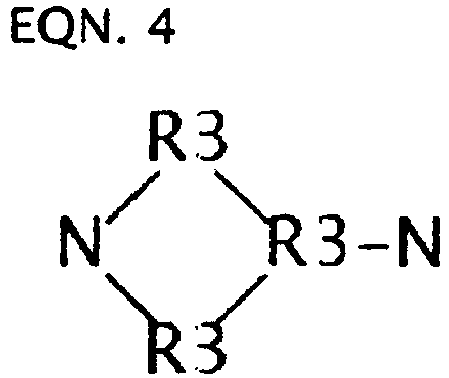
- R3 may be generally described as a hydrocarbon group, with optional substitution of the carbon and hydrogen atoms. The carbon atoms of R3 may be linear, branched or cyclic. R3 is preferably an alkyl or cycloalkyl group. R3 may be saturated or unsaturated. If cyclic R3 may have some degree of aromaticity. Any desired suitable substitution may be made, non-limiting examples of which include substitution of any hydrogen with halogen, and/or substitution of any carbon with oxygen or nitrogen. Preferably R3 contains halogen substitution of one or more hydrogen atoms. Each R3 is independently selected and may be the same or different.
- The total number of carbon atoms in the link L will depend on whether the diamine is a lower alkyl diamine, dimer acid containing diamine, or a polymeric diamine. The number of carbon atoms in R3 will then depend on the number of carbon atoms in link L, and then on whether the diamine is of the form of EQN. 2, 3 or 4.
- If the diamine is a lower alkyl diamine, the number of carbon atoms in L will range on the low end from 2, 4, or 6 and on the high end to 10, 12 or 24. Non-limiting examples of suitable ranges of carbon atoms in L include 2 to 10, 2 to 12, and 2 to 24.
- If the diamine is a dimer acid containing diamine, the number of carbon atoms in L will range on the low end from 26, 32 or 36 and on the high end to 54 or 60. Non-limiting examples of suitable ranges of carbon atoms in L include 26 to 60, 32 to 54, and 36 to 54.
- If the diamine is a polymeric diamine (generally described as oligomers with amine functionalty on both ends, with the preceding lower alkyl diamine and dimer acid containing diamine being considered "nonpolymeric diamines"), the number of carbon atoms in L will range on the low end from 50 or 75 and on the high end to 100, 150, or 200. Non-limiting examples of suitable ranges of carbon atoms in L include 50 to 250, 75 to 150 and 75 to 100. Molecular weight will of course depend upon the chemical structure of the polymeric diamine. As a non-limiting example, commercially available polymeric diamines have molecular weights in the range of about 148 to about 4000. Of course, polymeric diamines with molecular weights outside of that range may be utilized.
- Polyamides as a class of polymer are well known in the art. As used herein, the term "polyamide" denotes a macromolecule containing a plurality of amide groups, i.e., groups of the formula --NH--C(=O)-- and/or --C(=O)--NH--. As is very well known in the art, polyamides are commonly prepared via a condensation polymerization process whereby diamines are reacted with polyacids such as a polycarboxylic acid.
- As discussed below, the polyamide diols of the present invention are likewise conveniently prepared by reacting diamines with polyacids, except that hydroxy substituted carboxylic acid or a lactone is also included in the reaction mixture.
- Thus, in a non-limiting method of the present invention, the polyamide diols of EQN. 1 may be obtained by reacting a diamine, a dicarboxylic substituted acid, and a hydroxy substituted carboxylic acid or lactone in a condensation polymerization reaction to form the desired polyamide diol.
- Any suitable diamine may be utilized in the present invention, with the understanding that the particular diamine selected will generally depend on the ultimate polyamide diol desired, and/or on the ultimate polyurethane desired. Preferably, a mixture of diamines is utilized providing a polyamide diol of EQN. 1 with a mixture of Z groups dependent upon the mixture of diamines. Preferably, the mixture of diamines comprises in the range from 0.1, 4.5, 7, 50, or 70 weight percent polymeric amine, ranging up to 5.5, 9, 20, 75, 80 or 99.9 weight percent polymeric amine, with the weight percent based on the total weight of the diamines in the mixture of diamines. Of course, non-polymeric amines make up 100 weight percent less the weight percent of the polymeric amines. More preferably, polymeric amines comprise in the range of about 50 to 80 weight percent, even more preferably in the range of about 70 to 75 weight percent of the mixture of amines.
- The diamine compound may be one or more of an aliphatic, cycloaliphatic or aromatic diamine compound having from 2 to 200 carbon atoms. Non-limiting examples of suitable diamines include those having the formulas of EQNs. 2, 3 and 4 above wherein the amine groups are protonated.
- Non-limiting examples of diamines suitable for use in the present invention include alkylene diamine compounds, ethylene diamine, 1,2-diaminopropane, 1,3-diaminopropane, 1,4-diaminobutane, p-xylene diamine, 1,6-hexamethylene diamine, 2,-methylpentamethylene diamine, 4,4'-methylenebis(cyclohexylamine), 1,2-diamino-2-methylpropane, 1,5-diaminopentane, 2,2-dimethyl-1,3-propanediamine, 2-methyl-1,5-pentanediamine, 1,7- diaminoheptane, 1,8-diaminooctane, 2,5-dimethyl-2,5-hexanediamine, 1,9- diaminononane, 2,2-di-(4-cyclohexylamine)propane, polyglycol diamines, isophorone diamine, m-xylene diamine, cyclohexanebis(methylamine), bis-1,4-(2'-aminoethyl)benzene, 9-aminomethylstearylamine, 10-aminoethylstearylamine; 1,3-di-4-piperidyl propane, 1,10-diaminodecane, 1,12-diaminododecane, 1,18-diaminooctadecane, piperazine, N-aminoethylpiperazine, bis-(3-aminopropyl)piperazine, polyoxyalkylenediamines, polyethylene polyamines such as diethylene triamine and triethylene tetramine, diethyltoluene diamine, methylene dianiline and bis(aminoethyl)diphenyl oxide, and dimer diamine compounds, such as C36-alkylene diamine.
- Preferably, the diamines for use in the present invention include ethylenediamine, hexamethylenediamine, piperazine, polyoxyalkylenediamines such as polyoxypropylenediamines, m-xylenediamine. 1,2-diamino-2-methylpropane, 1 ,5- diaminopentane, 2,2-dimethyl-1,3-propanediamine, 2-methyl-1,5-pentanediamine, 1,7-diaminoheptane, 1,8-diaminooctane, 2,5-dimethyl-2,5-hexanediamine, N-aminoethylpiperazine, and 1,9- diaminononane.
- More preferably, the diamines for use in the present invention include ethylenediamine, hexamethylenediamine, piperazine, N-aminoethylpiperazine, and polyoxypropylenediamines.
- Ether-containing diamines may be utilized in those instances where it is desired to lower the melting point of the polyamide diol and increase compatibility with other polyols normally used in polyurethane formulations such as polypropylene glycol. Non-limiting examples of ether-containing diamaines include polyoxyalkylenediamines, and polyoxypropylenediamine.
- Where hexamethylenediamine or ethylenediaminediamine is utilized, they will comprise an equivalent percent of the diamine which will range on the low end from 0.1, 12, or 25 equivalent percent to on the high end to 35, 50, or 100 equivalent percent. Non-limiting examples of suitable ranges of hexamethylenediamine or preferably ethylenediaminediamine include 0.1 to 100 equivalent percent, 12 to 50 equivalent percent, and 25 to 35 equivalent percent.
- Where piperazine is utilized, it will comprise an equivalent percent of the diamine which will range on the low end from 0.1, 10, 25, 35, or 55 equivalent percent to on the high end to 20, 30, 35, 65, 80, 90, or 100 equivalent percent. Non-limiting examples of suitable ranges of piperazine include 0.1 to 80 equivalent percent, 35 to 65 equivalent percent, and 55 to 65 equivalent percent.
- Where a polyoxyalkylenediamine, a non-limiting example of which includes polyoxypropylenediamine, is utilized, it will comprise an equivalent percent of the diamine which will range on the low end from 0.1, 4.5, 7, 25, 50, or 70 equivalent percent to on the high end to 5.5, 9, 20, 50, 75, 80 or 100 equivalent percent. Of course, the equivalent percent utilized will vary depending upon the particular polyoxyalkylenediamaine utilized and its molecular weight. Non-limiting examples of suitable ranges of polyoxypropylenediamine include 0.1 to 20 equivalent percent, 7 to 9 equivalent percent (for Jeffamine D2000 having a MW of 2000), and 4.5 to 5.5 equivalent percent (for Jeffamine D400 having a MW of 400).
- The preferred mixture of diamines will comprise a polymeric diamine and a non-polymeric diamine, with weight percentages as described above. Preferably, the non-polymeric diamine will comprise piperazine in the weight percentages as described above. Most preferably, the mixture of diamines will comprise polyoxypropylenediamine, piperazine and etheylenediamine, in the weight percentages as described above.
- Any suitable dicarboxylic acid may be utilized in the present invention. Of course, the particular dicarboxylic acid selected will generally depend on the ultimate polyamide diol desired, and/or on the ultimate polyurethane desired.
- Dicarboxylic acids useful in the present invention include any dicarboxylic acid in which the carboxylic acid groups are separated by a bivalent hydrocarbon group which may be saturated or unsaturated, aliphatic, aromatic or cycloaliphatic or which may have two or more aliphatic, aromatic or cycloaliphatic. Also, any polycarboxylic acid in which the average functionality (number of functional groups per molecule) is greater than two, may be used. Corresponding acid anhydrides, esters, and acid chlorides of the foregoing acids are also suitable for use in the present invention and are encompassed by the term "dicarboxylic acid."
- Non-limiting examples of dicarboxylic acids suitable for use in the present invention include those of EQN. 5 below, wherein R2 is as described above.
-
HOOC-R2-COOH (EQN. 5)
- Polymerized fatty acids are suitable for use as a dicarboxylic acid in the present invention. The term "polymerized fatty acid" is intended to include any acid obtained by dimerizing saturated, ethylenically unsaturated or acetylenically unsaturated naturally occurring or synthetic monobasic aliphatic carboxylic acids containing as many as 54 or more carbon atoms. Polymerized fatty acids are a well known material of commerce, typically formed by heating long-chain unsaturated fatty acids, usually monocarboxylic acids, to about 200-250°C in the presence of a clay catalyst in order that the fatty acids polymerize. The product typically comprises dimer acid, isomeric dimmers, such as dicarboxylic acid formed by dimerization of the fatty acid, and trimer acid, such as tricarboxylic acid formed by trimerization of the fatty acid, and higher polymers. The polymerized fatty acid useful in this invention may be a liquid with an acid number of about 180-200. It may be hydrogenated or non-hydrogenated. Suitable monocarboxylic acids include C14, C16, C18, C20 and C22 monocarboxylic acids, which upon dimerization results respectively in C28, C32, C36, C40 and C44 dicarboxylic acids.
- For example, for the commonly occurring C18 monocarboxylic acid, polymerization will generally produce C36 dicarboxylic acid and C54 tricarboxylic acid (as well as some unreacted C18 monocarboxylic acid). A common source of such species, can be found in tall oil fatty acid.
- In a preferred embodiment of the invention, the dicarboxylic acid mixture may comprise polymerized fatty acid and further comprise any dicarboxylic acid of EQN. 5 that is not a polymerized fatty acid, described as follows.
- In one preferred embodiment, suitable dicarboxylic acids which are not polymerized fatty acids include oxalic, glutaric, malonic, adipic, succinic, suberic, sebacic, azelaic, dodecanedioic, pimelic, terephthalic, isophthalic, phthalic, napthalene dicarboxylic acids and 1,4- or 1,3-cyclohexane dicarboxylic acids.
- In another preferred embodiment, suitable dicarboxylic acids which are not polymerized fatty acids include 1,6- hexanedioic acid (adipic acid), 1,7-heptanedioic acid (pimelic acid), 1,8- octanedioic acid (suberic acid), 1,9-nonanedioic acid (azelaic acid), or 1,10-decanedioic acid (sebacic acid).
- In some non-limiting embodiments, the dicarboxylic acid comprises at least 40% of the acid equivalents from polymerized fatty acids. In other embodiments, the dicarboxylic acid comprises in the range of about 40, 50, 60 or 60 to about 40, 50, 60, 70, 80, 90 or 100% of the acid equivalents from polymerized fatty acids. Non-limiting examples of suitable ranges include 40 to 100%, 40-80%, and 50-70%. The balance is from dicarboxylic acids which are not derived from polymerized fatty acids.
- Polymerized fatty acid may contain large amounts of trimer acid, for example 15-20% in first pass dimer acid, or smaller amounts in the range of 4-6% of trimer acid in second pass dimer acid. Either can be used effectively. The added functionality from the additional trimer acid can be controlled by also adding the necessary amount of a hydroxy substituted carboxylic acid, or a monoacid such as stearic acid or tall oil fatty acid, or any monoacids mentioned below.
- As is well known, the functionality of the polyamide diol resin can be determined by measuring its hydroxyl number, amine number, and number average molecular weight Mn (from GPC). The functionality is equal to the sum of the hydroxyl and amine numbers times Mn divided by 56,100. The added hydroxy substituted carboxylic acid or a monoacid, can be adjusted to preferably keep the functionality in the range of about 2 ±0.5, preferably 2 ±0.25, and more preferably 2 ±0.15.
- In the practice of the present invention, any suitable hydroxy substituted carboxylic acid may be utilized in the present invention. The particular hydroxy substituted carboxylic acid selected will generally depend on the ultimate polyamide diol desired, and on the ultimate polyurethane desired.
- Non-limiting examples of hydroxy substituted carboxylic acids suitable for use in the present invention include those of EQN. 6 below, wherein X and R1 are as described above.
-
X-R1-COOH (EQN. 6)
- Non-limiting examples of hydroxy substituted carboxylic acids suitable for use on the present invention include 12-hydroxy stearic acid, 12-hydroxy olec acid (riconoleic acid) (may in some instances lower softening point), glycolic acid, lactic acid, 2-hydroxybutyric acid, 3-hydroxybutyric acid, 3-hydroxybenzoic acid, 4-hydroxybenzoic acid, 2-hydroxycinnamic acid, 3-hydroxycinnamic acid 10-hydroxydecanoic acid, 2-hydroxy-3,3-dimethylbutyric acid, 9-hydroxy-9-fluorenecarboxylic acid, 16-hydroxyhexadecanoic acid, 2-hydroxyhexanoic acid, alpha-hydroxyisobutyric acid, 2-hydroxyisocaproic acid, alpha-hydroxyisovaleric acid, 3-hydroxymandelic acid, and 9-hydroxynonanoic acid
4-hydroxyphenylacetic acid. More preferred hydroxy substituted carboxylic acids comprising in the range of 6 to 24 carbon atoms, even more preferred in the range of 6 to 18 carbon atoms. An even more preferred hydroxy
substituted acid is 1 2-hydroxy stearic acid. - The most preferred compounds are those with secondary OH for low reactivity with carboxylic acid but high reactivity with isocyanate that also have the hydroxyl greater than 6 bonds from the acid group to minimize internal side reactions. Suitable non-limiting examples include 12-hydroxystearic acid and lithocholic acid.
- Hydroxy substituted carboxylic acids with secondary alcohols will have an OH group hindered from reaction with carboxylic acids to form unwanted esters but still reactive enough to react with isocyanates. Non-limiting examples include lactic acid, 2-hydroxybutyric acid, 3-hydroxybutyric acid, 2-hydroxy-3,3-dimethylbutyric acid, 2-hydroxyhexanoic acid, and alpha-hydroxyisovaleric acid.
- Hydroxy substituted carboxylic acids with tertiary alcohols have an OH that is more sterically hindered. While they should provide good yields of polyols, they may react much slower with the isocyanates. Non-limiting examples include 9-hydroxy-9-fluorenecarboxylic acid and alpha-hydroxyisobutyric acid.
- Hydroxy substituted carboxylic acids with primary OH groups should give some useful polyol product, and may give ester by-products. Non-limiting examples include glycolic acid, 10-hydroxydecanoic acid, 16-hydroxydecanoic acid and 9-hydroxynonanoic acid.
- Hydroxy substituted carboxylic acids with aromatic OH groups should give good yields of polyol, but they may also give thermally unstable polyurethanes which would not be recommended for most hot melt applications. The addition of hydrogenated dimer may be used to improve thermal stability. Non-limiting examples include 3-hydroxybenzoic acid, 4-hydroxybenzoic acid, 2-hydroxycinnamic acid, 3-hydroxycinnamic acid, and 3-hydroxymandelic acid.
- It is preferred that the hydroxy substituted carboxylic acid be sufficiently sterically hindered to reduce competition of the 2° OH group on the acid (which will result in a undesired polyester) with the amine groups on the diamine (which will result in the desired polyamide). The acid in the reaction mixture will generally comprise in the range of about 2-40 equivalent percent hydroxy substituted carboxylic acid preferably 2-20 equivalent percent hydroxy substituted carboxylic acid, to provide a hydroxyl number in the range of about of 0 - 70, preferably 20-35 mg KOH/gm.
- It should be understood that a lactone may be utilized in place of or in conjunction with the hydroxy substituted carboxylic acid, provided that upon reaction with the amine, the lactone provides a structure to the polyamide having the form: X-R1-(C=O), wherein R1 and X are as described above. Suitable lactones include those derived from suitable hydroxy substituted carboxylic acids.
- Suitable lactones include those disclosed in
U.S. Patent No. 7,112,699 , which is hereby incorporated by reference. - Any suitable amount of hydroxy substituted carboxylic acid may be included in the reaction mixture. In some non-limiting embodiments, the hydroxy substituted carboxylic acid is included in the reaction mixture to provide a polyamide diol with a desired hydroxyl number. In other embodiments, the hydroxy substituted carboxylic acid is included in the reaction mixture in sufficient quantity to give a polyamide with an hydroxyl number that ranges on the low end ranges from 0, 10 or 20, to on high end to 25, 35, 50 or 75. A non-limiting example of a suitable hydroxyl number range includes 20 to 35.
- Any monoacid may be utilized in the present invention which will provide the desired polyamide diol of the present invention. Non-limiting examples of type of monoacids suitable, include those without other functional groups besides the carboxyl group reactive to acids, amines, or alcohols. While not necessary, preferably the monoacid is not highly volatile for ease in conducting the reaction. Thus, while monoacids of higher volatility may be utilized, those may make it more difficult to conduct the reaction.
- Non-limiting examples of monoacids suitable for use in the present invention include stearic acid, isostearic acid (may be used to lower softening point), tall oil fatty acid, vegetable fatty acids, palmitic acid, myristic acid, benzoic acid, p-aminobenzoic acid (PABA), and phenylacetic acid, Preferably the monoacid is stearic acid, isostearic acid or tall oil fatty acid. Even more preferably, the monoacid is stearic acid.
- In a non-limiting method embodiment of the present invention, the polyamide diols of EQN. 1 may be obtained by reacting the above described diamine, dicarboxylic acid, and hydroxy substituted carboxylic acid under suitable reaction conditions to form the desired polyamide diol.
- Any conventional process for preparing a polyamide resin may be employed. As a non-limiting example, the various reactants may be blended and heated gradually to a temperature in the range of about 200 C to about 240 C. During the temperature elevation, condensed water and any volatilized amine may be removed.
- A phosphoric acid catalyst may also be employed to accelerate and improve the efficiency of the reaction. Exemplary suitable catalysts include acid compounds such as phosphoric acid, oxides or carbonates of alkaline nature such as magnesium oxide or calcium oxide and halogen salts of polyvalent metals and acids. The catalyst is present in an amount of from about 0% to about 3% by weight of the resin, preferably in an amount of from about 0.005% to about 0.500% by weight, most preferably in an amount of about 0.01% by weight.
- The amidation reaction may be carried out under any suitable conditions the will result in production of a polyamide diol of EQN. 1. In one non-limiting embodiment, either the acids or amines can be in slight excess with the amount of excess controlling the molecular weight. While the resulting polyamide diol may have any desirable molecular weight, in some non-limiting embodiments it is at least 1000 Daltons. In other non-limiting embodiments the resulting polyamide diol will have a molecular weight which will range on the low end from 1000, 2000, 2500 or 5000 to a high end of 5000, 10,000, 50,000, 100,000 or 200,000 Daltons.
- The amidation may be carried out for any suitable reaction time to any suitable reaction extent. In some non-limiting embodiments, the amidation reaction is substantially over when the acid number or amine number less than 4 mg KOH/gm. The acid number may preferably be reduced by use of any suitable acid scavenger. The acid scavenger may be a carbonate scavenger. More particularly, the scavenger may be an alkylene carbonate. Non-limiting examples of suitable alkylene carbonates include C2 to C10 alkylene carbonates, non-limiting examples of which include ethylene carbonate, propylene carbonate and butylene carbonate. As a particular non-limiting example, the acid number may preferably be reduced to less than 1 by treatment with 4 equivalents of alkylene carbonate based on the residual acid content. This treatment with an acid scavenger may be utilized to avoid excess foaming, or to control the rate of foaming, in any subsequent reaction of the polyamide diol with diisocyanate. Certainly, there may be instances where foaming is desired.
- The polyamide diol of the present invention is useful as a material for the making of polyurethanes. Non-limiting examples of polyurethanes include those described below, as well as any others which may be made from the present polyamide diol. The polyamide polyol of the present invention finds utility in a wide variety of uses as are known for polyamides, polyols, and polyurethanes (including those polyurethane uses described below for the polyurethanes of the present invention). Non-limiting examples of utilities include leather finishing, thermoplastic compositions for injection molding and extrusion, engineered components, flooring, alkyds, rosin tackifiers, lubricants, cosmetics, fuel additives, plasticizers, synthetic waxes, detergents, metalworking, hydraulic fluids, heat transfer fluids, antifoams, demulsifiers, and polyurethane CASE applications, coatings, adhesives, sealants and elastomers. The present disclosure is directed to such products made from the present polyamide diol, and to methods of making and using such products.
- Polyurethanes
- The present invention also includes polyurethanes represented by the following EQN 7:
-
OCN-R4-N-(C=O)-P-[(C=O)-N-R4-N-(C=O)-P]m-(C=O)-N-R4-NCO (EQN. 7)
- m is the number of repeating units, and is at least 1, with its upper limit merely limited by the type of polyurethane desired. In some non-limiting embodiments, m will generally range on the low end from 1, 10, or 35, and on the high end to 50, 100, 300, 1000, or 10,000. Non-limiting examples of suitable ranges include from 1 to 50, from 1 to 100, and from 1 to 300. Of course, where desired, n may be greater then 10,000.
- R4 may be generally described as a hydrocarbon group, with optional substitution of the carbon and hydrogen atoms. The carbon atoms of R4 may be linear, branched or cyclic. R4 is preferably an alkyl or cycloalkyl group. R4 may be saturated or unsaturated. If cyclic R4 may have some degree of aromaticity. The number of carbon atoms in R4 will range on the low end from 2, 4, or 6 and on the high end to 10, 50, or 100. Non-limiting examples of suitable ranges of carbon atoms in R4 include 2 to 10, 2 to 50, and 2 to 100. Any desired suitable substitution may be made, non-limiting examples of which include substitution of any hydrogen with halogen, and/or substitution of any carbon with oxygen or nitrogen. Optionally, R4 may contain halogen substitution of one or more hydrogen atoms. Each R4 is independently selected and may be the same or different.
- P is a repeating unit version of the polyamide diol of EQN. 1 less the end hydrogen atoms. It should be understood that for each occurrence of P in EQN. 7, P is independently selected and may be the same or different.
- Polyurethanes as a class of polymer are well known in the art. As is very well known in the art, polyurethanes are commonly prepared by reaction of a diisocyanate and a polyol.
- It should be understood that when at least one T of EQN. 1 is X-R1 -(C=O) that P is a polyamide diol. When each T is H, then a polyamide is formed. Of course, P may in some non-limiting embodiments be a mixture of polyamide diol with polyamide. Reaction of the polyol with diisocyanate will result in a polyurethane. Reaction of the polyamide with diisocyanate will result in a polyurea. Further embodiments of this invention are directed to compositions of a polyurethane, compositions of polyurea, and to compositions comprising both the polyurethane and polyurea.
- In a non-limiting emodiment of a method of the present invention, a polyurethane of EQN. 7 is obtained by reacting a diisocyanate with the polyamide diol of EQN. 1.
- Exemplary suitable polyisocyanate compounds useful for preparing a polyurethane base resin for use in the present invention include aromatic, aliphatic, cycloaliphatic, and aralkyl polyisocyanate compounds containing from 6 to 100 carbon atoms. The term "aliphatic polyisocyanate" as used herein includes any organic polyisocyanate compound in which the isocyanate groups are attached to saturated carbon atoms. Preferably, the polyisocyanate compound employed contains two isocyanate groups, however, polyisocyanate compounds containing greater than two isocyanate groups are suitable for use in preparing the polyurethane resin of the invention providing that the resulting urethane compound is a liquid or thermoplastic solid. A mixture or a blend of more than one polyisocyanate compound may also be employed. In other embodiments, polymers (dimers or greater) of polyisocyanate compounds may be utilized.
- The following polyisocyanate compounds are exemplary suitable compounds for use in the invention: 4,4'-diphenylmethane diisocyanate; 2,4'-diphenylmethane diisocyanate; toluene-2,4-diisocyanate; toluene-2,6-diisocyanate; 3-phenyl-2-ethylenediisocyanate; 1,5-naphthalene diisocyanate; 1,8-naphthalene diisocyanate; cumene-2,4-diisocyanate; 4-methyoxy-1,3-phenylene diisocyanate; 4-chloro-1,3-phenylenediisocyanate; 4-bromo-1,3-phenylene diisocyanate; 4-ethyloxy-1,3-phenylenediisocyanate; 2,4'-diisocyanatodiphenyl ether; 5,6-dimethyl-1,3-phenylenediisocyanate; 2,4-dimethyl-1,3-phenylenediisocyanate; 4,4'-diisocyanatodiphenyl ether; benzidinediisocyanate; 4,6-dimethyl-1,3-phenylenediisocyanate;9,10-anthracenediisocyanate; 4,4'-diisocyanatodibenzyl; 3,3'-dimethyl-4,4'-diisocyanatodiphenylmethane; 2,6-dimethyl-4,4'-diisocyanatodiphenyl; 2,4-diisocyanatostilbene; 3,3'-dimethyl-4,4'-diisocyanatodiphenyl; 3,3'-dimethoxy-4,4'-diisocyanatodiphenyl; 1,4-anthracenediisocyanate; 2,5-fluorenediisocyanate; 1,3-phenylenediisocyanate; 1,4-phenylenediisocyanate; 2,6-diisocyanatobenzylfuran; bis(2-isocyanatoethyl)fumarate; bis(2-isocyanatoethyl)carbonate; bis(2-isocyanatoethyl)-4-cyclohexene-1,2-dicarboxylate; polymethylene polyphenyl isocyanate; 1,4-tetramethylenediisocyanate; 1,6-hexamethylenediisocyanate; 1,10-decamethylenediisocyanate; 1,3-cyclohexylenediisocyanate; 1,4-cyclohexylenediisocyanate; 4,4'-methylene-bis(cyclohexylisocyanate); m- and p-tetramethylxylene diisocyanate; 2,2,4-trimethyl-1,6-hexamethylene diisocyanate; m- and p-xylylene diisocyanate; 3-isocyanatomethyl-3,5,5-trimethylcyclohexyl isocyanate; phenylene bis(2-ethyl isocyanate); 4-methyl-1,3-cyclohexylene diisocyanate; 2-methyl-1,3-cyclohexylene diisocyanate; 2,4'-methylene bis(cyclohexylisocyanate); lower alkyl esters of 2,5-diisocyanatovaleric acid; and polyisocyanates containing three or more isocyanate groups per molecule such as triphenylmethane triisocyanate and 2,4-bis(4-isocyanatocyclohexylmethyl)cyclohexyl isocyanate, and mixtures and polymers thereof.
- Preferred polyisocyanate compounds include 4,4'-diphenylmethane diisocyanate; 2,4'-diphenylmethane diisocyanate; toluene-2,4-diisocyanate; toluene-2,6-diisocyanate; 1,6-hexamethylenediisocyanate; and 3-isocyanatomethyl-3,5,5-trimethylcyclohexyl isocyanate.
- More preferred polyisocyanate compounds include 4,4'-diphenylmethane diisocyanate; 2,4'-diphenylmethane diisocyanate; toluene-2,4-diisocyanate; and toluene-2,6-diisocyanate.
- In the method of the present invention, the polyol component for the polyurethane reaction will include the polyamide diol of EQN. 1, and may optionally include other polyols as are commonly utilized in the manufacture of polyurethanes.
- The optional polyols which may be included with the polyamide diols include polyacrylic polyols, polyester polyols, polyether polyols, polyamide diols, polycarbonate polyols, polyesteramide polyols, polythioether polyols, polyacetal polyols, polyurethane polyols, polybutadiene polyols or copolymers with acrylonitrile or styrene for example, castor oil and its derivatives and any monomeric polyols such as ethylene glycol, 1,2-propylene glycol, diethylene glycol, triethylene glycol, dipropylene glycol, trimethylene glycol, 1,3- and 1,4-butane diol; hexamethylene glycol, neopentyl glycol, glycerin, trimethylolpropane and pentaerythritol.
- Polyurethane can be made in a variety of densities and hardnesses by varying the type of monomer(s) used and adding other substances to modify their characteristics, notably density, or enhance their performance. As with other polymers, any number of additives may be used to improve the fire performance, stability in difficult chemical environments and other properties of the polyurethane products.
- Though the properties of the polyurethane are determined mainly by the choice of polyol, the diisocyanate exerts some influence. The cure rate is influenced by the functional group reactivity and the number of functional isocyanate groups. The mechanical properties are influenced by the functionality and the molecular shape. The choice of diisocyanate also affects the stability of the polyurethane upon exposure to light. Polyurethanes made with aromatic diisocyanates yellow with exposure to light, whereas those made with aliphatic diisocyanates are stable.
- The precise formulation of the polyurethane adhesive or sealant composition of the present invention will vary depending upon the specific end use. Other ingredients may also be incorporated into the adhesive or sealant composition as dictated by the nature of the desired composition as well known by those having ordinary skill in the art.
- While the adhesive or sealant compositions may be used directly as described above, if desired the adhesive or sealant compositions of the present invention may also be formulated with conventional additives as are known in the art, non-limiting examples of which include plasticizers, compatible tackifiers, catalysts, fillers, anti-oxidants, pigments, mercapto/silane adhesion promoters, stabilizers and the like. The adhesive or sealant compositions are readily prepared using methods generally known in the art.
- The resultant polyurethanes are useful in applications as are well known for prior art polyurethanes. The resultant polyurethanes may be formulated into thermoplastic polyurethanes or thermoset polyurethanes. As non-limiting examples, the polyurethanes of the present invention (as well as the above described polyamide diols) may be useful in the making of flexible and rigid foams, elastomers, cast elastomers, sealants, textiles, fibers, gaskets, binders, coatings, linings, adhesives, molded products, paints, plastic compositions with other plastics, packaging, RIM products, molded products, spandex, construction materials, furniture, carpeting, carpet cushion, bedding, footwear, decorative materials, millable gums, mine reinforcements, CASE applications, just to name a few. The present disclosure is directed to such products made from the present polyurethanes (as well as the present above described polyamide diol), and to methods of making and using such products.
- Some embodiments of the resultant polyurethanes will provide a moisture curable adhesive with good tack, green strength, open time, and/or good adhesion after curing to substrates used in large scale lamination or profile wrap application. Some embodiments of the resultant polyurethane exhibit good adhesion to substrates like ABS, Poly(Acrylonitrile Butadiene Styrene). The present invention is also believed to have utility in adhesion to or with other polymers such as, PVC, polyacrylics, polyolefins (C2 to C8 homopolymers, copolymers thereof, and mixtures thereof), such as polyethylene and polypropylene, and any polymer compositions containing at least one of the same.
- In another non-limiting method embodiment of the present invention, products may be produced by application of the polyurethane adhesive to a substrate.
- As non-limiting examples, the resulting adhesive or sealant compositions, when appropriately formulated, may be used as hot melt adhesives in virtually any packaging application in which adhesive or sealant compositions are commonly employed with a substrate, including case and carton forming and sealing, tube winding, bag manufacture, glued lap, paper and flexible film laminating. Blocked isocyanates may improve shelf life of these adhesive or sealant compositions. Non-limiting examples of isocyanates may include HDI, IPDI TDI TmXDI, and MDI. Non-limiting examples of suitable blocking agents include alcohols, lactams, cetoxims and active methylene group compounds. The substrates will have applied to a portion thereof the adhesive composition. Depending on the particular application, the substrate may have substantially all of one surface coated, or may be coated on two sides. Alternately, the adhesive or sealant composition may be applied as a bead, whereby a minor portion of the substrate has applied thereto the adhesive. One skilled in the art, having the knowledge of the present specification, will readily ascertain those applications in which the use of the inventive adhesive or sealant compositions would be advantageous. Any conventional method of applying the adhesive or sealants to the particular substrates may be employed. These methods are well known in the field of adhesives or sealants.
- EXAMPLES
- The following non-limiting Examples are provided merely to illustrate a few embodiments of the invention, and are not meant to and do not limit the scope of the claims.
- Examples 1-5, Preparation of Polyamide diol
- In the examples, "EDA" means ethylene diamine, "Cenwax® A" means 12-hydroxystearic acid, "D-2000" means polyoxypropylenediamine with a molecular weight of about 2000, "D-400" means polyoxypropylenediamine with a molecular weight of about 400, "Unitol® BKS" means tall oil fatty acid, "Century 1224" means stearic acid, "Unitol 1 8" is a dimer acid, "prop. carb." means propylene carbonate, "ODS" means Anox ODS antioxidant, and "20" means Anox 20 antioxidant.
- The reactants listed in Table 1 below were charged to a 3000 mL vessel and heated gradually with stirring to a maximum reaction temperature of about 220°C. The reactants were held at that temperature for about 8 hours under a mild stream of dry nitrogen. Water was distilled off as it was formed. After the 8 hour hold, the reaction was judged to be sufficiently complete as determined by acid number measurement of samples (3 to 4). Next, four equivalents of propylene carbonate based on the acid number were added to the flask and the reaction was held at 220C for 1 to 2 additional hours. Analysis of a new sample confirmed that the acid number was below 1. The flask was evacuated to a vacuum of about 29 inches of mercury below atmospheric pressure and held there for 1 hour to remove any unreacted propylene carbonate and other volatiles. The final antioxidants were added and allowed to dissolve for 15 minutes. Then the resin was poured into cans to cool to an amber soft solid.
- Results are provided in Table 1 below.


- Examples 6-9, Preparation of Polyurethane Adhesive
- The polyamide diol formulations of Examples 1-5 were used to make polyurethane adhesives.
- "PPG 2000" is polypropylene glycol with an average molecular weight of 2000, "Rubinate 9433" is MDI high in the 2,4' isomer available from Huntsman, "Isonate 125M" is a 98% pure 4,4'-MDI available from Dow Chemical, "Modaflow 2100" is a flow modifier available from Cytech, "Dynacoll 7360" is a polyester polyol from Degussa with an OH # of about 30 and a molecular weight of 3500.
- Formulations are shown in Table 2 below. A polyol mixture is made by melting a mixture of the PPG 2000, selected polyamide diol of Examples 1-5, and the other polyol (Dynacoll 7360, Dynacoll 7380 or Dianal MB-3068) in a stirred flask at 100C. Next, the Modaflow 2100 is added and the flask is evacuated to a vacuum of 29 inches of mercury to remove traces of water. Then the flask is vented with nitrogen and the MDI added. The reaction is stirred at for one hour (at 100-105C for Ex. 1-4 and 4A, and at 120-130C for the remaining examples) under a partial vacuum to remove bubbles. The resulting isocyanate terminated polyurethane is coated onto substrates for adhesive testing.


- This table compares polyamide diol polyurethane #5, mixed polyamide diol / acrylic polyol polyurethane #6, and, as controls, an acrylic polyol polyurethane #7 and a polyester polyol polyurethane #8. Polyurethanes #5 and #6 show increased adhesion to the ABS, PVC, and acrylic substrates compared to the one of the controls both in subjective testing and in the numerical measurements we have been doing (in progress).
- Therefore, we want to emphasize that our polyamide diol can provide increased adhesion to low energy substrates like ABS, PVC, or the acrylic film. A formulation like #8 is currently used commercially as an adhesive for acrylics in profile wrap applications, but the acrylics must be pretreated (with for example, a solvent) to get the adhesion. Polyurethanes containing our product show the good adhesion without substrate pretreatment. Note that our polyamide diol can either be used to replace a competitive technology like acrylic polyols or can be used with them to enhance their adhesive properties (weight % of ingredients used and analyses for each example)
EMX-21 is a proprietary commercial acrylic polyol based PUR adhesive made by FasTech Inc. EMX-21 is similar in composition to example 7 in Table 2.PUR Formulation 4A 5A 9 FasTech EMX-21* PPG 2000 30.0% 14.0% 13.0% PPG 1000 15.0% 15.0% PPG 400 Polyamide diol #4A 31.7% 31.7% 26.7% none DMDEE Rubinate 9433 (2,4'-, 4,4'-MDI blend) Isonate 125M (4,4'-MDI) 18.0% 16.0% 16.0% yes Modaflow 2100 0.3% 0.3% 0.3% Dynacoll 7360 20.0% 17.0% 17.0% Dynacoll 7380 7.0% 7.0% Dianal MB-3068 acrylic polyol 5.0% yes Dynacoll 7150 Dynacoll 7130 % unreacted NCO content 3.2% 2.0% 2.3% Visc. at 120°C (cps) 2645 5300 3850 10,000 cps Visc. after 30 min. (cps) 6100 8700 6260 - All publications cited herein, including but not limited to, patent related publications such as U.S. and foreign patents, U.S. and foreign applications, and non-patent publications such as books, articles, magazines, journals, dissertations, presentations, speeches, newspapers, are herein incorporated by reference for all that they teach and disclose.
- The present invention has been illustrated mainly by reference to polyamide diols. However, the present invention should be broadly understood in terms of any suitable polyamide polyol in place of the polyamide diol. So the present invention relates to polyamide diol compositions, to method of making and use thereof, and to products made therefrom, and to polyurethanes made therefrom.
- According to one embodiment of the present invention there is provided a method of making a polyol, the method comprising:
- contacting a diamine, dicarboxylic acid and a hydroxy substituted carboxylic acid together under conditions sufficient to form the polyol,
- wherein the diamine comprises polymeric diamines and non-polymeric diamines.
- The polyol may e.g. be a polyamide diol and is represented by the formula:
T-[Z-(C=4)-R2-(C=O)]n-Z-T
wherein n is at least 1; each T independently is selected, may be the same or different, and is X-R1-(C=O); each X is independently selected, may be the same or different and is H or OH; each R1 is independently selected, may be the same or different, and is a hydrocarbon group having from 2 to 54 carbon atoms; each R2 is independently selected, may be the same or different, and is a hydrocarbon group having from 2 to 54 carbon atoms; and Z is a pair of N atoms joined by a hydrocarbon link. - The polymeric diamine may e.g. comprise polyoxyalkylenediamine, and the non-polymeric diamine comprises at least one selected from the group consisting of ethylene diamine, 1,2-diaminopropane, 1,3-diaminopropane, 1,4-diaminobutane, p-xylene diamine, 1,6-hexamethylene diamine, 2,-methylpentamethylene diamine, 4,4'-methylenebis(cyclohexylamine), 1,2-diamino-2-methylpropane, 1,5-diaminopentane, 2,2-dimethyl-1,3-propanediamine, 2-methyl-1,5-pentanediamine, 1,7-diaminoheptane, 1,8-diaminooctane, 2,5-dimethyl-2,5-hexanediamine, 1,9-diaminononane, 2,2-di-(4- cyclohexylamine)propane, polyglycol diamines, isophorone diamine, m-xylene diamine, cyclohexanebis(methylamine), bis-1,4-(2'-aminoethyl) benzene, 9-aminomethylstearylamine, 10-aminoethylstearylamine; 1,3-di-4-piperidyl propane, 1,10-diaminodecane, 1,12-diaminododecane, 1,18-diaminooctadecane, piperazine, N-aminoethylpiperazine, bis-(3-aminopropyl)piperazine, polyethylene polyamines such as diethylene triamine and triethylene tetramine, diethyltoluene diamine, methylene dianiline and bis (aminoethyl) diphenyl oxide.
- The dicarboxylic acid may e.g. comprise at least one selected from the group of lower alkyl dicarboxylic acids consisting of oxalic, glutaric, malonic, adipic, succinic, suberic, sebacic, azelaic, dodecanedioic, pimelic, terephthalic, iosphthalic, phthalic, napthalene, dicarboxylic acids and 1,4- or 1,3-cyclohexane dicarboxylic acids, and at least one selected from the group of fatty acid dicarboxylic acids selected from the group consisting of C28 to C44 dicarboxylic acids.
- The hydroxy substituted carboxylic acid may e.g. comprise at least one selected from the group consisting of 12-hydroxy stearic acid, glycolic acid, lactic acid, 2-hydroxybutyric acid, 3-hydroxybutyric acid, 3-hydroxybenzoic acid, 4-hydroxybenzoic acid, 2-hydroxycinnamic acid, 3-hydroxycinnamic acid, 10-hydroxydecanoic acid, 2-hydroxy-3,3-dimethylbutyric acid, 9-hydroxy-9-fluorenecarboxylic acid, 16-hydroxyhexadecanoic acid, 2-hydroxyhexanoic acid, alpha-hydroxyisobutyric acid, 2-hydroxyisocaproic acid, alpha-hydroxyisovaleric acid, 3-hydroxymandelic acid, and 9-hydroxynonanoic acid; and, 4-hydroxyphenylacetic acid.
- The dicarboxylic acid may e.g. comprise at least one selected from the group of lower alkyl dicarboxylic acids consisting of 1,6-hexanedioic acid (adipic acid), 1,7-heptanedioic acid (pimelic acid), 1,8-octanedioic acid (suberic acid), 1,9-nonanedioic acid (azelaic acid), or 1,10-decanedioic acid (sebacic acid); and at least one selected from the group of fatty acid dicarboxylic acids selected from the group consisting of C32 to C40 dicarboxylic acids.
- The hydroxy substituted carboxylic acid may e.g. comprise at least one selected from the group consisting of 12-hydroxy stearic acid, and lithocholic acid.
- The dicarboxylic acid may e.g. comprise at least one selected from the group of lower alkyl dicarboxylic acids consisting of 1,6-hexanedioic acid (adipic acid), 1,7-heptanedioic acid (pimelic acid), 1,8-octanedioic acid (suberic acid), 1,9-nonanedioic acid (azelaic acid), or 1,10-decanedioic acid (sebacic acid); and a C36 dicarboxylic acid.
- The hydroxy substituted carboxylic acid may e.g. comprise 12-hydroxy stearic acid.
- The dicarboxylic acid may e.g. comprise 1,10-decanedioic acid (sebacic acid) and C36 dicarboxylic acid.
- The polymeric diamine may e.g. comprise polyoxyalkylenediamine, and the non-polymeric diamine comprises at least one selected from the group consisting of ethylenediamine, hexamethylenediamine, piperazine, m-xylenediamine, 1,2-diamino-2-methylpropane, 1,5-diaminopentane, 2,2-dimethyl-1,3-propanediamine, 2-methyl-1,5-pentanediamine, 1,7-diaminoheptane, 1,8-diaminooctane, 2,5-dimethyl-2,5-hexanediamine, N-aminoethylpiperazine, and 1,9-diaminononane.
- The dicarboxylic acid may e.g. comprise at least one selected from the group of lower alkyl dicarboxylic acids consisting of oxalic, glutaric, malonic, adipic, succinic, suberic, sebacic, azelaic, dodecanedioic, pimelic, terephthalic, isophthalic, phthalic, napthalene dicarboxylic acids and 1,4- or 1,3-cyclohexane dicarboxylic acids, and at least one selected from the group of fatty acid dicarboxylic acids selected from the group consisting of C28 to C44 dicarboxylic acids.
- The hydroxy substituted carboxylic acid may e.g. comprise at least one selected from the group consisting of 12-hydroxyl stearic acid, glycolic acid, lactic acid, 2-hydroxybutyric acid, 3-hydroxybutyric acid, 3-hydroxybenzoic acid, 4-hydroxybenzoic acid, 2-hydroxycinnamic acid, 3-hydroxycinnamic acid, 10-hydroxydecanoic acid, 2-hydroxy-3,3-dimethylbutyric acid, 9-hydroxy-9-fluorenecarboxylic acid, 16-hydroxyhexadecanoic acid, 2-hydroxyhexanoic acid, alpha-hydroxyisobutyric acid, 2-hydroxyisocaproic acid, alpha-hydroxyisovaleric acid, 3-hydroxymandelic acid, and 9-hydroxynonanoic acid; and, 4-hydroxyphenylacetic acid.
- The dicarboxylic acid may e.g. comprise at least one selected from the group of lower alkyl dicarboxylic acids consisting of 1,6-hexanedioic acid (adipic acid), 1,7-heptanedioic acid (pimelic acid), 1,8-octanedioic acid (suberic acid), 1,9-nonanedioic acid (azelaic acid), or 1,10-decanedioic acid (sebacic acid); and at least one selected from the group of fatty acid dicarboxylic acids selected from the group consisting of C32 to C40 dicarboxylic acids.
- The hydroxy substituted carboxylic acid may e.g. comprise at least one selected from the group consisting of 12-hydroxy stearic acid, and lithocholic acid.
- The dicarboxylic acid may e.g. comprise at least one selected from the group of lower alkyl dicarboxylic acids consisting of 1,6-hexanedioic acid (adipic acid), 1,7-heptanedioic acid (pimelic acid), 1,8-octanedioic acid (suberic acid), 1,9-nonanedioic acid (azelaic acid), or 1,10-decanedioic acid (sebacic acid); and comprises a C36 dicarboxylic acid.
- The hydroxy substituted carboxylic acid may e.g. comprise 12-hydroxy stearic acid.
- The dicarboxylic acid may e.g. comprise 1,10-decanedioic acid (sebacic acid) and C36 dicarboxylic acid.
- The polymeric diamine may e.g. comprise polyoxypropylenediamines diamine and the non-polymeric diamine comprises piperazine.
- The dicarboxylic acid may e.g. comprise at least one selected from the group of lower alkyl dicarboxylic acids consisting of oxalic, glutaric, malonic, adipic, succinic, suberic, sebacic, azelaic, dodecanedioic, pimelic, terephthalic, isophthalic, phthalic, napthalene dicarboxylic acids and 1,4- or 1,3-cyclohexane dicarboxylic acids, and at least one selected from the group of fatty acid dicarboxylic acids selected from the group consisting of C28 to C44 dicarboxylic acids.
- The hydroxy substituted carboxylic acid comprises at least one selected from the group consisting of 12-hydroxy stearic acid, glycolic acid, lactic acid, 2-hydroxybutyric acid, 3-hydroxybutyric acid, 3-hydroxybenzoic acid, 4-hydroxybenzoic acid, 2-hydroxycinnamic acid, 3-hydroxycinnamic acid, 10-hydroxydecanoic acid, 2-hydroxy-3,3-dimethylbutyric acid, 9-hydroxy-9-fluorenecarboxylic acid, 16-hydroxyhexadecanoic acid, 2-hydroxyhexanoic acid, alpha-hydroxyisobutyric acid, 2-hydroxyisocaproic acid, alpha-hydroxyisovaleric acid, 3-hydroxymandelic acid, and 9-hydroxynonanoic acid; and, 4-hydroxyphenylacetic acid.
- The dicarboxylic acid may e.g. comprise at least one selected from the group of lower alkyl dicarboxylic acids consisting of 1,6-hexanedioic acid (adipic acid), 1,7-heptanedioic acid (pimelic acid), 1,8-octanedioic acid (suberic acid), 1,9-nonanedioic acid (azelaic acid), or 1,10-decanedioic acid (sebacic acid); and at least one selected from the group of fatty acid dicarboxylic acids selected from the group consisting of C32 to C40 dicarboxylic acids.
- The hydroxy substituted carboxylic acid may e.g. comprise at least one selected from the group consisting of 12-hydroxy stearic acid, and lithocholic acid.
- The dicarboxylic acid may e.g. comprise at least one selected from the group of lower alkyl dicarboxylic acids consisting of 1,6-hexanedioic acid (adipic acid), 1,7-heptanedioic acid (pimelic acid), 1,8-octanedioic acid (suberic acid), 1,9-nonanedioic acid (azelaic acid), or 1,10-decanedioic acid (sebacic acid); and a C36 dicarboxylic acid.
- The hydroxy substituted carboxylic acid may e.g. comprise 12-hydroxy stearic acid.
- The dicarboxylic acid may e.g. comprise 1,10-decanedioic acid (sebacic acid) and a C36 dicarboxylic acid.
- According to a second embodiment of the invention there is provided a polyamide diol composition represented by the formula
T-[Z-(C=O)-R2-(C=O)]n-Z-T
wherein n is at least 1; each T independently is selected, may be the same or different, and is X-R1-(C=O); each X is independently selected, may be the same or different and is H or OH; each R1 is independently selected, may be the same or different, and is a hydrocarbon group having from 2 to 54 carbon atoms; each R2 is independently selected, may be the same or different, and is a hydrocarbon group having from 2 to 54 carbon atoms; Z is of the form NLN, a pair of nitrogen atoms joined by a hydrocarbon link L, L may be a hydrocarbon group between the nitrogen atoms, or it may be a cyclical hydrocarbon group into which at least one of the nitrogen atoms is incorporated therein, and wherein at least 1 but less than all Z groups comprises a polyoxyalkyl group.
L may e.g. comprise in the range of 2 to 200 carbon atoms.
R1 may e.g. comprise in the range of 4 to 36 carbon atoms.
R1 may e.g. comprise in the range of 6 to 18 carbon atoms.
R1 may e.g. comprise 18 carbon atoms.
At least one R2 may e.g. comprise in the range of 2 to 12 carbon atoms, and at least one R2 may e.g. comprise in the range of 28 to 44 carbon atoms.
R1 may e.g. comprise in the range of 4 to 36 carbon atoms.
R1 may e.g. comprise in the range of 6 to 18 carbon atoms.
R1 may e.g. comprise 18 carbon atoms.
At least one R2 may e.g. comprise 10 carbon atoms, and at least one R2 may e.g. comprise 36 carbon atoms.
R1 may e.g. comprise in the range of 4 to 36 carbon atoms.
R1 may e.g. comprise in the range of 6 to 18 carbon atoms.
R1 may e.g. comprise 18 carbon atoms. - According to a third embodiment of the present invention there is provided a polyurethane composition represented by the formula
OCN-R4-N-(C=O)-P-[(C=O)-N-R4-N-(C=O-P]m-(C=O)-N-R4-NCO
wherein m is at least 1; each R4 is independently selected, may be the same or different, and is a C2 to C100 hydrocarbon group; each P is independently selected, may be the same or different, and is a polyamide diol represented by the formula
T-[Z-(C=O)-R2-(C=O)]n-Z-T
wherein n is at least 1; each T independently is selected, may be the same or different, and is X-R1-(C=O); each X is independently selected, may be the same or different and is H or OH; each R1 is independently selected, may be the same or different, and is a hydrocarbon group having from 2 to 54 carbon atoms; each R2 is independently selected, may be the same or different, and is a hydrocarbon group having from 2 to 54 carbon atoms; and Z is of the form NLN, a pair of nitrogen atoms joined by a hydrocarbon link L, L may be a hydrocarbon group between the nitrogen atoms, or it may be a cyclical hydrocarbon group into which at least one of the nitrogen atoms is incorporated therein.
L may e.g. comprise in the range of 2 to 200 carbon atoms.
R1 may e.g. comprise in the range of 4 to 36 carbon atoms; and wherein R4 comprises in the range of 2 to 100 carbon atoms.
R1 may e.g. comprise in the range of 6 to 18 carbon atoms.
R1 may e.g. comprise 18 carbon atoms.
At least one R2 may comprise in the range of 2 to 12 carbon atoms, and at least one R2 may e.g. comprise in the range of 28 to 44 carbon atoms; and wherein R4 comprises in the range of 2 to 50 carbon atoms.
R1 may e.g. comprise in the range of 4 to 36 carbon atoms.
R1 may e.g. comprise in the range of 6 to 18 carbon atoms.
R1 may e.g. comprise 18 carbon atoms.
At least one R2 may e.g. comprise 10 carbon atoms, and at least one R2 comprises 36 carbon atoms; and R4 may e.g. comprise in the range of 2 to 25 carbon atoms.
R1 may e.g. comprise in the range of 4 to 36 carbon atoms.
R1 may e.g. comprise in the range of 6 to 18 carbon atoms.
According to a fourth embodiment of the present invention, there is a provided a method of making polyurethane of the present invention comprising contacting a diisocyanate and a polyamide diol together under conditions sufficient to form a polyurethane.
The diisocyanate may e.g. comprise at least one selected from the group consisting of 4,4'-diphenylmethane diisocyanate; 2,4'-diphenylmethane diisocyanate; toluene-2,4-diiosocyanate; toluene-2,6-diisocyanate; 3-phenyl-2-ethylenediisocyanate; 1,5-naphthalene diisocyanate; 1,8-naphthalene diisocyanate; cumene-2,4-diisocyanate; 4-methyoxy-1,3-phenylene diisocyanate; 4-chloro-1,3-phenylenediisocyanate; 4-bromo-1,3-phenylene diisocyanate; 4-ethyloxy-1,3-phenylenediisocyanate; 2,4'-diisocyanatodiphenyl ether; 5,6-dimethyl-1,3-phenylenediisocyanate; 2,4-dimethyl-1,3-phenylenediisocyanate; 4,4'-diisocyanatodiphenyl ether; benzidinediisocyanate; 4,6-dimethyl-1,3-phenylenediisocyanate; 9,10-anthracenediisocyanate; 4,4'-diisocyanatodibenzyl; 3,3'-dimethyl-4,4'-diisocyanatodiphenylmethane; 2,6-dimethyl-4,4'-diisocyanatodiphenyl; 2,4-diisocyanatostilbene; 3,3'-dimethyl-4,4'-diisocyanatodiphenyl; 3,3'-dimethoxy-4,4'-diisocyanatodiphenyl; 1,4-anthracenediisocyanate; 2,5-fluorenediisocyanate; 1,3-phenylenediisocyanate; 1,4-phenylenediisocyanate; 2,6-diisocyantobenzylfuran; bis(2-isocyanatoethyl)fumarate; bis (2-isocyanatoethyl) carbonate; bis (2-isocyanatoethyl)-4-cyclohexene-1,2-dicarboxylate; polymethylene polyphenyl isocyanate; 1,4-tetramethylenediisocyanate; 1,6-hexamethylenediisocyanate; 1,10-decamethylenediisocyanate; 1,3-cyclohexylenediisocyanate; 1,4-cyclohexylenediisocyanate; 4,4'-methylene-bis (cyclohexylisocyanate) ; m- and p-tetramethylxylene diisocyanate; 2,2,4-trimethyl-1,6-hexamethylene diisocyanate; m- and p-xylylene diisocyanate; 3-isocyanatomethyl-3,5,-trimethylcyclohexyl isocyanate; phenylene bis(2-ethyl isocyanate); 4-methyl-1,3-cyclohexylene diisocyanate; 2-methyl-1,3-cyclohexylene diisocyanate; 2,4'-methylene bis(cyclohexylisocyanate); lower alkyl esters of 2,5-diisocyanatovaleric acid; and polyisocyanates containing three or more isocyanate groups per molecule such as triphenylmethane triisocyanate and 2,4-bis(4-isocyanatocyclohexylmethyl)cyclohexyl isocyanate, and mixtures and polymers thereof.
The polyurethane may e.g. be of the formula
OCN-R4-N-(C=O)-P-[(C=O)-N-R4-N-(C=O-P]m-(C=O)-N-R4-NCO
wherein m is the number of repeating units; each R4 is independently selected, may be the same or different, and is a C2 to C100 hydrocarbon group, each P is independently selected, may be the same or different, and is a polyamide diol.
The diisocyanate may e.g. comprise at least one selected from the group consisting of 4,4'-diphenylmethane diisocyanate; 2,4'-diphenylmethane diisocyanate; toluene-2,4-diisocyanate; toluene-2,6-diisocyanate; 3-phenyl-2-ethylenediisocyanate; 1,5-napthalene diisocyanate; 1,8-naphthalene diisocyanate; cumene-2,4-diisocyanate; 4-methyoxy-1,3-phenylene diisocyanate; 4-chloro-1,3-phenylenediisocyanate; 4-bromo-1,3-phenylene diisocyanate; 4-ethyloxy-1,3-phenylenediisocyanate; 2,4'-diisocyanatodiphenyl ether; 5,6-dimethyl-1,3-phenylenediisocyanate; 2,4-dimethyl-1,3-phenylenediisocyanate; 4,4'-diisocyanatodiphenyl ether; benzidinediisocyanate; 4,6-dimethyl-1,3-phenylenediisocyanate; 9,10-anthracenediisocyanate; 4,4'-diisocyanatodibenzyl; 3,3'-dimethyl-4,4'-diisocyanatodiphenylmethane; 2,6-dimethyl-4,4'-diisocyanatodiphenyl; 2,4-diisocyanatostilbene; 3,3'-dimethyl-4,4'-diisocyanatodiphenyl; 3,3'-dimethoxy-4,4'-diisocyanatodiphenyl; 1,4-anthracenediisocyanate; 2,5-fluorenediisocyanate; 1,3-phenylenediisocyanate; 1,4-phenylenediisocyanate; 2,6-diisocyanatobenzylfuran; bis(2-isocyanatoethyl)fumarate; bis(2-isocyanatoethyl)carbonate; bis(2-isocyanatoethyl)-4-cyclohexene-1,2-dicarboxylate; polymethylene polyphenyl isocyanate; 1,4-tetramethytenediisocyanate; 1,6-hexamethylenediisocyanate; 1,10-decamethylenediisocyanate; 1,3-cyclohexylenediisocyanate; 1,4-cyclohexylenediisocyanate; 4,4'-methylene-bis(cyclohexylisocyanate); m- and p-tetramethylxylene diisocyanate; 2,2,4-trimethyl-1,6-hexamethylene diisocyanate; m- and p-xylylene diisocyanate; 3-isocyanatomethyl-3,5,5-trimethylcyclohexyl isocyanate; phenylene bis(2-ethyl isocyanate); 4-methyl-1,3-cyclohexylene diisocyanate; 2-methyl-1,3-cyclohexylene diisocyanate; 2,4'-methylene bis(cyclohexylisocyanate); lower alkyl esters of 2,5-diisocyanatovaleric acid; and polyisocyanates containing three or more isocyanate groups per molecule such as triphenylmethane triisocyanate and 2,4-bis(4-isocyanatocyclohexylmethyl)cyclohexyl isocyanate, and mixtures and polymers thereof.
The polyamide diol P may e.g. be represented by the formula
T-[Z-(C=O)-R2-(C=O)]n-Z-T
wherein n is at least 1; each T independently is selected, may be the same or different, and is X-R1-(C=O); each X is independently selected, may be the same or different and is H or OH; each R1 is independently selected, may be the same or different, and is a hydrocarbon group having from 2 to 54 carbon atoms each R2 is independently selected, may be the same or different, and is a hydrocarbon group having from 2 to 54 carbon atoms; and Z is of the form NLN, a pair of nitrogen atoms joined by a hydrocarbon link L, L may be a hydrocarbon group between the nitrogen atoms, or it may be a cyclical hydrocarbon group into which at least one of the nitrogen atoms is incorporated therein.
According to a fifth embodiment of the present invention, there is provided an article of manufacture comprising: - a substrate; and,
- polyurethane of the present invention supported by the substrate, wherein the polyurethane is of the formula
OCN-R4-N-(C=O)-P-[(C=O)-N-R4-N-(C=O-P]m-(C=O)-N-R4-NCO
wherein m is the number of repeating units; each R4 is independently selected, may be the same or different, and is a C2 to C100 hydrocarbon group; each P is independently selected, may be the same or different, and is a polyamide diol. - [Para 140] The present disclosure is to be taken as illustrative rather than as limiting the scope or nature of the claims below. Numerous modifications and variations will become apparent to those skilled in the art after studying the disclosure, including use of equivalent functional and/or structural substitutes for elements described herein, use of equivalent functional couplings for couplings described herein, and/or use of equivalent functional actions for actions described herein.
T-[Z-(C=O)-R2-(C=O)]n-Z-T
wherein n is at least 1; each T independently is selected, may be the same or different, and is X-R1-(C=O); each X is independently selected, may be the same or different and is H or OH; each R1 is independently selected, may be the same or different, and is a hydrocarbon group having from 2 to 54 carbon atoms; each R2 is independently selected, may be the same or different, and is a hydrocarbon group having from 2 to 54 carbon atoms; and Z is of the form NLN, a pair of nitrogen atoms joined by a hydrocarbon link L, L may be a hydrocarbon group between the nitrogen atoms, or it may be a cyclical hydrocarbon group into which at least one of the nitrogen atoms is incorporated therein.
According to a sixth embodiment of the present invention, there is provided a method for adhering comprising:
Bringing together a first surface, a second surface, and a polyurethane adhesive which is a polyurethane of the present invention, wherein the polyurethane adhesive is of the formula
OCN-R4-N-(C=O)-P-[(C=O)-N-R4-N-(C=O-P]m-(C=O)-N-R4-NCO
wherein m is the number of repeating units; each R4 is independently selected, may be the same or different, and is a C2 to C100 hydrocarbon group; each P is independently selected, may be the same or different and is a polyamide diol.
The polyamide diol P may e.g. be represented by the formula
T-[Z-(C=O)-R2-(C=O)]n-Z-T
wherein n is at least 1; each T independently is selected, may be the same or different, and is X-R1-(C=O); each X is independently selected, may be the same or different and is H or OH; each R1 is independently selected, may be the same or different, and is a hydrocarbon group having from 2 to 54 carbon atoms; each R2 is independently selected, may be the same or different, and is a hydrocarbon group having from 2 to 54 carbon atoms; and Z is of the form NLN, a pair of nitrogen atoms joined by a hydrocarbon link L, L may be a hydrocarbon group between the nitrogen atoms; or it may be a cyclical hydrocarbon group into which at least one of the nitrogen atoms is incorporated therein.
Claims (31)
- A method of making a polyol, the method comprising:contacting a diamine, dicarboxylic acid and a hydroxy substituted carboxylic acid together under conditions sufficient to form the polyol, wherein the diamine comprises polymeric diamines and non-polymeric diamines.
- The method of claim 1 , wherein the polyol is a polyamide diol and is represented by the formula:
T-[Z-(C=O)-R2-(C=O)]n-Z-T
wherein n is at least 1; each T independently is selected, may be the same or different, and is X-R1-(C=O); each X is independently selected, may be the same or different and is H or OH; each R1 is independently selected, may be the same or different, and is a hydrocarbon group having from 2 to 54 carbon atoms; each R2 is independently selected, may be the same or different, and is a hydrocarbon group having from 2 to 54 carbon atoms; and Z is a pair of N atoms joined by a hydrocarbon link,
optionally the polymeric diamine comprises polyoxyalkylenediamine, and the non-polymeric diamine comprises at least
one selected from the group consisting of ethylene diamine, 1,2-diaminopropane, 1,3-diaminopropane, 1,4-diaminobutane, p-xylene diamine, 1,6-hexamethylene diamine, 2-methylpentamethylene diamine, 4,4'-methylenebis(cyclohexylamine), 1,2-diamino-2-methylpropane, 1,5-diaminopentane, 2,2-dimethyl-1,3-propanediamine, 2-methyl-1,5-pentanediamine, 1,7-diaminoheptane, 1,8-diaminooctane, 2,5-dimethyl-2,5-hexanediamine, 1,9-diaminononane, 2,2-di-(4- cyclohexylamine)propane, polyglycol diamines, isophorone diamine, m-xylene diamine, cyclohexanebis(methylamine), bis-1,4-(2'-aminoethyl)benzene, 9-aminomethylstearylamine, 10-aminoethylstearylamine; 1,3-di-4-piperidyl propane, 1,10-diaminodecane, 1,12-diaminododecane, 1,18-diaminooctadecane, piperazine, N-aminoethylpiperazine, bis-(3-aminopropyl)piperazine, polyethylene polyamines such as diethylene triamine and triethylene tetramine, diethyltoluene diamine, methylene dianiline and bis(aminoethyl)diphenyl oxide,
the dicarboxylic acid optionally comprises at least one selected from the group of lower alkyl dicarboxylic acids consisting of oxalic, glutaric, malonic, adipic, succinic, suberic, sebacic, azelaic, dodecanedioic, pimelic, terephthalic, isophthalic, phthalic, napthalene dicarboxylic acids and 1,4- or 1,3-cyclohexane dicarboxylic acids, and at least one selected from the group of fatty acid dicarboxylic acids selected from the group consisting of C28 to C44 dicarboxylic acids, and
the hydroxy substituted carboxylic acid optionally comprises at least one selected from the group consisting of 12-hydroxy stearic acid, lithocholic acid, glycolic acid, lactic acid, 2-hydroxybutyric acid, 3-hydroxybutyric acid, 3-hydroxybenzoic acid, 4-hydroxybenzoic acid, 2-hydroxycinnamic acid, 3-hydroxycinnamic acid, 10-hydroxydecanoic acid, 2-hydroxy-3,3-dimethylbutyric acid, 9-hydroxy-9-fluorenecarboxylic acid, 16-hydroxyhexadecanoic acid, 2-hydroxyhexanoic acid, alpha-hydroxyisobutyric acid, 2-hydroxyisocaproic acid, alpha-hydroxyisovaleric acid, 3-hydroxymandelic acid, and 9-hydroxynonanoic acid; and, 4-hydroxyphenylacetic acid. - A method as claimed in claim 2, wherein the dicarboxylic acid comprises at least one selected from the group of lower alkyl dicarboxylic acids consisting of 1,6-hexanedioic acid (adipic acid), 1,7-heptanedioic acid (pimelic acid), 1,8-octanedioic acid (suberic acid), 1,9-nonanedioic acid (azelaic acid), or 1,10-decanedioic acid (sebacic acid); and comprises a C35 dicarboxylic acid, and the hydroxy substituted carboxylic acid optionally comprises 12-hydroxystearic acid.
- A method as claimed in claim 3, wherein the dicarboxylic acid comprises 1,10-decanedioic acid (sebacic acid) and C36 dicarboxylic acid.
- A method as claimed in claim 2, wherein the polymeric diamine comprises polyoxyalkylenediamine, and the non-polymeric diamine comprises at least one selected from the group consisting of ethylenediamine, hexamethylenediamine, piperazine, m-xylenediamine, 1,2-diamino-2-methylpropane, 1,5-diaminopentane, 2,2-dimethyl-1,3-propanediamine, 2-methyl-1,5-pentanediamine, 1,7-diaminoheptane, 1,8-diaminooctane, 2,5-dimethyl-2,5-hexanediamine, N-aminoethylpiperazine, and 1,9-diaminononane.
- A method as claimed in claim 5, wherein the dicarboxylic acid comprises at least one selected from the group of lower alkyl dicarboxylic acids consisting of oxalic, glutaric, malonic, adipic, succinic, suberic, sebacic, azelaic, dodecanedioic, pimelic, terephthalic, isophthalic, phthalic, napthalene dicarboxylic acids and 1,4- or 1,3-cyclohexane dicarboxylic acids, and at least one selected from the group of fatty acid dicarboxylic acids selected from the group consisting of C28 to C44 dicarboxylic acids.
- A method as claimed in claim 5, wherein the dicarboxylic acid comprises at least at selected from the group of lower alkyl dicarboxylic acids consisting of 1,6-hexanedioic acid (adipic acid), 1,7-heptanedioic acid (pimelic acid), 1,8-octanedioic acid (suberic acid), 1,9-nonanedioic acid (azelaic acid), or 1,10-decanedioic acid (sebacic acid); and comprises a C36 dicarboxylic acid, and optionally
the hydroxy substituted carboxylic acid comprises 12-hydroxy stearic acid. - A method as claimed in claim 7, wherein the dicarboxylic acid comprises 1,10-decanedioic acid (sebacic acid) and C36 dicarboxylic acid.
- A method as claimed in claim 2, wherein the polymeric diamine comprises polyoxypropylenediamines and the non-polymeric diamine comprises piperazine.
- A method as claimed in claim 9, wherein the dicarboxylic acid comprises at least one selected from the group of lower alkyl dicarboxylic acids consisting of oxalic, glutaric, malonic, adipic, succinic, suberic, sebacic, azelaic, dodecanedioic, pimelic, terephthalic, isophthalic, phthalic, napthalene dicarboxylic acids and 1,4- or 1,3-cyclohexane dicarboxylic acids, and at least one selected from the group of fatty acid dicarboxylic acids selected from the group consisting of C28 to C44 dicarboxylic acids.
- A method as claimed in claim 9, wherein the dicarboxylic acid comprises at least one selected from the group of lower alkyl dicarboxylic acids consisting of 1,6-hexanedioic acid (adipic acid), 1,7-heptanedioic acid (pimelic acid), 1,8-octanedioic acid (suberic acid), 1,9-nonanedioic acid (azelaic acid), or 1,10-decanedioic acid (sebacic acid); and at least one selected from the group of fatty acid dicarboxylic acids selected from the group consisting of C32 to C40 dicarboxylic acids, and optionally the hydroxy substituted carboxylic acid comprises at least one selected from the group consisting of 12-hydroxy stearic acid, and lithocholic acid.
- A method as claimed in claim 9, wherein the dicarboxylic acid comprises at least one selected from the group of lower alkyl dicarboxylic acids consisting of 1,6-hexanedioic acid (adipic acid), 1,7-heptanedioic acid (pimelic acid), 1,8-octanedioic acid (suberic acid), 1,9-nonanedioic acid (azelaic acid), or 1,10-decanedioic acid (sebacic acid); and comprises a C36 dicarboxylic acid.
- A method as claimed in claim 12, wherein the hydroxy substituted carboxylic acid comprises 12-hydroxy stearic acid.
- A method as claimed in claim 13, wherein the dicarboxylic acid comprises 1,10-decanedioic acid (sebacic acid) and a C36 dicarboxylic acid.
- A polyamide diol composition represented by the formula
T-[Z-(C=O)-R2-(C=O)]n-Z-T
wherein n is at least 1; each T independently is selected, may be the same or different, and is X-R1-(C=O); each X is independently selected, may be the same or different and is H or OH; each R1 is independently selected, may be the same or different, and is a hydrocarbon group having from 2 to 54 carbon atoms; each R2 is independently selected, may be the same or different, and is a hydrocarbon group having from 2 to 54 carbon atoms; Z is of the form NLN, a pair of nitrogen atoms joined by a hydrocarbon link L, L may be a hydrocarbon group between the nitrogen atoms, or it may be a cyclical hydrocarbon group into which at least one of the nitrogen atoms is incorporated therein, and wherein at least 1 but less than all Z groups comprises a polyoxyalkyl group. - A polyurethane composition represented by the formula
OCN-R1-N-(C=O)-P-[(C=O)-N-R4-N-(C=O)-P]m-(C=O)-N-R4-NCO
wherein m is at least 1; each R4 is independently selected, may be the same or different, and is a C2 to C100 hydrocarbon group; each P is independently selected, may be the same or different, and is a polyamide diol represented by the formula
T-[Z-(C=O)-R2-(C=O)]n-Z-T
wherein n is at least 1; each T independently is selected, may be the same or different, and is X-R1-(C=O); each X is independently selected, may be the same or different and is H or OH; each R1 is independently selected, may be the same or different, and is a hydrocarbon group having from 2 to 54 carbon atoms; each R2 is independently selected, may be the same or different, and is a hydrocarbon group having from 2 to 54 carbon atoms; and Z is of the form NLN, a pair of nitrogen atoms joined by a hydrocarbon link L, L may be a hydrocarbon group between the nitrogen atoms, or it may be a cyclical hydrocarbon group into which at least one of the nitrogen atoms is incorporated therein, and wherein at least 1 but less than all Z groups comprises a polyoxyalkyl group. - A polyurethane as claimed in claim 16, wherein L comprises in the range of 2 to 200 carbon atoms.
- A polyurethane as claimed in claim 17, wherein R1 comprises in the range of 4 to 36 carbon atoms; and wherein R4 comprises in the range of 2 to 100 carbon atoms.
- A polyurethane as claimed in claim 18, wherein R1 comprises in the range of 6 to 18 carbon atoms.
- A polyurethane as claimed in claim 19, wherein R1 comprises 18 carbon atoms.
- A polyurethane as claimed in claim 16, wherein at least one R2 comprises in the range of 2 to 12 carbon atoms, and at least one R2 comprises in the range of 28 to 44 carbon atoms; and wherein R4 comprises in the range of 2 to 50 carbon atoms.
- A polyurethane as claimed in claim 20, wherein R1 comprises in the range of 4 to 36 carbon atoms.
- A polyurethane as claimed in claim 21, wherein R1 comprises in the range of 6 to 18 carbon atoms.
- A polyurethane as claimed in claim 22, wherein R1 comprises 18 carbon atoms.
- A polyurethane as claimed in claim 16, wherein at least one R2 comprises 10 carbon atoms, and at least one R2 comprises 36 carbon atoms; and wherein R4 comprises in the range of 2 to 25 carbon atoms.
- A polyurethane as claimed in claim 25, wherein R1 comprises in the range of 4 to 36 carbon atoms.
- A polyurethane as claimed in claim 25, wherein R1 comprises in the range of 6 to 18 carbon atoms.
- A polyurethane as claimed in claim 26, wherein R1 comprises 18 carbon atoms.
- A method of making polyurethane comprising contacting a diisocyanate and a polyamide diol together under conditions sufficient to form a polyurethane,
wherein the diisocyanate comprises at least one selected from the group consisting of 4,4'-diphenylmethane diisocyanate; 2,4'-diphenylmethane diisocyanate; toluene-2,4-diisocyanate; toluene-2,6-diisocyanate; 3-phenyl-2-ethylenediisocyanate; 1,5-naphthalene diisocyanate; 1,8-naphthalene diisocyanate; cumene-2,4-diisocyanate; 4-methyoxy-1,3-pnenylene diisocyanate; 4-chloro-1,3-phenylenediisocyanate; 4-bromo-1,3-phenylene diisocyanate; 4-ethyloxy-1,3-phenylenediisocyanate; 2,4'-diisocyanatodiphenyl ether; 5,6-dimethyl-1,3-phenylenediisocyanate; 2,4-dimethyl-1,3-phenylenediisocyanate; 4,4'-diisocyanatodiphenyl ether; benzidinediisocyanate; 4,6-dimethyl-1,3-phenylenediisocyanate; 9,10-anthracenediisocyanate; 4,4'-diisocyanatodibenzyl; 3,3'-dimethyl-4,4'-diisocyanatodiphenylmethane; 2,6-dimethyl-4,4'-diisocyanatodiphenyl; 2,4-diisocyanatostilbene; 3,3'-dimethyl-4,4'-diisocyanatodiphenyl; 3,3'-dimethoxy-4,4'-diisocyanatodiphenyl; 1,4-anthracenediisocyanate; 2,5-fluorenediisocyanate; 1,3-phenylenediisocyanate; 1,4-phenylenediisocyanate; 2,6-diisocyanatobenzylfuran; bis(2-isocyanatoethyl)fumarate; bis(2-isocyanatoethyl)carbonate; bis(2-isocyanatoethyl)-4-cyclohexene-1,2-dicarboxylate; polymethylene polyphenyl isocyanate; 1,4-tetramethylenediisocyanate; 1,6-hexamethylenediisocyanate; 1,10-decamethylenediisocyanate; 1,3-cyclohexylenediisocyanate; 1,4-cyclohexylenediisocyanate; 4,4'-methylene-bis(cyclohexylisocyanate); m- and p-tetramethylxylene diisocyanate; 2,2,4-trimethyl-1,6-hexamethylene diisocyanate; m- and p-xylylene diisocyanate; 3-isocyanatomethyl-3,5,5-trimethylcyclohexyl isocyanate; phenylene bis(2-ethyl isocyanate); 4-methyl-1,3-cyclohexylene diisocyanate; 2-methyl-1,3-cyclohexylene diisocyanate; 2,4'-methylene bis(cyclohexylisocyanate); lower alkyl esters of 2,5-diisocyanatovaleric acid; and polyisocyanates containing three or more isocyanate groups per molecule such as triphenylmethane triisocyanate and 2,4-bis(4-isocyanatocyclohexylmethyl)cyclohexyl isocyanate, and mixtures and polymers thereof,
and the polyamide diol is a polyamide diol of the structure
T-[Z-(C=O)-R2-(C=O)]n-Z-T
wherein n is at least 1; each T independently is selected, may be the same or different, and is X-R1-(C=O); each X is independently selected, may be the same or different and is H or OH; each R1 is independently selected, may be the same or different, and is a hydrocarbon group having from 2 to 54 carbon atoms; each R2 is independently selected, may be the same or different, and is a hydrocarbon group having from 2 to 54 carbon atoms; and Z is of the form NLN, a pair of nitrogen atoms joined by a hydrocarbon link L, L may be a hydrocarbon group between the nitrogen atoms, or it may be a cyclical hydrocarbon group into which at least one of the nitrogen atoms is incorporated therein, and wherein at least 1 but less than all Z groups comprises a polyoxyalkyl group. - An article of manufacture comprising:a substrate; andpolyurethane supported by the substrate, wherein the polyurethane is as defined in any of claims 16 to 28.
- A method for adhering comprising:bringing together a first surface, a second surface and a polyurethane adhesive, wherein the polyurethane adhesive is a polyurethane as defined in any of claims 16 to 28.
Applications Claiming Priority (3)
| Application Number | Priority Date | Filing Date | Title |
|---|---|---|---|
| US86892306P | 2006-12-06 | 2006-12-06 | |
| US11/950,556 US20080223519A1 (en) | 2006-12-06 | 2007-12-05 | Polyamide polyols and polyurethanes, methods for making and using, and products made therefrom |
| PCT/US2007/086608 WO2008070762A1 (en) | 2006-12-06 | 2007-12-06 | Polyamide polyols and polyurethanes, methods for making and using, and products made therefrom |
Publications (3)
| Publication Number | Publication Date |
|---|---|
| EP2097464A1 EP2097464A1 (en) | 2009-09-09 |
| EP2097464A4 EP2097464A4 (en) | 2010-02-24 |
| EP2097464B1 true EP2097464B1 (en) | 2013-09-11 |
Family
ID=39492626
Family Applications (1)
| Application Number | Title | Priority Date | Filing Date |
|---|---|---|---|
| EP07869006.2A Not-in-force EP2097464B1 (en) | 2006-12-06 | 2007-12-06 | Polyamide polyols and polyurethanes, methods for making and using, and products made therefrom |
Country Status (4)
| Country | Link |
|---|---|
| US (1) | US20080223519A1 (en) |
| EP (1) | EP2097464B1 (en) |
| AU (1) | AU2007329289B2 (en) |
| WO (1) | WO2008070762A1 (en) |
Families Citing this family (32)
| Publication number | Priority date | Publication date | Assignee | Title |
|---|---|---|---|---|
| US20110117156A1 (en) * | 2004-05-27 | 2011-05-19 | Arizona Chemical Company | Compositions and articles containing an active liquid in a polymeric matrix and methods of making and using the same |
| US7914772B2 (en) * | 2008-06-30 | 2011-03-29 | Conopco, Inc. | Sunscreen composite particles dispersed in water-in-oil cosmetic compositions |
| US8669397B2 (en) | 2009-06-13 | 2014-03-11 | Rennovia, Inc. | Production of adipic acid and derivatives from carbohydrate-containing materials |
| AU2010259937B2 (en) | 2009-06-13 | 2016-07-14 | Archer-Daniels-Midland Company | Production of adipic acid and derivatives from carbohydrate-containing materials |
| AU2010259935B2 (en) | 2009-06-13 | 2016-05-26 | Archer-Daniels-Midland Company | Production of glutaric acid and derivatives from carbohydrate-containing materials |
| US8317967B2 (en) * | 2009-09-04 | 2012-11-27 | Ashland Licensing And Intellectual Property Llc | Structural urethane adhesives comprising amide polyols |
| US9469798B1 (en) | 2009-09-10 | 2016-10-18 | Line-X Llc | Mine seal |
| US8669393B2 (en) | 2010-03-05 | 2014-03-11 | Rennovia, Inc. | Adipic acid compositions |
| US9770705B2 (en) | 2010-06-11 | 2017-09-26 | Rennovia Inc. | Oxidation catalysts |
| US8957177B2 (en) * | 2011-08-09 | 2015-02-17 | Huntsman International Llc | Compositions comprising an amide moiety containing polyol |
| EA027269B1 (en) | 2011-08-16 | 2017-07-31 | Пурак Биокем Б.В. | Recovery of carboxylic acid from its magnesium salts by precipitation using hydrochloric acid, useful for fermentation broth work-up |
| BR112014003074A2 (en) * | 2011-08-16 | 2017-02-21 | Purac Biochem Bv | recovery of carboxylic acid from its magnesium salts through precipitation using hydrochloric acid, useful for fermentation broth work |
| ES2654105T3 (en) * | 2013-02-13 | 2018-02-12 | Lubrizol Advanced Materials, Inc. | Polymers made from N-alkylated telechelic polyamides |
| EP3219745B1 (en) * | 2013-02-13 | 2023-09-27 | Lubrizol Advanced Materials, Inc. | Telechelic n-alkylated polyamide polymers and copolymers |
| US9988555B2 (en) * | 2013-02-13 | 2018-06-05 | Lubrizol Advanced Materials, Inc. | Water-borne polyamide-urea dispersions |
| JP6507103B2 (en) * | 2013-02-13 | 2019-04-24 | ルブリゾル アドバンスド マテリアルズ, インコーポレイテッド | Aqueous polyamide-urea dispersion |
| CN104974502B (en) | 2014-04-10 | 2019-12-27 | 科思创德国股份有限公司 | Polyurethane composite material and preparation method thereof |
| TW201619227A (en) * | 2014-07-23 | 2016-06-01 | 盧伯利索先進材料有限公司 | Aliphatic thermoplastic polyurethanes made from telechelic N-alkylated polyamides |
| TW201609960A (en) * | 2014-07-23 | 2016-03-16 | 盧伯利索先進材料有限公司 | Aromatic thermoplastic polyurethanes made from telechelic N-alkylated polyamides |
| WO2016025300A1 (en) | 2014-08-11 | 2016-02-18 | Lubrizol Advanced Materials, Inc. | Aqueous copolymer coating compositions for industrial and construction applications |
| KR20170042336A (en) | 2014-08-11 | 2017-04-18 | 루브리졸 어드밴스드 머티어리얼스, 인코포레이티드 | Aqueous polymer compositions for printing, digital ink jet inks and printing onto textiles |
| CA2971184C (en) | 2014-12-18 | 2023-06-20 | Lubrizol Advanced Materials, Inc. | Water dispersible polyamide building blocks |
| KR102474183B1 (en) | 2014-12-18 | 2022-12-02 | 루브리졸 어드밴스드 머티어리얼스, 인코포레이티드 | Waterborne polyamide and their chain extension with isocyanates to form cationic waterborne polyureas dispersions |
| GB201508727D0 (en) | 2015-05-21 | 2015-07-01 | Croda Int Plc | Polyurethane |
| TWI796235B (en) | 2017-04-28 | 2023-03-11 | 美商盧伯利索先進材料有限公司 | Matted polyamide-pud and use thereof |
| FR3073843A1 (en) * | 2017-11-21 | 2019-05-24 | Arkema France | RHEOLOGY ADDITIVES BASED ON DI- OR TRI-AMIDES AND THEIR MIXTURES |
| CN110003423B (en) * | 2019-03-20 | 2022-03-11 | 浙江华峰新材料有限公司 | Modified isocyanate prepolymer, polyurethane composite material, and preparation method and application thereof |
| CN110128614B (en) * | 2019-04-12 | 2021-06-11 | 浙江华峰合成树脂有限公司 | Solvent-free polyurethane resin for high-stripping foaming layer and preparation method and application thereof |
| CN111234208B (en) * | 2020-04-01 | 2021-07-16 | 中山大学 | A kind of polyester/polyamide type copolymer and its preparation method and application |
| EP4688900A1 (en) * | 2023-03-28 | 2026-02-11 | Cargill, Incorporated | Polyurethane building block containing amide and urethane bonds |
| WO2025090552A1 (en) * | 2023-10-24 | 2025-05-01 | Lubrizol Advanced Materials, Inc. | Functional polyamides |
| CN117659924B (en) * | 2023-12-25 | 2024-07-16 | 浙江凯越新材料技术有限公司 | Polyamide modified polyurethane hot melt adhesive, preparation method thereof and electronic product |
Family Cites Families (11)
| Publication number | Priority date | Publication date | Assignee | Title |
|---|---|---|---|---|
| US4147679A (en) * | 1976-06-02 | 1979-04-03 | Ppg Industries, Inc. | Water-reduced urethane coating compositions |
| GB2235927B (en) * | 1989-09-14 | 1992-10-21 | Asahi Chemical Ind | A sulfonic acid group-containing polyurethane and a photosensitive resin composition containing the same |
| US5130382A (en) * | 1990-03-30 | 1992-07-14 | Texaco Chemical Company | Hydroxy terminated polyoxypropylene polyamides |
| US5180802A (en) * | 1990-07-18 | 1993-01-19 | Rheox, Inc. | Monoamine capped non-reactive polyamide composition |
| NZ243136A (en) * | 1991-08-16 | 1995-06-27 | Rheox Int | Rheological additive comprising the reaction product of a polycarboxylic acid, two different active hydrogen containing compounds and a monocarboxylic capping agent |
| WO1995009189A1 (en) * | 1993-09-28 | 1995-04-06 | Union Camp Corporation | Curable adhesive compositions containing polyamide resins |
| US5786405A (en) * | 1996-11-01 | 1998-07-28 | Bayer Corporation | Amine-initiated polyether polyols and a process for their production |
| NL1011386C2 (en) * | 1999-02-25 | 2000-08-28 | Dsm Nv | Supramolecular compound. |
| US7160979B2 (en) * | 2003-11-24 | 2007-01-09 | Henkel Corporation | Polyamides |
| US7276570B2 (en) * | 2004-06-02 | 2007-10-02 | Acushnet Company | Compositions for golf equipment |
| US7265195B2 (en) * | 2004-06-02 | 2007-09-04 | Acushnet Company | Compositions for golf equipment |
-
2007
- 2007-12-05 US US11/950,556 patent/US20080223519A1/en not_active Abandoned
- 2007-12-06 EP EP07869006.2A patent/EP2097464B1/en not_active Not-in-force
- 2007-12-06 WO PCT/US2007/086608 patent/WO2008070762A1/en not_active Ceased
- 2007-12-06 AU AU2007329289A patent/AU2007329289B2/en not_active Ceased
Also Published As
| Publication number | Publication date |
|---|---|
| AU2007329289A1 (en) | 2008-06-12 |
| EP2097464A4 (en) | 2010-02-24 |
| AU2007329289B2 (en) | 2013-06-27 |
| WO2008070762A1 (en) | 2008-06-12 |
| US20080223519A1 (en) | 2008-09-18 |
| EP2097464A1 (en) | 2009-09-09 |
Similar Documents
| Publication | Publication Date | Title |
|---|---|---|
| AU2007329289B2 (en) | Polyamide polyols and polyurethanes, methods for making and using, and products made therefrom | |
| JP6993232B2 (en) | Polyurethane | |
| US8686076B2 (en) | Silane moisture curable hot melts | |
| US4611051A (en) | Novel poly(ester-amide) hot-melt adhesives | |
| US7025853B2 (en) | Reactive hot-melt adhesive compositions with improved green strength | |
| CN107660218A (en) | The bi-component polyurethane carbamate adhesive prepared using the isocyanate-terminated quasi-prepolymer based on poly- (epoxy butane) | |
| TWI789428B (en) | A high strength long open time polyurethane reactive hot melt | |
| JPS62164713A (en) | Two-stage production of polyurethane and/or polyurea elastomer using chain extender mixture | |
| WO2008067967A2 (en) | Unsaturated polymers | |
| JPS6169831A (en) | Copolyester amide flexible at low temperature | |
| CN104995228B (en) | Polymers prepared from telechelic N-alkylated polyamides | |
| US3483237A (en) | Polyamide compositions of a polymeric fat acid and a mixture of diamines | |
| US6897266B2 (en) | Dendritically modified polyurethanes | |
| JPH02283710A (en) | Polyaldimine derivative | |
| US10577463B2 (en) | NCO-free compounds and usage thereof in a curable composition | |
| EP0156949B1 (en) | Poly(ester-amide) hot-melt adhesives | |
| KR20060009835A (en) | New chain extenders and corresponding polyurethanes useful for making polyurethanes | |
| EP0126998B1 (en) | Poly (ester-amide) hot-melt adhesives | |
| CA3112056C (en) | Use of polyvinylacetate polymers or copolymers to increase the viscosity of the isocyanate component of a two-component curable polymeric system | |
| US4569987A (en) | Poly(ester-amide) hot-melt adhesive | |
| JP2022510699A (en) | Polyurethane with (2-oxo-1,3-dioxolane-4-carboxylate) end group | |
| JP2026503555A (en) | Bio-based amine curing agents and polyurea compositions | |
| JP2024161983A (en) | Polyurethane resin composition and elastic paving material | |
| CN121079335A (en) | Polyurethane structural units containing amide and urethane linkages |
Legal Events
| Date | Code | Title | Description |
|---|---|---|---|
| PUAI | Public reference made under article 153(3) epc to a published international application that has entered the european phase |
Free format text: ORIGINAL CODE: 0009012 |
|
| 17P | Request for examination filed |
Effective date: 20090706 |
|
| AK | Designated contracting states |
Kind code of ref document: A1 Designated state(s): AT BE BG CH CY CZ DE DK EE ES FI FR GB GR HU IE IS IT LI LT LU LV MC MT NL PL PT RO SE SI SK TR |
|
| RIN1 | Information on inventor provided before grant (corrected) |
Inventor name: ASTROLOGES, GARY WILLIAM Inventor name: HARMAN, NANCY WEBB Inventor name: ROBINSON, DEMERY DALE Inventor name: LOCKO, GEORGE ALLISON Inventor name: PAVLIN, MARK STANLEY |
|
| A4 | Supplementary search report drawn up and despatched |
Effective date: 20100121 |
|
| RIC1 | Information provided on ipc code assigned before grant |
Ipc: C08G 69/40 20060101ALI20100115BHEP Ipc: C08G 18/10 20060101AFI20080711BHEP Ipc: C08G 69/26 20060101ALI20100115BHEP Ipc: C08G 18/60 20060101ALI20100115BHEP |
|
| DAX | Request for extension of the european patent (deleted) | ||
| 17Q | First examination report despatched |
Effective date: 20100527 |
|
| RIC1 | Information provided on ipc code assigned before grant |
Ipc: C08G 18/12 20060101ALI20130214BHEP Ipc: C09J 175/04 20060101ALI20130214BHEP Ipc: C08G 18/50 20060101ALI20130214BHEP Ipc: C08G 18/60 20060101ALI20130214BHEP Ipc: C08G 18/34 20060101ALI20130214BHEP Ipc: C08G 18/10 20060101AFI20130214BHEP Ipc: C08G 18/40 20060101ALI20130214BHEP Ipc: C08G 18/42 20060101ALI20130214BHEP Ipc: C08G 18/62 20060101ALI20130214BHEP Ipc: C08G 18/76 20060101ALI20130214BHEP Ipc: C08G 18/48 20060101ALI20130214BHEP Ipc: C08G 69/40 20060101ALI20130214BHEP Ipc: C08G 18/32 20060101ALI20130214BHEP Ipc: C08G 69/26 20060101ALI20130214BHEP |
|
| GRAP | Despatch of communication of intention to grant a patent |
Free format text: ORIGINAL CODE: EPIDOSNIGR1 |
|
| INTG | Intention to grant announced |
Effective date: 20130402 |
|
| GRAS | Grant fee paid |
Free format text: ORIGINAL CODE: EPIDOSNIGR3 |
|
| GRAP | Despatch of communication of intention to grant a patent |
Free format text: ORIGINAL CODE: EPIDOSNIGR1 |
|
| GRAA | (expected) grant |
Free format text: ORIGINAL CODE: 0009210 |
|
| INTG | Intention to grant announced |
Effective date: 20130729 |
|
| AK | Designated contracting states |
Kind code of ref document: B1 Designated state(s): AT BE BG CH CY CZ DE DK EE ES FI FR GB GR HU IE IS IT LI LT LU LV MC MT NL PL PT RO SE SI SK TR |
|
| REG | Reference to a national code |
Ref country code: GB Ref legal event code: FG4D |
|
| REG | Reference to a national code |
Ref country code: CH Ref legal event code: EP |
|
| REG | Reference to a national code |
Ref country code: AT Ref legal event code: REF Ref document number: 631598 Country of ref document: AT Kind code of ref document: T Effective date: 20130915 |
|
| REG | Reference to a national code |
Ref country code: IE Ref legal event code: FG4D |
|
| REG | Reference to a national code |
Ref country code: DE Ref legal event code: R096 Ref document number: 602007032866 Country of ref document: DE Effective date: 20131107 |
|
| REG | Reference to a national code |
Ref country code: SE Ref legal event code: TRGR |
|
| PG25 | Lapsed in a contracting state [announced via postgrant information from national office to epo] |
Ref country code: CY Free format text: LAPSE BECAUSE OF FAILURE TO SUBMIT A TRANSLATION OF THE DESCRIPTION OR TO PAY THE FEE WITHIN THE PRESCRIBED TIME-LIMIT Effective date: 20130807 Ref country code: LT Free format text: LAPSE BECAUSE OF FAILURE TO SUBMIT A TRANSLATION OF THE DESCRIPTION OR TO PAY THE FEE WITHIN THE PRESCRIBED TIME-LIMIT Effective date: 20130911 |
|
| REG | Reference to a national code |
Ref country code: NL Ref legal event code: VDEP Effective date: 20130911 |
|
| REG | Reference to a national code |
Ref country code: AT Ref legal event code: MK05 Ref document number: 631598 Country of ref document: AT Kind code of ref document: T Effective date: 20130911 |
|
| REG | Reference to a national code |
Ref country code: LT Ref legal event code: MG4D |
|
| PG25 | Lapsed in a contracting state [announced via postgrant information from national office to epo] |
Ref country code: GR Free format text: LAPSE BECAUSE OF FAILURE TO SUBMIT A TRANSLATION OF THE DESCRIPTION OR TO PAY THE FEE WITHIN THE PRESCRIBED TIME-LIMIT Effective date: 20131212 Ref country code: LV Free format text: LAPSE BECAUSE OF FAILURE TO SUBMIT A TRANSLATION OF THE DESCRIPTION OR TO PAY THE FEE WITHIN THE PRESCRIBED TIME-LIMIT Effective date: 20130911 Ref country code: SI Free format text: LAPSE BECAUSE OF FAILURE TO SUBMIT A TRANSLATION OF THE DESCRIPTION OR TO PAY THE FEE WITHIN THE PRESCRIBED TIME-LIMIT Effective date: 20130911 |
|
| PG25 | Lapsed in a contracting state [announced via postgrant information from national office to epo] |
Ref country code: CY Free format text: LAPSE BECAUSE OF FAILURE TO SUBMIT A TRANSLATION OF THE DESCRIPTION OR TO PAY THE FEE WITHIN THE PRESCRIBED TIME-LIMIT Effective date: 20130911 Ref country code: BE Free format text: LAPSE BECAUSE OF FAILURE TO SUBMIT A TRANSLATION OF THE DESCRIPTION OR TO PAY THE FEE WITHIN THE PRESCRIBED TIME-LIMIT Effective date: 20130911 |
|
| PG25 | Lapsed in a contracting state [announced via postgrant information from national office to epo] |
Ref country code: CZ Free format text: LAPSE BECAUSE OF FAILURE TO SUBMIT A TRANSLATION OF THE DESCRIPTION OR TO PAY THE FEE WITHIN THE PRESCRIBED TIME-LIMIT Effective date: 20130911 Ref country code: EE Free format text: LAPSE BECAUSE OF FAILURE TO SUBMIT A TRANSLATION OF THE DESCRIPTION OR TO PAY THE FEE WITHIN THE PRESCRIBED TIME-LIMIT Effective date: 20130911 Ref country code: SK Free format text: LAPSE BECAUSE OF FAILURE TO SUBMIT A TRANSLATION OF THE DESCRIPTION OR TO PAY THE FEE WITHIN THE PRESCRIBED TIME-LIMIT Effective date: 20130911 Ref country code: RO Free format text: LAPSE BECAUSE OF FAILURE TO SUBMIT A TRANSLATION OF THE DESCRIPTION OR TO PAY THE FEE WITHIN THE PRESCRIBED TIME-LIMIT Effective date: 20130911 Ref country code: IS Free format text: LAPSE BECAUSE OF FAILURE TO SUBMIT A TRANSLATION OF THE DESCRIPTION OR TO PAY THE FEE WITHIN THE PRESCRIBED TIME-LIMIT Effective date: 20140111 Ref country code: NL Free format text: LAPSE BECAUSE OF FAILURE TO SUBMIT A TRANSLATION OF THE DESCRIPTION OR TO PAY THE FEE WITHIN THE PRESCRIBED TIME-LIMIT Effective date: 20130911 |
|
| PG25 | Lapsed in a contracting state [announced via postgrant information from national office to epo] |
Ref country code: PL Free format text: LAPSE BECAUSE OF FAILURE TO SUBMIT A TRANSLATION OF THE DESCRIPTION OR TO PAY THE FEE WITHIN THE PRESCRIBED TIME-LIMIT Effective date: 20130911 Ref country code: ES Free format text: LAPSE BECAUSE OF FAILURE TO SUBMIT A TRANSLATION OF THE DESCRIPTION OR TO PAY THE FEE WITHIN THE PRESCRIBED TIME-LIMIT Effective date: 20130911 Ref country code: AT Free format text: LAPSE BECAUSE OF FAILURE TO SUBMIT A TRANSLATION OF THE DESCRIPTION OR TO PAY THE FEE WITHIN THE PRESCRIBED TIME-LIMIT Effective date: 20130911 |
|
| REG | Reference to a national code |
Ref country code: DE Ref legal event code: R097 Ref document number: 602007032866 Country of ref document: DE |
|
| PG25 | Lapsed in a contracting state [announced via postgrant information from national office to epo] |
Ref country code: PT Free format text: LAPSE BECAUSE OF FAILURE TO SUBMIT A TRANSLATION OF THE DESCRIPTION OR TO PAY THE FEE WITHIN THE PRESCRIBED TIME-LIMIT Effective date: 20140113 |
|
| PLBE | No opposition filed within time limit |
Free format text: ORIGINAL CODE: 0009261 |
|
| STAA | Information on the status of an ep patent application or granted ep patent |
Free format text: STATUS: NO OPPOSITION FILED WITHIN TIME LIMIT |
|
| REG | Reference to a national code |
Ref country code: CH Ref legal event code: PL |
|
| 26N | No opposition filed |
Effective date: 20140612 |
|
| PG25 | Lapsed in a contracting state [announced via postgrant information from national office to epo] |
Ref country code: IT Free format text: LAPSE BECAUSE OF FAILURE TO SUBMIT A TRANSLATION OF THE DESCRIPTION OR TO PAY THE FEE WITHIN THE PRESCRIBED TIME-LIMIT Effective date: 20130911 Ref country code: MC Free format text: LAPSE BECAUSE OF FAILURE TO SUBMIT A TRANSLATION OF THE DESCRIPTION OR TO PAY THE FEE WITHIN THE PRESCRIBED TIME-LIMIT Effective date: 20130911 Ref country code: LU Free format text: LAPSE BECAUSE OF FAILURE TO SUBMIT A TRANSLATION OF THE DESCRIPTION OR TO PAY THE FEE WITHIN THE PRESCRIBED TIME-LIMIT Effective date: 20131206 |
|
| REG | Reference to a national code |
Ref country code: IE Ref legal event code: MM4A |
|
| REG | Reference to a national code |
Ref country code: DE Ref legal event code: R097 Ref document number: 602007032866 Country of ref document: DE Effective date: 20140612 |
|
| PG25 | Lapsed in a contracting state [announced via postgrant information from national office to epo] |
Ref country code: DK Free format text: LAPSE BECAUSE OF FAILURE TO SUBMIT A TRANSLATION OF THE DESCRIPTION OR TO PAY THE FEE WITHIN THE PRESCRIBED TIME-LIMIT Effective date: 20130911 |
|
| PG25 | Lapsed in a contracting state [announced via postgrant information from national office to epo] |
Ref country code: IE Free format text: LAPSE BECAUSE OF NON-PAYMENT OF DUE FEES Effective date: 20131206 Ref country code: LI Free format text: LAPSE BECAUSE OF NON-PAYMENT OF DUE FEES Effective date: 20131231 Ref country code: CH Free format text: LAPSE BECAUSE OF NON-PAYMENT OF DUE FEES Effective date: 20131231 |
|
| PG25 | Lapsed in a contracting state [announced via postgrant information from national office to epo] |
Ref country code: TR Free format text: LAPSE BECAUSE OF FAILURE TO SUBMIT A TRANSLATION OF THE DESCRIPTION OR TO PAY THE FEE WITHIN THE PRESCRIBED TIME-LIMIT Effective date: 20130911 |
|
| PG25 | Lapsed in a contracting state [announced via postgrant information from national office to epo] |
Ref country code: HU Free format text: LAPSE BECAUSE OF FAILURE TO SUBMIT A TRANSLATION OF THE DESCRIPTION OR TO PAY THE FEE WITHIN THE PRESCRIBED TIME-LIMIT; INVALID AB INITIO Effective date: 20071206 Ref country code: BG Free format text: LAPSE BECAUSE OF FAILURE TO SUBMIT A TRANSLATION OF THE DESCRIPTION OR TO PAY THE FEE WITHIN THE PRESCRIBED TIME-LIMIT Effective date: 20130911 |
|
| PG25 | Lapsed in a contracting state [announced via postgrant information from national office to epo] |
Ref country code: MT Free format text: LAPSE BECAUSE OF FAILURE TO SUBMIT A TRANSLATION OF THE DESCRIPTION OR TO PAY THE FEE WITHIN THE PRESCRIBED TIME-LIMIT Effective date: 20130911 |
|
| REG | Reference to a national code |
Ref country code: FR Ref legal event code: PLFP Year of fee payment: 9 |
|
| REG | Reference to a national code |
Ref country code: FR Ref legal event code: PLFP Year of fee payment: 10 |
|
| REG | Reference to a national code |
Ref country code: FR Ref legal event code: PLFP Year of fee payment: 11 |
|
| PGFP | Annual fee paid to national office [announced via postgrant information from national office to epo] |
Ref country code: PT Payment date: 20181219 Year of fee payment: 4 Ref country code: SE Payment date: 20181211 Year of fee payment: 12 |
|
| PGFP | Annual fee paid to national office [announced via postgrant information from national office to epo] |
Ref country code: FR Payment date: 20181120 Year of fee payment: 12 Ref country code: GB Payment date: 20181205 Year of fee payment: 12 |
|
| REG | Reference to a national code |
Ref country code: FI Ref legal event code: MAE |
|
| REG | Reference to a national code |
Ref country code: SE Ref legal event code: EUG |
|
| PG25 | Lapsed in a contracting state [announced via postgrant information from national office to epo] |
Ref country code: FI Free format text: LAPSE BECAUSE OF NON-PAYMENT OF DUE FEES Effective date: 20191206 |
|
| GBPC | Gb: european patent ceased through non-payment of renewal fee |
Effective date: 20191206 |
|
| PG25 | Lapsed in a contracting state [announced via postgrant information from national office to epo] |
Ref country code: SE Free format text: LAPSE BECAUSE OF NON-PAYMENT OF DUE FEES Effective date: 20191207 Ref country code: GB Free format text: LAPSE BECAUSE OF NON-PAYMENT OF DUE FEES Effective date: 20191206 Ref country code: FR Free format text: LAPSE BECAUSE OF NON-PAYMENT OF DUE FEES Effective date: 20191231 |
|
| PGFP | Annual fee paid to national office [announced via postgrant information from national office to epo] |
Ref country code: DE Payment date: 20221213 Year of fee payment: 16 |
|
| REG | Reference to a national code |
Ref country code: DE Ref legal event code: R119 Ref document number: 602007032866 Country of ref document: DE |
|
| PG25 | Lapsed in a contracting state [announced via postgrant information from national office to epo] |
Ref country code: DE Free format text: LAPSE BECAUSE OF NON-PAYMENT OF DUE FEES Effective date: 20240702 |
|
| PG25 | Lapsed in a contracting state [announced via postgrant information from national office to epo] |
Ref country code: DE Free format text: LAPSE BECAUSE OF NON-PAYMENT OF DUE FEES Effective date: 20240702 |