EP2097457B1 - Derivatives of acid polysaccharides - Google Patents
Derivatives of acid polysaccharides Download PDFInfo
- Publication number
- EP2097457B1 EP2097457B1 EP07859095.7A EP07859095A EP2097457B1 EP 2097457 B1 EP2097457 B1 EP 2097457B1 EP 07859095 A EP07859095 A EP 07859095A EP 2097457 B1 EP2097457 B1 EP 2097457B1
- Authority
- EP
- European Patent Office
- Prior art keywords
- acid
- polysaccharides
- mmols
- autocrosslinked
- polysaccharide
- Prior art date
- Legal status (The legal status is an assumption and is not a legal conclusion. Google has not performed a legal analysis and makes no representation as to the accuracy of the status listed.)
- Active
Links
Images

Classifications
-
- A—HUMAN NECESSITIES
- A61—MEDICAL OR VETERINARY SCIENCE; HYGIENE
- A61K—PREPARATIONS FOR MEDICAL, DENTAL OR TOILETRY PURPOSES
- A61K47/00—Medicinal preparations characterised by the non-active ingredients used, e.g. carriers or inert additives; Targeting or modifying agents chemically bound to the active ingredient
- A61K47/30—Macromolecular organic or inorganic compounds, e.g. inorganic polyphosphates
- A61K47/36—Polysaccharides; Derivatives thereof, e.g. gums, starch, alginate, dextrin, hyaluronic acid, chitosan, inulin, agar or pectin
-
- C—CHEMISTRY; METALLURGY
- C08—ORGANIC MACROMOLECULAR COMPOUNDS; THEIR PREPARATION OR CHEMICAL WORKING-UP; COMPOSITIONS BASED THEREON
- C08B—POLYSACCHARIDES; DERIVATIVES THEREOF
- C08B11/00—Preparation of cellulose ethers
- C08B11/02—Alkyl or cycloalkyl ethers
- C08B11/04—Alkyl or cycloalkyl ethers with substituted hydrocarbon radicals
- C08B11/10—Alkyl or cycloalkyl ethers with substituted hydrocarbon radicals substituted with acid radicals
- C08B11/12—Alkyl or cycloalkyl ethers with substituted hydrocarbon radicals substituted with acid radicals substituted with carboxylic radicals, e.g. carboxymethylcellulose [CMC]
-
- C—CHEMISTRY; METALLURGY
- C08—ORGANIC MACROMOLECULAR COMPOUNDS; THEIR PREPARATION OR CHEMICAL WORKING-UP; COMPOSITIONS BASED THEREON
- C08B—POLYSACCHARIDES; DERIVATIVES THEREOF
- C08B15/00—Preparation of other cellulose derivatives or modified cellulose, e.g. complexes
- C08B15/005—Crosslinking of cellulose derivatives
-
- C—CHEMISTRY; METALLURGY
- C08—ORGANIC MACROMOLECULAR COMPOUNDS; THEIR PREPARATION OR CHEMICAL WORKING-UP; COMPOSITIONS BASED THEREON
- C08B—POLYSACCHARIDES; DERIVATIVES THEREOF
- C08B37/00—Preparation of polysaccharides not provided for in groups C08B1/00 - C08B35/00; Derivatives thereof
- C08B37/0006—Homoglycans, i.e. polysaccharides having a main chain consisting of one single sugar, e.g. colominic acid
- C08B37/0009—Homoglycans, i.e. polysaccharides having a main chain consisting of one single sugar, e.g. colominic acid alpha-D-Glucans, e.g. polydextrose, alternan, glycogen; (alpha-1,4)(alpha-1,6)-D-Glucans; (alpha-1,3)(alpha-1,4)-D-Glucans, e.g. isolichenan or nigeran; (alpha-1,4)-D-Glucans; (alpha-1,3)-D-Glucans, e.g. pseudonigeran; Derivatives thereof
- C08B37/0021—Dextran, i.e. (alpha-1,4)-D-glucan; Derivatives thereof, e.g. Sephadex, i.e. crosslinked dextran
-
- C—CHEMISTRY; METALLURGY
- C08—ORGANIC MACROMOLECULAR COMPOUNDS; THEIR PREPARATION OR CHEMICAL WORKING-UP; COMPOSITIONS BASED THEREON
- C08B—POLYSACCHARIDES; DERIVATIVES THEREOF
- C08B37/00—Preparation of polysaccharides not provided for in groups C08B1/00 - C08B35/00; Derivatives thereof
- C08B37/0006—Homoglycans, i.e. polysaccharides having a main chain consisting of one single sugar, e.g. colominic acid
- C08B37/0024—Homoglycans, i.e. polysaccharides having a main chain consisting of one single sugar, e.g. colominic acid beta-D-Glucans; (beta-1,3)-D-Glucans, e.g. paramylon, coriolan, sclerotan, pachyman, callose, scleroglucan, schizophyllan, laminaran, lentinan or curdlan; (beta-1,6)-D-Glucans, e.g. pustulan; (beta-1,4)-D-Glucans; (beta-1,3)(beta-1,4)-D-Glucans, e.g. lichenan; Derivatives thereof
-
- C—CHEMISTRY; METALLURGY
- C08—ORGANIC MACROMOLECULAR COMPOUNDS; THEIR PREPARATION OR CHEMICAL WORKING-UP; COMPOSITIONS BASED THEREON
- C08B—POLYSACCHARIDES; DERIVATIVES THEREOF
- C08B37/00—Preparation of polysaccharides not provided for in groups C08B1/00 - C08B35/00; Derivatives thereof
- C08B37/0006—Homoglycans, i.e. polysaccharides having a main chain consisting of one single sugar, e.g. colominic acid
- C08B37/0024—Homoglycans, i.e. polysaccharides having a main chain consisting of one single sugar, e.g. colominic acid beta-D-Glucans; (beta-1,3)-D-Glucans, e.g. paramylon, coriolan, sclerotan, pachyman, callose, scleroglucan, schizophyllan, laminaran, lentinan or curdlan; (beta-1,6)-D-Glucans, e.g. pustulan; (beta-1,4)-D-Glucans; (beta-1,3)(beta-1,4)-D-Glucans, e.g. lichenan; Derivatives thereof
- C08B37/0033—Xanthan, i.e. D-glucose, D-mannose and D-glucuronic acid units, saubstituted with acetate and pyruvate, with a main chain of (beta-1,4)-D-glucose units; Derivatives thereof
-
- C—CHEMISTRY; METALLURGY
- C08—ORGANIC MACROMOLECULAR COMPOUNDS; THEIR PREPARATION OR CHEMICAL WORKING-UP; COMPOSITIONS BASED THEREON
- C08B—POLYSACCHARIDES; DERIVATIVES THEREOF
- C08B37/00—Preparation of polysaccharides not provided for in groups C08B1/00 - C08B35/00; Derivatives thereof
- C08B37/0006—Homoglycans, i.e. polysaccharides having a main chain consisting of one single sugar, e.g. colominic acid
- C08B37/0045—Homoglycans, i.e. polysaccharides having a main chain consisting of one single sugar, e.g. colominic acid alpha-D-Galacturonans, e.g. methyl ester of (alpha-1,4)-linked D-galacturonic acid units, i.e. pectin, or hydrolysis product of methyl ester of alpha-1,4-linked D-galacturonic acid units, i.e. pectinic acid; Derivatives thereof
-
- C—CHEMISTRY; METALLURGY
- C08—ORGANIC MACROMOLECULAR COMPOUNDS; THEIR PREPARATION OR CHEMICAL WORKING-UP; COMPOSITIONS BASED THEREON
- C08B—POLYSACCHARIDES; DERIVATIVES THEREOF
- C08B37/00—Preparation of polysaccharides not provided for in groups C08B1/00 - C08B35/00; Derivatives thereof
- C08B37/006—Heteroglycans, i.e. polysaccharides having more than one sugar residue in the main chain in either alternating or less regular sequence; Gellans; Succinoglycans; Arabinogalactans; Tragacanth or gum tragacanth or traganth from Astragalus; Gum Karaya from Sterculia urens; Gum Ghatti from Anogeissus latifolia; Derivatives thereof
-
- C—CHEMISTRY; METALLURGY
- C08—ORGANIC MACROMOLECULAR COMPOUNDS; THEIR PREPARATION OR CHEMICAL WORKING-UP; COMPOSITIONS BASED THEREON
- C08B—POLYSACCHARIDES; DERIVATIVES THEREOF
- C08B37/00—Preparation of polysaccharides not provided for in groups C08B1/00 - C08B35/00; Derivatives thereof
- C08B37/006—Heteroglycans, i.e. polysaccharides having more than one sugar residue in the main chain in either alternating or less regular sequence; Gellans; Succinoglycans; Arabinogalactans; Tragacanth or gum tragacanth or traganth from Astragalus; Gum Karaya from Sterculia urens; Gum Ghatti from Anogeissus latifolia; Derivatives thereof
- C08B37/0063—Glycosaminoglycans or mucopolysaccharides, e.g. keratan sulfate; Derivatives thereof, e.g. fucoidan
- C08B37/0072—Hyaluronic acid, i.e. HA or hyaluronan; Derivatives thereof, e.g. crosslinked hyaluronic acid (hylan) or hyaluronates
-
- C—CHEMISTRY; METALLURGY
- C08—ORGANIC MACROMOLECULAR COMPOUNDS; THEIR PREPARATION OR CHEMICAL WORKING-UP; COMPOSITIONS BASED THEREON
- C08B—POLYSACCHARIDES; DERIVATIVES THEREOF
- C08B37/00—Preparation of polysaccharides not provided for in groups C08B1/00 - C08B35/00; Derivatives thereof
- C08B37/006—Heteroglycans, i.e. polysaccharides having more than one sugar residue in the main chain in either alternating or less regular sequence; Gellans; Succinoglycans; Arabinogalactans; Tragacanth or gum tragacanth or traganth from Astragalus; Gum Karaya from Sterculia urens; Gum Ghatti from Anogeissus latifolia; Derivatives thereof
- C08B37/0084—Guluromannuronans, e.g. alginic acid, i.e. D-mannuronic acid and D-guluronic acid units linked with alternating alpha- and beta-1,4-glycosidic bonds; Derivatives thereof, e.g. alginates
Definitions
- This invention relates to acid autocrosslinked polysaccharides characterised by the concomitant presence of formate esters, of esters with non-polysaccharide carboxylic acids and of esters between the acid groups of the same polysaccharide and the alcoholic groups of the repetitive units, wherein the starting polysaccharide is a glycosaminoglycan selected from hyaluronan, chondroitin sulphate, heparan sulphate, dermatan sulphate, keratan sulphate.
- carboxylated polysaccharides constitute raw materials of considerable interest for a wide variety of applications in the pharmaceutical and cosmetic industries.
- Some of them, such as hyaluronic acid (HA) are particularly valued for their high level of biotolerability and hydratability.
- HA hyaluronic acid
- the choice of material is often connected with cost aspects based on the value and importance of the final application.
- EP 0941253 describes the synthesis of HA derivatives with butyric anhydride in a basic environment, to obtain a product not crosslinked, having esterified hydroxy groups and which does not undergo any significant modification of its viscoelastic properties in aqueous solution.
- the process involves the use of the quaternary ammonium salt of HA and dimethylformamide (DMF) as aprotic solvent.
- DMF dimethylformamide
- EP 341745 teaches that autocrosslinking is obtained by "activating" the carboxyl by substituting the -OH group with an electron-attractor group X that allows the carbonyl carbon to be attached by a nucleophil (such as the -OH group of the monosaccharide units), with simultaneous detachment of X.
- the reagents described which are able to activate the carboxyl are the typical, well-known reagents that supply activated esters in peptide synthesis, such as water-soluble carbodiimides, carbonyldiimidazole, carbonyltriazole, N-hydroxysuccinimide, p-nitrophenol, p-nitrophenyltrifluoracetate, and salts of 2-halogen-N-alkylpyridine [ T. Mukaiyama, Ang. Chem., 10 (18) 1979, 707-808 ]; the reaction is catalysed with triethylamine (TEA).
- T. Mukaiyama, Ang. Chem., 10 (18) 1979, 707-808 the reaction is catalysed with triethylamine (TEA).
- the starting carboxylated polysaccharides are salified as tetrabutylammonium (TBA) salts soluble in aprotic solvents, such as dimethyl sulphoxide (DMSO), to obtain a single reaction phase.
- TAA tetrabutylammonium
- aprotic solvents such as dimethyl sulphoxide (DMSO)
- DMSO dimethyl sulphoxide
- the same patent also claims the use of sodium salts in the same aprotic organic solvents to conduct the same reaction.
- this salt is not soluble in solvents such as DMF or DMSO.
- the invention relates to natural or semisynthetic derivatives of acid polysaccharides wherein the alcoholic groups of the repetitive units occur, more or less extensively, in the form of esters with non-polysaccharide carboxylic acids, and the uronic acid groups are esterified, to a different extent, with other free alcoholic groups present in the polysaccharide chains.
- This latter type of bond induces autocrosslinking of the polysaccharide, thus influencing the viscoelastic behaviour of the end products;
- a suitable choice of acyl residue used to esterify the alcoholic hydroxyls enables other chemico-physical properties, such as hydrophilia/lipophilia and viscosity, to be modulated.
- the degree of autocrosslinking which is adjustable and reproducible, influences the characteristics of the final products (rigid gels, weak gels, products with increased viscosity).
- the derivatives according to the invention can be used as constituents of medical devices of various grades (I, II and III), such as injectable dermal fillers, post surgical antiadherence materials, devices for healing sores and wounds, etc., in slow-release galenical formulations, etc..
- the rheological tests demonstrate that the derivatives according to the invention possess rheological properties characterised by viscoelastic behaviour which can be modulated according to the degree of autocrosslinking of the system, which ranges from a solution to that characteristic of a strong gel. It was found that the viscosity at low shear rates and the resistance to the force applied could be easily modulated. Finally, it was found that the polymer mixtures of the invention have a good ability to recover their viscoelastic properties after a rheological history of imposed stresses (pseudoplastic properties).
- the invention also relates to the process for the preparation of these derivatives comprising the reaction, in homogenous phase in the protic, polar solvent formamide, of the salt of a monovalent inorganic cation, such as sodium or potassium, of the selected carboxylated polysaccharide with an anhydride of an alkylcarboxylic acid, such as acetic, butyric, isobutyric, valeric, isovaleric or crotonic anhydride, etc., in the presence of a basic catalyst containing an atom of trisubstituted nitrogen, or an inorganic base such sodium or potassium salt of phosphoric acid or a salt of an organic acid with sodium or potassium.
- a basic catalyst containing an atom of trisubstituted nitrogen, or an inorganic base
- an inorganic base such sodium or potassium salt of phosphoric acid or a salt of an organic acid with sodium or potassium.
- the range of the hydroxyl residues involved in ester bonds with the acyl residue deriving from the anhydride is between 0.01 and 0.9xN, where N is the number of hydroxyls in the repetitive unit.
- the formate ester formed by the formamide hydrolysis in the particular reaction environment may not be higher than 0.2.
- the starting polysaccharides can be in native form or differently modified according to the chemical functions present.
- Acid polysaccharides either in acid form or in the form of their inorganic salts, according to the invention are glycosaminoglycan selected from: hyaluronan, chondroitin sulphate, heparan sulphate, dermatan sulphate, keratan sulphate. Hyaluronic acid is particularly preferred.
- the products according to the invention can be used as moisturising (dermo-)cosmetic agents, medical devices, intra-articular viscosupplementation agents, post surgical anti-adherence filling materials, and materials for covering wounds or sores.
- the products according to the invention can also be advantageously used as a carrier for the controlled release or absorption of active drugs.
- the 1 H NMR analyses are conducted in D 2 O with a Bruker Advance 400 spectrometer equipped with a 5 mm multinuclear probe with gradient z, at 300 K.
- the analyses also use diffusion-ordered experiments (DOSY: Diffusion Ordered Spectroscopy).
- the rheological tests were performed with a Rheostress Haake RS150 controlled-stress rotational rheometer.
- esters to the hydroxyls are analysed, again with 1 H NMR, exploiting the different resonance of the methyls and methylenes of the acyl residues bonded to the hydroxyls compared with the other polymer signals.
- These analysis are performed after addition of few microliters of a NaOD solution directly inside the NMR tube containing the swollen gel in D 2 O thus inducing full hydrolysis of both the crosslink esters and the esters with the non-saccharide acids.
- Example 1 Synthesis of cross-linked hyaluronic acid, sodium salt, acetate ester; degree of autocrosslinking (AUC): 0.07; degree of esterification (DE): 0.19 (acetate), 0.12 (formate)
- the gel was then transferred, slowly and under constant agitation, into 100 mL of an 0.2 M solution of NaCl, transferred to a dialysis membrane (cut-off 12,000 D) and dialysed, firstly against 0.2 M NaCl and secondly against demineralised water. Finally, it was frozen and freeze-dried.
- Example 2 Synthesis of cross-linked hyaluronic acid, sodium salt, acetate ester; degree of autocrosslinking (AUC): 0.05; degree of esterification (DE): 0.16 (acetate), 0.01 (formate)
- the gel was then transferred, slowly and under constant agitation, into 70 mL of an 0.2 M solution of NaCl, and neutralised with KH 2 PO 4 . After approx. 16 hours' agitation, the system was transferred to a dialysis membrane (cut-off 12000 D) and dialysed, firstly against 0.2 M NaCl and secondly against demineralised water. Finally, it was frozen and freeze-dried.
- Example 3 Synthesis of cross-linked hyaluronic acid acetate sodium salt, degree of autocrosslinking (AUC): 0.05; degree of esterification (DE): 0.15 (acetate), 0.05 (formate)
- the gel was then transferred, slowly and under constant agitation, into 70 mL of an 0.2 M solution of NaCl, and then to a dialysis membrane (cut-off 12000 D) and dialysed, firstly against 0.2 M NaCl and secondly against demineralised water. Finally, it was frozen and freeze-dried.
- Example 4 Synthesis of cross-linked hyaluronic acid acetate sodium salt, degree of autocrosslinking (AUC): 0.03; degree of esterification (DE): 0.12 (acetate), 0.03 (formate)
- reaction mixture was then transferred into 100 mL of an 0.2 M solution of NaCl, poured into a dialysis membrane (cut-off 12,000 D) and dialysed, firstly against an 0.2 M solution of NaCl and secondly against demineralised water. Finally, the sample was frozen and freeze-dried, and 1.00 g of white lyophilisate was obtained.
- Example 5 Synthesis of cross-linked hyaluronic acid acetate sodium salt, degree of autocrosslinking (AUC): 0.01; degree of esterification (DE): 0.05 (acetate), 0.01 (formate)
- reaction mixture was then transferred into 100 mL of demineralised water, poured into a dialysis membrane (cut-off 12000 D) and dialysed, firstly against an 0.2 M solution of NaCl and secondly against demineralised water. Finally, the sample was frozen and freeze-dried, and 0.89 g of white lyophilisate was obtained.
- Example 6 Synthesis of cross-linked hyaluronic acid acetate sodium salt, degree of autocrosslinking (AUC): 0.03; degree of esterification (DE): 0.08 (acetate), 0.18 (formate)
- the gel was transferred into 350 mL of an 0.2 M solution of NaCl, and the mixture was transferred to a dialysis membrane (cut-off 12000 D) and dialysed, firstly against 0.2 M NaCl and then exhaustively against demineralised water. Finally, the sample was frozen and freeze-dried, and 2.10 g of white lyophilisate was obtained.
- Example 7 Synthesis of cross-linked hyaluronic acid acetate sodium salt, degree of autocrosslinking (AUC): 0.03; degree of esterification (DE): 0.23 (acetate), 0.19 (formate)
- the gel was then transferred, slowly and under constant agitation, into 150 mL of an 0.2 M solution of NaCl, and neutralised with KH 2 PO 4 . It was then transferred to a dialysis membrane (cut-off 12000 D) and dialysed, firstly against 0.2 M NaCl and secondly against demineralised water. Finally, it was frozen and freeze-dried.
- Example 8 Synthesis of cross-linked hyaluronic acid propionate sodium salt, degree of autocrosslinking (AUC): 0.05; degree of esterification (DE): 0.06 (propionate), 0.07 (formate)
- reaction mixture was then maintained under agitation for approximately 3 hours, and a further 320 ⁇ L of triethylamine (2.30 mmols) was added. After 2 hours, the gel was transferred into 100 mL of demineralised water and neutralised with KH 2 PO 4 . It was then transferred to a dialysis membrane (cut-off 12000 D) and dialysed, firstly against 0.2 M NaCl and secondly against demineralised water.
- Example 9 Synthesis of cross-linked hyaluronic acid butyrate sodium salt, degree of autocrosslinking (AUC): 0.06; degree of esterification (DE): 0.18 (butyrate), 0.08 (formate)
- reaction mixture was then maintained under agitation for approximately 20 hours, and a further 550 ⁇ L of triethylamine (3.95 mmols) was added. After 6 hours, the gel was transferred into 150 mL of ultrapure water, transferred to a dialysis membrane (cut-off 12000 D) and dialysed, firstly against 0.2 M NaCl and secondly against ultrapure water.
- Example 10 Synthesis of cross-linked hyaluronic acid butyrate sodium salt, degree of autocrosslinking (AUC): 0.05; degree of esterification (DE): 0.15 (butyrate), 0.15 (formate)
- reaction mixture was then maintained under agitation for approximately 5 hours, and a further 280 ⁇ L of triethylamine (2.01 mmols) was added. After 16 hours, the gel was transferred into 150 mL of ultrapure water, transferred to a dialysis membrane (cut-off 12000 D) and dialysed, firstly against 0.2 M NaCl and secondly against ultrapure water.
- Example 11 Synthesis of cross-linked hyaluronic acid butyrate sodium salt, degree of autocrosslinking (AUC): 0.03; degree of esterification (DE): 0.08 (butyrate), 0.02 (formate)
- reaction mixture was then maintained under agitation for approximately 16 hours, and a further 311 ⁇ L of triethylamine (2.23 mmols) was added. After 6 hours 30 minutes the gel was transferred into approx. 40 mL of an 0.2 M solution of NaCl, transferred to a dialysis membrane (cut-off 12000 D), and exhaustively dialysed against demineralised water. Finally, the sample was frozen and freeze-dried, and 0.90 g of white lyophilisate was obtained.
- Example 12 Synthesis of cross-linked hyaluronic acid butyrate sodium salt, degree of autocrosslinking (AUC): 0.03; degree of esterification (DE): 0.10 (butyrate), 0.08 (formate)
- reaction mixture was then maintained under agitation for approximately 16 hours, and a further 208 ⁇ L of triethylamine (1.49 mmols) was added. After 6 hours, the gel was transferred into 100 mL of ultrapure water, transferred to a dialysis membrane (cut-off 12000 D) and dialysed, firstly against 0.2 M NaCl and secondly against ultrapure water.
- Example 13 Synthesis of cross-linked hyaluronic acid butyrate sodium salt, degree of autocrosslinking (AUC): 0.02; degree of esterification (DE): 0.06 (butyrate), 0.05 (formate)
- reaction mixture was then maintained under agitation for 17 hours, and a further 320 ⁇ L of triethylamine (3.00 mmols) was added. After 6 hours 30 minutes the gel was transferred into 150 mL of ultrapure water, transferred to a dialysis membrane (cut-off 12000 D) and dialysed, firstly against 0.2 M NaCl and secondly against ultrapure water.
- Example 14 Synthesis of cross-linked hyaluronic acid butyrate sodium salt, degree of autocrosslinking (AUC): 0.01; degree of esterification (DE): 0.06 (butyrate), 0.02 (formate)
- reaction mixture was then maintained under agitation for 18 hours, and a further 740 ⁇ L of triethylamine (5.32 mmols) was added. After 6 hours, the system was transferred into 200 mL of demineralised water, neutralised with KH 2 PO 4 , transferred to a dialysis membrane (cut-off 12000 D) and dialysed, firstly against 0.2 M NaCl and secondly against water.
- Example 15 Synthesis of cross-linked butyrate, acetate and formate ester hyaluronic acid sodium salt; degree of autocrosslinking (AUC): 0.03; degree of esterification (DE): 0.12 (butyrate), 0.14 (acetate), 0.06 (formate)
- reaction mixture was then maintained under mechanical stirring for approximately 30 minutes, and 2 ml of a formamide solution containing 1.21 g of potassium acetate (12.3 mmols) were added. After 16 hours, the gel was transferred into 200 mL of ultrapure water, transferred to a dialysis membrane (cut-off 12000 D) and dialysed, firstly against 0.2 M NaCl and secondly against ultrapure water.
- Example 16 Synthesis of cross-linked hyaluronic acid butyrate sodium salt, degree of autocrosslinking (AUC): 0.03; degree of esterification (DE): 0.55 (butyrate), 0.15 (formate)
- reaction mixture was then maintained under agitation for 19 hours, and a further 143 ⁇ L of triethylamine (1.03 mmols) was added. After 41 ⁇ 2 hours the system was transferred into 100 mL of an 0.2 M solution of NaCl, and neutralised with KH 2 PO 4 . It was then transferred to a dialysis membrane (cut-off 12000 D) and dialysed, firstly against 0.2 M NaCl and secondly against demineralised water.
- Example 17 Synthesis of cross-linked hyaluronic acid crotonate sodium salt, degree of autocrosslinking (AUC): 0.05; degree of esterification (DE): 0.08 (crotonate), 0.10 (formate)
- the reaction mixture was maintained under agitation for 18 hours, and a further 320 ⁇ L of triethylamine (2.30 mmols) was added. After 7 hours 30 minutes the gel was transferred into 150 mL of ultrapure water, transferred to a dialysis membrane (cut-off 12000 D) and dialysed, firstly against an aqueous solution of 0.2 M NaCl and secondly against ultrapure water.
- Example 18 Synthesis of cross-linked hyaluronic acid isovalerate (or 3-methyl-butyrate) sodium salt, degree of autocrosslinking (AUC): 0.03; degree of esterification (DE): 0.08 (isovalerate), 0.02 (formate)
- the reaction mixture was maintained under agitation for 16 hours, and a further 167 ⁇ L of triethylamine (1.20 mmols) was added. After 6 hours, the gel was transferred into 100 mL of demineralised water and neutralised with KH 2 PO 4 , and 2.5 g of NaCl was added. It was then transferred to a dialysis membrane (cut-off 12000 D) and dialysed against water.
- Example 19 Preparation of a syringe containing 1.5 ml of a 2% hydrogel based on autocrosslinked polymer as obtained according to Example 15.
- rheological measurements we used a controlled stress rheometer, a mechanical spectrometer capable of subjecting a sample to either a dynamic (sinusoidal) or steady (linear) shear stress.
- a magnetic field generates a torque on the upper mobile measurement sensor, air-bearing supported, that converts in stress applied on the sample.
- the resultant rotational degree and speed of the mobile measurement system are detected by an optical laser system, and thus the strain expended by the sample in response to the shear stress, and the shear rate are estimated.
- the rheometer used was a Rheostress Haake RS150 , equipped with rough or smooth surfaces sensors useful for all types of measurements in rotation and oscillation, respectively for high or low structured systems. All measurements were done at 25°C, using a specific thermocontroller.
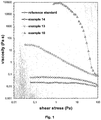
- Figure 1 shows how zero-shear viscosity ranges from 0,01 Pa*s to 100.000 Pa*s by increasing cross-link degree, and how qualitative and quantitative changes occurred on rheological properties over the wide shear stress range.
- Compounds having a low cross-linking degree behave like solutions while the more crosslinked they are, the more plastic they become. Infact, their profiles range from close to Newtonian to apparently plastic behaviour, characterized by a dramatic viscosity drop of many orders of magnitude over a narrow shear stress range.
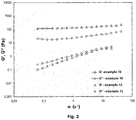
- Figure 2 shows the mechanical spectra of different systems. No mechanical spectra could be recorded for the compounds having the lowest crosslinking degree indicated as reference and example 14, since a linear viscoelasticity field could not be recognised.
Landscapes
- Chemical & Material Sciences (AREA)
- Health & Medical Sciences (AREA)
- Life Sciences & Earth Sciences (AREA)
- Medicinal Chemistry (AREA)
- Polymers & Plastics (AREA)
- Engineering & Computer Science (AREA)
- Biochemistry (AREA)
- Materials Engineering (AREA)
- Chemical Kinetics & Catalysis (AREA)
- Organic Chemistry (AREA)
- General Health & Medical Sciences (AREA)
- Molecular Biology (AREA)
- Inorganic Chemistry (AREA)
- Emergency Medicine (AREA)
- Pharmacology & Pharmacy (AREA)
- Epidemiology (AREA)
- Animal Behavior & Ethology (AREA)
- Public Health (AREA)
- Veterinary Medicine (AREA)
- Polysaccharides And Polysaccharide Derivatives (AREA)
- Materials For Medical Uses (AREA)
- Cosmetics (AREA)
Description
- This invention relates to acid autocrosslinked polysaccharides characterised by the concomitant presence of formate esters, of esters with non-polysaccharide carboxylic acids and of esters between the acid groups of the same polysaccharide and the alcoholic groups of the repetitive units, wherein the starting polysaccharide is a glycosaminoglycan selected from hyaluronan, chondroitin sulphate, heparan sulphate, dermatan sulphate, keratan sulphate.
- In view of their chemico-physical and biological-biochemical characteristics, carboxylated polysaccharides, whether natural or semisynthetic, constitute raw materials of considerable interest for a wide variety of applications in the pharmaceutical and cosmetic industries. Some of them, such as hyaluronic acid (HA), are particularly valued for their high level of biotolerability and hydratability. The choice of material is often connected with cost aspects based on the value and importance of the final application.
- Many structural changes have been made to these polysaccharides in recent years to optimise their characteristics and make them as suitable as possible for the desired applications. These changes usually involve the alcohol groups of the repetitive units, the carboxyl groups and, if present, the amino groups.
- The prior art as a whole describes two specific structural solutions:
- 1) simple monoesterification of the alcoholic hydroxyls of the repetitive polysaccharide units, regardless of their nature and origin, with organic acids, without intermolecular crosslinking;
- 2) formation of autocrosslinking esters between the hydroxyls of the repetitive polysaccharide units and the carboxyls present in the polysaccharide.
-
EP 0941253 describes the synthesis of HA derivatives with butyric anhydride in a basic environment, to obtain a product not crosslinked, having esterified hydroxy groups and which does not undergo any significant modification of its viscoelastic properties in aqueous solution. The process involves the use of the quaternary ammonium salt of HA and dimethylformamide (DMF) as aprotic solvent. - In
EP 341745 EP 341745 - It has now been found that the above-mentioned objectives can be achieved with autocrosslinked polysaccharide derivatives, characterised by the concomitant presence of formate esters, of esters with non-polysaccharide carboxylic acids and of esters between the acid groups of the same polysaccharide and the alcoholic groups of their repetitive units, wherein the starting polysaccharide is a glycosaminoglycan selected from hyaluronan, chondroitin sulphate, heparan sulphate, dermatan sulphate, keratan sulphate. Compounds simultaneously exhibiting the features of esterification to the hydroxyl groups and autocrosslinking have not been disclosed in the prior art.
- The invention relates to natural or semisynthetic derivatives of acid polysaccharides wherein the alcoholic groups of the repetitive units occur, more or less extensively, in the form of esters with non-polysaccharide carboxylic acids, and the uronic acid groups are esterified, to a different extent, with other free alcoholic groups present in the polysaccharide chains. This latter type of bond induces autocrosslinking of the polysaccharide, thus influencing the viscoelastic behaviour of the end products; a suitable choice of acyl residue used to esterify the alcoholic hydroxyls enables other chemico-physical properties, such as hydrophilia/lipophilia and viscosity, to be modulated. The degree of autocrosslinking, which is adjustable and reproducible, influences the characteristics of the final products (rigid gels, weak gels, products with increased viscosity). In view of their chemico-physical and rheological characteristics, the derivatives according to the invention can be used as constituents of medical devices of various grades (I, II and III), such as injectable dermal fillers, post surgical antiadherence materials, devices for healing sores and wounds, etc., in slow-release galenical formulations, etc..
- The rheological tests demonstrate that the derivatives according to the invention possess rheological properties characterised by viscoelastic behaviour which can be modulated according to the degree of autocrosslinking of the system, which ranges from a solution to that characteristic of a strong gel. It was found that the viscosity at low shear rates and the resistance to the force applied could be easily modulated. Finally, it was found that the polymer mixtures of the invention have a good ability to recover their viscoelastic properties after a rheological history of imposed stresses (pseudoplastic properties).
- The invention also relates to the process for the preparation of these derivatives comprising the reaction, in homogenous phase in the protic, polar solvent formamide, of the salt of a monovalent inorganic cation, such as sodium or potassium, of the selected carboxylated polysaccharide with an anhydride of an alkylcarboxylic acid, such as acetic, butyric, isobutyric, valeric, isovaleric or crotonic anhydride, etc., in the presence of a basic catalyst containing an atom of trisubstituted nitrogen, or an inorganic base such sodium or potassium salt of phosphoric acid or a salt of an organic acid with sodium or potassium. The range of the hydroxyl residues involved in ester bonds with the acyl residue deriving from the anhydride is between 0.01 and 0.9xN, where N is the number of hydroxyls in the repetitive unit. Furthermore, the formate ester formed by the formamide hydrolysis in the particular reaction environment may not be higher than 0.2.
- The starting polysaccharides can be in native form or differently modified according to the chemical functions present.
- The advantage of direct use of an inorganic cation salt is obvious because, as described below, it eliminates the need for preliminary transformation of the polysaccharide into the salt of an organic base (such as TBA) soluble in aprotic solvents such as DMF, DMSO, N-methylpyrrolidone, etc., a lengthy, expensive operation which involves the risk of depolymerisation.
- All the tests confirm the modulability and reproducibility of the process according to the invention. Using said process, it is possible to choose which rheological aspect should be given priority in order to obtain products that present a simple increase in their viscosity in solution (low degree of autocrosslinking and different degree of esterification) or derivatives with variable viscoelastic properties ranging from weak gels to strong gels.
- Acid polysaccharides, either in acid form or in the form of their inorganic salts, according to the invention are glycosaminoglycan selected from: hyaluronan, chondroitin sulphate, heparan sulphate, dermatan sulphate, keratan sulphate. Hyaluronic acid is particularly preferred.
- The products according to the invention can be used as moisturising (dermo-)cosmetic agents, medical devices, intra-articular viscosupplementation agents, post surgical anti-adherence filling materials, and materials for covering wounds or sores.
- The products according to the invention can also be advantageously used as a carrier for the controlled release or absorption of active drugs.
- The following examples illustrate the invention in greater detail.
- The 1H NMR analyses are conducted in D2O with a Bruker Advance 400 spectrometer equipped with a 5 mm multinuclear probe with gradient z, at 300 K. The analyses also use diffusion-ordered experiments (DOSY: Diffusion Ordered Spectroscopy).
- The rheological tests were performed with a Rheostress Haake RS150 controlled-stress rotational rheometer.
- The determination of the percentage of ester groups of the polysaccharide alcoholic hydroxyls with the various non-polysaccharide carboxylic acids (DE) and with the polysaccharide carboxyls (AUC) was expressed as the molar ratio between the moles of ester and polysaccharide by means of 1H NMR spectroscopic analysis.
- A sample of esterified, cross-linked polysaccharide swollen in formamide containing excess propylamine is left under magnetic stirring at ambient temperature for 16 hours. The polysaccharide is recovered by precipitation in acetone, washed with acetone and dried. The solid is analysed by 1H NMR. The acylation reaction of the amine with carboxyl esters (Michael B. Smith and Jerry March - March's Advanced Organic Chemistry, 5th ed., Wiley Interscience, page 510) is exploited to determine the esters previously used in the crosslinking; this methodology is selective, because the bland conditions used only involve unstable esters. The esters to the hydroxyls are analysed, again with 1H NMR, exploiting the different resonance of the methyls and methylenes of the acyl residues bonded to the hydroxyls compared with the other polymer signals. These analysis are performed after addition of few microliters of a NaOD solution directly inside the NMR tube containing the swollen gel in D2O thus inducing full hydrolysis of both the crosslink esters and the esters with the non-saccharide acids.
- The following examples describe the details of the synthesis of some acid autocrosslinked polysaccharides according to the invention.
- 1.00 g of hyaluronic acid in the form of sodium salt, with a molecular weight of approx. 300 kD, equal to 2.49 mmols of monomer units, was dissolved in 33 mL of formamide at 95°C, under nitrogen flow, with mechanical stirring. The solution was then cooled to room temperature, and 352 µL of acetic anhydride (3.73 mmols) and 312 µL of triethylamine (2.24 mmols) were added. After 16 hours reaction, a further 521 µL of triethylamine (3.74 mmols) was added, and the system was left to stir for another 6 hours.
- The gel was then transferred, slowly and under constant agitation, into 100 mL of an 0.2 M solution of NaCl, transferred to a dialysis membrane (cut-off 12,000 D) and dialysed, firstly against 0.2 M NaCl and secondly against demineralised water. Finally, it was frozen and freeze-dried.
- 0.94 g of white lyophilisate was obtained.
- The product, analysed in accordance with the method described above, presented AUC: 0.07; DE: 0.19 (acetate), 0.12 (formate).
- 1.00 g of hyaluronic acid in the form of sodium salt, with a molecular weight of approx. 300 kD, equal to 2.49 mmols of monomer units, was dissolved in 33 mL of formamide at 80°C, under nitrogen flow, with mechanical agitation. The solution was then cooled to ambient temperature, and 235 µL of acetic anhydride (2.49 mmols) and 311 µL of triethylamine (2.23 mmols) were added. After 16 hours, a further 320 µL of triethylamine (2.29 mmols) was added, and the system was left to stir for further 6 hours.
- The gel was then transferred, slowly and under constant agitation, into 70 mL of an 0.2 M solution of NaCl, and neutralised with KH2PO4. After approx. 16 hours' agitation, the system was transferred to a dialysis membrane (cut-off 12000 D) and dialysed, firstly against 0.2 M NaCl and secondly against demineralised water. Finally, it was frozen and freeze-dried.
- 0.9 g of white lyophilisate was obtained.
- The product, analysed in accordance with the method described above, presented AUC: 0.05; DE: 0.16 (acetate), 0.01 (formate).
- 1.00 g of hyaluronic acid in the form of sodium salt, with a molecular weight of approx. 300 kD, equal to 2.49 mmols of monomer units, was dissolved in 33 mL of formamide at 95°C, under nitrogen flow, with mechanical agitation. The solution was then cooled to ambient temperature, and 235 µL of acetic anhydride (2.49 mmols) and 277 µL of triethylamine (1.99 mmols) were added. After 16 hours' reaction, a further 417 µL of triethylamine (3.00 mmols) was added, and the system was left to stir for another 6 hours.
- The gel was then transferred, slowly and under constant agitation, into 70 mL of an 0.2 M solution of NaCl, and then to a dialysis membrane (cut-off 12000 D) and dialysed, firstly against 0.2 M NaCl and secondly against demineralised water. Finally, it was frozen and freeze-dried.
- 0.98 g of white lyophilisate was obtained.
- The product, analysed in accordance with the method described above, presented AUC: 0.05; DE: 0.15 (acetate), 0.05 (formate).
- 1.02 g of hyaluronic acid in the form of sodium salt, with a molecular weight of approx. 300 kD, equal to 2.54 mmols of monomer units, was dissolved in 33 mL of formamide at 95°C, under nitrogen flow, with mechanical agitation. The solution was then cooled to ambient temperature, and 120 µL of acetic anhydride (1.27 mmols) and 140 µL of triethylamine (1.01 mmols) were added. After 22 hours a further 140 µL of triethylamine (1.01 mmols) was added, and the gelatinous mass obtained was left to stir for further 6 hours.
- The reaction mixture was then transferred into 100 mL of an 0.2 M solution of NaCl, poured into a dialysis membrane (cut-off 12,000 D) and dialysed, firstly against an 0.2 M solution of NaCl and secondly against demineralised water. Finally, the sample was frozen and freeze-dried, and 1.00 g of white lyophilisate was obtained.
- The product, analysed in accordance with the method described above, presented AUC: 0.03; DE: 0.12 (acetate), 0.03 (formate).
- 1.00 g of hyaluronic acid in the form of sodium salt, with a molecular weight of approx. 300 kD, equal to 2.49 mmols of monomer units, was dissolved in 33 mL of formamide at 95°C, under nitrogen flow, with mechanical agitation. The solution was then cooled to ambient temperature, and 82 µL of acetic anhydride (0.87 mmols) and 87 µL of triethylamine (0.63 mmols) were added. After 19 hours a further 348 µL of triethylamine (2.52 mmols) was added, and the gelatinous mass obtained was left to stir for further 6 hours.
- The reaction mixture was then transferred into 100 mL of demineralised water, poured into a dialysis membrane (cut-off 12000 D) and dialysed, firstly against an 0.2 M solution of NaCl and secondly against demineralised water. Finally, the sample was frozen and freeze-dried, and 0.89 g of white lyophilisate was obtained.
- The product, analysed in accordance with the method described above, presented AUC: 0.01; DE: 0.05 (acetate), 0.01 (formate).
- 2.00 g of hyaluronic acid in the form of sodium salt, with a molecular weight of approx. 300 kD, equal to 4.99 mmols of monomer units, was solubilised in 67 mL of formamide at 80°C, under nitrogen flow, with mechanical agitation. The solution was then cooled to ambient temperature, and 710 µL of acetic anhydride (7.52 mmols) and 970 µL of triethylamine (6.97 mmols) were added.
- After 2 hours 30 minutes the gel was transferred into 350 mL of an 0.2 M solution of NaCl, and the mixture was transferred to a dialysis membrane (cut-off 12000 D) and dialysed, firstly against 0.2 M NaCl and then exhaustively against demineralised water. Finally, the sample was frozen and freeze-dried, and 2.10 g of white lyophilisate was obtained.
- The product, analysed in accordance with the method described above, presented AUC: 0.03; DE: 0.08. (acetate), 0.18 (formate).
- 1.01 g of hyaluronic acid in the form of sodium salt, with a molecular weight of approx. 300 kD, equal to 2.49 mmols of monomer units, was dissolved in 33 mL of formamide at 95°C, under nitrogen flow, with mechanical agitation. The solution was then cooled to ambient temperature, and 240 µL of acetic anhydride (2.54 mmols) and a solution of 0.28 g of dimethylaminopyridine (2.29 mmols), dissolved in 2 mL of formamide, were added. After 19 hours, a further 0.56 g of dimethylaminopyridine (4.58 mmols), dissolved in 4 mL of formamide, was added, and the system was stirred for further 5 hours.
- The gel was then transferred, slowly and under constant agitation, into 150 mL of an 0.2 M solution of NaCl, and neutralised with KH2PO4. It was then transferred to a dialysis membrane (cut-off 12000 D) and dialysed, firstly against 0.2 M NaCl and secondly against demineralised water. Finally, it was frozen and freeze-dried.
- 1.09 g of white lyophilisate was obtained.
- The product, analysed in accordance with the method described above, presented AUC: 0.03; DE: 0.23 (acetate), 0.19 (formate).
- 1.02 g of hyaluronic acid in the form of sodium salt, with a molecular weight of approx. 300 kD, equal to 2.54 mmols of monomer units, was dissolved in 33 mL of formamide at 95°C, under nitrogen flow, with mechanical agitation. The solution was then cooled to ambient temperature, and 330 µL of propionic anhydride (2.57 mmols) and 320 µL of triethylamine (2.30 mmols) were added.
- The reaction mixture was then maintained under agitation for approximately 3 hours, and a further 320 µL of triethylamine (2.30 mmols) was added. After 2 hours, the gel was transferred into 100 mL of demineralised water and neutralised with KH2PO4. It was then transferred to a dialysis membrane (cut-off 12000 D) and dialysed, firstly against 0.2 M NaCl and secondly against demineralised water.
- Finally, the sample was frozen and freeze-dried, and 0.96 g of white lyophilisate was obtained.
- The product, analysed in accordance with the method described above, presented AUC: 0.05; DE: 0.06 (propionate), 0.07 (formate).
- 1.00 g of hyaluronic acid in the form of sodium salt, with a molecular weight of approx. 300 kD, equal to 2.52 mmols of monomer units, was dissolved in 33 mL of formamide at 95°C, under nitrogen flow, with mechanical agitation. The solution was then cooled to ambient temperature, and 610 µL of butyric anhydride (3.73 mmols) and 310 µL of triethylamine (2.23 mmols) were added.
- The reaction mixture was then maintained under agitation for approximately 20 hours, and a further 550 µL of triethylamine (3.95 mmols) was added. After 6 hours, the gel was transferred into 150 mL of ultrapure water, transferred to a dialysis membrane (cut-off 12000 D) and dialysed, firstly against 0.2 M NaCl and secondly against ultrapure water.
- Finally, the sample was frozen and freeze-dried, and 0.95 g of white lyophilisate was obtained.
- The product, analysed in accordance with the method described above, presented AUC: 0.06; DE: 0.18 (butyrate), 0.08 (formate).
- 1.01 g of hyaluronic acid in the form of sodium salt, with a molecular weight of approx. 300 kD, equal to 2.52 mmols of monomer units, was dissolved in 33 mL of formamide at 95°C, under nitrogen flow, with mechanical agitation. The solution was then cooled to ambient temperature, and 490 µL of butyric anhydride (3.00 mmols) and 280 µL of triethylamine (2.01 mmols) were added.
- The reaction mixture was then maintained under agitation for approximately 5 hours, and a further 280 µL of triethylamine (2.01 mmols) was added. After 16 hours, the gel was transferred into 150 mL of ultrapure water, transferred to a dialysis membrane (cut-off 12000 D) and dialysed, firstly against 0.2 M NaCl and secondly against ultrapure water.
- Finally, the sample was frozen and freeze-dried, and 1.00 g of white lyophilisate was obtained.
- The product, analysed in accordance with the method described above, presented AUC: 0.05; DE: 0.15 (butyrate), 0.15 (formate).
- 1.00 g of hyaluronic acid in the form of sodium salt, with a molecular weight of approx. 300 kD, equal to 2.49 mmols of monomer units, was dissolved in 33 mL of formamide at 80°C, under nitrogen flow, with mechanical agitation. The solution was then cooled to ambient temperature, and 360 µL of butyric anhydride (2.20 mmols) and 311 µL of triethylamine (2.23 mmols) were added.
- The reaction mixture was then maintained under agitation for approximately 16 hours, and a further 311 µL of triethylamine (2.23 mmols) was added. After 6 hours 30 minutes the gel was transferred into approx. 40 mL of an 0.2 M solution of NaCl, transferred to a dialysis membrane (cut-off 12000 D), and exhaustively dialysed against demineralised water. Finally, the sample was frozen and freeze-dried, and 0.90 g of white lyophilisate was obtained.
- The product, analysed in accordance with the method described above, presented AUC: 0.03; DE: 0.08 (butyrate), 0.02 (formate).
- 1.00 g of hyaluronic acid in the form of sodium salt, with a molecular weight of approx. 300 kD, equal to 2.52 mmols of monomer units, was dissolved in 33 mL of formamide at 95°C, under nitrogen flow, with mechanical agitation. The solution was then cooled to ambient temperature, and 244 µL of butyric anhydride (1.49 mmols) and 173 µL of triethylamine (1.24 mmols) were added.
- The reaction mixture was then maintained under agitation for approximately 16 hours, and a further 208 µL of triethylamine (1.49 mmols) was added. After 6 hours, the gel was transferred into 100 mL of ultrapure water, transferred to a dialysis membrane (cut-off 12000 D) and dialysed, firstly against 0.2 M NaCl and secondly against ultrapure water.
- Finally, the sample was frozen and freeze-dried, and 0.95 g of white lyophilisate was obtained.
- The product, analysed in accordance with the method described above, presented AUC: 0.03; DE: 0.1 (butyrate), 0.08 (formate).
- 1.00 g of hyaluronic acid in the form of sodium salt, with a molecular weight of approx. 300 kD, equal to 2.49 mmols of monomer units, was dissolved in 33 mL of formamide at 95°C, under nitrogen flow, with mechanical stirring. The solution was then cooled to ambient temperature, and 210 µL of butyric anhydride (1.28 mmols) and 140 µL of triethylamine (1.0 mmols) were added.
- The reaction mixture was then maintained under agitation for 17 hours, and a further 320 µL of triethylamine (3.00 mmols) was added. After 6 hours 30 minutes the gel was transferred into 150 mL of ultrapure water, transferred to a dialysis membrane (cut-off 12000 D) and dialysed, firstly against 0.2 M NaCl and secondly against ultrapure water.
- Finally, the sample was frozen and freeze-dried, and 0.99 g of white lyophilisate was obtained.
- The product, analysed in accordance with the method described above, presented AUC: 0.02; DE: 0.06 (butyrate), 0.05 (formate).
- 1.01 g of hyaluronic acid in the form of sodium salt, with a molecular weight of approx. 300 kD, equal to 2.52 mmols of monomer units, was dissolved in 33 mL of formamide at 95°C, under nitrogen flow, with mechanical agitation. The solution was then cooled to ambient temperature, and 125 µL of butyric anhydride (0.76 mmols) and 75 µL of triethylamine (0.5 mmols) were added.
- The reaction mixture was then maintained under agitation for 18 hours, and a further 740 µL of triethylamine (5.32 mmols) was added. After 6 hours, the system was transferred into 200 mL of demineralised water, neutralised with KH2PO4, transferred to a dialysis membrane (cut-off 12000 D) and dialysed, firstly against 0.2 M NaCl and secondly against water.
- Finally, the sample was frozen and freeze-dried, and 0.82 g of white lyophilisate was obtained.
- The product, analysed in accordance with the method described above, presented AUC: 0.01; DE: 0.06 (butyrate), 0.02 (formate).
- 1.65 g of hyaluronic acid in the form of sodium salt, injection grade, with a molecular weight of approx. 500 kD, equal to 4.11 mmols of monomer units, was dissolved in 33 mL of formamide at 95°C, under nitrogen flow, with mechanical stirring. The solution was then cooled to room temperature and 670 µL of butyric anhydride (4.1 mmols) were added.
- The reaction mixture was then maintained under mechanical stirring for approximately 30 minutes, and 2 ml of a formamide solution containing 1.21 g of potassium acetate (12.3 mmols) were added. After 16 hours, the gel was transferred into 200 mL of ultrapure water, transferred to a dialysis membrane (cut-off 12000 D) and dialysed, firstly against 0.2 M NaCl and secondly against ultrapure water.
- All the reaction and purification equipment was confined under a vertical laminar flow cabinet to prevent contamination. The glassware and the water were pyrogen free.
- Finally, the sample was frozen and freeze-dried, and 1.60 g of white lyophilisate was obtained.
- The product, analysed in accordance with the method described above, presented AUC: 0.03; DE: 0.12 (butyrate), 0.14 (acetate), 0.06 (formate).
- 0.50 g of hyaluronic acid butyrate in the form of sodium salt (degree of butyration, namely moles of butyric groups on moles of polysaccharide, equal to approx. 0.54, MW=439 g/mol, 1.14 mmols) was dissolved in 17 mL of formamide at 60°C, under nitrogen flow and with mechanical agitation. The solution was then cooled to ambient temperature, and 186 µL of butyric anhydride (1.14 mmols) and 143 µL of triethylamine (1.03 mmols) were added.
- The reaction mixture was then maintained under agitation for 19 hours, and a further 143 µL of triethylamine (1.03 mmols) was added. After 4½ hours the system was transferred into 100 mL of an 0.2 M solution of NaCl, and neutralised with KH2PO4. It was then transferred to a dialysis membrane (cut-off 12000 D) and dialysed, firstly against 0.2 M NaCl and secondly against demineralised water.
- Finally, the sample was frozen and freeze-dried, and 0.45 g of white lyophilisate was obtained.
- The product, analysed in accordance with the method described above, presented AUC: 0.03; DE: 0.55 (butyrate), 0.15 (formate).
- 1.02 g of hyaluronic acid in the form of sodium salt, with a molecular weight of approx. 300 kD, equal to 2.54 mmols of monomer units, was dissolved in 32 mL of formamide at 95°C, under nitrogen flow, with mechanical agitation. The solution was then cooled to ambient temperature, and 380 µL of crotonic anhydride (2.56 mmols) and 320 µL of triethylamine (2.30 mmols) were added.
- The reaction mixture was maintained under agitation for 18 hours, and a further 320 µL of triethylamine (2.30 mmols) was added. After 7 hours 30 minutes the gel was transferred into 150 mL of ultrapure water, transferred to a dialysis membrane (cut-off 12000 D) and dialysed, firstly against an aqueous solution of 0.2 M NaCl and secondly against ultrapure water.
- Finally, the sample was frozen and recovered by freeze-drying.
- 0.45 g of white lyophilisate was obtained.
- The product, analysed in accordance with the method described above, presented AUC: 0.05; DE: 0.08 (crotonate), 0.10 (formate).
- 0.48 g of hyaluronic acid in the form of sodium salt, with a molecular weight of approx. 300 kD, equal to 1.21 mmols of monomer units, was dissolved in 16 mL of formamide at 95°C, under nitrogen flow, with mechanical agitation. The solution was then cooled to ambient temperature, and 240 µL of isovaleric anhydride (1.20 mmols) and 150 µL of triethylamine (1.08 mmols) were added.
- The reaction mixture was maintained under agitation for 16 hours, and a further 167 µL of triethylamine (1.20 mmols) was added. After 6 hours, the gel was transferred into 100 mL of demineralised water and neutralised with KH2PO4, and 2.5 g of NaCl was added. It was then transferred to a dialysis membrane (cut-off 12000 D) and dialysed against water.
- Finally, the sample was frozen and recovered by freeze-drying.
- 0.89 g of white lyophilisate was obtained.
- The product, analysed in accordance with the method described above, presented AUC: 0.03; DE: 0.08 (isovalerate), 0.02 (formate).
- 30 mg of the liophylised autocrosslinked polymer, as obtained according to Example 15, were weighted in a 2.0 ml syringe and 1.47g of a water solution containing 0.9% (w/V) sodium chloride were added. All the experimental procedures were conducted under a vertical laminar flow cabinet using pyrogen free materials; the above mentioned physiological solution was prepared using pyrogen free water. The polymer was left to swell for 24 hours at room temperature. Finally the syringe was sterilized by means of a standard thermal cycle ad 121°C for 16 minutes.
- Rheological studies highlight how polymeric systems examined exhibit a wide variety of rheological behaviours depending on the cross-linking density of the network. Indeed for different system reticulation degree, low shear viscosity differs of many decades, and flow curves dramatically vary from a viscous liquid to an elastic solid profile. Further viscoelastic behaviour ranges from solution-like to strong-gel-like confirming the properties variability of products object of the present invention.
- For rheological measurements we used a controlled stress rheometer, a mechanical spectrometer capable of subjecting a sample to either a dynamic (sinusoidal) or steady (linear) shear stress.
- A magnetic field generates a torque on the upper mobile measurement sensor, air-bearing supported, that converts in stress applied on the sample. At the same time, the resultant rotational degree and speed of the mobile measurement system are detected by an optical laser system, and thus the strain expended by the sample in response to the shear stress, and the shear rate are estimated.
- The rheometer used was a Rheostress Haake RS150, equipped with rough or smooth surfaces sensors useful for all types of measurements in rotation and oscillation, respectively for high or low structured systems. All measurements were done at 25°C, using a specific thermocontroller.
- Three types of measurements were done in order to characterize the products according to the invention:
- flow curves: continuous/steady state measurements of viscosity over a wide range of shear rate or shear stress;
- stress and frequency sweep: dynamic measurements (oscillation) for the determination of samples viscoelastic behaviour. In particular stress sweep is done in order to individuate the linear viscoelastic range extension, and thus the critical strain value for the linear/non linear transition. Frequency sweep gives systems' mechanical spectra, that are the storage modulus G' and the loss modulus G" profiles over a wide range of frequency, in the linear viscoelasticity field.
- recovery sweep: to evaluate the viscoelastic properties recovery of a sample undergone a certain rheological history: three measurement cycles are applied, each one composed by oscillatory steps, under constant amplitude and frequency of strain, before and after the application of a constant shear rate (respectively 100s-1, 100s-1, 500s-1 during each cycle)
- The tests were conducted on samples swollen in saline at the concentration of 1 % w/w.
- Examples of flow curves and mechanical spectra, in
figure 2 , of a hyaluronan butyrate esters family inphysiological solution 1% w/w, with different cross-linking degree, prepared as described in examples 10, 13, 14 and of the reference standard (HA sodium salt, Mw = 300kDa) are shown inFigures 1 and2 , respectively. -
Figure 1 shows how zero-shear viscosity ranges from 0,01 Pa*s to 100.000 Pa*s by increasing cross-link degree, and how qualitative and quantitative changes occurred on rheological properties over the wide shear stress range. Compounds having a low cross-linking degree behave like solutions while the more crosslinked they are, the more plastic they become. Infact, their profiles range from close to Newtonian to apparently plastic behaviour, characterized by a dramatic viscosity drop of many orders of magnitude over a narrow shear stress range. -
Figure 2 shows the mechanical spectra of different systems. No mechanical spectra could be recorded for the compounds having the lowest crosslinking degree indicated as reference and example 14, since a linear viscoelasticity field could not be recognised. - As to the other two compounds, it is possible to observe the transition from a solution behaviour to a strong gel profile. Solutions show a viscous modulus (G") higher than the elastic one (G') at low frequencies, while, as the frequency are increased, a module cross-over that takes. Strong gels show a storage modulus higher than the viscous one over the whole experimental range of frequencies. The more structured the systems are, the higher the module values are.
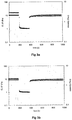
- The behaviour of compounds described in example 13 is shown during a recovery test in
figures 3a, 3b ,3c : it is possible to observe a complete recovery of both elastic and viscous components in each step. - These studies proved that some representative derivatives according to the invention, submitted to rheological characterization, exhibit different viscoelastic behaviours depending on cross-linking degree, ranging from a viscous solution to a strong gel-like behaviour. Furthermore, it was demonstrated the high capacity in recovering viscoelastic properties after a complete rheological working schedule applied.
- All experimental results confirm the great flexibility and reproducibility of the process of the invention for the synthesis of the claimed compounds.
- The results of the rheological characterisation of some samples representative of the products obtained are set out in Table 1.
Example no. Shear viscosity η0 [Pa.s] Shear viscosity ηat shear rate 700s-1 [Pa.s] Storage modules G' at 1Hz [Pa] Loss modules G" at 1Hz [Pa] D.S. ester D.S. Links linear native 0.1 0.05 np np 0 0 linear butyrate ester 0.008 0.007 np np 0.07 0 4 10.000,0 0.09 60 21 0.12 0.03 5 0.9 0.05 0.8 1.8 0.05 0.01 6 8.000,0 0.2 32 12 0.08 0.03 10 87.000,0 0.10 165 38 0.15 0.05 13 30.0 0.07 3.1 3.3 0.06 0.02 14 0.06 0.01 np np 0.06 0.01 15(1) 180.000,0 15 777.3 173.8 0.06 0.01 (1) The gel was swollen in a 0.9% NaCl at pH=5.5 water solution; the polymer concentration was 2% w/w.
Claims (11)
- Acid autocrosslinked polysaccharides, characterised by the concomitant presence of formate esters, of esters with non-polysaccharide carboxylic acids and of esters between the acid groups of the same polysaccharide and the alcoholic groups of the repetitive units, wherein the starting polysaccharide is a glycosaminoglycan selected from hyaluronan, chondroitin sulphate, heparan sulphate, dermatan sulphate, keratan sulphate.
- Acid autocrosslinked polysaccharides as claimed in claim 1, wherein the carboxyl functions are present in acid or salified form.
- Acid autocrosslinked polysaccharides as claimed in claim 2, wherein the carboxyl functions are salified with alkaline metals.
- Acid autocrosslinked polysaccharides as claimed in any of claims 1 to 3, in which the non polysaccharide carboxylic acid is chosen in the group of acetic, propionic, butyric, isobutyric, valeric, isovaleric and crotonic (group A) and formic acid.
- Acid autocrosslinked polysaccharides as claimed in any of claims 1 to 4, wherein the esters of acids of group A on the hydroxyls present a degree of substitution ranging between 0.01 and 0.9xN, where N is the number of hydroxyls present in the repetitive unit, whereas the formate ester is not higher than 0.2.
- Acid autocrosslinked polysaccharides as claimed in claim 5, wherein the esters of the group A on the hydroxyls present a degree of substitution ranging between 0.01 and 0.5 in relation to the repetitive unit.
- Process for the preparation of the acid autocrosslinked polysaccharides as described in claims 1-6, which comprises the following steps:a) heating solubilisation of the carboxylated polysaccharide in formamide;b) addition of an anhydride of the non-polysaccharide acid at room temperature for a time comprised between 10 minutes and 2 hours;c) addition of the base and allow to react at room temperature for a period between 4 hours and 24 hours;d) addition of a water solution of sodium chloride and neutralisation to a pH between 6 and 7.5;e) purification of the reaction mixture by means of dialyses ;f) recovery of the polymer by means of lyofilization.
- Process as claimed in claim 7, wherein the anhydride is the anhydride chosen from the acetic, propionic, butyric, isobutyric, valeric, isovaleric and crotonic.
- Process as claimed in any of claims 7 to 8, wherein the base is chosen among an organic base containing an atom of trisubstituted nitrogen, an inorganic base, a salt of an organic acid with sodium and potassium.
- Process for the preparation of the acid autocrosslinked polysaccharides as described in claim 7, wherein the formate ester is formed from the hydrolysis of formamide in the presence of one of the anhydrides as described in claim 8 and one of the bases as described in claim 9.
- Polysaccharides as claimed in claims 1-6 for use as medical devices, moisturising agents, intra-articular viscosupplementation agents, anti-tissue adherence filling materials in surgery, and materials for covering wounds and sores.
Priority Applications (2)
| Application Number | Priority Date | Filing Date | Title |
|---|---|---|---|
| PL07859095T PL2097457T3 (en) | 2006-12-29 | 2007-12-18 | Derivatives of acid polysaccharides |
| EP07859095.7A EP2097457B1 (en) | 2006-12-29 | 2007-12-18 | Derivatives of acid polysaccharides |
Applications Claiming Priority (3)
| Application Number | Priority Date | Filing Date | Title |
|---|---|---|---|
| EP06425874A EP1942117A1 (en) | 2006-12-29 | 2006-12-29 | Derivatives of acid polysaccharides |
| EP07859095.7A EP2097457B1 (en) | 2006-12-29 | 2007-12-18 | Derivatives of acid polysaccharides |
| PCT/IB2007/003973 WO2008081255A1 (en) | 2006-12-29 | 2007-12-18 | Derivatives of acid polysaccharides |
Publications (2)
| Publication Number | Publication Date |
|---|---|
| EP2097457A1 EP2097457A1 (en) | 2009-09-09 |
| EP2097457B1 true EP2097457B1 (en) | 2017-07-12 |
Family
ID=37904391
Family Applications (2)
| Application Number | Title | Priority Date | Filing Date |
|---|---|---|---|
| EP06425874A Withdrawn EP1942117A1 (en) | 2006-12-29 | 2006-12-29 | Derivatives of acid polysaccharides |
| EP07859095.7A Active EP2097457B1 (en) | 2006-12-29 | 2007-12-18 | Derivatives of acid polysaccharides |
Family Applications Before (1)
| Application Number | Title | Priority Date | Filing Date |
|---|---|---|---|
| EP06425874A Withdrawn EP1942117A1 (en) | 2006-12-29 | 2006-12-29 | Derivatives of acid polysaccharides |
Country Status (9)
| Country | Link |
|---|---|
| US (1) | US8247546B2 (en) |
| EP (2) | EP1942117A1 (en) |
| JP (1) | JP5372773B2 (en) |
| AU (1) | AU2007341078B2 (en) |
| CA (1) | CA2673947C (en) |
| ES (1) | ES2633712T3 (en) |
| PL (1) | PL2097457T3 (en) |
| PT (1) | PT2097457T (en) |
| WO (1) | WO2008081255A1 (en) |
Families Citing this family (19)
| Publication number | Priority date | Publication date | Assignee | Title |
|---|---|---|---|---|
| ITMI20072237A1 (en) * | 2007-11-27 | 2009-05-28 | Sigea Srl | MIXED BUTIRRIC-FORMAL ESTERS OF ACID POLYSACCHARIDES, THEIR PREPARATION AND USE AS DERMOCOSMETICS |
| KR101078302B1 (en) * | 2008-05-29 | 2011-10-31 | (주)프로넥스 | Drug Delivery System |
| ITTO20110428A1 (en) * | 2011-05-13 | 2012-11-14 | Rottapharm Spa | ESTERS OF HYALURONIC ACID, THEIR PREPARATION AND USE IN DERMATOLOGY |
| FR2983483B1 (en) * | 2011-12-02 | 2014-11-14 | Vivacy Lab | PROCESS FOR SIMULTANEOUS SUBSTITUTION AND RETICULATION OF A POLYSACCHARIDE VIA ITS HYDROXYL FUNCTIONS |
| CZ2012842A3 (en) | 2012-11-27 | 2014-08-20 | Contipro Biotech S.R.O. | C6-C18-acylated hyaluronate-based nanomicellar composition, process for preparing C6-C18-acylated hyaluronate, process for preparing nanomicellar composition and stabilized nanomicellar composition as well as use thereof |
| CZ2013914A3 (en) | 2013-11-21 | 2015-02-25 | Contipro Biotech S.R.O. | Nanofibers containing photocurable ester derivative of hyaluronic acid or its salt, photocured nanofibers, method of their synthesis, preparation containing photo-hardened nanofibers and their use |
| CZ2014150A3 (en) | 2014-03-11 | 2015-05-20 | Contipro Biotech S.R.O. | Conjugates of hyaluronic acid oligomer or salts thereof, process of their preparation and use |
| CZ2014451A3 (en) | 2014-06-30 | 2016-01-13 | Contipro Pharma A.S. | Antitumor composition based on hyaluronic acid and inorganic nanoparticles, process of its preparation and use |
| ES2704290T3 (en) * | 2015-01-13 | 2019-03-15 | Bmg Pharma S P A | Water process for the preparation of butyral esters of sodium salt of hyaluronic acid |
| CZ309295B6 (en) | 2015-03-09 | 2022-08-10 | Contipro A.S. | Self-supporting, biodegradable film based on hydrophobized hyaluronic acid, method of its preparation and use |
| CZ306479B6 (en) | 2015-06-15 | 2017-02-08 | Contipro A.S. | A method of crosslinking polysaccharides by using photolabile protecting groups |
| CZ306662B6 (en) | 2015-06-26 | 2017-04-26 | Contipro A.S. | Sulphated polysaccharides derivatives, the method of their preparation, the method of their modification and the use |
| CZ308106B6 (en) | 2016-06-27 | 2020-01-08 | Contipro A.S. | Unsaturated derivatives of polysaccharides, their preparation and their use |
| IL269506B2 (en) | 2017-03-22 | 2024-04-01 | Genentech Inc | Hyaluronic acid cross-linked hydrogel preparations and methods |
| CN110732037B (en) | 2018-07-20 | 2023-05-26 | 广州倍绣生物技术有限公司 | Hemostatic paste and preparation method thereof |
| CN110467691A (en) * | 2019-09-23 | 2019-11-19 | 山东银河生物科技有限公司 | A method of preparing acetylation hyaluronic acid |
| IT201900021693A1 (en) * | 2019-11-20 | 2021-05-20 | Bmg Pharma S P A | BUTYRATED OR BUTYRATED DERIVATIVES AND FORMS OF CROSS-LINKED HYALURONIC ACID AND THEIR CROSS-LINKING PROCEDURE |
| CN110981991B (en) * | 2019-12-24 | 2021-12-07 | 江苏诚信药业有限公司 | Preparation method of acetylated hyaluronate |
| CN113121721B (en) * | 2021-04-21 | 2022-02-15 | 山东焦点福瑞达生物股份有限公司 | Preparation method of acetylated sodium hyaluronate |
Family Cites Families (14)
| Publication number | Priority date | Publication date | Assignee | Title |
|---|---|---|---|---|
| US2589226A (en) * | 1946-11-22 | 1952-03-18 | Us Agriculture | Acylation of polysaccharides in formamide |
| US3758577A (en) * | 1971-11-01 | 1973-09-11 | Goodrich Co B F | Stabilization of dimethylformamide |
| JPS51149883A (en) * | 1975-06-19 | 1976-12-23 | Sumitomo Chem Co Ltd | Hydrophilic gel |
| US4152170A (en) | 1975-06-18 | 1979-05-01 | Sumitomo Chemical Company, Ltd. | Cross-linked pullulan |
| EP0091159B1 (en) * | 1982-04-02 | 1985-09-11 | Unilever N.V. | Process for preparing sugar acetates |
| IT1198449B (en) * | 1986-10-13 | 1988-12-21 | F I D I Farmaceutici Italiani | ESTERS OF POLYVALENT ALCOHOLS OF HYALURONIC ACID |
| IT1219587B (en) * | 1988-05-13 | 1990-05-18 | Fidia Farmaceutici | SELF-CROSS-LINKED CARBOXYLY POLYSACCHARIDES |
| US5221739A (en) * | 1992-01-09 | 1993-06-22 | Eli Lilly And Company | Acetylation of 3-hydroxymethyl cephalosporins |
| FR2752843B1 (en) * | 1996-08-30 | 1998-10-16 | Sod Conseils Rech Applic | CROSSLINKED COPOLYMERS BASED ON POLYCARBOXYLIC POLYMERS AND THEIR USE AS SUPPORTS OF PHARMACEUTICAL COMPOSITIONS |
| IT1286510B1 (en) * | 1996-11-29 | 1998-07-15 | Cooperativa Centro Ricerche Po | BUTYRIC ESTERS WITH ANTI-PROLIFERATIVE ACTIVITY AND PHARMACEUTICAL COMPOSITIONS THAT CONTAIN THEM |
| US6410044B1 (en) * | 1998-03-19 | 2002-06-25 | Surmodics, Inc. | Crosslinkable macromers |
| US6007833A (en) * | 1998-03-19 | 1999-12-28 | Surmodics, Inc. | Crosslinkable macromers bearing initiator groups |
| IT1306643B1 (en) * | 1999-04-08 | 2001-10-02 | Fidia Advanced Biopolymers Srl | PROCESS FOR THE PREPARATION OF SELF-CROSS-LINKED COMPOUNDS OF Hyaluronic Acid and ITS DERIVATIVES OBTAINABLE BY TECHNIQUE |
| ITMI20040605A1 (en) * | 2004-03-29 | 2004-06-29 | Coimex S C R L United Companie | BUTYRICAL ESTERS OF HYALURONIC ACID WITH LOW DEGREE OF SUBSTITUTION PROCEDURE FOR THEIR PREPARATION AND USE |
-
2006
- 2006-12-29 EP EP06425874A patent/EP1942117A1/en not_active Withdrawn
-
2007
- 2007-12-18 JP JP2009543534A patent/JP5372773B2/en active Active
- 2007-12-18 CA CA2673947A patent/CA2673947C/en active Active
- 2007-12-18 WO PCT/IB2007/003973 patent/WO2008081255A1/en not_active Ceased
- 2007-12-18 EP EP07859095.7A patent/EP2097457B1/en active Active
- 2007-12-18 AU AU2007341078A patent/AU2007341078B2/en active Active
- 2007-12-18 ES ES07859095.7T patent/ES2633712T3/en active Active
- 2007-12-18 US US12/521,307 patent/US8247546B2/en active Active
- 2007-12-18 PT PT78590957T patent/PT2097457T/en unknown
- 2007-12-18 PL PL07859095T patent/PL2097457T3/en unknown
Non-Patent Citations (1)
| Title |
|---|
| None * |
Also Published As
| Publication number | Publication date |
|---|---|
| WO2008081255A1 (en) | 2008-07-10 |
| PL2097457T3 (en) | 2017-12-29 |
| US8247546B2 (en) | 2012-08-21 |
| AU2007341078B2 (en) | 2013-03-07 |
| CA2673947C (en) | 2016-02-23 |
| PT2097457T (en) | 2017-07-20 |
| JP2010514878A (en) | 2010-05-06 |
| US20100292459A1 (en) | 2010-11-18 |
| ES2633712T3 (en) | 2017-09-25 |
| JP5372773B2 (en) | 2013-12-18 |
| AU2007341078A1 (en) | 2008-07-10 |
| CA2673947A1 (en) | 2008-07-10 |
| EP2097457A1 (en) | 2009-09-09 |
| EP1942117A1 (en) | 2008-07-09 |
Similar Documents
| Publication | Publication Date | Title |
|---|---|---|
| US8247546B2 (en) | Derivatives of acid polysaccharides | |
| CA2710123C (en) | Polysaccharide derivatives of lipoic acid, and their preparation and use as skin cosmetics and medical devices | |
| Kono et al. | Preparation and characterization of guar gum hydrogels as carrier materials for controlled protein drug delivery | |
| Gómez-Mascaraque et al. | Oxidized dextrins as alternative crosslinking agents for polysaccharides: application to hydrogels of agarose–chitosan | |
| Zieris et al. | Biohybrid networks of selectively desulfated glycosaminoglycans for tunable growth factor delivery | |
| CN107561179B (en) | Method for measuring crosslinking degree of crosslinked hyaluronic acid or salt thereof | |
| JP5372774B2 (en) | Polysaccharide derivatives containing citric acid | |
| CN108264581A (en) | A kind of self-crosslinking Sodium Hyaluronate and preparation method thereof | |
| JP2003252905A (en) | Cross-linked hyaluronic acid | |
| DK3245233T3 (en) | PROCEDURE IN WATER FOR THE PREPARATION OF HYBRID ACID ESTERS OF HYALURONIC ACID SODIUM SALT | |
| JP7747335B2 (en) | Crosslinked hyaluronic acid butyrate or butyrate-formate derivatives and method for crosslinking same | |
| Crescenzi et al. | Case studies of physical and chemical gels based on microbial polysaccharides | |
| Ghosh et al. | Effect of dual crosslinking on physico-chemical properties of hydrogels prepared from chitosan and alginate | |
| ITTS20010016A1 (en) | REGULAR CROSS-LINKED POLYSACCHARIDES. |
Legal Events
| Date | Code | Title | Description |
|---|---|---|---|
| PUAI | Public reference made under article 153(3) epc to a published international application that has entered the european phase |
Free format text: ORIGINAL CODE: 0009012 |
|
| 17P | Request for examination filed |
Effective date: 20090529 |
|
| AK | Designated contracting states |
Kind code of ref document: A1 Designated state(s): AT BE BG CH CY CZ DE DK EE ES FI FR GB GR HU IE IS IT LI LT LU LV MC MT NL PL PT RO SE SI SK TR |
|
| DAX | Request for extension of the european patent (deleted) | ||
| 17Q | First examination report despatched |
Effective date: 20130806 |
|
| REG | Reference to a national code |
Ref country code: DE Ref legal event code: R079 Ref document number: 602007051635 Country of ref document: DE Free format text: PREVIOUS MAIN CLASS: C08B0037080000 Ipc: C08B0011120000 |
|
| GRAP | Despatch of communication of intention to grant a patent |
Free format text: ORIGINAL CODE: EPIDOSNIGR1 |
|
| RIC1 | Information provided on ipc code assigned before grant |
Ipc: C08B 37/02 20060101ALI20160906BHEP Ipc: C08B 37/08 20060101ALI20160906BHEP Ipc: C08B 15/00 20060101ALI20160906BHEP Ipc: C08B 11/12 20060101AFI20160906BHEP Ipc: C08B 37/00 20060101ALI20160906BHEP Ipc: A61K 47/36 20060101ALI20160906BHEP |
|
| INTG | Intention to grant announced |
Effective date: 20160928 |
|
| RIN1 | Information on inventor provided before grant (corrected) |
Inventor name: PICOTTI, FABRIZIO Inventor name: STUCCHI, LUCA Inventor name: BOSCO, MARCO Inventor name: GIANNI, RITA |
|
| RAP1 | Party data changed (applicant data changed or rights of an application transferred) |
Owner name: SIGEA S.R.L. |
|
| RIN1 | Information on inventor provided before grant (corrected) |
Inventor name: BOSCO, MARCO Inventor name: GIANNI, RITA Inventor name: STUCCHI, LUCA Inventor name: PICOTTI, FABRIZIO |
|
| GRAJ | Information related to disapproval of communication of intention to grant by the applicant or resumption of examination proceedings by the epo deleted |
Free format text: ORIGINAL CODE: EPIDOSDIGR1 |
|
| STAA | Information on the status of an ep patent application or granted ep patent |
Free format text: STATUS: EXAMINATION IS IN PROGRESS |
|
| GRAP | Despatch of communication of intention to grant a patent |
Free format text: ORIGINAL CODE: EPIDOSNIGR1 |
|
| STAA | Information on the status of an ep patent application or granted ep patent |
Free format text: STATUS: GRANT OF PATENT IS INTENDED |
|
| INTC | Intention to grant announced (deleted) | ||
| INTG | Intention to grant announced |
Effective date: 20170208 |
|
| GRAS | Grant fee paid |
Free format text: ORIGINAL CODE: EPIDOSNIGR3 |
|
| GRAA | (expected) grant |
Free format text: ORIGINAL CODE: 0009210 |
|
| STAA | Information on the status of an ep patent application or granted ep patent |
Free format text: STATUS: THE PATENT HAS BEEN GRANTED |
|
| AK | Designated contracting states |
Kind code of ref document: B1 Designated state(s): AT BE BG CH CY CZ DE DK EE ES FI FR GB GR HU IE IS IT LI LT LU LV MC MT NL PL PT RO SE SI SK TR |
|
| REG | Reference to a national code |
Ref country code: GB Ref legal event code: FG4D |
|
| REG | Reference to a national code |
Ref country code: CH Ref legal event code: EP |
|
| REG | Reference to a national code |
Ref country code: AT Ref legal event code: REF Ref document number: 908230 Country of ref document: AT Kind code of ref document: T Effective date: 20170715 |
|
| REG | Reference to a national code |
Ref country code: PT Ref legal event code: SC4A Ref document number: 2097457 Country of ref document: PT Date of ref document: 20170720 Kind code of ref document: T Free format text: AVAILABILITY OF NATIONAL TRANSLATION Effective date: 20170713 |
|
| REG | Reference to a national code |
Ref country code: CH Ref legal event code: NV Representative=s name: ISLER AND PEDRAZZINI AG, CH |
|
| REG | Reference to a national code |
Ref country code: IE Ref legal event code: FG4D |
|
| REG | Reference to a national code |
Ref country code: DE Ref legal event code: R096 Ref document number: 602007051635 Country of ref document: DE |
|
| REG | Reference to a national code |
Ref country code: ES Ref legal event code: FG2A Ref document number: 2633712 Country of ref document: ES Kind code of ref document: T3 Effective date: 20170925 |
|
| REG | Reference to a national code |
Ref country code: NL Ref legal event code: MP Effective date: 20170712 |
|
| REG | Reference to a national code |
Ref country code: LT Ref legal event code: MG4D |
|
| REG | Reference to a national code |
Ref country code: FR Ref legal event code: PLFP Year of fee payment: 11 |
|
| PG25 | Lapsed in a contracting state [announced via postgrant information from national office to epo] |
Ref country code: NL Free format text: LAPSE BECAUSE OF FAILURE TO SUBMIT A TRANSLATION OF THE DESCRIPTION OR TO PAY THE FEE WITHIN THE PRESCRIBED TIME-LIMIT Effective date: 20170712 Ref country code: LT Free format text: LAPSE BECAUSE OF FAILURE TO SUBMIT A TRANSLATION OF THE DESCRIPTION OR TO PAY THE FEE WITHIN THE PRESCRIBED TIME-LIMIT Effective date: 20170712 Ref country code: SE Free format text: LAPSE BECAUSE OF FAILURE TO SUBMIT A TRANSLATION OF THE DESCRIPTION OR TO PAY THE FEE WITHIN THE PRESCRIBED TIME-LIMIT Effective date: 20170712 Ref country code: FI Free format text: LAPSE BECAUSE OF FAILURE TO SUBMIT A TRANSLATION OF THE DESCRIPTION OR TO PAY THE FEE WITHIN THE PRESCRIBED TIME-LIMIT Effective date: 20170712 |
|
| PG25 | Lapsed in a contracting state [announced via postgrant information from national office to epo] |
Ref country code: LV Free format text: LAPSE BECAUSE OF FAILURE TO SUBMIT A TRANSLATION OF THE DESCRIPTION OR TO PAY THE FEE WITHIN THE PRESCRIBED TIME-LIMIT Effective date: 20170712 Ref country code: IS Free format text: LAPSE BECAUSE OF FAILURE TO SUBMIT A TRANSLATION OF THE DESCRIPTION OR TO PAY THE FEE WITHIN THE PRESCRIBED TIME-LIMIT Effective date: 20171112 Ref country code: GR Free format text: LAPSE BECAUSE OF FAILURE TO SUBMIT A TRANSLATION OF THE DESCRIPTION OR TO PAY THE FEE WITHIN THE PRESCRIBED TIME-LIMIT Effective date: 20171013 Ref country code: BG Free format text: LAPSE BECAUSE OF FAILURE TO SUBMIT A TRANSLATION OF THE DESCRIPTION OR TO PAY THE FEE WITHIN THE PRESCRIBED TIME-LIMIT Effective date: 20171012 |
|
| REG | Reference to a national code |
Ref country code: DE Ref legal event code: R097 Ref document number: 602007051635 Country of ref document: DE |
|
| PG25 | Lapsed in a contracting state [announced via postgrant information from national office to epo] |
Ref country code: CZ Free format text: LAPSE BECAUSE OF FAILURE TO SUBMIT A TRANSLATION OF THE DESCRIPTION OR TO PAY THE FEE WITHIN THE PRESCRIBED TIME-LIMIT Effective date: 20170712 Ref country code: RO Free format text: LAPSE BECAUSE OF FAILURE TO SUBMIT A TRANSLATION OF THE DESCRIPTION OR TO PAY THE FEE WITHIN THE PRESCRIBED TIME-LIMIT Effective date: 20170712 Ref country code: DK Free format text: LAPSE BECAUSE OF FAILURE TO SUBMIT A TRANSLATION OF THE DESCRIPTION OR TO PAY THE FEE WITHIN THE PRESCRIBED TIME-LIMIT Effective date: 20170712 |
|
| PLBE | No opposition filed within time limit |
Free format text: ORIGINAL CODE: 0009261 |
|
| STAA | Information on the status of an ep patent application or granted ep patent |
Free format text: STATUS: NO OPPOSITION FILED WITHIN TIME LIMIT |
|
| PG25 | Lapsed in a contracting state [announced via postgrant information from national office to epo] |
Ref country code: EE Free format text: LAPSE BECAUSE OF FAILURE TO SUBMIT A TRANSLATION OF THE DESCRIPTION OR TO PAY THE FEE WITHIN THE PRESCRIBED TIME-LIMIT Effective date: 20170712 Ref country code: SK Free format text: LAPSE BECAUSE OF FAILURE TO SUBMIT A TRANSLATION OF THE DESCRIPTION OR TO PAY THE FEE WITHIN THE PRESCRIBED TIME-LIMIT Effective date: 20170712 |
|
| 26N | No opposition filed |
Effective date: 20180413 |
|
| PG25 | Lapsed in a contracting state [announced via postgrant information from national office to epo] |
Ref country code: SI Free format text: LAPSE BECAUSE OF FAILURE TO SUBMIT A TRANSLATION OF THE DESCRIPTION OR TO PAY THE FEE WITHIN THE PRESCRIBED TIME-LIMIT Effective date: 20170712 |
|
| REG | Reference to a national code |
Ref country code: IE Ref legal event code: MM4A |
|
| PG25 | Lapsed in a contracting state [announced via postgrant information from national office to epo] |
Ref country code: LU Free format text: LAPSE BECAUSE OF NON-PAYMENT OF DUE FEES Effective date: 20171218 Ref country code: MT Free format text: LAPSE BECAUSE OF NON-PAYMENT OF DUE FEES Effective date: 20171218 |
|
| REG | Reference to a national code |
Ref country code: BE Ref legal event code: MM Effective date: 20171231 |
|
| PG25 | Lapsed in a contracting state [announced via postgrant information from national office to epo] |
Ref country code: IE Free format text: LAPSE BECAUSE OF NON-PAYMENT OF DUE FEES Effective date: 20171218 |
|
| PG25 | Lapsed in a contracting state [announced via postgrant information from national office to epo] |
Ref country code: BE Free format text: LAPSE BECAUSE OF NON-PAYMENT OF DUE FEES Effective date: 20171231 |
|
| PG25 | Lapsed in a contracting state [announced via postgrant information from national office to epo] |
Ref country code: MC Free format text: LAPSE BECAUSE OF FAILURE TO SUBMIT A TRANSLATION OF THE DESCRIPTION OR TO PAY THE FEE WITHIN THE PRESCRIBED TIME-LIMIT Effective date: 20170712 Ref country code: HU Free format text: LAPSE BECAUSE OF FAILURE TO SUBMIT A TRANSLATION OF THE DESCRIPTION OR TO PAY THE FEE WITHIN THE PRESCRIBED TIME-LIMIT; INVALID AB INITIO Effective date: 20071218 |
|
| PG25 | Lapsed in a contracting state [announced via postgrant information from national office to epo] |
Ref country code: CY Free format text: LAPSE BECAUSE OF NON-PAYMENT OF DUE FEES Effective date: 20170712 |
|
| REG | Reference to a national code |
Ref country code: AT Ref legal event code: UEP Ref document number: 908230 Country of ref document: AT Kind code of ref document: T Effective date: 20170712 |
|
| P01 | Opt-out of the competence of the unified patent court (upc) registered |
Effective date: 20230523 |
|
| REG | Reference to a national code |
Ref country code: GB Ref legal event code: 732E Free format text: REGISTERED BETWEEN 20250626 AND 20250702 |
|
| REG | Reference to a national code |
Ref country code: DE Ref legal event code: R081 Ref document number: 602007051635 Country of ref document: DE Owner name: BMG PHARMA S.P.A., IT Free format text: FORMER OWNER: SIGEA S.R.L., TRIESTE, IT |
|
| PGFP | Annual fee paid to national office [announced via postgrant information from national office to epo] |
Ref country code: PT Payment date: 20251119 Year of fee payment: 19 |
|
| REG | Reference to a national code |
Ref country code: CH Ref legal event code: U11 Free format text: ST27 STATUS EVENT CODE: U-0-0-U10-U11 (AS PROVIDED BY THE NATIONAL OFFICE) Effective date: 20260101 |
|
| PGFP | Annual fee paid to national office [announced via postgrant information from national office to epo] |
Ref country code: DE Payment date: 20251120 Year of fee payment: 19 |
|
| PGFP | Annual fee paid to national office [announced via postgrant information from national office to epo] |
Ref country code: GB Payment date: 20251119 Year of fee payment: 19 |
|
| PGFP | Annual fee paid to national office [announced via postgrant information from national office to epo] |
Ref country code: AT Payment date: 20251223 Year of fee payment: 19 |
|
| PGFP | Annual fee paid to national office [announced via postgrant information from national office to epo] |
Ref country code: IT Payment date: 20251202 Year of fee payment: 19 |
|
| PGFP | Annual fee paid to national office [announced via postgrant information from national office to epo] |
Ref country code: FR Payment date: 20251121 Year of fee payment: 19 |
|
| REG | Reference to a national code |
Ref country code: AT Ref legal event code: PC Ref document number: 908230 Country of ref document: AT Kind code of ref document: T Owner name: BMG PHARMA S.P.A., IT Effective date: 20251117 |
|
| PGFP | Annual fee paid to national office [announced via postgrant information from national office to epo] |
Ref country code: TR Payment date: 20251204 Year of fee payment: 19 |
|
| PGFP | Annual fee paid to national office [announced via postgrant information from national office to epo] |
Ref country code: PL Payment date: 20251119 Year of fee payment: 19 |
|
| PGFP | Annual fee paid to national office [announced via postgrant information from national office to epo] |
Ref country code: ES Payment date: 20260109 Year of fee payment: 19 |
|
| REG | Reference to a national code |
Ref country code: ES Ref legal event code: PC2A Owner name: BMG PHARMA S.P.A. Effective date: 20260415 |
|
| PGFP | Annual fee paid to national office [announced via postgrant information from national office to epo] |
Ref country code: CH Payment date: 20260101 Year of fee payment: 19 |