EP2096156A1 - Method of transporting a chemical agent through a porous underground formation - Google Patents
Method of transporting a chemical agent through a porous underground formation Download PDFInfo
- Publication number
- EP2096156A1 EP2096156A1 EP08101685A EP08101685A EP2096156A1 EP 2096156 A1 EP2096156 A1 EP 2096156A1 EP 08101685 A EP08101685 A EP 08101685A EP 08101685 A EP08101685 A EP 08101685A EP 2096156 A1 EP2096156 A1 EP 2096156A1
- Authority
- EP
- European Patent Office
- Prior art keywords
- water
- interface
- crude oil
- chemical agent
- underground formation
- Prior art date
- Legal status (The legal status is an assumption and is not a legal conclusion. Google has not performed a legal analysis and makes no representation as to the accuracy of the status listed.)
- Withdrawn
Links
- 230000015572 biosynthetic process Effects 0.000 title claims abstract description 20
- 239000013043 chemical agent Substances 0.000 title claims abstract description 17
- 238000000034 method Methods 0.000 title claims abstract description 17
- XLYOFNOQVPJJNP-UHFFFAOYSA-N water Substances O XLYOFNOQVPJJNP-UHFFFAOYSA-N 0.000 claims abstract description 19
- 239000012530 fluid Substances 0.000 claims abstract description 15
- 239000000203 mixture Substances 0.000 claims abstract description 11
- 239000004094 surface-active agent Substances 0.000 claims abstract description 10
- 239000003795 chemical substances by application Substances 0.000 claims abstract description 5
- 230000001939 inductive effect Effects 0.000 claims abstract description 3
- VNWKTOKETHGBQD-UHFFFAOYSA-N methane Chemical compound C VNWKTOKETHGBQD-UHFFFAOYSA-N 0.000 claims description 14
- 239000010779 crude oil Substances 0.000 claims description 10
- 239000003345 natural gas Substances 0.000 claims description 9
- 239000003921 oil Substances 0.000 claims description 7
- LFQSCWFLJHTTHZ-UHFFFAOYSA-N Ethanol Chemical compound CCO LFQSCWFLJHTTHZ-UHFFFAOYSA-N 0.000 claims description 4
- 238000011084 recovery Methods 0.000 claims description 3
- POAOYUHQDCAZBD-UHFFFAOYSA-N 2-butoxyethanol Chemical compound CCCCOCCO POAOYUHQDCAZBD-UHFFFAOYSA-N 0.000 claims description 2
- 125000000129 anionic group Chemical group 0.000 claims description 2
- 239000003945 anionic surfactant Substances 0.000 claims description 2
- 125000002091 cationic group Chemical group 0.000 claims description 2
- 239000003093 cationic surfactant Substances 0.000 claims description 2
- 239000002736 nonionic surfactant Substances 0.000 claims description 2
- 125000003158 alcohol group Chemical group 0.000 claims 1
- 238000005755 formation reaction Methods 0.000 description 14
- 239000011148 porous material Substances 0.000 description 8
- 230000000694 effects Effects 0.000 description 6
- DIOQZVSQGTUSAI-UHFFFAOYSA-N decane Chemical compound CCCCCCCCCC DIOQZVSQGTUSAI-UHFFFAOYSA-N 0.000 description 4
- 239000007788 liquid Substances 0.000 description 3
- DBMJMQXJHONAFJ-UHFFFAOYSA-M Sodium laurylsulphate Chemical compound [Na+].CCCCCCCCCCCCOS([O-])(=O)=O DBMJMQXJHONAFJ-UHFFFAOYSA-M 0.000 description 2
- 239000008346 aqueous phase Substances 0.000 description 2
- XJWSAJYUBXQQDR-UHFFFAOYSA-M dodecyltrimethylammonium bromide Chemical compound [Br-].CCCCCCCCCCCC[N+](C)(C)C XJWSAJYUBXQQDR-UHFFFAOYSA-M 0.000 description 2
- 239000007789 gas Substances 0.000 description 2
- 150000001298 alcohols Chemical class 0.000 description 1
- 239000007864 aqueous solution Substances 0.000 description 1
- 238000009826 distribution Methods 0.000 description 1
- 230000004941 influx Effects 0.000 description 1
- 238000004519 manufacturing process Methods 0.000 description 1
- 239000000693 micelle Substances 0.000 description 1
- 238000003892 spreading Methods 0.000 description 1
- 239000000126 substance Substances 0.000 description 1
Images
Classifications
-
- C—CHEMISTRY; METALLURGY
- C09—DYES; PAINTS; POLISHES; NATURAL RESINS; ADHESIVES; COMPOSITIONS NOT OTHERWISE PROVIDED FOR; APPLICATIONS OF MATERIALS NOT OTHERWISE PROVIDED FOR
- C09K—MATERIALS FOR MISCELLANEOUS APPLICATIONS, NOT PROVIDED FOR ELSEWHERE
- C09K8/00—Compositions for drilling of boreholes or wells; Compositions for treating boreholes or wells, e.g. for completion or for remedial operations
- C09K8/58—Compositions for enhanced recovery methods for obtaining hydrocarbons, i.e. for improving the mobility of the oil, e.g. displacing fluids
- C09K8/584—Compositions for enhanced recovery methods for obtaining hydrocarbons, i.e. for improving the mobility of the oil, e.g. displacing fluids characterised by the use of specific surfactants
-
- C—CHEMISTRY; METALLURGY
- C09—DYES; PAINTS; POLISHES; NATURAL RESINS; ADHESIVES; COMPOSITIONS NOT OTHERWISE PROVIDED FOR; APPLICATIONS OF MATERIALS NOT OTHERWISE PROVIDED FOR
- C09K—MATERIALS FOR MISCELLANEOUS APPLICATIONS, NOT PROVIDED FOR ELSEWHERE
- C09K8/00—Compositions for drilling of boreholes or wells; Compositions for treating boreholes or wells, e.g. for completion or for remedial operations
- C09K8/60—Compositions for stimulating production by acting on the underground formation
- C09K8/602—Compositions for stimulating production by acting on the underground formation containing surfactants
Definitions
- the invention relates to a method of transporting a chemical agent through a porous underground formation.
- Chemical agents are often dissolved in an aqueous phase when injected.
- a problem with injecting chemical agents into underground formations is that the chemical agents may have a different density and viscosity than the fluids within the pore spaces, which may lead to an uneven distribution of the chemical agent through the formation.
- Another problem that often arises is that due to unfavorable wettability, chemicals that are dissolved in an aqueous phase or are hydrophilic cannot be injected into oil-wet parts of the reservoir. Injecting them by pressure would also not be successful because the fluid flow would bypass the target volume of the reservoir for instance through fractures. It is an object of the present invention to solve this problem and to provide a method of transporting a chemical agent in an accurate and predictable manner through an underground formation.
- a method of transporting a chemical agent through a porous underground formation in which a fluid interface, such as an oil/water, oil/gas and or water/gas interface, is present comprising mixing the agent with a surfactant and injecting the mixture into the formation in the vicinity of the fluid interface, thereby inducing the mixture to spread along the fluid interface.
- the surfactant may be selected from the group of anionic, cationic and nonionic surfactants and alcohols, such as a low molecular weight alcohol, for example 2-butoxy ethanol.
- the fluid interface may be a crude oil-water, a crude oil- natural gas or a water- natural gas interface and the chemical agent may be an enhanced oil recovery agent and be injected at a crude oil-water or crude oil-natural gas interface, and wherein subsequently crude oil and or natural gas is produced from the underground formation.
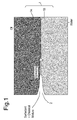
- FIG.1 shows a microscopic picture of the water-oil interface in a pore of an underground underground formation 1, which comprises an upper section 1A of which the pore space is filled with crude oil and a lower section 1B of which the pore space is filled with water.
- a mixture 2 of a chemical agent and a surfactant is injected into the pores of the formation in the vicinity of the oil-water interface 3 between the upper and lower sections 1A and 1B in the pores of the formation 1.
- the mixture is then induced to migrate and distribute itself along the oil-water interface 3 as illustrated by arrow 4.
- the driving force behind this surprisingly effective transportation mechanism is the interfacial energy of the oil-water interface 3, which is often in the range of 20-40 mN/m and that a surfactant reduces the interfacial energy locally thereby producing gradients in interfacial tension which drive fluid flow.
- a somewhat similar effect is known at air-liquid interfaces, which is known as the Marangoni effect. It is surprising that a similar effect occurs in narrow pore spaces in an underground formation and that this effect can be used to transport and a mixture 2 of a chemical agent and a surfactant in a surprisingly effective and accurate manner over significant distances into an underground formation, whereby the mixture 2 is distributed evenly along the oil water interface 3.
- aqueous solutions of sodium dodecyl sulfate (SDS) and dodecyl trimethyl ammonium bromide (DTAB) above the critical micelles concentration (CMC) have been found to spread in a radial geometry over distances of 20 cm in less than 1 second.
Landscapes
- Chemical & Material Sciences (AREA)
- Life Sciences & Earth Sciences (AREA)
- General Life Sciences & Earth Sciences (AREA)
- Engineering & Computer Science (AREA)
- Materials Engineering (AREA)
- Organic Chemistry (AREA)
- Oil, Petroleum & Natural Gas (AREA)
- Production Of Liquid Hydrocarbon Mixture For Refining Petroleum (AREA)
Abstract
A method of transporting a chemical agent through a porous underground formation(1) in which a fluid interface, such as an oil/water, oil/gas and or water/gas interface, is present, which method comprises mixing the agent with a surfactant and injecting the mixture(2) into the formation(1) in the vicinity of the fluid interface(3), thereby inducing the mixture to spread along the fluid interface(3).
Description
- The invention relates to a method of transporting a chemical agent through a porous underground formation.
- It is known to inject chemical agents into a porous underground formation, which may comprise pore spaces that may contain water, crude oil, natural gas and/or other fluids. The chemical agents may serve to stabilize the formation, to enhance crude oil recovery and/or to inhibit water influx into crude oil production wells.
- Chemical agents are often dissolved in an aqueous phase when injected.
- A problem with injecting chemical agents into underground formations is that the chemical agents may have a different density and viscosity than the fluids within the pore spaces, which may lead to an uneven distribution of the chemical agent through the formation. Another problem that often arises is that due to unfavorable wettability, chemicals that are dissolved in an aqueous phase or are hydrophilic cannot be injected into oil-wet parts of the reservoir. Injecting them by pressure would also not be successful because the fluid flow would bypass the target volume of the reservoir for instance through fractures. It is an object of the present invention to solve this problem and to provide a method of transporting a chemical agent in an accurate and predictable manner through an underground formation.
- In accordance with the invention there is provided a method of transporting a chemical agent through a porous underground formation in which a fluid interface, such as an oil/water, oil/gas and or water/gas interface, is present, the method comprising mixing the agent with a surfactant and injecting the mixture into the formation in the vicinity of the fluid interface, thereby inducing the mixture to spread along the fluid interface.
- The surfactant may be selected from the group of anionic, cationic and nonionic surfactants and alcohols, such as a low molecular weight alcohol, for example 2-butoxy ethanol.
- The fluid interface may be a crude oil-water, a crude oil- natural gas or a water- natural gas interface and the chemical agent may be an enhanced oil recovery agent and be injected at a crude oil-water or crude oil-natural gas interface, and wherein subsequently crude oil and or natural gas is produced from the underground formation.
- These and other features, advantages and embodiments of the method according to the invention are described in more detail in the accompanying claims, abstract and the following detailed description of a preferred embodiment in which reference is made to the accompanying drawing.
-
-
FIG.1 shows the interface between oil and water along which a chemical agent and surfactant containing mixture is transported using the method according to the invention. -
FIG.1 shows a microscopic picture of the water-oil interface in a pore of an underground underground formation 1, which comprises anupper section 1A of which the pore space is filled with crude oil and alower section 1B of which the pore space is filled with water. - A
mixture 2 of a chemical agent and a surfactant is injected into the pores of the formation in the vicinity of the oil-water interface 3 between the upper andlower sections - The mixture is then induced to migrate and distribute itself along the oil-water interface 3 as illustrated by arrow 4.
- It is believed that the driving force behind this surprisingly effective transportation mechanism is the interfacial energy of the oil-water interface 3, which is often in the range of 20-40 mN/m and that a surfactant reduces the interfacial energy locally thereby producing gradients in interfacial tension which drive fluid flow. A somewhat similar effect is known at air-liquid interfaces, which is known as the Marangoni effect. It is surprising that a similar effect occurs in narrow pore spaces in an underground formation and that this effect can be used to transport and a
mixture 2 of a chemical agent and a surfactant in a surprisingly effective and accurate manner over significant distances into an underground formation, whereby themixture 2 is distributed evenly along the oil water interface 3. - In model systems where the clean interface between water and decane has been considered, aqueous solutions of sodium dodecyl sulfate (SDS) and dodecyl trimethyl ammonium bromide (DTAB) above the critical micelles concentration (CMC) have been found to spread in a radial geometry over distances of 20 cm in less than 1 second.
- Detailed studies on the spreading kinetics support the view that this mechanism is indeed driven by the interfacial energy between water and decane and that this phenomenon is indeed correctly attributed to the Marangoni effect. While in the literature this phenomenon has been shown several times for the interface between a liquid and air, we have demonstrated for the first time that this mechanism is also effective along the interface between two immiscible liquids. As a result of the experiments with model system, quantitative mathematical description of the effect was obtained.
Claims (7)
- A method of transporting a chemical agent through a porous underground formation, which comprises a fluid interface, the method comprising mixing the agent with a surfactant and injecting the mixture into the formation in the vicinity of the fluid interface, thereby inducing the mixture to spread along the fluid interface.
- The method of claim 1, wherein the surfactant is selected from the group of anionic, cationic and nonionic surfactants.
- The method of claim 1, wherein the surfactant is an alcohol.
- The method of claim 3, wherein the alcohol is a low molecular weight alcohol.
- The method of claim 4, wherein the low molecular weight alcohol is 2-butoxy ethanol.
- The method of claim 1, wherein the fluid interface is a crude oil/water, a crude oil/ natural gas or a water/ natural gas interface.
- The method of claim 6, wherein the chemical agent is an enhanced oil recovery agent and is injected at a crude oil/water or crude oil/natural gas interface, and wherein subsequently crude oil and/or natural gas is produced from the underground formation.
Priority Applications (1)
| Application Number | Priority Date | Filing Date | Title |
|---|---|---|---|
| EP08101685A EP2096156A1 (en) | 2008-02-15 | 2008-02-15 | Method of transporting a chemical agent through a porous underground formation |
Applications Claiming Priority (1)
| Application Number | Priority Date | Filing Date | Title |
|---|---|---|---|
| EP08101685A EP2096156A1 (en) | 2008-02-15 | 2008-02-15 | Method of transporting a chemical agent through a porous underground formation |
Publications (1)
| Publication Number | Publication Date |
|---|---|
| EP2096156A1 true EP2096156A1 (en) | 2009-09-02 |
Family
ID=39619073
Family Applications (1)
| Application Number | Title | Priority Date | Filing Date |
|---|---|---|---|
| EP08101685A Withdrawn EP2096156A1 (en) | 2008-02-15 | 2008-02-15 | Method of transporting a chemical agent through a porous underground formation |
Country Status (1)
| Country | Link |
|---|---|
| EP (1) | EP2096156A1 (en) |
Citations (2)
| Publication number | Priority date | Publication date | Assignee | Title |
|---|---|---|---|---|
| US4306981A (en) * | 1979-10-05 | 1981-12-22 | Magna Corporation | Method for breaking petroleum emulsions and the like comprising resinous polyalkylene oxide adducts |
| GB2165280A (en) * | 1984-10-05 | 1986-04-09 | Shell Int Research | Surfactant composition and process for the production of oil using such a composition |
-
2008
- 2008-02-15 EP EP08101685A patent/EP2096156A1/en not_active Withdrawn
Patent Citations (2)
| Publication number | Priority date | Publication date | Assignee | Title |
|---|---|---|---|---|
| US4306981A (en) * | 1979-10-05 | 1981-12-22 | Magna Corporation | Method for breaking petroleum emulsions and the like comprising resinous polyalkylene oxide adducts |
| GB2165280A (en) * | 1984-10-05 | 1986-04-09 | Shell Int Research | Surfactant composition and process for the production of oil using such a composition |
Similar Documents
| Publication | Publication Date | Title |
|---|---|---|
| Majeed et al. | A review on foam stabilizers for enhanced oil recovery | |
| US9970265B2 (en) | Multi-functional surfactant complexes for use in subterranean formations | |
| CN102933681B (en) | Make surface active agent solubilization in supercritical co for tertiary oil recovery | |
| Yadali Jamaloei et al. | Analysis of microscopic displacement mechanisms of dilute surfactant flooding in oil-wet and water-wet porous media | |
| CA2924127C (en) | Volatile surfactant treatment for use in subterranean formation operations | |
| RU2536722C2 (en) | Hydrocarbon production method with pressure maintenance in fractured reservoirs | |
| CN110945208B (en) | Methods for improving oil recovery in formations | |
| EP3556823A1 (en) | Method of slickwater fracturing | |
| US9944842B2 (en) | Methods of pre-flushing reservoir paths for higher return of hydrocarbon fluids | |
| US20180362826A1 (en) | Oil-in-water stable, emulsified spacer fluids | |
| CN107532077A (en) | Cosurfactant formation of foam composition for intensified oil reduction | |
| US9982185B2 (en) | Methods and systems for preparing surfactant polyelectrolyte complexes for use in subterranean formations | |
| CN105038752B (en) | A kind of compound oil displacement agent and composite oil-displacing system for high-temperature oil reservoir | |
| EP3344723B1 (en) | Method of improving mobility of heavy crude oils in subterranean reservoirs | |
| US20120157357A1 (en) | Detergent package for improved recovery and transport of crude oil | |
| US11649394B2 (en) | Ionic liquid-based products for IOR applications | |
| WO2015157156A1 (en) | Systems and methods for accelerating production of viscous hydrocarbons in a subterranean reservoir with emulsions comprising chemical agents | |
| RU2461702C1 (en) | Development method of high-viscous oil deposit (versions) | |
| CA2951289C (en) | Multi-functional surfactant complexes for use in subterranean formations | |
| US20130248176A1 (en) | Ultra low concentration surfactant flooding | |
| US20250270912A1 (en) | Methods and systems of clean-up for a fracturing fluid | |
| Stylianou et al. | Laboratory testing in support of surfactant-alternating-gas foam flood for NAPL recovery from shallow subsurface | |
| Lucuara et al. | Damage Remediation in a Mature Field Reservoir by Applying a Customized Treatment Using Surface Active Additives and Diversion Technologies: Case Histories from San Francisco Field | |
| US11124698B2 (en) | Acidizing and proppant transport with emulsified fluid | |
| US20200048539A1 (en) | Self-breaking emulsified fluid system |
Legal Events
| Date | Code | Title | Description |
|---|---|---|---|
| PUAI | Public reference made under article 153(3) epc to a published international application that has entered the european phase |
Free format text: ORIGINAL CODE: 0009012 |
|
| AK | Designated contracting states |
Kind code of ref document: A1 Designated state(s): AT BE BG CH CY CZ DE DK EE ES FI FR GB GR HR HU IE IS IT LI LT LU LV MC MT NL NO PL PT RO SE SI SK TR |
|
| AX | Request for extension of the european patent |
Extension state: AL BA MK |
|
| STAA | Information on the status of an ep patent application or granted ep patent |
Free format text: STATUS: THE APPLICATION HAS BEEN WITHDRAWN |
|
| 18W | Application withdrawn |
Effective date: 20100226 |