EP2095972A1 - Pneumatic tire - Google Patents
Pneumatic tire Download PDFInfo
- Publication number
- EP2095972A1 EP2095972A1 EP09152449A EP09152449A EP2095972A1 EP 2095972 A1 EP2095972 A1 EP 2095972A1 EP 09152449 A EP09152449 A EP 09152449A EP 09152449 A EP09152449 A EP 09152449A EP 2095972 A1 EP2095972 A1 EP 2095972A1
- Authority
- EP
- European Patent Office
- Prior art keywords
- tire
- inner liner
- wound
- liner layer
- layer
- Prior art date
- Legal status (The legal status is an assumption and is not a legal conclusion. Google has not performed a legal analysis and makes no representation as to the accuracy of the status listed.)
- Granted
Links
- 229920001971 elastomer Polymers 0.000 claims abstract description 53
- 229920005992 thermoplastic resin Polymers 0.000 claims abstract description 50
- 239000000806 elastomer Substances 0.000 claims abstract description 35
- 239000011324 bead Substances 0.000 claims abstract description 29
- 239000000203 mixture Substances 0.000 claims abstract description 28
- 229920002725 thermoplastic elastomer Polymers 0.000 claims abstract description 25
- 238000002156 mixing Methods 0.000 claims abstract description 10
- 239000010410 layer Substances 0.000 description 104
- 239000005060 rubber Substances 0.000 description 18
- 238000004073 vulcanization Methods 0.000 description 16
- 229920001577 copolymer Polymers 0.000 description 13
- 230000003014 reinforcing effect Effects 0.000 description 12
- PPBRXRYQALVLMV-UHFFFAOYSA-N Styrene Natural products C=CC1=CC=CC=C1 PPBRXRYQALVLMV-UHFFFAOYSA-N 0.000 description 10
- 229920005549 butyl rubber Polymers 0.000 description 10
- -1 polybutylene terephthalate Polymers 0.000 description 10
- 238000004898 kneading Methods 0.000 description 8
- 239000000463 material Substances 0.000 description 8
- 229920005989 resin Polymers 0.000 description 8
- 239000011347 resin Substances 0.000 description 8
- 230000000052 comparative effect Effects 0.000 description 7
- 238000000034 method Methods 0.000 description 7
- 229920000642 polymer Polymers 0.000 description 7
- NINIDFKCEFEMDL-UHFFFAOYSA-N Sulfur Chemical compound [S] NINIDFKCEFEMDL-UHFFFAOYSA-N 0.000 description 6
- 229910052717 sulfur Inorganic materials 0.000 description 6
- 239000011593 sulfur Substances 0.000 description 6
- 229920000181 Ethylene propylene rubber Polymers 0.000 description 5
- 239000004743 Polypropylene Substances 0.000 description 5
- 229920001155 polypropylene Polymers 0.000 description 5
- 229920002379 silicone rubber Polymers 0.000 description 5
- 229920002943 EPDM rubber Polymers 0.000 description 4
- ZRALSGWEFCBTJO-UHFFFAOYSA-N Guanidine Chemical compound NC(N)=N ZRALSGWEFCBTJO-UHFFFAOYSA-N 0.000 description 4
- 239000005062 Polybutadiene Substances 0.000 description 4
- 230000000694 effects Effects 0.000 description 4
- 229920002451 polyvinyl alcohol Polymers 0.000 description 4
- 230000002265 prevention Effects 0.000 description 4
- 150000003839 salts Chemical class 0.000 description 4
- UMGDCJDMYOKAJW-UHFFFAOYSA-N thiourea Chemical compound NC(N)=S UMGDCJDMYOKAJW-UHFFFAOYSA-N 0.000 description 4
- KUAZQDVKQLNFPE-UHFFFAOYSA-N thiram Chemical compound CN(C)C(=S)SSC(=S)N(C)C KUAZQDVKQLNFPE-UHFFFAOYSA-N 0.000 description 4
- 229960002447 thiram Drugs 0.000 description 4
- NLHHRLWOUZZQLW-UHFFFAOYSA-N Acrylonitrile Chemical compound C=CC#N NLHHRLWOUZZQLW-UHFFFAOYSA-N 0.000 description 3
- YCKRFDGAMUMZLT-UHFFFAOYSA-N Fluorine atom Chemical compound [F] YCKRFDGAMUMZLT-UHFFFAOYSA-N 0.000 description 3
- 244000043261 Hevea brasiliensis Species 0.000 description 3
- 229920000459 Nitrile rubber Polymers 0.000 description 3
- 229920002292 Nylon 6 Polymers 0.000 description 3
- 229920000305 Nylon 6,10 Polymers 0.000 description 3
- 229920002302 Nylon 6,6 Polymers 0.000 description 3
- 239000012790 adhesive layer Substances 0.000 description 3
- 239000003795 chemical substances by application Substances 0.000 description 3
- 238000011156 evaluation Methods 0.000 description 3
- 239000011737 fluorine Substances 0.000 description 3
- 229910052731 fluorine Inorganic materials 0.000 description 3
- 239000011159 matrix material Substances 0.000 description 3
- 238000000465 moulding Methods 0.000 description 3
- 229920003052 natural elastomer Polymers 0.000 description 3
- 229920001194 natural rubber Polymers 0.000 description 3
- 239000005011 phenolic resin Substances 0.000 description 3
- 229920002239 polyacrylonitrile Polymers 0.000 description 3
- 229920001707 polybutylene terephthalate Polymers 0.000 description 3
- 229920000728 polyester Polymers 0.000 description 3
- 229920000139 polyethylene terephthalate Polymers 0.000 description 3
- 239000005020 polyethylene terephthalate Substances 0.000 description 3
- 239000004945 silicone rubber Substances 0.000 description 3
- 229920003048 styrene butadiene rubber Polymers 0.000 description 3
- 229920000468 styrene butadiene styrene block copolymer Polymers 0.000 description 3
- 229920001935 styrene-ethylene-butadiene-styrene Polymers 0.000 description 3
- QAZLUNIWYYOJPC-UHFFFAOYSA-M sulfenamide Chemical compound [Cl-].COC1=C(C)C=[N+]2C3=NC4=CC=C(OC)C=C4N3SCC2=C1C QAZLUNIWYYOJPC-UHFFFAOYSA-M 0.000 description 3
- 239000013585 weight reducing agent Substances 0.000 description 3
- YXIWHUQXZSMYRE-UHFFFAOYSA-N 1,3-benzothiazole-2-thiol Chemical compound C1=CC=C2SC(S)=NC2=C1 YXIWHUQXZSMYRE-UHFFFAOYSA-N 0.000 description 2
- UJPKMTDFFUTLGM-UHFFFAOYSA-N 1-aminoethanol Chemical compound CC(N)O UJPKMTDFFUTLGM-UHFFFAOYSA-N 0.000 description 2
- OEPOKWHJYJXUGD-UHFFFAOYSA-N 2-(3-phenylmethoxyphenyl)-1,3-thiazole-4-carbaldehyde Chemical compound O=CC1=CSC(C=2C=C(OCC=3C=CC=CC=3)C=CC=2)=N1 OEPOKWHJYJXUGD-UHFFFAOYSA-N 0.000 description 2
- BUZICZZQJDLXJN-UHFFFAOYSA-N 3-azaniumyl-4-hydroxybutanoate Chemical compound OCC(N)CC(O)=O BUZICZZQJDLXJN-UHFFFAOYSA-N 0.000 description 2
- VTYYLEPIZMXCLO-UHFFFAOYSA-L Calcium carbonate Chemical compound [Ca+2].[O-]C([O-])=O VTYYLEPIZMXCLO-UHFFFAOYSA-L 0.000 description 2
- BWGNESOTFCXPMA-UHFFFAOYSA-N Dihydrogen disulfide Chemical compound SS BWGNESOTFCXPMA-UHFFFAOYSA-N 0.000 description 2
- IMROMDMJAWUWLK-UHFFFAOYSA-N Ethenol Chemical compound OC=C IMROMDMJAWUWLK-UHFFFAOYSA-N 0.000 description 2
- CHJJGSNFBQVOTG-UHFFFAOYSA-N N-methyl-guanidine Natural products CNC(N)=N CHJJGSNFBQVOTG-UHFFFAOYSA-N 0.000 description 2
- 239000004677 Nylon Substances 0.000 description 2
- 229920000572 Nylon 6/12 Polymers 0.000 description 2
- 229920000577 Nylon 6/66 Polymers 0.000 description 2
- 239000002033 PVDF binder Substances 0.000 description 2
- 239000004698 Polyethylene Substances 0.000 description 2
- 239000004642 Polyimide Substances 0.000 description 2
- 239000004372 Polyvinyl alcohol Substances 0.000 description 2
- FZWLAAWBMGSTSO-UHFFFAOYSA-N Thiazole Chemical compound C1=CSC=N1 FZWLAAWBMGSTSO-UHFFFAOYSA-N 0.000 description 2
- XSQUKJJJFZCRTK-UHFFFAOYSA-N Urea Natural products NC(N)=O XSQUKJJJFZCRTK-UHFFFAOYSA-N 0.000 description 2
- XLOMVQKBTHCTTD-UHFFFAOYSA-N Zinc monoxide Chemical compound [Zn]=O XLOMVQKBTHCTTD-UHFFFAOYSA-N 0.000 description 2
- 239000002253 acid Substances 0.000 description 2
- 150000001336 alkenes Chemical class 0.000 description 2
- 125000003118 aryl group Chemical group 0.000 description 2
- TZYHIGCKINZLPD-UHFFFAOYSA-N azepan-2-one;hexane-1,6-diamine;hexanedioic acid Chemical compound NCCCCCCN.O=C1CCCCCN1.OC(=O)CCCCC(O)=O TZYHIGCKINZLPD-UHFFFAOYSA-N 0.000 description 2
- IOJUPLGTWVMSFF-UHFFFAOYSA-N benzothiazole Chemical compound C1=CC=C2SC=NC2=C1 IOJUPLGTWVMSFF-UHFFFAOYSA-N 0.000 description 2
- 230000015572 biosynthetic process Effects 0.000 description 2
- 229920006235 chlorinated polyethylene elastomer Polymers 0.000 description 2
- 238000013329 compounding Methods 0.000 description 2
- 229940116901 diethyldithiocarbamate Drugs 0.000 description 2
- SWSQBOPZIKWTGO-UHFFFAOYSA-N dimethylaminoamidine Natural products CN(C)C(N)=N SWSQBOPZIKWTGO-UHFFFAOYSA-N 0.000 description 2
- 239000006185 dispersion Substances 0.000 description 2
- AUZONCFQVSMFAP-UHFFFAOYSA-N disulfiram Chemical compound CCN(CC)C(=S)SSC(=S)N(CC)CC AUZONCFQVSMFAP-UHFFFAOYSA-N 0.000 description 2
- 229920006242 ethylene acrylic acid copolymer Polymers 0.000 description 2
- 229920001038 ethylene copolymer Polymers 0.000 description 2
- 229920006244 ethylene-ethyl acrylate Polymers 0.000 description 2
- 229920006225 ethylene-methyl acrylate Polymers 0.000 description 2
- 239000000835 fiber Substances 0.000 description 2
- 229910052736 halogen Inorganic materials 0.000 description 2
- 150000002367 halogens Chemical class 0.000 description 2
- VKYKSIONXSXAKP-UHFFFAOYSA-N hexamethylenetetramine Chemical compound C1N(C2)CN3CN1CN2C3 VKYKSIONXSXAKP-UHFFFAOYSA-N 0.000 description 2
- 229920003049 isoprene rubber Polymers 0.000 description 2
- 239000000155 melt Substances 0.000 description 2
- 229920001778 nylon Polymers 0.000 description 2
- JRZJOMJEPLMPRA-UHFFFAOYSA-N olefin Natural products CCCCCCCC=C JRZJOMJEPLMPRA-UHFFFAOYSA-N 0.000 description 2
- 150000001451 organic peroxides Chemical class 0.000 description 2
- 229920001084 poly(chloroprene) Polymers 0.000 description 2
- 229920002493 poly(chlorotrifluoroethylene) Polymers 0.000 description 2
- 229920003229 poly(methyl methacrylate) Polymers 0.000 description 2
- 229920001230 polyarylate Polymers 0.000 description 2
- 229920002857 polybutadiene Polymers 0.000 description 2
- 239000005023 polychlorotrifluoroethylene (PCTFE) polymer Substances 0.000 description 2
- 229920000573 polyethylene Polymers 0.000 description 2
- 229920001721 polyimide Polymers 0.000 description 2
- 239000004926 polymethyl methacrylate Substances 0.000 description 2
- 229920002620 polyvinyl fluoride Polymers 0.000 description 2
- 229920002981 polyvinylidene fluoride Polymers 0.000 description 2
- 239000011701 zinc Substances 0.000 description 2
- 239000011787 zinc oxide Substances 0.000 description 2
- 235000014692 zinc oxide Nutrition 0.000 description 2
- WRXCBRHBHGNNQA-UHFFFAOYSA-N (2,4-dichlorobenzoyl) 2,4-dichlorobenzenecarboperoxoate Chemical compound ClC1=CC(Cl)=CC=C1C(=O)OOC(=O)C1=CC=C(Cl)C=C1Cl WRXCBRHBHGNNQA-UHFFFAOYSA-N 0.000 description 1
- WRIDQFICGBMAFQ-UHFFFAOYSA-N (E)-8-Octadecenoic acid Natural products CCCCCCCCCC=CCCCCCCC(O)=O WRIDQFICGBMAFQ-UHFFFAOYSA-N 0.000 description 1
- BQCIDUSAKPWEOX-UHFFFAOYSA-N 1,1-Difluoroethene Chemical compound FC(F)=C BQCIDUSAKPWEOX-UHFFFAOYSA-N 0.000 description 1
- OWRCNXZUPFZXOS-UHFFFAOYSA-N 1,3-diphenylguanidine Chemical compound C=1C=CC=CC=1NC(=N)NC1=CC=CC=C1 OWRCNXZUPFZXOS-UHFFFAOYSA-N 0.000 description 1
- MKZXROSCOHNKDX-UHFFFAOYSA-N 1,4-dinitrosobenzene Chemical compound O=NC1=CC=C(N=O)C=C1 MKZXROSCOHNKDX-UHFFFAOYSA-N 0.000 description 1
- DMWVYCCGCQPJEA-UHFFFAOYSA-N 2,5-bis(tert-butylperoxy)-2,5-dimethylhexane Chemical compound CC(C)(C)OOC(C)(C)CCC(C)(C)OOC(C)(C)C DMWVYCCGCQPJEA-UHFFFAOYSA-N 0.000 description 1
- 229940054266 2-mercaptobenzothiazole Drugs 0.000 description 1
- 125000003504 2-oxazolinyl group Chemical group O1C(=NCC1)* 0.000 description 1
- LQJBNNIYVWPHFW-UHFFFAOYSA-N 20:1omega9c fatty acid Natural products CCCCCCCCCCC=CCCCCCCCC(O)=O LQJBNNIYVWPHFW-UHFFFAOYSA-N 0.000 description 1
- CPGFMWPQXUXQRX-UHFFFAOYSA-N 3-amino-3-(4-fluorophenyl)propanoic acid Chemical compound OC(=O)CC(N)C1=CC=C(F)C=C1 CPGFMWPQXUXQRX-UHFFFAOYSA-N 0.000 description 1
- YBRVSVVVWCFQMG-UHFFFAOYSA-N 4,4'-diaminodiphenylmethane Chemical compound C1=CC(N)=CC=C1CC1=CC=C(N)C=C1 YBRVSVVVWCFQMG-UHFFFAOYSA-N 0.000 description 1
- QSBYPNXLFMSGKH-UHFFFAOYSA-N 9-Heptadecensaeure Natural products CCCCCCCC=CCCCCCCCC(O)=O QSBYPNXLFMSGKH-UHFFFAOYSA-N 0.000 description 1
- 239000004342 Benzoyl peroxide Substances 0.000 description 1
- OMPJBNCRMGITSC-UHFFFAOYSA-N Benzoylperoxide Chemical compound C=1C=CC=CC=1C(=O)OOC(=O)C1=CC=CC=C1 OMPJBNCRMGITSC-UHFFFAOYSA-N 0.000 description 1
- VGGSQFUCUMXWEO-UHFFFAOYSA-N Ethene Chemical compound C=C VGGSQFUCUMXWEO-UHFFFAOYSA-N 0.000 description 1
- 239000005977 Ethylene Substances 0.000 description 1
- 229920000219 Ethylene vinyl alcohol Polymers 0.000 description 1
- PDQAZBWRQCGBEV-UHFFFAOYSA-N Ethylenethiourea Chemical compound S=C1NCCN1 PDQAZBWRQCGBEV-UHFFFAOYSA-N 0.000 description 1
- 101000576320 Homo sapiens Max-binding protein MNT Proteins 0.000 description 1
- VQTUBCCKSQIDNK-UHFFFAOYSA-N Isobutene Chemical group CC(C)=C VQTUBCCKSQIDNK-UHFFFAOYSA-N 0.000 description 1
- JHWNWJKBPDFINM-UHFFFAOYSA-N Laurolactam Chemical compound O=C1CCCCCCCCCCCN1 JHWNWJKBPDFINM-UHFFFAOYSA-N 0.000 description 1
- FLVIGYVXZHLUHP-UHFFFAOYSA-N N,N'-diethylthiourea Chemical compound CCNC(=S)NCC FLVIGYVXZHLUHP-UHFFFAOYSA-N 0.000 description 1
- 239000006057 Non-nutritive feed additive Substances 0.000 description 1
- 229920000571 Nylon 11 Polymers 0.000 description 1
- 229920000299 Nylon 12 Polymers 0.000 description 1
- 229920003189 Nylon 4,6 Polymers 0.000 description 1
- 229920000393 Nylon 6/6T Polymers 0.000 description 1
- 229920000007 Nylon MXD6 Polymers 0.000 description 1
- 239000005642 Oleic acid Substances 0.000 description 1
- ZQPPMHVWECSIRJ-UHFFFAOYSA-N Oleic acid Natural products CCCCCCCCC=CCCCCCCCC(O)=O ZQPPMHVWECSIRJ-UHFFFAOYSA-N 0.000 description 1
- 239000004952 Polyamide Substances 0.000 description 1
- 239000004793 Polystyrene Substances 0.000 description 1
- 229920006121 Polyxylylene adipamide Polymers 0.000 description 1
- OFOBLEOULBTSOW-UHFFFAOYSA-N Propanedioic acid Natural products OC(=O)CC(O)=O OFOBLEOULBTSOW-UHFFFAOYSA-N 0.000 description 1
- VYPSYNLAJGMNEJ-UHFFFAOYSA-N Silicium dioxide Chemical compound O=[Si]=O VYPSYNLAJGMNEJ-UHFFFAOYSA-N 0.000 description 1
- 235000021355 Stearic acid Nutrition 0.000 description 1
- 229910000831 Steel Inorganic materials 0.000 description 1
- 239000002174 Styrene-butadiene Substances 0.000 description 1
- 229920006172 Tetrafluoroethylene propylene Polymers 0.000 description 1
- GWEVSGVZZGPLCZ-UHFFFAOYSA-N Titan oxide Chemical compound O=[Ti]=O GWEVSGVZZGPLCZ-UHFFFAOYSA-N 0.000 description 1
- 229920010741 Ultra High Molecular Weight Polyethylene (UHMWPE) Polymers 0.000 description 1
- 229920006311 Urethane elastomer Polymers 0.000 description 1
- BZHJMEDXRYGGRV-UHFFFAOYSA-N Vinyl chloride Chemical compound ClC=C BZHJMEDXRYGGRV-UHFFFAOYSA-N 0.000 description 1
- QYKIQEUNHZKYBP-UHFFFAOYSA-N Vinyl ether Chemical compound C=COC=C QYKIQEUNHZKYBP-UHFFFAOYSA-N 0.000 description 1
- WMVSVUVZSYRWIY-UHFFFAOYSA-N [(4-benzoyloxyiminocyclohexa-2,5-dien-1-ylidene)amino] benzoate Chemical compound C=1C=CC=CC=1C(=O)ON=C(C=C1)C=CC1=NOC(=O)C1=CC=CC=C1 WMVSVUVZSYRWIY-UHFFFAOYSA-N 0.000 description 1
- BAPJBEWLBFYGME-UHFFFAOYSA-N acrylic acid methyl ester Natural products COC(=O)C=C BAPJBEWLBFYGME-UHFFFAOYSA-N 0.000 description 1
- 229920000800 acrylic rubber Polymers 0.000 description 1
- 229920000122 acrylonitrile butadiene styrene Polymers 0.000 description 1
- 239000002998 adhesive polymer Substances 0.000 description 1
- 125000000217 alkyl group Chemical group 0.000 description 1
- PNEYBMLMFCGWSK-UHFFFAOYSA-N aluminium oxide Inorganic materials [O-2].[O-2].[O-2].[Al+3].[Al+3] PNEYBMLMFCGWSK-UHFFFAOYSA-N 0.000 description 1
- 125000003277 amino group Chemical group 0.000 description 1
- 235000019400 benzoyl peroxide Nutrition 0.000 description 1
- 229920005557 bromobutyl Polymers 0.000 description 1
- FACXGONDLDSNOE-UHFFFAOYSA-N buta-1,3-diene;styrene Chemical compound C=CC=C.C=CC1=CC=CC=C1.C=CC1=CC=CC=C1 FACXGONDLDSNOE-UHFFFAOYSA-N 0.000 description 1
- 125000000484 butyl group Chemical group [H]C([*])([H])C([H])([H])C([H])([H])C([H])([H])[H] 0.000 description 1
- 229910000019 calcium carbonate Inorganic materials 0.000 description 1
- 239000006229 carbon black Substances 0.000 description 1
- 125000002915 carbonyl group Chemical group [*:2]C([*:1])=O 0.000 description 1
- 229920002301 cellulose acetate Polymers 0.000 description 1
- 229920006217 cellulose acetate butyrate Polymers 0.000 description 1
- 239000012461 cellulose resin Substances 0.000 description 1
- YACLQRRMGMJLJV-UHFFFAOYSA-N chloroprene Chemical compound ClC(=C)C=C YACLQRRMGMJLJV-UHFFFAOYSA-N 0.000 description 1
- 239000000470 constituent Substances 0.000 description 1
- 238000004132 cross linking Methods 0.000 description 1
- 239000003431 cross linking reagent Substances 0.000 description 1
- 150000003946 cyclohexylamines Chemical class 0.000 description 1
- RAABOESOVLLHRU-UHFFFAOYSA-N diazene Chemical compound N=N RAABOESOVLLHRU-UHFFFAOYSA-N 0.000 description 1
- 229910000071 diazene Inorganic materials 0.000 description 1
- AFZSMODLJJCVPP-UHFFFAOYSA-N dibenzothiazol-2-yl disulfide Chemical compound C1=CC=C2SC(SSC=3SC4=CC=CC=C4N=3)=NC2=C1 AFZSMODLJJCVPP-UHFFFAOYSA-N 0.000 description 1
- 229920003244 diene elastomer Polymers 0.000 description 1
- 150000001993 dienes Chemical class 0.000 description 1
- 125000000118 dimethyl group Chemical group [H]C([H])([H])* 0.000 description 1
- 125000003700 epoxy group Chemical group 0.000 description 1
- 150000002148 esters Chemical class 0.000 description 1
- UFRKOOWSQGXVKV-UHFFFAOYSA-N ethene;ethenol Chemical compound C=C.OC=C UFRKOOWSQGXVKV-UHFFFAOYSA-N 0.000 description 1
- HQQADJVZYDDRJT-UHFFFAOYSA-N ethene;prop-1-ene Chemical group C=C.CC=C HQQADJVZYDDRJT-UHFFFAOYSA-N 0.000 description 1
- HIHIPCDUFKZOSL-UHFFFAOYSA-N ethenyl(methyl)silicon Chemical compound C[Si]C=C HIHIPCDUFKZOSL-UHFFFAOYSA-N 0.000 description 1
- 239000004715 ethylene vinyl alcohol Substances 0.000 description 1
- 239000005042 ethylene-ethyl acrylate Substances 0.000 description 1
- 239000005043 ethylene-methyl acrylate Substances 0.000 description 1
- 238000001125 extrusion Methods 0.000 description 1
- 239000000945 filler Substances 0.000 description 1
- 229920001973 fluoroelastomer Polymers 0.000 description 1
- 229920000578 graft copolymer Polymers 0.000 description 1
- 125000005843 halogen group Chemical group 0.000 description 1
- 235000010299 hexamethylene tetramine Nutrition 0.000 description 1
- 239000004312 hexamethylene tetramine Substances 0.000 description 1
- 125000002887 hydroxy group Chemical group [H]O* 0.000 description 1
- 229920002681 hypalon Polymers 0.000 description 1
- 150000003949 imides Chemical class 0.000 description 1
- 238000001746 injection moulding Methods 0.000 description 1
- 229920000554 ionomer Polymers 0.000 description 1
- QXJSBBXBKPUZAA-UHFFFAOYSA-N isooleic acid Natural products CCCCCCCC=CCCCCCCCCC(O)=O QXJSBBXBKPUZAA-UHFFFAOYSA-N 0.000 description 1
- HTUMBQDCCIXGCV-UHFFFAOYSA-N lead oxide Chemical compound [O-2].[Pb+2] HTUMBQDCCIXGCV-UHFFFAOYSA-N 0.000 description 1
- YEXPOXQUZXUXJW-UHFFFAOYSA-N lead(II) oxide Inorganic materials [Pb]=O YEXPOXQUZXUXJW-UHFFFAOYSA-N 0.000 description 1
- 239000004973 liquid crystal related substance Substances 0.000 description 1
- 239000000395 magnesium oxide Substances 0.000 description 1
- CPLXHLVBOLITMK-UHFFFAOYSA-N magnesium oxide Inorganic materials [Mg]=O CPLXHLVBOLITMK-UHFFFAOYSA-N 0.000 description 1
- AXZKOIWUVFPNLO-UHFFFAOYSA-N magnesium;oxygen(2-) Chemical compound [O-2].[Mg+2] AXZKOIWUVFPNLO-UHFFFAOYSA-N 0.000 description 1
- 239000011976 maleic acid Substances 0.000 description 1
- 238000004519 manufacturing process Methods 0.000 description 1
- 239000000178 monomer Substances 0.000 description 1
- IUJLOAKJZQBENM-UHFFFAOYSA-N n-(1,3-benzothiazol-2-ylsulfanyl)-2-methylpropan-2-amine Chemical compound C1=CC=C2SC(SNC(C)(C)C)=NC2=C1 IUJLOAKJZQBENM-UHFFFAOYSA-N 0.000 description 1
- DZCCLNYLUGNUKQ-UHFFFAOYSA-N n-(4-nitrosophenyl)hydroxylamine Chemical compound ONC1=CC=C(N=O)C=C1 DZCCLNYLUGNUKQ-UHFFFAOYSA-N 0.000 description 1
- GKTNLYAAZKKMTQ-UHFFFAOYSA-N n-[bis(dimethylamino)phosphinimyl]-n-methylmethanamine Chemical compound CN(C)P(=N)(N(C)C)N(C)C GKTNLYAAZKKMTQ-UHFFFAOYSA-N 0.000 description 1
- QIQXTHQIDYTFRH-UHFFFAOYSA-N octadecanoic acid Chemical compound CCCCCCCCCCCCCCCCCC(O)=O QIQXTHQIDYTFRH-UHFFFAOYSA-N 0.000 description 1
- OQCDKBAXFALNLD-UHFFFAOYSA-N octadecanoic acid Natural products CCCCCCCC(C)CCCCCCCCC(O)=O OQCDKBAXFALNLD-UHFFFAOYSA-N 0.000 description 1
- ZQPPMHVWECSIRJ-KTKRTIGZSA-N oleic acid Chemical compound CCCCCCCC\C=C/CCCCCCCC(O)=O ZQPPMHVWECSIRJ-KTKRTIGZSA-N 0.000 description 1
- 239000002245 particle Substances 0.000 description 1
- 229940097156 peroxyl Drugs 0.000 description 1
- 239000000049 pigment Substances 0.000 description 1
- 239000004014 plasticizer Substances 0.000 description 1
- 229920001483 poly(ethyl methacrylate) polymer Polymers 0.000 description 1
- 229920006111 poly(hexamethylene terephthalamide) Polymers 0.000 description 1
- 229920003214 poly(methacrylonitrile) Polymers 0.000 description 1
- 229920000058 polyacrylate Polymers 0.000 description 1
- 229920002647 polyamide Polymers 0.000 description 1
- 229920006122 polyamide resin Polymers 0.000 description 1
- 229920000515 polycarbonate Polymers 0.000 description 1
- 239000004417 polycarbonate Substances 0.000 description 1
- 229920001225 polyester resin Polymers 0.000 description 1
- 239000004645 polyester resin Substances 0.000 description 1
- 229920002959 polymer blend Polymers 0.000 description 1
- 229920000193 polymethacrylate Polymers 0.000 description 1
- 229920005554 polynitrile Polymers 0.000 description 1
- 229920005606 polypropylene copolymer Polymers 0.000 description 1
- 229920001021 polysulfide Polymers 0.000 description 1
- 239000005077 polysulfide Substances 0.000 description 1
- 150000008117 polysulfides Polymers 0.000 description 1
- 229920002689 polyvinyl acetate Polymers 0.000 description 1
- 239000011118 polyvinyl acetate Substances 0.000 description 1
- 239000004800 polyvinyl chloride Substances 0.000 description 1
- 229920000915 polyvinyl chloride Polymers 0.000 description 1
- 239000005033 polyvinylidene chloride Substances 0.000 description 1
- 230000002787 reinforcement Effects 0.000 description 1
- 239000008117 stearic acid Substances 0.000 description 1
- 239000010959 steel Substances 0.000 description 1
- 229920006132 styrene block copolymer Polymers 0.000 description 1
- 238000006467 substitution reaction Methods 0.000 description 1
- CIHOLLKRGTVIJN-UHFFFAOYSA-N tert‐butyl hydroperoxide Chemical compound CC(C)(C)OO CIHOLLKRGTVIJN-UHFFFAOYSA-N 0.000 description 1
- UGNWTBMOAKPKBL-UHFFFAOYSA-N tetrachloro-1,4-benzoquinone Chemical compound ClC1=C(Cl)C(=O)C(Cl)=C(Cl)C1=O UGNWTBMOAKPKBL-UHFFFAOYSA-N 0.000 description 1
- BFKJFAAPBSQJPD-UHFFFAOYSA-N tetrafluoroethene Chemical group FC(F)=C(F)F BFKJFAAPBSQJPD-UHFFFAOYSA-N 0.000 description 1
- 229920001169 thermoplastic Polymers 0.000 description 1
- 229920006230 thermoplastic polyester resin Polymers 0.000 description 1
- 239000004416 thermosoftening plastic Substances 0.000 description 1
- HPGGPRDJHPYFRM-UHFFFAOYSA-J tin(iv) chloride Chemical compound Cl[Sn](Cl)(Cl)Cl HPGGPRDJHPYFRM-UHFFFAOYSA-J 0.000 description 1
- OGIDPMRJRNCKJF-UHFFFAOYSA-N titanium oxide Inorganic materials [Ti]=O OGIDPMRJRNCKJF-UHFFFAOYSA-N 0.000 description 1
- VZCYOOQTPOCHFL-UHFFFAOYSA-N trans-butenedioic acid Natural products OC(=O)C=CC(O)=O VZCYOOQTPOCHFL-UHFFFAOYSA-N 0.000 description 1
- 229920002554 vinyl polymer Polymers 0.000 description 1
Images

Classifications
-
- B—PERFORMING OPERATIONS; TRANSPORTING
- B60—VEHICLES IN GENERAL
- B60C—VEHICLE TYRES; TYRE INFLATION; TYRE CHANGING; CONNECTING VALVES TO INFLATABLE ELASTIC BODIES IN GENERAL; DEVICES OR ARRANGEMENTS RELATED TO TYRES
- B60C5/00—Inflatable pneumatic tyres or inner tubes
- B60C5/12—Inflatable pneumatic tyres or inner tubes without separate inflatable inserts, e.g. tubeless tyres with transverse section open to the rim
- B60C5/14—Inflatable pneumatic tyres or inner tubes without separate inflatable inserts, e.g. tubeless tyres with transverse section open to the rim with impervious liner or coating on the inner wall of the tyre
-
- B—PERFORMING OPERATIONS; TRANSPORTING
- B60—VEHICLES IN GENERAL
- B60C—VEHICLE TYRES; TYRE INFLATION; TYRE CHANGING; CONNECTING VALVES TO INFLATABLE ELASTIC BODIES IN GENERAL; DEVICES OR ARRANGEMENTS RELATED TO TYRES
- B60C15/00—Tyre beads, e.g. ply turn-up or overlap
- B60C15/0009—Tyre beads, e.g. ply turn-up or overlap features of the carcass terminal portion
- B60C15/0036—Tyre beads, e.g. ply turn-up or overlap features of the carcass terminal portion with high ply turn-up, i.e. folded around the bead core and terminating radially above the point of maximum section width
- B60C15/0045—Tyre beads, e.g. ply turn-up or overlap features of the carcass terminal portion with high ply turn-up, i.e. folded around the bead core and terminating radially above the point of maximum section width with ply turn-up up to the belt edges, i.e. folded around the bead core and extending to the belt edges
-
- B—PERFORMING OPERATIONS; TRANSPORTING
- B60—VEHICLES IN GENERAL
- B60C—VEHICLE TYRES; TYRE INFLATION; TYRE CHANGING; CONNECTING VALVES TO INFLATABLE ELASTIC BODIES IN GENERAL; DEVICES OR ARRANGEMENTS RELATED TO TYRES
- B60C9/00—Reinforcements or ply arrangement of pneumatic tyres
- B60C9/02—Carcasses
- B60C9/023—Carcasses built up from narrow strips, individual cords or filaments, e.g. using filament winding
-
- B—PERFORMING OPERATIONS; TRANSPORTING
- B60—VEHICLES IN GENERAL
- B60C—VEHICLE TYRES; TYRE INFLATION; TYRE CHANGING; CONNECTING VALVES TO INFLATABLE ELASTIC BODIES IN GENERAL; DEVICES OR ARRANGEMENTS RELATED TO TYRES
- B60C5/00—Inflatable pneumatic tyres or inner tubes
- B60C5/12—Inflatable pneumatic tyres or inner tubes without separate inflatable inserts, e.g. tubeless tyres with transverse section open to the rim
- B60C5/14—Inflatable pneumatic tyres or inner tubes without separate inflatable inserts, e.g. tubeless tyres with transverse section open to the rim with impervious liner or coating on the inner wall of the tyre
- B60C2005/145—Inflatable pneumatic tyres or inner tubes without separate inflatable inserts, e.g. tubeless tyres with transverse section open to the rim with impervious liner or coating on the inner wall of the tyre made of laminated layers
-
- Y—GENERAL TAGGING OF NEW TECHNOLOGICAL DEVELOPMENTS; GENERAL TAGGING OF CROSS-SECTIONAL TECHNOLOGIES SPANNING OVER SEVERAL SECTIONS OF THE IPC; TECHNICAL SUBJECTS COVERED BY FORMER USPC CROSS-REFERENCE ART COLLECTIONS [XRACs] AND DIGESTS
- Y10—TECHNICAL SUBJECTS COVERED BY FORMER USPC
- Y10T—TECHNICAL SUBJECTS COVERED BY FORMER US CLASSIFICATION
- Y10T152/00—Resilient tires and wheels
- Y10T152/10—Tires, resilient
- Y10T152/10495—Pneumatic tire or inner tube
-
- Y—GENERAL TAGGING OF NEW TECHNOLOGICAL DEVELOPMENTS; GENERAL TAGGING OF CROSS-SECTIONAL TECHNOLOGIES SPANNING OVER SEVERAL SECTIONS OF THE IPC; TECHNICAL SUBJECTS COVERED BY FORMER USPC CROSS-REFERENCE ART COLLECTIONS [XRACs] AND DIGESTS
- Y10—TECHNICAL SUBJECTS COVERED BY FORMER USPC
- Y10T—TECHNICAL SUBJECTS COVERED BY FORMER US CLASSIFICATION
- Y10T152/00—Resilient tires and wheels
- Y10T152/10—Tires, resilient
- Y10T152/10495—Pneumatic tire or inner tube
- Y10T152/10765—Characterized by belt or breaker structure
Definitions
- the present invention relates to a pneumatic tire in which a film made of a thermoplastic resin or a thermoplastic elastomer composition obtained by blending a thermoplastic resin with an elastomer is used as an inner liner layer. More particularly, the present invention relates to a pneumatic tire having an improved driving stability with reduced weight.
- a pneumatic tire has a casing structure including: a carcass layer bridged between a pair of bead portions; and a belt layer disposed on the outer circumferential side of the carcass layer.
- the pneumatic tire has an inner liner layer made of a butyl rubber formed along the inner surface of the carcass layer.
- it is effective to bury a reinforcing member including organic fiber cords or steel cords in a region from the bead portion to a side wall portion.
- the addition of the reinforcing member that is thickened due to the inclusion of such cords increases the weight of the tire.
- a pneumatic tire is proposed in which a thermoplastic resin having an excellent air-permeation prevention ability is used in place of the butyl rubber as the material of an inner liner layer (see, for example, Japanese patent application Kokai publication No. Hei 8-217922 ).
- the thickness of the inner liner layer can be reduced, and thereby the reduction in the tire weight is achieved.
- the tire weight is accordingly increased, canceling out the tire weight reduction caused by the reduced thickness of the inner liner layer.
- An object of the present invention is to provide a pneumatic tire having an improved driving stability with reduced weight by use of an inner liner layer including a film made of a thermoplastic resin or a thermoplastic elastomer composition obtained by blending a thermoplastic resin with an elastomer.
- the pneumatic tire of the present invention includes: a pair of bead portions; a carcass layer bridged between the pair of bead portions; a belt layer disposed on an outer circumferential side of the carcass layer; an inner liner layer disposed along an inner surface of the carcass layer, the inner liner layer including a film made of a thermoplastic resin or a thermoplastic elastomer composition that is obtained by blending a thermoplastic resin with an elastomer; and bead cores buried in the bead portions, respectively.
- the inner liner layer is wound up around the bead cores from an inner side of the tire to an outer side thereof. At least one wound-up part of the inner liner layer extends to a position where the wound-up part overlaps the belt layer.
- the inner liner layer including the film made of the thermoplastic resin or the thermoplastic elastomer composition is disposed along the inner surface of the carcass layer, the inner liner layer is reduced in thickness, and the tire weight can be reduced in comparison with an inner liner layer made of a butyl rubber.
- the inner liner layer including the film made of the thermoplastic resin or the thermoplastic elastomer composition is wound up around the bead cores from the inner side of the tire to the outer side thereof, and at least one wound-up part of the inner liner layer extends to a position where the wound-up part overlaps the belt layer.
- the film made of the thermoplastic resin or the thermoplastic elastomer composition has a higher elastic modulus than a film made of a single rubber.
- the film made of the thermoplastic resin or the thermoplastic elastomer composition is thin, the casing stiffness of the tire is effectively increased. For this reason, even if the number of additional reinforcing members buried in a region from the bead portion to the side wall portion is reduced or if the additional reinforcing members are removed from the tire, an excellent driving stability is provided.
- the effect of improving the driving stability is obtained by extending the wound-up part of only the inner liner layer to be located on the outer side of the vehicle to the position where this wound-up part overlaps the belt layer.
- the wound-up parts on both sides of the tire need to extend to the positions where both the wound-up parts overlap the belt layer. It is needless to say that, in the tire that is designed in the manner as above, the wound-up parts of the inner liner layer on both the sides may extend to positions where both the wound-up parts overlap the belt layer.
- the overlapping width in a tire width direction between the wound-up part of the inner liner layer and the belt layer is preferably set to 10 mm or more.
- multiple slits extending in a tire radial direction are preferably provided in the wound-up part of the inner liner layer.
- the slits are provided in the wound-up part of the inner liner layer, i.e., in parts which do not provide air-permeation prevention ability. Thereby, the tire-building step is conducted smoothly. It is preferable that the number of slits be 4 to 20, and that the slits be arranged at equal intervals in a tire circumferential direction.
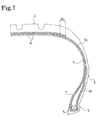
- Fig. 1 is a meridian half cross-sectional view of a pneumatic tire according to an embodiment of the present invention.
- Fig. 2 is a side view showing an extracted wound-up part of an inner liner layer in the pneumatic tire according to the embodiment of the present invention, seen from the side of the tire.
- Fig. 1 shows a pneumatic tire according to an embodiment of the present invention.
- Reference numeral 1 denotes a tread portion
- 2 denotes a side wall portion
- 3 denotes a bead portion.
- a carcass layer 4 including multiple reinforcing cords is bridged between a right and left pair of the bead portions 3, 3.
- the carcass layer 4 is wound up around a bead core 5 from the inner side of the tire to the outer side thereof.
- organic fiber cords such as nylon cords or polyester cords are generally used.
- multiple belt layers 6 are buried on the outer circumferential side of the carcass layer 4. These belt layers 6 are disposed in a way that reinforcing cords of the belt layers 6 incline relative to the tire circumferential direction, and that the reinforcing cords of the respective belt layers 6 intersect each other.
- an inner liner layer 7 is disposed along the inner surface of the carcass layer 4.
- the inner liner layer 7 includes a film made of a thermoplastic resin or a thermoplastic elastomer composition.
- the thickness of the film is not particularly limited, but can be selected from a range of 0.001 mm to 1.000 mm, more preferably 0.005 mm to 0.5 mm.
- the inner liner layer 7 needs to include the film made of the thermoplastic resin or the thermoplastic elastomer composition. Meanwhile, the inner liner layer 7 may have a thin rubber sheet layered on one side or on both sides of the film.
- the inner liner layer 7 is wound-up, as similar to the carcass layer 4, around the bead core 5 from the inner side of the tire to the outer side thereof.
- a wound-up part 7a of the inner liner layer 7 is disposed over an end of a wound-up part 4a of the carcass layer 4, and extends over there up to a position where the wound-up part 7a overlaps the belt layer 6.
- the tire has at least the wound-up part 7a on the outer side of the vehicle extending to the position where this wound-up part 7a overlaps the belt layer 6.
- the wound-up parts 7a on both sides of the tire are made to extend to the positions where both the wound-up parts 7a overlap with the belt layer 6.
- the inner liner layer 7 including the film made of the thermoplastic resin or the thermoplastic elastomer composition is disposed along the inner surface of the carcass layer 4. Accordingly, the thickness of the inner liner layer 7 can be reduced, thereby allowing the tire to have reduced weight in comparison with a case of an inner liner layer made of a butyl rubber.
- the inner liner layer 7 including the film made of the thermoplastic resin or the thermoplastic elastomer composition is wound up around the bead cores 5 from the inner side of the tire to the outer side thereof. At least one of the wound-up parts 7a of the inner liner layer 7 extends to the position where the wound-up part 7a overlaps the belt layer 6.
- the film made of the thermoplastic resin or the thermoplastic elastomer composition has a higher elastic modulus than a film made solely of a rubber. Accordingly, even when the film is thin, the casing stiffness of the tire is increased effectively.
- additional reinforcing members are included in a tire to increase the casing stiffness of the tire.
- the tire can show an excellent driving stability because the inner liner layer 7 including such a film is disposed adjacent to the carcass layer 4. Note that, when the wound-up part 4a of the carcass layer 4 extends to the position where the wound-up part 4a together with the wound-up part 7a of the inner liner layer 7 overlaps the belt layer 6, the casing stiffness of the tire can further be increased.
- an overlapping width W in a tire width direction between the wound-up part 7a of the inner liner layer 7 and the belt layer 6 is set to 10 mm or more.
- Fig. 2 shows the extracted wound-up part of the inner liner layer in the pneumatic tire, seen from the side of the tire.
- multiple slits 17 extending in a tire radial direction are provided in the wound-up part 7a of the inner liner layer 7.
- These slits 17 have been formed in an inner liner material wound on a making drum in a tire-building step.
- each slit 17 is deformed into a fan-like shape in accordance with the deformation of the carcass layer; that is, the slit 17 is deformed so that the width may gradually increase outwardly in the tire radial direction.
- the wound-up part 7a of the inner liner layer 7 greatly contributes to the increase in the casing stiffness of the tire.
- the excessively stiff inner liner layer 7 makes it difficult to expand a cylindrical first green tire build on the making drum in the tire-building step, and tire members may be damaged in some cases.
- the slits 17 are provided in the wound-up part 7a of the inner liner layer 7, i.e., in parts which do not provide air-permeation prevention ability, the tire-building step can be conducted smoothly.
- the number of slits 17 is 4 to 20, and more preferably 6 to 20. It is desirable that these slits 17 be arranged at equal intervals in the tire circumferential direction.
- the slits 17 preferably extend at an angle of substantially 0° to the tire radial direction.
- the slits 17 may incline to the tire radial direction as long as an angle of the slits to the tire radial direction is 30° or less.
- the slits 17 are desirably formed in a region that is away from the inner edge of the bead core 5 outwardly in the tire radial direction by 5 mm or more. Thereby, the air-permeation prevention ability is attained more surely.
- the formation region of the slits 17 may be appropriately designed in consideration of, for example, a deformation ratio of a material, which is determined in accordance with the tire size and the like.
- the slits 17 are desirably formed in a region where an expansion is caused at a state of the completed tire by 20% or more relative to the outer diameter of the inner liner material wound on the making drum.
- This film can be formed of a thermoplastic resin or a thermoplastic elastomer composition obtained by blending a thermoplastic resin with an elastomer.
- thermoplastic resin preferably used in the present invention examples include: polyamide resins (for example, nylon 6 (N6), nylon 66 (N66), nylon 46 (N46), nylon 11 (N11), nylon 12 (N12), nylon 610 (N610), nylon 612 (N612), nylon 6/66 copolymers (N6/66), nylon 6/66/610 copolymers (N6/66/610), nylon MXD6 (MXD6), nylon 6T, nylon 6/6T copolymers, nylon 66/PP copolymers, and nylon 66/PPS copolymers): their N-alkoxyalkylated products (for example, methoxymethylated nylon 6, methoxymethylated nylon 6/610 copolymers, and methoxymethylated nylon 612); polyester resins (for example, aromatic polyesters, such as polybutylene terephthalate (PBT), polyethylene terephthalate (PET), polyethylene isophthalate (PEI), PET/PEI copolymers, polyarylate (PBT
- Examples of the elastomer preferably used in the present invention include: diene rubbers and their hydrogenated products (for example, natural rubbers (NR), isoprene rubber (IR), epoxidized natural rubbers, styrene-butadiene rubber (SBR), butadiene rubbers (BR, high-cis BR and low-cis BR), nitrile rubber (NBR), hydrogenated NBR, and hydrogenated SBR) ; olefin rubbers (for example, ethylene propylene rubbers (EPDM and EPM), maleic acid-modified ethylene propylene rubber (M-EPM), butyl rubber (IIR), copolymers of isobutylene and aromatic vinyl or diene monomer, acrylic rubber (ACM), and ionomers); halogen-containing rubbers (for example, Br-IIR, C1-IIR, brominated isobutylene-p-methylstyrene copolymers (Br-IPMS), chloropren
- a compatibilizer may be used as a third component appropriately to make the two compatible with each other.
- a compatibilizer By mixing such a compatibilizer into the blend system, the interfacial tension between the thermoplastic resin and the elastomer is reduced. As a result, the rubber particles constituting the dispersion phase is made finer, so that both components can exhibit their characteristics more effectively.
- such a compatibilizer has a copolymer structure of at least one of the thermoplastic resin and the elastomer, or a copolymer structure having an epoxy group, a carbonyl group, a halogen group, an amino group, an oxazoline group, or a hydroxyl group, which is capable of reacting with the thermoplastic resin or the elastomer.
- the compatibilizer can be selected depending on the type of the thermoplastic resin and the elastomer to be mixed therewith.
- styrene/ethylene-butylene-styrene block copolymers SEBS
- EPDM, EPM, EPDM/styrene or EPDM/aorylonitrile graft copolymers SEBS
- the blending proportion of such a compatibilizer is not particularly limited, but may preferably be 0.5 to 10 parts by weight relative to 100 parts by weight of the polymer components (the total amount of the thermoplastic resin and the elastomer).
- the component ratio of a particular thermoplastic resin to a particular elastomer is not particularly limited, and may be appropriately set so as to have a structure in which the elastomer is dispersed as a discontinuous phase in a matrix of the thermoplastic resin.
- the preferable range is 90/10 to 30/70 in weight ratio.
- the thermoplastic resin and the thermoplastic elastomer composition each of which constitutes the film may be mixed with another polymer, for example, the above-described compatibilizer in such an amount that the polymer does not harm the characteristic required as the inner liner layer.
- the purposes of mixing such a polymer are to improve the compatibility between the thermoplastic resin and the elastomer, to improve the molding processability of the material for the film, to improve the heat resistance, to reduce cost, and so on.
- the material used for the polymer include polyethylene (PE), polypropylene (PP), polystyrene (PS), ABS, SBS, and polycarbonate (PC).
- a filler (calcium carbonate, titanium oxide, alumina, or the like) generally blended with a polymer blend, a reinforcement such carbon black and white carbon, a softner, a plasticizer, a processing aid, a pigment, a dye, an antidegradant, or the like can be blended optionally with the inner liner layer as long as such an agent does not harm the characteristic required as the inner liner layer.
- the elastomer When mixed with the thermoplastic resin, the elastomer can be dynamically vulcanized.
- a vulcanizer, a vulcanization assistant, vulcanization conditions (temperature, time), and the like, during the dynamic vulcanization can be determined as appropriate in accordance with the composition of the elastomer to be added, and are not particularly limited.
- a generally-available rubber vulcanizer crosslinking agent
- examples of a sulfur-based vulcanizer include a sulfur powder, precipitated sulfur, highly dispersible sulfur, surface-treated sulfur, non-soluble sulfur, dimorpholin disulfide, and alkylphenol disulfide.
- phr refers to parts by weight per 100 parts by weight of the elastomer component.
- examples of an organic peroxide-based vulcanizer include benzoyl peroxide, t-butyl hydroperoxide, 2,4-dichlorobenzoyl peroxide, 2,5-dimethyl-2,5-di(t-butyl peroxy)hexane, and 2,5-dimethylhexane-2,5-di(peroxyl benzoate).
- Such an organic peroxide-based vulcanizer can be used in an amount of, for example, approximately 1 to 20 phr.
- examples of a phenol resin-based vulcanizer includes brominated alkylphenol resins and mixed crosslinking system containing an alkyl phenol resin with a halogen donor such as tin chloride and chloroprene.
- a phenol resin-based vulcanizer can be used in an amount of, for example, approximately 1 to 20 phr.
- vulcanizers examples include zinc white (approximately 5 phr), magnesium oxide (approximately 4 phr), litharge (approximately 10 to 20 phr), p-quinone dioxime, p-dibenzoylquinone dioxime, tetrachloro-p-benzoquinone, poly-p-dinitrosobenzene (approximately 2 to 10 phr), and methylenedianiline (approximately 0.2 to 10 phr).
- a vulcanization accelerator may be added.
- the vulcanization accelerator are aldehyde-ammonia-based, guanidine-based, thiazole-based, sulfenamide-based, thiuram-based, dithioic acid salt-based, and thiourea-based vulcanization accelerators which are generally available.
- Such a vulcanization accelerator can be used in an amount of, for example, approximately 0.5 to 2 phr.
- an example of the aldehyde-ammonia-based vulcanization accelerator includes hexamethylenetetramine.
- An example of the guanidine-based vulcanization accelerator includes diphenylguanidine.
- Examples of the thiazole-based vulcanization accelerator include dibenzothiazyl disulfide (DM), 2-mercapto benzothiazole and their Zn salts, and cyclohexylamine salts.
- sulfenamide-based vulcanization accelerator examples include cyclohexylbenzothiazyl sulfenamide (CBS), N-oxydiethylenebenzothiazyl-2-sulfenamide, N-t-butyl-2-benzothiazole sulfenamide, and 2-(thymolpolynyldithio)benzothiazole.
- CBS cyclohexylbenzothiazyl sulfenamide
- N-oxydiethylenebenzothiazyl-2-sulfenamide N-t-butyl-2-benzothiazole sulfenamide
- 2-(thymolpolynyldithio)benzothiazole examples include 2-(thymolpolynyldithio)benzothiazole.
- thiuram-based vulcanization accelerator examples include tetramethylthiuram disulfide (TMTD), tetraethylthiuram disul
- Examples of the dithioic acid salt-based vulcanization accelerator include Zn-dimethyldithiocarbamate, Zn-diethyldithiocarbamate, Zn-di-n-butyldithiocarbamate, Zn-ethylphenyldithiocarbamate, Te-diethyldithiocarbamate, Cu-dimethyldithiocarbamate, Fe-dimethyldithiocarbamate, and pipecoline pipecolyldithiocarbamate.
- Examples of the thiourea-based vulcanization accelerator include ethylene thiourea and diethylthiourea.
- a vulcanization accelerator assistant which is generally-used for a rubber can be used.
- zinc white approximately 5 phr
- stearic acid approximately 1 phr
- oleic acid approximately 1 phr
- Zn salts approximately 2 to 4 phr
- the method for producing the thermoplastic elastomer composition is as follows.
- the thermoplastic resin and the elastomer (unvulcanized one in the case of rubber) are melt-kneaded in advance by a bi-axial kneader/extruder or the like.
- the elastomer is dispersed as a dispersion phase (domain) in the thermoplastic resin forming a continuous phase (matrix).
- the vulcanizer can be added during the kneading process to dynamically vulcanize the elastomer.
- the various compounding agents may be added to the thermoplastic resin or the elastomer during the kneading process, it is preferable to premix the compounding agents before the kneading process.
- the kneader used for kneading the thermoplastic resin and the elastomer is not particularly limited. A screw extruder, kneader, Banbury Mixer, bi-axial kneader/extruder, or the like can be used as the kneader.
- a bi-axial kneader/extruder is preferably used for kneading the thermoplastic resin and the elastomer and for dynamically vulcanizing the elastomer.
- two or more types of kneaders can be used to successively knead the thermoplastic resin and the elastomer.
- the temperature should be at a temperature at which the thermoplastic resin melts or at a higher temperature.
- the shear rate at the time of kneading is preferably 1000 to 7500 sec -1 .
- the overall kneading time is 30 seconds to 10 minutes.
- the vulcanization time after the addition is preferably 15 seconds to 5 minutes.
- the polymer composition produced by the above method may be formed into a desired shape by a generally-used method for forming a thermoplastic resin such as injection molding and extrusion molding.
- thermoplastic elastomer composition thus obtained has a structure in which the elastomer is dispersed as a discontinuous phase in the matrix of the thermoplastic resin.
- the Young's moduli of the thermoplastic resin and the thermoplastic elastomer composition in the standard atmosphere specified by JIS K7100 are not particularly limited, but are preferably set to 1 to 500 MPa, and more preferably 50 to 500 MPa.
- thermoplastic resin or the thermoplastic elastomer composition can be formed into a sheet or film to be used as a single unit.
- an adhesive layer may be stacked thereon in order to improve the adhesiveness to the adjacent rubber.
- an adhesive polymer that constitutes the adhesive layer include an ultra high molecular weight polyethylene (UHMWPE) having a molecular weight of 1,000,000 or more, preferably 3,000,000 or more, acrylate copolymers such as ethylene-ethylacrylate copolymers (EEA), ethylene-methylacrylate resins (EMA) and ethylene-acrylic acid copolymers (EAA), and their maleic anhydrate adduct, polypropylene (PP) and maleic acid-modified products thereof, ethylene-polypropylene copolymers and maleic acid-modified products thereof, polybutadiene resins and maleic anhydrate-modified products thereof, styrene-butadiene-styrene copolymers (SBS), styrene-
- the thickness of the adhesive layer is not particularly limited, but is preferably small for the tire weight reduction. The thickness of 5 ⁇ m to 150 ⁇ m is preferable.
- Tires prepared for Conventional Example, Examples 1, 2 and Comparative Examples 1, 2 were pneumatic tires having the following structures. Specifically, each tire has a tire size of 205/55R16, and includes: a carcass layer bridged between a pair of bead portions; belt layers disposed on the outer circumferential side of the carcass layer; and an inner liner layer disposed along the inner surface of the carcass layer.
- the pneumatic tires of the respective examples differ from one another in the constituent material of the inner liner layer and in an overlapping width W between wound--up part of the inner liner layer and the belt layer.
- the inner liner layer adopted in the tire of Conventional Example was formed of a rubber composition mainly containing a butyl rubber and had a thickness of 1.5 mm; and the inner liner layer is terminated within the inner surface of the tire.
- the inner liner layer adopted in the tire of Example 1 was formed of a film made of a thermoplastic elastomer composition obtained by blending a thermoplastic resin (nylon 6,66) with an elastomer (brominated butyl rubber) and had a thickness of 0.3 mm; the inner liner layer was wound up around a bead core from the inner side of the tire to the outer side thereof; and the overlapping width between each wound-up part and the belt layer was set to 10 mm.
- the tire of Example 2 had the same constitution as the tire of Example 1 except that the adopted inner liner layer was formed of a film made of a thermoplastic resin (vinyl alcohol/ethylene copolymer) having a thickness of 0.3 mm.
- the tire of Comparative Example 1 had the same constitution as the tire of Example 1 except that the adopted inner liner layer is terminated within the inner surface of the tire.
- the tire of Comparative Example 2 had the same constitution as the tire of Example 2 except that the adopted inner liner layer is terminated within the inner surface of the tire.
- Each of the test tires was fitted onto a regular rim, and mounted on a test vehicle.
- An air pressure of the tire was set to 200 kPa. Then, a feeling evaluation was conducted by a test driver.
- the evaluation result was expressed by an index where the driving stability of Conventional Example was taken as 100. The larger the index value means the more excellent the tire is in driving stability.
Landscapes
- Engineering & Computer Science (AREA)
- Mechanical Engineering (AREA)
- Tires In General (AREA)
- Compositions Of Macromolecular Compounds (AREA)
Abstract
Description
- The present invention relates to a pneumatic tire in which a film made of a thermoplastic resin or a thermoplastic elastomer composition obtained by blending a thermoplastic resin with an elastomer is used as an inner liner layer. More particularly, the present invention relates to a pneumatic tire having an improved driving stability with reduced weight.
- Generally, a pneumatic tire has a casing structure including: a carcass layer bridged between a pair of bead portions; and a belt layer disposed on the outer circumferential side of the carcass layer. In addition, the pneumatic tire has an inner liner layer made of a butyl rubber formed along the inner surface of the carcass layer. In order to improve the driving stability of the pneumatic tire by increasing the casing stiffness thereof, it is effective to bury a reinforcing member including organic fiber cords or steel cords in a region from the bead portion to a side wall portion. However, the addition of the reinforcing member that is thickened due to the inclusion of such cords increases the weight of the tire.
- On the other hand, a pneumatic tire is proposed in which a thermoplastic resin having an excellent air-permeation prevention ability is used in place of the butyl rubber as the material of an inner liner layer (see, for example, Japanese patent application Kokai publication No.
Hei 8-217922 - An object of the present invention is to provide a pneumatic tire having an improved driving stability with reduced weight by use of an inner liner layer including a film made of a thermoplastic resin or a thermoplastic elastomer composition obtained by blending a thermoplastic resin with an elastomer.
- In order to achieve the above object, the pneumatic tire of the present invention includes: a pair of bead portions; a carcass layer bridged between the pair of bead portions; a belt layer disposed on an outer circumferential side of the carcass layer; an inner liner layer disposed along an inner surface of the carcass layer, the inner liner layer including a film made of a thermoplastic resin or a thermoplastic elastomer composition that is obtained by blending a thermoplastic resin with an elastomer; and bead cores buried in the bead portions, respectively. The inner liner layer is wound up around the bead cores from an inner side of the tire to an outer side thereof. At least one wound-up part of the inner liner layer extends to a position where the wound-up part overlaps the belt layer.
- In the present invention, since the inner liner layer including the film made of the thermoplastic resin or the thermoplastic elastomer composition is disposed along the inner surface of the carcass layer, the inner liner layer is reduced in thickness, and the tire weight can be reduced in comparison with an inner liner layer made of a butyl rubber. Moreover, the inner liner layer including the film made of the thermoplastic resin or the thermoplastic elastomer composition is wound up around the bead cores from the inner side of the tire to the outer side thereof, and at least one wound-up part of the inner liner layer extends to a position where the wound-up part overlaps the belt layer. Thereby, the driving stability of the tire according to the present invention is improved while the tire weight is reduced. Specifically, the film made of the thermoplastic resin or the thermoplastic elastomer composition has a higher elastic modulus than a film made of a single rubber. Thus, even when the film made of the thermoplastic resin or the thermoplastic elastomer composition is thin, the casing stiffness of the tire is effectively increased. For this reason, even if the number of additional reinforcing members buried in a region from the bead portion to the side wall portion is reduced or if the additional reinforcing members are removed from the tire, an excellent driving stability is provided.
- In the present invention, if the tire is designed to be mounted on a vehicle in such a manner that a designated side of the tire faces to the outside of the vehicle, the effect of improving the driving stability is obtained by extending the wound-up part of only the inner liner layer to be located on the outer side of the vehicle to the position where this wound-up part overlaps the belt layer. In the meanwhile, if the tire is not is designed in such a manner, the wound-up parts on both sides of the tire need to extend to the positions where both the wound-up parts overlap the belt layer. It is needless to say that, in the tire that is designed in the manner as above, the wound-up parts of the inner liner layer on both the sides may extend to positions where both the wound-up parts overlap the belt layer.
- The overlapping width in a tire width direction between the wound-up part of the inner liner layer and the belt layer is preferably set to 10 mm or more. By setting the overlapping width sufficiently wide, the two films of the inner liner layer are securely laid between the bead core and the belt layer, and effectively increasing the casing stiffness.
- Moreover, multiple slits extending in a tire radial direction are preferably provided in the wound-up part of the inner liner layer. To be more specific, if the inner liner layer is excessively stiff, it becomes difficult to expand the cylindrical first green tire built on a making drum in the tire-building step. For this reason, the slits are provided in the wound-up part of the inner liner layer, i.e., in parts which do not provide air-permeation prevention ability. Thereby, the tire-building step is conducted smoothly. It is preferable that the number of slits be 4 to 20, and that the slits be arranged at equal intervals in a tire circumferential direction.
-
Fig. 1 is a meridian half cross-sectional view of a pneumatic tire according to an embodiment of the present invention.
Fig. 2 is a side view showing an extracted wound-up part of an inner liner layer in the pneumatic tire according to the embodiment of the present invention, seen from the side of the tire. - Hereinafter, a constitution of the present invention will be described in detail with reference to the attached drawings.
Fig. 1 shows a pneumatic tire according to an embodiment of the present invention. Reference numeral 1 denotes a tread portion, 2 denotes a side wall portion, and 3 denotes a bead portion. A carcass layer 4 including multiple reinforcing cords is bridged between a right and left pair of thebead portions bead core 5 from the inner side of the tire to the outer side thereof. As the reinforcing cords in the carcass layer 4, organic fiber cords such as nylon cords or polyester cords are generally used. In the tread portion 1,multiple belt layers 6 are buried on the outer circumferential side of the carcass layer 4. Thesebelt layers 6 are disposed in a way that reinforcing cords of thebelt layers 6 incline relative to the tire circumferential direction, and that the reinforcing cords of therespective belt layers 6 intersect each other. - Furthermore, in the pneumatic tire, an inner liner layer 7 is disposed along the inner surface of the carcass layer 4. The inner liner layer 7 includes a film made of a thermoplastic resin or a thermoplastic elastomer composition. The thickness of the film is not particularly limited, but can be selected from a range of 0.001 mm to 1.000 mm, more preferably 0.005 mm to 0.5 mm. The inner liner layer 7 needs to include the film made of the thermoplastic resin or the thermoplastic elastomer composition. Meanwhile, the inner liner layer 7 may have a thin rubber sheet layered on one side or on both sides of the film.
- The inner liner layer 7 is wound-up, as similar to the carcass layer 4, around the
bead core 5 from the inner side of the tire to the outer side thereof. A wound-uppart 7a of the inner liner layer 7 is disposed over an end of a wound-up part 4a of the carcass layer 4, and extends over there up to a position where the wound-uppart 7a overlaps thebelt layer 6. Particularly, if a tire is designed to be mounted on a vehicle in such a manner that a designated side of the tire faces to the outside of the vehicle, the tire has at least the wound-uppart 7a on the outer side of the vehicle extending to the position where this wound-uppart 7a overlaps thebelt layer 6. Meanwhile, if a tire is not designed in such a manner, the wound-upparts 7a on both sides of the tire are made to extend to the positions where both the wound-upparts 7a overlap with thebelt layer 6. - In the pneumatic tire having the above-described constitution, the inner liner layer 7 including the film made of the thermoplastic resin or the thermoplastic elastomer composition is disposed along the inner surface of the carcass layer 4. Accordingly, the thickness of the inner liner layer 7 can be reduced, thereby allowing the tire to have reduced weight in comparison with a case of an inner liner layer made of a butyl rubber.
- Furthermore, the inner liner layer 7 including the film made of the thermoplastic resin or the thermoplastic elastomer composition is wound up around the
bead cores 5 from the inner side of the tire to the outer side thereof. At least one of the wound-upparts 7a of the inner liner layer 7 extends to the position where the wound-uppart 7a overlaps thebelt layer 6. This enables the weight reduction and the driving stability to be balanced. In other words, the film made of the thermoplastic resin or the thermoplastic elastomer composition has a higher elastic modulus than a film made solely of a rubber. Accordingly, even when the film is thin, the casing stiffness of the tire is increased effectively. In general, additional reinforcing members are included in a tire to increase the casing stiffness of the tire. Even when the number of the additional reinforcing members is reduced or when the additional reinforcing members are removed from the tire, the tire can show an excellent driving stability because the inner liner layer 7 including such a film is disposed adjacent to the carcass layer 4. Note that, when the wound-up part 4a of the carcass layer 4 extends to the position where the wound-up part 4a together with the wound-uppart 7a of the inner liner layer 7 overlaps thebelt layer 6, the casing stiffness of the tire can further be increased. - In the above-described pneumatic tire, an overlapping width W in a tire width direction between the wound-up
part 7a of the inner liner layer 7 and thebelt layer 6 is set to 10 mm or more. By setting the overlapping width W sufficiently wide, the two films of the inner liner layer 7 are securely laid between thebead core 5 and thebelt layer 6, and the casing stiffness can be effectively increased. If the overlapping width W is less than 10 mm, the effect of increasing the casing stiffness is reduced. -
Fig. 2 shows the extracted wound-up part of the inner liner layer in the pneumatic tire, seen from the side of the tire. As shown inFig. 2 ,multiple slits 17 extending in a tire radial direction are provided in the wound-uppart 7a of the inner liner layer 7. Theseslits 17 have been formed in an inner liner material wound on a making drum in a tire-building step. In the process of completing the formation of a tire from a cylindrical first green tire, each slit 17 is deformed into a fan-like shape in accordance with the deformation of the carcass layer; that is, theslit 17 is deformed so that the width may gradually increase outwardly in the tire radial direction. - The wound-up
part 7a of the inner liner layer 7 greatly contributes to the increase in the casing stiffness of the tire. However, the excessively stiff inner liner layer 7 makes it difficult to expand a cylindrical first green tire build on the making drum in the tire-building step, and tire members may be damaged in some cases. In contrast, when theslits 17 are provided in the wound-uppart 7a of the inner liner layer 7, i.e., in parts which do not provide air-permeation prevention ability, the tire-building step can be conducted smoothly. - The number of
slits 17 is 4 to 20, and more preferably 6 to 20. It is desirable that theseslits 17 be arranged at equal intervals in the tire circumferential direction. Theslits 17 preferably extend at an angle of substantially 0° to the tire radial direction. Theslits 17 may incline to the tire radial direction as long as an angle of the slits to the tire radial direction is 30° or less. Meanwhile, theslits 17 are desirably formed in a region that is away from the inner edge of thebead core 5 outwardly in the tire radial direction by 5 mm or more. Thereby, the air-permeation prevention ability is attained more surely. Furthermore, the formation region of theslits 17 may be appropriately designed in consideration of, for example, a deformation ratio of a material, which is determined in accordance with the tire size and the like. For example, theslits 17 are desirably formed in a region where an expansion is caused at a state of the completed tire by 20% or more relative to the outer diameter of the inner liner material wound on the making drum. - Hereinafter, description will be given of the film of the inner liner layer used in the present invention. This film can be formed of a thermoplastic resin or a thermoplastic elastomer composition obtained by blending a thermoplastic resin with an elastomer.
- Examples of the thermoplastic resin preferably used in the present invention include: polyamide resins (for example, nylon 6 (N6), nylon 66 (N66), nylon 46 (N46), nylon 11 (N11), nylon 12 (N12), nylon 610 (N610), nylon 612 (N612), nylon 6/66 copolymers (N6/66), nylon 6/66/610 copolymers (N6/66/610), nylon MXD6 (MXD6), nylon 6T, nylon 6/6T copolymers, nylon 66/PP copolymers, and nylon 66/PPS copolymers): their N-alkoxyalkylated products (for example, methoxymethylated nylon 6, methoxymethylated nylon 6/610 copolymers, and methoxymethylated nylon 612); polyester resins (for example, aromatic polyesters, such as polybutylene terephthalate (PBT), polyethylene terephthalate (PET), polyethylene isophthalate (PEI), PET/PEI copolymers, polyarylate (PAR), polybutylene naphthalate (PBN), liquid crystal polyester, and polyoxyalkylene diimide diacid/polybutylene terephthalate copolymers); polynitrile resins (for example, polyacrylonitrile (PAN), polymethacrylonitrile, acrylonitrile/styrene copolymers (AS), (meth)acrylonitrile/styrene copolymers, and (meth)acrylonitrile/styrene/butadiene copolymers); polymethacrylate resins (for example, polymethyl methacrylate (PMMA), polyethyl methacrylate); polyvinyl resins (for example, polyvinyl acetate, polyvinyl alcohol (PVA), vinyl alcohol/ethylene copolymers (EVOH), polyvinylidene chloride (PVDC), polyvinyl chloride (PVC), vinyl chloride/vinylidene chloride copolymers, vinylidene chloride/methyl acrylate copolymers, vinylidene chloride/acrylonitrile copolymers); cellulose resins (for example, cellulose acetate, and cellulose acetate butyrate); fluororesins (for example, polyvinylidene fluoride (PVDF), polyvinyl fluoride (PVF), polychlorotrifluoroethylene (PCTFE), and ethylene/tetrafluoroethylene (ETFE) copolymers); and imide resins (for example, aromatic polyimide (PI)).
- Examples of the elastomer preferably used in the present invention include: diene rubbers and their hydrogenated products (for example, natural rubbers (NR), isoprene rubber (IR), epoxidized natural rubbers, styrene-butadiene rubber (SBR), butadiene rubbers (BR, high-cis BR and low-cis BR), nitrile rubber (NBR), hydrogenated NBR, and hydrogenated SBR) ; olefin rubbers (for example, ethylene propylene rubbers (EPDM and EPM), maleic acid-modified ethylene propylene rubber (M-EPM), butyl rubber (IIR), copolymers of isobutylene and aromatic vinyl or diene monomer, acrylic rubber (ACM), and ionomers); halogen-containing rubbers (for example, Br-IIR, C1-IIR, brominated isobutylene-p-methylstyrene copolymers (Br-IPMS), chloroprene rubber (CR), hydrin rubber (CHR), chlorosulfonated polyethylene rubber (CSM), chlorinated polyethylene rubber (CM), and maleic acid-modified chlorinated polyethylene rubber (M-CM)); silicone rubbers (for example, methyl vinyl silicone rubber, dimethyl silicone rubber, and methylphenylvinyl silicone rubber) ; sulfur-containing rubbers (for example, polysulfide rubber) ; fluororubbers (for example, vinylidene fluoride rubbers, fluorine-containing vinyl ether rubbers, tetrafluoroethylene-propylene rubbers, fluorine-containing silicone rubbers, and fluorine-containing phosphazene rubbers); and thermoplastic elastomers (for example, styrene elastomers, olefin elastomers, ester elastomers, urethane elastomers, and polyamide elastomers).
- If a particular thermoplastic resin among those described above is incompatible with such an elastomer, a compatibilizer may be used as a third component appropriately to make the two compatible with each other. By mixing such a compatibilizer into the blend system, the interfacial tension between the thermoplastic resin and the elastomer is reduced. As a result, the rubber particles constituting the dispersion phase is made finer, so that both components can exhibit their characteristics more effectively. In general, such a compatibilizer has a copolymer structure of at least one of the thermoplastic resin and the elastomer, or a copolymer structure having an epoxy group, a carbonyl group, a halogen group, an amino group, an oxazoline group, or a hydroxyl group, which is capable of reacting with the thermoplastic resin or the elastomer. The compatibilizer can be selected depending on the type of the thermoplastic resin and the elastomer to be mixed therewith. What is normally used is styrene/ethylene-butylene-styrene block copolymers (SEBS) and their maleic acid-modified products, EPDM, EPM, EPDM/styrene or EPDM/aorylonitrile graft copolymers and their maleic acid-modified products, styrene/maleic acid copolymers, reactive phenoxine, and the like. The blending proportion of such a compatibilizer is not particularly limited, but may preferably be 0.5 to 10 parts by weight relative to 100 parts by weight of the polymer components (the total amount of the thermoplastic resin and the elastomer).
- In the thermoplastic elastomer composition, the component ratio of a particular thermoplastic resin to a particular elastomer is not particularly limited, and may be appropriately set so as to have a structure in which the elastomer is dispersed as a discontinuous phase in a matrix of the thermoplastic resin. However, the preferable range is 90/10 to 30/70 in weight ratio.
- In the present invention, the thermoplastic resin and the thermoplastic elastomer composition each of which constitutes the film may be mixed with another polymer, for example, the above-described compatibilizer in such an amount that the polymer does not harm the characteristic required as the inner liner layer. The purposes of mixing such a polymer are to improve the compatibility between the thermoplastic resin and the elastomer, to improve the molding processability of the material for the film, to improve the heat resistance, to reduce cost, and so on. Examples of the material used for the polymer include polyethylene (PE), polypropylene (PP), polystyrene (PS), ABS, SBS, and polycarbonate (PC). In addition, a filler (calcium carbonate, titanium oxide, alumina, or the like) generally blended with a polymer blend, a reinforcement such carbon black and white carbon, a softner, a plasticizer, a processing aid, a pigment, a dye, an antidegradant, or the like can be blended optionally with the inner liner layer as long as such an agent does not harm the characteristic required as the inner liner layer.
- When mixed with the thermoplastic resin, the elastomer can be dynamically vulcanized. A vulcanizer, a vulcanization assistant, vulcanization conditions (temperature, time), and the like, during the dynamic vulcanization can be determined as appropriate in accordance with the composition of the elastomer to be added, and are not particularly limited.
- As the vulcanizer, a generally-available rubber vulcanizer (crosslinking agent) can be used. Specifically, examples of a sulfur-based vulcanizer include a sulfur powder, precipitated sulfur, highly dispersible sulfur, surface-treated sulfur, non-soluble sulfur, dimorpholin disulfide, and alkylphenol disulfide. Such a vulcanizer can be used in an amount of, for example, approximately 0.5 to 4 phr (hereinafter, "phr" refers to parts by weight per 100 parts by weight of the elastomer component).
- Moreover, examples of an organic peroxide-based vulcanizer include benzoyl peroxide, t-butyl hydroperoxide, 2,4-dichlorobenzoyl peroxide, 2,5-dimethyl-2,5-di(t-butyl peroxy)hexane, and 2,5-dimethylhexane-2,5-di(peroxyl benzoate). Such an organic peroxide-based vulcanizer can be used in an amount of, for example, approximately 1 to 20 phr.
- Furthermore, examples of a phenol resin-based vulcanizer includes brominated alkylphenol resins and mixed crosslinking system containing an alkyl phenol resin with a halogen donor such as tin chloride and chloroprene. Such a phenol resin-based vulcanizer can be used in an amount of, for example, approximately 1 to 20 phr.
- Examples of other vulcanizers include zinc white (approximately 5 phr), magnesium oxide (approximately 4 phr), litharge (approximately 10 to 20 phr), p-quinone dioxime, p-dibenzoylquinone dioxime, tetrachloro-p-benzoquinone, poly-p-dinitrosobenzene (approximately 2 to 10 phr), and methylenedianiline (approximately 0.2 to 10 phr).
- As necessary, a vulcanization accelerator may be added. Examples of the vulcanization accelerator are aldehyde-ammonia-based, guanidine-based, thiazole-based, sulfenamide-based, thiuram-based, dithioic acid salt-based, and thiourea-based vulcanization accelerators which are generally available. Such a vulcanization accelerator can be used in an amount of, for example, approximately 0.5 to 2 phr.
- Specifically, an example of the aldehyde-ammonia-based vulcanization accelerator includes hexamethylenetetramine. An example of the guanidine-based vulcanization accelerator includes diphenylguanidine. Examples of the thiazole-based vulcanization accelerator include dibenzothiazyl disulfide (DM), 2-mercapto benzothiazole and their Zn salts, and cyclohexylamine salts. Examples of the sulfenamide-based vulcanization accelerator include cyclohexylbenzothiazyl sulfenamide (CBS), N-oxydiethylenebenzothiazyl-2-sulfenamide, N-t-butyl-2-benzothiazole sulfenamide, and 2-(thymolpolynyldithio)benzothiazole. Examples of the thiuram-based vulcanization accelerator include tetramethylthiuram disulfide (TMTD), tetraethylthiuram disulfide, tetramethylthiuram monosulfide (TMTM), and dipentamethylenethiuram tetrasulfide. Examples of the dithioic acid salt-based vulcanization accelerator include Zn-dimethyldithiocarbamate, Zn-diethyldithiocarbamate, Zn-di-n-butyldithiocarbamate, Zn-ethylphenyldithiocarbamate, Te-diethyldithiocarbamate, Cu-dimethyldithiocarbamate, Fe-dimethyldithiocarbamate, and pipecoline pipecolyldithiocarbamate. Examples of the thiourea-based vulcanization accelerator include ethylene thiourea and diethylthiourea.
- Additionally, a vulcanization accelerator assistant which is generally-used for a rubber can be used. For example, zinc white (approximately 5 phr), stearic acid, oleic acid and their Zn salts (approximately 2 to 4 phr), or the like can be used.
- The method for producing the thermoplastic elastomer composition is as follows. The thermoplastic resin and the elastomer (unvulcanized one in the case of rubber) are melt-kneaded in advance by a bi-axial kneader/extruder or the like. The elastomer is dispersed as a dispersion phase (domain) in the thermoplastic resin forming a continuous phase (matrix). When the elastomer is vulcanized, the vulcanizer can be added during the kneading process to dynamically vulcanize the elastomer. Although the various compounding agents (except for vulcanizer) may be added to the thermoplastic resin or the elastomer during the kneading process, it is preferable to premix the compounding agents before the kneading process. The kneader used for kneading the thermoplastic resin and the elastomer is not particularly limited. A screw extruder, kneader, Banbury Mixer, bi-axial kneader/extruder, or the like can be used as the kneader. Among these, a bi-axial kneader/extruder is preferably used for kneading the thermoplastic resin and the elastomer and for dynamically vulcanizing the elastomer. Furthermore, two or more types of kneaders can be used to successively knead the thermoplastic resin and the elastomer. As the condition for the melt kneading, the temperature should be at a temperature at which the thermoplastic resin melts or at a higher temperature. The shear rate at the time of kneading is preferably 1000 to 7500 sec-1. The overall kneading time is 30 seconds to 10 minutes. When the vulcanizer is added, the vulcanization time after the addition is preferably 15 seconds to 5 minutes. The polymer composition produced by the above method may be formed into a desired shape by a generally-used method for forming a thermoplastic resin such as injection molding and extrusion molding.
- The thermoplastic elastomer composition thus obtained has a structure in which the elastomer is dispersed as a discontinuous phase in the matrix of the thermoplastic resin. By adopting such a structure, it becomes possible to provide the inner liner layer with both sufficient flexibility and sufficient stiffness that is attributed to the effect of the resin layer as the continuous phase. Furthermore, it becomes possible to obtain, in molding, a molding processability equivalent to the case of a thermoplastic resin regardless of the amount of elastomer.
- The Young's moduli of the thermoplastic resin and the thermoplastic elastomer composition in the standard atmosphere specified by JIS K7100 are not particularly limited, but are preferably set to 1 to 500 MPa, and more preferably 50 to 500 MPa.
- The thermoplastic resin or the thermoplastic elastomer composition can be formed into a sheet or film to be used as a single unit. Alternatively, an adhesive layer may be stacked thereon in order to improve the adhesiveness to the adjacent rubber. Specific examples of an adhesive polymer that constitutes the adhesive layer include an ultra high molecular weight polyethylene (UHMWPE) having a molecular weight of 1,000,000 or more, preferably 3,000,000 or more, acrylate copolymers such as ethylene-ethylacrylate copolymers (EEA), ethylene-methylacrylate resins (EMA) and ethylene-acrylic acid copolymers (EAA), and their maleic anhydrate adduct, polypropylene (PP) and maleic acid-modified products thereof, ethylene-polypropylene copolymers and maleic acid-modified products thereof, polybutadiene resins and maleic anhydrate-modified products thereof, styrene-butadiene-styrene copolymers (SBS), styrene-ethylene-butadiene-styrene copolymers (SEBS), thermoplastic fluororesins, and thermoplastic polyester resins. These polymers can be formed into a sheet or film by being extruded with, for example, a resin extruder in accordance with a generally-used method. The thickness of the adhesive layer is not particularly limited, but is preferably small for the tire weight reduction. The thickness of 5 µm to 150 µm is preferable.
- Hereinabove, the preferable embodiment of the present invention has been described in detail. It should be understood, however, that various alternations, substitutions and replacements can be made on the above-described embodiment without departing from the spirit and scope of the present invention defined by the attached claims.
- Tires prepared for Conventional Example, Examples 1, 2 and Comparative Examples 1, 2 were pneumatic tires having the following structures. Specifically, each tire has a tire size of 205/55R16, and includes: a carcass layer bridged between a pair of bead portions; belt layers disposed on the outer circumferential side of the carcass layer; and an inner liner layer disposed along the inner surface of the carcass layer. The pneumatic tires of the respective examples differ from one another in the constituent material of the inner liner layer and in an overlapping width W between wound--up part of the inner liner layer and the belt layer.
- The inner liner layer adopted in the tire of Conventional Example was formed of a rubber composition mainly containing a butyl rubber and had a thickness of 1.5 mm; and the inner liner layer is terminated within the inner surface of the tire. The inner liner layer adopted in the tire of Example 1 was formed of a film made of a thermoplastic elastomer composition obtained by blending a thermoplastic resin (
nylon 6,66) with an elastomer (brominated butyl rubber) and had a thickness of 0.3 mm; the inner liner layer was wound up around a bead core from the inner side of the tire to the outer side thereof; and the overlapping width between each wound-up part and the belt layer was set to 10 mm. The tire of Example 2 had the same constitution as the tire of Example 1 except that the adopted inner liner layer was formed of a film made of a thermoplastic resin (vinyl alcohol/ethylene copolymer) having a thickness of 0.3 mm. The tire of Comparative Example 1 had the same constitution as the tire of Example 1 except that the adopted inner liner layer is terminated within the inner surface of the tire. The tire of Comparative Example 2 had the same constitution as the tire of Example 2 except that the adopted inner liner layer is terminated within the inner surface of the tire. - The mass, radial stiffness, and transverse stiffness of the tires of Conventional Example, Examples 1, 2 and Comparative Examples 1, 2 were evaluated. The driving stability thereof was evaluated by the following evaluation method. The results are shown in Table 1.
- Each of the test tires was fitted onto a regular rim, and mounted on a test vehicle. An air pressure of the tire was set to 200 kPa. Then, a feeling evaluation was conducted by a test driver. The evaluation result was expressed by an index where the driving stability of Conventional Example was taken as 100. The larger the index value means the more excellent the tire is in driving stability.
[Table 1] Conventional Example Example 1 Example 2 Comparative Example 1 Comparative Example 2 Material of inner liner layer Butyl rubber Thermoplastic elastomer composition Thermoplastic resin Thermoplastic elastomer composition Thermoplastic resin Overlapping width (mm) - 10 10 - - Mass (kg) 8.3 7.6 7.6 7.6 7.6 Radial stiffness (N/mm) 202.0 203.0 203.0 202.1 202.2 Transverse stiffness (N/mm) 117.7 120.6 120.7 117.8 117.9 Driving stability (index) 100 105 105 100 100 - As apparent from Table 1, although the tires of Examples 1, 2 had lower weights than that of Conventional Example, the tires of Examples 1, 2 had high radial stiffness, high transverse stiffness, and excellent driving stability. On the other hand, the tires of Comparative Examples 1, 2 also had reduced weights, but the effect of improving the driving stability was not obtained.
Claims (6)
- A pneumatic tire comprising:a pair of bead portions;a carcass layer bridged between the pair of bead portions;a belt layer disposed on an outer circumferential side of the carcass layer;an inner liner layer disposed along an inner surface of the carcass layer, the inner liner layer including a film made of any one of a thermoplastic resin and a thermoplastic elastomer composition that is obtained by blending a thermoplastic resin with an elastomer; andbead cores buried in the bead portions, respectively,wherein the inner liner layer is wound up around the bead cores from an inner side of the tire to an outer side thereof, and at least one wound-up part of the inner liner layer extends to a position where the wound-up part overlaps the belt layer.
- The pneumatic tire according to claim 1, wherein the wound-up part of the inner liner layer overlaps the belt layer in a tire width direction by 10 mm or more.
- The pneumatic tire according to claim 1, further comprising a plurality of slits provided in the wound-up part of the inner liner layer, the slits extending in a tire radial direction.
- The pneumatic tire according to claim 2, further comprising a plurality of slits provided in the wound-up part of the inner liner layer, the slits extending in a tire radial direction.
- The pneumatic tire according to claim 3, wherein the number of slits is 4 to 20, and the slits are arranged at equal intervals in a tire circumferential direction.
- The pneumatic tire according to claim 4, wherein the number of slits are 4 to 20, and the slits are arranged at equal intervals in a tire circumferential direction.
Applications Claiming Priority (1)
| Application Number | Priority Date | Filing Date | Title |
|---|---|---|---|
| JP2008044600A JP4346666B2 (en) | 2008-02-26 | 2008-02-26 | Pneumatic tire |
Publications (2)
| Publication Number | Publication Date |
|---|---|
| EP2095972A1 true EP2095972A1 (en) | 2009-09-02 |
| EP2095972B1 EP2095972B1 (en) | 2011-09-07 |
Family
ID=40626746
Family Applications (1)
| Application Number | Title | Priority Date | Filing Date |
|---|---|---|---|
| EP09152449A Expired - Fee Related EP2095972B1 (en) | 2008-02-26 | 2009-02-10 | Pneumatic tire |
Country Status (4)
| Country | Link |
|---|---|
| US (1) | US8251114B2 (en) |
| EP (1) | EP2095972B1 (en) |
| JP (1) | JP4346666B2 (en) |
| CN (1) | CN101519021B (en) |
Families Citing this family (18)
| Publication number | Priority date | Publication date | Assignee | Title |
|---|---|---|---|---|
| JP4636194B2 (en) * | 2009-05-18 | 2011-02-23 | 横浜ゴム株式会社 | Pneumatic tire and manufacturing method thereof |
| KR101190733B1 (en) | 2010-06-24 | 2012-10-11 | 현대자동차주식회사 | Cellulose powder-filled weather strip composition |
| US9068063B2 (en) | 2010-06-29 | 2015-06-30 | Eastman Chemical Company | Cellulose ester/elastomer compositions |
| US9273195B2 (en) | 2010-06-29 | 2016-03-01 | Eastman Chemical Company | Tires comprising cellulose ester/elastomer compositions |
| US8454778B2 (en) | 2010-11-15 | 2013-06-04 | Ramendra Nath Majumdar | Pneumatic tire with barrier layer and method of making the same |
| JP4915471B1 (en) * | 2010-11-17 | 2012-04-11 | 横浜ゴム株式会社 | Pneumatic tire |
| JP6162920B2 (en) * | 2011-05-31 | 2017-07-12 | 株式会社ブリヂストン | Run flat tire |
| US9708474B2 (en) | 2011-12-07 | 2017-07-18 | Eastman Chemical Company | Cellulose esters in pneumatic tires |
| CA2902328A1 (en) | 2013-03-13 | 2014-10-09 | Basf Se | Inner liner for a pneumatic tire assembly |
| US10077342B2 (en) | 2016-01-21 | 2018-09-18 | Eastman Chemical Company | Elastomeric compositions comprising cellulose ester additives |
| US10047806B2 (en) | 2016-04-12 | 2018-08-14 | Schaeffler Technologies AG & Co. KG | Clutch carrier assembly having retention lip and fluid dam |
| US11034188B2 (en) | 2016-11-17 | 2021-06-15 | Bridgestone Americas Tire Operations, Llc | Pneumatic tire having reinforcing members and air barrier layer |
| EP3541612B1 (en) * | 2016-11-17 | 2023-09-06 | Bridgestone Americas Tire Operations, LLC | Pneumatic tires with applied air barrier layers |
| EP3541609B1 (en) * | 2016-11-17 | 2022-06-15 | Bridgestone Americas Tire Operations, LLC | Pneumatic tire having a sealant layer and air barrier layer |
| EP3541640B1 (en) | 2016-11-17 | 2022-08-24 | Bridgestone Americas Tire Operations, LLC | Pneumatic tire having dampening element adhered to air barrier layer |
| JP6774385B2 (en) * | 2017-06-19 | 2020-10-21 | 株式会社ブリヂストン | How to make a pneumatic tire |
| FR3073858B1 (en) * | 2017-11-17 | 2019-10-18 | Compagnie Generale Des Etablissements Michelin | TIRE COMPRISING AN EXTERNAL FLANCH COMPRISING A LIQUID PLASTICIZER HAVING A LOW TEMPERATURE OF VITREOUS TRANSITION |
| CN108359246B (en) * | 2018-03-17 | 2020-08-11 | 深圳市峰源化工有限公司 | High-performance rubber material and preparation method thereof |
Citations (3)
| Publication number | Priority date | Publication date | Assignee | Title |
|---|---|---|---|---|
| US1581743A (en) * | 1923-11-19 | 1926-04-20 | Lee Tire & Rubber Company | Pneumatic tire and method of building the same |
| DE1262580B (en) * | 1962-09-08 | 1968-03-07 | Continental Gummi Werke Ag | Blank for pneumatic vehicle tires, especially two-layer tires |
| JPH08217922A (en) | 1995-02-16 | 1996-08-27 | Yokohama Rubber Co Ltd:The | Pneumatic tire |
Family Cites Families (15)
| Publication number | Priority date | Publication date | Assignee | Title |
|---|---|---|---|---|
| JPS59179410A (en) * | 1983-03-30 | 1984-10-12 | Yokohama Rubber Co Ltd:The | Pneumatic radial tire for motorcycle |
| US5992486A (en) * | 1994-09-13 | 1999-11-30 | Gunze Limited | Laminate gas barrier layer for pneumatic tires |
| US6079465A (en) * | 1995-01-23 | 2000-06-27 | The Yokohama Rubber Co., Ltd. | Polymer composition for tire and pneumatic tire using same |
| EP0857761B1 (en) * | 1996-05-29 | 2007-01-03 | The Yokohama Rubber Co., Ltd. | Process for making a pneumatic tire having an almost impermeable thermoplastic elastomer composition in gas-barrier layer |
| EP2392620A1 (en) * | 1997-09-29 | 2011-12-07 | The Yokohama Rubber Co., Ltd. | Pneumatic tire |
| JP2000263656A (en) * | 1999-03-15 | 2000-09-26 | Bridgestone Corp | Pneumatic tire and its method manufacturing |
| DE60225460T2 (en) * | 2001-09-14 | 2009-02-26 | Honda Giken Kogyo K.K. | A pneumatic tire having a sealant layer and method of making the same |
| JP4409814B2 (en) * | 2001-09-26 | 2010-02-03 | 横浜ゴム株式会社 | Pneumatic tire having an adhesive sealant layer and method for producing the same |
| JP4297241B2 (en) * | 2001-10-18 | 2009-07-15 | 横浜ゴム株式会社 | Pneumatic tire |
| JP4297249B2 (en) * | 2003-01-28 | 2009-07-15 | 横浜ゴム株式会社 | Pneumatic tire |
| JP3977817B2 (en) * | 2004-03-16 | 2007-09-19 | 住友ゴム工業株式会社 | Run flat tire |
| JP4613508B2 (en) * | 2004-04-06 | 2011-01-19 | 横浜ゴム株式会社 | Pneumatic tire containing oxygen absorber |
| JP4653651B2 (en) * | 2005-12-13 | 2011-03-16 | 住友ゴム工業株式会社 | Run flat tire |
| JP4904054B2 (en) * | 2005-12-29 | 2012-03-28 | 住友ゴム工業株式会社 | Manufacturing method of rubber member for tire |
| JP4067552B2 (en) * | 2006-01-20 | 2008-03-26 | 横浜ゴム株式会社 | Pneumatic tire |
-
2008
- 2008-02-26 JP JP2008044600A patent/JP4346666B2/en not_active Expired - Fee Related
-
2009
- 2009-02-06 US US12/367,261 patent/US8251114B2/en not_active Expired - Fee Related
- 2009-02-10 EP EP09152449A patent/EP2095972B1/en not_active Expired - Fee Related
- 2009-02-23 CN CN2009100073942A patent/CN101519021B/en not_active Expired - Fee Related
Patent Citations (3)
| Publication number | Priority date | Publication date | Assignee | Title |
|---|---|---|---|---|
| US1581743A (en) * | 1923-11-19 | 1926-04-20 | Lee Tire & Rubber Company | Pneumatic tire and method of building the same |
| DE1262580B (en) * | 1962-09-08 | 1968-03-07 | Continental Gummi Werke Ag | Blank for pneumatic vehicle tires, especially two-layer tires |
| JPH08217922A (en) | 1995-02-16 | 1996-08-27 | Yokohama Rubber Co Ltd:The | Pneumatic tire |
Also Published As
| Publication number | Publication date |
|---|---|
| US8251114B2 (en) | 2012-08-28 |
| US20090211683A1 (en) | 2009-08-27 |
| JP2009202649A (en) | 2009-09-10 |
| EP2095972B1 (en) | 2011-09-07 |
| CN101519021B (en) | 2011-10-19 |
| JP4346666B2 (en) | 2009-10-21 |
| CN101519021A (en) | 2009-09-02 |
Similar Documents
| Publication | Publication Date | Title |
|---|---|---|
| EP2095972B1 (en) | Pneumatic tire | |
| EP2123480B1 (en) | Pneumatic tire and method of manufacturing the same | |
| US8439097B2 (en) | Pneumatic tire and manufacturing method therefor | |
| JP3695840B2 (en) | Pneumatic tire | |
| JP4501326B2 (en) | Pneumatic tire | |
| US8357255B2 (en) | Pneumatic tire manufacturing method and pneumatic tire | |
| US8596319B2 (en) | Pneumatic tire and method of manufacturing the same | |
| US8347930B2 (en) | Pneumatic tire having inner liner layer end portion in recessed portion | |
| JP3532036B2 (en) | Pneumatic tire | |
| US20100043937A1 (en) | Low-noise pneumatic tire | |
| JPH11198617A (en) | Pneumatic tire | |
| JP2010125891A (en) | Pneumatic tire | |
| JP3568324B2 (en) | Pneumatic radial tire | |
| US10850565B2 (en) | Pneumatic tire | |
| JP3568322B2 (en) | Pneumatic tire | |
| JP5228613B2 (en) | Pneumatic tire manufacturing method and pneumatic tire | |
| US10828938B2 (en) | Pneumatic tire | |
| JP3568323B2 (en) | Pneumatic radial tire | |
| JP5354057B2 (en) | Pneumatic tire | |
| JPH09300921A (en) | Pneumatic tire | |
| JP5321025B2 (en) | Pneumatic tire | |
| JP2009208734A (en) | Pneumatic tire | |
| JP5262278B2 (en) | Pneumatic tire | |
| JP7180151B2 (en) | pneumatic tire | |
| JP4661280B2 (en) | Pneumatic tire and manufacturing method thereof |
Legal Events
| Date | Code | Title | Description |
|---|---|---|---|
| PUAI | Public reference made under article 153(3) epc to a published international application that has entered the european phase |
Free format text: ORIGINAL CODE: 0009012 |
|
| AK | Designated contracting states |
Kind code of ref document: A1 Designated state(s): AT BE BG CH CY CZ DE DK EE ES FI FR GB GR HR HU IE IS IT LI LT LU LV MC MK MT NL NO PL PT RO SE SI SK TR |
|
| AX | Request for extension of the european patent |
Extension state: AL BA RS |
|
| 17P | Request for examination filed |
Effective date: 20091105 |
|
| AKX | Designation fees paid |
Designated state(s): DE |
|
| GRAP | Despatch of communication of intention to grant a patent |
Free format text: ORIGINAL CODE: EPIDOSNIGR1 |
|
| GRAS | Grant fee paid |
Free format text: ORIGINAL CODE: EPIDOSNIGR3 |
|
| RIN1 | Information on inventor provided before grant (corrected) |
Inventor name: TAKAHASHI, YASUHIROC/O THE YOKOHAMA RUBBER CO., LT |
|
| GRAA | (expected) grant |
Free format text: ORIGINAL CODE: 0009210 |
|
| REG | Reference to a national code |
Ref country code: DE Ref legal event code: R096 Ref document number: 602009002496 Country of ref document: DE Effective date: 20111117 |
|
| PLBE | No opposition filed within time limit |
Free format text: ORIGINAL CODE: 0009261 |
|
| STAA | Information on the status of an ep patent application or granted ep patent |
Free format text: STATUS: NO OPPOSITION FILED WITHIN TIME LIMIT |
|
| 26N | No opposition filed |
Effective date: 20120611 |
|
| REG | Reference to a national code |
Ref country code: DE Ref legal event code: R097 Ref document number: 602009002496 Country of ref document: DE Effective date: 20120611 |
|
| PGFP | Annual fee paid to national office [announced via postgrant information from national office to epo] |
Ref country code: DE Payment date: 20150203 Year of fee payment: 7 |
|
| REG | Reference to a national code |
Ref country code: DE Ref legal event code: R119 Ref document number: 602009002496 Country of ref document: DE |
|
| PG25 | Lapsed in a contracting state [announced via postgrant information from national office to epo] |
Ref country code: DE Free format text: LAPSE BECAUSE OF NON-PAYMENT OF DUE FEES Effective date: 20160901 |