EP2095819A1 - N-benzyl imidazole derivatives and their use as aldosterone synthase inhibitors - Google Patents
N-benzyl imidazole derivatives and their use as aldosterone synthase inhibitors Download PDFInfo
- Publication number
- EP2095819A1 EP2095819A1 EP08152079A EP08152079A EP2095819A1 EP 2095819 A1 EP2095819 A1 EP 2095819A1 EP 08152079 A EP08152079 A EP 08152079A EP 08152079 A EP08152079 A EP 08152079A EP 2095819 A1 EP2095819 A1 EP 2095819A1
- Authority
- EP
- European Patent Office
- Prior art keywords
- methyl
- imidazol
- alkyl
- halogen
- alkyloxy
- Prior art date
- Legal status (The legal status is an assumption and is not a legal conclusion. Google has not performed a legal analysis and makes no representation as to the accuracy of the status listed.)
- Ceased
Links
- 229940123338 Aldosterone synthase inhibitor Drugs 0.000 title description 5
- KKKDZZRICRFGSD-UHFFFAOYSA-N 1-benzylimidazole Chemical class C1=CN=CN1CC1=CC=CC=C1 KKKDZZRICRFGSD-UHFFFAOYSA-N 0.000 title description 2
- 229910052736 halogen Inorganic materials 0.000 claims abstract description 27
- 102100024329 Cytochrome P450 11B2, mitochondrial Human genes 0.000 claims abstract description 26
- 150000002367 halogens Chemical class 0.000 claims abstract description 26
- 108010009911 Cytochrome P-450 CYP11B2 Proteins 0.000 claims abstract description 25
- 125000003545 alkoxy group Chemical group 0.000 claims abstract description 24
- 125000000217 alkyl group Chemical group 0.000 claims abstract description 21
- -1 N-benzyl 5-substituted imidazole Chemical class 0.000 claims abstract description 20
- 125000004093 cyano group Chemical group *C#N 0.000 claims abstract description 13
- 150000003839 salts Chemical class 0.000 claims abstract description 13
- 125000004453 alkoxycarbonyl group Chemical group 0.000 claims abstract description 12
- 125000001997 phenyl group Chemical group [H]C1=C([H])C([H])=C(*)C([H])=C1[H] 0.000 claims abstract description 11
- 125000004169 (C1-C6) alkyl group Chemical group 0.000 claims abstract description 10
- 208000037265 diseases, disorders, signs and symptoms Diseases 0.000 claims abstract description 9
- 125000001424 substituent group Chemical group 0.000 claims abstract description 9
- 239000003814 drug Substances 0.000 claims abstract description 8
- 125000000449 nitro group Chemical group [O-][N+](*)=O 0.000 claims abstract description 8
- 125000005196 alkyl carbonyloxy group Chemical group 0.000 claims abstract description 7
- 201000010099 disease Diseases 0.000 claims abstract description 6
- 230000005764 inhibitory process Effects 0.000 claims abstract description 5
- 238000002360 preparation method Methods 0.000 claims abstract description 5
- 230000001404 mediated effect Effects 0.000 claims abstract description 4
- 208000035475 disorder Diseases 0.000 claims abstract description 3
- 150000001875 compounds Chemical class 0.000 claims description 23
- 206010019280 Heart failures Diseases 0.000 claims description 15
- 206010007559 Cardiac failure congestive Diseases 0.000 claims description 11
- 125000004029 hydroxymethyl group Chemical group [H]OC([H])([H])* 0.000 claims description 8
- 206010028594 Myocardial fibrosis Diseases 0.000 claims description 6
- 239000008194 pharmaceutical composition Substances 0.000 claims description 4
- 238000002560 therapeutic procedure Methods 0.000 claims description 3
- 125000005843 halogen group Chemical group 0.000 claims 1
- HEDRZPFGACZZDS-MICDWDOJSA-N Trichloro(2H)methane Chemical compound [2H]C(Cl)(Cl)Cl HEDRZPFGACZZDS-MICDWDOJSA-N 0.000 description 68
- 239000007787 solid Substances 0.000 description 35
- HEDRZPFGACZZDS-UHFFFAOYSA-N Chloroform Chemical compound ClC(Cl)Cl HEDRZPFGACZZDS-UHFFFAOYSA-N 0.000 description 34
- RTZKZFJDLAIYFH-UHFFFAOYSA-N Diethyl ether Chemical compound CCOCC RTZKZFJDLAIYFH-UHFFFAOYSA-N 0.000 description 33
- OKKJLVBELUTLKV-UHFFFAOYSA-N Methanol Chemical compound OC OKKJLVBELUTLKV-UHFFFAOYSA-N 0.000 description 33
- 238000005160 1H NMR spectroscopy Methods 0.000 description 32
- 238000004895 liquid chromatography mass spectrometry Methods 0.000 description 32
- 239000000243 solution Substances 0.000 description 32
- 239000000203 mixture Substances 0.000 description 26
- PQSUYGKTWSAVDQ-ZVIOFETBSA-N Aldosterone Chemical compound C([C@@]1([C@@H](C(=O)CO)CC[C@H]1[C@@H]1CC2)C=O)[C@H](O)[C@@H]1[C@]1(C)C2=CC(=O)CC1 PQSUYGKTWSAVDQ-ZVIOFETBSA-N 0.000 description 21
- PQSUYGKTWSAVDQ-UHFFFAOYSA-N Aldosterone Natural products C1CC2C3CCC(C(=O)CO)C3(C=O)CC(O)C2C2(C)C1=CC(=O)CC2 PQSUYGKTWSAVDQ-UHFFFAOYSA-N 0.000 description 21
- YMWUJEATGCHHMB-UHFFFAOYSA-N Dichloromethane Chemical compound ClCCl YMWUJEATGCHHMB-UHFFFAOYSA-N 0.000 description 21
- 229960002478 aldosterone Drugs 0.000 description 21
- XEKOWRVHYACXOJ-UHFFFAOYSA-N Ethyl acetate Chemical compound CCOC(C)=O XEKOWRVHYACXOJ-UHFFFAOYSA-N 0.000 description 18
- 239000003112 inhibitor Substances 0.000 description 18
- VYPSYNLAJGMNEJ-UHFFFAOYSA-N Silicium dioxide Chemical compound O=[Si]=O VYPSYNLAJGMNEJ-UHFFFAOYSA-N 0.000 description 17
- WEVYAHXRMPXWCK-UHFFFAOYSA-N Acetonitrile Chemical compound CC#N WEVYAHXRMPXWCK-UHFFFAOYSA-N 0.000 description 15
- LFQSCWFLJHTTHZ-UHFFFAOYSA-N Ethanol Chemical compound CCO LFQSCWFLJHTTHZ-UHFFFAOYSA-N 0.000 description 15
- 210000004027 cell Anatomy 0.000 description 15
- ZMXDDKWLCZADIW-UHFFFAOYSA-N N,N-Dimethylformamide Chemical compound CN(C)C=O ZMXDDKWLCZADIW-UHFFFAOYSA-N 0.000 description 14
- 108010049356 Steroid 11-beta-Hydroxylase Proteins 0.000 description 13
- 238000002290 gas chromatography-mass spectrometry Methods 0.000 description 13
- 229940079865 intestinal antiinfectives imidazole derivative Drugs 0.000 description 13
- QKXNUPIXWIZCKV-UHFFFAOYSA-N 4-phenyl-1-tritylimidazole Chemical compound C1=NC(C=2C=CC=CC=2)=CN1C(C=1C=CC=CC=1)(C=1C=CC=CC=1)C1=CC=CC=C1 QKXNUPIXWIZCKV-UHFFFAOYSA-N 0.000 description 12
- 238000004440 column chromatography Methods 0.000 description 12
- OHSJPLSEQNCRLW-UHFFFAOYSA-N triphenylmethyl radical Chemical compound C1=CC=CC=C1[C](C=1C=CC=CC=1)C1=CC=CC=C1 OHSJPLSEQNCRLW-UHFFFAOYSA-N 0.000 description 12
- 229960004132 diethyl ether Drugs 0.000 description 11
- 238000000034 method Methods 0.000 description 11
- XLYOFNOQVPJJNP-UHFFFAOYSA-N water Substances O XLYOFNOQVPJJNP-UHFFFAOYSA-N 0.000 description 11
- 239000002394 mineralocorticoid antagonist Substances 0.000 description 10
- QTBSBXVTEAMEQO-UHFFFAOYSA-N Acetic acid Chemical compound CC(O)=O QTBSBXVTEAMEQO-UHFFFAOYSA-N 0.000 description 9
- HEMHJVSKTPXQMS-UHFFFAOYSA-M Sodium hydroxide Chemical compound [OH-].[Na+] HEMHJVSKTPXQMS-UHFFFAOYSA-M 0.000 description 9
- 229940083712 aldosterone antagonist Drugs 0.000 description 9
- 230000000694 effects Effects 0.000 description 9
- 230000000747 cardiac effect Effects 0.000 description 8
- 238000000746 purification Methods 0.000 description 8
- 206010020772 Hypertension Diseases 0.000 description 7
- 239000007832 Na2SO4 Substances 0.000 description 7
- PMZURENOXWZQFD-UHFFFAOYSA-L Sodium Sulfate Chemical compound [Na+].[Na+].[O-]S([O-])(=O)=O PMZURENOXWZQFD-UHFFFAOYSA-L 0.000 description 7
- 150000001793 charged compounds Chemical class 0.000 description 7
- 229910052938 sodium sulfate Inorganic materials 0.000 description 7
- CHOAUJWZAOEZCR-UHFFFAOYSA-N 1-[(4-nitrophenyl)methyl]-5-phenylimidazole Chemical compound C1=CC([N+](=O)[O-])=CC=C1CN1C(C=2C=CC=CC=2)=CN=C1 CHOAUJWZAOEZCR-UHFFFAOYSA-N 0.000 description 6
- MTJKAAUUQRJJML-UHFFFAOYSA-N 3-[3-[(4-fluorophenyl)methyl]imidazol-4-yl]propan-1-ol Chemical compound OCCCC1=CN=CN1CC1=CC=C(F)C=C1 MTJKAAUUQRJJML-UHFFFAOYSA-N 0.000 description 6
- AMUOEEKBBOOOCV-UHFFFAOYSA-N 4-[(5-formylimidazol-1-yl)methyl]benzonitrile Chemical compound O=CC1=CN=CN1CC1=CC=C(C#N)C=C1 AMUOEEKBBOOOCV-UHFFFAOYSA-N 0.000 description 6
- JYTDMONWVZXEMX-UHFFFAOYSA-N 4-[(5-methylimidazol-1-yl)methyl]benzonitrile Chemical compound CC1=CN=CN1CC1=CC=C(C#N)C=C1 JYTDMONWVZXEMX-UHFFFAOYSA-N 0.000 description 6
- HPKNNFRLCPHIRD-UHFFFAOYSA-N 4-[(5-phenylimidazol-1-yl)methyl]benzonitrile Chemical compound C1=CC(C#N)=CC=C1CN1C(C=2C=CC=CC=2)=CN=C1 HPKNNFRLCPHIRD-UHFFFAOYSA-N 0.000 description 6
- XBUPVQPMTRYFDV-UHFFFAOYSA-N 4-[[5-(3-fluorophenyl)imidazol-1-yl]methyl]benzonitrile Chemical compound FC1=CC=CC(C=2N(C=NC=2)CC=2C=CC(=CC=2)C#N)=C1 XBUPVQPMTRYFDV-UHFFFAOYSA-N 0.000 description 6
- 101100219201 Homo sapiens CYP11B1 gene Proteins 0.000 description 6
- VEXZGXHMUGYJMC-UHFFFAOYSA-N Hydrochloric acid Chemical compound Cl VEXZGXHMUGYJMC-UHFFFAOYSA-N 0.000 description 6
- ZMANZCXQSJIPKH-UHFFFAOYSA-N Triethylamine Chemical compound CCN(CC)CC ZMANZCXQSJIPKH-UHFFFAOYSA-N 0.000 description 6
- 230000009471 action Effects 0.000 description 6
- 230000015572 biosynthetic process Effects 0.000 description 6
- 150000002460 imidazoles Chemical class 0.000 description 6
- 230000002401 inhibitory effect Effects 0.000 description 6
- 208000017169 kidney disease Diseases 0.000 description 6
- MXKKRKBZTNRWJQ-UHFFFAOYSA-N methyl 3-[(4-cyanophenyl)methyl]imidazole-4-carboxylate Chemical compound COC(=O)C1=CN=CN1CC1=CC=C(C#N)C=C1 MXKKRKBZTNRWJQ-UHFFFAOYSA-N 0.000 description 6
- XHCBLGDBHDZHFR-UHFFFAOYSA-N methyl 3-[3-[(4-bromophenyl)methyl]imidazol-4-yl]propanoate Chemical compound COC(=O)CCC1=CN=CN1CC1=CC=C(Br)C=C1 XHCBLGDBHDZHFR-UHFFFAOYSA-N 0.000 description 6
- VLKZOEOYAKHREP-UHFFFAOYSA-N n-Hexane Chemical compound CCCCCC VLKZOEOYAKHREP-UHFFFAOYSA-N 0.000 description 6
- 150000003431 steroids Chemical class 0.000 description 6
- UMLFTCYAQPPZER-UHFFFAOYSA-N 4-(bromomethyl)benzonitrile Chemical compound BrCC1=CC=C(C#N)C=C1 UMLFTCYAQPPZER-UHFFFAOYSA-N 0.000 description 5
- PMVNVHAWQMXUIC-UHFFFAOYSA-N 4-[[5-(2-methylphenyl)imidazol-1-yl]methyl]benzonitrile Chemical compound CC1=CC=CC=C1C1=CN=CN1CC1=CC=C(C#N)C=C1 PMVNVHAWQMXUIC-UHFFFAOYSA-N 0.000 description 5
- 102000008186 Collagen Human genes 0.000 description 5
- 108010035532 Collagen Proteins 0.000 description 5
- 206010016654 Fibrosis Diseases 0.000 description 5
- UIIMBOGNXHQVGW-UHFFFAOYSA-M Sodium bicarbonate Chemical class [Na+].OC([O-])=O UIIMBOGNXHQVGW-UHFFFAOYSA-M 0.000 description 5
- 229920001436 collagen Polymers 0.000 description 5
- 230000004761 fibrosis Effects 0.000 description 5
- JXQFVDJVIUDSGF-UHFFFAOYSA-N methyl 3-[3-[(4-cyanophenyl)methyl]imidazol-4-yl]propanoate Chemical compound COC(=O)CCC1=CN=CN1CC1=CC=C(C#N)C=C1 JXQFVDJVIUDSGF-UHFFFAOYSA-N 0.000 description 5
- 208000010125 myocardial infarction Diseases 0.000 description 5
- 239000003921 oil Substances 0.000 description 5
- 239000000741 silica gel Substances 0.000 description 5
- 229910002027 silica gel Inorganic materials 0.000 description 5
- 239000000377 silicon dioxide Substances 0.000 description 5
- 230000001225 therapeutic effect Effects 0.000 description 5
- OJARIMXOZRQRND-UHFFFAOYSA-N trimethyl-[3-(1-tritylimidazol-4-yl)propoxy]silane Chemical compound C1=NC(CCCO[Si](C)(C)C)=CN1C(C=1C=CC=CC=1)(C=1C=CC=CC=1)C1=CC=CC=C1 OJARIMXOZRQRND-UHFFFAOYSA-N 0.000 description 5
- 238000001665 trituration Methods 0.000 description 5
- NVNPLEPBDPJYRZ-UHFFFAOYSA-N 1-(bromomethyl)-4-fluorobenzene Chemical compound FC1=CC=C(CBr)C=C1 NVNPLEPBDPJYRZ-UHFFFAOYSA-N 0.000 description 4
- CAHZUHPUFIHDMF-UHFFFAOYSA-N 1-[(4-methylphenyl)methyl]-5-prop-1-enylimidazole Chemical compound CC=CC1=CN=CN1CC1=CC=C(C)C=C1 CAHZUHPUFIHDMF-UHFFFAOYSA-N 0.000 description 4
- YLRBJYMANQKEAW-UHFFFAOYSA-N 1-bromo-4-(bromomethyl)benzene Chemical compound BrCC1=CC=C(Br)C=C1 YLRBJYMANQKEAW-UHFFFAOYSA-N 0.000 description 4
- JEVPOYFZJLLZIA-UHFFFAOYSA-N 3-(1-tritylimidazol-4-yl)propan-1-ol Chemical compound C1=NC(CCCO)=CN1C(C=1C=CC=CC=1)(C=1C=CC=CC=1)C1=CC=CC=C1 JEVPOYFZJLLZIA-UHFFFAOYSA-N 0.000 description 4
- KSLGADSQAMHETM-UHFFFAOYSA-N 3-[3-[(4-methylphenyl)methyl]imidazol-4-yl]propan-1-ol Chemical compound C1=CC(C)=CC=C1CN1C(CCCO)=CN=C1 KSLGADSQAMHETM-UHFFFAOYSA-N 0.000 description 4
- CLPFFLWZZBQMAO-UHFFFAOYSA-N 4-(5,6,7,8-tetrahydroimidazo[1,5-a]pyridin-5-yl)benzonitrile Chemical compound C1=CC(C#N)=CC=C1C1N2C=NC=C2CCC1 CLPFFLWZZBQMAO-UHFFFAOYSA-N 0.000 description 4
- MHDGKGCOBILXLM-UHFFFAOYSA-N 4-[(5-bromoimidazol-1-yl)methyl]benzonitrile Chemical compound BrC1=CN=CN1CC1=CC=C(C#N)C=C1 MHDGKGCOBILXLM-UHFFFAOYSA-N 0.000 description 4
- ACOYOVQVLSTOMH-UHFFFAOYSA-N 4-[[5-(3-hydroxypropyl)imidazol-1-yl]methyl]benzonitrile Chemical compound OCCCC1=CN=CN1CC1=CC=C(C#N)C=C1 ACOYOVQVLSTOMH-UHFFFAOYSA-N 0.000 description 4
- ACFSBQWDVYWNRT-UHFFFAOYSA-N 4-[[5-(hydroxymethyl)imidazol-1-yl]methyl]benzonitrile Chemical compound OCC1=CN=CN1CC1=CC=C(C#N)C=C1 ACFSBQWDVYWNRT-UHFFFAOYSA-N 0.000 description 4
- BSQFJBYJUQJNMZ-UHFFFAOYSA-N 4-bromo-1-tritylimidazole Chemical compound C1=NC(Br)=CN1C(C=1C=CC=CC=1)(C=1C=CC=CC=1)C1=CC=CC=C1 BSQFJBYJUQJNMZ-UHFFFAOYSA-N 0.000 description 4
- VOLRSQPSJGXRNJ-UHFFFAOYSA-N 4-nitrobenzyl bromide Chemical compound [O-][N+](=O)C1=CC=C(CBr)C=C1 VOLRSQPSJGXRNJ-UHFFFAOYSA-N 0.000 description 4
- HBAQYPYDRFILMT-UHFFFAOYSA-N 8-[3-(1-cyclopropylpyrazol-4-yl)-1H-pyrazolo[4,3-d]pyrimidin-5-yl]-3-methyl-3,8-diazabicyclo[3.2.1]octan-2-one Chemical class C1(CC1)N1N=CC(=C1)C1=NNC2=C1N=C(N=C2)N1C2C(N(CC1CC2)C)=O HBAQYPYDRFILMT-UHFFFAOYSA-N 0.000 description 4
- 108010078554 Aromatase Proteins 0.000 description 4
- 102000014654 Aromatase Human genes 0.000 description 4
- 108090000790 Enzymes Proteins 0.000 description 4
- 102000004190 Enzymes Human genes 0.000 description 4
- 101100219207 Homo sapiens CYP11B2 gene Proteins 0.000 description 4
- WYURNTSHIVDZCO-UHFFFAOYSA-N Tetrahydrofuran Chemical compound C1CCOC1 WYURNTSHIVDZCO-UHFFFAOYSA-N 0.000 description 4
- 239000008346 aqueous phase Substances 0.000 description 4
- 238000006243 chemical reaction Methods 0.000 description 4
- 239000012230 colorless oil Substances 0.000 description 4
- 239000002299 complementary DNA Substances 0.000 description 4
- JYGXADMDTFJGBT-VWUMJDOOSA-N hydrocortisone Chemical compound O=C1CC[C@]2(C)[C@H]3[C@@H](O)C[C@](C)([C@@](CC4)(O)C(=O)CO)[C@@H]4[C@@H]3CCC2=C1 JYGXADMDTFJGBT-VWUMJDOOSA-N 0.000 description 4
- 239000002609 medium Substances 0.000 description 4
- FSUWVSSCCGVYLS-UHFFFAOYSA-N methyl 3-(1-tritylimidazol-4-yl)propanoate Chemical compound C1=NC(CCC(=O)OC)=CN1C(C=1C=CC=CC=1)(C=1C=CC=CC=1)C1=CC=CC=C1 FSUWVSSCCGVYLS-UHFFFAOYSA-N 0.000 description 4
- 239000012044 organic layer Substances 0.000 description 4
- 239000011541 reaction mixture Substances 0.000 description 4
- 238000007634 remodeling Methods 0.000 description 4
- 239000002904 solvent Substances 0.000 description 4
- YQYLLBSWWRWWAY-UHFFFAOYSA-N 1-tritylimidazole-4-carbaldehyde Chemical compound C1=NC(C=O)=CN1C(C=1C=CC=CC=1)(C=1C=CC=CC=1)C1=CC=CC=C1 YQYLLBSWWRWWAY-UHFFFAOYSA-N 0.000 description 3
- ZESRJSPZRDMNHY-YFWFAHHUSA-N 11-deoxycorticosterone Chemical compound O=C1CC[C@]2(C)[C@H]3CC[C@](C)([C@H](CC4)C(=O)CO)[C@@H]4[C@@H]3CCC2=C1 ZESRJSPZRDMNHY-YFWFAHHUSA-N 0.000 description 3
- 238000001644 13C nuclear magnetic resonance spectroscopy Methods 0.000 description 3
- XUHXGUZVLIHMAE-UHFFFAOYSA-N 5-(3-chloropropyl)-1-[(4-methylphenyl)methyl]imidazole Chemical compound C1=CC(C)=CC=C1CN1C(CCCCl)=CN=C1 XUHXGUZVLIHMAE-UHFFFAOYSA-N 0.000 description 3
- CSCPPACGZOOCGX-UHFFFAOYSA-N Acetone Chemical compound CC(C)=O CSCPPACGZOOCGX-UHFFFAOYSA-N 0.000 description 3
- 206010048554 Endothelial dysfunction Diseases 0.000 description 3
- YQYJSBFKSSDGFO-UHFFFAOYSA-N Epihygromycin Natural products OC1C(O)C(C(=O)C)OC1OC(C(=C1)O)=CC=C1C=C(C)C(=O)NC1C(O)C(O)C2OCOC2C1O YQYJSBFKSSDGFO-UHFFFAOYSA-N 0.000 description 3
- 208000019025 Hypokalemia Diseases 0.000 description 3
- OFOBLEOULBTSOW-UHFFFAOYSA-N Propanedioic acid Natural products OC(=O)CC(O)=O OFOBLEOULBTSOW-UHFFFAOYSA-N 0.000 description 3
- DNIAPMSPPWPWGF-UHFFFAOYSA-N Propylene glycol Chemical compound CC(O)CO DNIAPMSPPWPWGF-UHFFFAOYSA-N 0.000 description 3
- 208000001647 Renal Insufficiency Diseases 0.000 description 3
- 239000013543 active substance Substances 0.000 description 3
- 238000004458 analytical method Methods 0.000 description 3
- XKRFYHLGVUSROY-UHFFFAOYSA-N argon Substances [Ar] XKRFYHLGVUSROY-UHFFFAOYSA-N 0.000 description 3
- 206010003119 arrhythmia Diseases 0.000 description 3
- KRKNYBCHXYNGOX-UHFFFAOYSA-N citric acid Chemical compound OC(=O)CC(O)(C(O)=O)CC(O)=O KRKNYBCHXYNGOX-UHFFFAOYSA-N 0.000 description 3
- ZESRJSPZRDMNHY-UHFFFAOYSA-N de-oxy corticosterone Natural products O=C1CCC2(C)C3CCC(C)(C(CC4)C(=O)CO)C4C3CCC2=C1 ZESRJSPZRDMNHY-UHFFFAOYSA-N 0.000 description 3
- 230000008021 deposition Effects 0.000 description 3
- 230000008694 endothelial dysfunction Effects 0.000 description 3
- 239000000284 extract Substances 0.000 description 3
- 229950011548 fadrozole Drugs 0.000 description 3
- 238000004128 high performance liquid chromatography Methods 0.000 description 3
- 230000001965 increasing effect Effects 0.000 description 3
- 238000011534 incubation Methods 0.000 description 3
- 201000006370 kidney failure Diseases 0.000 description 3
- 239000007788 liquid Substances 0.000 description 3
- 238000004519 manufacturing process Methods 0.000 description 3
- 239000000463 material Substances 0.000 description 3
- NLSUCNKNEPJLAV-UHFFFAOYSA-N methyl 1-tritylimidazole-4-carboxylate Chemical compound C1=NC(C(=O)OC)=CN1C(C=1C=CC=CC=1)(C=1C=CC=CC=1)C1=CC=CC=C1 NLSUCNKNEPJLAV-UHFFFAOYSA-N 0.000 description 3
- 239000012074 organic phase Substances 0.000 description 3
- 208000024896 potassium deficiency disease Diseases 0.000 description 3
- 230000036515 potency Effects 0.000 description 3
- 239000002244 precipitate Substances 0.000 description 3
- 239000007858 starting material Substances 0.000 description 3
- 239000000758 substrate Substances 0.000 description 3
- 239000000725 suspension Substances 0.000 description 3
- NSJVYHOPHZMZPN-UHFFFAOYSA-N (2-methylphenyl)boronic acid Chemical compound CC1=CC=CC=C1B(O)O NSJVYHOPHZMZPN-UHFFFAOYSA-N 0.000 description 2
- WZRKSPFYXUXINF-UHFFFAOYSA-N 1-(bromomethyl)-4-methylbenzene Chemical compound CC1=CC=C(CBr)C=C1 WZRKSPFYXUXINF-UHFFFAOYSA-N 0.000 description 2
- LHMVBZUXJAMAAP-UHFFFAOYSA-N 1-[(4-bromophenyl)methyl]-5-phenylimidazole Chemical compound C1=CC(Br)=CC=C1CN1C(C=2C=CC=CC=2)=CN=C1 LHMVBZUXJAMAAP-UHFFFAOYSA-N 0.000 description 2
- ILEPDNSLDAJTII-UHFFFAOYSA-N 1-[(4-chlorophenyl)methyl]-5-phenylimidazole Chemical compound C1=CC(Cl)=CC=C1CN1C(C=2C=CC=CC=2)=CN=C1 ILEPDNSLDAJTII-UHFFFAOYSA-N 0.000 description 2
- OLGSJJAJXFNAKF-UHFFFAOYSA-N 1-[(4-fluorophenyl)methyl]-5-phenylimidazole Chemical compound C1=CC(F)=CC=C1CN1C(C=2C=CC=CC=2)=CN=C1 OLGSJJAJXFNAKF-UHFFFAOYSA-N 0.000 description 2
- HOECOCWBELQMLK-UHFFFAOYSA-N 1-[(4-methylphenyl)methyl]-5-propylimidazole Chemical compound CCCC1=CN=CN1CC1=CC=C(C)C=C1 HOECOCWBELQMLK-UHFFFAOYSA-N 0.000 description 2
- JQZAEUFPPSRDOP-UHFFFAOYSA-N 1-chloro-4-(chloromethyl)benzene Chemical compound ClCC1=CC=C(Cl)C=C1 JQZAEUFPPSRDOP-UHFFFAOYSA-N 0.000 description 2
- HNOJMJNDVRPLSW-UHFFFAOYSA-N 3-[3-[(4-bromophenyl)methyl]imidazol-4-yl]propan-1-ol Chemical compound OCCCC1=CN=CN1CC1=CC=C(Br)C=C1 HNOJMJNDVRPLSW-UHFFFAOYSA-N 0.000 description 2
- HPGUXAXJZVHMRJ-UHFFFAOYSA-N 4-[[5-(2-fluorophenyl)imidazol-1-yl]methyl]benzonitrile Chemical compound FC1=CC=CC=C1C1=CN=CN1CC1=CC=C(C#N)C=C1 HPGUXAXJZVHMRJ-UHFFFAOYSA-N 0.000 description 2
- WYBNGUMEYAKICB-UHFFFAOYSA-N 4-[[5-[2-(hydroxymethyl)phenyl]imidazol-1-yl]methyl]benzonitrile Chemical compound OCC1=CC=CC=C1C1=CN=CN1CC1=CC=C(C#N)C=C1 WYBNGUMEYAKICB-UHFFFAOYSA-N 0.000 description 2
- GDROHFZOCLUMKN-UHFFFAOYSA-N 4-methyl-1-tritylimidazole Chemical compound C1=NC(C)=CN1C(C=1C=CC=CC=1)(C=1C=CC=CC=1)C1=CC=CC=C1 GDROHFZOCLUMKN-UHFFFAOYSA-N 0.000 description 2
- XLSZMDLNRCVEIJ-UHFFFAOYSA-N 4-methylimidazole Chemical compound CC1=CNC=N1 XLSZMDLNRCVEIJ-UHFFFAOYSA-N 0.000 description 2
- CIWBSHSKHKDKBQ-JLAZNSOCSA-N Ascorbic acid Chemical compound OC[C@H](O)[C@H]1OC(=O)C(O)=C1O CIWBSHSKHKDKBQ-JLAZNSOCSA-N 0.000 description 2
- IJGRMHOSHXDMSA-UHFFFAOYSA-N Atomic nitrogen Chemical compound N#N IJGRMHOSHXDMSA-UHFFFAOYSA-N 0.000 description 2
- 206010007558 Cardiac failure chronic Diseases 0.000 description 2
- 108010015742 Cytochrome P-450 Enzyme System Proteins 0.000 description 2
- 102000002004 Cytochrome P-450 Enzyme System Human genes 0.000 description 2
- VZCYOOQTPOCHFL-OWOJBTEDSA-N Fumaric acid Chemical compound OC(=O)\C=C\C(O)=O VZCYOOQTPOCHFL-OWOJBTEDSA-N 0.000 description 2
- AEMRFAOFKBGASW-UHFFFAOYSA-N Glycolic acid Chemical compound OCC(O)=O AEMRFAOFKBGASW-UHFFFAOYSA-N 0.000 description 2
- 241000282412 Homo Species 0.000 description 2
- 208000029422 Hypernatremia Diseases 0.000 description 2
- 206010020919 Hypervolaemia Diseases 0.000 description 2
- AFVFQIVMOAPDHO-UHFFFAOYSA-N Methanesulfonic acid Chemical compound CS(O)(=O)=O AFVFQIVMOAPDHO-UHFFFAOYSA-N 0.000 description 2
- FQISKWAFAHGMGT-SGJOWKDISA-M Methylprednisolone sodium succinate Chemical compound [Na+].C([C@@]12C)=CC(=O)C=C1[C@@H](C)C[C@@H]1[C@@H]2[C@@H](O)C[C@]2(C)[C@@](O)(C(=O)COC(=O)CCC([O-])=O)CC[C@H]21 FQISKWAFAHGMGT-SGJOWKDISA-M 0.000 description 2
- 102000003979 Mineralocorticoid Receptors Human genes 0.000 description 2
- 108090000375 Mineralocorticoid Receptors Proteins 0.000 description 2
- MWUXSHHQAYIFBG-UHFFFAOYSA-N Nitric oxide Chemical compound O=[N] MWUXSHHQAYIFBG-UHFFFAOYSA-N 0.000 description 2
- 206010030113 Oedema Diseases 0.000 description 2
- KDLHZDBZIXYQEI-UHFFFAOYSA-N Palladium Chemical compound [Pd] KDLHZDBZIXYQEI-UHFFFAOYSA-N 0.000 description 2
- NBIIXXVUZAFLBC-UHFFFAOYSA-N Phosphoric acid Chemical compound OP(O)(O)=O NBIIXXVUZAFLBC-UHFFFAOYSA-N 0.000 description 2
- 101100497944 Rhizopus delemar (strain RA 99-880 / ATCC MYA-4621 / FGSC 9543 / NRRL 43880) cyp11 gene Proteins 0.000 description 2
- 206010040047 Sepsis Diseases 0.000 description 2
- CDBYLPFSWZWCQE-UHFFFAOYSA-L Sodium Carbonate Chemical compound [Na+].[Na+].[O-]C([O-])=O CDBYLPFSWZWCQE-UHFFFAOYSA-L 0.000 description 2
- QAOWNCQODCNURD-UHFFFAOYSA-N Sulfuric acid Chemical compound OS(O)(=O)=O QAOWNCQODCNURD-UHFFFAOYSA-N 0.000 description 2
- DTQVDTLACAAQTR-UHFFFAOYSA-N Trifluoroacetic acid Chemical compound OC(=O)C(F)(F)F DTQVDTLACAAQTR-UHFFFAOYSA-N 0.000 description 2
- 239000000654 additive Substances 0.000 description 2
- PNEYBMLMFCGWSK-UHFFFAOYSA-N aluminium oxide Inorganic materials [O-2].[O-2].[O-2].[Al+3].[Al+3] PNEYBMLMFCGWSK-UHFFFAOYSA-N 0.000 description 2
- 230000003466 anti-cipated effect Effects 0.000 description 2
- 229910052786 argon Inorganic materials 0.000 description 2
- 230000006793 arrhythmia Effects 0.000 description 2
- 230000008901 benefit Effects 0.000 description 2
- 230000000903 blocking effect Effects 0.000 description 2
- 230000037396 body weight Effects 0.000 description 2
- 125000000484 butyl group Chemical group [H]C([*])([H])C([H])([H])C([H])([H])C([H])([H])[H] 0.000 description 2
- 239000002775 capsule Substances 0.000 description 2
- 125000004432 carbon atom Chemical group C* 0.000 description 2
- 208000019425 cirrhosis of liver Diseases 0.000 description 2
- 238000001816 cooling Methods 0.000 description 2
- 239000006184 cosolvent Substances 0.000 description 2
- 239000012043 crude product Substances 0.000 description 2
- 230000003247 decreasing effect Effects 0.000 description 2
- 238000001514 detection method Methods 0.000 description 2
- XBDQKXXYIPTUBI-UHFFFAOYSA-N dimethylselenoniopropionate Natural products CCC(O)=O XBDQKXXYIPTUBI-UHFFFAOYSA-N 0.000 description 2
- 239000002934 diuretic Substances 0.000 description 2
- 229940030606 diuretics Drugs 0.000 description 2
- 229940079593 drug Drugs 0.000 description 2
- 239000003480 eluent Substances 0.000 description 2
- 125000001495 ethyl group Chemical group [H]C([H])([H])C([H])([H])* 0.000 description 2
- 238000000605 extraction Methods 0.000 description 2
- 230000003176 fibrotic effect Effects 0.000 description 2
- 238000001914 filtration Methods 0.000 description 2
- 230000004217 heart function Effects 0.000 description 2
- 229960000890 hydrocortisone Drugs 0.000 description 2
- 230000006698 induction Effects 0.000 description 2
- 238000002347 injection Methods 0.000 description 2
- 239000007924 injection Substances 0.000 description 2
- 239000000543 intermediate Substances 0.000 description 2
- 125000001449 isopropyl group Chemical group [H]C([H])([H])C([H])(*)C([H])([H])[H] 0.000 description 2
- JVTAAEKCZFNVCJ-UHFFFAOYSA-N lactic acid Chemical compound CC(O)C(O)=O JVTAAEKCZFNVCJ-UHFFFAOYSA-N 0.000 description 2
- BDAGIHXWWSANSR-UHFFFAOYSA-N methanoic acid Natural products OC=O BDAGIHXWWSANSR-UHFFFAOYSA-N 0.000 description 2
- DVLGIQNHKLWSRU-UHFFFAOYSA-N methyl 1h-imidazole-5-carboxylate Chemical compound COC(=O)C1=CN=CN1 DVLGIQNHKLWSRU-UHFFFAOYSA-N 0.000 description 2
- JWXUKTBFRJNZBL-UHFFFAOYSA-N methyl 3-[3-[(4-methylphenyl)methyl]imidazol-4-yl]propanoate Chemical compound COC(=O)CCC1=CN=CN1CC1=CC=C(C)C=C1 JWXUKTBFRJNZBL-UHFFFAOYSA-N 0.000 description 2
- JLHIXRFOYDKSSR-UHFFFAOYSA-N methyl 3-[3-[(4-nitrophenyl)methyl]imidazol-4-yl]propanoate Chemical compound COC(=O)CCC1=CN=CN1CC1=CC=C([N+]([O-])=O)C=C1 JLHIXRFOYDKSSR-UHFFFAOYSA-N 0.000 description 2
- JRMNXPDAOYGIJT-UHFFFAOYSA-N methyl 4-[[5-(3-methoxy-3-oxopropyl)imidazol-1-yl]methyl]benzoate Chemical compound COC(=O)CCC1=CN=CN1CC1=CC=C(C(=O)OC)C=C1 JRMNXPDAOYGIJT-UHFFFAOYSA-N 0.000 description 2
- 125000002496 methyl group Chemical group [H]C([H])([H])* 0.000 description 2
- 229960004584 methylprednisolone Drugs 0.000 description 2
- 208000031225 myocardial ischemia Diseases 0.000 description 2
- 239000005022 packaging material Substances 0.000 description 2
- NFHFRUOZVGFOOS-UHFFFAOYSA-N palladium;triphenylphosphane Chemical compound [Pd].C1=CC=CC=C1P(C=1C=CC=CC=1)C1=CC=CC=C1.C1=CC=CC=C1P(C=1C=CC=CC=1)C1=CC=CC=C1.C1=CC=CC=C1P(C=1C=CC=CC=1)C1=CC=CC=C1.C1=CC=CC=C1P(C=1C=CC=CC=1)C1=CC=CC=C1 NFHFRUOZVGFOOS-UHFFFAOYSA-N 0.000 description 2
- 238000007911 parenteral administration Methods 0.000 description 2
- 239000012071 phase Substances 0.000 description 2
- 230000003389 potentiating effect Effects 0.000 description 2
- 239000000047 product Substances 0.000 description 2
- 125000001436 propyl group Chemical group [H]C([*])([H])C([H])([H])C([H])([H])[H] 0.000 description 2
- 108090000623 proteins and genes Proteins 0.000 description 2
- 150000003254 radicals Chemical class 0.000 description 2
- 238000000926 separation method Methods 0.000 description 2
- UCSJYZPVAKXKNQ-HZYVHMACSA-N streptomycin Chemical compound CN[C@H]1[C@H](O)[C@@H](O)[C@H](CO)O[C@H]1O[C@@H]1[C@](C=O)(O)[C@H](C)O[C@H]1O[C@@H]1[C@@H](NC(N)=N)[C@H](O)[C@@H](NC(N)=N)[C@H](O)[C@H]1O UCSJYZPVAKXKNQ-HZYVHMACSA-N 0.000 description 2
- 238000003786 synthesis reaction Methods 0.000 description 2
- YLQBMQCUIZJEEH-UHFFFAOYSA-N tetrahydrofuran Natural products C=1C=COC=1 YLQBMQCUIZJEEH-UHFFFAOYSA-N 0.000 description 2
- FYSNRJHAOHDILO-UHFFFAOYSA-N thionyl chloride Chemical compound ClS(Cl)=O FYSNRJHAOHDILO-UHFFFAOYSA-N 0.000 description 2
- VZCYOOQTPOCHFL-UHFFFAOYSA-N trans-butenedioic acid Natural products OC(=O)C=CC(O)=O VZCYOOQTPOCHFL-UHFFFAOYSA-N 0.000 description 2
- LOIYMIARKYCTBW-OWOJBTEDSA-N trans-urocanic acid Chemical compound OC(=O)\C=C\C1=CNC=N1 LOIYMIARKYCTBW-OWOJBTEDSA-N 0.000 description 2
- 229940086542 triethylamine Drugs 0.000 description 2
- PUPZLCDOIYMWBV-UHFFFAOYSA-N (+/-)-1,3-Butanediol Chemical compound CC(O)CCO PUPZLCDOIYMWBV-UHFFFAOYSA-N 0.000 description 1
- QCSLIRFWJPOENV-UHFFFAOYSA-N (2-fluorophenyl)boronic acid Chemical compound OB(O)C1=CC=CC=C1F QCSLIRFWJPOENV-UHFFFAOYSA-N 0.000 description 1
- KNXQDJCZSVHEIW-UHFFFAOYSA-N (3-fluorophenyl)boronic acid Chemical compound OB(O)C1=CC=CC(F)=C1 KNXQDJCZSVHEIW-UHFFFAOYSA-N 0.000 description 1
- 0 *c1cnc[n]1Cc1ccc(*)cc1 Chemical compound *c1cnc[n]1Cc1ccc(*)cc1 0.000 description 1
- XOQABDOICLHPIS-UHFFFAOYSA-N 1-hydroxy-2,1-benzoxaborole Chemical compound C1=CC=C2B(O)OCC2=C1 XOQABDOICLHPIS-UHFFFAOYSA-N 0.000 description 1
- FUFLCEKSBBHCMO-UHFFFAOYSA-N 11-dehydrocorticosterone Natural products O=C1CCC2(C)C3C(=O)CC(C)(C(CC4)C(=O)CO)C4C3CCC2=C1 FUFLCEKSBBHCMO-UHFFFAOYSA-N 0.000 description 1
- WHBHBVVOGNECLV-UHFFFAOYSA-N 11-deoxy-17-hydroxy-corticosterone Natural products O=C1CCC2(C)C3CCC(C)(C(CC4)(O)C(=O)CO)C4C3CCC2=C1 WHBHBVVOGNECLV-UHFFFAOYSA-N 0.000 description 1
- WHBHBVVOGNECLV-OBQKJFGGSA-N 11-deoxycortisol Chemical compound O=C1CC[C@]2(C)[C@H]3CC[C@](C)([C@@](CC4)(O)C(=O)CO)[C@@H]4[C@@H]3CCC2=C1 WHBHBVVOGNECLV-OBQKJFGGSA-N 0.000 description 1
- RAXXELZNTBOGNW-UHFFFAOYSA-N 1H-imidazole Chemical group C1=CNC=N1 RAXXELZNTBOGNW-UHFFFAOYSA-N 0.000 description 1
- ZQEXIXXJFSQPNA-UHFFFAOYSA-N 1h-imidazole-5-carbaldehyde Chemical compound O=CC1=CNC=N1 ZQEXIXXJFSQPNA-UHFFFAOYSA-N 0.000 description 1
- FMKGJQHNYMWDFJ-CVEARBPZSA-N 2-[[4-(2,2-difluoropropoxy)pyrimidin-5-yl]methylamino]-4-[[(1R,4S)-4-hydroxy-3,3-dimethylcyclohexyl]amino]pyrimidine-5-carbonitrile Chemical compound FC(COC1=NC=NC=C1CNC1=NC=C(C(=N1)N[C@H]1CC([C@H](CC1)O)(C)C)C#N)(C)F FMKGJQHNYMWDFJ-CVEARBPZSA-N 0.000 description 1
- BMYNFMYTOJXKLE-UHFFFAOYSA-N 3-azaniumyl-2-hydroxypropanoate Chemical compound NCC(O)C(O)=O BMYNFMYTOJXKLE-UHFFFAOYSA-N 0.000 description 1
- OSWFIVFLDKOXQC-UHFFFAOYSA-N 4-(3-methoxyphenyl)aniline Chemical compound COC1=CC=CC(C=2C=CC(N)=CC=2)=C1 OSWFIVFLDKOXQC-UHFFFAOYSA-N 0.000 description 1
- IEPNOWVPPXEAHF-UHFFFAOYSA-N 4-[[5-(3-chloropropyl)imidazol-1-yl]methyl]benzonitrile Chemical compound ClCCCC1=CN=CN1CC1=CC=C(C#N)C=C1 IEPNOWVPPXEAHF-UHFFFAOYSA-N 0.000 description 1
- FHZALEJIENDROK-UHFFFAOYSA-N 5-bromo-1h-imidazole Chemical compound BrC1=CN=CN1 FHZALEJIENDROK-UHFFFAOYSA-N 0.000 description 1
- XHLKOHSAWQPOFO-UHFFFAOYSA-N 5-phenyl-1h-imidazole Chemical compound N1C=NC=C1C1=CC=CC=C1 XHLKOHSAWQPOFO-UHFFFAOYSA-N 0.000 description 1
- 239000005541 ACE inhibitor Substances 0.000 description 1
- 102000005862 Angiotensin II Human genes 0.000 description 1
- 101800000733 Angiotensin-2 Proteins 0.000 description 1
- 201000001320 Atherosclerosis Diseases 0.000 description 1
- 101150008857 CYP11B1 gene Proteins 0.000 description 1
- OKTJSMMVPCPJKN-UHFFFAOYSA-N Carbon Chemical compound [C] OKTJSMMVPCPJKN-UHFFFAOYSA-N 0.000 description 1
- 102000019034 Chemokines Human genes 0.000 description 1
- 108010012236 Chemokines Proteins 0.000 description 1
- OMFXVFTZEKFJBZ-UHFFFAOYSA-N Corticosterone Natural products O=C1CCC2(C)C3C(O)CC(C)(C(CC4)C(=O)CO)C4C3CCC2=C1 OMFXVFTZEKFJBZ-UHFFFAOYSA-N 0.000 description 1
- MFYSYFVPBJMHGN-ZPOLXVRWSA-N Cortisone Chemical compound O=C1CC[C@]2(C)[C@H]3C(=O)C[C@](C)([C@@](CC4)(O)C(=O)CO)[C@@H]4[C@@H]3CCC2=C1 MFYSYFVPBJMHGN-ZPOLXVRWSA-N 0.000 description 1
- MFYSYFVPBJMHGN-UHFFFAOYSA-N Cortisone Natural products O=C1CCC2(C)C3C(=O)CC(C)(C(CC4)(O)C(=O)CO)C4C3CCC2=C1 MFYSYFVPBJMHGN-UHFFFAOYSA-N 0.000 description 1
- 108010052832 Cytochromes Proteins 0.000 description 1
- 102000018832 Cytochromes Human genes 0.000 description 1
- 108020004414 DNA Proteins 0.000 description 1
- FEWJPZIEWOKRBE-JCYAYHJZSA-N Dextrotartaric acid Chemical compound OC(=O)[C@H](O)[C@@H](O)C(O)=O FEWJPZIEWOKRBE-JCYAYHJZSA-N 0.000 description 1
- XTHFKEDIFFGKHM-UHFFFAOYSA-N Dimethoxyethane Chemical compound COCCOC XTHFKEDIFFGKHM-UHFFFAOYSA-N 0.000 description 1
- 239000006144 Dulbecco’s modified Eagle's medium Substances 0.000 description 1
- 102400000686 Endothelin-1 Human genes 0.000 description 1
- 101800004490 Endothelin-1 Proteins 0.000 description 1
- 208000033962 Fontaine progeroid syndrome Diseases 0.000 description 1
- 230000005526 G1 to G0 transition Effects 0.000 description 1
- 101000761956 Homo sapiens Cytochrome P450 11B2, mitochondrial Proteins 0.000 description 1
- 101000979342 Homo sapiens Nuclear factor NF-kappa-B p105 subunit Proteins 0.000 description 1
- UFHFLCQGNIYNRP-UHFFFAOYSA-N Hydrogen Chemical compound [H][H] UFHFLCQGNIYNRP-UHFFFAOYSA-N 0.000 description 1
- 206010020571 Hyperaldosteronism Diseases 0.000 description 1
- CZGUSIXMZVURDU-JZXHSEFVSA-N Ile(5)-angiotensin II Chemical compound C([C@@H](C(=O)N[C@@H]([C@@H](C)CC)C(=O)N[C@@H](CC=1NC=NC=1)C(=O)N1[C@@H](CCC1)C(=O)N[C@@H](CC=1C=CC=CC=1)C([O-])=O)NC(=O)[C@@H](NC(=O)[C@H](CCCNC(N)=[NH2+])NC(=O)[C@@H]([NH3+])CC([O-])=O)C(C)C)C1=CC=C(O)C=C1 CZGUSIXMZVURDU-JZXHSEFVSA-N 0.000 description 1
- GUBGYTABKSRVRQ-QKKXKWKRSA-N Lactose Natural products OC[C@H]1O[C@@H](O[C@H]2[C@H](O)[C@@H](O)C(O)O[C@@H]2CO)[C@H](O)[C@@H](O)[C@H]1O GUBGYTABKSRVRQ-QKKXKWKRSA-N 0.000 description 1
- FYYHWMGAXLPEAU-UHFFFAOYSA-N Magnesium Chemical compound [Mg] FYYHWMGAXLPEAU-UHFFFAOYSA-N 0.000 description 1
- 238000005481 NMR spectroscopy Methods 0.000 description 1
- 208000008589 Obesity Diseases 0.000 description 1
- 229930182555 Penicillin Natural products 0.000 description 1
- JGSARLDLIJGVTE-MBNYWOFBSA-N Penicillin G Chemical compound N([C@H]1[C@H]2SC([C@@H](N2C1=O)C(O)=O)(C)C)C(=O)CC1=CC=CC=C1 JGSARLDLIJGVTE-MBNYWOFBSA-N 0.000 description 1
- ZLMJMSJWJFRBEC-UHFFFAOYSA-N Potassium Chemical compound [K] ZLMJMSJWJFRBEC-UHFFFAOYSA-N 0.000 description 1
- 241000235347 Schizosaccharomyces pombe Species 0.000 description 1
- 229940124639 Selective inhibitor Drugs 0.000 description 1
- FAPWRFPIFSIZLT-UHFFFAOYSA-M Sodium chloride Chemical compound [Na+].[Cl-] FAPWRFPIFSIZLT-UHFFFAOYSA-M 0.000 description 1
- 229920002472 Starch Chemical class 0.000 description 1
- KDYFGRWQOYBRFD-UHFFFAOYSA-N Succinic acid Natural products OC(=O)CCC(O)=O KDYFGRWQOYBRFD-UHFFFAOYSA-N 0.000 description 1
- 238000006069 Suzuki reaction reaction Methods 0.000 description 1
- FEWJPZIEWOKRBE-UHFFFAOYSA-N Tartaric acid Natural products [H+].[H+].[O-]C(=O)C(O)C(O)C([O-])=O FEWJPZIEWOKRBE-UHFFFAOYSA-N 0.000 description 1
- 206010047295 Ventricular hypertrophy Diseases 0.000 description 1
- SPXSEZMVRJLHQG-XMMPIXPASA-N [(2R)-1-[[4-[(3-phenylmethoxyphenoxy)methyl]phenyl]methyl]pyrrolidin-2-yl]methanol Chemical compound C(C1=CC=CC=C1)OC=1C=C(OCC2=CC=C(CN3[C@H](CCC3)CO)C=C2)C=CC=1 SPXSEZMVRJLHQG-XMMPIXPASA-N 0.000 description 1
- SMNRFWMNPDABKZ-WVALLCKVSA-N [[(2R,3S,4R,5S)-5-(2,6-dioxo-3H-pyridin-3-yl)-3,4-dihydroxyoxolan-2-yl]methoxy-hydroxyphosphoryl] [[[(2R,3S,4S,5R,6R)-4-fluoro-3,5-dihydroxy-6-(hydroxymethyl)oxan-2-yl]oxy-hydroxyphosphoryl]oxy-hydroxyphosphoryl] hydrogen phosphate Chemical compound OC[C@H]1O[C@H](OP(O)(=O)OP(O)(=O)OP(O)(=O)OP(O)(=O)OC[C@H]2O[C@H]([C@H](O)[C@@H]2O)C2C=CC(=O)NC2=O)[C@H](O)[C@@H](F)[C@@H]1O SMNRFWMNPDABKZ-WVALLCKVSA-N 0.000 description 1
- 238000010521 absorption reaction Methods 0.000 description 1
- PQLVXDKIJBQVDF-UHFFFAOYSA-N acetic acid;hydrate Chemical compound O.CC(O)=O PQLVXDKIJBQVDF-UHFFFAOYSA-N 0.000 description 1
- 239000002253 acid Substances 0.000 description 1
- 230000004913 activation Effects 0.000 description 1
- 239000004480 active ingredient Substances 0.000 description 1
- 230000000996 additive effect Effects 0.000 description 1
- 210000004404 adrenal cortex Anatomy 0.000 description 1
- 239000003470 adrenal cortex hormone Substances 0.000 description 1
- 230000001919 adrenal effect Effects 0.000 description 1
- 229910000147 aluminium phosphate Inorganic materials 0.000 description 1
- 125000000539 amino acid group Chemical group 0.000 description 1
- 239000002333 angiotensin II receptor antagonist Substances 0.000 description 1
- 229950006323 angiotensin ii Drugs 0.000 description 1
- 229940044094 angiotensin-converting-enzyme inhibitor Drugs 0.000 description 1
- 239000005557 antagonist Substances 0.000 description 1
- 229940034982 antineoplastic agent Drugs 0.000 description 1
- 239000002246 antineoplastic agent Substances 0.000 description 1
- 238000013459 approach Methods 0.000 description 1
- 239000007900 aqueous suspension Substances 0.000 description 1
- 239000012300 argon atmosphere Substances 0.000 description 1
- 235000010323 ascorbic acid Nutrition 0.000 description 1
- 239000011668 ascorbic acid Substances 0.000 description 1
- 229960005070 ascorbic acid Drugs 0.000 description 1
- 238000011914 asymmetric synthesis Methods 0.000 description 1
- 239000012298 atmosphere Substances 0.000 description 1
- QVGXLLKOCUKJST-UHFFFAOYSA-N atomic oxygen Chemical compound [O] QVGXLLKOCUKJST-UHFFFAOYSA-N 0.000 description 1
- 230000003416 augmentation Effects 0.000 description 1
- 208000027697 autoimmune lymphoproliferative syndrome due to CTLA4 haploinsuffiency Diseases 0.000 description 1
- 230000035581 baroreflex Effects 0.000 description 1
- 230000009286 beneficial effect Effects 0.000 description 1
- KCXMKQUNVWSEMD-UHFFFAOYSA-N benzyl chloride Chemical compound ClCC1=CC=CC=C1 KCXMKQUNVWSEMD-UHFFFAOYSA-N 0.000 description 1
- 229940073608 benzyl chloride Drugs 0.000 description 1
- 239000002876 beta blocker Substances 0.000 description 1
- 229940097320 beta blocking agent Drugs 0.000 description 1
- 239000011230 binding agent Substances 0.000 description 1
- 230000036772 blood pressure Effects 0.000 description 1
- 150000001642 boronic acid derivatives Chemical class 0.000 description 1
- 229910052794 bromium Inorganic materials 0.000 description 1
- 239000000872 buffer Substances 0.000 description 1
- KDYFGRWQOYBRFD-NUQCWPJISA-N butanedioic acid Chemical compound O[14C](=O)CC[14C](O)=O KDYFGRWQOYBRFD-NUQCWPJISA-N 0.000 description 1
- 244000309466 calf Species 0.000 description 1
- 238000011088 calibration curve Methods 0.000 description 1
- 229910052799 carbon Inorganic materials 0.000 description 1
- 230000009787 cardiac fibrosis Effects 0.000 description 1
- 229940097217 cardiac glycoside Drugs 0.000 description 1
- 239000002368 cardiac glycoside Substances 0.000 description 1
- 230000003293 cardioprotective effect Effects 0.000 description 1
- 239000000969 carrier Substances 0.000 description 1
- 239000003054 catalyst Substances 0.000 description 1
- 150000003943 catecholamines Chemical class 0.000 description 1
- 239000001913 cellulose Chemical class 0.000 description 1
- 229920002678 cellulose Chemical class 0.000 description 1
- 238000012512 characterization method Methods 0.000 description 1
- 239000003153 chemical reaction reagent Substances 0.000 description 1
- 229910052801 chlorine Inorganic materials 0.000 description 1
- IJOOHPMOJXWVHK-UHFFFAOYSA-N chlorotrimethylsilane Chemical compound C[Si](C)(C)Cl IJOOHPMOJXWVHK-UHFFFAOYSA-N 0.000 description 1
- 238000004587 chromatography analysis Methods 0.000 description 1
- 230000001684 chronic effect Effects 0.000 description 1
- 235000015165 citric acid Nutrition 0.000 description 1
- 238000010367 cloning Methods 0.000 description 1
- 238000010549 co-Evaporation Methods 0.000 description 1
- 239000003086 colorant Substances 0.000 description 1
- 229940127271 compound 49 Drugs 0.000 description 1
- 229940127113 compound 57 Drugs 0.000 description 1
- 208000029078 coronary artery disease Diseases 0.000 description 1
- OMFXVFTZEKFJBZ-HJTSIMOOSA-N corticosterone Chemical compound O=C1CC[C@]2(C)[C@H]3[C@@H](O)C[C@](C)([C@H](CC4)C(=O)CO)[C@@H]4[C@@H]3CCC2=C1 OMFXVFTZEKFJBZ-HJTSIMOOSA-N 0.000 description 1
- 229960004544 cortisone Drugs 0.000 description 1
- 238000002425 crystallisation Methods 0.000 description 1
- 238000012258 culturing Methods 0.000 description 1
- 230000001186 cumulative effect Effects 0.000 description 1
- 230000002939 deleterious effect Effects 0.000 description 1
- 230000001419 dependent effect Effects 0.000 description 1
- 230000001627 detrimental effect Effects 0.000 description 1
- 238000011161 development Methods 0.000 description 1
- 206010012601 diabetes mellitus Diseases 0.000 description 1
- 230000029087 digestion Effects 0.000 description 1
- 239000002270 dispersing agent Substances 0.000 description 1
- 239000006185 dispersion Substances 0.000 description 1
- 239000002552 dosage form Substances 0.000 description 1
- 238000001035 drying Methods 0.000 description 1
- 229920001971 elastomer Polymers 0.000 description 1
- 238000002330 electrospray ionisation mass spectrometry Methods 0.000 description 1
- 239000000839 emulsion Substances 0.000 description 1
- 229940011871 estrogen Drugs 0.000 description 1
- 239000000262 estrogen Substances 0.000 description 1
- 238000011156 evaluation Methods 0.000 description 1
- 238000002474 experimental method Methods 0.000 description 1
- 239000000945 filler Substances 0.000 description 1
- 239000000706 filtrate Substances 0.000 description 1
- 239000012530 fluid Substances 0.000 description 1
- 229910052731 fluorine Inorganic materials 0.000 description 1
- 235000019253 formic acid Nutrition 0.000 description 1
- 239000012458 free base Substances 0.000 description 1
- 239000001530 fumaric acid Substances 0.000 description 1
- 230000006870 function Effects 0.000 description 1
- 238000007429 general method Methods 0.000 description 1
- 239000003862 glucocorticoid Substances 0.000 description 1
- 239000003163 gonadal steroid hormone Substances 0.000 description 1
- 239000008187 granular material Substances 0.000 description 1
- 230000036541 health Effects 0.000 description 1
- 238000010438 heat treatment Methods 0.000 description 1
- 125000004051 hexyl group Chemical group [H]C([H])([H])C([H])([H])C([H])([H])C([H])([H])C([H])([H])C([H])([H])* 0.000 description 1
- 239000001257 hydrogen Substances 0.000 description 1
- 229910052739 hydrogen Inorganic materials 0.000 description 1
- JMANUKZDKDKBJP-UHFFFAOYSA-N imidazo[1,5-a]pyridine Chemical class C1=CC=CC2=CN=CN21 JMANUKZDKDKBJP-UHFFFAOYSA-N 0.000 description 1
- 125000002883 imidazolyl group Chemical group 0.000 description 1
- 238000000099 in vitro assay Methods 0.000 description 1
- 230000001939 inductive effect Effects 0.000 description 1
- 238000001764 infiltration Methods 0.000 description 1
- 230000008595 infiltration Effects 0.000 description 1
- 230000004054 inflammatory process Effects 0.000 description 1
- 239000004615 ingredient Substances 0.000 description 1
- 229910052500 inorganic mineral Inorganic materials 0.000 description 1
- 230000003993 interaction Effects 0.000 description 1
- 238000007918 intramuscular administration Methods 0.000 description 1
- 238000007913 intrathecal administration Methods 0.000 description 1
- 238000001990 intravenous administration Methods 0.000 description 1
- 229910052740 iodine Inorganic materials 0.000 description 1
- XJTQJERLRPWUGL-UHFFFAOYSA-N iodomethylbenzene Chemical compound ICC1=CC=CC=C1 XJTQJERLRPWUGL-UHFFFAOYSA-N 0.000 description 1
- 150000002500 ions Chemical class 0.000 description 1
- 125000000959 isobutyl group Chemical group [H]C([H])([H])C([H])(C([H])([H])[H])C([H])([H])* 0.000 description 1
- 230000000155 isotopic effect Effects 0.000 description 1
- 238000011813 knockout mouse model Methods 0.000 description 1
- 239000004310 lactic acid Substances 0.000 description 1
- 235000014655 lactic acid Nutrition 0.000 description 1
- 239000008101 lactose Substances 0.000 description 1
- 210000002540 macrophage Anatomy 0.000 description 1
- 239000011777 magnesium Substances 0.000 description 1
- 229910052749 magnesium Inorganic materials 0.000 description 1
- VZCYOOQTPOCHFL-UPHRSURJSA-N maleic acid Chemical compound OC(=O)\C=C/C(O)=O VZCYOOQTPOCHFL-UPHRSURJSA-N 0.000 description 1
- 239000011976 maleic acid Substances 0.000 description 1
- 230000007246 mechanism Effects 0.000 description 1
- QSHDDOUJBYECFT-UHFFFAOYSA-N mercury Chemical compound [Hg] QSHDDOUJBYECFT-UHFFFAOYSA-N 0.000 description 1
- 229910052753 mercury Inorganic materials 0.000 description 1
- 229940098779 methanesulfonic acid Drugs 0.000 description 1
- ZXKOENSQFURTSZ-NSCUHMNNSA-N methyl (e)-3-(1h-imidazol-5-yl)prop-2-enoate Chemical compound COC(=O)\C=C\C1=CN=CN1 ZXKOENSQFURTSZ-NSCUHMNNSA-N 0.000 description 1
- YFEPBWKUBQUBKL-UHFFFAOYSA-N methyl 3-(1h-imidazol-5-yl)propanoate Chemical compound COC(=O)CCC1=CN=CN1 YFEPBWKUBQUBKL-UHFFFAOYSA-N 0.000 description 1
- NLWBJPPMPLPZIE-UHFFFAOYSA-N methyl 4-(bromomethyl)benzoate Chemical compound COC(=O)C1=CC=C(CBr)C=C1 NLWBJPPMPLPZIE-UHFFFAOYSA-N 0.000 description 1
- 239000011707 mineral Substances 0.000 description 1
- 230000002438 mitochondrial effect Effects 0.000 description 1
- 210000001616 monocyte Anatomy 0.000 description 1
- 230000002107 myocardial effect Effects 0.000 description 1
- 210000000107 myocyte Anatomy 0.000 description 1
- 239000007922 nasal spray Substances 0.000 description 1
- 229940097496 nasal spray Drugs 0.000 description 1
- 229910052757 nitrogen Inorganic materials 0.000 description 1
- 235000020824 obesity Nutrition 0.000 description 1
- 150000007524 organic acids Chemical class 0.000 description 1
- 230000001151 other effect Effects 0.000 description 1
- 125000005740 oxycarbonyl group Chemical group [*:1]OC([*:2])=O 0.000 description 1
- 239000001301 oxygen Substances 0.000 description 1
- 229910052760 oxygen Inorganic materials 0.000 description 1
- 230000019039 oxygen homeostasis Effects 0.000 description 1
- 229910052763 palladium Inorganic materials 0.000 description 1
- 239000002245 particle Substances 0.000 description 1
- 230000001575 pathological effect Effects 0.000 description 1
- 229940049954 penicillin Drugs 0.000 description 1
- 125000001147 pentyl group Chemical group C(CCCC)* 0.000 description 1
- 230000010412 perfusion Effects 0.000 description 1
- 239000006187 pill Substances 0.000 description 1
- 239000011591 potassium Substances 0.000 description 1
- 229910052700 potassium Inorganic materials 0.000 description 1
- 239000003286 potassium sparing diuretic agent Substances 0.000 description 1
- LPNYRYFBWFDTMA-UHFFFAOYSA-N potassium tert-butoxide Chemical compound [K+].CC(C)(C)[O-] LPNYRYFBWFDTMA-UHFFFAOYSA-N 0.000 description 1
- 229940097241 potassium-sparing diuretic Drugs 0.000 description 1
- 239000000843 powder Substances 0.000 description 1
- 239000002243 precursor Substances 0.000 description 1
- 201000009395 primary hyperaldosteronism Diseases 0.000 description 1
- 238000004393 prognosis Methods 0.000 description 1
- 230000000770 proinflammatory effect Effects 0.000 description 1
- 235000019260 propionic acid Nutrition 0.000 description 1
- 102000004169 proteins and genes Human genes 0.000 description 1
- 230000002685 pulmonary effect Effects 0.000 description 1
- IUVKMZGDUIUOCP-BTNSXGMBSA-N quinbolone Chemical compound O([C@H]1CC[C@H]2[C@H]3[C@@H]([C@]4(C=CC(=O)C=C4CC3)C)CC[C@@]21C)C1=CCCC1 IUVKMZGDUIUOCP-BTNSXGMBSA-N 0.000 description 1
- 102000005962 receptors Human genes 0.000 description 1
- 108020003175 receptors Proteins 0.000 description 1
- 230000009467 reduction Effects 0.000 description 1
- 230000002829 reductive effect Effects 0.000 description 1
- 230000008085 renal dysfunction Effects 0.000 description 1
- 239000002461 renin inhibitor Substances 0.000 description 1
- 230000036454 renin-angiotensin system Effects 0.000 description 1
- 229940086526 renin-inhibitors Drugs 0.000 description 1
- 238000011160 research Methods 0.000 description 1
- 208000015658 resistant hypertension Diseases 0.000 description 1
- 208000037803 restenosis Diseases 0.000 description 1
- 230000002441 reversible effect Effects 0.000 description 1
- 235000015598 salt intake Nutrition 0.000 description 1
- 238000012216 screening Methods 0.000 description 1
- 230000035945 sensitivity Effects 0.000 description 1
- 210000002966 serum Anatomy 0.000 description 1
- 239000012679 serum free medium Substances 0.000 description 1
- 229910000029 sodium carbonate Inorganic materials 0.000 description 1
- WUWHFEHKUQVYLF-UHFFFAOYSA-M sodium;2-aminoacetate Chemical compound [Na+].NCC([O-])=O WUWHFEHKUQVYLF-UHFFFAOYSA-M 0.000 description 1
- 239000008247 solid mixture Substances 0.000 description 1
- 241000894007 species Species 0.000 description 1
- 238000001228 spectrum Methods 0.000 description 1
- 239000007921 spray Substances 0.000 description 1
- 239000008107 starch Chemical class 0.000 description 1
- 235000019698 starch Nutrition 0.000 description 1
- 229930002534 steroid glycoside Natural products 0.000 description 1
- 239000003270 steroid hormone Substances 0.000 description 1
- 150000008143 steroidal glycosides Chemical class 0.000 description 1
- 238000003756 stirring Methods 0.000 description 1
- 229960005322 streptomycin Drugs 0.000 description 1
- 238000007920 subcutaneous administration Methods 0.000 description 1
- 239000000126 substance Substances 0.000 description 1
- 239000000829 suppository Substances 0.000 description 1
- 208000024891 symptom Diseases 0.000 description 1
- 208000011580 syndromic disease Diseases 0.000 description 1
- 229940037128 systemic glucocorticoids Drugs 0.000 description 1
- 239000003826 tablet Substances 0.000 description 1
- 239000011975 tartaric acid Substances 0.000 description 1
- 235000002906 tartaric acid Nutrition 0.000 description 1
- 238000012360 testing method Methods 0.000 description 1
- LOIYMIARKYCTBW-UHFFFAOYSA-N trans-urocanic acid Natural products OC(=O)C=CC1=CNC=N1 LOIYMIARKYCTBW-UHFFFAOYSA-N 0.000 description 1
- 238000013518 transcription Methods 0.000 description 1
- 230000035897 transcription Effects 0.000 description 1
- 238000001890 transfection Methods 0.000 description 1
- JBWKIWSBJXDJDT-UHFFFAOYSA-N triphenylmethyl chloride Chemical compound C=1C=CC=CC=1C(C=1C=CC=CC=1)(Cl)C1=CC=CC=C1 JBWKIWSBJXDJDT-UHFFFAOYSA-N 0.000 description 1
- 238000005866 tritylation reaction Methods 0.000 description 1
- 231100000216 vascular lesion Toxicity 0.000 description 1
- 230000002861 ventricular Effects 0.000 description 1
- 238000005406 washing Methods 0.000 description 1
- 239000000080 wetting agent Substances 0.000 description 1
Classifications
-
- A—HUMAN NECESSITIES
- A61—MEDICAL OR VETERINARY SCIENCE; HYGIENE
- A61K—PREPARATIONS FOR MEDICAL, DENTAL OR TOILETRY PURPOSES
- A61K31/00—Medicinal preparations containing organic active ingredients
- A61K31/33—Heterocyclic compounds
- A61K31/395—Heterocyclic compounds having nitrogen as a ring hetero atom, e.g. guanethidine or rifamycins
- A61K31/41—Heterocyclic compounds having nitrogen as a ring hetero atom, e.g. guanethidine or rifamycins having five-membered rings with two or more ring hetero atoms, at least one of which being nitrogen, e.g. tetrazole
- A61K31/4164—1,3-Diazoles
- A61K31/4174—Arylalkylimidazoles, e.g. oxymetazolin, naphazoline, miconazole
-
- A—HUMAN NECESSITIES
- A61—MEDICAL OR VETERINARY SCIENCE; HYGIENE
- A61P—SPECIFIC THERAPEUTIC ACTIVITY OF CHEMICAL COMPOUNDS OR MEDICINAL PREPARATIONS
- A61P9/00—Drugs for disorders of the cardiovascular system
- A61P9/10—Drugs for disorders of the cardiovascular system for treating ischaemic or atherosclerotic diseases, e.g. antianginal drugs, coronary vasodilators, drugs for myocardial infarction, retinopathy, cerebrovascula insufficiency, renal arteriosclerosis
-
- C—CHEMISTRY; METALLURGY
- C07—ORGANIC CHEMISTRY
- C07D—HETEROCYCLIC COMPOUNDS
- C07D233/00—Heterocyclic compounds containing 1,3-diazole or hydrogenated 1,3-diazole rings, not condensed with other rings
- C07D233/54—Heterocyclic compounds containing 1,3-diazole or hydrogenated 1,3-diazole rings, not condensed with other rings having two double bonds between ring members or between ring members and non-ring members
- C07D233/56—Heterocyclic compounds containing 1,3-diazole or hydrogenated 1,3-diazole rings, not condensed with other rings having two double bonds between ring members or between ring members and non-ring members with only hydrogen atoms or radicals containing only hydrogen and carbon atoms, attached to ring carbon atoms
- C07D233/58—Heterocyclic compounds containing 1,3-diazole or hydrogenated 1,3-diazole rings, not condensed with other rings having two double bonds between ring members or between ring members and non-ring members with only hydrogen atoms or radicals containing only hydrogen and carbon atoms, attached to ring carbon atoms with only hydrogen atoms or radicals containing only hydrogen and carbon atoms, attached to ring nitrogen atoms
-
- C—CHEMISTRY; METALLURGY
- C07—ORGANIC CHEMISTRY
- C07D—HETEROCYCLIC COMPOUNDS
- C07D233/00—Heterocyclic compounds containing 1,3-diazole or hydrogenated 1,3-diazole rings, not condensed with other rings
- C07D233/54—Heterocyclic compounds containing 1,3-diazole or hydrogenated 1,3-diazole rings, not condensed with other rings having two double bonds between ring members or between ring members and non-ring members
- C07D233/56—Heterocyclic compounds containing 1,3-diazole or hydrogenated 1,3-diazole rings, not condensed with other rings having two double bonds between ring members or between ring members and non-ring members with only hydrogen atoms or radicals containing only hydrogen and carbon atoms, attached to ring carbon atoms
- C07D233/60—Heterocyclic compounds containing 1,3-diazole or hydrogenated 1,3-diazole rings, not condensed with other rings having two double bonds between ring members or between ring members and non-ring members with only hydrogen atoms or radicals containing only hydrogen and carbon atoms, attached to ring carbon atoms with hydrocarbon radicals, substituted by oxygen or sulfur atoms, attached to ring nitrogen atoms
-
- C—CHEMISTRY; METALLURGY
- C07—ORGANIC CHEMISTRY
- C07D—HETEROCYCLIC COMPOUNDS
- C07D233/00—Heterocyclic compounds containing 1,3-diazole or hydrogenated 1,3-diazole rings, not condensed with other rings
- C07D233/54—Heterocyclic compounds containing 1,3-diazole or hydrogenated 1,3-diazole rings, not condensed with other rings having two double bonds between ring members or between ring members and non-ring members
- C07D233/64—Heterocyclic compounds containing 1,3-diazole or hydrogenated 1,3-diazole rings, not condensed with other rings having two double bonds between ring members or between ring members and non-ring members with substituted hydrocarbon radicals attached to ring carbon atoms, e.g. histidine
-
- C—CHEMISTRY; METALLURGY
- C07—ORGANIC CHEMISTRY
- C07D—HETEROCYCLIC COMPOUNDS
- C07D233/00—Heterocyclic compounds containing 1,3-diazole or hydrogenated 1,3-diazole rings, not condensed with other rings
- C07D233/54—Heterocyclic compounds containing 1,3-diazole or hydrogenated 1,3-diazole rings, not condensed with other rings having two double bonds between ring members or between ring members and non-ring members
- C07D233/66—Heterocyclic compounds containing 1,3-diazole or hydrogenated 1,3-diazole rings, not condensed with other rings having two double bonds between ring members or between ring members and non-ring members with hetero atoms or with carbon atoms having three bonds to hetero atoms with at the most one bond to halogen, e.g. ester or nitrile radicals, directly attached to ring carbon atoms
- C07D233/68—Halogen atoms
-
- C—CHEMISTRY; METALLURGY
- C07—ORGANIC CHEMISTRY
- C07D—HETEROCYCLIC COMPOUNDS
- C07D233/00—Heterocyclic compounds containing 1,3-diazole or hydrogenated 1,3-diazole rings, not condensed with other rings
- C07D233/54—Heterocyclic compounds containing 1,3-diazole or hydrogenated 1,3-diazole rings, not condensed with other rings having two double bonds between ring members or between ring members and non-ring members
- C07D233/66—Heterocyclic compounds containing 1,3-diazole or hydrogenated 1,3-diazole rings, not condensed with other rings having two double bonds between ring members or between ring members and non-ring members with hetero atoms or with carbon atoms having three bonds to hetero atoms with at the most one bond to halogen, e.g. ester or nitrile radicals, directly attached to ring carbon atoms
- C07D233/90—Carbon atoms having three bonds to hetero atoms with at the most one bond to halogen, e.g. ester or nitrile radicals
Definitions
- Heart failure is a condition in which the heart is not able to cope adequately with its workload. It is characterized by a high mortality and extensive hospitalizations, and poses an increasing burden on health care ( Masoudi et al. "The burden of chronic congestive heart failure in older persons: magnitude and implications for policy and research" Heart Fail Rev 2002;7:9-16 ). Although introduction of blockers of the renin-angiotensin system (RAS) created a breakthrough in the treatment of heart failure, death and hospitalization numbers are still high, and better therapeutic options desirable ( Mann et al. "New therapeutics for chronic heart failure" Annu Rev Med 2002, 53, 59-74 ). More recently, clinical studies have provided evidence for a key role of the adrenal steroid hormone aldosterone in heart failure and a high therapeutic benefit of blocking its action, even if patients are already being treated by conventional medication as described above.
- RAS renin-angiotensin system
- aldosterone exerts its detrimental effects, it is likely that these extend beyond the well known action of aldosterone on renal salt-handling and blood pressure.
- aldosterone produces ventricular hypertrophy and extensive collagen deposition (fibrosis) in the perivascular and interstitial space.
- Excessive collagen deposition impairs heart function by increasing ventricular stiffness and decreasing myocardial perfusion and also causes electrical conductance dispersion, which may contribute to arrhythmias.
- the ability to prevent and reverse cardiac fibrosis determines the therapeutic benefit of mineralocorticoid receptor antagonists. Only in heart failure patients with high cardiac collagen deposition, mineralocorticoid receptor antagonists are able to improve clinical outcome, whereas the extent by which cardiac collagen levels are reduced predicts patient prognosis.
- the fibrosis by aldosterone is proceeded by an inflammatory process, involving macrophage and monocyte infiltration, production of chemokines, free radicals and free radical generating enzymes, and activation of the transcription factor NF ⁇ B, resulting in myocyte death and (coronary) vascular lesions.
- the proinflammatory and fibrotic actions of aldosterone are exacerbated by high salt intake and can be prevented and reversed by mineralocorticoid antagonists.
- aldosterone effects of aldosterone that may affect cardiac structure, cardiac electrical conductance properties and heart function involve the induction of endothelial dysfunction and decreased nitric oxide bioavailability, augmentation of angiotensin II, endothelin-1 and catecholamine actions, a reduction of baroreflex sensitivity and heart rate variability, and changed potassium and magnesium levels.
- the classical approach to block aldosterone action was by using mineralocorticoid receptor antagonists. Use of these antagonist may suffer from serious sex-steroid related side effects, while in addition aldosterone levels can increase considerably.
- Aldosterone next to inducing changes in the gene transcription via the mineralocorticoid receptor, exerts rapid non-genomic effects, that are likely to contribute to the pathological effects of aldosterone ( Chai and Danser "Why are mineralocorticoid receptor antagonists cardioprotective?" Naunyn Schmiedebergs Arch Pharmacol 2006;374:153-62 ). As these effects can not be fully explained by interaction with the mineralocorticoid receptor ( Haseroth et al.
- Aldosterone synthase (CYP11B2) is a mitochondrial cytochrome P450 enzyme which catalyses the last steps of aldosterone production in the adrenal cortex, i.e. the conversion of 11-deoxycorticosterone to aldosterone.
- the racemic compound fadrozole 4-(5,6,7,8-tetrahydroimidazo[1,5-a]-pyridine-5-yl)benzonitril, is an antineoplastic agent known as an inhibitor of aromatase (CYP19), another enzyme of the cytochrome P450 family.
- CYP19 aromatase
- N-benzyl 5-substituted imidazole derivatives having the general formula I wherein R is (C 1-3 )alkyl, (C 1-3 )alkyloxy, halogen, nitro or cyano; R 1 is (C 1-6 )alkyl, optionally substituted with OH, (C 1-3 )alkyloxy, (C 1-3 )alkylcarbonyloxy, (C 1-3 )alkyloxycarbonyl or halogen, or (C 1-3 )alkyloxycarbonyl; or R 1 is phenyl, optionally substituted with 1-3 substituents independently selected from (C 1-3 )alkyl, (C 1-3 )alkyloxy, hydroxymethyl and halogen; or a pharmaceutically acceptable salt thereof, for the preparation of a medicament for the treatment of a disorder or disease in a subject mediated by aldosterone synthase or responsive to inhibition of aldosterone synthase, such as in the
- aldosterone synthase inhibitors of the present invention are distinguished from the prior art inhibitors by the absence of a fused bicyclic ring system and by the presence of a structurally simple 5-substituent at the imidazole ring while retaining potent and selective inhibitory activity for the CYP11B2 enzyme.
- (C 1-3 )alkyl as used in the definition of Formula I means a branched or unbranched alkyl group having 1-3 carbon atoms, like propyl, isopropyl, ethyl and methyl.
- the term (C 1-6 )alkyl likewise means a branched or unbranched alkyl group having 1-6 carbon atoms, like hexyl, pentyl, butyl, isobutyl, tertiary butyl, propyl, isopropyl, ethyl and methyl.
- (C 1-3 )alkyloxy In the terms (C 1-3 )alkyloxy, (C 1-3 )alkylcarbonyloxy and (C 1-3 )oxycarbonyl, (C 1-3 )alkyl has the meaning as defined above.
- halogen means F, Cl, Br or I.
- the invention relates to the use of N-benzyl 5-substituted imidazole derivatives having the general formula I in the preparation of a medicament for the treatment of congestive heart failure and myocardial fibrosis.
- N-benzyl 5-substituted imidazole derivatives having the general formula I wherein R is (C 1-3 )alkyl, (C 1-3 )alkyloxy, halogen, nitro or cyano, and R 1 is phenyl, optionally substituted with 1-3 substituents independently selected from (C 1-3 )alkyl, (C 1-3 )alkyloxy, hydroxymethyl and halogen.
- R is cyano and R 1 is phenyl, optionally substituted with halogen.
- N-benzyl 5-substituted imidazole derivatives for use in the invention are:
- methyl 3-[1-(4-cyanobenzyl)-1 H -imidazol-5-yl]propanoate is disclosed as a synthetic intermediate in WO 2001/009128 (Yuhan Corporation), while 1-(4-cyanobenzyl)-5-hydroxymethyl-1 H -imidazole, 4-[(5-formyl-1 H -imidazol-1-yl)methyl]benzonitrile and methyl 1-(4-cyanobenzyl)-1 H -imidazole-5-carboxylate were likewise disclosed as synthetic intermediates in WO 1997/27752 .
- Another aspect of the invention relates to the following novel N-benzyl 5-substituted imidazole derivatives per se:
- N-benzyl 5-substituted imidazole derivatives of the invention may be prepared by methods well known in the art of organic chemistry in general.
- N-Benzyl 5-substituted imidazole derivatives of Formula I can for instance be prepared starting from imidazole derivatives of Formula II, wherein R 1 has the meaning as previously defined.
- R 1 has the meaning as previously defined.
- the resulting compound of Formula III can be alkylated by a compound of Formula IV, wherein R has the meaning as previously defined and wherein L represents a leaving group such as a halogen.
- N-Benzyl 5-substituted imidazole derivatives of Formula I wherein R 1 is phenyl (represented by Formula VII), can in an alternative method be prepared by a Suzuki coupling reaction between a boronic acid derivative of Formula V, wherein R 2 represents 1-3 substituents independently selected from (C 1-3 )alkyl, (C 1-3 )alkyloxy, hydroxymethyl and halogen, and a brominated N-benzyl imidazole derivative of Formula VI
- Compounds of Formula II, IV, V and VI are either commercially available or can be prepared using literature procedures.
- the N-benzyl 5-substituted imidazole derivatives of Formula I and their salts may contain at least one centre of chirality, and exist therefore as stereoisomers, including enantiomers and diastereomers.
- the present invention includes the aforementioned stereoisomers within its scope and each of the individual R and S enantiomers of the compounds of Formula I and their salts, substantially free, i.e. associated with less than 5%, preferably less than 2%, in particular less than 1 % of the other enantiomer, and mixtures of such enantiomers in any proportions including racemic mixtures containing equal amounts of the two enantiomers.
- Pharmaceutically acceptable salts may be obtained by treating a free base of a compound of Formula I with a mineral acid such as hydrochloric acid, hydrobromic acid, phosphoric acid and sulfuric acid, or an organic acid such as for example ascorbic acid, citric acid, tartaric acid, lactic acid, maleic acid, malonic acid, fumaric acid, glycolic acid, succinic acid, propionic acid, acetic acid and methane sulfonic acid.
- a mineral acid such as hydrochloric acid, hydrobromic acid, phosphoric acid and sulfuric acid
- an organic acid such as for example ascorbic acid, citric acid, tartaric acid, lactic acid, maleic acid, malonic acid, fumaric acid, glycolic acid, succinic acid, propionic acid, acetic acid and methane sulfonic acid.
- the compounds of the invention may exist in unsolvated as well as in solvated forms with pharmaceutically acceptable solvents such as water, ethanol and the like.
- the solvated forms are considered equivalent to the unsolvated forms for the purpose of the invention.
- the present invention further provides pharmaceutical compositions comprising a N-benzyl 5-substituted imidazole derivative having the general formula I wherein R is (C 1-3 )alkyl, (C 1-3 )alkyloxy, halogen, nitro or cyano; R 1 is (C 1-6 )alkyl, optionally substituted with OH, (C 1-3 )alkyloxy, (C 1-3 )alkylcarbonyloxy, (C 1-3 )alkyloxycarbonyl or halogen, or (C 1-3 )alkyloxycarbonyl; or R 1 is phenyl, optionally substituted with 1-3 substituents independently selected from (C 1-3 )alkyl, (C 1-3 )alkyloxy, hydroxymethyl and halogen; or a pharmaceutically acceptable salt thereof, in admixture with pharmaceutically acceptable auxiliaries, with the proviso that compounds of formula I wherein R is cyano and R 1 is unsubstituted (C 1-6 )
- compositions include e.g. those suitable for oral, sublingual, subcutaneous, intravenous, epidural, intrathecal, intramuscular, transdermal, pulmonary, local, or rectal administration, and the like, all in unit dosage forms for administration.
- a preferred route of administration is the oral route.
- the active ingredient may be presented as discrete units, such as tablets, capsules, powders, granulates, solutions, suspensions, and the like.
- the pharmaceutical composition of the invention may be presented in unit-dose or multi-dose containers, e.g. injection liquids in predetermined amounts, for example in sealed vials and ampoules, and may also be stored in a freeze dried (lyophilized) condition requiring only the addition of sterile liquid carrier, e.g. water, prior to use.
- sterile liquid carrier e.g. water
- suitable auxiliaries e.g. as described in the standard reference, Gennaro, A.R.
- the active agent may be compressed into solid dosage units, such as pills, tablets, or be processed into capsules, suppositories or patches.
- solid dosage units such as pills, tablets, or be processed into capsules, suppositories or patches.
- the active agent can be applied as a fluid composition, e.g. as an injection preparation, in the form of a solution, suspension, emulsion, or as a spray, e.g. a nasal spray.
- a fluid composition e.g. as an injection preparation, in the form of a solution, suspension, emulsion, or as a spray, e.g. a nasal spray.
- conventional additives such as fillers, colorants, polymeric binders and the like is contemplated. In general any pharmaceutically acceptable additive which does not interfere with the function of the active compounds can be used.
- Suitable carriers with which the active agent of the invention can be administered as solid compositions include lactose, starch, cellulose derivatives and the like, or mixtures thereof, used in suitable amounts.
- aqueous suspensions, isotonic saline solutions and sterile injectable solutions may be used, containing pharmaceutically acceptable dispersing agents and/or wetting agents, such as propylene glycol or butylene glycol.
- the invention further includes a pharmaceutical composition, as hereinbefore described, in combination with packaging material suitable for said composition, said packaging material including instructions for the use of the composition for the use as hereinbefore described.
- N-benzyl 5-substituted imidazole derivatives of the invention were found to be inhibitors of aldosterone synthase (CYP11B2), as determined in V79 cells stably (over)expressing human CYP11B2. Moreover the compounds were found to be selective CYP11B2 inhibitors as compared to their inhibiting activity of the enzyme 11- ⁇ -hydroxylase (CYP11B1), as determined in V79 cells stably (over)expressing human CYP11B1.
- inhibitors of the biosynthesis of aldosterone possess potential therapeutic merit in diseases in which aldosterone is known to play a role (and in which mineralocorticoid receptor antagonists often have been shown to be useful) as e.g.: hyperaldosteronism, edema (e.g. due to liver cirrhosis, congestive heart failure or sepsis), hypernatremia or hypervolemia or other situations in which the use of diuretics is desirable (mineralocorticoid receptor antagonists are potassium sparing diuretics), hypokalemia, fibrotic diseases, (cardiac) arrhythmias and cardiac remodeling following myocardial infarction or cardiac ischemia.
- hyperaldosteronism edema (e.g. due to liver cirrhosis, congestive heart failure or sepsis), hypernatremia or hypervolemia or other situations in which the use of diuretics is desirable (mineralocorticoid receptor antagonists are potassium sparing diure
- the CYP11B2 inhibitors of the invention would thus potentially be useful in the treatment of chronic heart failure, fibrosis, such as cardiac or myocardial fibrosis, hypertension, nephropathy, renal failure, and in the treatment of further aldosterone mediated diseased such as hyperaldosteroism, edema as a result of liver cirrhosis, congestive heart failure or sepsis, hypernatremia, hypervolemia, hypokalemia, cardiac arrhythmias and cardiac remodeling following myocardial infarction or cardiac ischemia.
- the compounds of the invention could also be used in conjunction with other drugs, including, but not limited to beta blocking agents, cardiac glycosides, diuretics, ACE- inhibitors, AT 1 -receptor antagonists, renin inhibitors and mineralocorticoid receptor antagonists.
- the compounds of the invention may be administered to humans in a sufficient amount and for a sufficient amount of time to alleviate the symptoms.
- dosage levels for humans can be in the range of 0.001-50 mg per kg body weight, preferably in a dosage of 0.01-20 mg per kg body weight.
- GC-MS was used to characterize the molecules, using a Shimadzu GCMS-QP5000 spectrometer applying a Zebron ZB-5 15m, 0.1 ⁇ m or a Zebron ZB-35 30m, 0.25 ⁇ m capillary column in a Shimadzu GC-17A chromatograph. A single peak for the desired product was observed in the chromatograms for all analyzed products, in either LC-MS or GC-MS.
- Compounds 8-11, 16-17, 28-33, 41 and 53-56 have been acquired from commercial sources. All further reagents, catalysts, chemicals, materials and solvents were also obtained commercially and were used without further purification. When appropriate, drying of solvents was usually done by applying molsieves that were dried in an oven at 500 °C.
- Methyl 3-(1-trityl-1 H -imidazol-4-yl)propanoate 5 (1.0 g, 2.5 mmol) and 4-cyanobenzyl bromide 8 (0.5 g, 2.5 mmol) were dissolved in 10 mL of acetonitrile and stirred overnight at 80 °C. The mixture was concentrated and triturated using 10 mL of ethyl acetate. The precipitate was collected by filtration and washed with ethyl acetate. The solids were refluxed for 30 minutes in 20 mL of methanol. The resulting solution was evaporated in vacuo and triturated with 10 mL of ethyl acetate.
- the aqueous phase was brought to pH 8 with approximately 6 mL of a 1 M NaOH solution and was then extracted two times with 40 mL of methylene chloride.
- the collected organic phases were dried over Na 2 SO 4 and evaporated in vacuo to yield 0.54 g of brownish oil. Purification was performed by column chromatography on silica eluting with chloroform/methanol (97.5:2.5) resulting in 0.35 g (49%) of a yellowish oil.
- the material is a 3:1 mixture of trans and cis isomer.
- 1-(4-Methylbenzyl)-5-prop-1-enyl-1 H -imidazole 26 (0.2 g, 0.9 mmol) was dissolved in 2 mL of ethanol and under an argon atmosphere 10 mg of palladium (10%) on carbon was added. After three cycles of vacuum-argon and 2 cycles of vacuum-hydrogen the mixture was stirred for 2 hours at ambient temperature with an open connection to a balloon filled with hydrogen gas. The mixture was filtered over celite, the celite was washed with ethanol, and the ethanol was evaporated in vacuo to yield 0.16 g (80%) of a white solid.
- the organic phase was extracted with 7.5 mL of a 1 M solution of HCl.
- the combined aqueous phases were adjusted to pH 8 with a 6M NaOH solution and were then extracted twice with 10 mL portions of methylene chloride.
- the methylene chloride extracts were dried over Na 2 SO 4 , and evaporated in vacuo to give a slightly yellow oil.
- This crude product was purified by column chromatography using silica gel and eluting with a chloroform/methanol gradient yielding 60 mg (37%) of a colorless oil.
- Inhibitor potencies for human CYP11B1 and CYP11B2 were determined in an in vitro assay using V79 cells in which human CYP11B1 or CYP11B2 are expressed.
- V79 cells stably (over)expressing human CYP11 B2 were developed in the laboratory of Prof. Rita Bernhardt, Institute of Biochemistry, Saarland University, Saareaun, Germany :
- the human CYP11B1 (over)expressing V79 cells were constructed at Organon (Newhouse, UK) in the following manner.
- the full length cDNA for human CYP11B1 was obtained by PCR from human adrenal cDNA as described by Kawamoto et al ("Cloning of cDNA and genomic DNA for human cytochrome P-45011 beta" FEBS Lett 1990;269:345-9 ) and cloned into pPCR SCRIPT (Stratagene, La Jolla, USA).
- the obtained cDNA was inserted into a Xho I/Not I digested pcDNA3.1 vector (InVitrogen, Breda, Netherlands), carrying a hygromycin resistance box. Following transfection to the V79 cells, positive cells were selected based on their hygromycin resistance. The presence of the CYP11B1 gene was confirmed by PCR and the presence of 11 ⁇ -hydroxylase activity (i.e. the ability to produce corticosterone or cortisol from 11-deoxycorticosterone or 11-deoxycortisol respectively).
- Cells were cultured under standard conditions in DMEM/FK12 medium (Gibco, Gaitersburg, USA) supplemented with 10% foetal calf serum (Hyclone, Logan, USA), penicillin/streptomycin (100 U/ml and 100 ⁇ g/ml, respectively Gibco). Cell culturing and incubation experiments (see below) with the cells were performed at 37°C in a humid environment and 5%CO2 atmosphere.
- cells were transferred to 12 well plates and grown until they were confluent. Next, cells were incubated for 1 hour in serum free medium with cumulative inhibitor concentrations. Subsequently, 11-deoxycorticosterone (Sigma-Aldrich, St Louis, USA) was added as substrate to obtain a final concentration of 500 nM (0.5 times Km), following incubation of the plates for another hour for V79 CYP11B1 or another three hours for V79 CYP11B2. After these incubation times, medium was collected for steroid analysis by HPLC.
- 11-deoxycorticosterone Sigma-Aldrich, St Louis, USA
- the HPLC system comprised a MR column (4.6 x 50 mm, particle size 2.5 ⁇ m; Shimadzu, Tokyo, Japan) as a stationary phase and a mixture of 680/320/1 (v/v/v) milliQ water, acetonitrile and trifluoro-acetic acid as mobile phase at a flow rate of 1.0 ml/minute.
- Steroids were detected by UV absorption at 243 nm (Shimadzu, Tokyo, Japan).
- peak area ratios versus the internal standard methylprednisolone
Landscapes
- Chemical & Material Sciences (AREA)
- Organic Chemistry (AREA)
- Health & Medical Sciences (AREA)
- Pharmacology & Pharmacy (AREA)
- Engineering & Computer Science (AREA)
- Bioinformatics & Cheminformatics (AREA)
- Veterinary Medicine (AREA)
- Public Health (AREA)
- General Health & Medical Sciences (AREA)
- Animal Behavior & Ethology (AREA)
- Life Sciences & Earth Sciences (AREA)
- Medicinal Chemistry (AREA)
- Urology & Nephrology (AREA)
- Nuclear Medicine, Radiotherapy & Molecular Imaging (AREA)
- General Chemical & Material Sciences (AREA)
- Chemical Kinetics & Catalysis (AREA)
- Heart & Thoracic Surgery (AREA)
- Cardiology (AREA)
- Vascular Medicine (AREA)
- Epidemiology (AREA)
- Pharmaceuticals Containing Other Organic And Inorganic Compounds (AREA)
Abstract
The invention relates to the use of a N-benzyl 5-substituted imidazole derivative having the general formula I

wherein R is (C1-3)alkyl, (C1-3)alkyloxy, halogen, nitro or cyano; R1 is (C1-6)alkyl, optionally substituted with OH, (C1-3)alkyloxy, (C1-3)alkylcarbonyloxy, (C1-3)alkyloxycarbonyl or halogen, or (C1-3)alkyloxycarbonyl; or R1 is phenyl, optionally substituted with 1-3 substituents independently selected from (C1-3)alkyl, (C1-3)alkyloxy, hydroxylmethyl and halogen; or a pharmaceutically acceptable salt thereof, for the preparation of a medicament for the treatment of a disorder or disease in a subject mediated by aldosterone synthase or responsive to inhibition of aldosterone synthase.
Description
- Heart failure is a condition in which the heart is not able to cope adequately with its workload. It is characterized by a high mortality and extensive hospitalizations, and poses an increasing burden on health care (Masoudi et al. "The burden of chronic congestive heart failure in older persons: magnitude and implications for policy and research" Heart Fail Rev 2002;7:9-16). Although introduction of blockers of the renin-angiotensin system (RAS) created a breakthrough in the treatment of heart failure, death and hospitalization numbers are still high, and better therapeutic options desirable (Mann et al. "New therapeutics for chronic heart failure" Annu Rev Med 2002, 53, 59-74). More recently, clinical studies have provided evidence for a key role of the adrenal steroid hormone aldosterone in heart failure and a high therapeutic benefit of blocking its action, even if patients are already being treated by conventional medication as described above.
- Although at present it is not fully clear by which mechanisms aldosterone exerts its detrimental effects, it is likely that these extend beyond the well known action of aldosterone on renal salt-handling and blood pressure. In the heart, aldosterone produces ventricular hypertrophy and extensive collagen deposition (fibrosis) in the perivascular and interstitial space. Excessive collagen deposition impairs heart function by increasing ventricular stiffness and decreasing myocardial perfusion and also causes electrical conductance dispersion, which may contribute to arrhythmias. Indeed, the ability to prevent and reverse cardiac fibrosis determines the therapeutic benefit of mineralocorticoid receptor antagonists. Only in heart failure patients with high cardiac collagen deposition, mineralocorticoid receptor antagonists are able to improve clinical outcome, whereas the extent by which cardiac collagen levels are reduced predicts patient prognosis.
- The fibrosis by aldosterone is proceeded by an inflammatory process, involving macrophage and monocyte infiltration, production of chemokines, free radicals and free radical generating enzymes, and activation of the transcription factor NFκB, resulting in myocyte death and (coronary) vascular lesions. The proinflammatory and fibrotic actions of aldosterone are exacerbated by high salt intake and can be prevented and reversed by mineralocorticoid antagonists.
- Other effects of aldosterone that may affect cardiac structure, cardiac electrical conductance properties and heart function involve the induction of endothelial dysfunction and decreased nitric oxide bioavailability, augmentation of angiotensin II, endothelin-1 and catecholamine actions, a reduction of baroreflex sensitivity and heart rate variability, and changed potassium and magnesium levels.
The classical approach to block aldosterone action was by using mineralocorticoid receptor antagonists. Use of these antagonist may suffer from serious sex-steroid related side effects, while in addition aldosterone levels can increase considerably. Aldosterone, next to inducing changes in the gene transcription via the mineralocorticoid receptor, exerts rapid non-genomic effects, that are likely to contribute to the pathological effects of aldosterone (Chai and Danser "Why are mineralocorticoid receptor antagonists cardioprotective?" Naunyn Schmiedebergs Arch Pharmacol 2006;374:153-62). As these effects can not be fully explained by interaction with the mineralocorticoid receptor (Haseroth et al. "Rapid nongenomic effects of aldosterone in mineralocorticoid-receptor-knockout mice" Biochem Biophys Res Commun 1999;266:257-61) it is anticipated that they are not blocked by mineralocorticoid receptor antagonists. - An alternative way to block aldosterone action is by reducing the levels of the steroid hormone itself, i.e. by inhibiting the biosynthesis of aldosterone. Aldosterone synthase (CYP11B2) is a mitochondrial cytochrome P450 enzyme which catalyses the last steps of aldosterone production in the adrenal cortex, i.e. the conversion of 11-deoxycorticosterone to aldosterone. The use of inhibitors of aldosterone synthase for the treatment of congestive heart failure and myocardial fibrosis has been suggested by Hartmann et al.( "Discovery of selective CYP11B2 inhibitors for the therapy of congestive heart failure and myocardial fibrosis.", Eur. J. Med. Chem. 2003, 38, 363-366). Such CYP11B2 inhibitors should preferably be selective with regard to the inhibition of the enzyme steroid 11β-hydroxylase (CYP11B1). This CYP11B1 enzyme has 93% sequence homology with CYP11B2 and catalyses the final steps in the biosynthesis of the glucocorticoids cortisol and cortisone.
The racemic compound fadrozole, 4-(5,6,7,8-tetrahydroimidazo[1,5-a]-pyridine-5-yl)benzonitril, is an antineoplastic agent known as an inhibitor of aromatase (CYP19), another enzyme of the cytochrome P450 family. Recently it has been reported in the International Patent ApplicationWO 2001076574 (Novartis) that the R-enantiomer of fadrozole is an aldosterone synthase inhibitor useful in the treatment of conditions such as hypertension, congestive heart failure and others.
Further imidazo[1,5-a]pyridine derivatives have been disclosed in the International Patent applicationWO 2004/046145 (NOVARTIS PHARMA Gmbh) as aldosterone synthase inhibitors useful in the treatment of hypokalemia, hypertension, congestive heart failure, renal failure, atherosclerosis, coronary heart diseases, post myocardial infarction, restenosis, increased formation of collagen, fibrosis and remodeling following hypertension, endothelial dysfunction, renal dysfunction, nephropathy, syndrome X and obesity. - Condensed imidazolo derivatives closely related in structure to fadrozole and having aldosterone synthase and aromatase activity were recently disclosed in the International Patent Application
WO 2007/024945 (NOVARTIS PHARMA Gmbh). N-tetrahydroquinolin-4-yl and N-isochroman-4-yl 5-substituted imidazole derivatives were disclosed inWO 2007/117982 (Novartis Pharma Gmbh) as inhibitors of CYP11B2 and CYP11B1.
Nevertheless, a need for compounds which are selective inhibitors of aldosterone synthase remains. - To this aim the present invention provides N-benzyl 5-substituted imidazole derivatives having the general formula I

R is (C1-3)alkyl, (C1-3)alkyloxy, halogen, nitro or cyano;
R1 is (C1-6)alkyl, optionally substituted with OH, (C1-3)alkyloxy, (C1-3)alkylcarbonyloxy, (C1-3)alkyloxycarbonyl or halogen, or (C1-3)alkyloxycarbonyl; or
R1 is phenyl, optionally substituted with 1-3 substituents independently selected from (C1-3)alkyl, (C1-3)alkyloxy, hydroxymethyl and halogen; or a pharmaceutically acceptable salt thereof, for the preparation of a medicament for the treatment of a disorder or disease in a subject mediated by aldosterone synthase or responsive to inhibition of aldosterone synthase, such as in the treatment of congestive heart failure, post-myocardial infarction, hypertension, hypokalema, nephropathy, renal failure, hyperaldosteronemia, fibrosis or remodeling following hypertension and endothelial dysfunction. - The aldosterone synthase inhibitors of the present invention are distinguished from the prior art inhibitors by the absence of a fused bicyclic ring system and by the presence of a structurally simple 5-substituent at the imidazole ring while retaining potent and selective inhibitory activity for the CYP11B2 enzyme.
- The term (C1-3)alkyl as used in the definition of Formula I means a branched or unbranched alkyl group having 1-3 carbon atoms, like propyl, isopropyl, ethyl and methyl.
The term (C1-6)alkyl likewise means a branched or unbranched alkyl group having 1-6 carbon atoms, like hexyl, pentyl, butyl, isobutyl, tertiary butyl, propyl, isopropyl, ethyl and methyl.
In the terms (C1-3)alkyloxy, (C1-3)alkylcarbonyloxy and (C1-3)oxycarbonyl, (C1-3)alkyl has the meaning as defined above.
The term halogen means F, Cl, Br or I. - In one aspect the invention relates to the use of N-benzyl 5-substituted imidazole derivatives having the general formula I in the preparation of a medicament for the treatment of congestive heart failure and myocardial fibrosis.
- There is a preference for the use in the invention of N-benzyl 5-substituted imidazole derivatives having the general formula I wherein R is (C1-3)alkyl, (C1-3)alkyloxy, halogen, nitro or cyano, and R1 is phenyl, optionally substituted with 1-3 substituents independently selected from (C1-3)alkyl, (C1-3)alkyloxy, hydroxymethyl and halogen. Further preferred are the compounds of formula I wherein R is cyano and R1 is phenyl, optionally substituted with halogen.
- Specifically preferred N-benzyl 5-substituted imidazole derivatives for use in the invention are:
- 3-[1-(4-fluorobenzyl)-1H-imidazol-5-yl]propanol;
- methyl 3-[1-(4-cyanobenzyl)-1H-imidazol-5-yl]propanoate ;
- methyl 3-[1-(4-bromobenzyl)-1H-imidazol-5-yl]propanoate;
- 1-(4-cyanobenzyl)-5-hydroxymethyl-1H-imidazole;
- 4-[(5-methyl-1H-imidazol-1-yl)methyl]benzonitrile;
- 4-[(5-phenyl-1H-imidazol-1-yl)methyl]benzonitrile;
- 4-[(5-formyl-1H-imidazol-1-yl)methyl]benzonitrile;
- methyl 1-(4-cyanobenzyl)-1H-imidazole-5-carboxylate;
- 1-(4-nitrobenzyl)-5-phenyl-1H-imidazole;
- 4-[(5-(2-methylphenyl)-1H-imidazol-1-yl)methyl]benzonitrile; and
- 4-[(5-(3-fluorophenyl)-1H-imidazol-1-yl)methyl]benzonitrile; or a pharmaceutically acceptable salt thereof.
- From the preferred N-benzyl 5-substituted imidazole derivatives for use in the invention methyl 3-[1-(4-cyanobenzyl)-1H-imidazol-5-yl]propanoate is disclosed as a synthetic intermediate in
WO 2001/009128 (Yuhan Corporation), while 1-(4-cyanobenzyl)-5-hydroxymethyl-1H-imidazole, 4-[(5-formyl-1H-imidazol-1-yl)methyl]benzonitrile and methyl 1-(4-cyanobenzyl)-1H-imidazole-5-carboxylate were likewise disclosed as synthetic intermediates inWO 1997/27752 US 4,937,250 (Ciba-Geigy Corporation) as a compound having aromatase inhibitory activity, useful for the treatment of estrogen dependent conditions. - Another aspect of the invention relates to the following novel N-benzyl 5-substituted imidazole derivatives per se:
- 3-[1-(4-fluorobenzyl)-1H-imidazol-5-yl]propanol;
- methyl 3-[1-(4-bromobenzyl)-1H-imidazol-5-yl]propanoate :
- 4-[(5-phenyl-1H-imidazol-1-yl)methyl]benzonitrile;
- 1-(4-nitrobenzyl)-5-phenyl-1H-imidazole;
- 4-[(5-(2-methylphenyl)-1H-imidazol-1-yl)methyl]benzonitrile; and
- 4-[(5-(3-fluorophenyl)-1H-imidazol-1-yl)methyl]benzonitrile; or a pharmaceutically acceptable salt thereof.
- The N-benzyl 5-substituted imidazole derivatives of the invention may be prepared by methods well known in the art of organic chemistry in general.
N-Benzyl 5-substituted imidazole derivatives of Formula I can for instance be prepared starting from imidazole derivatives of Formula II, wherein R1 has the meaning as previously defined. Following tritylation of the imidazol group the resulting compound of Formula III can be alkylated by a compound of Formula IV, wherein R has the meaning as previously defined and wherein L represents a leaving group such as a halogen.

- The N-benzyl 5-substituted imidazole derivatives of Formula I and their salts may contain at least one centre of chirality, and exist therefore as stereoisomers, including enantiomers and diastereomers. The present invention includes the aforementioned stereoisomers within its scope and each of the individual R and S enantiomers of the compounds of Formula I and their salts, substantially free, i.e. associated with less than 5%, preferably less than 2%, in particular less than 1 % of the other enantiomer, and mixtures of such enantiomers in any proportions including racemic mixtures containing equal amounts of the two enantiomers.
Methods for asymmetric synthesis or chiral separation whereby the pure stereoisomers are obtained are well known in the art, e.g. synthesis with chiral induction or starting from commercially available chiral substrates, or separation of stereoisomers, for example using chromatography on chiral media or by crystallisation with a chiral counter-ion. - Pharmaceutically acceptable salts may be obtained by treating a free base of a compound of Formula I with a mineral acid such as hydrochloric acid, hydrobromic acid, phosphoric acid and sulfuric acid, or an organic acid such as for example ascorbic acid, citric acid, tartaric acid, lactic acid, maleic acid, malonic acid, fumaric acid, glycolic acid, succinic acid, propionic acid, acetic acid and methane sulfonic acid.
- The compounds of the invention may exist in unsolvated as well as in solvated forms with pharmaceutically acceptable solvents such as water, ethanol and the like. In general, the solvated forms are considered equivalent to the unsolvated forms for the purpose of the invention.
- The present invention further provides pharmaceutical compositions comprising a N-benzyl 5-substituted imidazole derivative having the general formula I

R is (C1-3)alkyl, (C1-3)alkyloxy, halogen, nitro or cyano;
R1 is (C1-6)alkyl, optionally substituted with OH, (C1-3)alkyloxy, (C1-3)alkylcarbonyloxy, (C1-3)alkyloxycarbonyl or halogen, or (C1-3)alkyloxycarbonyl; or
R1 is phenyl, optionally substituted with 1-3 substituents independently selected from (C1-3)alkyl, (C1-3)alkyloxy, hydroxymethyl and halogen; or a pharmaceutically acceptable salt thereof, in admixture with pharmaceutically acceptable auxiliaries, with the proviso that compounds of formula I wherein R is cyano and R1 is unsubstituted (C1-6)alkyl are excluded.
The proviso relates to the disclosure of compounds having aromatase inhibitory activity inUS 4,937,250 (Ciba-Geigy Corporation; supra). - The term "acceptable" means being compatible with the other ingredients of the composition and not deleterious to the recipients thereof. Compositions include e.g. those suitable for oral, sublingual, subcutaneous, intravenous, epidural, intrathecal, intramuscular, transdermal, pulmonary, local, or rectal administration, and the like, all in unit dosage forms for administration. A preferred route of administration is the oral route.
- For oral administration, the active ingredient may be presented as discrete units, such as tablets, capsules, powders, granulates, solutions, suspensions, and the like. For parenteral administration, the pharmaceutical composition of the invention may be presented in unit-dose or multi-dose containers, e.g. injection liquids in predetermined amounts, for example in sealed vials and ampoules, and may also be stored in a freeze dried (lyophilized) condition requiring only the addition of sterile liquid carrier, e.g. water, prior to use.
Mixed with such pharmaceutically acceptable auxiliaries, e.g. as described in the standard reference, Gennaro, A.R. et al, Remington: The Science and Practice of Pharmacy (20th Edition, Lippincott Williams & Wilkins, 2000, see especially Part 5: Pharmaceutical Manufacturing), the active agent may be compressed into solid dosage units, such as pills, tablets, or be processed into capsules, suppositories or patches. By means of pharmaceutically acceptable liquids the active agent can be applied as a fluid composition, e.g. as an injection preparation, in the form of a solution, suspension, emulsion, or as a spray, e.g. a nasal spray.
For making solid dosage units, the use of conventional additives such as fillers, colorants, polymeric binders and the like is contemplated. In general any pharmaceutically acceptable additive which does not interfere with the function of the active compounds can be used. Suitable carriers with which the active agent of the invention can be administered as solid compositions include lactose, starch, cellulose derivatives and the like, or mixtures thereof, used in suitable amounts. For parenteral administration, aqueous suspensions, isotonic saline solutions and sterile injectable solutions may be used, containing pharmaceutically acceptable dispersing agents and/or wetting agents, such as propylene glycol or butylene glycol.
The invention further includes a pharmaceutical composition, as hereinbefore described, in combination with packaging material suitable for said composition, said packaging material including instructions for the use of the composition for the use as hereinbefore described. - The N-benzyl 5-substituted imidazole derivatives of the invention were found to be inhibitors of aldosterone synthase (CYP11B2), as determined in V79 cells stably (over)expressing human CYP11B2. Moreover the compounds were found to be selective CYP11B2 inhibitors as compared to their inhibiting activity of the enzyme 11-β-hydroxylase (CYP11B1), as determined in V79 cells stably (over)expressing human CYP11B1.
- It has become evident that, in addition to the use of CYP11 B2 inhibitors in the treatment of congestive heart failure,myocardial fibrosis and after myocardial infarction, blocking the action of aldosterone is also of substantial therapeutic merit in the treatment of hypertension (particularly therapy resistant hypertension) and in kidney disease or nephropathy, in particular in case of diabetes related nephropathy. Indeed, in the treatment of these conditions, salutary effects for mineralocorticoid receptor antagonists have been reported. It is therefore expected that the aldosterone synthase inhibitors of the present invention will also be beneficial in these diseases.
- Similarly, it is anticipated that inhibitors of the biosynthesis of aldosterone possess potential therapeutic merit in diseases in which aldosterone is known to play a role (and in which mineralocorticoid receptor antagonists often have been shown to be useful) as e.g.: hyperaldosteronism, edema (e.g. due to liver cirrhosis, congestive heart failure or sepsis), hypernatremia or hypervolemia or other situations in which the use of diuretics is desirable (mineralocorticoid receptor antagonists are potassium sparing diuretics), hypokalemia, fibrotic diseases, (cardiac) arrhythmias and cardiac remodeling following myocardial infarction or cardiac ischemia.
- The CYP11B2 inhibitors of the invention would thus potentially be useful in the treatment of chronic heart failure, fibrosis, such as cardiac or myocardial fibrosis, hypertension, nephropathy, renal failure, and in the treatment of further aldosterone mediated diseased such as hyperaldosteroism, edema as a result of liver cirrhosis, congestive heart failure or sepsis, hypernatremia, hypervolemia, hypokalemia, cardiac arrhythmias and cardiac remodeling following myocardial infarction or cardiac ischemia.
- The compounds of the invention could also be used in conjunction with other drugs, including, but not limited to beta blocking agents, cardiac glycosides, diuretics, ACE- inhibitors, AT1-receptor antagonists, renin inhibitors and mineralocorticoid receptor antagonists.
- The compounds of the invention may be administered to humans in a sufficient amount and for a sufficient amount of time to alleviate the symptoms. Illustratively, dosage levels for humans can be in the range of 0.001-50 mg per kg body weight, preferably in a dosage of 0.01-20 mg per kg body weight.
- The invention is illustrated by the following Examples.
- Molecular characterization of the prepared compounds was performed by NMR spectroscopy using a Varian Mercury Vx 400 MHz or a Varian Gemini 300 MHz spectrometer, where spectra were recorded at a temperature of 298 K, and by LC-MS using a Finnigan LCQ Decca XP Max ESI-MS spectrometer and applying an Alltima HP C18 50mm, 3 µm column with an acetonitrile/water eluent gradient, and 0.1% formic acid in the eluent for ionization. Simultaneous with MS-detection, photo diode array (PDA) detection was performed. In some cases GC-MS was used to characterize the molecules, using a Shimadzu GCMS-QP5000 spectrometer applying a Zebron ZB-5 15m, 0.1 µm or a Zebron ZB-35 30m, 0.25 µm capillary column in a Shimadzu GC-17A chromatograph. A single peak for the desired product was observed in the chromatograms for all analyzed products, in either LC-MS or GC-MS.
Compounds 8-11, 16-17, 28-33, 41 and 53-56 have been acquired from commercial sources. All further reagents, catalysts, chemicals, materials and solvents were also obtained commercially and were used without further purification. When appropriate, drying of solvents was usually done by applying molsieves that were dried in an oven at 500 °C. - Methyl 3-(1H-imidazol-4-yl)acrylate (3), methyl 3-(1H-imidazol-4-yl)propanoate (4), Methyl 3-(1-trityl-1H-imidazol-4-yl)propanoate (5) and 3-(1-(trityl)-1H-imidazol-4-yl)propanol (6): These precursors were synthesized as shown in Scheme 1 starting with urocanic acid 2 by using procedures described by Stark et al., J. Med. Chem., 1996, 39 (6), 1220-1226.

- 4-[3-((Trimethylsilyl)oxy)propyl]-1-trityl-1H-imidazole (7): A solution of trimethylsilyl chloride (36.0 g, 331 mmol) in 200 mL of chloroform was added drop wise to an ice-cooled solution of 3-(1-(trityl)-1H-imidazol-4-yl)propanol 6 (101.8 g, 276 mmol) and triethylamine (39.0 g, 386 mmol) in 600 mL of chloroform. After stirring for 1 hour the solution was concentrated and diluted with 600 mL of diethyl ether, giving a white precipitate. The precipitate was collected by filtration and washed with 600 mL of diethyl ether. Concentration of the filtrate and co-evaporation with diethyl ether yielded a quantitative yield of a slightly yellow solid. 1H-NMR (CDCl3) δ 7.35 (m, 10H), 7.15 (m, 6H), 6.55 (s, 1H), 3.61 (t, 2H), 2.60 (t, 2H), 1.85 (m, 2H), 0.10 (s, 9H). LC-MS: m/z = 369 and 243 for the TMS-deprotected H+-species and the trityl radical cation, the (M+1)+ species is not observed. GC-MS: m/z = 243 (trityl radical cation), the molecular ion is not observed.
-

- A solution of 4-(3-((trimethylsilyl)oxy)propyl)-1-trityl-1H-imidazole 7 (19.8 g, 45 mmol) and 4-cyanobenzyl bromide 8 (8.8 g, 45 mmol) in 250 mL of acetonitrile was refluxed overnight. The solution was concentrated and dissolved in a mixture of 80 mL acetic acid and 20 mL water, and this mixture was refluxed until a white solid precipitated. Water (200 mL) was added and after cooling down to room temperature the mixture was extracted twice with diethyl ether. The aqueous phase was adjusted to pH=9 with a 4M NaOH solution and was then extracted with methylene chloride. The organic extracts were dried over Na2SO4 and evaporated to give a slightly yellow solid. Trituration with cold acetone yielded 6.5 g (59%) of a white solid. 1H-NMR (CDCl3) δ 7.6 (d, 2H), 7.5 (s, 1H), 7.1 (d, 2H), 6.85 (s, 1H), 5.15 (s, 2H), 3.6 (t, 2H), 2.65 (bs, 1H), 2.5 (t, 2H), 1.8 (m, 2H). 13C-NMR (CDCl3) δ 141.8, 137.4, 132.8, 131.6, 127.0, 126.9, 118.3, 112.0, 61.2, 47.8, 31.0, 20.1. LC-MS: m/z = 242 (M+1).
- The following imidazoles were prepared (see Scheme 2) using a similar procedure as that described in Example 2.
- Using 4-methylbenzyl bromide 9. Purification was performed by column chromatography on alumina eluting with CHCl3/MeOH (99:1 - 95:5) to give 0.9 g (87%) of a colorless oil. 1H-NMR (CDCl3) δ 7.41 (s, 1H), 7.13 (d, 2H), 6.95 (d, 2H), 6.80 (s, 1H), 5.00 (s, 2H), 3.61 (t, 2H), 2.60 (bs, 1H), 2.55 (t, 2H), 2.30 (s, 3H), 1.80 (m, 2H).
- 3B: 3-[1-(4-Bromobenzyl)-1H-imidazol-5-yl]propanol (14): Using 4-bromobenzyl bromide 10. Purification was performed by column chromatography on alumina eluting with CHCl3/MeOH (99:1 - 95:5) to give 0.7 g (52%) of a white solid. 1H-NMR (CDCl3) δ 7.45 (m, 3H), 6.90 (d, 2H), 6.81 (s, 1H), 5.02 (s, 2H), 3.61 (t, 2H), 2.50 (t, 3H), 2.1 (bs, 1H), 1.80 (m, 2H). LC-MS: m/z = 297 (M+1).
- 3C: 3-[1-(4-Fluorobenzyl)-1H-imidazol-5-yl]propanol (15): Using 4-fluorobenzyl bromide 11. Purification was performed by column chromatography on silica gel eluting with CHCl3/MeOH (95:5 - 90:10) to give 0.3 g (55%) of a white solid. 1H-NMR (CDCl3) δ 7.45 (s, 1H), 7.02 (d, 4H), 6.85 (s, 1H), 5.05 (s, 2H), 3.64 (t, 2H), 2.52 (t, 2H), 1.81 (m, 2H), 1.65 (bs, 1H). LC-MS: m/z = 235 (M+1).
-

- Methyl 3-(1-trityl-1H-imidazol-4-yl)propanoate 5 (1.0 g, 2.5 mmol) and 4-cyanobenzyl bromide 8 (0.5 g, 2.5 mmol) were dissolved in 10 mL of acetonitrile and stirred overnight at 80 °C. The mixture was concentrated and triturated using 10 mL of ethyl acetate. The precipitate was collected by filtration and washed with ethyl acetate. The solids were refluxed for 30 minutes in 20 mL of methanol. The resulting solution was evaporated in vacuo and triturated with 10 mL of ethyl acetate. After washing with ethyl acetate the solid was taken up in a saturated NaHCO3 solution (15 mL) and this solution was extracted twice with 15 mL of chloroform. The combined organic layers were washed with a saturated NaHCO3 solution, dried over Na2SO4 and evaporated to dryness giving a yellowish oil that was purified by column chromatography on silica gel eluting with CHCl3/MeOH (95:5 - 90:10) resulting in 0.51 g (69%) of a slightly yellow solid. 1H-NMR (CDCl3) δ 7.62 (d, 2H), 7.5 (s, 1H), 7.10 (d, 2H), 6.9 (s, 1H), 5.19 (s, 2H), 3.63 (s, 3H), 2.69 (t, 2H), 2.59 (t, 2H). LC-MS: m/z = 270 (M+1).
- The following imidazoles were prepared (see Scheme 3) using a similar procedure as described in Example 2.
- Using 4-methylbenzyl bromide 9 yielding 0.36 g (55%) of a white solid after extraction. 1H-NMR (CDCl3) δ 7.45 (s, 1H), 7.15 (d, 2H), 6.95 (d, 2H), 6.81 (s, 1H), 5.02 (s, 2H), 3.65 (s, 3H), 2.77 (t, 2H), 2.57 (t, 2H), 2.35 (s, 3H). LC-MS: m/z = 259 (M+1).
- Using 4-bromobenzyl bromide 10. Purification was performed by column chromatography on silica gel eluting with CHCl3/MeOH (95:5) resulting in 0.49 g (60%) of a white solid. 1H-NMR (CDCl3) δ 7.49 (s, 1H), 7.45 (d, 2H), 6.91 (d, 2H), 6.82 (s, 1H) 5.04 (s, 2H), 3.65 (s, 3H), 2.71 (t, 2H), 2.59 (t, 2H). LC-MS: m/z = 325 (M+1).
- Using 4-nitrobenzyl bromide 16 yielding 0.57 g (78%) of a colorless oil after extraction. 1H-NMR (CDCl3) δ 8.20 (d, 2H), 7.51 (s, 1H), 7.18 (d, 2H), 6.88 (s, 1H), 5.22 (s, 2H), 3.63 (s, 3H), 2.70 (t, 2H), 2.61 (t, 2H). LC-MS: m/z = 290 (M+1). 5D: Methyl 4-[(5-(3-methoxy-3-oxopropyl)-1H-imidazol-1-yl)methyl]benzoate (22): Using methyl 4-(bromomethyl)benzoate 17. Purification was performed by column chromatography on silica gel eluting with CHCl3/MeOH (95:5 - 90:10) resulting in 0.44 g (60%) of a white solid. 1H-NMR (CDCl3) δ 8.01 (d, 2H), 7.51 (s, 1H), 7.07 (d, 2H), 6.86 (s, 1H), 5.18 (s, 2H), 3.92 (s, 3H), 3.65 (s, 3H), 2.71 (t, 2H), 2.59 (t, 2H). LC-MS: m/z = 303 (M+1).
-

- A suspension of 3-[1-(4-cyanobenzyl)-1H-imidazol-5-yl]propanol 12 (6.2 g, 25.8 mmol) in 50 mL of methylene chloride was added drop wise to a solution of thionyl chloride (7.8 g, 32 mmol) in 10 mL of methylene chloride. After addition the clear solution was heated at 40 °C. During heating a white solid precipitated. After 1 hour the mixture was extracted twice with 50 mL of a saturated NaHCO3 solution. The aqueous phase was extracted back with methylene chloride. The combined organic layers were dried over Na2SO4 and evaporated in vacuo to yield 6.0 g (89%) of a white solid. 1H-NMR (CDCl3) δ 7.62 (d, 2H), 7.51 (s, 1H), 7.12 (d, 2H), 6.80 (s, 1H), 5.18 (s, 2H), 3.63 (t, 2H), 2.59 (t, 2H), 1.99 (m, 2H). 13C NMR (CDCl3) δ 141.5, 137.6, 132.7, 130.1, 127.3, 126.8, 118.1, 112.0, 47.7, 43.7, 30.8, 20.7. LC-MS: m/z = 260 (M+1).
- A similar procedure as that described for example 6 was followed, using 3-[1-(4-methylbenzyl)-1H-imidazol-5-yl]propanol 13 as starting compound, giving 0.9 g (88%) of a white solid. 1H-NMR (CDCl3) δ 7.43 (s, 1H), 7.15 (d, 2H), 6.91 (d, 2H), 6.81 (s, 1H), 5.01 (s, 2H), 3.61 (t, 2H), 2.61 (t, 2H), 2.32 (s, 3H) 1.95 (m, 2H).
- A solution of potassium tertbutoxide (0.77 g, 6.8 mmol) in 10 mL of freshly distilled tetrahydrofuran was added drop wise to an ice-cooled solution of 5-(3-chloropropyl)-1-(4-methylbenzyl)-1H-imidazole 24 (0.85 g, 3.4 mmol) in 5 mL of freshly distilled tetrahydrofuran. After 6 hours 50 mL of water was added and the mixture was brought to pH 2 with 30 mL of a 1 M HCl solution. The mixture was extracted two times with 40 mL of diethyl ether. The aqueous phase was brought to pH 8 with approximately 6 mL of a 1 M NaOH solution and was then extracted two times with 40 mL of methylene chloride. The collected organic phases were dried over Na2SO4 and evaporated in vacuo to yield 0.54 g of brownish oil. Purification was performed by column chromatography on silica eluting with chloroform/methanol (97.5:2.5) resulting in 0.35 g (49%) of a yellowish oil. The material is a 3:1 mixture of trans and cis isomer. 1H-NMR (CDCl3) δ 7.45 and 7.40 (both s, 1H), 7.13 (m, 3H), 6.95 (d, 2H), 6.05 and 5.78 (both m, 2H), 5.02 (s, 2H), 2.32 (s, 3H), 1.85 + 1.79 (both d, 3H). LC-MS: m/z = 213 (M+1). GC-MS: m/z = 212 (molecular ion).
- 1-(4-Methylbenzyl)-5-prop-1-enyl-1H-imidazole 26 (0.2 g, 0.9 mmol) was dissolved in 2 mL of ethanol and under an argon atmosphere 10 mg of palladium (10%) on carbon was added. After three cycles of vacuum-argon and 2 cycles of vacuum-hydrogen the mixture was stirred for 2 hours at ambient temperature with an open connection to a balloon filled with hydrogen gas. The mixture was filtered over celite, the celite was washed with ethanol, and the ethanol was evaporated in vacuo to yield 0.16 g (80%) of a white solid. 1H-NMR (CDCl3) δ 7.42 (s, 1H), 7.15 (d, 2H), 6.95 (d, 2H), 6.8 (s, 1H), 5.00 (s, 2H), 2.38 (t, 2H), 2.30 (s, 3H), 1.59 (m, 2H), 0.95 (t, 3H). LC-MS: m/z = 215 (M+1). GC-MS: m/z = 214 (molecular ion).
-

- A solution of 4-methyl-1H-imidazole 28 (0.99 g, 12 mmol) and triethyl amine (3.4 g, 34 mmol) in 15 mL of chloroform was added to an ice-cooled solution of trityl chloride (3.7 g, 13 mmol) in 15 mL of chloroform. The reaction mixture was stirred for 1 hour at ambient temperature, and was then washed twice with 15 mL portions of a 0.5M HCl solution, and once with 15 mL of a saturated NaHCO3 solution. The organic layer was dried over Na2SO4 and evaporated in vacuo. The resulting solid was triturated with 15 mL of diethyl ether, filtered and washed with diethyl ether yielding 3.7 g (93%) of a white solid. 1H-NMR (CDCl3) δ 7.32 (m, 10H), 7.15 (m, 6H), 6.51 (s, 1H), 2.10 (s, 3H). LC-MS: m/z = 325 (M+1) and 243 (trityl radical cation). GC-MS: m/z = 243 (trityl radical cation), the molecular ion is not observed.
- The following imidazoles were prepared using a similar procedure as that for compound 34:
- Using 4-phenyl-1H-imidazole 29 yielding 2.4 g (90%) of a white solid. 1H-NMR (CDCl3) δ 7.7 (d, 2H), 7.48 (s, 1H), 7.32 (m 11H), 7.20 (m, 7H), 7.10 (s, 1H). LC-MS: m/z = 387 (M+1) and 243 (trityl radical cation). GC-MS: m/z = 386 (molecular ion) and 243 (trityl radical cation).
- A few mL of N,N-dimethylformamide (DMF) were used as co-solvent to dissolve the starting compound 1H-imidazole-4-carbaldehyde 30. The DMF was removed by trituration with water, followed by trituration with diethyl ether to yield 0.6 g (69%) of a white solid. 1H-NMR (CDCl3) δ 9.85 (s, 1H), 7.61 (s, 1H), 7.52 (s, 1H), 7.35 (m, 9H), 7.10 (m, 6H). LC-MS: m/z = 677 (2M+1) and 243 (trityl radical cation). GC-MS: m/z = 243 (trityl radical cation).
- A few mL of N,N-dimethylformamide (DMF) were used as co-solvent to dissolve the starting compound methyl 1H-imidazole-4-carboxylate 31. The DMF was removed by trituration with water, followed by trituration with diethyl ether to yield 0.4 g (56%) of a white solid. 1H-NMR (CDCl3) δ 7.59 (s, 1H), 7.62 (s, 1H), 7.35 (m, 9H), 7.12 (m, 6H), 3.85 (s, 3H). LC-MS: m/z = 737 (2M+1) and 243 (trityl radical cation). GC-MS: m/z = 243 (trityl radical cation).
- Using 4-bromo-1H-imidazole 33 yielding 0.77 g (73%) of a white solid. 1H-NMR (CDCl3) δ 7.35 (m, 9H), 7.30 (s, 1H), 7.10 (m, 6H), 6.80 (s, 1H). LC-MS: m/z = 391 (M+1) and 243 (trityl radical cation). GC-MS: m/z = 243 (trityl radical cation).
-
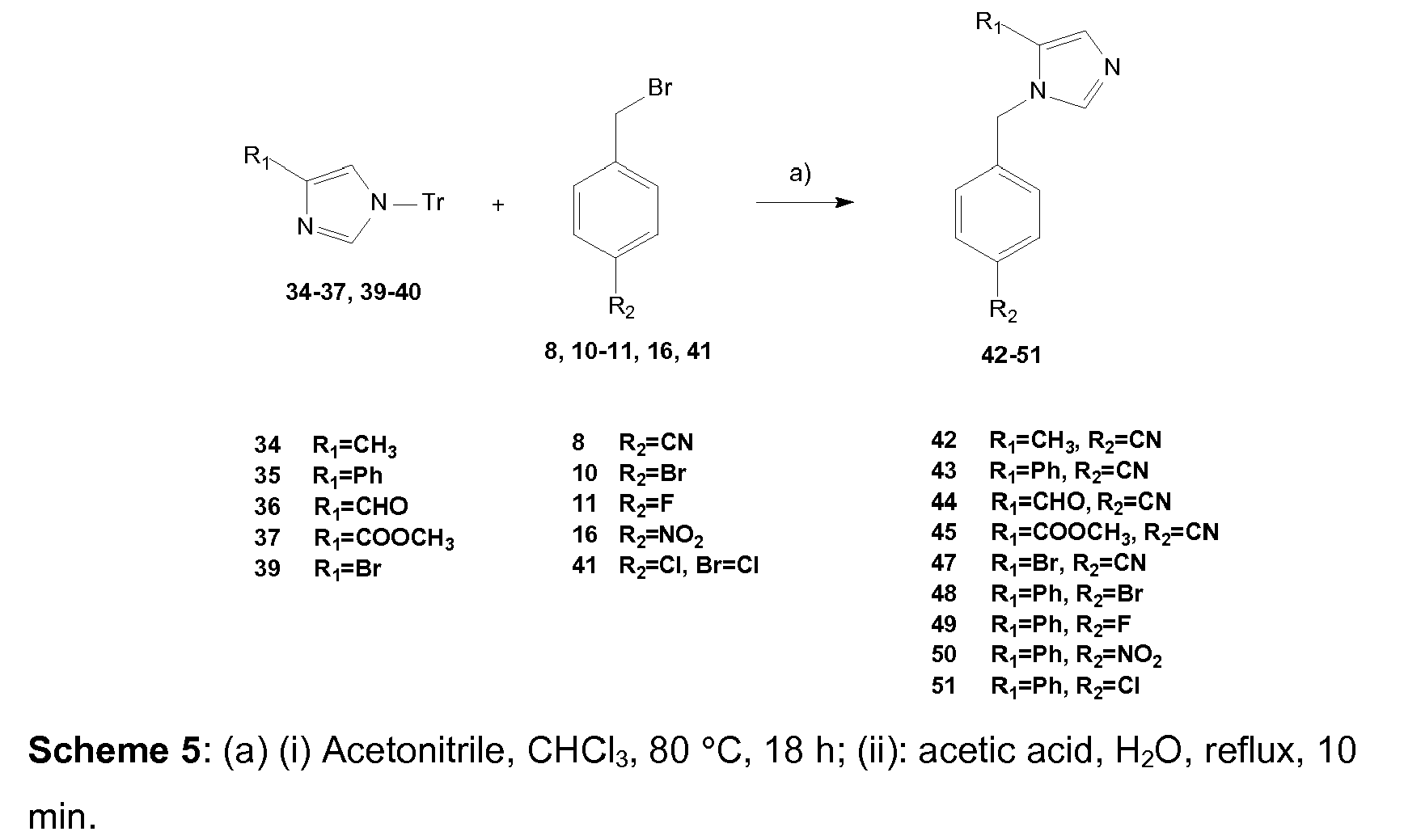
- A solution of 4-phenyl-1-trityl-1H-imidazole 35 (0.25 g, 0.65 mmol) and 1-(bromomethyl)-4-fluorobenzene 11 (0.12 g, 0.65 mmol) in 2 mL of acetonitrile and 0.5 mL of chloroform was stirred overnight at 80 °C. The solution was concentrated and dissolved in a mixture of 1.25 mL acetic acid and 1 mL of water, and this mixture was refluxed until a white solid precipitated. A 1 M HCl solution (7.5 mL) was added and after cooling down to room temperature the mixture was extracted twice with 5 mL portions of diethyl ether. The organic phase was extracted with 7.5 mL of a 1 M solution of HCl. The combined aqueous phases were adjusted to pH 8 with a 6M NaOH solution and were then extracted twice with 10 mL portions of methylene chloride. The methylene chloride extracts were dried over Na2SO4, and evaporated in vacuo to give a slightly yellow oil. This crude product was purified by column chromatography using silica gel and eluting with a chloroform/methanol gradient yielding 60 mg (37%) of a colorless oil. 1H-NMR (CDCl3) δ 7.56 (s, 1H), 7.35 (m, 3H), 7.25 (d, 2H), 7.12 (s, 1H), 6.95 (d, 4H), 6.95 (s, 1H), 5.13 (s, 2H). LC-MS: m/z = 253 (M+1).
- The following imidazoles were prepared using a similar procedure as that for compound 49:
- Using 4-methyl-1-trityl-1H-imidazole 34 yielding 0.71 g (78%) of a slightly yellow solid. 1H-NMR (CDCl3) δ 7.65 (d, 2H), 7.5 (s, 1H), 7.11 (d, 2H), 6.9 (s, 1H), 5.14 (s, 2H), 2.05 (s, 3H). LC-MS: m/z = 198 (M+1). GC-MS: m/z = 197 (molecular ion).
- Using 4-phenyl-1-trityl-1H-imidazole 35 yielding 5.5 g (68%) of white solid. 1H-NMR (CDCl3) δ 7.6 (m, 3H), 7.35 (m, 3H), 7.2 (m, 2H), 7.15 (s, 1H), 7.05 (d, 2H), 5.2 (s, 2H). 13C NMR δ 142.1, 138.6, 133.4, 132.7, 129.2, 128.8 (2x), 128.4, 127.1, 118.3, 112.0, 48.3. LC-MS: m/z = 260 (M+1). GC-MS: m/z = 259 (molecular ion).
- Using 1-trityl-1H-imidazole-4-carbaldehyde 36 yielding 57 mg (37%) of a slightly yellow solid. 1H-NMR (CDCl3) δ 9.75 (s, 1H), 7.9 (s, 1H), 7.75 (s, 1H), 7.61 (d, 2H), 7.25 (d, 2H), 5.59 (s, 2H). LC-MS: m/z = 212 (M+1).
- Using methyl 1-trityl-1H-imidazole-4-carboxylate 37 yielding 27 mg (11%) of a white solid. 1H-NMR (CDCl3) δ 7.8 (s, 1H), 7.69 (s, 1H), 7.61 (d, 2H), 7.20 (d, 2H), 5.59 (s, 2H), 3.80 (s, 3H). LC-MS: m/z = 242 (M+1).
- Using 4-bromo-1-trityl-1H-imidazole 39 yielding 84 mg (31%) of a white solid. 1H-NMR (CDCl3) δ 7.65 (s, 1H), 7.62 (d, 2H), 7.20 (d, 2H), 7.10 (s, 1H), 5.21 (s, 2H). LC-MS: m/z = 262 (M+1). GC-MS: m/z = 261 and 263 (ionic isotopes).
- Using 4-phenyl-1-trityl-1H-imidazole 35 and 4-bromobenzyl bromide 10 yielding 79 mg (39%) of a slightly yellow solid. 1H-NMR (CDCl3) δ 7.58 (s, 1H), 7.40 (d, 2H), 7.36 (m, 3H), 7.26 (m, 2H), 7.15 (s, 1H), 6.85 (d, 2H), 5.1 (s, 2H). LC-MS: m/z = 315 (M+1).
- Using 4-phenyl-1-trityl-1H-imidazole 35 and 4-nitrobenzyl bromide 16 yielding 72 mg (40%) of a yellowish solid. 1H-NMR (CDCl3) δ 8.15 (d, 2H), 7.65 (s, 1H), 7.35 (m, 3H), 7.26 (m, 2H), 7.17 (s, 1H), 7.10 (d, 2H), 5.27 (s, 2H). LC-MS: m/z = 280 (M+1).
- Using 4-phenyl-1-trityl-1H-imidazole 35 and 4-chlorobenzyl chloride 41. For speeding up the reaction, ca. 1 molar equivalent of Nal was added to the reaction mixture to convert the benzyl chloride to the benzyl iodide. Purification yielded 21 mg (12%) of a yellowish oil. 1H-NMR (CDCl3) δ 7.58 (s, 1H), 7.35 (m, 3H), 7.25 (m, 4H), 7.14 (s, 1H), 6.91 (d, 2H), 5.12 (s, 2H). LC-MS: m/z = 269 and 271 (M+1 isotopic ions).
-
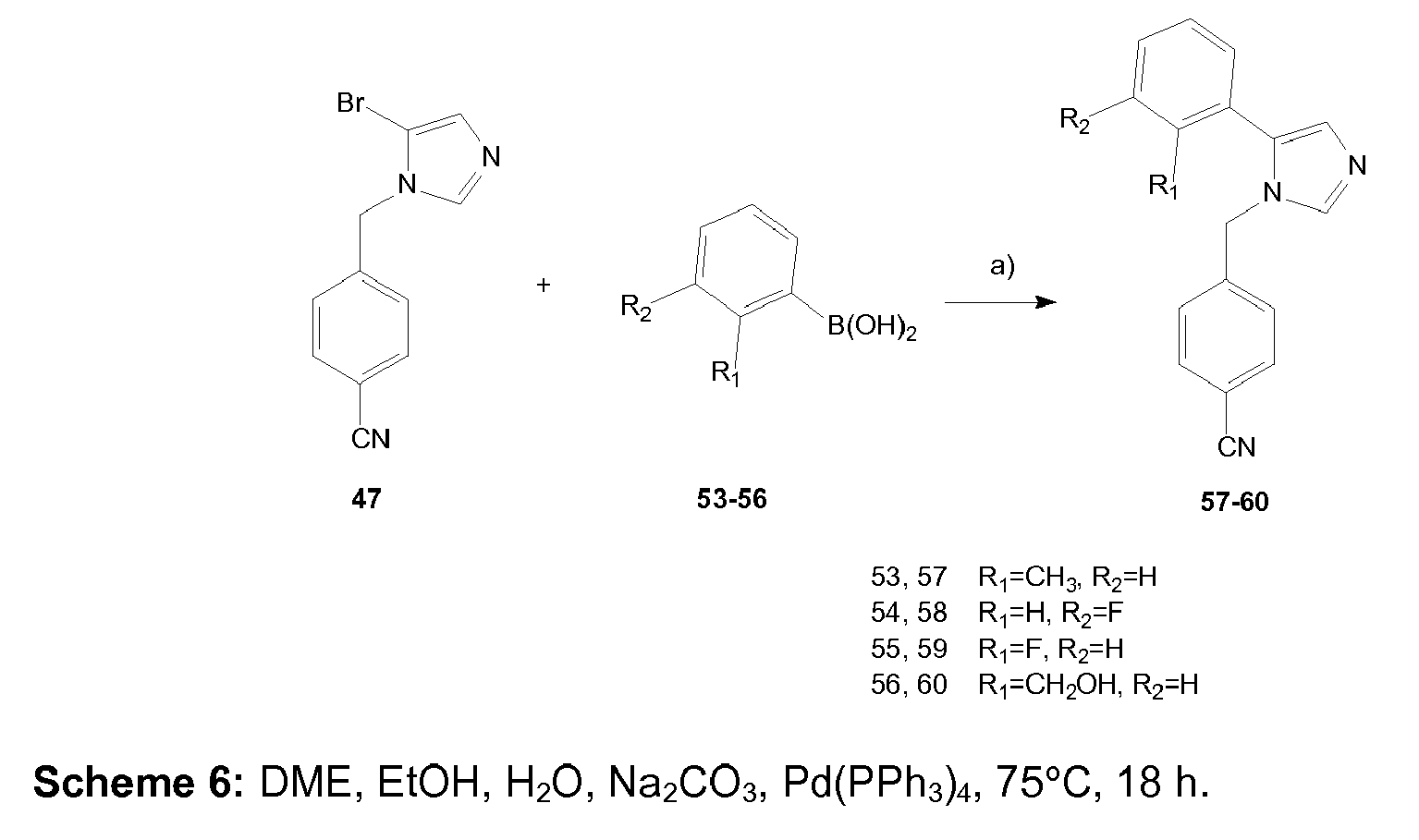
- 4-[(5-Bromo-1H-imidazol-1-yl)methyl]benzonitrile 47 (80 mg, 0.31 mmol), 2-methylphenylboronic acid 53 (46 mg, 0.34 mmol) and Na2CO3 (0.76 mmol) were weighed in a Schlenck tube, capped with a rubber septum. The reaction tube was filled with argon and subsequently with 1.5 mL of a 1:1:1 mixture of water, dimethoxy ethane and ethanol. The mixture was heated to 75 °C upon which a clear solution developed. Three cycles of freeze-pump-thaw were performed to remove the oxygen from the reaction mixture, and tetrakis(triphenylphosphine)palladium(0) (0.7 mg, 0.6 µmol) was added. The reaction mixture was then stirred overnight at 75 °C. The mixture was concentrated, 2.5 mL of chloroform was added, and the mixture was washed twice with 2 mL portions of a saturated NaHCO3 solution. The organic layer was dried over Na2SO4 and the solvent was evaporated in vacuo giving crude product that was purified by column chromatography over silica eluting with chloroform/methanol (98:2) yielding 46 mg (55%) of a colorless oil. 1H-NMR (CDCl3) δ 7.67 (s, 1H), 7.51 (d, 2H), 7.3-7.1 (m, 3H), 7.04 (m, 2H), 6.95 (d, 2H), 4.98 (s, 2H), 2.01 (s, 3H). LC-MS: m/z = 274 (M+1).
- The following imidazoles were prepared using a similar procedure as that for compound 57:
- Using 3-fluorophenylboronic acid 54 and purifying by column chromatography over silica eluting with ethyl acetate/hexane (2:1 - 4:1) yielded 52 mg (61%) of a white solid. 1H-NMR (CDCl3) δ 7.63 (s, 1H), 7.58 (d, 2H), 7.33 (m, 1H), 7.20 (s, 1H), 7.09 (d, 2H), 7.03 (m, 2H), 6.94 (d, 1H), 5.24 (s, 2H). LC-MS: m/z = 278 (M+1).
- Using 2-fluorophenylboronic acid 55 and purifying by column chromatography over silica eluting with ethyl acetate/hexane (2:1 - 4:1) yielded 32 mg (38%) of a slightly yellow solid. 1H-NMR (CDCl3) δ 7.64 (s, 1H), 7.53 (d, 2H), 7.37 (m, 1H), 7.15 (m, 4H), 7.05 (d, 2H), 5.15 (s, 2H). LC-MS: m/z = 278 (M+1).
- Using 2,1-benzoxaborol-1(3H)-ol 56 and purifying by column chromatography over silica eluting with chloroform/methanol (98:2 - 96:4) yielded 0.20 g (53%) of a slightly yellow solid. 1H-NMR (CDCl3) δ 7.62 (s, 1H), 7,52 (m, 3H), 7,42 (t, 1H), 7.26 (t, 1H), 7.06 (s, 1H), 7.02 (d, 1H), 6.97 (d, 2H), 5.02 (s, 2H), 4.39 (s, 2H). LC-MS: m/z = 290 (M+1).
- Inhibitor potencies for human CYP11B1 and CYP11B2 were determined in an in vitro assay using V79 cells in which human CYP11B1 or CYP11B2 are expressed.
- The V79 cells stably (over)expressing human CYP11 B2 were developed in the laboratory of Prof. Rita Bernhardt, Institute of Biochemistry, Saarland University, Saarbrücken, Germany :
- Denner K, Doehmer J,Bernhardt R. "Cloning of CYP11B1 and CYP11B2 from normal human adrenal and their functional expression in COS-7 and V79 Chinese hamster cells" Endocr Res 1995;21:443-8;
- Bottner B, Denner K, Bernhardt R "Conferring aldosterone synthesis to human CYP11B1 by replacing key amino acid residues with CYP11B2 ones", Eur. J. Biochem. 1998; 252: 458-466;
- Denner K, Vogel R, Schmalix W, Doehmer J, Bernhardt R.: "Cloning and stable expression of the human mitochondrial cytochrome P45011B1 cDNA in V79 Chinese hamster cells and their application for testing of potential inhibitors." Pharmacogenetics 1995; 5: 89-96;
- Denner K, Bernhardt R. "Inhibition studies of steroid conversions mediated by human CYP11B1 and CYP11B2 expressed in cell cultures". In: Oxygen Homeostasis and Its Dynamics. Springer-Verlag, Tokyo, Berlin, Heidelberg, New York 1998, pp 231-236;
- Ehmer PB, Bureik M, Bernhardt R, Muller U, Hartmann RW. "Development of a test system for inhibitors of human aldosterone synthase (CYP11B2): screening in fission yeast and evaluation of selectivity in V79 cells." J. Steroid Biochem Mol Biol. 2002; 81: 173-179.
- The human CYP11B1 (over)expressing V79 cells (stably transfected with a pcDNA3.1 vector, carrying a hygromycin resistance box) were constructed at Organon (Newhouse, UK) in the following manner. The full length cDNA for human CYP11B1 was obtained by PCR from human adrenal cDNA as described by Kawamoto et al ("Cloning of cDNA and genomic DNA for human cytochrome P-45011 beta" FEBS Lett 1990;269:345-9) and cloned into pPCR SCRIPT (Stratagene, La Jolla, USA). After digestion with Xho I and Not I, the obtained cDNA was inserted into a Xho I/Not I digested pcDNA3.1 vector (InVitrogen, Breda, Netherlands), carrying a hygromycin resistance box. Following transfection to the V79 cells, positive cells were selected based on their hygromycin resistance. The presence of the CYP11B1 gene was confirmed by PCR and the presence of 11β-hydroxylase activity (i.e. the ability to produce corticosterone or cortisol from 11-deoxycorticosterone or 11-deoxycortisol respectively). Although no electron-transporting proteins were co-transfected, the CYP11B1 expressing V79 cells showed abundant 11β-hydroxylase activity, as was previously also shown by Denner et al. for both CYP11B1 and CYP11 B2 [1]. In normal (non transfected) V79 cells, no detectable 11β-hydroxylase activity or PCR signals were found.
- Cells were cultured under standard conditions in DMEM/FK12 medium (Gibco, Gaitersburg, USA) supplemented with 10% foetal calf serum (Hyclone, Logan, USA), penicillin/streptomycin (100 U/ml and 100 µg/ml, respectively Gibco). Cell culturing and incubation experiments (see below) with the cells were performed at 37°C in a humid environment and 5%CO2 atmosphere.
- For assessing inhibitor potencies, cells were transferred to 12 well plates and grown until they were confluent. Next, cells were incubated for 1 hour in serum free medium with cumulative inhibitor concentrations. Subsequently, 11-deoxycorticosterone (Sigma-Aldrich, St Louis, USA) was added as substrate to obtain a final concentration of 500 nM (0.5 times Km), following incubation of the plates for another hour for V79 CYP11B1 or another three hours for V79 CYP11B2. After these incubation times, medium was collected for steroid analysis by HPLC. To extract the (produced) steroids from the medium, 1 ml aliquots of medium were mixed with 1 ml 1 M sodium-glycine buffer (pH 10.5) containing 500 nM methylprednisolone (Sigma-Aldrich) as internal standard and 5 ml of diethylether (Biosolve, Valkenswaard, the Netherlands). After shaking for 3 minutes, the samples were briefly centrifuged and the organic phase (containing the steroids) transferred into another tube and blown to dryness under a stream of nitrogen. The dried extracts were dissolved in 100 µl of mobile phase to be used for automated HPLC analysis. The HPLC system comprised a MR column (4.6 x 50 mm, particle size 2.5 µm; Shimadzu, Tokyo, Japan) as a stationary phase and a mixture of 680/320/1 (v/v/v) milliQ water, acetonitrile and trifluoro-acetic acid as mobile phase at a flow rate of 1.0 ml/minute. Steroids were detected by UV absorption at 243 nm (Shimadzu, Tokyo, Japan). To quantitate the steroids, peak area ratios versus the internal standard (methylprednisolone) were determined and compared with calibration curves.
- Determination of IC50 values (potencies) was based on at least 5 inhibitor concentrations and was derived from the generic equation for enzyme inhibition at fixed substrate concentration vi = v0/(1 + I/IC50) with vi and v0 being the reaction velocities in the presence or absence of inhibitor respectively, and I being the inhibitor concentration (Cornish-Bowden A, "Analysis of enzyme kinetic data.", Oxford University Press, Oxford, 1995). All analyses were conducted at least in duplicate. IC50 values for a representative number of compounds according to the invention are presented in Table I. The data demonstrate that the compounds have both potent and selective (ratio) inhibitory activity at the CYP11B2 receptor.
Table I COMPOUND IC50 11B2 nM IC50 11B1 nM Ratio 3-[1-(4-fluorobenzyl)-1H-imidazol-5-yl]propanol ( 15 ) 16.8 115.5 6.9 methyl 3-[1-(4-cyanobenzyl)-1H-imidazol-5-yl]propanoate ( 18 ) 3.5 31.1 8.9 methyl 3-[1-(4-bromobenzyl)-1H-imidazol-5-yl]propanoate ( 20 ) 4.0 57.4 14.4 1-(4-cyanobenzyl)-5-hydroxymethyl-1H-imidazole ( 52 ) 28.5 285.2 10 4-[(5-methyl-1H-imidazol-1-yl)methyl]benzonitrile ( 42 ) 12.3 140.5 11.4 4-[(5-phenyl-1H-imidazol-1-yl)methyl]benzonitrile ( 43 ) 1.7 27.5 15.7 4-[(5-formyl-1H-imidazol-1-yl)methyl]benzonitrile ( 44 ) 61.8 478 7.7 methyl 1-(4-cyanobenzyl)-1H-imidazole-5-carboxylate ( 45 ) 7.1 47.8 6.7 1-(4-nitrobenzyl)-5-phenyl-1H-imidazole ( 50 ) 2.3 13.7 5.9 4-[(5-(2-methylphenyl)-1H-imidazol-1-yl)methyl]benzonitrile ( 57 ) 0.7 7.6 10.5 4-[(5-(3-fluorophenyl)-1H-imidazol-1-yl)methyl]benzonitrile ( 58 ) 5.5 31.8 5.8 Ratio = IC50 CYP11B1/ IC50 CYP11B2
Claims (8)
- The use of a N-benzyl 5-substituted imidazole derivative having the general formula I

R is (C1-3)alkyl, (C1-3)alkyloxy, halogen, nitro or cyano;
R1 is (C1-6)alkyl, optionally substituted with OH, (C1-3)alkyloxy, (C1-3)alkylcarbonyloxy, (C1-3)alkyloxycarbonyl or halogen, or (C1-3)alkyloxycarbonyl; or
R1 is phenyl, optionally substituted with 1-3 substituents independently selected from (C1-3)alkyl, (C1-3)alkyloxy, hydroxymethyl and halogen; or a pharmaceutically acceptable salt thereof, for the preparation of a medicament for the treatment of a disorder or disease in a subject mediated by aldosterone synthase or responsive to inhibition of aldosterone synthase. - The use according to claim 1, wherein the medicament is for the treatment of congestive heart failure and myocardial fibrosis.
- The use according to claim 1, wherein R is (C1-3)alkyl, (C1-3)alkyloxy, halogen, nitro or cyano, and R1 is phenyl, optionally substituted optionally substituted with 1-3 substituents independently selected from (C1-3)alkyl, (C1-3)alkyloxy, hydroxymethyl and halogen.
- The use according to claim 3, wherein R is cyano and R1 is phenyl, optionally substituted with halogen.
- The use according to claim 1 wherein the N-benzyl 5-substituted imidazole derivative is selected from:- 3-[1-(4-fluorobenzyl)-1H-imidazol-5-yl]propanol;- methyl 3-[1-(4-cyanobenzyl)-1H-imidazol-5-yl]propanoate;- methyl 3-[1-(4-bromobenzyl)-1H-imidazol-5-yl]propanoate:- 1-(4-cyanobenzyl)-5-hydroxymethyl-1H-imidazole;- 4-[(5-methyl-1H-imidazol-1-yl)methyl]benzonitrile;- 4-[(5-phenyl-1H-imidazol-1-yl)methyl]benzonitrile;- 4-[(5-formyl-1H-imidazol-1-yl)methyl]benzonitrile;- methyl 1-(4-cyanobenzyl)-1H-imidazole-5-carboxylate;- 1-(4-nitrobenzyl)-5-phenyl-1H-imidazole;- 4-[(5-(2-methylphenyl)-1H-imidazol-1-yl)methyl]benzonitrile; and- 4-[(5-(3-fluorophenyl)-1H-imidazol-1-yl)methyl]benzonitrile; or a pharmaceutically acceptable salt thereof.
- The N-benzyl 5-substituted imidazole derivative according to Figure 1 of claim 1 which is selected from:- 3-[1-(4-fluorobenzyl)-1H-imidazol-5-yl]propanol;- methyl 3-[1-(4-bromobenzyl)-1H-imidazol-5-yl]propanoate;- 4-[(5-phenyl-1H-imidazol-1-yl)methyl]benzonitrile;- 1-(4-nitrobenzyl)-5-phenyl-1H-imidazole;- 4-[(5-(2-methylphenyl)-1H-imidazol-1-yl)methyl]benzonitrile; and- 4-[(5-(3-fluorophenyl)-1H-imidazol-1-yl)methyl]benzonitrile; or a pharmaceutically acceptable salt thereof.
- A N-benzyl 5-substituted imidazole derivative having the general formula I

R is (C1-3)alkyl, (C1-3)alkyloxy, halogen, nitro or cyano;
R1 is (C1-6)alkyl, optionally substituted with OH, (C1-3)alkyloxy, (C1-3)alkylcarbonyloxy, (Ck1-3)alkyloxycarbonyl or halogen, or (C1-3)alkyloxycarbonyl; or
R1 is phenyl, optionally substituted with 1-3 substituents independently selected from (C1-3)alkyl, (C1-3)alkyloxy, hydroxymethyl and halogen; or a pharmaceutically acceptable salt thereof, for use in therapy, with the proviso that compounds of formula I wherein R is cyano and R1 is unsubstituted (C1-6)alkyl are excluded. - A pharmaceutical composition comprising a N-benzyl 5-substituted imidazole derivative having the general formula I

R is (C1-3)alkyl, (C1-3)alkyloxy, halogen, nitro or cyano;
R1 is (C1-6)alkyl, optionally substituted with OH, (C1-3)alkyloxy, (C1-3)alkylcarbonyloxy, (C1-3)alkyloxycarbonyl or halogen, or (C1-3)alkyloxycarbonyl; or
R1 is phenyl, optionally substituted with 1-3 substituents independently selected from (C1-3)alkyl, (C1-3)alkyloxy, hydroxymethyl and halogen; or a pharmaceutically acceptable salt thereof, in admixture with pharmaceutically acceptable auxiliaries, with the proviso that compounds of formula I wherein R is cyano and R1 is unsubstituted (C1-6)alkyl are excluded.
Priority Applications (2)
| Application Number | Priority Date | Filing Date | Title |
|---|---|---|---|
| EP08152079A EP2095819A1 (en) | 2008-02-28 | 2008-02-28 | N-benzyl imidazole derivatives and their use as aldosterone synthase inhibitors |
| PCT/EP2009/052426 WO2009106640A2 (en) | 2008-02-28 | 2009-02-27 | N-benzyl imidazole derivatives |
Applications Claiming Priority (1)
| Application Number | Priority Date | Filing Date | Title |
|---|---|---|---|
| EP08152079A EP2095819A1 (en) | 2008-02-28 | 2008-02-28 | N-benzyl imidazole derivatives and their use as aldosterone synthase inhibitors |
Publications (1)
| Publication Number | Publication Date |
|---|---|
| EP2095819A1 true EP2095819A1 (en) | 2009-09-02 |
Family
ID=39542369
Family Applications (1)
| Application Number | Title | Priority Date | Filing Date |
|---|---|---|---|
| EP08152079A Ceased EP2095819A1 (en) | 2008-02-28 | 2008-02-28 | N-benzyl imidazole derivatives and their use as aldosterone synthase inhibitors |
Country Status (2)
| Country | Link |
|---|---|
| EP (1) | EP2095819A1 (en) |
| WO (1) | WO2009106640A2 (en) |
Cited By (3)
| Publication number | Priority date | Publication date | Assignee | Title |
|---|---|---|---|---|
| WO2011088188A1 (en) * | 2010-01-14 | 2011-07-21 | Novartis Ag | Use of an adrenal hormone-modifying agent |
| WO2012052540A1 (en) * | 2010-10-21 | 2012-04-26 | Universitaet Des Saarlandes | Selective cyp11b1 inhibitors for the treatment of cortisol dependent diseases |
| WO2013120771A1 (en) * | 2012-02-13 | 2013-08-22 | F. Hoffmann-La Roche Ag | Imidazolylketone derivatives asd aldosterone synthase inhibitors |
Families Citing this family (1)
| Publication number | Priority date | Publication date | Assignee | Title |
|---|---|---|---|---|
| JP2015093833A (en) * | 2013-11-08 | 2015-05-18 | 日本メジフィジックス株式会社 | Radioactive halogen labeled compounds or salts thereof, and pharmaceuticals containing the same |
Citations (13)
| Publication number | Priority date | Publication date | Assignee | Title |
|---|---|---|---|---|
| EP0165904A2 (en) * | 1984-06-20 | 1985-12-27 | Ciba-Geigy Ag | Substituted bicycle compounds |
| US4937250A (en) | 1988-03-07 | 1990-06-26 | Ciba-Geigy Corporation | Alpha-heterocycle substituted tolunitriles |
| WO1996004275A1 (en) * | 1994-08-02 | 1996-02-15 | Roussel Uclaf | Novel imidazole derivatives, method for preparing same, novel intermediates thus obtained, medicinal applications of same and pharmaceutical compositions containing same |
| WO1997027752A1 (en) | 1996-01-30 | 1997-08-07 | Merck & Co., Inc. | Inhibitors of farnesyl-protein transferase |
| WO1999012912A1 (en) * | 1997-09-11 | 1999-03-18 | Yuhan Corporation | Thiourea derivatives or non-toxic salts thereof for inhibitng ras-transformed cell growth |
| WO1999028315A1 (en) * | 1997-11-28 | 1999-06-10 | Lg Chemical Ltd. | Imidazole derivatives having an inhibitory activity for farnesyl transferase and process for preparation thereof |
| WO2001009128A1 (en) | 1999-07-30 | 2001-02-08 | Yuhan Corporation | Thiourea and isothiourea derivatives for inhibiting ras-transformed cell growth |
| WO2001076574A2 (en) | 2000-04-12 | 2001-10-18 | Novartis Ag | Novel medical use of aldosterone synthase inhibitors alone or in combination with at1-receptor antagonists |
| WO2001079179A2 (en) * | 2000-04-17 | 2001-10-25 | Warner-Lambert Company | Dihydro-2h-naphthalene-1-one inhibitors of ras farnesyl transferase |
| EP1422218A1 (en) * | 2001-08-10 | 2004-05-26 | Shionogi & Co., Ltd. | Antiviral agent |
| WO2004046145A1 (en) | 2002-11-18 | 2004-06-03 | Novartis Ag | Imidazo[1, 5a]pyridine derivatives and methods for treating aldosterone mediated diseases |
| WO2007024945A1 (en) | 2005-08-25 | 2007-03-01 | Novartis Ag | Condensed imidazolo derivatives for the inhibition of aldosterone synthase and aromatase |
| WO2007117982A2 (en) | 2006-03-29 | 2007-10-18 | Novartis Ag | Organic compounds |
Family Cites Families (7)
| Publication number | Priority date | Publication date | Assignee | Title |
|---|---|---|---|---|
| US4978672A (en) * | 1986-03-07 | 1990-12-18 | Ciba-Geigy Corporation | Alpha-heterocyclc substituted tolunitriles |
| GB2210875B (en) * | 1987-10-09 | 1991-05-29 | Farmos Oy | Aromatase inhibiting 4(5)-imidazoles |
| US5780488A (en) * | 1996-04-03 | 1998-07-14 | Merck & Co., Inc. | Inhibitors of farnesyl-protein transferase |
| US5859035A (en) * | 1996-04-03 | 1999-01-12 | Merck & Co., Inc. | Arylheteroaryl inhibitors of farnesyl-protein transferase |
| AU7715300A (en) * | 1999-09-27 | 2001-04-30 | Merck & Co., Inc. | Method of preventing osteoporosis |
| WO2002039997A2 (en) * | 2000-11-01 | 2002-05-23 | Millennium Pharmaceuticals, Inc. | Ace-2 modulating compounds and use thereof |
| CN101568331A (en) * | 2006-09-08 | 2009-10-28 | 奥尔制药有限公司 | Methods of reducing or alleviating inflammation of the digestive tract |
-
2008
- 2008-02-28 EP EP08152079A patent/EP2095819A1/en not_active Ceased
-
2009
- 2009-02-27 WO PCT/EP2009/052426 patent/WO2009106640A2/en not_active Ceased
Patent Citations (13)
| Publication number | Priority date | Publication date | Assignee | Title |
|---|---|---|---|---|
| EP0165904A2 (en) * | 1984-06-20 | 1985-12-27 | Ciba-Geigy Ag | Substituted bicycle compounds |
| US4937250A (en) | 1988-03-07 | 1990-06-26 | Ciba-Geigy Corporation | Alpha-heterocycle substituted tolunitriles |
| WO1996004275A1 (en) * | 1994-08-02 | 1996-02-15 | Roussel Uclaf | Novel imidazole derivatives, method for preparing same, novel intermediates thus obtained, medicinal applications of same and pharmaceutical compositions containing same |
| WO1997027752A1 (en) | 1996-01-30 | 1997-08-07 | Merck & Co., Inc. | Inhibitors of farnesyl-protein transferase |
| WO1999012912A1 (en) * | 1997-09-11 | 1999-03-18 | Yuhan Corporation | Thiourea derivatives or non-toxic salts thereof for inhibitng ras-transformed cell growth |
| WO1999028315A1 (en) * | 1997-11-28 | 1999-06-10 | Lg Chemical Ltd. | Imidazole derivatives having an inhibitory activity for farnesyl transferase and process for preparation thereof |
| WO2001009128A1 (en) | 1999-07-30 | 2001-02-08 | Yuhan Corporation | Thiourea and isothiourea derivatives for inhibiting ras-transformed cell growth |
| WO2001076574A2 (en) | 2000-04-12 | 2001-10-18 | Novartis Ag | Novel medical use of aldosterone synthase inhibitors alone or in combination with at1-receptor antagonists |
| WO2001079179A2 (en) * | 2000-04-17 | 2001-10-25 | Warner-Lambert Company | Dihydro-2h-naphthalene-1-one inhibitors of ras farnesyl transferase |
| EP1422218A1 (en) * | 2001-08-10 | 2004-05-26 | Shionogi & Co., Ltd. | Antiviral agent |
| WO2004046145A1 (en) | 2002-11-18 | 2004-06-03 | Novartis Ag | Imidazo[1, 5a]pyridine derivatives and methods for treating aldosterone mediated diseases |
| WO2007024945A1 (en) | 2005-08-25 | 2007-03-01 | Novartis Ag | Condensed imidazolo derivatives for the inhibition of aldosterone synthase and aromatase |
| WO2007117982A2 (en) | 2006-03-29 | 2007-10-18 | Novartis Ag | Organic compounds |
Non-Patent Citations (23)
| Title |
|---|
| ALLENTOFF, ALBAN J. ET AL: "Palladium-catalyzed aryl cyanations with [14C]KCN: synthesis of 14C-labeled Fadrozole, a potent aromatase inhibitor", JOURNAL OF LABELLED COMPOUNDS & RADIOPHARMACEUTICALS , 43(11), 1075-1085 CODEN: JLCRD4; ISSN: 0362-4803, 2000, XP007905071 * |
| BELGODERE E ET AL: "Imidazole derivatives with potential biological activity", ARZNEIMITTEL FORSCHUNG. DRUG RESEARCH, ECV EDITIO CANTOR VERLAG, AULENDORF, DE, vol. 30, no. 7, 1 January 1980 (1980-01-01), pages 1051 - 1056, XP002430385, ISSN: 0004-4172 * |
| BOTTNER B; DENNER K; BERNHARDT R: "Conferring aldosterone synthesis to human CYP11B1 by replacing key amino acid residues with CYP1182 ones", EUR. J. BIOCHEM., vol. 252, 1998, pages 458 - 466 |
| CHAI; DANSER: "Why are mineralocorticoid receptor antagonists cardioprotective", NAUNYN SCHMIEDEBERGS ARCH PHARMACOL, vol. 374, 2006, pages 153 - 62, XP019457980, DOI: doi:10.1007/s00210-006-0107-9 |
| CORNISH-BOWDEN A: "Analysis of enzyme kinetic data", 1995, OXFORD UNIVERSITY PRESS |
| DATABASE REGISTRY 8 August 2006 (2006-08-08), XP002487091, retrieved from STN accession no. 899725-23-6 * |
| DENNER K; BERNHARDT R.: "Oxygen Homeostasis and Its Dynamics", 1998, SPRINGER-VERLAG, article "Inhibition studies of steroid conversions mediated by human CYP11B1 and CYP11B2 expressed in cell cultures", pages: 231 - 236 |
| DENNER K; DOEHMER J; BERNHARDT R.: "Cloning of CYP11B1 and CYP1182 from normal human adrenal and their functional expression in COS-7 and V79 Chinese hamster cells", ENDOCR RES, vol. 21, 1995, pages 443 - 8 |
| EHMER P B ET AL: "DEVELOPMENT OF A TEST SYSTEM FOR INHIBITORS OF HUMAN ALDOSTERONE SYNTHASE (CYP11B2): SCREENING IN FISSION YEAST AND EVALUATION OF SELECTIVITY IN V79 CELLS", JOURNAL OF STEROID BIOCHEMISTRY AND MOLECULAR BIOLOGY, ELSEVIER SCIENCE LTD., OXFORD, GB, vol. 81, no. 2, 1 January 2002 (2002-01-01), pages 173 - 179, XP008057232, ISSN: 0960-0760 * |
| EHMER PB ET AL.: "Development of a test system for inhibitors of human aldosterone synthase (CYP11B2): screening in fission yeast and evaluation of selectivity in V79 cells", STEROID BIOCHEM MOL BIOL, vol. 81, 2002, pages 173 - 179, XP008057232, DOI: doi:10.1016/S0960-0760(02)00056-0 |
| GENNARO, A.R. ET AL.: "Remington: The Science and Practice of Pharmacy", 2000, LIPPINCOTT WILLIAMS & WILKINS |
| GODEFROI, E. F. ET AL: "Regiospecific N-substitution of asymmetrically alkylated imidazoles. Preparation of 1,5-dialkyl- and 1,2,5-trialkylimidazoles", RECUEIL DES TRAVAUX CHIMIQUES DES PAYS-BAS , 93(2), 56-8 CODEN: RTCPA3; ISSN: 0165-0513, 1974, XP009102623 * |
| HARPER J L ET AL: "Synthesis, Acidity and <19>F NMR Characteristics of Imidazoles bearing 1-Fluorinated Substituents with Potential Application as Probes for Intracellular pH Determination", TETRAHEDRON, ELSEVIER SCIENCE PUBLISHERS, AMSTERDAM, NL, vol. 53, no. 24, 16 June 1997 (1997-06-16), pages 8211 - 8224, XP004105812, ISSN: 0040-4020 * |
| HARTMANN ET AL.: "Discovery of selective CYP1182 inhibitors for the therapy of congestive heart failure and myocardial fibrosis", EUR. J. MED. CHEM., vol. 38, 2003, pages 363 - 366, XP004425009, DOI: doi:10.1016/S0223-5234(03)00049-7 |
| HASEROTH ET AL.: "Rapid nongenomic effects of aldosterone in mineralocorticoid-receptor-knockout mice", BIOCHEM BIOPHYS RES COMMUN, vol. 266, 1999, pages 257 - 61 |
| KAMIJO TETSUHIDE ET AL: "1-substituted imidazoles as useful catalysts for acylation of alcohols", CHEMICAL AND PHARMACEUTICAL BULLETIN, PHARMACEUTICAL SOCIETY OF JAPAN, TOKYO, vol. 31, no. 10, 25 October 1983 (1983-10-25), pages 3724 - 3727, XP009102508, ISSN: 0009-2363 * |
| KAWAMOTO ET AL.: "Cloning of cDNA and genomic DNA for human cytochrome P-45011 beta", FEBS LETT, vol. 269, 1990, pages 345 - 9, XP025604499, DOI: doi:10.1016/0014-5793(90)81190-Y |
| LUC ROUMEN ET AL: "Construction of 3D models of the CYP11B family as a tool to predict ligand binding characteristics", JOURNAL OF COMPUTER-AIDED MOLECULAR DESIGN, KLUWER ACADEMIC PUBLISHERS, DO, vol. 21, no. 8, 24 July 2007 (2007-07-24), pages 455 - 471, XP019528351, ISSN: 1573-4951 * |
| MALIGRES, PETER E. ET AL: "Preparation of a clinically investigated ras farnesyl transferase inhibitor", JOURNAL OF HETEROCYCLIC CHEMISTRY , 40(2), 229-241 CODEN: JHTCAD; ISSN: 0022-152X, 2003, XP009102616 * |
| MANN ET AL.: "New therapeutics for chronic heart failure", ANNU REV MED, vol. 53, 2002, pages 59 - 74 |
| MASOUDI ET AL.: "The burden of chronic congestive heart failure in older persons: magnitude and implications for policy and research", HEART FAIL REV, vol. 7, 2002, pages 9 - 16 |
| MILLET R ET AL: "Potent and Selective Farnesyl Transferase Inhibitors", JOURNAL OF MEDICINAL CHEMISTRY, AMERICAN CHEMICAL SOCIETY. WASHINGTON, vol. 47, no. 27, 12 September 2004 (2004-09-12), pages 6812 - 6820, XP002993755, ISSN: 0022-2623 * |
| SONEGAWA MOTOHARU ET AL: "Regioselective alkylation of 2-alkyl-5,6,7,8-tetrahydro-3h-cyclohepti midazol-4-ones and 2-alkyl-3h-cycloheptimidazol-4-ones.", CHEMICAL & PHARMACEUTICAL BULLETIN MAY 2006, vol. 54, no. 5, May 2006 (2006-05-01), pages 706 - 710, XP007905068, ISSN: 0009-2363 * |
Cited By (11)
| Publication number | Priority date | Publication date | Assignee | Title |
|---|---|---|---|---|
| WO2011088188A1 (en) * | 2010-01-14 | 2011-07-21 | Novartis Ag | Use of an adrenal hormone-modifying agent |
| US8609862B2 (en) | 2010-01-14 | 2013-12-17 | Novartis Ag | Use of an adrenal hormone-modifying agent |
| US9434754B2 (en) | 2010-01-14 | 2016-09-06 | Novartis Ag | Use of an adrenal hormone-modifying agent |
| EP3527208A1 (en) * | 2010-01-14 | 2019-08-21 | Novartis AG | Use of an adrenal hormone-modifying agent |
| WO2012052540A1 (en) * | 2010-10-21 | 2012-04-26 | Universitaet Des Saarlandes | Selective cyp11b1 inhibitors for the treatment of cortisol dependent diseases |
| JP2013540145A (en) * | 2010-10-21 | 2013-10-31 | ウニベルシテート デス ザールランデス | Selective CYP11B1 inhibitor for the treatment of cortisol-dependent diseases |
| US9394290B2 (en) | 2010-10-21 | 2016-07-19 | Universitaet Des Saarlandes Campus Saarbruecken | Selective CYP11B1 inhibitors for the treatment of cortisol dependent diseases |
| WO2013120771A1 (en) * | 2012-02-13 | 2013-08-22 | F. Hoffmann-La Roche Ag | Imidazolylketone derivatives asd aldosterone synthase inhibitors |
| CN104093709A (en) * | 2012-02-13 | 2014-10-08 | 霍夫曼-拉罗奇有限公司 | Imidazolylketone derivatives as aldosterone synthase inhibitors |
| JP2015506967A (en) * | 2012-02-13 | 2015-03-05 | エフ.ホフマン−ラ ロシュ アーゲーF. Hoffmann−La Roche Aktiengesellschaft | Imidazolyl ketone derivative ASD aldosterone synthase inhibitor |
| CN104093709B (en) * | 2012-02-13 | 2017-09-22 | 霍夫曼-拉罗奇有限公司 | It is used as the imidazole derivative of aldosterone synthase inhibitors |
Also Published As
| Publication number | Publication date |
|---|---|
| WO2009106640A3 (en) | 2009-10-29 |
| WO2009106640A2 (en) | 2009-09-03 |
Similar Documents
| Publication | Publication Date | Title |
|---|---|---|
| EP3885340B1 (en) | Androgen receptor modulating compounds | |
| EP2699561B1 (en) | Androgen receptor modulating carboxamides | |
| EP2090570B1 (en) | Imidazole derivative | |
| EP3020714B1 (en) | Imidazole diketone compound and use thereof | |
| CN102149687B (en) | Novel imidazolidine compounds as androgen receptor modulators | |
| EP4077334B1 (en) | Furoindazole derivatives | |
| MXPA06010253A (en) | Mtp inhibiting aryl piperidines or piperazines substituted with 5-membered heterocycles. | |
| KR20090031544A (en) | Substituted Bicyclic and Tricyclic Thrombin Receptor Antagonists | |
| EP3124480B1 (en) | Amide compound | |
| EP3004077B1 (en) | New 3,4-dihydro-2h-isoquinoline-1-one and 2,3-dihydro-isoindol-1-one compounds | |
| EP3719019B1 (en) | New 3,4-dihydro-2h-isoquinoline-1-one and 2,3-dihydro-isoindol-1-one compounds | |
| EP2095819A1 (en) | N-benzyl imidazole derivatives and their use as aldosterone synthase inhibitors | |
| RU2693698C2 (en) | Novel compounds 3,4-dihydro-2n-isoquinolin-1-one and 2,3-dihydroisoindol-1-one | |
| EP4596539A1 (en) | Fused ring compound and pharmaceutical containing same | |
| US20090105278A1 (en) | Selective inhibitors of human corticosteroid syntheses | |
| Sato et al. | Discovery of tetrasubstituted imidazolines as potent and selective neuropeptide Y Y5 receptor antagonists: reduced human ether-a-go-go related gene potassium channel binding affinity and potent antiobesity effect | |
| Gobbi et al. | Benzophenones as xanthone-open model CYP11B1 inhibitors potentially useful for promoting wound healing | |
| EP4692094A1 (en) | Sulfonamide compound, pharmaceutical composition thereof and use thereof | |
| EP1560822B1 (en) | 4-imidazol-1-ylmethyl-pyrimidine derivatives as ligands for gabaa receptors | |
| Brudeli et al. | Synthesis and pharmacological properties of a new hydrophilic and orally bioavailable 5-HT4 antagonist | |
| CN102413694B (en) | Imidazole derivatives useful as FAAH modulators and FAAH imaging agents | |
| TW202415364A (en) | Combinations of rxfp1 modulators and sglt2 inhibitors | |
| EP2814814B1 (en) | Imidazolylketone derivatives asd aldosterone synthase inhibitors | |
| KR20180090302A (en) | NK1 receptor antagonist | |
| EP3212638B1 (en) | New dihydroquinoline pyrazolyl compounds as aldosterone synthase inhibitors |
Legal Events
| Date | Code | Title | Description |
|---|---|---|---|
| PUAI | Public reference made under article 153(3) epc to a published international application that has entered the european phase |
Free format text: ORIGINAL CODE: 0009012 |
|
| AK | Designated contracting states |
Kind code of ref document: A1 Designated state(s): AT BE BG CH CY CZ DE DK EE ES FI FR GB GR HR HU IE IS IT LI LT LU LV MC MT NL NO PL PT RO SE SI SK TR |
|
| AX | Request for extension of the european patent |
Extension state: AL BA MK RS |
|
| STAA | Information on the status of an ep patent application or granted ep patent |
Free format text: STATUS: THE APPLICATION HAS BEEN REFUSED |
|
| 18R | Application refused |
Effective date: 20090929 |