EP2094679B1 - Process for preparing 3,5-di-omicron-acyl-2-fluoro-2-c-methyl-d-ribono-gamma-lactone - Google Patents
Process for preparing 3,5-di-omicron-acyl-2-fluoro-2-c-methyl-d-ribono-gamma-lactone Download PDFInfo
- Publication number
- EP2094679B1 EP2094679B1 EP07857390A EP07857390A EP2094679B1 EP 2094679 B1 EP2094679 B1 EP 2094679B1 EP 07857390 A EP07857390 A EP 07857390A EP 07857390 A EP07857390 A EP 07857390A EP 2094679 B1 EP2094679 B1 EP 2094679B1
- Authority
- EP
- European Patent Office
- Prior art keywords
- mixture
- compounds
- process according
- formula
- compound
- Prior art date
- Legal status (The legal status is an assumption and is not a legal conclusion. Google has not performed a legal analysis and makes no representation as to the accuracy of the status listed.)
- Not-in-force
Links
- 0 C[C@]([C@@](C1OC(*)(*)OC1)O)C(O*)=O Chemical compound C[C@]([C@@](C1OC(*)(*)OC1)O)C(O*)=O 0.000 description 13
- VNCJYMKHJWVTPK-IWGUZYHVSA-N C[C@]([C@H]([C@@H](CO)O1)O)(C1=O)F Chemical compound C[C@]([C@H]([C@@H](CO)O1)O)(C1=O)F VNCJYMKHJWVTPK-IWGUZYHVSA-N 0.000 description 2
- JZDNWWLQQZGTNA-ACLDMZEESA-N C[C@@H]1[C@H](N(C=CC(N)=N2)C2=O)O[C@H](CO)C1 Chemical compound C[C@@H]1[C@H](N(C=CC(N)=N2)C2=O)O[C@H](CO)C1 JZDNWWLQQZGTNA-ACLDMZEESA-N 0.000 description 1
Classifications
-
- C—CHEMISTRY; METALLURGY
- C07—ORGANIC CHEMISTRY
- C07D—HETEROCYCLIC COMPOUNDS
- C07D317/00—Heterocyclic compounds containing five-membered rings having two oxygen atoms as the only ring hetero atoms
- C07D317/08—Heterocyclic compounds containing five-membered rings having two oxygen atoms as the only ring hetero atoms having the hetero atoms in positions 1 and 3
- C07D317/10—Heterocyclic compounds containing five-membered rings having two oxygen atoms as the only ring hetero atoms having the hetero atoms in positions 1 and 3 not condensed with other rings
- C07D317/14—Heterocyclic compounds containing five-membered rings having two oxygen atoms as the only ring hetero atoms having the hetero atoms in positions 1 and 3 not condensed with other rings with substituted hydrocarbon radicals attached to ring carbon atoms
- C07D317/18—Radicals substituted by singly bound oxygen or sulfur atoms
- C07D317/24—Radicals substituted by singly bound oxygen or sulfur atoms esterified
-
- C—CHEMISTRY; METALLURGY
- C07—ORGANIC CHEMISTRY
- C07D—HETEROCYCLIC COMPOUNDS
- C07D317/00—Heterocyclic compounds containing five-membered rings having two oxygen atoms as the only ring hetero atoms
- C07D317/08—Heterocyclic compounds containing five-membered rings having two oxygen atoms as the only ring hetero atoms having the hetero atoms in positions 1 and 3
- C07D317/10—Heterocyclic compounds containing five-membered rings having two oxygen atoms as the only ring hetero atoms having the hetero atoms in positions 1 and 3 not condensed with other rings
- C07D317/12—Heterocyclic compounds containing five-membered rings having two oxygen atoms as the only ring hetero atoms having the hetero atoms in positions 1 and 3 not condensed with other rings with only hydrogen atoms or radicals containing only hydrogen and carbon atoms, directly attached to ring carbon atoms
Definitions
- optionally substituted phenyl-C 1-6 -alkyl or “optionally substituted phenyl” refers to C 1-3 -alkyl substituted phenyl-C 1-6 -alkyl or C 1-3 -alkyl substituted phenyl.
- R is phenyl
- R 1 is methyl, ethyl, or n-butyl, preferably ethyl
- R 2 is methyl or ethyl, preferably methyl
- X is chloro
- the reaction in step (a) can be carried out in a suitable organic non-reactive solvent.
- a suitable organic non-reactive solvent include tetrahydrofuran (THF), 2-Me-THF, toluene, diethyl ether, t-butyl methyl ether, and the like.
- Step d) requires acylating a mixture with an acyl halogenide of the formula RCOX wherein R is as above and X is a halogen or with an acyl anhydride RC(O)O(O)CR wherein R is as above in the presence of a base to form a mixture of the compounds wherein R is as above.
- acylation takes place in a suitable solvent such as in acetonitrile, dimethylformamide (DMF), pyridine, and the like.
- a suitable solvent such as in acetonitrile, dimethylformamide (DMF), pyridine, and the like.
Landscapes
- Chemical & Material Sciences (AREA)
- Organic Chemistry (AREA)
- Pharmaceuticals Containing Other Organic And Inorganic Compounds (AREA)
- Preparation Of Compounds By Using Micro-Organisms (AREA)
- Saccharide Compounds (AREA)
- Organic Low-Molecular-Weight Compounds And Preparation Thereof (AREA)
Abstract
Description
- The present invention provides a novel process for the preparation of 3,5-di-O-acyl-2-fluoro-2-C-methyl-D-ribono-y-lactone derivatives of formula.


PCT Publication WO 2005/003147 ). - A number of synthetic routes for preparing intermediate 2 have been disclosed in
PCT Publication WO 2006/012440 , but these synthetic routes have the shortcomings of high manufacturing costs and technical difficulties for commercial scale manufacturing. The use of heavy load of asymmetric dihydroxlyation catalyst (AD-mix-β), fluorinating agent diethylaminosulfur trifluoride, and the Wittig reagent, are major cost drivers. The use of highly toxic reagents, such as AD-mix-β, highly reactive reagent such as diethylaminosulfur trifluoride, and chromatographic isolation of intermediates,contribute to scale up difficulties. - Object of the present invention was to find an alternative synthetic approach which does not suffer from the disadvantages known from the synthesis known in the art.
- The object could be reached with the process of the present invention as outlined below.
- The process for the preparation of a compound of the formula:

- (a) reacting a compound of the formula

with a base and a compound of formula
to form a mixture of the compounds


- b) reacting a mixture of the compounds


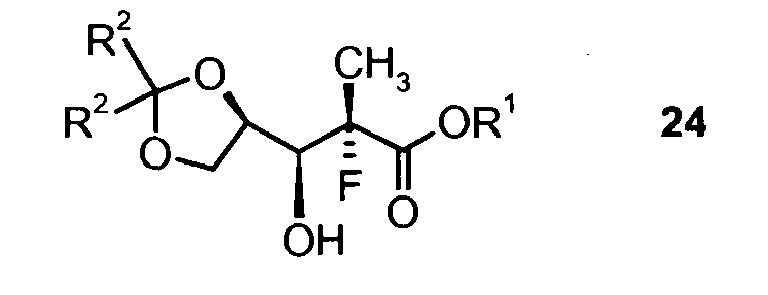
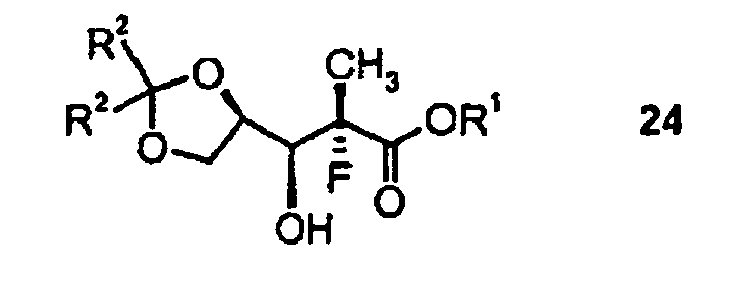
with an enzyme capable to hydrolyze the compound of formula 23 to the corresponding carboxylic acid and isolating a mixture of the compounds 22 and 24; - c) transforming a mixture of the compounds


- d) acylating a mixture of the compounds


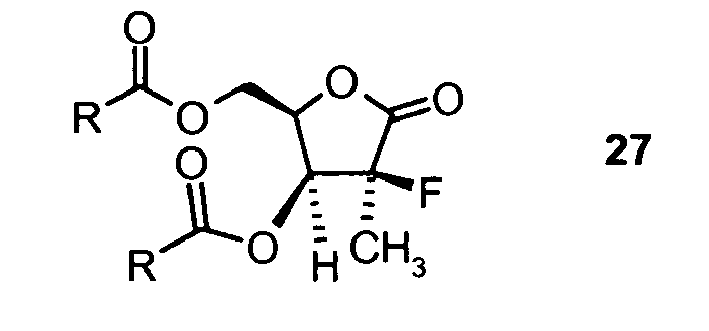
- e) recyrystallizing a mixture of the compounds


- As used herein, the following terms have the meanings:
- The term "phenyl-C1-6-alkyl", as used herein refers to C1-6-alkyl substituted with a phenyl group, preferably to benzyl.
- The term "optionally substituted phenyl-C1-6-alkyl" or "optionally substituted phenyl" refers to C1-3-alkyl substituted phenyl-C1-6-alkyl or C1-3-alkyl substituted phenyl.
- The term "C1-4-alkyl" or "C1-6-alkyl" refers to methyl, ethyl, n-propyl, iso-propyl, n-butyl, sec-butyl, t-butyl or in addition to pentyl and its isomers and hexyl and its isomers.
- The term "halogen" refers to chloro, bromo, iodo and fluoro, and is preferably chloro.
- In a preferred embodiment of the process of the present invention the substituents have the following meaning: R is phenyl, R1 is methyl, ethyl, or n-butyl, preferably ethyl, R2 is methyl or ethyl, preferably methyl and X is chloro.
- Step a) requires reacting a compound of the formula


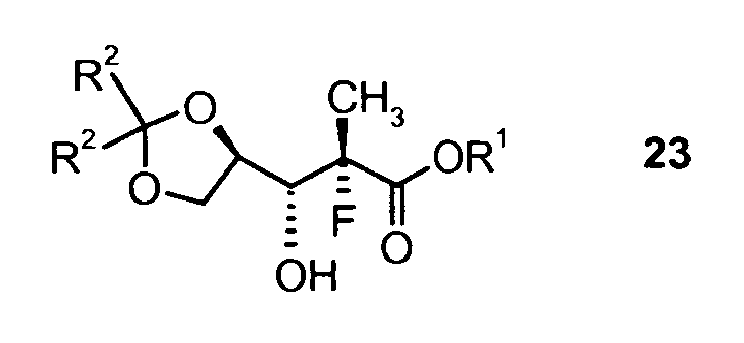

- The base used for the reaction step a) is a non nucleophilic base selected from the group consisting of lithium diisopropylamide (LDA), lithium 2, 2, 6, 6-tetramethylpiperidine (LTMP), and lithium hexamethyldisilazide (LHMDS).
- The reaction in step (a) can be carried out in a suitable organic non-reactive solvent. Illustrative examples include tetrahydrofuran (THF), 2-Me-THF, toluene, diethyl ether, t-butyl methyl ether, and the like.
- The reaction temperature is a rule maintained below -55°C. Isolation of the mixture of the compounds of formula 22, 23 and 24 can happen by adding an aqueous ammonium chloride solution to the reaction mixture and by extracting the aqueous phase with a suitable organic solvent such as with dichloromethane.
- Step b) requires reacting a mixture of the compounds

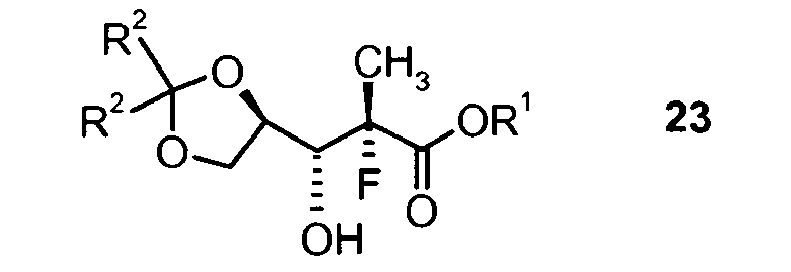

with an enzyme capable to hydrolyze the compound of formula 23 to the corresponding carboxylic acid and isolating a mixture of the compounds 22 and 24. - In principle any enzyme may be employed which preferentially hydrolyzes compound 23 to the corresponding carboxylic acid in the presence of compounds 22 and 24.
- Useful enzymes, which preferentially hydrolyze compound 23 in the presence of compound 22, include the lipase TOY from Pseudomonas aeruginosa (Toyobo); the esterase HLE from horse liver (Fluka), the esterase MME from Mucor miehei (Fluka); the esterase CLE from Candida lipolytica (Fluka); the lipase L1 from Burholderia cepacia (Roche); and the purified formulation of CALB which is the of lipase L2 from Roche.
- Candida Antarctica lipase form B (CALB), Novozymes, is a preferred enzyme because of its high reactivity and stereoselectivity. Preferably, the selective hydrolysis of compound 23 is carried out with CALB at a temperature of about 20-45 °C in an aqueous buffer of about pH 7.0-7.5 that may contain ammonium sulfate, potassium sulfate, sodium sulfate, dimethylammonium phosphate, sodium acetate, sodium citrate, sodium phosphate, sorbitol, sucrose, glycine or other beneficial additives for the enzymatic activity.
- The isolation of the mixture of compounds 22 and 24 from the alkaline aqueous medium may be carried out by way of extraction with a suitable organic solvent, preferably with dichloromethane.
- Step c) requires transforming a mixture of the compounds


- As a rule the acidic treatment in step c) is performed with an acid selected from the group consisting of acetic acid, sulfuric acid, hydrochloric acid, methanesulfonic acid or trifluoroacetic acid, preferably with aqueous sulfuric acid.
- Conversion of 22 and 24 to the corresponding 25 and 26 in step (a) may also be carried out using an acid as catalyst in a mixed solution of an organic solvent and water at an elevated temperature. Suitable conditions include acetic acid/water/95°C, Amberlyst 15/acetonitrile/water/82°C, sulfuric acid/ethanol/water/80°C and hydrochloric acid/1-propanol/water/88°C.
- The mixture of the compounds 25 and 26 can be isolated usually by neutralizing the reaction mixture with a suitable base, extraction with a suitable organic solvent and subsequent removal of the solvent.
- Step d) requires acylating a mixture


- Suitable bases are those which do not react with the acyl halogenide and the acyl anhydride reactant. Non-limiting illustrative examples are pyridine, or tertiary amines such as triethylamine, N,N'-diisopropylamine (DIPEA), 4-dimethylaminopyridine (DMAP). Preferably a tertiary amine and more preferably triethylamine is used as base for the acylation.
- Preferred acylation agents are the acyl halogenides RCOX with the R and X having the meaning as above. Most preferred acylating agent is benzoyl chloride.
- In a preferred embodiment of the acylation step a catalytic amount of 4-dimethylaminopyridine can be added.
- Usually the acylation takes place in a suitable solvent such as in acetonitrile, dimethylformamide (DMF), pyridine, and the like.
- As a rule the mixture of the compounds 2 and 27 will not be isolated from the reaction mixture but readily be subjected to the recrystallization in step e)
- Step e) requires recyrystallizing a mixture of the compounds


- Usually a water soluble organic solvent is that substantially separates compound 2 in the crystalline form from compound 27. Non-limiting illustrative examples may be selected from the group consisting of methanol, ethanol, n-propanol, and isopropanol. A preferred solvent is isopropanol.
- In another specific embodiment the present invention provides a method for preparing a compound of the formula:


- Usually the mixture of compounds 22 and 24 is dissolved in a suitable solvent such as in tert-butyl methyl ether. Compound 22 can then be precipitated in an apolar solvent, preferably in hexane.
- Yet, in another embodiment of the invention a process for the preparation of a compound of formula

- The following examples shall illustrate the invention without limiting it.
- Reaction of ethyl 2-fluoropropionate (20, R1=ethyl) with D-glyceraldehyde, 1,2-acetonide (21, R2=methyl)

- A dry, clean, 2L, 4-neck round bottom flask, equipped with a mechanic stirrer, a thermo couple, a nitrogen inlet, and an addition funnel, was charged with 266 g of anhydrous tetrahydrofuran (THF) and 38.1 g of diisopropylamine. The mixture was stirred and cooled to <-75°C. To the solution was slowly charged 173 g of 1.6 M MeLi solution in ethyl ether while maintaining the batch temperature below -55°C. After the addition the mixture was stirred at approximately -75°C. for 40 minutes. To this mixture was then slowly added 45.2 g of ethyl 2-fluoropropionate 20 while maintaining the batch temperature below -74°C. The mixture was stirred at -76°C. for 50 minutes and a solution of 35 g freshly distilled D-glyceraldehyde, 1,2-acetonide 21 in 178 g of anhydrous THF was slowly added while maintaining batch temperature below -74°C. After the addition the mixture was stirred for approximately 20 minutes. To it was added 300 g of 20% NH4Cl solution. The mixture was slowly warmed to ambient temperature and transferred to a separatory funnel. The aqueous phase was separated and extracted with 2X132 g =264 g of dichloromethane. The organic phases were combined, dried over MgSO4, filtered, and concentrated to give 58 g crude aldol product as thick oil. A gas chromatogram showed the oil contained 12.2% of 24, 43.4% of 22, and 35.2% of 23.
- Reaction of ethyl 2-fluoropropionate (20, R1=ethyl) with D-glyceraldehyde, 1,2-pentanonide (21, R2=ethyl)

- A dry, clean, 4-neck round bottom flask, equipped with a mechanic stirrer, a thermo couple, a nitrogen inlet, and an addition funnel, was charged with 20 mL of anhydrous THF and 1.8 g of diisopropylamine. The mixture was stirred and cooled to <-75°C. To the solution was slowly charged 11 mL of 1.6 M MeLi solution in ethyl ether while maintaining the batch temperature below -55°C. After the addition the mixture was stirred at approximately -75°C. for 30 minutes. To this mixture was then slowly added 2.1 g of ethyl 2-fluoropropionate 20 while maintaining the batch temperature below -74°C. The mixture was stirred at -76 °C for 30 minutes and a solution of 2 g freshly distilled D-glyceraldehyde, 1,2-pentanonide 21 in 10 mL of anhydrous THF was slowly added while maintaining batch temperature below -74 °C. After the addition the mixture was stirred for approximately 20 minutes. To it was added 20 mL of 20% NH4Cl solution. The mixture was slowly warmed to ambient temperature and transferred to a separatory funnel. The aqueous phase was separated and extracted with 2X10 mL = 20 mL of dichloromethane. The organic phases were combined, dried over MgSO4, filtered, and concentrated to give 3 g crude aldol product as thick oil. A gas chromatogram showed the oil contained 8.2% of 24, 36.5% of 22, and 30.8% of 23.
- Reaction of n-butyl 2-fluoropropionate (20, R1=n-butyl) with D-glyceraldehyde, 1,2-acetonide (21, R2=methyl)

- A dry, clean, 4-neck round bottom flask, equipped with a mechanic stirrer, a thermo couple, a nitrogen inlet, and an addition funnel, was charged with 100 mL of anhydrous toluene and 10 g of diisopropylamine. The mixture was stirred and cooled to <-75°C. To the solution was slowly charged 54 mL of 1.6 M MeLi solution in ethyl ether while maintaining the batch temperature below -55°C. After the addition the mixture was stirred at approximately -75°C for 30 minutes. To this mixture was then slowly added 11 g of n-butyl 2-fluoropropionate 20 while maintaining the batch temperature below -70°C. The mixture was stirred at -76°C for 30 minutes and a solution of 8 g freshly distilled D-glyceraldehyde, 1,2-acetonide 21 in 50 mL of anhydrous toluene was slowly added while maintaining batch temperature below -74°C. After the addition the mixture was stirred for approximately 1 hour. The mixture was added to 30 mL of 30% citric acid solution. The mixture was slowly warmed to ambient temperature and transferred to a separatory funnel. The aqueous phase was separated and extracted with 2X20 mL = 40 mL of ethyl acetate. The organic phases were combined, washed with brine, and concentrated to give 11 g crude aldol product as thick oil. A gas chromatogram showed the oil contained 5.5% of 24, 55% of 22, and 39% of 23.
- Enzymatic Treatment of a Mixture of 22, 23, and 24 (R1=ethyl, R2= methyl)

- A dry, clean, 1L, 4-neck round bottom flask, equipped with a mechanic stirrer, a thermo couple, a pH probe, and a base dosing pump inlet, was charged with 360 g of buffer which consisted of 10% D-sorbitol, 3mM potassium phosphate, and 38.5 g of crude aldol product (22, 23 and 24). The mixture was stirred at 43°C. (batch temperature) and the pH of the mixture was adjusted to ~7.5 by adding 12% H2SO4 solution. To the mixture was added 4 g of CALB solution. The mixture was stirred at the temperature for 22 hours while the pH was maintained at 7.5 by the addition of 1.0 N NaOH solution via a pH pump. The mixture was cooled to ambient temperature, transferred to a separatory funnel, and extracted with 3X100 mL = 300 g of dichloromethane. The organic solution was stirred with 75 g of anhydrous MgSO4 for 1 hour. The solid was filtered and the filtrate was concentrated to dryness to give 18 g crude mixture of 22 and 24 as thick oil that slowly became a semi-solid.
- Preparation of 2 (R=Ph) from a mixture of 22 and 24 (R1=ethyl, R2=methyl)

- A mixture of 3.0 g of crude mixture of 22 and 24 from Example 4 and 20 g of 2B alcohol and 6 g of 12% sulfuric acid was refluxed at 78°C for 5 hours. The mixture was cooled to ambient temperature and 1 g of triethylamine was added to neutralize the acid. The mixture was concentrated to dryness. The residue was mixed with 20 g of toluene and the mixture was again concentrated to dryness. The residue was dissolved in 15 g of acetonitrile. To the solution was added a catalytic amount of 4-dimethylaminopyridine (DMAP) and 5.2 g of benzoyl chloride. To this mixture was slowly added 4.1 g of triethylamine while maintaining the batch temperature at <40 °C. After the addition the mixture was stirred for 1 hour. The mixture was diluted with 36 g of ethyl acetate and was cooled to 0°C, 25 g of water was added. The mixture was transferred to a separatory funnel and the aqueous phase was separated and extracted again with 20 g of ethyl acetate. The combined organic solution was washed with 20 g of saturated NaHCO3 solution, dried over MgSO4, filtered, and concentrated to give a crude oil. The oil was mixed with 27 g of 2-propanol. The mixture was heated to ~60°C to become a clear solution. The mixture was then slowly cooled to 10°C and held for 1 hour. The solid was filtered and the wet cake was washed with 2-propanol and dried under vacuum at 50°C overnight to give 2.0 g of 2 (R=Ph).
- Isolation of Pure 22 (R1=ethyl, R2=methyl) after Enzymatic Hydrolysis

- A flask was charged with 3 g of a mixture of 22 and 24 (R1=ethyl, R2=methyl) from Example 4 and 3ml of tert-butyl methyl ether (TBME). The mixture was stirred until a clear solution was formed. To this solution was slowly added 10 mL of hexanes. The resulted suspension was stirred at ambient temperature for 2 hours. The solid was isolated and washed with 4 mL of hexane and dried under vacuum at 30°C overnight to give 1.3 g of pure 22 (R1=ethyl, R2=methyl).
Claims (11)
- Process for the preparation of a compound of the formula:

which comprises one or more of the steps:a) reacting a compound of the formula
with a base and a compound of formula
to form a mixture of the compounds

 b) reacting a mixture of the compounds

with an enzyme capable to hydrolyze the compound of formula 23 to the corresponding carboxylic acid and isolating a mixture of the compounds 22 and 24;c) transforming a mixture of the compounds


 d) acylating a mixture of the compounds

RCOX
wherein R is as above and X is a halogen or with an acyl anhydride
RC(O)O(O)CR
wherein R is as above in the presence of a base
to form a mixture of the compounds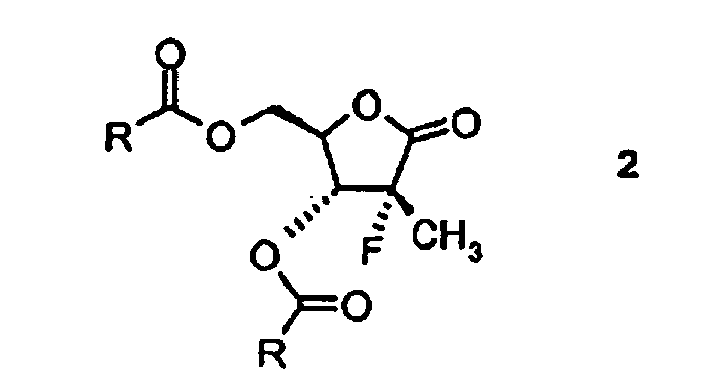
 e) recyrystallizing a mixture of the compounds

- Process according to claim 1 wherein R is phenyl, R1 is methyl, ethyl or n-butyl, R2 is methyl or ethyl and X is chloro.
- Process according to claim 1, characterized in that the base used for the reaction step a) is selected from the group consisting of lithium diisopropylamide, lithium 2, 2, 6, 6-tetramethylpiperidine, and lithium hexamethyldisilazide.
- Process according to claim 1, characterized in that the enzyme used in step (b) is a Candida Antarctica Lipase 2 (CALB).
- Process according to claims 1 or 4, characterized in that the enzymatic hydrolysis in step b) is performed in an aqueous buffer medium at a pH between 7.0 and 7.5 and a temperature between 20°C and 45°C.
- Process according to claims 1, 4 or 5, characterized in that in step b) the mixture of the compounds 22 and 24 is recovered by extraction of the reaction mixture with an organic solvent.
- Process according to claim 1, characterized in that the acidic treatment in step c) is performed with an acid selected from the group consisting of acetic acid, sulfuric acid, hydrochloric acid, methanesulfonic acid or trifluoroacetic acid.
- Process according to claim 1 or 7, characterized in that the base used for the acylation in step d) is a tertiary amine.
- Process according to claims 1 or 8, characterized in that the acylation in step d) is performed with benzoylchloride.
- Process according to claim 1, characterized in that the recrystallization in step e) is performed with an aliphatic alcohol selected from methanol, ethanol, n-propanol and isopropanol.
- Process according to claim 1 or 10, characterized in that isopropanol is used.
Applications Claiming Priority (2)
| Application Number | Priority Date | Filing Date | Title |
|---|---|---|---|
| US87561706P | 2006-12-18 | 2006-12-18 | |
| PCT/EP2007/063703 WO2008074693A2 (en) | 2006-12-18 | 2007-12-11 | Process for preparing 3,5-di-omicron-acyl-2-fluoro-2-c-methyl-d-ribono-gamma-lactone |
Publications (2)
| Publication Number | Publication Date |
|---|---|
| EP2094679A2 EP2094679A2 (en) | 2009-09-02 |
| EP2094679B1 true EP2094679B1 (en) | 2012-01-25 |
Family
ID=39433788
Family Applications (1)
| Application Number | Title | Priority Date | Filing Date |
|---|---|---|---|
| EP07857390A Not-in-force EP2094679B1 (en) | 2006-12-18 | 2007-12-11 | Process for preparing 3,5-di-omicron-acyl-2-fluoro-2-c-methyl-d-ribono-gamma-lactone |
Country Status (13)
| Country | Link |
|---|---|
| US (1) | US7838693B2 (en) |
| EP (1) | EP2094679B1 (en) |
| JP (1) | JP5148627B2 (en) |
| KR (1) | KR101118413B1 (en) |
| CN (1) | CN101573349B (en) |
| AT (1) | ATE542810T1 (en) |
| AU (1) | AU2007336365B2 (en) |
| BR (1) | BRPI0720835A2 (en) |
| CA (1) | CA2671856C (en) |
| ES (1) | ES2379696T3 (en) |
| IL (1) | IL198801A (en) |
| MX (1) | MX2009006156A (en) |
| WO (1) | WO2008074693A2 (en) |
Families Citing this family (6)
| Publication number | Priority date | Publication date | Assignee | Title |
|---|---|---|---|---|
| CN103724301A (en) | 2012-10-10 | 2014-04-16 | 上海特化医药科技有限公司 | (2R)-2-desoxy-2,2-disubstituted-1,4-ribonolactones, preparation method and purpose thereof |
| AR094466A1 (en) * | 2013-01-14 | 2015-08-05 | Hoffmann La Roche | PROCESS FOR OBTAINING A FLUORLACTONE DERIVATIVE |
| CN104918924B (en) * | 2013-01-14 | 2018-05-11 | 吉利德制药有限责任公司 | The method for preparing fluoro lactone derivatives |
| CN105026382B (en) * | 2013-02-28 | 2016-10-19 | 中央硝子株式会社 | Method for producing (2R)-2-fluoro-2-C-methyl-D-ribono-γ-lactone |
| JP6476591B2 (en) * | 2013-06-05 | 2019-03-06 | セントラル硝子株式会社 | Process for producing (2R) -2-fluoro-2-C-methyl-D-ribono-γ-lactones |
| CN105085445B (en) * | 2015-08-11 | 2016-09-07 | 海门慧聚药业有限公司 | The preparation of Suo Feibuwei intermediate |
Family Cites Families (5)
| Publication number | Priority date | Publication date | Assignee | Title |
|---|---|---|---|---|
| KR20030005167A (en) * | 2000-11-30 | 2003-01-17 | 다이셀 가가꾸 고교 가부시끼가이샤 | Transfer Sheet |
| US7799827B2 (en) * | 2002-03-08 | 2010-09-21 | Eisai Co., Ltd. | Macrocyclic compounds useful as pharmaceuticals |
| BRPI0419345B8 (en) * | 2003-05-30 | 2021-05-25 | Gilead Pharmasset Llc | use of (2'r)-2'-deoxy-2'-fluor-2'-c-methyl nucleoside and a pharmaceutical composition comprising it |
| PT1773856E (en) * | 2004-07-21 | 2012-05-14 | Gilead Pharmasset Llc | Preparation of alkyl-substituted 2-deoxy-2-fluoro-d-ribofuranosyl pyrimidines and purines and their derivatives |
| MX2007003085A (en) * | 2004-09-14 | 2007-08-02 | Pharmasset Inc | Preparation of 2' ifluoro-2'- alkyl- substituted or other optionally substituted ribofuranosyl pyrimidines and purines and their derivatives. |
-
2007
- 2007-12-11 MX MX2009006156A patent/MX2009006156A/en active IP Right Grant
- 2007-12-11 CA CA2671856A patent/CA2671856C/en not_active Expired - Fee Related
- 2007-12-11 JP JP2009541984A patent/JP5148627B2/en not_active Expired - Fee Related
- 2007-12-11 AT AT07857390T patent/ATE542810T1/en active
- 2007-12-11 US US11/953,900 patent/US7838693B2/en not_active Expired - Fee Related
- 2007-12-11 ES ES07857390T patent/ES2379696T3/en active Active
- 2007-12-11 CN CN2007800467888A patent/CN101573349B/en not_active Expired - Fee Related
- 2007-12-11 EP EP07857390A patent/EP2094679B1/en not_active Not-in-force
- 2007-12-11 WO PCT/EP2007/063703 patent/WO2008074693A2/en not_active Ceased
- 2007-12-11 BR BRPI0720835A patent/BRPI0720835A2/en not_active IP Right Cessation
- 2007-12-11 AU AU2007336365A patent/AU2007336365B2/en not_active Ceased
- 2007-12-11 KR KR1020097012519A patent/KR101118413B1/en not_active Expired - Fee Related
-
2009
- 2009-05-18 IL IL198801A patent/IL198801A/en not_active IP Right Cessation
Also Published As
| Publication number | Publication date |
|---|---|
| ES2379696T3 (en) | 2012-04-30 |
| IL198801A (en) | 2013-08-29 |
| IL198801A0 (en) | 2010-02-17 |
| JP2010513377A (en) | 2010-04-30 |
| MX2009006156A (en) | 2009-06-19 |
| CN101573349B (en) | 2013-07-10 |
| CN101573349A (en) | 2009-11-04 |
| JP5148627B2 (en) | 2013-02-20 |
| ATE542810T1 (en) | 2012-02-15 |
| AU2007336365A1 (en) | 2008-06-26 |
| CA2671856A1 (en) | 2008-06-26 |
| US20080145901A1 (en) | 2008-06-19 |
| EP2094679A2 (en) | 2009-09-02 |
| CA2671856C (en) | 2015-02-10 |
| WO2008074693A2 (en) | 2008-06-26 |
| WO2008074693A3 (en) | 2008-10-30 |
| BRPI0720835A2 (en) | 2015-09-29 |
| KR101118413B1 (en) | 2012-03-07 |
| AU2007336365B2 (en) | 2013-03-07 |
| KR20090080562A (en) | 2009-07-24 |
| US7838693B2 (en) | 2010-11-23 |
Similar Documents
| Publication | Publication Date | Title |
|---|---|---|
| RU2266903C2 (en) | Method for preparing derivatives of 2-(6-substituted-1,3-dioxane-4-yl)-acetic acid | |
| CA2671856C (en) | Process for preparing 3,5-di-omicron-acyl-2-fluoro-2-c-methyl-d-ribono-gamma-lactone | |
| US6103901A (en) | Process for preparing a 2-(2-amino-1,6-dihydro-6-oxo-purin-9-yl)methoxy-1,3-propanediol derivative | |
| US8258299B2 (en) | Process for preparation of temsirolimus | |
| WO2008090046A1 (en) | Alternate process for preparing 3,5-di-omicron-acyl-2-fluoro-2-c-methyl-d-ribono-gamma-lactone | |
| JPH06261774A (en) | Process for producing 1,4: 3,6-dianhydroglucitol 2-acylate | |
| US5773629A (en) | Synthesis of (4S, 5R) -2, 4-diphenyl-5-carboxy-oxazoline derivative as taxol side-chain precursor | |
| KR100897597B1 (en) | Process for preparing substituted carboxylic acid ester | |
| CN101003820B (en) | Method for producing optically active cyclopentenones and cyclopentenones produced thereby | |
| EP1464638A1 (en) | Process for producing erythro-3-amino-2-hydroxybutyric acid derivatives | |
| US7011960B2 (en) | Substituted 2-amino-3-(2-amino-phenylsulfanyl)-propionic acids | |
| KR100870784B1 (en) | Enzymatic synthesis of enantiopure intermediates by means of cholesterolesterase from yeasts | |
| WO2006076565A2 (en) | Preparation of chiral propargylic alcohol and ester intermediates of himbacine analogs | |
| KR101130717B1 (en) | Process for the Preparation of a Chiral Intermediate for the Preparation of HMG-CoA Reductase Inhibitors | |
| Hayakawa et al. | The Baker's Yeast Reduction of the β-keto Aldehydes in the Presence of a Sulfur Compound | |
| US7557216B2 (en) | Process for production of 5-chloro-2,4-dihydroxypyridine | |
| EP1414822B1 (en) | Improved synthesis of branched acyclic nucleosides | |
| JPH11209345A (en) | Method for producing pharmaceutical intermediates | |
| KR101086039B1 (en) | New preparation method of 3,4-dihydro-pyrano [3,4-c] pyridin-1-one derivative | |
| AU2002325848A1 (en) | Improved synthesis of branched acyclic nucleosides | |
| KR20050060281A (en) | Process for preparing simvastatin |
Legal Events
| Date | Code | Title | Description |
|---|---|---|---|
| PUAI | Public reference made under article 153(3) epc to a published international application that has entered the european phase |
Free format text: ORIGINAL CODE: 0009012 |
|
| 17P | Request for examination filed |
Effective date: 20090720 |
|
| AK | Designated contracting states |
Kind code of ref document: A2 Designated state(s): AT BE BG CH CY CZ DE DK EE ES FI FR GB GR HU IE IS IT LI LT LU LV MC MT NL PL PT RO SE SI SK TR |
|
| DAX | Request for extension of the european patent (deleted) | ||
| 17Q | First examination report despatched |
Effective date: 20110407 |
|
| GRAP | Despatch of communication of intention to grant a patent |
Free format text: ORIGINAL CODE: EPIDOSNIGR1 |
|
| GRAS | Grant fee paid |
Free format text: ORIGINAL CODE: EPIDOSNIGR3 |
|
| GRAA | (expected) grant |
Free format text: ORIGINAL CODE: 0009210 |
|
| AK | Designated contracting states |
Kind code of ref document: B1 Designated state(s): AT BE BG CH CY CZ DE DK EE ES FI FR GB GR HU IE IS IT LI LT LU LV MC MT NL PL PT RO SE SI SK TR |
|
| REG | Reference to a national code |
Ref country code: GB Ref legal event code: FG4D |
|
| REG | Reference to a national code |
Ref country code: CH Ref legal event code: EP |
|
| REG | Reference to a national code |
Ref country code: AT Ref legal event code: REF Ref document number: 542810 Country of ref document: AT Kind code of ref document: T Effective date: 20120215 |
|
| REG | Reference to a national code |
Ref country code: IE Ref legal event code: FG4D |
|
| REG | Reference to a national code |
Ref country code: DE Ref legal event code: R096 Ref document number: 602007020343 Country of ref document: DE Effective date: 20120322 |
|
| REG | Reference to a national code |
Ref country code: ES Ref legal event code: FG2A Ref document number: 2379696 Country of ref document: ES Kind code of ref document: T3 Effective date: 20120430 |
|
| REG | Reference to a national code |
Ref country code: NL Ref legal event code: T3 |
|
| REG | Reference to a national code |
Ref country code: SE Ref legal event code: TRGR |
|
| LTIE | Lt: invalidation of european patent or patent extension |
Effective date: 20120125 |
|
| PG25 | Lapsed in a contracting state [announced via postgrant information from national office to epo] |
Ref country code: BG Free format text: LAPSE BECAUSE OF FAILURE TO SUBMIT A TRANSLATION OF THE DESCRIPTION OR TO PAY THE FEE WITHIN THE PRESCRIBED TIME-LIMIT Effective date: 20120425 Ref country code: LT Free format text: LAPSE BECAUSE OF FAILURE TO SUBMIT A TRANSLATION OF THE DESCRIPTION OR TO PAY THE FEE WITHIN THE PRESCRIBED TIME-LIMIT Effective date: 20120125 Ref country code: IS Free format text: LAPSE BECAUSE OF FAILURE TO SUBMIT A TRANSLATION OF THE DESCRIPTION OR TO PAY THE FEE WITHIN THE PRESCRIBED TIME-LIMIT Effective date: 20120525 |
|
| PG25 | Lapsed in a contracting state [announced via postgrant information from national office to epo] |
Ref country code: PT Free format text: LAPSE BECAUSE OF FAILURE TO SUBMIT A TRANSLATION OF THE DESCRIPTION OR TO PAY THE FEE WITHIN THE PRESCRIBED TIME-LIMIT Effective date: 20120525 Ref country code: PL Free format text: LAPSE BECAUSE OF FAILURE TO SUBMIT A TRANSLATION OF THE DESCRIPTION OR TO PAY THE FEE WITHIN THE PRESCRIBED TIME-LIMIT Effective date: 20120125 Ref country code: LV Free format text: LAPSE BECAUSE OF FAILURE TO SUBMIT A TRANSLATION OF THE DESCRIPTION OR TO PAY THE FEE WITHIN THE PRESCRIBED TIME-LIMIT Effective date: 20120125 Ref country code: GR Free format text: LAPSE BECAUSE OF FAILURE TO SUBMIT A TRANSLATION OF THE DESCRIPTION OR TO PAY THE FEE WITHIN THE PRESCRIBED TIME-LIMIT Effective date: 20120426 |
|
| PG25 | Lapsed in a contracting state [announced via postgrant information from national office to epo] |
Ref country code: CY Free format text: LAPSE BECAUSE OF FAILURE TO SUBMIT A TRANSLATION OF THE DESCRIPTION OR TO PAY THE FEE WITHIN THE PRESCRIBED TIME-LIMIT Effective date: 20120125 |
|
| REG | Reference to a national code |
Ref country code: HU Ref legal event code: AG4A Ref document number: E013810 Country of ref document: HU |
|
| PG25 | Lapsed in a contracting state [announced via postgrant information from national office to epo] |
Ref country code: CZ Free format text: LAPSE BECAUSE OF FAILURE TO SUBMIT A TRANSLATION OF THE DESCRIPTION OR TO PAY THE FEE WITHIN THE PRESCRIBED TIME-LIMIT Effective date: 20120125 Ref country code: EE Free format text: LAPSE BECAUSE OF FAILURE TO SUBMIT A TRANSLATION OF THE DESCRIPTION OR TO PAY THE FEE WITHIN THE PRESCRIBED TIME-LIMIT Effective date: 20120125 Ref country code: RO Free format text: LAPSE BECAUSE OF FAILURE TO SUBMIT A TRANSLATION OF THE DESCRIPTION OR TO PAY THE FEE WITHIN THE PRESCRIBED TIME-LIMIT Effective date: 20120125 Ref country code: DK Free format text: LAPSE BECAUSE OF FAILURE TO SUBMIT A TRANSLATION OF THE DESCRIPTION OR TO PAY THE FEE WITHIN THE PRESCRIBED TIME-LIMIT Effective date: 20120125 Ref country code: SI Free format text: LAPSE BECAUSE OF FAILURE TO SUBMIT A TRANSLATION OF THE DESCRIPTION OR TO PAY THE FEE WITHIN THE PRESCRIBED TIME-LIMIT Effective date: 20120125 |
|
| PG25 | Lapsed in a contracting state [announced via postgrant information from national office to epo] |
Ref country code: SK Free format text: LAPSE BECAUSE OF FAILURE TO SUBMIT A TRANSLATION OF THE DESCRIPTION OR TO PAY THE FEE WITHIN THE PRESCRIBED TIME-LIMIT Effective date: 20120125 |
|
| PLBE | No opposition filed within time limit |
Free format text: ORIGINAL CODE: 0009261 |
|
| STAA | Information on the status of an ep patent application or granted ep patent |
Free format text: STATUS: NO OPPOSITION FILED WITHIN TIME LIMIT |
|
| 26N | No opposition filed |
Effective date: 20121026 |
|
| REG | Reference to a national code |
Ref country code: DE Ref legal event code: R097 Ref document number: 602007020343 Country of ref document: DE Effective date: 20121026 |
|
| PG25 | Lapsed in a contracting state [announced via postgrant information from national office to epo] |
Ref country code: MC Free format text: LAPSE BECAUSE OF NON-PAYMENT OF DUE FEES Effective date: 20121231 |
|
| PG25 | Lapsed in a contracting state [announced via postgrant information from national office to epo] |
Ref country code: MT Free format text: LAPSE BECAUSE OF FAILURE TO SUBMIT A TRANSLATION OF THE DESCRIPTION OR TO PAY THE FEE WITHIN THE PRESCRIBED TIME-LIMIT Effective date: 20120125 |
|
| PG25 | Lapsed in a contracting state [announced via postgrant information from national office to epo] |
Ref country code: TR Free format text: LAPSE BECAUSE OF FAILURE TO SUBMIT A TRANSLATION OF THE DESCRIPTION OR TO PAY THE FEE WITHIN THE PRESCRIBED TIME-LIMIT Effective date: 20120125 |
|
| PG25 | Lapsed in a contracting state [announced via postgrant information from national office to epo] |
Ref country code: LU Free format text: LAPSE BECAUSE OF NON-PAYMENT OF DUE FEES Effective date: 20121211 |
|
| REG | Reference to a national code |
Ref country code: FR Ref legal event code: PLFP Year of fee payment: 9 |
|
| REG | Reference to a national code |
Ref country code: DE Ref legal event code: R082 Ref document number: 602007020343 Country of ref document: DE Representative=s name: LEDERER & KELLER PATENTANWAELTE PARTNERSCHAFT , DE Ref country code: DE Ref legal event code: R081 Ref document number: 602007020343 Country of ref document: DE Owner name: GILEAD PHARMASSET LLC, FOSTER CITY, US Free format text: FORMER OWNER: F. HOFFMANN-LA ROCHE AG, 4070 BASEL, CH |
|
| REG | Reference to a national code |
Ref country code: DE Ref legal event code: R081 Ref document number: 602007020343 Country of ref document: DE Owner name: GILEAD PHARMASSET LLC, FOSTER CITY, US Free format text: FORMER OWNER: GILEAD PHARMASSET LLC, FOSTER CITY, CALIF., US Ref country code: DE Ref legal event code: R082 Ref document number: 602007020343 Country of ref document: DE Representative=s name: LEDERER & KELLER PATENTANWAELTE PARTNERSCHAFT , DE Ref country code: DE Ref legal event code: R081 Ref document number: 602007020343 Country of ref document: DE Owner name: GILEAD PHARMASSET LLC, FOSTER CITY, US Free format text: FORMER OWNER: GILEAD PHARMASSET LLC, FORSTER CITY, CALIF., US |
|
| REG | Reference to a national code |
Ref country code: FR Ref legal event code: PLFP Year of fee payment: 10 |
|
| PGFP | Annual fee paid to national office [announced via postgrant information from national office to epo] |
Ref country code: IE Payment date: 20161125 Year of fee payment: 10 Ref country code: HU Payment date: 20161124 Year of fee payment: 10 Ref country code: FR Payment date: 20161117 Year of fee payment: 10 Ref country code: GB Payment date: 20161125 Year of fee payment: 10 Ref country code: FI Payment date: 20161205 Year of fee payment: 10 Ref country code: CH Payment date: 20161025 Year of fee payment: 10 Ref country code: NL Payment date: 20161207 Year of fee payment: 10 |
|
| PGFP | Annual fee paid to national office [announced via postgrant information from national office to epo] |
Ref country code: IT Payment date: 20161221 Year of fee payment: 10 Ref country code: ES Payment date: 20161215 Year of fee payment: 10 Ref country code: BE Payment date: 20161215 Year of fee payment: 10 Ref country code: AT Payment date: 20161125 Year of fee payment: 10 Ref country code: SE Payment date: 20161207 Year of fee payment: 10 |
|
| PGFP | Annual fee paid to national office [announced via postgrant information from national office to epo] |
Ref country code: DE Payment date: 20161220 Year of fee payment: 10 |
|
| REG | Reference to a national code |
Ref country code: DE Ref legal event code: R119 Ref document number: 602007020343 Country of ref document: DE |
|
| PG25 | Lapsed in a contracting state [announced via postgrant information from national office to epo] |
Ref country code: FI Free format text: LAPSE BECAUSE OF NON-PAYMENT OF DUE FEES Effective date: 20171211 |
|
| REG | Reference to a national code |
Ref country code: CH Ref legal event code: PL |
|
| REG | Reference to a national code |
Ref country code: NL Ref legal event code: MM Effective date: 20180101 |
|
| REG | Reference to a national code |
Ref country code: AT Ref legal event code: MM01 Ref document number: 542810 Country of ref document: AT Kind code of ref document: T Effective date: 20171211 |
|
| GBPC | Gb: european patent ceased through non-payment of renewal fee |
Effective date: 20171211 |
|
| PG25 | Lapsed in a contracting state [announced via postgrant information from national office to epo] |
Ref country code: SE Free format text: LAPSE BECAUSE OF NON-PAYMENT OF DUE FEES Effective date: 20171212 |
|
| REG | Reference to a national code |
Ref country code: IE Ref legal event code: MM4A |
|
| PG25 | Lapsed in a contracting state [announced via postgrant information from national office to epo] |
Ref country code: NL Free format text: LAPSE BECAUSE OF NON-PAYMENT OF DUE FEES Effective date: 20180101 |
|
| REG | Reference to a national code |
Ref country code: FR Ref legal event code: ST Effective date: 20180831 |
|
| REG | Reference to a national code |
Ref country code: BE Ref legal event code: MM Effective date: 20171231 |
|
| PG25 | Lapsed in a contracting state [announced via postgrant information from national office to epo] |
Ref country code: IT Free format text: LAPSE BECAUSE OF NON-PAYMENT OF DUE FEES Effective date: 20171211 Ref country code: IE Free format text: LAPSE BECAUSE OF NON-PAYMENT OF DUE FEES Effective date: 20171211 Ref country code: HU Free format text: LAPSE BECAUSE OF NON-PAYMENT OF DUE FEES Effective date: 20171212 Ref country code: FR Free format text: LAPSE BECAUSE OF NON-PAYMENT OF DUE FEES Effective date: 20180102 Ref country code: DE Free format text: LAPSE BECAUSE OF NON-PAYMENT OF DUE FEES Effective date: 20180703 |
|
| PG25 | Lapsed in a contracting state [announced via postgrant information from national office to epo] |
Ref country code: LI Free format text: LAPSE BECAUSE OF NON-PAYMENT OF DUE FEES Effective date: 20171231 Ref country code: CH Free format text: LAPSE BECAUSE OF NON-PAYMENT OF DUE FEES Effective date: 20171231 Ref country code: BE Free format text: LAPSE BECAUSE OF NON-PAYMENT OF DUE FEES Effective date: 20171231 Ref country code: GB Free format text: LAPSE BECAUSE OF NON-PAYMENT OF DUE FEES Effective date: 20171211 Ref country code: AT Free format text: LAPSE BECAUSE OF NON-PAYMENT OF DUE FEES Effective date: 20171211 |
|
| REG | Reference to a national code |
Ref country code: ES Ref legal event code: FD2A Effective date: 20190703 |
|
| PG25 | Lapsed in a contracting state [announced via postgrant information from national office to epo] |
Ref country code: ES Free format text: LAPSE BECAUSE OF NON-PAYMENT OF DUE FEES Effective date: 20171212 |