EP2093958A1 - Multicarrier mobile measuring signals from neighbouring base stations to calculate its position for interference coordination - Google Patents
Multicarrier mobile measuring signals from neighbouring base stations to calculate its position for interference coordination Download PDFInfo
- Publication number
- EP2093958A1 EP2093958A1 EP08290170A EP08290170A EP2093958A1 EP 2093958 A1 EP2093958 A1 EP 2093958A1 EP 08290170 A EP08290170 A EP 08290170A EP 08290170 A EP08290170 A EP 08290170A EP 2093958 A1 EP2093958 A1 EP 2093958A1
- Authority
- EP
- European Patent Office
- Prior art keywords
- interference
- multicarrier
- signal
- mobile device
- communication cell
- Prior art date
- Legal status (The legal status is an assumption and is not a legal conclusion. Google has not performed a legal analysis and makes no representation as to the accuracy of the status listed.)
- Granted
Links
Images


Classifications
-
- H—ELECTRICITY
- H04—ELECTRIC COMMUNICATION TECHNIQUE
- H04W—WIRELESS COMMUNICATION NETWORKS
- H04W64/00—Locating users or terminals or network equipment for network management purposes, e.g. mobility management
-
- H—ELECTRICITY
- H04—ELECTRIC COMMUNICATION TECHNIQUE
- H04W—WIRELESS COMMUNICATION NETWORKS
- H04W52/00—Power management, e.g. Transmission Power Control [TPC] or power classes
- H04W52/04—Transmission power control [TPC]
- H04W52/18—TPC being performed according to specific parameters
- H04W52/24—TPC being performed according to specific parameters using SIR [Signal to Interference Ratio] or other wireless path parameters
- H04W52/243—TPC being performed according to specific parameters using SIR [Signal to Interference Ratio] or other wireless path parameters taking into account interferences
-
- H—ELECTRICITY
- H04—ELECTRIC COMMUNICATION TECHNIQUE
- H04W—WIRELESS COMMUNICATION NETWORKS
- H04W52/00—Power management, e.g. Transmission Power Control [TPC] or power classes
- H04W52/04—Transmission power control [TPC]
- H04W52/38—TPC being performed in particular situations
- H04W52/42—TPC being performed in particular situations in systems with time, space, frequency or polarisation diversity
-
- H—ELECTRICITY
- H04—ELECTRIC COMMUNICATION TECHNIQUE
- H04L—TRANSMISSION OF DIGITAL INFORMATION, e.g. TELEGRAPHIC COMMUNICATION
- H04L27/00—Modulated-carrier systems
- H04L27/26—Systems using multi-frequency codes
- H04L27/2601—Multicarrier modulation systems
- H04L27/2602—Signal structure
- H04L27/261—Details of reference signals
-
- H—ELECTRICITY
- H04—ELECTRIC COMMUNICATION TECHNIQUE
- H04L—TRANSMISSION OF DIGITAL INFORMATION, e.g. TELEGRAPHIC COMMUNICATION
- H04L5/00—Arrangements affording multiple use of the transmission path
- H04L5/0001—Arrangements for dividing the transmission path
- H04L5/0014—Three-dimensional division
- H04L5/0023—Time-frequency-space
-
- H—ELECTRICITY
- H04—ELECTRIC COMMUNICATION TECHNIQUE
- H04L—TRANSMISSION OF DIGITAL INFORMATION, e.g. TELEGRAPHIC COMMUNICATION
- H04L5/00—Arrangements affording multiple use of the transmission path
- H04L5/003—Arrangements for allocating sub-channels of the transmission path
- H04L5/0058—Allocation criteria
- H04L5/006—Quality of the received signal, e.g. BER, SNR, water filling
-
- H—ELECTRICITY
- H04—ELECTRIC COMMUNICATION TECHNIQUE
- H04W—WIRELESS COMMUNICATION NETWORKS
- H04W16/00—Network planning, e.g. coverage or traffic planning tools; Network deployment, e.g. resource partitioning or cells structures
- H04W16/02—Resource partitioning among network components, e.g. reuse partitioning
Definitions
- the present invention relates to multicarrier transmission systems.
- mobile communication devices communicate via base stations arranged within communication cells of e.g. a multicell communication scenario.
- Each base station is associated with one or more sectors and serves mobile communication devices arranged within the sectors boundary.
- the interference measurement methods currently used provide a total interference power with respect to all neighbouring sectors and the signal power associated with the wanted sector. It is not possible to derive any location information from this interference measurement.
- the invention is based on the finding that a position of a mobile station can efficiently be determined upon a basis of interference measurements when certain sub-carriers of signals used in neighbouring sectors are exploited for separately measuring the interference power.
- the certain signal portions may correspond to preamble sub-carriers used in neighbouring sectors which may be used for determining the carrier to interference plus noise ratio (CINR) from each preamble.
- CINR carrier to interference plus noise ratio
- the neighbouring sectors use different, e.g. orthogonal, sets of sub-carriers for transmitting the preamble portions.
- specific interference measurements can be performed for each subset of sub-carriers, e.g. for two or three subsets of sub-carriers associated with different sectors of a multicell scenario.
- Each interference measurement may then be reported e.g. as an interference value to a base station.
- a location of the mobile station within the sector can be determined and, furthermore, interference coordination methods exploiting the location information may be applied.
- a transmit power level (Rx) of the mobile station can be used which may e.g. provide a distance information of the mobile station with respect to the base station.
- the invention exploits the further finding that a measurement of an interference power on each orthogonal preamble carrier set corresponds to the interference experienced at the mobile station which may perform the above outlined measurements of interference from each neighbouring sector associated with the respective base station.
- a measurement of an interference power on each orthogonal preamble carrier set corresponds to the interference experienced at the mobile station which may perform the above outlined measurements of interference from each neighbouring sector associated with the respective base station.
- separately reporting the interference measurements results for each neighbouring sector enables the base station to determine which sectors significantly contribute to the interference at the mobile station.
- a closest sector with respect to the position of the mobile terminal can be identified.
- information on the position of the mobile terminal can be obtained from the interference power measurements which can also be used to assign the available resources such that the impact of interference on the transmission is minimized.
- the invention relates to a multicarrier mobile device comprising a receiver for receiving a first multicarrier signal being associated with a first communication cell or sector and a second multicarrier signal being associated with a second communication cell or sector, an extractor for extracting a first signal portion from the first multicarrier signal and for extracting a second signal portion from the second multicarrier signal and a processor for determining a first interference power on the first signal portion and the second interference power on the second signal portion.
- each signal portion is an orthogonal preamble carrier set associated with a respective communication cell or sector.
- the multicarrier mobile device may further comprise a transmitter for transmitting the determined interference powers.
- the transmitter may be the common transmitter usually used for communications. However, the transmitter may also be a further, separate transmitter.
- the signal portions are associated with different sub-carriers of a multicarrier transmission scheme.
- the invention relates to a method for determining information on a position or location of a mobile device, the method comprising receiving, from the mobile device, a first interference value relating to an interference power being associated with a first communication cell or sector and a second interference value relating to an interference power being associated with a second communication cell or sector, and determining information on a position of the mobile device upon a basis of the first interference value and the second interference value.
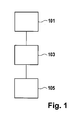
- Fig. 1 shows a multicarrier mobile device comprising a receiver 101, e.g. a wireless receiver according to the WiMAX approach, for receiving signals being associated with e.g. different communication cells.
- the receiver 101 is coupled to an extractor 103 extracting certain signal portions from the different multicarrier signals associated with different communication cells.
- the extractor 103 extracts the different multicarrier sets in order to extract a respective preamble associated with a respective multicarrier signal of a respective communication cell.
- the extractor 103 is coupled to a processor 105 which determines interference powers on the extracted signal portions.
- Fig. 2 shows a block diagram of a base station having a receiver 201 for receiving interference values from the mobile device.
- the interference values are provided to a processor 203 which determines information on a position of the mobile device upon a basis of the received interference values. For example, the processor 203 compares the interference values in order to determine the position information.
- Fig. 4 demonstrates the arrangement of preamble carrier sets associated with the sectors 305, 301 and 303.
- two subsequent sub-carriers associated with a certain sector are separated by two sub-carriers associated with different sector.
- preamble carrier sets associated with different sectors are associated with different frequencies.
- Figs. 5 and 6 schematically depict interference powers on different preamble sets of sectors 305, 301, and 303.
- the interference caused by the sector 301 with respect to e.g. the mobile station MS3 is lower than a wanted signal, wherein the interference from the sector 303 is approximately the same as the preamble in sector 305.
- the corresponding interference situation for the mobile station MS2 is depicted in Fig. 6 .
- the interference caused by the sector 303 is lower than the interference caused by the sector 301.
- the inventive approach further enables a throughput increase with interference coordination based on location information for multicarrier systems upon a basis of orthogonal preambles without the restrictions to beam forming schemes.
- the inventive approach may be applied for multiple input/multiple output and single antenna base stations and can be further employed for improving the known beam forming solutions.
- the inventive concept is associated with an improved throughput due to the improved interference coordination based on the mobile station location which may also be employed in existing WiMAX systems which are not based on beam forming like e.g. multiple input/multiple output systems or two element antenna systems.
- the network's performance may be increased without significantly increasing the system's complexity.
- separate physical layer measurements are to be performed at a corresponding mobile station which transmits the measurement results to the corresponding base station. This approach may further be combined with an updated scheduling algorithm.
Landscapes
- Engineering & Computer Science (AREA)
- Computer Networks & Wireless Communication (AREA)
- Signal Processing (AREA)
- Mobile Radio Communication Systems (AREA)
- Position Fixing By Use Of Radio Waves (AREA)
Abstract
Description
- The present invention relates to multicarrier transmission systems.
- Usually, mobile communication devices communicate via base stations arranged within communication cells of e.g. a multicell communication scenario. Each base station is associated with one or more sectors and serves mobile communication devices arranged within the sectors boundary.
- In order to achieve a maximum throughput in a multicell environment, e.g. in a WiMAX multicell environment (WiMAX: World wide Interoperability for Microwave Access), frequency reuse schemes are employed, which reuse the same carrier frequency in sectors at low distance or even in the neighbour sector of the served mobile communication device. This causes high interference and therefore requires the deployment of interference coordination methods. Usually, known interference coordination methods rely on the knowledge of the positions or locations of the terminals in combination with measurements of an interference level within a sector to enable an interference minimizing assignment of resources e.g. in terms of subchannels, time slots or other orthogonal resource units. However, the position (location) information e.g. in current WiMAX systems can only be derived if beamforming with a perfectly calibrated antenna array is used. If antenna configurations other than beam forming arrays are used, e.g. multiple input/multiple output systems with separated antennas or cross-polarized arrays, then the position (location) information cannot be derived from the antenna signal. Furthermore, the interference measurement methods currently used provide a total interference power with respect to all neighbouring sectors and the signal power associated with the wanted sector. It is not possible to derive any location information from this interference measurement.
- It is the object of the invention to provide an efficient concept enabling determining a position of a mobile station within a sector.
- This object is achieved by the features of the independent claims.
- The invention is based on the finding that a position of a mobile station can efficiently be determined upon a basis of interference measurements when certain sub-carriers of signals used in neighbouring sectors are exploited for separately measuring the interference power. In accordance with the IEEE 802.16 standard for mobile stations, the certain signal portions may correspond to preamble sub-carriers used in neighbouring sectors which may be used for determining the carrier to interference plus noise ratio (CINR) from each preamble.
- Usually, the neighbouring sectors use different, e.g. orthogonal, sets of sub-carriers for transmitting the preamble portions. Thus, for each subset of sub-carriers, e.g. for two or three subsets of sub-carriers associated with different sectors of a multicell scenario, specific interference measurements can be performed. Each interference measurement may then be reported e.g. as an interference value to a base station. Based on the interference measurements per subcarrier subset, a location of the mobile station within the sector can be determined and, furthermore, interference coordination methods exploiting the location information may be applied. Additionally, also a transmit power level (Rx) of the mobile station can be used which may e.g. provide a distance information of the mobile station with respect to the base station.
- The invention exploits the further finding that a measurement of an interference power on each orthogonal preamble carrier set corresponds to the interference experienced at the mobile station which may perform the above outlined measurements of interference from each neighbouring sector associated with the respective base station. Thus, separately reporting the interference measurements results for each neighbouring sector enables the base station to determine which sectors significantly contribute to the interference at the mobile station. Based upon the measurement of the interference power, a closest sector with respect to the position of the mobile terminal can be identified. Thus, information on the position of the mobile terminal can be obtained from the interference power measurements which can also be used to assign the available resources such that the impact of interference on the transmission is minimized.
- According to an aspect, the invention relates to a multicarrier mobile device comprising a receiver for receiving a first multicarrier signal being associated with a first communication cell or sector and a second multicarrier signal being associated with a second communication cell or sector, an extractor for extracting a first signal portion from the first multicarrier signal and for extracting a second signal portion from the second multicarrier signal and a processor for determining a first interference power on the first signal portion and the second interference power on the second signal portion.
- According to an embodiment, the multicarrier mobile device may be located within the first, second or third communication cell or sector.
- According to an embodiment, the receiver is further configured to receive a third multicarrier signal being associated with a third communication cell or sector, wherein the extractor is configured to extract a third signal portion being associated with a third communication cell or sector and wherein the processor is configured to determine a third interference power on the third signal portion.
- According to an embodiment, each signal portion is an orthogonal preamble carrier set associated with a respective communication cell or sector.
- According to an embodiment, the multicarrier mobile device may further comprise a transmitter for transmitting the determined interference powers. The transmitter may be the common transmitter usually used for communications. However, the transmitter may also be a further, separate transmitter.
- According to an embodiment, the multicarrier mobile device further uses its uplink communication channel to transmit the determined interference powers to its base station.
- According to an embodiment, the signal portions are associated with different sub-carriers of a multicarrier transmission scheme.
- According to an aspect, the invention relates to a base station comprising a receiver for receiving, from a mobile device, a first interference value relating to an interference power being associated with a first communication cell and a second interference value relating to an interference power being associated with a second communication cell, and a processor for determining information on a position of the mobile device upon a basis of the first interference value and the second interference value. The receiver may be the common receiver usually used for communications. However, the receiver may also be a further, separate receiver. For example, the base station receives an uplink signal and extracts the interference power values from this signal. The base station e.g. receives an uplink signal and extracts the interference power values from this signal.
- According to an embodiment, the receiver is configured to receive, from the mobile device, a third interference value relating to an interference power being associated with a third communication cell or sector and the processor is configured to determine information on the position of the mobile device upon a basis of the first interference value, the second interference value and the third interference value.
- According to an embodiment, the processor is configured to determine information on the position of the mobile device upon a basis of an evaluation of the interference values.
- According to an aspect, the invention relates to a multicarrier communication method comprising receiving a first multicarrier signal being associated with a first communication cell or sector and a second multicarrier signal being associated with a second communication cell or sector, extracting a first signal portion from the first multicarrier signal, extracting a second signal portion from the second multicarrier signal and determining a first interference power on the first signal portion and the second interference power on the second signal portion.
- According to an aspect, the invention relates to a method for determining information on a position or location of a mobile device, the method comprising receiving, from the mobile device, a first interference value relating to an interference power being associated with a first communication cell or sector and a second interference value relating to an interference power being associated with a second communication cell or sector, and determining information on a position of the mobile device upon a basis of the first interference value and the second interference value.
- According to an aspect, the invention relates to a method for determining information related to a location of a mobile terminal in a multicarrier system being configured to reuse all available frequency, wherein a plurality of sectors is defined around each base station and wherein a predefined preamble carrier set is associated to each sector. The method comprises determining the interference power experience on each preamble carrier set at a mobile terminal, transmitting separately the interference power for each of the preamble carrier sets to the base station and, depending on a level of the interference power measured for said different preamble carrier sets, determining information related to the location of the mobile terminal.
- Further embodiments of the invention will be described with respect to the following figures in which:
- Fig. 1
- shows a block diagram of a mobile device;
- Fig. 2
- shows a block diagram of a base station;
- Fig. 3
- shows a multicell communication scenario;
- Fig. 4
- shows preamble carrier sets;
- Fig. 5
- demonstrates intersector interference; and
- Fig. 6
- demonstrates intersector interference.
-
Fig. 1 shows a multicarrier mobile device comprising areceiver 101, e.g. a wireless receiver according to the WiMAX approach, for receiving signals being associated with e.g. different communication cells. Thereceiver 101 is coupled to anextractor 103 extracting certain signal portions from the different multicarrier signals associated with different communication cells. For example, theextractor 103 extracts the different multicarrier sets in order to extract a respective preamble associated with a respective multicarrier signal of a respective communication cell. Theextractor 103 is coupled to aprocessor 105 which determines interference powers on the extracted signal portions. - The mobile device of
Fig. 1 may further comprise a transmitter which transmits the determined interference powered or interference values to a base station which is currently employed for communication. Preferably, no separate transmitter is used as the signals may be transmitted within the normal communication channel as a specific message. -
Fig. 2 shows a block diagram of a base station having areceiver 201 for receiving interference values from the mobile device. The interference values are provided to aprocessor 203 which determines information on a position of the mobile device upon a basis of the received interference values. For example, theprocessor 203 compares the interference values in order to determine the position information. -
Fig. 3 shows a part of a cellular network by way of example. The cellular network comprises a plurality of sectors, a plurality of base stations and a plurality of mobile stations, by way of example. In particular, a first base station BS1 is arranged between asector sectors sector 311. A fourth base station BS4 is associated with asector 313. - By way of example, four mobile stations MS1, MS2, MS3, and MS4 are arranged within the
sector 305. For example, if a frequency reuse factor FR = 1 is chosen, then all base stations will use the same radio frequency band or channel so that a particular mobile station in such a network will receive multiple base station signals according to the downlink path loss. According to the WiMAX specification, each base station uses specified preamble carrier set (PC-S) in each downlink signal as depicted inFig.4 . Furthermore, the preamble carrier sets 401, 403 and 405 associated with thesectors -
Fig. 4 demonstrates the arrangement of preamble carrier sets associated with thesectors -
Figs. 5 and6 schematically depict interference powers on different preamble sets ofsectors Fig. 5 , the interference caused by thesector 301 with respect to e.g. the mobile station MS3 is lower than a wanted signal, wherein the interference from thesector 303 is approximately the same as the preamble insector 305. The corresponding interference situation for the mobile station MS2 is depicted inFig. 6 . For example, the interference caused by thesector 303 is lower than the interference caused by thesector 301. - Thus, those mobile stations which are arranged e.g. within the
sector 305 and which measure a high interference value resulting from thesector 301 and a low or lower interference value from thesector 303 are located at a sector boarder between thesectors - The inventive approach further enables a throughput increase with interference coordination based on location information for multicarrier systems upon a basis of orthogonal preambles without the restrictions to beam forming schemes. The inventive approach may be applied for multiple input/multiple output and single antenna base stations and can be further employed for improving the known beam forming solutions. Furthermore, the inventive concept is associated with an improved throughput due to the improved interference coordination based on the mobile station location which may also be employed in existing WiMAX systems which are not based on beam forming like e.g. multiple input/multiple output systems or two element antenna systems. Furthermore, the network's performance may be increased without significantly increasing the system's complexity. In particular, separate physical layer measurements are to be performed at a corresponding mobile station which transmits the measurement results to the corresponding base station. This approach may further be combined with an updated scheduling algorithm.
Claims (10)
- A multicarrier mobile device, comprising:- a receiver (101) for receiving a first multicarrier signal being associated with a first communication cell and a second multicarrier signal being associated with a second communication cell;- an extractor (103) for extracting a first signal portion from the first multicarrier signal and for extracting a second signal portion from the second multicarrier signal; and- a processor (105) for determining a first interference power on the first signal portion and the second interference power on the second signal portion.
- The multicarrier mobile device according to claim 1, the receiver (101) being further configured to receive a third multicarrier signal being associated with a third communication cell, the extractor (103) being configured to extract a third signal portion being associated with a third communication cell, the processor (105) being configured to determine a third interference power on the third signal portion.
- The multicarrier mobile device according to claim 1 or 2, each signal portion being an orthogonal preamble carrier set associated with a respective communication cell.
- The multicarrier mobile device according to one of the claims 1 to 3, further comprising a transmitter for transmitting the determined interference powers.
- The multicarrier mobile device according to one of the claims 1 to 4, the signal portions being associated with different subcarriers of a multicarrier transmission scheme.
- A base station, comprising- a receiver (201) for receiving, from a mobile device, a first interference value relating to an interference power being associated with a first communication cell and a second interference value relating to an interference power being associated with a second communication cell; and- a processor (203) for determining information on a position of the mobile device upon a basis of the first interference value and the second interference value.
- The base station according to claim 6, the receiver (201) being configured to receive, from the mobile device, a third interference value relating to an interference power being associated with a third communication cell, the processor (203) being configured to determine information on the position of the mobile device upon a basis of the first interference value, the second interference value and the third interference value.
- The base station according to claim 6 or 7, the processor (203) being configured to determine information on the position of the mobile device upon a basis of a comparison of the interference values.
- A multicarrier communication method, comprising:- receiving a first multicarrier signal being associated with a first communication cell and a second multicarrier signal being associated with a second communication cell;- extracting a first signal portion from the first multicarrier signal;- extracting a second signal portion from the second multicarrier signal; and- determining a first interference power on the first signal portion and a second interference power on the second signal portion.
- A method for determining information on a position of a mobile device, the method comprising:- receiving, from the mobile device, a first interference value relating to an interference power being associated with a first communication cell and a second interference value relating to an interference power being associated with a second communication cell; and- determining information on a position of the mobile device upon a basis of the first interference value and the second interference value.
Priority Applications (6)
| Application Number | Priority Date | Filing Date | Title |
|---|---|---|---|
| EP08290170.3A EP2093958B1 (en) | 2008-02-19 | 2008-02-19 | Multicarrier mobile measuring signals from neighbouring base stations to calculate its position for interference coordination |
| JP2010547065A JP2011521487A (en) | 2008-02-19 | 2008-12-15 | Multi-carrier mobile that measures signals from neighboring base stations and calculates its position for interference coordination |
| KR1020107020703A KR101226044B1 (en) | 2008-02-19 | 2008-12-15 | Multicarrier mobile device |
| PCT/EP2008/067487 WO2009103376A1 (en) | 2008-02-19 | 2008-12-15 | Multicarrier mobile measuring signals from neighbouring base stations to calculate its position for interference coordination |
| CN200910007143.4A CN101516094B (en) | 2008-02-19 | 2009-02-09 | Multicarrier mobile device |
| US12/372,790 US8396426B2 (en) | 2008-02-19 | 2009-02-18 | Multicarrier mobile device |
Applications Claiming Priority (1)
| Application Number | Priority Date | Filing Date | Title |
|---|---|---|---|
| EP08290170.3A EP2093958B1 (en) | 2008-02-19 | 2008-02-19 | Multicarrier mobile measuring signals from neighbouring base stations to calculate its position for interference coordination |
Publications (2)
| Publication Number | Publication Date |
|---|---|
| EP2093958A1 true EP2093958A1 (en) | 2009-08-26 |
| EP2093958B1 EP2093958B1 (en) | 2013-10-16 |
Family
ID=39627637
Family Applications (1)
| Application Number | Title | Priority Date | Filing Date |
|---|---|---|---|
| EP08290170.3A Active EP2093958B1 (en) | 2008-02-19 | 2008-02-19 | Multicarrier mobile measuring signals from neighbouring base stations to calculate its position for interference coordination |
Country Status (6)
| Country | Link |
|---|---|
| US (1) | US8396426B2 (en) |
| EP (1) | EP2093958B1 (en) |
| JP (1) | JP2011521487A (en) |
| KR (1) | KR101226044B1 (en) |
| CN (1) | CN101516094B (en) |
| WO (1) | WO2009103376A1 (en) |
Families Citing this family (3)
| Publication number | Priority date | Publication date | Assignee | Title |
|---|---|---|---|---|
| CN102026275A (en) * | 2010-12-20 | 2011-04-20 | 中兴通讯股份有限公司 | Anchor carrier coordination method and device in heterogeneous network |
| KR20150023109A (en) | 2013-08-22 | 2015-03-05 | 한국전자통신연구원 | Method and apparatus for controlling interference based on carrier aggregation for small base station |
| US10206215B2 (en) * | 2014-03-11 | 2019-02-12 | Lg Electronics Inc. | Method for assigning resources in wireless communication system supporting device-to-device direct communication, and apparatus therefor |
Family Cites Families (6)
| Publication number | Priority date | Publication date | Assignee | Title |
|---|---|---|---|---|
| JP4380015B2 (en) * | 2000-04-11 | 2009-12-09 | ソニー株式会社 | Wireless communication system, wireless base station device, wireless mobile station device, and wireless communication method |
| JP3543959B2 (en) * | 2001-02-16 | 2004-07-21 | 日本電気株式会社 | base station |
| KR100974326B1 (en) * | 2004-10-28 | 2010-08-05 | 삼성전자주식회사 | Dynamic resource allocation device and method in communication system using orthogonal frequency division multiple access |
| KR20060097450A (en) * | 2005-03-09 | 2006-09-14 | 삼성전자주식회사 | System and method for resource allocation control in multi-cell communication system |
| CN100586214C (en) | 2006-04-04 | 2010-01-27 | 大唐移动通信设备有限公司 | Scheduling Method of Base Station and Cell Carrier Resources of Orthogonal Frequency Division Multiplexing System |
| US8036669B2 (en) * | 2006-04-20 | 2011-10-11 | Qualcomm Incorporated | Orthogonal resource reuse with SDMA beams |
-
2008
- 2008-02-19 EP EP08290170.3A patent/EP2093958B1/en active Active
- 2008-12-15 JP JP2010547065A patent/JP2011521487A/en active Pending
- 2008-12-15 WO PCT/EP2008/067487 patent/WO2009103376A1/en not_active Ceased
- 2008-12-15 KR KR1020107020703A patent/KR101226044B1/en active Active
-
2009
- 2009-02-09 CN CN200910007143.4A patent/CN101516094B/en active Active
- 2009-02-18 US US12/372,790 patent/US8396426B2/en active Active
Non-Patent Citations (2)
| Title |
|---|
| CAFFERY, JAMES: "Wireless Location in CDMA Cellular Radio Systems", 1 January 2000, KLUWER, USA, XP002493184 * |
| NORTEL: "Discussion on the DL Interference Coordination", 3GPP TSG-RAN WG1#50, 24 August 2007 (2007-08-24), Greece, pages 1 - 10, XP002493183 * |
Also Published As
| Publication number | Publication date |
|---|---|
| US8396426B2 (en) | 2013-03-12 |
| CN101516094A (en) | 2009-08-26 |
| KR101226044B1 (en) | 2013-01-24 |
| CN101516094B (en) | 2014-09-17 |
| US20090209207A1 (en) | 2009-08-20 |
| EP2093958B1 (en) | 2013-10-16 |
| WO2009103376A1 (en) | 2009-08-27 |
| KR20100123871A (en) | 2010-11-25 |
| JP2011521487A (en) | 2011-07-21 |
Similar Documents
| Publication | Publication Date | Title |
|---|---|---|
| US11265071B2 (en) | Electronic device, method and apparatus for wireless communication system, and storage medium | |
| CN109891819B (en) | Method and apparatus for transmitting or receiving reference signal in wireless communication system | |
| US10348431B2 (en) | Methods of discovery and measurements for small cells in OFDM/OFDMA systems | |
| US9948439B2 (en) | Method and apparatus for transmitting and receiving common channel information in wireless communication system | |
| US20220182200A1 (en) | Methods and apparatus for configuring 5g new radio uplink positioning reference signals | |
| US20190182007A1 (en) | Method of wireless communication and user equipment | |
| US20160242147A1 (en) | Distributed processing in a centralized radio access network | |
| CN101494484B (en) | Downlink beam forming method | |
| EP3518452B1 (en) | Uplink reference signal sending method and apparatus, base station, and user equipment | |
| KR20190059956A (en) | Antenna beam management method and related apparatus | |
| EP3286847B1 (en) | Adaptive beamforming | |
| KR102146177B1 (en) | Wireless-network nodes, wireless devices and methods performed thereon | |
| EP2093958B1 (en) | Multicarrier mobile measuring signals from neighbouring base stations to calculate its position for interference coordination | |
| EP3069563B1 (en) | Port selection in combined cell of radio access network | |
| EP3373617A1 (en) | Out-of-band radio | |
| US11902952B2 (en) | Carrier aggregation grouping based on user location in 5G NR massive MIMO beamforming network | |
| WO2022265547A1 (en) | Network node and method for restraining false preambles | |
| HK1262130A1 (en) | Radio-network node, wireless device and methods performed therein | |
| KR20170073521A (en) | Method for beam searching and signals combining |
Legal Events
| Date | Code | Title | Description |
|---|---|---|---|
| PUAI | Public reference made under article 153(3) epc to a published international application that has entered the european phase |
Free format text: ORIGINAL CODE: 0009012 |
|
| 17P | Request for examination filed |
Effective date: 20081209 |
|
| AK | Designated contracting states |
Kind code of ref document: A1 Designated state(s): AT BE BG CH CY CZ DE DK EE ES FI FR GB GR HR HU IE IS IT LI LT LU LV MC MT NL NO PL PT RO SE SI SK TR |
|
| AX | Request for extension of the european patent |
Extension state: AL BA MK RS |
|
| 17Q | First examination report despatched |
Effective date: 20100312 |
|
| AKX | Designation fees paid |
Designated state(s): AT BE BG CH CY CZ DE DK EE ES FI FR GB GR HR HU IE IS IT LI LT LU LV MC MT NL NO PL PT RO SE SI SK TR |
|
| RAP1 | Party data changed (applicant data changed or rights of an application transferred) |
Owner name: ALCATEL LUCENT |
|
| GRAP | Despatch of communication of intention to grant a patent |
Free format text: ORIGINAL CODE: EPIDOSNIGR1 |
|
| INTG | Intention to grant announced |
Effective date: 20130607 |
|
| GRAS | Grant fee paid |
Free format text: ORIGINAL CODE: EPIDOSNIGR3 |
|
| GRAA | (expected) grant |
Free format text: ORIGINAL CODE: 0009210 |
|
| 111Z | Information provided on other rights and legal means of execution |
Free format text: AT BE BG CH CY CZ DE DK EE ES FI FR GB GR HR HU IE IS IT LI LT LU LV MC MT NL NO PL PT RO SE SI SK TR Effective date: 20130410 |
|
| AK | Designated contracting states |
Kind code of ref document: B1 Designated state(s): AT BE BG CH CY CZ DE DK EE ES FI FR GB GR HR HU IE IS IT LI LT LU LV MC MT NL NO PL PT RO SE SI SK TR |
|
| REG | Reference to a national code |
Ref country code: GB Ref legal event code: FG4D |
|
| REG | Reference to a national code |
Ref country code: CH Ref legal event code: EP |
|
| REG | Reference to a national code |
Ref country code: IE Ref legal event code: FG4D |
|
| REG | Reference to a national code |
Ref country code: AT Ref legal event code: REF Ref document number: 636951 Country of ref document: AT Kind code of ref document: T Effective date: 20131115 |
|
| REG | Reference to a national code |
Ref country code: DE Ref legal event code: R096 Ref document number: 602008028107 Country of ref document: DE Effective date: 20131212 |
|
| REG | Reference to a national code |
Ref country code: NL Ref legal event code: VDEP Effective date: 20131016 |
|
| REG | Reference to a national code |
Ref country code: AT Ref legal event code: MK05 Ref document number: 636951 Country of ref document: AT Kind code of ref document: T Effective date: 20131016 |
|
| REG | Reference to a national code |
Ref country code: LT Ref legal event code: MG4D |
|
| REG | Reference to a national code |
Ref country code: FR Ref legal event code: GC Effective date: 20140306 |
|
| PG25 | Lapsed in a contracting state [announced via postgrant information from national office to epo] |
Ref country code: IS Free format text: LAPSE BECAUSE OF FAILURE TO SUBMIT A TRANSLATION OF THE DESCRIPTION OR TO PAY THE FEE WITHIN THE PRESCRIBED TIME-LIMIT Effective date: 20140216 Ref country code: FI Free format text: LAPSE BECAUSE OF FAILURE TO SUBMIT A TRANSLATION OF THE DESCRIPTION OR TO PAY THE FEE WITHIN THE PRESCRIBED TIME-LIMIT Effective date: 20131016 Ref country code: BE Free format text: LAPSE BECAUSE OF FAILURE TO SUBMIT A TRANSLATION OF THE DESCRIPTION OR TO PAY THE FEE WITHIN THE PRESCRIBED TIME-LIMIT Effective date: 20131016 Ref country code: NL Free format text: LAPSE BECAUSE OF FAILURE TO SUBMIT A TRANSLATION OF THE DESCRIPTION OR TO PAY THE FEE WITHIN THE PRESCRIBED TIME-LIMIT Effective date: 20131016 Ref country code: HR Free format text: LAPSE BECAUSE OF FAILURE TO SUBMIT A TRANSLATION OF THE DESCRIPTION OR TO PAY THE FEE WITHIN THE PRESCRIBED TIME-LIMIT Effective date: 20131016 Ref country code: NO Free format text: LAPSE BECAUSE OF FAILURE TO SUBMIT A TRANSLATION OF THE DESCRIPTION OR TO PAY THE FEE WITHIN THE PRESCRIBED TIME-LIMIT Effective date: 20140116 Ref country code: SE Free format text: LAPSE BECAUSE OF FAILURE TO SUBMIT A TRANSLATION OF THE DESCRIPTION OR TO PAY THE FEE WITHIN THE PRESCRIBED TIME-LIMIT Effective date: 20131016 Ref country code: LT Free format text: LAPSE BECAUSE OF FAILURE TO SUBMIT A TRANSLATION OF THE DESCRIPTION OR TO PAY THE FEE WITHIN THE PRESCRIBED TIME-LIMIT Effective date: 20131016 |
|
| PG25 | Lapsed in a contracting state [announced via postgrant information from national office to epo] |
Ref country code: CY Free format text: LAPSE BECAUSE OF FAILURE TO SUBMIT A TRANSLATION OF THE DESCRIPTION OR TO PAY THE FEE WITHIN THE PRESCRIBED TIME-LIMIT Effective date: 20131016 Ref country code: ES Free format text: LAPSE BECAUSE OF FAILURE TO SUBMIT A TRANSLATION OF THE DESCRIPTION OR TO PAY THE FEE WITHIN THE PRESCRIBED TIME-LIMIT Effective date: 20131016 Ref country code: LV Free format text: LAPSE BECAUSE OF FAILURE TO SUBMIT A TRANSLATION OF THE DESCRIPTION OR TO PAY THE FEE WITHIN THE PRESCRIBED TIME-LIMIT Effective date: 20131016 Ref country code: AT Free format text: LAPSE BECAUSE OF FAILURE TO SUBMIT A TRANSLATION OF THE DESCRIPTION OR TO PAY THE FEE WITHIN THE PRESCRIBED TIME-LIMIT Effective date: 20131016 |
|
| PG25 | Lapsed in a contracting state [announced via postgrant information from national office to epo] |
Ref country code: PT Free format text: LAPSE BECAUSE OF FAILURE TO SUBMIT A TRANSLATION OF THE DESCRIPTION OR TO PAY THE FEE WITHIN THE PRESCRIBED TIME-LIMIT Effective date: 20140217 |
|
| REG | Reference to a national code |
Ref country code: DE Ref legal event code: R097 Ref document number: 602008028107 Country of ref document: DE |
|
| PG25 | Lapsed in a contracting state [announced via postgrant information from national office to epo] |
Ref country code: EE Free format text: LAPSE BECAUSE OF FAILURE TO SUBMIT A TRANSLATION OF THE DESCRIPTION OR TO PAY THE FEE WITHIN THE PRESCRIBED TIME-LIMIT Effective date: 20131016 |
|
| REG | Reference to a national code |
Ref country code: CH Ref legal event code: PCOW Free format text: NEW ADDRESS: 148/152 ROUTE DE LA REINE, 92100 BOULOGNE-BILLANCOURT (FR) |
|
| RAP2 | Party data changed (patent owner data changed or rights of a patent transferred) |
Owner name: ALCATEL LUCENT |
|
| PLBE | No opposition filed within time limit |
Free format text: ORIGINAL CODE: 0009261 |
|
| STAA | Information on the status of an ep patent application or granted ep patent |
Free format text: STATUS: NO OPPOSITION FILED WITHIN TIME LIMIT |
|
| PG25 | Lapsed in a contracting state [announced via postgrant information from national office to epo] |
Ref country code: PL Free format text: LAPSE BECAUSE OF FAILURE TO SUBMIT A TRANSLATION OF THE DESCRIPTION OR TO PAY THE FEE WITHIN THE PRESCRIBED TIME-LIMIT Effective date: 20131016 Ref country code: CZ Free format text: LAPSE BECAUSE OF FAILURE TO SUBMIT A TRANSLATION OF THE DESCRIPTION OR TO PAY THE FEE WITHIN THE PRESCRIBED TIME-LIMIT Effective date: 20131016 Ref country code: IT Free format text: LAPSE BECAUSE OF FAILURE TO SUBMIT A TRANSLATION OF THE DESCRIPTION OR TO PAY THE FEE WITHIN THE PRESCRIBED TIME-LIMIT Effective date: 20131016 Ref country code: RO Free format text: LAPSE BECAUSE OF FAILURE TO SUBMIT A TRANSLATION OF THE DESCRIPTION OR TO PAY THE FEE WITHIN THE PRESCRIBED TIME-LIMIT Effective date: 20131016 Ref country code: SK Free format text: LAPSE BECAUSE OF FAILURE TO SUBMIT A TRANSLATION OF THE DESCRIPTION OR TO PAY THE FEE WITHIN THE PRESCRIBED TIME-LIMIT Effective date: 20131016 |
|
| 26N | No opposition filed |
Effective date: 20140717 |
|
| PG25 | Lapsed in a contracting state [announced via postgrant information from national office to epo] |
Ref country code: DK Free format text: LAPSE BECAUSE OF FAILURE TO SUBMIT A TRANSLATION OF THE DESCRIPTION OR TO PAY THE FEE WITHIN THE PRESCRIBED TIME-LIMIT Effective date: 20131016 Ref country code: MC Free format text: LAPSE BECAUSE OF FAILURE TO SUBMIT A TRANSLATION OF THE DESCRIPTION OR TO PAY THE FEE WITHIN THE PRESCRIBED TIME-LIMIT Effective date: 20131016 Ref country code: LU Free format text: LAPSE BECAUSE OF FAILURE TO SUBMIT A TRANSLATION OF THE DESCRIPTION OR TO PAY THE FEE WITHIN THE PRESCRIBED TIME-LIMIT Effective date: 20140219 |
|
| REG | Reference to a national code |
Ref country code: CH Ref legal event code: PL |
|
| REG | Reference to a national code |
Ref country code: DE Ref legal event code: R097 Ref document number: 602008028107 Country of ref document: DE Effective date: 20140717 |
|
| PG25 | Lapsed in a contracting state [announced via postgrant information from national office to epo] |
Ref country code: CH Free format text: LAPSE BECAUSE OF NON-PAYMENT OF DUE FEES Effective date: 20140228 Ref country code: LI Free format text: LAPSE BECAUSE OF NON-PAYMENT OF DUE FEES Effective date: 20140228 |
|
| REG | Reference to a national code |
Ref country code: FR Ref legal event code: RG Effective date: 20141016 |
|
| REG | Reference to a national code |
Ref country code: IE Ref legal event code: MM4A |
|
| PG25 | Lapsed in a contracting state [announced via postgrant information from national office to epo] |
Ref country code: IE Free format text: LAPSE BECAUSE OF NON-PAYMENT OF DUE FEES Effective date: 20140219 |
|
| REG | Reference to a national code |
Ref country code: FR Ref legal event code: PLFP Year of fee payment: 8 |
|
| PG25 | Lapsed in a contracting state [announced via postgrant information from national office to epo] |
Ref country code: SI Free format text: LAPSE BECAUSE OF FAILURE TO SUBMIT A TRANSLATION OF THE DESCRIPTION OR TO PAY THE FEE WITHIN THE PRESCRIBED TIME-LIMIT Effective date: 20131016 |
|
| REG | Reference to a national code |
Ref country code: FR Ref legal event code: PLFP Year of fee payment: 9 |
|
| PG25 | Lapsed in a contracting state [announced via postgrant information from national office to epo] |
Ref country code: MT Free format text: LAPSE BECAUSE OF FAILURE TO SUBMIT A TRANSLATION OF THE DESCRIPTION OR TO PAY THE FEE WITHIN THE PRESCRIBED TIME-LIMIT Effective date: 20131016 |
|
| PG25 | Lapsed in a contracting state [announced via postgrant information from national office to epo] |
Ref country code: BG Free format text: LAPSE BECAUSE OF FAILURE TO SUBMIT A TRANSLATION OF THE DESCRIPTION OR TO PAY THE FEE WITHIN THE PRESCRIBED TIME-LIMIT Effective date: 20131016 |
|
| PG25 | Lapsed in a contracting state [announced via postgrant information from national office to epo] |
Ref country code: GR Free format text: LAPSE BECAUSE OF FAILURE TO SUBMIT A TRANSLATION OF THE DESCRIPTION OR TO PAY THE FEE WITHIN THE PRESCRIBED TIME-LIMIT Effective date: 20140117 |
|
| PG25 | Lapsed in a contracting state [announced via postgrant information from national office to epo] |
Ref country code: TR Free format text: LAPSE BECAUSE OF FAILURE TO SUBMIT A TRANSLATION OF THE DESCRIPTION OR TO PAY THE FEE WITHIN THE PRESCRIBED TIME-LIMIT Effective date: 20131016 Ref country code: HU Free format text: LAPSE BECAUSE OF FAILURE TO SUBMIT A TRANSLATION OF THE DESCRIPTION OR TO PAY THE FEE WITHIN THE PRESCRIBED TIME-LIMIT; INVALID AB INITIO Effective date: 20080219 |
|
| REG | Reference to a national code |
Ref country code: FR Ref legal event code: PLFP Year of fee payment: 10 |
|
| REG | Reference to a national code |
Ref country code: FR Ref legal event code: PLFP Year of fee payment: 11 |
|
| PGFP | Annual fee paid to national office [announced via postgrant information from national office to epo] |
Ref country code: FR Payment date: 20251231 Year of fee payment: 19 |
|
| PGFP | Annual fee paid to national office [announced via postgrant information from national office to epo] |
Ref country code: GB Payment date: 20260106 Year of fee payment: 19 |
|
| PGFP | Annual fee paid to national office [announced via postgrant information from national office to epo] |
Ref country code: DE Payment date: 20251230 Year of fee payment: 19 |