EP2093678A1 - Data network - Google Patents
Data network Download PDFInfo
- Publication number
- EP2093678A1 EP2093678A1 EP08250616A EP08250616A EP2093678A1 EP 2093678 A1 EP2093678 A1 EP 2093678A1 EP 08250616 A EP08250616 A EP 08250616A EP 08250616 A EP08250616 A EP 08250616A EP 2093678 A1 EP2093678 A1 EP 2093678A1
- Authority
- EP
- European Patent Office
- Prior art keywords
- data
- server
- domains
- opc
- servers
- Prior art date
- Legal status (The legal status is an assumption and is not a legal conclusion. Google has not performed a legal analysis and makes no representation as to the accuracy of the status listed.)
- Withdrawn
Links
Images



Classifications
-
- H—ELECTRICITY
- H04—ELECTRIC COMMUNICATION TECHNIQUE
- H04L—TRANSMISSION OF DIGITAL INFORMATION, e.g. TELEGRAPHIC COMMUNICATION
- H04L67/00—Network arrangements or protocols for supporting network services or applications
- H04L67/01—Protocols
- H04L67/12—Protocols specially adapted for proprietary or special-purpose networking environments, e.g. medical networks, sensor networks, networks in vehicles or remote metering networks
-
- H—ELECTRICITY
- H04—ELECTRIC COMMUNICATION TECHNIQUE
- H04L—TRANSMISSION OF DIGITAL INFORMATION, e.g. TELEGRAPHIC COMMUNICATION
- H04L63/00—Network architectures or network communication protocols for network security
- H04L63/10—Network architectures or network communication protocols for network security for controlling access to devices or network resources
- H04L63/104—Grouping of entities
Definitions
- the present invention relates to data network and in particular to a network for transmitting data generated by monitoring sensors.
- OPC OPC
- OPC servers are able to access data from OPC compliant devices; they also provide a common interface such that applications may access the data held on the servers for the purposes of process management and monitoring. Examples of OPC related technology are to be found in EP1121626 and US 2005/0038885 .
- a data network comprising one or more data producing domains, one or more data consuming domains and a core platform; the or each data producing domains comprising one or more data servers and the or each data server being in communication with one or more data sources; the or each data consuming domains comprising one or more data clients: the core platform comprising a global data server and one or more virtual data servers wherein; i) the global data server and the or each virtual data servers being in communication with the or each data producing domains and the or each data consuming domains; and ii): the or each virtual data server is associated with one of the or each data consuming domains; wherein, in use, a) data from the one or more data servers are transmitted to the global data server; b) selected data subsets from the global data server are written to the or each virtual data server; and c) each data client can access the data held in the virtual data server associated with the respective data consuming domain.
- the one or more servers comprise OPC servers
- the one or more data sources comprise OPC compliant data sources
- the one or more data clients comprise OPC clients and each of the global data server and the or each virtual data servers comprise an OPC server.
- the present invention enables multiple, diverse organisations to share a common infrastructure over which process control data can be collected and delivered. Collection and delivery of data is optimised such that data collection frequency and data values (tags) collected can be dynamically tuned to meet aggregate demand for specific units of data. Furthermore, the present invention allows real time operational data to be securely shared with remote operations centres, partners, 3 rd parties, etc..
- All of the registered data sources are held within the global server, which can not be viewed by any user. Each user may only see a subset of the global server, which is defined by the data held within one of the virtual servers.
- a virtual server represents all of the data tags that a user has been granted the rights to read. These data tags may be subscribed to and data values can be delivered to a user on demand.
- the present invention provides the ability to request authorised data from multiple organisations and multiple data sources and to have that data delivered, on demand, without having to understand where the data sources are or having to configure access to those data sources.
- the invention also enables a consumer user role (referred to as an ad hoc consumer) to be defined, create a Virtual OPC server for that user and define subscriptions for that user for which data is then streamed and stored awaiting later collection. The actual user who will assume the role may be appointed after that data collection has begun. An ad hoc consumer may then securely connect to the service from anywhere and access the data that belongs to their role.
- the present invention is believed to be of use in the gas and oil industries. All oil platforms and operational facilities monitor and control key assets through the use of specialist Process Information sensors. These sensors send real time data (typically in the form of OPC data tags) to a local data store (referred to as a data historian) and enable the safe and efficient operation of each facility. There are currently no suitable methods for sharing "tag" data beyond the local Data Historian environment. Oil Companies are struggling to address the issues of complexity, lead times, security and the high costs associated with sharing live oil field data. The lack of integration and data sharing has a significant negative impact on asset performance and operational efficiency.
- the present invention provides a common industry wide platform which enables organisations to share real time monitoring data.
- the complexity of the current mesh of connections with associated management and security issues is replaced by a simple logical hub that provides connectivity, management and security as a network service.
- the invention relates generally to the self managed distribution of data over a common infrastructure.
- the specific example used to describe the invention relates to the distribution of process control data as derived from OPC servers (where OPC stands for Object Linking and Embedding for Process Control) using one of the standard communication protocols as defined by the OPC Foundation.
- a method of operating a data network comprising one or more data producing domains, one or more data consuming domains and a core platform, wherein the or each data producing domains comprise one or more data servers and the or each data server are in communication with one or more data sources; the or each data consuming domains comprise one or more data clients and the core platform comprising a global data server and one or more virtual data servers i) the global data server and the or each virtual data servers are in communication with the or each data producing domains and the or each data consuming domains; and ii) the or each virtual data server is associated with one of the or each data consuming domains; the method comprising the steps of: a) transmitting data from one or more of the data servers to the global data server; b) writing selected data subsets from the global data server to the or each virtual data server; and c) enabling each data client to access the data held in the virtual data server associated with the respective data consuming domain.
- a computer program product comprising computer executable code for performing a method as described above.
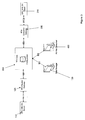
- FIG 1a is a schematic depiction of a conventional arrangement in which a plurality of sensor domains 10 are connected to a respective OPC server 20.
- Each of the OPC servers is connected to in turn to a mesh network which comprises production and management systems from a number of different organisations 30, 40 & 50.
- Figure 1b shows a schematic depiction of an arrangement in accordance with the present invention in which the OPC servers 20 are connected to a central data platform 60.
- the production and management systems from a number of different organisations 30, 40 & 50 are also connected to the central data platform 60 in order to receive the appropriate data collected from the sensor domains 10.
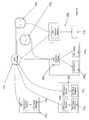
- FIG. 2 shows a schematic depiction of the operation of the arrangement described above with reference to Figure 1b .
- Each of a number of source domains 100a, 100b comprises one or more OPC servers 110 and one or more source gateways 120.
- Each of the OPC servers is in turn connected to one or more sensors (not shown) which transmit OPC conformant data to the OPC servers.
- Each of the OPC servers are also connected to a source gateway within it's respective source domains.
- Each of the source domains further comprise a source data manager 130 which is in communication with a core platform 200.
- the source gateways 120 are also in communication with the core platform 200.
- the core platform comprises a global core OPC server 210 and a plurality of virtual core OPC servers 220. Data received from the sensors via the source domains 100 is received by the global core OPC server. Each of the virtual core OPC servers has access to partitions of the data held on the global core OPC server, such that OPC clients in a plurality of consumer domains may access only the data to which they are entitled to have access.
- the core platform 200 is also in communication with one or more consumer domains 300a, 300b.
- Each of the consumer domains comprise a consumer data manager 330, one or more consumer gateways 320 and one or more OPC clients 310.
- Each of the OPC clients is connected to a consumer gateway 320.
- Figure 2 also shows an ad hoc data consumer 400 which is in communication with the core platform 200.
- each of the source and consumer domains comprise a respective data manager. It should be understood that each domain may comprise more than one data manager. In an alternative, a domain may not comprise a data manager but in such a case a data manager from a further domain must be appointed to manage that domain. It should be noted that the data managers for both the source and the consumer domains merely represent different instances of the role of data manager, with each data manager managing their own virtual core OPC server and is responsible for granting rights on this to other customers/users. It should be understood that Figure 2 illustrates only the logical deployment of such a system and does not imply any structural limitation.
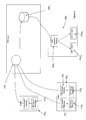
- FIG 3 represents a schematic depiction of the connectivity provided between an OPC server 110 and an OPC client 310.
- the OPC server is connected to the source gateway 120, preferably using the OPC XML (extensible mark-up language) DA (data access) protocol, and the connection between the source gateway 130 and the core platform 200 is preferably made using an ESB (enterprise service bus).
- the connection between the core platform 200 and the consumer gateway 320 is preferably made using an ESB and the connection between the consumer gateway and the OPC client is preferably made using OPC XML DA.
- OPC XML DA may be replaced using DCOM.
- Data managers either source or consumer data managers 130, 330
- ad hoc consumers may make connections to the core platform 200 using HTML over HTTP (or HTTPS) or other suitable protocols.
- Figure 4 shows a schematic depiction of the processes by which data is transmitted from OPC servers to a global core OPC server.
- Figure 4 shows an arrangement in which a first source domain 100, (which is operated by a first customer) comprises first and second OPC servers 110 1 & 110 2 , named Platform 1 & Platform2 respectively.
- the first source domain 110 1 comprises first and second respective source gateways 120 1 120 2 . Both of the first and second source gateways are in communication with the global core server 200.
- a second source domain 100 2 (which is operated by a second customer) comprises a third OPC server 110 3 , named NorthSea, and a third source gateway 120 3 : the NorthSea OPC server 110 3 is in communication with the third source gateway 120 3 which, in turn, is in communication with the global core server 200.
- Each of the sensors associated with the OPC servers has a identifier so that the OPC tags associated with each OPC server can be uniquely identified. By combining these tags with an identifier for the OPC server and customer it is possible to generate a unique tag identifier across the entire network.
- Table 1 below summarises the different tag IDs that are associated with each of the OPC servers shown in Figure 4 and Table 2 shows the unique identifiers that are used within the global core OPC server to identify each of the tags.
- Table 1 List of Tag IDs for each OPC server OPC Server ID Tag ID Platform1 Plant.item.01 Plant.item.02 Plant.item.03 Pump.alpha Pump.beta Platform2 Riser.A Riser.
- Each of these virtual core OPC servers contain a subset of the data held by the global core OPC server. In this way, it is possible for the data held by the global core OPC server to be partitioned such that users can only access the data that they have permission to and are not able to view or access other data held on the global core OPC server.
- Each virtual core OPC server allows OPC clients from the respective consumer domain to access and view all of the OPC data referenced in that virtual core OPC server.
- each of the consumer gateways will see and may subscribe to any tags that are in their Virtual core OPC server.
- 'rights' are defined for each of the data items that a user may access via a virtual core OPC server. In the present example the rights that may be granted include Read, Grant & Expose rights. These rights are defined as:
- Table 3 Contents of Virtual Core OPC Server 220 1 Global Core OPC Server ID Tag ID Rights Cust1.Platform1.Plant.item.01 Plant.item.01 Grant Cust1.Platform1.Plant.item.02 Plant.item.02 Grant Cust1.Platform1.Plant.item.03 Plant.item.03 Grant Cust1.Platform1.Pump.alpha Pump.alpha Grant Cust1.Platform1.Pump.beta Pump.beta Grant Cust1.Platform2.Riser.A Riser.A Grant Cust1.Platform2.Riser.B Riser.B Grant Cust1.Platform2.Riser.C Riser.C Grant Table 4: Contents of Virtual Core OPC Server 220 2 Global Core OPC Server ID Tag ID Rights Cust2.NorthSea.
- Figure 5 shows a schematic depiction of the process by which OPC clients can subscribe to the data held in an associated virtual core OPC server.
- Figure 5 is similar to Figure 4 , showing first source domain 100 1 , comprising first and second OPC servers 110 1 & 110 2 Platform1 & Platform2 and first and second source gateways 120 1 120 2 , and second source domain 100 2 comprising a third OPC server 110 3 NorthSea and a third source gateway 120 3 : the NorthSea OPC server 110 3 is in communication with the third source gateway 120 3 .
- the OPC servers are in communication with the global core OPC server 210, from which is extracted virtual core OPC server 220 3 .
- a consumer domain 300 3 comprises first and second OPC Clients 310 3a & 310 3b which are in communication with consumer gateway 320 3 .
- the consumer gateway 320 3 is in communication with both the global core OPC server 210 and the virtual core OPC server 220 3 .
- Table 5 above shows the tags that may be accessed from the virtual core OPC server 220 3 by either the first or the second OPC Clients 310 3a & 310 3b .
- the OPC servers periodically transmit data updates to the global core OPC server; these data updates are then reflected in the associated virtual core OPC servers.
- the first and second OPC Clients 310 3a & 310 3b subscribe to one or more tags in order that the data provided by the tags can be used in a monitoring or management application.
- the identity of the tags for which a subscription is required is passed to the consumer gateway by each of the OPC clients.
- Table 7 Data Tags requested by OPC clients
- OPC Client Global Core OPC Server ID Frequency (ms)
- Table 7 shows the data tags that are requested by the first and second OPC Clients 310 3a & 310 3b . It can be seen from reference to Figure 5 that all of these data tags are held in Virtual OPC Server 220 3 and thus the subscription requests are valid.
- the consumer gateway 320 3 receives the subscription requests and analyses the requests to determine whether they can be optimised. It can be seen from Table 7 that both the first and second OPC clients have requested data from Cust1.Platform1.Plant.item.01 so only a single request needs to be sent to the global core OPC server.
- Table 8 below shows the request that is sent to the global core OPC server by the consumer gateway: Table 8: Data Tags requested by consumer gateway Global Core OPC Server ID Frequency (ms) Cust1.Platform1.Plant.item.01 5000 Cust1.Platform2.Riser.A 5000 Cust2.NorthSea.Prod 10000
- Figure 6 shows a schematic depiction of how the process described above with reference to Figure 5 can be updated.
- Figure 6 shows the addition of a further consumer domain 300 4 , which comprises a consumer gateway 320 4 and a third OPC client 310 4 .
- the third OPC client requests data from Cust1.Platform1.Plant.item.01 at a frequency of 1000 ms and from Cust1.Platform2.Riser.A at a frequency of 8000 ms. It can be seen from Table 6 that these tags are held in virtual core OPC server 220 4 and thus the request is a valid one.
- the consumer gateway thus sends theses requests to the global core OPC server.
- the global core server can optimise these requests by sending a single request to Cust1.Platform1.Plant.item.01 with a frequency of 1000 ms. It can be seen that the other requests for data at frequencies of 5000 & 10000 ms can be satisfied by accessing every fifth and tenth update respectively. However, the global core OPC server must send two requests to Cust1.Platform2.Riser.A, one for an update every 5000 ms and one for an update every 8000 ms.
- Figure 2 shows that an ad hoc data consumer may be in communication with the core platform.
- An ad hoc data consumer may be granted the rights to view data from one or more OPC servers but in a situation where there is not the need and/or requirement to create a new consumer domain.
- an ad hoc consumer may be granted the rights to read all of the tags provided by the OPC server NorthSea 110 3 by the operator of NorthSea by the creation of appropriate tag subscriptions. This data is collected at the required frequency and stored in the appropriate virtual core OPC.
- the ad hoc consumer will be provided with a secure connection to the core platform such that a connection can be made to the appropriate virtual core OPC and the stored data tags retrieved.
- connection is preferably made using a secure technique, for example a token based connection or using out-of-band authentication.
- a secure technique for example a token based connection or using out-of-band authentication.
- the present invention is of great application in the oil and as industries but it will be understood that it could be used in any other industry or technical application where it is necessary, or desired, to share data between a number of different organisations. It should also be understood that the invention may be of use in applications which use data protocols other than OPC.
- the present invention will be implemented as a program or software component that will be executed by a computer.
- Software implementing a method according to the present invention may be supplied on physical media (such as a USB drive, CD-ROM, DVD, etc) or supplied or made available for transfer or download via a communications network.
Landscapes
- Engineering & Computer Science (AREA)
- Health & Medical Sciences (AREA)
- Computing Systems (AREA)
- General Health & Medical Sciences (AREA)
- Medical Informatics (AREA)
- Computer Networks & Wireless Communication (AREA)
- Signal Processing (AREA)
- Computer And Data Communications (AREA)
Abstract
A data network in which data from sensors is collected by local data servers and transmitted to a global data server. A number of virtual servers hold subsets of data from the global data server. Domains of data clients have access to a virtual server such that data clients may not access data to which they do not have permission to access.
Description
- The present invention relates to data network and in particular to a network for transmitting data generated by monitoring sensors.
- As manufacturing and production processes have become increasingly automated, there has been a need to capture the data that is produced by sensors or reported by production components. Initially there were difficulties encountered in implementing such schemes as sensors and apparatus from different manufacturers were not compatible with each other. This lead to the unsatisfactory situation were it might be necessary to only source such equipment from a single supplier or to provide a number of different monitoring networks with each being compatible with equipment from a different supplier.
- To address these issues, the OPC standard (OLE [Object-Linking & Embedding] for Process Control) was developed, which details the data structures to be used when transmitting real time data in production and manufacturing processes. OPC servers are able to access data from OPC compliant devices; they also provide a common interface such that applications may access the data held on the servers for the purposes of process management and monitoring. Examples of OPC related technology are to be found in
EP1121626 andUS 2005/0038885 . - According to a first aspect of the present invention there is provided a data network comprising one or more data producing domains, one or more data consuming domains and a core platform; the or each data producing domains comprising one or more data servers and the or each data server being in communication with one or more data sources; the or each data consuming domains comprising one or more data clients: the core platform comprising a global data server and one or more virtual data servers wherein; i) the global data server and the or each virtual data servers being in communication with the or each data producing domains and the or each data consuming domains; and ii): the or each virtual data server is associated with one of the or each data consuming domains; wherein, in use, a) data from the one or more data servers are transmitted to the global data server; b) selected data subsets from the global data server are written to the or each virtual data server; and c) each data client can access the data held in the virtual data server associated with the respective data consuming domain.
- In a particular embodiment of the invention, the one or more servers comprise OPC servers, the one or more data sources comprise OPC compliant data sources, the one or more data clients comprise OPC clients and each of the global data server and the or each virtual data servers comprise an OPC server.
- The present invention enables multiple, diverse organisations to share a common infrastructure over which process control data can be collected and delivered. Collection and delivery of data is optimised such that data collection frequency and data values (tags) collected can be dynamically tuned to meet aggregate demand for specific units of data. Furthermore, the present invention allows real time operational data to be securely shared with remote operations centres, partners, 3rd parties, etc..
- All of the registered data sources are held within the global server, which can not be viewed by any user. Each user may only see a subset of the global server, which is defined by the data held within one of the virtual servers. A virtual server represents all of the data tags that a user has been granted the rights to read. These data tags may be subscribed to and data values can be delivered to a user on demand.
- The present invention provides the ability to request authorised data from multiple organisations and multiple data sources and to have that data delivered, on demand, without having to understand where the data sources are or having to configure access to those data sources. The invention also enables a consumer user role (referred to as an ad hoc consumer) to be defined, create a Virtual OPC server for that user and define subscriptions for that user for which data is then streamed and stored awaiting later collection. The actual user who will assume the role may be appointed after that data collection has begun. An ad hoc consumer may then securely connect to the service from anywhere and access the data that belongs to their role.
- The present invention is believed to be of use in the gas and oil industries. All oil platforms and operational facilities monitor and control key assets through the use of specialist Process Information sensors. These sensors send real time data (typically in the form of OPC data tags) to a local data store (referred to as a data historian) and enable the safe and efficient operation of each facility. There are currently no suitable methods for sharing "tag" data beyond the local Data Historian environment. Oil Companies are struggling to address the issues of complexity, lead times, security and the high costs associated with sharing live oil field data. The lack of integration and data sharing has a significant negative impact on asset performance and operational efficiency.
- The present invention provides a common industry wide platform which enables organisations to share real time monitoring data. The complexity of the current mesh of connections with associated management and security issues is replaced by a simple logical hub that provides connectivity, management and security as a network service. The invention relates generally to the self managed distribution of data over a common infrastructure. The specific example used to describe the invention relates to the distribution of process control data as derived from OPC servers (where OPC stands for Object Linking and Embedding for Process Control) using one of the standard communication protocols as defined by the OPC Foundation.
- According to a second aspect of the present invention there is provided a method of operating a data network, the data network comprising one or more data producing domains, one or more data consuming domains and a core platform, wherein the or each data producing domains comprise one or more data servers and the or each data server are in communication with one or more data sources; the or each data consuming domains comprise one or more data clients and the core platform comprising a global data server and one or more virtual data servers i) the global data server and the or each virtual data servers are in communication with the or each data producing domains and the or each data consuming domains; and ii) the or each virtual data server is associated with one of the or each data consuming domains; the method comprising the steps of: a) transmitting data from one or more of the data servers to the global data server; b) writing selected data subsets from the global data server to the or each virtual data server; and c) enabling each data client to access the data held in the virtual data server associated with the respective data consuming domain.
- According to a third aspect of the present invention there is provided a computer program product, comprising computer executable code for performing a method as described above.
- Embodiments of the present invention will now be described, by way of example only, with reference to the accompanying drawings in which:
-
Figure 1a is a schematic depiction of a conventional arrangement; -
Figure 1b shows a schematic depiction of an arrangement in accordance with the present invention; -
Figure 2 shows a schematic depiction of the operation of the arrangement described above with reference toFigure 1 b; -
Figure 3 represents a schematic depiction of the connectivity provided between an OPC server and an OPC client; -
Figure 4 shows a schematic depiction of the processes by which data is transmitted from OPC servers to a global core OPC server; -
Figure 5 shows a schematic depiction of the process by which OPC clients can subscribe to the data held in an associated virtual core OPC server; and -
Figure 6 shows a schematic depiction of how the process described above with reference toFigure 5 can be updated. -
Figure 1a is a schematic depiction of a conventional arrangement in which a plurality ofsensor domains 10 are connected to arespective OPC server 20. Each of the OPC servers is connected to in turn to a mesh network which comprises production and management systems from a number ofdifferent organisations Figure 1b shows a schematic depiction of an arrangement in accordance with the present invention in which theOPC servers 20 are connected to acentral data platform 60. The production and management systems from a number ofdifferent organisations central data platform 60 in order to receive the appropriate data collected from thesensor domains 10. -
Figure 2 shows a schematic depiction of the operation of the arrangement described above with reference toFigure 1b . Each of a number ofsource domains 100a, 100b comprises one ormore OPC servers 110 and one ormore source gateways 120. Each of the OPC servers is in turn connected to one or more sensors (not shown) which transmit OPC conformant data to the OPC servers. Each of the OPC servers are also connected to a source gateway within it's respective source domains. Each of the source domains further comprise asource data manager 130 which is in communication with acore platform 200. Thesource gateways 120 are also in communication with thecore platform 200. By providing a plurality ofsource gateways 120 it is possible for one domain to incorporate OPC servers that are geographically diversely located. - The core platform comprises a global
core OPC server 210 and a plurality of virtualcore OPC servers 220. Data received from the sensors via thesource domains 100 is received by the global core OPC server. Each of the virtual core OPC servers has access to partitions of the data held on the global core OPC server, such that OPC clients in a plurality of consumer domains may access only the data to which they are entitled to have access. - The
core platform 200 is also in communication with one ormore consumer domains consumer data manager 330, one ormore consumer gateways 320 and one ormore OPC clients 310. Each of the OPC clients is connected to aconsumer gateway 320.Figure 2 also shows an adhoc data consumer 400 which is in communication with thecore platform 200. -
Figure 2 shows that each of the source and consumer domains comprise a respective data manager. It should be understood that each domain may comprise more than one data manager. In an alternative, a domain may not comprise a data manager but in such a case a data manager from a further domain must be appointed to manage that domain. It should be noted that the data managers for both the source and the consumer domains merely represent different instances of the role of data manager, with each data manager managing their own virtual core OPC server and is responsible for granting rights on this to other customers/users. It should be understood thatFigure 2 illustrates only the logical deployment of such a system and does not imply any structural limitation. -
Figure 3 represents a schematic depiction of the connectivity provided between anOPC server 110 and anOPC client 310. The OPC server is connected to thesource gateway 120, preferably using the OPC XML (extensible mark-up language) DA (data access) protocol, and the connection between thesource gateway 130 and thecore platform 200 is preferably made using an ESB (enterprise service bus). Similarly, the connection between thecore platform 200 and theconsumer gateway 320 is preferably made using an ESB and the connection between the consumer gateway and the OPC client is preferably made using OPC XML DA. It will be understood that other transmission protocols or technologies may be used; for example OPC XML DA may be replaced using DCOM. Data managers (either source orconsumer data managers 130, 330) and ad hoc consumers (see below) may make connections to thecore platform 200 using HTML over HTTP (or HTTPS) or other suitable protocols. -
Figure 4 shows a schematic depiction of the processes by which data is transmitted from OPC servers to a global core OPC server.Figure 4 shows an arrangement in which afirst source domain 100, (which is operated by a first customer) comprises first andsecond OPC servers 1101 & 1102, named Platform1 & Platform2 respectively. Thefirst source domain 1101 comprises first and secondrespective source gateways 1201 1202. Both of the first and second source gateways are in communication with theglobal core server 200. A second source domain 1002 (which is operated by a second customer) comprises athird OPC server 1103, named NorthSea, and a third source gateway 1203: theNorthSea OPC server 1103 is in communication with thethird source gateway 1203 which, in turn, is in communication with theglobal core server 200. - Each of the sensors associated with the OPC servers has a identifier so that the OPC tags associated with each OPC server can be uniquely identified. By combining these tags with an identifier for the OPC server and customer it is possible to generate a unique tag identifier across the entire network. Table 1 below summarises the different tag IDs that are associated with each of the OPC servers shown in
Figure 4 and Table 2 shows the unique identifiers that are used within the global core OPC server to identify each of the tags.Table 1: List of Tag IDs for each OPC server OPC Server ID Tag ID Platform1 Plant.item.01 Plant.item.02 Plant.item.03 Pump.alpha Pump.beta Platform2 Riser.A Riser. B Riser.C NorthSea Prod Temp Pressure Table 2: List of Tag IDs for Global Core OPC server Global Core OPC Server ID Tag ID Cust1.Platform1.Plant.item.01 Plant.item.01 Cust1.Platform1.Plant.item.02 Plant.item.02 Cust1.Platform1.Plant.item.03 Plant.item.03 Cust1.Platform1.Pump.alpha Pump.alpha Cust1.Platform1.Pump.beta Pump.beta Cust1.Platform2.Riser.A Riser.A Cust1.Platform2.Riser.B Riser.B Cust1.Platform2.Riser.C Riser.C Cust2.NorthSea.Prod Prod Cust2.NorthSea.Temp Temp Cust2.NorthSea.Pressure Pressure - In order to allow access to the data held on the global core OPC server, a number of virtual core OPC server are created. Each of these virtual core OPC servers contain a subset of the data held by the global core OPC server. In this way, it is possible for the data held by the global core OPC server to be partitioned such that users can only access the data that they have permission to and are not able to view or access other data held on the global core OPC server. Each virtual core OPC server allows OPC clients from the respective consumer domain to access and view all of the OPC data referenced in that virtual core OPC server. Also, each of the consumer gateways will see and may subscribe to any tags that are in their Virtual core OPC server. Furthermore, 'rights' are defined for each of the data items that a user may access via a virtual core OPC server. In the present example the rights that may be granted include Read, Grant & Expose rights. These rights are defined as:
- Grant enables a Data Owner to grant another customer Grant, Expose or Read rights.
- Expose enables a Data Owner to grant another customer Read rights
- Read does not permit a Data Owner to grant rights to another customer
- These rights are not exclusive and further rights may be defined and used as is appropriate. For the example defined above with reference to
Figure 4 , four virtual core OPC servers are defined and their contents are as set out below in Tables 3-6:Table 3: Contents of Virtual Core OPC Server 2201Global Core OPC Server ID Tag ID Rights Cust1.Platform1.Plant.item.01 Plant.item.01 Grant Cust1.Platform1.Plant.item.02 Plant.item.02 Grant Cust1.Platform1.Plant.item.03 Plant.item.03 Grant Cust1.Platform1.Pump.alpha Pump.alpha Grant Cust1.Platform1.Pump.beta Pump.beta Grant Cust1.Platform2.Riser.A Riser.A Grant Cust1.Platform2.Riser.B Riser.B Grant Cust1.Platform2.Riser.C Riser.C Grant Table 4: Contents of Virtual Core OPC Server 2202Global Core OPC Server ID Tag ID Rights Cust2.NorthSea.Prod Prod Grant Cust2.NorthSea.Temp Temp Grant Cust2.NorthSea.Pressure Pressure Grant Table 5: Contents of Virtual Core OPC Server 2203Global Core OPC Server ID Tag ID Rights Cust1.Platform1.Plant.item.01 Plant.item.01 Read Cust1.Platform1.Plant.item.02 Plant.item.02 Read Cust1.Platform1.Plant.item.03 Plant.item.03 Read Cust1.Platform2.Riser.A Riser.A Grant Cust1.Platform2.Riser.B Riser.B Grant Cust2.NorthSea.Prod Prod Expose Table 6: Contents of Virtual Core OPC Server 2204Global Core OPC Server ID Tag ID Rights Cust1.Platform2.Riser.A Riser.A Read Cust1.Platform2.Riser.B Riser.B Read Cust2.NorthSea.Prod Prod Read - It can be seen from Table 3 that the owner of the data from Platform1 & Platform2 (referred to as Cust1) has Grant rights over all of the tags from Cust1, which means that other rights may be assigned to other organisations. Tables 5 & 6 show that other organisations have been permitted 'read' or 'grant' rights over tags from Cust1. Similarly, the data owner referred to as Cust2 has granted Cust3 'expose' rights over the Cust2.NorthSea.Prod tag. Thus, it can be seen that access to the data tags can be managed in a hierarchical manner.
-
Figure 5 shows a schematic depiction of the process by which OPC clients can subscribe to the data held in an associated virtual core OPC server.Figure 5 is similar toFigure 4 , showingfirst source domain 1001, comprising first andsecond OPC servers 1101 & 1102 Platform1 & Platform2 and first andsecond source gateways 1201 1202, andsecond source domain 1002 comprising athird OPC server 1103 NorthSea and a third source gateway 1203: theNorthSea OPC server 1103 is in communication with thethird source gateway 1203. The OPC servers are in communication with the globalcore OPC server 210, from which is extracted virtualcore OPC server 2203. A consumer domain 3003 comprises first andsecond OPC Clients 3103a & 3103b which are in communication withconsumer gateway 3203. Theconsumer gateway 3203 is in communication with both the globalcore OPC server 210 and the virtualcore OPC server 2203. Table 5 above shows the tags that may be accessed from the virtualcore OPC server 2203 by either the first or thesecond OPC Clients 3103a & 3103b. The OPC servers periodically transmit data updates to the global core OPC server; these data updates are then reflected in the associated virtual core OPC servers. - The first and
second OPC Clients 3103a & 3103b subscribe to one or more tags in order that the data provided by the tags can be used in a monitoring or management application. The identity of the tags for which a subscription is required is passed to the consumer gateway by each of the OPC clients. For the sake of illustration only, consider Table 7 below:Table 7: Data Tags requested by OPC clients OPC Client Global Core OPC Server ID Frequency
(ms)First OPC Client 3103a Cust1.Platform1.Plant.item.01 5000 Cust1.Platform2.Riser.A 5000 Second OPC Client 3103bCust1.Platform1.Plant.item.01 10000 Cust2.NorthSea.Prod 10000 - Table 7 shows the data tags that are requested by the first and
second OPC Clients 3103a & 3103b. It can be seen from reference toFigure 5 that all of these data tags are held inVirtual OPC Server 2203 and thus the subscription requests are valid. Theconsumer gateway 3203 receives the subscription requests and analyses the requests to determine whether they can be optimised. It can be seen from Table 7 that both the first and second OPC clients have requested data from Cust1.Platform1.Plant.item.01 so only a single request needs to be sent to the global core OPC server. Table 8 below shows the request that is sent to the global core OPC server by the consumer gateway:Table 8: Data Tags requested by consumer gateway Global Core OPC Server ID Frequency
(ms)Cust1.Platform1.Plant.item.01 5000 Cust1.Platform2.Riser.A 5000 Cust2.NorthSea.Prod 10000 - It will be understood that by requesting data from Cust1.Platform1.Plant.item.01 every 5000 ms it is possible for the second OPC client to receive data at a frequency of 10000 ms by accessing every other data sample. The global core OPC server then forwards this data to the relevant source gateways such that a data values is provided at the appropriate frequency. These data values are written to the global core OPC server such that the data may be accessed by the consumer gateway from the appropriate virtual core OPC server. The data is then forwarded to the OPC client that requested the data.
-
Figure 6 shows a schematic depiction of how the process described above with reference toFigure 5 can be updated.Figure 6 shows the addition of a further consumer domain 3004, which comprises aconsumer gateway 3204 and athird OPC client 3104. The third OPC client requests data from Cust1.Platform1.Plant.item.01 at a frequency of 1000 ms and from Cust1.Platform2.Riser.A at a frequency of 8000 ms. It can be seen from Table 6 that these tags are held in virtualcore OPC server 2204 and thus the request is a valid one. The consumer gateway thus sends theses requests to the global core OPC server. - The global core server can optimise these requests by sending a single request to Cust1.Platform1.Plant.item.01 with a frequency of 1000 ms. It can be seen that the other requests for data at frequencies of 5000 & 10000 ms can be satisfied by accessing every fifth and tenth update respectively. However, the global core OPC server must send two requests to Cust1.Platform2.Riser.A, one for an update every 5000 ms and one for an update every 8000 ms.
-
Figure 2 shows that an ad hoc data consumer may be in communication with the core platform. An ad hoc data consumer may be granted the rights to view data from one or more OPC servers but in a situation where there is not the need and/or requirement to create a new consumer domain. For example, and with reference toFigure 4 , an ad hoc consumer may be granted the rights to read all of the tags provided by theOPC server NorthSea 1103 by the operator of NorthSea by the creation of appropriate tag subscriptions. This data is collected at the required frequency and stored in the appropriate virtual core OPC. The ad hoc consumer will be provided with a secure connection to the core platform such that a connection can be made to the appropriate virtual core OPC and the stored data tags retrieved. The connection is preferably made using a secure technique, for example a token based connection or using out-of-band authentication. It will be understood that an ad hoc consumer may represent a group of potential users who are managed by or in some relationship with the operator of the OPC server that has been exposed to the ad hoc consumer. - The present invention is of great application in the oil and as industries but it will be understood that it could be used in any other industry or technical application where it is necessary, or desired, to share data between a number of different organisations. It should also be understood that the invention may be of use in applications which use data protocols other than OPC.
- It will be understood that the present invention will be implemented as a program or software component that will be executed by a computer. Software implementing a method according to the present invention may be supplied on physical media (such as a USB drive, CD-ROM, DVD, etc) or supplied or made available for transfer or download via a communications network.
Claims (12)
- A data network comprising one or more data producing domains, one or more data consuming domains and a core platform,
the or each data producing domains comprising one or more data servers and the or each data server being in communication with one or more data sources;
the or each data consuming domains comprising one or more data clients:the core platform comprising a global data server and one or more virtual data servers wherein;i) the global data server and the or each virtual data servers being in communication with the or each data producing domains and the or each data consuming domains; andii): the or each virtual data server is associated with one of the or each data consuming domains; wherein, in use,a) data from the one or more data servers are transmitted to the global data server;b) selected data subsets from the global data server are written to the or each virtual data server; andc) each data client can access the data held in the virtual data server associated with the respective data consuming domain. - A data network according to Claim 1, wherein the one or more servers comprise OPC servers and the one or more data sources comprise OPC compliant data sources.
- A data network according to Claim 1 or Claim 2, wherein the one or more data clients comprise OPC clients.
- A data network according to any of Claims 1 to 3, wherein each of the global data server and the or each virtual data servers comprise an OPC server.
- A data network according to any of Claims 1 to 4, wherein each of the one or more data producing domains further comprises a gateway wherein, in use, communications from the data servers to the global data server is made via the gateway.
- A data network according to any of Claims 1 to 5, wherein each of the one or more data consuming domains further comprises a gateway wherein, in use, communications from the associated virtual data server to the data clients is made via the gateway.
- A data network according to any of Claims 1 to 6, wherein each of the one or more data producing domains further comprises a data manager, the data manager, in use, being in communication with the core platform.
- A data network according to any of Claims 1 to 7, wherein each of the one or more data consuming domains further comprises a data manager, the data manager, in use, being in communication with the core platform.
- A data network according to any of Claims 1 to 8, wherein a request for data from a data client can be forwarded to an appropriate data server, via the core platform.
- A data network according to Claim 9, wherein a request for data may comprise the time period after which the data value is updated.
- A method of operating a data network, the data network comprising one or more data producing domains, one or more data consuming domains and a core platform, wherein the or each data producing domains comprise one or more data servers and the or each data server are in communication with one or more data sources; the or each data consuming domains comprise one or more data clients and
the core platform comprising a global data server and one or more virtual data serversi) the global data server and the or each virtual data servers are in communication with the or each data producing domains and the or each data consuming domains; andii): the or each virtual data server is associated with one of the or each data consuming domains; the method comprising the steps of:a) transmitting data from one or more of the data servers to the global data server;b) writing selected data subsets from the global data server to the or each virtual data server; andc) enabling each data client to access the data held in the virtual data server associated with the respective data consuming domain. - A computer program product, comprising computer executable code for performing a method according to Claim 11.
Priority Applications (4)
| Application Number | Priority Date | Filing Date | Title |
|---|---|---|---|
| EP08250616A EP2093678A1 (en) | 2008-02-21 | 2008-02-21 | Data network |
| PCT/GB2009/000456 WO2009103979A1 (en) | 2008-02-21 | 2009-02-19 | Real time data network |
| US12/735,816 US20100325244A1 (en) | 2008-02-21 | 2009-02-19 | Real time data network |
| EP09711776A EP2245556A1 (en) | 2008-02-21 | 2009-02-19 | Real time data network |
Applications Claiming Priority (1)
| Application Number | Priority Date | Filing Date | Title |
|---|---|---|---|
| EP08250616A EP2093678A1 (en) | 2008-02-21 | 2008-02-21 | Data network |
Publications (1)
| Publication Number | Publication Date |
|---|---|
| EP2093678A1 true EP2093678A1 (en) | 2009-08-26 |
Family
ID=39629030
Family Applications (2)
| Application Number | Title | Priority Date | Filing Date |
|---|---|---|---|
| EP08250616A Withdrawn EP2093678A1 (en) | 2008-02-21 | 2008-02-21 | Data network |
| EP09711776A Withdrawn EP2245556A1 (en) | 2008-02-21 | 2009-02-19 | Real time data network |
Family Applications After (1)
| Application Number | Title | Priority Date | Filing Date |
|---|---|---|---|
| EP09711776A Withdrawn EP2245556A1 (en) | 2008-02-21 | 2009-02-19 | Real time data network |
Country Status (3)
| Country | Link |
|---|---|
| US (1) | US20100325244A1 (en) |
| EP (2) | EP2093678A1 (en) |
| WO (1) | WO2009103979A1 (en) |
Cited By (3)
| Publication number | Priority date | Publication date | Assignee | Title |
|---|---|---|---|---|
| WO2014032715A1 (en) * | 2012-08-30 | 2014-03-06 | Siemens Aktiengesellschaft | Managing access to a server |
| CN105573742A (en) * | 2015-11-11 | 2016-05-11 | 江苏瑞中数据股份有限公司 | Method for realizing uniform application programming interface of heterogeneous real-time databases |
| WO2019103946A1 (en) * | 2017-11-24 | 2019-05-31 | Microsoft Technology Licensing, Llc | Distributed global discovery servers in operational technology infrastructure |
Families Citing this family (2)
| Publication number | Priority date | Publication date | Assignee | Title |
|---|---|---|---|---|
| US20140006338A1 (en) * | 2012-06-29 | 2014-01-02 | Applied Materials, Inc. | Big data analytics system |
| US9088558B2 (en) | 2013-08-21 | 2015-07-21 | Owl Computing Technologies, Inc. | Secure one-way interface for OPC data transfer |
Citations (2)
| Publication number | Priority date | Publication date | Assignee | Title |
|---|---|---|---|---|
| EP1121626A1 (en) | 1998-10-16 | 2001-08-08 | Iconics, Inc. | Process control |
| WO2003088104A1 (en) * | 2002-04-10 | 2003-10-23 | Hotbutton Solutions Inc. | System and methode for monitoring and managing physical assets using a database |
Family Cites Families (2)
| Publication number | Priority date | Publication date | Assignee | Title |
|---|---|---|---|---|
| JP3937230B2 (en) * | 2003-07-29 | 2007-06-27 | 横河電機株式会社 | Process data collection device |
| JP2008077535A (en) * | 2006-09-25 | 2008-04-03 | Yokogawa Electric Corp | Field communication system, field server, field device, and field communication method |
-
2008
- 2008-02-21 EP EP08250616A patent/EP2093678A1/en not_active Withdrawn
-
2009
- 2009-02-19 WO PCT/GB2009/000456 patent/WO2009103979A1/en not_active Ceased
- 2009-02-19 EP EP09711776A patent/EP2245556A1/en not_active Withdrawn
- 2009-02-19 US US12/735,816 patent/US20100325244A1/en not_active Abandoned
Patent Citations (3)
| Publication number | Priority date | Publication date | Assignee | Title |
|---|---|---|---|---|
| EP1121626A1 (en) | 1998-10-16 | 2001-08-08 | Iconics, Inc. | Process control |
| US20050038885A1 (en) | 1998-10-16 | 2005-02-17 | Iconics, Inc. | Process control |
| WO2003088104A1 (en) * | 2002-04-10 | 2003-10-23 | Hotbutton Solutions Inc. | System and methode for monitoring and managing physical assets using a database |
Non-Patent Citations (3)
| Title |
|---|
| CHAUDHURI S ET AL: "An overview of data warehousing and OLAP technology", SIGMOD RECORD, ACM, NEW YORK, NY, US, vol. 26, no. 1, 1 March 1997 (1997-03-01), pages 65 - 74, XP002115173, ISSN: 0163-5808 * |
| OPC TASK FORCE: "OPC Overview", OPC FOUNDATION, 27 October 1998 (1998-10-27), XP002489848, Retrieved from the Internet <URL:http://www.opcfoundation.org/Archive/c9cf0fff-65fa-4362-bc93-aa7d0ab58016/General/OPC%20Overview%201.00.pdf> [retrieved on 20080724] * |
| THOMAS M S ET AL: "Development of a Data Warehouse for Non-Operational Data in Power Utilities", POWER INDIA CONFERENCE, 2006 IEEE NEW DELHI, INDIA APRIL 10-12, 2006, PISCATAWAY, NJ, USA,IEEE, 10 April 2006 (2006-04-10), pages 106 - 112, XP010916847, ISBN: 978-0-7803-9525-1 * |
Cited By (4)
| Publication number | Priority date | Publication date | Assignee | Title |
|---|---|---|---|---|
| WO2014032715A1 (en) * | 2012-08-30 | 2014-03-06 | Siemens Aktiengesellschaft | Managing access to a server |
| CN105573742A (en) * | 2015-11-11 | 2016-05-11 | 江苏瑞中数据股份有限公司 | Method for realizing uniform application programming interface of heterogeneous real-time databases |
| WO2019103946A1 (en) * | 2017-11-24 | 2019-05-31 | Microsoft Technology Licensing, Llc | Distributed global discovery servers in operational technology infrastructure |
| US10892950B2 (en) | 2017-11-24 | 2021-01-12 | Microsoft Technology Licensing, Llc | Distributed global discovery servers in operational technology infrastructure |
Also Published As
| Publication number | Publication date |
|---|---|
| EP2245556A1 (en) | 2010-11-03 |
| US20100325244A1 (en) | 2010-12-23 |
| WO2009103979A1 (en) | 2009-08-27 |
Similar Documents
| Publication | Publication Date | Title |
|---|---|---|
| Zuo | Making smart manufacturing smarter–a survey on blockchain technology in Industry 4.0 | |
| KR101011608B1 (en) | Diagnostic system and method for integrated remote tool access, data collection, and control | |
| CN101640700B (en) | Method and system for mediating enterprise service access for smart devices | |
| US8255409B2 (en) | Systems and methods for generating a change log for files in a managed network | |
| US8767564B2 (en) | Field communication system and field communication method | |
| EP1927924A1 (en) | Traceability system, traceability method and traceability program | |
| CN115567251A (en) | Multi-service isolation method and system for microservice cluster | |
| US20100242101A1 (en) | Method and system for securely managing access and encryption credentials in a shared virtualization environment | |
| CN111125046B (en) | Cross-system file sharing system and method based on unstructured platform | |
| CN103634144A (en) | Method, system and equipment for managing multi-IDC (internet data center) cluster configuration file | |
| CN102822841A (en) | Thin-client system, access control method, and access control method in same | |
| US20100325244A1 (en) | Real time data network | |
| CN101977184A (en) | Multi-identity selection landing device and service system | |
| CN104219175B (en) | Data exchange and service calling system and method | |
| EP3853787A1 (en) | A method of controlling data transfer in a manufacturing plant and a system thereof | |
| CN111178837B (en) | Intelligent manufacturing information system based on micro-service architecture | |
| CN112104726A (en) | Real-time monitoring system for object storage of industrial Internet of things | |
| CN117043762A (en) | Systems and methods for exchanging and managing data stored in heterogeneous data sources | |
| KR20210098219A (en) | Advanced Operator Method for Manufacturing Equipment System using Broker based OPC UA PubSub | |
| CN101971158A (en) | Disconnected/offline data processing/synchronization of input | |
| WO2001033759A1 (en) | Method of sharing proprietary information | |
| CN113407262A (en) | Information processing method and device, electronic equipment and computer readable medium | |
| CN104094268B (en) | System and method for permitting a large amount of component softwares | |
| Zhou et al. | An information management architecture for production planning in a virtual enterprise | |
| US8301273B2 (en) | Method for providing functions in an industrial automation system, control program and industrial automation system |
Legal Events
| Date | Code | Title | Description |
|---|---|---|---|
| PUAI | Public reference made under article 153(3) epc to a published international application that has entered the european phase |
Free format text: ORIGINAL CODE: 0009012 |
|
| AK | Designated contracting states |
Kind code of ref document: A1 Designated state(s): AT BE BG CH CY CZ DE DK EE ES FI FR GB GR HR HU IE IS IT LI LT LU LV MC MT NL NO PL PT RO SE SI SK TR |
|
| AX | Request for extension of the european patent |
Extension state: AL BA MK RS |
|
| AKX | Designation fees paid | ||
| REG | Reference to a national code |
Ref country code: DE Ref legal event code: 8566 |
|
| STAA | Information on the status of an ep patent application or granted ep patent |
Free format text: STATUS: THE APPLICATION IS DEEMED TO BE WITHDRAWN |
|
| 18D | Application deemed to be withdrawn |
Effective date: 20100227 |