EP2093229A1 - Post-metallocene complexes based on bis(naphtoxy) pyridine and bis(naphtoxy) thiophene ligands for the polymerisation of ethylene and alpha-olefins - Google Patents
Post-metallocene complexes based on bis(naphtoxy) pyridine and bis(naphtoxy) thiophene ligands for the polymerisation of ethylene and alpha-olefins Download PDFInfo
- Publication number
- EP2093229A1 EP2093229A1 EP08290185A EP08290185A EP2093229A1 EP 2093229 A1 EP2093229 A1 EP 2093229A1 EP 08290185 A EP08290185 A EP 08290185A EP 08290185 A EP08290185 A EP 08290185A EP 2093229 A1 EP2093229 A1 EP 2093229A1
- Authority
- EP
- European Patent Office
- Prior art keywords
- formula
- ligand
- group
- ethylene
- metallic
- Prior art date
- Legal status (The legal status is an assumption and is not a legal conclusion. Google has not performed a legal analysis and makes no representation as to the accuracy of the status listed.)
- Withdrawn
Links
- 239000003446 ligand Substances 0.000 title claims abstract description 26
- VGGSQFUCUMXWEO-UHFFFAOYSA-N Ethene Chemical compound C=C VGGSQFUCUMXWEO-UHFFFAOYSA-N 0.000 title claims abstract description 16
- 239000005977 Ethylene Substances 0.000 title claims abstract description 16
- 239000004711 α-olefin Substances 0.000 title claims abstract description 10
- JUJWROOIHBZHMG-UHFFFAOYSA-N Pyridine Chemical compound C1=CC=NC=C1 JUJWROOIHBZHMG-UHFFFAOYSA-N 0.000 title abstract description 6
- YTPLMLYBLZKORZ-UHFFFAOYSA-N Thiophene Chemical compound C=1C=CSC=1 YTPLMLYBLZKORZ-UHFFFAOYSA-N 0.000 title abstract description 6
- UMJSCPRVCHMLSP-UHFFFAOYSA-N pyridine Natural products COC1=CC=CN=C1 UMJSCPRVCHMLSP-UHFFFAOYSA-N 0.000 title abstract description 3
- 229930192474 thiophene Natural products 0.000 title abstract description 3
- ZMXDDKWLCZADIW-UHFFFAOYSA-N N,N-Dimethylformamide Chemical compound CN(C)C=O ZMXDDKWLCZADIW-UHFFFAOYSA-N 0.000 claims description 15
- 239000003054 catalyst Substances 0.000 claims description 15
- 229910052751 metal Inorganic materials 0.000 claims description 11
- 238000000034 method Methods 0.000 claims description 11
- 230000003213 activating effect Effects 0.000 claims description 10
- 239000002184 metal Substances 0.000 claims description 10
- JWAZRIHNYRIHIV-UHFFFAOYSA-N 2-naphthol Chemical compound C1=CC=CC2=CC(O)=CC=C21 JWAZRIHNYRIHIV-UHFFFAOYSA-N 0.000 claims description 9
- 125000000217 alkyl group Chemical group 0.000 claims description 9
- 239000003795 chemical substances by application Substances 0.000 claims description 9
- 150000001875 compounds Chemical class 0.000 claims description 9
- LIKMAJRDDDTEIG-UHFFFAOYSA-N 1-hexene Chemical compound CCCCC=C LIKMAJRDDDTEIG-UHFFFAOYSA-N 0.000 claims description 8
- 229910052757 nitrogen Inorganic materials 0.000 claims description 8
- 229910052736 halogen Inorganic materials 0.000 claims description 7
- 125000005843 halogen group Chemical group 0.000 claims description 7
- HEDRZPFGACZZDS-UHFFFAOYSA-N Chloroform Chemical compound ClC(Cl)Cl HEDRZPFGACZZDS-UHFFFAOYSA-N 0.000 claims description 6
- LFQSCWFLJHTTHZ-UHFFFAOYSA-N Ethanol Chemical compound CCO LFQSCWFLJHTTHZ-UHFFFAOYSA-N 0.000 claims description 6
- 125000003118 aryl group Chemical group 0.000 claims description 6
- 125000001797 benzyl group Chemical group [H]C1=C([H])C([H])=C(C([H])=C1[H])C([H])([H])* 0.000 claims description 6
- 125000004432 carbon atom Chemical group C* 0.000 claims description 6
- 238000006243 chemical reaction Methods 0.000 claims description 6
- 239000000178 monomer Substances 0.000 claims description 6
- 239000002904 solvent Substances 0.000 claims description 6
- 229910052717 sulfur Inorganic materials 0.000 claims description 6
- 229910052719 titanium Inorganic materials 0.000 claims description 6
- 125000001183 hydrocarbyl group Chemical group 0.000 claims description 5
- 229910052739 hydrogen Inorganic materials 0.000 claims description 5
- 239000001257 hydrogen Substances 0.000 claims description 5
- WGOPGODQLGJZGL-UHFFFAOYSA-N lithium;butane Chemical compound [Li+].CC[CH-]C WGOPGODQLGJZGL-UHFFFAOYSA-N 0.000 claims description 5
- PXHVJJICTQNCMI-UHFFFAOYSA-N Nickel Chemical compound [Ni] PXHVJJICTQNCMI-UHFFFAOYSA-N 0.000 claims description 4
- KDLHZDBZIXYQEI-UHFFFAOYSA-N Palladium Chemical compound [Pd] KDLHZDBZIXYQEI-UHFFFAOYSA-N 0.000 claims description 4
- 125000004183 alkoxy alkyl group Chemical group 0.000 claims description 4
- 229910052794 bromium Inorganic materials 0.000 claims description 4
- 229910052799 carbon Inorganic materials 0.000 claims description 4
- 229910052801 chlorine Inorganic materials 0.000 claims description 4
- 125000000524 functional group Chemical group 0.000 claims description 4
- 229910052735 hafnium Inorganic materials 0.000 claims description 4
- 125000005842 heteroatom Chemical group 0.000 claims description 4
- 229910052740 iodine Inorganic materials 0.000 claims description 4
- 229910052760 oxygen Inorganic materials 0.000 claims description 4
- 230000000737 periodic effect Effects 0.000 claims description 4
- 150000003839 salts Chemical class 0.000 claims description 4
- UFHFLCQGNIYNRP-UHFFFAOYSA-N Hydrogen Chemical compound [H][H] UFHFLCQGNIYNRP-UHFFFAOYSA-N 0.000 claims description 3
- 238000006263 metalation reaction Methods 0.000 claims description 3
- 125000001997 phenyl group Chemical group [H]C1=C([H])C([H])=C(*)C([H])=C1[H] 0.000 claims description 3
- 229910052726 zirconium Inorganic materials 0.000 claims description 3
- 239000002253 acid Substances 0.000 claims description 2
- 239000003513 alkali Substances 0.000 claims description 2
- 229910000102 alkali metal hydride Inorganic materials 0.000 claims description 2
- 150000008046 alkali metal hydrides Chemical class 0.000 claims description 2
- 150000004703 alkoxides Chemical class 0.000 claims description 2
- 125000003368 amide group Chemical group 0.000 claims description 2
- 125000004429 atom Chemical group 0.000 claims description 2
- 238000006880 cross-coupling reaction Methods 0.000 claims description 2
- 125000002147 dimethylamino group Chemical group [H]C([H])([H])N(*)C([H])([H])[H] 0.000 claims description 2
- 150000004820 halides Chemical class 0.000 claims description 2
- 150000002367 halogens Chemical class 0.000 claims description 2
- 229910052759 nickel Inorganic materials 0.000 claims description 2
- 229910052763 palladium Inorganic materials 0.000 claims description 2
- 125000006239 protecting group Chemical group 0.000 claims description 2
- 229920001577 copolymer Polymers 0.000 claims 1
- 125000004435 hydrogen atom Chemical class [H]* 0.000 claims 1
- YXFVVABEGXRONW-UHFFFAOYSA-N Toluene Chemical compound CC1=CC=CC=C1 YXFVVABEGXRONW-UHFFFAOYSA-N 0.000 description 15
- 239000000243 solution Substances 0.000 description 15
- 239000010936 titanium Substances 0.000 description 11
- VLKZOEOYAKHREP-UHFFFAOYSA-N n-Hexane Chemical compound CCCCCC VLKZOEOYAKHREP-UHFFFAOYSA-N 0.000 description 9
- 238000002360 preparation method Methods 0.000 description 9
- YMWUJEATGCHHMB-UHFFFAOYSA-N Dichloromethane Chemical compound ClCCl YMWUJEATGCHHMB-UHFFFAOYSA-N 0.000 description 8
- CSNNHWWHGAXBCP-UHFFFAOYSA-L Magnesium sulfate Chemical compound [Mg+2].[O-][S+2]([O-])([O-])[O-] CSNNHWWHGAXBCP-UHFFFAOYSA-L 0.000 description 8
- VYPSYNLAJGMNEJ-UHFFFAOYSA-N Silicium dioxide Chemical group O=[Si]=O VYPSYNLAJGMNEJ-UHFFFAOYSA-N 0.000 description 8
- HEDRZPFGACZZDS-MICDWDOJSA-N Trichloro(2H)methane Chemical compound [2H]C(Cl)(Cl)Cl HEDRZPFGACZZDS-MICDWDOJSA-N 0.000 description 8
- 238000005160 1H NMR spectroscopy Methods 0.000 description 7
- 239000011541 reaction mixture Substances 0.000 description 7
- MCULRUJILOGHCJ-UHFFFAOYSA-N triisobutylaluminium Chemical compound CC(C)C[Al](CC(C)C)CC(C)C MCULRUJILOGHCJ-UHFFFAOYSA-N 0.000 description 7
- 0 Cc(c(*)c(c(*)c(*)c(*)c1*)c1c1C(C(*)*)I)c1O Chemical compound Cc(c(*)c(c(*)c(*)c(*)c1*)c1c1C(C(*)*)I)c1O 0.000 description 6
- RTZKZFJDLAIYFH-UHFFFAOYSA-N Diethyl ether Chemical compound CCOCC RTZKZFJDLAIYFH-UHFFFAOYSA-N 0.000 description 6
- OKKJLVBELUTLKV-UHFFFAOYSA-N Methanol Chemical compound OC OKKJLVBELUTLKV-UHFFFAOYSA-N 0.000 description 6
- IMNFDUFMRHMDMM-UHFFFAOYSA-N N-Heptane Chemical compound CCCCCCC IMNFDUFMRHMDMM-UHFFFAOYSA-N 0.000 description 6
- 238000000425 proton nuclear magnetic resonance spectrum Methods 0.000 description 6
- CPOFMOWDMVWCLF-UHFFFAOYSA-N methyl(oxo)alumane Chemical group C[Al]=O CPOFMOWDMVWCLF-UHFFFAOYSA-N 0.000 description 5
- 125000002221 trityl group Chemical group [H]C1=C([H])C([H])=C([H])C([H])=C1C([*])(C1=C(C(=C(C(=C1[H])[H])[H])[H])[H])C1=C([H])C([H])=C([H])C([H])=C1[H] 0.000 description 5
- XLYOFNOQVPJJNP-UHFFFAOYSA-N water Substances O XLYOFNOQVPJJNP-UHFFFAOYSA-N 0.000 description 5
- XKRFYHLGVUSROY-UHFFFAOYSA-N Argon Chemical compound [Ar] XKRFYHLGVUSROY-UHFFFAOYSA-N 0.000 description 4
- IJGRMHOSHXDMSA-UHFFFAOYSA-N Atomic nitrogen Chemical compound N#N IJGRMHOSHXDMSA-UHFFFAOYSA-N 0.000 description 4
- 238000005481 NMR spectroscopy Methods 0.000 description 4
- RTAQQCXQSZGOHL-UHFFFAOYSA-N Titanium Chemical compound [Ti] RTAQQCXQSZGOHL-UHFFFAOYSA-N 0.000 description 4
- ZGZDRNBWMWPGDU-UHFFFAOYSA-N [3-(methoxymethoxy)naphthalen-2-yl]-triphenylsilane Chemical compound COCOC1=CC2=CC=CC=C2C=C1[Si](C=1C=CC=CC=1)(C=1C=CC=CC=1)C1=CC=CC=C1 ZGZDRNBWMWPGDU-UHFFFAOYSA-N 0.000 description 4
- 230000015572 biosynthetic process Effects 0.000 description 4
- YMWUJEATGCHHMB-DICFDUPASA-N dichloromethane-d2 Chemical compound [2H]C([2H])(Cl)Cl YMWUJEATGCHHMB-DICFDUPASA-N 0.000 description 4
- 239000000284 extract Substances 0.000 description 4
- 229920002521 macromolecule Polymers 0.000 description 4
- 229910052943 magnesium sulfate Inorganic materials 0.000 description 4
- 238000000655 nuclear magnetic resonance spectrum Methods 0.000 description 4
- 125000002524 organometallic group Chemical group 0.000 description 4
- 239000000377 silicon dioxide Substances 0.000 description 4
- 239000007787 solid Substances 0.000 description 4
- VNFWTIYUKDMAOP-UHFFFAOYSA-N sphos Chemical compound COC1=CC=CC(OC)=C1C1=CC=CC=C1P(C1CCCCC1)C1CCCCC1 VNFWTIYUKDMAOP-UHFFFAOYSA-N 0.000 description 4
- 238000001644 13C nuclear magnetic resonance spectroscopy Methods 0.000 description 3
- UHOVQNZJYSORNB-UHFFFAOYSA-N Benzene Chemical compound C1=CC=CC=C1 UHOVQNZJYSORNB-UHFFFAOYSA-N 0.000 description 3
- 101150116295 CAT2 gene Proteins 0.000 description 3
- 101100326920 Caenorhabditis elegans ctl-1 gene Proteins 0.000 description 3
- 101100494773 Caenorhabditis elegans ctl-2 gene Proteins 0.000 description 3
- XDTMQSROBMDMFD-UHFFFAOYSA-N Cyclohexane Chemical compound C1CCCCC1 XDTMQSROBMDMFD-UHFFFAOYSA-N 0.000 description 3
- 101100112369 Fasciola hepatica Cat-1 gene Proteins 0.000 description 3
- KWYHDKDOAIKMQN-UHFFFAOYSA-N N,N,N',N'-tetramethylethylenediamine Chemical compound CN(C)CCN(C)C KWYHDKDOAIKMQN-UHFFFAOYSA-N 0.000 description 3
- 101100005271 Neurospora crassa (strain ATCC 24698 / 74-OR23-1A / CBS 708.71 / DSM 1257 / FGSC 987) cat-1 gene Proteins 0.000 description 3
- 101100126846 Neurospora crassa (strain ATCC 24698 / 74-OR23-1A / CBS 708.71 / DSM 1257 / FGSC 987) katG gene Proteins 0.000 description 3
- HEMHJVSKTPXQMS-UHFFFAOYSA-M Sodium hydroxide Chemical compound [OH-].[Na+] HEMHJVSKTPXQMS-UHFFFAOYSA-M 0.000 description 3
- 239000004411 aluminium Substances 0.000 description 3
- 229910052782 aluminium Inorganic materials 0.000 description 3
- -1 amino, imino Chemical group 0.000 description 3
- 238000002474 experimental method Methods 0.000 description 3
- 125000001624 naphthyl group Chemical group 0.000 description 3
- 229920000642 polymer Polymers 0.000 description 3
- 238000003786 synthesis reaction Methods 0.000 description 3
- VOITXYVAKOUIBA-UHFFFAOYSA-N triethylaluminium Chemical compound CC[Al](CC)CC VOITXYVAKOUIBA-UHFFFAOYSA-N 0.000 description 3
- CYPYTURSJDMMMP-WVCUSYJESA-N (1e,4e)-1,5-diphenylpenta-1,4-dien-3-one;palladium Chemical compound [Pd].[Pd].C=1C=CC=CC=1\C=C\C(=O)\C=C\C1=CC=CC=C1.C=1C=CC=CC=1\C=C\C(=O)\C=C\C1=CC=CC=C1.C=1C=CC=CC=1\C=C\C(=O)\C=C\C1=CC=CC=C1 CYPYTURSJDMMMP-WVCUSYJESA-N 0.000 description 2
- ZOXJGFHDIHLPTG-UHFFFAOYSA-N Boron Chemical compound [B] ZOXJGFHDIHLPTG-UHFFFAOYSA-N 0.000 description 2
- ROSDSFDQCJNGOL-UHFFFAOYSA-N Dimethylamine Chemical compound CNC ROSDSFDQCJNGOL-UHFFFAOYSA-N 0.000 description 2
- XEKOWRVHYACXOJ-UHFFFAOYSA-N Ethyl acetate Chemical compound CCOC(C)=O XEKOWRVHYACXOJ-UHFFFAOYSA-N 0.000 description 2
- 229910000799 K alloy Inorganic materials 0.000 description 2
- 229910000528 Na alloy Inorganic materials 0.000 description 2
- OFBQJSOFQDEBGM-UHFFFAOYSA-N Pentane Chemical compound CCCCC OFBQJSOFQDEBGM-UHFFFAOYSA-N 0.000 description 2
- XYFCBTPGUUZFHI-UHFFFAOYSA-N Phosphine Chemical compound P XYFCBTPGUUZFHI-UHFFFAOYSA-N 0.000 description 2
- PPBRXRYQALVLMV-UHFFFAOYSA-N Styrene Chemical compound C=CC1=CC=CC=C1 PPBRXRYQALVLMV-UHFFFAOYSA-N 0.000 description 2
- 239000012190 activator Substances 0.000 description 2
- 229910052786 argon Inorganic materials 0.000 description 2
- UHOVQNZJYSORNB-MZWXYZOWSA-N benzene-d6 Chemical compound [2H]C1=C([2H])C([2H])=C([2H])C([2H])=C1[2H] UHOVQNZJYSORNB-MZWXYZOWSA-N 0.000 description 2
- 229910052796 boron Inorganic materials 0.000 description 2
- 238000010668 complexation reaction Methods 0.000 description 2
- 230000008878 coupling Effects 0.000 description 2
- 238000010168 coupling process Methods 0.000 description 2
- 238000005859 coupling reaction Methods 0.000 description 2
- 230000000694 effects Effects 0.000 description 2
- VBJZVLUMGGDVMO-UHFFFAOYSA-N hafnium atom Chemical compound [Hf] VBJZVLUMGGDVMO-UHFFFAOYSA-N 0.000 description 2
- 125000000623 heterocyclic group Chemical group 0.000 description 2
- 239000013080 microcrystalline material Substances 0.000 description 2
- 238000005580 one pot reaction Methods 0.000 description 2
- 239000002243 precursor Substances 0.000 description 2
- 239000002516 radical scavenger Substances 0.000 description 2
- 230000000707 stereoselective effect Effects 0.000 description 2
- 238000003756 stirring Methods 0.000 description 2
- 239000000725 suspension Substances 0.000 description 2
- 239000011592 zinc chloride Substances 0.000 description 2
- JIAARYAFYJHUJI-UHFFFAOYSA-L zinc dichloride Chemical compound [Cl-].[Cl-].[Zn+2] JIAARYAFYJHUJI-UHFFFAOYSA-L 0.000 description 2
- 125000004209 (C1-C8) alkyl group Chemical group 0.000 description 1
- YJTKZCDBKVTVBY-UHFFFAOYSA-N 1,3-Diphenylbenzene Chemical group C1=CC=CC=C1C1=CC=CC(C=2C=CC=CC=2)=C1 YJTKZCDBKVTVBY-UHFFFAOYSA-N 0.000 description 1
- FEYDZHNIIMENOB-UHFFFAOYSA-N 2,6-dibromopyridine Chemical compound BrC1=CC=CC(Br)=N1 FEYDZHNIIMENOB-UHFFFAOYSA-N 0.000 description 1
- UTDNEXXRMLOWSU-UHFFFAOYSA-N 2-(methoxymethoxy)naphthalene Chemical compound C1=CC=CC2=CC(OCOC)=CC=C21 UTDNEXXRMLOWSU-UHFFFAOYSA-N 0.000 description 1
- NLXLAEXVIDQMFP-UHFFFAOYSA-N Ammonia chloride Chemical compound [NH4+].[Cl-] NLXLAEXVIDQMFP-UHFFFAOYSA-N 0.000 description 1
- BNOMVHZDJIXZAA-UHFFFAOYSA-N CCCCC(C)CN Chemical compound CCCCC(C)CN BNOMVHZDJIXZAA-UHFFFAOYSA-N 0.000 description 1
- QKVAHCSLZOPWAV-UHFFFAOYSA-N Cc1nc([BrH]C)ccc1 Chemical compound Cc1nc([BrH]C)ccc1 QKVAHCSLZOPWAV-UHFFFAOYSA-N 0.000 description 1
- XJUZRXYOEPSWMB-UHFFFAOYSA-N Chloromethyl methyl ether Chemical compound COCCl XJUZRXYOEPSWMB-UHFFFAOYSA-N 0.000 description 1
- 241000282326 Felis catus Species 0.000 description 1
- 229910019142 PO4 Inorganic materials 0.000 description 1
- 239000004793 Polystyrene Substances 0.000 description 1
- 238000004639 Schlenk technique Methods 0.000 description 1
- 229910007275 Si2Ti Inorganic materials 0.000 description 1
- BLRPTPMANUNPDV-UHFFFAOYSA-N Silane Chemical compound [SiH4] BLRPTPMANUNPDV-UHFFFAOYSA-N 0.000 description 1
- HCHKCACWOHOZIP-UHFFFAOYSA-N Zinc Chemical compound [Zn] HCHKCACWOHOZIP-UHFFFAOYSA-N 0.000 description 1
- QCWXUUIWCKQGHC-UHFFFAOYSA-N Zirconium Chemical compound [Zr] QCWXUUIWCKQGHC-UHFFFAOYSA-N 0.000 description 1
- GUUNXUMWZSRVEE-UHFFFAOYSA-N [3-(methoxymethoxy)-4-[5-[2-(methoxymethoxy)-3-triphenylsilylnaphthalen-1-yl]thiophen-2-yl]naphthalen-2-yl]-triphenylsilane Chemical compound COCOC1=C([Si](C=2C=CC=CC=2)(C=2C=CC=CC=2)C=2C=CC=CC=2)C=C2C=CC=CC2=C1C(S1)=CC=C1C(C1=CC=CC=C1C=1)=C(OCOC)C=1[Si](C=1C=CC=CC=1)(C=1C=CC=CC=1)C1=CC=CC=C1 GUUNXUMWZSRVEE-UHFFFAOYSA-N 0.000 description 1
- RYBAWBFVDPJQKP-UHFFFAOYSA-N [3-(methoxymethoxy)-4-[6-[2-(methoxymethoxy)-3-triphenylsilylnaphthalen-1-yl]pyridin-2-yl]naphthalen-2-yl]-triphenylsilane Chemical compound COCOC1=C([Si](C=2C=CC=CC=2)(C=2C=CC=CC=2)C=2C=CC=CC=2)C=C2C=CC=CC2=C1C(N=1)=CC=CC=1C(C1=CC=CC=C1C=1)=C(OCOC)C=1[Si](C=1C=CC=CC=1)(C=1C=CC=CC=1)C1=CC=CC=C1 RYBAWBFVDPJQKP-UHFFFAOYSA-N 0.000 description 1
- POQKGIPYRUOMMU-UHFFFAOYSA-N [O-]B[O-].C1=CC=CC=C1[C+](C=1C=CC=CC=1)C1=CC=CC=C1.C1=CC=CC=C1[C+](C=1C=CC=CC=1)C1=CC=CC=C1 Chemical compound [O-]B[O-].C1=CC=CC=C1[C+](C=1C=CC=CC=1)C1=CC=CC=C1.C1=CC=CC=C1[C+](C=1C=CC=CC=1)C1=CC=CC=C1 POQKGIPYRUOMMU-UHFFFAOYSA-N 0.000 description 1
- 150000001336 alkenes Chemical class 0.000 description 1
- 230000002152 alkylating effect Effects 0.000 description 1
- PNEYBMLMFCGWSK-UHFFFAOYSA-N aluminium oxide Inorganic materials [O-2].[O-2].[O-2].[Al+3].[Al+3] PNEYBMLMFCGWSK-UHFFFAOYSA-N 0.000 description 1
- 150000001408 amides Chemical class 0.000 description 1
- 239000012300 argon atmosphere Substances 0.000 description 1
- RWCCWEUUXYIKHB-UHFFFAOYSA-N benzophenone Chemical compound C=1C=CC=CC=1C(=O)C1=CC=CC=C1 RWCCWEUUXYIKHB-UHFFFAOYSA-N 0.000 description 1
- 239000012965 benzophenone Substances 0.000 description 1
- 125000001743 benzylic group Chemical group 0.000 description 1
- 229950011260 betanaphthol Drugs 0.000 description 1
- CTNFGBKAHAEKFE-UHFFFAOYSA-N bis(2-methylpropyl)alumanyloxy-bis(2-methylpropyl)alumane Chemical compound CC(C)C[Al](CC(C)C)O[Al](CC(C)C)CC(C)C CTNFGBKAHAEKFE-UHFFFAOYSA-N 0.000 description 1
- 239000012267 brine Substances 0.000 description 1
- 125000001246 bromo group Chemical group Br* 0.000 description 1
- 230000003197 catalytic effect Effects 0.000 description 1
- 238000012512 characterization method Methods 0.000 description 1
- 125000001309 chloro group Chemical group Cl* 0.000 description 1
- MNKYQPOFRKPUAE-UHFFFAOYSA-N chloro(triphenyl)silane Chemical compound C=1C=CC=CC=1[Si](C=1C=CC=CC=1)(Cl)C1=CC=CC=C1 MNKYQPOFRKPUAE-UHFFFAOYSA-N 0.000 description 1
- 238000004440 column chromatography Methods 0.000 description 1
- 238000007334 copolymerization reaction Methods 0.000 description 1
- 239000013058 crude material Substances 0.000 description 1
- 125000004122 cyclic group Chemical group 0.000 description 1
- 238000010511 deprotection reaction Methods 0.000 description 1
- HQWPLXHWEZZGKY-UHFFFAOYSA-N diethylzinc Chemical compound CC[Zn]CC HQWPLXHWEZZGKY-UHFFFAOYSA-N 0.000 description 1
- AZLYZRGJCVQKKK-UHFFFAOYSA-N dioxohydrazine Chemical compound O=NN=O AZLYZRGJCVQKKK-UHFFFAOYSA-N 0.000 description 1
- 238000000921 elemental analysis Methods 0.000 description 1
- 150000002148 esters Chemical class 0.000 description 1
- HEAMQYHBJQWOSS-UHFFFAOYSA-N ethene;oct-1-ene Chemical compound C=C.CCCCCCC=C HEAMQYHBJQWOSS-UHFFFAOYSA-N 0.000 description 1
- 235000019439 ethyl acetate Nutrition 0.000 description 1
- 125000001153 fluoro group Chemical group F* 0.000 description 1
- 239000007789 gas Substances 0.000 description 1
- 239000011521 glass Substances 0.000 description 1
- 238000003919 heteronuclear multiple bond coherence Methods 0.000 description 1
- 238000003929 heteronuclear multiple quantum coherence Methods 0.000 description 1
- GNOIPBMMFNIUFM-UHFFFAOYSA-N hexamethylphosphoric triamide Chemical compound CN(C)P(=O)(N(C)C)N(C)C GNOIPBMMFNIUFM-UHFFFAOYSA-N 0.000 description 1
- 229920001903 high density polyethylene Polymers 0.000 description 1
- 239000004700 high-density polyethylene Substances 0.000 description 1
- 150000002431 hydrogen Chemical class 0.000 description 1
- 125000002346 iodo group Chemical group I* 0.000 description 1
- 125000000959 isobutyl group Chemical group [H]C([H])([H])C([H])(C([H])([H])[H])C([H])([H])* 0.000 description 1
- 125000003253 isopropoxy group Chemical group [H]C([H])([H])C([H])(O*)C([H])([H])[H] 0.000 description 1
- 239000000463 material Substances 0.000 description 1
- 238000010907 mechanical stirring Methods 0.000 description 1
- 150000002739 metals Chemical class 0.000 description 1
- 125000002496 methyl group Chemical group [H]C([H])([H])* 0.000 description 1
- 239000000203 mixture Substances 0.000 description 1
- 125000000449 nitro group Chemical group [O-][N+](*)=O 0.000 description 1
- NFHFRUOZVGFOOS-UHFFFAOYSA-N palladium;triphenylphosphane Chemical compound [Pd].C1=CC=CC=C1P(C=1C=CC=CC=1)C1=CC=CC=C1.C1=CC=CC=C1P(C=1C=CC=CC=1)C1=CC=CC=C1.C1=CC=CC=C1P(C=1C=CC=CC=1)C1=CC=CC=C1.C1=CC=CC=C1P(C=1C=CC=CC=1)C1=CC=CC=C1 NFHFRUOZVGFOOS-UHFFFAOYSA-N 0.000 description 1
- 125000000951 phenoxy group Chemical group [H]C1=C([H])C([H])=C(O*)C([H])=C1[H] 0.000 description 1
- NBIIXXVUZAFLBC-UHFFFAOYSA-K phosphate Chemical compound [O-]P([O-])([O-])=O NBIIXXVUZAFLBC-UHFFFAOYSA-K 0.000 description 1
- 239000010452 phosphate Substances 0.000 description 1
- 125000005538 phosphinite group Chemical group 0.000 description 1
- XRBCRPZXSCBRTK-UHFFFAOYSA-N phosphonous acid Chemical compound OPO XRBCRPZXSCBRTK-UHFFFAOYSA-N 0.000 description 1
- 229910000073 phosphorus hydride Inorganic materials 0.000 description 1
- 238000006116 polymerization reaction Methods 0.000 description 1
- 229920002223 polystyrene Polymers 0.000 description 1
- 239000012041 precatalyst Substances 0.000 description 1
- 238000000746 purification Methods 0.000 description 1
- 238000010992 reflux Methods 0.000 description 1
- 239000013557 residual solvent Substances 0.000 description 1
- 229910000077 silane Inorganic materials 0.000 description 1
- HPALAKNZSZLMCH-UHFFFAOYSA-M sodium;chloride;hydrate Chemical compound O.[Na+].[Cl-] HPALAKNZSZLMCH-UHFFFAOYSA-M 0.000 description 1
- 239000007858 starting material Substances 0.000 description 1
- 239000000126 substance Substances 0.000 description 1
- 125000003107 substituted aryl group Chemical group 0.000 description 1
- CZDYPVPMEAXLPK-UHFFFAOYSA-N tetramethylsilane Chemical compound C[Si](C)(C)C CZDYPVPMEAXLPK-UHFFFAOYSA-N 0.000 description 1
- 150000003568 thioethers Chemical class 0.000 description 1
- LFXVBWRMVZPLFK-UHFFFAOYSA-N trioctylalumane Chemical compound CCCCCCCC[Al](CCCCCCCC)CCCCCCCC LFXVBWRMVZPLFK-UHFFFAOYSA-N 0.000 description 1
- 239000003039 volatile agent Substances 0.000 description 1
- 238000010626 work up procedure Methods 0.000 description 1
Images


Classifications
-
- C—CHEMISTRY; METALLURGY
- C07—ORGANIC CHEMISTRY
- C07F—ACYCLIC, CARBOCYCLIC OR HETEROCYCLIC COMPOUNDS CONTAINING ELEMENTS OTHER THAN CARBON, HYDROGEN, HALOGEN, OXYGEN, NITROGEN, SULFUR, SELENIUM OR TELLURIUM
- C07F7/00—Compounds containing elements of Groups 4 or 14 of the Periodic Table
-
- C—CHEMISTRY; METALLURGY
- C07—ORGANIC CHEMISTRY
- C07F—ACYCLIC, CARBOCYCLIC OR HETEROCYCLIC COMPOUNDS CONTAINING ELEMENTS OTHER THAN CARBON, HYDROGEN, HALOGEN, OXYGEN, NITROGEN, SULFUR, SELENIUM OR TELLURIUM
- C07F7/00—Compounds containing elements of Groups 4 or 14 of the Periodic Table
- C07F7/02—Silicon compounds
- C07F7/08—Compounds having one or more C—Si linkages
- C07F7/0803—Compounds with Si-C or Si-Si linkages
- C07F7/081—Compounds with Si-C or Si-Si linkages comprising at least one atom selected from the elements N, O, halogen, S, Se or Te
- C07F7/0812—Compounds with Si-C or Si-Si linkages comprising at least one atom selected from the elements N, O, halogen, S, Se or Te comprising a heterocyclic ring
-
- C—CHEMISTRY; METALLURGY
- C07—ORGANIC CHEMISTRY
- C07F—ACYCLIC, CARBOCYCLIC OR HETEROCYCLIC COMPOUNDS CONTAINING ELEMENTS OTHER THAN CARBON, HYDROGEN, HALOGEN, OXYGEN, NITROGEN, SULFUR, SELENIUM OR TELLURIUM
- C07F7/00—Compounds containing elements of Groups 4 or 14 of the Periodic Table
- C07F7/28—Titanium compounds
-
- C—CHEMISTRY; METALLURGY
- C08—ORGANIC MACROMOLECULAR COMPOUNDS; THEIR PREPARATION OR CHEMICAL WORKING-UP; COMPOSITIONS BASED THEREON
- C08F—MACROMOLECULAR COMPOUNDS OBTAINED BY REACTIONS ONLY INVOLVING CARBON-TO-CARBON UNSATURATED BONDS
- C08F10/00—Homopolymers and copolymers of unsaturated aliphatic hydrocarbons having only one carbon-to-carbon double bond
-
- C—CHEMISTRY; METALLURGY
- C08—ORGANIC MACROMOLECULAR COMPOUNDS; THEIR PREPARATION OR CHEMICAL WORKING-UP; COMPOSITIONS BASED THEREON
- C08F—MACROMOLECULAR COMPOUNDS OBTAINED BY REACTIONS ONLY INVOLVING CARBON-TO-CARBON UNSATURATED BONDS
- C08F4/00—Polymerisation catalysts
- C08F4/42—Metals; Metal hydrides; Metallo-organic compounds; Use thereof as catalyst precursors
- C08F4/44—Metals; Metal hydrides; Metallo-organic compounds; Use thereof as catalyst precursors selected from light metals, zinc, cadmium, mercury, copper, silver, gold, boron, gallium, indium, thallium, rare earths or actinides
- C08F4/60—Metals; Metal hydrides; Metallo-organic compounds; Use thereof as catalyst precursors selected from light metals, zinc, cadmium, mercury, copper, silver, gold, boron, gallium, indium, thallium, rare earths or actinides together with refractory metals, iron group metals, platinum group metals, manganese, rhenium technetium or compounds thereof
- C08F4/62—Refractory metals or compounds thereof
- C08F4/64—Titanium, zirconium, hafnium or compounds thereof
- C08F4/659—Component covered by group C08F4/64 containing a transition metal-carbon bond
-
- C—CHEMISTRY; METALLURGY
- C08—ORGANIC MACROMOLECULAR COMPOUNDS; THEIR PREPARATION OR CHEMICAL WORKING-UP; COMPOSITIONS BASED THEREON
- C08F—MACROMOLECULAR COMPOUNDS OBTAINED BY REACTIONS ONLY INVOLVING CARBON-TO-CARBON UNSATURATED BONDS
- C08F4/00—Polymerisation catalysts
- C08F4/42—Metals; Metal hydrides; Metallo-organic compounds; Use thereof as catalyst precursors
- C08F4/44—Metals; Metal hydrides; Metallo-organic compounds; Use thereof as catalyst precursors selected from light metals, zinc, cadmium, mercury, copper, silver, gold, boron, gallium, indium, thallium, rare earths or actinides
- C08F4/60—Metals; Metal hydrides; Metallo-organic compounds; Use thereof as catalyst precursors selected from light metals, zinc, cadmium, mercury, copper, silver, gold, boron, gallium, indium, thallium, rare earths or actinides together with refractory metals, iron group metals, platinum group metals, manganese, rhenium technetium or compounds thereof
- C08F4/62—Refractory metals or compounds thereof
- C08F4/64—Titanium, zirconium, hafnium or compounds thereof
- C08F4/659—Component covered by group C08F4/64 containing a transition metal-carbon bond
- C08F4/65912—Component covered by group C08F4/64 containing a transition metal-carbon bond in combination with an organoaluminium compound
Definitions
- the present invention relates to the field of post-metallocene complexes based on sterically encumbered bis(naphtoxy)pyridine and bis(naphtoxy)thiophene ligands. It also relates to the use of such post-metallocene complexes in the polymerisation of ethylene and alpha-olefins.
- R 1 , R 3 , R 4 , R 5 , R 6 and R 7 are each independently selected from hydrogen or alkyl groups having at most 6 carbon atoms, more preferably they all are hydrogen.
- Z is C or S, more preferably, it is Si.
- R 2 is a substituted or unsubstituted phenyl group, or a higher aromatic group (e.g. naphtyl), or an alkyl. More preferably, it is an unsubstituted phenyl group or a tertio-butyl group .
- inert functional group is meant a group, other than hydrocarbyl or substituted hydrocarbyl, that is inert under the complexation conditions to which the compound containing said group is subjected.
- They can be selected for example from halo, ester, ether, amino, imino, nitro, cyano, carboxyl, phosphate, phosphonite, phosphine, phosphinite, thioether and amide.
- halo such as chloro, bromo, fluoro and iodo, or ether of formula - OR* wherein R* is unsubstituted or substituted hydrocarbyl.
- the method of preparation can be summarised in the scheme presented in exemplary Figure 2 , for the specific preparation of a given ⁇ ONO ⁇ H 2 pro-ligand.
- the key feature of the ligands according to the present invention is the possibility to form firm stereoselective coodination to the metal center provided by the non-coplanar orientation of the bridging heterocyclic and adjacent naphthyl groups due to steric repulsion between protons at meta and 8 positions of these moieties as can be seen in examplary figure 3 .
- the invention also discloses a metallic complex of formula II
- the metallic complexes II result from the complexation of pro-ligand I with metallic salts MR $ n in a solvent, wherein M is a metal Group 4 of the periodic Table, wherein each R $ is the same or different and is an alkyl, benzyl, aryl, amido, alkoxide, and/or halide (Cl, Br, I).
- R $ are the same and are either CH 2 Ph, OiPr or NMe 2 ,
- metallation reaction is carried out at a temperature of from -80 °C to a temperature of +25 °C and for a period of time of 1 to 18 hours.
- the present invention also discloses an active catalyst system comprising the Group 4 metal single-site catalyst component of formula II and an activating agent having an alkylating/ionising action.
- the activating agent can be an aluminium alkyl represented by formula AIR + n X 3-n wherein R + is an alkyl having from 1 to 20 carbon atoms and X is a halogen, in combination with [Ph 3 C][B(C 6 F 5 ) 4 ].
- the preferred aluminium alkyls are triisobutyl aluminium (TIBAL) or triethyl aluminium (TEAL). Aluminium alkyls are used in combination with trityl.
- it can be aluminoxane and comprise oligomeric linear and/or cyclic alkyl aluminoxanes represented by formula for oligomeric, linear aluminoxanes and by formula for oligomeric, cyclic aluminoxane, wherein n is 1-40, preferably 1-20, m is 3-40, preferably 3-20 and R* is a C 1 -C 8 alkyl group and preferably methyl or isobutyl.
- the activating agent is methylaluminoxane (MAO).
- the amount of activating agent is selected to give an Al/M ratio of from 500 to 10000, preferably of from to 1000 to 5000.
- the amount of activating agent depends upon its nature,.
- Suitable boron-containing agents may also be used for activating Group 4 metal single-site catalyst component of formula II where R $ is an alkyl or benzyl group,.
- R $ is an alkyl or benzyl group
- Suitable boron-containing agents may also be used for activating Group 4 metal single-site catalyst component of formula II where R $ is an alkyl or benzyl group,.
- triphenylcarbenium boronate such as tetrakispentafluorophenyl-borato-triphenylcarbenium as described in EP-A-0427696 , or those of the general formula [L'-H] + [B Ar 1 Ar 2 X 3 X 4 ]- as described in EP-A-0277004 (page 6, line 30 to page 7, line 7).
- the amount of boron-containing activating agent is selected to give a B/M ratio of from 0.5 to 5, preferably of about 1.
- the single-site catalyst component of formula II may be deposited on a conventional support.
- the conventional support is silica impregnated with MAO.
- the support may also be an activating support such as fluorinated alumina silica.
- the catalyst system may comprise an optional scavenger that may be selected from triethylaluminium, triisobutylaluminum, tris-n-octylaluminium, tetraisobutyldialuminoxane or diethyl zinc.
- an optional scavenger that may be selected from triethylaluminium, triisobutylaluminum, tris-n-octylaluminium, tetraisobutyldialuminoxane or diethyl zinc.
- the active Group 4 metal catalyst system is used in the oligomerisation and in the polymerisation of ethylene and alpha-olefins.
- the present invention discloses a method for the oligomerisation or the homo- or co-polymerisation of ethylene and alpha-olefins that comprises the steps of:
- the pressure in the reactor can vary from 0.5 to 50 bars, preferably from 5 to 25 bars.
- the polymerisation temperature can range from 10 to 100°C, preferably from 50 to 85°C.
- the preferred monomer and optional comonomer can be selected from ethylene, propylene, 1-hexene or styrene.
- the preferred monomer is ethylene with 1-hexene as comonomer.
- This is a one pot method comprises the following steps:
- pro-ligand ⁇ OSO ⁇ H 2 was prepared from 3.48 g of [3-(methoxymethoxy)-2-naphthyl](triphenyl)silane (7.79 mmol), 1.18 mL of TMEDA (7.82 mmol), 6.3 mL of sec-BuLi 1.3 M in hexane/cyclohexane (8.18 mmol), 1.06 g of ZnCl 2 (7.78 mmol), 0.142 g of Pd 2 dba 3 (155.0 ⁇ mol), 0.255 g of S-Phos (621.2 ⁇ mol) and0.94 g of 2,5-dibromotiophene (3.89 mmol).
- the polymerisation was carried out as follows. A 300 mL glass high-pressure reactor was charged with 80 mL of freshly distilled toluene and optional comonomer under argon flash. Mechanical stirring (Pelton turbine, 1000 rpm) was started, the reactor was then purged with ethylene and loaded with a solution of scavenger selected from MAO or TIBAL, at atmospheric pressure, and then kept at the desired temperature by circulating water in a double wall. A solution of trityl (if used) in 2 mL of toluene was injected in by syringe followed by injecting a solution of precatalyst in 2 mL of toluene.
- a solution of scavenger selected from MAO or TIBAL
- the gas pressure in the reactor was maintained immediately and kept constant with a back regulator throughout the experiment.
- the ethylene consumption was monitored via an Aalborg flowmeter.
- the reactor was depressurised and the reaction was quenched by adding about 5 mL of a 10% solution of HCl in methanol.
- the polymer was further precipitated by adding 500 mL of methanol, washed and dried in vacuum overnight at room temperature.
- the polymerisation conditions are summarised in Table I and the polymerisation results are presented in Table II.
Landscapes
- Chemical & Material Sciences (AREA)
- Organic Chemistry (AREA)
- Health & Medical Sciences (AREA)
- Chemical Kinetics & Catalysis (AREA)
- Medicinal Chemistry (AREA)
- Polymers & Plastics (AREA)
- Transition And Organic Metals Composition Catalysts For Addition Polymerization (AREA)
Abstract
The present invention relates to the field of group 4 post-metallocene complexes based on sterically encumbered bis(naphtoxy)pyridine and bis(naphtoxy)thiophene ligands. It also relates to the use of such post-metallocene complexes in the polymerisation of ethylene and alpha-olefins.
Description
- The present invention relates to the field of post-metallocene complexes based on sterically encumbered bis(naphtoxy)pyridine and bis(naphtoxy)thiophene ligands. It also relates to the use of such post-metallocene complexes in the polymerisation of ethylene and alpha-olefins.
- There is a need for new highly active alkene polymerisation catalyst systems based on post-metallocenes and a lot of research has been carried out in that field, such as reviewed for example in Gibson and Sptizmesser (Gibson, V. C.; Spitzmesser, S. K. in Chem. Rev. 2003, 103, 283) or in Ittel et al. (Ittel, S. D.; Johnson, L. K.; Brookhart, M. in Chem. Rev. 2000, 100, 1169 or in Britovsek et al. (Britovsek, G. J. P.; Gibson, V. C.; Wass, D. F. in Angew. Chem., Int. Ed. 1999, 38, 429).
Among the plethora of newly disclosed catalytic systems, discrete group 4 metal complexes bearing various chelating aryloxide-based ligands have demonstrated astonishing performances in the polymerisation of ethylene and α-olefins. In particular, industry-relevant highly effective phenoxy-imine systems were pioneered by Fujita et al. at Mitsui, such as disclosed for example in Makio and Fujita (Makio, H.; Fujita, T. in Macromol. Rapid Commun. 2007, 28, 698) or in Terao et al. (Terao, H.; Ishii, S.; Saito, J.; Matsuura, S.; Mitani, M.; Nagai, N.; Tanaka, H.; Fujita, T. in Macromolecules 2006, 39, 8584) or in Nakayama et al. (Nakayama, Y.; Saito, J.; Bando, H.; Fujita, T. in Chem. Eur. J. 2006, 12, 7546) or in Saito et al. (Saito, J.; Suzuki, Y.; Makio, H.; Tanaka, H.; Onda, M.; Fujita, T. in Macromolecules 2006, 39, 4023) or in Nakayama et al. (Nakayama, Y.; Saito, J.; Bando, H.; Fujita, T. in Macromol. Chem. Phys. 2005, 206, 1847) or in Furuyama et al. (Furuyama, R.; Saito, J.; Ishii, S.; Makio, H.; Mitani, M.; Tanaka, H.; Fujita, T. in J. Organomet. Chem. 2005, 690, 4398) or in Saito et al. (Saito, J.; Tohi, Y.; Matsukawa, N.; Mitani, M.; Fujita, T.in Macromolecules 2005, 38, 4955). Typical metallic complexes of this family are represented infigure 1 , complex A - Other groups also reported very active highly isospecific 1-hexene polymerization precursors bearing tetradentate {ONXO} and {ONNO} auxiliaries such as described for example in Mason and Coates (Mason, A.F.; Coates, G.W. in J. Am. Chem. Soc. 2004, 126, 10798) or in DeRosa et al. (DeRosa, C.; Circelli, T.; Auriemma, F.; Mathers, R.T.; Coates, G.W. in Macromolecules 2004, 37, 9034) or in Mason and Coates (Mason, A.F.; Coates, G.W. in J. Am. Chem. Soc. 2004, 126, 16326) or in Reinartz et al. (Reinartz, S.; Mason, A.F.; Lobkovsky, E.B.; Coates, G.W. in Organometallics 2003, 22, 2542) or in Hustad et al. (Hustad, P.D.; Tian, J.; Coates, G.W. in J. Am. Chem. Soc. 2002, 124, 3614) or in Yeori et al. (Yeori, A.; Goldberg, I.; Shuster, M.; Kol, M. in J. Am. Chem. Soc. 2006, 128, 13062). Further structures have been described in Groysman et al. (Groysman, S.; Sergeeva, E.; Goldberg, I.; Kol, M. in Inorg. Chem. 2005, 44, 8188) or in Yeori et al. (Yeori, A.; Groysman, S.; Goldberg, I.; Kol, M. in Inorg. Chem. 2005, 44, 4466) or in Segal et al. (Segal, S; Goldberg, I; Kol, M. in Organometallics 2005, 24, 200) or in (Yeori, A; Gendler, S; Groysman, S.; Goldberg, I.; Kol, M. in Inorg. Chem. Commun. 2004, 7, 280) or in Tshuva et al. (Tshuva, E.Y.; Groysman, S.; Goldberg, I.; Kol, M.; Goldschmidt, Z. in Organometallics 2002, 21, 662). Typical structures of this family are represented in
Figure 1 , complexes B and C. Stereorigid complexes incorporating tetradentate {OSSO} ligands were shown to effectively produce isotactic polystyrene such as described for example in Lian et al. (Lian, B.; Beckerle, K.; Spaniol, T.P.; Okuda, J. in Angew. Chem., Int, Ed. 2007, 46, 8507) or in beckerle et al. (Beckerle, K.; Manivannan, R.; Lian, B.; Meppelder, G.-J. M.; Raabe, G.; Spaniol, T.P.; Ebeling, H.; Pelascini, F.; Muelhaupt, R.; Okuda, J. in Angew. Chem., Int. Ed. 2007, 46, 4790) or in Beckerle et al. (Beckerle, K.; Manivannan, R.; Spaniol, T. P.; Okuda, J. in Organometallics 2006, 25, 3019) or in Capacchione et al. (Capacchione, C.; Manivannan, R.; Barone, M.; Beckerle, K.; Centore, R.; Oliva, L.; Proto, A.; Tuzi, A.; Spaniol, T. P.; Okuda, J. in Organometallics 2005, 24, 2971). Typical strutures of this group are represented inFigure 1 , complex D. Recently, rigid tridentate ligand systems and related polymerisation systems were introduced: they enable the formation of HDPE with activities of the order of 10-15 106 kg·mol-1·h-1 as well as ethylene/1-octene copolymerization. they are described for example in Chan et al. (Chan, M.C.W.; Kui, S.C.F.; Cole, J.M.; Mcintyre, G.J.; Matsui, S.; Zhu, N.; Tam, K.-H. in Chem. Eur. J. 2006, 12, 2607) or in Chan et al. (Chan, M.C.W.; Tam, K.-H.; Zhu, Z.; Chiu, P.; Matsui, S. in Organometallics, 2006, 25, 785) or in Chan et al. (Chan, M.C.W.; Tam, K.-H.; Pui, Y.-L.; Zhu, Z. in J. Chem. Soc., Dalton Trans. 2002, 3085). Typical structures of this group are represented inFigures 1 , complexes E and F. -
-
Figure 1 represents various organometallic compouds disclosed in literature that are suitable for the oligomerisation or polymerisation of ethylene and alpha-olefins. -
Figure 2 represents the scheme used for the preparation of {ONO}H2. -
Figure 3 represents the non coplanar orientation of the bridging heterocyclic and adjacent naphtyl groups resulting from the steric repulsion between protons at meta and 8 positions. -
Figure 4 represents the 1H NMR spectrum of {ONO}H2. -
Figure 5 represents the 1H NMR spectrum of {OSO}H2. -
Figure 6 represents the molecular structure of {OSO}H2 pro-ligand. -
Figure 7 represents the molecular structure of titanium metallic complex rac-{ONO}Ti(CH2Ph)2. -
Figure 8 represents the 1H NMR spectrum of titanium metallic complex rac-{ONO}Ti(CH2Ph)2. -
Figure 9 represents the molecular structure of hafnium metallic complex {ONO}Hf(NMe2)2(NHMe2). - There is however still a need to develop new very active catalyst systems having specific functionalities in order to tailor polymer with desired properties.
- It is an aim of the present invention to prepare sterically encumbered ligands based on phenoxy groups.
- It is another aim of the present invention to complex these ligands with metals with firm stereoselective coordination.
- it is also an aim of the present invention to prepare very active catalyst systems for the polymerisation of ethylene and alpha-olefins.
- Any one of these aims is, at least partially, fulfilled by the present invention.
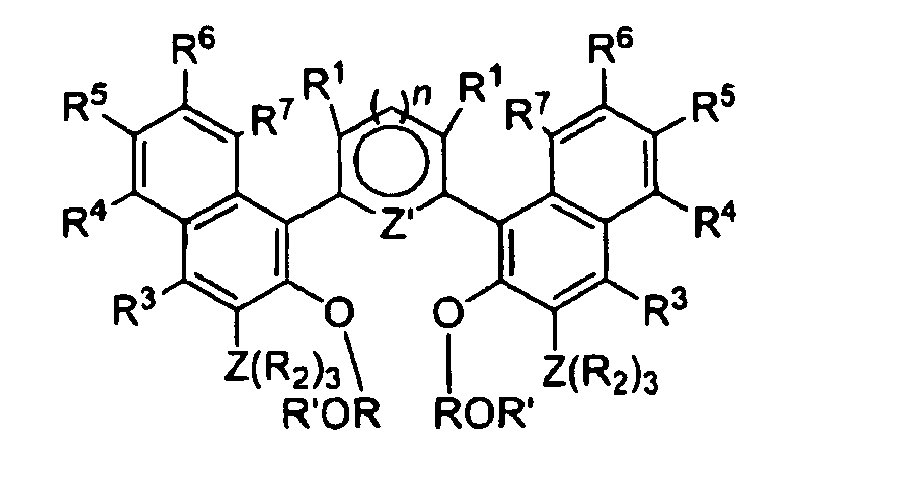
- Accordingly, the present invention discloses a pro-ligand of formula I

- Wherein R1, R3, R4, R5, R6 and R7 are each independently selected from hydrogen, unsubstituted or substituted hydrocarbyl, or inert functional group, wherein two or more of said groups can be linked together to form one or more rings,
wherein Z' is one or two heteroatom(s) and n is 0 (Z' = O, S, N=N) or 1 (Z' = N),
wherein Z is an atom selected from group 14 of the Periodic Table,
wherein R2 is a substituted or unsubstituted aryl group having at most 8 carbon atoms, and/or an alkyl group, with the restriction that Z(R2)3 is a bulky group, at least as bulky as tertio-butyl.
Z(R2)3 can also be a substituted aryl group. - Preferably R1, R3, R4, R5, R6 and R7 are each independently selected from hydrogen or alkyl groups having at most 6 carbon atoms, more preferably they all are hydrogen.
- Preferably Z' is S or N or N=N.
- Preferably, Z is C or S, more preferably, it is Si.
- Preferably R2 is a substituted or unsubstituted phenyl group, or a higher aromatic group (e.g. naphtyl), or an alkyl. More preferably, it is an unsubstituted phenyl group or a tertio-butyl group .
- By inert functional group, is meant a group, other than hydrocarbyl or substituted hydrocarbyl, that is inert under the complexation conditions to which the compound containing said group is subjected. They can be selected for example from halo, ester, ether, amino, imino, nitro, cyano, carboxyl, phosphate, phosphonite, phosphine, phosphinite, thioether and amide. Preferably, they are selected from halo, such as chloro, bromo, fluoro and iodo, or ether of formula - OR* wherein R* is unsubstituted or substituted hydrocarbyl. After metallation of the ligand, an inert functional group must not coordinate to the metal more strongly than the groups organised to coordinate to the metal and thereby displace the desired coordinating group.
- Several procedures have been tested in order to prepare the ligands of the present invention, most of them without success. They can be prepared in good yield starting from β-naphtol by a process that comprises the steps of:
- a) providing β-naphtol of formula

- b) introducing alkoxy alkyl protecting groups by reacting with an alkoxy alkyl halide of formula XROR' wherein X is an halogen and R and R' are each independently selected from alkyl having from 1 to 6 carbon atom in the presence of dimethylformamide (DMF) and an alkali metal-alkyl or alkali metal-hydride, preferably NaH,to obtain a compound of formula;

- c) reacting with (R2)3ZX', wherein X' is an halogen, in the presence of sec-BuLi in a solvent to obtain a compound of formula

- d) reacting with a dihaloheteroaryl of formula

- e) deprotecting the compound obtained in step d), e.g. by reaction of an acid (e.g. HCl in CHCl3/EtOH), in order to obtain a bridged pro-ligand of general formula I

- The method of preparation can be summarised in the scheme presented in exemplary
Figure 2 , for the specific preparation of a given {ONO}H2 pro-ligand. - The key feature of the ligands according to the present invention is the possibility to form firm stereoselective coodination to the metal center provided by the non-coplanar orientation of the bridging heterocyclic and adjacent naphthyl groups due to steric repulsion between protons at meta and 8 positions of these moieties as can be seen in examplary
figure 3 . - The invention also discloses a metallic complex of formula II

- The metallic complexes II result from the complexation of pro-ligand I with metallic salts MR$ n in a solvent, wherein M is a metal Group 4 of the periodic Table, wherein each R$ is the same or different and is an alkyl, benzyl, aryl, amido, alkoxide, and/or halide (Cl, Br, I).
- Preferably all R$ are the same and are either CH2Ph, OiPr or NMe2,
- Preferably one equivalent of metallic salt is used per bridged bisnaphtol complex. The metallation reaction is carried out at a temperature of from -80 °C to a temperature of +25 °C and for a period of time of 1 to 18 hours.
- The present invention also discloses an active catalyst system comprising the Group 4 metal single-site catalyst component of formula II and an activating agent having an alkylating/ionising action.
- Suitable activating agents are well known in the art. The activating agent can be an aluminium alkyl represented by formula AIR+ nX3-n wherein R+ is an alkyl having from 1 to 20 carbon atoms and X is a halogen, in combination with [Ph3C][B(C6F5)4]. The preferred aluminium alkyls are triisobutyl aluminium (TIBAL) or triethyl aluminium (TEAL). Aluminium alkyls are used in combination with trityl.
- Alternatively, it can be aluminoxane and comprise oligomeric linear and/or cyclic alkyl aluminoxanes represented by formula


wherein n is 1-40, preferably 1-20, m is 3-40, preferably 3-20 and R* is a C1-C8 alkyl group and preferably methyl or isobutyl. - Preferably, the activating agent is methylaluminoxane (MAO).
- The amount of activating agent is selected to give an Al/M ratio of from 500 to 10000, preferably of from to 1000 to 5000. The amount of activating agent depends upon its nature,.
- Suitable boron-containing agents may also be used for activating Group 4 metal single-site catalyst component of formula II where R$ is an alkyl or benzyl group,.
These include for example a triphenylcarbenium boronate such as tetrakispentafluorophenyl-borato-triphenylcarbenium as described inEP-A-0427696 , or those of the general formula [L'-H] + [B Ar1 Ar2 X3 X4]- as described inEP-A-0277004 (page 6, line 30 to page 7, line 7). - The amount of boron-containing activating agent is selected to give a B/M ratio of from 0.5 to 5, preferably of about 1.
- In another embodiment, according to the present invention, the single-site catalyst component of formula II may be deposited on a conventional support. Preferably, the conventional support is silica impregnated with MAO. Alternatively the support may also be an activating support such as fluorinated alumina silica.
- The catalyst system may comprise an optional scavenger that may be selected from triethylaluminium, triisobutylaluminum, tris-n-octylaluminium, tetraisobutyldialuminoxane or diethyl zinc.
- The active Group 4 metal catalyst system is used in the oligomerisation and in the polymerisation of ethylene and alpha-olefins.
- The present invention discloses a method for the oligomerisation or the homo- or co-polymerisation of ethylene and alpha-olefins that comprises the steps of:
- a) injecting the active catalyst system into the reactor;
- b) injecting the monomer and optional comonomer either before or after or simultaneously with step a);
- c) maintaining under polymerisation conditions;
- d) retrieving the oligomers and/or polymer.
- The pressure in the reactor can vary from 0.5 to 50 bars, preferably from 5 to 25 bars.
- The polymerisation temperature can range from 10 to 100°C, preferably from 50 to 85°C.
- The preferred monomer and optional comonomer can be selected from ethylene, propylene, 1-hexene or styrene. The preferred monomer is ethylene with 1-hexene as comonomer.
- All experiments were performed under a purified argon atmosphere using standard Schlenk techniques, or in a glovebox. Solvents were distilled under nitrogen, from Na/benzophenone for THF and Et2O, and from Na/K alloy for toluene and pentane. They were degassed thoroughly and stored under nitrogen prior to use. Deuterated solvents (benzene-d 6, toluene-d 8, THF-d 8; >99.5% D, Eurisotop) were vacuum-transferred from Na/K alloy into storage tubes. Tetrabenzyl M(CH2Ph)4 wherein M = Ti, Zr, Hf, and tetrakis(dimethylamido) Hf(NMe2)4 precursors, and S-Phos (dicyclohexyl(2',6'-dimethoxy-1,1'-biphenyl-2-yl)phosphine) were prepared using reported procedures. Other starting materials were purchased from Acros, Strem and Aldrich. NMR spectra of complexes were recorded on Bruker AC-200, AC-300 and AM-500 spectrometers in Teflon-valved NMR tubes at 25 °C unless otherwise indicated. 1H and 13C chemical shifts are reported in ppm vs. SiMe4 and were determined by reference to the residual solvent peaks. Assignment of resonances for organometallic complexes was made from 1H-13C HMQC and HMBC NMR experiments. Coupling constants are given in Hertz. Elemental analyses were performed by the Microanalytical Laboratory at the Institute of Chemistry of Rennes and are the average of two independent determinations.
- To a suspension of 5.0 g of NaH (208.33 mmol) in 150 mL of DMF under argon flow were added 20.0 g of solid 2-hydroxynaphthalene (138.7 mmol) at a temperature of 0 °C, by small portions. The suspension was kept under stirring for 4 h at room temperature, 17.8 g of methoxymethyl chloride (221.2 mmol) were added slowly, and the reaction mixture was stirred for 10 additional hours. The reaction was carefully diluted with 1 L of water and the organic part was extracted with 3
times 50 mL of CH2Cl2. The combined organic extracts were washed twice with 500 mL of water, brine and dried over MgSO4. The solution was evaporated, dried in vacuum at a temperature of 80 °C to give 25.1 g of colorless oily product (133.3 mmol) that was used without further purification.
The NMR result is as follows: 1H NMR (200 MHz, CDCl3, 25 °C): δ 7.80 (m, 3H), 7.55-7.37 (m, 3H), 7.26 (m, 1 H), 5.34 (s, 2H, OCH 2O), 3.57 (s, 3H, OCH 3).
Anal. calcd. for C12H12O2: C, 76.57; H, 6.43. Found: C, 76.59; H, 6.55. - A solution of 19.1 m of sec-BuLi 1.3 M in hexane/cyclohexane (24.70 mmol) was added dropwise to a stirred solution of 4.64 f of [3-(methoxymethoxy)-2-naphthyl](triphenyl)silane (24.65 mmol) in 150 mL of THF at a temperature of -78 °C over a period of time of 15 min. After stirring overnight at room temperature, to the resultant tinted solution was added a solution of 7.27 g of Ph3SiCl (24.65 mmol) and 4.3 mL of HMPA (24.72 mmol) in 100 mL of THF. The reaction mixture was heated at reflux for 40 h, cooled and diluted with 1000 mL of water. The organic part was extracted with 3 times 100 mL of Et2O. The combined organic extracts were dried over MgSO4, and evaporated. The crude residue was recrystallised from heptane and dried under vacuum to give 8.25 g of [3-(methoxymethoxy)-2-naphthyl](triphenyl)silane (18.47 mmol) with a yield of 75 %.
The NMR result is as follows: 1H NMR (200 MHz, CDCl3, 25 °C): δ 7.83-7.75 (m, 2H), 7.72-7.58 (m, 7H), 7.55-7.25 (m, 12 H), 4.96 (s, 2H, OCH 2O), 3.00 (s, 3H, OCH 3).
Anal. calcd. for C29H24OSi: C, 83.61; H, 5.81. Found: C, 82.15; H, 5.23. -

- This is a one pot method comprises the following steps:
- (i) To a solution of 2.3 g of [3-(methoxymethoxy)-2-naphthyl](triphenyl)silane (5.15 mmol) in 40 mL of THF were added 0.78 mL of tetramethylethylenediamine (TMEDA) (5.16 mmol) followed by addition of 4.2 mL of sec-BuLi 1.3 M in hexane/cyclohexane (5.46 mmol) at a temperature of -78 °C. The reaction mixture was stirred at room temperature overnight, afterwards all the volatiles were evaporated and the residue was dried for 1 h under vacuum.
- (ii) 0.70 g of anhydrous ZnCl2 (5.15 mmol) were added in the glovebox, 30 mL of THF were vacuum transferred, and the resultant solution was stirred for 30 min at room temperature.
- (iii) The solution was transferred to a Teflon-valved Schlenk followed by addition of 0.094 g of Pd2dba3 (102.6 µmol), 0.168 g of S-Phos (409.3 µmol) and 0.61 g of 2,6-dibromopyridine (2.57 mmol). The reaction mixture was stirred for 40 h at a temperature of 105 °C, cooled, diluted with 200 mL of water and extracted with 3
times 20 mL of CH2Cl2. The combined organic extracts were dried over MgSO4, and evaporated. The crude material contained about 50 % ofproduct 2,6-bis[2-(methoxymethoxy)-3-(triphenylsilyl)-1-naphthyl]pyridine as judged by 1H NMR spectroscopy. This material was purified by column chromatography (silica, heptane: EtOAc (15:1), Rf = 0.12) and used without complete characterization. - (iv) The resultant solid was dissolved in a mixture of 20 mL of concentrated HCl, 30 mL of CHCl3 and 40 mL of EtOH, and the solution was refluxed for 24 h. The reaction mixture was cooled to 0 °C and then carefully diluted with a concentrated solution of NaOH. Then, concentrated solution of NH4Cl was added to maintain a pH value of 7-8. The product was extracted with 3
times 20 mL of CH2Cl2. The combined organic extracts were dried over MgSO4, and evaporated to afford 1.11 g of {ONO}H2 as off-white solid (1.26 mmol) with a yield of 98 %. -

- Using a similar synthetic approach as that descrived above for {ONO}H2, pro-ligand {OSO}H2 was prepared from 3.48 g of [3-(methoxymethoxy)-2-naphthyl](triphenyl)silane (7.79 mmol), 1.18 mL of TMEDA (7.82 mmol), 6.3 mL of sec-BuLi 1.3 M in hexane/cyclohexane (8.18 mmol), 1.06 g of ZnCl2 (7.78 mmol), 0.142 g of Pd2dba3 (155.0 µmol), 0.255 g of S-Phos (621.2 µmol) and0.94 g of 2,5-dibromotiophene (3.89 mmol). The yield of (3-(methoxymethoxy)-4-{5-[2-(methoxymethoxy)-3-(triphenylsilyl)-1-naphthyl]thien-2-yl}-2-naphthyl)(triphenyl)silane after Pd-catalyzed coupling was of about 30% over 100 h. After the deprotection step and further workup, crude {OSO}H2 was recovered as a deep blue powder, which was purified by passing through a short silica pad (heptane:CH2Cl2 (1:1)) to afford 1.01 g of colorless solid (1.14 mmol) with a yield of 98 %. The NMR spectra were as follows:
1H NMR (500 MHz, CDCl3, 25 °C) (Fig. 6 ): δ 7.89 (s, 2H), 7.76 (d, J = 8.6 Hz, 2H), 7.73-7.69 (m, 14H), 7.54-7.46 (m, 8H), 7.46-7.41 (m, 12H), 7.38-7.33 (m, 4H), 5.85 (s, 2H, OH).
13C NMR (125 MHz, CDCl3, 25 °C): δ 155.7, 141.9, 137.6, 136.4, 135.4, 134.3, 130.9, 129.6, 128.7, 128.6, 128.0, 127.9, 124.2, 123.6, 122.9, 112.1.
The 1H NMR spectrum of {OSO}H2 is represented infigure 5 and molecular structure is given infigure 6 .
Anal. calcd. for C60H44O2SSi2: C, 81.41; H, 5.01. Found: C, 80.56; H, 4.87. - A Schlenk tube was charged with 0.20 g of {ONO}H2 (0.23 mmol) and 0.094 g of Ti(CH2Ph)4 (0.23 mmol), and then 5 mL of toluene were vacuum transferred. The reaction mixture was stirred overnight at room temperature, filtered and evaporated and dried in vacuum to give 0.24 g of rac-{ONO}Ti(CH2Ph)2 as brownish-red microcrystalline material (0.22 mmol) with a yield of 95%. The molecular structure of the titanium metallic complex can be seen in
figure 7 .
The NMR spectra were as follows:
1H NMR (500 MHz, toluene-d 8, 70 °C) (Fig. 7 ): δ 8.29 (s, 2H), 8.02 (m, 12 H), 7.48 (d, J = 8.2 Hz, 2H), 7.34 (d, J = 8.2 Hz, 2H), 7.32 (d, J = 8.2 Hz, 2H), 7.23 (m, 12H), 7.13 (t, J = 6.8 Hz, 2H), 7.06 (m, 2H), 6.99 (m, 6H), 6.81 (t, J = 8.2 Hz, 1H), 6.05 (t, J = 7.5 Hz, 2H, CH2Ph), 5.94 (t, J = 7.5 Hz, 4H, CH2 Ph), 5.75 (d, J = 7.5 Hz, 4H, CH2 Ph), 2.36 (br s, 4H, CH 2Ph).
13C NMR (75 MHz, benzene-d 6, 25 °C): 8 161.3, 151.0, 144.1, 142.3, 137.1, 137.0, 134.6, 133.1, 129.6, 128.3, 128.1, 125.7, 125.2, 123.0, 122.9, 122.0, 121.9, 116.9 (three signals from quaternary aromatic carbons and one from CH2 of the benzylic groups were not observed).
The 1H NMR spectrum of the titanium metallic complex can be seen infigure 8 .
Anal. calcd. for C75H57NO2Si2Ti: C, 81.28; H, 5.18. Found: C, 80.89; H, 4.97. - Using a procedure similar to that described hereabove 0.12 g of the zirconium complex (0.10 mmol) were obtained with a yield of 90 %. It was prepared from 0.10 g of {ONO}H2 (0.11 mmol) and 0.052 g of Zr(CH2Ph)4 (0.11 mmol).
- A Schlenk tube was charged with 0.11 g of {ONO}H2 (0.12 mmol) and 0.044 g of Hf(NMe2)4 (0.12 mmol), and 5 mL of benzene were vacuum transferred. The reaction mixture was stirred overnight at room temperature, filtered and evaporated and dried in vacuum to give 0.12 g of hafnium complex as yellow microcrystalline material (0.10 mmol) with a yield of 84%.
The molecular structure of the complex can be seen infigure 9 .
The NMR result was as follows:
1H NMR (500 MHz, toluene-d 8, 70 °C): δ 8.40-8.20 (br m, 2H), 7.98 (br m, 9H), 7.84 (br m, 2H), 7.55-7.30 (br m, 7H), 7.28 (br m, 20H), 7.13 (br m, 3H), 3.13 (s, 12H, NMe 2), 2.27 (br s, 12H, NHMe 2) (signal from protons of NHMe2 were not observed).
Anal. calcd. for C67H62HfN4O2Si2: C, 67.63; H, 5.25. Found: C, 66.01; H, 4.99. - The polymerisation was carried out as follows.
A 300 mL glass high-pressure reactor was charged with 80 mL of freshly distilled toluene and optional comonomer under argon flash. Mechanical stirring (Pelton turbine, 1000 rpm) was started, the reactor was then purged with ethylene and loaded with a solution of scavenger selected from MAO or TIBAL, at atmospheric pressure, and then kept at the desired temperature by circulating water in a double wall. A solution of trityl (if used) in 2 mL of toluene was injected in by syringe followed by injecting a solution of precatalyst in 2 mL of toluene. The gas pressure in the reactor was maintained immediately and kept constant with a back regulator throughout the experiment. The ethylene consumption was monitored via an Aalborg flowmeter. After a given time period, the reactor was depressurised and the reaction was quenched by adding about 5 mL of a 10% solution of HCl in methanol. The polymer was further precipitated by adding 500 mL of methanol, washed and dried in vacuum overnight at room temperature. The polymerisation conditions are summarised in Table I and the polymerisation results are presented in Table II. -
Cat 1 is rac-{ONO}Ti(CH2Ph)2 -
Cat 2 is {ONO}Zr(CH2Ph)2
1H NMR (500 MHz, CD2Cl2, 25 °C) (
13C NMR (125 MHz, CD2Cl2, 25 °C): δ 157.5, 155.8, 142.6, 138.3, 136.3, 134.4, 133.3, 129.5, 129.0, 128.9, 127.9, 127.8, 125.4, 124.1, 123.7, 123.4, 115.7.
The 1H NMR spectrum of {ONO}H2 can be seen in
MS-FAB (m/z): 880.3 (M+).
Anal. calcd. for C61H44NO2Si2: C, 83.24; H, 5.15. Found: C, 82.76; H, 5.01.
| Run | Cat | Amount cat µmol | Activator | Activator/M | comonomer | T ° | t min | |
| 1 | | 4.5 | MAO | 5000/1 | - | 50 | 30 | |
| 2 | | 9 | trityl/ | 3/200/1 | - | 50 | 10 | |
| 4 | | 9 | trityl/ | 3/200/1 | - | ∼60 | 5 | |
| 5 | | 9 | trityl/ | 3/200/1 | 1-hexene | ∼66 | 15 |
| Run | mass g | Productivity gpolym/gcata | Activity kg/mol/h | Mn kDa | Mw/Mn | Tm ° |
| 1 | 0.55 | 110 | 244 | |||
| 2 | 3.14 | 315 | 2090 | |||
| 4 | 2.26 | 218 | 3010 | |||
| 5 | 3.58 | 345 | 1600 |
Claims (12)
- A pro-ligand of general formula

wherein two or more of said groups can be linked together to form one or more rings,
wherein Z' is one or two heteroatom(s) and n is 0 (Z' = O, S, N=N) or 1 (Z' = N)
wherein Z is an atom selected from group 14 of the Periodic Table,
wherein R2 is a substituted or unsubstituted aryl group having at most 8 carbon atoms with the restriction that Z(R2)3 is a bulky group, at least as bulky as tertio-butyl. - The ligand of claim 1 wherein Z is C, Si, or Ge, preferably Si.
- The ligand of claim 1 or claim 2 wherein R2 is substituted or unsubstituted phenyl group.
- The ligand of any one of claims 1 to 3 wherein R1, R3, R4, R5, R6 and R7 are the same and are hydrogen.
- A method for preparing the ligand of any one of claims 1 to 4 that comprises the steps of:a) providing β-naphtol of formula
 b) introducing alkoxy alkyl protecting groups by reacting with an alkoxy alkyl halide of formula XROR' wherein X is an halogen and R and R' are each independently selected from alkyl having from 1 to 6 carbon atom in the presence of dimethylformamide (DMF) and an alkali metal-alkyl or alkali metal-hydride, preferably NaH,to obtain a compound of formula;
 c) reacting with (R2)3ZX', wherein X' is an halogen, in the presence of sec-BuLi in a solvent to obtain a compound of formula
 d) reacting with a dihaloheteroaryl of formula
 e) deprotecting the compound obtained in step d), e.g. by reaction of an acid (e.g. HCl in CHCl3/EtOH), in order to obtain a bridged pro-ligand of general formula I
- A metallic complex of general formula

- The metallic complexes of claim 6 wherein R$ is CH2Ph or NMe2.
- The metallic complexes of claim 6 or claim 7 wherein M is Zr, Ti, Hf.
- A method for preparing the metallic complex of any one of claims 6 to 8 by reacting a metallic salt MR$ n with the pro-ligand of any one of claims 1 to 4, in a solvent.
- An active group 4 metal catalyst system comprising the metallic complex of any one of claims 6 to 8 and an activating agent having an ionising action.
- A method for homo- or co-polymerising ethylene and alpha-olefins that comprises the steps of:a) injecting the active catalyst system of claim 10 or claim 11 into the reator;b) injecting the monomer and optional comonomer into the reactor simultaleously with or after the catalyst system;c) maintaining under polymerising conditions;d) retrieving a homo- or co-polymer of ethylene or alpha-olefin.
- The method of claim 12 wherein the monomer is ethylene and the comonomer, if present, is 1-hexene.
Priority Applications (8)
| Application Number | Priority Date | Filing Date | Title |
|---|---|---|---|
| EP08290185A EP2093229A1 (en) | 2008-02-25 | 2008-02-25 | Post-metallocene complexes based on bis(naphtoxy) pyridine and bis(naphtoxy) thiophene ligands for the polymerisation of ethylene and alpha-olefins |
| EA201070997A EA018925B1 (en) | 2008-02-25 | 2009-02-17 | Post-metallocene complexes based on bis-(naphtoxy)pyridine and bis-(naphtoxy)thiophene ligands for the polymerisation of ethylene and alpha-olefins |
| US12/919,248 US8519070B2 (en) | 2008-02-25 | 2009-02-17 | Post-metallocene complexes based on bis(naphthoxy)pyridine and bis(naphthoxy)thiophene ligands for the polymerisation of ethylene and alpha-olefins |
| KR1020107018746A KR101262333B1 (en) | 2008-02-25 | 2009-02-17 | Post-metallocene complexes based on bis(naphtoxy)pyridine and bis(naphtoxy)thiophene ligands for the polymerisation of ethylene and alpha-olefins |
| BRPI0907926-2A BRPI0907926A2 (en) | 2008-02-25 | 2009-02-17 | Post-metallocene complexes based on bis (naphthoxy) pyridine and bis (naphthoxy) thiophene linkers for the polymerization of ethylene and alphaolefins. |
| EP09716175A EP2245035A1 (en) | 2008-02-25 | 2009-02-17 | Post-metallocene complexes based on bis(naphtoxy)pyridine and bis(naphtoxy)thiophene ligands for the polymerisation of ethylene and alpha-olefins |
| PCT/EP2009/051868 WO2009106458A1 (en) | 2008-02-25 | 2009-02-17 | Post-metallocene complexes based on bis(naphtoxy)pyridine and bis(naphtoxy)thiophene ligands for the polymerisation of ethylene and alpha-olefins |
| CN200980106421XA CN101959894A (en) | 2008-02-25 | 2009-02-17 | Post-metallocene complexes based on bis(naphtoxy)pyridine and bis(naphtoxy)thiophene ligands for the polymerisation of ethylene and alpha-olefins |
Applications Claiming Priority (1)
| Application Number | Priority Date | Filing Date | Title |
|---|---|---|---|
| EP08290185A EP2093229A1 (en) | 2008-02-25 | 2008-02-25 | Post-metallocene complexes based on bis(naphtoxy) pyridine and bis(naphtoxy) thiophene ligands for the polymerisation of ethylene and alpha-olefins |
Publications (1)
| Publication Number | Publication Date |
|---|---|
| EP2093229A1 true EP2093229A1 (en) | 2009-08-26 |
Family
ID=39537494
Family Applications (2)
| Application Number | Title | Priority Date | Filing Date |
|---|---|---|---|
| EP08290185A Withdrawn EP2093229A1 (en) | 2008-02-25 | 2008-02-25 | Post-metallocene complexes based on bis(naphtoxy) pyridine and bis(naphtoxy) thiophene ligands for the polymerisation of ethylene and alpha-olefins |
| EP09716175A Ceased EP2245035A1 (en) | 2008-02-25 | 2009-02-17 | Post-metallocene complexes based on bis(naphtoxy)pyridine and bis(naphtoxy)thiophene ligands for the polymerisation of ethylene and alpha-olefins |
Family Applications After (1)
| Application Number | Title | Priority Date | Filing Date |
|---|---|---|---|
| EP09716175A Ceased EP2245035A1 (en) | 2008-02-25 | 2009-02-17 | Post-metallocene complexes based on bis(naphtoxy)pyridine and bis(naphtoxy)thiophene ligands for the polymerisation of ethylene and alpha-olefins |
Country Status (7)
| Country | Link |
|---|---|
| US (1) | US8519070B2 (en) |
| EP (2) | EP2093229A1 (en) |
| KR (1) | KR101262333B1 (en) |
| CN (1) | CN101959894A (en) |
| BR (1) | BRPI0907926A2 (en) |
| EA (1) | EA018925B1 (en) |
| WO (1) | WO2009106458A1 (en) |
Cited By (1)
| Publication number | Priority date | Publication date | Assignee | Title |
|---|---|---|---|---|
| WO2012154945A3 (en) * | 2011-05-11 | 2013-04-04 | University Of Florida Research Foundation, Inc. | Ono pincer ligands and ono pincer ligand comprising metal complexes |
Families Citing this family (6)
| Publication number | Priority date | Publication date | Assignee | Title |
|---|---|---|---|---|
| US9394387B2 (en) * | 2014-05-15 | 2016-07-19 | Chevron Phillips Chemical Company Lp | Synthesis of aryl coupled bis phenoxides and their use in olefin polymerization catalyst systems with activator-supports |
| US11225539B2 (en) * | 2019-02-12 | 2022-01-18 | Exxonmobil Chemical Patents Inc. | Supported transition metal bis(phenolate) complexes and their use as catalysts for olefin polymerization |
| EP4222180B1 (en) * | 2020-09-30 | 2024-04-10 | ExxonMobil Chemical Patents Inc. | Bis(heterocyclic-olate) lewis base catalysts and methods thereof |
| CN113880977B (en) * | 2021-10-18 | 2023-07-11 | 万华化学集团股份有限公司 | A kind of olefin polymerization catalyst, preparation method and application |
| CN114230702B (en) * | 2022-01-17 | 2023-10-13 | 万华化学集团股份有限公司 | Olefin polymerization catalyst with naphthoxy skeleton, preparation method and application |
| CN119504879B (en) * | 2024-11-19 | 2026-01-30 | 万华化学集团股份有限公司 | A bimetallic compound, its preparation method and application |
Citations (6)
| Publication number | Priority date | Publication date | Assignee | Title |
|---|---|---|---|---|
| EP0277004A1 (en) | 1987-01-30 | 1988-08-03 | Exxon Chemical Patents Inc. | Catalysts, method of preparing these catalysts and method of using said catalysts |
| EP0427696A2 (en) | 1989-10-10 | 1991-05-15 | Fina Technology, Inc. | Process and catalyst for producing syndiotactic polymers |
| JPH06192330A (en) * | 1992-09-24 | 1994-07-12 | Idemitsu Kosan Co Ltd | Catalyst for olefin polymerization and production of olefinic polymer |
| EP0606125A2 (en) * | 1993-01-08 | 1994-07-13 | Shell Internationale Researchmaatschappij B.V. | Use of titanium and zirconium compounds as homogeneous catalyst and novel titanium and zirconium compounds |
| US20030191015A1 (en) * | 2002-03-29 | 2003-10-09 | Michael Chi-Wang Chan | Catalyst component for olefin polymerization |
| WO2008036882A1 (en) * | 2006-09-21 | 2008-03-27 | California Institute Of Technology | Non-metallocene organometallic complexes and related methods and systems |
Family Cites Families (3)
| Publication number | Priority date | Publication date | Assignee | Title |
|---|---|---|---|---|
| JP2681720B2 (en) * | 1991-10-29 | 1997-11-26 | 新日本製鐵株式会社 | Device for defective packaging sealing |
| JP4233365B2 (en) * | 2003-03-25 | 2009-03-04 | 三井化学株式会社 | Azadiol complex compound and optical recording medium using the compound |
| EP2093242A1 (en) * | 2008-02-25 | 2009-08-26 | Total Petrochemicals Research Feluy | Group 3 post-metallocene complexes based on bis (Naphthoxy)pyridine and bis (Naphthoxy) thiophene ligands for the ring-opening polymerisation of polar cyclic monomers |
-
2008
- 2008-02-25 EP EP08290185A patent/EP2093229A1/en not_active Withdrawn
-
2009
- 2009-02-17 EP EP09716175A patent/EP2245035A1/en not_active Ceased
- 2009-02-17 EA EA201070997A patent/EA018925B1/en not_active IP Right Cessation
- 2009-02-17 WO PCT/EP2009/051868 patent/WO2009106458A1/en not_active Ceased
- 2009-02-17 BR BRPI0907926-2A patent/BRPI0907926A2/en not_active IP Right Cessation
- 2009-02-17 US US12/919,248 patent/US8519070B2/en not_active Expired - Fee Related
- 2009-02-17 CN CN200980106421XA patent/CN101959894A/en active Pending
- 2009-02-17 KR KR1020107018746A patent/KR101262333B1/en not_active Expired - Fee Related
Patent Citations (6)
| Publication number | Priority date | Publication date | Assignee | Title |
|---|---|---|---|---|
| EP0277004A1 (en) | 1987-01-30 | 1988-08-03 | Exxon Chemical Patents Inc. | Catalysts, method of preparing these catalysts and method of using said catalysts |
| EP0427696A2 (en) | 1989-10-10 | 1991-05-15 | Fina Technology, Inc. | Process and catalyst for producing syndiotactic polymers |
| JPH06192330A (en) * | 1992-09-24 | 1994-07-12 | Idemitsu Kosan Co Ltd | Catalyst for olefin polymerization and production of olefinic polymer |
| EP0606125A2 (en) * | 1993-01-08 | 1994-07-13 | Shell Internationale Researchmaatschappij B.V. | Use of titanium and zirconium compounds as homogeneous catalyst and novel titanium and zirconium compounds |
| US20030191015A1 (en) * | 2002-03-29 | 2003-10-09 | Michael Chi-Wang Chan | Catalyst component for olefin polymerization |
| WO2008036882A1 (en) * | 2006-09-21 | 2008-03-27 | California Institute Of Technology | Non-metallocene organometallic complexes and related methods and systems |
Non-Patent Citations (31)
| Title |
|---|
| BECKERLE, K. ET AL., ANGEW. CHEM., INT. ED., vol. 46, 2007, pages 4790 |
| BECKERLE, K. ET AL., ORGANOMETALLICS, vol. 25, 2006, pages 3019 |
| BRITOVSEK, G. J. P.; GIBSON, V. C.; WASS, D. F.: "Angew. Chem.", vol. 38, 1999, pages: 429 |
| CAPACCHIONE, C. ET AL., ORGANOMETALLICS, vol. 24, 2005, pages 2971 |
| CHAN MICHAEL C W ET AL: "Surprising activity for group 4 polyolefin catalysts [M{ (OAr)2 py} CL2(thf)] (M = Zr, Ti) bearing tridentate pyridine-2,6-bis(aryloxide) ligands", J CHEM SOC DALTON TRANS; JOURNAL OF THE CHEMICAL SOCIETY. DALTON TRANSACTIONS AUG 21 2002, no. 16, 21 August 2002 (2002-08-21), pages 3085 - 3087, XP002486339 * |
| CHAN MICHAEL C W ET AL: "Synthesis, structures, and olefin polymerization characteristics of group 4 catalysts [Zr{ (OAr)2py} Cl2(D)] (D = O-donors, Cl[HPR 3]) supported by tridentate pyridine-2,6-bis(aryloxide) ligands", ORGANOMETALLICS; ORGANOMETALLICS JAN 30 2006, vol. 25, no. 3, 30 January 2006 (2006-01-30), pages 785 - 792, XP002486340 * |
| CHAN, M.C.W. ET AL., CHEM. EUR. J., vol. 12, 2006, pages 2607 |
| CHAN, M.C.W. ET AL., J. CHEM. SOC., DALTON TRANS., 2002, pages 3085 |
| CHAN, M.C.W. ET AL., ORGANOMETALLICS, vol. 25, 2006, pages 785 |
| DEROSA, C. ET AL., MACROMOLECULES, vol. 37, 2004, pages 9034 |
| FURUYAMA, R. ET AL., J. ORGANOMET. CHEM., vol. 690, 2005, pages 4398 |
| GIBSON, V. C.; SPITZMESSER, S. K., CHEM. REV., vol. 103, 2003, pages 283 |
| GROYSMAN, S. ET AL., INORG. CHEM., vol. 44, 2005, pages 8188 |
| HUSTAD, P.D.; TIAN, J.; COATES, G.W., J. AM. CHEM. SOC., vol. 124, 2002, pages 3614 |
| ITTEL, S. D.; JOHNSON, L. K.; BROOKHART, M., CHEM. REV., vol. 100, 2000, pages 1169 |
| LIAN, B. ET AL.: "Angew. Chem.", vol. 46, 2007, pages: 8507 |
| MAKIO, H.; FUJITA, T., MACROMOL. RAPID COMMUN., vol. 28, 2007, pages 698 |
| MASON, A.F.; COATES, G.W., J. AM. CHEM. SOC., vol. 126, 2004, pages 10798 |
| MASON, A.F.; COATES, G.W., J. AM. CHEM. SOC., vol. 126, 2004, pages 16326 |
| NAKAYAMA, Y. ET AL., CHEM. EUR. J., vol. 12, 2006, pages 7546 |
| NAKAYAMA, Y. ET AL., MACROMOL. CHEM. PHYS., vol. 206, 2005, pages 1847 |
| REINARTZ, S. ET AL., ORGANOMETALLICS, vol. 22, 2003, pages 2542 |
| SAITO, J. ET AL., MACROMOLECULES, vol. 38, 2005, pages 4955 |
| SAITO, J. ET AL., MACROMOLECULES, vol. 39, 2006, pages 4023 |
| SEGAL, S; GOLDBERG, I; KOL, M., ORGANOMETALLICS, vol. 24, 2005, pages 200 |
| SWEETMAN B A ET AL: "Synthesis, resolution and racemisation studies of new tridentate ligands for asymmetric catalysis", TETRAHEDRON LETTERS, ELSEVIER, AMSTERDAM, vol. 46, no. 27, 4 July 2005 (2005-07-04), pages 4643 - 4646, XP004925566, ISSN: 0040-4039 * |
| TERAO, H. ET AL., MACROMOLECULES, vol. 39, 2006, pages 8584 |
| TSHUVA, E.Y. ET AL., ORGANOMETALLICS, vol. 21, 2002, pages 662 |
| YEORI, A ET AL., INORG. CHEM. COMMUN., vol. 7, 2004, pages 280 |
| YEORI, A. ET AL., INORG. CHEM., vol. 44, 2005, pages 4466 |
| YEORI, A. ET AL., J. AM. CHEM. SOC., vol. 128, 2006, pages 13062 |
Cited By (3)
| Publication number | Priority date | Publication date | Assignee | Title |
|---|---|---|---|---|
| WO2012154945A3 (en) * | 2011-05-11 | 2013-04-04 | University Of Florida Research Foundation, Inc. | Ono pincer ligands and ono pincer ligand comprising metal complexes |
| US9464104B2 (en) | 2011-05-11 | 2016-10-11 | University Of Florida Research Foundation, Inc. | Ono pincer ligands and ono pincer ligand comprising metal complexes |
| US9765102B2 (en) | 2011-05-11 | 2017-09-19 | University Of Florida Research Foundation, Inc. | ONO pincer ligands and ONO pincer ligand comprising metal complexes |
Also Published As
| Publication number | Publication date |
|---|---|
| US20110144291A1 (en) | 2011-06-16 |
| KR101262333B1 (en) | 2013-05-07 |
| EA018925B1 (en) | 2013-11-29 |
| CN101959894A (en) | 2011-01-26 |
| BRPI0907926A2 (en) | 2015-07-28 |
| EP2245035A1 (en) | 2010-11-03 |
| EA201070997A1 (en) | 2011-02-28 |
| KR20100106597A (en) | 2010-10-01 |
| WO2009106458A1 (en) | 2009-09-03 |
| US8519070B2 (en) | 2013-08-27 |
Similar Documents
| Publication | Publication Date | Title |
|---|---|---|
| US6531424B2 (en) | Polymerization of olefins | |
| US6770771B2 (en) | Polymerization of olefins | |
| US8519070B2 (en) | Post-metallocene complexes based on bis(naphthoxy)pyridine and bis(naphthoxy)thiophene ligands for the polymerisation of ethylene and alpha-olefins | |
| EP2739655B1 (en) | Catalysts for preparing ultra high molecular weight polyethylene (uhmwpe) | |
| EP3476858B1 (en) | Metal complex and method for producing the same, catalyst component for olefin polymerization and catalyst for olefin polymerization containing the metal complex, and methods for producing alpha-olefin polymer and copolymer using the catalyst for olefin polymerization | |
| US20030191015A1 (en) | Catalyst component for olefin polymerization | |
| EP1994040B1 (en) | Polymerisation of ethylene and alpha-olefins with phosphino-iminophenol complexes | |
| US8492493B2 (en) | Sterically emcumbered bidentate and tridentate naphthoxy-imine metallic complexes | |
| EP2089399B1 (en) | Polymerisation of ethylene and alpha olefins with single site catalysts having an anionic scorpion-like ligand | |
| US8017541B2 (en) | Catalyst components based on ferrocenyl complexes used for olefin polymerisation | |
| CN118598910B (en) | Preparation method and application of OP bidentate imine vanadium complex | |
| US8026192B2 (en) | Fluorinated alkoxy-imino catalyst components | |
| CN119462720A (en) | A kind of aminophenoloxy transition metal complex and its preparation method and application | |
| JP2024519742A (en) | catalyst | |
| MXPA01000875A (en) | Polymerization of olefins | |
| CZ2001300A3 (en) | Polymerization process of olefins |
Legal Events
| Date | Code | Title | Description |
|---|---|---|---|
| PUAI | Public reference made under article 153(3) epc to a published international application that has entered the european phase |
Free format text: ORIGINAL CODE: 0009012 |
|
| AK | Designated contracting states |
Kind code of ref document: A1 Designated state(s): AT BE BG CH CY CZ DE DK EE ES FI FR GB GR HR HU IE IS IT LI LT LU LV MC MT NL NO PL PT RO SE SI SK TR |
|
| AX | Request for extension of the european patent |
Extension state: AL BA MK RS |
|
| AKX | Designation fees paid | ||
| REG | Reference to a national code |
Ref country code: DE Ref legal event code: 8566 |
|
| STAA | Information on the status of an ep patent application or granted ep patent |
Free format text: STATUS: THE APPLICATION IS DEEMED TO BE WITHDRAWN |
|
| 18D | Application deemed to be withdrawn |
Effective date: 20100227 |