EP2091536B1 - Enantiomeric compounds with antibacterial activity - Google Patents
Enantiomeric compounds with antibacterial activity Download PDFInfo
- Publication number
- EP2091536B1 EP2091536B1 EP07814797.2A EP07814797A EP2091536B1 EP 2091536 B1 EP2091536 B1 EP 2091536B1 EP 07814797 A EP07814797 A EP 07814797A EP 2091536 B1 EP2091536 B1 EP 2091536B1
- Authority
- EP
- European Patent Office
- Prior art keywords
- compounds
- thieno
- compound
- ylamino
- formula
- Prior art date
- Legal status (The legal status is an assumption and is not a legal conclusion. Google has not performed a legal analysis and makes no representation as to the accuracy of the status listed.)
- Active
Links
- 0 C*(CCC*C(*(C)c1c2[n]cc1)=CC2=O)[C@]1(c(cccc2)c2OC1)I Chemical compound C*(CCC*C(*(C)c1c2[n]cc1)=CC2=O)[C@]1(c(cccc2)c2OC1)I 0.000 description 2
Classifications
-
- C—CHEMISTRY; METALLURGY
- C07—ORGANIC CHEMISTRY
- C07D—HETEROCYCLIC COMPOUNDS
- C07D495/00—Heterocyclic compounds containing in the condensed system at least one hetero ring having sulfur atoms as the only ring hetero atoms
- C07D495/02—Heterocyclic compounds containing in the condensed system at least one hetero ring having sulfur atoms as the only ring hetero atoms in which the condensed system contains two hetero rings
- C07D495/04—Ortho-condensed systems
-
- A—HUMAN NECESSITIES
- A61—MEDICAL OR VETERINARY SCIENCE; HYGIENE
- A61P—SPECIFIC THERAPEUTIC ACTIVITY OF CHEMICAL COMPOUNDS OR MEDICINAL PREPARATIONS
- A61P31/00—Antiinfectives, i.e. antibiotics, antiseptics, chemotherapeutics
- A61P31/04—Antibacterial agents
-
- A—HUMAN NECESSITIES
- A61—MEDICAL OR VETERINARY SCIENCE; HYGIENE
- A61P—SPECIFIC THERAPEUTIC ACTIVITY OF CHEMICAL COMPOUNDS OR MEDICINAL PREPARATIONS
- A61P43/00—Drugs for specific purposes, not provided for in groups A61P1/00-A61P41/00
-
- C—CHEMISTRY; METALLURGY
- C07—ORGANIC CHEMISTRY
- C07D—HETEROCYCLIC COMPOUNDS
- C07D405/00—Heterocyclic compounds containing both one or more hetero rings having oxygen atoms as the only ring hetero atoms, and one or more rings having nitrogen as the only ring hetero atom
- C07D405/02—Heterocyclic compounds containing both one or more hetero rings having oxygen atoms as the only ring hetero atoms, and one or more rings having nitrogen as the only ring hetero atom containing two hetero rings
- C07D405/12—Heterocyclic compounds containing both one or more hetero rings having oxygen atoms as the only ring hetero atoms, and one or more rings having nitrogen as the only ring hetero atom containing two hetero rings linked by a chain containing hetero atoms as chain links
Definitions
- the present invention relates to novel enantiomers of bicyclic heteroaromatic compounds that inhibit bacterial methionyl tRNA synthetases (MetRS) and to processes for their preparation and their use in therapy as antibacterial agents.
- MetRS bacterial methionyl tRNA synthetases
- the present invention relates to the use of these enantiomeric compounds in the treatment of Clostridium difficile based infection and disease.
- antibacterial agents were developed and are in common use throughout the industrialized world to treat most known bacterial infections.
- antibiotics like penicillin inhibited replication of bacteria by blocking the action of transpeptidase, an enzyme responsible for the building of bacterial cell walls.
- transpeptidase an enzyme responsible for the building of bacterial cell walls.
- many antibiotics have lost some or all of their effectiveness at treating infection.
- a line of antibacterial agents that target new molecular growth mechanisms would be useful in avoidance of further enhancement of antibiotic resistance.
- One such target is tRNA synthetase.
- tRNA synthetases are involved in protein biosynthesis so that inhibition thereof may be expected to lead to a cessation of cell growth.
- the compound mupirocin has been shown to be an inhibitor of the isoleucyl tRNA synthetase.
- Mupirocin is produced by the organism Pseudomonas fluorescens, and is an antibacterial agent used as the active ingredient in the product Bactroban®, marketed by GlaxoSmithKline.
- Bactroban® marketed by GlaxoSmithKline.
- Each tRNA synthetase represents a separate target for drug discovery.
- tRNA synthetase inhibitors which are selective for bacterial cells over mammalian cells are of considerable therapeutic interest as they have the potential to be used as antibacterial agents.
- sequence of the tRNA synthetase genes in the Gram positive organism S. aureus have recently been determined (see, for instance, European Patent application no 97300317.1 , SmithKline Beecham, for S . aureus MetRS), thereby assisting the process of identifying inhibitors.
- sequence of tRNA synthetase genes in other pathogenic bacteria, for instance the Gram negative organism H. influenzae has also been published ( R.D. Fleischmann et al., Science, 269, 496-512, 1995 ).
- WO 00/219 49 describes various 2-(NH-or O-substituted) quinolone compounds, which are inhibitors of methionyl t-RNA synthetase.
- Jarvest et al. described various bicyclic heteroaromatic compounds that have shown some degree of MetRS inhibition including one particular compound that is the enantiomer with R configuration of a left-hand-side tetrahydroquinoline compound ( Bioorg. & Med. Chem. Lett. 14 (2004) 3937-3941 ).
- Clostridium difficile C. difficile
- C. difficile is becoming a more prevalent infectious agent, where one to three percent of healthy individuals are carriers of the organism.
- Clabots et al., J Infect. Dis., 166, 561-567, 1992 ; McFarland et al., N. Engl. J Med., 320, 204-210, 1989 The risk of infection and disease becomes increasingly prevalent in the immunodeficient, elderly, and especially, elderly in healthcare settings, e.g., nursing home, hospital, doctors office, etc. Few conventional antibacterial drugs have shown promise in the treatment of C .
- the invention provides novel compounds that are potent inhibitors of bacterial methionyl tRNA synthetase (MetRS).
- MetRS bacterial methionyl tRNA synthetase
- the compounds of the invention are shown to have broad applicability as antibacterial agents for numerous Gram-positive and Gram-negative bacteria.
- MetRS inhibitors have best activity against Gram-positive organisms and far weaker activity against Gram-negative organisms.
- the compounds of the invention are shown to have surprisingly potent antibacterial activity against C . difficile .
- Compounds of the invention are novel bicyclic heteroaromatic enantiomers which show unexpected and potent inhibition of bacterial MetRS. These compounds show little or no inhibition of mammalian MetRS.
- the compounds of the invention are for use in therapy as antibacterial agents.
- compounds of the invention have shown surprisingly strong potency against Gram-positive bacteria and in particular C . difficile.
- Ar is the right hand side (RHS) substituent and has a substituted or unsubstituted aryl or heteroaryl group;
- X is selected from the group consisting of NH, O, S, SO, SO 2 , or CH 2 ;
- n 1, 2 or 3;
- * indicates an asymmetric carbon atom, wherein when n is 2 or 3, then * is R configuration; wherein when n is 1 and X is CH 2 , then * is R configuration; and wherein when n is 1 and X is selected from the group consisting of NH, O, S, SO, or SO 2 , then * is S configuration.
- n 0, 1, 2, 3, or 4;
- R 1 is independently selected from halo, cyano, hydroxyl, (C 1-6 )alkyl (optionally substituted by halo, hydroxyl, amino, carboxy, or (C 1-6 )alkoxycarbonyl), (C 3-7 )cycloalkyl, C( 1-6 )alkoxy, amino, mono- or di-(C 1-6 )alkylamino, acylamino, carboxy, (C 1-6 )alkoxycarbonyl, carboxy(C 1-6 )alkyloxy, (C 1-6 )alkylthio, (C 1-6 )alkylsulphinyl, (C 1-6 )alkylsulphonyl, sulphamoyl, mono- and di-(C 1-6 )alkylsulphamoyl, carbamoyl, mono- and di-(C 1-6 )alkylcarbamoyl and heterocyclic.
- X is selected from the group consisting of NH, O, S, SO, SO 2 , or CH 2 ;
- n 1, 2 or 3;
- * indicates an asymmetric carbon atom, wherein when n is 2 or 3, then * is R configuration; wherein when n is 1 and X is CH 2 , then * is R configuration; and wherein when n is 1 and X is selected from the group consisting of NH, O, S, SO, or SO 2 , then * is S configuration;
- R 1 is independently selected from halo, cyano, hydroxyl, (C 1-6 )alkyl (optionally substituted by halo, hydroxyl, amino, carboxy, or (C 1-6 )alkoxycarbonyl), (C 3-7 )cycloalkyl, C( 1-6 )alkoxy, amino, mono- or di-(C 1-6 )alkylamino, acylamino, carboxy, (C 1-6 )alkoxycarbonyl, carboxy(C 1-6 )alkyloxy, (C 1-6 )alkylthio, (C 1-6 )alkylsulphinyl, (C 1-6 )alkylsulphonyl, sulphamoyl, mono- and di-(C 1-6 )alkylsulphamoyl, carbamoyl, mono- and di-(C 1-6 )alkylcarbamoyl and heterocyclic;
- n 0, 1, 2, 3 or 4;
- p 0, 1, 2 or 3;
- R 2 is independently selected from halo, cyano, hydroxyl, (C 1 - 6 )alkyl (optionally substituted by halo, hydroxyl, amino, carboxy, or (C 1-6 )alkoxycarbonyl), (C 3-7 )cycloalkyl, C( 1-6 )alkoxy, amino, mono- or di-(C 1-6 )alkylamino, acylamino, carboxy, (C 1-6 )alkoxycarbonyl, carboxy(C 1-6 )alkyloxy, (C 1-6 )alkylthio, (C 1-6 )alkylsulphinyl, (C 1-6 )alkylsulphonyl, sulphamoyl, mono- and di-(C 1-6 )alkylsulphamoyl, carbamoyl, mono- and di-(C 1-6 )alkylcarbamoyl and heterocyclic.
- One embodiment of the present invention is a compound of the formula (IIa): in which:
- X is selected from the group consisting of NH, O, S, SO, SO 2 , or CH 2 ;
- n 1, 2 or 3;
- * indicates an asymmetric carbon atom, wherein when n is 2 or 3, then * is R configuration; wherein when n is 1 and X is CH 2 , then * is R configuration; and wherein when n is 1 and X is selected from the group consisting of NH, O, S, SO, or SO 2 , then * is S configuration;
- R 1 is independently selected from halo, cyano, hydroxyl, (C 1-6 )alkyl (optionally substituted by halo, hydroxyl, amino, carboxy, or (C 1-6 )alkoxycarbonyl), (C 3-7 )cycloalkyl, C( 1-6 )alkoxy, amino, mono- or di-(C 1-6 )alkylamino, acylamino, carboxy, (C 1-6 )alkoxycarbonyl, carboxy(C 1-6 )alkyloxy, (C 1-6 )alkylthio, (C 1-6 )alkylsulphinyl, (C 1-6 )alkylsulphonyl, sulphamoyl, mono- and di-(C 1-6 )alkylsulphamoyl, carbamoyl, mono- and di-(C 1-6 )alkylcarbamoyl and heterocyclic;
- n 0, 1, 2, 3 or 4;
- R 2 is independently selected from halo, cyano, hydroxyl, (C 1-6 )alkyl (optionally substituted by halo, hydroxyl, amino, carboxy, or (C 1-6 )alkoxycarbonyl), (C 3-7 )cycloalkyl, C( 1-6 )alkoxy, amino, mono- or di-(C 1-6 )alkylamino, acylamino, carboxy, (C 1-6 )alkoxycarbonyl, carboxy(C 1-6 )alkyloxy, (C 1-6 )alkylthio, (C 1-6 )alkylsulphinyl, (C 1-6 )alkylsulphonyl, sulphamoyl, mono- and di-(C 1-6 )alkylsulphamoyl, carbamoyl, mono- and di-(C 1-6 )alkylcarbamoyl and heterocyclic; and
- Compounds of formula (IIa) and (IIb) are chiral non-racemic and are isolable in high enantiomeric excess in either their R or S configurations.
- Compounds of formula (II) comprise compounds of the formula which have at least 60% enantiomeric excess of the R-enantiomer or S-enantiomer, and can be enantiomerically pure, where substantially 100% of the compound is a single enantiomer (as measured by optical rotation, chiral HPLC, or as measured on a weight/weight basis).
- Preferred enantiomer compounds have either an R configuration or an S configuration.
- a preferred group of compounds of formula (IIa) are those in which the left-hand-side (LHS) of the formula is as shown in formula (III) and the righthand-side (RHS) of the formula (or Ar) is a thienopyridone group (formula III), wherein X is defined as in Formula (IIa):
- R 1 is defined as in Formula (IIa) and (IIb).
- (R 1 ) m can be further defined as a 6, 8 substitution on the ring where they can be the same or different substituents, and preferably bromine, chlorine, iodine or sulfane;
- n is defined as in Formula (IIa) and (IIb);
- R 2 is defined as in Formula (IIa) and (IIb);
- p is defined as in Formula (IIa) and (IIb).
- formulas (III) and (IV) are characterized by an asymmetric carbon atom marked with an asterisk (*). The bonds surrounding this carbon give rise to an R configuration in compounds of formula (III) or (IV).
- Compounds of formula (III) or (IV) are typically chiral non-racemic and are isolable in high enantiomeric excess of the R enantiomer.
- the compounds of either formula (III) or (IV) comprise compounds of the respective formula which have at least 60% R enantiomer and can be enantiomerically pure in which substantially 100% of the compound is in the R configuration (as measured by optical rotation, chiral HPLC, or weight).
- Preferred compounds having formula (III) or (IV) are in the R configuration.
- Another preferred group of compounds of formula (IIa) are those in which the LHS of the formula is a dihydrobenzofuran group and the RHS of the formula is a thienopyridone group (formula V): in which:
- R 1 is defined as in formula (IIa).
- (R 1 ) m can be further defined as a 5, 7 substitution on the ring where they can be the same or different substituents, and preferably bromine, chlorine, iodine or sulfane;
- n is defined as in Formula (IIa);
- R 2 is defined as in Formula (IIa);
- formula (V) is characterized by an asymmetric carbon atom marked with an asterisk (*). The bonds surrounding this carbon give rise to an S configuration.
- Compounds of formula (V) are typically chiral non-racemic and are isolable in high enantiomeric excess in the S enantiomer.
- the compounds of formula (V) have at least 60% S enantiomer and can be enantiomerically pure in which substantially 100% of the compound is in the S configuration (as measured by optical rotation or weight).
- the compounds having formula (V) are in the S configuration.
- Described herein are compounds of examples 1-12.
- preferred compounds of the invention include the compounds of formulas (IV), (VII), (VIII), (IX), and (XI) (shown below and see Table 1):
- Table 1 provides a summary of the compounds described herein, showing LHS (left hand side) and RHS (right hand side) functionality; compounds of formula (IIa), formula (III) and formula (V) are compounds of the invention as claimed: FORM NO. / EX. NO.
- STRUCTURE LHS RHS (substituted or unsubstituted) (substituted or unsubstituted) (I) See structure Aryl or heteroaryl (IIa) Chroman, Tetrahydroquinoline, Dihydrobenzofuran, Tetrahydronaphthalene, or Benzothiopyran Thienopyridone (IIb) Chroman, Tetrahydroquinoline, Dihydrobenzofuran, Tetrahydronaphthalene, or Benzothiopyran Quinolone (III) Chroman, Tetrahydroquinoline, Benzothiopyran, or Tetrahydronaphthalene Thienopyridone (IV) Chroman, Tetrahydroquinoline, Benzothiopyran, or Tetrahydronaphthalene Quinolone (V) Dihydrobenzofuran Thienopyridone (VI) [Ex.
- Salts may be formed from inorganic and organic acids.
- suitable inorganic and organic acids from which pharmaceutically acceptable salts of compounds of formulas (I-XI) may be formed include maleic, fumaric, benzoic, ascorbic, pamoic, succinic, bismethylene-salicylic, methanesulfonic, ethanedisulfonic, acetic, propionic, tartaric, salicylic, citric, gluconic, aspartic, stearic, palmitic, itaconic, glycolic, p-aminobenzoic, glutamic, benzenesulfonic, hydrochloric, hydrobromic, sulfuric, cyclohexylsulfamic, phosphoric and nitric acids.
- alkyl and similar terms such as “alkoxy” to include all straight chain and branched isomers. Representative examples thereof include methyl, ethyl, n -propyl, iso -propyl, n -butyl, sec -butyl, iso -butyl, t -butyl, n -pentyl and n -hexyl.
- alkenyl and alkynyl include all straight chain and branched isomers. Representative examples thereof include vinyl, ethynyl and 1-propynyl.
- Preferred substituents for alkyl and alkenyl groups include, for example, and unless otherwise defined, halogen, cyano, azido, nitro, carboxy, (C 1-6 )alkoxycarbonyl, carbamoyl, mono- or di-(C 1-6 )alkylcarbamoyl, sulpho, sulphamoyl, mono- or di-(C 1-6 )alkylsulphamoyl, amino, mono- or di-(C 1-6 )alkylamino, acylamino, ureido, (C 1-6 )alkoxycarbonylamino, 2,2,2-trichloroethoxycarbonylamino, aryl, heterocyclic, hydroxy, (C 1-6 )alkoxy, acyloxy, oxo, acyl, 2-thienoyl, (C 1-6 )alkylthio, (C 1-6 )alkylsulphinyl, (C 1-6
- aryl includes, unless otherwise defined, phenyl or naphthyl optionally substituted with up to five, preferably up to three, substituents.
- an aryl group may have up to four substituents.
- Preferred substituents for an aryl group include, for example, and unless otherwise defined, halogen, cyano, (C 1 - 6 )alkyl, mono to perfluoro(C 1 - 3 )alkyl, (C 3 - 7 )cycloalkyl, (C 2 - 6 )alkenyl, (C 1 - 6 )alkoxy, (C 2 - 6 )alkenoxy, arylC (1-6 )alkoxy, halo(C 1 - 6) alkyl, hydroxy, amino, mono- or di-(C 1 - 6 )alkylamino, acylamino, nitro, carboxy, (C 1 - 6 )alkoxycarbonyl, (C 1 - 6 )alkenyloxycarbonyl, (C 1 - 6 )alkoxycarbonyl(C 1 - 6 )alkyl, carboxy(C 1
- heteroaryl includes single or fused rings comprising up to four hetero-atoms in the ring selected from oxygen, nitrogen and sulphur.
- the heteroaryl ring comprises from 4 to 7, preferably 5 to 6, ring atoms.
- a fused heteroaryl ring system may include carbocyclic rings and need only include one heterocyclic ring.
- heterocyclic includes aromatic and non-aromatic single or fused rings comprising up to four hetero-atoms in the ring selected from oxygen, nitrogen and sulphur.
- the heterocyclic ring comprises from 4 to 7, preferably 5 to 6, ring atoms.
- a fused heterocyclic ring system may include carbocyclic rings and need only include one heterocyclic ring.
- a heteroaryl or a heterocyclic group may have up to three substituents.
- Preferred substituents include those previously mentioned for an aryl group as well as oxo.
- halogen and “halo” include fluorine, chlorine, bromine, and iodine and fluoro, chloro, bromo, and iodo, respectively.
- enantiomer refers to one of two compounds that differ in handedness and are said to have an enantiomeric relationship. In order to convert one enantiomer to the other requires breaking and reforming bonds or distorting the molecule through planar geometry. An enantiomer is said to be in enantiomeric excess when one configuration of the enantiomer is present in excess over the other enantiomer configuration. Enantiomeric excess can be measured on the basis of weight/weight or by the net optical rotation of the mixture.
- the compounds according to the invention are suitably provided in substantially pure form, for example at least 50% pure, suitably at least 60% pure, advantageously at least 75% pure, preferably at least 85% pure, more preferably at least 95% pure, especially at least 98% pure, all percentages being calculated as weight/weight. All impure or less pure forms of a compound according to the invention may, for example, be used in the preparation of a more pure form of the same compound or of a related compound (for example a corresponding derivative) suitable for pharmaceutical use.
- an enantiomerically enriched compound of the present invention may be prepared by chiral separation as depicted in process I.
- the desired compounds were prepared as racemic mixtures according to methods described in U.S. Patent Application Serial Number 11/853,314 , entitled "Substituted Thienopyridone Compounds with Antibacterial Activity, filed September 11, 2007.
- the racemates were then separated via chiral stationary phase chromatography.
- the racemates were converted to a carbamate functionality such as t-butoxycarbonyl (Boc) as a means to facilitate the chiral separation.
- the racemic mixture of compounds was Boc-protected under known conditions with sodium hydride and Boc-anhydride in THF (Carbamate formation in process 1).
- an enantiomerically enriched compound of the present invention may be prepared via catalytic asymmetric synthesis as depicted in process II.
- the desired compounds were prepared as enantiomerically enriched forms via a catalytic asymmetric transfer hydrogenation of a ketone to an alcohol followed by conversion to the amine via an intermediate azide. Reductive amination and removal of protecting group gave the final compounds.
- the compounds of this invention are active against a range of important pathogenic bacteria, including Gram positive organisms, such as Staphylococci, for instance S. aureus Oxford and coagulase negative strains of Staphylococci such as S. epidermidis; Streptococci, for instance S. pyogenes ATCC19615 and S. pneumoniae R6; Clostridium, for instance C . difficile, and Enterococci, for instance E. faecalis 1 and E. faecium.
- Gram positive organisms such as Staphylococci, for instance S. aureus Oxford and coagulase negative strains of Staphylococci such as S. epidermidis; Streptococci, for instance S. pyogenes ATCC19615 and S. pneumoniae R6; Clostridium, for instance C . difficile, and Enterococci, for instance E. faecalis 1 and E. faecium.
- Gram negative organisms such
- the most preferred compounds of the present invention will be active against the organisms C . difficile, S. aureus, S. pneumoniae, E. faecalis, E. faecium, H. influenzae, H. pylori, and M . catarrhalis.
- compounds of this invention are active against Staphylococci organisms such as S. aureus and coagulase negative strains of Staphylocci such as S. epidermidis which are resistant (including multiply-resistant) to other antibacterial agents, for instance, ⁇ -lactam antibiotics such as, for example, methicillin, macrolides, aminoglycosides, oxazolidinones, and lincosamides.
- Staphylococci organisms such as S. aureus and coagulase negative strains of Staphylocci such as S. epidermidis which are resistant (including multiply-resistant) to other antibacterial agents, for instance, ⁇ -lactam antibiotics such as, for example, methicillin, macrolides, aminoglycosides, oxazolidinones, and lincosamides.
- Compounds of the present invention are also active against strains of E. faecalis including vancomycin resistant strains and therefore of use in treating infections associated with VRE organisms. Furthermore, compounds of the present invention are useful in the treatment of Staphylococci organisms which are resistant to mupirocin.
- Compounds of the present invention are particularly potent, i.e., activity, against Clostridium including Clostridium difficile. Therefore, compounds of the invention can be used to treat infections associated with C . difficile, e.g., pseudomembraneous colitis, toxic megacolin, and other antibiotic associated diarrheas (AAD).
- infections associated with C . difficile e.g., pseudomembraneous colitis, toxic megacolin, and other antibiotic associated diarrheas (AAD).
- Compounds of the present invention are not, however, active against mammalian cells. This provides an optimal combination of high activity against pathogenic bacteria and low or no activity against mammalian cells, allowing for the use of these compounds in mammalian treatments.
- Bacterial infections which may be treated include gastrointestinal tract infections, respiratory tract infections, otitis media, meningitis, endocarditis, skin and soft tissue infections in man, mastitis in cattle, and also respiratory infections in farm animals such as pigs and cattle.
- the present invention provides Compounds of Formula (IIa),(III) and (V), as hereinbefore defined for use in treating bacterial infection in human or non-human animals, in need of such therapy.
- Compounds of the invention can be combined with other known antibacterial agents or can be combined together.
- a compound of the present invention which has a broad spectrum of antibacterial activity, including activity against both Gram positive and Gram negative bacteria will be of general use in the community for the empiric treatment of community acquired infections.
- a compound of the present invention with a more limited spectrum, for instance activity against Gram positive bacteria is more likely to be used in circumstances where the causative pathogenic organism has been identified.
- the present invention provides a pharmaceutical composition
- a pharmaceutical composition comprising a compound of formula (IIa),(III) or (V) together with a pharmaceutically acceptable carrier or excipient.
- compositions comprising combinations of compounds of formula (I)-(XI) together with a pharmaceutically acceptable carrier or excipient.
- a pharmaceutical composition of the invention can include a compound of formula (VII) and a compound of formula (IX) in combination with the carrier or excipient.
- Compounds of formula (IIa), (III) and (V) are provided for use in treating bacterial infections in mammals, especially in humans and in domesticated animals.
- the bacterial infection may be a Clostridium based infection and often is a Clostridium difficile infection.
- the invention further provides the use of a compound of formula (IIa), (III) or (V) in the preparation of a medicament composition for use in the treatment of bacterial infections.
- the compounds and compositions according to the invention may be formulated for administration in any convenient way for use in human or veterinary medicine, by analogy with other antibiotics.
- compositions according to the invention may be formulated for administration by any route, for example oral, topical, parenteral, or rectal.
- the compositions may, for example, be made up in the form of tablets, capsules, powders, granules, lozenges, creams, suppositories, ointments, gels, lotions, syrups, or liquid preparations, for example solutions or suspensions, which may be formulated for oral use or in sterile form for parenteral administration by injection or infusion.
- Tablets and capsules for oral administration may be in unit dosage form, and may contain conventional excipients including, for example, binding agents, for example, syrup, acacia, gelatin, sorbitol, tragacanth, or polyvinylpyrrollidone; fillers, for example lactose, sucrose, maize-starch, calcium phosphate, sorbitol or glycine; tabletting lubricants, for example magnesium stearate, talc, polyethylene glycol or silica; disintegrants, for example potato starch; pharmaceutically acceptable wetting agents, for example sodium lauryl sulphate.
- the tablets may be coated according to methods well known in normal pharmaceutical practice.
- Oral liquid preparations may be in the form of, for example, aqueous or oily suspensions, solutions, emulsions, syrups or elixirs, or may be presented as a dry product for reconstitution with water or another suitable vehicle before use.
- Such liquid preparations may contain conventional additives, including, for example, suspending agents, for example sorbitol, methyl cellulose, glucose syrup, gelatin, hydroxyethyl cellulose, carboxymethyl cellulose, aluminium stearate gel or hydrogenated edible fats; emulsifying agents, for example lecithin, sorbitan monooleate or acacia; non-aqueous vehicles (which may include edible oils), for example almond oil, oily esters (for example glycerine), propylene glycol, or ethyl alcohol; preservatives, for example methyl or propyl p-hydroxybenzoate or sorbic acid; and, if desired, conventional flavouring and colour agents.
- suspending agents for example sorbitol, methyl cellulose, glucose syrup, gelatin, hydroxyethyl cellulose, carboxymethyl cellulose, aluminium stearate gel or hydrogenated edible fats
- emulsifying agents for example lecithin, sorbitan monooleate
- compositions according to the invention intended for topical administration may, for example, be in the form of ointments, creams, lotions, eye ointments, eye drops, ear drops, impregnated dressings, and aerosols, and may contain appropriate conventional additives, including, for example, preservatives, solvents to assist drug penetration, and emollients in ointments, gels, and creams.
- Such topical formulations may also contain compatible conventional carriers, for example cream or ointment bases, and ethanol or oleyl alcohol for lotions.
- Such carriers may constitute from about 1% to about 98% by weight of the formulation; more usually they will constitute up to about 80% by weight of the formulation.
- compositions according to the invention may be formulated as suppositories, which may contain conventional suppository bases, for example cocoa-butter or other glycerides.
- compositions according to the invention intended for parenteral administration may conveniently be in fluid unit dosage forms, which may be prepared utilizing the compound and a sterile vehicle, water being preferred.
- the compound depending on the vehicle and concentration used, may be either suspended or dissolved in the vehicle.
- the compound may be dissolved in water for injection and filter-sterilized before being filled into a suitable vial or ampoule, which is then sealed.
- conventional additives including, for example, local anesthetics, preservatives, and buffering agents can be dissolved in the vehicle.
- the composition may be frozen after being filled into the vial, and the water removed under vacuum; the resulting dry lyophilized powder may then be sealed in the vial and a accompanying vial of water for injection may be supplied to reconstitute the liquid prior to use.
- Parenteral suspensions may be prepared in substantially the same manner except that the compound is suspended in the vehicle instead of being dissolved and sterilization cannot be accomplished by filtration. The compound may instead be sterilized by exposure to ethylene oxide before being suspended in the sterile vehicle.
- a surfactant or wetting agent is included in such suspensions in order to facilitate uniform distribution of the compound.
- a compound or composition according to the invention may suitably be administered to the patient in an antibacterially effective amount.
- the compounds and compositions according to the invention are administered in an amount effective to treat a patient with a Clostridium infection and in particular a Clostridium percutaneous infection.
- a composition according to the invention may suitably contain from 0.1% by weight, preferably from 10 to 60% by weight, of a compound according to the invention (based on the total weight of the composition), depending on the method of administration.
- the compounds according to the invention may suitably be administered to the patient at a daily dosage of from 1.0 to 100 mg/kg of body weight.
- a daily dosage of from 1.0 to 100 mg/kg of body weight For an adult human (of approximately 70 kg body weight), from 50 to 3000 mg, for example about 1500 mg, of a compound according to the invention may be administered daily.
- the dosage for adult humans is from 5 to 40 mg/kg per day. Higher or lower dosages may, however, be used in accordance with normal clinical practice.
- each unit dose may suitably comprise from 25 to 1000 mg, preferable from 50 to 500 mg, of a compound according to the invention.
- the 5-[3-(6,8-Dibromo-chroman-4-ylamino)-propylamino]-4H-thieno[3,2-b]pyridin-7-one was prepared as a-racemic mixture according to methods described in U.S. Patent Application Serial Number 11/853,314 , entitled “Substituted Thienopyridone Compounds with Antibacterial Activity,” filed September 11, 2007 and combined with tetrahydrofuran (0.02M) and 1.5 equivalent of sodium hydride (as a 60% suspension in mineral oil). The reaction was allowed to stir 30 minutes at room temperature and 1.04 equivalents of Boc-anhydride was added portion-wise. After addition was complete, the reaction was allowed to stir overnight. Solvent was removed and the crude material was purified by silica gel column chromatography, eluting with 0-100% gradient of ethyl acetate and hexanes to give the title compound as a yellow oil.
- Racemic mixtures described above were separated into the single enantiomers by preparative chiral chromatography (prep-HPLC).
- prep-HPLC preparative chiral chromatography
- Racemic mixtures of tert-butyl 6,8-dibromo-1,2,3,4-tetrahydroquinolin-4-yl(3-(7-oxo-4,7-dihydrothieno[3,2-b]pyridin-5-ylamino)propyl)carbamate prepared similarly as in method A were separated into single enantiomers by preparative chiral chromatography (prep-HPLC).
- a 113 mg batch of the first eluting enantiomer (formula VIII, R-(+)-enantiomer, e.e. >99%) and a 70 mg batch of the second eluting enantiomer (S-(-)-enantiomer, e.e. 85%) were isolated. Further purification of this second eluting enantiomer by a second preparative run afforded 5.5 mg of this enantiomer with e.e. >99%.
- 3-Thiophene isothiocyanate (472.5 g, 3.34 mol) was mixed with 2,2-dimethyl-1,3-dioxane-4,6-dione (433.2 g, 3.006 mol) in dimethylsulfoxide (1.9 L).
- Triethylamine (516 mL, 3.67 mol) was added dropwise over 130 min. while maintaining the reaction temperature below 20 °C. After the addition, the resultant mixture was stirred at room temperature for 16 h.
- Iodomethane (426.7 g, 3.006 mol) was added slowly over 70 min while the reaction temperature was maintained below 20 °C. After complete addition, the mixture was stirred at room temperature for 1 h.
- a dilute aqueous hydrochloric acid solution (4.8 L of water containing 46 mL of 37% HCl) was slowly added to precipitate the product while the temperature was kept below 30 °C. The mixture was stirred for 2h. The solids were filtered and rinsed with water. The resultant wet solids were suspended in EtOH (6 L) and then the solvents were removed under reduced pressure. The resultant slurry was dissolved in boiling methanol (4.0 L) and treated with decolorizing charcoal (Norit brand, 130 g) and maintained at reflux for 40 min. The hot solution was filtered through a pad of Celite 543 and the filter cake rinsed with boiling methanol (1 L). The filtrate was allowed to stand at room temperature for 24 h.
- Co-crystals of 5-[3-((R)(+)6,8-Dibromo-chroman-4-ylamino)-propylamino]-4H-thieno[3,2-b]pyridin-7-one di-hydrochloride (formula IX) and Clostridium diffcile MetRS were grown.
- X-ray diffraction of the co-crystals provided a 1.72 ⁇ resolution pattern.
- the three dimensional structure of compound IX was unambiguously assigned R absolute configuration.
- Example 8 Synthesis of 5-[3-((R)(+)-6,8-Dibromo-1,2,3,4-tetrahydro-quinolin-4-ylamino)-propylmano]-4H-thieno[3,2-b]pyridin-7-one tri-hydrochloride (formula VIII, a compound related to compounds of the invention)
- N-terminally hexaHis-tagged C . difficile MetRS was amplified and cloned into pETcoco-2.
- the following primers were used to amplify DNA from genomic DNA: 5'-CTGCAGAGCTAGCAAACCGAGTTTTTATGTAAC-3' (forward) (SEQ ID NO:1), 5'-CTTTCTAAGCTTCTACTAACGAACCTCGGATCC-3' (reverse) (SEQ ID NO:2).
- Amplified DNA was treated with Sph1 and HindIII restriction endonucleases, which were heat-inactivated after digestion.
- the fragment was ethanol-precipitated and combined with pETcoco-2 vector (Novagen) that had been treated with the same enzymes plus shrimp alkaline phophatase.
- the fragments were ligated and the ligation mixture transformed into competent DH10 E . coli.
- Transformants were plated on F-medium plus glucose with 50 ug/ml ampicillin. Growth in glucose maintains the repressed state of the pBAD promoter driving expression of the replicator TrfA, thus maintaining low copy number.
- the resulting expression clone, pETcoco-Cdiff-MRS was confirmed by sequencing of the insert in both directions.
- Pelleted cells were lysed by adding 78 g of a 1:1 suspension of frozen cells (39 g cells) in Tris-sucrose which had been stored at -20 °C to 107.25 ml Tris-sucrose buffer that had been pre-warmed to 45 °C (2.75 ml/g of cells).
- Tris-sucrose Tris-sucrose buffer
- To the stirred mixture 1.95 ml of 0.5M 1,4-dithiothreitol (DTT) (0.05 ml/g of cells) and 9.75 ml of lysis buffer (2M NaCl, 0.3M spermidine in Tris-sucrose adjusted to pH 7.5) (0.25 ml/g of cells) was added.
- DTT 1,4-dithiothreitol
- the pH of the slurry was tested with pH paper and adjusted to pH 8.0 by the addition of 50 ml of 2 M Tris base. Lysozyme (117 mg) was added in 20 ml of Tris-sucrose buffer (3 mg lysozyme/g of cells). The slurry was distributed into centrifuge bottles and incubated at 4 °C for 1 hour followed by incubation at 37 °C for 4 minutes. The insoluble cellular components were removed by centrifugation (23,000 x g, 60 min, 4 °C). The recovered supernatant (192ml) constituted Fraction I.
- Fraction I was loaded onto a 15 mL Ni-NTA column which was equilibrated in Load Buffer (50 mM Tris-HCl, pH 7.5, 10% glycerol, 40 mM KCl, 10 mM Imidazole, pH 6.8, and 7 mM beta mercaptoethanol).
- Load Buffer 50 mM Tris-HCl, pH 7.5, 10% glycerol, 40 mM KCl, 10 mM Imidazole, pH 6.8, and 7 mM beta mercaptoethanol.
- the column was washed with 10 column volumes of Wash Buffer (50 mM Tris-HCl, pH 7.5, 10% glycerol, 800 mM KCl, 20 mM Imidazole, pH 6.8, and 7 mM beta mercaptoethanol).
- the protein was eluted in 10 column volume gradient from Wash Buffer to Elution Buffer (50 mM Tris-HCl, pH 7.5, 10% glycerol, 40 mM KCl, 250 mM Imidazole, pH 6.8, and 7 mM beta mercaptoethanol) at 0.5 mL/min collecting 3 mL fractions. Fractions were collected and analyzed for protein by SDS-PAGE. Fractions were assayed in the C. difficile MetRS tRNA charging assay. Fractions containing peak activity were pooled to form Fraction II (60 mg at 1.3 mg/ml). Fraction II had a specific activity of 3.2 x 10 5 units per mg. The purity was estimated at greater than 97% based on densitometry of an SDS-PAGE gel stained with Coomassie blue.
- Example 14 Enantiomer Compounds Are Potent Inhibitors of C . difficile MetRS
- Each reaction was started by adding 20 ⁇ l appropriately diluted pure enzyme (preincubated with inhibitor) to 25 ⁇ l reaction mix for 10 min at room temperature.
- the reaction is terminated by the addition of 150 ⁇ l 167 mM sodium citrate, pH 2.15 containing phosphodiesterase (PDE) SPA beads (0.833 mg/ml).
- PDE phosphodiesterase
- E . coli MRE 600 tRNA and ATP were purchased from Boehringer-Mannheim, L-[methyl- 3 H]methionine and phosphodiesterase scintillation proximity (SPA) beads from Amersham Pharmacia Biotech and other reagents from Sigma.
- SPA phosphodiesterase scintillation proximity
- Example 15 Enantiomer Compounds Have Potent Antibacterial Activity Against C . difficile
- Organisms All compounds were tested for antibacterial activity against a collection of non-repeat clinical isolates of C . difficile. The organisms were stored frozen in Brucella broth supplemented with 20% glycerol. The organisms were retrieved from the freezer and subcultured twice onto CDC agar to ensure purity and growth. The plates were incubated under anaerobic conditions for at least 24 hours. Bacterial colonies were examined for morphology; yellow color, ground glass texture and characteristic odor. The control organism tested was Bacteroides fragilis ATCC 25285.
- Antimicrobial susceptibility testing was conducted by the agar dilution method on Brucella agar supplemented with vitamin K 1 , hemin and 5% laked sheep blood in accordance with CLSI guidelines (CLSI, M11-A2). The test compounds were serially diluted and added to molten supplemented Brucella agar. Drug free plates were inoculated before and after inoculation of each antimicrobial plate series and were used as growth controls. Anaerobic/aerobic growth controls were conducted on drug free plates after two sets of drug plates.
- Example 16 Compounds of the Present Invention: Potent Antibacterial Activity Against Other Bacteria
- Example 17 Compounds of the Present Invention: Strong Therapeutic Utility During in vivo Trials:
- MetRS inhibitors Animal studies were performed to determine the efficacy of MetRS inhibitors for treating C . diffcile -infections.
- Results were compared to C . difficile -infected hamsters treated with the conventional antibiotic, vancomycin. Infected hamsters were treated with either a solution or suspension of a MetRS inhibitor at 5 to 50 mg/kg or vancomycin at 2.5, 5 or 25 mg/kg. There were eight hamsters per group with the final endpoint of the experiment being survival. Expired hamsters were examined for GI condition.
- Example 18 Compounds of the Present Invention: Toxin Production in C . difficile :
- C . difficile The pathogenicity of C . difficile is associated with its ability to produce the extracellular toxins A and B. Hypertoxinogenic strains are responsible for recent outbreaks with high mortality. In contrast, isolates that do not produce toxins are non-pathogenic. Since toxin production requires active protein synthesis, inhibition of the protein synthesis machinery is expected to suppress de novo toxin production. Therefore, MetRS inhibitors were evaluated for their effect on C . difficile toxin production in vitro.
- C . difficile strain ATCC43255 was grown and maintained anaerobically on CDC anaerobe agar (Remel, Lenexa, KS).
- CDC anaerobe agar Remel, Lenexa, KS.
- BHI brain heart infusion
- BHI brain heart infusion
- Spent medium was then replaced with fresh broth containing MctRS inhibitors and control agents at a concentration range of 0.015 - 16 ⁇ g/mL.
- growth and cell viability were monitored by optical density measurements at 595 nm and by culture on CDC anaerobe agar, respectively.
- Culture supernatants were collected, and toxin A was detected by ELIFA (enzyme-linked immuno-flow assay) using an anti toxin A monoclonal antibody (Novus Biologicals, Centennial, CO).
- the MetRS inhibitors 5-[3-(6,8-Dibromo-chroman-4-ylamino)-propylamino]-4H-thieno[3,2-b]pyridin-7-one and 5-(3- ⁇ 3,5-Dibromo-2-[2-(4-methyl-thiazol-5-yl)-ethoxy]-benzylamino ⁇ -propylamino)-4H-thieno[3,2-b]pyridin-7-one are related to the compounds of the invention as claimed, are prevented growth of C . difficile in broth at concentrations of ⁇ 0.25 ⁇ g/mL.
- MetRS inhibitors demonstrate inhibitory effects on both growth and toxin production of C . difficile in broth cultures. Furthermore, toxin production was effectively blocked in stationary phase cultures. As a consequence of this suppression of toxin production by bacteriostatic MetRS inhibitors, C . difficile becomes essentially non-toxinogenic and thus non-pathogenic. This effect is unique to protein synthesis inhibitors, such as MetRS inhibitors, whose mode-of-action does not require that the bacteria are actively growing.
- Example 19 Compounds of the Present Invention: Spore Production in C . difficile:
- C . difficile is an organism well known for its ability to form spores that are resistant to heating, drying and many cleaning agents such as disinfectants. Spores present in the environment may serve as a reservoir for disease-causing organisms. C . difficile infections are often initiated by the ingestion of spores that germinate in the GI tract causing CDAD. Spore retention in the gut after treatment for CDAD is also thought to be a major source of relapsing disease. Reduction in the capacity of C . difficile to produce spores or spore germination could represent an important breakthrough in the treatment of this disease. Spore coats are composed primarily of protein, generation of the spore coat requires protein synthesis and inhibition of active protein synthesis is expected to affect spore production in this organism. Therefore, MetRS inhibitors were evaluated for their effect on C . difficile spore production in vitro.
- MetRS inhibitors were evaluated for their effect on sporulation of four clinical isolates of C . difficile, including two recent outbreak isolates that belong to the BI/NAP1 genotype.
- C . difficile strains were grown on supplemented Brucella blood for 24 to 48 hours and colonies suspended in saline to achieve a turbidity equivalent to a 0.5 McFarland standard.
- C . difficile suspensions (10 ⁇ L) were spread onto the surface of fresh supplemented Brucella agar plates with 5% laked sheep blood containing MetRS inhibitors at concentrations ranging from 0.06 to 2 ⁇ g/mL and incubated anaerobically at 35°C for 96 hours.
Landscapes
- Chemical & Material Sciences (AREA)
- Organic Chemistry (AREA)
- Health & Medical Sciences (AREA)
- Life Sciences & Earth Sciences (AREA)
- General Health & Medical Sciences (AREA)
- Chemical Kinetics & Catalysis (AREA)
- General Chemical & Material Sciences (AREA)
- Medicinal Chemistry (AREA)
- Nuclear Medicine, Radiotherapy & Molecular Imaging (AREA)
- Pharmacology & Pharmacy (AREA)
- Veterinary Medicine (AREA)
- Animal Behavior & Ethology (AREA)
- Public Health (AREA)
- Oncology (AREA)
- Communicable Diseases (AREA)
- Engineering & Computer Science (AREA)
- Bioinformatics & Cheminformatics (AREA)
- Pharmaceuticals Containing Other Organic And Inorganic Compounds (AREA)
- Heterocyclic Carbon Compounds Containing A Hetero Ring Having Oxygen Or Sulfur (AREA)
- Plural Heterocyclic Compounds (AREA)
- Agricultural Chemicals And Associated Chemicals (AREA)
- Preparation Of Compounds By Using Micro-Organisms (AREA)
Description
- The present invention relates to novel enantiomers of bicyclic heteroaromatic compounds that inhibit bacterial methionyl tRNA synthetases (MetRS) and to processes for their preparation and their use in therapy as antibacterial agents. In addition, the present invention relates to the use of these enantiomeric compounds in the treatment of Clostridium difficile based infection and disease.
- The search for antibacterial agents began in the late 1800s with the realization that "germs" caused human disease. Over the past century scientists have developed a variety of drugs useful in the targeting and inhibition of numerous bacterial strains. In particular, antibacterial agents known as antibiotics were developed and are in common use throughout the industrialized world to treat most known bacterial infections. Originally, antibiotics like penicillin inhibited replication of bacteria by blocking the action of transpeptidase, an enzyme responsible for the building of bacterial cell walls. However, due to overuse and resistance adaptations of many bacterial strains, many antibiotics have lost some or all of their effectiveness at treating infection. A line of antibacterial agents that target new molecular growth mechanisms would be useful in avoidance of further enhancement of antibiotic resistance. One such target is tRNA synthetase.
- tRNA synthetases are involved in protein biosynthesis so that inhibition thereof may be expected to lead to a cessation of cell growth. Thus, for instance, the compound mupirocin has been shown to be an inhibitor of the isoleucyl tRNA synthetase. Mupirocin is produced by the organism Pseudomonas fluorescens, and is an antibacterial agent used as the active ingredient in the product Bactroban®, marketed by GlaxoSmithKline. Each tRNA synthetase represents a separate target for drug discovery. tRNA synthetase inhibitors which are selective for bacterial cells over mammalian cells are of considerable therapeutic interest as they have the potential to be used as antibacterial agents.
- The sequence of the tRNA synthetase genes in the Gram positive organism S. aureus have recently been determined (see, for instance, European Patent application no
97300317.1 - Several compounds have recently been disclosed for their inhibitory activity toward MetRS and for their capacity as antibacterial agents. For example,
WO 00/219 49 - One particularly interesting bacterial target is the organism Clostridium difficile (C. difficile). C. difficile is becoming a more prevalent infectious agent, where one to three percent of healthy individuals are carriers of the organism. (Bartlett & Perl, N. Engl. J Med., 353, 2503-2505, 2005; Clabots et al., J Infect. Dis., 166, 561-567, 1992; McFarland et al., N. Engl. J Med., 320, 204-210, 1989). The risk of infection and disease becomes increasingly prevalent in the immunodeficient, elderly, and especially, elderly in healthcare settings, e.g., nursing home, hospital, doctors office, etc. Few conventional antibacterial drugs have shown promise in the treatment of C. difficile, in fact only vancomycin is approved by the FDA for treatment of C. difficile associated diarrhea (CDAD). As such, there is a need in the art to obtain additional approaches to the treatment of C. difficile based infection, especially treatments that avoid conventional antibiotic treatments and therefore antibiotic resistance.
- Against this backdrop the present invention has been discovered.
- The invention provides novel compounds that are potent inhibitors of bacterial methionyl tRNA synthetase (MetRS). The compounds of the invention are shown to have broad applicability as antibacterial agents for numerous Gram-positive and Gram-negative bacteria. MetRS inhibitors have best activity against Gram-positive organisms and far weaker activity against Gram-negative organisms. In particular, the compounds of the invention are shown to have surprisingly potent antibacterial activity against C. difficile.
- Compounds of the invention are novel bicyclic heteroaromatic enantiomers which show unexpected and potent inhibition of bacterial MetRS. These compounds show little or no inhibition of mammalian MetRS. The compounds of the invention are for use in therapy as antibacterial agents. In particular, compounds of the invention have shown surprisingly strong potency against Gram-positive bacteria and in particular C. difficile.
- Described herein are compounds of the formula (I):

- Ar is the right hand side (RHS) substituent and has a substituted or unsubstituted aryl or heteroaryl group;
- X is selected from the group consisting of NH, O, S, SO, SO2, or CH2;
- n is 1, 2 or 3;
- * indicates an asymmetric carbon atom, wherein when n is 2 or 3, then * is R configuration; wherein when n is 1 and X is CH2, then * is R configuration; and wherein when n is 1 and X is selected from the group consisting of NH, O, S, SO, or SO2, then * is S configuration.
- m is 0, 1, 2, 3, or 4; and
- R1 is independently selected from halo, cyano, hydroxyl, (C1-6)alkyl (optionally substituted by halo, hydroxyl, amino, carboxy, or (C1-6)alkoxycarbonyl), (C3-7)cycloalkyl, C(1-6)alkoxy, amino, mono- or di-(C1-6)alkylamino, acylamino, carboxy, (C1-6)alkoxycarbonyl, carboxy(C1-6)alkyloxy, (C1-6)alkylthio, (C1-6)alkylsulphinyl, (C1-6)alkylsulphonyl, sulphamoyl, mono- and di-(C1-6)alkylsulphamoyl, carbamoyl, mono- and di-(C1-6)alkylcarbamoyl and heterocyclic.
- Also described herein are those compounds of the formula (IIb):

- X is selected from the group consisting of NH, O, S, SO, SO2, or CH2;
- n is 1, 2 or 3;
- * indicates an asymmetric carbon atom, wherein when n is 2 or 3, then * is R configuration; wherein when n is 1 and X is CH2, then * is R configuration; and wherein when n is 1 and X is selected from the group consisting of NH, O, S, SO, or SO2, then * is S configuration;
- R1 is independently selected from halo, cyano, hydroxyl, (C1-6)alkyl (optionally substituted by halo, hydroxyl, amino, carboxy, or (C1-6)alkoxycarbonyl), (C3-7)cycloalkyl, C(1-6)alkoxy, amino, mono- or di-(C1-6)alkylamino, acylamino, carboxy, (C1-6)alkoxycarbonyl, carboxy(C1-6)alkyloxy, (C1-6)alkylthio, (C1-6)alkylsulphinyl, (C1-6)alkylsulphonyl, sulphamoyl, mono- and di-(C1-6)alkylsulphamoyl, carbamoyl, mono- and di-(C1-6)alkylcarbamoyl and heterocyclic;
- m is 0, 1, 2, 3 or 4;
- p is 0, 1, 2 or 3;
- R2 is independently selected from halo, cyano, hydroxyl, (C1-6)alkyl (optionally substituted by halo, hydroxyl, amino, carboxy, or (C1-6)alkoxycarbonyl), (C3-7)cycloalkyl, C(1-6)alkoxy, amino, mono- or di-(C1-6)alkylamino, acylamino, carboxy, (C1-6)alkoxycarbonyl, carboxy(C1-6)alkyloxy, (C1-6)alkylthio, (C1-6)alkylsulphinyl, (C1-6)alkylsulphonyl, sulphamoyl, mono- and di-(C1-6)alkylsulphamoyl, carbamoyl, mono- and di-(C1-6)alkylcarbamoyl and heterocyclic.
- One embodiment of the present invention is a compound of the formula (IIa):
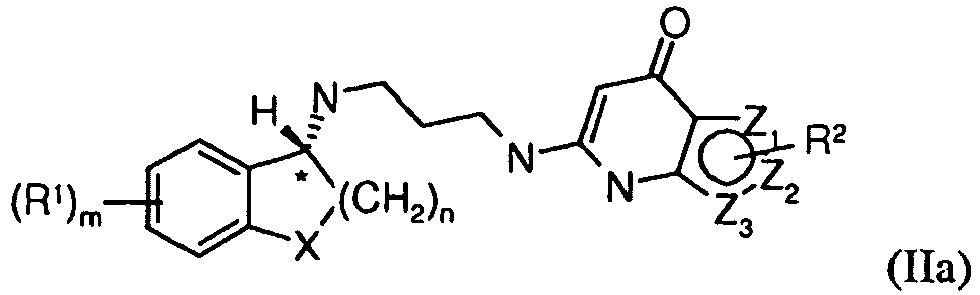
- X is selected from the group consisting of NH, O, S, SO, SO2, or CH2;
- n is 1, 2 or 3;
- * indicates an asymmetric carbon atom, wherein when n is 2 or 3, then * is R configuration; wherein when n is 1 and X is CH2, then * is R configuration; and wherein when n is 1 and X is selected from the group consisting of NH, O, S, SO, or SO2, then * is S configuration;
- R1 is independently selected from halo, cyano, hydroxyl, (C1-6)alkyl (optionally substituted by halo, hydroxyl, amino, carboxy, or (C1-6)alkoxycarbonyl), (C3-7)cycloalkyl, C(1-6)alkoxy, amino, mono- or di-(C1-6)alkylamino, acylamino, carboxy, (C1-6)alkoxycarbonyl, carboxy(C1-6)alkyloxy, (C1-6)alkylthio, (C1-6)alkylsulphinyl, (C1-6)alkylsulphonyl, sulphamoyl, mono- and di-(C1-6)alkylsulphamoyl, carbamoyl, mono- and di-(C1-6)alkylcarbamoyl and heterocyclic;
- m is 0, 1, 2, 3 or 4;
- R2 is independently selected from halo, cyano, hydroxyl, (C1-6)alkyl (optionally substituted by halo, hydroxyl, amino, carboxy, or (C1-6)alkoxycarbonyl), (C3-7)cycloalkyl, C(1-6)alkoxy, amino, mono- or di-(C1-6)alkylamino, acylamino, carboxy, (C1-6)alkoxycarbonyl, carboxy(C1-6)alkyloxy, (C1-6)alkylthio, (C1-6)alkylsulphinyl, (C1-6)alkylsulphonyl, sulphamoyl, mono- and di-(C1-6)alkylsulphamoyl, carbamoyl, mono- and di-(C1-6)alkylcarbamoyl and heterocyclic; and
- when Z1 is S, Z2 and Z3 are CH; when Z2 is S, Z1 and Z3 are CH; and when Z3 is S, Z1 and Z2 are CH.
- Compounds of formula (IIa) and (IIb) are chiral non-racemic and are isolable in high enantiomeric excess in either their R or S configurations. Compounds of formula (II) comprise compounds of the formula which have at least 60% enantiomeric excess of the R-enantiomer or S-enantiomer, and can be enantiomerically pure, where substantially 100% of the compound is a single enantiomer (as measured by optical rotation, chiral HPLC, or as measured on a weight/weight basis). Preferred enantiomer compounds have either an R configuration or an S configuration.
- A preferred group of compounds of formula (IIa) are those in which the left-hand-side (LHS) of the formula is as shown in formula (III) and the righthand-side (RHS) of the formula (or Ar) is a thienopyridone group (formula III), wherein X is defined as in Formula (IIa):
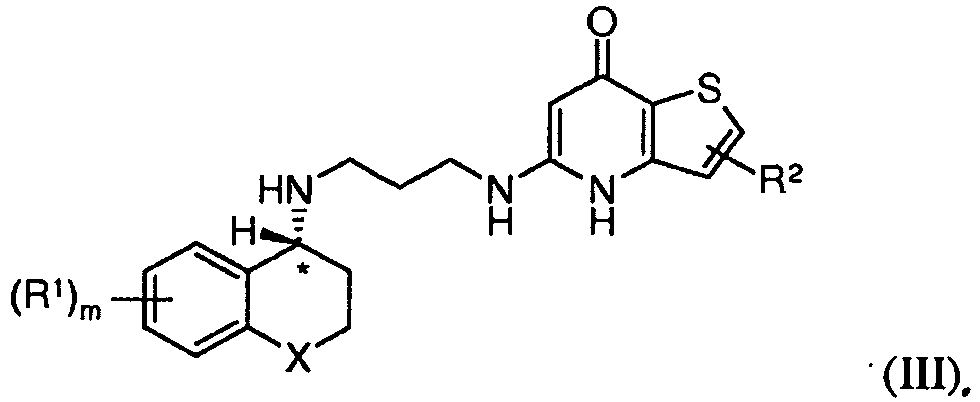
- Also described are compounds of formula (IIb) in which the LHS of the formula is as shown in Formula (IV) and the RHS of the formula is a quinolone group (formula IV):

- X is defined as in Formula (IIa) and (IIb).
- In formula (III) and formula (IV), R1 is defined as in Formula (IIa) and (IIb). (R1)m can be further defined as a 6, 8 substitution on the ring where they can be the same or different substituents, and preferably bromine, chlorine, iodine or sulfane;
- m is defined as in Formula (IIa) and (IIb);
- R2 is defined as in Formula (IIa) and (IIb); and
- p is defined as in Formula (IIa) and (IIb).
- As above, formulas (III) and (IV) are characterized by an asymmetric carbon atom marked with an asterisk (*). The bonds surrounding this carbon give rise to an R configuration in compounds of formula (III) or (IV). Compounds of formula (III) or (IV) are typically chiral non-racemic and are isolable in high enantiomeric excess of the R enantiomer. The compounds of either formula (III) or (IV) comprise compounds of the respective formula which have at least 60% R enantiomer and can be enantiomerically pure in which substantially 100% of the compound is in the R configuration (as measured by optical rotation, chiral HPLC, or weight). Preferred compounds having formula (III) or (IV) are in the R configuration.
- Another preferred group of compounds of formula (IIa) are those in which the LHS of the formula is a dihydrobenzofuran group and the RHS of the formula is a thienopyridone group (formula V):

- R1 is defined as in formula (IIa). In more preferred embodiments, (R1)m can be further defined as a 5, 7 substitution on the ring where they can be the same or different substituents, and preferably bromine, chlorine, iodine or sulfane;
- m is defined as in Formula (IIa);
- R2 is defined as in Formula (IIa);
- As above, formula (V) is characterized by an asymmetric carbon atom marked with an asterisk (*). The bonds surrounding this carbon give rise to an S configuration. Compounds of formula (V) are typically chiral non-racemic and are isolable in high enantiomeric excess in the S enantiomer. In some embodiments, the compounds of formula (V) have at least 60% S enantiomer and can be enantiomerically pure in which substantially 100% of the compound is in the S configuration (as measured by optical rotation or weight). In preferred embodiments the compounds having formula (V) are in the S configuration.
- Described herein are compounds of examples 1-12. In particular, preferred compounds of the invention include the compounds of formulas (IV), (VII), (VIII), (IX), and (XI) (shown below and see Table 1):
- 5-[3-((R)(-)-5,7-Dibromo-1,2,3,4-tetrahydro-naphthalen-1-ylamino)-propylamino]-4H-thieno[3,2-6b]pyridine-7-one (formula VI);
- 5-[3-((R)(+)-8-Bromo-6-chloro-chroman-4-ylamino)-propylamino]-4H-thieno[3,2-b]pyridine-7-one (formula VII);
- 5-[3-((R)(+)-6,8-Dibromo-1,2,3,4-tetrahydro-quinolin-4-ylamino)-propylamino]-4H-thieno[3,2-b]pyridine-7-one (formula VIII);
- 5-[3-((R)(+)-6,8-Dibromo-chroman-4-ylamino)-propylamino]-4H-thieno[3,2-b]pyridine-7-one (formula IX);
- 5-[3-((S)-5,7-Dibromo-2,3-dihydrobenzofuran-3ylamino)-propylamino]-4H-thieno[3,2-b]pyridine-7-one (formula XI).
- Also described herein is compound 2-[3-((R)(+)-6,8-Dibromo-chroman-4-ylamino)propylamino]-1H-quinolin-4-one (Formula X).
- Table 1 provides a summary of the compounds described herein, showing LHS (left hand side) and RHS (right hand side) functionality; compounds of formula (IIa), formula (III) and formula (V) are compounds of the invention as claimed:
FORM NO. / EX. NO. STRUCTURE LHS RHS 
(substituted or unsubstituted) (substituted or unsubstituted) (I) 
See structure Aryl or heteroaryl (IIa) 
Chroman, Tetrahydroquinoline, Dihydrobenzofuran, Tetrahydronaphthalene, or Benzothiopyran Thienopyridone (IIb) 
Chroman, Tetrahydroquinoline, Dihydrobenzofuran, Tetrahydronaphthalene, or Benzothiopyran Quinolone (III) 
Chroman, Tetrahydroquinoline, Benzothiopyran, or Tetrahydronaphthalene Thienopyridone (IV) 
Chroman, Tetrahydroquinoline, Benzothiopyran, or Tetrahydronaphthalene Quinolone (V) 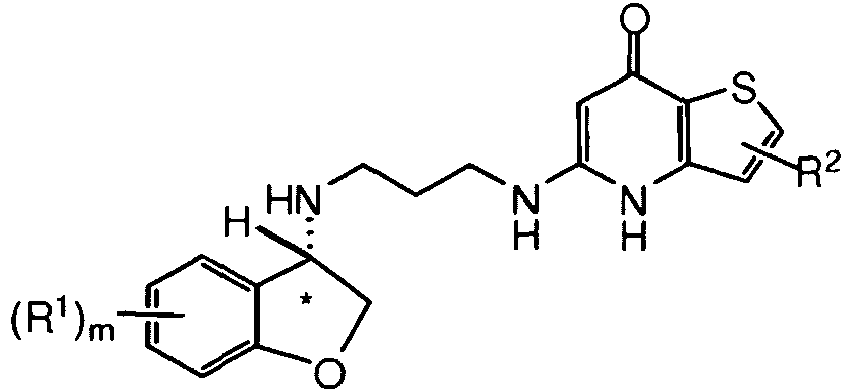
Dihydrobenzofuran Thienopyridone (VI) [Ex. 10] 
5-[3-((R)(-)-5,7-Dibromo-1,2,3,4-tetrahydro-naphthalen-1-ylamino)-propylamino]-4H-thieno[3,2-b]pyridine-7-one (VII) [Ex. 4] 
5-[3-((R)(+)-8-Bromo-6-chloro-chroman-4-ylamino)-propylamino]-4H-thieno[3,2-b]pyridine-7-one (VIII) [Ex. 8] 
5-[3-((R)(+)-6,8-Dibromo-1,2,3,4-tetrahydro-quinolin-4-ylamino)-propylamino]-4H-thieno[3,2-b]pyridine-7-one (IX) [Ex. 2] 
5-[3-((R)(+)-6,8-Dibromo-chroman-4-ylamino)-propylamino]-4H-thieno[3,2-b]pyridine-7-one (X) [Ex. 6] 
2-[3-((R)(+)-6,8-Dibromo-chroman-4-ylamino)-propylamino]-1H-quinolin-4-one (XI) [Ex. 11] 
5-[3-((S)-5,7-Dibromo-2,3-dihydrobenzofuran-3-ylamino)-propylamino]-4H-thieno[3,2-b]pyridine-7-one - Salts may be formed from inorganic and organic acids. Representative examples of suitable inorganic and organic acids from which pharmaceutically acceptable salts of compounds of formulas (I-XI) may be formed include maleic, fumaric, benzoic, ascorbic, pamoic, succinic, bismethylene-salicylic, methanesulfonic, ethanedisulfonic, acetic, propionic, tartaric, salicylic, citric, gluconic, aspartic, stearic, palmitic, itaconic, glycolic, p-aminobenzoic, glutamic, benzenesulfonic, hydrochloric, hydrobromic, sulfuric, cyclohexylsulfamic, phosphoric and nitric acids.
- When used herein, the term "alkyl" and similar terms such as "alkoxy" to include all straight chain and branched isomers. Representative examples thereof include methyl, ethyl, n-propyl, iso-propyl, n-butyl, sec-butyl, iso-butyl, t-butyl, n-pentyl and n-hexyl.
- When used herein, the terms "alkenyl" and "alkynyl" include all straight chain and branched isomers. Representative examples thereof include vinyl, ethynyl and 1-propynyl.
- Preferred substituents for alkyl and alkenyl groups include, for example, and unless otherwise defined, halogen, cyano, azido, nitro, carboxy, (C1-6)alkoxycarbonyl, carbamoyl, mono- or di-(C 1-6)alkylcarbamoyl, sulpho, sulphamoyl, mono- or di-(C1-6)alkylsulphamoyl, amino, mono- or di-(C1-6)alkylamino, acylamino, ureido, (C 1-6)alkoxycarbonylamino, 2,2,2-trichloroethoxycarbonylamino, aryl, heterocyclic, hydroxy, (C1-6)alkoxy, acyloxy, oxo, acyl, 2-thienoyl, (C1-6)alkylthio, (C1-6)alkylsulphinyl, (C1-6)alkylsulphonyl, hydroxyimino, (C1-6)alkoxyimino, hydrazino, hydrazono, benzohydroximoyl, guanidino, amidino and iminoalkylamino.
- When used herein, the term "aryl" includes, unless otherwise defined, phenyl or naphthyl optionally substituted with up to five, preferably up to three, substituents.
- When substituted, an aryl group may have up to four substituents. Preferred substituents for an aryl group include, for example, and unless otherwise defined, halogen, cyano, (C1-6)alkyl, mono to perfluoro(C1-3)alkyl, (C3-7)cycloalkyl, (C2-6)alkenyl, (C1-6)alkoxy, (C2-6)alkenoxy, arylC(1-6)alkoxy, halo(C1-6)alkyl, hydroxy, amino, mono- or di-(C 1-6)alkylamino, acylamino, nitro, carboxy, (C1-6)alkoxycarbonyl, (C1-6)alkenyloxycarbonyl, (C1-6)alkoxycarbonyl(C1-6)alkyl, carboxy(C 1-6)alkyl, (C1-6)alkylcarbonyloxy, carboxy(C 1-6)alkyloxy, (C1-6)alkoxycarbonyl(C 1-6)alkoxy, (C1-6)alkylthio, (C1-6)alkylsulphinyl, (C1-6)alkylsulphonyl, sulphamoyl, mono- and di-(C1-6)-alkylsulphamoyl, carbamoyl, mono- and di-(C1-6)alkylcarbamoyl, and heterocyclic.
- When used herein, the term "heteroaryl" includes single or fused rings comprising up to four hetero-atoms in the ring selected from oxygen, nitrogen and sulphur. Preferably the heteroaryl ring comprises from 4 to 7, preferably 5 to 6, ring atoms. A fused heteroaryl ring system may include carbocyclic rings and need only include one heterocyclic ring.
- When used herein, the term "heterocyclic" includes aromatic and non-aromatic single or fused rings comprising up to four hetero-atoms in the ring selected from oxygen, nitrogen and sulphur. Suitably the heterocyclic ring comprises from 4 to 7, preferably 5 to 6, ring atoms. A fused heterocyclic ring system may include carbocyclic rings and need only include one heterocyclic ring.
- When substituted, a heteroaryl or a heterocyclic group may have up to three substituents. Preferred substituents include those previously mentioned for an aryl group as well as oxo.
- When used herein, the terms "halogen" and "halo" include fluorine, chlorine, bromine, and iodine and fluoro, chloro, bromo, and iodo, respectively.
- When used herein, the term "enantiomer" refers to one of two compounds that differ in handedness and are said to have an enantiomeric relationship. In order to convert one enantiomer to the other requires breaking and reforming bonds or distorting the molecule through planar geometry. An enantiomer is said to be in enantiomeric excess when one configuration of the enantiomer is present in excess over the other enantiomer configuration. Enantiomeric excess can be measured on the basis of weight/weight or by the net optical rotation of the mixture.
- When used herein, the terms "(R)" or "R" and "(S)" or "S" is based on naming conventions well known to one of skill within the art, for example, an R-configuration is based on a compound's actual geometry, typically using the Cahn-Ingold-Prelog priority rules to classify the form (Smith M.B., March, J, March's Advanced Organic Chemistry, 5th ed. Wiley-Interscience, NY, 2001, p139-141). As has been described herein above, compounds of the invention have been characterized as having R configuration or an S configuration.
- The compounds according to the invention are suitably provided in substantially pure form, for example at least 50% pure, suitably at least 60% pure, advantageously at least 75% pure, preferably at least 85% pure, more preferably at least 95% pure, especially at least 98% pure, all percentages being calculated as weight/weight. All impure or less pure forms of a compound according to the invention may, for example, be used in the preparation of a more pure form of the same compound or of a related compound (for example a corresponding derivative) suitable for pharmaceutical use.
- The compounds of formulas (I)-(XI) may be prepared by methods described herein or by methods described in the prior art that are detailed below.
- In one embodiment, an enantiomerically enriched compound of the present invention may be prepared by chiral separation as depicted in process I.

- The desired compounds were prepared as racemic mixtures according to methods described in
U.S. Patent Application Serial Number 11/853,314 - In one embodiment, an enantiomerically enriched compound of the present invention may be prepared via catalytic asymmetric synthesis as depicted in process II.

- The desired compounds were prepared as enantiomerically enriched forms via a catalytic asymmetric transfer hydrogenation of a ketone to an alcohol followed by conversion to the amine via an intermediate azide. Reductive amination and removal of protecting group gave the final compounds.
- The compounds of this invention are active against a range of important pathogenic bacteria, including Gram positive organisms, such as Staphylococci, for instance S. aureus Oxford and coagulase negative strains of Staphylococci such as S. epidermidis; Streptococci, for instance S. pyogenes ATCC19615 and S. pneumoniae R6; Clostridium, for instance C. difficile, and Enterococci, for instance E. faecalis 1 and E. faecium. Preferably, compounds of this invention are also active against Gram negative organisms, such as Haemophilus, for instance H. influenzae Q1; Moraxella, for instance M. catarrhalis 1502; Helicobacter, for instance H. pylori ATCC700824; and Escherichia, for instance E. Coli DC0. The most preferred compounds of the present invention will be active against the organisms C. difficile, S. aureus, S. pneumoniae, E. faecalis, E. faecium, H. influenzae, H. pylori, and M. catarrhalis.
- In addition, compounds of this invention are active against Staphylococci organisms such as S. aureus and coagulase negative strains of Staphylocci such as S. epidermidis which are resistant (including multiply-resistant) to other antibacterial agents, for instance, β-lactam antibiotics such as, for example, methicillin, macrolides, aminoglycosides, oxazolidinones, and lincosamides.
- Compounds of the present invention are also active against strains of E. faecalis including vancomycin resistant strains and therefore of use in treating infections associated with VRE organisms. Furthermore, compounds of the present invention are useful in the treatment of Staphylococci organisms which are resistant to mupirocin.
- Compounds of the present invention are particularly potent, i.e., activity, against Clostridium including Clostridium difficile. Therefore, compounds of the invention can be used to treat infections associated with C. difficile, e.g., pseudomembraneous colitis, toxic megacolin, and other antibiotic associated diarrheas (AAD).
- Compounds of the present invention are not, however, active against mammalian cells. This provides an optimal combination of high activity against pathogenic bacteria and low or no activity against mammalian cells, allowing for the use of these compounds in mammalian treatments.
- Bacterial infections which may be treated include gastrointestinal tract infections, respiratory tract infections, otitis media, meningitis, endocarditis, skin and soft tissue infections in man, mastitis in cattle, and also respiratory infections in farm animals such as pigs and cattle.
- Accordingly, in a further aspect, the present invention provides Compounds of Formula (IIa),(III) and (V), as hereinbefore defined for use in treating bacterial infection in human or non-human animals, in need of such therapy. Compounds of the invention can be combined with other known antibacterial agents or can be combined together. It will be appreciated that a compound of the present invention which has a broad spectrum of antibacterial activity, including activity against both Gram positive and Gram negative bacteria will be of general use in the community for the empiric treatment of community acquired infections. In comparison, a compound of the present invention with a more limited spectrum, for instance activity against Gram positive bacteria, is more likely to be used in circumstances where the causative pathogenic organism has been identified.
- The present invention provides a pharmaceutical composition comprising a compound of formula (IIa),(III) or (V) together with a pharmaceutically acceptable carrier or excipient.
- Disclosed herein and/or claimed are pharmaceutical compositions comprising combinations of compounds of formula (I)-(XI) together with a pharmaceutically acceptable carrier or excipient. For example, a pharmaceutical composition of the invention can include a compound of formula (VII) and a compound of formula (IX) in combination with the carrier or excipient.
- Compounds of formula (IIa), (III) and (V) are provided for use in treating bacterial infections in mammals, especially in humans and in domesticated animals. The bacterial infection may be a Clostridium based infection and often is a Clostridium difficile infection.
- The invention further provides the use of a compound of formula (IIa), (III) or (V) in the preparation of a medicament composition for use in the treatment of bacterial infections.
- The compounds and compositions according to the invention may be formulated for administration in any convenient way for use in human or veterinary medicine, by analogy with other antibiotics.
- The compounds and compositions according to the invention may be formulated for administration by any route, for example oral, topical, parenteral, or rectal. The compositions may, for example, be made up in the form of tablets, capsules, powders, granules, lozenges, creams, suppositories, ointments, gels, lotions, syrups, or liquid preparations, for example solutions or suspensions, which may be formulated for oral use or in sterile form for parenteral administration by injection or infusion.
- Tablets and capsules for oral administration may be in unit dosage form, and may contain conventional excipients including, for example, binding agents, for example, syrup, acacia, gelatin, sorbitol, tragacanth, or polyvinylpyrrollidone; fillers, for example lactose, sucrose, maize-starch, calcium phosphate, sorbitol or glycine; tabletting lubricants, for example magnesium stearate, talc, polyethylene glycol or silica; disintegrants, for example potato starch; pharmaceutically acceptable wetting agents, for example sodium lauryl sulphate. The tablets may be coated according to methods well known in normal pharmaceutical practice.
- Oral liquid preparations may be in the form of, for example, aqueous or oily suspensions, solutions, emulsions, syrups or elixirs, or may be presented as a dry product for reconstitution with water or another suitable vehicle before use. Such liquid preparations may contain conventional additives, including, for example, suspending agents, for example sorbitol, methyl cellulose, glucose syrup, gelatin, hydroxyethyl cellulose, carboxymethyl cellulose, aluminium stearate gel or hydrogenated edible fats; emulsifying agents, for example lecithin, sorbitan monooleate or acacia; non-aqueous vehicles (which may include edible oils), for example almond oil, oily esters (for example glycerine), propylene glycol, or ethyl alcohol; preservatives, for example methyl or propyl p-hydroxybenzoate or sorbic acid; and, if desired, conventional flavouring and colour agents.
- Compositions according to the invention intended for topical administration may, for example, be in the form of ointments, creams, lotions, eye ointments, eye drops, ear drops, impregnated dressings, and aerosols, and may contain appropriate conventional additives, including, for example, preservatives, solvents to assist drug penetration, and emollients in ointments, gels, and creams. Such topical formulations may also contain compatible conventional carriers, for example cream or ointment bases, and ethanol or oleyl alcohol for lotions. Such carriers may constitute from about 1% to about 98% by weight of the formulation; more usually they will constitute up to about 80% by weight of the formulation.
- Compositions according to the invention may be formulated as suppositories, which may contain conventional suppository bases, for example cocoa-butter or other glycerides.
- Compositions according to the invention intended for parenteral administration may conveniently be in fluid unit dosage forms, which may be prepared utilizing the compound and a sterile vehicle, water being preferred. The compound, depending on the vehicle and concentration used, may be either suspended or dissolved in the vehicle. In preparing solutions, the compound may be dissolved in water for injection and filter-sterilized before being filled into a suitable vial or ampoule, which is then sealed. Advantageously, conventional additives including, for example, local anesthetics, preservatives, and buffering agents can be dissolved in the vehicle. In order to enhance the stability of the solution, the composition may be frozen after being filled into the vial, and the water removed under vacuum; the resulting dry lyophilized powder may then be sealed in the vial and a accompanying vial of water for injection may be supplied to reconstitute the liquid prior to use. Parenteral suspensions may be prepared in substantially the same manner except that the compound is suspended in the vehicle instead of being dissolved and sterilization cannot be accomplished by filtration. The compound may instead be sterilized by exposure to ethylene oxide before being suspended in the sterile vehicle. Advantageously, a surfactant or wetting agent is included in such suspensions in order to facilitate uniform distribution of the compound.
- A compound or composition according to the invention may suitably be administered to the patient in an antibacterially effective amount. In some cases the compounds and compositions according to the invention are administered in an amount effective to treat a patient with a Clostridium infection and in particular a Clostridium dificile infection.
- A composition according to the invention may suitably contain from 0.1% by weight, preferably from 10 to 60% by weight, of a compound according to the invention (based on the total weight of the composition), depending on the method of administration.
- The compounds according to the invention may suitably be administered to the patient at a daily dosage of from 1.0 to 100 mg/kg of body weight. For an adult human (of approximately 70 kg body weight), from 50 to 3000 mg, for example about 1500 mg, of a compound according to the invention may be administered daily. Suitably, the dosage for adult humans is from 5 to 40 mg/kg per day. Higher or lower dosages may, however, be used in accordance with normal clinical practice.
- When the compositions according to the invention are presented in unit dosage form, each unit dose may suitably comprise from 25 to 1000 mg, preferable from 50 to 500 mg, of a compound according to the invention.
- The following examples are provided for illustrative purposes only and are not intended to limit the scope of the invention.
- The following examples and experiments describe the manner and process of making and using compounds of the present invention and related compounds, and are illustrative rather than limiting. The compounds of the present invention, salts thereof, and their intermediates can be prepared or manufactured as described herein or by various processes known to be present in the chemical art.
-

-

- The 5-[3-(6,8-Dibromo-chroman-4-ylamino)-propylamino]-4H-thieno[3,2-b]pyridin-7-one was prepared as a-racemic mixture according to methods described in
U.S. Patent Application Serial Number 11/853,314 - Racemic mixtures described above were separated into the single enantiomers by preparative chiral chromatography (prep-HPLC). For (6,8-Dibromo-chroman-4-yl)-[3-(7-oxo-4,7-dihydro-thieno[3,2-b]pyridin-5-ylamino)-propyl]-carbamic acid tert-butyl ester, 300 mg batches of the first (R-(+)-enantiomer (formula IX)) and second (S-(-)-enantiomer) eluting enantiomer were isolated, both with e.e. >99%.
-
Column : Chiralpak AD; 250x20 mm; Diacel Chemical Industries LTD Eluent : Heptane/EtOH (90/10) Flow : 6.0 ml/min UV : 256 nm Sample : 50 mg/ml Injection volume : 500 µl Retention Time : R-(+)-enantiomer, ∼ 37 min. S-(-)-enantiomer, ∼ 47 min. - =
Column : Chiralcel OD-H; 150x4.6 mm; Diacel Chemical Industries LTD Eluent : Heptane/IPA (90/10) Flow : 0.5 ml/min UV : 256, 328 nm Sample : ∼1 mg/ml Injection volume : 20 µl Retention Time : R-(+)-enantiomer, ∼ 41 min. S-(-)-enantiomer, ∼ 46 min. - Racemic mixtures of tert-butyl 6,8-dibromo-1,2,3,4-tetrahydroquinolin-4-yl(3-(7-oxo-4,7-dihydrothieno[3,2-b]pyridin-5-ylamino)propyl)carbamate prepared similarly as in method A were separated into single enantiomers by preparative chiral chromatography (prep-HPLC). A 113 mg batch of the first eluting enantiomer (formula VIII, R-(+)-enantiomer, e.e. >99%) and a 70 mg batch of the second eluting enantiomer (S-(-)-enantiomer, e.e. 85%) were isolated. Further purification of this second eluting enantiomer by a second preparative run afforded 5.5 mg of this enantiomer with e.e. >99%.
-
Column : Chiralcel OD-H; 250x20 mm; Diacel Chemical Industries LTD Eluent : Heptane/EtOH/Et2NH (95/5/0.2 %) Flow : 10 ml/min UV : 256, 328 nm Sample : 85 mg/ml Injection volume : 80 µl -
Column : Chiralcel OD-H; 150x4.6 mm; Diacel Chemical Industries LTD Eluent : Heptane/IPA (90/10) Flow : 0.5 ml/min UV : 256, 328 nm Sample : ∼1 mg/ml Injection volume 20 µl Retention Time : R-(+)enantiomer, ∼ 41 min. S-(-)enantiomer, ∼ 46 min. - The ((R)(+)-6,8-Dibromo-chroman-4-yl)-[3-(7-oxo-4,7-dihydro-thieno[3,2-b]pyridin-5-ylamino)-propyl]-carbamic acid tert-butyl ester was taken up in 4.0M HCl in dioxane and allowed to stir overnight, during which the product oiled out of solution. About half of the dioxane was removed via evaporation and the remaining was stirred for several hours. Product precipitated out of solution as an off-white solid (this solid was isolated by vacuum filtration and dried under vacuum to give the title compound as an off-white solid).
- The ((R)(+)-6, 8-Dibromo-1,2,3,4-tetrahydro-quinolin-4-yl)-[3-(7-oxo-4,7-dihydro-thieno[3,2-b]pyridin-5-ylamino)-propyl]-carbamic acid tert-butyl ester was treated with HCl (4.0M solution prepared with concentrated HCl in THF). This was allowed to stir oversight. The solvent was removed via evaporation and the resulting white solid was stirred with ether. The solid was isolated by vacuum filtration. Solid was isolated and dried under vacuum to give title compound as a white solid (this solid was isolated by vacuum filtration and dried under vacuum to give the title compound as an off-white solid).
-

- 3-Thiophene isothiocyanate (472.5 g, 3.34 mol) was mixed with 2,2-dimethyl-1,3-dioxane-4,6-dione (433.2 g, 3.006 mol) in dimethylsulfoxide (1.9 L). Triethylamine (516 mL, 3.67 mol) was added dropwise over 130 min. while maintaining the reaction temperature below 20 °C. After the addition, the resultant mixture was stirred at room temperature for 16 h. Iodomethane (426.7 g, 3.006 mol) was added slowly over 70 min while the reaction temperature was maintained below 20 °C. After complete addition, the mixture was stirred at room temperature for 1 h. A dilute aqueous hydrochloric acid solution (4.8 L of water containing 46 mL of 37% HCl) was slowly added to precipitate the product while the temperature was kept below 30 °C. The mixture was stirred for 2h. The solids were filtered and rinsed with water. The resultant wet solids were suspended in EtOH (6 L) and then the solvents were removed under reduced pressure. The resultant slurry was dissolved in boiling methanol (4.0 L) and treated with decolorizing charcoal (Norit brand, 130 g) and maintained at reflux for 40 min. The hot solution was filtered through a pad of Celite 543 and the filter cake rinsed with boiling methanol (1 L). The filtrate was allowed to stand at room temperature for 24 h. The solids were filtered and dried to afford 408.4 g (45%) of light brown crystals of the intermediate 2,2-Dimethyl-5-(methylsulfanyl-thiophene-3-ylamino-methylene)-[1,3]dioxane-4,6-dione. 1H NMR (400 MHz, CDCl3) δ 1.76 (s, 6H), 2.38 (s, 3H), 7.09 (d, 1H J = 5 Hz), 7.25 (d, 1H, J = 3.2 Hz), 7.38 (dd, 1H, J = 3.2, 5 Hz), 12.7 (br s, 1H).
- 3,3-Diethoxypropylamine (210.7 g, 1.43 mol) was added in portions to the solution of 2,2-dimethyl-5-(methylsulfanyl-thiophene-3-ylamino-methylene)-[1,3]dioxane-4,6-dione (407.3 g, 1.36 mol) in dichloromethane (1.7 L) and methanol (0.36 L) over 60 min, while the reaction temperature was kept under 25 °C with a water bath. After stirring for 1.5 h at room temperature, the reaction mixture was diluted with dichloromethane (0.8 L). The organic layer was separated and washed with aqueous ammonium chloride solution (400 mL, made of 200 mL of sat. NH4Cl and 200 mL of water), brine (300 mL) and dried over magnesium sulfate. Concentration of the reaction mixture under reduced pressure afforded a dark oil. Xylenes (500 ml) were added and the mixture concentrated under reduced pressure to give the intermediate 5-((3,3-Diethoxypropylamino)(thiophene-3-ylamino)methylene)-2,2-dimethyl-1,3-dioxane-4,6-dione. The resultant dark oil was used directly in next step without further purification. 1H NMR (400 MHz, CDCl3) δ 1.65 (m, 6H), 1.73 (s, 6H), 1.78 (m, 2H), 2.98 (q, 2H, J = 6.4 Hz), 3.45 (m, 2H), 3.60 (m, 2H), 4.50 (t, 1H, J = 5.2 Hz), 6.98 (dd, 1H, J = 1.6, 5.2 Hz), 7.05 (dd, 1H, J = 1.2, 3.2 Hz), 7.33 (dd, 1H, J = 3.2, 5.2 Hz), 10.2 (s, 1H), 11.3 (s, 1H).
- 5-((3,3-Diethoxypropylamino)(thiophene-3-ylamino)methylene)-2,2-dimethyl-1,3-dioxane-4,6-dione (1.62 mol) was suspended in a solution of hexamethyldisilazane (1.08 L, 5.18 mol) in xylenes (2.4 L) and was heated at reflux for 24 h. After cooling to room temperature, the mixture was concentrated under reduced pressure to afford a dark oil. The dark oil was carefully treated with methanol (0.5 L) to form brown solids, followed by addition of ethyl ether (1.6 L). The resultant solids were filtered and washed with MeOH/Ether (1:3) (0.8 L). The solids were dried under vacuum to afford 432.2 g (78 %) of the desired intermediate 5-(3,3-Diethoxypropylamino)-7-oxo-4,7-dihydrothieno[3,2-b]pyridine-6-carboxylic acid as a beige solid. 1H NMR (400 MHz, DMSO d6) δ 1.09 (m, 6H), 1.91 (m, 2H), 3.40 (m, 2H), 3.58 (m, 2H), 4.06 (s, 1H), 4.60 (t, 1H, J = 5.2 Hz), 7.28 (d, 1H, J = 4.8 Hz), 8.05 (d, 1H, J = 4.8 Hz), 9.94 (m, 1H), 11.8 (s, 1H).
- 5-(3,3-Diethoxypropylamino)-7-oxo-4,7-dihydrothieno[3,2-b]pyridine-6-carboxylic acid (432 g, 1.27 mol) was mixed with sodium methoxide (95% pure, 75.8 g, 1.33 mol) and suspended in xylenes (2 L). The resultant mixture was heated at reflux for 2 h. The reaction mixture was gradually cooled to room temperature with stirring to afford light brown solids. The solids were collected by filtration and washed with toluene and dried under vacuum at 50-60 °C for 48 h to give the desired intermediate sodium 5-(3,3-diethoxypropylamino) thieno[3,2-b]pyridin-7-olate (a solid). This crude product was used in the next step without further purification. 1H NMR (400 MHz, DMSO d6) δ 1.08 (m, 6H), 1.72 (q, 2H, J = 6.8 Hz), 3.15 (m, 2H), 4.55 (t, 1H, J = 6 Hz), 6.22 (s, 1H), 6.98 (d, 1H, J = 5.2 Hz), 7.53 (d, 1H, J = 5.2 Hz).
- Sodium 5-(3,3-diethoxypropylamino) thieno[3,2-b]pyridin-7-olate (445.7 g, 1.40 mol) was suspended in DMSO (2.8 L). Benzoic anhydride (332.9 g, 1.47 mol) was added in portions at room temperature. After the addition, the reaction mixture was stirred for 3 h at room temperature. The mixture was diluted with ethyl acetate (6 L). The resultant organic solution was washed with water (6 L). The separated aqueous layer was extracted with ethyl acetate (2 L). The combined organic layers were dried over magnesium sulfate and filtered. Removal of solvent under reduced pressure and drying under vacuum afforded the desired intermediate 5-(3,3-Diethoxypropylamino) thieno[3,2-b]pyridin-7-yl benzoate as a dark oil. This product was used in the next step without further purification. 1H NMR (400 MHz, CDCl3) δ 1.09 (m, 6H), 1.99 (m, 2H), 3.50 (m, 4H), 3.70 (m, 2H), 4.60 (t, 1H, J = 5.6 Hz), 7.30 (d, 1H, J = 4.8 Hz), 7.55 (m, 3H), 7.67 (d, 1H, J = 4.8 Hz), 8.24 (m, 2H).
- The crude 5-(3,3-diethoxypropylamino) thieno[3,2-b]pyridin-7-yl benzoate from above (677.3 g, 1.68 mol) was dissolved in 3.0 L of THF. Then, 12N HCl (1.68 mol, 0.14 L) was added dropwise while the reaction temperature was maintained below 20 °C with an ice-water bath. After stirring for 5 minutes, solids precipitated. The resultant mixture was stirred at room temperature for 1h, followed by the addition of ethyl acetate (2.0 L). The mixture was stirred for 30 min. The solids were filtered, rinsed with ethyl acetate (250 ml X 2), and then dried under reduced pressure at 55 °C to give the title compound 5-(3-oxopropylamino) thieno[3,2-b]pyridin-7-yl benzoate HCl salt as a light brown solid. 1H NMR (400 MHz, DMSO d6) δ 2.20 (m, 2H), 3.56(m, 2H), 6.31 (t, 1H, J = 3.6 NHz), 7.83-7.87 (m, 2H), 7.96 (d, 1H, J = 6.0 Hz), 8.16-8.20 (m, 2H), 8.35 (d, 1H, J = 5.6 Hz), 10.20 (s, 1H).
- To a mixture containing 6,8-dibromochroman-4-one in acetonitrile (0.3M) and 5/2 formic acid/triethylamine (30% by volume) was added (1S,2S)-(+)-N-p-tosyl-1,2-diphenylehtylene diamine (1 mol%) and dichloro(p-cymene)-ruthenium (II) dimer (0.5 mol%). After stirring for 24h, the reaction was diluted with ethylacetate and washed with brine/sodium bicarbonate (1:1). The organic phase was concentrated under reduced pressure to afford the title compound as a tan solid.
1H NMR (400 MHz, CDCl3) δ 7.59 (d,1H), 7.41 (d, 1H), 4.78 (ABq, 1H), 4.38 (m, 2H), 2,08 (m, 2H), 1.91 (d, 1H). - A solution containing 6,8-dibromo-chroman-4(S)-ol in tetrahydrofuran (0.17M) and 1.2 equivalents of diphenylphosphorylazide was stirred for 15 minutes at room temperature. The solution was cooled to 10°C and 2.5 equivalents of 1,8-diazabicyclo[5.4.0]undec-7-ene added. The mixture was stirred with gradual warming to room temperature and maintained for 48h. The mixture was diluted with ethylacetate and washed with brine followed by water. The organic phase was concentrated to afford the title compound as a tan oil.
1H NMR (400 MHz, CDCl3) δ 7.65 (d, 1H), 7.32 (d, 1H), 4.57 (t, 1H), 4.43 (m, 1H), 4.31 (m, 1H), 2.18 (m, 1H), 2.08 (m, 1H). - To an ice cooled solution of 4(R)-azido-6,8-dibromo-chroman in tetrahydrofuran (0.16M) was added 1.2 equivalents of trimethylphosphine. The mixture was warmed to room temperature and maintained for 16h. Concentration of the mixture gave the crude amine. This was dissolved in acetonitrile (0.20M) and 2 equivalents of hydrochloric acid added. The mixture was stirred for 16h and the solids filtered, washed with acetonitrile and dried to afford the title compound as an off-white solid.
1H NMR (400 MHz, CD3OD) δ 7.75 (d, 1H), 7.60 (dd, 1H), 4.62 (t, 1H), 4.40 (m, 2H), 2.40 (m, 1H), 2.20 (m, 1H). - 5-(3-Oxopropylamine) thieno[3,2-b]pyridine-7-yl benzoate hydrochloride salt was mixed with 1 equivalent of 6,8-dibromo-chroman-4(R)-ylamine hydrochloride in tetrahydrofuran (0.35M) followed by the addition of 3 equivalents of triethylamine. After stirring for 1h, 1.3 equivalents of sodium triacetoxyborohydride was added and the mixture stirred for 2h. The reaction was diluted with ethylacetate and washed with aqueous sodium bicarbonate. The organic phase was dried over magnesium sulfate. Filtration, removal of solvent and purification of the crude product by column chromatography eluting with 0-10% methanol in dichloromethane gave the title compound as a brown oil.
1H NMR (400 MHz, CDCl3) δ 8.24 (m, 2H), 7.70 (m, 1H), 7.56 (m, 3H), 7.50 (d, 1H), 7.40 (d, 1H), 7.24 (d, 1H), 6.58 (m, 1H), 4.34 (m, 2H), 3.77 (t, 1H), 3.56 (m, 2H), 2.85 (m, 2H), 2.0 (m, 2H) - To a solution containing 5-[3-(6,8-dibromo-chroman-4-ylamine) propylamino]-thieno[3,2-b]pyridin-7-yl benzoate in ethylacetate (2.5M) and tetrahydrofuran (1.2M) was added 2.5 equivalents of 2M ammonia in methanol. After stirring for 24h, the mixture was diluted with ethylacetate and solids filtered, rinsed with ethylacetate and dried. Purification of the crude material by column chromatography eluting with 0-10% ammonia/methanol in dichloromethane gave the title compound as the free base. This was dissolved in absolute ethanol (0.4M) and 3 equivalents of 4N hydrochloric acid added. The mixture was heated to 75 °C and treated with decolorizing charcoal. The resultant mixture was filtered through a pad of Celite and the filter bed was rinsed with warm ethanol/ 4N hydrochloric acid. The filtrate was stirred over 16 h at room temperature until colorless solids formed. The solids were filtered, rinsed with ethanol/ 2N hydrochloric acid and dried under vacuum at 95-100 °C to yield the target compound as an off-white solid.
1H NMR (400 MHz, CD3OD): δ 8.04(d, 1H), 7.77 (s, 1H), 7.71 (s, 1H), 7.45 (d, 1H), 6.26 (s, 1H), 4.62 (br, s, 1H), 4.52-4.38 (m, 2H), 3.59 (t, 2H), 3.41 (m, 1H), 3.28 (m, 1H), 2.41 (m, 2H), 2.18 (m, 2H). - Using the synthesis reactions as described in Process I (methods A, B and D), the title compound was prepared and isolated as the first eluting enantiomer. Alternatively the title compound was prepared according to Process II (methods F-J). The title compound was isolated as an off-white solid in both instances.

- Co-crystals of 5-[3-((R)(+)6,8-Dibromo-chroman-4-ylamino)-propylamino]-4H-thieno[3,2-b]pyridin-7-one di-hydrochloride (formula IX) and Clostridium diffcile MetRS were grown. X-ray diffraction of the co-crystals provided a 1.72 Å resolution pattern. The three dimensional structure of compound IX was unambiguously assigned R absolute configuration.
- Using the synthesis reactions as described in Process 1 (methods A, B and D), the title compound was prepared and isolated as the second eluting enantiomer. Alternatively the title compound was prepared according to Process II wherein in Method F, the (1R,2R)-(-)-N-p-tosyl-1,2-diphenylehtylene diamine (1 mol%) and dichloro(p-cymene)-ruthenium (II) dimer was employed, followed by methods G-J. The title compound was isolated as an off-white solid in both instances.
 8.04 (d, 1H), 7.77 (s, 1H), 7.71 (s, 1H), 7.45 (d, 1H), 6.26 (s, 1H), 4.62 (br, t, 4.52-4.38 (m 2H), 3.59 (t, 2H), 3.41 (m, 1H), 3.27 (m, 1H), 2.41 (m, 2H), 2.17 (m, 2H). MS (ES+): M/Z 514 (M+1). Optical rotation: [α]589 = -21.70 (c=0.507 mM in MeOH, 20°C).
- Using the synthesis reactions as described in Example 1 (methods A, B and D), the title compound was prepared and isolated as the first eluting enantiomer:
 8.05 (d, 1H), 7.66 (s, 1H), 7.56 (s, 1H), 7.43 (d, 1H), 6.25 (s, 1H), 4.62 (t, 1H), 4.52-4.38 (m, 2H), 3.58 (t, 2H), 3.39 (m, 1H), 3.29 (m, 1H), 2.41 (m, 2H), 2.17 (m,2H). MS (ES+): M/Z 470 (M+1). Optical rotation: [α]589 = +36.86 (c=0.510 mM in MeOH, 20°C).
 - Using the synthesis reactions as described in Process 1 (methods A, B and D), the title compound was prepared and isolated as the second eluting enantiomer:
 8.05 (d, 1H), 7.66 (s, 1H), 7.59 (s, 1H), 7.45 (d, 1H), 6.26 (s, 1H), 4.63 (t, 1H), 4.52-4.38 (m, 2H), 3.57 (t, 2H), 3.41 (m, 1H), 3.30 (m, 1H), 2.42 (m 2H), 2.18 (m 2H). MS (ES+): M/Z 470 (M+1). Optical rotation: [α]589 = -35.24 (c=0.500 mM in MeOH, 20°C).
 - Using the synthesis reactions as described in Example 1 (methods A, B and D), the following compound was prepared and isolated as the first eluting enantiomer.
 8.10 (d, 1H), 7.90 (br, 1H), 7.78-7.75 (m, 3H), 7.48 (t, 1H), 6.38 (s, 1H), 4.65 (t, 1H). 4.48 (m, 2H), 3.70 (m, 2H), 3.44 (m, 1H), 3.31 (m, 1H), 2.48 (m, 1H), 2.40 (m, 1H), 2.23 (m, 2H). MS (ES+): M/Z 508 (M+1). Optical rotation: [α]589 = +23.22 (c=0.500 mM in MeOH, 20°C).
 - Using the synthesis reactions as described in Example 1 (methods A, B and D), the following compound was prepared and isolated as the second eluting enantiomer:
 8.10 (d, 1H), 7.90 (br, 1H), 7.78-7.75 (m, 3H), 7.48 (t, 1H), 6.38 (s, 1H), 4.65 (t, 1H), 4.48 (m, 2H), 3.70 (m, 2H), 3.44 (m, 1H), 3.31 (m, 1H), 2.48 (m, 1H), 2.40 (m, 1H), 2.23 (m, 2H). MS (ES+): M/Z 508 (M+1). Optical rotation: [α]589 = -24.51 (c=0.506 mM in MeOH, 20°C).
 - Using the synthesis reactions as described in Examples 1 (Methods A, C and E), the following compound was prepared and isolated as the first cluting enantiomer. Alternatively the title compound was prepared according to Process II (methods F-J). The title compound was isolated as an off-white solid in both instances.
 8.05 (d, 1H), 7.58 (s, 1H), 7.44 (d, 1H), 7.42 (s, 1H), 6.25 (s, 1H), 4.48 (br, s, 1H), 3.63-3.53 (m, 4H), 3.38 (m, 1H), 3.21 (m, 1H), 2.43(m, 1H), 2.14 (m, 2H), 2.07 (m, 1H). MS (ES+): M/Z 513 (M+1). Optical rotation: [α]589 =+72.26 (c=0.507 mM in MeOH, 20° C).
 - Using the synthesis reactions as described in Examples 1 (Methods A, C and E), the following compound was prepared and isolated as the second eluting enantiomer. Alternatively the title compound was prepared according to Process II wherein in Method F, the (1R,2R)-(-)-N-p-tosyl-1,2-diphenylehtylene diamine (1 mol%) and dichloro(p-cymene)-ruthenium (II) dimer was employed, followed by methods G-J. The title compound was isolated as an off-white solid in both instances.
 8.04 (d, 1H), 7.58 s, 1H), 7.43 (d, 1H), 7.42(s, 1H), 6.23 (s, 1H), 4.48 (br, s, 1H), 3.63-3.52 (m, 4H), 3.37 (m, 1H), 3.22 (m, 1H), 2.42 (m, 1H), 2.20-2.00 (m, 3H). MS (ES+): M/Z 513 (M+1).
 - The title compound was prepared according to Process II (methods F-J). The title compound was isolated as an off-white solid.
 7.68 (d, 1H), 7.59 (d, 2H), 7.00 (d,1H), 5.57 (s, 1H), 3.80 (t, 1H), 3.32 (t, 2H), 2.76 (m, 3H), 2.61 (m, 1H), 1.97 (m, 1H), 1.86 (m, 4H), 1.72 (m, 1H). MS (ES+): M/Z 512 (M+1). Optical rotation: [α]589 = -22.30 (c=0.870 mM in MeOH, 20° C).
 - The title compound was prepared according to Process II (methods F-J). The title compound was isolated as an off-white solid.

- The title compound was prepared according to Process II wherein in Method F, the (1R,2R)-(-)-N-p-tosyl-1,2-diphenylehtylene diamine (1 mol%) and dichloro(p-cymene)-ruthenium (II) dimer was employed, followed by methods G-J. The title compound was isolated as an off-white solid.

- The following example illustrates expression and purification of C. difficile MetRS useful in the functional assays shown in examples 14 and 15.
- Cloning of Over-producing Vector: N-terminally hexaHis-tagged C. difficile MetRS was amplified and cloned into pETcoco-2. The following primers were used to amplify DNA from genomic DNA: 5'-CTGCAGAGCTAGCAAACCGAGTTTTTATGTAAC-3' (forward) (SEQ ID NO:1), 5'-CTTTCTAAGCTTCTACTAACGAACCTCGGATCC-3' (reverse) (SEQ ID NO:2). Amplified DNA was treated with Sph1 and HindIII restriction endonucleases, which were heat-inactivated after digestion. The fragment was ethanol-precipitated and combined with pETcoco-2 vector (Novagen) that had been treated with the same enzymes plus shrimp alkaline phophatase. The fragments were ligated and the ligation mixture transformed into competent DH10 E. coli. Transformants were plated on F-medium plus glucose with 50 ug/ml ampicillin. Growth in glucose maintains the repressed state of the pBAD promoter driving expression of the replicator TrfA, thus maintaining low copy number. The resulting expression clone, pETcoco-Cdiff-MRS, was confirmed by sequencing of the insert in both directions.
- Purification of C. difficile MetRS. The expression vector pETcoco-Cdiff-MRS was transformed into Rosetta DE3 expression strain and used to inoculate 4 liters of F media supplemented with 10 ug/mL chloramphenicol, 50 ug/mL ampicillin, 0.2% glucose. The culture was induced with 1 mM IPTG at OD 0.66. Cells were harvested 4 hours post-induction (yield = 38 g cell pellet). Pelleted cells were lysed by adding 78 g of a 1:1 suspension of frozen cells (39 g cells) in Tris-sucrose which had been stored at -20 °C to 107.25 ml Tris-sucrose buffer that had been pre-warmed to 45 °C (2.75 ml/g of cells). To the stirred mixture, 1.95 ml of 0.5M 1,4-dithiothreitol (DTT) (0.05 ml/g of cells) and 9.75 ml of lysis buffer (2M NaCl, 0.3M spermidine in Tris-sucrose adjusted to pH 7.5) (0.25 ml/g of cells) was added. The pH of the slurry was tested with pH paper and adjusted to pH 8.0 by the addition of 50 ml of 2 M Tris base. Lysozyme (117 mg) was added in 20 ml of Tris-sucrose buffer (3 mg lysozyme/g of cells). The slurry was distributed into centrifuge bottles and incubated at 4 °C for 1 hour followed by incubation at 37 °C for 4 minutes. The insoluble cellular components were removed by centrifugation (23,000 x g, 60 min, 4 °C). The recovered supernatant (192ml) constituted Fraction I. Fraction I was loaded onto a 15 mL Ni-NTA column which was equilibrated in Load Buffer (50 mM Tris-HCl, pH 7.5, 10% glycerol, 40 mM KCl, 10 mM Imidazole, pH 6.8, and 7 mM beta mercaptoethanol). The column was washed with 10 column volumes of Wash Buffer (50 mM Tris-HCl, pH 7.5, 10% glycerol, 800 mM KCl, 20 mM Imidazole, pH 6.8, and 7 mM beta mercaptoethanol). The protein was eluted in 10 column volume gradient from Wash Buffer to Elution Buffer (50 mM Tris-HCl, pH 7.5, 10% glycerol, 40 mM KCl, 250 mM Imidazole, pH 6.8, and 7 mM beta mercaptoethanol) at 0.5 mL/min collecting 3 mL fractions. Fractions were collected and analyzed for protein by SDS-PAGE. Fractions were assayed in the C. difficile MetRS tRNA charging assay. Fractions containing peak activity were pooled to form Fraction II (60 mg at 1.3 mg/ml). Fraction II had a specific activity of 3.2 x 10⁵ units per mg. The purity was estimated at greater than 97% based on densitometry of an SDS-PAGE gel stained with Coomassie blue.
- Compounds were assayed to determine their ability to inhibit MetRS. Assays were performed as follows:
-
Stock Volume (µl) Final Concentration 100mM Tris/Cl, pH 7.9 600 30 mM 250 mM KCl 75 mM 125 mM ATP 40 2.5 mM 250 mM MgCl2 80 10 mM 50 mM DTT 80 2 mM 1 mM Met (H-3 hot and cold) 20 10 µM Solid tRNA (Mixed E. coli MRE 600) 4mg/ml 2mg/ml H2O 180 - Each reaction was started by adding 20 µl appropriately diluted pure enzyme (preincubated with inhibitor) to 25 µl reaction mix for 10 min at room temperature. The reaction is terminated by the addition of 150 µl 167 mM sodium citrate, pH 2.15 containing phosphodiesterase (PDE) SPA beads (0.833 mg/ml). The binding of the radiolabelled product to the bead brings the isotope into close enough proximity to allow radiation from the tritium to excite the scintillant within the bead. Any unbound radiolabel is not close enough to the scintillant to allow this energy transfer, so no signal is generated. Following termination of the reaction, plates are spun at 2500rpm for 5 min in a Mistral 3000E plate centrifuge (or alternatively allowed to stand for 1 hour). The assay is conducted in 96-well Optiplates (Packard). Plates are counted on a TopCount. (Packard 96 well counter).
- Mixed E. coli MRE 600 tRNA and ATP were purchased from Boehringer-Mannheim, L-[methyl-3H]methionine and phosphodiesterase scintillation proximity (SPA) beads from Amersham Pharmacia Biotech and other reagents from Sigma.
- Pure enantiomers (examples 2, 4, 6, 8, 10), all R enantiomers, and (example 11) S enantiomer, had very potent inhibition of Clostridium difficile MetRS in the range (Ki = 15-25 pM). All were highly selective with respect to the mammalian enzyme (no inhibition of rat MetRS). Racemic mixtures of these examples had approximately 50% less activity than the pure enantiomers.
- In comparison, the opposite configuration isomers (examples 3, 5, 7, 9), all S enatiomers, and (example 12) R enantiomer, had very weak inhibition of Clostridium difficile MetRS in the range (Ki = 24,000-80,000 pM). This is an unanticipated dramatic difference in activity between isomers of opposite configuration. In addition, this data indicates that the compounds of the present invention show strong selectivity toward inhibition of C. difficile MetRS, but have little or no inhibitory activity toward mammalian MetRS. MetRS inhibitors are competitive inhibitors of methionine and uncompetitive inhibitors of ATP.
- Compounds (formulas (VI) - (XI), compounds related to compounds of the invention as claimed, were also assayed for their capacity to inhibit C. difficile growth. MIC90 (minimum inhibition concentration required to inhibit the growth of 90% of C. difficile) was determined using standard agar based assays according to CLSI.
- Organisms: All compounds were tested for antibacterial activity against a collection of non-repeat clinical isolates of C. difficile. The organisms were stored frozen in Brucella broth supplemented with 20% glycerol. The organisms were retrieved from the freezer and subcultured twice onto CDC agar to ensure purity and growth. The plates were incubated under anaerobic conditions for at least 24 hours. Bacterial colonies were examined for morphology; yellow color, ground glass texture and characteristic odor. The control organism tested was Bacteroides fragilis ATCC 25285.
- Antimicrobial susceptibility testing: Antimicrobial susceptibility testing was conducted by the agar dilution method on Brucella agar supplemented with vitamin K1, hemin and 5% laked sheep blood in accordance with CLSI guidelines (CLSI, M11-A2). The test compounds were serially diluted and added to molten supplemented Brucella agar. Drug free plates were inoculated before and after inoculation of each antimicrobial plate series and were used as growth controls. Anaerobic/aerobic growth controls were conducted on drug free plates after two sets of drug plates. Bacterial colonies were suspended in Brucella broth to a turbidity equal to that of a 0.5 McFarland standard and applied to a plate with a Steers replicator that delivered 105 CFU/spot. The plates were incubated under anaerobic conditions for 24 hours at 35°C prior to the reading of the results. The minimum inhibitory concentration (MIC) was the concentration that completely inhibited growth or caused a marked reduction in the appearance of growth compared to that of the drug-free growth control.
- Results: Pure enantiomers (examples 2, 4, 6, 8, 10), all R enantiomers, and (example 11) S enantiomer, had very potent antibacterial activity against Clostridium difficile (MIC90 = 0.25 µg/ml to 4.0 µg/ml). Racemic mixtures of these examples had approximately 50% less activity than the pure enantiomers (MIC90 = 0.50 µg/ml to 8.0 µg/ml).
- In comparison, the opposite configuration isomers (examples 3, 5, 7, 9), all S enantiomers, and (example 12) R enantiomer, had very weak antibacterial activity against Clostridium difficile (MIC90 = >8.0 µg/ml to >32.0 µg/ml).
- These results indicate the potent activity of the pure enantiomeric compounds against C. difficile, typically around 0.25-1.0 µg/ml. In addition, IC50 data indicates that the compounds are specific for C. difficile MetRS, showing little or no activity against mammalian MetRS. MetRS inhibitor compounds show potent activity against C. difficile and gram positive bacteria while sparing normal gut flora.
- The data in these examples illustrate the potent and unexpected antibacterial effectiveness of the pure R enantiomers in the case of examples 2, 4, 6, 8,10 and the S enantiomer example 11 as compared to the very weak activity of their opposite configuration isomers (examples 3, 5, 7, 9,12).
- Compounds related to compounds of the present invention (examples 2, 4, 6, 8, 10, and 11) were tested for antibacterial activity against a panel of Gram-positive bacteria. Compounds were tested against Gram-positive aerobic bacteria using the CLSI-reference broth microdilution method. Data was obtained against S. aureus, E. faecalis, E. faecium, S. pyogenes, S. epidermidis and S. haemolyticus. The compounds tested demonstrated potent antibacterial activity against all isolates with a MIC range of <0.008-8 µg/ml, including resistant strains of S. aureus, S. epidermidis and S. pyogenes. Data was also obtained against Helicobacter, H. pylori using the standard CLSI guideline agar dilution method and results indicate that the compounds of the invention are active against H. pylori.
- The data illustrated the utility of using the compounds of the present invention as antibacterial agents against other Gram-positive bacteria, e.g., S. aureus, E. faecalis, E. faecium S. pyogenes, S. epidermidis, and S. haemolyticus and against the Gram-negative bacteria H. pylori.
- Animal studies were performed to determine the efficacy of MetRS inhibitors for treating C. diffcile-infections. The MetRS inhibitors tested were 5-[3-((R)-6,8-Dibromo-chroman-4-ylamino)-propylamino]-4H-thieno[3,2-b]pyridine-7-one (both racemic mixture and the R enantiomer) and 5-[3-((R)-8-Bromo-6-chloro-chroman-4-ylamino)-propylamino]-4H-thieno[3,2-b]pyridin-7-one. Also tested Was 2-(3-{3,5-Dibromo-2-[2-(4-methyl-thiazol-5-yl)-ethoxy]-benzylamino}-propylamino)-1H-quinolin-4-one. These compounds are related to compounds of the present invention as claimed.
- Results were compared to C. difficile-infected hamsters treated with the conventional antibiotic, vancomycin. Infected hamsters were treated with either a solution or suspension of a MetRS inhibitor at 5 to 50 mg/kg or vancomycin at 2.5, 5 or 25 mg/kg. There were eight hamsters per group with the final endpoint of the experiment being survival. Expired hamsters were examined for GI condition.
- Data for the studies indicated that control hamsters (infected with C. difficile but receiving no treatment) died within 3-4 days. Hamsters treated with MetRS inhibitors showed a significant increase in survival, often living until study termination, typically 28 or more days. These results were similar or superior to the results obtained using vancomycin treatment. 5-[3-((R)-6,8-Dibromo-chroman-4-ylamino)-propylamino]-4H-thieno[3,2-b]pyridine-7-one demonstrated the best efficacy. 5-[3-((R)-6,8-Dibromo-chroman-4-ylamino)-propylamino]-4H-thieno[3,2-b]pyridine-7-one exhibited superior efficacy to vancomycin in that >60% survival was observed on Day 28 (5 mg/kg BID) as compared to 0-10% survival with vancomycin. Surviving animals had healthy GI appearance and histopathology. Low systemic exposure and bioavailability was observed in hamsters following oral administration of the MetRS inhibitors.
- The data in this Example illustrates that compounds related to compounds of the present invention were comparable or superior to vancomycin in their capability to treat animals infected with C. difficile.
- The pathogenicity of C. difficile is associated with its ability to produce the extracellular toxins A and B. Hypertoxinogenic strains are responsible for recent outbreaks with high mortality. In contrast, isolates that do not produce toxins are non-pathogenic. Since toxin production requires active protein synthesis, inhibition of the protein synthesis machinery is expected to suppress de novo toxin production. Therefore, MetRS inhibitors were evaluated for their effect on C. difficile toxin production in vitro.
- C. difficile strain ATCC43255 was grown and maintained anaerobically on CDC anaerobe agar (Remel, Lenexa, KS). To test the effect of antibacterial agents on growth, cells were grown anaerobically for 40 h at 35°C in 96-well brain heart infusion (BHI) broth cultures, with an initial inoculum of 106 CFU/mL. To test the effect of antibacterial agents on toxin production at high C. difficile cell densities, the cells were grown anaerobically for 24 h at 35°C in 96-well brain heart infusion (BHI) broth cultures. Spent medium was then replaced with fresh broth containing MctRS inhibitors and control agents at a concentration range of 0.015 - 16 µg/mL. After 4 days, growth and cell viability were monitored by optical density measurements at 595 nm and by culture on CDC anaerobe agar, respectively. Culture supernatants were collected, and toxin A was detected by ELIFA (enzyme-linked immuno-flow assay) using an anti toxin A monoclonal antibody (Novus Biologicals, Centennial, CO).
- The MetRS inhibitors 5-[3-(6,8-Dibromo-chroman-4-ylamino)-propylamino]-4H-thieno[3,2-b]pyridin-7-one and 5-(3-{3,5-Dibromo-2-[2-(4-methyl-thiazol-5-yl)-ethoxy]-benzylamino}-propylamino)-4H-thieno[3,2-b]pyridin-7-one are related to the compounds of the invention as claimed, are prevented growth of C. difficile in broth at concentrations of ≥0.25 µg/mL.
- Toxin production in high cell density, 4 day old stationary phase cultures was inhibited by four different MetRS inhibitors (5-[3-(6,8-Dibromo-chroman-4-ylamino)-propylamino]-4H-thieno[3,2-b]pyridin-7-one, 5-(3-{3,5-Dibromo-2-[2-(4-methyl-thiazol-5-yl)-ethoxy]-benzylamino}-propylamino)-4H-thieno[3,2-b]pyridin-7-one, R-(+)-5-[3-(6,8-Dibromo-chroman-4-ylamino)-propylamino]-4H-thieno[3,2-b]pyridin-7-one di-hydrochloride, 5-[3-(6,8-Dibromo-1,2,3,4-tetrahydro-quinolin-4-ylamino)-propylamino]-4H-thieno[3,2-b]pyridin-7-one tri-hydrochloride) at concentrations as low as 0.25 µg/mL. In contrast, much higher concentrations (4 - >16 µg/mL) of the comparator agents (metronidazole, vancomycin, levofloxacin) were required to inhibit toxin production.
- MetRS inhibitors demonstrate inhibitory effects on both growth and toxin production of C. difficile in broth cultures. Furthermore, toxin production was effectively blocked in stationary phase cultures. As a consequence of this suppression of toxin production by bacteriostatic MetRS inhibitors, C. difficile becomes essentially non-toxinogenic and thus non-pathogenic. This effect is unique to protein synthesis inhibitors, such as MetRS inhibitors, whose mode-of-action does not require that the bacteria are actively growing.
- C. difficile is an organism well known for its ability to form spores that are resistant to heating, drying and many cleaning agents such as disinfectants. Spores present in the environment may serve as a reservoir for disease-causing organisms. C. difficile infections are often initiated by the ingestion of spores that germinate in the GI tract causing CDAD. Spore retention in the gut after treatment for CDAD is also thought to be a major source of relapsing disease. Reduction in the capacity of C. difficile to produce spores or spore germination could represent an important breakthrough in the treatment of this disease. Spore coats are composed primarily of protein, generation of the spore coat requires protein synthesis and inhibition of active protein synthesis is expected to affect spore production in this organism. Therefore, MetRS inhibitors were evaluated for their effect on C. difficile spore production in vitro.
- MetRS inhibitors were evaluated for their effect on sporulation of four clinical isolates of C. difficile, including two recent outbreak isolates that belong to the BI/NAP1 genotype. C. difficile strains were grown on supplemented Brucella blood for 24 to 48 hours and colonies suspended in saline to achieve a turbidity equivalent to a 0.5 McFarland standard. C. difficile suspensions (10 µL) were spread onto the surface of fresh supplemented Brucella agar plates with 5% laked sheep blood containing MetRS inhibitors at concentrations ranging from 0.06 to 2 µg/mL and incubated anaerobically at 35°C for 96 hours. Aliquots of the same cell suspensions used to inoculate the MetRS containing plates were also plated for viable counts and an additional 250 µL aliquot was treated with 250 µL of absolute ethanol for 1 hour at room temperature to eliminate vegetative cells and permit the enumeration of spores. The ratio of spores to total cells was again determined for all four strains after 96 hours of incubation in the presence of compound and used to compare the effects of MetRS inhibitors with drug free controls on sporulation rates.
- Three out of four C. difficile strains produced measurable number of spores and were evaluated as described above. Treatment of all strains with 5-[3-((R)-6,8-Dibromo-chroman-4-ylamino)-propylamino]-4H-thieno[3,2-b]pyridine-7-one (Formula IX, Example 2; a compound related to compounds of the invention as claimed) in all strains showed reductions in spore production at 0.25x MIC (<2% spores) and at 0.5x MIC (<1% spores). This is in marked contrast to the results obtained after treatment with metronidazole, where all tested strains display marked increases in spore production (up to 100% spores) after exposure to subMIC concentrations of the drug. Treatment with vancomycin induced similar spore production increases in two strains but not in one strain where the spore counts remained low.
- 5-[3-((R)-6,8-Dibromo-chroman-4-ylamino)-propylamino]-4H-thieno[3,2-b]pyridine-7-one at subMIC (0.25 and 0.5X MIC) was effective in preventing vegetative cells of C. difficile from forming spores. These data suggest that 5-[3-((R)-6,8-Dibromo-chroman-4-ylamino)-propylamino]-4H-thieno[3,2-b]pyridine-7-one might also have a useful role in preventing outbreaks and reducing relapse rates that have been correlated with widespread prevalence of C. difficile spores in the environment.
- While the invention has been particularly shown and described with reference to a number of embodiments, it would be understood by those skilled in the art that changes in the form and details may be made to the various embodiments disclosed herein and that the various embodiments disclosed herein are not intended to act as limitations on the scope of the claims.
Claims (13)
- An optically active compound of the formula (IIa):
 X is selected from the group consisting ofNH, O, S, SO, SO2, or CH2;n is 1, 2 or 3;* indicates an asymmetric carbon atom, wherein when n is 2 or 3, then * is R configuration; wherein when n is 1 and X is CH2, then * is R configuration; and wherein when n is 1 and X is selected from the group consisting ofNH, O, S, SO, or SO2, then * is S configuration;R1 is independently selected from halo, cyano, hydroxyl, (C1-6)alkyl (optionally substituted by halo, hydroxyl, amino, carboxy, or (C1-6)alkkoxycarbonyl), (C3-7)cycloalkyl, C(1-6)alkoxy, amino, mono- or di-(C1-6)alkylamino, acylamino, carboxy, (C1-6)alkoxycarbonyl, carboxy(C1-6)alkyloxy, (C1-6)alkylthio, (C1-6)alkylsulphinyl, (C1-6)alkylsulphonyl, sulphamoyl, mono- and di-(C1-6)alkylsulphamoyl, carbamoyl, mono- and di-(C1-6)alkylcarbamoyl and heterocyclic;m is 0, 1, 2, 3 or 4;R2 is independently selected from halo, cyano, hydroxyl, (C1-6)alkyl (optionally substituted by halo, hydroxyl, amino, carboxy, or (C1-6)alkoxycarbonyl), (C3-7)cycloalkyl, C(1-6)alkoxy, amino, mono- or di-(C1-6)alkylamino, acylamino, carboxy, (C1-6)alkoxycarbonyl, carboxy(C1-6)alkyloxy, (C1-6)alkylthio, (C1-6) alkylsulphinyl, (C1-6)alkylsulphonyl, sulphamoyl, mono- and di-(C1-6) alkylsulphamoyl, carbamoyl, mono- and di-(C1-6)alkylcarbamoyl and heterocyclic; andwhen Z1 is S, Z2 and Z3 are CH; when Z2 is S, Z1 and Z3 are CH; and when Z3 is S, Z1 and Z2 are CH.
 - An optically active compound of claim 1 having the formula (III):

- The optically active compound of claim 2 wherein (R1)m is a 6, 8 substitution and can be the same or different substituents, wherein the substituents are selected from the group consisting of bromine, chlorine, iodine and sulfane.
- An optically active compound of claim 1 having a formula (V):

- The optically active compound of claim 4 wherein (R1)m is a 5, 7 substitution and can be the same or different substituents, wherein the substituents are selected from the group consisting of bromine, chlorine, iodine and sulfane.
- An optically active compound of claim 1 selected from the group consisting of:5-[3-((R)(-)-5,7-Dibromo-1,2,3,4-tetrahydro-naphthalen-1-ylamino)-propylamino]-4H-thieno[3,2-b]pyridine-7-one;5-[3-((R)(+)-8-Bromo-6-chloro-chroman-4-ylamino)-propylamino]-4H-thieno[3,2-b]pyridine-7-one;5-[3-((R)(+)-6,8-Dibromo-1,2,3,4-tetrahydro-quinolin-4-ylamino)-propylamino]-4H-thieno[3,2-b]pyridine-7-one;5-[3-((R)(+)-6,8-Dibromo-chroman-4-ylamino)-propylamino]-4H-thieno[3,2-b]pyridine-7-one; and5-[3-((S)-5,7-Dibromo-2,3-dihydro-benzofuran-3-ylamino)-propylamino]-4H-thieno[3,2-b]pyridine-7-one.
- A salt of the compound of claim 1.
- The salt of claim 7 wherein the salt is a pharmaceutically acceptable salt.
- A compound as in claim 1 for use in the treatment of bacterial infections.
- A compound of claim 1 for use for treating a bacterial infection in a human.
- A pharmaceutical composition comprising a compound of claim 1 and a pharmaceutically acceptable carrier or excipient.
- The pharmaceutical composition of claim 11 for use in the treatment of bacterial infections.
- The pharmaceutical composition of claim 11 for use for treating a bacterial infection in a human.
Applications Claiming Priority (2)
| Application Number | Priority Date | Filing Date | Title |
|---|---|---|---|
| US82694006P | 2006-09-26 | 2006-09-26 | |
| PCT/US2007/078144 WO2008039640A2 (en) | 2006-09-26 | 2007-09-11 | Enantiomeric compounds with antibacterial activity |
Publications (3)
| Publication Number | Publication Date |
|---|---|
| EP2091536A2 EP2091536A2 (en) | 2009-08-26 |
| EP2091536A4 EP2091536A4 (en) | 2010-12-29 |
| EP2091536B1 true EP2091536B1 (en) | 2013-07-31 |
Family
ID=39230858
Family Applications (1)
| Application Number | Title | Priority Date | Filing Date |
|---|---|---|---|
| EP07814797.2A Active EP2091536B1 (en) | 2006-09-26 | 2007-09-11 | Enantiomeric compounds with antibacterial activity |
Country Status (8)
| Country | Link |
|---|---|
| EP (1) | EP2091536B1 (en) |
| JP (1) | JP5247706B2 (en) |
| CN (1) | CN101652140B (en) |
| AU (1) | AU2007300290B2 (en) |
| CA (1) | CA2664588C (en) |
| DK (1) | DK2091536T3 (en) |
| ES (1) | ES2429289T3 (en) |
| WO (1) | WO2008039640A2 (en) |
Families Citing this family (10)
| Publication number | Priority date | Publication date | Assignee | Title |
|---|---|---|---|---|
| WO2008039639A2 (en) * | 2006-09-26 | 2008-04-03 | Crestone, Inc. | Substituted thienopyridone compounds with antibacterial activity |
| WO2008039642A2 (en) | 2006-09-26 | 2008-04-03 | Replidyne, Inc. | Methods and compounds for treatment of clostridium based infection |
| US8697720B2 (en) | 2006-09-26 | 2014-04-15 | Crestone, Inc. | Substituted phenylether-thienopyridone compounds with antibacterial activity |
| US7994192B2 (en) | 2006-09-26 | 2011-08-09 | Crestone, Inc. | Substituted thienopyridone compounds with antibacterial activity |
| US7973050B2 (en) | 2006-09-26 | 2011-07-05 | Crestone, Inc. | Enantiomeric compounds with antibacterial activity |
| AR077688A1 (en) | 2009-08-04 | 2011-09-14 | Takeda Pharmaceutical | HETEROCICLIC COMPOUNDS, USEFUL IN CANCER TREATMENT |
| TWI498330B (en) * | 2010-08-04 | 2015-09-01 | Elanco Animal Health Ireland | a compound having antibacterial activity against Clostridium spp |
| GB201509326D0 (en) | 2015-05-29 | 2015-07-15 | Antibio Tx Aps | Novel use |
| WO2022125691A1 (en) * | 2020-12-09 | 2022-06-16 | Crestone, Inc. | Methods and compounds for treatment of autism spectrum disorder |
| WO2026055581A1 (en) * | 2024-09-06 | 2026-03-12 | Crestone, Inc. | Intermediates, formulations, syntheses, polymorphs, and salt forms of crs3123 |
Family Cites Families (4)
| Publication number | Priority date | Publication date | Assignee | Title |
|---|---|---|---|---|
| CA2330564A1 (en) * | 1998-04-29 | 1999-11-04 | John Stephen Elder | Quinolones used as mrs inhibitors and bactericides |
| GB9822241D0 (en) * | 1998-10-12 | 1998-12-09 | Smithkline Beecham Plc | Novel compounds |
| US20040224981A1 (en) * | 2003-05-01 | 2004-11-11 | Nebojsa Janjic | Antibacterial methods and compositions |
| WO2008039639A2 (en) * | 2006-09-26 | 2008-04-03 | Crestone, Inc. | Substituted thienopyridone compounds with antibacterial activity |
-
2007
- 2007-09-11 CA CA2664588A patent/CA2664588C/en active Active
- 2007-09-11 WO PCT/US2007/078144 patent/WO2008039640A2/en not_active Ceased
- 2007-09-11 JP JP2009530512A patent/JP5247706B2/en active Active
- 2007-09-11 DK DK07814797.2T patent/DK2091536T3/en active
- 2007-09-11 EP EP07814797.2A patent/EP2091536B1/en active Active
- 2007-09-11 ES ES07814797T patent/ES2429289T3/en active Active
- 2007-09-11 AU AU2007300290A patent/AU2007300290B2/en active Active
- 2007-09-11 CN CN2007800432639A patent/CN101652140B/en active Active
Also Published As
| Publication number | Publication date |
|---|---|
| EP2091536A4 (en) | 2010-12-29 |
| CA2664588C (en) | 2014-12-23 |
| CN101652140B (en) | 2013-07-10 |
| AU2007300290A1 (en) | 2008-04-03 |
| CN101652140A (en) | 2010-02-17 |
| WO2008039640A3 (en) | 2008-12-11 |
| JP2010504986A (en) | 2010-02-18 |
| JP5247706B2 (en) | 2013-07-24 |
| ES2429289T3 (en) | 2013-11-14 |
| CA2664588A1 (en) | 2008-04-03 |
| EP2091536A2 (en) | 2009-08-26 |
| AU2007300290B2 (en) | 2012-11-15 |
| WO2008039640A2 (en) | 2008-04-03 |
| DK2091536T3 (en) | 2013-10-28 |
Similar Documents
| Publication | Publication Date | Title |
|---|---|---|
| AU2007300290B2 (en) | Enantiomeric compounds with antibacterial activity | |
| EP2094714B1 (en) | Substituted thienopyridone compounds with antibacterial activity | |
| US8658670B2 (en) | Methods and compounds for treatment of clostridium based infection | |
| WO2008039641A2 (en) | Substituted phenylether-thienopyridone compounds with antibacterial activity | |
| US7994192B2 (en) | Substituted thienopyridone compounds with antibacterial activity | |
| US20070213362A1 (en) | 2-nh-heteroarylimidazoles with antibacterial activity | |
| US7973050B2 (en) | Enantiomeric compounds with antibacterial activity | |
| JP2003500397A (en) | 2-NH-pyridones and pyrimidones as MRS inhibitors | |
| US8697720B2 (en) | Substituted phenylether-thienopyridone compounds with antibacterial activity | |
| EP2601193B1 (en) | Compounds with antibacterial activity against clostridium | |
| US7030137B2 (en) | Substituted thiophenes with antibacterial activity | |
| WO2004069196A2 (en) | Novel compounds | |
| EP1603881A2 (en) | Substituted thiophenes with antibacterial activity |
Legal Events
| Date | Code | Title | Description |
|---|---|---|---|
| PUAI | Public reference made under article 153(3) epc to a published international application that has entered the european phase |
Free format text: ORIGINAL CODE: 0009012 |
|
| 17P | Request for examination filed |
Effective date: 20090421 |
|
| AK | Designated contracting states |
Kind code of ref document: A2 Designated state(s): AT BE BG CH CY CZ DE DK EE ES FI FR GB GR HU IE IS IT LI LT LU LV MC MT NL PL PT RO SE SI SK TR |
|
| DAX | Request for extension of the european patent (deleted) | ||
| A4 | Supplementary search report drawn up and despatched |
Effective date: 20101201 |
|
| RIC1 | Information provided on ipc code assigned before grant |
Ipc: A61P 31/04 20060101ALI20101125BHEP Ipc: C07D 471/02 20060101ALI20101125BHEP Ipc: A61K 31/4743 20060101AFI20090623BHEP |
|
| 17Q | First examination report despatched |
Effective date: 20110805 |
|
| GRAP | Despatch of communication of intention to grant a patent |
Free format text: ORIGINAL CODE: EPIDOSNIGR1 |
|
| GRAS | Grant fee paid |
Free format text: ORIGINAL CODE: EPIDOSNIGR3 |
|
| GRAA | (expected) grant |
Free format text: ORIGINAL CODE: 0009210 |
|
| AK | Designated contracting states |
Kind code of ref document: B1 Designated state(s): AT BE BG CH CY CZ DE DK EE ES FI FR GB GR HU IE IS IT LI LT LU LV MC MT NL PL PT RO SE SI SK TR |
|
| REG | Reference to a national code |
Ref country code: GB Ref legal event code: FG4D Ref country code: CH Ref legal event code: EP |
|
| REG | Reference to a national code |
Ref country code: CH Ref legal event code: NV Representative=s name: SCHMAUDER AND PARTNER AG PATENT- UND MARKENANW, CH Ref country code: AT Ref legal event code: REF Ref document number: 624205 Country of ref document: AT Kind code of ref document: T Effective date: 20130815 |
|
| REG | Reference to a national code |
Ref country code: IE Ref legal event code: FG4D |
|
| REG | Reference to a national code |
Ref country code: NL Ref legal event code: T3 |
|
| REG | Reference to a national code |
Ref country code: DE Ref legal event code: R096 Ref document number: 602007032020 Country of ref document: DE Effective date: 20130919 |
|
| REG | Reference to a national code |
Ref country code: DK Ref legal event code: T3 Effective date: 20131021 Ref country code: DK Ref legal event code: T3 |
|
| REG | Reference to a national code |
Ref country code: SE Ref legal event code: TRGR |
|
| REG | Reference to a national code |
Ref country code: ES Ref legal event code: FG2A Ref document number: 2429289 Country of ref document: ES Kind code of ref document: T3 Effective date: 20131114 |
|
| REG | Reference to a national code |
Ref country code: LT Ref legal event code: MG4D |
|
| PG25 | Lapsed in a contracting state [announced via postgrant information from national office to epo] |
Ref country code: LT Free format text: LAPSE BECAUSE OF FAILURE TO SUBMIT A TRANSLATION OF THE DESCRIPTION OR TO PAY THE FEE WITHIN THE PRESCRIBED TIME-LIMIT Effective date: 20130731 Ref country code: CY Free format text: LAPSE BECAUSE OF FAILURE TO SUBMIT A TRANSLATION OF THE DESCRIPTION OR TO PAY THE FEE WITHIN THE PRESCRIBED TIME-LIMIT Effective date: 20130807 Ref country code: PT Free format text: LAPSE BECAUSE OF FAILURE TO SUBMIT A TRANSLATION OF THE DESCRIPTION OR TO PAY THE FEE WITHIN THE PRESCRIBED TIME-LIMIT Effective date: 20131202 Ref country code: IS Free format text: LAPSE BECAUSE OF FAILURE TO SUBMIT A TRANSLATION OF THE DESCRIPTION OR TO PAY THE FEE WITHIN THE PRESCRIBED TIME-LIMIT Effective date: 20131130 |
|
| PG25 | Lapsed in a contracting state [announced via postgrant information from national office to epo] |
Ref country code: PL Free format text: LAPSE BECAUSE OF FAILURE TO SUBMIT A TRANSLATION OF THE DESCRIPTION OR TO PAY THE FEE WITHIN THE PRESCRIBED TIME-LIMIT Effective date: 20130731 Ref country code: SI Free format text: LAPSE BECAUSE OF FAILURE TO SUBMIT A TRANSLATION OF THE DESCRIPTION OR TO PAY THE FEE WITHIN THE PRESCRIBED TIME-LIMIT Effective date: 20130731 Ref country code: GR Free format text: LAPSE BECAUSE OF FAILURE TO SUBMIT A TRANSLATION OF THE DESCRIPTION OR TO PAY THE FEE WITHIN THE PRESCRIBED TIME-LIMIT Effective date: 20131101 Ref country code: LV Free format text: LAPSE BECAUSE OF FAILURE TO SUBMIT A TRANSLATION OF THE DESCRIPTION OR TO PAY THE FEE WITHIN THE PRESCRIBED TIME-LIMIT Effective date: 20130731 |
|
| PG25 | Lapsed in a contracting state [announced via postgrant information from national office to epo] |
Ref country code: CY Free format text: LAPSE BECAUSE OF FAILURE TO SUBMIT A TRANSLATION OF THE DESCRIPTION OR TO PAY THE FEE WITHIN THE PRESCRIBED TIME-LIMIT Effective date: 20130731 |
|
| PG25 | Lapsed in a contracting state [announced via postgrant information from national office to epo] |
Ref country code: CZ Free format text: LAPSE BECAUSE OF FAILURE TO SUBMIT A TRANSLATION OF THE DESCRIPTION OR TO PAY THE FEE WITHIN THE PRESCRIBED TIME-LIMIT Effective date: 20130731 Ref country code: MC Free format text: LAPSE BECAUSE OF FAILURE TO SUBMIT A TRANSLATION OF THE DESCRIPTION OR TO PAY THE FEE WITHIN THE PRESCRIBED TIME-LIMIT Effective date: 20130731 Ref country code: RO Free format text: LAPSE BECAUSE OF FAILURE TO SUBMIT A TRANSLATION OF THE DESCRIPTION OR TO PAY THE FEE WITHIN THE PRESCRIBED TIME-LIMIT Effective date: 20130731 Ref country code: EE Free format text: LAPSE BECAUSE OF FAILURE TO SUBMIT A TRANSLATION OF THE DESCRIPTION OR TO PAY THE FEE WITHIN THE PRESCRIBED TIME-LIMIT Effective date: 20130731 Ref country code: SK Free format text: LAPSE BECAUSE OF FAILURE TO SUBMIT A TRANSLATION OF THE DESCRIPTION OR TO PAY THE FEE WITHIN THE PRESCRIBED TIME-LIMIT Effective date: 20130731 |
|
| PLBE | No opposition filed within time limit |
Free format text: ORIGINAL CODE: 0009261 |
|
| STAA | Information on the status of an ep patent application or granted ep patent |
Free format text: STATUS: NO OPPOSITION FILED WITHIN TIME LIMIT |
|
| 26N | No opposition filed |
Effective date: 20140502 |
|
| REG | Reference to a national code |
Ref country code: DE Ref legal event code: R097 Ref document number: 602007032020 Country of ref document: DE Effective date: 20140502 |
|
| PG25 | Lapsed in a contracting state [announced via postgrant information from national office to epo] |
Ref country code: MT Free format text: LAPSE BECAUSE OF FAILURE TO SUBMIT A TRANSLATION OF THE DESCRIPTION OR TO PAY THE FEE WITHIN THE PRESCRIBED TIME-LIMIT Effective date: 20130731 Ref country code: TR Free format text: LAPSE BECAUSE OF FAILURE TO SUBMIT A TRANSLATION OF THE DESCRIPTION OR TO PAY THE FEE WITHIN THE PRESCRIBED TIME-LIMIT Effective date: 20130731 |
|
| PG25 | Lapsed in a contracting state [announced via postgrant information from national office to epo] |
Ref country code: LU Free format text: LAPSE BECAUSE OF NON-PAYMENT OF DUE FEES Effective date: 20130911 Ref country code: HU Free format text: LAPSE BECAUSE OF FAILURE TO SUBMIT A TRANSLATION OF THE DESCRIPTION OR TO PAY THE FEE WITHIN THE PRESCRIBED TIME-LIMIT; INVALID AB INITIO Effective date: 20070911 Ref country code: BG Free format text: LAPSE BECAUSE OF FAILURE TO SUBMIT A TRANSLATION OF THE DESCRIPTION OR TO PAY THE FEE WITHIN THE PRESCRIBED TIME-LIMIT Effective date: 20130731 |
|
| REG | Reference to a national code |
Ref country code: FR Ref legal event code: PLFP Year of fee payment: 10 |
|
| REG | Reference to a national code |
Ref country code: FR Ref legal event code: PLFP Year of fee payment: 11 |
|
| REG | Reference to a national code |
Ref country code: FR Ref legal event code: PLFP Year of fee payment: 12 |
|
| REG | Reference to a national code |
Ref country code: CH Ref legal event code: U11 Free format text: ST27 STATUS EVENT CODE: U-0-0-U10-U11 (AS PROVIDED BY THE NATIONAL OFFICE) Effective date: 20251002 |
|
| PGFP | Annual fee paid to national office [announced via postgrant information from national office to epo] |
Ref country code: FI Payment date: 20250929 Year of fee payment: 19 |
|
| PGFP | Annual fee paid to national office [announced via postgrant information from national office to epo] |
Ref country code: DK Payment date: 20250929 Year of fee payment: 19 |
|
| PGFP | Annual fee paid to national office [announced via postgrant information from national office to epo] |
Ref country code: NL Payment date: 20250930 Year of fee payment: 19 |
|
| PGFP | Annual fee paid to national office [announced via postgrant information from national office to epo] |
Ref country code: BE Payment date: 20250929 Year of fee payment: 19 Ref country code: GB Payment date: 20250929 Year of fee payment: 19 |
|
| PGFP | Annual fee paid to national office [announced via postgrant information from national office to epo] |
Ref country code: FR Payment date: 20250929 Year of fee payment: 19 Ref country code: AT Payment date: 20250929 Year of fee payment: 19 |
|
| PGFP | Annual fee paid to national office [announced via postgrant information from national office to epo] |
Ref country code: SE Payment date: 20250929 Year of fee payment: 19 |
|
| PGFP | Annual fee paid to national office [announced via postgrant information from national office to epo] |
Ref country code: IE Payment date: 20250929 Year of fee payment: 19 |
|
| PGFP | Annual fee paid to national office [announced via postgrant information from national office to epo] |
Ref country code: DE Payment date: 20251029 Year of fee payment: 19 |
|
| PGFP | Annual fee paid to national office [announced via postgrant information from national office to epo] |
Ref country code: IT Payment date: 20250929 Year of fee payment: 19 |
|
| PGFP | Annual fee paid to national office [announced via postgrant information from national office to epo] |
Ref country code: CH Payment date: 20251002 Year of fee payment: 19 |
|
| PGFP | Annual fee paid to national office [announced via postgrant information from national office to epo] |
Ref country code: ES Payment date: 20251210 Year of fee payment: 19 |