EP2088774A1 - Adaptive scaling method for an entertainment system - Google Patents
Adaptive scaling method for an entertainment system Download PDFInfo
- Publication number
- EP2088774A1 EP2088774A1 EP09152348A EP09152348A EP2088774A1 EP 2088774 A1 EP2088774 A1 EP 2088774A1 EP 09152348 A EP09152348 A EP 09152348A EP 09152348 A EP09152348 A EP 09152348A EP 2088774 A1 EP2088774 A1 EP 2088774A1
- Authority
- EP
- European Patent Office
- Prior art keywords
- video frame
- displayed
- video
- scaling
- motion
- Prior art date
- Legal status (The legal status is an assumption and is not a legal conclusion. Google has not performed a legal analysis and makes no representation as to the accuracy of the status listed.)
- Ceased
Links
Images


Classifications
-
- H—ELECTRICITY
- H04—ELECTRIC COMMUNICATION TECHNIQUE
- H04N—PICTORIAL COMMUNICATION, e.g. TELEVISION
- H04N5/00—Details of television systems
- H04N5/44—Receiver circuitry for the reception of television signals according to analogue transmission standards
-
- G—PHYSICS
- G06—COMPUTING OR CALCULATING; COUNTING
- G06T—IMAGE DATA PROCESSING OR GENERATION, IN GENERAL
- G06T3/00—Geometric image transformations in the plane of the image
- G06T3/40—Scaling of whole images or parts thereof, e.g. expanding or contracting
-
- H—ELECTRICITY
- H04—ELECTRIC COMMUNICATION TECHNIQUE
- H04N—PICTORIAL COMMUNICATION, e.g. TELEVISION
- H04N21/00—Selective content distribution, e.g. interactive television or video on demand [VOD]
- H04N21/40—Client devices specifically adapted for the reception of or interaction with content, e.g. set-top-box [STB]; Operations thereof
- H04N21/43—Processing of content or additional data, e.g. demultiplexing additional data from a digital video stream; Elementary client operations, e.g. monitoring of home network or synchronising decoder's clock; Client middleware
- H04N21/431—Generation of visual interfaces for content selection or interaction; Content or additional data rendering
- H04N21/4312—Generation of visual interfaces for content selection or interaction; Content or additional data rendering involving specific graphical features, e.g. screen layout, special fonts or colors, blinking icons, highlights or animations
-
- H—ELECTRICITY
- H04—ELECTRIC COMMUNICATION TECHNIQUE
- H04N—PICTORIAL COMMUNICATION, e.g. TELEVISION
- H04N21/00—Selective content distribution, e.g. interactive television or video on demand [VOD]
- H04N21/40—Client devices specifically adapted for the reception of or interaction with content, e.g. set-top-box [STB]; Operations thereof
- H04N21/43—Processing of content or additional data, e.g. demultiplexing additional data from a digital video stream; Elementary client operations, e.g. monitoring of home network or synchronising decoder's clock; Client middleware
- H04N21/44—Processing of video elementary streams, e.g. splicing a video clip retrieved from local storage with an incoming video stream or rendering scenes according to encoded video stream scene graphs
- H04N21/44008—Processing of video elementary streams, e.g. splicing a video clip retrieved from local storage with an incoming video stream or rendering scenes according to encoded video stream scene graphs involving operations for analysing video streams, e.g. detecting features or characteristics in the video stream
-
- H—ELECTRICITY
- H04—ELECTRIC COMMUNICATION TECHNIQUE
- H04N—PICTORIAL COMMUNICATION, e.g. TELEVISION
- H04N21/00—Selective content distribution, e.g. interactive television or video on demand [VOD]
- H04N21/40—Client devices specifically adapted for the reception of or interaction with content, e.g. set-top-box [STB]; Operations thereof
- H04N21/47—End-user applications
- H04N21/485—End-user interface for client configuration
- H04N21/4858—End-user interface for client configuration for modifying screen layout parameters, e.g. fonts, size of the windows
-
- H—ELECTRICITY
- H04—ELECTRIC COMMUNICATION TECHNIQUE
- H04N—PICTORIAL COMMUNICATION, e.g. TELEVISION
- H04N21/00—Selective content distribution, e.g. interactive television or video on demand [VOD]
- H04N21/40—Client devices specifically adapted for the reception of or interaction with content, e.g. set-top-box [STB]; Operations thereof
- H04N21/47—End-user applications
- H04N21/488—Data services, e.g. news ticker
- H04N21/4884—Data services, e.g. news ticker for displaying subtitles
Definitions
- This invention is related to a method for improving picture quality and for adaptive scaling of frames displayed by an entertainment system.
- a displayed video signal is consistent of several video frames, and during watching a video over display systems, the most important part for human eye is the moving parts within such frames.
- display devices like LCD (liquid crystal display) television sets, a moving object within a video can automatically be detected for several purposes.
- the displayed videos may have graphical portions and/or text portions regarding to a displayed show; a user watching such display systems may intend to manually scale (zoom) some of those portions or fields within displayed videos in order to improve perceived image quality; this feature provides users an ease to read subtitles or to zoom to a portion of displayed video, which portion is supposed to be centre of interest by that individual user.
- scaling a portion of a displayed video is always dependent to user selections, where users are supposed to manually designate objects/fields within displayed video in order to provide scaling of such objects/areas accordingly.
- the present invention relates to an entertainment system to overcome problems stated in prior arts and method for providing adaptive scaling of video frames displayed over display screen in relation with detected motion changes within consequent video frames.
- Another object of present invention is to provide adaptive scaling of video frames displayed over display screen in relation with detected motion changes within consequent video frames and user preferences, various embodiments are disclosed.
- the moving part of the video While watching a moving object within a displayed video, the moving part of the video is constantly followed by the human eye in order to perceive moving part of displayed video images better than stationary parts within the same video image; where the moving parts of the video are generally considered to be the centre of interest.
- FIG. 2 The main principle of the invention is illustrated referring to Figure 2 where; adaptive scaling of predefined fields over display screen in relation with detected motion changes within consequent video frames is provided.
- a video to be displayed is supposed to have frame characteristic as ...N-2,N-1,N,N+1,N+2,N+3...where consequent frames forms the video to be displayed.
- luminance value which value consist of main color components R(red),G(green) and B(blue) may be used to determine motion changes; where luminance changes refer to presence of motion within a video.
- Figure 2 illustrates how a single frame (Nth frame) will be displayed over display system if adaptive scaling is activated by the features of the invention.
- the video to be displayed is loaded to a buffer area (not shown in figure) in order to evaluate each frame a video to be displayed have.
- This buffer area may be a random access memory-RAM, or another memory location.
- the Nth frame to be displayed is initially divided to subfields (sub blocks) in order to evaluate luminance within each field at step 201, the main reason to divide a frame to be displayed into subfields is to evaluate the luminance value of that frame subfield, and to make a comparison between present luminance value of that subfield with the luminance value of same subfield of previous frame(N-1 in this condition).
- the luminance value of previous frames are compared with luminance value of initial frames (for this example luminance value of (N-1)th frame and Nth frame are compared), this comparison may be performed in various ways.
- subfields may be defined as pixel groups, for instance; a 8x8 pixel group may be considered to be a subfield, where a frame represented by 800x600 pixels will form 7500 subfield ((800x600)/(8x8)).
- M represents the luminance value
- x and y represent the location of pixels within a subfield.
- Motion detection in relation with luminance change detection at step 102 is performed by a microprocessor (not shown), motion detection based on luminance difference is a well known system in prior art, and motion detection for adaptive scaling may be performed in various ways; within the features of present invention; motion presence is determined if value of luminance changes exceed a predetermined threshold value; that threshold value is determined in the site of manufacturer and can be changed by user.
- the user may determine the sensitivity for activating the adaptive scaling automatically, for example the user may use a remote control for sending the sensitivity data to the entertainment system, and according to the invention the threshold level to activate adaptive scaling may be changed.
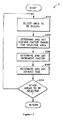
- the scaling coefficients are calculated in relation with a scaling parameters determination rule, this process is summarized in 203,204,205 within Figure 2 .
- a view mode in order to automatically scale moving parts of a video frame in accordance with user preferences. Defining user preferences are explained within Figure 3 where; in order to define the subfield numbers to be evaluated during motion calculation within one frame, or in order to define the range of scaling, those modes are taken into consideration; at step 307 and 308, the users are asked to choose one of predefined view modes, if they intent to activate adaptive scaling.
- Those modes, and rules related to those modes are prepared in the site of manufacturer, and data related to scaling coefficients for view modes is loaded to a memory location within the display system.
- the constant scaling parameters scaling coefficients
- scaling coefficients are read from memory location within the display system by taking selected view mode decision at step 309 into consideration.
- scaling coefficients are loaded from a memory location within the display system and those coefficients are used within step 103 and 104 , where if motion presence is determined.
- some of subfields are scaled more, compared with other subfields at step 310 , if motion presence is detected within those subfields, the adaptive scaling operation is performed in relation with selected view mode. Examples regarding to how adaptive scaling varies in relation with selected view mode will be explained with Figure 4 and Figure 5 in details.
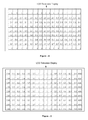
- Figure 4 represent a subfield scaling coefficients table for selected view mode "news", where upper and lower side of video to be displayed has greater scaling coefficients compared to other subfields.
- the reason to use greater scaling coefficients for upper and lower side of video to be displayed is to adaptively scale a sliding subtitle, if there appears any.
- the frames to be displayed are divided into subfields and motion calculation is performed at step 202 and 203 by above mentioned methods. If the user defines a view mode in step 307 and 308, this selection is used in step 104; where video to be displayed is scaled adaptively with predefined scaling coefficients if a motion presence is detected.
- All scaling coefficients are evaluated in relation with selected view mode at step 105; according to the principle of the present invention, scaling coefficients (in relation with selected video modes) are used to adaptively scale the video to be displayed, if motion presence is determined.
- a user enabling a view mode for this example news mode, will see upper and lower side of video scaled more compared to other fields within the same video if a motion presence within the video is detected.
- the reason to upscale motion and user preference related subfields, and to downscale the other subfields in case of motion detection is to fit the whole video to be displayed to the display system.
- Figure 5 represents a subfield scaling coefficients table for selected view mode "movie", where centre of the video to be displayed has greater scaling coefficients compared to other subfields.
- the reason to use bigger scaling coefficients for centre of frame to be displayed is to adaptively scale centre of the image, where centre of the image to be displayed is considered to be the centre of interest.
- this selection is used in step 204; where scaling coefficients are evaluated in relation with selected view mode at step 205.
- a user enabling a view mode for this example movie mode, will observe centre of displayed video scaled more, compared to other areas of displayed video; if any motion presence is detected.
- the reason to upscale centre of video in presence of motion detection within a video to be displayed, and to downscale the other subfields within the video in this example (movie mode) is to fit the whole video to the display system.
- motion detection can be performed, and in case of a motion presence, a video to be displayed can adaptively be scaled with greater scaling ratios for user's centre of interest, which enable the user to view his/her centre of interest in an easier manner.
Landscapes
- Engineering & Computer Science (AREA)
- Multimedia (AREA)
- Signal Processing (AREA)
- Human Computer Interaction (AREA)
- Physics & Mathematics (AREA)
- General Physics & Mathematics (AREA)
- Theoretical Computer Science (AREA)
- Information Transfer Between Computers (AREA)
- Television Systems (AREA)
Abstract
Description
- This invention is related to a method for improving picture quality and for adaptive scaling of frames displayed by an entertainment system.
- Within recent years, there has been an increasing demand in the entertainment market for providing features within television receivers and display systems for improving perceived picture quality. A displayed video signal is consistent of several video frames, and during watching a video over display systems, the most important part for human eye is the moving parts within such frames. Nowadays, by the features provided by display devices, like LCD (liquid crystal display) television sets, a moving object within a video can automatically be detected for several purposes.
- The displayed videos may have graphical portions and/or text portions regarding to a displayed show; a user watching such display systems may intend to manually scale (zoom) some of those portions or fields within displayed videos in order to improve perceived image quality; this feature provides users an ease to read subtitles or to zoom to a portion of displayed video, which portion is supposed to be centre of interest by that individual user.
- A prior art technique was disclosed by the patent application
US2002/0075318 which basically receives data associated with a show and provides user to select at least one feature to scale and does the scaling accordingly. The operation principle of stated prior art is summarized within Figure-1, where user selects an area to be scaled within a displayed video via remote controller and scaling parameters are set accordingly. - Within the prior art systems, scaling a portion of a displayed video is always dependent to user selections, where users are supposed to manually designate objects/fields within displayed video in order to provide scaling of such objects/areas accordingly.
- The present invention relates to an entertainment system to overcome problems stated in prior arts and method for providing adaptive scaling of video frames displayed over display screen in relation with detected motion changes within consequent video frames.
- Another object of present invention is to provide adaptive scaling of video frames displayed over display screen in relation with detected motion changes within consequent video frames and user preferences, various embodiments are disclosed.
-
- Figure-1 general overview of the prior art system
- Figure-2 a block diagram for illustrating the main principle of the invention
- Figure-3 a block diagram for summarizing the principle of view mode definition and constant scaling parameters determination
- Figure-4 a block diagram for representing scaling coefficients for an exemplary view mode," news"
- Figure-5 a block diagram for representing scaling coefficients for an exemplary view mode, "sports"
- While watching a moving object within a displayed video, the moving part of the video is constantly followed by the human eye in order to perceive moving part of displayed video images better than stationary parts within the same video image; where the moving parts of the video are generally considered to be the centre of interest.
- The main principle of the invention is illustrated referring to
Figure 2 where; adaptive scaling of predefined fields over display screen in relation with detected motion changes within consequent video frames is provided. During detection of motion changes, a video to be displayed is supposed to have frame characteristic as ...N-2,N-1,N,N+1,N+2,N+3...where consequent frames forms the video to be displayed. In order to detect motion changes, it is a well known prior art to use luminance value, which value consist of main color components R(red),G(green) and B(blue) may be used to determine motion changes; where luminance changes refer to presence of motion within a video. -
Figure 2 illustrates how a single frame (Nth frame) will be displayed over display system if adaptive scaling is activated by the features of the invention. At first step the video to be displayed is loaded to a buffer area (not shown in figure) in order to evaluate each frame a video to be displayed have. This buffer area may be a random access memory-RAM, or another memory location. According to the present invention, the Nth frame to be displayed is initially divided to subfields (sub blocks) in order to evaluate luminance within each field atstep 201, the main reason to divide a frame to be displayed into subfields is to evaluate the luminance value of that frame subfield, and to make a comparison between present luminance value of that subfield with the luminance value of same subfield of previous frame(N-1 in this condition). After division of frame N into subfields, according to the present invention atstep 202, the luminance value of previous frames are compared with luminance value of initial frames (for this example luminance value of (N-1)th frame and Nth frame are compared), this comparison may be performed in various ways. - One of the known prior art for motion detection is luminance comparison between subfields, as mentioned before. Within an LCD television receiver, subfields may be defined as pixel groups, for instance; a 8x8 pixel group may be considered to be a subfield, where a frame represented by 800x600 pixels will form 7500 subfield ((800x600)/(8x8)).The motion level in one subfield, 8x8 pixels, can be calculated with a simple approach by the below function;

- Where M represents the luminance value, x and y represent the location of pixels within a subfield. By means of the above equation, the luminance change of one subfield of Nth and (N-1)th frame, and the luminance change within 64 pixels can be calculated, and motion is approximately calculated by means of evaluating the luminance difference for all subfields of Nth and (N-1)th frame (for this example 7500 subfields).
- Motion detection in relation with luminance change detection at step 102 is performed by a microprocessor (not shown), motion detection based on luminance difference is a well known system in prior art, and motion detection for adaptive scaling may be performed in various ways; within the features of present invention; motion presence is determined if value of luminance changes exceed a predetermined threshold value; that threshold value is determined in the site of manufacturer and can be changed by user. The user may determine the sensitivity for activating the adaptive scaling automatically, for example the user may use a remote control for sending the sensitivity data to the entertainment system, and according to the invention the threshold level to activate adaptive scaling may be changed.
- After determining the motion change between consequent frames, in order to determine the range of scaling, the scaling coefficients are calculated in relation with a scaling parameters determination rule, this process is summarized in 203,204,205 within
Figure 2 . According to the features of the present invention, in order to define constant scaling parameters, users are asked to define a view mode in order to automatically scale moving parts of a video frame in accordance with user preferences. Defining user preferences are explained withinFigure 3 where; in order to define the subfield numbers to be evaluated during motion calculation within one frame, or in order to define the range of scaling, those modes are taken into consideration; atstep step step 309 into consideration. According to user decisions made atstep - In accordance with selected view mode, some of subfields are scaled more, compared with other subfields at
step 310 , if motion presence is detected within those subfields, the adaptive scaling operation is performed in relation with selected view mode. Examples regarding to how adaptive scaling varies in relation with selected view mode will be explained withFigure 4 and Figure 5 in details. -
Figure 4 represent a subfield scaling coefficients table for selected view mode "news", where upper and lower side of video to be displayed has greater scaling coefficients compared to other subfields. The reason to use greater scaling coefficients for upper and lower side of video to be displayed is to adaptively scale a sliding subtitle, if there appears any. According to present invention, the frames to be displayed are divided into subfields and motion calculation is performed atstep step -
Figure 5 represents a subfield scaling coefficients table for selected view mode "movie", where centre of the video to be displayed has greater scaling coefficients compared to other subfields. The reason to use bigger scaling coefficients for centre of frame to be displayed is to adaptively scale centre of the image, where centre of the image to be displayed is considered to be the centre of interest. According to present invention, if the user chooses a "movie" view mode instep step 204; where scaling coefficients are evaluated in relation with selected view mode atstep 205. According to the features of the invention, a user enabling a view mode, for this example movie mode, will observe centre of displayed video scaled more, compared to other areas of displayed video; if any motion presence is detected. The reason to upscale centre of video in presence of motion detection within a video to be displayed, and to downscale the other subfields within the video in this example (movie mode) is to fit the whole video to the display system. - By the features of the present invention, motion detection can be performed, and in case of a motion presence, a video to be displayed can adaptively be scaled with greater scaling ratios for user's centre of interest, which enable the user to view his/her centre of interest in an easier manner.
Claims (5)
- A method for adaptive scaling of a video frame displayed by an entertainment system comprising;- means receiving user preference data to determine view mode- receiving a first video frame to be displayed within an entertainment system- comparing said first video frame with at least another video frame to detect motion presence, characterized in that;- in case of motion presence between said first video frame and said at least another video frame, adaptively scaling said first video frame in relation with determined view mode- displaying said first video frame within said entertainment system
- A method according to claim 1 wherein; said comparing said first video frame with at least another video frame to detect motion presence comprises the steps of;- dividing each of said first video frame and at least another video frame into at least two subfields- detecting luminance value change between said at least two subfields- determining motion change presence in relation with detected luminance value change.
- A method according to claim 1 wherein ; said view mode comprises scaling coefficients.
- A method according to claim 1 or claim 3 wherein; said constant scaling coefficients are created in the site of manufacturer.
- A method according to claim 1 wherein; said at least another video frame is a frame displayed before said first video frame.
Applications Claiming Priority (1)
| Application Number | Priority Date | Filing Date | Title |
|---|---|---|---|
| TR2008/00856A TR200800856A2 (en) | 2008-02-11 | 2008-02-11 | Adaptive scaling method for an entertainment system. |
Publications (1)
| Publication Number | Publication Date |
|---|---|
| EP2088774A1 true EP2088774A1 (en) | 2009-08-12 |
Family
ID=40600084
Family Applications (1)
| Application Number | Title | Priority Date | Filing Date |
|---|---|---|---|
| EP09152348A Ceased EP2088774A1 (en) | 2008-02-11 | 2009-02-09 | Adaptive scaling method for an entertainment system |
Country Status (2)
| Country | Link |
|---|---|
| EP (1) | EP2088774A1 (en) |
| TR (1) | TR200800856A2 (en) |
Cited By (1)
| Publication number | Priority date | Publication date | Assignee | Title |
|---|---|---|---|---|
| CN107680045A (en) * | 2017-10-13 | 2018-02-09 | 广州酷狗计算机科技有限公司 | Picture telescopic method and device |
Citations (6)
| Publication number | Priority date | Publication date | Assignee | Title |
|---|---|---|---|---|
| US20020075318A1 (en) | 2000-12-20 | 2002-06-20 | Hong Yang | System and method for providing adaptive scaling of selected features in an integrated receiver decoder |
| US20030122853A1 (en) * | 2001-12-29 | 2003-07-03 | Kim Jeong Woo | Method for tracing enlarged region of moving picture |
| US20040095477A1 (en) * | 2002-08-09 | 2004-05-20 | Takashi Maki | ROI setting method and apparatus, electronic camera apparatus, program, and recording medium |
| US20050151884A1 (en) * | 2004-01-08 | 2005-07-14 | Samsung Electronics Co., Ltd. | Automatic zoom apparatus and method for playing dynamic images |
| US20070147708A1 (en) * | 2005-12-26 | 2007-06-28 | Samsung Electronics Co., Ltd. | Adaptive image size conversion apparatus and method thereof |
| EP1848203A1 (en) * | 2006-04-18 | 2007-10-24 | Vestel Elektronik Sanayi ve Ticaret A.S. | Method and system for video image aspect ratio conversion |
-
2008
- 2008-02-11 TR TR2008/00856A patent/TR200800856A2/en unknown
-
2009
- 2009-02-09 EP EP09152348A patent/EP2088774A1/en not_active Ceased
Patent Citations (6)
| Publication number | Priority date | Publication date | Assignee | Title |
|---|---|---|---|---|
| US20020075318A1 (en) | 2000-12-20 | 2002-06-20 | Hong Yang | System and method for providing adaptive scaling of selected features in an integrated receiver decoder |
| US20030122853A1 (en) * | 2001-12-29 | 2003-07-03 | Kim Jeong Woo | Method for tracing enlarged region of moving picture |
| US20040095477A1 (en) * | 2002-08-09 | 2004-05-20 | Takashi Maki | ROI setting method and apparatus, electronic camera apparatus, program, and recording medium |
| US20050151884A1 (en) * | 2004-01-08 | 2005-07-14 | Samsung Electronics Co., Ltd. | Automatic zoom apparatus and method for playing dynamic images |
| US20070147708A1 (en) * | 2005-12-26 | 2007-06-28 | Samsung Electronics Co., Ltd. | Adaptive image size conversion apparatus and method thereof |
| EP1848203A1 (en) * | 2006-04-18 | 2007-10-24 | Vestel Elektronik Sanayi ve Ticaret A.S. | Method and system for video image aspect ratio conversion |
Cited By (1)
| Publication number | Priority date | Publication date | Assignee | Title |
|---|---|---|---|---|
| CN107680045A (en) * | 2017-10-13 | 2018-02-09 | 广州酷狗计算机科技有限公司 | Picture telescopic method and device |
Also Published As
| Publication number | Publication date |
|---|---|
| TR200800856A2 (en) | 2009-08-21 |
Similar Documents
| Publication | Publication Date | Title |
|---|---|---|
| US8558772B2 (en) | Image display apparatus | |
| US9672437B2 (en) | Legibility enhancement for a logo, text or other region of interest in video | |
| US9892716B2 (en) | Image display program, image display method, and image display system | |
| US8624913B2 (en) | Display control apparatus and display control method that determines a plurality of regions in a frame to be displayed at different frame rates than one another | |
| EP2069881B1 (en) | Method and apparatus for controlling screen of image display device | |
| US8957899B2 (en) | Image processing apparatus and method for controlling the same | |
| US6359658B1 (en) | Subjective noise measurement on active video signal | |
| US8515264B2 (en) | Information processing apparatus, information processing method, display control apparatus, display control method, and program | |
| EP1848209A2 (en) | Apparatus and method for adjusting image | |
| EP1555814A2 (en) | Reducing burn-in associated with mismatched video image/display aspect ratios | |
| EP1855468A2 (en) | Image detection device, image processing apparatus, image detection method, method of reducing burn-in of display device, and image detection program | |
| KR20060113708A (en) | Adaptation of subtitle text based on surrounding video content | |
| JP2004364234A5 (en) | ||
| US7432984B2 (en) | Automatic zoom apparatus and method for playing dynamic images | |
| KR20000068044A (en) | Television picture signal processing | |
| EP1848208A2 (en) | Image processing apparatus, image processing method, and image processing program | |
| US20080107335A1 (en) | Methods for processing image signals and related apparatus | |
| JP2006040055A (en) | Image display device | |
| EP2091241A1 (en) | Transparent OSD menu for a television system or the like | |
| US20080186324A1 (en) | Method for generating a frame stream to be displayed on a display device | |
| US8004543B2 (en) | Image processing apparatus and control method thereof | |
| CN102263982A (en) | Method and device for improving mobile visibility of analog TV | |
| TW201413701A (en) | Improved visual accessibility for vision impaired | |
| KR20160087449A (en) | Method and apparatus for controlling display | |
| US20060158556A1 (en) | Display device and method for controlling the same |
Legal Events
| Date | Code | Title | Description |
|---|---|---|---|
| PUAI | Public reference made under article 153(3) epc to a published international application that has entered the european phase |
Free format text: ORIGINAL CODE: 0009012 |
|
| AK | Designated contracting states |
Kind code of ref document: A1 Designated state(s): AT BE BG CH CY CZ DE DK EE ES FI FR GB GR HR HU IE IS IT LI LT LU LV MC MK MT NL NO PL PT RO SE SI SK TR |
|
| AX | Request for extension of the european patent |
Extension state: AL BA RS |
|
| 17P | Request for examination filed |
Effective date: 20100210 |
|
| AKX | Designation fees paid |
Designated state(s): AT BE BG CH CY CZ DE DK EE ES FI FR GB GR HR HU IE IS IT LI LT LU LV MC MK MT NL NO PL PT RO SE SI SK TR |
|
| 17Q | First examination report despatched |
Effective date: 20100628 |
|
| STAA | Information on the status of an ep patent application or granted ep patent |
Free format text: STATUS: THE APPLICATION HAS BEEN REFUSED |
|
| 18R | Application refused |
Effective date: 20120209 |