EP2088537A1 - Word recognizing method and word recognizing program - Google Patents
Word recognizing method and word recognizing program Download PDFInfo
- Publication number
- EP2088537A1 EP2088537A1 EP07792960A EP07792960A EP2088537A1 EP 2088537 A1 EP2088537 A1 EP 2088537A1 EP 07792960 A EP07792960 A EP 07792960A EP 07792960 A EP07792960 A EP 07792960A EP 2088537 A1 EP2088537 A1 EP 2088537A1
- Authority
- EP
- European Patent Office
- Prior art keywords
- character
- word
- computation
- formula
- probability
- Prior art date
- Legal status (The legal status is an assumption and is not a legal conclusion. Google has not performed a legal analysis and makes no representation as to the accuracy of the status listed.)
- Withdrawn
Links
Images






Classifications
-
- G—PHYSICS
- G06—COMPUTING OR CALCULATING; COUNTING
- G06V—IMAGE OR VIDEO RECOGNITION OR UNDERSTANDING
- G06V30/00—Character recognition; Recognising digital ink; Document-oriented image-based pattern recognition
- G06V30/10—Character recognition
- G06V30/22—Character recognition characterised by the type of writing
- G06V30/226—Character recognition characterised by the type of writing of cursive writing
-
- G—PHYSICS
- G06—COMPUTING OR CALCULATING; COUNTING
- G06F—ELECTRIC DIGITAL DATA PROCESSING
- G06F18/00—Pattern recognition
- G06F18/20—Analysing
- G06F18/24—Classification techniques
- G06F18/241—Classification techniques relating to the classification model, e.g. parametric or non-parametric approaches
- G06F18/2415—Classification techniques relating to the classification model, e.g. parametric or non-parametric approaches based on parametric or probabilistic models, e.g. based on likelihood ratio or false acceptance rate versus a false rejection rate
- G06F18/24155—Bayesian classification
-
- G—PHYSICS
- G06—COMPUTING OR CALCULATING; COUNTING
- G06V—IMAGE OR VIDEO RECOGNITION OR UNDERSTANDING
- G06V30/00—Character recognition; Recognising digital ink; Document-oriented image-based pattern recognition
- G06V30/10—Character recognition
- G06V30/19—Recognition using electronic means
- G06V30/191—Design or setup of recognition systems or techniques; Extraction of features in feature space; Clustering techniques; Blind source separation
- G06V30/19173—Classification techniques
-
- G—PHYSICS
- G06—COMPUTING OR CALCULATING; COUNTING
- G06V—IMAGE OR VIDEO RECOGNITION OR UNDERSTANDING
- G06V30/00—Character recognition; Recognising digital ink; Document-oriented image-based pattern recognition
- G06V30/10—Character recognition
- G06V30/26—Techniques for post-processing, e.g. correcting the recognition result
- G06V30/262—Techniques for post-processing, e.g. correcting the recognition result using context analysis, e.g. lexical, syntactic or semantic context
- G06V30/268—Lexical context
-
- G—PHYSICS
- G06—COMPUTING OR CALCULATING; COUNTING
- G06V—IMAGE OR VIDEO RECOGNITION OR UNDERSTANDING
- G06V30/00—Character recognition; Recognising digital ink; Document-oriented image-based pattern recognition
- G06V30/10—Character recognition
Definitions
- the present invention relates to a word recognition method for performing word recognition in an optical character reader for optically reading a word that consists of a plurality of characters described on a material targeted for reading.
- the present invention relates to a storage medium that stores a word recognition program for causing the word recognition processing.
- the error in the approximate calculation of the posteriori probability providing the word assessment value is large inconveniently for rejection.
- the rejection is carried out optimally in the case where the posteriori probability is not more than a predetermined value.
- the rejection may fail depending on the error.
- the difference from the assessment value for other words is checked. This method, however, is heuristic and not considered an optimum method.
- a word recognition method comprising: a character recognition processing step of performing recognition processing of an input character string that corresponds to a word to be recognized by each character, thereby obtaining the character recognition result; a probability calculation step of obtaining a probability at which characteristics obtained as the character recognition result are generated by the character recognition processing by conditioning characters of words contained in a word dictionary that stores in advance a candidate of the word to be recognized; a first computation step of performing a predetermined first computation between a probability obtained by the probability calculation step and the characteristics obtained as the character recognition result by the character recognition processing step; a second computation step of performing a predetermined second computation between computation results obtained by the first computation on each character of each word in the word dictionary; a third computation step of adding up all computation results obtained for each word in the word dictionary by the second computation; a fourth computation step of dividing computation results obtained by the second computation on each character of each word in the word dictionary by computation results in the third computation step; and a word recognition processing step of obtaining a word recognition result of the word
- a word recognition method comprising: a delimiting step of delimiting an input character string that corresponds to a word to be recognized by each character; a step of obtaining plural kinds of delimiting results considering whether character spacing is provided or not by character delimiting caused by the delimiting step; a character recognition processing step of performing recognition processing for each character as all the delimiting results obtained by the step of obtaining plural kinds of delimiting results; a probability calculation step of obtaining a probability at which characteristics obtained as the result of character recognition are generated by the character recognition step by computing the characters of the words contained in the word dictionary that stores in advance candidates of words to be recognized; a first computation step of performing a predetermined first computation between a probability obtained by the probability calculation step and the characteristics obtained as the character recognition result by the character recognition processing step; a second computation step of performing a predetermined second computation between computation results obtained by the first computation on each character of each word in the word dictionary; a third computation step of adding up all computation results obtained for each word in the word dictionary by the second computation
- a word recognition program for causing a computer to execute a word recognition process, comprising: a character recognition processing step of performing recognition processing of an input character string that corresponds to a word to be recognized by each character; a probability calculation step of obtaining a probability at which characteristics obtained as the character recognition result are generated by the character recognition processing by conditioning characters of words contained in a word dictionary that stores in advance a candidate of the word to be recognized; a first computation step of performing a predetermined first computation between a probability obtained by the probability calculation step and the characteristics obtained as the character recognition result by the character recognition processing step; a second computation step of performing a predetermined second computation between computation results obtained by the first computation on each character of each word in the word dictionary; a third computation step of adding up all computation results obtained for each word in the word dictionary by the second computation; a fourth computation step of dividing computation results obtained by the second computation on each character of each word in the word dictionary by computation results in the third computation step; and a word recognition processing step of obtaining
- FIG. 1 schematically depicts a configuration of a word recognition system for achieving a word recognition method according to an embodiment of the present invention.
- this word recognition system is composed of: a CPU (central processing unit) 1; an input device 2; a scanner 3 that is image input means; a display device 4; a first memory 5 that is storage means; a second memory 6 that is storage means; and a reader 7.
- a CPU central processing unit
- the CPU 1 executes an operating system program stored in the second memory 6 and an application program (word recognition program or the like) stored in the second memory 6, thereby performing word recognition processing as described later in detail.
- the input device 2 consists of a keyboard and a mouse, for example, and is used for a user to perform a variety of operations or input a variety of data.
- the scanner 3 reads characters of a word described on a material targeted for reading through scanning, and inputs these characters.
- the above material targeted for reading includes a mail P on which an address is described, for example.
- an address is described, for example.
- postal number, name of state, city name, street name, and street number are described in order from the lowest line and from the right side.
- the display device 4 consists of a display unit and a printer, for example, and outputs a variety of data.
- the first memory 5 is composed of a RAM (random access memory), for example. This memory is used as a work memory of the CPU 1, and temporarily stores a variety of data or the like being processed.
- RAM random access memory
- the second memory 6 is composed of a hard disk unit, for example, and stores a variety of programs or the like for operating the CPU 1.
- the second memory 6 stores: an operating system program for operating the input device 2, scanner 3, display device 4, first memory 5, and reader 7; a word recognition program and a character dictionary 9 for recognizing characters that configure a word; a word dictionary 10 for word recognition; and a probability table 11 that stores a probability of the generation of characters that configure a word or the like.
- the above word dictionary 10 stores in advance a plurality of candidates of words to be recognized. This dictionary can be used as a city name dictionary that registers regions in which word recognition systems are installed, for example, city names in states.
- the reader 7 consists of a CD-ROM drive unit or the like, for example, and reads a word recognition program stored in a CD-ROM 8 that is a storage medium and a word dictionary 10 for word recognition.
- the word recognition program, character dictionary 9, word dictionary 10, and probability table 1 read by the reader 7 are stored in the second memory 6.
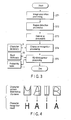
- image acquisition processing for acquiring (reading) an image of a mail P is performed by means of the scanner 3 (ST1).
- Region detection processing for detecting a region in which an address is described is performed by using the image acquired by the image acquisition processing (ST2).
- delimiting processing for using vertical projection or horizontal projection is performed by using vertical projection or horizontal projection, thereby identifying a character pattern in a rectangular region for each character of a word that corresponds to a city name, from a description region of the address detected by the region detection processing (ST3).
- Character recognition processing for acquiring a character recognition candidate is performed based on a degree of analogy obtained by comparing a character pattern of each character of the word identified by this delimiting processing with a character pattern stored in the character dictionary 9 (ST4).
- the posteriori probability is calculated by each city name contained in the word dictionary 10, and there is performed word recognition processing in which a word with its highest posteriori probability is recognized (ST5).
- Each of the above processing functions is controlled by means of the CPU 1.
- a word break may be judged based on a character pattern for each character and a gap in size between the patterned characters. In addition, it may be judged whether or not character spacing is provided based on the gap in size.
- a word recognition method is achieved in such a system configuration. Now, an outline of the word recognition method will be described below.
- a posteriori probability considering a variety of problems as described previously is used as an evaluation function.
- all data concerning a difference in the number of characters, the ambiguity of word delimiting, the absence of character spacing, noise entry, and character break can be naturally incorporated in one evaluation function by calculation of probability.
- An input pattern (input character string) is defined as "x”.
- recognition processing certain processing is performed for "x”, and the classification result is obtained. This processing can be roughly divided into the two processes below.
- the classification result "ki” corresponds to the "recognition result".
- the "recognition result” of character recognition is used as one of the characteristics.
- the terms “characteristics” and “recognition result” are used distinctly.
- the Bayes Estimation is used as an evaluation method in the second process.
- r) is obtained as a result of recognition.
- the probability is calculated indirectly by using Bayes Estimation Theory, i.e., the following formula [formula 1] P k i
- r P r
- a denominator P(r) is a constant that does not depend on "i".
- ki) P(ki) is calculated, whereby a magnitude of the posteriori probability P(ki
- Bayes Estimation in word recognition when the number of characters is constant.
- the Bayes Estimation is effective in English or any other language in which a word break may occur.
- P(ki) is statistically obtained in advance. For example, reading an address of a mail is considered as depending on a position in a letter or a position in line as well as statistics of address.
- ki) is represented as a product
- this product can be converted into addition by using an algorithm, for example, without being limited thereto. This fact applies to the following description.
- FIG. 4 shows the delimiting processing result of a character pattern that corresponds to a portion at which it is believed that the city name identified by the above mentioned delimiting processing is written. This result shows that four characters are detected.
- a word dictionary 10 stores candidates of city names (words) by the number of characters. For example, a candidate of a city name (word) that consist of four characters is shown in FIG. 5 . In this case, five city names each consisting of four characters are stored as MAIR (k1), SORD (k2), ABLA (k3), HAMA (k4), and HEWN (k5).
- Character recognition is performed for each character pattern shown in FIG. 4 by the above described character recognition processing.
- a posteriori probability for each of the city names shown in FIG. 5 is calculated on the basis of the character recognition result of such each character pattern.
- k1) at which the city name MAIR (ki) relevant to the character recognition result "H, A, I, A" is the result of word recognition is 0.0001.
- FIG. 6 shows how the approximation described in subsection 3.2.2 is expressed in the form of a probability table.
- the characters are assumed to be 26 upper-case alphabetic characters.
- the vertical axis indicates actually written characters, while the horizontal axis represents their character recognition results.
- the intersection between vertical line “M” and horizontal line “H” in the probability table 11 represents the probability P("H"
- the probability of each character recognition result correctly representing the actually written character is assumed to be "p". This being so, the diagonal line between the upper left corner of the probability table 11 and the lower right corner thereof is constant. In the case of FIG. 6 , the probability is 0.5.
- the probability of each character recognition result representing a character other than the actually written character is assumed to be "q”. This being so, the diagonal line between the upper left corner of the probability table 11 and the lower right corner thereof is constant. In the case of FIG. 6 , the probability is 0.02.
- k1) includes the largest value, and a city name estimated to be written on a mail P shown in FIG. 2 is MAIR.
- the Bayes Estimation in word recognition when the number of characters is not constant according to the first embodiment of the present invention.
- the Bayes Estimation is effective in Japanese or any other language in which no word break occurs.
- the Bays Estimation is effective in the case where a word dictionary contains a character string consisting of a plurality of words.
- An input pattern "x" is defined as a plurality of words rather than one word, and Bayes Estimation is performed in a similar manner to that described in chapter 3. In this case, the definitions in chapter 3 are added and changed as follows. Changes:
- wb may be expressed in place of ⁇ ' j .
- Additions: [formula 13] ⁇ w ⁇ j ⁇ , w ⁇ j ⁇ 1 ⁇ w ⁇ j ⁇ 2 ⁇ ... w ⁇ jL j ⁇ L j : Total number of characters in character string " ⁇ ' j " ⁇ jk : k-th character of ⁇ 'j ⁇ ' jk ⁇ C
- Approximation of a first line assumes that there is ignored an effect of "wb” on a portion to which a character string "wb” of all the characters of the input pattern "x" is applied.
- Approximation of a second line assumes that each "rk” is independent. This is not really true. These approximation is coarse, but is very effective.
- a numerator of the above formula (16) is the same as that of the above formula (3), namely, P(r
- the number of characters of each candidate is not constant.
- FIG. 9 shows the delimiting processing result of a character pattern that corresponds to a portion at which it is believed that the city name identified by the above described delimiting processing is written, wherein it is detected that a word consisting of two characters is followed by a space, and such space is followed by a word consisting of three characters.
- the word dictionary 10, as shown in FIG. 10 stores all the city names having the number of characters or the number of words applied in FIG. 9 . In this case, five city names are stored as COH (k1), LE ITH (k2), OTH (k3), SK (k4), and STLIN (k5).
- Character recognition is performed for each character patterns shown in FIG. 9 by the above described character recognition processing.
- the posteriori probability is calculated by each city name shown in FIG. 10 on the basis of the character recognition result obtained by such each character pattern.
- r)/P(k5) includes the largest value, and the city name estimated to be written in FIG. 8 is ST LIN.
- formula (16-2) is calculated. Assuming that P(k1) to P(k5) are equal to one another, they are reduced in advance.
- the denominator is the total sum of formula (22), i.e. 56.24 + 15.21 + 56.24 + 169 + 205.3 ⁇ 502.
- the numerator is each result of formula (22).
- recognition processing is performed by each character for an input character string that corresponds to a word to be recognized; there is obtained a probability of the generation of characteristics obtained as the result of character recognition by conditioning characters of the words contained in a word dictionary that stores in advance candidates of words to be recognized; the thus obtained probability is divided by a probability of the generation of characteristics obtained as the result of character recognition; each of the above division results obtained for the characters of the words contained in the word dictionary is divided for all the characters; all the computation results obtained for each word in the word dictionary are added up; the computation results obtained on each character of each word in the word dictionary are divided by the above added-up computation results; and based on this result, the word recognition result is obtained.
- word recognition can be performed precisely by using an evaluation function based on a posteriori probability that can be used even in the case where the number of characters in a word is not always constant.
- the rejection process can be executed with high accuracy.
- Bayes Estimation according to a second embodiment of the present invention, the Bayes Estimation being characterized in that , when word delimiting is ambiguous, such ambiguity is included in calculation of the posteriori probability. In this case, the Bayes Estimation is effective when error detection of word break cannot be ignored.
- r) can be represented by the following formula. [formula 32] P k i
- r P k i
- r C , r S P r C , r S
- k i ⁇ P k i P r C r S P r C
- ki) is substantially similar to that obtained by the above formula (13).
- k i P r C ⁇ 1 , r C ⁇ 2 , ⁇ , r Ch
- k i P r C ⁇ 1 , r C ⁇ 2 , ⁇ , r Ch
- k i ⁇ k 1 L j P ⁇ r Ch + k
- ki) is represented as follows.
- a first line of the above formula (29) is in accordance with the above formula (24).
- a second line uses approximation obtained by the following formula. [formula 39] P r C r S ⁇ P r C r S
- Characteristics of character spacing set D ⁇ d0, d1, d2, (, d3) ⁇ d0: Expanded character spacing d1: Condensed character spacing d2: No character spacing (d3: This denotes the start or end of the line, and always denotes a word break.) ⁇ rs ⁇ D
- FIG. 13 shows the delimiting processing of a character pattern that corresponds to a portion at which it is believed that the city name identified by the above described delimiting processing is written, wherein a total of five characters are detected. It is detected that the first and second characters are free of being spaced from each other; the second and third characters are expanded in spacing; and the third and fourth characters and the fourth and fifth characters are condensed in spacing.
- FIG. 14A, FIG. 14B, and FIG. 14C show the contents of the word directory 10, wherein all city names are stored. In this case, three city names are stored as ST LIN shown in FIG. 14A , SLIM shown in FIG. 14B , and SIM shown in FIG. 14C .
- the sign (s0, s1) described under each city name denotes whether or not a word break occurs. s0 denotes a word break, and s1 denotes no word break.
- FIG. 15 illustrates a set of categories. Each category includes position information, and thus, is different from the word dictionary 10.
- a category k1 is made of a word shown in FIG. 14A ; categories k2 and k3 are made of words shown in FIG. 14B ; and categories k4, k5, and k6 are made of words shown in FIG. 14C .
- the category 1 is made of "STLIN”; the category 2 is made of “SLIM”; the category 3 is made of " SLIM”; the category k4 is made of "SLIM "; the category k5 is made of " SIM “; and the category k6 is made of " SLIM”.
- Character recognition is performed for each character pattern shown in FIG. 13 by the above described character recognition processing.
- the character recognition result is used for calculating the posteriori probability of each of the categories shown in FIG. 15 .
- characteristics used for calculation are various, an example using characters specified as a first candidate is shown here.
- FIG. 13 shows characteristics of character spacing.
- the first and second characters are free of being spaced from each other, and thus, the characteristics of character spacing are defined as "d2".
- the second and third characters are expanded in spacing, and thus, the characteristics of character spacing are defined as "d0".
- the third and fourth characters and the fourth and fifth characters are condensed in spacing, the characteristics of character spacing are defined as "d1".
- Table 1 lists values obtained by the following formula. [formula 52] P d k ⁇ s l
- r)/P(ki) are obtained with respect to k2 to k6 as follows.
- the input character string corresponding to a word to be recognized is identified by each character; the characteristics of character spacing are extracted by this character delimiting; recognition processing is performed for each character obtained by the above character delimiting; and a probability at which there appears characteristics obtained as the result of character recognition by conditioning characteristics of the characters and character spacing of the words contained in a word dictionary that stores candidates of the characteristics of a word to be recognized and character spacing of the word.
- the thus obtained probability is divided by a probability at which there appears characteristics obtained as the result of character recognition; each of the above calculation results obtained for each of the characteristics of the characters and character spacing of the words contained in the word dictionary is multiplied relevant to all the characters and character spacing; all the computation results obtained for each word in the word dictionary are added up; the computation results obtained on each character of each word in the word dictionary are divided by the above added-up computation results; and based on this result, the word recognition result is obtained.
- an evaluation function is used based on a posteriori probability considering at least the ambiguity of word delimiting. In this way, even in the case where word delimiting is not reliable, word recognition can be performed precisely.
- the rejection process can be executed with high accuracy.
- Bayes Estimation according to a third embodiment of the present invention when no character spacing is provided or noise entry occurs.
- the Bayes Estimation is effective when no character spacing is provided or when noise entry cannot be ignored.
- A ⁇ a 0 , a 1 , a 2 ⁇ a 0 : No action a 1 : No character spacing a 2 : Noise entry ⁇ a0: No action None is done for the character spacing. ⁇ a1: No character spacing
- the spacing between the two characters is not provided.
- the two characters are converted into one non-character by this action.
- a noise (non-character) is entered between the two characters.
- a non-character is identified as " ⁇ " by considering the absence of character spacing or noise entry, and is included in character C.
- r) is similar to that obtained by the above formulas (23) and (24). [formula 62] P k i
- r P r C
- ki) is substantially similar to that obtained by the above formula (25).
- k i P r C ⁇ 1 , r C ⁇ 2 , ⁇ , r Ch
- k i ⁇ l 1 L jk P ⁇ r Ch + l
- ki) is also substantially similar to that obtained by the above formula (26).
- k i P ⁇ r S ⁇ 1 , r S ⁇ 2 , ⁇ , r Sh - 1
- k i ⁇ l 0 L jk P ⁇ r Sh + l
- P(wc) is obtained in advance.
- P(wc) is affected by the position in a letter or the position in line if the address of the mail P is actually read, for example, the P(wc) is assumed to be assigned as an expected value thereof.
- a relationship between P(wd) and P(wc) is considered as follows. [formula 65]
- This formula is a term concerning whether or not noise occurs at both ends.
- probabilities at which noises exist are different from each other between characters and at both ends.
- a value other than noise entry probability P(a2) is assumed to be defined.
- a relationship between P(wc) and P(wc, h) or a relationship between P(wd) and P(wd, h) depends on how the effects as described previously (such as position in a leter) are modeled and/or approximated. Thus, a description is omitted here.
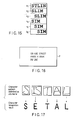
- FIG. 17 shows the result of delimiting processing of a character pattern that corresponds to a portion at which it is believed that a city name identified by the above described delimiting processing is written, wherein a total of five characters are detected.
- the word dictionary 10 stores all city names, as shown in FIG. 18 . In this case, three city names are stored as SITAL, PETAR, and STAL.
- FIG. 19 illustrates a category set, wherein character strings each consisting of five characters are listed from among derivative character strings made based on the word dictionary 10.
- derivative character strings each consisting of five characters are listed, for example, "P#A*R” or the like deriving from "PETAR" must be included.
- P(a) of the absence of character spacing or noise entry probability P(a2) described in section 6.2 is smaller than a certain degree, such characters can be ignored. In this example, such characters are ignored.
- Categories k1 to k5 each are made of a word "SISTAL”; a category k6 is made of a word “PETAR”; and categories k7 to k11 each are made of a word “STAL”.
- the category k1 is made of "#STAL”; the category k2 is made of “S#TAL”; the category k3 is made of “SI#AL”; the category k4 is made of "SIS#L”; the category k5 is made of "SIST#”; the category k6 is made of "PETAR”; the category k7 is made of “*STAL”; the category k8 is made of "S*TAL”; the category k9 is made of "ST*AL”; the category k10 is made of "STA*L”; and the category k11 is made of "STA*L”.
- Character recognition is performed for each of the character patterns shown in FIG. 17 by the above described character recognition processing.
- the posteriori probability is calculated by each category shown in FIG. 19 by on the basis of the character recognition result obtained by such each character pattern.
- characters used for calculation are various, an example using characters specified as a first candidate is shown here.
- the character recognition result is "S, E, T, A, L" in order from the left-most character, relevant to each character pattern shown in FIG. 17 .
- r)/P(k2) in a probability of generating the category k2 (S#TAL) shown in FIG. 2 the change caused by knowing the character recognition result, is obtained as follows.
- P(k2) P 0 ⁇ 0.948 ⁇ 0.05 ⁇ 0.948 ⁇ 0.948 ⁇ 094 ⁇ 0.94 ⁇ 0.0357 ⁇ P 0
- the highest posteriori probability is the category k2, and it is estimated that the city name written in FIG. 16 is SISTAL, and no character spacing between I and S is provided.
- the denominator is the total sum of the aforementioned P(k1
- the numerator is the aforementioned P(k1
- the characters of words contained in a word dictionary include information on non-characters as well as characters.
- a probability of generating words each consisting of characters that include non-character information is set based on a probability of generating words each consisting of characters that do not include any non-character information.
- the rejection process can be executed with high accuracy.
- Bayes Estination according to a fourth embodiment of the present invention when a character is not identified uniquely.
- the Bayes Estimation is effective for characters with delimiters such as Japanese Kanji characters or Kana characters.
- the Bayes Estimation is also effective to calligraphic characters in English which includes a case where many break candidates other than actual character breaks must be presented.
- processing for cutting a character contact is performed.
- this processing when a case in which a portion that is not a character break is specified as a break candidate is compared with a case in which a character break is not specified as a break candidate, the latter affects recognition. The reasons are stated as follows.
- r) is similar to the above formulas (23) and (24).
- r P r C
- ki) is represented as follows.
- ki) is represented as follows.
- FIG. 20 shows a portion at which it is believed that a city name is written, and five cells are present.
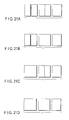
- FIG. 21A to FIG. 21D show possible character delimiting pattern candidates. In this example, for clarity, it is assumed that the spacing between cells 2 and 3 and the spacing between cells 4 and 5 are always found to have been delimited (a probability at which characters are not delimited is very low, and may be ignored).
- the delimiting candidates are present between cells 1 and 2 and between cells 3 and 4.
- the possible character delimiting pattern candidates are exemplified as shown in FIG. 21A to FIG. 21D .
- FIG. 22 shows the contents of the word directory 10 in which all city names are stored. In this example, there are three candidates for city names.
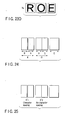
- FIG. 23A to FIG. 23D each illustrate a category set. It is assumed that word delimiting is completely successful. Thus, NAYGE applies to FIG. 21A ; RAGE applies to FIG. 21B and FIG. 21C ; and ROE applies to FIG. 21D .
- the interval between cells 1 and 2 and that between cells 3 and 4 correspond to separation points between characters.
- the interval between cells 1 and 2 corresponds to a separation point between characters, while the interval between cells 3 and 4 does not.
- the interval between cells 3 and 4 corresponds to a separation point between characters, while the interval between cells 1 and 2 does not.
- the interval between cells 1 and 2 and that between cells 3 and 4 does not correspond to separation points between characters.
- Each of the units that appear in FIG. 23A to FIG. 21D is applied to character recognition, and the character recognition result is used for calculating the posteriori probabilities of the categories shown in FIG. 23A to FIG. 23D .
- characteristics used for calculation are various, an example using characters specified as a first candidate is shown below.
- FIG. 24 shows the recognition result of each unit. For example, this figure shows that a first place of the recognition result has been R in a unit having cells 1 and 2 connected to each other.
- FIG. 27 shows characteristics of character spacing between cells 1 and 2, and between cells 3 and 4. Character spacing is provided between cells 1 and 2, and no character spacing is provided between cells 3 and 4.
- Table 4 lists values obtained by formula. [formula 96] P d k ⁇ ⁇ s l
- the widths of units are the most uniform. In FIG. 21A , these widths are the second uniform. However, in FIG. 21B and FIG. 21C , these widths are not uniform.
- a degree of this uniformity is modeled by a certain method, and the modeled degree is reflected in P(ki), thereby enabling more precise word recognition. As long as such precise word recognition is achieved, any method may be used here.
- the highest priority is category k3 caused by the above formulas (61) and (64).
- the highest priority is category k2 caused by the above formulas (62) and (65).
- the highest value in evaluation of balance in character shape is category k4, estimation based on all integrated results is performed, whereby category k1 can be selected.
- formula (53-2) is calculated.
- the denominator is the total sum of formula (68), i.e. 11086P1 + 162P1 + 249P1 + 1710P1 ⁇ 13200P1.
- the numerator is each result of formula (68).
- [formula 105] P k 1
- an input character string corresponding to a word to be recognized is delimited for each character; plural kinds of delimiting results are obtained considering character spacing by this character delimiting; recognition processing is performed for each of the characters specified as all of the obtained delimiting results; and a probability at which there appears characteristics obtained as the result of character recognition by conditioning characteristics of the characters and character spacing of the words contained in a word dictionary that stores candidates of the characteristics of a word to be recognized and character spacing of the word.
- the thus obtained probability is divided by a probability at which there appears characteristics obtained as the result of character recognition; each of the above calculation results obtained for each of the characteristics of the characters and character spacing of the words contained in the word dictionary is multiplied relevant to all the characters and character spacing; all the computation results obtained for each word in the word dictionary are added up; the computation results obtained on each character of each word in the word dictionary are divided by the above added-up computation results; and based on this result, the word recognition result is obtained.
- the rejection process can be executed with high accuracy.
- word recognition in word recognition using the character recognition result, even in the case where the number of characters in a word is not constant, word recognition can be performed precisely by using an evaluation function based on a posteriori probability that can be used even in the case where the number of characters in a word is not always constant.
- the rejection process can be executed with high accuracy.
- word recognition in word recognition using the character recognition result, even in the case where word delimiting is not reliable, word recognition can be performed precisely by using an evaluation function based on a posteriori probability considering at least the ambiguity of word delimiting.
- the rejection process can be executed with high accuracy.
- word recognition in word recognition using the character recognition result, even in the case where no character spacing is provided, word recognition can be performed precisely by using an evaluation function based on a posteriori probability considering at least the absence of character spacing even in the case where no character spacing is provided.
- the rejection process can be executed with high accuracy.
- word recognition in word recognition using the character recognition result, even in the case where no character spacing is provided, word recognition can be performed precisely by using an evaluation function based on a posteriori probability considering at least noise entry even in the case where the noise entry occurs.
- the rejection process can be executed with high accuracy.
- word recognition in word recognition using the character recognition result, even in the case where character delimiting is not reliable, word recognition can be performed precisely by using an evaluation function based on the posteriori probability considering at least the ambiguity of character delimiting.
- the rejection process can be executed with high accuracy.
- the present invention is not limited to the embodiments described above, but can be embodied with the component elements thereof modified without departing from the spirit and scope of the invention. Also, various inventions can be formed by appropriately combining a plurality of the component elements disclosed in the aforementioned embodiments. For example, several ones of all the component elements included in the embodiments may be deleted. Further, the component elements included in different embodiments may be combined appropriately.
Landscapes
- Engineering & Computer Science (AREA)
- Physics & Mathematics (AREA)
- Theoretical Computer Science (AREA)
- Computer Vision & Pattern Recognition (AREA)
- General Physics & Mathematics (AREA)
- Multimedia (AREA)
- Data Mining & Analysis (AREA)
- Computational Linguistics (AREA)
- Life Sciences & Earth Sciences (AREA)
- Artificial Intelligence (AREA)
- Bioinformatics & Cheminformatics (AREA)
- Bioinformatics & Computational Biology (AREA)
- Evolutionary Biology (AREA)
- Evolutionary Computation (AREA)
- General Engineering & Computer Science (AREA)
- Probability & Statistics with Applications (AREA)
- Character Discrimination (AREA)
Abstract
Description
- The present invention relates to a word recognition method for performing word recognition in an optical character reader for optically reading a word that consists of a plurality of characters described on a material targeted for reading. In addition, the present invention relates to a storage medium that stores a word recognition program for causing the word recognition processing.
- In general, in an optical character reader, for example, in the case where characters described on a material targeted for reading is read, even if individual character recognition precision is low, one can read such characters precisely by using knowledge of words. Conventionally, a variety of methods have been proposed.
- These methods include the one disclosed by Jpn. Pat. Appln. KOKAI Publication No.
2001-283157 - In the method disclosed in the patent publication described above, the error in the approximate calculation of the posteriori probability providing the word assessment value is large inconveniently for rejection. The rejection is carried out optimally in the case where the posteriori probability is not more than a predetermined value. In the techniques described in the aforementioned publication, however, the rejection may fail depending on the error. In the case where the rejection is carried out using the techniques described above, therefore, the difference from the assessment value for other words is checked. This method, however, is heuristic and not considered an optimum method.
- Accordingly, it is an object of the present invention to provide a word recognition method and a word recognition program in which the error can be suppressed in the approximate calculation of the posteriori probability and the rejection can be made with high accuracy.
- According to the present invention, there is provided a word recognition method comprising: a character recognition processing step of performing recognition processing of an input character string that corresponds to a word to be recognized by each character, thereby obtaining the character recognition result; a probability calculation step of obtaining a probability at which characteristics obtained as the character recognition result are generated by the character recognition processing by conditioning characters of words contained in a word dictionary that stores in advance a candidate of the word to be recognized; a first computation step of performing a predetermined first computation between a probability obtained by the probability calculation step and the characteristics obtained as the character recognition result by the character recognition processing step; a second computation step of performing a predetermined second computation between computation results obtained by the first computation on each character of each word in the word dictionary; a third computation step of adding up all computation results obtained for each word in the word dictionary by the second computation; a fourth computation step of dividing computation results obtained by the second computation on each character of each word in the word dictionary by computation results in the third computation step; and a word recognition processing step of obtaining a word recognition result of the word based on computation results in the fourth computation step.
- In addition, according to the present invention, there is provided a word recognition method comprising: a delimiting step of delimiting an input character string that corresponds to a word to be recognized by each character; a step of obtaining plural kinds of delimiting results considering whether character spacing is provided or not by character delimiting caused by the delimiting step; a character recognition processing step of performing recognition processing for each character as all the delimiting results obtained by the step of obtaining plural kinds of delimiting results; a probability calculation step of obtaining a probability at which characteristics obtained as the result of character recognition are generated by the character recognition step by computing the characters of the words contained in the word dictionary that stores in advance candidates of words to be recognized; a first computation step of performing a predetermined first computation between a probability obtained by the probability calculation step and the characteristics obtained as the character recognition result by the character recognition processing step; a second computation step of performing a predetermined second computation between computation results obtained by the first computation on each character of each word in the word dictionary; a third computation step of adding up all computation results obtained for each word in the word dictionary by the second computation; a fourth computation step of dividing computation results obtained by the second computation on each character of each word in the word dictionary by computation results in the third computation step; and a word recognition processing step of obtaining a word recognition result of the word based on computation results in the fourth computation step.
- In addition, according to the present invention, there is provided a word recognition program for causing a computer to execute a word recognition process, comprising: a character recognition processing step of performing recognition processing of an input character string that corresponds to a word to be recognized by each character; a probability calculation step of obtaining a probability at which characteristics obtained as the character recognition result are generated by the character recognition processing by conditioning characters of words contained in a word dictionary that stores in advance a candidate of the word to be recognized; a first computation step of performing a predetermined first computation between a probability obtained by the probability calculation step and the characteristics obtained as the character recognition result by the character recognition processing step; a second computation step of performing a predetermined second computation between computation results obtained by the first computation on each character of each word in the word dictionary; a third computation step of adding up all computation results obtained for each word in the word dictionary by the second computation; a fourth computation step of dividing computation results obtained by the second computation on each character of each word in the word dictionary by computation results in the third computation step; and a word recognition processing step of obtaining a word recognition result of the word based on computation results in the fourth computation step.
-
-
FIG. 1 is a block diagram schematically depicting a configuration of a word recognition system for achieving a word recognition method according to an embodiment of the present invention; -
FIG. 2 is a view showing a description example of a mail on which an address is described; -
FIG. 3 is a flow chart illustrating an outline of the word recognition method; -
FIG. 4 is a view showing a character pattern identified as a city name; -
FIG. 5 is a view showing the contents of a word dictionary; -
FIG. 6 is a view showing the contents of a probability table; -
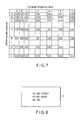
FIG. 7 is a view showing the contents of a probability table; -
FIG. 8 is a view showing a description example of a mail on which an address is described; -
FIG. 9 is a view showing a character pattern identified as a city name; -
FIG. 10 is a view showing the contents of a word dictionary; -
FIG. 11 is a view showing the contents of a probability table; -
FIG. 12 is a view showing a description example of a mail on which an address is described; -
FIG. 13 is a view showing a character pattern identified as a city name; -
FIG. 14A is a view showing a part of a word dictionary; -
FIG. 14B is a view showing a part of a word dictionary; -
FIG. 14C is a view showing a part of a word dictionary; -
FIG. 15 is a view showing a set of categories relevant to the word dictionary shown inFIG. 14A to FIG. 14C ; -
FIG. 16 is a view showing a description example of a mail on which an address is described; -
FIG. 17 is a view showing a character pattern identified as a city name; -
FIG. 18 is a view showing the contents of a word dictionary; -
FIG. 19 is a view showing a set of categories relevant to the word dictionary shown inFIG. 18 ; -
FIG. 20 is a view showing cells processed as representing a city name; -
FIG. 21A is a view showing one of character delimiting pattern candidates; -
FIG. 21B is a view showing one of character delimiting pattern candidates; -
FIG. 21C is a view showing one of character delimiting pattern candidates; -
FIG. 21D is a view showing one of character delimiting pattern candidates; -
FIG. 22 is a view showing the contents of a word dictionary; -
FIG. 23A is a view showing one of categories relevant to the word dictionary shown inFIG. 22 ; -
FIG. 23B is a view showing one of categories relevant to the word dictionary shown inFIG. 22 ; -
FIG. 23C is a view showing one of categories relevant to the word dictionary shown inFIG. 22 ; -
FIG. 23D is a view showing one of categories relevant to the word dictionary shown inFIG. 22 ; -
FIG. 24 is a view showing the recognition result of each unit relevant to the character delimiting pattern candidate; and -
FIG. 25 is a view showing characteristics of character intervals. - Hereinafter, embodiments of the present invention will be described with reference to the accompanying drawings.
-
FIG. 1 schematically depicts a configuration of a word recognition system for achieving a word recognition method according to an embodiment of the present invention. - In
FIG. 1 , this word recognition system is composed of: a CPU (central processing unit) 1; aninput device 2; ascanner 3 that is image input means; adisplay device 4; afirst memory 5 that is storage means; asecond memory 6 that is storage means; and areader 7. - The
CPU 1 executes an operating system program stored in thesecond memory 6 and an application program (word recognition program or the like) stored in thesecond memory 6, thereby performing word recognition processing as described later in detail. - The
input device 2 consists of a keyboard and a mouse, for example, and is used for a user to perform a variety of operations or input a variety of data. - The
scanner 3 reads characters of a word described on a material targeted for reading through scanning, and inputs these characters. The above material targeted for reading includes a mail P on which an address is described, for example. In a method of describing the above address, as shown inFIG. 2 , postal number, name of state, city name, street name, and street number are described in order from the lowest line and from the right side. - The
display device 4 consists of a display unit and a printer, for example, and outputs a variety of data. - The
first memory 5 is composed of a RAM (random access memory), for example. This memory is used as a work memory of theCPU 1, and temporarily stores a variety of data or the like being processed. - The
second memory 6 is composed of a hard disk unit, for example, and stores a variety of programs or the like for operating theCPU 1. Thesecond memory 6 stores: an operating system program for operating theinput device 2,scanner 3,display device 4,first memory 5, andreader 7; a word recognition program and acharacter dictionary 9 for recognizing characters that configure a word; aword dictionary 10 for word recognition; and a probability table 11 that stores a probability of the generation of characters that configure a word or the like. Theabove word dictionary 10 stores in advance a plurality of candidates of words to be recognized. This dictionary can be used as a city name dictionary that registers regions in which word recognition systems are installed, for example, city names in states. - The
reader 7 consists of a CD-ROM drive unit or the like, for example, and reads a word recognition program stored in a CD-ROM 8 that is a storage medium and aword dictionary 10 for word recognition. The word recognition program,character dictionary 9,word dictionary 10, and probability table 1 read by thereader 7 are stored in thesecond memory 6. - Now, an outline of a word recognition method will be described with reference to a flow chart shown in
FIG. 3 . - First, image acquisition processing for acquiring (reading) an image of a mail P is performed by means of the scanner 3 (ST1). Region detection processing for detecting a region in which an address is described is performed by using the image acquired by the image acquisition processing (ST2). There is performed delimiting processing for using vertical projection or horizontal projection, thereby identifying a character pattern in a rectangular region for each character of a word that corresponds to a city name, from a description region of the address detected by the region detection processing (ST3). Character recognition processing for acquiring a character recognition candidate is performed based on a degree of analogy obtained by comparing a character pattern of each character of the word identified by this delimiting processing with a character pattern stored in the character dictionary 9 (ST4). By using the recognition result of each character of the word obtained by this character recognition processing; each of characters of the city names stored in the
word dictionary 10; and the probability table 11, the posteriori probability is calculated by each city name contained in theword dictionary 10, and there is performed word recognition processing in which a word with its highest posteriori probability is recognized (ST5). Each of the above processing functions is controlled by means of theCPU 1. - When character pattern delimiting processing is performed in accordance with the
step 3, a word break may be judged based on a character pattern for each character and a gap in size between the patterned characters. In addition, it may be judged whether or not character spacing is provided based on the gap in size. - A word recognition method according to an embodiment of the present invention is achieved in such a system configuration. Now, an outline of the word recognition method will be described below.
- For example, consider character reading by an optical character reader. Although no problem will occur when the character reader has high character reading performance, and hardly makes a mistake, for example, it is difficult to achieve such high performance in recognition of a handwritten character. Thus, recognition precision is enhanced by using knowledge of words. Specifically, a word that is believed to be correct is selected from a word dictionary. Because of this, a certain evaluation value is calculated for each word, and a word with its highest (lowest) evaluation value is obtained as a recognition result. Although a variety of evaluation functions as described previously are propose, a variety of problems as described previously still remain unsolved.
- In the present embodiment, a posteriori probability considering a variety of problems as described previously is used as an evaluation function. In this way, all data concerning a difference in the number of characters, the ambiguity of word delimiting, the absence of character spacing, noise entry, and character break can be naturally incorporated in one evaluation function by calculation of probability.
- Now, a general theory of Bayes Estimation used in the present invention will be described below.
- An input pattern (input character string) is defined as "x". In recognition processing, certain processing is performed for "x", and the classification result is obtained. This processing can be roughly divided into the two processes below.
- (1) Characteristic "r" (= R(x)) is obtained by multiplying characteristics extraction processing R for obtaining any characteristic quantity relevant to "x".
- (2) The classification result "ki" is obtained by using any evaluation method relevant to the characteristic "r".
- The classification result "ki" corresponds to the "recognition result". In word recognition, note that the "recognition result" of character recognition is used as one of the characteristics. Hereinafter, the terms "characteristics" and "recognition result" are used distinctly.
- The Bayes Estimation is used as an evaluation method in the second process. A category "ki" with its highest posteriori probability P(ki|r) is obtained as a result of recognition. In the case where it is difficult or impossible to directly calculate the posteriori probability P(ki|r), the probability is calculated indirectly by using Bayes Estimation Theory, i.e., the following formula
[formula 1]
- A denominator P(r) is a constant that does not depend on "i". Thus, a numerator P(p|ki) P(ki) is calculated, whereby a magnitude of the posteriori probability P(ki|r) can be evaluated.
- Now, for a better understanding of the following description, a description will be given to the Bayes Estimation in word recognition when the number of characters is constant. In this case, the Bayes Estimation is effective in English or any other language in which a word break may occur.
- This section assumes that character and word delimitings are completely successful, and the number of characters is fixedly determined without noise entry between characters. The following formulas are defined.
[formula 2] - · Number of characters L
- · Category set K = {ki}
ki = ŵi, ŵi ∈ ŵ, ŵ : Set of words with the number of characters L - · ŵi = (ŵi1, ŵi2, ..., ŵiL )
ŵij: j-th character of ŵi ŵij ∈ C,
C : Character set - · Characteristics r = (r1, r2, r3, ..., rL)
ri: Character characteristics of i-th character
(= character recognition result) - (Example: First candidate, first to third candidates, candidates having a predetermined similarity, first and second candidates and its similarity or the like)
- In the foregoing description, "wa" may be expressed in place of "ŵi".
- At this time, assume that a written word is estimated based on the Bayes Estimation.
[formula 3]
P(r|ki) is represented as follows.
[formula 4]
- Assume that P(ki) is statistically obtained in advance. For example, reading an address of a mail is considered as depending on a position in a letter or a position in line as well as statistics of address.
- Although P(r|ki) is represented as a product, this product can be converted into addition by using an algorithm, for example, without being limited thereto. This fact applies to the following description.
- A significant difference in performance of recognition may occur depending on what is used as a characteristic "ri".
- Consider that a "character specified as a first candidate" is used as a character characteristic "ri". This character is defined as follows.
- · Character set C = {ci}
Example) ci: Numeral ci: Alphabetical upper-case or lower-case letter - · Character characteristic set E = {ei}
ei = (the first candidate is "ci") - · ri ∈ E
- For example, assume that "alphabetical upper-case and lower-case letters + numerals" is a character set C. The types of characteristics "ei" and types of characters "ci" have n (C) = n (E) 62 ways. Thus, there are 622 combinations of (ei, cj). 622 ways of P(ei|cj) are provided in advance, whereby the above formula (3) is used for calculation. Specifically, for example, in order to obtain P(ei|"A"), many samples of "A" are supplied to characteristics extraction processing R, and the frequency of the generation of each characteristic "ei" may be checked.
- Here, the following approximations may be used.
[formula 5]
[formula 6]
- The above formulas (4) and (5) are approximations in which, in any character "ci", a probability at which a first candidate is the characters themselves is equally "p", and a probability at which the first candidate is the other characters is equally "q". At this time, the following result is obtained.

- This approximation assumes that a character string listing the first candidates is a result of preliminary recognition. This result corresponds to matching for checking how many words such character string coincides with each word "wa". When the characters with "a" in number are coincident with each other, the following simple result is obtained.
[formula 7]
- For example, consider that a city name is read in address reading of mail P written in English as shown in
FIG. 2 .FIG. 4 shows the delimiting processing result of a character pattern that corresponds to a portion at which it is believed that the city name identified by the above mentioned delimiting processing is written. This result shows that four characters are detected. Aword dictionary 10 stores candidates of city names (words) by the number of characters. For example, a candidate of a city name (word) that consist of four characters is shown inFIG. 5 . In this case, five city names each consisting of four characters are stored as MAIR (k1), SORD (k2), ABLA (k3), HAMA (k4), and HEWN (k5). - Character recognition is performed for each character pattern shown in
FIG. 4 by the above described character recognition processing. A posteriori probability for each of the city names shown inFIG. 5 is calculated on the basis of the character recognition result of such each character pattern. - Although characteristics (= character recognition results) used for calculation are various, an example using characters of a first candidate is shown here. In this case, the character recognition result is "H, A, I, A" in order from the left-most character, relevant to each character pattern shown in
FIG. 4 . In this way, from the above formula (3), a probability P(r|k1) the probability that the character recognition result "H, A, I, A" shown inFIG. 4 will be produced when the actually written character is "MAIR (k1)",
[formula 8]
- As described in subsection 3.2.1, the value of each term on the right side is obtained in advance by preparing a probability table. Alternatively, by using approximation described in subsection 3.2.2, namely, for example, when p = 0.5 and n (E) = 26, q = 0.02. Thus, the calculation result is obtained as follows.

- That is, a probability P(r|k1) at which the city name MAIR (ki) relevant to the character recognition result "H, A, I, A" is the result of word recognition is 0.0001.
- Similarly, the following results are obtained.

- The probability P(r|K2) that the character recognition result "H, A, I, A" shown in
FIG. 4 will be produced when the actually written character is "SORD (k2)", is 0.00000016. - The probability P(r|K3) that the character recognition result "H, A, I, A" shown in
FIG. 4 will be produced when the actually written character is "SORD (k3)", is 0.000004. - The probability P(r|K4) that the character recognition result "H, A, I, A" shown in
FIG. 4 will be produced when the actually written character is "SORD (k4)", is 0.0025. - The probability P(r|K5) that the character recognition result "H, A, I, A" shown in
FIG. 4 will be produced when the actually written character is "SORD (k5)", is 0.000004. - Assuming that P(k1) to P(k5) are equal to each other, the magnitude of a posteriori probability P(ki|r) is equal to P(r|ki) from the above formula (2). Therefore, the formulas (9) and (10) may be compared with each other in magnitude. The largest probability is P(r|k4), and thus, the city name written in
FIG. 2 is estimated as HAMA. A description will now be given of the probability table 11.FIG. 6 shows how the approximation described in subsection 3.2.2 is expressed in the form of a probability table. The characters are assumed to be 26 upper-case alphabetic characters. InFIG. 6 , the vertical axis indicates actually written characters, while the horizontal axis represents their character recognition results. For example, the intersection between vertical line "M" and horizontal line "H" in the probability table 11 represents the probability P("H"|"M"), at which the character recognition result becomes "H" when the actually written character is "M". In the approximation described in subsection 3.2.2., the probability of each character recognition result correctly representing the actually written character is assumed to be "p". This being so, the diagonal line between the upper left corner of the probability table 11 and the lower right corner thereof is constant. In the case ofFIG. 6 , the probability is 0.5. Likewise, in the approximation described in subsection 3.2.2., the probability of each character recognition result representing a character other than the actually written character is assumed to be "q". This being so, the diagonal line between the upper left corner of the probability table 11 and the lower right corner thereof is constant. In the case ofFIG. 6 , the probability is 0.02. - As a result of using approximation described in subsection 3.2.2, a city name with its more coincident characters among city names contained in the
word dictionary 10 shown inFIG. 5 and among the city names obtained by the character recognition shown inFIG. 4 , is selected. Without using approximation described in subsection 3.2.2, as described in subsection 3.2.1, in the case where each P(ei|cj) is obtained in advance, and then, the obtained value is used for calculation, a city name with its more coincident characters is not always selected. - For example, a comparatively large value is in the first term of the above formula (8) because H and M is similar to each other in shape. Thus, the following result is obtained.
[formula 9]

- Similarly, a value in the fourth term is obtained in accordance with the following formulas
[formula 10]

- With respect to the other characters, approximation described in subsection 3.2.2 can be used. The probability table 11 in this case is shown in
FIG. 7 . At this time, the following result is obtained.
[formula 11]
- In this formula, P(r|k1) includes the largest value, and a city name estimated to be written on a mail P shown in
FIG. 2 is MAIR. - Now, a description is given to the Bayes Estimation in word recognition when the number of characters is not constant according to the first embodiment of the present invention. In this case, the Bayes Estimation is effective in Japanese or any other language in which no word break occurs. In addition, in a language in which a word break occurs, the Bays Estimation is effective in the case where a word dictionary contains a character string consisting of a plurality of words.
- In reality, although there is a case in which a character string of a plurality of words is contained in a category (for example, NORTH YORK), a character string of one word cannot be compared with a character string of two words in the method described in
chapter 3. In addition, the number of characters is not constant in a language (such as Japanese) in which no word break occurs, the method described inchapter 3 is not used. Now, this section describes a word recognition method that corresponds to a case in which the number of characters is not always constant. - An input pattern "x" is defined as a plurality of words rather than one word, and Bayes Estimation is performed in a similar manner to that described in
chapter 3. In this case, the definitions inchapter 3 are added and changed as follows.
Changes: - · An input pattern "x" is defined as a plurality of words.
- · L: Total number of characters in the input pattern "x"
- · Category set K = {ki}
- In the foregoing description, wb may be expressed in place of ŵ'j.
Additions:
[formula 13]
Lj: Total number of characters in character string "ŵ'j"
ŵjk: k-th character of ŵ'j ŵ'jk ∈ C - At this time, when Bayes Estimation is used, a posteriori probability P(ki|r) is equal to that obtained by the above formula (2).
[formula 14]
P(r|ki) is represented as follows.
[formula 15]
- Assume that P(ki) is obtained in the same way as that described in
chapter 3. Note that n (K) increases more significantly than that inchapter 3, and thus, a value of P(ki) is simply smaller than that inchapter 3. - The first term of the above formula (13) is approximated as follows.
[formula 16]
- Approximation of a first line assumes that there is ignored an effect of "wb" on a portion to which a character string "wb" of all the characters of the input pattern "x" is applied. Approximation of a second line assumes that each "rk" is independent. This is not really true. These approximation is coarse, but is very effective.
- Similarly, when the third term of the above formula (13) is approximated, the formula (13) is changed as follows.
[formula 17]
- Here, assume a value of P(ki|r)/P(ki). This value indicates how a probability of "ki" increases or decreases by knowing a characteristic "r".
[formula 18]
- Approximation using a denominator in
line 2 of the formula (16) is similar to that obtained by the above formula (14). - This result is very important. At the right side of the above formula (16), there is no description concerning a portion at which the character string "wb" of all the characters is not applied. That is, the above formula (16) is not associated with what the input pattern "x" is. From this fact, it is found that P(ki|r) can be calculated by using the above formula (16) without worrying about the position and length of the character string "wb", and multiplying P(ki).
- A numerator of the above formula (16) is the same as that of the above formula (3), namely, P(r|ki) when the number of characters is constant. This means that the above formula (16) performs normalization of the number of characters by using the denominator.
- Here, assume that characters specified as a first candidate is used as a characteristic as described in subsection 3.2.1. The following approximation of P(rk) is assumed.
[formula 19]
- In reality, although there is a need to consider the probability of generation of each character, this consideration is ignored here. At this time, when the above formula (16) is approximated by using the approximation described in subsection 3.2.2, the following result is obtained.
[formula 20]
where normalization is effected by n(E)Lj. - The above formula (16) is obtained based on rough approximation and may pose the accuracy problem. In order to further improve the accuracy, therefore, formula (12) is modified as follows:
[formula 21]
where
[formula 22]
- As a result, the approximation used for the denominator on the second line of formula (16) can be avoided and the error is suppressed.
- The formula "match(ki)" is identical with the third line in formula (16). In other words, the above formula (16-2) can be calculated by calculating and substituting formula (16) for each ki.
- For example, consider that a city name is read in mail address reading when:
- · there exists a city name consisting of a plurality of words in a language (such as English) in which a work break occurs; and
- · when a city name is written in a language (such as Japanese) in which no word break occurs.
- In the foregoing, the number of characters of each candidate is not constant. For example, consider that a city name is read in address reading of mail P written in English as shown in
FIG. 8 .FIG. 9 shows the delimiting processing result of a character pattern that corresponds to a portion at which it is believed that the city name identified by the above described delimiting processing is written, wherein it is detected that a word consisting of two characters is followed by a space, and such space is followed by a word consisting of three characters. Theword dictionary 10, as shown inFIG. 10 , stores all the city names having the number of characters or the number of words applied inFIG. 9 . In this case, five city names are stored as COH (k1), LE ITH (k2), OTH (k3), SK (k4), and STLIN (k5). - Character recognition is performed for each character patterns shown in
FIG. 9 by the above described character recognition processing. The posteriori probability is calculated by each city name shown inFIG. 10 on the basis of the character recognition result obtained by such each character pattern. - Although characteristics used for calculation (= character recognition results) are various, an example using characters specified as a first candidate is shown here. In this case, the character recognition result is S, K, C, T, H in order from the left-most character relevant to each character pattern shown in
FIG. 9 . When approximation described in subsection 4.2.1 is used, in accordance with the above formula (16), a posteriori probability P(ki|r). That the last three characters are "COH" when the character recognition result is "S, K, C, T, H".
[formula 23]
- Further, in the case where approximation described in subsections 3.2.2 and 4.2.2 is used, when p = 0.5 and n (E) = 26, q = 0.02. Thus, the following result is obtained.
[formula 24]
- Similarly, the following result is obtained.
[formula 25]
- In the above formula, "k3" assumes that the right three characters are OTH, and "k4" assumes that the left two characters are SK.
- Assuming that P(ki) to P(k5) are equal to each other, with respect to the magnitude of the posteriori probability P(ki|r), the above formula (21) and formula (22) may be compared with each other in magnitude. The highest probability is P(k|r), and thus, the city name written in
FIG. 8 is estimated as SK. - Without using approximation described in subsection 3.2.2, as described in subsection 3.2.1, there is shown an example when each P(ei|cj) is obtained in advance, and then, the obtained value is used for calculation.
- Because the shapes of C and L, T and I, and H and N are similar to each other, it is assumed that the following result is obtained.
[formula 26]
- Approximation described in subsection 3.2.2 is met with respect to the other characters. The probability table 11 in this case is shown in
FIG. 11 . At this time, the following result is obtained.
[formula 27]
- In this formula, P(k5|r)/P(k5) includes the largest value, and the city name estimated to be written in
FIG. 8 is ST LIN. - Also, an example of the calculation for error suppression described in subsection 4.2.3 will be explained below. First, formula (16-2) is calculated. Assuming that P(k1) to P(k5) are equal to one another, they are reduced in advance. The denominator is the total sum of formula (22), i.e. 56.24 + 15.21 + 56.24 + 169 + 205.3 ≈ 502. The numerator is each result of formula (22). Thus,
[formula 28]
- Assuming the rejection for the probability of 0.5 or less, the recognition result is rejected.
- In this way, in the first embodiment, recognition processing is performed by each character for an input character string that corresponds to a word to be recognized; there is obtained a probability of the generation of characteristics obtained as the result of character recognition by conditioning characters of the words contained in a word dictionary that stores in advance candidates of words to be recognized; the thus obtained probability is divided by a probability of the generation of characteristics obtained as the result of character recognition; each of the above division results obtained for the characters of the words contained in the word dictionary is divided for all the characters; all the computation results obtained for each word in the word dictionary are added up; the computation results obtained on each character of each word in the word dictionary are divided by the above added-up computation results; and based on this result, the word recognition result is obtained.
- That is, in word recognition using the character recognition result, even in the case where the number of characters in a word is not constant, word recognition can be performed precisely by using an evaluation function based on a posteriori probability that can be used even in the case where the number of characters in a word is not always constant.
- Also, the rejection process can be executed with high accuracy.
- Now, a description will be given to Bayes Estimation according to a second embodiment of the present invention, the Bayes Estimation being characterized in that, when word delimiting is ambiguous, such ambiguity is included in calculation of the posteriori probability. In this case, the Bayes Estimation is effective when error detection of word break cannot be ignored.
- In a language (such as English) in which a word break occurs, the methods described in the foregoing
chapters 1 to 4 assume that a word is always identified correctly. If the number of characters is changed while this assumption is not met, these methods cannot be used. In this chapter, the result of word delimiting is treated as a probability without being defined as absoluteness, whereby the ambiguity of word delimiting is integrated with the Bayes Estimation in word recognition. A primary difference fromchapter 4 is that consideration is taken into characteristics between characters obtained as the result of word delimiting. - This section assumes that character delimiting is completely successful, and no noise entry occurs. The definitions in
chapter 4 are added and changed as follows.
Changes - · An input pattern "x" is defined as a line.
- · L: Total number of characters in the input line "x"
- · Category set K = {ki}
- In the foregoing description, "wc" may be expressed in place of "w̃j".
Additions
[formula 30]
Lj: Number of characters in character string "w̃j"
w̃jk: k-th character "w̃jk ∈ C" of character string "w̃j"
w̃'jk : Whether or not a word break occurs k-th character and (k + 1)-th character of character string "w̃j"
s0: Break
s1: No break
(s2: Start or end of line)
w̃'j0 : w̃'jLj = s0
(s2 is provided for representing the start or end of line in the same format, and is not essential.)
Change - · Characteristic "r" = (rc, rs)
- At this time, the posteriori probability P(ki|r) can be represented by the following formula.
[formula 32]
- In this formula, assuming that P(rs|ki) and P(rc|ki) are independent of each other (this means that character characteristics extraction and characteristics of character spacing extraction are independent of each other), P(rc|rs, ki) = P(rc|ki). Thus, the above formula (23) is changed as follows.
[formula 33]
- P(rc|ki) is substantially similar to that obtained by the above formula (13).
[formula 34]
P(rs|ki) is represented as follows.
[formula 35]
- Assume that P(ki) is obtained in a manner similar to that described in
chapters 1 to 4. However, in general, note that n (K) increases more significantly than that described inchapter 4. - When approximation similar to that described in subsection 4.2.1 is used, the following result is obtained.
[formula 36]
- Similarly, the above formula (26) is approximated as follows.
[formula 37]
- When a value of P(ki|r)/P(ki) is considered in a manner similar to that described in subsection 4.2.1, the formula is changed as follows.
[formula 38]
- A first line of the above formula (29) is in accordance with the above formula (24). A second line uses approximation obtained by the following formula.
[formula 39]
- The above formula (29) shows that a "change caused by knowing 'characteristics' of a probability of 'ki'" can be handled independently according to rc and rs. The probability is calculated below.
[formula 40]
[formula 41]
- Approximation used by a denominator in the second line of each of the above formulas (30) and (31) is similar to that obtained by the above formula (14). In the third line of the formula (31), rs0 and rsL are always at the start and end of the line (d3 shown in an example of the next subsection 5.2.2),

- From the foregoing, the following result is obtained.
[formula 42]
- As in the above formula (16), in the above formula (32) as well, there is no description concerning a portion to which a character string "wc" is not applied. That is, in this case as well, "normalization caused by a denominator" can be considered.
- An example of characteristics are defined as follows.
· Characteristics of character spacing set
D = {d0, d1, d2, (, d3) }
d0: Expanded character spacing
d1: Condensed character spacing
d2: No character spacing
(d3: This denotes the start or end of the line, and always denotes a word break.)
· rs ∈ D - At this time, the following result is obtained.
[formula 43]
- The above formula is established in advance, whereby the numerator in the second term of the above formula (32) can be obtained by the formula below.
[formula 44]
where P(d3|s2) = 1. - In addition, the formula set forth below is established in advance, whereby the denominator P(rsk) in the second term of the above formula (32) can be obtained.
[formula 45]
- The above formula (32) is obtained based on a rough approximation and may pose the accuracy problem. In order to further improve the accuracy, therefore, formula (23) is modified as follows:
[formula 46]
where
[formula 47]
- As a result, the approximation used for the denominator on the second line of formula (30) and the denominator on the second line of formula (31) can be avoided and the error is suppressed.
- The formula "matchB(ki)" is identical with formula (32). In other words, formula (23-2) can be calculated by calculating and substituting formula (32) for each ki.
- As in section 4.3, consider that a city name is read in address reading of a mail in English.
- For example, consider that a city name is read in address reading of mail P written in English, as shown in
FIG. 12 .FIG. 13 shows the delimiting processing of a character pattern that corresponds to a portion at which it is believed that the city name identified by the above described delimiting processing is written, wherein a total of five characters are detected. It is detected that the first and second characters are free of being spaced from each other; the second and third characters are expanded in spacing; and the third and fourth characters and the fourth and fifth characters are condensed in spacing.FIG. 14A, FIG. 14B, and FIG. 14C show the contents of theword directory 10, wherein all city names are stored. In this case, three city names are stored as ST LIN shown inFIG. 14A , SLIM shown inFIG. 14B , and SIM shown inFIG. 14C . The sign (s0, s1) described under each city name denotes whether or not a word break occurs. s0 denotes a word break, and s1 denotes no word break. -
FIG. 15 illustrates a set of categories. Each category includes position information, and thus, is different from theword dictionary 10. A category k1 is made of a word shown inFIG. 14A ; categories k2 and k3 are made of words shown inFIG. 14B ; and categories k4, k5, and k6 are made of words shown inFIG. 14C . Specifically, thecategory 1 is made of "STLIN"; thecategory 2 is made of "SLIM"; thecategory 3 is made of " SLIM"; the category k4 is made of "SLIM "; the category k5 is made of " SIM "; and the category k6 is made of " SLIM". - Character recognition is performed for each character pattern shown in
FIG. 13 by the above described character recognition processing. The character recognition result is used for calculating the posteriori probability of each of the categories shown inFIG. 15 . Although characteristics used for calculation (= character recognition result) are various, an example using characters specified as a first candidate is shown here. - In this case, the five characters "S, S, L, I, M" from the start (leftmost character) are obtained as character recognition results for each of the character patterns shown in
FIG. 13 . - Although a variety of characteristics of character spacing are considered, an example described in subsection 5.2.2 is shown here.
FIG. 13 shows characteristics of character spacing. The first and second characters are free of being spaced from each other, and thus, the characteristics of character spacing are defined as "d2". The second and third characters are expanded in spacing, and thus, the characteristics of character spacing are defined as "d0". The third and fourth characters and the fourth and fifth characters are condensed in spacing, the characteristics of character spacing are defined as "d1". - When approximation described in subsection 5.2.1 is used, in accordance with the above formula (30), a change P(kl|rc)/P(k1) in a probability of generating a category k1, the change caused by knowing the character recognition result "S, S, L, I, M", is obtained by the following formula.
[formula 48]
- In accordance with the above formula (31), P(k1|rs)/P(k1) of the probability of an occurrence of category k1, a change caused by characteristics of character spacing shown in
FIG. 14 , is obtained by the following formula.
[formula 49]
- If approximation described in subsections 3.2.2 and 4.2.2 is used to make calculation in accordance with the above formula (33), for example, when p = 0.5 and n (E) = 26, q = 0.02. The above formula (33) is computed as follows.
[formula 50]
- In order to make communication in accordance with the above formula (34), it is required to obtain the following formula in advance.
[formula 51]
- As an example, it is assumed that the following values in tables 1 and 2 are obtained.
[Table 1]

- Table 1 lists values obtained by the following formula.
[formula 52]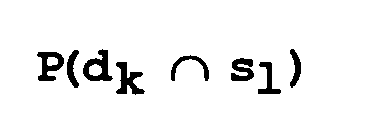
- Table 2 lists the values of P(dk|s1). In this case, note that a relationship expressed by the following formula is met.
[formula 53]
- In reality, P(dk|s1)/P(dk) is required for calculation using the above formula (34), and thus, the calculations are shown in table 3 below.
[Table 3]
- The above formula (34) is used for calculation as follows based on the values shown in table 3 above.
[formula 54]
- From the above formula (29), a change P(k1|r)/P(k1) in a probability of generating the category k1, the change caused by knowing the characteristics recognition result "S, S, L, I, M" and the characteristics of character spacing is represented by a product between the above formulas (35) and (36), and is obtained by formula.
[formula 55]
- Similarly, P(ki|rc)/P(ki), P(ki|rs)/P(ki), P(ki|r)/P(ki) are obtained with respect to k2 to k6 as follows.
[formula 56]
[formula 57]
[formula 58]
- The maximum category in the above formulas (37) and (40) is "k1". Therefore, the estimation result is ST LIN.
- In the method described in
chapter 4, which does not use characteristics of character spacing, although the category "k3" that is maximum in the formulas (35) and (38) is the estimation result, it is found that the category "k1" believed to comprehensively match best is selected by integrating the characteristics of character spacing. - Also, an example of the calculation for error suppression described in subsection 5.2.3 will be explained. The above formula (23-2) is calculated. Assuming that P(k1) to P(k6) are equal to one another, they are reduced in advance. The denominator is the total sum of formula (40), i.e. 3900 + 0.227 + 1350 + 0.337 + 0.0500 + 473 ≈ 5720. The numerator is each result of formula (40). Thus,
[formula 59]
- Assuming the rejection for the probability of 0.7 or less, the recognition result is rejected.
- In this manner, in the second embodiment, the input character string corresponding to a word to be recognized is identified by each character; the characteristics of character spacing are extracted by this character delimiting; recognition processing is performed for each character obtained by the above character delimiting; and a probability at which there appears characteristics obtained as the result of character recognition by conditioning characteristics of the characters and character spacing of the words contained in a word dictionary that stores candidates of the characteristics of a word to be recognized and character spacing of the word. In addition, the thus obtained probability is divided by a probability at which there appears characteristics obtained as the result of character recognition; each of the above calculation results obtained for each of the characteristics of the characters and character spacing of the words contained in the word dictionary is multiplied relevant to all the characters and character spacing; all the computation results obtained for each word in the word dictionary are added up; the computation results obtained on each character of each word in the word dictionary are divided by the above added-up computation results; and based on this result, the word recognition result is obtained.
- That is, in word recognition using the character recognition result, an evaluation function is used based on a posteriori probability considering at least the ambiguity of word delimiting. In this way, even in the case where word delimiting is not reliable, word recognition can be performed precisely.
- Also, the rejection process can be executed with high accuracy.
- Now, a description will be given to Bayes Estimation according to a third embodiment of the present invention when no character spacing is provided or noise entry occurs. In this case, the Bayes Estimation is effective when no character spacing is provided or when noise entry cannot be ignored.
- The methods described in the foregoing
chapters 1 to 5 assume that character is always identified correctly. If no character spacing is provided while this assumption is not met, the above methods cannot be used. In addition, these methods cannot be used to counteract noise entry. In this chapter, the Bayes Estimation that counteracts the absence of character spacing or noise entry is performed by changing categories. - Definitions are added and changed as follows based on the definitions in
chapter 5.
Changes
· Category K = {ki}
[formula 60]
ki = (wjk, h), wjk ∈ w, w: A set of derivative character strings - In the foregoing description, "wd" may be expressed in place of "wjk".
Addition
[formula 61]
· Derivative character string
wjk = (wjk1, wjk2, ..., wjkLjk , w'jk0,
w'jk1, ..., w'jkLjk )
Ljk: Number of characters in derivative character string "wjk"
wjk1: l-th character wjk ∈ C of wjk
w'jk: Whether or not a word break occurs between l character and (l + 1)-th character w'jkl ∈ S,
w'jk0 = w'jkLjk = s0
· Relationship between derivative character string wjk and character string w̃j. - Assume that action ajkl ∈ A is acted between l-th character and (l + 1) character in character string w̃j, whereby a derivative character string wjk can be formed.
- A = {a0, a1, a2} a0: No action a1: No character spacing a2: Noise entry
· a0: No action
Nothing is done for the character spacing.
· a1: No character spacing - The spacing between the two characters is not provided. The two characters are converted into one non-character by this action.
- Example: The spacing between T and A of ONTARIO is not provided. ON#RIO (# denotes a non-character by providing no character spacing.)
· a2: Noise entry - A noise (non-character) is entered between the two characters.
- Example: A noise is entered between N and T of ONT.
ON*T (* denotes a non-character due to noise.) - However, when 1 = 0, Lj, it is assumed that noises are generated at the left and right ends of a character spring "wc", respectively. In addition, this definition assumes that noise does not enter two or more characters continuously.
· Non-character γ ∈ C - A non-character is identified as "γ" by considering the absence of character spacing or noise entry, and is included in character C.
- At this time, a posteriori probability P(ki|r) is similar to that obtained by the above formulas (23) and (24).
[formula 62]
- P(pc|ki) is substantially similar to that obtained by the above formula (25).
[formula 63]
- P(ps|ki) is also substantially similar to that obtained by the above formula (26).
[formula 64]
- Assume that P(wc) is obtained in advance. Here, although P(wc) is affected by the position in a letter or the position in line if the address of the mail P is actually read, for example, the P(wc) is assumed to be assigned as an expected value thereof. At this time, a relationship between P(wd) and P(wc) is considered as follows.
[formula 65]
- That is, the absence of character spacing and noise entry can be integrated with each other in a frame of up to five syllables by providing a probability of the absence of character spacing P(a1) and a noise entry probability P(a2). From the above formula (44), the following result is obtained.
[formula 66]
- This formula is a term concerning whether or not noise occurs at both ends. In general, probabilities at which noises exist are different from each other between characters and at both ends. Thus, a value other than noise entry probability P(a2) is assumed to be defined.
- A relationship between P(wc) and P(wc, h) or a relationship between P(wd) and P(wd, h) depends on how the effects as described previously (such as position in a leter) are modeled and/or approximated. Thus, a description is omitted here.
- Consider a case in which characters specified as a first candidate are used as character characteristics, as shown in subsection 3.2.1. When a non-character "γ" is extracted as characteristics, the characters generated as a first candidate are considered to be similarly probable. Then, such non-character is handled as follows.
[formula 67]
- As in section 5.3, for example, consider that a city name is read in address reading of a mail P in English, as shown in
FIG. 17 . - In order to clarify the characteristics of this section, there is provided an assumption that word delimiting is completely successful, and a character string consisting of a plurality of words does not exist in a category.
FIG. 17 shows the result of delimiting processing of a character pattern that corresponds to a portion at which it is believed that a city name identified by the above described delimiting processing is written, wherein a total of five characters are detected. Theword dictionary 10 stores all city names, as shown inFIG. 18 . In this case, three city names are stored as SITAL, PETAR, and STAL. -
FIG. 19 illustrates a category set, wherein character strings each consisting of five characters are listed from among derivative character strings made based on theword dictionary 10. When all derivative character strings each consisting of five characters are listed, for example, "P#A*R" or the like deriving from "PETAR" must be included. However, in the case where a probability P(a) of the absence of character spacing or noise entry probability P(a2) described in section 6.2 is smaller than a certain degree, such characters can be ignored. In this example, such characters are ignored. - Categories k1 to k5 each are made of a word "SISTAL"; a category k6 is made of a word "PETAR"; and categories k7 to k11 each are made of a word "STAL". Specifically, the category k1 is made of "#STAL"; the category k2 is made of "S#TAL"; the category k3 is made of "SI#AL"; the category k4 is made of "SIS#L"; the category k5 is made of "SIST#"; the category k6 is made of "PETAR"; the category k7 is made of "*STAL"; the category k8 is made of "S*TAL"; the category k9 is made of "ST*AL"; the category k10 is made of "STA*L"; and the category k11 is made of "STA*L".
- Character recognition is performed for each of the character patterns shown in
FIG. 17 by the above described character recognition processing. The posteriori probability is calculated by each category shown inFIG. 19 by on the basis of the character recognition result obtained by such each character pattern. - Although characters used for calculation (= character recognition result) are various, an example using characters specified as a first candidate is shown here. In this case, the character recognition result is "S, E, T, A, L" in order from the left-most character, relevant to each character pattern shown in
FIG. 17 . In this way, in accordance with the above formula (16), a change P(k2|r)/P(k2) in a probability of generating the category k2 (S#TAL) shown inFIG. 2 , the change caused by knowing the character recognition result, is obtained as follows.
[formula 68]
- Further, by using approximation described in section 3.2 and subsection 4.2.2, for example, when p = 0.5 and n (E) = 26, q = 0.02. Thus, the above formula (46) is used for calculation as follows.
[formula 69]
- Referring now to the above calculation process, this calculation is equivalent to calculation of four characters other than non-characters. Similarly, the other categories are calculated. Here, k6, k7, and k8 easily estimated to indicate large values are calculated as a typical example.
[formula 70]
- In comparing these values,
chapter 5 assumes that the values of P(ki) is equal to each other. However, in this section, as described in section 6.2, a change occur with P(ki) by considering the absence of character spacing or noise entry. Thus, all the values of P(ki) before such change occurs is assumed to be equal to each other, and P(ki) = P0 is defined. P0 can be considered to be P(wc) in the above formula (44). In addition, P(ki) after such change has occurred is considered to be P(wd) in the above formula (44). Therefore, P(ki) after such change has occurred is obtained as follows.
[formula 71]
- In this formula, assuming that a probability of the absence of character spacing P(a1) = 0.05, a probability of noise entry into character space P(a0) = 0.002, a probability of noise entry into both ends is P' (a2) = 0.06, for example, P(k2) is calculated as follows.
[formula 72]
- In calculation, a probability when neither character spacing nor noise entry occurs P(a0) = 1 - P(a1) - P(a2) = 0.948 is used, and a probability free of noise entry at both ends P' (a0) = 1 - P' (a2) = 0.94 is used.
- Similarly, when P(k6), P(k7), and P(k8) are calculated, the following result is obtained.
[formula 73]
- When the above formulas (50) and (51) are changed by using the above formulas (47) and (48), the following result is obtained.
[formula 74]
- When the other categories are calculated similarly as a reference, the following result is obtained.
[formula 75]
- From the foregoing, the highest posteriori probability is the category k2, and it is estimated that the city name written in
FIG. 16 is SISTAL, and no character spacing between I and S is provided. - Also, an example of the calculation for error suppression will be explained. The denominator is the total sum of the aforementioned P(k1|r) to P(k11|r), i.e. 40.7P0 + 1020P0 + 40.7P0 + 1.63P0 + 0.0653P0 + 424P0 + 54.8P0 + 45.5P0 + 1.81P0 + 0.0727P0 + 0.0880P0 ≈ 1630P0 . The numerator is the aforementioned P(k1|r) to P(k11|r). Thus, the calculation is made only for the maximum value k2. Then,
[formula 76]
- Assuming the rejection for the probability of 0.7 or less, the recognition result is rejected.
- As described above, according to the third embodiment, the characters of words contained in a word dictionary include information on non-characters as well as characters. In addition, a probability of generating words each consisting of characters that include non-character information is set based on a probability of generating words each consisting of characters that do not include any non-character information. In this manner, word recognition can be performed by using an evaluation function based on a posteriori probability considering the absence of character spacing or noise entry. Therefore, even in the case where no character spacing is provided or noise entry occurs, word recognition can be performed precisely.
- Also, the rejection process can be executed with high accuracy.
- Now, a description will be given to Bayes Estination according to a fourth embodiment of the present invention when a character is not identified uniquely. In this case, the Bayes Estimation is effective for characters with delimiters such as Japanese Kanji characters or Kana characters. In addition, the Bayes Estimation is also effective to calligraphic characters in English which includes a case where many break candidates other than actual character breaks must be presented.
- The methods described in
chapters 1 to 6 assume that characters themselves are not delimited. However, there is a case in which characters such as Japanese Kanji or Kana characters themselves are delimited into two or more. For example, in a Kanji character "", when character delimiting is performed, " " and "
 " are identified separately as character candidates. At this time, a plurality of character delimiting candidates appear depending on whether these two character candidates are integrated with each other or separated from each other.
- Such character delimiting cannot be achieved by the method described in
chapters 1 to 6. Conversely, in the case where many characters free of being spaced from each other are present, and are subjected to delimiting processing, the characters themselves as well as actual character contacted portions may be cut. Although it will be described later in detail, it would be better to permit cutting of characters themselves to a certain extent as a strategy of recognition. In this case as well, the methods described incharacters 1 to 6 cannot be used similarly. In this chapter, Bayes Estimation is performed which corresponds to a plurality of character delimiting candidates caused by character delimiting. - In character delimiting targeted for character contact, processing for cutting a character contact is performed. In this processing, when a case in which a portion that is not a character break is specified as a break candidate is compared with a case in which a character break is not specified as a break candidate, the latter affects recognition. The reasons are stated as follows.
- · When a portion that is not a character break is specified as a break candidate
- A case in which a character break is executed at a character break and a case in which such character break is not performed can be attempted. Thus, if two much breaks occur, correct character delimiting is not always performed.
- · When a character break is not specified as a break candidate
- There is no means for obtaining correct character delimiting.
- Therefore, in character delimiting, it is effective to specify many break candidates other than character breaks. However, when a case in which a character break is performed at a break candidate and a case in which such break is not performed is attempted, it means that there are a plurality of character delimiting patterns. In the methods described in
chapters 1 to 6, comparison between different character delimiting pattern candidates cannot be performed. Therefore, a method described here is used to solve this problem. - The definitions are added and changed as follows based on the definitions in
chapter 6.
Changes
· Break state set S = {s0, s1, s2, (, s3)}
s0: Word break
s1: Character break
s2: No character break (s3: Start or end of line)
"Break" defined inchapter 5 and subsequent means a word break, which falls into s0. "No break" falls into s1 and s2.
· L: Number of portions divided at a break candidate (referred to as cell)
Addition
[formula 77]
· Unit uij (I ≦ j)
This unit is combined between i-th cell and
(j - i)-th cell.
Change
· Category K = {ki}
[formula 78]
mjk = (mjk1, mjk2, ..., mjkLjk , mjkLjk + 1)
mjk1: Start cell number of unit to which character "wjkl" applies. The unit can be expressed as "umjklmjkl+1".
h: A position of a derivable character string "wjk". A derivative character string "wjk" starts from a (h + 1)-th cell.
Addition
[formula 79]
· Break pattern k'i = (k'i0, k'i1, ..., k'iLC ) k'i: Break state in ki
LC: Total number of cells included in all units to which a derivative character string "wjk" applies.
LC = mjkLjk +1 - mjk1
k'il: State k'il ∈ S in a break between
(h + 1)-th cell and (h + 1 + 1)-th cell
Change
[formula 80]
· Character characteristics
rC = (rC12, rC13, rC14, ..., rC1L+1, RC23, rC24, ..., rC2L+1, ..., rCLL+1)
rCn1 n2 : Character characteristics of unit un1 n2
· Characteristics of character spacing rS = (rS0, rS1, ..., rSL)
rSn: Characteristics of character spacing between n-th cell and (n + 1)-th cell - At this time, a posterior probability P(ki|r) is similar to the above formulas (23) and (24).
[formula 81]
P(rc|ki) is represented as follows.
[formula 82]
[formula 83]
- In P(ki), "mjk" is contained in a category "ki" in this section, and thus, the effect of the "mjk" should be considered. Although it is considered that the "mjk" affect the shape of a unit to which individual characters apply, characters that apply to such unit, a balance in shape between the adjacent units or the like, a description of its modeling will be omitted here.
- When approximation similar to that in subsection 4.2.1 is used for the above formula (54), the following result is obtained.
[formula 84]
- In reality, it is considered that there is any correlation among "r cn1n3", "r cn1n2", and "r cn2n3", and thus, this approximation is more coarse than that described in subsection 4.2.1.
- In addition, when the above formula (55) is approximated similar, the following result is obtained.
[formula 85]
- Further, when P(ki|r)/P(ki) is calculated in a manner similar to that described in subsection 5.2.1, the following result is obtained.
[formula 86]
- As in the above formula (32), with respect to the above formula (58), there is no description concerning a portion at which a derivative character string "wd" applies, and "normalization by denominator" can be performed.
- 7.3.2 Break and character spacing characteristics "rs"
- Unlike
chapters 1 to 6, in this subsection, s2 (No character break) is specified as a break state. Thus, in the case where characteristics of character spacing set D is used as a set of character spacing characteristics in a manner similar to that described in subsection 5.2.2, the following result is obtained.
[formula 87]
- It must be noted here that all of these facts are limited to a portion specified as "a break candidate", as described in section 7.1. s2 (No character break) means that a character is specified as a break candidate, but no break occur. This point should be noted when a value is obtained by using the formula below.
[formula 88]
This applies to a case in which a value is obtained by using the formula below.
[formula 89]
- The above formula (58) is obtained based on rough approximation and may pose the accuracy problem. In order to further improve the accuracy, therefore, formula (53) is modified as follows:
[formula 90]
where
[formula 91]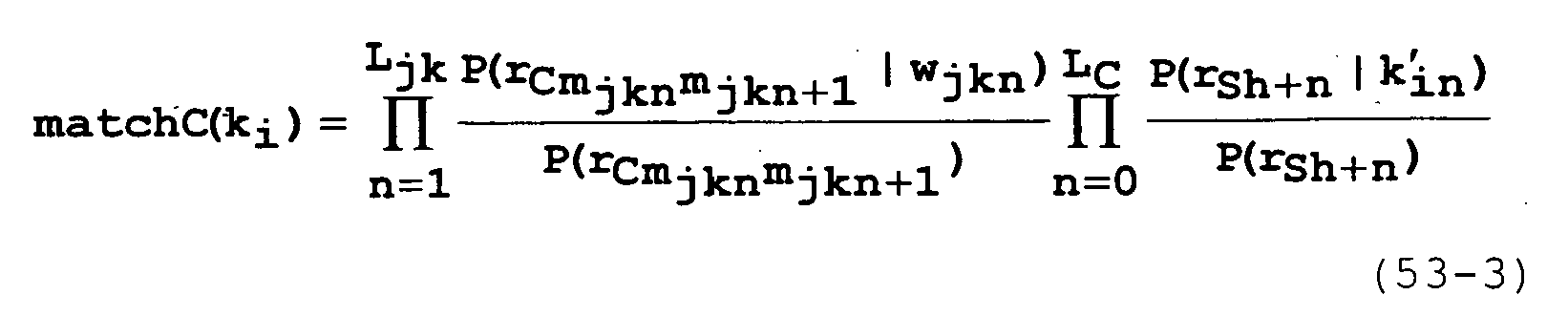
- As a result, the approximation used for the denominator on the second line of formula (58) can be avoided and the error is suppressed.
- The formula "matchC(ki)" is identical with formula (58). In other words, formula (53-2) can be calculated by calculating and substituting formula (58) for each ki.
- As in section 6.4, consider that a city name is read in address reading of mail P written in English.
- For clarifying the characteristics of this section, it is assumed that word delimiting is completely successful; a character string consisting of a plurality of words does not exist in a category, no noise entry occurs, and all the character breaks are detected by character delimiting (That is, unlike
section 6, there is no need for category concerning noise or space-free character). -
FIG. 20 shows a portion at which it is believed that a city name is written, and five cells are present.FIG. 21A to FIG. 21D show possible character delimiting pattern candidates. In this example, for clarity, it is assumed that the spacing betweencells cells - The delimiting candidates are present between
cells cells FIG. 21A to FIG. 21D .FIG. 22 shows the contents of theword directory 10 in which all city names are stored. In this example, there are three candidates for city names. - In this case, three city names are stored as BAYGE, RAGE, and ROE.
-
FIG. 23A to FIG. 23D each illustrate a category set. It is assumed that word delimiting is completely successful. Thus, NAYGE applies toFIG. 21A ; RAGE applies toFIG. 21B and FIG. 21C ; and ROE applies toFIG. 21D . - In the category k1 shown in
FIG. 23A , the interval betweencells cells - In the category k2 shown in
FIG. 23B , the interval betweencells cells - In the category k3 shown in
FIG. 23C , the interval betweencells cells - In the category k4 shown in
FIG. 23D , the interval betweencells cells - Each of the units that appear in
FIG. 23A to FIG. 21D is applied to character recognition, and the character recognition result is used for calculating the posteriori probabilities of the categories shown inFIG. 23A to FIG. 23D . Although characteristics used for calculation (= character recognition result) are various, an example using characters specified as a first candidate is shown below. -
FIG. 24 shows the recognition result of each unit. For example, this figure shows that a first place of the recognition result has been R in aunit having cells - Although it is considered that character spacing characteristics are various, an example described in subsection 5.2.2 is summarized here, and the following is used.
- · Set of character spacing characteristics
D' = {d' 1, d' 2}
d' 1: Character spacing
d' 2: No character spacing - FIG. 27 shows characteristics of character spacing between
cells cells cells cells - When approximation described in subsection 7.3.1 is used, in accordance with the above formula (58), a change P(k1|rc)/P(k1) of a probability of generating category "k1" (BAYGE), the change caused by knowing the recognition result shown in
FIG. 24 , is obtained by the following formula.
[formula 92]
- In the above formula (58), a change P(ki|rs)/P(ki) caused by knowing characteristics of character spacing shown in
FIG. 25 is obtained by the following formula.
[formula 93]
- In order to make a calculation using the above formula (59), when approximation described in subsections 3.2.2 and 4.2.2 is used, for example, when p = 0.5 and n (E) = 26, q = 0.02. Thus, the above formula (59) is used for calculation as follows.
[formula 94]
- In order to make calculation using the above formula (60), it is required to establish the following formula in advance.
[formula 95]
- As an example, it is assumed that the following values shown in tables 4 and 5 are obtained.
[Table 4]

[formula 96]
- Table 5 lists values of P(d'k|s1). In this case, note that a relationship shown by the following formula is met.
[formula 97]
- In reality, P(d'k|s1)/P(d'k) is required for calculation using the above formula (60). Thus, Table 6 lists the thus calculated values.
[Table 6]
- The above formula (60) is used for calculation as follows, based on the above values shown in Table 6.
[formula 98]
- From the above formula (60), a change P(kl|r)/P(k1) caused by knowing the character recognition result shown in
FIG. 24 and the characteristics of character spacing shown inFIG. 25 is represented by a product between the above formulas (61) and (62), and the following result is obtained.
[formula 99]
- Similarly, with respect to k2 to k4 as well, when P(ki|rc)/P(ki), P(ki|rs)/P(ki), and
P(ki|r)/P(ki) are obtained, the following result is obtained.
[formula 100]
[formula 101]
[formula 102]
- In comparing these results, although it is assumed that values of P(ki) are equal to each other in
chapters 1 to 5, the shape of characters is considered in this section. - In
FIG. 21D , the widths of units are the most uniform. InFIG. 21A , these widths are the second uniform. However, inFIG. 21B and FIG. 21C , these widths are not uniform. - A degree of this uniformity is modeled by a certain method, and the modeled degree is reflected in P(ki), thereby enabling more precise word recognition. As long as such precise word recognition is achieved, any method may be used here.
- In this example, it is assumed that the following result is obtained.
[formula 103]
- When a proportion content Pi is defined, and the above formula (67) is deformed by using the formulas (63) and 66, the following result is obtained.
[formula 104]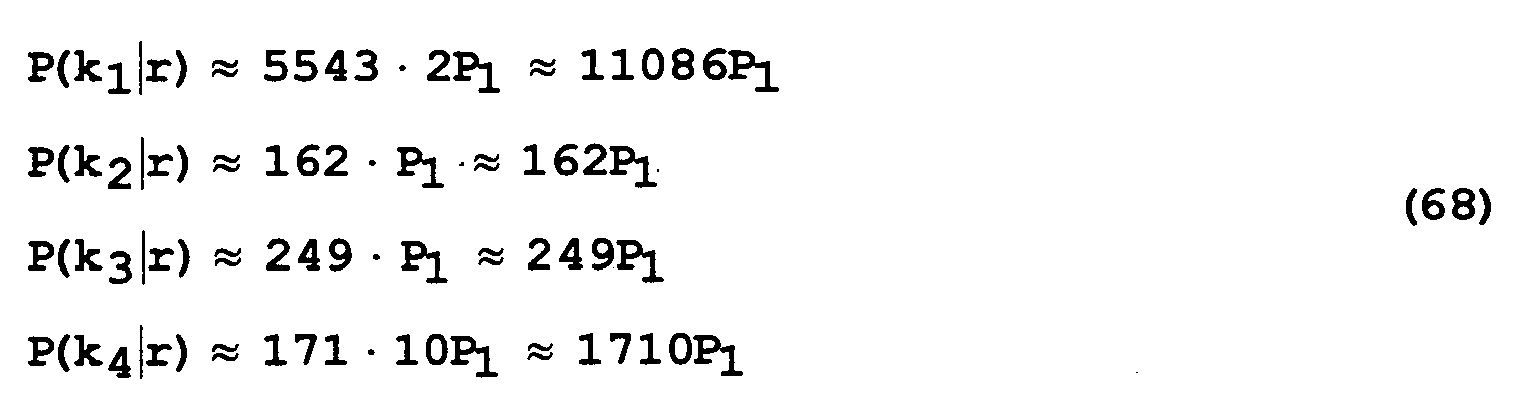
- From the foregoing, it is assumed that the highest posteriori probability is category "ki", and a city name is BAYGE.
- As the result of character recognition shown in
FIG. 24 , the highest priority is category k3 caused by the above formulas (61) and (64). As the result of character spacing characteristics shown inFIG. 25 , the highest priority is category k2 caused by the above formulas (62) and (65). Although the highest value in evaluation of balance in character shape is category k4, estimation based on all integrated results is performed, whereby category k1 can be selected. - Also, an example of the calculation for error suppression described in subsection 7.3.3 will be explained below. First, formula (53-2) is calculated. The denominator is the total sum of formula (68), i.e. 11086P1 + 162P1 + 249P1 + 1710P1 ≈ 13200P1. The numerator is each result of formula (68). Thus,
[formula 105]
- Assuming the rejection for the probability of 0.9 or less, the recognition result is rejected.
- In this manner, according to the fourth embodiment, an input character string corresponding to a word to be recognized is delimited for each character; plural kinds of delimiting results are obtained considering character spacing by this character delimiting; recognition processing is performed for each of the characters specified as all of the obtained delimiting results; and a probability at which there appears characteristics obtained as the result of character recognition by conditioning characteristics of the characters and character spacing of the words contained in a word dictionary that stores candidates of the characteristics of a word to be recognized and character spacing of the word. In addition, the thus obtained probability is divided by a probability at which there appears characteristics obtained as the result of character recognition; each of the above calculation results obtained for each of the characteristics of the characters and character spacing of the words contained in the word dictionary is multiplied relevant to all the characters and character spacing; all the computation results obtained for each word in the word dictionary are added up; the computation results obtained on each character of each word in the word dictionary are divided by the above added-up computation results; and based on this result, the word recognition result is obtained.
- That is, in word recognition using the character recognition result, an evaluation function based on the posteriori probability is used in consideration of at least the ambiguity of character delimiting. In this manner, even in the case where character delimiting is not reliable, word recognition can be performed precisely.
- Also, the rejection process can be executed with high accuracy.
- According to the present invention, in word recognition using the character recognition result, even in the case where the number of characters in a word is not constant, word recognition can be performed precisely by using an evaluation function based on a posteriori probability that can be used even in the case where the number of characters in a word is not always constant.
- Also, the rejection process can be executed with high accuracy.
- According to the present invention, in word recognition using the character recognition result, even in the case where word delimiting is not reliable, word recognition can be performed precisely by using an evaluation function based on a posteriori probability considering at least the ambiguity of word delimiting.
- Also, the rejection process can be executed with high accuracy.
- According to the present invention, in word recognition using the character recognition result, even in the case where no character spacing is provided, word recognition can be performed precisely by using an evaluation function based on a posteriori probability considering at least the absence of character spacing even in the case where no character spacing is provided.
- Also, the rejection process can be executed with high accuracy.
- According to the present invention, in word recognition using the character recognition result, even in the case where no character spacing is provided, word recognition can be performed precisely by using an evaluation function based on a posteriori probability considering at least noise entry even in the case where the noise entry occurs.
- Also, the rejection process can be executed with high accuracy.
- According to the present invention, in word recognition using the character recognition result, even in the case where character delimiting is not reliable, word recognition can be performed precisely by using an evaluation function based on the posteriori probability considering at least the ambiguity of character delimiting.
- Also, the rejection process can be executed with high accuracy.
- The present invention is not limited to the embodiments described above, but can be embodied with the component elements thereof modified without departing from the spirit and scope of the invention. Also, various inventions can be formed by appropriately combining a plurality of the component elements disclosed in the aforementioned embodiments. For example, several ones of all the component elements included in the embodiments may be deleted. Further, the component elements included in different embodiments may be combined appropriately.
- According to the invention, it is possible to provide a word recognition method and a word recognition program in which the error can be suppressed in the approximate calculation of the posteriori probability and the rejection can be made with high accuracy.

ŵ'j ∈ ŵ', ŵ': A set of character strings having the number of characters and the number of words that can be applied to input "x"
h: A position of a character string "ŵ'j" in the input "x". A character string "ŵ'j" starts from (h + 1)-th character from the start of the input "x".
ki = (w̃j, h), w̃j ∈ W̃, W̃ : A set of all candidates of character strings (The number of characteristics is not limited.)
h: A position of a character string "w̃j" in an input line "x". A character string w̃j starts from (h + 1)-th character from the start of an input pattern "x".
Characteristics of character spacing
Addition
[formula 31]
· Character characteristics rC = (rC1, rC2, rC3, ..., rCL)
rCi: Character characteristics of i-th character (= character recognition result)
(Example: First candidate; first to third candidates; candidate having predetermined similarity, and first and second candidates and their similarity and the like)
· Character spacing characteristics rS = (rS0, rS1, rS2, ..., rSL)
rSi: Characteristics of character spacing between i-th character and (i+1)-th character
Claims (3)
- A word recognition method comprising:a character recognition processing step of performing recognition processing of an input character string that corresponds to a word to be recognized by each character, thereby obtaining the character recognition result;a probability calculation step of obtaining a probability at which characteristics obtained as the character recognition result are generated by the character recognition processing by conditioning characters of words contained in a word dictionary that stores in advance a candidate of the word to be recognized;a first computation step of performing a predetermined first computation between a probability obtained by the probability calculation step and the characteristics obtained as the character recognition result by the character recognition processing step;a second computation step of performing a predetermined second computation between computation results obtained by the first computation on each character of each word in the word dictionary;a third computation step of adding up all computation results obtained for each word in the word dictionary by the second computation;a fourth computation step of dividing computation results obtained by the second computation on each character of each word in the word dictionary by computation results in the third computation step;.anda word recognition processing step of obtaining a word recognition result of the word based on computation results in the fourth computation step.
- A word recognition method comprising:a delimiting step of delimiting an input character string that corresponds to a word to be recognized by each character;a step of obtaining plural kinds of delimiting results considering whether character spacing is provided or not by character delimiting caused by the delimiting step;a character recognition processing step of performing recognition processing for each character as all the delimiting results obtained by the step of obtaining plural kinds of delimiting results;a probability calculation step of obtaining a probability at which characteristics obtained as the result of character recognition are generated by the character recognition step by computing the characters of the words contained in the word dictionary that stores in advance candidates of words to be recognized;a first computation step of performing a predetermined first computation between a probability obtained by the probability calculation step and the characteristics obtained as the character recognition result by the character recognition processing step;a second computation step of performing a predetermined second computation between computation results obtained by the first computation on each character of each word in the word dictionary;a third computation step of adding up all computation results obtained for each word in the word dictionary by the second computation;a fourth computation step of dividing computation results obtained by the second computation on each character of each word in the word dictionary by computation results in the third computation step; anda word recognition processing step of obtaining a word recognition result of the word based on computation results in the fourth computation step.
- A word recognition program for causing a computer to execute a word recognition process, comprising:a character recognition processing step of performing recognition processing of an input character string that corresponds to a word to be recognized by each character;a probability calculation step of obtaining a probability at which characteristics obtained as the character recognition result are generated by the character recognition processing by conditioning characters of words contained in a word dictionary that stores in advance a candidate of the word to be recognized;a first computation step of performing a predetermined first computation between a probability obtained by the probability calculation step and the characteristics obtained as the character recognition result by the character recognition processing step;a second computation step of performing a predetermined second computation between computation results obtained by the first computation on each character of each word in the word dictionary;a third computation step of adding up all computation results obtained for each word in the word dictionary by the second computation;a fourth computation step of dividing computation results obtained by the second computation on each character of each word in the word dictionary by computation results in the third computation step; anda word recognition processing step of obtaining a word recognition result of the word based on computation results in the fourth computation step.
Applications Claiming Priority (2)
| Application Number | Priority Date | Filing Date | Title |
|---|---|---|---|
| JP2006280413A JP4686433B2 (en) | 2006-10-13 | 2006-10-13 | Word recognition method and word recognition device |
| PCT/JP2007/066431 WO2008044393A1 (en) | 2006-10-13 | 2007-08-24 | Word recognizing method and word recognizing program |
Publications (2)
| Publication Number | Publication Date |
|---|---|
| EP2088537A1 true EP2088537A1 (en) | 2009-08-12 |
| EP2088537A4 EP2088537A4 (en) | 2011-11-23 |
Family
ID=39282602
Family Applications (1)
| Application Number | Title | Priority Date | Filing Date |
|---|---|---|---|
| EP07792960A Withdrawn EP2088537A4 (en) | 2006-10-13 | 2007-08-24 | METHOD AND SOFTWARE RECOGNITION SOFTWARE |
Country Status (5)
| Country | Link |
|---|---|
| US (1) | US20090190841A1 (en) |
| EP (1) | EP2088537A4 (en) |
| JP (1) | JP4686433B2 (en) |
| KR (1) | KR101065152B1 (en) |
| WO (1) | WO2008044393A1 (en) |
Families Citing this family (6)
| Publication number | Priority date | Publication date | Assignee | Title |
|---|---|---|---|---|
| JP4672692B2 (en) | 2007-03-14 | 2011-04-20 | 株式会社東芝 | Word recognition system and word recognition program |
| US20090208112A1 (en) * | 2008-02-20 | 2009-08-20 | Kabushiki Kaisha Toshiba | Pattern recognition method, and storage medium which stores pattern recognition program |
| US9101961B2 (en) | 2009-09-24 | 2015-08-11 | Nec Corporation | Word recognition apparatus, word recognition method, non-transitory computer readable medium storing word recognition program, and delivery item sorting apparatus |
| JP5767913B2 (en) * | 2011-09-05 | 2015-08-26 | 株式会社東芝 | Word recognition device, word recognition method, and paper sheet processing device provided with word recognition device |
| JP6062273B2 (en) * | 2013-02-05 | 2017-01-18 | 株式会社東芝 | Pattern recognition apparatus, pattern recognition method, and pattern recognition program |
| CN106599900B (en) * | 2015-10-20 | 2020-04-21 | 华中科技大学 | A method and apparatus for identifying character strings in images |
Family Cites Families (5)
| Publication number | Priority date | Publication date | Assignee | Title |
|---|---|---|---|---|
| JPH05174195A (en) * | 1991-01-25 | 1993-07-13 | Matsushita Electric Ind Co Ltd | English character recognition device |
| US5727081A (en) * | 1991-12-31 | 1998-03-10 | Lucent Technologies Inc. | System and method for automated interpretation of input expressions using novel a posteriori probability measures and optimally trained information processing networks |
| JP4601835B2 (en) * | 2000-01-28 | 2010-12-22 | 株式会社東芝 | Word recognition method, word recognition program, and word recognition device |
| US6847734B2 (en) * | 2000-01-28 | 2005-01-25 | Kabushiki Kaisha Toshiba | Word recognition method and storage medium that stores word recognition program |
| JP2003123025A (en) * | 2001-10-17 | 2003-04-25 | Toshiba Corp | Pattern recognition device and pattern recognition method |
-
2006
- 2006-10-13 JP JP2006280413A patent/JP4686433B2/en active Active
-
2007
- 2007-08-24 KR KR1020097007460A patent/KR101065152B1/en not_active Expired - Fee Related
- 2007-08-24 EP EP07792960A patent/EP2088537A4/en not_active Withdrawn
- 2007-08-24 WO PCT/JP2007/066431 patent/WO2008044393A1/en not_active Ceased
-
2009
- 2009-04-07 US US12/419,512 patent/US20090190841A1/en not_active Abandoned
Also Published As
| Publication number | Publication date |
|---|---|
| KR101065152B1 (en) | 2011-09-16 |
| WO2008044393A1 (en) | 2008-04-17 |
| KR20090053953A (en) | 2009-05-28 |
| JP2008097452A (en) | 2008-04-24 |
| JP4686433B2 (en) | 2011-05-25 |
| US20090190841A1 (en) | 2009-07-30 |
| EP2088537A4 (en) | 2011-11-23 |
Similar Documents
| Publication | Publication Date | Title |
|---|---|---|
| US6847734B2 (en) | Word recognition method and storage medium that stores word recognition program | |
| US8131087B2 (en) | Program and apparatus for forms processing | |
| US7171350B2 (en) | Method for named-entity recognition and verification | |
| KR100412317B1 (en) | Character recognizing/correcting system | |
| US9754176B2 (en) | Method and system for data extraction from images of semi-structured documents | |
| US10963717B1 (en) | Auto-correction of pattern defined strings | |
| US20090190841A1 (en) | Word recognition method and storage medium that stores word recognition program | |
| US11645332B2 (en) | System and method for clustering documents | |
| JP5217127B2 (en) | Collective place name recognition program, collective place name recognition apparatus, and collective place name recognition method | |
| EP2138959B1 (en) | Word recognizing method and word recognizing program | |
| Soric et al. | Benchmarking Table Extraction from Heterogeneous Scientific Extraction Documents | |
| Wang et al. | A study on the document zone content classification problem | |
| JP4601835B2 (en) | Word recognition method, word recognition program, and word recognition device | |
| JP4194020B2 (en) | Character recognition method, program used for executing the method, and character recognition apparatus | |
| JPH11328306A (en) | Document element logical element extraction method, apparatus and recording medium | |
| JP6798055B1 (en) | Information processing device, information processing method, program and sequence information | |
| JP5252487B2 (en) | Information processing apparatus, control method thereof, control program, and recording medium | |
| JP2021157597A (en) | Validity confirmation method, validity confirmation system and program | |
| JP4976789B2 (en) | Boundary detection method, apparatus, program, and recording medium in token sequence | |
| JP2000090203A (en) | Character recognition method and apparatus | |
| JP4805485B2 (en) | Word recognition method and word recognition device | |
| JP5830996B2 (en) | Image processing apparatus and program | |
| JP4141217B2 (en) | Character recognition method, program used for executing the method, and character recognition apparatus | |
| JP5672003B2 (en) | Character recognition processing apparatus and program | |
| JP2006139659A (en) | Word recognition device, word recognition method, and word recognition program |
Legal Events
| Date | Code | Title | Description |
|---|---|---|---|
| PUAI | Public reference made under article 153(3) epc to a published international application that has entered the european phase |
Free format text: ORIGINAL CODE: 0009012 |
|
| 17P | Request for examination filed |
Effective date: 20090331 |
|
| AK | Designated contracting states |
Kind code of ref document: A1 Designated state(s): AT BE BG CH CY CZ DE DK EE ES FI FR GB GR HU IE IS IT LI LT LU LV MC MT NL PL PT RO SE SI SK TR |
|
| DAX | Request for extension of the european patent (deleted) | ||
| RBV | Designated contracting states (corrected) |
Designated state(s): DE FR IT |
|
| A4 | Supplementary search report drawn up and despatched |
Effective date: 20111024 |
|
| RIC1 | Information provided on ipc code assigned before grant |
Ipc: G06K 9/62 20060101AFI20111019BHEP Ipc: G06K 9/72 20060101ALI20111019BHEP Ipc: G06K 9/00 20060101ALI20111019BHEP |
|
| 17Q | First examination report despatched |
Effective date: 20120628 |
|
| STAA | Information on the status of an ep patent application or granted ep patent |
Free format text: STATUS: THE APPLICATION IS DEEMED TO BE WITHDRAWN |
|
| 18D | Application deemed to be withdrawn |
Effective date: 20121109 |