EP2086154A1 - Method and apparatus for localized hopping OFDMA and power efficient OFDMA multiplexing - Google Patents
Method and apparatus for localized hopping OFDMA and power efficient OFDMA multiplexing Download PDFInfo
- Publication number
- EP2086154A1 EP2086154A1 EP09250243A EP09250243A EP2086154A1 EP 2086154 A1 EP2086154 A1 EP 2086154A1 EP 09250243 A EP09250243 A EP 09250243A EP 09250243 A EP09250243 A EP 09250243A EP 2086154 A1 EP2086154 A1 EP 2086154A1
- Authority
- EP
- European Patent Office
- Prior art keywords
- channels
- sub
- hopping
- frequency
- ofdma
- Prior art date
- Legal status (The legal status is an assumption and is not a legal conclusion. Google has not performed a legal analysis and makes no representation as to the accuracy of the status listed.)
- Withdrawn
Links
- 238000000034 method Methods 0.000 title claims description 17
- 230000005540 biological transmission Effects 0.000 claims abstract description 11
- 238000004590 computer program Methods 0.000 claims 2
- 230000003595 spectral effect Effects 0.000 description 6
- 230000006735 deficit Effects 0.000 description 4
- 238000001228 spectrum Methods 0.000 description 4
- 239000006185 dispersion Substances 0.000 description 3
- 230000006872 improvement Effects 0.000 description 3
- 230000008901 benefit Effects 0.000 description 2
- 230000001413 cellular effect Effects 0.000 description 2
- 238000004891 communication Methods 0.000 description 2
- 230000015654 memory Effects 0.000 description 2
- 238000012986 modification Methods 0.000 description 2
- 230000004048 modification Effects 0.000 description 2
- 230000008569 process Effects 0.000 description 2
- 230000001105 regulatory effect Effects 0.000 description 2
- 238000004088 simulation Methods 0.000 description 2
- 230000003044 adaptive effect Effects 0.000 description 1
- 230000002950 deficient Effects 0.000 description 1
- 230000036039 immunity Effects 0.000 description 1
- 230000008520 organization Effects 0.000 description 1
- 230000035515 penetration Effects 0.000 description 1
- 238000006467 substitution reaction Methods 0.000 description 1
Images


Classifications
-
- H—ELECTRICITY
- H04—ELECTRIC COMMUNICATION TECHNIQUE
- H04L—TRANSMISSION OF DIGITAL INFORMATION, e.g. TELEGRAPHIC COMMUNICATION
- H04L5/00—Arrangements affording multiple use of the transmission path
- H04L5/003—Arrangements for allocating sub-channels of the transmission path
-
- H—ELECTRICITY
- H04—ELECTRIC COMMUNICATION TECHNIQUE
- H04B—TRANSMISSION
- H04B1/00—Details of transmission systems, not covered by a single one of groups H04B3/00 - H04B13/00; Details of transmission systems not characterised by the medium used for transmission
- H04B1/69—Spread spectrum techniques
- H04B1/713—Spread spectrum techniques using frequency hopping
-
- H—ELECTRICITY
- H04—ELECTRIC COMMUNICATION TECHNIQUE
- H04L—TRANSMISSION OF DIGITAL INFORMATION, e.g. TELEGRAPHIC COMMUNICATION
- H04L27/00—Modulated-carrier systems
- H04L27/26—Systems using multi-frequency codes
- H04L27/2601—Multicarrier modulation systems
- H04L27/2614—Peak power aspects
-
- H—ELECTRICITY
- H04—ELECTRIC COMMUNICATION TECHNIQUE
- H04L—TRANSMISSION OF DIGITAL INFORMATION, e.g. TELEGRAPHIC COMMUNICATION
- H04L5/00—Arrangements affording multiple use of the transmission path
- H04L5/0001—Arrangements for dividing the transmission path
- H04L5/0003—Two-dimensional division
- H04L5/0005—Time-frequency
- H04L5/0007—Time-frequency the frequencies being orthogonal, e.g. OFDM(A) or DMT
-
- H—ELECTRICITY
- H04—ELECTRIC COMMUNICATION TECHNIQUE
- H04L—TRANSMISSION OF DIGITAL INFORMATION, e.g. TELEGRAPHIC COMMUNICATION
- H04L5/00—Arrangements affording multiple use of the transmission path
- H04L5/003—Arrangements for allocating sub-channels of the transmission path
- H04L5/0058—Allocation criteria
- H04L5/0066—Requirements on out-of-channel emissions
-
- H—ELECTRICITY
- H04—ELECTRIC COMMUNICATION TECHNIQUE
- H04B—TRANSMISSION
- H04B1/00—Details of transmission systems, not covered by a single one of groups H04B3/00 - H04B13/00; Details of transmission systems not characterised by the medium used for transmission
- H04B1/69—Spread spectrum techniques
- H04B1/713—Spread spectrum techniques using frequency hopping
- H04B1/715—Interference-related aspects
Definitions
- uplink power deficits are a significant problem for emerging cellular data services. This problem arises from the following combination of cellular operators' targets: higher radio frequencies (than those of the voice service); higher bit rates; deep indoor penetration; and co-location with the existing voice-BS infrastructure.
- Multi-tone modulation is attractive, as it is immune to channel dispersion and spectrally efficient; but the power deficit is especially hard with OFDM.
- the reason is the poor Peak-to-Average Power Ratio (PAPR) (the signal amplitude is Rayleigh-distributed, even in the case of QPSK-modulated tones).
- PAPR Peak-to-Average Power Ratio
- PA back-off is limited by out-of-band emission; to meet regulatory spectral mask, it must be ⁇ 10 dB.
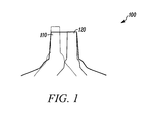
- FIG. 1 illustrates how the out of band emission shrinks proportionally in an embodiment of the present invention
- FIG. 2 shows a simulation of results depicting the spectrum of each hop separately (at the edge and at the center) of an embodiment of the invention
- FIG. 3 is a graphical illustration of the average spectrum over multiple hop intervals of an embodiment of the present invention.
- FIG. 4 is a graphical illustration showing the gain in terms of link budget of an embodiment of the present invention.
- the terms “plurality” and “a plurality” as used herein may include, for example, “multiple” or “two or more”.
- the terms “plurality” or “a plurality” may be used throughout the specification to describe two or more components, devices, elements, units, parameters, or the like.
- a plurality of stations may include two or more stations.
- An embodiment of the present invention provides an apparatus and method for multipoint-to-point OFDMA radio transmission (e.g. WiMax Uplink) with reduced transmission back-off.
- the method works by division of a total RF channel into frequency-contiguous, hopping, relatively narrow sub-channels, each one being used by a single transmitter. Transmissions may be highly non-linear, but inter-modulation products remain inside the total channel and they do not violate out-of-band emission mask nor create unacceptable error vector magnitude (EVM) / cross-talk.
- EVM error vector magnitude
- the present invention proposes to enable an up link (UL) rotation scheme to Adaptive Modulation and Coding (AMC) permutation (currently UL rotation scheme can only be applied to UL Partial Usage of Subchannels (PUSC)), which will provide a localized allocation with hop every 3 symbols.
- AMC Adaptive Modulation and Coding
- PUSC UL Partial Usage of Subchannels
- the present invention particularly applies to WiMAX using an AMC and UL rotation scheme.
- Multi-tone modulation is attractive, as it is immune to channel dispersion and spectrally efficient; but the power deficit is especially hard with OFDM.
- the reason is the poor Peak-to-Average Power Ratio (PAPR) (the signal amplitude is Rayleigh-distributed, even in the case of QPSK-modulated tones).
- PAPR Peak-to-Average Power Ratio
- PA back-off is limited by out-of-band emission; in order to meet regulatory spectral mask, it must be ⁇ 10 dB.
- Embodiments of the present invention solve the power deficit problem by means of Localized Highly-Non-Linear OFDM, and add diversity by means of frequency hopping. In this manner the present invention does not compromise modulation immunity to the channel dispersion, and attains Link Budget improvement ⁇ 6 dB (vs. non-localized OFDM).
- embodiments of the present invention provide OFDM transmissions in frequency-contiguous, hopping, relatively narrow sub-channels (e.g. each user transmits over up to 1/5 of the total BW, such that one can obey spectral mask limitation) with PA back-off up to 0 dB.
- the "windowing and overlapping" of OFDMA symbols should not be done at the hop boundary.
- Embodiments of the present invention provide frequency hopping of the user's localized allocation, without changing the carrier frequency. Therefore the users remain orthogonal to each other and there is no need for extra guard band in time (in the hop boundaries) or frequency.
- the advantage of the transmission scheme is the ability of a user to transmit more power than he can transmit with full BW allocation.
- Effective_SNR Signal ⁇ PathGain N 0 + AutoInterference ⁇ PathGain .
- the present invention is not limited by the spectral mask, with a given path gain we may choose PA back-off to maximize Effective SNR.
- FIG. 2 at 200 is a simulation of results depicting the spectrum of each hop (220 and 240) separately (at the edge and at the center), when passed through RAPP3 PA model.
- the maximum power that conforms to the FCC spectral mask is 25.3dBm 220 and 30.4dBm 240 for edge and center allocation respectively, while for regular OFDM/OFDMA signal maximum 23dBm can be transmitted.
- FIG. 3 is the graphical illustration of the average spectrum over multiple hop intervals.
- the present invention can attain ⁇ 5 dB Effective SNR (which provides robust 1 bit/Hz transmission) with 1 dB PA back-off; to get the same Effective SNR with 9 dB back-off, we would need extra 6 dB of the path gain.
- FIG. 4 at 400 is a graphical illustration showing the gain in terms of link budget: Improvements of the Link Budget ⁇ 6dB (vs. non-localized OFDM). This may be done with a simple and well-known OFDM demodulator. Thus, embodiments of the present invention combine OFDM modulation with strong non-linear Tx distortion and contiguous, relatively narrow, hopping sub-channelization.
Landscapes
- Engineering & Computer Science (AREA)
- Signal Processing (AREA)
- Computer Networks & Wireless Communication (AREA)
- Mobile Radio Communication Systems (AREA)
- Cable Transmission Systems, Equalization Of Radio And Reduction Of Echo (AREA)
Abstract
Description
- In wireless communications, uplink power deficits are a significant problem for emerging cellular data services. This problem arises from the following combination of cellular operators' targets: higher radio frequencies (than those of the voice service); higher bit rates; deep indoor penetration; and co-location with the existing voice-BS infrastructure.
- Multi-tone modulation (OFDM) is attractive, as it is immune to channel dispersion and spectrally efficient; but the power deficit is especially hard with OFDM. The reason is the poor Peak-to-Average Power Ratio (PAPR) (the signal amplitude is Rayleigh-distributed, even in the case of QPSK-modulated tones). In the last case, PA back-off is limited by out-of-band emission; to meet regulatory spectral mask, it must be ∼10 dB.
- Thus, a strong need exists for improvements in wireless communication systems, methods and apparatus.
- The subject matter regarded as the invention is particularly pointed out and distinctly claimed in the concluding portion of the specification. The invention, however, both as to organization and method of operation, together with objects, features, and advantages thereof, may best be understood by reference to the following detailed description when read with the accompanying drawings in which:
-
FIG. 1 illustrates how the out of band emission shrinks proportionally in an embodiment of the present invention; -
FIG. 2 shows a simulation of results depicting the spectrum of each hop separately (at the edge and at the center) of an embodiment of the invention; -
FIG. 3 is a graphical illustration of the average spectrum over multiple hop intervals of an embodiment of the present invention; and -
FIG. 4 is a graphical illustration showing the gain in terms of link budget of an embodiment of the present invention. - It will be appreciated that for simplicity and clarity of illustration, elements illustrated in the figures have not necessarily been drawn to scale. For example, the dimensions of some of the elements are exaggerated relative to other elements for clarity. Further, where considered appropriate, reference numerals have been repeated among the figures to indicate corresponding or analogous elements.
- In the following detailed description, numerous specific details are set forth in order to provide a thorough understanding of the invention. However, it will be understood by those skilled in the art that the present invention may be practiced without these specific details. In other instances, well-known methods, procedures, components and circuits have not been described in detail so as not to obscure the present invention.
- In the following detailed description, numerous specific details are set forth in order to provide a thorough understanding of the invention. However, it will be understood by those of ordinary skill in the art that the invention may be practiced without these specific details. In other instances, well-known methods, procedures, components, units and/or circuits have not been described in detail so as not to obscure the invention.
- Although embodiments of the invention are not limited in this regard, discussions utilizing terms such as, for example, "processing," "computing," "calculating," "determining," "establishing", "analyzing", "checking", or the like, may refer to operation(s) and/or process(es) of a computer, a computing platform, a computing system, or other electronic computing device, that manipulate and/or transform data represented as physical (e.g., electronic) quantities within the computer's registers and/or memories into other data similarly represented as physical quantities within the computer's registers and/or memories or other information storage medium that may store instructions to perform operations and/or processes.
- Although embodiments of the invention are not limited in this regard, the terms "plurality" and "a plurality" as used herein may include, for example, "multiple" or "two or more". The terms "plurality" or "a plurality" may be used throughout the specification to describe two or more components, devices, elements, units, parameters, or the like. For example, "a plurality of stations" may include two or more stations.
- An embodiment of the present invention provides an apparatus and method for multipoint-to-point OFDMA radio transmission (e.g. WiMax Uplink) with reduced transmission back-off. In an embodiment of the present invention, the method works by division of a total RF channel into frequency-contiguous, hopping, relatively narrow sub-channels, each one being used by a single transmitter. Transmissions may be highly non-linear, but inter-modulation products remain inside the total channel and they do not violate out-of-band emission mask nor create unacceptable error vector magnitude (EVM) / cross-talk.
- In an embodiment of the present invention, specifically for IEEE 802.16 (a.k.a WiMax) the present invention proposes to enable an up link (UL) rotation scheme to Adaptive Modulation and Coding (AMC) permutation (currently UL rotation scheme can only be applied to UL Partial Usage of Subchannels (PUSC)), which will provide a localized allocation with hop every 3 symbols. In an embodiment of the present invention, the present invention particularly applies to WiMAX using an AMC and UL rotation scheme.
- Multi-tone modulation (OFDM) is attractive, as it is immune to channel dispersion and spectrally efficient; but the power deficit is especially hard with OFDM. The reason is the poor Peak-to-Average Power Ratio (PAPR) (the signal amplitude is Rayleigh-distributed, even in the case of QPSK-modulated tones). In the last case, PA back-off is limited by out-of-band emission; in order to meet regulatory spectral mask, it must be ∼10 dB.
- Embodiments of the present invention solve the power deficit problem by means of Localized Highly-Non-Linear OFDM, and add diversity by means of frequency hopping. In this manner the present invention does not compromise modulation immunity to the channel dispersion, and attains Link Budget improvement ∼ 6 dB (vs. non-localized OFDM).
- For power deficient WiMax users, embodiments of the present invention provide OFDM transmissions in frequency-contiguous, hopping, relatively narrow sub-channels (e.g. each user transmits over up to 1/5 of the total BW, such that one can obey spectral mask limitation) with PA back-off up to 0 dB. The "windowing and overlapping" of OFDMA symbols should not be done at the hop boundary.
- Embodiments of the present invention provide frequency hopping of the user's localized allocation, without changing the carrier frequency. Therefore the users remain orthogonal to each other and there is no need for extra guard band in time (in the hop boundaries) or frequency. The advantage of the transmission scheme is the ability of a user to transmit more power than he can transmit with full BW allocation.
- Due to sub-channel contiguity, inter-modulation products do not violate the spectral mask. Said another way, since the bandwidth of the signal shrinks, assuming memory-less distortion, the out of band emission shrinks proportionally 110 to 120 as depicted
FIG. 1 , generally as 100. - The output of PA may be represented as a sum of Output Signal (proportional to the input) and Auto-Interference (zero-correlated with the input). Due to Rayleigh-distributed input's amplitude, the power of Auto-Interference turns out to be relatively small (although the signal shape may be severely distorted). OFDM receivers make FFT transforms of the received symbol. Doing this, it disperses Auto-Interference over tones (almost) uniformly; more accurately, Auto-Interference + Interference from the adjacent sub-channels = const in a flat channel.
- Thus we may define

- Turning now to
FIG. 2 at 200 is a simulation of results depicting the spectrum of each hop (220 and 240) separately (at the edge and at the center), when passed through RAPP3 PA model. The maximum power that conforms to the FCC spectral mask is 25.3dBm 220 and 30.4dBm 240 for edge and center allocation respectively, while for regular OFDM/OFDMA signal maximum 23dBm can be transmitted. - Looking now at
FIG. 3 at 300 is the graphical illustration of the average spectrum over multiple hop intervals. In this way the present invention can attain ∼ 5 dB Effective SNR (which provides robust 1 bit/Hz transmission) with 1 dB PA back-off; to get the same Effective SNR with 9 dB back-off, we would need extra 6 dB of the path gain. - Looking now at
FIG. 4 at 400 is a graphical illustration showing the gain in terms of link budget: Improvements of the Link Budget ∼ 6dB (vs. non-localized OFDM). This may be done with a simple and well-known OFDM demodulator. Thus, embodiments of the present invention combine OFDM modulation with strong non-linear Tx distortion and contiguous, relatively narrow, hopping sub-channelization. - While certain features of the invention have been illustrated and described herein, many modifications, substitutions, changes, and equivalents may occur to those skilled in the art. It is, therefore, to be understood that the appended claims are intended to cover all such modifications and changes as fall within the scope of the invention as claimed.
Claims (13)
- An apparatus, comprising:a transceiver configured for OFDM transmissions in frequency-contiguous, hopping, sub-channels.
- The apparatus of claim 1, wherein said sub-channels are relatively narrow sub-channels with each user transmitting up to 1/5 of the total BW.
- The apparatus of claim 2, wherein said transmissions have a Power Amplifier back-off up to 0 dB.
- The apparatus of claim 3, wherein windowing and overlapping of OFDMA symbols are prevented at hop boundaries.
- The apparatus of claim 1, wherein said transceiver is operable in an Institute for Electrical and Electronic Engineers (IEEE) 802.16 standard.
- The apparatus of claim 1, wherein said frequency hopping is in a user's localized allocation without changing the carrier frequency and therefore said user remains orthogonal to other users and there is no need for extra guard band in time or frequency
- A method, comprising:transmitting information wirelessly using OFDM transmissions in frequency-contiguous, hopping, sub-channels.
- The method of claim 7, wherein said sub-channels are relatively narrow sub-channels with each user transmitting up to 1/5 of the total BW.
- The method of claim 8, further comprising using transmissions with a power amplifier back-off up to 0 dB.
- The method of claim 9, further comprising preventing windowing and overlapping of OFDMA symbols at hop boundaries.
- The method of claim 7, wherein said transceiver is operable in an Institute for Electrical and Electronic Engineers (IEEE) 802.16 standard.
- A computer program product comprising program code means arranged to perform all the steps of the method as claimed in any of claims 7 to 11 when that program code means is run on a computer.
- A computer-readable medium embodying a computer program product as claimed in claim 12.
Applications Claiming Priority (1)
| Application Number | Priority Date | Filing Date | Title |
|---|---|---|---|
| US12/025,389 US8379688B2 (en) | 2008-02-04 | 2008-02-04 | Method and apparatus adapted for localized hopping OFDMA and power efficient OFDMA multiplexing |
Publications (1)
| Publication Number | Publication Date |
|---|---|
| EP2086154A1 true EP2086154A1 (en) | 2009-08-05 |
Family
ID=40688341
Family Applications (1)
| Application Number | Title | Priority Date | Filing Date |
|---|---|---|---|
| EP09250243A Withdrawn EP2086154A1 (en) | 2008-02-04 | 2009-01-29 | Method and apparatus for localized hopping OFDMA and power efficient OFDMA multiplexing |
Country Status (5)
| Country | Link |
|---|---|
| US (1) | US8379688B2 (en) |
| EP (1) | EP2086154A1 (en) |
| JP (1) | JP2009201105A (en) |
| CN (1) | CN101505289A (en) |
| BR (1) | BRPI0900473A2 (en) |
Cited By (2)
| Publication number | Priority date | Publication date | Assignee | Title |
|---|---|---|---|---|
| US8379688B2 (en) | 2008-02-04 | 2013-02-19 | Intel Corporation | Method and apparatus adapted for localized hopping OFDMA and power efficient OFDMA multiplexing |
| WO2017143201A1 (en) * | 2016-02-17 | 2017-08-24 | Qualcomm Incorporated | Transmit error vector magnitude and spectral mask requirements for ofdma transmission |
Families Citing this family (2)
| Publication number | Priority date | Publication date | Assignee | Title |
|---|---|---|---|---|
| US8305953B2 (en) * | 2009-03-31 | 2012-11-06 | Intel Corporation | Narrowband transmissions using a plurality of antennas |
| US10292101B2 (en) * | 2016-05-11 | 2019-05-14 | Qualcomm Incorporated | Peak-to-average power management in wireless local area network signaling |
Citations (3)
| Publication number | Priority date | Publication date | Assignee | Title |
|---|---|---|---|---|
| US20050163194A1 (en) | 2004-01-28 | 2005-07-28 | Qualcomm Incorporated | Interference estimation in a wireless communication system |
| US20070223365A1 (en) | 2006-03-21 | 2007-09-27 | Texas Instruments Incorporated | Apparatus for and method of minimizing backoff for orthogonal frequency division multiplexing transmission |
| EP1909403A2 (en) | 2005-04-19 | 2008-04-09 | Qualcomm Incorporated | Frequency hopping design for IFDMA, LFDMA and OFDMA systems |
Family Cites Families (9)
| Publication number | Priority date | Publication date | Assignee | Title |
|---|---|---|---|---|
| JPH10285645A (en) | 1997-03-31 | 1998-10-23 | Victor Co Of Japan Ltd | Wireless communication area division method and wireless communication system |
| US6246713B1 (en) * | 1998-06-08 | 2001-06-12 | Telefonaktiebolaget Lm Ericsson (Publ) | Frequency-hopping in a bandwidth-on-demand system |
| CA2299568A1 (en) | 1999-03-11 | 2000-09-11 | Lucent Technologies Inc. | Orthogonal frequency division multiplexing based spread spectrum multiple access system using directional antenna |
| KR100754721B1 (en) | 2002-04-26 | 2007-09-03 | 삼성전자주식회사 | Multiplexed Data Transceiver and Method in Orthogonal Frequency Division Multiplexed Communication System |
| JP4509872B2 (en) | 2005-06-14 | 2010-07-21 | 株式会社エヌ・ティ・ティ・ドコモ | Base station, mobile station and method |
| GB2433681B (en) | 2005-12-21 | 2009-05-06 | Iti Scotland Ltd | Communication system and method |
| JP4430052B2 (en) | 2006-06-19 | 2010-03-10 | 株式会社エヌ・ティ・ティ・ドコモ | Mobile communication system, user apparatus and transmission method |
| US8917673B2 (en) | 2006-07-14 | 2014-12-23 | Qualcomm Incorporation | Configurable downlink and uplink channels for improving transmission of data by switching duplex nominal frequency spacing according to conditions |
| US8379688B2 (en) | 2008-02-04 | 2013-02-19 | Intel Corporation | Method and apparatus adapted for localized hopping OFDMA and power efficient OFDMA multiplexing |
-
2008
- 2008-02-04 US US12/025,389 patent/US8379688B2/en not_active Expired - Fee Related
-
2009
- 2009-01-29 EP EP09250243A patent/EP2086154A1/en not_active Withdrawn
- 2009-01-30 JP JP2009019668A patent/JP2009201105A/en active Pending
- 2009-02-04 CN CNA2009100057812A patent/CN101505289A/en active Pending
- 2009-02-04 BR BRPI0900473-4A patent/BRPI0900473A2/en not_active IP Right Cessation
Patent Citations (3)
| Publication number | Priority date | Publication date | Assignee | Title |
|---|---|---|---|---|
| US20050163194A1 (en) | 2004-01-28 | 2005-07-28 | Qualcomm Incorporated | Interference estimation in a wireless communication system |
| EP1909403A2 (en) | 2005-04-19 | 2008-04-09 | Qualcomm Incorporated | Frequency hopping design for IFDMA, LFDMA and OFDMA systems |
| US20070223365A1 (en) | 2006-03-21 | 2007-09-27 | Texas Instruments Incorporated | Apparatus for and method of minimizing backoff for orthogonal frequency division multiplexing transmission |
Non-Patent Citations (6)
| Title |
|---|
| GUO, Y. ET AL.: "Frequency hopping F-QPSK for power and spectrally efficient cellular systems", PROC. VEHICULAR TECHNOLOGY CONF. ON PERSONAL COMMUNICATION - FREEDOM THROUGH WIRELESS TECHNOLOGY, vol. 43, 18 May 1993 (1993-05-18), pages 799 - 802 |
| HARJANI R ET AL: "Analog/RF physical layer issues for UWB systems", PROCEEDINGS OF THE IEEE 17TH INTERNATIONAL CONFERENCE ON VLSI DESIGN, 5 January 2004 (2004-01-05) - 9 January 2004 (2004-01-09), CA, USA, pages 941 - 948, XP010679189, ISBN: 978-0-7695-2072-8 * |
| HARJANI, R. ET AL.: "Analog/RF physical layer issues for UWB systems", PROC. 1 IH IEEE INT. CONF. ON VLSI DESIGN, 5 January 2004 (2004-01-05), pages 941 - 948 |
| SVENSSON, T. ET AL.: "B-IFDMA - a power efficient multiple access scheme for non- frequency-adaptive transmission", PROC. 16TH IEEE 1ST MOBILE AND WIRELESS COMMUNICATIONS SUMMIT 2007, 1 July 2007 (2007-07-01), pages 1 - 5 |
| TOMMY SVENSSON ET AL: "B-IFDMA - A Power Efficient Multiple Access Scheme for Non-frequency-adaptive Transmission", IEEE 16TH IST MOBILE AND WIRELESS COMMUNICATIONS SUMMIT 2007, 1 July 2007 (2007-07-01) - 5 July 2007 (2007-07-05), NY,USA, pages 1 - 5, XP031132569, ISBN: 978-1-4244-1662-2 * |
| YANPENG GUO ET AL: "FREQUENCY HOPPING F-QPSK FOR POWER AND SPECTRALLY EFFICIENT CELLULAR SYSTEMS", PROCEEDINGS OF THE VEHICULAR TECHNOLOGY CONFERENCE ON PERSONAL COMMUNICATION - FREEDOM THROUGH WIRELESS TECHNOLOGY, vol. CONF. 43, 18 May 1993 (1993-05-18) - 20 May 1993 (1993-05-20), NY, USA, pages 799 - 802, XP000393302, ISBN: 978-0-7803-1267-8 * |
Cited By (2)
| Publication number | Priority date | Publication date | Assignee | Title |
|---|---|---|---|---|
| US8379688B2 (en) | 2008-02-04 | 2013-02-19 | Intel Corporation | Method and apparatus adapted for localized hopping OFDMA and power efficient OFDMA multiplexing |
| WO2017143201A1 (en) * | 2016-02-17 | 2017-08-24 | Qualcomm Incorporated | Transmit error vector magnitude and spectral mask requirements for ofdma transmission |
Also Published As
| Publication number | Publication date |
|---|---|
| JP2009201105A (en) | 2009-09-03 |
| US8379688B2 (en) | 2013-02-19 |
| CN101505289A (en) | 2009-08-12 |
| BRPI0900473A2 (en) | 2009-06-13 |
| US20090196328A1 (en) | 2009-08-06 |
Similar Documents
| Publication | Publication Date | Title |
|---|---|---|
| US10411935B2 (en) | System and method for DFT-S-OFDM PAPR reduction | |
| EP2835926B1 (en) | Transmitter apparatus for conditioning a multicarrier signal, network node, method for conditioning a multicarrier signal, and computer program thereof | |
| US8411766B2 (en) | System and method for utilizing spectral resources in wireless communications | |
| KR20090108134A (en) | Multicarrier Modulation with Enhanced Frequency Coding | |
| US9386569B2 (en) | Processing information blocks for wireless transmission | |
| EP2282429B1 (en) | Radio communication system | |
| Attar et al. | Cognitive radio transmission based on direct sequence MC-CDMA | |
| KR20200092778A (en) | A method and an apparatus for single-carrier transmission in a millimetter wireless communication system | |
| EP2086154A1 (en) | Method and apparatus for localized hopping OFDMA and power efficient OFDMA multiplexing | |
| CN107371383B (en) | Method and apparatus for reducing peak-to-average power in a wireless communication system using spectral mask filling | |
| US8837636B2 (en) | Method and apparatus for out-of-channel emission suppression | |
| US8340229B2 (en) | Method and apparatus for reducing the interferences between a wideband device and a narrowband device interfering with the wideband device | |
| US20100219884A1 (en) | Transmitter, receiver, power amplification method, and signal demodulation method | |
| EP2290858A1 (en) | Wireless transmission apparatus and wireless transmission method | |
| EP2253115B1 (en) | Band-efficient method and system for transmitting/receiving a communication signal using a channel band | |
| KR100754622B1 (en) | Apparatus and method for transmitting a signal in a communication system | |
| KR101352049B1 (en) | Apparatus and method for uplink power control in broadband wireless communication system | |
| CN109076049B (en) | Method and apparatus for transmitting signals | |
| Hussain et al. | Peak power control in cognitive radio context | |
| US20260005905A1 (en) | Papr reduction for data portion of enhanced long range ppdu | |
| Boyapati et al. | Power efficient resource mapping techniques and their tradeoffs in LTE Multiple Access | |
| Ellingsæter | Carrier aggregation in power limited devices over Rayleigh fading channels | |
| EP3282655A1 (en) | Suppression of out of band emissions using cancellation subcarriers in guard band | |
| Walker | SPECTRUM SHAPING FOR INTERFERENCE MANAGEMENT IN COGNITIVE RADIO NETWORKS |
Legal Events
| Date | Code | Title | Description |
|---|---|---|---|
| PUAI | Public reference made under article 153(3) epc to a published international application that has entered the european phase |
Free format text: ORIGINAL CODE: 0009012 |
|
| AK | Designated contracting states |
Kind code of ref document: A1 Designated state(s): AT BE BG CH CY CZ DE DK EE ES FI FR GB GR HR HU IE IS IT LI LT LU LV MC MK MT NL NO PL PT RO SE SI SK TR |
|
| AX | Request for extension of the european patent |
Extension state: AL BA RS |
|
| RTI1 | Title (correction) |
Free format text: METHOD AND APPARATUS FOR LOCALIZED FREQUENCY HOPPING FOR OFDM TRANSMISSIONS WITH POWER EFFICIENT MULTIPLEXING |
|
| 17P | Request for examination filed |
Effective date: 20100202 |
|
| 17Q | First examination report despatched |
Effective date: 20100303 |
|
| AKX | Designation fees paid |
Designated state(s): AT BE BG CH CY CZ DE DK EE ES FI FR GB GR HR HU IE IS IT LI LT LU LV MC MK MT NL NO PL PT RO SE SI SK TR |
|
| STAA | Information on the status of an ep patent application or granted ep patent |
Free format text: STATUS: THE APPLICATION IS DEEMED TO BE WITHDRAWN |
|
| 18D | Application deemed to be withdrawn |
Effective date: 20160802 |