EP2085365A1 - Method of producing a bonded mineral fibre product - Google Patents
Method of producing a bonded mineral fibre product Download PDFInfo
- Publication number
- EP2085365A1 EP2085365A1 EP08101219A EP08101219A EP2085365A1 EP 2085365 A1 EP2085365 A1 EP 2085365A1 EP 08101219 A EP08101219 A EP 08101219A EP 08101219 A EP08101219 A EP 08101219A EP 2085365 A1 EP2085365 A1 EP 2085365A1
- Authority
- EP
- European Patent Office
- Prior art keywords
- binder
- mineral
- main
- onset temperature
- curing
- Prior art date
- Legal status (The legal status is an assumption and is not a legal conclusion. Google has not performed a legal analysis and makes no representation as to the accuracy of the status listed.)
- Withdrawn
Links
- 229910052500 inorganic mineral Inorganic materials 0.000 title claims abstract description 61
- 239000011707 mineral Substances 0.000 title claims abstract description 61
- 239000000835 fiber Substances 0.000 title claims abstract description 41
- 238000000034 method Methods 0.000 title claims abstract description 32
- 239000011230 binding agent Substances 0.000 claims abstract description 169
- 229920001187 thermosetting polymer Polymers 0.000 claims abstract description 7
- 238000000151 deposition Methods 0.000 claims abstract description 3
- 239000000047 product Substances 0.000 claims description 30
- 239000007787 solid Substances 0.000 claims description 18
- 238000009987 spinning Methods 0.000 claims description 11
- 150000001244 carboxylic acid anhydrides Chemical class 0.000 claims description 8
- 239000007795 chemical reaction product Substances 0.000 claims description 5
- 230000015572 biosynthetic process Effects 0.000 claims description 3
- 239000002131 composite material Substances 0.000 claims description 3
- 239000003822 epoxy resin Substances 0.000 claims description 3
- 229920000647 polyepoxide Polymers 0.000 claims description 3
- KXGFMDJXCMQABM-UHFFFAOYSA-N 2-methoxy-6-methylphenol Chemical group [CH]OC1=CC=CC([CH])=C1O KXGFMDJXCMQABM-UHFFFAOYSA-N 0.000 claims description 2
- 239000008187 granular material Substances 0.000 claims description 2
- 239000004925 Acrylic resin Substances 0.000 claims 1
- 229920000178 Acrylic resin Polymers 0.000 claims 1
- 229920005989 resin Polymers 0.000 description 22
- 239000011347 resin Substances 0.000 description 22
- 239000000203 mixture Substances 0.000 description 21
- ZBCBWPMODOFKDW-UHFFFAOYSA-N diethanolamine Chemical compound OCCNCCO ZBCBWPMODOFKDW-UHFFFAOYSA-N 0.000 description 18
- 150000008064 anhydrides Chemical class 0.000 description 17
- XLYOFNOQVPJJNP-UHFFFAOYSA-N water Substances O XLYOFNOQVPJJNP-UHFFFAOYSA-N 0.000 description 15
- 239000011490 mineral wool Substances 0.000 description 14
- 150000002500 ions Chemical class 0.000 description 13
- 239000002253 acid Substances 0.000 description 12
- 238000004519 manufacturing process Methods 0.000 description 10
- 238000006243 chemical reaction Methods 0.000 description 9
- 238000002360 preparation method Methods 0.000 description 9
- -1 aromatic anhydrides Chemical class 0.000 description 8
- 238000007664 blowing Methods 0.000 description 8
- 239000000463 material Substances 0.000 description 8
- KMOUUZVZFBCRAM-OLQVQODUSA-N (3as,7ar)-3a,4,7,7a-tetrahydro-2-benzofuran-1,3-dione Chemical compound C1C=CC[C@@H]2C(=O)OC(=O)[C@@H]21 KMOUUZVZFBCRAM-OLQVQODUSA-N 0.000 description 7
- QGZKDVFQNNGYKY-UHFFFAOYSA-N Ammonia Chemical compound N QGZKDVFQNNGYKY-UHFFFAOYSA-N 0.000 description 7
- 238000005259 measurement Methods 0.000 description 7
- WSFSSNUMVMOOMR-UHFFFAOYSA-N Formaldehyde Chemical compound O=C WSFSSNUMVMOOMR-UHFFFAOYSA-N 0.000 description 6
- KRKNYBCHXYNGOX-UHFFFAOYSA-N citric acid Chemical compound OC(=O)CC(O)(C(O)=O)CC(O)=O KRKNYBCHXYNGOX-UHFFFAOYSA-N 0.000 description 6
- 239000000178 monomer Substances 0.000 description 6
- 238000012360 testing method Methods 0.000 description 6
- 125000002768 hydroxyalkyl group Chemical group 0.000 description 5
- SRPWOOOHEPICQU-UHFFFAOYSA-N trimellitic anhydride Chemical compound OC(=O)C1=CC=C2C(=O)OC(=O)C2=C1 SRPWOOOHEPICQU-UHFFFAOYSA-N 0.000 description 5
- 239000004593 Epoxy Substances 0.000 description 4
- 150000007513 acids Chemical class 0.000 description 4
- WNLRTRBMVRJNCN-UHFFFAOYSA-N adipic acid Chemical compound OC(=O)CCCCC(O)=O WNLRTRBMVRJNCN-UHFFFAOYSA-N 0.000 description 4
- 150000001412 amines Chemical class 0.000 description 4
- 238000004458 analytical method Methods 0.000 description 4
- 239000003431 cross linking reagent Substances 0.000 description 4
- 239000007789 gas Substances 0.000 description 4
- 238000001879 gelation Methods 0.000 description 4
- 239000011521 glass Substances 0.000 description 4
- 125000002887 hydroxy group Chemical group [H]O* 0.000 description 4
- 229920001568 phenolic resin Polymers 0.000 description 4
- 239000000376 reactant Substances 0.000 description 4
- WYTZZXDRDKSJID-UHFFFAOYSA-N (3-aminopropyl)triethoxysilane Chemical compound CCO[Si](OCC)(OCC)CCCN WYTZZXDRDKSJID-UHFFFAOYSA-N 0.000 description 3
- NIXOWILDQLNWCW-UHFFFAOYSA-N 2-Propenoic acid Natural products OC(=O)C=C NIXOWILDQLNWCW-UHFFFAOYSA-N 0.000 description 3
- GSEJCLTVZPLZKY-UHFFFAOYSA-N Triethanolamine Chemical compound OCCN(CCO)CCO GSEJCLTVZPLZKY-UHFFFAOYSA-N 0.000 description 3
- 239000000654 additive Substances 0.000 description 3
- 229910021529 ammonia Inorganic materials 0.000 description 3
- 238000001816 cooling Methods 0.000 description 3
- 238000010790 dilution Methods 0.000 description 3
- 239000012895 dilution Substances 0.000 description 3
- 239000012467 final product Substances 0.000 description 3
- ACVYVLVWPXVTIT-UHFFFAOYSA-N phosphinic acid Chemical compound O[PH2]=O ACVYVLVWPXVTIT-UHFFFAOYSA-N 0.000 description 3
- 239000011541 reaction mixture Substances 0.000 description 3
- 239000004575 stone Substances 0.000 description 3
- 239000000126 substance Substances 0.000 description 3
- QTBSBXVTEAMEQO-UHFFFAOYSA-N Acetic acid Chemical compound CC(O)=O QTBSBXVTEAMEQO-UHFFFAOYSA-N 0.000 description 2
- NLXLAEXVIDQMFP-UHFFFAOYSA-N Ammonium chloride Substances [NH4+].[Cl-] NLXLAEXVIDQMFP-UHFFFAOYSA-N 0.000 description 2
- VHUUQVKOLVNVRT-UHFFFAOYSA-N Ammonium hydroxide Chemical compound [NH4+].[OH-] VHUUQVKOLVNVRT-UHFFFAOYSA-N 0.000 description 2
- 229920002748 Basalt fiber Polymers 0.000 description 2
- LUWJOGAMONYFFW-UHFFFAOYSA-N C1[O]2CCCC1C2 Chemical compound C1[O]2CCCC1C2 LUWJOGAMONYFFW-UHFFFAOYSA-N 0.000 description 2
- UEEJHVSXFDXPFK-UHFFFAOYSA-N N-dimethylaminoethanol Chemical compound CN(C)CCO UEEJHVSXFDXPFK-UHFFFAOYSA-N 0.000 description 2
- NBIIXXVUZAFLBC-UHFFFAOYSA-N Phosphoric acid Chemical compound OP(O)(O)=O NBIIXXVUZAFLBC-UHFFFAOYSA-N 0.000 description 2
- ABLZXFCXXLZCGV-UHFFFAOYSA-N Phosphorous acid Chemical compound OP(O)=O ABLZXFCXXLZCGV-UHFFFAOYSA-N 0.000 description 2
- 229920002125 Sokalan® Polymers 0.000 description 2
- GWEVSGVZZGPLCZ-UHFFFAOYSA-N Titan oxide Chemical compound O=[Ti]=O GWEVSGVZZGPLCZ-UHFFFAOYSA-N 0.000 description 2
- 230000002378 acidificating effect Effects 0.000 description 2
- 239000001361 adipic acid Substances 0.000 description 2
- 235000011037 adipic acid Nutrition 0.000 description 2
- 235000011114 ammonium hydroxide Nutrition 0.000 description 2
- 125000003178 carboxy group Chemical group [H]OC(*)=O 0.000 description 2
- 239000000919 ceramic Substances 0.000 description 2
- 230000006835 compression Effects 0.000 description 2
- 238000007906 compression Methods 0.000 description 2
- 229920001577 copolymer Polymers 0.000 description 2
- 229960002887 deanol Drugs 0.000 description 2
- 230000007423 decrease Effects 0.000 description 2
- 239000012972 dimethylethanolamine Substances 0.000 description 2
- 239000000428 dust Substances 0.000 description 2
- SLGWESQGEUXWJQ-UHFFFAOYSA-N formaldehyde;phenol Chemical class O=C.OC1=CC=CC=C1 SLGWESQGEUXWJQ-UHFFFAOYSA-N 0.000 description 2
- 239000003365 glass fiber Substances 0.000 description 2
- 239000011491 glass wool Substances 0.000 description 2
- 239000001257 hydrogen Substances 0.000 description 2
- 229910052739 hydrogen Inorganic materials 0.000 description 2
- 125000004435 hydrogen atom Chemical group [H]* 0.000 description 2
- 239000012774 insulation material Substances 0.000 description 2
- 238000002844 melting Methods 0.000 description 2
- 230000008018 melting Effects 0.000 description 2
- 238000012544 monitoring process Methods 0.000 description 2
- 238000006386 neutralization reaction Methods 0.000 description 2
- BDJRBEYXGGNYIS-UHFFFAOYSA-N nonanedioic acid Chemical compound OC(=O)CCCCCCCC(O)=O BDJRBEYXGGNYIS-UHFFFAOYSA-N 0.000 description 2
- 239000002736 nonionic surfactant Substances 0.000 description 2
- 229920000642 polymer Polymers 0.000 description 2
- CYIDZMCFTVVTJO-UHFFFAOYSA-N pyromellitic acid Chemical compound OC(=O)C1=CC(C(O)=O)=C(C(O)=O)C=C1C(O)=O CYIDZMCFTVVTJO-UHFFFAOYSA-N 0.000 description 2
- 239000002994 raw material Substances 0.000 description 2
- 150000003839 salts Chemical class 0.000 description 2
- 229920006395 saturated elastomer Polymers 0.000 description 2
- CXMXRPHRNRROMY-UHFFFAOYSA-N sebacic acid Chemical compound OC(=O)CCCCCCCCC(O)=O CXMXRPHRNRROMY-UHFFFAOYSA-N 0.000 description 2
- NTHWMYGWWRZVTN-UHFFFAOYSA-N sodium silicate Chemical class [Na+].[Na+].[O-][Si]([O-])=O NTHWMYGWWRZVTN-UHFFFAOYSA-N 0.000 description 2
- 239000007921 spray Substances 0.000 description 2
- 238000005507 spraying Methods 0.000 description 2
- 239000004094 surface-active agent Substances 0.000 description 2
- ARCGXLSVLAOJQL-UHFFFAOYSA-N trimellitic acid Chemical compound OC(=O)C1=CC=C(C(O)=O)C(C(O)=O)=C1 ARCGXLSVLAOJQL-UHFFFAOYSA-N 0.000 description 2
- 210000002268 wool Anatomy 0.000 description 2
- KNDQHSIWLOJIGP-UMRXKNAASA-N (3ar,4s,7r,7as)-rel-3a,4,7,7a-tetrahydro-4,7-methanoisobenzofuran-1,3-dione Chemical compound O=C1OC(=O)[C@@H]2[C@H]1[C@]1([H])C=C[C@@]2([H])C1 KNDQHSIWLOJIGP-UMRXKNAASA-N 0.000 description 1
- MUTGBJKUEZFXGO-OLQVQODUSA-N (3as,7ar)-3a,4,5,6,7,7a-hexahydro-2-benzofuran-1,3-dione Chemical compound C1CCC[C@@H]2C(=O)OC(=O)[C@@H]21 MUTGBJKUEZFXGO-OLQVQODUSA-N 0.000 description 1
- 125000000008 (C1-C10) alkyl group Chemical group 0.000 description 1
- DTCCVIYSGXONHU-CJHDCQNGSA-N (z)-2-(2-phenylethenyl)but-2-enedioic acid Chemical compound OC(=O)\C=C(C(O)=O)\C=CC1=CC=CC=C1 DTCCVIYSGXONHU-CJHDCQNGSA-N 0.000 description 1
- VLDPXPPHXDGHEW-UHFFFAOYSA-N 1-chloro-2-dichlorophosphoryloxybenzene Chemical compound ClC1=CC=CC=C1OP(Cl)(Cl)=O VLDPXPPHXDGHEW-UHFFFAOYSA-N 0.000 description 1
- SMZOUWXMTYCWNB-UHFFFAOYSA-N 2-(2-methoxy-5-methylphenyl)ethanamine Chemical compound COC1=CC=C(C)C=C1CCN SMZOUWXMTYCWNB-UHFFFAOYSA-N 0.000 description 1
- FALRKNHUBBKYCC-UHFFFAOYSA-N 2-(chloromethyl)pyridine-3-carbonitrile Chemical compound ClCC1=NC=CC=C1C#N FALRKNHUBBKYCC-UHFFFAOYSA-N 0.000 description 1
- GVNHOISKXMSMPX-UHFFFAOYSA-N 2-[butyl(2-hydroxyethyl)amino]ethanol Chemical compound CCCCN(CCO)CCO GVNHOISKXMSMPX-UHFFFAOYSA-N 0.000 description 1
- KJJPLEZQSCZCKE-UHFFFAOYSA-N 2-aminopropane-1,3-diol Chemical compound OCC(N)CO KJJPLEZQSCZCKE-UHFFFAOYSA-N 0.000 description 1
- KQIGMPWTAHJUMN-UHFFFAOYSA-N 3-aminopropane-1,2-diol Chemical compound NCC(O)CO KQIGMPWTAHJUMN-UHFFFAOYSA-N 0.000 description 1
- TWWAWPHAOPTQEU-UHFFFAOYSA-N 4-methyl-2-benzofuran-1,3-dione Chemical compound CC1=CC=CC2=C1C(=O)OC2=O TWWAWPHAOPTQEU-UHFFFAOYSA-N 0.000 description 1
- MWSKJDNQKGCKPA-UHFFFAOYSA-N 6-methyl-3a,4,5,7a-tetrahydro-2-benzofuran-1,3-dione Chemical compound C1CC(C)=CC2C(=O)OC(=O)C12 MWSKJDNQKGCKPA-UHFFFAOYSA-N 0.000 description 1
- FEWJPZIEWOKRBE-JCYAYHJZSA-N Dextrotartaric acid Chemical compound OC(=O)[C@H](O)[C@@H](O)C(O)=O FEWJPZIEWOKRBE-JCYAYHJZSA-N 0.000 description 1
- 239000004606 Fillers/Extenders Substances 0.000 description 1
- 229920000877 Melamine resin Polymers 0.000 description 1
- CERQOIWHTDAKMF-UHFFFAOYSA-N Methacrylic acid Chemical compound CC(=C)C(O)=O CERQOIWHTDAKMF-UHFFFAOYSA-N 0.000 description 1
- 101100365384 Mus musculus Eefsec gene Proteins 0.000 description 1
- AKNUHUCEWALCOI-UHFFFAOYSA-N N-ethyldiethanolamine Chemical compound OCCN(CC)CCO AKNUHUCEWALCOI-UHFFFAOYSA-N 0.000 description 1
- GRYLNZFGIOXLOG-UHFFFAOYSA-N Nitric acid Chemical compound O[N+]([O-])=O GRYLNZFGIOXLOG-UHFFFAOYSA-N 0.000 description 1
- LGRFSURHDFAFJT-UHFFFAOYSA-N Phthalic anhydride Natural products C1=CC=C2C(=O)OC(=O)C2=C1 LGRFSURHDFAFJT-UHFFFAOYSA-N 0.000 description 1
- 239000004642 Polyimide Substances 0.000 description 1
- OFOBLEOULBTSOW-UHFFFAOYSA-N Propanedioic acid Natural products OC(=O)CC(O)=O OFOBLEOULBTSOW-UHFFFAOYSA-N 0.000 description 1
- 239000006087 Silane Coupling Agent Substances 0.000 description 1
- 229910000831 Steel Inorganic materials 0.000 description 1
- KDYFGRWQOYBRFD-UHFFFAOYSA-N Succinic acid Natural products OC(=O)CCC(O)=O KDYFGRWQOYBRFD-UHFFFAOYSA-N 0.000 description 1
- QAOWNCQODCNURD-UHFFFAOYSA-N Sulfuric acid Chemical compound OS(O)(=O)=O QAOWNCQODCNURD-UHFFFAOYSA-N 0.000 description 1
- FEWJPZIEWOKRBE-UHFFFAOYSA-N Tartaric acid Natural products [H+].[H+].[O-]C(=O)C(O)C(O)C([O-])=O FEWJPZIEWOKRBE-UHFFFAOYSA-N 0.000 description 1
- SLINHMUFWFWBMU-UHFFFAOYSA-N Triisopropanolamine Chemical compound CC(O)CN(CC(C)O)CC(C)O SLINHMUFWFWBMU-UHFFFAOYSA-N 0.000 description 1
- 239000012963 UV stabilizer Substances 0.000 description 1
- XSQUKJJJFZCRTK-UHFFFAOYSA-N Urea Natural products NC(N)=O XSQUKJJJFZCRTK-UHFFFAOYSA-N 0.000 description 1
- 229920001807 Urea-formaldehyde Polymers 0.000 description 1
- 150000008065 acid anhydrides Chemical class 0.000 description 1
- 150000001252 acrylic acid derivatives Chemical class 0.000 description 1
- 239000002671 adjuvant Substances 0.000 description 1
- 125000001931 aliphatic group Chemical group 0.000 description 1
- 125000000217 alkyl group Chemical group 0.000 description 1
- 229910000147 aluminium phosphate Inorganic materials 0.000 description 1
- BFNBIHQBYMNNAN-UHFFFAOYSA-N ammonium sulfate Chemical compound N.N.OS(O)(=O)=O BFNBIHQBYMNNAN-UHFFFAOYSA-N 0.000 description 1
- 229910052921 ammonium sulfate Inorganic materials 0.000 description 1
- 239000001166 ammonium sulphate Substances 0.000 description 1
- 235000011130 ammonium sulphate Nutrition 0.000 description 1
- 239000002280 amphoteric surfactant Substances 0.000 description 1
- 239000002518 antifoaming agent Substances 0.000 description 1
- 239000003963 antioxidant agent Substances 0.000 description 1
- 230000002238 attenuated effect Effects 0.000 description 1
- 239000003139 biocide Substances 0.000 description 1
- KGBXLFKZBHKPEV-UHFFFAOYSA-N boric acid Chemical compound OB(O)O KGBXLFKZBHKPEV-UHFFFAOYSA-N 0.000 description 1
- 239000004327 boric acid Substances 0.000 description 1
- KDYFGRWQOYBRFD-NUQCWPJISA-N butanedioic acid Chemical compound O[14C](=O)CC[14C](O)=O KDYFGRWQOYBRFD-NUQCWPJISA-N 0.000 description 1
- JHIWVOJDXOSYLW-UHFFFAOYSA-N butyl 2,2-difluorocyclopropane-1-carboxylate Chemical compound CCCCOC(=O)C1CC1(F)F JHIWVOJDXOSYLW-UHFFFAOYSA-N 0.000 description 1
- 239000004202 carbamide Substances 0.000 description 1
- 150000001720 carbohydrates Chemical class 0.000 description 1
- 235000014633 carbohydrates Nutrition 0.000 description 1
- 206010061592 cardiac fibrillation Diseases 0.000 description 1
- 239000003054 catalyst Substances 0.000 description 1
- 239000003093 cationic surfactant Substances 0.000 description 1
- 239000003795 chemical substances by application Substances 0.000 description 1
- 239000004927 clay Substances 0.000 description 1
- 238000010960 commercial process Methods 0.000 description 1
- 150000001875 compounds Chemical class 0.000 description 1
- 238000010924 continuous production Methods 0.000 description 1
- 238000005260 corrosion Methods 0.000 description 1
- 230000007797 corrosion Effects 0.000 description 1
- 230000003247 decreasing effect Effects 0.000 description 1
- QGBSISYHAICWAH-UHFFFAOYSA-N dicyandiamide Chemical compound NC(N)=NC#N QGBSISYHAICWAH-UHFFFAOYSA-N 0.000 description 1
- GYZLOYUZLJXAJU-UHFFFAOYSA-N diglycidyl ether Chemical compound C1OC1COCC1CO1 GYZLOYUZLJXAJU-UHFFFAOYSA-N 0.000 description 1
- LVTYICIALWPMFW-UHFFFAOYSA-N diisopropanolamine Chemical compound CC(O)CNCC(C)O LVTYICIALWPMFW-UHFFFAOYSA-N 0.000 description 1
- 229940043276 diisopropanolamine Drugs 0.000 description 1
- 238000006073 displacement reaction Methods 0.000 description 1
- 230000005684 electric field Effects 0.000 description 1
- 239000003995 emulsifying agent Substances 0.000 description 1
- 230000001804 emulsifying effect Effects 0.000 description 1
- 230000005284 excitation Effects 0.000 description 1
- 238000002474 experimental method Methods 0.000 description 1
- 230000002600 fibrillogenic effect Effects 0.000 description 1
- 239000000945 filler Substances 0.000 description 1
- 239000003063 flame retardant Chemical class 0.000 description 1
- VANNPISTIUFMLH-UHFFFAOYSA-N glutaric anhydride Chemical compound O=C1CCCC(=O)O1 VANNPISTIUFMLH-UHFFFAOYSA-N 0.000 description 1
- 238000010438 heat treatment Methods 0.000 description 1
- 229920001519 homopolymer Polymers 0.000 description 1
- 239000003112 inhibitor Substances 0.000 description 1
- 239000012948 isocyanate Substances 0.000 description 1
- 150000002513 isocyanates Chemical class 0.000 description 1
- 229940102253 isopropanolamine Drugs 0.000 description 1
- VTHJTEIRLNZDEV-UHFFFAOYSA-L magnesium dihydroxide Chemical compound [OH-].[OH-].[Mg+2] VTHJTEIRLNZDEV-UHFFFAOYSA-L 0.000 description 1
- 239000000347 magnesium hydroxide Substances 0.000 description 1
- 229910001862 magnesium hydroxide Inorganic materials 0.000 description 1
- VZCYOOQTPOCHFL-UPHRSURJSA-N maleic acid Chemical compound OC(=O)\C=C/C(O)=O VZCYOOQTPOCHFL-UPHRSURJSA-N 0.000 description 1
- 239000011976 maleic acid Substances 0.000 description 1
- FPYJFEHAWHCUMM-UHFFFAOYSA-N maleic anhydride Chemical compound O=C1OC(=O)C=C1 FPYJFEHAWHCUMM-UHFFFAOYSA-N 0.000 description 1
- 229910052751 metal Inorganic materials 0.000 description 1
- 239000002184 metal Substances 0.000 description 1
- CRVGTESFCCXCTH-UHFFFAOYSA-N methyl diethanolamine Chemical compound OCCN(C)CCO CRVGTESFCCXCTH-UHFFFAOYSA-N 0.000 description 1
- 238000013508 migration Methods 0.000 description 1
- 239000002480 mineral oil Chemical class 0.000 description 1
- 229910017604 nitric acid Inorganic materials 0.000 description 1
- 229910000069 nitrogen hydride Inorganic materials 0.000 description 1
- 238000009828 non-uniform distribution Methods 0.000 description 1
- 239000005011 phenolic resin Substances 0.000 description 1
- 239000000049 pigment Substances 0.000 description 1
- 239000004014 plasticizer Substances 0.000 description 1
- 239000004584 polyacrylic acid Substances 0.000 description 1
- 229920000768 polyamine Polymers 0.000 description 1
- 229920001721 polyimide Polymers 0.000 description 1
- 229920001855 polyketal Polymers 0.000 description 1
- 230000002028 premature Effects 0.000 description 1
- 238000012545 processing Methods 0.000 description 1
- 238000011084 recovery Methods 0.000 description 1
- 238000007493 shaping process Methods 0.000 description 1
- 150000004760 silicates Chemical class 0.000 description 1
- 229920002545 silicone oil Chemical class 0.000 description 1
- 239000002893 slag Substances 0.000 description 1
- 239000000243 solution Substances 0.000 description 1
- 239000010959 steel Substances 0.000 description 1
- 229940014800 succinic anhydride Drugs 0.000 description 1
- 239000001117 sulphuric acid Substances 0.000 description 1
- 235000011149 sulphuric acid Nutrition 0.000 description 1
- 239000011975 tartaric acid Substances 0.000 description 1
- 235000002906 tartaric acid Nutrition 0.000 description 1
- 238000002076 thermal analysis method Methods 0.000 description 1
- 239000003017 thermal stabilizer Substances 0.000 description 1
- LXUQDZITPQYMIR-UHFFFAOYSA-N thiourea;urea Chemical compound NC(N)=O.NC(N)=S LXUQDZITPQYMIR-UHFFFAOYSA-N 0.000 description 1
- 239000004408 titanium dioxide Substances 0.000 description 1
- JOXIMZWYDAKGHI-UHFFFAOYSA-N toluene-4-sulfonic acid Chemical compound CC1=CC=C(S(O)(=O)=O)C=C1 JOXIMZWYDAKGHI-UHFFFAOYSA-N 0.000 description 1
- VZCYOOQTPOCHFL-UHFFFAOYSA-N trans-butenedioic acid Natural products OC(=O)C=CC(O)=O VZCYOOQTPOCHFL-UHFFFAOYSA-N 0.000 description 1
- LENZDBCJOHFCAS-UHFFFAOYSA-N tris Chemical compound OCC(N)(CO)CO LENZDBCJOHFCAS-UHFFFAOYSA-N 0.000 description 1
- 230000000007 visual effect Effects 0.000 description 1
- 239000000080 wetting agent Substances 0.000 description 1
Images
Classifications
-
- D—TEXTILES; PAPER
- D04—BRAIDING; LACE-MAKING; KNITTING; TRIMMINGS; NON-WOVEN FABRICS
- D04H—MAKING TEXTILE FABRICS, e.g. FROM FIBRES OR FILAMENTARY MATERIAL; FABRICS MADE BY SUCH PROCESSES OR APPARATUS, e.g. FELTS, NON-WOVEN FABRICS; COTTON-WOOL; WADDING ; NON-WOVEN FABRICS FROM STAPLE FIBRES, FILAMENTS OR YARNS, BONDED WITH AT LEAST ONE WEB-LIKE MATERIAL DURING THEIR CONSOLIDATION
- D04H1/00—Non-woven fabrics formed wholly or mainly of staple fibres or like relatively short fibres
- D04H1/40—Non-woven fabrics formed wholly or mainly of staple fibres or like relatively short fibres from fleeces or layers composed of fibres without existing or potential cohesive properties
- D04H1/58—Non-woven fabrics formed wholly or mainly of staple fibres or like relatively short fibres from fleeces or layers composed of fibres without existing or potential cohesive properties by applying, incorporating or activating chemical or thermoplastic bonding agents, e.g. adhesives
- D04H1/64—Non-woven fabrics formed wholly or mainly of staple fibres or like relatively short fibres from fleeces or layers composed of fibres without existing or potential cohesive properties by applying, incorporating or activating chemical or thermoplastic bonding agents, e.g. adhesives the bonding agent being applied in wet state, e.g. chemical agents in dispersions or solutions
-
- C—CHEMISTRY; METALLURGY
- C03—GLASS; MINERAL OR SLAG WOOL
- C03C—CHEMICAL COMPOSITION OF GLASSES, GLAZES OR VITREOUS ENAMELS; SURFACE TREATMENT OF GLASS; SURFACE TREATMENT OF FIBRES OR FILAMENTS MADE FROM GLASS, MINERALS OR SLAGS; JOINING GLASS TO GLASS OR OTHER MATERIALS
- C03C25/00—Surface treatment of fibres or filaments made from glass, minerals or slags
- C03C25/10—Coating
- C03C25/12—General methods of coating; Devices therefor
- C03C25/14—Spraying
- C03C25/146—Spraying onto fibres in suspension in a gaseous medium
-
- C—CHEMISTRY; METALLURGY
- C03—GLASS; MINERAL OR SLAG WOOL
- C03C—CHEMICAL COMPOSITION OF GLASSES, GLAZES OR VITREOUS ENAMELS; SURFACE TREATMENT OF GLASS; SURFACE TREATMENT OF FIBRES OR FILAMENTS MADE FROM GLASS, MINERALS OR SLAGS; JOINING GLASS TO GLASS OR OTHER MATERIALS
- C03C25/00—Surface treatment of fibres or filaments made from glass, minerals or slags
- C03C25/10—Coating
- C03C25/24—Coatings containing organic materials
- C03C25/26—Macromolecular compounds or prepolymers
-
- C—CHEMISTRY; METALLURGY
- C08—ORGANIC MACROMOLECULAR COMPOUNDS; THEIR PREPARATION OR CHEMICAL WORKING-UP; COMPOSITIONS BASED THEREON
- C08G—MACROMOLECULAR COMPOUNDS OBTAINED OTHERWISE THAN BY REACTIONS ONLY INVOLVING UNSATURATED CARBON-TO-CARBON BONDS
- C08G18/00—Polymeric products of isocyanates or isothiocyanates
- C08G18/06—Polymeric products of isocyanates or isothiocyanates with compounds having active hydrogen
- C08G18/28—Polymeric products of isocyanates or isothiocyanates with compounds having active hydrogen characterised by the compounds used containing active hydrogen
- C08G18/30—Low-molecular-weight compounds
- C08G18/38—Low-molecular-weight compounds having heteroatoms other than oxygen
- C08G18/3893—Low-molecular-weight compounds having heteroatoms other than oxygen containing silicon
- C08G18/3895—Inorganic compounds, e.g. aqueous alkalimetalsilicate solutions; Organic derivatives thereof containing no direct silicon-carbon bonds
-
- C—CHEMISTRY; METALLURGY
- C08—ORGANIC MACROMOLECULAR COMPOUNDS; THEIR PREPARATION OR CHEMICAL WORKING-UP; COMPOSITIONS BASED THEREON
- C08G—MACROMOLECULAR COMPOUNDS OBTAINED OTHERWISE THAN BY REACTIONS ONLY INVOLVING UNSATURATED CARBON-TO-CARBON BONDS
- C08G18/00—Polymeric products of isocyanates or isothiocyanates
- C08G18/06—Polymeric products of isocyanates or isothiocyanates with compounds having active hydrogen
- C08G18/70—Polymeric products of isocyanates or isothiocyanates with compounds having active hydrogen characterised by the isocyanates or isothiocyanates used
- C08G18/72—Polyisocyanates or polyisothiocyanates
- C08G18/80—Masked polyisocyanates
- C08G18/8061—Masked polyisocyanates masked with compounds having only one group containing active hydrogen
-
- D—TEXTILES; PAPER
- D04—BRAIDING; LACE-MAKING; KNITTING; TRIMMINGS; NON-WOVEN FABRICS
- D04H—MAKING TEXTILE FABRICS, e.g. FROM FIBRES OR FILAMENTARY MATERIAL; FABRICS MADE BY SUCH PROCESSES OR APPARATUS, e.g. FELTS, NON-WOVEN FABRICS; COTTON-WOOL; WADDING ; NON-WOVEN FABRICS FROM STAPLE FIBRES, FILAMENTS OR YARNS, BONDED WITH AT LEAST ONE WEB-LIKE MATERIAL DURING THEIR CONSOLIDATION
- D04H1/00—Non-woven fabrics formed wholly or mainly of staple fibres or like relatively short fibres
- D04H1/40—Non-woven fabrics formed wholly or mainly of staple fibres or like relatively short fibres from fleeces or layers composed of fibres without existing or potential cohesive properties
- D04H1/42—Non-woven fabrics formed wholly or mainly of staple fibres or like relatively short fibres from fleeces or layers composed of fibres without existing or potential cohesive properties characterised by the use of certain kinds of fibres insofar as this use has no preponderant influence on the consolidation of the fleece
- D04H1/4209—Inorganic fibres
-
- D—TEXTILES; PAPER
- D04—BRAIDING; LACE-MAKING; KNITTING; TRIMMINGS; NON-WOVEN FABRICS
- D04H—MAKING TEXTILE FABRICS, e.g. FROM FIBRES OR FILAMENTARY MATERIAL; FABRICS MADE BY SUCH PROCESSES OR APPARATUS, e.g. FELTS, NON-WOVEN FABRICS; COTTON-WOOL; WADDING ; NON-WOVEN FABRICS FROM STAPLE FIBRES, FILAMENTS OR YARNS, BONDED WITH AT LEAST ONE WEB-LIKE MATERIAL DURING THEIR CONSOLIDATION
- D04H1/00—Non-woven fabrics formed wholly or mainly of staple fibres or like relatively short fibres
- D04H1/70—Non-woven fabrics formed wholly or mainly of staple fibres or like relatively short fibres characterised by the method of forming fleeces or layers, e.g. reorientation of fibres
- D04H1/72—Non-woven fabrics formed wholly or mainly of staple fibres or like relatively short fibres characterised by the method of forming fleeces or layers, e.g. reorientation of fibres the fibres being randomly arranged
Definitions
- the present invention relates to a method of producing a bonded mineral fibre product, in particular a bonded mineral fibre product for use as thermal and/or acoustical insulation material.
- Mineral fibre products generally comprise man-made vitreous fibres (MMVF) such as, e.g., glass fibres, ceramic fibres, basalt fibres, slag wool, mineral wool and stone wool, which are bonded together by a cured thermosetting polymeric binder material.
- MMVF man-made vitreous fibres
- mineral wool products are manufactured by melting a suitable mineral raw material in a melting apparatus, such as a cupola furnace, from which the melted material is continuously supplied to a fibre-forming apparatus.
- a melting apparatus such as a cupola furnace
- the melted material is transformed into mineral fibres, for instance, by a spinning cup process or by a cascade rotor process.
- the formed mineral fibres are carried by means of an air or gas stream into a forming chamber and, while airborne and while still hot, are sprayed with a binder solution and deposited on a receiver means, for instance, a perforated conveyor, in the form of a continuous mat or web of randomly distributed mineral fibres.
- the mineral fibre mat is then transferred to a curing oven where hot air is blown through the mat to cure the binder and rigidly bond the mineral fibres together.
- the fibre-forming apparatus comprises rapidly rotating steel cylinders, called spinning wheels, which are arranged to successively receive the melted material and to throw it on to the next spinning wheel.
- spinning wheels There are generally 2 to 4 spinning wheels in the cascade spinning apparatus.
- Addition of the binder must be carried out under conditions that allow the binder to be uniformly distributed over the fibres. In particular, it is necessary to prevent the formation of fibre bundles, these being dispersed within non-bonded fibres that are liable to easily break and thereby generate dust.
- This operation aims at retaining fibres that are bonded together by junction points that are sufficiently strong to ensure good cohesion and to ensure that the product does not tear when used.
- the cohesion must not be too high, so that the bonding remains flexible and the final product retains a certain deformability.
- the junctions between the fibres must provide a network that is stable and rigid enough to withstand the compression imposed by storing and transporting the product, and must meet the supplier's specifications when the product is being used.
- the fibres, just formed are suspended in the air or gas stream which carries them from the fibre-forming apparatus to the receiver means, and the binder to be added to the mineral fibres is sprayed in a finely dispersed form on to said suspended fibres.
- Other substances may be supplied in combination with the binder, for instance, a wetting agent or a dust binding substance.
- the binder is supplied very close to the fibre-forming apparatus. The reason for applying the binder to the suspended fibres, and not to the mat already formed on the receiving conveyor is that it is difficult to have the binder penetrate into a mineral wool mat since such mats are tight and the fibres have a fine structure compared to the size of the binder drops.
- a final mat is built up on the conveyor of the receiver means, and said final mat is then further processed (cured, cooled, divided, cross cut, etc.).Technically, this means that the area weight of the mineral wool as initially deposited on the perforated conveyor is the same as the intended area weight of the final product.
- a second principle gives a better result, and according to this principle a relatively thin mat, a so called primary mat, is first deposited, and said primary mat is then, by a folding process, in one or more steps, processed so as to build up a final mineral wool mat, the area weight of which corresponds to intended area weight of the final product.
- the web of mineral fibres spray-coated with the binder is subsequently heat-treated at a temperature generally above 100°C in order to cross-link the binder resin and thereby obtain a cured bonded mineral fibre product having the properties required for forming a thermal and/or acoustic insulation material, especially in terms of dimensional stability, tensile strength, thickness recovery after compression and uniform color.
- Curing of the mineral fibre web may be carried out in a curing oven by introducing a hot-air stream into the mineral fibre web.
- a hot-air stream may be of a magnitude that holes or depressions are formed in the mineral fibre web.
- the problem decreases in importance because the stiffness increases and the web gains resistance against the air pressure. The problem is especially pronounced in the curing of light products which have a higher tendency for hollow-blowing due to their low density and hence ease of compressibility.
- the curing oven has a fixed length and a minimum speed, i.e. there is a maximum curing time limit within which the curing has to take place.
- the present invention offers the possibility of avoiding or reducing the problems associated with "hollow-blowing" in the curing step of a continuous process for manufacturing bonded mineral fibre products thereby improving curing quality and production capacity.
- a method of producing a bonded mineral fibre product which comprises:
- co-binders having a lower T-onset temperature than the main binder By applying one or more co-binders having a lower T-onset temperature than the main binder, strength is fast built up in the mineral fibre web upon introduction into the curing oven, thereby preventing the occurrence of hollow-blowing in the non-cured or partly cured sections and improving curing quality and curing rate. This allows to use air pressures that would normally cause hollow-blowing which, in turn, increases production capacity.
- the T-onset temperature is an important parameter as this is the temperature at which the binder in general has its lowest stiffness.
- the mineral fibre web is most vulnerable to hollow-blowing at the T-onset temperature of the binder because it has its lowest stiffness at his temperature.
- the combination of main binder and co-binder provides adequate stiffness of the mineral fibre web, since the ion viscosity and hence the stiffness of the co-binder at the T-onset temperature of the main binder is required to be higher than that of the main binder, the co-binder is able provide the necessary stiffness where the main binder fails.
- the co-binder has at least the same curing rate as the main binder and, preferably, a higher curing rate than the main binder.
- a high curing rate will quickly impart stiffness to the product, especially in the bottom part of the mineral wool web facing the hot air stream.
- the amount of co-binder, based on solids, generally is within the range of from 1 to 50 weight percent of total binder, preferably from 5 to 30 weight percent of total binder comprising main and co-binder.
- the T-onset temperature and the ion viscosity of the main binder and the co-binder are determined by dielectric analysis, often abbreviated as DEA.
- Dielectric Cure Monitoring and Dielectric Analysis are techniques for investigating the processing behaviour and physical and chemical structure of thermosetting resins and other polymers by measuring the changes in dielectric properties of the material.
- DEA may be used to analyse the T-onset temperature, the curing rate and the degree of cure of a binder resin.
- DEA measurements often equipment provided by NETSCH Automaticbau GmbH of Selb, Germany, is employed (see www.netzsch-thermal-analysis.com)
- the sample is placed in contact with electrodes (the dielectric sensor) and a sinusoidal voltage (the excitation) having a certain frequency is applied.
- the resulting sinusoidal current (the response) is measured.
- the response signal is attenuated in amplitude and shift in phase in relation to the mobility of the ions and alignment of dipoles. Dipoles in the material will attempt to align with the electric field and charged ions will move toward the electrode of opposite polarity. Determining the changes in the dielectric properties of the sample as a function of time or temperature (as detailed in ASTM E 2038 or E 2039) provides the necessary information about T-onset temperature and ion viscosity.
- the ion viscosity is related to the viscosity of the resin before gelation and to rigidity after gelation.
- the viscosity decreases as the resin is melted, i.e. the mobility of the ions is increasing.
- the viscosity is increasing, i.e. the mobility of the ions is decreased, and viscosity increases as curing proceeds.
- T-onset the temperature at which curing starts (T-onset) may be taken.
- the slope of the curve during gelation indicates the curing speed. For more details, see Dielectric Analysis & Dielectric Cure Monitoring at www.ngb.netzsch.com.
- the T-onset temperature of the co-binder is at least 10°C, preferably at least 20°C, more preferably at least 30°C, and most preferably at least 50°C lower than the T-onset temperature of the main binder.
- any combination of known mineral wool binders may be used as main binder and co-binder, provided the requirements in terms of T-onset temperature and ion viscosity are met.
- the T-onset temperature of the co-binder should preferably be selected such that premature curing in the forming chamber is prevented. It is not necessary for the co-binder to contribute to excellent product properties. Rather it is sufficient for the co-binder to provide adequate stiffness of the mineral fibre web so as to avoid hollow-blowing during the curing process.
- thermosetting binder resins may comprise both formaldehyde-containing and formaldehyde-free, organic and inorganic binder resins.
- Suitable formaldehyde-containing resins are, for instance, phenoplast-type resins (phenol-formaldehyde resins or urea-modified phenol-formaldehyde resins) and aminoplast-type resins (melamine-formaldehyde resins or urea-formaldehyde resins), or combinations thereof.
- formaldehyde-free binder systems are, for instance, the following:
- a first embodiment of a formaldehyde-free polymeric binder system comprises the water-soluble reaction product of an alkanolamine with a carboxylic anhydride obtainable by reacting at least one alkanolamine with at least one carboxylic anhydride and, optionally, treating the reaction product with a base.
- alkanolamines for use in the preparation of this binder system are alkanolamines having at least two hydroxy groups such as, for instance, alkanolamines represented by the formula wherein R 1 is hydrogen, a C 1-10 alkyl group or a C 1-10 hydroxyalkyl group; and R 2 and R 3 are C 1-10 hydroxyalkyl groups.
- R 2 and R 3 independently are C 2-5 hydroxyalkyl groups
- R 1 is hydrogen, a C 1-5 alkyl group or a C 2-5 hydroxyalkyl group.
- Particularly preferred hydroxyalkyl groups are ⁇ -hydroxyalkyl groups.
- alkanolamines are diethanolamine, triethanolamine, diisopropanolamine, triisopropanolamine, methyldiethanolamine, ethyldiethanolamine, n-butyldiethanolamine, methyldiisopropanolamine, ethyl-isopropanolamine, ethyldiisopropanolamine, 3-amino-1,2-propanediol, 2-amino-1,3-propanediol and tris(hydroxymethyl)aminomethane.
- Diethanolamine is the currently preferred alkanolamine.
- the carboxylic anhydride reactant may be selected from saturated or unsaturated aliphatic and cycloaliphatic anhydrides, aromatic anhydrides and mixtures thereof, saturated or unsaturated cycloaliphatic anhydrides, aromatic anhydrides and mixtures thereof being preferred.
- two different anhydrides selected from cycloaliphatic and/or aromatic anhydrides are employed. These different anhydrides are preferably reacted in sequence.
- suitable aliphatic carboxylic anhydrides are succinic anhydride, maleic anhydride and glutaric anhydride.
- suitable cycloaliphatic anhydrides are tetrahydrophthalic anhydride, hexahydrophthalic anhydride, methyltetrahydrophthalic anhydride and nadic anhydride, i.e. endo-cis-bicyclo[2.2.1]-5-heptene-2,3-dicarboxylic anhydride.
- suitable aromatic anhydrides are phthalic anhydride, methylphthalic anhydride, trimellitic anhydride and pyromellitic dianhydride.
- a combination of cycloaliphatic anhydride and aromatic anhydride is particularly preferred, e.g. a combination of tetrahydrophthalic anhydride (THPA) and trimellitic anhydride (TMA).
- THPA tetrahydrophthalic anhydride
- TMA trimellitic anhydride
- the molar ratio of cycloaliphatic anhydride to aromatic anhydride is preferably within the range of from 0.1 to 10, more preferably within the range of from 0.5 to 3.
- the proportion of the alkanolamine and carboxylic anhydride reactants is preferably selected such that the ratio of equivalents of amine plus hydroxy groups (NH+OH) to equivalents of carboxy groups (COOH) is at least 0.4, more preferably at least 0.6.
- the properties of the final binder composition are determined by the total ratio of reactive groups present. Therefore, for optimum performance, the ratio of equivalents of amine plus hydroxy groups (NH+OH) to equivalents of carboxy groups (COOH) in the final binder composition is preferably adjusted to 2.0 or less, more preferably to 1.7 or less.
- the final binder composition has an equivalent ratio of (NH+OH) / (COOH) within the range of from 0.7 to 1.55.
- the reaction between the alkanolamine and carboxylic anhydride reactants is carried out in the usual manner, for instance, as described in WO 99/36368 , WO 01/05725 , WO 01/96460 , WO 02/06178 , WO 2004/007615 and WO 2006/061249 , the entire contents of which is incorporated herein by reference.
- the reaction temperature is generally within the range of from 50°C to 200°C.
- the alkanolamine is first heated to a temperature of at least about 40°C, preferably at least about 60°C, whereafter the first anhydride is added and the reaction temperature is raised to at least about 70°C, preferably at least about 95°C and more preferably at least about 125°C, at which temperature the second anhydride is added to the reaction mixture when substantially all the first anhydride has dissolved and/or reacted.
- Increasing the reaction temperature from 70-95°C to 100-200°C allows a higher conversion of monomers to oligomers.
- a preferred temperature range is 105-170°C, more preferably 110-150°C.
- a binder having an increased molecular weight (compared to water addition from the start) is obtained which still has a desired pumpability, viscosity, and water dilutability and contains less unreacted monomers.
- a base may be added up to a pH of about 8, preferably a pH of between about 5-8, and more preferably a pH of about 6. Furthermore, the addition of a base will cause at least partial neutralization of unreacted acids and a concomitant reduction of corrosiveness. Normally, the base will be added in an amount sufficient to achieve the desired water solubility or dilutability.
- the base is preferably selected from volatile bases which will evaporate at or below curing temperature and hence will not influence curing. Specific examples of suitable bases are ammonia (NH 3 ) and organic amines such as diethanolamine (DEA), triethanolamine (TEA) and dimethylethanolamine (DMEA).
- the base is preferably added to the reaction mixture after the reaction between the alkanol amine and the carboxylic anhydride has been actively stopped by adding water.
- an additional acid monomer may be employed in the reaction and is preferably added to the reaction mixture before addition of the anhydride reactant.
- suitable acid monomers are di-, tri- and polycarboxylic acids such as adipic acid, citric acid, sebacic acid, azelaic acid, succinic acid, tartaric acid, trimellitic acid, pyromellitic acid and styrene-maleic acid.
- polycarboxy crosslinking agents may be added after termination of the reaction and, optionally, together with the base.
- Suitable polycarboxy crosslinking agents are, e.g., homopolymers and copolymers of acidic monomers such as acrylic acid, alkylacrylic acid (e.g. methacrylic acid) and maleic acid, and copolymers of such acidic monomers and acrylates.
- the weight percentage of these polycarboxy crosslinking agents is at least 0.5, preferably at least 10 wt.%, and up to 50, preferably up to 30 wt.%, more preferably up to 15 wt.%, based on the binder composition.
- a binder system according to this second embodiment is described in WO 2005/087837 , the entire disclosure of which is incorporated herein by reference.
- a third embodiment of a formaldehyde-free polymeric binder system is a binder composition
- a binder composition comprising a polycarboxy polymer (especially a polyacrylic acid polymer), a polyhydroxy crosslinking agent, and a surfactant selected from the group consisting of cationic surfactants, amphoteric surfactants, nonionic surfactants, and mixtures thereof.
- a binder system according to this third embodiment is described in US-A-2004/0152824 , the entire disclosure of which is incorporated herein by reference.
- thermosetting MMVF binders suitable as either the main or co-binders in accordance with the present invention are disclosed, for instance, in the following patent publications, the entire disclosure of which is incorporated herein by reference.
- the binder compositions according to the present invention may additionally comprise one or more conventional binder additives.
- binder additives include, for instance, curing accelerators such as, e.g., ⁇ -hydroxyalkylamides; the free acid and salt forms of phosphoric acid, hypophosphorous acid, phosphonic acid, citric acid and adipic acid.
- curing accelerators such as, e.g., ⁇ -hydroxyalkylamides
- Other strong acids such as boric acid, sulphuric acid, nitric acid and p-toluenesulphonic acid may also be used, either alone or in combination with the just mentioned acids, in particular with phosphoric, hypophosphorous acid or phosphonic acid.
- silane coupling agents such as ⁇ -aminopropyltriethoxysilane; thermal stabilizers; UV stabilizers; emulsifiers; surface active agents, particularly nonionic surfactants; biocides; plasticizers; anti-migration aids; coalescents; fillers and extenders such as carbohydrates, clay, silicates and magnesium hydroxide; pigments such as titanium dioxide; hydrophobizing agents such as fluorinated compounds, mineral oils and silicone oils; flame retardants; corrosion inhibitors such as thiourea; urea; antifoaming agents; antioxidants; and others.
- binder additives and adjuvants may be used in conventional amounts generally not exceeding 20 wt.% of the binder solids.
- the amount of curing accelerator in the binder composition is generally between 0.05 and 5 wt.%, based on solids.
- the aqueous binder composition preferably has a solids content of from 1 to 20 wt.%.
- the viscosity of the binder composition may be adjusted. This is accomplished, for instance, by controlling the type and/or concentration of binder components in the aqueous binder system or by dispersing or emulsifying the binder in water.
- the combined binders are normally applied in an amount of 0.1 to 10 %, preferably 0.2 to 8 % by weight, of the bonded mineral fibre product on a dry basis.
- the mineral fibres employed may be any of man-made vitreous fibres (MMVF), glass fibres, ceramic fibres, basalt fibres, slag wool, rock wool, stone wool and others.
- MMVF man-made vitreous fibres
- glass fibres glass fibres
- ceramic fibres ceramic fibres
- basalt fibres basalt fibres
- slag wool rock wool
- stone wool stone wool
- Suitable fibre formation methods and subsequent production steps for manufacturing the mineral fibre product are those conventional in the art including but not limited to those discussed hereinbefore in the "Background of the Invention".
- the different binders are sprayed immediately after fibrillation of the mineral melt on to the airborne mineral fibres.
- Suitable spraying devices are, e.g., nozzles.
- the main binder may, for instance, be sprayed from the central diffusers of wheels 2 and 3 plus nozzle ring and the co-binder from the central diffuser of wheel 4.
- the spray-coated mineral fibre web is generally cured in a curing oven by means of a hot air stream.
- the hot air stream may be introduced into the mineral fibre web from below, or above or from alternating directions in distinctive zones in the length direction of the curing oven.
- the curing oven is operated at a temperature of from about 150°C to about 350°C.
- the curing temperature ranges from about 200 to about 300°C.
- the curing oven residence time is from 30 seconds to 20 minutes, depending on, for instance, the product density.
- the mineral wool web may be subjected to a shaping process before curing.
- the bonded mineral fibre product emerging from the curing oven may be cut to a desired format. e.g., in the form of a batt.
- the mineral fibre products produced may, for instance, have the form of mats, batts, slabs, sheets, plates, strips, rolls, granulates and other shaped articles.
- suitable composite layers or laminate layers such as, e.g., metal, glass surfacing mats and other woven or non-woven materials.
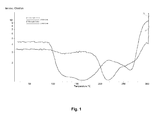
- DEA measurements were carried out on a Netzsch DEA 230/1 Epsilon using the following sensor supplied by Netzsch Automaticbau GmbH: IDEX sensor, 35 cm, made of polyimide. 175 ⁇ l of the 20% solids binder sample to be tested is placed on the sensor area using an automatic pipette and the sample is heated to 300°C with a constant rate of 5°C/min. During the measurement, the ion viscosity was recorded at a frequency of 3000 Hz.
- 158 g of diethanolamine are placed in a 1-litre glass reactor provided with a stirrer and a heating/cooling jacket.
- the temperature of the diethanolamine is raised to 60°C whereafter 91 g of tetrahydrophthalic anhydride are added.
- a second portion of 46 g of tetrahydrophthalic anhydride is added followed by 86 g of trimellitic anhydride.
- the mixture is cooled to 95°C and 210 g of water added and the mixture stirred for 1 hour. After cooling to ambient temperature, the obtained resin is ready for use.
- a binder is made using the obtained resin by adding ammonia to pH 6.5 as well as 2% of hypophosphorous acid. After dilution to 20% solids with water, a DEA measurement was performed
- the epoxy was mixed with dicyandiamide in an amount corresponding to 11 g/100 g epoxy. After dilution to 20% solids with water, a DEA measurement was performed.
- a commercially available urea modified phenol formaldehyde resin from Hexion 1764K was used for the test.
- To the phenolic resin was added 9% of a 25% ammonia solution and ammonium sulphate in an amount corresponding to neutralisation of all catalyst. After dilution with water to 20% solids, a DEA measurement was performed
- co-binder an acrylic-based binder according to Example 2. To the binder were added ammonia to pH 6.5 and 1,4% of a ⁇ -aminopropyltriethoxy silane, based on solids. Finally, the binder was diluted with water to 15% solids.
Landscapes
- Chemical & Material Sciences (AREA)
- Engineering & Computer Science (AREA)
- Chemical Kinetics & Catalysis (AREA)
- Organic Chemistry (AREA)
- Life Sciences & Earth Sciences (AREA)
- Textile Engineering (AREA)
- General Chemical & Material Sciences (AREA)
- Health & Medical Sciences (AREA)
- Polymers & Plastics (AREA)
- Medicinal Chemistry (AREA)
- Inorganic Chemistry (AREA)
- General Life Sciences & Earth Sciences (AREA)
- Geochemistry & Mineralogy (AREA)
- Materials Engineering (AREA)
- Dispersion Chemistry (AREA)
- Nonwoven Fabrics (AREA)
Abstract
A bonded mineral fibre product is produced by a method which comprises: fiberizing a mineral melt; carrying the mineral fibres formed by means of a gas stream into a forming chamber; applying a thermosetting binder on to the mineral fibres; depositing the coated fibres as a mineral fibre web on a receiver means; and transferring the mineral fibre web to a curing oven for curing of the binder and forming a bonded mineral fibre product; the method being characterized by separately applying a main binder and at least one co-binder on to the mineral fibres, the T-onset temperature (temperature at which curing starts) of the co-binder being at least 10°C lower than the T-onset temperature of the main binder, and the ion viscosity of the co-binder at the T-onset temperature of the main binder being higher than that of the main binder.
Description
- The present invention relates to a method of producing a bonded mineral fibre product, in particular a bonded mineral fibre product for use as thermal and/or acoustical insulation material.
- Mineral fibre products generally comprise man-made vitreous fibres (MMVF) such as, e.g., glass fibres, ceramic fibres, basalt fibres, slag wool, mineral wool and stone wool, which are bonded together by a cured thermosetting polymeric binder material.
- Generally mineral wool products are manufactured by melting a suitable mineral raw material in a melting apparatus, such as a cupola furnace, from which the melted material is continuously supplied to a fibre-forming apparatus. In said fibre-forming apparatus, the melted material is transformed into mineral fibres, for instance, by a spinning cup process or by a cascade rotor process. The formed mineral fibres are carried by means of an air or gas stream into a forming chamber and, while airborne and while still hot, are sprayed with a binder solution and deposited on a receiver means, for instance, a perforated conveyor, in the form of a continuous mat or web of randomly distributed mineral fibres. The mineral fibre mat is then transferred to a curing oven where hot air is blown through the mat to cure the binder and rigidly bond the mineral fibres together.
- In the so-called cascade rotor process, the fibre-forming apparatus comprises rapidly rotating steel cylinders, called spinning wheels, which are arranged to successively receive the melted material and to throw it on to the next spinning wheel. There are generally 2 to 4 spinning wheels in the cascade spinning apparatus.
- In the manufacture of glass wool, conventional glass raw materials are usually melted in a tank furnace. In the most common fibre-forming method for glass wool, the melted material is allowed to flow into hollow centrifuges which are mounted for rotation about vertical shafts. There are holes in the jacket of the centrifuges and the melted glass is by the centrifugal force pressed out through said holes thereby forming thin mineral strings, called primary fibres. The actual fibre-forming is thereafter accomplished by means of strong axially directed gas or air jets which flow past the jackets of the centrifuges.
- Also in the production of stone or slag mineral wool, air flows are supplied around the spinning wheels for several reasons, for instance, in order to carry the fibres away from the actual fibre-forming apparatus into the forming chamber where they deposit on the receiver means.
- Addition of the binder must be carried out under conditions that allow the binder to be uniformly distributed over the fibres. In particular, it is necessary to prevent the formation of fibre bundles, these being dispersed within non-bonded fibres that are liable to easily break and thereby generate dust. This operation aims at retaining fibres that are bonded together by junction points that are sufficiently strong to ensure good cohesion and to ensure that the product does not tear when used. However, the cohesion must not be too high, so that the bonding remains flexible and the final product retains a certain deformability. In particular, the junctions between the fibres must provide a network that is stable and rigid enough to withstand the compression imposed by storing and transporting the product, and must meet the supplier's specifications when the product is being used.
- In commercial processes for the manufacture of mineral wool products, the fibres, just formed, are suspended in the air or gas stream which carries them from the fibre-forming apparatus to the receiver means, and the binder to be added to the mineral fibres is sprayed in a finely dispersed form on to said suspended fibres. Other substances may be supplied in combination with the binder, for instance, a wetting agent or a dust binding substance. Normally, the binder is supplied very close to the fibre-forming apparatus. The reason for applying the binder to the suspended fibres, and not to the mat already formed on the receiving conveyor is that it is difficult to have the binder penetrate into a mineral wool mat since such mats are tight and the fibres have a fine structure compared to the size of the binder drops.
- Regarding the receiver means, there are basically two different principles for the function thereof. According to one principle, a final mat is built up on the conveyor of the receiver means, and said final mat is then further processed (cured, cooled, divided, cross cut, etc.).Technically, this means that the area weight of the mineral wool as initially deposited on the perforated conveyor is the same as the intended area weight of the final product.
- In many cases, a second principle gives a better result, and according to this principle a relatively thin mat, a so called primary mat, is first deposited, and said primary mat is then, by a folding process, in one or more steps, processed so as to build up a final mineral wool mat, the area weight of which corresponds to intended area weight of the final product.
- The web of mineral fibres spray-coated with the binder is subsequently heat-treated at a temperature generally above 100°C in order to cross-link the binder resin and thereby obtain a cured bonded mineral fibre product having the properties required for forming a thermal and/or acoustic insulation material, especially in terms of dimensional stability, tensile strength, thickness recovery after compression and uniform color.
- Curing of the mineral fibre web may be carried out in a curing oven by introducing a hot-air stream into the mineral fibre web. However, at the entrance of the curing oven where the uncured and thus soft mineral fibre web is introduced into the oven, there often occurs the problem that the hot-air stream may be of a magnitude that holes or depressions are formed in the mineral fibre web (so-called "hollow-blowing"). As curing takes place along the length of the curing oven, the problem decreases in importance because the stiffness increases and the web gains resistance against the air pressure. The problem is especially pronounced in the curing of light products which have a higher tendency for hollow-blowing due to their low density and hence ease of compressibility.
- One way to solve the problem would of course be to lower the air pressure. However, this may leave part of the product semi-cured or will reduce the production capacity and is therefore unsuited. The curing oven has a fixed length and a minimum speed, i.e. there is a maximum curing time limit within which the curing has to take place.
- The present invention offers the possibility of avoiding or reducing the problems associated with "hollow-blowing" in the curing step of a continuous process for manufacturing bonded mineral fibre products thereby improving curing quality and production capacity.
- In accordance with the present invention there is provided a method of producing a bonded mineral fibre product which comprises:
- fiberizing a mineral melt;
- carrying the mineral fibres formed by means of a gas stream into a forming chamber;
- applying a thermosetting binder on to the mineral fibres;
- depositing the coated fibres as a mineral fibre web on a receiver means; and
- transferring the mineral fibre web to a curing oven for curing of the binder and forming a bonded mineral fibre product;
- the method being characterized by separately applying a main binder and at least one co-binder on to the mineral fibres, the T-onset temperature (temperature at which curing starts) of the co-binder being at least 10°C lower than the T-onset temperature of the main binder, and the ion viscosity of the co- binder at the T-onset temperature of the main binder being higher than that of the main binder.
- By applying one or more co-binders having a lower T-onset temperature than the main binder, strength is fast built up in the mineral fibre web upon introduction into the curing oven, thereby preventing the occurrence of hollow-blowing in the non-cured or partly cured sections and improving curing quality and curing rate. This allows to use air pressures that would normally cause hollow-blowing which, in turn, increases production capacity.
- The T-onset temperature is an important parameter as this is the temperature at which the binder in general has its lowest stiffness. In a one-binder system, the mineral fibre web is most vulnerable to hollow-blowing at the T-onset temperature of the binder because it has its lowest stiffness at his temperature. The combination of main binder and co-binder provides adequate stiffness of the mineral fibre web, since the ion viscosity and hence the stiffness of the co-binder at the T-onset temperature of the main binder is required to be higher than that of the main binder, the co-binder is able provide the necessary stiffness where the main binder fails.
- In a preferred embodiment of the method according to the present invention, the co-binder has at least the same curing rate as the main binder and, preferably, a higher curing rate than the main binder. A high curing rate will quickly impart stiffness to the product, especially in the bottom part of the mineral wool web facing the hot air stream.
- The amount of co-binder, based on solids, generally is within the range of from 1 to 50 weight percent of total binder, preferably from 5 to 30 weight percent of total binder comprising main and co-binder.
- The T-onset temperature and the ion viscosity of the main binder and the co-binder are determined by dielectric analysis, often abbreviated as DEA. Dielectric Cure Monitoring and Dielectric Analysis (DEA) are techniques for investigating the processing behaviour and physical and chemical structure of thermosetting resins and other polymers by measuring the changes in dielectric properties of the material. For instance, DEA may be used to analyse the T-onset temperature, the curing rate and the degree of cure of a binder resin. For DEA measurements, often equipment provided by NETSCH Gerätebau GmbH of Selb, Germany, is employed (see www.netzsch-thermal-analysis.com)
- In a typical test, the sample is placed in contact with electrodes (the dielectric sensor) and a sinusoidal voltage (the excitation) having a certain frequency is applied. The resulting sinusoidal current (the response) is measured. The response signal is attenuated in amplitude and shift in phase in relation to the mobility of the ions and alignment of dipoles. Dipoles in the material will attempt to align with the electric field and charged ions will move toward the electrode of opposite polarity. Determining the changes in the dielectric properties of the sample as a function of time or temperature (as detailed in ASTM E 2038 or E 2039) provides the necessary information about T-onset temperature and ion viscosity. The ion viscosity is related to the viscosity of the resin before gelation and to rigidity after gelation. At first, the viscosity decreases as the resin is melted, i.e. the mobility of the ions is increasing. When the resin starts curing, the viscosity is increasing, i.e. the mobility of the ions is decreased, and viscosity increases as curing proceeds. From the curve obtained in a DEA experiment at a frequency of 3000 Hz, the temperature at which curing starts (T-onset) may be taken. T-onset is the temperature at which the ion viscosity has its minimum (= maximum flow). This is often referred to as the gel temperature as immediately after this point viscosity increases and gelation occurs. The slope of the curve during gelation indicates the curing speed. For more details, see Dielectric Analysis & Dielectric Cure Monitoring at www.ngb.netzsch.com.
- The T-onset temperature of the co-binder is at least 10°C, preferably at least 20°C, more preferably at least 30°C, and most preferably at least 50°C lower than the T-onset temperature of the main binder.
- For the purposes of the present invention, any combination of known mineral wool binders may be used as main binder and co-binder, provided the requirements in terms of T-onset temperature and ion viscosity are met. The T-onset temperature of the co-binder should preferably be selected such that premature curing in the forming chamber is prevented. It is not necessary for the co-binder to contribute to excellent product properties. Rather it is sufficient for the co-binder to provide adequate stiffness of the mineral fibre web so as to avoid hollow-blowing during the curing process.
- The thermosetting binder resins may comprise both formaldehyde-containing and formaldehyde-free, organic and inorganic binder resins.
- Suitable formaldehyde-containing resins are, for instance, phenoplast-type resins (phenol-formaldehyde resins or urea-modified phenol-formaldehyde resins) and aminoplast-type resins (melamine-formaldehyde resins or urea-formaldehyde resins), or combinations thereof.
- Preferred examples of formaldehyde-free binder systems are, for instance, the following:
- A first embodiment of a formaldehyde-free polymeric binder system comprises the water-soluble reaction product of an alkanolamine with a carboxylic anhydride obtainable by reacting at least one alkanolamine with at least one carboxylic anhydride and, optionally, treating the reaction product with a base.
- Preferred alkanolamines for use in the preparation of this binder system are alkanolamines having at least two hydroxy groups such as, for instance, alkanolamines represented by the formula

- Preferably, R2 and R3, independently are C2-5 hydroxyalkyl groups, and R1 is hydrogen, a C1-5 alkyl group or a C2-5 hydroxyalkyl group. Particularly preferred hydroxyalkyl groups are β-hydroxyalkyl groups.
- Specific examples of suitable alkanolamines are diethanolamine, triethanolamine, diisopropanolamine, triisopropanolamine, methyldiethanolamine, ethyldiethanolamine, n-butyldiethanolamine, methyldiisopropanolamine, ethyl-isopropanolamine, ethyldiisopropanolamine, 3-amino-1,2-propanediol, 2-amino-1,3-propanediol and tris(hydroxymethyl)aminomethane. Diethanolamine is the currently preferred alkanolamine.
- The carboxylic anhydride reactant may be selected from saturated or unsaturated aliphatic and cycloaliphatic anhydrides, aromatic anhydrides and mixtures thereof, saturated or unsaturated cycloaliphatic anhydrides, aromatic anhydrides and mixtures thereof being preferred. In a particularly preferred embodiment of the invention, two different anhydrides selected from cycloaliphatic and/or aromatic anhydrides are employed. These different anhydrides are preferably reacted in sequence.
- Specific examples of suitable aliphatic carboxylic anhydrides are succinic anhydride, maleic anhydride and glutaric anhydride. Specific examples of suitable cycloaliphatic anhydrides are tetrahydrophthalic anhydride, hexahydrophthalic anhydride, methyltetrahydrophthalic anhydride and nadic anhydride, i.e. endo-cis-bicyclo[2.2.1]-5-heptene-2,3-dicarboxylic anhydride. Specific examples of suitable aromatic anhydrides are phthalic anhydride, methylphthalic anhydride, trimellitic anhydride and pyromellitic dianhydride.
- If two different anhydrides are employed, a combination of cycloaliphatic anhydride and aromatic anhydride is particularly preferred, e.g. a combination of tetrahydrophthalic anhydride (THPA) and trimellitic anhydride (TMA). The molar ratio of cycloaliphatic anhydride to aromatic anhydride is preferably within the range of from 0.1 to 10, more preferably within the range of from 0.5 to 3.
- In the preparation of the binder composition, the proportion of the alkanolamine and carboxylic anhydride reactants is preferably selected such that the ratio of equivalents of amine plus hydroxy groups (NH+OH) to equivalents of carboxy groups (COOH) is at least 0.4, more preferably at least 0.6. By employing these minimum ratios, a too high excess of free unreacted acid is avoided which under specific conditions could lead to a displacement of binder in the curing oven, i.e. to a non-uniform distribution in amount of binder between the bottom and top of the mineral wool mat or web. Furthermore, high amounts of unreacted acid may increase corrosiveness.
- On the other hand, the properties of the final binder composition, such as curing behaviour, durability and humidity resistance are determined by the total ratio of reactive groups present. Therefore, for optimum performance, the ratio of equivalents of amine plus hydroxy groups (NH+OH) to equivalents of carboxy groups (COOH) in the final binder composition is preferably adjusted to 2.0 or less, more preferably to 1.7 or less. Preferably, the final binder composition has an equivalent ratio of (NH+OH) / (COOH) within the range of from 0.7 to 1.55.
- The reaction between the alkanolamine and carboxylic anhydride reactants is carried out in the usual manner, for instance, as described in
WO 99/36368 WO 01/05725 WO 01/96460 WO 02/06178 WO 2004/007615 andWO 2006/061249 , the entire contents of which is incorporated herein by reference. - The reaction temperature is generally within the range of from 50°C to 200°C. In a preferred embodiment and, in particular, when two different anhydrides are employed, the alkanolamine is first heated to a temperature of at least about 40°C, preferably at least about 60°C, whereafter the first anhydride is added and the reaction temperature is raised to at least about 70°C, preferably at least about 95°C and more preferably at least about 125°C, at which temperature the second anhydride is added to the reaction mixture when substantially all the first anhydride has dissolved and/or reacted. Increasing the reaction temperature from 70-95°C to 100-200°C allows a higher conversion of monomers to oligomers. In this case, a preferred temperature range is 105-170°C, more preferably 110-150°C.
- If water is added after the first anhydride has reacted, either together with the second anhydride or before addition of the second anhydride or at the end of the reaction, in an amount to make the binder easily pumpable, a binder having an increased molecular weight (compared to water addition from the start) is obtained which still has a desired pumpability, viscosity, and water dilutability and contains less unreacted monomers.
- In order to improve the water solubility and dilutability of the binder, a base may be added up to a pH of about 8, preferably a pH of between about 5-8, and more preferably a pH of about 6. Furthermore, the addition of a base will cause at least partial neutralization of unreacted acids and a concomitant reduction of corrosiveness. Normally, the base will be added in an amount sufficient to achieve the desired water solubility or dilutability. The base is preferably selected from volatile bases which will evaporate at or below curing temperature and hence will not influence curing. Specific examples of suitable bases are ammonia (NH3) and organic amines such as diethanolamine (DEA), triethanolamine (TEA) and dimethylethanolamine (DMEA). The base is preferably added to the reaction mixture after the reaction between the alkanol amine and the carboxylic anhydride has been actively stopped by adding water.
- If appropriate, an additional acid monomer may be employed in the reaction and is preferably added to the reaction mixture before addition of the anhydride reactant. Specific examples of suitable acid monomers are di-, tri- and polycarboxylic acids such as adipic acid, citric acid, sebacic acid, azelaic acid, succinic acid, tartaric acid, trimellitic acid, pyromellitic acid and styrene-maleic acid.
- Furthermore, one or more polycarboxy crosslinking agents may be added after termination of the reaction and, optionally, together with the base. Suitable polycarboxy crosslinking agents are, e.g., homopolymers and copolymers of acidic monomers such as acrylic acid, alkylacrylic acid (e.g. methacrylic acid) and maleic acid, and copolymers of such acidic monomers and acrylates. The weight percentage of these polycarboxy crosslinking agents is at least 0.5, preferably at least 10 wt.%, and up to 50, preferably up to 30 wt.%, more preferably up to 15 wt.%, based on the binder composition.
- A second embodiment of a formaldehyde-free polymeric binder system is an aqueous binder composition comprising:
- (a) a polyacid component having acid groups, or anhydride or salt derivatives thereof; and
- (b) a polyhydroxy component having hydroxyl groups;
- A binder system according to this second embodiment is described in
WO 2005/087837 , the entire disclosure of which is incorporated herein by reference. - A third embodiment of a formaldehyde-free polymeric binder system is a binder composition comprising a polycarboxy polymer (especially a polyacrylic acid polymer), a polyhydroxy crosslinking agent, and a surfactant selected from the group consisting of cationic surfactants, amphoteric surfactants, nonionic surfactants, and mixtures thereof.
- A binder system according to this third embodiment is described in
US-A-2004/0152824 , the entire disclosure of which is incorporated herein by reference. - Other thermosetting MMVF binders suitable as either the main or co-binders in accordance with the present invention are disclosed, for instance, in the following patent publications, the entire disclosure of which is incorporated herein by reference.
- Epoxy-based binder resins such as described, e.g., in
WO 2004/07395 WO 2005/044750 ; - Polyacryl/polyamine-based binder resins such as described, e.g., in
US 2007/173588 ; - Polyketal-based binder resins such as described, e.g., in
WO 2007/044632 ; - Inorganic sol-gel-type binders such as described, e.g., in
EP-A-1 292 384 ; - Blocked isocyanates;
- Organically modified water glass;
- Isocyanate-modified water glass;
- Isocyanate-modified inorganic binders such as described, e.g., in
DE-A-2359606 . - The binder compositions according to the present invention may additionally comprise one or more conventional binder additives. These include, for instance, curing accelerators such as, e.g., β-hydroxyalkylamides; the free acid and salt forms of phosphoric acid, hypophosphorous acid, phosphonic acid, citric acid and adipic acid. Other strong acids such as boric acid, sulphuric acid, nitric acid and p-toluenesulphonic acid may also be used, either alone or in combination with the just mentioned acids, in particular with phosphoric, hypophosphorous acid or phosphonic acid. Other suitable binder additives are silane coupling agents such as γ-aminopropyltriethoxysilane; thermal stabilizers; UV stabilizers; emulsifiers; surface active agents, particularly nonionic surfactants; biocides; plasticizers; anti-migration aids; coalescents; fillers and extenders such as carbohydrates, clay, silicates and magnesium hydroxide; pigments such as titanium dioxide; hydrophobizing agents such as fluorinated compounds, mineral oils and silicone oils; flame retardants; corrosion inhibitors such as thiourea; urea; antifoaming agents; antioxidants; and others.
- These binder additives and adjuvants may be used in conventional amounts generally not exceeding 20 wt.% of the binder solids. The amount of curing accelerator in the binder composition is generally between 0.05 and 5 wt.%, based on solids.
- The aqueous binder composition preferably has a solids content of from 1 to 20 wt.%. In order to achieve adequate application properties and, in particular, spraying properties, the viscosity of the binder composition may be adjusted. This is accomplished, for instance, by controlling the type and/or concentration of binder components in the aqueous binder system or by dispersing or emulsifying the binder in water.
- The combined binders are normally applied in an amount of 0.1 to 10 %, preferably 0.2 to 8 % by weight, of the bonded mineral fibre product on a dry basis.
- The mineral fibres employed may be any of man-made vitreous fibres (MMVF), glass fibres, ceramic fibres, basalt fibres, slag wool, rock wool, stone wool and others.
- Suitable fibre formation methods and subsequent production steps for manufacturing the mineral fibre product are those conventional in the art including but not limited to those discussed hereinbefore in the "Background of the Invention". Generally, the different binders are sprayed immediately after fibrillation of the mineral melt on to the airborne mineral fibres. Suitable spraying devices are, e.g., nozzles. In a cascade spinning apparatus having four spinning wheels, the main binder may, for instance, be sprayed from the central diffusers of
wheels 2 and 3 plus nozzle ring and the co-binder from the central diffuser of wheel 4. - The spray-coated mineral fibre web is generally cured in a curing oven by means of a hot air stream. The hot air stream may be introduced into the mineral fibre web from below, or above or from alternating directions in distinctive zones in the length direction of the curing oven. Typically, the curing oven is operated at a temperature of from about 150°C to about 350°C. Preferably, the curing temperature ranges from about 200 to about 300°C. Generally, the curing oven residence time is from 30 seconds to 20 minutes, depending on, for instance, the product density.
- If desired, the mineral wool web may be subjected to a shaping process before curing. The bonded mineral fibre product emerging from the curing oven may be cut to a desired format. e.g., in the form of a batt.
- Thus, the mineral fibre products produced may, for instance, have the form of mats, batts, slabs, sheets, plates, strips, rolls, granulates and other shaped articles. In accordance with the present invention, it is also possible to produce composite materials by combining the bonded mineral fibre product with suitable composite layers or laminate layers such as, e.g., metal, glass surfacing mats and other woven or non-woven materials.
- The following examples are intended to further illustrate the invention without limiting it.
- In the examples, DEA measurements were carried out on a Netzsch DEA 230/1 Epsilon using the following sensor supplied by Netzsch Gerätebau GmbH: IDEX sensor, 35 cm, made of polyimide. 175 µl of the 20% solids binder sample to be tested is placed on the sensor area using an automatic pipette and the sample is heated to 300°C with a constant rate of 5°C/min. During the measurement, the ion viscosity was recorded at a frequency of 3000 Hz.
- An example of a DEA curve is presented in
Fig. 1 - 158 g of diethanolamine are placed in a 1-litre glass reactor provided with a stirrer and a heating/cooling jacket. The temperature of the diethanolamine is raised to 60°C whereafter 91 g of tetrahydrophthalic anhydride are added. After raising the temperature and keeping it at 130°C, a second portion of 46 g of tetrahydrophthalic anhydride is added followed by 86 g of trimellitic anhydride. After reacting at 130°C for 1 hour, the mixture is cooled to 95°C and 210 g of water added and the mixture stirred for 1 hour. After cooling to ambient temperature, the obtained resin is ready for use.
- A binder is made using the obtained resin by adding ammonia to pH 6.5 as well as 2% of hypophosphorous acid. After dilution to 20% solids with water, a DEA measurement was performed
- A commercially available acrylic based binder from Rohm and Haas Aquaset series: Aquaset® 600 was used for the test. After having been diluted with water to 20% solids, a DEA measurement was performed
- A commercially available epoxy resin of the glycidyl ether type from UPPC: Polypox® E 260 W was used for the test. The epoxy was mixed with dicyandiamide in an amount corresponding to 11 g/100 g epoxy. After dilution to 20% solids with water, a DEA measurement was performed.
- A commercially available urea modified phenol formaldehyde resin from Hexion 1764K was used for the test. To the phenolic resin was added 9% of a 25% ammonia solution and ammonium sulphate in an amount corresponding to neutralisation of all catalyst. After dilution with water to 20% solids, a DEA measurement was performed
- In the table below combinations of main and co-binders according to the invention derived from the examples are listed
Co-binder Main binder T-onset Co-binder °C T-onset Main binder °C Ion viscosity ratio Co-binder/Main binder at T-onset for Main binder Ex.2 Ex. 1 167 217 2 Ex.3 Ex. 1 93 217 39 Ex.4 Ex. 1 144 217 >1000 Ex.3 Ex.2 93 167 11 Ex.4 Ex.2 144 167 325 Ex.3 Ex.4 93 144 23 - 2800 kg of diethanolamine are transferred to a 10 m3 reactor and heated to 60°C. Then 1560 kg of tetrahydrophthalic anhydride are added. After raising the temperature and keeping it at 130°C, a second portion of 780 kg of tetrahydrophthalic anhydride is added followed by 1560 kg of trimellitic anhydride. After reacting at 130°C for 1 hour, the mixture is cooled to 95°C, water added and the mixture stirred for 1 hour. After further cooling to ambient temperature, a resin according Example 1 is obtained. The obtained resin has a solids content of 57.9%
- From the above resin a main binder was made by addition of 200 litres of 25% ammonia solution per ton solids resin, 2% of hypophophorous acid, based on solids, and 1.4% of a γ-aminopropyltriethoxy silane, based on solids. Finally, the binder was diluted with water to 15% solids
- As co-binder was used an acrylic-based binder according to Example 2. To the binder were added ammonia to pH 6.5 and 1,4% of a γ-aminopropyltriethoxy silane, based on solids. Finally, the binder was diluted with water to 15% solids.
- Using the main binder and co-binder described above a factory trial was carried out with the main binder dosed on the central diffusers of
spinning wheels 2 and 3 and the nozzle ring of a cascade spinning apparatus and the co-binder dosed on the central diffuser of wheel 4. The proportion of co-binder to main binder was adjusted so that the amount of co-binder was approx. 1/3 of the total binder flow. The product produced was a light product and the curing oven air temperature during the whole test was set to 290°C. - When running with the co-binder, it was possible to increase the differential pressure in the curing oven and thereby increase production capacity of the line by more than 25% without the occurrence of hollow blowing of the product based upon visual observation.
Claims (16)
- A method of producing a bonded mineral fibre product which comprises:fiberizing a mineral melt;carrying the mineral fibres formed by means of a gas stream into a forming chamber;applying a thermosetting binder on to the mineral fibres;depositing the coated fibres as a mineral fibre web on a receiver means; andtransferring the mineral fibre web to a curing oven for curing of the binder and forming a bonded mineral fibre product;the method being characterized by separately applying a main binder and at least one co-binder on to the mineral fibres, the T-onset temperature (temperature at which curing starts) of the co-binder being at least 10°C lower than the T-onset temperature of the main binder, and the ion viscosity of the co-binder at the T-onset temperature of the main binder being higher than the ion viscosity of the main binder.
- The method of claim 1, wherein the co-binder has at least the same curing rate as the main binder.
- The method of claim 2, wherein the co-binder has a higher curing rate than the main binder.
- The method of any one of claims 1 to 3, wherein the amount of co-binder, based on solids, is 1 to 50 weight percent of the total binder.
- The method of claim 4, wherein the amount of co-binder, based on solids, is 5 to 35 weight percent of the total binder.
- The method of any one of claims 1 to 5, wherein the T-onset temperature of the co-binder is at least 20°C lower than the T-onset temperature of the main binder.
- The method of claim 6, wherein the T-onset temperature of the co-binder is at least 30°C lower than the T-onset temperature of the main binder.
- The method of claim 7, wherein the T-onset temperature of the co-binder is at least 50°C lower than the T-onset temperature of the main binder.
- The method of any one of claims 1 to 8, wherein the main binder is a urea-modified phenol formaldehyde resin and the co-binder is an epoxy resin.
- The method of any one of claims 1 to 8, wherein the main binder is an alkanolamine/carboxylic acid anhydride reaction product and the co-binder is an acrylic resin.
- The method of any one of claims 1 to 8, wherein the main binder is an alkanolamine/carboxylic acid anhydride reaction product and the co-binder is an epoxy resin.
- The method of any one of claims 1 to 11, wherein fibre formation is carried out by means of a spinning cup process or a cascade rotor process.
- The method of any one of claims 1 to 12, wherein curing is effected by means of a hot-air stream introduced into the mineral fibre web.
- A bonded mineral fibre product produced by a method according to any one of claims 1 to 13.
- An article produced from the bonded mineral fibre product of claim 14.
- An article according to claim 15 in the form of a mat, batt, slab, sheet, plate, strip, roll, granulate or other shaped article or composite.
Priority Applications (1)
| Application Number | Priority Date | Filing Date | Title |
|---|---|---|---|
| EP08101219A EP2085365A1 (en) | 2008-02-01 | 2008-02-01 | Method of producing a bonded mineral fibre product |
Applications Claiming Priority (1)
| Application Number | Priority Date | Filing Date | Title |
|---|---|---|---|
| EP08101219A EP2085365A1 (en) | 2008-02-01 | 2008-02-01 | Method of producing a bonded mineral fibre product |
Publications (1)
| Publication Number | Publication Date |
|---|---|
| EP2085365A1 true EP2085365A1 (en) | 2009-08-05 |
Family
ID=39545069
Family Applications (1)
| Application Number | Title | Priority Date | Filing Date |
|---|---|---|---|
| EP08101219A Withdrawn EP2085365A1 (en) | 2008-02-01 | 2008-02-01 | Method of producing a bonded mineral fibre product |
Country Status (1)
| Country | Link |
|---|---|
| EP (1) | EP2085365A1 (en) |
Cited By (2)
| Publication number | Priority date | Publication date | Assignee | Title |
|---|---|---|---|---|
| WO2011163102A1 (en) * | 2010-06-24 | 2011-12-29 | Usg Interiors, Inc. | Formaldehyde free coating for panels comprsing a polyacid copolymer and calcium aluminosilicate powder |
| US8309231B2 (en) | 2006-05-31 | 2012-11-13 | Usg Interiors, Llc | Acoustical tile |
Citations (20)
| Publication number | Priority date | Publication date | Assignee | Title |
|---|---|---|---|---|
| DE2359606A1 (en) | 1973-11-30 | 1975-06-05 | Bayer Ag | INORGANIC-ORGANIC PLASTICS |
| EP0374112A1 (en) * | 1988-12-16 | 1990-06-20 | Rockwool Aktiebolaget | Method and apparatus for supplying a binder to mineral wool |
| US5601629A (en) * | 1992-12-29 | 1997-02-11 | Helbing; Clarence H. | Apparatus for producing a fiberglass pack with two steps of binder application |
| WO1999036368A1 (en) | 1998-01-16 | 1999-07-22 | Rockwool International A/S | Compound for use as a mineral fibre binder and process for providing such |
| US6099775A (en) * | 1996-07-03 | 2000-08-08 | C.T.A. Acoustics | Fiberglass insulation product and process for making |
| WO2001005725A1 (en) | 1999-07-16 | 2001-01-25 | Rockwool International A/S | Resin for a mineral wool binder comprising the reaction product of an amine with a first and second anhydride |
| WO2001096460A2 (en) | 2000-06-16 | 2001-12-20 | Rockwool International A/S | Binder for mineral wool products |
| WO2002006178A1 (en) | 2000-07-04 | 2002-01-24 | Rockwool International A/S | Binder for mineral wool products |
| EP1292384A2 (en) | 2000-06-20 | 2003-03-19 | Paroc Group Oy Ab | Colloidal silicate dispersion, method for its preparation and its use |
| WO2004007615A1 (en) | 2002-07-15 | 2004-01-22 | Rockwool International A/S | Formaldehyde-free aqueous binder composition for mineral fibers |
| WO2004007395A2 (en) | 2002-07-12 | 2004-01-22 | Saint-Gobain Isover | Insulation product, such as a thermal insulation product, and production method thereof |
| WO2004050978A1 (en) * | 2002-12-03 | 2004-06-17 | Owens Corning | Polycaboxylic acid based co-binder |
| US20040152824A1 (en) | 2001-05-31 | 2004-08-05 | Richard Dobrowolski | Surfactant-containing insulation binder |
| WO2005044750A1 (en) | 2003-11-05 | 2005-05-19 | Saint-Gobain Isover | Sizing composition for an insulating product based on mineral wool, and resulting products |
| WO2005087837A1 (en) | 2004-03-11 | 2005-09-22 | Knauf Insulation Gmbh | Binder compositions and associated methods |
| US20050215153A1 (en) * | 2004-03-23 | 2005-09-29 | Cossement Marc R | Dextrin binder composition for heat resistant non-wovens |
| WO2006061249A1 (en) | 2004-12-10 | 2006-06-15 | Rockwool International A/S | Aqueous binder for mineral fibers |
| WO2006070055A2 (en) * | 2004-12-31 | 2006-07-06 | Paroc Oy Ab | Method and apparatus in the manufacture of mineral fibres and fiberising rotor arrangement |
| WO2007044632A1 (en) | 2005-10-07 | 2007-04-19 | Johns Manville | IMPROVED CURABLE FIBERGLASS BINDER COMPRISING A β- AMINO-ESTER OR β-AMINO-AMIDE CONJUGATE ADDITION PRODUCT |
| US20070173588A1 (en) | 2003-04-16 | 2007-07-26 | Saint-Gobain Isover | Mineral fibre sizing composition containing a carboxylic polyacid and a polyamine, preparation method thereof and resulting products |
-
2008
- 2008-02-01 EP EP08101219A patent/EP2085365A1/en not_active Withdrawn
Patent Citations (20)
| Publication number | Priority date | Publication date | Assignee | Title |
|---|---|---|---|---|
| DE2359606A1 (en) | 1973-11-30 | 1975-06-05 | Bayer Ag | INORGANIC-ORGANIC PLASTICS |
| EP0374112A1 (en) * | 1988-12-16 | 1990-06-20 | Rockwool Aktiebolaget | Method and apparatus for supplying a binder to mineral wool |
| US5601629A (en) * | 1992-12-29 | 1997-02-11 | Helbing; Clarence H. | Apparatus for producing a fiberglass pack with two steps of binder application |
| US6099775A (en) * | 1996-07-03 | 2000-08-08 | C.T.A. Acoustics | Fiberglass insulation product and process for making |
| WO1999036368A1 (en) | 1998-01-16 | 1999-07-22 | Rockwool International A/S | Compound for use as a mineral fibre binder and process for providing such |
| WO2001005725A1 (en) | 1999-07-16 | 2001-01-25 | Rockwool International A/S | Resin for a mineral wool binder comprising the reaction product of an amine with a first and second anhydride |
| WO2001096460A2 (en) | 2000-06-16 | 2001-12-20 | Rockwool International A/S | Binder for mineral wool products |
| EP1292384A2 (en) | 2000-06-20 | 2003-03-19 | Paroc Group Oy Ab | Colloidal silicate dispersion, method for its preparation and its use |
| WO2002006178A1 (en) | 2000-07-04 | 2002-01-24 | Rockwool International A/S | Binder for mineral wool products |
| US20040152824A1 (en) | 2001-05-31 | 2004-08-05 | Richard Dobrowolski | Surfactant-containing insulation binder |
| WO2004007395A2 (en) | 2002-07-12 | 2004-01-22 | Saint-Gobain Isover | Insulation product, such as a thermal insulation product, and production method thereof |
| WO2004007615A1 (en) | 2002-07-15 | 2004-01-22 | Rockwool International A/S | Formaldehyde-free aqueous binder composition for mineral fibers |
| WO2004050978A1 (en) * | 2002-12-03 | 2004-06-17 | Owens Corning | Polycaboxylic acid based co-binder |
| US20070173588A1 (en) | 2003-04-16 | 2007-07-26 | Saint-Gobain Isover | Mineral fibre sizing composition containing a carboxylic polyacid and a polyamine, preparation method thereof and resulting products |
| WO2005044750A1 (en) | 2003-11-05 | 2005-05-19 | Saint-Gobain Isover | Sizing composition for an insulating product based on mineral wool, and resulting products |
| WO2005087837A1 (en) | 2004-03-11 | 2005-09-22 | Knauf Insulation Gmbh | Binder compositions and associated methods |
| US20050215153A1 (en) * | 2004-03-23 | 2005-09-29 | Cossement Marc R | Dextrin binder composition for heat resistant non-wovens |
| WO2006061249A1 (en) | 2004-12-10 | 2006-06-15 | Rockwool International A/S | Aqueous binder for mineral fibers |
| WO2006070055A2 (en) * | 2004-12-31 | 2006-07-06 | Paroc Oy Ab | Method and apparatus in the manufacture of mineral fibres and fiberising rotor arrangement |
| WO2007044632A1 (en) | 2005-10-07 | 2007-04-19 | Johns Manville | IMPROVED CURABLE FIBERGLASS BINDER COMPRISING A β- AMINO-ESTER OR β-AMINO-AMIDE CONJUGATE ADDITION PRODUCT |
Cited By (6)
| Publication number | Priority date | Publication date | Assignee | Title |
|---|---|---|---|---|
| US8309231B2 (en) | 2006-05-31 | 2012-11-13 | Usg Interiors, Llc | Acoustical tile |
| USRE46131E1 (en) | 2006-05-31 | 2016-08-30 | Usg Interiors, Llc | Acoustical tile |
| WO2011163102A1 (en) * | 2010-06-24 | 2011-12-29 | Usg Interiors, Inc. | Formaldehyde free coating for panels comprsing a polyacid copolymer and calcium aluminosilicate powder |
| JP2013534553A (en) * | 2010-06-24 | 2013-09-05 | ユーエスジー・インテリアズ・エルエルシー | Formaldehyde-free coating for panels containing polyacid copolymer and calcium aluminosilicate powder |
| US8536259B2 (en) | 2010-06-24 | 2013-09-17 | Usg Interiors, Llc | Formaldehyde free coatings for panels |
| RU2550385C2 (en) * | 2010-06-24 | 2015-05-10 | Юэсджи Интериорс, Ллс | Formaldehyde-free coating on panels, including polyacid copolymer and calcium aluminosilicate powder |
Similar Documents
| Publication | Publication Date | Title |
|---|---|---|
| EP1819764B1 (en) | Aqueous binder for mineral fibers | |
| EP2054354B1 (en) | Aqueous urea-modified binder for mineral fibres | |
| EP2075239B1 (en) | Binder for mineral wool products and process of preparing the same | |
| EP1521807B1 (en) | Formaldehyde-free aqueous binder composition for mineral fibers | |
| US8044168B2 (en) | Aqueous binder composition for mineral fibers | |
| EP1290082B1 (en) | Binder for mineral wool products | |
| US12595655B2 (en) | Insulation products | |
| US20040034154A1 (en) | Epoxide-type formaldehyde free insulation binder | |
| EP2549006A1 (en) | Urea-modified binder for mineral fibres | |
| CN1902140B (en) | Sizing composition for an insulating product based on mineral wool, and resulting products | |
| US20150152262A1 (en) | Binder for mineral fibers | |
| EP3135649A1 (en) | Mineral wool product |
Legal Events
| Date | Code | Title | Description |
|---|---|---|---|
| PUAI | Public reference made under article 153(3) epc to a published international application that has entered the european phase |
Free format text: ORIGINAL CODE: 0009012 |
|
| AK | Designated contracting states |
Kind code of ref document: A1 Designated state(s): AT BE BG CH CY CZ DE DK EE ES FI FR GB GR HR HU IE IS IT LI LT LU LV MC MT NL NO PL PT RO SE SI SK TR |
|
| AX | Request for extension of the european patent |
Extension state: AL BA MK RS |
|
| AKX | Designation fees paid | ||
| STAA | Information on the status of an ep patent application or granted ep patent |
Free format text: STATUS: THE APPLICATION IS DEEMED TO BE WITHDRAWN |
|
| 18D | Application deemed to be withdrawn |
Effective date: 20100206 |
|
| REG | Reference to a national code |
Ref country code: DE Ref legal event code: 8566 |