EP2085107A1 - A method and system for anesthesia delivery - Google Patents
A method and system for anesthesia delivery Download PDFInfo
- Publication number
- EP2085107A1 EP2085107A1 EP08396003A EP08396003A EP2085107A1 EP 2085107 A1 EP2085107 A1 EP 2085107A1 EP 08396003 A EP08396003 A EP 08396003A EP 08396003 A EP08396003 A EP 08396003A EP 2085107 A1 EP2085107 A1 EP 2085107A1
- Authority
- EP
- European Patent Office
- Prior art keywords
- anesthetic agent
- breathing air
- concentration
- delivery system
- gas
- Prior art date
- Legal status (The legal status is an assumption and is not a legal conclusion. Google has not performed a legal analysis and makes no representation as to the accuracy of the status listed.)
- Withdrawn
Links
- 206010002091 Anaesthesia Diseases 0.000 title claims abstract description 50
- 230000037005 anaesthesia Effects 0.000 title claims abstract description 50
- 238000000034 method Methods 0.000 title claims abstract description 20
- 239000003193 general anesthetic agent Substances 0.000 claims abstract description 166
- 230000029058 respiratory gaseous exchange Effects 0.000 claims abstract description 82
- 230000001105 regulatory effect Effects 0.000 claims abstract description 9
- 239000007788 liquid Substances 0.000 claims description 26
- 238000005259 measurement Methods 0.000 claims description 13
- 230000008016 vaporization Effects 0.000 claims description 8
- 230000001276 controlling effect Effects 0.000 claims description 7
- CURLTUGMZLYLDI-UHFFFAOYSA-N Carbon dioxide Chemical compound O=C=O CURLTUGMZLYLDI-UHFFFAOYSA-N 0.000 claims 2
- 229910002092 carbon dioxide Inorganic materials 0.000 claims 1
- 239000001569 carbon dioxide Substances 0.000 claims 1
- 239000007789 gas Substances 0.000 description 69
- 239000003795 chemical substances by application Substances 0.000 description 27
- 238000005070 sampling Methods 0.000 description 6
- 238000009834 vaporization Methods 0.000 description 6
- 239000000443 aerosol Substances 0.000 description 5
- 239000000203 mixture Substances 0.000 description 5
- HEMHJVSKTPXQMS-UHFFFAOYSA-M Sodium hydroxide Chemical compound [OH-].[Na+] HEMHJVSKTPXQMS-UHFFFAOYSA-M 0.000 description 3
- 230000009471 action Effects 0.000 description 3
- QVGXLLKOCUKJST-UHFFFAOYSA-N atomic oxygen Chemical compound [O] QVGXLLKOCUKJST-UHFFFAOYSA-N 0.000 description 3
- 238000001990 intravenous administration Methods 0.000 description 3
- 239000006199 nebulizer Substances 0.000 description 3
- 239000001301 oxygen Substances 0.000 description 3
- 229910052760 oxygen Inorganic materials 0.000 description 3
- 230000003444 anaesthetic effect Effects 0.000 description 2
- 230000008901 benefit Effects 0.000 description 2
- 210000004556 brain Anatomy 0.000 description 2
- 230000001934 delay Effects 0.000 description 2
- 239000003814 drug Substances 0.000 description 2
- 229940079593 drug Drugs 0.000 description 2
- 238000001802 infusion Methods 0.000 description 2
- HUAUNKAZQWMVFY-UHFFFAOYSA-M sodium;oxocalcium;hydroxide Chemical compound [OH-].[Na+].[Ca]=O HUAUNKAZQWMVFY-UHFFFAOYSA-M 0.000 description 2
- 230000001360 synchronised effect Effects 0.000 description 2
- 238000011144 upstream manufacturing Methods 0.000 description 2
- 239000006200 vaporizer Substances 0.000 description 2
- 239000012855 volatile organic compound Substances 0.000 description 2
- 206010020751 Hypersensitivity Diseases 0.000 description 1
- 238000009825 accumulation Methods 0.000 description 1
- 208000030961 allergic reaction Diseases 0.000 description 1
- 238000004458 analytical method Methods 0.000 description 1
- 239000008280 blood Substances 0.000 description 1
- 210000004369 blood Anatomy 0.000 description 1
- 230000008859 change Effects 0.000 description 1
- 150000001875 compounds Chemical class 0.000 description 1
- 238000011109 contamination Methods 0.000 description 1
- 239000013078 crystal Substances 0.000 description 1
- 230000003247 decreasing effect Effects 0.000 description 1
- 238000006731 degradation reaction Methods 0.000 description 1
- 238000002716 delivery method Methods 0.000 description 1
- 238000010586 diagram Methods 0.000 description 1
- 150000008282 halocarbons Chemical class 0.000 description 1
- 238000002347 injection Methods 0.000 description 1
- 239000007924 injection Substances 0.000 description 1
- 230000003434 inspiratory effect Effects 0.000 description 1
- 238000010253 intravenous injection Methods 0.000 description 1
- 230000007774 longterm Effects 0.000 description 1
- 210000004072 lung Anatomy 0.000 description 1
- 230000002503 metabolic effect Effects 0.000 description 1
- 230000004060 metabolic process Effects 0.000 description 1
- 210000003205 muscle Anatomy 0.000 description 1
- 210000000056 organ Anatomy 0.000 description 1
- 238000002360 preparation method Methods 0.000 description 1
- 230000001737 promoting effect Effects 0.000 description 1
- 238000005086 pumping Methods 0.000 description 1
- 230000004044 response Effects 0.000 description 1
- 210000001519 tissue Anatomy 0.000 description 1
- 230000032258 transport Effects 0.000 description 1
- 238000002604 ultrasonography Methods 0.000 description 1
- 210000003462 vein Anatomy 0.000 description 1
- 238000009423 ventilation Methods 0.000 description 1
- 239000003039 volatile agent Substances 0.000 description 1
Images

Classifications
-
- A—HUMAN NECESSITIES
- A61—MEDICAL OR VETERINARY SCIENCE; HYGIENE
- A61M—DEVICES FOR INTRODUCING MEDIA INTO, OR ONTO, THE BODY; DEVICES FOR TRANSDUCING BODY MEDIA OR FOR TAKING MEDIA FROM THE BODY; DEVICES FOR PRODUCING OR ENDING SLEEP OR STUPOR
- A61M16/00—Devices for influencing the respiratory system of patients by gas treatment, e.g. ventilators; Tracheal tubes
- A61M16/10—Preparation of respiratory gases or vapours
- A61M16/14—Preparation of respiratory gases or vapours by mixing different fluids, one of them being in a liquid phase
- A61M16/18—Vaporising devices for anaesthetic preparations
-
- A—HUMAN NECESSITIES
- A61—MEDICAL OR VETERINARY SCIENCE; HYGIENE
- A61M—DEVICES FOR INTRODUCING MEDIA INTO, OR ONTO, THE BODY; DEVICES FOR TRANSDUCING BODY MEDIA OR FOR TAKING MEDIA FROM THE BODY; DEVICES FOR PRODUCING OR ENDING SLEEP OR STUPOR
- A61M16/00—Devices for influencing the respiratory system of patients by gas treatment, e.g. ventilators; Tracheal tubes
- A61M16/0087—Environmental safety or protection means, e.g. preventing explosion
- A61M16/009—Removing used or expired gases or anaesthetic vapours
- A61M16/0093—Removing used or expired gases or anaesthetic vapours by adsorption, absorption or filtration
-
- A—HUMAN NECESSITIES
- A61—MEDICAL OR VETERINARY SCIENCE; HYGIENE
- A61M—DEVICES FOR INTRODUCING MEDIA INTO, OR ONTO, THE BODY; DEVICES FOR TRANSDUCING BODY MEDIA OR FOR TAKING MEDIA FROM THE BODY; DEVICES FOR PRODUCING OR ENDING SLEEP OR STUPOR
- A61M16/00—Devices for influencing the respiratory system of patients by gas treatment, e.g. ventilators; Tracheal tubes
- A61M16/01—Devices for influencing the respiratory system of patients by gas treatment, e.g. ventilators; Tracheal tubes specially adapted for anaesthetising
-
- A—HUMAN NECESSITIES
- A61—MEDICAL OR VETERINARY SCIENCE; HYGIENE
- A61M—DEVICES FOR INTRODUCING MEDIA INTO, OR ONTO, THE BODY; DEVICES FOR TRANSDUCING BODY MEDIA OR FOR TAKING MEDIA FROM THE BODY; DEVICES FOR PRODUCING OR ENDING SLEEP OR STUPOR
- A61M16/00—Devices for influencing the respiratory system of patients by gas treatment, e.g. ventilators; Tracheal tubes
- A61M16/10—Preparation of respiratory gases or vapours
- A61M16/1045—Devices for humidifying or heating the inspired gas by using recovered moisture or heat from the expired gas
-
- A—HUMAN NECESSITIES
- A61—MEDICAL OR VETERINARY SCIENCE; HYGIENE
- A61M—DEVICES FOR INTRODUCING MEDIA INTO, OR ONTO, THE BODY; DEVICES FOR TRANSDUCING BODY MEDIA OR FOR TAKING MEDIA FROM THE BODY; DEVICES FOR PRODUCING OR ENDING SLEEP OR STUPOR
- A61M16/00—Devices for influencing the respiratory system of patients by gas treatment, e.g. ventilators; Tracheal tubes
- A61M16/0003—Accessories therefor, e.g. sensors, vibrators, negative pressure
- A61M2016/003—Accessories therefor, e.g. sensors, vibrators, negative pressure with a flowmeter
- A61M2016/0033—Accessories therefor, e.g. sensors, vibrators, negative pressure with a flowmeter electrical
- A61M2016/0036—Accessories therefor, e.g. sensors, vibrators, negative pressure with a flowmeter electrical in the breathing tube and used in both inspiratory and expiratory phase
-
- A—HUMAN NECESSITIES
- A61—MEDICAL OR VETERINARY SCIENCE; HYGIENE
- A61M—DEVICES FOR INTRODUCING MEDIA INTO, OR ONTO, THE BODY; DEVICES FOR TRANSDUCING BODY MEDIA OR FOR TAKING MEDIA FROM THE BODY; DEVICES FOR PRODUCING OR ENDING SLEEP OR STUPOR
- A61M16/00—Devices for influencing the respiratory system of patients by gas treatment, e.g. ventilators; Tracheal tubes
- A61M16/10—Preparation of respiratory gases or vapours
- A61M16/1005—Preparation of respiratory gases or vapours with O2 features or with parameter measurement
- A61M2016/102—Measuring a parameter of the content of the delivered gas
- A61M2016/1035—Measuring a parameter of the content of the delivered gas the anaesthetic agent concentration
Definitions
- This disclosure relates generally to an anesthesia delivery system and a method for delivering anesthetic agent into a breathing air of a subject.
- Inhalation anesthesia agents are volatile halogenated hydrocarbon compounds. They are expensive, environmentally harmful, and long-term exposure may be dangerous. Therefore inhalation anesthesia systems are designed to minimize the use of the agents.
- inhalation anesthesia the volatile agent is vaporized from liquid form to vapor mixed in the patient's inhalation gas mixture. From the lungs the anesthesia agent dissolves into blood that transports that to brain, other organs, muscles, and fat tissue. Brain concentration is assumed to determine the depth of anesthesia. When maintaining this, all body compartments fill to the required concentration.
- the agents are variable in solubility to various body compartments, but relatively slow body metabolism is common characteristic of those all. Therefore, once the body compartments get filled, body agent uptake is drastically reduced to compensate only the metabolic demand.
- Another port of the circuit is connected to a ventilator controlling the circuit pressure to ventilate the patient.
- ventilator provides the inspiration volume that is for typical adult patient 500 ml into the breathing circuit during inspiration and receives respective volume during expiration.
- the ventilator comprises a volume that preserves the expiration gas for the next inspiration. Typically this ventilator preserving volume is maximum 1500 ml.
- Anesthesia delivery systems where the supplied amount of fresh gas corresponds to the patient gas consumption, at steady state typically 150-200 ml/min oxygen, is called closed circuit.
- closed circuit Anesthesia delivery systems where the supplied amount of fresh gas corresponds to the patient gas consumption, at steady state typically 150-200 ml/min oxygen, is called closed circuit.
- VOC volatile organic compound
- agent degradation reactions in the soda-lime adsorber.
- the fresh gas flow typically somewhat exceeds the patient gas uptake to allow some margin for leakages, gas sampling without need of returning the sampling gas to the circuit, and circuit ventilation out of the unwanted gas compounds.
- Even closed circuits are temporarily opened to wash out the contaminations. While the fresh gas flow is thus larger than the patient consumption, the circuit is provided an excess gas port to prevent unwanted pressure build-up in the circuit.
- This port is often actively controlled to maintain the desired circuit pressure.
- the fresh gas flow rate varies from 0.5-1.5 L/min. The higher the flow is, the more open the circuit and the more anesthesia agent is lost and vice versa.
- inhalation anesthesia delivery systems having the anesthesia agent preserving capability comparable with state of the art anesthesia practice.
- agent reflector connected to airway tube in the reciprocating gas flow path between the patient and circuit Y-piece. There the reflector adsorbs agent from exhalation gas and releases to inspiration gas.
- agent preserve capacity respective to 1-1.5 L/min fresh gas flow of the re-breathing system.
- Using the reflector removes the need for CO2 adsorber when the expired gas is not circulated back to inspiration.
- fresh gas mixer is eliminated, as ventilator when controlling the circuit pressure provides the breathing gas.
- the agent When the reflector prevents the anesthesia agent flow-through, the agent needs to be delivered into- or between the reflector and the patient.
- the agent may be administered e.g. as liquid infusion, as gasified on anesthetic vaporizer, as aerosol droplets produced with a nebulizer, or as a bolus source embedded in the system that can be activated to release the agent.
- Liquid infusion and nebulizer has been used to deliver the anesthetic agent.
- a side-stream infrared gas analyzer suctions gas flow from breathing circuit through sampling line into the IR sensor for concentration measurement.
- the gas sampling system comprising a pump, flow regulation systems, and sampling gas flow path, however, increases system size and complexity for the needs of compact anesthesia delivery system and therefore is not practical in operating room environment.
- Further gas analyzer is fitted to measure inspired gas concentration and using this to control the gas delivery in order to achieve a desired gas mixture at the patient. Using inspired gas concentration to control the mixture at the patient is, however, even at its best very slow and target would be hardly ever achieved. So it fails in controlling the state of the patient.
- an apparatus for an anesthesia delivery system includes an airway tube" an anesthetic agent dosing unit, an anesthetic agent adsorber unit and a gas analyzing apparatus.
- the anesthesia delivery system also includes a user interface and an anesthetic agent delivery controller connected to the gas analyzing apparatus for receiving measurement results and also connected to the user interface for receiving target anesthetic agent concentration and further connected to the anesthetic agent dosing unit for controlling an anesthetic agent delivery based on received measurement results and the target anesthetic agent concentration.
- Each of the anesthetic agent dosing unit, the anesthetic agent adsorber unit and the gas analyzing apparatus is adapted to be mounted on the airway tube.
- a method for delivering an anesthetic agent into a breathing air of a subject includes feeding a target anesthetic agent concentration, measuring a concentration of the anesthetic agent component in the breathing air and comparing the measured concentration with the fed target anesthetic agent concentration.
- the method for delivering an anesthetic agent into a breathing air of a subject also includes choosing one of regulating or not regulating the delivery of the anesthetic agent into the breathing air based on the comparison to achieve the target anesthetic agent concentration, delivering doses of the anesthetic agent into the breathing air, adsorbing the anesthetic agent and releasing the absorbed anesthetic agent into the breathing air.
- a method for delivering an anesthetic agent into a breathing air of a subject includes feeding a target anesthetic agent concentration, measuring a concentration of the anesthetic agent component in the breathing air, comparing the measured concentration with the fed target anesthetic agent concentration and choosing one of regulating or not regulating the delivery of anesthetic agent into the breathing air based on the comparison to achieve the target anesthetic agent concentration.
- a method for delivering an anesthetic agent into a breathing air of a subject also includes delivering doses of the liquid anesthetic agent into the breathing air, vaporizing the anesthetic agent, adsorbing the anesthetic agent from the breathing air into an anesthetic agent adsorber unit during an exhalation phase and releasing the anesthetic agent into the breathing air during an inhalation phase.
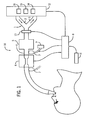
- Figure 1 is a general view of a system in accordance with an embodiment
- Figure 2 is a block diagram illustrating a method in accordance with an embodiment.
- Figure 1 shows an anesthesia delivery system 10 comprising a breathing connector 1, such as Y-piece, having three branches.
- the first branch is an inhalation tube 2 for delivery of inhaled gases during inspiration
- the second branch is an exhalation tube 3 carrying during expiration expired gas
- the third branch is an airway tube 4 carrying during inspiration the inhaled gas to and during the expiration the expired gas from the subject.
- the anesthesia delivery system 10 comprises an anesthetic agent adsorber unit 5, such as a reflector, for adsorbing anesthetic agent usually when a subject is exhaling and for releasing this agent into inspiratory breathing air.
- the anesthesia delivery system 10 comprises a gas analyzing apparatus 6 and an anesthetic agent dosing unit 7, which both are assembled into the airway tube 4.
- the gas analyzing apparatus 6, such as an infrared gas analyzer, is for measuring a concentration of at least one component of a gas flowing along the airway tube 4.
- the anesthetic agent dosing unit 7, such as a nebulizer or syringe injector, is for dosing anesthetic agent into the breathing air flowing along the airway tube 4.
- the anesthesia delivery system also comprises an anesthetic agent delivery controller 8 and a user interface 11.
- the anesthetic agent delivery controller 8 is adapted to control a liquid delivery into the breathing air and to control a liquid delivery from a liquid reservoir 9 to the anesthetic agent dosing unit 7. Further the anesthetic agent delivery controller 8 is adapted to receive measurement results from the gas analyzing apparatus and also to receive a target anesthetic agent concentration from a user interface 11.
- a breathing circuit represents an open one.
- a ventilator 12 connected to the inhalation tube 2 and the exhalation tube 3 of the breathing connector 1.
- the ventilator 12 comprises an inspiration controller 14 that regulates the breathing gas mixture and flow rate for the breathing gas delivery to the subject, and an expiration controller 15 regulating the subject's expiration flow and pressure.
- the ventilator further comprises a timing unit 16 to control a duration of the inspiration and expiration.
- the liquid delivery by means of the anesthetic dosing unit 7 may happen by nebulizing small or preferably micro droplets into the brerathing air. Because of their small size, large surface area, and high vapor pressure of the volatile anesthesia agents, these are vaporized into the breathing gas rapidly and spontaneously before inhaled into the subject's breathing. If the anesthesia agent is delivered into contact with the breathing gas as liquid with injection technique using a syringe and syringe pump actuator, the vaporization is not as effective as with micro droplets because of larger liquid volume ratio to surface area. In these circumstances special actions may be needed for vaporization. These may comprise a heated surface (not shown) where the liquid is deliverd on and vaporized with the aid of the heat. Alternatively the anesthetic agent can be injected into the anesthetic agent adsorber unit 5 for vaporization into the breathing gas passing the adsorber unit 5 during inspiration.
- the target anesthetic agent concentration fed to the user interface 11 may be a single value or a range having minimum and maximum values.
- the anesthetic agent delivery controller 8 is adapted to adjust anesthetic agent delivery into breathing air flowing along the airway tube 4 based on the measurement results from the gas analyzing apparatus 6 and the target anesthetic agent concentration in order to match the measurement result with the target anesthetic agent concentration.
- the anesthetic agent delivery controller 8 receives power e.g. from a separate power source not shown in the figure, or from a ventilator 12.
- the decrease of the gas concentration after stopping the delivery is slow.
- the user given target concentration may also have a time forecast when the anesthesia is likely to stop. Using this information the system can begin preparation in reducing the delivery to obtain the given target at given time.
- the anesthetic agent dosing unit 7 is advantageously of a mesh plate type comprising an array of miniature micrometer-range holes vibrated with an ultrasound crystal coupled to the mesh plate. While vibrating, the mesh plate may be arranged to act as a pump as well as providing the liquid feed action to the supply. Alternatively, the liquid feed may be controlled through pumping action control or control of a valve connected in the liquid feed line connected to pressurized liquid reservoir 9. It is advantageous that the generated aerosol comprises droplets small enough to allow passive vaporization when in contact to the breathing gas. For this purpose the droplets shall be less than 10 micrometers, preferably less than or equal to 5 micrometers. The droplet size produced corresponds to the hole size of the mesh plate. It is also advantageous that the liquid delivered into contact with the breathing gas is vaporized as rapidly as possible. Delays in vaporization will delay in the breathing gas concentration change, and respectively delaying the measured response. Such delays make the concentration control more difficult.
- the anesthetic agent dosing unit 7 may be connected upstream (solid line) or downstream (dashed illustration) of the gas analyzing apparatus 6.
- the delivery may also be synchronized with patient breathing to deliver either during inspiration or expiration.
- the anesthesia delivery system may be equipped also with a flow phase detector 13 to detect the subject flow phase, such as a flow sensor, or this same information can be acquired from the ventilator 12 including the flow phase detector 13 to detect the subject flow phase.
- the gas analyzing apparatus 6 is fitted to measure also patient breathing gas CO2 concentration, that can be applied on the purpose as well. In this case the expiration phase is identified when the measured CO2 concentration exceeds given CO2 value and respectively during inspiration is below given CO2 value.
- Delivery synchronization corresponds with the delivery point location advantageously so that the aerosol delivered does not end up to the measurement point immediately upon delivery to avoid disturbing uninformative measurement noise caused by high-concentration delivery doses.
- Upstream connection would then correspond to synchronization with expiration phase and would provide the longest time for the vaporization.
- Downstream delivery would then be synchronized with the inspiration phase respectively.
- the delivery dose would first be adsorbed in the anesthetic agent adsorber unit 5 and then released to the coming inspiration flow.
- the dose becomes diluted in the alveolar volume of the subject.
- a result of the system described is very small and compact system when each of the anesthetic agent dosing unit 7, the anesthetic agent adsorber unit 5 and said gas analyzing apparatus 6 is mounted on the airway tube 4. All extra wires or tubes connecting the system to any outside device are avoided making a working environment around patient more safe from both patient's and personnel's point of view.
- Figure 2 shows a method 20 for delivering anesthetic agent into a breathing air of a subject. References to figure 1 has also been made while discussing the method steps.
- a target anesthetic agent concentration is fed to the user interface 11 at step 21 to set a concentration that should be achieved and maintained during anesthesia.
- Step 22 is an optional step to detect the subject's flow phase which may be either an inspiration or an expiration and which flow phase information can used while anestetizing the subject.
- the flow phase can be detected by means of the flow phase detector 13.
- the concentration of the anesthetic agent in the breathing air exhaled is measured by means of the gas analyzing apparatus 6, which measuring is made in the airway tube 4.
- this measuring is made immediately without withdrawing the sample of gas from breathing air. Measuring in the airway tube avoids any extra connections to outside monitors and makes the system compact and more reliable.
- the benefit for measuring exhaled gas compared to inspired gas is the fact that this gives a reliable information about the state of the patient.
- step 24 the measured anesthetic agent concentration of step 23 is compared by the anesthetic agent delivery controller 8 with the fed target anesthetic agent concentration of step 21 to find out whether or not the anesthetic agent concentration of the breathing air exhaled by the patient corresponds to the target anesthetic agent concentration.
- the anesthetic agent delivery controller 8 chooses either to regulate or not regulate the delivery of the anesthetic agent into the breathing air of the patient.
- the decision to choose to regulate or to not regulate depends on the comparison made between the measured anesthetic agent concentration of the breathing air exhaled and the target anesthetic agent concentration. If the comparison shows that the measured anesthetic agent concentration corresponds to the target anesthetic agent concentration or is above, then no anesthetic agent will be delivered into the breathing air. Instead, if the comparison shows that the measured anesthetic agent concentration is lower than the target anesthetic agent concentration, then the anesthetic agent will be delivered.
- the decision to regulate may mean to deliver a fixed amount of anesthetic agent per breath whereas not regulate may mean that no anesthetic agent is delivered to a breath.
- these regulate and not regulate may mean increasing and decreasing the amount of anesthetic agent delivered per breath respectively.
- Doses of an anesthetic agent are delivered at step 26 into the breathing air by means of the anesthetic agent dosing unit 7 depending on the decision chosen at step 25.
- the delivery may happen either during expiration phase or inspiration phase and which information can be obtained by detecting the subject's flow phase as explained at step 22.
- Injecting liquid into breathing air should be advantageously made during expiration phase, but aerosol delivery can happen either during inspiration or expiration phase. Therefore the information from flow phase detector 13 can be used to detect whether the patient is inhaling or exhaling.
- Step 27 is an optional step wherein the anesthetic agent is delivered into the breathing air in bigger liquid doses and thus needs to be effectively vaporized. While nebulizing the liquid anesthetic agent is already as an aerosol in the breathing agent, but when injecting liquid volumes more time of efforts are needed to vaporize.
- the anesthetic agent which may be in a liquid form or vaporized is adsorbed at step 28 into the anesthetic agent adsorber unit 5.
- the anesthetic agent may flow with the breathing air while the patient is exhaling or it may be delivered directly into the anesthetic agent adsorber unit 5 by means of the anesthetic agent dosing unit 7.
- the adsorbed anesthetic agent of the anesthetic agent adsorber unit 5 is released into the breathing air flowing towards the patient for the breathing.
Landscapes
- Health & Medical Sciences (AREA)
- Anesthesiology (AREA)
- Life Sciences & Earth Sciences (AREA)
- Engineering & Computer Science (AREA)
- Animal Behavior & Ethology (AREA)
- Biomedical Technology (AREA)
- Heart & Thoracic Surgery (AREA)
- Hematology (AREA)
- Emergency Medicine (AREA)
- Pulmonology (AREA)
- General Health & Medical Sciences (AREA)
- Public Health (AREA)
- Veterinary Medicine (AREA)
- Biodiversity & Conservation Biology (AREA)
- Ecology (AREA)
- Environmental & Geological Engineering (AREA)
- Environmental Sciences (AREA)
- Acyclic And Carbocyclic Compounds In Medicinal Compositions (AREA)
Abstract
Description
- This disclosure relates generally to an anesthesia delivery system and a method for delivering anesthetic agent into a breathing air of a subject.
- Inhalation anesthesia agents are volatile halogenated hydrocarbon compounds. They are expensive, environmentally harmful, and long-term exposure may be dangerous. Therefore inhalation anesthesia systems are designed to minimize the use of the agents.
- In inhalation anesthesia the volatile agent is vaporized from liquid form to vapor mixed in the patient's inhalation gas mixture. From the lungs the anesthesia agent dissolves into blood that transports that to brain, other organs, muscles, and fat tissue. Brain concentration is assumed to determine the depth of anesthesia. When maintaining this, all body compartments fill to the required concentration. The agents are variable in solubility to various body compartments, but relatively slow body metabolism is common characteristic of those all. Therefore, once the body compartments get filled, body agent uptake is drastically reduced to compensate only the metabolic demand.
- While the body uptake is reduced, to preserve the body agent concentration, alveolar concentration has to be maintained. To facilitate this without additional agent consumption, current delivery systems use re-breathing circuit where expired breathing gas containing anesthesia agent in the alveolar concentration is re-circulated back to inspiration gas. However, before re-breathing, the expired gas needs to be cleared from patient-produced CO2 and filled with oxygen corresponding to patient 02 consumption. CO2 is removed in CO2 adsorber comprising typically NaOH or KOH soda-lime. Oxygen is added through fresh gas inlet, which is used to control the re-breathing circuit mixture. Fresh gas may contain also inhalation agent vapor mixed to it with vaporizer, or the agent is injected directly to the circuit. Another port of the circuit is connected to a ventilator controlling the circuit pressure to ventilate the patient. Through this port ventilator provides the inspiration volume that is for typical adult patient 500 ml into the breathing circuit during inspiration and receives respective volume during expiration. The ventilator comprises a volume that preserves the expiration gas for the next inspiration. Typically this ventilator preserving volume is maximum 1500 ml.
- Anesthesia delivery systems where the supplied amount of fresh gas corresponds to the patient gas consumption, at steady state typically 150-200 ml/min oxygen, is called closed circuit. These have, however, many difficulties like circuit leakages including patient connection, gas monitor gas sampling stream removing gas from the circuit for analysis, accumulation of volatile organic compound (VOC) gases, and agent degradation reactions in the soda-lime adsorber. The fresh gas flow typically somewhat exceeds the patient gas uptake to allow some margin for leakages, gas sampling without need of returning the sampling gas to the circuit, and circuit ventilation out of the unwanted gas compounds. Even closed circuits are temporarily opened to wash out the contaminations. While the fresh gas flow is thus larger than the patient consumption, the circuit is provided an excess gas port to prevent unwanted pressure build-up in the circuit. This port is often actively controlled to maintain the desired circuit pressure. In typical modem low-flow inhalation anesthesia the fresh gas flow rate varies from 0.5-1.5 L/min. The higher the flow is, the more open the circuit and the more anesthesia agent is lost and vice versa.
- Unnecessary to say the described inhalation anesthesia delivery system is complex and requires a lot of infrastructure. This is one aspect promoting intravenous anesthesia where the drug is infused as a bolus or continuous flow directly to a patient's vein. However, even then, possibility for inhalation anesthesia delivery is often preserved as a backup for the intravenous injection and for patients developing some allergic reaction to the intravenous drugs. Therefore, inhalation system complexity is present even in intravenous anesthesia. Inhalation anesthesia is increasingly used also in intensive care departments to sedate the patients. However, the ICU departments lack totally the required system infrastructure and often also room for that. Other places where inhalation anesthesia demand exists but infrastructure is often missing are all kind of field conditions and developing countries. Also commercially available for limited inhalation agents are inhalation anesthesia delivery systems having the anesthesia agent preserving capability comparable with state of the art anesthesia practice. This can be provided using agent reflector connected to airway tube in the reciprocating gas flow path between the patient and circuit Y-piece. There the reflector adsorbs agent from exhalation gas and releases to inspiration gas. Such provide agent preserve capacity respective to 1-1.5 L/min fresh gas flow of the re-breathing system. Using the reflector removes the need for CO2 adsorber when the expired gas is not circulated back to inspiration. Furthermore, also fresh gas mixer is eliminated, as ventilator when controlling the circuit pressure provides the breathing gas.
- When the reflector prevents the anesthesia agent flow-through, the agent needs to be delivered into- or between the reflector and the patient. The agent may be administered e.g. as liquid infusion, as gasified on anesthetic vaporizer, as aerosol droplets produced with a nebulizer, or as a bolus source embedded in the system that can be activated to release the agent. Liquid infusion and nebulizer has been used to deliver the anesthetic agent. A side-stream infrared gas analyzer suctions gas flow from breathing circuit through sampling line into the IR sensor for concentration measurement. The gas sampling system comprising a pump, flow regulation systems, and sampling gas flow path, however, increases system size and complexity for the needs of compact anesthesia delivery system and therefore is not practical in operating room environment. Further gas analyzer is fitted to measure inspired gas concentration and using this to control the gas delivery in order to achieve a desired gas mixture at the patient. Using inspired gas concentration to control the mixture at the patient is, however, even at its best very slow and target would be hardly ever achieved. So it fails in controlling the state of the patient.
- Independently of the anesthetic agent delivery method, accurate delivery of the very small amounts of agent is difficult. Using the reflector reduces the delivered amount further by reducing the gas volume the agent is delivered into.
- The above-mentioned shortcomings, disadvantages and problems are addressed herein which will be understood by reading and understanding the following specification.
- In an embodiment, an apparatus for an anesthesia delivery system includes an airway tube" an anesthetic agent dosing unit, an anesthetic agent adsorber unit and a gas analyzing apparatus. The anesthesia delivery system also includes a user interface and an anesthetic agent delivery controller connected to the gas analyzing apparatus for receiving measurement results and also connected to the user interface for receiving target anesthetic agent concentration and further connected to the anesthetic agent dosing unit for controlling an anesthetic agent delivery based on received measurement results and the target anesthetic agent concentration. Each of the anesthetic agent dosing unit, the anesthetic agent adsorber unit and the gas analyzing apparatus is adapted to be mounted on the airway tube.
- In another embodiment, a method for delivering an anesthetic agent into a breathing air of a subject includes feeding a target anesthetic agent concentration, measuring a concentration of the anesthetic agent component in the breathing air and comparing the measured concentration with the fed target anesthetic agent concentration. The method for delivering an anesthetic agent into a breathing air of a subject also includes choosing one of regulating or not regulating the delivery of the anesthetic agent into the breathing air based on the comparison to achieve the target anesthetic agent concentration, delivering doses of the anesthetic agent into the breathing air, adsorbing the anesthetic agent and releasing the absorbed anesthetic agent into the breathing air.
- In yet another embodiment, a method for delivering an anesthetic agent into a breathing air of a subject includes feeding a target anesthetic agent concentration, measuring a concentration of the anesthetic agent component in the breathing air, comparing the measured concentration with the fed target anesthetic agent concentration and choosing one of regulating or not regulating the delivery of anesthetic agent into the breathing air based on the comparison to achieve the target anesthetic agent concentration. A method for delivering an anesthetic agent into a breathing air of a subject also includes delivering doses of the liquid anesthetic agent into the breathing air, vaporizing the anesthetic agent, adsorbing the anesthetic agent from the breathing air into an anesthetic agent adsorber unit during an exhalation phase and releasing the anesthetic agent into the breathing air during an inhalation phase.
- Various other features, objects, and advantages of the invention will be made apparent to those skilled in the art from the accompanying drawing and detailed description thereof.
-
Figure 1 is a general view of a system in accordance with an embodiment; and -
Figure 2 is a block diagram illustrating a method in accordance with an embodiment. -
Figure 1 shows ananesthesia delivery system 10 comprising abreathing connector 1, such as Y-piece, having three branches. The first branch is an inhalation tube 2 for delivery of inhaled gases during inspiration, the second branch is an exhalation tube 3 carrying during expiration expired gas and the third branch is anairway tube 4 carrying during inspiration the inhaled gas to and during the expiration the expired gas from the subject. Also theanesthesia delivery system 10 comprises an anestheticagent adsorber unit 5, such as a reflector, for adsorbing anesthetic agent usually when a subject is exhaling and for releasing this agent into inspiratory breathing air. Further theanesthesia delivery system 10 comprises a gas analyzing apparatus 6 and an anestheticagent dosing unit 7, which both are assembled into theairway tube 4. The gas analyzing apparatus 6, such as an infrared gas analyzer, is for measuring a concentration of at least one component of a gas flowing along theairway tube 4. The anestheticagent dosing unit 7, such as a nebulizer or syringe injector, is for dosing anesthetic agent into the breathing air flowing along theairway tube 4. The anesthesia delivery system also comprises an anestheticagent delivery controller 8 and auser interface 11. The anestheticagent delivery controller 8 is adapted to control a liquid delivery into the breathing air and to control a liquid delivery from aliquid reservoir 9 to the anestheticagent dosing unit 7. Further the anestheticagent delivery controller 8 is adapted to receive measurement results from the gas analyzing apparatus and also to receive a target anesthetic agent concentration from auser interface 11. - In
Figure 1 a breathing circuit represents an open one. For a control of a subject's breathing there is aventilator 12 connected to the inhalation tube 2 and the exhalation tube 3 of thebreathing connector 1. Theventilator 12 comprises aninspiration controller 14 that regulates the breathing gas mixture and flow rate for the breathing gas delivery to the subject, and anexpiration controller 15 regulating the subject's expiration flow and pressure. The ventilator further comprises atiming unit 16 to control a duration of the inspiration and expiration. - The liquid delivery by means of the
anesthetic dosing unit 7 may happen by nebulizing small or preferably micro droplets into the brerathing air. Because of their small size, large surface area, and high vapor pressure of the volatile anesthesia agents, these are vaporized into the breathing gas rapidly and spontaneously before inhaled into the subject's breathing. If the anesthesia agent is delivered into contact with the breathing gas as liquid with injection technique using a syringe and syringe pump actuator, the vaporization is not as effective as with micro droplets because of larger liquid volume ratio to surface area. In these circumstances special actions may be needed for vaporization. These may comprise a heated surface (not shown) where the liquid is deliverd on and vaporized with the aid of the heat. Alternatively the anesthetic agent can be injected into the anestheticagent adsorber unit 5 for vaporization into the breathing gas passing theadsorber unit 5 during inspiration. - The target anesthetic agent concentration fed to the
user interface 11 may be a single value or a range having minimum and maximum values. The anestheticagent delivery controller 8 is adapted to adjust anesthetic agent delivery into breathing air flowing along theairway tube 4 based on the measurement results from the gas analyzing apparatus 6 and the target anesthetic agent concentration in order to match the measurement result with the target anesthetic agent concentration. The anestheticagent delivery controller 8 receives power e.g. from a separate power source not shown in the figure, or from aventilator 12. - Preserving the anesthetic agent in the subject's breathing gas effectively, the decrease of the gas concentration after stopping the delivery is slow. To make the control easier, the user given target concentration may also have a time forecast when the anesthesia is likely to stop. Using this information the system can begin preparation in reducing the delivery to obtain the given target at given time.
- The anesthetic
agent dosing unit 7 is advantageously of a mesh plate type comprising an array of miniature micrometer-range holes vibrated with an ultrasound crystal coupled to the mesh plate. While vibrating, the mesh plate may be arranged to act as a pump as well as providing the liquid feed action to the supply. Alternatively, the liquid feed may be controlled through pumping action control or control of a valve connected in the liquid feed line connected to pressurizedliquid reservoir 9. It is advantageous that the generated aerosol comprises droplets small enough to allow passive vaporization when in contact to the breathing gas. For this purpose the droplets shall be less than 10 micrometers, preferably less than or equal to 5 micrometers. The droplet size produced corresponds to the hole size of the mesh plate. It is also advantageous that the liquid delivered into contact with the breathing gas is vaporized as rapidly as possible. Delays in vaporization will delay in the breathing gas concentration change, and respectively delaying the measured response. Such delays make the concentration control more difficult. - The anesthetic
agent dosing unit 7 may be connected upstream (solid line) or downstream (dashed illustration) of the gas analyzing apparatus 6. The delivery may also be synchronized with patient breathing to deliver either during inspiration or expiration. For this purpose the anesthesia delivery system may be equipped also with aflow phase detector 13 to detect the subject flow phase, such as a flow sensor, or this same information can be acquired from theventilator 12 including theflow phase detector 13 to detect the subject flow phase. Further, if the gas analyzing apparatus 6 is fitted to measure also patient breathing gas CO2 concentration, that can be applied on the purpose as well. In this case the expiration phase is identified when the measured CO2 concentration exceeds given CO2 value and respectively during inspiration is below given CO2 value. Delivery synchronization corresponds with the delivery point location advantageously so that the aerosol delivered does not end up to the measurement point immediately upon delivery to avoid disturbing uninformative measurement noise caused by high-concentration delivery doses. Upstream connection would then correspond to synchronization with expiration phase and would provide the longest time for the vaporization. Downstream delivery would then be synchronized with the inspiration phase respectively. In the former case the delivery dose would first be adsorbed in the anestheticagent adsorber unit 5 and then released to the coming inspiration flow. In the latter case the dose becomes diluted in the alveolar volume of the subject. - A result of the system described is very small and compact system when each of the anesthetic
agent dosing unit 7, the anestheticagent adsorber unit 5 and said gas analyzing apparatus 6 is mounted on theairway tube 4. All extra wires or tubes connecting the system to any outside device are avoided making a working environment around patient more safe from both patient's and personnel's point of view. -
Figure 2 shows amethod 20 for delivering anesthetic agent into a breathing air of a subject. References tofigure 1 has also been made while discussing the method steps. - A target anesthetic agent concentration is fed to the
user interface 11 atstep 21 to set a concentration that should be achieved and maintained during anesthesia. -
Step 22 is an optional step to detect the subject's flow phase which may be either an inspiration or an expiration and which flow phase information can used while anestetizing the subject. The flow phase can be detected by means of theflow phase detector 13. - At
step 23 when the patient is exhaling the concentration of the anesthetic agent in the breathing air exhaled is measured by means of the gas analyzing apparatus 6, which measuring is made in theairway tube 4. Thus this measuring is made immediately without withdrawing the sample of gas from breathing air. Measuring in the airway tube avoids any extra connections to outside monitors and makes the system compact and more reliable. The benefit for measuring exhaled gas compared to inspired gas is the fact that this gives a reliable information about the state of the patient. - At
step 24 the measured anesthetic agent concentration ofstep 23 is compared by the anestheticagent delivery controller 8 with the fed target anesthetic agent concentration ofstep 21 to find out whether or not the anesthetic agent concentration of the breathing air exhaled by the patient corresponds to the target anesthetic agent concentration. - At
step 25 the anestheticagent delivery controller 8 chooses either to regulate or not regulate the delivery of the anesthetic agent into the breathing air of the patient. The decision to choose to regulate or to not regulate depends on the comparison made between the measured anesthetic agent concentration of the breathing air exhaled and the target anesthetic agent concentration. If the comparison shows that the measured anesthetic agent concentration corresponds to the target anesthetic agent concentration or is above, then no anesthetic agent will be delivered into the breathing air. Instead, if the comparison shows that the measured anesthetic agent concentration is lower than the target anesthetic agent concentration, then the anesthetic agent will be delivered. The decision to regulate may mean to deliver a fixed amount of anesthetic agent per breath whereas not regulate may mean that no anesthetic agent is delivered to a breath. Alternatively, these regulate and not regulate may mean increasing and decreasing the amount of anesthetic agent delivered per breath respectively. - Doses of an anesthetic agent are delivered at
step 26 into the breathing air by means of the anestheticagent dosing unit 7 depending on the decision chosen atstep 25. The delivery may happen either during expiration phase or inspiration phase and which information can be obtained by detecting the subject's flow phase as explained atstep 22. Injecting liquid into breathing air should be advantageously made during expiration phase, but aerosol delivery can happen either during inspiration or expiration phase. Therefore the information fromflow phase detector 13 can be used to detect whether the patient is inhaling or exhaling. -
Step 27 is an optional step wherein the anesthetic agent is delivered into the breathing air in bigger liquid doses and thus needs to be effectively vaporized. While nebulizing the liquid anesthetic agent is already as an aerosol in the breathing agent, but when injecting liquid volumes more time of efforts are needed to vaporize. - The anesthetic agent which may be in a liquid form or vaporized is adsorbed at
step 28 into the anestheticagent adsorber unit 5. The anesthetic agent may flow with the breathing air while the patient is exhaling or it may be delivered directly into the anestheticagent adsorber unit 5 by means of the anestheticagent dosing unit 7. - When the patient is inhaling at
step 29 the adsorbed anesthetic agent of the anestheticagent adsorber unit 5 is released into the breathing air flowing towards the patient for the breathing. - The written description uses examples to disclose the invention, including the best mode, and also to enable any person skilled in the art to make and use the invention. The patentable scope of the invention is defined by the claims, and may include other examples that occur to those skilled in the art. Such other examples are intended to be within the scope of the claims if they have structural elements that do not differ from the literal language of the claims, or if they include equivalent structural elements with insubstantial differences from the literal languages of the claims.
Claims (23)
- An anesthesia delivery system comprising:an airway tube (4);an anesthetic agent dosing unit (7);an anesthetic agent adsorber unit (5);a gas analyzing apparatus (6);a user interface (11); andan anesthetic agent delivery controller (8) connected to said gas analyzing apparatus (6) for receiving measurement results and also connected to said user interface (11) for receiving the target anesthetic agent concentration and further connected to said anesthetic agent dosing unit (7) for controlling an anesthetic agent delivery based on received measurement results and the target anesthetic agent concentration,wherein each of said anesthetic agent dosing unit (7), said anesthetic agent adsorber unit (5) and said gas analyzing apparatus (6) is adapted to be mounted on said airway tube (4).
- An anesthesia delivery system according to claim 1, wherein said gas analyzing apparatus (6) is an infrared gas analyzer.
- An anesthesia delivery system according to claim 1, wherein said anesthetic agent adsorber unit (5) is adapted to adsorb the anesthetic agent in the breathing air exhaled and to release the adsorbed anesthetic agent to the breathing air inhaled.
- An anesthesia delivery system according to claim 1 or 3, wherein said anesthetic agent adsorber unit (5) is adapted to adsorb the anesthetic agent in the breathing air exhaled and the anesthetic agent delivered by said anesthetic agent dosing unit (7) and to release the adsorbed anesthetic agent to the breathing air inhaled.
- An anesthesia delivery system according to claim 1, wherein said anesthetic agent dosing unit (7) is adapted to be mounted on said airway tube (4) between said gas analyzing apparatus (6) and said anesthetic agent adsorber unit (5).
- An anesthesia delivery system according to claim 1, wherein said gas analyzing apparatus (6) is adapted be mounted on said airway tube (4) between said anesthetic agent dosing unit (7) and said anesthetic agent adsorber unit (5).
- An anesthesia delivery system according to claim 1, wherein said gas analyzing apparatus (6), said anesthetic agent dosing unit and said anesthetic agent adsorber unit (5) are adapted to be mounted on said airway tube one after another.
- An anesthesia delivery system according to claim 1, wherein said anesthetic agent dosing unit (7) is adapted to deliver small liquid droplets into breathing air.
- An anesthesia delivery system according to claim 1, wherein said anesthetic agent dosing unit (7) is adapted to deliver an injected liquid anesthetic agent into the breathing air.
- An anesthesia delivery system according to claim 1, wherein said gas analyzing apparatus (6) is adapted to measure the gas concentration of an anesthetic agent component in the breathing air expired and which measurement value is fed to said anesthetic agent delivery controller (8) for controlling the anesthetic agent delivery to adjust the measured gas concentration of the anesthetic agent to correspond with the target anesthetic agent concentration.
- An anesthesia delivery system according to claim 1 or 10, wherein the target anesthetic agent concentration may be a single value or a concentration range having minimum and maximum values.
- An anesthesia delivery system according to claim 1, further comprising a flow phase detector (13) to detect a subject flow phase.
- An anesthesia delivery system according to claim 12, wherein said flow phase detector (13) to detect the subject flow phase is a flow sensor.
- An anesthesia delivery system according to claim 12, wherein said flow phase detector (13) to detect the subject flow phase is included in a ventilator (12).
- An anesthesia delivery system according to claim 1, wherein said gas analyzing apparatus (6) is adapted to measure breathing gas carbon dioxide concentration to detect a subject's flow phase.
- A method for delivering anesthetic agent into a breathing air of a subject comprising:feeding (21)a target anesthetic agent concentration;measuring (23) a concentration of an anesthetic agent component in the breathing air;comparing (24) the measured concentration with the fed target anesthetic agent concentration;choosing (25) one of regulating or not regulating the delivery of the anesthetic agent into the breathing air based on said comparison to achieve the target anesthetic agent concentration;delivering (26) doses of an anesthetic agent into the breathing air;adsorbing (28) the anesthetic agent; andreleasing (29) the absorbed anesthetic agent into the breathing air.
- A method according to claim 16, wherein said releasing (29) is made during an inhalation phase.
- A method according to claim 16, wherein said delivering (26) doses of anesthetic agent into a breathing air includes delivering a liquid anesthetic agent.
- A method according to claim 18, further comprising vaporizing (27) the liquid anesthetic agent in the breathing air.
- A method according to claim 16, wherein said adsorbing (28) anesthetic agent includes adsorbing the anesthetic agent from the breathing air into an anesthetic agent adsorber unit (5) during an exhalation phase.
- A method according to claim 16, wherein said measuring (23) includes measuring the anesthetic agent concentration of the flowing breathing air expired and which anesthetic agent concentration is used for adjusting anesthetic agent delivery.
- A method according to claim 16, further comprising detecting (22) a subject's flow phase which may be one of an inspiration or an expiration and which flow phase information is used for said delivering doses of a liquid anesthetic agent into the breathing air.
- An anesthesia delivery system comprising:an airway tube (4) for flowing a breathing air including breathing air inhaled and exhaled;an anesthetic agent dosing unit (7) for dosing an anesthetic agent into a subject's breathing air;an anesthetic agent adsorber unit (5) for adsorbing the anesthetic agent and for releasing the anesthetic agent into the breathing air inhaled;a gas analyzing apparatus (6) for measuring an anesthetic agent component concentration in the breathing air;a user interface (11) for feeding a target anesthetic agent concentration; andan anesthetic agent delivery controller (8) connected to said gas analyzing apparatus (6) for receiving measurement results andalso connected to said user interface (11) for receiving the target anesthetic agent concentration and further connected to said anesthetic agent dosing unit (7) for controlling an anesthetic agent delivery based on received measurement results and the target anesthetic agent concentration,wherein each of said anesthetic agent dosing unit (7), said anesthetic agent adsorber unit (5) and said gas analyzing apparatus (6) is adapted to be mounted on said airway tube (4).
Priority Applications (4)
| Application Number | Priority Date | Filing Date | Title |
|---|---|---|---|
| EP08396003A EP2085107A1 (en) | 2008-01-31 | 2008-01-31 | A method and system for anesthesia delivery |
| EP08396007.0A EP2050479A3 (en) | 2007-10-16 | 2008-05-20 | Apparatus, system and method for admistering an anesthetic agent for a subject breathing |
| US12/362,567 US20090199854A1 (en) | 2008-01-31 | 2009-01-30 | Method and system for anesthesia delivery |
| US12/465,025 US20090288659A1 (en) | 2007-10-16 | 2009-05-13 | Apparatus, system and method for administering an anesthetic agent for a subject breathing |
Applications Claiming Priority (1)
| Application Number | Priority Date | Filing Date | Title |
|---|---|---|---|
| EP08396003A EP2085107A1 (en) | 2008-01-31 | 2008-01-31 | A method and system for anesthesia delivery |
Publications (1)
| Publication Number | Publication Date |
|---|---|
| EP2085107A1 true EP2085107A1 (en) | 2009-08-05 |
Family
ID=39473942
Family Applications (1)
| Application Number | Title | Priority Date | Filing Date |
|---|---|---|---|
| EP08396003A Withdrawn EP2085107A1 (en) | 2007-10-16 | 2008-01-31 | A method and system for anesthesia delivery |
Country Status (2)
| Country | Link |
|---|---|
| US (1) | US20090199854A1 (en) |
| EP (1) | EP2085107A1 (en) |
Cited By (2)
| Publication number | Priority date | Publication date | Assignee | Title |
|---|---|---|---|---|
| EP2808049A1 (en) * | 2013-05-31 | 2014-12-03 | Maquet Critical Care AB | Anesthetic breathing apparatus with target value control of anesthetic agent |
| CN113082423A (en) * | 2021-05-12 | 2021-07-09 | 南昌大学第一附属医院 | Anesthesia device to operation of clinical anesthesia branch of academic or vocational study |
Families Citing this family (7)
| Publication number | Priority date | Publication date | Assignee | Title |
|---|---|---|---|---|
| EP2316515B1 (en) | 2009-10-28 | 2019-07-17 | General Electric Company | Arrangement for controlling narcotic effect value of breathing gas |
| US20130211207A1 (en) * | 2011-09-09 | 2013-08-15 | Sony Corporation | Method and system for monitoring respiratory gases during anesthesia |
| GB2533799B (en) * | 2014-12-30 | 2017-11-22 | Gen Electric | Method and system for controlling patient recovery |
| CN105268070A (en) * | 2015-11-11 | 2016-01-27 | 赵志强 | Headrest type suspension anesthesia device for anesthesia departments |
| CN106063966A (en) * | 2016-06-17 | 2016-11-02 | 中国人民解放军第三军医大学第二附属医院 | A kind of inhalation anesthesia system retaining autonomous respiration |
| DE102019002273A1 (en) * | 2019-03-29 | 2020-10-01 | Drägerwerk AG & Co. KGaA | Control system and method for controlling a fresh gas dosage for an anesthesia machine |
| CN112618885A (en) * | 2021-01-06 | 2021-04-09 | 杨龙俊 | Anesthesia atomizer with humidification function for department of anesthesia |
Citations (5)
| Publication number | Priority date | Publication date | Assignee | Title |
|---|---|---|---|---|
| US5471979A (en) | 1990-05-03 | 1995-12-05 | Siemens Aktiengesellschaft | Method and apparatus for the reuse of anesthetic gases in inhalation anesthesia with specific size and position of CO2 absorber |
| US6095137A (en) * | 1997-11-21 | 2000-08-01 | Drager Medizintechnik Gmbh | Anesthesia respirator |
| US6745771B2 (en) * | 2001-01-10 | 2004-06-08 | Siemens Elema Ab | Anesthetic filter arrangement with variable retention of gas by the filter |
| US20050166917A1 (en) * | 2002-04-23 | 2005-08-04 | Christer Ahlmen | Anaesthetic delivery system |
| US20070203448A1 (en) * | 2002-01-22 | 2007-08-30 | Melker Richard J | System and method for monitoring health using exhaled breath |
Family Cites Families (6)
| Publication number | Priority date | Publication date | Assignee | Title |
|---|---|---|---|---|
| SE9503141D0 (en) * | 1995-09-12 | 1995-09-12 | Siemens Elema Ab | Anesthesia apparatus |
| SE9802568D0 (en) * | 1998-07-17 | 1998-07-17 | Siemens Elema Ab | Anaesthetic delivery system |
| US7004168B2 (en) * | 2001-09-07 | 2006-02-28 | Respironics, Inc. | Face mask for gas monitoring during supplemental oxygen delivery |
| DE10352981B3 (en) * | 2003-11-13 | 2005-06-09 | Dräger Medical AG & Co. KGaA | Apparatus and method for supplying a patient with breathing gas |
| DE102007048891B3 (en) * | 2007-10-11 | 2009-04-30 | Dräger Medical AG & Co. KG | Device for adsorption and desorption of anesthetic |
| EP2050479A3 (en) * | 2007-10-16 | 2013-06-19 | General Electric Company | Apparatus, system and method for admistering an anesthetic agent for a subject breathing |
-
2008
- 2008-01-31 EP EP08396003A patent/EP2085107A1/en not_active Withdrawn
-
2009
- 2009-01-30 US US12/362,567 patent/US20090199854A1/en not_active Abandoned
Patent Citations (5)
| Publication number | Priority date | Publication date | Assignee | Title |
|---|---|---|---|---|
| US5471979A (en) | 1990-05-03 | 1995-12-05 | Siemens Aktiengesellschaft | Method and apparatus for the reuse of anesthetic gases in inhalation anesthesia with specific size and position of CO2 absorber |
| US6095137A (en) * | 1997-11-21 | 2000-08-01 | Drager Medizintechnik Gmbh | Anesthesia respirator |
| US6745771B2 (en) * | 2001-01-10 | 2004-06-08 | Siemens Elema Ab | Anesthetic filter arrangement with variable retention of gas by the filter |
| US20070203448A1 (en) * | 2002-01-22 | 2007-08-30 | Melker Richard J | System and method for monitoring health using exhaled breath |
| US20050166917A1 (en) * | 2002-04-23 | 2005-08-04 | Christer Ahlmen | Anaesthetic delivery system |
Cited By (5)
| Publication number | Priority date | Publication date | Assignee | Title |
|---|---|---|---|---|
| EP2808049A1 (en) * | 2013-05-31 | 2014-12-03 | Maquet Critical Care AB | Anesthetic breathing apparatus with target value control of anesthetic agent |
| CN104288884A (en) * | 2013-05-31 | 2015-01-21 | 马奎特紧急护理公司 | Anesthetic breathing apparatus with target value control of anesthetic agent |
| CN104288884B (en) * | 2013-05-31 | 2017-12-05 | 马奎特紧急护理公司 | Anesthesia respirator with the control of anesthetic desired value |
| US10328221B2 (en) | 2013-05-31 | 2019-06-25 | Maquet Critical Care Ab | Anesthetic breathing apparatus with target value control of anesthetic agent |
| CN113082423A (en) * | 2021-05-12 | 2021-07-09 | 南昌大学第一附属医院 | Anesthesia device to operation of clinical anesthesia branch of academic or vocational study |
Also Published As
| Publication number | Publication date |
|---|---|
| US20090199854A1 (en) | 2009-08-13 |
Similar Documents
| Publication | Publication Date | Title |
|---|---|---|
| US20090199854A1 (en) | Method and system for anesthesia delivery | |
| EP2396063B1 (en) | A device, an aggregate and a method for providing a gasified anesthetic agent | |
| CN101932355B (en) | Regulation of delivery of multiple anesthetic agents to a patient from an anesthetic breathing apparatus | |
| EP0894506B1 (en) | On-line detection and correction in anesthesia delivery system | |
| US10046129B2 (en) | System and method for ventilating lungs | |
| CN113663197B (en) | Systems that provide gases for artificial respiration and oxygenation along with the delivery of inhaled substances | |
| JP2022532243A (en) | Architecture for the production of nitric oxide | |
| US20030145853A1 (en) | Expiration- dependent gas dosage | |
| US8783248B2 (en) | Inhalation anaesthesia delivery system and method | |
| JP2006518617A (en) | Breathing circuit for easier measurement of cardiac output during controlled and spontaneous ventilation | |
| JP2001525717A (en) | Tracheal ventilation delivery system for breathing apparatus | |
| US9770569B2 (en) | Method for measuring the anesthetic agent consumption in a ventilation system | |
| CN102309402A (en) | Automatic live gas control system | |
| Faulkner et al. | A xenon recirculating ventilator for the newborn piglet: developing clinical applications of xenon for neonates | |
| Hendrickx et al. | The anesthesia workstation: Quo vadis? | |
| WO2020236860A1 (en) | Mechanical ventilation circuit with wet nebulization | |
| US20110094509A1 (en) | Method and arrangement for controlling narcotic effect value of breathing gas | |
| EP2599515B1 (en) | Gas delivery unit for delivering breathing gas for subject breathing and arrangement for maintaining vital functions of a subject | |
| Schober et al. | Closed system anaesthesia–historical aspects and recent developments | |
| CN219323754U (en) | Anesthesia machine | |
| JP2007097931A (en) | Inhalation anesthetic apparatus, method for changing flow rate of inhaled gas, and method for changing concentration of anesthetic in inhaled gas | |
| JP2005279218A (en) | Inhalation anesthesia apparatus for small laboratory animal | |
| Mashari et al. | High volatile anaesthetic conservation with a digital in‐line vaporizer and a reflector | |
| RU2387464C2 (en) | Method and device for automatic delivery of volatile anaesthetic | |
| JP2001095921A (en) | Method and system for anesthetization |
Legal Events
| Date | Code | Title | Description |
|---|---|---|---|
| PUAI | Public reference made under article 153(3) epc to a published international application that has entered the european phase |
Free format text: ORIGINAL CODE: 0009012 |
|
| AK | Designated contracting states |
Kind code of ref document: A1 Designated state(s): AT BE BG CH CY CZ DE DK EE ES FI FR GB GR HR HU IE IS IT LI LT LU LV MC MT NL NO PL PT RO SE SI SK TR |
|
| AX | Request for extension of the european patent |
Extension state: AL BA MK RS |
|
| 17Q | First examination report despatched |
Effective date: 20090929 |
|
| 17P | Request for examination filed |
Effective date: 20090902 |
|
| AKX | Designation fees paid |
Designated state(s): AT BE BG CH CY CZ DE DK EE ES FI FR GB GR HR HU IE IS IT LI LT LU LV MC MT NL NO PL PT RO SE SI SK TR |
|
| STAA | Information on the status of an ep patent application or granted ep patent |
Free format text: STATUS: THE APPLICATION IS DEEMED TO BE WITHDRAWN |
|
| 18D | Application deemed to be withdrawn |
Effective date: 20151030 |