EP2084287B1 - Process for the biological production of n-butanol with high yield - Google Patents
Process for the biological production of n-butanol with high yield Download PDFInfo
- Publication number
- EP2084287B1 EP2084287B1 EP07821988A EP07821988A EP2084287B1 EP 2084287 B1 EP2084287 B1 EP 2084287B1 EP 07821988 A EP07821988 A EP 07821988A EP 07821988 A EP07821988 A EP 07821988A EP 2084287 B1 EP2084287 B1 EP 2084287B1
- Authority
- EP
- European Patent Office
- Prior art keywords
- gene
- microorganism
- butanol
- deleted
- encoding
- Prior art date
- Legal status (The legal status is an assumption and is not a legal conclusion. Google has not performed a legal analysis and makes no representation as to the accuracy of the status listed.)
- Not-in-force
Links
- LRHPLDYGYMQRHN-UHFFFAOYSA-N N-Butanol Chemical compound CCCCO LRHPLDYGYMQRHN-UHFFFAOYSA-N 0.000 title claims abstract description 88
- 238000000034 method Methods 0.000 title claims abstract description 30
- 238000004519 manufacturing process Methods 0.000 title claims abstract description 23
- 230000008569 process Effects 0.000 title abstract description 8
- CSCPPACGZOOCGX-UHFFFAOYSA-N Acetone Chemical compound CC(C)=O CSCPPACGZOOCGX-UHFFFAOYSA-N 0.000 claims abstract description 33
- 229910052799 carbon Inorganic materials 0.000 claims abstract description 25
- FERIUCNNQQJTOY-UHFFFAOYSA-N Butyric acid Natural products CCCC(O)=O FERIUCNNQQJTOY-UHFFFAOYSA-N 0.000 claims abstract description 21
- OKTJSMMVPCPJKN-UHFFFAOYSA-N Carbon Chemical compound [C] OKTJSMMVPCPJKN-UHFFFAOYSA-N 0.000 claims abstract description 20
- FERIUCNNQQJTOY-UHFFFAOYSA-M Butyrate Chemical compound CCCC([O-])=O FERIUCNNQQJTOY-UHFFFAOYSA-M 0.000 claims abstract description 18
- 238000000855 fermentation Methods 0.000 claims abstract description 16
- 230000004151 fermentation Effects 0.000 claims abstract description 16
- QTBSBXVTEAMEQO-UHFFFAOYSA-M Acetate Chemical compound CC([O-])=O QTBSBXVTEAMEQO-UHFFFAOYSA-M 0.000 claims abstract description 7
- 238000004821 distillation Methods 0.000 claims abstract description 4
- 108090000623 proteins and genes Proteins 0.000 claims description 60
- 101150054092 buk gene Proteins 0.000 claims description 39
- 244000005700 microbiome Species 0.000 claims description 35
- 238000012217 deletion Methods 0.000 claims description 31
- 230000037430 deletion Effects 0.000 claims description 31
- 241000193401 Clostridium acetobutylicum Species 0.000 claims description 27
- 230000015572 biosynthetic process Effects 0.000 claims description 12
- 241001112696 Clostridia Species 0.000 claims description 10
- 239000001963 growth medium Substances 0.000 claims description 9
- 101150029013 hydA gene Proteins 0.000 claims description 8
- 108700024126 Butyrate kinases Proteins 0.000 claims description 7
- 241000019008 Hyda Species 0.000 claims description 6
- 108700023175 Phosphate acetyltransferases Proteins 0.000 claims description 6
- 108010092060 Acetate kinase Proteins 0.000 claims description 5
- 108091026890 Coding region Proteins 0.000 claims description 5
- 108091022873 acetoacetate decarboxylase Proteins 0.000 claims description 5
- 101000695175 Bacillus subtilis (strain 168) Probable phosphate butyryltransferase Proteins 0.000 claims description 4
- 241000193454 Clostridium beijerinckii Species 0.000 claims description 4
- 241000429427 Clostridium saccharobutylicum Species 0.000 claims description 4
- 241001508458 Clostridium saccharoperbutylacetonicum Species 0.000 claims description 4
- 101150104734 ldh gene Proteins 0.000 claims description 4
- 238000012258 culturing Methods 0.000 claims description 3
- 238000011084 recovery Methods 0.000 claims description 3
- 238000002955 isolation Methods 0.000 claims description 2
- 230000002238 attenuated effect Effects 0.000 claims 3
- 102000001253 Protein Kinase Human genes 0.000 claims 2
- 230000008030 elimination Effects 0.000 claims 1
- 238000003379 elimination reaction Methods 0.000 claims 1
- WQZGKKKJIJFFOK-GASJEMHNSA-N Glucose Natural products OC[C@H]1OC(O)[C@H](O)[C@@H](O)[C@@H]1O WQZGKKKJIJFFOK-GASJEMHNSA-N 0.000 abstract description 10
- 239000008103 glucose Substances 0.000 abstract description 10
- JVTAAEKCZFNVCJ-UHFFFAOYSA-M Lactate Chemical compound CC(O)C([O-])=O JVTAAEKCZFNVCJ-UHFFFAOYSA-M 0.000 abstract description 7
- UFHFLCQGNIYNRP-UHFFFAOYSA-N Hydrogen Chemical compound [H][H] UFHFLCQGNIYNRP-UHFFFAOYSA-N 0.000 abstract description 6
- 239000001257 hydrogen Substances 0.000 abstract description 6
- 229910052739 hydrogen Inorganic materials 0.000 abstract description 6
- 108010020056 Hydrogenase Proteins 0.000 abstract description 5
- 230000003247 decreasing effect Effects 0.000 abstract description 5
- 239000007789 gas Substances 0.000 abstract description 4
- 230000004907 flux Effects 0.000 abstract description 3
- 238000006243 chemical reaction Methods 0.000 abstract description 2
- 230000037361 pathway Effects 0.000 abstract 4
- ULGZDMOVFRHVEP-RWJQBGPGSA-N Erythromycin Chemical compound O([C@@H]1[C@@H](C)C(=O)O[C@@H]([C@@]([C@H](O)[C@@H](C)C(=O)[C@H](C)C[C@@](C)(O)[C@H](O[C@H]2[C@@H]([C@H](C[C@@H](C)O2)N(C)C)O)[C@H]1C)(C)O)CC)[C@H]1C[C@@](C)(OC)[C@@H](O)[C@H](C)O1 ULGZDMOVFRHVEP-RWJQBGPGSA-N 0.000 description 114
- 229960003276 erythromycin Drugs 0.000 description 57
- OTVAEFIXJLOWRX-NXEZZACHSA-N thiamphenicol Chemical compound CS(=O)(=O)C1=CC=C([C@@H](O)[C@@H](CO)NC(=O)C(Cl)Cl)C=C1 OTVAEFIXJLOWRX-NXEZZACHSA-N 0.000 description 55
- 229960003053 thiamphenicol Drugs 0.000 description 55
- 108020004414 DNA Proteins 0.000 description 50
- 239000012634 fragment Substances 0.000 description 26
- LFQSCWFLJHTTHZ-UHFFFAOYSA-N Ethanol Chemical compound CCO LFQSCWFLJHTTHZ-UHFFFAOYSA-N 0.000 description 20
- 230000035945 sensitivity Effects 0.000 description 20
- 239000002609 medium Substances 0.000 description 19
- 239000013612 plasmid Substances 0.000 description 18
- 239000007788 liquid Substances 0.000 description 11
- 238000010222 PCR analysis Methods 0.000 description 10
- 230000000694 effects Effects 0.000 description 10
- 239000002904 solvent Substances 0.000 description 10
- WQZGKKKJIJFFOK-VFUOTHLCSA-N beta-D-glucose Chemical compound OC[C@H]1O[C@@H](O)[C@H](O)[C@@H](O)[C@@H]1O WQZGKKKJIJFFOK-VFUOTHLCSA-N 0.000 description 9
- 239000000758 substrate Substances 0.000 description 9
- 102000004169 proteins and genes Human genes 0.000 description 8
- PEDCQBHIVMGVHV-UHFFFAOYSA-N Glycerine Chemical compound OCC(O)CO PEDCQBHIVMGVHV-UHFFFAOYSA-N 0.000 description 6
- CRFNGMNYKDXRTN-CITAKDKDSA-N butyryl-CoA Chemical compound O[C@@H]1[C@H](OP(O)(O)=O)[C@@H](COP(O)(=O)OP(O)(=O)OCC(C)(C)[C@@H](O)C(=O)NCCC(=O)NCCSC(=O)CCC)O[C@H]1N1C2=NC=NC(N)=C2N=C1 CRFNGMNYKDXRTN-CITAKDKDSA-N 0.000 description 6
- 238000010790 dilution Methods 0.000 description 6
- 239000012895 dilution Substances 0.000 description 6
- 239000000047 product Substances 0.000 description 6
- 101100125338 Escherichia coli (strain K12) hypF gene Proteins 0.000 description 5
- 108010046276 FLP recombinase Proteins 0.000 description 5
- 102000003855 L-lactate dehydrogenase Human genes 0.000 description 5
- 108700023483 L-lactate dehydrogenases Proteins 0.000 description 5
- 101150112040 MLS gene Proteins 0.000 description 5
- 108010019653 Pwo polymerase Proteins 0.000 description 5
- 239000003242 anti bacterial agent Substances 0.000 description 5
- 230000003115 biocidal effect Effects 0.000 description 5
- 230000000295 complement effect Effects 0.000 description 5
- 238000010276 construction Methods 0.000 description 5
- 230000029087 digestion Effects 0.000 description 5
- 238000004520 electroporation Methods 0.000 description 5
- 238000002474 experimental method Methods 0.000 description 5
- 230000004927 fusion Effects 0.000 description 5
- 230000006801 homologous recombination Effects 0.000 description 5
- 238000002744 homologous recombination Methods 0.000 description 5
- 238000003780 insertion Methods 0.000 description 5
- 230000037431 insertion Effects 0.000 description 5
- 150000002772 monosaccharides Chemical class 0.000 description 5
- 229920001282 polysaccharide Polymers 0.000 description 5
- 239000005017 polysaccharide Substances 0.000 description 5
- 150000004804 polysaccharides Chemical class 0.000 description 5
- 230000009466 transformation Effects 0.000 description 5
- IJGRMHOSHXDMSA-UHFFFAOYSA-N Atomic nitrogen Chemical compound N#N IJGRMHOSHXDMSA-UHFFFAOYSA-N 0.000 description 4
- 102000004190 Enzymes Human genes 0.000 description 4
- 108090000790 Enzymes Proteins 0.000 description 4
- 235000014548 Rubus moluccanus Nutrition 0.000 description 4
- CZMRCDWAGMRECN-UGDNZRGBSA-N Sucrose Chemical compound O[C@H]1[C@H](O)[C@@H](CO)O[C@@]1(CO)O[C@@H]1[C@H](O)[C@@H](O)[C@H](O)[C@@H](CO)O1 CZMRCDWAGMRECN-UGDNZRGBSA-N 0.000 description 4
- 229930006000 Sucrose Natural products 0.000 description 4
- 229920001542 oligosaccharide Polymers 0.000 description 4
- 150000002482 oligosaccharides Chemical class 0.000 description 4
- 229960004793 sucrose Drugs 0.000 description 4
- 101100335054 Caenorhabditis elegans flp-1 gene Proteins 0.000 description 3
- WQZGKKKJIJFFOK-QTVWNMPRSA-N D-mannopyranose Chemical compound OC[C@H]1OC(O)[C@@H](O)[C@@H](O)[C@@H]1O WQZGKKKJIJFFOK-QTVWNMPRSA-N 0.000 description 3
- 108010088350 Lactate Dehydrogenase 5 Proteins 0.000 description 3
- OKKJLVBELUTLKV-UHFFFAOYSA-N Methanol Chemical compound OC OKKJLVBELUTLKV-UHFFFAOYSA-N 0.000 description 3
- 230000007423 decrease Effects 0.000 description 3
- 238000004128 high performance liquid chromatography Methods 0.000 description 3
- 239000000203 mixture Substances 0.000 description 3
- 229920001184 polypeptide Polymers 0.000 description 3
- 102000004196 processed proteins & peptides Human genes 0.000 description 3
- 108090000765 processed proteins & peptides Proteins 0.000 description 3
- ALYNCZNDIQEVRV-UHFFFAOYSA-N 4-aminobenzoic acid Chemical compound NC1=CC=C(C(O)=O)C=C1 ALYNCZNDIQEVRV-UHFFFAOYSA-N 0.000 description 2
- IKHGUXGNUITLKF-UHFFFAOYSA-N Acetaldehyde Chemical compound CC=O IKHGUXGNUITLKF-UHFFFAOYSA-N 0.000 description 2
- QTBSBXVTEAMEQO-UHFFFAOYSA-N Acetic acid Chemical compound CC(O)=O QTBSBXVTEAMEQO-UHFFFAOYSA-N 0.000 description 2
- VHUUQVKOLVNVRT-UHFFFAOYSA-N Ammonium hydroxide Chemical compound [NH4+].[OH-] VHUUQVKOLVNVRT-UHFFFAOYSA-N 0.000 description 2
- 101100238659 Arabidopsis thaliana MSL4 gene Proteins 0.000 description 2
- 241000894006 Bacteria Species 0.000 description 2
- CURLTUGMZLYLDI-UHFFFAOYSA-N Carbon dioxide Chemical compound O=C=O CURLTUGMZLYLDI-UHFFFAOYSA-N 0.000 description 2
- 241000423302 Clostridium acetobutylicum ATCC 824 Species 0.000 description 2
- SRBFZHDQGSBBOR-IOVATXLUSA-N D-xylopyranose Chemical compound O[C@@H]1COC(O)[C@H](O)[C@H]1O SRBFZHDQGSBBOR-IOVATXLUSA-N 0.000 description 2
- 101710088194 Dehydrogenase Proteins 0.000 description 2
- XEEYBQQBJWHFJM-UHFFFAOYSA-N Iron Chemical compound [Fe] XEEYBQQBJWHFJM-UHFFFAOYSA-N 0.000 description 2
- CSNNHWWHGAXBCP-UHFFFAOYSA-L Magnesium sulfate Chemical compound [Mg+2].[O-][S+2]([O-])([O-])[O-] CSNNHWWHGAXBCP-UHFFFAOYSA-L 0.000 description 2
- 240000004808 Saccharomyces cerevisiae Species 0.000 description 2
- 229920002472 Starch Polymers 0.000 description 2
- 102000004357 Transferases Human genes 0.000 description 2
- 108090000992 Transferases Proteins 0.000 description 2
- OJFDKHTZOUZBOS-CITAKDKDSA-N acetoacetyl-CoA Chemical compound O[C@@H]1[C@H](OP(O)(O)=O)[C@@H](COP(O)(=O)OP(O)(=O)OCC(C)(C)[C@@H](O)C(=O)NCCC(=O)NCCSC(=O)CC(=O)C)O[C@H]1N1C2=NC=NC(N)=C2N=C1 OJFDKHTZOUZBOS-CITAKDKDSA-N 0.000 description 2
- 238000013019 agitation Methods 0.000 description 2
- PYMYPHUHKUWMLA-UHFFFAOYSA-N arabinose Natural products OCC(O)C(O)C(O)C=O PYMYPHUHKUWMLA-UHFFFAOYSA-N 0.000 description 2
- SRBFZHDQGSBBOR-UHFFFAOYSA-N beta-D-Pyranose-Lyxose Natural products OC1COC(O)C(O)C1O SRBFZHDQGSBBOR-UHFFFAOYSA-N 0.000 description 2
- 230000033228 biological regulation Effects 0.000 description 2
- DKPFZGUDAPQIHT-UHFFFAOYSA-N butyl acetate Chemical compound CCCCOC(C)=O DKPFZGUDAPQIHT-UHFFFAOYSA-N 0.000 description 2
- 150000001720 carbohydrates Chemical class 0.000 description 2
- 235000014633 carbohydrates Nutrition 0.000 description 2
- 150000001721 carbon Chemical group 0.000 description 2
- 150000001875 compounds Chemical class 0.000 description 2
- 230000000368 destabilizing effect Effects 0.000 description 2
- 235000013681 dietary sucrose Nutrition 0.000 description 2
- 150000002016 disaccharides Chemical class 0.000 description 2
- 230000002779 inactivation Effects 0.000 description 2
- 108010088351 lactate dehydrogenase 4 Proteins 0.000 description 2
- 101150026107 ldh1 gene Proteins 0.000 description 2
- 101150041530 ldha gene Proteins 0.000 description 2
- 108020004999 messenger RNA Proteins 0.000 description 2
- 230000002503 metabolic effect Effects 0.000 description 2
- 230000035772 mutation Effects 0.000 description 2
- 229910052757 nitrogen Inorganic materials 0.000 description 2
- 230000003287 optical effect Effects 0.000 description 2
- 150000007524 organic acids Chemical class 0.000 description 2
- 235000005985 organic acids Nutrition 0.000 description 2
- 238000000926 separation method Methods 0.000 description 2
- 239000000243 solution Substances 0.000 description 2
- 239000008107 starch Substances 0.000 description 2
- 235000019698 starch Nutrition 0.000 description 2
- 239000005720 sucrose Substances 0.000 description 2
- XLYOFNOQVPJJNP-UHFFFAOYSA-N water Substances O XLYOFNOQVPJJNP-UHFFFAOYSA-N 0.000 description 2
- YBJHBAHKTGYVGT-ZKWXMUAHSA-N (+)-Biotin Chemical compound N1C(=O)N[C@@H]2[C@H](CCCCC(=O)O)SC[C@@H]21 YBJHBAHKTGYVGT-ZKWXMUAHSA-N 0.000 description 1
- OWEGMIWEEQEYGQ-UHFFFAOYSA-N 100676-05-9 Natural products OC1C(O)C(O)C(CO)OC1OCC1C(O)C(O)C(O)C(OC2C(OC(O)C(O)C2O)CO)O1 OWEGMIWEEQEYGQ-UHFFFAOYSA-N 0.000 description 1
- 108010055682 3-hydroxybutyryl-CoA dehydrogenase Proteins 0.000 description 1
- GUBGYTABKSRVRQ-XLOQQCSPSA-N Alpha-Lactose Chemical compound O[C@@H]1[C@@H](O)[C@@H](O)[C@@H](CO)O[C@H]1O[C@@H]1[C@@H](CO)O[C@H](O)[C@H](O)[C@H]1O GUBGYTABKSRVRQ-XLOQQCSPSA-N 0.000 description 1
- USFZMSVCRYTOJT-UHFFFAOYSA-N Ammonium acetate Chemical compound N.CC(O)=O USFZMSVCRYTOJT-UHFFFAOYSA-N 0.000 description 1
- 239000005695 Ammonium acetate Substances 0.000 description 1
- 101100342790 Bacillus anthracis ldh3 gene Proteins 0.000 description 1
- 108010068197 Butyryl-CoA Dehydrogenase Proteins 0.000 description 1
- UGFAIRIUMAVXCW-UHFFFAOYSA-N Carbon monoxide Chemical compound [O+]#[C-] UGFAIRIUMAVXCW-UHFFFAOYSA-N 0.000 description 1
- 108091035707 Consensus sequence Proteins 0.000 description 1
- 235000000638 D-biotin Nutrition 0.000 description 1
- 239000011665 D-biotin Substances 0.000 description 1
- 241000196324 Embryophyta Species 0.000 description 1
- 108010023922 Enoyl-CoA hydratase Proteins 0.000 description 1
- 102000011426 Enoyl-CoA hydratase Human genes 0.000 description 1
- WSFSSNUMVMOOMR-UHFFFAOYSA-N Formaldehyde Chemical compound O=C WSFSSNUMVMOOMR-UHFFFAOYSA-N 0.000 description 1
- 229930091371 Fructose Natural products 0.000 description 1
- RFSUNEUAIZKAJO-ARQDHWQXSA-N Fructose Chemical compound OC[C@H]1O[C@](O)(CO)[C@@H](O)[C@@H]1O RFSUNEUAIZKAJO-ARQDHWQXSA-N 0.000 description 1
- 239000005715 Fructose Substances 0.000 description 1
- 241000233866 Fungi Species 0.000 description 1
- 229920002488 Hemicellulose Polymers 0.000 description 1
- 239000007836 KH2PO4 Substances 0.000 description 1
- 101150050566 LDHC gene Proteins 0.000 description 1
- GUBGYTABKSRVRQ-QKKXKWKRSA-N Lactose Natural products OC[C@H]1O[C@@H](O[C@H]2[C@H](O)[C@@H](O)C(O)O[C@@H]2CO)[C@H](O)[C@@H](O)[C@H]1O GUBGYTABKSRVRQ-QKKXKWKRSA-N 0.000 description 1
- GUBGYTABKSRVRQ-PICCSMPSSA-N Maltose Natural products O[C@@H]1[C@@H](O)[C@H](O)[C@@H](CO)O[C@@H]1O[C@@H]1[C@@H](CO)OC(O)[C@H](O)[C@H]1O GUBGYTABKSRVRQ-PICCSMPSSA-N 0.000 description 1
- 241000124008 Mammalia Species 0.000 description 1
- 108091028043 Nucleic acid sequence Proteins 0.000 description 1
- 101710157860 Oxydoreductase Proteins 0.000 description 1
- 108091000080 Phosphotransferase Proteins 0.000 description 1
- LCTONWCANYUPML-UHFFFAOYSA-M Pyruvate Chemical compound CC(=O)C([O-])=O LCTONWCANYUPML-UHFFFAOYSA-M 0.000 description 1
- 101710181816 Pyruvate-formate-lyase deactivase Proteins 0.000 description 1
- 102000018120 Recombinases Human genes 0.000 description 1
- 108010091086 Recombinases Proteins 0.000 description 1
- 102100024639 Short-chain specific acyl-CoA dehydrogenase, mitochondrial Human genes 0.000 description 1
- 108060008225 Thiolase Proteins 0.000 description 1
- 102000002932 Thiolase Human genes 0.000 description 1
- ZSLZBFCDCINBPY-ZSJPKINUSA-N acetyl-CoA Chemical compound O[C@@H]1[C@H](OP(O)(O)=O)[C@@H](COP(O)(=O)OP(O)(=O)OCC(C)(C)[C@@H](O)C(=O)NCCC(=O)NCCSC(=O)C)O[C@H]1N1C2=NC=NC(N)=C2N=C1 ZSLZBFCDCINBPY-ZSJPKINUSA-N 0.000 description 1
- 230000002053 acidogenic effect Effects 0.000 description 1
- 150000001252 acrylic acid derivatives Chemical class 0.000 description 1
- 150000001299 aldehydes Chemical class 0.000 description 1
- 150000001338 aliphatic hydrocarbons Chemical class 0.000 description 1
- WQZGKKKJIJFFOK-PHYPRBDBSA-N alpha-D-galactose Chemical compound OC[C@H]1O[C@H](O)[C@H](O)[C@@H](O)[C@H]1O WQZGKKKJIJFFOK-PHYPRBDBSA-N 0.000 description 1
- 229920003180 amino resin Polymers 0.000 description 1
- 229960004050 aminobenzoic acid Drugs 0.000 description 1
- 229940043376 ammonium acetate Drugs 0.000 description 1
- 235000019257 ammonium acetate Nutrition 0.000 description 1
- 238000004458 analytical method Methods 0.000 description 1
- PYMYPHUHKUWMLA-WDCZJNDASA-N arabinose Chemical compound OC[C@@H](O)[C@@H](O)[C@H](O)C=O PYMYPHUHKUWMLA-WDCZJNDASA-N 0.000 description 1
- 150000004945 aromatic hydrocarbons Chemical class 0.000 description 1
- QVGXLLKOCUKJST-UHFFFAOYSA-N atomic oxygen Chemical compound [O] QVGXLLKOCUKJST-UHFFFAOYSA-N 0.000 description 1
- 230000001580 bacterial effect Effects 0.000 description 1
- 238000010923 batch production Methods 0.000 description 1
- GUBGYTABKSRVRQ-QUYVBRFLSA-N beta-maltose Chemical compound OC[C@H]1O[C@H](O[C@H]2[C@H](O)[C@@H](O)[C@H](O)O[C@@H]2CO)[C@H](O)[C@@H](O)[C@@H]1O GUBGYTABKSRVRQ-QUYVBRFLSA-N 0.000 description 1
- 239000002551 biofuel Substances 0.000 description 1
- 230000002051 biphasic effect Effects 0.000 description 1
- DNZWLJIKNWYXJP-UHFFFAOYSA-N butan-1-ol;propan-2-one Chemical compound CC(C)=O.CCCCO DNZWLJIKNWYXJP-UHFFFAOYSA-N 0.000 description 1
- RJEDZXHQNSCGIO-UHFFFAOYSA-N butanal;butan-1-ol Chemical compound CCCCO.CCCC=O RJEDZXHQNSCGIO-UHFFFAOYSA-N 0.000 description 1
- 239000006227 byproduct Substances 0.000 description 1
- 239000001569 carbon dioxide Substances 0.000 description 1
- 229910002092 carbon dioxide Inorganic materials 0.000 description 1
- 229910002091 carbon monoxide Inorganic materials 0.000 description 1
- 239000003054 catalyst Substances 0.000 description 1
- 239000001913 cellulose Substances 0.000 description 1
- 229920002678 cellulose Polymers 0.000 description 1
- 230000002759 chromosomal effect Effects 0.000 description 1
- 235000021310 complex sugar Nutrition 0.000 description 1
- 238000010924 continuous production Methods 0.000 description 1
- 239000002537 cosmetic Substances 0.000 description 1
- 238000001514 detection method Methods 0.000 description 1
- 238000011161 development Methods 0.000 description 1
- ZPWVASYFFYYZEW-UHFFFAOYSA-L dipotassium hydrogen phosphate Chemical compound [K+].[K+].OP([O-])([O-])=O ZPWVASYFFYYZEW-UHFFFAOYSA-L 0.000 description 1
- 229910000396 dipotassium phosphate Inorganic materials 0.000 description 1
- 235000019797 dipotassium phosphate Nutrition 0.000 description 1
- 238000009826 distribution Methods 0.000 description 1
- 239000003480 eluent Substances 0.000 description 1
- 238000005516 engineering process Methods 0.000 description 1
- 230000007613 environmental effect Effects 0.000 description 1
- 150000002170 ethers Chemical class 0.000 description 1
- LYCAIKOWRPUZTN-UHFFFAOYSA-N ethylene glycol Natural products OCCO LYCAIKOWRPUZTN-UHFFFAOYSA-N 0.000 description 1
- 238000011156 evaluation Methods 0.000 description 1
- 229930182830 galactose Natural products 0.000 description 1
- 238000010353 genetic engineering Methods 0.000 description 1
- -1 glycol ethers Chemical class 0.000 description 1
- 150000002334 glycols Chemical class 0.000 description 1
- WGCNASOHLSPBMP-UHFFFAOYSA-N hydroxyacetaldehyde Natural products OCC=O WGCNASOHLSPBMP-UHFFFAOYSA-N 0.000 description 1
- 230000000415 inactivating effect Effects 0.000 description 1
- 238000011534 incubation Methods 0.000 description 1
- 239000004615 ingredient Substances 0.000 description 1
- 239000003112 inhibitor Substances 0.000 description 1
- 230000000977 initiatory effect Effects 0.000 description 1
- 230000010354 integration Effects 0.000 description 1
- 229910052742 iron Inorganic materials 0.000 description 1
- 229910000359 iron(II) sulfate Inorganic materials 0.000 description 1
- 150000002576 ketones Chemical class 0.000 description 1
- 108010088076 lactate dehydrogenase 2 Proteins 0.000 description 1
- 108010088074 lactate dehydrogenase 3 Proteins 0.000 description 1
- 239000008101 lactose Substances 0.000 description 1
- 101150095787 ldh2 gene Proteins 0.000 description 1
- 101150100271 ldhb gene Proteins 0.000 description 1
- 229910052943 magnesium sulfate Inorganic materials 0.000 description 1
- 235000019341 magnesium sulphate Nutrition 0.000 description 1
- 239000013028 medium composition Substances 0.000 description 1
- 230000004060 metabolic process Effects 0.000 description 1
- 239000002207 metabolite Substances 0.000 description 1
- 238000010369 molecular cloning Methods 0.000 description 1
- 229910000402 monopotassium phosphate Inorganic materials 0.000 description 1
- 235000019796 monopotassium phosphate Nutrition 0.000 description 1
- 150000003941 n-butylamines Chemical class 0.000 description 1
- 230000007935 neutral effect Effects 0.000 description 1
- 239000001301 oxygen Substances 0.000 description 1
- 229910052760 oxygen Inorganic materials 0.000 description 1
- 102000020233 phosphotransferase Human genes 0.000 description 1
- 230000004962 physiological condition Effects 0.000 description 1
- 229920005862 polyol Polymers 0.000 description 1
- 150000003077 polyols Chemical class 0.000 description 1
- GNSKLFRGEWLPPA-UHFFFAOYSA-M potassium dihydrogen phosphate Chemical compound [K+].OP(O)([O-])=O GNSKLFRGEWLPPA-UHFFFAOYSA-M 0.000 description 1
- 230000019525 primary metabolic process Effects 0.000 description 1
- 108020001580 protein domains Proteins 0.000 description 1
- 238000001273 protein sequence alignment Methods 0.000 description 1
- 230000001105 regulatory effect Effects 0.000 description 1
- 239000000523 sample Substances 0.000 description 1
- 238000002864 sequence alignment Methods 0.000 description 1
- 230000035939 shock Effects 0.000 description 1
- 235000021309 simple sugar Nutrition 0.000 description 1
- 239000000126 substance Substances 0.000 description 1
- 235000000346 sugar Nutrition 0.000 description 1
- 150000008163 sugars Chemical class 0.000 description 1
- 238000003786 synthesis reaction Methods 0.000 description 1
- 230000001988 toxicity Effects 0.000 description 1
- 231100000419 toxicity Toxicity 0.000 description 1
- 150000004043 trisaccharides Chemical class 0.000 description 1
- 239000011782 vitamin Substances 0.000 description 1
- 229940088594 vitamin Drugs 0.000 description 1
- 235000013343 vitamin Nutrition 0.000 description 1
- 229930003231 vitamin Natural products 0.000 description 1
- 229920001221 xylan Polymers 0.000 description 1
- 150000004823 xylans Chemical class 0.000 description 1
Images
Definitions
- the invention comprises a process for the bioconversion of a fermentable carbon source to n-butanol at high yield by a metabolically engineered microorganism.
- n-Butanol is a colorless, neutral liquid of medium volatility with restricted miscibility (about 7-8%) in water, but freely miscible with all common solvents such as glycols, ketones, alcohol, aldehydes, ethers, and aromatic and aliphatic hydrocarbons
- n-Butanol is used i) to make other chemicals, ii) as a solvent and iii) as an ingredient in formulated products such as cosmetics.
- the major uses of n-butanol as a feed-stock are in the synthesis of acrylate/methacrylate esters, glycol ethers, n-Butyl acetate, amino resins and n-Butylamines.
- n-butanol is a better biofuel than ethanol due to lower vapour pressure, higher energy content (closer to that of gasoline) and lesser susceptibility to separation in the presence of water. Furthermore, n-butanol can be blended at higher concentrations than ethanol for use in standard vehicle engines and it does not require automakers to compromise on performance to meet environmental regulations; it is also suitable for transport in pipelines and as a result it has the potential to be introduced into gasoline quickly and avoid the need for additional large-scale supply infrastructures.
- n-butanol can be produced as an acetone/n-butanol/ethanol (ABE) mixture by the fermentation of carbohydrate by solventogenic Clostridia.
- ABE fermentations are biphasic.
- high growth rate is accompanied by acetic and butyric acids production.
- second solventogenic phase growth rate decrease and the solvents (ABE) are produced with the concomitant consumption of the organic acids produced in the first phase.
- Carbon dioxide and hydrogen are produced throughout the fermentation.
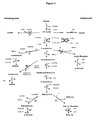
- butyryl-CoA The biological production of n-butanol, presented in figure 1 , requires the formation of butyryl-CoA as an intermediate which can be reduced, depending on the physiological conditions, by two different bi-functional aldehyde-alcohol dehydrogenases encoded by adhE1 and adhE2.
- Butyryl-CoA can also be converted to butyric acid by a phospho-transbutyrylase and a butyrate kinase encoded respectively by the ptb and buk genes.
- Acetone is produced from aceto-acetyl-CoA (an intermediate in the production of butyryl-CoA) by a CoA-transferase and an acetoacetate decarboxylase encoded respectively by the crfAB and adc genes.
- Hydrogen is produced by an iron only hydrogenase encoded by the hydA gene.
- a hydrogenase inhibitor When cultures are performed in the presence of carbon monoxide, a hydrogenase inhibitor, n-butanol, ethanol and lactate are the main fermentation products. Lactate is produced from pyruvate by a lactate dehydrogenase encoded by the ldh gene.
- the problem to be solved by the present invention is to obtain a stable mutant strain with no butyrate kinase activity, that could be cultured for several generations without any possibility of reversion to the wild type genotype.
- This strain would be useful for the biological production of n-butanol at high yield, from an inexpensive carbon substrate such as glucose or other sugars, by genetically stable cultures of Clostridia.
- the number of biochemical steps to inactivate and the complexity of the regulation of the metabolism necessitate, for an industrial feasible process of n-butanol production, the use of a metabolically engineered whole cell catalyst.
- the present invention provides a method for bioconverting a fermentable carbon source to n-butanol as a major product by genetically stable cultures of Clostridia.
- the invention provides for a method for the production of n-butanot by culturing a microorganism of a Clostridia species in an appropriate culture medium comprising a source of carbon and recovery of n-butanol from the culture medium, wherein the gene buk involved in butyrate formation is deleted in the microorganism, the deletion consisting in the removal of at least 50% of the coding sequence of the deleted gene.
- the invention also provides for a microorganism of a Clostridia species wherein at the gene ptb involved in butyrate formation is furthermore deleted in the microorganism, the deletion consisting in the removal of at least 50% of the coding sequence of the deleted gene.
- Glucose is used as a model substrate and recombinant Clostridium acetobutylicum is used as the model host.
- a stable recombinant C. acetobutylicum unable to metabolize butyryl-CoA to butyrate is constructed by deleting the gene coding for the butyrate kinase (buk).
- a recombinant C . acetobutylicum unable to produce acetone is constructed by additionally deleting the genes coding for the CoA-transferase (ctfAB).
- a recombinant strain unable to produce lactate is constructed by additionally deleting the gene coding for the lactate dehydrogenase (ldh).
- a recombinant C . acetobutylicum unable to produce acetate is constructed by additionally deleting the genes coding for the phosphotransacetylase and/or acetate kinase (pta and ack).
- the present invention may be generally applied to include any carbon substrate that is readily converted to acetyl-coA.
- the recombinant organism useful For the production of n-butanol comprising: (a) at least deletion of the buk genes involved in the conversion of butyryl-CoA to butyrate and (b) at least deletion of one of the two genes encoding the CoA-transferase activity.
- the recombinant organism may comprise i) inactivating mutations in endogenous genes selected from the group consisting of: (a) a gene encoding a polypeptide having lactate dehydrogenase activity and (b) a gene encoding a polypeptide having phospho-transacetylase or actate kinase activity.
- the invention provides a stable process for the production of n-butanol at high yield from a recombinant organism comprising: (a) contacting the recombinant organism of the present invention with at least one carbon source selected from the group consisting of monosacchurides, oligosaccharides, polysaccharides, and single-carbon substrates whereby n-butanol is produced; optionally (b) recovering then-butanol during the production through a step of gas striping and (c) purifying n-butanol from the condensate by distillation.
- Figure 1 depicts the genetic engineering of central metabolism in the development of a butanol production system from carbohydrates.
- 1 Pyruvate-ferredoxin oxydoreductase ; 2 : Thiolase ; 3 : ⁇ -Hydroxybutyryl-CoA dehydrogenase ; 4 : Crotonase ; 5 : Butyryl-CoA dehydrogenase ; 6 : Lactate dehydrogenase ; 7 : Phospho-transacetylase ; 8 : Acetate kinase ; 9 : Acetaldehyde deshydrogenase ; 10 : Ethanol dehydrogenase ; 11 : CoA transferase (Acetoacetyl-CoA :acetate/butyrate : CoA transferase) ; 12 : Acetoacetate decarboxylase ; 13 : Phospho-transbutyrylase ; 14 : Butyrate
- microorganism refers to all kind of unicellular organisms, including prokaryotic organisms like bacteria, and eukaryotic organisms like yeasts.
- appropriate culture medium refers to a culture medium adapted for the used microorganism as it is well known by the man skilled in the art.
- carbon substrate or “source of carbon” means any carbon source capable of being metabolized by a microorganism wherein the substrate contains at least one carbon atom.
- Authors refer particularly to renewable, inexpensive and fermentable carbon sources such as monosaccharides, oligosaccharides, polysaccharides, single-carbon substrates, and polyols such as glycerol.
- Single carbon substrate are defined as carbon molecules that contain only one carbon atom such as methanol.
- Monosaccharides of the formula (CH 2 O) n are also called oses or "simple sugars"; monosaccharides include saccharose, fructose, glucose, galactose and mannose.
- Disaccharides include saccharose (sucrose), lactose and maltose.
- Starch and hemicellulose are polysaccharides, also know as "complex sugars”.
- source of carbon means any product cited above, and mixture thereof.
- mutant gene means that at least 50% of the coding sequence was removed, and preferably at least 80%.
- enzymes are identified by their specific activities. This definition thus includes all polypeptides that have the defined specific activity also present in other organisms, more particularly in other microorganisms. Often enzymes with similar activities can be identified by their grouping to certain families defined as PFAM or COG.
- PFAM protein families database of alignments and hidden Markov models; http://www.sanger.ac.uk/software/Pfam/) represents a large collection of protein sequence alignments. Each PFAM makes it possible to visualize multiple alignments, see protein domains, evaluate distribution among organisms, gain access to other databases, and visualize known protein structures.
- COGs clusters of orthologous groups of proteins; http://www.ncbi.nlm.nih.gov/COG/) are obtained by comparing protein sequences from 43 fully sequenced genomes representing 30 major phylogenic lines. Each COG is defined from at least three lines, which permits the identification of former conserved domains.
- the means of identifying homologous sequences and their percentage homologies are well known to those skilled in the art, and include in particular the BLAST programs, which can be used from the website hqg:/twww.ncbi.niM.nih gov/BLAST/ with the default parameters indicated on that website.
- the sequences obtained can then be exploited (e.g., aligned) using, for example, the programs CLUSTALW (http://www.ebi.ac.uk/clustalw/) or MULTALIN (htto://prodes.toulouse.inra.fr/multaling/cgi-bin/multaling.pl), with the default parameters indicated on those websites.
- the present invention provides a method for the fermentative batch or continuous production of n-butanol by culturing a microorganism in an appropriate culture medium comprising a carbon source and the simultaneous recovery of n-butanol from the culture medium wherein at least one gene involved in butyrate formation is deleted in the microorganism.
- the invention provides a method wherein the microorganism is modified to be unable to convert butyryl-CoA to butyrate due to the deletion of the gene encoding for butyrate kinase (buk).
- Deletion of genes in Clostridia can be done using the method recently described in patent application WO2008 040387 allowing the i) replacement of the gene to delete with an erythromycin resistance gene and ii) removal of the erythromycin resistance gene with a recombinase.
- the microorganism is unable to produce acetone due to an additional attenuation or a deletion of at least one of the gene encoding for CoA-transferase (ctfAB) or acetoacetate decarboxylase (adc). Deletion of one of these genes can be done using the method recently described in patent application WO2008 040387
- the microorganism used in the method of the invention is unable to produce lactate.
- this can be due to an additional deletion of the gene ldh encoding for lactate dehydrogenase. Deletion of ldh can be done using the method recently described in patent application WO 2008 040387 .
- the microorganism is modified in such a way to be unable to produce acetate.
- This result can be achieved by an additional delection of at least one of the genes encoding for phospho-transacetylase (pta) or acetate kinase (ack). Deletion of one; of these genes can be done using the method recently described in patent application WO2008 040387
- An embodiment of the disclosure also provides a microorganism with a decreased flux of hydrogen production and then a redirection of the flux of reducing equivalent toward n-butanol production; this can be done by attenuating the gene encoding the hydrogenase ( hydA ), an enzyme that provides a sink for reducing equivalent in the form of hydrogen production. Attenuation of hydA can be done by replacing the natural promoter by a low strength promoter or by element destabilizing the corresponding messenger RNA or the protein. If needed, complete attenuation of the gene can also be achieved by a deletion of the corresponding DNA sequence.
- the used microorganism is selected among the group consisting of C. acetobtitylicum, C. beijerinckii, C. saccharoperbutylacetonicum or C. saccharobutylicum.
- the culture is continuous and stable.
- the method according to the invention comprises the following steps:
- the culture conditions for the microorganisms are able to define the culture conditions for the microorganisms according to the invention.
- the clostridia are fermented at a temperature between 20°C and 55°C, preferentially between 25°C and 40°C, and more specifically about 35°C for C. acetobutylicum.
- the fermentation is generally conducted in fermentors with an inorganic culture medium of known defined composition adapted to the bacteria used, containing at least one simple carbon source, and if necessary a co-substrate necessary for the production of the metabolite.
- the invention is also related to the microorganism as described previously.
- this microorganism is selected among the group consisting of C. acetobutylicum, C. beijerinckii, C. saccharoperbutylacetonicum or C. saccharobutylicum.
- the buk deletion cassette in pCons::upp was constructed as follows.
- primers sequences Name Primer sequences Buk 1 SEQ ID N°1 aaaaggatcc tagtaaaagggagtgtacgaccagtg Buk 2 SEQ ID N°2 ggggtcgcgaaaaaggggg gattattagtaatctatacatgttcctccac Buk 3 SEQ ID N°3 ccccttttttcgcgacccc acttcttgcacttgcagaaggtggac Buk 4 SEQ ID N°4 aaaaggatcctctaaattctgcaatatatgcccccc Buk 0 SEQ ID N°5 ataacaggatatatgctctctgacgcgg Buk 5 SEQ ID N°6 qatcatcactcattttaaacatqqqcc
- Two DNA fragments surrounding buk were PCR amplified with the Pwo polymerase with total DNA from C . acetobutylicum as template and two specific couples of olumbleucleotides. With the couples of primers BUK 1-BUK 2 and BUK 3-BUK 4, two DNA fragments were respectively obtained. Both primers BUK 1 and BUK 4 introduce a BamHI site while primers BUK 2 and BUK 3 have a complementary region which introduces a NruI site. DNA fragments BUK 1-BUK 2 and BUK 3-BUK 4 were joined in a PCR fusion experiment with primers BUK 1 and BUK 4 and the resulting fragment was cloned in pCR4-TOPO-Blunt to yield pTOPO :buk.
- the pREP ⁇ BUK::upp plasmid was used to transform by electroporation C .
- acetobutylicum MGC ⁇ cac15 ⁇ upp strain After selection on Petri plate for clones resistant to erythromycin (40 ⁇ g/ml), one colony was cultured for 24 hours in liquid synthetic medium with erythromycin at 40 ⁇ g/ml and 100 ⁇ l of undiluted culture was plated on RCA with erythromycin at 40 ⁇ g/ml and 5-FU at 400 ⁇ M.
- Colonies resistant to both erythromycin and 5-FU were replica plated on both RCA with erythromycin at 40 ⁇ g/ml and RCA with thiamphenicol at 50 ⁇ g/ml to select clones where 5-FU resistance is also associated with thiamphenicol sensitivity.
- the genotype of clones resistant to erythromycin and sensitive to thiamphenicol was checked by PCR analysis (with primers BUK 0 and BUK 5 located outside of the buk deletion cassette). The ⁇ cac15 ⁇ upp ⁇ buk::mls R strain which have lost pREP ⁇ buk::upp was isolated.
- the ⁇ cac15 ⁇ upp ⁇ buk::mls R strain was transformed with pCLFI.1 vector expressing the Flp1 gene encoding the Flp recombinase from S . cerevisiae.
- thiamphenicol 50 ⁇ g/ml
- one colony was cultured on synthetic liquid medium with thiamphenicol at 50 ⁇ g/ml and appropriate dilutions were plated on RCA with thiamphenicol at 50 ⁇ g/ml.
- Thiamphenicol resistant clones were replica plated on both RCA with erythromycin at 40 ⁇ g/ml and RCA with thiamphenicol at 50 ⁇ g/ml.
- the genotype of clones with erythromycin sensitivity and thiamphenicol resistance was checked by PCR analysis with primers BUK 0 and BUK 5. Two successive 24 hours cultures of the ⁇ cac15A ⁇ upp ⁇ buk strain with erythromycin sensitivity and thiamphenicol resistance were carried out in order to lose pCLF1.1. The ⁇ cac15 ⁇ upp ⁇ buk strain which has lost pCLF1.1 was isolated according to its sensitivity to both erythromycin and thiamphenicol.
- Two DNA fragments surrounding ctfAB were PCR amplified with the Pwo polymerase with total DNA from C. acetobutylicum as template and two specific couples of olumbleucleotides. With the couples of primers CTF 1-CTF 2 and CTF 3-CTF 4, two DNA fragments were respectively obtained. Both primers CTF 1 and CTF 4 introduce a BamHI site while primers CTF 2 and CTF 3 have a complementary region which introduces a Stul site.
- DNA fragments CTF 1-CTF 2 and CTF 3-CTF 4 were joined in a PCR fusion experiment with primers CTF 1 and CTF 4 and the resulting fragment was cloned in pCR4-TOPO-Blunt to yield pTOPO :CTF.
- pTOPO:CTF At the unique StuI site of pTOPO:CTF, an antibiotic resistance MLS gene with FRT sequences on both sides was introduced from the Stul fragment of pUC18-FRT-MLS2.
- the UPP deletion cassette obtained after BamHI digestion of the resulting plasmid was cloned into pCons::upp at the BamHI site to yield the pREP ⁇ CTF::upp plasmid.
- the pREP ⁇ CTF::upp plasmid was used to transform by electroporation C. acetobutylicum MGC ⁇ cac15 ⁇ upp ⁇ buk strain. After selection on Petri plate for clones resistant to erythromycin (40 ⁇ g/ml), one colony was cultured for 24 hours in liquid synthetic medium with erythromycin at 40 ⁇ g/ml and 100 ⁇ l of undiluted culture was plated on RCA with erythromycin at 40 ⁇ g/ml and 5-FU at 400 ⁇ M.
- Colonies resistant to both erythromycin and 5-FU were replica plated on both RCA with erythromycin at 40 ⁇ g/ml and RCA with thiamphenicol at 50 ⁇ g/ml to select clones where 5-FU resistance is also associated with thiamphenicol sensitivity.
- the genotype of clones resistant to erythromycin and sensitive to thiamphenicol was checked by PCR analysis (with primers CTF 0 and CTF 5 located outside of the ctfAB deletion cassette).
- the ⁇ cac15 ⁇ uppdbuk ⁇ ctfAB::mls R strain which have lost pREP ⁇ CTF::upp was isolated.
- the ⁇ cac15 ⁇ upp ⁇ buk ⁇ ctfAB::mls R strain was transformed with pCLF1.1 vector expressing the Flp1 gene encoding the Flp recombinase from S . cerevisiae. After transformation and selection for resistance to thiamphenicol (50 ⁇ g/ml) on Petri plate, one colony was cultured on synthetic liquid medium with thiamphenicol at 50 ⁇ g/ml and appropriate dilutions were plated on RCA with thiamphenicol at 50 ⁇ g/ml.
- Thiamphenicol resistant clones were replica plated on both RCA with erythromycin at 40 ⁇ g/ml and RCA with thiamphenicol at 50 ⁇ g/ml.
- the genotype of clones with erythromycin sensitivity and thiamphenicol resistance was checked by PCR analysis with primers CTF 0 and CTF 5.
- Two successive 24 hours cultures of the ⁇ ca c15 ⁇ u pp ⁇ buk ⁇ ctfAB strain with erythromycin sensitivity and thiamphenicol resistance were carried out in order to lose pCLF 1.
- the ⁇ cac15 ⁇ upp ⁇ buk ⁇ ctfAB strain which has lost pCLF1.1 was isolated according to its sensitivity to both erythromycin and thiamphenicol.
- the ldh deletion cassette in pCons::upp was constructed as follows. Table 3 : primers sequences Name Primer sequences Ldh 1 SEQ ID N°13 Ldh 2 SEQ ID N°14 Ldh 3 SEQ ID N°15 Ldh 4 SEQ ID N°16 Ldh 0 SEQ ID N°17 CAGAAGGCAAGAATGTATTAAGCGGAAATGC Ldh 5 SEQ ID N°18 CTTCCCATTATAGCTCTTATTCACATTAAGC
- Two DNA fragments surrounding ldh ( CAC267 ) were PCR amplified with the Pwo polymerase with total DNA from C. acetobutylicum as template and two specific couples of olignonucleotides. With the couples of primers LDH 1-LDH 2 and LDH 3-LDH 4, 1 135 bp and 1177 bp DNA fragments were respectively obtained. Both primers LDH 1 and LDH 4 introduce a BamHI site while primers LDH 2 and LDH 3 have a complementary region which introduces a StuI site.
- DNA fragments LDH 1-LDH 2 and LDH 3-LDH 4 were joined in a PCR fusion experiment with primers LDH I and LDH 4 and the resulting fragment was cloned in pCR4-TOPO-Blunt to yield pTOPO :LDH.
- pTOPO :LDH At the unique StuI site of pTOPO :LDH, an antibiotic resistance MLS gene with FRT sequences on both sides was introduced from the 1372 bp StuI fragment of pUC18-FRT-MLS2.
- the UPP deletion cassette obtained after BamHI digestion of the resulting plasmid was cloned into pCons::upp at the BamHI site to yield the pREPOLDH::upp plasmid.
- the pREPOLDH::upp plasmid was used to transform by electroporation C .
- Colonies resistant to both erythromycin and 5-FU were replica plated on both RCA with erythromycin at 40 ⁇ g/ml and RCA with thiamphenicol at 50 ⁇ g/ml to select clones where 5-FU resistance is also associated with thiamphenicol sensitivity.
- the genotype of clones resistant to erythromycin and sensitive to thiamphenicol was checked by PCR analysis (with primers LDH 0 and LDH 5 located outside of the ldh deletion cassette).
- the ⁇ cac15 ⁇ upp ⁇ buk ⁇ ctfAB ⁇ ldh::mls R strain which have lost pREPOLDH::upp was isolated.
- the ⁇ cac15 ⁇ upp ⁇ buk ⁇ ctf:AB ⁇ ldh::mls R strain was transformed with pCLF 1.1 vector expressing the Flp1 gene encoding the Flp recombinase from S . cerevisiae. After transformation and selection for resistance to thiamphenicol (50 ⁇ g/ml) on Petri plate, one colony was cultured on synthetic liquid medium with thiamphenicol at 50 ⁇ g/ml and appropriate dilutions were plated on RCA with thiamphenicol at 50 ⁇ g/ml.
- Thiamphenicol resistant clones were replica plated on both RCA with erythromycin at 40 ⁇ g/ml and RCA with thiamphenicol at 50 ⁇ g/ml.
- the genotype of clones with erythromycin sensitivity and thiamphenicol resistance was checked by PCR analysis with primers LDH 0 and LDH 5.
- Two successive 24 hours cultures of the ⁇ cac15 ⁇ upp ⁇ buk ⁇ ctfAB ⁇ ldh strain with erythromycin sensitivity and thiamphenicol resistance were carried out in order to lose pCLF1.1.
- the ⁇ cac15 ⁇ upp ⁇ buk ⁇ ctfAB ⁇ ldh strain which has lost pCLF1 was isolated according to its sensitivity to both erythromycin and thiamphenicol.
- Two DNA fragments surrounding pta-ack were PCR amplified with the Pwo polymerase with total DNA from C . acetobutylicum as template and two specific couples of olumbleucleotides. With the couples of primers PA I-PA.2 and PA 3-PA 4, two DNA fragments were respectively obtained. Both primers PA I and PA 4 introduce a BamHI site while primers PA 2 and PA 3 have a complementary region which introduces a Stul site. DNA fragments PA I-PA 2 and PA 3 ⁇ PA 4 were joined in a PCR fusion experiment with primers PA 1 and PA 4 and the resulting fragment was cloned in pCR4-TOPO-Blunt to yield pTOPO :PA.
- the pREP ⁇ PA::upp plasmid was used to transform by electroporation C .
- erythromycin 40 ⁇ g/ml
- one colony was cultured for 24 hours in liquid synthetic medium with erythromycin at 40 ⁇ g/ml and 100 ⁇ l of undiluted culture was plated on RCA with erythromycin at 40 ⁇ g/ml and 5-FU at 400 ⁇ M.
- Colonies resistant to both erythromycin and 5-FU were replica plated on both RCA with erythromycin at 40 ⁇ g/ml and RCA with thiamphenicol at 50 ⁇ g/ml to select clones where 5-FU resistance is also associated with thiamphenicol sensitivity.
- the genotype of clones resistant to erythromycin and sensitive to thiamphenicol was checked by PCR analysis (with primers PA 0 and PA 5 located outside of the pta-ack deletion cassette).
- the ⁇ cac15 ⁇ upp ⁇ buk ⁇ ctfAB ⁇ ldh ⁇ pta-ack::mls R strain which have lost pREP ⁇ PA::upp was isolated.
- the ⁇ cac15 ⁇ upp ⁇ buk ⁇ ctfAB ⁇ ldh ⁇ pta-ack::mls R strain was transformed with pCLF1.1 vector expressing the Flp.l gene encoding the Flp recombinase from S. cerevisiae. After transformation and selection for resistance to thiamphenicol (50 ⁇ g/ml) on Petri plate, one colony was cultured on synthetic liquid medium with thiamphenicol at 50 ⁇ g/ml and appropriate dilutions were plated on RCA with thiamphenicol at 50 ⁇ g/ml.
- Thiamphenicol resistant clones were replica plated on both RCA with erythromycin at 40 ⁇ g/ml and RCA with thiamphenicol at 50 ⁇ g/ml.
- the genotype of clones with erythromycin sensitivity and thiamphenicol resistance was checked by PCR analysis with primers PA 0 and PA 5.
- Two successive 24 hours cultures of the ⁇ cacl5 ⁇ upp ⁇ buk ⁇ ctfAB ⁇ ldh ⁇ pta-ack strain with erythromycin sensitivity and thiamphenicol resistance were carried out in order to lose pCLF1.1.
- the ⁇ cacl5 ⁇ upp ⁇ buk ⁇ ctfAB ⁇ ldh ⁇ pta-ack strain which has lost pCLF1.1 was isolated according to its sensitivity to both erythromycin and thiamphenicol.
- Two DNA fragments surrounding hydA (CAC028) were PCR amplified with the Pwo polymerase with total DNA from C . acetobutylicum as template and two specific couples of olignonucleotides. With the couples of primers HYD 1-HYD 2 and HYD 3-HYD 4, 1269 bp and 1317 bp DNA fragments were respectively obtained. Both primers HYD 1 and HYD 4 introduce a BamHI site while primers HYD 2 and HYD 3 have a complementary region which introduces a StuI site.
- DNA fragments HYD 1-HYD 2 and HYD 3-HYD 4 were joined in a PCR fusion experiment with primers HYD 1 and HYD 4 and the resulting fragment was cloned in pCR4-TOPO-Blunt to yield pTOPO :HYD.
- pTOPO :HYD At the unique StuI site of pTOPO :HYD, an antibiotic resistance MLS gene with FRT sequences on both sides was introduced from the 1372 bp StuI fragment of pUC 18-FRT-MLS2.
- the UPP deletion cassette obtained after BamHI digestion of the resulting plasmid was cloned into pCons::upp at the BamHI site to yield the pREP ⁇ HYD::upp plasmid.
- the pREP ⁇ HYD::upp plasmid was used to transform by electroporation C .
- Colonies resistant to both erythromycin and 5-FU were replica plated on both RCA with erythromycin at 40 ⁇ g/ml and RCA with thiamphenicol at 50 ⁇ g/ml to select clones where 5-FU resistance is also associated with thiamphenicol sensitivity.
- the genotype of clones resistant to erythromycin and sensitive to thiamphenicol was checked by PCR analysis (with primers HYD 0 and HYD 5 located outside of the hydA deletion cassette).
- the ⁇ cacl5 ⁇ upp ⁇ buk ⁇ ctfAB ⁇ ldh ⁇ hydA::mls R strain which have lost pREP ⁇ HYD::upp was isolated.
- the ⁇ cac15 ⁇ upp ⁇ buk ⁇ ctfAB ⁇ ldh ⁇ hydA::mls R strain was transformed with pCLF1.1 vector expressing the Flpl gene encoding the Flp recombinase from S . cerevisiae. After transformation and selection for resistance to thiamphenicol (50 ⁇ g/ml) on Petri plate, one colony was cultured on synthetic liquid medium with thiamphenicol at 50 ⁇ g/ml and appropriate dilutions were plated on RCA with thiamphenicol at 50 ⁇ g/ml.
- Thiamphenicol resistant clones were replica plated on both RCA with erythromycin at 40 ⁇ g/ml and RCA with thiamphenicol at 50 ⁇ g/ml.
- the genotype of clones with erythromycin sensitivity and thiamphenicol resistance was checked by PCR analysis with primers HYD 0 and HYD 5.
- Two successive 24 hours cultures of the ⁇ cac15 ⁇ upp ⁇ buk ⁇ ctfAB ⁇ ldh ⁇ hydA strain with erythromycin sensitivity and thiamphenicol resistance were carried out in order to lose pCLF1.1.
- the ⁇ cac15 ⁇ upp ⁇ buk ⁇ ctfAB ⁇ ldh ⁇ hydA strain which has lost pCLF1.1 was isolated according to its sensitivity to both erythromycin and thiamphenicol.
- the fermentor was filled with 250 ml of synthetic medium, sparged with nitrogen for 30 min and inoculated with 25 ml of preculture to an optical density (OD600nm) between 0.05 and 0.1.
- the temperature of the culture was maintained constant at 35 °C and the pH was permanently adjusted at 5.5 using an NH 4 OH solution.
- the agitation rate was maintained at 300 rpm during the fermentation.
- n-butanol producing strain was analyzed in chemostat cultures in the synthetic medium described by Soni et al ( Soni et al, 1987, Appl. Microbiol.Biotechnol. 27:1-5 ). An overnight culture at 35°C was used to inoculate a 300 ml fermentors (DASGIP) using an anaerobic chemostat protocol.
- DASGIP 300 ml fermentors
- the fermentor was filled with 250 ml of synthetic medium, sparged with nitrogen for 30 min and inoculated with 25 ml of preculture to an optical density (OD600nm) between 0.05 and 0.1.
- OD600nm optical density
- the fermentor was continuously fed with oxygen free synthetic medium at a dilution rate of 0.05 h-1 while the volume was kept constant by sequential removal of fermentated medium. Stability of the culture was followed by products analysis using the HPLC protocol previously described.
- Production strains were evaluated in small flasks. 10% of thawed cultures (typically 3ml) were used to inoculate 30ml of synthetic medium (MSL4). A 15 minutes thermal shock at 80°C was applied to kill any vegetative cells present before the initiation of growth. The cultures were then grown at 37°C for 6 to 7 days. Extra-cellular compounds were quantified by HPLC using the following parameters: Eluent (H2SO4) concentration: 0.25mM; Flow: 0.5ml/min; Temperature: 25°C, Time: 50 minutes. Table 6: Synthetic medium composition (MSL4).
- Table 7 Solvents yield in % g product/g glucose produced and maximal butyrate concentration in g/l, in batch culture by strains described above. SD denotes the standard deviation; MC denotes the Maximum Concentration in g/l. Genotype Y bu + Y et SD Y ac SD Butyrate MC 48H 120H C. acetobutylicum ATCC 824 ⁇ cac15 ⁇ upp 23.47 0.01 9.94 0.01 3.13 1.61 C. acetobutylicum ATCC824 ⁇ cac15 ⁇ upp ⁇ buk::MSLr 38.07 2.23 4.64 2.68 0.29 0.43
Landscapes
- Micro-Organisms Or Cultivation Processes Thereof (AREA)
- Preparation Of Compounds By Using Micro-Organisms (AREA)
Abstract
Description
- The invention comprises a process for the bioconversion of a fermentable carbon source to n-butanol at high yield by a metabolically engineered microorganism.
- n-Butanol is a colorless, neutral liquid of medium volatility with restricted miscibility (about 7-8%) in water, but freely miscible with all common solvents such as glycols, ketones, alcohol, aldehydes, ethers, and aromatic and aliphatic hydrocarbons n-Butanol is used i) to make other chemicals, ii) as a solvent and iii) as an ingredient in formulated products such as cosmetics. The major uses of n-butanol as a feed-stock are in the synthesis of acrylate/methacrylate esters, glycol ethers, n-Butyl acetate, amino resins and n-Butylamines. Currently more than 9 millions tons of n-Butanol are consumed annually in the world.
- More recently it has been shown that n-butanol is a better biofuel than ethanol due to lower vapour pressure, higher energy content (closer to that of gasoline) and lesser susceptibility to separation in the presence of water. Furthermore, n-butanol can be blended at higher concentrations than ethanol for use in standard vehicle engines and it does not require automakers to compromise on performance to meet environmental regulations; it is also suitable for transport in pipelines and as a result it has the potential to be introduced into gasoline quickly and avoid the need for additional large-scale supply infrastructures.
- n-butanol can be produced as an acetone/n-butanol/ethanol (ABE) mixture by the fermentation of carbohydrate by solventogenic Clostridia. The ABE fermentations are biphasic. During the first acidogenic phase, high growth rate is accompanied by acetic and butyric acids production. In the second solventogenic phase growth rate decrease and the solvents (ABE) are produced with the concomitant consumption of the organic acids produced in the first phase. Carbon dioxide and hydrogen are produced throughout the fermentation.
- The biological production of n-butanol, presented in
figure 1 , requires the formation of butyryl-CoA as an intermediate which can be reduced, depending on the physiological conditions, by two different bi-functional aldehyde-alcohol dehydrogenases encoded by adhE1 and adhE2. Butyryl-CoA can also be converted to butyric acid by a phospho-transbutyrylase and a butyrate kinase encoded respectively by the ptb and buk genes. Acetone is produced from aceto-acetyl-CoA (an intermediate in the production of butyryl-CoA) by a CoA-transferase and an acetoacetate decarboxylase encoded respectively by the crfAB and adc genes. Hydrogen is produced by an iron only hydrogenase encoded by the hydA gene. When cultures are performed in the presence of carbon monoxide, a hydrogenase inhibitor, n-butanol, ethanol and lactate are the main fermentation products. Lactate is produced from pyruvate by a lactate dehydrogenase encoded by the ldh gene. - Clostridium acetobutylicum strains with an inactivated buk gene (obtained by single crossing over with a non-replicable plasmid) have already been described in the article (Green et al., 1996). The non-replicable vector pJC4BK, with a 0.8 kb internal buk fragment was integrated into the chromosomal buk gene which leaded to an inactivation of the endogenous gene. The obtained strain was named "mutant PJC4BK"from the name of the plasmid. As precised in this article, this gene integration did not completely eliminate enzyme activity nor butyrate formation due to the instability of this type of gene inactivation that can reverse to wild type by plasmid excision. This mutant strain was then used in several studies (Green and Bennett, 1998; Desai and Harris, 1999; Harris et al., 2000).
- Traditionally, the commercial ABE fermentation was conducted only in a batch mode due to continuous cultures instability of the producing Clostridia. Several solvent yielding fermentation processes have been described. These processes yield n-butanol, acetone and ethanol in a ratio of 6:3:1. Solvent yields of 29-34% (18-25% for n-butanol only) of fermentable carbon source have been reported in the literature. A total solvent concentration of 16-24 g/l and a n-butanol concentration of 10-14 g/l is generally the limit due to toxicity of n-butanol produced. However, these low titers of solvent no longer seem to be an economical limitation to the process as it has recently been demonstrated that solvents can be recovered during fermentation by the use of the "low cost" gas striping technology.
- The problem to be solved by the present invention is to obtain a stable mutant strain with no butyrate kinase activity, that could be cultured for several generations without any possibility of reversion to the wild type genotype. This strain would be useful for the biological production of n-butanol at high yield, from an inexpensive carbon substrate such as glucose or other sugars, by genetically stable cultures of Clostridia. The number of biochemical steps to inactivate and the complexity of the regulation of the metabolism necessitate, for an industrial feasible process of n-butanol production, the use of a metabolically engineered whole cell catalyst.
- Applicants have solved the stated problem and the present invention provides a method for bioconverting a fermentable carbon source to n-butanol as a major product by genetically stable cultures of Clostridia.
- The invention provides for a method for the production of n-butanot by culturing a microorganism of a Clostridia species in an appropriate culture medium comprising a source of carbon and recovery of n-butanol from the culture medium, wherein the gene buk involved in butyrate formation is deleted in the microorganism, the deletion consisting in the removal of at least 50% of the coding sequence of the deleted gene.
- The invention also provides for a microorganism of a Clostridia species wherein at the gene ptb involved in butyrate formation is furthermore deleted in the microorganism, the deletion consisting in the removal of at least 50% of the coding sequence of the deleted gene.
- Glucose is used as a model substrate and recombinant Clostridium acetobutylicum is used as the model host. In this invention, a stable recombinant C. acetobutylicum unable to metabolize butyryl-CoA to butyrate is constructed by deleting the gene coding for the butyrate kinase (buk). In a further aspect of this invention a recombinant C. acetobutylicum unable to produce acetone is constructed by additionally deleting the genes coding for the CoA-transferase (ctfAB). In a further aspect of this invention a recombinant strain unable to produce lactate is constructed by additionally deleting the gene coding for the lactate dehydrogenase (ldh). Furthermore, a recombinant C. acetobutylicum unable to produce acetate is constructed by additionally deleting the genes coding for the phosphotransacetylase and/or acetate kinase (pta and ack).
- The present invention may be generally applied to include any carbon substrate that is readily converted to acetyl-coA.
- Accordingly it is an object of the present invention to provide a recombinant organism, useful For the production of n-butanol comprising: (a) at least deletion of the buk genes involved in the conversion of butyryl-CoA to butyrate and (b) at least deletion of one of the two genes encoding the CoA-transferase activity. Optionally the recombinant organism may comprise i) inactivating mutations in endogenous genes selected from the group consisting of: (a) a gene encoding a polypeptide having lactate dehydrogenase activity and (b) a gene encoding a polypeptide having phospho-transacetylase or actate kinase activity.
- In another embodiment the invention provides a stable process for the production of n-butanol at high yield from a recombinant organism comprising: (a) contacting the recombinant organism of the present invention with at least one carbon source selected from the group consisting of monosacchurides, oligosaccharides, polysaccharides, and single-carbon substrates whereby n-butanol is produced; optionally (b) recovering then-butanol during the production through a step of gas striping and (c) purifying n-butanol from the condensate by distillation.
- The accompanying drawing which is incorporated in and constitutes a part of this specification exemplifies the invention and together with the description, serve to explain the principles of this invention.
-
Figure 1 depicts the genetic engineering of central metabolism in the development of a butanol production system from carbohydrates.
1 : Pyruvate-ferredoxin oxydoreductase ; 2 : Thiolase ; 3 : β-Hydroxybutyryl-CoA dehydrogenase ; 4 : Crotonase ; 5 : Butyryl-CoA dehydrogenase ; 6 : Lactate dehydrogenase ; 7 : Phospho-transacetylase ; 8 : Acetate kinase ; 9 : Acetaldehyde deshydrogenase ; 10 : Ethanol dehydrogenase ; 11 : CoA transferase (Acetoacetyl-CoA :acetate/butyrate : CoA transferase) ; 12 : Acetoacetate decarboxylase ; 13 : Phospho-transbutyrylase ; 14 : Butyrate kinase ; 15 : Butyraldehyde-Butanol dehydrogenase ; 16 : hydrogenase. - As used herein the following terms may be used for interpretation of the claims and specification.
- The term "microorganism" refers to all kind of unicellular organisms, including prokaryotic organisms like bacteria, and eukaryotic organisms like yeasts.
- The expression "appropriate culture medium" refers to a culture medium adapted for the used microorganism as it is well known by the man skilled in the art.
- The term "carbon substrate" or "source of carbon" means any carbon source capable of being metabolized by a microorganism wherein the substrate contains at least one carbon atom. Authors refer particularly to renewable, inexpensive and fermentable carbon sources such as monosaccharides, oligosaccharides, polysaccharides, single-carbon substrates, and polyols such as glycerol. Single carbon substrate are defined as carbon molecules that contain only one carbon atom such as methanol.
- Monosaccharides of the formula (CH2O)n are also called oses or "simple sugars"; monosaccharides include saccharose, fructose, glucose, galactose and mannose.
- Other carbon sources comprising more than one monosaccharide are called disaccharides, trisaccharides, oligosaccharides and polysaccharides. Disaccharides include saccharose (sucrose), lactose and maltose. Starch and hemicellulose are polysaccharides, also know as "complex sugars".
- Therefore, the term "source of carbon" means any product cited above, and mixture thereof.
- The term "attenuation" refers to a decreased expression of a gene or a decreased activity of the protein, product of the gene. The man skilled In the art knows numerous means to obtain this result, and for example:
- Introduction of a mutation into the gene, decreasing the expression level of this gene, or the level of activity of the encoded protein.
- Replacement of the natural promoter of the gene by a low strength promoter, resulting in a lower expression
- Use of elements destabilizing the corresponding messenger RNA or the protein
- Deletion of the gene if no expression is needed.
- The term "deleted gene" means that at least 50% of the coding sequence was removed, and preferably at least 80%.
- In the description of the present invention, enzymes are identified by their specific activities. This definition thus includes all polypeptides that have the defined specific activity also present in other organisms, more particularly in other microorganisms. Often enzymes with similar activities can be identified by their grouping to certain families defined as PFAM or COG.
- PFAM (protein families database of alignments and hidden Markov models; http://www.sanger.ac.uk/software/Pfam/) represents a large collection of protein sequence alignments. Each PFAM makes it possible to visualize multiple alignments, see protein domains, evaluate distribution among organisms, gain access to other databases, and visualize known protein structures.
- COGs (clusters of orthologous groups of proteins; http://www.ncbi.nlm.nih.gov/COG/) are obtained by comparing protein sequences from 43 fully sequenced genomes representing 30 major phylogenic lines. Each COG is defined from at least three lines, which permits the identification of former conserved domains.
- The means of identifying homologous sequences and their percentage homologies are well known to those skilled in the art, and include in particular the BLAST programs, which can be used from the website hqg:/twww.ncbi.niM.nih gov/BLAST/ with the default parameters indicated on that website. The sequences obtained can then be exploited (e.g., aligned) using, for example, the programs CLUSTALW (http://www.ebi.ac.uk/clustalw/) or MULTALIN (htto://prodes.toulouse.inra.fr/multaling/cgi-bin/multaling.pl), with the default parameters indicated on those websites.
- Using the references given on GenBank for known genes, those skilled in the art are able to determine the equivalent genes in other organisms, bacterial strains, yeasts, fungi, mammals, plants, etc. This routine work is advantageously done using consensus sequences that can be determined by carrying out sequence alignments with genes derived from other microorganisms, and designing degenerate probes to clone the corresponding gene in another organism. These routine methods of molecular biology are well known to those skilled in the art, and are described, for example, in Sambrook et al. (Molecular Cloning: a Laboratory Manual. 2nd ed. Cold Spring Harbor Lab., Cold Spring Harbor, New York, 1989.).
- The present invention provides a method for the fermentative batch or continuous production of n-butanol by culturing a microorganism in an appropriate culture medium comprising a carbon source and the simultaneous recovery of n-butanol from the culture medium wherein at least one gene involved in butyrate formation is deleted in the microorganism.
- The invention provides a method wherein the microorganism is modified to be unable to convert butyryl-CoA to butyrate due to the deletion of the gene encoding for butyrate kinase (buk). Deletion of genes in Clostridia can be done using the method recently described in patent application
WO2008 040387 allowing the i) replacement of the gene to delete with an erythromycin resistance gene and ii) removal of the erythromycin resistance gene with a recombinase. - In a further embodiment of the invention, the microorganism is unable to produce acetone due to an additional attenuation or a deletion of at least one of the gene encoding for CoA-transferase (ctfAB) or acetoacetate decarboxylase (adc). Deletion of one of these genes can be done using the method recently described in patent application
WO2008 040387 - In a further embodiment of the invention, the microorganism used in the method of the invention is unable to produce lactate. In particular this can be due to an additional deletion of the gene ldh encoding for lactate dehydrogenase. Deletion of ldh can be done using the method recently described in patent application
WO 2008 040387 . - In a further embodiment, the microorganism is modified in such a way to be unable to produce acetate. This result can be achieved by an additional delection of at least one of the genes encoding for phospho-transacetylase (pta) or acetate kinase (ack). Deletion of one; of these genes can be done using the method recently described in patent application
WO2008 040387 - An embodiment of the disclosure also provides a microorganism with a decreased flux of hydrogen production and then a redirection of the flux of reducing equivalent toward n-butanol production; this can be done by attenuating the gene encoding the hydrogenase (hydA), an enzyme that provides a sink for reducing equivalent in the form of hydrogen production. Attenuation of hydA can be done by replacing the natural promoter by a low strength promoter or by element destabilizing the corresponding messenger RNA or the protein. If needed, complete attenuation of the gene can also be achieved by a deletion of the corresponding DNA sequence.
- Preferably, the used microorganism is selected among the group consisting of C. acetobtitylicum, C. beijerinckii, C. saccharoperbutylacetonicum or C. saccharobutylicum.
- In another embodiment of the invention, the culture is continuous and stable.
- In another embodiment, the method according to the invention comprises the following steps:
- (a) contacting a microorganism with at least one carbon sources selected from the group consisting of glucose, xylose, arabinose, sucrose, monosaccharides, oligosaccharides, polysaccharides, cellulose, xylan, starch or its derivatives and glycerol, whereby n-butanol is produced
- (b) Recovering the n-butanol during the fermentation by gas striping and
- (c) Isolation of n-butanol from the condensate by distillation.
- Those skilled in the art are able to define the culture conditions for the microorganisms according to the invention. In particular the clostridia are fermented at a temperature between 20°C and 55°C, preferentially between 25°C and 40°C, and more specifically about 35°C for C. acetobutylicum.
- The fermentation is generally conducted in fermentors with an inorganic culture medium of known defined composition adapted to the bacteria used, containing at least one simple carbon source, and if necessary a co-substrate necessary for the production of the metabolite.
- The invention is also related to the microorganism as described previously. Preferably, this microorganism is selected among the group consisting of C. acetobutylicum, C. beijerinckii, C. saccharoperbutylacetonicum or C. saccharobutylicum.
- To delete the buk gene, the homologous recombination strategy described by Croux & Soucaille (2006) in patent application
WO 2008 040387 is used. This strategy allows the insertion of an erythromycin resistance cassette, while deleting most of the gene concerned. The buk deletion cassette in pCons::upp was constructed as follows.Table 1: primers sequences Name Primer sequences Buk 1 SEQ ID N°1 aaaaggatcctagtaaaagggagtgtacgaccagtg Buk 2 SEQ ID N°2 ggggtcgcgaaaaaaggggggattattagtaatctatacatgttcctccac Buk 3 SEQ ID N°3 cccccttttttcgcgaccccacttcttgcacttgcagaaggtggac Buk 4 SEQ ID N°4 aaaaggatcctctaaattctgcaatatatgcccccc Buk 0 SEQ ID N°5 ataacaggatatatgctctctgacgcgg Buk 5 SEQ ID N°6 qatcatcactcattttaaacatqqqqcc - Two DNA fragments surrounding buk were PCR amplified with the Pwo polymerase with total DNA from C. acetobutylicum as template and two specific couples of olignonucleotides. With the couples of primers BUK 1-
BUK 2 and BUK 3-BUK 4, two DNA fragments were respectively obtained. Both primers BUK 1 and BUK 4 introduce a BamHI site while primers BUK 2 andBUK 3 have a complementary region which introduces a NruI site. DNA fragments BUK 1-BUK 2 and BUK 3-BUK 4 were joined in a PCR fusion experiment with primers BUK 1 and BUK 4 and the resulting fragment was cloned in pCR4-TOPO-Blunt to yield pTOPO :buk. At the unique Stul site of pTOPO :buk, an antibiotic resistance MLS gene with FRT sequences on both sides was introduced from the Stul fragment of pUC18-FRT-MLS2. The BUK deletion cassette obtained after BamHI digestion of the resulting plasmid was cloned into pCons::upp at the BamHI site to yield the pREPABUK::upp plasmid. - The pREPΔBUK::upp plasmid was used to transform by electroporation C. acetobutylicum MGCΔcac15Δupp strain. After selection on Petri plate for clones resistant to erythromycin (40 µg/ml), one colony was cultured for 24 hours in liquid synthetic medium with erythromycin at 40 µg/ml and 100 µl of undiluted culture was plated on RCA with erythromycin at 40 µg/ml and 5-FU at 400 µM. Colonies resistant to both erythromycin and 5-FU were replica plated on both RCA with erythromycin at 40 µg/ml and RCA with thiamphenicol at 50 µg/ml to select clones where 5-FU resistance is also associated with thiamphenicol sensitivity. The genotype of clones resistant to erythromycin and sensitive to thiamphenicol was checked by PCR analysis (with primers BUK 0 and BUK 5 located outside of the buk deletion cassette). The Δcac15ΔuppΔbuk::mlsR strain which have lost pREPΔbuk::upp was isolated.
- The Δcac15ΔuppΔbuk::mlsR strain was transformed with pCLFI.1 vector expressing the Flp1 gene encoding the Flp recombinase from S. cerevisiae. After transformation and selection for resistance to thiamphenicol (50 µg/ml) on Petri plate, one colony was cultured on synthetic liquid medium with thiamphenicol at 50 µg/ml and appropriate dilutions were plated on RCA with thiamphenicol at 50 µg/ml. Thiamphenicol resistant clones were replica plated on both RCA with erythromycin at 40 µg/ml and RCA with thiamphenicol at 50 µg/ml. The genotype of clones with erythromycin sensitivity and thiamphenicol resistance was checked by PCR analysis with primers BUK 0 and BUK 5. Two successive 24 hours cultures of the Δcac15AΔuppΔbuk strain with erythromycin sensitivity and thiamphenicol resistance were carried out in order to lose pCLF1.1. The Δcac15ΔuppΔbuk strain which has lost pCLF1.1 was isolated according to its sensitivity to both erythromycin and thiamphenicol.
- To delete the crfAB genes, the homologous recombination strategy described by
Croux & Soucaille (2006) in patent application WO 2008 040 387 is used. This strategy allows the insertion of an erythromycin resistance cassette, while deleting most of the genes concerned. The ctfAB deletion cassette in pCons::upp was constructed as follows.Table 2 : primers scqucnccs Name Primer sequences Ctf 1 SEQ ID N°7 aaaaggatcccagococtotootogctttoggtggtocccc Ctf 2 SEQ ID N°8 ggggaggcctaaaaaggggattataaaaagtagttgaaatatggttg Ctf 3 SEQ ID N°9 ccccctttttaggcctccccatatccaatgaacttagacccatggctg Ctf 4 SEQ ID N°10 aaaaggatccgtgttataatgtaaatataaataaataggactagaggcg Ctf 0 SEQ ID N°11 taccaccttctttcacgcttggctgcgg Ctf 5 SEQ ID N°12 tatttaaagaggcattatcaccagagcg - Two DNA fragments surrounding ctfAB were PCR amplified with the Pwo polymerase with total DNA from C. acetobutylicum as template and two specific couples of olignonucleotides. With the couples of primers CTF 1-
CTF 2 and CTF 3-CTF 4, two DNA fragments were respectively obtained. Both primers CTF 1 and CTF 4 introduce a BamHI site whileprimers CTF 2 andCTF 3 have a complementary region which introduces a Stul site. DNA fragments CTF 1-CTF 2 and CTF 3-CTF 4 were joined in a PCR fusion experiment with primers CTF 1 and CTF 4 and the resulting fragment was cloned in pCR4-TOPO-Blunt to yield pTOPO :CTF. At the unique StuI site of pTOPO:CTF, an antibiotic resistance MLS gene with FRT sequences on both sides was introduced from the Stul fragment of pUC18-FRT-MLS2. The UPP deletion cassette obtained after BamHI digestion of the resulting plasmid was cloned into pCons::upp at the BamHI site to yield the pREPΔCTF::upp plasmid. - The pREPΔCTF::upp plasmid was used to transform by electroporation C. acetobutylicum MGCΔcac15ΔuppΔbuk strain. After selection on Petri plate for clones resistant to erythromycin (40 µg/ml), one colony was cultured for 24 hours in liquid synthetic medium with erythromycin at 40 µg/ml and 100 µl of undiluted culture was plated on RCA with erythromycin at 40 µg/ml and 5-FU at 400 µM. Colonies resistant to both erythromycin and 5-FU were replica plated on both RCA with erythromycin at 40 µg/ml and RCA with thiamphenicol at 50 µg/ml to select clones where 5-FU resistance is also associated with thiamphenicol sensitivity. The genotype of clones resistant to erythromycin and sensitive to thiamphenicol was checked by PCR analysis (with primers CTF 0 and CTF 5 located outside of the ctfAB deletion cassette). The Δcac15Δuppdbuk ΔctfAB::mlsR strain which have lost pREPΔCTF::upp was isolated.
- The Δcac15ΔuppΔbukΔctfAB::mlsR strain was transformed with pCLF1.1 vector expressing the Flp1 gene encoding the Flp recombinase from S. cerevisiae. After transformation and selection for resistance to thiamphenicol (50 µg/ml) on Petri plate, one colony was cultured on synthetic liquid medium with thiamphenicol at 50 µg/ml and appropriate dilutions were plated on RCA with thiamphenicol at 50 µg/ml. Thiamphenicol resistant clones were replica plated on both RCA with erythromycin at 40 µg/ml and RCA with thiamphenicol at 50 µg/ml. The genotype of clones with erythromycin sensitivity and thiamphenicol resistance was checked by PCR analysis with primers CTF 0 and CTF 5. Two successive 24 hours cultures of the Δcac15ΔuppΔbukΔctfAB strain with erythromycin sensitivity and thiamphenicol resistance were carried out in order to lose pCLF 1. The Δcac15ΔuppΔbukΔctfAB strain which has lost pCLF1.1 was isolated according to its sensitivity to both erythromycin and thiamphenicol.
- To delete the ldh gene, the homologous recombination strategy described by
Croux & Soucaille (2006) in patent application WO 2008 040 387 is used. This strategy allows the insertion of an erythromycin resistance cassette, while deleting most of the genes concerned. The ldh deletion cassette in pCons::upp was constructed as follows.Table 3 : primers sequences Name Primer sequences Ldh 1 SEQ ID N°13 
Ldh 2SEQ ID N°14 
Ldh 3SEQ ID N°15 
Ldh 4 SEQ ID N°16 
Ldh 0 SEQ ID N°17 CAGAAGGCAAGAATGTATTAAGCGGAAATGC Ldh 5 SEQ ID N°18 CTTCCCATTATAGCTCTTATTCACATTAAGC - Two DNA fragments surrounding ldh (CAC267) were PCR amplified with the Pwo polymerase with total DNA from C. acetobutylicum as template and two specific couples of olignonucleotides. With the couples of primers LDH 1-
LDH 2 and LDH 3-LDH 4, 1 135 bp and 1177 bp DNA fragments were respectively obtained. Both primers LDH 1 and LDH 4 introduce a BamHI site while primers LDH 2 andLDH 3 have a complementary region which introduces a StuI site. DNA fragments LDH 1-LDH 2 and LDH 3-LDH 4 were joined in a PCR fusion experiment with primers LDH I and LDH 4 and the resulting fragment was cloned in pCR4-TOPO-Blunt to yield pTOPO :LDH. At the unique StuI site of pTOPO :LDH, an antibiotic resistance MLS gene with FRT sequences on both sides was introduced from the 1372 bp StuI fragment of pUC18-FRT-MLS2. The UPP deletion cassette obtained after BamHI digestion of the resulting plasmid was cloned into pCons::upp at the BamHI site to yield the pREPOLDH::upp plasmid. - The pREPOLDH::upp plasmid was used to transform by electroporation C. acetobutylicum MGCΔcac15AΔppΔbukΔcffAB strain. After selection on Petri plate for clones resistant to erythromycin (40 µg/ml), one colony was cultured for 24 hours in liquid synthetic medium with erythromycin at 40 µg/ml and 100 µl of undiluted culture was plated on RCA with erythromycin at 40 µg/ml and 5-FU at 400 µM. Colonies resistant to both erythromycin and 5-FU were replica plated on both RCA with erythromycin at 40 µg/ml and RCA with thiamphenicol at 50 µg/ml to select clones where 5-FU resistance is also associated with thiamphenicol sensitivity. The genotype of clones resistant to erythromycin and sensitive to thiamphenicol was checked by PCR analysis (with primers LDH 0 and LDH 5 located outside of the ldh deletion cassette). The Δcac15ΔuppΔbuk ΔctfAB Δldh::mlsR strain which have lost pREPOLDH::upp was isolated.
- The Δcac15ΔuppΔbukΔctf:ABΔldh::mlsR strain was transformed with pCLF 1.1 vector expressing the Flp1 gene encoding the Flp recombinase from S. cerevisiae. After transformation and selection for resistance to thiamphenicol (50 µg/ml) on Petri plate, one colony was cultured on synthetic liquid medium with thiamphenicol at 50 µg/ml and appropriate dilutions were plated on RCA with thiamphenicol at 50 µg/ml. Thiamphenicol resistant clones were replica plated on both RCA with erythromycin at 40 µg/ml and RCA with thiamphenicol at 50 µg/ml. The genotype of clones with erythromycin sensitivity and thiamphenicol resistance was checked by PCR analysis with primers LDH 0 and LDH 5. Two successive 24 hours cultures of the Δcac15ΔuppΔbukΔctfAB Δldh strain with erythromycin sensitivity and thiamphenicol resistance were carried out in order to lose pCLF1.1. The Δcac15 Δupp ΔbukΔctfABΔldh strain which has lost pCLF1 was isolated according to its sensitivity to both erythromycin and thiamphenicol.
- To delete the pta and ack genes, the homologous recombination strategy described by
Croux & Soucaille (2006) in patent application WO 2008 040387 is used. This strategy allows the insertion of an erythromycin resistance cassette, while deleting most of the genes concerned. The pta-ack deletion cassette in pCons::upp was constructed as follows.Table 4 : primers sequences Name Primer sequences PA 1 SEQ ID N°19 aaaaggatcctattataacagtcaaacccaotaaantactggg PA 2 SEQ ID N°20 ggggaggcctaaaaagggggttaatccatttgtawttctcccttcataatgcc PA 3 SEQ ID N°21 ccccctttttaggcctcccctttnttttgcntgcttatntaatnanttntggctgcg PA 4 SEQ ID N°22 aaaaggatccgcttttccttcttttacaagatttaaagcc PA 0 SEQ ID N°23 cacttttatttatcaagctgtaggcc PA 5 SEQ ID N°24 tataccttttgaacctaggaaaggc - Two DNA fragments surrounding pta-ack were PCR amplified with the Pwo polymerase with total DNA from C. acetobutylicum as template and two specific couples of olignonucleotides. With the couples of primers PA I-PA.2 and PA 3-PA 4, two DNA fragments were respectively obtained. Both primers PA I and PA 4 introduce a BamHI site while
primers PA 2 andPA 3 have a complementary region which introduces a Stul site. DNA fragments PA I-PA 2 andPA 3···PA 4 were joined in a PCR fusion experiment with primers PA 1 and PA 4 and the resulting fragment was cloned in pCR4-TOPO-Blunt to yield pTOPO :PA. At the unique Stul site of pTOPO :PA, an antibiotic resistance MLS gene with FRT sequences on both sides was introduced from the Stul fragment of pUC18-FRT-MLS2. The UPP deletion cassette obtained after BamHI digestion of the resulting plasmid was cloned into pCons::upp at the BamHI site to yield the pREPΔPA::upp plasmid. - The pREPΔPA::upp plasmid was used to transform by electroporation C. acetobutylicum MGCΔcac15ΔuppΔbukΔctfABΔldh strain. After selection on Petri plate for clones resistant to erythromycin (40 µg/ml), one colony was cultured for 24 hours in liquid synthetic medium with erythromycin at 40 µg/ml and 100 µl of undiluted culture was plated on RCA with erythromycin at 40 µg/ml and 5-FU at 400 µM. Colonies resistant to both erythromycin and 5-FU were replica plated on both RCA with erythromycin at 40 µg/ml and RCA with thiamphenicol at 50 µg/ml to select clones where 5-FU resistance is also associated with thiamphenicol sensitivity. The genotype of clones resistant to erythromycin and sensitive to thiamphenicol was checked by PCR analysis (with primers PA 0 and PA 5 located outside of the pta-ack deletion cassette). The Δcac15ΔuppΔbuk ΔctfABΔldhΔpta-ack::mlsR strain which have lost pREPΔPA::upp was isolated.
- The Δcac15ΔuppΔbukΔctfABΔldh Δpta-ack::mlsR strain was transformed with pCLF1.1 vector expressing the Flp.l gene encoding the Flp recombinase from S. cerevisiae. After transformation and selection for resistance to thiamphenicol (50 µg/ml) on Petri plate, one colony was cultured on synthetic liquid medium with thiamphenicol at 50 µg/ml and appropriate dilutions were plated on RCA with thiamphenicol at 50 µg/ml. Thiamphenicol resistant clones were replica plated on both RCA with erythromycin at 40 µg/ml and RCA with thiamphenicol at 50 µg/ml. The genotype of clones with erythromycin sensitivity and thiamphenicol resistance was checked by PCR analysis with primers PA 0 and PA 5. Two successive 24 hours cultures of the Δcacl5ΔuppΔbukΔctfABΔldhΔpta-ack strain with erythromycin sensitivity and thiamphenicol resistance were carried out in order to lose pCLF1.1. The Δcacl5ΔuppΔbukΔctfABΔldhΔpta-ack strain which has lost pCLF1.1 was isolated according to its sensitivity to both erythromycin and thiamphenicol.
- To delete the hydA gene, the homologous recombination strategy described by
Croux & Soucaille (2006) in patent application WO 2008 040387 is used. This strategy allows the insertion of an erythromycin resistance cassette, while deleting most of the genes concerned. The hydA deletion cassette in pCons::upp was constructed as follow.Table 5 : primers sequences Name Primer sequences Hyd 1 SEQ ID N°25 
Hyd 2SEQ ID N°26 
Hyd 3SEQ ID N°27 
Hyd 4 SEQ ID N°28 
Hyd 0 SEQ ID N°29 CATGTTCTATTGTTACTATGGAAGAGGTAGTAG Hyd 5 SEQ ID N°30 GCAGTTATTATAAATGCTGCTACTAGAGC - Two DNA fragments surrounding hydA (CAC028) were PCR amplified with the Pwo polymerase with total DNA from C. acetobutylicum as template and two specific couples of olignonucleotides. With the couples of primers HYD 1-
HYD 2 and HYD 3-HYD 4, 1269 bp and 1317 bp DNA fragments were respectively obtained. Both primers HYD 1 and HYD 4 introduce a BamHI site whileprimers HYD 2 andHYD 3 have a complementary region which introduces a StuI site. DNA fragments HYD 1-HYD 2 and HYD 3-HYD 4 were joined in a PCR fusion experiment with primers HYD 1 and HYD 4 and the resulting fragment was cloned in pCR4-TOPO-Blunt to yield pTOPO :HYD. At the unique StuI site of pTOPO :HYD, an antibiotic resistance MLS gene with FRT sequences on both sides was introduced from the 1372 bp StuI fragment of pUC 18-FRT-MLS2. The UPP deletion cassette obtained after BamHI digestion of the resulting plasmid was cloned into pCons::upp at the BamHI site to yield the pREPΔHYD::upp plasmid. - The pREPΔHYD::upp plasmid was used to transform by electroporation C. acetobutylicum MGCΔcac15ΔuppΔbukΔqfABôldh strain. After selection on Petri plate for clones resistant to erythromycin (40 µg/ml), one colony was cultured for 24 hours in liquid synthetic medium with erythromycin at 40 µg/ml and 100 µl of undiluted culture was plated on RCA with erythromycin at 40 µg/ml and 5-FU at 400 µM. Colonies resistant to both erythromycin and 5-FU were replica plated on both RCA with erythromycin at 40 µg/ml and RCA with thiamphenicol at 50 µg/ml to select clones where 5-FU resistance is also associated with thiamphenicol sensitivity. The genotype of clones resistant to erythromycin and sensitive to thiamphenicol was checked by PCR analysis (with primers HYD 0 and HYD 5 located outside of the hydA deletion cassette). The Δcacl5ΔuppΔbukΔctfABΔldhΔhydA::mlsR strain which have lost pREPΔHYD::upp was isolated.
- The Δcac15ΔuppΔbukΔctfABΔldhΔhydA::mlsR strain was transformed with pCLF1.1 vector expressing the Flpl gene encoding the Flp recombinase from S. cerevisiae. After transformation and selection for resistance to thiamphenicol (50 µg/ml) on Petri plate, one colony was cultured on synthetic liquid medium with thiamphenicol at 50 µg/ml and appropriate dilutions were plated on RCA with thiamphenicol at 50 µg/ml. Thiamphenicol resistant clones were replica plated on both RCA with erythromycin at 40 µg/ml and RCA with thiamphenicol at 50 µg/ml. The genotype of clones with erythromycin sensitivity and thiamphenicol resistance was checked by PCR analysis with primers HYD 0 and HYD 5. Two successive 24 hours cultures of the Δcac15ΔuppΔbukΔctfABΔldhΔhydA strain with erythromycin sensitivity and thiamphenicol resistance were carried out in order to lose pCLF1.1. The Δcac15ΔuppΔbukΔctfABΔldhΔhydA strain which has lost pCLF1.1 was isolated according to its sensitivity to both erythromycin and thiamphenicol.
- Strains were initially analyzed in anaerobic flask cultures in the synthetic medium described by Soni et al (Soni et al, 1987, Appl. Microbiol.Biotechnol. 27:1-5) supplemented with 2.5 g/l of ammonium acetate. An overnight culture at 35°C was used to inoculate a 30 ml culture to an OD600 of 0.05. After incubation of the culture for 3 days at 35°C, glucose, organic acids and solvents were analyzed by HPLC using a Biorad HPX 97H column for the separation and a refractometer for the detection.
- Strains with the correct phenotype were subsequently tested under production conditions in 300 ml fermentors (DASGIP) using an anaerobic batch protocol.
- For this purpose the fermentor was filled with 250 ml of synthetic medium, sparged with nitrogen for 30 min and inoculated with 25 ml of preculture to an optical density (OD600nm) between 0.05 and 0.1.
- The temperature of the culture was maintained constant at 35 °C and the pH was permanently adjusted at 5.5 using an NH4OH solution. The agitation rate was maintained at 300 rpm during the fermentation.
- The best n-butanol producing strain was analyzed in chemostat cultures in the synthetic medium described by Soni et al (Soni et al, 1987, Appl. Microbiol.Biotechnol. 27:1-5). An overnight culture at 35°C was used to inoculate a 300 ml fermentors (DASGIP) using an anaerobic chemostat protocol.
- For this purpose the fermentor was filled with 250 ml of synthetic medium, sparged with nitrogen for 30 min and inoculated with 25 ml of preculture to an optical density (OD600nm) between 0.05 and 0.1. After 12 hours of batch culture at 35 °C, pH 5.5 (regulated using an NH4OH solution) and an agitation rate of 300 rpm, the fermentor was continuously fed with oxygen free synthetic medium at a dilution rate of 0.05 h-1 while the volume was kept constant by sequential removal of fermentated medium. Stability of the culture was followed by products analysis using the HPLC protocol previously described.
- Production strains were evaluated in small flasks. 10% of thawed cultures (typically 3ml) were used to inoculate 30ml of synthetic medium (MSL4). A 15 minutes thermal shock at 80°C was applied to kill any vegetative cells present before the initiation of growth. The cultures were then grown at 37°C for 6 to 7 days. Extra-cellular compounds were quantified by HPLC using the following parameters: Eluent (H2SO4) concentration: 0.25mM; Flow: 0.5ml/min; Temperature: 25°C, Time: 50 minutes.
Table 6: Synthetic medium composition (MSL4). Compound Concentration Glucose 60g/l KH2PO4 0,5g/l K2HPO4 0,5g/l MgSO4, 7H2O 0,2g/l FeS04, 7H2O 0.01g/ l CH3COOH 2,2g/l Aminobenzoic acid (p) 8mg/l Biotine 0,04mg/l - As can be seen in table 2, upon deletion of the gene coding for the butyrate kinase (buk) the maximum butyrate concentration detected in the medium decreases from 3.13 g/l after 2 days of culture in the C. acetobutylicum Δcacl5 Δupp strain, to 0.43 g/l after 5 days of culture in the C. acetobutylicum Δcac15 Δupp Δbuk::MSLr strain. Notably, the alcohol/glucose yield (Ybu + Yet) increases significantly, whereas the acetone/glucose yield (Yac) decreases significantly.
Table 7: Solvents yield in % g product/g glucose produced and maximal butyrate concentration in g/l, in batch culture by strains described above. SD denotes the standard deviation; MC denotes the Maximum Concentration in g/l. Genotype Ybu + Yet SD Yac SD Butyrate MC 48H 120H C. acetobutylicum ATCC 824 Δcac15 Δupp 23.47 0.01 9.94 0.01 3.13 1.61 C. acetobutylicum ATCC824 Δcac15 Δupp Δbuk::MSLr 38.07 2.23 4.64 2.68 0.29 0.43 -
- Desai RP, Harris LM, Welker NE, Papoutsakis ET. Metabolic flux analysis elucidates the importance of the acid-formation pathways in regulating solvent production by Clostridium acetobutylicum. Metab Eng. 1999,1:206-13.
- Green EM, Bennett GN. Genetic manipulation of acid and solvent formation in clostridium acetobutylicum ATCC 824 Biotechnol Bioeng. 1998, 58:215-21.
- Green EM, Boynton ZL, Harris LM, Rudolph FB, Papoutsakis ET, Bennett GN. Genetic manipulation of acid formation pathways by gene inactivation in Clostridium acetobutylicum ATCC 824. Microbiology. 1996,142 :2079-86.
- Harris LM, Desai RP, Welker NE, Papoutsakis ET. Characterization of recombinant strains of the Clostridium acetobutylicum butyrate kinase inactivation mutant: need for new phenomenological models for solventogenesis and butanol inhibition? Biotechnol Bioeng. 2000,;67:1-11.
- Soni B. K., Soucaille P. Goma G. Continuous acetone butanol fermentation : influence of vitamins on the metabolic activity of Clostridium acetobutylicum. Appl. Microbiol. Biotechnol. 1987.27 : 1-5.
-
- <110> METABOLIC EXPLORER
- <120> PROCESS FOR THE BIOLOGICAL PRODUCTION OF N BUTANOL WITH HIGH YIELD
- <130> 351965 D24755
- <150>
PCT/EP2006/067993
<151> 2006-10-31 - <160> 30
- <170> PatentIn version 3.3
- <210> 1
<211> 36
<212> DNA
<213> Artificial - <220>
<223> PCR primer - <400> 1
aaaaggatcc tagtaaaagg gagtgtacga ccagtg 36 - <210> 2
<211> 57
<212> DNA
<213> Artificial - <220>
<223> PCR primer - <400> 2
ggggtcgcga aaaaaggggg gattattagt aatctataca tgttaacatt cctccac 57 - <210> 3
<211> 46
<212> DNA
<213> Artificial - <220>
<223> PCR primer - <400> 3
cccccttttt tcgcgacccc acttcttgca cttgcagaag gtggac 46 - <210> 4
<211> 37
<212> DNA
<213> Artificial - <220>
<223> PCR primer - <400> 4
aaaaggatcc tctaaattct gcaatatatg ccccccc 37 - <210> 5
<211> 28
<212> DNA
<213> Artificial - <220>
<223> PCR primer - <400> 5
ataacaggat atatgctctc tgacgcgg 28 - <210> 6
<211> 28
<212> DNA
<213> Artificial - <220>
<223> PCR primer - <400> 6
gatcatcact cattttaaac atggggcc 28 - <210> 7
<211> 41
<212> DNA
<213> Artificial - <220>
<223> PCR primer - <400> 7
aaaaggatcc cagacactat aatagcttta ggtggtaccc c 41 - <210> 8
<211> 58
<212> DNA
<213> Artificial - <220>
<223> PCR primer - <400> 8
ggggaggcct aaaaaggggg attataaaaa gtagttgaaa tatgaaggtt taaggttg 58 - <210> 9
<211> 48
<212> DNA
<213> Artificial - <220>
<223> PCR primer - <400> 9
cccccttttt aggcctcccc atatccaatg aacttagacc catggctg 48 - <210> 10
<211> 49
<212> DNA
<213> Artificial - <220>
<223> PCR primer - <400> 10
aaaaggatcc gtgttataat gtaaatataa ataaatagga ctagaggcg 49 - <210> 11
<211> 28
<212> DNA
<213> Artificial - <220>
<223> PCR primer - <400> 11
taccaccttc tttcacgctt ggctgcgg 28 - <210> 12
<211> 28
<212> DNA
<213> Artificial - <220>
<223> PCR primer - <400> 12
tatttaaaga ggcattatca ccagagcg 28 - <210> 13
<211> 39
<212> DNA
<213> Artificial - <220>
<223> PCR primer - <400> 13
aaaaggatcc gctttaaaat ttggaaagag gaagttgtg 39 - <210> 14
<211> 56
<212> DNA
<213> Artificial - <220>
<223> PCR primer - <400> 14
ggggaggcct aaaaaggggg ttagaaatct ttaaaaattt ctctatagag cccatc 56 - <210> 15
<211> 57
<212> DNA
<213> Artificial - <220>
<223> PCR primer - <400> 15
cccccttttt aggcctcccc ggtaaaagac ctaaactcca agggtggagg ctaggtc 57 - <210> 16
<211> 48
<212> DNA
<213> Artificial - <220>
<223> PCR primer - <400> 16
aaaaggatcc cccattgtgg agaatattcc aaagaagaaa ataattgc 48 - <210> 17
<211> 31
<212> DNA
<213> Artificial - <220>
<223> PCR primer - <400> 17
cagaaggcaa gaatgtatta agcggaaatg c 31 - <210> 18
<211> 31
<212> DNA
<213> Artificial - <220>
<223> PCR primer - <400> 18
cttcccatta tagctcttat tcacattaag c 31 - <210> 19
<211> 43
<212> DNA
<213> Artificial - <220>
<223> PCR primer - <400> 19
aaaaggatcc tattataaca gtcaaaccca ataaaatact ggg 43 - <210> 20
<211> 54
<212> DNA
<213> Artificial - <220>
<223> PCR primer - <400> 20
ggggaggcct aaaaaggggg ttaatccatt tgtattttct cccttcataa tgcc 54 - <210> 21
<211> 57
<212> DNA
<213> Artificial - <220>
<223> PCR primer - <400> 21
cccccttttt aggcctcccc tttattttgc atgcttatat aataaattat ggctgcg 57 - <210> 22
<211> 40
<212> DNA
<213> Artificial - <220>
<223> PCR primer - <400> 22
aaaaggatcc gcttttcctt cttttacaag atttaaagcc 40 - <210> 23
<211> 26
<212> DNA
<213> Artificial - <220>
<223> PCR primer - <400> 23
cacttttatt tatcaagctg taggcc 26 - <210> 24
<211> 25
<212> DNA
<213> Artificial - <220>
<223> PCR primer - <400> 24
tatacctttt gaacctagga aaggc 25 - <210> 25
<211> 43
<212> DNA
<213> Artificial - <220>
<223> PCR primer - <400> 25
aaaaggatcc gcctcttctg tattatgcaa ggaaagcagc tgc 43 - <210> 26
<211> 59
<212> DNA
<213> Artificial - <220>
<223> PCR primer - <400> 26
ggggaggcct aaaaaggggg tatataaaat aaatgtgcct taacatctaa gttgaggcc 59 - <210> 27
<211> 85
<212> DNA
<213> Artificial - <220>
<223> PCR primer - <400> 27

- <210> 28
<211> 43
<212> DNA
<213> Artificial - <220>
<223> PCR primer - <400> 28
aaaaggatcc ccttttagcg tataaagttt tatatagcta ttg 43 - <210> 29
<211> 33
<212> DNA
<213> Artificial - <220>
<223> PCR primer - <400> 29
catgttctat tgttactatg gaagaggtag tag 33 - <210> 30
<211> 29
<212> DNA
<213> Artificial - <220>
<223> PCR primer - <400> 30
gcagttatta taaatgctgc tactagagc 29
Claims (15)
- A method for the production of n-butanol by culturing a microorganism of a Clostridia species in an appropriate culture medium comprising a source of carbon and recovery of n-butanol from the culture medium, wherein the gene buk encoding butyrate kinase, involved in butyrate formation, is deleted in the microorganism, the deletion consisting in the removal of at least 50% of the coding sequence of the buk gene.
- The method according to claim 1 wherein the gene ptb encoding phospho-transbutyrylase is furthermore deleted.
- The method according to claim 1 or 2 wherein the gene ctfAB encoding CoA-transferase, involved in acetone formation, is attenuated in the microorganism.
- The method according to claim 3 wherein the gene adc encoding aceto-acetate decarboxylase is furthermore deleted.
- The method according to any one of claims 1 to 4 wherein in the microorganism, the ldh gene is deleted.
- The method as claimed in any one of claims 1 to 5 wherein in the microorganism, at least one gene involved in acetate formation selected among the following :• pta encoding phospho-transacetylase• ack encoding acetate kinase,is deleted.
- The method as claimed in any one of claims 1 to 6, wherein the hyda gene is attenuated.
- The method according to anyone of claims 1 to 7 wherein the microorganism is selected among the group consisting of C. acetobutylicum. C. beijerinckii, C. saccharoperbutylacetonicum or C. saccharobutylicum.
- The method according to anyone of claims 1 to 8 wherein the culture is continuous and stable.
- The method according to claim 9 comprising the following steps:a) Fermentation of the microorganism producing n-butanolb) Elimination of n-butanol during the fermentation by gas striping.c) Isolation of n-butanol from the condensate by distillation.
- The microorganism of a clostridia species as defined in any one of claims 1 to 8.
- The microorganism of claim 11, wherein the gene buk involved in butyrate formation is deleted in the microorganism, the deletion consisting in the removal of at least 50% of the coding sequence of the deleted gene.
- The microorganism of claim 12, wherein the gene ptb encoding phospho-transbutyrylase is furthermore deleted.
- The microorganism of claim 12 or 13, wherein at least one gene involved in acetone formation selected among ctfAB encoding CoA-transferase and adc encoding aceto-acetate decarboxylase is deleted, and/or, the ldh gene is deleted, and/or, at least one gene involved in acetate formation selected among pta encoding phospho-transacetylase and ack encoding acetate kinase is deleted and/or the hydA gene is attenuated.
- The microorganism of one of claims 11 to 14, selected among the group consisting of C. acetobutylicum, C. beijerinckii, C. saccharoperbutylacetonicum or C. saccharobutylicum.
Priority Applications (1)
| Application Number | Priority Date | Filing Date | Title |
|---|---|---|---|
| EP07821988A EP2084287B1 (en) | 2006-10-31 | 2007-10-29 | Process for the biological production of n-butanol with high yield |
Applications Claiming Priority (3)
| Application Number | Priority Date | Filing Date | Title |
|---|---|---|---|
| PCT/EP2006/067993 WO2008052596A1 (en) | 2006-10-31 | 2006-10-31 | Process for the biological production of n-butanol with high yield |
| PCT/EP2007/061634 WO2008052973A2 (en) | 2006-10-31 | 2007-10-29 | Process for the biological production of n-butanol with high yield |
| EP07821988A EP2084287B1 (en) | 2006-10-31 | 2007-10-29 | Process for the biological production of n-butanol with high yield |
Publications (2)
| Publication Number | Publication Date |
|---|---|
| EP2084287A2 EP2084287A2 (en) | 2009-08-05 |
| EP2084287B1 true EP2084287B1 (en) | 2012-05-30 |
Family
ID=40810096
Family Applications (1)
| Application Number | Title | Priority Date | Filing Date |
|---|---|---|---|
| EP07821988A Not-in-force EP2084287B1 (en) | 2006-10-31 | 2007-10-29 | Process for the biological production of n-butanol with high yield |
Country Status (1)
| Country | Link |
|---|---|
| EP (1) | EP2084287B1 (en) |
Cited By (1)
| Publication number | Priority date | Publication date | Assignee | Title |
|---|---|---|---|---|
| US9777297B2 (en) | 2011-11-03 | 2017-10-03 | Easel Biotechnologies, Llc | Microbial production of n-butyraldehyde |
Families Citing this family (1)
| Publication number | Priority date | Publication date | Assignee | Title |
|---|---|---|---|---|
| EP3328997B1 (en) | 2015-07-27 | 2020-12-23 | Institut National Des Sciences Appliquees | New polypeptide having ferredoxin-nadp+ reductase activity, polynucleotide encoding the same and uses thereof |
-
2007
- 2007-10-29 EP EP07821988A patent/EP2084287B1/en not_active Not-in-force
Cited By (1)
| Publication number | Priority date | Publication date | Assignee | Title |
|---|---|---|---|---|
| US9777297B2 (en) | 2011-11-03 | 2017-10-03 | Easel Biotechnologies, Llc | Microbial production of n-butyraldehyde |
Also Published As
| Publication number | Publication date |
|---|---|
| EP2084287A2 (en) | 2009-08-05 |
Similar Documents
| Publication | Publication Date | Title |
|---|---|---|
| AU2007316189B2 (en) | Process for the biological production of n-Butanol with high yield | |
| Cheng et al. | Engineering Clostridium for improved solvent production: recent progress and perspective | |
| US8236994B2 (en) | Process for the biological production of 1,3-propanediol from glycerol with high yield | |
| US9284580B2 (en) | Metabolic engineering of clostridium tyrobutyricum for butanol production | |
| AU2008213200B2 (en) | Method for preparing butanol through butyryl-CoA as an intermediate using yeast | |
| Xue et al. | 3.07-Biofuels and Bioenergy: Acetone and Butanol☆ | |
| US20100330636A1 (en) | Process for the biological production of n-butanol with high yield | |
| Dong et al. | Biobutanol | |
| ES2866823T3 (en) | New polypeptide that presents a ferredoxin-NADP + reductase activity, polynucleotide that encodes the same and uses thereof | |
| US9434963B2 (en) | Process for butanol production | |
| KR101758910B1 (en) | Recombinant Microorganisms Producing Butanol and Method for Preparing Butanol Using the Same | |
| EP2267141A1 (en) | Process for the biological production of n-Butanol with high yield | |
| EP2084287A2 (en) | Process for the biological production of n-butanol with high yield | |
| CN101935677A (en) | Method for producing n-butanol by using high-yield organism | |
| Wang et al. | Microbial Butanol Production | |
| Gong et al. | Hongjun Dong, Wenwen Tao, Zongjie Dai, Liejian Yang | |
| FENGXUE | BIOSYNTHESIS OF FOUR CARBON ALCOHOLS FROM SUSTAINABLE FEEDSTOCK |
Legal Events
| Date | Code | Title | Description |
|---|---|---|---|
| PUAI | Public reference made under article 153(3) epc to a published international application that has entered the european phase |
Free format text: ORIGINAL CODE: 0009012 |
|
| 17P | Request for examination filed |
Effective date: 20090526 |
|
| AK | Designated contracting states |
Kind code of ref document: A2 Designated state(s): AT BE BG CH CY CZ DE DK EE ES FI FR GB GR HU IE IS IT LI LT LU LV MC MT NL PL PT RO SE SI SK TR |
|
| 17Q | First examination report despatched |
Effective date: 20091006 |
|
| DAX | Request for extension of the european patent (deleted) | ||
| GRAP | Despatch of communication of intention to grant a patent |
Free format text: ORIGINAL CODE: EPIDOSNIGR1 |
|
| RTI1 | Title (correction) |
Free format text: PROCESS FOR THE BIOLOGICAL PRODUCTION OF N-BUTANOL WITH HIGH YIELD |
|
| GRAS | Grant fee paid |
Free format text: ORIGINAL CODE: EPIDOSNIGR3 |
|
| GRAA | (expected) grant |
Free format text: ORIGINAL CODE: 0009210 |
|
| AK | Designated contracting states |
Kind code of ref document: B1 Designated state(s): AT BE BG CH CY CZ DE DK EE ES FI FR GB GR HU IE IS IT LI LT LU LV MC MT NL PL PT RO SE SI SK TR |
|
| REG | Reference to a national code |
Ref country code: GB Ref legal event code: FG4D |
|
| REG | Reference to a national code |
Ref country code: CH Ref legal event code: EP |
|
| REG | Reference to a national code |
Ref country code: AT Ref legal event code: REF Ref document number: 560099 Country of ref document: AT Kind code of ref document: T Effective date: 20120615 |
|
| REG | Reference to a national code |
Ref country code: IE Ref legal event code: FG4D |
|
| REG | Reference to a national code |
Ref country code: NL Ref legal event code: T3 |
|
| REG | Reference to a national code |
Ref country code: DK Ref legal event code: T3 |
|
| REG | Reference to a national code |
Ref country code: DE Ref legal event code: R096 Ref document number: 602007023037 Country of ref document: DE Effective date: 20120726 |
|
| REG | Reference to a national code |
Ref country code: CH Ref legal event code: NV Representative=s name: MICHELI & CIE SA |
|
| REG | Reference to a national code |
Ref country code: LT Ref legal event code: MG4D Effective date: 20120530 |
|
| PG25 | Lapsed in a contracting state [announced via postgrant information from national office to epo] |
Ref country code: CY Free format text: LAPSE BECAUSE OF FAILURE TO SUBMIT A TRANSLATION OF THE DESCRIPTION OR TO PAY THE FEE WITHIN THE PRESCRIBED TIME-LIMIT Effective date: 20120530 Ref country code: LT Free format text: LAPSE BECAUSE OF FAILURE TO SUBMIT A TRANSLATION OF THE DESCRIPTION OR TO PAY THE FEE WITHIN THE PRESCRIBED TIME-LIMIT Effective date: 20120530 Ref country code: SE Free format text: LAPSE BECAUSE OF FAILURE TO SUBMIT A TRANSLATION OF THE DESCRIPTION OR TO PAY THE FEE WITHIN THE PRESCRIBED TIME-LIMIT Effective date: 20120530 Ref country code: IS Free format text: LAPSE BECAUSE OF FAILURE TO SUBMIT A TRANSLATION OF THE DESCRIPTION OR TO PAY THE FEE WITHIN THE PRESCRIBED TIME-LIMIT Effective date: 20120930 Ref country code: FI Free format text: LAPSE BECAUSE OF FAILURE TO SUBMIT A TRANSLATION OF THE DESCRIPTION OR TO PAY THE FEE WITHIN THE PRESCRIBED TIME-LIMIT Effective date: 20120530 |
|
| REG | Reference to a national code |
Ref country code: AT Ref legal event code: MK05 Ref document number: 560099 Country of ref document: AT Kind code of ref document: T Effective date: 20120530 |
|
| PG25 | Lapsed in a contracting state [announced via postgrant information from national office to epo] |
Ref country code: GR Free format text: LAPSE BECAUSE OF FAILURE TO SUBMIT A TRANSLATION OF THE DESCRIPTION OR TO PAY THE FEE WITHIN THE PRESCRIBED TIME-LIMIT Effective date: 20120831 Ref country code: SI Free format text: LAPSE BECAUSE OF FAILURE TO SUBMIT A TRANSLATION OF THE DESCRIPTION OR TO PAY THE FEE WITHIN THE PRESCRIBED TIME-LIMIT Effective date: 20120530 Ref country code: LV Free format text: LAPSE BECAUSE OF FAILURE TO SUBMIT A TRANSLATION OF THE DESCRIPTION OR TO PAY THE FEE WITHIN THE PRESCRIBED TIME-LIMIT Effective date: 20120530 |
|
| PG25 | Lapsed in a contracting state [announced via postgrant information from national office to epo] |
Ref country code: BE Free format text: LAPSE BECAUSE OF FAILURE TO SUBMIT A TRANSLATION OF THE DESCRIPTION OR TO PAY THE FEE WITHIN THE PRESCRIBED TIME-LIMIT Effective date: 20120530 |
|
| REG | Reference to a national code |
Ref country code: DE Ref legal event code: R082 Ref document number: 602007023037 Country of ref document: DE Representative=s name: KILIAN KILIAN & PARTNER, DE Ref country code: DE Ref legal event code: R082 Ref document number: 602007023037 Country of ref document: DE Representative=s name: KILIAN KILIAN & PARTNER MBB PATENTANWAELTE, DE |
|
| PG25 | Lapsed in a contracting state [announced via postgrant information from national office to epo] |
Ref country code: EE Free format text: LAPSE BECAUSE OF FAILURE TO SUBMIT A TRANSLATION OF THE DESCRIPTION OR TO PAY THE FEE WITHIN THE PRESCRIBED TIME-LIMIT Effective date: 20120530 Ref country code: CZ Free format text: LAPSE BECAUSE OF FAILURE TO SUBMIT A TRANSLATION OF THE DESCRIPTION OR TO PAY THE FEE WITHIN THE PRESCRIBED TIME-LIMIT Effective date: 20120530 Ref country code: SK Free format text: LAPSE BECAUSE OF FAILURE TO SUBMIT A TRANSLATION OF THE DESCRIPTION OR TO PAY THE FEE WITHIN THE PRESCRIBED TIME-LIMIT Effective date: 20120530 Ref country code: AT Free format text: LAPSE BECAUSE OF FAILURE TO SUBMIT A TRANSLATION OF THE DESCRIPTION OR TO PAY THE FEE WITHIN THE PRESCRIBED TIME-LIMIT Effective date: 20120530 Ref country code: RO Free format text: LAPSE BECAUSE OF FAILURE TO SUBMIT A TRANSLATION OF THE DESCRIPTION OR TO PAY THE FEE WITHIN THE PRESCRIBED TIME-LIMIT Effective date: 20120530 |
|
| PG25 | Lapsed in a contracting state [announced via postgrant information from national office to epo] |
Ref country code: PL Free format text: LAPSE BECAUSE OF FAILURE TO SUBMIT A TRANSLATION OF THE DESCRIPTION OR TO PAY THE FEE WITHIN THE PRESCRIBED TIME-LIMIT Effective date: 20120530 Ref country code: PT Free format text: LAPSE BECAUSE OF FAILURE TO SUBMIT A TRANSLATION OF THE DESCRIPTION OR TO PAY THE FEE WITHIN THE PRESCRIBED TIME-LIMIT Effective date: 20121001 |
|
| PLBE | No opposition filed within time limit |
Free format text: ORIGINAL CODE: 0009261 |
|
| STAA | Information on the status of an ep patent application or granted ep patent |
Free format text: STATUS: NO OPPOSITION FILED WITHIN TIME LIMIT |
|
| PG25 | Lapsed in a contracting state [announced via postgrant information from national office to epo] |
Ref country code: ES Free format text: LAPSE BECAUSE OF FAILURE TO SUBMIT A TRANSLATION OF THE DESCRIPTION OR TO PAY THE FEE WITHIN THE PRESCRIBED TIME-LIMIT Effective date: 20120910 |
|
| 26N | No opposition filed |
Effective date: 20130301 |
|
| PG25 | Lapsed in a contracting state [announced via postgrant information from national office to epo] |
Ref country code: MC Free format text: LAPSE BECAUSE OF NON-PAYMENT OF DUE FEES Effective date: 20121031 |
|
| REG | Reference to a national code |
Ref country code: DE Ref legal event code: R097 Ref document number: 602007023037 Country of ref document: DE Effective date: 20130301 |
|
| PG25 | Lapsed in a contracting state [announced via postgrant information from national office to epo] |
Ref country code: BG Free format text: LAPSE BECAUSE OF FAILURE TO SUBMIT A TRANSLATION OF THE DESCRIPTION OR TO PAY THE FEE WITHIN THE PRESCRIBED TIME-LIMIT Effective date: 20120830 |
|
| REG | Reference to a national code |
Ref country code: IE Ref legal event code: MM4A |
|
| PG25 | Lapsed in a contracting state [announced via postgrant information from national office to epo] |
Ref country code: IE Free format text: LAPSE BECAUSE OF NON-PAYMENT OF DUE FEES Effective date: 20121029 |
|
| PG25 | Lapsed in a contracting state [announced via postgrant information from national office to epo] |
Ref country code: MT Free format text: LAPSE BECAUSE OF FAILURE TO SUBMIT A TRANSLATION OF THE DESCRIPTION OR TO PAY THE FEE WITHIN THE PRESCRIBED TIME-LIMIT Effective date: 20120530 |
|
| PG25 | Lapsed in a contracting state [announced via postgrant information from national office to epo] |
Ref country code: TR Free format text: LAPSE BECAUSE OF FAILURE TO SUBMIT A TRANSLATION OF THE DESCRIPTION OR TO PAY THE FEE WITHIN THE PRESCRIBED TIME-LIMIT Effective date: 20120530 |
|
| PG25 | Lapsed in a contracting state [announced via postgrant information from national office to epo] |
Ref country code: LU Free format text: LAPSE BECAUSE OF NON-PAYMENT OF DUE FEES Effective date: 20121029 |
|
| PG25 | Lapsed in a contracting state [announced via postgrant information from national office to epo] |
Ref country code: HU Free format text: LAPSE BECAUSE OF FAILURE TO SUBMIT A TRANSLATION OF THE DESCRIPTION OR TO PAY THE FEE WITHIN THE PRESCRIBED TIME-LIMIT Effective date: 20071029 |
|
| REG | Reference to a national code |
Ref country code: FR Ref legal event code: PLFP Year of fee payment: 9 |
|
| REG | Reference to a national code |
Ref country code: FR Ref legal event code: PLFP Year of fee payment: 10 |
|
| REG | Reference to a national code |
Ref country code: FR Ref legal event code: PLFP Year of fee payment: 11 |
|
| PGFP | Annual fee paid to national office [announced via postgrant information from national office to epo] |
Ref country code: NL Payment date: 20170918 Year of fee payment: 11 Ref country code: DK Payment date: 20170922 Year of fee payment: 11 |
|
| PGFP | Annual fee paid to national office [announced via postgrant information from national office to epo] |
Ref country code: DE Payment date: 20171010 Year of fee payment: 11 Ref country code: FR Payment date: 20171006 Year of fee payment: 11 |
|
| PGFP | Annual fee paid to national office [announced via postgrant information from national office to epo] |
Ref country code: CH Payment date: 20171018 Year of fee payment: 11 Ref country code: IT Payment date: 20171012 Year of fee payment: 11 Ref country code: GB Payment date: 20171016 Year of fee payment: 11 |
|
| REG | Reference to a national code |
Ref country code: DE Ref legal event code: R119 Ref document number: 602007023037 Country of ref document: DE |
|
| REG | Reference to a national code |
Ref country code: DK Ref legal event code: EBP Effective date: 20181031 |
|
| REG | Reference to a national code |
Ref country code: CH Ref legal event code: PL |
|
| REG | Reference to a national code |
Ref country code: NL Ref legal event code: MM Effective date: 20181101 |
|
| GBPC | Gb: european patent ceased through non-payment of renewal fee |
Effective date: 20181029 |
|
| PG25 | Lapsed in a contracting state [announced via postgrant information from national office to epo] |
Ref country code: DE Free format text: LAPSE BECAUSE OF NON-PAYMENT OF DUE FEES Effective date: 20190501 Ref country code: NL Free format text: LAPSE BECAUSE OF NON-PAYMENT OF DUE FEES Effective date: 20181101 |
|
| PG25 | Lapsed in a contracting state [announced via postgrant information from national office to epo] |
Ref country code: CH Free format text: LAPSE BECAUSE OF NON-PAYMENT OF DUE FEES Effective date: 20181031 Ref country code: LI Free format text: LAPSE BECAUSE OF NON-PAYMENT OF DUE FEES Effective date: 20181031 Ref country code: FR Free format text: LAPSE BECAUSE OF NON-PAYMENT OF DUE FEES Effective date: 20181031 |
|
| PG25 | Lapsed in a contracting state [announced via postgrant information from national office to epo] |
Ref country code: IT Free format text: LAPSE BECAUSE OF NON-PAYMENT OF DUE FEES Effective date: 20181029 Ref country code: DK Free format text: LAPSE BECAUSE OF NON-PAYMENT OF DUE FEES Effective date: 20181031 Ref country code: GB Free format text: LAPSE BECAUSE OF NON-PAYMENT OF DUE FEES Effective date: 20181029 |