EP2081919B1 - Tetrahydrofuro [3, 2-b]pyrr0l-3-0ne intermediates - Google Patents
Tetrahydrofuro [3, 2-b]pyrr0l-3-0ne intermediates Download PDFInfo
- Publication number
- EP2081919B1 EP2081919B1 EP07766240A EP07766240A EP2081919B1 EP 2081919 B1 EP2081919 B1 EP 2081919B1 EP 07766240 A EP07766240 A EP 07766240A EP 07766240 A EP07766240 A EP 07766240A EP 2081919 B1 EP2081919 B1 EP 2081919B1
- Authority
- EP
- European Patent Office
- Prior art keywords
- alkyl
- compound
- formula
- mmol
- cycloalkyl
- Prior art date
- Legal status (The legal status is an assumption and is not a legal conclusion. Google has not performed a legal analysis and makes no representation as to the accuracy of the status listed.)
- Not-in-force
Links
- 239000000543 intermediate Substances 0.000 title description 39
- 150000001875 compounds Chemical class 0.000 claims abstract description 269
- 238000000034 method Methods 0.000 claims abstract description 89
- 125000000217 alkyl group Chemical group 0.000 claims abstract description 79
- 230000008569 process Effects 0.000 claims abstract description 53
- 125000002088 tosyl group Chemical group [H]C1=C([H])C(=C([H])C([H])=C1C([H])([H])[H])S(*)(=O)=O 0.000 claims abstract description 31
- 239000007800 oxidant agent Substances 0.000 claims abstract description 15
- 150000003839 salts Chemical class 0.000 claims abstract description 15
- 239000012453 solvate Substances 0.000 claims abstract description 10
- 238000004519 manufacturing process Methods 0.000 claims abstract description 8
- YMWUJEATGCHHMB-UHFFFAOYSA-N Dichloromethane Chemical compound ClCCl YMWUJEATGCHHMB-UHFFFAOYSA-N 0.000 claims description 348
- 239000000203 mixture Substances 0.000 claims description 326
- LFQSCWFLJHTTHZ-UHFFFAOYSA-N Ethanol Chemical compound CCO LFQSCWFLJHTTHZ-UHFFFAOYSA-N 0.000 claims description 184
- RTZKZFJDLAIYFH-UHFFFAOYSA-N Diethyl ether Chemical compound CCOCC RTZKZFJDLAIYFH-UHFFFAOYSA-N 0.000 claims description 168
- 125000003118 aryl group Chemical group 0.000 claims description 119
- 239000011734 sodium Substances 0.000 claims description 100
- -1 sulphonyl group Chemical group 0.000 claims description 87
- 229910052786 argon Inorganic materials 0.000 claims description 63
- 125000001584 benzyloxycarbonyl group Chemical group C(=O)(OCC1=CC=CC=C1)* 0.000 claims description 60
- KFZMGEQAYNKOFK-UHFFFAOYSA-N Isopropanol Chemical compound CC(C)O KFZMGEQAYNKOFK-UHFFFAOYSA-N 0.000 claims description 55
- ZMXDDKWLCZADIW-UHFFFAOYSA-N N,N-Dimethylformamide Chemical compound CN(C)C=O ZMXDDKWLCZADIW-UHFFFAOYSA-N 0.000 claims description 53
- 125000000753 cycloalkyl group Chemical group 0.000 claims description 42
- YYROPELSRYBVMQ-UHFFFAOYSA-N 4-toluenesulfonyl chloride Chemical compound CC1=CC=C(S(Cl)(=O)=O)C=C1 YYROPELSRYBVMQ-UHFFFAOYSA-N 0.000 claims description 40
- JUJWROOIHBZHMG-UHFFFAOYSA-N Pyridine Chemical compound C1=CC=NC=C1 JUJWROOIHBZHMG-UHFFFAOYSA-N 0.000 claims description 40
- 125000006239 protecting group Chemical group 0.000 claims description 39
- QGZKDVFQNNGYKY-UHFFFAOYSA-N ammonia Natural products N QGZKDVFQNNGYKY-UHFFFAOYSA-N 0.000 claims description 35
- 125000000999 tert-butyl group Chemical group [H]C([H])([H])C(*)(C([H])([H])[H])C([H])([H])[H] 0.000 claims description 29
- VHUUQVKOLVNVRT-UHFFFAOYSA-N Ammonium hydroxide Chemical compound [NH4+].[OH-] VHUUQVKOLVNVRT-UHFFFAOYSA-N 0.000 claims description 28
- MHAJPDPJQMAIIY-UHFFFAOYSA-N Hydrogen peroxide Chemical compound OO MHAJPDPJQMAIIY-UHFFFAOYSA-N 0.000 claims description 28
- 229920006395 saturated elastomer Polymers 0.000 claims description 26
- NKLCNNUWBJBICK-UHFFFAOYSA-N dess–martin periodinane Chemical compound C1=CC=C2I(OC(=O)C)(OC(C)=O)(OC(C)=O)OC(=O)C2=C1 NKLCNNUWBJBICK-UHFFFAOYSA-N 0.000 claims description 24
- 229910052799 carbon Inorganic materials 0.000 claims description 23
- 239000000908 ammonium hydroxide Substances 0.000 claims description 21
- 125000004170 methylsulfonyl group Chemical group [H]C([H])([H])S(*)(=O)=O 0.000 claims description 21
- JCXJVPUVTGWSNB-UHFFFAOYSA-N Nitrogen dioxide Chemical compound O=[N]=O JCXJVPUVTGWSNB-UHFFFAOYSA-N 0.000 claims description 20
- 239000003153 chemical reaction reagent Substances 0.000 claims description 20
- UMJSCPRVCHMLSP-UHFFFAOYSA-N pyridine Natural products COC1=CC=CN=C1 UMJSCPRVCHMLSP-UHFFFAOYSA-N 0.000 claims description 20
- HSDAJNMJOMSNEV-UHFFFAOYSA-N benzyl chloroformate Chemical compound ClC(=O)OCC1=CC=CC=C1 HSDAJNMJOMSNEV-UHFFFAOYSA-N 0.000 claims description 19
- 150000001412 amines Chemical class 0.000 claims description 17
- 229910052760 oxygen Inorganic materials 0.000 claims description 17
- 125000002023 trifluoromethyl group Chemical group FC(F)(F)* 0.000 claims description 17
- 125000002619 bicyclic group Chemical group 0.000 claims description 16
- 125000002496 methyl group Chemical group [H]C([H])([H])* 0.000 claims description 16
- 125000001424 substituent group Chemical group 0.000 claims description 16
- 229910052717 sulfur Inorganic materials 0.000 claims description 16
- 238000005580 one pot reaction Methods 0.000 claims description 15
- 229910052736 halogen Inorganic materials 0.000 claims description 14
- 125000005843 halogen group Chemical group 0.000 claims description 14
- IJGRMHOSHXDMSA-UHFFFAOYSA-N nitrogen Substances N#N IJGRMHOSHXDMSA-UHFFFAOYSA-N 0.000 claims description 14
- 150000002367 halogens Chemical class 0.000 claims description 13
- 239000012280 lithium aluminium hydride Substances 0.000 claims description 13
- 229910052757 nitrogen Inorganic materials 0.000 claims description 13
- 229910006074 SO2NH2 Inorganic materials 0.000 claims description 12
- 229910006069 SO3H Inorganic materials 0.000 claims description 12
- MDFFNEOEWAXZRQ-UHFFFAOYSA-N aminyl Chemical compound [NH2] MDFFNEOEWAXZRQ-UHFFFAOYSA-N 0.000 claims description 12
- 125000003917 carbamoyl group Chemical group [H]N([H])C(*)=O 0.000 claims description 12
- 125000000896 monocarboxylic acid group Chemical group 0.000 claims description 12
- 125000000020 sulfo group Chemical group O=S(=O)([*])O[H] 0.000 claims description 12
- RIOQSEWOXXDEQQ-UHFFFAOYSA-N triphenylphosphine Chemical compound C1=CC=CC=C1P(C=1C=CC=CC=1)C1=CC=CC=C1 RIOQSEWOXXDEQQ-UHFFFAOYSA-N 0.000 claims description 12
- KEAYESYHFKHZAL-UHFFFAOYSA-N Sodium Chemical compound [Na] KEAYESYHFKHZAL-UHFFFAOYSA-N 0.000 claims description 11
- ASQQEOXYFGEFKQ-UHFFFAOYSA-N dioxirane Chemical compound C1OO1 ASQQEOXYFGEFKQ-UHFFFAOYSA-N 0.000 claims description 11
- 239000012312 sodium hydride Substances 0.000 claims description 11
- 229910000104 sodium hydride Inorganic materials 0.000 claims description 11
- PXIPVTKHYLBLMZ-UHFFFAOYSA-N Sodium azide Chemical compound [Na+].[N-]=[N+]=[N-] PXIPVTKHYLBLMZ-UHFFFAOYSA-N 0.000 claims description 10
- 125000001072 heteroaryl group Chemical group 0.000 claims description 10
- 125000005842 heteroatom Chemical group 0.000 claims description 10
- QJGQUHMNIGDVPM-UHFFFAOYSA-N nitrogen group Chemical group [N] QJGQUHMNIGDVPM-UHFFFAOYSA-N 0.000 claims description 10
- RAHZWNYVWXNFOC-UHFFFAOYSA-N Sulphur dioxide Chemical compound O=S=O RAHZWNYVWXNFOC-UHFFFAOYSA-N 0.000 claims description 9
- 238000010534 nucleophilic substitution reaction Methods 0.000 claims description 9
- UYWQUFXKFGHYNT-UHFFFAOYSA-N phenylmethyl ester of formic acid Natural products O=COCC1=CC=CC=C1 UYWQUFXKFGHYNT-UHFFFAOYSA-N 0.000 claims description 9
- 150000001204 N-oxides Chemical class 0.000 claims description 8
- 239000003795 chemical substances by application Substances 0.000 claims description 8
- 125000004435 hydrogen atom Chemical group [H]* 0.000 claims description 8
- VQTUBCCKSQIDNK-UHFFFAOYSA-N Isobutene Chemical compound CC(C)=C VQTUBCCKSQIDNK-UHFFFAOYSA-N 0.000 claims description 7
- 125000003545 alkoxy group Chemical group 0.000 claims description 7
- 125000004122 cyclic group Chemical group 0.000 claims description 7
- 125000005931 tert-butyloxycarbonyl group Chemical group [H]C([H])([H])C(OC(*)=O)(C([H])([H])[H])C([H])([H])[H] 0.000 claims description 7
- QAOWNCQODCNURD-UHFFFAOYSA-N Sulfuric acid Chemical compound OS(O)(=O)=O QAOWNCQODCNURD-UHFFFAOYSA-N 0.000 claims description 6
- 150000001540 azides Chemical class 0.000 claims description 6
- VFWRGKJLLYDFBY-UHFFFAOYSA-N silver;hydrate Chemical compound O.[Ag].[Ag] VFWRGKJLLYDFBY-UHFFFAOYSA-N 0.000 claims description 6
- 229910052721 tungsten Inorganic materials 0.000 claims description 6
- GJFNRSDCSTVPCJ-UHFFFAOYSA-N 1,8-bis(dimethylamino)naphthalene Chemical compound C1=CC(N(C)C)=C2C(N(C)C)=CC=CC2=C1 GJFNRSDCSTVPCJ-UHFFFAOYSA-N 0.000 claims description 5
- 229910020008 S(O) Inorganic materials 0.000 claims description 5
- 229910052794 bromium Inorganic materials 0.000 claims description 5
- 150000001735 carboxylic acids Chemical class 0.000 claims description 5
- 239000003054 catalyst Substances 0.000 claims description 5
- FIMAYKDZLLQUDW-UHFFFAOYSA-N fluoro(dioxido)borane;trimethyloxidanium Chemical compound C[O+](C)C.C[O+](C)C.[O-]B([O-])F FIMAYKDZLLQUDW-UHFFFAOYSA-N 0.000 claims description 5
- 239000002808 molecular sieve Substances 0.000 claims description 5
- URGAHOPLAPQHLN-UHFFFAOYSA-N sodium aluminosilicate Chemical compound [Na+].[Al+3].[O-][Si]([O-])=O.[O-][Si]([O-])=O URGAHOPLAPQHLN-UHFFFAOYSA-N 0.000 claims description 5
- 150000002148 esters Chemical class 0.000 claims description 4
- 229910052731 fluorine Inorganic materials 0.000 claims description 4
- RCCPEORTSYDPMB-UHFFFAOYSA-N hydroxy benzenecarboximidothioate Chemical compound OSC(=N)C1=CC=CC=C1 RCCPEORTSYDPMB-UHFFFAOYSA-N 0.000 claims description 4
- 125000002950 monocyclic group Chemical group 0.000 claims description 4
- 239000012038 nucleophile Substances 0.000 claims description 4
- 150000001409 amidines Chemical class 0.000 claims description 3
- 150000003857 carboxamides Chemical class 0.000 claims description 3
- 229910052801 chlorine Inorganic materials 0.000 claims description 3
- 150000002357 guanidines Chemical class 0.000 claims description 3
- 229910052740 iodine Inorganic materials 0.000 claims description 3
- 125000001174 sulfone group Chemical group 0.000 claims description 3
- 150000003568 thioethers Chemical class 0.000 claims description 3
- OKTJSMMVPCPJKN-UHFFFAOYSA-N Carbon Chemical compound [C] OKTJSMMVPCPJKN-UHFFFAOYSA-N 0.000 claims description 2
- 150000003973 alkyl amines Chemical class 0.000 claims description 2
- 125000002915 carbonyl group Chemical group [*:2]C([*:1])=O 0.000 claims description 2
- 150000004820 halides Chemical class 0.000 claims description 2
- FDDDEECHVMSUSB-UHFFFAOYSA-N sulfanilamide Chemical compound NC1=CC=C(S(N)(=O)=O)C=C1 FDDDEECHVMSUSB-UHFFFAOYSA-N 0.000 claims description 2
- 229940124530 sulfonamide Drugs 0.000 claims description 2
- 125000000325 methylidene group Chemical group [H]C([H])=* 0.000 claims 4
- 125000004397 aminosulfonyl group Chemical group NS(=O)(=O)* 0.000 claims 3
- 229910052708 sodium Inorganic materials 0.000 claims 2
- DGAQECJNVWCQMB-PUAWFVPOSA-M Ilexoside XXIX Chemical compound C[C@@H]1CC[C@@]2(CC[C@@]3(C(=CC[C@H]4[C@]3(CC[C@@H]5[C@@]4(CC[C@@H](C5(C)C)OS(=O)(=O)[O-])C)C)[C@@H]2[C@]1(C)O)C)C(=O)O[C@H]6[C@@H]([C@H]([C@@H]([C@H](O6)CO)O)O)O.[Na+] DGAQECJNVWCQMB-PUAWFVPOSA-M 0.000 claims 1
- 125000004432 carbon atom Chemical group C* 0.000 claims 1
- 229940002612 prodrug Drugs 0.000 abstract 1
- 239000000651 prodrug Substances 0.000 abstract 1
- XEKOWRVHYACXOJ-UHFFFAOYSA-N Ethyl acetate Chemical compound CCOC(C)=O XEKOWRVHYACXOJ-UHFFFAOYSA-N 0.000 description 382
- IMNFDUFMRHMDMM-UHFFFAOYSA-N N-Heptane Chemical compound CCCCCCC IMNFDUFMRHMDMM-UHFFFAOYSA-N 0.000 description 282
- 239000000243 solution Substances 0.000 description 230
- HEDRZPFGACZZDS-MICDWDOJSA-N Trichloro(2H)methane Chemical compound [2H]C(Cl)(Cl)Cl HEDRZPFGACZZDS-MICDWDOJSA-N 0.000 description 192
- VYPSYNLAJGMNEJ-UHFFFAOYSA-N Silicium dioxide Chemical compound O=[Si]=O VYPSYNLAJGMNEJ-UHFFFAOYSA-N 0.000 description 180
- 235000019439 ethyl acetate Nutrition 0.000 description 147
- XLYOFNOQVPJJNP-UHFFFAOYSA-N water Substances O XLYOFNOQVPJJNP-UHFFFAOYSA-N 0.000 description 140
- HEDRZPFGACZZDS-UHFFFAOYSA-N Chloroform Chemical compound ClC(Cl)Cl HEDRZPFGACZZDS-UHFFFAOYSA-N 0.000 description 128
- 230000002829 reductive effect Effects 0.000 description 110
- XKRFYHLGVUSROY-UHFFFAOYSA-N Argon Chemical compound [Ar] XKRFYHLGVUSROY-UHFFFAOYSA-N 0.000 description 100
- WYURNTSHIVDZCO-UHFFFAOYSA-N Tetrahydrofuran Chemical compound C1CCOC1 WYURNTSHIVDZCO-UHFFFAOYSA-N 0.000 description 90
- WEVYAHXRMPXWCK-UHFFFAOYSA-N Acetonitrile Chemical compound CC#N WEVYAHXRMPXWCK-UHFFFAOYSA-N 0.000 description 80
- 239000000377 silicon dioxide Substances 0.000 description 79
- OKKJLVBELUTLKV-UHFFFAOYSA-N Methanol Chemical compound OC OKKJLVBELUTLKV-UHFFFAOYSA-N 0.000 description 78
- 239000003921 oil Substances 0.000 description 72
- 235000019198 oils Nutrition 0.000 description 72
- 238000002360 preparation method Methods 0.000 description 72
- CSNNHWWHGAXBCP-UHFFFAOYSA-L Magnesium sulfate Chemical compound [Mg+2].[O-][S+2]([O-])([O-])[O-] CSNNHWWHGAXBCP-UHFFFAOYSA-L 0.000 description 70
- 238000003818 flash chromatography Methods 0.000 description 68
- 238000000589 high-performance liquid chromatography-mass spectrometry Methods 0.000 description 68
- 239000012267 brine Substances 0.000 description 64
- HPALAKNZSZLMCH-UHFFFAOYSA-M sodium;chloride;hydrate Chemical compound O.[Na+].[Cl-] HPALAKNZSZLMCH-UHFFFAOYSA-M 0.000 description 64
- 125000003088 (fluoren-9-ylmethoxy)carbonyl group Chemical group 0.000 description 63
- 239000012074 organic phase Substances 0.000 description 63
- 239000007787 solid Substances 0.000 description 60
- UIIMBOGNXHQVGW-UHFFFAOYSA-M Sodium bicarbonate Chemical compound [Na+].OC([O-])=O UIIMBOGNXHQVGW-UHFFFAOYSA-M 0.000 description 59
- 238000004128 high performance liquid chromatography Methods 0.000 description 59
- 239000007832 Na2SO4 Substances 0.000 description 58
- PMZURENOXWZQFD-UHFFFAOYSA-L Sodium Sulfate Chemical compound [Na+].[Na+].[O-]S([O-])(=O)=O PMZURENOXWZQFD-UHFFFAOYSA-L 0.000 description 58
- 229910052938 sodium sulfate Inorganic materials 0.000 description 58
- CDBYLPFSWZWCQE-UHFFFAOYSA-L Sodium Carbonate Chemical compound [Na+].[Na+].[O-]C([O-])=O CDBYLPFSWZWCQE-UHFFFAOYSA-L 0.000 description 52
- 150000001336 alkenes Chemical group 0.000 description 47
- 239000000047 product Substances 0.000 description 47
- YLQBMQCUIZJEEH-UHFFFAOYSA-N Furan Chemical compound C=1C=COC=1 YLQBMQCUIZJEEH-UHFFFAOYSA-N 0.000 description 43
- NLXLAEXVIDQMFP-UHFFFAOYSA-N Ammonia chloride Chemical compound [NH4+].[Cl-] NLXLAEXVIDQMFP-UHFFFAOYSA-N 0.000 description 42
- 239000012044 organic layer Substances 0.000 description 42
- 239000002904 solvent Substances 0.000 description 41
- UKHQUUMINBTTGU-UHFFFAOYSA-N bromo 4-methylbenzenesulfonate Chemical compound CC1=CC=C(S(=O)(=O)OBr)C=C1 UKHQUUMINBTTGU-UHFFFAOYSA-N 0.000 description 40
- RYHBNJHYFVUHQT-UHFFFAOYSA-N 1,4-Dioxane Chemical compound C1COCCO1 RYHBNJHYFVUHQT-UHFFFAOYSA-N 0.000 description 39
- 238000006243 chemical reaction Methods 0.000 description 39
- 239000000725 suspension Substances 0.000 description 38
- 238000003786 synthesis reaction Methods 0.000 description 38
- BHKKSKOHRFHHIN-MRVPVSSYSA-N 1-[[2-[(1R)-1-aminoethyl]-4-chlorophenyl]methyl]-2-sulfanylidene-5H-pyrrolo[3,2-d]pyrimidin-4-one Chemical compound N[C@H](C)C1=C(CN2C(NC(C3=C2C=CN3)=O)=S)C=CC(=C1)Cl BHKKSKOHRFHHIN-MRVPVSSYSA-N 0.000 description 36
- 229910052943 magnesium sulfate Inorganic materials 0.000 description 35
- 150000002118 epoxides Chemical class 0.000 description 34
- 238000003756 stirring Methods 0.000 description 33
- 150000002576 ketones Chemical class 0.000 description 32
- 238000000746 purification Methods 0.000 description 31
- VEXZGXHMUGYJMC-UHFFFAOYSA-N Hydrochloric acid Chemical compound Cl VEXZGXHMUGYJMC-UHFFFAOYSA-N 0.000 description 30
- XSXHWVKGUXMUQE-UHFFFAOYSA-N osmium dioxide Inorganic materials O=[Os]=O XSXHWVKGUXMUQE-UHFFFAOYSA-N 0.000 description 29
- 229910000030 sodium bicarbonate Inorganic materials 0.000 description 29
- 239000012298 atmosphere Substances 0.000 description 28
- HEMHJVSKTPXQMS-UHFFFAOYSA-M Sodium hydroxide Chemical compound [OH-].[Na+] HEMHJVSKTPXQMS-UHFFFAOYSA-M 0.000 description 27
- 125000001797 benzyl group Chemical group [H]C1=C([H])C([H])=C(C([H])=C1[H])C([H])([H])* 0.000 description 26
- 229910000029 sodium carbonate Inorganic materials 0.000 description 26
- 239000000706 filtrate Substances 0.000 description 24
- 102000035195 Peptidases Human genes 0.000 description 23
- 108091005804 Peptidases Proteins 0.000 description 23
- 239000012065 filter cake Substances 0.000 description 23
- 229910052739 hydrogen Inorganic materials 0.000 description 23
- 238000007254 oxidation reaction Methods 0.000 description 23
- JOXIMZWYDAKGHI-UHFFFAOYSA-N toluene-4-sulfonic acid Chemical compound CC1=CC=C(S(O)(=O)=O)C=C1 JOXIMZWYDAKGHI-UHFFFAOYSA-N 0.000 description 23
- KLDXJTOLSGUMSJ-BXKVDMCESA-N (3s,3as,6s,6as)-2,3,3a,5,6,6a-hexahydrofuro[3,2-b]furan-3,6-diol Chemical compound O[C@H]1CO[C@H]2[C@@H](O)CO[C@H]21 KLDXJTOLSGUMSJ-BXKVDMCESA-N 0.000 description 22
- 230000015572 biosynthetic process Effects 0.000 description 22
- 238000001914 filtration Methods 0.000 description 22
- 239000001257 hydrogen Substances 0.000 description 22
- 230000003647 oxidation Effects 0.000 description 22
- HCHKCACWOHOZIP-UHFFFAOYSA-N Zinc Chemical compound [Zn] HCHKCACWOHOZIP-UHFFFAOYSA-N 0.000 description 21
- 235000019270 ammonium chloride Nutrition 0.000 description 21
- 238000006735 epoxidation reaction Methods 0.000 description 21
- 235000017557 sodium bicarbonate Nutrition 0.000 description 21
- 235000019833 protease Nutrition 0.000 description 20
- KDLHZDBZIXYQEI-UHFFFAOYSA-N Palladium Chemical compound [Pd] KDLHZDBZIXYQEI-UHFFFAOYSA-N 0.000 description 18
- NHTMJRNQNIYXDD-UMSGYPCISA-N [(3r,3ar,6r,6as)-3-hydroxy-3,3a,4,5,6,6a-hexahydro-2h-furo[3,2-b]pyrrol-6-yl] 4-methylbenzenesulfonate Chemical compound C1=CC(C)=CC=C1S(=O)(=O)O[C@H]1[C@H]2OC[C@H](O)[C@H]2NC1 NHTMJRNQNIYXDD-UMSGYPCISA-N 0.000 description 18
- AMXOYNBUYSYVKV-UHFFFAOYSA-M lithium bromide Chemical compound [Li+].[Br-] AMXOYNBUYSYVKV-UHFFFAOYSA-M 0.000 description 18
- DYHSDKLCOJIUFX-UHFFFAOYSA-N tert-butoxycarbonyl anhydride Chemical compound CC(C)(C)OC(=O)OC(=O)OC(C)(C)C DYHSDKLCOJIUFX-UHFFFAOYSA-N 0.000 description 18
- ZMANZCXQSJIPKH-UHFFFAOYSA-N Triethylamine Chemical compound CCN(CC)CC ZMANZCXQSJIPKH-UHFFFAOYSA-N 0.000 description 17
- NNWGCBZEBGTXLV-STQMWFEESA-N benzyl n-[(2s)-2-[(2s)-2,5-dihydrofuran-2-yl]-2-hydroxyethyl]carbamate Chemical compound C([C@H](O)[C@@H]1C=CCO1)NC(=O)OCC1=CC=CC=C1 NNWGCBZEBGTXLV-STQMWFEESA-N 0.000 description 17
- YDZYREHHCRHTRZ-UHFFFAOYSA-N 4-methylbenzenesulfonyl iodide Chemical compound CC1=CC=C(S(I)(=O)=O)C=C1 YDZYREHHCRHTRZ-UHFFFAOYSA-N 0.000 description 16
- UFHFLCQGNIYNRP-UHFFFAOYSA-N Hydrogen Chemical compound [H][H] UFHFLCQGNIYNRP-UHFFFAOYSA-N 0.000 description 16
- KLDXJTOLSGUMSJ-JGWLITMVSA-N Isosorbide Chemical compound O[C@@H]1CO[C@@H]2[C@@H](O)CO[C@@H]21 KLDXJTOLSGUMSJ-JGWLITMVSA-N 0.000 description 16
- DVSDBMFJEQPWNO-UHFFFAOYSA-N methyllithium Chemical compound C[Li] DVSDBMFJEQPWNO-UHFFFAOYSA-N 0.000 description 16
- BZLVMXJERCGZMT-UHFFFAOYSA-N Methyl tert-butyl ether Chemical compound COC(C)(C)C BZLVMXJERCGZMT-UHFFFAOYSA-N 0.000 description 15
- 239000012425 OXONE® Substances 0.000 description 15
- YXFVVABEGXRONW-UHFFFAOYSA-N Toluene Chemical compound CC1=CC=CC=C1 YXFVVABEGXRONW-UHFFFAOYSA-N 0.000 description 15
- JOXIMZWYDAKGHI-UHFFFAOYSA-M toluene-4-sulfonate Chemical compound CC1=CC=C(S([O-])(=O)=O)C=C1 JOXIMZWYDAKGHI-UHFFFAOYSA-M 0.000 description 15
- GVNVAWHJIKLAGL-UHFFFAOYSA-N 2-(cyclohexen-1-yl)cyclohexan-1-one Chemical compound O=C1CCCCC1C1=CCCCC1 GVNVAWHJIKLAGL-UHFFFAOYSA-N 0.000 description 14
- 101150065749 Churc1 gene Proteins 0.000 description 14
- 102100038239 Protein Churchill Human genes 0.000 description 14
- GIHOYWNIYLZPEJ-VQTJNVASSA-N [(1r)-1-[(2s)-2,5-dihydrofuran-2-yl]-2-(phenylmethoxycarbonylamino)ethyl] 4-methylbenzenesulfonate Chemical compound C1=CC(C)=CC=C1S(=O)(=O)O[C@@H]([C@@H]1C=CCO1)CNC(=O)OCC1=CC=CC=C1 GIHOYWNIYLZPEJ-VQTJNVASSA-N 0.000 description 14
- 229910021529 ammonia Inorganic materials 0.000 description 14
- HSZCZNFXUDYRKD-UHFFFAOYSA-M lithium iodide Chemical compound [Li+].[I-] HSZCZNFXUDYRKD-UHFFFAOYSA-M 0.000 description 14
- 239000012071 phase Substances 0.000 description 14
- FHUDAMLDXFJHJE-UHFFFAOYSA-N 1,1,1-trifluoropropan-2-one Chemical group CC(=O)C(F)(F)F FHUDAMLDXFJHJE-UHFFFAOYSA-N 0.000 description 13
- NNWGCBZEBGTXLV-OLZOCXBDSA-N benzyl n-[(2r)-2-[(2s)-2,5-dihydrofuran-2-yl]-2-hydroxyethyl]carbamate Chemical compound C([C@@H](O)[C@@H]1C=CCO1)NC(=O)OCC1=CC=CC=C1 NNWGCBZEBGTXLV-OLZOCXBDSA-N 0.000 description 13
- ULDOPPAZCQXBOZ-RITPCOANSA-N (1r)-2-amino-1-[(2s)-2,5-dihydrofuran-2-yl]ethanol Chemical compound NC[C@@H](O)[C@H]1OCC=C1 ULDOPPAZCQXBOZ-RITPCOANSA-N 0.000 description 12
- IAZDPXIOMUYVGZ-UHFFFAOYSA-N Dimethylsulphoxide Chemical compound CS(C)=O IAZDPXIOMUYVGZ-UHFFFAOYSA-N 0.000 description 12
- ZGTMUACCHSMWAC-UHFFFAOYSA-L EDTA disodium salt (anhydrous) Chemical compound [Na+].[Na+].OC(=O)CN(CC([O-])=O)CCN(CC(O)=O)CC([O-])=O ZGTMUACCHSMWAC-UHFFFAOYSA-L 0.000 description 12
- KWYUFKZDYYNOTN-UHFFFAOYSA-M Potassium hydroxide Chemical compound [OH-].[K+] KWYUFKZDYYNOTN-UHFFFAOYSA-M 0.000 description 12
- JIJCDBITGHDTDP-STQMWFEESA-N [(1s)-1-[(2s)-2,5-dihydrofuran-2-yl]-2-hydroxyethyl] 4-methylbenzenesulfonate Chemical compound C1=CC(C)=CC=C1S(=O)(=O)O[C@@H](CO)[C@@H]1C=CCO1 JIJCDBITGHDTDP-STQMWFEESA-N 0.000 description 12
- 238000005859 coupling reaction Methods 0.000 description 12
- 125000000151 cysteine group Chemical group N[C@@H](CS)C(=O)* 0.000 description 12
- HZSZXHFOOIAHBV-ZJIFWQFVSA-N tert-butyl (3r,3ar,6r,6as)-3-hydroxy-6-(4-methylphenyl)sulfonyloxy-2,3,3a,5,6,6a-hexahydrofuro[3,2-b]pyrrole-4-carboxylate Chemical compound C1=CC(C)=CC=C1S(=O)(=O)O[C@H]1[C@H]2OC[C@H](O)[C@H]2N(C(=O)OC(C)(C)C)C1 HZSZXHFOOIAHBV-ZJIFWQFVSA-N 0.000 description 12
- VZGDMQKNWNREIO-UHFFFAOYSA-N tetrachloromethane Chemical compound ClC(Cl)(Cl)Cl VZGDMQKNWNREIO-UHFFFAOYSA-N 0.000 description 12
- NHQDETIJWKXCTC-UHFFFAOYSA-N 3-chloroperbenzoic acid Chemical compound OOC(=O)C1=CC=CC(Cl)=C1 NHQDETIJWKXCTC-UHFFFAOYSA-N 0.000 description 11
- 238000004458 analytical method Methods 0.000 description 11
- 239000003112 inhibitor Substances 0.000 description 11
- 239000007790 solid phase Substances 0.000 description 11
- SJRJJKPEHAURKC-UHFFFAOYSA-N N-Methylmorpholine Chemical compound CN1CCOCC1 SJRJJKPEHAURKC-UHFFFAOYSA-N 0.000 description 10
- DTQVDTLACAAQTR-UHFFFAOYSA-N Trifluoroacetic acid Chemical compound OC(=O)C(F)(F)F DTQVDTLACAAQTR-UHFFFAOYSA-N 0.000 description 10
- 239000010410 layer Substances 0.000 description 10
- 125000001997 phenyl group Chemical group [H]C1=C([H])C([H])=C(*)C([H])=C1[H] 0.000 description 10
- ULDOPPAZCQXBOZ-WDSKDSINSA-N (1s)-2-amino-1-[(2s)-2,5-dihydrofuran-2-yl]ethanol Chemical compound NC[C@H](O)[C@H]1OCC=C1 ULDOPPAZCQXBOZ-WDSKDSINSA-N 0.000 description 9
- CSCPPACGZOOCGX-UHFFFAOYSA-N Acetone Chemical compound CC(C)=O CSCPPACGZOOCGX-UHFFFAOYSA-N 0.000 description 9
- 150000001298 alcohols Chemical class 0.000 description 9
- IRXSLJNXXZKURP-UHFFFAOYSA-N fluorenylmethyloxycarbonyl chloride Chemical compound C1=CC=C2C(COC(=O)Cl)C3=CC=CC=C3C2=C1 IRXSLJNXXZKURP-UHFFFAOYSA-N 0.000 description 9
- 229960002479 isosorbide Drugs 0.000 description 9
- 125000000956 methoxy group Chemical group [H]C([H])([H])O* 0.000 description 9
- FVAUCKIRQBBSSJ-UHFFFAOYSA-M sodium iodide Chemical compound [Na+].[I-] FVAUCKIRQBBSSJ-UHFFFAOYSA-M 0.000 description 9
- 125000000565 sulfonamide group Chemical group 0.000 description 9
- 238000005160 1H NMR spectroscopy Methods 0.000 description 8
- LCGLNKUTAGEVQW-UHFFFAOYSA-N Dimethyl ether Chemical compound COC LCGLNKUTAGEVQW-UHFFFAOYSA-N 0.000 description 8
- AVXURJPOCDRRFD-UHFFFAOYSA-N Hydroxylamine Chemical compound ON AVXURJPOCDRRFD-UHFFFAOYSA-N 0.000 description 8
- 239000002253 acid Substances 0.000 description 8
- 229940019748 antifibrinolytic proteinase inhibitors Drugs 0.000 description 8
- QRDQYNNOFHPEBO-MTQWCTHYSA-N benzyl (3r,3ar,6r,6as)-3-hydroxy-6-(4-methylphenyl)sulfonyloxy-2,3,3a,5,6,6a-hexahydrofuro[3,2-b]pyrrole-4-carboxylate Chemical compound C1=CC(C)=CC=C1S(=O)(=O)O[C@H]1[C@H]2OC[C@H](O)[C@H]2N(C(=O)OCC=2C=CC=CC=2)C1 QRDQYNNOFHPEBO-MTQWCTHYSA-N 0.000 description 8
- 238000006073 displacement reaction Methods 0.000 description 8
- 239000000137 peptide hydrolase inhibitor Substances 0.000 description 8
- NROKBHXJSPEDAR-UHFFFAOYSA-M potassium fluoride Chemical compound [F-].[K+] NROKBHXJSPEDAR-UHFFFAOYSA-M 0.000 description 8
- 238000006722 reduction reaction Methods 0.000 description 8
- PJELMLKLNQZLTQ-DJLDLDEBSA-N tert-butyl (3r,3ar,6ar)-3-hydroxy-2,3,3a,5,6,6a-hexahydrofuro[3,2-b]pyrrole-4-carboxylate Chemical compound O1C[C@H](O)[C@H]2N(C(=O)OC(C)(C)C)CC[C@H]21 PJELMLKLNQZLTQ-DJLDLDEBSA-N 0.000 description 8
- 238000001644 13C nuclear magnetic resonance spectroscopy Methods 0.000 description 7
- OIEAXXWLLCWXTO-UHFFFAOYSA-N 4,5,6,6a-tetrahydro-3ah-furo[3,2-b]pyrrol-3-one Chemical class C1CNC2C(=O)COC21 OIEAXXWLLCWXTO-UHFFFAOYSA-N 0.000 description 7
- 125000003158 alcohol group Chemical group 0.000 description 7
- 150000001732 carboxylic acid derivatives Chemical group 0.000 description 7
- 230000008878 coupling Effects 0.000 description 7
- 238000010168 coupling process Methods 0.000 description 7
- AQEFLFZSWDEAIP-UHFFFAOYSA-N di-tert-butyl ether Chemical compound CC(C)(C)OC(C)(C)C AQEFLFZSWDEAIP-UHFFFAOYSA-N 0.000 description 7
- IXCSERBJSXMMFS-UHFFFAOYSA-N hydrogen chloride Substances Cl.Cl IXCSERBJSXMMFS-UHFFFAOYSA-N 0.000 description 7
- 229910000041 hydrogen chloride Inorganic materials 0.000 description 7
- GEOVEUCEIQCBKH-UHFFFAOYSA-N hypoiodous acid Chemical compound IO GEOVEUCEIQCBKH-UHFFFAOYSA-N 0.000 description 7
- 239000012258 stirred mixture Substances 0.000 description 7
- 125000005490 tosylate group Chemical group 0.000 description 7
- JOYRKODLDBILNP-UHFFFAOYSA-N urethane group Chemical group NC(=O)OCC JOYRKODLDBILNP-UHFFFAOYSA-N 0.000 description 7
- 125000004178 (C1-C4) alkyl group Chemical group 0.000 description 6
- LCRIQYBVMHKKQY-WOJBJXKFSA-N 9h-fluoren-9-ylmethyl (3as,6ar)-3-oxo-3a,5,6,6a-tetrahydrofuro[3,2-b]pyrrole-4-carboxylate Chemical compound C12=CC=CC=C2C2=CC=CC=C2C1COC(=O)N1[C@@H]2C(=O)CO[C@@H]2CC1 LCRIQYBVMHKKQY-WOJBJXKFSA-N 0.000 description 6
- AFVFQIVMOAPDHO-UHFFFAOYSA-N Methanesulfonic acid Chemical class CS(O)(=O)=O AFVFQIVMOAPDHO-UHFFFAOYSA-N 0.000 description 6
- MZRVEZGGRBJDDB-UHFFFAOYSA-N N-Butyllithium Chemical compound [Li]CCCC MZRVEZGGRBJDDB-UHFFFAOYSA-N 0.000 description 6
- NOUOQNGFFLRVQB-IGQOVBAYSA-N benzyl (3r,3ar,6s,6as)-3-hydroxy-6-methoxy-2,3,3a,5,6,6a-hexahydrofuro[3,2-b]pyrrole-4-carboxylate Chemical compound C([C@@H]([C@H]1OC[C@H](O)[C@H]11)OC)N1C(=O)OCC1=CC=CC=C1 NOUOQNGFFLRVQB-IGQOVBAYSA-N 0.000 description 6
- 125000001495 ethyl group Chemical group [H]C([H])([H])C([H])([H])* 0.000 description 6
- 238000010438 heat treatment Methods 0.000 description 6
- 150000005217 methyl ethers Chemical class 0.000 description 6
- 230000009467 reduction Effects 0.000 description 6
- DWAQJAXMDSEUJJ-UHFFFAOYSA-M Sodium bisulfite Chemical compound [Na+].OS([O-])=O DWAQJAXMDSEUJJ-UHFFFAOYSA-M 0.000 description 5
- 230000004913 activation Effects 0.000 description 5
- 125000002723 alicyclic group Chemical group 0.000 description 5
- QVGXLLKOCUKJST-UHFFFAOYSA-N atomic oxygen Chemical compound [O] QVGXLLKOCUKJST-UHFFFAOYSA-N 0.000 description 5
- QRDQYNNOFHPEBO-VNTMZGSJSA-N benzyl (3r,3ar,6s,6as)-3-hydroxy-6-(4-methylphenyl)sulfonyloxy-2,3,3a,5,6,6a-hexahydrofuro[3,2-b]pyrrole-4-carboxylate Chemical compound C1=CC(C)=CC=C1S(=O)(=O)O[C@@H]1[C@H]2OC[C@H](O)[C@H]2N(C(=O)OCC=2C=CC=CC=2)C1 QRDQYNNOFHPEBO-VNTMZGSJSA-N 0.000 description 5
- 230000000694 effects Effects 0.000 description 5
- 238000010828 elution Methods 0.000 description 5
- 150000004677 hydrates Chemical class 0.000 description 5
- INQOMBQAUSQDDS-UHFFFAOYSA-N iodomethane Chemical compound IC INQOMBQAUSQDDS-UHFFFAOYSA-N 0.000 description 5
- OKBMCNHOEMXPTM-UHFFFAOYSA-M potassium peroxymonosulfate Chemical compound [K+].OOS([O-])(=O)=O OKBMCNHOEMXPTM-UHFFFAOYSA-M 0.000 description 5
- 238000001953 recrystallisation Methods 0.000 description 5
- 239000000523 sample Substances 0.000 description 5
- 239000004289 sodium hydrogen sulphite Substances 0.000 description 5
- 235000010267 sodium hydrogen sulphite Nutrition 0.000 description 5
- 239000000758 substrate Substances 0.000 description 5
- CDMLEMBRAYSSJQ-KVQBGUIXSA-N (3r,3ar,6ar)-3,3a,4,5,6,6a-hexahydro-2h-furo[3,2-b]pyrrol-3-ol Chemical compound C1CN[C@@H]2[C@@H](O)CO[C@@H]21 CDMLEMBRAYSSJQ-KVQBGUIXSA-N 0.000 description 4
- CIWOUYXYGLPHMK-VWDOSNQTSA-N (3r,3ar,6s,6as)-6-methoxy-3,3a,4,5,6,6a-hexahydro-2h-furo[3,2-b]pyrrol-3-ol Chemical compound O[C@H]1CO[C@@H]2[C@@H](OC)CN[C@@H]21 CIWOUYXYGLPHMK-VWDOSNQTSA-N 0.000 description 4
- 125000006701 (C1-C7) alkyl group Chemical group 0.000 description 4
- 125000005913 (C3-C6) cycloalkyl group Chemical group 0.000 description 4
- HZHWUOHAMYTSLL-UHFFFAOYSA-N 1-iodoethanol Chemical class CC(O)I HZHWUOHAMYTSLL-UHFFFAOYSA-N 0.000 description 4
- 108090000625 Cathepsin K Proteins 0.000 description 4
- 102000004171 Cathepsin K Human genes 0.000 description 4
- 102000005927 Cysteine Proteases Human genes 0.000 description 4
- 108010005843 Cysteine Proteases Proteins 0.000 description 4
- 125000003342 alkenyl group Chemical group 0.000 description 4
- 150000001413 amino acids Chemical group 0.000 description 4
- 125000003710 aryl alkyl group Chemical group 0.000 description 4
- PNKIBIRDUWGYHM-YNEHKIRRSA-N benzyl (3r,3ar,6ar)-3-hydroxy-2,3,3a,5,6,6a-hexahydrofuro[3,2-b]pyrrole-4-carboxylate Chemical compound C([C@H]1OC[C@@H]([C@@H]21)O)CN2C(=O)OCC1=CC=CC=C1 PNKIBIRDUWGYHM-YNEHKIRRSA-N 0.000 description 4
- LUFPJJNWMYZRQE-UHFFFAOYSA-N benzylsulfanylmethylbenzene Chemical compound C=1C=CC=CC=1CSCC1=CC=CC=C1 LUFPJJNWMYZRQE-UHFFFAOYSA-N 0.000 description 4
- 125000001153 fluoro group Chemical group F* 0.000 description 4
- 125000001188 haloalkyl group Chemical group 0.000 description 4
- CBOIHMRHGLHBPB-UHFFFAOYSA-N hydroxymethyl Chemical compound O[CH2] CBOIHMRHGLHBPB-UHFFFAOYSA-N 0.000 description 4
- KWGKDLIKAYFUFQ-UHFFFAOYSA-M lithium chloride Chemical compound [Li+].[Cl-] KWGKDLIKAYFUFQ-UHFFFAOYSA-M 0.000 description 4
- 239000011698 potassium fluoride Substances 0.000 description 4
- 235000003270 potassium fluoride Nutrition 0.000 description 4
- AKHNMLFCWUSKQB-UHFFFAOYSA-L sodium thiosulfate Chemical compound [Na+].[Na+].[O-]S([O-])(=O)=S AKHNMLFCWUSKQB-UHFFFAOYSA-L 0.000 description 4
- 238000010532 solid phase synthesis reaction Methods 0.000 description 4
- 239000000126 substance Substances 0.000 description 4
- HJUGFYREWKUQJT-UHFFFAOYSA-N tetrabromomethane Chemical compound BrC(Br)(Br)Br HJUGFYREWKUQJT-UHFFFAOYSA-N 0.000 description 4
- 238000012546 transfer Methods 0.000 description 4
- 229910052725 zinc Inorganic materials 0.000 description 4
- 239000011701 zinc Substances 0.000 description 4
- 125000004169 (C1-C6) alkyl group Chemical group 0.000 description 3
- JKTCBAGSMQIFNL-UHFFFAOYSA-N 2,3-dihydrofuran Chemical compound C1CC=CO1 JKTCBAGSMQIFNL-UHFFFAOYSA-N 0.000 description 3
- QTBSBXVTEAMEQO-UHFFFAOYSA-N Acetic acid Chemical compound CC(O)=O QTBSBXVTEAMEQO-UHFFFAOYSA-N 0.000 description 3
- NVRNJZJRCBVZCS-ZJIFWQFVSA-N C([C@H](OC(C)(C)C)[C@@H]1[C@@H]2O[C@@H]2CO1)NC(=O)OCC1=CC=CC=C1 Chemical compound C([C@H](OC(C)(C)C)[C@@H]1[C@@H]2O[C@@H]2CO1)NC(=O)OCC1=CC=CC=C1 NVRNJZJRCBVZCS-ZJIFWQFVSA-N 0.000 description 3
- LXPCLLCUPGHVBQ-LJISPDSOSA-N C1([C@H](NC(=O)OC(C)(C)C)C(=O)N2[C@@H]3[C@@H](O)CO[C@@H]3CC2)CCCC1 Chemical compound C1([C@H](NC(=O)OC(C)(C)C)C(=O)N2[C@@H]3[C@@H](O)CO[C@@H]3CC2)CCCC1 LXPCLLCUPGHVBQ-LJISPDSOSA-N 0.000 description 3
- CKDWPUIZGOQOOM-UHFFFAOYSA-N Carbamyl chloride Chemical class NC(Cl)=O CKDWPUIZGOQOOM-UHFFFAOYSA-N 0.000 description 3
- NINIDFKCEFEMDL-UHFFFAOYSA-N Sulfur Chemical group [S] NINIDFKCEFEMDL-UHFFFAOYSA-N 0.000 description 3
- 229910052770 Uranium Inorganic materials 0.000 description 3
- 239000008346 aqueous phase Substances 0.000 description 3
- 239000002585 base Substances 0.000 description 3
- 150000001721 carbon Chemical group 0.000 description 3
- 230000003197 catalytic effect Effects 0.000 description 3
- 238000001311 chemical methods and process Methods 0.000 description 3
- AOGYCOYQMAVAFD-UHFFFAOYSA-N chlorocarbonic acid Chemical class OC(Cl)=O AOGYCOYQMAVAFD-UHFFFAOYSA-N 0.000 description 3
- 238000004587 chromatography analysis Methods 0.000 description 3
- 239000006185 dispersion Substances 0.000 description 3
- 239000003814 drug Substances 0.000 description 3
- VRZVPALEJCLXPR-UHFFFAOYSA-N ethyl 4-methylbenzenesulfonate Chemical compound CCOS(=O)(=O)C1=CC=C(C)C=C1 VRZVPALEJCLXPR-UHFFFAOYSA-N 0.000 description 3
- 125000004404 heteroalkyl group Chemical group 0.000 description 3
- 150000002431 hydrogen Chemical class 0.000 description 3
- 238000005984 hydrogenation reaction Methods 0.000 description 3
- RAXXELZNTBOGNW-UHFFFAOYSA-N imidazole Natural products C1=CNC=N1 RAXXELZNTBOGNW-UHFFFAOYSA-N 0.000 description 3
- 238000011065 in-situ storage Methods 0.000 description 3
- 230000005764 inhibitory process Effects 0.000 description 3
- 239000012948 isocyanate Substances 0.000 description 3
- 150000002513 isocyanates Chemical class 0.000 description 3
- 239000002777 nucleoside Substances 0.000 description 3
- 239000001301 oxygen Substances 0.000 description 3
- 229910052763 palladium Inorganic materials 0.000 description 3
- 238000010647 peptide synthesis reaction Methods 0.000 description 3
- 239000000816 peptidomimetic Substances 0.000 description 3
- FHHJDRFHHWUPDG-UHFFFAOYSA-N peroxysulfuric acid Chemical compound OOS(O)(=O)=O FHHJDRFHHWUPDG-UHFFFAOYSA-N 0.000 description 3
- 108090000765 processed proteins & peptides Proteins 0.000 description 3
- 108090000623 proteins and genes Proteins 0.000 description 3
- 230000002441 reversible effect Effects 0.000 description 3
- 125000003198 secondary alcohol group Chemical group 0.000 description 3
- 235000009518 sodium iodide Nutrition 0.000 description 3
- 235000000346 sugar Nutrition 0.000 description 3
- HZSZXHFOOIAHBV-CAOSSQGBSA-N tert-butyl (3r,3ar,6s,6as)-3-hydroxy-6-(4-methylphenyl)sulfonyloxy-2,3,3a,5,6,6a-hexahydrofuro[3,2-b]pyrrole-4-carboxylate Chemical compound C1=CC(C)=CC=C1S(=O)(=O)O[C@@H]1[C@H]2OC[C@H](O)[C@H]2N(C(=O)OC(C)(C)C)C1 HZSZXHFOOIAHBV-CAOSSQGBSA-N 0.000 description 3
- 229910052720 vanadium Inorganic materials 0.000 description 3
- PKYMNFQZQXCLQN-JGWLITMVSA-N (3s,3as,6r,6as)-3,6-diiodo-2,3,3a,5,6,6a-hexahydrofuro[3,2-b]furan Chemical compound I[C@@H]1CO[C@@H]2[C@@H](I)CO[C@@H]21 PKYMNFQZQXCLQN-JGWLITMVSA-N 0.000 description 2
- PKYMNFQZQXCLQN-UNTFVMJOSA-N (3s,3as,6s,6as)-3,6-diiodo-2,3,3a,5,6,6a-hexahydrofuro[3,2-b]furan Chemical compound I[C@H]1CO[C@@H]2[C@@H](I)CO[C@@H]21 PKYMNFQZQXCLQN-UNTFVMJOSA-N 0.000 description 2
- 125000004400 (C1-C12) alkyl group Chemical group 0.000 description 2
- 125000003837 (C1-C20) alkyl group Chemical group 0.000 description 2
- 125000006273 (C1-C3) alkyl group Chemical group 0.000 description 2
- QBVHMPFSDVNFAY-UHFFFAOYSA-N 1,1,1-trifluorobutan-2-one Chemical compound CCC(=O)C(F)(F)F QBVHMPFSDVNFAY-UHFFFAOYSA-N 0.000 description 2
- PJUPKRYGDFTMTM-UHFFFAOYSA-N 1-hydroxybenzotriazole;hydrate Chemical compound O.C1=CC=C2N(O)N=NC2=C1 PJUPKRYGDFTMTM-UHFFFAOYSA-N 0.000 description 2
- GQHTUMJGOHRCHB-UHFFFAOYSA-N 2,3,4,6,7,8,9,10-octahydropyrimido[1,2-a]azepine Chemical compound C1CCCCN2CCCN=C21 GQHTUMJGOHRCHB-UHFFFAOYSA-N 0.000 description 2
- FJHGMUDVUAXUEK-UHFFFAOYSA-N 2-amino-4-methylbenzenesulfonic acid Chemical compound CC1=CC=C(S(O)(=O)=O)C(N)=C1 FJHGMUDVUAXUEK-UHFFFAOYSA-N 0.000 description 2
- 125000002941 2-furyl group Chemical group O1C([*])=C([H])C([H])=C1[H] 0.000 description 2
- AFXKCBFBGDUFAM-UHFFFAOYSA-N 2-methylpropan-2-amine;hydrofluoride Chemical compound [F-].CC(C)(C)[NH3+] AFXKCBFBGDUFAM-UHFFFAOYSA-N 0.000 description 2
- VHYFNPMBLIVWCW-UHFFFAOYSA-N 4-Dimethylaminopyridine Chemical compound CN(C)C1=CC=NC=C1 VHYFNPMBLIVWCW-UHFFFAOYSA-N 0.000 description 2
- BKCFKLSNQCRFDS-DNVJHFABSA-N 9h-fluoren-9-ylmethyl (3as,6r,6as)-6-[(2-methylpropan-2-yl)oxy]-3-oxo-3a,5,6,6a-tetrahydrofuro[3,2-b]pyrrole-4-carboxylate Chemical compound C12=CC=CC=C2C2=CC=CC=C2C1COC(=O)N1C[C@@H](OC(C)(C)C)[C@@H]2[C@H]1C(=O)CO2 BKCFKLSNQCRFDS-DNVJHFABSA-N 0.000 description 2
- BKCFKLSNQCRFDS-YTFSRNRJSA-N 9h-fluoren-9-ylmethyl (3as,6s,6as)-6-[(2-methylpropan-2-yl)oxy]-3-oxo-3a,5,6,6a-tetrahydrofuro[3,2-b]pyrrole-4-carboxylate Chemical compound C12=CC=CC=C2C2=CC=CC=C2C1COC(=O)N1C[C@H](OC(C)(C)C)[C@@H]2[C@H]1C(=O)CO2 BKCFKLSNQCRFDS-YTFSRNRJSA-N 0.000 description 2
- CITWNJMLAICQAM-PWRODBHTSA-N 9h-fluoren-9-ylmethyl (3as,6s,6as)-6-methoxy-3-oxo-3a,5,6,6a-tetrahydrofuro[3,2-b]pyrrole-4-carboxylate Chemical compound C12=CC=CC=C2C2=CC=CC=C2C1COC(=O)N1C[C@H](OC)[C@@H]2[C@H]1C(=O)CO2 CITWNJMLAICQAM-PWRODBHTSA-N 0.000 description 2
- IERRNOMWBQHFED-XUVXKRRUSA-N 9h-fluoren-9-ylmethyl (3r,3ar,6ar)-3-hydroxy-2,3,3a,5,6,6a-hexahydrofuro[3,2-b]pyrrole-4-carboxylate Chemical compound C12=CC=CC=C2C2=CC=CC=C2C1COC(=O)N1CC[C@H]2OC[C@H](O)[C@@H]12 IERRNOMWBQHFED-XUVXKRRUSA-N 0.000 description 2
- DLFVBJFMPXGRIB-UHFFFAOYSA-N Acetamide Chemical compound CC(N)=O DLFVBJFMPXGRIB-UHFFFAOYSA-N 0.000 description 2
- WFDIJRYMOXRFFG-UHFFFAOYSA-N Acetic anhydride Chemical compound CC(=O)OC(C)=O WFDIJRYMOXRFFG-UHFFFAOYSA-N 0.000 description 2
- 208000023275 Autoimmune disease Diseases 0.000 description 2
- 239000004342 Benzoyl peroxide Substances 0.000 description 2
- OMPJBNCRMGITSC-UHFFFAOYSA-N Benzoylperoxide Chemical compound C=1C=CC=CC=1C(=O)OOC(=O)C1=CC=CC=C1 OMPJBNCRMGITSC-UHFFFAOYSA-N 0.000 description 2
- NVRNJZJRCBVZCS-JONQDZQNSA-N C([C@H](OC(C)(C)C)[C@@H]1[C@H]2O[C@H]2CO1)NC(=O)OCC1=CC=CC=C1 Chemical compound C([C@H](OC(C)(C)C)[C@@H]1[C@H]2O[C@H]2CO1)NC(=O)OCC1=CC=CC=C1 NVRNJZJRCBVZCS-JONQDZQNSA-N 0.000 description 2
- WPASYGGGASXUJI-UHFFFAOYSA-N ClC1CN(C(O)=O)C2C(O)COC21 Chemical compound ClC1CN(C(O)=O)C2C(O)COC21 WPASYGGGASXUJI-UHFFFAOYSA-N 0.000 description 2
- CPELXLSAUQHCOX-UHFFFAOYSA-N Hydrogen bromide Chemical compound Br CPELXLSAUQHCOX-UHFFFAOYSA-N 0.000 description 2
- SIKJAQJRHWYJAI-UHFFFAOYSA-N Indole Chemical compound C1=CC=C2NC=CC2=C1 SIKJAQJRHWYJAI-UHFFFAOYSA-N 0.000 description 2
- FEWJPZIEWOKRBE-JCYAYHJZSA-L L-tartrate(2-) Chemical compound [O-]C(=O)[C@H](O)[C@@H](O)C([O-])=O FEWJPZIEWOKRBE-JCYAYHJZSA-L 0.000 description 2
- 206010027476 Metastases Diseases 0.000 description 2
- 239000012359 Methanesulfonyl chloride Substances 0.000 description 2
- BAVYZALUXZFZLV-UHFFFAOYSA-N Methylamine Chemical compound NC BAVYZALUXZFZLV-UHFFFAOYSA-N 0.000 description 2
- NQRYJNQNLNOLGT-UHFFFAOYSA-N Piperidine Chemical compound C1CCNCC1 NQRYJNQNLNOLGT-UHFFFAOYSA-N 0.000 description 2
- 239000004365 Protease Substances 0.000 description 2
- KYQCOXFCLRTKLS-UHFFFAOYSA-N Pyrazine Chemical compound C1=CN=CC=N1 KYQCOXFCLRTKLS-UHFFFAOYSA-N 0.000 description 2
- WTKZEGDFNFYCGP-UHFFFAOYSA-N Pyrazole Chemical compound C=1C=NNC=1 WTKZEGDFNFYCGP-UHFFFAOYSA-N 0.000 description 2
- SMWDFEZZVXVKRB-UHFFFAOYSA-N Quinoline Chemical compound N1=CC=CC2=CC=CC=C21 SMWDFEZZVXVKRB-UHFFFAOYSA-N 0.000 description 2
- 238000003436 Schotten-Baumann reaction Methods 0.000 description 2
- WQDUMFSSJAZKTM-UHFFFAOYSA-N Sodium methoxide Chemical compound [Na+].[O-]C WQDUMFSSJAZKTM-UHFFFAOYSA-N 0.000 description 2
- 239000004133 Sodium thiosulphate Substances 0.000 description 2
- YTPLMLYBLZKORZ-UHFFFAOYSA-N Thiophene Chemical compound C=1C=CSC=1 YTPLMLYBLZKORZ-UHFFFAOYSA-N 0.000 description 2
- DTQVDTLACAAQTR-UHFFFAOYSA-M Trifluoroacetate Chemical compound [O-]C(=O)C(F)(F)F DTQVDTLACAAQTR-UHFFFAOYSA-M 0.000 description 2
- JIJCDBITGHDTDP-QWHCGFSZSA-N [(1r)-1-[(2s)-2,5-dihydrofuran-2-yl]-2-hydroxyethyl] 4-methylbenzenesulfonate Chemical compound C1=CC(C)=CC=C1S(=O)(=O)O[C@H](CO)[C@@H]1C=CCO1 JIJCDBITGHDTDP-QWHCGFSZSA-N 0.000 description 2
- FGJZRMSVFCYGGE-FDYHWXHSSA-N [(3r,3ar,6r,6as)-3-hydroxy-2,3,3a,5,6,6a-hexahydrofuro[3,2-b]furan-6-yl] 4-methylbenzenesulfonate Chemical compound C1=CC(C)=CC=C1S(=O)(=O)O[C@H]1[C@H]2OC[C@@H](O)[C@H]2OC1 FGJZRMSVFCYGGE-FDYHWXHSSA-N 0.000 description 2
- NHTMJRNQNIYXDD-WUHRBBMRSA-N [(3r,3ar,6s,6as)-3-hydroxy-3,3a,4,5,6,6a-hexahydro-2h-furo[3,2-b]pyrrol-6-yl] 4-methylbenzenesulfonate Chemical compound C1=CC(C)=CC=C1S(=O)(=O)O[C@@H]1[C@H]2OC[C@H](O)[C@H]2NC1 NHTMJRNQNIYXDD-WUHRBBMRSA-N 0.000 description 2
- VLVOQJVSEIZXQX-VWDOSNQTSA-N [(3r,3ar,6s,6as)-3-hydroxy-3,3a,4,5,6,6a-hexahydro-2h-furo[3,2-b]pyrrol-6-yl] methanesulfonate Chemical compound O[C@H]1CO[C@@H]2[C@@H](OS(=O)(=O)C)CN[C@@H]21 VLVOQJVSEIZXQX-VWDOSNQTSA-N 0.000 description 2
- LFXDGKWHPSDRCT-UAFMIMERSA-N [(3r,3as,6r,6as)-6-(4-methylphenyl)sulfonyloxy-2,3,3a,5,6,6a-hexahydrofuro[3,2-b]furan-3-yl] 4-methylbenzenesulfonate Chemical compound C1=CC(C)=CC=C1S(=O)(=O)O[C@H]1[C@H]2OC[C@@H](OS(=O)(=O)C=3C=CC(C)=CC=3)[C@H]2OC1 LFXDGKWHPSDRCT-UAFMIMERSA-N 0.000 description 2
- LYUMSFVURGTNGM-UMSGYPCISA-N [(3r,3as,6s,6as)-6-bromo-2,3,3a,5,6,6a-hexahydrofuro[3,2-b]furan-3-yl] 4-methylbenzenesulfonate Chemical compound C1=CC(C)=CC=C1S(=O)(=O)O[C@H]1[C@H]2OC[C@H](Br)[C@H]2OC1 LYUMSFVURGTNGM-UMSGYPCISA-N 0.000 description 2
- LFXDGKWHPSDRCT-IYWMVGAKSA-N [(3s,3as,6r,6as)-6-(4-methylphenyl)sulfonyloxy-2,3,3a,5,6,6a-hexahydrofuro[3,2-b]furan-3-yl] 4-methylbenzenesulfonate Chemical compound C1=CC(C)=CC=C1S(=O)(=O)O[C@H]1[C@H]2OC[C@H](OS(=O)(=O)C=3C=CC(C)=CC=3)[C@H]2OC1 LFXDGKWHPSDRCT-IYWMVGAKSA-N 0.000 description 2
- DXHDPDHBCNHDAO-UHFFFAOYSA-N [diphenyl(tritylsulfanyl)methyl]benzene Chemical class C=1C=CC=CC=1C(C=1C=CC=CC=1)(C=1C=CC=CC=1)SC(C=1C=CC=CC=1)(C=1C=CC=CC=1)C1=CC=CC=C1 DXHDPDHBCNHDAO-UHFFFAOYSA-N 0.000 description 2
- 239000012445 acidic reagent Substances 0.000 description 2
- 150000007513 acids Chemical class 0.000 description 2
- 239000004480 active ingredient Substances 0.000 description 2
- 150000001299 aldehydes Chemical class 0.000 description 2
- 125000001931 aliphatic group Chemical group 0.000 description 2
- 229940024606 amino acid Drugs 0.000 description 2
- 235000001014 amino acid Nutrition 0.000 description 2
- 238000013459 approach Methods 0.000 description 2
- 230000008901 benefit Effects 0.000 description 2
- IOJUPLGTWVMSFF-UHFFFAOYSA-N benzothiazole Chemical compound C1=CC=C2SC=NC2=C1 IOJUPLGTWVMSFF-UHFFFAOYSA-N 0.000 description 2
- 235000019400 benzoyl peroxide Nutrition 0.000 description 2
- OVJHUVOYPIRTPA-YVECIDJPSA-N benzyl (3r,3ar,6r,6as)-6-chloro-3-hydroxy-2,3,3a,5,6,6a-hexahydrofuro[3,2-b]pyrrole-4-carboxylate Chemical compound C([C@@H](Cl)[C@H]1OC[C@@H]([C@@H]21)O)N2C(=O)OCC1=CC=CC=C1 OVJHUVOYPIRTPA-YVECIDJPSA-N 0.000 description 2
- GYEUKTFCSSCEAX-WUHRBBMRSA-N benzyl (3r,3ar,6s,6as)-6-azido-3-hydroxy-2,3,3a,5,6,6a-hexahydrofuro[3,2-b]pyrrole-4-carboxylate Chemical compound C([C@@H]([C@H]1OC[C@@H]([C@@H]21)O)N=[N+]=[N-])N2C(=O)OCC1=CC=CC=C1 GYEUKTFCSSCEAX-WUHRBBMRSA-N 0.000 description 2
- NVRNJZJRCBVZCS-KLHDSHLOSA-N benzyl n-[(2r)-2-[(1r,2r,5r)-3,6-dioxabicyclo[3.1.0]hexan-2-yl]-2-[(2-methylpropan-2-yl)oxy]ethyl]carbamate Chemical compound C([C@@H](OC(C)(C)C)[C@@H]1[C@@H]2O[C@@H]2CO1)NC(=O)OCC1=CC=CC=C1 NVRNJZJRCBVZCS-KLHDSHLOSA-N 0.000 description 2
- NVRNJZJRCBVZCS-QXSJWSMHSA-N benzyl n-[(2r)-2-[(1s,2r,5s)-3,6-dioxabicyclo[3.1.0]hexan-2-yl]-2-[(2-methylpropan-2-yl)oxy]ethyl]carbamate Chemical compound C([C@@H](OC(C)(C)C)[C@@H]1[C@H]2O[C@H]2CO1)NC(=O)OCC1=CC=CC=C1 NVRNJZJRCBVZCS-QXSJWSMHSA-N 0.000 description 2
- NRDGVTYYLIVCJE-UONOGXRCSA-N benzyl n-[(2r)-2-[(2s)-2,5-dihydrofuran-2-yl]-2-methoxyethyl]carbamate Chemical compound C([C@@H](OC)[C@@H]1C=CCO1)NC(=O)OCC1=CC=CC=C1 NRDGVTYYLIVCJE-UONOGXRCSA-N 0.000 description 2
- 239000012455 biphasic mixture Substances 0.000 description 2
- 125000000484 butyl group Chemical group [H]C([*])([H])C([H])([H])C([H])([H])C([H])([H])[H] 0.000 description 2
- 125000002837 carbocyclic group Chemical group 0.000 description 2
- 125000006355 carbonyl methylene group Chemical group [H]C([H])([*:2])C([*:1])=O 0.000 description 2
- 238000009903 catalytic hydrogenation reaction Methods 0.000 description 2
- 238000006555 catalytic reaction Methods 0.000 description 2
- KTRFZWJCHOQHMN-UHFFFAOYSA-N chloromethanethioic s-acid Chemical class SC(Cl)=O KTRFZWJCHOQHMN-UHFFFAOYSA-N 0.000 description 2
- 238000003776 cleavage reaction Methods 0.000 description 2
- 238000004440 column chromatography Methods 0.000 description 2
- 239000010779 crude oil Substances 0.000 description 2
- 150000003997 cyclic ketones Chemical class 0.000 description 2
- 125000004210 cyclohexylmethyl group Chemical group [H]C([H])(*)C1([H])C([H])([H])C([H])([H])C([H])([H])C([H])([H])C1([H])[H] 0.000 description 2
- 238000011161 development Methods 0.000 description 2
- 125000004852 dihydrofuranyl group Chemical group O1C(CC=C1)* 0.000 description 2
- 201000010099 disease Diseases 0.000 description 2
- 208000037265 diseases, disorders, signs and symptoms Diseases 0.000 description 2
- JBKVHLHDHHXQEQ-UHFFFAOYSA-N epsilon-caprolactam Chemical class O=C1CCCCCN1 JBKVHLHDHHXQEQ-UHFFFAOYSA-N 0.000 description 2
- 238000002474 experimental method Methods 0.000 description 2
- FJPFUFWDADKKAP-UHFFFAOYSA-N furan-3-yl 4-methylbenzenesulfonate Chemical compound C1=CC(C)=CC=C1S(=O)(=O)OC1=COC=C1 FJPFUFWDADKKAP-UHFFFAOYSA-N 0.000 description 2
- 238000012268 genome sequencing Methods 0.000 description 2
- 239000011521 glass Substances 0.000 description 2
- 125000003106 haloaryl group Chemical group 0.000 description 2
- 125000000623 heterocyclic group Chemical group 0.000 description 2
- 125000004051 hexyl group Chemical group [H]C([H])([H])C([H])([H])C([H])([H])C([H])([H])C([H])([H])C([H])([H])* 0.000 description 2
- 238000011905 homologation Methods 0.000 description 2
- 230000007062 hydrolysis Effects 0.000 description 2
- 238000006460 hydrolysis reaction Methods 0.000 description 2
- 238000006192 iodination reaction Methods 0.000 description 2
- 125000000959 isobutyl group Chemical group [H]C([H])([H])C([H])(C([H])([H])[H])C([H])([H])* 0.000 description 2
- 125000001449 isopropyl group Chemical group [H]C([H])([H])C([H])(*)C([H])([H])[H] 0.000 description 2
- 239000007791 liquid phase Substances 0.000 description 2
- 229910052744 lithium Inorganic materials 0.000 description 2
- LULAYUGMBFYYEX-UHFFFAOYSA-N metachloroperbenzoic acid Natural products OC(=O)C1=CC=CC(Cl)=C1 LULAYUGMBFYYEX-UHFFFAOYSA-N 0.000 description 2
- QARBMVPHQWIHKH-UHFFFAOYSA-N methanesulfonyl chloride Chemical compound CS(Cl)(=O)=O QARBMVPHQWIHKH-UHFFFAOYSA-N 0.000 description 2
- 125000001570 methylene group Chemical group [H]C([H])([*:1])[*:2] 0.000 description 2
- BQJCRHHNABKAKU-KBQPJGBKSA-N morphine Natural products O([C@H]1[C@H](C=C[C@H]23)O)C4=C5[C@@]12CCN(C)[C@@H]3CC5=CC=C4O BQJCRHHNABKAKU-KBQPJGBKSA-N 0.000 description 2
- VLKZOEOYAKHREP-UHFFFAOYSA-N n-Hexane Chemical class CCCCCC VLKZOEOYAKHREP-UHFFFAOYSA-N 0.000 description 2
- BWYBBMQLUKXECQ-GIVPXCGWSA-N n-[(2s)-4-methyl-1-[[(4s,7r)-7-methyl-3-oxo-1-pyridin-2-ylsulfonylazepan-4-yl]amino]-1-oxopentan-2-yl]-1-benzofuran-2-carboxamide Chemical compound N1([C@H](C)CC[C@@H](C(C1)=O)NC(=O)[C@@H](NC(=O)C=1OC2=CC=CC=C2C=1)CC(C)C)S(=O)(=O)C1=CC=CC=N1 BWYBBMQLUKXECQ-GIVPXCGWSA-N 0.000 description 2
- 125000001624 naphthyl group Chemical group 0.000 description 2
- 238000006386 neutralization reaction Methods 0.000 description 2
- 230000000269 nucleophilic effect Effects 0.000 description 2
- 230000003071 parasitic effect Effects 0.000 description 2
- HJKYXKSLRZKNSI-UHFFFAOYSA-I pentapotassium;hydrogen sulfate;oxido sulfate;sulfuric acid Chemical compound [K+].[K+].[K+].[K+].[K+].OS([O-])(=O)=O.[O-]S([O-])(=O)=O.OS(=O)(=O)O[O-].OS(=O)(=O)O[O-] HJKYXKSLRZKNSI-UHFFFAOYSA-I 0.000 description 2
- 125000001147 pentyl group Chemical group C(CCCC)* 0.000 description 2
- JRKICGRDRMAZLK-UHFFFAOYSA-L persulfate group Chemical group S(=O)(=O)([O-])OOS(=O)(=O)[O-] JRKICGRDRMAZLK-UHFFFAOYSA-L 0.000 description 2
- CHKVPAROMQMJNQ-UHFFFAOYSA-M potassium bisulfate Chemical compound [K+].OS([O-])(=O)=O CHKVPAROMQMJNQ-UHFFFAOYSA-M 0.000 description 2
- 229910000343 potassium bisulfate Inorganic materials 0.000 description 2
- 239000012286 potassium permanganate Substances 0.000 description 2
- 229910052939 potassium sulfate Inorganic materials 0.000 description 2
- OTYBMLCTZGSZBG-UHFFFAOYSA-L potassium sulfate Chemical compound [K+].[K+].[O-]S([O-])(=O)=O OTYBMLCTZGSZBG-UHFFFAOYSA-L 0.000 description 2
- 230000003389 potentiating effect Effects 0.000 description 2
- 239000002244 precipitate Substances 0.000 description 2
- 125000001436 propyl group Chemical group [H]C([*])([H])C([H])([H])C([H])([H])[H] 0.000 description 2
- 235000018102 proteins Nutrition 0.000 description 2
- 102000004169 proteins and genes Human genes 0.000 description 2
- 229940024999 proteolytic enzymes for treatment of wounds and ulcers Drugs 0.000 description 2
- LEHBURLTIWGHEM-UHFFFAOYSA-N pyridinium chlorochromate Chemical compound [O-][Cr](Cl)(=O)=O.C1=CC=[NH+]C=C1 LEHBURLTIWGHEM-UHFFFAOYSA-N 0.000 description 2
- 239000000376 reactant Substances 0.000 description 2
- 239000011541 reaction mixture Substances 0.000 description 2
- 229950002818 relacatib Drugs 0.000 description 2
- 238000006798 ring closing metathesis reaction Methods 0.000 description 2
- 230000007017 scission Effects 0.000 description 2
- RMBAVIFYHOYIFM-UHFFFAOYSA-M sodium methanethiolate Chemical compound [Na+].[S-]C RMBAVIFYHOYIFM-UHFFFAOYSA-M 0.000 description 2
- 235000019345 sodium thiosulphate Nutrition 0.000 description 2
- 241000894007 species Species 0.000 description 2
- 239000007858 starting material Substances 0.000 description 2
- 230000000707 stereoselective effect Effects 0.000 description 2
- 150000008163 sugars Chemical class 0.000 description 2
- 229940095064 tartrate Drugs 0.000 description 2
- VZCYOOQTPOCHFL-UHFFFAOYSA-N trans-butenedioic acid Natural products OC(=O)C=CC(O)=O VZCYOOQTPOCHFL-UHFFFAOYSA-N 0.000 description 2
- 238000000825 ultraviolet detection Methods 0.000 description 2
- LSPHULWDVZXLIL-UHFFFAOYSA-N (+/-)-Camphoric acid Chemical compound CC1(C)C(C(O)=O)CCC1(C)C(O)=O LSPHULWDVZXLIL-UHFFFAOYSA-N 0.000 description 1
- AKINACMYBBOXAO-WDSKDSINSA-N (2s)-2-[(2s)-2,5-dihydrofuran-2-yl]-2-iodoethanol Chemical compound OC[C@H](I)[C@H]1OCC=C1 AKINACMYBBOXAO-WDSKDSINSA-N 0.000 description 1
- CIWOUYXYGLPHMK-BDVNFPICSA-N (3r,3ar,6r,6as)-6-methoxy-3,3a,4,5,6,6a-hexahydro-2h-furo[3,2-b]pyrrol-3-ol Chemical compound O[C@H]1CO[C@@H]2[C@H](OC)CN[C@@H]21 CIWOUYXYGLPHMK-BDVNFPICSA-N 0.000 description 1
- GBSYERZVCKDFQK-UNTFVMJOSA-N (3r,3ar,6s,6as)-6-chloro-3,3a,4,5,6,6a-hexahydro-2h-furo[3,2-b]pyrrol-3-ol Chemical compound Cl[C@H]1CN[C@@H]2[C@@H](O)CO[C@@H]21 GBSYERZVCKDFQK-UNTFVMJOSA-N 0.000 description 1
- 125000006527 (C1-C5) alkyl group Chemical group 0.000 description 1
- 125000006592 (C2-C3) alkenyl group Chemical group 0.000 description 1
- 125000006704 (C5-C6) cycloalkyl group Chemical group 0.000 description 1
- GHOKWGTUZJEAQD-ZETCQYMHSA-N (D)-(+)-Pantothenic acid Chemical compound OCC(C)(C)[C@@H](O)C(=O)NCCC(O)=O GHOKWGTUZJEAQD-ZETCQYMHSA-N 0.000 description 1
- BDNKZNFMNDZQMI-UHFFFAOYSA-N 1,3-diisopropylcarbodiimide Chemical compound CC(C)N=C=NC(C)C BDNKZNFMNDZQMI-UHFFFAOYSA-N 0.000 description 1
- ASOKPJOREAFHNY-UHFFFAOYSA-N 1-Hydroxybenzotriazole Chemical compound C1=CC=C2N(O)N=NC2=C1 ASOKPJOREAFHNY-UHFFFAOYSA-N 0.000 description 1
- LMDZBCPBFSXMTL-UHFFFAOYSA-N 1-ethyl-3-(3-dimethylaminopropyl)carbodiimide Chemical compound CCN=C=NCCCN(C)C LMDZBCPBFSXMTL-UHFFFAOYSA-N 0.000 description 1
- HYZJCKYKOHLVJF-UHFFFAOYSA-N 1H-benzimidazole Chemical compound C1=CC=C2NC=NC2=C1 HYZJCKYKOHLVJF-UHFFFAOYSA-N 0.000 description 1
- KAESVJOAVNADME-UHFFFAOYSA-N 1H-pyrrole Natural products C=1C=CNC=1 KAESVJOAVNADME-UHFFFAOYSA-N 0.000 description 1
- HGUFODBRKLSHSI-UHFFFAOYSA-N 2,3,7,8-tetrachloro-dibenzo-p-dioxin Chemical compound O1C2=CC(Cl)=C(Cl)C=C2OC2=C1C=C(Cl)C(Cl)=C2 HGUFODBRKLSHSI-UHFFFAOYSA-N 0.000 description 1
- HZAXFHJVJLSVMW-UHFFFAOYSA-N 2-Aminoethan-1-ol Chemical compound NCCO HZAXFHJVJLSVMW-UHFFFAOYSA-N 0.000 description 1
- BAAWQXHUENFAAZ-ZETCQYMHSA-N 2-[(2r)-2,5-dihydrofuran-2-yl]ethyl methanesulfonate Chemical compound CS(=O)(=O)OCC[C@H]1OCC=C1 BAAWQXHUENFAAZ-ZETCQYMHSA-N 0.000 description 1
- KOTOJHBUFJPGEG-UHFFFAOYSA-N 2-aminopyrimidine-4-carbonitrile Chemical class NC1=NC=CC(C#N)=N1 KOTOJHBUFJPGEG-UHFFFAOYSA-N 0.000 description 1
- VWZLOQOYOALYJG-UHFFFAOYSA-N 2-iodo-2,3-dihydrofuran Chemical class IC1CC=CO1 VWZLOQOYOALYJG-UHFFFAOYSA-N 0.000 description 1
- QSECPQCFCWVBKM-UHFFFAOYSA-N 2-iodoethanol Chemical compound OCCI QSECPQCFCWVBKM-UHFFFAOYSA-N 0.000 description 1
- YOETUEMZNOLGDB-UHFFFAOYSA-N 2-methylpropyl carbonochloridate Chemical compound CC(C)COC(Cl)=O YOETUEMZNOLGDB-UHFFFAOYSA-N 0.000 description 1
- LNMBCRKRCIMQLW-UHFFFAOYSA-N 2-tert-butylsulfanyl-2-methylpropane Chemical compound CC(C)(C)SC(C)(C)C LNMBCRKRCIMQLW-UHFFFAOYSA-N 0.000 description 1
- BXEAAHIHFFIMIE-UHFFFAOYSA-N 3-chlorothiophene-2-carboxylic acid Chemical class OC(=O)C=1SC=CC=1Cl BXEAAHIHFFIMIE-UHFFFAOYSA-N 0.000 description 1
- ZYJSTSMEUKNCEV-UHFFFAOYSA-N 3-diazo-1-diazonioprop-1-en-2-olate Chemical compound [N-]=[N+]=CC(=O)C=[N+]=[N-] ZYJSTSMEUKNCEV-UHFFFAOYSA-N 0.000 description 1
- XMIIGOLPHOKFCH-UHFFFAOYSA-M 3-phenylpropionate Chemical compound [O-]C(=O)CCC1=CC=CC=C1 XMIIGOLPHOKFCH-UHFFFAOYSA-M 0.000 description 1
- BZISXKHFQYSYGO-UHFFFAOYSA-N 4-[(hydrazinecarbonylamino)methyl]cyclohexane-1-carboxylic acid Chemical compound NNC(=O)NCC1CCC(C(O)=O)CC1 BZISXKHFQYSYGO-UHFFFAOYSA-N 0.000 description 1
- QCQCHGYLTSGIGX-GHXANHINSA-N 4-[[(3ar,5ar,5br,7ar,9s,11ar,11br,13as)-5a,5b,8,8,11a-pentamethyl-3a-[(5-methylpyridine-3-carbonyl)amino]-2-oxo-1-propan-2-yl-4,5,6,7,7a,9,10,11,11b,12,13,13a-dodecahydro-3h-cyclopenta[a]chrysen-9-yl]oxy]-2,2-dimethyl-4-oxobutanoic acid Chemical compound N([C@@]12CC[C@@]3(C)[C@]4(C)CC[C@H]5C(C)(C)[C@@H](OC(=O)CC(C)(C)C(O)=O)CC[C@]5(C)[C@H]4CC[C@@H]3C1=C(C(C2)=O)C(C)C)C(=O)C1=CN=CC(C)=C1 QCQCHGYLTSGIGX-GHXANHINSA-N 0.000 description 1
- RJWBTWIBUIGANW-UHFFFAOYSA-N 4-chlorobenzenesulfonic acid Chemical compound OS(=O)(=O)C1=CC=C(Cl)C=C1 RJWBTWIBUIGANW-UHFFFAOYSA-N 0.000 description 1
- XRTYJPQPILOYAI-UHFFFAOYSA-N 4-methylbenzenesulfonic acid;pyrrolidine Chemical class C1CCNC1.CC1=CC=C(S(O)(=O)=O)C=C1 XRTYJPQPILOYAI-UHFFFAOYSA-N 0.000 description 1
- FHVDTGUDJYJELY-UHFFFAOYSA-N 6-{[2-carboxy-4,5-dihydroxy-6-(phosphanyloxy)oxan-3-yl]oxy}-4,5-dihydroxy-3-phosphanyloxane-2-carboxylic acid Chemical compound O1C(C(O)=O)C(P)C(O)C(O)C1OC1C(C(O)=O)OC(OP)C(O)C1O FHVDTGUDJYJELY-UHFFFAOYSA-N 0.000 description 1
- HBAQYPYDRFILMT-UHFFFAOYSA-N 8-[3-(1-cyclopropylpyrazol-4-yl)-1H-pyrazolo[4,3-d]pyrimidin-5-yl]-3-methyl-3,8-diazabicyclo[3.2.1]octan-2-one Chemical class C1(CC1)N1N=CC(=C1)C1=NNC2=C1N=C(N=C2)N1C2C(N(CC1CC2)C)=O HBAQYPYDRFILMT-UHFFFAOYSA-N 0.000 description 1
- ZVEJRZRAUYJYCO-UHFFFAOYSA-N 9-methyl-9h-fluorene Chemical group C1=CC=C2C(C)C3=CC=CC=C3C2=C1 ZVEJRZRAUYJYCO-UHFFFAOYSA-N 0.000 description 1
- CITWNJMLAICQAM-NJDAHSKKSA-N 9h-fluoren-9-ylmethyl (3as,6r,6as)-6-methoxy-3-oxo-3a,5,6,6a-tetrahydrofuro[3,2-b]pyrrole-4-carboxylate Chemical compound C12=CC=CC=C2C2=CC=CC=C2C1COC(=O)N1C[C@@H](OC)[C@@H]2[C@H]1C(=O)CO2 CITWNJMLAICQAM-NJDAHSKKSA-N 0.000 description 1
- VMSGNLMMSDMSMA-WBADGQHESA-N 9h-fluoren-9-ylmethyl (3r,3ar,6r,6as)-3-hydroxy-6-[(2-methylpropan-2-yl)oxy]-2,3,3a,5,6,6a-hexahydrofuro[3,2-b]pyrrole-4-carboxylate Chemical compound C12=CC=CC=C2C2=CC=CC=C2C1COC(=O)N1C[C@@H](OC(C)(C)C)[C@H]2OC[C@H](O)[C@H]21 VMSGNLMMSDMSMA-WBADGQHESA-N 0.000 description 1
- KXPUARHXDCVXQZ-DOIPELPJSA-N 9h-fluoren-9-ylmethyl (3r,3ar,6r,6as)-3-hydroxy-6-methoxy-2,3,3a,5,6,6a-hexahydrofuro[3,2-b]pyrrole-4-carboxylate Chemical compound C12=CC=CC=C2C2=CC=CC=C2C1COC(=O)N1C[C@@H](OC)[C@H]2OC[C@H](O)[C@H]21 KXPUARHXDCVXQZ-DOIPELPJSA-N 0.000 description 1
- VMSGNLMMSDMSMA-MYDTUXCISA-N 9h-fluoren-9-ylmethyl (3r,3ar,6s,6as)-3-hydroxy-6-[(2-methylpropan-2-yl)oxy]-2,3,3a,5,6,6a-hexahydrofuro[3,2-b]pyrrole-4-carboxylate Chemical compound C12=CC=CC=C2C2=CC=CC=C2C1COC(=O)N1C[C@H](OC(C)(C)C)[C@H]2OC[C@H](O)[C@H]21 VMSGNLMMSDMSMA-MYDTUXCISA-N 0.000 description 1
- KXPUARHXDCVXQZ-UWHLTILDSA-N 9h-fluoren-9-ylmethyl (3r,3ar,6s,6as)-3-hydroxy-6-methoxy-2,3,3a,5,6,6a-hexahydrofuro[3,2-b]pyrrole-4-carboxylate Chemical compound C12=CC=CC=C2C2=CC=CC=C2C1COC(=O)N1C[C@H](OC)[C@H]2OC[C@H](O)[C@H]21 KXPUARHXDCVXQZ-UWHLTILDSA-N 0.000 description 1
- QTBSBXVTEAMEQO-UHFFFAOYSA-M Acetate Chemical compound CC([O-])=O QTBSBXVTEAMEQO-UHFFFAOYSA-M 0.000 description 1
- 206010001935 American trypanosomiasis Diseases 0.000 description 1
- 241000894006 Bacteria Species 0.000 description 1
- CPELXLSAUQHCOX-UHFFFAOYSA-M Bromide Chemical compound [Br-] CPELXLSAUQHCOX-UHFFFAOYSA-M 0.000 description 1
- FERIUCNNQQJTOY-UHFFFAOYSA-M Butyrate Chemical compound CCCC([O-])=O FERIUCNNQQJTOY-UHFFFAOYSA-M 0.000 description 1
- FERIUCNNQQJTOY-UHFFFAOYSA-N Butyric acid Natural products CCCC(O)=O FERIUCNNQQJTOY-UHFFFAOYSA-N 0.000 description 1
- 125000003358 C2-C20 alkenyl group Chemical group 0.000 description 1
- 125000000882 C2-C6 alkenyl group Chemical group 0.000 description 1
- NVRNJZJRCBVZCS-QGAIPKOMSA-N CC(C)(C)O[C@H](CNC(=O)OCC1=CC=CC=C1)[C@@H]2[C@H]3C(O3)CO2 Chemical compound CC(C)(C)O[C@H](CNC(=O)OCC1=CC=CC=C1)[C@@H]2[C@H]3C(O3)CO2 NVRNJZJRCBVZCS-QGAIPKOMSA-N 0.000 description 1
- BKTOXBFDQBSELI-CAOSSQGBSA-N CC(C)(C)O[C@H]1CN([C@@H]2[C@@H](O)CO[C@H]12)C(=O)OCc1ccccc1 Chemical compound CC(C)(C)O[C@H]1CN([C@@H]2[C@@H](O)CO[C@H]12)C(=O)OCc1ccccc1 BKTOXBFDQBSELI-CAOSSQGBSA-N 0.000 description 1
- 240000006432 Carica papaya Species 0.000 description 1
- 235000009467 Carica papaya Nutrition 0.000 description 1
- 108090000712 Cathepsin B Proteins 0.000 description 1
- 102000004225 Cathepsin B Human genes 0.000 description 1
- 229940122156 Cathepsin K inhibitor Drugs 0.000 description 1
- 108090000624 Cathepsin L Proteins 0.000 description 1
- 102000004172 Cathepsin L Human genes 0.000 description 1
- 102000005600 Cathepsins Human genes 0.000 description 1
- 108010084457 Cathepsins Proteins 0.000 description 1
- 208000024699 Chagas disease Diseases 0.000 description 1
- KRKNYBCHXYNGOX-UHFFFAOYSA-K Citrate Chemical compound [O-]C(=O)CC(O)(CC([O-])=O)C([O-])=O KRKNYBCHXYNGOX-UHFFFAOYSA-K 0.000 description 1
- XZMCDFZZKTWFGF-UHFFFAOYSA-N Cyanamide Chemical class NC#N XZMCDFZZKTWFGF-UHFFFAOYSA-N 0.000 description 1
- XFXPMWWXUTWYJX-UHFFFAOYSA-N Cyanide Chemical compound N#[C-] XFXPMWWXUTWYJX-UHFFFAOYSA-N 0.000 description 1
- 108010069514 Cyclic Peptides Proteins 0.000 description 1
- 102000001189 Cyclic Peptides Human genes 0.000 description 1
- AVVWPBAENSWJCB-CBPJZXOFSA-N D-allofuranose Chemical compound OC[C@@H](O)[C@H]1OC(O)[C@H](O)[C@@H]1O AVVWPBAENSWJCB-CBPJZXOFSA-N 0.000 description 1
- RGHNJXZEOKUKBD-SQOUGZDYSA-M D-gluconate Chemical compound OC[C@@H](O)[C@@H](O)[C@H](O)[C@@H](O)C([O-])=O RGHNJXZEOKUKBD-SQOUGZDYSA-M 0.000 description 1
- QOSSAOTZNIDXMA-UHFFFAOYSA-N Dicylcohexylcarbodiimide Chemical compound C1CCCCC1N=C=NC1CCCCC1 QOSSAOTZNIDXMA-UHFFFAOYSA-N 0.000 description 1
- IAZDPXIOMUYVGZ-WFGJKAKNSA-N Dimethyl sulfoxide Chemical class [2H]C([2H])([2H])S(=O)C([2H])([2H])[2H] IAZDPXIOMUYVGZ-WFGJKAKNSA-N 0.000 description 1
- 241000196324 Embryophyta Species 0.000 description 1
- 102000004190 Enzymes Human genes 0.000 description 1
- 108090000790 Enzymes Proteins 0.000 description 1
- 239000004593 Epoxy Substances 0.000 description 1
- KRHYYFGTRYWZRS-UHFFFAOYSA-M Fluoride anion Chemical compound [F-] KRHYYFGTRYWZRS-UHFFFAOYSA-M 0.000 description 1
- 241000233866 Fungi Species 0.000 description 1
- WQZGKKKJIJFFOK-GASJEMHNSA-N Glucose Natural products OC[C@H]1OC(O)[C@H](O)[C@@H](O)[C@@H]1O WQZGKKKJIJFFOK-GASJEMHNSA-N 0.000 description 1
- 108010016183 Human immunodeficiency virus 1 p16 protease Proteins 0.000 description 1
- CKLJMWTZIZZHCS-REOHCLBHSA-N L-aspartic acid Chemical compound OC(=O)[C@@H](N)CC(O)=O CKLJMWTZIZZHCS-REOHCLBHSA-N 0.000 description 1
- JVTAAEKCZFNVCJ-UHFFFAOYSA-M Lactate Chemical compound CC(O)C([O-])=O JVTAAEKCZFNVCJ-UHFFFAOYSA-M 0.000 description 1
- 208000004554 Leishmaniasis Diseases 0.000 description 1
- 241000124008 Mammalia Species 0.000 description 1
- AFVFQIVMOAPDHO-UHFFFAOYSA-M Methanesulfonate Chemical compound CS([O-])(=O)=O AFVFQIVMOAPDHO-UHFFFAOYSA-M 0.000 description 1
- FXHOOIRPVKKKFG-UHFFFAOYSA-N N,N-Dimethylacetamide Chemical compound CN(C)C(C)=O FXHOOIRPVKKKFG-UHFFFAOYSA-N 0.000 description 1
- PVNIIMVLHYAWGP-UHFFFAOYSA-N Niacin Chemical compound OC(=O)C1=CC=CN=C1 PVNIIMVLHYAWGP-UHFFFAOYSA-N 0.000 description 1
- 235000019502 Orange oil Nutrition 0.000 description 1
- 208000001132 Osteoporosis Diseases 0.000 description 1
- MUBZPKHOEPUJKR-UHFFFAOYSA-N Oxalic acid Chemical compound OC(=O)C(O)=O MUBZPKHOEPUJKR-UHFFFAOYSA-N 0.000 description 1
- 108090000526 Papain Proteins 0.000 description 1
- PCNDJXKNXGMECE-UHFFFAOYSA-N Phenazine Natural products C1=CC=CC2=NC3=CC=CC=C3N=C21 PCNDJXKNXGMECE-UHFFFAOYSA-N 0.000 description 1
- 241000223960 Plasmodium falciparum Species 0.000 description 1
- XBDQKXXYIPTUBI-UHFFFAOYSA-M Propionate Chemical compound CCC([O-])=O XBDQKXXYIPTUBI-UHFFFAOYSA-M 0.000 description 1
- CZPWVGJYEJSRLH-UHFFFAOYSA-N Pyrimidine Chemical compound C1=CN=CN=C1 CZPWVGJYEJSRLH-UHFFFAOYSA-N 0.000 description 1
- VMHLLURERBWHNL-UHFFFAOYSA-M Sodium acetate Chemical compound [Na+].CC([O-])=O VMHLLURERBWHNL-UHFFFAOYSA-M 0.000 description 1
- QAOWNCQODCNURD-UHFFFAOYSA-L Sulfate Chemical compound [O-]S([O-])(=O)=O QAOWNCQODCNURD-UHFFFAOYSA-L 0.000 description 1
- 238000006859 Swern oxidation reaction Methods 0.000 description 1
- ZMZDMBWJUHKJPS-UHFFFAOYSA-M Thiocyanate anion Chemical compound [S-]C#N ZMZDMBWJUHKJPS-UHFFFAOYSA-M 0.000 description 1
- 206010064390 Tumour invasion Diseases 0.000 description 1
- 241000700605 Viruses Species 0.000 description 1
- RDTQHFWENJHESN-JKSUJKDBSA-N [(1r)-1-[(2s)-2,5-dihydrofuran-2-yl]-2-[(2-methylpropan-2-yl)oxycarbonylamino]ethyl] 4-methylbenzenesulfonate Chemical compound C1=CC(C)=CC=C1S(=O)(=O)O[C@H](CNC(=O)OC(C)(C)C)[C@@H]1C=CCO1 RDTQHFWENJHESN-JKSUJKDBSA-N 0.000 description 1
- OJGZBYPNIHMTOB-FQUUOJAGSA-N [(1s)-1-[(1s,2s,5s)-3,6-dioxabicyclo[3.1.0]hexan-2-yl]-2-(phenylmethoxycarbonylamino)ethyl] methanesulfonate Chemical compound C([C@H](OS(=O)(=O)C)[C@@H]1[C@H]2O[C@H]2CO1)NC(=O)OCC1=CC=CC=C1 OJGZBYPNIHMTOB-FQUUOJAGSA-N 0.000 description 1
- GIHOYWNIYLZPEJ-PMACEKPBSA-N [(1s)-1-[(2s)-2,5-dihydrofuran-2-yl]-2-(phenylmethoxycarbonylamino)ethyl] 4-methylbenzenesulfonate Chemical compound C1=CC(C)=CC=C1S(=O)(=O)O[C@H]([C@@H]1C=CCO1)CNC(=O)OCC1=CC=CC=C1 GIHOYWNIYLZPEJ-PMACEKPBSA-N 0.000 description 1
- HACGOVWXCWIMFC-KBPBESRZSA-N [(1s)-1-[(2s)-2,5-dihydrofuran-2-yl]-2-(phenylmethoxycarbonylamino)ethyl] methanesulfonate Chemical compound C([C@H](OS(=O)(=O)C)[C@@H]1C=CCO1)NC(=O)OCC1=CC=CC=C1 HACGOVWXCWIMFC-KBPBESRZSA-N 0.000 description 1
- RAQXHUFHGQKGNB-KIGPFUIMSA-N [(3r,3as,6as)-6-iodo-2,3,3a,5,6,6a-hexahydrofuro[3,2-b]furan-3-yl] 4-methylbenzenesulfonate Chemical compound C1=CC(C)=CC=C1S(=O)(=O)O[C@H]1[C@H]2OCC(I)[C@H]2OC1 RAQXHUFHGQKGNB-KIGPFUIMSA-N 0.000 description 1
- LYUMSFVURGTNGM-WUHRBBMRSA-N [(3s,3as,6s,6as)-6-bromo-2,3,3a,5,6,6a-hexahydrofuro[3,2-b]furan-3-yl] 4-methylbenzenesulfonate Chemical compound C1=CC(C)=CC=C1S(=O)(=O)O[C@@H]1[C@H]2OC[C@H](Br)[C@H]2OC1 LYUMSFVURGTNGM-WUHRBBMRSA-N 0.000 description 1
- ULMJDBWORPPFCT-UHFFFAOYSA-N [2-ethenyl-1-(4-methylphenyl)sulfonylpyrrolidin-3-yl] methanesulfonate Chemical compound C1=CC(C)=CC=C1S(=O)(=O)N1C(C=C)C(OS(C)(=O)=O)CC1 ULMJDBWORPPFCT-UHFFFAOYSA-N 0.000 description 1
- KRZMEYBKHQPLPS-UHFFFAOYSA-M [I-].FC(F)(F)[Mg+] Chemical compound [I-].FC(F)(F)[Mg+] KRZMEYBKHQPLPS-UHFFFAOYSA-M 0.000 description 1
- KXKVLQRXCPHEJC-UHFFFAOYSA-N acetic acid trimethyl ester Natural products COC(C)=O KXKVLQRXCPHEJC-UHFFFAOYSA-N 0.000 description 1
- 238000007171 acid catalysis Methods 0.000 description 1
- 230000009471 action Effects 0.000 description 1
- 150000001263 acyl chlorides Chemical class 0.000 description 1
- 150000001265 acyl fluorides Chemical class 0.000 description 1
- 239000000654 additive Substances 0.000 description 1
- WNLRTRBMVRJNCN-UHFFFAOYSA-L adipate(2-) Chemical compound [O-]C(=O)CCCCC([O-])=O WNLRTRBMVRJNCN-UHFFFAOYSA-L 0.000 description 1
- 229940072056 alginate Drugs 0.000 description 1
- 235000010443 alginic acid Nutrition 0.000 description 1
- 229920000615 alginic acid Polymers 0.000 description 1
- 150000001335 aliphatic alkanes Chemical group 0.000 description 1
- 150000001345 alkine derivatives Chemical group 0.000 description 1
- 150000001350 alkyl halides Chemical class 0.000 description 1
- 230000029936 alkylation Effects 0.000 description 1
- 238000005804 alkylation reaction Methods 0.000 description 1
- AWUCVROLDVIAJX-UHFFFAOYSA-N alpha-glycerophosphate Natural products OCC(O)COP(O)(O)=O AWUCVROLDVIAJX-UHFFFAOYSA-N 0.000 description 1
- 125000003277 amino group Chemical group 0.000 description 1
- 150000008064 anhydrides Chemical class 0.000 description 1
- 125000003435 aroyl group Chemical group 0.000 description 1
- 229940009098 aspartate Drugs 0.000 description 1
- RFRXIWQYSOIBDI-UHFFFAOYSA-N benzarone Chemical compound CCC=1OC2=CC=CC=C2C=1C(=O)C1=CC=C(O)C=C1 RFRXIWQYSOIBDI-UHFFFAOYSA-N 0.000 description 1
- SRSXLGNVWSONIS-UHFFFAOYSA-M benzenesulfonate Chemical compound [O-]S(=O)(=O)C1=CC=CC=C1 SRSXLGNVWSONIS-UHFFFAOYSA-M 0.000 description 1
- 229940050390 benzoate Drugs 0.000 description 1
- WPYMKLBDIGXBTP-UHFFFAOYSA-N benzoic acid Chemical compound OC(=O)C1=CC=CC=C1 WPYMKLBDIGXBTP-UHFFFAOYSA-N 0.000 description 1
- KGNDCEVUMONOKF-UGPLYTSKSA-N benzyl n-[(2r)-1-[(2s,4r)-2-[[(2s)-6-amino-1-(1,3-benzoxazol-2-yl)-1,1-dihydroxyhexan-2-yl]carbamoyl]-4-[(4-methylphenyl)methoxy]pyrrolidin-1-yl]-1-oxo-4-phenylbutan-2-yl]carbamate Chemical compound C1=CC(C)=CC=C1CO[C@H]1CN(C(=O)[C@@H](CCC=2C=CC=CC=2)NC(=O)OCC=2C=CC=CC=2)[C@H](C(=O)N[C@@H](CCCCN)C(O)(O)C=2OC3=CC=CC=C3N=2)C1 KGNDCEVUMONOKF-UGPLYTSKSA-N 0.000 description 1
- RTIYQRSQJDSNGS-JKSUJKDBSA-N benzyl n-[(2r)-2-[(2s)-2,5-dihydrofuran-2-yl]-2-[(2-methylpropan-2-yl)oxy]ethyl]carbamate Chemical compound C([C@@H](OC(C)(C)C)[C@@H]1C=CCO1)NC(=O)OCC1=CC=CC=C1 RTIYQRSQJDSNGS-JKSUJKDBSA-N 0.000 description 1
- RTIYQRSQJDSNGS-HOTGVXAUSA-N benzyl n-[(2s)-2-[(2s)-2,5-dihydrofuran-2-yl]-2-[(2-methylpropan-2-yl)oxy]ethyl]carbamate Chemical compound C([C@H](OC(C)(C)C)[C@@H]1C=CCO1)NC(=O)OCC1=CC=CC=C1 RTIYQRSQJDSNGS-HOTGVXAUSA-N 0.000 description 1
- XMIIGOLPHOKFCH-UHFFFAOYSA-N beta-phenylpropanoic acid Natural products OC(=O)CCC1=CC=CC=C1 XMIIGOLPHOKFCH-UHFFFAOYSA-N 0.000 description 1
- 230000008827 biological function Effects 0.000 description 1
- 230000031018 biological processes and functions Effects 0.000 description 1
- QAOWNCQODCNURD-UHFFFAOYSA-M bisulphate group Chemical group S([O-])(O)(=O)=O QAOWNCQODCNURD-UHFFFAOYSA-M 0.000 description 1
- 238000005893 bromination reaction Methods 0.000 description 1
- 239000006227 byproduct Substances 0.000 description 1
- MIOPJNTWMNEORI-UHFFFAOYSA-N camphorsulfonic acid Chemical compound C1CC2(CS(O)(=O)=O)C(=O)CC1C2(C)C MIOPJNTWMNEORI-UHFFFAOYSA-N 0.000 description 1
- 150000001718 carbodiimides Chemical class 0.000 description 1
- 239000011203 carbon fibre reinforced carbon Substances 0.000 description 1
- PFKFTWBEEFSNDU-UHFFFAOYSA-N carbonyldiimidazole Chemical compound C1=CN=CN1C(=O)N1C=CN=C1 PFKFTWBEEFSNDU-UHFFFAOYSA-N 0.000 description 1
- 125000003178 carboxy group Chemical group [H]OC(*)=O 0.000 description 1
- 238000012512 characterization method Methods 0.000 description 1
- 125000001309 chloro group Chemical group Cl* 0.000 description 1
- 229940001468 citrate Drugs 0.000 description 1
- 229940125833 compound 23 Drugs 0.000 description 1
- 230000002153 concerted effect Effects 0.000 description 1
- 108090000711 cruzipain Proteins 0.000 description 1
- 125000006165 cyclic alkyl group Chemical group 0.000 description 1
- 125000000113 cyclohexyl group Chemical group [H]C1([H])C([H])([H])C([H])([H])C([H])(*)C([H])([H])C1([H])[H] 0.000 description 1
- JBDSSBMEKXHSJF-UHFFFAOYSA-N cyclopentanecarboxylic acid Chemical compound OC(=O)C1CCCC1 JBDSSBMEKXHSJF-UHFFFAOYSA-N 0.000 description 1
- 125000001511 cyclopentyl group Chemical group [H]C1([H])C([H])([H])C([H])([H])C([H])(*)C1([H])[H] 0.000 description 1
- MHDVGSVTJDSBDK-UHFFFAOYSA-N dibenzyl ether Chemical class C=1C=CC=CC=1COCC1=CC=CC=C1 MHDVGSVTJDSBDK-UHFFFAOYSA-N 0.000 description 1
- VILAVOFMIJHSJA-UHFFFAOYSA-N dicarbon monoxide Chemical group [C]=C=O VILAVOFMIJHSJA-UHFFFAOYSA-N 0.000 description 1
- IJKVHSBPTUYDLN-UHFFFAOYSA-N dihydroxy(oxo)silane Chemical compound O[Si](O)=O IJKVHSBPTUYDLN-UHFFFAOYSA-N 0.000 description 1
- 238000005906 dihydroxylation reaction Methods 0.000 description 1
- BGRWYRAHAFMIBJ-UHFFFAOYSA-N diisopropylcarbodiimide Natural products CC(C)NC(=O)NC(C)C BGRWYRAHAFMIBJ-UHFFFAOYSA-N 0.000 description 1
- 238000007865 diluting Methods 0.000 description 1
- 229960001760 dimethyl sulfoxide Drugs 0.000 description 1
- 150000004844 dioxiranes Chemical class 0.000 description 1
- 229940079593 drug Drugs 0.000 description 1
- 238000007876 drug discovery Methods 0.000 description 1
- 235000013399 edible fruits Nutrition 0.000 description 1
- 229940088598 enzyme Drugs 0.000 description 1
- 239000002532 enzyme inhibitor Substances 0.000 description 1
- 229940125532 enzyme inhibitor Drugs 0.000 description 1
- CCIVGXIOQKPBKL-UHFFFAOYSA-M ethanesulfonate Chemical compound CCS([O-])(=O)=O CCIVGXIOQKPBKL-UHFFFAOYSA-M 0.000 description 1
- 150000002170 ethers Chemical class 0.000 description 1
- 125000001301 ethoxy group Chemical group [H]C([H])([H])C([H])([H])O* 0.000 description 1
- 238000001704 evaporation Methods 0.000 description 1
- 230000008020 evaporation Effects 0.000 description 1
- 239000000284 extract Substances 0.000 description 1
- 238000000605 extraction Methods 0.000 description 1
- 108010007459 falcipain Proteins 0.000 description 1
- 239000012458 free base Substances 0.000 description 1
- VZCYOOQTPOCHFL-OWOJBTEDSA-L fumarate(2-) Chemical compound [O-]C(=O)\C=C\C([O-])=O VZCYOOQTPOCHFL-OWOJBTEDSA-L 0.000 description 1
- 230000006870 function Effects 0.000 description 1
- 125000000524 functional group Chemical group 0.000 description 1
- 229940050410 gluconate Drugs 0.000 description 1
- 239000008187 granular material Substances 0.000 description 1
- MNWFXJYAOYHMED-UHFFFAOYSA-N heptanoic acid Chemical compound CCCCCCC(O)=O MNWFXJYAOYHMED-UHFFFAOYSA-N 0.000 description 1
- FUZZWVXGSFPDMH-UHFFFAOYSA-N hexanoic acid Chemical compound CCCCCC(O)=O FUZZWVXGSFPDMH-UHFFFAOYSA-N 0.000 description 1
- 150000003840 hydrochlorides Chemical class 0.000 description 1
- XMBWDFGMSWQBCA-UHFFFAOYSA-N hydrogen iodide Chemical compound I XMBWDFGMSWQBCA-UHFFFAOYSA-N 0.000 description 1
- ZMZDMBWJUHKJPS-UHFFFAOYSA-N hydrogen thiocyanate Natural products SC#N ZMZDMBWJUHKJPS-UHFFFAOYSA-N 0.000 description 1
- 230000003301 hydrolyzing effect Effects 0.000 description 1
- 150000002463 imidates Chemical class 0.000 description 1
- 150000002466 imines Chemical class 0.000 description 1
- 230000006872 improvement Effects 0.000 description 1
- PZOUSPYUWWUPPK-UHFFFAOYSA-N indole Natural products CC1=CC=CC2=C1C=CN2 PZOUSPYUWWUPPK-UHFFFAOYSA-N 0.000 description 1
- RKJUIXBNRJVNHR-UHFFFAOYSA-N indolenine Natural products C1=CC=C2CC=NC2=C1 RKJUIXBNRJVNHR-UHFFFAOYSA-N 0.000 description 1
- 230000026045 iodination Effects 0.000 description 1
- 125000002346 iodo group Chemical group I* 0.000 description 1
- SUMDYPCJJOFFON-UHFFFAOYSA-N isethionic acid Chemical compound OCCS(O)(=O)=O SUMDYPCJJOFFON-UHFFFAOYSA-N 0.000 description 1
- 238000002955 isolation Methods 0.000 description 1
- 125000000468 ketone group Chemical group 0.000 description 1
- 229940001447 lactate Drugs 0.000 description 1
- JYTUSYBCFIZPBE-AMTLMPIISA-M lactobionate Chemical compound [O-]C(=O)[C@H](O)[C@@H](O)[C@@H]([C@H](O)CO)O[C@@H]1O[C@H](CO)[C@H](O)[C@H](O)[C@H]1O JYTUSYBCFIZPBE-AMTLMPIISA-M 0.000 description 1
- 229940099584 lactobionate Drugs 0.000 description 1
- 230000000670 limiting effect Effects 0.000 description 1
- 125000005647 linker group Chemical group 0.000 description 1
- 239000003120 macrolide antibiotic agent Substances 0.000 description 1
- 201000004792 malaria Diseases 0.000 description 1
- 229940049920 malate Drugs 0.000 description 1
- BJEPYKJPYRNKOW-UHFFFAOYSA-L malate(2-) Chemical compound [O-]C(=O)C(O)CC([O-])=O BJEPYKJPYRNKOW-UHFFFAOYSA-L 0.000 description 1
- VZCYOOQTPOCHFL-UPHRSURJSA-N maleic acid Chemical compound OC(=O)\C=C/C(O)=O VZCYOOQTPOCHFL-UPHRSURJSA-N 0.000 description 1
- 239000000463 material Substances 0.000 description 1
- JEXXYHJLISOZHN-UHFFFAOYSA-N methyl 2,5-dihydrofuran-2-carboxylate Chemical compound COC(=O)C1OCC=C1 JEXXYHJLISOZHN-UHFFFAOYSA-N 0.000 description 1
- 238000007069 methylation reaction Methods 0.000 description 1
- 150000007522 mineralic acids Chemical class 0.000 description 1
- 230000004048 modification Effects 0.000 description 1
- 238000012986 modification Methods 0.000 description 1
- BDRTVPCFKSUHCJ-UHFFFAOYSA-N molecular hydrogen;potassium Chemical compound [K].[H][H] BDRTVPCFKSUHCJ-UHFFFAOYSA-N 0.000 description 1
- 229940041009 monobactams Drugs 0.000 description 1
- 229960005181 morphine Drugs 0.000 description 1
- 125000002757 morpholinyl group Chemical group 0.000 description 1
- 239000012452 mother liquor Substances 0.000 description 1
- KVBGVZZKJNLNJU-UHFFFAOYSA-N naphthalene-2-sulfonic acid Chemical compound C1=CC=CC2=CC(S(=O)(=O)O)=CC=C21 KVBGVZZKJNLNJU-UHFFFAOYSA-N 0.000 description 1
- 235000001968 nicotinic acid Nutrition 0.000 description 1
- 239000011664 nicotinic acid Substances 0.000 description 1
- 150000002825 nitriles Chemical class 0.000 description 1
- 125000003835 nucleoside group Chemical group 0.000 description 1
- 230000003287 optical effect Effects 0.000 description 1
- 239000010502 orange oil Substances 0.000 description 1
- 150000007524 organic acids Chemical class 0.000 description 1
- 235000005985 organic acids Nutrition 0.000 description 1
- 238000006053 organic reaction Methods 0.000 description 1
- 230000001590 oxidative effect Effects 0.000 description 1
- 229940014662 pantothenate Drugs 0.000 description 1
- 235000019161 pantothenic acid Nutrition 0.000 description 1
- 239000011713 pantothenic acid Substances 0.000 description 1
- 235000019834 papain Nutrition 0.000 description 1
- 229940055729 papain Drugs 0.000 description 1
- 244000045947 parasite Species 0.000 description 1
- 125000006340 pentafluoro ethyl group Chemical group FC(F)(F)C(F)(F)* 0.000 description 1
- 150000004965 peroxy acids Chemical class 0.000 description 1
- 125000000286 phenylethyl group Chemical group [H]C1=C([H])C([H])=C(C([H])=C1[H])C([H])([H])C([H])([H])* 0.000 description 1
- 229940075930 picrate Drugs 0.000 description 1
- OXNIZHLAWKMVMX-UHFFFAOYSA-M picrate anion Chemical compound [O-]C1=C([N+]([O-])=O)C=C([N+]([O-])=O)C=C1[N+]([O-])=O OXNIZHLAWKMVMX-UHFFFAOYSA-M 0.000 description 1
- 125000004193 piperazinyl group Chemical group 0.000 description 1
- 125000003386 piperidinyl group Chemical group 0.000 description 1
- IUGYQRQAERSCNH-UHFFFAOYSA-M pivalate Chemical compound CC(C)(C)C([O-])=O IUGYQRQAERSCNH-UHFFFAOYSA-M 0.000 description 1
- 229950010765 pivalate Drugs 0.000 description 1
- LPNYRYFBWFDTMA-UHFFFAOYSA-N potassium tert-butoxide Chemical compound [K+].CC(C)(C)[O-] LPNYRYFBWFDTMA-UHFFFAOYSA-N 0.000 description 1
- 239000000843 powder Substances 0.000 description 1
- 238000012910 preclinical development Methods 0.000 description 1
- 239000002243 precursor Substances 0.000 description 1
- 150000003141 primary amines Chemical group 0.000 description 1
- 125000002924 primary amino group Chemical group [H]N([H])* 0.000 description 1
- 235000019419 proteases Nutrition 0.000 description 1
- AOJFQRQNPXYVLM-UHFFFAOYSA-N pyridin-1-ium;chloride Chemical compound [Cl-].C1=CC=[NH+]C=C1 AOJFQRQNPXYVLM-UHFFFAOYSA-N 0.000 description 1
- GRJJQCWNZGRKAU-UHFFFAOYSA-N pyridin-1-ium;fluoride Chemical compound F.C1=CC=NC=C1 GRJJQCWNZGRKAU-UHFFFAOYSA-N 0.000 description 1
- INTJZENRAYCATA-UHFFFAOYSA-N pyrrol-3-one Chemical compound O=C1C=CN=C1 INTJZENRAYCATA-UHFFFAOYSA-N 0.000 description 1
- 125000000719 pyrrolidinyl group Chemical group 0.000 description 1
- 125000000168 pyrrolyl group Chemical group 0.000 description 1
- 238000006268 reductive amination reaction Methods 0.000 description 1
- 238000010992 reflux Methods 0.000 description 1
- 238000012827 research and development Methods 0.000 description 1
- 238000006049 ring expansion reaction Methods 0.000 description 1
- 238000007142 ring opening reaction Methods 0.000 description 1
- 150000003334 secondary amides Chemical class 0.000 description 1
- 150000003335 secondary amines Chemical class 0.000 description 1
- 125000000467 secondary amino group Chemical group [H]N([*:1])[*:2] 0.000 description 1
- 238000011894 semi-preparative HPLC Methods 0.000 description 1
- DUIOPKIIICUYRZ-UHFFFAOYSA-N semicarbazide Chemical compound NNC(N)=O DUIOPKIIICUYRZ-UHFFFAOYSA-N 0.000 description 1
- 150000007659 semicarbazones Chemical class 0.000 description 1
- AWUCVROLDVIAJX-GSVOUGTGSA-N sn-glycerol 3-phosphate Chemical compound OC[C@@H](O)COP(O)(O)=O AWUCVROLDVIAJX-GSVOUGTGSA-N 0.000 description 1
- 239000001632 sodium acetate Substances 0.000 description 1
- 235000017281 sodium acetate Nutrition 0.000 description 1
- QDRKDTQENPPHOJ-UHFFFAOYSA-N sodium ethoxide Chemical compound [Na+].CC[O-] QDRKDTQENPPHOJ-UHFFFAOYSA-N 0.000 description 1
- 238000004611 spectroscopical analysis Methods 0.000 description 1
- 150000003431 steroids Chemical class 0.000 description 1
- 239000011550 stock solution Substances 0.000 description 1
- 238000003860 storage Methods 0.000 description 1
- 239000010902 straw Substances 0.000 description 1
- KDYFGRWQOYBRFD-UHFFFAOYSA-L succinate(2-) Chemical compound [O-]C(=O)CCC([O-])=O KDYFGRWQOYBRFD-UHFFFAOYSA-L 0.000 description 1
- 150000003456 sulfonamides Chemical class 0.000 description 1
- 229910021653 sulphate ion Inorganic materials 0.000 description 1
- 238000010189 synthetic method Methods 0.000 description 1
- FLJCBQARXITOSE-AXTSPUMRSA-N tert-butyl (3r,3ar,6s,6as)-3-hydroxy-6-methylsulfonyloxy-2,3,3a,5,6,6a-hexahydrofuro[3,2-b]pyrrole-4-carboxylate Chemical compound O1C[C@H](O)[C@H]2N(C(=O)OC(C)(C)C)C[C@H](OS(C)(=O)=O)[C@H]21 FLJCBQARXITOSE-AXTSPUMRSA-N 0.000 description 1
- LFKDJXLFVYVEFG-UHFFFAOYSA-N tert-butyl carbamate Chemical compound CC(C)(C)OC(N)=O LFKDJXLFVYVEFG-UHFFFAOYSA-N 0.000 description 1
- XKXIQBVKMABYQJ-UHFFFAOYSA-M tert-butyl carbonate Chemical compound CC(C)(C)OC([O-])=O XKXIQBVKMABYQJ-UHFFFAOYSA-M 0.000 description 1
- 150000003511 tertiary amides Chemical class 0.000 description 1
- FPGGTKZVZWFYPV-UHFFFAOYSA-M tetrabutylammonium fluoride Chemical compound [F-].CCCC[N+](CCCC)(CCCC)CCCC FPGGTKZVZWFYPV-UHFFFAOYSA-M 0.000 description 1
- 150000003536 tetrazoles Chemical class 0.000 description 1
- 230000001225 therapeutic effect Effects 0.000 description 1
- 125000004001 thioalkyl group Chemical group 0.000 description 1
- 150000003573 thiols Chemical group 0.000 description 1
- 229930192474 thiophene Natural products 0.000 description 1
- 230000009466 transformation Effects 0.000 description 1
- 150000003852 triazoles Chemical class 0.000 description 1
- DBGVGMSCBYYSLD-UHFFFAOYSA-N tributylstannane Chemical compound CCCC[SnH](CCCC)CCCC DBGVGMSCBYYSLD-UHFFFAOYSA-N 0.000 description 1
- MWKJTNBSKNUMFN-UHFFFAOYSA-N trifluoromethyltrimethylsilane Chemical compound C[Si](C)(C)C(F)(F)F MWKJTNBSKNUMFN-UHFFFAOYSA-N 0.000 description 1
- 125000000026 trimethylsilyl group Chemical group [H]C([H])([H])[Si]([*])(C([H])([H])[H])C([H])([H])[H] 0.000 description 1
- 238000001665 trituration Methods 0.000 description 1
- ZDPHROOEEOARMN-UHFFFAOYSA-N undecanoic acid Chemical compound CCCCCCCCCCC(O)=O ZDPHROOEEOARMN-UHFFFAOYSA-N 0.000 description 1
- 125000005500 uronium group Chemical group 0.000 description 1
- 238000006886 vinylation reaction Methods 0.000 description 1
- 238000010626 work up procedure Methods 0.000 description 1
- 150000004799 α-ketoamides Chemical class 0.000 description 1
Classifications
-
- C—CHEMISTRY; METALLURGY
- C07—ORGANIC CHEMISTRY
- C07D—HETEROCYCLIC COMPOUNDS
- C07D493/00—Heterocyclic compounds containing oxygen atoms as the only ring hetero atoms in the condensed system
- C07D493/02—Heterocyclic compounds containing oxygen atoms as the only ring hetero atoms in the condensed system in which the condensed system contains two hetero rings
- C07D493/04—Ortho-condensed systems
-
- C—CHEMISTRY; METALLURGY
- C07—ORGANIC CHEMISTRY
- C07D—HETEROCYCLIC COMPOUNDS
- C07D307/00—Heterocyclic compounds containing five-membered rings having one oxygen atom as the only ring hetero atom
- C07D307/02—Heterocyclic compounds containing five-membered rings having one oxygen atom as the only ring hetero atom not condensed with other rings
- C07D307/26—Heterocyclic compounds containing five-membered rings having one oxygen atom as the only ring hetero atom not condensed with other rings having one double bond between ring members or between a ring member and a non-ring member
- C07D307/28—Heterocyclic compounds containing five-membered rings having one oxygen atom as the only ring hetero atom not condensed with other rings having one double bond between ring members or between a ring member and a non-ring member with only hydrogen atoms, hydrocarbon or substituted hydrocarbon radicals, directly attached to ring carbon atoms
-
- C—CHEMISTRY; METALLURGY
- C07—ORGANIC CHEMISTRY
- C07D—HETEROCYCLIC COMPOUNDS
- C07D491/00—Heterocyclic compounds containing in the condensed ring system both one or more rings having oxygen atoms as the only ring hetero atoms and one or more rings having nitrogen atoms as the only ring hetero atoms, not provided for by groups C07D451/00 - C07D459/00, C07D463/00, C07D477/00 or C07D489/00
- C07D491/02—Heterocyclic compounds containing in the condensed ring system both one or more rings having oxygen atoms as the only ring hetero atoms and one or more rings having nitrogen atoms as the only ring hetero atoms, not provided for by groups C07D451/00 - C07D459/00, C07D463/00, C07D477/00 or C07D489/00 in which the condensed system contains two hetero rings
- C07D491/04—Ortho-condensed systems
Definitions
- the present invention relates to a process for preparing 5,5-bicyclic building blocks that are useful in the preparation of cysteinyl proteinase inhibitors, especially CAC1 inhibitors.
- the invention seeks to provide new methodology for preparing tetrahydrofuro[3,2- b ]pyrrol-3-ones and substituted derivatives thereof.
- Proteinases participate in an enormous range of biological processes and constitute approximately 2% of all the gene products identified following analysis of several completed genome sequencing programmes. Proteinases mediate their effect by cleavage of peptide amide bonds within the myriad of proteins found in nature.
- This hydrolytic action involves recognising, and then binding to, specific three-dimensional electronic surfaces of a protein, which aligns the bond for cleavage precisely within the proteinase catalytic site.
- Catalytic hydrolysis then commences through nucleophilic attack of the amide bond to be cleaved either via an amino acid side-chain of the proteinase itself, or through the action of a water molecule that is bound to and activated by the proteinase.
- cysteine proteinases Proteinases in which the attacking nucleophile is the thiol side-chain of a Cys residue are known as cysteine proteinases.
- the general classification of "cysteine proteinase” contains many members found across a wide range of organisms from viruses, bacteria, protozoa, plants and fungi to mammals.
- Cysteine proteinases are classified into “clans” based upon similarity of their three-dimensional structure or a conserved arrangement of catalytic residues within the proteinase primary sequence. Additionally, “clans” may be further classified into “families” in which each proteinase shares a statistically significant relationship with other members when comparing the portions of amino acid sequence which constitute the parts responsible for the proteinase activity (see Barrett, A. J et al, in 'Handbook of Proteolytic Enzymes', Eds. Barrett, A. J. , Rawlings, N. D., and Woessner, J. F. Publ. Academic Press, 1998, for a thorough discussion).
- cysteine proteinases have been classified into five clans, CA, CB, CC, CD and CE (Barrett, A. J. et al, 1998).
- a proteinase from the tropical papaya fruit 'papain' forms the foundation of clan CA, which currently contains over eighty distinct entries in various sequence databases, with many more expected from the current genome sequencing efforts.
- cysteinyl proteinases have been shown to exhibit a wide range of disease-related biological functions.
- proteinases of the clan CA/family C1 (CAC1) have been implicated in a multitude of disease processes [a) Lecaille, F. et al, Chem. Rev. 2002, 102, 4459 ; (b) Chapman, H. A. et al, Annu. Rev. Physiol. 1997, 59, 63 ; Barrett, A. J. et al, Handbook of Proteolytic Enzymes; Academic: New York, 1998 ].
- Examples include human proteinases such as cathepsin K (osteoporosis), cathepsins S and F (autoimmune disorders), cathepsin B (tumour invasion/metastases) and cathepsin L (metastases/autoimmune disorders), as well as parasitic proteinases such as falcipain (malaria parasite Plasmodium falciparum ), cruzipain (Trypanosoma cruzi infection) and the CPB proteinases associated with Leishmaniasis [Lecaille, F. et al, ibid, Kaleta, J., ibid ].
- human proteinases such as cathepsin K (osteoporosis), cathepsins S and F (autoimmune disorders), cathepsin B (tumour invasion/metastases) and cathepsin L (metastases/autoimmune disorders), as well as parasitic proteinases such as falcipain (malaria parasite Plasmodium falciparum ), cruzipain (
- cysteinyl proteinase activity has evolved into an area of intense current interest [(a) Otto, H.-H. et al, Chem. Rev. 1997, 97, 133 ; (b) Heranandez, A. A. et al, Curr. Opin. Chem. Biol. 2002, 6, 459 ; (c) Veber, D. F. et al, Cur. Opin. Drug Disc. Dev. 2000, 3, 362-369 ; (d) Leung-Toung, R. et al, Curr. Med. Chem. 2002, 9, 979 ].
- Cysteinyl proteinase inhibitors investigated to date include peptide and peptidomimetic nitriles (e.g. see WO 03/041649 ), linear and cyclic peptide and peptidomimetic ketones, ketoheterocycles (e.g. see Veber, D. F. et al, Curr. Opin. Drug Discovery Dev., 3(4), 362-369, 2000 ), monobactams (e.g. see WO 00/59881 , WO 99/48911 , WO 0 1/09169 ), ⁇ -ketoamides (e.g.
- WO 03/013518 cyanoamides ( WO 01/077073 , WO 01/068645 ), dihydropyrimidines (e.g. see WO 02/032879 ) and cyano-aminopyrimidines (e. g. see WO 03/020278 , WO 03/020721 ).
- the initial cyclic inhibitors of GSK were based upon potent, selective and reversible 3-amido-tetrahydrofuran-4-ones [1'a], 3-amidopyrrolidin-4-ones [1'b], 4-amido-tetrahydropyran-3-ones [1'c], 4-amidopiperidin-3-ones [1'd] and 4-amidoazepan-3-ones [1'e,1'f] (shown above) [see (a) Marquis, R. W. et al, J. Med. Chem. 2001, 44, 725 , and references cited therein; (b) Marquis, R. W. et al, J. Med. Chem. 2001, 44, 1380 , and references cited therein; (c) Yamashita, D. S. et al, J. Med. Chem. 2006, 49(5), 1597-1612 ].
- Literature syntheses of 5,5-bicyclic intermediates have been reported by a variety of routes.
- a diazomethylketone cyclisation route has been described in WO 02/057270 (Scheme. 1).
- Additional alternative routes include syntheses based upon dihydrofuran derived intermediates detailed in Scheme 3 that are open to the stereoselective epoxidation chemistry pioneered in our syntheses of alternative 5,5-heterobicycles (see (a) Quibell, M. et al, Bioorg. Med. Chem, 13, 609-625, 2005 ; (b) Wang, Y. et al, Bioorg. Med. Chem. Lett., 15, 1327-1331, 2005 ). Syntheses may commence with the homologation of methyl 2,5-dihydrofuran-2-carboxylate by cyanide displacement of the corresponding mesylate derivative or via homologation to an epoxide intermediate (Scheme 3).
- the epoxide intermediate is applicable to the types of amine ring opening reactions typified in the syntheses of HIV-1 protease hydroxyethylamine inhibitors (e.g. see Beaulieu, P. L. et al, J. Org. Chem., 62, 3440-3448, 1997 ).
- the present invention seeks to provide an improved process for synthesising 5,5-bicyclic building blocks useful in the preparation of cysteinyl proteinase inhibitors. More particularly, the invention seeks to provide new methodology for synthesising tetrahydrofuro[3,2- b ]pyrrol-3-ones and substituted derivatives thereof. The invention also seeks to provide new intermediates useful in the synthesis of cysteinyl proteinase inhibitors.
- a first aspect of the invention relates to a process for preparing a compound of formula Ia, Ib, Ic or Id, or a pharmaceutically acceptable salt, hydrate, solvate or complex thereof, wherein:
- a relatively bulky substituent (-OR 48 ), alpha to the dihydrofuran ring, imparts a strong stereofacial preference for forming the desired anti-epoxide during the oxidation step.
- This is referred to hereinafter as a "directing effect" and is in contrast to prior art reactions on the corresponding unsubstituted analogues, where little stereofacial preference is observed.
- a second aspect of the invention relates to a compound of formula IVa, IVb, Va or Vb, or pharmaceutically acceptable salts, hydrates or solvates thereof, wherein:
- the above compounds are easily accessible, enantiomerically pure intermediates which are useful in the preparation of a wide range of cysteinyl proteinase inhibitors.
- a first aspect of the invention relates to a process for preparing a compound of formula Ia, Ib, Ic or Id, or a pharmaceutically acceptable salt, hydrate, solvate, or complex thereof.
- alkyl includes both saturated straight chain and branched alkyl groups which may be substituted (mono- or poly-) or unsubstituted.
- suitable substituents include halo, CF 3 , OH, CN, NO 2 , SH, SO 3 H, SO 2 H, SO 2 NH 2 , SO 2 Me, NH 2 , COOH, and CONH 2 .
- the alkyl group may also contain one or more heteroatoms, for example, to give ethers, thioethers, sulphones, sulphonamides, substituted amines, amidines, guanidines, carboxylic acids, esters, carboxamides.
- the alkyl group is a C 1-20 alkyl group, more preferably a C 1-15 , more preferably still a C 1-12 alkyl group, more preferably still, a C 1 - 7 alkyl group, even more preferably a C 1-6 alkyl group, more preferably a C 1-3 alkyl group.
- alkyl groups include, for example, methyl, ethyl, propyl, isopropyl, butyl, isobutyl, tert -butyl, pentyl and hexyl.
- aryl or “Ar” refers to a C 6-12 aromatic group which may be substituted (mono- or poly-) or unsubstituted. Typical examples include phenyl and naphthyl etc. Examples of suitable substituents include alkyl, halo, CF 3 , OH, CN, NO 2 , SO 3 H, SO 2 NH 2 , SO 2 Me, NH 2 , COOH, and CONH 2 .
- heteroaryl refers to a C 4-12 aromatic, substituted (mono- or poly-) or unsubstituted group, which comprises one or more heteroatoms as part of the aromatic ring.
- Preferred heteroaryl groups include pyrrole, indole, benzofuran, pyrazole, benzimidazole, benzothiazole, pyrimidine, imidazole, pyrazine, pyridine, quinoline, triazole, tetrazole, thiophene and furan.
- suitable substituents include, for example, halo, alkyl, CF 3 , OH, CN, NO 2 , SO 3 H, SO 2 NH 2 , SO 2 Me, NH 2 , COOH, and CONH 2 .
- heteroaryl(alkyl) is used as a conjunction of the terms alkyl and heteroaryl as given above.
- cycloalkyl refers to a cyclic alkyl group which may be substituted (mono- or poly-) or unsubstituted.
- the cycloalkyl group is a C 3-6 cycloalkyl group.
- Suitable substituents include, for example, halo, alkyl, CF 3 , OH, CN, NO 2 , SO 3 H, SO 2 NH 2 , SO 2 Me, NH 2 , COOH, CONH 2 and alkoxy.
- cycloalkyl(alkyl) is used as a conjunction of the terms alkyl and cycloalkyl(alkyl) as given above.
- aralkyl is used as a conjunction of the terms alkyl and aryl as given above.
- Preferred aralkyl groups include CH 2 Ph and CH 2 CH 2 Ph and the like.
- alkenyl refers to a group containing one or more carbon-carbon double bonds, which may be branched or unbranched, substituted (mono- or poly-) or unsubstituted.
- the alkenyl group is a C 2-20 alkenyl group, more preferably a C 2-15 alkenyl group, more preferably still a C 2-12 alkenyl group, or preferably a C 2-6 alkenyl group, more preferably a C 2-3 alkenyl group.
- Suitable substituents include, for example, alkyl, halo, CF 3 , OH, CN, NO 2 , SO 3 H, SO 2 NH 2 , SO 2 Me, NH 2 , COOH, CONH 2 and alkoxy.
- alicyclic refers to a cyclic aliphatic group which optionally contains one or more heteroatoms and which is optionally substituted.
- Preferred alicyclic groups include piperidinyl, pyrrolidinyl, piperazinyl and morpholinyl. More preferably, the alicyclic group is selected from N-piperidinyl, N-pyrrolidinyl, N-piperazinyl and N-morpholinyl.
- Suitable substituents include, for example, alkyl, halo, CF 3 , OH, CN, NO 2 , SO 3 H, SO 2 NH 2 , SO 2 Me, NH 2 , COOH, CONH 2 and alkoxy.
- aliphatic takes its normal meaning in the art and includes non-aromatic groups such as alkanes, alkenes and alkynes and substituted derivatives thereof.
- PG 1 and PG 2 are each independently nitrogen protecting groups. Suitable nitrogen protecting groups will be familiar to the skilled artisan (see for example, " Protective Groups in Organic Synthesis” by Peter G. M. Wuts and Theodora W. Greene, 2nd Editi on). Preferred nitrogen protecting groups are described hereinafter.
- PG 3 is an oxygen protecting group. Suitable oxygen protecting groups will be familiar to the skilled artisan (see for example, " Protective Groups in Organic Synthesis” by Peter G. M. Wuts and Theodora W. Greene, 2nd Editi on). Preferred oxygen protecting groups include tert -butyl ether and benzyl (PhCH 2 ) ether or substituted benzyl ether (e.g. 4-MeOPhCH 2 ).
- PG 4 is a sulphur protecting group. Suitable sulphur protecting groups will be familiar to the skilled artisan (see for example, " Protective Groups in Organic Synthesis” by Peter G. M. Wuts and Theodora W. Greene, 2nd Editi on). Preferred sulphur protecting groups include tert -butyl thioether (Bu t -S), tert -butyl thiodisulphide (Bu t S-S), benzyl thioether (PhCH 2 -S) or substituted benzyl thioether (e.g. 4-MeOPhCH 2 -S), trityl thioether ([Ph] 3 C-S) or substituted trityl thioether or S-acetamidomethyl (Acm).
- the present invention relates to the preparation and use of all salts, hydrates, solvates and complexes of the compounds described herein.
- the term "compound” is intended to include all such salts, hydrates, solvates and complexes, unless the context requires otherwise.
- Appropriate pharmaceutically and veterinarily acceptable salts include salts of organic acids, especially carboxylic acids, including but not limited to acetate, trifluoroacetate, lactate, gluconate, citrate, tartrate, maleate, malate, pantothenate, adipate, alginate, aspartate, benzoate, butyrate, digluconate, cyclopentanate, glucoheptanate, glycerophosphate, oxalate, heptanoate, hexanoate, fumarate, nicotinate, palmoate, pectinate, 3-phenylpropionate, picrate, pivalate, proprionate, tartrate, lactobionate, pivolate, camphorate, undecanoate and succinate, organic sulphonic acids such as methanesulphonate, ethanesulphonate, 2-hydroxyethane sulphonate, camphorsulphonate, 2-naphthalenesulphonate
- the invention furthermore relates to the preparation of compounds in their various crystalline forms, polymorphic forms and (an)hydrous forms. It is well established within the pharmaceutical industry that chemical compounds may be isolated in any of such forms by slightly varying the method of purification and or isolation form the solvents used in the synthetic preparation of such compounds.
- ketone group of the bicycle may exist in alternative forms such as the hydrate and the invention extends to all such alternative forms.
- Steps (A)(i) and (B)(i) of the process involve oxidation to form an epoxide intermediate (Va, Vb).
- the oxidising agent is a hydrogen peroxide and alkylnitrile mixture.
- the oxidising agent is a dioxirane.
- the dioxirane is generated in situ by the reaction of KHSO 5 with a ketone.
- step (i) can also be carried out using an isolated dioxirane, for example a stock solution of the dioxirane formed from acetone.
- the dioxirane is generated in situ using Oxone®, which is a commercially available oxidising agent containing KHSO 5 as the active ingredient.
- step (i) of the claimed process involves the in situ epoxidation using Oxone® (2KHSO 5 ⁇ KHSO 4 ⁇ K 2 SO 4 ) and a ketone co-reactant.
- the active ingredient of Oxone® is potassium peroxymonosulfate, KHSO 5 [CAS-RN 10058-23-8 ], commonly known as potassium monopersulfate, which is present as a component of a triple salt with the formula 2KHSO 5 ⁇ KHSO 4 ⁇ K 2 SO 4 [potassium hydrogen peroxymonosulfate sulfate (5:3:2:2), CAS-RN 70693-62-8 ; commercially available from DuPont].
- persulfate reacts with the ketone co-reactant to form a three membered cyclic peroxide (a dioxirane) in which both oxygens are bonded to the carbonyl carbon of the ketone.
- the cyclic peroxide so formed then epoxidises the compound of formula III by syn specific oxygen transfer to the alkene bond.
- the ketone is of formula XVII wherein R a and R b are each independently alkyl, aryl, haloalkyl or haloaryl.
- the alkyl group may be a straight chain or branched alkyl group.
- the alkyl group is a C 1-20 alkyl group, more preferably a C 1-15 , more preferably still a C 1-12 alkyl group, more preferably still, a C 1-7 or C 1-6 alkyl group, more preferably a C 1-3 alkyl group.
- Particularly preferred alkyl groups include, for example, methyl, ethyl, propyl, isopropyl, butyl, isobutyl, tert -butyl, pentyl and hexyl.
- haloalkyl refers to an alkyl group as described above in which one or more hydrogens are replaced by halo.
- R a and/or R b are aryl
- the aryl group is typically a C 6-12 aromatic group. Preferred examples include phenyl and naphthyl etc.
- haloaryl refers to an aryl group as described above in which one or more hydrogens are replaced by halo.
- R a and R b are each independently alkyl or haloalkyl.
- At least one of R a and R b is a haloalkyl, more preferably, CF 3 or CF 2 CF 3 .
- R a and R b are each independently methyl or trifluoromethyl.
- the ketone is selected from acetone and a 1,1,1-trifluoroalkyl ketone.
- the trifluoroalkyl ketone is 1,1,1-trifluoroacetone or 1,1,1-trifluoro-2-butanone, more preferably 1,1,1-trifluoro-2-butanone.
- Y is CR 8 R 9 -CO-, where R 8 , R 9 are each independently selected from H, alkyl, cycloalkyl, Ar and Ar-alkyl, or R 8 and R 9 are linked to the adjacent backbone carbon atom to form a spiro-C 5 -C 6 cycloalkyl group.
- R 2 is a protecting group PG 1 or a group of formula U-(V) m -(W) n -(X) o -Y- or a group of formula (U) p -(X 2 ) s -(Y 1 ) k -Y 2 - as defined above.
- R 2 is a nitrogen protecting group PG 1 , i.e. the process is used to prepare a compound of formula Ie, If, Ig or Ih,
- PG 1 is a urethane protecting group.
- the urethane protecting group is selected from benzyloxycarbonyl, tert -butoxycarbonyl, fluoren-9-ylmethoxycarbonyl, 1-(biphenyl-4-yl)-1-methylethoxycarbonyl, ⁇ , ⁇ -dimethyl-3,5-dimethoxylbenzyloxycarbonyl, p-methoxybenzyloxycarbonyl, p -nitrobenzyloxycarbonyl, allyloxycarbonyl and trichloroethoxycarbonyl.
- the urethane protecting group is benzyloxycarbonyl (Cbz), tert- butoxycarbonyl (Boc) or fluoren-9-ylmethoxycarbonyl (Fmoc).
- R 48 is methyl, tert-butyl or tosyl.
- R 1 is H, N 3 , NH 2 , NH-Boc, tert-BuO, MeO, MeS or OTs.
- R 1 is H.
- R 1 is F or Cl.
- the process of the present invention is also suitable for preparing a wide range of 5,5-bicyclic structures wherein R 2 is a group of formula U-(V) m -(W) n -(X) o -Y-, i.e. compounds of formula Ii, Ij, Ik and Il or (U) p -(X 2 ) s -(Y 1 ) k -Y 2 - i.e. compounds of formula Im, In, Io and Ip,
- Y is CHR 9 CO
- R 9 is selected from H, C 1-7 -alkyl or Ar-C 1-7 -alkyl, for example hydrogen, a straight or branched alkyl chain, a straight or branched heteroalkyl chain, an optionally substituted arylalkyl chain or an optionally substituted arylheteroalkyl chain.
- R 9 may be C 3-6 -cycloalkyl or C 3-6 -cycloalkyl(alkyl), for example cyclopentyl, cyclohexyl or cyclohexylmethyl or cyclohexylmethyl.
- Y is CR 8 R 9 CO where R 8 and R 9 are linked to the adjacent backbone carbon atom to form a spiro-5 or 6-membered cycloalkyl group;
- Examples of preferred (X) o -Y- groups include the following: wherein R 49 is H, alkyl, cycloalkyl, Ar-alkyl, Ar, OH, O-alkyl, O-cycloalkyl, O-Ar-alkyl, OAr, SH, S-alkyl, S-cycloalkyl, S-Ar-alkyl, SAr, SO-alkyl, SO-cycloalkyl, SO-Ar-alkyl, SO-Ar, SO 2 H, SO 2 -alkyl, SO 2 -cycloalkyl, SO 2 -Ar-alkyl, SO 2 Ar, NH-alkyl, NH 2 , NH-cycloalkyl, NH-Ar-alkyl, NHAr, NHCO-alkyl, NHCO-cycloalkyl, NHCO-Ar-alkyl, NHCOAr ,N(alkyl) 2 , N(cycloalkyl), or
- R 50 is selected from H, alkyl, cycloalkyl, Ar and Ar-alkyl and Ar /aryl is as defined above.
- R 9 groups include C 1-5 -alkyl, or C 4-6 -cycloalkyl or C 3-6 -cycloalkylmethyl or Ar-C 1-4 -alkyl, where the aryl group may be substituted with R 49 ; wherein each R 49 and R 50 is independently as defined above.
- R 9 groups comprise C 4-5 -alkyl, or C 5-6 -cycloalkyl or C 5-6 -cycloalkylmethyl. Additionally even more preferred R 9 groups comprise Ar-CH 2 -, where the aromatic ring is an optionally substituted phenyl, or heteroaryl-CH 2 -, where the heteroaryl group is monocyclic. Additionally even more preferred R 9 groups also comprise heteroalkyl chains such as benzylsulfanylmethyl or benzylsulphonylmethyl Examples of even more preferred (X) o -Y- substituents include the following, wherein R 49 and aryl are as defined previously
- each of R 10 and R 11 is selected from H, C 1-7 -alkyl or Ar, Ar-C 1-7 -alkyl, for example hydrogen, a straight or branched alkyl chain, a straight or branched heteroalkyl chain, an optionally substituted arylalkyl chain or an optionally substituted arylheteroalkyl chain.
- R 10 is hydrogen and R 11 is C 1-4 -alkyl, which may be substituted with OH, NR 50 R 50 , COOR 50 , or CONR 50 ; or Ar-C 1-4 -alkyl, where the aryl group may be substituted with R 49 , wherein each R 49 and R 50 is independently as defined above.
- Examples of preferred (W) n -(X) o -Y- groups include the following: wherein R 49 and aryl are as defined previously.
- X is a simple alkyl group such as methylene and o is 0 or 1.
- W is preferably O, S, SO 2 , S(O), C(O) or NR 51 , where R 51 is H, C 1-4 -alkyl; and n is 0 or 1.
- More preferred (W) n groups include O, S, SO 2 , C(O) and NH where n is 0 or 1.
- V is preferably C(O), OC(O), NHC(O) or CHR 52 , where R 12 is H, C 1-4 -alkyl; and m is 0 or 1.
- U comprises an optionally substituted 5- or 6-membered saturated or unsaturated heterocycle or Ar group or an optionally substituted saturated or unsaturated 9- or 10-membered heterocycle or Ar group.
- U rings include the following: wherein B, D, E, G, J, L, M, R, T, T 2 , T 3 , T 4 and R 41 are as defined previously.
- the U group comprises a branched alkyl or cycloalkyl or alicyclic or aryl group in the para position of an aryl Ar.
- more preferred compounds contain a meta or para-biaryl Ar-Ar, where Ar is as previously defined. Examples of more preferred U groups are: wherein A, B, D, E, G, J, L, M, R, T and T 5 are as defined previously and R 53 is H or C 1-4 -alkyl
- the U group comprises a 6-membered Ar ring containing a alicyclic or aryl or heteroaryl group in the para position of the aryl ring.
- the U group is selected from the following: wherein B, D, E, G, J, L, M, R, T and T 5 are as defined previously and R 54 is C 1-6 -alkyl or C 3-6 -cycloalkyl.
- Compounds of formula Ii-Il may be prepared (1) by the stepwise addition of P2 and P3 synthons (see later descriptions) representing Y, (X) o , (W) n , (V) m and U to the bicyclic tetrahydrofuro[3,2- b ]pyrrol-3-one core; or (2) by reaction of the bicyclic tetrahydrofuro[3,2- b ]pyrrol-3-one core with a U-(V) m -(W) n -(X) o -Y- prescursor molecule, (i.e.
- compounds of formula Im-Ip may be prepared (1) by the stepwise addition of P2 and P3 synthons (see later descriptions) representing Y 2 , (Y 1 ) k , (X 2 ) s and (U) p to the bicyclic tetrahydrofuro[3,2- b ]pyrrol-3-one core; or (2) by reaction of the bicyclic tetrahydrofuro[3,2- b ]pyrrol-3-one core with a (U) p -(X 2 ) s -(Y 1 ) k -Y 2 - prescursor molecule, (i.e.
- compounds of formula Ik, Il, Io, Ip may be prepared using conventional solid phase chemistry, for example, as described in Quibell M, et al (Bioorg. Med. Chem, 12, 5689-5710, 2004 , see in particular, Scheme 3 and Section 3.2, and references cited therein; and Bioorg. Med. Chem, 13, 609-625, 2005 , see Scheme 5 and Section 2.2, and references cited therein).
- the synthetic strategy is based on reversible anchorage of the ketone functionality via a hydrazide linker bond using general multipin techniques previously described in the art ( Watts J. et al, Bioorg. Med. Chem.
- compounds of formulae Ii-Ip may be prepared using conventional solution phase chemistry, for example, as described in Quibell, M et al, Bioorg. Med. Chem, 13, 609-625, 2005 (see in particular, Schemes 3 and 4).
- a suitable method amenable to the reversible linkage of an alkyl ketone functionality such as Ih is through a combination of the previously described chemistries.
- a second strategy for the synthesis of compounds of general formulae Ic-Id comprises:-
- the entire left hand portion of the inhibitor molecule can be prepared in solution by traditional organic chemistry methods and coupled to building block (a) (see Scheme 5 exemplified by preparation and use of the 6-R 1 -3-hydroxy-tetrahydrofuro[3,2- b ]pyrrole-4-carboxylic acid tert -butyl ester XXI).
- U-X 2 -Y 1 -Y 2 - reagents such as chloroformates, chlorothioformates, isocyanates, carbamoylchlorides as detailed above could be used in place of the carboxylic acid reagent in Scheme 5.
- the alcohol oxidation route is particularly useful when the compound of general formulae Ic-Id contains a substituent that is labile to trifluoroacetic acid, this being the final reagent used in the solid phase Scheme 4.
- a third strategy for the synthesis of compounds where the addition of U-V-W-X-Y- to the protected building block involves multistep organic reactions comprises:
- U-X 2 -Y 1 -Y 2 - reagents such as chloroformates, chlorothioformates, isocyanates, carbamoylchlorides as detailed earlier could be used in place of the carboxylic acid reagent in Scheme 6.
- said compound of formula IVa is prepared from a compound of formula IIIa
- said compound of formula IVb is prepared from a compound of formula IIIb
- R 48 is Me.
- the process comprises treating a compound of formula IIIa or IIIb with MeI in the presence of a silver (I) oxide catalyst.
- the reaction is carried out using acetonitrile as solvent.
- R 48 is Me and the process comprises treating a compound of formula IIIa or IIIb with trimethyloxonium fluoroborate, proton sponge [1,8-bis(dimethylamino)naphthalene] and molecular sieves in dichloromethane.
- R 48 is tert- Bu.
- the process comprises treating a compound of formula IIIa or IIIb with gaseous 2-methylpropene in dichloromethane in the presence of concentrated H 2 SO 4 .
- R 48 is tosyl.
- the process comprises treating a compound of formula IIIa or IIIb with tosyl chloride in pyridine.
- said compound of formula IIIa is prepared by the steps of:
- said compound of formula IIIb is prepared by the steps of:
- the above process is a one-pot process, i.e. the product of step (a) is not isolated or purified from the reaction mixture.
- R 2 is benzyloxycarbonyl
- step (b) comprises treating the mixture formed in step (a) with benzyloxycarbonyl chloride.
- X 3 is I, Br or OTs.
- the alcohol is isopropyl alcohol or ethanol.
- said compound of formula IIa is prepared from a compound of formula XVIIIa
- the above process comprises treating said compound of formula XVIIIa with methyl lithium.
- said compound of formula IIa is compound (13), i.e. X 3 is OTs, and compound (13) is prepared from compound (38)
- the above process comprises treating compound (38) with methyl lithium.
- compound (38) is prepared from compound (39);
- the above process comprises treating compound (39) with sodium iodide in DMF.
- compound (39) is prepared from compound (40);
- the above process comprises treating compound (40) with tosyl chloride in pyridine.
- said compound of formula IIb is prepared from a compound of formula XVIIIb
- said compound of formula IIb is compound (14), i.e. X 3 is OTs, and compound (14) is prepared from compound (41)
- the above process comprises treating said compound (41) with methyl lithium.
- compound (41) is prepared from compound (42);
- the above process comprises treating compound (42) with sodium iodide in DMF.
- compound (42) is prepared from compound (43)
- the above process comprises treating compound (43) with tosyl chloride in pyridine.
- Isosorbide (43) is converted to the di-tosylate (42) which is obtained following recrystallisation from methanol in 97% yield.
- Mono-bromination is effected by 2.5eq lithium bromide in DMSO (or DMF) with temperature control 110°C ⁇ 120°C.
- the product bromide is isolated following extractive work-up and purification either by column chromatography (74%) or attractive for large scale by recrystallisation from methanol giving a first crop of 55% plus mother liquors containing good quality material that may be pooled from batch runs and purified later. This is a particularly attractive, simple and scalable route to monobromotosylate (47) with defined stereochemistry.
- Monotosylate can be obtained in higher yield by treatment of isomannide (40) with tosylchloride in pyridine, purification currently requires column chromatography which may becomes undesirable at large scale.
- Monobromotosylate (46) may then be prepared by treatment of ditosylate (39) with lithium bromide in DMF (29% yield following chromatography) or by treatment of monotosylate under Mitsunobu conditions with carbon tetrabromide (63% yield following chromatography).
- One embodiment of the invention relates to a process for preparing a compound of formula (13) from a compound of formula (46)
- compound (46) is treated with zinc dust at room temperature in an organic/aqueous mixture.
- the organic/aqueous mixture is a mixture of isopropanol, tetrahydrofuran, water and ammonium chloride.
- compound (46) is prepared from compound (39)
- the above process comprises monobromination of compound (39) with lithium bromide.
- the solvent is DMSO or DMF.
- compound (39) is prepared from compound (40), isomannide.
- the above process comprises treating compound (40) with tosyl chloride in pyridine.
- Another embodiment of the invention relates to a process of preparing a compound of formula (14) from a compound of formula (47)
- said compound (47) is treated with zinc dust at room temperature in an organic/aqueous mixture.
- the organic/aqueous mixture is a mixture of isopropanol, tetrahydrofuran, water and ammonium chloride.
- compound (47) is prepared from compound (42)
- the above process comprises treating said compound (42) with lithium bromide.
- the solvent is DMSO or DMF.
- compound (42) is prepared from compound (43), isosorbide.
- the above process comprises treating compound (43) with tosyl chloride in dichloromethane with triethylamine.
- the process comprises treating a compound of formula Va or Vb with sodium hydride.
- the reaction is carried out in THF.
- R 2 is a protecting group PG 1 , and intramolecular cyclisation of compound Va or Vb is induced by removal of the protecting group PG 1 .
- R 2 is benzyloxycarbonyl (Cbz), and the process comprises hydrogenating a compound of formula Va or Vb in the presence of a palladium catalyst.
- Any suitable oxidising agent may be used to convert the secondary alcohol group of VIa or VIb into the corresponding ketone.
- Suitable oxidising agents will be familiar to the skilled artisan.
- the oxidation may be carried out via a Dess-Martin periodinane reaction [ Dess, D.B. et al, J. Org. Chem. 1983, 48, 4155 ; Dess, D.B. et al, J. Am. Chem. Soc. 1991, 113, 7277 ], or via a Swern oxidation [ Mancuso, A. J. et al, J. Org. Chem. 1978, 43, 2480 ].
- the oxidation can be carried out using SO 3 /pyridine/Et 3 N/DMSO [ Parith, J. R. et al, J. Am. Chem. Soc. 1967, 5505 ; US 3,444,216, Parith, J. R. et al ,], P 2 O 5 /DMSO or P 2 O 5 /Ac 2 O [ Christensen, S. M. et al, Organic Process Research and Development, 2004, 8, 777 ].
- Other alternative oxidation reagents include activated dimethyl sulphoxide [ Mancuso, A. J., Swern, D. J., Synthesis, 1981, 165 ], pyridinium chlorochromate [ Pianeatelli, G. et al, Sythesis, 1982, 245 ] and Jones' reagent [ Vogel, A, I., Textbook of Organic Chemistry, 6th Editi on].
- the process comprises treating a compound of formula VIa or VIb with Dess Martin periodinane.
- the reaction is carried out using dichloromethane as solvent.
- R 2 is benzyloxycarbonyl (Cbz) and:
- the process comprises hydrogenating a compound of formula VIIIa or VIIIb in the presence of a palladium catalyst, and reacting the intermediate so produced with Fmoc-Cl.
- R 48 is tosyl, i.e. said compound of formula VIIIa is of the subformula XIa (and said compound of formula VIIIb is of the subformula XIb).
- said compound of formula VIIIa is of the subformula XIa (and said compound of formula VIIIb is of the subformula XIb).
- the process comprises treating a compound of formula XIa or XIb with sodium azide in DMF.
- the process comprises treating a compound of formula XIIa or XIIb with (a) triphenylphosphine; and (b) protecting the intermediate formed in step (a) with a protecting group, PG 2 .
- PG 2 is tert -butoxycarbonyl (Boc), and the process comprises reacting the product formed in step (a) with tert-butylcarbonate and Na 2 CO 3 in a dioxan/water mixture.
- R 2 is benzyloxycarbonyl (Cbz) and PG 2 is tert -butoxycarbonyl (Boc), or following standard hydrogenation of subformulae XIII to remove Cbz and treatment with Fmoc-Cl, R 2 is converted to fluoren-9-ylmethoxycarbonyl (Fmoc).
- any suitable oxidising agent can be used to convert the secondary alcohol group to the corresponding ketone (as described above).
- the process comprises treating a compound of formula XIIIa or XIIIb with Dess Martin periodinane in dichloromethane.
- the process of the invention allows for the preparation of 6-unsubstituted 5,5-bicyclic species (see for example, compounds of formula XV and XVI below).
- One embodiment involves the step of treating a compound of formula XIa or formula XIb with lithium triethylborohydride; wherein R 2 is chosen from PG 1 or hydrogen.
- this embodiment involves the step of treating a compound of formula XIb with lithium triethylborohydride wherein R 2 is chosen from PG 1 or hydrogen.
- the process of the invention involves the step of treating a compound of formula XIb with lithium aluminium hydride wherein R 2 is chosen as hydrogen.
- any suitable oxidising agent can be used to convert the secondary alcohol group to the corresponding ketone (as described above).
- R 2 is tert- butoxycarbonyl (Boc).
- R 2 is hydrogen
- R 2 is fluoren-9-ylmethoxycarbonyl (Fmoc).
- the process comprises treating a compound of formula XV with Dess Martin periodinane in dichloromethane.
- the processes of the invention involve a variety of synthetic methods through solution chemistry, solid phase chemistry or a combination of techniques.
- R 2 is a group of formula U-(V) m -(W) n -(X) o -Y-.
- These compounds may be conveniently considered as a combination of three building blocks (P1, P2 and P3) that respectively occupy the S1, S2 and S3 binding sites of the protease (see Berger, A and Schechter, I., Philos. Trans. R. Soc. Lond [Biol.], 257, 249-264, 1970 for a description of the designation of enzyme S-subsites and substrate P-subsites within enzyme-substrate or enzyme-inhibitor complexes).
- the notional concepts of P1, P2 and P3 are used herein for convenience only and the above-mentioned compounds are intended to be within the scope of the invention regardless of binding mode.
- the P1 building block represents the substituted 5,5-bicyclic portion of general formulae Ic and Id, whilst the P2 building block represents the central amino acid portion and the P3 building block represents the substituted aroyl or heteroaroyl portion as depicted below.
- a suitably protected and/or activated building block may then be prepared and subsequently chemically bonded (coupled) together with other building blocks to provide compounds of the above general formulae.
- Alternative orders of coupling of the building blocks are possible, for example P2 + P1 ⁇ P2-P1 then addition of P3 ⁇ P3-P2-P1 or P3 + P2 ⁇ P3-P2 then addition to P1 ⁇ P3-P2-P1.
- each of the P1, P2 or P3 building blocks may contain additional alternative functionalities that are further transformed following coupling to give the final compound.
- the ketone functionality of the P1 building block may be protected as a ketal during coupling of building blocks and transformed to the final ketone by hydrolysis following completion of the coupling reactions.
- the ketone functionality of the P 1 building block may be initially introduced via a lower oxidation state such as the corresponding alcohol and following completion of the coupling reactions be re-introduced by oxidation of the alcohol.
- the ketone functionality of the P1 building block may be protected through a semi-carbazone suitable for solid phase synthesis (e.g. see WO 02/057270 and references cited therein) and following completion of the coupling reactions released from the solid phase by acidolytic reaction.
- the chemical bond formed by coupling of the building blocks is a secondary amide (P3-P2) or a tertiary amide (P2-P1) that is formed through reaction of an activated carboxylic acid with a primary and secondary amine respectively.
- P3-P2 secondary amide
- P2-P1 tertiary amide
- Many methods are available for activation of a carboxylic acid prior to coupling to an amine and in principle, any of these methods may be used herein.
- Typical carboxylic acid activation methods are exemplified but not restricted to the azide method, mixed anhydride method (e.g. via isobutylchloroformate), carbodiimide methods (e.g.
- dicyclohexylcarbodiimide via dicyclohexylcarbodiimide, diisopropylcarbodiimide, 1-ethyl-3-(3'-dimethylamino propyl)carbodiimide), active ester method (e.g. via p-nitrophenyl ester, N-hydroxysuccinic imido ester, pentafluorophenyl ester), uronium method (e.g. via addition of HBTU, PyBop, BOP), carbonyldiimidazole method or via pre-formation of acyl fluorides or acyl chlorides.
- active ester method e.g. via p-nitrophenyl ester, N-hydroxysuccinic imido ester, pentafluorophenyl ester
- uronium method e.g. via addition of HBTU, PyBop, BOP
- carbonyldiimidazole method e.g. via
- the coupling reaction may be enhanced by the addition of a further activation catalyst such as 1-hydroxybenzotriazole, or 4-dimethylaminopyridine.
- a further activation catalyst such as 1-hydroxybenzotriazole, or 4-dimethylaminopyridine.
- the ⁇ -amino group of the P2 aminoacid building block is usually protected during coupling reactions to the P1 building block to avoid the formation of undesired selfcondensation products.
- the art of ⁇ -amino protection is well known in peptide chemistry (e.g. see Bodanszky, M. 'Principles of Peptide Synthesis', 2 nd rev.
- example protection groups include, but are not limited to, 9-fluorenylmethoxycarbonyl (Fmoc), tert- butoxycarbonyl (Boc), benzyloxycarbonyl (Cbz), allyloxycarbonyl (Alloc) and trichloroethoxycarbonyl (Treoc).
- Fmoc 9-fluorenylmethoxycarbonyl
- Boc tert- butoxycarbonyl
- Cbz benzyloxycarbonyl
- Alloc allyloxycarbonyl
- Teoc trichloroethoxycarbonyl
- the Fmoc group is particularly well suited for solid phase syntheses (e.g. see Atherton, E.; Sheppard, R. C.
- any protecting groups are removed in whatever manner is dictated by the choice of protecting groups (for a general description of protecting groups and their respective stabilities and methods of removal see Greene, T. W. and Wuts, P. G. M. 'Protective Groups in Organic Synthesis' John Wiley and Sons, New York, 1991 and references therein).
- P1 building blocks include but are not limited to general formulae (1a-8a) below;
- the R x group forms part of the amine urethane protecting group (R x OC(O)) and confers particular chemical properties to the intermediate compound.
- R x is 9-methyl-9H-fluorene
- the protecting group is the well known Fmoc group and oxidation of the alcohol functionality of (2b) to the corresponding ketone functionality (e.g. for general oxidation of bicyclic alcohols see Quibell, M et al, Bioorg. Med.
- the P1 building block (2g) may also be accessed via numerous alternative intermediates for example, but not limited to, removal of the Fmoc group from (2b) or removal of the Cbz group from the corresponding Cbz-protected bicyclic alcohol.
- the 6-substituent is protected through the acid labile tert-butyl ether (as in (3a), (4a)) or the acid labile Boc group (as in (7a) and (8a)) then the amine urethane protecting group (R x OC(O)) should have orthogonal lability (see Greene, T. W. and Wuts, P. G. M. 'Protective Groups in Organic Synthesis' John Wiley and Sons, New York, 1991 and references therein).
- a particularly useful combination for solution phase syntheses is the Cbz amine urethane protecting group (BzOC(O)) in conjunction with acid labile Boc amine protection or tert-butyl ether alcohol protection or dimethylketal protection of the ketone.
- the present invention is based on the finding that dihydrofuran derived intermediates offer convenient access to a broad range of 6-substituted bicyclic intermediates (e.g. building blocks 3-8) as well as the corresponding 6-unsubstituted (herein termed saturated) analogues (e.g. building block I and 2) with high optical purity of final products.
- dihydrofuran derived intermediates offer convenient access to a broad range of 6-substituted bicyclic intermediates (e.g. building blocks 3-8) as well as the corresponding 6-unsubstituted (herein termed saturated) analogues (e.g. building block I and 2) with high optical purity of final products.
- one aspect of the present invention relates to a new process for preparing compounds of formula IIIa or IIIb. Said process comprises:
- step (A')(i) and step (B')(i) are one-pot processes.
- the group R 2 is a urethane protecting group PG 1 .
- Preferred protecting groups are as defined above for the first aspect of the invention.
- protecting group PG 1 is benzyloxycarbonyl
- step (ii) involves treating the mixture formed in step (i) with benzyloxycarbonyl chloride.
- X 3 is I or Br.
- the alcohol is isopropyl alcohol or ethanol.
- the above process provides an alternative route for preparing enantiomerically pure diastereomers IIIa and IIIb, which are key intermediates useful in the synthesis of 5,5-bicylic building blocks for the preparation of cysteinyl proteinase inhibitors.
- the one pot sequence from halo-dihydrofurans (12) or the dihydrofuryl tosylate (14) provides benzyl ( R )-2-(( S )-2,5-dihydrofuran-2-yl)-2-hydroxyethyl carbamate (18).
- ammonia acts initially as a base to promote ring closure (and inversion) of intermediates to give chiral epoxides (15) and (16) that are then opened by ammonia acting as a nucleophile.
- the iodo-dihydrofurans (11), (12) may be converted to alkene intermediate (23) via de-iodination to alcohol (19), then standard conversions to mesylate (20), azide (21), azide reduction to amine (22) (e.g. see Mandville, G. et al, J. Org. Chem, 61, 1122, 1996 ) and amine urethane protection (23) (see Paolucci refs), as shown below in Scheme 7.
- Alkene (23) may then be converted to bicyclic ketone (2c) following the conditions detailed in Scheme 8.
- Epoxidation of alkene (23) can be achieved under many conditions (for example see (a) Bonini, C. and Righi, G. Tet. 58, 4981-5021, 2002 ; (b) Yang, D. Acc. Chem. Res., 37, 497-505, 2004 ; (c) Chaudhuri, N. K. and Ball, T. J. J. Org. Chem., 47(26), 5196-5 98, 1982 ). However, only modest stereoselective ratios of the desired anti-(24a) have been achieved.
- one aspect of the invention relates to the synthesis of compounds of formula Ia-Id via intermediates IVa and Va (or IVb and Vb) shown below.
- the alcohol functionality of (17) may be protected e.g. as the acid labile tert -butyl ether and utilised as detailed in Scheme 10 below, wherein benzyl ( S )-2-(( S )-2,5-dihydrofuran-2-yl)-2-hydroxyethyl carbamate (17) proceeds through the anti- epoxide benzyl ( S )-2-((1 S , 2 R , 5 S )-3,6-dioxabicyclo[3.1.0]hexan-2-yl)-2- tert- butoxyethyl carbamate (28).
- tert -butyl ether protection leads to a substantial increase in the stereoselectivity of epoxidation when compared to that observed for alkene (23) (Table 1).
- the presence of either tert -butyl ether isomer (26 [ S , S ], 26b [ S , R ]) produces a substantial increase in the yield of desired anti -epoxide (28, 28b) when oxone based reagents are used for epoxidation when compared to the saturated analogue (23).
- a similar increase in ratio may also be observed when using hydrogen peroxide/alkylnitrile e.g. acetonitrile reagents (see Chaudhuri, N. K. and.
- Ratio of Anti Syn epoxides mCPBA Oxone H 2 O 2 / CH 3 CN Alkene (23) Anti -epoxide (24a) 17 5 2 Syn -epoxide (24b) 19 4 1 Alkene (26) Anti -epoxide (28) 2 10 - Syn -epoxide (27) 1 1 - Alkene (26b) Anti -epoxide (28b) 1 10 - Syn -epoxide (27b) 3 1 -
- the alcohol functionality of (17) may be derivatised as the methyl ether (30) and utilised as detailed in Scheme 11, wherein benzyl ( S )-2-(( S )-2,5-dihydrofuran-2-yl)-2-hydroxyethyl carbamate (17) proceeds through the anti -epoxides benzyl ( S )-2-((1 S , 2 R , 5 S )-3,6-dioxabicyclo[3.1.0]hexan-2-yl)-2-methoxyethyl carbamate (31).
- methyl ethers (30) and (30b) are prepared from alcohols (17) and (18) by reaction with trimethyloxonium fluoroborate, proton sponge [1,8-bis(dimethylamino)naphthalene] and molecular sieves in dichloromethane.
- the alcohol functionality of (18) may be derivatised as the para- toluene sulphonate (Ts) giving (R)-2-(benzyloxycarbonylamino)-1-(( S )-2,5-dihydrofuran-2-yl)ethyl 4-methylbenzenesulfonate (32b) and utilised as detailed in Scheme 12, proceeding through the anti -epoxide ( R )-2-(benzyloxycarbonylamino)-1-((1 S, 2 S , 5 S )-3,6-dioxabicyclo[3.1.0]hexan-2-yl)ethyl 4-methylbenzenesulphonate (33b).
- tosyl protection of alcohols (17) and (18) leads to a substantial increase in the stereoselectivity of epoxidation when compared to that observed for alkene (23) (Table 2).
- the presence of either tosyl isomer in (32, 32b) produces a substantial increase in the yield of desired anti -epoxide (33, 33b) when oxone based reagents are used for epoxidation when compared to the saturated analogue (23).
- a significant increase in ratio is also observed when using hydrogen peroxide / alkylnitrile e.g. acetonitrile reagents (see Chaudhuri, N. K. and Ball, T. J. J. Org.
- tosyl group of bicyclic intermediates (34), (34b), (35), (35b) can act as a leaving group by employing a suitable nucleophile to provide access to additional 6-substituted analogues.
- the present invention also provides an alternative route for preparing 6-unsubstituted compounds of formula Ia-Id, i.e. where R 1 is H.
- the alcohol functionality of (18) may be derivatised as the para -toluene sulphonate (Ts) giving ( R )-2-(benzyloxycarbonylamino)-1-(( S )-2,5-dihydrofuran-2-yl)ethyl 4-methylbenzenesulfonate (32b) which proceeds through the anti -epoxide (R)-2-(Benzyloxycarbonylamino)-1-((1 S , 2 S , 5 S )-3,6-dioxabicyclo[3.1.0]hexan-2-yl)ethyl 4-methylbenzenesulphonate (33b) Scheme 14.
- Another aspect of the invention relates to compounds of formula IVa, IVb, Va or Vb, and pharmaceutically acceptable salts, hydrates and solvates thereof, wherein R 48 is alkyl or tosyl, and R 2 is a protecting group PG 1 or a group of formula U-(V) m -(W) n -(X) o -Y- or a group of formula (U) p -(X 2 ) s -(Y 1 ) k -Y 2 - as defined above.
- the above compounds are easily accessible, enantiomerically pure intermediates which are useful in the preparation of a wide range of cysteinyl proteinase inhibitors.
- the present invention provides a new synthetic route to oxygen bicyclic structures such as tetrahydrofuro[3,2-b]pyrrol-3-ones (for example, as disclosed in WO 02/057270 ).
- the process involves the use of commercially available starting materials (such as isomannide, isosorbide) coupled with an improved 'one pot ammonia reaction' to give key enantiomerically pure diastereoisomers (for example, compounds 17 and 18), which are generally known in literature, but previously obtained via alternative longer routes.
- the present invention additionally provides an improved process for preparing alcohol intermediates (13) and (14) by the simple treatment of monobromotosylate derivatives of isomannide and isosorbide respectively with zinc dust at room temperature in organic/aqueous mixtures.
- the present invention is also centred on the discovery that alcohol protected compounds of formula IVa and IVb (for example, alcohol protected analogues of 17 and 18), in particular bulky groups such as tert -butyl, tosyl, provide a strong stereofacial preference for desired anti -epoxide during oxidation to the corresponding epoxides.
- This 'directing effect' is in stark contrast to equivalent reactions on unsubstituted analogues (such as compound 23), where little stereofacial preference is observed.
- the processes of the invention open up access to 5,5-bicyclic compounds having a substituent other than hydrogen in the 6-position (i.e. R 1 ⁇ H), either by direct synthesis (e.g. -OH, 6-OMe etc) or by nucleophilic substitution of the 6-tosylates (e.g. compounds 34/35 and 74) or 6-mesylates.
- R 1 substituent other than hydrogen in the 6-position
- direct synthesis e.g. -OH, 6-OMe etc
- nucleophilic substitution of the 6-tosylates e.g. compounds 34/35 and 74
- 6-mesylates e.g. compounds 34/35 and 74
- nucleophilic substitution of the tosyl analogue (compounds 34 or 35) with sodium thiomethoxide [CAS 5188-07-8] in dimethylacetamide at 90°C provides the 6-SMe analogue;
- use of alternative thioalkyl reagents provides access to other 6-alkylsulphide analogues (formula Ia,b R 1 is SR 7 wherein R 7 is as previously defined); additionally one skilled in the art will appreciate that oxidation of the 6-alkylsulphide analogues provides access to the 6-sulphoxides (formula Ia,b R 1 is SOR 7 wherein R 7 is as previously defined) and 6-alkylsulphones (formulae Ia,b R 1 is SO 2 R 7 wherein R 7 is as previously defined).
- R 1 alkoxy (OR 6 )
- R 1 alkoxy (OR 6 )
- tosylate e.g. 35b
- alkoxy reagents provides access to other 6-alkoxy analogues.
- nucleophilic displacement of a secondary tosylate by halides is well known in the literature.
- chloro analogues from carbocyclic and heterocarbocyclic tosylates on a wide variety of substrates (e.g. nucleosides, see Mikhailopulo, I. A. et al, J. Org. Chem., 2003, 68(15), 5897 ; steroids, see Back, T. G. et al, Tet. Lett., 1991, 32(45), 6517 ; morphine analogues, see Berenyi, S. et al, Acta Chimica Hungarica, 1989, 126(2), 275 ).
- substrates e.g. nucleosides, see Mikhailopulo, I. A. et al, J. Org. Chem., 2003, 68(15), 5897 ; steroids, see Back, T. G. et al, Tet. Lett., 1991, 32(45), 6517 ; morphine analogues, see Berenyi, S.
- Lithium chloride displacement of tosylate (34b) provides (3 R , 3a R , 6 S , 6a S )-Benryl 6-chloro-3-hydroxytetrahydro-2 H -furo[3,2- b ]pyrrole4(5 H )-carboxylate (68); or tosylate (34) provides (3 R , 3a R , 6 R , 6a S )-Benzyl 6-chloro-3-hydroxy tetrahydro-2 H -furo[3,2- b ]pyrrole-4(5 H )-carboxylate (76); or tosylate (74) provides (3 R , 3a R , 6 S , 6a S )-6-chlorohexahydro-2 H -furo[3,2- b ]pyrrol-3-ol (69).
- nucleoside tosylate substrates e.g. see Lee, C. K. et al, Carbohydate Res., 1988, 177, 247 ; Makinabakan, O. et al, Carbohydate Res., 1996, 280(2), 339 ).
- Other displacement reagents may be suitable for access to other 6-functionalised analogues, e.g. LiBr, DMF, heat towards the 6-Br analogue; alkylmetal reagents such as methyllithium (e.g. see Hanessian, S. et al, J. Am. Chem. Soc., 1990, 112(13), 5276-5290 ) towards the 6-Me analogue; trifluromethylating reagents such as trifluoromethyl trimethylsilane (e.g. see Sevenard. D. V. et al, Syn. Lett.,2001, 3, 379-381 ) or trifluoromethyl magnesium iodide towards the 6-CF 3 analogue.
- these tosyl analogues not only direct the stereofacial preference of the epoxidation step, but also provide versatile intermediates to access a host of 6-substituted bicyclic species.
- tosyl analogues (35b), (74) can also be reduced to give the corresponding unsubstituted analogues (i.e. 5,5-bicyclic systems unsubstituted in the 6-position, where R 1 is H), with the advantage that although this involves an additional synthetic step, the stereoselectivity of the epoxidation is controlled to ultimately allow much higher yields of the desired anti -epoxide.
- Solvents were purchased from ROMIL Ltd, U.K. at SpS or Hi-Dry grade unless otherwise stated.
- 1 H NMR and 13 C NMR were obtained on a Bruker DPX400 (400 MHz 1 H frequency and 100 MHz 13 C frequency; QXI probe) or Bruker Avance 500MHz (TXI probe with ATM) in the solvents indicated. Chemical shifts are expressed in parts per million ( ⁇ ) and are referenced to residual signals of the solvent. Coupling constants ( J ) are expressed in Hz.
- HPLC-MS analysis was performed on an Agilent 1100 series LC/MSD, using automated Agilent HPLC systems, with a gradient of 10 to 90% B in A over 10 min on Phenomenex Luna C 8 , 5 ⁇ , 300 ⁇ , 50 ⁇ 2.0 mm at 0.6 mL / min.
- Semi-preparative HPLC purification was performed on Phenomenex Jupiter C 4 , 5 ⁇ 300 ⁇ , 250 ⁇ 10 mm, using a gradient of 10 to 90% B in A over 25 min at 4 mL / min on automated Agilent systems with 215 and / or 254 nm UV detection. Flash column purification was performed on silica gel 60 (Merck 9385) or using isolute SPE flash silica columns (Biotage, hengoed, UK).
- the filter cake was washed with diethyl ether (15 mL). Hydrochloric acid (1M, 15 mL) was added to the filtrate then the organic phase separated. The aqueous layer was extracted with diethyl ether (15 mL) then the combined organic phase was washed with brine (15 mL), then dried (MgSO 4 ), filtered and reduced in vacuo. The residue (0.54 g) was dissolved in ammonium hydroxide (4.5 mL) and a solution of ammonia in 2-propanol (3 mL, 2.0M, 6 mmol) then heated in a sealed tube at 75 °C for 16 hour.
- the mixture of iodoalcohols (11,12) was dissolved in ammonium hydroxide (80 mL) and a solution of ammonia in ethanol (50 mL, 2.0M, 100 mmol) then heated in a sealed tube at 75 °C for 3 hours. After standing at ambient temperature for 16 hours the solution was transferred using methanol then the solvents were removed in vacuo. The residue was azeotroped with diethyl ether (3 x 100 mL) to obtain a mixture of alcohols (13) and (14) which was used without further purification.
- the mixture of iodoethanols (11,12) was dissolved in ammonium hydroxide (15 mL) and a solution of ammonia in 2-propanol (10 mL, 2.0M, 20 mmol) then divided into three equal portions and heated in three sealed tubes at 75 °C for 16 hours. Two of the tubes were combined (using methanol to assist with the transfer) then the solvents were removed in vacuo. The residue was azeotroped with diethyl ether (3 x 10 mL) to obtain a mixture of ( R )- and ( S )-2-amino-1-((S)-2,5-dihydrofuran-2-yl)ethanol as a yellow-brown oil which was used without further purification.
- the aqueous was extracted with dichloromethane (2 x 500 mL), then the combined organic layers were washed with water (2 x 500 mL), then dried (Na 2 SO 4 ), filtered then reduced in vacuo to leave a viscous oil (65.22 g).
- the oil was crystallized from hot methanol (350 mL).
- the white solid was collected by filteration in vacuo, then washed with methanol (100 mL) and dried in vacuo to obtain ditosylate (42) as a white solid (45.87 g, 74%).
- the mixture was diluted with water (1 L) extracted with tert -butyl methyl ether (4 x 500 mL) then the organic phase washed with water (3 x 500 mL), brine (500 mL), dried (MgSO 4 ), filtered and reduced in vacuo to leave a brown oily residue.
- the residue was triturated with diethyl ether then the solid collected by filtration in vacuo to obtain bromotosylate (47) (22.02 g) as an off-white solid.
- the diethyl ether layer was concentrated in vacuo, then the residue was recrystallised from methanol (50 mL) to bromotosylate (47) (17.6 g) as pale brown solid (combined yield 62%).
- Acetonitrile (0.5 mL) was added then the solvent removed using a stream of argon. Acetonitrile (0.5 mL) was added three more times, removing the solvent each time using a stream of argon.
- a solution of tosylate (34b) (50 mg, 0.115 mmol) in acetonitrile (0.5 mL) was added then the vessel sealed and heated at 130 °C for 2 hours.
- HPLC-MS analysis showed the formation of 6-fluoro analogue; HPLC-MS 282.1 [M + H] + , 304.1 [M + Na] + , 585 [2M + Na] + .
- the Cbz analogue (60) may readily be converted to the corresponding Boc analogue (3 R , 3a R , 6 S , 6a S )- tert -butyl 6-fluoro-3-hydroxytetrahydro-2 H -furo[3,2- b ]pyrrole-4(5 H )-carboxylate (61) following standard Pd-C hydrogenation and treatment with di- tert -buytl dicarbonate and sodium carbonate in aqueous dioxane.
- Fmoc-ketone building blocks (2c-8c, 56, 63, 71, 79) were utilised in a solid phase synthesis of example inhibitors (85-71) of general formulae Ic and Id.
- the methods used were directly analogous to those described in detail in WO02057270 , utilising the 4- ⁇ [(Hydrazinocarbonyl)amino]methyl ⁇ cyclohexane carboxylic acid trifluoroacetate based linker, solid phase lanterns (ex Mimotopes), standard Fmoc chemistries and acidolytic cleavage followed by semi-preparative HPLC purification (see WO02057270 pg 124-127 for full generic details) through use of the appropriately derivatised 4-(4-alkylpiperazin-1-yl)benzoic acid or 4-(1-alkylpiperidin-4-yl)benzoic acid building block (general synthetic details for preparation are given in WO0158886 ). Each purified analogue was analysed
- the free base or hydrochloride salt of the bicyclic alcohol building block (e.g. compound 2g or compound (69)) are utilised in a solution phase synthesis of compounds of general formula I as follows;
- EXAMPLE ketone (free base) (1 mmol) was dissolved in acetonitrile (16.7 mL) and standardised 0.1N HCl (1.5 eq, 15.0 mL) was added. The mixture was frozen and lyophilised to leave the EXAMPLE hydrochloride salt as a solid.
- the compounds of this invention may be tested in one of a number of literature based biochemical assays that are designed to elucidate the characteristics of compound inhibition.
- the data from these types of assays enables compound potency and the rates of reaction to be measured and quantified. This information, either alone or in combination with other information, would allow the amount of compound required to produce a given pharmacological effect to be determined.
- Equation 1 ' v i ' is the observed initial rate, ' V max app ' is the observed maximum activity at saturating substrate concentration, ' K M app ' is the apparent macroscopic binding (Michaelis) constant for the substrate, '[ S o ]' is the initial substrate concentration.
- K i The apparent inhibition constant ( K i ) for each compound was determined on the basis that inhibition was reversible and occurred by a pure-competitive mechanism.
- the K i values were calculated, from the dependence of enzyme activity as a function of inhibitor concentration, by direct regression analysis (Prism v 3.02) using Equation 2 (Cornish-Bowden, A., 1995.).
- v i V max app . S S + K M app . I / K i
- Equation 2 ' v i ' is the observed residual activity, ' V max app ' is the observed maximum activity ( i.e. in the absence of inhibitor), ' K M app ' is the apparent macroscopic binding (Michaelis) constant for the substrate, '[ S ]' is the initial substrate concentration, ' K i ' is the apparent dissociation constant and '[ I ]' is the inhibitor concentration.
- Equation 3 ' v i ' is the observed residual activity, 'F' is the difference between the maximum activity ( i.e. in the absence of inhibitor) and minimum enzyme activity, ' E o ' is the total enzyme concentration, ' K i app ' is the apparent dissociation constant and ' I o ' is the inhibitor concentration. Curves were fitted by non-linear regression analysis (Prism) using a fixed value for the enzyme concentration. Equation 4 was used to account for the substrate kinetics, where ' K i ' is the inhibition constant, '[ S o ]' is the initial substrate concentration and ' K M app ' is the apparent macroscopic binding (Michaelis) constant for the substrate (Morrison, 1982).
- the concentration dependence of the observed rate of reaction ( k obs ) of each compound with enzyme was analysed by determining the rate of enzyme inactivation under pseudo-first order conditions in the presence of substrate ( Morrison, J.F., TIBS, 102-105, 1982 ; Tian, W.X. and Tsou, C.L., Biochemistry, 21, 1028-1032, 1982 ; Morrison, J.F. and Walsh, C.T., from Meister (Ed.), Advances in Enzymol., 61 201-301, 1988 ; Tsou, C.L., from Meister (Ed.), Advances in Enzymol., 61, 381-436, 1988 ; ).
Landscapes
- Chemical & Material Sciences (AREA)
- Organic Chemistry (AREA)
- Pharmaceuticals Containing Other Organic And Inorganic Compounds (AREA)
- Nitrogen Condensed Heterocyclic Rings (AREA)
- Heterocyclic Carbon Compounds Containing A Hetero Ring Having Oxygen Or Sulfur (AREA)
- Low-Molecular Organic Synthesis Reactions Using Catalysts (AREA)
Abstract
Description
- The present invention relates to a process for preparing 5,5-bicyclic building blocks that are useful in the preparation of cysteinyl proteinase inhibitors, especially CAC1 inhibitors. In particular, the invention seeks to provide new methodology for preparing tetrahydrofuro[3,2-b]pyrrol-3-ones and substituted derivatives thereof.
- Proteinases participate in an enormous range of biological processes and constitute approximately 2% of all the gene products identified following analysis of several completed genome sequencing programmes. Proteinases mediate their effect by cleavage of peptide amide bonds within the myriad of proteins found in nature.
- This hydrolytic action involves recognising, and then binding to, specific three-dimensional electronic surfaces of a protein, which aligns the bond for cleavage precisely within the proteinase catalytic site. Catalytic hydrolysis then commences through nucleophilic attack of the amide bond to be cleaved either via an amino acid side-chain of the proteinase itself, or through the action of a water molecule that is bound to and activated by the proteinase.
- Proteinases in which the attacking nucleophile is the thiol side-chain of a Cys residue are known as cysteine proteinases. The general classification of "cysteine proteinase" contains many members found across a wide range of organisms from viruses, bacteria, protozoa, plants and fungi to mammals.
- Cysteine proteinases are classified into "clans" based upon similarity of their three-dimensional structure or a conserved arrangement of catalytic residues within the proteinase primary sequence. Additionally, "clans" may be further classified into "families" in which each proteinase shares a statistically significant relationship with other members when comparing the portions of amino acid sequence which constitute the parts responsible for the proteinase activity (see Barrett, A. J et al, in 'Handbook of Proteolytic Enzymes', Eds. Barrett, A. J. , Rawlings, N. D., and Woessner, J. F. Publ. Academic Press, 1998, for a thorough discussion).
- To date, cysteine proteinases have been classified into five clans, CA, CB, CC, CD and CE (Barrett, A. J. et al, 1998). A proteinase from the tropical papaya fruit 'papain' forms the foundation of clan CA, which currently contains over eighty distinct entries in various sequence databases, with many more expected from the current genome sequencing efforts.
- Over recent years, cysteinyl proteinases have been shown to exhibit a wide range of disease-related biological functions. In particular, proteinases of the clan CA/family C1 (CAC1) have been implicated in a multitude of disease processes [a) Lecaille, F. et al, Chem. Rev. 2002, 102, 4459; (b) Chapman, H. A. et al, Annu. Rev. Physiol. 1997, 59, 63; Barrett, A. J. et al, Handbook of Proteolytic Enzymes; Academic: New York, 1998]. Examples include human proteinases such as cathepsin K (osteoporosis), cathepsins S and F (autoimmune disorders), cathepsin B (tumour invasion/metastases) and cathepsin L (metastases/autoimmune disorders), as well as parasitic proteinases such as falcipain (malaria parasite Plasmodium falciparum), cruzipain (Trypanosoma cruzi infection) and the CPB proteinases associated with Leishmaniasis [Lecaille, F. et al, ibid, Kaleta, J., ibid].
- The inhibition of cysteinyl proteinase activity has evolved into an area of intense current interest [(a) Otto, H.-H. et al, Chem. Rev. 1997, 97, 133; (b) Heranandez, A. A. et al, Curr. Opin. Chem. Biol. 2002, 6, 459; (c) Veber, D. F. et al, Cur. Opin. Drug Disc. Dev. 2000, 3, 362-369; (d) Leung-Toung, R. et al, Curr. Med. Chem. 2002, 9, 979]. Selective inhibition of any of these CAC1 proteinases offers enormous therapeutic potential and consequently there has been a concerted drive within the pharmaceutical industry towards the development of compounds suitable for human administration [for example, see (a) Bromme, D. et al, Curr. Pharm. Des. 2002, 8, 1639-1658; (b) Kim, W. et al, Expert Opin. Ther. Patents 2002, 12(3), 419]. To date, these efforts have primarily focused on low molecular weight substrate based peptidomimetic inhibitors, the most advanced of which are in early clinical assessment.
- Cysteinyl proteinase inhibitors investigated to date include peptide and peptidomimetic nitriles (e.g. see
WO 03/041649 WO 00/59881 WO 99/48911 WO 0 1/09169 WO 03/013518 WO 01/077073 WO 01/068645 WO 02/032879 WO 03/020278 WO 03/020721 
- The initial cyclic inhibitors of GSK were based upon potent, selective and reversible 3-amido-tetrahydrofuran-4-ones [1'a], 3-amidopyrrolidin-4-ones [1'b], 4-amido-tetrahydropyran-3-ones [1'c], 4-amidopiperidin-3-ones [1'd] and 4-amidoazepan-3-ones [1'e,1'f] (shown above) [see (a) Marquis, R. W. et al, J. Med. Chem. 2001, 44, 725, and references cited therein; (b) Marquis, R. W. et al, J. Med. Chem. 2001, 44, 1380, and references cited therein; (c) Yamashita, D. S. et al, J. Med. Chem. 2006, 49(5), 1597-1612].
- Further studies revealed that cyclic ketones [1'], in particular the five-membered ring analogues [1'a] and [1'b], suffered from configurational instability due to facile epimerisation at the centre situated α to the ketone [Marquis, R. W. et al, J. Med. Chem. 2001, 44, 1380; Fenwick, A. E. et al, J. Bioorg. Med. Chem. Lett. 2001, 11, 199;
WO 00/69855 - More recent studies have investigated 5,5-bicyclic systems as inhibitors of CAC1 proteinases, for example, N-(3-oxo-hexahydrocyclopenta[b]furan-3a-yl)acylamide bicyclic ketones [2'] [(a)
Quibell, M.; Ramjee, M. K., WO 02/57246 Quibell, M. WO02/57270 Quibell, M. WO04/0750 
- Studies have shown that the above-described 5,5-bicyclic systems exhibit promising potency as inhibitors of a range of therapeutically attractive mammalian and parasitic CAC1 cysteinyl proteinase targets. Moreover, the 5,5-bicyclic series are chirally stable due to a marked energetic preference for a cis-fused rather than a trans-fused geometry. This chiral stability provides a major advance when compared to monocyclic systems that often show limited potential for preclinical development due to chiral instability.
- Literature syntheses of 5,5-bicyclic intermediates have been reported by a variety of routes. One example, a diazomethylketone cyclisation route, has been described in
WO 02/057270 
- A further example through the preparation of allo-furanose intermediates followed by cyclisation and subsequent reduction of the anomeric oxygen has been detailed by
Nilsson, M. et al (WO 05/066180 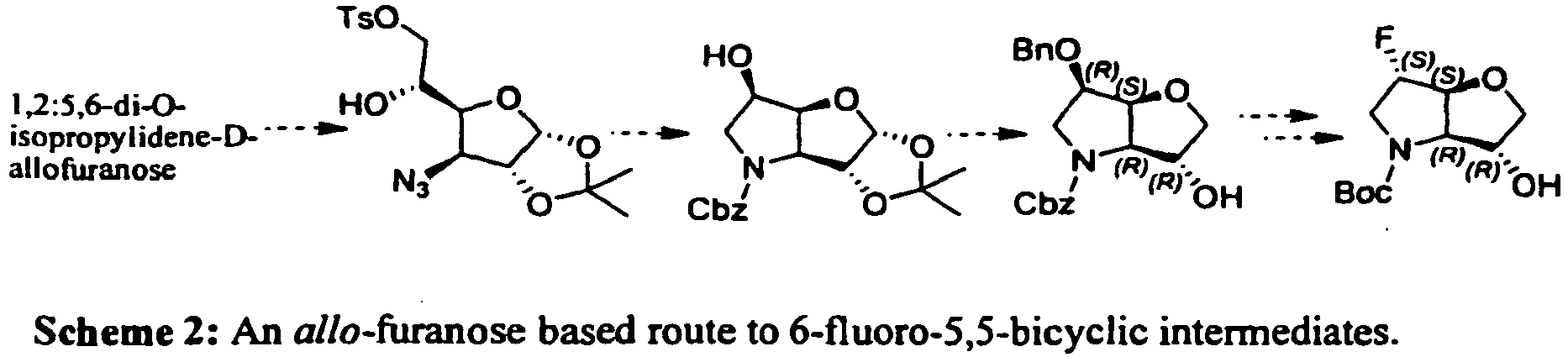
- Other literature routes to 5,5-bicyclic intermediates include, but are not limited to, the stereocontrolled vinylation of a chiral α,β-epoxy imine (see Ayad, T.; et al, Synlett, 6, 866-868, 2001); preparation of a 4,5-disubstituted oxazolidin-2-one followed by steps which incorporate base cyclisation (see Delle Monache, G., et al, Tet. Asymm., 10(15), 2961-2973, 1999); dihydroxylation of 1-tosyl-2-vinylpyrrolidin-3-yl methanesulfonate followed by based-catalysed ring closure (see Lin, G-Q. and Shi, Z-C., Tet., 53(4), 1369-1382, 1997)..
- Additional alternative routes include syntheses based upon dihydrofuran derived intermediates detailed in Scheme 3 that are open to the stereoselective epoxidation chemistry pioneered in our syntheses of alternative 5,5-heterobicycles (see (a) Quibell, M. et al, Bioorg. Med. Chem, 13, 609-625, 2005; (b) Wang, Y. et al, Bioorg. Med. Chem. Lett., 15, 1327-1331, 2005). Syntheses may commence with the homologation of methyl 2,5-dihydrofuran-2-carboxylate by cyanide displacement of the corresponding mesylate derivative or via homologation to an epoxide intermediate (Scheme 3). In particular, the epoxide intermediate is applicable to the types of amine ring opening reactions typified in the syntheses of HIV-1 protease hydroxyethylamine inhibitors (e.g. see Beaulieu, P. L. et al, J. Org. Chem., 62, 3440-3448, 1997).

- The present invention seeks to provide an improved process for synthesising 5,5-bicyclic building blocks useful in the preparation of cysteinyl proteinase inhibitors. More particularly, the invention seeks to provide new methodology for synthesising tetrahydrofuro[3,2-b]pyrrol-3-ones and substituted derivatives thereof. The invention also seeks to provide new intermediates useful in the synthesis of cysteinyl proteinase inhibitors.
- A first aspect of the invention relates to a process for preparing a compound of formula Ia, Ib, Ic or Id, or a pharmaceutically acceptable salt, hydrate, solvate or complex thereof,

- R1 is selected from H, N3, NH2, NHR3, NR4R5, OH, OR6, OTs, OMs, Me, Et, CF3, F, Cl, Br, SH, SR7, SOR7, SO2R7, NH-PG2, O-PG3 and S-PG4, wherein each of PG2, PG3 and PG4 is independently a protecting group and Ts and Ms are tosyl and mesyl group respectively;
- R2 is H or a protecting group PG1 or a group of formula U-(V)m-(W)n-(X)o-Y- or a group of formula (U)p-(X2)s-(Y1)k-Y2- wherein PG1 is a nitrogen protecting group;
- R3-7 are each independently alkyl or cycloalkyl or aryl; or R4 and R5 are linked to form a cyclic group together with the nitrogen to which they are attached;
- Y is CR8R9-CO-, where R8, R9 are each independently selected from H, alkyl, cycloalkyl, Ar, Ar-alkyl, cycloalkyl(alkyl), heteroaryl or heteroaryl(alkyl), each of which may be optionally substituted by R49, or R8 and R9 are linked to the adjacent backbone carbon atom to form a spiro-C5-C6 cycloalkyl group;
- in the group (X)o, X is CR10R11, where R10and R11 are independently selected from H, alkyl, cycloalkyl, Ar and Ar-alkyl, and o is 0, 1, 2 or 3;
- in the group (W)n, W is O, S, C(O), S(O) or S(O)2 or NR12, where R12 is selected from H, alkyl, cycloalkyl, Ar and Ar-alkyl, and n is 0 or 1;
- in the group (V)m, V is C(O), C(S), S(O), S(O)2, S(O)2NH, OC(O), NHC(O), NHS(O), NHS(O)2, OC(O)NH, C(O)NH or CR13R14, where R13 and R14 are independently selected from H, alkyl, cycloalkyl, Ar and Ar-alkyl, and m is 0, 1, 2 or 3; provided that when m is greater than one, (V)m contains a maximum of one carbonyl or sulphonyl group;
- Y2 is OC(O)-, SC(O)- or

- or where (U)p, (X2)5 and (Y1)k are absent, Y2 is R47OC(O)-, R47SC(O)- or R15R45NC(O)-, where R47 is alkyl or aryl, and R15 and R45 are each independently selected from H and alkyl, or R15 and R45 are linked to form a cyclic group together with the nitrogen to which they are attached;
- in the group (Y1)k, each Y1, is independently

- or when 'k' is l, Y1 may additionally be selected from

- where Y3 is methylene or absent;
- R18 is selected from

- 'j' is 1, 2, 3 or 4, where when 'j' is 2, 3 or 4, one R18 may additionally be selected from O, S, SO2, NR23 and -N(R23)C(O)-;
- or when 'k' is 1, 2, or 3 and (U)p and (X2)s are absent, the terminal Y1 group is selected from CR16R17R43 and

- R26 is selected from


- R27 is selected from


- except when R26 is O, then R27 is selected from


- R28 is selected from


- in the group (X2)s, each X2 is independently


- each U is independently a 5- to 7-membered monocyclic or a 8- to 11-membered bicyclic ring which is either saturated or unsaturated and which includes up to four heteroatoms as shown below:


- wherein R41 is:
- H, alkyl, cycloalkyl, Ar-alkyl, Ar, OH, O-alkyl, O-cycloalkyl, O-Ar-alkyl, OAr, SH, S-alkyl, S-cycloalkyl, S-Ar-alkyl, SAr, SO-alkyl, SO-cycloalkyl, SO-Ar-alkyl, SO-Ar, SO2H, SO2-alkyl, SO2-cycloalkyl, SO2-Ar-alkyl, SO2Ar, NH-alkyl, NH2, NH-cycloalkyl, NH-Ar-alkyl, NHAr, NHCO-alkyl, NHCO-cycloalkyl, NHCO-Ar-alkyl, NHCOAr ,N(alkyl)2, N(cycloalkyl), or N(Ar-alkyl)2 or NAr2 or, when part of a CHR41 or CR41 group, R41 may be halogen;
- A is selected from:
- CH2,


- CH2,
- B, D and G are each independently selected from:
-


-
- E is selected from: CH2,


- K is selected from:
- CH2,

- CH2,
- J, L, M, R, T, T2, T3 and T4 are independently selected from:
- CR41 where R41 is as defined above, N and N-oxide

- CR41 where R41 is as defined above, N and N-oxide
- T5 is selected from:
- CH and N;
- T6 is selected from:
-


-
- T7 is selected from:
- O, S,

- O, S,
- 'q' is 1, 2 or 3;
- 'p' is 0 or 1;
- R16-17, R19-22, R24-25, R29-30 , R32-33 R35-36, R38-39 and R43-44 are each independently selected from H, alkyl, cycloalkyl, Ar-alkyl, Ar and halogen; and
- R23, R31, R34, R37, R40 and R46 are each independently selected from H, alkyl, cycloalkyl, Ar-alkyl and Ar;
- R49 is H, alkyl, cycloalkyl, Ar-alkyl, Ar, OH, O-alkyl, O-cycloalkyl, O-Ar-alkyl, OAr, SH, S-alkyl, S-cycloalkyl, S-Ar-alkyl, SAr, SO-alkyl, SO-cycloalkyl, SO-Ar-alkyl, SO-Ar, SO2H, SO2-alkyl, SO2-cycloalkyl, SO2-Ar-alkyl, SO2Ar, NH-alkyl, NH2, NH-cycloalkyl, NH-Ar-alkyl, NHAr, NHCO-alkyl, NHCO-cycloalkyl, NHCO-Ar-alkyl, NHCOAr ,N(alkyl)2, N(cycloalkyl), or N(Ar-alkyl)2 or NAr2 or halogen;
- (A)
- (i) treating a compound of formula IVa, where R48 is alkyl or tosyl or mesyl, with an oxidising agent selected from a hydrogen peroxide/alkylnitrile mixture and a dioxirane to form a compound of formula Va; and
- (ii) forming a compound of formula VIa by treating said compound of formula Va with sodium hydride, or where R2 is a protecting group PG1, by removal of the protecting group PG1;
- (iii) optionally oxidising said compound of formula VIa to form a compound of formula Ic, where R1 is O-alkyl, OMs or OTs; or
- (iv) where R48 is Ts or Ms, subjecting said compound of formula VIa to nucleophilic substitution; or
- (v) where R48 is Ts,
- optionally treating said compound of formula VIa with lithium triethylborohydride, or
- where R2 is H, optionally treating said compound of formula VIa with lithium aluminium hydride,
compound of formula Ia to form a compound of formula Ic; or - (B)
- (i) treating a compound of formula IVb, where R48 is alkyl or tosyl or mesyl, with an oxidising agent selected from a hydrogen peroxide/alkylnitrile mixture and a dioxirane to form a compound of formula Vb; and
- (ii) forming a compound of formula VIb by treating said compound of formula Vb with sodium hydride, or where R2 is a protecting group PG1, by removal of the protecting group PG1;
- (ii) optionally oxidising said compound of formula VIb to form a compound of formula Id, where R1 is O-alkyl, OMs or OTs; or
- (iv) where R48 is Ts or Ms, optionally subjecting said compound of formula VIb to nucleophilic substitution; or
- (v) where R48 is Ts,
- optionally treating said compound of formula VIb with lithium triethylborohydride, or
- where R2 is H, optionally treating said compound of formula VIa with lithium aluminium hydride;
- Advantageously, the presence of a relatively bulky substituent (-OR48), alpha to the dihydrofuran ring, imparts a strong stereofacial preference for forming the desired anti-epoxide during the oxidation step. This is referred to hereinafter as a "directing effect" and is in contrast to prior art reactions on the corresponding unsubstituted analogues, where little stereofacial preference is observed.
- A second aspect of the invention relates to a compound of formula IVa, IVb, Va or Vb, or pharmaceutically acceptable salts, hydrates or solvates thereof,


- R48 is alkyl, tosyl or mesyl;
- R2 is a protecting group PG1 or a group of formula U-(V)m-(W)n-(X)o-Y- or a group of formula (U)p-(X2)s-(Y1)k-Y2- where Y, X, W, V, U, Y2, Y1, X2, o, n, m, k, s and p are as defmed above;
- Advantageously, the above compounds are easily accessible, enantiomerically pure intermediates which are useful in the preparation of a wide range of cysteinyl proteinase inhibitors.
- As mentioned above, a first aspect of the invention relates to a process for preparing a compound of formula Ia, Ib, Ic or Id, or a pharmaceutically acceptable salt, hydrate, solvate, or complex thereof.
- Unless the context requires otherwise, throughout the specification different enantiomers of the same generic structure are labelled as "a" and "b" respectively. For individual compounds labelled numerically, the number alone (i.e. without a label. "a" or "b") refers to one enantiomer, with the other enantiomer being labelled as "b".
- As used herein, the term "alkyl" includes both saturated straight chain and branched alkyl groups which may be substituted (mono- or poly-) or unsubstituted. Examples of suitable substituents include halo, CF3, OH, CN, NO2, SH, SO3H, SO2H, SO2NH2, SO2Me, NH2, COOH, and CONH2. The alkyl group may also contain one or more heteroatoms, for example, to give ethers, thioethers, sulphones, sulphonamides, substituted amines, amidines, guanidines, carboxylic acids, esters, carboxamides. If the heteroatom is located at a chain terminus then it is appropriately substituted with one or two hydrogen atoms. Preferably, the alkyl group is a C1-20 alkyl group, more preferably a C1-15, more preferably still a C1-12 alkyl group, more preferably still, a C1-7 alkyl group, even more preferably a C1-6 alkyl group, more preferably a C1-3 alkyl group.
- Particularly preferred alkyl groups include, for example, methyl, ethyl, propyl, isopropyl, butyl, isobutyl, tert-butyl, pentyl and hexyl.
- As used herein, the term "aryl" or "Ar" refers to a C6-12 aromatic group which may be substituted (mono- or poly-) or unsubstituted. Typical examples include phenyl and naphthyl etc. Examples of suitable substituents include alkyl, halo, CF3, OH, CN, NO2, SO3H, SO2NH2, SO2Me, NH2, COOH, and CONH2.
- As used herein, the term "heteroaryl" refers to a C4-12 aromatic, substituted (mono- or poly-) or unsubstituted group, which comprises one or more heteroatoms as part of the aromatic ring. Preferred heteroaryl groups include pyrrole, indole, benzofuran, pyrazole, benzimidazole, benzothiazole, pyrimidine, imidazole, pyrazine, pyridine, quinoline, triazole, tetrazole, thiophene and furan. Again, suitable substituents include, for example, halo, alkyl, CF3, OH, CN, NO2, SO3H, SO2NH2, SO2Me, NH2, COOH, and CONH2.
- The term "heteroaryl(alkyl)" is used as a conjunction of the terms alkyl and heteroaryl as given above.
- As used herein, the term "cycloalkyl" refers to a cyclic alkyl group which may be substituted (mono- or poly-) or unsubstituted. Preferably, the cycloalkyl group is a C3-6 cycloalkyl group. Suitable substituents include, for example, halo, alkyl, CF3, OH, CN, NO2, SO3H, SO2NH2, SO2Me, NH2, COOH, CONH2 and alkoxy.
- The term "cycloalkyl(alkyl)" is used as a conjunction of the terms alkyl and cycloalkyl(alkyl) as given above.
- The term "aralkyl" is used as a conjunction of the terms alkyl and aryl as given above. Preferred aralkyl groups include CH2Ph and CH2CH2Ph and the like.
- As used herein, the term "alkenyl" refers to a group containing one or more carbon-carbon double bonds, which may be branched or unbranched, substituted (mono- or poly-) or unsubstituted. Preferably the alkenyl group is a C2-20 alkenyl group, more preferably a C2-15 alkenyl group, more preferably still a C2-12 alkenyl group, or preferably a C2-6 alkenyl group, more preferably a C2-3 alkenyl group. Suitable substituents include, for example, alkyl, halo, CF3, OH, CN, NO2, SO3H, SO2NH2, SO2Me, NH2, COOH, CONH2 and alkoxy.
- As used herein, the term "alicyclic" refers to a cyclic aliphatic group which optionally contains one or more heteroatoms and which is optionally substituted. Preferred alicyclic groups include piperidinyl, pyrrolidinyl, piperazinyl and morpholinyl. More preferably, the alicyclic group is selected from N-piperidinyl, N-pyrrolidinyl, N-piperazinyl and N-morpholinyl. Suitable substituents include, for example, alkyl, halo, CF3, OH, CN, NO2, SO3H, SO2NH2, SO2Me, NH2, COOH, CONH2 and alkoxy.
- The term "aliphatic" takes its normal meaning in the art and includes non-aromatic groups such as alkanes, alkenes and alkynes and substituted derivatives thereof.
- PG1 and PG2 are each independently nitrogen protecting groups. Suitable nitrogen protecting groups will be familiar to the skilled artisan (see for example, "Protective Groups in Organic Synthesis" by Peter G. M. Wuts and Theodora W. Greene, 2nd Edition). Preferred nitrogen protecting groups are described hereinafter.
- PG3 is an oxygen protecting group. Suitable oxygen protecting groups will be familiar to the skilled artisan (see for example, "Protective Groups in Organic Synthesis" by Peter G. M. Wuts and Theodora W. Greene, 2nd Edition). Preferred oxygen protecting groups include tert-butyl ether and benzyl (PhCH2) ether or substituted benzyl ether (e.g. 4-MeOPhCH2).
- PG4 is a sulphur protecting group. Suitable sulphur protecting groups will be familiar to the skilled artisan (see for example, "Protective Groups in Organic Synthesis" by Peter G. M. Wuts and Theodora W. Greene, 2nd Edition). Preferred sulphur protecting groups include tert-butyl thioether (But-S), tert-butyl thiodisulphide (ButS-S), benzyl thioether (PhCH2-S) or substituted benzyl thioether (e.g. 4-MeOPhCH2-S), trityl thioether ([Ph]3C-S) or substituted trityl thioether or S-acetamidomethyl (Acm).
- The present invention relates to the preparation and use of all salts, hydrates, solvates and complexes of the compounds described herein. The term "compound" is intended to include all such salts, hydrates, solvates and complexes, unless the context requires otherwise.
- Appropriate pharmaceutically and veterinarily acceptable salts include salts of organic acids, especially carboxylic acids, including but not limited to acetate, trifluoroacetate, lactate, gluconate, citrate, tartrate, maleate, malate, pantothenate, adipate, alginate, aspartate, benzoate, butyrate, digluconate, cyclopentanate, glucoheptanate, glycerophosphate, oxalate, heptanoate, hexanoate, fumarate, nicotinate, palmoate, pectinate, 3-phenylpropionate, picrate, pivalate, proprionate, tartrate, lactobionate, pivolate, camphorate, undecanoate and succinate, organic sulphonic acids such as methanesulphonate, ethanesulphonate, 2-hydroxyethane sulphonate, camphorsulphonate, 2-naphthalenesulphonate, benzenesulphonate, p-chlorobenzenesulphonate and p-toluenesulphonate; and inorganic acids such as hydrochloride, hydrobromide, hydroiodide, sulphate, bisulphate, hemisulphate, thiocyanate, persulphate, phosphoric and sulphonic acids. Salts which are not pharmaceutically or veterinarily acceptable may still be valuable as intermediates.
- The invention furthermore relates to the preparation of compounds in their various crystalline forms, polymorphic forms and (an)hydrous forms. It is well established within the pharmaceutical industry that chemical compounds may be isolated in any of such forms by slightly varying the method of purification and or isolation form the solvents used in the synthetic preparation of such compounds.
- It will be appreciated that the ketone group of the bicycle may exist in alternative forms such as the hydrate and the invention extends to all such alternative forms.
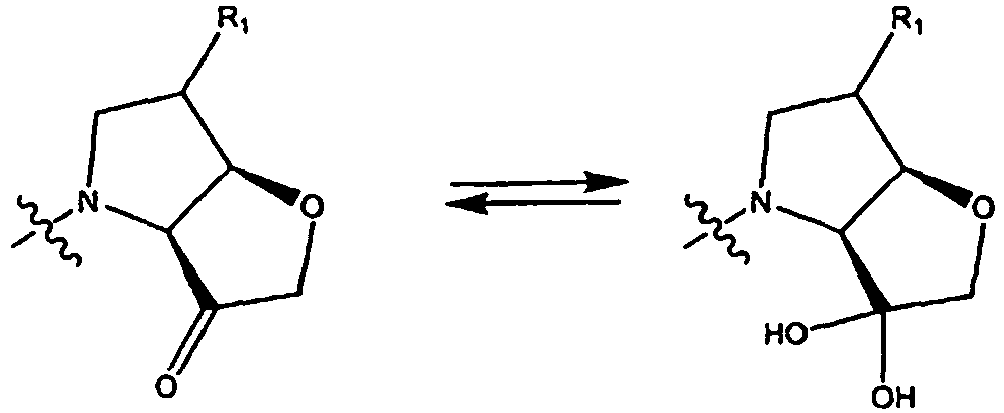
- Steps (A)(i) and (B)(i) of the process involve oxidation to form an epoxide intermediate (Va, Vb).
- In one embodiment, the oxidising agent is a hydrogen peroxide and alkylnitrile mixture.
- The use of hydrogen peroxide with alkylnitriles as oxidising agents is well documented in the literature [see (a) Chaudhuri, N. K. and Ball, T. J. J. Org. Chem., 47(26), 5196-5198, (1982); (b) von Holleben, M. L. A.. et al, J. Braz. Chem. Soc. 12(1), 42-46, (2001)]
- In another embodiment, the oxidising agent is a dioxirane.
- The use of dioxiranes as oxidising agents is well documented in the literature [see (a) Hodgson, D. M. et al, Synlett, 310 (2002); (b) Adam, W. et al, Acc. Chem. Res. 22, 205, (1989); (c) Yang, D. et al, J. Org. Chem., 60, 3887, (1995); (d) Mello, R. et al, J. Org. Chem., 53, 3890, (1988); (e) Curci, R. et al, Pure & Appl. Chem., 67(5), 811 1 (1995); (f) Emmons, W. D. et al, J. Amer. Chem. Soc. 89, (1955)].
- Preferably, the dioxirane is generated in situ by the reaction of KHSO5 with a ketone. However, step (i) can also be carried out using an isolated dioxirane, for example a stock solution of the dioxirane formed from acetone.
- More preferably, the dioxirane is generated in situ using Oxone®, which is a commercially available oxidising agent containing KHSO5 as the active ingredient.
- Thus, in one preferred embodiment, step (i) of the claimed process involves the in situ epoxidation using Oxone® (2KHSO5·KHSO4·K2SO4) and a ketone co-reactant.
- As mentioned above, the active ingredient of Oxone® is potassium peroxymonosulfate, KHSO5 [CAS-RN 10058-23-8], commonly known as potassium monopersulfate, which is present as a component of a triple salt with the formula 2KHSO5·KHSO4·K2SO4 [potassium hydrogen peroxymonosulfate sulfate (5:3:2:2), CAS-RN 70693-62-8; commercially available from DuPont]. The oxidation potential of Oxone® is derived from its peracid chemistry; it is the first neutralization salt of peroxymonosulfuric acid H2SO5 (also known as Caro's acid).
K+ -O-S(=O)2(-OOH)
- Under slightly basic conditions (pH 7.5-8.0), persulfate reacts with the ketone co-reactant to form a three membered cyclic peroxide (a dioxirane) in which both oxygens are bonded to the carbonyl carbon of the ketone. The cyclic peroxide so formed then epoxidises the compound of formula III by syn specific oxygen transfer to the alkene bond.
- Preferably, the ketone is of formula XVII

- Where Ra and/or Rb are alkyl, the alkyl group may be a straight chain or branched alkyl group. Preferably, the alkyl group is a C1-20 alkyl group, more preferably a C1-15, more preferably still a C1-12 alkyl group, more preferably still, a C1-7 or C1-6 alkyl group, more preferably a C1-3 alkyl group. Particularly preferred alkyl groups include, for example, methyl, ethyl, propyl, isopropyl, butyl, isobutyl, tert-butyl, pentyl and hexyl.
- As used herein, the term "haloalkyl" refers to an alkyl group as described above in which one or more hydrogens are replaced by halo.
- Where Ra and/or Rb are aryl, the aryl group is typically a C6-12 aromatic group. Preferred examples include phenyl and naphthyl etc.
- As used herein, the term "haloaryl" refers to an aryl group as described above in which one or more hydrogens are replaced by halo.
- By way of example, the reaction of KHSO5 (Oxone®) with a ketone of formula XVII would form a dioxirane of formula:

- More preferably, Ra and Rb are each independently alkyl or haloalkyl.
- In a highly preferred embodiment, at least one of Ra and Rb is a haloalkyl, more preferably, CF3 or CF2CF3.
- In one preferred embodiment, Ra and Rb are each independently methyl or trifluoromethyl.
- In one preferred embodiment of the invention, the ketone is selected from acetone and a 1,1,1-trifluoroalkyl ketone.
- In a more preferred embodiment of the invention, the trifluoroalkyl ketone is 1,1,1-trifluoroacetone or 1,1,1-trifluoro-2-butanone, more preferably 1,1,1-trifluoro-2-butanone.
- In one preferred embodiment, Y is CR8R9-CO-, where R8, R9 are each independently selected from H, alkyl, cycloalkyl, Ar and Ar-alkyl, or R8 and R9 are linked to the adjacent backbone carbon atom to form a spiro-C5-C6 cycloalkyl group.
- In one preferred embodiment, R2 is a protecting group PG1 or a group of formula U-(V)m-(W)n-(X)o-Y- or a group of formula (U)p-(X2)s-(Y1)k-Y2- as defined above.
- In one particularly preferred embodiment of the invention, R2 is a nitrogen protecting group PG1, i.e. the process is used to prepare a compound of formula Ie, If, Ig or Ih,

- Preferably, PG1 is a urethane protecting group.
- More preferably, the urethane protecting group is selected from benzyloxycarbonyl, tert-butoxycarbonyl, fluoren-9-ylmethoxycarbonyl, 1-(biphenyl-4-yl)-1-methylethoxycarbonyl, α,α-dimethyl-3,5-dimethoxylbenzyloxycarbonyl, p-methoxybenzyloxycarbonyl, p-nitrobenzyloxycarbonyl, allyloxycarbonyl and trichloroethoxycarbonyl.
- Even more preferably, the urethane protecting group is benzyloxycarbonyl (Cbz), tert-butoxycarbonyl (Boc) or fluoren-9-ylmethoxycarbonyl (Fmoc).
- In one preferred embodiment of the invention, R48 is methyl, tert-butyl or tosyl.
- In one preferred embodiment of the invention, R1 is H, N3, NH2, NH-Boc, tert-BuO, MeO, MeS or OTs.
- In one highly preferred embodiment of the invention, R1 is H.
- In another highly preferred embodiment of the invention, R1 is F or Cl.
- The process of the present invention is also suitable for preparing a wide range of 5,5-bicyclic structures wherein R2 is a group of formula U-(V)m-(W)n-(X)o-Y-, i.e. compounds of formula Ii, Ij, Ik and Il or (U)p-(X2)s-(Y1)k-Y2- i.e. compounds of formula Im, In, Io and Ip,


- Preferred Y, X, W, V and U groups are described in
WO 02/057270 - For potent inhibition of cathepsin K; preferred Y, X, W, V and U groups are described in co-pending PCT applications [Agent's reference P024640WO], claiming priority from
GB0614046.1 GB0614037.0 GB0614073.5 GB0614044.6 GB0614052.9 GB0614042.0 GB0614053.7 - Particularly preferred U, X, Y1 and Y2 groups are described in
WO 07/023281 - Preferably, Y is CHR9CO where R9 is selected from H, C1-7-alkyl or Ar-C1-7-alkyl, for example hydrogen, a straight or branched alkyl chain, a straight or branched heteroalkyl chain, an optionally substituted arylalkyl chain or an optionally substituted arylheteroalkyl chain. Additionally, R9 may be C3-6-cycloalkyl or C3-6-cycloalkyl(alkyl), for example cyclopentyl, cyclohexyl or cyclohexylmethyl or cyclohexylmethyl.
- In another preferred embodiment, Y is CR8R9CO where R8 and R9 are linked to the adjacent backbone carbon atom to form a spiro-5 or 6-membered cycloalkyl group;
- Examples of preferred (X)o-Y- groups include the following:


- R50 is selected from H, alkyl, cycloalkyl, Ar and Ar-alkyl and Ar /aryl is as defined above.
- More preferred R9 groups include C1-5-alkyl, or C4-6-cycloalkyl or C3-6-cycloalkylmethyl or Ar-C1-4-alkyl, where the aryl group may be substituted with R49; wherein each R49 and R50 is independently as defined above.
- Even more preferred R9 groups comprise C4-5-alkyl, or C5-6-cycloalkyl or C5-6-cycloalkylmethyl. Additionally even more preferred R9 groups comprise Ar-CH2-, where the aromatic ring is an optionally substituted phenyl, or heteroaryl-CH2-, where the heteroaryl group is monocyclic. Additionally even more preferred R9 groups also comprise heteroalkyl chains such as benzylsulfanylmethyl or benzylsulphonylmethyl Examples of even more preferred (X)o-Y- substituents include the following,


- It is preferred that in the group X, each of R10 and R11 is selected from H, C1-7-alkyl or Ar, Ar-C1-7-alkyl, for example hydrogen, a straight or branched alkyl chain, a straight or branched heteroalkyl chain, an optionally substituted arylalkyl chain or an optionally substituted arylheteroalkyl chain.
- More preferably, R10 is hydrogen and R11 is C1-4-alkyl, which may be substituted with OH, NR50R50, COOR50, or CONR50; or Ar-C1-4-alkyl, where the aryl group may be substituted with R49, wherein each R49 and R50 is independently as defined above.
- Examples of preferred (W)n-(X)o-Y- groups include the following:


- Even more preferably, X is a simple alkyl group such as methylene and o is 0 or 1.
- In the group (W)n, W is preferably O, S, SO2, S(O), C(O) or NR51, where R51 is H, C1-4-alkyl; and n is 0 or 1.
- More preferred (W)n groups include O, S, SO2, C(O) and NH where n is 0 or 1.
- Even more preferred (W)n groups include NH where n = 1.
- In the group (V)m, V is preferably C(O), OC(O), NHC(O) or CHR52, where R12 is H, C1-4-alkyl; and m is 0 or 1.
- Even more preferred (V)m groups include C(O) where m = 1.
- Preferred U-(V)m-(W)n-(X)o- combinations include, but are not limited to:


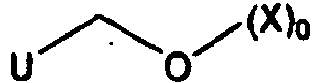
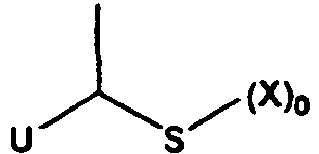
'n'=0 'n' = 1 'n'=1 'm'=0 'W'=O 'W'=O 'n'= 1 'W'= S 'm'= 0 'V' = CH2 'V' =CH(CH3) 'V' = 1 'm' = 1 'm'=1 


'n'= 1 'n' = 1 (X)0 > 0 'W' = 1 'n' = 0 'W' = O 'n' = 1 'V' = CH(CH2CH3) 'V' = C(O) 'V' = C(O) 'W' = NR51 'V' = CH(CH2CH3) 'm'=1 'm'=1 R51 = H V = C(O) 'm' = 1 - Additionally, a preferred U-(V)m-(W)n-(X)0-Y- combination includes, but is not limited to:
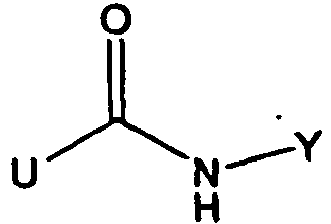
(X)0 = '-' 'n' = 1 'W' = NR51 R51=H V = C(O) 'm'= 1 - More preferred U-(V)m-(W)n-(X)0-Y combinations include, but are not limited to


(X)0 ='-' (X)0 = '-' (X)0 = '-' (X)0 = '-' (X)0 = 'CH2' (X)0 = '-' (W)n = '0' (W)n ='O' (W)n ='S' (W)n = 'SO2' (W)n = 'C(O)' (W)n = 'NH' (V)m ='C(O)' (V)m = 'CH2' (V)m = 'CH2' (V)m = 'CH2' (V)m = '-' (V)m = 'C(O)' - Preferably, U comprises an optionally substituted 5- or 6-membered saturated or unsaturated heterocycle or Ar group or an optionally substituted saturated or unsaturated 9- or 10-membered heterocycle or Ar group. Examples of such preferred U rings include the following:



- More preferably, the U group comprises a branched alkyl or cycloalkyl or alicyclic or aryl group in the para position of an aryl Ar. Also, more preferred compounds contain a meta or para-biaryl Ar-Ar, where Ar is as previously defined. Examples of more preferred U groups are:


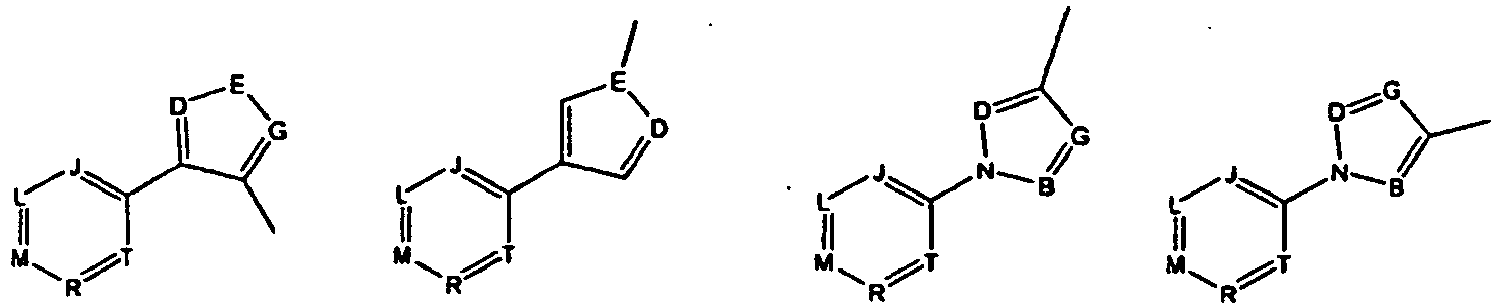
- Even more preferably, the U group comprises a 6-membered Ar ring containing a alicyclic or aryl or heteroaryl group in the para position of the aryl ring. Even more preferably still, the U group is selected from the following:


- Compounds of formulae Ii-Il in which R2 is a group of formula U-(V)m-(W)n-(X)o-Y-, may be prepared from the precursors of formulae Ie-h (wherein R2 is a protecting group PGI). Typically, the protecting group PGI is removed by conventional means to yield the corresponding free base compound wherein R2 is hydrogen.
- Compounds of formula Ii-Il may be prepared (1) by the stepwise addition of P2 and P3 synthons (see later descriptions) representing Y, (X)o, (W)n, (V)m and U to the bicyclic tetrahydrofuro[3,2-b]pyrrol-3-one core; or (2) by reaction of the bicyclic tetrahydrofuro[3,2-b]pyrrol-3-one core with a U-(V)m-(W)n-(X)o-Y- prescursor molecule, (i.e. where the U-(V)m-(W)n-(X)o-Y- group is already constructed); or (3) by introducing the U-(V)m-(W)n-(X)o-Y- group as the R2 substituent prior to formation of the bicyclic tetrahydrofuro[3,2-b]pyrrol-3-one core, i.e. prior to the oxidation step or prior to the intramolecular cyclisation step.
- Similarly, compounds of formula Im-Ip may be prepared (1) by the stepwise addition of P2 and P3 synthons (see later descriptions) representing Y2, (Y1)k, (X2)s and (U)p to the bicyclic tetrahydrofuro[3,2-b]pyrrol-3-one core; or (2) by reaction of the bicyclic tetrahydrofuro[3,2-b]pyrrol-3-one core with a (U)p-(X2)s-(Y1)k-Y2- prescursor molecule, (i.e. where the (U)p-(X2)s-(Y1)k-Y2- p group is already constructed); or (3) by introducing the (U)p-(X2)s-(Y1)k-Y2- group as the R2 substituent prior to formation of the bicyclic tetrahydrofuro[3,2-b]pyrrol-3-one core, i.e. prior to the oxidation step or prior to the intramolecular cyclisation step.
- In one preferred embodiment of the invention, compounds of formula Ik, Il, Io, Ip may be prepared using conventional solid phase chemistry, for example, as described in Quibell M, et al (Bioorg. Med. Chem, 12, 5689-5710, 2004, see in particular, Scheme 3 and Section 3.2, and references cited therein; and Bioorg. Med. Chem, 13, 609-625, 2005, see Scheme 5 and Section 2.2, and references cited therein). The synthetic strategy is based on reversible anchorage of the ketone functionality via a hydrazide linker bond using general multipin techniques previously described in the art (Watts J. et al, Bioorg. Med. Chem. 12(11), 2903, 2004; Quibell M., et al, Bioorg. Med. Chem. 5689-5710, 2004; Grabowksa U. et al, J. Comb. Chem. 2000, 2(5), 475).
- In an alternative preferred embodiment of the invention, compounds of formulae Ii-Ip may be prepared using conventional solution phase chemistry, for example, as described in Quibell, M et al, Bioorg. Med. Chem, 13, 609-625, 2005 (see in particular, Schemes 3 and 4).
- Compounds of formulae Ig-Ih, PG1, may be utilised in a solid phase synthesis of inhibitor molecules Ic-Id. The solid phase linkage of an aldehyde or ketone, has previously been described by a variety of methods (e.g. see (a) James, I. W., 1999, (b) Lee, A., Hang, L., Ellman, J. A., J. Am. Chem. Soc, 121(43), 9907-9914, 1999, (c) Murphy, A. M., et al, J. Am. Chem. Soc, 114, 3156-3157, 1992). A suitable method amenable to the reversible linkage of an alkyl ketone functionality such as Ih is through a combination of the previously described chemistries. The semicarbazide, 4-[[(hydrazinocarbonyl)amino]methyl]cyclohexane carboxylic acid. trifluoroacetate (Murphy, A. M., et al, J. Am. Chem. Soc, 114, 3156-3157, 1992), may be utilised as illustrated in Scheme 4, exemplified by linkage of the tetrahydrofuro[3,2-b]pyrrol-3-one (Ih; R2 = Fmoc).

- Construct XIX is prepared through reaction of the linker molecule and the tetrahydrofuro[3,2-b]pyrrol-3-one Ih (PG1 = Fmoc) by reflux in aqueous ethanol/sodium acetate. Standard solid phase techniques (e.g. see Atherton, E. and Sheppard, R. C., 1989) are used to anchor the construct to an amino-functionalised solid phase through the free carboxylic acid functionality of XIX, providing the loaded construct XX. Loaded construct XX may be reacted with a wide range of carboxylic acids available commercially or in the literature, to introduce the left-hand portion 'U-V-W-X-Y'. Alternatively introduction of the '(U)p-(X2)s-(Y1)k-Y2' group is through the use of chloroformates (Y2 is OC(O)-, (U)p-(X2)s-(Y1)k-OC(O)Cl), chlorothiolformates (Y2 is SC(O)-, (U)p-(X2)s-(Y1)k-SC(O)Cl), isocyanates (Y2 is NHC(O)-, (U)p-(X2)s-(Y1)k-N=C=O) or carbamoyl chlorides (Y2 is NR15C(O)-, (U)p-(X2)s-(Y1)k-NR15COCl) as a single step reaction.
- Compounds of Il and Ip are finally released from the solid phase by treatment with trifluoroacetic acid / water, followed by evaporation, lyophylis and standard analytical characterisation. By analogy compounds of Ik and Io can be prepared by identical methods to those described for Ih but commencing from Ig.
- A second strategy for the synthesis of compounds of general formulae Ic-Id comprises:-
- (a) preparation of an appropriately functionalised and protected 5,5-bicyclic alcohol building block in solution such as Ie and If (preferred protecting groups for solution phase chemistry are the Nα-tert-butoxycarbonyl group and the Nα-benzyloxycarbonyl group);
- (b) standard organic chemistry methods for the conversion of the building block formed in (a) towards compounds of general formulae Ia-Ib
- (c) oxidation of compounds of general formulae Ia-Ib towards compounds of general formulae Ic-Id
- In the simplest example, the entire left hand portion of the inhibitor molecule can be prepared in solution by traditional organic chemistry methods and coupled to building block (a) (see Scheme 5 exemplified by preparation and use of the 6-R1-3-hydroxy-tetrahydrofuro[3,2-b]pyrrole-4-carboxylic acid tert-butyl ester XXI).

- By analogy, U-X2-Y1-Y2- reagents such as chloroformates, chlorothioformates, isocyanates, carbamoylchlorides as detailed above could be used in place of the carboxylic acid reagent in Scheme 5. The alcohol oxidation route is particularly useful when the compound of general formulae Ic-Id contains a substituent that is labile to trifluoroacetic acid, this being the final reagent used in the solid phase Scheme 4.
- A third strategy for the synthesis of compounds where the addition of U-V-W-X-Y- to the protected building block involves multistep organic reactions comprises:-
- (a) Preparation of an appropriately functionalised and protected tetrahydrofuro[3,2-b]pyrrol-3-one building block in solution such as Ig or Ih (preferred protecting groups for this particular solution phase chemistry include the Nα-benzyloxycarbonyl group);
- (b) Protection of the ketone functionality of the tetrahydrofuro[3,2-b]pyn ol-3-one, e.g. as the dimethylketal.
- (c) Standard organic chemistry methods for the conversion of the building block from step (b) towards compounds of general formulae Ic-Id.
- Such a method is detailed and exemplified in Scheme 6 by the preparation and use of 6-R1-3,3-dimethoxyhexahydrofuro[3,2-b]pyrrole-4-carboxylic acid benzyl ester XXIV.

- By analogy, U-X2-Y1-Y2- reagents such as chloroformates, chlorothioformates, isocyanates, carbamoylchlorides as detailed earlier could be used in place of the carboxylic acid reagent in Scheme 6.
- In one particularly preferred embodiment, said compound of formula IVa is prepared from a compound of formula IIIa
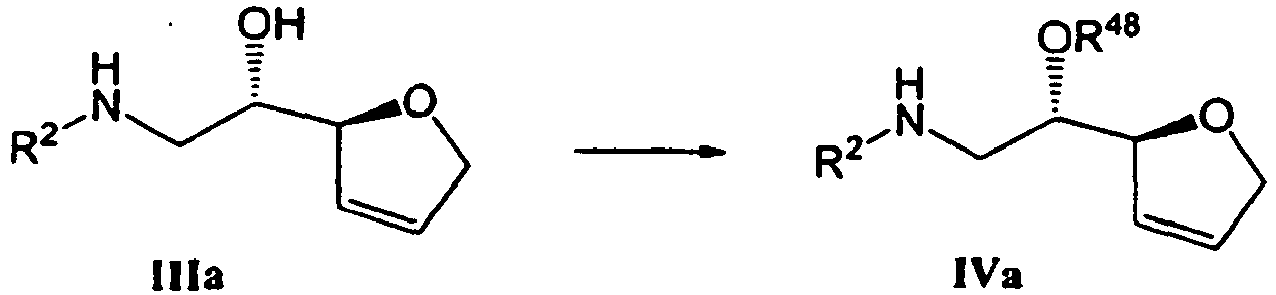
- Preferably, said compound of formula IVb is prepared from a compound of formula IIIb

- In one preferred embodiment, R48 is Me. For this embodiment, preferably the process comprises treating a compound of formula IIIa or IIIb with MeI in the presence of a silver (I) oxide catalyst. Preferably, the reaction is carried out using acetonitrile as solvent.
- In an even more preferred embodiment, R48 is Me and the process comprises treating a compound of formula IIIa or IIIb with trimethyloxonium fluoroborate, proton sponge [1,8-bis(dimethylamino)naphthalene] and molecular sieves in dichloromethane.
- In another preferred embodiment, R48 is tert-Bu. For this embodiment, preferably the process comprises treating a compound of formula IIIa or IIIb with gaseous 2-methylpropene in dichloromethane in the presence of concentrated H2SO4.
- In another preferred embodiment, R48 is tosyl. For this embodiment, preferably the process comprises treating a compound of formula IIIa or IIIb with tosyl chloride in pyridine.
- In one preferred embodiment of the invention, said compound of formula IIIa is prepared by the steps of:

- (a) reacting a compound of formula IIa, where X3 is halogen or OTs, with aqueous ammonia and alcohol, or with aqueous ammonium hydroxide; and
- (b) converting the product formed in step (a) to a compound of formula IIIa;
- In one preferred embodiment of the invention, said compound of formula IIIb is prepared by the steps of:

- (a) reacting a compound of formula IIb, where X3 is halogen or OTs, with aqueous ammonia and alcohol, or with aqueous ammonium hydroxide; and
- (b) converting the product formed in step (a) to a compound of formula IIIb.
- Preferably, the above process is a one-pot process, i.e. the product of step (a) is not isolated or purified from the reaction mixture.
- In one particularly preferred embodiment, R2 is benzyloxycarbonyl, and step (b) comprises treating the mixture formed in step (a) with benzyloxycarbonyl chloride.
- Preferably, X3 is I, Br or OTs.
- Preferably, the alcohol is isopropyl alcohol or ethanol.
- In one preferred embodiment of the invention, said compound of formula IIa is prepared from a compound of formula XVIIIa

- Preferably, the above process comprises treating said compound of formula XVIIIa with methyl lithium.
- In one highly preferred embodiment of the invention, said compound of formula IIa is compound (13), i.e. X3 is OTs, and compound (13) is prepared from compound (38)

- Preferably, the above process comprises treating compound (38) with methyl lithium.
- More preferably, compound (38) is prepared from compound (39);

- Preferably, the above process comprises treating compound (39) with sodium iodide in DMF.
- Preferably, compound (39) is prepared from compound (40);

- Preferably, the above process comprises treating compound (40) with tosyl chloride in pyridine.
- In one preferred embodiment of the invention, said compound of formula IIb is prepared from a compound of formula XVIIIb

- In one highly preferred embodiment of the invention, said compound of formula IIb is compound (14), i.e. X3 is OTs, and compound (14) is prepared from compound (41)

- Preferably, the above process comprises treating said compound (41) with methyl lithium.
- More preferably, compound (41) is prepared from compound (42);

- Preferably, the above process comprises treating compound (42) with sodium iodide in DMF.
- More preferably, compound (42) is prepared from compound (43)

- Preferably, the above process comprises treating compound (43) with tosyl chloride in pyridine.
- Still commencing from the commercially available sugars isomannide and isosorbide, the present invention also provides alternative preparations of alcohols (13) and (14). One highly preferred preparation is shown below in Scheme 15

- Isosorbide (43) is converted to the di-tosylate (42) which is obtained following recrystallisation from methanol in 97% yield. Mono-bromination is effected by 2.5eq lithium bromide in DMSO (or DMF) with temperature control 110°C→ 120°C. The product bromide is isolated following extractive work-up and purification either by column chromatography (74%) or attractive for large scale by recrystallisation from methanol giving a first crop of 55% plus mother liquors containing good quality material that may be pooled from batch runs and purified later. This is a particularly attractive, simple and scalable route to monobromotosylate (47) with defined stereochemistry. Reaction (c) Scheme 15 then forms a new method for opening the sugar intermediate towards dihydrofurans. Paolucci describes treatment of halo-analogues (halo-tosylate, di-bromide, di-iodide) with alkyl lithium reagents. When considering the iodo analogues (either iodidotosylate or di-iodide) yields with methyl lithium are high. However, preparation of mono-iodotosylate or di-iodide through iodination of the di-tosylate can lead to mixed products and in practice the desired mono-iodotosylate or di-iodide are purified out by chromatography prior to alkyl lithium treatment otherwise mixtures of alcohols (11-14) are subsequently produced. Thus, preparation of monobromotosylate (47) with defined stereochemistry by methods in Scheme 15 is attractive for large scale applications. However, treatment of monobromotosylate under Paolucci conditions with either methyl lithium / lithium iodide complex or methyl lithium or butyl lithium at -70°C gave alcohol (14) in 20, 38 and 27% isolated yield respectively. Alternatively, treatment of monobromotosylate with butyl lithium and completion of the one-pot conversion gave alcohol (18) in 22% yield. Although probably scalable, these conditions would need significant improvement for large scale preparations.
- We have now discovered that simple treatment of monobromotosylate (47) with zinc dust at room temperature in organic / aqueous mixtures (most preferably an isopropanol, tetrahydrofuran, water, ammonium chloride mixture) provided alcohol (14) in 80% isolated yield. Additionally, completion of the one-pot conversion gave alcohol (18) in 58% yield from starting monobromotosylate.


- Treatment of isomannide (40) (Scheme 16) with tosylchloride (2.2eq) in a bi-phasic potassium hydroxide / dichloromethane / carbon tetrachloride mixture at 0°C gives ditosylate (39) in 48% yield following simple filtration and trituration with methanol. Alternatively, treatment of isomannide (40) with tosylchloride (0.5eq) in a bi-phasic potassium hydroxide / dichloromethane / carbon tetrachloride mixture at 0°C gives monotosylate in 38% yield following simple extraction and re-crystallisation from carbon tetrachloride (conditions as described in
US 6,858,632 ). Although the monotosylate can be obtained in higher yield by treatment of isomannide (40) with tosylchloride in pyridine, purification currently requires column chromatography which may becomes undesirable at large scale. Monobromotosylate (46) may then be prepared by treatment of ditosylate (39) with lithium bromide in DMF (29% yield following chromatography) or by treatment of monotosylate under Mitsunobu conditions with carbon tetrabromide (63% yield following chromatography). Finally, application of our new conditions with simple treatment of monobromotosylate (46) with zinc dust at room temperature in organic / aqueous mixtures (most preferably an isopropanol, tetrahydrofuran, water, ammonium chloride mixture) provided alcohol (13) in 75% isolated yield. Similar treatment of the monoiodotosylate with zinc dust also provides alcohol (13) in high yield. Additionally, completion of the one-pot conversion gave alcohol (17) in 53% yield from starting monobromotosylate (46). - One embodiment of the invention relates to a process for preparing a compound of formula (13) from a compound of formula (46)

- Preferably, compound (46) is treated with zinc dust at room temperature in an organic/aqueous mixture. More preferably, the organic/aqueous mixture is a mixture of isopropanol, tetrahydrofuran, water and ammonium chloride.
- More preferably, compound (46) is prepared from compound (39)

- Preferably, the above process comprises monobromination of compound (39) with lithium bromide. Preferably, the solvent is DMSO or DMF.
- Preferably, compound (39) is prepared from compound (40), isomannide. Preferably, the above process comprises treating compound (40) with tosyl chloride in pyridine.
- Another embodiment of the invention relates to a process of preparing a compound of formula (14) from a compound of formula (47)

- Preferably, said compound (47) is treated with zinc dust at room temperature in an organic/aqueous mixture. More preferably, the organic/aqueous mixture is a mixture of isopropanol, tetrahydrofuran, water and ammonium chloride.
- More preferably, compound (47) is prepared from compound (42)

- Preferably, the above process comprises treating said compound (42) with lithium bromide. Preferably, the solvent is DMSO or DMF.
- More preferably, compound (42) is prepared from compound (43), isosorbide. Preferably, the above process comprises treating compound (43) with tosyl chloride in dichloromethane with triethylamine.
- In one particularly preferred embodiment,
- Step (A) (ii) comprises the step of converting a compound of formula Va into a compound of formula VIa; and
- Step (B) (ii) comprises the step of converting a compound of formula Vb into a compound of formula VIb;

- The process comprises treating a compound of formula Va or Vb with sodium hydride. Preferably, the reaction is carried out in THF.
- In an alternative preferred embodiment of the invention, R2 is a protecting group PG1, and intramolecular cyclisation of compound Va or Vb is induced by removal of the protecting group PG1. Preferably, for this embodiment, R2 is benzyloxycarbonyl (Cbz), and the process comprises hydrogenating a compound of formula Va or Vb in the presence of a palladium catalyst.
-
- Step (A) (iii) comprises the step of converting a compound of formula VIa into a compound of formula Ic, where R1 is O-alkyl, OMs or OTs; and
- Step (B) (iii) comprises the step of converting a compound of formula VIb into a compound of formula Id, where R1 is O-alkyl, OMs or OTs;

- Any suitable oxidising agent may be used to convert the secondary alcohol group of VIa or VIb into the corresponding ketone. Suitable oxidising agents will be familiar to the skilled artisan. By way of example, the oxidation may be carried out via a Dess-Martin periodinane reaction [Dess, D.B. et al, J. Org. Chem. 1983, 48, 4155; Dess, D.B. et al, J. Am. Chem. Soc. 1991, 113, 7277], or via a Swern oxidation [Mancuso, A. J. et al, J. Org. Chem. 1978, 43, 2480]. Alternatively, the oxidation can be carried out using SO3/pyridine/Et3N/DMSO [Parith, J. R. et al, J. Am. Chem. Soc. 1967, 5505;
US 3,444,216, Parith, J. R. et al ,], P2O5/DMSO or P2O5/Ac2O [Christensen, S. M. et al, Organic Process Research and Development, 2004, 8, 777]. Other alternative oxidation reagents include activated dimethyl sulphoxide [Mancuso, A. J., Swern, D. J., Synthesis, 1981, 165], pyridinium chlorochromate [Pianeatelli, G. et al, Sythesis, 1982, 245] and Jones' reagent [Vogel, A, I., Textbook of Organic Chemistry, 6th Edition]. - More preferably, the process comprises treating a compound of formula VIa or VIb with Dess Martin periodinane. Preferably, the reaction is carried out using dichloromethane as solvent.
- In one highly preferred embodiment, R2 is benzyloxycarbonyl (Cbz) and:
- Step (A) (ii) comprises the steps of:
- converting a compound of formula VIIIa into a compound of formula IXa;
- optionally converting said compound of formula IXa into a compound of formula Xa; and
- optionally converting said compound of formula Xa wherein R48 is alkyl into a compound of formula Ic or wherein R48 is tosyl or mesyl to a compound of formula Ic or Id;
- Step (B) (ii) comprises the steps of:
- converting a compound of formula VIIIb into a compound of formula IXb;
- optionally converting said compound of formula IXb into a compound of formula Xb; and
- optionally converting said compound of formula Xb, wherein R48 is alkyl into a compound of formula Id, or wherein R48 is tosyl or mesyl, to a compound of formula Ic or Id;

- More preferably, the process comprises hydrogenating a compound of formula VIIIa or VIIIb in the presence of a palladium catalyst, and reacting the intermediate so produced with Fmoc-Cl.
- In one particularly preferred embodiment of the invention, R48 is tosyl, i.e. said compound of formula VIIIa is of the subformula XIa (and said compound of formula VIIIb is of the subformula XIb). For this embodiment, preferably,
- Step (A) (iv) comprises the step of converting a compound of formula XIa to a compound of XIIa; and
- Step (B) (iv) comprises the step of converting a compound of formula XIb to a compound of XIIb
- For this embodiment, even more preferably the process comprises treating a compound of formula XIa or XIb with sodium azide in DMF.
- In an even more preferred embodiment,
- Step (A) (iv) further comprises the step of converting a compound of formula XIIa to a compound of XIIIa; and
- Step (B) (iv) further comprises the step of converting a compound of formula XIIb to a compound of XIIIb

- Preferably, for this embodiment, the process comprises treating a compound of formula XIIa or XIIb with (a) triphenylphosphine; and (b) protecting the intermediate formed in step (a) with a protecting group, PG2.
- More preferably still, PG2 is tert-butoxycarbonyl (Boc), and the process comprises reacting the product formed in step (a) with tert-butylcarbonate and Na2CO3 in a dioxan/water mixture.
- In an even more preferred embodiment of the invention,
- Step (A) (iv) comprises the additional step of converting a compound of formula XIIIa to a compound of XIVa; and
- Step (B) (iv) comprises the additional step of converting a compound of formula XIIIb to a compound of XIVb

- More preferably still, R2 is benzyloxycarbonyl (Cbz) and PG2 is tert-butoxycarbonyl (Boc), or following standard hydrogenation of subformulae XIII to remove Cbz and treatment with Fmoc-Cl, R2 is converted to fluoren-9-ylmethoxycarbonyl (Fmoc).
- As before, any suitable oxidising agent can be used to convert the secondary alcohol group to the corresponding ketone (as described above).
- Even more preferably, the process comprises treating a compound of formula XIIIa or XIIIb with Dess Martin periodinane in dichloromethane.
- In one preferred embodiment, the process of the invention allows for the preparation of 6-unsubstituted 5,5-bicyclic species (see for example, compounds of formula XV and XVI below).
- For this embodiment, preferably,
- Step (A) (v) comprises the step of converting a compound of formula XIa to a compound of XV; and
- Step (B) (v) comprises the step of converting a compound of formula XIb to a compound of XV

- One embodiment involves the step of treating a compound of formula XIa or formula XIb with lithium triethylborohydride; wherein R2 is chosen from PG1 or hydrogen.
- More preferably, this embodiment involves the step of treating a compound of formula XIb with lithium triethylborohydride wherein R2 is chosen from PG1 or hydrogen.
- In another embodiment, the process of the invention involves the step of treating a compound of formula XIb with lithium aluminium hydride wherein R2 is chosen as hydrogen.
- In one highly preferred embodiment,
- Step (A) (v) comprises the step of converting a compound of formula XV to a compound of XVI

- As before, any suitable oxidising agent can be used to convert the secondary alcohol group to the corresponding ketone (as described above).
- In one highly preferred embodiment for the reduction reaction, R2 is tert-butoxycarbonyl (Boc).
- In another highly preferred embodiment for the reduction reaction, R2 is hydrogen.
- In a further highly preferred embodiment for the oxidation reaction, R2 is fluoren-9-ylmethoxycarbonyl (Fmoc). Preferably, the process comprises treating a compound of formula XV with Dess Martin periodinane in dichloromethane.
- The processes of the invention involve a variety of synthetic methods through solution chemistry, solid phase chemistry or a combination of techniques.
- In one preferred embodiment of the invention, for compounds of formula Ic and Id, R2 is a group of formula U-(V)m-(W)n-(X)o-Y-. These compounds may be conveniently considered as a combination of three building blocks (P1, P2 and P3) that respectively occupy the S1, S2 and S3 binding sites of the protease (see Berger, A and Schechter, I., Philos. Trans. R. Soc. Lond [Biol.], 257, 249-264, 1970 for a description of the designation of enzyme S-subsites and substrate P-subsites within enzyme-substrate or enzyme-inhibitor complexes). The notional concepts of P1, P2 and P3 are used herein for convenience only and the above-mentioned compounds are intended to be within the scope of the invention regardless of binding mode.
- By way of illustration, a preferred example of a compound in which R2 is U-(V)m-(W)n-(X)o-Y- is shown below. In essence, the P1 building block represents the substituted 5,5-bicyclic portion of general formulae Ic and Id, whilst the P2 building block represents the central amino acid portion and the P3 building block represents the substituted aroyl or heteroaroyl portion as depicted below.

- A suitably protected and/or activated building block may then be prepared and subsequently chemically bonded (coupled) together with other building blocks to provide compounds of the above general formulae. Alternative orders of coupling of the building blocks are possible, for example P2 + P1 → P2-P1 then addition of P3 → P3-P2-P1 or P3 + P2 → P3-P2 then addition to P1 → P3-P2-P1. Within each of these combinations each of the P1, P2 or P3 building blocks may contain additional alternative functionalities that are further transformed following coupling to give the final compound. For example the ketone functionality of the P1 building block may be protected as a ketal during coupling of building blocks and transformed to the final ketone by hydrolysis following completion of the coupling reactions. Alternatively, the ketone functionality of the P 1 building block may be initially introduced via a lower oxidation state such as the corresponding alcohol and following completion of the coupling reactions be re-introduced by oxidation of the alcohol. Alternatively, the ketone functionality of the P1 building block may be protected through a semi-carbazone suitable for solid phase synthesis (e.g. see
WO 02/057270 - The chemical bond formed by coupling of the building blocks is a secondary amide (P3-P2) or a tertiary amide (P2-P1) that is formed through reaction of an activated carboxylic acid with a primary and secondary amine respectively. Many methods are available for activation of a carboxylic acid prior to coupling to an amine and in principle, any of these methods may be used herein. Typical carboxylic acid activation methods are exemplified but not restricted to the azide method, mixed anhydride method (e.g. via isobutylchloroformate), carbodiimide methods (e.g. via dicyclohexylcarbodiimide, diisopropylcarbodiimide, 1-ethyl-3-(3'-dimethylamino propyl)carbodiimide), active ester method (e.g. via p-nitrophenyl ester, N-hydroxysuccinic imido ester, pentafluorophenyl ester), uronium method (e.g. via addition of HBTU, PyBop, BOP), carbonyldiimidazole method or via pre-formation of acyl fluorides or acyl chlorides. In some instances the coupling reaction may be enhanced by the addition of a further activation catalyst such as 1-hydroxybenzotriazole, or 4-dimethylaminopyridine. A general description of carboxylic acid activation techniques and the use of activation additives may be found in Bodanszky, M. 'Principles of Peptide Synthesis', 2nd rev. ed., Springer-Verlag, Berlin, 1993 and references cited therein.
- The α-amino group of the P2 aminoacid building block is usually protected during coupling reactions to the P1 building block to avoid the formation of undesired selfcondensation products. The art of α-amino protection is well known in peptide chemistry (e.g. see Bodanszky, M. 'Principles of Peptide Synthesis', 2nd rev. ed., Springer-Verlag, Berlin, 1993 and references cited therein) and example protection groups include, but are not limited to, 9-fluorenylmethoxycarbonyl (Fmoc), tert-butoxycarbonyl (Boc), benzyloxycarbonyl (Cbz), allyloxycarbonyl (Alloc) and trichloroethoxycarbonyl (Treoc). The Fmoc group is particularly well suited for solid phase syntheses (e.g. see Atherton, E.; Sheppard, R. C. in 'Solid Phase Peptide Synthesis A Practical Approach', IRL Press, Oxford, U.K., 1989) typically being removed by treatment with 20% v/v piperidine in dimethylformamide or 1% v/v 1,8-diazabicyclo[5.4.0]undec-7-ene in dimethylformamide. The Boc group is particularly well suited to solution phase syntheses typically being removed by treatment with trifluoroacetic acid based mixtures or HCl in dioxane or ethyl acetate. The Cbz group is also particularly well suited for solution phase syntheses typically being removed by catalytic hydrogenation with hydrogen and palladium catalysis or by treatment with HBr in acetic acid. Once the coupling sequence is complete, any protecting groups are removed in whatever manner is dictated by the choice of protecting groups (for a general description of protecting groups and their respective stabilities and methods of removal see Greene, T. W. and Wuts, P. G. M. 'Protective Groups in Organic Synthesis' John Wiley and Sons, New York, 1991 and references therein).
- Typically the first stage in the synthesis is the preparation in solution of a functionalized and appropriately protected P1 building block. Preferred P1 building blocks include but are not limited to general formulae (1a-8a) below;


- (1a) (3aS, 6aR)-alkyl 3-oxotetrahydro-2H-furo[3,2-b]pyrrole-4(5H)-carboxylate
- (2a) (3R, 3aR, 6aR)-alkyl 3-hydroxytetrahydro-2H-furo[3,2-b]pyrrole-4(5H)-carboxylate;
- (3a) (3R, 3aR, 6R, 6aS)-alkyl 6-tert-butoxy-3-hydroxytetrahydro-2H-furo[3,2-b]pyrrole-4(5H)-carboxylate;
- (4a) (3R, 3aR, 6S, 6aS)-alkyl 6-tert-butoxy-3-hydroxytetrahydro-2H-furo[3,2-b]pyrrole-4(5H)-carboxylate;
- (5a) (3R, 3aR, 6R, 6aS)-alkyl 3-hydroxy-6-methoxytetrahydro-2H-furo[3,2-b]pyrrole-4(5H)-carboxylate;
- (6a) (3R, 3aR, 6S, 6aS)-alkyl 3-hydroxy-6-methoxytetrallydro-2H-furo[3,2-b]pyrrole-4(5H)-carboxylate;
- (7a) (3R, 3aR, 6R, 6aR)-alkyl 6-(tert-butoxycarbonylamino)-3-hydroxytetrahydro-2H-furo[3,2-b]pyrrole-4(5H)-carboxylate;
- (8a) (3R, 3aR, 6S, 6aR)-alkyl 6-(tert-butoxycarbonylamino)-3-hydroxytetrahydro-2H-furo[3,2-b]pyrrole-4(5H)-carboxylate.
- Within these P1 building blocks, the Rx group forms part of the amine urethane protecting group (RxOC(O)) and confers particular chemical properties to the intermediate compound. For example, when Rx is 9-methyl-9H-fluorene, the protecting group is the well known Fmoc group and oxidation of the alcohol functionality of (2b) to the corresponding ketone functionality (e.g. for general oxidation of bicyclic alcohols see Quibell, M et al, Bioorg. Med. Chem, 13, 609-625, 2005) provides P1 building block (2c) that is particularly useful in solid phase syntheses (for utilisation of Fmoc-protected bicyclic ketones in solid phase synthesis see (a) Quibell, M et al, Bioorg. Med. Chem, 12, 5689-5710, 2004, (b)
WO-A-02057270 

- The corresponding equivalent analogues to (2b-2g) such as analogues (3b-3g), (4b-4g), (5b-5g), (6b-6g), (7b-7g) and (8b-8g) described hereinafter, are also useful for syntheses of compounds having an additional functional group at the 6-position of the bicycle. Those skilled in the art of organic synthesis will recognise that the presence of additional reactive functionalities within P1 building blocks such as (3a) and (4a) (alcohol functional group at the 6-position of bicycle) or (7a) and (8a) (primary amine functional group at the 6-position of bicycle) will also require protection during subsequent synthetic reactions. For instance when the 6-substituent is protected through the acid labile tert-butyl ether (as in (3a), (4a)) or the acid labile Boc group (as in (7a) and (8a)) then the amine urethane protecting group (RxOC(O)) should have orthogonal lability (see Greene, T. W. and Wuts, P. G. M. 'Protective Groups in Organic Synthesis' John Wiley and Sons, New York, 1991 and references therein). A particularly useful combination for solution phase syntheses is the Cbz amine urethane protecting group (BzOC(O)) in conjunction with acid labile Boc amine protection or tert-butyl ether alcohol protection or dimethylketal protection of the ketone.
- The present invention is based on the finding that dihydrofuran derived intermediates offer convenient access to a broad range of 6-substituted bicyclic intermediates (e.g. building blocks 3-8) as well as the corresponding 6-unsubstituted (herein termed saturated) analogues (e.g. building block I and 2) with high optical purity of final products.
- Robust access to dihydrofuran intermediates has been described by Paolucci and co-workers (see (a) Paolucci, C. et al, Synthesis, 12, 1415-1419, 1997; (b) Paolucci, C. et al, Tet. Lett., 36(44), 8127-8, 1995; (c) Paolucci, C. et al, J. Org. Chem., 60(1), 169-175, 1995; (d) Cere, V. et al, J. Org. Chem., 58(17), 4567-71, 1993; (e) Cere, V. et al, Tet. Lett., 30(48), 6737-40, 1989). The above-described literature references commence from the commercially available sugars isomannide and isosorbide that are readily transformed into halo-dihydrofurans (11), (12) and the dihydrofuryl para-toluene sulphonates (tosylates, Ts) (13) and (14).

- Furthermore, Paolucci and co-workers have detailed the treatment of alcohols (11-14) with base (e.g. sodium methoxide in methanol) to give the corresponding chiral epoxides (15) and (16) (see Cere, V. et al, J. Org. Chem., 58(17), 4567-71, 1993; Paolucci, C. et al, J. Org. Chem., 60(1), 169-175, 1995).

- As mentioned above, one aspect of the present invention relates to a new process for preparing compounds of formula IIIa or IIIb. Said process comprises:

- (A')
- (i) reacting a compound of formula IIa, wherein X3 is halogen or OTs, with aqueous ammonia and alcohol; or with aqueous ammonium hydroxide;
- (ii) converting the product formed in step (i) to a compound of formula IIIa;
- (B')
- (i) reacting a compound of formula IIb, wherein X3 is halogen or OTs, with aqueous ammonia and alcohol; or with aqueous ammonium hydroxide;
- (ii) converting the product formed in step (i) to a compound of formula IIIb.
- Preferably, step (A')(i) and step (B')(i) are one-pot processes.
- In one preferred embodiment, the group R2 is a urethane protecting group PG1. Preferred protecting groups are as defined above for the first aspect of the invention.
- In one preferred embodiment, protecting group PG1 is benzyloxycarbonyl, and step (ii) involves treating the mixture formed in step (i) with benzyloxycarbonyl chloride.
- In one preferred embodiment, X3 is I or Br.
- Preferably, the alcohol is isopropyl alcohol or ethanol.
- Advantageously, the above process provides an alternative route for preparing enantiomerically pure diastereomers IIIa and IIIb, which are key intermediates useful in the synthesis of 5,5-bicylic building blocks for the preparation of cysteinyl proteinase inhibitors.
- By way of illustration, heating halo-dihydrofurans (11) or the dihydrofuryl tosylate (13) with an aqueous ammonia/alcohol (e.g. isopropanol or ethanol) mixture followed by amine urethane protection provides benzyl (S)-2-((S)-2,5-dihydrofuran-2-yl)-2-hydroxyethyl carbamate (17) in good yield. By analogy, the one pot sequence from halo-dihydrofurans (12) or the dihydrofuryl tosylate (14) provides benzyl (R)-2-((S)-2,5-dihydrofuran-2-yl)-2-hydroxyethyl carbamate (18). In this sequence ammonia acts initially as a base to promote ring closure (and inversion) of intermediates to give chiral epoxides (15) and (16) that are then opened by ammonia acting as a nucleophile.

- Furthermore, the iodo-dihydrofurans (11), (12) may be converted to alkene intermediate (23) via de-iodination to alcohol (19), then standard conversions to mesylate (20), azide (21), azide reduction to amine (22) (e.g. see Mandville, G. et al, J. Org. Chem, 61, 1122, 1996) and amine urethane protection (23) (see Paolucci refs), as shown below in Scheme 7.

- Alkene (23) may then be converted to bicyclic ketone (2c) following the conditions detailed in Scheme 8. Epoxidation of alkene (23) can be achieved under many conditions (for example see (a) Bonini, C. and Righi, G. Tet. 58, 4981-5021, 2002; (b) Yang, D. Acc. Chem. Res., 37, 497-505, 2004; (c) Chaudhuri, N. K. and Ball, T. J. J. Org. Chem., 47(26), 5196-5 98, 1982). However, only modest stereoselective ratios of the desired anti-(24a) have been achieved. Conversion of (24a) to (2c) then proceeds in an analogous manner to that previously detailed for alternative 5,5-heterobicycles (see (a) Quibell, M et al, Bioorg. Med. Chem, 13, 609-625, 2005; (b) Wang, Y. et al, Bioorg. Med. Chem. Lett., 15, 1327-1331, 2005). Removal of the urethane protection from (24a) by hydrogenation provides the free amine intermediate that spontaneously undergoes intramolecular cyclisation to give the 5,5-bicyclic framework. Protection with Fmoc-Cl e.g. under standard Schotten-Baumann conditions provides alcohol (2b) which may be oxidised e.g. with Dess-Martin periodinane in DCM to give the ketone building block (2c). Alternatively, treatment of anti-(24a) with sodium hydride in anhydrous THF provides the Cbz urethane analogue of Fmoc-bicyclic alcohol (2b).

- By extension, compounds of formulae Ic or Id, where U-(V)m-(W)n-(X)o-Y-, may be prepared directly by a modification of Scheme 8 as detailed in Scheme 9. Intermediate amine (22) may alternatively be acylated directly with the P3-P2-COOH building block providing alkene (23b). Epoxidation of alkene (23b) provides anti-epoxide (24c) which can undergo intramolecular cyclisation to alcohol (25) through treatment with sodium hydride. Final oxidation of alcohol then provides ketone compounds of general formulae Ic and Id. Additionally by extension, such routes will also be applicable to the corresponding building blocks leading to 6-functionalised derivatives i.e. through appropriately protected intermediates derived from alcohols (17) and (18) and their respective free amines. Such routes are attractive where the chemical moieties within the P3-P2 building block are fully compatible with epoxidation, sodium hydride and final oxidative conditions.

- As mentioned above, one aspect of the invention relates to the synthesis of compounds of formula Ia-Id via intermediates IVa and Va (or IVb and Vb) shown below.
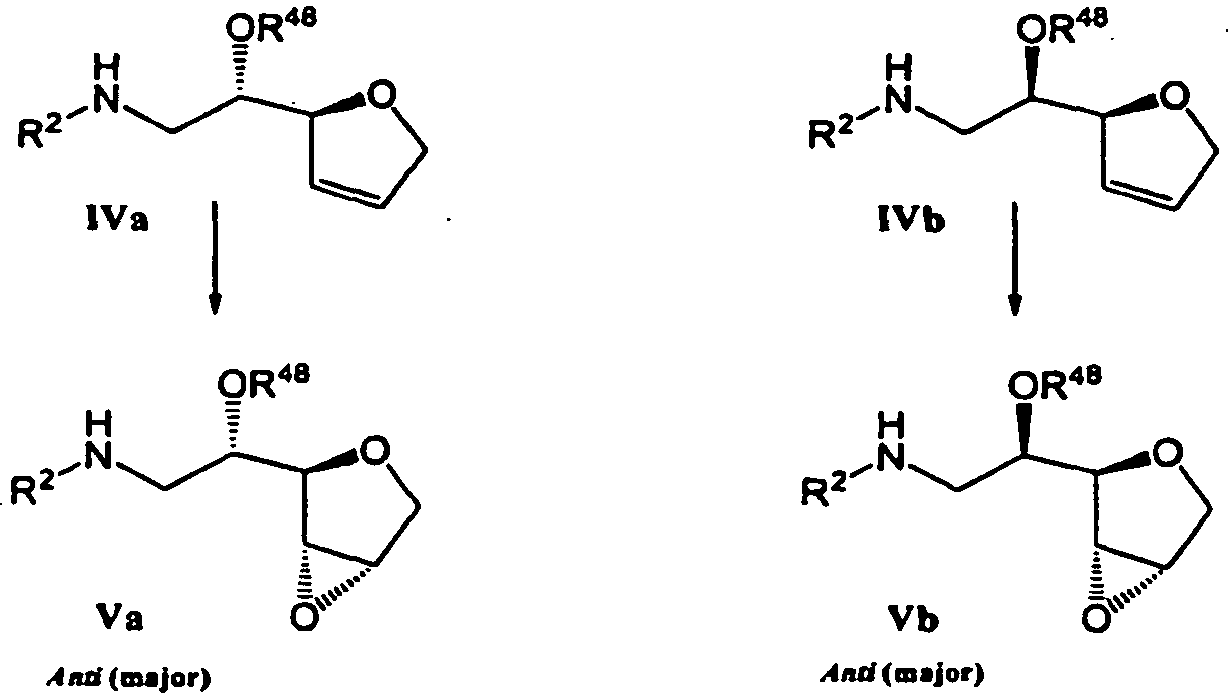
- By way of illustration, the controlled syntheses of diastereoisomeric alcohols (17) and (18) provide attractive intermediates useful in the preparation of compounds of general formulae Ia-Id that contain a substituent other than hydrogen in the 6-position of the 5,5-bicyclic ring (i.e. R1 ≠ H).
- For example, the alcohol functionality of (17) may be protected e.g. as the acid labile tert-butyl ether and utilised as detailed in Scheme 10 below, wherein benzyl (S)-2-((S)-2,5-dihydrofuran-2-yl)-2-hydroxyethyl carbamate (17) proceeds through the anti-epoxide benzyl (S)-2-((1S, 2R, 5S)-3,6-dioxabicyclo[3.1.0]hexan-2-yl)-2-tert-butoxyethyl carbamate (28). An analogous reaction scheme can be applied to benzyl (R)-2-((S)-2,5-dihydrofuan-2-yl)-2-hydroxyethyl carbamate (18) proceeding through the analogous anti-epoxide benzyl (R)-2-((1S, 2R, 5S)-3,6-dioxabicyclo[3.1.0]hexan-2-yl)-2-tert-butoxyethyl carbamate (28b). Preparation of tert-butyl ethers is typically performed through reaction of alcohol with 2-methylpropene in a solvent such as dichloromethane with acid catalysis (e.g. see Wunsch, E. and Jentsch, J. Chem. Ber., 97, 2490, 1964).

- Advantageously, tert-butyl ether protection leads to a substantial increase in the stereoselectivity of epoxidation when compared to that observed for alkene (23) (Table 1). The presence of either tert-butyl ether isomer (26 [S,S], 26b [S,R]) produces a substantial increase in the yield of desired anti-epoxide (28, 28b) when oxone based reagents are used for epoxidation when compared to the saturated analogue (23). A similar increase in ratio may also be observed when using hydrogen peroxide/alkylnitrile e.g. acetonitrile reagents (see Chaudhuri, N. K. and. Ball, T. J. J. Org. Chem., 47(26), 5196-5198, 1982 and Table 2 data for tosylates (32, 32b)).
Table 1: Ratio of anti:syn epoxides for alkenes (23), (26) and (26b) under various epoxidation conditions. (-) denotes experiment not assessed. Ratio of Anti : Syn epoxides mCPBA Oxone H2O2/ CH3CN Alkene (23) Anti-epoxide (24a) 17 5 2 Syn-epoxide (24b) 19 4 1 Alkene (26) Anti-epoxide (28) 2 10 - Syn-epoxide (27) 1 1 - Alkene (26b) Anti-epoxide (28b) 1 10 - Syn-epoxide (27b) 3 1 - - As a further example, the alcohol functionality of (17) may be derivatised as the methyl ether (30) and utilised as detailed in Scheme 11, wherein benzyl (S)-2-((S)-2,5-dihydrofuran-2-yl)-2-hydroxyethyl carbamate (17) proceeds through the anti-epoxides benzyl (S)-2-((1S, 2R, 5S)-3,6-dioxabicyclo[3.1.0]hexan-2-yl)-2-methoxyethyl carbamate (31). An analogous reaction scheme can be applied to benzyl (R)-2-((S)-2,5-dihydrofuran-2-yl)-2-hydroxyethyl carbamate (18) proceeding through the analogous anti-epoxide benzyl (R)-2-((1S, 2R, 5S)-3,6-dioxabicyclo[3.1.0]hexan-2-yl)-2-methoxyethyl carbamate (31b). Preparation of methyl ethers is typically performed through reaction of alcohol with methyl iodide in a solvent such as acetonitrile with silver(I) oxide catalysis (e.g. see Finch, N. et al, J. Org. Chem., 40, 206, 1975 and refs. cited therein). Alternatively, methyl ethers (30) and (30b) are prepared from alcohols (17) and (18) by reaction with trimethyloxonium fluoroborate, proton sponge [1,8-bis(dimethylamino)naphthalene] and molecular sieves in dichloromethane.

- Again an increase in the stereoselectivity of epoxidation is observed for methoxy substituted compounds 30, 30b, when compared to that observed for alkene (23). The presence of the (R)-methyl ether moiety in (30b) produces a 3-fold increase in the yield of desired anti-epoxide (31b) when oxone based reagents are used for epoxidation when compared to the saturated analogue (23).
- As a further example, the alcohol functionality of (18) may be derivatised as the para-toluene sulphonate (Ts) giving (R)-2-(benzyloxycarbonylamino)-1-((S)-2,5-dihydrofuran-2-yl)ethyl 4-methylbenzenesulfonate (32b) and utilised as detailed in Scheme 12, proceeding through the anti-epoxide (R)-2-(benzyloxycarbonylamino)-1-((1S, 2S, 5S)-3,6-dioxabicyclo[3.1.0]hexan-2-yl)ethyl 4-methylbenzenesulphonate (33b). An analogous reaction scheme can be applied to benzyl (S)-2-((S)-2,5-dihydrofuran-2-yl)-2-hydroxyethyl carbamate (17) proceeding through the analogous anti-epoxide (S)-2-(benzyloxycarbonylamino)-1-((1S, 2S, 5S)-3,6-dioxabicyclo[3.1.0] hexan-2-yl)ethyl 4-methylbenzenesulphonate (33) to give (3R, 3aR, 6S, 6aS)-benzyl 3-hydroxy-6-(tosyloxy)tetrahydro-2H-furo[3,2-b]pyrrole-4(5H)-carboxylate (34) and (3R, 3aR, 6S, 6aS)-tert-butyl 3-hydroxy-6-(tosyloxy)tetrahydro-2H-furo[3,2-b] pyrrole-4(5H)-carboxylate (35).

- Advantageously, tosyl protection of alcohols (17) and (18) leads to a substantial increase in the stereoselectivity of epoxidation when compared to that observed for alkene (23) (Table 2). The presence of either tosyl isomer in (32, 32b) produces a substantial increase in the yield of desired anti-epoxide (33, 33b) when oxone based reagents are used for epoxidation when compared to the saturated analogue (23). A significant increase in ratio is also observed when using hydrogen peroxide / alkylnitrile e.g. acetonitrile reagents (see Chaudhuri, N. K. and Ball, T. J. J. Org. Chem., 47(26), 5196-5198, 1982).
Table 2: Ratio of anti : syn epoxides for alkenes (23), (32) and (32b) under various epoxidation conditions. (-) denotes experiment not assessed. Ratio of Anti : Syn epoxides mCPBA Oxone H2O2 / CH3CN Alkene (23) Anti-epoxide (24a) 17 5 2 Syn-epoxide (24b) 19 4 1 Alkene (32) Anti-epoxide (33) 3 >10 - Syn-epoxide 1 1 - Alkene (32b) Anti-epoxide (33b) 2 >10 10 Syn-epoxide 1 1 1 - Furthermore, the tosyl group of bicyclic intermediates (34), (34b), (35), (35b) can act as a leaving group by employing a suitable nucleophile to provide access to additional 6-substituted analogues.
- For example, treatment of tosylate (34b) with sodium azide in dimethylformamide with heating provides 6-azido analogue (3R, 3aR, 6S, 6aS)-benzyl 6-azido-3-hydroxytetrahydro-2H-furo[3,2-b]pyrrole-4(5H)-carboxylate (36b) Scheme 13. Reduction of azide to amine e.g. with triphenylphosphine / water (e.g. see Mandville, G. et al, J. Org. Chem., 61, 1122, 1996) provides the 6-amino intermediate which is Boc-protected under standard Schotten-Baumann conditions providing (37b). Conversion of Cbz to Fmoc-protection and oxidation then provides building blocks (8b) and (8c) that can be utilised in a solid phase method to prepare 6-amino analogues of general formula Ic and Id. An analogous reaction sequence may be applied to tosylate (34) to provide the opposite 6-amino epimers (7b) and (7c). One skilled in the art will appreciate that tosylates (34), (34b), (35), (35b) are exceptionally versatile analogues that open-up synthetic routes to a wide range of 6-substitiuted compounds.

- The present invention also provides an alternative route for preparing 6-unsubstituted compounds of formula Ia-Id, i.e. where R1 is H.
- As for Scheme 12 above, the alcohol functionality of (18) may be derivatised as the para-toluene sulphonate (Ts) giving (R)-2-(benzyloxycarbonylamino)-1-((S)-2,5-dihydrofuran-2-yl)ethyl 4-methylbenzenesulfonate (32b) which proceeds through the anti-epoxide (R)-2-(Benzyloxycarbonylamino)-1-((1S, 2S, 5S)-3,6-dioxabicyclo[3.1.0]hexan-2-yl)ethyl 4-methylbenzenesulphonate (33b) Scheme 14. An analogous reaction scheme can be applied to benzyl (S)-2-((S)-2,5-dihydrofuran-2-yl)-2-hydroxyethyl carbamate (17) proceeding through the analogous anti-epoxide (S)-2-(Benzyloxycarbonylamino)-1-((1S, 2S, 5S)-3,6-dioxabicyclo[3.1.0] hexan-2-yl)ethyl 4-methylbenzenesulphonate (33) to give (3R, 3aR, 6S, 6aS)-benzyl 3-hydroxy-6-(tosyloxy)tetrahydro-2H-furo[3,2-b]pyrrole-4(5H)-carboxylate (34) and (3R, 3aR, 6S, 6aS)-tert-butyl 3-hydroxy-6-(tosyloxy)tetrahydro-2H-furo[3,2-b] pyrrole-4(5H)-carboxylate (35).
- Subsequent treatment of tosylate (35b) with super-hydride (for general refs. see (a) Brown, H. C., et al, J. Org. Chem., 45(1), 1-12, 1980; (b) Krishnamurthy, S and Brown, H. C., J. Org. Chem., 41(18), 3064-3066, 1976) reduces out the tosyl group giving the saturated bicycle intermediate, which through transformation of Boc to Fmoc-protection provides another route towards building blocks (2b) and (2c). Alternatively, treatment of aminotosylate (74) with super-hydride (for general refs. see (a) Brown, H. C., et al, J. Org. Chem., 45(1), 1-12, 1980; (b) Krishnamurthy, S and Brown, H. C., J. Org. Chem., 41 (18), 3064-3066, 1976) reduces out the tosyl group giving the saturated bicycle intermediate (2g) which may be Fmoc-protected to towards building blocks (2b) and (2c). Additionally, treatment of aminotosylate (74) with lithium aluminium hydride reduces out the tosyl group giving the saturated bicycle intermediate (2g) which may be Fmoc-protected to towards building blocks (2b) and (2c). Suprisingly, analogous reduction of tosylate (35b) with lithium aluminium hydride is a significantly less efficient reaction, which constasts the efficient reduction observed with super-hydride. These routes towards (2b) and (2c) has the advantage that epoxidation to give the desired anti-epoxide is directed by the presence of the tosylate group whilst only modest stereoselectivity can be achieved for saturated alkene (23). Thus, although this route to the 6-unsubstituted derivatives involves additional synthetic steps, the stereoselectivity of the epoxidation is controlled to allow much higher yields of the desired anti-epoxide.

- Another aspect of the invention relates to compounds of formula IVa, IVb, Va or Vb, and pharmaceutically acceptable salts, hydrates and solvates thereof,


- By way of summary, the present invention provides a new synthetic route to oxygen bicyclic structures such as tetrahydrofuro[3,2-b]pyrrol-3-ones (for example, as disclosed in
WO 02/057270 - The present invention is also centred on the discovery that alcohol protected compounds of formula IVa and IVb (for example, alcohol protected analogues of 17 and 18), in particular bulky groups such as tert-butyl, tosyl, provide a strong stereofacial preference for desired anti-epoxide during oxidation to the corresponding epoxides. This 'directing effect' is in stark contrast to equivalent reactions on unsubstituted analogues (such as compound 23), where little stereofacial preference is observed.
- Furthermore, the processes of the invention open up access to 5,5-bicyclic compounds having a substituent other than hydrogen in the 6-position (i.e. R1 ≠ H), either by direct synthesis (e.g. -OH, 6-OMe etc) or by nucleophilic substitution of the 6-tosylates (e.g. compounds 34/35 and 74) or 6-mesylates. By way of example, nucleophilic substitution of the tosyl analogue (compound 34b) with azide provides the 6-azido analogue (R1 = N3); one skilled in the art will appreciate that protection of the alcohol (e.g. with trimethylsilyl) functionality within this analogue followed by reduction of the 6-azido to 6-amino functionality (e.g. as detailed in scheme 13) provides a primary that may be N-alkylated (e.g. displacement of an alkyl halide [R3-halogen] or reductive amination [with aldehydes such as RzCHO or ketones such as RyRzC=O]) providing compounds wherein R1 = NR4R5. Alternatively, nucleophilic substitution of the tosyl analogue (compound 34b) with methylamine provides an additional route towards N-alkylated compounds wherein R1 = NHMe. One skilled in the art will appreciate that use of alternative alkylamine reagents provides access to other 6-alkylamino analogues. Also, within NR3R4 when either R3 or R4 are hydrogen, it is preferred that the secondary amino function is further protected, for example with the tert-butoxycarbonyl group, providing compounds of formula (Ia) or (Ib) wherein R2 is Cbz and R1 is BocNR4. Alternatively, nucleophilic substitution of the tosyl analogue (compounds 34 or 35) with sodium thiomethoxide [CAS 5188-07-8] in dimethylacetamide at 90°C provides the 6-SMe analogue; one skilled in the art will appreciate that use of alternative thioalkyl reagents provides access to other 6-alkylsulphide analogues (formula Ia,b R1 is SR7 wherein R7 is as previously defined); additionally one skilled in the art will appreciate that oxidation of the 6-alkylsulphide analogues provides access to the 6-sulphoxides (formula Ia,b R1 is SOR7 wherein R7 is as previously defined) and 6-alkylsulphones (formulae Ia,b R1 is SO2R7 wherein R7 is as previously defined). Compounds of formulae (Ia) and (Ib) wherein R1 is alkoxy (OR6) can be prepared by direct synthesis (e.g. see scheme 11). Alternatively, for example the R1 = ethoxy analogue can be prepared by displacement of tosylate (e.g. 35b) typically performed with sodium ethoxide in ethanol with heat. One skilled in the art will appreciate that use of alternative alkoxy reagents provides access to other 6-alkoxy analogues. Within carbocyclic and heterocarbocyclic rings, nucleophilic displacement of a secondary tosylate by halides is well known in the literature. For example, treatment of morphine tosylate analogues with tert-butyl ammonium fluoride and heat gives excellent yields of the inverted fluoro analogues (see Zhang, A. et al, Org. Lett. 2005, 7(15), 3239); pyrrolidine tosylate analogues with potassium fluoride and heat (see Giardina, G. et al, Synlett. 1995, 1, 55; Bouzard, D. et al, J. Med. Chem., 1990, 33(5), 1344)); nucleoside tosylate analogues with tert-butyl ammonium fluoride and heat (e.g. see
EP576231 - Other displacement reagents may be suitable for access to other 6-functionalised analogues, e.g. LiBr, DMF, heat towards the 6-Br analogue; alkylmetal reagents such as methyllithium (e.g. see Hanessian, S. et al, J. Am. Chem. Soc., 1990, 112(13), 5276-5290) towards the 6-Me analogue; trifluromethylating reagents such as trifluoromethyl trimethylsilane (e.g. see Sevenard. D. V. et al, Syn. Lett.,2001, 3, 379-381) or trifluoromethyl magnesium iodide towards the 6-CF3 analogue. Thus, these tosyl analogues not only direct the stereofacial preference of the epoxidation step, but also provide versatile intermediates to access a host of 6-substituted bicyclic species.
- Finally, the above-described tosyl analogues (35b), (74) can also be reduced to give the corresponding unsubstituted analogues (i.e. 5,5-bicyclic systems unsubstituted in the 6-position, where R1 is H), with the advantage that although this involves an additional synthetic step, the stereoselectivity of the epoxidation is controlled to ultimately allow much higher yields of the desired anti-epoxide.
- The present invention is further described by way of the following non-limiting examples.
- Solvents were purchased from ROMIL Ltd, U.K. at SpS or Hi-Dry grade unless otherwise stated. 1H NMR and 13C NMR were obtained on a Bruker DPX400 (400 MHz 1H frequency and 100 MHz 13C frequency; QXI probe) or Bruker Avance 500MHz (TXI probe with ATM) in the solvents indicated. Chemical shifts are expressed in parts per million (δ) and are referenced to residual signals of the solvent. Coupling constants (J) are expressed in Hz. All analytical HPLC were obtained on Phenomenex Jupiter C4, 5 µ, 300 Å, 250 × 4.6 mm, using mixtures of solvent A (0.1 % aq trifluoroacetic acid (TFA)) and solvent B (90% acetonitrile / 10% solvent A) on automated Agilent systems with 215 and / or 254 nm UV detection. Unless otherwise stated a gradient of 10 to 90% B in A over 25 min at 1.5 mL / min was performed for full analytical HPLC. HPLC-MS analysis was performed on an Agilent 1100 series LC/MSD, using automated Agilent HPLC systems, with a gradient of 10 to 90% B in A over 10 min on Phenomenex Luna C8, 5µ, 300 Å, 50 × 2.0 mm at 0.6 mL / min. Semi-preparative HPLC purification was performed on Phenomenex Jupiter C4, 5µ 300 Å, 250 × 10 mm, using a gradient of 10 to 90% B in A over 25 min at 4 mL / min on automated Agilent systems with 215 and / or 254 nm UV detection. Flash column purification was performed on silica gel 60 (Merck 9385) or using isolute SPE flash silica columns (Biotage, hengoed, UK).
-
- (i) Preparation of (3R, 3aS, 6R, 6aS)-Hexahydrofuro[3,2-b]furan-3,6-diyl bis(4-methylbenzenesulfonate) (39). A solution of p-toluenesulfonyl chloride (52 g, 273 mmol) in pyridine (150 mL) was added to a stirred solution of isomannide (40) (19.0 g, 130 mmol) in pyridine (150 mL) over 15 minutes then stirred at ambient temperature for 5 hours. The mixture was heated at 90 °C for 1.25 hours then stirred at ambient temperature for 16 hours, then heated at 90 °C for 1.25 hours before being poured onto iced-water (1 L). The aqueous was extracted with tert-butyl methyl ether (750 mL) then the organic phase washed with water (2 x 500 mL), diluted with dichloromethane (1 L), dried (MgSO4), filtered and reduced in vacuo to leave an oil (60.3 g). The oil was crystallized from hot methanol (400 mL), and the white solid filtered in vacuo, washed with methanol (150 mL) then dried in vacuo to obtain ditosylate (39) (44.0 g, 74%). TLC (Rf = 0.30, EtOAc : heptane 2 : 3), analytical HPLC single main peak, Rt = 20.513 min., HPLC-MS 455.1 [M + H]+, 931.2 [2M + Na]+,
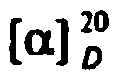
- (ii) Preparation of (3S, 3aS, 6S, 6aS)-3,6-Diiodohexahydrofuro[3,2-b]furan (48) and (3R, 3aS, 6S, 6aS)-3,6-diiodohexahydrofuro[3,2-b]furan (49) and (3R, 3aS, 6aS)-6-iodohexahydrofuro[3,2-b]furan-3-yl 4-methylbenzenesulfonate (38). Sodium iodide (116 g, 770 mmol) was added to a stirred solution of ditosylate (39) (43.8 g, 96.5 mmol) in dimethylformamide (250 mL) under nitrogen. The mixture was heated at 100 °C for 2 hours then at 125-135 °C for 3.5 hours then stood at ambient temperature for 16 hours. The reaction was heated at 135 °C for 1.5 hours then allowed to cool to ambient temperature before adding water (500 mL). The mixture was extracted with tert-butyl methyl ether (4 x 250 mL) then the organic phase washed with water (3 x 250 mL), brine (250 mL), dried (MgSO4), filtered and reduced in vacuo to leave a brown oil (35 g). Flash chromatography over silica, eluting with ethyl acetate : heptane mixtures 0 : 100 to 20 : 80 gave (in order of elution) a mixture (approximately 3 : 1 respectively) of diiodide (48) and diiodide (49) (20.35 g, 58%) as a white solid, and iodotosylate (38) (6.04 g, 15%) as a white solid. Data for iodotosylate (38); TLC (R f = 0.40, EtOAc : heptane 3 : 2), analytical HPLC single main peak, Rt = 17.044 min., HPLC-MS 411.0 [M + H]+, 843.0 [2M + Na]+; δH (500 MHz, CDCl3) 2.44 (3H, s, CH 3), 3.75 (1H, dd, J = 11.21 and 8.72 Hz, CH 2), 3.79 (1H, dd, J = 9.99 and 6.34 Hz, CH 2), 3.91 (1H, dd, J = 9.99 and 6.22 Hz, CH 2), 3.98-4.03 (1H, m, CHI), 4.14 (1H, dd, J = 8.56 and 7.56 Hz, CH 2), 4.39 and 4.57 (each 1H, t, J = 4.51 and 4.94 Hz respectively, CHCHCHI), 4.95 (1H, dd, J = 11.77 and 6.20 Hz, CHOTs), 7.34 (2H, d, J = 8.00 Hz, aromatic CH3CCH), 7.82 (2H, brd, J = 8.33 Hz, aromatic OSO2CCH); δC (125 MHz, CDCl3) 21.258 (CHI), 21.688 (CH3), 70.569 (CH2CHOTs), 75.998 (CH2CHI), 79.021, 79.383 and 82.387 (CHCHCHOTs), 127.958 and 129.883 (aromatic CH), 133.208 (CHOSO2 C quaternary), 145.206 (CH3 C quaternary).
- (iii) Preparation of (R)-1-((S)-2,5-Dihydrofuran-2-yl)-2-hydroxyethyl 4-methylbenzenesulfonate (13). A solution of methyllithium lithium iodide complex (2.68 mL, 1.0M in diethyl ether, 2.68 mmol) was added dropwise to a stirred solution of iodotosylate (38) (0.8 g, 2.19 mmol) in tetrahydrofuran (10 mL) under argon at -70 °C over 2 minutes. The mixture was stirred for 1 hour then saturated aqueous ammonium chloride solution (15 mL) was added dropwise. The mixture was allowed to warm to ambient temperature, diluted with water (10 mL) then the product extracted into dichloromethane (2 x 50 mL). The organic phase was washed with brine (50 mL), then dried (MgSO4), filtered and reduced in vacuo. Flash chromatography over silica, eluting with ethyl acetate : heptane mixtures 10 : 90 to 50 : 50 gave alcohol (13) (648 mg, 93%) as a white solid. TLC (Rf = 0.33, EtOAc : heptane 1 : 1), analytical HPLC single main peak, Rt = 12.67 min., HPLC-MS 285.1 [M + H]+, 591.2 [2M + Na]+;

- (iv) A stirred mixture of alcohol (13) (4.2 g, 14.8 mmol), ammonium hydroxide (20 mL) and ammonia in 2-propanol (15 mL, 2.0M, 30 mmol) was heated in a sealed tube at 70 °C for 16 hours then the solvents were removed in vacuo. The residue was azeotroped with diethyl ether to obtain (S)-2-amino-1-((S)-2,5-dihydrofuran-2-yl)ethanol which was used without further purification. TLC (Rf = 0.01, EtOAc : heptane 1 : 1), HPLC-MS 130.2 [M + H]+. A solution of sodium carbonate (2.35 g, 22.2 mmol) in water (20 mL) was added whilst stirring to a solution of (S)-2-amino-1-((S)-2,5-dihydrofuran-2-yl)ethanol in 1,4-dioxane (20 mL). A solution of benzylchloroformate (2.64 mL, 18.5 mmol) in 1,4-dioxane (5 mL) was added dropwise over 5 minutes. The mixture was stirred for 1.5 hours, then water (40 mL) added and the product extracted into dichloromethane (2 x 100 mL). The organic layer was dried (MgSO4), filtered and reduced in vacuo. Flash chromatography over silica, eluting with ethyl acetate : heptane mixtures 20 : 80 to 50 : 50 gave alcohol (17) as a colourless oil (2.62 g, 67%) as a white solid. TLC (Rf = 0.10, EtOAc : heptane 1 : 1), analytical HPLC two main peaks, Rt = 10.913 and 11.061 min., HPLC-MS 264.1 [M + H]+, 286.1 [M + Na]+, 549.2 [2M + Na]+;

- Alternative preparation of Benzyl (S)-2-((S)-2,5-dihydrofuran-2-yl)-2-hydroxyethylcarbamate (17); Zinc and 'One-pot' procedure. A solution of ammonium chloride (140 mg, 2.62 mmol) in water (1.5 mL) was added to a solution of iodotosylate (38) (800 g, 1.95 mmol) in propan-2-ol (3 mL) and tetrahydrofuran (6 mL) under argon. Zinc dust (140 mg, 2.15 mmol) was then added in portions over 5 minutes then the suspension stirred for 16 hours before filtering through celite in vacuo. The filter cake was washed with diethyl ether (15 mL). Hydrochloric acid (1M, 15 mL) was added to the filtrate then the organic phase separated. The aqueous layer was extracted with diethyl ether (15 mL) then the combined organic phase was washed with brine (15 mL), then dried (MgSO4), filtered and reduced in vacuo. The residue (0.54 g) was dissolved in ammonium hydroxide (4.5 mL) and a solution of ammonia in 2-propanol (3 mL, 2.0M, 6 mmol) then heated in a sealed tube at 75 °C for 16 hour. The solvents were removed in vacuo (transfer assisted with methanol) then the residue azeotroped with diethyl ether (5 mL) before adding ammonium hydroxide (4.5 mL) and ammonia in 2-propanol (3 mL, 2.0M, 6 mmol). The suspension was heated in a sealed tube at 75 °C for 16 hours. The solvents were removed in vacuo (transfer assisted with methanol) then the residue azeotroped with diethyl ether (3 x 5 mL) to obtain (S)-2-amino-1-((S)-2,5-dihydrofuran-2-yl)ethanol which was used without further purification.
- A solution of sodium carbonate (0.43 g, 4.10 mmol) in water (4 mL) was added whilst stirring to a solution of (S)-2-amino-1-((S)-2,5-dihydrofuran-2-yl)ethanol (assumed to be 1.95 mmol) in 1,4-dioxane (5 mL). The mixture was cooled to 0 °C then benzylchloroformate (0.42 mL, 2.93 mmol) was added dropwise over 10 minutes. The mixture was stirred at 0 °C for 95 minutes, then dichloromethane (25 mL) and water (30 mL) added. The organic phase was separated and the aqueous extracted with dichloromethane (2 x 10 mL). The organic layer was washed with brine (10 mL), then dried (Na2SO4), filtered and reduced in vacuo to leave a residue (1.31 g). Flash chromatography over silica, eluting with ethyl acetate : heptane mixtures 20 : 80 to 70 : 30 gave alcohol (17) (278 mg, 54%).

-
- (i) Preparation of (S)-2-((S)-2,5-Dihydrofuran-2-yl)-2-iodoethanol (12). A solution of methyllithium lithium iodide complex (40.6 mL, 1.0M in diethyl ether, 40.6 mmol) was added dropwise to a stirred solution containing diiodide mixture (48) and (49) (13.5 g, 36.9 mmol) in tetrahydrofuran (140 mL) under nitrogen at -70 °C over 12 minutes. The cloudy white suspension was stirred for 2.5 hours then saturated aqueous ammonium chloride solution (175 mL) was added dropwise over 30 minutes. Water (200 mL) was added then the mixture was allowed to warm to ambient temperature. The product was extracted into dichloromethane (2 x 250 mL) then the organic phase was washed with a mixture of brine and water (1:1, 200 mL), then dried (Na2SO4), filtered and reduced in vacuo to leave a colourless oil (8.6 g). Flash chromatography over silica, eluting with ethyl acetate : heptane mixtures 0 : 100 to 20 : 80 gave iodoalcohol (12) (5.41 g, 61%) as a yellow-brown oil., TLC (Rf = 0.20, EtOAc : heptane 3 : 2), analytical HPLC single main peak, Rt = 7.11 min., HPLC-MS 223.0 [M - 18 + H]+, 258.0, 263.0 [M + Na]+;

- (ii) A stirred mixture of iodoalcohol (12) (85 mg, 0.35 mmol), ammonium hydroxide (2.0 mL) and ammonia in 2-propanol (2.0 mL, 2.0M, 4 mmol) was heated in a sealed tube at 80 °C for 3.5 hours then the solvents were removed in vacuo. The residue was azeotroped with diethyl ether (3 x 5 mL) to obtain (R)-2-amino-1-((S)-2,5-dihydrofuran-2-yl)ethanol as a yellow oil which was used without further purification. TLC (Rf = 0.01, EtOAc : heptane 3 : 2), HPLC-MS 130.1 [M + H]+. A solution of sodium carbonate (79 mg, 0.74 mmol) in water (1.75 mL) was added whilst stirring to a solution of (R)-2-amino-1-((S)-2,5-dihydrofuran-2-yl)ethanol in 1,4-dioxane (2.5 mL). The mixture was cooled to 0 °C then a solution of benzylchloroformate (75 µL, 0.53 mmol) in 1,4-dioxane (1 mL) was added dropwise over 15 minutes. The mixture was stirred at 0 °C for 25 minutes, then water (10 mL) added and the product extracted into dichloromethane (1 x 10 mL then 2 x 5 mL). The organic layer was washed with brine (5 mL), then dried (Na2SO4), filtered and reduced in vacuo to leave a residue (0.128 g). Flash chromatography over silica, eluting with ethyl acetate : heptane mixtures 20 : 80 to 60 : 40 gave alcohol (18) as a colourless oil (72 mg, 77%) that solidified to a white solid after storage at -20 °C. TLC (Rf = 0.55, EtOAc : heptane 4 : 1), analytical HPLC single main peak, Rt = 10.91 min., HPLC-MS 220.1, 264.1 [M + H]+, 286.1 [M + Na]+, 549.2 [2M + Na]+;

- (iii) Alternative 'One-pot' procedure. A solution of methyllithium lithium iodide complex (42.8 mL, 1.0M in diethyl ether, 42.8 mmol) was added dropwise to a stirred solution containing a 7 : 3 mixture of diiodide (48) and diiodide (49) (12.53 g, 34.24 mmol) in tetrahydrofuran (150 mL) under argon at -70 °C over 5 minutes. The mixture was stirred for 2.25 hours then ammonium hydroxide solution (140 mL) was added dropwise over 3 minutes. The mixture was allowed to warm to ambient temperature then reduced in vacuo to leave a mixture of iodoalcohols (11,12) as an oil which was used without further purification.
- The mixture of iodoalcohols (11,12) was dissolved in ammonium hydroxide (80 mL) and a solution of ammonia in ethanol (50 mL, 2.0M, 100 mmol) then heated in a sealed tube at 75 °C for 3 hours. After standing at ambient temperature for 16 hours the solution was transferred using methanol then the solvents were removed in vacuo. The residue was azeotroped with diethyl ether (3 x 100 mL) to obtain a mixture of alcohols (13) and (14) which was used without further purification.
- A solution of sodium carbonate (7.62 g, 71.9 mmol) in water (100 mL) was added whilst stirring to a solution of alcohols (13) and (14) (assumed to be 34.24 mmol) in 1,4-dioxane (50 mL). The mixture was cooled to 0 °C then a solution of benzylchloroformate (7.33 mL, 51.36 mmol) in 1,4-dioxane (50 mL) was added dropwise over 15 minutes. The mixture was stirred at 0 °C for 1.5 hours then dichloromethane (200 mL) and water (200 mL) added. The organic phase was separated and the aqueous extracted with dichloromethane (2 x 200 mL). The combined organic phase was washed with brine (200 mL), then dried (Na2SO4), filtered and reduced in vacuo to leave a residue. Flash chromatography over silica, eluting with ethyl acetate : heptane mixtures 0 : 100 to 35 : 65 gave a 7 : 1 partially separated mixture of alcohol (18) and alcohol (17) as colourless oils (5.84 g, 65%).
- (iv) Alternative 'One-pot' procedure. A solution of methyllithium (7.4 mL, 1.6M in diethyl ether, 11.8 mmol) was added dropwise to a stirred solution containing a 1.12 : 1 mixture of diiodides (48) and (49) (3.46 g, 9.45 mmol) in tetrahydrofuran (40 mL) under nitrogen at -70 °C over 5 minutes. The mixture was stirred for 2.25 hours then saturated aqueous ammonium chloride solution (75 mL) was added dropwise. The mixture was allowed to warm to ambient temperature, diluted with water (75 mL) then the product extracted into dichloromethane (2 x 75 mL). The organic phase was washed with a mixture of brine and water (1:1, 75 mL), then dried (Na2SO4), filtered and reduced in vacuo to leave a mixture of iodoethanols (11,12) as an oil which was used without further purification.
- The mixture of iodoethanols (11,12) was dissolved in ammonium hydroxide (15 mL) and a solution of ammonia in 2-propanol (10 mL, 2.0M, 20 mmol) then divided into three equal portions and heated in three sealed tubes at 75 °C for 16 hours. Two of the tubes were combined (using methanol to assist with the transfer) then the solvents were removed in vacuo. The residue was azeotroped with diethyl ether (3 x 10 mL) to obtain a mixture of (R)- and (S)-2-amino-1-((S)-2,5-dihydrofuran-2-yl)ethanol as a yellow-brown oil which was used without further purification.
- A solution of sodium carbonate (1.3 g, 12.3 mmol) in water (12 mL) was added whilst stirring to a solution of (R)- and (S)-2-amino-1-((S)-2,5-dihydrofuran-2-yl)ethanol (assumed to be 5.86 mmol) in 1,4-dioxane (12 mL). The mixture was cooled to 0 °C then a solution of benzylchloroformate (1.25 mL, 8.79 mmol) in 1,4-dioxane (4 mL) was added dropwise over 15 minutes. The mixture was stirred at 0 °C for 1.5 hours, then water (100 mL) added and the product extracted into dichloromethane (3 x 100 mL). The organic layer was washed with brine (100 mL), then dried (Na2SO4), filtered and reduced in vacuo to leave a residue (1.86 g). Flash chromatography over silica, eluting with ethyl acetate : heptane mixtures 20 : 80 to 40 : 60 gave a 2.9 : 1 partially separated mixture of alcohol (18) and alcohol (17) as colourless oils (0.75 g, 49%).
- (v) Alternative 'One-pot' procedure. A solution of methyllithium (1.1 mL, 1.6M in diethyl ether, 1.71 mmol) was added dropwise to a stirred solution containing a 1.12 : 1 mixture of diiodides (48) and (49) (0.50 g, 1:37 mmol) in tetrahydrofuran (6 mL) under nitrogen at -70 °C over 5 minutes. The mixture was stirred for 2.25 hours then ammonium hydroxide solution (1.1 mL) was added dropwise. The mixture was allowed to warm to ambient temperature then reduced in vacuo to leave a mixture of iodoethanols (11, 12) as an oil which was used without further purification.
- The mixture of iodoethanols (11, 12) was dissolved in ammonium hydroxide (3 mL) and a solution of ammonia in 2-propanol (2 mL, 2.0M, 4 mmol) then heated in a sealed tube at 75 °C for 2.75 hours.,After standing at ambient temperature for 16 hours the solution was transferred using methanol then the solvents were removed in vacuo. The residue was azeotroped with diethyl ether (3 x 5 mL) to obtain a mixture of (R)- and (S)-2-amino-1-((S)-2,5-dihydrofuran-2-yl)ethanol which was used without further purification.
- A solution of sodium carbonate (305 mg, 2.88 mmol) in water (3 mL) was added whilst stirring to a solution of (R)- and (S)-2-amino-1-((S)-2,5-dihydrofuan-2-yl)ethanol (assumed to be 1.37 mmol) in 1,4-dioxane (3 mL). The mixture was cooled to 0 °C then a solution of benzylchloroformate (0.293 mL, 2.06 mmol) in 1,4-dioxane (1 mL) was added dropwise over 5 minutes. The mixture was stirred at 0 °C for 1.5 hours then dichloromethane (25 mL) and water (25 mL) added. The organic phase was separated and the aqueous extracted with dichloromethane (2 x 25 mL). The combined organic phase was washed with brine (25 mL), then dried (Na2SO4), filtered and reduced in vacuo to leave a residue (0.37 g). Flash chromatography over silica, eluting with ethyl acetate : heptane mixtures 20 : 80 to 40 : 60 gave a 2.7 : 1 partially separated mixture of alcohol (18) and alcohol (17) as colourless oils (216 mg, 60%).
- Preparation of (S)-1-((S)-2,5-Dihydrofuran-2-yl)-2-hydroxyethyl 4-methyl benzenesulfonate (14). A solution of methyllithium lithium iodide complex (5.4 mL, 1.0M in diethyl ether , 5.4 mmol) was added dropwise to a stirred solution of iodotosylates (41) (ref. Paolucci, D. et al, J. Org. Chem. 60, 169-175, 1995) (2.0 g, 4.88 mmol) in tetrahydrofuran (25 mL) under argon at -20 °C over 10 minutes. The mixture was stirred for 1 hour, then further methyllithium lithium iodide complex (0.54 mL, 1.0M in diethyl ether , 0.54 mmol) was added and stirred a further 30mins, then saturated aqueous ammonium chloride solution (10 mL) was added dropwise. The mixture was allowed to warm to ambient temperature, diluted with water (10 mL) then the product extracted into ethyl acetate (3 x 50 mL). The organic phase was washed dried (Na2SO4), filtered and reduced in vacuo. Flash chromatography over silica, eluting with ethyl acetate : heptane mixtures 1 : 2 to 1 : 1 gave alcohol (14) (648 mg, 93%) as a white solid. TLC (Rf = 0.1, EtOAc : heptane 1 : 2), analytical HPLC main peak, Rt = 12.5 min; HPLC-MS 285.1 [M + H]+, 302.1, 591.2 [2M + Na]+; δH (500 MHz, CDCl3) 2.12 (1H, brs, OH), 2.48 (3H, s, aryl-CH 3), 3.77 (2H, d, J = 4.85 Hz, CH 2OH), 4.54-4.58 (3H, m, CH 2OCH), 4.94-4.98 (1H, m, CHOTs), 5.64-5.67 and 5.97-6.00 (2H total, m, CH2CH=CH), 7.33 (2H, brd, J = 8.23 Hz, aromatic CH3CCH), 7.79 (2H, brd, J = 8:31 Hz, aromatic OSO2CCH); δC (125 MHz, CDCl3) 21.660 (CH3), 62.303 (CH2OH), 75.940 (OCH2CH=CH), 82.720 and 85.221 (OCHCHOTs), 124.792, 127.977, 129.479 and 129.749 (OCH2 CH=CH and aromatic CH), 133.496 (CHOSO2 C quaternary), 144.973 (CH3 C quaternary).
- Alternative preparation of (3R, 3aS, 6R, 6aS)-Hexahydrofuro[3,2-b]furan-3,6-diyl bis(4-methylbenzenesulfonate) (39). Isomannide (40) (50 g, 342.5 mmol) and p-toluenesulphonyl chloride (143.6 g, 753.2 mmol) were dissolved in a mixture of carbon tetrachloride (300 mL), dichloromethane (30 mL) and water (250 mL). The flask was cooled to 0 °C and a solution of potassium hydroxide (42.0 g, 750.0 mmol) in water (42 mL) added dropwise over 2 hours with stirring under argon. The resulting biphasic mixture was stirred vigorously at 0 °C for 24 hours. The resulting off-white precipitate, comprising a mixture of mono- and bistosylates (approximately 1 : 1), was collected by filtration in vacuo. The filter cake was washed with water then triturated with methanol (500 mL). The solid was isolated by filtration in vacuo to obtain ditosylate (39) as an off-white powder (75 g, 48%).

- Preparation of (3R, 3aS, 6S, 6aS)-6-Bromohexahydrofuro[3,2-b]furan-3-yl 4-methylbenzenesulfonate (46). A stirred mixture of ditosylate (39) (16.9 g, 37.22 mmol) and lithium bromide (4.85 g, 55.84 mmol) in N,N-dimethylformamide (100 mL) was heated at 100 °C for 27 hours. The mixture was allowed to cool then water (150 mL) added before extracting with tert-butyl methyl ether (1 x 100 mL then 5 x 50 mL). The organic phase was dried (MgSO4), filtered and reduced in vacuo to give a colourless oil which solidified on standing. Flash chromatography over silica, eluting with ethyl acetate : heptane mixtures 0 : 100 to 80 : 20 gave bromotosylate (46) as a white solid (2.86 g, 29 %). TLC (Rf = 0.45 diethyl ether : heptane, 1:1), analytical HPLC: Rf = 16.768 min; HPLC-MS: 363.1 / 365.0 [M+H]+, 380.1 / 382.1, 749.0 / 751.0 [2M+Na]+;
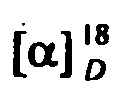
- Preparation of (3R, 3aS, 6R, 6aR)-6-Hydroxyhexahydrofuro[3,2-b]furan-3-yl 4-methylbenzenesulfonate (50). Isomannide (40) (10 g, 68.49 mmol) and p-toluenesulphonyl chloride (6.53 g, 34.25 mmol) were dissolved in a mixture of carbon tetrachloride (50 mL), dichloromethane (5 mL) and water (40 mL). The flask was cooled to 0 °C and a solution of potassium hydroxide (1.92 g, 34.25 mmol) in water (5 mL) added dropwise over 30 minutes with stirring. The resulting biphasic mixture was stirred at 0 °C for 7 hours. Then off-white precipitate was collected by filtration in vacuo then partitioned between dichloromethane (30 mL) and water (10 mL). The organic phase was washed with brine (2 x 10 mL) then dried (Na2SO4), filtered and reduced in vacuo to leave a colourless solid. Recrystallisation from carbon tetrachloride gave monotosylate (50) as colourless granules (3.92 g, 38%). TLC (Rf = 0.11, EtOAc : heptane I : 1); analytical HPLC main peak, Rf = 10.692 min; HPLC-MS 318.2, 323.1 [M + Na]+, 623.2 [2M + Na]+;

- Alternative preparation of (3R, 3aS, 6R, 6aR)-6-Hydroxyhexahydrofuro[3,2-b]furan-3-yl 4-methylbenzenesulfonate (50). A solution of p-toluenesulfonyl chloride (24.8 g, 130 mmol) in pyridine (150 mL) was added to a stirred solution of isomannide (40) (19.0 g, 130 mmol) in pyridine (150 mL) over 1 hour at 0 °C then stirred at ambient temperature for 1 hour. The mixture was poured onto iced-water (1 L) then extracted with dichloromethane (3 x 300 mL). The organic phase washed with brine (300 mL), dried (MgSO4), filtered and reduced in vacuo to leave a residue. Flash chromatography over silica, eluting with ethyl acetate : heptane mixtures 0 : 100 to 50 : 50 gave monotosylate (50) (23.4 g, 60%) as a white solid.
- Alternative preparation of (3R, 3aS, 6S, 6aS)-6-Bromohexahydrofuro[3,2-b]furan-3-yl 4-methylbenzenesulfonate (46). A solution of carbon tetrabromide (18.12 g, 54.63 mmol) in pyridine (100 mL) was added to a solution of monotosylate (50) (14.9 g, 49.66 mmol) and triphenylphosphine (26.1 g, 99.32 mmol) in pyridine (150 mL) over 30 minutes, then the mixture heated at 65 °C for 1.5 hours under an atmosphere of argon. Water (200 mL) was added then the aqueous phase extracted with dichloromethane (5 x 100 mL). The organic phase was washed with brine (50 mL), then dried (MgSO4), filtered and reduced in vacuo to leave a residue which was azeotroped with toluene (5 x 50 mL). Flash chromatography over silica, eluting with diethyl ether : heptane mixtures 0 : 100 to 100 : 0 gave bromotosylate (46) (7.70 g, 43%) as a white solid.

- Alternative preparation of (R)-1-((S)-2,5-Dihydrofuran-2-yl)-2-hydroxyethyl 4-methyl benzenesulfonate (13) . A solution of ammonium chloride (100 mg, 1.87 mmol) in water (1.25 mL) then zinc dust (100 mg, 1.54 mmol) were added to a solution of bromotosylate (46) (0.5 g, 1.38 mmol) in tetrahydrofuran (5 mL) and propan-2-ol (2.5 mL) under argon. The mixture was stirred for 16 hours before filtering the suspension through celite in vacuo. The filter cake was washed with diethyl ether (20 mL). Hydrochloric acid (1M, 20 mL) was added to the filtrate then the organic phase separated. The aqueous layer was extracted with diethyl ether (20 mL) then the combined organic phase was washed with brine (20 mL), then dried (MgSO4), filtered and reduced in vacuo to leave a residue. Flash chromatography over silica, eluting with ethyl acetate : heptane mixtures 20 : 80 to 50 : 50 gave alcohol (13) (292 mg, 75%) as a white solid.

- Alternative preparation of Benzyl (S)-2-((S)-2,5-dihydrofuran-2-yl)-2-hydroxyethylcarbamate (17); Zinc and 'One-pot' procedure. A solution of ammonium chloride (560 mg, 10.5 mmol) in water (7 mL) was added to a solution of bromotosylate (46) (2.86 g, 7.88 mmol) in propan-2-ol (14 mL) under argon. Zinc dust (560 mg, 8.67 mmol) was then added in portions over 4 minutes then the suspension stirred for 16 hours before filtering through celite in vacuo. The filter cake was washed with diethyl ether (60 mL). Hydrochloric acid (1M, 60 mL) was added to the filtrate then the organic phase separated. The aqueous layer was extracted with diethyl ether (60 mL) then the combined organic phase was washed with brine (60 mL), then dried (MgSO4), filtered and reduced in vacuo. The residue was dissolved in ammonium hydroxide (18 mL) and a solution of ammonia in propan-2-ol (12 mL, 2.0M, 24 mmol) then divided into three equal portions and heated in sealed tubes at 75 °C for 16 hours. The mixtures were combined using methanol then the solvents were removed in vacuo. The residue was azeotroped with diethyl ether (3 x 10 mL) to obtain (S)-2-amino-1-((S)-2,5-dihydrofuran-2-yl)ethanol which was used without further purification.
- A solution of sodium carbonate (1.75 g, 16.6 mmol) in water (16 mL) was added whilst stirring to a solution of (S)-2-amino-1-((S)-2,5-dihydrofuran-2-yl)ethanol (assumed to be 7.88 mmol) in 1,4-dioxane (20 mL). The mixture was cooled to 0 °C then benzylchloroformate (1.69 mL, 11.82 mmol) was added dropwise over 10 minutes. The mixture was stirred at 0 °C for 85 minutes, then dichloromethane (75 mL) and water (100 mL) added. The organic phase was separated and the aqueous extracted with dichloromethane (2 x 50 mL). The organic layer was washed with brine (50 mL), then dried (Na2SO4), filtered and reduced in vacuo to leave a residue (3.1 g). Flash chromatography over silica, eluting with ethyl acetate : heptane mixtures 20 : 80 to 70 : 30 gave alcohol (17) (1.10 g, 53%).

- Preparation of (3R, 3aS, 6S, 6aS)-Hexahvdrofuro[3,2-b]furan-3,6-diyl bis(4-methylbenzenesulfonate) (42). A stirred solution of p-toluenesulfonyl chloride (57.4 g, 301 mmol) and isosorbide (43) (20 g, 137 mmol) in pyridine (315 mL) was heated at 95 °C for 4.5 hours under an atmosphere of argon then stood at ambient temperature for 16 hours before being poured onto iced-water (1 L). The aqueous was extracted with dichloromethane (2 x 500 mL), then the combined organic layers were washed with water (2 x 500 mL), then dried (Na2SO4), filtered then reduced in vacuo to leave a viscous oil (65.22 g). The oil was crystallized from hot methanol (350 mL). The white solid was collected by filteration in vacuo, then washed with methanol (100 mL) and dried in vacuo to obtain ditosylate (42) as a white solid (45.87 g, 74%). TLC (Rf = 0.30, EtOAc : heptane 2 : 3), analytical HPLC single main peak, Rt = 20.219 min., HPLC-MS 455.1 [M + H]+, 931.2 [2M + Na]+,

- Alternative Preparation of (3R, 3aS, 6S, 6aS)-Hexahydrofuro[3,2-b]furan-3,6-diyl bis(4-methylbenzenesulfonate) (42). Triethylamine (123.2 mL, 876 mmol) was added dropwise to a stirred solution of p-toluenesulfonyl chloride (156.6 g, 822 mmol) and isosorbide (43) (40 g, 274 mmol) in dichloromethane (600 mL) over 15 minutes. The mixture was stirred at 25 °C for 16 hours then at 50 °C for 4 hours before diluting with dichloromethane (1 L). The organic layer was washed with water (2 x 1 L), then dried (Na2SO4), filtered then reduced in vacuo to leave a viscous oil. The oil was crystallized from hot methanol (600 mL) to obtain ditosylate (42) as a white solid (120.1 g, 97%).

- Alternative preparation of (3R, 3aS, 6S, 6aS)-Hexahydrofuro[3,2-b]furan-3,6-diyl bis(4-methylbenzenesulfonate) (42). Triethylamine (123.2 mL, 876 mmol) was added over 15 minutes to a stirred solution of isosorbide (43) (40 g, 274 mmol) and p-toluenesulfonyl chloride (156.6 g, 822 mmol) in dichloromethane (600 mL). The mixture was heated at 25 °C for 4 hours, then at 50 °C for 4 hours. Dichloromethane (1L) was added then the mixture was washed with water (2 x 1L), then dried (Na2SO4), filtered then reduced in vacuo to leave a viscous oil. The oil was crystallized from methanol (600 mL) to obtain obtain ditosylate (42) (123.7 g, 99%) as an off-white solid.
- Preparation of (3S, 3aS, 6S, 6aS)-6-Bromohexahvdrofuro[3,2-b]furan-3-yl 4-methylbenzenesulfonate (47). Lithium bromide (9.6 g, 110.1 mmol) was added to a stirred solution of ditosylate (42) (20.0 g, 44.05 mmol) in dimethylformamide (100 mL) under an atmosphere of argon. The mixture was heated at 1.10. °C for 5 hours then stood at ambient temperature for 3 days, then heated at 90 °C for 3.5 hours. The mixture was diluted with water (250 mL) extracted with tert-butyl methyl ether (4 x 125 mL) then the organic phase washed with water (3 x 125 mL), brine (125 mL), dried (MgSO4), filtered and reduced in vacuo to leave a brown oil (16.8 g). Flash chromatography over silica, eluting with ethyl acetate : heptane mixtures 0 : 100 to 30 : 70 gave bromotosylate (47) (11.88 g, 74%) as a pale yellow solid. TLC (Rf = 0.20, EtOAc : heptane 1 : 3); analytical HPLC main peak, Rt = 18.050 min; HPLC-MS 381.0 / 383.0 [M + H2O + H]+, 385.0 / 387.0 [M + Na]+;

- Alternative preparation of (3S, 3aS, 6S, 6aS)-6-Bromohexahydrofuro[3,2-b]furan-3-yl 4-methylbenzenesulfonate (47) . Lithium bromide (38.4 g, 440 mmol) was added to a stirred solution of ditosylate (42) (80 g, 176 mmol) in dimethylformamide (400 mL) under an atmosphere of argon. The mixture was heated at 110 °C for 8 hours. The mixture was diluted with water (1 L) extracted with tert-butyl methyl ether (4 x 500 mL) then the organic phase washed with water (3 x 500 mL), brine (500 mL), dried (MgSO4), filtered and reduced in vacuo to leave a brown oily residue. The residue was triturated with diethyl ether then the solid collected by filtration in vacuo to obtain bromotosylate (47) (22.02 g) as an off-white solid. The diethyl ether layer was concentrated in vacuo, then the residue was recrystallised from methanol (50 mL) to bromotosylate (47) (17.6 g) as pale brown solid (combined yield 62%).
- Alternative preparation of (3S, 3aS, 6S, 6aS)-6-Bromobexabvdrofuro[3,2-b]furan-3-yl 4-methylbenzenesulfonate (47) . Lithium bromide (19.2 g, 220.2 mmol) was added to a stirred solution of ditosylate (42) (40.0 g, 88.1 mmol) in dimethyl sulfoxide (200 mL) under an atmosphere of argon. The mixture was heated at 110 °C for 8 hours then at 120 °C for 1.75 hours. The mixture was diluted with water (500 mL) then extracted with tert-butyl methyl ether (4 x 250 mL). The organic phase was washed with water (3 x 250 mL) then brine (250 mL), dried (MgSO4), filtered and reduced in vacuo to leave an orange solid. Recrystallisation from methanol (100 mL) gave bromotosylate (47) (17.47 g, 55%) as a pale yellow solid.

- Alternative preparation of (S)-1-((S)-2,5-Dihydrofuran-2-yl)-2-hydroxyethyl 4-methyl benzenesulfonate (14). Ammonium chloride (20 mg, 0.37 mmol) then zinc dust (20 mg, 0.31 mmol) were added to a solution of bromotosylate (47) (100 mg, 0.28 mmol) in ethanol (1.5 mL) under argon. The mixture was stirred for 16 hours before filtering the suspension through celite in vacuo. The filter cake was washed with ethanol (20 mL) then the filtrate reduced in vacuo to leave a residue (111 mg). Flash chromatography over silica, eluting with ethyl acetate : heptane mixtures 20 : 80 to 40 : 60 gave alcohol (14) (53 mg, 68%) as a white solid. TLC (Rf = 0.15, EtOAc : heptane 1 : 2); analytical HPLC main peak, Rt = 12.543 min; HPLC-MS 285.1 [M + H]+, 302.1, 591.2 [2M + Na]+; [α] D 15 -86.8° (c = 5.3, CHCl3); δH (500 MHz, CDCl3) 2.12 (1H, brs, OH), 2.44 (3H, s, aryl-CH 3), 3.77 (2H, d, J = 4.85 Hz, CH 2OH), 4.54-4.58 (3H, m, CH 2OCH), 4.94-4.98 (1H, m, CHOTs), 5.64-5.67 and 5.97-6.00 (2H total, m, CH2CH=CH), 7.33 (2H, brd, J = 8.23 Hz, aromatic CH3CCH), 7.79 (2H, brd, J = 8.31 Hz, aromatic OSO2CCH); δ c (125 MHz, CDCl3) 21.660 (CH3), 62.303 (CH2OH), 75.940 (OCH2CH=CH), 82.720 and 85.221 (OCHCHOTs), 124.792, 127.977, 129.479 and 129.749 (OCH2 CH=CH and aromatic CH), 133.496 (CHOSO2 C quaternary), 144.973 (CH3 C quaternary).
- Alternative preparation of (S)-1-((S)-2,5-Dihydrofuran-2-yl)-2-hydroxyethyl 4-methyl benzenesulfonate (14). Ammonium chloride (200 mg, 3.7 mmol) then zinc dust (200 mg, 3.1 mmol) were added to a suspension of bromotosylate (47) (1 g, 2.75 mmol) in propan-2-ol (15 mL) under argon. The mixture was stirred for 16 hours before filtering the suspension through celite in vacuo. The filter cake was washed with propan-2-ol (20 mL) then the filtrate reduced in vacuo to leave a residue (1.43 g). Flash chromatography over silica, eluting with ethyl acetate : heptane mixtures 20 : 80 to 50 : 50 gave alcohol (14) (566 mg, 72%) as a white solid.

- Alternative preparation of (S)-1-((S)-2,5-Dihydrofuran-2-yl)-2-hydroxyethyl-4-methyl benzenesulfonate (14) . A solution of ammonium chloride (200 mg, 3.7 mmol) in water (2.5 mL) then zinc dust (200 mg, 3.1 mmol) were added to a solution of bromotosylate (47) (1 g, 2.75 mmol) in tetrahydrofuran (10 mL) under argon. The mixture was stirred for 16 hours before filtering the suspension through celite in vacuo. The filter cake was washed with tert-butyl methyl ether (20 mL). Water (20 mL) and brine (20 mL) were added to the filtrate then the organic phase separated. The aqueous layer was extracted with tert-butyl methyl ether (20 mL) then the combined organic phase was washed with brine (20 mL), dried (MgSO4), filtered and reduced in vacuo to leave a residue (0.82 g). Flash chromatography over silica, eluting with ethyl acetate: heptane mixtures 20 : 80 to 50 : 50 gave alcohol (14) (544 mg, 70%) as a white solid. [α]15 D -86.1° (c = 10.8, CHCl3).
- Alternative preparation of (S)-1-((S)-2,5-Dihydrofuran-2-yl)-2-hydroxyethyl 4-methyl benzenesulfonate (14) . A solution of ammonium chloride (200 mg, 3.7 mmol) in water (2.5 mL) then zinc dust (200 mg, 3.1 mmol) were added to a solution of bromotosylate (47) (1 g, 2.75 mmol) in tetrahydrofuran (10 mL) and propan-2-ol (5 mL) under argon. The mixture was stirred for 16 hours before filtering the suspension through celite in vacuo. The filter cake was washed with diethyl ether (20 mL). Hydrochloric acid (1M, 20 mL) was added to the filtrate then the organic phase separated. The aqueous layer was extracted with diethyl ether (20 mL) then the combined organic phase was washed with brine (20 mL), then dried (MgSO4), filtered and reduced in vacuo to leave a residue (1.06 g). Flash chromatography over silica, eluting with ethyl acetate : heptane mixtures 20 : 80 to 50 : 50 gave alcohol (14) (528 mg, 68%) as a white solid.

- Alternative preparation of (S)-1-((S)-2,5-Dibydrofuran-2-yl)-2-hydroxyethyl 4-methyl benzenesulfonate (14) . A solution of methyllithium lithium iodide complex (6.6 mL, 1.0M in diethyl ether, 6.6 mmol) was added dropwise to a stirred solution of bromotosylate (47) (2.0 g, 5.5 mmol) in tetrahydrofuran (25 mL) under argon at -70 °C over 10 minutes. The mixture was stirred for 2 hours before dropwise addition of saturated aqueous ammonium chloride solution (12 mL). The mixture was allowed to warm to ambient temperature then extracted with ethyl acetate (3 x 25 m). The organic phase was dried (Na2SO4), filtered and reduced in vacuo to leave a residue (1.5 g). Flash chromatography over silica, eluting with ethyl acetate : heptane mixtures 25 : 75 to 35 : 65 gave gave alcohol (14) (315 mg, 20%) as a white solid.
- Alternative preparation of (S)-1-((S)-2.5-Dihydrofuran-2-yl)-2-hydroxyethyl 4-methyl benzenesulfonate (14) . A solution of n-butyllithium (4.1 mL, 1.6M in hexanes, 6.6 mmol) was added dropwise to a stirred solution of bromotosylate (47) (2.0 g, 5.5 mmol) in tetrahydrofuran (25 mL) under argon at -70°C over 10 minutes. The mixture was stirred for 1 hour before dropwise addition of saturated aqueous ammonium chloride solution (12 mL). The mixture was allowed to warm to ambient temperature then extracted with ethyl acetate (3 x 25 mL). The organic phase was dried (Na2SO4), filtered and reduced in vacuo to leave a residue (0.935 g). Flash chromatography over silica, eluting with ethyl acetate : heptane mixtures 25 : 75 to 35 : 65 gave alcohol (14) (590 mg, 38%) as a white solid.
- Alternative preparation of (S)-1-((S)-2,5-Dibydrofuran-2-yl-2-hydroxyethyl 4-methyl benzenesulfonate (14). A solution of methyllithium (6.6 mL, 0.98M in diethyl ether, 6.6 mmol) was added dropwise to a stirred solution of bromotosylate (47) (2.0 g, 5.5 mmol) in tetrahydrofuran (25 mL) under argon at -70°C over 10 minutes. The mixture was stirred for 2 hours before dropwise addition of saturated aqueous ammonium chloride solution (12 mL). The mixture was allowed to warm to ambient temperature then extracted with ethyl acetate (3 x 25 mL). The organic phase was dried (Na2SO4), filtered and reduced in vacuo to leave a residue (1.8 g). Flash chromatography over silica, eluting with ethyl acetate : heptane mixtures 25 : 75 to 50 : 50 gave alcohol (14) (419 mg, 27%) as a white solid.
- Alternative preparation of (S)-1-((S)-2,5-Dihydrofuran-2-yl)-2-hydroxyethyl 4-methyl benzenesulfonate (14). A solution of ammonium chloride (4 g, 74.8 mmol) in water (50 mL) then zinc dust (4 g, 61.6 mmol) were added to a solution of bromotosylate (47) (20 g, 55 mmol) in tetrahydrofuran (200 mL) and propan-2-ol (100 mL). The mixture was stirred for 16 hours before filtering the suspension through celite in vacuo. The filter cake was washed with diethyl ether (400 mL). Hydrochloric acid (1M, 400 mL) was added to the filtrate then the organic phase separated. The aqueous layer was extracted with diethyl ether (400 mL) then the combined organic phase was washed with brine (400 mL), then dried (MgSO4), filtered and reduced in vacuo to leave a residue. Flash chromatography over silica, eluting with ethyl acetate : heptane mixtures 0 : 100 to 50 : 50 gave alcohol (14) (11.28 g, 72%) as a pale yellow oil. [α]14 D -77.1° (c = 9.15, CHCl3).
- Alternative preparation of Benzyl (R)-2-((S)-2,5-dihydrofuran-2-yl)-2-hydroxyethylcarbamate (18) . Alcohol (14) (4.3 g, 15.1 mmol) was dissolved in ammonium hydroxide (30 mL) and a solution of ammonia in 2-propanol (20 mL, 2.0M, 80 mmol). The solution was divided into two equal portions then heated at 75°C in sealed tubes for 16 hours. The mixtures were combined using methanol then the solvents were removed in vacuo. The residue was azeotroped with diethyl ether (3 x 20 mL) to obtain (R)-2-amino-1-((S)-2,5-dihydrofuran-2-yl)ethanol which was used without further purification.
- A solution of sodium carbonate (3.37 g, 31.8 mmol) in water (24 mL) was added whilst stirring to a suspension of (R)-2-amino-1-((S)-2,5-dihydrofuran-2-yl)ethanol (assumed to be 15.1 mmol) in 1,4-dioxane (30 mL). The mixture was cooled to 0 °C then benzylchloroformate (2.7 mL, 18.9 mmol) was added dropwise over 10 minutes. The mixture was stirred at 0 °C for 45 minutes then dichloromethane (100 mL) and water (150 mL) added. The organic phase was separated and the aqueous extracted with dichloromethane (2 x 50 mL). The organic layer was washed with brine (50 mL), then dried (Na2SO4), filtered and reduced in vacuo to leave a residue (5.2 g). Flash chromatography over silica, eluting with ethyl acetate : heptane mixtures 20 : 80 to 70 : 30 gave alcohol (18) (3.09 g, 78%).

- Alternative preparation of Benzyl (R)-2-((S)-2,5-dihydrofuran-2-yl)-2-bydroxyethylcarbamate (18); Zinc and 'One-pot' procedure . A solution of ammonium chloride (600 mg, 11.2 mmol) in water (7.5 mL) was added to a solution of bromotosylate (47) (3.0 g, 8.26 mmol) in propan-2-ol (15 mL) under argon. Zinc dust (600 mg, 9.2 mmol) was then added in portions over 4 minutes and the mixture was stirred for 16 hours before filtering the suspension through celite in vacuo. The filter cake was washed with diethyl ether (60 mL). Hydrochloric acid (1M, 60 mL) was added to the filtrate then the organic phase separated. The aqueous layer was extracted with diethyl ether (60 mL) then the combined organic phase was washed with brine (60 mL), then dried (MgSO4), filtered and reduced in vacuo. The residue was dissolved in ammonium hydroxide (18 mL) and a solution of ammonia in propan-2-ol (12 mL, 2.0M, 24 mmol), then divided into two equal portions and heated in sealed tubes at 75 °C for 16 hours. The mixtures were combined using methanol then the solvents were removed in vacuo. The residue was azeotroped with diethyl ether (3 x 10 mL) to obtain (R)-2-amino-1-((S)-2,5-dihydrofuran-2-yl)ethanol which was used without further purification.
- A solution of sodium carbonate (1.84 g, 17.4 mmol) in water (16 mL) was added whilst stirring to a suspension of (R)-2-amino-1-((S)-2,5-dihydrofuran-2-yl)ethanol (assumed to be 8.26 mmol) in 1,4-dioxane (20 mL). The mixture was cooled to 0 °C then benzylchloroformate (1.77 mL, 12.4 mmol) was added dropwise over 5 minutes. The mixture was stirred at 0 °C for 55 minutes then dichloromethane (75 mL) and water (100 mL) added. The organic phase was separated and the aqueous extracted with dichloromethane (2 x 50 mL). The organic phase was washed with brine (50 mL), then dried (Na2SO4), filtered and reduced in vacuo to leave a residue (3.7 g). Flash chromatography over silica, eluting with ethyl acetate : heptane mixtures 20 : 80 to 70 : 30 gave alcohol (18) (1.26 g, 58%).

- Alternative preparation of Benzyl (R)-2-((S)-2,5-dihydrofuran-2-yl)-2-hydroxyethylcarbamate (18); Zinc and 'One-not' procedure 2. A solution of ammonium chloride (4 g, 74.8 mmol) in water (50 mL) then zinc dust (4 g, 61.6 mmol) were added to a solution of bromotosylate (47) (20 g, 55 mmol) in tetrahydrofuran (200 mL) and propan-2-ol (100 mL). The mixture was stirred for 6 hours then zinc dust (4 g, 61.6 mmol) was added. The mixture was stirred for an additional 16 hours before filtering the suspension through celite in vacuo. The filter cake was washed with diethyl ether (400 mL). Hydrochloric acid (1M, 400 mL) was added to the filtrate then the organic phase separated. The aqueous layer was extracted with diethyl ether (400 mL) then the combined organic phase was washed with brine (400 mL), then dried (MgSO4), filtered and reduced in vacuo to leave a residue. The residue was partially dissolved in ammonium hydroxide (92 mL) and a solution of ammonia in 2-propanol (60 mL, 2.0M, 120 mmol) then divided into 6 equal portions and heated in sealed tubes at 75°C for 16 hours. The mixtures were combined using methanol, then the solvents were removed in vacuo. The residue was azeotroped with diethyl ether (3 x 50 mL) to obtain (R)-2-amino-1-((S)-2,5-dihydrofuran-2-yl)ethanol which was used without further purification.
- A solution of sodium carbonate (12.26 g, 115.7 mmol) in water (80 mL) was added whilst stirring to a solution of (R)-2-amino-l-((S)-2,5-dihydrofuran-2-yl)ethanol (assumed to be 55 mmol) in tetrahydrofuran (100 mL). The mixture was cooled to 0 °C then benzylchloroformate (9.69 mL, 68.87 mmol) was added. The mixture was stirred at 0 °C for 45 minutes, then dichloromethane (400 mL) and water (400 mL) added. The organic phase was separated and the aqueous reextracted with dichloromethane (2 x 400 mL). The organic layer was washed with brine (400 mL), then dried (Na2SO4), filtered and reduced in vacuo to leave a residue. Flash chromatography over silica, eluting with ethyl acetate : heptane mixtures 0 : 100 to 65 : 35 gave alcohol (18) (11.58 g, 80%) as a pale yellow oil.
- Alternative preparation of Benzyl (R)-2-((S)-2,5-dihydrofuran-2-yl)-2-hydroxyethylcarbamate (18); 'One-pot' procedure 3: Aqueous Conditions. (S)-1-((S)-2,5-Dihydrofuran-2-yl)-2-hydroxyethyl 4-methylbenzenesulfonate (14) (0.95 g, 3.35 mmol) was suspended in ammonium hydroxide (4 mL) then stirred and heated at 75°C in a sealed tube for 6 hours during which time the two liquid phases became a single phase solution. The mixture was stirred at ambient temperature for 20 hours then the solvents were removed in vacuo. The residue was azeotroped with diethyl ether (3 x 10 mL) to obtain (R)-2-amino-1-((S)-2,5-dihydrofuran-2-yl)ethanol which was used without further purification.
- 1,4-Dioxane (7 mL) then a solution of sodium carbonate (745 mg, 7.02 mmol) in water (6 mL) was added whilst stirring to the crude (R)-2-amino-1-((S)-2,5-dihydrofuran-2-yl)ethanol (assumed to be 3.35 mmol) then the mixture was cooled to 0 °C. Benzylchloroformate (0.597 mL, 4.18 mmol) was added dropwise over 25 minutes then the mixture was stirred at 0 °C for 4 hours before adding dichloromethane (25 mL) and water (30 mL). The organic phase was separated and the aqueous reextracted with dichloromethane (2x10 mL). The organic layer was washed with brine (10 mL), then dried (Na2SO4), filtered and reduced in vacuo to leave an orange oil (1.14 g). Flash chromatography over silica, eluting with ethyl acetate : heptane mixtures 20 : 80 to 55 : 45 gave alcohol (18) (613 mg, 70%).

- Preparation of tert-Butyl (R)-2-((S)-2,5-dihydrofuran-2-yl)-2-hydroxyethyl carbamate (80). (S)-1-((S)-2,5-dihydrofuran-2-yl)-2-hydroxyethyl 4-methylbenzenesulfonate (14) (1.0 g, 3.52 mmol) was suspended in ammonium hydroxide (8 mL) then stirred and heated at 75°C in a sealed tube for 6.5 hours during which time the two liquid phases became a single phase solution. The mixture was stood at ambient temperature for 2 days then the solvents were removed in vacuo. The residue was azeotroped with diethyl ether (3 x 10 mL) to obtain (R)-2-amino-1-((S)-2,5-dihydrofuran-2-yl)ethanol which was used without further purification.
- Ethyl acetate (20 mL) then di-tert-butyl dicarbonate (806 mg, 3.70 mmol) were added whilst stirring to the crude (R)-2-amino-1-((S)-2,5-dihydrofuran-2-yl)ethanol (assumed to be 3.52 mmol) then the suspension was stirred for 30 minutes before adding dichloromethane (5 mL). The mixture was stirred for 3 hours then di-tert-butyl dicarbonate (806 mg, 3.70 mmol) was added. The mixture was stirred for 45 minutes then dichloromethane (10 mL) and water (10 mL) were added. The mixture was stirred for 20 hours then a solution of sodium carbonate (930 mg, 8.8 mmol) in water (5 mL) was added The mixture was stirred for 2 hours then di-tert-butyl dicarbonate (403 mg, 1.85 mmol) was added. The mixture was stirred for 2.5 hours then water (75 mL) and dichloromethane (50 mL) were added. The organic phase was separated and the aqueous reextracted with dichloromethane (2 x 50 mL). The combined organic layers were dried (Na2SO4), filtered and reduced in vacuo to leave a pale yellow oil (2.03 g). Flash chromatography over silica, eluting with ethyl acetate : heptane mixtures 20 : 80 to 70 : 30 gave alcohol (80) as a colourless oil (637 mg, 79%). TLC (Rf = 0.45, EtOAc : heptane 1:1), analytical HPLC single main peak, Rt = 6.77 min., HPLC-MS 130.1 [M + 2H - t BuOCO]+, 174.1 [M + 2H - t Bu]+, 252.1 [M + Na]+, 481.2 [2M + Na]+; [α]24 D - 71.3° (c = 3.715, CHCl3); δH (500 MHz, CDCl3) 1.42 (9H, s, C(CH 3)3), 3.08 (1H, brs, OH), 3.09 (1H, dd, J = 14.2 and 7.5 Hz, CH 2NH), 3.43 (1H, dd, J = 14.1 and 2.3 Hz, CH 2NH), 3.62-3.67 (1H, m, CHOH), 4.57-4.67 (2H, m, OCH 2CH=CH), 4.73-4.80 (1H, m, OCHCH=CH), 5.08 (1H, brs, NH), 5.85-5.89 and 5.96-6.00 (1H each, m, CH2CH=CH; δC (125 MHz, CDCl3) 28.327 (C(CH3)3), 43.272 (CH2NHBoc), 73.924 (CHOH), 75.674 (OCH2CH=CH), 79.800 (C(CH3)3), 87.391 (OCHCH=CH); 126.381 and 128.220 (OCH2 CH=CH), 157.190 (Boc C=O).
- Preparation of (R)-2-(tert-Butoxycarbonylamino)-1-((S)-2,5-dihydrofuran-2-yl)ethyl 4-methylbenzenesulfonate (81). A solution of p-toluenesulfonyl chloride (799 mg, 4.19 mmol) in pyridine (5 mL) was added to alcohol (80) (600 mg, 2.62 mmol). The mixture was stirred for 23 hours then diluted with water (40 mL) then extracted with tert-butyl methyl ether (2 x 40 mL). The organic layer was dried (MgSO4), filtered and reduced in vacuo to leave an orange oily solid (1.11 g). Flash chromatography over silica, eluting with ethyl acetate : heptane mixtures 10 : 90 to 30 : 70 gave tosylate (81) (883 mg, 88%) as a white solid. TLC (Rf = 0.35, EtOAc : heptane 3 : 2), analytical HPLC Rt = 15.86 min., HPLC-MS 284.1 [M + 2H - -'BuOCO]+, 328.1 [M + 2H - t Bu]+, 789.2 [2M + Na]+; [α]23 D -28.18° (c = 2.307, CHCl3); δH (500 MHz, CDCl3) 1.41 (9H, s, C(CH 3)3), 2.43 (3H, s, aryl-CH 3), 3.21-3.27 and 3.48-3.56 (2H total, m, CH 2NH), 4.42 (1 H, brdd, J = 12.83 and 6.11 Hz, 1 x OCH 2CH=CH), 4.52 (1H, brd, J = 12.93 Hz, 1 x OCH 2CH=CH), 4.61-4.66 (1H, m, OCHCH=CH), 4.79 (1H, burs, NH), 4.85-4.90 (1H, m, CHOTs), 5.68-5.73 and 5.93-5.98 (2H total, m, CH2CH=CH), 7.32 (2H, dd, J = 8.55 and 0.60 Hz, aromatic CH3CCH), 7.79 (2H, d, J = 8.26 Hz, aromatic OSO2CCH); δC (125 MHz, CDCl3) 21.667 (aryl-CH3), 28.317 (C(CH3)3), 40.578 (CH2NHBoc), 75.913 (OCH2CH=CH), 79.642 (C(CH3)3), 82.801 (CHOTs), 85.691 (OCHCH=CH), 124.724, 127.825, 129.491 and 129.784 (OCH2 CH=CH and aromatic CH), 133.896 (CHOSO2 C quaternary), 144:792 (CH3 C quaternary), 155.750 (Cbz C=O).
- Prepartation of (R)-1-((1S, 2S, 5S)-3,6-Dioxabicyclo[3:1.0]hexan-2-yl)-2-(tert-butoxy carbonylamino)ethyl 4-methylbenzenesulphonate (82). To a solution of tosylate (81) (250 mg, 0.653 mmol) in acetonitrile (6 mL) and aqueous Na2.EDTA (6 mL, 0.4 mmol solution) at 0 °C was added 1,1,1-trifluoroacetone (0.7 mL, 7.83 mmol) via a pre-cooled syringe. To this solution was added in portions a mixture of sodium bicarbonate (461 mg, 5.48 mmol) and OXONE® (1.24 g, 2.02 mmol) over a period of 1 hour. The mixture was stirred for 1 hour 50 minutes then diluted with water (50 mL) and the product extracted into dichloromethane (3 x 25 mL). The combined organic layers were washed with water (25 mL) then aqueous sodium hydrogen sulphite solution (5%, 25 mL), then water (15 mL), then dried (Na2SO4), filtered and reduced in vacuo to leave a pale yellow oil (217 mg). Flash chromatography over silica, eluting with ethyl acetate : heptane 10 : 90 to 50 : 50 gave anti-epoxide (82) (139 mg, 53%) as a white solid and bicycle (3R, 3aR, 6R, 6aS)-tert-butyl 3-hydroxy-6-(tosyloxy)tetrahydro-2H-furo[3,2-b]pyrrole-4(5H)-carboxylate (35b) (26 mg, 10%). Data for anti-epoxide (82): TLC (Rf = 0.46, EtOAc : heptane 3 : 2), analytical HPLC single main peak, Rt = 14.81 min., HPLC-MS 300.1 [M + 2H - t BuOCO]+, 344.1 [M + 2H - t Bu]+, 422.1 [M + Na]+, 821.2 [2M + Na]+; δH (500 MHz, CDCl3) 1.42 (9H, s, C(CH 3)3), 2.42 (3H, s, aryl-CH 3), 3.23-3.30 and 3.51-3.68 (2H total, m, CH 2NH), 3.63 (1H, d, J = 10.49 Hz, 1 x OCH 2CH), 3.74 and 3.79 (each 1H, d, J = 2.69 and 2.86 Hz respectively, OCH2CHCH), 3.90 (1H, d, J = 10.53 Hz, 1 x OCH 2CH), 4.06 (1H, d, J = 6.29 Hz, OCHCHOTs), 4.59-4.65 (1H, m, CHOTs), 4.80 (1H brs, NH), 7.35 (2H, d, J = 8.31 Hz, aromatic CH3CCH), 7.80 (2H, d, J = 8.19 Hz, aromatic OSO2CCH); δC (125 MHz, CDCl3) 21.681 (aryl-CH3), 28.283 (C(CH3)3), 41.465 (CH2NHBoc), 56.293 and 56.987 (OCH2 CHCH), 67.678 (OCH2CH), 76.833 (OCHCHOTs), 79.868 (C(CH3)3), 80.088 (CHOTs), 127.756 and 130.007 (aromatic CH), 133.443 (CHOSO2 C quaternary), 145.329 (CH3 C quaternary), 155.641 (Boc C=O).
- Preparation of (S)-2-(Benzyloxycarbonylamino)-1-((S)-1-2,5-dihydrofuran-2-yl)ethyl 4-methlibenzenesuffonate (32) A solution of p-toluenesulfonyl chloride (252 mg, 1.32 mmol) in pyridine (7.0 mL), alcohol (17) (290 mg, 1.10 mmol) was stirred at 24 °C for 2 days then diluted with water (15 mL). The product was extracted into tert-butyl methyl ether (3 x 20 mL) then dried (MgSO4), filtered and reduced in vacuo. Flash chromatography over silica, eluting with ethyl acetate : heptane mixtures 7 : 93 to 20 : 80 gave tosylate (32) (282 mg, 61%) as a colourless oil. TLC (Rf = 0.35, EtOAc : heptane 1:1), analytical HPLC single main peak, Rt = 19.02 min., HPLC-MS 418.2 [M + H]+, 857.3 [2M + Na]+; [α]11 D -86.1° (c = 1.103, CHCl3; δH (500 MHz, CDCl3) 2.37 (3H, s, aryl-CH 3), 3.29-3.37 and 3.50-3.56 (2H total, m, CH 2NH), 4.53-4.56 (2H total, m, OCH 2CH=CH), 4.62.66 (1H, m, OCHCH=CH), 4.85-4.90 (1H, m, CHOTs), 5.02-5.08 (2H, m, OCH 2Ph), 5.02 (1H, brs, NH), 5.65-5.70 and 5.94-5.98 (2H total, m, CH2CH=CH), 7.27 (2H, d, J= 8.12 Hz, aromatic CH3CCH), 7.29-7.37 (5H, m, phenyl CH), 7.76 (2H, d, J = 8.23 Hz, aromatic OSO2CCH); δC (125 MHz, CDCl3) 21.609 (aryl-CH3), 41.749 (CH2NHCbz), 66.833 (CH2Ph), 75.939 (OCH2CH=CH), 81.235 (CHOTs), 85.203 (OCHCH=CH), 124.702, 127.887, 128.026, 128.128, 128.504, 129.687 and 129.757 (OCH2 CH=CH and aromatic CH), 133.591 (CHOSO2 C quaternary), 136.368 (Cbz quaternary), 144.906 (CH3 C quaternary), 156.271 (Cbz C=O).
- Alternative preparation of (S)-2-(Benzylolycarbonylamino)-1-((S)-2,5-dihydro furan-2-yl)ethyl 4-methylbenzenesulfonate (32). A solution of p-toluenesulfonyl chloride (760 mg, 3.99 mmol) in pyridine (10.0 mL), alcohol (17) (600 mg, 2.28 mmol) was stirred at 40°C for a total of 6 hours and stood at 24 °C for 16 hours then diluted with water (20 mL). The product was extracted into tert-butyl methyl ether (2 x 50 mL) then dried (MgSO4), filtered and reduced in vacuo. Flash chromatography over silica, eluting with ethyl acetate : heptane mixtures 10 : 90 to 30 : 70 gave tosylate (32) (789 mg, 83%) as a white solid.
- Preparation of (R)-2-(Benzyloxycarbonylamino)-1-((S)-2,5-dihydrofuran-2-yl) ethyl 4-methyl benzenesulfonate (32b). A solution of p-toluenesulfonyl chloride (368 mg, 2.03 mmol) in pyridine (1.5 mL) was added to alcohol (18) (333 mg, 1.27 mmol). The mixture was stirred at 14°C for 16 hours and at 24 °C for 3.5 hours then diluted with tert-butyl methyl ether (35 mL). The organic layer was washed with water (15 mL), brine (15 mL), then dried (MgSO4), filtered and reduced in vacuo to leave a pale yellow oil (0.712 g). Flash chromatography over silica, eluting with ethyl acetate : heptane mixtures 15 : 85 to 30 : 70 gave tosylate (32b) (429 mg, 81%) as a white solid. TLC (Rf = 0.75, EtOAc : heptane 3:1), analytical HPLC single main peak, Rt = 18.93 min., HPLC-MS 374.2, 418.2 [M + H]+, 857.3 [2M + Na]+; [α]18.5 D -30.2° (c = 1.326, CHCl3); δH (500 MHz, CDCl3) 2.39 (3H, s, aryl-CH 3), 3.29-3.37 and 3.53-3.62 (2H total, m, CH 2NH), 4.44-4.50 and 4.52-4.57 (2H total, m, OCH 2CH=CH), 4.59-4.65 (1H, m, OCHCH=H), 4.87-4.92 (1H, m, CHOTs), 5.05 (2H, m, OCH 2Ph), 5.03 (1H, brs, NH), 5.69-5.73 and 5.94-5.98 (2H total, m, CH2CH=CH), 7.28 (2H, d, J= 8.10 Hz, aromatic CH3CCH), 7.29-7.37 (5H, phenyl CH), 7.77 (2H, d, J = 8.10 Hz, aromatic OSO2CCH); δC (125 MHz, CDCl3) 21.627 (aryl-CH3), 41.119 (CH2NHCbz), 66.856 (CH2Ph), 75.987 (OCH2CH=CH), 82.352 (CHOTs), 85.622 (OCHCH=CH), 124.792, 127.825, 128.027, 128.126, 128.504, 129.357 and 129.537 (OCH2 CH=CH and aromatic CH), 133.674 (CHOSO2 C quaternary), 136.348 (Cbz quaternary), 144.941 (CH3 C quaternary), 156.273 (Cbz C=O).
- Alternative preparation of (R)-2-(Benzyloxvcarbonylamino)-1-((S)-2,5-dihydrofuran-2-yl) ethyl 4-methyl benzenesulfonate (32b). A solution of p-toluenesulfonyl chloride (21.74 g, 114 mmol) in pyridine (200 mL) was added to alcohol (18) (17.15 g, 65.2 mmol). The mixture was stirred at 40°C for 16 hours then diluted with water (150 mL) then extracted with tert-butyl methyl ether (3 x 150 mL). The combined organic layers were dried (MgSO4), filtered and reduced in vacuo to leave a residue. The residue was extracted with diethyl ether (300 mL) and the extract collected by decanting. The diethyl ether phase was concentrated in vacuo to leave tosylate (32b) (20.4 g) as a pale yellow solid which was used without further purification.
-
- (i) Preparation of (R)-2-(2,5-Dihydrofuran-2-yl)ethyl methanesulfonate (20). Tributyltin hydride (7.6 mL, 28.18 mmol) then benzoyl peroxide (70%, remainder water, 20 mg) were added consecutively to a stirred solution of iodoethanol (12) (4.41 g, 22.54 mmol) in tetrahydrofuran (65 mL) at 0 °C. The mixture was stirred for 2.5 hours with two additional aliquots of benzoyl peroxide (70%, remainder water, 20 mg each) added after 20 and 45 minutes. Triethylamine (4.9 mL, 35.2 mmol) was added dropwise over 2 minutes followed by methanesulfonyl chloride (2.8 mL, 36.2 mmol) over 5 minutes then the cloudy suspension stirred for 1 hour. The mixture was diluted with acetonitrile (750 mL) then washed with heptane (5 x 200 mL). The acetonitrile layer was dried (MgSO4), filtered and reduced in vacuo to leave a brown oil. Flash chromatography over silica, eluting with ethyl acetate : heptane mixtures 0 : 100 to 30 : 70 gave mesylate (20) (3.92 g, 90%) as a yellow-brown oil. TLC (Rf = 0.40, EtOAc : heptane 1:1), HPLC-MS 193.1 [M + H]+, 215.0 [M + Na]+;

- (ii) Preparation of (R)-Benzyl 2-(2,5-dihydrofuran-2-yl)ethyl carbamate (23). Sodium azide (218 mg, 3.35 mmol) was added to a stirred solution of mesylate (20) (585 mg, 3.05 mmol) in dimethylformamide (5.0 mL) then the mixture heated at 60 °C under an atmosphere of argon for 2 hours before allowing to cool to ambient temperature. Water (0.5 mL) then triphenylphosphine (1.20 g, 4.57 mmol) were added then the mixture stirred at ambient temperature for 2 hours and heated at 45 °C for 2 hours. The reaction was diluted with 1,4-dioxane (25 mL) then a solution of sodium carbonate (0.68 g, 6.4 mmol) in water (12.5 mL) was added. The mixture was cooled to 0 °C then a solution of benzylchloroformate (0.54 mL, 3.81 mmol) in 1,4-dioxane (5 mL) added dropwise over 30 minutes. The reaction was stirred for 30 minutes then diluted with water (75 mL). The product was extracted into dichloromethane (3 x 40 mL) then the organic layer was washed a mixture of brine and water (1 : 1, 50 mL), then dried (Na2SO4), filtered and reduced in vacuo to leave a residue (2.4 g). Flash chromatography over silica, eluting with ethyl acetate : heptane mixtures 5 : 95 to 30 : 60 gave alkene (23) (0.46 g, 61 %) as a colourless oil. TLC (Rf = 0.50, EtOAc : heptane 1:1), analytical HPLC main peak, Rt = 14.223 min., HPLC-MS 248.1 [M + H]+, 517.2 [2M + Na]+; [α]19 D -47.1 (c = 4.458, CHCl3; δH (500 MHz, CDCl3) 1.62-1.70 and 1.80-1.88 (2H total, m, CH 2CH2NH), 3.26-3.38 (2H, m, CH2CH2NH), 4.56-4.68 (2H, m, OCH 2CH=CH), 4.91 (1H, brs, OCHCH2), 5.08 (2H, s, CH 2Ph), 5.27 (1H, brs, NH), 5.73-5.77 and 5.83-5.91 (2H total, m, CH2CH=CH), 7.28-7.36 (5H, aromatic CH); δC (125 MHz, CDCl3) 34.997 (CH2CH2NH), 38.379 (CH2 CH2NH), 66.508 (CH2Ph), 75.148 (OCH2CH=CH), 85.033 (OCHCH=CH), 127.000, 128.027, 128.107, 128.469, 128.512 and 129.177 (OCH2 CH=CH and aromatic CH), 136.696 (Cbz quaternary), 156.376 (Cbz C=O).
- (iii) Epoxidation studies with (R)-Benzyl 2-(2,5-dihydrofuran-2-yl)ethyl carbamate (23).
- (a) Acetonitrile (0.1 mL, 1.9 mmol), then hydrogen peroxide (30% in water, 0.115 mL) then sodium bicarbonate (30 mg) were added to a stirred solution of alkene (23) (50 mg, 0.20 mmol) in methanol (1 mL). The mixture was stirred for 1 day before adding acetonitrile (0.1 mL, 1.9 mmol), then hydrogen peroxide (30% in water, 0.115 mL) then sodium bicarbonate (30 mg). The mixture was stirred for an additional 3 days then reduced in vacuo, then the residue partitioned between water and ethyl acetate. The organic phase was dried (MgSO4), filtered and reduced in vacuo. 1H nmr analysis of the residue indicated a 2 : 1 mixture of anti-(24a) : syn-(24b) respectively. A sample of this residue prepared as above was purified by flash chromatography over silica, eluting with methyl acetate : heptane mixtures 5 : 95 to 40 : 60 to give a partially separated mixture of the two epoxide diastereoisomers for spectroscopic analysis. Analytical HPLC two main peaks, Rt = 11.286 and 11.443 min., HPLC-MS 264.1 [M + H]+, 286.1 [M + Na]+, 549.2 [2M + Na]+. Data for anti-(24a); TLC (Rf = 0.25, EtOAc : heptane 1: 1); δH (500 MHz, CDCl3) 1.46-1.55 (1H, m, CH2CH2NH), 1.66-1.75 (1H, m, CH 2CH2NH), 3.28-3.43 (2H, m, CH 2NH), 3.57 (1H, d, J = 2.67 Hz, epoxide CH), 3.69 (1H, d, J = 10.62 Hz, OCH 2CH), 3.75 (1H, d, J=2.77 Hz, epoxide CH), 3.96 (1H, d, J = 10.66 Hz, OCH 2CH), 4.11-4.16 (1H, m, OCHCH2CH2), 5.08 (2H, s, CH 2Ph), 5.16 (1H, brs, NH), 7.29-7.36 (5H, m, aromatic CH); δC (125 MHz, CDCl3) 30.331 (CH2CH2NH), 38.309 (CH2NHCbz), 55.703 and 58.742 (OCH2 CHCH), 65.898 (OCH2CH), 66.658 (CH2Ph), 76.220 (OCHCH2CH2), 128.044, 128.121, and 128.511 (aromatic CH) 136.501 (Cbz quaternary), 156.376 (Cbz C=O). Data for syn-(24b); TLC (Rf = 0.25, EtOAc : heptane 1:1), analytical HPLC single main peak, Rt = 11.626 min., HPLC-MS 264.1 [M + H]+, 286.1 [M + Na]+, 549.2 [2M + Na]+; δH (500 MHz, CDCl3) 1.80-1.97 (2H, m, CH 2CH2NH), 3.28-3.43 (2H, m, CH 2NH), 3.64 (1H, d, J = 10.58 Hz, OCH 2CHCH), 3.65 (1H, brs, epoxide CH), 3.71 (1H, d, J = 3.00 Hz, epoxide CH), 3.84-3.88 (1H, m, OCHCH2CH2), 4.02 (1H, d, J = 10.68 Hz, OCH 2CH), 5.08 (2H, s, CH 2Ph), 5.16 (1H brs, NH), 7.29-7.36 (5H, m, aromatic CH); δC (125 MHz, CDCl3) 30.248 (CH2CH2NH), 38.309 (CH2NHCbz), 55.783 and 57.508 (OCH2 CHCH), 66.560 (CH2Ph), 67.539 (OCH2CH), 76.005 (OCHCH2CH2), 128.044, 128.121, and 128.479 (aromatic CH) 136.501 (Cbz quaternary), 156.376 (Cbz C=O).
- (b) 3-Chloroperbenzoic acid. (186 mg, ≤ 77%, 0.83 mmol) was added to a stirred solution of alkene (23) (100 mg, 0.40 mmol) in dichloromethane (4 mL). The mixture was stirred for 1.5 hours then 3-chloroperbenzoic acid (300 mg, ≤ 77%, 1.34 mmol) was added. The mixture was stirred for 3 hours then 3-chloroperbenzoic acid (410 mg, ≤ 77%, 1.83 mmol) was added. The mixture was stirred diluted with dichloromethane and aqueous sodium hydroxide solution (10%) then stirred for 30 minutes. The organic phase was washed with aqueous sodium hydroxide solution (10%) then dried (MgSO4), filtered and reduced in vacuo. 1H nmr analysis of the residue indicated a 17 : 19 mixture of anti-(24a) : syn-(24b) respectively.
- (c) To a solution of alkene (23) (64 mg, 0.26 mmol) in acetonitrile (1.5 mL) and aqueous Na2.EDTA (1.5 mL, 0.4 mmol solution) at 0 °C was added 1,1,1-trifluoroacetone (0.28 mL, 3.12 mmol) via a pre-cooled syringe. To this solution was added in portions a mixture of sodium bicarbonate (185 mg, 2.18 mmol) and OXONE® (0.50 g, 0.81 mmol) over a period of 1 hour. The mixture was stirred for 55 minutes then diluted with water (10 mL) and the product extracted into dichloromethane (3 x 5 mL). The combined organic layers were washed with water (10 mL), aqueous sodium hydrogen sulphite solution (5%, 7.5 mL), water (5 mL), brine (12.5 mL), then dried (Na2SO4), filtered and reduced in vacuo. 1H nmr analysis of the residue indicated a 5 : 4 mixture of anti-(24a) : syn-(24b) respectively, together with over oxidation products.
- (d) 3-Chloroperbenzoic acid (18 g, ≤ 77%, 80.3 mmol) was added in portions to a stirred solution of alkene (23) (1.98 g, 8.02 mmol) in dichloromethane (40 mL) over 30 minutes. The mixture was stirred for 18 hours at ambient temperature then diluted with dichloromethane (150 mL). The organic phase was washed with aqueous sodium hydroxide solution (10%, 2 x 200 mL), then dried (Na2SO4), filtered and reduced in vacuo to leave a colourless oil (2.12 g). Flash chromatography over silica, eluting with ethyl acetate : heptane mixtures 5 : 95 to 30 : 70 gave a 5 : 6 mixture of anti-(24a) : syn-(24b) respectively as a colourless oil (1.65 g, 78%) which was used without further purification.
- (iv) Preparation of (3R, 3aR, 6aR)-(9H-fluoren-9-yl)methyl 3-hydroxytetrahydro-2H-furo[3,2-b]pyrrole-4(5H)-carboxylate (2b). A suspension of 10% palladium on charcoal (150 mg) and the mixture of epoxides (24a, 24b) in ethanol (40 mL) was stirred under an atmosphere of hydrogen for 75 minutes before filtering the mixture through celite in vacuo. The filter cake was washed with ethanol (60 mL) then the solvents removed in vacuo from the filtrate to obtain a colourless oil (1.0 g) which was used without further purification. A solution of sodium carbonate (1.67 g, 15.75 mmol) in water (30 mL) was added whilst stirring to a solution of the hydrogenation residue in 1,4-dioxane (20 mL). The solution was cooled to 0 °C then a solution of 9-fluorenylmethoxycarbonyl chloride (1.96 g, 7.56 mmol) in 1,4-dioxane (10 mL) was added dropwise over 20 minutes. The mixture stirred for 40 minutes then water (100 mL) was added and the product extracted into dichloromethane (2 x 100 mL). The organic layer was washed with brine (200 mL), then dried (Na2SO4), filtered and reduced in vacuo to leave an oily residue (3.6 g). Flash chromatography over silica, eluting with ethyl acetate : heptane mixtures 5 : 95 to 35 : 65 gave two batches of alcohol (2b) contaminated with (9H-fluoren-9-yl)methyl 2-((1S, 2R, 5R)-3,6-dioxabicyclo[3.1.0]hexan-2-yl)ethyl carbamate as white solids (0.660 g and 0.720 g). From analytical HPLC the estimated purity of alcohol (2b) in each batch was 90% and 40% respectively (i.e. 594 mg and 288 mg, 31%). Data for alcohol (2b). TLC (Rf = 0.15, EtOAc : heptane 1 : 1), analytical HPLC single main peak, Rt = 15.81 min., HPLC-MS 352.1 [M + H]+, 374.1 [M + Na]+, 725.1 [2M + Na]+. Data for (9H-fluoren-9-yl)methyl 2-((1S, 2R, 5R)-3,6-dioxabicyclo[3.1.0]hexan-2-yl)ethyl carbamate. TLC (Rf = 0.20, EtOAc : heptane 1 : 1), analytical HPLC single main peak, Rt = 16:68 min., HPLC-MS 352.1 [M + H]+, 374.1 [M + Na]+;

- (v) Oxidation of alcohol (2b) to ketone (2c). Dess-Martin periodinane (1.52 g, 3.6 mmol) was added to a stirred solution of alcohol (2b) (660 mg of approximately 90% purity, 1.7 mmol) in dichloromethane (25 mL) under an atmosphere of nitrogen. The mixture was stirred for 1.25 hours then diluted with dichloromethane (50 mL). The organic phase was washed with a mixture of saturated aqueous sodium bicarbonate and 0.25M sodium thiosulphate solution (1 : 1), then saturated aqueous sodium bicarbonate then brine, then dried (Na2SO4), filtered and reduced in vacuo. Flash chromatography over silica, eluting with ethyl acetate : heptane mixtures 10 : 90 to 40 : 60 gave ketone (2c) (611 mg, quantitative) as a white solid. TLC (Rf = 0.30, EtOAc : heptane 1 : I), analytical HPLC broad main peak, Rt = 15.311-17.960 min., HPLC-MS 350.2 [M + H]+, 372.2 [M + Na]+, 390.2 [M + H2O + Na]+, 721.3 [2M + Na]+;

-
- (a) 3-Chloroperbenzoic acid (97 mg, ≤ 77%, 0.43 mmol) was added to a stirred solution of alkene (32b) (36 mg, 0.086 mmol) in dichloromethane (1.5 mL). The mixture was stirred for 20 hours at ambient temperature then 3-chloroperbenzoic acid (97 mg, ≤ 77%, 0.43 mmol) was added and stirring continued for 1 day at 24 °C then diluted with dichloromethane (15 mL). The organic phase was washed with aqueous sodium hydroxide solution (5%, 10 mL), water (10 mL), then dried (Na2SO4), filtered and reduced in vacuo to leave a residue (0.038 mg). Flash chromatography over silica, eluting with ethyl acetate : heptane mixtures 10 : 90 to 50 : 50 gave (in order of elution) anti-(33b) (16 mg, 43%) as a colourless viscous oil and syn-epoxide (9 mg, 24%) as a white solid. Data for anti-(33b); TLC (Rf = 0.50, EtOAc : heptane 1 : 1), analytical HPLC single main peak, Rt = 17.999 min., HPLC-MS 434.1 [M + H]+, 456.1 [M + Na]+, 889.2 [2M + Na]+;

- (b) To a solution of alkene (32b) (262 mg, 0.63 mmol) in acetonitrile (4 mL) and aqueous Na2.EDTA (4 mL, 0.4 mmol solution) at 0 °C was added 1,1,1-trifluoroacetone (0.67 mL, 7.54 mmol) via a pre-cooled syringe. To this solution was added in portions a mixture of sodium bicarbonate (0.44 g, 5.28 mmol) and OXONE® (1.20 g, 1.95 mmol) over a period of 55 minutes. The mixture was stirred for 2.5 hours then diluted with water (25 mL) and the product extracted into dichloromethane (2 x 25 mL). The combined organic layers were washed with brine (12.5 mL) then dried (Na2SO4), filtered and reduced in vacuo to leave a residue (310 mg). Flash chromatography over silica, eluting with ethyl acetate : heptane mixtures 15 : 85 to 50 : 50 gave anti-(33b) as a viscous white oil (216 mg, 79%).
- (c) To a solution of alkene (32b) (4.74 g, 11.35 mmol) in acetonitrile (260 mL) and aqueous Na2.EDTA (80 mL, 0.4 mM solution) at 0 °C was added 1,1,1-trifluoroacetone (12.19 mL, 136.24 mmol) via a pre-cooled syringe. To this solution was added in portions a mixture of sodium bicarbonate (8.01 g, 95.37 mmol) and OXONE® (21.64 g, 35.19 mmol) over a period of I hour. The mixture was stirred for 1 hour then diluted with water (500 mL) and the product extracted into dichloromethane (3 x 200 mL). The combined organic layers were washed with aqueous sodium hydrogen sulphite solution (5%, 200 mL) then dried (Na2SO4), filtered and reduced in vacuo to leave a residue that was recrystallised from ethanol (20 mL) to give anti-(33b) as a white solid (0.68 g, 14%).

- (d) To a solution of alkene (32b) (1.48 g, 3.54 mmol) in acetonitrile (85 mL) and aqueous Na2.EDTA (25 mL, 0.4 mM solution) at 0 °C was added 1,1,1-trifluoroacetone (3.81 mL, 42.54 mmol) via a pre-cooled syringe. To this solution was added in portions a mixture of sodium bicarbonate (2.5 g, 29.8 mmol) and OXONE® (6.76 g, 10.99 mmol) over a period of 1 hour. The mixture was stirred for 1 hour then diluted with water (150 mL) and the product extracted into dichloromethane (3 x 60 mL). The combined organic layers were washed with aqueous sodium hydrogen sulphite solution (5%, 60 mL) then dried (Na2SO4), filtered and reduced in vacuo to leave a residue that was recrystallised from propan-2-ol (15 mL) to give anti-(33b) as an off-white solid (0.54 g, 35%). The mother liquor was concentrated in vacuo to leave a residue (0.98 g). Flash chromatography over silica, eluting with ethyl acetate : heptane 1 : 2 gave anti-(33b) (0.555 g, 36%).
- (e) Acetonitrile (0.2 mL, 3.8 mmol), then hydrogen peroxide (30% in water, 0.271 mL), then sodium bicarbonate (50 mg) were added to a stirred solution of alkene (32b) (100 mg, 0.24 mmol) in methanol (3 mL). The mixture was stirred for 5 days before adding acetonitrile (0.2 mL, 3.8 mmol), then hydrogen peroxide (30% in water, 0.271 mL), then sodium bicarbonate (50 mg). The mixture was stirred for an additional 2 days before adding acetonitrile (0.2 mL, 3.8 mmol), then hydrogen peroxide (30% in water, 0.271 mL), then sodium bicarbonate (50 mg). The mixture was stirred for 1 day then reduced in vacuo, then the residue partitioned between water (10 mL) and ethyl acetate (2 x 15 mL). The organic phase was dried (MgSO4), filtered and reduced in vacuo. 1H nmr analysis of the residue indicated an approximate ratio of 10 : 1 : 3 of anti-(33b): syn-epoxide: starting material alkene (32b) respectively to be present.
- (f) To a solution of alkene (32b) (21.26 g, 50.9 mmol) in acetonitrile (600 mL) and aqueous Na2.EDTA (400 mL, 0.4 mmol solution) at 0 °C was added 1,1,1-trifluoroacetone (54 mL, 604 mmol). To this solution was added in portions a mixture of sodium bicarbonate (35 g, 417 mmol) and OXONE® (93 g, 151 mmol) over a period of 1 hour. The mixture was stirred for 0.5 hours then diluted with dichloromethane (500 mL) and water (2 L). The organic layer was separated then the aqueous extracted with dichloromethane (500 mL then 1L). The combined organic layers were washed with water (1 L), aqueous sodium hydrogen sulphite solution (5%, 1 L), then water (1 L), then dried (Na2SO4), filtered and reduced in vacuo to leave a residue. Flash chromatography over silica, eluting with ethyl acetate : heptane mixtures 0 : 100 to 50 : 50 gave anti-(33b) as a viscous white oil (18.02 g, 82%).
-
- (a) To a solution of alkene (32) (765 mg, 1.83 mmol) in acetonitrile (10 mL) and aqueous Na2.EDTA (10 mL, 0.4 mmol solution) at 0 °C was added 1,1,1-trifluoroacetone (1.98 mL, 22.0 mmol). To this solution was added in portions a mixture of sodium bicarbonate (1.29 g, 15.4 mmol) and OXONE® (3.49 g, 5.68 mmol) over a period of 1.5 hours. The mixture was stirred for 1.5 hours then diluted with water (30 mL) and the product extracted into dichloromethane (3 x 30 mL). The combined organic layers were washed with brine (50 mL) then dried (MgSO4), filtered and reduced in vacuo. Flash chromatography over silica, eluting with ethyl acetate : heptane mixtures 10 : 90 to 30 : 70 gave (in order of elution) anti-(33) as a white solid (597 mg, 75%) and syn-epoxide (35 mg, 4%) as a white solid. Data for anti-(33); TLC (Rf= 0.50, EtOAc : heptane 1 : 1), analytical HPLC single main peak, Rt = 17.989 min., HPLC-MS 434.2 [M + H]+, 889.3 [2M + Na]+;


- (b) 3-Chloroperbenzoic acid (268 mg, ≤ 77%, 1.2 mmol) was added to a stirred solution of alkene (32) (50 mg, 0.12 mmol) in dichloromethane (2.0 mL). The mixture was stirred for 20 hours at ambient temperature then at 24 °C for 26 hours. The mixture was partitioned between dichloromethane (10 mL) and aqueous sodium hydroxide solution (10%, 10 mL). The aqueous phase was extracted with dichloromethane (2 x 15 mL) then the combined organic phase dried (Na2SO4), filtered and reduced in vacuo 1H (500 MHz, CDCl3) nmr analysis of the residue indicated that a 3 : 1 mixture of anti-(33) and syn-epoxide respectively.
-
- (i) Preparation of (S)-2-(Benzyloxycarbonylamino)-1-((S)-2,5-dihydrofuran-2-yl)ethyl methane sulfonate (51). Triethylamine (0.594 mL, 4.25 mmol) then methanesulfonyl chloride (0.309 mL, 3.99 mmol) were added to a stirred solution of (alcohol (17) (700 mg, 2.66 mmol) in dichloromethane (15 mL). The mixture was stirred for 2 hours then diluted with water (20 mL). The product was extracted into dichloromethane (2 x 25 mL) then dried (MgSO4), filtered and reduced in vacuo. Flash chromatography over silica, eluting with ethyl acetate : heptane mixtures 10 : 90 to 40 : 60 gave mesylate (51) (584 mg, 64%) as a white solid. TLC (Rf = 0.35, EtOAc : heptane 1 : 1), analytical HPLC single main peak, Rt = 14.21 min., HPLC-MS 342.1 [M + H]+, 364.1 [M + Na]+, 705.2 [2M + Na]+;

- (ii) Preparation of (S)-2-(Benzyloxycarbonylamino)-1-((1S, 2S, 5S)-3,6-dioxabicyclo[3.1.0]hexan-2-yl)ethyl methanesulfonate anti-(52). To a solution of mesylate (51) (439 mg, 1.29 mmol) in acetonitrile (7 mL) and aqueous Na2.EDTA (7 mL, 0.4 mmol solution) at 0 °C was added 1,1,1-trifluoroacetone (1.38 mL, 15.4 mmol). To this solution was added in portions a mixture of sodium bicarbonate (0.907 g, 10.8 mmol) and OXONE® (2.45 g, 3.99 mmol) over a period of 80 minutes. The mixture was stirred for 30 minutes then diluted with water (10 mL) and the product extracted into dichloromethane (1 x 10 mL and 2 x 20 mL). The combined organic layers were washed with brine (30 mL) then dried (MgSO4), filtered and reduced in vacuo. Flash chromatography over silica, eluting with ethyl acetate : heptane mixtures 10 : 90 to 50 : 50 gave (in order of elution) anti-(52) (271 mg, 59%) and syn-epoxide (71 mg, 15%) as colourless oils. Data for anti-(52); TLC (Rf = 0.41, EtOAc : heptane 3 : 2), analytical HPLC single main peak, Rt = 13.556 min., HPLC-MS 358.2 [M + H]+, 380.2 [M + Na]+, 737.3 [2M + Na]+;
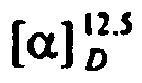

-
- (i) Preparation (3R, 3aR, 6R, 6aS)- tert-Butyl 3-hydroxy-6-(tosyloxy)tetrahydro-2H-furo[3,2-b]pyrrole-4(5H)-carboxylate (35b). Ethanol (1.5 mL) was added dropwise to a mixture of 10% palladium on charcoal (20 mg) and anti-(33b) (100 mg, 0.25 mmol) under an atmosphere of argon. The argon was replaced by hydrogen then the suspension was stirred for 4.5 hours before filtering the mixture through celite in vacuo.
- The filter cake was washed with ethanol (10 mL) then the solvents removed in vacuo from the filtrate. The residue was azeotroped with toluene (2 x 3 mL) to obtain (3R, 3aR, 6R, 6aS)-3-hydroxyhexahydro-2H-furo[3,2-b]pyrrol-6-yl 4-methylbenzenesulfonate (74) which was used without further purification.
- A solution of sodium carbonate (56 mg, 0.275 mmol) in water (0.75 mL) was added whilst stirring to a solution of aminoalcohol (74) in 1,4-dioxane (0.75 mL). A solution of di-tert-butyl dicarbonate (60 mg, 0.275 mmol) in 1,4-dioxane (0.5 mL) was added dropwise over 5 minutes then the mixture stirred for 1 hour before adding an additional aliquot of di-tert-butyl dicarbonate (40 mg, 0.184 mmol) in 1,4-dioxane (0.25 mL) dropwise over 1 minute. The mixture was stirred for 70 minutes then water (5 mL) was added and the product extracted into dichloromethane (3 x 5 mL). The organic layer was washed with brine (5 mL), then dried (Na2SO4), filtered and reduced in vacuo to leave a residue (132 mg). Flash chromatography over silica, eluting with ethyl acetate : heptane mixtures 15 : 85 to 45 : 55 gave bicyclic alcohol (35b) (58.9 mg, 60%) as a white solid. TLC (Rf = 0.30, EtOAc : heptane 1 : 1), analytical HPLC single main peak, Rt = 16.54 min., HPLC-MS 344.1 [M + 2H - t Bu]+, 821.3 [2M + Na]+;
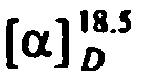
- (ii) Alternative preparation (3R, 3aR, 6R, 6aS)- tert-Butyl 3-hydroxy-6-(tosyloxy)tetrahydro-2H-furo[3,2-b]pyrrole-4(5H)-carboxylate (35b). 10% Palladium on charcoal (2 g) was added in portions to a solution of anti-(33b) (18.02 g, 41.62 mmol) in ethanol (300 mL) at 0 °C. The mixture was stirred under an atmosphere of hydrogen at ambient temperature for 16 hours before filtering through celite in vacuo. The filter cake was washed with ethyl acetate then the solvents removed in vacuo from the filtrate. The residue was azeotroped with toluene (2 x 100 mL) to obtain (3R, 3aR, 6R, 6aS)-3-hydroxyhexahydro-2H-furo[3,2-b]pyrrol-6-yl 4-methylbenzenesulfonate (74) which was used without further purification. δH (500 MHz, CDCl3) 2.43 (3H, s, aryl-CH 3), 2.49 (2H, brs, OH and NH), 2.83 (1H, dd, J = 11.63 and 8.17 Hz, 1 x CH 2NH), 3.08 (1H, dd, J = 11.62 and 6.62 Hz, 1 x CH 2NH), 3.73 (1H, d, J = 5.19 Hz, CHNH), 3.81 (1H, d, J = 10.15 Hz, I x OCH 2CHOH), 3.90 (1H, dd, J = 10.15 and 3.45 Hz, 1 x OCH 2CHOH), 4.13-4.15 (1H, m, OCH2CHOH), 4.54 (1H, t, J = 4.95 Hz, TsOCHCH), 4.67-4.72 (1H, m, TsOCH), 7.33 (2H, brd, J = 8.24 Hz, aromatic CH3CCH), 7.82 (2H, brd, J = 8.52 Hz, aromatic OSO2CCH); δC (125 MHz, CDCl3) 21.660 (aryl-CH3), 48.607 (CH2NH), 68.530 (CHNH), 75.968 (OCH2CHOH), 78.397, 79.960 and 80.158 (OCH2 CHOH and TsOCHCH), 127.924 and 129.848 (aromatic CH), 133.400 (CHOSO2 C quaternary), 144.983 (CH3C quaternary);
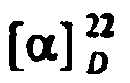
- Di-tert-butyl dicarbonate (9.1 g, 41.62 mmol) was added a solution of aminoalcohol (74) (assumed to be 41.62 mmol) in ethyl acetate (300 mL). The mixture was stirred for 40 minutes at 25 °C then reduced in vacuo to leave a yellow oil. Flash chromatography over silica, eluting with ethyl acetate : heptane mixtures 0 : 100 to 50 : 50 gave (3R, 3aR, 6R, 6aS)-tert-butyl 3-hydroxy-6-(tosyloxy)tetrahydro-2H-furo[3,2-b]pyrrole-4(5H)-carboxylate (13.38 g, 81%) as a white solid.
- (iii) Alternative preparation of (3R, 3aR, 6R, 6aS)-tert-Butyl 3-hydroxy-6-(tosyloxy)tetrahydro-2H-furo[3,2-b]pyrrole-4(5H)-carboxylate (35b). Potassium tert-butoxide (9.0 mg, 0.080 mmol) was added to anti-epoxide (82) (29.1 mg, 0.073 mmol) followed by tetrahydrofuran (0.5 mL) under an atmosphere of argon. The suspension was stirred for 5 minutes then sonicated for 30 seconds. Stirring was continued for 30 minutes. HPLC-MS indicated the appearance of a new peak corresponding to bicycle (35b) together with other products. Data for bicycle (35b): analytical HPLC, Rt = 14.5 min., HPLC-MS 344.0 [M + 2H - t Bu]+, 821.2 [2M + Na]+.
- (iv) Preparation of (3R, 3aR, 6aR)- tert-Butyl 3-hydroxytetrahydro-2H-furo[3,2-b]pyrrole-4(5H)-carboxylate (2f). A solution of Super-Hydride® (12.5 mL, 1M in tetrahydrofuran, 12.5 mmol) was added dropwise over 2 minutes to a stirred solution of bicyclic alcohol (35b) (1 g, 2.51 mmol) in tetrahydrofuran (20 mL) under an atmosphere of argon. The mixture was heated for 1 hour at 40 °C then an additional aliquot of Super-Hydride® (12.5 mL, 1M in tetrahydrofuran, 12.5 mmol) was added. The mixture was heated at 40 °C for 1 hour then cooled to 0 °C. Water (100 mL) was cautiously added and the product extracted into dichloromethane (3 x 100 mL). The organic phase was washed with a mixture of brine and water (1:1, 500 mL), then dried (Na2SO4), filtered and reduced in vacuo to leave an oil. Flash chromatography over silica, eluting with ethyl acetate : heptane mixtures 0 : 100 to 50 : 50 gave bicyclic alcohol (2f) (416 mg, 72%) as a viscous colourless oil. TLC (Rf = 0.25, EtOAc : heptane 2 : 1); HPLC-MS 174.1 [M + 2H - t Bu]+, 252.1 [M + Na]+, 481.3 [2M + Na]+;
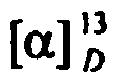
- (v) Alternative preparation of (3R, 3aR, 6aR)- tert-Butyl 3-hydroxytetrahydro-2H-furo[3,2-b]pyrrole-4(5H)-carboxylate (2f). A solution of Super-Hydride® (61.65 mL, 1M in tetrahydrofuran, 61.65 mmol) was added dropwise over 15 minutes to a stirred solution of (3R, 3aR, 6R, 6aS)-tert-butyl 3-hydroxy-6-(tosyloxy)tetrahydro-2H-furo[3,2-b]pyrrole-4(5H)-carboxylate (4.92 g, 12.33 mmol) in tetrahydrofuran (50 mL) under an atmosphere of argon. The mixture was heated for 3 hour at 40 °C then cooled to 0 °C. Water (150 mL) was cautiously added and the product extracted into dichloromethane (3 x 150 mL). The organic phase was washed with a mixture of brine and water (1:1, 100.mL), then dried (Na2SO4), filtered and reduced in vacuo to leave an oil. Flash chromatography over silica, eluting with ethyl acetate : heptane mixtures 0 : 100 to 50 : 50 gave (3R, 3aR, 6aR)-tert-butyl 3-hydroxytetrahydro-2H-furo[3,2-b]pyrrole-4(5H)-carboxylate (1.72 g, 61%) as a white solid. In addition, fractions containing less pure (3R, 3aR, 6aR)-tert-butyl 3-hydroxytetrahydro-2H-furo[3,2-b]pyrrole-4(5H)-carboxylate were collected, reduced in vacuo then the residue dissolved in dichloromethane (20 mL). The solution was washed with aqueous sodium hydroxide solution (1M, 15 mL), then water (15 mL), then dried (Na2SO4), filtered and reduced in vacuo to leave pure (3R, 3aR, 6aR)-tert-butyl 3-hydroxytetrahydro-2H-furo[3,2-b]pyrrole-4(5H)-carboxylate (0.697 g, 25%).
- (vi) Alternative preparation of (3R, 3aR, 6aR)-tert-Butyl 3-hydroxytetrahydro-2H-furo[3,2-b]pyrrole-4(5H)-carboxylate (2f). A suspension of (3R, 3aR, 6R, 6aS)-tert-butyl 3-hydroxy-6-(tosyloxy)tetrahydro-2H-furo[3,2-b]pyrrole-4(5H)-carboxylate (35b) (250 mg, 0.63 mmol) in diethyl ether (1.5 mL) and tetrahydrofuran (1 mL) was added to a stirred suspension of lithium aluminium hydride (48 mg, 1.25 mmol) in diethyl ether (1.5 mL) under an atmosphere of argon. The mixture was stirred for I hour at ambient temperature then heated at 35 °C for 2.75 hours. HPLC-MS analysis of the reaction indicated starting tosylate (35b) together with small amounts of both (3R, 3aR, 6aR)-tert-butyl 3-hydroxytetrahydro-2H-furo[3,2-b]pyrrole-4(5H)-carboxylate (2f) and (3R, 3aR, 6aR)-hexahydro-2H-furo[3,2-b]pyrrol-3-ol (2g) to be present.
- (vii) Preparation of (3R, 3aR, 6aR)-(9H-fluoren-9-yl)methyl 3-hydroxytetrahydro-2H-furo[3,2-b]pyrrole-4(5H)-carboxylate (2b). Alcohol (2f) (558mg, 2.43 mmol) was dissolved in 4M HCl in dioxane (14.06mL) and left to stand at ambient temperature for 1h. The solvent was removed in vacuo and the residue azeotroped from toluene (3 x 20mL) to give hydrochloride salt of (3R, 3aR, 6aR)-hexahydro-2H-furo[3,2-b]pyrrol-3-ol (2g) used directly in the following step.
- A solution of sodium carbonate (0.54 g, 5.11 mmol) in water (4 mL) was added whilst stirring to a solution of the HCl salt of aminoalcohol (2g) in 1,4-dioxane (10 mL). The solution was cooled to 0 °C then a solution of 9-fluorenylmethoxycarbonyl chloride (0.66 g, 2.56 mmol) in 1,4-dioxane (10 mL) was added dropwise over 30 minutes. The mixture stirred for 2h then water (50 mL) was added and the product extracted into dichloromethane (2 x 50 mL). The organic layer was washed with brine (50 mL), then dried (Na2SO4), filtered and reduced in vacuo to leave an oily residue. Flash chromatography over silica, eluting with ethyl acetate : heptane mixtures 15 : 85 to 50 : 50 gave alcohol (2b) as a white solid (0.324 g, 0.93 mmol). Data for alcohol (2b). TLC (Rf = 0.15, EtOAc : heptane 1 : 1), analytical HPLC single main peak, Rt = 15.81 min., HPLC-MS 352.1 [M + H]+, 374.1 [M + Na]+, 725.1 [2M + Na]+.
- (viii) Alternative preparation of (3R, 3aR, 6aR)-hexahydro-2H-furo[3,2-b]pyrrol-3-ol (2g). A solution of Super-Hydride® (1.0 mL, 1M in tetrahydrofuran, 1.0 mmol) was added dropwise over 2 minutes to a stirred solution of (3R, 3aR, 6R, 6aS) 3-hydroxyhexahydro-2H-furo[3,2-b]pyrrol-6-yl 4-methylbenzenesulfonate (74) (100 mg, 0.33 mmol) in tetrahydrofuran (1 mL) under an atmosphere of argon. The mixture was heated for 1.5 hours at 40 °C then chilled with iced water to provide a solution containing aminoalcohol (2g) used directly in the next step.
- (ix) Alternative preparation of (3R, 3aR, 6aR)-hexahydro-2H-furo[3,2-b]pyrrol-3-ol (2g). A suspension of (3R, 3aR, 6R, 6aS) 3-hydroxyhexahydro-2H-furo[3,2-b]pyrrol-6-yl 4-methylbenzenesulfonate (74) (100 mg, 0.33 mmol) in diethyl ether (1 mL) and tetrahydrofuran (0.5 mL) was added to a stirred suspension of lithium aluminium hydride (25.4 mg, 0.67 mmol) in diethyl ether (1 mL) under an atmosphere of argon. The mixture was stirred for 1 hour at ambient temperature then heated at 35 °C for 2 hours. Tetrahydrofuran (1.5 mL) was added then heating at 35 °C continued for 45 minutes. The mixture was stirred at ambient temperature for 16 hours then lithium aluminium hydride (25.4 mg, 0.67 mmol) added. The mixture was stirred for 1 hour 35 minutes then tetrahydrofuran (1 mL) was added and the solution containing aminoalcohol (2g) used directly in the next step.
- Preparation of (3R, 3aR, 6aR)-Benzyl 3-hydroxytetrahydro-2H-furo[3,2-b]pyrrole-4(5H)-carboxylate (83). A solution of Super-Hydride® (1.0 mL, 1M in tetrahydrofuran, 1.0 mmol) was added dropwise over 2 minutes to a stirred solution of (3R, 3aR, 6R, 6aS) 3-hydroxyhexahydro-2H-furo[3,2-b]pyrrol-6-yl 4-methylbenzenesulfonate (74) (100 mg, 0.33 mmol) in tetrahydrofuran (1 mL) under an atmosphere of argon. The mixture was heated for 1.5 hours at 40 °C then chilled with iced water to provide a solution containing aminoalcohol (2g). A solution of sodium carbonate (89 mg, 0.84 mmol) in water (1.5 mL) was added cautiously followed by benzylchloroformate (0.105 mL, 0.74 mmol). The mixture was stirred at ambient temperature for 1 hour then dichloromethane (10 mL) and water (15 mL) added. The organic phase was separated and the aqueous extracted with dichloromethane (2 x 5 mL). The combined organic phase was washed with brine (5 mL), then dried (Na2SO4), filtered and reduced in vacuo to leave a colourless oil (143 mg). Flash chromatography over silica, eluting with ethyl acetate : heptane mixtures 10 : 90 to 60 : 40 gave (3R, 3aR, 6aR)-benzyl 3-hydroxytetrahydro-2H-furo[3,2-b]pyrrole-4(5H)-carboxylate (83) (43 mg, 50%) as a viscous colourless oil and a less pure sample of alcohol (83) (22 mg) contaminated with 10% of (3R, 3aR, 6R, 6aS)-benzyl 3-hydroxy-6-(tosyloxy)tetrahydro-2H-furo[3,2-b]pyrrole-4(5H)-carboxylate (34b). Data for bicycle (83): TLC (Rf = 0.20, EtOAc : heptane 3 : 2); HPLC-MS 264.1 [M + H]+, 286.1 [M + Na]+, 549.2 [2M + Na]+;

- Alternative preparation of (3R, 3aR, 6aR)-Benzyl 3-hydroxytetrahydro-2H-furo[3,2-b]pyrrole-4(5H)-carboxylate (83). A suspension of (3R, 3aR, 6R, 6aS) 3-hydroxyhexahydro-2H-furo[3,2-b]pyrrol-6-yl 4-methylbenzenesulfonate (74) (100 mg, 0.33 mmol) in diethyl ether (1 mL) and tetrahydrofuran (0.5 mL) was added to a stirred suspension of lithium aluminium hydride (25.4 mg, 0.67 mmol) in diethyl ether (1 mL) under an atmosphere of argon. The mixture was stirred for 1 hour at ambient temperature then heated at 35 °C for 2 hours. Tetrahydrofuran (1.5 mL) was added then heating at 35 °C continued for 45 minutes. The mixture was stirred at ambient temperature for 16 hours then lithium aluminium hydride (25.4 mg, 0.67 mmol) added. The mixture was stirred for 1 hour 35 minutes then tetrahydrofuran (1 mL) was added. After stirring for 30 minutes a solution of sodium carbonate (89 mg, 0.84 mmol) in water (1.5 mL) was added cautiously. The thick suspension was stirred for 5 minutes then benzylchloroformate (0.105 mL, 0.74 mmol) was added. The mixture was stirred for 20 minutes then dichloromethane (10 mL) and water (15 mL) were added. The organic phase was separated and the aqueous reextracted with dichloromethane (2 x 5 mL). The combined organic phase was washed with brine (5 mL), then dried (Na2SO4), filtered and reduced in vacuo to leave a residue (95 mg). Flash chromatography over silica, eluting with ethyl acetate : heptane mixtures 10 : 90 to 50 : 50 gave bicycle alcohol (83) (23.3 mg, 16%) as a viscous colourless oil and a less pure sample of bicycle alcohol (83) (13.8 mg) contaminated with 8% of (3R, 3aR, 6R, 6aS)-benzyl 3-hydroxy-6-(tosyloxy)tetrahydro-2H-furo[3,2-b]pyrrole-4(5H)-carboxylate (34b).
- Preparation of tert-Butyl (S)-1-cyclopentyl-2-((3R, 3aR, 6aR)-3-hydroxydihydro-2H-furo[3,2-b]pyrrol-4(5H, 6H, 6aH)-yl)-2-oxoethylcarbamate (84) . A solution of (3R, 3aR, 6R, 6aS) 3-hydroxyhexahydro-2H-furo[3,2-b]pyrrol-6-yl 4-methylbenzenesulfonate (74) (100 mg, 0.33 mmol) in tetrahydrofuran (1.5 mL) was added dropwise to a stirred suspension of lithium aluminium hydride (51 mg, 1.34 mmol) in tetrahydrofuran (1 mL) under an atmosphere of argon over 2 minutes. The mixture was stirred for 3 hours then hydrochloric acid (1M then 5M) added carefully until pH = 1. Sodium hydroxide solution (1M) was added until pH = 14 followed by hydrochloric acid (1M) until pH = 2. The solvents were removed in vacuo then the residue azeotroped with toluene (3 x 5 mL) to leave aminoalcohol (2g) which was used without further purification.
- 4-Methylmorpholine (0.077 mL, 0.70 mmol) was added to a suspension of 2-(1H-benzotriazole-1-yl)-1,1,3,3-tetramethyluronium hexafluorophosphate (HBTU, 133 mg, 0.35 mmol), 1-hydroxybenzotriazole monohydrate (54 mg, 0.35 mmol) and (S)-2-(tert-butoxycarbonylamino)-2-cyclopentyl acid (85 mg, 0.35 mmol) in dimethylformamide (0.75 mL). The suspension was agitated for 5 minutes before adding to a stirred suspension of aminoalcohol (2g) (assume 0.33 mmol) in dimethylformamide (1 mL). After 2.25 hours 4-methylmorpholine (0.077 mL, 0.70 mmol) was added to a suspension of 2-(1H-benzotriazole-1-yl)-1,1,3,3-tetramethyluronium hexafluorophosphate (HBTU, 133 mg, 0.35 mmol), 1-hydroxybenzotriazole monohydrate (54 mg, 0.35 mmol) and (S)-2-(tert-butoxycarbonylamino)-2-cyclopentyl acid (85 mg, 0.35 mmol) in dimethylformamide (0.75 mL). The suspension was agitated for 5 minutes then added to the reaction mixture. The reaction was stirred for 1 hour then the solvents removed in vacuo. The residue was partitioned between dichloromethane (10 mL) and saturated sodium hydrogen carbonate solution (10 mL). The aqueous phase was reextracted with dichloromethane (2 x 5 mL) then the combined organic layers washed with brine (5 mL), then dried (Na2SO4), filtered and reduced in vacuo to give a brown oil (141 mg). Flash chromatography over silica, eluting with ethyl acetate : heptane mixtures 25 : 75 to 80 : 20 gave tert-butyl (S)-1-cyclopentyl-2-((3R, 3aR, 6aR)-3-hydroxydihydro-2H-furo[3,2-b]pyrrol-4(5H, 6H, 6aH)-yl)-2-oxoethylcarbamate (84) contaminated with approximately 15% of byproducts as a colourless oil (28.7 mg). TLC (Rf = 0.10, EtOAc : heptane 4 : 1); analytical HPLC main peak, Rt = 11.54 min., HPLC-MS 299.1 [M + 2H - t Bu]+, 355.1 [M + H]+, 377.1 [M + Na]+, 731.2 [2M + Na]+.
- Preparation (3R, 3aR, 6S, 6aS)-tert-Butyl 3-hydroxy-6-(tosyloxy)tetrahydro-2H-furo[3,2-b]pyrrole-4(5H)-carboxylate (35). Ethanol (20 mL) was added dropwise to a mixture of 10% palladium on charcoal (50 mg) and anti-(33) (578 mg, 1.33 mmol) under an atmosphere of argon. The argon was replaced by hydrogen then the suspension was stirred for 1.5 hours before filtering the mixture through celite in vacuo. The filter cake was washed with ethanol then the solvents removed in vacuo from the filtrate to obtain (3R, 3aR, 6S, 6aS)- 3-hydroxyhexahydro-2H-furo[3,2-b]pyrrol-6-yl 4-methylbenzenesulfonate which was used without further purification.
- A solution of sodium carbonate (297 mg, 2.80 mmol) in water (10 mL) was added whilst stirring to a solution of (3R, 3aR, 6S, 6aS)-3-hydroxyhexahydro-2H-furo[3,2-b]pyrrol-6-yl 4-methylbenzenesulfonate in 1,4-dioxane (7 mL). A solution of di-tert-butyl dicarbonate (320 mg, 1.47 mmol) in 1,4-dioxane (3 mL) was added then the mixture stirred for 2 hours then stored at 4°C for 16 hours then water (30 mL) was added and the product extracted into dichloromethane (3 x 30 mL). The organic layer was washed with brine (30 mL), then dried (MgSO4), filtered and reduced in vacuo to leave a residue. Flash chromatography over silica, eluting with ethyl acetate : heptane mixtures 20 : 80 to 40 : 60 gave bicyclic alcohol (35) (292 mg, 55%) as a white solid. TLC (Rf = 0.38, EtOAc : heptane 3 : 2), analytical HPLC single main peak, Rt = 16.80 min., HPLC-MS 344.1 [M + 2H - t Bu]+, 821.3 [2M + Na]+;

- Preparation of (3R, 3aR, 6S, 6aS)- tert-Butyl 3-hydroxy-6-(methylsulfonyloxy)tetrahydro-2H-furo[3,2-b]pyrrole-4(5H)-carboxylate (53) . Ethanol (3 mL) was added dropwise to a mixture of 10% palladium on charcoal (5 mg) and anti-(52) (60 mg, 0.17 mmol) under an atmosphere of argon. The argon was replaced by hydrogen then the suspension was stirred for 1 hour before filtering the mixture through celite in vacuo. The filter cake was washed with ethanol then the solvents removed in vacuo from the filtrate to obtain (3R, 3aR, 6S, 6aS)- 3-hydroxyhexahydro-2H-furo[3,2-b]pyrrol-6-yl methanesulfonate which was used without further purification.
- A solution of sodium carbonate (37 mg, 0.35 mmol) in water (2 mL) was added whilst stirring to a solution of (3R, 3aR, 6S, 6aS)- 3-hydroxyhexahydro-2H-furo[3,2-b]pyrrol-6-yl methanesulfonate in 1,4-dioxane (1 mL). A solution of di-tert-butyl dicarbonate (40 mg, 0.18 mmol) in 1,4-dioxane (1 mL) was added then the mixture stirred for 3 hours before adding di-tert-butyl dicarbonate (40 mg, 0.18 mmol). The mixture was stirred for 16 hours then water (10 mL) was added and the product extracted into dichloromethane (1 x 10 mL and 2 x 15 mL). The organic layer was washed with brine (15 mL), then dried (MgSO4), filtered and reduced in vacuo to leave a residue. Flash chromatography over silica, eluting with ethyl acetate : heptane mixtures 20 : 80 to 50 : 50 gave bicyclic alcohol (53) (27 mg, 49%) as a white solid. TLC (Rf = 0.15, EtOAc : heptane 1 : 1), HPLC-MS 268.1 [M + 2H - t Bu]+, 346.1 [M + Na]+, 669.3 [2M + Na]+;

-
- (i) Preparation of Benzyl (S)-2-tert-butoxy-2-((S)-2,5-dihydrofuran-2-yl)ethylcarbamate (26). Alcohol (17) (270mg, 1.02 mmol) was dissolved in anhydrous dichloromethane (8 mL) in a 50 mL glass pressure tube and cooled to -78 °C. Isobutene (~3 mL) was condensed into the solution and conc. H2SO4 (25 µL) added. The tube was sealed and stirred at ambient temperature overnight. The sealed tube was cooled to -78 °C, N-methylmorpholine (60 µL, 1 eq. w.r.t. conc. H2SO4) added and allowed to warm to ambient temperature, unsealed, with stirring over 2 h. Dichloromethane (25 mL) was added and the organics washed with pH 3 HCl (25 mL), NaHCO3 (25 mL) then brine (25 mL) and dried (Na2SO4). The solvents were removed in vacuo to give a tan oil. The crude oil was purified on a 5g Flash silica cartridge eluting with a gradient of heptane : ethyl acetate 9:1 → 6:1. Desired fractions were combined and reduced in vacuo to provide ether (26) as a clear gum (222 mg, 68%). TLC (KMnO4 stain, R f = 0.46, heptane : ethyl acetate 1:2), analytical HPLC R t = 17.10 min, HPLC-MS (single main UV peak with R t = 2.91 min, 264.1 [M + 2H - Bu]+, 342.2 [M + Na]+, 661.3 [2M + Na]+);

- (ii) Preparation of epoxide mixture Benzyl (S)-2-((1R, 2R, 5R)-3,6-dioxabicyclo[3.1.0]hexan-2-yl)-2-tert-butoxyethylcarbamate syn-(27) and Benzyl (S)-2-((1S, 2R, 5S)-3,6-dioxabicyclo[3.1.0]hexan-2-yl)-2-tert-butoxyethylcarbamate anti-(28). Method 1; meta-Chloroperbenzoic acid. Ether (26) (210 mg, 0.66 mmol) was dissolved in anhydrous dichloromethane (10 mL) with stirring and meta-chloroperoxybenzoic acid (1.48 g, 77% reagent, 6.6 mmol) added. The mixture was stirred at ambient temperature under argon for 16 h. Dichloromethane (20 mL) was added and the organic .phase washed with 10% aqueous w/v solution of sodium hydroxide (2 x 20 mL) then dried (Na2SO4), filtered and reduced in vacuo to leave a clear gum (200 mg). The crude gum was purified on a 5g Flash silica cartridge eluting with a gradient of heptane : ethyl acetate 9:1 → 7: 1. Desired fractions containing the co-eluting epoxides were combined and reduced in vacuo to provide a viscous oil (183 mg, 82.7%). TLC (Rf = 0.30 (figure of eight mixture of syn and anti epoxides), EtOAc : heptane 2 : 1), HPLC-MS 236.1, 280.1 [M + 2H - Bu]+, 358.2 [M + Na]+, 693.2 [2M + Na]+.
- (iii) Alternative preparation of epoxide mixture Benzyl (S)-2-((1R, 2R, 5R)-3,6-dioxabicyclo[3.1.0]hexan-2-yl)-2-tert-butoxyethylcarbamate syn-(27). and Benzyl (S)-2-((1S, 2R, 5S)-3,6-dioxabicyclo[3.1.0]hexan-2-yl)-2-tert-butoxyethylcarbamate anti-(28). Method 2; Oxone. To a solution of ether (26) (9.5 mg, 0.030 mmol) in acetonitrile (0.15 mL) and aqueous Na2.EDTA (0.15 mL, 0.4 mmol solution) at 0 °C was added 1,1,1-trifluoroacetone (0.032 mL, 0.36 mmol). To this solution was added in portions a mixture of sodium bicarbonate (21 mg, 0.25 mmol) and OXONE® (57 mg, 0.092 mmol) over a period of 1 hour. The mixture was stirred for 50 minutes then diluted with water (5 mL) and the product extracted into dichloromethane (2 x 50 mL). The combined organic layers were washed with brine (5 mL) then dried (Na2SO4), filtered and reduced in vacuo. 1H nmr analysis of the residue indicated a 10 : 1 mixture benzyl anti-(28) and syn-(27) respectively (6.7 mg).
- (iv) Preparation of Benzyl (S)-2-((1R, 2R, 5R)-3,6-dioxabicyclo[3.1.0]hexan-2-yl)-2-tert-butoxyethylcarbamate syn-(27) and (3R, 3aR, 6S, 6aS)-benzyl 6-tert-butoxy-3-hydroxytetrahydro-2H-furo[3,2-b]pyrrole-4(5H)-carboxylate (29). Epoxide mixture (27, 28) (175 mg, 0.52 mmol) was dissolved in anhydrous THF (3 mL), cooled to 0 °C and sodium hydride (60% dispersion in oil) (26.2 mg, 0.65 mmol) added. The mixture was stirred at ambient temperature for 3 h. Dichloromethane (25 mL) was added and the organic phase washed with brine (1 x 25 mL), then dried (Na2SO4), filtered and reduced in vacuo to leave an opaque gum (∼ 150 mg). The crude gum was purified on a 5g Flash silica cartridge eluting with a gradient of heptane : ethyl acetate 9:1 → 5:1 to provide two products:
- (a) Syn-epoxide (27) as a viscous oil (39.2 mg, 0.12 mmol, 22.4%), TLC (Rf = 0.37, EtOAc : heptane 1 : 1), analytical HPLC R t = 15.61 min, HPLC-MS 280.1 [M + 2H - Bu]+, 358.2 [M + Na]+, 693.2 [2M + Na]+.
- (b) Bicycle alcohol (29) as a viscous oil (80.4 mg, 0.24 mmol, 46%), TLC (Rf = 0.31, EtOAc : heptane 1 : 1), analytical HPLC R t = 15.17 min, HPLC-MS 236.1, 280.1 [M + 2H - Bu]+, 358.2 [M + Na]+, 693.2 [2M + Na]+;

- (v) Preparation of (3R, 3aR, 6S, 6aS)-(9H-fluoren-9-yl)methyl 6-tert-butoxy-3-hydroxytetrahydro-2H-furo[3,2-b]pyrrole-4(5H)-carboxylate (4b). Bicycle alcohol (29) (75 mg, 0.22 mmol) was dissolved in methanol (5 mL), cooled to 0 °C and 10% palladium on charcoal (20 mg) added. The mixture was stirred, then evacuated and flushed with hydrogen. The mixture was warmed to ambient temperature and after 1 h. filtered through celite. The filter cake was washed with ethanol (3 x 5 mL) and the combined filtrates reduced in vacuo to provide the crude amine (∼ 45 mg). HPLC-MS 146.1 [M + 2H - Bu]+, 202.1 [M + H]+, 425.2 [M + Na]+. The crude amine was dissolved in 1,4-dioxane (3.5 mL) with stirring, ice-cooled and a solution of sodium carbonate (50 mg, 0.47 mmol) in water (3.5 mL) was added. 9-Fluorenylmethyl chloroformate (61 mg, 0.234 mmol) in 1,4-dioxane (2.5 mL) was added dropwise over 30 minutes and the mixture stirred for a further 1 h. CHCl3 (25 mL) was then added and the organic phase washed with 0.1N HCl (25 mL), sat. NaHCO3 (25 mL), then brine (25 mL) and dried (Na2SO4). The organic layer was filtered and reduced in vacuo to leave a clear film (∼ 100 mg). The crude film was purified on a 5g Flash silica cartridge eluting with a gradient of heptane : ethyl acetate 8:1 → 2:1 to provide alcohol (4b) as a white solid (74.4 mg, 0.175 mmol, 78%). TLC (Rf = 0.33, EtOAc : heptane 1 : 1), analytical HPLC R t = 18.78 min, HPLC-MS 368.1 [M + 2H - Bu]+, 424.2 [M + H]+, 446.2 [M + Na]+, 869.4 [2M + Na]+;

- (vi) Preparation of (3aS, 6S, 6aS)-(9H-fluoren-9-yl)methyl 6-tert-butoxy-3-oxotetrahydro-2H-furo[3,2-b]pyrrole-4(5H)-carboxylate (4c). Alcohol (4b) (70 mg, 0.165 mmol) was dissolved in anhydrous dichloromethane (5 mL) with stirring under argon. Dess-Martin periodinane (141 mg, 0.33 mmol) was added and the mixture stirred for 2 h. The mixture was diluted with DCM (20 mL) and washed with sat. NaHCO3 / 0.25M Na2S2O3, sat. NaHCO3, brine (25 mL each) and dried (Na2SO4). The organic layer was filtered and reduced in vacuo to leave a clear film (∼ 110 mg). The crude film was purified on a 5g Flash silica cartridge eluting with a gradient of heptane : ethyl acetate 7:1 → 2:1 to provide ketone (4c) as a colourless gum (70.5 mg, 0.165 mmol, 99.8%). TLC (Rf = 0.50, EtOAc : heptane 1 : 1), analytical HPLC broad peak with Rt = 18.58 - 20.92 min, HPLC-MS 366.1 [M + 2H - Bu]+, 422.2 [M + H]+, 444.2 [M + Na]+, 865.4 [2M + Na]+;

-
- (i) Preparation of Benzyl (R)-2-tert-butoxy-2-((S)-2,5-dihydrofuran-2-yl)ethylcarbamate (26b). Alcohol (18) (400mg, 1.52 mmol) was dissolved in anhydrous dichloromethane (8 mL) in a 50 mL glass pressure tube and cooled to -78 °C. Isobutene ( ∼4 mL) was condensed into the solution and conc. H2SO4 (35 µL) added. The tube was sealed and stirred at ambient temperature for 6 h. The sealed tube was cooled to -78 °C, N-methylmorpholine (75 µL, 1 eq. w.r.t. conc. H2SO4) added and allowed to warm to ambient temperature, unsealed, with stirring over 2 h. Dichloromethane (20 mL) was added and the organics washed with pH 3 HCl (25 mL), NaHCO3 (25 mL) then brine (25 mL) and dried (Na2SO4). The solvents were removed in vacuo to give an opaque gum (350 mg). The crude gum was purified on a 5g Flash silica cartridge eluting with a gradient of heptane : ethyl acetate 7:1 → 2:1. Desired fractions were combined and reduced in vacuo to provide ether (26b) as a thick clear oil (204 mg, 42%) and recovered starting alcohol (108 mg, 27%). TLC (KMnO4 stain, R f = 0.70, heptane : ethyl acetate 2:1), analytical HPLC R t = 16.85 min, HPLC-MS (single main UV peak with R t = 2.85 min, 264.1 [M + 2H - Bu]+, 342.2 [M + Na]+, 661.3 [2M + Na]+);

- (ii) Preparation of epoxide mixture Benzyl (R)-2-((1R, 2R,5R)-3,6-dioxabicyclo[3.1.0]hexan-2-yl)-2-tert-butoxyethylcarbamate syn-(27b). and Benzyl (R)-2-((1S, 2R, 5S)-3,6-dioxabicyclo[3.1.0]hexan-2-yl)-2-tert-butoxyethylcarbamate anti-(28b). Method 1; meta-Chloroperbenzoic acid. Ether (26b) (175 mg, 0.55 mmol) was dissolved in anhydrous dichloromethane (7.5 mL) with stirring and meta-chloroperoxybenzoic acid (1.22 g, 77% reagent, 5.5 mmol) added. The mixture was stirred at ambient temperature under argon for 16 h. Dichloromethane (20 mL) was added and the organic phase washed with 10% aqueous w/v solution of sodium hydroxide (2 x 50 mL), then dried (Na2SO4), filtered and reduced in vacuo to leave a clear oil (180 mg). The crude oil was purified on a 5g Flash silica cartridge eluting with a gradient of heptane : ethyl acetate 8:1 → 2:1. Desired fractions containing the co-eluting epoxides were combined and reduced in vacuo to provide a clear gum (171 mg, 92.7%). TLC (Rf = 0.28 (mixture of syn and anti epoxides), EtOAc : heptane 1 : 2), HPLC-MS 236.1, 280.1 [M + 2H - Bu]+, 358.2 [M + Na]+, 693.2 [2M + Na]+.
- (iii) Alternative preparation of epoxide mixture Benzyl (R)-2-((1R, 2R, 5R)-3,6-dioxabicyclo[3.1.0]hexan-2-yl)-2-tert-butoxyethylcarbamate syn-(27b). and Benzyl (R)-2-((1S, 2R, 5S)-3,6-dioxabicyclo[3.1.0]hexan-2-yl)-2-tert-butoxyethylcarbamate anti-(28b). Method 2; Oxone. To a solution of ether (26b) (9.5 mg, 0.030 mmol) in acetonitrile (0.15 mL) and aqueous Na2.EDTA (0.15 mL, 0.4 mmol solution) at 0 °C was added 1,1,1-trifluoroacetone (0.032 mL, 0.36 mmol). To this solution was added in portions a mixture of sodium bicarbonate (21 mg, 0.25 mmol) and OXONE® (57 mg, 0.092 mmol) over a period of 1 hour. The mixture was stirred for 50 minutes then diluted with water (5 mL) and the product extracted into dichloromethane (2 x 50 mL). The combined organic layers were washed with brine (5 mL) then dried (Na2SO4), filtered and reduced in vacuo. 1H nmr analysis of the residue indicated a 10 : 1 mixture of anti-(28b) and syn-(27b) respectively (8.9 mg).
- (iv) Preparation of Benzyl (R)-2-((1R, 2R, SR)-3,6-dioxabicyclo[3.1.0]hexan-2-yl)-2-tert-butoxyethylcarbamate syn-(27b) and (3R, 3aR, 6R, 6aS)-benzyl 6-tert-butoxy-3-hydroxytetrahydro-2H-furo[3,2-blpyrrole-4(5H)-carboxylate (29b). Epoxide mixture (27b, 28b) (165 mg, 0.49 mmol) was dissolved in anhydrous THF (3 mL), cooled to 0 °C and sodium hydride (60% dispersion in oil) (24.6 mg, 0.615 mmol) added. The mixture was stirred at ambient temperature overnight. Dichloromethane (25 mL) was added and the organic phase washed with brine (1 x 25 mL), then dried (Na2SO4), filtered and reduced in vacuo to leave a colourless gum (∼ 200 mg). The crude gum was purified on a 5g Flash silica cartridge eluting with a gradient of heptane : ethyl acetate 6:1 → 1:2 to provide two products:
- (c) Syn-epoxide (27b) as a viscous oil (88 mg, 0.26 mmol, 53.4%), TLC (Rf = 0.42, EtOAc : heptane 1 : 1), analytical HPLC R t = 15.64 min, HPLC-MS 280.1 [M + 2H - Bu]+, 358.2 [M + Na]+, 693.2 [2M + Na]+;

- (d) Bicycle alcohol (29b) as a viscous oil (33 mg, 0.10 mmol, 20.0%), TLC (Rf = 0.13, EtOAc : heptane 1 : 1), analytical HPLC R t = 13.66 min, HPLC-MS 236.1, 280.1 [M + 2H - Bu]+, 358.2 [M + Na]+, 693.2 [2M + Na]+;

- (c) Syn-epoxide (27b) as a viscous oil (88 mg, 0.26 mmol, 53.4%), TLC (Rf = 0.42, EtOAc : heptane 1 : 1), analytical HPLC R t = 15.64 min, HPLC-MS 280.1 [M + 2H - Bu]+, 358.2 [M + Na]+, 693.2 [2M + Na]+;
- (v) Preparation of (3R, 3aR, 6R, 6aS)-(9H-fluoren-9-yl)methyl 6-tert-butoxy-3-hydroxytetrahydro-2H-furo[3,2-b]pyrrole-4(5H)-carboxylate (3b). Alcohol (29b) (33 mg, 0.1 mmol) was dissolved in methanol (5 mL), cooled to 0 °C and 10% palladium on charcoal (15 mg) added. The mixture was stirred, then evacuated and flushed with hydrogen. The mixture was warmed to ambient temperature and after I h. filtered through celite. The filter cake was washed with ethanol (3 x 5 mL) and the combined filtrates reduced in vacuo to provide the crude amine (∼ 15 mg). HPLC-MS 146.1 [M + 2H - Bu]+, 202.1 [M + H]+, 425.2 [M + Na]+. The crude amine was dissolved in 1,4-dioxane (2.5 mL) with stirring, ice-cooled and a solution of sodium carbonate (22 mg, 0.21 mmol) in water (2.5 mL) was added. 9-Fluorenylmethyl chloroformate (27 mg, 0.10 mmol) in 1,4-dioxane (2.5 mL) was added dropwise over 30 minutes and the mixture stirred for a further 1 h. CHCl3 (25 mL) was then added and the organic phase washed with 0.1N HCl (25 mL), sat. NaHCO3 (25 mL), then brine (25 mL) and dried (Na2SO4). The organic layer was filtered and reduced in vacuo to leave a clear film (∼ 40 mg). The crude film was purified on a 5g Flash silica cartridge eluting with a gradient of heptane : ethyl acetate 8:1 → 1:1 to provide alcohol (3b) as a white solid (27.3 mg, 0.065 mmol, 65.8%). TLC (Rf = 0.16, EtOAc : heptane 1 : 1), analytical HPLC R t = 17.39 min, HPLC-MS 368.2 [M + 2H - Bu]+, 424.2 [M + H]+, 446.2 [M + Na]+, 869.4 [2M + Na]+;

- (vi) Preparation of (3aS, 6R, 6aS)-(9H-fluoren-9-yl)methyl 6-tert-butoxy-3-oxotetrahydro-2H-furo[3,2-b]pyrrole-4(5H)-carboxylate (3c). Bicycle alcohol (3b) (25 mg, 0.06 mmol) was dissolved in anhydrous dichloromethane (3 mL) with stirring under argon. Dess-Martin periodinane (50 mg, 0.12 mmol) was added and the mixture stirred overnight. The mixture was diluted with DCM (20 mL) and washed with sat. NaHCO3 / 0.25M Na2S2O3, sat. NaHCO3, brine (25 mL each) and dried (Na2SPO4). The organic layer was filtered and reduced in vacuo to leave a tan gum (∼ 40 mg). The crude gum was purified on a 5g Flash silica cartridge eluting with a gradient of heptane : ethyl acetate 6:1 → 3:1 to provide ketone (3c) as a white solid (21.9 mg, 0.052 mmol, 88.1%). TLC (Rf = 0.57, EtOAc : heptane 2 : 1), analytical HPLC broad peak with R t = 17.15 - 19.96 min, HPLC-MS 366.1 [M + 2H - Bu]+, 422.2 [M + H]+, 444.2 [M + Na]+, 865.4 [2M + Na]+; [a]

-
- (i) Preparation of Benzyl (S)-2-((S)-2,5-dihydrofuran-2-yl)-2-methoxyethyl carbamate (30). Methyl iodide (1.18 mL, 19.0 mmol) was added to a stirred mixture of alcohol (17) (1.0 g, 3.80 mmol) and silver (I) oxide (1.32 g, 5.70 mmol) in acetonitrile (15 mL). The mixture was heated at 75 °C for 3 hours then at 80 °C for 3.5 hours. Silver (I) oxide (0.20 g, 0.86 mmol) and methyl iodide (0.25 mL, 4.0 mmol) were added and heating continued for 4 hours then allowed to cool to ambient temperature, filtered and reduced in vacuo. Flash chromatography over silica, eluting with ethyl acetate : heptane mixtures 10 : 90 to 30 : 70 gave methyl ether (30) (731 mg, 69%) as a colourless oil. TLC (Rf = 0.40, EtOAc : heptane 1 : 1), analytical HPLC single main peak, Rt = 13.107 min., HPLC-MS 278.1 [M + H]+, 577.2 [2M + Na]+;
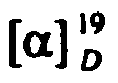
- (ii) Alternative preparation of Benzyl (R)-2-((S)-2,5-dihydrofuran-2-yl)-2-methoxyethylcarbamate (30). Trimethyloxonium fluoroborate (19.12 g, 129.3 mmol) was added to a stirred mixture of benzyl (S)-2-((S)-2,5-dihydrofuran-2-yl)-2-hydroxyethylcarbamate (17) (20.0 g, 76.0 mmol), 4Å molecular sieves (66 g), 1,8-bis(dimethylamino)naphthalene (97.8 g, 456.2 mmol) and dichloromethane (500 mL) under an atmosphere of argon. The mixture was stirred for 2 hours then filtered through celite in vacuo. The filter cake was washed with dichloromethane (750 mL) then the solvents removed in vacuo from the filtrate. The residue was triturated with TBME (250 mL) then the granular solid removed by filtration in vacuo. The solid was washed with TBME (3 x 100 mL) then the combined filtrates washed with hydrochloric acid (2.5M, 1 x 100 mL then 2 x 50 mL), brine (50 mL) then dried (Na2SO4), filtered and reduced in vacuo to leave a pale yellow oil. Flash chromatography over silica, eluting with ethyl acetate : heptane mixtures 10 : 90 to 50 : 50 gave methylether (30) as a colourless oil (17.2 g, 82%).
- (iii) Preparation of Benzyl (S)-2-((1S, 2R, 5S)-3,6-dioxabicyclo[3.1.0]hexan-2-yl)-2-methoxyethyl carbamate anti-(31). To a solution of methyl ether (30) (731 mg, 2.64 mmol) in acetonitrile (15 mL) and aqueous Na2.EDTA (15 mL, 0.4 mmol solution) at 0 °C was added 1,1,1-trifluoroacetone (2.84 mL, 31.7 mmol). To this solution was added in portions a mixture of sodium bicarbonate (1.87 g, 22.2 mmol) and OXONE® (5.04 g, 8.19 mmol) over a period of 1.5 hours. The mixture was stirred for 15 minutes then diluted with water (50 mL) and the product extracted into dichloromethane (3 x 50 mL). The combined organic layers were washed with brine (75 mL) then dried (MgSO4), filtered and reduced in vacuo. Flash chromatography over silica, eluting with ethyl acetate : heptane mixtures 10 : 90 to 30 : 70 gave anti-(31). (323 mg, 42%) as a colourless oil. TLC (Rf = 0.25, EtOAc : heptane 1 : 1), analytical HPLC single main peak, Rt = 10.901 min., HPLC-MS 294.2 [M + H]+, 609.3 [2M + Na]+;

- (iv) (3R, 3aR, 6S, 6aS)- (9H-Fluoren-9-yl)methyl 3-hydroxy-6-methoxytetrahydro-2H-furo[3,2-b]pyrrole-4(5H)-carboxylate (6b). Ethanol (15 mL) was added dropwise to a mixture of 10% palladium on charcoal (30 mg) and anti-(31) (315 mg, 1.07 mmol) under an atmosphere of argon. The argon was replaced by hydrogen then the suspension was stirred for 1.5 hours then 10% palladium on charcoal (30 mg) was added. The mixture was stirred for 2 hours then 10% palladium on charcoal (50 mg) was added. The mixture was stirred for 4.5 hours then filtered through celite in vacuo. The filter cake was washed with ethanol then the solvents removed in vacuo from the filtrate to obtain the crude (3R, 3aR, 6S, 6aS)- 6-methoxyhexahydro-2H-furo[3,2-b]pyrrol-3-ol which was used without further purification.
- A solution of sodium carbonate (239 mg, 2.26 mmol) in water (10 mL) was added whilst stirring to a solution of (3R, 3aR, 6S, 6aS)- 6-methoxyhexahydro-2H-furo[3,2-b]pyrrol-3-ol in 1,4-dioxane (7 mL). A solution of 9-fluorenylmethoxycarbonyl chloride (319 mg, 1.23 mmol) in 1,4-dioxane (3 mL) was added then the mixture stirred for 40 minutes then water (30 mL) was added and the product extracted into dichloromethane (1 x 40 mL then 2 x 30 mL). The organic layer was washed with brine (50 mL), then dried (MgSO4), filtered and reduced in vacuo to leave a residue. Flash chromatography over silica, eluting with ethyl acetate : heptane mixtures 7 : 93 to 45 : 55 gave bicyclic alcohol (6b) (270 mg, 66%) as a white solid. TLC (Rf = 0.34, EtOAc : heptane 3 : 2), analytical HPLC single main peak, Rt = 15.990 min., HPLC-MS 382.1 [M + H]+, 404.1 [M + Na]+, 785.3 [2M + Na]+;

- (v) (3aS, 6S, 6aS)-(9H-Fluoren-9-yl)methyl 6-methoxy-3-oxotetrahydro-2H-furo[3,2-b]pyrrole-4(5H)-carboxylate (6c). Dess-Martin periodinane (600 mg, 1.42 mmol) was added to a stirred solution of bicyclic alcohol (6b) (270, 0.71 mmol) in dichloromethane (10 mL) at 0 °C under an atmosphere of argon. The mixture was allowed to warm to ambient temperature over 2 hours then Dess-Martin periodinane (300 mg, 0.71 mmol) added. The mixture was stirred for 4 hours then diluted with dichloromethane (20 mL). The organic phase was washed with a mixture of saturated aqueous sodium bicarbonate and 0.25M sodium thiosulphate solution (1 : 1, 15 mL), then saturated aqueous sodium bicarbonate (10 mL), then brine (10 mL), then dried (MgSO4), filtered and reduced in vacuo. Flash chromatography over silica, eluting with ethyl acetate : heptane mixtures 15 : 85 to 40 : 60 gave bicyclic ketone (6c) (200 mg, 74%) as a white solid. TLC (Rf = 0.45, EtOAc : heptane 7 : 3), analytical HPLC broad main peak, Rt = 15.676-16.668 min., HPLC-MS 380.2 [M + H]+, 781.3 [2M + Na]+; [α]

- Preparation of (3R, 3aR, 6S, 6aS)-Benzyl 3-hydroxy-6-methoxytetrahydro-2H-furo[3,2-b]pyrrole-4(5H)-carboxylate (72) . Sodium hydride (60% dispersion in oil, 800 mg, 19.95 mmol) was added over 1 minute to a stirred solution consisting of a 4 : 1 mixture of anti-epoxide benzyl (S)-2-((1S, 2R, 5S)-3,6-dioxabicyclo[3.1.0]hexan-2-yl)-2-methoxyethyl carbamate (31) and syn-epoxide benzyl (S)-2-((1R, 2R, 5R)-3,6-dioxabicyclo[3.1.0]hexan-2-yl)-2-methoxyethyl carbamate (4.5 mg, 15.35 mmol total) in tetrahydrofuran (15 mL) at 0 °C under an atmosphere of argon. The mixture was stirred at 0 °C for 30 minutes then at ambient temperature overnight then dichloromethane (150 mL) added. The organic layer was washed with brine (75 mL), then dried (Na2SO4), filtered and reduced in vacuo to leave a residue (5.8 g). The residue was treated 4N HCl in dioxin (18 mL, 75 mmol) for 1 h then reduced in vacuo. Flash chromatography over silica, eluting with ethyl acetate : heptane mixtures 25 : 75 to 50 : 50 gave (3R, 3aR, 6S, 6aS)-benzyl 3-hydroxy-6-methoxytetrahydro-2H-furo[3,2-b]pyrrole-4(5H)-carboxylate (72) as a straw coloured oil (2.20 g, 7.5 mmol). TLC (Rf = 0.30, EtOAc : heptane 3 : 2), analytical HPLC single main peak, Rt = 9.50 min.; HPLC-MS 294.1 [M + H]+, 609.2 [2M + Na]+;

- (vii) Alternative Preparation of (3R, 3aR, 6S, 6aS)-Benzyl 3-hydroxy-6-methoxytetrahydro-2H-furo[3,2-b]pyrrole4(5H)-carboxylate (72). Ethanol (100 mL) was added dropwise to a mixture of 10% palladium on charcoal (400 mg) and benzyl (S)-2-((1S, 2R, 5S)-3,6-dioxabicyclo[3.1.0]hexan-2-yl)-2-methoxyethyl carbamate (31) (4.0 g, 13.65 mmol) under an atmosphere of argon. The argon was replaced by hydrogen then the suspension was stirred for 15 hours then filtered through celite in vacuo. The filter cake was washed with ethanol then the solvents removed in vacuo from the filtrate to obtain the crude (3R, 3aR, 6S, 6aS)-6-methoxyhexahydro-2H-furo[3,2-b]pyrrol-3-ol which was used without further purification.
- A solution of sodium carbonate (3.04 g, 28.7 mmol) in water (20 mL) was added whilst stirring to a solution of (3R, 3aR, 6S, 6aS)-6-methoxyhexahydro-2H-furo[3,2-b]pyrrol-3-ol (prepared as above, assumed to be 13.65 mmol) in 1,4-dioxane-(50 mL). Benzyl chloroformate (2.88 mL, 20.48 mmol) was added dropwise then the mixture stirred for 6 hours, then water (200 mL) was added and the product extracted into dichloromethane (3 x 75 mL). The organic layer was dried (Na2SO4), filtered and reduced in vacuo to leave a colourless oil (4.95 g). Flash chromatography over silica, eluting with ethyl acetate : heptane mixtures 15 : 85 to 75 : 25 gave (3R, 3aR, 6S, 6aS)-benzyl 3-hydroxy-6-methoxytetrahydro-2H-furo[3,2-b]pyrrole4(5H)-carboxylate (72) (2.98 g, 74%) as a colourless oil. TLC (Rf = 0.47, EtOAc : heptane 2 : 1), analytical HPLC single main peak, Rt = 9.78 min., HPLC-MS 294.1 [M + H]+, 316.1 [M + Na]+, 609.2 [2M + Na]+; δH (500 MHz, CDCl3) mixture of rotamers major : minor 3 : 2; 3.29 (0.4H, dd, J= 12.54 and 3.87 Hz, 1 x CbzNCH 2 minor), 3.34 (3H, s, OCH 3), 3.34-3.38 (0.6H, m, 1 x CbzNCH 2 major), 3.69-3.97 (4H, m, 1 x CbzNCH 2, OCH 2CHOH and CHOMe), 4.26 (1H, brt, J = 5.55 Hz, OCHCHOCH3), 4.37 (0.4H, brs, OCH2CHOH minor), 4.49 (0.6H, brs, OCH2CHOH major), 4.61 (1H, d, J = 4.89 Hz, CbzNCH), 5.09-5.24 (2H, m, CH 2Ph), 7.30-7.40 (5H, m, aromatic CH); Sc (125 MHz, CDCl3) 50.14 / 50.41 (CbzNCH2), 56.97 / 57.03 (OCH3), 67.26 / 67.38 (CH2Ph), 68.15 / 69.14 (CbzNCH), 74.05 / 74.34 (OCH2CHOH), 75.79 / 76.59 (OCH2 CHOH), 81.64 / 82.34 (OCHCHOCH3), 83.47 / 84.59 (OCHCHOCH3), 127.91, 127.96, 128.13 / 128.26 / 128.52 / 128.56 / 128.67 and 128.80 (aromatic CH), 136.26 / 136.32 (aromatic quaternary), 154.50/155.13 (Cbz C=O).
-
- (i) Preparation of Benzyl (R)-2-((S)-2,5-dihydrofuran-2-yl)-2methoxyethyl carbamate (30b). Methyl iodide (1.89 mL, 30.4 mmol) was added to a stirred mixture of alcohol (18) (2.0 g, 7.59 mmol) and silver (I) oxide (2.64 g, 11.4 mmol) in acetonitrile (32 mL). The mixture was heated at 72 °C for 3 hours then stood at ambient temperature for 16 hours: Heating was continued for 1.5 hours at 72 °C then the mixture allowed to cool to ambient temperature, filtered and reduced in vacuo. Flash chromatography over silica, eluting with an ethyl acetate : heptane mixture 1 : 1 to give methyl ether (30b) (1.05 g, 50%) with an estimated purity of 93%, as a colourless oil together with recovered alcohol (18) (694 mg, 35%). Data for methyl ether (30b); TLC (Rf = 0.35, EtOAc : heptane 1 : 1), analytical HPLC main peak, Rt = 13.082 min., HPLC-MS 278.1 [M + H]+, 577.2 [2M + Na]+;

- (ii) Alternative preparation of Benzyl (R)-2-((S)-2,5-dihydrofuran-2-yl)-2-methoxyethylcarbamate (30b). Trimethyloxonium fluoroborate (2.16 g, 14.61 mmol) was added to a stirred mixture of benzyl (R)-2-((S)-2,5-dihydrofuran-2-yl)-2-hydroxyethylcarbamate (18) (2.26 g, 8.59 mmol), 4Å molecular sieves (7.1 g), 1,8-bis(dimethylamino)naphthalene (11.0 g, 51.6 mmol) and dichloromethane (55 mL) under an atmosphere of argon. The mixture was stirred for 2 hours then filtered through celite in vacuo. The filter cake was washed with dichloromethane (300 mL) then the solvents removed in vacuo from the filtrate. The residue was triturated with diethyl ether (100 mL) then the yellow solid removed by filtration in vacuo. The solid was washed with diethyl ether (100 mL) then the combined filtrates washed with hydrochloric acid (2.5M, 1 x 50 mL then 2 x 25 mL), brine (50 mL) then dried (Na2SO4), filtered and reduced in vacuo to leave a pale yellow oil (1.93 g). Flash chromatography over silica, eluting with ethyl acetate : heptane mixtures 5 : 95 to 50 : 50 gave methylether (30b) as a colourless oil (1.42 g, 60%).
- (iii) Preparation of Benzyl (R)-2-((1S, 2R, 5S)-3,6-dioxabicyclo[3.1.0]hexan-2-yl)-2-methoxyethyl carbamate anti-(31b). To a solution of methyl ether (30b) (1.0 g, 3.61 mmol) in acetonitrile (20 mL) and aqueous Na2.EDTA (20 mL, 0.4 mmol solution) at 0 °C was added 1,1,1-trifluoroacetone (3.87 mL, 43.3 mmol). To this solution was added in portions a mixture of sodium bicarbonate (2.54 g, 30.3 mmol) and OXONE® (6.87 g, 11.2 mmol) over a period of 1.5 hours. The mixture was stirred for 30 minutes then diluted with water (50 mL) and the product extracted into dichloromethane (3 x 50 mL). The combined organic layers were washed with brine (60 mL) then dried (Na2SO4), filtered and reduced in vacuo. Flash chromatography over silica, eluting with ethyl acetate : heptane mixtures 7 : 93 to 50 : 50 gave a 3 : 1 mixture of anti-(31b) and syn-epoxide benzyl (R)-2-((1R, 2R, 5R)-3,6-dioxabicyclo[3.1.0]hexan-2-yl)-2-methoxyethyl carbamate respectively (611 mg, 58%) as a colourless oil. TLC (Rf = 0.25, EtOAc : heptane 1 : 1), analytical HPLC two main peaks, Rt = 11.792 and 12.132 min. (approx. 3 : 1 respectively). HPLC-MS 294.2 [M + H]+, 316.1 [M+ Na]+, 609.3 [2M + Na]+.
- (iv) (3R, 3aR, 6R, 6aS)- (9H-Fluoren-9-yl)methyl 3-hydroxy-6-methoxytetrahydro-2H-furo[3,2-b]pyrrole-4(5H)-carboxylate (5b). Ethanol (30 mL) was added dropwise to a mixture of 10% palladium on charcoal (200 mg) and syn- / anti-epoxides respectively (605 mg, 2.06 mmol) under an atmosphere of argon. The argon was replaced by hydrogen then the suspension was stirred for 2.5 hours then filtered through celite in vacuo. The filter cake was washed with ethanol then the solvents removed in vacuo from the filtrate to obtain the crude (3R, 3aR, 6R, 6aS)- 6-methoxyhexahydro-2H-furo[3,2-b]pyrrol-3-ol which was used without further purification.
- A solution of sodium carbonate (459 mg, 4.33 mmol) in water (20 mL) was added whilst stirring to a solution of (3R, 3aR, 6R, 6aS)-6-methoxyhexahydro-2H-furo[3,2-b]pynol-3-ol in 1,4-dioxane (20 mL). A solution of 9-fluorenylmethoxycarbonyl chloride (614 mg, 2.37 mmol) in 1,4-dioxane (3 mL) was added then the mixture stirred for 1.5 hours then water (30 mL) was added and the product extracted into dichloromethane (3 x 50 mL). The organic layer was washed with brine (70 mL), then dried (Na2SO4), filtered and reduced in vacuo to leave a residue. Flash chromatography over silica, eluting with ethyl acetate : heptane mixtures 10 : 90 to 80 : 20 gave (in order of elution) syn-epoxide (9H-fluoren-9-yl)methyl (R)-2-((1R, 2R, 5R)-3,6-dioxabicyclo[3.1.0]hexan-2-yl)-2-methoxyethyl carbamate (111 mg, 14%) as a colourless oil and bicyclic alcohol (5b) (453 mg, 58%) as a white solid. Data for syn-epoxide; TLC (Rf = 0.22, EtOAc : heptane 1 : 1), analytical HPLC single main peak, Rt = 17.108 min.; HPLC-MS 382.2 [M + H]+, 404.2 [2M + Na]+;

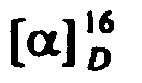
- (v) (3aS, 6R, 6aS)-(9H-Fluoren-9-yl)methyl 6-methoxy-3-oxotetrahydro-2H-furo[3,2-b]pyrrole-4(5H)-carboxylate (5c). Dess-Martin periodinane (985 mg, 2.32 mmol) was added to a stirred solution of bicyclic alcohol (5b) (443mg, 1.16 mmol) in dichloromethane (17 mL) at 0 °C under an atmosphere of argon. The mixture was stirred for 2 hours then allowed to warm to ambient temperature then stirred for 2 hours, then diluted with dichloromethane (30 mL). The organic phase was washed with a mixture of saturated aqueous sodium bicarbonate and 0.5M sodium thiosulphate solution (1 : 1, 30 mL), then saturated aqueous sodium bicarbonate (20 mL), then brine (20 mL), then dried (Na2SO4), filtered and reduced in vacuo. Flash chromatography over silica, eluting with ethyl acetate : heptane mixtures 20 : 80 to 40 : 60 gave bicyclic ketone (5c) (305 mg, 69%) as a white solid. TLC (Rf = 0.50, EtOAc : heptane 3 : 1), analytical HPLC broad main peak, Rt = 14.547-17.583 min., HPLC-MS 380.2 [M + H]+, 781.3 [2M + Na]+; [α]

- Preparation of (3R, 3aR, 6R, 6aS)-Benzvl 3-hydroxy-6-methoxytetrahvdro-2H-furo[3,2-b]pyrrole-4(5H)-carboxylate (73) . Sodium hydride (60% dispersion in oil, 164 mg, 4.11 mmol) was added over 1 minute to a stirred solution consisting of an ~ 4 : 1 mixture of anti-epoxide benzyl (R)-2-((1S, 2R, 5S)-3,6-dioxabicyclo[3.1.0]hexan-2-yl)-2-methoxyethyl carbamate (31b) and syn-epoxide benzyl (R)-2-((1R, 2R, 5R)-3,6-dioxabicyclo[3.1.0]hexan-2-yl)-2-methoxyethyl carbamate (963 mg, 3.29 mmol total) in tetrahydrofuran (10 mL) at 0 °C under an atmosphere of argon. The mixture was stirred at 0 °C for 30 minutes then at ambient temperature for 2.75 hours then dichloromethane (150 mL) added. The organic layer was washed with brine (75 mL), then dried (Na2SO4), filtered and reduced in vacuo to leave a residue (1.0 g). Flash chromatography over silica, eluting with ethyl acetate : heptane mixtures 30 : 70 to 90 : 10 gave (3R, 3aR, 6R, 6aS)-benzyl 3-hydroxy-6-methoxyteb-ahydro-2H-furo[3,2-b]pyrrole-4(5H)-carboxylate (73) as a colourless oil (657 mg, 85% based on anti-epoxide). TLC (Rf = 0.30, EtOAc : heptane 2 : 1), analytical HPLC single main peak, Rt = 8.70 min.; HPLC-MS 294.1 [M + H]+, 609.2 [2M + Na]+;
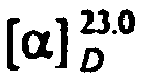
-
- (i) Preparation of (3R, 3aR, 6R, 6aS)- Benzyl 3-hydroxy-6-(tosyloxy)tetrahydro-2H-furo[3,2-b]pyrrole4(5H)-carboxylate (34b). Ethanol (1.5 mL) was added dropwise to a mixture of 10% palladium on charcoal (10 mg) and anti-(33b) (12.0 mg, 0.028 mmol) under an atmosphere of argon. The argon was replaced by hydrogen then the suspension was stirred for 1.75 hours before filtering the mixture through celite in vacuo. The filter cake was washed with ethanol (7.5 mL) then the solvents removed in vacuo from the filtrate. The residue was azeotroped with toluene (2 mL) to obtain (3R, 3aR, 6R, 6aS)-3-hydroxyhexahydro-2H-furo[3,2-b]pyrrol-6-yl 4-methylbenzenesulfonate (7.6 mg, 89%) as a pale yellow oil which was used without further purification. TLC (Rf = 0.01, EtOAc : heptane 1 : 1), HPLC-MS 300.1 [M + H]+, 621.2 [2M + Na]+.
- A solution of sodium carbonate (6.2 mg, 0.058 mmol) in water (0.15 mL) was added whilst stirring to a solution of (3R, 3aR, 6R, 6aS)-3-hydroxyhexahydro-2H-furo[3,2-b]pyrrol-6-yl 4-methylbenzenesulfonate in 1,4-dioxane (0.3 mL). Benzylchloroformate (5.9 µL, 0.042 mmol) was added then the mixture stirred for 2 hours. Water (5 mL) was added and the product extracted into dichloromethane (2 x 5 mL). The organic layer was washed with brine (5 mL), then dried (Na2SO4), filtered and reduced in vacuo to leave a residue (10.6 mg). Flash chromatography over silica, eluting with ethyl acetate : heptane mixtures 20 : 80 to 50 : 50 gave bicyclic alcohol (34b) (6.6 mg, 54%) as a white solid. TLC (Rf = 0.20, EtOAc : heptane 1 : 1), analytical HPLC single main peak, Rt = 17.32 min., HPLC-MS 434.1 [M + H]+, 889.2 [2M + Na]+;

- (ii) Preparation of (3R, 3aR, 6S, 6aS)-benzyl 6-azido-3-hydroxytetrahydro-2H-furo[3,2-b]pyrrole-4(5H)-carboxylate (36b). Sodium azide (15 mg, 0.231 mmol) was added to a stirred solution of bicyclic alcohol (34b) (50 mg, 0.115 mmol) in dimethylformamide (1 mL) under an atmosphere of argon. The mixture was heated at 70°C for 18 hours then sodium azide (10 mg, 0.154 mmol) was added and heating continued at 105°C for 21 hours. Water (6 mL) was added and the product extracted into tert-butyl methyl ether (3 x 3 mL). The organic layer was washed with brine (9 mL), then dried (Na2SO4), filtered and reduced in vacuo to leave a residue (56 mg). Flash chromatography over silica, eluting with ethyl acetate : pentane mixtures 1 : 2 gave bicyclic azidoalcohol (36b) (28 mg, 80%) as a (viscous) colourless oil. TLC (Rf = 0.25, EtOAc : heptane 1 : 1), analytical HPLC single main peak, Rt, = 13.43 min., HPLC-MS 277.2 [M - N2 + H]+, 327.2 [M + Na]+, 631.3 [2M + Na]+;

- (iii) Preparation of (3R, 3aR, 6S, 6aS)-benzyl 6-(tert-butoxycarbonylamino)-3-hydroxyteb-ahydro-2H-furo[3,2-b] pyrrole-4(5H)-carboxylate (37b).
- (a) Reduction of azide. Azide (36b) (54mg, 0.177 mmol) was dissolved in THF (6 mL) with stirring and water (32 µL, 1.77 mmol) added followed by triphenylphosphine (70 mg, 0.266 mmol). The mixture was heated at 45°C under nitrogen overnight.. The mixture was reduced in vacuo to a syrup used directly in the next step. HPLC-MS 279.1 [M + H]+, 301.1 [M + Na]+, 557.2, 579.3 [2M + Na]+.
- (b) Amine protection. Crude amine (~ 0.18 mmol) was dissolved in 1,4-dioxan (2.5 mL) with stirring and ice-cooled and a solution of sodium carbonate (42 mg, 0.37 mmol) in water (2.5 mL) was added. Di-tert-butylcarbonate (46 mg, 0.27 mmol) in 1,4-dioxane (1.0 mL) was added dropwise over 30 minutes and the mixture stirred overnight at ambient temperature. DCM (20 mL) was then added and the organic phase washed with 0.1N HCl (20 mL), sat. NaHCO3 (20 mL), then brine (20 mL) and dried (Na2SO4). The organic layer was filtered and reduced in vacuo to leave a clear gum. The crude gum was purified on a 5g Flash silica cartridge eluting with a gradient of heptane : ethyl acetate 5:1 → 1:2 to provide alcohol (37b) as a white foam (65.5 mg) contaminated with triphenylphosphine oxide. TLC (Rf = 0.43, EtOAc : heptane 2 : 1), analytical HPLC Rt = 15.05 min (product 8.25 % by UV) and 15.39 min (triphenylphosphine oxide 91.25 % by UV), HPLC-MS 279.1 [M + H - Boc]+, 323.1 [M + 2H - Bu]+, 401.1 [M + Na]+, 557.2, 779.3 [2M + Na]+.
- (iv) Preparation of (3R, 3aR, 6S, 6aR)-(9H-fluoren-9-yl)methyl 6-(tert-butoxycarbonylamino)-3-hydroxytetrahydro-2H-furo[3,2-b]pyrrole-4(5H)-carboxylate (8b). Bicycle alcohol (37b) (60 mg, ~ 0.16 mmol) was dissolved in methanol (5 mL), cooled to 0 °C and 10% palladium on charcoal (15 mg) added. The mixture was stirred, then evacuated and flushed with hydrogen. The mixture was warmed to ambient temperature and after 2 h. filtered through celite. The filter cake was washed with ethanol (3 x 5 mL) and the combined filtrates reduced in vacuo to provide the crude amine (~ 16 mg). HPLC-MS 245.2 [M + H]+, 279.1, 511.3 [M + Na]+, 557.2. The crude amine was dissolved in 1,4-dioxane (2.5 mL) with stirring, ice-cooled and a solution of sodium carbonate (35.5 mg, 0.333 mmol) in water (2.5 mL) was added. 9-Fluorenylmethyl chloroformate (43 mg, 0.166 mmol) in 1,4-dioxane (1.0 mL) was added dropwise over 30 minutes and the mixture stirred for a further 1 h. EtOAc (25 mL) was then added and the organic phase washed with 0.1N HCl (25 mL), sat. NaHCO3 (25 mL), then brine (25 mL) and dried (Na2SO4). The organic layer was filtered and reduced in vacuo to leave a clear film (72.5 mg). The crude film was purified on a 5g Flash silica cartridge eluting with a gradient of heptane : ethyl acetate 6:1 → 3:1 to provide alcohol (8b) as a white solid (40.0 mg) with triphenylphosphine oxide. TLC (Rf = 0.23, EtOAc : heptane 1 : 1), analytical HPLC 15.39 min (triphenylphosphine oxide 63.8 % by UV) and Rt = 18.30 min (product 33.8 % by UV), HPLC-MS 411.2 [M + 2H - Bu]+, 489.2 [M + Na]+, 955.4 [2M + Na]+ and 279.1, 557.2.
- (v) Preparation of (3aS, 6S, 6aR)-(9H-fluoren-9-yl)methyl 6-(tert-butoxycarbonylamino)-3-oxotetrahydro-2H-furo[3,2-b]pyrrole-4(5H)-carboxylate (8c). Bicycle alcohol (8b) (40 mg, ~0.08 mmol) was dissolved in anhydrous dichloromethane (3 mL) with stirring under argon. Dess-Martin periodinane (68 mg, 0.16 mmol) was added and the mixture stirred overnight. The mixture was diluted with DCM (20 mL) and washed with sat. NaHCO3 / 0.25M Na2S2O3, sat. NaHCO3, brine (20 mL each) and dried (Na2SO4). The organic layer was filtered and reduced in vacuo to leave a colourless gum (~ 41 mg). The crude gum was purified on a 5g Flash silica cartridge eluting with a gradient of heptane : ethyl acetate 5:1 → 2:1 to provide ketone (8c) as a white solid (17.3 mg, 0.037 mmol). TLC (Rf = 0.36, EtOAc : heptane 1 : 1), analytical HPLC broad peak with R t = 18.14 - 20.32 min, HPLC-MS 409.2 [M + 2H - Bu]+, 465.2 [M + H]+, 487.2 [M + Na]+, 951.4 [2M + Na]+;

-
- (i) Preparation of (3R, 3aR, 6S, 6aS)- Benzyl 3-hydroxy-6-(tosyloxy)tetrahydro-2H-furo[3,2-b]pyrrole4(5H)-carboxylate (34). Ethanol (6 mL) was added dropwise to a mixture of 10% palladium on charcoal (50 mg) and anti-(33) (547 mg, 1.26 mmol) under an atmosphere of argon. The argon was replaced by hydrogen then the suspension was stirred at 20 °C for 3.75 hours before filtering the mixture through celite in vacuo. The filter cake was washed with ethanol (40 mL) then the solvents removed in vacuo from the filtrate to obtain (3R, 3aR, 6S, 6aS)- 3-hydroxyhexahydro-2H-furo[3,2-b]pyrrol-6-yl 4-methylbenzenesulfonate which was used without further purification.
- A solution of sodium carbonate (281 mg, 2.65 mmol) in water (5 mL) was added whilst stirring to a solution of (3R, 3aR, 6S, 6aS)- 3-hydroxyhexahydro-2H-furo[3,2-b]pyrrol-6-yl 4-methylbenzenesulfonate in 1,4-dioxane (5 mL). A solution of benzyl chloroformate (0.225 mL, 1.96 mmol) in 1,4-dioxane (2.5 mL) was added over 20 minutes then the mixture stirred for 35 minutes, then water (50 mL) was added and the product extracted into dichloromethane (2 x 50 mL). The organic layer was washed with brine (50 mL), then dried (Na2SO4), filtered and reduced in vacuo to leave a residue. Flash chromatography over silica, eluting with ethyl acetate : heptane mixtures 25 : 75 to 50 : 50 gave bicyclic alcohol (34) (518 mg, 95%) as a white solid. TLC (Rf = 0.25, EtOAc : heptane 3 : 2), analytical HPLC single main peak, R t = 17.86 min., HPLC-MS 434.2 [M + H]+, 456.1 [M + Na]+, 889.3 [2M + Na]+;

- (ii) Preparation of (3R, 3aR, 6R, 6aS)-benzyl 6-azido-3-hydroxytetrahydro-2H-furo[3,2-b]pyrrole-4(5H)-carboxylate (36). Bicycle alcohol (34) (400 mg, 0.93 mmol) was dissolved in dimethylformamide (2 mL) in a glass pressure tube and sodium azide (120 mg, 1.85 mmol) added. The mixture was sealed and heated at 135°C with stirring overnight. The viscous dark mixture was reduced in vacuo and the residue partitioned between DCM (25 mL) and brine (25 mL). The organic phase was washed with sat. NaHCO3 (25 mL), brine (25 mL) and dried (Na2SO4). The organic layer was filtered and reduced in vacuo to leave a dark gum (105 mg). The crude gum was partially purified on a 5g Flash silica cartridge eluting with a gradient of heptane : ethyl acetate 8:1 → 3:1 to provide azidoalcohol (36) as a thick tan oil (77 mg). TLC (Rf = 0.50, EtOAc : heptane 2 : 1) plus an unidentified by-product (Rf = 0.40, EtOAc : heptane 2 : 1), HPLC-MS 277.1 [M + H - N2]+, 305.1 [M + H]+, 327.1 [M + Na]+, 631.2 [2M + Na]+.
- (iii) Preparation of (3R, 3aR, 6R, 6aR)-benzyl 6-(tert-butoxycarbonylamino)-3-hydroxytetrahydro-2H-furo[3,2-b]pyrrole-4(5H)-carboxylate (37).
- (a) Reduction of azide. Azide (36) (77mg, ~ 0.25 mmol) was dissolved in THF (8.5 mL) with stirring and water (46 µL, 2.53 mmol) added followed by triphenylphosphine (99 mg, 0.38 mmol). The mixture was heated at 45°C under nitrogen overnight.. The mixture was reduced in vacuo, the residue dissolved in DCM (10 mL) and washed with 0.1N HCl (2 x 5 mL). The aqueous layer was then adjusted to pH 11 with sat. NaCO3 and back extracted with DCM (4 x 10 mL). The combined DCM back extracts were dried (Na2SO4), filtered and reduced in vacuo to leave a yellow oil (29.8 mg) used directly in the next step. HPLC-MS 279.1 [M + H ]+, 341.1 [M + Na]+, 579.3 [2M + Na]+.
- (b) Amine protection. Crude amine (29.8 mg, - 0.11 mmol) was dissolved in 1,4-dioxan (1.5 mL) with stirring and ice-cooled and a solution of sodium carbonate (26 mg, 0.24 mmol) in water (1.5 mL) was added. Di-tert-butylcarbonate (28 mg, 0.16 mmol) in 1,4-dioxane (1.0 mL) was added dropwise over 30 minutes and the mixture stirred for a further 1 h at ambient temperature. DCM (20 mL) was then added and the organic phase washed with 0.1N HCl (20 mL), sat. NaHCO3 (20 mL), then brine (20 mL) and dried (Na2SO4). The organic layer was filtered and reduced in vacuo to leave a clear gum (~ 44 mg). The crude gum was purified on a 5g Flash silica cartridge eluting with a gradient of heptane : ethyl acetate 6:1 → 1:1 to provide alcohol (37) as a clear gum (30.0 mg, 0.08 mmol, 32% from azide). TLC (R f = 0.40, EtOAc : heptane 2 : 1), analytical HPLC R t = 15.25 min, HPLC-MS 279.1 [M + H - Boc]+, 323.1 [M + 2H - Bu]+, 401.1 [M + Na]+, 779.3 [2M + Na]+.
- (iv) Preparation of (3R, 3aR, 6R, 6aR)-(9H-fluoren-9-yl)methyl 6-(tert-butoxycarbonylamino)-3-hydroxytetrahydro-2H-furo[3,2-b]pyrrole-4(5H)-carboxylate (7b). Bicycle alcohol (37) (30 mg, 0.08 mmol) was dissolved in methanol (3 mL), cooled to 0 °C and 10% palladium on charcoal (10 mg) added. The mixture was stirred, then evacuated and flushed with hydrogen. The mixture was warmed to ambient temperature and after 5 h. filtered through celite. The filter cake was washed with ethanol (3 x 5 mL) and the combined filtrates reduced in vacuo to provide the crude amine (~ 16 mg). HPLC-MS 245.2 [M + H]+, 511.3 [M + Na]+. The crude amine was dissolved in 1,4-dioxane (2.5 mL) with stirring, ice-cooled and a solution of sodium carbonate (18 mg, 0.165 mmol) in water (2.5 mL) was added. 9-Fluorenylmethyl chloroformate (22 mg, 0.084 mmol) in 1,4-dioxane (1.0 mL) was added dropwise over 30 minutes and the mixture stirred for a further 1 h. DCM (25 mL) was then added and the organic phase washed with 0.1N HCl (25 mL), sat. NaHC03 (25 mL), then brine (25 mL) and dried (Na2SO4). The organic layer was filtered and reduced in vacuo to leave a clear film. The crude film was purified on a 5g Flash silica cartridge eluting with a gradient of heptane : ethyl acetate 6:1 → 1:1 to provide alcohol (7b) as a white solid (23.4 mg, 0.05 mmol, 63%). TLC (R f = 0.46, EtOAc : heptane 2 : 1), analytical HPLC R t = 18.52 min, HPLC-MS 367.2 [M + H - Boc]+, 411.2 [M + 2H - Bu]+, 489.2 [M + Na]+, 955.4 [2M + Na]+;

- (v) Preparation of (3aS, 6R, 6aR)-(9H-fluoren-9-yl)methyl 6-(tert-butoxycarbonylamino)-3-oxotetrahydro-2H-furo [3,2-b]pyrrole-4(5H)-carboxylate (7c). Bicycle alcohol (7b) (23 mg, 0.05 mmol) was dissolved in anhydrous dichloromethane (3 mL) with stirring under argon. Dess-Martin periodinane (42 mg, 0.10 mmol) was added and the mixture stirred overnight. Additional Dess-Martin periodinane (21 mg, 0.05 mmol) was added and the mixture stirred for a further 2 h. The mixture was diluted with DCM (20 mL) and washed with sat. NaHCO3 / 0.25M Na2S2O3, sat. NaHCO3, brine (25 mL each) and dried (Na2SO4). The organic layer was filtered and reduced in vacuo to leave a colourless film (~ 26 mg). The crude film was purified on a 5g Flash silica cartridge eluting with a gradient of heptane : ethyl acetate 6:1 → 2:1 to provide ketone (7c) as a white solid (17.2 mg, 0.037 mmol, 74%). TLC (Rf= 0.34, EtOAc : heptane 1 : 1), analytical HPLC broad peak with Rt = 17.94 - 20.0 min, HPLC-MS 365.1 [M + H - Boc]+, 409.1 [M + 2H - Bu]+, 465.2 [M + H]+, 487.2 [M + Na]+, 505.2 [M + 18 + Na]+, 951.3 [2M + Na]+;

- Preparation of (3R, 3aR, 6S ,6aS)-tert-butyl 3-bydroxy-6-(methylthio)tetrahydro-2H-furo[3,2-b]pyrrole-4(5H)-carboxylate (54) A stirred solution of tosylate (35b) (250mg, 0.63 mmol) and sodium thiomethoxide [CAS 5188-07-8] (88mg, 1.25 mmol) in 3ml of DMA was heated under an atmosphere of argon in a sealed pressure vessel at 90 °C for 2 hours. The mixture was then allowed to cool to ambient temperature then an aqueous saturated solution of ammonium chloride (10 mL) was added. The aqueous phase was extracted with tert-butyl methyl ether (3 x 7ml). The organic phase was dried (MgSO4), filtered and reduced in vacuo to leave an oil. Flash chromatography over silica, eluting with diethyl ether : pentane 2 : 1 gave thiomethylether (54) as colourless oil (0.152 g, 88%). TLC (Rf = 0.29, Et2O : pentane 2 : 1), HPLC-MS 220.1 [M + 2H - t Bu]+, 573.2 [2M + H]+; δH (500 MHz, CDCl3) mixture of rotamers 1 : 1; 1.46 (4.5H, s, CCH 3), 1.49 (4.5H, s, CCH 3), 2.16 (3H, s, SCH 3), 3.20 (1H, brs, BocNCH 2), 3.47-4.05 (4H, m, OCH 2CHOH, BocNCH 2 and CHSCH3), 4.24-4.45 (2H, m, BocNCH and OCH2CHOH), 4.63 (1H, s, OCHCHSCH3).
- Preparation of (3R, 3aR, 6S ,6aS)-(9H-fluoren-9-yl)methyl 3-hydroxy-6-(methylthio)tetrahydro-2H-furo[3,2-b]pyrrole-4(5H)-carboxylate (55) A solution of HCl in 1,4-dioxane (4M, 5.5 mL) was added to thiomethylether (54) (152mg, 0.55mmol). The mixture stirred for 1 hour then the solvents removed in vacuo. The residue was azeotroped with CH3CN (5 mL) to obtain (3R, 3aR, 6S, 6aS)-6-(methylthio)hexahydro-2H-furo[3,2-b]pyrrol-3-ol which was used without further purification.
- A solution of (3R, 3aR, 6S, 6aS)-6-(methytthio)hexahydro-2H-furo[3,2-b]pyrrol-3-ol in 1,4-dioxane (5 mL) was added whilst stirring to a solution of sodium carbonate (123 mg, 1.16 mmol) in water (1.5 mL) at 0 °C. A solution of 9-fluorenylmethoxycarbonyl chloride (150 mg, 0.58 mmol) in 1,4-dioxane (1.5 mL) was added dropwise over 5 minutes then the mixture allowed to warm to ambient temperature over 2 hours. Water (20 mL) was added and the product extracted into dichloromethane (3 x 10 mL). The organic layer was dried (Na2SO4), filtered and reduced in vacuo to leave a residue. Flash chromatography over silica, eluting with diethyl ether : pentane mixtures 2 : 1 gave alcohol (55) as a white solid (130 mg, 60%). TLC (Rf = 0.19, Et2O : pentane 2 : 1); HPLC-MS 398.2 [M + H]+, 420.1 [M + Na]+, 817.3 [2M + H]+; analytical HPLC single main peak, Rf = 16.096 min.,

- Preparation of (3aS, 6S, 6aS)-(9H-Fluoren-9-yl)methyl 6-(methylthio)-3-oxotetrahydro-2H-furo[3,2-b]pyrrole-4(5H)carboxylate (56). Dess-Martin periodinane (130 mg, 0.65 mmol) was added to a stirred solution of alcohol (55) (278 mg, 0.33 mmol) in dichloromethane (10 mL) under an atmosphere of argon. The mixture was stirred for 1 hour then diluted with dichloromethane (25 mL). The organic phase was washed with a mixture of saturated aqueous sodium bicarbonate and 10% aqueous sodium thiosulphate solution (1 : 1, 20 mL), then dried (Na2SO4), filtered and reduced in vacuo. Flash chromatography over silica, eluting with diethyl ether : pentane mixtures 60 : 40 to 65 : 35 gave ketone (56) (113 mg, 87%) as a white solid. TLC (Rf = 0.24, Et2O : pentane 2 : 1); analytical HPLC two main peaks, Rt = 15.71 and 15.91 min.; HPLC-MS 396.1 [M + H]+, 414.1 [M + H2O + Na]+, 813.2 [2M + H]+;

- Preparation of (3R, 3aR, 6S, 6aR)-benzyl 3-hydroxy-6-(methylamino)tetrahydro-2H-furor[3,2-b]pyrrole-4(5H)-carboxylate (57) A stirred solution of tosylate (34b) (200mg, 0.46mmol) and methylamine in ethanol (33% wt, 6 mL) was heated in a sealed pressure vessel at 150 °C for 72 hours. The mixture was then allowed to cool to ambient temperature then solvents removed in vacuo. The residue was dissolved in dichloromethane (20 mL), washed with water (15 mL) then dried (Na2SO4), filtered and reduced in vacuo. Flash chromatography over silica, eluting with dichloromethane : methanol mixtures 97 : 3 to 95 : 5 gave methylaminoalcohol (57) as a pale yellow solid (47 mg, 35%). TLC. (Rf = 0.22, DCM : MeOH 93 : 7), HPLC-MS 293.1 [M + H]+, 315.2 [M + Na]+, 607.3 [2M + Na]+; δH (500 MHz, CDCl3) mixture of rotamers major : minor 3 : 2; 2.42 (1.8H, s, NHCH 3 major), 2.3 (1.2H, s, NHCH 3 minor), 3.14-3.16 (1H, m, CHNHCH3), 3.35-4.48 (7H, m, OCH 2CHOH, CHCHCHCH 2NCbz), 5.06 and 5.22 (0.8H total, each d, J = 12.22 Hz, Cbz minor), 5.12 (1.2H, s, Cbz major), 7.27-7.37 (5H, m, aromatic CH).
- Preparation of (3R, 3aR, 6S, 6aR)-benzyl 6-(tert-butoxycarbonyl(methyl)amino)-3-hydroxytetrahydro-2H-furo[3,2-b]pyrrole-4(5H)-carboxylate (58) A solution of di-tert-butyl dicarbonate (48 mg, 0.22 mmol) and diisopropyl ethyl amine (30 mg, 0.23 mmol) in dichloromethane (1.5 mL) was added dropwise over 5 minutes to a solution of methylaminoalcohol (57) (47 mg, 0.161 mmol) dichloromethane (1.5 mL). The mixture was stirred for 16 hours then diluted with dichloromethane (10 mL), then washed with hydrochloric acid (1M, 5 mL), reduced in vacuo to leave Boc alcohol (58) as a yellow oil (72 mg). TLC (Rf = 0.41, Et2O), HPLC-MS 293.1 [M - Boc + H]+, 337.1 [M + 2H - tBu]+, 415.2 [M + Na]+, 807.3 [2M + Na]+.
- Preparation of (3R,3aR,6S,6aS)-tert-butyl 6-ethoxy-3-hydroxytetrahydro-2H-furo[3,2-b]pyrrole-4(5H)-arboxylate (59) A stirred mixture of tosylate (35b) (20 mg, 0.05 mmol), ethanol (1 mL) and sodium ethoxide solution in ethanol (21% wt, 94 µL, 0.25mmol) was heated under an atmosphere of argon at 80°C for 16 hours. The mixture was diluted with aqueous saturated sodium hydrogen carbonate solution (10 mL) then extracted with tert-butyl methyl ether (3 x 5 mL). The organic phase was dried (MgSO4), filtered and reduced in vacuo to leave an oil. Flash chromatography over silica, eluting with diethyl ether : pentane mixtures 65 : 35 to 83 : 17 gave ethoxyalcohol (59) as a pale yellow solid (1 mg, 7%). TLC (Rf = 0:50, Et2O); analytical HPLC main peak, Rf = 15.35 min., HPLC-MS 218.1 [M + 2H - t Bu]+, 296.1 [M + Na]+, 569.3 [2M + Na]+.
- Preparation of (3R, 3aR, 6S, 6aS)-Benzyl 6-fluoro-3-hydroxytetrahydro-2H-furo[3,2-b]pyrrole-4(5H)-carboxylate (60) A solution of potassium carbonate (5 mg, 0.034 mmol) in acetonitrile : water (95 : 5, 0.5 mL) was added to a mixture of Kryptofix®222 (66 mg, 0.175 mmol), oven dried potassium fluoride (13.1 mg, 0.225 mmol) in a pressure vessel. The mixture was stirred for 5 minutes then the solvent evaporated using a stream of argon. Acetonitrile (0.5 mL) was added then the solvent removed using a stream of argon. Acetonitrile (0.5 mL) was added three more times, removing the solvent each time using a stream of argon. A solution of tosylate (34b) (50 mg, 0.115 mmol) in acetonitrile (0.5 mL) was added then the vessel sealed and heated at 130 °C for 2 hours. HPLC-MS analysis showed the formation of 6-fluoro analogue; HPLC-MS 282.1 [M + H]+, 304.1 [M + Na]+, 585 [2M + Na]+.
- The Cbz analogue (60) may readily be converted to the corresponding Boc analogue (3R, 3aR, 6S, 6aS)-tert-butyl 6-fluoro-3-hydroxytetrahydro-2H-furo[3,2-b]pyrrole-4(5H)-carboxylate (61) following standard Pd-C hydrogenation and treatment with di-tert-buytl dicarbonate and sodium carbonate in aqueous dioxane.
- Alternative preparation of (3R, 3aR, 6S, 6aS)-tert-Butyl 6-fluoro-3-hydroxytetrahydro-2H-furo[3,2-b]pyrrole-4(5H)-carboxylate (61). A solution of tetrabutylammonium fluoride (1M in tetrahydrofuran, 35 mL, 35 mmol) and (3R, 3aR, 6R, 6aS)-tert-butyl 3-hydroxy-6-(tosyloxy)tetrahydro-2H-furo[3,2-b]pyrrole-4(5H)-carboxylate (35b) (7.0 g, 17:5 mmol) in dimethylformamide (35 mL) was divided into seven portions then heated in sealed tubes under an atmosphere of argon at 140 °C for 1 hour 40 minutes then at 145 °C for 3 hours. The mixtures were stirred at ambient temperature for 19 hours then at 145 °C for 2.75 hours. The separate reaction mixtures were combined then the solvents were removed in vacuo. The residue was diluted with dichloromethane (400 mL) and water (200 mL). The organic layer was separated then the aqueous phase re-extracted with dichloromethane (100 mL). The combined organic layers were washed with water (2 x 200 mL), then dried (Na2SO4), filtered and reduced in vacuo to leave a brown-black residue (10.4 g). Flash chromatography over silica, eluting with ethyl acetate : heptane mixtures 0 : 100 to 40 : 60 gave crude 6-fluoroalcohol (61) (3.05 g) as brown oil. The oil was dissolved in dichloromethane (65 mL) then 3-chloroperoxybenzoic acid (supplied by Sigma-Aldrich 77 % maximum purity, 2.77 g, 12.35 mmol) was added. The mixture was stirred for 1 hour then diluted with dichloromethane (300 mL), then washed with aqueous sodium hydroxide solution (1M, 2 x 150 mL), then water (150 mL), then dried (Na2SO4), filtered and reduced in vacuo to leave a residue (3.14 g). Flash chromatography over silica, eluting with ethyl acetate : heptane mixtures 0 : 100 to 50 : 50 gave 6-fluoroalcohol (61) (1.77 g, 41%) as a white solid. TLC (Rf = 0.46, EtOAc : heptane 3 : 1), HPLC-MS 192.0 [M + 2H - Bu]+, 270.1 [M + Na]+, 517.2 [2M + Na]+; δH (500 MHz, CDCl3) mixture of rotamers major : minor 2 : 1; 1.45 (6H, s, (CH 3)3C major), 1.49 (3H, s, (CH 3)3C minor), 2.70 (1H, brs, OH), 3.30 (0.66H, dt, J = 13.49 and 3.22 Hz, I x BocNCH 2 major), 3.38 (0.33H, dt, J = 13.26 and 3.22 Hz, 1 x BocNCH 2 minor), 3.76-4.00 (3H, m, OCH 2CHOH and 1 x CbzNCH 2), 4.27 (0.33H, d, J = 4.51 Hz, BocNCH minor), 4.32 (0.66H, d, J = 4.75 Hz, BocNCH major), 4.41 (0.33H, brd, J = 2.69 Hz, OCH2CHOH minor), 4.47 (0.66H, brs, OCH2CHOH major), 4.69-4.76 (1H, m, CHCHF), 4.94 (0.33H, d, J = 49.73 Hz, CHF minor), 4.95 (0.66H, d, J = 49.71 Hz, CHF major); δC (125 MHz, CDCl3) 28.358 / 28.445 ((CH3)3C), 50.962 / 51.139 and 51.47 / 51.650 (BocNCH2), 68.004 / 68.572 (BocNCH), 74.153 / 74.224 (OCH2CHOH), 75.599 / 76.426 (OCH2CHOH), 80.702 / 80.911 ((CH3)3C), 83.204 / 83.454 and 84.000 / 84.252 (CHCHF), 91.458 / 92.136 and 92.886 / 93.561 (CHF), 153.654 / 154.459 (Boc C=O).
- Alternative Preparation of (3R, 3aR, 6S, 6aS)-Benzyl 6-fluoro-3-hydroxytetrahydro-2H-furo[3,2-b]pyrrole-4(5H)-arboxylate (60). A solution of tetrabutylammonium fluoride (1M in tetrahydrofuran, 8.2 mL, 8.2 mmol) and (3R, 3aR, 6R, 6aS)-benzyl 3-hydroxy-6-(tosyloxy)tetrahydro-2H-furo[3,2-b]pyrrole-4(5H)-carboxylate (34b) (1.77 g, 4.09 mmol) in acetonitrile (17 mL) was heated in a sealed tube under an atmosphere of argon at 135 °C for 16 hours. The solvents were removed in vacuo then residue was partitioned between EtOAc (150 mL) and 0.2N HCl (340 mL). The aqueous phase re-extracted with EtOAc (2 x 150 mL) then the combined organic layers were washed with saturated NaHCO3 (300 mL), then brine (300 mL). The organic layer was then dried (Na2SO4), filtered and reduced in vacuo to leave a brown-black residue (1.07 g). Flash chromatography over silica, eluting with ethyl acetate : heptane mixtures 1 : 2 gave crude 6-fluoroalcohol (60) (780 mg) as a white solid. The crude alcohol was purified by on semi-preparative silica chromatography plates (EtOAc : DCM, 1:1) to give pure 6-fluoroalcohol (60) (379 mg, 33%) as a colourless oil. TLC (Rf = 0.25, EtOAc : heptane 1 : 2), HPLC-MS 282.1 [M + H]+, 304.1 [M + Na]+, 585.2 [2M + Na]+;

- Alternative Preparation of (3R, 3aR, 6S, 6aS)-Benzyl 6-fluoro-3-hydroxytetrahydro-2H-furo[3,2-b]pyrrole-4(5H)-carboxylate (60). A solution of tetrabutylammonium fluoride (1M in tetrahydrofuran, 0.6 mL, 0.6 mmol) and (3R, 3aR, 6R, 6aS)-benzyl 3-hydroxy-6-(tosyloxy)tetrahydro-2H-furo[3,2-b]pyrrole-4(5H)-carboxylate (34b) (130 mg, 0.30 mmol) in dimethylformamide (0.6 mL) was heated in a sealed tube under an atmosphere of argon at 135 °C for 3 hours. The solvents were removed in vacuo then residue was partitioned between dichloromethane (10 mL) and water (5 mL). The aqueous phase reextracted with dichloromethane (5 mL) then the combined organic layers were washed with water (5 mL), then dried (Na2SO4), filtered and reduced in vacuo to leave a brown-black residue (125 mg). Flash chromatography over silica, eluting with ethyl acetate : heptane mixtures 0 : 100 to 60 : 40 gave crude fluoroalcohol (60) (11 mg, 12%) as a white solid together with a contaminated sample of (60) (estimated 50% purity, 10 mg).
- Alternative Preparation of (3R, 3aR, 6S, 6aS)-Benzyl 6-fluoro-3-hydroxytetrahydro-2 H- furo[3,2-b]pyrrole-4(5H)-carboxylate (60). A solution of tetrabutylammonium fluoride (1M in tetrahydrofuran, 0.66 mL, 0.66 mmol) was added to a solution of (3R, 3aR, 6R, 6aS) 3-hydroxyhexahydro-2H-furo[3,2-b]pyrrol-6-yl 4-methylbenzenesulfonate (74) (100 mg, 0.33 mmol) in dimethylformamide (0.66 mL) under an atmosphere of argon. The mixture was heated at 125 °C for 5 hours then allowed to cool to ambient temperature. A solution of sodium carbonate (89 mg, 0.84 mmol) in water (1.5 mL) was added followed by benzylchloroformate (0.105 mL, 0.74 mmol). The mixture was stirred for 1 hour then dichloromethane (10 mL) and water (15 mL) added. The organic phase was separated and the aqueous extracted with dichloromethane (2 x 5 mL). The combined organic phase was washed with brine (5 mL), then dried (Na2SO4), filtered and reduced in vacuo to leave a brown oil. Flash chromatography over silica, eluting with ethyl acetate : heptane mixtures 5 : 95 to 40 : 60 gave fluoroalcohol (60) (23 mg, 25%) as a colourless oil. TLC (Rf = 0.70, EtOAc : heptane 3 : 1), analytical HPLC single main peak, Rt = 9.641 min; HPLC-MS 282.1 [M + H]+, 304.1 [M + Na]+, 585.2 [M + H]+;

-
- (i) Boc alcohol (61) (73 mg, 0.30 mmol) was dissolved in 1,4-dioxane (2 mL). A solution of hydrogen chloride in 1,4-dioxane (4M, 0.74 mL, 2.95 mmol) was added in a single portion then the mixture stirred for 18 hours. The solvent was removed in vacuo then the residue triturated with cold diethyl ether (10 mL) to afford a pale lilac powder (39 mg, 72%) which was used without further purification. Data for (3R, 3aR, 6S, 6aS)-6-fluorohexahydro-2H-furo[3,2-b]pyrrol-3-ol hydrochloride TLC (Rf = 0.0, EtOAc : heptane 2 : 3), HPLC-MS 148.1 [M + H]+.δC (125 MHz, D6-DMSO) 49.521 / 49.697 (NCH2), 68.088 (NCH), 72.738 (OCH2 CHOH), 74.944 (OCH2CHOH), 83.813 / 84.057 (OCHCHF), 92/975 / 94.379 (CHF); δF (376 MHz, CDCl3) -185.69.
- (ii) Preparation of (3R, 3aR, 6S, 6aS)-(9H-fluoren-9-yl)methyl 6-fluoro-3-hydroxytetrahydro-2H-furo[3,2-b]pyrrole-4(5H)-carboxylate (62). The crude (3R, 3aR, 6S, 6aS)-6-fluorohexahydro-2H-furo[3,2-b]pyrrol-3-ol hydrochloride (34 mg, 0.19 mmol) was dissolved in aqueous sodium carbonate solution (39 mg in 2 mL) then 1,4-dioxane (1 mL) followed by 9-fluorenylmethoxycarbonyl chloride (50 mg, 0.19 mmol) added. The mixture was stirred for 24 hours then water (2 mL) added. The aqueous phase was extracted with chloroform (5 x 2 mL) then the combined organic phase was washed with brine (5 mL), then dried (Na2SO4), filtered and reduced in vacuo to obtain an opaque oil. Flash chromatography over silica, eluting with ethyl acetate : heptane mixtures 0 : 100 to 60 : 40 gave alcohol (62) as a colourless oil (64 mg, 94%). TLC (Rf = 0.43, EtOAc : heptane 1 : 1), analytical HPLC single main peak, Rt = 15.402 min., HPLC-MS 370.2 [M + H]+, 392.2 [M + Na]+,

- (iii) Oxidation to ketone (63). Dess-Martin periodinane (135 mg, 0.32 mmol) was added in a single portion to a stirred solution of alcohol (62) (59 mg, 0.16 mmol) in dichloromethane (4 mL) under argon. The mixture was stirred for 4 hours then diluted with dichloromethane (5 mL). The organic phase was washed with a mixture of saturated aqueous sodium hydrogencarbonate and 10% sodium thiosulphate solution (1 : 1, 5 mL), then saturated aqueous sodium bicarbonate (5 mL), then dried (Na2SO4), filtered and reduced in vacuo to obtain a yellow solid. Flash chromatography over silica, eluting with ethyl acetate : heptane mixtures 0 : 100 to 60 : 40 gave ketone (63) as a white solid (47 mg, 80%). TLC (Rf = 0.42, EtOAc : heptane 1:1), analytical HPLC single main peak, Rt = 16.303 min., HPLC-MS 368.2 [M + H]+, 390.1 [M + Na]+, 757.3 [2M + Na]+,

-
- (i) Preparation of (3R, 3aR, 6S, 6aS)-Benzyl 6-chloro-3-hydroxytetrahydro-2H-furo[3,2-b]pyrrole-4(5H)-carboxylate (68).


- (ii) (3R, 3aR, 6S, 6aS)-(9H-Fluoren-9-yl)methyl 6-chloro-3-hydroxytetrahydro-2H-furo[3,2-b]pyrrole-4(5H)-carboxylate (70). Ethanol (8.5 mL) was added dropwise to a mixture of 10% palladium on charcoal (55 mg) and alcohol (68) (550 mg, 1.85 mmol) under an atmosphere of argon. The argon was replaced by hydrogen then the suspension was stirred for 1 hour 35 minutes before filtering the mixture through celite in vacuo. The filter cake was washed with ethanol (45 mL) then the solvents removed in vacuo from the filtrate. The residue was azeotroped with toluene (3 x 5 mL) to obtain (3R, 3aR, 6S, 6aS)-6-chlorohexahydro-2H-furo[3,2-b]pyrrol-3-ol (69) which was used without further purification.
A solution of sodium carbonate (0.49 g, 4.63 mmol) in water (7.5 mL) followed by a solution of 9-fluorenylmethoxycarbonyl chloride (0.55 g, 2.13 mmol) in 1,4-dioxane (2.5 mL) was added dropwise over 15 minutes whilst stirring to a solution of aminoalcohol (69) in 1,4-dioxane (5 mL). The mixture was stirred for 60 minutes then water (50 mL) was added and the product extracted into dichloromethane (3 x 25 mL), then dried (Na2SO4), filtered and reduced in vacuo to leave a colourless oil. Flash chromatography over silica, eluting with ethyl acetate : heptane mixtures 10 : 90 to 45 : 55 gave alcohol (70) (623 mg, 87%) as a white solid. TLC (Rf = 0.45, EtOAc : heptane 1 : 1), analytical HPLC single main peak, Rt = 16.54 min., HPLC-MS 386.1 / 388.1 [M + H]+, 408.1 / 410.1 [M + Na]+;
- (iii) (3aS, 6S, 6aS)-(9H-Fluoren-9-yl)methyl 6-chloro-3-oxotetrahydro-2H-furo[3,2-b]pyrrole-4(5H)-carboxylate (71). Dess-Martin periodinane (1.32 g, 3.11 mmol) was added to a stirred solution of alcohol (70) (600 mg, 1.56 mmol) in dichloromethane (15 mL) under an atmosphere of argon. The mixture was stirred for 19 hours then diluted with dichloromethane (50 mL) then washed with a mixture of saturated aqueous sodium bicarbonate and 0.25M sodium thiosulphate solution (1 : 1, 30 mL), saturated aqueous sodium bicarbonate (25 mL), brine (25 mL), then dried (Na2SO4) filtered and reduced in vacuo to obtain a white solid (935 mg). Flash chromatography over silica, eluting with ethyl acetate : heptane mixtures 15 : 85 to 100 : 0 gave ketone (71) (506 mg, 85%) as a white solid contaminated with 2-iodosylbenzoic acid (< 5%). TLC (Rf = 0.35, EtOAc : heptane 1:1), analytical HPLC single main peak, Rt = 15.81 min., HPLC-MS 384.1 / 386.1 [M + H]+, 406.1 / 408.1 [M + Na]+, 424.1 / 426.1 [M + H2O + Na]+, 789.1 / 791.2 [2M + Na]+;

- Alternative preparation of (3R, 3aR, 6S, 6aS)-Benzyl 6-chloro-3-hydroxytetrahydro-2H-furo[3,2-b]pyrrole-4(5H)-carboxylate (68). Lithium chloride (142 mg, 3.34 mmol) was added to a stirred solution of (3R, 3aR, 6R, 6aS) 3-hydroxyhexahydro-2H-furo[3,2-b]pyrrol-6-yl 4-methylbenzenesulfonate (74) (100 mg, 0.33 mmol) in dimethylformamide (3 mL) under an atmosphere of argon. The mixture was heated at 130 °C for 2.75 hours then allowed to cool to ambient temperature to give a solution containing 6-chloroaminoalcohol (69). A solution of sodium carbonate (89 mg, 0.84 mmol) in water (1.5 mL) was added followed by benzylchloroformate (0.105 mL, 0.74 mmol). The mixture was stirred for 35 minutes then dichloromethane (10 mL) and water (15 mL) added. The organic phase was separated and the aqueous extracted with dichloromethane (2 x 5 mL). The combined organic phase was washed with brine (5 mL), then dried (Na2SO4), filtered and reduced in vacuo to leave a black residue (97 mg). Flash chromatography over silica, eluting with ethyl acetate : heptane mixtures 5 : 95 to 50: 50 gave 6-chloroalcohol (68) (48 mg, 48%) as a pale yellow oil. TLC (Rf = 0.30, EtOAc : heptane 3 : 2), analytical HPLC single main peak, Rt = 11.47 min., HPLC-MS 298.0 / 300.0 [M + H]+, 617.1 / 619.1 [2M + Na]+;

-
- (i) Preparation of (3R, 3aR, 6R, 6aS)-Benzyl 6-chloro-3-hydroxytetrahydro-2H-furo[3,2-b]pyrrole-4(5H)-carboxylate (76).


- (ii) Preparation of (3R, 3aR, 6R, 6aS)-(9H-Fluoren-9-yl)methyl 6-chloro-3-hydroxytetrahydro-2H-furo[3,2-b]pyrrole-4(5H)-carboxylate (78). Ethanol (3.5 mL) was added dropwise to a mixture of 10% palladium on charcoal (25 mg) and (3R, 3aR, 6R, 6aS)-benzyl 6-chloro-3-hydroxytetrahydro-2H-furo[3,2-b]pyrrole-4(5H)-carboxylate (198 mg, 0.67 mmol) under an atmosphere of argon. The argon was replaced by hydrogen then the suspension was stirred for 4.5 hours before filtering the mixture through celite in vacuo. The filter cake was washed with ethanol (20 mL) then the solvents removed in vacuo from the filtrate. The residue was azeotroped with toluene (3 x 5 mL) to obtain (3R, 3aR, 6R, 6aS)-6-chlorohexahydro-2H-furo[3,2-b]pyrrol-3-ol (77) which was used without further purification.
A solution of sodium carbonate (155 mg, 1.46 mmol) in water (2.5 mL) then a solution of 9-fluorenylmethoxycarbonyl chloride (189 mg, 0.73 mmol) in 1,4-dioxane (1.5 mL) was added whilst stirring to a solution of aminoalcohol (77) in 1,4-dioxane (1 mL). The mixture was stirred for 65 minutes then water (20 mL) was added and the product extracted into dichloromethane (3 x 10 mL), then dried (Na2SO4), filtered and reduced in vacuo to leave a residue. Flash chromatography over silica, eluting with ethyl acetate : heptane mixtures 10 : 90 to 50 : 50 gave alcohol (78) (194 mg, 76%) as a white solid. TLC (Rf = 0.45, EtOAc : heptane 1 : 1), analytical HPLC single main peak, Rt = 15.51 min., HPLC-MS 386.1 / 388.1 [M + H]+, 408.1 / 410.1 [M + Na]+;
- (iii) Dess-Martin periodinane (383 mg, 0.90 mmol) was added to a stirred solution of alcohol (78) (174 mg, 0.45 mmol) in dichloromethane (4 mL) under an atmosphere of argon. The mixture was stirred for 19 hours then diluted with dichloromethane (20 mL) then washed with a mixture of saturated aqueous sodium bicarbonate and 0.25M sodium thiosulphate solution (1 : 1, 10 mL), saturated aqueous sodium bicarbonate (10 mL), brine (10 mL), then dried (Na2SO4), filtered and reduced in vacuo to obtain a white solid (310 mg). Flash chromatography over silica, eluting with ethyl acetate : heptane mixtures 20 : 80 to 40 : 60 gave ketone (79) (141 mg, 82%) as a white solid. TLC (Rf = 0.35, EtOAc : heptane 1:1), analytical HPLC single main peak, Rt = 15.04 min., HPLC-MS 384.1 / 386.1 [M + H]+, 406.1 / 408.1 [M + Na]+, 424.1 / 426.1 [M + H2O + Na]+, 789.1 / 791.2 [2M + Na]+;

- Fmoc-ketone building blocks (2c-8c, 56, 63, 71, 79) were utilised in a solid phase synthesis of example inhibitors (85-71) of general formulae Ic and Id. The methods used were directly analogous to those described in detail in
WO02057270 WO02057270 WO0158886 
- 4-(4-(2-methoxyethyl)piperazin-1-yl)-N-((S)-4-methyl-1-oxo-1-((3aS, 6aR)-3-oxo dihydro-2H-furo[3,2-b]pyrrol-4(5H, 6H, 6aH)-yl)pentan-2-yl)benzamide (85) from (2c); HPLC-MS R t = 3.05 min, 487.2 [M + H]+, 505.2 [M + H + 18]+, 995.3 [2M + Na]+.
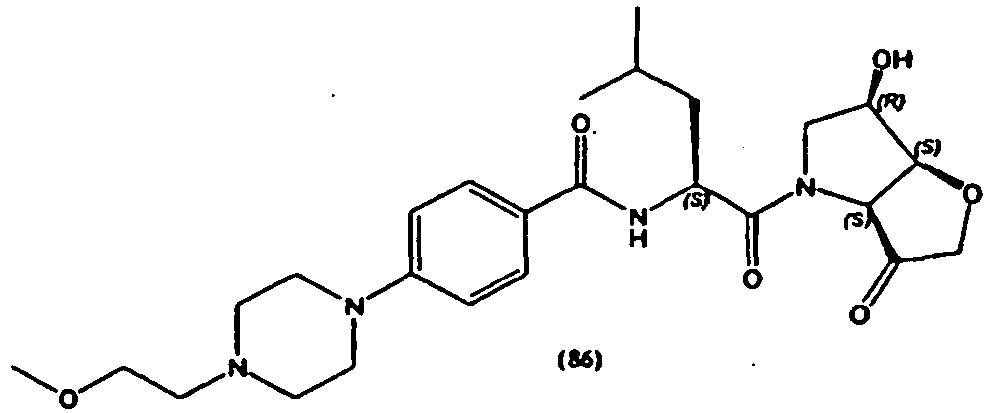
- N-((S)-1-((3aS, 6R, 6aS)-6-hydroxy-3-oxodihydro-2H-furo[3,2-b]pyrrol4(5H, 6H, 6aH)-yl)-4-methyl-1-oxopentan-2-yl)-4-(4-(2-methoxyethyl)piperazin-1-yl) benzamide (86) from (3c); HPLC-MS R t = 2.59 min, 503.3 [M + H]+, 521.3 [M + H + 18]+, 1027.5 [2M + Na]+.

- N-((S)-1-((3aS,6S,6aS)-6-hydroxy-3-oxodihydro-2H-furo[3,2-b]pyrrol-4(5H,6H,6aH)-yl)-4-methyl-1-oxopentan-2-yl)-4-(4-(2-methoxyethyl)piperazin-1-yl)benzamide (87) from (4c); HPLC-MS Rt = 2.83 min, 503.3 [M + H]+, 521.3 [M + H + 18]+, 1027.5 [2M + Na]+.

- N-((S)-1-((3aS, 6R, 6aS)-6-methoxy-3-oxodihydro-2H-furo[3,2-b]pyrrol-4(5H, 6H, 6aH)-yl)-4-methyl-1-oxopentan-2-yl)-4-(4-(2-methoxyethyl)piperazin-1-yl) benzamide (88) from (5c); HPLC-MS R t = 3.09 min, 517.3 [M +.H)+, 535.3 [M + H + 18]+, 1055.5 [2M + Na]+.

- N-((S)-1-((3aS, 6S, 6aS)-6-methoxy-3-oxodihydro-2H-furo[3,2-b]pyrol-4(5H, 6H, 6aH)-yl)-4-methyl-1-oxopentan-2-yl)-4-(4-(2-methoxyethyl)piperazin-1-yl) benzamide (89) from (6c); HPLC-MS R t = 3.16 min, 517.3 [M + H]+, 535.3 [M + H + 18]+, 1055.5 [2M + Na]+.

- N-((S)-1-((3aS, 6R, 6aR)-6-amino-3-oxodihydro-2H-furo[3,2-b]pyrrol-4(5H, 6H, 6aH)-yl)-4-methyl-1-oxopentan-2-yl)-4-(4-(2-methoxyethyl)piperazin-1-yl) benzamide (90) from (7c); HPLC-MS Rt = 2.12 min, 502.3 [M + H]+, 1025.5 [2M + Na]+.

- N-((S)-1-((3aS, 6R, 6aR)-6-amino-3-oxodihydro-2H-furo[3,2-b]pyrrol-4(5H, 6H, 6aH)-yl)-4-methyl-1-oxopentan-2-yl)-4-(4-(2-methoxyethyl)piperazin-1-yl) benzamide (91) from (8c); HPLC-MS R t = 2.14 min, 502.3 [M + H]+, 520.3 [M + H + 18]+, 1025.4 [2M + Na]+.

- N-((S)-1-cyclopentyl-2-((3aS,6S,6aS)-6-fluoro-3 -oxodihydro-2H-furo[3,2-b]pyrrol-4(5H,6H,6aH)-yl)-2-oxoethyl)-4-(4-methylpiperazin-1-yl)benzamide (92) from (63); HPLC-MS R t = 3.00 min, 473.1 [M + H]+, 491.3 [M + H + 18]+.

- N-((S)-1-cyclopentyl-2-((3aS,6S,6aS)-6-methylthio-3-oxodihydro-2H-furo[3,2-b] pyrrol-4(5H,6H,6aH)-yl)-2-oxoethyl)-4-(4-methylpiperazin-1-yl)benzamide (93) from (56); HPLC-MS R t = 3.50 min, 501.1 [M + H]+, 519.2 [M + H + 18]+.

- N-((S)-1-cyclopentyl-2-((3aS,6S,6aS)-6- methylsulfinyl -3-oxodihydro-2H-furo[3,2-b] pyrrol-4(5H,6H,6aH)-yl)-2-oxoethyl)-4-(4-methylpiperazin-1-yl)benzamide (94) from (56) and oxidation whilst on solid phase using Dess Martin periodinane in DCM overnight; HPLC-MS Rt = 2.23 min, 517.2 [M + H]+, 535.2 [M + H + 18]+.

- N-((S)-2-((3aS,6S,6aS)-6-chloro-3-oxodihydro-2H-furo[3,2-b]pyrrol-4(5H,6H,6aH)-yl)-1-cyclopentyl-2-oxoethyl)-4-(4-methylpiperazin-1-yl)benzamide (95) from (71); HPLC-MS R t = 3.80 min, 489.2/491.2 [M + H]+, 507.2/509.2 [M + H + 18]+.

- N-((S)-2-((3aS,6R,6aS)-6-chloro-3-oxodihydro-2H-furo[3,2-b]pyrrol-4(5H,6H,6aH)-yl)-1-cyclopentyl-2-oxoethyl)-4-(4-methylpiperazin-1-yl)benzamide (96) from (79); HPLC-MS R t = 3.77 min, 489.2/491.2 [M + H]+, 507.2/509.2 [M + H + 18]+.
- Alternatively, the free base or hydrochloride salt of the bicyclic alcohol building block (e.g. compound 2g or compound (69)) are utilised in a solution phase synthesis of compounds of general formula I as follows;
-
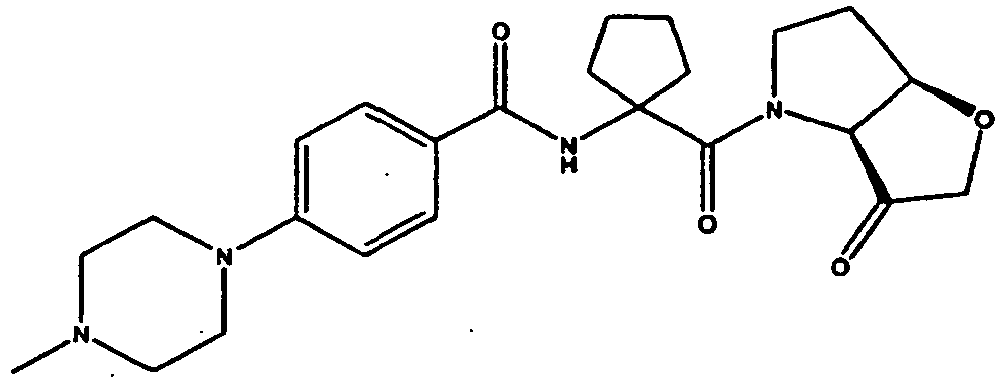
- (i) Preparation of benzyl 1-((3R,3aR,6aR)-3-hydroxyhexahydro-2H-furo[3,2-b]pyrrole-4-carbonyl)cyclopentylcarbamate. Hydrochloride salt (2g) (100mg, 0.6mmol) was dissolved in anhydrous DMF (1 mL) with stirring and NMM (1 eq. 61.7 mg, 67 µL) was added. Benzyl 1-(fluorocarbonyl)cyclopentylcarbamate (1 eq. 45% reagent, 356 mg, prepared following general methods detailed in Babu, V. V. S. et al, Ind. J. Chem., 39B(5), 384-6, 2000) was added in anhydrous DMF (2 mL) and the reaction stirred at ambient temperature for 5 h. The mixture was reduced in vacuo and partitioned between DCM (20 mL) and saturated NaHCO3 (20 mL). The organic phase was washed with pH 3 HCl (20mL), brine (20 mL), dried (Na2SO4), filtered and reduced in vacuo to give a brown oil. Flash chromatography over silica, eluting with ethyl acetate : heptane mixtures 5 : 95 to 30 : 70 gave product alcohol (168 mg, 74%) as a tan solid. TLC (Rf = 0.18, EtOAc : heptane 4 : 1), analytical HPLC single main peak, Rt = 10.36 min., HPLC-MS 375.2 [M + H]+, 771.3 [2M + Na]+;

- (ii) Preparation of N-(1-((3R,3aR,6aR)-3-hydroxyhexahydro-2H-furo[3,2-b]pyrrole-4-carbonyl)cyclopentyl)-4-(4-methylpiperazin-1-yl)benzamide. Methanol (5 mL) was added dropwise to a mixture of 10% palladium on charcoal (20 mg) and benzyl 1-((3R,3aR,6aR)-3-hydroxyhexahydro-2H-furo[3,2-b]pyrrole-4-carbonyl)cyclopentyl carbamate (115 mg, 0.31 mmol) under an atmosphere of argon. The argon was replaced by hydrogen then the suspension was stirred for 16 hours before filtering the mixture through celite in vacuo. The filter cake was washed with ethanol (10 mL) then the solvents removed in vacuo from the filtrate. The residue was azeotroped with toluene (2 x 3 mL) to obtain (1-aminocyclopentyl)((3R,3aR,6aR)-3-hydroxydihydro-2H-furo[3,2-b]pyrrol-4(5H,6H,6aH)-yl)methanone which was used without further purification.
4-(4-methylpiperazin-1-yl)benzoic acid (1.1 eq., 75 mg, 0.34 mmol), HBTU (1.05 eq., 123 mg, 0.32 mmol), HOBT (1.05 eq., 50 mg, 0.32 mmol) and NMM (2.1 eq., 71 µL, 0.65 mmol) were suspended in anhydrous DMF (2 mL) and sonicated for 5 mins. The mixture was then added to (1-aminocyclopentyl)((3R,3aR,6aR)-3-hydroxydihydro-2H-furo[3,2-b]pyrrol-4(5H,6H,6aH)-yl)methanone (89 mg, ∼ 0.31 mmol) and stirred at 60°C overnight. The mixture was reduced in vacuo and partitioned between DCM (15 mL) and saturated NaHCO3 (20 mL). The organic phase was washed with brine (15 mL), dried (Na2SO4), filtered and reduced in vacuo to give an orange gum. Flash chromatography over silica, eluting with methanol : CHCl3 mixtures 0 : 100 to 10 : 90 gave product alcohol (25.0 mg, 18%) as an oily orange solid. TLC (Rf= 0.30, MeOH : CHCl3 15 : 85), analytical HPLC single main peak, Rt = 5.98 min., HPLC-MS 222.2 [M + 2H]2+ , 314.2, 443.3 [M + H]+, 465.2 [M + Na]+, 907.4 [2M + Na]+. - (iii) Oxidation to Compound 97. N-(1-((3R,3aR,6aR)-3-hydroxyhexahydro-2H-furo[3,2-b]pyrrole-4-carbonyl)cyclopentyl)4-(4-methylpiperazin-1-yl)benzamide (22.5 mg, 0.051 mmol) was dissolved in anhydrous dichloromethane (2 mL) with stirring under argon. Dess-Martin periodinane (43 mg, 0.1 mmol) was added and the mixture stirred at ambient temperature overnight. The mixture was diluted with DCM (5 mL) and washed with 1N NaOH (5 mL), brine (10 mL each) and dried (Na2SO4). The organic layer was filtered and reduced in vacuo to leave a tan solid (15.2 mg). Analysis by HPLC-MS showed desired ketone; HPLC-MS 314.2, 441.3 [M + H]+, 903.4 [2M + . Na]+, 921.4 [2M + Na + 18]+.
-

- (i) Preparation of benzyl 1-((3R,3aR,6aR)-3-hydroxyhexahydro-2H-furo[3,2-b]pyrrole-4-carbonyl)cyclohexylcarbamate. Hydrochloride salt (2g) (100mg, 0.6mmol) was dissolved in anhydrous DMF (1 mL) with stirring and NMM (1 eq. 61.7 mg, 67 µL) was added. Benzyl 1-(fluorocarbonyl)cyclohexylcarbamate (1 eq. 90% reagent, 187 mg, prepared following general methods detailed in Babu, V. V. S. et al, Ind. J. Chem., 39B(5), 384-6, 2000) was added in anhydrous DMF (2 mL) and the reaction stirred at ambient temperature for 5 h. The mixture was reduced in vacuo and partitioned between DCM (20 mL) and saturated NaHCO3 (20 mL). The organic phase was washed with pH 3 HCl (20mL), brine (20 mL), dried (Na2SO4), filtered and reduced in vacuo to give a brown oil. Flash chromatography over silica, eluting with ethyl acetate : heptane mixtures 5 : 95 to 20 : 80 gave product alcohol as 2 fractions (35 mg, 15% and 60 mg, 26%) as white solids. TLC (Rf = 0.22, EtOAc : heptane 4 : 1), analytical HPLC single main peak, Rt = 11.84 min., HPLC-MS 389.2 [M + H]+, 799.4 [2M + Na]+;

- (ii) Preparation of N-(1-((3R,3aR,6aR)-3-hydroxyhexahydro-2H-furo[3,2-b]pyrrole-4-carbonyl)cyclohexyl)-4-(4-methylpiperazin-1-yl)benzamide. Methanol (3 mL) was added dropwise to a mixture of 10% palladium on charcoal (17 mg) and benzyl 1-((3R,3aR,6aR)-3-hydroxyhexahydro-2H-furo[3,2-b]pyrrole-4-carbonyl)cyclohexyl carbamate (77 mg, 0.2 mmol) under an atmosphere of argon. The argon was replaced by hydrogen then the suspension was stirred for 90 mins before filtering the mixture through celite in vacuo. The filter cake was washed with ethanol (10 mL) then the solvents removed in vacuo from the filtrate. The residue was azeotroped with toluene (2 x 3 m) to obtain (1-aminocyclohexyl)((3R,3aR,6aR)-3-hydroxydihydro-2H-furo[3,2-b]pyrrol-4(5H,6H,6aH)-yl)methanone which was used without further purification.
4-(4-methylpiperazin-1-yl)benzoic acid (1.1 eq., 49 mg, 0.22 mmol), HBTU (1.05 eq., 80 mg, 0.21 mmol), HOBT (1.05 eq., 33 mg, 0.21 mmol) and NMM (2.1 eq., 47 µL, 0.42 mmol) were suspended in anhydrous DMF (2 mL) and sonicated for 5 mins. The mixture was then added to (1-aminocyclohexyl)((3R,3aR,6aR)-3-hydroxydihydro-2H-furo[3,2-b]pyrrol-4(5H,6H,6aH)-yl)methanone (51 mg, ∼ 0.2 mmol) and stirred at 60°C overnight. The mixture was reduced in vacuo and partitioned between DCM (15 mL) and saturated NaHCO3 (20 mL). The organic phase was washed with brine (15 mL), dried (Na2SO4), filtered and reduced in vacuo to give an orange gum. Flash chromatography over silica, eluting with methanol : CHCl3 mixtures 0 : 100 to 8 : 92 gave product alcohol (12.0 mg, 13%) as an orange film. TLC (Rf = 0.23, MeOH : CHCl3 10 : 90), analytical HPLC single main peak, Rt = 7.39 min., HPLC-MS 229.2 [M + 2H]2+, 328.2, 457.3 [M + H]+, 935.5 [2M + Na]+. - (iii) Oxidation to Compound 98. N-(1-((3R,3aR,6aR)-3-hydroxyhexahydro-2H-furo[3,2-b]pyrrole-4-carbonyl)cyclohexyl)-4-(4-methylpiperazin-1-yl)benzamide (11 mg, 0.024 mmol) was dissolved in anhydrous dichloromethane (2 mL) with stirring under argon. Dess-Martin periodinane (21 mg, 0.048 mmol) was added and the mixture stirred at ambient temperature overnight. The mixture was diluted with DCM (5 mL) and washed with 1N NaOH (5 mL), brine (10 mL each) and dried (Na2SO4). The organic layer was filtered and reduced in vacuo to leave a white solid (8.8 mg). Analysis by HPLC-MS showed desired ketone; HPLC-MS 328.2, 455.2 [M + H]+, 931.4 [2M + Na]+.
-

- (i) tert-Butyl (S)-2-((3R, 3aR, 6S, 6aS)-6-chloro-3-hydroxydihydro-2H-furo[3,2-b]pyrrol-4(5H, 6H, 6aH)-yl)-1-cyclopentyl-2-oxoethylcarbamate (99). A solution of (S)-tert-butyl 1-cyclopentyl-2-fluoro-2-oxoethylcarbamate (4.77 g, 19.47 mmol) in dimethylformamide (15 mL) was added under argon to (3R, 3aR, 6S, 6aS)-6-chlorohexahydro-2H-furo[3,2-b]pyrrol-3-ol (69) (assumed to be 18.54 mmol). The mixture was stirred for 2 hours then the solvents removed in vacuo. Flash chromatography over silica, eluting with ethyl acetate : heptane mixtures 10 : 90 to 50 : 50 gave alcohol (99) as a white solid (3.56 g, 49%). TLC (Rf = 0.45, EtOAc : heptane 2 : 1), HPLC-MS 333.1 / 335.1 [M + 2H - t Bu]+, 389.2 / 391.2 [M + H]+, 411.2 / 413.2 [M + Na]+, 799.3 / 801.3 [2M + Na]+;

- (ii) Preparation of (S)-2-Amino-.1-((3R, 3aR, 6S, 6aS)-6-chloro-3-hydroxydihydro-2H-furo[3,2-b]pyrrol-4(5H, 6H, 6aH)-yl)-2-cyclopentylethanone hydrochloride (100). A solution of HCl in 1,4-dioxane (4.0M, 45 mL, 180 mmol) was added to Boc-alcohol (99) (3.54 g, 9.11 mmol). The mixture was stirred for 2 hours 15 minutes then the solvents were removed in vacuo and the residue azeotroped with toluene (3 x 25 mL) to leave hydrochloride salt (100) as a white solid which was used without further purification (assumed quantitative). TLC (Rf = 0.0, EtOAc : heptane 3:1), HPLC-MS 289.1/291.1 [M + H]+, 599.2 [2M + Na]+.
- (iii) Preparation of N-((S)-2-((3R, 3aR, 6S, 6aS)-6-Chloro-3-hydroxydihydro-2H-furo[3,2-b]pyrrol-4(5H, 6H, 6aH)-yl)-1-cyclopentyl-2-oxoethyl)-4-(4-methyl piperazin-1-yl)benzamide (101). 4-Methylmorpholine (2.09 mL, 19.14 mmol) was added to a suspension of 2-(1H-benzotriazole-1-yl)-1,1,3,3-tetramethyluronium hexafluorophosphate (HBTU, 3.63 g, 9.57 mmol), 1-hydroxybenzotriazole monohydrate (1.46 g, 9.57 mmol) and 4-(4-methylpiperazin-1-yl)benzoic acid (2.21 g, 10.02 mmol, ex Maybridge) in dimethylformamide (15 mL). The suspension was shaken and sonicated for 5 minutes before adding to a solution of hydrochloride salt (100) (prepared as above, assume 9.11 mmol) in dimethylformamide (10 mL). The activated acid reaction flask was rinsed into the bulk reaction mixture with an additional aliquot of dimethylformamide (10 mL). The reaction was stirred for 19 hours then the majority of solvents removed in vacuo. The residue was dissolved in dichloromethane (200 mL) and washed with saturated sodium hydrogen carbonate solution (200 mL). The aqueous phase was extracted with dichloromethane (1 x 100 mL then 1 x 50 mL) then the combined organic layers washed with brine (100 mL), then dried (Na2SO4), filtered and reduced in vacuo. Flash chromatography over silica, eluting with methanol : dichloromethane mixtures 1 : 99 to 7 : 93 gave alcohol (101) as an orange solid (3.57 g, 80%). TLC (Rf = 0.25-0.30 double spot, MeOH : CH2Cl2 4 : 96), analytical HPLC broad main peak, Rt = 9.60-10.96 min., HPLC-MS 491.2 / 493.2 [M + H]+, 1003.4 [2M + Na]+; [α]

- (iv) N-((S)-2-((3aS, 6S, 6aS)-6-Chloro-3-oxodihydro-2H-furo[3,2-b]pyrrol-4(5H, 6H, 6aH)-yl)-1-cyclopentyl-2-oxoethyl)-4-(4-methylpiperazin-1-yl)benzamide (95). Dess-Martin periodinane (6.00 g, 14.15 mmol) was added to a stirred solution of alcohol (101) (3.47 g, 7.07 mmol) in dichloromethane (80 mL) under an atmosphere of argon. The mixture was stirred for 21.5 hours then diluted with dichloromethane (550 mL). The organic phase was washed with aqueous sodium hydroxide solution (1M, 210 mL) then the aqueous extracted with dichloromethane (210 mL). The organic layer was washed with aqueous sodium hydroxide solution (1M, 210 mL) then brine (210 mL), then dried (Na2SO4), filtered and reduced in vacuo to leave N-((S)-2-((3aS, 6S, 6aS)-6-chloro-3-oxodihydro-2H-furo[3,2-b]pyrrol-4(5H, 6H, 6aH)-yl)-1-cyclopentyl-2-oxoethyl)-4-(4-methylpiperazin-1-yl)benzamide as a pale orange solid (2.62 g, 76%). Analytical HPLC main broad peak, Rt = 9.50-11.30 min., HPLC-MS 3.80mins 489.1 / 491.2 [M + H]+, 507.2 / 509.2 [M + H2O + H]+, [α]

- EXAMPLE ketone (free base) (1 mmol) was dissolved in acetonitrile (16.7 mL) and standardised 0.1N HCl (1.5 eq, 15.0 mL) was added. The mixture was frozen and lyophilised to leave the EXAMPLE hydrochloride salt as a solid.
- The compounds of this invention may be tested in one of a number of literature based biochemical assays that are designed to elucidate the characteristics of compound inhibition. The data from these types of assays enables compound potency and the rates of reaction to be measured and quantified. This information, either alone or in combination with other information, would allow the amount of compound required to produce a given pharmacological effect to be determined.
- Stock solutions of substrate or inhibitor were made up to 10 mM in 100 % dimethylsulfoxide (DMSO) (Rathburns, Glasgow, U.K.) and diluted as appropriately required. In all cases the DMSO concentration in the assays was maintained at less than 1 % (vol./vol.). The equilibrium inhibition constants (Ki ss ) for each compound were measured under steady-state conditions monitoring enzyme activity as a function of inhibitor concentration. The values were calculated on the assumption of pure competitive behaviour (Cornish-Bowden, A. Fundamentals of enzyme kinetics Portland Press; 1995, 93-128.). Human recombinant cathepsin K (0.25 nM final; B. Turk, Josef, Stefan Institute, Ljubljana, Slovenia), was routinely assayed in 100 mM sodium acetate; pH 5.5 containing 1 mM EDTA, 10 mM L-cysteine and 1.8 µM Z-Leu-Arg-AMC ([S]=KM).
- The apparent macroscopic binding constant (KM app) for each substrate was calculated, from the dependence of enzyme activity as a function of substrate concentration. The observed rates were plotted on the ordinate against the related substrate concentration on the abscissa and the data fitted by direct regression analysis (Prism v 3.02; GraphPad, San Diego, USA) using Equation I (Cornish-Bowden, A. Fundamentals of enzyme kinetics Portland Press; 1995, 93-128.).

- In Equation 1 'vi ' is the observed initial rate, ' V max app' is the observed maximum activity at saturating substrate concentration, ' K M app' is the apparent macroscopic binding (Michaelis) constant for the substrate, '[S o]' is the initial substrate concentration.
- The apparent inhibition constant (K i) for each compound was determined on the basis that inhibition was reversible and occurred by a pure-competitive mechanism. The K i values were calculated, from the dependence of enzyme activity as a function of inhibitor concentration, by direct regression analysis (Prism v 3.02) using Equation 2 (Cornish-Bowden, A., 1995.).

- In Equation 2 'vi ' is the observed residual activity, ' V max app' is the observed maximum activity (i.e. in the absence of inhibitor), ' K M app' is the apparent macroscopic binding (Michaelis) constant for the substrate, '[S]' is the initial substrate concentration, ' K i' is the apparent dissociation constant and '[I]' is the inhibitor concentration.
- In situations where the apparent dissociation constant (K i app) approached the enzyme concentrations, the K i app values were calculated using a quadratic solution in the form described by Equation 3 (Morrison, J.F. Trends Biochem. Sci., 7, 102-105, 1982 ; Morrison, J.F. Biochim. Biophys. Acta, 185, 269-286, 1969 ; Stone, S.R. and Hofsteenge, J. Biochemistry, 25, 4622-4628, 1986).


- In Equation 3 'vi ' is the observed residual activity, 'F' is the difference between the maximum activity (i.e. in the absence of inhibitor) and minimum enzyme activity, 'Eo ' is the total enzyme concentration, 'K i app' is the apparent dissociation constant and 'Io ' is the inhibitor concentration. Curves were fitted by non-linear regression analysis (Prism) using a fixed value for the enzyme concentration. Equation 4 was used to account for the substrate kinetics, where ' K i ' is the inhibition constant, '[So ]' is the initial substrate concentration and ' K M app ' is the apparent macroscopic binding (Michaelis) constant for the substrate (Morrison, 1982).
- Where applicable, the concentration dependence of the observed rate of reaction (k obs) of each compound with enzyme was analysed by determining the rate of enzyme inactivation under pseudo-first order conditions in the presence of substrate (Morrison, J.F., TIBS, 102-105, 1982 ; Tian, W.X. and Tsou, C.L., Biochemistry, 21, 1028-1032, 1982 ; Morrison, J.F. and Walsh, C.T., from Meister (Ed.), Advances in Enzymol., 61 201-301, 1988 ; Tsou, C.L., from Meister (Ed.), Advances in Enzymol., 61, 381-436, 1988 ;). Assays were carried out by addition of various concentrations of inhibitor to assay buffer containing substrate. Assays were initiated by the addition of enzyme to the reaction mixture and the change in fluorescence monitored over time. During the course of the assay less than 10% of the substrate was consumed.

- The activity fluorescence progress curves were fitted by non-linear regression analysis (Prism) using Eq. 5 (Morrison, 1969; Morrison, 1982); where 'F' is the fluorescence response, 't' is time, 'vo' is the initial velocity, 'vs' is the equilibrium steady-state velocity, 'k obs' is the observed pseudo first-order rate constant and 'D' is the intercept at time zero (i.e. the ordinate displacement of the curve). The second order rate constant was obtained from the slope of the line of a plot of k obs versus the inhibitor concentration (i.e. k obs/[I]). To correct for substrate kinetics, Eq. 6 was used, where '[So ]' is the iniitial substrate concentration and ' K M app' is the apparent macroscopic binding (Michaelis) constant for the substrate.

- Compounds of the invention were tested by the above described assays and observed to exhibit cathepsin K inhibitory activity with an in vitro Ki inhibitory constant of less than or equal to 100µM.
- Various modifications and variations of the described aspects of the invention will be apparent to those skilled in the art without departing from the scope and spirit of the invention. Although the invention has been described in connection with specific preferred embodiments, it should be understood that the invention as claimed should not be unduly limited to such specific embodiments. Indeed, various modifications of the described modes of carrying out the invention which are obvious to those skilled in the relevant fields are intended to be within the scope of the following claims.
wherein said cycloalkyl group is optionally substituted by one or more substitutents selected from halo, alkyl, CF3, OH, CN, NO2, SO3H, SO2NH2, SO2Me, NH2, COOH, CONH2 and alkoxy; and
wherein aryl is a C6-12 aromatic group optionally substituted by one or more substituents selected from alkyl, halo, CF3, OH, CN, NO2, SO3H, SO2NH2, SO2Me, NH2, COOH and CONH2;
said process comprising the steps of:


Claims (14)
- A process for preparing a compound of formula la, lb, lc or ld, or a pharmaceutically acceptable salt, hydrate, solvate or complex thereof,
 R1 is selected from H, N3, NH2, NHR3, NR4R5, OH, OR6, OTs, OMs, Me, Et, CF3, F, Cl, Br, SH, SR7, SOR7, SO2R7, NH-PG2, O-PG3 and S-PG4, wherein each of PG2, PG3 and PG4 is independently a protecting group and Ts and Ms are tosyl and mesyl group respectively;R2 is H or a protecting group PG1 or a group of formula U-(V)m-(W)n-(X)o-Y- or a group of formula (U)p-(X2)s-(Y1)k-Y2-, wherein PG1 is a nitrogen protecting group;R3-7 are each independently alkyl or cycloalkyl or aryl; R3-7 are each independently alkyl or cycloalkyl or aryl; or R4 and R5 are linked to form a cyclic group together with the nitrogen to which they are attached;Y is CR8R9-CO-, where R8, R9 are each independently selected from H, alkyl, cycloalkyl, Ar, Ar-alkyl, cycloalkyl(alkyl), heteroaryl or heteroaryl(alkyl), each of which may be optionally substituted by R49, or R8 and R9 are linked to the adjacent backbone carbon atom to form a spiro-C5-C6 cycloalkyl group;in the group (X)o, X is CR10R11, where R10 and R11 are independently selected from H, alkyl, cycloalkyl, Ar and Ar-alkyl, and o is 0, 1, 2 or 3;in the group (W)n, W is O, S, C(O), S(O) or S(O)2 or NR12, where R12 is selected from H, alkyl, cycloalkyl, Ar and Ar-alkyl, and n is 0 or 1;in the group (V)m, V is C(O), C(S), S(O), S(O)2, S(O)2NH, OC(O), NHC(O), NHS(O), NHS(O)2, OC(O)NH, C(O)NH or CR13R14, where R13 and R14 are independently selected from H, alkyl, cycloalkyl, Ar and Ar-alkyl, and m is 0, 1, 2 or 3; provided that when m is greater than one, (V)m contains a maximum of one carbonyl or sulphonyl group;Y2 is OC(O)-, SC(O)- or
 or where (U)p, (X2)s and (Y1)k are absent, Y2 is R47OC(O)-, R47SC(O)- orR15R45NC(O)-, where R47 is alkyl or aryl, and R15 and R45 are each independently selected from H and alkyl, or R15 and R45 are linked to form a cyclic group together with the nitrogen to which they are attached;in the group (Y1)k, each Y1 is independently) CR18R17, and 'k' is 0, 1, 2 or 3;or when 'k' is 1, Y1 may additionally be selected from
 where Y3 is methylene or absent;R18 is selected from ; CR21R22;'j' is 1, 2, 3 or 4, where when 'j' is 2, 3 or 4, one R18 may additionally be selected from O, S, SO2, NR23 and -N(R23)C(O)-;or when 'k' is 1, 2, or 3 and (U)p and (X2)s are absent, the terminal Y, group is selected from CR16R17R43 and
 R26 is selected from
 R27 is selected from
 except when R26 is O, then R27 is selected from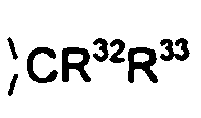
 R28 is selected from
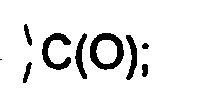 in the group (X2)s, each X2 is independently

 's' is 0, 1 or 2, provided that when (Y1)k is absent, (X2)s is CR38R39 or is absent, and also provided that when 's' is 2, (X2)s contains a minimum of one
 each U is independently a 5- to 7-membered monocyclic or a 8- to 11-membered bicyclic ring which is either saturated or unsaturated and which includes up to four heteroatoms as shown below:



 wherein R41 is: H, alkyl, cycloalkyl, Ar-alkyl, Ar, OH, O-alkyl, O-cycloalkyl, O-Ar-alkyl, OAr, SH, S-alkyl, S-cycloalkyl, S-Ar-alkyl, SAr, SO-alkyl, SO-cycloalkyl, SO-Ar-alkyl, SO-Ar, SO2H, SO2-alkyl, SO2-cycloalkyl, SO2-Ar-alkyl, SO2Ar, NH-alkyl, NH2, NH-cycloalkyl, NH-Ar-alkyl, NHAr, NHCO-alkyl, NHCO-cycloalkyl, NHCO-Ar-alkyl, NHCOAr, N(alkyl)2, N(cycloalkyl), or N(Ar-alkyl)2 or NAr2 or, when part of a CHR41 or CR41 group, R41 may be halogen;A is selected from:CH2,

 B, D and G are each independently selected from:
 E is selected from:CH2,

 K is selected from:CH2,
 J, L, M, R, T, T2, T3 and T4 are independently selected from:CR41 where R41 is as defined above, N and N-oxide
 T5 is selected from:CH and N;T6 is selected from:
 T7 is selected from:O, S,
 'q' is 1, 2 or 3;'p' is 0 or 1;R16-17, R19-22, R24-25, R29-30, R32-33, R35-36, R38-39 and R43-44 are each independently selected from H, alkyl, cycloalkyl, Ar-alkyl, Ar and halogen; andR23, R31, R34, R37, R40 and R46 are each independently selected from H, alkyl, cycloalkyl, Ar-alkyl and Ar;R49 is H, alkyl, cycloalkyl, Ar-alkyl, Ar, OH, O-alkyl, O-cycloalkyl, O-Ar-alkyl, OAr, SH, S-alkyl, S-cycloalkyl, S-Ar-alkyl, SAr, SO-alkyl, SO-cycloalkyl, SO-Ar-alkyl, SO-Ar, SO2H, SO2-alkyl, SO2-cycloalkyl, SO2-Ar-alkyl, SO2Ar, NH-alkyl, NH2, NH-cycloalkyl, NH-Ar-alkyl, NHAr, NHCO-alkyl, NHCO-cycloalkyl, NHCO-Ar-alkyl, NHCOAr , N(alkyl)2, N(cycloalkyl), or N(Ar-alkyl)2 or NAr2 or halogen;wherein alkyl includes both saturated straight chain and branched alkyl groups and is optionally substituted by one or more substituents selected from halo, CF3, OH, CN, NO2, SH, SO3H; SO2H, SO2NH2, SO2Me, NH2, COOH and CONH2 and which further optionally contains one or more heteroatoms to give an ether, thio ether, sulphone, sulphonamide, substituted amine, amidines, guanidines, carboxylic acids, esters, and carboxamides, wherein if the heteroatom is located at a chain terminus it is approximately substituted with one or two hydrogen atoms; and
wherein said cycloalkyl group is optionally substituted by one or more substitutents selected from halo, alkyl, CF3, OH, CN, NO2, SO3H, SO2NH2, SO2Me, NH2, COOH, CONH2 and alkoxy; and
wherein aryl is a C6-12 aromatic group optionally substituted by one or more substituents selected from alkyl, halo, CF3, OH, CN, NO2, SO3H, SO2NH2, SO2Me, NH2, COOH and CONH2;
said process comprising the steps of: (A)(i) treating a compound of formula IVa, where R48 is alkyl or tosyl or mesyl, with an oxidising agent selected from a hydrogen peroxide/alkylnitrile mixture and a dioxirane to form a compound of formula Va; and(ii) forming a compound of formula Via by treating said compound of formula Va with sodium hydride, or where R2 is a protecting group PG1, by removal of the protecting group PG1;(iii) optionally oxidising said compound of formula VIa to form a compound of formula Ic, where R1 is O-alkyl, OMs or OTs; or(iv) where R48 is Ts or Ms, subjecting said compound of formula VIa to nucleophilic substitution; or(v) where R48 is Ts,- optionally treating said compound of formula VIa with lithium triethylborohydride, or- where R2 is H, optionally treating said compound of formula VIa with lithium aluminium hydride,to form a compound of formula la where R1 is H, and optionally oxidising said compound of formula la to form a compound of formula Ic; or(B)(i) treating a compound of formula IVb, where R48 is alkyl or tosyl or mesyl, with an oxidising agent selected from a hydrogen peroxide/alkylnitrile mixture and a dioxirane to form a compound of formula Vb; and(ii) forming a compound of formula VIb by treating said compound of formula Vb with sodium hydride, or where R2 is a protecting group PG1, by removal of the protecting group PG1;(ii) optionally oxidising said compound of formula VIb to form a compound of formula Id, where R1 is O-alkyl, OMs or OTs; or(iv) where R48 is Ts or Ms, optionally subjecting said compound of formula VIb to nucleophilic substitution; or(v) where R48 is Ts,- optionally treating said compound of formula Vlb with lithium triethylborohydride, or- where R2 is H, optionally treating said compound of formula VIa with lithium aluminium hydride;to form a compound of formula Ib where R1 is H, and optionally oxidising said compound of formula Ib to form a compound of formula Id.
 - A process according to any preceding claim wherein R2 is a protecting group selected from benzyloxycarbonyl, tert-butoxycarbonyl, fluoren-9-ylmethoxycarbonyl, 1-(biphenyl-4-yl)-1-methylethoxycarbonyl, α,α-dimethyl-3,5-dimethoxylbenzyloxy-carbonyl, p-methoxybenzyloxycarbonyl, p-nitrobenzyloxy-carbonyl, allyloxycarbonyl and trichloroethoxycarbonyl.
- A process according to claim 1 or claim 2 wherein said compound of formula IVa is prepared from a compound of formula IIIa

 (a) where R48 is Me:(i) treating a compound of formula IIIa or IIIb with Mel in the presence of a silver (I) oxide catalyst; or(ii) treating a compound of formula IIIa or IIIb with trimethyloxonium fluoroborate, proton sponge [1,8-bis(dimethylamino)naphthalene] and molecular sieves in dichloromethane or(b) where R48 is tert-Bu, treating a compound of formula IIIa or IIIb with gaseous 2-methylpropene in dichloromethane in the presence of concentrated H2SO4; or(c) where R48 is tosyl, treating a compound of formula IIIa or IIIb with tosyl chloride in pyridine.
 - A process according to claim 3 wherein R2 is benzyloxycarbonyl, and said compound of formula IIIa is prepared by the steps of:
 (a) reacting a compound of formula IIa, where X3 is halogen or OTs, with aqueous ammonia and alcohol, or with aqueous ammonium hydroxide; and(b) treating the product formed in step (a) with benzyloxycarbonyl chloride to form a compound of formula IIIa; andsaid compound of formula IIIb is prepared by the steps of:
 (a) reacting a compound of formula IIb, where X3 is halogen or OTs, with aqueous ammonia and alcohol, or with aqueous ammonium hydroxide; and(b) treating the product formed in step (a) with benzyloxycarbonyl chloride to form a compound of formula IIIb.
 - A process according to claim 4 which is a one-pot process.
- A process according to claim 4 or claim 5 wherein X3 is I, Br or OTs and the alcohol is isopropyl alcohol or ethanol.
- A process according to claim 1 wherein step A(iv) or step (B(iv) comprises reacting said compound of formula VIa or VIb respectively with a nucleophile selected from an azide, an alkylamine, a sodium thioalkoxide, a sodium alkoxide, a halide, an alkylmetal reagent, and a trifluoromethylating agent.
- A process according to any preceding claim wherein R48 is tosyl, and
Step (A) (iv) comprises the step of treating a compound of formula XIa with sodium azide in DMF to form a compound of XIIa; and
Step (B) (iv) comprises the step of treating a compound of formula XIb with sodium azide in DMF to form a compound of XIIb
- A process according to claim 8 wherein:Step (A) (iv) further comprises the step of treating a compound of formula XIIa with (a) triphenylphosphine; and (b) protecting the intermediate formed in step (a) with a protecting group, PG2 to form a compound of XIIIa; andStep (B) (iv) further comprises the step of treating a compound of formula XIIb with (a) triphenylphosphine; and (b) protecting the intermediate formed in step (a) with a protecting group, PG2 to form a compound of XIIIb

- A process according to claim 9 wherein:Step (A) (iv) comprises the additional step of treating a compound of formula XIIIa with Dess Martin periodinane in dichloromethane to form a compound of XIVa; andStep (B) (iv) comprises the additional step of treating a compound of formula Xlllb with Dess Martin periodinane in dichloromethane to form a compound of XIVb

- A compound of formula IVa, IVb, Va or Vb, or pharmaceutically acceptable salt, hydrate or solvate thereof,

- A compound according to claim 11 wherein R2 is a protecting group PG1.
- A compound according to claim 11 or claim 12 wherein R2 is benzyloxycarbonyl (Cbz).
- A compound according to any one of claims 11 to 13 wherein R48 is methyl, tert-butyl or tosyl.
Applications Claiming Priority (2)
| Application Number | Priority Date | Filing Date | Title |
|---|---|---|---|
| GBGB0614040.4A GB0614040D0 (en) | 2006-07-14 | 2006-07-14 | Process |
| PCT/GB2007/002669 WO2008007132A1 (en) | 2006-07-14 | 2007-07-13 | Tetrahydrofuro [3, 2-b] pyrr0l-3-0ne intermediates |
Publications (2)
| Publication Number | Publication Date |
|---|---|
| EP2081919A1 EP2081919A1 (en) | 2009-07-29 |
| EP2081919B1 true EP2081919B1 (en) | 2012-05-23 |
Family
ID=36955683
Family Applications (1)
| Application Number | Title | Priority Date | Filing Date |
|---|---|---|---|
| EP07766240A Not-in-force EP2081919B1 (en) | 2006-07-14 | 2007-07-13 | Tetrahydrofuro [3, 2-b]pyrr0l-3-0ne intermediates |
Country Status (9)
| Country | Link |
|---|---|
| US (1) | US8039641B2 (en) |
| EP (1) | EP2081919B1 (en) |
| JP (1) | JP5539716B2 (en) |
| CN (1) | CN101506185B (en) |
| AU (1) | AU2007274021B2 (en) |
| BR (1) | BRPI0714223A2 (en) |
| CA (1) | CA2657797C (en) |
| GB (1) | GB0614040D0 (en) |
| WO (1) | WO2008007132A1 (en) |
Families Citing this family (1)
| Publication number | Priority date | Publication date | Assignee | Title |
|---|---|---|---|---|
| CN108178751A (en) * | 2018-01-30 | 2018-06-19 | 扬州工业职业技术学院 | A kind of synthetic method of the net intermediates of En Gelie |
Family Cites Families (4)
| Publication number | Priority date | Publication date | Assignee | Title |
|---|---|---|---|---|
| US3444216A (en) | 1966-11-16 | 1969-05-13 | Upjohn Co | Process for the oxidation of primary and secondary alcohols |
| GB0614046D0 (en) * | 2006-07-14 | 2006-08-23 | Amura Therapeutics Ltd | Compounds |
| GB0614044D0 (en) * | 2006-07-14 | 2006-08-23 | Amura Therapeutics Ltd | Compounds |
| GB0614042D0 (en) * | 2006-07-14 | 2006-08-23 | Amura Therapeutics Ltd | Compounds |
-
2006
- 2006-07-14 GB GBGB0614040.4A patent/GB0614040D0/en not_active Ceased
-
2007
- 2007-07-13 WO PCT/GB2007/002669 patent/WO2008007132A1/en not_active Ceased
- 2007-07-13 CA CA2657797A patent/CA2657797C/en not_active Expired - Fee Related
- 2007-07-13 CN CN200780030836.4A patent/CN101506185B/en not_active Expired - Fee Related
- 2007-07-13 BR BRPI0714223-4A patent/BRPI0714223A2/en not_active IP Right Cessation
- 2007-07-13 JP JP2009518971A patent/JP5539716B2/en not_active Expired - Fee Related
- 2007-07-13 EP EP07766240A patent/EP2081919B1/en not_active Not-in-force
- 2007-07-13 AU AU2007274021A patent/AU2007274021B2/en not_active Ceased
-
2009
- 2009-01-08 US US12/319,562 patent/US8039641B2/en not_active Expired - Fee Related
Also Published As
| Publication number | Publication date |
|---|---|
| GB0614040D0 (en) | 2006-08-23 |
| WO2008007132A1 (en) | 2008-01-17 |
| AU2007274021A1 (en) | 2008-01-17 |
| AU2007274021B2 (en) | 2013-08-15 |
| EP2081919A1 (en) | 2009-07-29 |
| US20090192322A1 (en) | 2009-07-30 |
| CN101506185A (en) | 2009-08-12 |
| BRPI0714223A2 (en) | 2013-01-29 |
| US8039641B2 (en) | 2011-10-18 |
| CA2657797A1 (en) | 2008-01-17 |
| JP2009543772A (en) | 2009-12-10 |
| CN101506185B (en) | 2016-06-29 |
| JP5539716B2 (en) | 2014-07-02 |
| CA2657797C (en) | 2017-05-16 |
Similar Documents
| Publication | Publication Date | Title |
|---|---|---|
| US8877927B2 (en) | Furo[3,2-B] pyrrol -3-one derivatives and their use as cysteinyl proteinase inhibitors | |
| EP2078023B1 (en) | Tetrahydrofuro (3, 2-b) pyrrol-3-one derivatives as inhibitors of cysteine proteinases | |
| EP2240491B1 (en) | TETRAHYDROFURO(2,3-b)PYRROL-3-ONE DERIVATIVES AS INHIBITORS OF CYSTEINE PROTEINASES | |
| AU2007274097B2 (en) | Tetrahydrofuro [3, 2 -b] pyrrol-3-ones as cathepsin K inhibitors | |
| US8039641B2 (en) | Tetrahydrofuro[3,2-b] pyrrol-3-one intermediates | |
| US8053437B2 (en) | Furo[3. 2-B] pyrrol derivatives | |
| US20090005575A1 (en) | Preparation of diazapentalene derivatives via epoxydation of dihydropyrroles | |
| US7846935B2 (en) | Furo[3,2-B]pyrrol-3-one derivatives and their use as cysteinyl proteinase inhibitors | |
| WO2008007112A1 (en) | Tetrahydrofuro [3, 2-b] pyrr0l-3-ones as cathepsin k inhibitors | |
| US7846934B2 (en) | Furo[3,2-B] pyrrol-3-one derivatives and their use as cysteinyl proteinase inhibitors |
Legal Events
| Date | Code | Title | Description |
|---|---|---|---|
| PUAI | Public reference made under article 153(3) epc to a published international application that has entered the european phase |
Free format text: ORIGINAL CODE: 0009012 |
|
| 17P | Request for examination filed |
Effective date: 20090211 |
|
| AK | Designated contracting states |
Kind code of ref document: A1 Designated state(s): AT BE BG CH CY CZ DE DK EE ES FI FR GB GR HU IE IS IT LI LT LU LV MC MT NL PL PT RO SE SI SK TR |
|
| AX | Request for extension of the european patent |
Extension state: AL BA HR MK RS |
|
| DAX | Request for extension of the european patent (deleted) | ||
| 17Q | First examination report despatched |
Effective date: 20091020 |
|
| GRAP | Despatch of communication of intention to grant a patent |
Free format text: ORIGINAL CODE: EPIDOSNIGR1 |
|
| GRAS | Grant fee paid |
Free format text: ORIGINAL CODE: EPIDOSNIGR3 |
|
| RAP1 | Party data changed (applicant data changed or rights of an application transferred) |
Owner name: AMURA THERAPEUTICS LIMITED |
|
| GRAA | (expected) grant |
Free format text: ORIGINAL CODE: 0009210 |
|
| AK | Designated contracting states |
Kind code of ref document: B1 Designated state(s): AT BE BG CH CY CZ DE DK EE ES FI FR GB GR HU IE IS IT LI LT LU LV MC MT NL PL PT RO SE SI SK TR |
|
| REG | Reference to a national code |
Ref country code: GB Ref legal event code: FG4D |
|
| REG | Reference to a national code |
Ref country code: CH Ref legal event code: EP |
|
| REG | Reference to a national code |
Ref country code: AT Ref legal event code: REF Ref document number: 559026 Country of ref document: AT Kind code of ref document: T Effective date: 20120615 |
|
| REG | Reference to a national code |
Ref country code: IE Ref legal event code: FG4D |
|
| REG | Reference to a national code |
Ref country code: DE Ref legal event code: R096 Ref document number: 602007022860 Country of ref document: DE Effective date: 20120719 |
|
| REG | Reference to a national code |
Ref country code: NL Ref legal event code: VDEP Effective date: 20120523 |
|
| REG | Reference to a national code |
Ref country code: LT Ref legal event code: MG4D Effective date: 20120523 |
|
| PG25 | Lapsed in a contracting state [announced via postgrant information from national office to epo] |
Ref country code: LT Free format text: LAPSE BECAUSE OF FAILURE TO SUBMIT A TRANSLATION OF THE DESCRIPTION OR TO PAY THE FEE WITHIN THE PRESCRIBED TIME-LIMIT Effective date: 20120523 Ref country code: CY Free format text: LAPSE BECAUSE OF FAILURE TO SUBMIT A TRANSLATION OF THE DESCRIPTION OR TO PAY THE FEE WITHIN THE PRESCRIBED TIME-LIMIT Effective date: 20120523 Ref country code: IS Free format text: LAPSE BECAUSE OF FAILURE TO SUBMIT A TRANSLATION OF THE DESCRIPTION OR TO PAY THE FEE WITHIN THE PRESCRIBED TIME-LIMIT Effective date: 20120923 Ref country code: SE Free format text: LAPSE BECAUSE OF FAILURE TO SUBMIT A TRANSLATION OF THE DESCRIPTION OR TO PAY THE FEE WITHIN THE PRESCRIBED TIME-LIMIT Effective date: 20120523 Ref country code: FI Free format text: LAPSE BECAUSE OF FAILURE TO SUBMIT A TRANSLATION OF THE DESCRIPTION OR TO PAY THE FEE WITHIN THE PRESCRIBED TIME-LIMIT Effective date: 20120523 |
|
| REG | Reference to a national code |
Ref country code: AT Ref legal event code: MK05 Ref document number: 559026 Country of ref document: AT Kind code of ref document: T Effective date: 20120523 |
|
| PG25 | Lapsed in a contracting state [announced via postgrant information from national office to epo] |
Ref country code: LV Free format text: LAPSE BECAUSE OF FAILURE TO SUBMIT A TRANSLATION OF THE DESCRIPTION OR TO PAY THE FEE WITHIN THE PRESCRIBED TIME-LIMIT Effective date: 20120523 Ref country code: GR Free format text: LAPSE BECAUSE OF FAILURE TO SUBMIT A TRANSLATION OF THE DESCRIPTION OR TO PAY THE FEE WITHIN THE PRESCRIBED TIME-LIMIT Effective date: 20120824 Ref country code: PT Free format text: LAPSE BECAUSE OF FAILURE TO SUBMIT A TRANSLATION OF THE DESCRIPTION OR TO PAY THE FEE WITHIN THE PRESCRIBED TIME-LIMIT Effective date: 20120924 Ref country code: SI Free format text: LAPSE BECAUSE OF FAILURE TO SUBMIT A TRANSLATION OF THE DESCRIPTION OR TO PAY THE FEE WITHIN THE PRESCRIBED TIME-LIMIT Effective date: 20120523 |
|
| PG25 | Lapsed in a contracting state [announced via postgrant information from national office to epo] |
Ref country code: BE Free format text: LAPSE BECAUSE OF FAILURE TO SUBMIT A TRANSLATION OF THE DESCRIPTION OR TO PAY THE FEE WITHIN THE PRESCRIBED TIME-LIMIT Effective date: 20120523 |
|
| PG25 | Lapsed in a contracting state [announced via postgrant information from national office to epo] |
Ref country code: AT Free format text: LAPSE BECAUSE OF FAILURE TO SUBMIT A TRANSLATION OF THE DESCRIPTION OR TO PAY THE FEE WITHIN THE PRESCRIBED TIME-LIMIT Effective date: 20120523 Ref country code: EE Free format text: LAPSE BECAUSE OF FAILURE TO SUBMIT A TRANSLATION OF THE DESCRIPTION OR TO PAY THE FEE WITHIN THE PRESCRIBED TIME-LIMIT Effective date: 20120523 Ref country code: DK Free format text: LAPSE BECAUSE OF FAILURE TO SUBMIT A TRANSLATION OF THE DESCRIPTION OR TO PAY THE FEE WITHIN THE PRESCRIBED TIME-LIMIT Effective date: 20120523 Ref country code: CZ Free format text: LAPSE BECAUSE OF FAILURE TO SUBMIT A TRANSLATION OF THE DESCRIPTION OR TO PAY THE FEE WITHIN THE PRESCRIBED TIME-LIMIT Effective date: 20120523 Ref country code: NL Free format text: LAPSE BECAUSE OF FAILURE TO SUBMIT A TRANSLATION OF THE DESCRIPTION OR TO PAY THE FEE WITHIN THE PRESCRIBED TIME-LIMIT Effective date: 20120523 Ref country code: RO Free format text: LAPSE BECAUSE OF FAILURE TO SUBMIT A TRANSLATION OF THE DESCRIPTION OR TO PAY THE FEE WITHIN THE PRESCRIBED TIME-LIMIT Effective date: 20120523 Ref country code: SK Free format text: LAPSE BECAUSE OF FAILURE TO SUBMIT A TRANSLATION OF THE DESCRIPTION OR TO PAY THE FEE WITHIN THE PRESCRIBED TIME-LIMIT Effective date: 20120523 |
|
| PG25 | Lapsed in a contracting state [announced via postgrant information from national office to epo] |
Ref country code: PL Free format text: LAPSE BECAUSE OF FAILURE TO SUBMIT A TRANSLATION OF THE DESCRIPTION OR TO PAY THE FEE WITHIN THE PRESCRIBED TIME-LIMIT Effective date: 20120523 Ref country code: IT Free format text: LAPSE BECAUSE OF FAILURE TO SUBMIT A TRANSLATION OF THE DESCRIPTION OR TO PAY THE FEE WITHIN THE PRESCRIBED TIME-LIMIT Effective date: 20120523 Ref country code: MC Free format text: LAPSE BECAUSE OF NON-PAYMENT OF DUE FEES Effective date: 20120731 |
|
| REG | Reference to a national code |
Ref country code: CH Ref legal event code: PL |
|
| PLBE | No opposition filed within time limit |
Free format text: ORIGINAL CODE: 0009261 |
|
| STAA | Information on the status of an ep patent application or granted ep patent |
Free format text: STATUS: NO OPPOSITION FILED WITHIN TIME LIMIT |
|
| PG25 | Lapsed in a contracting state [announced via postgrant information from national office to epo] |
Ref country code: CH Free format text: LAPSE BECAUSE OF NON-PAYMENT OF DUE FEES Effective date: 20120731 Ref country code: ES Free format text: LAPSE BECAUSE OF FAILURE TO SUBMIT A TRANSLATION OF THE DESCRIPTION OR TO PAY THE FEE WITHIN THE PRESCRIBED TIME-LIMIT Effective date: 20120903 Ref country code: LI Free format text: LAPSE BECAUSE OF NON-PAYMENT OF DUE FEES Effective date: 20120731 |
|
| 26N | No opposition filed |
Effective date: 20130226 |
|
| REG | Reference to a national code |
Ref country code: DE Ref legal event code: R097 Ref document number: 602007022860 Country of ref document: DE Effective date: 20130226 |
|
| PG25 | Lapsed in a contracting state [announced via postgrant information from national office to epo] |
Ref country code: BG Free format text: LAPSE BECAUSE OF FAILURE TO SUBMIT A TRANSLATION OF THE DESCRIPTION OR TO PAY THE FEE WITHIN THE PRESCRIBED TIME-LIMIT Effective date: 20120823 Ref country code: MT Free format text: LAPSE BECAUSE OF FAILURE TO SUBMIT A TRANSLATION OF THE DESCRIPTION OR TO PAY THE FEE WITHIN THE PRESCRIBED TIME-LIMIT Effective date: 20120523 |
|
| REG | Reference to a national code |
Ref country code: DE Ref legal event code: R082 Ref document number: 602007022860 Country of ref document: DE Representative=s name: WSL PATENTANWAELTE PARTNERSCHAFTSGESELLSCHAFT, DE |
|
| REG | Reference to a national code |
Ref country code: GB Ref legal event code: 732E Free format text: REGISTERED BETWEEN 20130926 AND 20131002 |
|
| REG | Reference to a national code |
Ref country code: FR Ref legal event code: TP Owner name: GRUNENTHAL GMBH, DE Effective date: 20131021 |
|
| REG | Reference to a national code |
Ref country code: DE Ref legal event code: R082 Ref document number: 602007022860 Country of ref document: DE Representative=s name: WSL PATENTANWAELTE PARTNERSCHAFTSGESELLSCHAFT, DE Effective date: 20131014 Ref country code: DE Ref legal event code: R081 Ref document number: 602007022860 Country of ref document: DE Owner name: GRUENENTHAL GMBH, DE Free format text: FORMER OWNER: AMURA THERAPEUTICS LTD., CAMBRIDGE, GB Effective date: 20131014 Ref country code: DE Ref legal event code: R082 Ref document number: 602007022860 Country of ref document: DE Representative=s name: WSL PATENTANWAELTE PARTNERSCHAFT MBB, DE Effective date: 20131014 |
|
| PG25 | Lapsed in a contracting state [announced via postgrant information from national office to epo] |
Ref country code: TR Free format text: LAPSE BECAUSE OF FAILURE TO SUBMIT A TRANSLATION OF THE DESCRIPTION OR TO PAY THE FEE WITHIN THE PRESCRIBED TIME-LIMIT Effective date: 20120523 |
|
| PG25 | Lapsed in a contracting state [announced via postgrant information from national office to epo] |
Ref country code: LU Free format text: LAPSE BECAUSE OF NON-PAYMENT OF DUE FEES Effective date: 20120713 |
|
| PG25 | Lapsed in a contracting state [announced via postgrant information from national office to epo] |
Ref country code: HU Free format text: LAPSE BECAUSE OF FAILURE TO SUBMIT A TRANSLATION OF THE DESCRIPTION OR TO PAY THE FEE WITHIN THE PRESCRIBED TIME-LIMIT Effective date: 20070713 |
|
| REG | Reference to a national code |
Ref country code: FR Ref legal event code: PLFP Year of fee payment: 9 |
|
| REG | Reference to a national code |
Ref country code: FR Ref legal event code: PLFP Year of fee payment: 10 |
|
| REG | Reference to a national code |
Ref country code: FR Ref legal event code: PLFP Year of fee payment: 11 |
|
| PGFP | Annual fee paid to national office [announced via postgrant information from national office to epo] |
Ref country code: FR Payment date: 20170613 Year of fee payment: 11 |
|
| PGFP | Annual fee paid to national office [announced via postgrant information from national office to epo] |
Ref country code: GB Payment date: 20170712 Year of fee payment: 11 Ref country code: DE Payment date: 20170731 Year of fee payment: 11 |
|
| PGFP | Annual fee paid to national office [announced via postgrant information from national office to epo] |
Ref country code: IE Payment date: 20170710 Year of fee payment: 11 |
|
| REG | Reference to a national code |
Ref country code: DE Ref legal event code: R119 Ref document number: 602007022860 Country of ref document: DE |
|
| GBPC | Gb: european patent ceased through non-payment of renewal fee |
Effective date: 20180713 |
|
| REG | Reference to a national code |
Ref country code: IE Ref legal event code: MM4A |
|
| PG25 | Lapsed in a contracting state [announced via postgrant information from national office to epo] |
Ref country code: GB Free format text: LAPSE BECAUSE OF NON-PAYMENT OF DUE FEES Effective date: 20180713 Ref country code: FR Free format text: LAPSE BECAUSE OF NON-PAYMENT OF DUE FEES Effective date: 20180731 Ref country code: DE Free format text: LAPSE BECAUSE OF NON-PAYMENT OF DUE FEES Effective date: 20190201 Ref country code: IE Free format text: LAPSE BECAUSE OF NON-PAYMENT OF DUE FEES Effective date: 20180713 |