EP2078825A2 - Turbocharger - Google Patents
Turbocharger Download PDFInfo
- Publication number
- EP2078825A2 EP2078825A2 EP09000165A EP09000165A EP2078825A2 EP 2078825 A2 EP2078825 A2 EP 2078825A2 EP 09000165 A EP09000165 A EP 09000165A EP 09000165 A EP09000165 A EP 09000165A EP 2078825 A2 EP2078825 A2 EP 2078825A2
- Authority
- EP
- European Patent Office
- Prior art keywords
- turbine shaft
- housing
- labyrinth seal
- turbine
- shaft hole
- Prior art date
- Legal status (The legal status is an assumption and is not a legal conclusion. Google has not performed a legal analysis and makes no representation as to the accuracy of the status listed.)
- Withdrawn
Links
Images



Classifications
-
- F—MECHANICAL ENGINEERING; LIGHTING; HEATING; WEAPONS; BLASTING
- F01—MACHINES OR ENGINES IN GENERAL; ENGINE PLANTS IN GENERAL; STEAM ENGINES
- F01D—NON-POSITIVE DISPLACEMENT MACHINES OR ENGINES, e.g. STEAM TURBINES
- F01D25/00—Component parts, details, or accessories, not provided for in, or of interest apart from, other groups
- F01D25/08—Cooling; Heating; Heat-insulation
- F01D25/12—Cooling
-
- F—MECHANICAL ENGINEERING; LIGHTING; HEATING; WEAPONS; BLASTING
- F01—MACHINES OR ENGINES IN GENERAL; ENGINE PLANTS IN GENERAL; STEAM ENGINES
- F01D—NON-POSITIVE DISPLACEMENT MACHINES OR ENGINES, e.g. STEAM TURBINES
- F01D11/00—Preventing or minimising internal leakage of working-fluid, e.g. between stages
- F01D11/003—Preventing or minimising internal leakage of working-fluid, e.g. between stages by packing rings; Mechanical seals
-
- F—MECHANICAL ENGINEERING; LIGHTING; HEATING; WEAPONS; BLASTING
- F01—MACHINES OR ENGINES IN GENERAL; ENGINE PLANTS IN GENERAL; STEAM ENGINES
- F01D—NON-POSITIVE DISPLACEMENT MACHINES OR ENGINES, e.g. STEAM TURBINES
- F01D11/00—Preventing or minimising internal leakage of working-fluid, e.g. between stages
- F01D11/02—Preventing or minimising internal leakage of working-fluid, e.g. between stages by non-contact sealings, e.g. of labyrinth type
-
- F—MECHANICAL ENGINEERING; LIGHTING; HEATING; WEAPONS; BLASTING
- F01—MACHINES OR ENGINES IN GENERAL; ENGINE PLANTS IN GENERAL; STEAM ENGINES
- F01D—NON-POSITIVE DISPLACEMENT MACHINES OR ENGINES, e.g. STEAM TURBINES
- F01D25/00—Component parts, details, or accessories, not provided for in, or of interest apart from, other groups
- F01D25/08—Cooling; Heating; Heat-insulation
- F01D25/14—Casings modified therefor
-
- F—MECHANICAL ENGINEERING; LIGHTING; HEATING; WEAPONS; BLASTING
- F01—MACHINES OR ENGINES IN GENERAL; ENGINE PLANTS IN GENERAL; STEAM ENGINES
- F01D—NON-POSITIVE DISPLACEMENT MACHINES OR ENGINES, e.g. STEAM TURBINES
- F01D25/00—Component parts, details, or accessories, not provided for in, or of interest apart from, other groups
- F01D25/18—Lubricating arrangements
- F01D25/183—Sealing means
-
- F—MECHANICAL ENGINEERING; LIGHTING; HEATING; WEAPONS; BLASTING
- F02—COMBUSTION ENGINES; HOT-GAS OR COMBUSTION-PRODUCT ENGINE PLANTS
- F02C—GAS-TURBINE PLANTS; AIR INTAKES FOR JET-PROPULSION PLANTS; CONTROLLING FUEL SUPPLY IN AIR-BREATHING JET-PROPULSION PLANTS
- F02C7/00—Features, components parts, details or accessories, not provided for in, or of interest apart form groups F02C1/00 - F02C6/00; Air intakes for jet-propulsion plants
- F02C7/28—Arrangement of seals
-
- F—MECHANICAL ENGINEERING; LIGHTING; HEATING; WEAPONS; BLASTING
- F16—ENGINEERING ELEMENTS AND UNITS; GENERAL MEASURES FOR PRODUCING AND MAINTAINING EFFECTIVE FUNCTIONING OF MACHINES OR INSTALLATIONS; THERMAL INSULATION IN GENERAL
- F16C—SHAFTS; FLEXIBLE SHAFTS; ELEMENTS OR CRANKSHAFT MECHANISMS; ROTARY BODIES OTHER THAN GEARING ELEMENTS; BEARINGS
- F16C33/00—Parts of bearings; Special methods for making bearings or parts thereof
- F16C33/72—Sealings
- F16C33/76—Sealings of ball or roller bearings
-
- F—MECHANICAL ENGINEERING; LIGHTING; HEATING; WEAPONS; BLASTING
- F16—ENGINEERING ELEMENTS AND UNITS; GENERAL MEASURES FOR PRODUCING AND MAINTAINING EFFECTIVE FUNCTIONING OF MACHINES OR INSTALLATIONS; THERMAL INSULATION IN GENERAL
- F16J—PISTONS; CYLINDERS; SEALINGS
- F16J15/00—Sealings
- F16J15/002—Sealings comprising at least two sealings in succession
-
- F—MECHANICAL ENGINEERING; LIGHTING; HEATING; WEAPONS; BLASTING
- F16—ENGINEERING ELEMENTS AND UNITS; GENERAL MEASURES FOR PRODUCING AND MAINTAINING EFFECTIVE FUNCTIONING OF MACHINES OR INSTALLATIONS; THERMAL INSULATION IN GENERAL
- F16J—PISTONS; CYLINDERS; SEALINGS
- F16J15/00—Sealings
- F16J15/16—Sealings between relatively-moving surfaces
- F16J15/40—Sealings between relatively-moving surfaces by means of fluid
- F16J15/406—Sealings between relatively-moving surfaces by means of fluid by at least one pump
-
- F—MECHANICAL ENGINEERING; LIGHTING; HEATING; WEAPONS; BLASTING
- F16—ENGINEERING ELEMENTS AND UNITS; GENERAL MEASURES FOR PRODUCING AND MAINTAINING EFFECTIVE FUNCTIONING OF MACHINES OR INSTALLATIONS; THERMAL INSULATION IN GENERAL
- F16J—PISTONS; CYLINDERS; SEALINGS
- F16J15/00—Sealings
- F16J15/44—Free-space packings
- F16J15/447—Labyrinth packings
- F16J15/4472—Labyrinth packings with axial path
-
- F—MECHANICAL ENGINEERING; LIGHTING; HEATING; WEAPONS; BLASTING
- F05—INDEXING SCHEMES RELATING TO ENGINES OR PUMPS IN VARIOUS SUBCLASSES OF CLASSES F01-F04
- F05D—INDEXING SCHEME FOR ASPECTS RELATING TO NON-POSITIVE-DISPLACEMENT MACHINES OR ENGINES, GAS-TURBINES OR JET-PROPULSION PLANTS
- F05D2220/00—Application
- F05D2220/40—Application in turbochargers
-
- F—MECHANICAL ENGINEERING; LIGHTING; HEATING; WEAPONS; BLASTING
- F05—INDEXING SCHEMES RELATING TO ENGINES OR PUMPS IN VARIOUS SUBCLASSES OF CLASSES F01-F04
- F05D—INDEXING SCHEME FOR ASPECTS RELATING TO NON-POSITIVE-DISPLACEMENT MACHINES OR ENGINES, GAS-TURBINES OR JET-PROPULSION PLANTS
- F05D2260/00—Function
- F05D2260/20—Heat transfer, e.g. cooling
- F05D2260/232—Heat transfer, e.g. cooling characterized by the cooling medium
-
- F—MECHANICAL ENGINEERING; LIGHTING; HEATING; WEAPONS; BLASTING
- F16—ENGINEERING ELEMENTS AND UNITS; GENERAL MEASURES FOR PRODUCING AND MAINTAINING EFFECTIVE FUNCTIONING OF MACHINES OR INSTALLATIONS; THERMAL INSULATION IN GENERAL
- F16C—SHAFTS; FLEXIBLE SHAFTS; ELEMENTS OR CRANKSHAFT MECHANISMS; ROTARY BODIES OTHER THAN GEARING ELEMENTS; BEARINGS
- F16C19/00—Bearings with rolling contact, for exclusively rotary movement
- F16C19/54—Systems consisting of a plurality of bearings with rolling friction
- F16C19/546—Systems with spaced apart rolling bearings including at least one angular contact bearing
- F16C19/547—Systems with spaced apart rolling bearings including at least one angular contact bearing with two angular contact rolling bearings
- F16C19/548—Systems with spaced apart rolling bearings including at least one angular contact bearing with two angular contact rolling bearings in O-arrangement
-
- F—MECHANICAL ENGINEERING; LIGHTING; HEATING; WEAPONS; BLASTING
- F16—ENGINEERING ELEMENTS AND UNITS; GENERAL MEASURES FOR PRODUCING AND MAINTAINING EFFECTIVE FUNCTIONING OF MACHINES OR INSTALLATIONS; THERMAL INSULATION IN GENERAL
- F16C—SHAFTS; FLEXIBLE SHAFTS; ELEMENTS OR CRANKSHAFT MECHANISMS; ROTARY BODIES OTHER THAN GEARING ELEMENTS; BEARINGS
- F16C19/00—Bearings with rolling contact, for exclusively rotary movement
- F16C19/54—Systems consisting of a plurality of bearings with rolling friction
- F16C19/55—Systems consisting of a plurality of bearings with rolling friction with intermediate floating or independently-driven rings rotating at reduced speed or with other differential ball or roller bearings
-
- F—MECHANICAL ENGINEERING; LIGHTING; HEATING; WEAPONS; BLASTING
- F16—ENGINEERING ELEMENTS AND UNITS; GENERAL MEASURES FOR PRODUCING AND MAINTAINING EFFECTIVE FUNCTIONING OF MACHINES OR INSTALLATIONS; THERMAL INSULATION IN GENERAL
- F16C—SHAFTS; FLEXIBLE SHAFTS; ELEMENTS OR CRANKSHAFT MECHANISMS; ROTARY BODIES OTHER THAN GEARING ELEMENTS; BEARINGS
- F16C2360/00—Engines or pumps
- F16C2360/23—Gas turbine engines
- F16C2360/24—Turbochargers
Definitions
- This invention relates to a turbocharger which is employed in automobiles or the like.
- Turbochargers which enhance output of internal combustion engines by blowing compressed air with increased density into inside of the internal combustion engines are known as, for example, supercharger, turbocharger or the like.
- a turbocharger for example, is configured such that a turbine wheel is disposed in an exhaust passage while a compressor wheel is disposed in an admission passage in an internal combustion engine such as an automobile engine. These wheels are provided respectively on opposite end portions of a turbine shaft that is housed within a shaft hole of a housing. Within the shaft hole of the housing, rolling bearings support rotatably the turbine shaft. When the turbine wheel is rotated by exhaust gas flowing through the exhaust passage, the turbine shaft and the compressor wheel are rotated so that air inside the admission passage to be fed to the internal combustion engine is compressed.
- a sealing structure that performs sealing between the shaft hole and the exhaust passage as well as between the shaft hole and the admission passage is provided such that lubricant which is provided with the shaft hole of the housing for lubrication of the rolling bearing is not leaked out toward the exhaust passage and the admission passage and such that gas such as air or exhaust gas does not flow in the housing from the exhaust passage and the admission passage.
- piston ring seals are provided on outer peripheries of opposite ends of the turbine shaft in its axial direction to form the sealing structure performing sealing between the shaft hole and the exhaust passage as well as between the shaft hole and the admission passage (See, for example, JP-A-H11-101128 Publication).
- the object of the invention is to provide a turbocharger in which the fluid communication between the exhaust passage and the shaft hole of the housing is effectively suppressed.
- a turbocharger according to the invention includes:
- the labyrinth seal provided between the outer periphery of the end portion of the turbine shaft on the turbine wheel side and the housing is disposed as noncontact structure without being brought into contact with the turbine shaft and the shaft hole of the housing, it is possible to suppress that exhaust gas flows in from the exhaust passage without interfering with rotation of the rolling bearing. Further, it is possible to prevent the leakage of the lubricant to the exhaust passage by the piston ring seal that is disposed on the side toward the center of the turbine shaft in the axial direction thereof from the position on the turbine shaft at which the labyrinth seal is provided. Moreover, by providing such inner/outer double sealing structure, the fluid communication between the exhaust passage and the shaft hole of the housing is further suppressed.
- the exhaust passage of the housing can be cooled efficiently without extending a dimension of the turbine shaft in the axial direction thereof. As a result, it is possible to suppress that heat of the exhaust gas passing the exhaust passage is transmitted to the axial hole of the housing.
- Fig. 1 is a sectional view of a turbocharger according to an embodiment of the turbocharger.
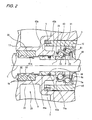
- Fig. 2 is an enlarged view of an essential portion of Fig. 1 .
- the turbocharger of the embodiment is a turbocharger for an automobile engine, and includes a housing 40, and a turbine shaft 41 housed in the housing 40 so as to be supported coaxially with an axis C by being inserted into a pair of rolling bearings 10a, 10b disposed apart from each other along the direction of axis C within the housing 40.
- a turbine wheel 42 is provided on one end portion of the turbine shaft 41 and in an admission passage 61, a compressor wheel 62 is provided on the other end portion of the turbine shaft 41.
- the housing 40 includes a housing body 40a.
- the housing body 40a has a shaft hole 43 at a center portion thereof that is formed in a substantially cylindrical hole coincided with the axis C.
- a tubular bearing holding member 15 is fitted into an inner periphery 40d of the housing body 40a with a gap.
- the pair of the rolling bearings 10a, 10b are fitted into the bearing holding member 15 so as to support the turbine shaft 41 housed in the shaft hole 43 rotatably around the axis C.
- roller bearing(s) 10 The pair of the rolling bearings 10a, 10b (hereinafter called “rolling bearing(s) 10") are provided with the same structure and disposed symmetrically in the shaft hole 43 along the left and right direction in Fig. 1 .
- a preload in the axial direction is applied to the rolling bearings 10a, 10b by urging the rolling bearings 10a, 10b outwardly in the axial direction with an urging member 81 disposed between the rolling bearing 10a,10b.
- the rolling bearing 10 includes an inner ring 1, an outer ring 3 and an intermediate ring 2 disposed between the inner ring 1 and the outer ring 3.
- a first rolling element set 4 and a second rolling element set 5 are arranged between the intermediate ring 2 and the inner ring 1, and between the intermediate ring 2 and the outer ring 3, respectively.
- the first and second rolling element sets 4,5 are provided with balls 4a,5a.
- an inner peripheral surface of the inner ring 1 serves as a fitting surface to the turbine shaft 41 such that the inner ring 1 is fitted around the turbine shaft 41.
- a first bearing raceway 11 with which the balls 4a of the first rolling element set 4 are brought into contact is formed on an outer peripheral surface of the inner ring 1.
- An outer peripheral surface of the outer ring 3 of the rolling bearing 10 is fixed to an inner periphery of the bearing holding member 15.
- a second bearing raceway 31 with which the balls 5a of the second rolling element set 5 are brought into contact is formed on an inner peripheral surface of the outer ring 3.
- the intermediate ring 2 has a bent shape in its cross section extended along the axial direction of the bearing 10.
- a third bearing raceway 21 with which the balls 4a of the first rolling element set 4 are brought into contact is formed on a part of an inner peripheral surface of the intermediate ring 2.
- a fourth bearing raceway 22 with which the balls 5a of the second rolling element set 5 are brought into contact is formed on a part of an outer peripheral surface of the intermediate ring 2.
- the plural balls 4a of the first rolling element set 4 are held by a cage 8 along a circumference of a circle that is centered at the axis C.
- the plural balls 5a of the second rolling element set are held by a cage 9 along a circumference of another circle that is centered at the axis C.
- the balls 4a of the first rolling element set 4 and the balls 5a of the second rolling element set 5 have the same ball diameter one another.
- the balls 4a of the first rolling element set 4 are brought into contact with the first bearing raceway 11 and the third bearing raceway 21 forming an opposite pair diagonally (namely, angular contact).
- the balls 5a of the second rolling element set 5 are brought into contact with the fourth bearing raceway 22 and the second bearing raceway 31 forming another opposite pair diagonally.
- the contact angle in both angular contacts is set to be the same, for example, to be 15° in Fig. 1 . Accordingly, the rolling bearing 10 is capable of bearing load in the direction of the axis C (axial direction load). Further, since the rolling bearing 10 is arranged along the axial direction extending in the direction of the axis C, it provides a structure having a damper function in the axial direction.
- Damper members 7 are provided on outer peripheral surfaces of the bearing holding member 15 at its opposite ends in the direction of the axis C to lessen vibrations generated due to rotation of the turbine shaft 41.
- the damper member 7 is fabricated by braiding metal wires to form a ring shape with a rectangular cross section.
- the damper member 7 is configured as a whole to be elastically deformable (contractible) in the radial direction and the direction of the axis C by allowing elastic deformation of the metal wires within the gaps, or displacement among adjacent wires in longitudinal directions of the wires in the damper member.
- the damper member 7 is formed to have an outer diameter that is slightly larger than an inner diameter of the shaft hole 43 so as to be interposed between the bearing holding member 15 and the shaft hole 43 in a compressed manner with a predetermined fitting margin in the radial direction.
- the gaps formed between the metal wires in the damper member 7 are filled with lubricant.
- Fluorinated grease is used for such lubricant for example.
- the vibration transmitted from the turbine shaft 41 to the bearing holding member 15 through the rolling bearings 10 is damped by the damper members 7 and transmitted to the housing 40 in the turbocharger.
- the damper members 7 are elastically deformable in the radial direction and the direction of the axis C. Therefore, the vibration can be damped three-dimensionally or in all directions and an excellent damping function is performed. Further, not only elastic deformation of the metal wires themselves but frictions come from the braiding structure and entanglement of the metal wires also serve to store and dissipate the vibration energy in all directions beyond simple effect of viscoelasticity.
- the damper member 7 is formed with metal wires, excellent heat resistance can be also provided. Therefore, it is suitable for a damper means for a turbo charger used in very high temperature.
- any oil film damper provided conventionally is not needed. Accordingly, it is possible to accomplish simplification of the structure of the housing 40 as well as cost reduction.
- a lace member 36 is provided such that one end thereof is put into a tank portion in which the lubricant is stored and the other end thereof is placed in the rolling bearing 10 within the shaft hole 43.
- lubrication of the rolling bearing 10 is conducted by feeding the lubricant from the tank portion (not-shown) to the shaft hole 43 utilizing capillary action of the lace member 36.
- the lace member 36 which does not require any power, the lubricant is fed to the rolling bearing 10 in the shaft hole 43 even in a condition that rotation of the turbine shaft 43 is stopped.
- oil which is normally used for lubrication of the rolling bearing and which has a suitable viscosity to be able to percolate in the lace member 36 can be used in the embodiment.
- oil which is superior to engine oils in seizure resistant property is preferably used, for example, chemical synthetic oil such as polyol ester oil, diester oil, aromatic ester oil, synthetic hydrocarbon oil, ether oil, silicon oil and fluorine oil.
- a coolant water jacket 26 in which coolant water is circulated is provided inside of the housing body 40a of the housing 40.
- the coolant water jacket 26 is formed so as to surround the turbine shaft 41 on a radial outer side of the rolling bearings 10 from one end portion 49 on the exhaust passage 60 side to the other end portion 50 on the admission passage 61 side in the housing body 40a.
- the coolant water jacket 26 is formed so as to surround the shaft hole 43 along the circumferential direction of the turbine shaft 41.
- annular recess 33 indenting inwardly from the inner peripheral surface 43a of the shaft hole 43 in the radial direction of the turbine shaft 41 is formed on the one end portion 49 of the housing body 40a.
- a piston ring seal 44a and a labyrinth seal 9 are provided between the rolling bearing 10 and the turbine wheel 42 so as to be adjacent to each other along the axis C in order to form a seal structure to suppress fluid communication between the shaft hole 43 and the exhaust passage 60.
- the piston ring seal 44a is adjacent to the rolling bearing 10a in the direction of the axis C.
- the piston ring seal 44a is configured by disposing a piston ring 47a between a ring groove 46 formed on an outer peripheral surface of a sleeve 45a that is fitted around the turbine shaft 41 so as to rotate together with the turbine shaft 41 and a cylindrical portion 40b of the housing 40 projecting toward the shaft hole 43.
- a minute gap is formed between the ring groove 46 and the piston ring 47a so that a gap between the sleeve 45a and the cylindrical portion 40b is closed.
- the labyrinth seal 9 is provided on the turbine wheel 42 side from the piston ring seal 44a.
- the labyrinth seal 9 is provided by fitting the turbine shaft 41 with a predetermined small gap to a cylindrical sleeve 90 that is provided at a center portion of a sidewall 17 on the exhaust passage 60 side of the housing body 40a.
- a ring groove 41a is formed in an indented manner in the radial direction.
- a projection portion 92 is formed so as to have a top portion defined by a tapered surface that is flared out from the turbine wheel 42 side to the shaft hole 43 side.
- the exhaust gas directing from the turbine wheel 42 side to the shaft hole 43 side does not move straightforwardly to the shaft hole 43 side, and it is easily introduced to the ring groove 91.
- the labyrinth seal 9 when the exhaust gas directing from the turbine wheel 42 side to the shaft hole 43 side reaches at a space defined by the ring groove 91, the projection portion 92 and the outer periphery of the turbine shaft 41, turbulence is generated by pressure change (stepwise pressure decrease) so that the exhaust gas does not easily advance toward the shaft hole 43. Therefore, the sealing performance is improved as compared with the structure in which only a small gap is formed.
- the labyrinth seal 9 As described above, by providing the labyrinth seal 9, the inflow of the exhaust gas from the exhaust passage 60 side into the shaft hole 43 is further suppressed. In addition, the labyrinth seal 9 is noncontact structure, no friction is generated. As a result, performance of the sealing structure is further increased without interfering with rotation of the turbine shaft 41.
- the rolling bearing 10 and the lubricant within the shaft hole 43 can be disposed away from the exhaust passage 60 by the labyrinth seal 9, so that heat from the exhaust passage side 60 is not easily transmitted to the rolling bearing 10a and the lubricant within the shaft hole 43. Therefore, it is possible to suppress thermal degradation of these parts.
- the annular recess 33 of the coolant water jacket 26 is formed by utilizing the additional space on the outer side in the radial direction that is created for providing the labyrinth seal 9. Therefore, it is possible to suppress that the size of the turbocharger is unduely increased.
- a piston ring seal 44b having substantially the same structure as the piston ring seal 44a provided on the exhaust passage 60 side is provided.
- the piston ring seal 44b is provided adjacent to the rolling bearing 10b in the direction of the axis C.
- the piston ring seal 44b is configured by disposing two piston rings 47b between two rows of ring grooves 48 formed on an outer peripheral surface of a sleeve 45b that is fitted around the turbine shaft 41 so as to rotate together with the turbine shaft 41 and an inner peripheral surface of an opening portion 40c formed at the center of a sidewall 18 of the housing 40.
- a minute gap is formed between each ring groove 48 and each piston ring 47b so that the gap between the sleeve 45b and the inner peripheral surface of the opening portion 40c is closed.
- the shape of the labyrinth seal 9 is not limited as long as it does not go against the purpose of the invention.
- Figs. 3-8 show turbochargers according to other embodiments of the invention.
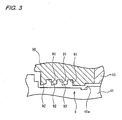
- a turbocharger according to an embodiment shown in Fig. 3 has a labyrinth seal 9 in which a ring groove 91 and a projection portion 92, forming a pair, are added in the labyrinth seal 9 shown in Fig. 1 and Fig. 2 .
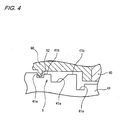
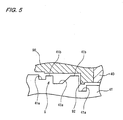
- Turbochargers according to embodiments shown in Fig. 4 and Fig. 5 have labyrinth seals 9 in which ring grooves 41a and projection portions 41b with flat top faces are formed in the turbine shaft 41.
- a projection portion 92 projecting toward the axis C of the housing 40 is formed on an inner peripheral surface of the sleeve 90 on the turbine wheel 42 side.
- a gap formed between a top end portion of the projection portion 92 and the outer peripheral surface of the turbine shaft 41 is set to be very small.
- a projection portion 92 is formed on an inner peripheral surface of the sleeve 90 on the shaft hole 43 side.
- a gap formed between the projection portion 92 and the outer peripheral surface of the turbine shaft 41 is set to be very small
- Turbochargers according to other embodiments shown in Figs 6 and 7 , each has a labyrinth seal 9 in which ring grooves 41a are formed on the turbine shaft 41.
- a turbocharger according to an embodiment shown in Fig. 8 has a labyrinth seal 9 in which projection portions 92 with flat top faces and ring grooves 91 are formed. Side faces of the ring grooves 91 and the projection portions 92 are tapered.
- a labyrinth seal 9 may be formed coaxially on a radial outer side of the piston ring seal 44b of the turbine shaft 41.
- the labyrinth seal 9 is configured by forming a ring groove on the housing 40 opposing to the outer periphery of the turbine shaft 41 at its end on the compressor wheel 62 side, or on the outer periphery of the turbine shaft 41 at its end on the compressor wheel 62 side, so as to extend along the circumferential direction of the turbine shaft 41.
- lubrication methods of the rolling bearings 10 may be a full float mode that is generally employed, namely, a mode that the shaft hole 43 in which the rolling bearings 10 are housed is filled up with lubricant (that is commonly used as engine oil, for example).
Landscapes
- Engineering & Computer Science (AREA)
- General Engineering & Computer Science (AREA)
- Mechanical Engineering (AREA)
- Chemical & Material Sciences (AREA)
- Combustion & Propulsion (AREA)
- Supercharger (AREA)
Abstract
Description
- This invention relates to a turbocharger which is employed in automobiles or the like.
- Turbochargers which enhance output of internal combustion engines by blowing compressed air with increased density into inside of the internal combustion engines are known as, for example, supercharger, turbocharger or the like.
- A turbocharger, for example, is configured such that a turbine wheel is disposed in an exhaust passage while a compressor wheel is disposed in an admission passage in an internal combustion engine such as an automobile engine. These wheels are provided respectively on opposite end portions of a turbine shaft that is housed within a shaft hole of a housing. Within the shaft hole of the housing, rolling bearings support rotatably the turbine shaft. When the turbine wheel is rotated by exhaust gas flowing through the exhaust passage, the turbine shaft and the compressor wheel are rotated so that air inside the admission passage to be fed to the internal combustion engine is compressed.
- Further, in the turbocharger as described above, a sealing structure that performs sealing between the shaft hole and the exhaust passage as well as between the shaft hole and the admission passage is provided such that lubricant which is provided with the shaft hole of the housing for lubrication of the rolling bearing is not leaked out toward the exhaust passage and the admission passage and such that gas such as air or exhaust gas does not flow in the housing from the exhaust passage and the admission passage. For example, piston ring seals are provided on outer peripheries of opposite ends of the turbine shaft in its axial direction to form the sealing structure performing sealing between the shaft hole and the exhaust passage as well as between the shaft hole and the admission passage (See, for example,
JP-A-H11-101128 - In the conventional turbocharger, it is difficult to completely shut out leakage of the lubricant from the shaft hole of the housing to the exhaust passage and flow-in of the gas from the admission passage or the exhaust passage to the shaft hole. However, as reduction of lubricant contamination in the exhaust gas is required in view of environmental consciousness, it is important to shut out fluid communication between the exhaust passage and the shaft hole of the housing as much as possible.
- Accordingly, the object of the invention is to provide a turbocharger in which the fluid communication between the exhaust passage and the shaft hole of the housing is effectively suppressed.
- A turbocharger according to the invention includes:
- a turbine shaft;
- a turbine wheel disposed on a first end portion of the turbine shaft in an exhaust passage of an internal combustion engine;
- a compressor wheel disposed on a second end portion of the turbine shaft in an admission passage of the internal combustion engine;
- a rolling bearing rotatably supporting the turbine shaft within a shaft hole of a housing; and
- a sealing structure performing a sealing between the shaft hole and the exhaust passage,
- wherein the sealing structure includes a labyrinth seal provided between an outer periphery of the first end portion of the turbine shaft and the housing, and a piston ring seal disposed on a side toward a center of the turbine shaft in an axial direction thereof from a position on the turbine shaft at which the labyrinth seal is provided, and
- wherein a ring groove is formed along a circumferential direction of the housing in a middle portion of the labyrinth seal to reverse a flow direction of exhaust gas entering from the exhaust passage.
- According to the above construction, since the labyrinth seal provided between the outer periphery of the end portion of the turbine shaft on the turbine wheel side and the housing is disposed as noncontact structure without being brought into contact with the turbine shaft and the shaft hole of the housing, it is possible to suppress that exhaust gas flows in from the exhaust passage without interfering with rotation of the rolling bearing. Further, it is possible to prevent the leakage of the lubricant to the exhaust passage by the piston ring seal that is disposed on the side toward the center of the turbine shaft in the axial direction thereof from the position on the turbine shaft at which the labyrinth seal is provided. Moreover, by providing such inner/outer double sealing structure, the fluid communication between the exhaust passage and the shaft hole of the housing is further suppressed.
- In addition, by forming the ring groove along the circumferential direction of the housing in the middle portion of the labyrinth seal to reverse the flow direction of the exhaust gas entering from the exhaust passage, it is possible to prevent effectively the inflow of the exhaust gas from the exhaust passage.
- Further, by providing a coolant water jacket in which coolant water for cooling the turbine shaft is circulated is provided on a radial outer side of the turbine shaft from the position of the housing at which the labyrinth seal is provided, the exhaust passage of the housing can be cooled efficiently without extending a dimension of the turbine shaft in the axial direction thereof. As a result, it is possible to suppress that heat of the exhaust gas passing the exhaust passage is transmitted to the axial hole of the housing.
- According to the invention, it is possible to suppress effectively the fluid communication between the exhaust passage and the shaft hole of the housing in the turbocharger.
-
-
Fig. 1 is a sectional view of a turbocharger according to an embodiment of the invention. -
Fig. 2 is an enlarged view of an essential portion ofFig. 1 . -
Fig. 3 is an enlarged view of a labyrinth seal portion of a turbocharger according to another embodiment of the invention. -
Fig. 4 is an enlarged view of a labyrinth seal portion of a turbocharger according to another embodiment of the invention. -
Fig. 5 is an enlarged view of a labyrinth seal portion of a turbocharger according to another embodiment of the invention. -
Fig. 6 is an enlarged view of a labyrinth seal portion of a turbocharger according to another embodiment of the invention. -
Fig. 7 is an enlarged view of a labyrinth seal portion of a turbocharger according to another embodiment of the invention. -
Fig. 8 is an enlarged view of a labyrinth seal portion of a turbocharger according to another embodiment of the invention. - Preferred embodiments of the present invention will now be described in detail with reference to the drawings.
-
Fig. 1 is a sectional view of a turbocharger according to an embodiment of the turbocharger.Fig. 2 is an enlarged view of an essential portion ofFig. 1 . The turbocharger of the embodiment is a turbocharger for an automobile engine, and includes ahousing 40, and aturbine shaft 41 housed in thehousing 40 so as to be supported coaxially with an axis C by being inserted into a pair ofrolling bearings housing 40. Further, in anexhaust passage 60, aturbine wheel 42 is provided on one end portion of theturbine shaft 41 and in anadmission passage 61, acompressor wheel 62 is provided on the other end portion of theturbine shaft 41. - The
housing 40 includes ahousing body 40a. Thehousing body 40a has ashaft hole 43 at a center portion thereof that is formed in a substantially cylindrical hole coincided with the axis C. In theshaft hole 43, a tubular bearingholding member 15 is fitted into aninner periphery 40d of thehousing body 40a with a gap. The pair of therolling bearings bearing holding member 15 so as to support theturbine shaft 41 housed in theshaft hole 43 rotatably around the axis C. - The pair of the
rolling bearings shaft hole 43 along the left and right direction inFig. 1 . A preload in the axial direction is applied to therolling bearings rolling bearings urging member 81 disposed between the rollingbearing - The rolling
bearing 10 includes aninner ring 1, anouter ring 3 and anintermediate ring 2 disposed between theinner ring 1 and theouter ring 3. A first rolling element set 4 and a secondrolling element set 5 are arranged between theintermediate ring 2 and theinner ring 1, and between theintermediate ring 2 and theouter ring 3, respectively. The first and secondrolling element sets 4,5 are provided withballs - As shown in
Fig. 1 , in the rolling bearing 10, an inner peripheral surface of theinner ring 1 serves as a fitting surface to theturbine shaft 41 such that theinner ring 1 is fitted around theturbine shaft 41. A first bearingraceway 11 with which theballs 4a of the first rolling element set 4 are brought into contact is formed on an outer peripheral surface of theinner ring 1. An outer peripheral surface of theouter ring 3 of the rollingbearing 10 is fixed to an inner periphery of thebearing holding member 15. A second bearingraceway 31 with which theballs 5a of the second rolling element set 5 are brought into contact is formed on an inner peripheral surface of theouter ring 3. Theintermediate ring 2 has a bent shape in its cross section extended along the axial direction of thebearing 10. A third bearingraceway 21 with which theballs 4a of the first rolling element set 4 are brought into contact is formed on a part of an inner peripheral surface of theintermediate ring 2. A fourth bearingraceway 22 with which theballs 5a of the second rolling element set 5 are brought into contact is formed on a part of an outer peripheral surface of theintermediate ring 2. - The
plural balls 4a of the first rolling element set 4 are held by a cage 8 along a circumference of a circle that is centered at the axis C. Theplural balls 5a of the second rolling element set are held by acage 9 along a circumference of another circle that is centered at the axis C. Theballs 4a of the first rolling element set 4 and theballs 5a of the second rolling element set 5 have the same ball diameter one another. Theballs 4a of the first rolling element set 4 are brought into contact with the first bearingraceway 11 and the third bearingraceway 21 forming an opposite pair diagonally (namely, angular contact). Theballs 5a of the secondrolling element set 5 are brought into contact with the fourth bearingraceway 22 and the second bearingraceway 31 forming another opposite pair diagonally. The contact angle in both angular contacts is set to be the same, for example, to be 15° inFig. 1 . Accordingly, the rollingbearing 10 is capable of bearing load in the direction of the axis C (axial direction load). Further, since the rollingbearing 10 is arranged along the axial direction extending in the direction of the axis C, it provides a structure having a damper function in the axial direction. -
Damper members 7 are provided on outer peripheral surfaces of thebearing holding member 15 at its opposite ends in the direction of the axis C to lessen vibrations generated due to rotation of theturbine shaft 41. Thedamper member 7 is fabricated by braiding metal wires to form a ring shape with a rectangular cross section. An outer peripheral surface of thedamper member 7 is brought into contact with theinner periphery 40d of thehousing body 40a, There are formed gaps (or voids) partially or entirely between adjacent metal wires that form thedamper member 7 Thedamper member 7 is configured as a whole to be elastically deformable (contractible) in the radial direction and the direction of the axis C by allowing elastic deformation of the metal wires within the gaps, or displacement among adjacent wires in longitudinal directions of the wires in the damper member. Thedamper member 7 is formed to have an outer diameter that is slightly larger than an inner diameter of theshaft hole 43 so as to be interposed between thebearing holding member 15 and theshaft hole 43 in a compressed manner with a predetermined fitting margin in the radial direction. - The gaps formed between the metal wires in the
damper member 7 are filled with lubricant. Fluorinated grease is used for such lubricant for example. - By providing the
damper member 7, the vibration transmitted from theturbine shaft 41 to thebearing holding member 15 through the rollingbearings 10 is damped by thedamper members 7 and transmitted to thehousing 40 in the turbocharger. At this time, thedamper members 7 are elastically deformable in the radial direction and the direction of the axis C. Therefore, the vibration can be damped three-dimensionally or in all directions and an excellent damping function is performed. Further, not only elastic deformation of the metal wires themselves but frictions come from the braiding structure and entanglement of the metal wires also serve to store and dissipate the vibration energy in all directions beyond simple effect of viscoelasticity. - In addition, since the
damper member 7 is formed with metal wires, excellent heat resistance can be also provided. Therefore, it is suitable for a damper means for a turbo charger used in very high temperature. - Further, since grease is filled in the gaps of the wires in the
damper member 7, wires are hardly worn by being rubbed against each other. - Furthermore, by inserting the
damper member 7 as described above between thebearing holding member 15 and thehousing 40, any oil film damper provided conventionally is not needed. Accordingly, it is possible to accomplish simplification of the structure of thehousing 40 as well as cost reduction. - In the turbocharger as described above, a
lace member 36 is provided such that one end thereof is put into a tank portion in which the lubricant is stored and the other end thereof is placed in the rollingbearing 10 within theshaft hole 43. Thus, lubrication of the rollingbearing 10 is conducted by feeding the lubricant from the tank portion (not-shown) to theshaft hole 43 utilizing capillary action of thelace member 36. By means of thelace member 36, which does not require any power, the lubricant is fed to the rollingbearing 10 in theshaft hole 43 even in a condition that rotation of theturbine shaft 43 is stopped. For the lubricant stored in the tank portion, oil which is normally used for lubrication of the rolling bearing and which has a suitable viscosity to be able to percolate in thelace member 36 can be used in the embodiment. Among such oils, oil which is superior to engine oils in seizure resistant property is preferably used, for example, chemical synthetic oil such as polyol ester oil, diester oil, aromatic ester oil, synthetic hydrocarbon oil, ether oil, silicon oil and fluorine oil. - Inside of the
housing body 40a of thehousing 40, acoolant water jacket 26 in which coolant water is circulated is provided. Thecoolant water jacket 26 is formed so as to surround theturbine shaft 41 on a radial outer side of the rollingbearings 10 from oneend portion 49 on theexhaust passage 60 side to theother end portion 50 on theadmission passage 61 side in thehousing body 40a. In other words, thecoolant water jacket 26 is formed so as to surround theshaft hole 43 along the circumferential direction of theturbine shaft 41. - Further, in the
coolant water jacket 26, anannular recess 33 indenting inwardly from the inner peripheral surface 43a of theshaft hole 43 in the radial direction of theturbine shaft 41 is formed on the oneend portion 49 of thehousing body 40a. Thus, by interposing theannular recess 33 between theturbine wheel 42 and the rollingbearing 10a in the axial direction, it is possible to conduct heat exchange effectively between heat transmitted from theexhaust passage 60 and the coolant water in theannular recess 33. Therefore, it is possible to reduce heat transmission from theturbine wheel 42 side to theshaft hole 43. As a result, it is possible to suppress thermal degradation of the lubricant and the rollingbearing 10 provided within theshaft hole 43. - Furthermore, in the turbocharger according to the embodiment, a
piston ring seal 44a and alabyrinth seal 9 are provided between the rollingbearing 10 and theturbine wheel 42 so as to be adjacent to each other along the axis C in order to form a seal structure to suppress fluid communication between theshaft hole 43 and theexhaust passage 60. - As shown in
Fig. 2 , thepiston ring seal 44a is adjacent to the rollingbearing 10a in the direction of the axis C. Thepiston ring seal 44a is configured by disposing apiston ring 47a between aring groove 46 formed on an outer peripheral surface of asleeve 45a that is fitted around theturbine shaft 41 so as to rotate together with theturbine shaft 41 and acylindrical portion 40b of thehousing 40 projecting toward theshaft hole 43. A minute gap is formed between thering groove 46 and thepiston ring 47a so that a gap between thesleeve 45a and thecylindrical portion 40b is closed. By such structure, it is possible to suppress that the lubricant within theshaft hole 43 is moved to theturbine wheel 42 side and also possible to suppress that exhaust gas flows in to theshaft hole 43 from theexhaust passage 60. - As shown in
Fig. 2 , thelabyrinth seal 9 is provided on theturbine wheel 42 side from thepiston ring seal 44a. Thelabyrinth seal 9 is provided by fitting theturbine shaft 41 with a predetermined small gap to acylindrical sleeve 90 that is provided at a center portion of asidewall 17 on theexhaust passage 60 side of thehousing body 40a. - In the
sleeve 90 forming the labyrinth seal, on an intermediate portion thereof along the axis C, tworing grooves 91 provided adjacent to each other are formed in an indented manner in the radial direction. Further, on theturbine shaft 41 side on which the labyrinth seal is formed, aring groove 41a is formed in an indented manner in the radial direction. On an inner peripheral surface of thesleeve 90, aprojection portion 92 is formed so as to have a top portion defined by a tapered surface that is flared out from theturbine wheel 42 side to theshaft hole 43 side. By this structure, the exhaust gas directing from theturbine wheel 42 side to theshaft hole 43 side does not move straightforwardly to theshaft hole 43 side, and it is easily introduced to thering groove 91. By means of thelabyrinth seal 9, when the exhaust gas directing from theturbine wheel 42 side to theshaft hole 43 side reaches at a space defined by thering groove 91, theprojection portion 92 and the outer periphery of theturbine shaft 41, turbulence is generated by pressure change (stepwise pressure decrease) so that the exhaust gas does not easily advance toward theshaft hole 43. Therefore, the sealing performance is improved as compared with the structure in which only a small gap is formed. - As described above, by providing the
labyrinth seal 9, the inflow of the exhaust gas from theexhaust passage 60 side into theshaft hole 43 is further suppressed. In addition, thelabyrinth seal 9 is noncontact structure, no friction is generated. As a result, performance of the sealing structure is further increased without interfering with rotation of theturbine shaft 41. - In the above described embodiment, the rolling
bearing 10 and the lubricant within theshaft hole 43 can be disposed away from theexhaust passage 60 by thelabyrinth seal 9, so that heat from theexhaust passage side 60 is not easily transmitted to the rollingbearing 10a and the lubricant within theshaft hole 43. Therefore, it is possible to suppress thermal degradation of these parts. Further, theannular recess 33 of thecoolant water jacket 26 is formed by utilizing the additional space on the outer side in the radial direction that is created for providing thelabyrinth seal 9. Therefore, it is possible to suppress that the size of the turbocharger is unduely increased. - As shown in
Fig. 1 , in the turbocharger according to the embodiment, as a sealing structure performing sealing between theshaft hole 43 of thehousing 40 and theadmission passage 61, apiston ring seal 44b having substantially the same structure as thepiston ring seal 44a provided on theexhaust passage 60 side is provided. Thepiston ring seal 44b is provided adjacent to the rollingbearing 10b in the direction of the axis C. Thepiston ring seal 44b is configured by disposing twopiston rings 47b between two rows ofring grooves 48 formed on an outer peripheral surface of asleeve 45b that is fitted around theturbine shaft 41 so as to rotate together with theturbine shaft 41 and an inner peripheral surface of anopening portion 40c formed at the center of asidewall 18 of thehousing 40. A minute gap is formed between eachring groove 48 and eachpiston ring 47b so that the gap between thesleeve 45b and the inner peripheral surface of theopening portion 40c is closed. By such structure, it is possible to suppress that the lubricant in theshaft hole 43 moves into thecompressor wheel 62 side and that the exhaust gas flows in to theshaft hole 43 from theadmission passage 61 side. - The invention is not limited to the embodiment as described above. For example, the shape of the
labyrinth seal 9 is not limited as long as it does not go against the purpose of the invention.Figs. 3-8 show turbochargers according to other embodiments of the invention. - A turbocharger according to an embodiment shown in
Fig. 3 has alabyrinth seal 9 in which aring groove 91 and aprojection portion 92, forming a pair, are added in thelabyrinth seal 9 shown inFig. 1 andFig. 2 . - Turbochargers according to embodiments shown in
Fig. 4 andFig. 5 havelabyrinth seals 9 in whichring grooves 41a andprojection portions 41b with flat top faces are formed in theturbine shaft 41. In the turbocharger according to the embodiment shown inFig. 4 , aprojection portion 92 projecting toward the axis C of thehousing 40 is formed on an inner peripheral surface of thesleeve 90 on theturbine wheel 42 side. A gap formed between a top end portion of theprojection portion 92 and the outer peripheral surface of theturbine shaft 41 is set to be very small. On the other hand, the turbocharger according to the embodiment shown inFig. 5 , aprojection portion 92 is formed on an inner peripheral surface of thesleeve 90 on theshaft hole 43 side. A gap formed between theprojection portion 92 and the outer peripheral surface of theturbine shaft 41 is set to be very small - Turbochargers according to other embodiments shown in
Figs 6 and7 , each has alabyrinth seal 9 in whichring grooves 41a are formed on theturbine shaft 41. - A turbocharger according to an embodiment shown in
Fig. 8 has alabyrinth seal 9 in whichprojection portions 92 with flat top faces andring grooves 91 are formed. Side faces of thering grooves 91 and theprojection portions 92 are tapered. - Further, in order to further suppress fluid communication between the
shaft hole 43 of thehousing 40 and theadmission passage 61, alabyrinth seal 9 may be formed coaxially on a radial outer side of thepiston ring seal 44b of theturbine shaft 41. In such a case, for example, thelabyrinth seal 9 is configured by forming a ring groove on thehousing 40 opposing to the outer periphery of theturbine shaft 41 at its end on thecompressor wheel 62 side, or on the outer periphery of theturbine shaft 41 at its end on thecompressor wheel 62 side, so as to extend along the circumferential direction of theturbine shaft 41. - Further, lubrication methods of the rolling
bearings 10 may be a full float mode that is generally employed, namely, a mode that theshaft hole 43 in which the rollingbearings 10 are housed is filled up with lubricant (that is commonly used as engine oil, for example).
Claims (2)
- A turbocharger comprising:a turbine shaft;a turbine wheel disposed on a first end portion of the turbine shaft in an exhaust passage of an internal combustion engine;a compressor wheel disposed on a second end portion of the turbine shaft in an admission passage of the internal combustion engine;a rolling bearing rotatably supporting the turbine shaft within a shaft hole of a housing; anda sealing structure performing a sealing between the shaft hole and the exhaust passage,wherein the sealing structure includes a labyrinth seal provided between an outer periphery of the first end portion of the turbine shaft and the housing, and a piston ring seal disposed on a side toward a center of the turbine shaft in an axial direction thereof from a position on the turbine shaft at which the labyrinth seal is provided, and
wherein a ring groove is formed along a circumferential direction of the housing in a middle portion of the labyrinth seal to reverse a flow direction of exhaust gas entering from the exhaust passage. - A turbocharger according to claim 1, wherein a coolant water jacket in which coolant water for cooling the turbine shaft is circulated is provided on a radial outer side of the turbine shaft from the position of the housing at which the labyrinth seal is provided.
Applications Claiming Priority (1)
| Application Number | Priority Date | Filing Date | Title |
|---|---|---|---|
| JP2008003461A JP2009167803A (en) | 2008-01-10 | 2008-01-10 | Turbocharger |
Publications (2)
| Publication Number | Publication Date |
|---|---|
| EP2078825A2 true EP2078825A2 (en) | 2009-07-15 |
| EP2078825A3 EP2078825A3 (en) | 2012-03-21 |
Family
ID=40524643
Family Applications (1)
| Application Number | Title | Priority Date | Filing Date |
|---|---|---|---|
| EP09000165A Withdrawn EP2078825A3 (en) | 2008-01-10 | 2009-01-08 | Turbocharger |
Country Status (3)
| Country | Link |
|---|---|
| US (1) | US20090196743A1 (en) |
| EP (1) | EP2078825A3 (en) |
| JP (1) | JP2009167803A (en) |
Cited By (3)
| Publication number | Priority date | Publication date | Assignee | Title |
|---|---|---|---|---|
| DE102009051307A1 (en) | 2009-10-29 | 2011-05-05 | Bosch Mahle Turbo Systems Gmbh & Co. Kg | Charging device, particularly exhaust gas turbocharger, comprises shaft mounted over two roller bearings, where two roller bearings are arranged in cartridge or socket |
| WO2011110388A3 (en) * | 2010-03-08 | 2011-11-10 | Bosch Mahle Turbo Systems Gmbh & Co. Kg | Core assembly of a supercharging device |
| CN102418567A (en) * | 2010-07-28 | 2012-04-18 | 曼柴油机和涡轮机欧洲股份公司 | Turbomachine |
Families Citing this family (17)
| Publication number | Priority date | Publication date | Assignee | Title |
|---|---|---|---|---|
| EP1905960A3 (en) * | 2006-09-28 | 2009-08-05 | JTEKT Corporation | Supercharger |
| JP5125684B2 (en) * | 2008-03-28 | 2013-01-23 | 株式会社Ihi | Turbocharger |
| WO2010085494A1 (en) * | 2009-01-20 | 2010-07-29 | Williams International Co., L.L.C. | Turbocharger with turbine nozzle cartridge |
| US8539936B2 (en) * | 2009-10-20 | 2013-09-24 | James E. Bell | Supercharger rotor shaft seal pressure equalization |
| WO2011087661A2 (en) * | 2009-12-22 | 2011-07-21 | Borgwarner Inc. | Internal combustion engine |
| DE102010037378A1 (en) * | 2010-09-07 | 2012-03-08 | Ford Global Technologies, Llc | Cylinder head with turbine |
| DE102010048304A1 (en) * | 2010-10-14 | 2011-12-22 | Voith Patent Gmbh | Turbo supercharger for use with combustion engine, has drive wheels arranged opposite to each other in driving connection, and seal provided between bearing and drive wheels and comprising piston rings and expansion chambers |
| ITCO20110036A1 (en) * | 2011-09-07 | 2013-03-08 | Nuovo Pignone Spa | GASKET FOR A ROTATING MACHINE |
| JP6080645B2 (en) * | 2013-03-27 | 2017-02-15 | 荏原冷熱システム株式会社 | Electric motor for compressor of turbo refrigerator |
| JP6660293B2 (en) * | 2014-04-30 | 2020-03-11 | 株式会社Ihi | Supercharger and supercharger refueling system |
| JP6392031B2 (en) * | 2014-08-28 | 2018-09-19 | 株式会社椿本チエイン | Side roller and chain with side roller |
| US10161259B2 (en) * | 2014-10-28 | 2018-12-25 | General Electric Company | Flexible film-riding seal |
| DE102015204563A1 (en) * | 2015-03-13 | 2016-09-15 | Bayerische Motoren Werke Aktiengesellschaft | turbocharger |
| US10260631B2 (en) * | 2015-11-25 | 2019-04-16 | Billy Dean Watson | Leak resistant pump |
| US9689424B1 (en) * | 2016-05-17 | 2017-06-27 | Schaeffler Technologies AG & Co. KG | Tiered axial taper roller bearing with common center ring |
| JP2018048593A (en) * | 2016-09-21 | 2018-03-29 | いすゞ自動車株式会社 | Seal structure for exhaust valve |
| CN113107614B (en) * | 2021-05-20 | 2023-08-25 | 华能安源发电有限责任公司 | Split H-shaped sealing device of small steam turbine of water feeding pump of thermal power plant |
Family Cites Families (16)
| Publication number | Priority date | Publication date | Assignee | Title |
|---|---|---|---|---|
| DE2735034C2 (en) * | 1976-08-19 | 1981-09-24 | Kabushiki Kaisha Komatsu Seisakusho, Tokyo | Exhaust gas turbocharger |
| US4268229A (en) * | 1979-04-19 | 1981-05-19 | The Garrett Corporation | Turbocharger shaft seal arrangement |
| US4725206A (en) * | 1984-12-20 | 1988-02-16 | The Garrett Corporation | Thermal isolation system for turbochargers and like machines |
| US4786238A (en) * | 1984-12-20 | 1988-11-22 | Allied-Signal Inc. | Thermal isolation system for turbochargers and like machines |
| JPS6249629U (en) * | 1985-09-17 | 1987-03-27 | ||
| JPH0138372Y2 (en) * | 1985-11-18 | 1989-11-16 | ||
| US5890881A (en) * | 1996-11-27 | 1999-04-06 | Alliedsignal Inc. | Pressure balanced turbocharger rotating seal |
| JP4004115B2 (en) * | 1997-09-29 | 2007-11-07 | 株式会社ジェイテクト | Supercharger and supercharger assembly method |
| US6467773B1 (en) * | 2000-08-31 | 2002-10-22 | Atlas Copco Comptec Inc. | Liquid seal |
| US6418722B1 (en) * | 2001-04-19 | 2002-07-16 | Honeywell International, Inc. | Turbocharger bearing system |
| GB0218092D0 (en) * | 2002-08-03 | 2002-09-11 | Holset Engineering Co | Turbocharger |
| EP1394365B1 (en) * | 2002-09-02 | 2006-10-25 | BorgWarner Inc. | Turbocharger shaft sealing |
| US7066719B2 (en) * | 2004-07-03 | 2006-06-27 | Honeywell International, Inc. | Bore and shaft assembly |
| DE102004055429B3 (en) * | 2004-11-17 | 2006-08-10 | Man B & W Diesel Ag | Sealing device for a particularly lubricated at standstill bearing a rotor shaft |
| JP4797920B2 (en) * | 2006-03-28 | 2011-10-19 | 株式会社ジェイテクト | Turbocharger |
| WO2009125452A1 (en) * | 2008-04-08 | 2009-10-15 | 株式会社Ihi | Turbocharger |
-
2008
- 2008-01-10 JP JP2008003461A patent/JP2009167803A/en active Pending
-
2009
- 2009-01-08 EP EP09000165A patent/EP2078825A3/en not_active Withdrawn
- 2009-01-09 US US12/318,867 patent/US20090196743A1/en not_active Abandoned
Cited By (5)
| Publication number | Priority date | Publication date | Assignee | Title |
|---|---|---|---|---|
| DE102009051307A1 (en) | 2009-10-29 | 2011-05-05 | Bosch Mahle Turbo Systems Gmbh & Co. Kg | Charging device, particularly exhaust gas turbocharger, comprises shaft mounted over two roller bearings, where two roller bearings are arranged in cartridge or socket |
| WO2011110388A3 (en) * | 2010-03-08 | 2011-11-10 | Bosch Mahle Turbo Systems Gmbh & Co. Kg | Core assembly of a supercharging device |
| US9011011B2 (en) | 2010-03-08 | 2015-04-21 | Bosch Mahle Turbo Systems Gmbh & Co. Kg | Bearing housing cover for a charging device |
| CN102418567A (en) * | 2010-07-28 | 2012-04-18 | 曼柴油机和涡轮机欧洲股份公司 | Turbomachine |
| CN102418567B (en) * | 2010-07-28 | 2015-06-17 | 曼柴油机和涡轮机欧洲股份公司 | Turbomachine |
Also Published As
| Publication number | Publication date |
|---|---|
| US20090196743A1 (en) | 2009-08-06 |
| JP2009167803A (en) | 2009-07-30 |
| EP2078825A3 (en) | 2012-03-21 |
Similar Documents
| Publication | Publication Date | Title |
|---|---|---|
| EP2078825A2 (en) | Turbocharger | |
| JP5075000B2 (en) | Supercharger bearing device | |
| US20090081040A1 (en) | Rolling bearing device and turbocharger incorporating same | |
| KR102556910B1 (en) | Vented bearing retainer for turbomachinery | |
| US8845271B2 (en) | Turbocharger bearing system | |
| JP4367628B2 (en) | Electric motor integrated turbocharger | |
| JP6946697B2 (en) | Rolling bearing | |
| JP6250923B2 (en) | Bearing device | |
| US20140153855A1 (en) | Rolling Bearing Having Insulating Material | |
| JP2009097525A (en) | Rolling bearing with cage | |
| JP2017009016A (en) | Angular ball bearing | |
| US9726037B2 (en) | Bearing systems for turbochargers used on internal combustion engines | |
| JP2009203846A (en) | Ball bearing arrangement for turbocharger | |
| JP2018159392A (en) | Rolling bearing | |
| EP3848602B1 (en) | Rolling bearing and spindle device equipped with rolling bearing | |
| JP2010138753A (en) | Bearing device for supercharger | |
| JP2018063018A (en) | Bearing device of supercharger | |
| JP2014126083A (en) | Ball bearing unit | |
| JP2008082298A (en) | Turbocharger | |
| JP6539507B2 (en) | Bearing unit | |
| KR20040053385A (en) | Bevel gear transmission | |
| JP7136637B2 (en) | rolling bearing | |
| JP7373050B2 (en) | turbo charger | |
| CN222811216U (en) | Sealing assembly for wind generating set | |
| JP2014126084A (en) | Ball bearing unit for turbocharger |
Legal Events
| Date | Code | Title | Description |
|---|---|---|---|
| PUAI | Public reference made under article 153(3) epc to a published international application that has entered the european phase |
Free format text: ORIGINAL CODE: 0009012 |
|
| AK | Designated contracting states |
Kind code of ref document: A2 Designated state(s): AT BE BG CH CY CZ DE DK EE ES FI FR GB GR HR HU IE IS IT LI LT LU LV MC MK MT NL NO PL PT RO SE SI SK TR |
|
| AX | Request for extension of the european patent |
Extension state: AL BA RS |
|
| PUAL | Search report despatched |
Free format text: ORIGINAL CODE: 0009013 |
|
| AK | Designated contracting states |
Kind code of ref document: A3 Designated state(s): AT BE BG CH CY CZ DE DK EE ES FI FR GB GR HR HU IE IS IT LI LT LU LV MC MK MT NL NO PL PT RO SE SI SK TR |
|
| AX | Request for extension of the european patent |
Extension state: AL BA RS |
|
| RIC1 | Information provided on ipc code assigned before grant |
Ipc: F02C 7/28 20060101ALI20120210BHEP Ipc: F01D 11/00 20060101ALI20120210BHEP Ipc: F01D 25/18 20060101ALI20120210BHEP Ipc: F01D 25/14 20060101ALI20120210BHEP Ipc: F01D 25/12 20060101ALI20120210BHEP Ipc: F01D 11/02 20060101AFI20120210BHEP |
|
| AKY | No designation fees paid | ||
| REG | Reference to a national code |
Ref country code: DE Ref legal event code: R108 |
|
| REG | Reference to a national code |
Ref country code: DE Ref legal event code: R108 Effective date: 20121128 |
|
| STAA | Information on the status of an ep patent application or granted ep patent |
Free format text: STATUS: THE APPLICATION IS DEEMED TO BE WITHDRAWN |
|
| 18D | Application deemed to be withdrawn |
Effective date: 20120922 |