EP2078560A1 - Automobile exhaust gas purifying catalyst and method for producing the same - Google Patents
Automobile exhaust gas purifying catalyst and method for producing the same Download PDFInfo
- Publication number
- EP2078560A1 EP2078560A1 EP07831402A EP07831402A EP2078560A1 EP 2078560 A1 EP2078560 A1 EP 2078560A1 EP 07831402 A EP07831402 A EP 07831402A EP 07831402 A EP07831402 A EP 07831402A EP 2078560 A1 EP2078560 A1 EP 2078560A1
- Authority
- EP
- European Patent Office
- Prior art keywords
- support
- catalyst
- supporting
- zro
- zirconia
- Prior art date
- Legal status (The legal status is an assumption and is not a legal conclusion. Google has not performed a legal analysis and makes no representation as to the accuracy of the status listed.)
- Granted
Links
Images

Classifications
-
- B—PERFORMING OPERATIONS; TRANSPORTING
- B01—PHYSICAL OR CHEMICAL PROCESSES OR APPARATUS IN GENERAL
- B01J—CHEMICAL OR PHYSICAL PROCESSES, e.g. CATALYSIS OR COLLOID CHEMISTRY; THEIR RELEVANT APPARATUS
- B01J23/00—Catalysts comprising metals or metal oxides or hydroxides, not provided for in group B01J21/00
- B01J23/38—Catalysts comprising metals or metal oxides or hydroxides, not provided for in group B01J21/00 of noble metals
- B01J23/40—Catalysts comprising metals or metal oxides or hydroxides, not provided for in group B01J21/00 of noble metals of the platinum group metals
- B01J23/46—Ruthenium, rhodium, osmium or iridium
-
- B—PERFORMING OPERATIONS; TRANSPORTING
- B01—PHYSICAL OR CHEMICAL PROCESSES OR APPARATUS IN GENERAL
- B01D—SEPARATION
- B01D53/00—Separation of gases or vapours; Recovering vapours of volatile solvents from gases; Chemical or biological purification of waste gases, e.g. engine exhaust gases, smoke, fumes, flue gases, aerosols
- B01D53/34—Chemical or biological purification of waste gases
- B01D53/92—Chemical or biological purification of waste gases of engine exhaust gases
- B01D53/94—Chemical or biological purification of waste gases of engine exhaust gases by catalytic processes
- B01D53/9445—Simultaneously removing carbon monoxide, hydrocarbons or nitrogen oxides making use of three-way catalysts [TWC] or four-way-catalysts [FWC]
- B01D53/945—Simultaneously removing carbon monoxide, hydrocarbons or nitrogen oxides making use of three-way catalysts [TWC] or four-way-catalysts [FWC] characterised by a specific catalyst
-
- B—PERFORMING OPERATIONS; TRANSPORTING
- B01—PHYSICAL OR CHEMICAL PROCESSES OR APPARATUS IN GENERAL
- B01D—SEPARATION
- B01D53/00—Separation of gases or vapours; Recovering vapours of volatile solvents from gases; Chemical or biological purification of waste gases, e.g. engine exhaust gases, smoke, fumes, flue gases, aerosols
- B01D53/34—Chemical or biological purification of waste gases
- B01D53/92—Chemical or biological purification of waste gases of engine exhaust gases
- B01D53/94—Chemical or biological purification of waste gases of engine exhaust gases by catalytic processes
-
- B—PERFORMING OPERATIONS; TRANSPORTING
- B01—PHYSICAL OR CHEMICAL PROCESSES OR APPARATUS IN GENERAL
- B01J—CHEMICAL OR PHYSICAL PROCESSES, e.g. CATALYSIS OR COLLOID CHEMISTRY; THEIR RELEVANT APPARATUS
- B01J21/00—Catalysts comprising the elements, oxides, or hydroxides of magnesium, boron, aluminium, carbon, silicon, titanium, zirconium, or hafnium
- B01J21/06—Silicon, titanium, zirconium or hafnium; Oxides or hydroxides thereof
-
- B—PERFORMING OPERATIONS; TRANSPORTING
- B01—PHYSICAL OR CHEMICAL PROCESSES OR APPARATUS IN GENERAL
- B01J—CHEMICAL OR PHYSICAL PROCESSES, e.g. CATALYSIS OR COLLOID CHEMISTRY; THEIR RELEVANT APPARATUS
- B01J21/00—Catalysts comprising the elements, oxides, or hydroxides of magnesium, boron, aluminium, carbon, silicon, titanium, zirconium, or hafnium
- B01J21/06—Silicon, titanium, zirconium or hafnium; Oxides or hydroxides thereof
- B01J21/066—Zirconium or hafnium; Oxides or hydroxides thereof
-
- B—PERFORMING OPERATIONS; TRANSPORTING
- B01—PHYSICAL OR CHEMICAL PROCESSES OR APPARATUS IN GENERAL
- B01J—CHEMICAL OR PHYSICAL PROCESSES, e.g. CATALYSIS OR COLLOID CHEMISTRY; THEIR RELEVANT APPARATUS
- B01J23/00—Catalysts comprising metals or metal oxides or hydroxides, not provided for in group B01J21/00
- B01J23/38—Catalysts comprising metals or metal oxides or hydroxides, not provided for in group B01J21/00 of noble metals
- B01J23/40—Catalysts comprising metals or metal oxides or hydroxides, not provided for in group B01J21/00 of noble metals of the platinum group metals
- B01J23/46—Ruthenium, rhodium, osmium or iridium
- B01J23/464—Rhodium
-
- B—PERFORMING OPERATIONS; TRANSPORTING
- B01—PHYSICAL OR CHEMICAL PROCESSES OR APPARATUS IN GENERAL
- B01J—CHEMICAL OR PHYSICAL PROCESSES, e.g. CATALYSIS OR COLLOID CHEMISTRY; THEIR RELEVANT APPARATUS
- B01J35/00—Catalysts, in general, characterised by their form or physical properties
- B01J35/30—Catalysts, in general, characterised by their form or physical properties characterised by their physical properties
- B01J35/391—Physical properties of the active metal ingredient
- B01J35/393—Metal or metal oxide crystallite size
-
- B—PERFORMING OPERATIONS; TRANSPORTING
- B01—PHYSICAL OR CHEMICAL PROCESSES OR APPARATUS IN GENERAL
- B01J—CHEMICAL OR PHYSICAL PROCESSES, e.g. CATALYSIS OR COLLOID CHEMISTRY; THEIR RELEVANT APPARATUS
- B01J37/00—Processes, in general, for preparing catalysts; Processes, in general, for activation of catalysts
- B01J37/02—Impregnation, coating or precipitation
- B01J37/0201—Impregnation
- B01J37/0207—Pretreatment of the support
-
- B—PERFORMING OPERATIONS; TRANSPORTING
- B01—PHYSICAL OR CHEMICAL PROCESSES OR APPARATUS IN GENERAL
- B01J—CHEMICAL OR PHYSICAL PROCESSES, e.g. CATALYSIS OR COLLOID CHEMISTRY; THEIR RELEVANT APPARATUS
- B01J37/00—Processes, in general, for preparing catalysts; Processes, in general, for activation of catalysts
- B01J37/02—Impregnation, coating or precipitation
- B01J37/0201—Impregnation
- B01J37/0211—Impregnation using a colloidal suspension
-
- B—PERFORMING OPERATIONS; TRANSPORTING
- B01—PHYSICAL OR CHEMICAL PROCESSES OR APPARATUS IN GENERAL
- B01J—CHEMICAL OR PHYSICAL PROCESSES, e.g. CATALYSIS OR COLLOID CHEMISTRY; THEIR RELEVANT APPARATUS
- B01J37/00—Processes, in general, for preparing catalysts; Processes, in general, for activation of catalysts
- B01J37/08—Heat treatment
-
- F—MECHANICAL ENGINEERING; LIGHTING; HEATING; WEAPONS; BLASTING
- F01—MACHINES OR ENGINES IN GENERAL; ENGINE PLANTS IN GENERAL; STEAM ENGINES
- F01N—GAS-FLOW SILENCERS OR EXHAUST APPARATUS FOR MACHINES OR ENGINES IN GENERAL; GAS-FLOW SILENCERS OR EXHAUST APPARATUS FOR INTERNAL-COMBUSTION ENGINES
- F01N3/00—Exhaust or silencing apparatus having means for purifying, rendering innocuous, or otherwise treating exhaust
- F01N3/08—Exhaust or silencing apparatus having means for purifying, rendering innocuous, or otherwise treating exhaust for rendering innocuous
- F01N3/10—Exhaust or silencing apparatus having means for purifying, rendering innocuous, or otherwise treating exhaust for rendering innocuous by thermal or catalytic conversion of noxious components of exhaust
-
- B—PERFORMING OPERATIONS; TRANSPORTING
- B01—PHYSICAL OR CHEMICAL PROCESSES OR APPARATUS IN GENERAL
- B01D—SEPARATION
- B01D2255/00—Catalysts
- B01D2255/10—Noble metals or compounds thereof
- B01D2255/102—Platinum group metals
- B01D2255/1025—Rhodium
-
- B—PERFORMING OPERATIONS; TRANSPORTING
- B01—PHYSICAL OR CHEMICAL PROCESSES OR APPARATUS IN GENERAL
- B01D—SEPARATION
- B01D2255/00—Catalysts
- B01D2255/20—Metals or compounds thereof
- B01D2255/207—Transition metals
- B01D2255/20715—Zirconium
-
- B—PERFORMING OPERATIONS; TRANSPORTING
- B01—PHYSICAL OR CHEMICAL PROCESSES OR APPARATUS IN GENERAL
- B01J—CHEMICAL OR PHYSICAL PROCESSES, e.g. CATALYSIS OR COLLOID CHEMISTRY; THEIR RELEVANT APPARATUS
- B01J2235/00—Indexing scheme associated with group B01J35/00, related to the analysis techniques used to determine the catalysts form or properties
-
- B—PERFORMING OPERATIONS; TRANSPORTING
- B01—PHYSICAL OR CHEMICAL PROCESSES OR APPARATUS IN GENERAL
- B01J—CHEMICAL OR PHYSICAL PROCESSES, e.g. CATALYSIS OR COLLOID CHEMISTRY; THEIR RELEVANT APPARATUS
- B01J2235/00—Indexing scheme associated with group B01J35/00, related to the analysis techniques used to determine the catalysts form or properties
- B01J2235/30—Scanning electron microscopy; Transmission electron microscopy
-
- B—PERFORMING OPERATIONS; TRANSPORTING
- B01—PHYSICAL OR CHEMICAL PROCESSES OR APPARATUS IN GENERAL
- B01J—CHEMICAL OR PHYSICAL PROCESSES, e.g. CATALYSIS OR COLLOID CHEMISTRY; THEIR RELEVANT APPARATUS
- B01J35/00—Catalysts, in general, characterised by their form or physical properties
- B01J35/60—Catalysts, in general, characterised by their form or physical properties characterised by their surface properties or porosity
- B01J35/61—Surface area
- B01J35/613—10-100 m2/g
-
- Y—GENERAL TAGGING OF NEW TECHNOLOGICAL DEVELOPMENTS; GENERAL TAGGING OF CROSS-SECTIONAL TECHNOLOGIES SPANNING OVER SEVERAL SECTIONS OF THE IPC; TECHNICAL SUBJECTS COVERED BY FORMER USPC CROSS-REFERENCE ART COLLECTIONS [XRACs] AND DIGESTS
- Y02—TECHNOLOGIES OR APPLICATIONS FOR MITIGATION OR ADAPTATION AGAINST CLIMATE CHANGE
- Y02A—TECHNOLOGIES FOR ADAPTATION TO CLIMATE CHANGE
- Y02A50/00—TECHNOLOGIES FOR ADAPTATION TO CLIMATE CHANGE in human health protection, e.g. against extreme weather
- Y02A50/20—Air quality improvement or preservation, e.g. vehicle emission control or emission reduction by using catalytic converters
-
- Y—GENERAL TAGGING OF NEW TECHNOLOGICAL DEVELOPMENTS; GENERAL TAGGING OF CROSS-SECTIONAL TECHNOLOGIES SPANNING OVER SEVERAL SECTIONS OF THE IPC; TECHNICAL SUBJECTS COVERED BY FORMER USPC CROSS-REFERENCE ART COLLECTIONS [XRACs] AND DIGESTS
- Y02—TECHNOLOGIES OR APPLICATIONS FOR MITIGATION OR ADAPTATION AGAINST CLIMATE CHANGE
- Y02T—CLIMATE CHANGE MITIGATION TECHNOLOGIES RELATED TO TRANSPORTATION
- Y02T10/00—Road transport of goods or passengers
- Y02T10/10—Internal combustion engine [ICE] based vehicles
- Y02T10/12—Improving ICE efficiencies
Definitions
- the present invention relates to an automobile exhaust gas purification catalyst raised in low temperature activity and a method of production of the same.
- a three-way catalyst As an automobile exhaust gas purification catalyst, a three-way catalyst simultaneously oxidizing the CO and HC in exhaust gas and reducing NOx at a stoichiometric air-fuel ratio is being used for purification.
- a three-way catalyst for example, a heat resistant base member comprised of cordierite etc. on the surface of which a coat layer made of ⁇ alumina is formed and supporting on the coat layer platinum Pt, rhodium Rh, palladium Pd, or another precious metal is widely known.
- a three-way catalyst for exhaust gas purification of a gasoline engine in particular a start catalyst arranged near the engine, has to be improved in low temperature activity the most among three-way catalysts since the HC and NOx exhausted at the time of cold start account for about 80% of the emissions.
- Rh has a high purification performance of NOx. Further, the purification of HC has an integral relationship with the purification of NOx in a three-way catalyst reaction mechanism.
- Rh it is not possible to use alumina (Al 2 O 3 ) as a support like with Pt or Pd.
- alumina Al 2 O 3
- Rh/ ⁇ alumina systems etc. the Rh becomes solid solute in the alumina support in an oxidizing atmosphere and conversely precipitates in a reducing atmosphere, so cannot be stably maintained as a catalyst.
- rhodium oxide Rh 2 O 3
- zirconia which differs from Rh 2 O 3 in crystal structure and will not become solid solute, has been used as a support to improve the low temperature activity and improve the durability.
- Rh is extremely expensive, so for broader application, there was the problem that it was necessary to greatly reduce the amount of catalyst metal.
- Rh will not become solid solute in zirconia, but the zirconia itself easily sinters at the usage temperature of the catalyst, so in the end, degradation as a catalyst was also unavoidable.
- Japanese Patent Publication (A) No. 2002-282692 shows a method of adding La etc. to ZrO 2 and supporting Rh on a support sintered at 500°C by the ion adsorption method.
- a zirconia support sintered at about 500°C had an initial surface area of 100 m 2 /g, but fell to 40 m 2 /g when the highest temperature reached 800°C or to 30 m 2 /g when the highest temperature reached 900°C.
- the zirconia particle size (average size) became coarser compared with the initial state 8 nm - reaching 25 nm after reaching 800°C and 33 nm after reaching 900°C. Therefore, the problem of the sintering of the zirconia as an Rh support is derived from the fact that it is difficult to support Rh on high temperature sintered zirconia.
- a catalyst supporting Rh as ions by adsorption had the problem of deterioration of the activity compared with a catalyst supporting the same as particles.
- Japanese Patent Publication (A) No. 2000-279818 and Japanese Patent Publication (A) No. 2000-279824 disclose methods of supporting previous metals as polymer chelate metal colloids. While an adsorption method, tens of hours are required for supporting them. Further, with the sole practical PVP colloid, the supporting efficiency was a low one of about 30% and the improvement in performance was small.
- Japanese Patent Publication (A) No. 2005-296733 discloses the method of using a metal colloid comprised of a protective agent and a catalyst metal to support a precious metal on a support by evaporation to dryness. However, with this method, basically the supporting density falls. Further, evaporation to dryness is used to secure the supporting ability. In the final analysis, there was no great difference from the methods of Japanese Patent Publication (A) No. 2000-279818 and Japanese Patent Publication (A) No. 2000-279824 .
- a catalyst supporting a precious metal as a polymer stabilized metal colloid like the above is better in initial performance and more advantageous in durability in some respects as well compared with a catalyst supporting a precious metal by the impregnation method used in the past, but in the final analysis, there was the defect that under tough durability test conditions, the performance dropped compared with a catalyst supported by impregnation.
- a polymer stabilized colloid is dispersed as a colloid by the hydrophilic groups of the polymer. While the individual colloid particles may be small, a large number of colloid particles agglomerate to form large secondary particles. If evaporating these to dryness, they are supported as coarse secondary particles. Under a high temperature durability test, large sintering occurs. Compared with the time of impregnation, while the initial performance may be good, under a high temperature durability test, the performance drops and the superiority is substantially lost.
- Japanese Patent Publication (A) No. 2005-279435 discloses a method of adding a basic salt of La etc. to an acidic Rh+ZrO 2 solution, reducing and making the Rh precipitate and evaporating to dryness the result to support the precious metal, and suppressing sintering by the crystal lattice of Rh matching the crystal lattice of the support. Even with this method, problems similar to Japanese Patent Publication (A) No. 2000-279818 , Japanese Patent Publication (A) No. 2000-279824 , and Japanese Patent Publication (A) No. 2005-296733 using evaporation to dryness cannot be avoided.
- the present invention has as its object the provision of an automobile exhaust gas purification catalyst comprised of a support mainly comprised of ZrO 2 in which Rh is supported as a catalyst metal preventing sintering of the support, raising the supporting efficiency, and raising the low temperature activity, and a method of production of the same.
- an automobile exhaust gas purification catalyst comprised of a support mainly comprised of ZrO 2 , sintered under sintering conditions where the as sintered ZrO 2 will substantially not be charged in a catalyst metal supporting treatment solution, in which Rh is supported as a catalyst metal in a particle state.
- substantially not be charged means “an absolute value of the ⁇ potential of less than 5 mV”.
- a method of production of the above automobile exhaust gas purification catalyst comprising a step of charging the support mainly comprised of ZrO 2 sintered under the above sintering conditions by applying at least one treatment of an acid treatment and a base treatment and a step of dipping the charged state support in the catalyst supporting solution including a colloid of Rh as the catalyst metal to make the Rh colloid be adsorbed on the support.
- the present invention treats a support mainly comprised of ZrO 2 , sintered under sintering conditions whereby the as sintered ZrO 2 will substantially not be changed in a catalyst metal supporting treatment solution, by acid treatment and/or base treatment so as to enable Rh to be carried as a catalyst metal in a particle state with a high supporting efficiency. Due to this, it is possible to sinter the support at a high temperature which could not be used in the past due to the difficulty of supporting Rh particles, so it is possible to prevent sintering of the support and the accompanying drop in catalyst activity and obtain the inherently high low temperature activity of Rh.
- Rh in the same way as other precious metals, deteriorated in catalyst activity due to sintering of Rh or ions entering solid solution.
- the inventors evaluated the performance by a stoichiometrical air-fuel ratio durability test up to 1000°C and as a result newly discovered that physical burial of the catalyst metal due to sintering of the support plays a more important role as a deterioration mechanism compared even with sintering or solid solution of a catalyst metal.
- FIG. 1 shows an Rh nanoanalysis image by STEM-HAADF of a catalyst supporting Rh particles on a zirconia support.
- the catalyst was fabricated by using a commercially available Rh colloid (Rh-PVP (polyvinyl pyrrolidone, Rh particle size of 2 nm) made by Tanaka Precious Metals), diluting this by distilled water of about 10 times the support weight, then adjusting pH to near the neutral point and dipping the zirconia support sintered at 500°C in the solution to make them support the Rh particles.
- Rh-PVP polyvinyl pyrrolidone, Rh particle size of 2 nm
- This catalyst was observed after a durability test at 1000°C, the stoichiometrical air-fuel ratio, and 2 hours.
- the acceleration voltage was 200V, and the resolution was 2 nm.
- STEM-EDS compared with EPMA, has an extremely high analysis ability as shown below: EDS EPMA Resolution: 2 nm Several ⁇ m Acceleration voltage 200 kV Several 10 kV Detection threshold Low High (in particular, for heavy element)
- Table 1 Analysis location EDS analysis value (count) Zr-K Rh-K 1 9031 483 2 8745 53 3 4342 624 4 5186 79 5 8286 3001 6 12166 428
- Rh particles were only sintered lightly and were maintained in a fine state, while the support zirconia was remarkably sintered and coarsened resulting in fine Rh particles being buried among coarse zirconia particles.
- Rh particles ending up physically buried in the zirconia support in this way do not function as a catalyst, so the effective amount of Rh with respect to the actual amount of Rh supported is greatly reduced and the catalyst activity is degraded.
- the surface area of the zirconia support fell from 95 m 2 /g to 11 m 2 /g and the particle size coarsened from 9 nm to 50 nm.
- the Rh particle size by the CO adsorption method it increased from the 1.9 nm of the initial state to 12 nm after the durability tests, but the particle size after the durability tests measured by FE-SEM was 7 nm. From the difference in the particle sizes due to the measurement methods, there is the possibility that about 78% of the Rh particles are buried.
- Rh particles The burial phenomenon of Rh particles has not been known at all up to now. It was first discovered by the inventors. To prevent burial and improve the catalyst activity, it is essential to prevent sintering of the zirconia support. For this, it is necessary to use a zirconia support sintered at a sintering temperature of at least the highest usage temperature under normal operating conditions. In the past, zirconia supports sintered at a high temperature of over the highest usage temperature were low in supporting ability of Rh particles, so evaporation to dryness had to be used for supporting it and therefore the supporting efficiency was low.
- the sintering temperature over the highest usage temperature under normal operating conditions is over 900°C in the case of the catalyst near the exhaust manifold in gasoline cars, over 750°C in the case of the catalyst under the floor in gasoline cars, and over 700°C in the case of a catalyst simultaneously reducing the PM and NOx in diesel cars.
- the inventors took note of the fact that the low ability of high temperature sintered zirconia to support Rh particles caused the as sintered zirconia to have a ⁇ potential of substantially zero in a catalyst metal supporting treatment solution. Further, they discovered that if treating an as sintered zirconia support by at least one of an acid treatment and base treatment, the ⁇ potential in the catalyst metal supporting treatment remarkably increased and the carrying ability of Rh particles greatly rose. Preferably, acid treatment is performed, then base treatment.
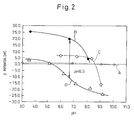
- FIG. 2 shows the changes in the ⁇ potential when changing the pH of an Rh colloid solution as a catalyst metal supporting treatment solution in various ways for a zirconia support sintered at 900°C (A), a sample treated by an acid+base (B and C), and Rh particles themselves (D) in the solution.
- Rh-PVP polyvinyl pyrrolidone and Rh particle size of 2 nm
- Tanaka Precious Metals was used, was diluted by distilled water about 10 times the weight of the support, then adjusted to various pH values.
- the zirconia support (A) as sintered at 900°C had a ⁇ potential remaining substantially 0 regardless of the pH value.
- the samples treated by acid treatment+base treatment (B and C) differed in absolute values depending on the temperature at the time of the acid treatment, the presence of any stirring, and the presence of any drying after the base treatment, but a trend is recognized where the ⁇ potential becomes a positive value at the low pH side and falls along with an increase in the pH value to become a negative value at the high pH side.
- the ⁇ potential of the copresent Rh colloid (D) is a small positive value at the low pH side. It falls along with an increase in the pH value and becomes a large negative value at the high pH side.
- supporting can be promoted by the electrostatic attraction force acting between the two.
- the ⁇ potential of the sample acid treated at 70°C for 3 h with stirring and the Rh colloid were large positive and negative values when the pH value was 6.5.
- a large electrostatic attraction force acts between the two, so it is possible to utilize this to obtain a high supporting ability.
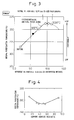
- FIG. 3 shows the relationship between the Rh particle size and temperature of HC50% purification over a pellet state Rh/zirconia catalyst due to the heat treatment temperature at aging at the stoichiometrical air-fuel ratio.
- the ordinate plots the heat treatment temperature from the bottom end to the top end from the high temperature to the low temperature. The higher the data plotted on the graph, the higher the purification performance shown (the higher the low temperature activity).
- the abscissas plot the Rh particle size after aging heat treatment.
- the bottom abscissa plots the apparent particle size by the CO adsorption method, while the top abscissa plots the actual particle size by an FE-SEM photograph.
- the purification temperature fell.
- the dependence on the particle size substantially disappeared. This is because in the small particle size region, the purification reaction is determined in rate by the change in state of the Rh, while in the large particle size region, the reaction itself determines the speed. If the Rh particle size is small in this way, the purification performance is low. That is, having Rh supported in the state of particles of a certain particle size or more is essential for improvement of the low temperature activity.
- Purification of HC is integrally related to purification of NOx due to the following reaction series using HC as a reducing agent in a three-way catalyst reaction mechanism. Therefore, it is possible to use the above HC50% purification temperature to evaluate the three-way catalyst covered for the NOx as well. Note that in the following formula, the "*" indicates the active points on the catalyst metal.
- the 2Oads of the above formula (2) reacts as follows with the HC: 2Oads+2/(2m+n/2) ⁇ CmHnads ⁇ 2m/(2m+n/2) ⁇ CO 2 +n/(2m+n/2) ⁇ H 2 O+2 * (4) (where m and n are the ratios of composition of C and H of HC)
- FIG. 4 and Table 2 show the relationship between the surface area of the zirconia support of the powder state Rh/zirconia catalyst and the HC50% purification temperature after a durability test at 1000°C.
- the zirconia support was treated by an acid, then treated by a base.
- the treatment conditions were as follows:
- Acid treatment conditions Stirring in a 0.2M HCl aqueous solution for 1 h. After that, filtering, rinsing, and filtering.
- Base treatment conditions Stirring in a 0.1M NH 4 OH aqueous solution for 1 h. After that, filtering, rinsing, and filtering.
- the other preparation conditions were similar to those of the above Example 1. However, the sintering temperature was changed in various ways to change the surface area.
- the HC50% purification temperature was the lowest in the range of the support surface area of 30 m 2 /g to 60 m 2 /g. It is learned that the low temperature activity is high.
- the surface area of the zirconia support used for the catalyst of the present invention is preferably in the above range.
- Table 2 Surface area (m 2 /g) Sintering temperature (°Cx3h) HC 50A% purification temperature (°C) Rh carrying efficiency (%) 12.8 (*A) 1000 265.5 94.3 33.0 (*A) 900 254.2 100.0 38.5 (*B) 950 253.5 Not yet measured 50.7 (*A) 800 254.2 Not yet measured 55.8 (*B) 900 253.1 99.0 91.8 (*A) 550 263.7 Not yet measured (Not yet measured: However, for carrying liquid transparency, estimated at about 100%) (*A: calcium stabilized zirconia) (*B: neodymium-yttrium stabilized zirconia)
- Examples 1, 2, and 3 are specific examples of pretreating a high temperature sintered support mainly comprised of zirconia by the present invention by acid treatment+base treatment, the supporting the Rh colloid.
- zirconia support indicates "a support mainly comprised of zirconia".
- the "mainly comprised of” means that in addition to the main ingredient of the ZrO 2 , other ingredients and stabilizers can be included to an extent not impairing the properties when supporting ZrO 2 alone.
- a zirconia support sintered at 900°C was treated in a hydrochloric acid 0.2 mol/L aqueous solution for 1 h with stirring for acid treatment, then was filtered and was rinsed by distilled water for 30 minutes. Next, it was treated in a 0.1 mol/L ammonia aqueous solution for 30 minutes with stirring for a base treatment, then was filtered. Next, it was rinsed for 30 minutes, then filtered.
- Rh colloid (Rh-PVP (polyvinyl pyrrolidone, Rh particle size of 2 nm) made by Tanaka Precious Metals) was used, was diluted by distilled water of about 10 times the support weight, then was adjusted in pH to near neutral.
- Rh-PVP polyvinyl pyrrolidone, Rh particle size of 2 nm
- the above treated zirconia support was placed in this colloid solution and stirred for 1 h to make it adsorb and support the Rh colloid particles. After this, the usual method was used to obtain a catalyst supporting Rh particles in a carried amount of 0.3 wt% with respect to the support weight. The Rh supporting efficiency at that time was 99.9%. For the above carried amount, the charged value was used as it is.
- Example 2 The same treatment and procedure were used as in Example 1 to make the zirconia support adsorb and support Rh colloid particles. After this, the usual method was used to obtain a catalyst supporting Rh particles in a carried amount of 0.6 wt% with respect to the support weight. The Rh supporting efficiency at that time was 99.3%. For the above supported amount, the charged value was used as it is.
- Example 2 The same treatment and procedure were used as in Example 1 to make the zirconia support adsorb and support Rh colloid particles. After this, the usual method was used to obtain a catalyst supporting Rh particles in a carried amount of 1.0 wt% with respect to the support weight. The Rh supporting efficiency at that time was 97.4%. For the above carried amount, the charged value was used as it is.
- a zirconia support sintered at 900°C was used without ammonia treatment. This was slowly stirred in a Rh chloride aqueous solution warmed to 50°C for 1 h to make it adsorb the Rh ions. After this, the usual method was used to obtain an impregnated catalyst carrying Rh ions in a supported amount of 0.3 wt% with respect to the support weight. The Rh supporting efficiency at that time was 92.0%. The initial amount was adjusted for use as the supported amount.
- Example 2 The same treatment as in Conventional Example 1 was performed on a zirconia support sintered at 900°C to make it adsorb Rh ions. After this, the usual method was used to obtain a catalyst supporting Rh ions in a supported amount of 0.6 wt% with respect to the support weight. The Rh supporting efficiency at that time was 85.7%. The initial amount was adjusted for use as the supported amount.
- Example 2 The same treatment as in Conventional Example 1 was performed on a zirconia support sintered at 900°C to make it adsorb Rh ions. After this, the usual method was used to obtain a catalyst supporting Rh ions in a supported amount of 1.0 wt% with respect to the support weight. The Rh supporting efficiency at that time was 54.5%. The initial amount was adjusted for use as the supported amount.
- Example 4 is a specific example of making a high temperature sintered zirconia support supporting an Rh colloid without the pretreatment of the present invention.
- a zirconia support sintered at 900°C was used as it is.
- the Rh-PVP colloid solution was added to distilled water and stirred.
- the zirconia carrier was added and stirred for 3 h.
- the usual method was used to obtain a catalyst carrying Rh particles in a supported amount of 0.3 wt% with respect to the support weight.
- the Rh supporting efficiency at that time was 85.2%.
- the amount of Rh colloid was adjusted for use as the supported amount.
- Comparative Examples 1, 2, and 3 are specific examples of impregnating a low temperature sintered zirconia support with Rh ions.
- a zirconia support sintered at 550°C was used as it is. This was slowly stirred in a Rh chloride aqueous solution warmed to 50°C for 1 h to make it adsorb the Rh ions. After this, the usual method was used to obtain an impregnated catalyst supporting Rh ions in a supported amount of 1.0 wt% with respect to the support weight. The Rh supporting efficiency at that time was 97.2%. The initial amount was adjusted for use as the supported amount.
- the catalysts of the examples of the present invention exhibited higher activity compared with even the comparative examples with their larger carried amounts of Rh. Further, the comparative examples fell rapidly in warmup ability together with the drop in the supported amount, while the examples exhibited little drop in warmup ability due to the drop in supported amount.
- Example 3 it is learned that even with a zirconia support sintered at a high temperature, it is possible to support a large amount of Rh and the usable range of the supported amount is broad.
- the catalyst of the present invention can support Rh particles with a high dispersion regardless of use of a high temperature sintered zirconia support.
- the warmup ability with the same supported amount of Rh is greatly improved.
- the range of the supported amount of Rh able to be used is also broad.
- an automobile exhaust gas purification catalyst preventing sintering of the support, raising the supporting efficiency, raising the low temperature activity comprised of a support mainly comprised of ZrO 2 in which Rh is supported as a catalyst metal and a method of production of the same.
Landscapes
- Chemical & Material Sciences (AREA)
- Engineering & Computer Science (AREA)
- Chemical Kinetics & Catalysis (AREA)
- Materials Engineering (AREA)
- Organic Chemistry (AREA)
- Combustion & Propulsion (AREA)
- Health & Medical Sciences (AREA)
- Biomedical Technology (AREA)
- Environmental & Geological Engineering (AREA)
- Analytical Chemistry (AREA)
- General Chemical & Material Sciences (AREA)
- Oil, Petroleum & Natural Gas (AREA)
- Physics & Mathematics (AREA)
- Thermal Sciences (AREA)
- Mechanical Engineering (AREA)
- General Engineering & Computer Science (AREA)
- Toxicology (AREA)
- Catalysts (AREA)
- Exhaust Gas Treatment By Means Of Catalyst (AREA)
- Exhaust Gas After Treatment (AREA)
Abstract
Description
- The present invention relates to an automobile exhaust gas purification catalyst raised in low temperature activity and a method of production of the same.
- As an automobile exhaust gas purification catalyst, a three-way catalyst simultaneously oxidizing the CO and HC in exhaust gas and reducing NOx at a stoichiometric air-fuel ratio is being used for purification. As a three-way catalyst, for example, a heat resistant base member comprised of cordierite etc. on the surface of which a coat layer made of γ alumina is formed and supporting on the coat layer platinum Pt, rhodium Rh, palladium Pd, or another precious metal is widely known.
- A three-way catalyst for exhaust gas purification of a gasoline engine, in particular a start catalyst arranged near the engine, has to be improved in low temperature activity the most among three-way catalysts since the HC and NOx exhausted at the time of cold start account for about 80% of the emissions.
- However, up until now, no specific means for raising the low temperature activity have been known, so the practice had been to increase the supported amount or strengthen the insulation of the exhaust pipe to meet emission controls.
- Here, among the HC and NOx accounting for the majority of the exhaust at the time of cold start, Rh has a high purification performance of NOx. Further, the purification of HC has an integral relationship with the purification of NOx in a three-way catalyst reaction mechanism.
- Therefore, by using Rh, improvement of the low temperature activity may be expected.
- However, in the case of Rh, it is not possible to use alumina (Al2O3) as a support like with Pt or Pd. This is because, as known in the past from C. Wong and R. W. McCabe, Journal of Catalysis, 119, 47-64 (1989) etc., in Rh/γ alumina systems etc., the Rh becomes solid solute in the alumina support in an oxidizing atmosphere and conversely precipitates in a reducing atmosphere, so cannot be stably maintained as a catalyst. This is because rhodium oxide (Rh2O3) has a corundum type crystal structure the same as α alumina, so easily becomes solid solute in alumina.
- For this reason, as disclosed in Japanese Patent Publication (A) No.
4-219140 - However, Rh is extremely expensive, so for broader application, there was the problem that it was necessary to greatly reduce the amount of catalyst metal.
- Further, Rh will not become solid solute in zirconia, but the zirconia itself easily sinters at the usage temperature of the catalyst, so in the end, degradation as a catalyst was also unavoidable.
- Zirconia easily sinters because supporting Rh in a high temperature sintered zirconia is difficult, so to secure the supporting property of Rh, it was necessary to use low temperature sintered zirconia. For example, Japanese Patent Publication (A) No.
2002-282692 - However, the exhaust temperature rises to 800°C or more during automobile operation. According to experiments by the inventors, a zirconia support sintered at about 500°C had an initial surface area of 100 m2/g, but fell to 40 m2/g when the highest temperature reached 800°C or to 30 m2/g when the highest temperature reached 900°C. The zirconia particle size (average size) became coarser compared with the initial state 8 nm - reaching 25 nm after reaching 800°C and 33 nm after reaching 900°C. Therefore, the problem of the sintering of the zirconia as an Rh support is derived from the fact that it is difficult to support Rh on high temperature sintered zirconia.
- Further, a catalyst supporting Rh as ions by adsorption had the problem of deterioration of the activity compared with a catalyst supporting the same as particles.
- To deal with this, various methods for supporting precious metals as colloids with higher activity than ions have been proposed in the past.
- Japanese Patent Publication (A) No.
2000-279818 2000-279824 - Japanese Patent Publication (A) No.
2005-296733 2000-279818 2000-279824 - Further, a catalyst supporting a precious metal as a polymer stabilized metal colloid like the above is better in initial performance and more advantageous in durability in some respects as well compared with a catalyst supporting a precious metal by the impregnation method used in the past, but in the final analysis, there was the defect that under tough durability test conditions, the performance dropped compared with a catalyst supported by impregnation.
- That is, a polymer stabilized colloid is dispersed as a colloid by the hydrophilic groups of the polymer. While the individual colloid particles may be small, a large number of colloid particles agglomerate to form large secondary particles. If evaporating these to dryness, they are supported as coarse secondary particles. Under a high temperature durability test, large sintering occurs. Compared with the time of impregnation, while the initial performance may be good, under a high temperature durability test, the performance drops and the superiority is substantially lost.
- Furthermore, Japanese Patent Publication (A) No.
2004-82000 2000-279818 2000-279824 2005-296733 - Japanese Patent Publication (A) No.
2005-279435 2000-279818 2000-279824 2005-296733 - In this way, up to now, there was the problem that the method of supporting a precious metal as colloid particles was low in supporting efficiency.
- The present invention has as its object the provision of an automobile exhaust gas purification catalyst comprised of a support mainly comprised of ZrO2 in which Rh is supported as a catalyst metal preventing sintering of the support, raising the supporting efficiency, and raising the low temperature activity, and a method of production of the same.
- To achieve the above object, according to the present invention, there is provided an automobile exhaust gas purification catalyst comprised of a support mainly comprised of ZrO2, sintered under sintering conditions where the as sintered ZrO2 will substantially not be charged in a catalyst metal supporting treatment solution, in which Rh is supported as a catalyst metal in a particle state.
- Here, "substantially not be charged" means "an absolute value of the ζ potential of less than 5 mV".
- Further, according to the present invention, there is provided a method of production of the above automobile exhaust gas purification catalyst, the method comprising a step of charging the support mainly comprised of ZrO2 sintered under the above sintering conditions by applying at least one treatment of an acid treatment and a base treatment and a step of dipping the charged state support in the catalyst supporting solution including a colloid of Rh as the catalyst metal to make the Rh colloid be adsorbed on the support.
- The present invention treats a support mainly comprised of ZrO2, sintered under sintering conditions whereby the as sintered ZrO2 will substantially not be changed in a catalyst metal supporting treatment solution, by acid treatment and/or base treatment so as to enable Rh to be carried as a catalyst metal in a particle state with a high supporting efficiency. Due to this, it is possible to sinter the support at a high temperature which could not be used in the past due to the difficulty of supporting Rh particles, so it is possible to prevent sintering of the support and the accompanying drop in catalyst activity and obtain the inherently high low temperature activity of Rh.
-
-
FIG. 1 is an Rh nanoanalysis image by STEM-HAADF of a catalyst comprised of a zirconia support on which Rh particles are supported and confirms the Rh by an EDS detector. -
FIG. 2 is a graph showing the changes in the ζ potential when changing the pH of an Rh colloid solution as a catalyst metal supporting treatment solution in various ways for a zirconia support sintered at 900°C, samples treated by an acid+base, and Rh particles themselves in the solution. -
FIG. 3 is a graph showing the relationship between the Rh particle size and the HC50% purification temperature due to the heat treatment temperature in stoichiometrical air-fuel ratio aging for powder state Rh/zirconia catalyst. -
FIG. 4 is a graph showing the relationship between the surface area of a zirconia support of an Rh/zirconia catalyst in the powder state and the HC50% purification temperature after a durability test at 1000°C. - In the past, it had been thought that Rh, in the same way as other precious metals, deteriorated in catalyst activity due to sintering of Rh or ions entering solid solution.
- As opposed to this, the inventors evaluated the performance by a stoichiometrical air-fuel ratio durability test up to 1000°C and as a result newly discovered that physical burial of the catalyst metal due to sintering of the support plays a more important role as a deterioration mechanism compared even with sintering or solid solution of a catalyst metal.
-
FIG. 1 shows an Rh nanoanalysis image by STEM-HAADF of a catalyst supporting Rh particles on a zirconia support. The catalyst was fabricated by using a commercially available Rh colloid (Rh-PVP (polyvinyl pyrrolidone, Rh particle size of 2 nm) made by Tanaka Precious Metals), diluting this by distilled water of about 10 times the support weight, then adjusting pH to near the neutral point and dipping the zirconia support sintered at 500°C in the solution to make them support the Rh particles. This catalyst was observed after a durability test at 1000°C, the stoichiometrical air-fuel ratio, and 2 hours. The acceleration voltage was 200V, and the resolution was 2 nm. STEM-EDS, compared with EPMA, has an extremely high analysis ability as shown below:EDS EPMA Resolution: 2 nm Several µm Acceleration voltage 200 kV Several 10 kV Detection threshold Low High (in particular, for heavy element) - Further, the analysis values of Zr and Rh at analysis locations 1 to 6 in
FIG. 1 are shown in Table 1.Table 1 Analysis location EDS analysis value (count) Zr-K Rh-K 1 9031 483 2 8745 53 3 4342 624 4 5186 79 5 8286 3001 6 12166 428 - From the relationship between the analysis strengths of Zr and Rh, it is judged that there were no Rh particles at the analysis locations 1 to 4, Rh particles were exposed at the analysis location 5, and Rh particles were physically buried in the support at the analysis location 6.
- Burial of Rh particles occurred in this way probably because under the durability test, the Rh particles were only sintered lightly and were maintained in a fine state, while the support zirconia was remarkably sintered and coarsened resulting in fine Rh particles being buried among coarse zirconia particles.
- The Rh particles ending up physically buried in the zirconia support in this way do not function as a catalyst, so the effective amount of Rh with respect to the actual amount of Rh supported is greatly reduced and the catalyst activity is degraded.
- In fact, if comparing the above samples between the initial state and the state after the durability tests, the surface area of the zirconia support fell from 95 m2/g to 11 m2/g and the particle size coarsened from 9 nm to 50 nm. On the other hand, if measuring the Rh particle size by the CO adsorption method, it increased from the 1.9 nm of the initial state to 12 nm after the durability tests, but the particle size after the durability tests measured by FE-SEM was 7 nm. From the difference in the particle sizes due to the measurement methods, there is the possibility that about 78% of the Rh particles are buried.
- The burial phenomenon of Rh particles has not been known at all up to now. It was first discovered by the inventors. To prevent burial and improve the catalyst activity, it is essential to prevent sintering of the zirconia support. For this, it is necessary to use a zirconia support sintered at a sintering temperature of at least the highest usage temperature under normal operating conditions. In the past, zirconia supports sintered at a high temperature of over the highest usage temperature were low in supporting ability of Rh particles, so evaporation to dryness had to be used for supporting it and therefore the supporting efficiency was low.
- In the present invention, the sintering temperature over the highest usage temperature under normal operating conditions is over 900°C in the case of the catalyst near the exhaust manifold in gasoline cars, over 750°C in the case of the catalyst under the floor in gasoline cars, and over 700°C in the case of a catalyst simultaneously reducing the PM and NOx in diesel cars.
- The inventors took note of the fact that the low ability of high temperature sintered zirconia to support Rh particles caused the as sintered zirconia to have a ζ potential of substantially zero in a catalyst metal supporting treatment solution. Further, they discovered that if treating an as sintered zirconia support by at least one of an acid treatment and base treatment, the ζ potential in the catalyst metal supporting treatment remarkably increased and the carrying ability of Rh particles greatly rose. Preferably, acid treatment is performed, then base treatment.
-
FIG. 2 shows the changes in the ζ potential when changing the pH of an Rh colloid solution as a catalyst metal supporting treatment solution in various ways for a zirconia support sintered at 900°C (A), a sample treated by an acid+base (B and C), and Rh particles themselves (D) in the solution. A commercially available Rh colloid (Rh-PVP (polyvinyl pyrrolidone and Rh particle size of 2 nm) made by Tanaka Precious Metals) was used, was diluted by distilled water about 10 times the weight of the support, then adjusted to various pH values. - The treatment conditions of Samples A, B, and C were as follows:
- (A) As sintered at 900°C
- (B) Sintered at 900°C, then treated by acid treatment (HCl (2M), 70°C, 3 h stirring)+base treatment (NH3 washing)
- (C) Sintered at 900°C, then treated by acid treatment (HCl (2M), room temperature, 1 h standing)+base treatment (NH3 washing)+drying
- In the experimental range of pH3 to 10, the zirconia support (A) as sintered at 900°C had a ζ potential remaining substantially 0 regardless of the pH value. The samples treated by acid treatment+base treatment (B and C) differed in absolute values depending on the temperature at the time of the acid treatment, the presence of any stirring, and the presence of any drying after the base treatment, but a trend is recognized where the ζ potential becomes a positive value at the low pH side and falls along with an increase in the pH value to become a negative value at the high pH side. On the other hand, the ζ potential of the copresent Rh colloid (D) is a small positive value at the low pH side. It falls along with an increase in the pH value and becomes a large negative value at the high pH side.
- If utilizing this difference in charging behavior of the zirconia support and Rh particles with respect to the pH value, supporting can be promoted by the electrostatic attraction force acting between the two. For example, in the illustrated example, the ζ potential of the sample acid treated at 70°C for 3 h with stirring and the Rh colloid were large positive and negative values when the pH value was 6.5. A large electrostatic attraction force acts between the two, so it is possible to utilize this to obtain a high supporting ability.
-
FIG. 3 shows the relationship between the Rh particle size and temperature of HC50% purification over a pellet state Rh/zirconia catalyst due to the heat treatment temperature at aging at the stoichiometrical air-fuel ratio. The ordinate plots the heat treatment temperature from the bottom end to the top end from the high temperature to the low temperature. The higher the data plotted on the graph, the higher the purification performance shown (the higher the low temperature activity). The abscissas plot the Rh particle size after aging heat treatment. The bottom abscissa plots the apparent particle size by the CO adsorption method, while the top abscissa plots the actual particle size by an FE-SEM photograph. - In the experiment range, from the smallest end of the Rh particle size (no heat treatment, apparent particle size of about 2 nm) to an apparent particle size of about 9 nm, along with the increase in the particle size, the purification temperature fell. At a higher particle size, the dependence on the particle size substantially disappeared. This is because in the small particle size region, the purification reaction is determined in rate by the change in state of the Rh, while in the large particle size region, the reaction itself determines the speed. If the Rh particle size is small in this way, the purification performance is low. That is, having Rh supported in the state of particles of a certain particle size or more is essential for improvement of the low temperature activity.
- Purification of HC is integrally related to purification of NOx due to the following reaction series using HC as a reducing agent in a three-way catalyst reaction mechanism. Therefore, it is possible to use the above HC50% purification temperature to evaluate the three-way catalyst covered for the NOx as well. Note that in the following formula, the "*" indicates the active points on the catalyst metal.
-
2NO+2* → 2NOads (1)
2NOads+2* → 2Nads+2Oads (2)
2Nads → N2+2* (3)
- The 2Oads of the above formula (2) reacts as follows with the HC:
2Oads+2/(2m+n/2)·CmHnads → 2m/(2m+n/2)·CO2+n/(2m+n/2)·H2O+2* (4)
(where m and n are the ratios of composition of C and H of HC) -
FIG. 4 and Table 2 show the relationship between the surface area of the zirconia support of the powder state Rh/zirconia catalyst and the HC50% purification temperature after a durability test at 1000°C. The zirconia support was treated by an acid, then treated by a base. The treatment conditions were as follows: - Acid treatment conditions: Stirring in a 0.2M HCl aqueous solution for 1 h. After that, filtering, rinsing, and filtering.
- Base treatment conditions: Stirring in a 0.1M NH4OH aqueous solution for 1 h. After that, filtering, rinsing, and filtering.
- The other preparation conditions were similar to those of the above Example 1. However, the sintering temperature was changed in various ways to change the surface area.
- In the experiment range, the HC50% purification temperature was the lowest in the range of the support surface area of 30 m2/g to 60 m2/g. It is learned that the low temperature activity is high.
- Therefore, the surface area of the zirconia support used for the catalyst of the present invention is preferably in the above range.
Table 2 Surface area (m2/g) Sintering temperature (°Cx3h) HC 50A% purification temperature (°C) Rh carrying efficiency (%) 12.8 (*A) 1000 265.5 94.3 33.0 (*A) 900 254.2 100.0 38.5 (*B) 950 253.5 Not yet measured 50.7 (*A) 800 254.2 Not yet measured 55.8 (*B) 900 253.1 99.0 91.8 (*A) 550 263.7 Not yet measured (Not yet measured: However, for carrying liquid transparency, estimated at about 100%)
(*A: calcium stabilized zirconia)
(*B: neodymium-yttrium stabilized zirconia) - The following Examples 1, 2, and 3 are specific examples of pretreating a high temperature sintered support mainly comprised of zirconia by the present invention by acid treatment+base treatment, the supporting the Rh colloid. Note that in the following examples, conventional examples, and comparative examples, the "zirconia support" indicates "a support mainly comprised of zirconia". The "mainly comprised of" means that in addition to the main ingredient of the ZrO2, other ingredients and stabilizers can be included to an extent not impairing the properties when supporting ZrO2 alone.
- A zirconia support sintered at 900°C was treated in a hydrochloric acid 0.2 mol/L aqueous solution for 1 h with stirring for acid treatment, then was filtered and was rinsed by distilled water for 30 minutes. Next, it was treated in a 0.1 mol/L ammonia aqueous solution for 30 minutes with stirring for a base treatment, then was filtered. Next, it was rinsed for 30 minutes, then filtered.
- A commercially available Rh colloid (Rh-PVP (polyvinyl pyrrolidone, Rh particle size of 2 nm) made by Tanaka Precious Metals) was used, was diluted by distilled water of about 10 times the support weight, then was adjusted in pH to near neutral.
- The above treated zirconia support was placed in this colloid solution and stirred for 1 h to make it adsorb and support the Rh colloid particles. After this, the usual method was used to obtain a catalyst supporting Rh particles in a carried amount of 0.3 wt% with respect to the support weight. The Rh supporting efficiency at that time was 99.9%. For the above carried amount, the charged value was used as it is.
- The same treatment and procedure were used as in Example 1 to make the zirconia support adsorb and support Rh colloid particles. After this, the usual method was used to obtain a catalyst supporting Rh particles in a carried amount of 0.6 wt% with respect to the support weight. The Rh supporting efficiency at that time was 99.3%. For the above supported amount, the charged value was used as it is.
- The same treatment and procedure were used as in Example 1 to make the zirconia support adsorb and support Rh colloid particles. After this, the usual method was used to obtain a catalyst supporting Rh particles in a carried amount of 1.0 wt% with respect to the support weight. The Rh supporting efficiency at that time was 97.4%. For the above carried amount, the charged value was used as it is.
- The following Conventional Examples 1, 2, and 3 are specific examples of impregnating Rh ions on a high temperature sintered zirconia support without the pretreatment of the present invention.
- A zirconia support sintered at 900°C was used without ammonia treatment. This was slowly stirred in a Rh chloride aqueous solution warmed to 50°C for 1 h to make it adsorb the Rh ions. After this, the usual method was used to obtain an impregnated catalyst carrying Rh ions in a supported amount of 0.3 wt% with respect to the support weight. The Rh supporting efficiency at that time was 92.0%. The initial amount was adjusted for use as the supported amount.
- Making a zirconia support sintered at a high temperature like 900°C support Rh is generally very difficult. There are two main reasons. The first is that the high temperature sintering causes the surface area to drop. The second is that acid points and other ion adsorption points are reduced resulting in hydrophobicity. However, this state is governed by the properties of the support (hydrophilicity etc.) and differs by individual case. It is de facto impossible to constantly secure stable supporting ability. In this conventional example, it just happened that supporting Rh was possible, but supporting is not always possible.
- The same treatment as in Conventional Example 1 was performed on a zirconia support sintered at 900°C to make it adsorb Rh ions. After this, the usual method was used to obtain a catalyst supporting Rh ions in a supported amount of 0.6 wt% with respect to the support weight. The Rh supporting efficiency at that time was 85.7%. The initial amount was adjusted for use as the supported amount.
- The same treatment as in Conventional Example 1 was performed on a zirconia support sintered at 900°C to make it adsorb Rh ions. After this, the usual method was used to obtain a catalyst supporting Rh ions in a supported amount of 1.0 wt% with respect to the support weight. The Rh supporting efficiency at that time was 54.5%. The initial amount was adjusted for use as the supported amount.
- The following Conventional Example 4 is a specific example of making a high temperature sintered zirconia support supporting an Rh colloid without the pretreatment of the present invention.
- A zirconia support sintered at 900°C was used as it is. First, in the same way as Example 1, the Rh-PVP colloid solution was added to distilled water and stirred. Next, the zirconia carrier was added and stirred for 3 h. After this, the usual method was used to obtain a catalyst carrying Rh particles in a supported amount of 0.3 wt% with respect to the support weight. The Rh supporting efficiency at that time was 85.2%. The amount of Rh colloid was adjusted for use as the supported amount.
- The following Comparative Examples 1, 2, and 3 are specific examples of impregnating a low temperature sintered zirconia support with Rh ions.
- A zirconia support sintered at 550°C was used as it is. This was slowly stirred in a Rh chloride aqueous solution warmed to 50°C for 1 h to make it adsorb the Rh ions. After this, the usual method was used to obtain an impregnated catalyst supporting Rh ions in a supported amount of 1.0 wt% with respect to the support weight. The Rh supporting efficiency at that time was 97.2%. The initial amount was adjusted for use as the supported amount.
- The same treatment as in Comparative Example 1 was performed on a zirconia support sintered at 550°C to make it adsorb Rh ions. After this, the usual method was used to obtain a catalyst supporting Rh ions in a supported amount of 0.6 wt% with respect to the support weight. The Rh supporting efficiency at that time was 99.4%. The charged amount was used as it is for the supported amount.
- The same treatment as in Comparative Example 1 was performed on a zirconia support sintered at 550°C to make it adsorb Rh ions. After this, the usual method was used to obtain a catalyst supporting Rh ions in a supported amount of 0.3 wt% with respect to the support weight. The Rh supporting efficiency at that time was 99.5%. The charged amount was used as it is for the supported amount.
- The catalysts obtained by the above examples, conventional examples, and comparative examples were evaluated for durability. However, Conventional Example 3 had a low Rh supporting efficiency of 54.5% and could not carry the prescribed amount of Rh, so was excluded from the evaluation. The durability test conditions and the evaluation conditions were as follows:
-
- 1000°C, stoichiometrical air-fuel ratio, 2 h
-
- SV: 500,000,000
- NOx: 2500 ppm
- CO: 6000 ppm
- HC: 3000 ppm
- CO2: 12%
- H2O: 10%
- The highest usage temperatures of a gasoline U/F catalyst and an NOx catalyst (NSR catalyst) are 900°C or less at the stoichiometrical air-fuel ratio. Therefore, an accelerated durability test was run at 1000°C at the stoichiometrical air-fuel ratio. These are conditions harsher than actuality in terms of sintering of the Rh particles. A safer side evaluation can be guaranteed. The examples and conventional examples had supported amounts of 0.3 wt% as standard, while the comparative examples had supported amounts of 1 wt% as standard. The results of the evaluation are shown together in Table 3.
Table 3 Class Zirconia support sintering temperature (°C) Supporting solution Rh supporting amount (wt%) Supporting efficiency (%) Rh supporting amount (g/L) HC50% purification temperature after durability test (°C) Ex. 1 900 Rh colloid particles 0.3 99.9 0.15 281.5 Ex. 2 900 Rh colloid particles 0.6 99.3 0.3 268.1 Ex. 3 900 Rh colloid particles 1.0 97.4 0.5 267.2 Conv. Ex. 1 900 Chlorinated Rh aqueous solution 0.3 92.0 0.15 321.5 Conv. Ex. 2 900 Chlorinated Rh aqueous solution 0.6 85.7 0.3 312.3 Conv. Ex. 3 900 Chlorinated Rh aqueous solution 1.0 54.5 0.5 - Conv. Ex. 4 900 Rh colloid particles 0.3 85.2 0.15 338.2 Comp. Ex. 1 550 Chlorinated Rh aqueous solution 1.0 97.2 0.5 301.3 Comp. Ex. 2 550 Chlorinated Rh aqueous solution 0.6 99.4 0.3 322.6 Comp. Ex. 3 550 Chlorinated Rh aqueous solution 0.3 99.5 0.15 337.3 - As shown in Table 3, if comparing the warmup ability after a durability test, the catalysts of the examples of the present invention exhibited higher activity compared with even the comparative examples with their larger carried amounts of Rh. Further, the comparative examples fell rapidly in warmup ability together with the drop in the supported amount, while the examples exhibited little drop in warmup ability due to the drop in supported amount.
- Further, as shown by the results of Example 3, it is learned that even with a zirconia support sintered at a high temperature, it is possible to support a large amount of Rh and the usable range of the supported amount is broad.
- On the other hand, the conventional examples were not able to exceed the warmup ability of Comparative Example 1 (carried amount of 1.0 wt%). This is believed because the ability of the high temperature sintered support to support ions was low, so the dispersion ability of the Rh fell.
- In this way, the catalyst of the present invention can support Rh particles with a high dispersion regardless of use of a high temperature sintered zirconia support. The warmup ability with the same supported amount of Rh is greatly improved. The range of the supported amount of Rh able to be used is also broad.
- According to the present invention, there are provided an automobile exhaust gas purification catalyst preventing sintering of the support, raising the supporting efficiency, raising the low temperature activity comprised of a support mainly comprised of ZrO2 in which Rh is supported as a catalyst metal and a method of production of the same.
Claims (5)
- An automobile exhaust gas purification catalyst comprised of a support mainly comprised of ZrO2, sintered under sintering conditions where the as sintered ZrO2 will substantially not be charged in a catalyst metal supporting treatment solution, in which Rh is supported as a catalyst metal in a particle state.
- An automobile exhaust gas purification catalyst as set forth in claim 1, wherein said support mainly comprised of ZrO2 has a surface area of 30 to 60 m2/g.
- A method of production of an automobile exhaust gas purification catalyst as set forth in claim 1 or 2, said method comprising:a step of charging the support mainly comprised of ZrO2 sintered under the above sintering conditions by applying at least one treatment of an acid treatment and a base treatment anda step of dipping said charged state support in said catalyst supporting treatment solution including a colloid of Rh as the catalyst metal to make said Rh colloid be adsorbed on said support.
- A method of production of an automobile exhaust gas purification catalyst as set forth in claim 3, wherein said support mainly comprised of zirconia has a surface area of 30 to 60 m2/g.
- An automobile exhaust gas purification catalyst comprised of a support mainly comprised of ZrO2 having a surface area of 30 to 60 m2/g in which Rh as supported as a catalyst metal in a particle state.
Applications Claiming Priority (2)
| Application Number | Priority Date | Filing Date | Title |
|---|---|---|---|
| JP2006297571A JP2008114107A (en) | 2006-11-01 | 2006-11-01 | Catalyst for purifying automobile exhaust gas and method for producing the same |
| PCT/JP2007/071671 WO2008054026A1 (en) | 2006-11-01 | 2007-11-01 | Automobile exhaust gas purifying catalyst and method for producing the same |
Publications (3)
| Publication Number | Publication Date |
|---|---|
| EP2078560A1 true EP2078560A1 (en) | 2009-07-15 |
| EP2078560A4 EP2078560A4 (en) | 2011-07-13 |
| EP2078560B1 EP2078560B1 (en) | 2016-10-19 |
Family
ID=39344358
Family Applications (1)
| Application Number | Title | Priority Date | Filing Date |
|---|---|---|---|
| EP07831402.8A Not-in-force EP2078560B1 (en) | 2006-11-01 | 2007-11-01 | Automobile exhaust gas purifying catalyst and method for producing the same |
Country Status (6)
| Country | Link |
|---|---|
| US (1) | US8288310B2 (en) |
| EP (1) | EP2078560B1 (en) |
| JP (1) | JP2008114107A (en) |
| KR (1) | KR101122385B1 (en) |
| CN (1) | CN101557874A (en) |
| WO (1) | WO2008054026A1 (en) |
Families Citing this family (3)
| Publication number | Priority date | Publication date | Assignee | Title |
|---|---|---|---|---|
| JP5082558B2 (en) * | 2007-04-13 | 2012-11-28 | トヨタ自動車株式会社 | Method for producing exhaust gas purification catalyst |
| MX2018006130A (en) * | 2015-11-17 | 2019-03-28 | Basf Corp | EXHAUST GAS TREATMENT CATALYST. |
| JP7722293B2 (en) * | 2022-08-02 | 2025-08-13 | トヨタ自動車株式会社 | Exhaust gas purification catalyst |
Family Cites Families (31)
| Publication number | Priority date | Publication date | Assignee | Title |
|---|---|---|---|---|
| US5057483A (en) | 1990-02-22 | 1991-10-15 | Engelhard Corporation | Catalyst composition containing segregated platinum and rhodium components |
| JPH04135641A (en) * | 1990-09-28 | 1992-05-11 | Mitsubishi Heavy Ind Ltd | Oxidation catalyst |
| JPH04166228A (en) * | 1990-09-28 | 1992-06-12 | Mitsubishi Heavy Ind Ltd | Oxidation catalyst |
| KR940001429B1 (en) * | 1990-12-11 | 1994-02-23 | 삼성전자 주식회사 | Output device of solid state imager |
| US5334570A (en) * | 1991-07-25 | 1994-08-02 | Corning Incorporated | Pore impregnated catalyst device |
| FR2701471B1 (en) * | 1993-02-10 | 1995-05-24 | Rhone Poulenc Chimie | Process for the synthesis of compositions based on mixed oxides of zirconium and cerium, compositions thus obtained and uses of the latter. |
| US5945369A (en) * | 1994-12-09 | 1999-08-31 | Kabushiki Kaisha Toyota Chuo Kenkyusho | Catalyst for purifying exhaust gases and process for producing the same |
| US5786294A (en) * | 1996-05-10 | 1998-07-28 | Northwestern University | Crystalline mesoporous zirconia catalysts having stable tetragonal pore wall structure |
| JP3956273B2 (en) * | 1997-12-22 | 2007-08-08 | トヨタ自動車株式会社 | Exhaust gas purification catalyst, method for producing the same, and exhaust gas purification method |
| JP4252151B2 (en) | 1999-03-29 | 2009-04-08 | 田中貴金属工業株式会社 | Catalytic metal colloid |
| JP4252152B2 (en) | 1999-03-29 | 2009-04-08 | トヨタ自動車株式会社 | Method for producing exhaust gas purifying catalyst |
| JP2000301000A (en) | 1999-04-23 | 2000-10-31 | Toyota Central Res & Dev Lab Inc | Exhaust gas purification catalyst and method for producing the same |
| JP3855255B2 (en) | 2001-03-26 | 2006-12-06 | トヨタ自動車株式会社 | Exhaust gas purification catalyst |
| JP2004082000A (en) | 2002-08-27 | 2004-03-18 | Toyota Motor Corp | Exhaust gas purification catalyst |
| JP3797313B2 (en) * | 2002-10-28 | 2006-07-19 | トヨタ自動車株式会社 | Method for producing metal oxide particles and catalyst for exhaust gas purification |
| JP2004261641A (en) * | 2003-02-12 | 2004-09-24 | Toyota Motor Corp | Exhaust gas purification catalyst and method for producing the same |
| JP5217072B2 (en) * | 2003-11-14 | 2013-06-19 | トヨタ自動車株式会社 | Exhaust gas purification catalyst and process for producing the same |
| JP2005185969A (en) * | 2003-12-25 | 2005-07-14 | Nissan Motor Co Ltd | High heat resistant catalyst and process for producing the same |
| JP4959129B2 (en) * | 2004-02-16 | 2012-06-20 | 株式会社キャタラー | Exhaust gas purification catalyst |
| FR2866871B1 (en) * | 2004-02-26 | 2007-01-19 | Rhodia Chimie Sa | COMPOSITION BASED ON ZIRCONIUM, PRASEODYM, LANTHAN OR NEODYME OXIDES, PREPARATION METHOD AND USE IN A CATALYTIC SYSTEM |
| JP4423546B2 (en) | 2004-03-29 | 2010-03-03 | トヨタ自動車株式会社 | Exhaust gas purification catalyst and method for producing the same |
| JP2005296733A (en) | 2004-04-07 | 2005-10-27 | Toyota Central Res & Dev Lab Inc | Catalyst production method |
| JP2006043654A (en) * | 2004-08-09 | 2006-02-16 | Toyota Motor Corp | Exhaust gas purification catalyst and method for producing the same |
| JP2006055748A (en) | 2004-08-20 | 2006-03-02 | Tanaka Kikinzoku Kogyo Kk | Catalyst production method |
| US7713908B2 (en) * | 2004-08-30 | 2010-05-11 | Kabushiki Kaisha Toyota Chuo Kenkyusho | Porous composite metal oxide and method of producing the same |
| JP2006068665A (en) * | 2004-09-03 | 2006-03-16 | Toyota Motor Corp | Exhaust gas purification catalyst manufacturing method and exhaust gas purification catalyst |
| JP4063807B2 (en) | 2004-09-14 | 2008-03-19 | 旭化成株式会社 | Exhaust gas purification catalyst |
| US7569512B2 (en) * | 2004-11-10 | 2009-08-04 | Umicore Ag & Co. Kg | Zirconia support and zirconia supported catalyst |
| JP2006137651A (en) * | 2004-11-15 | 2006-06-01 | Toyota Central Res & Dev Lab Inc | Composite oxide and exhaust gas purification catalyst |
| JP4696546B2 (en) * | 2004-12-10 | 2011-06-08 | マツダ株式会社 | Exhaust gas purification catalyst |
| JP4816694B2 (en) * | 2008-07-31 | 2011-11-16 | トヨタ自動車株式会社 | Manufacturing method of automobile exhaust gas purification catalyst |
-
2006
- 2006-11-01 JP JP2006297571A patent/JP2008114107A/en not_active Abandoned
-
2007
- 2007-11-01 CN CNA2007800449343A patent/CN101557874A/en active Pending
- 2007-11-01 EP EP07831402.8A patent/EP2078560B1/en not_active Not-in-force
- 2007-11-01 WO PCT/JP2007/071671 patent/WO2008054026A1/en not_active Ceased
- 2007-11-01 US US12/513,171 patent/US8288310B2/en not_active Expired - Fee Related
- 2007-11-01 KR KR1020097008559A patent/KR101122385B1/en not_active Expired - Fee Related
Also Published As
| Publication number | Publication date |
|---|---|
| WO2008054026A1 (en) | 2008-05-08 |
| EP2078560A4 (en) | 2011-07-13 |
| EP2078560B1 (en) | 2016-10-19 |
| US8288310B2 (en) | 2012-10-16 |
| KR101122385B1 (en) | 2012-03-23 |
| JP2008114107A (en) | 2008-05-22 |
| KR20090058586A (en) | 2009-06-09 |
| CN101557874A (en) | 2009-10-14 |
| US20100069232A1 (en) | 2010-03-18 |
Similar Documents
| Publication | Publication Date | Title |
|---|---|---|
| EP1955765B1 (en) | Process for producing a catalyst for exhaust-gas purification | |
| EP1925361B1 (en) | Catalyst for purification of exhaust gas | |
| EP1810738B1 (en) | Catalyst for exhaust gas purification | |
| US20040235651A1 (en) | Exhaust gas purifying catalyst | |
| EP2000202A1 (en) | Catalyst for purifying exhaust gas, method of regenerating the same, exhaust gas purification apparatus using the same and method of purifying exhaust gas | |
| EP1742738B1 (en) | Process for producing metal oxide particle and exhaust gas purifying catalyst | |
| EP2826560A1 (en) | Catalyst composition for exhaust gas cleaning and catalyst for automobile exhaust gas cleaning | |
| EP2172265B1 (en) | Process for producing catalyst support for exhaust gas purification . | |
| EP2045011B1 (en) | Exhaust gas purifying catalyst and method for producing the same | |
| EP1736241A1 (en) | Exhaust gas-purifying catalyst | |
| EP2078560B1 (en) | Automobile exhaust gas purifying catalyst and method for producing the same | |
| CN101674884A (en) | Exhaust gas purifying catalyst, exhaust gas purifying apparatus using the same, and exhaust gas purifying method | |
| EP2286914B1 (en) | Method for removing nitrogen oxide by selective catalytic reduction | |
| US7781367B2 (en) | Exhaust gas cleaning catalyst and process for producing the same | |
| KR20070004749A (en) | Inorganic oxides, exhaust gas purification catalyst carriers, and exhaust gas purification catalysts | |
| JP4816694B2 (en) | Manufacturing method of automobile exhaust gas purification catalyst | |
| KR100745117B1 (en) | Catalyst for purifying exhaust gases and process for producing the same | |
| KR20070085591A (en) | Exhaust Gas Purification Catalyst | |
| KR100870483B1 (en) | Catalyst Carrier and Catalyst Using the Same | |
| JP2003074334A (en) | Method for treating exhaust emission control catalyst | |
| EP3778008A1 (en) | Composition for exhaust gas purification, exhaust gas purifying catalyst containing same, and exhaust gas purifying catalyst structure | |
| CN1048650C (en) | Preparation process of catalyst for waste gas purification | |
| JP2008279319A (en) | Exhaust gas purification catalyst and method for producing acidic oxide-supported alumina used therefor | |
| JP4730947B2 (en) | Method for regenerating exhaust gas purification catalyst | |
| JP2006341201A (en) | Exhaust gas purification catalyst and method for producing the same |
Legal Events
| Date | Code | Title | Description |
|---|---|---|---|
| PUAI | Public reference made under article 153(3) epc to a published international application that has entered the european phase |
Free format text: ORIGINAL CODE: 0009012 |
|
| 17P | Request for examination filed |
Effective date: 20090429 |
|
| AK | Designated contracting states |
Kind code of ref document: A1 Designated state(s): AT BE BG CH CY CZ DE DK EE ES FI FR GB GR HU IE IS IT LI LT LU LV MC MT NL PL PT RO SE SI SK TR |
|
| A4 | Supplementary search report drawn up and despatched |
Effective date: 20110614 |
|
| 17Q | First examination report despatched |
Effective date: 20120515 |
|
| DAX | Request for extension of the european patent (deleted) | ||
| RAP1 | Party data changed (applicant data changed or rights of an application transferred) |
Owner name: TOYOTA JIDOSHA KABUSHIKI KAISHA |
|
| GRAP | Despatch of communication of intention to grant a patent |
Free format text: ORIGINAL CODE: EPIDOSNIGR1 |
|
| INTG | Intention to grant announced |
Effective date: 20160513 |
|
| GRAS | Grant fee paid |
Free format text: ORIGINAL CODE: EPIDOSNIGR3 |
|
| GRAA | (expected) grant |
Free format text: ORIGINAL CODE: 0009210 |
|
| AK | Designated contracting states |
Kind code of ref document: B1 Designated state(s): AT BE BG CH CY CZ DE DK EE ES FI FR GB GR HU IE IS IT LI LT LU LV MC MT NL PL PT RO SE SI SK TR |
|
| REG | Reference to a national code |
Ref country code: GB Ref legal event code: FG4D |
|
| REG | Reference to a national code |
Ref country code: CH Ref legal event code: EP |
|
| REG | Reference to a national code |
Ref country code: AT Ref legal event code: REF Ref document number: 837862 Country of ref document: AT Kind code of ref document: T Effective date: 20161115 |
|
| REG | Reference to a national code |
Ref country code: IE Ref legal event code: FG4D |
|
| REG | Reference to a national code |
Ref country code: DE Ref legal event code: R096 Ref document number: 602007048399 Country of ref document: DE |
|
| REG | Reference to a national code |
Ref country code: NL Ref legal event code: MP Effective date: 20161019 |
|
| REG | Reference to a national code |
Ref country code: LT Ref legal event code: MG4D |
|
| PG25 | Lapsed in a contracting state [announced via postgrant information from national office to epo] |
Ref country code: BE Free format text: LAPSE BECAUSE OF NON-PAYMENT OF DUE FEES Effective date: 20161130 Ref country code: LV Free format text: LAPSE BECAUSE OF FAILURE TO SUBMIT A TRANSLATION OF THE DESCRIPTION OR TO PAY THE FEE WITHIN THE PRESCRIBED TIME-LIMIT Effective date: 20161019 |
|
| REG | Reference to a national code |
Ref country code: AT Ref legal event code: MK05 Ref document number: 837862 Country of ref document: AT Kind code of ref document: T Effective date: 20161019 |
|
| PG25 | Lapsed in a contracting state [announced via postgrant information from national office to epo] |
Ref country code: LT Free format text: LAPSE BECAUSE OF FAILURE TO SUBMIT A TRANSLATION OF THE DESCRIPTION OR TO PAY THE FEE WITHIN THE PRESCRIBED TIME-LIMIT Effective date: 20161019 Ref country code: GR Free format text: LAPSE BECAUSE OF FAILURE TO SUBMIT A TRANSLATION OF THE DESCRIPTION OR TO PAY THE FEE WITHIN THE PRESCRIBED TIME-LIMIT Effective date: 20170120 Ref country code: SE Free format text: LAPSE BECAUSE OF FAILURE TO SUBMIT A TRANSLATION OF THE DESCRIPTION OR TO PAY THE FEE WITHIN THE PRESCRIBED TIME-LIMIT Effective date: 20161019 |
|
| PG25 | Lapsed in a contracting state [announced via postgrant information from national office to epo] |
Ref country code: IS Free format text: LAPSE BECAUSE OF FAILURE TO SUBMIT A TRANSLATION OF THE DESCRIPTION OR TO PAY THE FEE WITHIN THE PRESCRIBED TIME-LIMIT Effective date: 20170219 Ref country code: NL Free format text: LAPSE BECAUSE OF FAILURE TO SUBMIT A TRANSLATION OF THE DESCRIPTION OR TO PAY THE FEE WITHIN THE PRESCRIBED TIME-LIMIT Effective date: 20161019 Ref country code: PL Free format text: LAPSE BECAUSE OF FAILURE TO SUBMIT A TRANSLATION OF THE DESCRIPTION OR TO PAY THE FEE WITHIN THE PRESCRIBED TIME-LIMIT Effective date: 20161019 Ref country code: ES Free format text: LAPSE BECAUSE OF FAILURE TO SUBMIT A TRANSLATION OF THE DESCRIPTION OR TO PAY THE FEE WITHIN THE PRESCRIBED TIME-LIMIT Effective date: 20161019 Ref country code: AT Free format text: LAPSE BECAUSE OF FAILURE TO SUBMIT A TRANSLATION OF THE DESCRIPTION OR TO PAY THE FEE WITHIN THE PRESCRIBED TIME-LIMIT Effective date: 20161019 Ref country code: FI Free format text: LAPSE BECAUSE OF FAILURE TO SUBMIT A TRANSLATION OF THE DESCRIPTION OR TO PAY THE FEE WITHIN THE PRESCRIBED TIME-LIMIT Effective date: 20161019 Ref country code: BE Free format text: LAPSE BECAUSE OF FAILURE TO SUBMIT A TRANSLATION OF THE DESCRIPTION OR TO PAY THE FEE WITHIN THE PRESCRIBED TIME-LIMIT Effective date: 20161019 Ref country code: PT Free format text: LAPSE BECAUSE OF FAILURE TO SUBMIT A TRANSLATION OF THE DESCRIPTION OR TO PAY THE FEE WITHIN THE PRESCRIBED TIME-LIMIT Effective date: 20170220 |
|
| REG | Reference to a national code |
Ref country code: CH Ref legal event code: PL |
|
| REG | Reference to a national code |
Ref country code: DE Ref legal event code: R097 Ref document number: 602007048399 Country of ref document: DE |
|
| PG25 | Lapsed in a contracting state [announced via postgrant information from national office to epo] |
Ref country code: MC Free format text: LAPSE BECAUSE OF FAILURE TO SUBMIT A TRANSLATION OF THE DESCRIPTION OR TO PAY THE FEE WITHIN THE PRESCRIBED TIME-LIMIT Effective date: 20161019 Ref country code: DK Free format text: LAPSE BECAUSE OF FAILURE TO SUBMIT A TRANSLATION OF THE DESCRIPTION OR TO PAY THE FEE WITHIN THE PRESCRIBED TIME-LIMIT Effective date: 20161019 Ref country code: CH Free format text: LAPSE BECAUSE OF NON-PAYMENT OF DUE FEES Effective date: 20161130 Ref country code: LI Free format text: LAPSE BECAUSE OF NON-PAYMENT OF DUE FEES Effective date: 20161130 Ref country code: SK Free format text: LAPSE BECAUSE OF FAILURE TO SUBMIT A TRANSLATION OF THE DESCRIPTION OR TO PAY THE FEE WITHIN THE PRESCRIBED TIME-LIMIT Effective date: 20161019 Ref country code: CZ Free format text: LAPSE BECAUSE OF FAILURE TO SUBMIT A TRANSLATION OF THE DESCRIPTION OR TO PAY THE FEE WITHIN THE PRESCRIBED TIME-LIMIT Effective date: 20161019 Ref country code: RO Free format text: LAPSE BECAUSE OF FAILURE TO SUBMIT A TRANSLATION OF THE DESCRIPTION OR TO PAY THE FEE WITHIN THE PRESCRIBED TIME-LIMIT Effective date: 20161019 Ref country code: EE Free format text: LAPSE BECAUSE OF FAILURE TO SUBMIT A TRANSLATION OF THE DESCRIPTION OR TO PAY THE FEE WITHIN THE PRESCRIBED TIME-LIMIT Effective date: 20161019 |
|
| REG | Reference to a national code |
Ref country code: DE Ref legal event code: R084 Ref document number: 602007048399 Country of ref document: DE |
|
| REG | Reference to a national code |
Ref country code: IE Ref legal event code: MM4A |
|
| PLBE | No opposition filed within time limit |
Free format text: ORIGINAL CODE: 0009261 |
|
| REG | Reference to a national code |
Ref country code: FR Ref legal event code: ST Effective date: 20170731 |
|
| STAA | Information on the status of an ep patent application or granted ep patent |
Free format text: STATUS: NO OPPOSITION FILED WITHIN TIME LIMIT |
|
| PG25 | Lapsed in a contracting state [announced via postgrant information from national office to epo] |
Ref country code: BG Free format text: LAPSE BECAUSE OF FAILURE TO SUBMIT A TRANSLATION OF THE DESCRIPTION OR TO PAY THE FEE WITHIN THE PRESCRIBED TIME-LIMIT Effective date: 20170119 Ref country code: IT Free format text: LAPSE BECAUSE OF FAILURE TO SUBMIT A TRANSLATION OF THE DESCRIPTION OR TO PAY THE FEE WITHIN THE PRESCRIBED TIME-LIMIT Effective date: 20161019 |
|
| 26N | No opposition filed |
Effective date: 20170720 |
|
| GBPC | Gb: european patent ceased through non-payment of renewal fee |
Effective date: 20170119 |
|
| PG25 | Lapsed in a contracting state [announced via postgrant information from national office to epo] |
Ref country code: LU Free format text: LAPSE BECAUSE OF NON-PAYMENT OF DUE FEES Effective date: 20161130 |
|
| PG25 | Lapsed in a contracting state [announced via postgrant information from national office to epo] |
Ref country code: FR Free format text: LAPSE BECAUSE OF NON-PAYMENT OF DUE FEES Effective date: 20161219 |
|
| PG25 | Lapsed in a contracting state [announced via postgrant information from national office to epo] |
Ref country code: IE Free format text: LAPSE BECAUSE OF NON-PAYMENT OF DUE FEES Effective date: 20161101 Ref country code: SI Free format text: LAPSE BECAUSE OF FAILURE TO SUBMIT A TRANSLATION OF THE DESCRIPTION OR TO PAY THE FEE WITHIN THE PRESCRIBED TIME-LIMIT Effective date: 20161019 Ref country code: GB Free format text: LAPSE BECAUSE OF NON-PAYMENT OF DUE FEES Effective date: 20170119 |
|
| PG25 | Lapsed in a contracting state [announced via postgrant information from national office to epo] |
Ref country code: CY Free format text: LAPSE BECAUSE OF FAILURE TO SUBMIT A TRANSLATION OF THE DESCRIPTION OR TO PAY THE FEE WITHIN THE PRESCRIBED TIME-LIMIT Effective date: 20161019 Ref country code: HU Free format text: LAPSE BECAUSE OF FAILURE TO SUBMIT A TRANSLATION OF THE DESCRIPTION OR TO PAY THE FEE WITHIN THE PRESCRIBED TIME-LIMIT; INVALID AB INITIO Effective date: 20071101 |
|
| PG25 | Lapsed in a contracting state [announced via postgrant information from national office to epo] |
Ref country code: TR Free format text: LAPSE BECAUSE OF FAILURE TO SUBMIT A TRANSLATION OF THE DESCRIPTION OR TO PAY THE FEE WITHIN THE PRESCRIBED TIME-LIMIT Effective date: 20161019 |
|
| PG25 | Lapsed in a contracting state [announced via postgrant information from national office to epo] |
Ref country code: MT Free format text: LAPSE BECAUSE OF NON-PAYMENT OF DUE FEES Effective date: 20161101 |
|
| PGFP | Annual fee paid to national office [announced via postgrant information from national office to epo] |
Ref country code: DE Payment date: 20181016 Year of fee payment: 12 |
|
| REG | Reference to a national code |
Ref country code: DE Ref legal event code: R119 Ref document number: 602007048399 Country of ref document: DE |
|
| PG25 | Lapsed in a contracting state [announced via postgrant information from national office to epo] |
Ref country code: DE Free format text: LAPSE BECAUSE OF NON-PAYMENT OF DUE FEES Effective date: 20200603 |