EP2077122A1 - Therapeutic agents for irritable bowel syndrome - Google Patents
Therapeutic agents for irritable bowel syndrome Download PDFInfo
- Publication number
- EP2077122A1 EP2077122A1 EP07830615A EP07830615A EP2077122A1 EP 2077122 A1 EP2077122 A1 EP 2077122A1 EP 07830615 A EP07830615 A EP 07830615A EP 07830615 A EP07830615 A EP 07830615A EP 2077122 A1 EP2077122 A1 EP 2077122A1
- Authority
- EP
- European Patent Office
- Prior art keywords
- substituted
- bowel syndrome
- irritable bowel
- tricyclic compound
- unsubstituted
- Prior art date
- Legal status (The legal status is an assumption and is not a legal conclusion. Google has not performed a legal analysis and makes no representation as to the accuracy of the status listed.)
- Withdrawn
Links
- 208000002551 irritable bowel syndrome Diseases 0.000 title claims abstract description 101
- 239000003814 drug Substances 0.000 title claims abstract description 88
- 229940124597 therapeutic agent Drugs 0.000 title claims abstract description 86
- 150000001875 compounds Chemical class 0.000 claims abstract description 261
- 125000000217 alkyl group Chemical group 0.000 claims abstract description 112
- OIRDTQYFTABQOQ-KQYNXXCUSA-N adenosine Chemical compound C1=NC=2C(N)=NC=NC=2N1[C@@H]1O[C@H](CO)[C@@H](O)[C@H]1O OIRDTQYFTABQOQ-KQYNXXCUSA-N 0.000 claims abstract description 98
- 150000003839 salts Chemical class 0.000 claims abstract description 74
- 239000004480 active ingredient Substances 0.000 claims abstract description 64
- 239000002126 C01EB10 - Adenosine Substances 0.000 claims abstract description 48
- 229960005305 adenosine Drugs 0.000 claims abstract description 48
- 125000003545 alkoxy group Chemical group 0.000 claims abstract description 36
- 125000004435 hydrogen atom Chemical group [H]* 0.000 claims abstract description 36
- 229910052736 halogen Inorganic materials 0.000 claims abstract description 34
- 150000002367 halogens Chemical group 0.000 claims abstract description 34
- 230000002401 inhibitory effect Effects 0.000 claims abstract description 33
- 125000003118 aryl group Chemical group 0.000 claims abstract description 21
- 125000002924 primary amino group Chemical class [H]N([H])* 0.000 claims description 62
- -1 hydroxy, nitro, amino Chemical group 0.000 claims description 42
- 238000000034 method Methods 0.000 claims description 35
- 238000004519 manufacturing process Methods 0.000 claims description 26
- 206010010774 Constipation Diseases 0.000 claims description 24
- 230000001142 anti-diarrhea Effects 0.000 claims description 21
- 239000008141 laxative Substances 0.000 claims description 21
- 230000002475 laxative effect Effects 0.000 claims description 21
- 125000003710 aryl alkyl group Chemical group 0.000 claims description 18
- 206010012735 Diarrhoea Diseases 0.000 claims description 16
- 125000004432 carbon atom Chemical group C* 0.000 claims description 16
- 125000000753 cycloalkyl group Chemical group 0.000 claims description 14
- 125000000623 heterocyclic group Chemical group 0.000 claims description 14
- 125000002496 methyl group Chemical group [H]C([H])([H])* 0.000 claims description 13
- 125000003342 alkenyl group Chemical group 0.000 claims description 12
- 229940103988 Adenosine uptake inhibitor Drugs 0.000 claims description 11
- 125000001691 aryl alkyl amino group Chemical group 0.000 claims description 10
- 125000001072 heteroaryl group Chemical group 0.000 claims description 10
- 125000001769 aryl amino group Chemical group 0.000 claims description 9
- QJGQUHMNIGDVPM-UHFFFAOYSA-N nitrogen group Chemical group [N] QJGQUHMNIGDVPM-UHFFFAOYSA-N 0.000 claims description 8
- 125000001797 benzyl group Chemical group [H]C1=C([H])C([H])=C(C([H])=C1[H])C([H])([H])* 0.000 claims description 7
- 125000001589 carboacyl group Chemical group 0.000 claims description 6
- 229910052799 carbon Inorganic materials 0.000 claims description 6
- 239000008194 pharmaceutical composition Substances 0.000 claims description 6
- 229910052717 sulfur Inorganic materials 0.000 claims description 6
- 230000001225 therapeutic effect Effects 0.000 claims description 5
- 125000002887 hydroxy group Chemical group [H]O* 0.000 claims description 4
- 125000004430 oxygen atom Chemical group O* 0.000 claims description 4
- 125000004434 sulfur atom Chemical group 0.000 claims description 4
- 125000002023 trifluoromethyl group Chemical group FC(F)(F)* 0.000 claims description 4
- 208000011580 syndromic disease Diseases 0.000 claims description 2
- XEKOWRVHYACXOJ-UHFFFAOYSA-N Ethyl acetate Chemical compound CCOC(C)=O XEKOWRVHYACXOJ-UHFFFAOYSA-N 0.000 description 84
- 239000000243 solution Substances 0.000 description 50
- XLYOFNOQVPJJNP-UHFFFAOYSA-N water Substances O XLYOFNOQVPJJNP-UHFFFAOYSA-N 0.000 description 48
- 238000012360 testing method Methods 0.000 description 43
- VLKZOEOYAKHREP-UHFFFAOYSA-N n-Hexane Chemical compound CCCCCC VLKZOEOYAKHREP-UHFFFAOYSA-N 0.000 description 38
- 125000001424 substituent group Chemical group 0.000 description 33
- ABRVLXLNVJHDRQ-UHFFFAOYSA-N [2-pyridin-3-yl-6-(trifluoromethyl)pyridin-4-yl]methanamine Chemical compound FC(C1=CC(=CC(=N1)C=1C=NC=CC=1)CN)(F)F ABRVLXLNVJHDRQ-UHFFFAOYSA-N 0.000 description 32
- 239000000203 mixture Substances 0.000 description 29
- 238000003756 stirring Methods 0.000 description 27
- 230000002829 reductive effect Effects 0.000 description 25
- 230000002550 fecal effect Effects 0.000 description 20
- 239000011541 reaction mixture Substances 0.000 description 20
- ZMANZCXQSJIPKH-UHFFFAOYSA-N Triethylamine Chemical compound CCN(CC)CC ZMANZCXQSJIPKH-UHFFFAOYSA-N 0.000 description 18
- 238000000605 extraction Methods 0.000 description 17
- 239000012044 organic layer Substances 0.000 description 17
- CSNNHWWHGAXBCP-UHFFFAOYSA-L Magnesium sulfate Chemical compound [Mg+2].[O-][S+2]([O-])([O-])[O-] CSNNHWWHGAXBCP-UHFFFAOYSA-L 0.000 description 16
- OKKJLVBELUTLKV-UHFFFAOYSA-N Methanol Chemical compound OC OKKJLVBELUTLKV-UHFFFAOYSA-N 0.000 description 16
- FAPWRFPIFSIZLT-UHFFFAOYSA-M Sodium chloride Chemical compound [Na+].[Cl-] FAPWRFPIFSIZLT-UHFFFAOYSA-M 0.000 description 16
- 238000002330 electrospray ionisation mass spectrometry Methods 0.000 description 16
- RDOIQAHITMMDAJ-UHFFFAOYSA-N loperamide Chemical compound C=1C=CC=CC=1C(C=1C=CC=CC=1)(C(=O)N(C)C)CCN(CC1)CCC1(O)C1=CC=C(Cl)C=C1 RDOIQAHITMMDAJ-UHFFFAOYSA-N 0.000 description 16
- 229960001571 loperamide Drugs 0.000 description 16
- CSCPPACGZOOCGX-UHFFFAOYSA-N Acetone Chemical compound CC(C)=O CSCPPACGZOOCGX-UHFFFAOYSA-N 0.000 description 15
- VEXZGXHMUGYJMC-UHFFFAOYSA-N Hydrochloric acid Chemical compound Cl VEXZGXHMUGYJMC-UHFFFAOYSA-N 0.000 description 15
- YKPUWZUDDOIDPM-SOFGYWHQSA-N capsaicin Chemical compound COC1=CC(CNC(=O)CCCC\C=C\C(C)C)=CC=C1O YKPUWZUDDOIDPM-SOFGYWHQSA-N 0.000 description 14
- 239000008188 pellet Substances 0.000 description 14
- 238000010898 silica gel chromatography Methods 0.000 description 14
- 241000700159 Rattus Species 0.000 description 13
- YMWUJEATGCHHMB-UHFFFAOYSA-N Dichloromethane Chemical compound ClCCl YMWUJEATGCHHMB-UHFFFAOYSA-N 0.000 description 12
- UIIMBOGNXHQVGW-UHFFFAOYSA-M Sodium bicarbonate Chemical compound [Na+].OC([O-])=O UIIMBOGNXHQVGW-UHFFFAOYSA-M 0.000 description 12
- HEMHJVSKTPXQMS-UHFFFAOYSA-M Sodium hydroxide Chemical compound [OH-].[Na+] HEMHJVSKTPXQMS-UHFFFAOYSA-M 0.000 description 12
- WYURNTSHIVDZCO-UHFFFAOYSA-N Tetrahydrofuran Chemical compound C1CCOC1 WYURNTSHIVDZCO-UHFFFAOYSA-N 0.000 description 12
- 239000007864 aqueous solution Substances 0.000 description 12
- 239000013078 crystal Substances 0.000 description 11
- 229920006395 saturated elastomer Polymers 0.000 description 11
- 239000007787 solid Substances 0.000 description 11
- 208000024891 symptom Diseases 0.000 description 11
- 210000004027 cell Anatomy 0.000 description 10
- 239000011369 resultant mixture Substances 0.000 description 10
- WEVYAHXRMPXWCK-UHFFFAOYSA-N Acetonitrile Chemical compound CC#N WEVYAHXRMPXWCK-UHFFFAOYSA-N 0.000 description 9
- RTZKZFJDLAIYFH-UHFFFAOYSA-N Diethyl ether Chemical compound CCOCC RTZKZFJDLAIYFH-UHFFFAOYSA-N 0.000 description 9
- LFQSCWFLJHTTHZ-UHFFFAOYSA-N Ethanol Chemical compound CCO LFQSCWFLJHTTHZ-UHFFFAOYSA-N 0.000 description 9
- 238000002347 injection Methods 0.000 description 9
- 239000007924 injection Substances 0.000 description 9
- 125000004453 alkoxycarbonyl group Chemical group 0.000 description 8
- 239000003795 chemical substances by application Substances 0.000 description 8
- 239000012153 distilled water Substances 0.000 description 8
- 125000001495 ethyl group Chemical group [H]C([H])([H])C([H])([H])* 0.000 description 8
- 230000036407 pain Effects 0.000 description 8
- 230000035882 stress Effects 0.000 description 8
- FBPFZTCFMRRESA-KVTDHHQDSA-N D-Mannitol Chemical compound OC[C@@H](O)[C@@H](O)[C@H](O)[C@H](O)CO FBPFZTCFMRRESA-KVTDHHQDSA-N 0.000 description 7
- ZMXDDKWLCZADIW-UHFFFAOYSA-N N,N-Dimethylformamide Chemical compound CN(C)C=O ZMXDDKWLCZADIW-UHFFFAOYSA-N 0.000 description 7
- 208000002193 Pain Diseases 0.000 description 7
- 230000009471 action Effects 0.000 description 7
- 229960002504 capsaicin Drugs 0.000 description 7
- 235000017663 capsaicin Nutrition 0.000 description 7
- 238000001816 cooling Methods 0.000 description 7
- 125000003107 substituted aryl group Chemical group 0.000 description 7
- 239000000725 suspension Substances 0.000 description 7
- 208000004998 Abdominal Pain Diseases 0.000 description 6
- 241000699670 Mus sp. Species 0.000 description 6
- 230000013872 defecation Effects 0.000 description 6
- 230000005764 inhibitory process Effects 0.000 description 6
- HQKMJHAJHXVSDF-UHFFFAOYSA-L magnesium stearate Chemical compound [Mg+2].CCCCCCCCCCCCCCCCCC([O-])=O.CCCCCCCCCCCCCCCCCC([O-])=O HQKMJHAJHXVSDF-UHFFFAOYSA-L 0.000 description 6
- 229910000030 sodium bicarbonate Inorganic materials 0.000 description 6
- 235000017557 sodium bicarbonate Nutrition 0.000 description 6
- YLQBMQCUIZJEEH-UHFFFAOYSA-N tetrahydrofuran Natural products C=1C=COC=1 YLQBMQCUIZJEEH-UHFFFAOYSA-N 0.000 description 6
- VYPSYNLAJGMNEJ-UHFFFAOYSA-N Silicium dioxide Chemical compound O=[Si]=O VYPSYNLAJGMNEJ-UHFFFAOYSA-N 0.000 description 5
- 230000006399 behavior Effects 0.000 description 5
- 230000037396 body weight Effects 0.000 description 5
- 208000037265 diseases, disorders, signs and symptoms Diseases 0.000 description 5
- 235000010355 mannitol Nutrition 0.000 description 5
- 238000010992 reflux Methods 0.000 description 5
- 125000005346 substituted cycloalkyl group Chemical class 0.000 description 5
- IWMYIWLIESDFRZ-UHFFFAOYSA-N 1-[2-(4-amino-2,6-dichloroanilino)-2-oxoethyl]-4-[5,5-bis(4-fluorophenyl)pentyl]piperazine-2-carboxamide Chemical compound C1CN(CC(=O)NC=2C(=CC(N)=CC=2Cl)Cl)C(C(=O)N)CN1CCCCC(C=1C=CC(F)=CC=1)C1=CC=C(F)C=C1 IWMYIWLIESDFRZ-UHFFFAOYSA-N 0.000 description 4
- GDSLUYKCPYECNN-UHFFFAOYSA-N 3-[4-(aminomethyl)-6-(trifluoromethyl)pyridin-2-yl]oxy-N-[(4-fluorophenyl)methyl]benzamide Chemical compound NCC1=CC(=NC(=C1)C(F)(F)F)OC=1C=C(C(=O)NCC2=CC=C(C=C2)F)C=CC=1 GDSLUYKCPYECNN-UHFFFAOYSA-N 0.000 description 4
- MSELEOXWTRYWRJ-UHFFFAOYSA-N 5,5-dioxo-9-phenylmethoxy-4h-thieno[3,2-c][1]benzothiepin-10-one Chemical compound C=12C(=O)C=3SC=CC=3CS(=O)(=O)C2=CC=CC=1OCC1=CC=CC=C1 MSELEOXWTRYWRJ-UHFFFAOYSA-N 0.000 description 4
- NLXLAEXVIDQMFP-UHFFFAOYSA-N Ammonia chloride Chemical compound [NH4+].[Cl-] NLXLAEXVIDQMFP-UHFFFAOYSA-N 0.000 description 4
- 238000000846 Bartlett's test Methods 0.000 description 4
- WQZGKKKJIJFFOK-GASJEMHNSA-N Glucose Natural products OC[C@H]1OC(O)[C@H](O)[C@@H](O)[C@@H]1O WQZGKKKJIJFFOK-GASJEMHNSA-N 0.000 description 4
- FXHOOIRPVKKKFG-UHFFFAOYSA-N N,N-Dimethylacetamide Chemical compound CN(C)C(C)=O FXHOOIRPVKKKFG-UHFFFAOYSA-N 0.000 description 4
- SECXISVLQFMRJM-UHFFFAOYSA-N N-Methylpyrrolidone Chemical compound CN1CCCC1=O SECXISVLQFMRJM-UHFFFAOYSA-N 0.000 description 4
- DYCJFJRCWPVDHY-LSCFUAHRSA-N NBMPR Chemical compound O[C@@H]1[C@H](O)[C@@H](CO)O[C@H]1N1C2=NC=NC(SCC=3C=CC(=CC=3)[N+]([O-])=O)=C2N=C1 DYCJFJRCWPVDHY-LSCFUAHRSA-N 0.000 description 4
- HEDRZPFGACZZDS-MICDWDOJSA-N Trichloro(2H)methane Chemical compound [2H]C(Cl)(Cl)Cl HEDRZPFGACZZDS-MICDWDOJSA-N 0.000 description 4
- SAHIZENKTPRYSN-UHFFFAOYSA-N [2-[3-(phenoxymethyl)phenoxy]-6-(trifluoromethyl)pyridin-4-yl]methanamine Chemical compound O(C1=CC=CC=C1)CC=1C=C(OC2=NC(=CC(=C2)CN)C(F)(F)F)C=CC=1 SAHIZENKTPRYSN-UHFFFAOYSA-N 0.000 description 4
- 125000001931 aliphatic group Chemical group 0.000 description 4
- 238000009395 breeding Methods 0.000 description 4
- 230000001488 breeding effect Effects 0.000 description 4
- LOKCTEFSRHRXRJ-UHFFFAOYSA-I dipotassium trisodium dihydrogen phosphate hydrogen phosphate dichloride Chemical compound P(=O)(O)(O)[O-].[K+].P(=O)(O)([O-])[O-].[Na+].[Na+].[Cl-].[K+].[Cl-].[Na+] LOKCTEFSRHRXRJ-UHFFFAOYSA-I 0.000 description 4
- 230000000694 effects Effects 0.000 description 4
- 239000008103 glucose Substances 0.000 description 4
- 238000002156 mixing Methods 0.000 description 4
- 239000002953 phosphate buffered saline Substances 0.000 description 4
- 239000011734 sodium Substances 0.000 description 4
- AKHNMLFCWUSKQB-UHFFFAOYSA-L sodium thiosulfate Chemical compound [Na+].[Na+].[O-]S([O-])(=O)=S AKHNMLFCWUSKQB-UHFFFAOYSA-L 0.000 description 4
- 235000019345 sodium thiosulphate Nutrition 0.000 description 4
- DYHSDKLCOJIUFX-UHFFFAOYSA-N tert-butoxycarbonyl anhydride Chemical compound CC(C)(C)OC(=O)OC(=O)OC(C)(C)C DYHSDKLCOJIUFX-UHFFFAOYSA-N 0.000 description 4
- FYSNRJHAOHDILO-UHFFFAOYSA-N thionyl chloride Chemical compound ClS(Cl)=O FYSNRJHAOHDILO-UHFFFAOYSA-N 0.000 description 4
- 208000009935 visceral pain Diseases 0.000 description 4
- 238000005160 1H NMR spectroscopy Methods 0.000 description 3
- 125000000094 2-phenylethyl group Chemical group [H]C1=C([H])C([H])=C(C([H])=C1[H])C([H])([H])C([H])([H])* 0.000 description 3
- MXOWYPVUVPQDNZ-UHFFFAOYSA-N 3-[1-(6,7-diethoxy-2-morpholin-4-ylquinazolin-4-yl)piperidin-4-yl]-1,6-dimethylquinazoline-2,4-dione Chemical compound N=1C(N2CCC(CC2)N2C(C3=CC(C)=CC=C3N(C)C2=O)=O)=C2C=C(OCC)C(OCC)=CC2=NC=1N1CCOCC1 MXOWYPVUVPQDNZ-UHFFFAOYSA-N 0.000 description 3
- MZSAMHOCTRNOIZ-UHFFFAOYSA-N 3-[4-(aminomethyl)-6-(trifluoromethyl)pyridin-2-yl]oxy-N-phenylaniline Chemical compound NCC1=CC(=NC(=C1)C(F)(F)F)OC=1C=C(NC2=CC=CC=C2)C=CC=1 MZSAMHOCTRNOIZ-UHFFFAOYSA-N 0.000 description 3
- HAEQAUJYNHQVHV-UHFFFAOYSA-N 3-[4-(aminomethyl)-6-(trifluoromethyl)pyridin-2-yl]oxy-N-phenylbenzamide Chemical compound NCC1=CC(=NC(=C1)C(F)(F)F)OC=1C=C(C(=O)NC2=CC=CC=C2)C=CC=1 HAEQAUJYNHQVHV-UHFFFAOYSA-N 0.000 description 3
- PXSKEQRDELKVFK-UHFFFAOYSA-N 9-amino-4h-thieno[3,2-c][1]benzothiepin-10-one Chemical compound O=C1C=2C(N)=CC=CC=2SCC2=C1SC=C2 PXSKEQRDELKVFK-UHFFFAOYSA-N 0.000 description 3
- XXYXXCITZSDZMS-UHFFFAOYSA-N 9-fluoro-5,5-dioxo-4h-thieno[3,2-c][1]benzothiepin-10-one Chemical compound FC1=CC=CC(S(C2)(=O)=O)=C1C(=O)C1=C2C=CS1 XXYXXCITZSDZMS-UHFFFAOYSA-N 0.000 description 3
- QTBSBXVTEAMEQO-UHFFFAOYSA-N Acetic acid Chemical compound CC(O)=O QTBSBXVTEAMEQO-UHFFFAOYSA-N 0.000 description 3
- QVZCXCJXTMIDME-UHFFFAOYSA-N Biopropazepan Trimethoxybenzoate Chemical compound COC1=C(OC)C(OC)=CC(C(=O)OCCCN2CCN(CCCOC(=O)C=3C=C(OC)C(OC)=C(OC)C=3)CCC2)=C1 QVZCXCJXTMIDME-UHFFFAOYSA-N 0.000 description 3
- 0 C1CC*CC1 Chemical compound C1CC*CC1 0.000 description 3
- 102000018428 Equilibrative nucleoside transporters Human genes 0.000 description 3
- 108050007554 Equilibrative nucleoside transporters Proteins 0.000 description 3
- KFZMGEQAYNKOFK-UHFFFAOYSA-N Isopropanol Chemical compound CC(C)O KFZMGEQAYNKOFK-UHFFFAOYSA-N 0.000 description 3
- WMFOQBRAJBCJND-UHFFFAOYSA-M Lithium hydroxide Chemical compound [Li+].[OH-] WMFOQBRAJBCJND-UHFFFAOYSA-M 0.000 description 3
- 229930195725 Mannitol Natural products 0.000 description 3
- DNIAPMSPPWPWGF-UHFFFAOYSA-N Propylene glycol Chemical compound CC(O)CO DNIAPMSPPWPWGF-UHFFFAOYSA-N 0.000 description 3
- 229920002472 Starch Polymers 0.000 description 3
- YXFVVABEGXRONW-UHFFFAOYSA-N Toluene Chemical compound CC1=CC=CC=C1 YXFVVABEGXRONW-UHFFFAOYSA-N 0.000 description 3
- 210000000436 anus Anatomy 0.000 description 3
- QVGXLLKOCUKJST-UHFFFAOYSA-N atomic oxygen Chemical compound [O] QVGXLLKOCUKJST-UHFFFAOYSA-N 0.000 description 3
- 239000000872 buffer Substances 0.000 description 3
- 239000002775 capsule Substances 0.000 description 3
- 210000001072 colon Anatomy 0.000 description 3
- 230000003247 decreasing effect Effects 0.000 description 3
- 229960001079 dilazep Drugs 0.000 description 3
- IZEKFCXSFNUWAM-UHFFFAOYSA-N dipyridamole Chemical compound C=12N=C(N(CCO)CCO)N=C(N3CCCCC3)C2=NC(N(CCO)CCO)=NC=1N1CCCCC1 IZEKFCXSFNUWAM-UHFFFAOYSA-N 0.000 description 3
- 229960002768 dipyridamole Drugs 0.000 description 3
- 201000010099 disease Diseases 0.000 description 3
- 229950007723 draflazine Drugs 0.000 description 3
- 239000003937 drug carrier Substances 0.000 description 3
- GTUQHPNAVIOHNQ-UHFFFAOYSA-N ethyl 2-[(5,5,10-trioxo-4h-thieno[3,2-c][1]benzothiepin-9-yl)amino]propanoate Chemical compound CCOC(=O)C(C)NC1=CC=CC(S(C2)(=O)=O)=C1C(=O)C1=C2C=CS1 GTUQHPNAVIOHNQ-UHFFFAOYSA-N 0.000 description 3
- 238000002474 experimental method Methods 0.000 description 3
- 230000006870 function Effects 0.000 description 3
- 239000011521 glass Substances 0.000 description 3
- 230000000302 ischemic effect Effects 0.000 description 3
- 235000019359 magnesium stearate Nutrition 0.000 description 3
- 239000000594 mannitol Substances 0.000 description 3
- 229910052751 metal Inorganic materials 0.000 description 3
- 239000002184 metal Substances 0.000 description 3
- 229920000609 methyl cellulose Polymers 0.000 description 3
- 239000001923 methylcellulose Substances 0.000 description 3
- 235000010981 methylcellulose Nutrition 0.000 description 3
- 231100000668 minimum lethal dose Toxicity 0.000 description 3
- 125000004923 naphthylmethyl group Chemical group C1(=CC=CC2=CC=CC=C12)C* 0.000 description 3
- 125000004433 nitrogen atom Chemical group N* 0.000 description 3
- 229910052760 oxygen Inorganic materials 0.000 description 3
- 239000001301 oxygen Substances 0.000 description 3
- 230000001575 pathological effect Effects 0.000 description 3
- 108020003175 receptors Proteins 0.000 description 3
- 102000005962 receptors Human genes 0.000 description 3
- 239000003369 serotonin 5-HT3 receptor antagonist Substances 0.000 description 3
- 239000002904 solvent Substances 0.000 description 3
- 239000008107 starch Substances 0.000 description 3
- 235000019698 starch Nutrition 0.000 description 3
- TXTWXQXDMWILOF-UHFFFAOYSA-N (2-ethoxy-2-oxoethyl)azanium;chloride Chemical compound [Cl-].CCOC(=O)C[NH3+] TXTWXQXDMWILOF-UHFFFAOYSA-N 0.000 description 2
- 125000005919 1,2,2-trimethylpropyl group Chemical group 0.000 description 2
- 125000004973 1-butenyl group Chemical group C(=CCC)* 0.000 description 2
- 125000006017 1-propenyl group Chemical group 0.000 description 2
- LXVSANCQXSSLPA-UHFFFAOYSA-N 2-Ethyl-2-hydroxy-butyric acid Chemical compound CCC(O)(CC)C(O)=O LXVSANCQXSSLPA-UHFFFAOYSA-N 0.000 description 2
- JGBXJHJKMUVZKL-UHFFFAOYSA-N 2-bromo-4-chloro-1-(methoxymethoxy)benzene Chemical compound COCOC1=CC=C(Cl)C=C1Br JGBXJHJKMUVZKL-UHFFFAOYSA-N 0.000 description 2
- 125000003903 2-propenyl group Chemical group [H]C([*])([H])C([H])=C([H])[H] 0.000 description 2
- NHQDETIJWKXCTC-UHFFFAOYSA-N 3-chloroperbenzoic acid Chemical compound OOC(=O)C1=CC=CC(Cl)=C1 NHQDETIJWKXCTC-UHFFFAOYSA-N 0.000 description 2
- ZCYVEMRRCGMTRW-UHFFFAOYSA-N 7553-56-2 Chemical group [I] ZCYVEMRRCGMTRW-UHFFFAOYSA-N 0.000 description 2
- CJZOOEFCTBGZHT-UHFFFAOYSA-N 9-amino-5,5-dioxo-4h-thieno[3,2-c][1]benzothiepin-10-one Chemical compound NC1=CC=CC(S(C2)(=O)=O)=C1C(=O)C1=C2C=CS1 CJZOOEFCTBGZHT-UHFFFAOYSA-N 0.000 description 2
- IFSBXKQARDFHJC-UHFFFAOYSA-N 9-anilino-4h-thieno[3,2-c][1]benzothiepin-10-one Chemical compound C=12C(=O)C=3SC=CC=3CSC2=CC=CC=1NC1=CC=CC=C1 IFSBXKQARDFHJC-UHFFFAOYSA-N 0.000 description 2
- IYOKZOXLVWJWMR-UHFFFAOYSA-N 9-fluoro-4h-thieno[3,2-c][1]benzothiepin-10-one Chemical compound O=C1C=2C(F)=CC=CC=2SCC2=C1SC=C2 IYOKZOXLVWJWMR-UHFFFAOYSA-N 0.000 description 2
- JLRRIVKKLBBTIG-UHFFFAOYSA-N 9-hydroxy-4h-thieno[3,2-c][1]benzothiepin-10-one Chemical compound O=C1C=2C(O)=CC=CC=2SCC2=C1SC=C2 JLRRIVKKLBBTIG-UHFFFAOYSA-N 0.000 description 2
- ZXDLCWXUXYSQOC-UHFFFAOYSA-N 9-methoxy-4h-thieno[3,2-c][1]benzothiepin-10-one Chemical compound O=C1C=2C(OC)=CC=CC=2SCC2=C1SC=C2 ZXDLCWXUXYSQOC-UHFFFAOYSA-N 0.000 description 2
- ZKHQWZAMYRWXGA-KQYNXXCUSA-J ATP(4-) Chemical class C1=NC=2C(N)=NC=NC=2N1[C@@H]1O[C@H](COP([O-])(=O)OP([O-])(=O)OP([O-])([O-])=O)[C@@H](O)[C@H]1O ZKHQWZAMYRWXGA-KQYNXXCUSA-J 0.000 description 2
- 102000009346 Adenosine receptors Human genes 0.000 description 2
- 108050000203 Adenosine receptors Proteins 0.000 description 2
- IJGRMHOSHXDMSA-UHFFFAOYSA-N Atomic nitrogen Chemical compound N#N IJGRMHOSHXDMSA-UHFFFAOYSA-N 0.000 description 2
- WKBOTKDWSSQWDR-UHFFFAOYSA-N Bromine atom Chemical compound [Br] WKBOTKDWSSQWDR-UHFFFAOYSA-N 0.000 description 2
- 108050005111 Concentrative nucleoside transporters Proteins 0.000 description 2
- 102000014778 Concentrative nucleoside transporters Human genes 0.000 description 2
- ZAFNJMIOTHYJRJ-UHFFFAOYSA-N Diisopropyl ether Chemical compound CC(C)OC(C)C ZAFNJMIOTHYJRJ-UHFFFAOYSA-N 0.000 description 2
- IAZDPXIOMUYVGZ-WFGJKAKNSA-N Dimethyl sulfoxide Chemical compound [2H]C([2H])([2H])S(=O)C([2H])([2H])[2H] IAZDPXIOMUYVGZ-WFGJKAKNSA-N 0.000 description 2
- 238000001061 Dunnett's test Methods 0.000 description 2
- LYCAIKOWRPUZTN-UHFFFAOYSA-N Ethylene glycol Chemical compound OCCO LYCAIKOWRPUZTN-UHFFFAOYSA-N 0.000 description 2
- PXGOKWXKJXAPGV-UHFFFAOYSA-N Fluorine Chemical compound FF PXGOKWXKJXAPGV-UHFFFAOYSA-N 0.000 description 2
- PEDCQBHIVMGVHV-UHFFFAOYSA-N Glycerine Chemical compound OCC(O)CO PEDCQBHIVMGVHV-UHFFFAOYSA-N 0.000 description 2
- 241001481828 Glyptocephalus cynoglossus Species 0.000 description 2
- 206010020751 Hypersensitivity Diseases 0.000 description 2
- 206010020853 Hypertonic bladder Diseases 0.000 description 2
- 206010061218 Inflammation Diseases 0.000 description 2
- 238000012313 Kruskal-Wallis test Methods 0.000 description 2
- TWRXJAOTZQYOKJ-UHFFFAOYSA-L Magnesium chloride Chemical compound [Mg+2].[Cl-].[Cl-] TWRXJAOTZQYOKJ-UHFFFAOYSA-L 0.000 description 2
- 241000699666 Mus <mouse, genus> Species 0.000 description 2
- 208000009722 Overactive Urinary Bladder Diseases 0.000 description 2
- ZJUKTBDSGOFHSH-WFMPWKQPSA-N S-Adenosylhomocysteine Chemical compound O[C@@H]1[C@H](O)[C@@H](CSCC[C@H](N)C(O)=O)O[C@H]1N1C2=NC=NC(N)=C2N=C1 ZJUKTBDSGOFHSH-WFMPWKQPSA-N 0.000 description 2
- PMZURENOXWZQFD-UHFFFAOYSA-L Sodium Sulfate Chemical compound [Na+].[Na+].[O-]S([O-])(=O)=O PMZURENOXWZQFD-UHFFFAOYSA-L 0.000 description 2
- WQDUMFSSJAZKTM-UHFFFAOYSA-N Sodium methoxide Chemical compound [Na+].[O-]C WQDUMFSSJAZKTM-UHFFFAOYSA-N 0.000 description 2
- NINIDFKCEFEMDL-UHFFFAOYSA-N Sulfur Chemical compound [S] NINIDFKCEFEMDL-UHFFFAOYSA-N 0.000 description 2
- DTQVDTLACAAQTR-UHFFFAOYSA-N Trifluoroacetic acid Chemical compound OC(=O)C(F)(F)F DTQVDTLACAAQTR-UHFFFAOYSA-N 0.000 description 2
- 229920004890 Triton X-100 Polymers 0.000 description 2
- 239000013504 Triton X-100 Substances 0.000 description 2
- ZEEBGORNQSEQBE-UHFFFAOYSA-N [2-(3-phenylphenoxy)-6-(trifluoromethyl)pyridin-4-yl]methanamine Chemical compound C1(=CC(=CC=C1)OC1=NC(=CC(=C1)CN)C(F)(F)F)C1=CC=CC=C1 ZEEBGORNQSEQBE-UHFFFAOYSA-N 0.000 description 2
- REAYFGLASQTHKB-UHFFFAOYSA-N [2-[3-(1H-pyrazol-4-yl)phenoxy]-6-(trifluoromethyl)pyridin-4-yl]methanamine Chemical compound N1N=CC(=C1)C=1C=C(OC2=NC(=CC(=C2)CN)C(F)(F)F)C=CC=1 REAYFGLASQTHKB-UHFFFAOYSA-N 0.000 description 2
- YQYBUJYBXOVWQW-UHFFFAOYSA-N [3-[4-(aminomethyl)-6-(trifluoromethyl)pyridin-2-yl]oxyphenyl]-(3,4-dihydro-1H-isoquinolin-2-yl)methanone Chemical compound NCC1=CC(=NC(=C1)C(F)(F)F)OC=1C=C(C=CC=1)C(=O)N1CC2=CC=CC=C2CC1 YQYBUJYBXOVWQW-UHFFFAOYSA-N 0.000 description 2
- 210000001015 abdomen Anatomy 0.000 description 2
- 230000005856 abnormality Effects 0.000 description 2
- 239000002253 acid Substances 0.000 description 2
- 208000026935 allergic disease Diseases 0.000 description 2
- 150000001412 amines Chemical class 0.000 description 2
- 235000019270 ammonium chloride Nutrition 0.000 description 2
- 125000003785 benzimidazolyl group Chemical group N1=C(NC2=C1C=CC=C2)* 0.000 description 2
- WGQKYBSKWIADBV-UHFFFAOYSA-N benzylamine Chemical compound NCC1=CC=CC=C1 WGQKYBSKWIADBV-UHFFFAOYSA-N 0.000 description 2
- GDTBXPJZTBHREO-UHFFFAOYSA-N bromine Substances BrBr GDTBXPJZTBHREO-UHFFFAOYSA-N 0.000 description 2
- 229910052794 bromium Inorganic materials 0.000 description 2
- 125000000484 butyl group Chemical group [H]C([*])([H])C([H])([H])C([H])([H])C([H])([H])[H] 0.000 description 2
- FJDQFPXHSGXQBY-UHFFFAOYSA-L caesium carbonate Chemical compound [Cs+].[Cs+].[O-]C([O-])=O FJDQFPXHSGXQBY-UHFFFAOYSA-L 0.000 description 2
- 229910000024 caesium carbonate Inorganic materials 0.000 description 2
- 230000005779 cell damage Effects 0.000 description 2
- 208000037887 cell injury Diseases 0.000 description 2
- 208000026106 cerebrovascular disease Diseases 0.000 description 2
- 238000006243 chemical reaction Methods 0.000 description 2
- 239000000460 chlorine Substances 0.000 description 2
- 125000003016 chromanyl group Chemical group O1C(CCC2=CC=CC=C12)* 0.000 description 2
- 238000004587 chromatography analysis Methods 0.000 description 2
- OPQARKPSCNTWTJ-UHFFFAOYSA-L copper(ii) acetate Chemical compound [Cu+2].CC([O-])=O.CC([O-])=O OPQARKPSCNTWTJ-UHFFFAOYSA-L 0.000 description 2
- 125000001995 cyclobutyl group Chemical group [H]C1([H])C([H])([H])C([H])(*)C1([H])[H] 0.000 description 2
- 125000000582 cycloheptyl group Chemical group [H]C1([H])C([H])([H])C([H])([H])C([H])([H])C([H])(*)C([H])([H])C1([H])[H] 0.000 description 2
- 125000000113 cyclohexyl group Chemical group [H]C1([H])C([H])([H])C([H])([H])C([H])(*)C([H])([H])C1([H])[H] 0.000 description 2
- 125000000640 cyclooctyl group Chemical group [H]C1([H])C([H])([H])C([H])([H])C([H])([H])C([H])(*)C([H])([H])C([H])([H])C1([H])[H] 0.000 description 2
- 125000001511 cyclopentyl group Chemical group [H]C1([H])C([H])([H])C([H])([H])C([H])(*)C1([H])[H] 0.000 description 2
- 125000001559 cyclopropyl group Chemical group [H]C1([H])C([H])([H])C1([H])* 0.000 description 2
- USIUVYZYUHIAEV-UHFFFAOYSA-N diphenyl ether Chemical compound C=1C=CC=CC=1OC1=CC=CC=C1 USIUVYZYUHIAEV-UHFFFAOYSA-N 0.000 description 2
- 208000035475 disorder Diseases 0.000 description 2
- PMKPESUUOAWZGF-UHFFFAOYSA-N ethyl 2-[(10-oxo-4h-thieno[3,2-c][1]benzothiepin-9-yl)amino]acetate Chemical compound O=C1C=2C(NCC(=O)OCC)=CC=CC=2SCC2=C1SC=C2 PMKPESUUOAWZGF-UHFFFAOYSA-N 0.000 description 2
- 239000000796 flavoring agent Substances 0.000 description 2
- 235000019634 flavors Nutrition 0.000 description 2
- 239000011737 fluorine Substances 0.000 description 2
- 229910052731 fluorine Inorganic materials 0.000 description 2
- 238000009472 formulation Methods 0.000 description 2
- 230000002496 gastric effect Effects 0.000 description 2
- 125000005842 heteroatom Chemical group 0.000 description 2
- 125000006038 hexenyl group Chemical group 0.000 description 2
- 125000004051 hexyl group Chemical group [H]C([H])([H])C([H])([H])C([H])([H])C([H])([H])C([H])([H])C([H])([H])* 0.000 description 2
- 230000009610 hypersensitivity Effects 0.000 description 2
- 238000005286 illumination Methods 0.000 description 2
- 125000002883 imidazolyl group Chemical group 0.000 description 2
- 230000004054 inflammatory process Effects 0.000 description 2
- 230000000968 intestinal effect Effects 0.000 description 2
- JEIPFZHSYJVQDO-UHFFFAOYSA-N iron(III) oxide Inorganic materials O=[Fe]O[Fe]=O JEIPFZHSYJVQDO-UHFFFAOYSA-N 0.000 description 2
- YOBAEOGBNPPUQV-UHFFFAOYSA-N iron;trihydrate Chemical compound O.O.O.[Fe].[Fe] YOBAEOGBNPPUQV-UHFFFAOYSA-N 0.000 description 2
- 125000000959 isobutyl group Chemical group [H]C([H])([H])C([H])(C([H])([H])[H])C([H])([H])* 0.000 description 2
- 125000001449 isopropyl group Chemical group [H]C([H])([H])C([H])(*)C([H])([H])[H] 0.000 description 2
- 239000010410 layer Substances 0.000 description 2
- 239000007788 liquid Substances 0.000 description 2
- WNVAFXWSTQTIOV-UHFFFAOYSA-M lithium;2-methoxy-6-(thiophen-3-ylmethylsulfanyl)benzoate Chemical compound [Li+].COC1=CC=CC(SCC2=CSC=C2)=C1C([O-])=O WNVAFXWSTQTIOV-UHFFFAOYSA-M 0.000 description 2
- 125000005641 methacryl group Chemical group 0.000 description 2
- YRJIMTHQIPOSJR-UHFFFAOYSA-N methyl 2-hydroxy-6-methoxybenzoate Chemical compound COC(=O)C1=C(O)C=CC=C1OC YRJIMTHQIPOSJR-UHFFFAOYSA-N 0.000 description 2
- DMMBFHPWFAXSLD-UHFFFAOYSA-N methyl 2-methoxy-6-(thiophen-3-ylmethylsulfanyl)benzoate Chemical compound COC(=O)C1=C(OC)C=CC=C1SCC1=CSC=C1 DMMBFHPWFAXSLD-UHFFFAOYSA-N 0.000 description 2
- HYDHUDMIFACTMT-UHFFFAOYSA-N methyl 3-phenyl-2-[(5,5,10-trioxo-4h-thieno[3,2-c][1]benzothiepin-9-yl)amino]propanoate Chemical compound C=1C=CC(S(CC=2C=CSC=2C2=O)(=O)=O)=C2C=1NC(C(=O)OC)CC1=CC=CC=C1 HYDHUDMIFACTMT-UHFFFAOYSA-N 0.000 description 2
- JLFWUHUYBKCVGX-UHFFFAOYSA-N methyl 4-methyl-2-[(5,5,10-trioxo-4h-thieno[3,2-c][1]benzothiepin-9-yl)amino]pentanoate Chemical compound COC(=O)C(CC(C)C)NC1=CC=CC(S(C2)(=O)=O)=C1C(=O)C1=C2C=CS1 JLFWUHUYBKCVGX-UHFFFAOYSA-N 0.000 description 2
- BQJCRHHNABKAKU-KBQPJGBKSA-N morphine Chemical compound O([C@H]1[C@H](C=C[C@H]23)O)C4=C5[C@@]12CCN(C)[C@@H]3CC5=CC=C4O BQJCRHHNABKAKU-KBQPJGBKSA-N 0.000 description 2
- 125000002757 morpholinyl group Chemical group 0.000 description 2
- 125000001624 naphthyl group Chemical group 0.000 description 2
- 229910052757 nitrogen Inorganic materials 0.000 description 2
- 108091006527 nucleoside transporters Proteins 0.000 description 2
- 102000037831 nucleoside transporters Human genes 0.000 description 2
- 238000001543 one-way ANOVA Methods 0.000 description 2
- 208000020629 overactive bladder Diseases 0.000 description 2
- 125000002971 oxazolyl group Chemical group 0.000 description 2
- 125000002255 pentenyl group Chemical group C(=CCCC)* 0.000 description 2
- 125000001147 pentyl group Chemical group C(CCCC)* 0.000 description 2
- 125000001997 phenyl group Chemical group [H]C1=C([H])C([H])=C(*)C([H])=C1[H] 0.000 description 2
- 230000035790 physiological processes and functions Effects 0.000 description 2
- 125000004193 piperazinyl group Chemical group 0.000 description 2
- 125000005936 piperidyl group Chemical group 0.000 description 2
- 229920000729 poly(L-lysine) polymer Polymers 0.000 description 2
- 235000010482 polyoxyethylene sorbitan monooleate Nutrition 0.000 description 2
- 229920000053 polysorbate 80 Polymers 0.000 description 2
- BWHMMNNQKKPAPP-UHFFFAOYSA-L potassium carbonate Chemical compound [K+].[K+].[O-]C([O-])=O BWHMMNNQKKPAPP-UHFFFAOYSA-L 0.000 description 2
- 238000002360 preparation method Methods 0.000 description 2
- 125000001436 propyl group Chemical group [H]C([*])([H])C([H])([H])C([H])([H])[H] 0.000 description 2
- 238000000746 purification Methods 0.000 description 2
- 125000004076 pyridyl group Chemical group 0.000 description 2
- 125000000719 pyrrolidinyl group Chemical group 0.000 description 2
- 125000005493 quinolyl group Chemical group 0.000 description 2
- 230000009467 reduction Effects 0.000 description 2
- 238000005070 sampling Methods 0.000 description 2
- 125000002914 sec-butyl group Chemical group [H]C([H])([H])C([H])([H])C([H])(*)C([H])([H])[H] 0.000 description 2
- 239000000741 silica gel Substances 0.000 description 2
- 229910002027 silica gel Inorganic materials 0.000 description 2
- RMAQACBXLXPBSY-UHFFFAOYSA-N silicic acid Chemical compound O[Si](O)(O)O RMAQACBXLXPBSY-UHFFFAOYSA-N 0.000 description 2
- 235000012239 silicon dioxide Nutrition 0.000 description 2
- GEHJYWRUCIMESM-UHFFFAOYSA-L sodium sulfite Chemical compound [Na+].[Na+].[O-]S([O-])=O GEHJYWRUCIMESM-UHFFFAOYSA-L 0.000 description 2
- 230000001148 spastic effect Effects 0.000 description 2
- 238000007619 statistical method Methods 0.000 description 2
- 239000000126 substance Substances 0.000 description 2
- 239000011593 sulfur Substances 0.000 description 2
- 125000000999 tert-butyl group Chemical group [H]C([H])([H])C(*)(C([H])([H])[H])C([H])([H])[H] 0.000 description 2
- RFYWYJQHCQLADT-UHFFFAOYSA-N tert-butyl n-(5,5,10-trioxo-4h-thieno[3,2-c][1]benzothiepin-9-yl)carbamate Chemical compound CC(C)(C)OC(=O)NC1=CC=CC(S(C2)(=O)=O)=C1C(=O)C1=C2C=CS1 RFYWYJQHCQLADT-UHFFFAOYSA-N 0.000 description 2
- 125000003718 tetrahydrofuranyl group Chemical group 0.000 description 2
- 125000005958 tetrahydrothienyl group Chemical group 0.000 description 2
- 125000000335 thiazolyl group Chemical group 0.000 description 2
- 125000001544 thienyl group Chemical group 0.000 description 2
- 125000004568 thiomorpholinyl group Chemical group 0.000 description 2
- 210000001519 tissue Anatomy 0.000 description 2
- VZCYOOQTPOCHFL-UHFFFAOYSA-N trans-butenedioic acid Natural products OC(=O)C=CC(O)=O VZCYOOQTPOCHFL-UHFFFAOYSA-N 0.000 description 2
- QAEDZJGFFMLHHQ-UHFFFAOYSA-N trifluoroacetic anhydride Chemical compound FC(F)(F)C(=O)OC(=O)C(F)(F)F QAEDZJGFFMLHHQ-UHFFFAOYSA-N 0.000 description 2
- 239000003981 vehicle Substances 0.000 description 2
- 125000000391 vinyl group Chemical group [H]C([*])=C([H])[H] 0.000 description 2
- 229920002554 vinyl polymer Polymers 0.000 description 2
- PXJACNDVRNAFHD-UHFFFAOYSA-N (2-methoxyphenyl)methanamine Chemical compound COC1=CC=CC=C1CN PXJACNDVRNAFHD-UHFFFAOYSA-N 0.000 description 1
- VJLYHTOSFSGXGH-CQSZACIVSA-N (2R)-1-[3-[4-(aminomethyl)-6-(trifluoromethyl)pyridin-2-yl]oxybenzoyl]pyrrolidine-2-carboxylic acid Chemical compound NCC1=CC(=NC(=C1)C(F)(F)F)OC=1C=C(C(=O)N2[C@H](CCC2)C(=O)O)C=CC=1 VJLYHTOSFSGXGH-CQSZACIVSA-N 0.000 description 1
- DJHHDLMTUOLVHY-UHFFFAOYSA-N 1,2,3,4-tetrachlorodibenzodioxine Chemical compound C1=CC=C2OC3=C(Cl)C(Cl)=C(Cl)C(Cl)=C3OC2=C1 DJHHDLMTUOLVHY-UHFFFAOYSA-N 0.000 description 1
- VWXFUOAKGNJSBI-UHFFFAOYSA-N 1-[4,4-bis(4-fluorophenyl)butyl]-4-[2-(2,6-dichloroanilino)-2-oxoethyl]piperazine-2-carboxamide Chemical compound C1CN(CCCC(C=2C=CC(F)=CC=2)C=2C=CC(F)=CC=2)C(C(=O)N)CN1CC(=O)NC1=C(Cl)C=CC=C1Cl VWXFUOAKGNJSBI-UHFFFAOYSA-N 0.000 description 1
- IXPNQXFRVYWDDI-UHFFFAOYSA-N 1-methyl-2,4-dioxo-1,3-diazinane-5-carboximidamide Chemical compound CN1CC(C(N)=N)C(=O)NC1=O IXPNQXFRVYWDDI-UHFFFAOYSA-N 0.000 description 1
- VYHCZCOKMZDNPK-UHFFFAOYSA-N 2,2-dimethyl-3-oxo-n-(5,5,10-trioxo-4h-thieno[3,2-c][1]benzothiepin-9-yl)butanamide Chemical compound CC(=O)C(C)(C)C(=O)NC1=CC=CC(S(C2)(=O)=O)=C1C(=O)C1=C2C=CS1 VYHCZCOKMZDNPK-UHFFFAOYSA-N 0.000 description 1
- NGNBDVOYPDDBFK-UHFFFAOYSA-N 2-[2,4-di(pentan-2-yl)phenoxy]acetyl chloride Chemical compound CCCC(C)C1=CC=C(OCC(Cl)=O)C(C(C)CCC)=C1 NGNBDVOYPDDBFK-UHFFFAOYSA-N 0.000 description 1
- JKMHFZQWWAIEOD-UHFFFAOYSA-N 2-[4-(2-hydroxyethyl)piperazin-1-yl]ethanesulfonic acid Chemical compound OCC[NH+]1CCN(CCS([O-])(=O)=O)CC1 JKMHFZQWWAIEOD-UHFFFAOYSA-N 0.000 description 1
- ZBIAKUMOEKILTF-UHFFFAOYSA-N 2-[4-[4,4-bis(4-fluorophenyl)butyl]-1-piperazinyl]-N-(2,6-dimethylphenyl)acetamide Chemical compound CC1=CC=CC(C)=C1NC(=O)CN1CCN(CCCC(C=2C=CC(F)=CC=2)C=2C=CC(F)=CC=2)CC1 ZBIAKUMOEKILTF-UHFFFAOYSA-N 0.000 description 1
- YDGJPYDSXRYLGO-UHFFFAOYSA-N 2-ethyl-2-hydroxy-n-(5,5,10-trioxo-4h-thieno[3,2-c][1]benzothiepin-9-yl)butanamide Chemical compound CCC(O)(CC)C(=O)NC1=CC=CC(S(C2)(=O)=O)=C1C(=O)C1=C2C=CS1 YDGJPYDSXRYLGO-UHFFFAOYSA-N 0.000 description 1
- WSNKEJIFARPOSQ-UHFFFAOYSA-N 3-[4-(aminomethyl)-6-(trifluoromethyl)pyridin-2-yl]oxy-N-(1-benzothiophen-2-ylmethyl)benzamide Chemical compound NCC1=CC(=NC(=C1)C(F)(F)F)OC=1C=C(C(=O)NCC2=CC3=C(S2)C=CC=C3)C=CC=1 WSNKEJIFARPOSQ-UHFFFAOYSA-N 0.000 description 1
- SONNQRNOTIAJDS-GFCCVEGCSA-N 3-[4-(aminomethyl)-6-(trifluoromethyl)pyridin-2-yl]oxy-N-[(2R)-2,3-dihydroxypropyl]benzamide Chemical compound NCC1=CC(=NC(=C1)C(F)(F)F)OC=1C=C(C(=O)NC[C@H](CO)O)C=CC=1 SONNQRNOTIAJDS-GFCCVEGCSA-N 0.000 description 1
- ISXSUKUXUPLGTD-UHFFFAOYSA-N 3-[4-(aminomethyl)-6-(trifluoromethyl)pyridin-2-yl]oxy-N-[(5-oxopyrrolidin-2-yl)methyl]benzamide Chemical compound NCC1=CC(=NC(=C1)C(F)(F)F)OC=1C=C(C(=O)NCC2NC(CC2)=O)C=CC=1 ISXSUKUXUPLGTD-UHFFFAOYSA-N 0.000 description 1
- ZUNFPBNHELLPPP-UHFFFAOYSA-N 3-[4-(aminomethyl)-6-(trifluoromethyl)pyridin-2-yl]oxy-N-[2-(dimethylamino)ethyl]benzamide Chemical compound NCC1=CC(=NC(=C1)C(F)(F)F)OC=1C=C(C(=O)NCCN(C)C)C=CC=1 ZUNFPBNHELLPPP-UHFFFAOYSA-N 0.000 description 1
- UIAGMCDKSXEBJQ-IBGZPJMESA-N 3-o-(2-methoxyethyl) 5-o-propan-2-yl (4s)-2,6-dimethyl-4-(3-nitrophenyl)-1,4-dihydropyridine-3,5-dicarboxylate Chemical compound COCCOC(=O)C1=C(C)NC(C)=C(C(=O)OC(C)C)[C@H]1C1=CC=CC([N+]([O-])=O)=C1 UIAGMCDKSXEBJQ-IBGZPJMESA-N 0.000 description 1
- KQZLAOQGNIIITJ-UHFFFAOYSA-N 4-[2-(2,6-dichloroanilino)-2-oxoethyl]-1-[4-(4-fluorophenyl)-4-pyridin-3-ylbutyl]piperazine-2-carboxamide;dihydrochloride Chemical compound Cl.Cl.C1CN(CCCC(C=2C=CC(F)=CC=2)C=2C=NC=CC=2)C(C(=O)N)CN1CC(=O)NC1=C(Cl)C=CC=C1Cl KQZLAOQGNIIITJ-UHFFFAOYSA-N 0.000 description 1
- FJKROLUGYXJWQN-UHFFFAOYSA-M 4-hydroxybenzoate Chemical compound OC1=CC=C(C([O-])=O)C=C1 FJKROLUGYXJWQN-UHFFFAOYSA-M 0.000 description 1
- 102000004008 5'-Nucleotidase Human genes 0.000 description 1
- 101710169336 5'-deoxyadenosine deaminase Proteins 0.000 description 1
- JFCPDHBRWLJFOR-UHFFFAOYSA-N 5-methyl-n-(10-oxo-4h-thieno[3,2-c][1]benzothiepin-9-yl)-1h-pyrazole-3-carboxamide Chemical compound N1C(C)=CC(C(=O)NC=2C=3C(=O)C=4SC=CC=4CSC=3C=CC=2)=N1 JFCPDHBRWLJFOR-UHFFFAOYSA-N 0.000 description 1
- HLXBVNQPDLDEDW-UHFFFAOYSA-N 5-methyl-n-(5,5,10-trioxo-4h-thieno[3,2-c][1]benzothiepin-9-yl)-1h-pyrazole-3-carboxamide Chemical compound N1C(C)=CC(C(=O)NC=2C3=C(S(CC=4C=CSC=4C3=O)(=O)=O)C=CC=2)=N1 HLXBVNQPDLDEDW-UHFFFAOYSA-N 0.000 description 1
- WSMQKESQZFQMFW-UHFFFAOYSA-N 5-methyl-pyrazole-3-carboxylic acid Chemical compound CC1=CC(C(O)=O)=NN1 WSMQKESQZFQMFW-UHFFFAOYSA-N 0.000 description 1
- VZRJMJXFGKXPSS-UHFFFAOYSA-N 9-[5-chloro-2-(methoxymethoxy)anilino]-4h-thieno[3,2-c][1]benzothiepin-10-one Chemical compound COCOC1=CC=C(Cl)C=C1NC1=CC=CC2=C1C(=O)C(SC=C1)=C1CS2 VZRJMJXFGKXPSS-UHFFFAOYSA-N 0.000 description 1
- SXKSFUNDLUONON-UHFFFAOYSA-N 9-anilino-5,5-dioxo-4h-thieno[3,2-c][1]benzothiepin-10-one Chemical compound C=12C(=O)C=3SC=CC=3CS(=O)(=O)C2=CC=CC=1NC1=CC=CC=C1 SXKSFUNDLUONON-UHFFFAOYSA-N 0.000 description 1
- UEMLPNJSAFSTAE-UHFFFAOYSA-N 9-hydroxy-5,5-dioxo-4h-thieno[3,2-c][1]benzothiepin-10-one Chemical compound OC1=CC=CC(S(C2)(=O)=O)=C1C(=O)C1=C2C=CS1 UEMLPNJSAFSTAE-UHFFFAOYSA-N 0.000 description 1
- 206010000060 Abdominal distension Diseases 0.000 description 1
- QTBSBXVTEAMEQO-UHFFFAOYSA-M Acetate Chemical compound CC([O-])=O QTBSBXVTEAMEQO-UHFFFAOYSA-M 0.000 description 1
- 102000055025 Adenosine deaminases Human genes 0.000 description 1
- ZKHQWZAMYRWXGA-UHFFFAOYSA-N Adenosine triphosphate Natural products C1=NC=2C(N)=NC=NC=2N1C1OC(COP(O)(=O)OP(O)(=O)OP(O)(O)=O)C(O)C1O ZKHQWZAMYRWXGA-UHFFFAOYSA-N 0.000 description 1
- 102000005234 Adenosylhomocysteinase Human genes 0.000 description 1
- 108020002202 Adenosylhomocysteinase Proteins 0.000 description 1
- GUBGYTABKSRVRQ-XLOQQCSPSA-N Alpha-Lactose Chemical compound O[C@@H]1[C@@H](O)[C@@H](O)[C@@H](CO)O[C@H]1O[C@@H]1[C@@H](CO)O[C@H](O)[C@H](O)[C@H]1O GUBGYTABKSRVRQ-XLOQQCSPSA-N 0.000 description 1
- 208000024827 Alzheimer disease Diseases 0.000 description 1
- 208000019901 Anxiety disease Diseases 0.000 description 1
- 206010004446 Benign prostatic hyperplasia Diseases 0.000 description 1
- JRZFHGZWOKSJFT-MRVPVSSYSA-N CC[C@H]1C(C)=C(C)NC1 Chemical compound CC[C@H]1C(C)=C(C)NC1 JRZFHGZWOKSJFT-MRVPVSSYSA-N 0.000 description 1
- 101100101156 Caenorhabditis elegans ttm-1 gene Proteins 0.000 description 1
- UXVMQQNJUSDDNG-UHFFFAOYSA-L Calcium chloride Chemical compound [Cl-].[Cl-].[Ca+2] UXVMQQNJUSDDNG-UHFFFAOYSA-L 0.000 description 1
- VEXZGXHMUGYJMC-UHFFFAOYSA-M Chloride anion Chemical compound [Cl-] VEXZGXHMUGYJMC-UHFFFAOYSA-M 0.000 description 1
- ZAMOUSCENKQFHK-UHFFFAOYSA-N Chlorine atom Chemical compound [Cl] ZAMOUSCENKQFHK-UHFFFAOYSA-N 0.000 description 1
- KRKNYBCHXYNGOX-UHFFFAOYSA-K Citrate Chemical compound [O-]C(=O)CC(O)(CC([O-])=O)C([O-])=O KRKNYBCHXYNGOX-UHFFFAOYSA-K 0.000 description 1
- 206010009895 Colitis ischaemic Diseases 0.000 description 1
- 206010010904 Convulsion Diseases 0.000 description 1
- FBPFZTCFMRRESA-FSIIMWSLSA-N D-Glucitol Natural products OC[C@H](O)[C@H](O)[C@@H](O)[C@H](O)CO FBPFZTCFMRRESA-FSIIMWSLSA-N 0.000 description 1
- FBPFZTCFMRRESA-JGWLITMVSA-N D-glucitol Chemical compound OC[C@H](O)[C@@H](O)[C@H](O)[C@H](O)CO FBPFZTCFMRRESA-JGWLITMVSA-N 0.000 description 1
- FEWJPZIEWOKRBE-JCYAYHJZSA-N Dextrotartaric acid Chemical compound OC(=O)[C@H](O)[C@@H](O)C(O)=O FEWJPZIEWOKRBE-JCYAYHJZSA-N 0.000 description 1
- 239000006144 Dulbecco’s modified Eagle's medium Substances 0.000 description 1
- BDAGIHXWWSANSR-UHFFFAOYSA-M Formate Chemical compound [O-]C=O BDAGIHXWWSANSR-UHFFFAOYSA-M 0.000 description 1
- 235000016623 Fragaria vesca Nutrition 0.000 description 1
- 240000009088 Fragaria x ananassa Species 0.000 description 1
- 235000011363 Fragaria x ananassa Nutrition 0.000 description 1
- 239000005715 Fructose Substances 0.000 description 1
- 229930091371 Fructose Natural products 0.000 description 1
- RFSUNEUAIZKAJO-ARQDHWQXSA-N Fructose Chemical compound OC[C@H]1O[C@](O)(CO)[C@@H](O)[C@@H]1O RFSUNEUAIZKAJO-ARQDHWQXSA-N 0.000 description 1
- VZCYOOQTPOCHFL-OWOJBTEDSA-N Fumaric acid Chemical compound OC(=O)\C=C\C(O)=O VZCYOOQTPOCHFL-OWOJBTEDSA-N 0.000 description 1
- 208000018522 Gastrointestinal disease Diseases 0.000 description 1
- 108010010803 Gelatin Proteins 0.000 description 1
- 206010018364 Glomerulonephritis Diseases 0.000 description 1
- 208000023105 Huntington disease Diseases 0.000 description 1
- CPELXLSAUQHCOX-UHFFFAOYSA-N Hydrogen bromide Chemical compound Br CPELXLSAUQHCOX-UHFFFAOYSA-N 0.000 description 1
- 229920002153 Hydroxypropyl cellulose Polymers 0.000 description 1
- 206010020772 Hypertension Diseases 0.000 description 1
- 208000022559 Inflammatory bowel disease Diseases 0.000 description 1
- 239000007836 KH2PO4 Substances 0.000 description 1
- CKLJMWTZIZZHCS-REOHCLBHSA-N L-aspartic acid Chemical compound OC(=O)[C@@H](N)CC(O)=O CKLJMWTZIZZHCS-REOHCLBHSA-N 0.000 description 1
- GUBGYTABKSRVRQ-QKKXKWKRSA-N Lactose Natural products OC[C@H]1O[C@@H](O[C@H]2[C@H](O)[C@@H](O)C(O)O[C@@H]2CO)[C@H](O)[C@@H](O)[C@H]1O GUBGYTABKSRVRQ-QKKXKWKRSA-N 0.000 description 1
- 241001417092 Macrouridae Species 0.000 description 1
- 244000246386 Mentha pulegium Species 0.000 description 1
- 235000016257 Mentha pulegium Nutrition 0.000 description 1
- 235000004357 Mentha x piperita Nutrition 0.000 description 1
- 241001465754 Metazoa Species 0.000 description 1
- AFVFQIVMOAPDHO-UHFFFAOYSA-N Methanesulfonic acid Chemical compound CS(O)(=O)=O AFVFQIVMOAPDHO-UHFFFAOYSA-N 0.000 description 1
- LSDPWZHWYPCBBB-UHFFFAOYSA-N Methanethiol Chemical compound SC LSDPWZHWYPCBBB-UHFFFAOYSA-N 0.000 description 1
- 208000019430 Motor disease Diseases 0.000 description 1
- 229940121948 Muscarinic receptor antagonist Drugs 0.000 description 1
- 229910002651 NO3 Inorganic materials 0.000 description 1
- 206010028980 Neoplasm Diseases 0.000 description 1
- NHNBFGGVMKEFGY-UHFFFAOYSA-N Nitrate Chemical compound [O-][N+]([O-])=O NHNBFGGVMKEFGY-UHFFFAOYSA-N 0.000 description 1
- 206010030113 Oedema Diseases 0.000 description 1
- 208000030053 Opioid-Induced Constipation Diseases 0.000 description 1
- MUBZPKHOEPUJKR-UHFFFAOYSA-N Oxalic acid Chemical compound OC(=O)C(O)=O MUBZPKHOEPUJKR-UHFFFAOYSA-N 0.000 description 1
- 229910019142 PO4 Inorganic materials 0.000 description 1
- 206010033645 Pancreatitis Diseases 0.000 description 1
- 206010033647 Pancreatitis acute Diseases 0.000 description 1
- 208000018737 Parkinson disease Diseases 0.000 description 1
- 229920000148 Polycarbophil calcium Polymers 0.000 description 1
- 239000002202 Polyethylene glycol Substances 0.000 description 1
- 239000004372 Polyvinyl alcohol Substances 0.000 description 1
- 101710184309 Probable sucrose-6-phosphate hydrolase Proteins 0.000 description 1
- RBQOQRRFDPXAGN-UHFFFAOYSA-N Propentofylline Chemical compound CN1C(=O)N(CCCCC(C)=O)C(=O)C2=C1N=CN2CCC RBQOQRRFDPXAGN-UHFFFAOYSA-N 0.000 description 1
- XBDQKXXYIPTUBI-UHFFFAOYSA-M Propionate Chemical compound CCC([O-])=O XBDQKXXYIPTUBI-UHFFFAOYSA-M 0.000 description 1
- 208000004403 Prostatic Hyperplasia Diseases 0.000 description 1
- 208000003251 Pruritus Diseases 0.000 description 1
- 241000700157 Rattus norvegicus Species 0.000 description 1
- 201000007981 Reye syndrome Diseases 0.000 description 1
- 208000013738 Sleep Initiation and Maintenance disease Diseases 0.000 description 1
- 102100023116 Sodium/nucleoside cotransporter 1 Human genes 0.000 description 1
- 101710123675 Sodium/nucleoside cotransporter 1 Proteins 0.000 description 1
- 235000009233 Stachytarpheta cayennensis Nutrition 0.000 description 1
- 229910000831 Steel Inorganic materials 0.000 description 1
- 238000000692 Student's t-test Methods 0.000 description 1
- 102400000472 Sucrase Human genes 0.000 description 1
- 229930006000 Sucrose Natural products 0.000 description 1
- CZMRCDWAGMRECN-UGDNZRGBSA-N Sucrose Chemical compound O[C@H]1[C@H](O)[C@@H](CO)O[C@@]1(CO)O[C@@H]1[C@H](O)[C@@H](O)[C@H](O)[C@@H](CO)O1 CZMRCDWAGMRECN-UGDNZRGBSA-N 0.000 description 1
- 101710112652 Sucrose-6-phosphate hydrolase Proteins 0.000 description 1
- QAOWNCQODCNURD-UHFFFAOYSA-L Sulfate Chemical compound [O-]S([O-])(=O)=O QAOWNCQODCNURD-UHFFFAOYSA-L 0.000 description 1
- 208000007536 Thrombosis Diseases 0.000 description 1
- 206010046543 Urinary incontinence Diseases 0.000 description 1
- 206010052428 Wound Diseases 0.000 description 1
- 208000027418 Wounds and injury Diseases 0.000 description 1
- 206010000059 abdominal discomfort Diseases 0.000 description 1
- 230000003187 abdominal effect Effects 0.000 description 1
- 230000002159 abnormal effect Effects 0.000 description 1
- KXKVLQRXCPHEJC-UHFFFAOYSA-N acetic acid trimethyl ester Natural products COC(C)=O KXKVLQRXCPHEJC-UHFFFAOYSA-N 0.000 description 1
- 125000002777 acetyl group Chemical group [H]C([H])([H])C(*)=O 0.000 description 1
- NIXOWILDQLNWCW-UHFFFAOYSA-N acrylic acid group Chemical group C(C=C)(=O)O NIXOWILDQLNWCW-UHFFFAOYSA-N 0.000 description 1
- 231100000215 acute (single dose) toxicity testing Toxicity 0.000 description 1
- 201000003229 acute pancreatitis Diseases 0.000 description 1
- 238000011047 acute toxicity test Methods 0.000 description 1
- UDMBCSSLTHHNCD-KQYNXXCUSA-N adenosine 5'-monophosphate Chemical compound C1=NC=2C(N)=NC=NC=2N1[C@@H]1O[C@H](COP(O)(O)=O)[C@@H](O)[C@H]1O UDMBCSSLTHHNCD-KQYNXXCUSA-N 0.000 description 1
- 238000013019 agitation Methods 0.000 description 1
- 229960003550 alosetron Drugs 0.000 description 1
- FLZQKRKHLSUHOR-UHFFFAOYSA-N alosetron Chemical compound CC1=NC=N[C]1CN1C(=O)C(C=2C(=CC=CC=2)N2C)=C2CC1 FLZQKRKHLSUHOR-UHFFFAOYSA-N 0.000 description 1
- 229910052782 aluminium Inorganic materials 0.000 description 1
- XAGFODPZIPBFFR-UHFFFAOYSA-N aluminium Chemical compound [Al] XAGFODPZIPBFFR-UHFFFAOYSA-N 0.000 description 1
- 206010002026 amyotrophic lateral sclerosis Diseases 0.000 description 1
- 230000036592 analgesia Effects 0.000 description 1
- 238000000540 analysis of variance Methods 0.000 description 1
- 125000002490 anilino group Chemical group [H]N(*)C1=C([H])C([H])=C([H])C([H])=C1[H] 0.000 description 1
- 230000000954 anitussive effect Effects 0.000 description 1
- 230000001430 anti-depressive effect Effects 0.000 description 1
- 239000000924 antiasthmatic agent Substances 0.000 description 1
- 239000000935 antidepressant agent Substances 0.000 description 1
- 229940005513 antidepressants Drugs 0.000 description 1
- 239000002246 antineoplastic agent Substances 0.000 description 1
- 229940124584 antitussives Drugs 0.000 description 1
- 230000036506 anxiety Effects 0.000 description 1
- 239000002249 anxiolytic agent Substances 0.000 description 1
- 239000012300 argon atmosphere Substances 0.000 description 1
- 230000006793 arrhythmia Effects 0.000 description 1
- 206010003119 arrhythmia Diseases 0.000 description 1
- 229940009098 aspartate Drugs 0.000 description 1
- 210000004227 basal ganglia Anatomy 0.000 description 1
- 229940077388 benzenesulfonate Drugs 0.000 description 1
- SRSXLGNVWSONIS-UHFFFAOYSA-M benzenesulfonate Chemical compound [O-]S(=O)(=O)C1=CC=CC=C1 SRSXLGNVWSONIS-UHFFFAOYSA-M 0.000 description 1
- WPYMKLBDIGXBTP-UHFFFAOYSA-N benzoic acid Chemical compound OC(=O)C1=CC=CC=C1 WPYMKLBDIGXBTP-UHFFFAOYSA-N 0.000 description 1
- AGEZXYOZHKGVCM-UHFFFAOYSA-N benzyl bromide Chemical compound BrCC1=CC=CC=C1 AGEZXYOZHKGVCM-UHFFFAOYSA-N 0.000 description 1
- WQZGKKKJIJFFOK-VFUOTHLCSA-N beta-D-glucose Chemical compound OC[C@H]1O[C@@H](O)[C@H](O)[C@@H](O)[C@@H]1O WQZGKKKJIJFFOK-VFUOTHLCSA-N 0.000 description 1
- MUALRAIOVNYAIW-UHFFFAOYSA-N binap Chemical group C1=CC=CC=C1P(C=1C(=C2C=CC=CC2=CC=1)C=1C2=CC=CC=C2C=CC=1P(C=1C=CC=CC=1)C=1C=CC=CC=1)C1=CC=CC=C1 MUALRAIOVNYAIW-UHFFFAOYSA-N 0.000 description 1
- 239000011230 binding agent Substances 0.000 description 1
- 230000033228 biological regulation Effects 0.000 description 1
- 230000000903 blocking effect Effects 0.000 description 1
- 210000004369 blood Anatomy 0.000 description 1
- 239000008280 blood Substances 0.000 description 1
- 230000036471 bradycardia Effects 0.000 description 1
- 208000006218 bradycardia Diseases 0.000 description 1
- 208000029028 brain injury Diseases 0.000 description 1
- 125000004063 butyryl group Chemical group O=C([*])C([H])([H])C([H])([H])C([H])([H])[H] 0.000 description 1
- 239000001110 calcium chloride Substances 0.000 description 1
- 229910001628 calcium chloride Inorganic materials 0.000 description 1
- 244000309466 calf Species 0.000 description 1
- 150000001720 carbohydrates Chemical class 0.000 description 1
- 239000002041 carbon nanotube Substances 0.000 description 1
- 125000002915 carbonyl group Chemical group [*:2]C([*:1])=O 0.000 description 1
- 150000001735 carboxylic acids Chemical class 0.000 description 1
- 210000000170 cell membrane Anatomy 0.000 description 1
- 229910052801 chlorine Inorganic materials 0.000 description 1
- 239000000812 cholinergic antagonist Substances 0.000 description 1
- RRGUKTPIGVIEKM-UHFFFAOYSA-N cilostazol Chemical compound C=1C=C2NC(=O)CCC2=CC=1OCCCCC1=NN=NN1C1CCCCC1 RRGUKTPIGVIEKM-UHFFFAOYSA-N 0.000 description 1
- 229960004588 cilostazol Drugs 0.000 description 1
- DGBIGWXXNGSACT-UHFFFAOYSA-N clonazepam Chemical compound C12=CC([N+](=O)[O-])=CC=C2NC(=O)CN=C1C1=CC=CC=C1Cl DGBIGWXXNGSACT-UHFFFAOYSA-N 0.000 description 1
- 229960003120 clonazepam Drugs 0.000 description 1
- 238000004440 column chromatography Methods 0.000 description 1
- 230000008602 contraction Effects 0.000 description 1
- 230000036461 convulsion Effects 0.000 description 1
- 210000004748 cultured cell Anatomy 0.000 description 1
- 230000001186 cumulative effect Effects 0.000 description 1
- 230000006378 damage Effects 0.000 description 1
- 206010012601 diabetes mellitus Diseases 0.000 description 1
- AAOVKJBEBIDNHE-UHFFFAOYSA-N diazepam Chemical compound N=1CC(=O)N(C)C2=CC=C(Cl)C=C2C=1C1=CC=CC=C1 AAOVKJBEBIDNHE-UHFFFAOYSA-N 0.000 description 1
- 229960003529 diazepam Drugs 0.000 description 1
- WMKGGPCROCCUDY-PHEQNACWSA-N dibenzylideneacetone Chemical compound C=1C=CC=CC=1\C=C\C(=O)\C=C\C1=CC=CC=C1 WMKGGPCROCCUDY-PHEQNACWSA-N 0.000 description 1
- 235000014113 dietary fatty acids Nutrition 0.000 description 1
- 208000010643 digestive system disease Diseases 0.000 description 1
- PCHPORCSPXIHLZ-UHFFFAOYSA-N diphenhydramine hydrochloride Chemical compound [Cl-].C=1C=CC=CC=1C(OCC[NH+](C)C)C1=CC=CC=C1 PCHPORCSPXIHLZ-UHFFFAOYSA-N 0.000 description 1
- 230000008034 disappearance Effects 0.000 description 1
- 239000006185 dispersion Substances 0.000 description 1
- 238000004821 distillation Methods 0.000 description 1
- 239000002552 dosage form Substances 0.000 description 1
- 229940079593 drug Drugs 0.000 description 1
- 238000001035 drying Methods 0.000 description 1
- 238000005516 engineering process Methods 0.000 description 1
- 206010015037 epilepsy Diseases 0.000 description 1
- CCIVGXIOQKPBKL-UHFFFAOYSA-M ethanesulfonate Chemical compound CCS([O-])(=O)=O CCIVGXIOQKPBKL-UHFFFAOYSA-M 0.000 description 1
- JCXLZWMDXJFOOI-UHFFFAOYSA-N ethyl 2-aminopropanoate;hydron;chloride Chemical compound [Cl-].CCOC(=O)C(C)[NH3+] JCXLZWMDXJFOOI-UHFFFAOYSA-N 0.000 description 1
- 230000001747 exhibiting effect Effects 0.000 description 1
- 239000000194 fatty acid Substances 0.000 description 1
- 229930195729 fatty acid Natural products 0.000 description 1
- 230000002349 favourable effect Effects 0.000 description 1
- 238000001914 filtration Methods 0.000 description 1
- 239000011888 foil Substances 0.000 description 1
- 125000002485 formyl group Chemical group [H]C(*)=O 0.000 description 1
- 239000012458 free base Substances 0.000 description 1
- 125000002541 furyl group Chemical group 0.000 description 1
- 230000007661 gastrointestinal function Effects 0.000 description 1
- 208000018685 gastrointestinal system disease Diseases 0.000 description 1
- 239000008273 gelatin Substances 0.000 description 1
- 229920000159 gelatin Polymers 0.000 description 1
- 235000019322 gelatine Nutrition 0.000 description 1
- 235000011852 gelatine desserts Nutrition 0.000 description 1
- 230000024924 glomerular filtration Effects 0.000 description 1
- 235000001727 glucose Nutrition 0.000 description 1
- 235000011187 glycerol Nutrition 0.000 description 1
- HHLFWLYXYJOTON-UHFFFAOYSA-N glyoxylic acid Chemical compound OC(=O)C=O HHLFWLYXYJOTON-UHFFFAOYSA-N 0.000 description 1
- 239000008187 granular material Substances 0.000 description 1
- 230000036541 health Effects 0.000 description 1
- 238000010438 heat treatment Methods 0.000 description 1
- 125000003187 heptyl group Chemical group [H]C([*])([H])C([H])([H])C([H])([H])C([H])([H])C([H])([H])C([H])([H])C([H])([H])[H] 0.000 description 1
- JYVHOGDBFNJNMR-UHFFFAOYSA-N hexane;hydrate Chemical compound O.CCCCCC JYVHOGDBFNJNMR-UHFFFAOYSA-N 0.000 description 1
- 125000003104 hexanoyl group Chemical group O=C([*])C([H])([H])C([H])([H])C([H])([H])C([H])([H])C([H])([H])[H] 0.000 description 1
- 235000001050 hortel pimenta Nutrition 0.000 description 1
- XMBWDFGMSWQBCA-UHFFFAOYSA-N hydrogen iodide Chemical compound I XMBWDFGMSWQBCA-UHFFFAOYSA-N 0.000 description 1
- WGCNASOHLSPBMP-UHFFFAOYSA-N hydroxyacetaldehyde Natural products OCC=O WGCNASOHLSPBMP-UHFFFAOYSA-N 0.000 description 1
- 239000001863 hydroxypropyl cellulose Substances 0.000 description 1
- 235000010977 hydroxypropyl cellulose Nutrition 0.000 description 1
- 230000002102 hyperpolarization Effects 0.000 description 1
- 238000011534 incubation Methods 0.000 description 1
- 208000027866 inflammatory disease Diseases 0.000 description 1
- 230000000977 initiatory effect Effects 0.000 description 1
- 208000014674 injury Diseases 0.000 description 1
- 206010022437 insomnia Diseases 0.000 description 1
- 238000007689 inspection Methods 0.000 description 1
- 230000010354 integration Effects 0.000 description 1
- 230000003834 intracellular effect Effects 0.000 description 1
- 238000001990 intravenous administration Methods 0.000 description 1
- 235000011073 invertase Nutrition 0.000 description 1
- 230000000622 irritating effect Effects 0.000 description 1
- 208000028867 ischemia Diseases 0.000 description 1
- 201000008222 ischemic colitis Diseases 0.000 description 1
- 208000023589 ischemic disease Diseases 0.000 description 1
- 239000008101 lactose Substances 0.000 description 1
- 229960001941 lidoflazine Drugs 0.000 description 1
- 230000004130 lipolysis Effects 0.000 description 1
- 230000002366 lipolytic effect Effects 0.000 description 1
- 229960002983 loperamide hydrochloride Drugs 0.000 description 1
- PGYPOBZJRVSMDS-UHFFFAOYSA-N loperamide hydrochloride Chemical compound Cl.C=1C=CC=CC=1C(C=1C=CC=CC=1)(C(=O)N(C)C)CCN(CC1)CCC1(O)C1=CC=C(Cl)C=C1 PGYPOBZJRVSMDS-UHFFFAOYSA-N 0.000 description 1
- 239000000314 lubricant Substances 0.000 description 1
- 210000002540 macrophage Anatomy 0.000 description 1
- 229910001629 magnesium chloride Inorganic materials 0.000 description 1
- 229910052943 magnesium sulfate Inorganic materials 0.000 description 1
- 235000019341 magnesium sulphate Nutrition 0.000 description 1
- VZCYOOQTPOCHFL-UPHRSURJSA-N maleic acid Chemical compound OC(=O)\C=C/C(O)=O VZCYOOQTPOCHFL-UPHRSURJSA-N 0.000 description 1
- 238000005259 measurement Methods 0.000 description 1
- 230000007246 mechanism Effects 0.000 description 1
- ROBDFAUYGHBARR-UHFFFAOYSA-N methyl 2-(dimethylcarbamothioyloxy)-6-methoxybenzoate Chemical compound COC(=O)C1=C(OC)C=CC=C1OC(=S)N(C)C ROBDFAUYGHBARR-UHFFFAOYSA-N 0.000 description 1
- GFEZEVUIYRGWNU-UHFFFAOYSA-N methyl 5-methyl-1h-pyrazole-3-carboxylate Chemical compound COC(=O)C=1C=C(C)NN=1 GFEZEVUIYRGWNU-UHFFFAOYSA-N 0.000 description 1
- 229940050176 methyl chloride Drugs 0.000 description 1
- DDLIGBOFAVUZHB-UHFFFAOYSA-N midazolam Chemical compound C12=CC(Cl)=CC=C2N2C(C)=NC=C2CN=C1C1=CC=CC=C1F DDLIGBOFAVUZHB-UHFFFAOYSA-N 0.000 description 1
- 229960003793 midazolam Drugs 0.000 description 1
- 150000007522 mineralic acids Chemical class 0.000 description 1
- 229950008080 mioflazine Drugs 0.000 description 1
- 210000001616 monocyte Anatomy 0.000 description 1
- 229910000402 monopotassium phosphate Inorganic materials 0.000 description 1
- 229960005181 morphine Drugs 0.000 description 1
- 239000004570 mortar (masonry) Substances 0.000 description 1
- 208000031225 myocardial ischemia Diseases 0.000 description 1
- PHWISQNXPLXQRU-UHFFFAOYSA-N n,n-dimethylcarbamothioyl chloride Chemical compound CN(C)C(Cl)=S PHWISQNXPLXQRU-UHFFFAOYSA-N 0.000 description 1
- 210000005036 nerve Anatomy 0.000 description 1
- 230000008035 nerve activity Effects 0.000 description 1
- 230000001537 neural effect Effects 0.000 description 1
- 238000006386 neutralization reaction Methods 0.000 description 1
- 229960000715 nimodipine Drugs 0.000 description 1
- 125000002347 octyl group Chemical group [H]C([*])([H])C([H])([H])C([H])([H])C([H])([H])C([H])([H])C([H])([H])C([H])([H])C([H])([H])[H] 0.000 description 1
- 239000003921 oil Substances 0.000 description 1
- 235000019198 oils Nutrition 0.000 description 1
- 239000004006 olive oil Substances 0.000 description 1
- 235000008390 olive oil Nutrition 0.000 description 1
- 208000020911 optic nerve disease Diseases 0.000 description 1
- 230000003287 optical effect Effects 0.000 description 1
- 238000003305 oral gavage Methods 0.000 description 1
- 210000000056 organ Anatomy 0.000 description 1
- 150000007524 organic acids Chemical class 0.000 description 1
- 230000001734 parasympathetic effect Effects 0.000 description 1
- 230000008447 perception Effects 0.000 description 1
- 230000004526 pharmaceutical effect Effects 0.000 description 1
- 239000000546 pharmaceutical excipient Substances 0.000 description 1
- HXITXNWTGFUOAU-UHFFFAOYSA-N phenylboronic acid Chemical compound OB(O)C1=CC=CC=C1 HXITXNWTGFUOAU-UHFFFAOYSA-N 0.000 description 1
- NBIIXXVUZAFLBC-UHFFFAOYSA-K phosphate Chemical compound [O-]P([O-])([O-])=O NBIIXXVUZAFLBC-UHFFFAOYSA-K 0.000 description 1
- 239000010452 phosphate Substances 0.000 description 1
- 239000002504 physiological saline solution Substances 0.000 description 1
- 239000004014 plasticizer Substances 0.000 description 1
- 229950005134 polycarbophil Drugs 0.000 description 1
- 229920001223 polyethylene glycol Polymers 0.000 description 1
- 229920000642 polymer Polymers 0.000 description 1
- 229920002451 polyvinyl alcohol Polymers 0.000 description 1
- 235000019422 polyvinyl alcohol Nutrition 0.000 description 1
- 229910000027 potassium carbonate Inorganic materials 0.000 description 1
- GNSKLFRGEWLPPA-UHFFFAOYSA-M potassium dihydrogen phosphate Chemical compound [K+].OP(O)([O-])=O GNSKLFRGEWLPPA-UHFFFAOYSA-M 0.000 description 1
- LPNYRYFBWFDTMA-UHFFFAOYSA-N potassium tert-butoxide Chemical compound [K+].CC(C)(C)[O-] LPNYRYFBWFDTMA-UHFFFAOYSA-N 0.000 description 1
- HDMGAZBPFLDBCX-UHFFFAOYSA-M potassium;sulfooxy sulfate Chemical compound [K+].OS(=O)(=O)OOS([O-])(=O)=O HDMGAZBPFLDBCX-UHFFFAOYSA-M 0.000 description 1
- 239000000843 powder Substances 0.000 description 1
- 239000003755 preservative agent Substances 0.000 description 1
- 230000002335 preservative effect Effects 0.000 description 1
- 230000003449 preventive effect Effects 0.000 description 1
- 125000001325 propanoyl group Chemical group O=C([*])C([H])([H])C([H])([H])[H] 0.000 description 1
- 229960002934 propentofylline Drugs 0.000 description 1
- 108010043671 prostatic acid phosphatase Proteins 0.000 description 1
- 239000003379 purinergic P1 receptor agonist Substances 0.000 description 1
- 238000001953 recrystallisation Methods 0.000 description 1
- 230000001105 regulatory effect Effects 0.000 description 1
- 230000033904 relaxation of vascular smooth muscle Effects 0.000 description 1
- 238000012552 review Methods 0.000 description 1
- 201000003068 rheumatic fever Diseases 0.000 description 1
- 239000012266 salt solution Substances 0.000 description 1
- 230000001953 sensory effect Effects 0.000 description 1
- 239000000387 serotonin 5-HT4 receptor agonist Substances 0.000 description 1
- 210000002966 serum Anatomy 0.000 description 1
- 239000008159 sesame oil Substances 0.000 description 1
- 235000011803 sesame oil Nutrition 0.000 description 1
- 239000000377 silicon dioxide Substances 0.000 description 1
- 201000002859 sleep apnea Diseases 0.000 description 1
- 210000002460 smooth muscle Anatomy 0.000 description 1
- 229910052708 sodium Inorganic materials 0.000 description 1
- 235000010413 sodium alginate Nutrition 0.000 description 1
- 239000000661 sodium alginate Substances 0.000 description 1
- 229940005550 sodium alginate Drugs 0.000 description 1
- 239000011780 sodium chloride Substances 0.000 description 1
- 235000010265 sodium sulphite Nutrition 0.000 description 1
- 239000008279 sol Substances 0.000 description 1
- 239000000600 sorbitol Substances 0.000 description 1
- 239000003549 soybean oil Substances 0.000 description 1
- 235000012424 soybean oil Nutrition 0.000 description 1
- 208000020431 spinal cord injury Diseases 0.000 description 1
- 208000010110 spontaneous platelet aggregation Diseases 0.000 description 1
- 239000010959 steel Substances 0.000 description 1
- 230000000638 stimulation Effects 0.000 description 1
- KDYFGRWQOYBRFD-UHFFFAOYSA-L succinate(2-) Chemical compound [O-]C(=O)CCC([O-])=O KDYFGRWQOYBRFD-UHFFFAOYSA-L 0.000 description 1
- 239000005720 sucrose Substances 0.000 description 1
- 239000004094 surface-active agent Substances 0.000 description 1
- 230000002889 sympathetic effect Effects 0.000 description 1
- 239000006188 syrup Substances 0.000 description 1
- 235000020357 syrup Nutrition 0.000 description 1
- 238000007910 systemic administration Methods 0.000 description 1
- 239000000454 talc Substances 0.000 description 1
- 229910052623 talc Inorganic materials 0.000 description 1
- 229940095064 tartrate Drugs 0.000 description 1
- 229960004354 tegaserod maleate Drugs 0.000 description 1
- OCEQOMBQQAVYLA-UHFFFAOYSA-N tert-butyl n-(1-oxo-4,10-dihydrothieno[3,2-c][1]benzothiepin-9-yl)carbamate Chemical compound C1C=2C(NC(=O)OC(C)(C)C)=CC=CC=2SCC2=C1S(=O)C=C2 OCEQOMBQQAVYLA-UHFFFAOYSA-N 0.000 description 1
- 238000009210 therapy by ultrasound Methods 0.000 description 1
- 210000000115 thoracic cavity Anatomy 0.000 description 1
- 230000008733 trauma Effects 0.000 description 1
- IMNIMPAHZVJRPE-UHFFFAOYSA-N triethylenediamine Chemical compound C1CN2CCN1CC2 IMNIMPAHZVJRPE-UHFFFAOYSA-N 0.000 description 1
- 210000001364 upper extremity Anatomy 0.000 description 1
- 125000003774 valeryl group Chemical group O=C([*])C([H])([H])C([H])([H])C([H])([H])C([H])([H])[H] 0.000 description 1
- 230000001196 vasorelaxation Effects 0.000 description 1
- 230000003612 virological effect Effects 0.000 description 1
- 238000005406 washing Methods 0.000 description 1
Images

Classifications
-
- A—HUMAN NECESSITIES
- A61—MEDICAL OR VETERINARY SCIENCE; HYGIENE
- A61K—PREPARATIONS FOR MEDICAL, DENTAL OR TOILETRY PURPOSES
- A61K31/00—Medicinal preparations containing organic active ingredients
- A61K31/33—Heterocyclic compounds
- A61K31/38—Heterocyclic compounds having sulfur as a ring hetero atom
-
- A—HUMAN NECESSITIES
- A61—MEDICAL OR VETERINARY SCIENCE; HYGIENE
- A61K—PREPARATIONS FOR MEDICAL, DENTAL OR TOILETRY PURPOSES
- A61K31/00—Medicinal preparations containing organic active ingredients
- A61K31/33—Heterocyclic compounds
- A61K31/38—Heterocyclic compounds having sulfur as a ring hetero atom
- A61K31/381—Heterocyclic compounds having sulfur as a ring hetero atom having five-membered rings
-
- A—HUMAN NECESSITIES
- A61—MEDICAL OR VETERINARY SCIENCE; HYGIENE
- A61K—PREPARATIONS FOR MEDICAL, DENTAL OR TOILETRY PURPOSES
- A61K31/00—Medicinal preparations containing organic active ingredients
- A61K31/33—Heterocyclic compounds
- A61K31/395—Heterocyclic compounds having nitrogen as a ring hetero atom, e.g. guanethidine or rifamycins
- A61K31/41—Heterocyclic compounds having nitrogen as a ring hetero atom, e.g. guanethidine or rifamycins having five-membered rings with two or more ring hetero atoms, at least one of which being nitrogen, e.g. tetrazole
- A61K31/415—1,2-Diazoles
- A61K31/4155—1,2-Diazoles non condensed and containing further heterocyclic rings
-
- A—HUMAN NECESSITIES
- A61—MEDICAL OR VETERINARY SCIENCE; HYGIENE
- A61P—SPECIFIC THERAPEUTIC ACTIVITY OF CHEMICAL COMPOUNDS OR MEDICINAL PREPARATIONS
- A61P1/00—Drugs for disorders of the alimentary tract or the digestive system
-
- A—HUMAN NECESSITIES
- A61—MEDICAL OR VETERINARY SCIENCE; HYGIENE
- A61P—SPECIFIC THERAPEUTIC ACTIVITY OF CHEMICAL COMPOUNDS OR MEDICINAL PREPARATIONS
- A61P1/00—Drugs for disorders of the alimentary tract or the digestive system
- A61P1/06—Anti-spasmodics, e.g. drugs for colics, esophagic dyskinesia
-
- A—HUMAN NECESSITIES
- A61—MEDICAL OR VETERINARY SCIENCE; HYGIENE
- A61P—SPECIFIC THERAPEUTIC ACTIVITY OF CHEMICAL COMPOUNDS OR MEDICINAL PREPARATIONS
- A61P1/00—Drugs for disorders of the alimentary tract or the digestive system
- A61P1/10—Laxatives
-
- A—HUMAN NECESSITIES
- A61—MEDICAL OR VETERINARY SCIENCE; HYGIENE
- A61P—SPECIFIC THERAPEUTIC ACTIVITY OF CHEMICAL COMPOUNDS OR MEDICINAL PREPARATIONS
- A61P1/00—Drugs for disorders of the alimentary tract or the digestive system
- A61P1/12—Antidiarrhoeals
-
- A—HUMAN NECESSITIES
- A61—MEDICAL OR VETERINARY SCIENCE; HYGIENE
- A61P—SPECIFIC THERAPEUTIC ACTIVITY OF CHEMICAL COMPOUNDS OR MEDICINAL PREPARATIONS
- A61P1/00—Drugs for disorders of the alimentary tract or the digestive system
- A61P1/14—Prodigestives, e.g. acids, enzymes, appetite stimulants, antidyspeptics, tonics, antiflatulents
-
- A—HUMAN NECESSITIES
- A61—MEDICAL OR VETERINARY SCIENCE; HYGIENE
- A61P—SPECIFIC THERAPEUTIC ACTIVITY OF CHEMICAL COMPOUNDS OR MEDICINAL PREPARATIONS
- A61P43/00—Drugs for specific purposes, not provided for in groups A61P1/00-A61P41/00
-
- C—CHEMISTRY; METALLURGY
- C07—ORGANIC CHEMISTRY
- C07D—HETEROCYCLIC COMPOUNDS
- C07D495/00—Heterocyclic compounds containing in the condensed system at least one hetero ring having sulfur atoms as the only ring hetero atoms
- C07D495/02—Heterocyclic compounds containing in the condensed system at least one hetero ring having sulfur atoms as the only ring hetero atoms in which the condensed system contains two hetero rings
- C07D495/04—Ortho-condensed systems
Definitions
- the present invention relates to a therapeutic agent for irritable bowel syndrome which comprises, as an active ingredient, a compound having an adenosine uptake inhibitory activity, a therapeutic agent for irritable bowel syndrome which comprises, as an active ingredient, a tricyclic compound or a pharmaceutically salt thereof, or the like.
- adenosine is increased in concentration in the blood or tissue under a condition in which cell damage occurs due to decreased oxygen supply such as ischemic, inflammation and so on. It is known that adenosine preceptors are divided into A 1 , A 2A , A 2B and A 3 receptors.
- adenosine exhibits various physiological functions such as bradycardia, inhibition of lipolysis, reduction in glomerular filtration, analgesia, reduction in sympathetic and parasympathetic activities, neuronal hyperpolarization, regulation of sensorimotor integration of the basal ganglion, inhibition of platelet aggregation, inhibition of polymorphonuclear leucocytes, vasorelaxation, protection against ischemic damage, stimulation of sensory nerve activity, relaxation of vascular smooth muscle, relaxation of intestinal smooth muscle, inhibition of monocytes and macrophage function, inhibition of cell damage, etc. Since the adenosine receptors are present in the cell membrane, the extracellular adenosine concentration is important for exhibiting physiological functions.
- adenosine Under normal condition, adenosine is intracellularly produced from S-adenosylhomocysteine (SAH) by SAH hydrolase.
- SAH S-adenosylhomocysteine
- AMP adenosine monophosphate
- ATP adenosine triphosphate
- adenosine is mainly metabolized by intracellular or extracellular adenosine deaminase, but the mechanism of uptake into the cells through the nucleoside transporters plays an important role in a disappearance of extracellular adenosine.
- the nucleoside transporters are roughly divided into the two types, i.e., equilibrative nucleoside transporters (ENT) and concentrative nucleoside transporters (CNT), and the ENTs are subdivided into the three subtypes of ENT-1, 2, and 3 and the CNTs are subdivided into the three subtypes of the CNT-1, 2, and 3.
- adenosine moves inside and outside the cells according to the concentration gradient. Therefore, under a condition, in which adenosine is extracellularly produced, including a pathologic condition, adenosine is taken up into the cells through ENTs. Since adenosine functions through the receptors present extracellularly, the action of the produced adenosine disappears within a short time or the action reduced because the sufficient adenosine concentration cannot be maintained. Although various pharmaceutical effects can be expected by the systemic administration of adenosine or adenosine agonist, undesirable effects are observed at the same time.
- IBS irritable bowel syndrome
- the etiology of IBS is known to be concerned with gastrointestinal motor disorder, altered perception in the bowels, and psychosocial factor (stress).
- the symptoms include diarrhea, an abdominal pain, an abdominal bloating, and constipation, and are classified into a diarrhea type, a constipation type, and an alternating diarrhea and constipation type according to main symptoms.
- the symptoms may be accompanied with a psychological condition such as anxiety, hypersensitivity, tension, fretfulness, depression, or the like.
- the gastrointestinal function is highly regulated by the nerves, and a variety of receptors are present. Therefore, an anticholinergic agent, an antidiarrheal, or a laxative is administered according to the gastrointestinal symptoms such as an abdominal pain, diarrhea, and constipation, and an antidepressant or an antianxiety agent is used if needed.
- alosetron HCl a serotonin 5-HT 3 receptor antagonist
- this agent is applied only to woman patients with severe symptoms because serious gastrointestinal disorder, particularly ischemic colitis and serious constipation, are observed.
- tegaserod maleate a serotonin 5-HT 4 receptor agonist
- this agent is applied only to women patients.
- polycarbophil Ca a highly-water-absorbing polymer
- IBS the therapeutic options of IBS are limited. Therefore, a novel therapeutic agent for IBS with no difference in the effects is currently desired [ Reviews in Gastroenterological Disorders, Vol.1, No.1, p.2 (2001 ), and British Journal of Clinical Pharmacology, Viol.56, p.362 (2003 )].
- Patent Documents 1 and 2 There have been known a therapeutic agent for urinary incontinence (refer to Patent Documents 1 and 2), a therapeutic agent for overactive bladder (refer to Patent Document 3), a therapeutic agent for bladder hypersensitivity (refer to Patent Document 4), a therapeutic agent for bladder irritative symptoms associated with benign prostatic hyperplasia (refer to Patent Document 5), a therapeutic agent for overactive bladder associated with cerebrovascular disease (refer to Patent Document 6), a therapeutic agent for pruritus (refer to Patent document 7), an antitussive (refer to Patent Document 8), a therapeutic agent for pain (refer to Patent Document 9), and an antiasthmatic agent (refer to Patent Document 10) comprising, as an active ingredient, a tricyclic compound or a pharmaceutically acceptable salt thereof.
- An object of the present invention is to provide a therapeutic agent for irritable bowel syndrome which comprises, as an active ingredient, a compound having an adenosine uptake inhibitory activity, a therapeutic agent for irritable bowel syndrome which comprises, as an active ingredient, a tricyclic compound or a pharmaceutically acceptable salt thereof, and like.
- the present invention relates to (1)-(77).
- the present invention provides a therapeutic agent for irritable bowel syndrome which comprises, as an active ingredient, a compound having an adenosine uptake inhibitory activity, an agent for treating irritable bowel syndrome which comprises, as an active ingredient, a tricyclic compound or a pharmaceutically acceptable salt thereof, and the like.
- Compound (I) compounds represented by Formula (I). The same shall apply to the compounds of the other formula numbers.
- the lower alkyl includes, for example, straight-chain or branched alkyl having 1 to 8 carbon atoms, more specifically, methyl, ethyl, propyl, isopropyl, butyl, isobutyl, sec-butyl, tert-butyl, pentyl, hexyl, 1,2,2-trimethylpropyl, heptyl, octyl, etc.
- the halogen means fluorine, chlorine, bromine and iodine atoms.
- the lower alkyl moiety of the lower alkoxy, mono(lower alkyl)-substituted amino and di(lower alkyl)-substituted amino has the same meaning as the lower alkyl defined above.
- the lower alkanoyl of the (lower alkanoyl)amino includes, for example, alkanoyl having 1 to 6 carbon atoms, more specifically, formyl, acetyl, propanoyl, butanoyl, pentanoyl, 2,2-dimethylpropanoyl, hexanoyl, etc.
- the lower alkenyl includes, for example, straight-chain or branched alkenyl having 2 to 6 carbon atoms, more specifically, vinyl, allyl, 1-propenyl, methacryl, 1-butenyl, crotyl, pentenyl, hexenyl, etc.
- the aryl and the aryl moiety of the arylamino include, for example, phenyl, naphthyl, etc.
- the heteroaryl includes, for example, pyridyl, furyl, thienyl, quinolyl, imidazolyl, benzimidazolyl, thiazolyl, etc.
- the aralkyl moiety of the aralkylamino includes, for example, aralkyl having 7 to 12 carbon atoms, more specifically, benzyl, phenethyl, naphthylmethyl, etc.
- the heterocyclic group includes, for example, heteroalicyclic groups, nitrogen-containing heterocyclic groups, etc.
- the heteroalicyclic group includes, for example, tetrahydrofuryl, tetrahydrothienyl, chromanyl, etc.
- the nitrogen-containing heterocyclic group includes, for example, heterocyclic groups containing 1 or 2 nitrogen atoms in the ring and optionally containing other hetero atoms such as oxygen, sulfur, etc. and more specifically, it includes pyrrolidinyl, pipecolinyl, piperazinyl, piperidyl, morpholinyl, thiomorpholinyl, oxazolyl, etc.
- the substituted lower alkyl, the substituted lower alkoxy, the mono(substituted lower alkyl)-substituted amino, the di(substituted lower alkyl)-substituted amino, the substituted (lower alkanoyl)amino and the substituted lower alkenyl each have substituents of 1 to a substitutable number (preferably 1 to 6, more preferably 1 to 4) which substituents are the same or different.
- substituents include halogen, hydroxy, nitro, amino, mono(lower alkyl)-substituted amino, di(lower alkyl)-substituted amino, cycloalkyl, substituted cycloalkyl [the substituted cycloalkyl has 1 to 3 substituents which are the same or different, such as halogen, hydroxy, nitro, amino, mono(lower alkyl)-substituted amino, di(lower alkyl)-substituted amino, lower alkoxy, etc.], aryl, substituted aryl (the substituent in the substituted aryl has the same meaning as that in the substituted aryl defined below), aralkyl, substituted aralkyl (the substituent in the substituted aralkyl has the same meaning as that in the substituted aralkyl defined below), lower alkoxy, substituted lower alkoxy [the substituted lower alkoxy 1 to 3 substituents which are the same or different
- the two substituents on the same carbon atom of the substituted lower alkyl may form, together with the said carbon atom, an aliphatic ring.
- the substituted lower alkyl is substituted methyl or substituted ethyl
- the number of the substituents in the substituted methyl or the substituted ethyl may be, for example, 1 to 3 and the substituents may be the same or different.
- the substituents include lower alkyl, substituted lower alkyl [the substituted lower alkyl has 1 to 3 substi-tuents which are the same or different, such as halogen, hydroxy, nitro, amino, mono(lower alkyl)-substituted amino, di(lower alkyl)-substituted amino, lower alkoxy, etc.], etc.
- halogen has the same meaning as defined above.
- the lower alkyl, the lower alkyl moiety of the mono(lower alkyl)-substituted amino, di(lower alkyl)-substituted amino, lower alkoxycarbonyl and lower alkoxy has the same meaning as the lower alkyl defined above and aryl has the same meaning as defined above
- the cycloalkyl and the cycloalkyl moiety of aliphatic rings include, for example, cycloalkyl having 3 to 8 carbon atoms, more specifically, cyclopropyl, cyclobutyl, cyclopentyl, cyclohexyl, cycloheptyl, cyclooctyl, etc.
- the aralkyl includes, for example, aralkyl having 7 to 12 carbon atoms, more specifically, benzyl, phenethyl, naphthylmethyl, etc.
- the substituted aryl, the substituted heteroaryl, the substituted aralkylamino and the substituted arylamino have 1 to 3 substituents which are the same or different, and examples of the substituents include halogen, hydroxy, amino, lower alkyl, etc.
- halogen and lower alkyl have the same meanings at defined above, respectively.
- the substituted heterocyclic group has 1 to 3 substituents which are the same or different, and examples of the substituents include halogen, hydroxy, lower alkyl, etc.
- halogen and the lower alkyl have the same meanings us defined above, respectively.
- the lower alkyl includes, for example, straight-chain or branched alkyl having 1 to 6 carbon atoms, more specifically, methyl, ethyl, propyl, isopropyl, butyl, isobutyl, sec-butyl, tert-butyl, pentyl, hexyl, 1,2,2-trimethylpropyl, etc.
- the halogen means fluorine, chloride, bromine and iodine atoms.
- the lower alkyl moiety of the lower alkoxy, mono(lower alkyl)-substituted amino and di(lower alkyl)-substituted amino has the same meaning as that of the lower alkyl defined above.
- the lower alkenyl includes, for example, straight-chain or branched alkenyl having 2 to 6 carbon atoms, more specifically, vinyl, allyl, 1-propenyl, methacryl, 1-butenyl, crotyl, pentenyl, hexenyl, etc.
- the aryl and the aryl moiety of the arylamino include, for example, phenyl, naphthyl, etc. and the heteroaryl includes, for example, pyridyl, fury, thienyl, quinolyl, imidazolyl, benzimidazolyl, thiazolyl, etc.
- the aralkyl and the aralkyl moiety of the aralkylamino include, for example, aralkyl having 7 to 12 carbon atoms, more specifically, benzyl, phenethyl, naphthylmethyl, etc.
- the heteroalicyclic group includes, for example, tetrahydrofuryl, tetrahydrothienyl, chromanyl, etc.
- the nitrogen-containing heterocyclic group includes, for example, a heterocyclic group containing 1 or 2 nitrogen atoms in the ring and optionally containing other hetero atoms such as oxygen , sulfur, etc. in which the nitrogen atom in the ring bonds to the adjacent carbonyl group.
- it includes pyrrolidinyl, pipecolinyl, piperazinyl, piperidyl, morpholinyl, thiomorpholinyl, oxazolyl, etc.
- the cycloalkyl includes, for Example, cycloalkyl having 3 to 8 carbon atoms, more specifically, cyclopropyl, cyclobutyl, cyclopentyl, cyclohexyl, cycloheptyl, cyclooctyl, etc.
- the substituted lower alkyl, the substituted lower alkoxy, the mono(substituted lower alkyl)-substituted amino, the di(substituted lower alkyl)-substituted amino, the substituted lower alkenyl and the substituted cycloalkyl have 1 to 3 substituents which are the same or different.
- substituents include halogen, hydroxy, nitro, amino, mono(lower alkyl)-substituted amino, di(lower alkyl)-substituted amino, lower alkoxy, substituted lower alkoxy [the substituted lower alkoxy has 1 to 3 substituents which are the same or different, such as halogen, hydroxy, nitro, amino, mono(lower alkyl)-substituted amino, di(lower alkyl)-substituted amino, lower alkoxy, etc.], lower alkoxycarbonyl, substituted lower alkoxycarbonyl [the substituted lower alkoxycarbonyl has 1 to 3 substituents which are the same or different, such as halogen, hydroxy, nitro, amino, mono(lower alkyl)-substituted amino, di(lower alkyl)-substituted amino, lower alkoxy, etc.] etc.
- the number of the substituents in the substituted methyl or the substituted ethyl may be, for example, 1 to 3 and the substituents may bye the same or different.
- the substituents include lower alkyl, substituted lower alkyl [the substituted lower lower has 1 to 3 substituents which are the same or different, such as halogen, hydroxy, nitro, amino, mono(lower alkyl)-substituted amino, di(lower alkyl)-substituted amino, lower alkoxy, etc.], cycloalkyl, substituted cycloalkyl [the substituted cycloalkyl has 1 to 3 substituents which are the same or different, such as halogen, hydroxy, nitro, amino, mono(lower alkyl)-substituted amino, di(lower alkyl)-substituted amino, lower alkoxy, etc.], aryl, substituted aryl [the substituted aryl has 1 to 3 substituents which are the same or different, such as halogen, hydroxy, nitro, amino, mono(lower alkyl)-substituted amino, di(lower alkyl)-substi
- halogen, cycloalkyl, aryl and aralkyl have the same meanings as defined above, respectively.
- the lower alkyl and the lower alkyl moiety of the mono(lower alkyl)-substituted amino, di(lower alkyl)-substituted amino, lower alkoxycarbonyl and lower alkoxy have the same meaning as that of the lower alkyl defined above and the cycloalkyl moiety of an aliphatic ring has the same meaning as that of the cycloalkyl defined above.
- the substituted aryl, the substituted heteroaryl, the substituted aralkyl, the substituted benzyl, the substituted aralkylamino and the substituted arylmmino have 1 to 3 substituents which are the same or different, of the substituents include halogen, hydroxy, amino, lower alkyl, etc.
- halogen and lower alkyl have the same meanings as defined above, respectively.
- the substituted heteroalicyclic group and the substituted nitrogen-containing heterocyclic group have 1 to 3 substituents which are the same or different, Examples of the substituents include halogen, hydroxy, lower alkyl, etc.
- halogen and lower, alkyl have the same meanings as defined above, respectively.
- the pharmaceutically acceptable salts of Compounds (I), (Ia), (Ib), (Ic) and (Id) include pharmaceutically acceptable acid addition salts, for example, inorganic acid addition salts such as hydrochloride, hydrobromide, hydroiodide, nitrate, sulfate, phosphate, etc. and organic acid addition salts such as formate, acetate, benzoate, maleate, fumarate, succinate, tartrate, citrate, oxalate, glyoxylate, aspartate, methanesulfonate, ethanesulfonate, benzenesulfonate, etc.
- inorganic acid addition salts such as hydrochloride, hydrobromide, hydroiodide, nitrate, sulfate, phosphate, etc.
- organic acid addition salts such as formate, acetate, benzoate, maleate, fumarate, succinate, tartrate, citrate, oxalate, g
- the tricyclic compounds used in the present invention can be produced according to the methods disclosed in the above publications or similar methods, and can be isolated and purified by purification methods conventionally used in synthetic organic chemistry, such as neutralization, filtration, extraction, wishing, drying, concentration, recrystallization, various kinds of chromatography, etc.
- a salt of the tricyclic compound used in the present invention in the case where it is produced in the form of the salt, it can be subjected to purification as such, and where it is produced in the form of a free base, it can be converted into a salt, after being dissolved or suspended in a suitable solvent, by adding an acid thereto.
- optical isomers for some of the tricyclic compounds used in the present invention. All possible stereoisomers and mixtures thereof can be used as active ingredients of the agent for treating irritable bowel syndrome or the adenosine uptake inhibitor of the present invention.
- the tricyclic compounds or pharmaceutically acceptable salts thereof used in the present invention may exist in the form of adducts with water or various solvents, which can also be used as active ingredients of the agent for treating irritable bowel syndrome or the adenosine uptake inhibitor of the present invention.
- the adenosine uptake inhibitor of the present invention is considered to be useful as an agent for treating, for example, ischemic disease (for example, ischemic heart disease, ischemic cerebrovascular disease, spinal cord injury, etc.), imunoreaction accompanied by organ transplant, epilepsy, thrombosis, arrhythmia, insomnia, pain, inflammatory disease (for example, glomerulonephritis, acute pancreatitis, rheumatic arthritis, inflammatory bowel disease, edema, etc.), IBS, optic nerve disorder, diabetes mellitus, viral disease, tumor, hypertension, Reye's syndrome, convulsion, wound, sleep apnea syndrome, brain injury, Parkinson's disease, Alzheimer's disease, amyotrophic lateral sclerosis, Huntington disease, etc., potentiator of anticancer agent, hair grower, lipolytic agent, etc.
- ischemic disease for example, ischemic heart disease, ischemic cerebrovascular disease, spinal cord injury, etc
- the compounds having an adenosine uptake inhibitory activity for example, Dilazep, Draflazine, KF24345, Dipyridamole, S6-(4-nitrobenzyl)mercaptopurine riboside (Nitrobenzyl thioinosine), Lidoflazine, Mioflazine, Soluflazine, R75231, Nimodipine, Diazepam, Clonazepam, Midazolam, Propentofylline, Cilostazol etc. are known [ European Journal of Pharmacology, vol. 495, p. 1 (2004 )].
- Test Example 1 Adenosine uptake inhibitory activity in HEK293 cells
- HEK293 cells (ATCC, Registration No. CRL-1537) were subcultured in a Dulbecco's modified Eagle's medium (manufactured by Invitrogen Corporation) containing 10% of fatal calf serum in a CO 2 incubatoR using a poly-L-lysine-coated 10-cm dish (manufactured by Asahi Techno Glass Corporation). The cultured cells were seeded in a poly-L-lysine-coated 24-well plate (manufactured by Asahi Techno Glass Corporation) and cultured until the cells become confluent.
- the solution in each well was homogenized by passing through a 20G injection needle ten times and transferred to a scintillation vial containing 4 mL of clean sol (manufacture by Nacalai Tesque Inc.). Further, the wells were washed with 0.5 mL of PBS containing 5% Triton X-100, and the washing solution was added to the same vial. After sufficient agitation, radioactivity was measured using a liquid scintillation counter (Aloka Co., Ltd., LSC-3500). A relative value to 100% of an uptake of a control was indicated by percentage.
- Table 8 below indicates that adenosine uptake in HEK293 cells is almost completely inhabited by nitrobenzylthioinosine at a concentration of 100 nmol/L at which only ENT-1 is inhabited [ The Journal of Biological Chemistry, Vol.275, No.12, pp.8375-8381 (2000 )]. Therefore, it is thought that the adenosine uptake inhibitory activity of Compound (I) is mainly due to the ENT-1 inhibition.
- the rats were lightly anesthetized with diethyl ether, and the thoracic trunk and the forelimbs were wrapped with a tape to produce mild stress. One hour after stress initiation, the wet weight of fecal pellets was measured. Each drug solution was orally administered 1 hour before restraint stress. A test compound was suspended at a concentration of 2 mg/mL. in an aqueous solution of 0.5 w/v% methyl cellulose 400cP and orally administered at a volume of 5 mL/kg (at a dose of 10 mg/kg). In a control, an aqueous solution of 0.5 w/v% methyl cellulose 400cP was administered. Ten rats were used in each group.
- adenosine uptake inhibitors Dilazep, Draflazine, KF24345, and Dipyridamole [ European Journal of Pharmacology, Vol.495, p.1 (2004 )] were orally administered in doses of 300, 100, 10, and 300 mg/kg, respectively.
- YM060 a serotonin 5-HT 3 receptor antagonist [ The Journal of Pharmacology and Experimental Therapeutics, Vol.259, No.2, pp.815-819 (1991 ), Astellas Pharma.
- Test Example 3 Activity on loperamide-induced constipation
- the spastic constipation is known to be induced by administration of opioid including morphine, loperamide, or the like, and the opioid-induced constipation is used as a model of constipation-type IBS [ The Japanese Journal of Pharmacology, Vol.86, No.3, pp.281-288 (2001 ) and Vol.89, No.2, pp.133-141 (2002 )].
- methyl cellulose 400 (MC, manufactured by Wako Pure Chemical Industries, Ltd.) was added, followed by lightly mixing with a mixer (TTM-1, Shibata Scientific Technology Ltd.). Then, the resultant mixture was subjected to ultrasonic treatment (1 minute) with an ultrasonic cleaner (Sine Sonic UA100, Hitachi Kokusai, Denki Engineering Co., Ltd.), and suspended by re-mixing with the mixer to prepare a suspension at a concentration of 0.2 mg/mL. The resultant suspension was further diluted with 0.5 w/v% MC to prepare a solution at a concentration of each of 0.02, 0.002, and 0.0002 mg/mL.
- MC manufactured by Wako Pure Chemical Industries, Ltd.
- loperamide hydrochloride (hereinafter, referred to as "loperamide”; Sigma-Aldrich), followed by mixing with a magnetic stirrer to prepare a 1 mg/mL solution.
- the resultant solution was orally abministered in a volume of 5 mL/kg.
- each of the rats was individually placed in a metal cage and let freely drink water under fasting.
- the rats showing no obvious abnormality and no diarrhea a day before and an the day of the test (no dirt around the anus) were used.
- the rat tails were numbered for identification and the body weights were measured. At the same time, the dirt around the anus and the stool form were observed.
- the rats were orally administered with 0.5 w/v% MC or compound 1-1.
- the rats were orally administered with loperamide.
- rats were orally administered with distilled water.
- Every of the administration solution was administered by oral gavage using an syringe and a tube.
- the rats were moved to the individual breeding cages, and stool sampling was started. Eight hours after the administration of loperamide or distilled water, stools were collected. The collected stools were dried (100°C, 6 hours) with a dryer (SH42, Yamato Scientific Co., Ltd.), and the weight was measured with an electronic balance (AB54, Mettler-Toledo AG).
- a dry weight was used, and an amount of stools for 0 to 8 hours was used as a measurement parameter.
- the fecal pellets were collected in a tare (aluminum foil) whose weight was previously measured, and the weight was calculated by subtracting the weight of the tare from the weight including the tare weight.
- Fig. 1 shows the fecal amount for 0 to 8 hours after the administration of loperamide.
- the fecal amount of the control group was significantly smaller than that of the normal group.
- Compound 1-1 significantly inhibits a decrease in fecal amount after the administration of loperamide in doses of 0.01, 0.1 and 1 mg/kg.
- Test Example 4 Action on capsaicin-induced visceral pain model
- a suspension of Compound 1-1 was prepared with an agate mortar using 0.5 w/v% MC.
- Capsaicin (Sigma-Aldrich) was dissolved in a physiological saline solution containing 10% ethanol (Kanto Chemical co., Led.) and 10% polyoxyethylene (20) sorbitan monooleate (Tween 80, Wako Pure Chemical Industries, Ltd.), and the resultant solution was used.
- a test compound was orally administered in a volume of 10 mL/kg, and MC was administered to a control group in the same volume.
- mice Male ddY mice (Japan SLC, Inc.) with a body weight of 27g to 29g were purchased and used in an experiment. After inspection and acclimation for 2 days or more, the mice showing favorable increases in body weight and no obvious abnormality were used. The animals were housed in a breeding room at a room temperature of 19°C to 25°C and a humidity of 30% to 70% under illumiation for 12 hours a day (7 am to 7 pm) and bred by free intake of commercial solid feed (FR-2, Funabashi Farm Co., Ltd.) and water.
- each mouse was housed in a cage and left therein. Thirty minutes after, 50 ⁇ l of 0.1% capsaicin or a vehicle as admistered into the colon of each mouse at a position of 4 cm from the anus. Then, each of the mice was placed in an acrylic cage (8 cm in length ⁇ 8 cm in width ⁇ 15 cm in height) and recorded with a video (Sony) for 1 hour. After the recording, the following 4 behaviors and symptoms were measured as indexes of capsaicin-induced visceral pain at an interval of 5 minutes. The cumulative results for 60 minutes summarized on a graph.
- mice were used in each group, and the results were shown by average ⁇ standard error.
- Statistical analysis was performed using a statistical analysis software SAS (Release 8.2, SAS Institute Inc., Cary, NC, USA). Comparison between the control group and the compound administration group was performed by analysis of variance for nested model for confirming a significant difference, followed by the Bartlett test for testing a difference in variances. In the case of equal variances, one-way analysis of variance was performed, and when a significant difference was observed, the Dunnett test was performed. When the variances were not equal, the Kruskal-Wallis test was performed, and when a significant difference was observed, the Steel test was performed. When P ⁇ 0.05, it was considered as significantly different.
- Fig. 2 The results are shown in Fig. 2 .
- the control group in which 50 ⁇ l of 0.1% capsaicin was administered, into the colon, pain-related behaviors were increased as compared with the vehicle administration group (normal group).
- Compound 1-1 suppressed the pain-related behaviors in doses of 3 and 30 mg/kg, p.o.
- Test Example 1 indicates that Compound (I) has an adenosine uptake inhibitory activity.
- Test Example 2 indicates that Compound (I) has the action of decreasing stress-induced defecation and
- Test Example 3 indicates that Compound (I) has the action of suppressing constipation.
- Test Example 4 indicates that Compound (I) is effective for treating abdominal pain.
- Test Example 5 Acute toxicity test
- mice Male dd mice (body weight: 20 ⁇ 1 g) were used in groups each of which consisted of three mice, and a test compound was orally or intraperitoneally administered. On the 7th day after the administration, death conditions were observed, and the minimum lethal dose (MLD) was determined.
- MLD minimum lethal dose
- the minimum lethal dose of the test compound was 1000 mg/kg in oral administration.
- Compound (I) or a pharmaceutically acceptable salt thereof can be used as it is or in any one of various pharmaceutical forms.
- a pharmaceutical composition of the present invention can be produced by uniformly mixing an effective amount of Compound (I) or its pharmaceutically acceptable salt as an active ingredient with a pharmaceutically acceptable carrier.
- the pharmaceutical composition is preferably in a unit dosage form suitable for oral or parenteral (including intravenous) administration.
- a useful pharmaceutically acceptable carrier can be used.
- an oral liquid preparation such as a suspension or a syrup can be produced using water; a saccharide such as sucrose, sorbitol, or fructose; glycol such as polyethylene glycol or propylene glycol; oil such as sesame oil, olive oil, or soybean oil; a preservative such as p-hydroxybenzoate; and a flavor such as strawberry flavor or peppermint.
- a capsule, a tablet, a powder, and a granule can be produced using an excipient such as lactose, glucose, sucrase, or mannitol; a disintegrator such as starch or sodium alginate; a lubricant such as magnesium stearate or talc; a binder such as polyvinyl alcohol, hydroxypropyl cellulose, or gelatin; a surfactant such as a fatty acid ester; and a plasticizer such as glycerin.
- a tablet and capsule are the most useful unit oral administration agents because they can easily be administered. In order to produce a tablet and capsule, a solid pharmaceutical carrier is used.
- An injection can be prepared using a carrier containing, for example, distilled water, a salt solution, a glucose solution or a mixture of saline and a glucose solution.
- a carrier containing, for example, distilled water, a salt solution, a glucose solution or a mixture of saline and a glucose solution.
- an injection is prepared as a solution, a suspension, or a dispersion according to a usual method using an appropriate auxiliary.
- Compound (I) or its pharmaceutically acceptable salt can be administered orally, or parenterally as an injection in any one of the above pharmaceutical forms.
- the effective dose and the number of times of administration depend on the administration form and the age, body weight, and symptoms of a patient, the appropriate dose is 1 to 900 mg/60 kg/day and preferably 1 to 200 mg/60 kg/day.
- Di-tert-butyldicarbonate (35.3 g) was added to a solution of 9-amino-4,10-dihydrothieno[3,2-c][1]benzothiepin-10-one ( WO98/46587 ) (20 g) in tetrahydrofuran (THF) (40 mL), followed by stirring under reflux for about 16 hours.
- Di-tert-butyldicarbonate 17.7 g was added again, and the resultant mixture was stirred under reflux for about 24 hours. Then, the reaction solution was cooled to room temperature, and silica gel was added to the solution.
- Step 2 9-(tert-Butoxycarbonylamino)-5,5-dioxo-4,10-dihydrothieno[3,2-c][1]benzothiepin-10-one
- a 1 mol/L aqueous sodium sulfite solution 940 mL was added dropwise to the reaction mixture under ice-cooling. After the mixture was stirred for 40 minutes under ice-cooling and stirred at room temperature for about 17 hours, ethyl acetate (300 mL) and a saturated aqueous solution of sodium hydrogen carbonate (300 mL) were added to perform extraction. An aqueous layer was further extracted twice with ethyl acetate (300 mL), and the ethyl acetate solution was added to an organic layer.
- the mixture was washed with a saturated aqueous solution of sodium hydrogen carbonate, water, and saturated saline in that order, dried over anhydrous sodium sulfate, and then concentrated under a reduced pressure.
- Trifluoroacetic acid (227 mL) was cooled to -7°C with ice in a nitrogen stream, and 9-(tert-butoxycarbonylamino)-5,5-dioxo-4,10-dihydrothieno[3,2-c][1]benzothiepin-10-one (27.68 g) obtained in the step 2 was gradually added, followed by stirring at -7°C to 0°C for about 3 hours.
- the reaction mixture was poured into iced water (1 L) and stirred at room temperature, and a 10 mol/L aqueous sodium hydroxide solution was added to adjust the mixture to pH 10. Then, ethyl acetate and acetone were added to perform extraction.
- Methyl 5-methylpyrazole-3-carboxylate (1.00 6.49 mmol) was dissolved in methanol (6.5 mL), and a 3.5 mol/L aqueous sodium hydroxide solution (6.5 mL) was added to the resultant solution at room temperature, followed by stirring for 1.5 hours. Then, water was added to the reaction mixture, and the mixture was washed with diethyl ether. After pH was adjusted to 1 by adding 1 mol/L hydrochloric acid, extraction with ethyl acetate was performed. An organic layer was washed with water and saturated saline, dried over anhydrous magnesium sulfate, and then concentrated under a reduced pressure. The resultant white crystal was washed with diethyl ether to obtain the title compound (0.25 g, 31%).
- Step 2 9-[(5-Methylpyrazol-3-ylcarbonyl)aminol-4,10-dihydrothieno[3,2-c][1]benzothiepin-10-one
- Step 1 9-[5-Chloro-2-(methoxylmethyloxy)phenylamino]-4,10-dihydrothieno[3,2-c][1]benzothiepin-10-one
- Step 2 9-(5-Chloro-2-hydroxyphenylamino)-4,10-dihydrothieno[3,1-c][1]benzothiepin-10-one
- Step 1 9-Fluoro-5,5-dioxo-4,10-dihydrothieno[3,2-c][1]benzothiepin-10-one
- the mixture was cooled to room temperature, and a 1 mol/L aqueous solution of sodium thiosulfate (100 mL) was added to the mixture, followed by stirring at room temperature for 30 minutes. Then, extraction with ethyl acetate was performed, and an organic layer was washed with water and saturated saltine, dried over anhydrous magnesium sulfate, and then concentrated under a reduced pressure. The resultant solid was washed with ethanol to obtain, the title compound (4.43 g, 78%).
- Methyl 2-hydroxy-6-methoxybenzoate (16.9 g, 89.2 mmol) was dissolved in N , N -dimethylformamide (DMF) (150 mL), and dimethylthiocarbamoyl chloride (16.3 g, 132 mmol) and 1,4-diazabicyclo[2.2.2]octane (18.5 g, 165 mmol) were added to the resultant solution, followed by sitting overnight at room temperature. Then, water, was added to the mixture, and extraction with ethyl acetate was performed. An organic layer was washed witch water and saturated saline, dried over anhydrous magnesium sulfate, and then concentrated under a reduced pressure. The residue was purified by silica gel column chromatography to obtain the title compound (20.7 g, 86%).
- Methyl 2-dimethylca.rbamoylsulfanyl-6-methoxybenzoate (20.0 g, 74.3 mmol) obtained in the step 2 was dissolved in methanol (300 mL), and a 28% sodium methoxide/methanol solution (43 g, 223 mmol) was added to the resultant solution, followed by stirring at room temperature for 2 hours. Then, the mixture was cooled in an ice bath, and a solution, of thiophene-3-methyl chloride (15.3 g, 127 mnol) in methanol (30 mL) was added to the mixture, followed by stirring at 0°C for 30 minutes. Then, a saturated aqueous solution, of ammonium chloride was added to the reaction mixture, and the precipitated solid was filtered off and washed with water and n-hexane to obtain the title compound (19.5 g, 89%).
- Step 4 Lithium 2-methoxy-6-(thiophen-3-ylmethylsulfanyl)benzoate
- Methyl 2-methoxy-6-(thiophen-3-ylmethylsulfanyl)benzoate (19.5 g, 66.2 mmol) obtained in the step 3 was dissolved in methanol (300 mL), and mol/L lithium hydroxide (306 mL, 306 mmol) was added to the resultant solution, followed by stirring at room temperature to for 48 hours. Then, water was added to the reaction mixture, and the precipitated solid was filtered off to obtain the title compound (18.0 g, 97%).
- Lithium 2-Methoxy-6-(thiophen-3-ylmethylsulfanyl)benzoate (18.0 g, 64.3 mmol) obtained in the stop 4 was suspended in methylene chloride (300 mL), and trifluoroacetic anhydride (10.0 mL, 70.7 mmol) was added to the resultant suspension at 0°C, followed by stirring overnight at temperature. Then, 1 mol/L hydrochloric acid was added to the mixture, and extraction with methylene chloride was performed. An organic layer was washed with water and saturated saline, dried over anhydrous magnesium sulfate, and then concentrated under a reduced pressure. The residue was purified by silica gel column chromatography to obtain the title compound (15.2 g, 90%).
- Tablets having the following composition were prepared by a usual method.
- Injections having the following composition are prepared by a usual method.
- the present invention provides a therapeutic agent for irritable bowel syndrome comprises, as an active ingredient, a compound an adenosine inhibitory activity, a therapeutic for irritable bowel syndrome which comprises, as an active ingredient, a tricyclic compound or a pharmaceutically acceptable salt thereof, and the like.
Landscapes
- Health & Medical Sciences (AREA)
- Chemical & Material Sciences (AREA)
- Life Sciences & Earth Sciences (AREA)
- Veterinary Medicine (AREA)
- Public Health (AREA)
- General Health & Medical Sciences (AREA)
- Medicinal Chemistry (AREA)
- Animal Behavior & Ethology (AREA)
- Pharmacology & Pharmacy (AREA)
- Organic Chemistry (AREA)
- Epidemiology (AREA)
- Nuclear Medicine, Radiotherapy & Molecular Imaging (AREA)
- General Chemical & Material Sciences (AREA)
- Chemical Kinetics & Catalysis (AREA)
- Bioinformatics & Cheminformatics (AREA)
- Engineering & Computer Science (AREA)
- Nutrition Science (AREA)
- Pharmaceuticals Containing Other Organic And Inorganic Compounds (AREA)
- Heterocyclic Carbon Compounds Containing A Hetero Ring Having Oxygen Or Sulfur (AREA)
- Medicines That Contain Protein Lipid Enzymes And Other Medicines (AREA)
Abstract
The present invention provides a therapeutic agent for irritable bowel syndrome which comprises, as an active ingredient, a compound having an adenosine uptake inhibitory activity, a therapeutic agent for irritable bowel syndrome which comprises, as an active ingredient, a tricyclic compound represented by formula (I)

[wherein L represents -NHC(=O)- or the like,
R1 represents a hydrogen atom, halogen, or the like,
X1-X2-X3 represents S-CR7=CR8 (wherein R7 and R8 may be the same or different and each represents a hydrogen atom, halogen, substituted or unsubstituted lower alkyl, or the like), or the like,
Y represents -CH2SO2-, -SO2CH2- or the like,
R2 represents substituted or unsubstituted lower alkyl, substituted or unsubstituted lower alkoxy, substituted or unsubstituted aryl, or the like] or a pharmaceutically acceptable salt thereof, and the like.
R1 represents a hydrogen atom, halogen, or the like,
X1-X2-X3 represents S-CR7=CR8 (wherein R7 and R8 may be the same or different and each represents a hydrogen atom, halogen, substituted or unsubstituted lower alkyl, or the like), or the like,
Y represents -CH2SO2-, -SO2CH2- or the like,
R2 represents substituted or unsubstituted lower alkyl, substituted or unsubstituted lower alkoxy, substituted or unsubstituted aryl, or the like] or a pharmaceutically acceptable salt thereof, and the like.
Description
- The present invention relates to a therapeutic agent for irritable bowel syndrome which comprises, as an active ingredient, a compound having an adenosine uptake inhibitory activity, a therapeutic agent for irritable bowel syndrome which comprises, as an active ingredient, a tricyclic compound or a pharmaceutically salt thereof, or the like.
- It is that adenosine is increased in concentration in the blood or tissue under a condition in which cell damage occurs due to decreased oxygen supply such as ischemic, inflammation and so on. It is known that adenosine preceptors are divided into A1, A2A, A2B and A3 receptors. Through these receptors, adenosine exhibits various physiological functions such as bradycardia, inhibition of lipolysis, reduction in glomerular filtration, analgesia, reduction in sympathetic and parasympathetic activities, neuronal hyperpolarization, regulation of sensorimotor integration of the basal ganglion, inhibition of platelet aggregation, inhibition of polymorphonuclear leucocytes, vasorelaxation, protection against ischemic damage, stimulation of sensory nerve activity, relaxation of vascular smooth muscle, relaxation of intestinal smooth muscle, inhibition of monocytes and macrophage function, inhibition of cell damage, etc. Since the adenosine receptors are present in the cell membrane, the extracellular adenosine concentration is important for exhibiting physiological functions. Under normal condition, adenosine is intracellularly produced from S-adenosylhomocysteine (SAH) by SAH hydrolase. On the other hand, it is known that under pathologic condition such as ischemia, trauma, stress, or inflammation, adenosine is extracellularly produced from adenosine monophosphate (AMP), which is a metabolite of adenosine triphosphate (ATP), by ecto-5'-nucleotidase. It is known that adenosine is mainly metabolized by intracellular or extracellular adenosine deaminase, but the mechanism of uptake into the cells through the nucleoside transporters plays an important role in a disappearance of extracellular adenosine. The nucleoside transporters are roughly divided into the two types, i.e., equilibrative nucleoside transporters (ENT) and concentrative nucleoside transporters (CNT), and the ENTs are subdivided into the three subtypes of ENT-1, 2, and 3 and the CNTs are subdivided into the three subtypes of the CNT-1, 2, and 3. are expressed in many cells, and adenosine moves inside and outside the cells according to the concentration gradient. Therefore, under a condition, in which adenosine is extracellularly produced, including a pathologic condition, adenosine is taken up into the cells through ENTs. Since adenosine functions through the receptors present extracellularly, the action of the produced adenosine disappears within a short time or the action reduced because the sufficient adenosine concentration cannot be maintained. Although various pharmaceutical effects can be expected by the systemic administration of adenosine or adenosine agonist, undesirable effects are observed at the same time. Since a compound having an action of inhibiting adenosine uptake by ENT blocking functions only in pathologic tissues in which extracellular adenosine production is enhanced, the compound is likely to be used as a useful preventive/therapeutic agent for a certain type of disease condition, [European Journal of Pharmacology, Vol. 495, p.1 (2004)].
- On the other hand, irritable bowel syndrome (IBS), one of functional bowel disorders, is a syndrome characterized by abdominal discomfort or pain associated with defecation and Abnormal bowel movement in spite of the absence of a detectable intestinal organic disease. The etiology of IBS is known to be concerned with gastrointestinal motor disorder, altered perception in the bowels, and psychosocial factor (stress). The symptoms include diarrhea, an abdominal pain, an abdominal bloating, and constipation, and are classified into a diarrhea type, a constipation type, and an alternating diarrhea and constipation type according to main symptoms. The symptoms may be accompanied with a psychological condition such as anxiety, hypersensitivity, tension, fretfulness, depression, or the like. The gastrointestinal function is highly regulated by the nerves, and a variety of receptors are present. Therefore, an anticholinergic agent, an antidiarrheal, or a laxative is administered according to the gastrointestinal symptoms such as an abdominal pain, diarrhea, and constipation, and an antidepressant or an antianxiety agent is used if needed. Although alosetron HCl, a serotonin 5-HT3 receptor antagonist, is known as a therapeutic agent for diarrhea-type IBS, this agent is applied only to woman patients with severe symptoms because serious gastrointestinal disorder, particularly ischemic colitis and serious constipation, are observed. Further, although tegaserod maleate, a serotonin 5-HT4 receptor agonist, is known as a therapeutic agent for constipation-type IBS, this agent is applied only to women patients. Further, polycarbophil Ca, a highly-water-absorbing polymer, is known as a therapeutic agent for both the diarrhea-type and constipation-type IBS. However, the therapeutic options of IBS are limited. Therefore, a novel therapeutic agent for IBS with no difference in the effects is currently desired [Reviews in Gastroenterological Disorders, Vol.1, No.1, p.2 (2001), and British Journal of Clinical Pharmacology, Viol.56, p.362 (2003)].
- There have been known a therapeutic agent for urinary incontinence (refer to Patent Documents 1 and 2), a therapeutic agent for overactive bladder (refer to Patent Document 3), a therapeutic agent for bladder hypersensitivity (refer to Patent Document 4), a therapeutic agent for bladder irritative symptoms associated with benign prostatic hyperplasia (refer to Patent Document 5), a therapeutic agent for overactive bladder associated with cerebrovascular disease (refer to Patent Document 6), a therapeutic agent for pruritus (refer to Patent document 7), an antitussive (refer to Patent Document 8), a therapeutic agent for pain (refer to Patent Document 9), and an antiasthmatic agent (refer to Patent Document 10) comprising, as an active ingredient, a tricyclic compound or a pharmaceutically acceptable salt thereof.
- Patent Document 1: a
WO97/14672 - Patent Document 2:
WO98/46587 - Patent Document 3:
WO02/078710 - Patent Document 4:
WO02/078711 - Patent Document 5:
WO02/078712 - Patent Document 6:
WO2005/000293 - Patent Document 7:
WO03/041704 - Patent Document 8:
WO2004/087131 - Patent Document 9:
WO2005/007154 - Patent Document 10:
WO2005/011674 - An object of the present invention is to provide a therapeutic agent for irritable bowel syndrome which comprises, as an active ingredient, a compound having an adenosine uptake inhibitory activity, a therapeutic agent for irritable bowel syndrome which comprises, as an active ingredient, a tricyclic compound or a pharmaceutically acceptable salt thereof, and like.
- The present invention relates to (1)-(77).
- (1) A therapeutic agent for irritable bowel syndrome which comprises, as an active ingredient, a compound having an adenosine uptake inhibitory activity.
- (2) Am antidiarrheal which comprises, as an active ingredient, a compound having an adenosine uptake inhibitory activity.
- (3) A laxative which comprises, as an active ingredient, a compound having an adenosine uptake inhibitory activity.
- (4) A therapeutic agent for irritable bowel syndrome which comprises, as an active ingredient, a tricyclic compound represented by Formula (I)

R1 represents a hydrogen atom, halogen, substituted or unsubstituted lower alkyl or substituted or unsubstituted lower alkoxy,
X1-X2-X3 represents CR5=CR6-CR7=CR8 [wherein R5, R6, R7 and R8 may be the same or different and each represents a hydrogen atom, halogen, hydroxy, nitro, amino, mono(lower alkyl)-substituted amino, di(lower alkyl)-substituted amino, substituted or unsubstituted lower alkyl, substituted or unsubstituted lower alkoxy, or substituted or unsubstituted (lower alkanoyl)amino],
N(O)m=CR6-CR7=CR8 (wherein R6, R7 and R8 have the same meanings as defined above, respectively and m represents 0 or 1),
CR5=CR6-N(O)m=CR8 (wherein R5, R6, R8 and m have the same meanings as defined above, respectively), CR5=CR6-CR7=M(O)m (wherein R5, R6, R7 and m have the same meanings as defined above, respectively), CR5=CR6-O (whereon R5 and R6 have the same meanings as defined above, respectively), CR5=CR6-S (wherein R5 and R6 have the same meanings as defined above, respectively), O-CR7=CR8 (wherein R7 and
R8 have the same meanings as defined above, respectively),
S-CR7=CR8 (whereon R7 and R8 have the same meanings as defined above, respectively) or O-CR7=N (wherein R7 has the same meaning as defined above),
Y represents -CH2S-, -CH2SO-, -CH2SO2-, -CH2O-, -CH=CH-, -(CH2)p-(wherein p represents an integer of 0 to 2), -SCH2-, -SOCH2-, -SO2CH2- or -OCH2-, and
R2 represents a hydrogen atom, amino, substituted or unsubstituted lower alkyl, substituted or unsubstituted lower alkenyl, substituted or unsubstituted lower alkoxy, mono(substituted or unsubstituted lower alkyl)-substituted amino, di(substituted or unsubstituted lower alkyl)-substituted amino, substituted or unsubstituted aryl, substituted or unsubstituted heteroaryl, substituted or unsubstituted aralkylamino, substituted or unsubstituted arylamino, or a substituted or unsubstituted heterocyclic group} or a pharmaceutically acceptable salt thereof. - (5) An antidiarrheal which comprises, as an active ingredient, the tricyclic compound or the pharmaceutically acceptable salt thereof described in (4).
- (6) A laxative which comprises, as an active ingredient, the tricyclic compound or the pharmaceutically acceptable salt thereof described in (4).
- (7) An adenosine uptake inhibitor which comprises, as an active ingredient, the compound or the pharmaceutically acceptable salt thereof described in (4).
- (8) A therapeutic agent for irritable bowel syndrome which comprises, as an active ingredient, a tricyclic compound repesented by Formula (Ia)

Ya represents -CH2SO2-, -SCH2-, -SOCH2-, -SO2CH2- or -OCH2-, and
when Ya is -CH2SO2-, -SCH2-, -SOCH2- or -SO2CH2-,
R2a represents a hydrogen atom, amino, substituted or unsubstituted lower alkyl, substituted or unsubstituted lower alkenyl, substituted or unsubstituted lower alkoxy, mono(substituted or unsubstituted lower alkyl)-substituted amino, di(substituted or unsubstituted lower alkyl)-substituted amino, substituted or unsubstituted aryl, substituted or unsubstituted heteroaryl, substituted or unsubstituted aralkylamino, substituted or unsubstituted arylamino, a substituted or unsubstituted heteroalicyclic group, or a substituted or unsubstituted nitrogen-containing heterocyclic group, and
when Ya is -OCH2-,
R2a represents a hydrogen atom, amino, trifluoromethyl, substituted or unsubstituted lower alkenyl, substituted or unsubstituted lower alkoxy, mono(substituted or unsubstituted lower alkyl)-substituted amino, di(substituted or unsubstituted lower alkyl)-substituted amino, substituted or unsubstituted aryl, substituted or unsubstituted heteroaryl, substituted or unsubstituted aralkylamino, substituted or unsubstituted arylamino, a substituted or unsubstituted heteroalicyclic group, a substituted or unsubstituted nitrogen-containing heterocyclic group, or Formula (II)
- (9) The therapeutic agent for irritable bowel syndrome according two (8) wherein Ya is -CH2SO2-, -SCH2-, -SOCH2- or -SO2CH2-.
- (10) The therapeutic agent for for irritable bowel syndrome according to (8) wherein Ya is -OCH2-.
- (11) The therapeutic agent for irritable bowel syndrome according to any of (8) to (10) wherein R1 is a hydrogen atom, halogen or substituted or unsubstituted alkoxy.
- (12) The therapeutic agent for irritable bowel syndrome according to any of (8) to (10) wherein R1 is a hydrogen atom.
- (13) The therapeutic agent for irritable bowel syndrome according to of (8), (11) and (12) wherein Ya is -CH2SO2-, -SO2CH2- or -OCH2-.
- (14) The therapeutic agent for irritable bowel syndrome according to any of (8), (11) any (12) wherein Ya is -CH2SO2- or -SO2CH2-.
- (15) The therapeutic agent for irritable bowel syndrome according to any of (8), (11) and (12) wherein Ya is -CH2SO2-.
- (16) The therapeutic agent for irritable bowel syndrome according to any of (8) to (15) wherein X1-X2-X3 is S-CR7=CR8 (wherein R7 and R8 have the same as above, respectively).
- (17) The therapeutic agent for irritable bowel syndrome according to any of (8) to (15) wherein X1-X2-X3 is CR5=CR6-CR7=CR8 (wherein R5, R6, R7 and R8 have the same meanings as defined above, respectively).
- (18) The therapeutic agent for irritable bowel syndrome according to any of (8) to (17), wherein R2a is Formula (II)

- (19) The therapeutic agent for irritable bowel syndrome according to (18), wherein n is 0.
- (20) The therapeutic agent for irritable bowel syndrome according to (19), wherein R3 is methyl, R4 is trifluoromethyl, and Q is hydroxy.
- (21) The therapeutic agent for irritable bowel syndrome according to (8), wherein R1 is a hydrogen atom, Ya is -CH2SO2-, X1-X2-X3 is S-CR7=CR8 (wherein R7 and R8 have the same meanings as defined above, respectively), and R2a is Formula (III)

- (22) An antidiarrheal which comprises, as an active ingredient, the tricyclic compound or the pharmaceutically acceptable salt thereof described in any of (8) to (21).
- (23) A laxative which comprises, as an active ingredient, the tricyclic compound or the pharmaceutically acceptable salt thereof described in any of (8) to (21).
- (24) An adenosine uptake inhibitory which comprises, as an active ingredient, the tricyclic compound or the pharmaceutically acceptable salt thereof described in any of (8) to (21).
- (25) An therapeutic agent for irritable bowel syndrome which comprises, as an active ingredient, a tricyclic compound represented by Formula (Ib)


- (26) The therapeutic agent for irritable bowel syndrome according to (25), wherein X1-X2-X3 is CR5=CR6-CR7=CR8 (wherein R5, R6, R7 and R8 have the same meanings as defined above, respectively) or CR5=CR6-CR7=N (wherein R5, R6 and R7 have the same meanings as defined above, respectively).
- (27) The therapeutic agent for irritable bowel syndrome according to (25), wherein X1-X2-X3 is CR5=CR6-O (wherein R5 and R6 have the same meanings as defined above, respectively) or CR5=CR6-S (wherein R5 and R6 have the same meanings as defined above, respectively).
- (28) The therapeutic agent for irritable bowel syndrome according to (25), wherein. X1-X2-X3 is O-CR7=CR8 (whereon R7 and R8 have the same meanings as defined above, respectively) or S-CR7=CR8 (wherein R7 and R8 have the same meanings as defined above, respectively).
- (29) The therapeutic agent for irritable bowel syndrome according to any of (25) to (28), wherein Yb is -CH2O-.
- (30) The therapeutic agent for irritable bowel syndrome according to any of (25) to (28), wherein Yb is -(CH2)p- (wherein p has the same meaning as defined above).
- (31) The therapeutic agent for irritable bowel syndrome according to (30), wherein p is 0.
- (32) The therapeutic agent for irritable bowel syndrome according to (30), wherein p is 2.
- (33) The therapeutic agent for irritable bowel syndrome according to any of (25) to (28), wherein Yb is -CH=CH-.
- (34) The therapeutic agent for irritable bowel syndrome according to any of (25) to (28), wherein Yb is -CH2S- or -CH2SO-.
- (35) An antidiarrheal which comprises, as an active ingredient, the tricyclic compound or the pharmaceutically acceptable salt thereof described in any of (25) to (34).
- (36) A laxative which comprises, as an active ingredient, the tricyclic compound or the pharmaceutically acceptable salt thereof described in any of (25) to (34).
- (37) An adenosine uptake inhibitor which comprises, as an active ingredient, the tricyclic compound or the pharmaceutically acceptable salt thereof described in any of (25) to (34).
- (38) A tricyclic compound represented by Formula (Ic)

R1c represents a hydrogen atom or substituted or unsubstituted lower alkyl,
X1c-X2c-X3c represents O-CR7=CR8 (wherein R7 and R8 have the same meanings as defined above, respectively) or S-CR7=CR8 (wherein R7 and R8 have the same meanings as defined above, respectively),
Yc represents -CH2S-, -CH2SO- or -CH2SO2- and
R2c represents substituted or unsubstituted lower alkyl] or a pharmaceutically acceptable salt thereof. - (39) The tricyclic compound or the pharmaceutically acceptable salt thereof according to (38), wherein R1c is a hydrogen atom, X1c-X2c-X3c is S-CR7c=CR8c (wherein R7c and R8c may be the same or different and each represents a hydrogen atom or substituted or unsubstituted lower alkyl),
Yc is -CH2SO2- and
R2c is substituted or unsubstituted benzyl. - (40) A pharmaceutical composition which comprises, as an active ingredient, the tricyclic compound or the pharmaceutically acceptable salt thereof described in (38) or (39).
- (41) A therapeutic agent for irritable bowel syndrome which comprises, as an active ingredient, the tricyclic compound or the pharmaceutically acceptable salt thereof described in (38) or (39).
- (42) An antidiarrheal which comprises, as an active ingredient, the tricyclic compound or the pharmaceutically acceptable salt thereof, described in (38) or (39).
- (43) A laxative which comprises, as an active ingredient, the tricyclic compound or the pharmaceutically acceptable salt thereof, described in (38) or (39).
- (44) An adenosine uptake inhibitor which comprises, as an active ingredient, the tricyclic compound or the pharmaceutically acceptable salt thereof described in (38) or (39).
- (45) A tricyclic compound represented by Formula (Id)

R1d represents a hydrogen atom or substituted or unsubstituted lower alkyl,
X1d-X2d-X3d represents O-CR7=CR8 (wherein R7 and R8 have the same meanings as defined above, respectively) or S-CR7=CR8 (wherein R7 and R8 have the same meanings as defined above, respectively),
Yd represents -CH2S-, -CH2SO-, or -CH2SO2-, and
R2d represents substituted or unsubstituted lower alkyl or substituted or unsubstituted aryl] or a pharmaceutically acceptable salt thereof. - (46) The tricyclic compound or pharmaceutically acceptable salt thereof according to (45) wherein R1d is a hydrogen atom, X1d-X2d-X3d is S-CR7d=CR8d (wherein R7d and R8d may be the same or different and each represents a hydrogen atom or substituted or unsubstituted lower alkyl),
Yd represents -CH2SO2- and
R9 is a hydrogen atom. - (47) The tricyclic compound or the pharmaceutically acceptable salt thereof according to (46), wherein R2d is substituted or unsubstituted lower alkyl.
- (48) The tricyclic compound or the pharmaceutically acceptable salt thereof according to (46), wherein R2d is substituted or unsubstituted aryl.
- (49) A pharmaceutical composition which comprises, as an active ingredient, the tricyclic compound or the pharmaceutically acceptable salt thereof described in any of (45) to (48).
- (50) A therapeutic agent for irritable bowel syndrome which comprises, as an active ingredient, the tricyclic compound or the pharmaceutically acceptable salt thereof described in any of (45) to (48).
- (51) An antidiarrheal which comprises, as an active ingredient, the tricyclic compound or the pharmaceutically acceptable salt thereof described in any of (45) to (48).
- (52) A laxative which comprises, as an active ingredient, the tricyclic compound or the pharmaceutically acceptable salt thereof described in any of (45) to (48).
- (53) An adenosine uptake inhibitor which comprises, as an active ingredient, the tricyclic compound or the pharmaceutically acceptable salt thereof described in any of (45) to (48).
- (54) A method for treating irritable bowel syndrome which comprises a step of administering an effective amount of a compound having an adenosine uptake inhibitory activity.
- (55) A method for treating diarrhea which comprises a step of administering an effective amount of a compound having an adenosine uptake inhibitory activity.
- (56) A method for treating constipation which comprises a step of administering an effective amount of a compound having an adenosine uptake inhibitory activity.
- (57) A method for treating irritable bowel syndrome which comprises a step of administering an effective amount of the tricyclic compound described in any of (4), (8) to (21) and (25) to (34).
- (58) A method for treating diarrhea which comprises a step of administering an effective amount of the tricyclic compound described in any of (4), (8) to (21) and (25) to (34).
- (59) A method for treating constipation which comprises a step of administering an effective amount of the tricyclic compound described in any of (4), (8) to (21) and (25) to (34).
- (60) A method for treating irritable bowel syndrome which which comprises a step of administering an effective amount of the tricyclic compound described in (38) or (39).
- (61) A method for treating diarrhea which comprises a step of administering an effective amount of the tricyclic compound described in (38) or (39).
- (62) A method for treating constipation which comprises a step of administering an effective amount of the tricyclic compound described in (38) or (39).
- (63) A method for treating irritable bowel syndrome which comprises a step of administering an effective amount of the tricyclic compound described in any of (45) to (48).
- (64) A method for treating diarrhea which comprises a step of administering an effective amount of the tricyclic compound described in any of (45) to (48).
- (65) A method for treating constipation which comprises a step of administering an effective amount of the tricyclic compound described in any of (45) to (48).
- (66) Use of a compound having an adenosine uptake inhibitory activity for the manufacture of a therapeutic agent for irritable bowel syndrome.
- (67) Use of a compound having an adenosine uptake inhibitory activity for the manufacture of an antidiarrheal.
- (68) Use of a compound having an adenosine uptake inhibitory activity for the manufacture of a laxative.
- (69) Use of the tricyclic compound described in any of (4), (8) to (21) and (25) to (34) for the manufacture of a therapeutic agent for irritable bowel syndrome.
- (70) Use of the tricyclic compound described in any of (4), (8) to (21) and (25) to (34) for the manufacture of an antidiarrheal.
- (71) Use of the tricyclic compound described in any of (4), (8) to (21) and (25) to (34) for the manufacture of a laxative.
- (72) Use of the tricyclic compound described in (38) or (39) for the manufacture of a therapeutic agent for irritable bowel syndrome.
- (73) Use of the tricyclic compound described in (38) or (39) for manufacture of an antidiarrheal.
- (74) Use of the tricyclic compound described in (38) or (39) for the manufacture of a laxative.
- (75) Use of the tricyclic compound described in any of (45) to (48) for the manufacture of a therapeutic agent for irritable bowel syndrome.
- (76) Use of the tricyclic compound described in any of (45) to (48) for the manufacture of an antidiarrheal.
- (77) Use of the tricyclic compound described in any of (45) to (48) for the manufacture of a laxative.
- The present invention provides a therapeutic agent for irritable bowel syndrome which comprises, as an active ingredient, a compound having an adenosine uptake inhibitory activity, an agent for treating irritable bowel syndrome which comprises, as an active ingredient, a tricyclic compound or a pharmaceutically acceptable salt thereof, and the like.
-
- [
Fig.1 ]
Fig. 1 shows a fecal amount (g) 0 to 8 hours after the administration of loperamide in each administered group in Test Example 3. The longitudinal axis shows dry weight of fecal pellets (g). A: Normal group
B: Control group
C: 0.001 mg/kg of Compound 1-1 administered group
D: 0.01 mg/kg of Compound 1-1 administered group
E: 0.1 mg/kg of Compound 1-1 administered group
F: 1 mg/kg of Compound 1-1 administered group
***: p < 0.001 vs. normal group
†: P < 0.05 vs. control group
††: P < 0.01 vs. control group - [
Fig. 2 ]
Fig. 2 shows numbers of pain-related behaviors in each administered group in Test Example 4. The longitudinal axis shows numbers of pain-related behaviors (times) and abscissa axis shows the time (minutes).
White circle: Normal group
Black circle: Control group
White triangle: 3 mg/kg of Compound 1-1 administered group
Black triangle: 10 mg/kg of Compound 1-1 administered group
White square: 30 mg/kg of Compound 1-1 administered group,
*: p < 0.05 vs. Normal group
**: P < 0.01 vs. Normal group
***: p <0.001 vs. Normal group
†: P < 0.05 vs. control group - Hereinafter, compounds represented by Formula (I) are referred to as Compound (I). The same shall apply to the compounds of the other formula numbers.
- In the definitions of the groups in Formula (I), the lower alkyl includes, for example, straight-chain or branched alkyl having 1 to 8 carbon atoms, more specifically, methyl, ethyl, propyl, isopropyl, butyl, isobutyl, sec-butyl, tert-butyl, pentyl, hexyl, 1,2,2-trimethylpropyl, heptyl, octyl, etc.
- The halogen means fluorine, chlorine, bromine and iodine atoms.
- The lower alkyl moiety of the lower alkoxy, mono(lower alkyl)-substituted amino and di(lower alkyl)-substituted amino has the same meaning as the lower alkyl defined above.
- The lower alkanoyl of the (lower alkanoyl)amino includes, for example, alkanoyl having 1 to 6 carbon atoms, more specifically, formyl, acetyl, propanoyl, butanoyl, pentanoyl, 2,2-dimethylpropanoyl, hexanoyl, etc.
- The lower alkenyl includes, for example, straight-chain or branched alkenyl having 2 to 6 carbon atoms, more specifically, vinyl, allyl, 1-propenyl, methacryl, 1-butenyl, crotyl, pentenyl, hexenyl, etc.
- The aryl and the aryl moiety of the arylamino include, for example, phenyl, naphthyl, etc., and the heteroaryl includes, for example, pyridyl, furyl, thienyl, quinolyl, imidazolyl, benzimidazolyl, thiazolyl, etc.
- The aralkyl moiety of the aralkylamino includes, for example, aralkyl having 7 to 12 carbon atoms, more specifically, benzyl, phenethyl, naphthylmethyl, etc.
- The heterocyclic group includes, for example, heteroalicyclic groups, nitrogen-containing heterocyclic groups, etc. The heteroalicyclic group includes, for example, tetrahydrofuryl, tetrahydrothienyl, chromanyl, etc. The nitrogen-containing heterocyclic group includes, for example, heterocyclic groups containing 1 or 2 nitrogen atoms in the ring and optionally containing other hetero atoms such as oxygen, sulfur, etc. and more specifically, it includes pyrrolidinyl, pipecolinyl, piperazinyl, piperidyl, morpholinyl, thiomorpholinyl, oxazolyl, etc.
- The substituted lower alkyl, the substituted lower alkoxy, the mono(substituted lower alkyl)-substituted amino, the di(substituted lower alkyl)-substituted amino, the substituted (lower alkanoyl)amino and the substituted lower alkenyl each have substituents of 1 to a substitutable number (preferably 1 to 6, more preferably 1 to 4) which substituents are the same or different. Examples of the substituents include halogen, hydroxy, nitro, amino, mono(lower alkyl)-substituted amino, di(lower alkyl)-substituted amino, cycloalkyl, substituted cycloalkyl [the substituted cycloalkyl has 1 to 3 substituents which are the same or different, such as halogen, hydroxy, nitro, amino, mono(lower alkyl)-substituted amino, di(lower alkyl)-substituted amino, lower alkoxy, etc.], aryl, substituted aryl (the substituent in the substituted aryl has the same meaning as that in the substituted aryl defined below), aralkyl, substituted aralkyl (the substituent in the substituted aralkyl has the same meaning as that in the substituted aralkyl defined below), lower alkoxy, substituted lower alkoxy [the substituted lower alkoxy 1 to 3 substituents which are the same or different, such as halogen, hydroxy, nitro, amino, mono(lower alkyl)-substituted amino, di(lower alkyl)-substituted amino, lower alkoxy, etc.], lower alkoxycarbonyl, substituted lower alkoxycarbonyl [the substituted lower alkoxycarbonyl has 1 to 3 substituents which are the same or different, such as halogen, hydroxy, nitro, amino, mono(lower alkyl)-substituted amino, di(lower alkyl)-substituted amino, lower alkoxy, etc.] etc. Further, the two substituents on the same carbon atom of the substituted lower alkyl may form, together with the said carbon atom, an aliphatic ring. When the substituted lower alkyl is substituted methyl or substituted ethyl, the number of the substituents in the substituted methyl or the substituted ethyl may be, for example, 1 to 3 and the substituents may be the same or different. For example, the substituents include lower alkyl, substituted lower alkyl [the substituted lower alkyl has 1 to 3 substi-tuents which are the same or different, such as halogen, hydroxy, nitro, amino, mono(lower alkyl)-substituted amino, di(lower alkyl)-substituted amino, lower alkoxy, etc.], etc.
- Here, halogen has the same meaning as defined above. The lower alkyl, the lower alkyl moiety of the mono(lower alkyl)-substituted amino, di(lower alkyl)-substituted amino, lower alkoxycarbonyl and lower alkoxy has the same meaning as the lower alkyl defined above and aryl has the same meaning as defined above The cycloalkyl and the cycloalkyl moiety of aliphatic rings include, for example, cycloalkyl having 3 to 8 carbon atoms, more specifically, cyclopropyl, cyclobutyl, cyclopentyl, cyclohexyl, cycloheptyl, cyclooctyl, etc. The aralkyl includes, for example, aralkyl having 7 to 12 carbon atoms, more specifically, benzyl, phenethyl, naphthylmethyl, etc.
- The substituted aryl, the substituted heteroaryl, the substituted aralkylamino and the substituted arylamino have 1 to 3 substituents which are the same or different, and examples of the substituents include halogen, hydroxy, amino, lower alkyl, etc.
- Here, halogen and lower alkyl have the same meanings at defined above, respectively.
- The substituted heterocyclic group has 1 to 3 substituents which are the same or different, and examples of the substituents include halogen, hydroxy, lower alkyl, etc.
- Here, halogen and the lower alkyl have the same meanings us defined above, respectively.
- In the definitions of formula (Ia), (Ib), (Ic) and (Id), the lower alkyl includes, for example, straight-chain or branched alkyl having 1 to 6 carbon atoms, more specifically, methyl, ethyl, propyl, isopropyl, butyl, isobutyl, sec-butyl, tert-butyl, pentyl, hexyl, 1,2,2-trimethylpropyl, etc.
- The halogen means fluorine, chloride, bromine and iodine atoms.
- The lower alkyl moiety of the lower alkoxy, mono(lower alkyl)-substituted amino and di(lower alkyl)-substituted amino has the same meaning as that of the lower alkyl defined above.
- The lower alkenyl includes, for example, straight-chain or branched alkenyl having 2 to 6 carbon atoms, more specifically, vinyl, allyl, 1-propenyl, methacryl, 1-butenyl, crotyl, pentenyl, hexenyl, etc.
- The aryl and the aryl moiety of the arylamino include, for example, phenyl, naphthyl, etc. and the heteroaryl includes, for example, pyridyl, fury, thienyl, quinolyl, imidazolyl, benzimidazolyl, thiazolyl, etc.
- The aralkyl and the aralkyl moiety of the aralkylamino include, for example, aralkyl having 7 to 12 carbon atoms, more specifically, benzyl, phenethyl, naphthylmethyl, etc.
- The heteroalicyclic group includes, for example, tetrahydrofuryl, tetrahydrothienyl, chromanyl, etc. The nitrogen-containing heterocyclic group includes, for example, a heterocyclic group containing 1 or 2 nitrogen atoms in the ring and optionally containing other hetero atoms such as oxygen , sulfur, etc. in which the nitrogen atom in the ring bonds to the adjacent carbonyl group. For example, it includes pyrrolidinyl, pipecolinyl, piperazinyl, piperidyl, morpholinyl, thiomorpholinyl, oxazolyl, etc.
- The cycloalkyl includes, for Example, cycloalkyl having 3 to 8 carbon atoms, more specifically, cyclopropyl, cyclobutyl, cyclopentyl, cyclohexyl, cycloheptyl, cyclooctyl, etc.
- The substituted lower alkyl, the substituted lower alkoxy, the mono(substituted lower alkyl)-substituted amino, the di(substituted lower alkyl)-substituted amino, the substituted lower alkenyl and the substituted cycloalkyl have 1 to 3 substituents which are the same or different. Examples of the substituents include halogen, hydroxy, nitro, amino, mono(lower alkyl)-substituted amino, di(lower alkyl)-substituted amino, lower alkoxy, substituted lower alkoxy [the substituted lower alkoxy has 1 to 3 substituents which are the same or different, such as halogen, hydroxy, nitro, amino, mono(lower alkyl)-substituted amino, di(lower alkyl)-substituted amino, lower alkoxy, etc.], lower alkoxycarbonyl, substituted lower alkoxycarbonyl [the substituted lower alkoxycarbonyl has 1 to 3 substituents which are the same or different, such as halogen, hydroxy, nitro, amino, mono(lower alkyl)-substituted amino, di(lower alkyl)-substituted amino, lower alkoxy, etc.] etc.
- When the substituted lower alkyl is substituted methyl or substituted ethyl, the number of the substituents in the substituted methyl or the substituted ethyl may be, for example, 1 to 3 and the substituents may bye the same or different. For example, the substituents include lower alkyl, substituted lower alkyl [the substituted lower lower has 1 to 3 substituents which are the same or different, such as halogen, hydroxy, nitro, amino, mono(lower alkyl)-substituted amino, di(lower alkyl)-substituted amino, lower alkoxy, etc.], cycloalkyl, substituted cycloalkyl [the substituted cycloalkyl has 1 to 3 substituents which are the same or different, such as halogen, hydroxy, nitro, amino, mono(lower alkyl)-substituted amino, di(lower alkyl)-substituted amino, lower alkoxy, etc.], aryl, substituted aryl [the substituted aryl has 1 to 3 substituents which are the same or different, such as halogen, hydroxy, nitro, amino, mono(lower alkyl)-substituted amino, di(lower alkyl)-substituted amino, lower alkoxy, etc.], aralkyl, substituted aralkyl [the substituted aralkyl has 1 to 3 substituents which are the same or different, such as halogen, hydroxy, nitro, amino, mono(lower alkyl)-substituted amino, di(lower alkyl)-substituted amino, alkoxy, etc.], etc. Further, the two substituents on the same carbon atom of the substituted methyl or the substituted ethyl may form, together with the said carbon atom, an aliphatic ring.
- Here, halogen, cycloalkyl, aryl and aralkyl have the same meanings as defined above, respectively, The lower alkyl and the lower alkyl moiety of the mono(lower alkyl)-substituted amino, di(lower alkyl)-substituted amino, lower alkoxycarbonyl and lower alkoxy have the same meaning as that of the lower alkyl defined above and the cycloalkyl moiety of an aliphatic ring has the same meaning as that of the cycloalkyl defined above.
- The substituted aryl, the substituted heteroaryl, the substituted aralkyl, the substituted benzyl, the substituted aralkylamino and the substituted arylmmino have 1 to 3 substituents which are the same or different, of the substituents include halogen, hydroxy, amino, lower alkyl, etc.
- Here, halogen and lower alkyl have the same meanings as defined above, respectively.
- The substituted heteroalicyclic group and the substituted nitrogen-containing heterocyclic group have 1 to 3 substituents which are the same or different, Examples of the substituents include halogen, hydroxy, lower alkyl, etc.
- Here, halogen and lower, alkyl have the same meanings as defined above, respectively.
- The pharmaceutically acceptable salts of Compounds (I), (Ia), (Ib), (Ic) and (Id) include pharmaceutically acceptable acid addition salts, for example, inorganic acid addition salts such as hydrochloride, hydrobromide, hydroiodide, nitrate, sulfate, phosphate, etc. and organic acid addition salts such as formate, acetate, benzoate, maleate, fumarate, succinate, tartrate, citrate, oxalate, glyoxylate, aspartate, methanesulfonate, ethanesulfonate, benzenesulfonate, etc.
- The tricyclic compounds used in the present invention can be produced according to the methods disclosed in the above publications or similar methods, and can be isolated and purified by purification methods conventionally used in synthetic organic chemistry, such as neutralization, filtration, extraction, wishing, drying, concentration, recrystallization, various kinds of chromatography, etc.
- When it is desired to obtain a salt of the tricyclic compound used in the present invention, in the case where it is produced in the form of the salt, it can be subjected to purification as such, and where it is produced in the form of a free base, it can be converted into a salt, after being dissolved or suspended in a suitable solvent, by adding an acid thereto.
- There may be optical isomers for some of the tricyclic compounds used in the present invention. All possible stereoisomers and mixtures thereof can be used as active ingredients of the agent for treating irritable bowel syndrome or the adenosine uptake inhibitor of the present invention.
- The tricyclic compounds or pharmaceutically acceptable salts thereof used in the present invention may exist in the form of adducts with water or various solvents, which can also be used as active ingredients of the agent for treating irritable bowel syndrome or the adenosine uptake inhibitor of the present invention.
- The adenosine uptake inhibitor of the present invention is considered to be useful as an agent for treating, for example, ischemic disease (for example, ischemic heart disease, ischemic cerebrovascular disease, spinal cord injury, etc.), imunoreaction accompanied by organ transplant, epilepsy, thrombosis, arrhythmia, insomnia, pain, inflammatory disease (for example, glomerulonephritis, acute pancreatitis, rheumatic arthritis, inflammatory bowel disease, edema, etc.), IBS, optic nerve disorder, diabetes mellitus, viral disease, tumor, hypertension, Reye's syndrome, convulsion, wound, sleep apnea syndrome, brain injury, Parkinson's disease, Alzheimer's disease, amyotrophic lateral sclerosis, Huntington disease, etc., potentiator of anticancer agent, hair grower, lipolytic agent, etc.
- As the compounds having an adenosine uptake inhibitory activity, for example, Dilazep, Draflazine, KF24345, Dipyridamole, S6-(4-nitrobenzyl)mercaptopurine riboside (Nitrobenzyl thioinosine), Lidoflazine, Mioflazine, Soluflazine, R75231, Nimodipine, Diazepam, Clonazepam, Midazolam, Propentofylline, Cilostazol etc. are known [European Journal of Pharmacology, vol. 495, p. 1 (2004)].
- As the tricyclic compounds used in the present invention, compounds described in the Table 1 to 6 are included. In the tables, Me and Et respectively represents methyl and ethyl.
Table 1 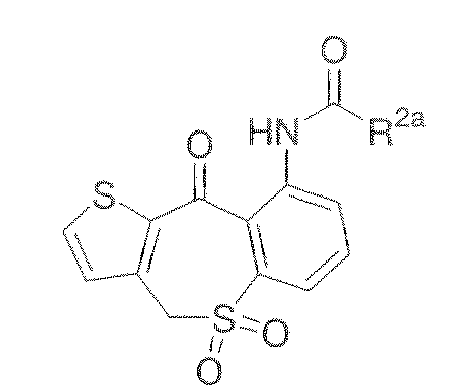
Compound Number R2a Compound Number R2a 1-1 
1-7 
1-2 
1-8 
1-3 
1-9 
1-4 
1-10 
1-5 
1-11 
1-6 
Table 2 
Compound Number 
Compound Number 
2-1 
2-4 
2-2 
2-5 
2-3 
2-6 
Table 3 
Compound Number R1 3-1 F 3-2 Cl 3-3 Br 3-4 Me Table 4 Compound Number Structure 4 
Table 5 
Compound Number R2d Compound Number R2d 5-1 
5-6 
5-2 
5-7 
5-3 
5-8 
5-4 
5-5 
Table 6 
Compound Number L1-R2c 6-1 
6-2 
- Next, the pharmaceutical functions of compounds used in the present invention will be described with preference to test examples.
- A test was conducted according to the method of Leung et al. [Biochemical Pharmacology, Viol.70, pp.355-362 (2005)]. HEK293 cells (ATCC, Registration No. CRL-1537) were subcultured in a Dulbecco's modified Eagle's medium (manufactured by Invitrogen Corporation) containing 10% of fatal calf serum in a CO2 incubatoR using a poly-L-lysine-coated 10-cm dish (manufactured by Asahi Techno Glass Corporation). The cultured cells were seeded in a poly-L-lysine-coated 24-well plate (manufactured by Asahi Techno Glass Corporation) and cultured until the cells become confluent. Then, the cells in the wells were washed twice witch 0.5 mL of Na+-free buffer (140 mmol/L N-methyl-D-glucose, 5 mmol/L HEPES [4-(2-hydroxyethyl)-1-piperazineethanesulfonic acid], 5 mmol/L KH2PO4, 11 mmol/L CaCl2, mmol/L MgCl2, 10 mmol/L glucose, pH 7.4), and 0.2 mL of a Na+-free buffer in which each compound was dissolved so that the final concentration was each of 50 nmol/L and 500 nmol/L was added to each well (n = 2). After incubation at room temperature for 15 minuted, 0.2 mL of a Na+-free buffer containing 100 nmol/L of [3H] adenosine (manufactured by GE Health Care Bioscience Corporation) and each compound at of 50 nmol/L and 500 nmol/L was added to each well. After 1 minute, the reaction solution was removed with an aspirator, and the wells were washed twice with 0.5 mL of ice-cooled PBS (phosphate-buffered saline). Then, 0.5 mL of PBS containing 5% Triton X-100 was added to each well, and the cells were scraped with a scraper. The solution in each well was homogenized by passing through a 20G injection needle ten times and transferred to a scintillation vial containing 4 mL of clean sol (manufacture by Nacalai Tesque Inc.). Further, the wells were washed with 0.5 mL of PBS containing 5% Triton X-100, and the washing solution was added to the same vial. After sufficient agitation, radioactivity was measured using a liquid scintillation counter (Aloka Co., Ltd., LSC-3500). A relative value to 100% of an uptake of a control was indicated by percentage.
- The results are shown in Tables 7-1 and 7-2.
-
Table 7-1 Test Compound Uptake (%) 50 nmol/L 500 nmol/L 1-1 68 29 1-2 39 17 1-4 73 34 1-5 90 55 1-6 89 68 1-7 74 35 1-8 79 44 1-9 62 26 1-10 94 63 1-11 82 46 2-1 82 49 2-2 86 56 2-4 72 34 2-5 75 44 3-1 96 63 3-4 71 41 -
Table 7-2 Test Compound Uptake (%) 50 nmol/L 500 nmol/L 5-1 91 60 5-2 80 44 5-3 63 30 5-4 72 42 5-5 98 68 5-6 80 50 5-7 67 30 5-8 92 69 6-1 75 39 6-2 94 73 - These results indicate that Compound (I) has an adenosine uptake inhibitory activity.
- Table 8 below indicates that adenosine uptake in HEK293 cells is almost completely inhabited by nitrobenzylthioinosine at a concentration of 100 nmol/L at which only ENT-1 is inhabited [The Journal of Biological Chemistry, Vol.275, No.12, pp.8375-8381 (2000)]. Therefore, it is thought that the adenosine uptake inhibitory activity of Compound (I) is mainly due to the ENT-1 inhibition.
-
Table 8 Test Compound Uptake (%) 100 nmol/L 500 nmol/L Nitrobenzylthioinosine 8 4 - An experiment was carried out according to the method of Kishibayashi et al. [Japanese Journal of Pharmacology, Vol.69, No.4, pp.495-502 (1993)].
- Is the experiment, male Wistar rats waged 6 to 7 weeks (supplied from Charles River Laboratories Japan, Inc.) were used. Five to seven rats were housed in each metal cage in a breeding room at a room temperature of 19°C to 25°C and a humidity of 30% to 70% under illumination for 12 hours a day (7 am to 7 pm) and bred by free intake of commercial solid chow and water.
- The rats were lightly anesthetized with diethyl ether, and the thoracic trunk and the forelimbs were wrapped with a tape to produce mild stress. One hour after stress initiation, the wet weight of fecal pellets was measured. Each drug solution was orally administered 1 hour before restraint stress. A test compound was suspended at a concentration of 2 mg/mL. in an aqueous solution of 0.5 w/v% methyl cellulose 400cP and orally administered at a volume of 5 mL/kg (at a dose of 10 mg/kg). In a control, an aqueous solution of 0.5 w/v% methyl cellulose 400cP was administered. Ten rats were used in each group. The known adenosine uptake inhibitors, Dilazep, Draflazine, KF24345, and Dipyridamole [European Journal of Pharmacology, Vol.495, p.1 (2004)] were orally administered in doses of 300, 100, 10, and 300 mg/kg, respectively. YM060, a serotonin 5-HT3 receptor antagonist [The Journal of Pharmacology and Experimental Therapeutics, Vol.259, No.2, pp.815-819 (1991), Astellas Pharma. Inc., online, internet (URL: http:/www.astell.as.com/jp/companry/news/2006/pdf/060131.pdf)], which is being applied as a therapeutic agent for irritable bowel syndrome, was administered at a dose of 0.1 mg/kg. The results are shown in Table 9.
-
Table 9-1 Test compound Wet weight of fecal pellets (g) Normal 0.14 ± 0.07 Control 1.71 ± 0.25 -
Table 9-2 Test compound Wet weight of fecal pellets (g) Control 1.38 ± 0.12 Compound 1-1 0.27 ± 0.06 Compound 2-3 0.45 ± 0.14 Compound 2-5 0.37 ± 0.19 -
Table 9-3 Test compound Wet weight of fecal pellets (g) Control 1.66 ± 0.19 Compound 1-2 0.78 ± 0.25 Compound 1-4 0.44 ± 0.19 Compound 1-5 0.97 ± 0.16 -
Table 9-4 Test compound Wet weight of fecal pellets (g) Control 1.40 ± 0.07 Compound 1-6 0.31 ± 0.06 Compound 1-7 0.59 ± 0.12 Compound 1-8 0.66 ± 0.12 -
Table 9-5 Test compound Wet weight of fecal pellets (g) Control 1.44 ± 0.18 Compound 1-9 0.39 ± 0.18 Compound 2-2 0.53 ± 0.12 Compound 2-4 0.39 ± 0.16 -
Table 9-6 Test compound Wet weight of fecal pellets (g) Control 1.28 ± 0.07 Compound 2-6 0.28 ± 0.06 Compound 3-1 0.41 ± 0.16 Compound 3-3 0.81 ± 0.22 -
Table 9-7 Test compound Wet weight of fecal pellets (g) Control 1.71 ± 0.25 Compound 3-2 0.53 ± 0.14 Compound 3-4 0.67 ± 0.19 Normal 0.14 ± 0.07 -
Table 9-8 Test compound Wet weight of fecal pellets (g) Control 1.35 ± 0.17 Compound 5-1 0.36 ± 0.16 Compound 5-2 0.46 ± 0.18 Compound 5-3 0.41 ± 0.17 -
Table 9-9 Test compound Wet weight of fecal pellets (g) Control 1.51 ± 0.17 Dilazep 300 mg/kg 0.84 ± 0.17 -
Table 9-10 Test compound Wet weight of fecal pellets (g) Control 1.06 ± 0.11 Draflazine 100 mg/kg 0.43 ± 0.13 KF24345 10 mg/kg 0.48 ± 0.14 -
Table 9-11 Test compound Wet weight of fecal pellets (g) Control 1.24 ± 0.23 Dipyridamole 300 mg/kg 0.59 ± 0.15 YM060 0.1 mg/kg 0.43 ± 0.11 - The results indicate that Compound (I) improves restraint stress-induced defecation. This suggests that Compound (I) improves the defecation symptoms of diarrhea-type IBS patients.
- The therapeutic effect of the compounds of the present application on constipation was evaluated by the method described below. Compound 1-1 was used as a test compound.
- In IBS patients, the bowel movement is enhanced, and the symptom of spastic constipation accompanied with an abdominal pain is developed. The spastic constipation is known to be induced by administration of opioid including morphine, loperamide, or the like, and the opioid-induced constipation is used as a model of constipation-type IBS [The Japanese Journal of Pharmacology, Vol.86, No.3, pp.281-288 (2001) and Vol.89, No.2, pp.133-141 (2002)].
- To Compound 1-1, 0.5 w/v% methyl cellulose 400 (MC, manufactured by Wako Pure Chemical Industries, Ltd.) was added, followed by lightly mixing with a mixer (TTM-1, Shibata Scientific Technology Ltd.). Then, the resultant mixture was subjected to ultrasonic treatment (1 minute) with an ultrasonic cleaner (Sine Sonic UA100, Hitachi Kokusai, Denki Engineering Co., Ltd.), and suspended by re-mixing with the mixer to prepare a suspension at a concentration of 0.2 mg/mL. The resultant suspension was further diluted with 0.5 w/v% MC to prepare a solution at a concentration of each of 0.02, 0.002, and 0.0002 mg/mL.
- Distilled water was added to loperamide hydrochloride (hereinafter, referred to as "loperamide"; Sigma-Aldrich), followed by mixing with a magnetic stirrer to prepare a 1 mg/mL solution. The resultant solution was orally abministered in a volume of 5 mL/kg.
- A test was conducted using male SD rats (Charles River Laboratories Japan, Inc.). It has been reported that the rats are decreased in the defecation by loperamide [The Japanese Journal of Pharmacology. Vol.89, No.2, pp.133-141 (2002)]. The rats aged 6 weeks were purchased and used at 7 weeks of age after acclimation for 1 week or more. Five to six rats were housed in each metal cage in a breeding room at a room temperature of 19°C to 25°C and a humidity of 30% to 70% under illumination for 12 hours a day (7 am to 7 pm) and bred by free intake of commercial solid feed (F-2, Funabashi Farms Co.,Ltd) and water. In sampling period of stools, each of the rats was individually placed in a metal cage and let freely drink water under fasting. In the test, the rats showing no obvious abnormality and no diarrhea a day before and an the day of the test (no dirt around the anus) were used.
- A day before the test, the rat tails were numbered for identification and the body weights were measured. At the same time, the dirt around the anus and the stool form were observed. In the morning of the day of the test, the rats were orally administered with 0.5 w/v% MC or compound 1-1. One hour after the administration, the rats were orally administered with loperamide. In a normal group rats were orally administered with distilled water. Anyone of the administration solution was administered by oral gavage using an syringe and a tube. After loperamide or distilled water was administered, the rats were moved to the individual breeding cages, and stool sampling was started. Eight hours after the administration of loperamide or distilled water, stools were collected. The collected stools were dried (100°C, 6 hours) with a dryer (SH42, Yamato Scientific Co., Ltd.), and the weight was measured with an electronic balance (AB54, Mettler-Toledo AG).
- The groups (in each group, n = 15) comprise as follows:
- Normal group: 0.5 w/v% MC 5 mL/kg + distilled water 5 mL/kg
- Control group: 0.5 w/v% MC 5 mL/kg + loperamide 5 mg/kg
- Compound 1-1 0.001 mg/kg group: Compound 1-1 0.001 mg/kg + loperamide 5 mg/kg
- Compound 1-1 0.01 mg/kg group: Compound 1-1 0.01 mg/kg + loperamide 5 mg/kg
- Compound 1-1 0.1 mg/kg group: Compound 1-1 0.1 mg/kg + loperamide 5 mg/kg
- Compound 1-1 1 mg/kg group: compound 1-1 1 mg/kg + loperamide 5 mg/kg
- With respect to the fecal amount, a dry weight was used, and an amount of stools for 0 to 8 hours was used as a measurement parameter. The fecal pellets were collected in a tare (aluminum foil) whose weight was previously measured, and the weight was calculated by subtracting the weight of the tare from the weight including the tare weight.
- Statistical analysis was performed using a statistical analysis software SAS (Release 9.1.3, SAS Institute Inc.). Comparison between the fecal amount of the normal group and that of the control group was performed by the F test. When no significant difference was observed in the F test, Student's t-test was conducted, while when a significant difference was observed in the F test, the Aspin-Welch test was conducted.
- Comparison between the control group and the compound 1-1. administration group was performed by Bartlett test. When no significant difference was observed in the Bartlett test, a significant difference was confirmed by one-way analysis of variance, and then Dunnett test was conducted. When a significant difference was observed in the Bartlett test, Kruskal-Wallis test was conducted. P < 0.05 was considered as significant difference.
-
Fig. 1 shows the fecal amount for 0 to 8 hours after the administration of loperamide. The fecal amount of the control group was significantly smaller than that of the normal group. - Compound 1-1 significantly inhibits a decrease in fecal amount after the administration of loperamide in doses of 0.01, 0.1 and 1 mg/kg.
- These results demonstrate that Compound 1-1 suppresses loperamide-induced constipation. This suggests that Compound 1-1 improves the stool symptoms of a constipation-type IBS patient.
- It has been reported that a visceral pain is induced by the administration of capsaicin into the colon [Pain, Vol.92, No.3, pp.335-342 (2001)].
- A suspension of Compound 1-1 was prepared with an agate mortar using 0.5 w/v% MC.
- Capsaicin (Sigma-Aldrich) was dissolved in a physiological saline solution containing 10% ethanol (Kanto Chemical co., Led.) and 10% polyoxyethylene (20) sorbitan monooleate (Tween 80, Wako Pure Chemical Industries, Ltd.), and the resultant solution was used. A test compound was orally administered in a volume of 10 mL/kg, and MC was administered to a control group in the same volume.
- Male ddY mice (Japan SLC, Inc.) with a body weight of 27g to 29g were purchased and used in an experiment. After inspection and acclimation for 2 days or more, the mice showing favorable increases in body weight and no obvious abnormality were used. The animals were housed in a breeding room at a room temperature of 19°C to 25°C and a humidity of 30% to 70% under illumiation for 12 hours a day (7 am to 7 pm) and bred by free intake of commercial solid feed (FR-2, Funabashi Farm Co., Ltd.) and water.
- After the oral administration of Compound 1-1 or 0.5 w/v% MC, each mouse was housed in a cage and left therein. Thirty minutes after, 50 µl of 0.1% capsaicin or a vehicle as admistered into the colon of each mouse at a position of 4 cm from the anus. Then, each of the mice was placed in an acrylic cage (8 cm in length × 8 cm in width × 15 cm in height) and recorded with a video (Sony) for 1 hour. After the recording, the following 4 behaviors and symptoms were measured as indexes of capsaicin-induced visceral pain at an interval of 5 minutes. The cumulative results for 60 minutes summarized on a graph.
- (1) Licking the abdomen
- (2) Stretching
- (3) Compressing of the abdomen on a floor
- (4) Strong abdominal contraction
- Ten mice were used in each group, and the results were shown by average ± standard error. Statistical analysis was performed using a statistical analysis software SAS (Release 8.2, SAS Institute Inc., Cary, NC, USA). Comparison between the control group and the compound administration group was performed by analysis of variance for nested model for confirming a significant difference, followed by the Bartlett test for testing a difference in variances. In the case of equal variances, one-way analysis of variance was performed, and when a significant difference was observed, the Dunnett test was performed. When the variances were not equal, the Kruskal-Wallis test was performed, and when a significant difference was observed, the Steel test was performed. When P < 0.05, it was considered as significantly different.
- The results are shown in
Fig. 2 . In the control group in which 50 µl of 0.1% capsaicin was administered, into the colon, pain-related behaviors were increased as compared with the vehicle administration group (normal group). Compound 1-1 suppressed the pain-related behaviors in doses of 3 and 30 mg/kg, p.o. - These results indicate that Compound 1-1 is effective for a capsaicin-induced visceral pain. This suggests that Compound (I) is effective for treating the abdominal pain of IBS patients.
- Test Example 1 indicates that Compound (I) has an adenosine uptake inhibitory activity. And Test Example 2 indicates that Compound (I) has the action of decreasing stress-induced defecation and Test Example 3 indicates that Compound (I) has the action of suppressing constipation. Further, Test Example 4 indicates that Compound (I) is effective for treating abdominal pain. These results show that Compound (I) is useful as a therapeutic agent for IBS. Further, it is shown that a compound having an adenosine uptake inhibitory activity is useful as a therapeutic agent for irritable bowel syndrome like the 5-HT3 receptor antagonist.
- Male dd mice (body weight: 20 ± 1 g) were used in groups each of which consisted of three mice, and a test compound was orally or intraperitoneally administered. On the 7th day after the administration, death conditions were observed, and the minimum lethal dose (MLD) was determined.
- As a result, the minimum lethal dose of the test compound was 1000 mg/kg in oral administration.
- Compound (I) or a pharmaceutically acceptable salt thereof can be used as it is or in any one of various pharmaceutical forms. A pharmaceutical composition of the present invention can be produced by uniformly mixing an effective amount of Compound (I) or its pharmaceutically acceptable salt as an active ingredient with a pharmaceutically acceptable carrier. The pharmaceutical composition is preferably in a unit dosage form suitable for oral or parenteral (including intravenous) administration.
- In preparation of the composition in an oral administration form, a useful pharmaceutically acceptable carrier can be used. For example, an oral liquid preparation such as a suspension or a syrup can be produced using water; a saccharide such as sucrose, sorbitol, or fructose; glycol such as polyethylene glycol or propylene glycol; oil such as sesame oil, olive oil, or soybean oil; a preservative such as p-hydroxybenzoate; and a flavor such as strawberry flavor or peppermint. A capsule, a tablet, a powder, and a granule can be produced using an excipient such as lactose, glucose, sucrase, or mannitol; a disintegrator such as starch or sodium alginate; a lubricant such as magnesium stearate or talc; a binder such as polyvinyl alcohol, hydroxypropyl cellulose, or gelatin; a surfactant such as a fatty acid ester; and a plasticizer such as glycerin. A tablet and capsule are the most useful unit oral administration agents because they can easily be administered. In order to produce a tablet and capsule, a solid pharmaceutical carrier is used.
- An injection can be prepared using a carrier containing, for example, distilled water, a salt solution, a glucose solution or a mixture of saline and a glucose solution. In this case, an injection is prepared as a solution, a suspension, or a dispersion according to a usual method using an appropriate auxiliary.
- Compound (I) or its pharmaceutically acceptable salt can be administered orally, or parenterally as an injection in any one of the above pharmaceutical forms. Although the effective dose and the number of times of administration depend on the administration form and the age, body weight, and symptoms of a patient, the appropriate dose is 1 to 900 mg/60 kg/day and preferably 1 to 200 mg/60 kg/day.
- An embodiment of the present invention will be described with reference to reference examples and examples, but the present invention is not limited to these examples.
- The compounds below are the same as those described in
WO98/46587 WO98/46587 - Compound 1-1: Compound 1-25 described in
WO98/46587 - compound 1-2: compound 3-19 described in
WO98/46587 - Compound 1-3: Compound 3-12 described in
WO98/46587 - Compound 1-5: Compound 2-1 described in
WO98/46587 - Compound 1-6: Compound 3-6 described in
WO98/46587 - compound 1-7: compound 3-24 described in
WO98/46587 - compound 1-8: Compound 3-22 described in
WO98/46587 - Compound 2-1: Compound 1-5 described in
WO98/46587 - compound 2-2: Compound 1-7 described in
WO98/46587 - Compound 2-3: Compound 1-11 described in
WO98/46587 WO98/46587 - Compound 2-5: Compound 1-24 described in
WO98/46587 - compound 2-6: compound 1-19 described in
WO98/46587 - Compound 3-1: Compound 1-35 described in
WO98/46587 - compound 3-2: Compound 1-33 described in
WO98/46587 - Compound 3-4: Compound 1-29 described in
WO98/46587 - Compound 4 was synthesized according to Reference Example 14 or 15 of
WO98/46587 - Di-tert-butyldicarbonate (35.3 g) was added to a solution of 9-amino-4,10-dihydrothieno[3,2-c][1]benzothiepin-10-one (
WO98/46587 - A solution of 9-(tert-butoxycarb.nylami-o)-4,10-dihydrothieno[3,2-c][1]benzothiepin-10-one (26.68 g) obtained in the step 1 in ethyl acetate (534 mL) was cooled to 5°C with ice, and m-chloroperbenzoic acid (66.26 g) was gradually added to the solution while the temperature was kept at 10°C or less. Then, the resultant mixture was stirred for 5 minutes under ice-cooling and then stirred at room temperature for about 24 hours. Next, a 1 mol/L aqueous sodium sulfite solution (940 mL) was added dropwise to the reaction mixture under ice-cooling. After the mixture was stirred for 40 minutes under ice-cooling and stirred at room temperature for about 17 hours, ethyl acetate (300 mL) and a saturated aqueous solution of sodium hydrogen carbonate (300 mL) were added to perform extraction. An aqueous layer was further extracted twice with ethyl acetate (300 mL), and the ethyl acetate solution was added to an organic layer. The mixture was washed with a saturated aqueous solution of sodium hydrogen carbonate, water, and saturated saline in that order, dried over anhydrous sodium sulfate, and then concentrated under a reduced pressure. The residue was dissolved in acetone, and silica gel was added to the resultant solution. After the solvent was removed by distillation, the residue was purified by silica gel chromatography (hexane/ethyl acetate = 2/1). Then, diisopropyl ether was added to the resultant crude crystal, and the mixture was stirred at room temperature. The crystal was filtered off, washed with diisopropyl ether, and then dried under a reduced pressure to obtain the title compound (27.74 g).
- Trifluoroacetic acid (227 mL) was cooled to -7°C with ice in a nitrogen stream, and 9-(tert-butoxycarbonylamino)-5,5-dioxo-4,10-dihydrothieno[3,2-c][1]benzothiepin-10-one (27.68 g) obtained in the step 2 was gradually added, followed by stirring at -7°C to 0°C for about 3 hours. The reaction mixture was poured into iced water (1 L) and stirred at room temperature, and a 10 mol/L aqueous sodium hydroxide solution was added to adjust the mixture to
pH 10. Then, ethyl acetate and acetone were added to perform extraction. An organic layer was washed with water and saturated saline in that order, dried over anhydrous sodium sulfate, and concentrated under a reduced pressure. Next, acetone (590 mL) was added to the resultant crude crystal, and the crystal was dissolved by reflux. Then, water (590 mL) was gradually added to the solution under reflux to precipitate a crystal. After cooling to room temperature, the solution was stirred for 3 hours under ice-cooling, and the crystal was filtered off washed with water, and then dried under a reduced pressure to obtain a crude crystal of the title compound (18.54 g). The crude crystal was recrystallized from acetone to obtain the title compound. - 2-Ethyl-2-hydroxybutanoic acid (44.1 g, 334 mmol) was dissolved in dimethylacetamide (DMA) (416 mL), and thionyl chloride (22.3 mL, 306 mmol) was added to the resultant solution at -13°C, followed by stirring at the same temperature for 1 hour. At the same temperature, 9-amino-5,5-dioxo-4,10-dihydrothieno[3,2-c][1]benzothiepin-10-one (20.7 g, 74.2 mmol) obtained in the step 3 was added to the resultant solution, followed by stirring overnight at room temperature. An acid chloride prepared as described above was again added to the mixture, followed by stirring overnight at room temperature. Then, water (416 mL) was added dropwise (over 1.5 hours) to the reaction mixture, and the mixture was stirred at 0°C for 2.5 hours. The precipitated solid was filtered off and washed with a 70% aqueous ethanol solution (100 mL) to obtain Compound 1-4 (27.8 g, 95.1%).
1H-NMR (300 MHz, DMSO-d6, δ) δ: 0.79 (t, J = 7.3 Hz, 6H), 1.46-1.78 (m, 4H), 7.18 (d, J = 5.0 Hz, 1H), 7.80-7.88 (m, 2H), 8.09 (d, J = 5.0 Hz, 1H), 8.44 (dd, J = 7.2, 2.6 Hz, 1H), 10.6 (br, 1H). ESI-MS m/z 392 (M-H)- - Methyl 5-methylpyrazole-3-carboxylate (1.00 6.49 mmol) was dissolved in methanol (6.5 mL), and a 3.5 mol/L aqueous sodium hydroxide solution (6.5 mL) was added to the resultant solution at room temperature, followed by stirring for 1.5 hours. Then, water was added to the reaction mixture, and the mixture was washed with diethyl ether. After pH was adjusted to 1 by adding 1 mol/L hydrochloric acid, extraction with ethyl acetate was performed. An organic layer was washed with water and saturated saline, dried over anhydrous magnesium sulfate, and then concentrated under a reduced pressure. The resultant white crystal was washed with diethyl ether to obtain the title compound (0.25 g, 31%).
- 5-Methylpyrazole-3-carboxylic acid (0.13 g, 1.03 mmol) obtained in the step 1 was dissolved in DMA (5 mL), and thionyl chloride (0.07 mL, 0.96 mmol) was added to the resultant solution on an ice-methanol bath, followed by stirring for 1 hour. Next, at the same temperature, a solution of 9-amino,-4,10-dihydrothien[3,2-c][1]benzothiepin-10-one (
WO98/46587 - 9-[(5-Methylpyrazol-3-ylcarbonyl)amino]-4,10-dihydrothieno[3,2-c][1]benzothiepin-10-one (87.8 mg, 0.25 mmol) obtained in the step 2 was dissolved in ethyl acetate (10 mL), and m-chloroperbenzoic acid (170 mg, 0.985 mmol) was added to the resultant solution at room temperature, followed by stirring overnight. Then, an aqueous sodium thiosulfate solution was added to the reaction mixture, and the resultant mixture was stirred at room temperature, followed by extraction with ethyl acetate. An organic layer was washed with a saturated aqueous solution of sodium hydrogen carbonate, water, and saturated saline, dried over anhydrous magnesium sulfate, and then concentrated under a reduced pressure. The residue was purified by silica gel column chromatography (ethyl acetate/hexane = 2/1) to obtain compound 1-9 (51.3 mg, 36.8%).
ESI-MS m/z 386 (M-H)- - The following compounds can be synthesized according to the steps 2 ann 3 of Reference Example 2 using respective corresponding carboxylic acids and amines.
- 5,5-Dioxo-9-(2,2-dimethyl-3-oxobutanoylamino)-4,10-dihydrothieno[3,2-c][1]benzothiepin-10-one (compound 1-10): ESI-MS m/z : 390 (M-H)-
5,5-Dioxo-9-(2-hydroxy-3,3,3-trifluoropropanoylamino)-4,10-dihydrothieno[3,2-c][1]benzothiepin-10-one (compound 1-11): ESI-MS m/z 404 (M-H)-
6-Bromo-5,5-dioxo-9-(3,3,3-trifluoro-2-hydroxy-2-methylpropanoylamino)-4,10-dihydrothieno[3,2-c][1]benzothiepin-10-one (compound 3-3) - 9-Amino-4,10-dihydrothieno[3,2-c][1]benzothiepin-10-one (
WO98/46587 - Compound 5-1 was obtained, according to the step 3 of Reference Example 2 using 9-phenylamino-4,10-dihydrothieno[3,2-c][1]benzothiepin-10-one obtained in the step 1.
ESI-MS m/z 356 (M-H)- - In an argon atmosphere, cesium carbonate (0.73 g, 2.2 mmol), bis(dibenzylideneacetone)plladium (46 mg, 0.080 mmol), 2,2'-bis(diphenylphosphino)-1,1'-binaphthyl (75 mg, 0.12 mmol), 9-amino-4,10-dihydrothieno[3,2-c][1]benzothiepin-10-one (
WO98/46587 - 9-[5-Chloro-2-(methoxymethyloxy)phenylamino]-4,10-dihydrothieno[3,2-c][1]benzothlepin-10-one (244 mg, 0.58 mmol) obtained in the step 1 was dissolved in THF (2 mL), any 1 mol/L hydrochloric acid (2 mL) was added to the resultant solution, followed by stirring overnight at 70°C. Then, water was added to the reaction mixture, followed by extraction with ethyl acetate. An organic layer was washed with water, and saturated saline, dried over anhydrous magnesium sulfate, and then concentrated under a reduced pressure. The residue was purified by silica gel column chromatography (ethyl acetate/hexane = 1/4) to obtain the title compound (187 mg, 86.3%).
- compound 5-2 was obtained according to the step 3 of Reference Example 2 using 9-(5-chloro-2-hydroxyphenylamin-)-4,10-dihydrothieno[3,2-c][1]benzothiepin-10-one obtained in the step 2.
ESI-MS m/z 404 (M-H)- - 9-Fluoro-4,10-dihydrothieno[3,2-c][1]benzothiepin-10-one (Japanese Unexamined Patent Application Publication No.
2000-053580 - 9-Fluoro-5,5-dioxo-4,10-dihydrothieno[3,2-c][1]benzothiepin-10-one (150 mg, 0.530 mmol) obtained in the step 1 was added to benzylamine (1.5 mL), the resultant mixture was stirred at room temperature for 4.5 hours. Then, 1 mol/L hydrochloric acid was added to the reaction mixture, followed by extraction with ethyl acetate. An organic layer was washed with a saturated aqueous solution of sodium hydrogen carbonate and saturated saltine, dried over anhydrous magnesium sulfate, and then concentrated under a reduced pressure. The residue was purified by silica gel column chromatography (ethyl acetate/hexane = 3/10) to obtain compound 5-3 (174 mg, 88.7%).
ESI-MS m/z 370 (M+H)+ - Compound 5-4 was obtained according to the step 2 of Reference Example 3 using 2-methoxybenzylamine.
5,5-Dioxo-9-(2-methoxybenzylamino)-4,10-dihydrothieno[3,2-c][1]benzoihiepin-10-one (compounds 5-4): ESI-MS m/z 400 (M+H)+ - 9-Fluoro-4,10-dihydrothieno[3,2-c][1]benzothiepin-10-one (Japanese Unexamined Patent Application Publication No.
2000-053580 - 9-Ethoxycarbonylmethylamino-4,10-dihydrothieno[3,2-c][1]benzothiepin-10-one (54.7 mg, 0.16 mmol) obtained in the step 1 was dissolved in acetonitrile (4 mL) and water (2 mL), and Oxone (registered trade name) (0.49 g, 0.80 mmol) was added to the resultant solution, followed by stirring at 50°C for 1 hour. Then, sodium thiosulfate was added to the reaction mixture, followed by extraction with ethyl acetate. An organic layer was washed with water and saturated saline, dried over anhydrous magnesium sulfate, and then concentrated under a reduced pressure. The residue was purified by preparative layer chromatography to obtain compound 5-5 (37.5 mg, 64.1%).
ESI-MS m/z 366 (M+H)+ - 9-Fluoro-5,5-dioxo-4,11.0-dihydrothieno[3,2-c][1]benzthiepin-10-one (250 mg, 0.890 mmol) obtained in the step 1 of Example 3 was dissolved in 1-methyl-2-pyrrolidinone (8 mL), and DL-alanine ethyl ester hydrochloride (4.0 g, 26 mmol) and triethylamine (5.0 my) were added to the resultant solution, followed by shirring overnight at 50°C. Then, water, and 1 mol/L hydrochloric were added to the reaction mixture, followed by extraction with ethyl acetate. An organic layer was washed with water and saturated saline, dried over anhydrous magnesium sulfate, and then concentrated under a reduced pressure. The residue was purified by silica gel column chromatography (ethyl acetate/hexane = 1/2) to obtain compound 5-6 (159 mg, 51.4%).
ESI-MS m/z 380 (M+H)+ - The following compounds were synthesized according to Example 5 using respective corresponding amines.
5,5-Dioxo-9-{[1-(methoxycarbonyl)-3-methylbutyl]amino}-4,10-dihydrothieno[3,2-c][1]benzothiepin-10-one (Compound 5-7): ESI-MS m/z 408 (M+H)+
5,5-Dioxo-9-{[1-(methoxycarbonyl)-2-phenylethyl]amino}-4,10-dihydrothieno[3,2-c][1]benzothiepin-10-one (compound 5-8): ESI-MS m/z 442 (M+H)+ - Potassium tert-butoxide (48 mg, 0.43 mmol) was suspended in THF (2.0 mL), and a solution of benzyl, mercaptan (0.05 mL, 0.43 mmol) in THF (1.0 mL) was added dropwise to the resultant suspension under ice cooling, followed by stirring for 30 minutes under ice cooling. Then, a solution of 9-fluoro-5,5-dioxo-4,10-dihydrothieno[3,2-c][1]benzothiepin-10-one (100 mg, 0.35 mmol) in THF (1.0 mL) obtained in the step 1 of Example 3 was added to the mixture, followed by stirring at room temperature for 2 hours. Then, a saturated aqueous solution of ammonium chloride was added the reaction mixture, followed by extraction with ethyl acetate. An organic layer was washed with saturated saline, dried over anhydrous magnesium sulfate, and then concentrated under a reduced pressure. The resultant solid was washed with 2-propanol to obtain compound 6-1 (74 mg, 45%).
ESI-MS m/z 387 (M+H)+; 1H-NMR (300 MHz, CDCl3, δ): 4.13 (s, 2H), 4.55 (s, 2H), 6.97 (d, J = 4.8 Hz, 1H), 7.17-7.26 (m, 5H), 7.55 (t, J = 7.5 Hz, 1H), 7.67 (d, J = 4.8 Hz, 1H), 7.76 (d, J = 7.5 Hz, 1H), 7.91 (d, J = 7.5 Hz, 1H).
ESI-MS m/z 387 (M+H)+ - Methyl 2-hydroxy-6-methoxybenzoate (16.9 g, 89.2 mmol) was dissolved in N,N-dimethylformamide (DMF) (150 mL), and dimethylthiocarbamoyl chloride (16.3 g, 132 mmol) and 1,4-diazabicyclo[2.2.2]octane (18.5 g, 165 mmol) were added to the resultant solution, followed by sitting overnight at room temperature. Then, water, was added to the mixture, and extraction with ethyl acetate was performed. An organic layer was washed witch water and saturated saline, dried over anhydrous magnesium sulfate, and then concentrated under a reduced pressure. The residue was purified by silica gel column chromatography to obtain the title compound (20.7 g, 86%).
- Diphenyl ether (30 mL) was added to methyl 2-dimethylthiocarbamoyloxy-6-methoxybenzoate (20.0 g, 74.3 mmol) obtained in the step 1, and the resultant mixture was stirred at 220°C for 30 minutes. The mixture was purified by silica gel column chromatography to obtain the title compound (20.0 g, quantitative).
- Methyl 2-dimethylca.rbamoylsulfanyl-6-methoxybenzoate (20.0 g, 74.3 mmol) obtained in the step 2 was dissolved in methanol (300 mL), and a 28% sodium methoxide/methanol solution (43 g, 223 mmol) was added to the resultant solution, followed by stirring at room temperature for 2 hours. Then, the mixture was cooled in an ice bath, and a solution, of thiophene-3-methyl chloride (15.3 g, 127 mnol) in methanol (30 mL) was added to the mixture, followed by stirring at 0°C for 30 minutes. Then, a saturated aqueous solution, of ammonium chloride was added to the reaction mixture, and the precipitated solid was filtered off and washed with water and n-hexane to obtain the title compound (19.5 g, 89%).
- Methyl 2-methoxy-6-(thiophen-3-ylmethylsulfanyl)benzoate (19.5 g, 66.2 mmol) obtained in the step 3 was dissolved in methanol (300 mL), and mol/L lithium hydroxide (306 mL, 306 mmol) was added to the resultant solution, followed by stirring at room temperature to for 48 hours. Then, water was added to the reaction mixture, and the precipitated solid was filtered off to obtain the title compound (18.0 g, 97%).
- Lithium 2-Methoxy-6-(thiophen-3-ylmethylsulfanyl)benzoate (18.0 g, 64.3 mmol) obtained in the stop 4 was suspended in methylene chloride (300 mL), and trifluoroacetic anhydride (10.0 mL, 70.7 mmol) was added to the resultant suspension at 0°C, followed by stirring overnight at temperature. Then, 1 mol/L hydrochloric acid was added to the mixture, and extraction with methylene chloride was performed. An organic layer was washed with water and saturated saline, dried over anhydrous magnesium sulfate, and then concentrated under a reduced pressure. The residue was purified by silica gel column chromatography to obtain the title compound (15.2 g, 90%).
- Acetic acid (150 and hydrobromic (100 mL) were added to 9-methoxy-4,10-dihydrothieno[3,2-c][1]benzothiepin-10-one (15.2 g, 57.8 mmol) obtained in the step 5, followed by reflux under heating for 24 hours. The reaction mixture was cooled to room temperature and then concentrated under a reduced pressure, and water was added to the residue, followed by extraction with methylene chloride. An organic layer was washed with a saturated aqueous solution of sodium hydrogen carbonate and saturated saline, dried over anhydrous magnesium sulfate, and then concentrated under a reduced pressure. The residue was purified by silica gel column chromatography to obtain the title compound (12.9 g, 90%).
- 9-Hydroxy-4,10-dihydrothieno[3,2-c][1]benzothiepin-10-one (1.0 g, 4.03 mmol) obtained in the step 6 was dissolved in acetonitrile (100 mL) and water (50 mL), and Oxone (registered trade name) (9.90 g, 16.1 mmol) was added to the resultant solution followed by stirring at 60°C for 3 hours. Then, a saturated aqueous solution of sodium thiosulfate was added to the reaction mixture, the mixture was stirred at temperature, followed by extraction with ethyl acetate. An organic layer was washed with water saturated saline, dried over anhydrous magnesium sulfate, and concentrated under a reduced pressure. The resultant solid was with acetone to obtain the title compound (0.79 g, 74%).
- 9-Hydroxy-4,10-dihydrothirno[3,2-c][1]benzothiepine-5,5,10-trione (0.1 g, 0.357 mmol) obtained in the stop 7 was dissolved in DMF (2 mL), potassium carbonate (0.1 g, 0.714 mmol) and benzyl bromide (0.047 mL, 0.428 mmol) were added to the resultant solution, followed by stirring overnight at temperature. Then, water was added to the reaction mixture, followed by extraction with ethyl acetate. An organic layer was washed with saturated saline, dried over anhydrous magnesium sulfate, and then concentrated under a reduced pressure. The resultant solid was purified by silica gel column chromatography to obtain Compound 6-2 (0.042 g, 32%).
ESI-MS mlz 371 (M+H)+; 1H-NMR (270 MHz, CDCl3,δ): 4.68 (s, 2H), 5.21 (s, 2H), 7.12 (d, J = 5.0 Hz, 1H), 7.23-7.43 (m, 6H), 7.69-7.73 (m, 2H), 8.10 (d, J = 7.3 Hz, 1H),
ESI-MS m/z 371 (M+H)+ - Tablets having the following composition were prepared by a usual method.
- First, 250 g of Compound 1-1, 1598.5 g of mannitol, 100 g of carboxylmethyl starch, 10 g of light anhydrous silicic acid, 40 g of magnesium stearate, and 1.5 g of yellow iron sesquioxide were by a usual method. The resultant mixture tableted with a tableting machine (Manufactured by Kikusui Seisakusho Ltd., Purepress Correct-12 model) having a punch die of 8 mm in diameter to prepare tablets (containing 25 mg of an active component tablet). The prescription is in Table 10.
-
Table 10 Prescription Compound 1-1 25 mg Mannitol 159.85 mg Sodium carboxylmethyl starch 10 mg Light anhydrous silicic acid 1 mg Magnesium stearate 4 mg Yellow iron sesquioxide 0.15 mg 200 mg - Injections having the following composition are prepared by a usual method.
- Compound 1-1 (1 g) and 5 g of D-mannitol are added to distilled for injection and mixed, and further hydrochloric acid and an aqueous sodium hydroxide solution are added to the mixture to adjust pH to 6. Then, distilled water is added to a total of 1000 mL. Each glass vial is aseptically filled with 2 mL of the resultant mixture to injections (containing 2 mg of an active component per vial). The prescription is shown in Table 11.
Table 11 Prescription Compound 1-1 2 mg D- mannitol 10 mg Hydrochloric acid proper amount Aqueous sodium hydroxide solution proper amount Distilled water for injection proper amount 2.00 mL - The present invention provides a therapeutic agent for irritable bowel syndrome comprises, as an active ingredient, a compound an adenosine inhibitory activity, a therapeutic for irritable bowel syndrome which comprises, as an active ingredient, a tricyclic compound or a pharmaceutically acceptable salt thereof, and the like.
Claims (77)
- A therapeutic agent for irritable bowel syndrome which comprises, as an active ingredient, a compound having an adenosine inhibitory activity.
- An antidiarrheal which comprises, as an active ingredient, a compound having an adenosine inhibitory activity.
- A laxative which comprises, as an active ingredient, a compound having an adenosine uptake inhibitory activity.
- A therapeutic agent for irritable bowel syndrome which comprises, as an active ingredient, a tricyclic compound represented by Formula (I)

R1 represents a hydrogen atom, halogen, substituted or unsubstituted alkyl, or substituted or unsubstituted lower
X1-X2-X3 represents CR5=CR6-CR7=CR8 [wherein R5, R6, R7 and R8 may be the same or different and each represents a hydrogen atom, halogen, hydroxy, nitro, amino, mono(lower alkyl)-substituted amino, di(lower alkyl)-substituted amino, substituted or unsubstituted lower alkyl, substituted or unsubstituted lower alkoxy, or substituted or unsubstituted (lower alkanoyl)amino], N(O)m=CR6-CR7=CR8 (wherein R6, R7 and R8 have the same meanings as above, respectively and m represent 0 or 1),
CR5=CR6-N(O)m=CR8 (wherein R5, R6 R8 and m have the same meanings as defined above, respectively), CR5=CR6-CR7=N(O)m (wherein R5, R6, R7 and m have the same meanings as defined above, respectively), CR5=CR6-O (wherein R5 and R6 have the same meanings as defined above, respectively), CR5=CR6-S (wherein R5 and R6 have the same meanings as defined above, respectively), O-CR7=CR8 (wherein R7 and
R8 have the same meanings as defined above, respectively),
S-CR7=CR8 (wherein R7 and R8 have the same meanings as defined above, respectively) or O-CR7=N (whereon R7 the meaning as defined above),
Y represents -CH2S-, -CH2SO-, -CH2SO2-, -CH2O-, -CH=CH-, -(CH2)p-(wherein p represents an integer of 0 to 2), -SCH2-, -SOCH2-, -SO2CH2- or -OCH2-, and
R2 represents a hydrogen atom, amino, substituted or unsubstituted lower alkyl, substituted or unsubstituted lower alkenyl, substituted or unsubstituted lower alkoxy, mono(substituted or unsubstituted lower alkyl)-substituted amino, di(substituted or unsubstituted lower alkyl)-substituted amino, substituted or unsubstituted aryl, substituted or unsubstituted heteroaryl, substituted or unsubstituted aralkylamino, substituted or unsubstituted arylamino, or a substituted or unsubstituted heterocyclic group} or a pharmaceutically acceptable salt thereof. - An antidiarrheal which comprises, as an active ingredient, the tricyclic compound or the pharmaceutically acceptable salt thereof described in Claim 4.
- A laxative which comprises, as an active ingredient, the tricyclic compound or the pharmaceutically acceptable salt thereof described in Claim 4.
- An adenosine uptake inhibitor which comprises, as an active ingredient, the tricyclic compound or the pharmaceutically acceptable salt thereof in Claim 4.
- A therapeutic agent for irritable bowel syndrome which comprises, as an active ingredient, a tricyclic compound represented by Formula (Ia)

Ya represents -CH2SO2-, -SCH2-, -SOCH2-, -SO2CH2- or -OCH2-, and
when Ya is -CH2SO2-, -SCH2-, -SOCH2- or -SO2CH2-,
R2a represents a hydrogen atom, amino, substituted or unsubstituted lower alkyl, substituted or unsubstituted lower alkenyl, substituted or unsubstituted lower alkoxy, mono(substituted or unsubstituted lower alkyl)-substituted amino, di(substituted or unsubstituted lower alkyl)-substituted amino, substituted or unsubstituted aryl, substituted or unsubstituted heteroaryl, substituted or unsubstituted aralkylamino, substituted or unsubstituted arylamino, a substituted or unsubstituted heteroalicyclic group, or a substituted or unsubstituted nitrogen-containing heterocyclic group, and
when Ya is -OCH2-,
R2a represents a hydrogen atom, amino, trifluoromethyl, substituted or unsubstituted lower alkenyl, substituted, or unsubstituted lower alkoxy, mono(substituted or unsubstituted lower alkyl)-substituted amino, di(substituted or unsubstituted lower alkyl)-substituted amino, substituted or unsubstituted aryl, substituted or unsubstituted heteroaryl, substituted or unsubstituted aralkylamino, substituted or unsubstituted arylamino, a substituted or unsubstituted heteroalicyclic group, a substituted or unsubstituted nitrogen-containing heterocyclic group, or Formula (II)
- The therapeutic agent for irritable bowel syndrome according to Claim 8 wherein Ya is -CH2SO2-, -SCH2-, -SOCH2- or -SO2CH2-.
- The therapeutic agent for irritable bowel syndrome according to Claims 8 wherein Ya is -OCH2-.
- The therapeutic agent for irritable bowel syndrome according to any of Claims 8 to 10 wherein R1 is a hydrogen atom, halogen or substituted or unsubstituted lower alkoxy.
- The therapeutic agent for irritable bowel syndrome according to of Claims 8 to 10 wherein R1 is a hydrogen atom.
- The therapeutic agent for irritable bowel syndrome according to of Claims 8, 11 and 12 wherein Ya is -CH2SO2-, -SO2CH2- or -OCH2-,
- The therapeutic agent for irritable bowel syndrome according to any of Claims 8, 11 and 12 wherein Ya is -CH2SO2- or -SO2CH2-.
- The therapeutic agent for irritable bowel syndrome according to any of Claim 8, 11 and 12 wherein Ya is -CH2SO2-.
- The therapeutic for irritable bowel syndrome according to any of Claims 8 to 15 wherein X1-X2-X-3 is S-CR7=CR8 (wherein R7 and R8 have the same meanings as defined above, respectively).
- The therapeutic agent for irritable bowel syndrome according to any of Claims 8 to 15 wherein X1-X2-X3 is CR5=CR6-CR7=CR8 (wherein R5, R6, R7 and R8 have the same meanings as defined above, respectively).
- The therapeutic agent for irritable bowel syndrome according to of claims 8 to 17, wherein R2a is Formula (II)

- The therapeutic agent for irritable bowel syndrome according to Claim 18, wherein n is 0.
- The therapeutic agent for irritable bowel syndrome according to Claim 19, wherein R3 is methyl, R4 is trifluoromethyl, and Q is hydroxy.
- The therapeutic agent for irritable bowel syndrome according to Claim 8, wherein R1 is a hydrogen atom, Ya is -CH2SO2-, X1-X2-X3 is S-CR7=CR8 (wherein R7 and R8 have the meanings as defined above, respectively), and R2a is Formula (III)

- An antidiarrheal which comprises, as an active ingredient, the tricyclic compound or the pharmaceutically acceptable salt thereof described in any of Claims 8 to 21.
- A laxative which comprises, as an active ingredient, the tricyclic compound or the pharmaceutically acceptable salt thereof described in any of Claims 8 to 21.
- Am adenosine uptake inhibitor which comprises, as an active ingredient, the tricyclic compound or the pharmaceutically acceptable salt thereof described in any of Claims 8 to 21.
- A therapeutic for irritable bowel syndrome which comprises, as an active ingredient, a tricyclic compound represented by Formula (Ib)


- The therapeutic agent for irritable bowel syndrome according to Claim 25, wherein X1-X2-X3 is CR5=CR6-CR7=CR8 (wherein R5, R6, R7 and R8 have the same meanings as defined above, respectively) or CR5=CR6-CR7=N (wherein R5, R6 and R7 have the same meanings as above, respectively).
- The therapeutic agent for irritable bowel syndrome according to Claim 25, wherein X1-X2-X3 is CR5=CR6-O (wherein R5 and R6 have the same meanings as defined above, respectively) or CR5=CR6-S (wherein R5 and R6 have the same meanings as defined above, respectively).
- The therapeutic agent for irritable bowel syndrome according to Claim 25, wherein X1-X2-X3 is O-CR7=CR8 (wherein R7 and R8 have the same meanings as defined above, respectively) or S-CR7=CR8 (wherein R7 and R8 have the same meanings as defined above, respectively).
- The therapeutic agent for irritable bowel syndrome according to any of Claims 25 to 28, wherein Yb is -CH2O-.
- The therapeutic agent for irritable bowel syndrome according to any of Claims 25 to 28, wherein Yb is -(CH2)p-(wherein p has the same as defined above).
- The therapeutic agent for irritable bowel syndrome according to Claim 30, wherein p is 0.
- The therapeutic agent for irritable bowel syndrome according to Claim 30, wherein p is 2.
- The therapeutic agent for irritable bowel syndrome according to any of Claims 25 to 28, wherein Yb is -CH=CH-.
- The therapeutic agent for irritable bowel syndrome according to any of Claims 25 to 28, wherein Yb is -CH2S- or -CH2SO-.
- An antidiarrheal which comprises, as an active ingredient, the tricyclic compound or the pharmaceutically acceptable salt thereof described in any of Claims 25 to 34.
- A laxative which comprises, as an active ingredient, the tricyclic compound or the pharmaceutically acceptable salt thereof described in any of Claims 25 to 34.
- An adenosine uptake inhibitory which comprises, as an active ingredient, the tricyclic compound or the pharmaceutically acceptable salt thereof described in any of Claims 25 to 34.
- A tricyclic compound represented by Formula (Ic)

R1c represents a hydrogen atom or substituted or unsubstituted lower alkyl,
X1c-x2c-X3c represents O-CR7=CR8 (wherein R7 and R8 have the same meanings as defined above, respectively) or S-CR7=CR8 (wherein R7 and R8 have the same meanings as defined above, respectively),
Yc represents -CH2S-, -CH2SO- or -CH2SO2-, and
R2c represents substituted or unsubstituted lower alkyl] or a pharmaceutically acceptable salt thereof. - The tricyclic compound or the pharmaceutically acceptable salt thereof according to Claim 38, wherein R1c is a hydrogen atom, X1c-X2c-X3c is S-CR7c=CR8c (wherein R7c and R8c may be the same or different and each represents a hydrogen atom or substituted or unsubstituted lower alkyl),
Yc is -CH2SO2- and
R2c is substituted or unsubstituted benzyl. - A pharmaceutical composition which comprises, as an active ingredient, the tricyclic compound or the pharmaceutically acceptable salt thereof described in Claim 38 or 39.
- A therapeutic agent for irritable bowel syndrome which comprises, as an active ingredient, the tricyclic compound or the pharmaceutically acceptable salt thereof described in Claim 38 or 39.
- An antidiarrheal which comprises, as an active ingredient, the tricyclic compound or the pharmaceutically acceptable salt thereof, described in Claim 38 or 39.
- A laxative which comprises, as an active ingredient, the tricyclic compound or the pharmaceutically acceptable salt thereof, described in Claim 38 or 39.
- An adenosine uptake inhibitor which comprises, as an active ingredient, the tricyclic compound or the pharmaceutically acceptable salt thereof described in Claim 38 or 39.
- A tricyclic compound represented by Formula (Id)
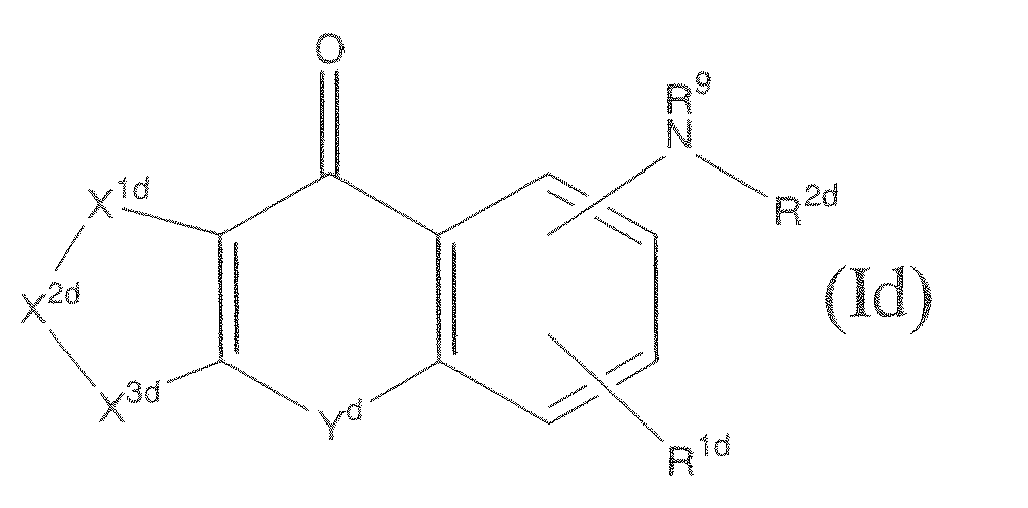
R1d represents a hydrogen atom, or substituted or unsubstituted lower alkyl,
X1d-X2d-X3d represents O-CR7=CR8 (wherein R7 and R8 have the same meanings as defined above, respectively) or S-CR7=CR8 (wherein R7 and R8 have the same meanings as defined above, respectively),
Yd represents -CH2S-, -CH2SO-, or -CH2SO2-, and
R2d represents substituted or unsubstituted lower alkyl or substituted or unsubstituted aryl] or a pharmaceutically acceptable salt thereof. - The tricyclic compound or the pharmaceutically acceptable salt thereof according to Claim 45, wherein R1d is a hydrogen atom, X1d-X2d-X3d is S-CR7d=CR8d (wherein R7d and R8d may be the same or different and each represents a hydrogen atom or substituted or unsubstituted lower alkyl),
Yd represents -CH2SO2- and
R9 is a hydrogen atom. - The tricyclic compound or the pharmaceutically acceptable salt thereof according to Claim 46, wherein R2d is substituted or unsubstituted lower alkyl.
- The tricyclic compound or the pharmaceutically acceptable salt thereof according to Claim 46, wherein R2d is substituted or unsubstituted aryl.
- A pharmaceutical composition which comprises, as an active ingredient, the tricyclic compound or the pharmaceutically acceptable salt thereof described in any of Claims 45 to 48.
- A therapeutic agent for irritable bowel syndrome which comprises, as an active ingredient, the tricyclic compound or the pharmaceutically acceptable salt thereof described in any of Claims 45 to 48.
- An antidiarrheal which comprises, as an active ingredient, the tricyclic compound or the pharmaceutically acceptable salt thereof described in any of Claims 45 to 48.
- A laxative which comprises, as an active ingredient, the tricyclic compound or the pharmaceutically acceptable salt thereof described in any of Claims 45 to 48.
- An adenosine uptake inhibitory which comprises, as an active ingredient, the tricyclic compound or the pharmaceutically acceptable salt thereof described in any of Claims 45 to 48.
- A method for treating irritable bowel syndrome which comprises a step of administering an effective amount of a compound having an adenosine uptake inhibitory activity.
- A method for treating diarrhea which comprises a step of administering an effective amount of a compound having an adenosine uptake inhibitory activity.
- A method for treating constipation which comprises a step of administering an effective amount of a compound having an adenosine uptake inhibitory activity.
- A method for treating irritable bowel syndrome which comprises a step of administering an effective amount of the tricyclic compound described in any of Claims 4, 8 to 21 and 25 to 34.
- A method for treating diarrhea which comprises a step of administering an effective amount of the tricyclic compound described in any of Claims 4, 8 to 21 and 25 to 34.
- A method for treating constipation which comprises a step of administering an effective amount of the tricyclic compound described in any of Claims 4, 8 to 21 and 25 to 34.
- A method for treating irritable bowel syndrome which comprises a step of administering an effective amount of the tricyclic compound described in Claim 38 or 39.
- A method for treating diarrhea which comprises a step of administering an effective amount of the tricyclic compound described in Claim 38 or 39.
- A method for treating constipation which comprises a step of administering an effective amount of the tricyclic compound described in Claim 38 or 39.
- A method for treating irritable bower syndrome which comprises a step of administering an effective amount of the tricyclic compound described in any of Claims 45 to 48.
- A method for treating diarrhea which comprises a step of administering an effective amount of the tricyclic compound described in any of Claims 45 to 48.
- A method for treating constipation which comprises a step of administering an effective amount of the tricyclic compound described in any of Claims 45 to 48.
- Use of a compound having an adenosine uptake inhibitory activity for the manufacture of a therapeutic agent for irritable bowel syndrome.
- Use of a compound having an adenosine uptake inhibitory activity for the manufacture of an antidiarrheal.
- Use of a compound having an adenosine uptake inhibitory activity for the manufacture of a laxative.
- Use of the tricyclic compound described in any of Claims 4, 8 to 21 and 25 to 34 for the manufacture of a therapeutic agent for irritable bowel syndrome.
- Use of the tricyclic compound described in any of Claims 4, 8 to 21 and 25 to 34 for the manufacture of an antidiarrheal.
- Use of the tricyclic compound described in any of Claims 4, 8 to 21 and 25 to 34 for the manufacture of a laxative.
- Use of the tricyclic compound described in Claim 38 or 39 for the manufacture of a therapeutic agent for irritable bowel syndrome.
- Use of the tricyclic compound described in Claim 38 or 239 for the manufacture of an antidiarrheal.
- Use of the tricyclic compound described in Claim 38 or 39 for the manufacture of a laxative.
- Use of the tricyclic compound described in any of Claims 45 to 48 for the manufacture of a therapeutic agent for irritable bowel syndrome.
- Use of the tricyclic compound described in any of Claims 45 to 48 for the manufacture of an antidiarrheal.
- Use of the tricyclic compound described in any of Claims 45 to 48 for the manufacture of a laxative.
Applications Claiming Priority (3)
| Application Number | Priority Date | Filing Date | Title |
|---|---|---|---|
| JP2006291374 | 2006-10-26 | ||
| JP2006329436 | 2006-12-06 | ||
| PCT/JP2007/070881 WO2008050853A1 (en) | 2006-10-26 | 2007-10-26 | Therapeutic agents for irritable bowel syndrome |
Publications (1)
| Publication Number | Publication Date |
|---|---|
| EP2077122A1 true EP2077122A1 (en) | 2009-07-08 |
Family
ID=39324637
Family Applications (1)
| Application Number | Title | Priority Date | Filing Date |
|---|---|---|---|
| EP07830615A Withdrawn EP2077122A1 (en) | 2006-10-26 | 2007-10-26 | Therapeutic agents for irritable bowel syndrome |
Country Status (8)
| Country | Link |
|---|---|
| US (1) | US20100267796A1 (en) |
| EP (1) | EP2077122A1 (en) |
| JP (2) | JPWO2008050853A1 (en) |
| KR (1) | KR20090071670A (en) |
| AU (1) | AU2007310003A1 (en) |
| CA (1) | CA2667176A1 (en) |
| TW (1) | TW200827367A (en) |
| WO (1) | WO2008050853A1 (en) |
Family Cites Families (22)
| Publication number | Priority date | Publication date | Assignee | Title |
|---|---|---|---|---|
| US5864033A (en) * | 1989-09-15 | 1999-01-26 | Metabasis Therapeutics, Inc. | Adenosine kinase inhibitors |
| US5777100A (en) * | 1990-08-10 | 1998-07-07 | Gensia Inc. | AICA riboside analogs |
| IL99124A (en) * | 1990-08-10 | 1998-02-22 | Gensia Pharma | Substituted imidazole analogs of aica riboside |
| FI933303L (en) * | 1991-01-23 | 1993-08-31 | Gensia Inc | ADENOSINCINE INHIBITORS |
| ES2159047T3 (en) * | 1995-10-16 | 2001-09-16 | Kyowa Hakko Kogyo Kk | TRICYCLE COMPOUNDS. |
| BR9808552A (en) | 1997-04-15 | 2000-05-23 | Kyowa Hakko Kogyo Kk | Tricyclic compound or a pharmaceutically acceptable salt thereof, and pharmaceutical composition |
| ES2218796T3 (en) | 1998-05-21 | 2004-11-16 | Tecnogen Scpa | USE OF A PEPTIDIC COMPOUND FOR THE TREATMENT OF SYSTEMIC ERIMATUS LUPUS. |
| JP2002047287A (en) * | 2000-05-25 | 2002-02-12 | Kyowa Hakko Kogyo Co Ltd | Aromatic derivatives |
| JP2002053580A (en) * | 2000-08-09 | 2002-02-19 | Kyowa Hakko Kogyo Co Ltd | Method for producing tricyclic compounds |
| CA2442452A1 (en) * | 2001-03-30 | 2002-10-10 | Kyowa Hakko Kogyo Co., Ltd. | Agent for the treatment of bladder irritative symptoms accompanied by benign prostatic hyperplasia |
| EA007069B1 (en) | 2001-03-30 | 2006-06-30 | Киова Хакко Когио Ко., Лтд. | A therapeutic agent for bladder hypersensitivity |
| CA2442472A1 (en) * | 2001-03-30 | 2002-10-10 | Kyowa Hakko Kogyo Co., Ltd. | Therapeutic agent for bladder irritative symptoms associated with benign prostatic hyperplasia |
| BR0208420A (en) | 2001-03-30 | 2004-03-30 | Kyowa Hakko Kogyo Kk | Therapeutic agent for overactive bladder, use of tricyclic compound or pharmaceutically acceptable salt thereof, and method for treating overactive bladder |
| EP1444980A1 (en) | 2001-11-13 | 2004-08-11 | Kyowa Hakko Kogyo Co., Ltd. | Preventive or remedy for pruritus |
| US20040132803A1 (en) * | 2002-03-29 | 2004-07-08 | Tsuyoshi Yamagata | Agent for the treatment of overactive bladder |
| CA2508995A1 (en) * | 2002-12-20 | 2004-07-15 | The Mclean Hospital Corporation | Use of cytidine-, creatine-, and adenosine-containing compounds and adenosine-elevating compounds for normalizing sleep/wake cycle, treating a sleep disorder or improving cognitive function |
| JPWO2004087131A1 (en) * | 2003-03-31 | 2006-06-29 | 協和醗酵工業株式会社 | Antitussive |
| TW200501938A (en) | 2003-06-27 | 2005-01-16 | Kyowa Hakko Kogyo Kk | A medicament for therapeutic treating overactive urinary bladder accompany with cerebrovascular disorder |
| JPWO2005007191A1 (en) * | 2003-07-16 | 2006-08-31 | 協和醗酵工業株式会社 | Pharmaceutical composition |
| WO2005007154A1 (en) | 2003-07-16 | 2005-01-27 | Kyowa Hakko Kogyo Co., Ltd. | Preventive and/or therapeutic agent for pain |
| CA2532806A1 (en) * | 2003-07-16 | 2005-01-27 | Kyowa Hakko Kogyo Co., Ltd. | Medicinal composition |
| WO2005011674A1 (en) | 2003-08-05 | 2005-02-10 | Kyowa Hakko Kogyo Co., Ltd. | Preventive and/or therapeutic agents for bronchial asthma |
-
2007
- 2007-10-25 TW TW096140023A patent/TW200827367A/en unknown
- 2007-10-26 EP EP07830615A patent/EP2077122A1/en not_active Withdrawn
- 2007-10-26 KR KR1020097010694A patent/KR20090071670A/en not_active Withdrawn
- 2007-10-26 US US12/065,120 patent/US20100267796A1/en not_active Abandoned
- 2007-10-26 CA CA002667176A patent/CA2667176A1/en not_active Abandoned
- 2007-10-26 AU AU2007310003A patent/AU2007310003A1/en not_active Abandoned
- 2007-10-26 JP JP2008502065A patent/JPWO2008050853A1/en active Pending
- 2007-10-26 WO PCT/JP2007/070881 patent/WO2008050853A1/en not_active Ceased
-
2008
- 2008-02-05 JP JP2008024856A patent/JP4335285B2/en not_active Expired - Fee Related
Non-Patent Citations (1)
| Title |
|---|
| See references of WO2008050853A1 * |
Also Published As
| Publication number | Publication date |
|---|---|
| JP2009067768A (en) | 2009-04-02 |
| JPWO2008050853A1 (en) | 2010-02-25 |
| KR20090071670A (en) | 2009-07-01 |
| WO2008050853A1 (en) | 2008-05-02 |
| TW200827367A (en) | 2008-07-01 |
| US20100267796A1 (en) | 2010-10-21 |
| CA2667176A1 (en) | 2008-05-02 |
| AU2007310003A1 (en) | 2008-05-02 |
| JP4335285B2 (en) | 2009-09-30 |
Similar Documents
| Publication | Publication Date | Title |
|---|---|---|
| DE60207744T2 (en) | PROCESS FOR THE PREPARATION OF 1,5,6,7-TETRAHYDROPYRROLO [3,2-C] DERIVATIVES FOR THE TREATMENT OF FATIBILITY | |
| US8952158B2 (en) | Tricyclic compound and use thereof | |
| WO2009107401A1 (en) | Kit, composition, product or medicament for treating cognitive impairment | |
| BRPI0709984A2 (en) | enzyme inhibitors | |
| EP1426050A1 (en) | Jnk inhibitors | |
| MX2014014563A (en) | Solid forms of an antiviral compound. | |
| AU2009260060A1 (en) | Thiazolyl- and oxazolyl-isoquinolinones and methods for using them | |
| KR20060082037A (en) | Metabolites of Quetiapine | |
| US8748422B2 (en) | Pharmaceutical compositions containing quinazoline derivatives for treating as serotonin receptor antagonist | |
| JPH07133224A (en) | Atherosclerotic drug | |
| WO2004060400A1 (en) | Antipsychotic molecular-targeting epithelial growth factor receptor | |
| US9169247B2 (en) | Tetrahydro-beta-carboline derivatives, synthesis and use thereof | |
| JP2019535680A (en) | Compositions and methods for inhibiting kinases | |
| JP4335285B2 (en) | Treatment for irritable bowel syndrome | |
| CN101528260A (en) | Therapeutic agents for irritable bowel syndrome | |
| US20110136784A1 (en) | Method of Treating Anxiety Disorders | |
| JP2003137785A (en) | Jnk activation inhibitor | |
| RU2667954C2 (en) | Pharmaceutical composition for treatment of functional mental disorders | |
| WO2025189066A1 (en) | Modulators of g protein-coupled receptor 55 (gpr55) | |
| US20090093461A1 (en) | Methods of Treating Anxiety and Mood Disorders | |
| EP4326269A1 (en) | Compounds with improved cardiac safety for the treatment of cancer and neurodegenerative disorders | |
| IL324432A (en) | Naphthyridinone derivatives for the treatment of a disease or disorder | |
| CN120569387A (en) | Small molecule modulators of PAR2 and uses thereof | |
| AU2014200818A1 (en) | Kit, composition, product or medicament for treating cognitive impairment |
Legal Events
| Date | Code | Title | Description |
|---|---|---|---|
| PUAI | Public reference made under article 153(3) epc to a published international application that has entered the european phase |
Free format text: ORIGINAL CODE: 0009012 |
|
| 17P | Request for examination filed |
Effective date: 20080318 |
|
| AK | Designated contracting states |
Kind code of ref document: A1 Designated state(s): AT BE BG CH CY CZ DE DK EE ES FI FR GB GR HU IE IS IT LI LT LU LV MC MT NL PL PT RO SE SI SK TR |
|
| STAA | Information on the status of an ep patent application or granted ep patent |
Free format text: STATUS: THE APPLICATION IS DEEMED TO BE WITHDRAWN |
|
| 18D | Application deemed to be withdrawn |
Effective date: 20100504 |