EP2075947A1 - Virtual MIMO system and apparatus thereof - Google Patents
Virtual MIMO system and apparatus thereof Download PDFInfo
- Publication number
- EP2075947A1 EP2075947A1 EP07291651A EP07291651A EP2075947A1 EP 2075947 A1 EP2075947 A1 EP 2075947A1 EP 07291651 A EP07291651 A EP 07291651A EP 07291651 A EP07291651 A EP 07291651A EP 2075947 A1 EP2075947 A1 EP 2075947A1
- Authority
- EP
- European Patent Office
- Prior art keywords
- group
- mobile devices
- base station
- mobile
- mobile device
- Prior art date
- Legal status (The legal status is an assumption and is not a legal conclusion. Google has not performed a legal analysis and makes no representation as to the accuracy of the status listed.)
- Granted
Links
Images




Classifications
-
- H—ELECTRICITY
- H04—ELECTRIC COMMUNICATION TECHNIQUE
- H04L—TRANSMISSION OF DIGITAL INFORMATION, e.g. TELEGRAPHIC COMMUNICATION
- H04L1/00—Arrangements for detecting or preventing errors in the information received
- H04L1/20—Arrangements for detecting or preventing errors in the information received using signal quality detector
Definitions
- the invention relates to a virtual MIMO system in a mobile communication system and more particularly without limitation to a method of evaluating a virtual MIMO system's quality and to a base station.
- multiple input and multiple output or MIMO defines the use of multiple antennas at the transmitter and receiver in order to improve the communication performance. Further, it increases the data throughput and link range without additional bandwidth or transmit power.
- MIMO One of the main functions of MIMO is the spatial multiplexing that splits a high rate signal into multiple lower rate streams, transmitting each stream from a different transmit antenna in the same frequency channel.
- a MIMO channel can be modeled as having several transmit streams to go through a matrix channel consisting of multiple paths between multiple transmit antennas at the transmitter and multiple receive antennas at the receiver. The receiver gets the signals by multiple receiver antennas and decodes the received signal vectors into the original information.
- a special type of MIMO is the so called virtual MIMO that allows a station to transmit or receive signals to or from multiple users in a same band and time simultaneously, even if the transmitter has a single antenna. By sharing the resources between two or more transmitters or mobile devices, the sum throughput of the individual transmitters is incremented.
- pairs of users can be formed which transmit on the same resources forming the virtual MIMO system. However, more than two users can also be used to form this virtual MIMO system.
- the characteristics and parameters of the channels between mobile devices and the Base Station Antennas within the virtual MIMO system can be very different, considerably impacting the performance and the quality of the virtual MIMO system that they have formed. That is, pairs cannot be formed in an arbitrary way and therefore, there is a need of an appropriate method for evaluating the quality of a pairing or a group combination and to apply it in a virtual MIMO system in order to improve the total cell throughput.
- the present invention provides a method of evaluating a virtual MIMO system's quality of a first group of mobile devices in a base station of a mobile communication system.
- the mobile communication system further comprises a plurality of mobile devices connected to the base station, the base station is adapted for estimating uplink channel estimation coefficients of each mobile device of the plurality of mobile devices.
- the method comprises the steps of: selecting at least a first and second mobile device of the plurality of mobile devices; obtaining a first factor by calculating an inverse correlation between a first and a second vector, the first vector containing at least a first and second transfer function between the first mobile station and the first and second base station antenna, the second vector containing third and forth transfer functions between the second mobile station and the first and second base station antennas, respectively.
- the transfer functions are obtained from the channel estimation coefficients.
- the mobile communication system may comply with one of the standards such as GSM, UMTS, IEEE 802.11, IEEE 802.16 or 3GPP LTE.
- the method further comprises: obtaining a second factor by dividing a first autocorrelation of the first vector by a second autocorrelation of the second vector.
- the second factor is descriptive of the average receive power ratio between the first and second mobile devices; and calculating the quality value of the virtual MIMO by combining the first factor and the second factor using an arithmetic operation, the quality value being descriptive of the virtual MIMO system's quality between the first and second mobile devices.
- the arithmetic operation is a multiplication, wherein the base station further comprises linear receivers and wherein the second autocorrelation is bigger than the first autocorrelation.
- the first factor includes a first constant exponent and the second factor includes a second constant exponent.
- One of the advantages of the embodiments of the invention is that it describes an optimized method for grouping or pairing mobile devices that are active in a base station.
- the method is based on the calculation of two factors that have a great impact on the quality of the virtual MIMO system. These two factors are the inverse correlation and the power balancing of the mobile devices that form the virtual MIMO system group.
- Another advantage is that the calculation of the inverse correlation and the power balancing between the mobile devices uses already available measurement as the channel estimation, that is continuously updated at the base station.
- the base station receives the information from every mobile device that is active within the cell.
- the invention in another aspect, relates to a method of calculating a plurality of virtual MIMO systems groups of mobile devices in a base station of a mobile communication system.
- the mobile communication system further comprises a plurality of mobile devices connected to the base station.
- the method comprises the steps of: obtaining a plurality of group candidates, each group candidate comprises at least a first and a second mobile device, the plurality of group candidates comprises all possible combinations among the plurality of mobile devices; calculating a quality value for each group candidate according to one of the embodiments of the invention; sorting the plurality of group candidates according to the calculated quality value from a highest to a lowest quality value; selecting the first group of mobile devices corresponding to the highest quality value; and selecting at least a second group of mobile devices corresponding to a second highest quality value, if the first and second mobile device of the second group is not included on a previous group selection.
- the group candidates of the plurality of mobile devices are selected according to a criteria, the criteria being: a signal to interference plus noise ratio SINR threshold and/or scheduling priority of each mobile device.
- the selection step of selecting groups of mobile devices is repeated until a maximum number of mobile devices has been grouped.
- a discarded group of mobile devices are excluded of the virtual MIMO system, wherein the discarded group contains a second plurality of mobile devices not complying to the criteria and/or have not been grouped.
- Another advantage of the embodiments of the invention is that a plurality of mobile devices, that are active in a cell of a base station, are grouped in a plurality of groups of virtual MIMO systems, according to the best characteristics and parameters that optimizes the performance of the virtual MIMO system.
- the embodiment of the invention calculates the quality value for each possible combination of groups or pairs within a cell of a base station, obtaining the best pairs that offer the highest quality values to form the virtual MIMO system.
- a criteria may be used to reduce the number of mobile devices to be included in the calculation. This criteria can be based on the signal to noise ratio SNIR of each mobile device and/or the priority of the mobile devices, including the mobile devices that comply with these criteria, whereas the rest of the mobile devices will continue transmitting and communicating with the base station without sharing resources.
- the possible combinations of the virtual MIMO systems groups contain only mobile devices with a higher probability of obtaining a good performance within a virtual MIMO system group.
- the groups are sorted based on the quality value, and the virtual MIMO system groups are created, starting from the group with the highest quality value until no more groups can be formed.
- Each mobile device may be part of only one virtual MIMO system group and, in the case that they are mobile devices that cannot be grouped, they will continue communicating with the base station in the same way as the mobile devices that do not fulfill the criteria.
- the invention in another aspect, relates to a base station of a mobile communication system for calculating a plurality of virtual MIMO systems groups of mobile devices, the mobile communication system further comprising a plurality of mobile devices connected to the base station, the base station being adapted for receiving uplink channel estimation coefficients of each mobile device of the plurality of mobile devices.
- the base station comprises: means for selecting at least a first and second mobile device of the plurality of mobile devices and the first group of mobile devices; means for obtaining a first factor by calculating an inverse correlation between a first and a second vector, the first vector containing at least a first and second transfer functions between the first mobile station and the first and second base station antenna, the second vector containing third and forth transfer functions between the second mobile station and the first and second base station antennas, and the transfer functions are obtained from the channel estimation coefficients.
- the method further comprises means for obtaining a second factor by dividing a first autocorrelation of the first vector by a second autocorrelation of the second vector, the second vector being descriptive of an average received power between the first and second mobile device; and means for calculating the quality value of the virtual MIMO by combining the first vector and the second vector using an arithmetic operation, the quality value being descriptive of the virtual MIMO system's quality between the first and second mobile device.
- the base station further comprises: means for obtaining a plurality of group candidates of mobile devices, each group candidate comprising at least a first and a second mobile device; means for calculating a quality value for each group candidate according to one of the embodiments of the invention.
- the method further comprises means for sorting the plurality of group candidates according to the calculated quality value from a highest to a lowest quality value; and means for selecting the first group of mobile devices corresponding to the highest quality value; means for selecting at least a second group of mobile devices corresponding to a second highest quality value if the first and second mobile device is not included on a previous group selection.
- the arithmetic operation is a multiplication, wherein the base station further comprises linear receivers, wherein the second autocorrelation is bigger than the first autocorrelation, wherein the first factor includes the first constant exponent and the second factor includes a second constant exponent.
- Fig. 1 shows a block diagram of a mobile communication system 100 comprising a plurality of mobile stations 101, a base station 102 and a first and second base station antenna 103 and 104.
- the plurality of mobile stations 101 are active and coupled to the base station 102.
- the base station 102 periodically receives from each mobile device pilot symbols, that are used to obtain or update the channel estimation coefficients.
- a virtual MIMO system can be used in order to share the resources of two or more mobile devices. In order to do so, the base station 102 requires to evaluate and calculate the best possible group combination or pairing for each mobile device that is active within the cell of the base station 102.
- the first step to calculate a plurality of virtual MIMO systems groups is to discard all mobile devices that do not fulfill the criteria of a virtual MIMO system.
- the criteria can be, for example, the signal to noise ratio SINR or a previously determined mobile device priority.
- a second group of mobile devices 106 are selected as candidates to be evaluated as potential virtual MIMO system groups.
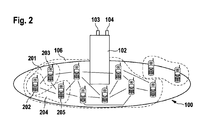
- Fig. 2 shows a block diagram with the step of calculating a plurality of virtual MIMO systems groups within a mobile communication system 100.
- the calculation is made in the base station 102, that further comprises first and second base station antennas 103, 104, and is completed for all the group of mobile devices 106.
- a plurality of group candidates is obtained.
- Each group candidate is formed of a first and a second mobile device and the group candidate comprises all possible combinations among the group of mobile devices 106.
- a first group candidate 201 is formed of the mobile devices 202 and 203.
- mobile device 202 is also grouped into the group candidate 204, that is formed by mobile device 202 and 205. This group combination is repeated for all mobile devices that are candidates to be part of a virtual MIMO system.
- Fig. 3 illustrates a block diagram of a step of calculating a plurality of virtual MIMO systems within a mobile communication system 100, the mobile communication system 100 further comprising base station 102 and base station antennas 103 and 104.
- the mobile communication system 100 further comprises all mobile devices that have not been previously discarded 106 and the discarded group of mobile devices 105.
- the fig. 3 represents the plurality of combinations of the mobile devices.
- a quality value for each group candidate is calculated. This quality value weights and defines what are the group candidates with the highest quality value to be grouped in a virtual MIMO system.
- a first factor is obtained by calculating the inverse correlation between a first ( h 1, n ) and second vector ( h 2, n ), the first vector containing a first and second transfer function ( h 1,1, n h 1,2, n ) between the first mobile station (numbered in the first subindex of the transfer functions) 203 and a first and second base station antenna 103 and 104 (numbered in the second subindex of the transfer functions).
- the second vector contains the transfer functions ( h 2,1, n h 2,2, n ) between the second mobile station 302 (numbered in the first subindex of the transfer functions) and the base station antennas 103 and 104 (numbered in the second subindex of the transfer functions). These transfer functions are obtained from the channel estimation coefficients from the mobile devices 203 and 302 and received by the base station 102.
- the formula (2) further represents an average over N subcarriers. The use of the average value is only needed for multi-carrier systems.
- a second factor is obtained by dividing a first autocorrelation of the first vector by a second autocorrelation of the second vector, wherein the second autocorrelation is bigger than the first autocorrelation.
- the quality value of the virtual MIMO is calculated by combining the first and the second factor using an arithmetic operation depending on the type of receivers in the base station. If the base station 102 includes linear receivers, then the arithmetic operation is a multiplication and the first and the second factor includes a first constant exponent ( ⁇ ) and the second factor exponent ( ⁇ ), respectively.
- the plurality of group candidates are sorted based on the calculated quality value from the highest to a lowest quality value, in order to recognize the group candidates that form the best virtual MIMO systems in fig. 3 , the best group candidate is 303 and the second biggest quality value is 304.
- the first group with the highest quality value 303 forms the first virtual MIMO group.
- the second virtual MIMO group is the second highest quality value group that does not contain a mobile device that has been previously grouped on a virtual MIMO group.
- the second highest quality value 304 is formed from mobile device 302, that already forms part of the first virtual MIMO group. Therefore, the second highest quality value 304 cannot be taken into account and the next highest quality value 305 is the next value that will point to the formation of the second virtual MIMO system. This process is repeated for all the subsequent group candidates until no more grouping or pairing is possible.
- Fig. 4 shows a block diagram of the step of calculating a plurality of virtual MIMO systems groups of a mobile communication system 100 that further comprises a base station 102, base station antennas 103 and 104 and the selected virtual MIMO groups 401, 402 and 403 after they were selected in the step described in fig. 3 .
- the fig. 4 also shows the group of the discarded mobile devices 105 and three further mobile devices that were not grouped into any virtual MIMO group 404, 405 and 406. These three mobile devices 404-406 were not grouped, as the quality values they obtained in their respective group candidates were 0,6 and 0,49, below the minimum quality value criteria of 0,61.
- the mobile device can not be further grouped, if there are no other devices available. If for example the minimum candidate criteria is 0,5, then the further virtual MIMO group can be formed by the mobile devices 405 and 406, but the mobile device 404 can not form any other group as all other mobile devices are already grouped. In this case, the mobile device 404 forms part of the discarded group of mobile devices without any pairing to form a virtual MIMO group. The rest of the mobile devices that form a virtual MIMO group start sharing the resources, including the frequency allocation, in order to increase the total throughput of transmission from the mobile devices to the base station 102.
- Fig. 5 represents a flowchart of a method of evaluating a virtual MIMO system's quality of a group of mobile devices in the base station of a mobile communication system.
- the base station is adapted for receiving uplink channel estimation coefficients of each mobile device.
- the first step 501 selects a first and a second mobile device of the plurality of mobile devices.
- the second step 502 obtains a first factor by calculating an inverse correlation between a first and a second vector, the first and second vector containing transfer functions between the first and second mobile station and the first and second base station antenna, the transfer function being obtained from the channel estimation coefficients.
- the third step 503 obtains a second factor by dividing a first autocorrelation of the first vector by a second autocorrelation of the second vector, the second vector being descriptive of an average received power between the first and second mobile device.
- the quality value of the virtual MIMO is calculated by combining the first and the second factor using an arithmetic operation. This quality value is descriptive of the virtual MIMO system's quality between the first and the second mobile device.
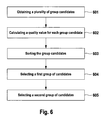
- Fig. 6 shows a flowchart of an embodiment of the invention of a method of calculating a plurality of virtual MIMO systems groups of mobile devices in a base station of a mobile communication system.
- the mobile communication system comprising a plurality of mobile devices coupled to the base station.
- the method comprises a first step 601 that obtains a plurality of group candidates, each group candidate comprising at least a first and second mobile device and a plurality of group candidates comprising a possible combination among a plurality of mobile devices.
- the second step 602 calculates a quality value for each group candidate according to the flowchart in fig. 5 .
- the third step 603 sorts a plurality of group candidates according to the calculated quality value from a highest to a lowest quality value.
- the fourth step 604 selects the first group of mobile devices corresponding to its quality value to form a first virtual MIMO group.
- the fifth step 605 selects at least a second group of mobile devices corresponding to a second highest quality value to form a second virtual MIMO group, these first and second mobile devices cannot have been included on previous group selections. This step 605 is repeated until all maximum number of mobile devices has been grouped and there are no further possibilities to form more virtual MIMO groups.
- a threshold on the quality value can be set, so that if a group candidate is below this quality value threshold, then the group candidates are not further regarded and are not able to form virtual MIMO groups.
- Fig. 7 shows base station 701 of a mobile communication system 100 further comprising a plurality of mobile devices 708.
- the base station communicates with the plurality of mobile devices 702 using any radio technology as GSM, UMTS, LTE from 3GPP. or WiMax from the 3GPP standard.
- the base station 701 further comprises a first and second base station antenna 702 and 703 and the means for selecting 704 at least the first and second mobile devices of the plurality of mobile devices as a first group of mobile devices.
- the base station 700 further comprises means for obtaining a first factor 705 by calculating an inverse correlation between first and second vector; means for obtaining a second factor 706 by dividing a first autocorrelation of the first vector by second autocorrelation of the second vector, the second vector being descriptive of an average receive power ratio between the first and second mobile device; and means for calculating 707 the quality value of the virtual MIMO by combining the first and second factor using an arithmetic operation, the quality value being descriptive of the virtual MIMO system's quality between the first and second mobile device.
Landscapes
- Engineering & Computer Science (AREA)
- Quality & Reliability (AREA)
- Computer Networks & Wireless Communication (AREA)
- Signal Processing (AREA)
- Mobile Radio Communication Systems (AREA)
- Radio Transmission System (AREA)
Abstract
Description
- The invention relates to a virtual MIMO system in a mobile communication system and more particularly without limitation to a method of evaluating a virtual MIMO system's quality and to a base station.
- In radio technologies, multiple input and multiple output or MIMO defines the use of multiple antennas at the transmitter and receiver in order to improve the communication performance. Further, it increases the data throughput and link range without additional bandwidth or transmit power. One of the main functions of MIMO is the spatial multiplexing that splits a high rate signal into multiple lower rate streams, transmitting each stream from a different transmit antenna in the same frequency channel. A MIMO channel can be modeled as having several transmit streams to go through a matrix channel consisting of multiple paths between multiple transmit antennas at the transmitter and multiple receive antennas at the receiver. The receiver gets the signals by multiple receiver antennas and decodes the received signal vectors into the original information.
- A special type of MIMO is the so called virtual MIMO that allows a station to transmit or receive signals to or from multiple users in a same band and time simultaneously, even if the transmitter has a single antenna. By sharing the resources between two or more transmitters or mobile devices, the sum throughput of the individual transmitters is incremented. Typically for the uplink, or transmission from a mobile device to a base station, pairs of users can be formed which transmit on the same resources forming the virtual MIMO system. However, more than two users can also be used to form this virtual MIMO system.
- The characteristics and parameters of the channels between mobile devices and the Base Station Antennas within the virtual MIMO system can be very different, considerably impacting the performance and the quality of the virtual MIMO system that they have formed. That is, pairs cannot be formed in an arbitrary way and therefore, there is a need of an appropriate method for evaluating the quality of a pairing or a group combination and to apply it in a virtual MIMO system in order to improve the total cell throughput.
- The present invention provides a method of evaluating a virtual MIMO system's quality of a first group of mobile devices in a base station of a mobile communication system. The mobile communication system further comprises a plurality of mobile devices connected to the base station, the base station is adapted for estimating uplink channel estimation coefficients of each mobile device of the plurality of mobile devices. The method comprises the steps of: selecting at least a first and second mobile device of the plurality of mobile devices; obtaining a first factor by calculating an inverse correlation between a first and a second vector, the first vector containing at least a first and second transfer function between the first mobile station and the first and second base station antenna, the second vector containing third and forth transfer functions between the second mobile station and the first and second base station antennas, respectively. The transfer functions are obtained from the channel estimation coefficients.
- The mobile communication system may comply with one of the standards such as GSM, UMTS, IEEE 802.11, IEEE 802.16 or 3GPP LTE.
- The method further comprises: obtaining a second factor by dividing a first autocorrelation of the first vector by a second autocorrelation of the second vector. The second factor is descriptive of the average receive power ratio between the first and second mobile devices; and calculating the quality value of the virtual MIMO by combining the first factor and the second factor using an arithmetic operation, the quality value being descriptive of the virtual MIMO system's quality between the first and second mobile devices.
In accordance with an embodiment of the invention, the arithmetic operation is a multiplication, wherein the base station further comprises linear receivers and wherein the second autocorrelation is bigger than the first autocorrelation. The first factor includes a first constant exponent and the second factor includes a second constant exponent. - One of the advantages of the embodiments of the invention is that it describes an optimized method for grouping or pairing mobile devices that are active in a base station. The method is based on the calculation of two factors that have a great impact on the quality of the virtual MIMO system. These two factors are the inverse correlation and the power balancing of the mobile devices that form the virtual MIMO system group. Another advantage is that the calculation of the inverse correlation and the power balancing between the mobile devices uses already available measurement as the channel estimation, that is continuously updated at the base station. The base station receives the information from every mobile device that is active within the cell.
- In another aspect, the invention relates to a method of calculating a plurality of virtual MIMO systems groups of mobile devices in a base station of a mobile communication system. The mobile communication system further comprises a plurality of mobile devices connected to the base station. The method comprises the steps of: obtaining a plurality of group candidates, each group candidate comprises at least a first and a second mobile device, the plurality of group candidates comprises all possible combinations among the plurality of mobile devices; calculating a quality value for each group candidate according to one of the embodiments of the invention; sorting the plurality of group candidates according to the calculated quality value from a highest to a lowest quality value; selecting the first group of mobile devices corresponding to the highest quality value; and selecting at least a second group of mobile devices corresponding to a second highest quality value, if the first and second mobile device of the second group is not included on a previous group selection.
- In accordance with an embodiment of the invention, the group candidates of the plurality of mobile devices are selected according to a criteria, the criteria being: a signal to interference plus noise ratio SINR threshold and/or scheduling priority of each mobile device.
- In accordance with another embodiment of the invention, the selection step of selecting groups of mobile devices is repeated until a maximum number of mobile devices has been grouped.
- In accordance with another embodiment of the invention, a discarded group of mobile devices are excluded of the virtual MIMO system, wherein the discarded group contains a second plurality of mobile devices not complying to the criteria and/or have not been grouped.
- Another advantage of the embodiments of the invention is that a plurality of mobile devices, that are active in a cell of a base station, are grouped in a plurality of groups of virtual MIMO systems, according to the best characteristics and parameters that optimizes the performance of the virtual MIMO system. The embodiment of the invention calculates the quality value for each possible combination of groups or pairs within a cell of a base station, obtaining the best pairs that offer the highest quality values to form the virtual MIMO system.
- In order to reduce the complexity and the calculation time, a criteria may be used to reduce the number of mobile devices to be included in the calculation. This criteria can be based on the signal to noise ratio SNIR of each mobile device and/or the priority of the mobile devices, including the mobile devices that comply with these criteria, whereas the rest of the mobile devices will continue transmitting and communicating with the base station without sharing resources. In that way, the possible combinations of the virtual MIMO systems groups contain only mobile devices with a higher probability of obtaining a good performance within a virtual MIMO system group. After all possible combinations and their quality values have been calculated, the groups are sorted based on the quality value, and the virtual MIMO system groups are created, starting from the group with the highest quality value until no more groups can be formed. Each mobile device may be part of only one virtual MIMO system group and, in the case that they are mobile devices that cannot be grouped, they will continue communicating with the base station in the same way as the mobile devices that do not fulfill the criteria.
- In another aspect, the invention relates to a base station of a mobile communication system for calculating a plurality of virtual MIMO systems groups of mobile devices, the mobile communication system further comprising a plurality of mobile devices connected to the base station, the base station being adapted for receiving uplink channel estimation coefficients of each mobile device of the plurality of mobile devices.
- The base station comprises: means for selecting at least a first and second mobile device of the plurality of mobile devices and the first group of mobile devices; means for obtaining a first factor by calculating an inverse correlation between a first and a second vector, the first vector containing at least a first and second transfer functions between the first mobile station and the first and second base station antenna, the second vector containing third and forth transfer functions between the second mobile station and the first and second base station antennas, and the transfer functions are obtained from the channel estimation coefficients.
- The method further comprises means for obtaining a second factor by dividing a first autocorrelation of the first vector by a second autocorrelation of the second vector, the second vector being descriptive of an average received power between the first and second mobile device; and means for calculating the quality value of the virtual MIMO by combining the first vector and the second vector using an arithmetic operation, the quality value being descriptive of the virtual MIMO system's quality between the first and second mobile device.
- In accordance with an embodiment of the invention, the base station further comprises: means for obtaining a plurality of group candidates of mobile devices, each group candidate comprising at least a first and a second mobile device; means for calculating a quality value for each group candidate according to one of the embodiments of the invention. The method further comprises means for sorting the plurality of group candidates according to the calculated quality value from a highest to a lowest quality value; and means for selecting the first group of mobile devices corresponding to the highest quality value; means for selecting at least a second group of mobile devices corresponding to a second highest quality value if the first and second mobile device is not included on a previous group selection.
- In accordance with an embodiment of the invention in the base station, the arithmetic operation is a multiplication, wherein the base station further comprises linear receivers, wherein the second autocorrelation is bigger than the first autocorrelation, wherein the first factor includes the first constant exponent and the second factor includes a second constant exponent.
- In the following preferred embodiments of the invention will be described in greater detail by way of example only making reference to the drawings in which:
- Figure 1
- is a block diagram of a step of calculating a plurality of virtual MIMO systems groups,
- Figure 2
- is a block diagram of a plurality of group candidates for the virtual MIMO system,
- Figure 3
- is a block diagram of the calculation of the quality value for each group candidate,
- Figure 4
- is a block diagram of a selection of groups of mobile devices for the virtual MIMO system,
- Figure 5
- is a flowchart of an embodiment of the invention,
- Figure 6
- is a second flowchart of another embodiment of the invention,
- Figure 7
- is a block diagram of a base station according to an embodiment of the invention.
-
Fig. 1 shows a block diagram of amobile communication system 100 comprising a plurality ofmobile stations 101, abase station 102 and a first and secondbase station antenna mobile stations 101 are active and coupled to thebase station 102. Thebase station 102 periodically receives from each mobile device pilot symbols, that are used to obtain or update the channel estimation coefficients. - If a
base station 102 requires to increase the throughput or the capacity of transmission of the whole cell, a virtual MIMO system can be used in order to share the resources of two or more mobile devices. In order to do so, thebase station 102 requires to evaluate and calculate the best possible group combination or pairing for each mobile device that is active within the cell of thebase station 102. The first step to calculate a plurality of virtual MIMO systems groups is to discard all mobile devices that do not fulfill the criteria of a virtual MIMO system. The criteria can be, for example, the signal to noise ratio SINR or a previously determined mobile device priority. In themobile communication system 100, there are a group ofmobile devices 105 that do not fulfill these criteria and are not taken into account when calculating the best virtual MIMO systems groups. A second group ofmobile devices 106 are selected as candidates to be evaluated as potential virtual MIMO system groups. -
Fig. 2 shows a block diagram with the step of calculating a plurality of virtual MIMO systems groups within amobile communication system 100. The calculation is made in thebase station 102, that further comprises first and secondbase station antennas mobile devices 106. After the mobile devices that complies with the criteria to be candidates of the virtual MIMO system have been selected, a plurality of group candidates is obtained. Each group candidate is formed of a first and a second mobile device and the group candidate comprises all possible combinations among the group ofmobile devices 106. For example, afirst group candidate 201 is formed of themobile devices mobile device 202 is also grouped into thegroup candidate 204, that is formed bymobile device -
Fig. 3 illustrates a block diagram of a step of calculating a plurality of virtual MIMO systems within amobile communication system 100, themobile communication system 100 further comprisingbase station 102 andbase station antennas mobile communication system 100 further comprises all mobile devices that have not been previously discarded 106 and the discarded group ofmobile devices 105. Thefig. 3 represents the plurality of combinations of the mobile devices. - In a further step for calculating a plurality of virtual MIMO systems groups, a quality value for each group candidate is calculated. This quality value weights and defines what are the group candidates with the highest quality value to be grouped in a virtual MIMO system. In order to make a calculation of the virtual MIMO system's quality value a first factor is obtained by calculating the inverse correlation between a first (h 1,n ) and second vector (h 2,n ), the first vector containing a first and second transfer function (h 1,1, n h 1,2,n ) between the first mobile station (numbered in the first subindex of the transfer functions) 203 and a first and second
base station antenna 103 and 104 (numbered in the second subindex of the transfer functions). The second vector contains the transfer functions (h 2,1, n h 2,2,n ) between the second mobile station 302 (numbered in the first subindex of the transfer functions) and thebase station antennas 103 and 104 (numbered in the second subindex of the transfer functions). These transfer functions are obtained from the channel estimation coefficients from themobile devices base station 102. The first and second vectors (1) and the first factor A calculation (2) may be represented using the following formulas:
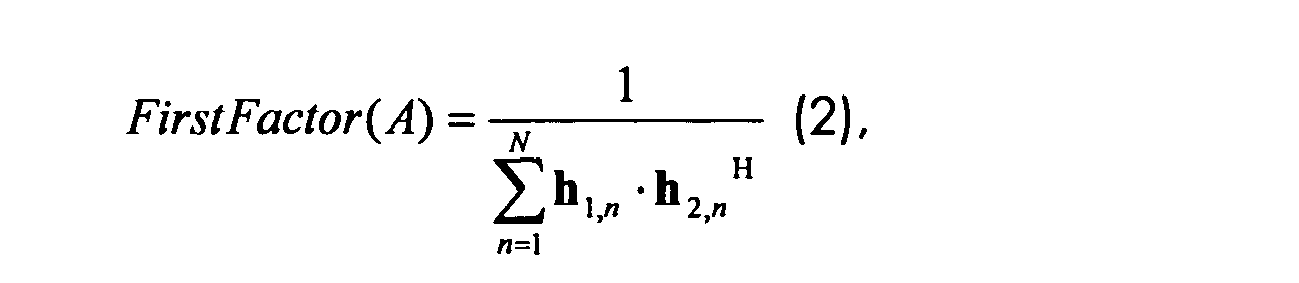
wherein the n represents the subcarrier number of the calculation, that can be more than one for multi-carrier systems as e.g. OFDM. The formula (2) further represents an average over N subcarriers. The use of the average value is only needed for multi-carrier systems. If needed, the calculation of the First Factor (A) may be normalized on average receive power, resulting in the following formula:
- Then, a second factor is obtained by dividing a first autocorrelation of the first vector by a second autocorrelation of the second vector, wherein the second autocorrelation is bigger than the first autocorrelation. The second factor is descriptive of an average receive power ratio between the first and the second mobile device and is represented as:

wherein H is the conjugated transpose of the vector. - Finally the quality value of the virtual MIMO is calculated by combining the first and the second factor using an arithmetic operation depending on the type of receivers in the base station. If the
base station 102 includes linear receivers, then the arithmetic operation is a multiplication and the first and the second factor includes a first constant exponent (α) and the second factor exponent (β), respectively. The quality value may be represented as:
wherein the A represents the first factor and B represents the second factor. This calculation of the quality value is repeated for all the group candidates that have been previously selected. As an example, thegroup candidate 202 has a quality value of 0,9 and thegroup candidate 204 has a quality value of 0,91. Then, the plurality of group candidates are sorted based on the calculated quality value from the highest to a lowest quality value, in order to recognize the group candidates that form the best virtual MIMO systems infig. 3 , the best group candidate is 303 and the second biggest quality value is 304. The first group with thehighest quality value 303 forms the first virtual MIMO group. The second virtual MIMO group is the second highest quality value group that does not contain a mobile device that has been previously grouped on a virtual MIMO group. In the case offig. 3 , the secondhighest quality value 304 is formed frommobile device 302, that already forms part of the first virtual MIMO group. Therefore, the secondhighest quality value 304 cannot be taken into account and the nexthighest quality value 305 is the next value that will point to the formation of the second virtual MIMO system. This process is repeated for all the subsequent group candidates until no more grouping or pairing is possible. -
Fig. 4 shows a block diagram of the step of calculating a plurality of virtual MIMO systems groups of amobile communication system 100 that further comprises abase station 102,base station antennas virtual MIMO groups fig. 3 . Thefig. 4 also shows the group of the discardedmobile devices 105 and three further mobile devices that were not grouped into anyvirtual MIMO group - In certain situations the mobile device can not be further grouped, if there are no other devices available. If for example the minimum candidate criteria is 0,5, then the further virtual MIMO group can be formed by the
mobile devices mobile device 404 can not form any other group as all other mobile devices are already grouped. In this case, themobile device 404 forms part of the discarded group of mobile devices without any pairing to form a virtual MIMO group. The rest of the mobile devices that form a virtual MIMO group start sharing the resources, including the frequency allocation, in order to increase the total throughput of transmission from the mobile devices to thebase station 102. -
Fig. 5 represents a flowchart of a method of evaluating a virtual MIMO system's quality of a group of mobile devices in the base station of a mobile communication system. The base station is adapted for receiving uplink channel estimation coefficients of each mobile device. Thefirst step 501 selects a first and a second mobile device of the plurality of mobile devices. Thesecond step 502 obtains a first factor by calculating an inverse correlation between a first and a second vector, the first and second vector containing transfer functions between the first and second mobile station and the first and second base station antenna, the transfer function being obtained from the channel estimation coefficients. Thethird step 503 obtains a second factor by dividing a first autocorrelation of the first vector by a second autocorrelation of the second vector, the second vector being descriptive of an average received power between the first and second mobile device. In afourth step 504, the quality value of the virtual MIMO is calculated by combining the first and the second factor using an arithmetic operation. This quality value is descriptive of the virtual MIMO system's quality between the first and the second mobile device. -
Fig. 6 shows a flowchart of an embodiment of the invention of a method of calculating a plurality of virtual MIMO systems groups of mobile devices in a base station of a mobile communication system. The mobile communication system comprising a plurality of mobile devices coupled to the base station. The method comprises afirst step 601 that obtains a plurality of group candidates, each group candidate comprising at least a first and second mobile device and a plurality of group candidates comprising a possible combination among a plurality of mobile devices. Thesecond step 602 calculates a quality value for each group candidate according to the flowchart infig. 5 . Thethird step 603 sorts a plurality of group candidates according to the calculated quality value from a highest to a lowest quality value. Thefourth step 604 selects the first group of mobile devices corresponding to its quality value to form a first virtual MIMO group. Thefifth step 605 selects at least a second group of mobile devices corresponding to a second highest quality value to form a second virtual MIMO group, these first and second mobile devices cannot have been included on previous group selections. Thisstep 605 is repeated until all maximum number of mobile devices has been grouped and there are no further possibilities to form more virtual MIMO groups. Alternatively, a threshold on the quality value can be set, so that if a group candidate is below this quality value threshold, then the group candidates are not further regarded and are not able to form virtual MIMO groups. -
Fig. 7 showsbase station 701 of amobile communication system 100 further comprising a plurality ofmobile devices 708. The base station communicates with the plurality ofmobile devices 702 using any radio technology as GSM, UMTS, LTE from 3GPP. or WiMax from the 3GPP standard. Thebase station 701 further comprises a first and secondbase station antenna base station 700 further comprises means for obtaining afirst factor 705 by calculating an inverse correlation between first and second vector; means for obtaining asecond factor 706 by dividing a first autocorrelation of the first vector by second autocorrelation of the second vector, the second vector being descriptive of an average receive power ratio between the first and second mobile device; and means for calculating 707 the quality value of the virtual MIMO by combining the first and second factor using an arithmetic operation, the quality value being descriptive of the virtual MIMO system's quality between the first and second mobile device. -
100 Mobile communication system 101 Plurality of mobile devices 102 Base station 103 First base station antenna 104 Second base station antenna 105 Discarded mobile devices 106 Plurality of candidates of mobile devices 201 First candidate group 202 First mobile device 203 Second mobile device 204 Second group candidate 205 Third mobile device 301 First mobile device 302 Second mobile device 303 Highest quality value 304 Second highest quality value 305 Third highest quality value 501 First step 502 Second step 503 Third step 504 Fourth step 601 First step 602 Second step 603 Third step 604 Fourth step 605 Fifth step 701 Base station 702 First base station antenna 703 Second base station antenna 704 Means for selecting 705 Means for obtaining a first factor 706 Means for obtaining a second factor 707 Means for calculating the quality value 708 Plurality of mobile devices
Claims (10)
- A method of evaluating a virtual MIMO system's quality of a group of mobile devices in a base station (102) of a mobile communications system (100), said mobile communication system (100) further comprising a plurality of mobile devices (101) coupled to said base station (102), said base station (102) being adapted for estimating uplink channel estimation coefficients of each mobile device of said plurality of mobile devices (101), said method comprising the steps of:- selecting at least a first (202) and second mobile device (203) of said plurality of mobile devices (101);- obtaining a first factor by calculating an inverse correlation between a first and a second vector, said first vector containing at least a first and second transfer functions between said first mobile device and a first (103) and second base station antennas (104), said second vector containing at least third and forth transfer functions between said second mobile device (203) and said first and second base station antennas (103-104), said transfer functions obtained from said channel estimation coefficients;- obtaining a second factor by dividing a first autocorrelation of said first vector by a second autocorrelation of said second vector, said second factor being descriptive of an average receive power between said first and second mobile device (202-203);- calculating said quality value of said virtual MIMO by combining said first factor and said second factor using an arithmetic operation, said quality value being descriptive of said virtual MIMO system's quality between said first (202) and second mobile device (203).
- A method as in claim 1, wherein said arithmetic operation is a multiplication, wherein said second autocorrelation is bigger than said first autocorrelation, wherein said first factor includes a first constant exponent and said second factor includes a second constant exponent.
- A method of calculating a plurality of virtual MIMO system's groups of mobile devices in a base station (102) of a mobile communications system (100), said mobile communication system (100) further comprises a plurality of mobile devices (101) coupled to said base station (102), said method comprising the steps of:- obtaining a plurality of group candidates (601), each group candidate comprising at least a first (202) and a second mobile device (203), said plurality of group candidates comprising all possible combinations among said plurality of mobile devices (101);- calculating a quality value for each group candidate (602) according to claim 1;- sorting said plurality of group candidates (603) according to said calculated quality value from a highest (303) to a lowest quality value;- selecting a first group of mobile devices (604) corresponding to said highest quality value (401) to form first virtual MIMO group;- selecting at least a second group of mobile devices (605) corresponding to a second highest quality value (402) to form a second virtual MIMO group, if said first and second mobile device of said second group is not included on a previous group selection.
- A method as in claim 3, wherein said group candidates of said plurality of mobile devices (101) are selected according to a criteria, said criteria being: a SINR threshold and/or a scheduling priority of each mobile device.
- A method as in claim 3, wherein said selection step of selecting a group of mobile devices is repeated until a maximum number of mobile devices has been grouped.
- A method as in claim 4 or claim 5, a discarded group of mobile devices are excluded of said virtual MIMO system, wherein said discarded group contains a second plurality of mobile devices not complying said criteria or/and has not been grouped.
- A base station (701) of a mobile communications system (700) for calculating a plurality of virtual MIMO system's groups of mobile devices, said mobile communication system (700) further comprising a plurality of mobile devices (708) coupled to said base station (701), said base station (701) being adapted for estimating uplink channel estimation coefficients of each mobile device of said plurality of mobile devices (708), said base station (701) comprising:- means for selecting (704) at least a first and second mobile device of said plurality of mobile devices as a first group of mobile devices;- means for obtaining a first factor (705) by calculating an inverse correlation between a first and a second vector, said first vector containing at least a first and second transfer functions between said first mobile device and a first (702) and second base station antenna (703), said second vector containing at least third and forth transfer functions between said second mobile device and said first (702) and second base station antennas (703), said transfer functions obtained from said channel estimation coefficients;- means for obtaining a second factor (706) by dividing a first autocorrelation of said first vector by a second autocorrelation of said second vector, said second factor being descriptive of an average receive power between said first and second mobile device;- means for calculating (707) said quality value of said virtual MIMO by combining said first factor and said second factor using an arithmetic operation, said quality value being descriptive of said virtual MIMO system's quality between said first and second mobile device.
- A base station as in claim 7 further comprising:- means for obtaining a plurality of group candidates of mobile devices, each group candidate comprising at least a first (202) and a second mobile device (203);- means for calculating a quality value for each group candidate according to claim 1;- sorting said plurality of group candidates according to said calculated quality value from a highest (303) to a lowest quality value;- means for selecting a first group of mobile devices corresponding to said highest quality value (401);- means for selecting at least a second group of mobile devices corresponding to a second highest quality value (402) if said first and second mobile device is not included on a previous group selection.
- A base station as in claim 7, said arithmetic operation is a multiplication, wherein said base station further comprises linear receivers, wherein said second autocorrelation is bigger than said first autocorrelation, wherein said first factor includes a first constant exponent and said second factor includes a second constant exponent.
- A base station as in claim 7, wherein said group candidates of said plurality of mobile devices (101) are selected according to a criteria, said criteria being: a SINR threshold and/or a scheduling priority of each mobile device.
Priority Applications (6)
| Application Number | Priority Date | Filing Date | Title |
|---|---|---|---|
| AT07291651T ATE473565T1 (en) | 2007-12-28 | 2007-12-28 | VIRTUAL MIMO SYSTEM DEVICE AND BASE STATION |
| EP07291651A EP2075947B1 (en) | 2007-12-28 | 2007-12-28 | Virtual MIMO system method and base station |
| DE602007007645T DE602007007645D1 (en) | 2007-12-28 | 2007-12-28 | Virtual MIMO system device and base station |
| PCT/EP2008/066785 WO2009083376A2 (en) | 2007-12-28 | 2008-12-04 | Virtual mimo system and apparatus thereof |
| US12/342,415 US20090197540A1 (en) | 2007-12-28 | 2008-12-23 | Virtual mimo system and apparatus thereof |
| CNA2008101850120A CN101472286A (en) | 2007-12-28 | 2008-12-26 | Virtual MIMO system and apparatus thereof |
Applications Claiming Priority (1)
| Application Number | Priority Date | Filing Date | Title |
|---|---|---|---|
| EP07291651A EP2075947B1 (en) | 2007-12-28 | 2007-12-28 | Virtual MIMO system method and base station |
Publications (2)
| Publication Number | Publication Date |
|---|---|
| EP2075947A1 true EP2075947A1 (en) | 2009-07-01 |
| EP2075947B1 EP2075947B1 (en) | 2010-07-07 |
Family
ID=39402850
Family Applications (1)
| Application Number | Title | Priority Date | Filing Date |
|---|---|---|---|
| EP07291651A Ceased EP2075947B1 (en) | 2007-12-28 | 2007-12-28 | Virtual MIMO system method and base station |
Country Status (6)
| Country | Link |
|---|---|
| US (1) | US20090197540A1 (en) |
| EP (1) | EP2075947B1 (en) |
| CN (1) | CN101472286A (en) |
| AT (1) | ATE473565T1 (en) |
| DE (1) | DE602007007645D1 (en) |
| WO (1) | WO2009083376A2 (en) |
Cited By (3)
| Publication number | Priority date | Publication date | Assignee | Title |
|---|---|---|---|---|
| CN102547732A (en) * | 2010-12-17 | 2012-07-04 | 上海贝尔股份有限公司 | Method and equipment for user pairing scheduling in multiple input multiple output (MIMO) wireless communication system |
| CN102611535A (en) * | 2011-01-24 | 2012-07-25 | 中兴通讯股份有限公司 | Multi-user MIMO (multi-input multi-output) dispatching method and device |
| WO2016078722A1 (en) * | 2014-11-20 | 2016-05-26 | Huawei Technologies Co., Ltd. | Methods and nodes in a wireless communication network |
Families Citing this family (12)
| Publication number | Priority date | Publication date | Assignee | Title |
|---|---|---|---|---|
| CN101965011B (en) * | 2009-07-23 | 2015-06-03 | 中兴通讯股份有限公司 | Method and device for realizing selection of multiple antenna transmission modes |
| WO2011013504A1 (en) * | 2009-07-29 | 2011-02-03 | 京セラ株式会社 | Radio base station |
| CN102045817B (en) * | 2009-10-23 | 2013-11-06 | 中兴通讯股份有限公司 | Method and device for self-adaptively pairing uplink multi-input/multi-output |
| CN101989866B (en) * | 2009-08-05 | 2014-03-19 | 中兴通讯股份有限公司 | Uplink virtual multiple input multiple output adaptive pairing method and device |
| JP5373690B2 (en) * | 2010-04-16 | 2013-12-18 | パナソニック株式会社 | Communication system, main unit, radio access unit, and communication method |
| CN102291842B (en) * | 2011-09-16 | 2014-09-10 | 湘潭大学 | Virtual MIMO pairing method taking user QoS into account |
| US8867639B2 (en) * | 2012-04-23 | 2014-10-21 | Lg Electronics Inc. | Feedback method for virtual MIMO transmission in wireless ad-hoc communication system |
| WO2014089839A1 (en) * | 2012-12-14 | 2014-06-19 | 华为技术有限公司 | Scheduling method and scheduling device |
| CN104219021A (en) | 2013-05-31 | 2014-12-17 | 中兴通讯股份有限公司 | Downlink data transmission method, apparatus, and system for virtual multi-antenna system |
| CN103313367B (en) * | 2013-07-08 | 2016-08-31 | 东南大学 | A kind of uplink multi-user method being applicable to WLAN |
| US10070454B2 (en) * | 2015-05-22 | 2018-09-04 | Qualcomm Incorporated | Smart grouping for multi-user multiple-input/multiple-output stations |
| US11451456B2 (en) * | 2019-04-19 | 2022-09-20 | Cisco Technology, Inc. | Learning stable representations of devices for clustering-based device classification systems |
Citations (1)
| Publication number | Priority date | Publication date | Assignee | Title |
|---|---|---|---|---|
| US20050281324A1 (en) * | 2004-06-16 | 2005-12-22 | Telefonaktiebolaget L M Ericsson (Publ) | Method and apparatus to compensate for receiver frequency error in noise estimation processing |
Family Cites Families (4)
| Publication number | Priority date | Publication date | Assignee | Title |
|---|---|---|---|---|
| KR101161873B1 (en) * | 2004-09-07 | 2012-07-03 | 더 보드 오브 리전츠 오브 더 유니버시티 오브 텍사스 시스템 | Mimo communication system using adaptive transmission mode switching technique |
| US7613423B2 (en) * | 2004-09-10 | 2009-11-03 | Samsung Electronics Co., Ltd. | Method of creating active multipaths for mimo wireless systems |
| US7940640B2 (en) * | 2006-01-20 | 2011-05-10 | Nortel Networks Limited | Adaptive orthogonal scheduling for virtual MIMO system |
| US7818013B2 (en) * | 2006-03-20 | 2010-10-19 | Intel Corporation | Downlink channel parameters determination for a multiple-input-multiple-output (MIMO) system |
-
2007
- 2007-12-28 DE DE602007007645T patent/DE602007007645D1/en active Active
- 2007-12-28 AT AT07291651T patent/ATE473565T1/en not_active IP Right Cessation
- 2007-12-28 EP EP07291651A patent/EP2075947B1/en not_active Ceased
-
2008
- 2008-12-04 WO PCT/EP2008/066785 patent/WO2009083376A2/en not_active Ceased
- 2008-12-23 US US12/342,415 patent/US20090197540A1/en not_active Abandoned
- 2008-12-26 CN CNA2008101850120A patent/CN101472286A/en active Pending
Patent Citations (1)
| Publication number | Priority date | Publication date | Assignee | Title |
|---|---|---|---|---|
| US20050281324A1 (en) * | 2004-06-16 | 2005-12-22 | Telefonaktiebolaget L M Ericsson (Publ) | Method and apparatus to compensate for receiver frequency error in noise estimation processing |
Non-Patent Citations (2)
| Title |
|---|
| LAN TANG ET AL.: "Variable-rate adaptive modulation in MIMO systems exploiting multiuser diversity", ACOUSTICS, SPEECH, AND SIGNAL PROCESSING, 2004. IEEE INTERNATIONAL CONFERENCE ON MONTREAL, vol. 4, 17 May 2004 (2004-05-17), pages 693 - 696 |
| LAN TANG ET AL: "Variable-rate adaptive modulation in mimo systems exploiting multiuser diversity", ACOUSTICS, SPEECH, AND SIGNAL PROCESSING, 2004. PROCEEDINGS. (ICASSP ' 04). IEEE INTERNATIONAL CONFERENCE ON MONTREAL, QUEBEC, CANADA 17-21 MAY 2004, PISCATAWAY, NJ, USA,IEEE, vol. 4, 17 May 2004 (2004-05-17), pages 693 - 696, XP010718579, ISBN: 978-0-7803-8484-2 * |
Cited By (3)
| Publication number | Priority date | Publication date | Assignee | Title |
|---|---|---|---|---|
| CN102547732A (en) * | 2010-12-17 | 2012-07-04 | 上海贝尔股份有限公司 | Method and equipment for user pairing scheduling in multiple input multiple output (MIMO) wireless communication system |
| CN102611535A (en) * | 2011-01-24 | 2012-07-25 | 中兴通讯股份有限公司 | Multi-user MIMO (multi-input multi-output) dispatching method and device |
| WO2016078722A1 (en) * | 2014-11-20 | 2016-05-26 | Huawei Technologies Co., Ltd. | Methods and nodes in a wireless communication network |
Also Published As
| Publication number | Publication date |
|---|---|
| EP2075947B1 (en) | 2010-07-07 |
| WO2009083376A3 (en) | 2009-09-11 |
| DE602007007645D1 (en) | 2010-08-19 |
| US20090197540A1 (en) | 2009-08-06 |
| ATE473565T1 (en) | 2010-07-15 |
| WO2009083376A2 (en) | 2009-07-09 |
| CN101472286A (en) | 2009-07-01 |
Similar Documents
| Publication | Publication Date | Title |
|---|---|---|
| EP2075947B1 (en) | Virtual MIMO system method and base station | |
| US10555305B2 (en) | Transmission apparatus and transmission method using a plurality of divided frequency bands in a communication band | |
| EP3484089B1 (en) | Wireless communication apparatus and subcarrier allocation method | |
| CN103259576B (en) | The method and device of assigning precoding vectors in mobile cellular network | |
| JP5557712B2 (en) | Radio base station apparatus performing antenna transmission power control | |
| CN116131893B (en) | Feedback method for group indication information, method and device for receiving feedback information | |
| CN112470419B (en) | Method and device for reporting channel state information | |
| US8306549B2 (en) | Method and apparatus for suppressing inter-cell interference | |
| US8077678B2 (en) | Radio resource allocating method and apparatus in adaptive antenna system | |
| US11777558B2 (en) | Active set management for multiple-input multiple-output communications | |
| EP2452444B1 (en) | Signalling of reference signals for single user spatial multiplexing transmission schemes | |
| US20110281591A1 (en) | Method and device for determining antenna cooperation set, method and device for determining base station cooperation set | |
| US11032841B2 (en) | Downlink active set management for multiple-input multiple-output communications | |
| EP1750402A1 (en) | Spatial multiplexing detection apparatus and method in MIMO system | |
| EP1699146B1 (en) | Method of communicating in a communication network | |
| US20110164578A1 (en) | Method and system for multiband user scheduling in a multiple user multiple input multiple output (mu-mimo) communication system | |
| CN102255840B (en) | Demodulation method and device | |
| CA2646693C (en) | Method and system for subband indicator signalling | |
| EP3379884B1 (en) | Low complexity mu-mimo pairing and scheduling for 5g systems | |
| CN111342868B (en) | A large-scale MIMO transmission method and device | |
| KR20100074803A (en) | Method of multi cell cooperation | |
| CN103220025A (en) | Multi-user paring algorithm applied to VMIMO system | |
| Jeong et al. | User and antenna joint selection in multi-user large-scale MIMO downlink networks | |
| Sun et al. | Optimal frame splitting for downlink MIMO channels with distributed antenna arrays | |
| US20080037503A1 (en) | Method for selecting multiple customer premises equipments to share a channel in a wireless communications network |
Legal Events
| Date | Code | Title | Description |
|---|---|---|---|
| PUAI | Public reference made under article 153(3) epc to a published international application that has entered the european phase |
Free format text: ORIGINAL CODE: 0009012 |
|
| AK | Designated contracting states |
Kind code of ref document: A1 Designated state(s): AT BE BG CH CY CZ DE DK EE ES FI FR GB GR HU IE IS IT LI LT LU LV MC MT NL PL PT RO SE SI SK TR |
|
| AX | Request for extension of the european patent |
Extension state: AL BA HR MK RS |
|
| 17P | Request for examination filed |
Effective date: 20090716 |
|
| 17Q | First examination report despatched |
Effective date: 20090831 |
|
| AKX | Designation fees paid |
Designated state(s): AT BE BG CH CY CZ DE DK EE ES FI FR GB GR HU IE IS IT LI LT LU LV MC MT NL PL PT RO SE SI SK TR |
|
| GRAP | Despatch of communication of intention to grant a patent |
Free format text: ORIGINAL CODE: EPIDOSNIGR1 |
|
| RTI1 | Title (correction) |
Free format text: VIRTUAL MIMO SYSTEM METHOD AND BASE STATION |
|
| GRAS | Grant fee paid |
Free format text: ORIGINAL CODE: EPIDOSNIGR3 |
|
| GRAA | (expected) grant |
Free format text: ORIGINAL CODE: 0009210 |
|
| AK | Designated contracting states |
Kind code of ref document: B1 Designated state(s): AT BE BG CH CY CZ DE DK EE ES FI FR GB GR HU IE IS IT LI LT LU LV MC MT NL PL PT RO SE SI SK TR |
|
| REG | Reference to a national code |
Ref country code: GB Ref legal event code: FG4D |
|
| REG | Reference to a national code |
Ref country code: CH Ref legal event code: EP |
|
| REG | Reference to a national code |
Ref country code: IE Ref legal event code: FG4D |
|
| REF | Corresponds to: |
Ref document number: 602007007645 Country of ref document: DE Date of ref document: 20100819 Kind code of ref document: P |
|
| REG | Reference to a national code |
Ref country code: NL Ref legal event code: VDEP Effective date: 20100707 |
|
| PG25 | Lapsed in a contracting state [announced via postgrant information from national office to epo] |
Ref country code: SI Free format text: LAPSE BECAUSE OF FAILURE TO SUBMIT A TRANSLATION OF THE DESCRIPTION OR TO PAY THE FEE WITHIN THE PRESCRIBED TIME-LIMIT Effective date: 20100707 |
|
| LTIE | Lt: invalidation of european patent or patent extension |
Effective date: 20100707 |
|
| PG25 | Lapsed in a contracting state [announced via postgrant information from national office to epo] |
Ref country code: FI Free format text: LAPSE BECAUSE OF FAILURE TO SUBMIT A TRANSLATION OF THE DESCRIPTION OR TO PAY THE FEE WITHIN THE PRESCRIBED TIME-LIMIT Effective date: 20100707 Ref country code: LT Free format text: LAPSE BECAUSE OF FAILURE TO SUBMIT A TRANSLATION OF THE DESCRIPTION OR TO PAY THE FEE WITHIN THE PRESCRIBED TIME-LIMIT Effective date: 20100707 Ref country code: NL Free format text: LAPSE BECAUSE OF FAILURE TO SUBMIT A TRANSLATION OF THE DESCRIPTION OR TO PAY THE FEE WITHIN THE PRESCRIBED TIME-LIMIT Effective date: 20100707 Ref country code: AT Free format text: LAPSE BECAUSE OF FAILURE TO SUBMIT A TRANSLATION OF THE DESCRIPTION OR TO PAY THE FEE WITHIN THE PRESCRIBED TIME-LIMIT Effective date: 20100707 |
|
| PG25 | Lapsed in a contracting state [announced via postgrant information from national office to epo] |
Ref country code: BG Free format text: LAPSE BECAUSE OF FAILURE TO SUBMIT A TRANSLATION OF THE DESCRIPTION OR TO PAY THE FEE WITHIN THE PRESCRIBED TIME-LIMIT Effective date: 20101007 Ref country code: CY Free format text: LAPSE BECAUSE OF FAILURE TO SUBMIT A TRANSLATION OF THE DESCRIPTION OR TO PAY THE FEE WITHIN THE PRESCRIBED TIME-LIMIT Effective date: 20100707 Ref country code: IS Free format text: LAPSE BECAUSE OF FAILURE TO SUBMIT A TRANSLATION OF THE DESCRIPTION OR TO PAY THE FEE WITHIN THE PRESCRIBED TIME-LIMIT Effective date: 20101107 Ref country code: PL Free format text: LAPSE BECAUSE OF FAILURE TO SUBMIT A TRANSLATION OF THE DESCRIPTION OR TO PAY THE FEE WITHIN THE PRESCRIBED TIME-LIMIT Effective date: 20100707 Ref country code: PT Free format text: LAPSE BECAUSE OF FAILURE TO SUBMIT A TRANSLATION OF THE DESCRIPTION OR TO PAY THE FEE WITHIN THE PRESCRIBED TIME-LIMIT Effective date: 20101108 |
|
| PG25 | Lapsed in a contracting state [announced via postgrant information from national office to epo] |
Ref country code: GR Free format text: LAPSE BECAUSE OF FAILURE TO SUBMIT A TRANSLATION OF THE DESCRIPTION OR TO PAY THE FEE WITHIN THE PRESCRIBED TIME-LIMIT Effective date: 20101008 Ref country code: LV Free format text: LAPSE BECAUSE OF FAILURE TO SUBMIT A TRANSLATION OF THE DESCRIPTION OR TO PAY THE FEE WITHIN THE PRESCRIBED TIME-LIMIT Effective date: 20100707 Ref country code: BE Free format text: LAPSE BECAUSE OF FAILURE TO SUBMIT A TRANSLATION OF THE DESCRIPTION OR TO PAY THE FEE WITHIN THE PRESCRIBED TIME-LIMIT Effective date: 20100707 Ref country code: SE Free format text: LAPSE BECAUSE OF FAILURE TO SUBMIT A TRANSLATION OF THE DESCRIPTION OR TO PAY THE FEE WITHIN THE PRESCRIBED TIME-LIMIT Effective date: 20100707 |
|
| PG25 | Lapsed in a contracting state [announced via postgrant information from national office to epo] |
Ref country code: DK Free format text: LAPSE BECAUSE OF FAILURE TO SUBMIT A TRANSLATION OF THE DESCRIPTION OR TO PAY THE FEE WITHIN THE PRESCRIBED TIME-LIMIT Effective date: 20100707 |
|
| PLBE | No opposition filed within time limit |
Free format text: ORIGINAL CODE: 0009261 |
|
| STAA | Information on the status of an ep patent application or granted ep patent |
Free format text: STATUS: NO OPPOSITION FILED WITHIN TIME LIMIT |
|
| PG25 | Lapsed in a contracting state [announced via postgrant information from national office to epo] |
Ref country code: RO Free format text: LAPSE BECAUSE OF FAILURE TO SUBMIT A TRANSLATION OF THE DESCRIPTION OR TO PAY THE FEE WITHIN THE PRESCRIBED TIME-LIMIT Effective date: 20100707 Ref country code: CZ Free format text: LAPSE BECAUSE OF FAILURE TO SUBMIT A TRANSLATION OF THE DESCRIPTION OR TO PAY THE FEE WITHIN THE PRESCRIBED TIME-LIMIT Effective date: 20100707 Ref country code: SK Free format text: LAPSE BECAUSE OF FAILURE TO SUBMIT A TRANSLATION OF THE DESCRIPTION OR TO PAY THE FEE WITHIN THE PRESCRIBED TIME-LIMIT Effective date: 20100707 Ref country code: EE Free format text: LAPSE BECAUSE OF FAILURE TO SUBMIT A TRANSLATION OF THE DESCRIPTION OR TO PAY THE FEE WITHIN THE PRESCRIBED TIME-LIMIT Effective date: 20100707 Ref country code: IT Free format text: LAPSE BECAUSE OF FAILURE TO SUBMIT A TRANSLATION OF THE DESCRIPTION OR TO PAY THE FEE WITHIN THE PRESCRIBED TIME-LIMIT Effective date: 20100707 |
|
| 26N | No opposition filed |
Effective date: 20110408 |
|
| PG25 | Lapsed in a contracting state [announced via postgrant information from national office to epo] |
Ref country code: ES Free format text: LAPSE BECAUSE OF FAILURE TO SUBMIT A TRANSLATION OF THE DESCRIPTION OR TO PAY THE FEE WITHIN THE PRESCRIBED TIME-LIMIT Effective date: 20101018 |
|
| REG | Reference to a national code |
Ref country code: DE Ref legal event code: R097 Ref document number: 602007007645 Country of ref document: DE Effective date: 20110408 |
|
| PG25 | Lapsed in a contracting state [announced via postgrant information from national office to epo] |
Ref country code: MC Free format text: LAPSE BECAUSE OF NON-PAYMENT OF DUE FEES Effective date: 20101231 |
|
| PG25 | Lapsed in a contracting state [announced via postgrant information from national office to epo] |
Ref country code: IE Free format text: LAPSE BECAUSE OF NON-PAYMENT OF DUE FEES Effective date: 20101228 |
|
| PG25 | Lapsed in a contracting state [announced via postgrant information from national office to epo] |
Ref country code: MT Free format text: LAPSE BECAUSE OF FAILURE TO SUBMIT A TRANSLATION OF THE DESCRIPTION OR TO PAY THE FEE WITHIN THE PRESCRIBED TIME-LIMIT Effective date: 20100707 |
|
| REG | Reference to a national code |
Ref country code: CH Ref legal event code: PCOW Free format text: ALCATEL LUCENT;3, AVENUE OCTAVE GREARD;75007 PARIS (FR) |
|
| REG | Reference to a national code |
Ref country code: CH Ref legal event code: PL |
|
| PG25 | Lapsed in a contracting state [announced via postgrant information from national office to epo] |
Ref country code: HU Free format text: LAPSE BECAUSE OF FAILURE TO SUBMIT A TRANSLATION OF THE DESCRIPTION OR TO PAY THE FEE WITHIN THE PRESCRIBED TIME-LIMIT Effective date: 20110108 Ref country code: LU Free format text: LAPSE BECAUSE OF NON-PAYMENT OF DUE FEES Effective date: 20101228 |
|
| PG25 | Lapsed in a contracting state [announced via postgrant information from national office to epo] |
Ref country code: CH Free format text: LAPSE BECAUSE OF NON-PAYMENT OF DUE FEES Effective date: 20111231 Ref country code: LI Free format text: LAPSE BECAUSE OF NON-PAYMENT OF DUE FEES Effective date: 20111231 Ref country code: TR Free format text: LAPSE BECAUSE OF FAILURE TO SUBMIT A TRANSLATION OF THE DESCRIPTION OR TO PAY THE FEE WITHIN THE PRESCRIBED TIME-LIMIT Effective date: 20100707 |
|
| REG | Reference to a national code |
Ref country code: FR Ref legal event code: GC Effective date: 20131018 |
|
| REG | Reference to a national code |
Ref country code: FR Ref legal event code: RG Effective date: 20141016 |
|
| REG | Reference to a national code |
Ref country code: FR Ref legal event code: CA Effective date: 20150521 |
|
| REG | Reference to a national code |
Ref country code: FR Ref legal event code: CA Effective date: 20150521 |
|
| REG | Reference to a national code |
Ref country code: FR Ref legal event code: PLFP Year of fee payment: 9 |
|
| REG | Reference to a national code |
Ref country code: FR Ref legal event code: PLFP Year of fee payment: 10 |
|
| REG | Reference to a national code |
Ref country code: FR Ref legal event code: PLFP Year of fee payment: 11 |
|
| PGFP | Annual fee paid to national office [announced via postgrant information from national office to epo] |
Ref country code: FR Payment date: 20211115 Year of fee payment: 15 |
|
| PG25 | Lapsed in a contracting state [announced via postgrant information from national office to epo] |
Ref country code: FR Free format text: LAPSE BECAUSE OF NON-PAYMENT OF DUE FEES Effective date: 20221231 |
|
| PGFP | Annual fee paid to national office [announced via postgrant information from national office to epo] |
Ref country code: GB Payment date: 20231109 Year of fee payment: 17 |
|
| PGFP | Annual fee paid to national office [announced via postgrant information from national office to epo] |
Ref country code: DE Payment date: 20231031 Year of fee payment: 17 |
|
| REG | Reference to a national code |
Ref country code: DE Ref legal event code: R119 Ref document number: 602007007645 Country of ref document: DE |
|
| GBPC | Gb: european patent ceased through non-payment of renewal fee |
Effective date: 20241228 |
|
| PG25 | Lapsed in a contracting state [announced via postgrant information from national office to epo] |
Ref country code: DE Free format text: LAPSE BECAUSE OF NON-PAYMENT OF DUE FEES Effective date: 20250701 |
|
| PG25 | Lapsed in a contracting state [announced via postgrant information from national office to epo] |
Ref country code: GB Free format text: LAPSE BECAUSE OF NON-PAYMENT OF DUE FEES Effective date: 20241228 |