EP2075944A2 - Data retransmission method and wireless communication apparatus - Google Patents
Data retransmission method and wireless communication apparatus Download PDFInfo
- Publication number
- EP2075944A2 EP2075944A2 EP20080171978 EP08171978A EP2075944A2 EP 2075944 A2 EP2075944 A2 EP 2075944A2 EP 20080171978 EP20080171978 EP 20080171978 EP 08171978 A EP08171978 A EP 08171978A EP 2075944 A2 EP2075944 A2 EP 2075944A2
- Authority
- EP
- European Patent Office
- Prior art keywords
- data
- received
- wireless communication
- transmitted
- information indicating
- Prior art date
- Legal status (The legal status is an assumption and is not a legal conclusion. Google has not performed a legal analysis and makes no representation as to the accuracy of the status listed.)
- Ceased
Links
Images



Classifications
-
- H—ELECTRICITY
- H04—ELECTRIC COMMUNICATION TECHNIQUE
- H04W—WIRELESS COMMUNICATION NETWORKS
- H04W24/00—Supervisory, monitoring or testing arrangements
- H04W24/04—Arrangements for maintaining operational condition
-
- H—ELECTRICITY
- H04—ELECTRIC COMMUNICATION TECHNIQUE
- H04L—TRANSMISSION OF DIGITAL INFORMATION, e.g. TELEGRAPHIC COMMUNICATION
- H04L1/00—Arrangements for detecting or preventing errors in the information received
- H04L1/004—Arrangements for detecting or preventing errors in the information received by using forward error control
- H04L1/0072—Error control for data other than payload data, e.g. control data
- H04L1/0073—Special arrangements for feedback channel
-
- H—ELECTRICITY
- H04—ELECTRIC COMMUNICATION TECHNIQUE
- H04L—TRANSMISSION OF DIGITAL INFORMATION, e.g. TELEGRAPHIC COMMUNICATION
- H04L1/00—Arrangements for detecting or preventing errors in the information received
- H04L1/12—Arrangements for detecting or preventing errors in the information received by using return channel
- H04L1/16—Arrangements for detecting or preventing errors in the information received by using return channel in which the return channel carries supervisory signals, e.g. repetition request signals
-
- H—ELECTRICITY
- H04—ELECTRIC COMMUNICATION TECHNIQUE
- H04L—TRANSMISSION OF DIGITAL INFORMATION, e.g. TELEGRAPHIC COMMUNICATION
- H04L1/00—Arrangements for detecting or preventing errors in the information received
- H04L1/12—Arrangements for detecting or preventing errors in the information received by using return channel
- H04L1/16—Arrangements for detecting or preventing errors in the information received by using return channel in which the return channel carries supervisory signals, e.g. repetition request signals
- H04L1/1607—Details of the supervisory signal
- H04L1/1671—Details of the supervisory signal the supervisory signal being transmitted together with control information
- H04L1/1678—Details of the supervisory signal the supervisory signal being transmitted together with control information where the control information is for timing, e.g. time stamps
-
- H—ELECTRICITY
- H04—ELECTRIC COMMUNICATION TECHNIQUE
- H04L—TRANSMISSION OF DIGITAL INFORMATION, e.g. TELEGRAPHIC COMMUNICATION
- H04L1/00—Arrangements for detecting or preventing errors in the information received
- H04L1/12—Arrangements for detecting or preventing errors in the information received by using return channel
- H04L1/16—Arrangements for detecting or preventing errors in the information received by using return channel in which the return channel carries supervisory signals, e.g. repetition request signals
- H04L1/18—Automatic repetition systems, e.g. Van Duuren systems
- H04L1/1829—Arrangements specially adapted for the receiver end
- H04L1/1835—Buffer management
- H04L1/1838—Buffer management for semi-reliable protocols, e.g. for less sensitive applications such as streaming video
-
- H—ELECTRICITY
- H04—ELECTRIC COMMUNICATION TECHNIQUE
- H04L—TRANSMISSION OF DIGITAL INFORMATION, e.g. TELEGRAPHIC COMMUNICATION
- H04L1/00—Arrangements for detecting or preventing errors in the information received
- H04L1/12—Arrangements for detecting or preventing errors in the information received by using return channel
- H04L1/16—Arrangements for detecting or preventing errors in the information received by using return channel in which the return channel carries supervisory signals, e.g. repetition request signals
- H04L1/18—Automatic repetition systems, e.g. Van Duuren systems
- H04L1/1829—Arrangements specially adapted for the receiver end
- H04L1/1848—Time-out mechanisms
-
- H—ELECTRICITY
- H04—ELECTRIC COMMUNICATION TECHNIQUE
- H04L—TRANSMISSION OF DIGITAL INFORMATION, e.g. TELEGRAPHIC COMMUNICATION
- H04L1/00—Arrangements for detecting or preventing errors in the information received
- H04L1/12—Arrangements for detecting or preventing errors in the information received by using return channel
- H04L1/16—Arrangements for detecting or preventing errors in the information received by using return channel in which the return channel carries supervisory signals, e.g. repetition request signals
- H04L1/18—Automatic repetition systems, e.g. Van Duuren systems
- H04L1/1812—Hybrid protocols; Hybrid automatic repeat request [HARQ]
Definitions
- the embodiment (s) discussed herein is directed to a data retransmission method for retransmitting a data using a wireless communication and a wireless communication apparatus.
- the embodiment(s) may be employed for a wireless communication system.
- the wireless communication system includes a base station and a user terminal
- a link from the base station to the user terminal, and a link from the user terminal to the base station are referred to as a downlink and an uplink, respectively.
- a transmission signal from the base station to the user terminal and a transmission signal from the user terminal to the base station are referred to as a downlink signal and an uplink signal, respectively.
- 3rd generation 3rd generation
- Japanese Laid-Open Patent Publication No. 2007-124682 discusses the packet communication of the wireless communication apparatus in which the transmission entity receives the feedback message from the reception entity of the communication destination, and transmits the retransmission data packet when the reception is not successful.
- the reception entity of the communication destination performs soft synthesis of the previously received packet and the retransmitted packet.
- the 3G has some stages in development, and a portable phone adopting a protocol referred to as 3.5G or a High-Speed Downlink Packet Access (HSDPA) with further higher communication speed in addition to an original 3G adopted in FOMA (TM) or the like appears, and further, the protocol referred to as Super3G or 3. 9G is considered.
- the protocol in the wireless communication system of the 3G group is divided into a plurality of layers, and a layer 1 thereof is a layer referred to as a physical layer, and this is a part that assumes actual communication.
- a layer 2 is formed in a superior portion of the layer 1.
- This layer 2 is formed of three sub-layers.
- the three sub-layers are a Medium Access Control (MAC), a Radio Link Control protocol (RLC), and a Packet-Data Convergence Protocol (PDCP).
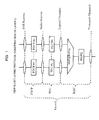
- Fig. 1 illustrates a configuration diagram of the layer 2 of the Super3G protocol.
- PDCP entities and RLC entities as many as the number of Logical Channels (LCH) to be used are formed.
- LCH Logical Channels
- Each LCH transmits and receives each Protocol Data Unit (PDU).
- a MAC entity allocates resource to each RLC entity.
- the MAC entity binds RLC-PDU transferred from each RLC entity to one PDU by multiplexing, and transfers the PDU to a Hybrid Automatic Repeat-reQuest (HARQ) processing unit.
- the HARQ processing unit uses Stop&Wait for performing retransmission control by Acknowledgement/Negative Acknowledgement (ACK/NACK) to perform retransmission control in order to perform retransmission for a PDU retransmission request from the receiving side.
- ACK/NACK Acknowledgement/Negative Acknowledgement
- one block of processing functions arranged in one layer or one sub-layer is referred to as an entity.
- the signal relating to the above-described retransmission control and an operation on the receiving side are illustrated in Figs. 2A and 2B .
- Fig. 2A is a view illustrating a name of channel to be used by the signal, a name of signal, a link indicating in which of the uplink and downlink the signal is used, existence or nonexistence of Cyclic Redundancy Check (CRC) protection, a transmission timing at which the signal is transmitted, information, which each signal has regarding the HARQ, and contents of the information.
- Fig. 2B is a view illustrating information contents when detecting Physical Hybrid ARQ Indicator Channel (PHICH) and Physical Uplink Control Channel (PUCCH) and when detecting Physical Downlink Control Channel (PDCCH), which are signals (represented by channel names) in Fig. 2A , on the UE side, and the operation on the UE side based on the signals.
- PHICH Physical Hybrid ARQ Indicator Channel
- PUCCH Physical Uplink Control Channel
- PDCCH Physical Downlink Control Channel
- the PDU next to the previously transmitted PDU is transmitted by the UE side based on the PDCCH.
- the retransmission request signals performed by the retransmission control by the HARQ processing unit in the uplink and in the downlink are different from each other.
- error correction process and CRC data are added to the data to be transmitted to the base station to perform the transmission process.
- the HARQ processing unit on an opposing side returns NACK information to the opposing side (that is to say, the user terminal side) when the reception information indicates reception NG (CRC NG: that is to say, when it is determined that the data is incorrect as a result of check using the CRC information).
- the HARQ processing unit transmits the ACK information to the opposing side (user terminal side) when the reception information indicates reception OK (CRC OK: that is to say, when it is determined that the data is correct as the result of the check using the CRC information).
- Fig. 3 is a view illustrating the communication between the conventional user terminal and base station and each operation.
- Fig. 3 is a view more illustrating a case in which data to be sequentially transmitted such as data #1 and data #2 are on the user terminal side.
- HARQ Pr#A and the like are obtained by separating transition in time in the communication between the user terminal and the base station in process units. First, the data #1 is transmitted from the user terminal side, and this data #1 is received by the base station side through AIR.
- the base station side When reception error occurs at the time of receiving the data #1, the base station side notifies the user terminal side of the NACK information and retransmission information by an HARQ reception result signal and a transmission resource notifying signal using the PHICH and the PDCCH (corresponding to a combination No. 4 in Fig. 2B ). The user terminal side transmits again the data #1 to the base station side, according to the retransmission information.
- the base station side notifies the user terminal side of the ACK information and the transmission information by the HARQ reception result signal and the transmission resource notifying signal (corresponding to the combination No. 1 in Fig. 2B ).
- the user terminal side transmits new data #2 to the base station side according to the transmission information.
- Fig. 4 is a view illustrating communication between the conventional user terminal and base station and each operation. This is different from the example illustrated in Fig. 3 in that this is a case in which only the ACK information and the NACK information are transmitted, the transmission resource notifying signal is not transmitted from the base station side, and there is no data to be transmitted next to the data #1 on the user terminal side. As in the case illustrated in Fig. 3 , when the reception error occurs at the time of receiving the data #1 on the base station side, the NACK information is transmitted from the base station side to the user terminal side. Herein, since the transmission resource notifying signal protected by the CRC is not added, the user terminal side retransmits the data #1 based on the NACK information.
- the base station side When the base station side normally receives the data #1, the data #1 is passed to a superior processing unit. On the other hand, the ACK information is transmitted to the user terminal side so as to notify the normal reception, and the user terminal side holds the transmitted data #1 without retransmitting the same.
- Fig. 5 is a view illustrating the communication between the conventional user terminal and base station and each operation.
- Fig. 5 is a view more illustrating a case in which the data #1 is transmitted from the base station side to the user terminal side.
- the user terminal transmits the NACK information to the base station.
- the base station side retransmits the data #1 according to the NACK information, and when the NACK information is normally received by the user terminal side, the user terminal side transmits the ACK information to the base station side (refer to Fig. 2A , PUCCH), and the base station side holds the transmitted data #1 without retransmitting the same.
- the transmission resource notifying signal is transmitted to the user terminal side.
- the transmission resource notifying signal is protected by a CRC code, and reliability thereof is higher than that of the ACK signal and the NACK signal, which are the HARQ reception result signals described above.
- the base station side adds the transmission information to the transmission resource notifying signal when reception is OK and a new PDU is requested to the user terminal side.
- the base station side adds the retransmission information to the transmission resource notifying signals and transmits the signals to the user terminal side when retransmission is requested to the user terminal side (refer to drawing illustrating signal in Fig. 2 , and refer to Fig. 3 ).
- the user terminal or the base station on the transmitting side When the user terminal or the base station on the transmitting side receives only the signal from the PHICH, the user terminal or the base station on the transmitting side retransmits the object PDU to the base station side when the signal is the NACK information, and saves the data without retransmission the same when this is the ACK information (refer to Fig. 4 ).
- the transmission side receives the signal from the PHICH and the PDCCH, based on the information of the highly reliable PDCCH, in a case that a transmission resource signal is the retransmission information, the retransmission of the object PDU is performed, and in a case that this is the transmission information, the transmission of the new PDU is performed (refer to No. 1 to No. 4 in Fig. 2B and Fig. 3 ).
- Patent Document 1 Japanese Laid-Open Patent Publication No. 2007-124682
- the ACK information transmitted from the receiving side might change to the NACK information, and on the other hand, the NACK information might change to the ACK information due to the effect of the noise or the like.
- the uplink when there is still the data to be transmitted in the UE (transmitting side) and it is possible to allocate the resource, it is possible to transmit the transmission resource notifying signal protected by the CRC, and correctly determine whether this is the request of the new PDU or the retransmission of the PDU by the transmission information and the retransmission information included in the signal.
- the user terminal or the base station on the receiving side may not correctly receive the NACK information, so that the user terminal or the base station on the transmitting side, which determines that the ACK information is received, does not perform the retransmission even though the retransmission request is transmitted. Therefore, in the user terminal or the base station on the transmitting side, which transmits the NACK information, the MAC processing unit cannot receive the PDU data, and the retransmission is not performed until the retransmission request is transmitted by the retransmission control by the RLC entity, which is in a superior portion of the MAC entity.
- This process is described in more detail with reference to Fig. 6 .
- This example illustrates a case in which there is no data to be transmitted next to the data #1.
- the NACK information is transmitted from the base station side to the user terminal side.
- the transmission data changes before the NACK information reaches the user terminal side (indicated as error), and when the transmission data is received as the ACK information by the user terminal side, the user terminal side recognizes that the transmitted data #1 is normally received on the base station side, and there is no Grant signal (for example, the transmission signal and the Retransmission signal), so that the user terminal side does not perform the transmission and stands by while holding the data #1.
- Grant signal for example, the transmission signal and the Retransmission signal
- a method includes a data retransmission method for retransmitting a data using a wireless communication, the method including:
- a wireless portable terminal which is a user terminal
- the wireless communication apparatus is described as the wireless communication apparatus; however, embodiments of the present invention are not limited to the application to this wireless portable terminal.
- Fig. 7 is a view illustrating a substantial part 100 of the wireless communication apparatus, and the substantial part is a portion corresponding to a MAC layer of a protocol construction of a layer 2 illustrated in Fig. 1 .
- a layer 1 is provided on a subordinate position of the substantial part 100, and an RLC entity and a PDCP entity of the layer 2 are provided on a superior position of the substantial part 100.
- MAC-PDU which is data received by the layer 1, is input to an HARQ reception control unit 102.
- the HARQ reception control unit 102 determines whether the MAC-PDU, which is the input data, is correct data or incorrect data.
- the HARQ reception control unit 102 issues a command to transmit ACK information to the layer 1 when the MAC-PDU is the correct data.
- the HARQ reception control unit 102 issues a command to transmit NACK information to the layer 1 when the MAC-PDU is the incorrect data. Thereby, an ACK signal or a NACK signal is transmitted to the layer 1.
- the HARQ reception control unit 102 determines that the MAC-PDU is the incorrect data and transmits the NACK information to the layer 1, and the HARQ reception control unit 102 also transmits a measurement start signal to a time information measuring unit 104.
- the MAC-PDU which is the data transmitted from a wireless communication apparatus on a transmitting side, and determination of correctness and incorrectness of the data are described with reference to Figs. 8 and 9 .
- Fig. 8 is a view illustrating a data flow including reply of the ACK and the NACK by a receiving side HARQ.
- an HARQ transmission control unit 202 on a transmitting side operates to transmit two MAC-PDUs, which are a MAC-PDU #1 and a MAC-PDU #2, to a wireless communication apparatus on the receiving side.
- the two MAC-PDUs are received by the wireless communication apparatus on the receiving side, and the HARQ reception control unit 102 performs a CRC check for each received MAC-PDU.
- the NACK is transmitted to the wireless communication apparatus on the transmitting side through the layer 1, and the HARQ transmission control unit 202 performs a retransmission control of the same MAC-PDU #1 when the HARQ transmission control unit 202 receives the NACK.
- the wireless communication apparatus on the transmitting side manages the time at which the MAC-PDU #1 is transmitted, and when the NACK is received, the wireless communication apparatus on the transmitting side can recognize which MAC-PDU is requested to be retransmitted by the NACK request, from the received time of the NACK.
- the wireless communication apparatus on the receiving side of the MAC-PDU transmits the NACK without transmitting an identifier of the MAC-PDU in which the abnormal reception occurs. Thereby, it is possible to know in which MAC-PDU the abnormal reception occurs in the wireless communication apparatus on the transmitting side of the MAC-PDU.
- the HARQ reception control unit 101 passes the MAC-PDU #2 to a MAC-PDU determination processing unit 122 and transmits the ACK to the wireless communication apparatus on the transmitting side through the layer 1.
- the wireless communication apparatus on the transmitting side which receives the ACK, recognizes that the retransmission control is not required for the MAC-PDU #2, and transmits the MAC-PDU to be transmitted next (herein, MAC-PDU #n).
- the MAC-PDU determination processing unit 122 determines whether the MAC-PDU #2 received from the HARQ reception control unit 102 is a correct format PDU or an incorrect format PDU.
- Fig. 9 is a schematic view illustrating a determination process of correctness/incorrectness of the PDU format in the MAC-PDU determination processing unit 122.
- the HARQ reception control unit 102 transmits the ACK to the wireless communication apparatus on the transmitting side when it is determined that the reception is normal as a result of the CRC check, and passes the MAC-PDU to the MAC-PDU determination processing unit 122.
- the MAC-PDU determination processing unit 122 receives the MAC-PDU from the HARQ reception control unit 102, the MAC-PDU determination processing unit 122 determines whether the format of the MAC-PDU is correct or incorrect.
- the incorrect format includes the following, for example:
- the MAC-PDU determination processing unit 122 determines whether the format of the MAC-PDU is correct or incorrect, and in the case of the correct format, the MAC-PDU is divided into MAC-SDUs for each LCH and passed to an RLC entity of each LCH (RLC 152 on the receiving side). However, in the case of the incorrect format, the MAC-PDU is discarded or a retransmission request is transmitted through a MAC control information creation processing unit 124, a MAC-PDU generation processing unit 126, and an HARQ transmission control unit 127, illustrated in Fig. 7 .
- the HARQ reception control unit 102 determines whether the MAC-PDU, which is the data transmitted from the wireless communication apparatus on the transmitting side, is the correct data or the incorrect data. According to this determination, the ACK information and the NACK information (refer to an HARQ reception result signal of a PUCCH in Figs. 2A and 2B ) are transmitted to the wireless communication apparatus on the transmitting side through the layer 1 while the ACK information and the NACK information are protected by the CRC or the like.
- the time information measuring unit 104 measures time course by setting a time at which the above-described NACK information is transmitted to the wireless communication apparatus on the transmitting side as a start time.
- a reception finished signal which indicates that the MAC-PDU is received, is input from the HARQ reception control unit 102, and then the measurement of an elapsed time by the time information measuring unit 104 is finished.
- an unfinished signal which indicates that the predetermined time has passed, is notified to the HARQ reception control unit 102 by the time information measuring unit 104, and the HARQ reception control unit 102 transmits the NACK signal again to the wireless communication apparatus on the transmitting side through the layer 1.
- Fig. 10 illustrates a process flow in the wireless communication apparatus on the receiving side and the wireless communication apparatus on the transmitting side based on the above-described configuration.
- a data transmission process and a scheduling process indicate processes on the user terminal side, such as a portable phone
- a reception determination process and a reception result creation process indicate processes on the base station side, which is the receiving side.
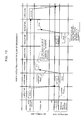
- Fig. 10 is a view illustrating the process flow of this embodiment, and in this embodiment, the configuration of the substantial part 100 of this embodiment illustrated in Fig. 7 is provided on the base station side. Also, Fig. 10 illustrates an example in which data to be transmitted next to the data #1 is not present. Fig. 10 illustrates, as in the case illustrated in Fig. 6 , a case in which reception error of the data #1 transmitted from the user terminal side occurs on the base station side, and when the NACK information is transmitted to the user terminal side, the NACK information changes to the ACK information during transmission, and is received by the user terminal side. Since the user terminal side receives the ACK information, the user terminal side does not perform the retransmission, and the data #1 is in a held state.
- the measurement of the elapsed time from the transmission of the NACK information is started by the time information measuring unit 104 illustrated in Fig. 7 , and after a predetermined time, the NACK information is transmitted to the user terminal side.
- the held data #1 is transmitted to the base station side.
- the data transmission process and the scheduling process indicate the processes on the user terminal side, such as the portable phone.
- the reception determination process and the reception result creation process are performed on the base station side.
- the transmission from the base station side is a downlink signal, and a transmission resource signal protected by the CRC or the like may be used. Therefore, in this embodiment, the retransmission request is performed by the NACK signal.
- the retransmission request is performed by the NACK signal.
- the NACK information and the transmission resource signal including the retransmission information are transmitted to the user terminal side, thereby surely allowing the user terminal to perform retransmission.
- the NACK information is transmitted first in Fig. 11 , it is possible that the transmission resource signal is transmitted first.
- the invention also provides a computer program or a computer program product for carrying out any of the methods described herein, and a computer readable medium having stored thereon a program for carrying out any of the methods described herein.
- a computer program embodying the invention may be stored on a computer-readable medium, or it could, for example, be in the form of a signal such as a downloadable data signal provided from an Internet website, or it could be in any other form.
Landscapes
- Engineering & Computer Science (AREA)
- Computer Networks & Wireless Communication (AREA)
- Signal Processing (AREA)
- Multimedia (AREA)
- Mobile Radio Communication Systems (AREA)
- Detection And Prevention Of Errors In Transmission (AREA)
- Communication Control (AREA)
Abstract
Description
- The embodiment (s) discussed herein is directed to a data retransmission method for retransmitting a data using a wireless communication and a wireless communication apparatus. For example, the embodiment(s) may be employed for a wireless communication system.
- In the following description, a case in which the wireless communication system includes a base station and a user terminal is described as an example. In this example, a link from the base station to the user terminal, and a link from the user terminal to the base station are referred to as a downlink and an uplink, respectively. A transmission signal from the base station to the user terminal and a transmission signal from the user terminal to the base station are referred to as a downlink signal and an uplink signal, respectively.
- Recently, a protocol of the wireless communication system referred to as 3rd generation (3G) is widely adopted.
- Japanese Laid-Open Patent Publication No.
2007-124682 - The 3G has some stages in development, and a portable phone adopting a protocol referred to as 3.5G or a High-Speed Downlink Packet Access (HSDPA) with further higher communication speed in addition to an original 3G adopted in FOMA (TM) or the like appears, and further, the protocol referred to as Super3G or 3. 9G is considered. The protocol in the wireless communication system of the 3G group is divided into a plurality of layers, and a
layer 1 thereof is a layer referred to as a physical layer, and this is a part that assumes actual communication. - A
layer 2 is formed in a superior portion of thelayer 1. Thislayer 2 is formed of three sub-layers. The three sub-layers are a Medium Access Control (MAC), a Radio Link Control protocol (RLC), and a Packet-Data Convergence Protocol (PDCP).Fig. 1 illustrates a configuration diagram of thelayer 2 of the Super3G protocol. PDCP entities and RLC entities as many as the number of Logical Channels (LCH) to be used are formed. Each LCH transmits and receives each Protocol Data Unit (PDU). A MAC entity allocates resource to each RLC entity. Also, the MAC entity binds RLC-PDU transferred from each RLC entity to one PDU by multiplexing, and transfers the PDU to a Hybrid Automatic Repeat-reQuest (HARQ) processing unit. The HARQ processing unit uses Stop&Wait for performing retransmission control by Acknowledgement/Negative Acknowledgement (ACK/NACK) to perform retransmission control in order to perform retransmission for a PDU retransmission request from the receiving side. Herein, one block of processing functions arranged in one layer or one sub-layer is referred to as an entity. - In the Super3G protocol, the signal relating to the above-described retransmission control and an operation on the receiving side (UE: User Equipment) or the like are illustrated in
Figs. 2A and 2B . -
Fig. 2A is a view illustrating a name of channel to be used by the signal, a name of signal, a link indicating in which of the uplink and downlink the signal is used, existence or nonexistence of Cyclic Redundancy Check (CRC) protection, a transmission timing at which the signal is transmitted, information, which each signal has regarding the HARQ, and contents of the information.Fig. 2B is a view illustrating information contents when detecting Physical Hybrid ARQ Indicator Channel (PHICH) and Physical Uplink Control Channel (PUCCH) and when detecting Physical Downlink Control Channel (PDCCH), which are signals (represented by channel names) inFig. 2A , on the UE side, and the operation on the UE side based on the signals. For example, when the UE obtains ACK information in the PHICH and obtains transmission information in the PDCCH, which is the combination No. 1 inFig. 2B , the PDU next to the previously transmitted PDU is transmitted by the UE side based on the PDCCH. - As illustrated in
Fig. 2A , the retransmission request signals performed by the retransmission control by the HARQ processing unit in the uplink and in the downlink are different from each other. In a case of the uplink, error correction process and CRC data are added to the data to be transmitted to the base station to perform the transmission process. The HARQ processing unit on an opposing side (that is to say, the base station side) returns NACK information to the opposing side (that is to say, the user terminal side) when the reception information indicates reception NG (CRC NG: that is to say, when it is determined that the data is incorrect as a result of check using the CRC information). The HARQ processing unit transmits the ACK information to the opposing side (user terminal side) when the reception information indicates reception OK (CRC OK: that is to say, when it is determined that the data is correct as the result of the check using the CRC information). -
Fig. 3 is a view illustrating the communication between the conventional user terminal and base station and each operation.Fig. 3 is a view more illustrating a case in which data to be sequentially transmitted such asdata # 1 anddata # 2 are on the user terminal side. InFig. 3 , HARQ Pr#A and the like are obtained by separating transition in time in the communication between the user terminal and the base station in process units. First, thedata # 1 is transmitted from the user terminal side, and thisdata # 1 is received by the base station side through AIR. When reception error occurs at the time of receiving thedata # 1, the base station side notifies the user terminal side of the NACK information and retransmission information by an HARQ reception result signal and a transmission resource notifying signal using the PHICH and the PDCCH (corresponding to a combination No. 4 inFig. 2B ). The user terminal side transmits again thedata # 1 to the base station side, according to the retransmission information. By the retransmission, when thedata # 1 is normally received by the base station side, the base station side notifies the user terminal side of the ACK information and the transmission information by the HARQ reception result signal and the transmission resource notifying signal (corresponding to the combination No. 1 inFig. 2B ). The user terminal side transmitsnew data # 2 to the base station side according to the transmission information. -
Fig. 4 is a view illustrating communication between the conventional user terminal and base station and each operation. This is different from the example illustrated inFig. 3 in that this is a case in which only the ACK information and the NACK information are transmitted, the transmission resource notifying signal is not transmitted from the base station side, and there is no data to be transmitted next to thedata # 1 on the user terminal side. As in the case illustrated inFig. 3 , when the reception error occurs at the time of receiving thedata # 1 on the base station side, the NACK information is transmitted from the base station side to the user terminal side. Herein, since the transmission resource notifying signal protected by the CRC is not added, the user terminal side retransmits thedata # 1 based on the NACK information. When the base station side normally receives thedata # 1, thedata # 1 is passed to a superior processing unit. On the other hand, the ACK information is transmitted to the user terminal side so as to notify the normal reception, and the user terminal side holds the transmitteddata # 1 without retransmitting the same. -
Fig. 5 is a view illustrating the communication between the conventional user terminal and base station and each operation.Fig. 5 is a view more illustrating a case in which thedata # 1 is transmitted from the base station side to the user terminal side. In this case also, when the reception error occurs to thedata # 1 from the base station side, the user terminal transmits the NACK information to the base station. The base station side retransmits thedata # 1 according to the NACK information, and when the NACK information is normally received by the user terminal side, the user terminal side transmits the ACK information to the base station side (refer toFig. 2A , PUCCH), and the base station side holds the transmitteddata # 1 without retransmitting the same. - As described above, in a case that the data to be transmitted still remains in the user terminal or the base station on the transmitting side and it is possible to allocate the data to the resource (size of the MAC PDU), the transmission resource notifying signal is transmitted to the user terminal side. The transmission resource notifying signal is protected by a CRC code, and reliability thereof is higher than that of the ACK signal and the NACK signal, which are the HARQ reception result signals described above. The base station side adds the transmission information to the transmission resource notifying signal when reception is OK and a new PDU is requested to the user terminal side. The base station side adds the retransmission information to the transmission resource notifying signals and transmits the signals to the user terminal side when retransmission is requested to the user terminal side (refer to drawing illustrating signal in
Fig. 2 , and refer toFig. 3 ). - When the user terminal or the base station on the transmitting side receives only the signal from the PHICH, the user terminal or the base station on the transmitting side retransmits the object PDU to the base station side when the signal is the NACK information, and saves the data without retransmission the same when this is the ACK information (refer to
Fig. 4 ). - When the transmission side receives the signal from the PHICH and the PDCCH, based on the information of the highly reliable PDCCH, in a case that a transmission resource signal is the retransmission information, the retransmission of the object PDU is performed, and in a case that this is the transmission information, the transmission of the new PDU is performed (refer to No. 1 to No. 4 in
Fig. 2B andFig. 3 ). - Although an operation in the downlink is substantially the same with that of the uplink, there is no signal protected by the CRC corresponding to the transmission resource notifying signal, so that the request of the new PDU and the retransmission request are performed only with the HARQ reception result signal. [Patent Document 1] Japanese Laid-Open Patent Publication No.
2007-124682 - As described above, since the HARQ reception result signal transmitted from the receiving side to the opposing side is not protected by the CRC and a check bit, the ACK information transmitted from the receiving side might change to the NACK information, and on the other hand, the NACK information might change to the ACK information due to the effect of the noise or the like. In a case of the uplink, when there is still the data to be transmitted in the UE (transmitting side) and it is possible to allocate the resource, it is possible to transmit the transmission resource notifying signal protected by the CRC, and correctly determine whether this is the request of the new PDU or the retransmission of the PDU by the transmission information and the retransmission information included in the signal. However, when the HARQ reception result signal is not protected and the NACK information changes to the ACK information, the user terminal or the base station on the receiving side may not correctly receive the NACK information, so that the user terminal or the base station on the transmitting side, which determines that the ACK information is received, does not perform the retransmission even though the retransmission request is transmitted. Therefore, in the user terminal or the base station on the transmitting side, which transmits the NACK information, the MAC processing unit cannot receive the PDU data, and the retransmission is not performed until the retransmission request is transmitted by the retransmission control by the RLC entity, which is in a superior portion of the MAC entity.
- This process is described in more detail with reference to
Fig. 6 . This example illustrates a case in which there is no data to be transmitted next to thedata # 1. When thedata # 1 is transmitted from the user terminal side to the base station side, in a case that the reception error occurs todata # 1, the NACK information is transmitted from the base station side to the user terminal side. The transmission data changes before the NACK information reaches the user terminal side (indicated as error), and when the transmission data is received as the ACK information by the user terminal side, the user terminal side recognizes that the transmitteddata # 1 is normally received on the base station side, and there is no Grant signal (for example, the transmission signal and the Retransmission signal), so that the user terminal side does not perform the transmission and stands by while holding thedata # 1. On the other hand, on the base station side, even though the NACK information is transmitted, thedata # 1 is not retransmitted. - Accordingly, it is desirable in one aspect of the embodiment to improve throughput of the data processing in a transmitting and receiving system.
- However, embodiments of the present invention have been made to achieve not only the above, but any other desirable outcome that may be achieved by each exemplary embodiment to be described later but not by the prior art.
- According to an aspect of the embodiment, a method includes a data retransmission method for retransmitting a data using a wireless communication, the method including:
- on a receiving apparatus (a wireless communication apparatus on a receiving side),
- receiving data transmitted from a transmitting apparatus (a wireless communication apparatus on a transmitting side);
- determining whether the received data is correct or not;
- transmitting data including information indicating that the received data is received correctly to the transmitting apparatus upon being determined the received data is correct, and transmitting data including information indicating that the received data is not received correctly to the transmitting apparatus upon being determined the received data is not correct;
- measuring an elapsed time from transmission of the data including information indicating that the received data is not received correctly; and
- monitoring whether to receive data corresponding to the received data from the transmitting apparatus before the elapsed time reaches a predetermined time.
- (2) According to an aspect of the embodiment, an apparatus includes a wireless communication apparatus including:
- a receiving unit that receives data transmitted from a transmitting apparatus;
- a determining unit that determines whether the data received by the receiving unit is correct or not;
- a transmitting unit that transmits data including information indicating that the received data is received correctly to the transmitting apparatus upon the received data being determined to be correct by the determining unit, and transmits data including information indicating that the received data is not received correctly to the transmitting apparatus upon the transmitted data being determined to be incorrect by the determining unit;
- a measuring unit that measures an elapsed time from a time at which the transmitting unit transmits the data including information indicating that the received data is not received correctly; and
- a monitoring unit that monitors whether to receive or not data corresponding to the received data from the transmitting apparatus before the elapsed time measured by the measuring unit reaches a predetermined time.
- (3) According to an aspect of the embodiment, a method includes a data retransmission method for retransmitting a data using a wireless communication, the method including:
- a step of receiving the data transmitted from a wireless communication unit of transmission side;
- a step of maintaining a data corresponding to the data transmitted from the wireless communication of transmission side;
- a step of transmitting the data corresponding to the transmitted data maintaining at the wireless communication device of the transmission side to the wireless communication device of reception side when the wireless communication of transmission side received a data showing that the received side did not receive the data transmitted from the wireless communication device of transmission side after the wireless communication device of transmission side had received a message showed that the wireless communication device of reception side received rightly the data transmitted from the wireless communication device of transmission side.
- (4) According to an aspect of the embodiment, an apparatus includes a data retransmission method for retransmitting a data using a wireless communication, the method including:
- receives a data transmitted from a wireless communication of transmission side at a wireless communication device of reception side;
- maintains the data to be transmitted from the wireless communication of transmission side at the wireless communication device of transmission side; and
- transmits the transmitted data maintaining at the wireless communication device of transmission side to the wireless communication device of reception side at the wireless communication of transmission side when the wireless communication of transmission side received a data showing that the wireless communication of reception side did not receive the data transmitted from the wireless communication device of transmission side after the wireless communication device of transmission side had received a message showed that the wireless communication device of reception side received rightly the data transmitted from the wireless communication device of transmission side.
- It is possible to perform the retransmission request process rapidly and it is possible to prevent the data from dropping out.
- The desirable outcomes and advantages of the embodiment will be realized and attained by means of the elements and combinations particularly pointed out in the claims.
- It is to be understood that both the foregoing general description and the following detailed description are exemplary and explanatory and are not restrictive of the embodiment, as claimed.
- Preferred features of the present invention will now be described, purely by way of example, with reference to the accompanying drawings in which:-
-
Fig. 1 is a view illustrating a protocol construction of alayer 2; -
Fig. 2A and Fig. 2B are views illustrating a signal and information contents; -
Fig. 3 is a view illustrating communication between user terminal and base station and each operation; -
Fig. 4 is a view illustrating the communication between the user terminal and base station and each operation; -
Fig. 5 is a view illustrating the communication between the user terminal and base station and each operation; -
Fig. 6 is a view illustrating an example; -
Fig. 7 is a view illustrating a substantial part of this embodiment; -
Fig. 8 is a view illustrating a normal process flow; -
Fig. 9 is a view illustrating a process flow example of correctness and incorrectness determination of received data; -
Fig. 10 is a view illustrating a process flow of the embodiment; and -
Fig. 11 is a view illustrating the process flow of the embodiment. - Hereinafter, exemplary embodiments will be described with reference to accompanying drawings. The following exemplary embodiments are merely examples and do not intend to exclude various modifications and variations to the proposed method and/or apparatus that are not specifically described herein. Rather, various modifications or variations may be made to the embodiments (for example, by combining the exemplary embodiments) without departing from the scope of the proposed method and/or apparatus.
- An embodiment of a data retransmission method for retransmitting a data using a wireless communication and a wireless communication apparatus are described with reference to
Figs. 7 to 11 . In the description of this embodiment, a wireless portable terminal, which is a user terminal, is described as the wireless communication apparatus; however, embodiments of the present invention are not limited to the application to this wireless portable terminal. -
Fig. 7 is a view illustrating asubstantial part 100 of the wireless communication apparatus, and the substantial part is a portion corresponding to a MAC layer of a protocol construction of alayer 2 illustrated inFig. 1 . Alayer 1 is provided on a subordinate position of thesubstantial part 100, and an RLC entity and a PDCP entity of thelayer 2 are provided on a superior position of thesubstantial part 100. MAC-PDU, which is data received by thelayer 1, is input to an HARQreception control unit 102. The HARQreception control unit 102 determines whether the MAC-PDU, which is the input data, is correct data or incorrect data. The HARQreception control unit 102 issues a command to transmit ACK information to thelayer 1 when the MAC-PDU is the correct data. The HARQreception control unit 102 issues a command to transmit NACK information to thelayer 1 when the MAC-PDU is the incorrect data. Thereby, an ACK signal or a NACK signal is transmitted to thelayer 1. Herein, the HARQreception control unit 102 determines that the MAC-PDU is the incorrect data and transmits the NACK information to thelayer 1, and the HARQreception control unit 102 also transmits a measurement start signal to a timeinformation measuring unit 104. - Herein, the MAC-PDU, which is the data transmitted from a wireless communication apparatus on a transmitting side, and determination of correctness and incorrectness of the data are described with reference to
Figs. 8 and9 . -
Fig. 8 is a view illustrating a data flow including reply of the ACK and the NACK by a receiving side HARQ. Herein, an HARQtransmission control unit 202 on a transmitting side operates to transmit two MAC-PDUs, which are a MAC-PDU # 1 and a MAC-PDU # 2, to a wireless communication apparatus on the receiving side. The two MAC-PDUs are received by the wireless communication apparatus on the receiving side, and the HARQreception control unit 102 performs a CRC check for each received MAC-PDU. When it is assumed that result of the CRC check is that reception is abnormal (CRC-NG) for MAC-PDU # 1, the NACK is transmitted to the wireless communication apparatus on the transmitting side through thelayer 1, and the HARQtransmission control unit 202 performs a retransmission control of the same MAC-PDU # 1 when the HARQtransmission control unit 202 receives the NACK. The wireless communication apparatus on the transmitting side manages the time at which the MAC-PDU # 1 is transmitted, and when the NACK is received, the wireless communication apparatus on the transmitting side can recognize which MAC-PDU is requested to be retransmitted by the NACK request, from the received time of the NACK. Therefore, the wireless communication apparatus on the receiving side of the MAC-PDU transmits the NACK without transmitting an identifier of the MAC-PDU in which the abnormal reception occurs. Thereby, it is possible to know in which MAC-PDU the abnormal reception occurs in the wireless communication apparatus on the transmitting side of the MAC-PDU. - As for the MAC-
PDU # 2 transmitted next to the MAC-PDU # 1 from the wireless communication apparatus on the transmitting side, when reception is normal (CRC-OK), the HARQ reception control unit 101 passes the MAC-PDU # 2 to a MAC-PDUdetermination processing unit 122 and transmits the ACK to the wireless communication apparatus on the transmitting side through thelayer 1. The wireless communication apparatus on the transmitting side, which receives the ACK, recognizes that the retransmission control is not required for the MAC-PDU # 2, and transmits the MAC-PDU to be transmitted next (herein, MAC-PDU #n). - The MAC-PDU
determination processing unit 122 determines whether the MAC-PDU # 2 received from the HARQreception control unit 102 is a correct format PDU or an incorrect format PDU. -
Fig. 9 is a schematic view illustrating a determination process of correctness/incorrectness of the PDU format in the MAC-PDUdetermination processing unit 122. - As described above, the HARQ
reception control unit 102 transmits the ACK to the wireless communication apparatus on the transmitting side when it is determined that the reception is normal as a result of the CRC check, and passes the MAC-PDU to the MAC-PDUdetermination processing unit 122. When the MAC-PDUdetermination processing unit 122 receives the MAC-PDU from the HARQreception control unit 102, the MAC-PDUdetermination processing unit 122 determines whether the format of the MAC-PDU is correct or incorrect. The incorrect format includes the following, for example: - (1) When an identifier of a LCH is out of range,
- (2) when a header is larger than a prescribed size (E (Extension) flag in the header is ON),
- (3) when a sum of Length information in the header is longer than the received MAC-PDU,
- (4) when an identifier of MAC control information is out of range, and
- (5) when the identifier of the MAC control information and the length are different from each other.
- The MAC-PDU
determination processing unit 122 determines whether the format of the MAC-PDU is correct or incorrect, and in the case of the correct format, the MAC-PDU is divided into MAC-SDUs for each LCH and passed to an RLC entity of each LCH (RLC 152 on the receiving side). However, in the case of the incorrect format, the MAC-PDU is discarded or a retransmission request is transmitted through a MAC control informationcreation processing unit 124, a MAC-PDUgeneration processing unit 126, and an HARQtransmission control unit 127, illustrated inFig. 7 . - In the above-described configuration, the HARQ
reception control unit 102 determines whether the MAC-PDU, which is the data transmitted from the wireless communication apparatus on the transmitting side, is the correct data or the incorrect data. According to this determination, the ACK information and the NACK information (refer to an HARQ reception result signal of a PUCCH inFigs. 2A and 2B ) are transmitted to the wireless communication apparatus on the transmitting side through thelayer 1 while the ACK information and the NACK information are protected by the CRC or the like. - The time
information measuring unit 104 measures time course by setting a time at which the above-described NACK information is transmitted to the wireless communication apparatus on the transmitting side as a start time. When the MAC-PDU previously determined to be incorrect from the wireless communication apparatus on the transmitting side is received by the user terminal within a predetermined time period, and the HARQreception control unit 102 determines that the MAC-PDU is the correct MAC-PDU, a reception finished signal, which indicates that the MAC-PDU is received, is input from the HARQreception control unit 102, and then the measurement of an elapsed time by the timeinformation measuring unit 104 is finished. - On the other hand, when the reception finished signal is not input from the HARQ
reception control unit 102 to the timeinformation measuring unit 104 within the predetermined time period, an unfinished signal, which indicates that the predetermined time has passed, is notified to the HARQreception control unit 102 by the timeinformation measuring unit 104, and the HARQreception control unit 102 transmits the NACK signal again to the wireless communication apparatus on the transmitting side through thelayer 1. -
Fig. 10 illustrates a process flow in the wireless communication apparatus on the receiving side and the wireless communication apparatus on the transmitting side based on the above-described configuration. InFig. 10 , a data transmission process and a scheduling process indicate processes on the user terminal side, such as a portable phone, and a reception determination process and a reception result creation process indicate processes on the base station side, which is the receiving side. -
Fig. 10 is a view illustrating the process flow of this embodiment, and in this embodiment, the configuration of thesubstantial part 100 of this embodiment illustrated inFig. 7 is provided on the base station side. Also,Fig. 10 illustrates an example in which data to be transmitted next to thedata # 1 is not present.Fig. 10 illustrates, as in the case illustrated inFig. 6 , a case in which reception error of thedata # 1 transmitted from the user terminal side occurs on the base station side, and when the NACK information is transmitted to the user terminal side, the NACK information changes to the ACK information during transmission, and is received by the user terminal side. Since the user terminal side receives the ACK information, the user terminal side does not perform the retransmission, and thedata # 1 is in a held state. - As described above, on the base station side, the measurement of the elapsed time from the transmission of the NACK information is started by the time
information measuring unit 104 illustrated inFig. 7 , and after a predetermined time, the NACK information is transmitted to the user terminal side. When the NACK information is normally received by the user terminal side, the helddata # 1 is transmitted to the base station side. In this manner, even when the retransmission request signal is not protected by a check bit or the CRC, or even when the information of the retransmission request signal is changed during the transmission, it is possible to monitor the elapsed time from the transmission of the retransmission request signal and transmit the retransmission request signal again when desired data is not retransmitted after the predetermined time. - Furthermore, it becomes possible to prevent drop out of the
data # 1. - Also, as another embodiment, an example of simultaneously transmitting the signal protected by the CRC or the like, such as a transmission resource notifying signal including the retransmission information, and the NACK information is described with reference to
Fig. 11 . InFig. 11 , the data transmission process and the scheduling process indicate the processes on the user terminal side, such as the portable phone. The reception determination process and the reception result creation process are performed on the base station side. The transmission from the base station side is a downlink signal, and a transmission resource signal protected by the CRC or the like may be used. Therefore, in this embodiment, the retransmission request is performed by the NACK signal. As inFig. 7 , when the NACK signal is transmitted to the user terminal side by the timeinformation measuring unit 104 provided in a MAC entity of thelayer 2 on the base station side, and the MAC-PDU of which retransmission is requested is not received from the user terminal within the predetermined time period, the NACK information and the transmission resource signal including the retransmission information are transmitted to the user terminal side, thereby surely allowing the user terminal to perform retransmission. Meanwhile, although the NACK information is transmitted first inFig. 11 , it is possible that the transmission resource signal is transmitted first. - Although a case in which the
substantial part 100 illustrated inFig. 7 is provided on the base station side is illustrated in detail in the aboveFigs. 10 and11 , it is possible to provide the configuration of thesubstantial part 100 on the user terminal side, thereby providing the effect similar to above-described ones. - Furthermore, it is possible to retransmit the PDU, which is conventionally dropped out due to difference in recognition between the transmission and reception of the reception result signal, by the HARQ process, thereby providing the retransmission processing method and the wireless communication apparatus capable of improving an entire throughput.
- In any of the above aspects, the various features may be implemented in hardware, or as software modules running on one or more processors. Features of one aspect may be applied to any of the other aspects.
- The invention also provides a computer program or a computer program product for carrying out any of the methods described herein, and a computer readable medium having stored thereon a program for carrying out any of the methods described herein. A computer program embodying the invention may be stored on a computer-readable medium, or it could, for example, be in the form of a signal such as a downloadable data signal provided from an Internet website, or it could be in any other form.
Claims (15)
- A data retransmission method for retransmitting a data using a wireless communication, the data retransmission method comprising:on a receiving apparatus,receiving data transmitted from a transmitting apparatus;determining whether the received data is correct or not;transmitting data including information indicating that the received data is received correctly to the transmitting apparatus upon being determined the received data is correct, and transmitting data including information indicating that the received data is not received correctly to the transmitting apparatus upon being determined the received data is not correct;measuring an elapsed time from transmission of the data including information indicating that the received data is not received correctly; andmonitoring whether to receive data corresponding to the received data from the transmitting apparatus before the elapsed time reaches a predetermined time.
- The data retransmission method according to claim 1, further comprising:on the transmitting apparatus,transmitting data to the receiving apparatus;holding data corresponding to the transmitted data; andretransmitting the held data corresponding to the transmitted data to the receiving apparatus, when receiving the data including information indicating that the transmitted data is not received correctly from the receiving apparatus, after receiving the data including information indicating that the transmitted data is received correctly from the receiving apparatus.
- The data retransmission method according to claim 1 or 2, wherein
the receiving apparatus retransmits the data including information indicating that the transmitted data is not received correctly to the transmitting apparatus, when the data corresponding to the transmitted data cannot be received from the transmitting apparatus within the predetermined time period. - The data retransmission method according to any of claims 1 to 3, wherein the data including information indicating that the transmitted data is received correctly includes data indicating transmission permission of next data to be transmitted to the receiving apparatus by the transmitting apparatus, which optionally includes error-detecting code information.
- The data retransmission method according to any of claims 1 to 4, wherein the data including information indicating that the transmitted data is not received correctly is data including retransmission request information of the transmitted data, which optionally includes error-detecting code information.
- The data retransmission method according to any of claims 1 to 3, wherein both the data including information indicating that the transmitted data is received correctly and the data including information indicating that the transmitted data is not received correctly do not include error-detecting code information.
- The data retransmission method according to any of claims 1 to 5, wherein both the data including information indicating that the transmitted data is received correctly and the data including information indicating that the transmitted data is not received correctly include error-detecting code information.
- The data retransmission method according to any of claims 1 to 7, wherein the receiving apparatus sequentially transmits the data including information indicating that the received data is correctly received and data including data indicating transmission permission of next data including error-detecting code information to the transmitting apparatus.
- The data retransmission method according to claim 1 or 2, wherein the receiving apparatus transmits only the data including information indicating that the received data is received correctly to the transmitting apparatus.
- The data retransmission method according to any of claims 1 to 8, wherein the receiving apparatus sequentially transmits the data including information indicating that the received data is not received correctly and data requesting retransmission including error-detecting code information to the transmitting apparatus.
- The data retransmission method according to claim 1 or 2, wherein the receiving apparatus transmits only the data including information indicating that the received data is not received correctly to the transmitting apparatus.
- The data retransmission method according to any one of claims 1 to 11, wherein the data retransmission method includes a Medium Access Control (MAC) protocol.
- A radio communication apparatus comprising:a receiving unit that receives data transmitted from a transmitting apparatus;a determining unit that determines whether the data received by the receiving unit is correct or not;a transmitting unit that transmits data including information indicating that the received data is received correctly to the transmitting apparatus upon the received data being determined to be correct by the determining unit, and transmits data including information indicating that the received data is not received correctly to the transmitting apparatus upon the transmitted data being determined to be incorrect by the determining unit;a measuring unit that measures an elapsed time from a time at which the transmitting unit transmits the data including information indicating that the received data is not received correctly; anda monitoring unit that monitors whether to receive or not data corresponding to the received data from the transmitting apparatus before the elapsed time measured by the measuring unit reaches a predetermined time.
- A data retransmission method for retransmitting a data using a wireless communication, the method comprising:a step of receiving the data transmitted from a wireless communication unit of transmission side;a step of maintaining a data corresponding to the data transmitted from the wireless communication of transmission side;a step of transmitting the data corresponding to the transmitted data maintaining at the wireless communication device of the transmission side to the wireless communication device of reception side when the wireless communication of transmission side received a data showing that the received side did not receive the data transmitted from the wireless communication device of transmission side after the wireless communication device of transmission side had received a message showed that the wireless communication device of reception side received rightly the data transmitted from the wireless communication device of transmission side.
- A data retransmission method for retransmitting a data using a wireless communication, the method comprising:receives a data transmitted from a wireless communication of transmission side at a wireless communication device of reception side;maintains the data to be transmitted from the wireless communication of transmission side at the wireless communication device of transmission side; andtransmits the transmitted data maintaining at the wireless communication device of transmission side to the wireless communication device of reception side at the wireless communication of transmission side when the wireless communication of transmission side received a data showing that the wireless communication of reception side did not receive the data transmitted from the wireless communication device of transmission side after the wireless communication device of transmission side had received a message showed that the wireless communication device of reception side received rightly the data transmitted from the wireless communication device of transmission side.
Priority Applications (1)
| Application Number | Priority Date | Filing Date | Title |
|---|---|---|---|
| EP20120152944 EP2448166A3 (en) | 2007-12-28 | 2008-12-17 | Data retransmission method and wireless communication apparatus |
Applications Claiming Priority (1)
| Application Number | Priority Date | Filing Date | Title |
|---|---|---|---|
| JP2007339450A JP2009164699A (en) | 2007-12-28 | 2007-12-28 | Data re-transmission processing method for wireless communication and wireless communication apparatus using the method |
Publications (2)
| Publication Number | Publication Date |
|---|---|
| EP2075944A2 true EP2075944A2 (en) | 2009-07-01 |
| EP2075944A3 EP2075944A3 (en) | 2010-04-07 |
Family
ID=40551550
Family Applications (2)
| Application Number | Title | Priority Date | Filing Date |
|---|---|---|---|
| EP20080171978 Ceased EP2075944A3 (en) | 2007-12-28 | 2008-12-17 | Data retransmission method and wireless communication apparatus |
| EP20120152944 Ceased EP2448166A3 (en) | 2007-12-28 | 2008-12-17 | Data retransmission method and wireless communication apparatus |
Family Applications After (1)
| Application Number | Title | Priority Date | Filing Date |
|---|---|---|---|
| EP20120152944 Ceased EP2448166A3 (en) | 2007-12-28 | 2008-12-17 | Data retransmission method and wireless communication apparatus |
Country Status (9)
| Country | Link |
|---|---|
| US (3) | US8516324B2 (en) |
| EP (2) | EP2075944A3 (en) |
| JP (1) | JP2009164699A (en) |
| KR (1) | KR101119800B1 (en) |
| CN (1) | CN101472293A (en) |
| AU (1) | AU2008258146B2 (en) |
| CA (1) | CA2647872C (en) |
| RU (1) | RU2456751C2 (en) |
| TW (1) | TWI423614B (en) |
Cited By (1)
| Publication number | Priority date | Publication date | Assignee | Title |
|---|---|---|---|---|
| WO2011021115A1 (en) * | 2009-08-17 | 2011-02-24 | Koninklijke Philips Electronics, N.V. | System and method to synchronize a patient monitoring device with a central server |
Families Citing this family (10)
| Publication number | Priority date | Publication date | Assignee | Title |
|---|---|---|---|---|
| JP2009164699A (en) * | 2007-12-28 | 2009-07-23 | Fujitsu Ltd | Data re-transmission processing method for wireless communication and wireless communication apparatus using the method |
| KR101583724B1 (en) * | 2008-11-07 | 2016-01-08 | 삼성전자주식회사 | Communication system and method for sending or receiving packet therein |
| CN102843223B (en) * | 2011-06-22 | 2017-10-31 | 中兴通讯股份有限公司 | The method and system that a kind of data are retransmitted |
| CN103325165B (en) * | 2013-06-24 | 2016-01-13 | 西北工业大学 | Integrated intelligence anti-interference wireless is locked information flag system |
| CN106330410B (en) * | 2015-06-16 | 2019-12-13 | 中国移动通信集团公司 | A method and device for processing uplink information |
| US20180262922A1 (en) * | 2015-09-28 | 2018-09-13 | British Telecommunications Public Limited Company | Cellular telecommunications network |
| US10880046B2 (en) * | 2016-10-24 | 2020-12-29 | Aptpod, Inc. | Data collection system, data collection method, client apparatus, server apparatus, and program |
| WO2018204266A1 (en) * | 2017-05-02 | 2018-11-08 | Intel IP Corporation | Methods, systems, and apparatus to aggregate retransmissions |
| CN109150419B (en) * | 2017-06-16 | 2021-09-07 | 华为技术有限公司 | A communication method and device thereof |
| WO2019241931A1 (en) * | 2018-06-20 | 2019-12-26 | 华为技术有限公司 | Data packet retransmission method and device |
Citations (1)
| Publication number | Priority date | Publication date | Assignee | Title |
|---|---|---|---|---|
| JP2007124682A (en) | 2003-12-19 | 2007-05-17 | Matsushita Electric Ind Co Ltd | Data packet transmission method, mobile station, radio network controller, and radio communication system |
Family Cites Families (31)
| Publication number | Priority date | Publication date | Assignee | Title |
|---|---|---|---|---|
| US6088342A (en) * | 1997-05-05 | 2000-07-11 | Nokia Mobile Phones Limited | Dynamic configuration of radio link protocol in a telecommunications system |
| US7936664B2 (en) * | 1991-03-26 | 2011-05-03 | Nokia Corporation | Multi-carrier radio link protocol supervision in a radio communication system |
| JPH0591091A (en) * | 1991-09-30 | 1993-04-09 | Nippon Telegr & Teleph Corp <Ntt> | Data transmission method |
| JP2808961B2 (en) * | 1992-01-23 | 1998-10-08 | 日本電気株式会社 | Communication control device |
| US5828677A (en) * | 1996-03-20 | 1998-10-27 | Lucent Technologies Inc. | Adaptive hybrid ARQ coding schemes for slow fading channels in mobile radio systems |
| KR100346117B1 (en) * | 1998-04-14 | 2002-10-19 | 삼성전자 주식회사 | Continuous User Data Transmission Method in Reverse Public Channel of Mobile Communication System |
| KR100424654B1 (en) | 1999-08-02 | 2004-03-24 | 삼성전자주식회사 | Apparatus and method for retransmitting data according to radio link protocol in mobile communication system |
| KR100876765B1 (en) * | 2002-05-10 | 2009-01-07 | 삼성전자주식회사 | Apparatus and method for retransmitting data in mobile communication system |
| US6901063B2 (en) * | 2002-05-13 | 2005-05-31 | Qualcomm, Incorporated | Data delivery in conjunction with a hybrid automatic retransmission mechanism in CDMA communication systems |
| JP2006523042A (en) * | 2003-04-10 | 2006-10-05 | テレフオンアクチーボラゲット エル エム エリクソン(パブル) | Retransmission method and system |
| KR100684307B1 (en) | 2003-12-29 | 2007-02-16 | 한국전자통신연구원 | A method for receiving an automatic retransmission request block and a recording medium storing the program |
| US7631239B2 (en) | 2003-12-29 | 2009-12-08 | Electronics And Telecommunications Research Institute | Method for retransmitting packet in mobile communication system and computer-readable medium recorded program thereof |
| US7225382B2 (en) * | 2004-05-04 | 2007-05-29 | Telefonakiebolaget Lm Ericsson (Publ) | Incremental redundancy operation in a wireless communication network |
| US7813754B2 (en) | 2004-06-17 | 2010-10-12 | Ntt Docomo, Inc. | Transfer rate control method, transmission power control method, transmission power ratio control method, mobile communication system, mobile station, and radio base station |
| KR100611623B1 (en) * | 2004-09-30 | 2006-08-10 | 한국전자통신연구원 | Lossless ARV Transmission Method in Handover in High-Speed Mobile Internet System |
| JP2006270788A (en) | 2005-03-25 | 2006-10-05 | Nec Corp | Mobile radio communication system, mobile station, and data transmission method |
| RU2421918C2 (en) | 2005-05-23 | 2011-06-20 | Телефонактиеболагет Лм Эрикссон (Пабл) | Protocol of automatic repeat request having multiple mechanisms of additional feedback |
| JP4824953B2 (en) * | 2005-06-23 | 2011-11-30 | 富士通株式会社 | Communication method, mobile station and base station in mobile communication system |
| JP4371272B2 (en) | 2005-07-04 | 2009-11-25 | ソニー・エリクソン・モバイルコミュニケーションズ株式会社 | Portable terminal device, content distribution system, and content reproduction program |
| US7805656B2 (en) | 2005-09-29 | 2010-09-28 | Dolby Laboratories Licensing Corporation | Error correction in packet-based communication networks using data consistency checks |
| US7895494B2 (en) * | 2005-12-29 | 2011-02-22 | Interdigital Technology Corporation | Method and system for implementing H-ARQ-assisted ARQ operation |
| KR100912784B1 (en) * | 2006-01-05 | 2009-08-18 | 엘지전자 주식회사 | Data transmission method and data retransmission method |
| KR100827969B1 (en) | 2006-02-17 | 2008-05-08 | 삼성전자주식회사 | Apparatus and method for operating automatic repeat request in a broadband wireless access communication system |
| US7979768B2 (en) | 2006-03-21 | 2011-07-12 | Interdigital Technology Corporation | Method and system for implementing hybrid automatic repeat request |
| KR100913904B1 (en) * | 2006-04-14 | 2009-08-26 | 삼성전자주식회사 | Method and apparatus for performing automatic retransmission request in mobile communication system |
| TW200803272A (en) | 2006-06-22 | 2008-01-01 | Innovative Sonic Ltd | Method and apparatus for detection local NACK in a wireless communications system |
| US8031656B2 (en) * | 2007-06-14 | 2011-10-04 | Telefonaktiebolaget Lm Ericsson (Publ) | Semi-persistent resource allocation method for uplink transmission in wireless packet data systems |
| US8402335B2 (en) * | 2007-06-22 | 2013-03-19 | Nokia Corporation | Status report messages for multi-layer ARQ protocol |
| US8024634B2 (en) * | 2007-08-07 | 2011-09-20 | Cisco Technology, Inc. | System and method for implementing a subrate recovery for lost packets in a communications environment |
| US8098623B2 (en) * | 2007-10-03 | 2012-01-17 | Telefonaktiebolaget Lm Ericsson | Telecommunications frame structure accomodating differing formats |
| JP2009164699A (en) * | 2007-12-28 | 2009-07-23 | Fujitsu Ltd | Data re-transmission processing method for wireless communication and wireless communication apparatus using the method |
-
2007
- 2007-12-28 JP JP2007339450A patent/JP2009164699A/en active Pending
-
2008
- 2008-12-08 US US12/330,159 patent/US8516324B2/en active Active
- 2008-12-11 TW TW97148181A patent/TWI423614B/en not_active IP Right Cessation
- 2008-12-11 KR KR20080125850A patent/KR101119800B1/en not_active Expired - Fee Related
- 2008-12-15 AU AU2008258146A patent/AU2008258146B2/en not_active Ceased
- 2008-12-17 EP EP20080171978 patent/EP2075944A3/en not_active Ceased
- 2008-12-17 EP EP20120152944 patent/EP2448166A3/en not_active Ceased
- 2008-12-23 CA CA 2647872 patent/CA2647872C/en not_active Expired - Fee Related
- 2008-12-25 RU RU2008151864/07A patent/RU2456751C2/en not_active IP Right Cessation
- 2008-12-26 CN CNA2008101850385A patent/CN101472293A/en active Pending
-
2013
- 2013-07-08 US US13/936,704 patent/US8745458B2/en not_active Expired - Fee Related
- 2013-07-08 US US13/936,723 patent/US8832517B2/en not_active Expired - Fee Related
Patent Citations (1)
| Publication number | Priority date | Publication date | Assignee | Title |
|---|---|---|---|---|
| JP2007124682A (en) | 2003-12-19 | 2007-05-17 | Matsushita Electric Ind Co Ltd | Data packet transmission method, mobile station, radio network controller, and radio communication system |
Cited By (3)
| Publication number | Priority date | Publication date | Assignee | Title |
|---|---|---|---|---|
| WO2011021115A1 (en) * | 2009-08-17 | 2011-02-24 | Koninklijke Philips Electronics, N.V. | System and method to synchronize a patient monitoring device with a central server |
| US9046878B2 (en) | 2009-08-17 | 2015-06-02 | Koninklijke Philips N.V. | System and method to synchronize a patient monitoring device with a central server |
| RU2556450C2 (en) * | 2009-08-17 | 2015-07-10 | Конинклейке Филипс Электроникс, Н.В. | System and method of synchronising device for patient monitoring with central server |
Also Published As
| Publication number | Publication date |
|---|---|
| EP2448166A3 (en) | 2012-09-12 |
| TWI423614B (en) | 2014-01-11 |
| CN101472293A (en) | 2009-07-01 |
| US8745458B2 (en) | 2014-06-03 |
| AU2008258146A1 (en) | 2009-07-16 |
| JP2009164699A (en) | 2009-07-23 |
| EP2075944A3 (en) | 2010-04-07 |
| US20130297982A1 (en) | 2013-11-07 |
| RU2008151864A (en) | 2010-06-27 |
| TW200935814A (en) | 2009-08-16 |
| US20130294345A1 (en) | 2013-11-07 |
| RU2456751C2 (en) | 2012-07-20 |
| US8832517B2 (en) | 2014-09-09 |
| AU2008258146B2 (en) | 2011-01-27 |
| CA2647872A1 (en) | 2009-06-28 |
| CA2647872C (en) | 2014-06-03 |
| US8516324B2 (en) | 2013-08-20 |
| EP2448166A2 (en) | 2012-05-02 |
| KR20090072959A (en) | 2009-07-02 |
| KR101119800B1 (en) | 2012-03-26 |
| US20090172490A1 (en) | 2009-07-02 |
Similar Documents
| Publication | Publication Date | Title |
|---|---|---|
| CA2647872C (en) | Data retransmission method and wireless communication apparatus | |
| TWI471024B (en) | Method and apparatur of exchanging data between a base station and a mobile station | |
| US8325656B2 (en) | Arrangement and method for extended control plane signalling in a high speed packet data communication | |
| US20110069668A1 (en) | Dedicated Acknowledgement and Delivery of Management Messages in Wireless Communication Systems | |
| TW200935812A (en) | Status reporting for retransmission protocol | |
| RU2550034C2 (en) | Wireless communication device, wireless communication control device, wireless communication method, computer medium with wireless communication programme, wireless communication control method and computer medium with wireless communication control programme | |
| JP2012165391A (en) | Data retransmission method | |
| CN103067142B (en) | Radio communication device | |
| JP4708982B2 (en) | Retransmission control method and receiving apparatus | |
| JP2010233249A (en) | Data re-transmission processing method for wireless communication and wireless communication apparatus using the method | |
| CN103152147B (en) | Radio communication device, radio communication control apparatus | |
| JP5626317B2 (en) | Wireless communication apparatus and wireless communication method | |
| RU2490801C1 (en) | Wireless communication device, wireless communication control device, wireless communication method, programmed wireless communication computer medium, wireless communication control method and computer medium with wireless communication control program | |
| JP2009273184A (en) | Communication device, communication method, and program |
Legal Events
| Date | Code | Title | Description |
|---|---|---|---|
| PUAI | Public reference made under article 153(3) epc to a published international application that has entered the european phase |
Free format text: ORIGINAL CODE: 0009012 |
|
| AK | Designated contracting states |
Kind code of ref document: A2 Designated state(s): AT BE BG CH CY CZ DE DK EE ES FI FR GB GR HR HU IE IS IT LI LT LU LV MC MT NL NO PL PT RO SE SI SK TR |
|
| AX | Request for extension of the european patent |
Extension state: AL BA MK RS |
|
| PUAL | Search report despatched |
Free format text: ORIGINAL CODE: 0009013 |
|
| AK | Designated contracting states |
Kind code of ref document: A3 Designated state(s): AT BE BG CH CY CZ DE DK EE ES FI FR GB GR HR HU IE IS IT LI LT LU LV MC MT NL NO PL PT RO SE SI SK TR |
|
| AX | Request for extension of the european patent |
Extension state: AL BA MK RS |
|
| RIC1 | Information provided on ipc code assigned before grant |
Ipc: H04W 72/00 20090101ALI20100303BHEP Ipc: H04L 1/18 20060101AFI20090423BHEP |
|
| 17P | Request for examination filed |
Effective date: 20101004 |
|
| AKX | Designation fees paid |
Designated state(s): DE ES FR GB IT |
|
| 17Q | First examination report despatched |
Effective date: 20110511 |
|
| STAA | Information on the status of an ep patent application or granted ep patent |
Free format text: STATUS: THE APPLICATION HAS BEEN REFUSED |
|
| 18R | Application refused |
Effective date: 20160307 |