EP2075036A1 - Disulfid dyes, composition comprising them and method of dyeing hair - Google Patents
Disulfid dyes, composition comprising them and method of dyeing hair Download PDFInfo
- Publication number
- EP2075036A1 EP2075036A1 EP09154638A EP09154638A EP2075036A1 EP 2075036 A1 EP2075036 A1 EP 2075036A1 EP 09154638 A EP09154638 A EP 09154638A EP 09154638 A EP09154638 A EP 09154638A EP 2075036 A1 EP2075036 A1 EP 2075036A1
- Authority
- EP
- European Patent Office
- Prior art keywords
- formula
- alkyl
- aryl
- solution
- unsubstituted
- Prior art date
- Legal status (The legal status is an assumption and is not a legal conclusion. Google has not performed a legal analysis and makes no representation as to the accuracy of the status listed.)
- Granted
Links
- 0 C[n+]1c(N)[n](*)cc1 Chemical compound C[n+]1c(N)[n](*)cc1 0.000 description 5
- UCFNGEQNTNYWDM-UHFFFAOYSA-P CN(c1ccccc1)/N=C/c1cc[n+](CC(NCCSSCCNC(C[n+]2ccc(/C=N/N(C)c3ccccc3)cc2)=O)=O)cc1 Chemical compound CN(c1ccccc1)/N=C/c1cc[n+](CC(NCCSSCCNC(C[n+]2ccc(/C=N/N(C)c3ccccc3)cc2)=O)=O)cc1 UCFNGEQNTNYWDM-UHFFFAOYSA-P 0.000 description 1
- JWTVWQUUKNZIHH-UHFFFAOYSA-O C[n+](cc1)ccc1N Chemical compound C[n+](cc1)ccc1N JWTVWQUUKNZIHH-UHFFFAOYSA-O 0.000 description 1
- WNQGEGCRPDVRIS-UHFFFAOYSA-P C[n]1c(/N=N/c2cc(NC(c3ccccc3)=O)ccc2NCCSSCCNc(ccc(NC(c2ccccc2)=O)c2)c2/N=N/c2[n+](C)cc[n]2C)[n+](C)cc1 Chemical compound C[n]1c(/N=N/c2cc(NC(c3ccccc3)=O)ccc2NCCSSCCNc(ccc(NC(c2ccccc2)=O)c2)c2/N=N/c2[n+](C)cc[n]2C)[n+](C)cc1 WNQGEGCRPDVRIS-UHFFFAOYSA-P 0.000 description 1
- XYBKYXHXXMOCFO-UHFFFAOYSA-N Cc([s]cc1)[n+]1[NH3+] Chemical compound Cc([s]cc1)[n+]1[NH3+] XYBKYXHXXMOCFO-UHFFFAOYSA-N 0.000 description 1
Classifications
-
- C—CHEMISTRY; METALLURGY
- C09—DYES; PAINTS; POLISHES; NATURAL RESINS; ADHESIVES; COMPOSITIONS NOT OTHERWISE PROVIDED FOR; APPLICATIONS OF MATERIALS NOT OTHERWISE PROVIDED FOR
- C09B—ORGANIC DYES OR CLOSELY-RELATED COMPOUNDS FOR PRODUCING DYES, e.g. PIGMENTS; MORDANTS; LAKES
- C09B44/00—Azo dyes containing onium groups
- C09B44/10—Azo dyes containing onium groups containing cyclammonium groups attached to an azo group by a carbon atom of the ring system
- C09B44/16—1,3-Diazoles or hydrogenated 1,3-diazoles ; (Benz)imidazolium
-
- A—HUMAN NECESSITIES
- A61—MEDICAL OR VETERINARY SCIENCE; HYGIENE
- A61K—PREPARATIONS FOR MEDICAL, DENTAL OR TOILETRY PURPOSES
- A61K8/00—Cosmetics or similar toiletry preparations
- A61K8/18—Cosmetics or similar toiletry preparations characterised by the composition
- A61K8/30—Cosmetics or similar toiletry preparations characterised by the composition containing organic compounds
- A61K8/46—Cosmetics or similar toiletry preparations characterised by the composition containing organic compounds containing sulfur
-
- A—HUMAN NECESSITIES
- A61—MEDICAL OR VETERINARY SCIENCE; HYGIENE
- A61K—PREPARATIONS FOR MEDICAL, DENTAL OR TOILETRY PURPOSES
- A61K8/00—Cosmetics or similar toiletry preparations
- A61K8/18—Cosmetics or similar toiletry preparations characterised by the composition
- A61K8/30—Cosmetics or similar toiletry preparations characterised by the composition containing organic compounds
- A61K8/49—Cosmetics or similar toiletry preparations characterised by the composition containing organic compounds containing heterocyclic compounds
-
- A—HUMAN NECESSITIES
- A61—MEDICAL OR VETERINARY SCIENCE; HYGIENE
- A61K—PREPARATIONS FOR MEDICAL, DENTAL OR TOILETRY PURPOSES
- A61K8/00—Cosmetics or similar toiletry preparations
- A61K8/18—Cosmetics or similar toiletry preparations characterised by the composition
- A61K8/30—Cosmetics or similar toiletry preparations characterised by the composition containing organic compounds
- A61K8/49—Cosmetics or similar toiletry preparations characterised by the composition containing organic compounds containing heterocyclic compounds
- A61K8/4906—Cosmetics or similar toiletry preparations characterised by the composition containing organic compounds containing heterocyclic compounds with one nitrogen as the only hetero atom
- A61K8/4926—Cosmetics or similar toiletry preparations characterised by the composition containing organic compounds containing heterocyclic compounds with one nitrogen as the only hetero atom having six membered rings
-
- A—HUMAN NECESSITIES
- A61—MEDICAL OR VETERINARY SCIENCE; HYGIENE
- A61K—PREPARATIONS FOR MEDICAL, DENTAL OR TOILETRY PURPOSES
- A61K8/00—Cosmetics or similar toiletry preparations
- A61K8/18—Cosmetics or similar toiletry preparations characterised by the composition
- A61K8/30—Cosmetics or similar toiletry preparations characterised by the composition containing organic compounds
- A61K8/49—Cosmetics or similar toiletry preparations characterised by the composition containing organic compounds containing heterocyclic compounds
- A61K8/494—Cosmetics or similar toiletry preparations characterised by the composition containing organic compounds containing heterocyclic compounds with more than one nitrogen as the only hetero atom
- A61K8/4946—Imidazoles or their condensed derivatives, e.g. benzimidazoles
-
- A—HUMAN NECESSITIES
- A61—MEDICAL OR VETERINARY SCIENCE; HYGIENE
- A61Q—SPECIFIC USE OF COSMETICS OR SIMILAR TOILETRY PREPARATIONS
- A61Q5/00—Preparations for care of the hair
- A61Q5/10—Preparations for permanently dyeing the hair
-
- C—CHEMISTRY; METALLURGY
- C09—DYES; PAINTS; POLISHES; NATURAL RESINS; ADHESIVES; COMPOSITIONS NOT OTHERWISE PROVIDED FOR; APPLICATIONS OF MATERIALS NOT OTHERWISE PROVIDED FOR
- C09B—ORGANIC DYES OR CLOSELY-RELATED COMPOUNDS FOR PRODUCING DYES, e.g. PIGMENTS; MORDANTS; LAKES
- C09B44/00—Azo dyes containing onium groups
- C09B44/10—Azo dyes containing onium groups containing cyclammonium groups attached to an azo group by a carbon atom of the ring system
- C09B44/20—Thiazoles or hydrogenated thiazoles
-
- C—CHEMISTRY; METALLURGY
- C09—DYES; PAINTS; POLISHES; NATURAL RESINS; ADHESIVES; COMPOSITIONS NOT OTHERWISE PROVIDED FOR; APPLICATIONS OF MATERIALS NOT OTHERWISE PROVIDED FOR
- C09B—ORGANIC DYES OR CLOSELY-RELATED COMPOUNDS FOR PRODUCING DYES, e.g. PIGMENTS; MORDANTS; LAKES
- C09B49/00—Sulfur dyes
-
- A—HUMAN NECESSITIES
- A61—MEDICAL OR VETERINARY SCIENCE; HYGIENE
- A61K—PREPARATIONS FOR MEDICAL, DENTAL OR TOILETRY PURPOSES
- A61K2800/00—Properties of cosmetic compositions or active ingredients thereof or formulation aids used therein and process related aspects
- A61K2800/80—Process related aspects concerning the preparation of the cosmetic composition or the storage or application thereof
- A61K2800/94—Involves covalent bonding to the substrate
Definitions
- the present invention relates to novel sulfide dyes, compositions thereof, to processes for their preparation and to their use for the dyeing of organic materials, such as keratin fibers, wool, leather, silk, cellulose or polyamides, especially keratin-containing fibers, cotton or nylon, and preferably hair, more preferably human hair.
- organic materials such as keratin fibers, wool, leather, silk, cellulose or polyamides, especially keratin-containing fibers, cotton or nylon, and preferably hair, more preferably human hair.
- cationic dyes can be used to dye organic material, for example keratin, silk, cellulose or cellulose derivatives, and also synthetic fibers, for example polyamides. Cationic dyes exhibit very brilliant shades. A disadvantage is their unsatisfactory fastness to washing.
- the actual technical problem of the present invention was to provide dyes that are distinguished by deep dying having good fastness properties with respect to washing, light, shampooing and rubbing.
- the present invention relates to a method of dyeing keratin-containing fibers, comprising treating the fiber with at least one sulfide dye of formula (1) R 1 -(Z 1 )r-Y 1 -S-Z 3 - ⁇ Y 2 -(Z 2 )q-R 2 ] n , wherein R 1 and R 2 each independently from each other are a residue of an organic dye; Y 1 and Y 2 each independently from each other are unsubstituted or substituted, straight-chain or branched, interrupted or uninterrupted -C 1 -C 10 alkylene-; -C 5 -C 10 cycloalkylene-; C 5 -C 10 arylene; or-C 5 -C 10 arylene-(C 1 -C 10 alkylene)-; Z 1 and Z 2 independently from each other are -C(O)-; -C 2 -C 12 alkenylene-; -(CH 2 CH 2 -O) 1-5 -; -C 1 sul
- Y 1 and Y 2 are unsubstituted or substituted straight-chain or branched interrupted or uninterrupted -C 5 -C 10 cycloalkylene- or -C 1 -C 10 alkylene.
- n 1
- Z 1 and Z 2 independently from each are other -N(R 3 )-; -CON(R 4 )-; -(R 5 )NC(O)-; -O-; or -S-; and R 3 , R 4 or R 5 are defined as in formula (1)
- At least one sulfide dye of formula (2) R 1 -(Z 1 )r-Y 1 -S-S-Y 2 -(Z 2 )q-R 2 and/or at least one sulfide dye of formula (3) R 1 -(Z 1 )r-Y 1 -S-H is used, wherein R 1 , R 2 , Z 1 , Z 2 , Y 1 , Y 2 , r and q are defined as in formula (1).
- the residue of an organic dye is selected from the group of anionic, cationic, neutral, amphoter and zwitterionic dyes, and especially preferred, wherein the residue of an organic dye is a cationic dye.
- the residue of an organic dye is selected from the group of anthraquinone, acridine, azo, azomethine, hydrazomethine, benzodifuranone, coumarine, diketopyrrolopyrrol, dioxaxine, diphenylmethane, formazan, indigoid, indophenol, naphthalimide, naphthoquinone, nitroaryl, merocyanine, methin, oxazine, perinone, perylene, pyrenequinone, phtalocyanine, phenazine, quinoneimine, quinacridone, quinophtalone, styryl, triphenylmethan, xanthene, thiazine and thioxanthene dye.
- an organic dye is selected from the group of anthraquinone, acridine, azo, azomethine, hydrazomethine, benzo
- the residue of an organic dye is selected from azo, azomethin, hydrazomethin, merocyanine, methin and styryl dyes, and more preferred from azo, azomethin dye and hydrazomethin dyes;
- Suitable nitroaryl dyes of the present invention are for example selected from the following compounds:
- Suitable anthraquinone dyes suitable for the method of the present invention are the following compounds:1-[(3-aminopropyl) amino]-anthraquinone (HC Red No. 7), 2-[(2-aminoethyl) amino]-anthraquinone (HC Orange No.
- Suitable azo dyes are for example the following compounds:
- D is a radical of a cationic aromatic substituted or unsubstituted heterocyclic compound of formulae wherein the asterix * indicates the bond to Z 4 and/or Z 5 of formula (7); and Q + is a cationic bivalent radical of an aromatic heterocyclic compound of formulae wherein the asterix * indicates a bond to Z 4 and/or Z 5 of formula (8); the asterix ** is a bond to Z 1 and/or Z 2 of formula (8); and M is a bivalent radical of formulae (D19) or wherein the asterix * indicates the bond to Z 4 or/and Z 5 of formula (7); the asterix ** indicates the bond to Z 1 and/or Z 2 of formula (7); and T is a radical of the compounds of formulae (D21)
- the heteroaromatic cycles of the radicals of the formulae (D9) - (D22) may be interrupted by one or more than one -O-, -S-, -(SO 2 )-
- D + is a radical of a cationic aromatic substituted or unsubstituted heterocyclic compound of formulae (23) or
- a method comprising disulfide dyes of formulae (35) wherein R 63 is hydrogen; unsubstituted or substituted C 1 -C 14 alkyl; C 5 -C 10 cycloalkyl; C 2 -C 14 alkenyl; C 5 -C 10 aryl-(C 1 -C 10 alkyl); C 1 -C 10 alkyl-(C 5 -C 10 aryl); C 5 -C 10 aryl; and R 64 is hydrogen; unsubstituted or substituted, straight-chain or branched, interrupted or uninterrubted C 1 -C 14 alkyl, C 5 -C 10 cycloalkyl, C 5 -C 10 aryl, or C 5 -C 10 aryl-(C 1 -C 10 alkyl); C 1 -C 10 alkyl(C 5 -C 10 aryl); R 67 is hydrogen; or a radical of formula (35a) Y 10 is unsubstituted or substituted C
- R 1 -(Z 1 )r-Y 1 -S-Z 3 - ⁇ Y 2 -(Z 2 )q-R 2 ] n wherein R 1 and R 2 each independently from each other are a residue of an organic dye; Y 1 and Y 2 independently from each other are C 1 -C 10 alkylene; Z 1 and Z 2 independently from each other are -C(O)-; -C 2 -C 12 alkenylene-; -(CH 2 CH 2 -O) 1-5 -; C 1 -C 10 alkylene(C 5 -C 10 arylene); C 5 -C 10 arylene; C 5 -C 10 cycloalkylene, -C(O)O-, -OCO-; -CON(R 4 )-; -(R 5 )NC(O)-; -O- -S-; -S(O)-; or -S(O) 2 -; R 3 , R 4 and R 5
- the present invention also relates to the novel compounds of formulae (35), (36), (37) and (38).
- Alkylene is generally C 1 -C 10 alkylene, for example methylene, ethylene, propylene, isopropylene, n-butylene, sec-butylene, tert-butylene, n-pentylene, 2-pentylene 3-pentylene, 2,2'-dimethylpropylene, cyclopentylene, cyclohexylene, n-hexylene, n-octylene, 1,1',3,3'-tetramethylbutylene, 2-ethylhexylene, nonylene or decylene.
- Alkylene may be straight-chain, branched, or, from C 5 alkyl upwards, monocyclic or polycyclic, and may be interrupted by hetero atoms, such as such as O, S, -CO-, N, NH, NR 54 ,-OCO-, -CO(OR 4 )-, -CONR 4 -, -(R 5 )NC(O)-; for example C 1 -C 10 alkylene may be a resisue such as: -CH 2 CH 2 -O-CH 2 CH 2 -O-CH 2 CH 2 -, or -CH 2 CH 2 -O-CH 2 CH 2 -, -CH 2 CH 2 -O-CH 2 -, -CH 2 CH 2 -O-CH 2 -, -CH 2 -O-CH 2 -, -CH 2 CH 2 -CH 2 CH 2 -O-CH 2 -, -CH 2 CH 2 -CH(N(CH 3 ) 2 )-CH 2
- Arylene is generally C 6 -C 10 arylene; for example phenyl or naphthyl;
- Aryl-alkylene is for example C 5 -C 10 aryl-C 1 -C 10 alkylene, C 6 -C 10 aryl-C 1 -C 2 alkylene, alkyl-arylene is for example C 1 -C 10 alkyl-C 5 -C 10 arylene or C 1 -C 2 alkyl-C 6 -C 10 arylene.
- C 5 -C 10 cycloalkylene is for example cyclopentylene, cyclohexylene, morpholylene or piperidinylene.
- subsituents may be chosen from the following groups:
- Halide is, for example, fluoride, chloride, bromide or iodide, especially chloride and fluoride.
- Anion denotes, for example, an organic or inorganic anion, such as halide, preferably chloride and fluoride, sulfate, hydrogen sulfate, phosphate, boron tetrafluoride, carbonate, bicarbonate, oxalate or C 1 -C 8 alkyl sulfate, especially methyl sulfate or ethyl sulfate; anion also denotes lactate, formate, acetate, propionate or a complex anion, such as the zinc chloride double salt.
- halide preferably chloride and fluoride
- sulfate hydrogen sulfate
- phosphate phosphate
- boron tetrafluoride carbonate
- oxalate C 1 -C 8 alkyl sulfate
- anion also denotes lactate, formate, acetate, propionate or a complex anion, such as the zinc chloride double salt.
- the anion is especially a halide, preferably chloride or fluoride, sulfate, hydrogen sulfate, methyl sulfate, ethyl sulfate, phosphate, formate, acetate or lactate.
- the anion is more especially fluoride, chloride, methyl sulfate, ethyl sulfate, formate or acetate.
- protein disulfidisomerase (EC 5.3.4.1) is an enzyme of the enzym category EC 5.3.4.1. These enzymes preferably catalyse the ismerisation of intermolecular and intramolecular disulfid-bonds in proteinis.
- the EC (Enzyme commission) number is provided from the " Nomenclature Committee of the International Uniion of Biochemistry and Molecular Biology" (IUBMB).
- IUBMB Nomenclature Committee of the International Uniion of Biochemistry and Molecular Biology
- the residue of an organic dye is substituted or unsubstituted.
- biradical or radical of a heterocyclic compound is for example a biradical or radical of thiophenyl, 1,3-thiazolyl, 1,2-thiazolyl, 1,3-benzothiazolyl, 2,3-benzothiazolyl, imidazolyl, 1,3,4-thiadiazolyl, 1,3,5-thiadiazolyl, 1,3,4-triazolyl, pyrazolyl, benzimidazolyl, benzopyrazolyl, pyridinyl, quinolinyl, pyrimidinyl and isoxazolyl.
- Preferred biradical or radical of a heterocyclic compound is for example 1,3-thiazolyl, 1,2-thiazolyl, 1,3-benzothiazolyl, 2,3-benzothiazolyl, imidazolyl, 1,3,4-thiadiazolyl, 1,3,5-thiadiazolyl, 1,3,4-triazolyl, pyrazolyl, benzimidazolyl, benzopyrazolyl, pyridinyl, quinolinyl, pyrimidinyl and isoxazolyl. More preferred cationic heterocyclic compounds are imidazolyl, pyridinyl, 1,3,4-triazolyl and 1,3-thiazolyl.
- a biradical or radical of an aromatic compound is for example phenyl, naphthyl, thiophenyl, 1,3-thiazolyl, 1,2-thiazolyl, 1,3-benzothiazolyl, 2,3-benzothiazolyl, imidazolyl, 1,3,4-thiadiazolyl, 1,3,5-thiadiazolyl, 1,3,4-triazolyl, pyrazolyl, benzimidazolyl, benzopyrazolyl, pyridinyl, quinolinyl, pyrimidinyl and isoxazolyl, aminodiphenyl, aminodiphenylether or azobenzenyl.
- the biradical or radical of a heterocyclic or aromatic compound is unsubstituted or mono- or poly-substituted, for example by C 1 -C 4 alkyl, C 1 -C 4 alkoxy, C 1 -C 4 alkylthio, halogen, e.g.
- a further emodiment of the present inveintion relates to processes for the preparation of the dyes of formula (1).
- a preferred process for the preparation comprises reacting a compound of formula (1 a) with the compound of formula (1 b) according to the following reaction scheme:
- a further preferred process for the preparation of compounds of formula (1) comprises reacting a compound of formula (1 c) with the compound of formula (1 d) according to the following reaction scheme:
- L 1 is a leaving group; and R 1 , R 2 , Z 1 , Z 2 , Z 3 , Y 1 , Y 2 , r, q and n are defined as in formula (1).
- the reaction is generally initiated by contacting; for example by mixing together the starting compounds or by dropwise addition of one starting compound to the other.
- the temperature is in the range of 273 to 300 K, preferably is in the range of 290 to 300 K during the mixing of the starting compounds.
- the reaction time is generally dependent on the reactivity of the starting compounds, on the reaction temperature chosen and on the desired conversion.
- the chosen duration of reaction is usually in the range from one hour to three days.
- the reaction temperature for the reaction of the compounds is advisable to select in the range from 273 to 340K, especially in the range from 273 to 335K.
- the reaction pressure chosen is generally in the range from 70 kPa to 10 MPa, especially from 90 kPa to 5 MPa, and is more especially atmospheric pressure.
- the molar ratio of compound of formula (1 a) to the catalyst is generally selected in the range from 10:1 to 1:5, especially in the range from 10:1 to 1:1.
- Suitable catalysts are for example an alkali metal C 1 -C 6 alkyloxide, such as sodium-, potassium or lithium C 1 -C 6 alkyloxide, preferably sodium methoxide, potassium methoxide or lithium methoxide, or sodium ethoxide, potassium ethoxide or lithium ethoxide; or tertiary amines, for example, such as chinuclidine, N-methylpiperidine, pyridine, trimethylamine, triethylamine, trioctylamine, 1,4-diazabicyclo[2.2.2]octan, chinuclidine, N-methylpiperidine; or alkalimetal acetate, for example such as sodium acetate, potassium acetate, or lithium acetate.
- Preferred are potassium acetate, sodium methoxide, pyridine and 1,4-diazabicyclo[2.2.2]-octan.
- reaction may be carried out with or without a solvent, but is preferably carried out in the presence of a solvent, preferably organic solvents or solvent mixtures.
- Solvents are organic solvents and water, or a mixture of organic solvents or a mixture of organic solvents and water.
- Organic solvents are for example, protic or aprotic polar organic solvents, such as alcohols, for example methanol, ethanol, n-propanol, isopropanol, butanol or glycols, especially isopropanol, or nitrile, such as acetonitrile or propionitrile, or amide, such as dimethylformamide, dimethylacetamide or N-methylpyridine, N-methylpyrolidon, or sulfoxide, such as dimethylsulfoxide, or mixtures thereof.
- protic or aprotic polar organic solvents such as alcohols, for example methanol, ethanol, n-propanol, isopropanol, butanol or glycols, especially isopropanol, or nitrile, such as acetonitrile or propionitrile, or amide, such as dimethylformamide, dimethylacetamide or N-methylpyridine, N-methylpyrolidon, or sulfoxide,
- the product prepared according to the process of the present invention may be advantageously worked up and isolated, and if desired be purified.
- the work up starts by decreasing the temperature of the reaction mixture in the range from 280 to 300 K, especially in the range from 290 to 300 K.
- reaction product is usually filtered and then washed with water or a salt solution and subsequently dried.
- Filtration is normally carried out in standard filtering equipment, for example Büchner funnels, filter presses, pressurised suction filters, preferably in vacuo.
- the temperature for the drying is dependent on the pressure applied. Drying is usually carried out in vacuo at 50-200 mbar.
- the drying is usually carried out at a temperature in the range from 313 to 363 K, especially from 323 to 353 K, and more especially in the range from 328 to 348 K.
- the product is purified by recrystallisation after isolation.
- Organic solvents and solvent mixtures are suitable for the recrystallisation, preferably alcohols, for example methanol, ethanol, 2-propanol or butanol, especially 2-propanol.
- the present invention also relates to a process for the preparation of compounds of formula which comprises
- acylation, reduction, diazotation, coupling and alkylation can be conducted by methods known per se.
- the dyes of formula (1) according to the invention are suitable for dyeing organic materials, such as keratin-containing fibers, wool, leather, silk, cellulose or polyamides, cotton or nylon, and preferably human hair.
- the dyeings obtained are distinguished by their depth of shade and their good fastness properties to washing, such as, for example, fastness to light, shampooing and rubbing.
- the stability, in particular the storage stability of the dyes according to the invention are excellent.
- the multiplicity of shades of the dyes can be increased by combination with other dyes.
- the dyes of formula (1) of the present invention may be combined with dyes of the same or other classes of dyes, especially with direct dyes, oxidation dyes; dye precursor combinations of a coupler compound as well as a diazotized compound, or a capped diazotized compound; and/or cationic reactive dyes.
- Direct dyes are of natural origin or may be prepared synthetically. They are uncharged, cationic or anionic, such as acid dyes.
- the dyes of formula (1) may be used in combination with at least one single direct dye different from the dyes of formula (1).
- cationic nitroaniline and anthraquinone dyes are useful for a combination with a dye of formula (1).
- the dyes of formula (1) may also be combined with acid dyes, for example the dyes which are known from the international names (Color index), or trade names.
- These acid dyes may be used either as single component or in any combination thereof.
- the dyes of formula (1) may also be combined with uncharged dyes, for example selected from the group of the nitroanilines, nitrophenylenediamines, nitroaminophenols, anthraquinones, indophenols, phenazines, phenothiazines, bispyrazolons, bispyrazol aza derivatives and methines.
- uncharged dyes for example selected from the group of the nitroanilines, nitrophenylenediamines, nitroaminophenols, anthraquinones, indophenols, phenazines, phenothiazines, bispyrazolons, bispyrazol aza derivatives and methines.
- the dyes of formula (1) may also be used in combination with oxidation dye systems.
- Oxidation dyes which, in the initial state, are not dyes but dye precursors are classified according to their chemical properties into developer and coupler compounds.
- Suitable oxidation dyes are described for example in - DE 19 959 479 , especially in col 2, I. 6 to col 3, I. 11; - " Dermatology", edited by Ch. Culnan, H. Maibach, Verlag Marcel Dekker Inc., New York, Basle, 1986, Vol. 7 , Ch. Zviak, The Science of Hair Care, chapter 8, on p. 264 - 267 (oxidation dyes ).
- Preferred developer compounds are for example primary aromatic amines, which are substituted in the para- or ortho- position with a substituted or unsubstituted hydroxy- or amino residue, or diaminopyridine derivatives, heterocyclic hydrazones, 4-aminopyrazol derivatives or 2,4,5,6-tetraaminopyrimidine derivatives.
- developer compounds in their physiological compatible acid addition salt form such as hydrochloride or sulfate can be used.
- Developer compounds, which have aromatic OH radicals are also suitable in their salt form together with a base, such as alkali metalphenolates.
- Preferred developer compounds are disclosed in DE 19959479 , p. 2, I. 8 - 29.
- Preferred coupler compounds are m-phenylendiamine derivatives, naphthole, resorcine and resorcine derivatives, pyrazolone and m-aminophenol derivatives, and most preferably the coupler compounds disclosed in DE 19959479 , p.1, I. 33 to p. 3, I. 11.
- autooxidizable compounds may be used in combination with the dyes of formula (1).
- Autooxidizable compounds are aromatic compounds with more than two substituents in the aomatic ring, which have a very low redox potential and will therefore be oxidized when exposed to the air.
- the dyeings obtained with these compounds are very stable and resistant to schampoo.
- Autooxidizable compounds are for example benzene, indol, or indol, especially 5,6-dihydroxyindol or 5,6-dihydroxyindol.
- the dyes of formula (1) may also be used in combination with naturally occurring dyes, such ashenna red, henna neutral, henna black, camomile blossom, sandalwood, black tea, Rhamnus frangula bark, sage, campeche wood, madder root, catechu, sedre and alkanet root.
- naturally occurring dyes such ashenna red, henna neutral, henna black, camomile blossom, sandalwood, black tea, Rhamnus frangula bark, sage, campeche wood, madder root, catechu, sedre and alkanet root.
- the dyes of formula (1) may also be used in combination with capped diazotised compounds.
- Suitable diazotised compounds are for example the compounds of formulae (1) - (4) in WO 2004/019897 (bridging gages 1 and 2) and the corresponding watersoluble coupling components (I) -(IV) as disclosed in the same reference on p. 3 to
- a multi-compartment dyeing device is described in col. 26, I. 13 - 24; (DC-13): WO 99/20235 , wherein compositions of at least one cationic dye and at least one nitrated benzene dye with cationic direct dyes and nitro benzene direct dyes are described; on p. 2, I. 1 to p. 7, I. 9, and p. 39, I. 1 to p. 40 I. 11, preferably p. 8, I. 12 to p. 25 I. 6, p. 26, I. 7 to p. 30, I. 15; p. 1, I. 25 to p. 8, I. 5, p. 30, I. 17 to p. 34 I. 25, p. 8, I. 12 to p. 25 I.
- compositions comprising at least one direct cationic dye and at least one autooxidisable dye, especially benzene, indol and indol. derivatives are described, preferably direct dyes on p. 2, I. 19 to p. 26, I. 4, and autooxidisable dyes as dislosed especially on p. 26, I. 10 to p. 28, I. 15; dyeing formulations especially on p. 34, I. 5 to p.
- oxidation dyeing compositions comprising at least one direct dye and at least one meta-aminophenol derivative as coupler component and at least one developer compound and an oxidizing agent are disclosed, especially p. 5, I. 41 to p. 7, I. 52, dyeing formulations p. 19, I. 50 - p. 22, I.
- oxidation dyeing compositions comprising at least one oxidation base selected from para-phenylenediamines and bis(phenyl)alkylenediamines, and the acid-addition salts thereof, at least one coupler selected from meta-diphenols, and the acid-addition salts thereof, at least one cationic direct dye, and at least one oxidizing agent are disclosed, especially p. 6, I. 50 to p. 8, I. 44 are discloseded; dyeing formulations p. 21, I. 30 - p. 22, I.
- the dyes of formula (1) according to the present invention may be added to the dye combinations or dyeing formulations or may be replaced with at least one dye of formula (1).
- the present invention also releates to formulations, which are used for the dyeing of organic materials, preferably keratin-containing fibers, and most preferably human hair, comprising at least one dye of formula (1).
- the dyes of formula (1) are incorporated into the composition for treating organic material, preferably for dyeing in amounts of 0.001 - 5% b.w. (hereinafter indicated merely by "%"), particularly 0.005 - 4%, more particularly 0.2 - 3%, based on the total weight of the composition.
- the formulations may be applied on the keratin-containing fiber, preferably the human hair in different technical forms.
- formulations are for example a solution, especially a thickened aqueous or aqueous alcoholic solution, a cream, foam, shampoo, powder, gel, or emulsion.
- Customary the dyeing compositions are applied to the keratin-containing fiber in an amount of 50 to 100 g.
- formulations are ready-to-use compositions or multi-compartment dyeing devices or 'kits' or any of the multi-compartment packaging systems with compartments as described for example in US 6,190,421 , col 2, I. 16 to 31.
- the pH value of the ready-to-use dyeing compositions is usually from 2 to 11, preferably from 5 to 10.
- One preferred embodiment of the present invention relates to the formulation of dyes, wherein the dyes of formula (1) are in powder form.
- Powder formulations are preferably used if stability and/or solubility problems as for example described in DE 197 13 698 , p. 2, I. 26 to 54 and p. 3, I. 51 to p. 4, I. 25, and p. 4, I. 41 to p. 5 I. 59.
- Suitable cosmetic hair-care formulations are hair-treatment preparations, e.g. hair-washing preparations in the form of shampoos and conditioners, hair-care preparations, e.g. pretreatment preparations or leave-on products such as sprays, creams, gels, lotions, mousses and oils, hair tonics, styling creams, styling gels, pomades, hair rinses, treatment packs, intensive hair treatments, hair-structuring preparations, e.g. hair-waving preparations for permanent waves (hot wave, mild wave, cold wave), hair-straightening preparations, liquid hair-setting preparations, hair foams, hairsprays, bleaching preparations, e.g.
- hair-treatment preparations e.g. hair-washing preparations in the form of shampoos and conditioners
- hair-care preparations e.g. pretreatment preparations or leave-on products such as sprays, creams, gels, lotions, mousses and oils, hair tonics, styling creams, styling gels, pomades
- the dyeing compositions of the present invention can usually be incorporated into an aqueous cosmetic carrier.
- Suitable aqueous cosmetic carriers include, for example W/O, O/W, O/W/O, W/O/W or PIT emulsions and all kinds of microemulsions, creams, sprays, emulsions, gels, powders and also surfactant-containing foaming solutions, e.g. shampoos or other preparations, that are suitable for use on keratin-containing fibers.
- surfactant-containing foaming solutions e.g. shampoos or other preparations
- Such forms of use are described in detail in Research Disclosure 42448 (August 1999).
- the dyeing compositions according to the invention are also excellently suitable for the dyeing method described in DE-A-3 829 870 using a dyeing comb
- the constituents of the aqueous carrier are present in the dyeing compositions of the present invention in the customary amounts, for example emulsifiers may be present in the dyeing compositions in concentrations from 0.5 to 30 % b.w. and thickeners in concentrations from 0.1 to 25 % b.w. of the total dyeing composition.
- the dyes of formula (1) may be stored in a liquid to paste-like preparation (aqueous or nonaqueous) or in the form of a dry powder.
- the preparation should be substantially anhydrous in order to reduce reaction of the compounds.
- the dyeing compositions according to the invention may comprise any active ingredients, additives or adjuvants known for such preparations, like surfactants, solvents, bases, acids, perfumes, polymeric adjuvants, thickeners and light stabilisers.
- non-ionic polymers non-ionic polymers, cationic polymers, acrylamide/dimethyldiallylammonium chloride copolymers, quaternised polyvinyl alcohol, zwitterionic and amphoteric polymers, anionic polymers, thickeners, structuring agents, hair-conditioning compounds, protein hydrolysates, perfume oils, dimethyl isosorbitol and cyclodextrins, solubilisers, anti-dandruff active ingredients, substances for adjusting the pH value; panthenol, pantothenic acid, allantoin, pyrrolidonecarboxylic acids and salts thereof, plant extracts and vitamins; cholesterol; light stabilisers and UV absorbers, consistency regulators, fats and waxes, fatty alkanolamides, polyethylene glycols and polypropylene glycols, complexing agents, swelling and penetration substances, opacifiers, such as latex; pearlising agents
- the dyeing compositions according to the present invention generally comprise at least one surfactant.
- Suitable surfactants are zwitterionic or ampholytic, or more preferably anionic, non-ionic and/or cationic surfactants.
- Suitable anionic surfactants are characterised by an anionic group that imparts water solubility, for example a carboxylate, sulfate, sulfonate or phosphate group, and a lipophilic alkyl group having approximately 10 to 22 carbon atoms.
- anionic group that imparts water solubility
- carboxylate for example a carboxylate, sulfate, sulfonate or phosphate group
- a lipophilic alkyl group having approximately 10 to 22 carbon atoms.
- glycol or polyglycol ether groups, ester, ether and amide groups and also hydroxy groups may be present in the molecule.
- Preferred anionic surfactants are alkyl sulfates, alkyl polyglycol ether sulfates and ether carboxylic acids having 10 to 18 carbon atoms in the alkyl group and up to 12 glycol ether groups in the molecule, and also especially salts of saturated and especially unsaturated C 8 -C 22 carboxylic acids, such as oleic acid, stearic acid, isostearic acid and palmitic acid.
- betaines such as the N-alkylN,N-dimethylammonium glycinates, for example cocoalkyldimethylammonium glycinate, N-acylaminopropyl-N,N-dimethylammonium glycinates, for example cocoacylaminopropyldimethylammonium glycinate, and 2-alkyl-3-carboxymethyl-3-hydroxyethylimidazol.
- a preferred zwitterionic surfactant is the fatty acid amide derivative known by the CTFA name cocoamidopropyl betaine.
- Ampholytic surfactants are surface-active compounds that, in addition to a C 8 -C 18 -alkyl or - acyl group and contain at least one free amino group and at least one -COOH or -SO 3 H group in the molecule and are capable of forming internal salts.
- ampholytic surfactants include N-alkylglycines, N-alkylpropionic acids, N-alkylaminobutyric acids, N-alkyliminodipropionic acids, N-hydroxyethyl-N-alkylamidopropylglycines, N-alkyltaurines, N-alkylsarcosines, 2-alkylaminopropionic acids and alkylaminoacetic acids, each having approximately from 8 to 18 carbon atoms in the alkyl group.
- Ampholytic surfactants to which special preference is given are N-cocoalkylaminopropionate, cocoacylaminoethylaminopropionate and C 12 -C 18 acylsarcosine.
- Non-ionic surfactants are described in WO 00/10519 , especially p. 45, I. 11 to p. 50, I. 12.
- Non-ionic surfactants contain as hydrophilic group, for example, a polyol group, a polyalkylene glycol ether group or a combination of polyol and polyglycol ether groups.
- Examples of cationic surfactants that can be used in the dyeing compositions according to the invention are especially quaternary ammonium compounds.
- Alkylamidoamines, especially fatty acid amidoamines, such as the stearylamidopropyl-dimethylamine obtainable under the name Tego Amid ® 18 are alos preffered as surfactants in the present dyeing compositions. They are distinguished not only by a good conditioning action but also especially by their good biodegradability.
- a further preferred embodiment of the present invention relates to a method of treating keratin-containig fibers with sulfide dyes of formula (1).
- the method comprises treating the hair in the presence of a reduction agent.
- Preferred reduction agents are for example thioglycol acid or salts therof, gycerine monothioglycolat, cystein, 2-mercaptopropionic acid, 2-mercaptoethylamine, thiolactic acid, thioglycerine, sodium sulfite, dithionithe, ammonium sulfite, sodium bisulfite, sodium metabisulfite or hydrochinon.
- the present invention relates to a method of
- the present invention concerns a process, comprising treating the hair with
- the sequence of the reaction steps is generally not important, the reduction agent can be applied first or in a final step.
- Preferred is a process, which comprises treating the hair
- a further process of the present invention comprises contacting hair
- the oxidizing agent is applied together with an acid or a base.
- the acid is for example citric acid, phosphoric acid or tartrate acid.
- the base is for example sodium hydroxide, ammonia or monoethanolamine.
- the dyeing compositions are applied to the keratin-containg fiber in an amount of from 50 to 100 g.
- the dyes of formula (1) are suitable for all-over dyeing of the hair, that is to say when dyeing the hair on a first occasion, and also for re-dyeing subsequently, or dyeing of locks or parts of the hair.
- the dyes of formula (1) are applied te on the hair for example by massage with the hand, a comb, a brush, or a bottle, or a bottle, which is combined with a comb or a nozzle.
- a process for dyeing keratin-containing fibers which comprises treating the keratin-containing fiber with at least one dye of formula (1), a base and an oxidizing agent.
- the oxidation dyeing process usually involves lightening, that is to say that it involves applying to the keratin-containing fibers, at basic pH, a mixture of bases and aqueous hydrogen peroxide solution, leaving the applied mixture to stand on the hair and then rinsing the hair. It allows, particularly in the case of hair dyeing, the melanin to be lightened and the hair to be dyed.
- the oxidizing agent containing composition is left on the fiber for 0 to 15 minutes, in particular for 0 to 5 minutes at 15 to 45°C, usually in amounts of 30 to 200 g.
- Oxidizing agents are for example persulfate or dilute hydrogen peroxide solutions, hydrogen peroxide emulsions or hydrogen peroxide gels, alkal. earth metal peroxides, organic peroxides, such as urea peroxides, melamine peroxides, or alkalimetalbromat fixations are also applicable if a shading powder on the basis of semi-permanent, direct hair dyes is used.
- Most preferred oxidizing agent is hydrogen peroxide, preferably used in a concentration from about 2 to 30 %, more preferably about 3 to 20% by, and most preferably from 6 to 12% b.w. the corresponding composition.
- the oxidizing agents may be present in the dyeing compositions according to the invention preferably in an amount from 0.01 % to 6 %, especially from 0.01 % to 1 %, based on the total dyeing composition.
- the dyeing with an oxidative agent is carried out in the presence of a base, for example ammonia, alkali metal carbonates, earth metal (potassium or lithium) carbonates, alkanol amines, such as mono-, di- or triethanolamine, alkali metal (sodium) hydroxides, earth metal hydroxides or compounds of the formula wherein R is a propylene residue, which may be substituted with OH or C 1 -C 4 alkyl, R 3 , R 4 , R 5 and R 6 are independently or dependently from each other hydrogen, C 1 -C 4 alkyl or hydroxy-(C 1 -C 4 )alkyl.
- a base for example ammonia, alkali metal carbonates, earth metal (potassium or lithium) carbonates, alkanol amines, such as mono-, di- or triethanolamine, alkali metal (sodium) hydroxides, earth metal hydroxides or compounds of the formula wherein R is a propylene residue, which may be
- the pH-value of the oxidizing agent containing composition is usually about 2 to 7, and in particular about 2 to 5.
- One preferred method of applying formulations comprising the dyes of formula (1) on the keratin-containing fiber, preferably the hair is by using a multi-compartment dyeing device or "kit” or any other multi-compartment packaging system, as described for example in WO 97/20545 on p. 4, I. 19 to I. 27.
- the present invention relates to a process of dyeing of keratin-containig fibers of the dyes of formula (1) with autooxidable compounds and optionally further dyes.
- the present invention relates to a process for dyeing keratin-containig fibers with the dyes of formula (1) and at least one acid dye.
- the obtained diazo solution is dropped to a 273 K cold solution of 7.4 g imidazole in 30 ml water, whereby the pH of the solution is maintained in the range of pH 10 to 11 by adding 36% of asodium hydroxide solution.
- the obtained suspension is warmed up to 295 K, the pH is adjusted to 10.5 with 36% sodium hydroxide solution.
- the suspension is filtered off and washed twice with 50 ml water to obtain 55 g of a humid product, which is suspended in 200 ml water and 3 weight equivalents dimethyl sulfate and sodium hydroxide are simultaneously added for maintaining the pH at 10-10.3 and the temperature at 298-303K.
- the reaction is allowed to stand for one more hour to finish the hydrolysis of excess of dimethyl sulfate.
- 100 g sodium chloride and 50 g potassium chloride are added at 273K and allowed to stand for 16 hours.
- the product is separated by filtration and washed with a cold solution of sodium /potassium chloride.
- About 20g of the compound of formula are obtained 6.9 g of cisteamine dihydrochloride are added at 293 K under nitrogen atmosphere to 20 g of the compound of formula (101 a) in 120g isopropanol and 24 g triethylamine.
- the temperature is raised to 333 K and the reaction mixture is stirred at this temperature during 25 hours.
- the reaction mass is stirred for 4 hours while the temperature is decreased to 295 K.
- reaction mass is filtered off and the filter residue washed with 45 ml of isopropanol and again filtered.300 ml water are added to the humid filter residue and the mixture is stirred for 3 hours at 353 K. Then the temperature is decreased to 295 K and the mixture filtered off. The filter residue is washed with 100 ml water, filtered and dried in vacuum to obtain 16 g of compound of formula (101).
- the obtained diazo solution is dropped to a 273 K cold solution of 7.4 g imidazole in 30 ml water, whereby the pH of the solution is maintained in the range of pH 10 to 11 by adding 36% sodium hydroxide solution.
- the obtained suspension is warmed up to 295 K and the pH is adjusted to 10.5 with 36% sodium hydroxide solution.
- the suspension is filtered off and then washed twice with 50 ml water to obtain 55 g of the humid product, which is suspended in 500 ml water.
- 0.3 mol dimethyl sulfate and sodium hydroxide are simoultaniously added for maintaining the pH in the range of 10-10.3 and the temperature at 298-303K.
- the reaction mixture is hold for one hour. Then the water is evaporated. About 40 g humid solid, which gives 27 g of dryed product of the formula is obtained
- 11g cisteamin chlorohydrate are added to 27g of compound of formula (102a) in 20 g triethylamine and 120g isopropanol under nitrogen atmosphere at 293 K, .
- the temperature is raised to 333 K.
- the reaction mixture is stirred for 28 hours at this temperature.
- the reaction mass is stirred for 4 hours while the temperature is decreased to 295 K.
- the reaction mass is filtered off and the filter residue washed with 45 ml isopropanol and dried in vacuum to obtain 17.6 g of product f formula (102).
- the reaction mixture is stirred for further 3 hours.
- the hot mass is separated through filtration the residue washed with 100 ml ethanol.
- the filtrate and wash solution are cooled to 380 K with mixing, when cristallization of the product takes place.
- the product is separated by filtration, washed with cold ethanol and dryed in a vacuum dryer.
- the dried material is dissolved in 132 ml water and 110 ml of 32% hydrochloric acid at 295 K.
- the reaction mixture is cooled to 273 K and 86.4 g 36% sodium nitrite solution are dropped at such a rate that the temperature of the mixture is maintained in the range of 273 to 276 K.
- the mixture is further stirred for one hour.
- the suspension After stirring for one hour at this pH and temperature the suspension is filtered off and then washed twice with 100 ml water to obtain 200 g of the humid product.
- the filtercake from the previouse step is suspended in water and 3 weight equivalents dimethylsulfate and sodium hydroxide are simultaniously added for maintaining the pH in the range of 10-10.3 and the temperature at 300 K. Then the reaction mixture is hold for one more hour to finish the hydrolysis of excess of dimethylsulfate. Then the suspension is separated by filtration. About 240 g of a humid solid which gives 140 g dryed product of formula Is obtained.
- the acetyl derivative is solved in 520 ml ethanol and continuously added to 130 g iron in 35 ml concentrated chlorhidric acid and 220 ml water at 363K during 1 hour. The temperature drops to 353 K. The reaction mixture is stirred for further 3 hours. The hot mass is separated through filtration, the residuu washed with 100 ml ethanol. The filtrate and wash solution is cooled to 380 K with mixing, when cristallization of the product takes place. The product is separated by filtration, washed with cold ethanol and dryed in a vacuum dryer. The dried material is dissolved in 132 ml water and 110 ml of 32% hydrochloric acid at 295 K.
- reaction mixture is cooled to 273 K and 86.4 g 36% sodium nitrite solution is dropped at such a rate that the temperature of the mixture is maintained in the range of 273 to 276 K.
- sodium nitrite solution After the addition of the sodium nitrite solution, the mixture is stirred for one hour. If no excess of nitrite is detected during one hour (detection by using a potassium iodide/starch paper), further amounts of sodium nitrite solution is added. After this one hour the remaining excess of nitrite is destroyed with sulfamic acid.
- the obtained diazo solution is dropped to a 273 K cold solution of 33.4 g imidazole in 130 ml water, whereby the pH of the solution is maintained in the range of pH 10 to 11 by adding 36% sodium hydroxide solution.
- the obtained suspension is warmed up to 295 K, the pH is adjusted to 10.5 with 36% sodium hydroxide solution.
- the suspension is filtrated and then washed twice with 100 ml water to obtain 200 g of the humid product
- the filtercake from the previouse step is suspended in water and 3 weight equivalents dimethylsulphate and sodium hydroxide simoultaniously added for maintaining the pH in the range of 10-10.3 and the temperature at 300 K.
- the reaction mixture is stirred for further 3 hours.
- the hot mass is separated through filtration, the residue washed with 100 ml ethanol.
- the filtrate and wash solution are cooled to 380 K with mixing when cristallization of the product takes place.
- the product is separated by filtration, washed with cold ethanol and dryed in a vacuum dryer.
- the dried material is dissolved in 132 ml water and 110 ml of 32% hydrochloric acid at 295 K.
- the reaction mixture is cooled to 273 K and 86.4 g of a 36% sodium nitrite solution are dropped at such a rate that the temperature of the mixture is maintained in the range of 273 to 276 K.
- the mixture is stirred for one hour.
- the suspension After stirring for one hour at this pH and temperature the suspension is filtered off and then washed twice with 100 ml water to obtain 200 g of the humid product Then the filtercake from the previouse step is suspended in water and 3 weight equivalents dimethylsulfate and sodium hydroxide simoultaniously added for maintaining the pH in the range of 10-10.3 and the temperature at 300 K. Then the reaction mixture is hold for one more hour to finish the hydrolysis of excess of dimethylsulfate. Then, the suspension is separated by filtration.
- Alkylating agent A mixture of 15.4 g of 2,2-dithiodiethanol in 100 ml chloroform and 24,1 g pyridine are cooled with stirring to 273 K and then 41.0 g of tosyl chloride are added in small amounts maintaining the temperature. After completion of the addition the mixture is left over night in the refrigerator.
- the reaction mixture is mixed with a water/hydrochloric acid/ice slurry, the phases are separated, washed with water and dried.
- the obtained solution of toluenesulfonate diester is used in the following step 3.Alkylation:
- the foregoing monoazo is dissolved by stirring into the diester solution. Temperature is raised to 333K. The temperature is maintained at 333K during the following 60 hours. Crystals separated in the slurry are filtered off.
- the product is washed with 50 ml of chloroform and dried in vacuum to obtain 59 g of a dark violett solid product. The product is recristallized twice from methanol.
- the pH of the solution is adjusted between 5 and 6 by adding 36% sodium hydroxide solution. After stirring for one hour at this pH and temperature the suspension is filtered off and washed twice with 50 ml water to obtain 255 g of the humid product. After drying 151 monoazo dye is obtained.
- Alkylating agent A mixture of 21.4 g of 2.2-dithiodiethanol in 100 ml chloroform and 24.1 g pyridine are cooled with stirring to 273K and then 41.0 g of mesyl anhydride are added in small amounts under constant temperature. After completion of the addition the mixture is left over night in the refrigerator to finish the reaction. The reaction mixture is mixed with a water/hydrochloric acid/ice slurry, the phases are separated, washed with water and dried. The obtained solution of methanesulfonate diester is used in the following step 3.Alkylation: Two equivalents of the foregoing monoazo are dissolved by stirring into the diester solution. Temperature was raised to 334K.
- Alkylating agent A mixture of 15.4 g of 2.2-dithiodiethanol in 100 ml chloroform and 24.1 g pyridine are cooled with stirring to 273K and then 41.0 g of tosyl chloride are added in small amounts under constant temperature. After completion of the addition the mixture is left over night in the refrigerator. The reaction mixture is mixed with a water/hydrochloric acid/ice slurry, the phases are separated, washed with water and dried. The obtained solution of methane-benzene-sulfonate diester is used in the following step. 3.Alkylation: Stirring into the diester solution in chloroform dissolves two equivalents of the foregoing monoazo. Temperature is raised to 333K.
- Alkylating agent A mixture of 15.4 g of 2.2-dithiodiethanol in 100 ml chloroform and 24,1 g pyridine is cooled with stirring to 273K and then 41.0 g of tosyl chloride are added in small amounts under constant temperature. After completion of the addition the mixture is left over night in the refrigerator. The reaction mixture is mixed with a water/chlorhidric acid/ice slurry, the phases are separated, washed with water and dried. The obtained solution of methane-benzene-sulfonate diester is used in the following step 3.Alkylation: Stirring into the diester solution in chloroform dissolves two equivalents of the foregoing monoazo.
- the temperature is raised to 333K and maintained at 333K during the following 20 hours. Crystals separated in the slurry are filtrated. The product is washed with 50 ml of chloroform and dried in vacuum to obtain 80 g of a dark solid product, which is recristallized twice from methanol.
- the compound of formula (104a) (prepared in example A 4) is reacted with N,N-dimethyl-ethylendiamine according to the method as described in Example A14.
- the same alkylating agent is used and the compound of formula (116) is obtained.
- a tress of human hair, bleached white, is shampooed. Then, the towel dried hair tress is put on the glass plate.
- Solution (1) is applied to the wet hair tress. After 10 min the hair tress is rinsed under tap water and pressed out with a paper towel. Afterwards the tress is treated with a solution 3 containing the dye of formula (101) (Example A1) for 20 min and then rinsed with water. Then solution (2) is applied to the towel dried hair tress. After 10 minutes the hair tress is rinsed under tap water again and dried. The tress is very intensive red with a very good wash fastness.
- a tress of blonde undamaged human hair is shampooed. Then the towel dried hair tress is put on the glass plate.
- the solution (1) (permanent solution) is applied to the wet hair tress. After 10 min the hair tress is rinsed under tap water and pressed out with a paper towel. Afterwards the tress is treated with a solution 3 containing the dye from Example A2 for 20 min and then rinsed with water. Then solution (2) (permanent fixation) is applied to the towel dried hair tress. After 10 min. the hair tress is rinsed under tap water again and dried. The tress is very intensive violet with a very good wash fastness.
- a solution 1 (permanent lotion) having a pH 8.2 is applied on shampooed hair (two blond, two middle blond and two damaged hair strands) and allowed to stand for 10 min. Then, the strands are rinsed under tap water, and the towel dry strands are treated with a colouring material solution consisting of a. compound of formula (101) according to example A1, 0.2%, b.w. solution in plantaren, and b. a watery hydrogene peroxid solution, 6% b.w., which are mixed together in a weight ratio of 1:1, and then applied on the hair and allowed to stand for 30 min, and then, rinsed and then shampooed, and afterwards dried for 12 hours at room temperature. Washing fastness: 10 x washed with shampoo / Results Strand Colour Washing fastness blond light red 2-3 middelblond light red 2-3 brown light red 4 damaged light red 2
- Solution 1 (permanent lotion; pH 8.2) is applied on shampooed hair (two blond, two middle blond and two damaged hair strands) and allowed to stand for 10 min. Then the strands are rinsed under tap water and the towel dry strands treated with a colouring material solution consisting of a. compound of formula (101) according to example A1, 0.2%, b.w. solution in plantaren, and b. placebo colouring material, which are mixed together in a weight ratio of 1:1, and then applied on the hair and allowed to stand for 30 min. and then rinsed. Then the towel dry strands are treated with a solution (2) (permanent fixation), and allowed to stand for 10 min. Then the strands are rinsed under tap water and dried 12 hours at room temperature. Washing fastness: 10 x washed with shampoo / Results Strand Colour Washing fastness blond red 5 middelblond red 5 brown red 5 damaged red 5
- Solution (1) (permanent lotion; pH 8.2) is applied on shampooed hair (two blond, two middle blond and two damaged hair strands) and allowed to stand for 10 min. Then the strands are rinsed under tap water and the towel dry strands are treated with a 0.1%, b.w. colouring material solution consisting of the compound of formula (101) insolution (2) (permanent fixation) and allowed to stand for 20 min. Then the strands are rinsed under tap water and dried 12 hours at room temperature. Washing fastness: 10 x washed with shampoo / Results Strand Colour Washing fastness blond red 4 middelblond red 4-5 brown red 4-5 damaged red 3
- a composition consisting of a. a solution 1 (permanent lotion), having a pH 8.2, and b. a 0.2%, b.w. solution of compound of formula (101) in plantaren, which are mixed together in a weight ratio of 1:1 is applied on shampooed hair (two blond, two middle blond and two damaged hair strands) and allowed to stand for 10 min. Then, the strands are rinsed under tap water. The towel dry strands are treated with a solution 2 (permanent fixation), and allowed to stand for 10 min. Then the strands are rinsed under tap water and dried 12 hours at room temperature. Washing fastness: 10 x washed with shampoo / Results Strand Colour Washing fastness blond red 4-5 middelblond red 5 brown red 5 damaged red 4-5
- a solution 1 (permanent lotion; pH 8.2) is applied on shampooed hair (two blond, two middle blond and two damaged hair strands) and allowed to stand for 20 min. Then the strands are rinsed under tap water and the towel dry strands are treated with a 0.1%, b.w. colouring material solution of compound of formula (101) in solution (2) (permanent fixation) and allowed to stand for 20 min. Then the strands are rinsed under tap water. The towel dry strands are treated with a composition consisting of a. a placebo colouring material and b. a aqueous hydrogen peroxide solution, 12 % b.w., and having a weight ratio of the placebo to the hydrogene peroxide solution of 1:1.
- Solution (1) (permanent lotion; pH 8.2) is applied on shampooed hair (two blond, two middle blond and two damaged hair strands) and allowed to stand for 10 min. Then the strands are rinsed under tap water and the towel dry strands are treated with a 0.1% b.w. colouring material solution of compound of formula (101) in solution (2) (permanent fixation) and allowed to stand for 20 min. Then the strands are rinsed under tap water. The towel dry strands are treated with a fixation composition consisting of a) ammonia and b) an aqueous hydrogen peroxide solution having a pH of 9.8. Then the strands are allowed to stand for 10 min. The strands are rinsed under tap water, shampooed and dried 12 hours at room temperature. Washing fastness: 10 x washed with shampoo / Results Strand Colour Washing fastness blond red 5 middelblond red 5 brown red 5 damaged red 4-5
- a colouring material solution consisting of
- Example B21 A solution 1 (permanent lotion; pH 8.2) is applied on shampooed hair (two blond, two middleblond and two damaged hair strands) and allowed to stand for 10 min. Then the strands are rinsed under tap water, and the towel dry strands are treated with a colouring material solution consisting of
- the strands are rinsed under tap water.
- the towel dry strands are treated with a solution (5) (permanent fixation) and allowed to stand for 10 min.
- the strands are rinsed under tap water and dried 12 hours at room temperature. Washing fastness: 10 x washed with shampoo / Results Strand Colour Washing fastness blond red 5 middelblond red 5 brown red 5 damaged red 5
- a solution (1) (permanent lotion; pH 8.2) is applied on shampooed hair (two blond, two middle blond and two damaged hair strands) and allowed to stand for 10 min.
- the strands are rinsed under tap water and the towel dry strands treated with a colouring material solution consisting of
- the towel dry strands are treated with a solution 2 (permanent fixation) and allowed to stand for 10 min.
- the strands are rinsed under tap water and dried 12 hours at room temperature. Washing fastness: 10 x washed with shampoo / Results Strand Colour Washing fastness blond red 5 middelblond red 5 brown red 5 damaged red 5
- Solution (1) (permanent lotion) is applied on shampooed hair (two blond, two middle blond and two damaged hair strands) and allowed to stand for 10 min.
- the strands are rinsed under tap water and the towel dry strands treated with a 0.1 % b. w. colouring material solution of the compound of formula (101) in plantaren, allowed to stand for 20 min and then rinsed.
- the towel dry strands are treated with a solution 2 (permanent fixation) and allowed to stand for 10 min.
- the strands are rinsed under tap water and dried 12 hours at room temperature. Washing fastness: 10 x washed with shampoo / Results Strand Colour Washing fastness blond red 5 middelblond red 4 brown red 5 damaged red 4
- Solution (4) (permanent lotion; pH 8.7) is applied on shampooed hair (two blond, two middle blond and two damaged hair strands) and allowed to stand for 15 min.
- the strands are rinsed under tap water, and the towel dry strands treated with a colouring material solution consisting of a 1.6 weight equivalents of a 0.1% b.w. solution of compound of formula (101) according to example A1 in plantaren solution, b)5 weight equivalents of of a 0.1% b.w. solution of compound of formula (106) according to example A6 in plantaren solution, and c) 1.5 weight equivalents of a 0.1% b.w. solution of compound of formula (103) according to example A3 in plantaren solution, and allowed to stand for 20 min.
- a colouring material solution consisting of a 1.6 w. eq. of a 0.1% b.w. solution of the compound of formula (101) in plantaren, and b. 5 w. eq. of of a 0.1 % b.w. solution of compound of formula (106) in plantaren, c. 1.5 w. eq. of a 0.1 % b.w. solution of compound of formula (103) in plantaren solution, is applied on dry hair (two blond, two middle blond and two damaged hair strands) and allowed to stand for 20 min. Washing fastness: 10 x washed with shampoo / Results Strand Colour Washing fastness blond brown 2-3 middelblond brown 2-3 damaged brown 2 grey 70% brown 2 grey 90% brown 2
- Hair (blond strand, damaged strand) is shampooed, rolled on curls windings and then treated with solution (4) (permanent lotion; pH 8.7) and then allowed to stand for 10 min.
- the hair is treated with a 0.1 % b.w. solution of compound of formula (101) in plantaren and allowed to stand for 20 min at room temperature.
- the hair is rinsed under tap water, and the towel dry strands treated with a solution 5 (permanent fixation; pH 2.9) and allowed to stand for 5 min.
- Curl windings are removed and the hair is again treated with solution (5) (permanent fixation; pH 3.92) and allowed to stand for 5 min.
- the strands are rinsed under tap water and dried 12 hours at room temperature. The strands are curled and red coloured.
- Hair (blond strand, damaged strand) is shampooed and then rolled on curls windings and treated with solution (4) (permanent lotion; pH 8.7 which is diluted with 2 weight equivalents of water and then allowed to stand for 5 min.
- the hair is treated with 0.1% b.w. solution of compound of formula (101) in plantaren and allowed to stand for 20 min at room temperature.
- the hair is rinsed under tap water and the towel dry strands are treated with solution (5) (permanent fixation; pH 2.9) and allowed to stand for 10 min.
- the strands are rinsed under tap water and dried 12 hours at room temperature. Washing fastness: 10 x washed with shampoo / Results Strand Colour Washing fastness blond red 4-5 middelblond red 5 brown red 5 damaged red 4
- Hair (blond strand, damaged strand) is shampooed and then rolled on curls windings and treated with solution (4) (permanent lotion; pH 8.7), which is diluted with 2 weight equivalents of water and allowed to stand for 10 min.
- solution (4) permanent lotion; pH 8.7
- the hair treated with 0.1 % b.w. solution of the compound of formula (101) in plantaren and allowed to stand for 20 min at room temperature.
- the hair is rinsed under tap water and the towel dry strands are treated with solution (5) (permanent fixation; pH 2.9) and allowed to stand for 10 min.
- the strands are rinsed under tap water and dried 12 hours at room temperature. Washing fastness: 10 x washed with shampoo / Results Strand Colour Washing fastness blond red 4-5 middelblond red 5 brown red 5 damaged red 4-5
- a composition consisting of 30 g of a 0.1% b. w. solution of the compound of formula (101) in plantaren having a pH of 6.12 is applied on shampooed hair (two blond, two middle blond and two damaged hair strands) and allowed to stand for 20 min. The strands are rinsed under tap water and dried 12 hours at room temperature. Washing fastness: 10 x washed with shampoo / Results strand Colour Washing fastness blond red 2-4 middelblond red 3-4 brown red 5 damaged red 3
- composition comprising
- a composition comprising 49.75 g of a 0.1% b.w. solution (pH 6.12) of the compound of formula (101), and 0.25g ammonium thioglycolate solution, and amonia and citronic acid for adjusting the pH to 8.0, is applied on shampooed hair (two blond, two middle blond and two damaged hair strands) and allowed to stand for 20 min..
- the strands are rinsed under tap water.
- the towel dry strands are treated with a solution 2 (permanent fixation) and allowed to stand for 10 min.
- the strands are rinsed under tap water and dried 12 hours at room temperature. Washing fastness: 10 x washed with shampoo / Results Strand Colour Washing fastness blond red 4-5 middelblond red 5 brown red 5 damaged red 4-5 permanent waved curled
- a composition comprising 49.5 g of a 0.1%, b.w. solution of compound of formula (101) ( pH 6.12), and 0.55g ammonium thioglycolate solution, and ammonia and citronic acid for adjusting the pH to 8.0, is applied on shampooed hair (two blond, two middle blond and two damaged hair strands) and allowed to stand for 20 min.
- the strands are rinsed under tap water.
- the towel dry strands are treated with solution (2) (permanent fixation) and allowed to stand for 10 min.
- the strands are rinsed under tap water and dried 12 hours at room temperature. Washing fastness: 10 x washed with shampoo / Results Strand Colour Washing fastness blond red 4-5 middelblond red 5 brown red 5 damaged red 4-5 permanent waved curled
- 10% b.w. of a solution of sodium sulfite in water having a pH of 8 (the pH is adjusted by ammonia and citric acid) is applied on shampooed hair (blond strand, damaged strand) and allowed to stand for 10 min.
- the hair is rinsed and treated then with 0.1 % b.w. of a solution (pH 9.5) of the compound of formula (101) and allowed to stand for 20 min at room temperature.
- the hair is rinsed under tap water and the towel dry strands are treated with solution (5) (permanent fixation) having a pH 2.9 and allowed to stand for 10 min.
- the strands are rinsed under tap water and dried 12 hours at room temperature. Washing fastness: 10 x washed with shampoo / Results Strand Colour Washing fastness blond red 4-5 middelblond red 5 brown red 5 damaged red 4-5
- a composition comprising 49.95 g of a 0.1% b.w. solution of the compound of formula (101) in plantaren (pH 6.12), and 0.05g of a 0.1% b.w. solution of sodium sulfite in water having a pH of 8 (the pH is adjusted by ammonia and citric acid), is applied on shampooed hair (two blond, two middle blond and two damaged hair strands) and allowed to stand for 20 min. The hair is rinsed under tap water and the towel dry strands are treated with solution (5) (permanent fixation) having a pH 2.9 and allowed to stand for 10 min. The strands are rinsed under tap water and dried 12 hours at room temperature. Washing fastness: 10 x washed with shampoo / Results Strand Colour Washing fastness blond red 4 middelblond red 5 brown red 4-5 damaged red 4
- a composition comprising 49g of a 0.1 % b.w. solution of the compound of formula (101) in plantaren (pH 6.12), and 1 g of a 2% b.w. solution of sodium sulfite in water having a pH of 8 (the pH is adjusted by ammonia and citric acid), is applied on shampooed hair (two blond, two middle blond and two damaged hair strands) and allowed to stand for 20 min. The hair is rinsed under tap water and the towel dry strands are treated with a solution 2 (permanent fixation) and allowed to stand for 10 min. The strands are rinsed under tap water and dried 12 hours at room temperature. Washing fastness: 10 x washed with shampoo / Results Strand Colour Washing fastness blond red 4-5 middelblond red 5 brown red 4-5 damaged red 4 permanent waved red and curled
- a composition comprising 49.95g of a 0.1% b.w. solution of the compound of formula (101) in plantaren (pH 6.12), and 0.05g of a 0.1% b.w. solution of ammonium thioglycolate in water having a pH of 6.1 (the pH is adjusted by ammonia and citric acid), is applied on shampooed hair (two blond, two middle blond and two damaged hair strands) and allowed to stand for 20 min. Then the strands are rinsed under tap water and dried 12 hours at room temperature. Washing fastness: 10 x washed with shampoo / Results Strand Colour Washing fastness blond red 3-4 middelblond red 3-4 brown red 5 damaged red 3-4
- a composition comprising 49.95g of a 0.1% b.w. solution of the compound of formula (101) (pH 6.12), and 0.05g of a 0.1% b.w. solution of ammonium thioglycolate in water having a ( pH of 8.0; iadjusted by ammonia and citric acid), is applied on shampooed hair (two blond, two middle blond and two damaged hair strands) and allowed to stand for 20 min. Then the strands are rinsed under tap water and dried for 12 hours at room temperature. Washing fastness: 10 x washed with shampoo / Results Strand Colour Washing fastness blond red 3-4 middelblond red 4 brown red 5 damaged red 3-4
- a composition comprising 49.95g of a 0.1% b.w. solution of compound of formula (101) in plantaren (pH 6.12), and 0.05g of a 0.1% b.w. solution of ammonium thioglycolate in water (pH 8.0; adjusted by ammonia and citric acid), is applied on shampooed hair (two blond, two middle blond and two damaged hair strands) and allowed to stand for 20 min. Then the hair is rinsed under tap water and the towel dry strands treated with a composition comprising component a) and b) in a weight ratio of 1:1, wherein a) is hydrogene peroxide, 6% b.w.
- a solution of 0.1% b.w. of the compound of formula (101) (pH 8; adjusted with ethanolamine) is applied on shampooed hair (two blond, two middle blond and two damaged hair strands) and allowed to stand for 20 min.
- the hair is rinsed under tap water and the towel dry strands treated with a composition comprising component a) and b) in a weight ratio of 1:1, wherein a) is hydrogen peroxide, 6% b.w. solution in water, and b) is a colouration composition of a placebo and are allowed to stand for 30 min.
- the strands are rinsed under tap water and dried for 12 hours at room temperature. Washing fastness: 10 x washed with shampoo / Results Strand Colour Washing fastness blond red 3 middelblond red 3 brown red 5 damaged red 2-3
- a composition comprising 49.91 g of a 0.1% b.w. solution of the compound of formula (101) in plantaren (pH 6.12), and 0.09g of a 0.1% b.w. solution of ammonium thiolactate in water (pH of 8.0; adjusted with ammonia and citric acid), is applied on shampooed hair (two blond, two middle blond and two damaged hair strands) and allowed to stand for 20 min. Then the hair is rinsed under tap water and the towel dry strands treated with solution (2) (permanent fixation) and allowed to stand for 10 min. Then the strands are rinsed under tap water and dried for 12 hours at room temperature. Washing fastness: 10 x washed with shampoo / Results Strand Colour Washing fastness blond red 4-5 middelblond red 4-5 brown red 5 damaged red 4
- a solution of 0.1% b.w. of the compound of formula (101) in plantaren (pH of 5.5; adjusted with ethanolamin) is applied on shampooed hair (two blond, two middle blond and two damaged hair strands) and allowed to stand for 20 min. Then the hair is rinsed under tap water and the towel dry strands are treated with a composition comprising component a) and b) in a weight ratio of 1:1, wherein a) is hydrogen peroxide, 6% b.w. solution in water, and b) is a colouration composition of a placebo and then allowed to stand for 30 min. The strands are rinsed under tap water and dried for 12 hours at room temperature. Washing fastness: 10 x washed with shampoo / Results Strand Colour Washing fastness blond red 3 middelblond red 3 brown red 5 damaged red 2-3
- a composition comprising 49.57g of a 0.1% b.w. solution of the compound of formula (101), and 0.43g of a 0.1% b.w. solution of ammoniumthiolactate in water ( pH 8.0; adjusted with ammonia and citric acid), is applied on shampooed hair (two blond, two middle blond and two damaged hair strands) and allowed to stand for 20 min. Then the hair is rinsed under tap water and the towel dry strands are treated with solution (2) (permanent fixation) and allowed to stand for 10 min.. Then the strands are rinsed under tap water and dried for 12 hours at room temperature. Washing fastness: 10 x washed with shampoo / Results Strand Colour Washing fastness blond red 4-5 middelblond red 5 brown red 5 damaged red 4
- a composition comprising 49.15g of a 0.1% b.w. solution of the compound of formula (101) in plantaren (pH 6.12), and 0.85g of a 0.1% b.w. solution of ammoniumthiolactate in water ( pH 8.0; adjusted with ammonia and citric acid), is applied on shampooed hair (two blond, two middle blond and two damaged hair strands) and allowed to stand for 20 min..
- the hair is rinsed under tap water and the towel dry strands treated with a solution (2) (permanent fixation) and allowed to stand for 10 min..
- the strands are rinsed under tap water and dried 12 hours at room temperature. Washing fastness: 10 x washed with shampoo / Results Strand Colour Washing fastness blond red 5 middelblond red 5 brown red 5 damaged red 4-5
- 0.1% b.w. of a solution of ascobinic acid in water pH 8; adjusted by ammonia and citric acid
- shampooed hair Blond strand, damaged strand
- the hair is rinsed and treated then with 0.1% b.w. of a solution of compound of formula (101) according to example A1 in plantaren (with pH 6.1), and allowed to stand for 20 min at room temperature.
- the hair is rinsed under tap water, and the towel dry strands are treated with a solution 2 (permanent fixation) and allowed to stand for 10 min.
- the strands are rinsed under tap water and dried 12 hours at room temperature. Washing fastness: 10 x washed with shampoo / Results Strand Colour Washing fastness blond red 2-3 middelblond red 4 brown red 5 damaged red 2-3
- Test 1 A solution 1 (permanent lotion; pH 8.2) is applied on shampooed hair (two blond, two middle blond and two damaged hair strands) and allowed to stand for 10 min. Then the strands are rinsed under tap water, and the towel dry strands are treated with a 0.1% b.w. colouring material solution of a compound of formula (102) according to example A2, in plantaren and allowed to stand for 20 min. and then rinsed. The towel dry strands are treated with a solution (2) (permanent fixation) and allowed to stand for 10 min. Then the strands are rinsed under tap water and dried for 12 hours at room temperature.
- Test 2 Solution (1) (permanent lotion; pH 8.2) is applied on shampooed hair (two blond, two middle blond and two damaged hair strands) and allowed to stand for 10 min..
- the wet strands are treated with a colouring material solution consisting of a 0.1%, b.w. colouring material solution of the compound of formula (102) in plantaren and allowed to stand for 20 min. and then rinsed.
- the towel dry strands are treated with solution (2) (permanent fixation) and allowed to stand for 10 min. Then the strands are rinsed under tap water and dried for 12 hours at room temperature.
- Test 3 A colouring material consisting of the compound of formula (102) in plantaren is applied on dry hair and then allowed to stand for 20 min., rinsed and dried for 12 hours at room temperature. Washing fastness: 10 x washed with shampoo / Results Strand Colour (test 1) Colour (test 2) Colour (test 3) blond violet/ violet/ paler violet than in test 3 middelblond violet violet/ paler than in violet test 3 damaged violet violet/ paler violet than in test 3 Strand Washing fastness (test 1) Washing fastness (test 2) Washing fastness (test 3) blond 5 5 3 middelblond 5 5 2 damaged 5 5 2-3
- a solution 1 (pH 8.2; permanent lotion) is applied on shampooed hair (two blond, two middle blond and two damaged hair strands) and allowed to stand for 10 min. Then the strands are rinsed under tap water and the towel dry strands are treated with a colouring material solution consisting of a compound of formula (102) according to example A2, in plantaren and allowed to stand for 20 min and then rinsed. Then, the towel dry strands are treated with a solution 2 (permanent fixation), and allowed to stand for 10 min. Then, the strands are rinsed under tap water and dried 12 hours at room temperature. Washing fastness: 10 x washed with shampoo / Results Strand Colour Washing fastness blond violet 5 middelblond violet 5 brown violet damaged violet 5
- Application Example 55 is repeated with the difference that instead of a compound of formula (102) according to example A2, a compound of formula (103) according to example A3 is used.
- Washing fastness 10 x washed with shampoo / Results Strand Colour Washing fastness/Example 55B blond blue 5 middelblond blue 5 brown blue damaged blue 5
- Hair (two blond, two middle blond and two damaged hair strands) is treated with a colouring material solution consisting of a 0.1%, b.w. colouring material solution of a compound of formula (102) according to example A2, in plantaren and allowed to stand for 20 min. Then, the strands are rinsed under tap water and dried 12 hours at room temperature. Washing fastness: 10 x washed with shampoo / Results Strand Colour Washing fastness blond violet 4 middelblond violet 4 brown violet damaged violet 3-4
- a composition comprising 49.95g of a 0.1% b.w. solution of compound of formula (102) according to example A2 in plantaren (pH 6.12), and 0.05g of a 0.1% b.w. solution of ammoniumthioglycolate in water having a pH of 8.0 (the pH is adjusted by ammonia and citric acid), is applied on shampooed hair (two blond, two middle blond and two damaged hair strands) and allowed to stand for 20 min. Then, the hair is rinsed under tap water, and the towel dry strands are treated with a fixating solution (Goldwell) having a pH 3.92 and allowed to stand for 10 min. Then, the strands are rinsed under tap water and dried 12 hours at room temperature. Washing fastness: 10 x washed with shampoo / Results Strand Colour Washing fastness blond violet 5 middelblond violet 4-5 brown violet - damaged violet 3
- Hair (two blond, two middle blond and two damaged hair strands) is treated with a colouring material solution consisting of a 0.1%, b.w. colouring material solution of a compound of formula (102), in plantaren and allowed to stand for 20 min. Then, the strands are rinsed under tap water and dried 12 hours at room temperature. Washing fastness: 10 x washed with shampoo / Results Strand Colour blond blue middelblond blue brown blue damaged blue
- a solution 4 (permanent lotion) having a pH 8.7, is applied on shampooed hair (two blond, two middle blond and two damaged hair strands) and allowed to stand for 15 min. Then, the strands are rinsed under tap water, and the towel dry strands are treated with a colouring material consisting of a 0.1%, b.w. solution of compound of formula (101) in plantaren and allowed to stand for 20 min. and then rinsed. Then, the towel dry strands are treated with a solution 5 (permanent fixation), and allowed to stand for 10 min. Then the strands are rinsed under tap water and dried 12 hours at room temperature. Washing fastness: 10 x washed with shampoo / Results Strand Colour Washing fastness blond blue 5 middelblond blue 5 brown blue 5 damaged blue 5
- Hair (two blond, two middle blond and two damaged hair strands) is treated with a colouring material solution consisting of a 0.1%, b.w. solution of compound of formula (107) in plantaren, and allowed to stand for 20 min. Then, the strands are rinsed under tap water and dried 12 hours at room temperature. Washing fastness: 10 x washed with shampoo / Results Strand Colour Washing fastness blond blue Shading:Blue-green middelblond blue 3 brown blue - damaged blue 4
- a solution 1 (permanent lotion), having a pH 8.2, is applied on shampooed hair (two blond, two middle blond and two damaged hair strands) and allowed to stand for 15 min.. Then the strands are rinsed under tap water, and the towel dry strands are treated with a colouring material consisting of a 0.1 % b.w. solution of compound of formula (101) in plantaren and allowed to stand for 20 min. and then rinsed. Then, the towel dry strands are treated with a solution 2 (permanent fixation), and allowed to stand for 10 min. Then, the strands are rinsed under tap water and dried 12 hours at room temperature. Washing fastness: 10 x washed with shampoo / Results Strand Colour Washing fastness blond blue 4-5 middelblond blue 4 brown blue 5 damaged blue 4
- a composition comprising 49.95g of a 0.1% b.w. solution of compound of formula (107) and 0.05g of a 0.1% b.w. solution of ammonium thioglycolate in water having a pH of 8.0 (the pH is adjusted by ammonia and citric acid), is applied on shampooed hair (two blond, two middle blond and two damaged hair strands) and allowed to stand for 20 min. Then, the hair is rinsed under tap water, and the towel dry strands are treated with a solution 2 (permanent fixation), and allowed to stand for 10 min. Then, the strands are rinsed under tap water and dried 12 hours at room temperature. Washing fastness: 10 x washed with shampoo / Results Strand Colour Washing fastness blond violet 5 middelblond violet 4-5 brown violet - damaged violet 3
- a composition comprising 15g of a 0.1% b.w. solution of compound of formula (103) and 50g of a 0.1% b.w. solution of compound of formula (106) according to example A6 in water, are applied on dry hair (two blond, two middle blond and two damaged hair strands) and allowed to stand for 20 min. Then, the hair is rinsed under tap water, and dried 12 hours at room temperature. Washing fastness: 10 x washed with shampoo / Results Strand Colour Washing fastness blond green 4 middelblond green 4-5 brown green 5 damaged green 3-4
- a solution 4 having a pH 8.7, is applied on shampooed hair (two blond, two middle blond and two damaged hair strands) and allowed to stand for 15 min. Then, the strands are rinsed under tap water, and the towel dry strands are treated with a colouring material consisting of a 0.1%, b.w. solution of compound of formula (101) according to example A1, in water and allowed to stand for 20 min. and then rinsed. Then, the towel dry strands are treated with a solution 5 (permanent fixation), and allowed to stand for 10 min. Then, the strands are rinsed under tap water, and then shampooed. Then, a solution 4 (permanent lotion) having a pH 8.7, is applied on the shampooed hair (two blond, two middle blond and two damaged hair strands) and allowed to stand for 15 min.
- the strands are rinsed under tap water, and the towel dry strands are treated with a colouring material comprising 15 g of a 0.1%, b.w. solution of compound of formula (103) in water, and 50 g of a 0.1%, b.w. solution of compound of formula (106), in water and allowed to stand for 20 min. and then rinsed.
- the towel dry strands are treated with a solution 5 (permanent fixation), and allowed to stand for 10 min.
- the strands are rinsed under tap water, and dried for 12 hours at roomtemperature. Washing fastness: 10 x washed with shampoo / Results Strand Colour Washing fastness blond red-brown 5 middelblond red 5 brown red 5 damaged red 5
Landscapes
- Health & Medical Sciences (AREA)
- Life Sciences & Earth Sciences (AREA)
- Public Health (AREA)
- Veterinary Medicine (AREA)
- Animal Behavior & Ethology (AREA)
- General Health & Medical Sciences (AREA)
- Epidemiology (AREA)
- Birds (AREA)
- Chemical & Material Sciences (AREA)
- Organic Chemistry (AREA)
- Cosmetics (AREA)
- Coloring (AREA)
- Nitrogen And Oxygen Or Sulfur-Condensed Heterocyclic Ring Systems (AREA)
- Heterocyclic Carbon Compounds Containing A Hetero Ring Having Oxygen Or Sulfur (AREA)
- Enzymes And Modification Thereof (AREA)
Abstract

R1 and R2 each independently from each other are a residue of an organic dye;
Y1 and Y2 each independently from each other are unsubstituted or substituted, straight-chain or branched, interrupted or uninterrupted -C1-C10alkylene-; -C5-C10cycloalkylene-; C5-C10arylene; or-C5-C10arylene-(C1-C10alkylene)-;
Z1 and Z2 independently from each other are -C(O)-; -C2-C12alkenylene-; -(CH2CH2-O)1-5-; -C1-C10alkylene(C5-C10arylene)-; -C5-C10arylene-; -C5-C10cycloalkylene-; -C(O)O-;

R3, R4 and R5 are each independently from each other hydrogen; or unsubstituted or substituted, straight-chain or branched, monocyclic or polycyclic, interrupted or uninterrupted C1-C14alkyl; C2-C14alkenyl; C6-C10aryl; C6-C10aryl-C1-C10alkyl; or C5-C10alkyl(C5-C10aryl);
r, q and n independently from each other are 0 or 1,
if n is 0,
Z3 is hydrogen; and
if n is 1,
Z3 is -S-;
with the proviso that the method does not comprise treating the fiber with an enzyme of the type of a protein disulfidisomerase (EC 5.3.4.1).
Description
- The present invention relates to novel sulfide dyes, compositions thereof, to processes for their preparation and to their use for the dyeing of organic materials, such as keratin fibers, wool, leather, silk, cellulose or polyamides, especially keratin-containing fibers, cotton or nylon, and preferably hair, more preferably human hair.
- It is known, for example, from
WO 95/01772 - R. S. Asquith, P. Carthew and T. T. Francis describe in JSDC from May 1973, pages 168-172 that ortho-azo disulfide dyes do not lead to covalent bonding with keartin fiber of wool, and that para-azo disulfide dyes underwent only at high concentration some covalent bindings with wool.
- The actual technical problem of the present invention was to provide dyes that are distinguished by deep dying having good fastness properties with respect to washing, light, shampooing and rubbing.
- Accordingly, the present invention relates to a method of dyeing keratin-containing fibers, comprising treating the fiber with at least one sulfide dye of formula
(1) R1-(Z1)r-Y1-S-Z3-⁅Y2-(Z2)q-R2]n,
wherein
R1 and R2 each independently from each other are a residue of an organic dye;
Y1 and Y2 each independently from each other are unsubstituted or substituted, straight-chain or branched, interrupted or uninterrupted -C1-C10alkylene-; -C5-C10cycloalkylene-; C5-C10arylene; or-C5-C10arylene-(C1-C10alkylene)-;
Z1 and Z2 independently from each other are -C(O)-; -C2-C12alkenylene-; -(CH2CH2-O)1-5-; -C1-C10alkylene(C5-C10arylene)-; -C5-C10arylene-; -C5-C10cycloalkylene-; -C(O)O-;
r, q and n independently from each other are 0 or 1,
if n is 0,
Z3 is hydrogen; and
if n is 1,
Z3 is -S-;
with the proviso that the method does not comprise treating the fiber with an enzyme of the type of a protein disulfidisomerase (EC 5.3.4.1). - Preferably Y1 and Y2 are unsubstituted or substituted straight-chain or branched interrupted or uninterrupted -C5-C10cycloalkylene- or -C1-C10alkylene.
- Further preferred is the method of the present invention, wherein Disulfid-dyes are used, i.e. wherein in formula (1) n is 1.
- More preferred is the method of the present invention, wherein R1 and R2 are identical.
- Further more preferred is the method of the present invention, wherein
Z1 and Z2 independently from each are other -N(R3)-;
R3, R4 or R5 are defined as in formula (1) - Further more preferred is the method wherein at least one sulfide dye of formula
(2) R1-(Z1)r-Y1-S-S-Y2-(Z2)q-R2
and/or at least one sulfide dye of formula
(3) R1-(Z1)r-Y1-S-H
is used, wherein
R1, R2, Z1, Z2, Y1, Y2, r and q are defined as in formula (1). - Further more preferred is the method of the present invention, wherein the residue of an organic dye is selected from the group of anionic, cationic, neutral, amphoter and zwitterionic dyes, and especially preferred, wherein the residue of an organic dye is a cationic dye.
- Furthermore preferred is the method of the present invention, wherein the residue of an organic dye is selected from the group of anthraquinone, acridine, azo, azomethine, hydrazomethine, benzodifuranone, coumarine, diketopyrrolopyrrol, dioxaxine, diphenylmethane, formazan, indigoid, indophenol, naphthalimide, naphthoquinone, nitroaryl, merocyanine, methin, oxazine, perinone, perylene, pyrenequinone, phtalocyanine, phenazine, quinoneimine, quinacridone, quinophtalone, styryl, triphenylmethan, xanthene, thiazine and thioxanthene dye.
- Preferably the residue of an organic dye is selected from azo, azomethin, hydrazomethin, merocyanine, methin and styryl dyes, and more preferred from azo, azomethin dye and hydrazomethin dyes;
- Suitable nitroaryl dyes of the present invention are for example selected from the following compounds:
- 4-amino-1-nitrobenzene, 2-amino-6-chloro-4-nitrophenol, 2-amino-3-nitrophenol, 2-amino-1-nitrobenzene, 1,4-diamino-2-nitrobenzene, 4-acetylamino-1-amino-2-nitrobenzene, 1,2-diamino-4-nitrobenzene, 1-amino-2-methyl-6-nitrobenzene, 3-amino-6-methylamino-2- nitropyridine (Azarot), pikraminacid, 4-amino-3-nitrophenol, 4-amino-2- nitrophenol, 6-nitro-o-toluidine, 1, 4-bis- (2-hydroxyethyl) amino-2- nitrobenzene, 1- (2-hydroxyethyl) amino-2-nitrobenzene (HC Yellow No. 2), 1- (2-hydroxyethyl) amino-2- (2-hydroxyethyl) oxy-4-nitrobenzene (HC YellowNo. 4), 1-amino-2- (2-hydroxyethyl) amino-5-nitro-benzene (HC YellowNo. 5), 1- (2, 3-dihydroxypropyl) amino-4-trifluormethyl-2-nitro-benzene (HC Yellow No. 6), 1- (2-hydroxyethyl) amino-4-chlor-2-nitro-benzene (HC Yellow No. 12), 1-amino-2-nitro-4-[bis (2-hydroxyethyl)] amino-benzene (HC Red No. 13), 4-chloro-2, 5-bis [(2, 3-dihydroxypropyl) amino]-1-nitro-benzene (HC Red No. 11), 1-amino-5-chloro-4-(2, 3-dihydroxypropyl) amino-benzene (HC Red No. 10), 1-amino-2-nitro-4- (2-hydroxyethyl) amino-benzene (HC Red No. 7), 2-chloro-5-nitro-N-(2-hydroxyethyl)-1, 4-phenylendiamine, 1-[(2- hydroxyethyl)-amino]-2-nitro-4-amino-benzene (HC Red No. 3), 4-amino-2- nitrodiphenylamine (HC Red No. 1), 2-nitro-4'-hydroxy-diphenylamine (HC Orange No. 1), 1-amino-3-methyl-4-(2-hydroxyethyl) amino-6-nitrobenzene (HC Violet No. 1), 2- (2-hydroxyethyl) amino-5- (bis (2-hydroxyethyl)) amino-1-nitro-benzene (HC Blue No. 2), 1- (2-hydroxyethyl) amino-2-nitro-4-N-ethyl- N-(2-hydroxyethyl) amino-benzene (HC Blue No. 12), 4-amino-3,5-dinitro- benzoic acid, 4-amino-2-nitrodiphenylamin-2'-carbonic acid, 2- (4'-amino-2'-nitroanilino)-benzoic acid, 6-nitro-2, 5-diaminopyridine, 2-amino-6-chloro- 4-nitrophenol, 4-amino-4'-nitrostilben-2, 2'-disulfonic acid, 4'-amino-4- nitrodiphenylamin-2-sulfonic acid, 4'-amino-3'-nitrobenzophenon-2- carbonic acid, 1-amino-4-nitro-2- (2'-nitrobenzylidenamino)-benzene, 2- [2- (diethylamino) ethylamino]-5-nitroaniline, 3-amino-4-hydroxy-5- nitrobenzolsulfonic acid, 3-amino-3'-nitrobiphenyl, 3-amino-4-nitro- acenaphthen, 2-amino-1-nitronaphthaline, 5-amino-6-nitrobenzo-1, 3-dioxol, 2-amino-6-nitrobenzothiazol, 4- (3-hydroxypropyl) amino-3-nitro-phenol (HC Red BN), 2-amino-4, 6-dinitro-phenol, 3-nitro-4- (2-hydroxyethyl)- aminophenol, 2- (2-hydroxyethyl) amino-4, 6-dinitrophenol, 2-amino-6-chlor- 4-nitrophenol, 2-chloro-6-ethylamino-4-nitro-phenol, 1-(2- hydroxyethyl) amino-4-methyl-2-nitrobenzene, 1-(2'-ureidoethyl) amino-4- nitrobenzene, 4-amino-2-nitro-diphenylamin-2'-carbonic acid, 6-nitro-1,2, 3,4- tetrahydrochinoxaline and 4-ethylamino-3-nitrobenzoic acid.
- Suitable anthraquinone dyes suitable for the method of the present invention are the following compounds:1-[(3-aminopropyl) amino]-anthraquinone (HC Red No. 7), 2-[(2-aminoethyl) amino]-anthraquinone (HC Orange No. 5), 1,4, 5,8-tetraamino-anthrachinone (Disperse Blue 1), 1-[(2-Hydroxyethyl) amino]-4-methylamino-anthraquinone (Disperse Blue 3), 1,4-[(2-hydroxyethyl) amino] -5,8-dihydroxy- anthraquinone (Disperse Blue 7), 1,4-diamino-2-methoxy- anthraquinone (Disperse Red 11), 1-amino-4- hydroxy- anthraquinone (Disperse Red 15), 1,4-diamino-anthraquinone (Disperse Violet 1), 1-amino-4-methylamino-anthrachinone (Disperse Violet 4) and 1-amino-4-isopropylamino-anthraquinone (Disperse Violet 15).
- Suitable azo dyes are for example the following compounds:
- 4-amino-4'-[bis (2-hydroxyethyl)] amino-azobenzene (Disperse Black 9), 4-amino-4'-nitro-azobenzene (Disperse Orange 3), 3-hydroxy-4-[(2-hydroxy-naphth-1-yl) azo)-7-nitro-naphthalin-1- sulfonic acid-chromcomplex (Acid Black 52), 1-amino-2- (3'-nitro- phenylazo)-7-phenylazo-8-naphthol-3, 6-disulfonic acid (Acid blue Nr. 29), 1-amino-2- (2'-hydroxy-4'-nitrophenylazo)-8-naphthol-3, 6-disulfonic acid (Palatinchrome green), 1-amino-2- (3'-chlor-2'-hydroxy-5'-nitrophenylazo)-8-naphthol-3, 6-disulfonic acid (Gallion) and diamino-3', 5'-dinitro-2'- hydroxy-5-methyl-azobenzene (Mordant brown 4). Suitable cationic dyes are the following compounds: N-[4-[[4-(diethylamino)phenyl][4-(ethylamino)-naphth-1-yl] methylen]-2,5- cyclohexadien-1-yliden]-N-ethyl-ethaniminium-chloride (Basic Blue No. 7), N- {4- [(4-(dimethylamino) phenyl) 4- (phenylamino)-1-naphthalenyl]methylen}-2, 5-cyclohexadien-1-ylidene]-N-methyl- methaniminiumchloride (Basic Blue 26), 4- [(4-aminophenyl) (4-imino-2,5- cyclohexadien-1-yliden) methyl]-2-methyl-anilin-hydrochloride (Basic Violet 14), N-{3-[(4, 5-dihydro-3-methyl-5-oxo-1-phenyl-1H-pyrazol-4-yl) azo] phenyl}-N, N, N-trimethylammoniumchloride (Basic Yellow 57), N- [7- hydroxy-8-[(2-methoxyphenyl) azo]-naphth-2-yl]-N, N, N- trimethylammonium-chloride (Basic Red 76), N-[4-[[4- (dimethylamino) phenyl] [4-(phenylamino)-naphth-1-yl]-methylen]-2, 5- cyclohexadien-1-yliden]-N-methyl-2-methaniminiumchloride (Basic Blue 99), [8-[(4'-amino-2'-nitrophenyl) azo]-7-hydroxy-naphth-2-yl]- trimethylammoniumchloride (Basic Brown 16), [8-((4'-amino-3'-nitrophenyl) azo)-7-hydroxy-naphth-2-yl]-trimethylammoniumchloride (BasicBrown 17), Basic Yellow 87, Basic Red 51 or Basic Orange 31.
- Most preference is given to a method wherein the fiber is treated with at least one sulfide dye selected from the dyes of formula
(7) D+-Z4-M-(Z1)r-Y1-S-Z3-⁅Y2-(Z2)q-M-Z5-D+]n;
and
(8) T-Z4-Q+-(Z1)r-Y1-S-Z3-⁅Y2-(Z2)q-Q+-Z5-T]n ; wherein
Z4 and Z5 independently from each other are a bivalent radical selected from -N=N-; -CR6=N-;
-N=CR7-; -NR8-N=CR9-; and -R10C=N-NR11-; wherein
R6, R7, R8, R9, R10 and R11 independently from each other are hydrogen; unsubstituted or SUbstituted C1-C14alkyl; C2-C14alkenyl; C5-C10aryl; C1 C10alkyl-C5-C10aryl; or C5-C10aryl-C1-C10alkyl; and
D+ is a cationic radical of a substituted or unsubstituted aromatic or heterocyclic compound, wherein the cationic charge may be part of the aromatic compounds or part of the substituent;
M is a bivalent radical of an aromatic or heteroaromatic substituted or unsubstituted compound;
T is a radical of an aromatic substituted or unsubstituted compound;
Q+ is a cationic biradical of a substituted or unsubstituted aromnatic or heteroaromatic compound; and
Z1, Z2, Z3, Y1, Y2, n, r and q are defined as in formula (1).
Especially preferred is a method, wherein D is a radical of a cationic aromatic substituted or unsubstituted heterocyclic compound of formulae

the asterix * indicates the bond to Z4 and/or Z5 of formula (7); and
Q+ is a cationic bivalent radical of an aromatic heterocyclic compound of formulae

the asterix * indicates a bond to Z4 and/or Z5 of formula (8);
the asterix ** is a bond to Z1 and/or Z2 of formula (8); and
M is a bivalent radical of formulae (D19)

the asterix ** indicates the bond to Z1 and/or Z2 of formula (7); and
T is a radical of the compounds of formulae (D21)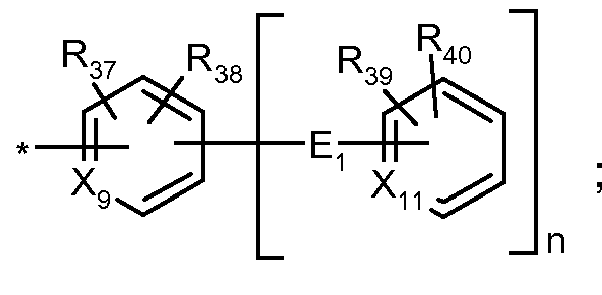

Very specially preferred is a method, wherein D+ is a radical of a cationic aromatic substituted or unsubstituted heterocyclic compound of formulae

the asterix * indicates the bond to Z4 and/or Z5 of formula (7); and
Q+ is a cationic bivalent radical of an aromatic heterocyclic compound of formulae

the asterix * indicates a bond to Z4 and/or Z5 of formula (8);
the asterix ** is a bond to Z1 and/or Z2 of formula (8); and
M is a bivalent radical of formulae (19)

the asterix * indicates the bond to Z4 or/and Z5 of formula (7);
the asterix ** indicates the bond to Z1 and/or Z2 of formula (7); and
T is a radical of the compounds of formulae (21)

the asterix * indicates the bond to Z4 and/or Z5 of compound of formula (8).
In the formulae (D9) - (D22) and (9) - (22)
X1, X2, X3, X4, X5, X6, X7, X8, X9, X10, X11, X12, X13, X14, X15 and X16 are independently from each other N or a radical of CR49,
Z6 is -O-; -S-; or a radical of NR50,
Z7, Z8, Z9, Z10, Z11, Z12, Z13 and Z14 are independently from each other N or a radical of CR51; E, E1, G and G1 are independently from each other -O-, -S-, -(SO2)-, -C1-C10alkylene or -(NR52)-;
R13, R14, R15, R18, R19, R21, R22, R23, R25, R26, R27, R28, R29, R30, R31, R32, R33, R34, R35, R36, R37, R38, R39, R40, R41, R42, R43, R44, R45, R46, R47, R48, R49 and R51 are independently from each other hydrogen; halogen; C1-C14alkyl, which is saturated or unsaturated, linear or branched, substituted or unsubstituted, or interrupted or uninterrupted with heteroatoms; a radical of phenyl, which substituted or unsubstituted; a of carboxylic acid radical; sulfonic acid radical; hydroxy; nitrile; C1-C16alkoxy, (poly)-hydroxy-C2-C4-alkoxy; halogen; sulfonylamino; SR60, NHR53; NR54R55; OR61; SO2; COOR62; NR56COR58; or CONR57; and
R12, R16, R17, R20, R24, R50, R52, R53, R54, R55, R56, R57, R58, R60, R61 and R62 are each independently of the other hydrogen; unsubstituted or substituted C1-C14alkyl, C2-C14alkenyl, C5-C10aryl, C5-C10aryl-(C1-C10alkyl), or -C1-C10alkyl(C5-C10aryl); and An is an anion. - Very especially most preferred is a method, wherein D+ is a radical of a cationic aromatic substituted or unsubstituted heterocyclic compound of formulae (23)


- * is a bond to Z4 and/or Z5 of formula (7); and
- * is a bond to Z4 and/or Z5 of formula (8);
- ** is a bond to and Z1 and/or Z2 of formula (8); and
- * is a bond to Z4 and/or Z5 of formula (7) or (8),
- ** is a bond to and Z1 and/or Z2 of formula (7) or (8); and
- Furthermore, very especially most preferred is a method, comprising disulfide dyes of formulae (35)

R63 is hydrogen; unsubstituted or substituted C1-C14alkyl; C5-C10cycloalkyl; C2-C14alkenyl; C5-C10aryl-(C1-C10alkyl); C1-C10alkyl-(C5-C10aryl); C5-C10aryl; and
R64 is hydrogen; unsubstituted or substituted, straight-chain or branched, interrupted or uninterrubted C1-C14alkyl, C5-C10cycloalkyl, C5-C10aryl, or C5-C10aryl-(C1-C10alkyl); C1-C10alkyl(C5-C10aryl);
R67 is hydrogen; or a radical of formula (35a)
R68 and R69 are each independently of the other hydrogen, unsubstituted or substituted C1-C14alkyl, C2-C14alkenyl, -C5-C10arylen-(C1-C10alkyl), -C1-C10alkylen(C5-C10aryl), C5-C10aryl,
R71 is hydrogen; unsubstituted or substituted C1-C14alkyl; C5-C10cycloalkyl; C2-C14alkenyl; C5-C10aryl; C1-C10alkyl-(C5-C10aryl); C5-C10aryl-(C1-C10alkyl);
R72 and R73 are each independently of the other hydrogen; C1-C14alkyl; C2-C14alkenyl; a radical of acarboxylic; a radical of a sulfonic acid; C5-C10aryl; hydroxy, nitril, C1-C16alkoxy, (poly)-hydroxy-C2-C4-alkoxy, carboxylic acid;; halogen; sulfonylamino; SR60; NHR53; NR54R55, OR61; COOR62; NR56COR58; or CONR57;
R53, R54, R55, R56, R57, R58, R60, R61 and R62 are each independently of the other hydrogen; unsubstituted or substituted C1-C14alkyl; C2-C14alkenyl; -C5-C10arylen-(C1-C10alkyl); -C1-C10alkylene(C5-C10aryl); orC5-C10aryl;
R76 and R77 are each independently of the other hydrogen, C1-C14alkyl, which is saturated or unsaturated, linear or branched, substituted or unsubstituted, or interrupted or uninterrupted with heteroatoms; a radical of phenyl, which substituted or unsubstituted; a radical of carboxylic acid; C5-C10aryl; a radical of hydroxy, nitril, C1-C16alkoxy, (poly)-hydroxy-C2-C4-alkoxy, carboxylic acid, sulfonic acid; halogen, sulfonylamino, SR60, NHR53 or NR54R55, OR61, SO2, COOR62, NR56COR58, CONR57;
R53, R54, R55, R56, R57, R58, R60, R61 and R62 are each independently of the other hydrogen, unsubstituted or substituted C1-C14alkyl, C2-C14alkenyl, -C5-C10arylen-(C1-C10alkyl), -C1-C10alkylen(C5-C10aryl), C5-C10aryl,
R79, R78 and R80 are each independently of the other hydrogen; C1-C14alkyl, which is saturated or unsaturated, linear or branched, substituted or unsubstituted, or interrupted or uninterrupted with heteroatoms; a radical of phenyl, which substituted or unsubstituted; a radical of carboxylic acid; C5-C10aryl; a radical of hydroxy, nitril, C1-C16alkoxy, (poly)-hydroxy-C2-C4-alkoxy; carboxylic acid; sulfonic acid; halogen; sulfonylamino; SR60; NHR53; NR54R55; OR61; SO2; COOR62; NR56COR58; or CONR57;
R53, R54, R55, R56, R57, R58, R60, R61 and R62 are each independently of the other hydrogen; unsubstituted or substituted C1-C14alkyl; C2-C14alkenyl; C5-C10arylene-(C1-C10alkyl), C1-C10alkylene(C5-C10aryl), C5-C10aryl; - More preferred are:
- compounds o formula (35), wherein R63 is methyl;
- compounds of formula (36), wherein R72 is hydrogen; and R72 is in the para-postion of the phenyl moiety;
- compounds of formula (37), wherein R76 is hydrogen; and R77 is in the para-postion of the phenyl moiety;
- compounds of formula (38), wherein R78 is hydrogen; and R79 is in the para-postion of the phenyl moiety.
- The compounds of formula
(1') R1-(Z1)r-Y1-S-Z3-⁅Y2-(Z2)q-R2]n wherein
R1 and R2 each independently from each other are a residue of an organic dye;
Y1 and Y2 independently from each other are C1-C10alkylene;
Z1 and Z2 independently from each other are -C(O)-; -C2-C12alkenylene-; -(CH2CH2-O)1-5-; C1-C10alkylene(C5-C10arylene); C5-C10arylene; C5-C10cycloalkylene, -C(O)O-, -OCO-;
R3, R4 and R5 are each independently from each other hydrogen; C1-C14alkyl; C2-C14alkenyl; C6-C10aryl; C1-C5alkyl-C5-C10aryl; or-C5-C10C5-C10aryl;
r, q and n independently from each other are 0; or 1,
if n is 0,
Z3 is hydrogen; and
if n is 1,
Z3 is -S-; are novel and represent another subject of the present inventio. - The present invention also relates to the novel compounds of formulae (35), (36), (37) and (38).
- Alkylene is generally C1-C10alkylene, for example methylene, ethylene, propylene, isopropylene, n-butylene, sec-butylene, tert-butylene, n-pentylene, 2-pentylene 3-pentylene, 2,2'-dimethylpropylene, cyclopentylene, cyclohexylene, n-hexylene, n-octylene, 1,1',3,3'-tetramethylbutylene, 2-ethylhexylene, nonylene or decylene.
- Alkylene may be straight-chain, branched, or, from C5alkyl upwards, monocyclic or polycyclic, and may be interrupted by hetero atoms, such as such as O, S, -CO-, N, NH, NR54,-OCO-, -CO(OR4)-, -CONR4-, -(R5)NC(O)-; for example C1-C10alkylene may be a resisue such as: -CH2CH2-O-CH2CH2-O-CH2CH2-, or -CH2CH2-O-CH2CH2-, -CH2CH2-O-CH2-, -CH2-O-CH2-, -CH2CH2-CH2CH2-O-CH2-CH2-, -CH2CH2-CH(N(CH3)2)-CH2-CH2-, CH2-NH2-CH2-CH2, or -CH2CH2-NH-CH2CH2-, -CH2CH2-NCH3-CH2CH2-, or -CO-CH2-, or -CH2CO-, or -CH2CH2-NHCO-CH2CH2-, or -CH2CH2-CONH-CH3-CH2CH2-, -CH2CH2-NCH3CO-CH2CH2-, or -CH2CH2-CONCH3-CH3-CH2CH2-, or -CH2-NHCO-CH2CH2-, or -CH2CH2-NHCO-CH2-, or -CH2CH2-CONH-CH2- or -CH2-CONH-CH2CH2-.
Arylene is generally C6-C10arylene; for example phenyl or naphthyl;
Aryl-alkylene is for example C5-C10aryl-C1-C10alkylene, C6-C10aryl-C1-C2alkylene,
alkyl-arylene is for example C1-C10alkyl-C5-C10arylene or C1-C2alkyl-C6-C10arylene. - C5-C10cycloalkylene is for example cyclopentylene, cyclohexylene, morpholylene or piperidinylene.
- In the present invention subsituents may be chosen from the following groups:
- hydroxyl, C1-C16alkyl, C5-C10aryl, C1-C16alkoxy, - COOH, sulfonic acid, sulfonylamino, -SR60, -OCO-, -COOR4, -CONR4, -(R5)NC(O), - S(O)-, -SO2, cyanide, nitrile, halide, aryl, aralkyl, alkylaryl and NR54R55, wherein
R4, R5, R54, R55 and R60 have the same defintion and preferences as given above. - C1-C16alkyl is for example, methyl, ethyl, propyl, isopropyl, n-butyl, sec-butyl, tert-butyl, n-pentyl, 2-pentyl, 3-pentyl, 2,2'-dimethylpropyl, cyclopentyl, cyclohexyl, n-hexyl, n-octyl, 1,1',3,3'-tetramethylbutyl or 2-ethylhexyl, nonyl, decyl, undecy, dodecyl, tredecyl, tetradecyl, pentadecyl or haxadecly.
- C1-C6alkoxy is O-C1-C6alkyl, preferably O-C1-C4alkyl.
- C5-C10aryl-C1-C10alkylene is, for example, phenyl-C1-C10alkylene or naphthyl-C1-C10alkylene.
- C6-C10aryl-C1-C2alkylene and C1-C2alkyl-C6-C10arylene are, for example, phenyl-C1-C10alkylene or naphthyl-C1-C10alkylen.
- Halide is, for example, fluoride, chloride, bromide or iodide, especially chloride and fluoride.
- "Anion" denotes, for example, an organic or inorganic anion, such as halide, preferably chloride and fluoride, sulfate, hydrogen sulfate, phosphate, boron tetrafluoride, carbonate, bicarbonate, oxalate or C1-C8alkyl sulfate, especially methyl sulfate or ethyl sulfate; anion also denotes lactate, formate, acetate, propionate or a complex anion, such as the zinc chloride double salt.
- The anion is especially a halide, preferably chloride or fluoride, sulfate, hydrogen sulfate, methyl sulfate, ethyl sulfate, phosphate, formate, acetate or lactate.
The anion is more especially fluoride, chloride, methyl sulfate, ethyl sulfate, formate or acetate. - In the present invention protein disulfidisomerase (EC 5.3.4.1) is an enzyme of the enzym category EC 5.3.4.1. These enzymes preferably catalyse the ismerisation of intermolecular and intramolecular disulfid-bonds in proteinis. The EC (Enzyme commission) number is provided from the " Nomenclature Committee of the International Uniion of Biochemistry and Molecular Biology" (IUBMB). A complete list of the characertized enzymes of the enzymens categories according to IUBMB is provided by data base of SwissProt under http://www.expasy.ch.
- In the present invention the residue of an organic dye is substituted or unsubstituted.
- In the present invention biradical or radical of a heterocyclic compound is for example a biradical or radical of thiophenyl, 1,3-thiazolyl, 1,2-thiazolyl, 1,3-benzothiazolyl, 2,3-benzothiazolyl, imidazolyl, 1,3,4-thiadiazolyl, 1,3,5-thiadiazolyl, 1,3,4-triazolyl, pyrazolyl, benzimidazolyl, benzopyrazolyl, pyridinyl, quinolinyl, pyrimidinyl and isoxazolyl.
- Preferred biradical or radical of a heterocyclic compound is for example 1,3-thiazolyl, 1,2-thiazolyl, 1,3-benzothiazolyl, 2,3-benzothiazolyl, imidazolyl, 1,3,4-thiadiazolyl, 1,3,5-thiadiazolyl, 1,3,4-triazolyl, pyrazolyl, benzimidazolyl, benzopyrazolyl, pyridinyl, quinolinyl, pyrimidinyl and isoxazolyl. More preferred cationic heterocyclic compounds are imidazolyl, pyridinyl, 1,3,4-triazolyl and 1,3-thiazolyl.
- In the present invention a biradical or radical of an aromatic compound is for example phenyl, naphthyl, thiophenyl, 1,3-thiazolyl, 1,2-thiazolyl, 1,3-benzothiazolyl, 2,3-benzothiazolyl, imidazolyl, 1,3,4-thiadiazolyl, 1,3,5-thiadiazolyl, 1,3,4-triazolyl, pyrazolyl, benzimidazolyl, benzopyrazolyl, pyridinyl, quinolinyl, pyrimidinyl and isoxazolyl, aminodiphenyl, aminodiphenylether or azobenzenyl.
- The biradical or radical of a heterocyclic or aromatic compound is unsubstituted or mono- or poly-substituted, for example by C1-C4alkyl, C1-C4alkoxy, C1-C4alkylthio, halogen, e.g. fluorine, bromine or chlorine, nitro, trifluoromethyl, CN, SCN, C1-C4alkylsulfonyl, phenylsulfonyl, benzylsulfonyl, di-C1-C4alkylaminosulfonyl, C1-C4alkyl-carbonylamino, C1-C4alkoxysulfonyl or by di-(hydroxy-C1-C4alkyl)-aminosulfonyl.
- A further emodiment of the present inveintion relates to processes for the preparation of the dyes of formula (1).
- Generally, the process-comprises a nucleophilic substitution of an organic compound by a sulfide and/or disulfide derivative containing at least one nucleophil group, or
a electrophilic substitution of an organic compound by a sulfid and/or disulfid derivative containing at least one electrophilic groups. - A preferred process for the preparation comprises reacting a compound of formula (1 a) with the compound of formula (1 b) according to the following reaction scheme:

- A further preferred process for the preparation of compounds of formula (1) comprises reacting a compound of formula (1 c) with the compound of formula (1 d) according to the following reaction scheme:

L1 is a leaving group; and
R1, R2, Z1, Z2, Z3, Y1, Y2, r, q and n are defined as in formula (1). - The reaction is generally initiated by contacting; for example by mixing together the starting compounds or by dropwise addition of one starting compound to the other.
- Customary, the temperature is in the range of 273 to 300 K, preferably is in the range of 290 to 300 K during the mixing of the starting compounds.
- The reaction time is generally dependent on the reactivity of the starting compounds, on the reaction temperature chosen and on the desired conversion. The chosen duration of reaction is usually in the range from one hour to three days.
- The reaction temperature for the reaction of the compounds is advisable to select in the range from 273 to 340K, especially in the range from 273 to 335K.
- The reaction pressure chosen is generally in the range from 70 kPa to 10 MPa, especially from 90 kPa to 5 MPa, and is more especially atmospheric pressure.
- It may by desirable to conduct the reaction of compounds in the presence of a catalyst.
- The molar ratio of compound of formula (1 a) to the catalyst is generally selected in the range from 10:1 to 1:5, especially in the range from 10:1 to 1:1.
- Suitable catalysts are for example an alkali metal C1-C6alkyloxide, such as sodium-, potassium or lithium C1-C6alkyloxide, preferably sodium methoxide, potassium methoxide or lithium methoxide, or sodium ethoxide, potassium ethoxide or lithium ethoxide; or tertiary amines, for example, such as chinuclidine, N-methylpiperidine, pyridine, trimethylamine, triethylamine, trioctylamine, 1,4-diazabicyclo[2.2.2]octan, chinuclidine, N-methylpiperidine; or alkalimetal acetate, for example such as sodium acetate, potassium acetate, or lithium acetate.
Preferred are potassium acetate, sodium methoxide, pyridine and 1,4-diazabicyclo[2.2.2]-octan. - In addition, the reaction may be carried out with or without a solvent, but is preferably carried out in the presence of a solvent, preferably organic solvents or solvent mixtures.
- Solvents are organic solvents and water, or a mixture of organic solvents or a mixture of organic solvents and water.
- Organic solvents are for example, protic or aprotic polar organic solvents, such as alcohols, for example methanol, ethanol, n-propanol, isopropanol, butanol or glycols, especially isopropanol, or nitrile, such as acetonitrile or propionitrile, or amide, such as dimethylformamide, dimethylacetamide or N-methylpyridine, N-methylpyrolidon, or sulfoxide, such as dimethylsulfoxide, or mixtures thereof.
- The product prepared according to the process of the present invention may be advantageously worked up and isolated, and if desired be purified.
- Customary, the work up starts by decreasing the temperature of the reaction mixture in the range from 280 to 300 K, especially in the range from 290 to 300 K.
- It may be of advantageous to decrease the temperature slowly, over a period of several hours.
- In general, the reaction product is usually filtered and then washed with water or a salt solution and subsequently dried.
- Filtration is normally carried out in standard filtering equipment, for example Büchner funnels, filter presses, pressurised suction filters, preferably in vacuo.
- The temperature for the drying is dependent on the pressure applied. Drying is usually carried out in vacuo at 50-200 mbar.
- The drying is usually carried out at a temperature in the range from 313 to 363 K, especially from 323 to 353 K, and more especially in the range from 328 to 348 K.
- Advantageously the product is purified by recrystallisation after isolation.
- Organic solvents and solvent mixtures are suitable for the recrystallisation, preferably alcohols, for example methanol, ethanol, 2-propanol or butanol, especially 2-propanol.
- The present invention also relates to a process for the preparation of compounds of formula

- a. acylating of 4-fluoro-3-nitroaniline with an acylating agent as shown in the above formula
- b. hen reducing the nitro group to the amino group,
- c. then diazotizing the acylated 4-Fluoro-3-amino-aniline, and
- d. then coupling the diazotized with imidazole, and
- e. then alkylating the intermediate compound with an alkylating agent; or
- a1) diazotizing and coupling of a compound of formula, and then
- b1) alkylating the intermediate compound with an alkylating agent

- The acylation, reduction, diazotation, coupling and alkylation can be conducted by methods known per se.
- The dyes of formula (1) according to the invention are suitable for dyeing organic materials, such as keratin-containing fibers, wool, leather, silk, cellulose or polyamides, cotton or nylon, and preferably human hair. The dyeings obtained are distinguished by their depth of shade and their good fastness properties to washing, such as, for example, fastness to light, shampooing and rubbing. The stability, in particular the storage stability of the dyes according to the invention are excellent.
- The multiplicity of shades of the dyes can be increased by combination with other dyes.
- Therefore the dyes of formula (1) of the present invention may be combined with dyes of the same or other classes of dyes, especially with direct dyes, oxidation dyes; dye precursor combinations of a coupler compound as well as a diazotized compound, or a capped diazotized compound; and/or cationic reactive dyes.
- Direct dyes are of natural origin or may be prepared synthetically. They are uncharged, cationic or anionic, such as acid dyes.
- The dyes of formula (1) may be used in combination with at least one single direct dye different from the dyes of formula (1).
- Examples of direct dyes are described in "Dermatology", edited by Ch. Culnan, H. Maibach, Verlag Marcel Dekker Inc., New York, Basle, 1986, Vol. 7, Ch. Zviak, The Science of Hair Care, chapter 7, p. 248-250, and in "Europäisches Inventar der Kosmetikrohstoffe", 1996, published by The European Commission, obtainable in diskette form from the Bundesverband der deutschen Industrie- und Handelsunternehmen für Arzneimittel, Reformwaren und Körperpflegemittel e.V., Mannheim.
- Furthermore, cationic nitroaniline and anthraquinone dyes are useful for a combination with a dye of formula (1).
- The dyes of formula (1) may also be combined with acid dyes, for example the dyes which are known from the international names (Color index), or trade names.
- These acid dyes may be used either as single component or in any combination thereof.
- The dyes of formula (1) may also be combined with uncharged dyes, for example selected from the group of the nitroanilines, nitrophenylenediamines, nitroaminophenols, anthraquinones, indophenols, phenazines, phenothiazines, bispyrazolons, bispyrazol aza derivatives and methines.
- Furthermore, the dyes of formula (1) may also be used in combination with oxidation dye systems.
- Oxidation dyes, which, in the initial state, are not dyes but dye precursors are classified according to their chemical properties into developer and coupler compounds.
- Suitable oxidation dyes are described for example in
-DE 19 959 479 , especially in col 2, I. 6 to col 3, I. 11;
- "Dermatology", edited by Ch. Culnan, H. Maibach, Verlag Marcel Dekker Inc., New York, Basle, 1986, Vol. 7, Ch. Zviak, The Science of Hair Care, chapter 8, on p. 264 - 267 (oxidation dyes). - Preferred developer compounds are for example primary aromatic amines, which are substituted in the para- or ortho- position with a substituted or unsubstituted hydroxy- or amino residue, or diaminopyridine derivatives, heterocyclic hydrazones, 4-aminopyrazol derivatives or 2,4,5,6-tetraaminopyrimidine derivatives.
- Furthermore, developer compounds in their physiological compatible acid addition salt form, such as hydrochloride or sulfate can be used. Developer compounds, which have aromatic OH radicals are also suitable in their salt form together with a base, such as alkali metalphenolates.
- Preferred developer compounds are disclosed in
DE 19959479 , p. 2, I. 8 - 29. - Preferred coupler compounds are m-phenylendiamine derivatives, naphthole, resorcine and resorcine derivatives, pyrazolone and m-aminophenol derivatives, and most preferably the coupler compounds disclosed in
DE 19959479 , p.1, I. 33 to p. 3, I. 11. - Furthermore, autooxidizable compounds may be used in combination with the dyes of formula (1).
- Autooxidizable compounds are aromatic compounds with more than two substituents in the aomatic ring, which have a very low redox potential and will therefore be oxidized when exposed to the air. The dyeings obtained with these compounds are very stable and resistant to schampoo.
- Autooxidizable compounds are for example benzene, indol, or indol, especially 5,6-dihydroxyindol or 5,6-dihydroxyindol.
- The dyes of formula (1) may also be used in combination with naturally occurring dyes, such ashenna red, henna neutral, henna black, camomile blossom, sandalwood, black tea, Rhamnus frangula bark, sage, campeche wood, madder root, catechu, sedre and alkanet root.
- Furthermore, the dyes of formula (1) may also be used in combination with capped diazotised compounds.
- Suitable diazotised compounds are for example the compounds of formulae (1) - (4) in
WO 2004/019897 (bridging gages 1 and 2) and the corresponding watersoluble coupling components (I) -(IV) as disclosed in the same reference on p. 3 to - Further preferred dyes or dye combinations which are useful for the combination with a dye of formula (1) according to the present invention are described in
(DC-01):WO 95/01772
(DC-02):US 6,843,256 , wherein cationic dyes are disclosed, especially the compounds of formulae (1), (2), (3) and (4) (col. 1, I. 27 - col. 3, I. 20, and preferably the compounds as prepared in the examples 1 to 4 (col. 10, I.42 to col. 13, I. 37; formulations col. 13, I. 38 to col. 15, I. 8;
(DC-03):EP 970 685
(DC-04):DE-A-19 713 698 , wherein direct dyes are described, especially p. 2, I. 61 to p. 3, I. 43; formulations p. 5, I. 26 to 60;
(DC-05):US 6,368,360 , wherein directd dyes (col. 4, I. 1 to col. 6, I. 31) and oxidizing agents (col. 6, I. 37 -39) are disclosed; formulations col. 7, I. 47 to col. 9, I. 4;
(DC-06):EP 1 166 752 , wherein cationic dyes (p. 3, I. 22 - p. 4, I. 15) and anionic UV-absorbers (p. 4, I. 27 - 30) are disclosed; formulations p. 7, I. 50 - p. 9, I. 56;
(DC-07):EP 998,908
(DC-08):FR-2788432
(DC-09):DE-A-19 713 698 , wherein the combinations of direct dyes and permanent-wave fixing comprising an oxidation agent, an oxidation dye and a direct dye are disclosed; especially p. 4, I. 65 to p. 5, I. 59;
(DC-10):EP 850 638
(DC-11):US 6,190,421 wherein extemporaneous mixtures of a composition (A) containing one or more oxidation dye precursors and optionally one or more couplers, of a composition (B), in powder form, containing one or more direct dyes (col. 5, I. 40 - col. 7, I. 14), optionally dispersed in an organic pulverulent excipient and/or a mineral pulverulent excipient, and a composition (C) containing one or more oxidizing agents are disclosed; formulations col. 8, I. 60 - col. 9, I. 56;
(DC-12):US 6,228,129 , wherein a ready-to-use composition comprising at least one oxidation base, at least one cationic direct dye and at least one enzyme of the 2-electron oxidoreductase type in the presence of at least one donor for the said enzyme are disclosed; especially col. 8, I. 17 - col. 13, I. 65; dyeing formulations in col. 2, I. 16 to col. 25, I. 55, a multi-compartment dyeing device is described in col. 26, I. 13 - 24;
(DC-13):WO 99/20235
(DC-14):WO 99/20234
(DC-15):EP 850 636
(DC-16):EP-A-850 637
(DC-17):WO 99/48856
(DC-18):DE 197 172 24 , wherein dyeing agents comprising unsaturated aldehydes and coupler compounds and primary and secondary amino group compounds, nitrogen-containing heterocyclic compounds, amino acids, oligopeptids, aromatic hydroxy compounds, and/or at least one CH-active compound are disclosed p. 3, I. 42 - p. 5 I. 25; dyeing formulations p. 8, I. 25 - p. 9, I. 61. - In the dye combinations disclosed in the references (DC-01 - DC-18) above, the dyes of formula (1) according to the present invention may be added to the dye combinations or dyeing formulations or may be replaced with at least one dye of formula (1).
- The present invention also releates to formulations, which are used for the dyeing of organic materials, preferably keratin-containing fibers, and most preferably human hair, comprising at least one dye of formula (1).
- Preferably the dyes of formula (1) are incorporated into the composition for treating organic material, preferably for dyeing in amounts of 0.001 - 5% b.w. (hereinafter indicated merely by "%"), particularly 0.005 - 4%, more particularly 0.2 - 3%, based on the total weight of the composition.
- The formulations may be applied on the keratin-containing fiber, preferably the human hair in different technical forms.
- Technical forms of formulations are for example a solution, especially a thickened aqueous or aqueous alcoholic solution, a cream, foam, shampoo, powder, gel, or emulsion.
- Customary the dyeing compositions are applied to the keratin-containing fiber in an amount of 50 to 100 g.
- Preferred forms of formulations are ready-to-use compositions or multi-compartment dyeing devices or 'kits' or any of the multi-compartment packaging systems with compartments as described for example in
US 6,190,421 , col 2, I. 16 to 31. - The pH value of the ready-to-use dyeing compositions is usually from 2 to 11, preferably from 5 to 10.
- One preferred embodiment of the present invention relates to the formulation of dyes, wherein the dyes of formula (1) are in powder form.
- Powder formulations are preferably used if stability and/or solubility problems as for example described in
DE 197 13 698 , p. 2, I. 26 to 54 and p. 3, I. 51 to p. 4, I. 25, and p. 4, I. 41 to p. 5 I. 59. - Suitable cosmetic hair-care formulations are hair-treatment preparations, e.g. hair-washing preparations in the form of shampoos and conditioners, hair-care preparations, e.g. pretreatment preparations or leave-on products such as sprays, creams, gels, lotions, mousses and oils, hair tonics, styling creams, styling gels, pomades, hair rinses, treatment packs, intensive hair treatments, hair-structuring preparations, e.g. hair-waving preparations for permanent waves (hot wave, mild wave, cold wave), hair-straightening preparations, liquid hair-setting preparations, hair foams, hairsprays, bleaching preparations, e.g. hydrogen peroxide solutions, lightening shampoos, bleaching creams, bleaching powders, bleaching pastes or oils, temporary, semi-permanent or permanent hair colorants, preparations containing self-oxidizing dyes, or natural hair colorants, such as henna or camomile.
- For use on human hair, the dyeing compositions of the present invention can usually be incorporated into an aqueous cosmetic carrier. Suitable aqueous cosmetic carriers include, for example W/O, O/W, O/W/O, W/O/W or PIT emulsions and all kinds of microemulsions, creams, sprays, emulsions, gels, powders and also surfactant-containing foaming solutions, e.g. shampoos or other preparations, that are suitable for use on keratin-containing fibers. Such forms of use are described in detail in Research Disclosure 42448 (August 1999). If necessary, it is also possible to incorporate the dyeing compositions into anhydrous carriers, as described, for example, in
US-3 369 970 , especially col 1, I. 70 to col 3, I. 55. The dyeing compositions according to the invention are also excellently suitable for the dyeing method described inDE-A-3 829 870 using a dyeing comb or a dyeing brush. - The constituents of the aqueous carrier are present in the dyeing compositions of the present invention in the customary amounts, for example emulsifiers may be present in the dyeing compositions in concentrations from 0.5 to 30 % b.w. and thickeners in concentrations from 0.1 to 25 % b.w. of the total dyeing composition.
- Further carriers for dying compositions are for example described in "Dermatology", edited by Ch. Culnan, H. Maibach, Verlag Marcel Dekker Inc., New York, Basle, 1986, Vol. 7, Ch. Zviak, The Science of Hair Care, chapter 7, p. 248-250, especially on p. 243, I. 1 to p. 244, I. 12.
- The dyes of formula (1) may be stored in a liquid to paste-like preparation (aqueous or nonaqueous) or in the form of a dry powder.
- When the dyes and adjuvants are stored together in a liquid preparation, the preparation should be substantially anhydrous in order to reduce reaction of the compounds.
- The dyeing compositions according to the invention may comprise any active ingredients, additives or adjuvants known for such preparations, like surfactants, solvents, bases, acids, perfumes, polymeric adjuvants, thickeners and light stabilisers.
- The following adjuavents are preferably used in the hair dyeing compositions of the present invention: non-ionic polymers, cationic polymers, acrylamide/dimethyldiallylammonium chloride copolymers, quaternised polyvinyl alcohol, zwitterionic and amphoteric polymers, anionic polymers, thickeners, structuring agents, hair-conditioning compounds, protein hydrolysates, perfume oils, dimethyl isosorbitol and cyclodextrins, solubilisers, anti-dandruff active ingredients, substances for adjusting the pH value; panthenol, pantothenic acid, allantoin, pyrrolidonecarboxylic acids and salts thereof, plant extracts and vitamins; cholesterol; light stabilisers and UV absorbers, consistency regulators, fats and waxes, fatty alkanolamides, polyethylene glycols and polypropylene glycols, complexing agents, swelling and penetration substances, opacifiers, such as latex; pearlising agents, propellants, antioxidants; sugar-containing polymers,quaternary ammonium salts, or bacteria inhibiting agents,.
- The dyeing compositions according to the present invention generally comprise at least one surfactant. Suitable surfactants are zwitterionic or ampholytic, or more preferably anionic, non-ionic and/or cationic surfactants.
- Suitable anionic surfactants are characterised by an anionic group that imparts water solubility, for example a carboxylate, sulfate, sulfonate or phosphate group, and a lipophilic alkyl group having approximately 10 to 22 carbon atoms. In addition, glycol or polyglycol ether groups, ester, ether and amide groups and also hydroxy groups may be present in the molecule.
- Preferred anionic surfactants are alkyl sulfates, alkyl polyglycol ether sulfates and ether carboxylic acids having 10 to 18 carbon atoms in the alkyl group and up to 12 glycol ether groups in the molecule, and also especially salts of saturated and especially unsaturated C8-C22carboxylic acids, such as oleic acid, stearic acid, isostearic acid and palmitic acid.
- Surface-active compounds that carry at least one quaternary ammonium group and at least one -COO- or -SO3 - group in the molecule are terminated zwitterionic surfactants. Preference is given the so-called betaines, such as the N-alkylN,N-dimethylammonium glycinates, for example cocoalkyldimethylammonium glycinate, N-acylaminopropyl-N,N-dimethylammonium glycinates, for example cocoacylaminopropyldimethylammonium glycinate, and 2-alkyl-3-carboxymethyl-3-hydroxyethylimidazol. having from 8 to 18 carbon atoms in the alkyl or acyl group and also cocoacylaminoethylhydroxyethylcarboxymethyl glycinate. A preferred zwitterionic surfactant is the fatty acid amide derivative known by the CTFA name cocoamidopropyl betaine.
- Ampholytic surfactants are surface-active compounds that, in addition to a C8-C18-alkyl or - acyl group and contain at least one free amino group and at least one -COOH or -SO3H group in the molecule and are capable of forming internal salts. Examples of suitable ampholytic surfactants include N-alkylglycines, N-alkylpropionic acids, N-alkylaminobutyric acids, N-alkyliminodipropionic acids, N-hydroxyethyl-N-alkylamidopropylglycines, N-alkyltaurines, N-alkylsarcosines, 2-alkylaminopropionic acids and alkylaminoacetic acids, each having approximately from 8 to 18 carbon atoms in the alkyl group. Ampholytic surfactants to which special preference is given are N-cocoalkylaminopropionate, cocoacylaminoethylaminopropionate and C12-C18acylsarcosine.
- Suitable non-ionic surfactants are described in
WO 00/10519 - Examples of cationic surfactants that can be used in the dyeing compositions according to the invention are especially quaternary ammonium compounds.
Alkylamidoamines, especially fatty acid amidoamines, such as the stearylamidopropyl-dimethylamine obtainable under the name Tego Amid® 18 are alos preffered as surfactants in the present dyeing compositions. They are distinguished not only by a good conditioning action but also especially by their good biodegradability. - A further preferred embodiment of the present invention relates to a method of treating keratin-containig fibers with sulfide dyes of formula (1).
- The method comprises treating the hair in the presence of a reduction agent.
- Preferred reduction agents are for example thioglycol acid or salts therof, gycerine monothioglycolat, cystein, 2-mercaptopropionic acid, 2-mercaptoethylamine, thiolactic acid, thioglycerine, sodium sulfite, dithionithe, ammonium sulfite, sodium bisulfite, sodium metabisulfite or hydrochinon.
- In addition, the present invention relates to a method of
- a. treating the keratin-containing fibers with a compound of formula (1),
- b. wearing the coloured hair for the desired period of time,
- c. removing the colour applied in step a) from hair by contacting the hair with an aqueous based colour removal composition containg a reduction agent capable of disrupting the - S-S-bonds between the dye molecule and the hair fiber surface to cause the dye molcule to become disassociated from the hair fiber.
- Further, the present invention concerns a process, comprising treating the hair with
- a. a reduction agent, and
- b. at least a single sulfide dye of formula (1) as defined above, and optionally
- c. with an oxidizing agent.
- The sequence of the reaction steps is generally not important, the reduction agent can be applied first or in a final step.
- Preferred is a process, which comprises treating the hair
- a1) with at least one single dye of formula (1), and
- b1) then with a reduction agent; or
- a process, which comprises contacting hair
- a2) with a reduction agent and
- b2) then with at least one single sulfide dye of formula (1) as defined above.
- In the present invention preferred is further a process, which comprises contacting hair
- a) with a reduction agent,
- b) then with at least one dye of formula (1), and
- c) then with an oxidizing agent.
- A further process of the present invention comprises contacting hair
- a) with at least one single dye of formula (1), and
- b) then with a reduction agent, and
- c) then with an oxidizing agent.
- Usally, the oxidizing agent is applied together with an acid or a base.
- The acid is for example citric acid, phosphoric acid or tartrate acid.
The base is for example sodium hydroxide, ammonia or monoethanolamine. - Usually, the dyeing compositions are applied to the keratin-containg fiber in an amount of from 50 to 100 g.
- The dyes of formula (1) are suitable for all-over dyeing of the hair, that is to say when dyeing the hair on a first occasion, and also for re-dyeing subsequently, or dyeing of locks or parts of the hair.
- The dyes of formula (1) are applied te on the hair for example by massage with the hand, a comb, a brush, or a bottle, or a bottle, which is combined with a comb or a nozzle.
- In the processes for dyeing according to the invention, whether or not dyeing is to be carried out in the presence of a further dye will depend upon the color shade to be obtained.
- Further preferred is a process for dyeing keratin-containing fibers which comprises treating the keratin-containing fiber with at least one dye of formula (1), a base and an oxidizing agent.
- The oxidation dyeing process usually involves lightening, that is to say that it involves applying to the keratin-containing fibers, at basic pH, a mixture of bases and aqueous hydrogen peroxide solution, leaving the applied mixture to stand on the hair and then rinsing the hair. It allows, particularly in the case of hair dyeing, the melanin to be lightened and the hair to be dyed.
- In general, the oxidizing agent containing composition is left on the fiber for 0 to 15 minutes, in particular for 0 to 5 minutes at 15 to 45°C, usually in amounts of 30 to 200 g.
- Oxidizing agents are for example persulfate or dilute hydrogen peroxide solutions, hydrogen peroxide emulsions or hydrogen peroxide gels, alkal. earth metal peroxides, organic peroxides, such as urea peroxides, melamine peroxides, or alkalimetalbromat fixations are also applicable if a shading powder on the basis of semi-permanent, direct hair dyes is used.
- Most preferred oxidizing agent is hydrogen peroxide, preferably used in a concentration from about 2 to 30 %, more preferably about 3 to 20% by, and most preferably from 6 to 12% b.w. the corresponding composition.
- The oxidizing agents may be present in the dyeing compositions according to the invention preferably in an amount from 0.01 % to 6 %, especially from 0.01 % to 1 %, based on the total dyeing composition.
- In general, the dyeing with an oxidative agent is carried out in the presence of a base, for example ammonia, alkali metal carbonates, earth metal (potassium or lithium) carbonates, alkanol amines, such as mono-, di- or triethanolamine, alkali metal (sodium) hydroxides, earth metal hydroxides or compounds of the formula

R is a propylene residue, which may be substituted with OH or C1-C4alkyl,
R3, R4, R5 and R6 are independently or dependently from each other hydrogen, C1-C4alkyl or hydroxy-(C1-C4)alkyl. - The pH-value of the oxidizing agent containing composition is usually about 2 to 7, and in particular about 2 to 5.
- One preferred method of applying formulations comprising the dyes of formula (1) on the keratin-containing fiber, preferably the hair is by using a multi-compartment dyeing device or "kit" or any other multi-compartment packaging system, as described for example in
WO 97/20545 - Furthermore, the present invention relates to a process of dyeing of keratin-containig fibers of the dyes of formula (1) with autooxidable compounds and optionally further dyes.
- Furthermore, the present invention relates to a process for dyeing keratin-containig fibers with the dyes of formula (1) and at least one acid dye.
- The following Examples serve to illustrate the processes for dyeing without limiting the processes thereto. Unless specified otherwise, parts and percentages relate to weight. The amounts of dye specified are relative to the material being coloured.
T, s, d, q and J, wherein t is a triplett, s is singulett, d is duplett, q is a quartett, and J is a coupling constant, define the NMRspectra values. -
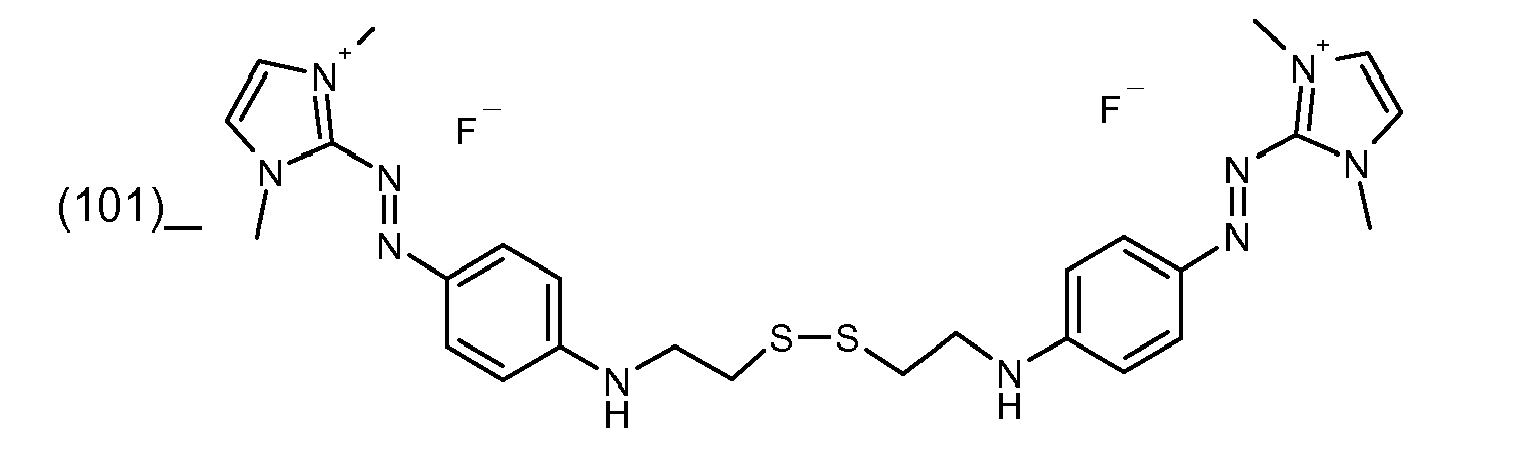
The reaction is allowed to stand for one more hour to finish the hydrolysis of excess of dimethyl sulfate.
100 g sodium chloride and 50 g potassium chloride are added at 273K and allowed to stand for 16 hours. The product is separated by filtration and washed with a cold solution of sodium /potassium chloride. About 20g of the compound of formula
-
7.924 d 7.3 3.95 phenylen 7.5109 S 3.82 imidazol 6.857 d 7.8 3.96 phenylen 4.038 s 12.06 dimethyl 3.595 t 3.982 methylen 2.925 t 4.00 methylen -

About 40 g humid solid, which gives 27 g of dryed product of the formula
- The product is characterized by 1H-NMR Data in deuterated methanol (128 scans)/ 360MHz:
8.002 ddd J = 7.6;J=7.5; j =1.4 1.029 7.893 s 2.00 imidazol 7.812 m J = 8.6, J = 6.7, 0.99 J = 1.4 7.505 ddd J = 8.6 1.06 7.436 t 0.949 4.211 s 5.78 dimethyl of imidazol 3.69 s 4.01 methy of monomethylsulfate - 11g cisteamin chlorohydrate are added to 27g of compound of formula (102a) in 20 g triethylamine and 120g isopropanol under nitrogen atmosphere at 293 K, .The temperature is raised to 333 K. The reaction mixture is stirred for 28 hours at this temperature. Then the reaction mass is stirred for 4 hours while the temperature is decreased to 295 K. The reaction mass is filtered off and the filter residue washed with 45 ml isopropanol and dried in vacuum to obtain 17.6 g of product f formula (102).
- The product is characterized by 1H-NMR Data in deuterated methanol (128 scans)/ 360MHz:
7.78 dd J = 8.6; 2.07 J =1.4 7.620 s 4.00 imidazol 7.498 m J = 8.6; J = 6.7 1.968 J = 1.4 7.083 d J = 8.6 1.875 6.831 m 1.938 4.057 s 12.08 dimethyl of dmidazol 3.846 t 6 3.75 methylene 3.69 s 4.01 methy of monomethylsulfate 3.109 t 6 3.95 methylene -

The dried material is dissolved in 132 ml water and 110 ml of 32% hydrochloric acid at 295 K. The reaction mixture is cooled to 273 K and 86.4 g 36% sodium nitrite solution are dropped at such a rate that the temperature of the mixture is maintained in the range of 273 to 276 K. The mixture is further stirred for one hour. If no excess of nitrite is detected during one hour (detection by using a potassium iodide/starch paper) further amounts of sodium nitrite solution are added. After this one hour the remaining excess of nitrite is destroyed with sulfamic acid. Then the obtained diazo solution is dropped to a 273 K cold solution of 33.4 g imidazole in 130 ml water, whereby the pH of the solution is maintained in the range of pH 10 to 11 by adding 36% of a sodium hydroxide solution. After completing the diazo addition, the obtained suspension is warmed up to 295 K and the pH is adjusted to 10.5 with 36% sodium hydroxide solution. After stirring for one hour at this pH and temperature the suspension is filtered off and then washed twice with 100 ml water to obtain 200 g of the humid product. The filtercake from the previouse step is suspended in water and 3 weight equivalents dimethylsulfate and sodium hydroxide are simultaniously added for maintaining the pH in the range of 10-10.3 and the temperature at 300 K. Then the reaction mixture is hold for one more hour to finish the hydrolysis of excess of dimethylsulfate. Then the suspension is separated by filtration. About 240 g of a humid solid which gives 140 g dryed product of formula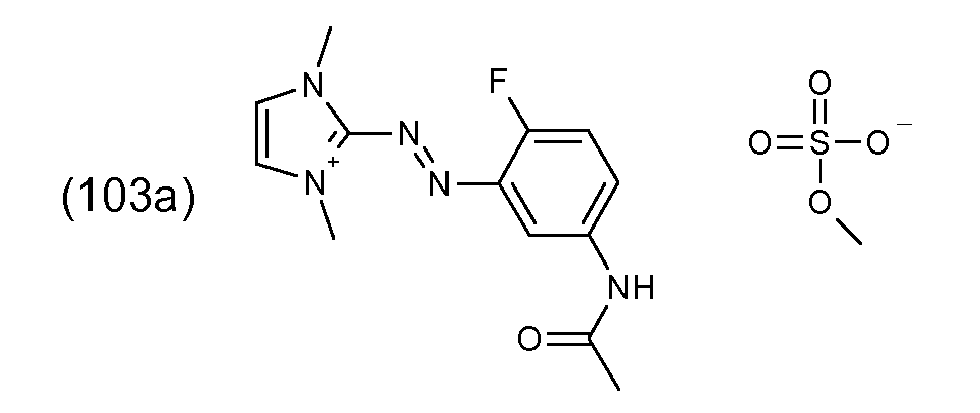
38.8 g of the product of formula (1 03a) are added to a stirred mixture of 10.6 g of cisteamin chlorohydrate in 15 g triethylamine and 70g acetonitrile under nitrogen atmosphere at 293 K. The temperature is maintained at 273 K. The reaction mixture is stirred for 20 hours at this temperature. The reaction mass is filtered off and the filter residue washed with 45 ml of acetonitrile and dried in vacuum to obtain 42 g of product of formula (103). -
8.11 d,J=1.7 2,00 orto 7.6 d,d, J = 8.6;J =1.4 6,06 para 7.57 s imidazol 7.00 d, J=9.5 2,04 meta 4.03 s 12,22 methyl 3.860 t 3,89 methylene 3.69 s 6,44 methylsulfate 3.109 t 4,28 methylene 2.14 s 6.22 acetyl -

The dried material is dissolved in 132 ml water and 110 ml of 32% hydrochloric acid at 295 K. Then the reaction mixture is cooled to 273 K and 86.4 g 36% sodium nitrite solution is dropped at such a rate that the temperature of the mixture is maintained in the range of 273 to 276 K. After the addition of the sodium nitrite solution, the mixture is stirred for one hour. If no excess of nitrite is detected during one hour (detection by using a potassium iodide/starch paper), further amounts of sodium nitrite solution is added. After this one hour the remaining excess of nitrite is destroyed with sulfamic acid. Then, the obtained diazo solution is dropped to a 273 K cold solution of 33.4 g imidazole in 130 ml water, whereby the pH of the solution is maintained in the range of pH 10 to 11 by adding 36% sodium hydroxide solution. After completing the diazo addition, the obtained suspension is warmed up to 295 K, the pH is adjusted to 10.5 with 36% sodium hydroxide solution. After one hour stirring at this pH and temperature, the suspension is filtrated and then washed twice with 100 ml water to obtain 200 g of the humid product
Then, the filtercake from the previouse step is suspended in water and 3 weight equivalents dimethylsulphate and sodium hydroxide simoultaniously added for maintaining the pH in the range of 10-10.3 and the temperature at 300 K. Then, the reaction mixture is hold for one more hour, to finish the hydrolysis of excess of dimethylsulphate. Then, the suspension is separated by filtration. About 240 g humid solid, which gives 140 g dryed product of formula
Residue of compound 8.415 d, J = 2.7; 6.6 0.95 ortho coupling 7.889 s 2.00 imidazol 7.820 d,d,d; 0.98 para coupling 7.468 d,d J = 9.5: 9.5 1.04 meta coupling 4.203 s 6.22 methyl 3.69 s 3.00 methylsulfat 2.175 q 2.22 propionyl 1.20 t 3.28 propionyl
Characterization by 1H-NMR Data in deuterated methanol (128 scans)/ 360MHzResidue of compound (104) 8.11 d,J=1.7 2.00 ortho coupling 7.6 overlaid d,d, J = 8.6; J =1.4 6.06 para coupling 7.57 s imidazol 7.00 d, j = 9.5 2.04 meta coupling 4.03 s 12.22 methyl 3.860 t 3.89 methylene 3.69 s 6.44 methylsulfate 3.1o9 t 4.28 methylene 2.14 q 4.22 propionyl 1.20 t 6.27 propionyl -

About 240 g of a humid solid, which gives 140 g dry product of the following formula
Characterizeation by 1H-NMR Data in deuterated methanol (128 scans)/ 360MHzResidue of compound 8.415 D, j = 2.7; 6.6 0.95 ortho coupling 7.889 s 2.00 Imidazol 7.820 d,d,d; 0.98 para coupling 7.468 D,d j = 9.5: 9.5 1.04 meta coupling 4.203 s 6.22 methyl 3.69 s 3.oo methylsulfat Residue of compound 8.11 d,j=1.7 2.00 ortho coupling 7.6 overlaid d,d, J = 8.6; j =1.4 6.06 para coupling 7.57 S Imidazol coupling 7.00 d, j = 9.5 2.04 meta coupling 4.03 s 12.22 methyl 3.860 t 3.89 methylene 3.69 s 6.44 methylsulfat 3.1o9 t 4.28 methylene -

- 1.Formation of the Hydrazone: 14 g sulfuric acid are added to 42 g of water and cooled to 293K. 24 g of N-methyl-phenyl hydrazine (100%) are added with stirring. 24.5 g of 4-pyridine-aldehyde are dropped in during 15 minutes and stirring is continued for 1 hour. The pH is raised to 2.2 by adding a solution of 36% sodium hydroxide in water. 2.7 g sodium chloride are added at the 333K. Stirring is continued at this temperature for one hour. The slurry is separated by filtration; the filter cake is dried at 343K in vacuum to yield 42 g of an orange powder.
- 2. Alkylating agent: A mixture of 15.4 g of 2.2-dithiodiethanol in 100 ml chloroform and 24.1 g pyridine are cooled with stirring at 273K and then 41.0 g of tosyl chloride are added in small amounts, maintaining the temperature.
After completion of the addition the mixture is left over night in the refrigerator. The reaction mixture is mixed with a water/hydrochloric acid/ice slurry. The phases are separated, washed with water and dried. The obtained solution of toluenesulfonate diester is used in the 3. step. - 3.Alkylation: The foregoing hydrazone is dissolved by stirring with the equivalent amount of diester solution. Temperature is raised to 334K which is maintainedduring the following 48 hours. Crystals separated in the slurry are filtred off. The product is washed with 50 ml chloroform and dried in vacuum to obtain 59 g of an orange solid product. The product is recristallized twice from methanol.
-

2. Alkylating agent: A mixture of 15.4 g of 2,2-dithiodiethanol in 100 ml chloroform and 24,1 g pyridine are cooled with stirring to 273 K and then 41.0 g of tosyl chloride are added in small amounts maintaining the temperature.
After completion of the addition the mixture is left over night in the refrigerator. The reaction mixture is mixed with a water/hydrochloric acid/ice slurry, the phases are separated, washed with water and dried. The obtained solution of toluenesulfonate diester is used in the following step
3.Alkylation: The foregoing monoazo is dissolved by stirring into the diester solution. Temperature is raised to 333K. The temperature is maintained at 333K during the following 60 hours. Crystals separated in the slurry are filtered off. The product is washed with 50 ml of chloroform and dried in vacuum to obtain 59 g of a dark violett solid product.
The product is recristallized twice from methanol.
Characterization by 1H-NMR Data in deuterated methanol (128 scans)/ 360MHz:Residues of the compound 8.095 d J = 8.6; 2.07 7.867 d J=4.2 2.00 thiazol 7.696 d overlaid 6 phenylene 7.470 d J = 4.3 1.968 thiazol 7.217 d J = 8.6 4.00 tosyl 7.083 d J = 8.6 3.97 phenylene 4.856 t 5.6 4.08 methylene 3.419 s 12 methyl 3.139 t 5.6 4.01 methylen 2.309 s 6.00 Methyl -

90.0 g 2-amino-6-methoxy-benzothiazol are added to a stirred solution of 135 ml 60% sulfuric acid at 293 K. The reaction mixture is cooled to 273 K and 81 ml of a 40% nitrosilsu-Ifuric acid are dropped at such a rate that the temperature of the mixture is maintained in the range of 273 to 276 K with cooling and stirred for four hours. The solution is dropped to a well-stirred water ice mixture (400 g) containing 2.5 g amidosulfuric acid. 60,5 g dimethylaniline are dropped to the obtained diazo solution (at 273 K ice added if need). The pH of the solution is adjusted between 5 and 6 by adding 36% sodium hydroxide solution. After stirring for one hour at this pH and temperature the suspension is filtered off and washed twice with 50 ml water to obtain 255 g of the humid product. After drying 151 monoazo dye is obtained. - 2. Alkylating agent: A mixture of 21.4 g of 2.2-dithiodiethanol in 100 ml chloroform and 24.1 g pyridine are cooled with stirring to 273K and then 41.0 g of mesyl anhydride are added in small amounts under constant temperature.
After completion of the addition the mixture is left over night in the refrigerator to finish the reaction. The reaction mixture is mixed with a water/hydrochloric acid/ice slurry, the phases are separated, washed with water and dried. The obtained solution of methanesulfonate diester is used in the following step
3.Alkylation: Two equivalents of the foregoing monoazo are dissolved by stirring into the diester solution. Temperature was raised to 334K. The temperature was maintained at 334K during the following 80 hours. Crystals separated in the slurry are filtered off. The product is washed with 50 ml of chloroform and dried in vacuum to obtain 80 g of a dark violett solid product. The product is recristallized twice from methanol.
Characterization by 1H-NMR in deuterated methanol (128 scans)/ 360MHz:Residues of compound 7.924 d 7.3 3.95 phenylene 7.5109 s 3.82 imidazol 6.857 d 7.8 3.96 phenylene 4.038 s 12.06 dimethyl 3.595 t 3.982 methylene 2.925 t 4.00 methylene -

-

The temperature is raised to 333 K while the viscosity of the reaction mixture decreases. The reaction mixture is stirred at this temperature during 25 hours. Then the reaction mass is stirred for 4 hours while the temperature is decreased to 295 K. The reaction mass is filtered off and the filter residue is washed with 45 ml of acetonitrile. Then the material is dried in vacuum to obtain 16 g of product.
2. Alkylating agent: A mixture of 15.4 g of 2.2-dithiodiethanol in 100 ml chloroform and 24.1 g pyridine are cooled with stirring to 273K and then 41.0 g of tosyl chloride are added in small amounts under constant temperature.
After completion of the addition the mixture is left over night in the refrigerator. The reaction mixture is mixed with a water/hydrochloric acid/ice slurry, the phases are separated, washed with water and dried. The obtained solution of methane-benzene-sulfonate diester is used in the following step.
3.Alkylation: Stirring into the diester solution in chloroform dissolves two equivalents of the foregoing monoazo. Temperature is raised to 333K. The temperature is maintained at 333K during the following 20 hours. Crystals separated in the slurry are filtrated. The product is washed with 50 ml of chloroform and dried in vacuum to obtain 80 g of a dark solid product. The product is recristallized twice from methanol.Residue of compound 7.924 d 7.3 3.95 phenylen 7.5109 s 3.82 imidazol 6.857 d 7.8 3.96 phenylen 4.038 s 12.06 dimethyl 3.595 t 3.982 methylen 2.925 t 4.00 methylen -

-

- 1. 16.9 g of ethylenediamine are added to the compound of the formula (101 a) (prepared in Example A1) and120g isopropanol at 293 K under nitrogen atmosphere under stirring. The temperature is raised to 333 K while the viscosity of the reaction mixture decreases. The reaction mixture is stirred at this temperature during 25 hours. Then the reaction mass is stirred for 4 hours while the temperature is decreased to 295 K. The reaction mass is filtered off and the filter residue is washed with 45 ml of isopropanol. Then the filter residue is dried in vacuum to obtain 16 g of the product.
- 2. Acylating agent: A mixture of 15.4 g of 2,2-dithiodipropionic acid and then 41.0 g of thionyl chloride is warmed to 333 K for 2 hours under constant temperature.
After completion of the addition the mixture is distilled under vacuum. - 3.Alcylation: Two equivalents of the foregoing monoazo are dissolved by stirring into the acid chloride solution in chloroform. The temperature is raised to 333K and maintained during the following 48 hours. Crystals separated in the slurry are filtrated. The product is washed with 50 ml of chloroform and dried in vacuum to obtain 80 g of a dark redish solid product which is recristallized twice from methanol.
-

- 1.Formation of the Hydrazone: 14 g sulfuric acid are added to 42 g of water and cooled to 293K. 25 g of N-methyl-phenyl hydrazine (100%) are added with stirring. 24.0 g of 4-pyridine-aldehyde are dropped in during 15 minutes and stirring is continued for 1 hour. The pH is raised to 2.2 by adding a solution of 36% sodium hydroxide in water. 2.7 g sodium chloride are added at a temperature of 333K and stirred for one more hour at this temperature. The slurry is separated by filtration, the filter cake dried at 343K in vacuum to yield 43 g of an orange powder.
- 2. Alkylating agent: A solution of 22.5 g of cisteamine dichlorohydrate in water and 31.4 g bromoacetic chloride are cooled with stirring to 273K and then the pH is kept constant by adding NaOH solution in small amounts under constant temperature.
After completion of the addition the mixture is left over night in the refrigerator. The mixture has two phases, which are separated, washed with water and dried. - 3. Alkylation: The foregoing hydrazone is dissolved in methanol by stirring with the dibromide solution. The temperature is raised to 60°C and maintained at 60°C during the following 24 hours. The crystals separated in the slurry are filtrated. The product is washed with 50 ml of methanol and dried in vacuum to obtain 49 g of an orange solid product. The product is recristallized twice from methanol.
-

The reaction mass is stirred for 4 hours while the temperature is decreased to 295 K. The reaction mass is filtered off and the filter residue washed with 45 ml of acetonitrile. Then the material is dried in vacuum to obtain 16 g of product.
2. Alkylating agent: A mixture of 15.4 g of 2.2-dithiodiethanol in 100 ml chloroform and 24,1 g pyridine is cooled with stirring to 273K and then 41.0 g of tosyl chloride are added in small amounts under constant temperature. After completion of the addition the mixture is left over night in the refrigerator. The reaction mixture is mixed with a water/chlorhidric acid/ice slurry, the phases are separated, washed with water and dried. The obtained solution of methane-benzene-sulfonate diester is used in the following step
3.Alkylation: Stirring into the diester solution in chloroform dissolves two equivalents of the foregoing monoazo. The temperature is raised to 333K and maintained at 333K during the following 20 hours. Crystals separated in the slurry are filtrated. The product is washed with 50 ml of chloroform and dried in vacuum to obtain 80 g of a dark solid product, which is recristallized twice from methanol.Residue of compound 7.966 d 7.3 3.95 phenylen 7,718 d 8 4,04 tosylate 7.564 s 3.82 imidazol 7,226 d 8 4,05 tosylate 6.927 d 7.8 3.96 phenylen 4.050 s 12.06 dimethyl 3,90 m 4,1 methylen 3,76 m 4, methylen 3.595 t 3.982 methylen 3,31 s 12 methyl 2.925 t 4.00 methylen 2,32 s methyl -

-

The same alkylating agent is used and the compound of formula (116) is obtained. - The washing fastness of the dyed hair is analyzed by the Grey scale according to Industrial organic pigments by Herbst&Hunger, 2nd ed. engl. S. 61) Nr 10: DIN 54 001-8-1982, "Herstellung und Bewertung der Aenderung der Farbe", ISO 105-A02-1993.
- In the following application examples compositions with definitions the below given are used:
- Solution (1) (permanent lotion, pH 8.2): Aqua, Ammonium Thioglycolate, Ammonium Bicarbonate, Ethoxydiglycol, Hexylene Glycol, Thioglycolic Acid; Thiolactic Acid, PEG-60 Hydrogenated Castor Oil, Glycine, Etidronic Acid, Isoceteth-20, Polysilicone-9, Styrene/PVP Copolymer, Trideceth-12, Amodimethicone, Cetrimonium Chloride, Ammonium Hydroxide, Polyquaternium-6, Isopropyl Alcohol, Alcohol denat., Simethicone, Parfum
- Solution (2) (permanent fixation, pH 3.9): Based on: Aqua, Hydrogen Peroxide, Propylene Glycol, Lauryldimonium Hydroxypropyl Hydrolyzed Wheat Protein, PEG-5 Cocamide, Sodium Cocoamphoacetate, Polyquaternium-35, Coco-Betaine, Acetaminophen, Phosphoric Acid, Sodium Chloride, Parfum
- Solution (3) (dyeing solution): 0.1 % of the dye is dissolved in a 10 % solution of a non-ionic surfactant (Plantacare 200UP, Henkel) adjusted to pH 9.5 using citric acid or monoethanolamine.
- Solution (4) (permanent lotion, pH 8.7): Aqua, Thioglycolic Acid, Ammonium Bicarbonate, Ammonium Hydroxide, PEG-60 Hydrogenated Castor Oil, Sericin, Polyquaternium 22, Lauryldimmonium Hydroxypropyl Hydrolyzed Keratin, Hydroxyethyl Cetyldimonium Phosphate, Sodium Cocoamphopropionate, Parfum/Fragance, Styrene/PVP Copolymer, Pantasodium Pentetate, Ascorbic Acid, Benzyl Salicilate, Hydroxyisohexyl 3-Cyclohexene Carboxaldehyde, Hexyl Cinnamal, Butylphenyl Methylprpional, Linalool.
- Solution (5) (permanent fixation, pH 2.9): Based on: Aqua, Hydrogen Peroxide, Hydroxycetyl Hydroxyethyl Dimonium Chloride, Tetrasodium Etidronate, PEG-40 hydrogenated Castor Oil, Salicylic Acid, Tetrasodium EDTA, Styrene/PVP Copolymer, Sericin, Parfum/Fragance, Phosphoric Acid.
- Placebo colouring material:obtained by adding 11 ml ammonia solution (25% b.w.) at 343K to a composition consisiting of ammonium chloride 0.5% b.w., tetrasodium EDTA, 0.2% b.w., silica 0.1% b.w., water, add 100% b.w..
- Colouration composition of a placebo: The colouration composition of a placebo is obtained by adding 11 ml ammonia solution (25% b.w.) at 343K to a composition consisiting of ammonium chloride 0.5% b.w., tetrasodium EDTA, 0.2% b.w., silica 0.1% b.w., water, add 100% b.w. and 0.2% b.w. of a dyestuff.Then, the obtained mixture is added to a composition consisting of cetearyl alcohol, 11% b.w., oleth-5, 5% b.w., oleic acid, 2.5% b.w., stearamide MEA, 2.5% b.w., cocoamide MEA, 2.5% b.w., propylene glycol 1.0% b.w..
- A tress of human hair, bleached white, is shampooed. Then, the towel dried hair tress is put on the glass plate. Solution (1) is applied to the wet hair tress. After 10 min the hair tress is rinsed under tap water and pressed out with a paper towel. Afterwards the tress is treated with a solution 3 containing the dye of formula (101) (Example A1) for 20 min and then rinsed with water. Then solution (2) is applied to the towel dried hair tress. After 10 minutes the hair tress is rinsed under tap water again and dried.
The tress is very intensive red with a very good wash fastness. - For comparison another tress of human hair, bleached white, is only treated with solution (3) containing the dye of formula (101) for 20 min and then rinsed with water and dried.
The tress shows a less intensive red and the wash fastness is much worse. - A tress of blonde undamaged human hair is shampooed. Then the towel dried hair tress is put on the glass plate.The solution (1) (permanent solution) is applied to the wet hair tress. After 10 min the hair tress is rinsed under tap water and pressed out with a paper towel. Afterwards the tress is treated with a solution 3 containing the dye from Example A2 for 20 min and then rinsed with water. Then solution (2) (permanent fixation) is applied to the towel dried hair tress. After 10 min. the hair tress is rinsed under tap water again and dried.
The tress is very intensive violet with a very good wash fastness. - For comparison another tress of blonde undamaged human hair is only treated with solution 3 containing the dye for 20 min and then rinsed with water and dried.
The tress is less intensive violet and the wash fastness is much worse. - 0.1%, b.w. colouring material solution consisting of compound of formula (101) in plantaren solution (pH=9.5) is applied on the dry hair (two blond, two middle blond and two damaged hair strands) and allowed to stand for 20 min. at room temperature. Then, the strands are rinsed under tap water and dried 12 hours.
Washing fastness: 10 x washed with shampoo / Results Strand Colour Washing fastness blond red 2-3 middelblond red 3 damaged red 3 - 0.1%, b.w. colouring material solution consisting of compound of formula (101) in plantaren solution (pH=9.5) is applied on shampooed hair (two blond, two middle blond and two damaged hair strands). Then the towel dry strands are put on a glasplate and treated with solution (1) (permanent lotion) and allowed to stand for 10 min. Then, the strands are rinsed under tap water and the towel dry strands are treated with a solution (2) (permanent fixation) and allowed to stand for 10 min. Then, the strands are rinsed under tap water and dried for 12 hours at room temperature.
Washing fastness: 10 x washed with shampoo / Results Strand Colour Washing fastness blond red 5 middelblond red 5 brown red 5 damaged red 5 - Same application as described in example B4, but with the difference that the compound of formula (101) is replaced by the compound of formula (102).
Washing fastness: 10 x washed with shampoo / Results Strand Colour Washing fastness blond red 5 middelblond red 5 brown red 5 damaged red 5 - Solution (1) (permanent lotion) is applied on shampooed hair (two blond, two middle blond and two damaged hair strands) and allowed to stand for 5 min. Then the strands are rinsed under tap water and the towel dry strands are treated with a 0.1% b.w. colouring material solution consisting of compound of formula (101) in plantaren (pH=9.5) allowed to stand for 20 min and then rinsed. Then the towel dry strands are treated with a solution (2) (permanent fixation) and allowed to stand for 10 min. Then the strands are rinsed under tap water and dried for 12 hours at room temperature.
Washing fastness: 10 x washed with shampoo / Results Strand Colour Washing fastness blond red 5 middelblond red 5 brown red 5 damaged red 5 - Solution (1) (permanent lotion) having a pH 8.2, which is mixed with a weight equivalent water to give a pH of 8.00 is applied on shampooed hair (two blond, two middle blond and two damaged hair strands) and allowed to stand for 10 min. Then the strands are rinsed under tap water and the towel dry strands are treated with a 0.1% b.w. colouring material solution consisting of the compound of formula (101) in plantaren (pH=9.5) and allowed to stand for 20 min and then rinsed. Then the towel dry strands are treated with solution (2) (permanent fixation) and allowed to stand for 10 min. Then the strands are rinsed under tap water and dried for 12 hours at room temperature.
Washing fastness: 10 x washed with shampoo / Results Strand Colour Washing fastness blond red 5 middelblond red 5 Brown red 5 damaged red 4-5 - Same application method as described in Example B7, but with the difference that the permanent wave solution allowed to stand for 5 min. instead of 10 min.
Washing fastness: 10 x washed with shampoo / Results Strand Colour Washing fastness blond red 4-5 middelblond red 5 brown red 5 damaged red 4-5 - Solution (1) (permanent lotion) with a pH 8.2 which is mixed with one weight equivalent water togive a pH of 8.00 is applied on shampooed hair (two blond, two middle blond and two damaged hair strands) and allowed to stand for 1 min. Then the strands are rinsed under tap water and the towel dry strands are treated with a 0.1% b.w. colouring material solution consisting of the compound of formula (101) in plantaren (pH=9.5) allowed to stand for 10 minutes and then rinsed. Then the towel dry strands are treated with solution (2) (permanent fixation) and allowed to stand for 10 min. Then the strands are rinsed under tap water and dried for 12 hours at room temperature.
Washing fastness: 10 x washed with shampoo / Results Strand Colour Washing fastness blond red 4 middelblond red - brown red - damaged red 4 - A solution 1 (permanent lotion), having a pH 8.2, which is mixed with two weight equivalents water to give a pH of 8.0, is applied on shampooed hair (two blond, two middle blond and two damaged hair strands) and allowed to stand for 1 minutes.. Then the strands are rinsed under tap water and the towel dry strands are treated with a 0.1% b.w. colouring material solution consisting of compound of formula (101) in plantaren (pH=9.5) and allowed to stand for 20 min and then rinsed. Then the towel dry strands are treated with a solution 2 (permanent fixation) and allowed to stand for 10 min. Then, the strands are rinsed under tap water and dried for 12 hours at room temperature.
Washing fastness: 10 x washed with shampoo / Results Strand Colour Washing fastness blond red 4 middelblond red - brown red - damaged red 4 - A solution 1 (permanent lotion), having a pH 8.2, which is mixed with two weight equivalents water to give a pH of 8.08 is applied on shampooed hair (two blond, two middle blond and two damaged hair strands) and allowed to stand for 1 minute. Then the strands are rinsed under tap water and the towel dry strands are treated with a 0.1% b. w. colouring material solution consisting of the compound of formula (101) in plantaren (pH=9.5), allowed to stand for 10 min. and then rinsed. Then the towel dry strands are treated with a solution 2 (permanent fixation) and allowed to stand for 10 min. Then the strands are rinsed under tap water and dried for 12 hours at room temperature.
Washing fastness: 10 x washed with shampoo / Results Strand Colour Washing fastness blond red 4 middelblond red - brown red - damaged red 3 - A solution 1 (permanent lotion) having a pH 8.2 is applied on shampooed hair (two blond, two middle blond and two damaged hair strands) and allowed to stand for 10 min. Then, the strands are rinsed under tap water, and the towel dry strands are treated with a colouring material solution consisting of
a. compound of formula (101) according to example A1, 0.2%, b.w. solution in plantaren, and
b. a watery hydrogene peroxid solution, 6% b.w., which are mixed together in a weight ratio of 1:1, and then applied on the hair and allowed to stand for 30 min, and then, rinsed and then shampooed, and afterwards dried for 12 hours at room temperature.Washing fastness: 10 x washed with shampoo / Results Strand Colour Washing fastness blond light red 2-3 middelblond light red 2-3 brown light red 4 damaged light red 2 - Solution 1 (permanent lotion; pH 8.2) is applied on shampooed hair (two blond, two middle blond and two damaged hair strands) and allowed to stand for 10 min. Then the strands are rinsed under tap water and the towel dry strands treated with a colouring material solution consisting of
a. compound of formula (101) according to example A1, 0.2%, b.w. solution in plantaren, and
b. placebo colouring material, which are mixed together in a weight ratio of 1:1, and then applied on the hair and allowed to stand for 30 min. and then rinsed.
Then the towel dry strands are treated with a solution (2) (permanent fixation), and allowed to stand for 10 min. Then the strands are rinsed under tap water and dried 12 hours at room temperature.Washing fastness: 10 x washed with shampoo / Results Strand Colour Washing fastness blond red 5 middelblond red 5 brown red 5 damaged red 5 - Solution (1) (permanent lotion; pH 8.2) is applied on shampooed hair (two blond, two middle blond and two damaged hair strands) and allowed to stand for 10 min. Then the strands are rinsed under tap water and the towel dry strands are treated with a 0.1%, b.w. colouring material solution consisting of the compound of formula (101) insolution (2) (permanent fixation) and allowed to stand for 20 min. Then the strands are rinsed under tap water and dried 12 hours at room temperature.
Washing fastness: 10 x washed with shampoo / Results Strand Colour Washing fastness blond red 4 middelblond red 4-5 brown red 4-5 damaged red 3 - A composition consisting of
a. a solution 1 (permanent lotion), having a pH 8.2, and
b. a 0.2%, b.w. solution of compound of formula (101) in plantaren,
which are mixed together in a weight ratio of 1:1 is applied on shampooed hair (two blond, two middle blond and two damaged hair strands) and allowed to stand for 10 min. Then, the strands are rinsed under tap water. The towel dry strands are treated with a solution 2 (permanent fixation), and allowed to stand for 10 min. Then the strands are rinsed under tap water and dried 12 hours at room temperature.Washing fastness: 10 x washed with shampoo / Results Strand Colour Washing fastness blond red 4-5 middelblond red 5 brown red 5 damaged red 4-5 - A composition consisting of
a. solution (1) (permanent lotion), having a pH 8.2, and
b. 0.1% b.w. solution of the compound of formula (101) in plantaren, which are mixed together in a weight ratio of 1:1, is applied on shampooed hair (two blond, two middle blond and two damaged hair strands) and allowed to stand for 20 min. Then, the strands are rinsed under tap water. The towel dry strands are treated with a solution (2) (permanent fixation), and allowed to stand for 10 min. Then the strands are rinsed under tap water and dried 12 hours at room temperature.Washing fastness: 10 x washed with shampoo / Results Strand Colour Washing fastness blond red 4 middelblond red 5 brown red 5 damaged red 3 - A solution 1 (permanent lotion; pH 8.2) is applied on shampooed hair (two blond, two middle blond and two damaged hair strands) and allowed to stand for 20 min. Then the strands are rinsed under tap water and the towel dry strands are treated with a 0.1%, b.w. colouring material solution of compound of formula (101) in solution (2) (permanent fixation) and allowed to stand for 20 min. Then the strands are rinsed under tap water. The towel dry strands are treated with a composition consisting of a. a placebo colouring material and b. a aqueous hydrogen peroxide solution, 12 % b.w., and having a weight ratio of the placebo to the hydrogene peroxide solution of 1:1. Then the strands are allowed to stand for 30 min.
The strands are rinsed under tap water, shampooed and dried 12 hours at room temperature.Washing fastness: 10 x washed with shampoo / Results Strand Colour Washing fastness blond red 5 middelblond red 5 brown red 5 damaged red 4-5 - Solution (1) (permanent lotion; pH 8.2) is applied on shampooed hair (two blond, two middle blond and two damaged hair strands) and allowed to stand for 10 min. Then the strands are rinsed under tap water and the towel dry strands are treated with a 0.1% b.w. colouring material solution of compound of formula (101) in solution (2) (permanent fixation) and allowed to stand for 20 min. Then the strands are rinsed under tap water. The towel dry strands are treated with a fixation composition consisting of a) ammonia and b) an aqueous hydrogen peroxide solution having a pH of 9.8. Then the strands are allowed to stand for 10 min. The strands are rinsed under tap water, shampooed and dried 12 hours at room temperature.
Washing fastness: 10 x washed with shampoo / Results Strand Colour Washing fastness blond red 5 middelblond red 5 brown red 5 damaged red 4-5 - A composition consisting of
- a. a solution 1 (permanent lotion), having a pH 8.2, and
- b. a 0.1%, b.w. solution of compound of formula (101) in plantaren which are mixed together in a weight ratio of 1:99 of component a) to b),
- A colouring material solution consisting of
- a. 25 ml of a 0.1% b.w. solution of compound of formula (101), and
- b. 25 ml of a 0.1% b.w. solution of compound of formula (106)
- Example B21: A solution 1 (permanent lotion; pH 8.2) is applied on shampooed hair (two blond, two middleblond and two damaged hair strands) and allowed to stand for 10 min. Then the strands are rinsed under tap water, and the towel dry strands are treated with a colouring material solution consisting of
- a. 25 ml of a 0.1% b.w. solution of compound of formula (101) according to example A1 in plantaren, and
- b. 25 ml of a 0.1% b.w. solution of compound of formula (106) according to example A6 in plantaren solution, allowed to stand for 20 min and then rinsed.
- A composition consisting of
a. Solution 4 (permanent lotion) having a pH 8.7, is mixed with one equivalent water to acess p H 8.6), and
b. 0.2%, b.w. solution of the compound of formula (101) in plantaren, which are mixed together in a weight ratio of 1:1,
are applied on shampooed hair (two blond, two middle blond and two damaged hair strands) and allowed to stand for 5 min. The strands are rinsed under tap water. The towel dry strands are treated with a solution (5) (permanent fixation) and allowed to stand for 10 min. The strands are rinsed under tap water and dried 12 hours at room temperature.Washing fastness: 10 x washed with shampoo / Results Strand Colour Washing fastness blond red 5 middelblond red 5 brown red 5 damaged red 5 - A solution (1) (permanent lotion; pH 8.2) is applied on shampooed hair (two blond, two middle blond and two damaged hair strands) and allowed to stand for 10 min. The strands are rinsed under tap water and the towel dry strands treated with a colouring material solution consisting of
- a. 0.2% b.w. solution of compound of formula (101) according to example A1, in plantaren, and
- b. placebo colouring material, which are mixed together in a weight ratio of 1:1, and then applied on the hair and allowed to stand for 20 min and then rinsed.
- The towel dry strands are treated with a solution 2 (permanent fixation) and allowed to stand for 10 min. The strands are rinsed under tap water and dried 12 hours at room temperature.
Washing fastness: 10 x washed with shampoo / Results Strand Colour Washing fastness blond red 5 middelblond red 5 brown red 5 damaged red 5 - Solution (1) (permanent lotion; pH 8.2) is applied on shampooed hair (two blond, two middle blond and two damaged hair strands) and allowed to stand for 10 min. Tthe strands are rinsed under tap water and the towel dry strands treated with a colouring material solution consisting of
- a. 0.2% b.w. solution of compound of formula (101) according to example A1, in plantaren, and
- b. placebo colouring material, which are mixed together in aweight ratio of 1:1, and then, applied on the hair and allowed to stand for 10 min and then rinsed.
- Then the towel dry strands are treated with solution (2) (permanent fixation) and allowed to stand for 10 min. Then the strands are rinsed under tap water and dried 12 hours at room temperature.
Washing fastness: 10 x washed with shampoo / Results Strand Colour Washing fastness blond Red 5 middelblond Red 5 brown Red 5 damaged Red 4-5 - Solution (1) (permanent lotion) is applied on shampooed hair (two blond, two middle blond and two damaged hair strands) and allowed to stand for 10 min. The strands are rinsed under tap water and the towel dry strands treated with a 0.1 % b. w. colouring material solution of the compound of formula (101) in plantaren, allowed to stand for 20 min and then rinsed. The towel dry strands are treated with a solution 2 (permanent fixation) and allowed to stand for 10 min. The strands are rinsed under tap water and dried 12 hours at room temperature.
Washing fastness: 10 x washed with shampoo / Results Strand Colour Washing fastness blond red 5 middelblond red 4 brown red 5 damaged red 4 - A composition consisting of
a. a solution 1 (permanent lotion), having a pH 8.2, and
b. 0.1 % b.w. solution of compound of formula (101) according to example A1 in plantaren, which are mixed together in a weight ratio of 1:9 of component a) to b),
is applied on shampooed hair (two blond, two middle blond and two damaged hair strands) and allowed to stand for 20 min. Then, the strands are rinsed under tap water. The towel dry strands are treated with a solution 2 (permanent fixation), and allowed to stand for 10 min.
Then, the strands are rinsed under tap water and dried 12 hours at room temperature.Washing fastness: 10 x washed with shampoo / Results Strand Colour Washing fastness blond red 5 middelblond red 4-5 brown red 5 damaged red 4 - Solution (4) (permanent lotion; pH 8.7) is applied on shampooed hair (two blond, two middle blond and two damaged hair strands) and allowed to stand for 15 min. The strands are rinsed under tap water, and the towel dry strands treated with a colouring material solution consisting of
a 1.6 weight equivalents of a 0.1% b.w. solution of compound of formula (101) according to example A1 in plantaren solution,
b)5 weight equivalents of of a 0.1% b.w. solution of compound of formula (106) according to example A6 in plantaren solution, and
c) 1.5 weight equivalents of a 0.1% b.w. solution of compound of formula (103) according to example A3 in plantaren solution,
and allowed to stand for 20 min. and then rinsed. The towel dry strands are treated with solution (5) (permanent fixation; pH 2.9) and allowed to stand for 10 min. The strands are rinsed under tap water and dried for 12 hours at room temperature.Washing fastness: 10 x washed with shampoo / Results Strand Colour Washing fastness blond brown 4 middelblond brown 4-5 damaged brown 5 grey 70% brown 5 grey 90% brown 4-5 - A colouring material solution consisting of a 1.6 w. eq. of a 0.1% b.w. solution of the compound of formula (101) in plantaren, and b. 5 w. eq. of of a 0.1 % b.w. solution of compound of formula (106) in plantaren, c. 1.5 w. eq. of a 0.1 % b.w. solution of compound of formula (103) in plantaren solution, is applied on dry hair (two blond, two middle blond and two damaged hair strands) and allowed to stand for 20 min.
Washing fastness: 10 x washed with shampoo / Results Strand Colour Washing fastness blond brown 2-3 middelblond brown 2-3 damaged brown 2 grey 70% brown 2 grey 90% brown 2 - Hair (blond strand, damaged strand) is shampooed, rolled on curls windings and then treated with solution (4) (permanent lotion; pH 8.7) and then allowed to stand for 10 min. The hair is treated with a 0.1 % b.w. solution of compound of formula (101) in plantaren and allowed to stand for 20 min at room temperature. The hair is rinsed under tap water, and the towel dry strands treated with a solution 5 (permanent fixation; pH 2.9) and allowed to stand for 5 min. Curl windings are removed and the hair is again treated with solution (5) (permanent fixation; pH 3.92) and allowed to stand for 5 min. The strands are rinsed under tap water and dried 12 hours at room temperature.
The strands are curled and red coloured. - Hair (blond strand, damaged strand) is shampooed and then rolled on curls windings and treated with solution (4) (permanent lotion; pH 8.7 which is diluted with 2 weight equivalents of water and then allowed to stand for 5 min. The hair is treated with 0.1% b.w. solution of compound of formula (101) in plantaren and allowed to stand for 20 min at room temperature. The hair is rinsed under tap water and the towel dry strands are treated with solution (5) (permanent fixation; pH 2.9) and allowed to stand for 10 min. The strands are rinsed under tap water and dried 12 hours at room temperature.
Washing fastness: 10 x washed with shampoo / Results Strand Colour Washing fastness blond red 4-5 middelblond red 5 brown red 5 damaged red 4 - Hair (blond strand, damaged strand) is shampooed and then rolled on curls windings and treated with solution (4) (permanent lotion; pH 8.7), which is diluted with 2 weight equivalents of water and allowed to stand for 10 min. The hair treated with 0.1 % b.w. solution of the compound of formula (101) in plantaren and allowed to stand for 20 min at room temperature. The hair is rinsed under tap water and the towel dry strands are treated with solution (5) (permanent fixation; pH 2.9) and allowed to stand for 10 min. The strands are rinsed under tap water and dried 12 hours at room temperature.
Washing fastness: 10 x washed with shampoo / Results Strand Colour Washing fastness blond red 4-5 middelblond red 5 brown red 5 damaged red 4-5 - A composition consisting of
a. a solution 1 (permanent lotion), having a pH 8.2, which are diluted with 4 weight equivalents of water, and
B. a 0.2% b.w. solution of compound of formula (101) in plantaren which are mixed together in a weight ratio of 1:2 of component a) to b),
is applied on shampooed hair (two blond, two middle blond and two damaged hair strands) and allowed to stand for 20 min. Then, the strands are rinsed under tap water. The towel dry strands are treated with a solution 2 (permanent fixation), and allowed to stand for 10 min.
Then, the strands are rinsed under tap water and dried 12 hours at room temperature.Washing fastness: 10 x washed with shampoo / Results strand Colour Washing fastness blond red 5 middelblond red 5 brown red 5 damaged red 4-5 - A composition consisting of 30 g of a 0.1% b. w. solution of the compound of formula (101) in plantaren having a pH of 6.12 is applied on shampooed hair (two blond, two middle blond and two damaged hair strands) and allowed to stand for 20 min. The strands are rinsed under tap water and dried 12 hours at room temperature.
Washing fastness: 10 x washed with shampoo / Results strand Colour Washing fastness blond red 2-4 middelblond red 3-4 brown red 5 damaged red 3 - A composition comprising
- 49.95 g of a 0.1%, b.w. solution of the compound of formula (101) in plantaren having a pH of 6.1, and
0.05g ammonium thioglycolate solution, and amonia and citronic acid for adjusting the pH to 8.0,
is applied on shampooed hair (two blond, two middle blond and two damaged hair strands) and allowed to stand for 20 min.. The strands are rinsed under tap water. The towel dry strands are treated with solution (2) (permanent fixation) and allowed to stand for 10 min. The strands are rinsed under tap water and dried 12 hours at room temperature.Washing fastness: 10 x washed with shampoo / Results Strand Colour Washing fastness blond red 4-5 middelblond red 5 brown red 5 damaged red 4-5 permanent waved curled - A composition comprising
49.75 g of a 0.1% b.w. solution (pH 6.12) of the compound of formula (101), and
0.25g ammonium thioglycolate solution, and amonia and citronic acid for adjusting the pH to 8.0,
is applied on shampooed hair (two blond, two middle blond and two damaged hair strands) and allowed to stand for 20 min.. The strands are rinsed under tap water. The towel dry strands are treated with a solution 2 (permanent fixation) and allowed to stand for 10 min. The strands are rinsed under tap water and dried 12 hours at room temperature.Washing fastness: 10 x washed with shampoo / Results Strand Colour Washing fastness blond red 4-5 middelblond red 5 brown red 5 damaged red 4-5 permanent waved curled - A composition comprising
49.5 g of a 0.1%, b.w. solution of compound of formula (101) ( pH 6.12), and
0.55g ammonium thioglycolate solution, and ammonia and citronic acid for adjusting the pH to 8.0, is applied on shampooed hair (two blond, two middle blond and two damaged hair strands) and allowed to stand for 20 min. The strands are rinsed under tap water. The towel dry strands are treated with solution (2) (permanent fixation) and allowed to stand for 10 min. The strands are rinsed under tap water and dried 12 hours at room temperature.Washing fastness: 10 x washed with shampoo / Results Strand Colour Washing fastness blond red 4-5 middelblond red 5 brown red 5 damaged red 4-5 permanent waved curled - 10% b.w. of a solution of sodium sulfite in water having a pH of 8 (the pH is adjusted by ammonia and citric acid) is applied on shampooed hair (blond strand, damaged strand) and allowed to stand for 10 min. The hair is rinsed and treated then with 0.1 % b.w. of a solution (pH 9.5) of the compound of formula (101) and allowed to stand for 20 min at room temperature. The hair is rinsed under tap water and the towel dry strands are treated with solution (5) (permanent fixation) having a pH 2.9 and allowed to stand for 10 min. The strands are rinsed under tap water and dried 12 hours at room temperature.
Washing fastness: 10 x washed with shampoo / Results Strand Colour Washing fastness blond red 4-5 middelblond red 5 brown red 5 damaged red 4-5 - A composition comprising
49.95 g of a 0.1% b.w. solution of the compound of formula (101) in plantaren (pH 6.12), and 0.05g of a 0.1% b.w. solution of sodium sulfite in water having a pH of 8 (the pH is adjusted by ammonia and citric acid), is applied on shampooed hair (two blond, two middle blond and two damaged hair strands) and allowed to stand for 20 min. The hair is rinsed under tap water and the towel dry strands are treated with solution (5) (permanent fixation) having a pH 2.9 and allowed to stand for 10 min. The strands are rinsed under tap water and dried 12 hours at room temperature.Washing fastness: 10 x washed with shampoo / Results Strand Colour Washing fastness blond red 4 middelblond red 5 brown red 4-5 damaged red 4 - A composition comprising
49g of a 0.1 % b.w. solution of the compound of formula (101) in plantaren (pH 6.12), and 1 g of a 2% b.w. solution of sodium sulfite in water having a pH of 8 (the pH is adjusted by ammonia and citric acid), is applied on shampooed hair (two blond, two middle blond and two damaged hair strands) and allowed to stand for 20 min. The hair is rinsed under tap water and the towel dry strands are treated with a solution 2 (permanent fixation) and allowed to stand for 10 min. The strands are rinsed under tap water and dried 12 hours at room temperature.Washing fastness: 10 x washed with shampoo / Results Strand Colour Washing fastness blond red 4-5 middelblond red 5 brown red 4-5 damaged red 4 permanent waved red and curled - 2% b.w. of a solution of sodium sulfite in water having a pH of 8 (the pH is adjusted by ammonia and citric acid) is applied on shampooed hair (blond strand, damaged strand) and then allowed to stand for 10 min. The hair is rinsed and treated then with 0.1% b.w. of a solution of the compound of formula (101) (pH 9.5) and allowed to stand for 20 min at room temperature. The hair is rinsed under tap water and the towel dry strands treated with solution (2) (permanent fixation) having a pH 3.92 and allowed to stand for 10 min. The strands are rinsed under tap water and dried 12 hours at room temperature.
Washing fastness: 10 x washed with shampoo / Results Strand Colour Washing fastness blond red 4-5 middelblond red 4-5 brown red 5 damaged red 4 - 2% b.w. of a solution of ammonium thioglycolate in water (pH 8; adjusted with ammonia and citric acid) is applied on shampooed hair (blond strand, damaged strand) and then allowed to stand for 10 min. The hair is rinsed and treated with 0.1% b.w. of a solution of the compound of formula (101) according in plantaren (pH 9.5) and allowed to stand for 20 min at room temperature. The hair is rinsed under tap water and the towel dry strands are treated with solution (2) (permanent fixation) and allowed to stand for 10 min. The strands are rinsed under tap water and dried 12 hours at room temperature.
Washing fastness: 10 x washed with shampoo / Results Strand Colour Washing fastness blond red 4-5 middelblond red 5 brown red 5 damaged red 3-4 - 2% b.w. of a solution of ammonium thiolactate in water (pH of 8; adjusted by ammonia and citric acid) is applied on shampooed hair (blond strand, damaged strand) and then allowed to stand for 10 min. The hair is rinsed and treated with 0.1% b.w. of a solution of the compound of formula (101) in plantaren (pH 9.5) and allowed to stand for 20 min at room temperature.
The hair is rinsed under tap water and the towel dry strands treated with solution (2) (permanent fixation) and allowed to stand for 10 min. Then the strands are rinsed under tap water and dried 12 hours at room temperature.Washing fastness: 10 x washed with shampoo / Results Strand Colour Washing fastness blond red 4-5 middelblond red 4-55 brown red 5 damaged red 3-4 - A composition comprising
49.95g of a 0.1% b.w. solution of the compound of formula (101) in plantaren (pH 6.12), and 0.05g of a 0.1% b.w. solution of ammonium thioglycolate in water having a pH of 6.1 (the pH is adjusted by ammonia and citric acid), is applied on shampooed hair (two blond, two middle blond and two damaged hair strands) and allowed to stand for 20 min. Then the strands are rinsed under tap water and dried 12 hours at room temperature.Washing fastness: 10 x washed with shampoo / Results Strand Colour Washing fastness blond red 3-4 middelblond red 3-4 brown red 5 damaged red 3-4 - A composition comprising
49.95g of a 0.1% b.w. solution of the compound of formula (101) (pH 6.12), and 0.05g of a 0.1% b.w. solution of ammonium thioglycolate in water having a ( pH of 8.0; iadjusted by ammonia and citric acid), is applied on shampooed hair (two blond, two middle blond and two damaged hair strands) and allowed to stand for 20 min. Then the strands are rinsed under tap water and dried for 12 hours at room temperature.Washing fastness: 10 x washed with shampoo / Results Strand Colour Washing fastness blond red 3-4 middelblond red 4 brown red 5 damaged red 3-4 - A composition comprising
49.95g of a 0.1% b.w. solution of compound of formula (101) in plantaren (pH 6.12), and
0.05g of a 0.1% b.w. solution of ammonium thioglycolate in water (pH 8.0; adjusted by ammonia and citric acid), is applied on shampooed hair (two blond, two middle blond and two damaged hair strands) and allowed to stand for 20 min. Then the hair is rinsed under tap water and the towel dry strands treated with a composition comprising component a) and b) in a weight ratio of 1:1, wherein a) is hydrogene peroxide, 6% b.w. solution in water, and b) is a colouration composition of a placebo and then are allowed to stand for 30 min. Then the strands are rinsed under tap water and dried 12 hours at room temperature.Washing fastness: 10 x washed with shampoo / Results Strand Colour Washing fastness blond red 3-4 middelblond red 4 brown red 5 damaged red 4 - A solution of 0.1% b.w. of the compound of formula (101) in plantaren (pH 8; pH is adjusted with ethanol amin), is applied on shampooed hair (two blond, two middle blond and two damaged hair strands) and allowed to stand for 20 min. Then the hair is rinsed under tap water and dried 12 hours at room temperature.
Washing fastness: 10 x washed with shampoo / Results Strand Colour Washing fastness blond red 4 middelblond red 4-5 brown red 5 damaged red 3 - A solution of 0.1% b.w. of the compound of formula (101) (pH 8; adjusted with ethanolamine) is applied on shampooed hair (two blond, two middle blond and two damaged hair strands) and allowed to stand for 20 min. The hair is rinsed under tap water and the towel dry strands treated with a composition comprising component a) and b) in a weight ratio of 1:1, wherein a) is hydrogen peroxide, 6% b.w. solution in water, and b) is a colouration composition of a placebo and are allowed to stand for 30 min. The strands are rinsed under tap water and dried for 12 hours at room temperature.
Washing fastness: 10 x washed with shampoo / Results Strand Colour Washing fastness blond red 3 middelblond red 3 brown red 5 damaged red 2-3 - A composition comprising
49.91 g of a 0.1% b.w. solution of the compound of formula (101) in plantaren (pH 6.12), and 0.09g of a 0.1% b.w. solution of ammonium thiolactate in water (pH of 8.0; adjusted with ammonia and citric acid), is applied on shampooed hair (two blond, two middle blond and two damaged hair strands) and allowed to stand for 20 min. Then the hair is rinsed under tap water and the towel dry strands treated with solution (2) (permanent fixation) and allowed to stand for 10 min. Then the strands are rinsed under tap water and dried for 12 hours at room temperature.Washing fastness: 10 x washed with shampoo / Results Strand Colour Washing fastness blond red 4-5 middelblond red 4-5 brown red 5 damaged red 4 - A solution of 0.1% b.w. of the compound of formula (101) in plantaren (pH of 5.5; adjusted with ethanolamin) is applied on shampooed hair (two blond, two middle blond and two damaged hair strands) and allowed to stand for 20 min. Then the hair is rinsed under tap water and the towel dry strands are treated with a composition comprising component a) and b) in a weight ratio of 1:1, wherein a) is hydrogen peroxide, 6% b.w. solution in water, and b) is a colouration composition of a placebo and then allowed to stand for 30 min. The strands are rinsed under tap water and dried for 12 hours at room temperature.
Washing fastness: 10 x washed with shampoo / Results Strand Colour Washing fastness blond red 3 middelblond red 3 brown red 5 damaged red 2-3 - A composition comprising
49.57g of a 0.1% b.w. solution of the compound of formula (101), and
0.43g of a 0.1% b.w. solution of ammoniumthiolactate in water ( pH 8.0; adjusted with ammonia and citric acid), is applied on shampooed hair (two blond, two middle blond and two damaged hair strands) and allowed to stand for 20 min. Then the hair is rinsed under tap water and the towel dry strands are treated with solution (2) (permanent fixation) and allowed to stand for 10 min.. Then the strands are rinsed under tap water and dried for 12 hours at room temperature.Washing fastness: 10 x washed with shampoo / Results Strand Colour Washing fastness blond red 4-5 middelblond red 5 brown red 5 damaged red 4 - A composition comprising
49.15g of a 0.1% b.w. solution of the compound of formula (101) in plantaren (pH 6.12), and 0.85g of a 0.1% b.w. solution of ammoniumthiolactate in water ( pH 8.0; adjusted with ammonia and citric acid), is applied on shampooed hair (two blond, two middle blond and two damaged hair strands) and allowed to stand for 20 min.. The hair is rinsed under tap water and the towel dry strands treated with a solution (2) (permanent fixation) and allowed to stand for 10 min.. The strands are rinsed under tap water and dried 12 hours at room temperature.Washing fastness: 10 x washed with shampoo / Results Strand Colour Washing fastness blond red 5 middelblond red 5 brown red 5 damaged red 4-5 - 0.1% b.w. of a solution of ascobinic acid in water ( pH 8; adjusted by ammonia and citric acid) is applied on shampooed hair (blond strand, damaged strand) and then allowed to stand for 10 min. Then, the hair is rinsed and treated then with 0.1% b.w. of a solution of compound of formula (101) according to example A1 in plantaren (with pH 6.1), and allowed to stand for 20 min at room temperature. Then, the hair is rinsed under tap water, and the towel dry strands are treated with a solution 2 (permanent fixation) and allowed to stand for
10 min. Then, the strands are rinsed under tap water and dried 12 hours at room temperature.Washing fastness: 10 x washed with shampoo / Results Strand Colour Washing fastness blond red 2-3 middelblond red 4 brown red 5 damaged red 2-3 - 2% b.w. of a solution of hydrochinon in water (pH 8; adjusted by ammonia and citric acid) is applied on shampooed hair (blond strand, damaged strand) and then allowed to stand for 10 min. The hair is rinsed and treated with 0.1 % b.w. of a solution of the compound of formula (101) in plantaren solution (with pH 6.1) and allowed to stand for 20 min at room temperature. The hair is rinsed under tap water and the towel dry strands treated with a fixating solution (Goldwell) having a pH 3.92 and allowed to stand for 10 min. Then the strands are rinsed under tap water and dried 12 hours at room temperature.
Washing fastness: 10 x washed with shampoo / Results Strand Colour Washing fastness blond red 2-3 middelblond red 4 brown red 5 damaged red 2-3 - Test 1: A solution 1 (permanent lotion; pH 8.2) is applied on shampooed hair (two blond, two middle blond and two damaged hair strands) and allowed to stand for 10 min. Then the strands are rinsed under tap water, and the towel dry strands are treated with a 0.1% b.w. colouring material solution of a compound of formula (102) according to example A2, in plantaren and allowed to stand for 20 min. and then rinsed. The towel dry strands are treated
with a solution (2) (permanent fixation) and allowed to stand for 10 min. Then the strands are rinsed under tap water and dried for 12 hours at room temperature. - Test 2: Solution (1) (permanent lotion; pH 8.2) is applied on shampooed hair (two blond, two middle blond and two damaged hair strands) and allowed to stand for 10 min.. The wet strands are treated with a colouring material solution consisting of a 0.1%, b.w. colouring material solution of the compound of formula (102) in plantaren and allowed to stand for 20 min. and then rinsed. The towel dry strands are treated with solution (2) (permanent fixation) and allowed to stand for 10 min. Then the strands are rinsed under tap water and dried for 12 hours at room temperature.
- Test 3: A colouring material consisting of the compound of formula (102) in plantaren is applied on dry hair and then allowed to stand for 20 min., rinsed and dried for 12 hours at room temperature.
Washing fastness: 10 x washed with shampoo / Results Strand Colour (test 1) Colour (test 2) Colour (test 3) blond violet/ violet/ paler violet than in test 3 middelblond violet violet/ paler than in violet test 3 damaged violet violet/ paler violet than in test 3 Strand Washing fastness (test 1) Washing fastness (test 2) Washing fastness (test 3) blond 5 5 3 middelblond 5 5 2 damaged 5 5 2-3 - A solution 1 (pH 8.2; permanent lotion) is applied on shampooed hair (two blond, two middle blond and two damaged hair strands) and allowed to stand for 10 min. Then the strands are rinsed under tap water and the towel dry strands are treated with a colouring material solution consisting of a compound of formula (102) according to example A2, in plantaren and allowed to stand for 20 min and then rinsed. Then, the towel dry strands are treated with a solution 2 (permanent fixation), and allowed to stand for 10 min. Then, the strands are rinsed under tap water and dried 12 hours at room temperature.
Washing fastness: 10 x washed with shampoo / Results Strand Colour Washing fastness blond violet 5 middelblond violet 5 brown violet damaged violet 5 - Application Example 55 is repeated with the difference that instead of a compound of formula (102) according to example A2, a compound of formula (103) according to example A3 is used.
Washing fastness: 10 x washed with shampoo / Results Strand Colour Washing fastness/Example 55B blond blue 5 middelblond blue 5 brown blue damaged blue 5 - Application Example 56 is repeated with the difference that instead of a compound of formula (102) a compound of formula (106) is used.
Results Strand Colour Washing fastness/Example 55C blond yellow 5 middelblond yellow 5 brown yellow damaged yellow 5 - Hair (two blond, two middle blond and two damaged hair strands) is treated with a colouring material solution consisting of a 0.1%, b.w. colouring material solution of a compound of formula (102) according to example A2, in plantaren and allowed to stand for 20 min. Then, the strands are rinsed under tap water and dried 12 hours at room temperature.
Washing fastness: 10 x washed with shampoo / Results Strand Colour Washing fastness blond violet 4 middelblond violet 4 brown violet damaged violet 3-4 - Application Example 56 is repeated with the difference that instead of a compound of formula (102) a compound of formula (103) is used.
Washing fastness: 10 x washed with shampoo / Results Strand Colour Washing fastness blond blue 3 middelblond blue 3 brown blue damaged blue 3 - Application Example 56 is repeated with the difference that instead of a compound of formula (102) the compound of formula (107) is used.
Washing fastness: 10 x washed with shampoo / Results Strand Colour Washing fastness/ blond yellow 5 middelblond yellow 5 brown yellow damaged yellow 5 - A composition comprising
49.95g of a 0.1% b.w. solution of compound of formula (102) according to example A2 in plantaren (pH 6.12), and
0.05g of a 0.1% b.w. solution of ammoniumthioglycolate in water having a pH of 8.0 (the pH is adjusted by ammonia and citric acid), is applied on shampooed hair (two blond, two middle blond and two damaged hair strands) and allowed to stand for 20 min. Then, the hair is rinsed under tap water, and the towel dry strands are treated with a fixating solution (Goldwell) having a pH 3.92 and allowed to stand for 10 min. Then, the strands are rinsed under tap water and dried 12 hours at room temperature.Washing fastness: 10 x washed with shampoo / Results Strand Colour Washing fastness blond violet 5 middelblond violet 4-5 brown violet - damaged violet 3 - Application Example 57 is repeated with the difference that instead of a compound of formula (102) the compound of formula (103) is used.
Washing fastness: 10 x washed with shampoo / Results Strand Colour Washing fastness blond blue 2-3 middelblond blue 2-3 brown blue 4 damaged blue 2-3 - Application Example 57 is repeated with the difference that instead of the compound of formula (102) the compound of formula (106) is used.
Washing fastness: 10 x washed with shampoo / Results Strand Colour Washing fastness blond blue 4 middelblond blue 4 brown blue 5 damaged blue 4 - Hair (two blond, two middle blond and two damaged hair strands) is treated with a colouring material solution consisting of a 0.1%, b.w. colouring material solution of a compound of formula (102), in plantaren and allowed to stand for 20 min. Then, the strands are rinsed under tap water and dried 12 hours at room temperature.
Washing fastness: 10 x washed with shampoo / Results Strand Colour blond blue middelblond blue brown blue damaged blue - A solution 4 (permanent lotion) having a pH 8.7, is applied on shampooed hair (two blond, two middle blond and two damaged hair strands) and allowed to stand for 15 min. Then, the strands are rinsed under tap water, and the towel dry strands are treated with a colouring material consisting of a 0.1%, b.w. solution of compound of formula (101) in plantaren and allowed to stand for 20 min. and then rinsed. Then, the towel dry strands are treated with a solution 5 (permanent fixation), and allowed to stand for 10 min. Then the strands are rinsed under tap water and dried 12 hours at room temperature.
Washing fastness: 10 x washed with shampoo / Results Strand Colour Washing fastness blond blue 5 middelblond blue 5 brown blue 5 damaged blue 5 - Hair (two blond, two middle blond and two damaged hair strands) is treated with a colouring material solution consisting of a 0.1%, b.w. solution of compound of formula (107) in plantaren, and allowed to stand for 20 min. Then, the strands are rinsed under tap water and dried 12 hours at room temperature.
Washing fastness: 10 x washed with shampoo / Results Strand Colour Washing fastness blond blue Shading:Blue-green middelblond blue 3 brown blue - damaged blue 4 - A solution 1 (permanent lotion), having a pH 8.2, is applied on shampooed hair (two blond, two middle blond and two damaged hair strands) and allowed to stand for 15 min.. Then the strands are rinsed under tap water, and the towel dry strands are treated with a colouring material consisting of a 0.1 % b.w. solution of compound of formula (101) in plantaren and allowed to stand for 20 min. and then rinsed. Then, the towel dry strands are treated with a solution 2 (permanent fixation), and allowed to stand for 10 min. Then, the strands are rinsed under tap water and dried 12 hours at room temperature.
Washing fastness: 10 x washed with shampoo / Results Strand Colour Washing fastness blond blue 4-5 middelblond blue 4 brown blue 5 damaged blue 4 - A composition comprising
49.95g of a 0.1% b.w. solution of compound of formula (107) and
0.05g of a 0.1% b.w. solution of ammonium thioglycolate in water having a pH of 8.0 (the pH is adjusted by ammonia and citric acid), is applied on shampooed hair (two blond, two middle blond and two damaged hair strands) and allowed to stand for 20 min. Then, the hair is rinsed under tap water, and the towel dry strands are treated with a solution 2 (permanent fixation), and allowed to stand for 10 min.
Then, the strands are rinsed under tap water and dried 12 hours at room temperature.Washing fastness: 10 x washed with shampoo / Results Strand Colour Washing fastness blond violet 5 middelblond violet 4-5 brown violet - damaged violet 3 - 30g of a 0.1% b.w. solution of compound of formula (101) in plantaren and ethanolamin (pH 10),
are applied on dry hair (two blond, two middle blond and two damaged and one blond curled hair strands) and allowed to stand for 20 min. Then, the hair is rinsed under tap water, and dried 12 hours at room temperature.Washing fastness: 10 x washed with shampoo / Results Strand Colour Washing fastness blond red 4 middelblond red 4-5 brown red 5 damaged red 3-4 blond curled red -- - A composition comprising
15g of a 0.1% b.w. solution of compound of formula (103) and
50g of a 0.1% b.w. solution of compound of formula (106) according to example A6 in water, are applied on dry hair (two blond, two middle blond and two damaged hair strands) and allowed to stand for 20 min. Then, the hair is rinsed under tap water, and dried 12 hours at room temperature.Washing fastness: 10 x washed with shampoo / Results Strand Colour Washing fastness blond green 4 middelblond green 4-5 brown green 5 damaged green 3-4 - A solution 4 (permanent lotion) having a pH 8.7, is applied on shampooed hair (two blond, two middle blond and two damaged hair strands) and allowed to stand for 15 min. Then, the strands are rinsed under tap water, and the towel dry strands are treated with a colouring material consisting of a 0.1%, b.w. solution of compound of formula (101) according to example A1, in water and allowed to stand for 20 min. and then rinsed. Then, the towel dry strands are treated with a solution 5 (permanent fixation), and allowed to stand for 10 min.
Then, the strands are rinsed under tap water, and then shampooed.
Then, a solution 4 (permanent lotion) having a pH 8.7, is applied on the shampooed hair (two blond, two middle blond and two damaged hair strands) and allowed to stand for 15 min. - Then, the strands are rinsed under tap water, and the towel dry strands are treated with a colouring material comprising
15 g of a 0.1%, b.w. solution of compound of formula (103) in water, and
50 g of a 0.1%, b.w. solution of compound of formula (106), in water and allowed to stand for 20 min. and then rinsed. Then, the towel dry strands are treated with a solution 5 (permanent fixation), and allowed to stand for 10 min. Then the strands are rinsed under tap water, and dried for 12 hours at roomtemperature.Washing fastness: 10 x washed with shampoo / Results Strand Colour Washing fastness blond red-brown 5 middelblond red 5 brown red 5 damaged red 5


and
T is a radical of formulae

R12, R16, R17, R18, R25, R26, R37, R38 and An are defined as in claim 14.
| Residues of the compound | ||||
| 8.632 | d | 6.8 | 4.00 | pyridinyl |
| 8.070 | d | 6.7 | 3.98 | pyridinyl |
| 7.701 | d | 7.0 | 3.74 | tosylate |
| 7.648 | s | 2.04 | hydrazon | |
| 7.528 | d | 6.1 | 3.967 | phenyl |
| 7.410 | t | 6.1 | 4.025 | phenyl |
| 7.195 | t | 6.6 | 3.846 | tosylate |
| 7.148 | t | 6.4 | 2.05 | phenyl |
| 4.78 | t | 6.77 | 4.00 | ethylene |
| 3.625 | s | 6.05 | mehydrazon | |
| 3.385 | t | 6.55 | 4.087 | ethylene |
| 2.326 | s | 5.90 | tosylate |
| Residues of compound | ||||
| 7.924 | d | 7.3 | 3.95 | phenylen |
| 7.5109 | s | 3.82 | imidazol | |
| 6.857 | d | 7.8 | 3.96 | phenylen |
| 4.038 | s | 12.06 | dimethyl | |
| 3.595 | t | 3.982 | methylen | |
| 2.925 | t | 4.00 | methylen |
| Residues of the compound | ||||
| 8.442 | d | 6.8 | 4.00 | pyridinyl |
| 8.007 | d | 6.7 | 3.935 | pyridinyl |
| 7.517 | s | 2.04 | hydrazon | |
| 7.4 | m | 8.08 | phenyl | |
| 7.162 | t | 6.4 | 1.982 | phenyl |
| 5.235 | s | 3.648 | ethylene | |
| 3.625 | t | 6.75 | 3.05 | ethylene |
| 3.489 | s | 6.23 | methyl | |
| 2.947 | t | 6.55 | 4.087 | ethylene |
| Washing fastness: 10 x washed with shampoo / Results | ||
| Strand | Colour | Washing fastness |
| blond | red | 4 |
| middelblond | red | 4-5 |
| brown | red | 5 |
| damaged | red | 3-4 |
| Washing fastness: 10 x washed with shampoo / Results | |
| Strand | Colour |
| blond | orange |
| middelblond | orange |
| brown | orange |
| damaged | orange |
| Washing fastness : 10 x washed with shampoo / Results | ||
| Strand | Colour | Washing fastness |
| blond | orange | 5 |
| middelblond | orange | 5 |
| brown | orange | 5 |
| damaged | orange | 5 |
Claims (24)
- Method of dyeing keratin-containing fibers comprising treating the fiber with at least one sulfide dye of formula

R1 and R2 each independently from each other are a residue of an organic dye;
Y1 and Y2 each independently from each other are unsubstituted or substituted, straight-chain or branched, interrupted or uninterrupted -C1-C10alkylene-; -C5-C10cycloalkylene-; C5-C10arylene; or-C5-C10arylene-(C1-C10alkylene)-;
Z1 and Z2 independently from each other are -C(O)-; -C2-C12alkenylene-; -(CH2CH2-O)1-5-; -C1-C10alkylene(C5-C10arylene)-; -C5-C10arylene-; -C5-C10cycloalkylene-; -C(O)O-; -OCO-; -N(R3)-;
R3, R4 and R5 are each independently from each other hydrogen; or unsubstituted or substituted, straight-chain or branched, monocyclic or polycyclic, interrupted or uninterrupted C1-C14alkyl; C2-C14alkenyl; C6-C10aryl; C6-C10aryl-C1-C10alkyl; or C5-C10alkyl(C5-C10aryl);
r and q independently from each other are 0 or 1,
n is 1, and
Z3 is -S-;
with the proviso that the method does not comprise treating the fiber with an enzyme of the type of a protein disulfidisomerase (EC 5.3.4.1). - Method according to claim 1, wherein
Y1 and Y2 are unsubstituted or substituted straight-chain or branched, interrupted or uninterrupted -C5-C10cycloalkylene-; or -C1-C10alkylene. - Method according to claim 1 or 2, wherein
R1 and R2 are identical. - Method according to any of claims 1 to 3, wherein
Z1 and Z2 independently from each are other -N(R3)-;
R3, R4 or R5 are defined as in claim 1. - Method according to any claims 1 to 4, wherein at least one sulfide dye of formula
(2) R1-(Z1)r-Y1-S-S-Y2-(Z2)q-R2
is used, wherein
R1, R2, Z1, Z2, Y1, Y2, r and q are defined in claim 1. - Method according to any of-claims 1 to 5, wherein R1 and R2 are selected from the group of anionic, cationic, neutral, amphoter and zwitterionic dyes.
- Method according to any of claims 1 to 6, wherein R1 and R2 are selected from the group of cationic dyes.
- Method according to any of claims 1 to 6, wherein R1 and R2 are selected from the group of anthraquinone, acridine dye, azo, azomethine, hydrazomethine, benzodifuranone, coumarine, diketopyrrolopyrrol, dioxaxine, diphenylmethane, formazane, indigoid, indophenol, naphtalimide, naphthaquinone, nitroaryl, merocyanine, methine, oxazine, perinone, perylene, pyrenequinone, phtalocyanine, phenazine, quinoneimine, quinacridone, quinophtalone, styryl, triphenylmethane, xanthene, thiazine dye and thioxanthene dyes.
- Method according to claim 8, wherein R1 and R2 are selected from azo, azomethine, hydrazomethine, merocyanine, methine and styryl dyes.
- Method according to any of claims 1 to 9, wherein R1 and R2 are selected from azo, azomethine and hydrazomethin dyes.
- Method according to any of claims 1 to 10 comprising treating the keratin-containing fiber with at least one sulfide dye selected from the dyes of formula
(7) D+-Z4-M-(Z1)r-Y1-S-Z3⁅Y2-(Z2)q-M-Z5-D+]n;
and
(8) T-Z4-Q+-(Z1)r-Y1-S-Z3⁅Y2-(Z2)q-Q+-Z5-T]n;
wherein
Z4 and Z5 independently from each other are a bivalent radical selected from -N=N-; -CR6=N-; -N=CR7-; -NR8-N=CR9-; and -R10C=N-NR11-; wherein
R6, R7, R8, R9, R10 and R11 independently from each other are hydrogen; unsubstituted or substituted C1-C14alkyl; C2-C14alkenyl; C5-C10aryl; C1 C10alkyl-C5-C10aryl; or C5-C10aryl-C1-C10alkyl; and
D+ is a cationic radical of a substituted or unsubstituted aromatic or heterocyclic compound, wherein the cationic charge may be part of the aromatic compounds or part of the substituent;
M is a bivalent radical of an aromatic or heteroaromatic substituted or unsubstituted compound;
T is a radical of an aromatic substituted or unsubstituted compound;
Q+ is a cationic biradical of a substituted or unsubstituted aromnatic or heteroaromatic compound; and
Z1, Z2, Z3, Y1, Y2, n, r and q are defined as in claim 1. - Method according to claim 11, wherein D+ is selected from a radical of a cationic aromatic heterocyclic compound of the formulae


the asterix * indicates the bond to Z4 and/or Z5 of formula (7); and
Q+ is a cationic bivalent radical of an aromatic heterocyclic compound of formulae

the asterix * indicates a bond to Z4 and/or Z5 of formula (8);
the asterix ** is a bond to Z1 and/or Z2 of formula (8); and
M is a bivalent radical of formulae (19)

the asterix * indicates the bond to Z4 or/and Z5 of formula (7);
the asterix ** indicates the bond to Z1 and/or Z2 of formula (7); and
T is a radical of the compounds of formulae (21)

the asterix * indicates the bond to Z4 and/or Z5 of compound of formula (8);
X1, X2, X3, X4, X5, X6, X7, X8, X9, X10, X11, X12, X13, X14, X15 and X16 are independently from each other N or a radical of CR49,
Z6 is -O-; -S-; or a radical of NR50,
Z7, Z8, Z9, Z10, Z11, Z12, Z13 and Z14 are independently from each other N or a radical of CR51; E, E1, G and G1 are independently from each other -O-, -S-, -(SO2)-, -C1-C10alkylene or -(NR52)-;
R13, R14, R15, R18, R19, R21, R22, R23, R25, R26, R27, R28, R29, R30, R31, R32, R33, R34, R35, R36, R37, R38, R39, R40, R41, R42, R43, R44, R45, R46, R47, R48, R49 and R51 are independently from each other hydrogen; halogen; C1-C14alkyl, which is saturated or unsaturated, linear or branched, substituted or unsubstituted, or interrupted or uninterrupted with heteroatoms; a radical of phenyl, which substituted or unsubstituted; a of carboxylic acid radical; sulfonic acid radical; hydroxy; nitrile; C1-C16alkoxy, (poly)-hydroxy-C2-C4-alkoxy; halogen; sulfonylamino; SR60, NHR53; NR54R55; OR61; SO2; COOR62; NR56COR58; or CONR57; and
R12, R16, R17, R20, R24, R50, R52, R53, R54, R55, R56, R57, R58, R60, R61 and R62 are each independently of the other hydrogen; unsubstituted or substituted C1-C14alkyl, C2-C14alkenyl, C5-C10aryl, C5-C10aryl-(C1-C10alkyl), or -C1-C10alkyl(C5-C10aryl); and An is an anion. - Method according to any of claims 1 to 12, wherein D+ is a radical of a cationic aromatic substituted or unsubstituted heterocyclic compound of formulae (23)


Q+ is a biradical of a cationic aromatic substituted or unsubstituted heterocyclic compound of formulae (28)

* is a bond to Z4 and/or Z5 of formula (8);
** is a bond to and Z1 and/or Z2 of formula (8); and
M is a bivalent radical of formula
T is a radical of formulae
R12, R16, R17, R18, R25, R26, R37, R38 and An are defined as in claim 12. - A method according to any of claims 1 to 13 wherein the dyeing with the compounds of formula (1) is carried out in the presence of a reduction agent.
- A method according to claim 14, wherein the reducing agent is selected from thioglycol acid or salts therof, gycerine monothioglycolate, cystein, 2-mercaptopropionic acid, 2-mercaptoethylamine, thiolactic acid, thioglycerine, sodium sulfite, dithionithe, ammonium sulfite, sodium bisulfite, sodium metabisulfite and hydrochinon.
- A method according to one of claims 1 to 15, comprising treating the keratin-containing fibera) optionally with a reduction agent, andb) at least one single sulfide dye of formula (1) as defined in claim 1, andc) optionally with an oxidizing agent.
- A method according to any of claims 1 to 16, comprisinga. dyeing the keratin-contining fiber with a compound of formula (1),b. wearing the coloured hair for the desired period of time,c. removing the colour applied in step a) from hair by contacting the hair with an aqueous based colour removal composition containg a reducing agent capable of disrupting the -S-S-bonds between the dye molecule and the hair fiber surface to cause the dye molcule to become disassociated from the hair fiber.
- A composition comprising at least one dye of formula (1) as defined in claim 1.
- A composition according to claim 18 in form of a shampoo, conditioner, gel or emulsion.
- A composition according to claim 18 or 19 comprising at least one single dye of formula (1) as defined in claim 1 and a direct dye and/or a reactive dye.
- Compounds of formula
(1') R1-(Z1)r-Y1-S-Z3-⁅Y2-(Z2)q-R2]n, wherein
R1 and R2 each independently from each other are a residue of an organic dye;
Y1 and Y2 independently from each other are C1-C10alkylene;
Z1 and Z2 independently from each other are -C(O)-; -C2-C12alkenylene-; -(CH2CH2-O)1-5-; C1-C10alkylene(C5-C10arylene); C5-C10arylene; C5-C10cycloalkylene, -C(O)O-, -OCO-; -N(R3)-;
R3, R4 and R5 are each independently from each other hydrogen; C1-C14alkyl; C2-C14alkenyl; C6-C10aryl; C1-C5alkyl-C5-C10aryl; or -C5-C10C5-C10aryl;
r, q and n independently from each other are 0; or 1,
if n is 0,
Z3 is hydrogen; and
if n is 1,
Z3 is -S-. - Compounds of formulae

R63 is hydrogen; unsubstituted or substituted C1-C14alkyl; C5-C10cycloalkyl;C2-C14alkenyl; C5-C10aryl-(C1-C10alkyl); C1-C10alkyl-(C5-C10aryl); C5-C10aryl; and
R64 is hydrogen; unsubstituted or substituted, straight-chain or branched, interrupted or uninterrubted C1-C14alkyl, C5-C10cycloalkyl, C5-C10aryl, or C5-C10aryl-(C1-C10alkyl); C1-C10alkyl(C5-C10aryl);
R67 is hydrogen; or a radical of formula (35a)
R68 and R69 are each independently of the other hydrogen, unsubstituted or substituted C1-C14alkyl, C2-C14alkenyl, -C5-C10arylen-(C1-C10alkyl), -C1-C10alkylen(C5-C10aryl), C5-C10aryl,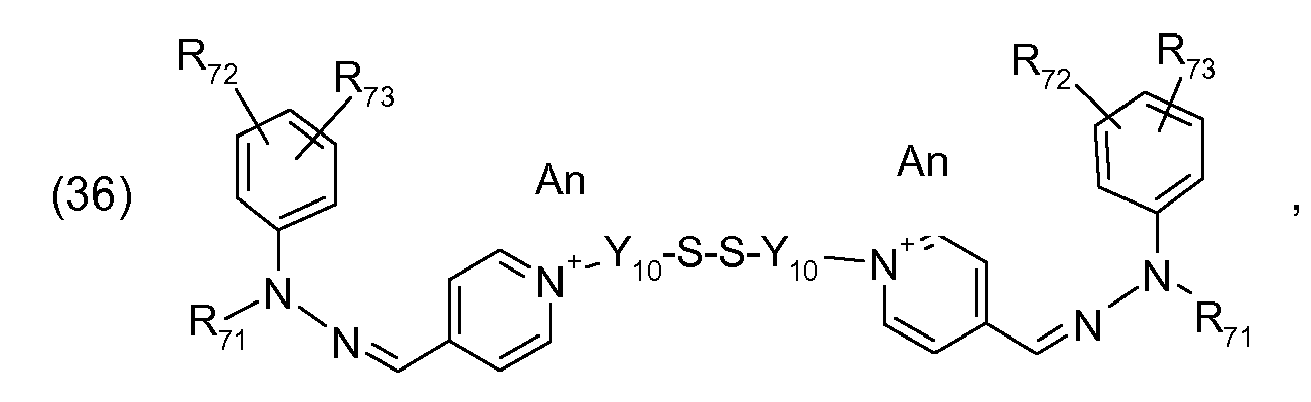
R71 is hydrogen; unsubstituted or substituted C1-C14alkyl; C5-C10cycloalkyl; C2-C14alkenyl; C5-C10aryl; C1-C10alkyl-(C5-C10aryl); C5-C10aryl-(C1-C10alkyl);
R72 and R73 are each independently of the other hydrogen; C1-C14alkyl; C2-C14alkenyl; a radical of acarboxylic; a radical of a sulfonic acid; C5-C10aryl; hydroxy, nitril, C1-C16alkoxy, (poly)-hydroxy-C2-C4-alkoxy, carboxylic acid;; halogen; sulfonylamino; SR60; NHR53; NR54R55; OR61; COOR62; NR56COR58; or CONR57;
R53, R54, R55, R56, R57, R58, R60, R61 and R62 are each independently of the other hydrogen; unsubstituted or substituted C1-C14alkyl; C2-C14alkenyl; -C5-C10arylen-(C1-C10alkyl); -C1-C10alkylene(C5-C10aryl); or C5-C10aryl;
R76 and R77 are each independently of the other hydrogen, C1-C14alkyl, which is saturated or unsaturated, linear or branched, substituted or unsubstituted, or interrupted or uninterrupted with heteroatoms; a radical of phenyl, which substituted or unsubstituted; a radical of carboxylic acid; C5-C10aryl; a radical of hydroxy, nitril, C1-C16alkoxy, (poly)-hydroxy-C2-C4-alkoxy, carboxylic acid, sulfonic acid; halogen, sulfonylamino, SR60, NHR53 or NR54R55, OR61, SO2, COOR62, NR56COR58, CONR57;
R53, R54, R55, R56, R57, R58, R60, R61 and R62 are each independently of the other hydrogen, unsubstituted or substituted C1-C14alkyl, C2-C14alkenyl, -C5-C10aryl-(C1-C10alkyl), -C1-C10alkyl(C5-C10aryl) or C5-C10aryl;
R79, R78 and R80 are each independently of the other hydrogen; C1-C14alkyl, which is saturated or unsaturated, linear or branched, substituted or unsubstituted, or interrupted or uninterrupted with heteroatoms; a radical of phenyl, which substituted or unsubstituted; a radical of carboxylic acid; C5-C10aryl; a radical of hydroxy, nitril, C1-C16alkoxy, (poly)-hydroxy-C2-C4-alkoxy; carboxylic acid; sulfonic acid; halogen; sulfonylamino; SR60; NHR53; NR54R55; OR61; SO2; COOR62; NR56COR58; or CONR57;
R53, R54, R55, R56, R57, R58, R60, R61 and R62 are each independently of the other hydrogen; unsubstituted or substituted C1-C14alkyl; C2-C14alkenyl; C5-C10arylene-(C1-C10alkyl), C1-C10alkylene(C5-C10aryl), C5-C10aryl; and An is an anion. - A process for the preparation of compounds of formula (1) according to claim 1, which comprises reacting a compound of formula (1 a) with the compound of formula (1 b) according to the following reaction scheme:

L is a leaving group; and
R1, R2, Y1, Y2, Z1, Z2, Z3, n, q and r are defined as in claim 1; - Process for the preparation of compounds of formula (1) according to claim 1, which comprises reacting a compound of formula (1 c) with the compound of formula (1 d) according to the following reaction scheme:

R1, R2, Z1, Z2, Z3, Y1, Y2, r, q and n are defined as in claim 1.
Priority Applications (1)
| Application Number | Priority Date | Filing Date | Title |
|---|---|---|---|
| EP09154638.2A EP2075036B1 (en) | 2004-04-08 | 2005-03-29 | Composition for dyeing keratin containing fibres comprising disulfide dyes and method |
Applications Claiming Priority (4)
| Application Number | Priority Date | Filing Date | Title |
|---|---|---|---|
| EP04101455 | 2004-04-08 | ||
| EP04105995 | 2004-11-23 | ||
| EP09154638.2A EP2075036B1 (en) | 2004-04-08 | 2005-03-29 | Composition for dyeing keratin containing fibres comprising disulfide dyes and method |
| EP05729805A EP1750663A2 (en) | 2004-04-08 | 2005-03-29 | Disulfide dyes, composition comprising them and method of dyeing hair |
Related Parent Applications (2)
| Application Number | Title | Priority Date | Filing Date |
|---|---|---|---|
| EP05729805.1 Division | 2005-03-29 | ||
| EP05729805A Division EP1750663A2 (en) | 2004-04-08 | 2005-03-29 | Disulfide dyes, composition comprising them and method of dyeing hair |
Publications (2)
| Publication Number | Publication Date |
|---|---|
| EP2075036A1 true EP2075036A1 (en) | 2009-07-01 |
| EP2075036B1 EP2075036B1 (en) | 2013-11-06 |
Family
ID=34593656
Family Applications (2)
| Application Number | Title | Priority Date | Filing Date |
|---|---|---|---|
| EP05729805A Withdrawn EP1750663A2 (en) | 2004-04-08 | 2005-03-29 | Disulfide dyes, composition comprising them and method of dyeing hair |
| EP09154638.2A Expired - Lifetime EP2075036B1 (en) | 2004-04-08 | 2005-03-29 | Composition for dyeing keratin containing fibres comprising disulfide dyes and method |
Family Applications Before (1)
| Application Number | Title | Priority Date | Filing Date |
|---|---|---|---|
| EP05729805A Withdrawn EP1750663A2 (en) | 2004-04-08 | 2005-03-29 | Disulfide dyes, composition comprising them and method of dyeing hair |
Country Status (12)
| Country | Link |
|---|---|
| US (1) | US7476260B2 (en) |
| EP (2) | EP1750663A2 (en) |
| JP (1) | JP5274832B2 (en) |
| KR (1) | KR101232694B1 (en) |
| CN (1) | CN1997340B (en) |
| AR (1) | AR048595A1 (en) |
| BR (1) | BRPI0508391B1 (en) |
| ES (1) | ES2439708T3 (en) |
| GB (1) | GB2412916A (en) |
| MX (1) | MXPA06011502A (en) |
| TW (1) | TW200613457A (en) |
| WO (1) | WO2005097051A2 (en) |
Cited By (1)
| Publication number | Priority date | Publication date | Assignee | Title |
|---|---|---|---|---|
| WO2020048944A1 (en) * | 2018-09-04 | 2020-03-12 | Archroma Ip Gmbh | Method for dyeing a protein substrate |
Families Citing this family (69)
| Publication number | Priority date | Publication date | Assignee | Title |
|---|---|---|---|---|
| ES2373043T3 (en) * | 2004-04-02 | 2012-01-30 | Basf Se | CATIÓNIC DYES OF AZOIMIDAZOL CONTAINING A STRUCTURAL UNIT 2,5-DIAMINOFENILO. |
| FR2876576B1 (en) * | 2004-10-14 | 2006-12-08 | Oreal | DYEING COMPOSITION COMPRISING A PARTICULAR DISULFIDE DYE AND METHOD FOR COLORING HUMAN KERATINOUS FIBERS FROM THE DYE |
| CN104018364B (en) | 2005-06-15 | 2017-01-11 | 巴斯夫欧洲公司 | Cationic oligomeric azo dyes |
| CN101283051B (en) * | 2005-10-03 | 2012-10-10 | 西巴特殊化学制品控股公司 | Xanthene dyes |
| JP5275034B2 (en) * | 2005-10-06 | 2013-08-28 | チバ ホールディング インコーポレーテッド | Triarylmethane dye |
| US7828858B2 (en) | 2005-10-11 | 2010-11-09 | Ciba Corporation | Mixture of sulfide dyes |
| WO2007110533A2 (en) * | 2006-03-24 | 2007-10-04 | L'oréal | Dyeing composition containing a thiol/disulphide fluorescent colorant having an external cationic charge and an interrupted alkylene chain, and method for lightening keratin materials using said colorant |
| JP5451375B2 (en) * | 2006-03-24 | 2014-03-26 | ロレアル | Composition for dyeing comprising a thiol / disulfide fluorescent colorant containing an amino group having an internal cationic charge, and a method for lightening keratin materials using said colorant |
| ATE518916T1 (en) | 2006-03-24 | 2011-08-15 | Oreal | DYEING COMPOSITION WITH A THIOL/DISULFIDE FLUORESCENT DYE WITH A HETEROCYCLE AND AN INTERNAL CATIONIC CHARGE AND METHOD FOR LIGHTENING KERATIN MATERIAL WITH THIS DYE |
| WO2007110541A2 (en) * | 2006-03-24 | 2007-10-04 | L'oreal | Dyeing composition containing a thiol/disulphide fluorescent colorant comprising a condensed cycle, with an internal cationic charge, and method for lightening keratin materials using said colorant |
| FR2898903B1 (en) * | 2006-03-24 | 2012-08-31 | Oreal | DYEING COMPOSITION COMPRISING A FLUORESCENT DISULFIDE DYE, METHOD OF LIGHTENING KERATINIC MATERIALS FROM THAT COLORANT |
| FR2912135B1 (en) * | 2007-02-05 | 2009-03-20 | Oreal | DYEING COMPOSITION COMPRISING A FLUORESCENT DYE, EXTERNALLY CATIONIC LOADING, AND INTERRUPTED ALKYLENE CHAIN, PROCESS FOR LIGHTENING KERATINIC MATERIALS FROM THAT COLOR |
| EP2024444B1 (en) | 2006-03-24 | 2011-07-06 | L'Oréal | Dyeing composition containing a thiol/disulphide naphthylimide fluorescent colorant, and method for lightening keratin materials using said colorant |
| JP2013079252A (en) * | 2006-03-24 | 2013-05-02 | L'oreal Sa | Dyeing and lightening method of keratinous substance in the presence of fluorescence disulfide dye-containing reducing agent |
| KR101088333B1 (en) | 2006-03-24 | 2011-11-30 | 로레알 | Dye composition containing a thiol / disulfide fluorescent dye comprising a heterocycle with an internal cationic charge, and a method for decolorizing keratin materials using the dye |
| EP2001960B1 (en) * | 2006-03-24 | 2014-03-05 | L'Oréal | Dyeing composition containing a thiol/disulphide fluorescent colorant comprising an ortho-pyridinium group with an interrupted alkylene chain and an external cationic load, and method for lightening keratin materials using said colorant |
| JP5431916B2 (en) * | 2006-03-24 | 2014-03-05 | ロレアル | Composition for dyeing containing a thiol / disulfide fluorescent colorant containing an external cationic charge and method for lightening keratin materials using said colorant |
| WO2007110536A2 (en) * | 2006-03-24 | 2007-10-04 | L'oréal | Dyeing composition containing a thiol/disulphide fluorescent colorant comprising an ortho-pyridinium group with an uninterrupted alkylene chain and an internal cationic charge, and method for lightening keratin materials using said colorant |
| JP5254950B2 (en) * | 2006-03-24 | 2013-08-07 | ロレアル | Composition for dyeing comprising a thiol / disulfide fluorescent colorant containing a heterocyclic ring having an external cationic charge, and a method for lightening keratin materials using said colorant |
| WO2007110540A2 (en) * | 2006-03-24 | 2007-10-04 | L'oreal | Dyeing composition containing a thiol/disulphide fluorescent colorant comprising an alkoxy/hydroxy grouping, with an internal cationic charge, and method for lightening keratin materials using said colorant |
| FR2899896B1 (en) * | 2006-04-13 | 2008-06-27 | Oreal | CATIONIC DICHROMOPHORIC COMPOUND HAVING TWO HYDRAZONE AND CATIONIC BOND ARRAY MOTIFS, TINCTORIAL COMPOSITION COMPRISING AT LEAST ONE SUCH COMPOUND, PROCESS FOR CARRYING OUT AND USES THEREOF |
| WO2007122340A1 (en) * | 2006-04-13 | 2007-11-01 | L'oréal | Cationic dichromophoric compound containing two units of hydrazone type and comprising a cationic linker arm, dye composition comprising at least one such compound, method for the use thereof and uses |
| US7803197B2 (en) * | 2006-08-17 | 2010-09-28 | Ciba Corporation | Thiol derivative dyes |
| FR2918667A1 (en) * | 2007-07-09 | 2009-01-16 | Oreal | METHOD FOR COLORING USING A STYRYLIC OR IMINIC TYPE DISULFIDE / THIOL AND STIMULI COMPOUND, COMPOSITION AND DEVICE FOR CARRYING OUT THE METHOD |
| FR2919179B1 (en) | 2007-07-24 | 2010-02-19 | Oreal | CAPILLARY COMPOSITION COMPRISING AT LEAST ONE DIRECT DISULFIDE DYE AND AT LEAST ONE ALKALINE HYDROXIDE AGENT AND METHOD FOR SIMULTANEOUS SHAPING AND COLORING. |
| FR2920778B1 (en) * | 2007-09-11 | 2009-10-30 | Oreal | CIPO - Patent - 2286090 Canadian Intellectual Property Office Symbol of the Government of Canada CA 2581277 AZOIC QUINOLINIUM COMPOUNDS WITH DISULFIDE / THIOL PATTERN, COMPOSITIONS COMPRISING THEM, KERATIN FIBER COLORING PROCESS AND DEVICE. |
| FR2920781B1 (en) * | 2007-09-11 | 2009-11-20 | Oreal | CIPO - Patent - 247601 Canadian Intellectual Property Office Symbol of the Government of Canada CA 2371100 CATIONIC THIOL / DISULFIDE AZOIC COMPOUNDS, COMPOSITIONS COMPRISING THEM, KERATIN FIBER COLORING METHOD, AND DEVICE. |
| FR2920779B1 (en) * | 2007-09-11 | 2009-10-30 | Oreal | CIPO - Patent - 249603 Canadian Intellectual Property Office Symbol of the Government of Canada CA 2381100 CATIONIC AZOLIC JULOLIDINE COMPOUNDS WITH THIOL / DISULFIDE PATTERN, COMPOSITIONS COMPRISING THEM, KERATIN FIBER COLORING PROCESS AND DEVICE. |
| FR2921377B1 (en) * | 2007-09-21 | 2009-10-30 | Oreal | STYRYL COMPOUND HAVING HYDROXY (CYCLO) ALKYLAMINO THIOL / DISULFIDE PATTERN, PROCESS FOR LIGHTENING KERATINIC MATERIALS THEREFROM |
| FR2921378B1 (en) * | 2007-09-21 | 2009-12-04 | Oreal | DICETORPYRROLO ° 3,4-C! PYRROLE THIOL / DISULFIDE DYE, TINCTORIAL COMPOSITION COMPRISING THE DYE, METHOD FOR LIGHTENING KERATINIC MATERIALS FROM THAT COLORANT |
| FR2921373B1 (en) | 2007-09-21 | 2009-10-30 | Oreal | LINK ALKYLENE STYRYL INDOLE DERIVATIVE DYE, TINCTORIAL COMPOSITION COMPRISING THE DYE, METHOD FOR LIGHTENING KERATINIC MATERIALS FROM THAT COLORANT |
| FR2921382B1 (en) | 2007-09-21 | 2009-10-30 | Oreal | PHENYL-PYRIDOL [1,2-A] INDOLIUM THIOL-DISULFIDE DERIVATIVE DYE, TINCTORIAL COMPOSITION COMPRISING THE DYE, METHOD OF CLEANING KERATINIC MATERIALS FROM THAT COLORANT |
| FR2921376B1 (en) | 2007-09-21 | 2009-10-30 | Oreal | STYRYL TETRAHYDROQUINOLINIUM THIOL / DISULFIDE COMPOUND, PROCESS FOR CLEANING KERATINIC MATERIALS FROM THAT COLORANT |
| FR2921381B1 (en) | 2007-09-21 | 2009-10-30 | Oreal | HEMICYANINE STYRYLE THIOL / DISULFIDE DYE, TINCTORIAL COMPOSITION COMPRISING THE DYE, METHOD OF CLEANING KERATINIC MATERIALS FROM THAT COLORANT |
| FR2921383B1 (en) * | 2007-09-24 | 2009-10-30 | Oreal | CARBONYL OR HETEROCYCLIC DICHROMOPHORIC DYE, TINCTORIAL COMPOSITION COMPRISING THIS COLOR, PROCESS FOR COLORING KERATINIC MATERIALS FROM THAT COLORANT |
| FR2921256B1 (en) | 2007-09-24 | 2009-12-04 | Oreal | COMPOSITION FOR COLORING KERATINIC FIBERS COMPRISING AT LEAST ONE DIRECT DYE WITH DISULFURE / THIOL FUNCTION AND AT LEAST ONE THIOL-FUNCTIONAL POLYMER AND PROCESS USING THE COMPOSITION |
| FR2921258A1 (en) | 2007-09-24 | 2009-03-27 | Oreal | TINCTORIAL COMPOSITION COMPRISING AT LEAST ONE COLOR DISULFIDE / THIOL PRECURSOR, COLORING PROCESS FROM THE COMPOSITION |
| JP5631217B2 (en) | 2008-01-17 | 2014-11-26 | ビーエーエスエフ ソシエタス・ヨーロピアBasf Se | Polymer hair dye |
| FR2928087B1 (en) * | 2008-02-29 | 2010-02-26 | Oreal | COMPOSITION FOR COLORING KERATIN FIBERS COMPRISING AT LEAST ONE DIRECT DYE WITH PROTECTED DISULFIDE / THIOL FUNCTION AND AT LEAST ONE THIOL FUNCTIONED SILICY COMPOUND AND PROCESS USING THE COMPOSITION. |
| KR101364872B1 (en) | 2009-02-25 | 2014-02-21 | 바스프 에스이 | Hair dyeing composition |
| EP3459520A1 (en) | 2009-02-25 | 2019-03-27 | Basf Se | Hair dyeing composition |
| MX2012000557A (en) | 2009-07-15 | 2012-03-07 | Basf Se | Polymeric hair dyes. |
| FR2952300B1 (en) | 2009-11-09 | 2012-05-11 | Oreal | NOVEL HETEROCYCLIC DISULFIDE FLUORESCENT DYES, DYE COMPOSITION COMPRISING SAME, AND METHOD FOR COLORING HUMAN KERATINOUS FIBERS FROM THESE DYES |
| ES2612475T3 (en) * | 2010-08-17 | 2017-05-17 | Basf Se | Polymeric hair dyes of disulfide or thiol |
| FR2967683B1 (en) | 2010-11-24 | 2012-11-02 | Oreal | NOVEL DIRECT DYES DERIVED FROM ASCORBIC ACID, DYE COMPOSITION COMPRISING SAME, AND PROCESS FOR COLORING HUMAN KERATINIC MATERIALS FROM THESE DYES |
| FR2967897B1 (en) * | 2010-11-25 | 2013-05-17 | Oreal | COMPOSITION FOR TREATING KERATIN FIBERS COMPRISING A CATIONIC SURFACTANT COMPRISING A HYDROXYLATED FATTY CHAIN |
| WO2012069639A2 (en) * | 2010-11-25 | 2012-05-31 | L'oreal | Composition for treating keratin fibres comprising a cationic surfactant comprising a hydroxylated chain |
| FR2968954B1 (en) | 2010-12-15 | 2012-12-21 | Oreal | PROCESS FOR COLORING KERATIN FIBERS USING A DIRECT DYE WITH PROTECTED DISULFIDE / THIOL / THIOL FUNCTION AND WATER VAPOR |
| US20140081012A1 (en) * | 2011-02-15 | 2014-03-20 | The University Of North Carolina At Chapel Hill | Nanoparticle, liposomes, polymers, agents and proteins modified with reversible linkers |
| BR112013021580B1 (en) | 2011-02-25 | 2019-01-29 | L'oreal | cosmetic composition, method for dyeing keratin fibers, method for dyeing and lightening dark keratin fibers and multi-compartment dyeing device or kit |
| FR2971938B1 (en) | 2011-02-25 | 2013-08-02 | Oreal | COMPOSITION FOR COLORING KERATINIC FIBERS COMPRISING DIRECT COLOR WITH DISULFURE / THIOL FUNCTION, LOW OR NON-ETHOXYL FATTY ALCOHOL, CATIONIC SURFACTANT, ALKALINE AGENT, AND REDUCING AGENT |
| FR2971939B1 (en) | 2011-02-25 | 2013-02-15 | Oreal | COMPOSITION FOR COLORING KERATINIC FIBERS COMPRISING A DIRECT DYE WITH DISULFIDE / THIOL FUNCTION, A FATTY BODY, AN ALKALI AGENT, AND A REDUCING AGENT |
| FR2971937B1 (en) | 2011-02-25 | 2013-02-15 | Oreal | COMPOSITION FOR COLORING KERATIN FIBERS COMPRISING A DIRECT DYE WITH DISULFURE / THIOL FUNCTION, A NON-CELLULOSIC THICKENING POLYMER, AN ALKALI AGENT, AND A REDUCING AGENT |
| FR2971935B1 (en) | 2011-02-25 | 2013-02-15 | Oreal | COMPOSITION FOR COLORING KERATIN FIBERS COMPRISING DIRECT COLOR WITH DISULFIDE / THIOL FUNCTION, THICKENING POLYMER, NON-IONIC SURFACTANT, ALKALINE AGENT, AND REDUCING AGENT |
| FR2971936B1 (en) | 2011-02-25 | 2013-02-15 | Oreal | COMPOSITION FOR COLORING KERATIN FIBERS COMPRISING DIRECT DYE WITH DISULFIDE / THIOL FUNCTION, NON-IONIC SURFACTANT, AMPHOTERIC SURFACTANT, ETHOXYL FATTY ALCOHOL, ALKALINE AGENT, AND REDUCING AGENT |
| BR112013028030B1 (en) | 2011-05-03 | 2021-01-05 | Basf Se | compound, method for dyeing human keratin fibers, and dyeing composition |
| CN102532935B (en) * | 2011-12-23 | 2014-07-16 | 大连理工大学 | Carboxylic acid-type water-soluble sulfur dye |
| KR102244166B1 (en) | 2013-09-02 | 2021-04-26 | 로레알 | Method for dyeing keratin fibres using cationic styryl disulphide dyes, and composition including said dyes |
| FR3043551B1 (en) | 2015-11-12 | 2017-11-24 | Oreal | DIRECT CATIONIC COLOR WITH ALIPHATIC CHAIN AND FUNCTION DISULFURE / THIOL / THIOL PROTECTED TO COLOR KERATIN FIBERS |
| FR3044661B1 (en) | 2015-12-03 | 2019-05-24 | L'oreal | NOVEL ANIONIC COLORANTS HETEROCYCLIC DISULFIDE PATTERN, DYE COMPOSITION COMPRISING SAME, AND METHOD FOR COLORING HUMAN KERATINIC MATERIALS FROM THESE DYES |
| FR3066108B1 (en) | 2017-05-10 | 2020-10-30 | Oreal | DIRECT FLUORESCENT COLORANT WITH ALIPHATIC CHAIN AND PROTECTED DISULPHIDE / THIOL / THIOL FUNCTION TO COLOR KERATINIC MATERIALS |
| FR3067597B1 (en) | 2017-06-16 | 2020-09-04 | Oreal | PROCESS FOR COLORING KERATINIC FIBERS USING AT LEAST ONE DIRECT DYE AND AT LEAST ONE FLUORESCENT DYE DISULPHIDE, THIOL OR PROTECTED THIOL |
| FR3067599B1 (en) | 2017-06-16 | 2020-09-04 | Oreal | PROCESS FOR COLORING KERATINIC MATERIALS USING AT LEAST ONE BLUE, PURPLE OR GREEN COLOR AND AT LEAST ONE FLUORESCENT COLORANT DISULPHIDE, THIOL OR PROTECTED THIOL |
| FR3067598B1 (en) | 2017-06-16 | 2020-09-11 | Oreal | PROCESS FOR COLORING KERATINIC FIBERS IMPLEMENTING AT LEAST ONE FLUORESCENT DYE DISULPHIDE, THIOL OR PROTECTED THIOL AND AT LEAST ONE ACTIVATOR INCLUDING A REDUCER AND LESS THAN TWO DIFFERENT ALKALINE AGENTS |
| ES2963356T3 (en) * | 2019-06-12 | 2024-03-26 | Nouryon Chemicals Int Bv | Method for isolating carboxylic acid from an aqueous side stream |
| JP7335362B2 (en) | 2019-06-12 | 2023-08-29 | ヌーリオン ケミカルズ インターナショナル ベスローテン フェノーツハップ | Process for producing diacyl peroxide |
| JP7281564B2 (en) | 2019-06-12 | 2023-05-25 | ヌーリオン ケミカルズ インターナショナル ベスローテン フェノーツハップ | Process for producing diacyl peroxide |
| JP7281563B2 (en) | 2019-06-12 | 2023-05-25 | ヌーリオン ケミカルズ インターナショナル ベスローテン フェノーツハップ | Process for producing peroxyesters |
| US11976035B2 (en) | 2019-06-12 | 2024-05-07 | Nouryon Chemicals International B.V. | Process for the production of diacyl peroxides |
Citations (26)
| Publication number | Priority date | Publication date | Assignee | Title |
|---|---|---|---|---|
| US3225025A (en) * | 1963-03-11 | 1965-12-21 | Martin Marietta Corp | Disazo disulfide dyestuffs |
| US3369970A (en) | 1959-08-20 | 1968-02-20 | Lever Brothers Ltd | Dyeing human hair |
| DE3829870A1 (en) | 1988-09-02 | 1989-04-13 | Henkel Kgaa | Dye solutions for dyeing hair |
| WO1995001772A1 (en) | 1993-07-05 | 1995-01-19 | Ciba-Geigy Ag | Process for dyeing keratin-containing fibres |
| WO1997020545A1 (en) | 1995-12-01 | 1997-06-12 | L'oreal | Enlightning dyeing composition for keratinic fibres comprising a direct specific dye |
| DE19713698C1 (en) | 1997-04-03 | 1998-06-04 | Goldwell Gmbh | Dyeing and perming hair |
| EP0850636A1 (en) | 1996-12-23 | 1998-07-01 | L'oreal | Composition for the oxidative dyeing of keratinic fibres and dyeing process using this composition |
| EP0850638A1 (en) | 1996-12-23 | 1998-07-01 | L'oreal | Oxidative dye composition for keratinic fibres and dyeing process using this composition |
| EP0850637A1 (en) | 1996-12-23 | 1998-07-01 | L'oreal | Composition for the oxidative dyeing of keratinic fibres and dyeing process using this composition |
| DE19717224A1 (en) | 1997-04-24 | 1998-10-29 | Henkel Kgaa | Use of unsaturated aldehydes for dyeing keratin fibers |
| WO1999020234A1 (en) | 1997-10-22 | 1999-04-29 | L'oreal | Dyeing composition for keratin fibres and dyeing method using same |
| WO1999020235A1 (en) | 1997-10-22 | 1999-04-29 | L'oreal | Composition for dyeing keratin fibres and dyeing method using same |
| EP0913430A1 (en) * | 1997-03-19 | 1999-05-06 | Kabushiki Kaisha Ueno Seiyaku Oyo Kenkyujo | Condensed azo compound and process for producing the same |
| WO1999048856A1 (en) | 1998-03-20 | 1999-09-30 | L'oreal | Oxidation dyeing compositions containing a cationic coupling agent, novel cationic coupling agents |
| EP0970685A1 (en) | 1998-07-09 | 2000-01-12 | L'oreal | Composition for dyeing keratinous fibres containing a cationic direct dye and a thickening polymer |
| WO2000010519A1 (en) | 1998-08-24 | 2000-03-02 | L'oreal | Dyeing composition for keratinous fibres with direct cationic colouring agent and a non-ionic surfactant |
| EP0998908A2 (en) | 1998-11-04 | 2000-05-10 | L'oreal | Dyeing composition containing a cattonic and an oxidativ dye based an pyrazolo-(1,5)-pyramidine and dyeing process |
| FR2788432A1 (en) | 1999-01-19 | 2000-07-21 | Oreal | USE FOR DIRECT DYING OF KERATINIC FIBERS FROM A COMBINATION OF TWO CATIONIC DYES |
| US6190421B1 (en) | 1996-04-25 | 2001-02-20 | L'oreal | Method for dyeing keratin fibres with oxidation dye precursors and direct powder dyes |
| US6228129B1 (en) | 1997-10-03 | 2001-05-08 | L'oreal S.A. | Oxidation dyeing composition for keratin fibres and dyeing method using said composition |
| DE19959479A1 (en) | 1999-12-10 | 2001-07-05 | Wella Ag | Partial and complete dying of human hair comprises an oxidation step and a dyeing step |
| EP1166752A2 (en) | 2000-06-23 | 2002-01-02 | GOLDWELL GmbH | Hair dyeing composition |
| WO2002070609A1 (en) * | 2001-03-03 | 2002-09-12 | Avecia Limited | Ink jet printing composition comprising a dye containing hydrazine or hydrazide |
| WO2003099242A1 (en) * | 2002-05-29 | 2003-12-04 | Henkel Kommanditgesellschaft Auf Aktien | Cosmetic agents containing protein disulfide isomerase |
| WO2004019897A1 (en) | 2002-09-02 | 2004-03-11 | Ciba Specialty Chemicals Holding Inc. | Method of colouring porous material |
| US6843256B2 (en) | 2000-03-09 | 2005-01-18 | Ciba Specialty Chemicals Corporation | Method of coloring hair using cationic dyes |
Family Cites Families (4)
| Publication number | Priority date | Publication date | Assignee | Title |
|---|---|---|---|---|
| US4751286A (en) | 1985-11-19 | 1988-06-14 | The Johns Hopkins University | Protein label and drug delivery system |
| US6599330B2 (en) | 2000-03-10 | 2003-07-29 | Revlon Consumer Products Corporation | Method for coloring hair with removable hair color |
| JP2001261535A (en) | 2000-03-17 | 2001-09-26 | Kao Corp | Hair dye composition |
| US7141106B2 (en) | 2001-03-03 | 2006-11-28 | Fujifilm Imaging Colorants Limited | Ink jet printing composition comprising a dye containing hydrazine or hydrazide |
-
2005
- 2005-03-29 CN CN2005800188700A patent/CN1997340B/en not_active Expired - Fee Related
- 2005-03-29 KR KR1020067022193A patent/KR101232694B1/en not_active Expired - Fee Related
- 2005-03-29 JP JP2007506763A patent/JP5274832B2/en not_active Expired - Fee Related
- 2005-03-29 BR BRPI0508391-5A patent/BRPI0508391B1/en not_active IP Right Cessation
- 2005-03-29 MX MXPA06011502A patent/MXPA06011502A/en active IP Right Grant
- 2005-03-29 US US11/547,571 patent/US7476260B2/en not_active Expired - Lifetime
- 2005-03-29 ES ES09154638.2T patent/ES2439708T3/en not_active Expired - Lifetime
- 2005-03-29 EP EP05729805A patent/EP1750663A2/en not_active Withdrawn
- 2005-03-29 EP EP09154638.2A patent/EP2075036B1/en not_active Expired - Lifetime
- 2005-03-29 WO PCT/EP2005/051412 patent/WO2005097051A2/en not_active Ceased
- 2005-04-04 GB GB0506757A patent/GB2412916A/en not_active Withdrawn
- 2005-04-06 AR ARP050101363A patent/AR048595A1/en not_active Application Discontinuation
- 2005-04-06 TW TW094110858A patent/TW200613457A/en unknown
Patent Citations (27)
| Publication number | Priority date | Publication date | Assignee | Title |
|---|---|---|---|---|
| US3369970A (en) | 1959-08-20 | 1968-02-20 | Lever Brothers Ltd | Dyeing human hair |
| US3225025A (en) * | 1963-03-11 | 1965-12-21 | Martin Marietta Corp | Disazo disulfide dyestuffs |
| DE3829870A1 (en) | 1988-09-02 | 1989-04-13 | Henkel Kgaa | Dye solutions for dyeing hair |
| WO1995001772A1 (en) | 1993-07-05 | 1995-01-19 | Ciba-Geigy Ag | Process for dyeing keratin-containing fibres |
| WO1997020545A1 (en) | 1995-12-01 | 1997-06-12 | L'oreal | Enlightning dyeing composition for keratinic fibres comprising a direct specific dye |
| US6368360B2 (en) | 1995-12-01 | 2002-04-09 | L'oreal S.A. | Method for dyeing keratin fibres with a dye composition containing at least one direct dye and a least one basifying agent |
| US6190421B1 (en) | 1996-04-25 | 2001-02-20 | L'oreal | Method for dyeing keratin fibres with oxidation dye precursors and direct powder dyes |
| EP0850636A1 (en) | 1996-12-23 | 1998-07-01 | L'oreal | Composition for the oxidative dyeing of keratinic fibres and dyeing process using this composition |
| EP0850637A1 (en) | 1996-12-23 | 1998-07-01 | L'oreal | Composition for the oxidative dyeing of keratinic fibres and dyeing process using this composition |
| EP0850638A1 (en) | 1996-12-23 | 1998-07-01 | L'oreal | Oxidative dye composition for keratinic fibres and dyeing process using this composition |
| EP0913430A1 (en) * | 1997-03-19 | 1999-05-06 | Kabushiki Kaisha Ueno Seiyaku Oyo Kenkyujo | Condensed azo compound and process for producing the same |
| DE19713698C1 (en) | 1997-04-03 | 1998-06-04 | Goldwell Gmbh | Dyeing and perming hair |
| DE19717224A1 (en) | 1997-04-24 | 1998-10-29 | Henkel Kgaa | Use of unsaturated aldehydes for dyeing keratin fibers |
| US6228129B1 (en) | 1997-10-03 | 2001-05-08 | L'oreal S.A. | Oxidation dyeing composition for keratin fibres and dyeing method using said composition |
| WO1999020234A1 (en) | 1997-10-22 | 1999-04-29 | L'oreal | Dyeing composition for keratin fibres and dyeing method using same |
| WO1999020235A1 (en) | 1997-10-22 | 1999-04-29 | L'oreal | Composition for dyeing keratin fibres and dyeing method using same |
| WO1999048856A1 (en) | 1998-03-20 | 1999-09-30 | L'oreal | Oxidation dyeing compositions containing a cationic coupling agent, novel cationic coupling agents |
| EP0970685A1 (en) | 1998-07-09 | 2000-01-12 | L'oreal | Composition for dyeing keratinous fibres containing a cationic direct dye and a thickening polymer |
| WO2000010519A1 (en) | 1998-08-24 | 2000-03-02 | L'oreal | Dyeing composition for keratinous fibres with direct cationic colouring agent and a non-ionic surfactant |
| EP0998908A2 (en) | 1998-11-04 | 2000-05-10 | L'oreal | Dyeing composition containing a cattonic and an oxidativ dye based an pyrazolo-(1,5)-pyramidine and dyeing process |
| FR2788432A1 (en) | 1999-01-19 | 2000-07-21 | Oreal | USE FOR DIRECT DYING OF KERATINIC FIBERS FROM A COMBINATION OF TWO CATIONIC DYES |
| DE19959479A1 (en) | 1999-12-10 | 2001-07-05 | Wella Ag | Partial and complete dying of human hair comprises an oxidation step and a dyeing step |
| US6843256B2 (en) | 2000-03-09 | 2005-01-18 | Ciba Specialty Chemicals Corporation | Method of coloring hair using cationic dyes |
| EP1166752A2 (en) | 2000-06-23 | 2002-01-02 | GOLDWELL GmbH | Hair dyeing composition |
| WO2002070609A1 (en) * | 2001-03-03 | 2002-09-12 | Avecia Limited | Ink jet printing composition comprising a dye containing hydrazine or hydrazide |
| WO2003099242A1 (en) * | 2002-05-29 | 2003-12-04 | Henkel Kommanditgesellschaft Auf Aktien | Cosmetic agents containing protein disulfide isomerase |
| WO2004019897A1 (en) | 2002-09-02 | 2004-03-11 | Ciba Specialty Chemicals Holding Inc. | Method of colouring porous material |
Non-Patent Citations (7)
| Title |
|---|
| "Europaisches Inventar der Kosmetikrohstoffe", 1996, THE EUROPEAN COMMISSION |
| ASQUITH R S ET AL: "The Reactions of Disulphide Dyes for the Covalent Coloration of Keratin", JOURNAL OF THE SOCIETY OF DYERS AND COLOURISTS, SOCIETY OF DYERS AND COLOURISTS. BRADFORD, GB, vol. 89, no. 5, May 1973 (1973-05-01), pages 168 - 172, XP009016863, ISSN: 0037-9859 * |
| CH. ZVIAK: "The Science of Hair Care", vol. 7, 1986, VERLAG MARCEL DEKKER INC., article "Dermatology", pages: 248 - 250 |
| CH. ZVIAK: "The Science of Hair Care", vol. 7, 1986, VERLAG MARCEL DEKKER INC., article "Dermatology", pages: 264 - 267 |
| NAMPALLI S ET AL: "Utility of Thiol-Cross-Linked Fluorescent Dye Labeled Terminators for DNA Sequencing", BIOCONJUGATE CHEMISTRY, ACS, WASHINGTON, DC, US, vol. 13, no. 3, 20 April 2002 (2002-04-20), pages 468 - 473, XP002377671, ISSN: 1043-1802 * |
| R. S. ASQUITH; P. CARTHEW; T. T. FRANCIS, JSDC, May 1973 (1973-05-01), pages 168 - 172 |
| SUGAWARA KAZUHARU ET AL: "Voltammetric behavior of avidin-biotin interaction at a biotin/thionine modified Au electrode", JOURNAL OF ELECTROANALYTICAL CHEMISTRY AND INTERFACIALELECTROCHEMISTRY, ELSEVIER, AMSTERDAM, NL, vol. 536, no. 1-2, 1 January 2002 (2002-01-01), pages 93 - 96, XP002451348, ISSN: 0022-0728 * |
Cited By (1)
| Publication number | Priority date | Publication date | Assignee | Title |
|---|---|---|---|---|
| WO2020048944A1 (en) * | 2018-09-04 | 2020-03-12 | Archroma Ip Gmbh | Method for dyeing a protein substrate |
Also Published As
| Publication number | Publication date |
|---|---|
| AR048595A1 (en) | 2006-05-10 |
| CN1997340A (en) | 2007-07-11 |
| CN1997340B (en) | 2013-07-17 |
| WO2005097051A2 (en) | 2005-10-20 |
| JP5274832B2 (en) | 2013-08-28 |
| JP2007532513A (en) | 2007-11-15 |
| KR101232694B1 (en) | 2013-02-13 |
| US7476260B2 (en) | 2009-01-13 |
| TW200613457A (en) | 2006-05-01 |
| KR20070006859A (en) | 2007-01-11 |
| US20080295260A1 (en) | 2008-12-04 |
| MXPA06011502A (en) | 2006-12-15 |
| BRPI0508391B1 (en) | 2017-10-10 |
| WO2005097051A3 (en) | 2005-12-15 |
| BRPI0508391A (en) | 2007-09-25 |
| EP2075036B1 (en) | 2013-11-06 |
| ES2439708T3 (en) | 2014-01-24 |
| GB2412916A (en) | 2005-10-12 |
| EP1750663A2 (en) | 2007-02-14 |
| GB0506757D0 (en) | 2005-05-11 |
Similar Documents
| Publication | Publication Date | Title |
|---|---|---|
| EP2075036B1 (en) | Composition for dyeing keratin containing fibres comprising disulfide dyes and method | |
| ES2782334T3 (en) | Composition of hair dye | |
| JP5774052B2 (en) | Dyes containing thiol groups | |
| US20100000028A1 (en) | Styryl sulfide dyes | |
| EP2606095B1 (en) | Disulfide or thiol polymeric hair dyes | |
| US7931696B2 (en) | Cationic dyes | |
| US7803197B2 (en) | Thiol derivative dyes | |
| EP2400947A2 (en) | Hair dyeing composition | |
| EP1732990B1 (en) | Cationic imidazolazo dyes containing a 2,5-diaminophenyl moiety | |
| US8221508B2 (en) | Polymeric hair dyes | |
| BRPI0612834B1 (en) | keratin-containing fiber dyeing method and hair dyeing composition |
Legal Events
| Date | Code | Title | Description |
|---|---|---|---|
| PUAI | Public reference made under article 153(3) epc to a published international application that has entered the european phase |
Free format text: ORIGINAL CODE: 0009012 |
|
| 17P | Request for examination filed |
Effective date: 20090309 |
|
| AC | Divisional application: reference to earlier application |
Ref document number: 1750663 Country of ref document: EP Kind code of ref document: P |
|
| AK | Designated contracting states |
Kind code of ref document: A1 Designated state(s): AT BE BG CH CY CZ DE DK EE ES FI FR GB GR HU IE IS IT LI LT LU MC NL PL PT RO SE SI SK TR |
|
| 17Q | First examination report despatched |
Effective date: 20100122 |
|
| AKX | Designation fees paid |
Designated state(s): AT BE BG CH CY CZ DE DK EE ES FI FR GB GR HU IE IS IT LI LT LU MC NL PL PT RO SE SI SK TR |
|
| GRAP | Despatch of communication of intention to grant a patent |
Free format text: ORIGINAL CODE: EPIDOSNIGR1 |
|
| INTG | Intention to grant announced |
Effective date: 20130527 |
|
| RAP1 | Party data changed (applicant data changed or rights of an application transferred) |
Owner name: BASF SE |
|
| GRAS | Grant fee paid |
Free format text: ORIGINAL CODE: EPIDOSNIGR3 |
|
| GRAA | (expected) grant |
Free format text: ORIGINAL CODE: 0009210 |
|
| AC | Divisional application: reference to earlier application |
Ref document number: 1750663 Country of ref document: EP Kind code of ref document: P |
|
| AK | Designated contracting states |
Kind code of ref document: B1 Designated state(s): AT BE BG CH CY CZ DE DK EE ES FI FR GB GR HU IE IS IT LI LT LU MC NL PL PT RO SE SI SK TR |
|
| REG | Reference to a national code |
Ref country code: GB Ref legal event code: FG4D |
|
| REG | Reference to a national code |
Ref country code: CH Ref legal event code: EP |
|
| REG | Reference to a national code |
Ref country code: AT Ref legal event code: REF Ref document number: 639021 Country of ref document: AT Kind code of ref document: T Effective date: 20131215 |
|
| REG | Reference to a national code |
Ref country code: IE Ref legal event code: FG4D |
|
| REG | Reference to a national code |
Ref country code: DE Ref legal event code: R096 Ref document number: 602005041823 Country of ref document: DE Effective date: 20140109 |
|
| REG | Reference to a national code |
Ref country code: ES Ref legal event code: FG2A Ref document number: 2439708 Country of ref document: ES Kind code of ref document: T3 Effective date: 20140124 |
|
| REG | Reference to a national code |
Ref country code: NL Ref legal event code: VDEP Effective date: 20131106 |
|
| REG | Reference to a national code |
Ref country code: AT Ref legal event code: MK05 Ref document number: 639021 Country of ref document: AT Kind code of ref document: T Effective date: 20131106 |
|
| REG | Reference to a national code |
Ref country code: LT Ref legal event code: MG4D |
|
| PG25 | Lapsed in a contracting state [announced via postgrant information from national office to epo] |
Ref country code: FI Free format text: LAPSE BECAUSE OF FAILURE TO SUBMIT A TRANSLATION OF THE DESCRIPTION OR TO PAY THE FEE WITHIN THE PRESCRIBED TIME-LIMIT Effective date: 20131106 Ref country code: LT Free format text: LAPSE BECAUSE OF FAILURE TO SUBMIT A TRANSLATION OF THE DESCRIPTION OR TO PAY THE FEE WITHIN THE PRESCRIBED TIME-LIMIT Effective date: 20131106 Ref country code: IS Free format text: LAPSE BECAUSE OF FAILURE TO SUBMIT A TRANSLATION OF THE DESCRIPTION OR TO PAY THE FEE WITHIN THE PRESCRIBED TIME-LIMIT Effective date: 20140306 Ref country code: SE Free format text: LAPSE BECAUSE OF FAILURE TO SUBMIT A TRANSLATION OF THE DESCRIPTION OR TO PAY THE FEE WITHIN THE PRESCRIBED TIME-LIMIT Effective date: 20131106 Ref country code: NL Free format text: LAPSE BECAUSE OF FAILURE TO SUBMIT A TRANSLATION OF THE DESCRIPTION OR TO PAY THE FEE WITHIN THE PRESCRIBED TIME-LIMIT Effective date: 20131106 |
|
| PG25 | Lapsed in a contracting state [announced via postgrant information from national office to epo] |
Ref country code: AT Free format text: LAPSE BECAUSE OF FAILURE TO SUBMIT A TRANSLATION OF THE DESCRIPTION OR TO PAY THE FEE WITHIN THE PRESCRIBED TIME-LIMIT Effective date: 20131106 Ref country code: BE Free format text: LAPSE BECAUSE OF FAILURE TO SUBMIT A TRANSLATION OF THE DESCRIPTION OR TO PAY THE FEE WITHIN THE PRESCRIBED TIME-LIMIT Effective date: 20131106 |
|
| PG25 | Lapsed in a contracting state [announced via postgrant information from national office to epo] |
Ref country code: PT Free format text: LAPSE BECAUSE OF FAILURE TO SUBMIT A TRANSLATION OF THE DESCRIPTION OR TO PAY THE FEE WITHIN THE PRESCRIBED TIME-LIMIT Effective date: 20140306 |
|
| PG25 | Lapsed in a contracting state [announced via postgrant information from national office to epo] |
Ref country code: EE Free format text: LAPSE BECAUSE OF FAILURE TO SUBMIT A TRANSLATION OF THE DESCRIPTION OR TO PAY THE FEE WITHIN THE PRESCRIBED TIME-LIMIT Effective date: 20131106 |
|
| REG | Reference to a national code |
Ref country code: DE Ref legal event code: R097 Ref document number: 602005041823 Country of ref document: DE |
|
| PG25 | Lapsed in a contracting state [announced via postgrant information from national office to epo] |
Ref country code: RO Free format text: LAPSE BECAUSE OF FAILURE TO SUBMIT A TRANSLATION OF THE DESCRIPTION OR TO PAY THE FEE WITHIN THE PRESCRIBED TIME-LIMIT Effective date: 20131106 Ref country code: SK Free format text: LAPSE BECAUSE OF FAILURE TO SUBMIT A TRANSLATION OF THE DESCRIPTION OR TO PAY THE FEE WITHIN THE PRESCRIBED TIME-LIMIT Effective date: 20131106 Ref country code: PL Free format text: LAPSE BECAUSE OF FAILURE TO SUBMIT A TRANSLATION OF THE DESCRIPTION OR TO PAY THE FEE WITHIN THE PRESCRIBED TIME-LIMIT Effective date: 20131106 Ref country code: CZ Free format text: LAPSE BECAUSE OF FAILURE TO SUBMIT A TRANSLATION OF THE DESCRIPTION OR TO PAY THE FEE WITHIN THE PRESCRIBED TIME-LIMIT Effective date: 20131106 |
|
| PLBE | No opposition filed within time limit |
Free format text: ORIGINAL CODE: 0009261 |
|
| STAA | Information on the status of an ep patent application or granted ep patent |
Free format text: STATUS: NO OPPOSITION FILED WITHIN TIME LIMIT |
|
| PG25 | Lapsed in a contracting state [announced via postgrant information from national office to epo] |
Ref country code: DK Free format text: LAPSE BECAUSE OF FAILURE TO SUBMIT A TRANSLATION OF THE DESCRIPTION OR TO PAY THE FEE WITHIN THE PRESCRIBED TIME-LIMIT Effective date: 20131106 |
|
| 26N | No opposition filed |
Effective date: 20140807 |
|
| PG25 | Lapsed in a contracting state [announced via postgrant information from national office to epo] |
Ref country code: LU Free format text: LAPSE BECAUSE OF FAILURE TO SUBMIT A TRANSLATION OF THE DESCRIPTION OR TO PAY THE FEE WITHIN THE PRESCRIBED TIME-LIMIT Effective date: 20140329 |
|
| REG | Reference to a national code |
Ref country code: CH Ref legal event code: PL |
|
| REG | Reference to a national code |
Ref country code: DE Ref legal event code: R097 Ref document number: 602005041823 Country of ref document: DE Effective date: 20140807 |
|
| REG | Reference to a national code |
Ref country code: IE Ref legal event code: MM4A |
|
| PG25 | Lapsed in a contracting state [announced via postgrant information from national office to epo] |
Ref country code: LI Free format text: LAPSE BECAUSE OF NON-PAYMENT OF DUE FEES Effective date: 20140331 Ref country code: IE Free format text: LAPSE BECAUSE OF NON-PAYMENT OF DUE FEES Effective date: 20140329 Ref country code: CH Free format text: LAPSE BECAUSE OF NON-PAYMENT OF DUE FEES Effective date: 20140331 |
|
| PG25 | Lapsed in a contracting state [announced via postgrant information from national office to epo] |
Ref country code: SI Free format text: LAPSE BECAUSE OF FAILURE TO SUBMIT A TRANSLATION OF THE DESCRIPTION OR TO PAY THE FEE WITHIN THE PRESCRIBED TIME-LIMIT Effective date: 20131106 |
|
| REG | Reference to a national code |
Ref country code: FR Ref legal event code: PLFP Year of fee payment: 12 |
|
| PG25 | Lapsed in a contracting state [announced via postgrant information from national office to epo] |
Ref country code: MC Free format text: LAPSE BECAUSE OF FAILURE TO SUBMIT A TRANSLATION OF THE DESCRIPTION OR TO PAY THE FEE WITHIN THE PRESCRIBED TIME-LIMIT Effective date: 20131106 Ref country code: BG Free format text: LAPSE BECAUSE OF FAILURE TO SUBMIT A TRANSLATION OF THE DESCRIPTION OR TO PAY THE FEE WITHIN THE PRESCRIBED TIME-LIMIT Effective date: 20131106 |
|
| PG25 | Lapsed in a contracting state [announced via postgrant information from national office to epo] |
Ref country code: CY Free format text: LAPSE BECAUSE OF FAILURE TO SUBMIT A TRANSLATION OF THE DESCRIPTION OR TO PAY THE FEE WITHIN THE PRESCRIBED TIME-LIMIT Effective date: 20131106 Ref country code: GR Free format text: LAPSE BECAUSE OF FAILURE TO SUBMIT A TRANSLATION OF THE DESCRIPTION OR TO PAY THE FEE WITHIN THE PRESCRIBED TIME-LIMIT Effective date: 20140207 |
|
| PG25 | Lapsed in a contracting state [announced via postgrant information from national office to epo] |
Ref country code: HU Free format text: LAPSE BECAUSE OF FAILURE TO SUBMIT A TRANSLATION OF THE DESCRIPTION OR TO PAY THE FEE WITHIN THE PRESCRIBED TIME-LIMIT; INVALID AB INITIO Effective date: 20050329 Ref country code: TR Free format text: LAPSE BECAUSE OF FAILURE TO SUBMIT A TRANSLATION OF THE DESCRIPTION OR TO PAY THE FEE WITHIN THE PRESCRIBED TIME-LIMIT Effective date: 20131106 |
|
| PG25 | Lapsed in a contracting state [announced via postgrant information from national office to epo] |
Ref country code: IT Free format text: LAPSE BECAUSE OF NON-PAYMENT OF DUE FEES Effective date: 20160329 |
|
| REG | Reference to a national code |
Ref country code: FR Ref legal event code: PLFP Year of fee payment: 13 |
|
| PG25 | Lapsed in a contracting state [announced via postgrant information from national office to epo] |
Ref country code: IT Free format text: LAPSE BECAUSE OF NON-PAYMENT OF DUE FEES Effective date: 20160329 |
|
| PGRI | Patent reinstated in contracting state [announced from national office to epo] |
Ref country code: IT Effective date: 20170710 |
|
| REG | Reference to a national code |
Ref country code: FR Ref legal event code: PLFP Year of fee payment: 14 |
|
| PGFP | Annual fee paid to national office [announced via postgrant information from national office to epo] |
Ref country code: IT Payment date: 20210323 Year of fee payment: 17 Ref country code: FR Payment date: 20210326 Year of fee payment: 17 |
|
| PGFP | Annual fee paid to national office [announced via postgrant information from national office to epo] |
Ref country code: GB Payment date: 20210326 Year of fee payment: 17 |
|
| PGFP | Annual fee paid to national office [announced via postgrant information from national office to epo] |
Ref country code: DE Payment date: 20210329 Year of fee payment: 17 |
|
| PGFP | Annual fee paid to national office [announced via postgrant information from national office to epo] |
Ref country code: ES Payment date: 20210415 Year of fee payment: 17 |
|
| REG | Reference to a national code |
Ref country code: DE Ref legal event code: R119 Ref document number: 602005041823 Country of ref document: DE |
|
| GBPC | Gb: european patent ceased through non-payment of renewal fee |
Effective date: 20220329 |
|
| PG25 | Lapsed in a contracting state [announced via postgrant information from national office to epo] |
Ref country code: GB Free format text: LAPSE BECAUSE OF NON-PAYMENT OF DUE FEES Effective date: 20220329 Ref country code: FR Free format text: LAPSE BECAUSE OF NON-PAYMENT OF DUE FEES Effective date: 20220331 Ref country code: DE Free format text: LAPSE BECAUSE OF NON-PAYMENT OF DUE FEES Effective date: 20221001 |
|
| REG | Reference to a national code |
Ref country code: ES Ref legal event code: FD2A Effective date: 20230503 |
|
| PG25 | Lapsed in a contracting state [announced via postgrant information from national office to epo] |
Ref country code: ES Free format text: LAPSE BECAUSE OF NON-PAYMENT OF DUE FEES Effective date: 20220330 |
|
| PG25 | Lapsed in a contracting state [announced via postgrant information from national office to epo] |
Ref country code: IT Free format text: LAPSE BECAUSE OF NON-PAYMENT OF DUE FEES Effective date: 20220329 |