EP2073557A1 - Intra prediction encoding control method and device, its program, and storage medium containing program - Google Patents
Intra prediction encoding control method and device, its program, and storage medium containing program Download PDFInfo
- Publication number
- EP2073557A1 EP2073557A1 EP07829358A EP07829358A EP2073557A1 EP 2073557 A1 EP2073557 A1 EP 2073557A1 EP 07829358 A EP07829358 A EP 07829358A EP 07829358 A EP07829358 A EP 07829358A EP 2073557 A1 EP2073557 A1 EP 2073557A1
- Authority
- EP
- European Patent Office
- Prior art keywords
- block size
- encoding
- prediction
- prediction block
- flatness
- Prior art date
- Legal status (The legal status is an assumption and is not a legal conclusion. Google has not performed a legal analysis and makes no representation as to the accuracy of the status listed.)
- Granted
Links
Images



Classifications
-
- H—ELECTRICITY
- H04—ELECTRIC COMMUNICATION TECHNIQUE
- H04N—PICTORIAL COMMUNICATION, e.g. TELEVISION
- H04N19/00—Methods or arrangements for coding, decoding, compressing or decompressing digital video signals
- H04N19/10—Methods or arrangements for coding, decoding, compressing or decompressing digital video signals using adaptive coding
- H04N19/169—Methods or arrangements for coding, decoding, compressing or decompressing digital video signals using adaptive coding characterised by the coding unit, i.e. the structural portion or semantic portion of the video signal being the object or the subject of the adaptive coding
- H04N19/17—Methods or arrangements for coding, decoding, compressing or decompressing digital video signals using adaptive coding characterised by the coding unit, i.e. the structural portion or semantic portion of the video signal being the object or the subject of the adaptive coding the unit being an image region, e.g. an object
-
- H—ELECTRICITY
- H04—ELECTRIC COMMUNICATION TECHNIQUE
- H04N—PICTORIAL COMMUNICATION, e.g. TELEVISION
- H04N19/00—Methods or arrangements for coding, decoding, compressing or decompressing digital video signals
- H04N19/10—Methods or arrangements for coding, decoding, compressing or decompressing digital video signals using adaptive coding
- H04N19/102—Methods or arrangements for coding, decoding, compressing or decompressing digital video signals using adaptive coding characterised by the element, parameter or selection affected or controlled by the adaptive coding
- H04N19/103—Selection of coding mode or of prediction mode
- H04N19/11—Selection of coding mode or of prediction mode among a plurality of spatial predictive coding modes
-
- H—ELECTRICITY
- H04—ELECTRIC COMMUNICATION TECHNIQUE
- H04N—PICTORIAL COMMUNICATION, e.g. TELEVISION
- H04N19/00—Methods or arrangements for coding, decoding, compressing or decompressing digital video signals
- H04N19/10—Methods or arrangements for coding, decoding, compressing or decompressing digital video signals using adaptive coding
- H04N19/189—Methods or arrangements for coding, decoding, compressing or decompressing digital video signals using adaptive coding characterised by the adaptation method, adaptation tool or adaptation type used for the adaptive coding
- H04N19/196—Methods or arrangements for coding, decoding, compressing or decompressing digital video signals using adaptive coding characterised by the adaptation method, adaptation tool or adaptation type used for the adaptive coding being specially adapted for the computation of encoding parameters, e.g. by averaging previously computed encoding parameters
-
- H—ELECTRICITY
- H04—ELECTRIC COMMUNICATION TECHNIQUE
- H04N—PICTORIAL COMMUNICATION, e.g. TELEVISION
- H04N19/00—Methods or arrangements for coding, decoding, compressing or decompressing digital video signals
- H04N19/50—Methods or arrangements for coding, decoding, compressing or decompressing digital video signals using predictive coding
- H04N19/593—Methods or arrangements for coding, decoding, compressing or decompressing digital video signals using predictive coding involving spatial prediction techniques
-
- H—ELECTRICITY
- H04—ELECTRIC COMMUNICATION TECHNIQUE
- H04N—PICTORIAL COMMUNICATION, e.g. TELEVISION
- H04N19/00—Methods or arrangements for coding, decoding, compressing or decompressing digital video signals
- H04N19/10—Methods or arrangements for coding, decoding, compressing or decompressing digital video signals using adaptive coding
- H04N19/134—Methods or arrangements for coding, decoding, compressing or decompressing digital video signals using adaptive coding characterised by the element, parameter or criterion affecting or controlling the adaptive coding
- H04N19/136—Incoming video signal characteristics or properties
- H04N19/14—Coding unit complexity, e.g. amount of activity or edge presence estimation
Definitions
- the present invention relates to an intra prediction encoding control method and apparatus used in an intra prediction encoding which has a plurality of prediction modes and a plurality of prediction block sizes so that a mode and a size can be switchably selected, and also relates to an intra prediction encoding control program for implementing the intra prediction encoding control method, and a computer-readable storage medium which stores the program.
- the present invention relates to an intra prediction encoding control method and apparatus for reducing the computation cost, an intra prediction encoding control program for implementing the intra prediction encoding control method, and a computer-readable storage medium which stores the program.
- Priority is claimed on Japanese Patent Application No. 2006-275951, filed October 10, 2006 , the contents of which are incorporated herein by reference.
- ITU-T H.264 which is a standard video encoding method (see, for example, Non-Patent Document 1), employs a prediction encoding method in which a predicted signal is generated using peripheral pixels in intra encoding.
- the prediction mode or the prediction block size can be adaptively switched.
- the encoding efficiency of intra encoding has been remarkably improved in comparison with the other known video encoding methods.
- Figs. 6A to 8B show the prediction mode and the prediction block size, employed in H.264.
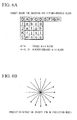
- Figs. 6A and 6B relate to an intra prediction encoding of a target macroblock (16 ⁇ 16 pixels) using a prediction block size of 4 ⁇ 4 pixels, where Fig. 6A shows the positional relationship between the target blocks (for encoding) and already-encoded blocks, and Fig. 6B shows the prediction direction.
- Figs. 7A and 7B relate to an intra prediction encoding of a target macroblock using a prediction block size of 8 ⁇ 8 pixels, where Fig. 7A shows the positional relationship between the target blocks (for encoding) and already-encoded blocks, and Fig. 7B shows the prediction direction.
- Figs. 6A and 6B relate to an intra prediction encoding of a target macroblock (16 ⁇ 16 pixels) using a prediction block size of 4 ⁇ 4 pixels, where Fig. 6A shows the positional relationship between the target blocks (for encoding) and already-encoded blocks, and Fig. 6B shows the prediction direction.
- Figs. 7A and 7B relate to an intra
- FIG. 8A and 8B relate to an intra prediction encoding of a target macroblock using a prediction block size of 16 ⁇ 16 pixels (i.e., the same size as the macroblock), where Fig. 8A shows the positional relationship between the target block (for encoding) and already-encoded signals (or pixels), and Fig. 8B shows predictions by means of various directions and methods.
- any prediction block size and any prediction direction can be selected in accordance with the encoding efficiency.
- the edge direction is first determined; limited prediction modes are provided; a prediction mode is selected; the prediction block size is determined; and then intra prediction encoding is performed.
- the edge direction is measured in advance so as to exclude prediction modes having a low probability of being selected, thereby reducing the computation cost.
- the prediction mode for the 4 ⁇ 4 block size is first selected; a bias for the prediction mode is measured; based on the measurement results, selection of the prediction mode for the 8 ⁇ 8 block size may be skipped, or the prediction mode for the 8 ⁇ 8 block size (if there is no skipping for this size) or 16 ⁇ 16 block size may be performed; the prediction block size is determined; and then intra prediction encoding is performed.
- the prediction mode for the 4 ⁇ 4 block size (i.e., minimum block size) is first selected, and based on the appearance frequency of the prediction mode for the 4 ⁇ 4 block size, limitation on the 8 ⁇ 8 or 16 ⁇ 16 block size and selection of the prediction block size are controlled.
- the prediction mode for the 8 ⁇ 8 block size may be limited or the prediction for the 8 ⁇ 8 block size may be skipped in accordance with a bias for the minimum block size, so as to reduce the computation cost.
- frequency data for the prediction mode of peripheral blocks is weighted, and the prediction mode is limited based on the weighted frequency data.
- the prediction mode and a weighting factor for a reference block are first obtained, and then the priority order of the prediction mode is obtained. Based on the obtained prediction mode and the weighting factor, a weighted histogram for the prediction mode is produced. Then, based on the weighted histogram, a candidate for the prediction mode is selected. In this process, if there is no prediction mode which satisfies a predetermined number used for determining the candidate (as the prediction mode), a prediction mode having a relatively higher priority order is selected, so as to perform intra prediction encoding.
- the prediction mode to be used is limited based on statistical data for the prediction mode of peripheral blocks, thereby reducing the number of execution times of a cost computation which is required for selecting the prediction mode.
- the computation cost is reduced by limiting the prediction mode (to be used) in intra prediction encoding.
- the edge direction of an input signal, a selection result of the prediction mode for the minimum block size, frequency data of the prediction mode for peripheral blocks, or the like are used as data for limiting the prediction mode used in the intra prediction encoding.
- usage of the prediction mode for the 4 ⁇ 4 or 8 ⁇ 8 block size i.e., smaller than the macroblock size (16 ⁇ 16) is not limited, or the usage is partially limited.
- a temporary decoded image should be generated. This is because, for small blocks except for the upper-left small block in each macroblock, a decoded image of each small block adjacent to a target block should be referred to when determining the prediction mode of the target block.
- orthogonal transformation For the generation of a decoded image, orthogonal transformation, quantization, inverse quantization, and inverse orthogonal transformation should be performed. These processes are not actually used for the encoding, but provide temporary decoded results used for selecting the prediction mode. If the relevant block size is not selected, the corresponding temporary decoded results are cancelled.
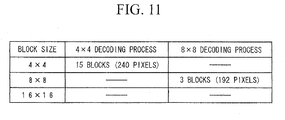
- Fig. 11 is a table showing the amount of decoding processing required for selecting the prediction mode for each block size defined in H.264.
- selection of the prediction mode requires application of a decoding process to 15 blocks (240 pixels) for the 4 ⁇ 4 block size, and 3 blocks (192 pixels) for the 8 ⁇ 8 block size. If a prediction mode for the 16 ⁇ 16 block size is selected last, a decoding process corresponding to approximately 3 macroblocks (which includes the decoding process for a target 16 ⁇ 16 block size block (which is actually decoded)) should be performed.
- the 16 ⁇ 16 block size i.e., macroblock size
- temporary decoded results for the 4 ⁇ 4 and 8 ⁇ 8 block sizes are cancelled, so that the decoding process applied to at least 432 (i.e., 240 + 192) pixels is useless.
- an object of the present invention is to provide a novel intra prediction encoding control technique for reducing the computation cost by omitting an unnecessary decoding process in intra prediction encoding.
- the present invention provides an intra prediction encoding control apparatus used in intra prediction encoding having a plurality of prediction modes and prediction block sizes, wherein the prediction mode and the prediction block size each can be switched when encoding is performed, the apparatus comprising: (1) a computation device for computing a flatness degree index which indicates a degree of flatness of a target area for encoding; (2) a determination device for determining a prediction block size used in intra prediction encoding of the target area, in accordance with the flatness degree index computed by the computation device; and (3) a selection device for selecting a prediction mode used in the intra prediction encoding of the target area, for the prediction block size determined by the determination device.
- the above structure may further include (4) a computation device for computing a quantization step size of the target area; and (5) a setting device for setting the threshold based on the quantization step size computed by the computation device.
- the intra prediction encoding control method of the present invention which is implemented when the above devices operate, can also be implemented by a computer program.
- a computer program may be provided by storing it in an appropriate computer-readable storage medium, or by means of a network, and can be installed and operate on a control device such as a CPU so as to implement the present invention.
- the flatness degree index which indicates the degree of flatness of a target area for encoding, is computed, for example, based on a statistic with respect to the brightness signal in the target area.
- the target area may be divided into small areas, and the flatness degree index may be computed for each small area.
- the flatness degree index of the target area may be computed based on the computed flatness degree indexes.
- a prediction block size used in intra prediction encoding of the target area is determined in accordance with the computed flatness degree index. For example, (i) if the degree of flatness of the target area is low, a small prediction block size is determined as the prediction block size for the intra prediction encoding; and (ii) if the degree of flatness of the target area is high, a large prediction block size is determined as the prediction block size for the intra prediction encoding.
- the prediction mode used in the intra prediction encoding of the target area is selected while regarding the prediction block size as a fixed size.
- the prediction block size used in the intra prediction encoding of a target area is determined using the flatness degree index, which indicates the degree of flatness of the target area, without performing the determination of the prediction mode.
- the prediction block size for the intra prediction encoding may be determined based on a result of a comparison between the computed flatness degree index of the target area and a threshold which is set in accordance with selectable prediction block sizes.
- the above threshold may be set based on the quantization step size of the target area.
- the threshold may be set in a manner such that when the quantization step size decreases, the probability that a small prediction block size is selected increases.
- a quantization step size as a substitute for that of the target area may be computed based on an already-computed quantization step size of another area.
- the prediction block size of a target area for encoding can be determined using the flatness degree index, which indicates the degree of flatness of the target area, without performing the determination of the prediction mode.
- the prediction block size is first limited without limiting the prediction mode (as performed in the conventional methods).
- the prediction block size it is possible to omit an unnecessary decoding process and thus reduce the computation cost.
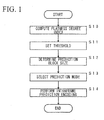
- Fig. 1 is an example of the flowchart executed by a video encoding apparatus in accordance with the present invention. Based on the flowchart, the operation of the video encoding apparatus in accordance with the present invention will be explained.
- the video encoding apparatus first computes a flatness degree index which indicates the degree of flatness of a target area for encoding (see step S10).
- a threshold to be compared with the computed flatness degree index is set in accordance with each prediction block size which can be used.
- the prediction block size for the target area is determined.
- the prediction block size is regarded as a fixed size so as to select the prediction mode.
- the target area is subjected to intra prediction encoding.
- the flatness degree index of the target area for encoding is used for first determining the prediction block size employed in the intra prediction encoding of the target area.
- the flatness degree index can be computed using a dispersion or an average of relevant pixel values, for example, by using the L2 dispersion (see Formula (1)) or the L1 dispersion (see Formula (2)).
- s(i,j) indicates the pixel value at position (i,j) in the target area for encoding
- ⁇ s> indicates an average of the relevant pixel values.
- the target area for encoding may include a plurality of areas having different flatness degree indexes. Therefore, the flatness degree index may be computed after dividing the target area for encoding into small areas. In such a case, the number of computed flatness degree indexes correspond to the number of small areas, and the minimum or maximum value among them is determined as the flatness degree index of the target area for encoding.
- a macroblock of the 16 ⁇ 16 block size is divided into small blocks of the 8 ⁇ 8 block size, and the flatness degree index is computed for each small block. Accordingly, four flatness degree indexes are computed for each macroblock, and the minimum or maximum value among them is determined as the flatness degree index of the macroblock.
- Such a flatness degree index may be used in another encoding process, for example, for quantization control. If the flatness degree index is commonly used, no computation cost for the intra prediction encoding control should be considered. Therefore, in comparison with the case of computing the edge direction or the like, an additional computation cost may be reduced.
- the threshold compared with the flatness degree index is set in accordance with the prediction block size.
- TH 4-8 used for switching between the 4 ⁇ 4 and 8 ⁇ 8 block sizes
- TH 8-16 used for switching between the 8 ⁇ 8 and 16 ⁇ 16 block sizes
- the prediction block size is set to the smallest 4 ⁇ 4 block size. If the degree of flatness is medium as shown by “TH 4-8 > flatness degree index ⁇ TH 8-16 ", a medium prediction block size is preferable. Therefore, the prediction block size is set to the 8 ⁇ 8 block size. If the degree of flatness is high as shown by "TH 8-16 > flatness degree index", the prediction accuracy is not degraded even when selecting a large prediction block size, and the amount of code can be reduced. Therefore, the prediction block size is set to the largest 16 ⁇ 16 block size.
- the threshold value used for the comparison with the flatness degree index may be changed in accordance with the quantization step size.
- each prediction mode has an individual amount of code for overhead data (such as prediction mode data or significant coefficient block data)
- the relationship between the prediction block size and the flatness degree index varies in accordance with the quantization step size. Therefore, degradation of the encoding efficiency can be reduced by changing the threshold value based on the quantization step size.
- degradation of the encoding efficiency can be further reduced by setting the threshold in a manner such that when the quantization step size decreases (i.e., fine quantization is performed), the probability that a small prediction block size is selected increases.
- the threshold TH 4-8 is set to a smaller value. Accordingly, the probability of selecting the smallest 4 ⁇ 4 prediction block size increases, thereby reducing the degradation of the encoding efficiency.
- the quantization step size the value used when quantizing the target area for encoding is preferable. However, if the quantization step size cannot be obtained before the determination of the prediction block size, then the quantization step size of the area which has been encoded immediately before, or an average of the quantization step sizes of the already-processed blocks in the relevant image can be used.
- the prediction block size of a target area can be determined using the flatness degree index of the area without performing the determination of the prediction mode.
- the number of prediction modes for the mode determination can be decreased, and a temporary decoding process used for determining the prediction mode for each prediction block size is unnecessary, thereby reducing the computation cost.
- the practical embodiment shown below employs an intra prediction encoding method based on H.264, and uses three block sizes of 16 ⁇ 16, 8 ⁇ 8, and 4 ⁇ 4 for the relevant intra prediction encoding.
- Fig. 2 shows a video encoding apparatus 1 as a practical embodiment of the present invention.
- the video encoding apparatus 1 has an intra prediction encoding device 2 for performing the intra prediction encoding in accordance with the present invention.
- the intra prediction encoding device 2 includes a prediction block size determination device 3 for performing a distinctive process of the present invention so as to determine the prediction block size used in the intra prediction encoding of a target macroblock; a prediction mode selection device 4 for selecting the prediction mode used in the intra prediction encoding of the target macroblock while regarding the prediction block size, which is determined by the prediction block size determination device 3, as a fixed size; and an encoding device 5 for subjecting the target macroblock to the intra prediction encoding based on the prediction block size (determined by the prediction block size determination device 3) and the prediction mode (selected by the prediction mode selection device 4).
- reference numeral 6 indicates a quantization step size computing unit provided in a quantization control device or the like.
- the quantization step size computing unit 6 computes the quantization step size of the target macroblock, and communicates the result to the intra prediction encoding device 2.
- the prediction block size determination device 3 includes a macroblock division unit 30, an L1 dispersion computing unit 31, a macroblock flatness degree index computing unit 32, a prediction block size determination unit 33, a threshold table 34, a lookup table 35, a table data registration unit 36, and a threshold setting unit 37.
- the macroblock division unit 30 divides the target macroblock for encoding into four small blocks of the 8 ⁇ 8 block size.
- the L1 dispersion computing unit 31 computes an L1 dispersion "act n " of the brightness signal in accordance with the following formula (3), where act n functions as a value (the flatness degree index) which indicates the degree of flatness of the relevant small block.
- the macroblock flatness degree index computing unit 32 computes the maximum value act max of the four L1 dispersions act n computed by the L1 dispersion computing unit 31.
- act max max act 0 act 1 act 2 act 3
- the prediction block size determination unit 33 uses two thresholds TH 4-8 and TH 8-16 (TH 4-8 > TH 8-16 ), and performs the determination in a manner such that (i) if a relationship "act max ⁇ TH 4-8 " is satisfied, the prediction block size is set to the 4 ⁇ 4 block size; (ii) if a relationship "TH 4-8 > act max ⁇ TH 8-16 " is satisfied, the prediction block size is set to the 8 ⁇ 8 block size; and (iii) if a relationship "TH 8-16 > act max " is satisfied, the prediction block size is set to the 16 ⁇ 16 block size.
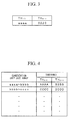
- the threshold table 34 manages the two thresholds TH 4-8 and TH 8-16 used by the prediction block size determination unit 33.
- the lookup table 35 manages the values of the thresholds TH 4-8 and TH 8-16 , which are assigned to each quantization step size range and used when the quantization step size belongs to the relevant quantization step size range.
- the table data registration unit 36 registers data, which indicates corresponding relationships between the quantization step size range and the thresholds TH 4-8 and TH 8-16 , into the lookup table 35.
- the thresholds are set in a manner such that if the quantization step size decreases, the probability that a relatively small prediction block size is selected increases.
- the threshold setting unit 37 refers to the lookup table 35 by using the quantization step size which is computed by the quantization step size computing unit 6 and functions as a key, so as to obtain the values of the thresholds TH 4-8 and TH 8-16 suitable for the relevant quantization step size.
- the threshold setting unit 37 writes the threshold values onto the threshold table 34, so as to set the thresholds TH 4-8 and TH 8-16 .
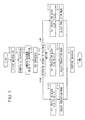
- Fig. 5 shows an example of the flowchart of the operation executed by the intra prediction encoding device 2 having the above-described structure. In accordance with the flowchart, the operation executed by the intra prediction encoding device 2 will be explained in detail.
- the intra prediction encoding device 2 when data of a target macroblock for encoding is provided to the intra prediction encoding device 2, the intra prediction encoding device 2 first divides the target macroblock (16 ⁇ 16 block size) into four small blocks (8 ⁇ 8 block size) (see step S100).
- the L1 dispersions act 0 , act 1 , act 2 , and act 3 of the brightness signal are computed in accordance with the above-described formula (3).
- act max max act 0 act 1 act 2 act 3
- act max max act 0 act 1 act 2 act 3
- the computed act max is determined as the flatness degree index which indicates the degree of flatness of the target macroblock.
- the thresholds TH 4-8 and TH 8-16 used for determining the prediction block size are set.
- the lookup table 35 is referred to by using the quantization step size (as a key) of the target macroblock, which is computed by the quantization step size computing unit 6, so as to obtain the values of the thresholds TH 4-8 and TH 8-16 suitable for the quantization step size, and to write the values onto the threshold table 34.
- the maximum value act max of the L1 dispersion which has been computed as the flatness degree index of the target macroblock, is compared with the two thresholds TH 4-8 and TH 8-16 read from the threshold table 34, so as to determine the degree of flatness of the target macroblock.
- step S104 if it is determined that the degree of flatness of the target macroblock is high, the operation proceeds to step S105, and the 16 ⁇ 16 block size is determined as the prediction block size.
- step S106 the prediction mode of the target macroblock is selected for the determined prediction block.
- step S104 if it is determined that the degree of flatness of the target macroblock is medium, the operation proceeds to step S107, and the 8 ⁇ 8 block size is determined as the prediction block size.
- step S108 the prediction mode of the target macroblock is selected for the determined prediction block.
- step S104 if it is determined that the degree of flatness of the target macroblock is low, the operation proceeds to step S109, and the 4 ⁇ 4 block size is determined as the prediction block size.
- step S110 the prediction mode of the target macroblock is selected for the determined prediction block.
- the prediction block size and the prediction mode of the target macroblock for encoding are selected, and in the following step S111, the target macroblock is subjected to the intra prediction encoding by using the prediction block size and the prediction mode.
- the prediction block size used for the encoding can be determined before determining the prediction mode.
- the present invention can be applied to intra prediction encoding, and it is possible to, not only limit the number of prediction modes for the mode determination, but also omit a temporary decoding process required for determining the prediction mode, which is necessary for each prediction block size. Therefore, the computation cost can be reduced.
Landscapes
- Engineering & Computer Science (AREA)
- Multimedia (AREA)
- Signal Processing (AREA)
- Computing Systems (AREA)
- Theoretical Computer Science (AREA)
- Compression Or Coding Systems Of Tv Signals (AREA)
Abstract
Description
- The present invention relates to an intra prediction encoding control method and apparatus used in an intra prediction encoding which has a plurality of prediction modes and a plurality of prediction block sizes so that a mode and a size can be switchably selected, and also relates to an intra prediction encoding control program for implementing the intra prediction encoding control method, and a computer-readable storage medium which stores the program. In particular, the present invention relates to an intra prediction encoding control method and apparatus for reducing the computation cost, an intra prediction encoding control program for implementing the intra prediction encoding control method, and a computer-readable storage medium which stores the program.
Priority is claimed on Japanese Patent Application No.2006-275951, filed October 10, 2006 - In order to improve the encoding efficiency, ITU-T H.264, which is a standard video encoding method (see, for example, Non-Patent Document 1), employs a prediction encoding method in which a predicted signal is generated using peripheral pixels in intra encoding.
- In the intra prediction encoding of H.264, the prediction mode or the prediction block size can be adaptively switched. In accordance with such a prediction encoding method, the encoding efficiency of intra encoding has been remarkably improved in comparison with the other known video encoding methods.
-
Figs. 6A to 8B show the prediction mode and the prediction block size, employed in H.264. -
Figs. 6A and 6B relate to an intra prediction encoding of a target macroblock (16×16 pixels) using a prediction block size of 4×4 pixels, whereFig. 6A shows the positional relationship between the target blocks (for encoding) and already-encoded blocks, andFig. 6B shows the prediction direction.
Similarly,Figs. 7A and 7B relate to an intra prediction encoding of a target macroblock using a prediction block size of 8×8 pixels, whereFig. 7A shows the positional relationship between the target blocks (for encoding) and already-encoded blocks, andFig. 7B shows the prediction direction.
Similarly,Figs. 8A and 8B relate to an intra prediction encoding of a target macroblock using a prediction block size of 16×16 pixels (i.e., the same size as the macroblock), whereFig. 8A shows the positional relationship between the target block (for encoding) and already-encoded signals (or pixels), andFig. 8B shows predictions by means of various directions and methods. - As described above, in H.264, any prediction block size and any prediction direction can be selected in accordance with the encoding efficiency.
- However, although an increase in the number of selectable prediction modes or prediction block sizes improves the encoding efficiency, it increases the cost of computation performed for selecting the prediction mode or prediction block size. Therefore, a method for reducing the computation cost for intra prediction encoding has been proposed.
- In the invention disclosed in Non-Patent
Document 1, in accordance with the flowchart inFig. 9 , the edge direction is first determined; limited prediction modes are provided; a prediction mode is selected; the prediction block size is determined; and then intra prediction encoding is performed. - In the above-described invention disclosed in
Non-Patent Document 1, the edge direction is measured in advance so as to exclude prediction modes having a low probability of being selected, thereby reducing the computation cost. - In the invention disclosed in Non-Patent
Document 2, in accordance with the flowchart inFig. 10 , the prediction mode for the 4×4 block size is first selected; a bias for the prediction mode is measured; based on the measurement results, selection of the prediction mode for the 8×8 block size may be skipped, or the prediction mode for the 8×8 block size (if there is no skipping for this size) or 16×16 block size may be performed; the prediction block size is determined; and then intra prediction encoding is performed. - In the above-described invention disclosed in
Non-Patent Document 2, the prediction mode for the 4×4 block size (i.e., minimum block size) is first selected, and based on the appearance frequency of the prediction mode for the 4×4 block size, limitation on the 8×8 or 16×16 block size and selection of the prediction block size are controlled. - That is, in the invention disclosed in Non-Patent
Document 2, the prediction mode for the 8×8 block size may be limited or the prediction for the 8×8 block size may be skipped in accordance with a bias for the minimum block size, so as to reduce the computation cost. - Additionally, in the invention disclosed in
Patent Document 1, frequency data for the prediction mode of peripheral blocks is weighted, and the prediction mode is limited based on the weighted frequency data. - In the invention disclosed in
Patent Document 1, the prediction mode and a weighting factor for a reference block are first obtained, and then the priority order of the prediction mode is obtained. Based on the obtained prediction mode and the weighting factor, a weighted histogram for the prediction mode is produced. Then, based on the weighted histogram, a candidate for the prediction mode is selected. In this process, if there is no prediction mode which satisfies a predetermined number used for determining the candidate (as the prediction mode), a prediction mode having a relatively higher priority order is selected, so as to perform intra prediction encoding. - As described above, in the invention disclosed in
Patent Document 1, the prediction mode to be used is limited based on statistical data for the prediction mode of peripheral blocks, thereby reducing the number of execution times of a cost computation which is required for selecting the prediction mode. - Non-Patent Document 1: Feng Pan et al., "Fast Mode Decision Algorithm for Intraprediction in H.264/AVC Video Coding," IEEE Trans. Circuits Syst. Video Technol., vol.15, NO.7, pp. 813-822, July 2005.
- Non-Patent Document 2: Yuichi Tsunematsu et al., "Fast Intra Mode Decision for H.264/AVC FRExt Using Prediction Result Bias", Proceedings of the 2005 IEICE general conference, D-11-5, p. 55, Mar. 2005.
- Patent Document 1: Japanese Unexamined Patent Application, First Publication No.
2005-348280 - As described above, in the conventional methods, the computation cost is reduced by limiting the prediction mode (to be used) in intra prediction encoding.
- For such a function, in the conventional methods, the edge direction of an input signal, a selection result of the prediction mode for the minimum block size, frequency data of the prediction mode for peripheral blocks, or the like are used as data for limiting the prediction mode used in the intra prediction encoding.
- However, in such methods, usage of the prediction mode for the 4×4 or 8×8 block size (i.e., smaller than the macroblock size (16×16)) is not limited, or the usage is partially limited.
- In order to determine the prediction mode for the 4×4 or 8×8 block size (smaller than the macroblock size), a temporary decoded image should be generated. This is because, for small blocks except for the upper-left small block in each macroblock, a decoded image of each small block adjacent to a target block should be referred to when determining the prediction mode of the target block.
- For the generation of a decoded image, orthogonal transformation, quantization, inverse quantization, and inverse orthogonal transformation should be performed. These processes are not actually used for the encoding, but provide temporary decoded results used for selecting the prediction mode. If the relevant block size is not selected, the corresponding temporary decoded results are cancelled.
-
Fig. 11 is a table showing the amount of decoding processing required for selecting the prediction mode for each block size defined in H.264. - As understood by the table, if three block sizes (4×4, 8×8, and 16×16) are used, selection of the prediction mode requires application of a decoding process to 15 blocks (240 pixels) for the 4×4 block size, and 3 blocks (192 pixels) for the 8×8 block size. If a prediction mode for the 16×16 block size is selected last, a decoding process corresponding to approximately 3 macroblocks (which includes the decoding process for a
target 16×16 block size block (which is actually decoded)) should be performed. - As described above, in the conventional methods, when selecting the prediction mode, a temporary decoding process should be performed for a prediction block size which may not be selected last.
- Therefore, if the 16×16 block size (i.e., macroblock size) is selected last, temporary decoded results for the 4×4 and 8×8 block sizes are cancelled, so that the decoding process applied to at least 432 (i.e., 240 + 192) pixels is useless.
- In light of the above circumstances, an object of the present invention is to provide a novel intra prediction encoding control technique for reducing the computation cost by omitting an unnecessary decoding process in intra prediction encoding.
- In order to achieve the above-described object, the present invention provides an intra prediction encoding control apparatus used in intra prediction encoding having a plurality of prediction modes and prediction block sizes, wherein the prediction mode and the prediction block size each can be switched when encoding is performed, the apparatus comprising: (1) a computation device for computing a flatness degree index which indicates a degree of flatness of a target area for encoding; (2) a determination device for determining a prediction block size used in intra prediction encoding of the target area, in accordance with the flatness degree index computed by the computation device; and (3) a selection device for selecting a prediction mode used in the intra prediction encoding of the target area, for the prediction block size determined by the determination device.
- The above structure may further include (4) a computation device for computing a quantization step size of the target area; and (5) a setting device for setting the threshold based on the quantization step size computed by the computation device.
- The intra prediction encoding control method of the present invention, which is implemented when the above devices operate, can also be implemented by a computer program. Such a computer program may be provided by storing it in an appropriate computer-readable storage medium, or by means of a network, and can be installed and operate on a control device such as a CPU so as to implement the present invention.
- In the intra prediction encoding control apparatus of the present invention having the above structure, first, the flatness degree index, which indicates the degree of flatness of a target area for encoding, is computed, for example, based on a statistic with respect to the brightness signal in the target area.
- In this process, in consideration that a large target area may include a plurality of areas having different flatness degree indexes, the target area may be divided into small areas, and the flatness degree index may be computed for each small area. The flatness degree index of the target area may be computed based on the computed flatness degree indexes.
- Then, a prediction block size used in intra prediction encoding of the target area is determined in accordance with the computed flatness degree index. For example, (i) if the degree of flatness of the target area is low, a small prediction block size is determined as the prediction block size for the intra prediction encoding; and (ii) if the degree of flatness of the target area is high, a large prediction block size is determined as the prediction block size for the intra prediction encoding.
- Next, in accordance with the determined prediction block size, the prediction mode used in the intra prediction encoding of the target area is selected while regarding the prediction block size as a fixed size.
- Therefore, in the intra prediction encoding control apparatus of the present invention, the prediction block size used in the intra prediction encoding of a target area is determined using the flatness degree index, which indicates the degree of flatness of the target area, without performing the determination of the prediction mode.
- In the prediction block size determination in the intra prediction encoding control apparatus of the present invention, the prediction block size for the intra prediction encoding may be determined based on a result of a comparison between the computed flatness degree index of the target area and a threshold which is set in accordance with selectable prediction block sizes.
- In order to reduce degradation of the encoding efficiency, the above threshold may be set based on the quantization step size of the target area. For example, the threshold may be set in a manner such that when the quantization step size decreases, the probability that a small prediction block size is selected increases.
- Also in the setting of the threshold, if the quantization step size of the target area cannot be computed before the prediction block size is determined, then a quantization step size as a substitute for that of the target area may be computed based on an already-computed quantization step size of another area.
- In accordance with the present invention, when performing intra prediction encoding, the prediction block size of a target area for encoding can be determined using the flatness degree index, which indicates the degree of flatness of the target area, without performing the determination of the prediction mode.
- Therefore, in accordance with the present invention, when performing the intra prediction encoding, it is possible to, not only limit the number of prediction modes for the mode determination, but also omit a temporary decoding process required for determining the prediction mode, which is necessary for each prediction block size. Therefore, the computation cost can be reduced.
-
-
Fig. 1 is a flowchart of the operation executed by a video encoding apparatus in accordance with the present invention. -
Fig. 2 shows a video encoding apparatus as a practical embodiment of the present invention. -
Fig. 3 is a diagram for explaining table data in a threshold table. -
Fig. 4 is a diagram for explaining table data in a lookup table. -
Fig. 5 is a flowchart of the operation executed by an intra prediction encoding device. -
Fig. 6A is a diagram for explaining encoding which uses a prediction block size of 4×4 pixels and is employed in H.264. -
Fig. 6B is a diagram for explaining the prediction direction inFig. 6A . -
Fig. 7A is a diagram for explaining encoding which uses a prediction block size of 8×8 pixels and is employed in H.264. -
Fig. 7B is a diagram for explaining the prediction direction inFig. 7A . -
Fig. 8A is a diagram for explaining encoding which uses a prediction block size of 16×16 pixels and is employed in H.264. -
Fig. 8B is a diagram for explaining predictions by means of various directions and methods inFig. 8A . -
Fig. 9 is a flowchart of the operation executed in the invention disclosed inNon-Patent Document 2. -
Fig. 10 is a flowchart of the operation executed in the invention disclosed inNon-Patent Document 3. -
Fig. 11 is a diagram for explaining the amount of decoding processing required for selecting the prediction mode in H.264. -
- 1
- video encoding apparatus
- 2
- intra prediction encoding device
- 3
- prediction block size determination device
- 4
- prediction mode selection device
- 5
- encoding device
- 6
- quantization step size computing unit
- 30
- macroblock division unit
- 31
- L1 dispersion computing unit
- 32
- macroblock flatness degree index computing unit
- 33
- prediction block size determination unit
- 34
- threshold table
- 35
- lookup table
- 36
- table data registration unit
- 37
- threshold setting unit
- Below, the present invention will be explained in detail in accordance with embodiments.
- In the present invention, when performing intra prediction encoding, the prediction block size is first limited without limiting the prediction mode (as performed in the conventional methods). When limiting the prediction block size first, it is possible to omit an unnecessary decoding process and thus reduce the computation cost.
-
Fig. 1 is an example of the flowchart executed by a video encoding apparatus in accordance with the present invention. Based on the flowchart, the operation of the video encoding apparatus in accordance with the present invention will be explained. - The video encoding apparatus first computes a flatness degree index which indicates the degree of flatness of a target area for encoding (see step S10).
- In the next step S11, a threshold to be compared with the computed flatness degree index is set in accordance with each prediction block size which can be used.
- In the next step S12, based on the result of comparison between the computed flatness degree index and the set threshold, the prediction block size for the target area is determined.
- In this process of the block size selection for the target area, the lower the degree of flatness, the smaller the selected block size, and the higher the degree of flatness, the larger the selected block size.
- In the next step S13, in accordance with the determined prediction block size, the prediction block size is regarded as a fixed size so as to select the prediction mode.
- In the
last step S 14, in accordance with the determined prediction block size and the selected prediction mode, the target area is subjected to intra prediction encoding. - Below, the above operation will be explained in more detail.
- In the present invention, the flatness degree index of the target area for encoding is used for first determining the prediction block size employed in the intra prediction encoding of the target area.
- The flatness degree index can be computed using a dispersion or an average of relevant pixel values, for example, by using the L2 dispersion (see Formula (1)) or the L1 dispersion (see Formula (2)).
-

- In the above formulas, s(i,j) indicates the pixel value at position (i,j) in the target area for encoding, and <s> indicates an average of the relevant pixel values.
As shown by the formulas, the larger the computed flatness degree index, the lower the degree of flatness, and the smaller the computed flatness degree index, the higher the degree of flatness. - If the target area for encoding is large, it may include a plurality of areas having different flatness degree indexes. Therefore, the flatness degree index may be computed after dividing the target area for encoding into small areas. In such a case, the number of computed flatness degree indexes correspond to the number of small areas, and the minimum or maximum value among them is determined as the flatness degree index of the target area for encoding.
- For example, a macroblock of the 16×16 block size is divided into small blocks of the 8×8 block size, and the flatness degree index is computed for each small block. Accordingly, four flatness degree indexes are computed for each macroblock, and the minimum or maximum value among them is determined as the flatness degree index of the macroblock.
- Such a flatness degree index may be used in another encoding process, for example, for quantization control. If the flatness degree index is commonly used, no computation cost for the intra prediction encoding control should be considered. Therefore, in comparison with the case of computing the edge direction or the like, an additional computation cost may be reduced.
- The threshold compared with the flatness degree index is set in accordance with the prediction block size.
- For example, if the prediction block size is switched between three sizes such as 4×4, 8×8, and 16×16 in accordance with H.264, two thresholds such as TH4-8 used for switching between the 4×4 and 8×8 block sizes and TH8-16 used for switching between the 8×8 and 16×16 block sizes (TH4-8 > TH8-16) are set for performing the relevant switching.
- By using the above two thresholds, if the degree of flatness is low as shown by "flatness degree index ≥ TH4-8", the prediction accuracy is degraded unless a small prediction block size is selected. Therefore, the prediction block size is set to the smallest 4×4 block size.
If the degree of flatness is medium as shown by "TH4-8 > flatness degree index ≥ TH8-16", a medium prediction block size is preferable. Therefore, the prediction block size is set to the 8×8 block size.
If the degree of flatness is high as shown by "TH8-16 > flatness degree index", the prediction accuracy is not degraded even when selecting a large prediction block size, and the amount of code can be reduced. Therefore, the prediction block size is set to the largest 16×16 block size. - The threshold value used for the comparison with the flatness degree index may be changed in accordance with the quantization step size.
- As each prediction mode has an individual amount of code for overhead data (such as prediction mode data or significant coefficient block data), the relationship between the prediction block size and the flatness degree index varies in accordance with the quantization step size. Therefore, degradation of the encoding efficiency can be reduced by changing the threshold value based on the quantization step size.
- In accordance with a knowledge obtained by the inventors of the present application by means of experiments, degradation of the encoding efficiency can be further reduced by setting the threshold in a manner such that when the quantization step size decreases (i.e., fine quantization is performed), the probability that a small prediction block size is selected increases.
- That is, if the quantization step size decreases, then for example, the threshold TH4-8 is set to a smaller value. Accordingly, the probability of selecting the smallest 4×4 prediction block size increases, thereby reducing the degradation of the encoding efficiency.
- For the quantization step size, the value used when quantizing the target area for encoding is preferable. However, if the quantization step size cannot be obtained before the determination of the prediction block size, then the quantization step size of the area which has been encoded immediately before, or an average of the quantization step sizes of the already-processed blocks in the relevant image can be used.
- As described above, in accordance with the present invention, when performing the intra prediction encoding, the prediction block size of a target area can be determined using the flatness degree index of the area without performing the determination of the prediction mode.
- Therefore, in the intra prediction encoding in accordance with the present invention, the number of prediction modes for the mode determination can be decreased, and a temporary decoding process used for determining the prediction mode for each prediction block size is unnecessary, thereby reducing the computation cost.
- Below, the present invention will be explained in detail in accordance with a practical embodiment.
- The practical embodiment shown below employs an intra prediction encoding method based on H.264, and uses three block sizes of 16×16, 8×8, and 4×4 for the relevant intra prediction encoding.
-
Fig. 2 shows avideo encoding apparatus 1 as a practical embodiment of the present invention. - As shown in
Fig. 2 , thevideo encoding apparatus 1 has an intraprediction encoding device 2 for performing the intra prediction encoding in accordance with the present invention.
The intraprediction encoding device 2 includes a prediction blocksize determination device 3 for performing a distinctive process of the present invention so as to determine the prediction block size used in the intra prediction encoding of a target macroblock; a predictionmode selection device 4 for selecting the prediction mode used in the intra prediction encoding of the target macroblock while regarding the prediction block size, which is determined by the prediction blocksize determination device 3, as a fixed size; and anencoding device 5 for subjecting the target macroblock to the intra prediction encoding based on the prediction block size (determined by the prediction block size determination device 3) and the prediction mode (selected by the prediction mode selection device 4). - In
Fig. 2 ,reference numeral 6 indicates a quantization step size computing unit provided in a quantization control device or the like. The quantization stepsize computing unit 6 computes the quantization step size of the target macroblock, and communicates the result to the intraprediction encoding device 2. - In order to perform a process of determining the prediction block size used in the intra prediction encoding of the target macroblock, the prediction block
size determination device 3 includes amacroblock division unit 30, an L1dispersion computing unit 31, a macroblock flatness degree index computing unit 32, a prediction block size determination unit 33, a threshold table 34, a lookup table 35, a tabledata registration unit 36, and athreshold setting unit 37. - The
macroblock division unit 30 divides the target macroblock for encoding into four small blocks of the 8×8 block size. - Foe each of the 8×8 small blocks divided by the
macroblock division unit 30, the L1dispersion computing unit 31 computes an L1 dispersion "actn" of the brightness signal in accordance with the following formula (3), where actn functions as a value (the flatness degree index) which indicates the degree of flatness of the relevant small block. -

- In the above formula, sy(i,j) indicates each pixel value of a small block "n" (n=0 to 3), and <sy> indicates an average of the brightness signals of the small block "n".
- The macroblock flatness degree index computing unit 32 computes the maximum value actmax of the four L1 dispersions actn computed by the L1
dispersion computing unit 31. - That is, the following is computed:

- The prediction block size determination unit 33 uses two thresholds TH4-8 and TH8-16 (TH4-8 > TH8-16), and performs the determination in a manner such that (i) if a relationship "actmax ≥ TH4-8" is satisfied, the prediction block size is set to the 4×4 block size; (ii) if a relationship "TH4-8 > actmax ≥ TH8-16" is satisfied, the prediction block size is set to the 8×8 block size; and (iii) if a relationship "TH8-16 > actmax" is satisfied, the prediction block size is set to the 16×16 block size.
- As shown in
Fig. 3 , the threshold table 34 manages the two thresholds TH4-8 and TH8-16 used by the prediction block size determination unit 33. - As shown in
Fig. 4 , the lookup table 35 manages the values of the thresholds TH4-8 and TH8-16, which are assigned to each quantization step size range and used when the quantization step size belongs to the relevant quantization step size range. - The table
data registration unit 36 registers data, which indicates corresponding relationships between the quantization step size range and the thresholds TH4-8 and TH8-16, into the lookup table 35. In accordance with the registered corresponding relationship data, the thresholds are set in a manner such that if the quantization step size decreases, the probability that a relatively small prediction block size is selected increases. - The
threshold setting unit 37 refers to the lookup table 35 by using the quantization step size which is computed by the quantization stepsize computing unit 6 and functions as a key, so as to obtain the values of the thresholds TH4-8 and TH8-16 suitable for the relevant quantization step size. Thethreshold setting unit 37 writes the threshold values onto the threshold table 34, so as to set the thresholds TH4-8 and TH8-16. -
Fig. 5 shows an example of the flowchart of the operation executed by the intraprediction encoding device 2 having the above-described structure. In accordance with the flowchart, the operation executed by the intraprediction encoding device 2 will be explained in detail. - As shown in the flowchart of
Fig. 5 , when data of a target macroblock for encoding is provided to the intraprediction encoding device 2, the intraprediction encoding device 2 first divides the target macroblock (16×16 block size) into four small blocks (8×8 block size) (see step S100). - In the next step S101, for each of the four divided small blocks, the L1 dispersions act0, act1, act2, and act3 of the brightness signal are computed in accordance with the above-described formula (3).
- In the next step S102, the maximum value actmax among the four computed L1 dispersions act0, act1, act2, and act3 is computed as follows:

The computed actmax is determined as the flatness degree index which indicates the degree of flatness of the target macroblock. - In the next step S103, the thresholds TH4-8 and TH8-16 used for determining the prediction block size are set.
- More specifically, in the threshold setting process, the lookup table 35 is referred to by using the quantization step size (as a key) of the target macroblock, which is computed by the quantization step
size computing unit 6, so as to obtain the values of the thresholds TH4-8 and TH8-16 suitable for the quantization step size, and to write the values onto the threshold table 34. - In the next step S104, the maximum value actmax of the L1 dispersion, which has been computed as the flatness degree index of the target macroblock, is compared with the two thresholds TH4-8 and TH8-16 read from the threshold table 34, so as to determine the degree of flatness of the target macroblock.
- More specifically, in the determination process, (i) if the relationship "actmax ≥ TH4-8" is satisfied, it is determined that the degree of flatness is low; (ii) if the relationship "TH4-8 > actmax ≥ TH8-16" is satisfied, it is determined that the degree of flatness is medium; and (iii) if the relationship "TH8-16 > actmax" is satisfied, it is determined that the degree of flatness is high.
- In accordance with the determination process in step S104, if it is determined that the degree of flatness of the target macroblock is high, the operation proceeds to step S105, and the 16×16 block size is determined as the prediction block size. In the following step S106, the prediction mode of the target macroblock is selected for the determined prediction block.
- Also in accordance with the determination process in step S104, if it is determined that the degree of flatness of the target macroblock is medium, the operation proceeds to step S107, and the 8×8 block size is determined as the prediction block size. In the following step S108, the prediction mode of the target macroblock is selected for the determined prediction block.
- Also in accordance with the determination process in step S104, if it is determined that the degree of flatness of the target macroblock is low, the operation proceeds to step S109, and the 4×4 block size is determined as the prediction block size. In the following step S110, the prediction mode of the target macroblock is selected for the determined prediction block.
- Therefore, in accordance with the process from step S105 to S110, the prediction block size and the prediction mode of the target macroblock for encoding are selected, and in the following step S111, the target macroblock is subjected to the intra prediction encoding by using the prediction block size and the prediction mode.
- Accordingly, in the present invention, when performing intra prediction encoding, the prediction block size used for the encoding can be determined before determining the prediction mode.
- In the above-described practical embodiment, no limitation is imposed on the prediction mode for each prediction block size. However, the number of prediction modes which can be used may be limited so as to further reduce the computation cost.
- The present invention can be applied to intra prediction encoding, and it is possible to, not only limit the number of prediction modes for the mode determination, but also omit a temporary decoding process required for determining the prediction mode, which is necessary for each prediction block size. Therefore, the computation cost can be reduced.
Claims (12)
- An intra prediction encoding control method used in intra prediction encoding having a plurality of prediction modes and prediction block sizes, wherein the prediction mode and the prediction block size each can be switched when encoding is performed, the method comprising:a step of computing a flatness degree index which indicates a degree of flatness of a target area for encoding;a step of determining a prediction block size used in intra prediction encoding of the target area, in accordance with the computed flatness degree index; anda step of selecting a prediction mode used in the intra prediction encoding of the target area, for the determined prediction block size.
- The intra prediction encoding control method in accordance with claim 1, wherein in the step of determining the prediction block size:if the degree of flatness of the target area is low, a small prediction block size is determined as the prediction block size for the encoding; andif the degree of flatness of the target area is high, a large prediction block size is determined as the prediction block size for the encoding.
- The intra prediction encoding control method in accordance with claim 2, wherein in the step of determining the prediction block size, the prediction block size for the encoding is determined based on a result of a comparison between the flatness degree index of the target area and a threshold which is set in accordance with selectable prediction block sizes.
- The intra prediction encoding control method in accordance with claim 3, further comprising:a step of computing a quantization step size of the target area; anda step of setting the threshold based on the computed quantization step size.
- The intra prediction encoding control method in accordance with claim 4, wherein in the step of computing the quantization step size, if the quantization step size cannot be computed before the step of determining the prediction block size is executed, then the quantization step size of the target area is computed based on an already-computed quantization step size of another area.
- The intra prediction encoding control method in accordance with claim 4, wherein in the step of setting the threshold, if the computed quantization step size is relatively small, then the threshold is set to a value which increases a probability that a relatively small prediction block size is selected.
- The intra prediction encoding control method in accordance with claim 1, wherein in the step of computing the flatness degree index, the flatness degree index is computed based on a statistic for brightness signals in the target area.
- The intra prediction encoding control method in accordance with claim 1, wherein in the step of computing the flatness degree index, the target area is divided into small areas, the flatness degree index is computed for each small area; and the flatness degree index of the target area is computed based on the flatness degree indexes of the small areas.
- An intra prediction encoding control apparatus used in intra prediction encoding having a plurality of prediction modes and prediction block sizes, wherein the prediction mode and the prediction block size each can be switched when encoding is performed, the apparatus comprising:a computation device for computing a flatness degree index which indicates a degree of flatness of a target area for encoding;a determination device for determining a prediction block size used in intra prediction encoding of the target area, in accordance with the flatness degree index computed by the computation device; anda selection device for selecting a prediction mode used in the intra prediction encoding of the target area, for the prediction block size determined by the determination device.
- The intra prediction encoding control apparatus in accordance with claim 9, wherein the determination device determines:a small prediction block size as the prediction block size for the encoding if the degree of flatness of the target area is low; anda large prediction block size as the prediction block size for the encoding if the degree of flatness of the target area is high.
- An intra prediction encoding control program by which a computer executes a process for implementing the image encoding control method in accordance with claim 1.
- A computer-readable storage medium which stores an intra prediction encoding control program by which a computer executes a process for implementing the image encoding control method in accordance with claim 1.
Applications Claiming Priority (2)
| Application Number | Priority Date | Filing Date | Title |
|---|---|---|---|
| JP2006275951 | 2006-10-10 | ||
| PCT/JP2007/069620 WO2008044658A1 (en) | 2006-10-10 | 2007-10-05 | Intra prediction encoding control method and device, its program, and storage medium containing program |
Publications (3)
| Publication Number | Publication Date |
|---|---|
| EP2073557A1 true EP2073557A1 (en) | 2009-06-24 |
| EP2073557A4 EP2073557A4 (en) | 2011-03-09 |
| EP2073557B1 EP2073557B1 (en) | 2017-03-29 |
Family
ID=39282853
Family Applications (1)
| Application Number | Title | Priority Date | Filing Date |
|---|---|---|---|
| EP07829358.6A Active EP2073557B1 (en) | 2006-10-10 | 2007-10-05 | Intra prediction encoding control method and device, its program, and storage medium containing program |
Country Status (11)
| Country | Link |
|---|---|
| US (1) | US8228998B2 (en) |
| EP (1) | EP2073557B1 (en) |
| JP (2) | JPWO2008044658A1 (en) |
| KR (2) | KR101242013B1 (en) |
| CN (1) | CN101523921B (en) |
| BR (1) | BRPI0719853A2 (en) |
| CA (1) | CA2664668C (en) |
| ES (1) | ES2630203T3 (en) |
| RU (1) | RU2407221C1 (en) |
| TW (1) | TWI386064B (en) |
| WO (1) | WO2008044658A1 (en) |
Cited By (1)
| Publication number | Priority date | Publication date | Assignee | Title |
|---|---|---|---|---|
| WO2017123328A1 (en) * | 2016-01-11 | 2017-07-20 | Qualcomm Incorporated | Block size decision for video coding |
Families Citing this family (34)
| Publication number | Priority date | Publication date | Assignee | Title |
|---|---|---|---|---|
| JP4901772B2 (en) * | 2007-02-09 | 2012-03-21 | パナソニック株式会社 | Moving picture coding method and moving picture coding apparatus |
| US8219074B2 (en) * | 2008-06-12 | 2012-07-10 | Telefonaktiebolaget L M Ericsson (Publ) | Method and apparatus for communication site planning |
| TW201041405A (en) * | 2009-03-06 | 2010-11-16 | Sony Corp | Image processing device and method |
| JP5219089B2 (en) * | 2009-04-30 | 2013-06-26 | 株式会社メガチップス | Image data generation method |
| US9369720B2 (en) | 2009-12-28 | 2016-06-14 | Panasonic Intellectual Property Management Co., Ltd. | Image coding apparatus and image coding method |
| CN101795409B (en) * | 2010-03-03 | 2011-12-28 | 北京航空航天大学 | content adaptive fractional pixel motion estimation method |
| JP2011239365A (en) * | 2010-04-12 | 2011-11-24 | Canon Inc | Moving image encoding apparatus and method for controlling the same, and computer program |
| US9215470B2 (en) | 2010-07-09 | 2015-12-15 | Qualcomm Incorporated | Signaling selected directional transform for video coding |
| ES2773887T3 (en) * | 2010-12-21 | 2020-07-15 | Ntt Docomo Inc | Improved intra-prediction coding using flat representations |
| US10992958B2 (en) | 2010-12-29 | 2021-04-27 | Qualcomm Incorporated | Video coding using mapped transforms and scanning modes |
| JP5552078B2 (en) * | 2011-02-28 | 2014-07-16 | 株式会社メガチップス | Encoder |
| US10284859B2 (en) | 2011-03-09 | 2019-05-07 | Nec Corporation | Video decoding device and method using inverse quantization |
| PT3471412T (en) | 2011-04-25 | 2021-01-27 | Lg Electronics Inc | Intra-prediction method for video decoding and video encoding |
| JP5720399B2 (en) * | 2011-04-26 | 2015-05-20 | 株式会社Jvcケンウッド | Moving picture coding apparatus, moving picture coding method, and moving picture coding program |
| US9025665B2 (en) * | 2011-07-01 | 2015-05-05 | Cavium, Inc. | Video encoder bit estimator for macroblock encoding |
| WO2013009029A2 (en) * | 2011-07-08 | 2013-01-17 | 한양대학교 산학협력단 | Method and apparatus for setting the size of an encoding unit |
| US9635355B2 (en) | 2011-07-28 | 2017-04-25 | Qualcomm Incorporated | Multiview video coding |
| US9674525B2 (en) | 2011-07-28 | 2017-06-06 | Qualcomm Incorporated | Multiview video coding |
| HUE063723T2 (en) | 2011-10-28 | 2024-01-28 | Samsung Electronics Co Ltd | Method and apparatus for video intra prediction |
| JP6190103B2 (en) * | 2012-10-29 | 2017-08-30 | キヤノン株式会社 | Moving picture coding apparatus, moving picture coding method, and program |
| US9177393B2 (en) * | 2013-02-04 | 2015-11-03 | Qualcomm Incorporated | Mixed mode for frame buffer compression |
| WO2014190468A1 (en) * | 2013-05-27 | 2014-12-04 | Microsoft Corporation | Video encoder for images |
| CN103686183B (en) * | 2013-12-27 | 2017-01-11 | 南京讯思雅信息科技有限公司 | Intra-frame video coding method with controllable power consumption |
| US10136140B2 (en) | 2014-03-17 | 2018-11-20 | Microsoft Technology Licensing, Llc | Encoder-side decisions for screen content encoding |
| US10306229B2 (en) | 2015-01-26 | 2019-05-28 | Qualcomm Incorporated | Enhanced multiple transforms for prediction residual |
| CN106416254B (en) | 2015-02-06 | 2019-08-02 | 微软技术许可有限责任公司 | Skip the evaluation phase during media encoding |
| US10038917B2 (en) | 2015-06-12 | 2018-07-31 | Microsoft Technology Licensing, Llc | Search strategies for intra-picture prediction modes |
| US10136132B2 (en) | 2015-07-21 | 2018-11-20 | Microsoft Technology Licensing, Llc | Adaptive skip or zero block detection combined with transform size decision |
| US10623774B2 (en) | 2016-03-22 | 2020-04-14 | Qualcomm Incorporated | Constrained block-level optimization and signaling for video coding tools |
| JP7027044B2 (en) * | 2017-04-27 | 2022-03-01 | キヤノン株式会社 | Image coding device, image coding method and program |
| US11323748B2 (en) | 2018-12-19 | 2022-05-03 | Qualcomm Incorporated | Tree-based transform unit (TU) partition for video coding |
| CN113273191A (en) * | 2019-01-10 | 2021-08-17 | 世宗大学校产学协力团 | Image encoding/decoding method and apparatus |
| US11381830B2 (en) * | 2020-06-11 | 2022-07-05 | Tencent America LLC | Modified quantizer |
| JP2024135215A (en) * | 2023-03-22 | 2024-10-04 | キヤノン株式会社 | Encoding device, imaging device, control method, and program |
Family Cites Families (21)
| Publication number | Priority date | Publication date | Assignee | Title |
|---|---|---|---|---|
| US5122875A (en) | 1991-02-27 | 1992-06-16 | General Electric Company | An HDTV compression system |
| US5214507A (en) * | 1991-11-08 | 1993-05-25 | At&T Bell Laboratories | Video signal quantization for an mpeg like coding environment |
| JP3640651B2 (en) * | 1992-12-25 | 2005-04-20 | 三菱電機株式会社 | Encoding control device |
| TW297202B (en) * | 1993-10-13 | 1997-02-01 | Rca Thomson Licensing Corp | |
| JP3864461B2 (en) * | 1996-08-30 | 2006-12-27 | ソニー株式会社 | Video data compression apparatus and method |
| US6633611B2 (en) * | 1997-04-24 | 2003-10-14 | Mitsubishi Denki Kabushiki Kaisha | Method and apparatus for region-based moving image encoding and decoding |
| JPH11331850A (en) * | 1998-03-16 | 1999-11-30 | Mitsubishi Electric Corp | Video coding method |
| US6529634B1 (en) | 1999-11-08 | 2003-03-04 | Qualcomm, Inc. | Contrast sensitive variance based adaptive block size DCT image compression |
| NZ524955A (en) | 2000-09-27 | 2005-01-28 | Milestone Entertainment Llc | A lottery game and method for play in games of chance |
| US6831947B2 (en) * | 2001-03-23 | 2004-12-14 | Sharp Laboratories Of America, Inc. | Adaptive quantization based on bit rate prediction and prediction error energy |
| JP4323770B2 (en) * | 2002-10-18 | 2009-09-02 | キヤノン株式会社 | Image processing apparatus, image processing method, program, and recording medium |
| HUP0301368A3 (en) | 2003-05-20 | 2005-09-28 | Amt Advanced Multimedia Techno | Method and equipment for compressing motion picture data |
| CN1209928C (en) * | 2003-07-04 | 2005-07-06 | 清华大学 | Inframe coding frame coding method using inframe prediction based on prediction blockgroup |
| CN100479527C (en) * | 2004-02-26 | 2009-04-15 | 联合信源数字音视频技术(北京)有限公司 | Method for selecting predicting mode within frame |
| JP2005244666A (en) * | 2004-02-26 | 2005-09-08 | Sony Corp | Data processing apparatus, encoding apparatus, and data processing method |
| US8467447B2 (en) * | 2004-05-07 | 2013-06-18 | International Business Machines Corporation | Method and apparatus to determine prediction modes to achieve fast video encoding |
| JP2005348280A (en) | 2004-06-07 | 2005-12-15 | Nippon Telegr & Teleph Corp <Ntt> | Image encoding method, image encoding apparatus, image encoding program, and computer-readable recording medium recording the program |
| US7792188B2 (en) * | 2004-06-27 | 2010-09-07 | Apple Inc. | Selecting encoding types and predictive modes for encoding video data |
| JP2006074474A (en) | 2004-09-02 | 2006-03-16 | Toshiba Corp | Moving picture coding apparatus, moving picture coding method, and moving picture coding program |
| US20060193527A1 (en) * | 2005-01-11 | 2006-08-31 | Florida Atlantic University | System and methods of mode determination for video compression |
| JP4802535B2 (en) | 2005-03-30 | 2011-10-26 | 株式会社島津製作所 | Analyzer information presentation system |
-
2007
- 2007-10-05 BR BRPI0719853-1A2A patent/BRPI0719853A2/en not_active IP Right Cessation
- 2007-10-05 WO PCT/JP2007/069620 patent/WO2008044658A1/en not_active Ceased
- 2007-10-05 KR KR1020097006580A patent/KR101242013B1/en active Active
- 2007-10-05 KR KR1020117013550A patent/KR20110086159A/en not_active Ceased
- 2007-10-05 TW TW096137413A patent/TWI386064B/en active
- 2007-10-05 JP JP2008538717A patent/JPWO2008044658A1/en active Pending
- 2007-10-05 RU RU2009111869/09A patent/RU2407221C1/en active
- 2007-10-05 US US12/441,665 patent/US8228998B2/en active Active
- 2007-10-05 ES ES07829358.6T patent/ES2630203T3/en active Active
- 2007-10-05 CN CN2007800367625A patent/CN101523921B/en active Active
- 2007-10-05 EP EP07829358.6A patent/EP2073557B1/en active Active
- 2007-10-05 CA CA2664668A patent/CA2664668C/en active Active
-
2014
- 2014-01-28 JP JP2014012981A patent/JP5757596B2/en active Active
Cited By (2)
| Publication number | Priority date | Publication date | Assignee | Title |
|---|---|---|---|---|
| WO2017123328A1 (en) * | 2016-01-11 | 2017-07-20 | Qualcomm Incorporated | Block size decision for video coding |
| US9955186B2 (en) | 2016-01-11 | 2018-04-24 | Qualcomm Incorporated | Block size decision for video coding |
Also Published As
| Publication number | Publication date |
|---|---|
| CA2664668C (en) | 2014-04-01 |
| KR20110086159A (en) | 2011-07-27 |
| TW200826691A (en) | 2008-06-16 |
| KR101242013B1 (en) | 2013-03-12 |
| US8228998B2 (en) | 2012-07-24 |
| BRPI0719853A2 (en) | 2014-06-03 |
| CA2664668A1 (en) | 2008-04-17 |
| CN101523921A (en) | 2009-09-02 |
| JP2014140169A (en) | 2014-07-31 |
| EP2073557B1 (en) | 2017-03-29 |
| TWI386064B (en) | 2013-02-11 |
| JPWO2008044658A1 (en) | 2010-02-12 |
| JP5757596B2 (en) | 2015-07-29 |
| RU2009111869A (en) | 2010-10-10 |
| EP2073557A4 (en) | 2011-03-09 |
| ES2630203T3 (en) | 2017-08-18 |
| KR20090064404A (en) | 2009-06-18 |
| WO2008044658A1 (en) | 2008-04-17 |
| CN101523921B (en) | 2011-04-06 |
| US20100020872A1 (en) | 2010-01-28 |
| RU2407221C1 (en) | 2010-12-20 |
Similar Documents
| Publication | Publication Date | Title |
|---|---|---|
| EP2073557B1 (en) | Intra prediction encoding control method and device, its program, and storage medium containing program | |
| CN101529916B (en) | Video encoding with intra encoding selection | |
| EP2129135B1 (en) | Video coding intra prediction method and decoding method, their device, their program and program-recorded medium | |
| US8094720B2 (en) | Mode decision for inter prediction in video coding | |
| EP1610563A2 (en) | Selecting encoding types and predictive modes for encoding video data | |
| US8369403B2 (en) | Image processing device and image processing method | |
| US6611620B1 (en) | Reversible coding method, reversible coding apparatus, and memory medium used therein | |
| US12425601B2 (en) | Method and apparatus for video predictive coding | |
| EP2806639A1 (en) | Video image decoding device, video image and coding device, video image decoding method and video image coding method | |
| US20110182361A1 (en) | Image decoding method and image coding method | |
| US20090268974A1 (en) | Intra-picture prediction mode deciding method, image coding method, and image coding device | |
| US11432005B2 (en) | Moving image encoding device | |
| JP4246723B2 (en) | Intraframe predictive coding control method, intraframe predictive coding control apparatus, intraframe predictive coding control program, and computer-readable recording medium storing the program | |
| US8917766B2 (en) | Picture coding apparatus, picture coding method and video camera | |
| US6356592B1 (en) | Moving image coding apparatus | |
| US8891622B2 (en) | Motion picture coding apparatus, motion picture coding method and computer readable information recording medium | |
| KR100982652B1 (en) | Video encoding method and apparatus therefor using multiple reference frames | |
| US6973216B2 (en) | Image coding apparatus and method | |
| JP2007129662A (en) | Image encoding device | |
| Biadgie et al. | Improving the Intra-prediction of H. 264 and H. 265 Video Coding Standards Using Adaptive Weighted Least Squares Based Predictor | |
| HK1086969A (en) | Selecting encoding types and predictive modes for encoding video data |
Legal Events
| Date | Code | Title | Description |
|---|---|---|---|
| PUAI | Public reference made under article 153(3) epc to a published international application that has entered the european phase |
Free format text: ORIGINAL CODE: 0009012 |
|
| 17P | Request for examination filed |
Effective date: 20090324 |
|
| AK | Designated contracting states |
Kind code of ref document: A1 Designated state(s): AT BE BG CH CY CZ DE DK EE ES FI FR GB GR HU IE IS IT LI LT LU LV MC MT NL PL PT RO SE SI SK TR |
|
| AX | Request for extension of the european patent |
Extension state: AL BA HR MK RS |
|
| DAX | Request for extension of the european patent (deleted) | ||
| RBV | Designated contracting states (corrected) |
Designated state(s): DE ES FR GB |
|
| A4 | Supplementary search report drawn up and despatched |
Effective date: 20110203 |
|
| 17Q | First examination report despatched |
Effective date: 20120117 |
|
| REG | Reference to a national code |
Ref country code: DE Ref legal event code: R079 Ref document number: 602007050422 Country of ref document: DE Free format text: PREVIOUS MAIN CLASS: H04N0007320000 Ipc: H04N0019110000 |
|
| GRAP | Despatch of communication of intention to grant a patent |
Free format text: ORIGINAL CODE: EPIDOSNIGR1 |
|
| RIC1 | Information provided on ipc code assigned before grant |
Ipc: H04N 19/593 20140101ALI20161011BHEP Ipc: H04N 19/196 20140101ALI20161011BHEP Ipc: H04N 19/17 20140101ALI20161011BHEP Ipc: H04N 19/11 20140101AFI20161011BHEP |
|
| INTG | Intention to grant announced |
Effective date: 20161031 |
|
| GRAS | Grant fee paid |
Free format text: ORIGINAL CODE: EPIDOSNIGR3 |
|
| STAA | Information on the status of an ep patent application or granted ep patent |
Free format text: STATUS: GRANT OF PATENT IS INTENDED |
|
| GRAA | (expected) grant |
Free format text: ORIGINAL CODE: 0009210 |
|
| STAA | Information on the status of an ep patent application or granted ep patent |
Free format text: STATUS: THE PATENT HAS BEEN GRANTED |
|
| AK | Designated contracting states |
Kind code of ref document: B1 Designated state(s): DE ES FR GB |
|
| REG | Reference to a national code |
Ref country code: GB Ref legal event code: FG4D |
|
| REG | Reference to a national code |
Ref country code: DE Ref legal event code: R096 Ref document number: 602007050422 Country of ref document: DE |
|
| REG | Reference to a national code |
Ref country code: ES Ref legal event code: FG2A Ref document number: 2630203 Country of ref document: ES Kind code of ref document: T3 Effective date: 20170818 |
|
| REG | Reference to a national code |
Ref country code: FR Ref legal event code: PLFP Year of fee payment: 11 |
|
| REG | Reference to a national code |
Ref country code: DE Ref legal event code: R097 Ref document number: 602007050422 Country of ref document: DE |
|
| PLBE | No opposition filed within time limit |
Free format text: ORIGINAL CODE: 0009261 |
|
| STAA | Information on the status of an ep patent application or granted ep patent |
Free format text: STATUS: NO OPPOSITION FILED WITHIN TIME LIMIT |
|
| 26N | No opposition filed |
Effective date: 20180103 |
|
| REG | Reference to a national code |
Ref country code: FR Ref legal event code: PLFP Year of fee payment: 12 |
|
| PGFP | Annual fee paid to national office [announced via postgrant information from national office to epo] |
Ref country code: DE Payment date: 20251021 Year of fee payment: 19 |
|
| PGFP | Annual fee paid to national office [announced via postgrant information from national office to epo] |
Ref country code: GB Payment date: 20251022 Year of fee payment: 19 |
|
| PGFP | Annual fee paid to national office [announced via postgrant information from national office to epo] |
Ref country code: FR Payment date: 20251029 Year of fee payment: 19 |
|
| PGFP | Annual fee paid to national office [announced via postgrant information from national office to epo] |
Ref country code: ES Payment date: 20251210 Year of fee payment: 19 |
|
| REG | Reference to a national code |
Ref country code: DE Ref legal event code: R081 Ref document number: 602007050422 Country of ref document: DE Owner name: NTT, INC., JP Free format text: FORMER OWNER: NIPPON TELEGRAPH AND TELEPHONE CORP., TOKIO/TOKYO, JP Ref country code: DE Ref legal event code: R082 Ref document number: 602007050422 Country of ref document: DE Representative=s name: DENNEMEYER & ASSOCIATES RECHTSANWALTSGESELLSCH, DE |