EP2073454A1 - Updating a dynamic learning table - Google Patents
Updating a dynamic learning table Download PDFInfo
- Publication number
- EP2073454A1 EP2073454A1 EP07291570A EP07291570A EP2073454A1 EP 2073454 A1 EP2073454 A1 EP 2073454A1 EP 07291570 A EP07291570 A EP 07291570A EP 07291570 A EP07291570 A EP 07291570A EP 2073454 A1 EP2073454 A1 EP 2073454A1
- Authority
- EP
- European Patent Office
- Prior art keywords
- learning table
- ethernet address
- aging
- value
- entry
- Prior art date
- Legal status (The legal status is an assumption and is not a legal conclusion. Google has not performed a legal analysis and makes no representation as to the accuracy of the status listed.)
- Granted
Links
- 230000032683 aging Effects 0.000 claims abstract description 75
- 238000000034 method Methods 0.000 claims abstract description 14
- 101100189060 Arabidopsis thaliana PROC1 gene Proteins 0.000 description 6
- 230000006399 behavior Effects 0.000 description 3
- 229920006235 chlorinated polyethylene elastomer Polymers 0.000 description 2
- 230000002776 aggregation Effects 0.000 description 1
- 238000004220 aggregation Methods 0.000 description 1
- 230000005540 biological transmission Effects 0.000 description 1
- 238000000136 cloud-point extraction Methods 0.000 description 1
- 230000000737 periodic effect Effects 0.000 description 1
- 230000003068 static effect Effects 0.000 description 1
Images
Classifications
-
- H—ELECTRICITY
- H04—ELECTRIC COMMUNICATION TECHNIQUE
- H04L—TRANSMISSION OF DIGITAL INFORMATION, e.g. TELEGRAPHIC COMMUNICATION
- H04L12/00—Data switching networks
- H04L12/28—Data switching networks characterised by path configuration, e.g. LAN [Local Area Networks] or WAN [Wide Area Networks]
- H04L12/46—Interconnection of networks
- H04L12/4604—LAN interconnection over a backbone network, e.g. Internet, Frame Relay
- H04L12/462—LAN interconnection over a bridge based backbone
- H04L12/4625—Single bridge functionality, e.g. connection of two networks over a single bridge
-
- H—ELECTRICITY
- H04—ELECTRIC COMMUNICATION TECHNIQUE
- H04L—TRANSMISSION OF DIGITAL INFORMATION, e.g. TELEGRAPHIC COMMUNICATION
- H04L45/00—Routing or path finding of packets in data switching networks
-
- H—ELECTRICITY
- H04—ELECTRIC COMMUNICATION TECHNIQUE
- H04L—TRANSMISSION OF DIGITAL INFORMATION, e.g. TELEGRAPHIC COMMUNICATION
- H04L49/00—Packet switching elements
- H04L49/25—Routing or path finding in a switch fabric
Definitions
- the present invention relates to a switch with a dynamic Ethernet address-learning table and related method to update a dynamic Ethernet address learning-table.
- MAC entries in e.g. an Ethernet switch have a certain aging timer.
- a timer equal to the aging time is started, and when this timer expires the learned MAC address will be removed from the forwarding table if there was no other packet with that source MAC address.
- Typical implementations use a different strategy to achieve this behavior, e.g., by means of a hit-bit and global timer such that the MAC entries ages between the aging time and 2 times the aging time.
- the Ethernet switch is a Digital Subscriber Line Access Multiplexer DSLAM
- MAC addresses from CPEs or end-devices are learned in the DSLAM, assuming the DSLAM is doing Ethernet switching.
- the problem is how large the aging timer should be set.
- a large aging timer is needed to avoid quick aging.
- the MAC address is aged, no downstream traffic is possible anymore in the event of the above described implementation (1). Since more and more subscribers want to have their own servers, it is possible that the first packet in e.g. a Transmission Control Protocol TCP session setup is a downstream packet, and hence if the MAC address is aged, the TCP session will not come up. Also for VolP this is important. It has been seen that the VoIP phones are not generating any periodic messages, resulting in the aging MAC address of the VolP phone, and hence the subscriber cannot be called.
- a large aging timer is also desired for above property (2). Indeed when the aging timer is long, it will be more difficult for an attacker to steal someone's MAC address.
- An object of the present invention is to provide a switch with a dynamic Ethernet address-learning table and related method to update a dynamic Ethernet address learning-table of the above known type but that covers above situations more efficiently.
- this object is achieved by introducing a predefined minimum aging time value and a predefined maximum aging time value.
- a switching device that comprises a dynamic Ethernet address-learning table with for each entry an associated aging timer comprises furthermore :
- the minimum aging timer is not expired, the behavior is as with known MAC aging i.e. MAC address does not age, and cannot move to another line.
- the minimum timer expired i.e. the associated aging timer of an entry is bigger as the predefined minimum aging time, but not yet the maximum timer, then the MAC will not age i.e. the entry will remain.
- the entry will not remain and the MAC entry will be deleted to favor another new MAC address from the same subscriber.
- this MAC address will not age or will not move to another subscriber.
- the maximum aging timer is reached i.e. the aging timer of an entry is bigger as the predefined maximum aging time value, the MAC address ages i.e. the entry will be removed from the table.
- a possible way to implement such a capacity condition is checking whether a maximum number of Ethernet address entries for said port in said learning table has been reached e.g. checking whether the maximum number of entries for a DSL line is already exceeded.
- Another way to implement such a capacity condition is checking whether a maximum number of Ethernet address entries in said learning table have been reached i.e. for the whole learning table.
- the capacity condition might include that each and every DSL line is allowed to have maximum e.g. 10 MAC address entries in the table and, moreover, that all DSL lines together may not exceed more then e.g. 100 MAC address entries in the table.
- a recommended value for the minimum aging timer is a time equal than or larger than the aging timer used by the known Ethernet switches in the network that are working with one aging timer.
- a recommended value for the maximum aging timer is a time equal than or larger than the DHCP lease time.
- the maximum aging timer can be replaced by lining up this timer with the DHCP lease time in case a DHCP snooper is used at the device that is doing MAC learning.
- This alternative is obviously only limited to DHCP routes (and not for PPP, or static IP users), but for DHCP this is also a viable solution to tune the maximum aging timer.
- the preferred behavior might be slightly different, e.g., when the minimum aging timer is expired but not yet the maximum aging timer, it is better in some cases to allow MAC movement.
- the term 'coupled' should not be interpreted as being limitative to direct connections only.
- the scope of the expression 'a device A coupled to a device B' should not be limited to devices or systems wherein an output of device A is directly connected to an input of device B. It means that there exists a path between an output of A and an input of B which may be a path including other devices or means.
- the Access network comprises a switching node SW that is coupled between the Internet network and a number of subscriber locations.
- the SW comprises a number of ports P1, P2, ..., Pn that provides access for a subscriber over e.g. a Digital Subscriber Line DSL line.
- a port reference is in this way a subscriber port reference.
- the network elements can be implemented by e.g. a PC, fixed phone, mobile phone, ....
- Each one of the network elements includes a Network Interface Card NIC with its associated MAC address. In this way the Figure shows :
- the switching node SW comprises a dynamic Ethernet address-learning table T with for each entry an associated aging timer t. Presume that the address-learning table already comprises a number of entries. In this way the entry for the network element with MAC11 looks like:
- the switching device further comprises a first processor PROC1, a second processor PROC2 and a third processor PROC3.
- the three processors PROC1, PROC2 and PROC3 are each coupled to a port e.g. Port P1 of the switch SW and to the address-learning table T.
- the first processor PROC1 is coupled to the second processor PROC2, which is coupled to the third processor PROC3.
- the first processor PROC1 is included to determine whether a capacity condition being fulfilled.
- the capacity condition is being implemented by checking whether a maximum number of Ethernet address entries in the learning table has been reached for the port P1 at which a newly packet is received.
- MAC 14 is the Ethernet MAC address of a newly installed network element at the first home location that replaces a previously installed computer with previous MAC address MAC11.
- the second processor PROC2 is included to determine upon reception of a new packet with a new Ethernet address i.e. MAC14 at a port P1 of the switch SW, a previous Ethernet address MAC11 that is associated in the learning table T by means of one of the previous entries to the port P1 and for which the associated aging timer t11 has been growing to a value between a predefined minimum aging time value tmin and a predefined maximum aging time value tmax.
- the third processor PROC3 is included to provide an entry to the learning table T to overwrite in the learning table the previous Ethernet address MAC11 with the new Ethernet address MAC14. It has to be explained here that the expression overwriting can mean firstly deleting a previous entry and secondly entering the new entry.
- Ethernet address MAC14 it is meant that indeed no entry in the address-learning table is yet present which comprises this Ethernet address MAC14.
- the method for to be used by the switching node SW to update its dynamic Ethernet address-learning table (T) comprises the following steps.
- a first step is associating to each entry of the learning table an aging timer. This is shown in the figure by means of the above described entries and associated aging timers such as t11, t12, t13, t21, t22, ..., tnm.
- a following step is, checking whether a capacity condition is fulfilled.
- the first processor PROC1 executes this step.
- the capacity condition for this example embodiment is controlling whether a maximum number of Ethernet address entries for a particular subscriber line in the learning table has been reached. A newly packet with a new MAC 14 address has been received at Port P1i.e.
- This packet includes a new Ethernet address MAC 14 from the newly installed network element. Presume that the home location e.g. DSL subscriber line of port P1 is allowed to have maximum three entries in the address-learning table T. According to he described example in the Figure, the result of the controlling step is positive. Hereby the first processor PROC 1 triggers the second processor PROC2.
- the second processor PROC2 receives the port reference P1 e.g. from the input P1 or from the first processor PROC1 and controls for each entry being associated to the receiving port P1 in the address-learning table T1 whether one of the associated aging timers t11, t12 or t13 reached a value between the predefined minimum aging time value tmin and the predefined maximum aging time value tmax. Presume that for this described embodiment, the aging timer t13 reached indeed a value between tmin and tmax.
- the second processor PROC2 provides to the third processor PROC3 this aging timer reference t11.
- the third processor PROC3 Upon reception of this aging timer t11, the third processor PROC3 prepares a newly entry for the address-learning table T. Indeed, for the previous Ethernet address MAC11 that is associated in the learning table T by means of a previous entry P1; MAC11 to the receiving port P1 and for which the associated aging timer t11 reached indeed a value between the predefined minimum aging time value tmin and the predefined maximum aging time value tmax, the Ethernet address MAC11 of the entry is overwritten with the new Ethernet address MAC 14 of the received Ethernet packet.
- the system to update an address-learning table is made more flexible.
- the idea of the present application is about keeping the MAC address in the forwarding table under certain conditions, although it has been expired i.e. tmin has been reached by the aging timer or the entry, for security reasons and to ensure forwarding of traffic.
- a MAC entry can be replaced by another MAC entry of the same subscriber line.
- too long waiting times in the event of e.g. Nic replacements are avoided.
Landscapes
- Engineering & Computer Science (AREA)
- Computer Networks & Wireless Communication (AREA)
- Signal Processing (AREA)
- Small-Scale Networks (AREA)
- Electrically Operated Instructional Devices (AREA)
Abstract
Description
- The present invention relates to a switch with a dynamic Ethernet address-learning table and related method to update a dynamic Ethernet address learning-table.
- Such a switch and method are already known in the art, e.g. from the Internet website:
- "http://www.h3c.com/portal/Technical_Support_Document/Technic al_Documents/Routers/H3C_MSR_20_Series_Routers/Configuration/Operation_ Manual/System_Volume(OM_V1.02)/200708/208880_1285_0.htm".
- At that webpage point 15 - MAC Address Table Management configuration of the book "Operation Manual - GR Overview (System Volume)" is described. Graceful Restart (GR) ensures the continuity of packet forwarding when a routing protocol restarts. Paragraph 1.2.4 of this point 15 describes the configuration of Medium Access Control MAC Address Aging Timer. In that paragraph it is described the MAC address table of e.g. a router can available with an aging mechanism for dynamic entries to prevent its resources from being exhausted.
- Indeed, MAC entries in e.g. an Ethernet switch have a certain aging timer. When the MAC address is learned based on source MAC address learning, a timer equal to the aging time is started, and when this timer expires the learned MAC address will be removed from the forwarding table if there was no other packet with that source MAC address. Typical implementations use a different strategy to achieve this behavior, e.g., by means of a hit-bit and global timer such that the MAC entries ages between the aging time and 2 times the aging time. In case the Ethernet switch is a Digital Subscriber Line Access Multiplexer DSLAM , MAC addresses from CPEs or end-devices are learned in the DSLAM, assuming the DSLAM is doing Ethernet switching.
- For security reasons, 3 commonly implemented properties of such MAC entries are defined:
- (1) Downstream packets with an unknown destination MAC address are dropped, and not flooded to all users like in standard Ethernet switching
- (2)While a MAC address is learned, it cannot move to another DSL line to prevent that someone is stealing the MAC address of someone else.
- (3)The number of MAC addresses learned on 1 DSL line (or PVC) is limited to a certain maximum. This is to avoid that 1 subscriber consumes a lot of MAC entries in the aggregation switches, or just because of a service sold to the subscriber where the subscriber has to pay for each MAC entry.
- Normally, there are 2 types of subscriptions i.e. one MAC address or more MAC addresses.
- At Paragraph 1.2.4 of this point 15 of the above mentioned document, it is described that the aging timer has to be put appropriately. A long aging interval may cause the MAC address table to retain outdated entries and fail to accommodate latest network changes. On the other hand, a short interval may result in removal of valid entries and, depending of the used system, hence unnecessary broadcasts which may affect device performance.
- Indeed, the problem is how large the aging timer should be set.
- A large aging timer is needed to avoid quick aging. When the MAC address is aged, no downstream traffic is possible anymore in the event of the above described implementation (1). Since more and more subscribers want to have their own servers, it is possible that the first packet in e.g. a Transmission Control Protocol TCP session setup is a downstream packet, and hence if the MAC address is aged, the TCP session will not come up. Also for VolP this is important. It has been seen that the VoIP phones are not generating any periodic messages, resulting in the aging MAC address of the VolP phone, and hence the subscriber cannot be called.
- A large aging timer is also desired for above property (2). Indeed when the aging timer is long, it will be more difficult for an attacker to steal someone's MAC address.
- On the other hand, a small aging timer is required for above mentioned property (3). When, a Network Interface Card NIC is replaced, or a CPE is changed, there might not be enough free entries anymore because non-existing devices use the entries.
- It is clear that there are reasons to set the aging timer large, and there are reasons to set the aging timer small. Usually a rather small aging timer is used (5-10 minutes) because this is the aging timer used by default by most switches. To avoid aging, it is recommended to set the Dynamic Host Configuration Protocol DHCP lease time smaller than the aging timer such that the DHCP renews refreshes the MAC entry. However, this is in most cases not accepted by providers and they prefer to set the DHCP lease time in the order of hours or even days. There is no good configuration of MAC aging and DHCP lease to cover all situations efficiently as discussed above.
- An object of the present invention is to provide a switch with a dynamic Ethernet address-learning table and related method to update a dynamic Ethernet address learning-table of the above known type but that covers above situations more efficiently.
- According to the invention, this object is achieved by introducing a predefined minimum aging time value and a predefined maximum aging time value. In this way, a switching device that comprises a dynamic Ethernet address-learning table with for each entry an associated aging timer comprises furthermore :
- a first processor to determine, whether a capacity condition has been reached or has been fulfilled; and
- a second processor to determine, upon reception of a new packet with a new Ethernet address at a port of the switch, a previous Ethernet address that is associated in the learning table by means of one of the previous entries to this port and for which the associated aging timer already reached a value between such a predefined minimum aging time value and such a predefined maximum aging time value; and
- a third processor to provide an entry to the learning table to overwrite in the learning table the previous Ethernet address with said new Ethernet address.
- Indeed, as long the minimum aging timer is not expired, the behavior is as with known MAC aging i.e. MAC address does not age, and cannot move to another line. When the minimum timer expired i.e. the associated aging timer of an entry is bigger as the predefined minimum aging time, but not yet the maximum timer, then the MAC will not age i.e. the entry will remain. However, when a capacity condition is fulfilled, the entry will not remain and the MAC entry will be deleted to favor another new MAC address from the same subscriber. Shortly, this MAC address will not age or will not move to another subscriber. However, when the maximum aging timer is reached i.e. the aging timer of an entry is bigger as the predefined maximum aging time value, the MAC address ages i.e. the entry will be removed from the table.
- A possible way to implement such a capacity condition is checking whether a maximum number of Ethernet address entries for said port in said learning table has been reached e.g. checking whether the maximum number of entries for a DSL line is already exceeded.
- Another way to implement such a capacity condition is checking whether a maximum number of Ethernet address entries in said learning table have been reached i.e. for the whole learning table. Indeed, the capacity condition might include that each and every DSL line is allowed to have maximum e.g. 10 MAC address entries in the table and, moreover, that all DSL lines together may not exceed more then e.g. 100 MAC address entries in the table.
- A recommended value for the minimum aging timer is a time equal than or larger than the aging timer used by the known Ethernet switches in the network that are working with one aging timer.
- A recommended value for the maximum aging timer is a time equal than or larger than the DHCP lease time. With these settings, the MAC address will never age since the DHCP renews are refreshing it, which guarantees connectivity and security. Moreover, when a NIC or device is replaced, the MAC will age rather quickly to make room for another MAC of that subscriber.
- As an alternative, the maximum aging timer can be replaced by lining up this timer with the DHCP lease time in case a DHCP snooper is used at the device that is doing MAC learning. This alternative is obviously only limited to DHCP routes (and not for PPP, or static IP users), but for DHCP this is also a viable solution to tune the maximum aging timer.
- It should be noted that for some reasons the preferred behavior might be slightly different, e.g., when the minimum aging timer is expired but not yet the maximum aging timer, it is better in some cases to allow MAC movement.
- It is to be noticed that the term 'comprising', used in the claims, should not be interpreted as being limitative to the means listed thereafter. Thus, the scope of the expression 'a device comprising means A and B' should not be limited to devices consisting only of components A and B. It means that with respect to the present invention, the only relevant components of the device are A and B.
- Similarly, it is to be noticed that the term 'coupled', also used in the claims, should not be interpreted as being limitative to direct connections only. Thus, the scope of the expression 'a device A coupled to a device B' should not be limited to devices or systems wherein an output of device A is directly connected to an input of device B. It means that there exists a path between an output of A and an input of B which may be a path including other devices or means.
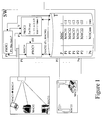
- The above and other objects and features of the invention will become more apparent and the invention itself will be best understood by referring to the following description of an embodiment taken in conjunction with the accompanying drawings wherein the Figure represents an access network.
- The Access network comprises a switching node SW that is coupled between the Internet network and a number of subscriber locations.
- The SW comprises a number of ports P1, P2, ..., Pn that provides access for a subscriber over e.g. a Digital Subscriber Line DSL line. A port reference is in this way a subscriber port reference.
- At each subscriber location a number of network elements are included. The network elements can be implemented by e.g. a PC, fixed phone, mobile phone, .... Each one of the network elements includes a Network Interface Card NIC with its associated MAC address. In this way the Figure shows :
- a first home location being coupled via port P1 to the SW and comprising three network elements each having its MAC address MAC11, MAC12 and MAC13; and
- a second home location being coupled via port P2 to the switch SW and comprising two network elements each having its MAC address MAC21 and MAC22.
- The switching node SW comprises a dynamic Ethernet address-learning table T with for each entry an associated aging timer t. Presume that the address-learning table already comprises a number of entries. In this way the entry for the network element with MAC11 looks like:
- (P1; MAC11; t11) with P1 the port being used for MAC11 to access the switch and t11 the actual value of the timer being associated to this entry.
- In a similar way the following entries are already made in the table:
- (P1;MAC11;t11)
- (P1; MAC12; t12)
- (P1; MAC13; t13)
- (P2; MAC21; t21)
- (P2; MAC22 ; t22)
... ... ... - (Pn; MACnm; tnm)
- The switching device further comprises a first processor PROC1, a second processor PROC2 and a third processor PROC3.
- The three processors PROC1, PROC2 and PROC3 are each coupled to a port e.g. Port P1 of the switch SW and to the address-learning table T. The first processor PROC1 is coupled to the second processor PROC2, which is coupled to the third processor PROC3.
- The first processor PROC1 is included to determine whether a capacity condition being fulfilled. As a matter of example implementation, the capacity condition is being implemented by checking whether a maximum number of Ethernet address entries in the learning table has been reached for the port P1 at which a newly packet is received.
- It has to be explained that in this example MAC 14 is the Ethernet MAC address of a newly installed network element at the first home location that replaces a previously installed computer with previous MAC address MAC11.
- The second processor PROC2 is included to determine upon reception of a new packet with a new Ethernet address i.e. MAC14 at a port P1 of the switch SW, a previous Ethernet address MAC11 that is associated in the learning table T by means of one of the previous entries to the port P1 and for which the associated aging timer t11 has been growing to a value between a predefined minimum aging time value tmin and a predefined maximum aging time value tmax.
- The third processor PROC3 is included to provide an entry to the learning table T to overwrite in the learning table the previous Ethernet address MAC11 with the new Ethernet address MAC14. It has to be explained here that the expression overwriting can mean firstly deleting a previous entry and secondly entering the new entry.
- Furthermore it has to be clear that with new Ethernet address MAC14 it is meant that indeed no entry in the address-learning table is yet present which comprises this Ethernet address MAC14.
- The working of the device according to the present invention in accordance with its telecommunication environment that is shown in the Figure will be explained by means of a functional description of the different blocks shown therein. Based on this description, the practical implementation of the blocks will be obvious to a person skilled in the art and will therefor not be described in details. In addition, the principle working of the method to update a dynamic Ethernet address-learning table will be described in further detail.
- The method for to be used by the switching node SW to update its dynamic Ethernet address-learning table (T) comprises the following steps. A first step is associating to each entry of the learning table an aging timer. This is shown in the figure by means of the above described entries and associated aging timers such as t11, t12, t13, t21, t22, ..., tnm. A following step is, checking whether a capacity condition is fulfilled. The first processor PROC1 executes this step. As described above, the capacity condition for this example embodiment is controlling whether a maximum number of Ethernet address entries for a particular subscriber line in the learning table has been reached. A newly packet with a new MAC 14 address has been received at Port P1i.e. the packet shown in the Figure at the port P1. This packet includes a new Ethernet address MAC 14 from the newly installed network element. Presume that the home location e.g. DSL subscriber line of port P1 is allowed to have maximum three entries in the address-learning table T. According to he described example in the Figure, the result of the controlling step is positive. Hereby the first processor PROC 1 triggers the second processor PROC2.
- The second processor PROC2 receives the port reference P1 e.g. from the input P1 or from the first processor PROC1 and controls for each entry being associated to the receiving port P1 in the address-learning table T1 whether one of the associated aging timers t11, t12 or t13 reached a value between the predefined minimum aging time value tmin and the predefined maximum aging time value tmax. Presume that for this described embodiment, the aging timer t13 reached indeed a value between tmin and tmax. The second processor PROC2 provides to the third processor PROC3 this aging timer reference t11.
- Upon reception of this aging timer t11, the third processor PROC3 prepares a newly entry for the address-learning table T. Indeed, for the previous Ethernet address MAC11 that is associated in the learning table T by means of a previous entry P1; MAC11 to the receiving port P1 and for which the associated aging timer t11 reached indeed a value between the predefined minimum aging time value tmin and the predefined maximum aging time value tmax, the Ethernet address MAC11 of the entry is overwritten with the new Ethernet address MAC 14 of the received Ethernet packet.
- Hereby the system to update an address-learning table is made more flexible. Basically, the idea of the present application is about keeping the MAC address in the forwarding table under certain conditions, although it has been expired i.e. tmin has been reached by the aging timer or the entry, for security reasons and to ensure forwarding of traffic. However, in the event when certain capacity conditions are as well accomplished, a MAC entry can be replaced by another MAC entry of the same subscriber line. Hereby too long waiting times in the event of e.g. Nic replacements are avoided.
- A final remark is that embodiments of the present invention are described above in terms of functional blocks. From the functional description of these blocks, given above, it will be apparent for a person skilled in the art of designing electronic devices how embodiments of these blocks can be manufactured with well-known electronic components. A detailed architecture of the contents of the functional blocks hence is not given.
- While the principles of the invention have been described above in connection with specific apparatus, it is to be clearly understood that this description is made only by way of example and not as a limitation on the scope of the invention, as defined in the appended claims.
Claims (5)
- A method for use by a switch (SW) to update a dynamic Ethernet address-learning table (T), said method comprises- associating to each entry of said learning table an aging timer (t : t11, t12, t13, t21, t22, ..., tnm), characterized in that said method further comprises a step of in the event when a capacity condition being reached and upon reception of a new packet with a new Ethernet address (MAC14) at a port (P1) of said switch (SW), overwriting in said learning table a previous Ethernet address (MAC11) with said new Ethernet address (MAC14), said previous Ethernet address (MAC11) being associated in said learning table (T) by a previous entry (P1; MAC11) to said port (P1) and for which said associated aging timer (t11) reached a value between a predefined minimum aging time (tmin) value and a predefined maximum aging time value (tmax).
- The method according to claim 1, characterized in that said capacity condition being accomplished by having reached a maximum number of Ethernet address entries for said port (P1) in said learning table.
- The method according to claim 1, characterized in that said capacity condition being accomplished by having reached a maximum number of Ethernet address entries in said learning table.
- The method according to claim 1, characterized in that said predefined maximum aging time value being a value equal than or larger than the DHCP lease time in the network.
- A switching device that comprises a dynamic Ethernet address-learning table (T) with for each entry an associated aging timer (t : t11, t12, t13, t21, t22, ..., tnm), characterized in that said switching device further comprises- a first processor (PROC1) to determine whether a capacity condition being reached; and- a second processor (PROC2) to determine, upon reception of a new packet with a new Ethernet address (MAC 14) at a port (P1) of said switch (SW), a previous Ethernet address (MAC11) being associated in said learning table (T) by one of said previous entries to said port (P1) and for which said associated aging timer (t11) having a value between a predefined minimum aging time (tmin) value and a predefined maximum aging time value (tmax); and- a third processor (PROC3) to provide an entry to said learning table (T) to overwrite in said learning table said previous Ethernet address (MAC11) with said new Ethernet address (MAC14) in the event when said capacity condition being fulfilled and said aging timer having a value between said predefined minimum aging time value (tmin) and said predefined maximum aging time value (tmax).
Priority Applications (3)
| Application Number | Priority Date | Filing Date | Title |
|---|---|---|---|
| DE602007012566T DE602007012566D1 (en) | 2007-12-19 | 2007-12-19 | Updating a dynamic learning board |
| AT07291570T ATE498963T1 (en) | 2007-12-19 | 2007-12-19 | UPDATING A DYNAMIC LEARNING BOARD |
| EP07291570A EP2073454B1 (en) | 2007-12-19 | 2007-12-19 | Updating a dynamic learning table |
Applications Claiming Priority (1)
| Application Number | Priority Date | Filing Date | Title |
|---|---|---|---|
| EP07291570A EP2073454B1 (en) | 2007-12-19 | 2007-12-19 | Updating a dynamic learning table |
Publications (2)
| Publication Number | Publication Date |
|---|---|
| EP2073454A1 true EP2073454A1 (en) | 2009-06-24 |
| EP2073454B1 EP2073454B1 (en) | 2011-02-16 |
Family
ID=39319621
Family Applications (1)
| Application Number | Title | Priority Date | Filing Date |
|---|---|---|---|
| EP07291570A Not-in-force EP2073454B1 (en) | 2007-12-19 | 2007-12-19 | Updating a dynamic learning table |
Country Status (3)
| Country | Link |
|---|---|
| EP (1) | EP2073454B1 (en) |
| AT (1) | ATE498963T1 (en) |
| DE (1) | DE602007012566D1 (en) |
Cited By (7)
| Publication number | Priority date | Publication date | Assignee | Title |
|---|---|---|---|---|
| CN102123106A (en) * | 2011-04-21 | 2011-07-13 | 杭州华三通信技术有限公司 | MAC (Multi-Access Computer) addresses learning method and device in virtual private local area network service (VPLS) network |
| CN102035721B (en) * | 2009-09-30 | 2012-09-26 | 中兴通讯股份有限公司 | Method and device for aging processing of media access control table entry |
| EP2597829A1 (en) * | 2011-11-22 | 2013-05-29 | Huawei Technologies Co., Ltd. | Method and apparatus for managing MAC address table |
| CN104660439B (en) * | 2013-11-25 | 2018-10-02 | 华为技术有限公司 | The setting method and device of session entry ageing time |
| CN108712449A (en) * | 2018-07-12 | 2018-10-26 | 新华三技术有限公司 | Prevent the method, apparatus and electronic equipment of MAC Address extensive aggression |
| CN112866438A (en) * | 2021-03-26 | 2021-05-28 | 新华三信息安全技术有限公司 | Address allocation method and device and address allocation server |
| CN115987919A (en) * | 2022-12-27 | 2023-04-18 | 苏州盛科通信股份有限公司 | Method and device for realizing accurate aging of MAC entries |
Citations (3)
| Publication number | Priority date | Publication date | Assignee | Title |
|---|---|---|---|---|
| US5210748A (en) * | 1990-02-09 | 1993-05-11 | Hitachi, Ltd. | Address filter unit for carrying out address filter processing among plurality of networks and method thereof |
| EP1087573A2 (en) * | 1999-09-27 | 2001-03-28 | Nortel Networks Corporation | Enhanced dual counter rotating ring network control system |
| EP1185039A2 (en) * | 2000-09-01 | 2002-03-06 | Avaya Communication Israel Ltd. | Policy enforcing switch |
-
2007
- 2007-12-19 DE DE602007012566T patent/DE602007012566D1/en active Active
- 2007-12-19 AT AT07291570T patent/ATE498963T1/en not_active IP Right Cessation
- 2007-12-19 EP EP07291570A patent/EP2073454B1/en not_active Not-in-force
Patent Citations (3)
| Publication number | Priority date | Publication date | Assignee | Title |
|---|---|---|---|---|
| US5210748A (en) * | 1990-02-09 | 1993-05-11 | Hitachi, Ltd. | Address filter unit for carrying out address filter processing among plurality of networks and method thereof |
| EP1087573A2 (en) * | 1999-09-27 | 2001-03-28 | Nortel Networks Corporation | Enhanced dual counter rotating ring network control system |
| EP1185039A2 (en) * | 2000-09-01 | 2002-03-06 | Avaya Communication Israel Ltd. | Policy enforcing switch |
Cited By (10)
| Publication number | Priority date | Publication date | Assignee | Title |
|---|---|---|---|---|
| CN102035721B (en) * | 2009-09-30 | 2012-09-26 | 中兴通讯股份有限公司 | Method and device for aging processing of media access control table entry |
| CN102123106A (en) * | 2011-04-21 | 2011-07-13 | 杭州华三通信技术有限公司 | MAC (Multi-Access Computer) addresses learning method and device in virtual private local area network service (VPLS) network |
| CN102123106B (en) * | 2011-04-21 | 2013-08-14 | 杭州华三通信技术有限公司 | MAC (Multi-Access Computer) addresses learning method and device in virtual private local area network service (VPLS) network |
| EP2597829A1 (en) * | 2011-11-22 | 2013-05-29 | Huawei Technologies Co., Ltd. | Method and apparatus for managing MAC address table |
| US9036660B2 (en) | 2011-11-22 | 2015-05-19 | Huawei Technologies Co., Ltd. | Method and apparatus for managing MAC address table |
| CN104660439B (en) * | 2013-11-25 | 2018-10-02 | 华为技术有限公司 | The setting method and device of session entry ageing time |
| CN108712449A (en) * | 2018-07-12 | 2018-10-26 | 新华三技术有限公司 | Prevent the method, apparatus and electronic equipment of MAC Address extensive aggression |
| CN112866438A (en) * | 2021-03-26 | 2021-05-28 | 新华三信息安全技术有限公司 | Address allocation method and device and address allocation server |
| CN112866438B (en) * | 2021-03-26 | 2022-07-22 | 新华三信息安全技术有限公司 | Address allocation method and device and address allocation server |
| CN115987919A (en) * | 2022-12-27 | 2023-04-18 | 苏州盛科通信股份有限公司 | Method and device for realizing accurate aging of MAC entries |
Also Published As
| Publication number | Publication date |
|---|---|
| EP2073454B1 (en) | 2011-02-16 |
| DE602007012566D1 (en) | 2011-03-31 |
| ATE498963T1 (en) | 2011-03-15 |
Similar Documents
| Publication | Publication Date | Title |
|---|---|---|
| EP2073454A1 (en) | Updating a dynamic learning table | |
| EP2266255B1 (en) | Method & system for configuring a network communications device | |
| US9118571B2 (en) | Methods of operating load balancing switches and controllers using matching patterns with unrestricted characters | |
| US8477782B2 (en) | VRRP and learning bridge CPE | |
| RU2416884C2 (en) | Method of controlling user device through network address translation (nat) gateway | |
| EP3301870B1 (en) | Route processing method, device and system | |
| CN101971654A (en) | network access control | |
| US20130080629A1 (en) | Method and apparatus for detecting devices on a local area network | |
| CN103329486A (en) | Address compatibility in network device overloading | |
| US20210351956A1 (en) | Customer premises lan expansion | |
| US20070091890A1 (en) | Constraining flooding of multicast traffic in Layer2 networks | |
| JP4873960B2 (en) | Method for facilitating application server functions and access nodes including application server functions | |
| US6470395B1 (en) | Method to impose execution of a predefined command, first terminal and second terminal realizing such a method and a communication network including such a first terminal and such a second terminal | |
| KR20060059073A (en) | Multicast System and Method in Deep Sub Using Encapsulation and Unicast Routing | |
| KR101385749B1 (en) | Router-ID setup system and control method in network for supporting more than at least | |
| EP3021529B1 (en) | Method and device for implementing layer 3 virtual private network | |
| CA2720222C (en) | Spatial clustering | |
| US20070104200A1 (en) | Network device with routing function and policy route setting method thereof | |
| EP2197170A1 (en) | VOIP registration backup on VRRP routers | |
| TWI415425B (en) | The home network gateway provides a domain name assignment method for multiple WAN connections | |
| JP2005064572A (en) | Communication address configuration method and information processing apparatus | |
| CN101268675A (en) | Method, communication arrangement and communication device for establishing a communication relationship |
Legal Events
| Date | Code | Title | Description |
|---|---|---|---|
| PUAI | Public reference made under article 153(3) epc to a published international application that has entered the european phase |
Free format text: ORIGINAL CODE: 0009012 |
|
| AK | Designated contracting states |
Kind code of ref document: A1 Designated state(s): AT BE BG CH CY CZ DE DK EE ES FI FR GB GR HU IE IS IT LI LT LU LV MC MT NL PL PT RO SE SI SK TR |
|
| AX | Request for extension of the european patent |
Extension state: AL BA HR MK RS |
|
| 17P | Request for examination filed |
Effective date: 20091228 |
|
| AKX | Designation fees paid |
Designated state(s): AT BE BG CH CY CZ DE DK EE ES FI FR GB GR HU IE IS IT LI LT LU LV MC MT NL PL PT RO SE SI SK TR |
|
| 17Q | First examination report despatched |
Effective date: 20100209 |
|
| GRAP | Despatch of communication of intention to grant a patent |
Free format text: ORIGINAL CODE: EPIDOSNIGR1 |
|
| GRAS | Grant fee paid |
Free format text: ORIGINAL CODE: EPIDOSNIGR3 |
|
| GRAA | (expected) grant |
Free format text: ORIGINAL CODE: 0009210 |
|
| AK | Designated contracting states |
Kind code of ref document: B1 Designated state(s): AT BE BG CH CY CZ DE DK EE ES FI FR GB GR HU IE IS IT LI LT LU LV MC MT NL PL PT RO SE SI SK TR |
|
| REG | Reference to a national code |
Ref country code: GB Ref legal event code: FG4D |
|
| REG | Reference to a national code |
Ref country code: CH Ref legal event code: EP |
|
| REG | Reference to a national code |
Ref country code: IE Ref legal event code: FG4D |
|
| REF | Corresponds to: |
Ref document number: 602007012566 Country of ref document: DE Date of ref document: 20110331 Kind code of ref document: P |
|
| REG | Reference to a national code |
Ref country code: DE Ref legal event code: R096 Ref document number: 602007012566 Country of ref document: DE Effective date: 20110331 |
|
| REG | Reference to a national code |
Ref country code: NL Ref legal event code: VDEP Effective date: 20110216 |
|
| LTIE | Lt: invalidation of european patent or patent extension |
Effective date: 20110216 |
|
| PG25 | Lapsed in a contracting state [announced via postgrant information from national office to epo] |
Ref country code: GR Free format text: LAPSE BECAUSE OF FAILURE TO SUBMIT A TRANSLATION OF THE DESCRIPTION OR TO PAY THE FEE WITHIN THE PRESCRIBED TIME-LIMIT Effective date: 20110517 Ref country code: LT Free format text: LAPSE BECAUSE OF FAILURE TO SUBMIT A TRANSLATION OF THE DESCRIPTION OR TO PAY THE FEE WITHIN THE PRESCRIBED TIME-LIMIT Effective date: 20110216 Ref country code: SE Free format text: LAPSE BECAUSE OF FAILURE TO SUBMIT A TRANSLATION OF THE DESCRIPTION OR TO PAY THE FEE WITHIN THE PRESCRIBED TIME-LIMIT Effective date: 20110216 Ref country code: ES Free format text: LAPSE BECAUSE OF FAILURE TO SUBMIT A TRANSLATION OF THE DESCRIPTION OR TO PAY THE FEE WITHIN THE PRESCRIBED TIME-LIMIT Effective date: 20110527 Ref country code: PT Free format text: LAPSE BECAUSE OF FAILURE TO SUBMIT A TRANSLATION OF THE DESCRIPTION OR TO PAY THE FEE WITHIN THE PRESCRIBED TIME-LIMIT Effective date: 20110616 Ref country code: LV Free format text: LAPSE BECAUSE OF FAILURE TO SUBMIT A TRANSLATION OF THE DESCRIPTION OR TO PAY THE FEE WITHIN THE PRESCRIBED TIME-LIMIT Effective date: 20110216 |
|
| PG25 | Lapsed in a contracting state [announced via postgrant information from national office to epo] |
Ref country code: AT Free format text: LAPSE BECAUSE OF FAILURE TO SUBMIT A TRANSLATION OF THE DESCRIPTION OR TO PAY THE FEE WITHIN THE PRESCRIBED TIME-LIMIT Effective date: 20110216 Ref country code: FI Free format text: LAPSE BECAUSE OF FAILURE TO SUBMIT A TRANSLATION OF THE DESCRIPTION OR TO PAY THE FEE WITHIN THE PRESCRIBED TIME-LIMIT Effective date: 20110216 Ref country code: SI Free format text: LAPSE BECAUSE OF FAILURE TO SUBMIT A TRANSLATION OF THE DESCRIPTION OR TO PAY THE FEE WITHIN THE PRESCRIBED TIME-LIMIT Effective date: 20110216 Ref country code: BG Free format text: LAPSE BECAUSE OF FAILURE TO SUBMIT A TRANSLATION OF THE DESCRIPTION OR TO PAY THE FEE WITHIN THE PRESCRIBED TIME-LIMIT Effective date: 20110516 Ref country code: CY Free format text: LAPSE BECAUSE OF FAILURE TO SUBMIT A TRANSLATION OF THE DESCRIPTION OR TO PAY THE FEE WITHIN THE PRESCRIBED TIME-LIMIT Effective date: 20110216 Ref country code: NL Free format text: LAPSE BECAUSE OF FAILURE TO SUBMIT A TRANSLATION OF THE DESCRIPTION OR TO PAY THE FEE WITHIN THE PRESCRIBED TIME-LIMIT Effective date: 20110216 Ref country code: PL Free format text: LAPSE BECAUSE OF FAILURE TO SUBMIT A TRANSLATION OF THE DESCRIPTION OR TO PAY THE FEE WITHIN THE PRESCRIBED TIME-LIMIT Effective date: 20110216 Ref country code: BE Free format text: LAPSE BECAUSE OF FAILURE TO SUBMIT A TRANSLATION OF THE DESCRIPTION OR TO PAY THE FEE WITHIN THE PRESCRIBED TIME-LIMIT Effective date: 20110216 |
|
| PG25 | Lapsed in a contracting state [announced via postgrant information from national office to epo] |
Ref country code: DK Free format text: LAPSE BECAUSE OF FAILURE TO SUBMIT A TRANSLATION OF THE DESCRIPTION OR TO PAY THE FEE WITHIN THE PRESCRIBED TIME-LIMIT Effective date: 20110216 Ref country code: EE Free format text: LAPSE BECAUSE OF FAILURE TO SUBMIT A TRANSLATION OF THE DESCRIPTION OR TO PAY THE FEE WITHIN THE PRESCRIBED TIME-LIMIT Effective date: 20110216 |
|
| PG25 | Lapsed in a contracting state [announced via postgrant information from national office to epo] |
Ref country code: CZ Free format text: LAPSE BECAUSE OF FAILURE TO SUBMIT A TRANSLATION OF THE DESCRIPTION OR TO PAY THE FEE WITHIN THE PRESCRIBED TIME-LIMIT Effective date: 20110216 Ref country code: RO Free format text: LAPSE BECAUSE OF FAILURE TO SUBMIT A TRANSLATION OF THE DESCRIPTION OR TO PAY THE FEE WITHIN THE PRESCRIBED TIME-LIMIT Effective date: 20110216 Ref country code: SK Free format text: LAPSE BECAUSE OF FAILURE TO SUBMIT A TRANSLATION OF THE DESCRIPTION OR TO PAY THE FEE WITHIN THE PRESCRIBED TIME-LIMIT Effective date: 20110216 |
|
| PLBE | No opposition filed within time limit |
Free format text: ORIGINAL CODE: 0009261 |
|
| STAA | Information on the status of an ep patent application or granted ep patent |
Free format text: STATUS: NO OPPOSITION FILED WITHIN TIME LIMIT |
|
| 26N | No opposition filed |
Effective date: 20111117 |
|
| REG | Reference to a national code |
Ref country code: CH Ref legal event code: PCOW Free format text: ALCATEL LUCENT;3, AVENUE OCTAVE GREARD;75007 PARIS (FR) |
|
| REG | Reference to a national code |
Ref country code: DE Ref legal event code: R097 Ref document number: 602007012566 Country of ref document: DE Effective date: 20111117 |
|
| PG25 | Lapsed in a contracting state [announced via postgrant information from national office to epo] |
Ref country code: IT Free format text: LAPSE BECAUSE OF FAILURE TO SUBMIT A TRANSLATION OF THE DESCRIPTION OR TO PAY THE FEE WITHIN THE PRESCRIBED TIME-LIMIT Effective date: 20110216 |
|
| PG25 | Lapsed in a contracting state [announced via postgrant information from national office to epo] |
Ref country code: MC Free format text: LAPSE BECAUSE OF NON-PAYMENT OF DUE FEES Effective date: 20111231 |
|
| REG | Reference to a national code |
Ref country code: CH Ref legal event code: PL |
|
| REG | Reference to a national code |
Ref country code: IE Ref legal event code: MM4A |
|
| PG25 | Lapsed in a contracting state [announced via postgrant information from national office to epo] |
Ref country code: LI Free format text: LAPSE BECAUSE OF NON-PAYMENT OF DUE FEES Effective date: 20111231 Ref country code: CH Free format text: LAPSE BECAUSE OF NON-PAYMENT OF DUE FEES Effective date: 20111231 Ref country code: IE Free format text: LAPSE BECAUSE OF NON-PAYMENT OF DUE FEES Effective date: 20111219 |
|
| PG25 | Lapsed in a contracting state [announced via postgrant information from national office to epo] |
Ref country code: MT Free format text: LAPSE BECAUSE OF FAILURE TO SUBMIT A TRANSLATION OF THE DESCRIPTION OR TO PAY THE FEE WITHIN THE PRESCRIBED TIME-LIMIT Effective date: 20110216 |
|
| PG25 | Lapsed in a contracting state [announced via postgrant information from national office to epo] |
Ref country code: LU Free format text: LAPSE BECAUSE OF NON-PAYMENT OF DUE FEES Effective date: 20111219 |
|
| PG25 | Lapsed in a contracting state [announced via postgrant information from national office to epo] |
Ref country code: IS Free format text: LAPSE BECAUSE OF FAILURE TO SUBMIT A TRANSLATION OF THE DESCRIPTION OR TO PAY THE FEE WITHIN THE PRESCRIBED TIME-LIMIT Effective date: 20110216 |
|
| PG25 | Lapsed in a contracting state [announced via postgrant information from national office to epo] |
Ref country code: TR Free format text: LAPSE BECAUSE OF FAILURE TO SUBMIT A TRANSLATION OF THE DESCRIPTION OR TO PAY THE FEE WITHIN THE PRESCRIBED TIME-LIMIT Effective date: 20110216 |
|
| PG25 | Lapsed in a contracting state [announced via postgrant information from national office to epo] |
Ref country code: HU Free format text: LAPSE BECAUSE OF FAILURE TO SUBMIT A TRANSLATION OF THE DESCRIPTION OR TO PAY THE FEE WITHIN THE PRESCRIBED TIME-LIMIT Effective date: 20110216 |
|
| REG | Reference to a national code |
Ref country code: FR Ref legal event code: GC Effective date: 20131018 |
|
| REG | Reference to a national code |
Ref country code: FR Ref legal event code: RG Effective date: 20141016 |
|
| REG | Reference to a national code |
Ref country code: FR Ref legal event code: CA Effective date: 20150521 |
|
| REG | Reference to a national code |
Ref country code: FR Ref legal event code: CA Effective date: 20150521 |
|
| REG | Reference to a national code |
Ref country code: FR Ref legal event code: PLFP Year of fee payment: 9 |
|
| REG | Reference to a national code |
Ref country code: FR Ref legal event code: PLFP Year of fee payment: 10 |
|
| PGFP | Annual fee paid to national office [announced via postgrant information from national office to epo] |
Ref country code: FR Payment date: 20161222 Year of fee payment: 10 |
|
| PGFP | Annual fee paid to national office [announced via postgrant information from national office to epo] |
Ref country code: DE Payment date: 20171211 Year of fee payment: 11 |
|
| PGFP | Annual fee paid to national office [announced via postgrant information from national office to epo] |
Ref country code: GB Payment date: 20171221 Year of fee payment: 11 |
|
| REG | Reference to a national code |
Ref country code: FR Ref legal event code: ST Effective date: 20180831 |
|
| PG25 | Lapsed in a contracting state [announced via postgrant information from national office to epo] |
Ref country code: FR Free format text: LAPSE BECAUSE OF NON-PAYMENT OF DUE FEES Effective date: 20180102 |
|
| REG | Reference to a national code |
Ref country code: GB Ref legal event code: 732E Free format text: REGISTERED BETWEEN 20190429 AND 20190502 |
|
| REG | Reference to a national code |
Ref country code: DE Ref legal event code: R082 Ref document number: 602007012566 Country of ref document: DE Representative=s name: MENZIETTI WETZEL, DE Ref country code: DE Ref legal event code: R081 Ref document number: 602007012566 Country of ref document: DE Owner name: PROVENANCE ASSET GROUP LLC, PITTSFORD, US Free format text: FORMER OWNER: ALCATEL LUCENT, PARIS, FR |
|
| REG | Reference to a national code |
Ref country code: DE Ref legal event code: R119 Ref document number: 602007012566 Country of ref document: DE |
|
| GBPC | Gb: european patent ceased through non-payment of renewal fee |
Effective date: 20181219 |
|
| PG25 | Lapsed in a contracting state [announced via postgrant information from national office to epo] |
Ref country code: DE Free format text: LAPSE BECAUSE OF NON-PAYMENT OF DUE FEES Effective date: 20190702 |
|
| PG25 | Lapsed in a contracting state [announced via postgrant information from national office to epo] |
Ref country code: GB Free format text: LAPSE BECAUSE OF NON-PAYMENT OF DUE FEES Effective date: 20181219 |