EP2073442A1 - Quality of service measurements for streamed content - Google Patents
Quality of service measurements for streamed content Download PDFInfo
- Publication number
- EP2073442A1 EP2073442A1 EP07291594A EP07291594A EP2073442A1 EP 2073442 A1 EP2073442 A1 EP 2073442A1 EP 07291594 A EP07291594 A EP 07291594A EP 07291594 A EP07291594 A EP 07291594A EP 2073442 A1 EP2073442 A1 EP 2073442A1
- Authority
- EP
- European Patent Office
- Prior art keywords
- content
- network
- network element
- packets
- packet
- Prior art date
- Legal status (The legal status is an assumption and is not a legal conclusion. Google has not performed a legal analysis and makes no representation as to the accuracy of the status listed.)
- Withdrawn
Links
- 238000005259 measurement Methods 0.000 title 1
- 238000000034 method Methods 0.000 claims abstract description 18
- 238000012360 testing method Methods 0.000 claims abstract description 8
- 239000000872 buffer Substances 0.000 claims description 13
- 230000002776 aggregation Effects 0.000 claims description 3
- 238000004220 aggregation Methods 0.000 claims description 3
- 238000007689 inspection Methods 0.000 description 3
- 230000004044 response Effects 0.000 description 2
- 230000009471 action Effects 0.000 description 1
- 238000007792 addition Methods 0.000 description 1
- 238000004891 communication Methods 0.000 description 1
- 230000006735 deficit Effects 0.000 description 1
- 238000012986 modification Methods 0.000 description 1
- 230000004048 modification Effects 0.000 description 1
- 230000008569 process Effects 0.000 description 1
- 230000005236 sound signal Effects 0.000 description 1
- 230000000007 visual effect Effects 0.000 description 1
Images


Classifications
-
- H—ELECTRICITY
- H04—ELECTRIC COMMUNICATION TECHNIQUE
- H04N—PICTORIAL COMMUNICATION, e.g. TELEVISION
- H04N21/00—Selective content distribution, e.g. interactive television or video on demand [VOD]
- H04N21/40—Client devices specifically adapted for the reception of or interaction with content, e.g. set-top-box [STB]; Operations thereof
- H04N21/43—Processing of content or additional data, e.g. demultiplexing additional data from a digital video stream; Elementary client operations, e.g. monitoring of home network or synchronising decoder's clock; Client middleware
- H04N21/44—Processing of video elementary streams, e.g. splicing a video clip retrieved from local storage with an incoming video stream or rendering scenes according to encoded video stream scene graphs
- H04N21/44004—Processing of video elementary streams, e.g. splicing a video clip retrieved from local storage with an incoming video stream or rendering scenes according to encoded video stream scene graphs involving video buffer management, e.g. video decoder buffer or video display buffer
-
- H—ELECTRICITY
- H04—ELECTRIC COMMUNICATION TECHNIQUE
- H04L—TRANSMISSION OF DIGITAL INFORMATION, e.g. TELEGRAPHIC COMMUNICATION
- H04L41/00—Arrangements for maintenance, administration or management of data switching networks, e.g. of packet switching networks
- H04L41/50—Network service management, e.g. ensuring proper service fulfilment according to agreements
- H04L41/5003—Managing SLA; Interaction between SLA and QoS
- H04L41/5009—Determining service level performance parameters or violations of service level contracts, e.g. violations of agreed response time or mean time between failures [MTBF]
-
- H—ELECTRICITY
- H04—ELECTRIC COMMUNICATION TECHNIQUE
- H04L—TRANSMISSION OF DIGITAL INFORMATION, e.g. TELEGRAPHIC COMMUNICATION
- H04L41/00—Arrangements for maintenance, administration or management of data switching networks, e.g. of packet switching networks
- H04L41/50—Network service management, e.g. ensuring proper service fulfilment according to agreements
- H04L41/508—Network service management, e.g. ensuring proper service fulfilment according to agreements based on type of value added network service under agreement
- H04L41/509—Network service management, e.g. ensuring proper service fulfilment according to agreements based on type of value added network service under agreement wherein the managed service relates to media content delivery, e.g. audio, video or TV
-
- H—ELECTRICITY
- H04—ELECTRIC COMMUNICATION TECHNIQUE
- H04L—TRANSMISSION OF DIGITAL INFORMATION, e.g. TELEGRAPHIC COMMUNICATION
- H04L43/00—Arrangements for monitoring or testing data switching networks
- H04L43/08—Monitoring or testing based on specific metrics, e.g. QoS, energy consumption or environmental parameters
-
- H—ELECTRICITY
- H04—ELECTRIC COMMUNICATION TECHNIQUE
- H04L—TRANSMISSION OF DIGITAL INFORMATION, e.g. TELEGRAPHIC COMMUNICATION
- H04L43/00—Arrangements for monitoring or testing data switching networks
- H04L43/14—Arrangements for monitoring or testing data switching networks using software, i.e. software packages
-
- H—ELECTRICITY
- H04—ELECTRIC COMMUNICATION TECHNIQUE
- H04N—PICTORIAL COMMUNICATION, e.g. TELEVISION
- H04N17/00—Diagnosis, testing or measuring for television systems or their details
- H04N17/004—Diagnosis, testing or measuring for television systems or their details for digital television systems
-
- H—ELECTRICITY
- H04—ELECTRIC COMMUNICATION TECHNIQUE
- H04N—PICTORIAL COMMUNICATION, e.g. TELEVISION
- H04N21/00—Selective content distribution, e.g. interactive television or video on demand [VOD]
- H04N21/60—Network structure or processes for video distribution between server and client or between remote clients; Control signalling between clients, server and network components; Transmission of management data between server and client, e.g. sending from server to client commands for recording incoming content stream; Communication details between server and client
- H04N21/63—Control signaling related to video distribution between client, server and network components; Network processes for video distribution between server and clients or between remote clients, e.g. transmitting basic layer and enhancement layers over different transmission paths, setting up a peer-to-peer communication via Internet between remote STB's; Communication protocols; Addressing
- H04N21/643—Communication protocols
- H04N21/64322—IP
Definitions
- the present invention relates to a method to test the Quality of Service (QoS) pertaining to content that is streamed over a packet-based network.
- QoS Quality of Service
- the present invention further relates to a network element that can be used for implementing this method.
- Analog television is steadily being replaced by digital techniques, for instance Internet Protocol Television (IP-TV) or Digital Video Broadcasting (DVB) television.
- IP-TV Internet Protocol Television
- DVD Digital Video Broadcasting
- the analog signal is replaced by a digital counterpart.
- the video content is transferred in a compressed stream.
- Such a stream consists of a sequence of packets.
- the packets comprise a number of headers which convey additional information such as the destination address, the sequence number of the packet, timestamps, stream identification, source identification, encoding format etc.
- the television signal needs to be reconstructed continuously.
- the delivery of the packets by the network must meet certain minimum quality criteria levels for network paramaters parameters such as drop, latency, jitter, reordering etc.
- network paramaters parameters such as drop, latency, jitter, reordering etc.
- most digital television receivers e.g. set-top boxes, contain a buffer.
- the use of a buffer does not eliminate these problems.
- a content provider wishes to ensure the best possible Quality of Service (QoS) of the content that is actually received by the end-user.
- QoS Quality of Service
- Current solutions to determine the end-user experience are based on measuring the abovementioned network parameters, followed by an indirect computation of the quality of content transported over such a network. Hence, it is an indirect method that can only predict an overall average performance. Problems that an individual end-user faces at a given time are not always visible in this calculated overall QoE figure. Such problems may include visual artifacts, channels that are unavailable, slow response to zapping commands or slow response of the system in general. These impairments can depend on the time of the day of a particular action of the user, e.g. zapping, and may not be visible in an overall QoE value.
- the object of the present invention is to provide a method to test the QoS pertaining to content that is streamed over a packet-based network, in which the abovementioned problems do not occur, or at least in a lesser degree.
- This objective is achieved by reflecting the steamed content from within said network.
- the reflection enables the remote inspection of the content by an operator.
- the operator can inspect the quality of the content at the point where it is reflected in the network.
- the reflection process preferably comprises the capturing of content packets and the re-directing of these packets.
- the captured packets are provided with time stamps. These time stamps represent the time at which the content packets were received and or captured at the reflection point. Using these time stamps, the operator can reconstruct the content at the reflection point with high accuracy.
- the buffer filling level may go to zero, which results in loss of signal. It is advantageous if this aspect of the signal reconstruction can be added to the reflected content.
- a possible implementation is to add the buffer filling level as separate information to each packet that is reflected. Of course, this information could also be sent on regular intervals.
- Packet-based networks comprise a receiver, responsible for the reconstruction of the video/audio/voice signal.
- An example of such a receiver is a set-top box for DVB or IP-TV.
- These receivers usually comprise means to control the content that is being received. These means are responsive to control signals from a user of the receiver. It is convenient if the operator can remotely control the content much like the user can do locally. In this way, the operator is able to experience the problems a user may have in controlling the content.
- An important example is the changing of channels in case of a television signal.
- IP-TV IP-TV
- DVB DVB
- the present invention further provides a network element for use in a packet-based network which has an input and a first output for the transport of streamed content. It is characterized by a second output and in that this network element comprises means to capture content received at the input and to re-direct said captured content to said second output.
- a network element could be used to reflect content at the location at which this element is placed in the network.
- This element can be added to an existing network element or be part of an existing element. It may further be a stand-alone element specifically targeted at content reflection.
- Typical network elements that comprise such an element are a set-top box, an edge router, an aggregation switch, a DSLAM, a DSL-modem, a cable-modem or a home-router/gateway.
- a video server 1 streams a video signal 2 to an edge router 3.
- the router distributes the stream to an aggregation switch 4, which in turn is connected to multiple DSLAMs 5 of which only one is shown.
- Each DSLAM 5 multiplexes several individual XSDL lines.
- one XDSL line 6 is shown which is connected to a modem 7 of an end-user.
- a set-top box 8 is connected to this modem to decode the signals and to send them to a television 9.
- Set-top box 8 is equipped with means to reflect the original video stream 2. As a result, a reflected video stream 10 is transported back to the edge router 3 where it is directed to video testing equipment 11.
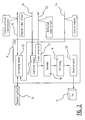
- Figure 2 illustrates an embodiment of a set-top box 8 according to the present invention. It comprises controlling means 12 which can be operated by a remote control 13 of a user or remotely by the operator using control signals 14.
- the controlling means enable control-protocol communication 15 with the network, e.g. DSLAM, to for instance select a desired television channel.
- the network e.g. DSLAM
- the set-top box 8 comprises an input for the regular video stream 16. Packets received at this input are subsequently captured by known capturing means 17, decoded in decoder 18 and buffered in buffer 19. As a last step the television signal is reconstructed in reconstructor 20 and sent to the television 9.
- the video stream is reflected by the video reflector 21 after the capturing of the packets 17.
- information regarding the filling level of the buffer 19 and the time stamps pertaining to the time of reception and or capturing of the packets is included in the reflected video stream 22.
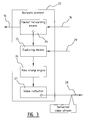
- Figure 3 depicts a network element 23 which can be used to reflect content according to the present invention.
- the network element has a first input and output which enable packet forwarding by packet forwarding means 24 of video stream 16. This configuration is known in the art. Additionally, the element comprises means to capture packets 25. After capturing, the captured packets are provided with a time stamp in the time stamp engine 26 after which the packets are re-directed by the video reflector 27 in a reflected video stream 28 preferably to the operator or test equipment.
- the network element may be responsive to remote control signals 29, which can for instance be used to select a certain channel in video stream 16. In this way, only that specific channel is reflected.
- FIG 4 An example of a reflected packet 35 is illustrated in figure 4 .
- the packet is provided with lower layer headers 30 that contain information to convey a payload 31 from the device at which the content is reflected to the inspection destination, e.g. test equipment.
- the abovementioned payload comprises a captured packet 32 of the content stream as well as time stamp information 33 pertaining to the corresponding reception and or capturing.
- the actual filling level of a buffer 34 can be included if applicable, e.g. the buffer level of a set-top box.
- the original captured packet may also contain lower layer headers. These headers contain information pertaining to the original stream and may comprise the destination and source of the original content stream. They can be found at the start of the so-called "original captured packet" 32.
Landscapes
- Engineering & Computer Science (AREA)
- Signal Processing (AREA)
- Computer Networks & Wireless Communication (AREA)
- Multimedia (AREA)
- Environmental & Geological Engineering (AREA)
- Health & Medical Sciences (AREA)
- Biomedical Technology (AREA)
- General Health & Medical Sciences (AREA)
- Computer Security & Cryptography (AREA)
- Data Exchanges In Wide-Area Networks (AREA)
Abstract
Description
- The present invention relates to a method to test the Quality of Service (QoS) pertaining to content that is streamed over a packet-based network. The present invention further relates to a network element that can be used for implementing this method.
- Analog television is steadily being replaced by digital techniques, for instance Internet Protocol Television (IP-TV) or Digital Video Broadcasting (DVB) television. In both techniques, the analog signal is replaced by a digital counterpart. Typically, the video content is transferred in a compressed stream. Such a stream consists of a sequence of packets. In addition to the actual digital representation of the video signal, the packets comprise a number of headers which convey additional information such as the destination address, the sequence number of the packet, timestamps, stream identification, source identification, encoding format etc.
- Similar to analog television, the television signal needs to be reconstructed continuously. To make it possible to reconstruct the signal in a timely matter, the delivery of the packets by the network must meet certain minimum quality criteria levels for network paramaters parameters such as drop, latency, jitter, reordering etc. To minimize the impact of these network parameters, most digital television receivers, e.g. set-top boxes, contain a buffer. However, the use of a buffer does not eliminate these problems.
- A content provider wishes to ensure the best possible Quality of Service (QoS) of the content that is actually received by the end-user. Current solutions to determine the end-user experience are based on measuring the abovementioned network parameters, followed by an indirect computation of the quality of content transported over such a network. Hence, it is an indirect method that can only predict an overall average performance. Problems that an individual end-user faces at a given time are not always visible in this calculated overall QoE figure. Such problems may include visual artifacts, channels that are unavailable, slow response to zapping commands or slow response of the system in general. These impairments can depend on the time of the day of a particular action of the user, e.g. zapping, and may not be visible in an overall QoE value.
- Although examples have been provided with respect to video signals, not excluding the corresponding audio signals, the invention applies to streamed content in general, for which the reconstruction requires the accurate timing of packets.
- The object of the present invention is to provide a method to test the QoS pertaining to content that is streamed over a packet-based network, in which the abovementioned problems do not occur, or at least in a lesser degree.
- This objective is achieved by reflecting the steamed content from within said network. The reflection enables the remote inspection of the content by an operator. By reflecting the content at a strategic point, or points, in the network the operator can inspect the quality of the content at the point where it is reflected in the network.
- The reflection process preferably comprises the capturing of content packets and the re-directing of these packets. To eliminate any distortion that may occur in the reflection path, i.e. from the reflection point to the inspection point, it is advantageous if the captured packets are provided with time stamps. These time stamps represent the time at which the content packets were received and or captured at the reflection point. Using these time stamps, the operator can reconstruct the content at the reflection point with high accuracy.
- As stated above, most receivers of streamed content comprise buffers. These buffers have a limited amount of memory. If the packet reception severely degrades, the buffer filling level may go to zero, which results in loss of signal. It is advantageous if this aspect of the signal reconstruction can be added to the reflected content. A possible implementation is to add the buffer filling level as separate information to each packet that is reflected. Of course, this information could also be sent on regular intervals.
- Packet-based networks comprise a receiver, responsible for the reconstruction of the video/audio/voice signal. An example of such a receiver is a set-top box for DVB or IP-TV. These receivers usually comprise means to control the content that is being received. These means are responsive to control signals from a user of the receiver. It is convenient if the operator can remotely control the content much like the user can do locally. In this way, the operator is able to experience the problems a user may have in controlling the content. An important example is the changing of channels in case of a television signal.
- Important types of content for which the present invention can be applied are IP-TV and DVB, although the present invention is not limited to these types of content.
- The present invention further provides a network element for use in a packet-based network which has an input and a first output for the transport of streamed content. It is characterized by a second output and in that this network element comprises means to capture content received at the input and to re-direct said captured content to said second output. Such a network element could be used to reflect content at the location at which this element is placed in the network. This element can be added to an existing network element or be part of an existing element. It may further be a stand-alone element specifically targeted at content reflection. Typical network elements that comprise such an element are a set-top box, an edge router, an aggregation switch, a DSLAM, a DSL-modem, a cable-modem or a home-router/gateway.
- In the following, the present invention will be described in more detail with reference to the accompanying figures in which:
-
Figure 1 depicts an example of an IP-TV network in which content is reflected; -
Figure 2 illustrates a set-top box according to the present invention; -
Figure 3 shows a network element according to the present invention; and -
Figure 4 illustrates a possible build-up of a reflected packet. - In the IP-TV network of
figure 1 , a video server 1 streams avideo signal 2 to an edge router 3. The router distributes the stream to an aggregation switch 4, which in turn is connected tomultiple DSLAMs 5 of which only one is shown. EachDSLAM 5 multiplexes several individual XSDL lines. Infigure 1 , one XDSL line 6 is shown which is connected to a modem 7 of an end-user. A set-top box 8 is connected to this modem to decode the signals and to send them to atelevision 9. - Set-
top box 8 is equipped with means to reflect theoriginal video stream 2. As a result, areflected video stream 10 is transported back to the edge router 3 where it is directed tovideo testing equipment 11. -
Figure 2 illustrates an embodiment of a set-top box 8 according to the present invention. It comprises controllingmeans 12 which can be operated by aremote control 13 of a user or remotely by the operator usingcontrol signals 14. The controlling means enable control-protocol communication 15 with the network, e.g. DSLAM, to for instance select a desired television channel. - The set-
top box 8 comprises an input for theregular video stream 16. Packets received at this input are subsequently captured by knowncapturing means 17, decoded indecoder 18 and buffered inbuffer 19. As a last step the television signal is reconstructed inreconstructor 20 and sent to thetelevision 9. - In this embodiment, the video stream is reflected by the
video reflector 21 after the capturing of thepackets 17. In addition, information regarding the filling level of thebuffer 19 and the time stamps pertaining to the time of reception and or capturing of the packets is included in the reflectedvideo stream 22. -
Figure 3 depicts anetwork element 23 which can be used to reflect content according to the present invention. The network element has a first input and output which enable packet forwarding by packet forwarding means 24 ofvideo stream 16. This configuration is known in the art. Additionally, the element comprises means to capturepackets 25. After capturing, the captured packets are provided with a time stamp in thetime stamp engine 26 after which the packets are re-directed by thevideo reflector 27 in areflected video stream 28 preferably to the operator or test equipment. - Additionally, the network element may be responsive to remote control signals 29, which can for instance be used to select a certain channel in
video stream 16. In this way, only that specific channel is reflected. - An example of a reflected
packet 35 is illustrated infigure 4 . The packet is provided withlower layer headers 30 that contain information to convey apayload 31 from the device at which the content is reflected to the inspection destination, e.g. test equipment. The abovementioned payload comprises a capturedpacket 32 of the content stream as well astime stamp information 33 pertaining to the corresponding reception and or capturing. In addition, the actual filling level of abuffer 34 can be included if applicable, e.g. the buffer level of a set-top box. It should be noted that the original captured packet may also contain lower layer headers. These headers contain information pertaining to the original stream and may comprise the destination and source of the original content stream. They can be found at the start of the so-called "original captured packet" 32. - The present invention has been described in detail referring to specific embodiments thereof. However, the skilled person in the art may recognize that modifications, additions, or adjustments can be made without deviating from the scope of the present invention as defined by the following claims.
Claims (10)
- A method to test Quality of Service (QoS) pertaining to content that is streamed over a packet-based network, characterized by reflecting said content from within said network.
- The method according to claim 1, characterized in that said reflecting comprises the steps of capturing packets of said content and re-directing said packets.
- The method according to claim 2, characterized in that said reflecting further comprises the addition of time stamps to said packets.
- The method according to claim 1, wherein said network comprises a receiver having a buffer to buffer said streamed content, characterized by adding a filling level of said buffer to said content prior to reflection.
- The method according to claim 1, wherein said network comprises a receiver having controlling means which are responsive to control signals from a user, and which are arranged to control said content, characterized in remotely controlling said content.
- The method according to claim 5, wherein said content comprises a multiplicity of content channels, characterized in selecting a channel of said content.
- The method according to claim 1, wherein said content comprises Internet Protocol Television (IPTV).
- The method according to claim 1, characterized in that said content comprises Digital Video Broadcasting (DVB) content.
- A network element for use in a packet-based network having an input and a first output for the transport of streamed content, characterized in that said network element is provided with a second output and in that said network element comprises means to capture content received at the input and to re-direct said captured content to said second output.
- The network element according to claim 9, characterized in that said network element is a set-top box, an edge router, an aggregation switch, a DSLAM, a DSL-modem, a cable-modem or a home-router/gateway.
Priority Applications (1)
| Application Number | Priority Date | Filing Date | Title |
|---|---|---|---|
| EP07291594A EP2073442A1 (en) | 2007-12-21 | 2007-12-21 | Quality of service measurements for streamed content |
Applications Claiming Priority (1)
| Application Number | Priority Date | Filing Date | Title |
|---|---|---|---|
| EP07291594A EP2073442A1 (en) | 2007-12-21 | 2007-12-21 | Quality of service measurements for streamed content |
Publications (1)
| Publication Number | Publication Date |
|---|---|
| EP2073442A1 true EP2073442A1 (en) | 2009-06-24 |
Family
ID=39400964
Family Applications (1)
| Application Number | Title | Priority Date | Filing Date |
|---|---|---|---|
| EP07291594A Withdrawn EP2073442A1 (en) | 2007-12-21 | 2007-12-21 | Quality of service measurements for streamed content |
Country Status (1)
| Country | Link |
|---|---|
| EP (1) | EP2073442A1 (en) |
Citations (3)
| Publication number | Priority date | Publication date | Assignee | Title |
|---|---|---|---|---|
| US20040034492A1 (en) * | 2001-03-30 | 2004-02-19 | Conway Adrian E. | Passive system and method for measuring and monitoring the quality of service in a communications network |
| US20040078733A1 (en) * | 2000-07-13 | 2004-04-22 | Lewis Lundy M. | Method and apparatus for monitoring and maintaining user-perceived quality of service in a communications network |
| EP1689124A2 (en) * | 2005-02-07 | 2006-08-09 | AT&T Corp. | Method and apparatus for centralised monitoring and analysis of virtual private networks |
-
2007
- 2007-12-21 EP EP07291594A patent/EP2073442A1/en not_active Withdrawn
Patent Citations (3)
| Publication number | Priority date | Publication date | Assignee | Title |
|---|---|---|---|---|
| US20040078733A1 (en) * | 2000-07-13 | 2004-04-22 | Lewis Lundy M. | Method and apparatus for monitoring and maintaining user-perceived quality of service in a communications network |
| US20040034492A1 (en) * | 2001-03-30 | 2004-02-19 | Conway Adrian E. | Passive system and method for measuring and monitoring the quality of service in a communications network |
| EP1689124A2 (en) * | 2005-02-07 | 2006-08-09 | AT&T Corp. | Method and apparatus for centralised monitoring and analysis of virtual private networks |
Similar Documents
| Publication | Publication Date | Title |
|---|---|---|
| JP5023144B2 (en) | Video streaming diagnostics | |
| US7873760B2 (en) | Expedited digital signal decoding | |
| EP1482681B1 (en) | Medium streaming distribution system | |
| US8625455B2 (en) | System and method for handling streaming media | |
| CN101009847B (en) | Video Aware Service Management | |
| US9565482B1 (en) | Adaptive profile switching system and method for media streaming over IP networks | |
| RU2497283C2 (en) | Method for efficient allocation of frequency band of plurality of traffic streams with partially identical content | |
| US20100312905A1 (en) | Sustaining Live Interactive Streaming | |
| US9781488B2 (en) | Controlled adaptive rate switching system and method for media streaming over IP networks | |
| US20100138885A1 (en) | Prioritized Retransmission of Internet Protocol Television (IPTV) Packets | |
| EP3609179A1 (en) | Video quality evaluation method and device | |
| US9009765B2 (en) | Method and server for fast channel change in unicast-multicast IPTV networks | |
| US9363684B2 (en) | Determining loss of IP packets | |
| JP2011082934A (en) | Stream data transmission device and method, and program | |
| US20120002059A1 (en) | Video Feedback Loop | |
| WO2008134897A1 (en) | Method and system for quality service enhancement in networks for media streaming | |
| CA3230893C (en) | Method and system for panoramic multimedia streaming | |
| EP2073442A1 (en) | Quality of service measurements for streamed content | |
| KR20090071873A (en) | Compression rate control system through image quality measurement and its method | |
| EP3041184B1 (en) | Controlling transmission of data over a lossy transmission path to a client | |
| US20100246685A1 (en) | Compressed video decoding delay reducer | |
| US12279001B2 (en) | Method for transmitting real time based digital video signals in networks | |
| CN101272265A (en) | IP broadcasting system and multiplexer, receiving device and method used therein | |
| Laabs | Adaptive multicast streaming | |
| EP3185576A1 (en) | On-demand repair mode for a staggercast stream |
Legal Events
| Date | Code | Title | Description |
|---|---|---|---|
| PUAI | Public reference made under article 153(3) epc to a published international application that has entered the european phase |
Free format text: ORIGINAL CODE: 0009012 |
|
| AK | Designated contracting states |
Kind code of ref document: A1 Designated state(s): AT BE BG CH CY CZ DE DK EE ES FI FR GB GR HU IE IS IT LI LT LU LV MC MT NL PL PT RO SE SI SK TR |
|
| AX | Request for extension of the european patent |
Extension state: AL BA HR MK RS |
|
| 17P | Request for examination filed |
Effective date: 20091228 |
|
| 17Q | First examination report despatched |
Effective date: 20100122 |
|
| AKX | Designation fees paid |
Designated state(s): AT BE BG CH CY CZ DE DK EE ES FI FR GB GR HU IE IS IT LI LT LU LV MC MT NL PL PT RO SE SI SK TR |
|
| RAP1 | Party data changed (applicant data changed or rights of an application transferred) |
Owner name: ALCATEL LUCENT |
|
| STAA | Information on the status of an ep patent application or granted ep patent |
Free format text: STATUS: THE APPLICATION HAS BEEN WITHDRAWN |
|
| 18W | Application withdrawn |
Effective date: 20130429 |
|
| 111Z | Information provided on other rights and legal means of execution |
Free format text: AT BE BG CH CY CZ DE DK EE ES FI FR GB GR HU IE IS IT LI LT LU LV MC MT NL PL PT RO SE SI SK TR Effective date: 20130410 |