EP2071335A2 - Detection of auto-antibodies from patients suffering from rheumatoid arthritis - Google Patents
Detection of auto-antibodies from patients suffering from rheumatoid arthritis Download PDFInfo
- Publication number
- EP2071335A2 EP2071335A2 EP09155765A EP09155765A EP2071335A2 EP 2071335 A2 EP2071335 A2 EP 2071335A2 EP 09155765 A EP09155765 A EP 09155765A EP 09155765 A EP09155765 A EP 09155765A EP 2071335 A2 EP2071335 A2 EP 2071335A2
- Authority
- EP
- European Patent Office
- Prior art keywords
- cit
- peptide
- amino acid
- peptides
- sera
- Prior art date
- Legal status (The legal status is an assumption and is not a legal conclusion. Google has not performed a legal analysis and makes no representation as to the accuracy of the status listed.)
- Withdrawn
Links
- 206010039073 rheumatoid arthritis Diseases 0.000 title claims abstract description 47
- 238000001514 detection method Methods 0.000 title description 6
- 108090000765 processed proteins & peptides Proteins 0.000 claims abstract description 207
- 150000001413 amino acids Chemical class 0.000 claims abstract description 61
- DHMQDGOQFOQNFH-UHFFFAOYSA-N Glycine Chemical compound NCC(O)=O DHMQDGOQFOQNFH-UHFFFAOYSA-N 0.000 claims abstract description 14
- 239000004471 Glycine Substances 0.000 claims abstract description 6
- 125000004122 cyclic group Chemical group 0.000 claims description 33
- -1 aromatic amino acid Chemical class 0.000 claims description 6
- 229910052698 phosphorus Inorganic materials 0.000 claims description 6
- 229910052717 sulfur Inorganic materials 0.000 claims description 6
- 229910052720 vanadium Inorganic materials 0.000 claims description 6
- 238000009007 Diagnostic Kit Methods 0.000 claims description 4
- 125000003118 aryl group Chemical group 0.000 claims description 4
- FPIPGXGPPPQFEQ-OVSJKPMPSA-N all-trans-retinol Chemical compound OC\C=C(/C)\C=C\C=C(/C)\C=C\C1=C(C)CCCC1(C)C FPIPGXGPPPQFEQ-OVSJKPMPSA-N 0.000 claims description 3
- 101000595554 Homo sapiens TIR domain-containing adapter molecule 2 Proteins 0.000 claims description 2
- 102100036074 TIR domain-containing adapter molecule 2 Human genes 0.000 claims description 2
- 239000011717 all-trans-retinol Substances 0.000 claims description 2
- 235000019169 all-trans-retinol Nutrition 0.000 claims description 2
- 229940058140 avita Drugs 0.000 claims description 2
- 229920002557 polyglycidol polymer Polymers 0.000 claims description 2
- 238000008157 ELISA kit Methods 0.000 claims 1
- KZSNJWFQEVHDMF-BYPYZUCNSA-N L-valine Chemical compound CC(C)[C@H](N)C(O)=O KZSNJWFQEVHDMF-BYPYZUCNSA-N 0.000 claims 1
- KZSNJWFQEVHDMF-UHFFFAOYSA-N Valine Natural products CC(C)C(N)C(O)=O KZSNJWFQEVHDMF-UHFFFAOYSA-N 0.000 claims 1
- 239000004474 valine Substances 0.000 claims 1
- RHGKLRLOHDJJDR-UHFFFAOYSA-N citrulline Chemical group OC(=O)C(N)CCCNC(N)=O RHGKLRLOHDJJDR-UHFFFAOYSA-N 0.000 abstract description 33
- 238000000034 method Methods 0.000 abstract description 31
- 102000008946 Fibrinogen Human genes 0.000 abstract description 8
- 108010049003 Fibrinogen Proteins 0.000 abstract description 8
- 102100022905 Keratin, type II cytoskeletal 1 Human genes 0.000 abstract description 8
- 229940012952 fibrinogen Drugs 0.000 abstract description 8
- 102000009123 Fibrin Human genes 0.000 abstract description 7
- 108010073385 Fibrin Proteins 0.000 abstract description 7
- BWGVNKXGVNDBDI-UHFFFAOYSA-N Fibrin monomer Chemical compound CNC(=O)CNC(=O)CN BWGVNKXGVNDBDI-UHFFFAOYSA-N 0.000 abstract description 7
- 102100023129 Keratin, type I cytoskeletal 9 Human genes 0.000 abstract description 7
- 101710194922 Keratin, type II cytoskeletal 1 Proteins 0.000 abstract description 7
- 229950003499 fibrin Drugs 0.000 abstract description 7
- 108010070585 Keratin-9 Proteins 0.000 abstract description 6
- 102000013127 Vimentin Human genes 0.000 abstract description 6
- 108010065472 Vimentin Proteins 0.000 abstract description 6
- 210000005048 vimentin Anatomy 0.000 abstract description 5
- 102000004196 processed proteins & peptides Human genes 0.000 description 59
- 235000001014 amino acid Nutrition 0.000 description 46
- 230000035945 sensitivity Effects 0.000 description 30
- 238000002405 diagnostic procedure Methods 0.000 description 12
- 239000011324 bead Substances 0.000 description 10
- XUJNEKJLAYXESH-UHFFFAOYSA-N cysteine Natural products SCC(N)C(O)=O XUJNEKJLAYXESH-UHFFFAOYSA-N 0.000 description 10
- 235000018417 cysteine Nutrition 0.000 description 10
- 108010069514 Cyclic Peptides Proteins 0.000 description 8
- 102000001189 Cyclic Peptides Human genes 0.000 description 8
- 238000002965 ELISA Methods 0.000 description 7
- 239000000203 mixture Substances 0.000 description 7
- 235000018102 proteins Nutrition 0.000 description 7
- 102000004169 proteins and genes Human genes 0.000 description 7
- 108090000623 proteins and genes Proteins 0.000 description 7
- RHGKLRLOHDJJDR-BYPYZUCNSA-N L-citrulline Chemical compound NC(=O)NCCC[C@H]([NH3+])C([O-])=O RHGKLRLOHDJJDR-BYPYZUCNSA-N 0.000 description 6
- 235000013477 citrulline Nutrition 0.000 description 6
- 229960002173 citrulline Drugs 0.000 description 6
- 239000004475 Arginine Substances 0.000 description 5
- 102100028314 Filaggrin Human genes 0.000 description 5
- 101710088660 Filaggrin Proteins 0.000 description 5
- 239000002253 acid Substances 0.000 description 5
- ODKSFYDXXFIFQN-UHFFFAOYSA-N arginine Natural products OC(=O)C(N)CCCNC(N)=N ODKSFYDXXFIFQN-UHFFFAOYSA-N 0.000 description 5
- 230000009257 reactivity Effects 0.000 description 5
- 210000002966 serum Anatomy 0.000 description 5
- 238000012360 testing method Methods 0.000 description 5
- FAPWRFPIFSIZLT-UHFFFAOYSA-M Sodium chloride Chemical compound [Na+].[Cl-] FAPWRFPIFSIZLT-UHFFFAOYSA-M 0.000 description 4
- 238000003556 assay Methods 0.000 description 4
- 238000002474 experimental method Methods 0.000 description 4
- 239000008194 pharmaceutical composition Substances 0.000 description 4
- 238000003786 synthesis reaction Methods 0.000 description 4
- 102000002260 Alkaline Phosphatase Human genes 0.000 description 3
- 108020004774 Alkaline Phosphatase Proteins 0.000 description 3
- 208000023275 Autoimmune disease Diseases 0.000 description 3
- SJRJJKPEHAURKC-UHFFFAOYSA-N N-Methylmorpholine Chemical compound CN1CCOCC1 SJRJJKPEHAURKC-UHFFFAOYSA-N 0.000 description 3
- 108010067902 Peptide Library Proteins 0.000 description 3
- 230000015572 biosynthetic process Effects 0.000 description 3
- 238000006243 chemical reaction Methods 0.000 description 3
- 229940079593 drug Drugs 0.000 description 3
- 239000003814 drug Substances 0.000 description 3
- 238000002360 preparation method Methods 0.000 description 3
- 125000006239 protecting group Chemical group 0.000 description 3
- 102000034272 protein filaments Human genes 0.000 description 3
- 108091005974 protein filaments Proteins 0.000 description 3
- 239000011780 sodium chloride Substances 0.000 description 3
- 239000000243 solution Substances 0.000 description 3
- YBJHBAHKTGYVGT-ZKWXMUAHSA-N (+)-Biotin Chemical compound N1C(=O)N[C@@H]2[C@H](CCCCC(=O)O)SC[C@@H]21 YBJHBAHKTGYVGT-ZKWXMUAHSA-N 0.000 description 2
- 108091035707 Consensus sequence Proteins 0.000 description 2
- RTZKZFJDLAIYFH-UHFFFAOYSA-N Diethyl ether Chemical compound CCOCC RTZKZFJDLAIYFH-UHFFFAOYSA-N 0.000 description 2
- 102000004190 Enzymes Human genes 0.000 description 2
- 108090000790 Enzymes Proteins 0.000 description 2
- WQZGKKKJIJFFOK-GASJEMHNSA-N Glucose Chemical compound OC[C@H]1OC(O)[C@H](O)[C@@H](O)[C@@H]1O WQZGKKKJIJFFOK-GASJEMHNSA-N 0.000 description 2
- XUJNEKJLAYXESH-REOHCLBHSA-N L-Cysteine Chemical compound SC[C@H](N)C(O)=O XUJNEKJLAYXESH-REOHCLBHSA-N 0.000 description 2
- ODKSFYDXXFIFQN-BYPYZUCNSA-P L-argininium(2+) Chemical compound NC(=[NH2+])NCCC[C@H]([NH3+])C(O)=O ODKSFYDXXFIFQN-BYPYZUCNSA-P 0.000 description 2
- QIVBCDIJIAJPQS-VIFPVBQESA-N L-tryptophane Chemical compound C1=CC=C2C(C[C@H](N)C(O)=O)=CNC2=C1 QIVBCDIJIAJPQS-VIFPVBQESA-N 0.000 description 2
- DTQVDTLACAAQTR-UHFFFAOYSA-N Trifluoroacetic acid Chemical compound OC(=O)C(F)(F)F DTQVDTLACAAQTR-UHFFFAOYSA-N 0.000 description 2
- QIVBCDIJIAJPQS-UHFFFAOYSA-N Tryptophan Natural products C1=CC=C2C(CC(N)C(O)=O)=CNC2=C1 QIVBCDIJIAJPQS-UHFFFAOYSA-N 0.000 description 2
- 239000006035 Tryptophane Substances 0.000 description 2
- 125000003277 amino group Chemical group 0.000 description 2
- 239000000872 buffer Substances 0.000 description 2
- 210000004899 c-terminal region Anatomy 0.000 description 2
- 125000002843 carboxylic acid group Chemical group 0.000 description 2
- 239000000969 carrier Substances 0.000 description 2
- 238000003745 diagnosis Methods 0.000 description 2
- 230000002637 immunotoxin Effects 0.000 description 2
- 229940051026 immunotoxin Drugs 0.000 description 2
- 239000002596 immunotoxin Substances 0.000 description 2
- 231100000608 immunotoxin Toxicity 0.000 description 2
- 238000011534 incubation Methods 0.000 description 2
- 229910052760 oxygen Inorganic materials 0.000 description 2
- 238000010647 peptide synthesis reaction Methods 0.000 description 2
- 239000000546 pharmaceutical excipient Substances 0.000 description 2
- 230000002285 radioactive effect Effects 0.000 description 2
- 239000000126 substance Substances 0.000 description 2
- 150000003568 thioethers Chemical class 0.000 description 2
- 229960004799 tryptophan Drugs 0.000 description 2
- BMVXCPBXGZKUPN-UHFFFAOYSA-N 1-hexanamine Chemical compound CCCCCCN BMVXCPBXGZKUPN-UHFFFAOYSA-N 0.000 description 1
- QKNYBSVHEMOAJP-UHFFFAOYSA-N 2-amino-2-(hydroxymethyl)propane-1,3-diol;hydron;chloride Chemical compound Cl.OCC(N)(CO)CO QKNYBSVHEMOAJP-UHFFFAOYSA-N 0.000 description 1
- WEVYAHXRMPXWCK-UHFFFAOYSA-N Acetonitrile Chemical compound CC#N WEVYAHXRMPXWCK-UHFFFAOYSA-N 0.000 description 1
- 108091003079 Bovine Serum Albumin Proteins 0.000 description 1
- 102000014914 Carrier Proteins Human genes 0.000 description 1
- 108010078791 Carrier Proteins Proteins 0.000 description 1
- 241000606161 Chlamydia Species 0.000 description 1
- 208000035473 Communicable disease Diseases 0.000 description 1
- 208000011231 Crohn disease Diseases 0.000 description 1
- LVGKNOAMLMIIKO-UHFFFAOYSA-N Elaidinsaeure-aethylester Natural products CCCCCCCCC=CCCCCCCCC(=O)OCC LVGKNOAMLMIIKO-UHFFFAOYSA-N 0.000 description 1
- WHUUTDBJXJRKMK-UHFFFAOYSA-N Glutamic acid Natural products OC(=O)C(N)CCC(O)=O WHUUTDBJXJRKMK-UHFFFAOYSA-N 0.000 description 1
- 239000012981 Hank's balanced salt solution Substances 0.000 description 1
- 101001050274 Homo sapiens Keratin, type I cytoskeletal 9 Proteins 0.000 description 1
- 101001046960 Homo sapiens Keratin, type II cytoskeletal 1 Proteins 0.000 description 1
- 101000803403 Homo sapiens Vimentin Proteins 0.000 description 1
- 108010001336 Horseradish Peroxidase Proteins 0.000 description 1
- 108060003951 Immunoglobulin Proteins 0.000 description 1
- QNAYBMKLOCPYGJ-REOHCLBHSA-N L-alanine Chemical compound C[C@H](N)C(O)=O QNAYBMKLOCPYGJ-REOHCLBHSA-N 0.000 description 1
- OUYCCCASQSFEME-QMMMGPOBSA-N L-tyrosine Chemical compound OC(=O)[C@@H](N)CC1=CC=C(O)C=C1 OUYCCCASQSFEME-QMMMGPOBSA-N 0.000 description 1
- 241000204031 Mycoplasma Species 0.000 description 1
- 229910019142 PO4 Inorganic materials 0.000 description 1
- 239000004793 Polystyrene Substances 0.000 description 1
- 206010039710 Scleroderma Diseases 0.000 description 1
- 229920002684 Sepharose Polymers 0.000 description 1
- MTCFGRXMJLQNBG-UHFFFAOYSA-N Serine Natural products OCC(N)C(O)=O MTCFGRXMJLQNBG-UHFFFAOYSA-N 0.000 description 1
- 208000021386 Sjogren Syndrome Diseases 0.000 description 1
- 239000007983 Tris buffer Substances 0.000 description 1
- 206010047115 Vasculitis Diseases 0.000 description 1
- 150000007513 acids Chemical class 0.000 description 1
- 235000004279 alanine Nutrition 0.000 description 1
- 125000001931 aliphatic group Chemical group 0.000 description 1
- 150000001408 amides Chemical class 0.000 description 1
- 238000004458 analytical method Methods 0.000 description 1
- 239000000427 antigen Substances 0.000 description 1
- 230000000890 antigenic effect Effects 0.000 description 1
- 102000036639 antigens Human genes 0.000 description 1
- 108091007433 antigens Proteins 0.000 description 1
- 229960002685 biotin Drugs 0.000 description 1
- 235000020958 biotin Nutrition 0.000 description 1
- 239000011616 biotin Substances 0.000 description 1
- 229940098773 bovine serum albumin Drugs 0.000 description 1
- 239000003153 chemical reaction reagent Substances 0.000 description 1
- 238000005352 clarification Methods 0.000 description 1
- 239000011248 coating agent Substances 0.000 description 1
- 238000000576 coating method Methods 0.000 description 1
- 206010009887 colitis Diseases 0.000 description 1
- 230000008878 coupling Effects 0.000 description 1
- 238000010168 coupling process Methods 0.000 description 1
- 238000005859 coupling reaction Methods 0.000 description 1
- 239000008121 dextrose Substances 0.000 description 1
- 239000000032 diagnostic agent Substances 0.000 description 1
- 229940039227 diagnostic agent Drugs 0.000 description 1
- 125000002147 dimethylamino group Chemical group [H]C([H])([H])N(*)C([H])([H])[H] 0.000 description 1
- 201000010099 disease Diseases 0.000 description 1
- 208000037265 diseases, disorders, signs and symptoms Diseases 0.000 description 1
- 239000003937 drug carrier Substances 0.000 description 1
- 230000000694 effects Effects 0.000 description 1
- WBJINCZRORDGAQ-UHFFFAOYSA-N ethyl formate Chemical compound CCOC=O WBJINCZRORDGAQ-UHFFFAOYSA-N 0.000 description 1
- LVGKNOAMLMIIKO-QXMHVHEDSA-N ethyl oleate Chemical compound CCCCCCCC\C=C/CCCCCCCC(=O)OCC LVGKNOAMLMIIKO-QXMHVHEDSA-N 0.000 description 1
- 229940093471 ethyl oleate Drugs 0.000 description 1
- 230000002349 favourable effect Effects 0.000 description 1
- GNBHRKFJIUUOQI-UHFFFAOYSA-N fluorescein Chemical compound O1C(=O)C2=CC=CC=C2C21C1=CC=C(O)C=C1OC1=CC(O)=CC=C21 GNBHRKFJIUUOQI-UHFFFAOYSA-N 0.000 description 1
- 125000000524 functional group Chemical group 0.000 description 1
- 235000013922 glutamic acid Nutrition 0.000 description 1
- 239000004220 glutamic acid Substances 0.000 description 1
- ZDXPYRJPNDTMRX-UHFFFAOYSA-N glutamine Natural products OC(=O)C(N)CCC(N)=O ZDXPYRJPNDTMRX-UHFFFAOYSA-N 0.000 description 1
- 150000004676 glycans Chemical class 0.000 description 1
- PCHJSUWPFVWCPO-UHFFFAOYSA-N gold Chemical compound [Au] PCHJSUWPFVWCPO-UHFFFAOYSA-N 0.000 description 1
- 239000010931 gold Substances 0.000 description 1
- 229910052737 gold Inorganic materials 0.000 description 1
- 125000005843 halogen group Chemical group 0.000 description 1
- HNDVDQJCIGZPNO-UHFFFAOYSA-N histidine Natural products OC(=O)C(N)CC1=CN=CN1 HNDVDQJCIGZPNO-UHFFFAOYSA-N 0.000 description 1
- 102000057393 human VIM Human genes 0.000 description 1
- 229910052739 hydrogen Inorganic materials 0.000 description 1
- 102000018358 immunoglobulin Human genes 0.000 description 1
- 229940072221 immunoglobulins Drugs 0.000 description 1
- 108010045069 keyhole-limpet hemocyanin Proteins 0.000 description 1
- 238000002372 labelling Methods 0.000 description 1
- 206010025135 lupus erythematosus Diseases 0.000 description 1
- 201000004792 malaria Diseases 0.000 description 1
- 238000004519 manufacturing process Methods 0.000 description 1
- 239000000463 material Substances 0.000 description 1
- 238000001840 matrix-assisted laser desorption--ionisation time-of-flight mass spectrometry Methods 0.000 description 1
- 239000004005 microsphere Substances 0.000 description 1
- 239000013642 negative control Substances 0.000 description 1
- 229910052757 nitrogen Inorganic materials 0.000 description 1
- 239000003921 oil Substances 0.000 description 1
- 201000008482 osteoarthritis Diseases 0.000 description 1
- 239000005022 packaging material Substances 0.000 description 1
- 239000000816 peptidomimetic Substances 0.000 description 1
- NMHMNPHRMNGLLB-UHFFFAOYSA-N phloretic acid Chemical compound OC(=O)CCC1=CC=C(O)C=C1 NMHMNPHRMNGLLB-UHFFFAOYSA-N 0.000 description 1
- NBIIXXVUZAFLBC-UHFFFAOYSA-K phosphate Chemical compound [O-]P([O-])([O-])=O NBIIXXVUZAFLBC-UHFFFAOYSA-K 0.000 description 1
- 239000010452 phosphate Substances 0.000 description 1
- 229920000747 poly(lactic acid) Polymers 0.000 description 1
- 229920000151 polyglycol Polymers 0.000 description 1
- 239000010695 polyglycol Substances 0.000 description 1
- 229920000642 polymer Polymers 0.000 description 1
- 208000005987 polymyositis Diseases 0.000 description 1
- 229920001282 polysaccharide Polymers 0.000 description 1
- 239000005017 polysaccharide Substances 0.000 description 1
- 229920000136 polysorbate Polymers 0.000 description 1
- 229920002223 polystyrene Polymers 0.000 description 1
- 238000001556 precipitation Methods 0.000 description 1
- 239000003755 preservative agent Substances 0.000 description 1
- 208000014265 psoriasis 10 Diseases 0.000 description 1
- 239000011347 resin Substances 0.000 description 1
- 229920005989 resin Polymers 0.000 description 1
- 238000004007 reversed phase HPLC Methods 0.000 description 1
- 238000006798 ring closing metathesis reaction Methods 0.000 description 1
- 150000003839 salts Chemical class 0.000 description 1
- 239000007787 solid Substances 0.000 description 1
- 230000000707 stereoselective effect Effects 0.000 description 1
- 239000000758 substrate Substances 0.000 description 1
- 230000009885 systemic effect Effects 0.000 description 1
- 150000003573 thiols Chemical class 0.000 description 1
- 238000001269 time-of-flight mass spectrometry Methods 0.000 description 1
- LENZDBCJOHFCAS-UHFFFAOYSA-N tris Chemical compound OCC(N)(CO)CO LENZDBCJOHFCAS-UHFFFAOYSA-N 0.000 description 1
- OUYCCCASQSFEME-UHFFFAOYSA-N tyrosine Natural products OC(=O)C(N)CC1=CC=C(O)C=C1 OUYCCCASQSFEME-UHFFFAOYSA-N 0.000 description 1
Images

Classifications
-
- G—PHYSICS
- G01—MEASURING; TESTING
- G01N—INVESTIGATING OR ANALYSING MATERIALS BY DETERMINING THEIR CHEMICAL OR PHYSICAL PROPERTIES
- G01N33/00—Investigating or analysing materials by specific methods not covered by groups G01N1/00 - G01N31/00
- G01N33/48—Biological material, e.g. blood, urine; Haemocytometers
- G01N33/50—Chemical analysis of biological material, e.g. blood, urine; Testing involving biospecific ligand binding methods; Immunological testing
- G01N33/53—Immunoassay; Biospecific binding assay; Materials therefor
- G01N33/564—Immunoassay; Biospecific binding assay; Materials therefor for pre-existing immune complex or autoimmune disease, i.e. systemic lupus erythematosus, rheumatoid arthritis, multiple sclerosis, rheumatoid factors or complement components C1-C9
-
- C—CHEMISTRY; METALLURGY
- C07—ORGANIC CHEMISTRY
- C07K—PEPTIDES
- C07K14/00—Peptides having more than 20 amino acids; Gastrins; Somatostatins; Melanotropins; Derivatives thereof
- C07K14/435—Peptides having more than 20 amino acids; Gastrins; Somatostatins; Melanotropins; Derivatives thereof from animals; from humans
- C07K14/46—Peptides having more than 20 amino acids; Gastrins; Somatostatins; Melanotropins; Derivatives thereof from animals; from humans from vertebrates
- C07K14/47—Peptides having more than 20 amino acids; Gastrins; Somatostatins; Melanotropins; Derivatives thereof from animals; from humans from vertebrates from mammals
- C07K14/4701—Peptides having more than 20 amino acids; Gastrins; Somatostatins; Melanotropins; Derivatives thereof from animals; from humans from vertebrates from mammals not used
- C07K14/4713—Autoimmune diseases, e.g. Insulin-dependent diabetes mellitus, multiple sclerosis, rheumathoid arthritis, systemic lupus erythematosus; Autoantigens
-
- C—CHEMISTRY; METALLURGY
- C07—ORGANIC CHEMISTRY
- C07K—PEPTIDES
- C07K7/00—Peptides having 5 to 20 amino acids in a fully defined sequence; Derivatives thereof
- C07K7/04—Linear peptides containing only normal peptide links
- C07K7/08—Linear peptides containing only normal peptide links having 12 to 20 amino acids
-
- C—CHEMISTRY; METALLURGY
- C07—ORGANIC CHEMISTRY
- C07K—PEPTIDES
- C07K7/00—Peptides having 5 to 20 amino acids in a fully defined sequence; Derivatives thereof
- C07K7/50—Cyclic peptides containing at least one abnormal peptide link
- C07K7/52—Cyclic peptides containing at least one abnormal peptide link with only normal peptide links in the ring
-
- C—CHEMISTRY; METALLURGY
- C07—ORGANIC CHEMISTRY
- C07K—PEPTIDES
- C07K7/00—Peptides having 5 to 20 amino acids in a fully defined sequence; Derivatives thereof
- C07K7/64—Cyclic peptides containing only normal peptide links
-
- C—CHEMISTRY; METALLURGY
- C40—COMBINATORIAL TECHNOLOGY
- C40B—COMBINATORIAL CHEMISTRY; LIBRARIES, e.g. CHEMICAL LIBRARIES
- C40B30/00—Methods of screening libraries
- C40B30/04—Methods of screening libraries by measuring the ability to specifically bind a target molecule, e.g. antibody-antigen binding, receptor-ligand binding
-
- G—PHYSICS
- G01—MEASURING; TESTING
- G01N—INVESTIGATING OR ANALYSING MATERIALS BY DETERMINING THEIR CHEMICAL OR PHYSICAL PROPERTIES
- G01N33/00—Investigating or analysing materials by specific methods not covered by groups G01N1/00 - G01N31/00
- G01N33/48—Biological material, e.g. blood, urine; Haemocytometers
- G01N33/50—Chemical analysis of biological material, e.g. blood, urine; Testing involving biospecific ligand binding methods; Immunological testing
- G01N33/68—Chemical analysis of biological material, e.g. blood, urine; Testing involving biospecific ligand binding methods; Immunological testing involving proteins, peptides or amino acids
- G01N33/6878—Chemical analysis of biological material, e.g. blood, urine; Testing involving biospecific ligand binding methods; Immunological testing involving proteins, peptides or amino acids in epitope analysis
-
- G—PHYSICS
- G01—MEASURING; TESTING
- G01N—INVESTIGATING OR ANALYSING MATERIALS BY DETERMINING THEIR CHEMICAL OR PHYSICAL PROPERTIES
- G01N2410/00—Assays, e.g. immunoassays or enzyme assays, involving peptides of less than 20 animo acids
-
- G—PHYSICS
- G01—MEASURING; TESTING
- G01N—INVESTIGATING OR ANALYSING MATERIALS BY DETERMINING THEIR CHEMICAL OR PHYSICAL PROPERTIES
- G01N2800/00—Detection or diagnosis of diseases
- G01N2800/10—Musculoskeletal or connective tissue disorders
- G01N2800/101—Diffuse connective tissue disease, e.g. Sjögren, Wegener's granulomatosis
- G01N2800/102—Arthritis; Rheumatoid arthritis, i.e. inflammation of peripheral joints
-
- Y—GENERAL TAGGING OF NEW TECHNOLOGICAL DEVELOPMENTS; GENERAL TAGGING OF CROSS-SECTIONAL TECHNOLOGIES SPANNING OVER SEVERAL SECTIONS OF THE IPC; TECHNICAL SUBJECTS COVERED BY FORMER USPC CROSS-REFERENCE ART COLLECTIONS [XRACs] AND DIGESTS
- Y10—TECHNICAL SUBJECTS COVERED BY FORMER USPC
- Y10S—TECHNICAL SUBJECTS COVERED BY FORMER USPC CROSS-REFERENCE ART COLLECTIONS [XRACs] AND DIGESTS
- Y10S435/00—Chemistry: molecular biology and microbiology
- Y10S435/973—Simultaneous determination of more than one analyte
-
- Y—GENERAL TAGGING OF NEW TECHNOLOGICAL DEVELOPMENTS; GENERAL TAGGING OF CROSS-SECTIONAL TECHNOLOGIES SPANNING OVER SEVERAL SECTIONS OF THE IPC; TECHNICAL SUBJECTS COVERED BY FORMER USPC CROSS-REFERENCE ART COLLECTIONS [XRACs] AND DIGESTS
- Y10—TECHNICAL SUBJECTS COVERED BY FORMER USPC
- Y10S—TECHNICAL SUBJECTS COVERED BY FORMER USPC CROSS-REFERENCE ART COLLECTIONS [XRACs] AND DIGESTS
- Y10S435/00—Chemistry: molecular biology and microbiology
- Y10S435/975—Kit
-
- Y—GENERAL TAGGING OF NEW TECHNOLOGICAL DEVELOPMENTS; GENERAL TAGGING OF CROSS-SECTIONAL TECHNOLOGIES SPANNING OVER SEVERAL SECTIONS OF THE IPC; TECHNICAL SUBJECTS COVERED BY FORMER USPC CROSS-REFERENCE ART COLLECTIONS [XRACs] AND DIGESTS
- Y10—TECHNICAL SUBJECTS COVERED BY FORMER USPC
- Y10S—TECHNICAL SUBJECTS COVERED BY FORMER USPC CROSS-REFERENCE ART COLLECTIONS [XRACs] AND DIGESTS
- Y10S530/00—Chemistry: natural resins or derivatives; peptides or proteins; lignins or reaction products thereof
- Y10S530/806—Antigenic peptides or proteins
Definitions
- the present invention relates to a method of detecting autoantibodies from patients suffering from rheumatoid arthritis, using a peptide comprising a citrullin residue or analogue thereof.
- a method according to the preamble is also known from the international patent application PCT/FR00/01857 .
- This publication describes the use of peptides derived from fibrin or fibrinogen, and which comprise citrullin or an analogue thereof for the detection of autoantibodies from patients suffering from rheumatoid arthritis.
- PCT/EP98/07714 describes the use of synthetic peptides derived from (pro)fillagrin for the diagnosis of rheumatoid arthritis. This application also describes synthetic peptides derived from human vimentin, cytokeratin 1, cytokeratin 9 and other intermediary filament proteins.
- the present invention provides a method as mentioned in the preamble, which method is characterized in that said autoantibodies are contacted with a peptide unit comprising the motif XG, and a peptide unit comprising the motif XnonG, wherein X is a citrullin residue or an analogue thereof, G is the amino acid glycine and nonG is an amino acid other than glycine.
- X is a citrullin residue or an analogue thereof
- G is the amino acid glycine
- nonG is an amino acid other than glycine.
- the population can in part be detected with the pre-published XG peptide units and for a still larger part when using the peptide units according to the present invention.
- the other population of antibodies reacts with XnonG peptide units.
- this population of antibodies has not yet been observed as such in the pre-published literature.
- the majority of sera from patients suffering from rheumatoid arthritis comprise both populations of antibodies. Consequently these sera can be detected by means of a diagnostic test comprising an XG or an XnonG peptide unit. It appears however, that a significant part of the sera from patients suffering from rheumatoid arthritis comprises only one of the two populations.
- an improved diagnostic method according to the present invention therefore comprises at least one XG and one XnonG peptide.
- the diagnostic test according to the invention may be 20% more sensitive than a test according to the published literature.
- the peptide unit with the XnonG motif comprised a part not derived from natural proteins such as human (pro)fillaggrin, fibrin, or fibrinogen as well as the related proteins vimentin, and cytokeratin 1 and cytokeratin 9 or other related intermediary filament proteins.
- PCT/EP98/07714 for example, describes a filaggrin-derived XnonG peptide (IPG1249). It is cross-reactive with 3.3% of the sera from SLE patients and has a homology of 82% with filaggrine.
- the peptide unit with the XnonG motif comprises a tripeptide, in which the central amino acid is citrullin or an analogue thereof, and that a selection is preferably made from XXK, XXY, KXI, MXR, RXY, WXK, MXH, VXK, NXR, WXS, RXW,YXM, IXX, XXF, RXH, TXV, PXH, AXF, FXR, YXF, LXM, LXY, YXP, HXS and PXW.
- nonG is an amino acid selected from H, I, W, S, R, K, Y, M, F, V, P, Cit or an analogue thereof. As shown in the experiments below, such XnonG peptide units are very effective.
- the peptide unit comprising the XG motif may or may not be derived from (pro)filaggrin, fibrin, fibrinogen, vimentin, cytokeratin 1 or cytokeratin 9, and effectively the cfc1 known from PCT/NL97/00624 .
- amino acid includes both natural and non-natural amino acids, as well as amino acids having a D-configuration or L-configuration.
- a non-natural amino acid is understood to be an amino acid of the kind occurring in an retro-inverso peptide, retro-peptide, a peptide wherein the side chain is located on the amide nitrogen atom of the peptide skelet, and a peptide wherein a CO of the peptide skelet is replaced by 2, 3 or preferably a single -CH 2 -group (pseudo-peptide).
- Amino acids may also be modified.
- carboxylic acid groups may be esterified or may be converted to an amide, and an aminogroup may be alkylated, for example methylated.
- functional groups on the peptide may be provided with a protective group or a label (for example a fluorescent or radioactive label).
- Aminogroups and carboxylic acid groups in the peptides may be present in the form of a salt formed by using an acid or a base. If synthetic peptides are used, it is very simple to make all kinds of variants falling within the scope of the invention that can be used.
- aromatic side groups such as from fenylalanine and tyrosine may be halogenated with one or more halogen atoms.
- Peptidomimetic and organomimetic embodiments also fall within the scope of the invention and their application in the method according to the invention.
- an analogue thereof such as those represented in Fig. 1 in the form of the amino acid.
- Such analogues and their preparation are known to the person skilled in the art. For example, Sonke et al., in Stereoselective Biocatalysis (2000), pp. 23-58 , and Greene: Protective groups in Organic synthesis (Wiley, New York 1999 .
- a peptide unit is understood to be a peptide that is at least 7 amino acids long.
- Peptide units may have one or more side chains.
- peptide units or terminal ends of the peptide unit may be acetylated, glycosylated, alkylated, or phosphorylated independently of each other.
- a peptide unit in this context is indicated as not derived from (pro)filaggrin, fibrin, fibrinogen, vimentin, cytokeratin 1 or cytokeratin 9 and other intermediary filament proteins if the homology (the similarity of the amino acid sequence) to these proteins is less than 80%, more preferably less than 75% such as less than 70% or 65%, and most preferably less than 60%, such as less than 55% or 50%.
- the peptide units shown in Table 5, which are not derived from (pro)filaggrin, fibrin, fibrinogen, vimentin, cytokeratin 1 and cytokeratine 9, have a homology between 15 and 45%. On examination of the homology arginine, citrullin and analogues of citrullin are considered to be equivalent (identical).
- the peptide units comprising XG and XnonG may or may not part of the same molecule. This will be entered into later on.
- the peptide units may be bound to a carrier and optionally provided with a label.
- the complex may be detected in any manner well-known to the ordinary person skilled in the art.
- the complex may be detected indirectly, for example in the case of a competition assay, in which the complex itself is not labelled.
- the reaction with the two peptide units may take place simultaneously or successively and in the same container (such as a well of a microtitre plate) or in different containers.
- the peptide units are recognized by at least 2 of 100 random sera from recognized RA patients. Obviously it is preferred to use peptide units that are recognized by a considerably higher percentage, preferably at least 30%.
- the number of peptide units in a method according to the invention is preferably 2 or greater than 2.
- the invention relates to a method as mentioned above, wherein the peptide unit with the XG motif and peptide unit with the XnonG motif are recognized together by at least 10% of the series of sera from patients.
- the peptide unit with the XG motif and peptide unit with the XnonG motif are recognized together by at least 10% of the series of sera from patients.
- combinations of peptide units resulting in higher sensitivities are preferred.
- diagnostic tests can be carried out with sensitivities of 40, 60, 70, 80 or even 85 and more than 90%.
- the sensitivity of the detection can be further increased if at least one of the peptide units is a cyclic peptide unit.
- a multipeptide is a molecule comprised of at least two antigenic peptide units, i.e. combinations of peptide units that may or may not be linked by a covalent bond.
- Such multipeptides may be comprised of linear, branched, cyclic peptide units or a combination of these.
- Multipeptides may be comprised both of peptide units having the same amino acid sequence, and of peptide units having different amino acid sequences.
- a multipeptide according to the invention comprises at least 7, preferably at least 10 amino acids, i.e. the peptide units may overlap. It goes without saying that the XG and XnonG motif can not overlap.
- the invention also relates to a XnonG peptide unit, very useful for the method according to the present invention, comprising a sequence with the formula (II): A ⁇ 1 - A ⁇ 2 - A ⁇ 3 - A ⁇ 4 - A ⁇ 5 - Cit - A ⁇ 6 - A ⁇ 7 - A ⁇ 8 - A ⁇ 9 - A ⁇ 10 - A ⁇ 11 wherein
- the invention also relates to a XnonG peptide unit, very useful for the method according to the present invention, comprising a sequence with the formula (III): B ⁇ 1 - B ⁇ 2 - B ⁇ 3 - B ⁇ 4 - B ⁇ 5 - B ⁇ 6 - Cit - B ⁇ 7 - B ⁇ 8 - B ⁇ 9 - B ⁇ 10 - B ⁇ 11 wherein
- homologous sequence as used in connection with A1-A2-A3-A4-A5, A7-A8-A9-A10-A11, B1-B2-B3-B4-B5-B6 and B8-B9-B10-B11, means that at most two amino acids of each amino acid sequence may be replaced by as many other amino acids (including citrullin and/or an analogue thereof), at most two amino acids (including or an analogue thereof) may be introduced and at most two amino acids may be absent.
- A6 and B7 are preferably selected from Cit, H, I, K, R, S, W, Y, M, F, V and P.
- Specific preferred peptides to be used in the method according to the invention are characterized in that they comprise at least one peptide sequence selected from R H G R Q Cit Cit K Y I I Y I R Cit Y K Cit I T N R K F R H G R Q Cit Cit Cit Y I I Y A R F Q M Cit H Cit R L I R Q Cit Y K W Cit K I E R K R K P Y T V Cit K F M R K P K P Y T V Cit K F M R R P R N L R L Cit R E R N H A R R R R Cit Y Cit R A V I T A R F K S N Cit R T P N R W R G K S N Cit R T Y N R W R F K S N Cit R T Y N R W R G K S N Cit R T P N R W R W V S Q Cit R R T P T R M K P R Y Cit R I V V V K S F V W Cit S H A R P R Y S F V W Cit S H A R P R Y S F V
- Suitable XG peptides to be used in the method according to the invention preferably comprise the sequence with the formula (IV) C ⁇ 1 - C ⁇ 2 - C ⁇ 3 - C ⁇ 4 - C ⁇ 5 - X - G - C ⁇ 6 - C ⁇ 7 - C ⁇ 8 - C ⁇ 9 - C ⁇ 10
- C1-C2 is HQ, GF, EG or GV
- C3-C4-C5 represents 3 amino acids of which at least 1, and preferably 2 independently of each other are basic, aromatic or V
- C6 is equal to a basic or aromatic amino acid, or equal to A, G, E, P, V, S or Cit or analogue thereof
- C7-C8-C9-C10 is SRAA, SCitAA, RPLD, RVVE or PGLD; as well as analogues of the peptide with the formula (IV).
- the term 'analogue' as used in connection with the peptide of
- the peptides according to the invention are preferably cyclic peptides of which the ring comprises at least 10 amino acids, and more preferably at least 11 amino acids.
- the person skilled in the art is acquainted with various methods for the preparation of cyclic peptides and a further explanation is not required.
- an XG peptide is used in combination with at least one XnonG peptide, wherein the XG peptide is selected from the group comprised of: 0002-27 H Q K R G Cit G W S R A A 0002-29 H Q R R V Cit G W S R A A 0002-31 H Q R R T Cit G G S R A A 0002-32 H Q R K W Cit G A S R A A 0002-36 H Q F R F Cit G Cit S R A A 0002-37 H Q K W R Cit G R S Cit A A 0002-63 H Q F R F Cit G W S R A A and the XnonG peptide is chosen from the group comprised of: 0107-32 K P Y T V Cit K F M R R P 0107-35 A R F Q M Cit H Cit R L I R 0107-45 Y S F V W Cit S H A R P R 0113-30 A R F Q M R H Cit R L I R 0218-36 R N L R L Cit R E R
- XG and XnonG peptide units are selected from the group comprised of:
- the above-mentioned combinations were shown to produce an average again in sensitivity of 6%, bringing the total sensitivity of such a combination test of an XG and a XnonG peptide to 75 to 78%.
- the results described in the examples below further showed that the various peptide units also detected different cohorts of sera.
- An additional gain in sensitivity was achieved by adding a third peptide unit or even a fourth or more peptide units.
- a diagnostic test according to the invention allowed sensitivities of 88-92% to be achieved.
- the invention also relates to a multipeptide, characterized in that it is a linear or branched multipeptide, comprising at least two linear or cyclic peptide sequences selected independently of each other from
- Such a multipeptide is very suitable for use in the method according to the invention. It makes it possible to carry out the method more simply and more reliably since peptides are used in the same known ratio, and extra operations during the assay or during the preliminary work (e.g. coating a microtitre plate with multipeptide) is avoided.
- the invention further relates to a diagnostic kit for determining the presence of autoantibodies from patients suffering from rheumatoid arthritis, wherein the diagnostic kit comprises a peptide according to one of the claims 5 to 13, or a multipeptide according to claim 14, or a mixture thereof, together with at least one further reagent.
- the invention also relates to a peptide or an antibody of an immunotoxin molecule as described above, or a composition thereof for use as a pharmaceutical composition.
- the present invention further relates to a peptide or an antibody of an immunotoxin molecule as described above or a composition thereof for preparing a pharmaceutical composition or a diagnostic agent for rheumatoid arthritis.
- the present invention also relates to the application of a peptide or a composition thereof as described above for preparing a pharmaceutical composition for the treatment of autoimmune diseases by increasing the size of antigen immune complexes, which improves the clarification of the immune complexes formed.
- the present invention therefore also relates to a method for the treatment of rheumatoid arthritis by introducing into the body of a patient requiring such treatment, at least one peptide according to the invention.
- the invention further relates to a method for the selection of a peptide suitable for the diagnosis of RA, wherein a peptide library is screened with antibodies obtained from patients with RA and wherein the peptide library is selected from a group comprised of:
- the invention relates to a peptide that can be obtained with the aid of the afore-mentioned method to be used in a diagnostic assay.
- a pharmaceutical composition for the treatment or "a drug for the treatment” or “the use of proteins for the preparation of a drug for the treatment” relate to a composition comprising a peptide as described above or an antibody binding specifically to the peptide and a pharmaceutically acceptable carrier or excipient (the two terms are interchangeable) for the treatment of diseases as described above.
- Suitable carriers or excipients with which the ordinary person skilled in the art is familiar are saline, Ringer's solution, dextrose solution, Hank's solution, oils, ethyloleate, 5% dextrose in saline, substances improving isotonicity and chemical stability, buffers and preservatives.
- suitable carriers include any carrier that does not itself induce the production of antibodies harmful to the individual receiving the composition, such as proteins, polysaccharides, polylactic acids, polyglycol acids, polymeric amino acids and amino acid polymers.
- the "drug" may be administered in any manner known to the ordinary person skilled in the art.
- the peptides according to the invention may be labelled (radioactive, fluorescent or otherwise, as well known in the art) or may be provided with a carrier. In this form also such peptides fall within the scope of the invention.
- a peptide may be coupled to a carrier protein, such as Keyhole Limpet Haemocyanin or bovine serum albumin.
- the peptide according to the invention may be non-covalently or covalently coupled to a solid carrier, such as a microsphere (gold, polystyrene etc.), slides, chips, or a wall of a reactor vessel or of a well of a microtitre plate.
- the peptide may be labelled with a direct or an indirect label. Examples include biotin, fluorescein and an enzyme, such as horseradish peroxidase. All this is generally known to the ordinary person skilled in the art and requires no further explanation.
- Citrullinated peptides were synthesised as described by De Koster H.S. et al. (J. Immunol. Methods, 187, pp. 177-188, (1995 )). Beads were used to which the peptide molecules were attached via an amide bond so that after the removal of protective groups, peptide molecules were still attached to the bead.
- an automated multiple peptide synthesiser was used (Abimed AMS422, Abimed, Langenfeld, Germany).
- the incorporated amino acids and the peptide linker 6-aminohexane acid were protected by a Fmoc-group, and to facilitate coupling, the protected amino acids were activated with PyBOP and N-methylmorpholine.
- the side chains were protected with groups protecting acid-sensitive side chains.
- the beads used had a diameter of approximately 100 ⁇ m and comprised approximately 100 pmol peptide each. It is estimated that approximately 0.5% of this amount is bound to the outside and is in principle accessible to antibodies.
- Example 2 Reaction of the bead-coupled peptides with sera from patients suffering from rheumatoid arthritis (RA)
- IgG was isolated from serum from patients clinically diagnosed to be suffering from RA.
- the beads were incubated with a solution comprising i) total serum from the patient, or ii) IgG from a patient conjugated to a reporter enzyme (alkaline phosphatase labelling kit; Roche/Boehringer, Mannheim, Germany).
- a reporter enzyme alkaline phosphatase labelling kit; Roche/Boehringer, Mannheim, Germany.
- serum i) a second incubation was carried out with an alkaline phosphatase conjugated antihuman IgG antibody (Dako D0336; Dako Immunoglobulins, Glostrup, Denmark). After each incubation the beads were thoroughly washed with Tris-HCl buffer pH 8.9 (50 mM Tris pH 8.9, 150 mM NaCl, 0.5% Tween® 20).
- the beads with peptides that had bound the most human IgG (after dying with a substrate of alkaline phosphatase that is converted into an insoluble coloured product, these become the most intensely coloured beads) were selected with the aid of a microscope.
- An XG peptide unit being preferably recognized by RA sera may therefore be represented by: -3 -2 -1 0 +1 +2 K R R X G R R W W E K
- peptides described below were cyclisized in accordance with the cysteine-bromoacetic acid method.
- Several cyclic variants were tested, with in particular the cyclic variants of peptides 0002-27, 0002-29, 0002-31, 0002-36, and 0002-63 proving to be of interest.
- Ring size a number of adequately reacting peptides were used to synthesise additional cyclic peptides that each had a different ring size. Of these the 8, 9, 10, 11 and 12-mers were eventually tested. All these peptides were tested in ELISA with 48 RA sera and 8 normal sera respectively. The 8- and 9-mers reacted with some of the sera (with 22% (titre 0,47) and 28% (titre 0,5), respectively, but the titres (the OD-values found) were much lower than when larger rings were used (10-mer 33% with a titre van 0.60; 11-and 12-mer 50% with an average titre of 0.74. Table 2: Results from serum-analyses using cyclic peptide 0002-36.
- the above table represents ELISAs with sera obtained from patients suffering from RA and from patients suffering from various other autoimmune diseases. This shows the high specificity of RA sera for a peptide such as 0002-36. Practically none of the cases showed sera obtained from other autoimmune diseases and material from normal healthy persons to be positive.
- the arginine variant of peptide 0002-36 (R on position 0 and +2, i.e. instead of Cit in the formula) was also tested and shown to be negative with all tested RA and normal sera.
- Table 3 ELISA with 132 RA sera with peptide 36 compared with peptide cfc1 from [PCT/NL97/00624]: peptide cfc1 cfc1 0002-36 0002-36 (linear) (cyclic) (linear) (cyclic) 48/132 83/132 80/132 94/132 positive sera 36% 63% 61% 71%
- the cyclic variant was shown to react more frequently (and better) than the linear variant. Better, because the OD-values found with the cyclic variant were also much higher than with the linear composition.
- the cyclic variant was created via -S-S-bonds between two cysteins, or via a thioether formed, for example, by reacting a cysteine and a bromoacetyl group (formed by reacting a thiol in the side chain of a cysteine with an N-terminal bromoacetyl group, forming a thioether), is immaterial.
- the N-terminal bromoacetyl group is formed, after the synthesis of the peptide, by allowing the bead-bound peptide (peptidyl-resin) to react with the N-hydroxy succinimide ester of bromoacetic acid) in the same peptide.
- XnonG peptides comprise relatively many positively charged amino acids on the -2, -1, +1 and +2 positions.
- the antibodies in these RA sera react with a citrullin in a different peptide context.
- peptides 0107-32, 0107-35, and 0107-45 react with approximately 15-18% of the XG negative sera.
- An ELISA test based on one or more of these peptides induces a sensitivity increase of at least 5% (up from 73% to 78%) compared with the combination of cyclic cfc1 and cyclic 0002-36.
- a XnonG peptide unit preferably recognized by RA sera may be represented by: -5 -4 3 -2 -1 0 +1 +2 +3 +4 +5 B B B B B B B B N Y V Q H T I I K F I Y Y P P H S V N G
- peptide 0107-35 in the cyclic form reacts with 18% of the sera that are not reactive with cyclic 0002-36.
- This sensitivity may be further increased by other peptides.
- a further 8% may be added by cyclic peptide 0107-32.
- a similar value was found for the peptide 0107-45.
- XG-negative sera were shown to react with one or more XnonG peptides.
- a sensitivity of above 80% can be achieved. This is therefore better than what can be achieved by a combination of the peptides with the formula IV, and those known from PCT/NL97/00624 .
- the sensitivity can be increased even further by using more peptides still.
- a cyclic XG peptide for example 0002-63 or 0002-36
- a linear or cyclic XnonG peptide for example 0107-35
- 318 RA sera a sensitivity of 78% was obtained.
- the addition of a 3rd, 4th and possibly 5th peptide increased the sensitivity to 85% (peptides 0107-32, 0107-42 respectively 0107-34).
- a mere 48 of the 318 RA sera did not react with one of the peptides mentioned.
- Example 7 Sensitivity and specificity of diagnostic tests comprising XG and XnonG peptide units
Landscapes
- Health & Medical Sciences (AREA)
- Chemical & Material Sciences (AREA)
- Life Sciences & Earth Sciences (AREA)
- Immunology (AREA)
- Organic Chemistry (AREA)
- Molecular Biology (AREA)
- Hematology (AREA)
- Biochemistry (AREA)
- General Health & Medical Sciences (AREA)
- Medicinal Chemistry (AREA)
- Engineering & Computer Science (AREA)
- Proteomics, Peptides & Aminoacids (AREA)
- Urology & Nephrology (AREA)
- Biomedical Technology (AREA)
- Biophysics (AREA)
- Genetics & Genomics (AREA)
- Rheumatology (AREA)
- Rehabilitation Therapy (AREA)
- Pathology (AREA)
- Microbiology (AREA)
- Cell Biology (AREA)
- Food Science & Technology (AREA)
- Physics & Mathematics (AREA)
- Analytical Chemistry (AREA)
- General Physics & Mathematics (AREA)
- Biotechnology (AREA)
- Gastroenterology & Hepatology (AREA)
- Toxicology (AREA)
- Zoology (AREA)
- Diabetes (AREA)
- Chemical Kinetics & Catalysis (AREA)
- General Chemical & Material Sciences (AREA)
- Peptides Or Proteins (AREA)
- Medicines That Contain Protein Lipid Enzymes And Other Medicines (AREA)
- Investigating Or Analysing Biological Materials (AREA)
- Amplifiers (AREA)
- Nitrogen And Oxygen Or Sulfur-Condensed Heterocyclic Ring Systems (AREA)
- Measuring Pulse, Heart Rate, Blood Pressure Or Blood Flow (AREA)
- Medicines Containing Antibodies Or Antigens For Use As Internal Diagnostic Agents (AREA)
- Medicines Containing Plant Substances (AREA)
Abstract
Description
- The present invention relates to a method of detecting autoantibodies from patients suffering from rheumatoid arthritis, using a peptide comprising a citrullin residue or analogue thereof.
- Such a method is known from the international patent application
PCT/NL97/00624 - A method according to the preamble is also known from the international patent application
PCT/FR00/01857 -
PCT/EP98/07714 describes the use of synthetic peptides derived from (pro)fillagrin for the diagnosis of rheumatoid arthritis. This application also describes synthetic peptides derived from human vimentin, cytokeratin 1, cytokeratin 9 and other intermediary filament proteins. - However, the above-mentioned methods still only detect a limited number of all the patients suffering from rheumatoid arthritis. Therefore there is a strong need for a method by which an increased sensitivity can be achieved wile maintaining a substantially equal or even improved specificity.
- In order to achieve this objective, the present invention provides a method as mentioned in the preamble, which method is characterized in that said autoantibodies are contacted with a peptide unit comprising the motif XG, and a peptide unit comprising the motif XnonG, wherein X is a citrullin residue or an analogue thereof, G is the amino acid glycine and nonG is an amino acid other than glycine.
The experiments described below have shown that sera obtained from patients suffering from rheumatoid arthritis contain two different populations of antibodies. The one population is reactive with XG peptide units such as have been described in the above-mentioned pre-published literature. The population can in part be detected with the pre-published XG peptide units and for a still larger part when using the peptide units according to the present invention. The other population of antibodies reacts with XnonG peptide units. Until now, this population of antibodies has not yet been observed as such in the pre-published literature. As described below in more detail, the majority of sera from patients suffering from rheumatoid arthritis comprise both populations of antibodies. Consequently these sera can be detected by means of a diagnostic test comprising an XG or an XnonG peptide unit. It appears however, that a significant part of the sera from patients suffering from rheumatoid arthritis comprises only one of the two populations. Therefore, sera that comprise antibodies to the XnonG peptide unit only are not or only for a very small part detected with the diagnostic tests as described in the above-mentioned published literature. A large part of these sera can now be detected if the diagnostic test comprises a XnonG peptide unit. An improved diagnostic method according to the present invention therefore comprises at least one XG and one XnonG peptide. Thus the diagnostic test according to the invention may be 20% more sensitive than a test according to the published literature. - Particularly good results were obtained when the peptide unit with the XnonG motif comprised a part not derived from natural proteins such as human (pro)fillaggrin, fibrin, or fibrinogen as well as the related proteins vimentin, and cytokeratin 1 and cytokeratin 9 or other related intermediary filament proteins.
- Surprisingly it was shown, that when combining such XnonG peptides not derived from natural proteins with XG peptides according to the invention, a further improved diagnostic method was obtained. More in particular, the use of such a combination of peptide units in the method according to the present invention provides a diagnostic method of a very great sensitivity, while maintaining an excellent specificity. This is all the more surprising, since the above-mentioned published literature is still based on the idea that autoantibodies from patients with RA reacted especially well with peptides derived from naturally-occurring protein such as (pro)filaggrine, fibrine, fibrinogen, vimentine, cytokeratin 1 or cytokeratin 9.
PCT/EP98/07714 , for example, describes a filaggrin-derived XnonG peptide (IPG1249). It is cross-reactive with 3.3% of the sera from SLE patients and has a homology of 82% with filaggrine.
Good results are obtained when the peptide unit with the XnonG motif comprises a tripeptide, in which the central amino acid is citrullin or an analogue thereof, and that a selection is preferably made from XXK, XXY, KXI, MXR, RXY, WXK, MXH, VXK, NXR, WXS, RXW,YXM, IXX, XXF, RXH, TXV, PXH, AXF, FXR, YXF, LXM, LXY, YXP, HXS and PXW. - Preferably nonG is an amino acid selected from H, I, W, S, R, K, Y, M, F, V, P, Cit or an analogue thereof. As shown in the experiments below, such XnonG peptide units are very effective.
- The peptide unit comprising the XG motif, may or may not be derived from (pro)filaggrin, fibrin, fibrinogen, vimentin, cytokeratin 1 or cytokeratin 9, and effectively the cfc1 known from
PCT/NL97/00624 - In this context the term amino acid includes both natural and non-natural amino acids, as well as amino acids having a D-configuration or L-configuration.
- In the present application a non-natural amino acid is understood to be an amino acid of the kind occurring in an retro-inverso peptide, retro-peptide, a peptide wherein the side chain is located on the amide nitrogen atom of the peptide skelet, and a peptide wherein a CO of the peptide skelet is replaced by 2, 3 or preferably a single -CH2-group (pseudo-peptide).
- Amino acids may also be modified. For example, carboxylic acid groups may be esterified or may be converted to an amide, and an aminogroup may be alkylated, for example methylated. Alternatively, functional groups on the peptide may be provided with a protective group or a label (for example a fluorescent or radioactive label). Aminogroups and carboxylic acid groups in the peptides may be present in the form of a salt formed by using an acid or a base. If synthetic peptides are used, it is very simple to make all kinds of variants falling within the scope of the invention that can be used. For example, aromatic side groups such as from fenylalanine and tyrosine may be halogenated with one or more halogen atoms. Peptidomimetic and organomimetic embodiments also fall within the scope of the invention and their application in the method according to the invention. Instead of a Cit residue it is also possible to use an analogue thereof, such as those represented in
Fig. 1 in the form of the amino acid. Such analogues and their preparation are known to the person skilled in the art. For example, Sonke et al., in Stereoselective Biocatalysis (2000), pp. 23-58, and Greene: Protective groups in Organic synthesis (Wiley, New York 1999. In accordance with a favourable embodiment, the side chains of the citrullin analogues have the formula (I):
Q = NH2, CH3, NHCH3 or N(CH3)2;
Y = O, NH, or NCH3;
Z = O, NH or CH2; and
n = 2, 3 or 4;
on the condition that if Q = NH2 and Z = NH, Y is not NH. - In this context, a peptide unit is understood to be a peptide that is at least 7 amino acids long. Peptide units may have one or more side chains. Also, peptide units or terminal ends of the peptide unit may be acetylated, glycosylated, alkylated, or phosphorylated independently of each other.
- A peptide unit in this context is indicated as not derived from (pro)filaggrin, fibrin, fibrinogen, vimentin, cytokeratin 1 or cytokeratin 9 and other intermediary filament proteins if the homology (the similarity of the amino acid sequence) to these proteins is less than 80%, more preferably less than 75% such as less than 70% or 65%, and most preferably less than 60%, such as less than 55% or 50%. The peptide units shown in Table 5, which are not derived from (pro)filaggrin, fibrin, fibrinogen, vimentin, cytokeratin 1 and cytokeratine 9, have a homology between 15 and 45%. On examination of the homology arginine, citrullin and analogues of citrullin are considered to be equivalent (identical).
- The peptide units comprising XG and XnonG may or may not part of the same molecule. This will be entered into later on. For carrying out a detection assay, the peptide units may be bound to a carrier and optionally provided with a label. The complex may be detected in any manner well-known to the ordinary person skilled in the art. The complex may be detected indirectly, for example in the case of a competition assay, in which the complex itself is not labelled. The reaction with the two peptide units may take place simultaneously or successively and in the same container (such as a well of a microtitre plate) or in different containers.
- This application is not intended as an educational publication on how to become a person skilled in the art. It is therefore limited to providing sufficient information to enable the ordinary person skilled in the art to understand the invention, and to work it, and to understand the scope of protection.
- Preferably the peptide units are recognized by at least 2 of 100 random sera from recognized RA patients. Obviously it is preferred to use peptide units that are recognized by a considerably higher percentage, preferably at least 30%. The number of peptide units in a method according to the invention is preferably 2 or greater than 2.
- Preferably the invention relates to a method as mentioned above, wherein the peptide unit with the XG motif and peptide unit with the XnonG motif are recognized together by at least 10% of the series of sera from patients. Of course, combinations of peptide units resulting in higher sensitivities are preferred. With some combinations of peptide units as described in this document, diagnostic tests can be carried out with sensitivities of 40, 60, 70, 80 or even 85 and more than 90%.
- It has been shown that the sensitivity of the detection can be further increased if at least one of the peptide units is a cyclic peptide unit.
- The peptide unit with XG motif and the peptide unit with XnonG motif are preferably part of a multipeptide. In the context of the present invention, a multipeptide is a molecule comprised of at least two antigenic peptide units, i.e. combinations of peptide units that may or may not be linked by a covalent bond. Such multipeptides may be comprised of linear, branched, cyclic peptide units or a combination of these. Multipeptides may be comprised both of peptide units having the same amino acid sequence, and of peptide units having different amino acid sequences. A multipeptide according to the invention comprises at least 7, preferably at least 10 amino acids, i.e. the peptide units may overlap. It goes without saying that the XG and XnonG motif can not overlap.
- The invention also relates to a XnonG peptide unit, very useful for the method according to the present invention, comprising a sequence with the formula (II):

wherein - A1-A2-A3-A4-A5 is an amino acid sequence selected from
- RHGRQ
- IRCitYK
- HGRQCit
- GRQCitCit
- FQMCitH
- CitWRGM
- ARFQM
- QCitYKW
- KPYTV
- RNLRL
- RRRCitY
- RFKSN
- RGKSN
- RWVSQ
- MKPRY
- KSFVW
- YSFVW
- FQMRH
- RNMNR
- RMGRP
- - A7 an amino acid other than glycine;
- - A7-A8-A9-A10-A11 an amino acid sequence selected from
- - KYIIY
- - TNRKF
- - KWCitKI
- - CitRAVI
- - RCitGHS
- - CitGRSR
- - CitYIIY
- - CitRLI R
- - IERKR
- - FMRKP
- - FMRRP
- - ERNHA
- - AVITA
- - TPNRW
- - TYN RW
- - RTPTR
- - RIVVV
- - HARPR
- - RGMCitR
- - IRFPV
- The invention also relates to a XnonG peptide unit, very useful for the method according to the present invention, comprising a sequence with the formula (III):

wherein - B1-B2-B3-B4-B5-B6 is an amino acid sequence selected from
- INCitRAS
- ICitKRLY
- KCitCitYNI
- RLYFICit
- IRQGAR
- CitERCitVQ
- CitHQRIT
- RICitRVCit
- GRNQRY
- RCitRQHP
- CitCitRCitVA
- RPKQHV
- RKCitGCitR
- RCitCitRNT
- RCitQCitFT
- QLVYLQ
- QYNRFK
- CitLRHIR
- PRCitCitCitK
- RCitQVRY
- GRCitHAH
- ARHVIR
- RCitGHMF
- GRNIRV
- QIFYLCit
- RQGPIA
- GVYLVR
- NCitCitRRV
- KCitRLCitY
- GRRCitCitL
- RMPHCitH
- - B7 is an amino acid other than glycine;
- - B8-B9-B10-B11 an amino acid sequence selected from
- - CitHRR
- - CitIRR
- - FRRN
- - AQTT
- - GYPK
- - RPPQ
- - GCitRK
- - PIPR
- - YTIH
- - RIKA
- - CitRVR
- - TRRP
- - TIRP
- - IKCitR
- - RNVV
- - CitRRY
- - CitRPR
- - TRCitCit
- - CitCitGR
- - LCitRCit
- - RVRCit
- - VPRT
- - YCitFR
- - ARCitCit
- - RQCitR
- - HIRR
- - CitMMR
- - CitRICit
- - VRKS
- - PCitCitR
- - CitRRK
- The term "homologous sequence", as used in connection with A1-A2-A3-A4-A5, A7-A8-A9-A10-A11, B1-B2-B3-B4-B5-B6 and B8-B9-B10-B11, means that at most two amino acids of each amino acid sequence may be replaced by as many other amino acids (including citrullin and/or an analogue thereof), at most two amino acids (including or an analogue thereof) may be introduced and at most two amino acids may be absent.
- The term 'analogue' as used in connection with the peptide of the formula (II) or (III) means that optionally
- - one or more amino acids may have the D-configuration,
- - one or more side chains (other than that of citrullin or an analogue thereof) or terminal ends of the peptide may be acetylated, glycosylated, alkylated, or phosphorylated independently of each other, and
- - one or more amino acids may be replaced by non-natural amino acids.
- A6 and B7 (independent of each other) are preferably selected from Cit, H, I, K, R, S, W, Y, M, F, V and P.
- Specific preferred peptides to be used in the method according to the invention are characterized in that they comprise at least one peptide sequence selected from
R H G R Q Cit Cit K Y I I Y
I R Cit Y K Cit I T N R K F
R H G R Q Cit Cit Cit Y I I Y
A R F Q M Cit H Cit R L I R
Q Cit Y K W Cit K I E R K R
K P Y T V Cit K F M R K P
K P Y T V Cit K F M R R P
R N L R L Cit R E R N H A
R R R Cit Y Cit R A V I T A
R F K S N Cit R T P N R W
R G K S N Cit R T Y N R W
R F K S N Cit R T Y N R W
R G K S N Cit R T P N R W
R W V S Q Cit R R T P T R
M K P R Y Cit R R I V V V
K S F V W Cit S H A R P R
Y S F V W Cit S H A R P R
R N M N R Cit W R G M Cit R, and
R M G R P Cit W I R F P V
as well as
I N Cit R A S Cit K Cit H R R
I Cit K R L Y Cit M Cit I R R
K Cit Cit Y N I Cit Cit F R R N
R L Y F I Cit Cit R A Q T T
I R Q G A R Cit R G Y P K
Cit E R Cit V Q Cit R R P P Q
Cit H Q R I T Cit V G Cit R K
R I Cit R V Cit Cit T P I P R
G R N Q R Y Cit L Y T I H
R Cit R Q H P Cit H R I K A
Cit Cit R Cit V A Cit F Cit R V R
R P K Q H V Cit H T R R P
R K Cit G Cit R Cit Cit T I R P
R Cit Cit R N T Cit H I K Cit R
R Cit Q Cit F T Cit Cit R N V V
Q L V Y L Q Cit Cit Cit R R Y
Q Y N R F K Cit Cit Cit R P R
Cit L R H I R Cit Q T R Cit Cit
P R Cit Cit Cit K Cit R Cit Cit G R
R Cit Q V R Y Cit Cit L Cit R Cit
G R Cit H A H Cit P R V R Cit
A R H V I R Cit Cit V P R T
R Cit G H M F Cit V Y Cit F R
G R N I R V Cit Cit A R Cit Cit
Q I F Y L Cit Cit H R Q Cit R
R Q G P I A Cit L H I R R
G V Y L V R Cit L Cit M M R
N Cit Cit R R V Cit M Cit R I Cit
K Cit R L Cit Y Cit P V R K S
G R R Cit Cit L Cit R P Cit Cit R
R M P H Cit H Cit S Cit R R K
or an analogue thereof. - Suitable XG peptides to be used in the method according to the invention preferably comprise the sequence with the formula (IV)

wherein
C1-C2 is HQ, GF, EG or GV;
C3-C4-C5 represents 3 amino acids of which at least 1, and preferably 2 independently of each other are basic, aromatic or V;
C6 is equal to a basic or aromatic amino acid, or equal to A, G, E, P, V, S or Cit or analogue thereof; and
C7-C8-C9-C10 is SRAA, SCitAA, RPLD, RVVE or PGLD;
as well as analogues of the peptide with the formula (IV).
The term 'analogue' as used in connection with the peptide of the formula (IV) means that optionally - one or more amino acids may have the D-configuration,
- one or more side chains (other than that of citrullin or an analogue thereof) or terminal ends of the peptide independently of each other may be acetylated, glycosylated, alkylated, or phosphorylated; and
- one or more amino acids may be replaced by non-natural amino acids.
Specific examples of XG peptides suitable to be used in the method according to the invention comprise a sequence selected from
H Q R K W Cit G A S R A A
H Q H W R Cit G A S R A A
H Q F R F Cit G Cit S R A A
H Q E R R Cit G E S R A A
H Q K W R Cit G F S R A A
H Q R W K Cit G G S R A A
H Q R R T Cit G G S R A A
H Q R R G Cit G G S R A A
H Q Cit F R Cit G H S R A A
G F F S A Cit G H R P L D
H Q E R G Cit G K S R A A
H Q E K R Cit G K S R A A
H Q R W L Cit G K S R A A
H Q K R N Cit G K S R A A
E G G G V Cit G P R V V E
H Q W R H Cit G R S Cit A A
H Q K W N Cit G R S R A A
H Q K F W Cit G R S R A A
H Q K Cit K Cit G R S R A A
H Q K W R Cit G R S Cit A A
H Q A W R Cit G R S Cit A A
H Q N Q W Cit G R S R A A
H Q N S K Cit G R S R A A
H Q K R R Cit G R S R A A
H Q K R F Cit G R S R A A
H Q K R Y Cit G R S R A A
H Q K R H Cit G R S R A A
H Q E R A Cit G S S R A A
H Q E K M Cit G V S R A A
H Q K R G Cit G W S R A A
H Q R R V Cit G W S R A A
H Q W N R Cit G W S R A A
H Q Q R M Cit G W S R A A
H Q S H R Cit G W S R A A
H Q F R F Cit G W S R A A
H Q K R R Cit G W S R A A
G V K G H Cit G Y P G L D
or an analogue thereof. - The peptides according to the invention are preferably cyclic peptides of which the ring comprises at least 10 amino acids, and more preferably at least 11 amino acids. The person skilled in the art is acquainted with various methods for the preparation of cyclic peptides and a further explanation is not required.
- According to a most preferred method of the invention, an XG peptide is used in combination with at least one XnonG peptide, wherein the XG peptide is selected from the group comprised of:
0002-27 H Q K R G Cit G W S R A A 0002-29 H Q R R V Cit G W S R A A 0002-31 H Q R R T Cit G G S R A A 0002-32 H Q R K W Cit G A S R A A 0002-36 H Q F R F Cit G Cit S R A A 0002-37 H Q K W R Cit G R S Cit A A 0002-63 H Q F R F Cit G W S R A A 0107-32 K P Y T V Cit K F M R R P 0107-35 A R F Q M Cit H Cit R L I R 0107-45 Y S F V W Cit S H A R P R 0113-30 A R F Q M R H Cit R L I R 0218-36 R N L R L Cit R E R N H A - Depending on the desired specificity and sensitivity of the diagnostic test and the respective population of rheumatoid arthritis sera under examination, a preferred combination of XG and XnonG peptide units is selected from the group comprised of:
- 0002-27 and 0107-32; 0002-27 and 0107-35;0002-27 and 0107-45;
- 0002-27 and 0113-30; 0002-27 and 0218-36;0002-29 and 0107-32; 0002-29 and 0107-35; 0002-29 and 0107-45;0002-29 and 0113-30; 0002-29 and 0218-36; 0002-31 and 0107-32;0002-31 and 0107-35; 0002-31 and 0107-45; 0002-31 and 0113-30;0002-31 and 0218-36; 0002-32 and 0107-32; 0002-32 and 0107-35;0002-32 and 0107-45; 0002-32 and 0113-30; 0002-32 and 0218-36;0002-36 and 0107-32; 0002-36 and 0107-35; 0002-36 and 0107-45;0002-36 and 0113-30; 0002-36 and 0218-36; 0002-37 and 0107-32;0002-37 and 0107-35; 0002-37 and 0107-45; 0002-37 and 0113-30;0002-37 and 0218-36; 0002-63 and 0107-32; 0002-63 and 0107-35;0002-63 and 0107-45; 0002-63 and 0113-30; 0002-63 and 0218-36.
- The above-mentioned combinations were shown to produce an average again in sensitivity of 6%, bringing the total sensitivity of such a combination test of an XG and a XnonG peptide to 75 to 78%.
The results described in the examples below further showed that the various peptide units also detected different cohorts of sera. An additional gain in sensitivity was achieved by adding a third peptide unit or even a fourth or more peptide units. Depending on the combination of peptide units selected from the above-mentioned groups, a diagnostic test according to the invention allowed sensitivities of 88-92% to be achieved.
The invention also relates to a multipeptide, characterized in that it is a linear or branched multipeptide, comprising at least two linear or cyclic peptide sequences selected independently of each other from - - a peptide unit selected from peptide units with the formula (II) and (III) and analogues thereof;
- - a peptide unit with the formula (IV) and analogues thereof.
- Such a multipeptide is very suitable for use in the method according to the invention. It makes it possible to carry out the method more simply and more reliably since peptides are used in the same known ratio, and extra operations during the assay or during the preliminary work (e.g. coating a microtitre plate with multipeptide) is avoided.
- The invention further relates to a diagnostic kit for determining the presence of autoantibodies from patients suffering from rheumatoid arthritis, wherein the diagnostic kit comprises a peptide according to one of the claims 5 to 13, or a multipeptide according to claim 14, or a mixture thereof, together with at least one further reagent.
- The invention also relates to a peptide or an antibody of an immunotoxin molecule as described above, or a composition thereof for use as a pharmaceutical composition.
- The present invention further relates to a peptide or an antibody of an immunotoxin molecule as described above or a composition thereof for preparing a pharmaceutical composition or a diagnostic agent for rheumatoid arthritis.
- The present invention also relates to the application of a peptide or a composition thereof as described above for preparing a pharmaceutical composition for the treatment of autoimmune diseases by increasing the size of antigen immune complexes, which improves the clarification of the immune complexes formed.
- The present invention therefore also relates to a method for the treatment of rheumatoid arthritis by introducing into the body of a patient requiring such treatment, at least one peptide according to the invention.
- The invention further relates to a method for the selection of a peptide suitable for the diagnosis of RA, wherein a peptide library is screened with antibodies obtained from patients with RA and wherein the peptide library is selected from a group comprised of:
- Lib(1): H Q E X X Cit X X S R A A
Wherein X = any amino acid except cysteine and tryptophane - Lib (2): H Q X X X Cit G X S R/Cit A A
Wherein X = any amino acid except cysteine but including Citrulline - Lib (3): H Q E X X Cit X X S R/Cit A A
Wherein X = any amino acid except cysteine but including Citrulline - Lib (4): X X X X X X Cit X X X X X
Wherein X = any amino acid except cysteine but including Citrulline
or equivalents thereof. - Finally, the invention relates to a peptide that can be obtained with the aid of the afore-mentioned method to be used in a diagnostic assay.
- The terms "a pharmaceutical composition for the treatment" or "a drug for the treatment" or "the use of proteins for the preparation of a drug for the treatment" relate to a composition comprising a peptide as described above or an antibody binding specifically to the peptide and a pharmaceutically acceptable carrier or excipient (the two terms are interchangeable) for the treatment of diseases as described above. Suitable carriers or excipients with which the ordinary person skilled in the art is familiar are saline, Ringer's solution, dextrose solution, Hank's solution, oils, ethyloleate, 5% dextrose in saline, substances improving isotonicity and chemical stability, buffers and preservatives. Other suitable carriers include any carrier that does not itself induce the production of antibodies harmful to the individual receiving the composition, such as proteins, polysaccharides, polylactic acids, polyglycol acids, polymeric amino acids and amino acid polymers. The "drug" may be administered in any manner known to the ordinary person skilled in the art.
- The peptides according to the invention may be labelled (radioactive, fluorescent or otherwise, as well known in the art) or may be provided with a carrier. In this form also such peptides fall within the scope of the invention. For example, a peptide may be coupled to a carrier protein, such as Keyhole Limpet Haemocyanin or bovine serum albumin. Also, the peptide according to the invention may be non-covalently or covalently coupled to a solid carrier, such as a microsphere (gold, polystyrene etc.), slides, chips, or a wall of a reactor vessel or of a well of a microtitre plate. The peptide may be labelled with a direct or an indirect label. Examples include biotin, fluorescein and an enzyme, such as horseradish peroxidase. All this is generally known to the ordinary person skilled in the art and requires no further explanation.
- Citrullinated peptides were synthesised as described by De Koster H.S. et al. (J. Immunol. Methods, 187, pp. 177-188, (1995)). Beads were used to which the peptide molecules were attached via an amide bond so that after the removal of protective groups, peptide molecules were still attached to the bead. For the synthesis of peptides an automated multiple peptide synthesiser was used (Abimed AMS422, Abimed, Langenfeld, Germany). The incorporated amino acids and the peptide linker 6-aminohexane acid were protected by a Fmoc-group, and to facilitate coupling, the protected amino acids were activated with PyBOP and N-methylmorpholine. Where necessary, the side chains were protected with groups protecting acid-sensitive side chains. The beads used had a diameter of approximately 100 µm and comprised approximately 100 pmol peptide each. It is estimated that approximately 0.5% of this amount is bound to the outside and is in principle accessible to antibodies.
- For the synthesis in larger quantities, beads were used that were provided with an acid-sensitive linker. The chemistry of peptide synthesis was largely comparable with the one already described above. The peptides were split off with trifluoroacetic acid and isolated by means of ether precipitation, all in accordance with methods well-known in the art and for which the ordinary person skilled in the art requires no further explanation. It is of course also possible to acquire peptides with a desired sequence commercially. The purity and identity of the individual peptides were checked by means of analytical RP-HPLC and time-of-flight mass spectrometry (MALDI-TOF).
- With the aid of the above method 4 peptide libraries were created, each comprising a large number (8x10⁶) citrullinated peptides. The formulas below show the amino acid sequence of the peptides in each library:
- Lib(1): H Q E X X Cit X X S R A A
Wherein X = any amino acid except cysteine and tryptophane - Lib (2): H Q X X X Cit G X S R/Cit A A
Wherein X = any amino acid except cysteine but including Citrulline - Lib (3): H Q E X X Cit X X S R/Cit A A
Wherein X = any amino acid except cysteine but including Citrulline - Lib (4): X X X X X X Cit X X X X X
Wherein X = any amino acid except cysteine but including Citrulline. - These libraries were screened in accordance with the method described below using sera from patients suffering from rheumatoid arthritis.
- With the aid of Protein A-Sepharose, IgG was isolated from serum from patients clinically diagnosed to be suffering from RA. The beads were incubated with a solution comprising i) total serum from the patient, or ii) IgG from a patient conjugated to a reporter enzyme (alkaline phosphatase labelling kit; Roche/Boehringer, Mannheim, Germany). For serum (i) a second incubation was carried out with an alkaline phosphatase conjugated antihuman IgG antibody (Dako D0336; Dako Immunoglobulins, Glostrup, Denmark). After each incubation the beads were thoroughly washed with Tris-HCl buffer pH 8.9 (50 mM Tris pH 8.9, 150 mM NaCl, 0.5% Tween® 20).
- The beads with peptides that had bound the most human IgG (after dying with a substrate of alkaline phosphatase that is converted into an insoluble coloured product, these become the most intensely coloured beads) were selected with the aid of a microscope.
- The most interesting peptides were synthesised in a slightly larger quantity to form a linear and a cyclic variant, and in most cases in a citrullin and arginine (=control) variant. These peptides were tested for reactivity with a series of sera from RA patients. The peptides were coated to ELISA plates and incubated with sera from RA patients. Each serum was tested in duplicate. Sera from healthy persons were used as negative control.
- By using sera that gave a positive reaction with cfc1 (see
PCT/NL97/00624 - Thus a number of peptide sequences with the combination -XG- were selected, all of which reacted with RA sera. Specific examples of preferred members of this XG family are
Table 1: Family of XG peptides: H Q R K W Cit G A S R A A (0002-32) H Q H W R Cit G A S R A A (0002-42) H Q F R F Cit G Cit S R A A (0002-36) H Q E R R Cit G E S R A A (020699-2) H Q K W R Cit G F S R A A (0102-74) H Q R W K Cit G G S R A A (0002-28) H Q R R T Cit G G S R A A (0002-31) H Q R R G Cit G G S R A A (0002-33) H Q Cit F R Cit G H S R A A (0002-43) G F F S A Cit G H R P L D (0101-7) H Q E R G Cit G K S R A A (020699-1) H Q E K R Cit G K S R A A (020699-4) H Q R W L Cit G K S R A A (0002-30) H Q K R N Cit G K S R A A (0002-38) E G G G V Cit G P R V V E (0101-5) H Q W R H Cit G R S Cit A A (0002-34) H Q K W N Cit G R S R A A (0002-24) H Q K F W Cit G R S R A A (0002-25) H Q K Cit K Cit G R S R A A (0002-26) H Q K W R Cit G R S Cit A A (0002-37) H Q A W R Cit G R S Cit A A (0002-40) H Q N Q W Cit G R S R A A (0002-44) H Q N S K Cit G R S R A A (0002-45) H Q K R R Cit G R S R A A (0102-76) H Q K R F Cit G R S R A A (0102-77) H Q K R Y Cit G R S R A A (0102-78) H Q K R H Cit G R S R A A (0102-79) H Q E R A Cit G S S R A A (020699-3) H Q E K M Cit G V S R A A (020699-5) H Q K R G Cit G W S R A A (0002-27) H Q R R V Cit G W S R A A (0002-29) H Q W N R Cit G W S R A A (0002-35) H Q Q R M Cit G W S R A A (0002-41) H Q S H R Cit G W S R A A (0002-39) H Q F R F Cit G W S R A A (0002-63) H Q K R R Cit G W S R A A (0102-75) G V K G H Cit G Y P G L D (0101-3) - From the above data a consensus sequence is derived of amino acids that appear to have a preference for a particular position. An XG peptide unit being preferably recognized by RA sera may therefore be represented by:
-3 -2 -1 0 +1 +2 K R R X G R R W W E K - All these peptides showed good to excellent results. Especially the peptides 0002-35, 0002-36 and 0002-63 were very satisfactory. In most of the cases the cyclic variant of such a peptide reacted even better (see later). Incidentally, this is not always the case. For example, the linear peptide 0101-7 reacted with 55% of the sera. The cyclic variant of this peptide reacted with "only" 45% of 186 RA-sera. As expected, the arginine variants of these peptides (wherein the citrullin(s) is/are replaced by arginine(s)) did not react with the RA sera.
- The peptides described below were cyclisized in accordance with the cysteine-bromoacetic acid method. Several cyclic variants were tested, with in particular the cyclic variants of peptides 0002-27, 0002-29, 0002-31, 0002-36, and 0002-63 proving to be of interest.
- Ring size: a number of adequately reacting peptides were used to synthesise additional cyclic peptides that each had a different ring size. Of these the 8, 9, 10, 11 and 12-mers were eventually tested. All these peptides were tested in ELISA with 48 RA sera and 8 normal sera respectively. The 8- and 9-mers reacted with some of the sera (with 22% (titre 0,47) and 28% (titre 0,5), respectively, but the titres (the OD-values found) were much lower than when larger rings were used (10-mer 33% with a titre van 0.60; 11-and 12-mer 50% with an average titre of 0.74.
Table 2: Results from serum-analyses using cyclic peptide 0002-36. N % positive sera RA 318 71 Systemic Lupus Erythematodes 24 0 Prim Sjögren's syndrome 34 3 SSc Scleroderma 10 0 PM, Polymyositis 11 0 Osteoarthritis 29 0 Crohn's disease 40 0 Colitis ulcerosa 40 0 Infectious diseases (malaria, chlamydia, mycoplasma, etc.) 250 1 Psoriasis 10 0 Vasculitis 30 0 Normal human serum 84 0 - The above table represents ELISAs with sera obtained from patients suffering from RA and from patients suffering from various other autoimmune diseases. This shows the high specificity of RA sera for a peptide such as 0002-36. Practically none of the cases showed sera obtained from other autoimmune diseases and material from normal healthy persons to be positive. The arginine variant of peptide 0002-36 (R on position 0 and +2, i.e. instead of Cit in the formula) was also tested and shown to be negative with all tested RA and normal sera.
Table 3: ELISA with 132 RA sera with peptide 36 compared with peptide cfc1 from [PCT/NL97/00624]: peptide cfc1 cfc1 0002-36 0002-36 (linear) (cyclic) (linear) (cyclic) 48/132 83/132 80/132 94/132 positive sera 36% 63% 61% 71% - By using cyclic cfc1 as well as cyclic 0002-36 an additional 2% sensitivity may be gained (total 73%, see Table 4), which for this type of application is a welcome improvement as long as it is not accompanied by a declining specificity. The latter does not seem to be the case. Thus within the XG group of peptides there is diversity with regard to their ability to react with RA antibodies.
Table 4: ELISA with 186 RA sera and cyclic variants of cf1, 0002-36, and 0002-63 peptide cfc1
(cyclic)0002-63
(cyclic)0002-36
(cyclic)cfc1 + 0002-36
(cyclic)positive sera 51% 71% 71% 73% - Comparing the linear and the cyclic variants of 0002-36 in two cohorts of RA sera (in total 318 sera), the cyclic variant was shown to react more frequently (and better) than the linear variant. Better, because the OD-values found with the cyclic variant were also much higher than with the linear composition. Whether the cyclic variant was created via -S-S-bonds between two cysteins, or via a thioether formed, for example, by reacting a cysteine and a bromoacetyl group (formed by reacting a thiol in the side chain of a cysteine with an N-terminal bromoacetyl group, forming a thioether), is immaterial. The N-terminal bromoacetyl group is formed, after the synthesis of the peptide, by allowing the bead-bound peptide (peptidyl-resin) to react with the N-hydroxy succinimide ester of bromoacetic acid) in the same peptide. The ring closure occurs in a phosphate-buffered aqueous acetonitril solution, pH = 8.
- Surprisingly, there were also peptides found that were not derived from (pro)filaggrine, fibrin, fibrinogen, vimentin, cytokeratin 1 and cytokeratin 9, and that were recognized by RA sera that did not or only slightly react with peptides of the XG family described above. A characteristic of these peptides is that the amino acid and the C-terminal side of the Cit is basic (R, K, H), aromatic (W, Y, F) aliphatic (M, I, V) or Cit, S or P (see table 5), but not G. Hence the name XnonG family. Remarkably, XnonG peptides comprise relatively many positively charged amino acids on the -2, -1, +1 and +2 positions. Thus the antibodies in these RA sera react with a citrullin in a different peptide context.
The XnonG peptides mentioned all reacted with one or more XG-negative sera. For example, peptides 0107-32, 0107-35, and 0107-45 react with approximately 15-18% of the XG negative sera. An ELISA test based on one or more of these peptides induces a sensitivity increase of at least 5% (up from 73% to 78%) compared with the combination of cyclic cfc1 and cyclic 0002-36. Very importantly, none of the XnonG peptides mentioned reacted with control sera.Table 5: Peptides of the XnonG family: R H G R Q Cit Cit K Y I I Y (0107-33) R H G R Q Cit Cit Cit Y I I Y (0107-34) I R Cit Y K Cit I T N R K F (0107-37) A R F Q M Cit H Cit R L l R (0107-35) Q Cit Y K W Cit K I E R K R (0107-43) K P Y T V Cit K F M R K P (0107-31) K P Y T V Cit K F M R R P (0107-32) R N L R L Cit R E R N H A (0107-36) R R R Cit Y Cit R A V I T A (0107-38) R F K S N Cit R T P N R W (0107-42) R G K S N Cit R T Y N R W (0107-39) R F K S N Cit R T Y N R W (0107-40) R G K S N Cit R T P N R W (0107-41) R W V S Q Cit R R T P T R (0102-71) M K P R Y Cit R R I V V V (0102-73) K S F V W Cit S H A R P R (0107-44) Y S F V W Cit S H A R P R (0107-45) R N M N R Cit W R G M Cit R (0107-30) R M G R P Cit W I R F P V (0102-72) as well as I N Cit R A S Cit K Cit H R R 0215-46 I Cit K R L Y Cit M Cit I R R 0219-44 K Cit Cit Y N I Cit Cit F R R N 0222-56 R L Y F I Cit Cit R A Q T T 0222-57 I R Q G A R Cit R G Y P K 0223-12 Cit E R Cit V Q Cit R R P P Q 150202RA02 Cit H Q R I T Cit V G Cit R K 150202RA03 R I Cit R V Cit Cit T P I P R 061102RA01 G R N Q R Y Cit L Y T I H 061102RA02 R Cit R Q H P Cit H R I K A 061102RA03 Cit Cit R Cit V A Cit F Cit R V R 061102RA05 R P K Q H V Cit H T R R P 061102RA06 R K Cit G Cit R Cit Cit T I R P 061102RA07 R Cit Cit R N T Cit H I K Cit R 061102RA08 R Cit Q Cit F T Cit Cit R N V V 061102RA09 Q L V Y L Q Cit Cit Cit R R Y 061102RA11 Q Y N R F K Cit Cit Cit R P R 061102RA12 Cit L R H I R Cit Q T R Cit Cit 061102RA14 P R Cit Cit Cit K Cit R Cit Cit G R 061102RA15 R Cit Q V R Y Cit Cit L Cit R Cit 061102RA16 G R Cit H A H Cit P R V R Cit 061102RA17 A R H V I R Cit Cit V P R T 181102RA01 R Cit G H M F Cit V Y Cit F R 181102RA02 G R N I R V Cit Cit A R Cit Cit 181102RA04 Q I F Y L Cit Cit H R Q Cit R 221102RA01 R Q G P I A Cit L H I R R 221102RA02 G V Y L V R Cit L Cit M M R 0218-36 N Cit Cit R R V Cit M Cit R I Cit 271102RA01 K Cit R L Cit Y Cit P V R K S 271102RA02 G R R Cit Cit L Cit R P Cit Cit R 271102RA03 R M P H Cit H Cit S Cit R R K 271102RA04 - From the above data it is possible to derive a consensus sequence of amino acids that appear to have a preference for certain positions. Therefore, a XnonG peptide unit preferably recognized by RA sera may be represented by:
-5 -4 3 -2 -1 0 +1 +2 +3 +4 +5 B B B B B B B B B B N Y V Q H T I I K F I Y Y P P H S V N G - Experiments have shown that, for example, peptide 0107-35 in the cyclic form reacts with 18% of the sera that are not reactive with cyclic 0002-36. This sensitivity may be further increased by other peptides. For example, a further 8% may be added by cyclic peptide 0107-32. This allows the sensitivity to be increased to 80%. A similar value was found for the peptide 0107-45. In total 17 of the 52 (32%) XG-negative sera were shown to react with one or more XnonG peptides. This means that with combinations of more than 2 XG and XnonG peptides, a preferred embodiment of the invention, a sensitivity of above 80% can be achieved. This is therefore better than what can be achieved by a combination of the peptides with the formula IV, and those known from
PCT/NL97/00624 - The sensitivity can be increased even further by using more peptides still. When testing the RA sera with a cyclic XG peptide (for example 0002-63 or 0002-36) together with a linear or cyclic XnonG peptide (for example 0107-35), for 318 RA sera a sensitivity of 78% was obtained. The addition of a 3rd, 4th and possibly 5th peptide increased the sensitivity to 85% (peptides 0107-32, 0107-42 respectively 0107-34). A mere 48 of the 318 RA sera did not react with one of the peptides mentioned.
- Using the above-described methods, seven XG peptide units were tested for reactivity with the 318 sera mentioned in Table 2 from patients suffering from rheumatoid arthritis. The specificity was determined with the aid of sera mentioned in Table 2 from control patients and normal donors. Table 6 shows the specificity and sensitivity of the individual peptide units.
Table 6 XG Peptide units Sensitivity [%] Specificity [%] Linear cyclic linear cyclic 0002-27 56 71 98 98 0002-29 57 70 98 98 0002-31 51 69 98 98 0002-32 61 71 98 98 0002-36 61 71 99 99 0002-37 60 70 98 98 0002-63 60 71 98 98 cfc1 36 56 - - - In accordance with the methods described in this document, five XnonG peptide units were tested for reactivity with the same 318 sera mentioned in table 2 from patients suffering from rheumatoid arthritis. Specificity was again determined with the aid of the sera mentioned in table 2 from control patients and normal donors. Table 7 shows the specificity and sensitivity of the individual peptide units.
Table 7 Peptide unit Sensitivity [%] Specificity [%] Linear cyclic linear cyclic 0107-32 48 63 98 98 0107-35 52 61 98 99 0107-45 51 69 98 99 0113-30 49 71 99 100 0218-36 50 70 98 98 - The reactivity of the XnonG peptide units mentioned in table 7 was tested with 80 sera from the panel of 318 sera described above that did not react with any of the XG peptide from table 6. The percentages mentioned in table 8 therefore show the percentage of the sera that did comprise antibodies to XnonG peptide units but comprised no XG reactive antibodies.
Table 8 Peptide unit Sensitivity [%] Linear cyclic 0107-32 15 18 0107-35 17 18 0107-45 16 18 0113-30 18 19 0218-36 17 17 - The above results show that an increased sensitivity may be expected if each of the XG peptide units from Table 6 is combined with each of the peptide units from Table 7. All the combinations of peptide units given below were tested with a representative portion of the above-mentioned panel of 318 sera from patients suffering from rheumatoid arthritis. This experiment does in fact show that an average gain in sensitivity of 6% was obtained, bringing the total sensitivity of such a combination test to 75 to 78%.
- The tested combinations of peptide units related to: peptide unit 0002-27 with 0107-32; 0002-27 with 0107-35; 0002-27 with 0107-45; 0002-27 with 0113-30; 0002-27 with 0218-36; 0002-29 with 0107-32; 0002-29 with 0107-35; 0002-29 with 0107-45; 0002-29 with 0113-30; 0002-29 with 0218-36; 0002-31 with 0107-32; 0002-31 with 0107-35; 0002-31 with 0107-45; 0002-31 with 0113-30; 0002-31 with 0218-36; 0002-32 with 0107-32; 0002-32 with 0107-35; 0002-32 with 0107-45; 0002-32 with 0113-30; 0002-32 with 0218-36; 0002-36 with 0107-32; 0002-36 with 0107-35; 0002-36 with 0107-45; 0002-36 with 0113-30; 0002-36 with 0218-36; 0002-37 with 0107-32; 0002-37 with 0107-35; 0002-37 with 0107-45; 0002-37 with 0113-30; 0002-37 with 0218-36; 0002-63 with 0107-32; 0002-63 with 0107-35; 0002-63 with 0107-45; 0002-63 with 0113-30 and finally 0002-63 with 0218-36.
- With respect to the results of Table 6 and Table 8 it should also be noted that the various peptide units also detected different cohorts of sera. From this it may be deduced that the above-mentioned combinations of XG and XnonG peptide units also are capable of producing a further gain in sensitivity if a third peptide unit or even a fourth or further peptide units are added. Depending on the selected combination of peptide units, the diagnostic test according to the invention did indeed make it possible to achieve a sensitivity of 88-92%.


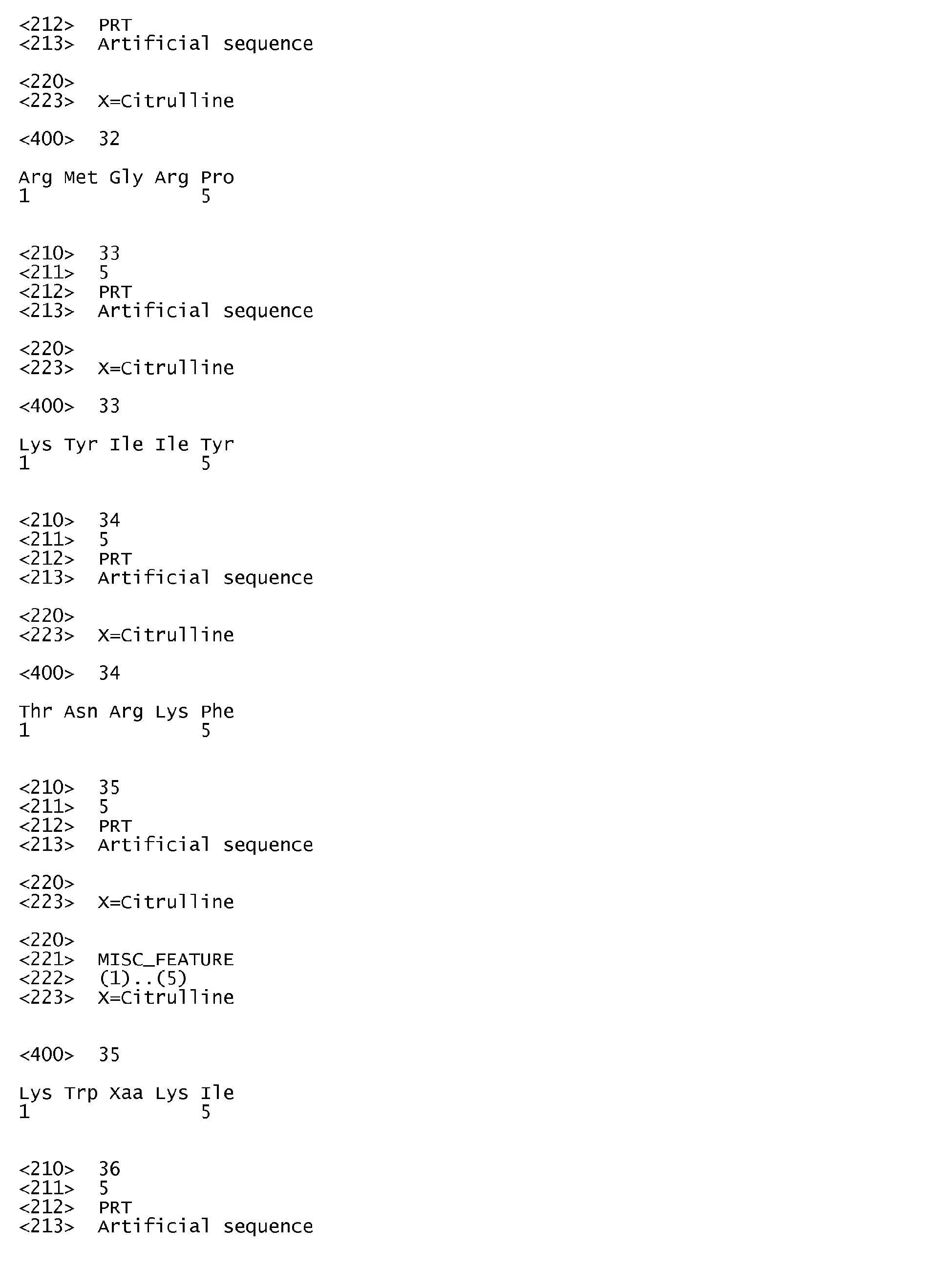


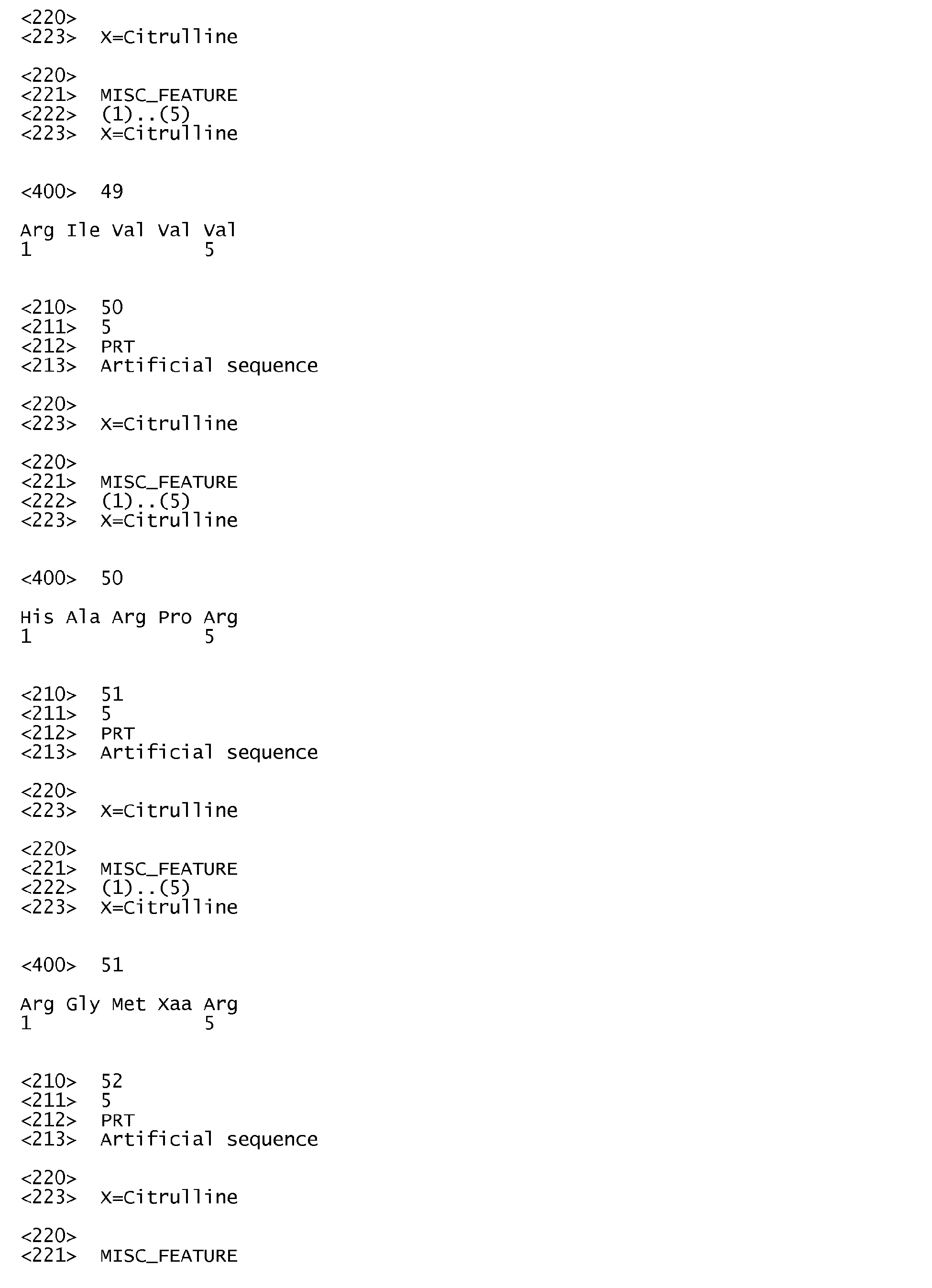


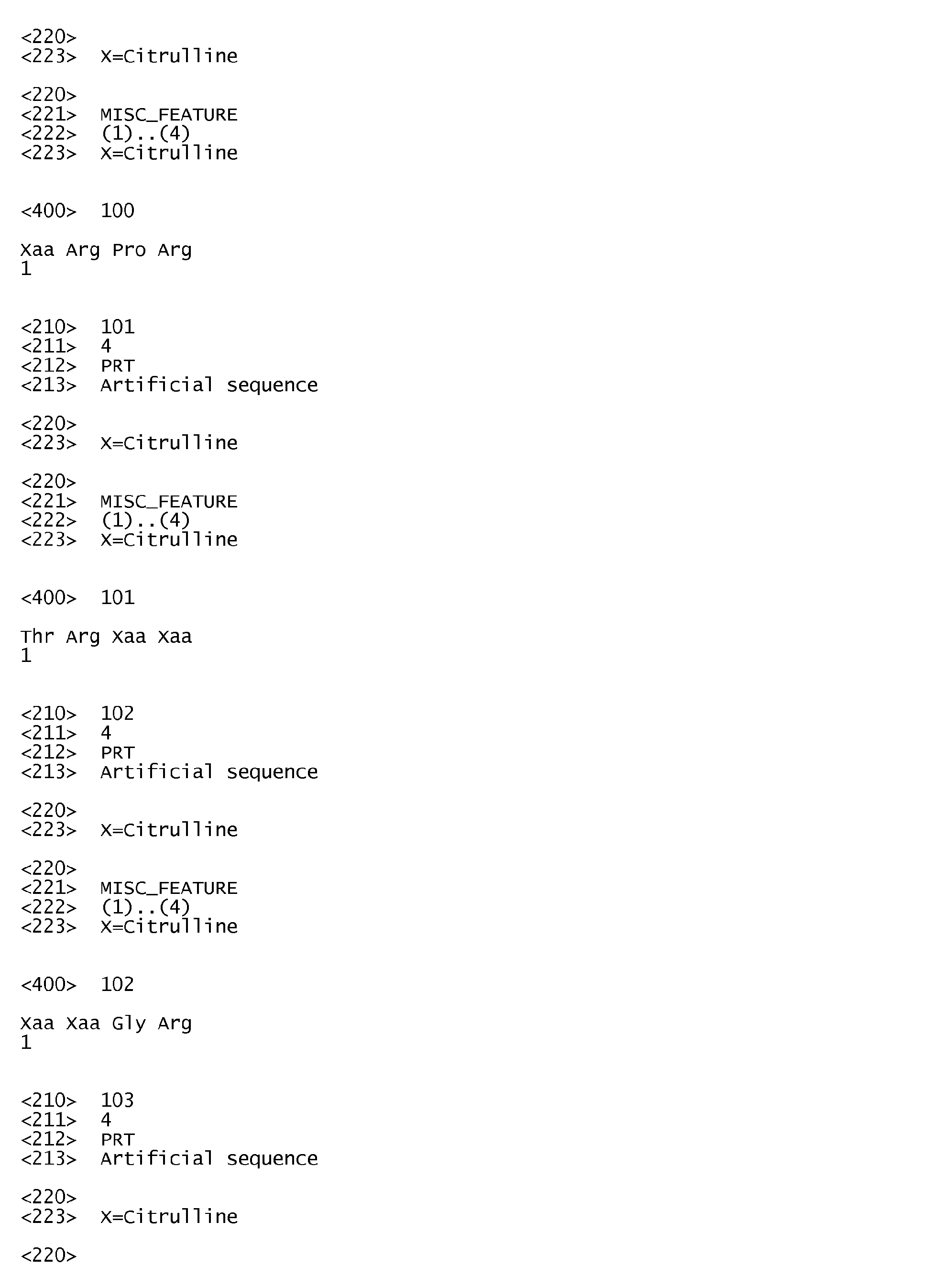


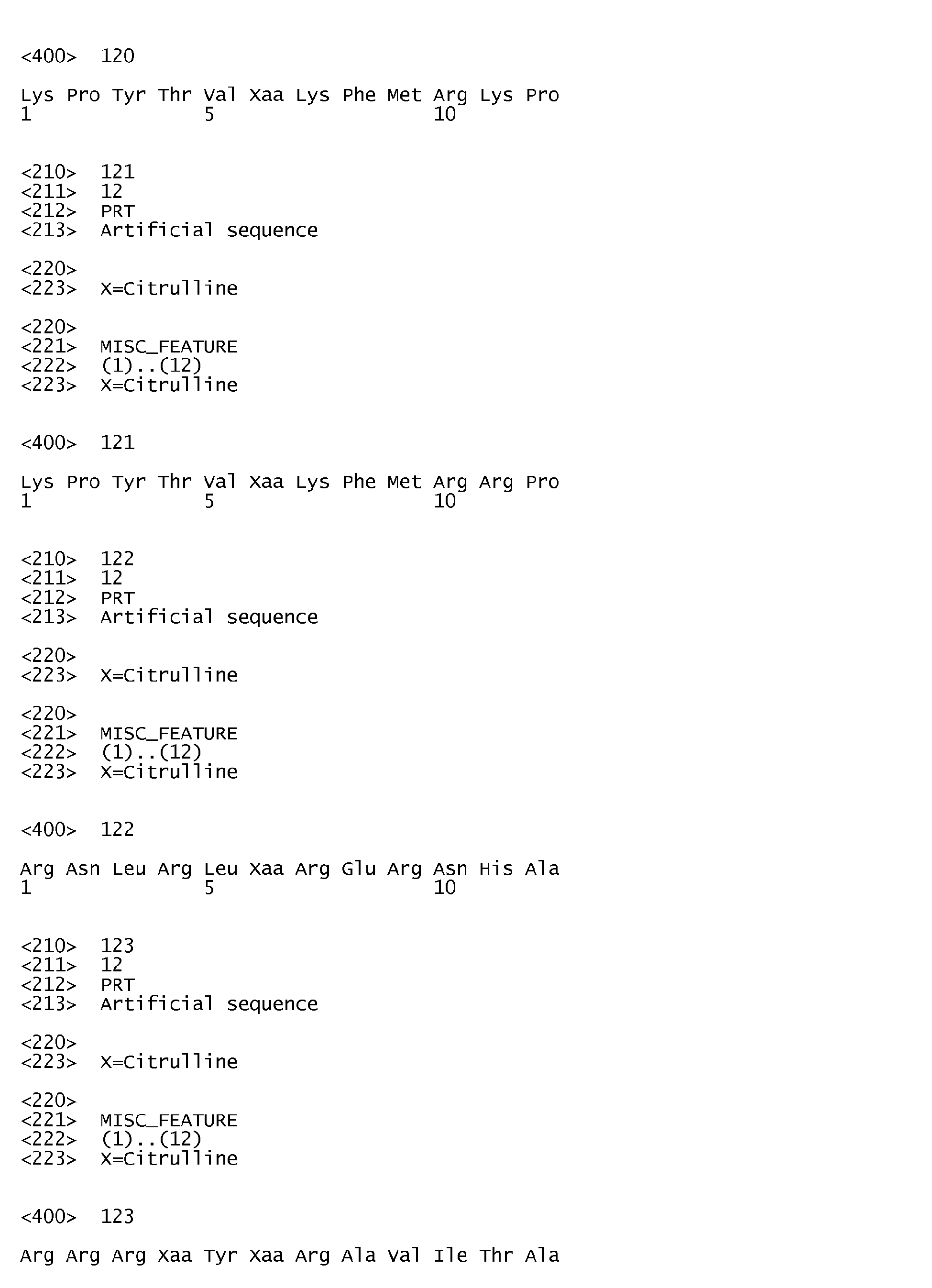


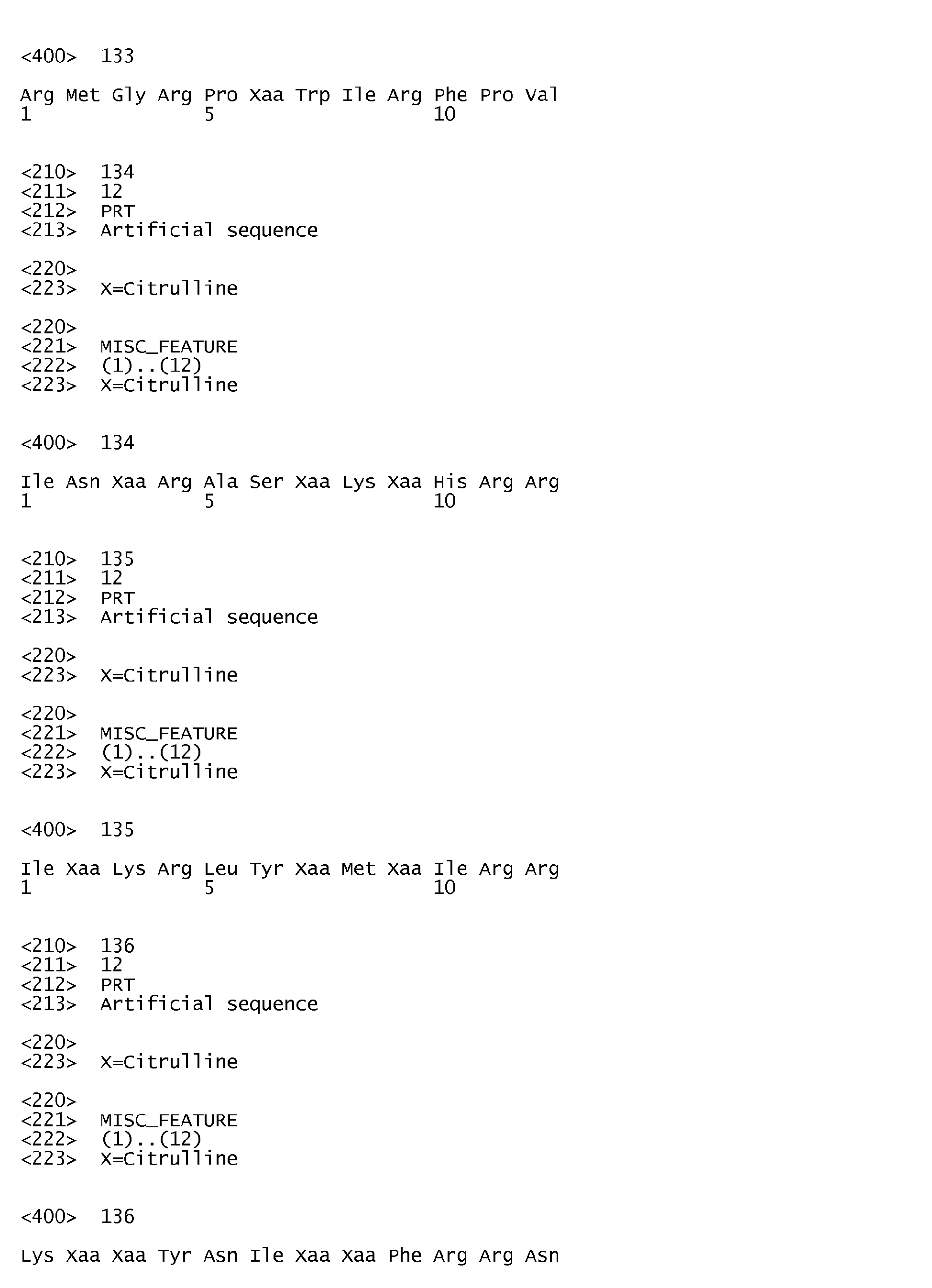


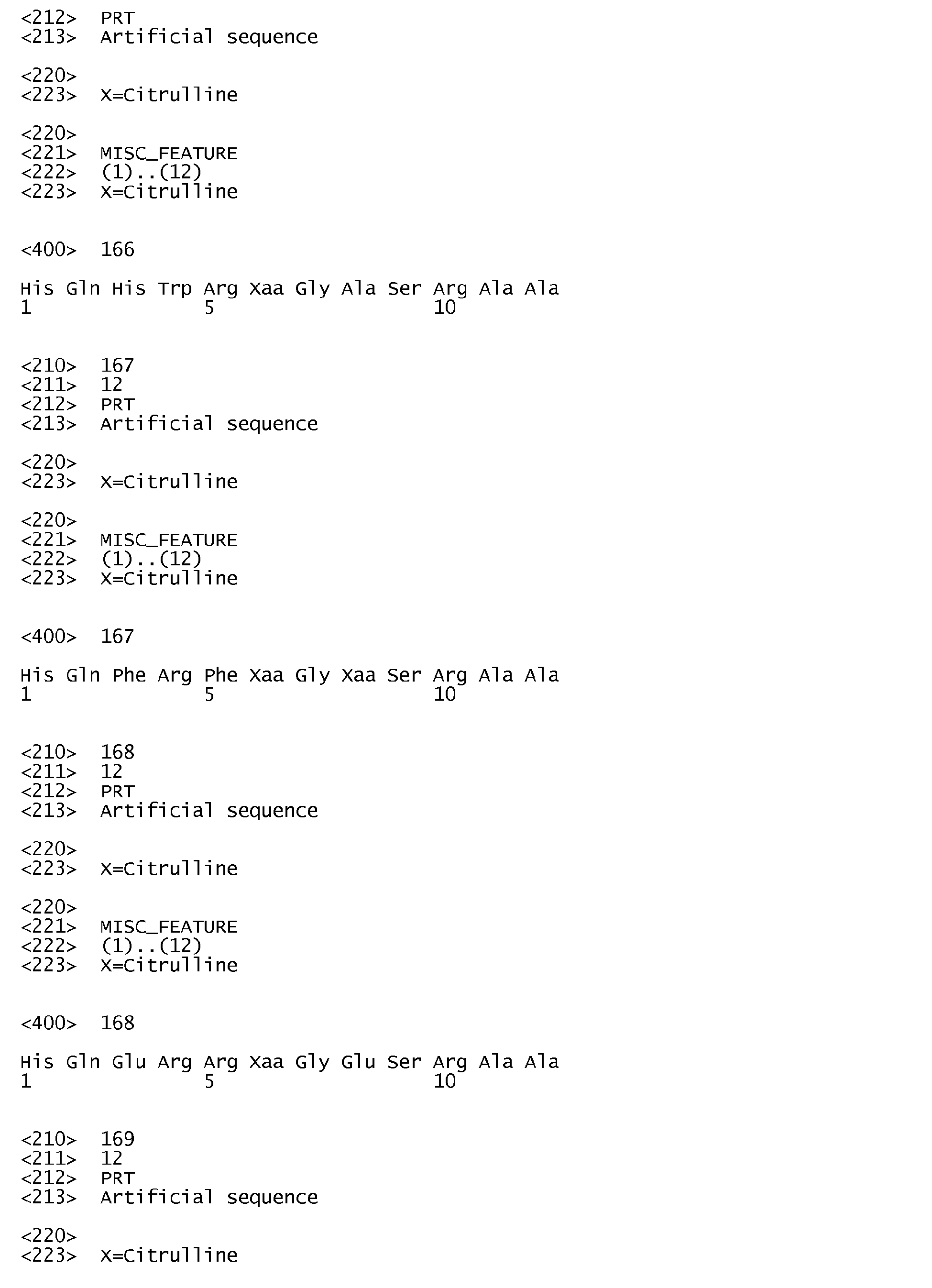
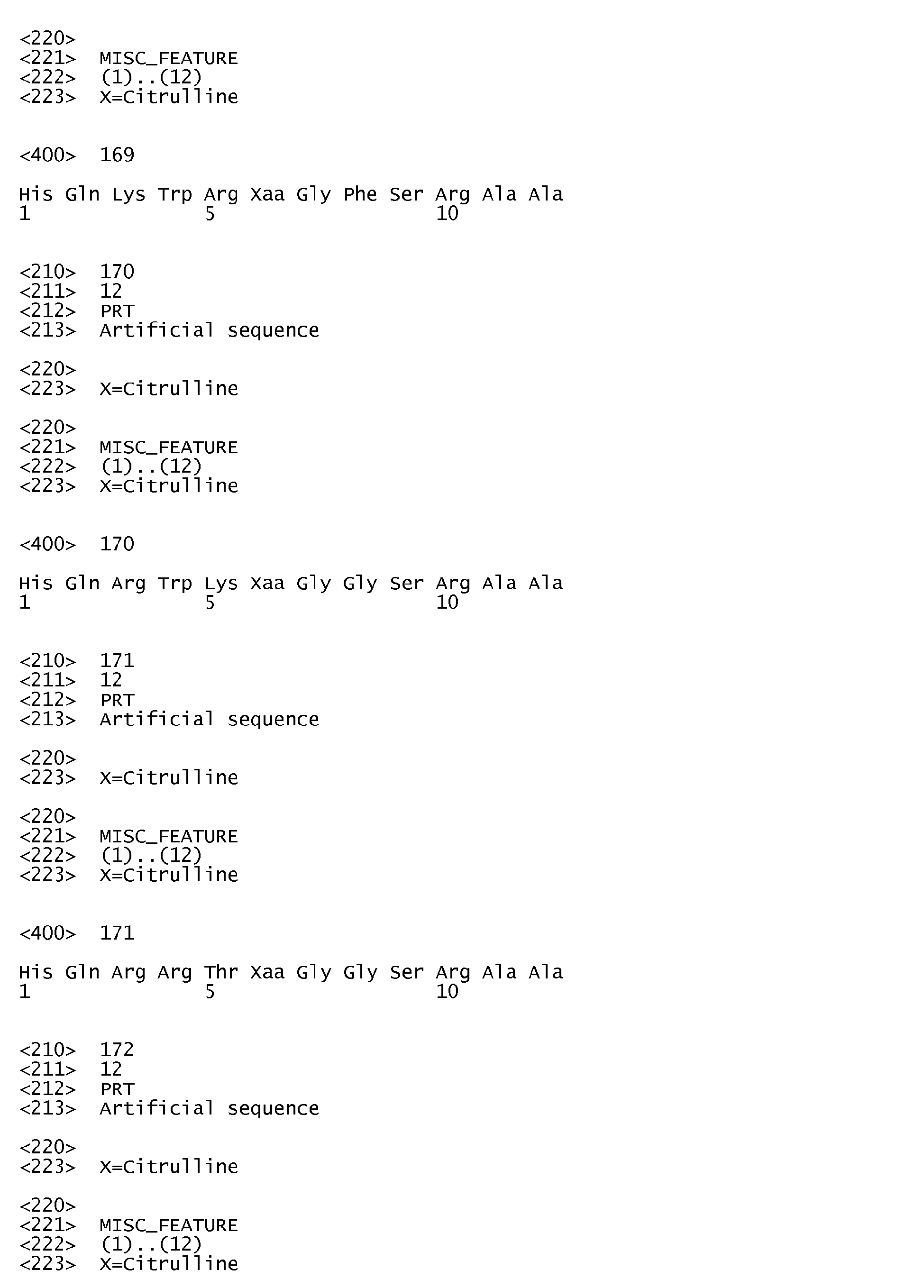
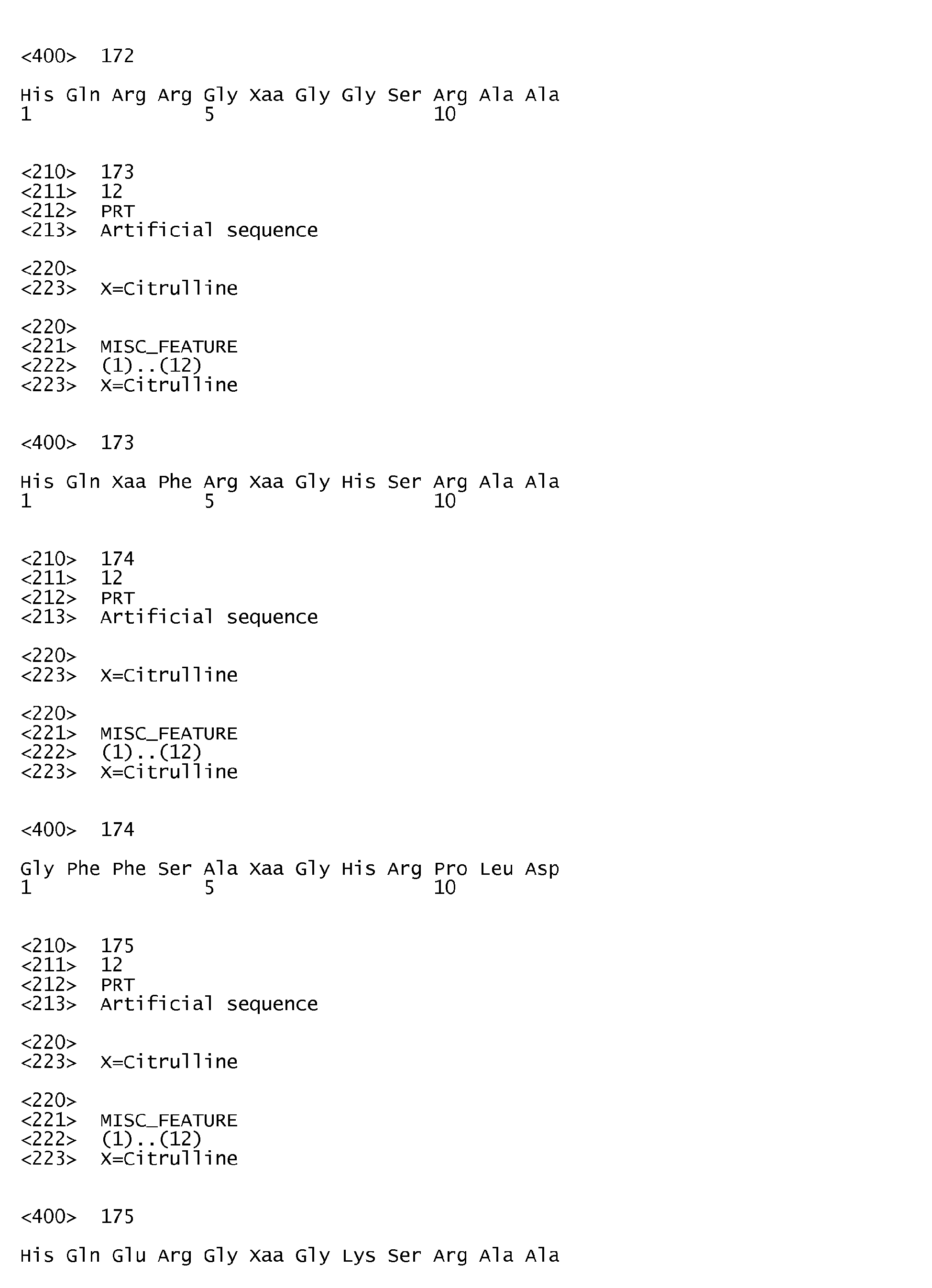

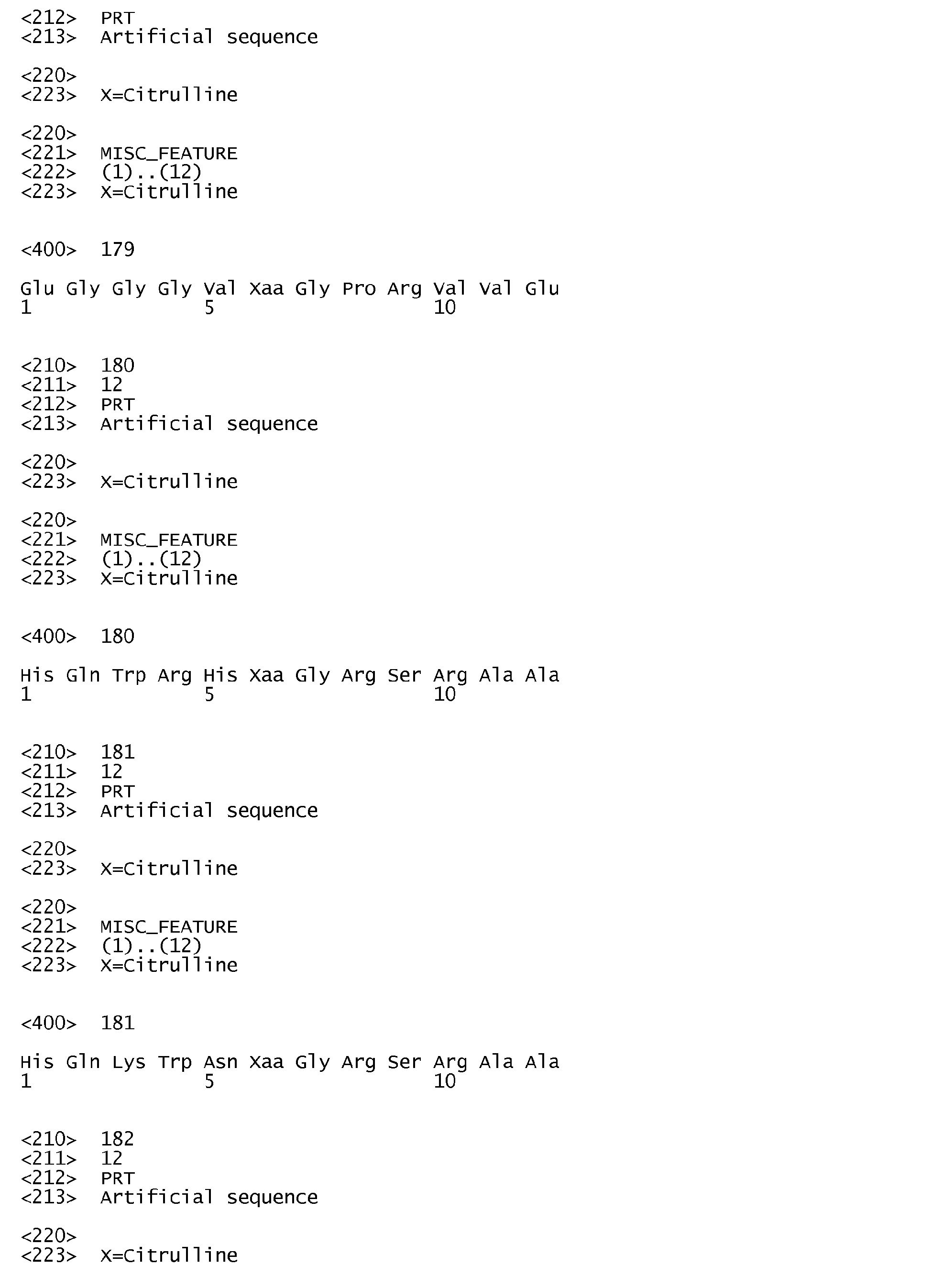


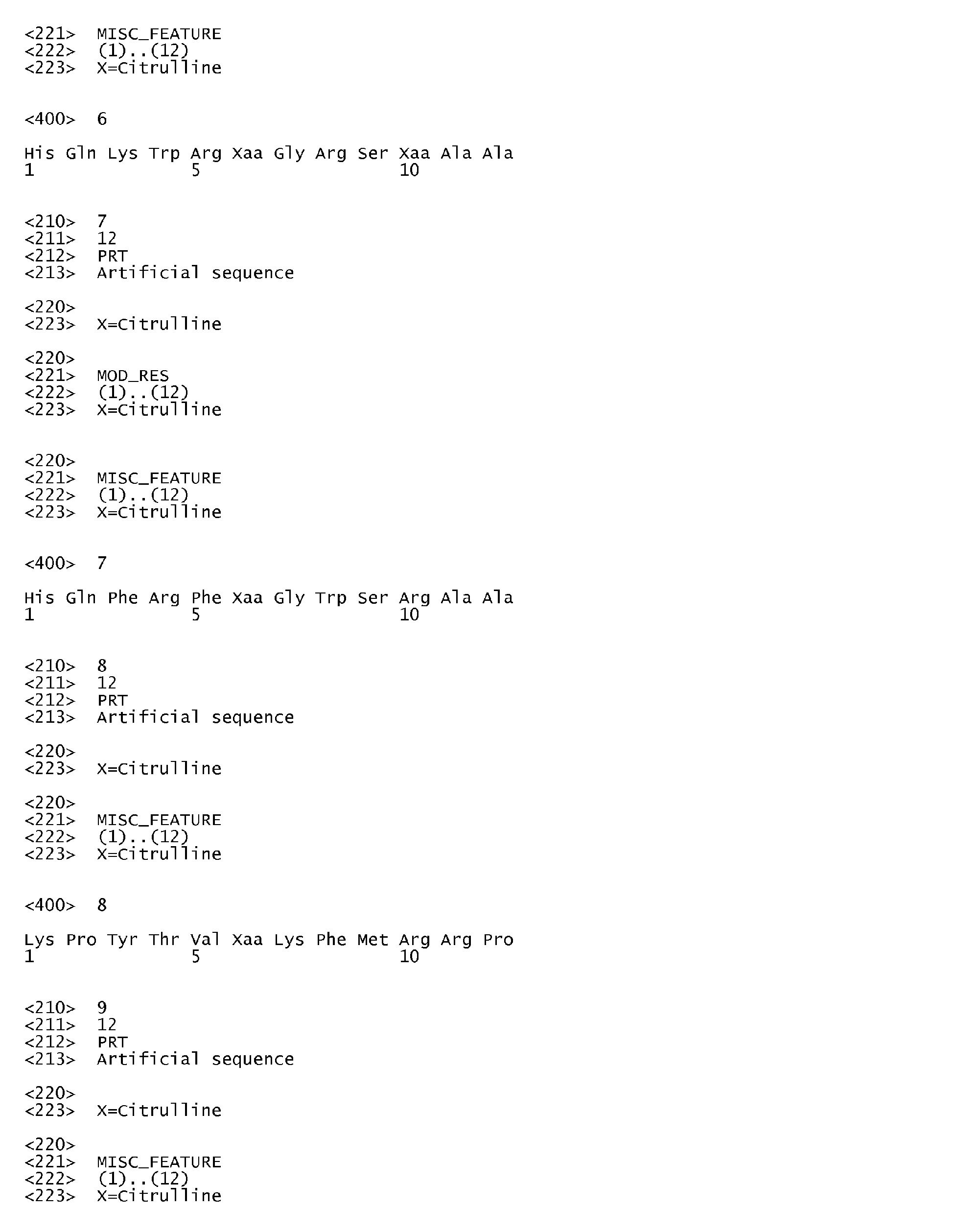


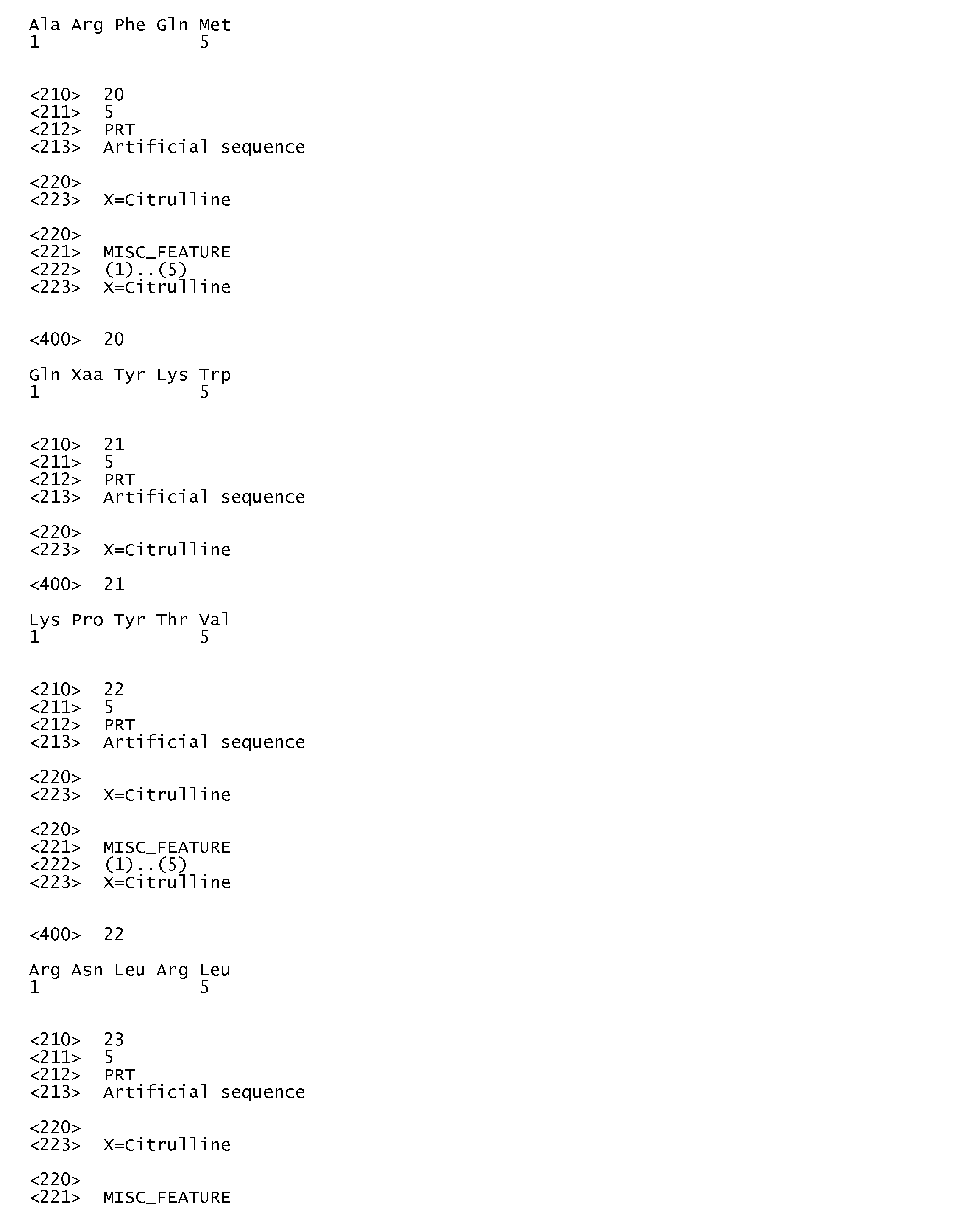

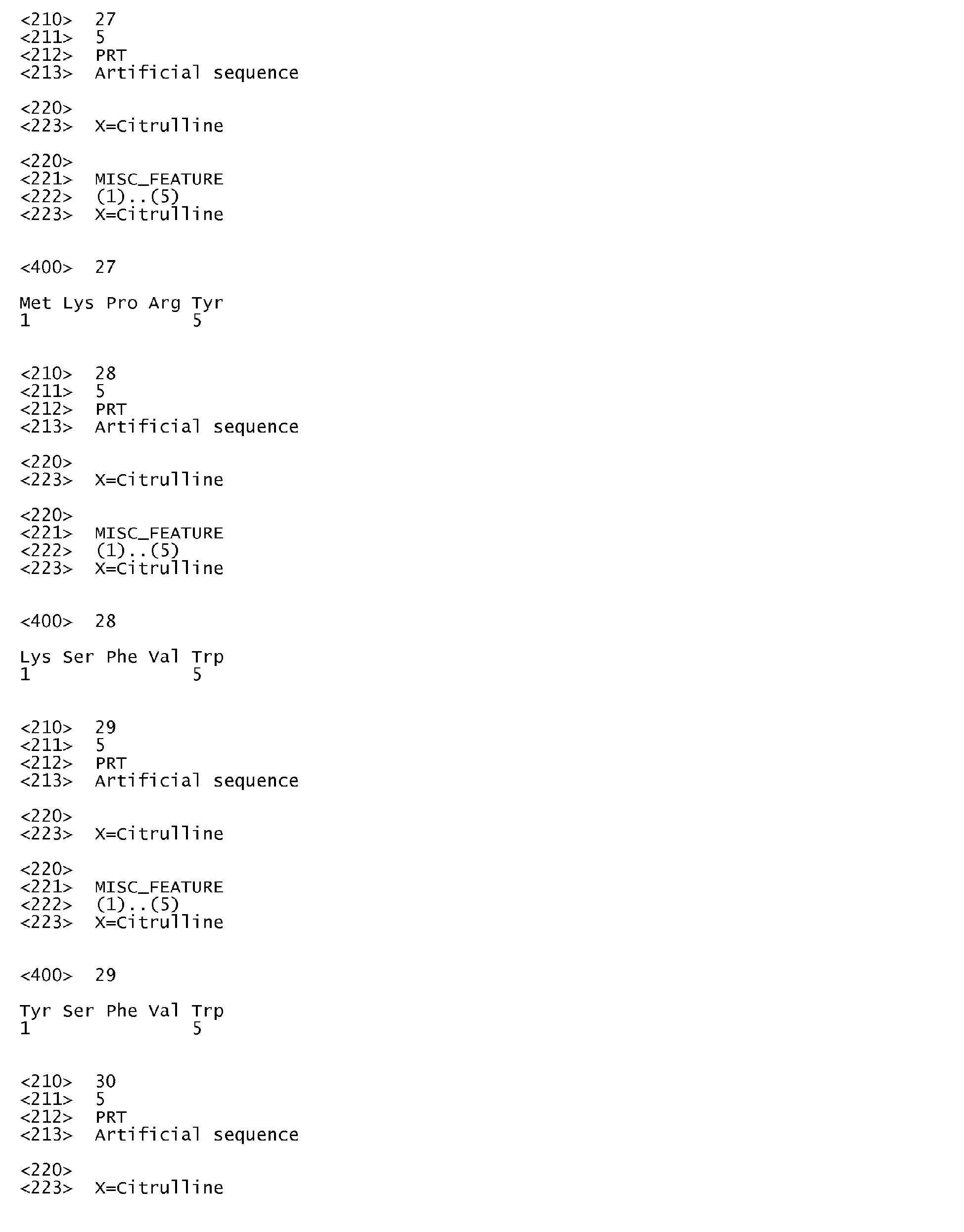


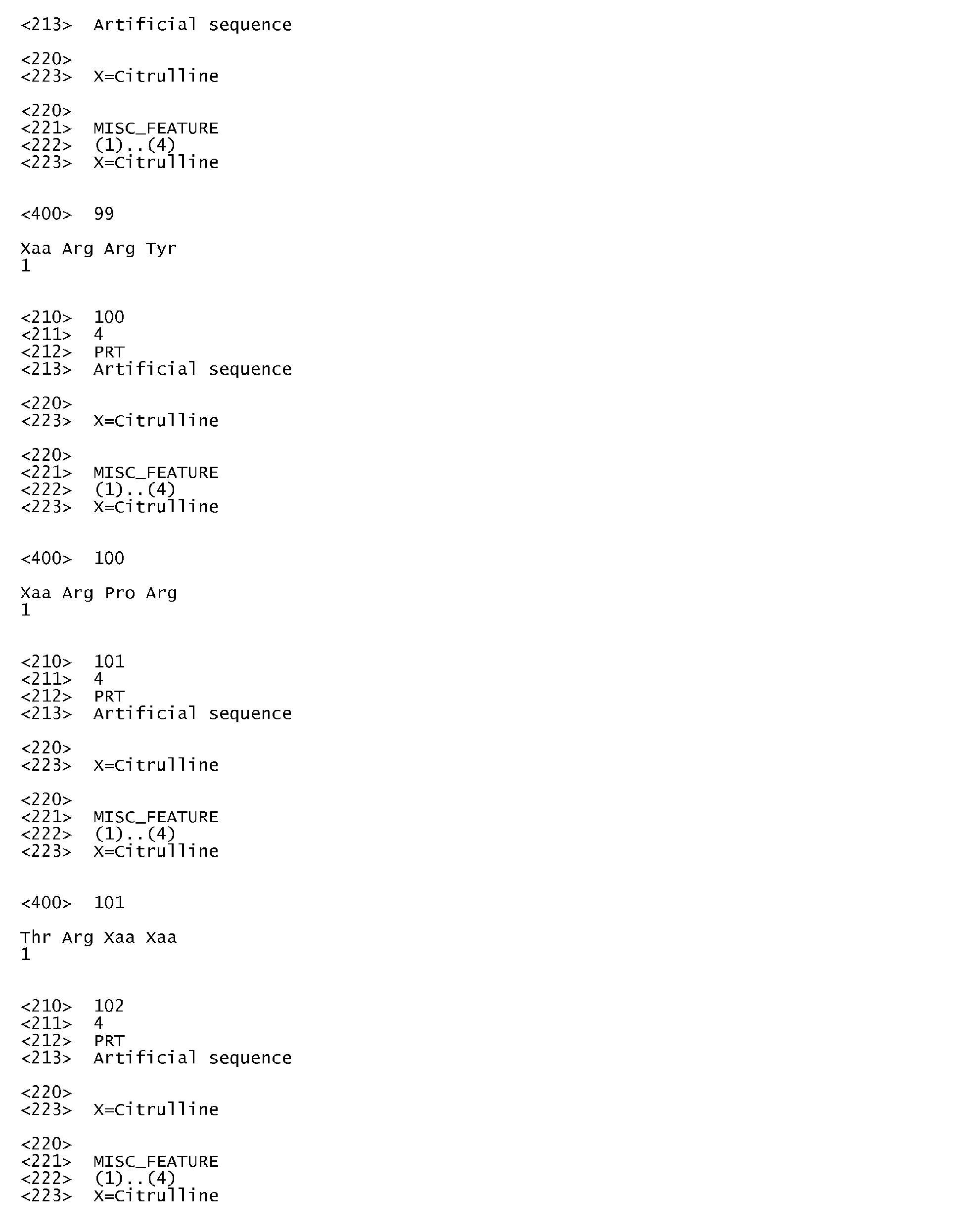


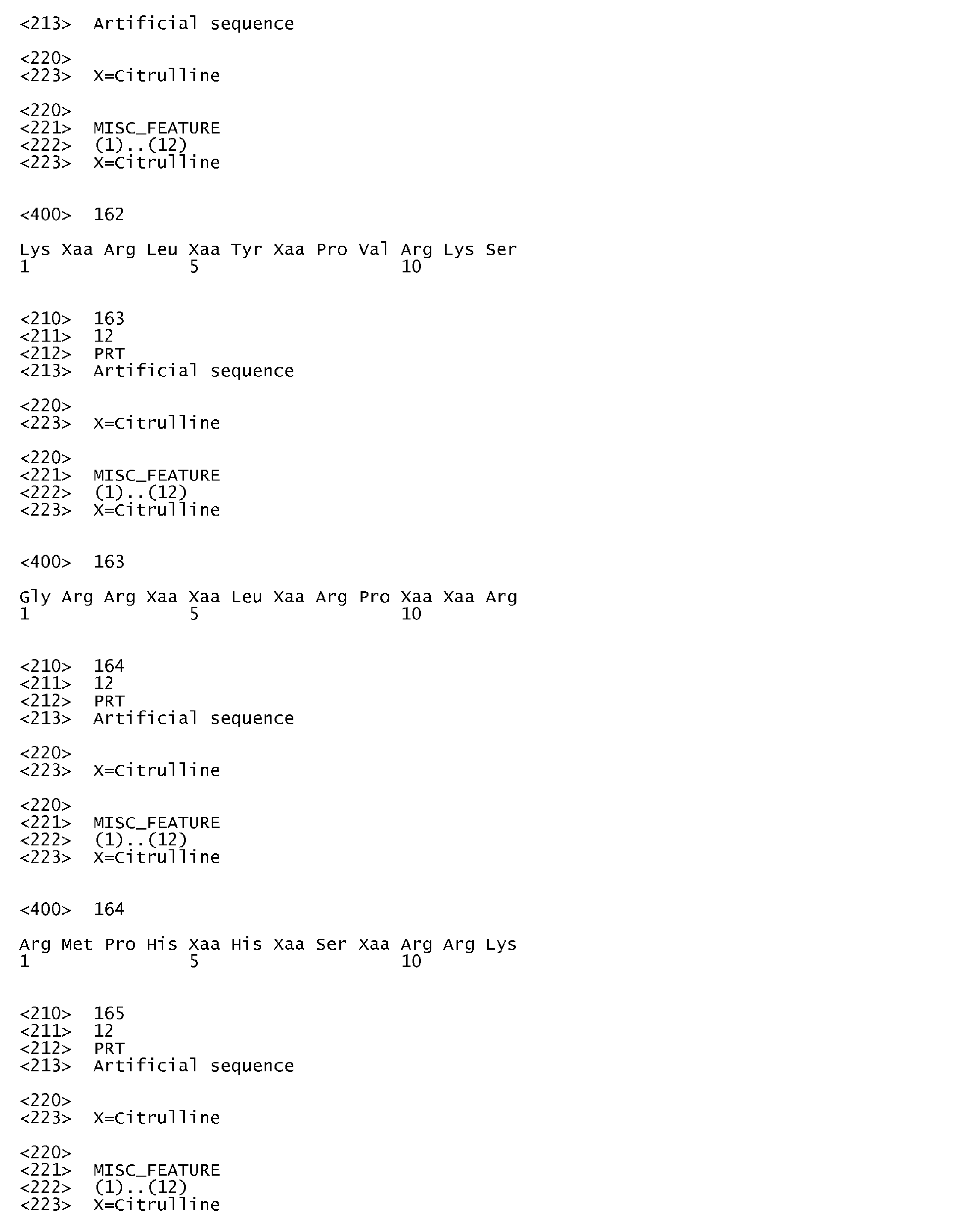


as well as functional analogues of the peptide with the formula (II).
as well as functional analogues of the peptide with the formula (III).
Claims (12)
- A peptide sequence according to the formula: (Al-A2-A3-A4-A5)-Cit- (A6)- (A7-A8-A9-A10-All) whereina. A1-A2-A3-A4-A5 represents an amino acid sequence selected from the group consisting of RHGRQ, IRCitYK, HGRQCit, GRQCitCit, FQMCitH, CitWRGM, ARFQM, QCitYKW, KPYTV, RNLRL, RRRCitY, RFKSN, RGKSN, RWVSQ, MKPRY, KSFVW, YSFVW, FQMRH, RNMNR, RMGRP and homologous sequences thereof, and whereinb. A6 represents an amino acid other than glycine, and whereinc. A7-A8-A9-A10-A11 represents an amino acid sequence selected from the group consisting of KYIIY, TNRKF, KWCitKI, CitRAVI, RCitGHS, CitGRSR, CitYIIY, CitRLIR, IERKR, FMRKP, FMRRP, ERNHA, AVITA, TPNRW, TYNRW, RTPTR, RIVVV, HARPR, RGMCitR, IRFPV and homologous sequences thereof.
- A peptide sequence according to the formula (B1-B2-B3-B4-B5-B6)-Cit-(B7)-(B8-B9-B10-B11) whereina. B1-B2-B3-B4-B5-B6 represents an amino acid sequence selected from the group consisting of INCitRAS, ICitKRLY, KCitCitYNI, RLYFICit, IRQGAR, CitERCitVQ, CitHQRIT, RICitRVCit, GRNQRY, RCitRQHP, CitCitRCitVA, RPKQHV, RKCitGCitR, RCitCitRNT, RCitQCitFT, QLVYLQ, QYNRFK - CitLRHIR, PRCitCitCitK, RCitQVRY, GRCitHAH, ARHVIR, RCitGHMF, GRNIRV, QIFYLCit, RQGPIA, GVYLVR, NCitCitRRV, KCitRLCitY, GRRCitCitL, RMPHCitH and homologous sequences thereof, and whereinb. B7 is an amino acid other than glycine, and whereinc. B8-B9-B10-B11 represents an amino acid sequence selected from the group consisting of CitHRR, CitIRR, FRRN, AQTT, GYPK, RPPQ, GCitRK, PIPR, YTIH, RIKA, CitRVR, TRRP, TIRP, IKCitR, RNVV, CitRRY, CitRPR, TRCitCit, CitCitGR, LCitRCit, RVRCit, VPRT, YCitFR, ARCitCit, RQCitR, HIRR, CitMMR, CitRICit, VRKS, PCitCitR, CitRRK and homologous sequences thereof
- A peptide sequence according to claims 1 or 2 wherein A6 or B7 are selected from the group consisting of Cit, H,I, K, R, S, W, Y, M, F, V and P.
- A peptide sequence according to claims 1 - 3 selected from the group consisting of:R H G R Q Cit Cit K Y I I Y,I R Cit Y K Cit I T N R K F,R H G R Q Cit Cit Cit Y I I Y,A R F Q M Cit H Cit R L. I R,Q Cit Y K W Cit K I E R K R,K P Y T V Cit K F M R K P,K P Y T V Cit K F M R RR N L R L Cit R E R N H A,R R R Cit Y Cit R A V I T A,R F K S N Cit R T P N R W,R G K S N Cit R T Y N R W,R F K S N Cit R T Y N R W,R G K S N Cit R T P N R W,R W V S Q Cit R R T P T R,M K P R Y Cit R R I V V V,K S F V W Cit S H A R P R,Y S F V W Cit S H A R P R,R N M N R Cit W R G M Cit R,R M G R P Cit W I R F P V,I N Cit R A S Cit K Cit H R R,I Cit K R L Y Cit M Cit I R R,K Cit Cit Y N I Cit Cit F R R N,R L Y F I Cit Cit R A Q T T,I R Q G A R Cit R G Y P K,Cit E R Cit V Q Cit R R P P Q,Cit H Q R I T Cit V G Cit R K,R I Cit R V Cit Cit T P I P R,G R N Q R Y Cit L Y T I H,R Cit R Q H P Cit H R I K A,Cit Cit R Cit V A Cit F Cit R V R,R P K Q H V Cit H T R R P,R K Cit G Cit R Cit Cit T I R P,R Cit Cit R N T Cit H I K Cit R,R Cit Q Cit F T Cit Cit R N V V,Q L V Y L Q Cit Cit Cit R R Y,Q Y N R F K Cit Cit Cit R P R,Cit L R H I R Cit Q T R Cit CitP R Cit Cit Cit K Cit R Cit Cit G R,R Cit Q V R Y Cit Cit L Cit R CitG R Cit H A H Cit P R V R Cit,A R H V I R Cit Cit V P. R T,R Cit G H M F Cit V Y Cit F R,G R N I R V Cit Cit A R Cit Cit,Q I F Y L Cit Cit H R Q Cit R,R Q G P I A Cit L H I R R,G V Y L V R Cit L Cit M M R,N Cit Cit R R V Cit M Cit R I Cit,K Cit R L Cit Y Cit P V R K S,G R R Cit Cit L Cit R P Cit Cit R,R M P H Cit H Cit S Cit R R Kor an analogue thereof.
- A peptide sequence according to the formula (C1-C2)- (C3-C4-C5)-Cit-G-C6- (C7-C8-C9-C10) (IV) whereina. C1-C2 represents HQ, GF, EG or GV and whereinb. C3-C4-C5 represents 3 amino acids of which at least 1 is basic, aromatic or Valine, and wherein;c. C6 is equal to a basic or aromatic amino acid, or equal to A, G, E, P, V, S or Cit or analogue thereof; and whereind. C7-C8-C9-C10 represents SRAA, SCitAA, RPLD, RVVE or PGLD or an analogue thereof.
- A peptide sequence comprising the formula (D1-D2-D3-D4-D5-D6) whereina. D1 is K, R or W,b. D2 is R or W,c. D3 is R,d. D4 is Cit,e. D5 is G andf. D6 is R, W or K.
- A peptide sequence according to claims 1 - 6 wherein the peptide is cyclic.
- Multipeptide, comprising at least one of the peptide sequences according to claims 1 - 7
- Multipeptide according to claim 8 comprising at least one peptide sequence according to claim 1 or 2 and at least one peptide sequence according to claim 5 or 6.
- Multipeptide according to claims 8 or 9 wherein the multipeptide is cyclic.
- An ex-vivo diagnostic kit for determining the presence of autoantibodies from patients suffering from Rheumatoid Arthritis, comprising a peptide or multipeptide according to claims 1 - 10.
- A diagnostic kit according to claim 11 which is an ELISA kit.
Applications Claiming Priority (3)
| Application Number | Priority Date | Filing Date | Title |
|---|---|---|---|
| NL1019540A NL1019540C2 (en) | 2001-12-11 | 2001-12-11 | Method for detecting autoantibodies from patients suffering from rheumatoid arthritis, peptide and assay kit. |
| EP06114882A EP1693673A3 (en) | 2001-12-11 | 2002-12-11 | Detection of auto-antibodies from patients suffering from rheumatoid arthritis |
| EP02786237A EP1456662B1 (en) | 2001-12-11 | 2002-12-11 | Detection of auto-antibodies from patients suffering from rheumatoid arthritis |
Related Parent Applications (1)
| Application Number | Title | Priority Date | Filing Date |
|---|---|---|---|
| EP06114882A Division EP1693673A3 (en) | 2001-12-11 | 2002-12-11 | Detection of auto-antibodies from patients suffering from rheumatoid arthritis |
Publications (2)
| Publication Number | Publication Date |
|---|---|
| EP2071335A2 true EP2071335A2 (en) | 2009-06-17 |
| EP2071335A3 EP2071335A3 (en) | 2009-09-02 |
Family
ID=19774384
Family Applications (3)
| Application Number | Title | Priority Date | Filing Date |
|---|---|---|---|
| EP02786237A Expired - Lifetime EP1456662B1 (en) | 2001-12-11 | 2002-12-11 | Detection of auto-antibodies from patients suffering from rheumatoid arthritis |
| EP09155765A Withdrawn EP2071335A3 (en) | 2001-12-11 | 2002-12-11 | Detection of auto-antibodies from patients suffering from rheumatoid arthritis |
| EP06114882A Ceased EP1693673A3 (en) | 2001-12-11 | 2002-12-11 | Detection of auto-antibodies from patients suffering from rheumatoid arthritis |
Family Applications Before (1)
| Application Number | Title | Priority Date | Filing Date |
|---|---|---|---|
| EP02786237A Expired - Lifetime EP1456662B1 (en) | 2001-12-11 | 2002-12-11 | Detection of auto-antibodies from patients suffering from rheumatoid arthritis |
Family Applications After (1)
| Application Number | Title | Priority Date | Filing Date |
|---|---|---|---|
| EP06114882A Ceased EP1693673A3 (en) | 2001-12-11 | 2002-12-11 | Detection of auto-antibodies from patients suffering from rheumatoid arthritis |
Country Status (16)
| Country | Link |
|---|---|
| US (6) | US7888133B2 (en) |
| EP (3) | EP1456662B1 (en) |
| JP (1) | JP4098718B2 (en) |
| CN (4) | CN105699648B (en) |
| AT (1) | ATE329267T1 (en) |
| AU (3) | AU2002354397B2 (en) |
| BR (1) | BRPI0214872B8 (en) |
| CA (5) | CA2892001C (en) |
| CY (1) | CY1105537T1 (en) |
| DE (1) | DE60212186T2 (en) |
| DK (1) | DK1456662T3 (en) |
| ES (1) | ES2266603T3 (en) |
| NL (1) | NL1019540C2 (en) |
| PT (1) | PT1456662E (en) |
| SI (1) | SI1456662T1 (en) |
| WO (1) | WO2003050542A2 (en) |
Families Citing this family (46)
| Publication number | Priority date | Publication date | Assignee | Title |
|---|---|---|---|---|
| NL1019540C2 (en) * | 2001-12-11 | 2003-07-01 | Stichting Tech Wetenschapp | Method for detecting autoantibodies from patients suffering from rheumatoid arthritis, peptide and assay kit. |
| EP1882946B1 (en) * | 2003-12-23 | 2010-02-17 | Roche Diagnostics GmbH | Method of assessing rheumatoid arthritis by measuring anti-CCP and interleukin 6 |
| SI1721162T1 (en) | 2004-02-27 | 2009-02-28 | Roche Diagnostics Gmbh | Method of assessing rheumatoid arthritis by measuring anti-ccp and serum amyloid a |
| FR2879604B1 (en) * | 2004-12-22 | 2010-08-13 | Biomerieux Sa | FIBRIN-DERIVED CITRULIN PEPTIDES RECOGNIZED BY RHE-PATIENT-SPECIFIC AUTO-ANTIBODIES AND USES THEREOF |
| US8207299B2 (en) | 2004-11-04 | 2012-06-26 | Biomerieux | Citrulline peptides derived from fibrin and recognized by rheumatoid arthritis specific autoantibodies, and the use thereof |
| EP1877795A4 (en) * | 2005-05-02 | 2010-04-28 | Brigham & Womens Hospital | DIAGNOSTIC PROFILING OF SERIC ANTIBODIES |
| FI20050814A0 (en) * | 2005-08-11 | 2005-08-11 | Procollagen Oy | Procedure for observing autoantibodies formed in rheumatoid arthritis |
| ES2545688T3 (en) | 2006-09-29 | 2015-09-15 | F. Hoffmann-La Roche Ag | Method of assessing the risk of disease progression of patients with rheumatoid arthritis |
| US20100047256A1 (en) | 2007-01-25 | 2010-02-25 | Imperial Innovations Limited | Methods |
| ES2307421B1 (en) * | 2007-04-30 | 2009-09-28 | Consejo Superiorde Investigaciones Cientificas (Csic) | CITRUINATED FIBRINE-FILAGRINE CHEMERIC POLYPEPTIDE CAPABLE OF DETECTING ANTIBODIES GENERATED IN REUMATOID ARTHRITIS. |
| EP2058663A1 (en) | 2007-11-12 | 2009-05-13 | Euro-Diagnostica B.V. | Method for the immobilization of an analyte on a solid support |
| WO2009070875A1 (en) * | 2007-12-03 | 2009-06-11 | Sqi Diagnostics Systems Inc. | Synthetic peptides immuno-reactive with rheumatoid arthritis auto-antibodies |
| US20090286256A1 (en) * | 2008-05-19 | 2009-11-19 | Abbott Laboratories | Isolated human autoantibodies to natriuretic peptides and methods and kits for detecting human autoantibodies to natriuretic peptides |
| WO2010075249A2 (en) | 2008-12-22 | 2010-07-01 | Genentech, Inc. | A method for treating rheumatoid arthritis with b-cell antagonists |
| EP2204655A1 (en) | 2008-12-23 | 2010-07-07 | Max-Planck-Gesellschaft zur Förderung der Wissenschaften e.V. | Diagnostic prediction of rheumatoid arthritis and systemic lupus erythematosus |
| FR2940292B1 (en) * | 2008-12-23 | 2013-05-10 | Isp Investments Inc | PEPTIDES DERIVED FROM HMG-COA REDUCTASE AND COSMETIC AND / OR PHARMACEUTICAL COMPOSITION CONTAINING THEM |
| CN102004154B (en) * | 2009-08-28 | 2013-06-19 | 上海荣盛生物药业有限公司 | Composition for detecting immune antibodies of rheumatoid arthritis by dot immunogold filtration assay |
| CN102012431B (en) * | 2009-09-04 | 2013-06-19 | 上海荣盛生物药业有限公司 | CCP (Cyclic Citrullinated Peptide) used for detecting the immune antibody of rheumatoid arthritis with dot immuno-gold filtration assay |
| EP2325195A1 (en) | 2009-11-23 | 2011-05-25 | Toscana Biomarkers S.r.l. | Viral citrullinated peptides and uses thereof |
| EP2336769A1 (en) | 2009-12-18 | 2011-06-22 | F. Hoffmann-La Roche AG | Trigger assay for differentiating between rheumatic and non-rheumatic disorders |
| EP2402368A1 (en) | 2010-07-02 | 2012-01-04 | Toscana Biomarkers S.r.l. | Histone citrullinated peptides and uses thereof |
| WO2012105838A1 (en) | 2011-02-02 | 2012-08-09 | Academisch Ziekenhuis Leiden H.O.D.N. Lumc | Anti-carbamylated protein antibodies and the risk for arthritis |
| EP3045468B1 (en) | 2011-04-05 | 2020-01-15 | Fraunhofer Gesellschaft zur Förderung der Angewand | Novel peptides and their use in diagnosis and treatment |
| EP2527841A1 (en) | 2011-05-25 | 2012-11-28 | Toscana Biomarkers S.r.l. | Methods for the diagnosis of rheumatoid arthritis |
| WO2012163768A1 (en) * | 2011-05-27 | 2012-12-06 | Nordic Bioscience A/S | Detection of diagnostic peptides |
| CN102590530B (en) * | 2012-03-02 | 2014-06-25 | 常晓天 | Application of KRT84 self-immune antibody as diagnosis marker for diagnosing and detecting rheumatoid arthritis |
| CA2902209C (en) | 2013-03-15 | 2025-02-04 | The Regents Of The University Of California | Peptides having reduced toxicity that stimulate cholesterol efflux |
| EP3024849A2 (en) | 2013-07-24 | 2016-06-01 | Vilara AB | Novel antibodies for the diagnosis and treatment of rheumatoid arthritis |
| CA2946925C (en) | 2014-05-05 | 2023-08-15 | Noviosmart | Method for the serological diagnosis of rheumatoid arthritis. |
| CN104262489B (en) * | 2014-09-30 | 2017-01-11 | 陈仁奋 | Cyclic chimeric citrullinated peptide antigen and application thereof |
| EP3056904A1 (en) | 2015-02-13 | 2016-08-17 | F. Hoffmann-La Roche AG | Method of assessing rheumatoid arthritis by measuring anti-CCP and anti-MCM3 |
| EP3056903A1 (en) | 2015-02-13 | 2016-08-17 | F. Hoffmann-La Roche AG | Method of assessing rheumatoid arthritis by measuring anti-CCP and anti-Casp8 |
| CN107484423A (en) | 2015-02-13 | 2017-12-15 | 豪夫迈·罗氏有限公司 | The method of rheumatoid arthritis is assessed by measuring anti-CCP and anti-PIK3CD |
| EP3368904A1 (en) * | 2015-10-30 | 2018-09-05 | Oxford University Innovation Ltd. | Peptide and biomarker associated with inflammatory disorders, and uses thereof |
| EP3523657B1 (en) | 2016-10-04 | 2023-06-21 | F. Hoffmann-La Roche AG | System and method for identification of a synthetic classifier |
| CN106543277B (en) * | 2016-10-31 | 2020-02-14 | 中南大学 | Endothelial cell antigen related to transplant rejection and application and kit thereof |
| CN108196073B (en) * | 2018-03-13 | 2019-09-13 | 江苏浩欧博生物医药股份有限公司 | It is a kind of measure cyclic citrullinated peptid kit and its application |
| CN108948173B (en) * | 2018-05-22 | 2020-11-03 | 北京蛋白质组研究中心 | A kind of citrulline modified peptide and its application |
| CN108948153B (en) * | 2018-05-22 | 2020-11-03 | 北京蛋白质组研究中心 | Citrulline modified peptide antigen combination and application thereof |
| US12105097B2 (en) * | 2019-01-27 | 2024-10-01 | China Medical University | Rheumatoid arthritis auto-antibody-bound peptide and application thereof |
| CN109929009B (en) * | 2019-03-20 | 2021-06-04 | 深圳市新产业生物医学工程股份有限公司 | CCP peptides, antigens containing the same, reagents, kits and applications |
| WO2020221153A1 (en) * | 2019-04-28 | 2020-11-05 | 广州市雷德生物科技有限公司 | Zipper fastener structure of promoting formation of protein dimer and application thereof |
| US20220214340A1 (en) * | 2019-04-28 | 2022-07-07 | Leide Biosciences Co., Ltd. | Zipper structure that helps the formation of protein dimer and application thereof |
| US12622946B2 (en) | 2019-08-09 | 2026-05-12 | Fraunhofer-Gesellschaft zur Förderung der angewandten Forschung e.V. | HLA-DR/CII peptide complexes for treating arthritis |
| CN110456074B (en) * | 2019-08-27 | 2022-06-03 | 广东菲鹏生物有限公司 | Citrullinated peptides and their applications, detection reagents and kits for rheumatoid arthritis |
| GB202408954D0 (en) | 2024-06-21 | 2024-08-07 | Alivedx Suisse Sa | Immobilised biomolecule |
Citations (1)
| Publication number | Priority date | Publication date | Assignee | Title |
|---|---|---|---|---|
| NL1019540C2 (en) | 2001-12-11 | 2003-07-01 | Stichting Tech Wetenschapp | Method for detecting autoantibodies from patients suffering from rheumatoid arthritis, peptide and assay kit. |
Family Cites Families (14)
| Publication number | Priority date | Publication date | Assignee | Title |
|---|---|---|---|---|
| WO1992019649A1 (en) * | 1991-04-26 | 1992-11-12 | Clonatec | Antigens recognized by antibodies of rhumatoid polyarthritis, and preparation and use thereof |
| US5650508A (en) * | 1991-12-27 | 1997-07-22 | Georgia Tech Research Corporation | Peptide ketoamides |
| US5314804A (en) * | 1992-03-24 | 1994-05-24 | Serim Research Corporation | Test for Helicobacter pylori |
| CN1153530A (en) * | 1995-03-09 | 1997-07-02 | 比奥美希奥公司 | MSRV-1 virus and pathogenic and/or infectious MSRV-2 agents associated with rheumatoid arthritis |
| KR0182853B1 (en) * | 1995-08-07 | 1999-05-15 | 김신규 | Diagnostic technique of autoimmune disease |
| FR2752842B1 (en) * | 1996-08-30 | 1998-11-06 | Biomerieux Sa | ANTIGENS DERIVED FROM FILAGGRINS AND THEIR USE FOR THE DIAGNOSIS OF RHUMATOID POLYARTHRITIS |
| NL1004539C2 (en) * | 1996-11-15 | 1998-05-20 | Stichting Tech Wetenschapp | Peptide derived from an antigen recognized by autoantibodies of patients with rheumatoid arthritis, antibody to it and method for detecting autoimmune antibodies. |
| EP1034186A2 (en) * | 1997-11-28 | 2000-09-13 | Innogenetics N.V. | Synthetic peptides containing citrulline recognized by rheumatoid arthritis sera as tools for diagnosis and treatment |
| FR2773157B1 (en) * | 1997-12-30 | 2001-10-05 | Bio Merieux | PEPTIDE EPITOPES RECOGNIZED BY ANTIFILAGGRIN AUTOANTIBODIES PRESENT IN THE SERUM OF PATIENTS WITH RHUMATOID POLYARTHRITIS |
| GB9805477D0 (en) * | 1998-03-13 | 1998-05-13 | Oxford Glycosciences Limited | Methods and compositions for diagnosis of rheumatoid arthritis |
| GB9822115D0 (en) * | 1998-10-09 | 1998-12-02 | King S College London | Treatment of inflammatory disease |
| FR2795735B1 (en) | 1999-07-01 | 2001-09-07 | Univ Toulouse | CITRULLIN FIBRIN DERIVATIVES AND THEIR USE FOR DIAGNOSIS OR TREATMENT OF RHUMATOID POLYARTHRITIS |
| DE1240180T1 (en) * | 1999-12-21 | 2003-08-14 | Innogenetics N.V., Gent | PEPTIDES FOR DIAGNOSIS AND TREATMENT OF RHEUMATIC ARTHRITIS |
| AUPQ776100A0 (en) * | 2000-05-26 | 2000-06-15 | Australian National University, The | Synthetic molecules and uses therefor |
-
2001
- 2001-12-11 NL NL1019540A patent/NL1019540C2/en not_active IP Right Cessation
-
2002
- 2002-12-11 AT AT02786237T patent/ATE329267T1/en active
- 2002-12-11 EP EP02786237A patent/EP1456662B1/en not_active Expired - Lifetime
- 2002-12-11 CN CN201610039155.5A patent/CN105699648B/en not_active Expired - Lifetime
- 2002-12-11 EP EP09155765A patent/EP2071335A3/en not_active Withdrawn
- 2002-12-11 DE DE60212186T patent/DE60212186T2/en not_active Expired - Lifetime
- 2002-12-11 CN CN200810215984XA patent/CN101408546B/en not_active Expired - Lifetime
- 2002-12-11 CN CNB028246470A patent/CN100424509C/en not_active Expired - Lifetime
- 2002-12-11 CN CN201310482892.9A patent/CN103524603B/en not_active Expired - Lifetime
- 2002-12-11 WO PCT/NL2002/000815 patent/WO2003050542A2/en not_active Ceased
- 2002-12-11 CA CA2892001A patent/CA2892001C/en not_active Expired - Lifetime
- 2002-12-11 CA CA2969577A patent/CA2969577C/en not_active Expired - Lifetime
- 2002-12-11 EP EP06114882A patent/EP1693673A3/en not_active Ceased
- 2002-12-11 CA CA3076702A patent/CA3076702C/en not_active Expired - Lifetime
- 2002-12-11 US US10/497,667 patent/US7888133B2/en active Active
- 2002-12-11 SI SI200230389T patent/SI1456662T1/en unknown
- 2002-12-11 CA CA2489167A patent/CA2489167C/en not_active Expired - Lifetime
- 2002-12-11 PT PT02786237T patent/PT1456662E/en unknown
- 2002-12-11 JP JP2003551544A patent/JP4098718B2/en not_active Expired - Lifetime
- 2002-12-11 BR BRPI0214872A patent/BRPI0214872B8/en not_active IP Right Cessation
- 2002-12-11 ES ES02786237T patent/ES2266603T3/en not_active Expired - Lifetime
- 2002-12-11 DK DK02786237T patent/DK1456662T3/en active
- 2002-12-11 AU AU2002354397A patent/AU2002354397B2/en not_active Expired
- 2002-12-11 CA CA2708463A patent/CA2708463C/en not_active Expired - Lifetime
-
2006
- 2006-09-07 CY CY20061101278T patent/CY1105537T1/en unknown
- 2006-10-18 AU AU2006230702A patent/AU2006230702A1/en not_active Abandoned
-
2010
- 2010-02-22 AU AU2010200648A patent/AU2010200648B2/en not_active Expired
-
2011
- 2011-01-24 US US13/012,739 patent/US8481332B2/en not_active Expired - Fee Related
-
2013
- 2013-06-17 US US13/920,017 patent/US8759114B2/en not_active Expired - Lifetime
-
2014
- 2014-05-23 US US14/286,878 patent/US9689871B2/en not_active Expired - Fee Related
-
2017
- 2017-05-31 US US15/610,398 patent/US10119966B2/en not_active Expired - Lifetime
-
2018
- 2018-11-02 US US16/178,848 patent/US20190056393A1/en not_active Abandoned
Patent Citations (1)
| Publication number | Priority date | Publication date | Assignee | Title |
|---|---|---|---|---|
| NL1019540C2 (en) | 2001-12-11 | 2003-07-01 | Stichting Tech Wetenschapp | Method for detecting autoantibodies from patients suffering from rheumatoid arthritis, peptide and assay kit. |
Non-Patent Citations (3)
| Title |
|---|
| "Greene: Protective groups in Organic synthesis", 1999, WILEY |
| DE KOSTER H.S. ET AL., J. IMMUNOL. METHODS, vol. 187, 1995, pages 177 - 188 |
| SONKE ET AL., STEREOSELECTIVE BIO- CATALYSIS, 2000, pages 23 - 58 |
Also Published As
Similar Documents
| Publication | Publication Date | Title |
|---|---|---|
| US10119966B2 (en) | Method of detecting auto-antibodies from patients suffering from rheumatoid arthritis, a peptide and assay kit | |
| HK1072805B (en) | Detection of auto-antibodies from patients suffering from rheumatoid arthritis | |
| HK1226143A1 (en) | Method of detecting autoantibodies from patients suffering from rheumatoid arthritis, a peptide and an assaykit | |
| HK1191962B (en) | Method of detecting autoantibodies from patients suffering from rheumatoid arthritis, a peptide and an assaykit | |
| HK1128329B (en) | Method of detecting autoantibodies from patients suffering from rheumatoid arthritis, a peptide and an assaykit |
Legal Events
| Date | Code | Title | Description |
|---|---|---|---|
| PUAI | Public reference made under article 153(3) epc to a published international application that has entered the european phase |
Free format text: ORIGINAL CODE: 0009012 |
|
| AC | Divisional application: reference to earlier application |
Ref document number: 1693673 Country of ref document: EP Kind code of ref document: P Ref document number: 1456662 Country of ref document: EP Kind code of ref document: P |
|
| AK | Designated contracting states |
Kind code of ref document: A2 Designated state(s): AT BE BG CH CY CZ DE DK EE ES FI FR GB GR IE IT LI LU MC NL PT SE SI SK TR |
|
| RIN1 | Information on inventor provided before grant (corrected) |
Inventor name: VAN VENROOIJ, WALTHERUS Inventor name: VAN BOEKEL, MARTINUS Inventor name: DRIJFHOUT, JAN Inventor name: PRUIJN, GERARDUS |
|
| PUAL | Search report despatched |
Free format text: ORIGINAL CODE: 0009013 |
|
| AK | Designated contracting states |
Kind code of ref document: A3 Designated state(s): AT BE BG CH CY CZ DE DK EE ES FI FR GB GR IE IT LI LU MC NL PT SE SI SK TR |
|
| RIN1 | Information on inventor provided before grant (corrected) |
Inventor name: DRIJFHOUT, JAN Inventor name: VAN BOEKEL, MARTINUS Inventor name: VAN VENROOIJ, WALTHERUS Inventor name: PRUIJN, GERARDUS |
|
| 17P | Request for examination filed |
Effective date: 20090923 |
|
| 17Q | First examination report despatched |
Effective date: 20091016 |
|
| AKX | Designation fees paid |
Designated state(s): AT BE BG CH CY CZ DE DK EE ES FI FR GB GR IE IT LI LU MC NL PT SE SI SK TR |
|
| STAA | Information on the status of an ep patent application or granted ep patent |
Free format text: STATUS: THE APPLICATION IS DEEMED TO BE WITHDRAWN |
|
| 18D | Application deemed to be withdrawn |
Effective date: 20110218 |